Questions as text
Q1 · Using information in the Periodic Table on page 32, calculate the relative molecular… 0654/41 May/June 2019
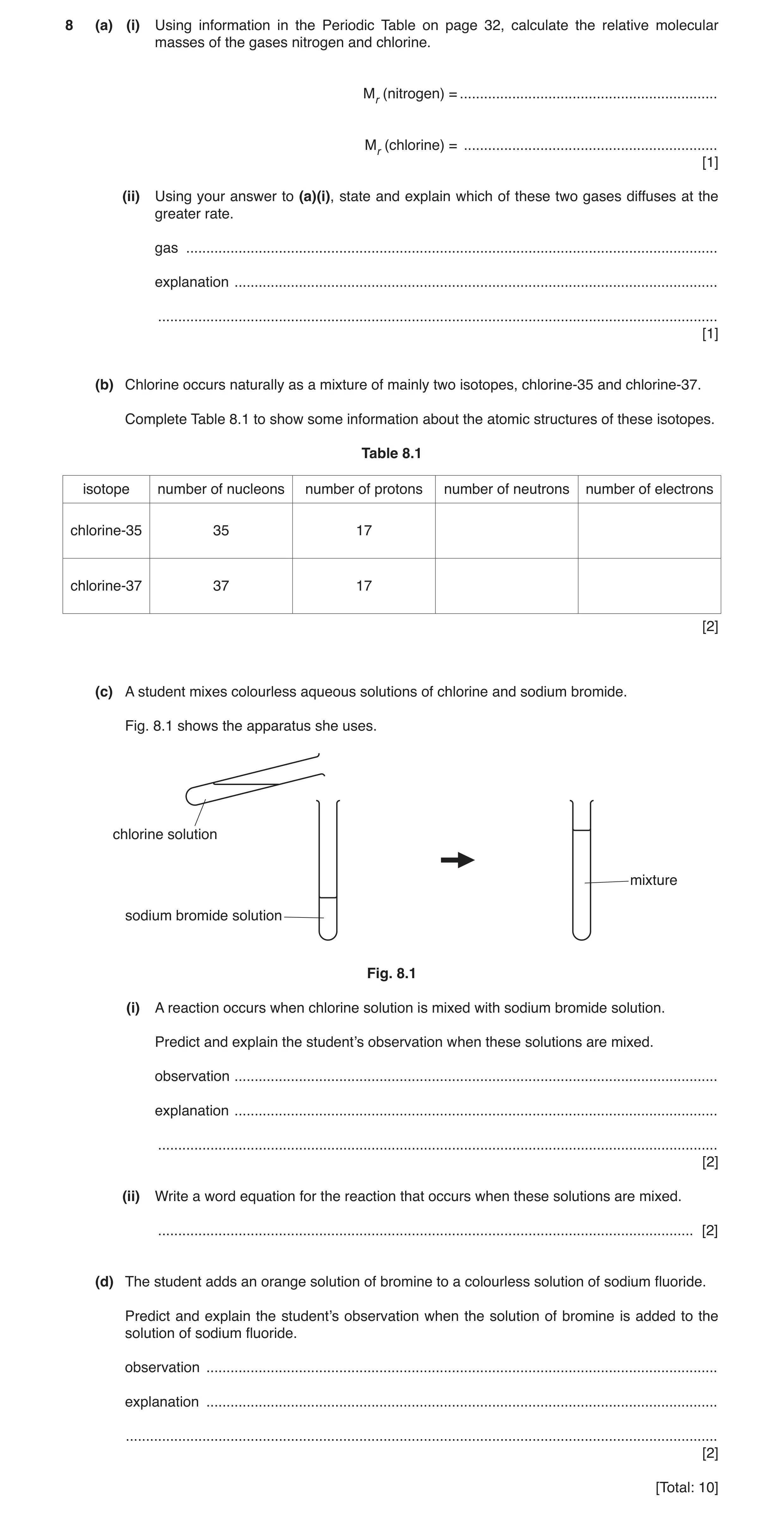
8 (a) (i) Using information in the Periodic Table on page 32, calculate the relative molecular masses of the gases nitrogen and chlorine. Mr (nitrogen) = … Mr (chlorine) = … [1] (ii) Using your answer to (a)(i), state and explain which of these two gases diffuses at the greater rate. gas … explanation … … [1] (b) Chlorine occurs naturally as a mixture of mainly two isotopes, chlorine-35 and chlorine-37. Complete Table 8.1 to show some information about the atomic structures of these isotopes. Table 8.1 isotope number of nucleons number of protons number of neutrons number of electrons chlorine-35 35 17 chlorine-37 37 17 [2] (c) A student mixes colourless aqueous solutions of chlorine and sodium bromide. Fig. 8.1 shows the apparatus she uses. chlorine solution mixture sodium bromide solution Fig. 8.1 (i) A reaction occurs when chlorine solution is mixed with sodium bromide solution. Predict and explain the student’s observation when these solutions are mixed. observation … explanation … … [2] (ii) Write a word equation for the reaction that occurs when these solutions are mixed. … [2] (d) The student adds an orange solution of bromine to a colourless solution of sodium fluoride. Predict and explain the student’s observation when the solution of bromine is added to the solution of sodium fluoride. observation … explanation … … [2] [Total: 10]
10 marks
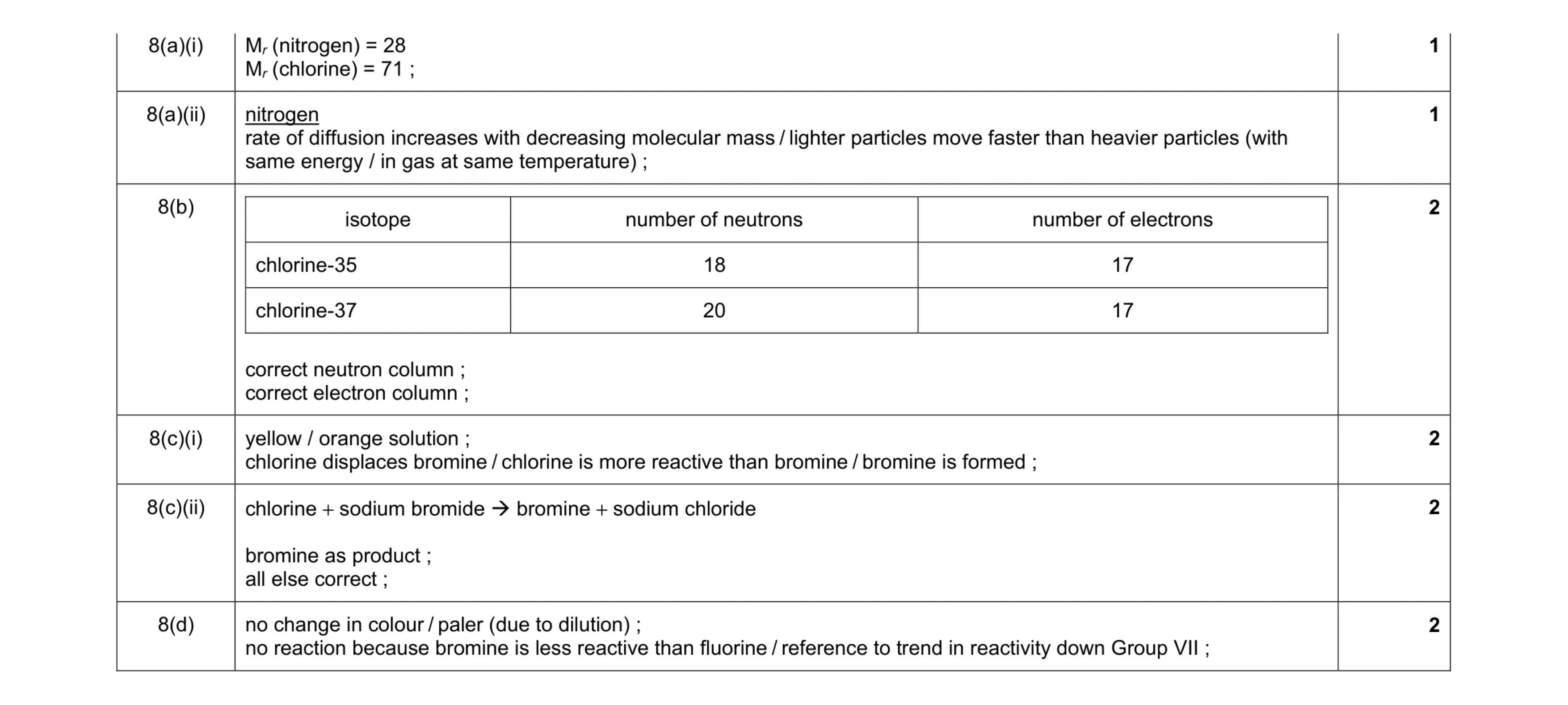
Mark scheme: 8(a)(i) Mr (nitrogen) = 28 Mr (chlorine) = 71 ; 1 8(a)(ii) nitrogen rate of diffusion increases with decreasing molecular mass / lighter particles move faster than heavier particles (with same energy / in gas at same temperature) ; 1 8(b) correct neutron column ; correct electron column ; isotope number of neutrons number of electrons chlorine-35 18 17 chlorine-37 20 17 2 8(c)(i) yellow / orange solution ; chlorine displaces bromine / chlorine is more reactive than bromine / bromine is formed ; 2 8(c)(ii) chlorine + sodium bromide Æ bromine + sodium chloride bromine as product ; all else correct ; 2 8(d) no change in colour / paler (due to dilution) ; no reaction because bromine is less reactive than fluorine / reference to trend in reactivity down Group VII ; 2
This question in 0654/41 May/June 2019
Q2 · Ammonium sulfate is a fertiliser 0654/43 Oct/Nov 2020
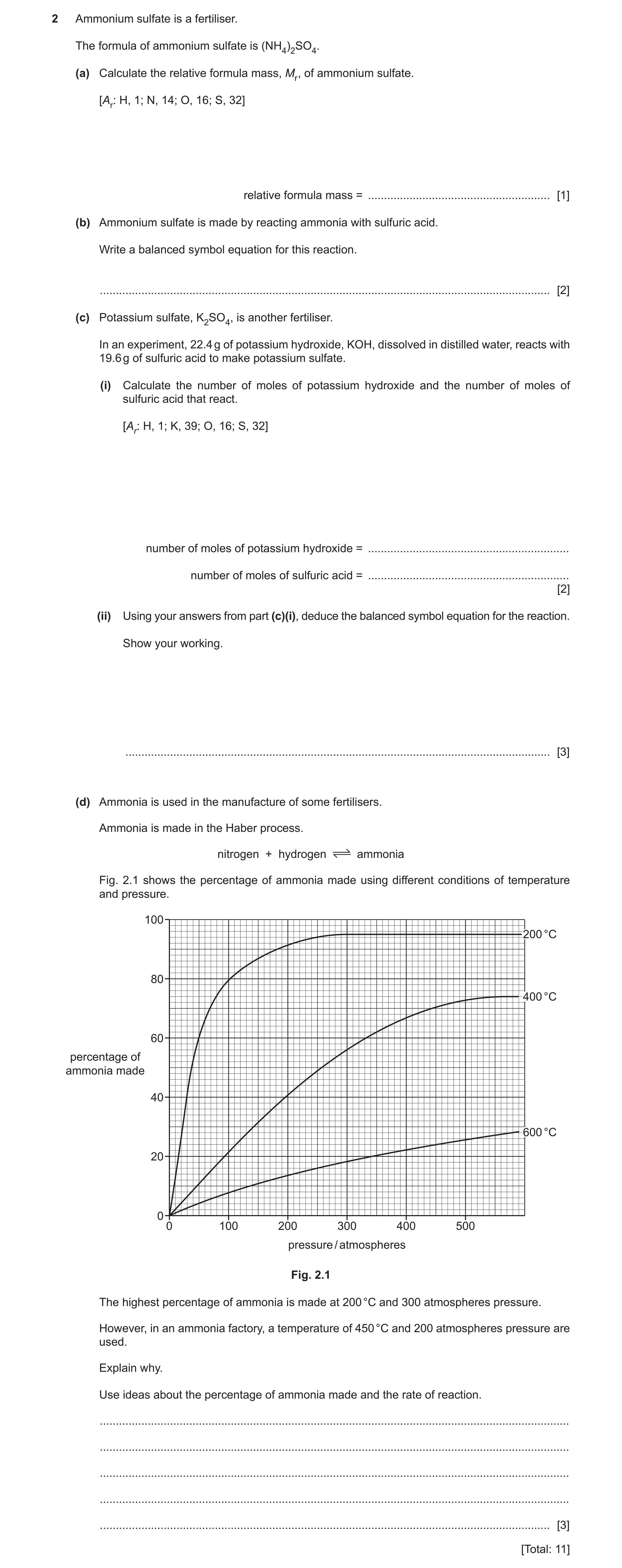
2 Ammonium sulfate is a fertiliser. The formula of ammonium sulfate is (NH4)2SO4. (a) Calculate the relative formula mass, Mr , of ammonium sulfate. [Ar: H, 1; N, 14; O, 16; S, 32] relative formula mass = … [1] (b) Ammonium sulfate is made by reacting ammonia with sulfuric acid. Write a balanced symbol equation for this reaction. … [2] (c) Potassium sulfate, K2SO4, is another fertiliser. In an experiment, 22.4 g of potassium hydroxide, KOH, dissolved in distilled water, reacts with 19.6 g of sulfuric acid to make potassium sulfate. (i) Calculate the number of moles of potassium hydroxide and the number of moles of sulfuric acid that react. [Ar: H, 1; K, 39; O, 16; S, 32] number of moles of potassium hydroxide = … number of moles of sulfuric acid = … [2] (ii) Using your answers from part (c)(i), deduce the balanced symbol equation for the reaction. Show your working. … [3] (d) Ammonia is used in the manufacture of some fertilisers. Ammonia is made in the Haber process. nitrogen + hydrogen ammonia Fig. 2.1 shows the percentage of ammonia made using different conditions of temperature and pressure. 100 200 °C 80 400 °C 60 percentage of ammonia made 40 600 °C 20 0 0 100 200 300 400 500 pressure / atmospheres Fig. 2.1 The highest percentage of ammonia is made at 200 °C and 300 atmospheres pressure. However, in an ammonia factory, a temperature of 450 °C and 200 atmospheres pressure are used. Explain why. Use ideas about the percentage of ammonia made and the rate of reaction. … … … … … [3] [Total: 11]
11 marks
Mark scheme: 2(a) 132 ; 1 2(b) 2NH3 + H2SO4 → (NH4)2SO4 correct formulae ; correctly balanced ; 2 2(c)(i) moles of KOH = mass ÷ Mr = 22.4 ÷ 56 = 0.40 moles of H2SO4 mass ÷ Mr = 19.6 ÷ 98 = 0.20 use of mass ÷ Mr or working ; 0.40 and 0.20 ; 2 Question Answer Marks 2(c)(ii) simplest whole number ratio is 2:1 / (so) 2 mol of KOH react with 1 mol of H2SO4 ; 2KOH + H2SO4 → K2SO4 + 2H2O correct formulae ; correctly balanced ; 3 2(d) 450°C / higher temperature (rather than 200°C) increases rate of reaction ; 200 atmospheres / lower pressure (rather than 300 atmospheres) safer / less expensive ; idea of compromise (e.g. between yield and rate) ; max 3 3
This question in 0654/43 Oct/Nov 2020
Q3 · Ammonia, NH3, is made in factories by the Haber process 0654/42 May/June 2021
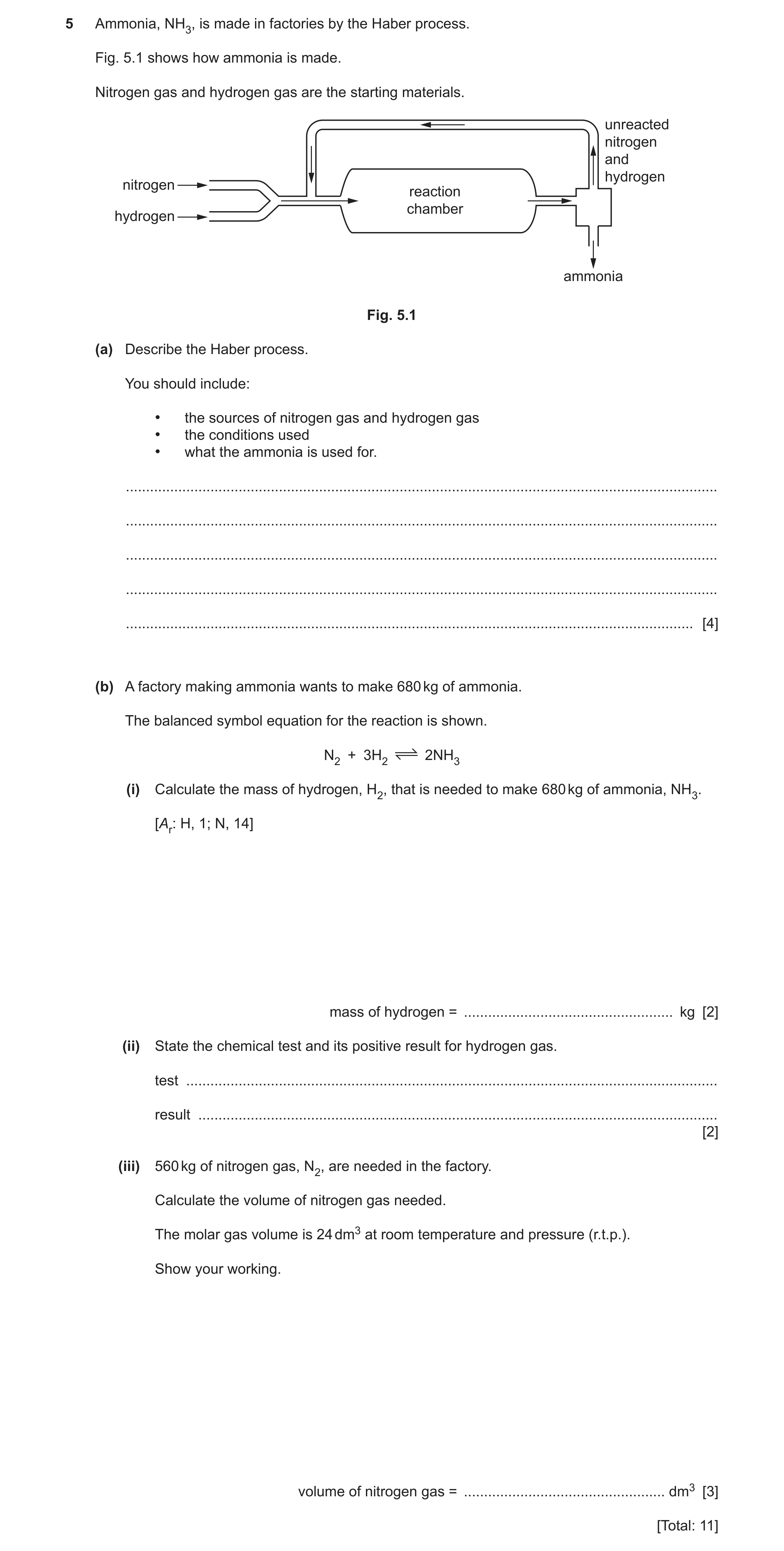
5 Ammonia, NH3, is made in factories by the Haber process. Fig. 5.1 shows how ammonia is made. Nitrogen gas and hydrogen gas are the starting materials. unreacted nitrogen and hydrogen nitrogen reaction chamber hydrogen ammonia Fig. 5.1 (a) Describe the Haber process. You should include: • the sources of nitrogen gas and hydrogen gas • the conditions used • what the ammonia is used for. … … … … … [4] (b) A factory making ammonia wants to make 680 kg of ammonia. The balanced symbol equation for the reaction is shown. N2 + 3H2 2NH3 (i) Calculate the mass of hydrogen, H2, that is needed to make 680 kg of ammonia, NH3. [Ar: H, 1; N, 14] mass of hydrogen = … kg [2] (ii) State the chemical test and its positive result for hydrogen gas. test … result … [2] (iii) 560 kg of nitrogen gas, N2, are needed in the factory. Calculate the volume of nitrogen gas needed. The molar gas volume is 24 dm3 at room temperature and pressure (r.t.p.). Show your working. volume of nitrogen gas = … dm3 [3] [Total: 11]
11 marks
Mark scheme: 5(a) source of nitrogen – air ; source of hydrogen – natural gas / cracking ; 200 atmospheres pressure / 450°C / iron catalyst ; ammonia is used for making fertilisers ; 4 5(b)(i) relative molecular mass of H2 = 2 and of NH3 = 17 or relative molecular mass of 3H2 = 6 and of 2NH3 = 34 ; (6 × 680 / 34 =) 120 (kg) ; 2 5(b)(ii) test – lighted splint / ignite gas ; result – (squeaky) pop ; 2 5(b)(iii) Mr of N2 = 28 ; moles of N2 = 560 000 ÷ 28 = 20 000 ; volume of N2 = 20 000 × 24 = 480 000 (dm³) ; 3
This question in 0654/42 May/June 2021
Q4 · Different methods can be used to extract metals from their ores 0654/43 May/June 2021
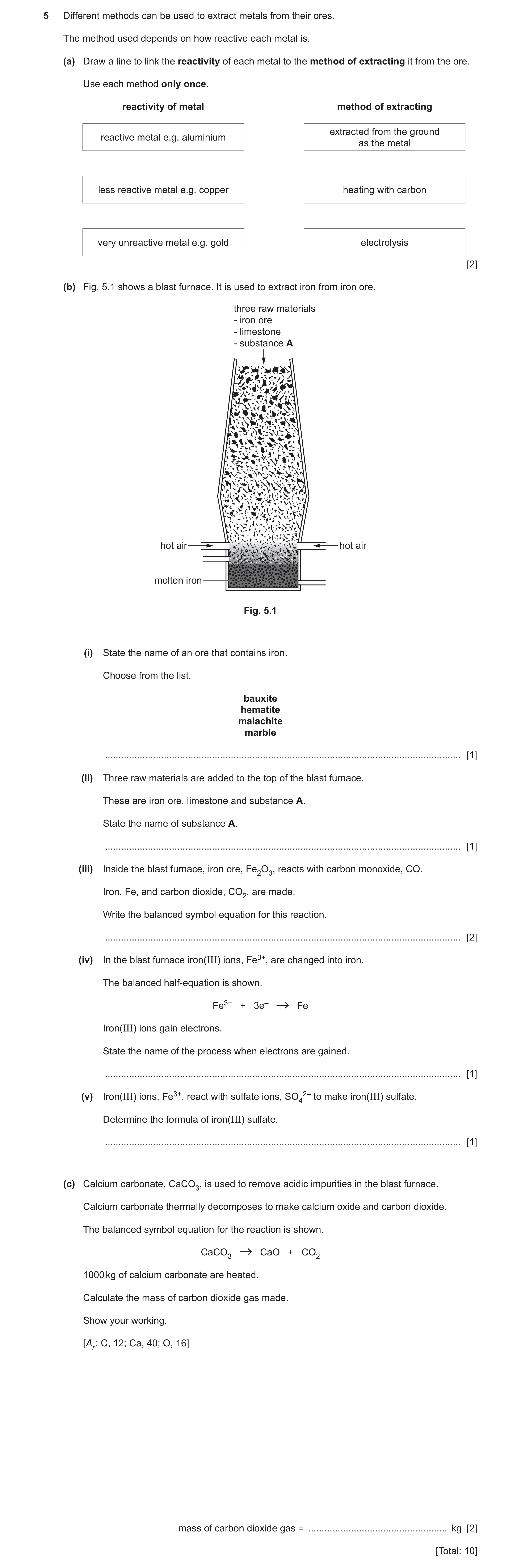
5 Different methods can be used to extract metals from their ores. The method used depends on how reactive each metal is. (a) Draw a line to link the reactivity of each metal to the method of extracting it from the ore. Use each method only once. reactivity of metal method of extracting extracted from the ground reactive metal e.g. aluminium as the metal less reactive metal e.g. copper heating with carbon very unreactive metal e.g. gold electrolysis [2] (b) Fig. 5.1 shows a blast furnace. It is used to extract iron from iron ore. three raw materials - iron ore - limestone - substance A hot air hot air molten iron Fig. 5.1 (i) State the name of an ore that contains iron. Choose from the list. bauxite hematite malachite marble … [1] (ii) Three raw materials are added to the top of the blast furnace. These are iron ore, limestone and substance A. State the name of substance A. … [1] (iii) Inside the blast furnace, iron ore, Fe2O3, reacts with carbon monoxide, CO. Iron, Fe, and carbon dioxide, CO2, are made. Write the balanced symbol equation for this reaction. … [2] (iv) In the blast furnace iron(III) ions, Fe3+, are changed into iron. The balanced half-equation is shown. Fe3+ + 3e– Fe Iron(III) ions gain electrons. State the name of the process when electrons are gained. … [1] (v) Iron(III) ions, Fe3+, react with sulfate ions, SO42– to make iron(III) sulfate. Determine the formula of iron(III) sulfate. … [1] (c) Calcium carbonate, CaCO3, is used to remove acidic impurities in the blast furnace. Calcium carbonate thermally decomposes to make calcium oxide and carbon dioxide. The balanced symbol equation for the reaction is shown. CaCO3 CaO + CO2 1000 kg of calcium carbonate are heated. Calculate the mass of carbon dioxide gas made. Show your working. [Ar : C, 12; Ca, 40; O, 16] mass of carbon dioxide gas = … kg [2] [Total: 10]
10 marks
Mark scheme: 5(a) ;; 5(b)(i) hematite ; 1 5(b)(ii) carbon / coke ; 1 5(b)(iii) Fe2O3 + 3CO → 2Fe + 3CO2 formulae ; balancing ; 2 5(b)(iv) reduction ; 1 5(b)(v) Fe2(SO4)3 ; 1 5(c) relative molecular mass of CaCO3 =100 and of CO2 = 44 ; 44 1000 100 × = 440 (kg) ; 2
This question in 0654/43 May/June 2021
Q5 · An oxygen atom has the electronic structure 2,6 0654/42 Oct/Nov 2021
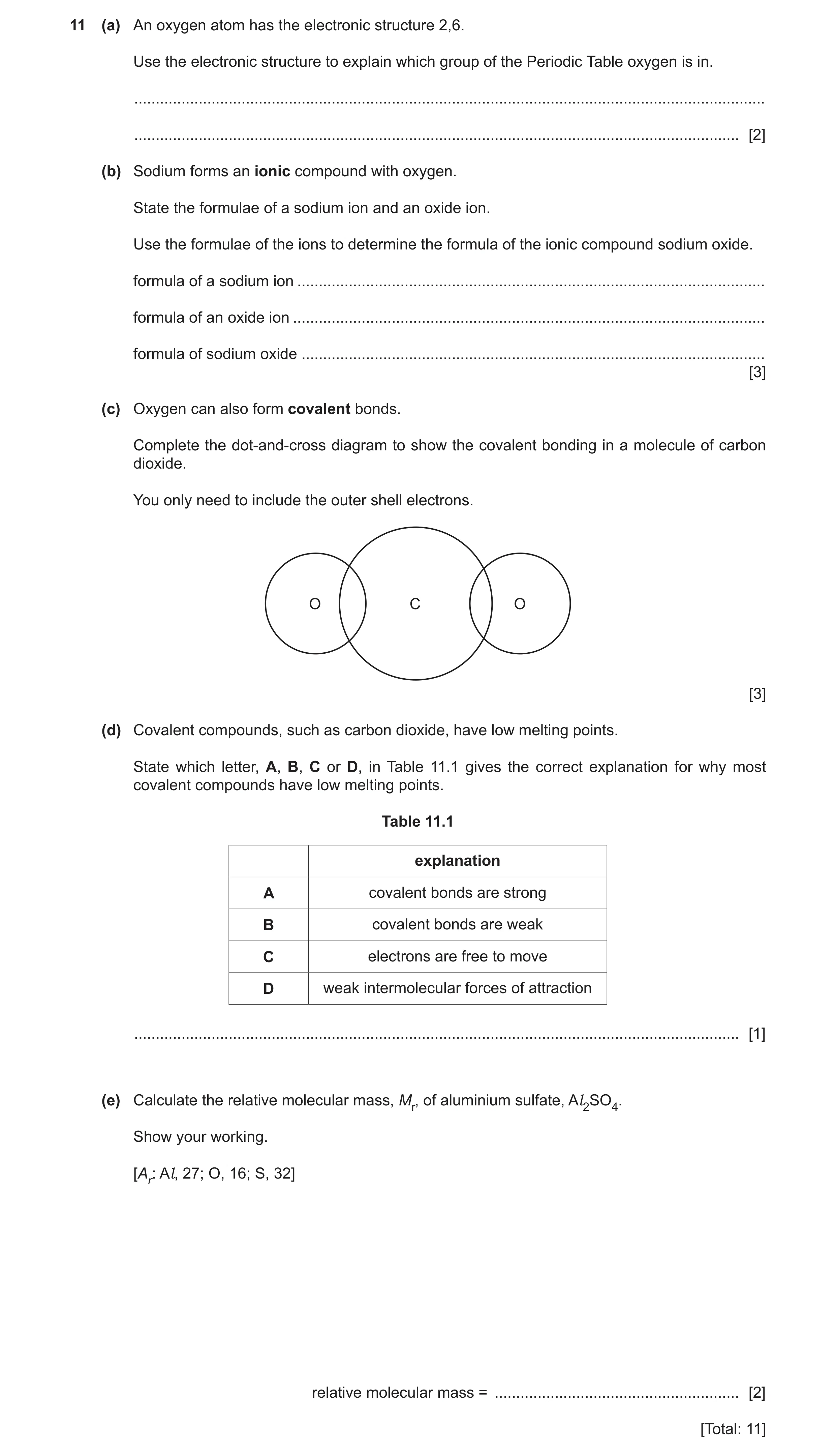
11 (a) An oxygen atom has the electronic structure 2,6. Use the electronic structure to explain which group of the Periodic Table oxygen is in. … … [2] (b) Sodium forms an ionic compound with oxygen. State the formulae of a sodium ion and an oxide ion. Use the formulae of the ions to determine the formula of the ionic compound sodium oxide. formula of a sodium ion … formula of an oxide ion … formula of sodium oxide … [3] (c) Oxygen can also form covalent bonds. Complete the dot-and-cross diagram to show the covalent bonding in a molecule of carbon dioxide. You only need to include the outer shell electrons. O C O [3] (d) Covalent compounds, such as carbon dioxide, have low melting points. State which letter, A, B, C or D, in Table 11.1 gives the correct explanation for why most covalent compounds have low melting points. Table 11.1 explanation A covalent bonds are strong B covalent bonds are weak C electrons are free to move D weak intermolecular forces of attraction … [1] (e) Calculate the relative molecular mass, Mr, of aluminium sulfate, Al2SO4. Show your working. [Ar: Al, 27; O, 16; S, 32] relative molecular mass = … [2] [Total: 11]
11 marks
Mark scheme: 11(a) group VI / group 6 ; (because) 6 electrons in the outer shell ; 2 11(b) sodium ion – Na+ ; oxide ion – O2- ; sodium oxide – Na2O ; 3 11(c) ;;; 3 11(d) D ; 1 11(e) [2 × 27] + 32 + [4 × 16] ; = 150 ; 2
This question in 0654/42 Oct/Nov 2021
Q6 · Plants need three essential elements: nitrogen, phosphorus and potassium 0654/42 May/June 2022
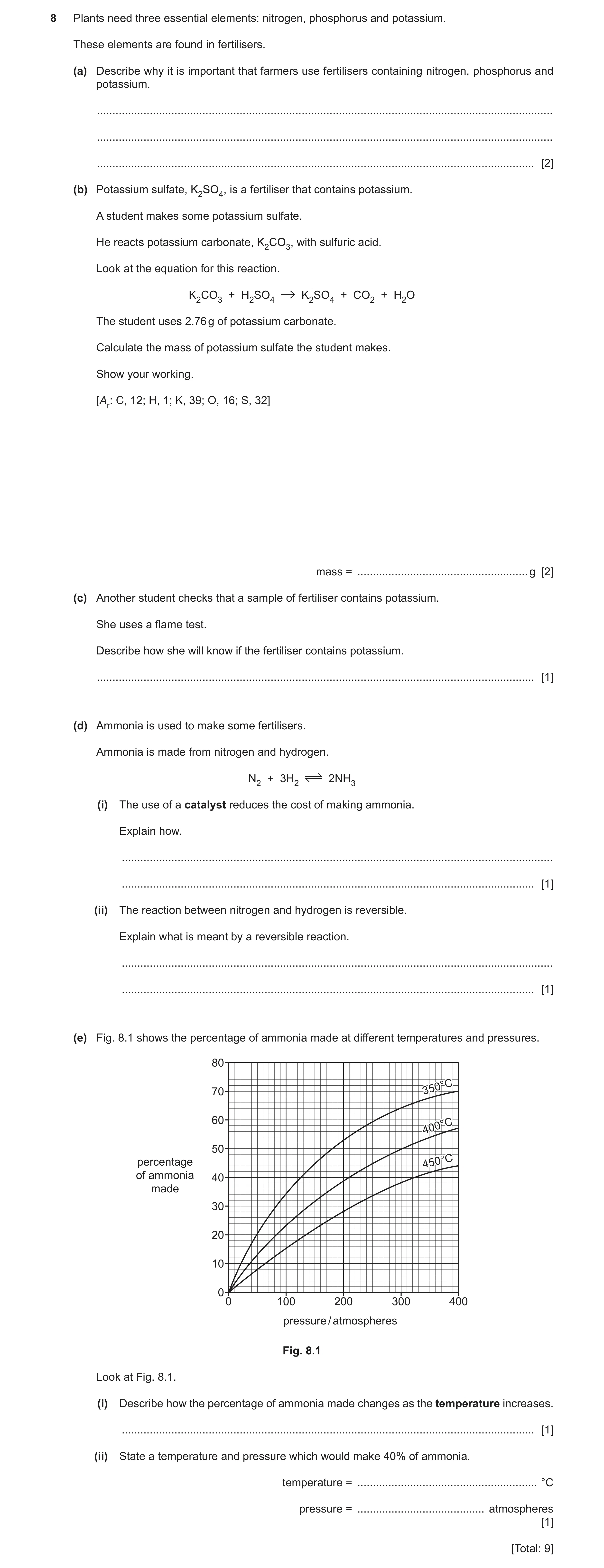
8 Plants need three essential elements: nitrogen, phosphorus and potassium. These elements are found in fertilisers. (a) Describe why it is important that farmers use fertilisers containing nitrogen, phosphorus and potassium. … … … [2] (b) Potassium sulfate, K2SO4, is a fertiliser that contains potassium. A student makes some potassium sulfate. He reacts potassium carbonate, K2CO3, with sulfuric acid. Look at the equation for this reaction. K2CO3 + H2SO4 K2SO4 + CO2 + H2O The student uses 2.76 g of potassium carbonate. Calculate the mass of potassium sulfate the student makes. Show your working. [Ar: C, 12; H, 1; K, 39; O, 16; S, 32] mass = … g [2] (c) Another student checks that a sample of fertiliser contains potassium. She uses a flame test. Describe how she will know if the fertiliser contains potassium. … [1] (d) Ammonia is used to make some fertilisers. Ammonia is made from nitrogen and hydrogen. N2 + 3H2 2NH3 (i) The use of a catalyst reduces the cost of making ammonia. Explain how. … … [1] (ii) The reaction between nitrogen and hydrogen is reversible. Explain what is meant by a reversible reaction. … … [1] (e) Fig. 8.1 shows the percentage of ammonia made at different temperatures and pressures. 80 70 350°C350°C 60 400°C400°C 50 percentage 450°C450°C of ammonia 40 made 30 20 10 0 0 100 200 300 400 pressure / atmospheres Fig. 8.1 Look at Fig. 8.1. (i) Describe how the percentage of ammonia made changes as the temperature increases. … [1] (ii) State a temperature and pressure which would make 40% of ammonia. temperature = … °C pressure = … atmospheres [1] [Total: 9]
9 marks
Mark scheme: 8(a) to, improve quality / increase yield / for growth, (of crop / plant) ; prevents discolouration of leaves / synthesis of (named) proteins or amino acids / replaces (named) minerals or ions in soil ; 2 8(b) relative formula mass of K2CO3 =138 and of K2SO4 = 174 ; 174 2.76 138 = 3.48 g ; 2 8(c) (flame test gives) a lilac / purple (flame) ; 1 Question Answer Marks 8(d)(i) (catalyst) increases rate of reaction ; 1 8(d)(ii) idea that reaction can go both ways / can go in both directions ; 1 8(e)(i) decreases / owtte ; 1 8(e)(ii) 350 °C and 125 atm OR 400 °C and 210 atm OR 450 °C and 325 atm ; 1
This question in 0654/42 May/June 2022
Q7 · Ammonia is manufactured in the Haber process 0654/42 Feb/March 2024
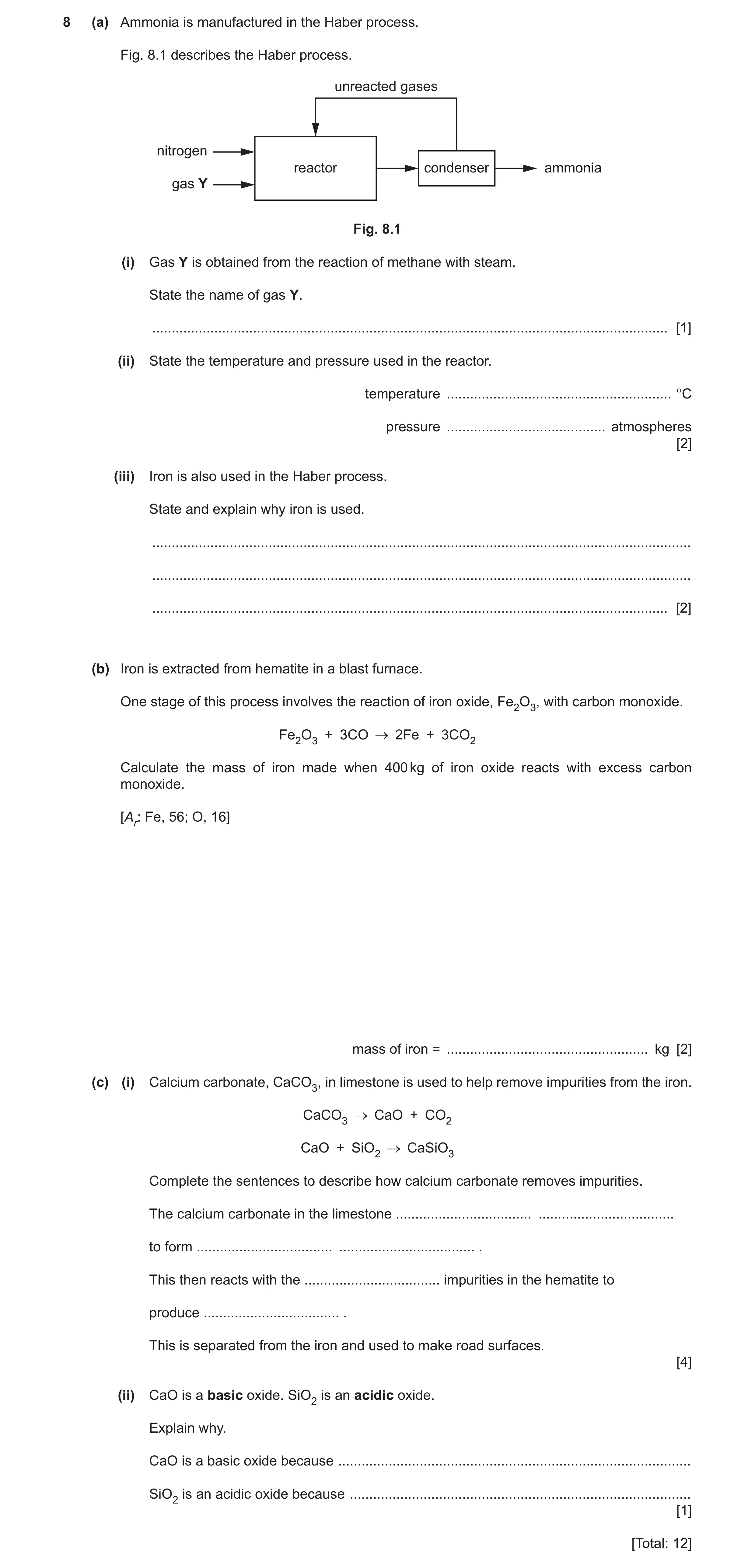
8 (a) Ammonia is manufactured in the Haber process. Fig. 8.1 describes the Haber process. unreacted gases nitrogen reactor condenser ammonia gas Y Fig. 8.1 (i) Gas Y is obtained from the reaction of methane with steam. State the name of gas Y. … [1] (ii) State the temperature and pressure used in the reactor. temperature … °C pressure … atmospheres [2] (iii) Iron is also used in the Haber process. State and explain why iron is used. … … … [2] (b) Iron is extracted from hematite in a blast furnace. One stage of this process involves the reaction of iron oxide, Fe2O3, with carbon monoxide. Fe2O3 + 3CO 2Fe + 3CO2 Calculate the mass of iron made when 400 kg of iron oxide reacts with excess carbon monoxide. [Ar: Fe, 56; O, 16] mass of iron = … kg [2] (c) (i) Calcium carbonate, CaCO3, in limestone is used to help remove impurities from the iron. CaCO3 CaO + CO2 CaO + SiO2 CaSiO3 Complete the sentences to describe how calcium carbonate removes impurities. The calcium carbonate in the limestone … … to form … … . This then reacts with the … impurities in the hematite to produce … . This is separated from the iron and used to make road surfaces. [4] (ii) CaO is a basic oxide. SiO2 is an acidic oxide. Explain why. CaO is a basic oxide because … SiO2 is an acidic oxide because … [1] [Total: 12]
12 marks
Mark scheme: 8(a)(i) hydrogen ; 1 8(a)(ii) temperature – 450 °C ; 2 pressure – 200 atmospheres ; 8(a)(iii) catalyst ; 2 to speed up the (rate of) reaction / lower activation energy ; 8(b) relative molecular mass of Fe2O3 = 160 ; 2 112 400 = 280 ; 160 8(c)(i) thermally decomposes ; 4 calcium oxide. ; acidic / silica / sand ; slag / calcium silicate. ; 8(c)(ii) (CaO is a basic oxide because) Ca / calcium is a metal 1 (SiO2 is an acidic oxide because) Si is a non-metal ;
This question in 0654/42 Feb/March 2024
Q8 · Sulfuric acid is made by the Contact process 0654/42 May/June 2024
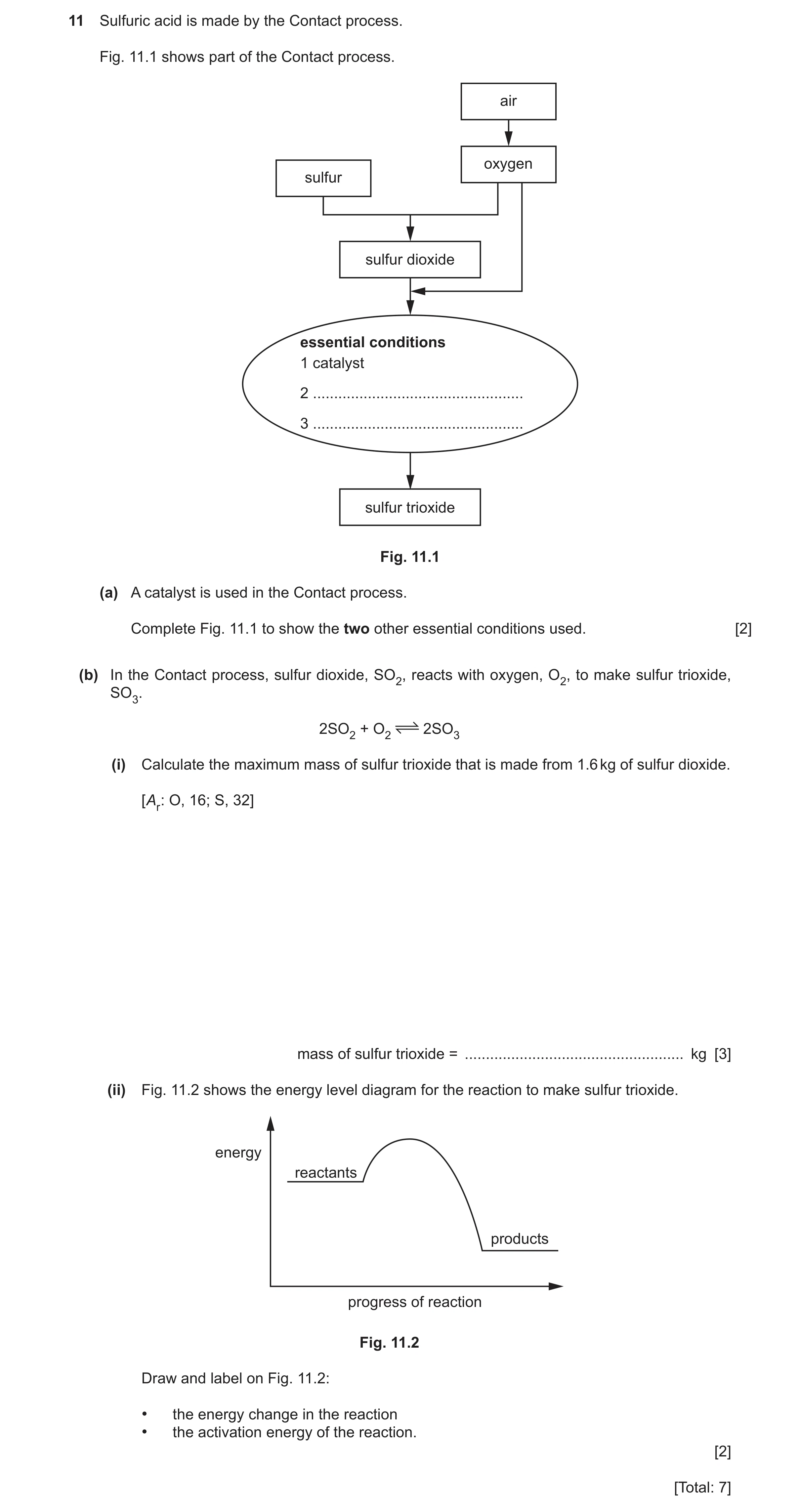
11 Sulfuric acid is made by the Contact process. Fig. 11.1 shows part of the Contact process. air oxygen sulfur sulfur dioxide essential conditions 1 catalyst 2 … 3 … sulfur trioxide Fig. 11.1 (a) A catalyst is used in the Contact process. Complete Fig. 11.1 to show the two other essential conditions used. [2] (b) In the Contact process, sulfur dioxide, SO2, reacts with oxygen, O2, to make sulfur trioxide, SO3. 2SO2 + O2 2SO3 (i) Calculate the maximum mass of sulfur trioxide that is made from 1.6 kg of sulfur dioxide. [Ar: O, 16; S, 32] mass of sulfur trioxide = … kg [3] (ii) Fig. 11.2 shows the energy level diagram for the reaction to make sulfur trioxide. energy reactants products progress of reaction Fig. 11.2 Draw and label on Fig. 11.2: • the energy change in the reaction • the activation energy of the reaction. [2] [Total: 7]
7 marks
Mark scheme: 11(a) 450 °C ; 1–2 atmospheres ; 2 11(b)(i) (Mr of SO2) = 64 and (Mr of SO3) = 80 ; (Mass of SO3) = 80 64 1.6 ; = 2.0 (kg) ; 3 Question Answer Marks 11(b)(ii) energy change in reaction ; activation energy ; 2 activation energy energy change
This question in 0654/42 May/June 2024
Q9 · A student investigates the reaction between calcium carbonate and dilute hydrochloric acid 0654/43 May/June 2024
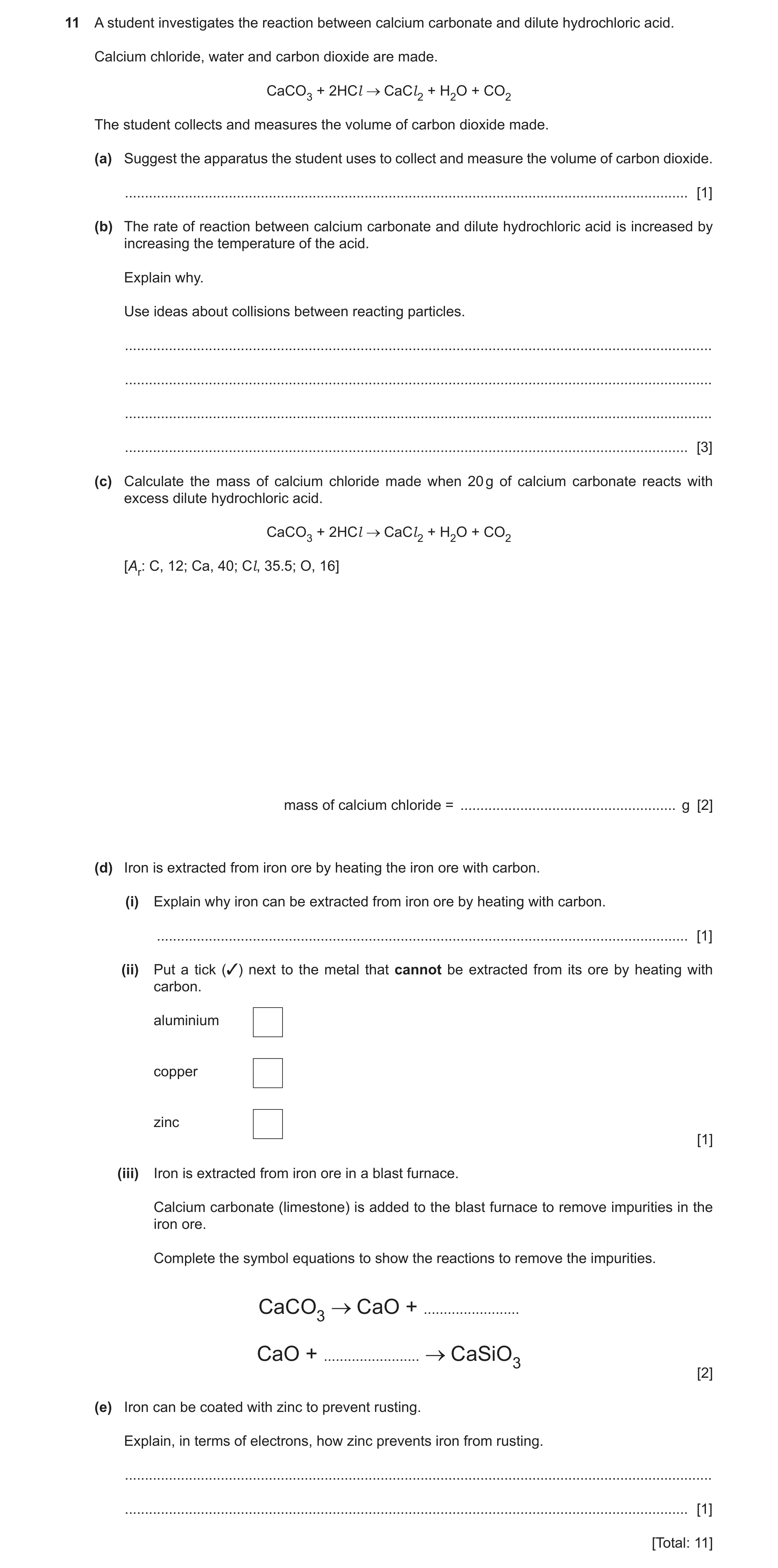
11 A student investigates the reaction between calcium carbonate and dilute hydrochloric acid. Calcium chloride, water and carbon dioxide are made. CaCO3 + 2HCl CaCl 2 + H2O + CO2 The student collects and measures the volume of carbon dioxide made. (a) Suggest the apparatus the student uses to collect and measure the volume of carbon dioxide. … [1] (b) The rate of reaction between calcium carbonate and dilute hydrochloric acid is increased by increasing the temperature of the acid. Explain why. Use ideas about collisions between reacting particles. … … … … [3] (c) Calculate the mass of calcium chloride made when 20 g of calcium carbonate reacts with excess dilute hydrochloric acid. CaCO3 + 2HCl CaCl 2 + H2O + CO2 [Ar: C, 12; Ca, 40; Cl, 35.5; O, 16] mass of calcium chloride = … g [2] (d) Iron is extracted from iron ore by heating the iron ore with carbon. (i) Explain why iron can be extracted from iron ore by heating with carbon. … [1] (ii) Put a tick (✓) next to the metal that cannot be extracted from its ore by heating with carbon. aluminium copper zinc [1] (iii) Iron is extracted from iron ore in a blast furnace. Calcium carbonate (limestone) is added to the blast furnace to remove impurities in the iron ore. Complete the symbol equations to show the reactions to remove the impurities. … CaCO3 CaO + CaO + … CaSiO3 [2] (e) Iron can be coated with zinc to prevent rusting. Explain, in terms of electrons, how zinc prevents iron from rusting. … … [1] [Total: 11]
11 marks
Mark scheme: 11(a) gas syringe / measuring cylinder over water ; 1 11(b) Any 3 from particles have more kinetic energy / molecules move faster ; more particles with activation energy ; more successful collisions ; frequency of collision (of particles) is higher / more collisions per second ; 3 11(c) relative molecular mass of CaCO3 = 100 and CaCl2 = 111 / 111 20 100 = 22.2 (g) ;; 2 11(d)(i) carbon is more reactive than iron / ORA ; 1 11(d)(ii) aluminium ; 1 11(d)(iii) CO2 ; SiO2 ; 2 11(e) zinc loses electrons more readily than iron / ORA ; 1
This question in 0654/43 May/June 2024
Q10 · The reactivity series of some metals 0654/43 Oct/Nov 2024
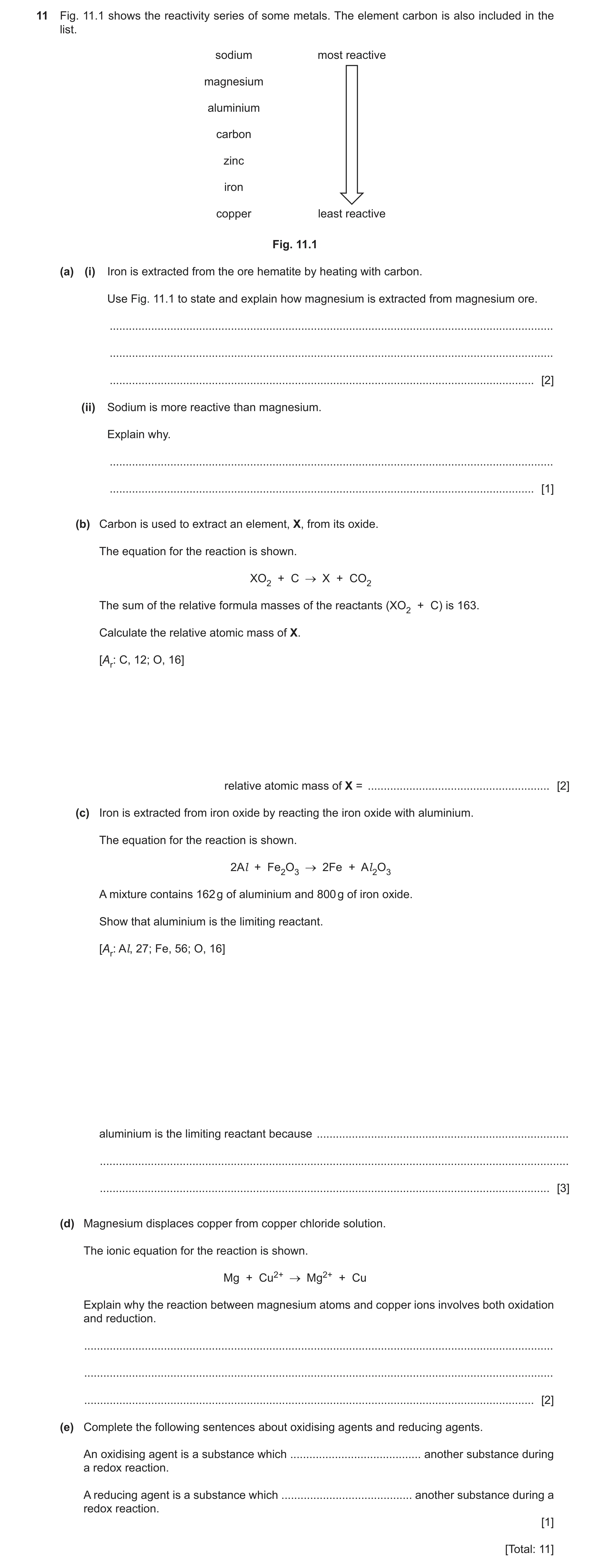
11 Fig. 11.1 shows the reactivity series of some metals. The element carbon is also included in the list. sodium most reactive magnesium aluminium carbon zinc iron copper least reactive Fig. 11.1 (a) (i) Iron is extracted from the ore hematite by heating with carbon. Use Fig. 11.1 to state and explain how magnesium is extracted from magnesium ore. … … … [2] (ii) Sodium is more reactive than magnesium. Explain why. … … [1] (b) Carbon is used to extract an element, X, from its oxide. The equation for the reaction is shown. XO2 + C X + CO2 The sum of the relative formula masses of the reactants (XO2 + C) is 163. Calculate the relative atomic mass of X. [Ar: C, 12; O, 16] relative atomic mass of X = … [2] (c) Iron is extracted from iron oxide by reacting the iron oxide with aluminium. The equation for the reaction is shown. 2Al + Fe2O3 2Fe + Al 2O3 A mixture contains 162 g of aluminium and 800 g of iron oxide. Show that aluminium is the limiting reactant. [Ar: Al, 27; Fe, 56; O, 16] aluminium is the limiting reactant because … … … [3] (d) Magnesium displaces copper from copper chloride solution. The ionic equation for the reaction is shown. Mg + Cu2+ Mg2+ + Cu Explain why the reaction between magnesium atoms and copper ions involves both oxidation and reduction. … … … [2] (e) Complete the following sentences about oxidising agents and reducing agents. An oxidising agent is a substance which … another substance during a redox reaction. A reducing agent is a substance which … another substance during a redox reaction. [1] [Total: 11]
11 marks
Mark scheme: 11(a)(i) electrolysis ; 2 carbon is less reactive than magnesium / ORA / carbon cannot displace the magnesium from the magnesium ore ; 11(a)(ii) (idea that sodium atoms) form positive (sodium) ions more easily (than magnesium) / 1 (idea that sodium atoms) lose electrons more easily (than magnesium) ; 11(b) Mr of CO2 = 44 / relative atomic mass of X = 163 – 44 / 163 – 32 – 12 ; 2 119 ; 11(c) (moles of Fe2O3 = 800 / 160 =) 5 ; 3 (moles of Al = 162 / 27 =) 6 ; (aluminium is limiting because) 6 mol is less than the (2 5 =) 10 mol (aluminium needed) or iron oxide is in excess because 5 mol is more than the (6 ÷ 2 =) 3 mol (iron oxide needed) ; 11(d) oxidation because magnesium atoms lose electrons ; 2 reduction because copper ions gain electrons ; 11(e) oxidises 1 and reduces ;
This question in 0654/43 Oct/Nov 2024
Q11 · The metal iron is extracted from hematite in a blast furnace 0654/41 May/June 2025
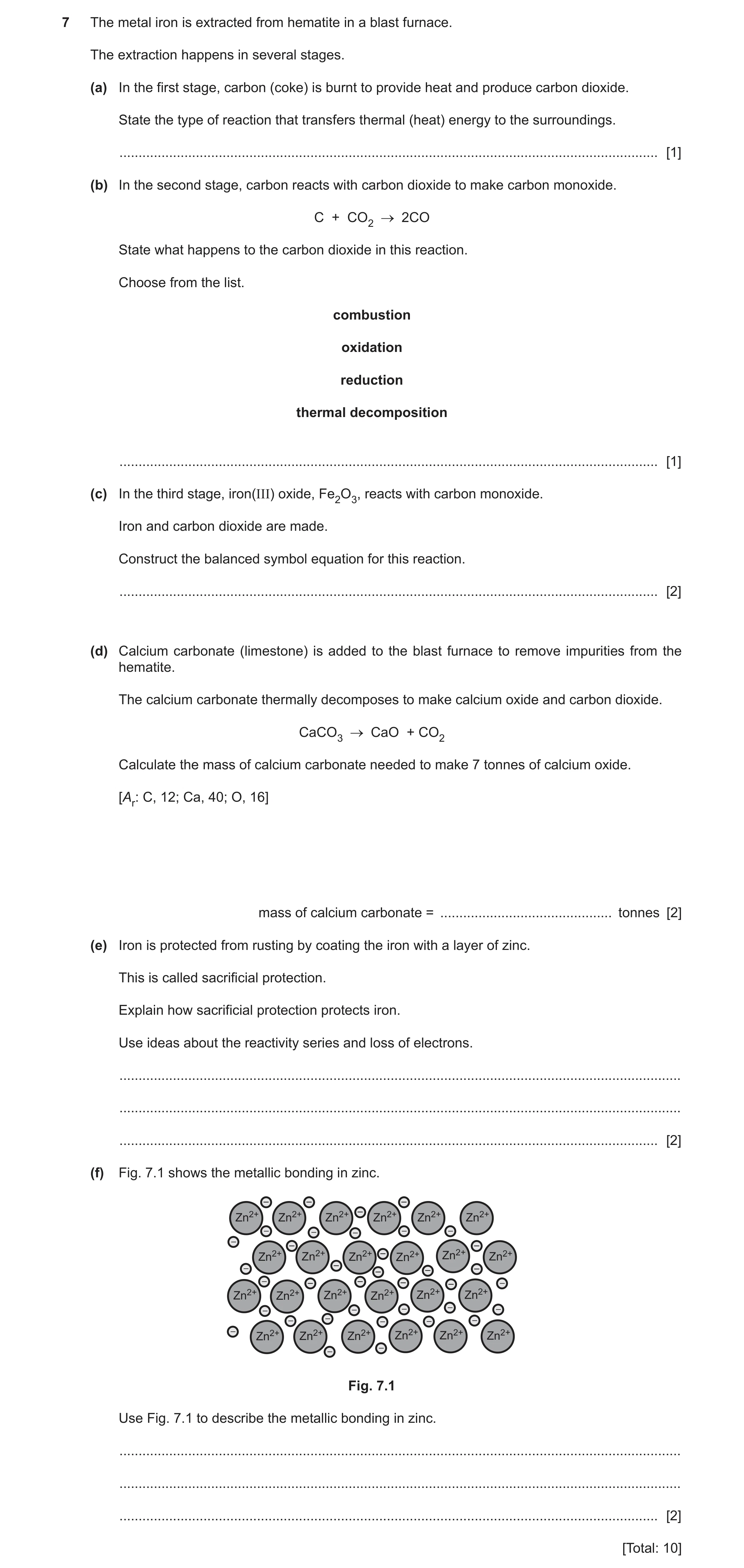
7 The metal iron is extracted from hematite in a blast furnace. The extraction happens in several stages. (a) In the first stage, carbon (coke) is burnt to provide heat and produce carbon dioxide. State the type of reaction that transfers thermal (heat) energy to the surroundings. … [1] (b) In the second stage, carbon reacts with carbon dioxide to make carbon monoxide. C + CO2 2CO State what happens to the carbon dioxide in this reaction. Choose from the list. combustion oxidation reduction thermal decomposition … [1] (c) In the third stage, iron(III) oxide, Fe2O3, reacts with carbon monoxide. Iron and carbon dioxide are made. Construct the balanced symbol equation for this reaction. … [2] (d) Calcium carbonate (limestone) is added to the blast furnace to remove impurities from the hematite. The calcium carbonate thermally decomposes to make calcium oxide and carbon dioxide. CaCO3 CaO + CO2 Calculate the mass of calcium carbonate needed to make 7 tonnes of calcium oxide. [Ar: C, 12; Ca, 40; O, 16] mass of calcium carbonate = … tonnes [2] (e) Iron is protected from rusting by coating the iron with a layer of zinc. This is called sacrificial protection. Explain how sacrificial protection protects iron. Use ideas about the reactivity series and loss of electrons. … … … [2] (f) Fig. 7.1 shows the metallic bonding in zinc. – – – Zn2+ Zn2+ Zn2+ – Zn2+ Zn2+ Zn2+ – – – – – – – – Zn2+ Zn2+ Zn2+ – Zn2+ Zn2+ Zn2+ – – – – – – – – – – – Zn2+ Zn2+ Zn2+ Zn2+ Zn2+ Zn2+ – – – – – – – – – – – Zn2+ Zn2+ Zn2+ Zn2+ Zn2+ Zn2+ – – Fig. 7.1 Use Fig. 7.1 to describe the metallic bonding in zinc. … … … [2] [Total: 10]
10 marks
Mark scheme: 7(a) exothermic ; 1 7(b) reduction ; 1 7(c) Fe2O3 + 3CO → 2Fe + 3CO2 ;; 2 7(d) Mr of CaCO3 = 100 and Mr of CaO = 56 ; 2 100 7 = 12.5 (tonnes) ; 56 7(e) zinc is more reactive than iron / ORA ; 2 zinc loses electrons more easily than iron / ORA ; 7(f) electrostatic attraction ; 2 between positive (zinc / metal) ions and (a ‘sea’ of) delocalised electrons ;
This question in 0654/41 May/June 2025
 10
10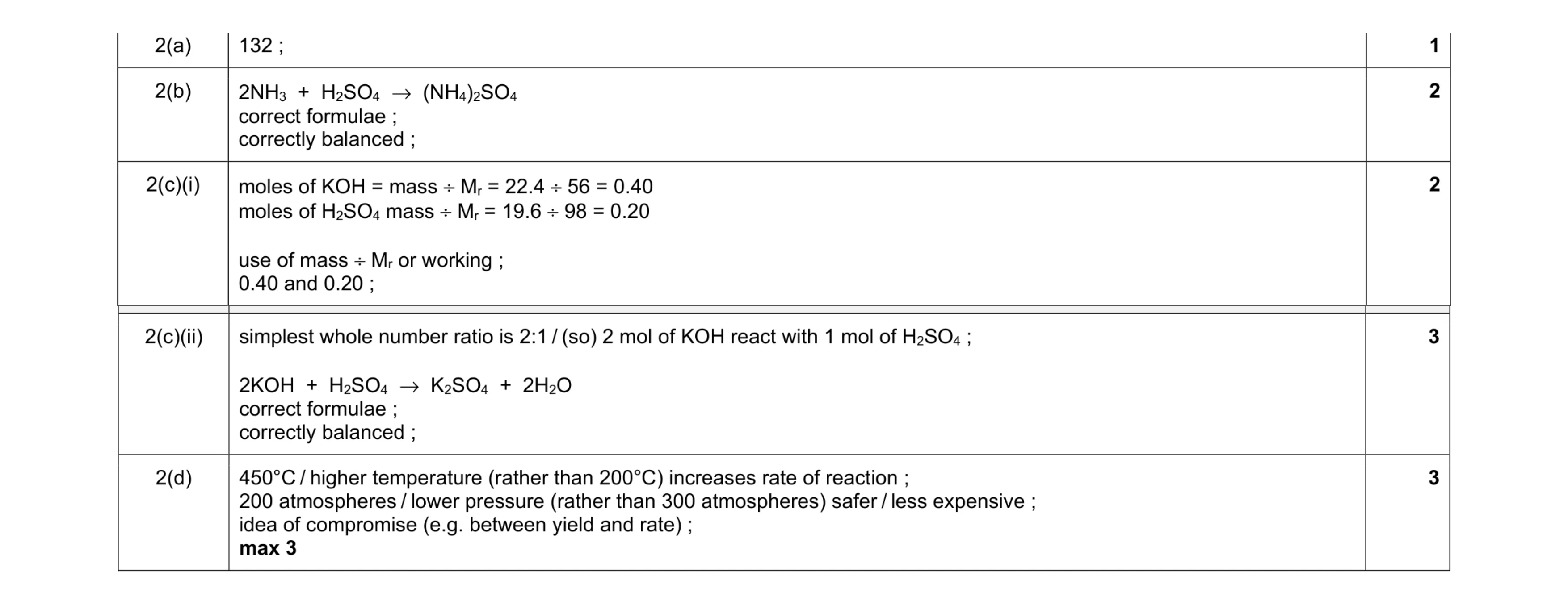 11
11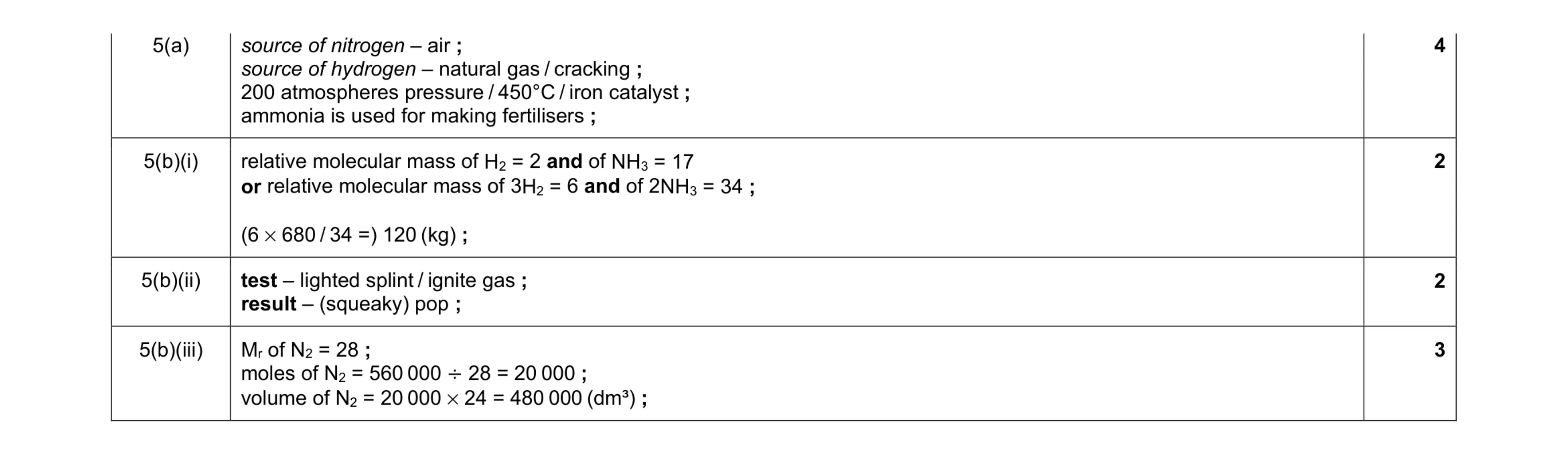 11
11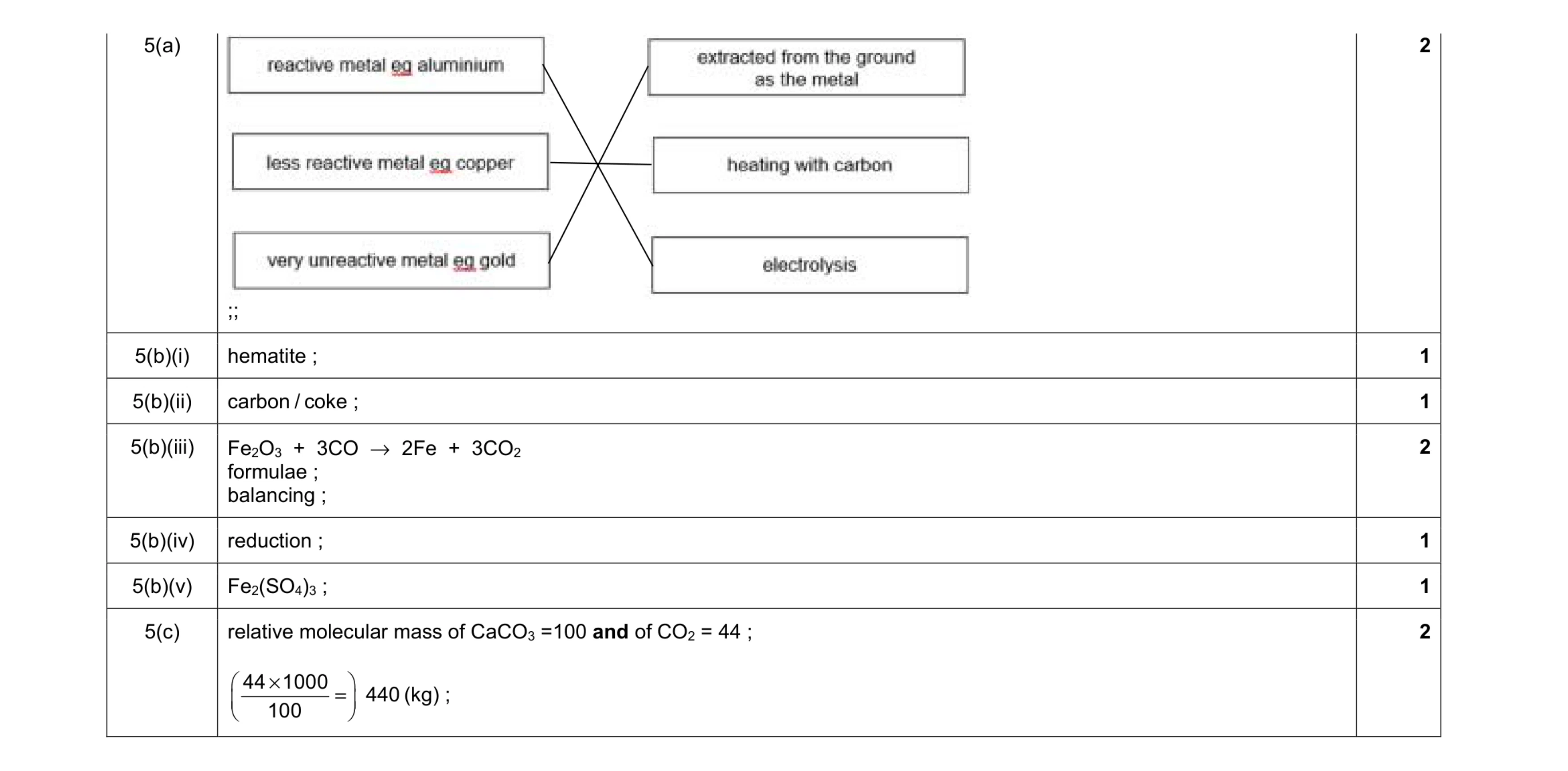 10
10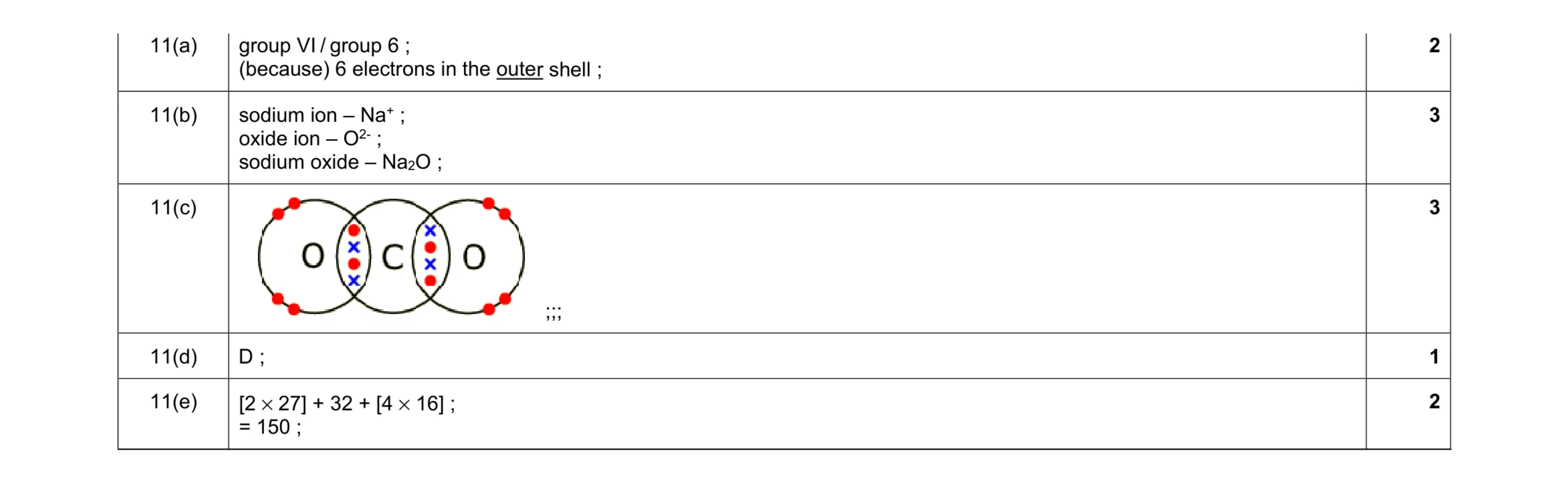 11
11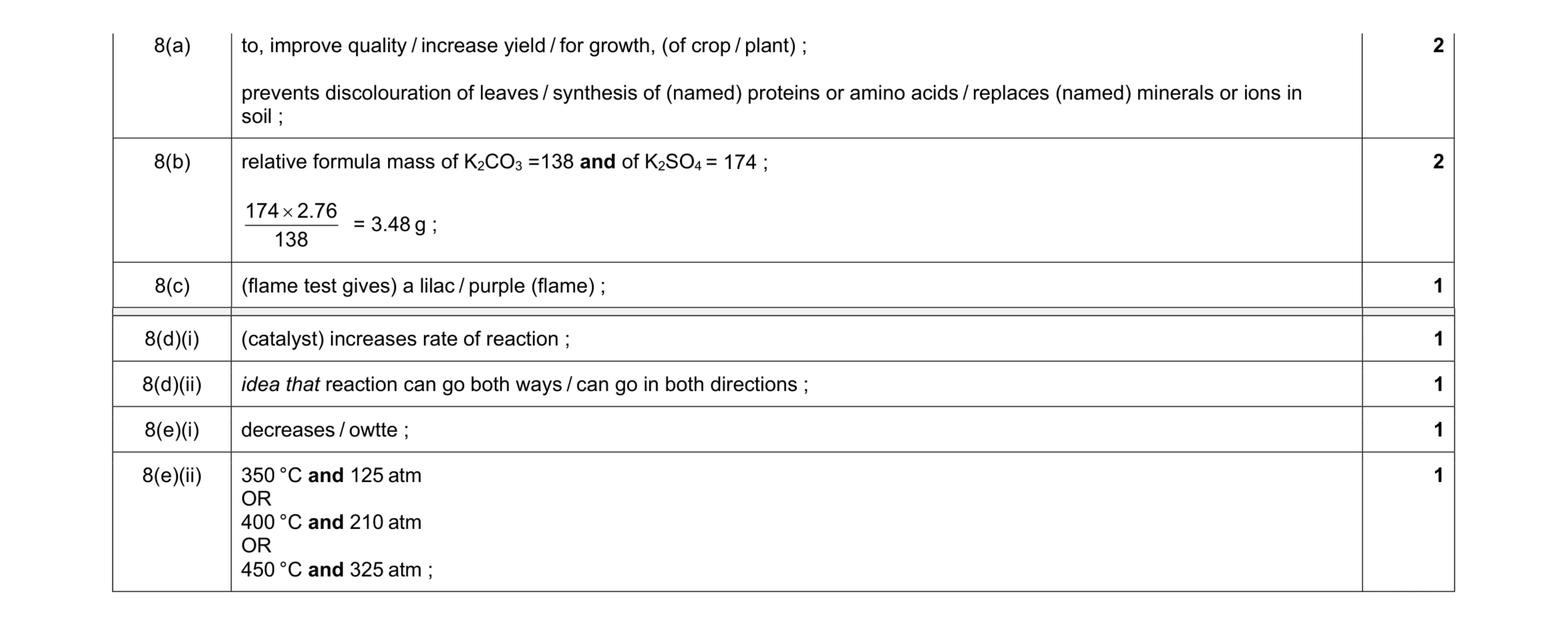 9
9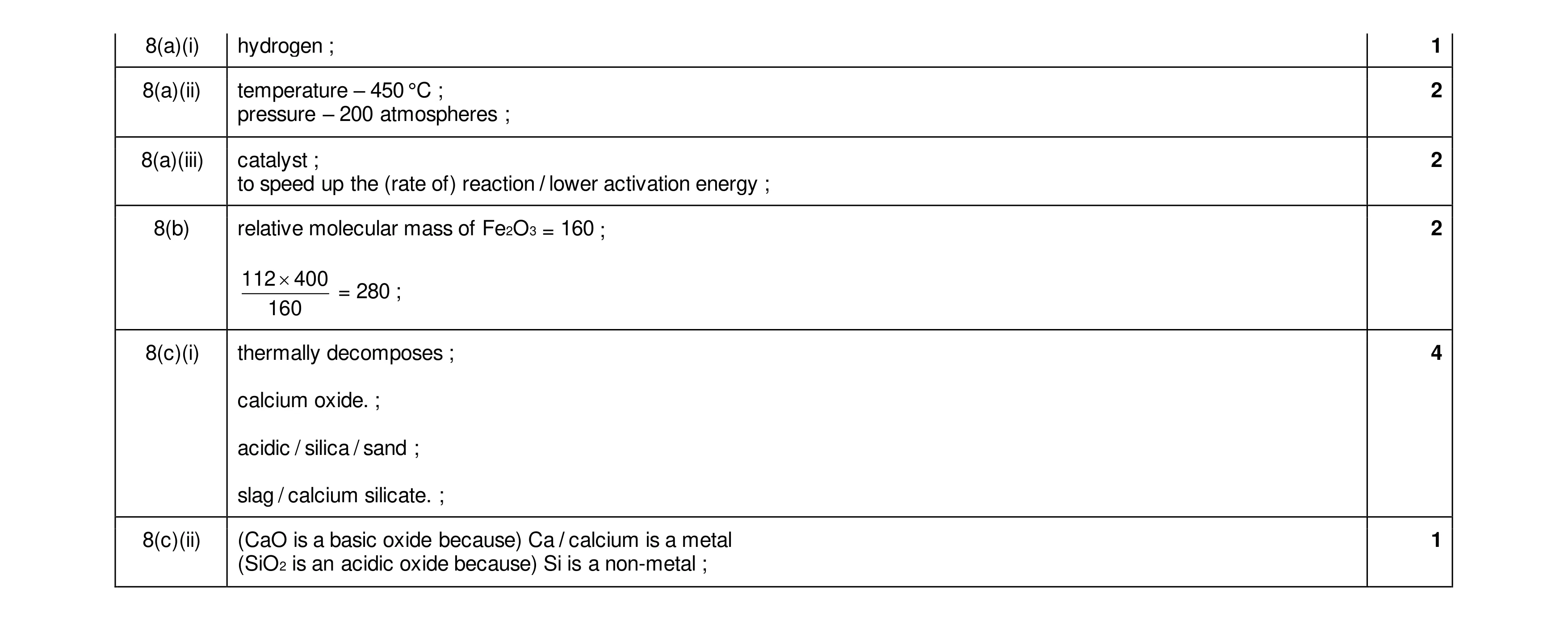 12
12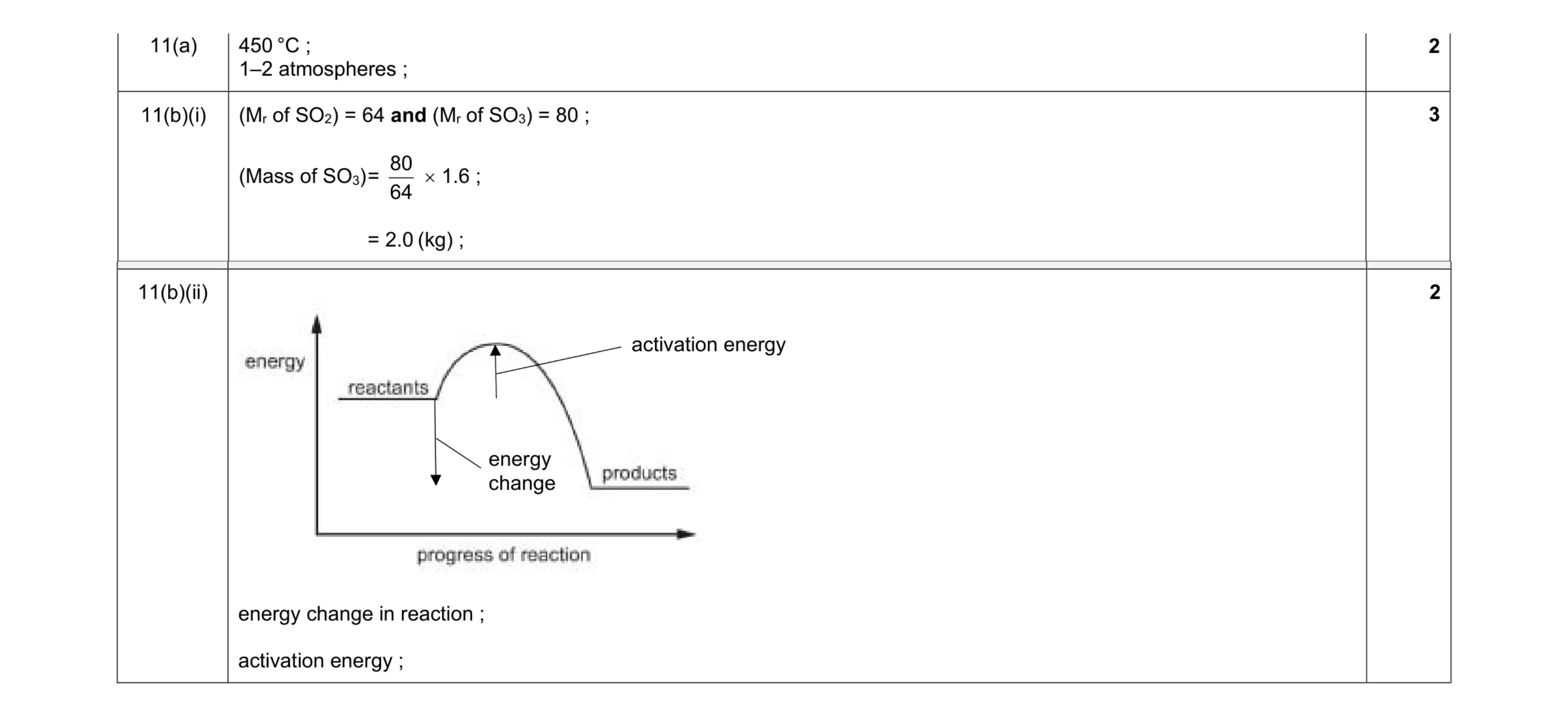 7
7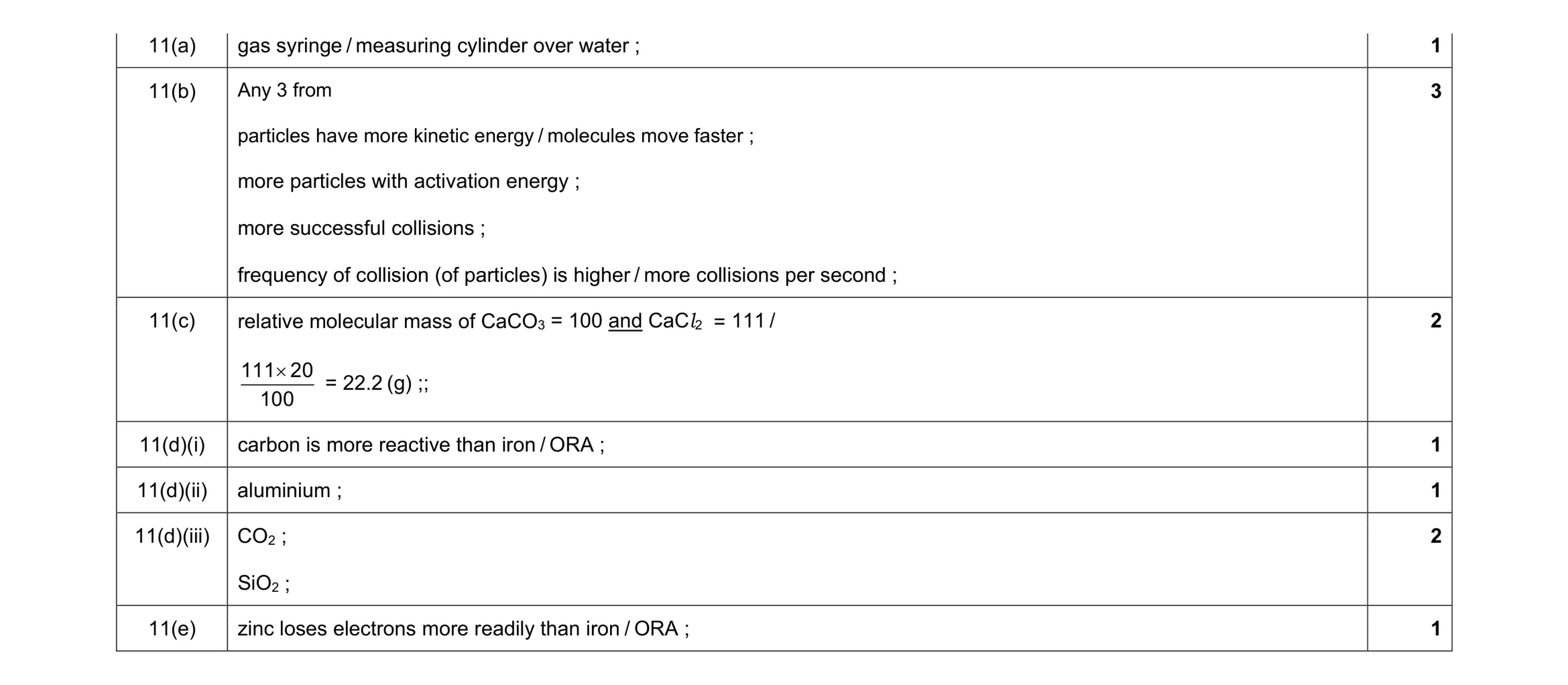 11
11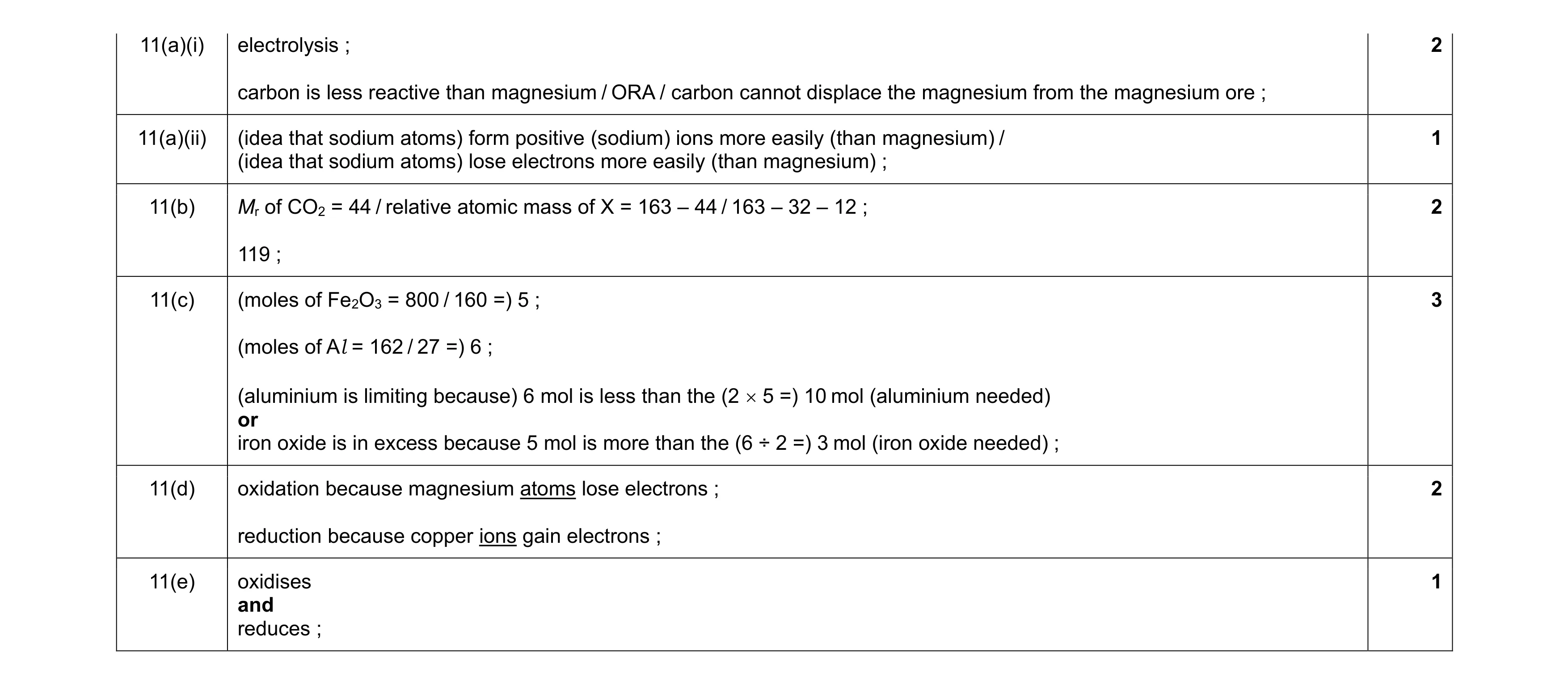 11
11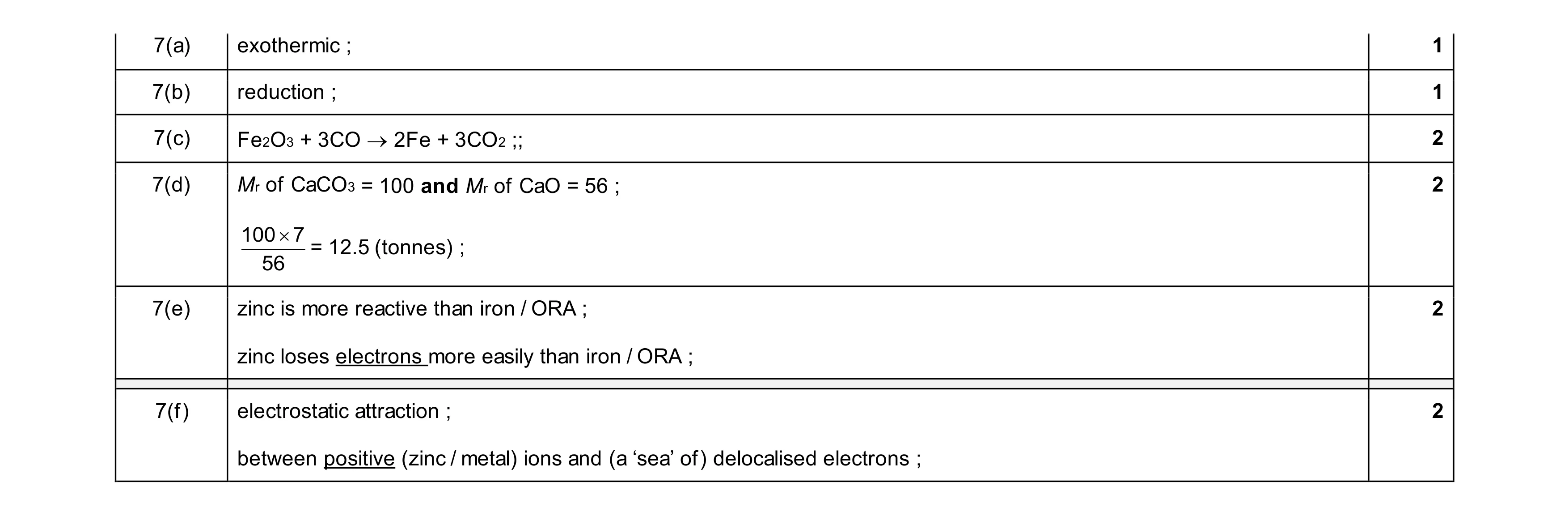 10
10