Questions as text
Q1 · A drawing of the alimentary canal and associated organs 0654/32 May/June 2017
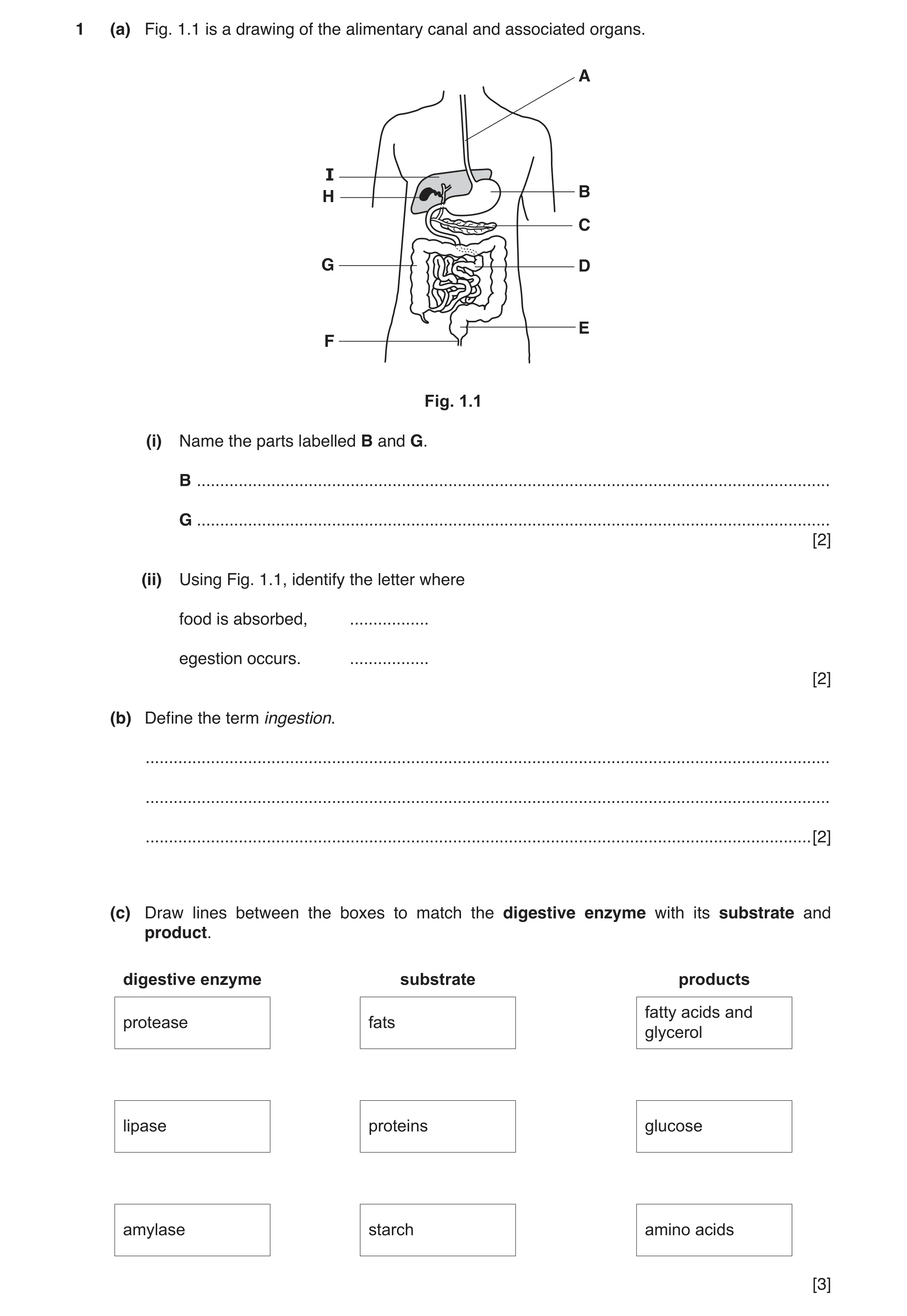
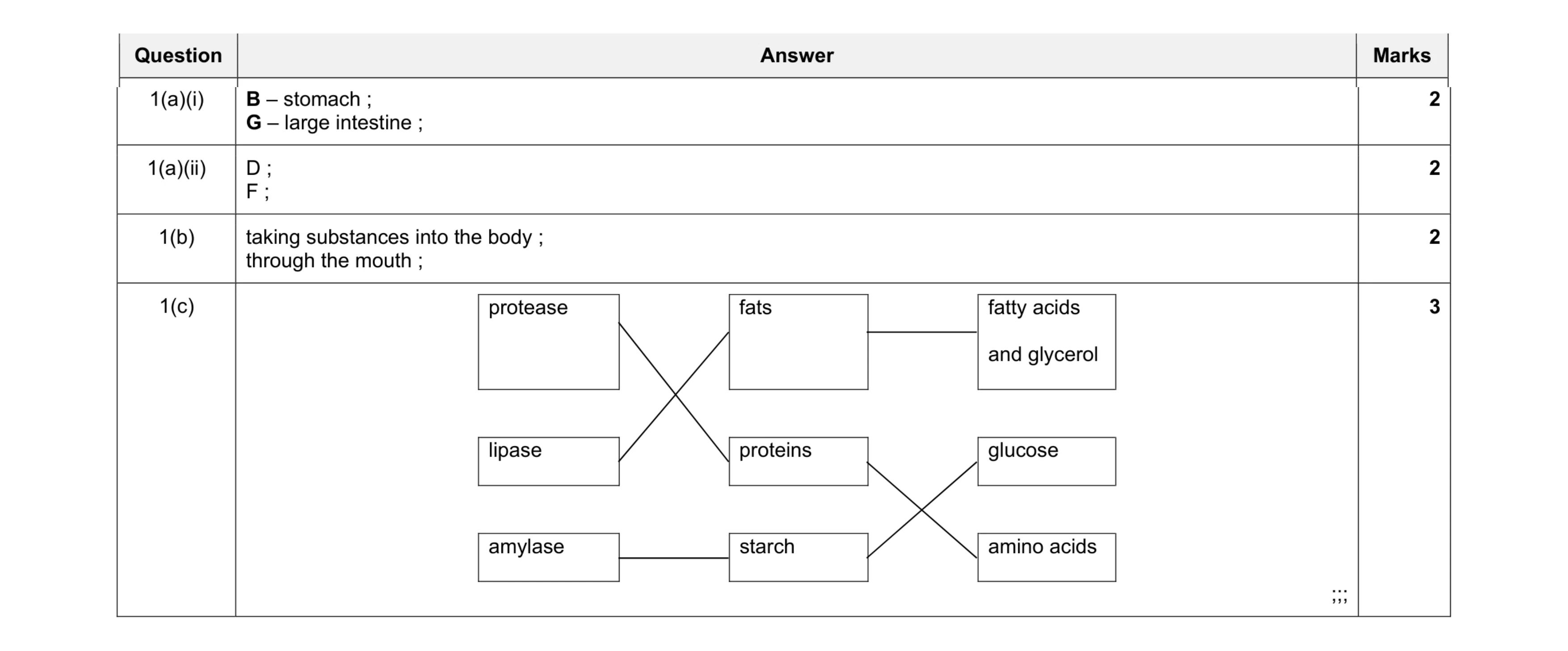
1 (a) Fig. 1.1 is a drawing of the alimentary canal and associated organs. A I H B C G D E F Fig. 1.1 (i) Name the parts labelled B and G. B … G … [2] (ii) Using Fig. 1.1, identify the letter where food is absorbed, … egestion occurs. … [2] (b) Define the term ingestion. … … … [2] (c) Draw lines between the boxes to match the digestive enzyme with its substrate and product. digestive enzyme substrate products fatty acids and protease fats glycerol lipase proteins glucose amylase starch amino acids [3]
9 marks
Mark scheme: 1(a)(i) B – stomach ; G – large intestine ; 2 1(a)(ii) D ; F ; 2 1(b) taking substances into the body ; through the mouth ; 2 1(c) protease fats fatty acids and glycerol lipase proteins glucose amylase starch amino acids ;;; 3
This question in 0654/32 May/June 2017
Q2 · A diagram of the different types of teeth in a human 0654/32 Oct/Nov 2017
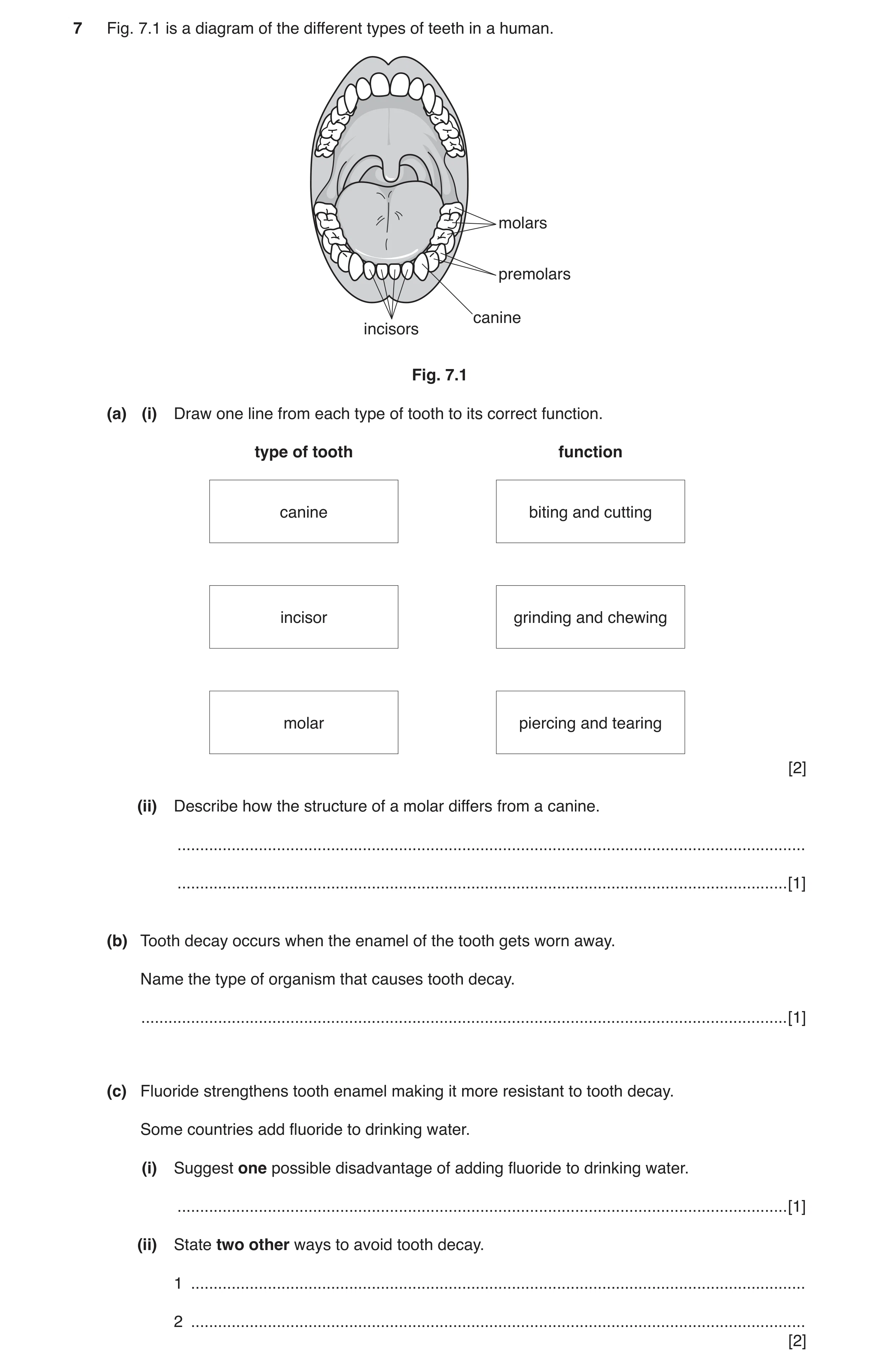
7 Fig. 7.1 is a diagram of the different types of teeth in a human. molars premolars canine incisors Fig. 7.1 (a) (i) Draw one line from each type of tooth to its correct function. type of tooth function canine biting and cutting incisor grinding and chewing molar piercing and tearing [2] (ii) Describe how the structure of a molar differs from a canine. … … [1] (b) Tooth decay occurs when the enamel of the tooth gets worn away. Name the type of organism that causes tooth decay. … [1] (c) Fluoride strengthens tooth enamel making it more resistant to tooth decay. Some countries add fluoride to drinking water. (i) Suggest one possible disadvantage of adding fluoride to drinking water. … [1] (ii) State two other ways to avoid tooth decay. 1 … 2 … [2]
7 marks
Mark scheme: 7(a)(i) 1 or 2 correct ; 3 correct ; 2 7(a)(ii) (molar is) flatter / broader / larger surface area / has cusps / uneven surface / more than one root ; 1 7(b) bacteria ; 1 7(c)(i) ref to no consumer choice ; side effects / long term effects not known ; fluorosis / discolouration of teeth ; max 1 7(c)(ii) brushing teeth ; avoid sugary, food / drinks ; visiting dentist / regular checkups ; max 2
This question in 0654/32 Oct/Nov 2017
Q3 · A diagram of the alimentary canal and associated organs 0654/31 Oct/Nov 2020
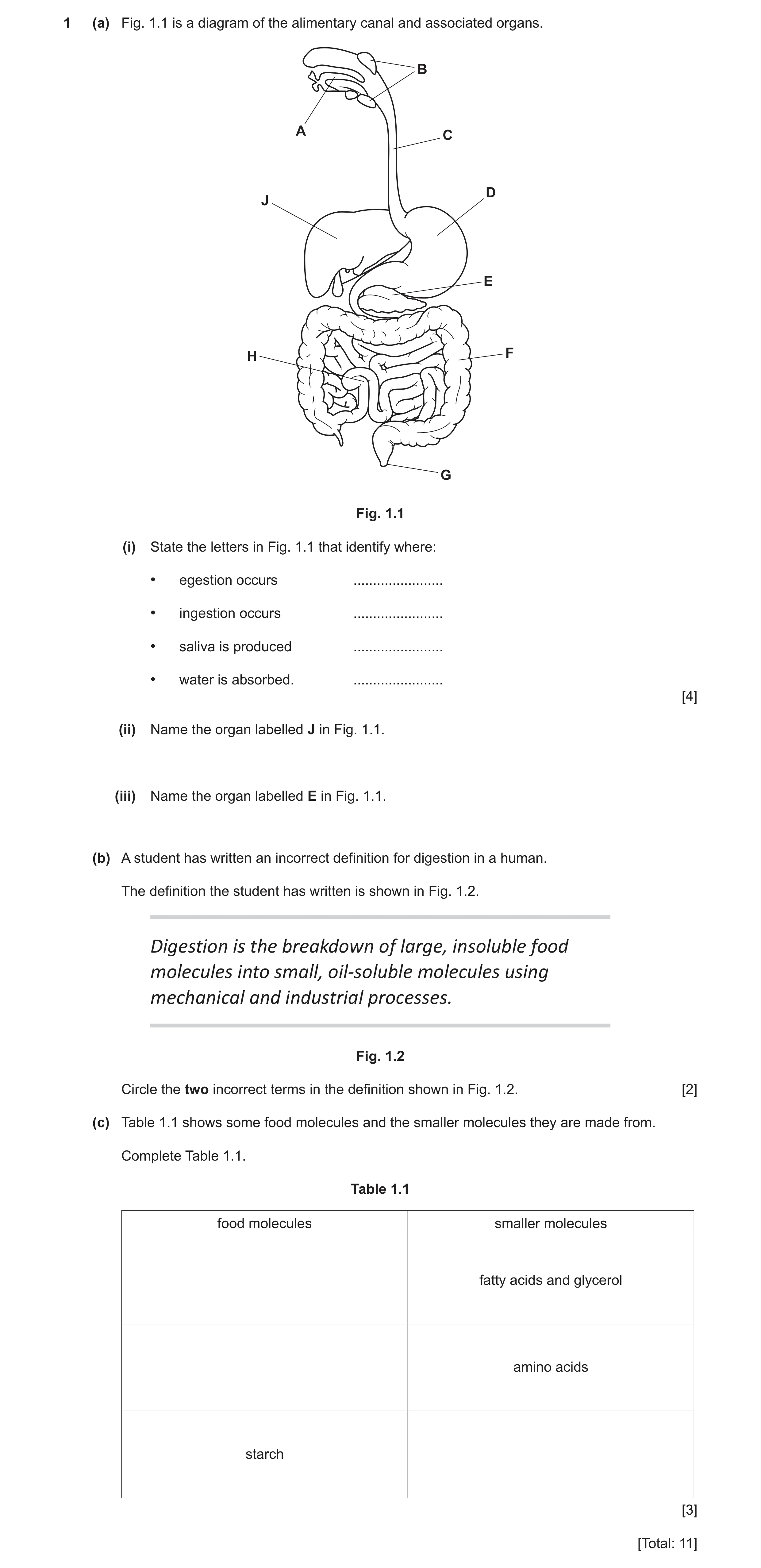
1 (a) Fig. 1.1 is a diagram of the alimentary canal and associated organs. B A C D J E H F G Fig. 1.1 (i) State the letters in Fig. 1.1 that identify where: • egestion occurs … • ingestion occurs … • saliva is produced … • water is absorbed. … [4] (ii) Name the organ labelled J in Fig. 1.1. (iii) Name the organ labelled E in Fig. 1.1. (b) A student has written an incorrect definition for digestion in a human. The definition the student has written is shown in Fig. 1.2. Digestion is the breakdown of large, insoluble food molecules into small, oil‑soluble molecules using mechanical and industrial processes. Fig. 1.2 Circle the two incorrect terms in the definition shown in Fig. 1.2. [2] (c) Table 1.1 shows some food molecules and the smaller molecules they are made from. Complete Table 1.1. Table 1.1 food molecules smaller molecules fatty acids and glycerol amino acids starch [3] [Total: 11]
11 marks
Mark scheme: 1(a)(i) G ; A ; B ; F / H ; 4 1(a)(ii) liver ; 1 1(a)(iii) pancreas ; 1 1(b) oil (-soluble) circled ; industrial circled ; 2 1(c) food molecule smaller molecules fats / oils fatty acids and glycerol protein ; amino acids starch glucose ; 3
This question in 0654/31 Oct/Nov 2020
Q4 · A diagram of the alimentary canal and associated organs 0654/33 Oct/Nov 2020
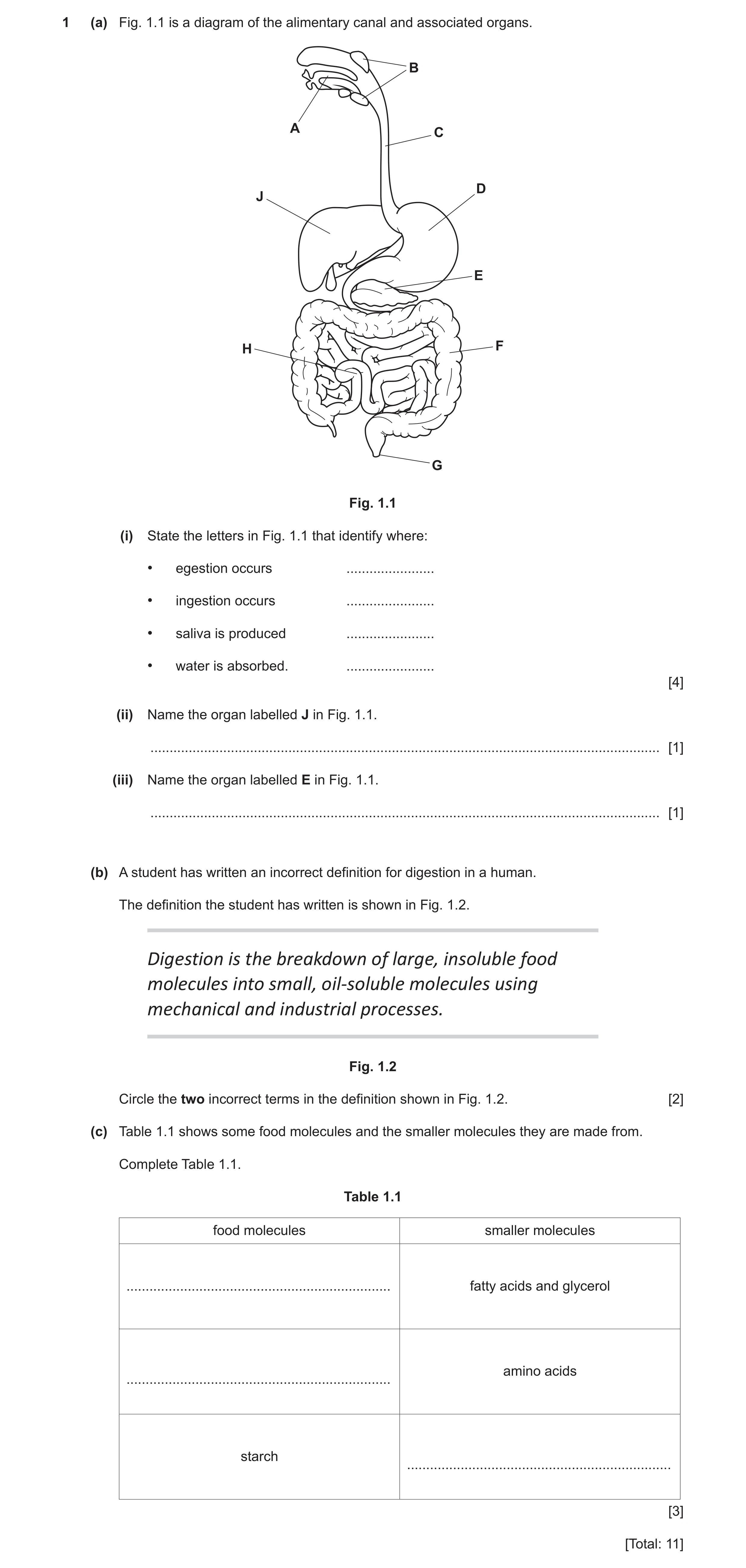
1 (a) Fig. 1.1 is a diagram of the alimentary canal and associated organs. B A C D J E H F G Fig. 1.1 (i) State the letters in Fig. 1.1 that identify where: • egestion occurs … • ingestion occurs … • saliva is produced … • water is absorbed. … [4] (ii) Name the organ labelled J in Fig. 1.1. … [1] (iii) Name the organ labelled E in Fig. 1.1. … [1] (b) A student has written an incorrect definition for digestion in a human. The definition the student has written is shown in Fig. 1.2. Digestion is the breakdown of large, insoluble food molecules into small, oil‑soluble molecules using mechanical and industrial processes. Fig. 1.2 Circle the two incorrect terms in the definition shown in Fig. 1.2. [2] (c) Table 1.1 shows some food molecules and the smaller molecules they are made from. Complete Table 1.1. Table 1.1 food molecules smaller molecules … fatty acids and glycerol amino acids … starch … [3] [Total: 11]
11 marks
Mark scheme: 1(a)(i) G ; A ; B ; F / H ; 4 1(a)(ii) liver ; 1 1(a)(iii) pancreas ; 1 1(b) oil (-soluble) circled ; industrial circled ; 2 1(c) food molecule smaller molecules fats / oils fatty acids and glycerol protein ; amino acids starch glucose ; 3
This question in 0654/33 Oct/Nov 2020
Q5 · Some information about feeding relationships in a national park 0654/31 May/June 2021
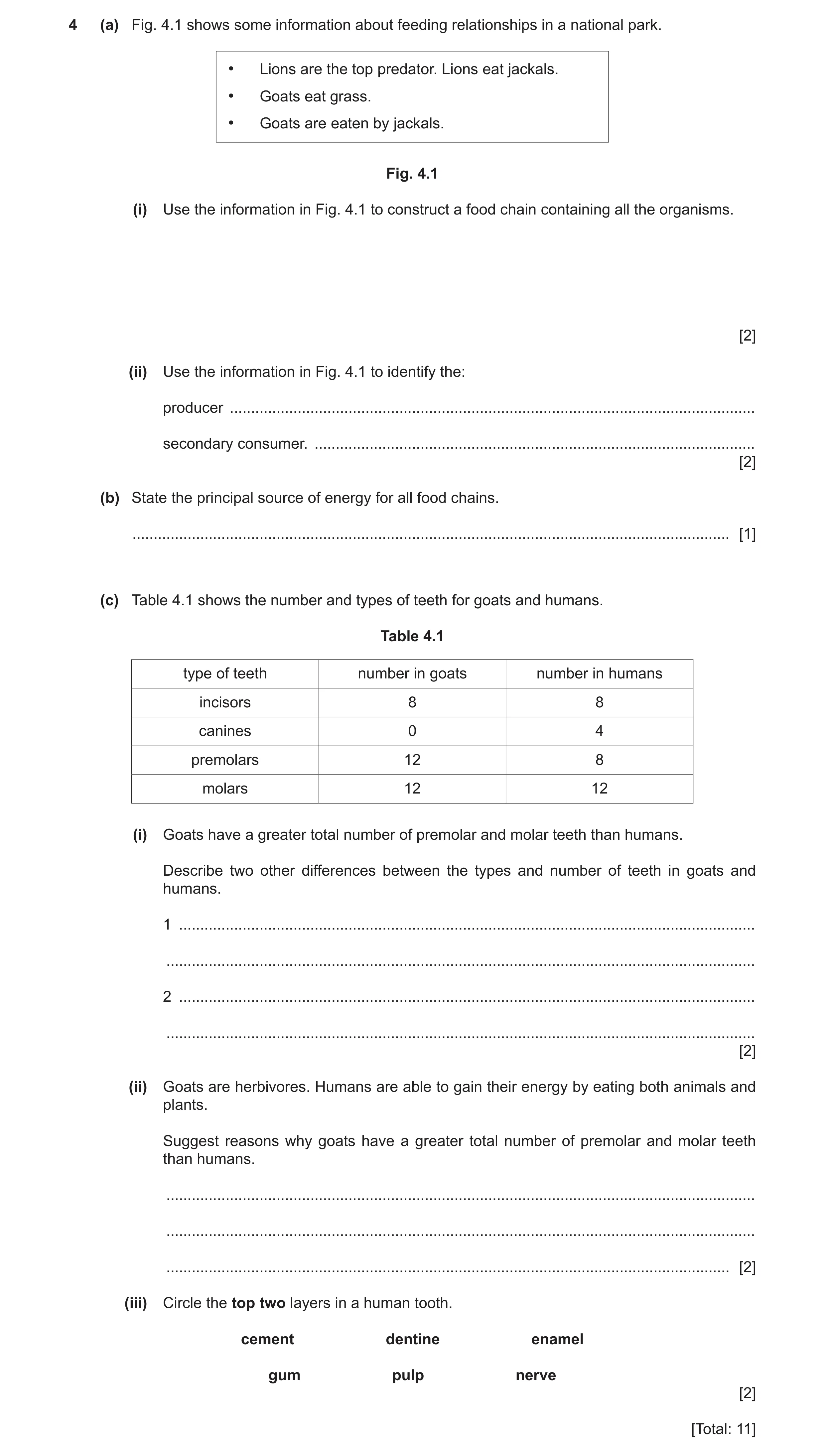
4 (a) Fig. 4.1 shows some information about feeding relationships in a national park. • Lions are the top predator. Lions eat jackals. • Goats eat grass. • Goats are eaten by jackals. Fig. 4.1 (i) Use the information in Fig. 4.1 to construct a food chain containing all the organisms. [2] (ii) Use the information in Fig. 4.1 to identify the: producer … secondary consumer. … [2] (b) State the principal source of energy for all food chains. … [1] (c) Table 4.1 shows the number and types of teeth for goats and humans. Table 4.1 type of teeth number in goats number in humans incisors 8 8 canines 0 4 premolars 12 8 molars 12 12 (i) Goats have a greater total number of premolar and molar teeth than humans. Describe two other differences between the types and number of teeth in goats and humans. 1 … … 2 … … [2] (ii) Goats are herbivores. Humans are able to gain their energy by eating both animals and plants. Suggest reasons why goats have a greater total number of premolar and molar teeth than humans. … … … [2] (iii) Circle the top two layers in a human tooth. cement dentine enamel gum pulp nerve [2] [Total: 11]
11 marks
Mark scheme: 4(a)(i) organisms in correct order ; all arrows drawn in the correct direction ; 2 4(a)(ii) producer grass ; secondary consumer jackal ; 2 4(b) the Sun ; 1 4(c)(i) (goats have) more premolar teeth than humans ; (goats have) fewer / no, canine teeth ; 2 4(c)(ii) goats, gain (all) their energy from plant material / only eats plants ; plant material requires more chewing / breaking down ; molars / premolars needed for chewing ; max 2 2 4(c)(iii) enamel ; dentine ; 2
This question in 0654/31 May/June 2021
Q6 · The total number of teeth of different animals 0654/32 Feb/March 2022
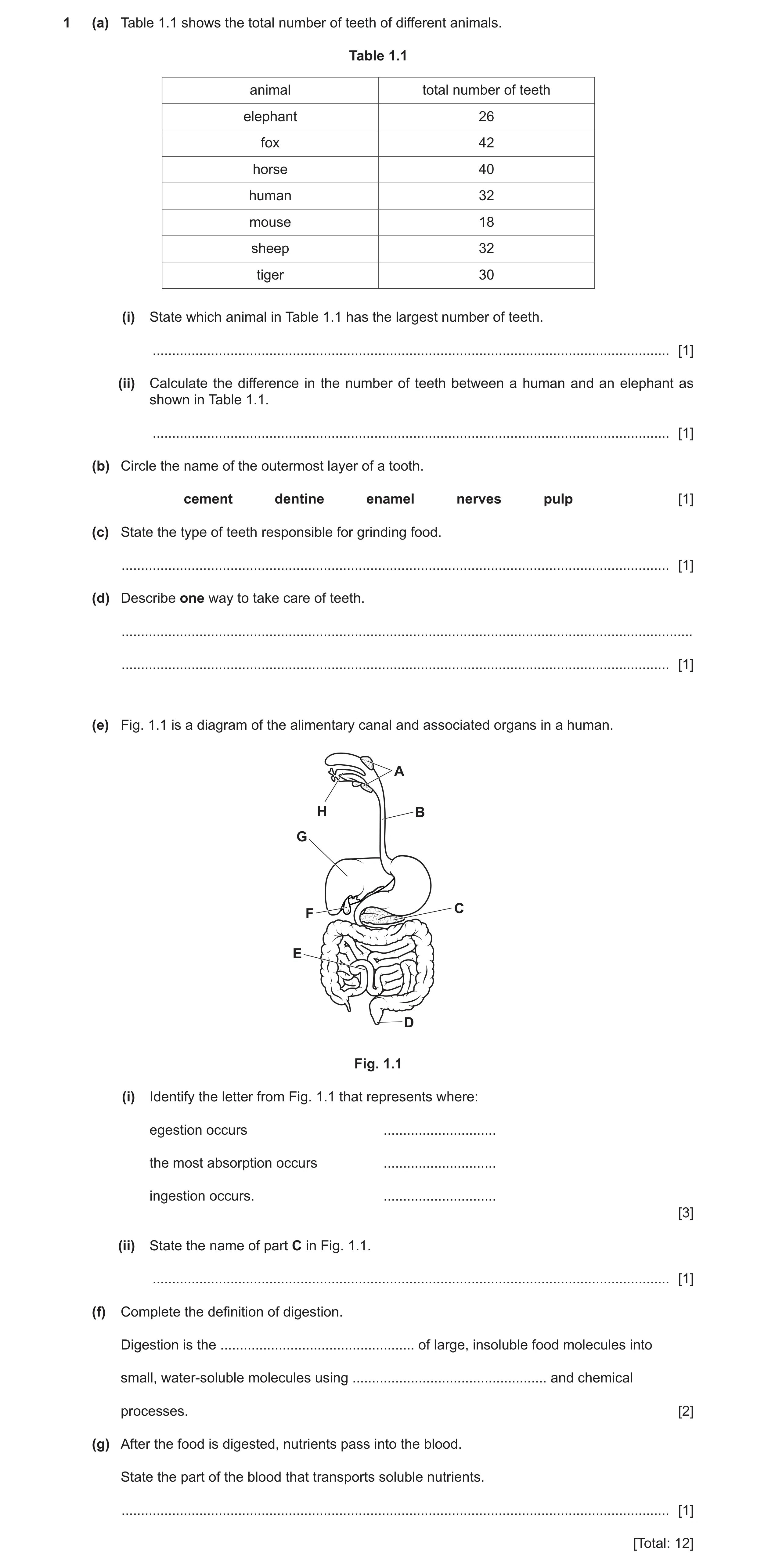
1 (a) Table 1.1 shows the total number of teeth of different animals. Table 1.1 animal total number of teeth elephant 26 fox 42 horse 40 human 32 mouse 18 sheep 32 tiger 30 (i) State which animal in Table 1.1 has the largest number of teeth. … [1] (ii) Calculate the difference in the number of teeth between a human and an elephant as shown in Table 1.1. … [1] (b) Circle the name of the outermost layer of a tooth. cement dentine enamel nerves pulp [1] (c) State the type of teeth responsible for grinding food. … [1] (d) Describe one way to take care of teeth. … … [1] (e) Fig. 1.1 is a diagram of the alimentary canal and associated organs in a human. A H B G C F E D Fig. 1.1 (i) Identify the letter from Fig. 1.1 that represents where: egestion occurs … the most absorption occurs … ingestion occurs. … [3] (ii) State the name of part C in Fig. 1.1. … [1] (f) Complete the definition of digestion. Digestion is the … of large, insoluble food molecules into small, water-soluble molecules using … and chemical processes. [2] (g) After the food is digested, nutrients pass into the blood. State the part of the blood that transports soluble nutrients. … [1] [Total: 12]
12 marks
Mark scheme: 1(a)(i) fox ; 1 1(a)(ii) 6 ; 1 1(b) enamel ; 1 1(c) molar / pre molar ; 1 1(d) brushing / using toothpaste / (regular) visits to dentist / consume less sugary food or drink ; 1 1(e)(i) D ; E ; H ; 3 1(e)(ii) pancreas ; 1 1(f) break(ing) down ; mechanical ; 2 1(g) plasma ; 1
This question in 0654/32 Feb/March 2022
Q7 · The number of different types of teeth in sheep and humans 0654/32 Oct/Nov 2022
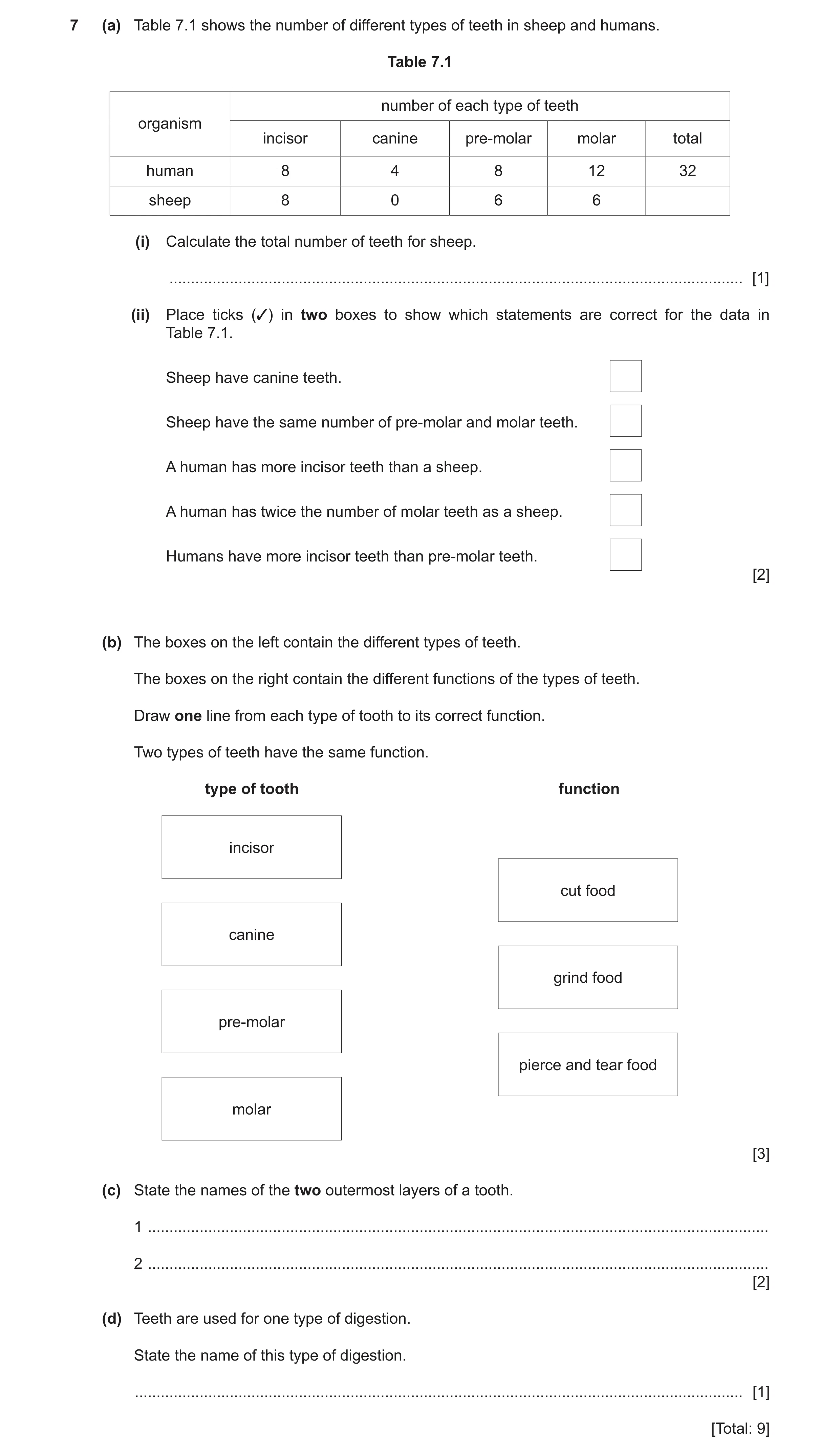
7 (a) Table 7.1 shows the number of different types of teeth in sheep and humans. Table 7.1 number of each type of teeth organism incisor canine pre-molar molar total human 8 4 8 12 32 sheep 8 0 6 6 (i) Calculate the total number of teeth for sheep. … [1] (ii) Place ticks (✓) in two boxes to show which statements are correct for the data in Table 7.1. Sheep have canine teeth. Sheep have the same number of pre-molar and molar teeth. A human has more incisor teeth than a sheep. A human has twice the number of molar teeth as a sheep. Humans have more incisor teeth than pre-molar teeth. [2] (b) The boxes on the left contain the different types of teeth. The boxes on the right contain the different functions of the types of teeth. Draw one line from each type of tooth to its correct function. Two types of teeth have the same function. type of tooth function incisor cut food canine grind food pre-molar pierce and tear food molar [3] (c) State the names of the two outermost layers of a tooth. 1 … 2 … [2] (d) Teeth are used for one type of digestion. State the name of this type of digestion. … [1] [Total: 9]
9 marks
Mark scheme: 7(a)(i) 20 ; 1 7(a)(ii) sheep have the same number of pre-molar and molar teeth ticked ; 2 humans have twice the number of molar teeth than sheep ticked ; 7(b) 3 incisor cut food canine grind food pre-molar pierce and tear food molar 1 or 2 teeth linked correctly ; 3 teeth linked correctly ; 4 teeth linked correctly ; 7(c) dentine ; 2 enamel ; 7(d) mechanical ; 1
This question in 0654/32 Oct/Nov 2022
Q8 · A diagram of the alimentary canal and associated organs in a human 0654/33 Oct/Nov 2022
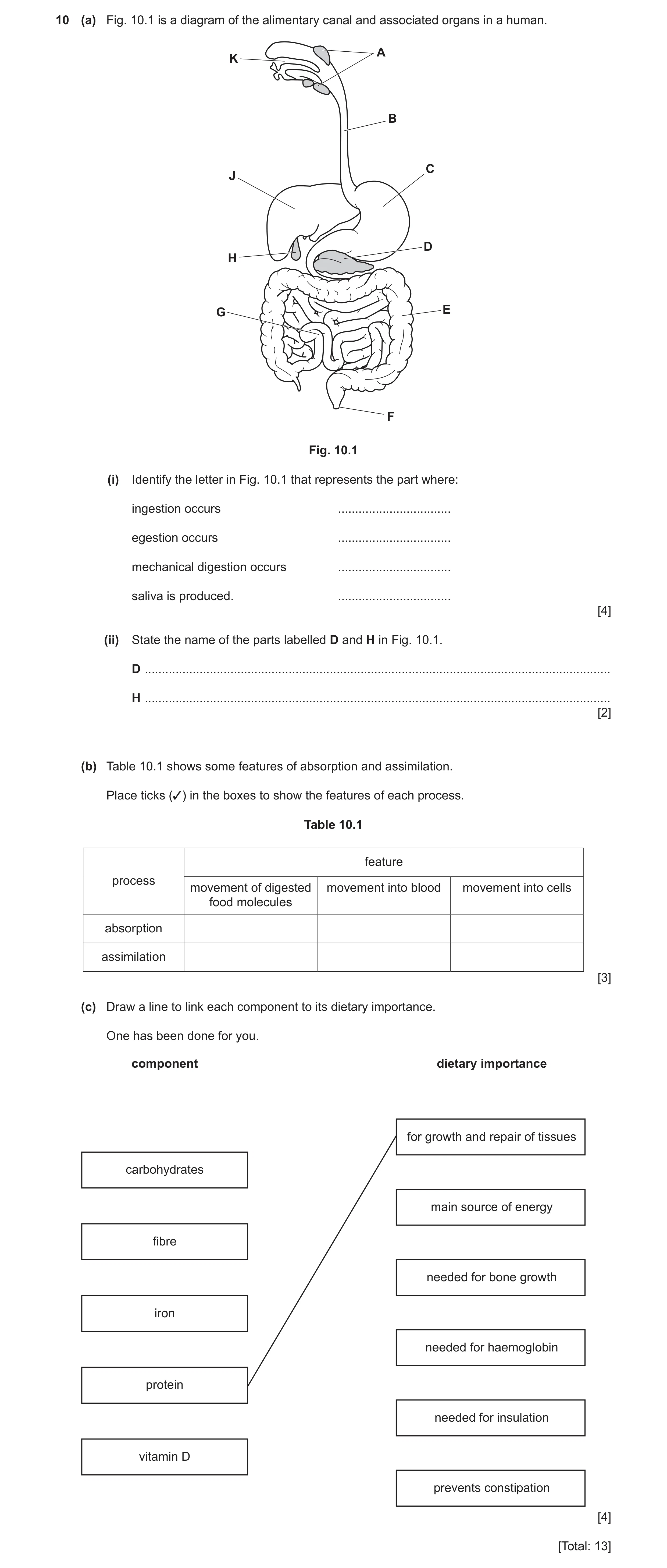
10 (a) Fig. 10.1 is a diagram of the alimentary canal and associated organs in a human. A K B C J D H G E F Fig. 10.1 (i) Identify the letter in Fig. 10.1 that represents the part where: ingestion occurs … egestion occurs … mechanical digestion occurs … saliva is produced. … [4] (ii) State the name of the parts labelled D and H in Fig. 10.1. D … H … [2] (b) Table 10.1 shows some features of absorption and assimilation. Place ticks (3) in the boxes to show the features of each process. Table 10.1 feature process movement of digested movement into blood movement into cells food molecules absorption assimilation [3] (c) Draw a line to link each component to its dietary importance. One has been done for you. component dietary importance for growth and repair of tissues carbohydrates main source of energy fibre needed for bone growth iron needed for haemoglobin protein needed for insulation vitamin D prevents constipation [4] [Total: 13]
13 marks
Mark scheme: 10(a)(i) K ; 4 F ; K / C ; A ; 10(a)(ii) D – pancreas ; 2 H – gall bladder ; 10(b) 3 feature process movement of movement into movement into digested food blood cells molecules absorption assimilation ;;; 1 mark for each column 10(c) 4 for growth and repair of tissues carbohydrates main source of energy fibre needed for bone growth iron needed for haemoglobin protein needed for insulation vitamin D prevents constipation ;;;; 1 mark for each correct link
This question in 0654/33 Oct/Nov 2022
Question 9 0654/31 Oct/Nov 2023
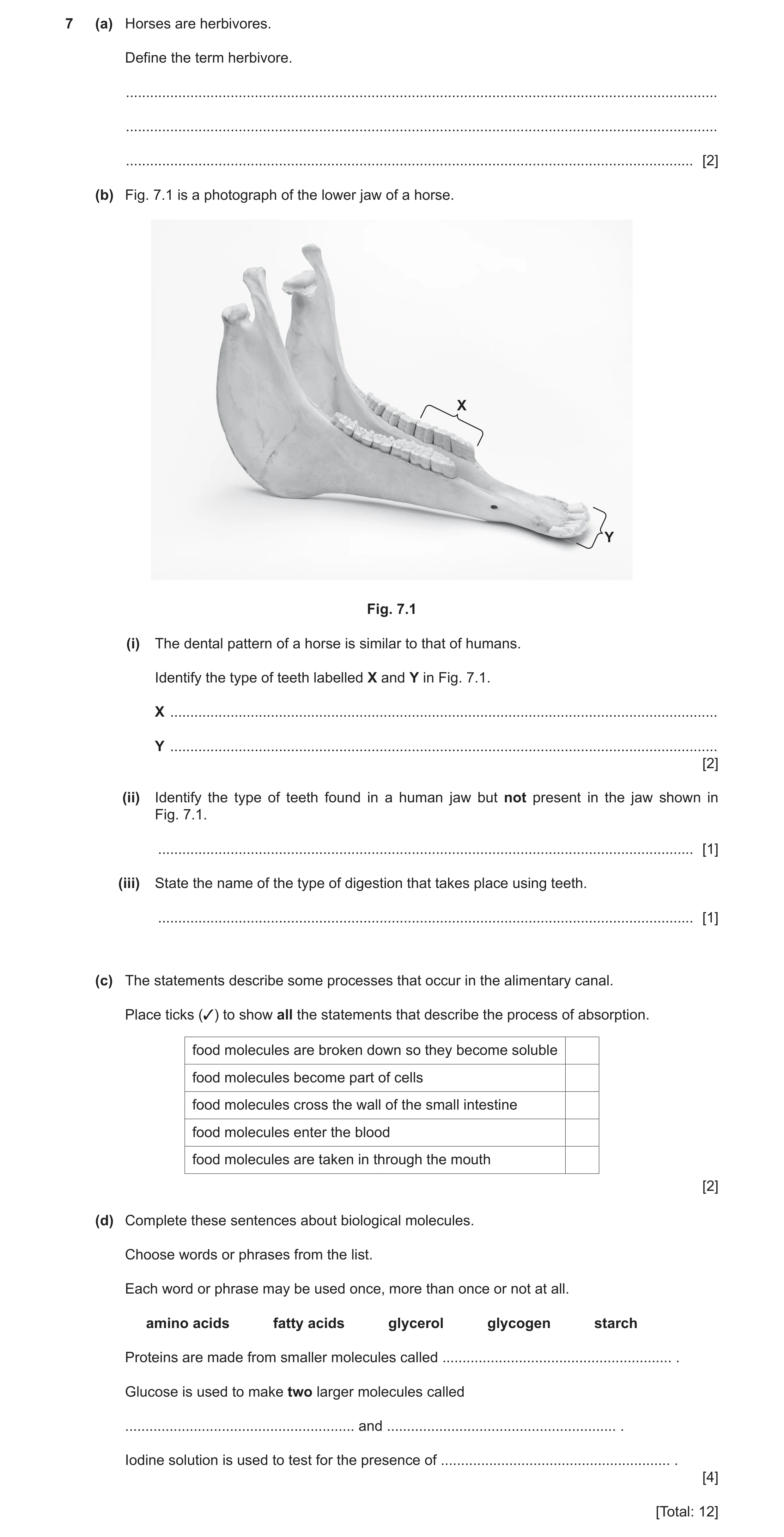
7 (a) Horses are herbivores. Define the term herbivore. … … … [2] (b) Fig. 7.1 is a photograph of the lower jaw of a horse. X Y Fig. 7.1 (i) The dental pattern of a horse is similar to that of humans. Identify the type of teeth labelled X and Y in Fig. 7.1. X … Y … [2] (ii) Identify the type of teeth found in a human jaw but not present in the jaw shown in Fig. 7.1. … [1] (iii) State the name of the type of digestion that takes place using teeth. … [1] (c) The statements describe some processes that occur in the alimentary canal. Place ticks (✓) to show all the statements that describe the process of absorption. food molecules are broken down so they become soluble food molecules become part of cells food molecules cross the wall of the small intestine food molecules enter the blood food molecules are taken in through the mouth [2] (d) Complete these sentences about biological molecules. Choose words or phrases from the list. Each word or phrase may be used once, more than once or not at all. amino acids fatty acids glycerol glycogen starch Proteins are made from smaller molecules called … . Glucose is used to make two larger molecules called … and … . Iodine solution is used to test for the presence of … . [4] [Total: 12]
12 marks
Mark scheme: 7(a) animal that gets its energy ; 2 from eating plants / AW ; 7(b)(i) X – premolars ; 2 Y – incisors ; 7(b)(ii) canines ; 1 7(b)(iii) mechanical ; 1 7(c) 2 food molecules cross the wall of the small intestine food molecules enter the blood ;; 2 ticks and 2 correct = 2 marks 3 ticks and 2 correct = 1 mark otherwise 0 marks 7(d) amino acids ; 4 glycogen ; starch ; starch ;
This question in 0654/31 Oct/Nov 2023
Q10 · A diagram of the alimentary canal and associated organs 0654/32 Oct/Nov 2023
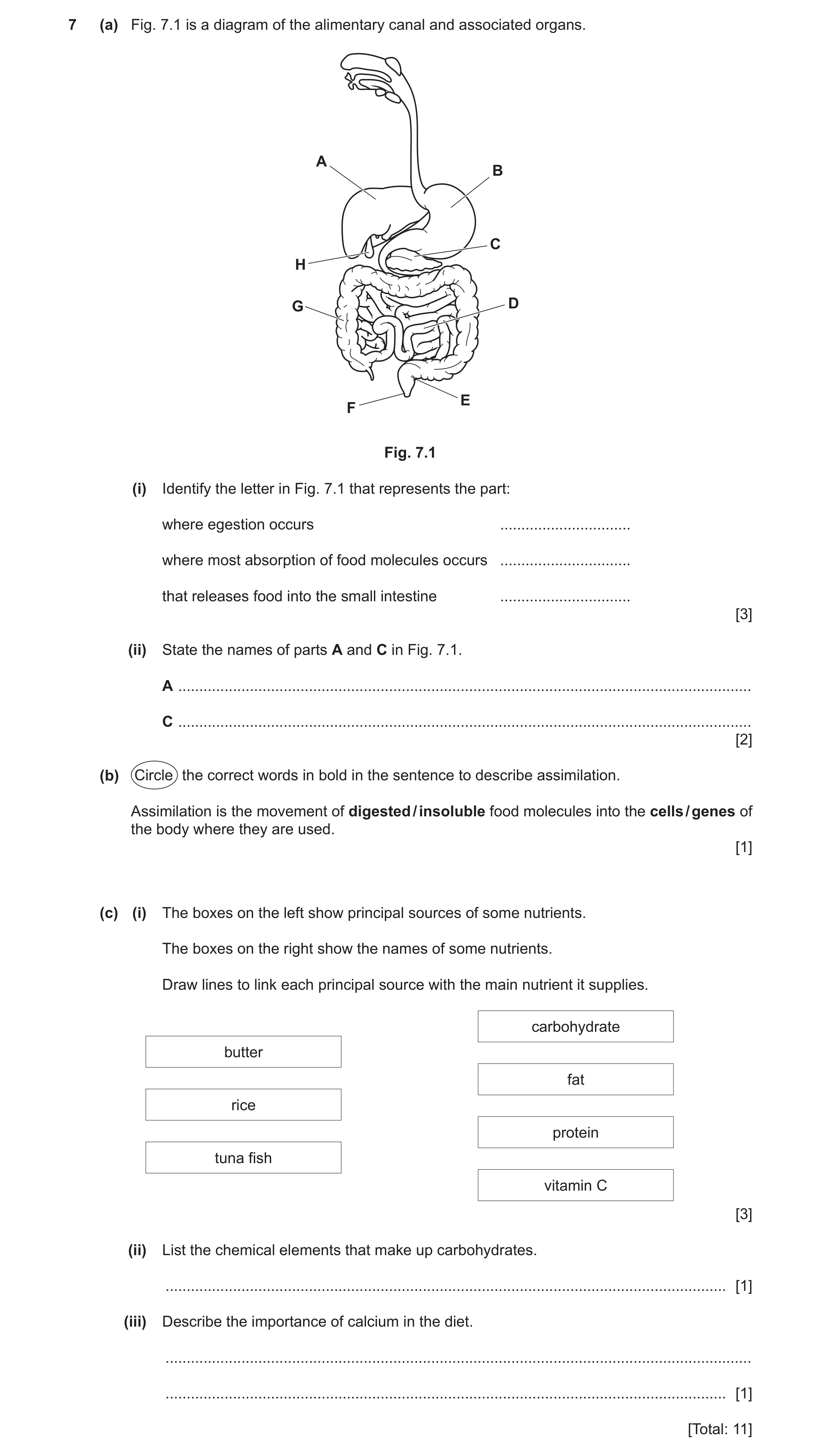
7 (a) Fig. 7.1 is a diagram of the alimentary canal and associated organs. A B C H G D E F Fig. 7.1 (i) Identify the letter in Fig. 7.1 that represents the part: where egestion occurs … where most absorption of food molecules occurs … that releases food into the small intestine … [3] (ii) State the names of parts A and C in Fig. 7.1. A … C … [2] (b) Circle the correct words in bold in the sentence to describe assimilation. Assimilation is the movement of digested / insoluble food molecules into the cells / genes of the body where they are used. [1] (c) (i) The boxes on the left show principal sources of some nutrients. The boxes on the right show the names of some nutrients. Draw lines to link each principal source with the main nutrient it supplies. carbohydrate butter fat rice protein tuna fish vitamin C [3] (ii) List the chemical elements that make up carbohydrates. … [1] (iii) Describe the importance of calcium in the diet. … … [1] [Total: 11]
11 marks
Mark scheme: 7(a)(i) F ; 3 D ; B ; 7(a)(ii) A – liver ; 2 C – pancreas ; 7(b) digested and cells ; 1 7(c)(i) 3 carbohydrate butter fat rice protein tuna fish vitamin C ;;; 7(c)(ii) carbon, hydrogen, oxygen ; 1 7(c)(iii) strengthen bones / teeth ; 1
This question in 0654/32 Oct/Nov 2023
Q11 · The parts of a human tooth 0654/31 May/June 2024
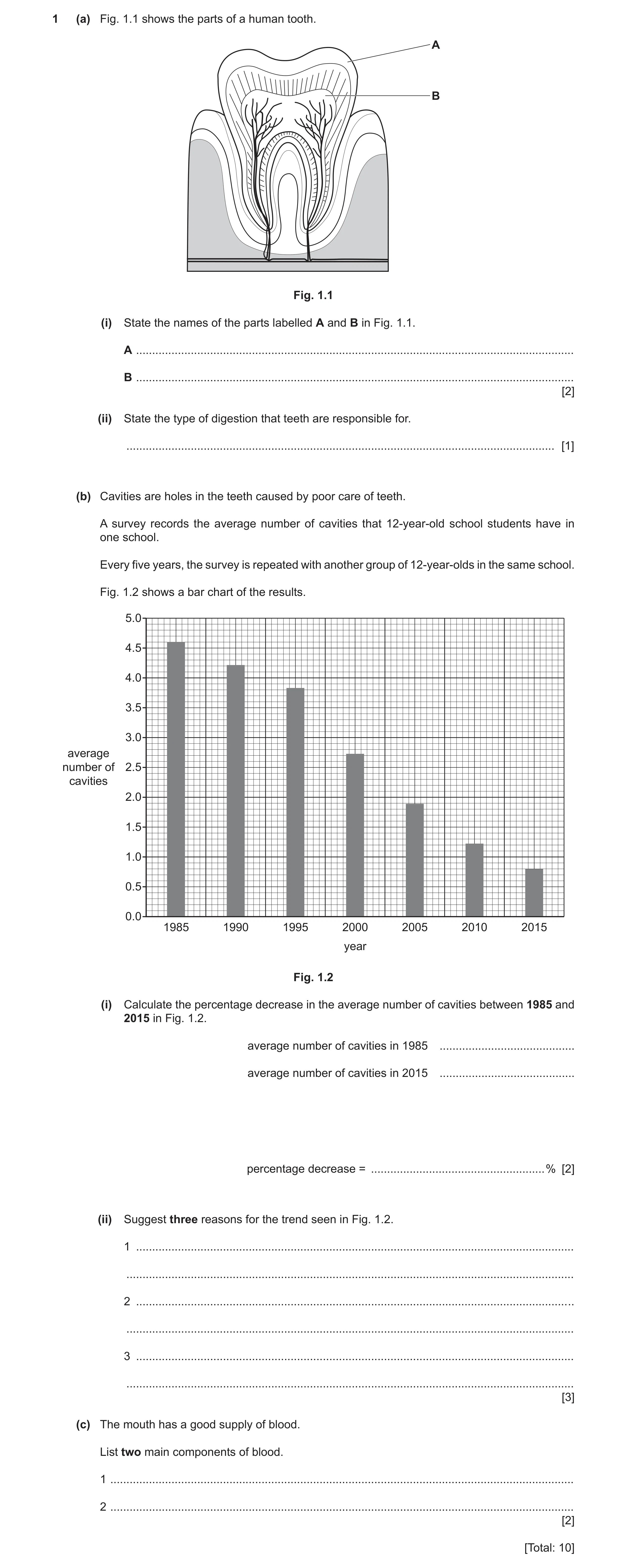
1 (a) Fig. 1.1 shows the parts of a human tooth. A B Fig. 1.1 (i) State the names of the parts labelled A and B in Fig. 1.1. A … B … [2] (ii) State the type of digestion that teeth are responsible for. … [1] (b) Cavities are holes in the teeth caused by poor care of teeth. A survey records the average number of cavities that 12‑year‑old school students have in one school. Every five years, the survey is repeated with another group of 12‑year‑olds in the same school. Fig. 1.2 shows a bar chart of the results. 5.0 4.5 4.0 3.5 3.0 average number of 2.5 cavities 2.0 1.5 1.0 0.5 0.0 1985 1990 1995 2000 2005 2010 2015 year Fig. 1.2 (i) Calculate the percentage decrease in the average number of cavities between 1985 and 2015 in Fig. 1.2. average number of cavities in 1985 … average number of cavities in 2015 … percentage decrease = … % [2] (ii) Suggest three reasons for the trend seen in Fig. 1.2. 1 … … 2 … … 3 … … [3] (c) The mouth has a good supply of blood. List two main components of blood. 1 … 2 … [2] [Total: 10]
10 marks
Mark scheme: 1(a)(i) A – enamel ; B – pulp (cavity) ; 2 1(a)(ii) mechanical ; 1 1(b)(i) 4.6 and 0.8 ; ((3.8 / 4.6) 100) = 83 (%) ; 2 1(b)(ii) any three from: improvement in dental care by people ; improvement in dental, care / technology ; reduction in consumption of sugar / more calcium in diet ; ref to education ; addition of fluoride to drinking water / toothpaste ; 3 1(c) any two from: red blood cells ; white blood cells ; plasma ; platelets ; 2
This question in 0654/31 May/June 2024
Q12 · Some information about five different enzymes 0654/33 Oct/Nov 2024
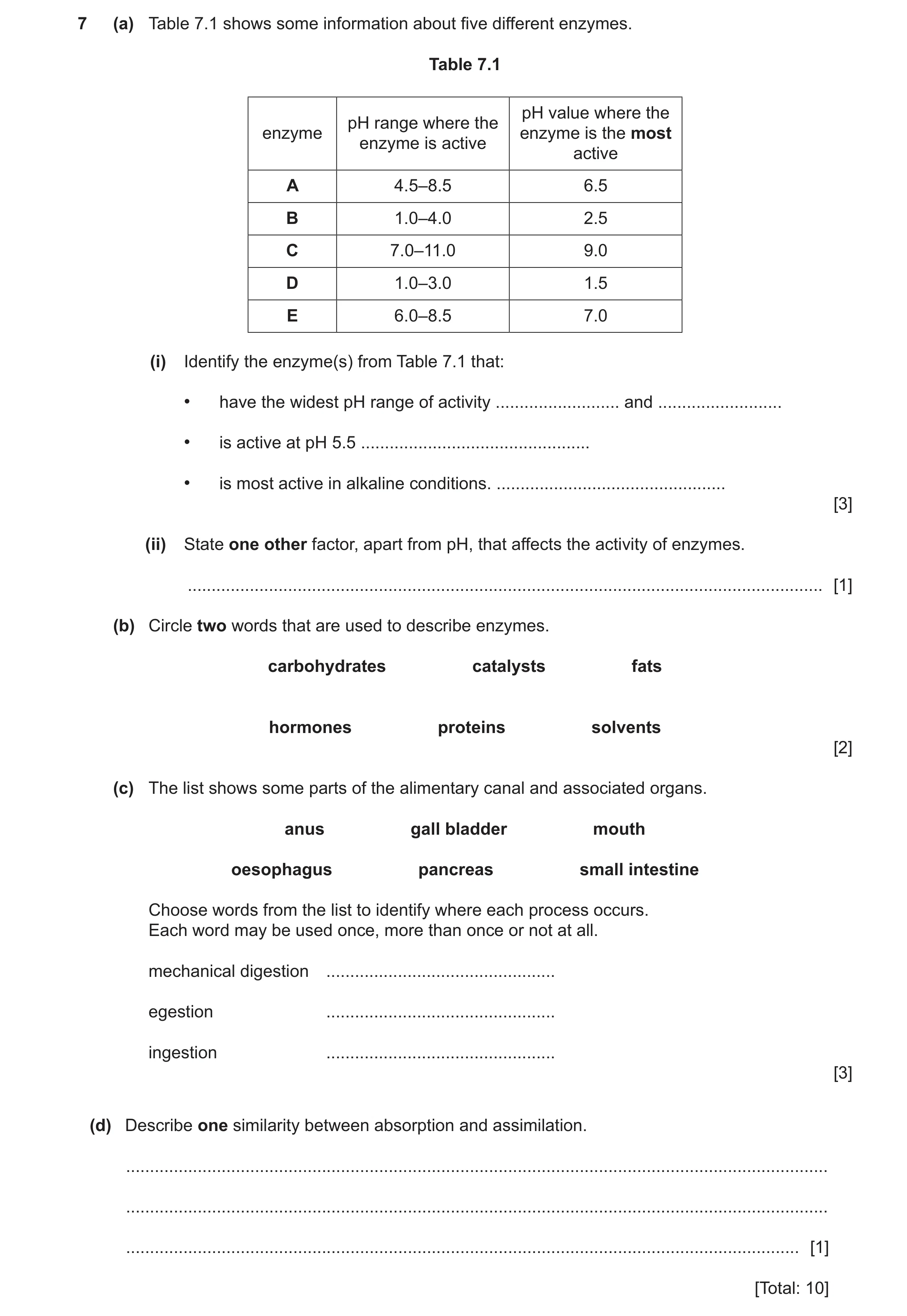
7 (a) Table 7.1 shows some information about five different enzymes. Table 7.1 pH value where the pH range where the enzyme enzyme is the most enzyme is active active A 4.5–8.5 6.5 B 1.0–4.0 2.5 C 7.0–11.0 9.0 D 1.0–3.0 1.5 E 6.0–8.5 7.0 (i) Identify the enzyme(s) from Table 7.1 that: • have the widest pH range of activity … and … • is active at pH 5.5 … • is most active in alkaline conditions. … [3] (ii) State one other factor, apart from pH, that affects the activity of enzymes. … [1] (b) Circle two words that are used to describe enzymes. carbohydrates catalysts fats hormones proteins solvents [2] (c) The list shows some parts of the alimentary canal and associated organs. anus gall bladder mouth oesophagus pancreas small intestine Choose words from the list to identify where each process occurs. Each word may be used once, more than once or not at all. mechanical digestion … egestion … ingestion … [3] (d) Describe one similarity between absorption and assimilation. … … … [1] [Total: 10]
10 marks
Mark scheme: 7(a)(i) A AND C ; 3 A ; C ; 7(a)(ii) temperature / AVP ; 1 7(b) proteins circled ; 2 catalysts circled ; 7(c) mouth ; 3 anus ; mouth ; 7(d) both involve the movement of, digested food / molecules / soluble nutrients ; 1
This question in 0654/33 Oct/Nov 2024
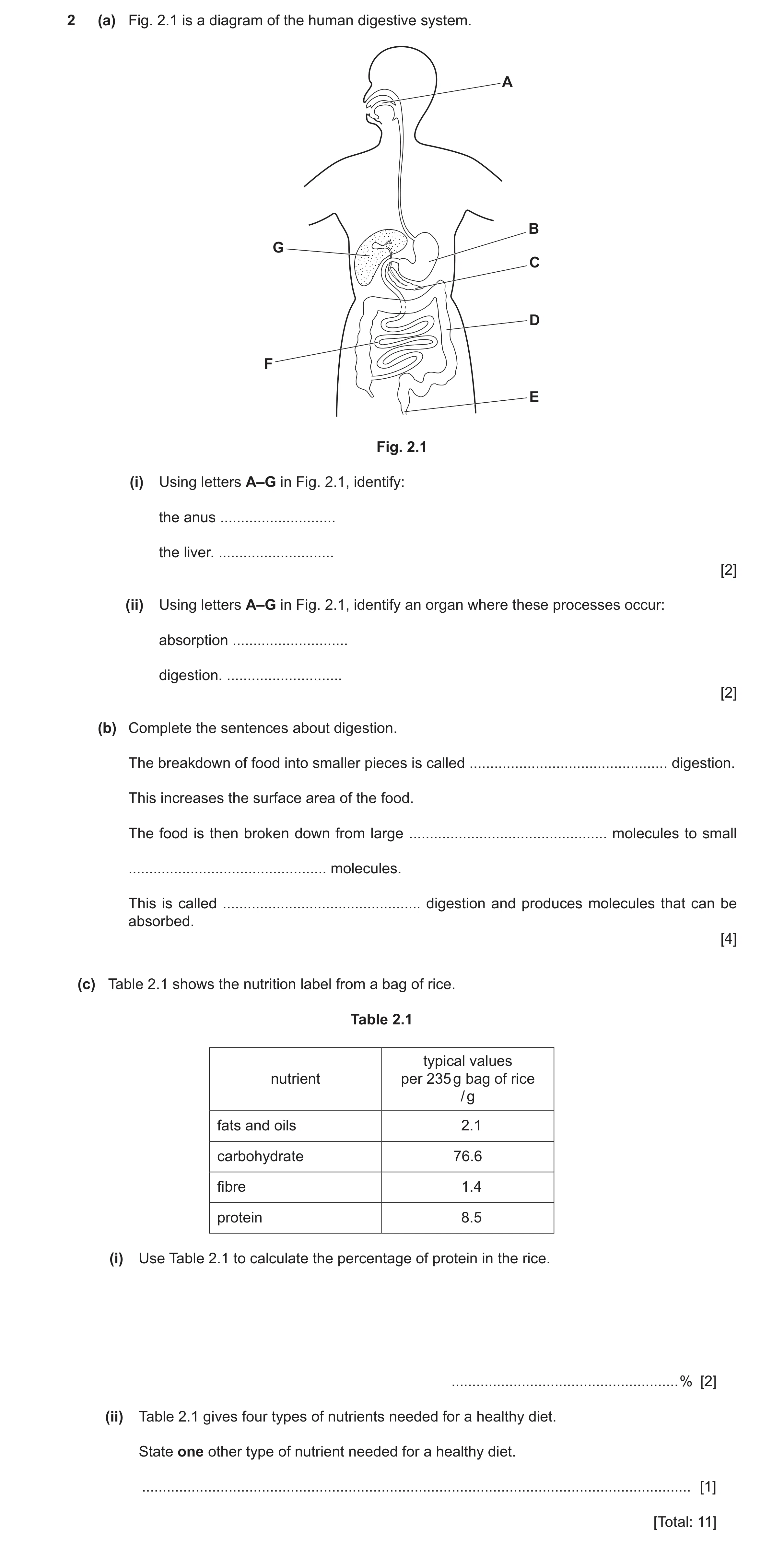
Q13 · A diagram of the human digestive system 0654/31 May/June 2025
2 (a) Fig. 2.1 is a diagram of the human digestive system. A B G C D F E Fig. 2.1 (i) Using letters A–G in Fig. 2.1, identify: the anus … the liver. … [2] (ii) Using letters A–G in Fig. 2.1, identify an organ where these processes occur: absorption … digestion. … [2] (b) Complete the sentences about digestion. The breakdown of food into smaller pieces is called … digestion. This increases the surface area of the food. The food is then broken down from large … molecules to small … molecules. This is called … digestion and produces molecules that can be absorbed. [4] (c) Table 2.1 shows the nutrition label from a bag of rice. Table 2.1 typical values nutrient per 235 g bag of rice / g fats and oils 2.1 carbohydrate 76.6 fibre 1.4 protein 8.5 (i) Use Table 2.1 to calculate the percentage of protein in the rice. … % [2] (ii) Table 2.1 gives four types of nutrients needed for a healthy diet. State one other type of nutrient needed for a healthy diet. … [1] [Total: 11]
11 marks
Mark scheme: 2(a)(i) E ; 2 G ; 2(a)(ii) D or F ; 2 A or B or F ; 2(b) physical / mechanical ; 4 insoluble ; soluble ; chemical ; 2(c)(i) 8.5 and 235 ; 2 3.6 ; 2(c)(ii) vitamins / minerals / water ; 1
This question in 0654/31 May/June 2025
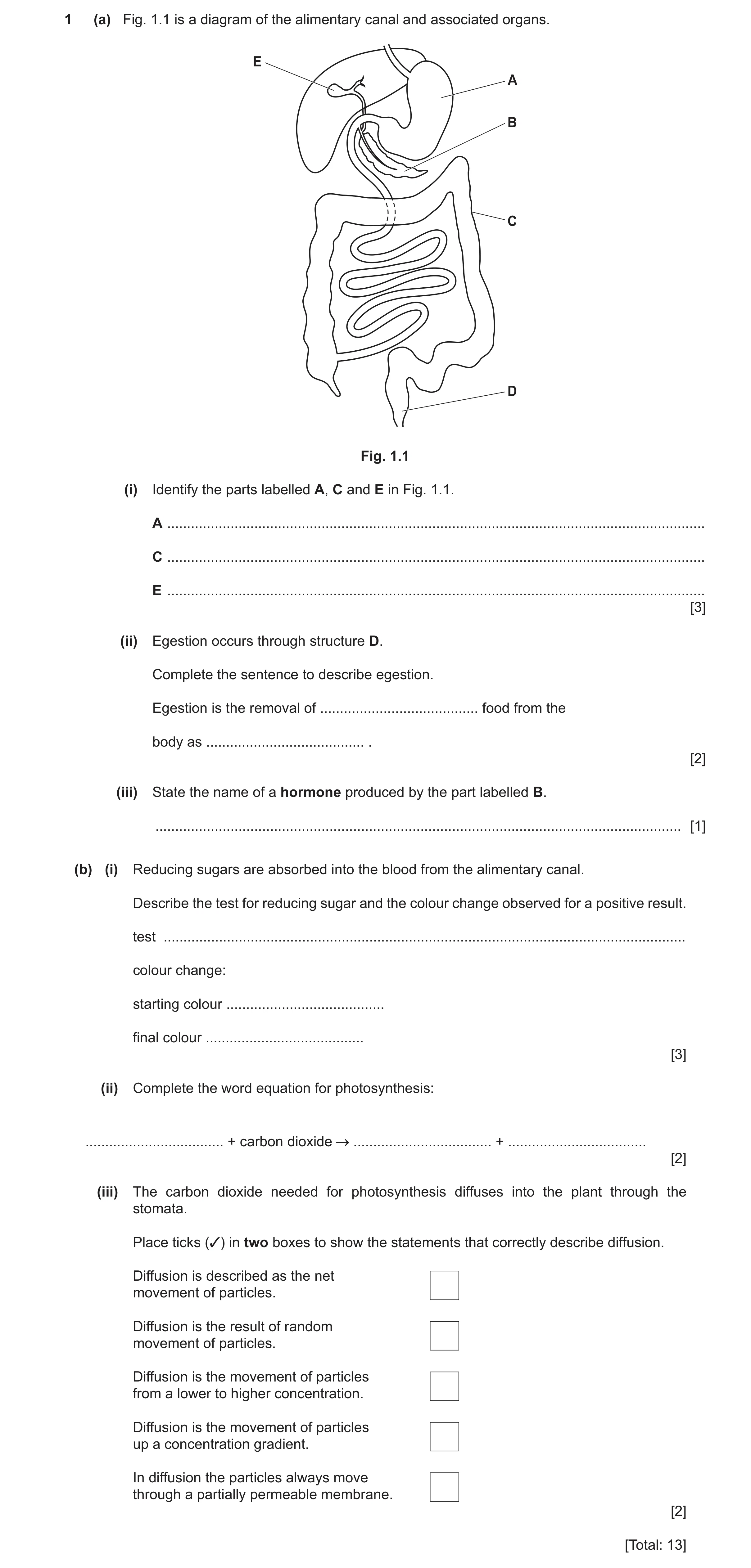
Q14 · A diagram of the alimentary canal and associated organs 0654/32 Oct/Nov 2025
1 (a) Fig. 1.1 is a diagram of the alimentary canal and associated organs. E A B C D Fig. 1.1 (i) Identify the parts labelled A, C and E in Fig. 1.1. A … C … E … [3] (ii) Egestion occurs through structure D. Complete the sentence to describe egestion. Egestion is the removal of … food from the body as … . [2] (iii) State the name of a hormone produced by the part labelled B. … [1] (b) (i) Reducing sugars are absorbed into the blood from the alimentary canal. Describe the test for reducing sugar and the colour change observed for a positive result. test … colour change: starting colour … final colour … [3] (ii) Complete the word equation for photosynthesis: … + carbon dioxide … + … [2] (iii) The carbon dioxide needed for photosynthesis diffuses into the plant through the stomata. Place ticks (3) in two boxes to show the statements that correctly describe diffusion. Diffusion is described as the net movement of particles. Diffusion is the result of random movement of particles. Diffusion is the movement of particles from a lower to higher concentration. Diffusion is the movement of particles up a concentration gradient. In diffusion the particles always move through a partially permeable membrane. [2] [Total: 13]
13 marks
Mark scheme: Question Answer Marks 1(a)(i) A – stomach ; 3 C – large intestine ; E – gall bladder ; 1(a)(ii) undigested ; 2 faeces ; 1(a)(iii) insulin ; 1 1(b)(i) (heat with) Benedict’s (solution) ; 3 (starting colour) blue ; (final colour) red / orange / yellow / green ; 1(b)(ii) water + (carbon dioxide) → oxygen + glucose 2 1 mark left hand side correct 1 mark right hand side correct 1(b)(iii) 2 1 mark for each correct answer 3 boxes ticked – 2 correct – 1 mark 3 boxes ticked – 1 correct – 0 marks 4 boxes ticked – 0 marks
This question in 0654/32 Oct/Nov 2025
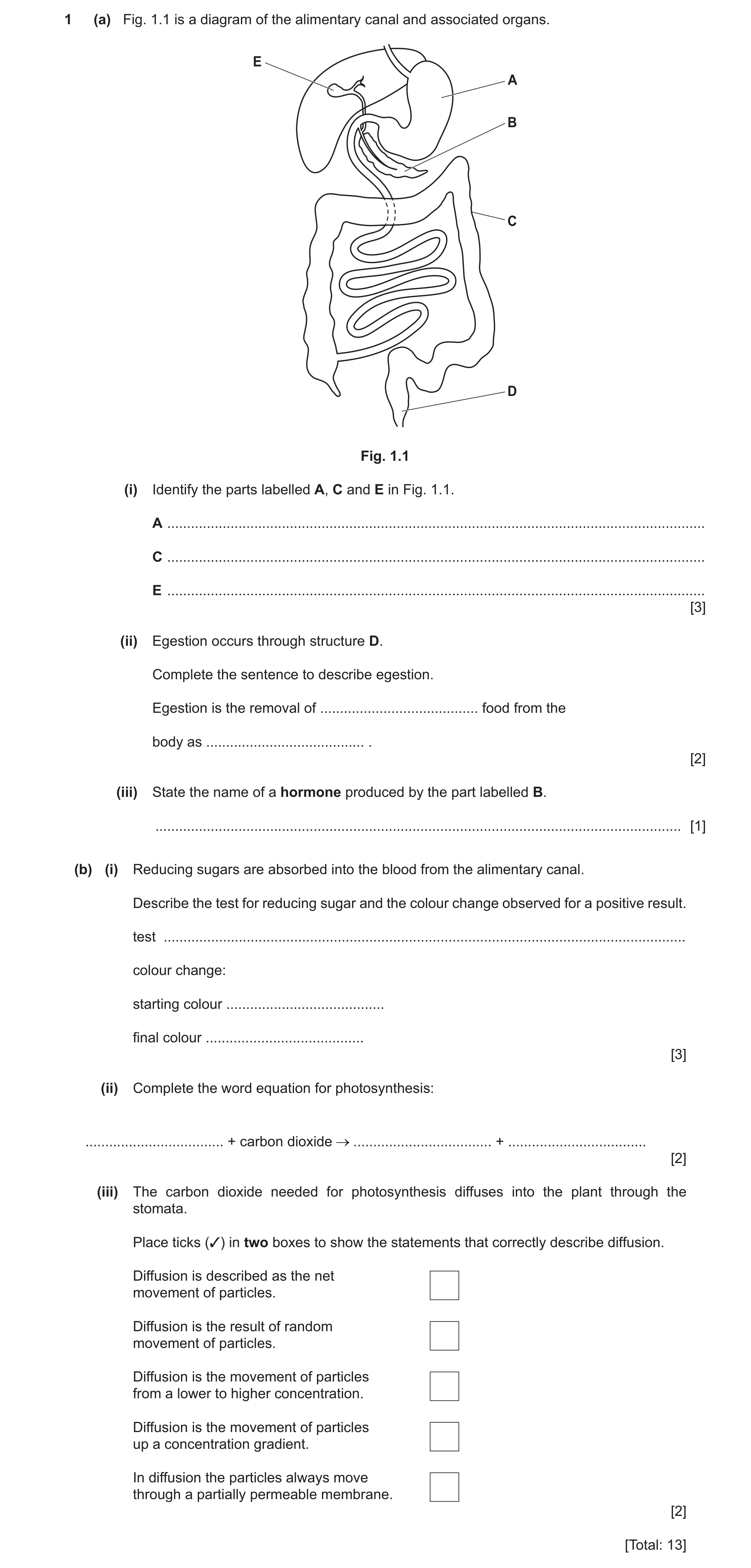
Q15 · A diagram of the alimentary canal and associated organs 0654/33 Oct/Nov 2025
1 (a) Fig. 1.1 is a diagram of the alimentary canal and associated organs. E A B C D Fig. 1.1 (i) Identify the parts labelled A, C and E in Fig. 1.1. A … C … E … [3] (ii) Egestion occurs through structure D. Complete the sentence to describe egestion. Egestion is the removal of … food from the body as … . [2] (iii) State the name of a hormone produced by the part labelled B. … [1] (b) (i) Reducing sugars are absorbed into the blood from the alimentary canal. Describe the test for reducing sugar and the colour change observed for a positive result. test … colour change: starting colour … final colour … [3] (ii) Complete the word equation for photosynthesis: … + carbon dioxide … + … [2] (iii) The carbon dioxide needed for photosynthesis diffuses into the plant through the stomata. Place ticks (3) in two boxes to show the statements that correctly describe diffusion. Diffusion is described as the net movement of particles. Diffusion is the result of random movement of particles. Diffusion is the movement of particles from a lower to higher concentration. Diffusion is the movement of particles up a concentration gradient. In diffusion the particles always move through a partially permeable membrane. [2] [Total: 13]
13 marks
Mark scheme: Question Answer Marks 1(a)(i) A – stomach ; 3 C – large intestine ; E – gall bladder ; 1(a)(ii) undigested ; 2 faeces ; 1(a)(iii) insulin ; 1 1(b)(i) (heat with) Benedict’s (solution) ; 3 (starting colour) blue ; (final colour) red / orange / yellow / green ; 1(b)(ii) water + (carbon dioxide) → oxygen + glucose 2 1 mark left hand side correct 1 mark right hand side correct 1(b)(iii) 2 1 mark for each correct answer 3 boxes ticked – 2 correct – 1 mark 3 boxes ticked – 1 correct – 0 marks 4 boxes ticked – 0 marks
This question in 0654/33 Oct/Nov 2025
 9
9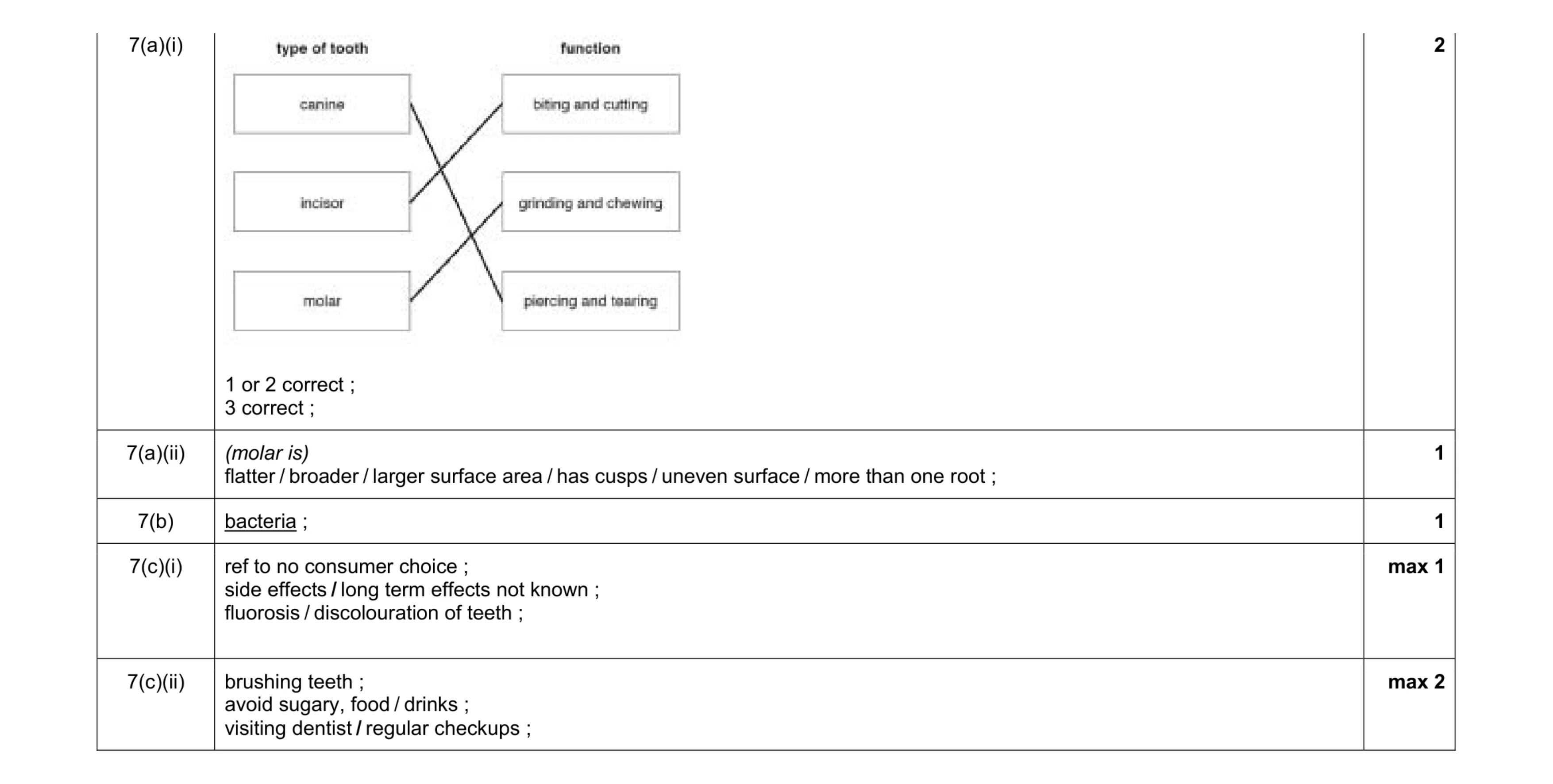 7
7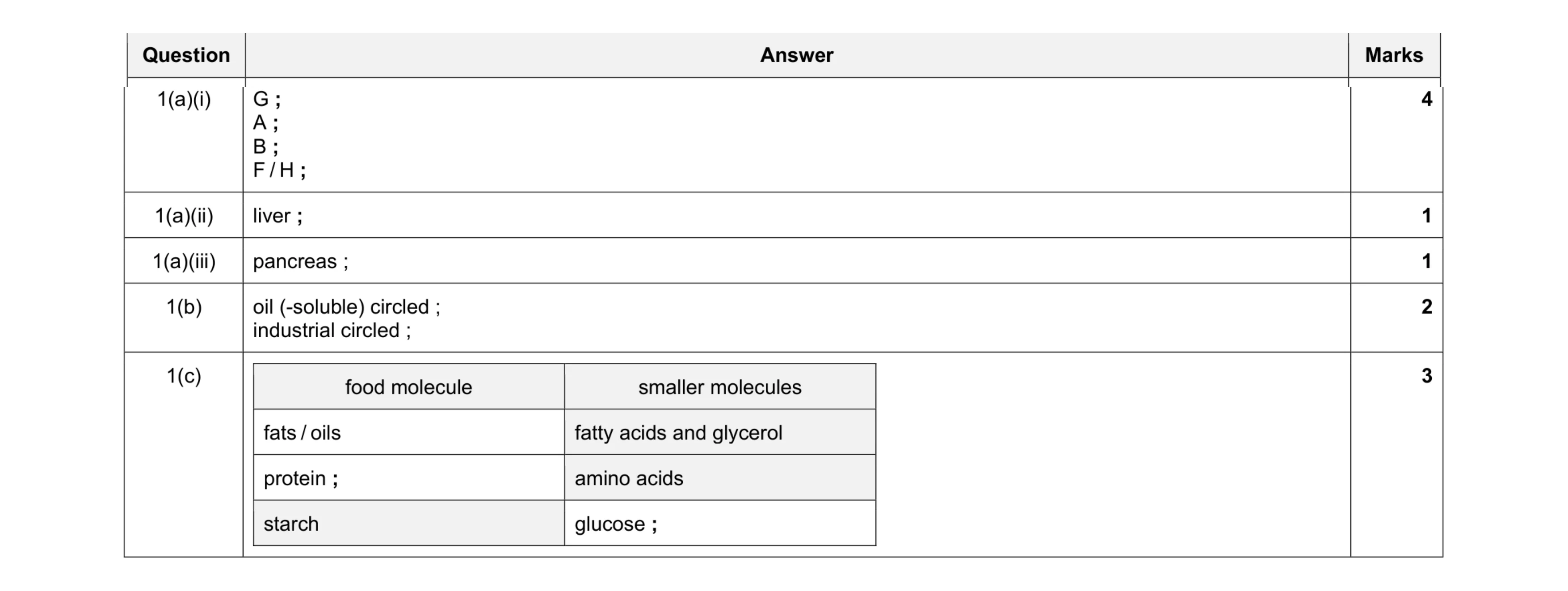 11
11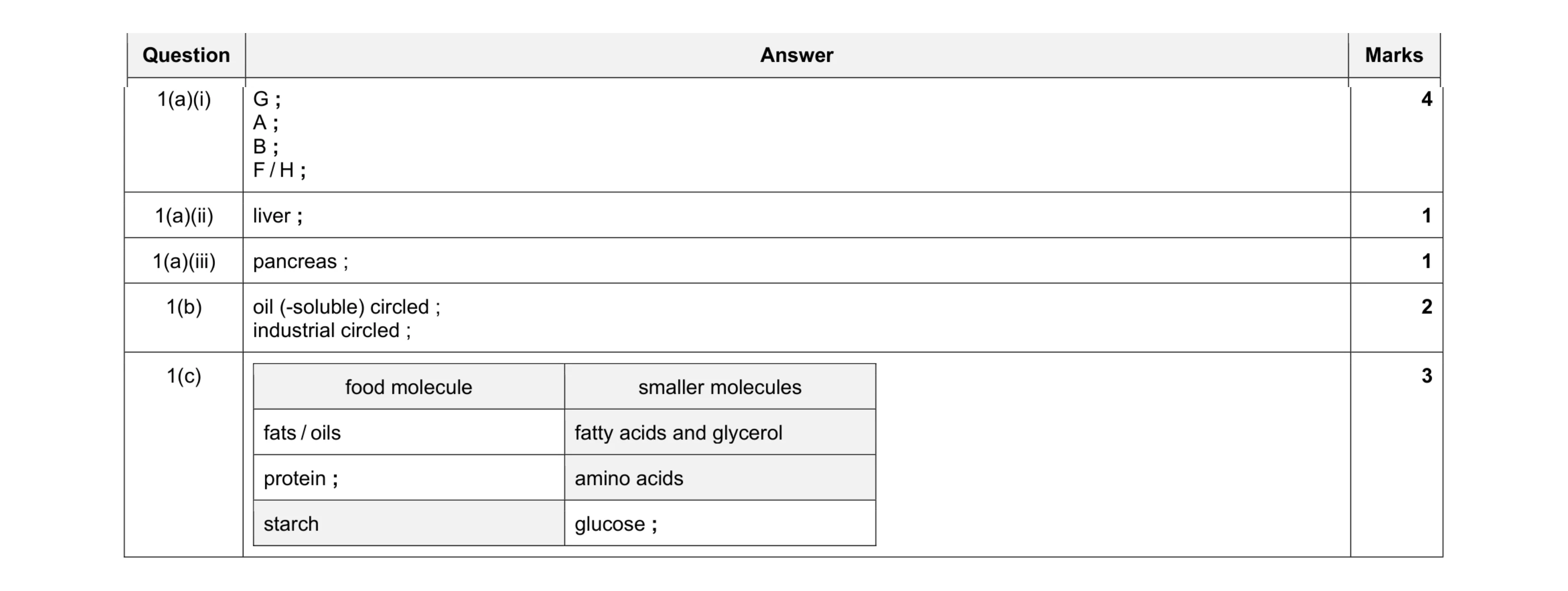 11
11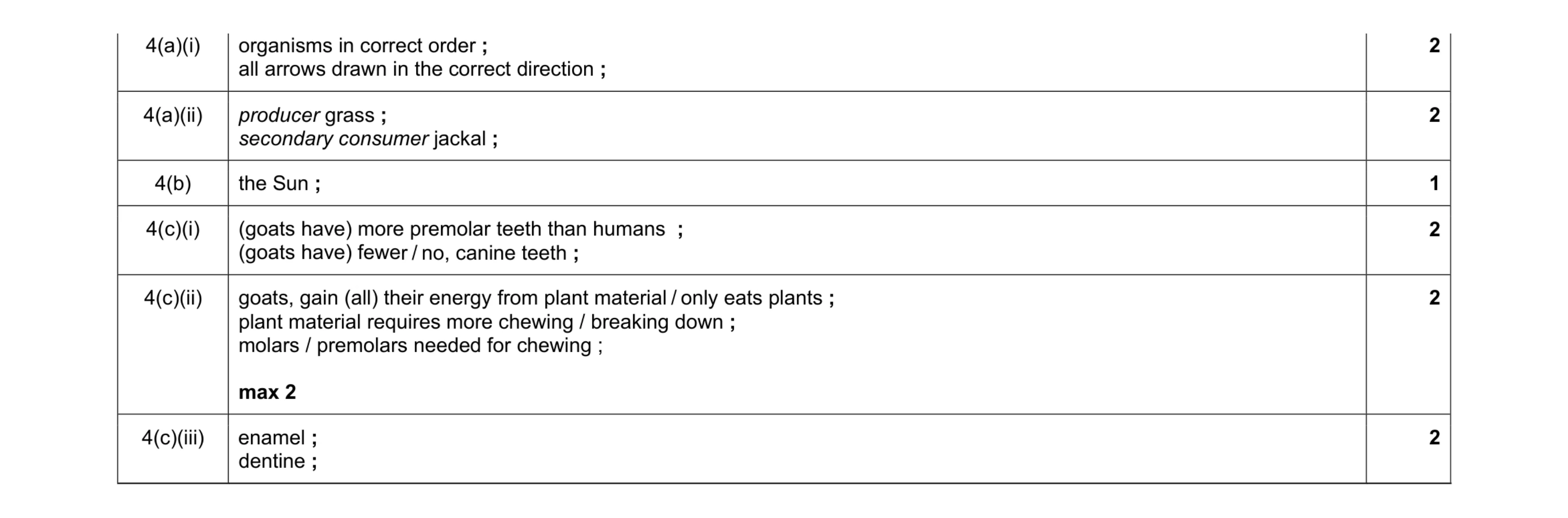 11
11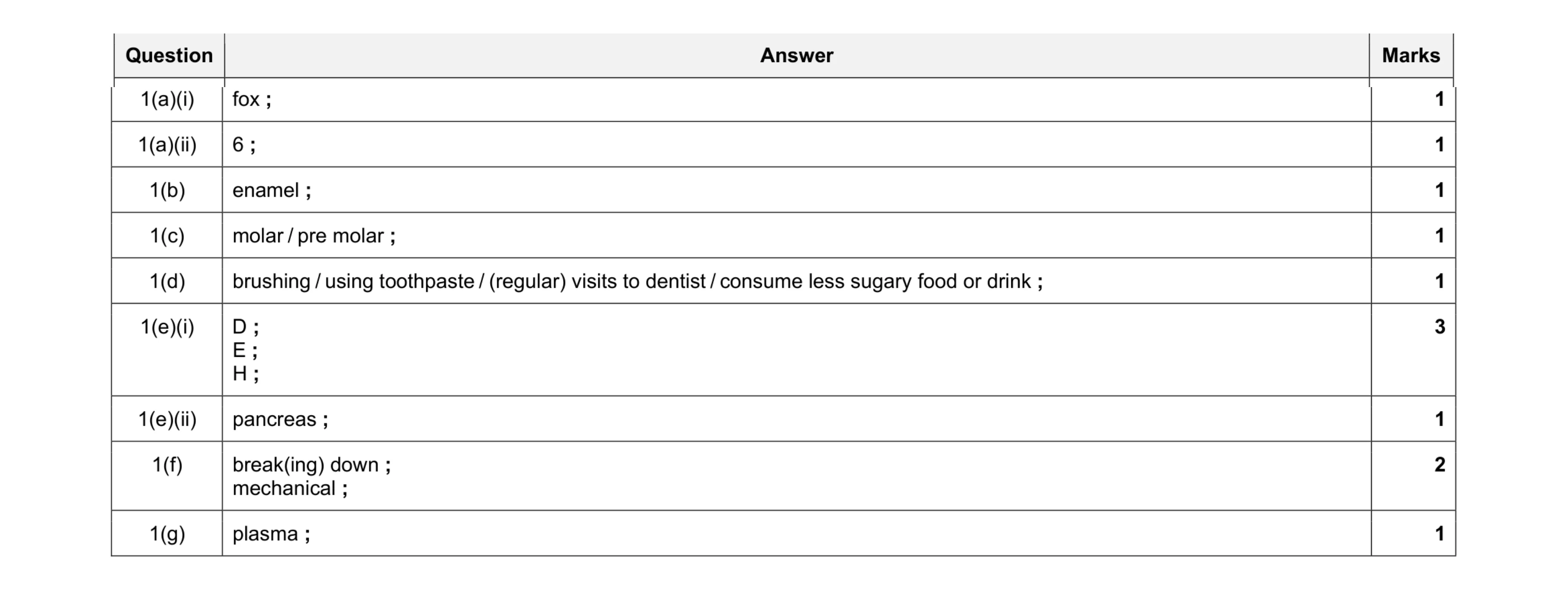 12
12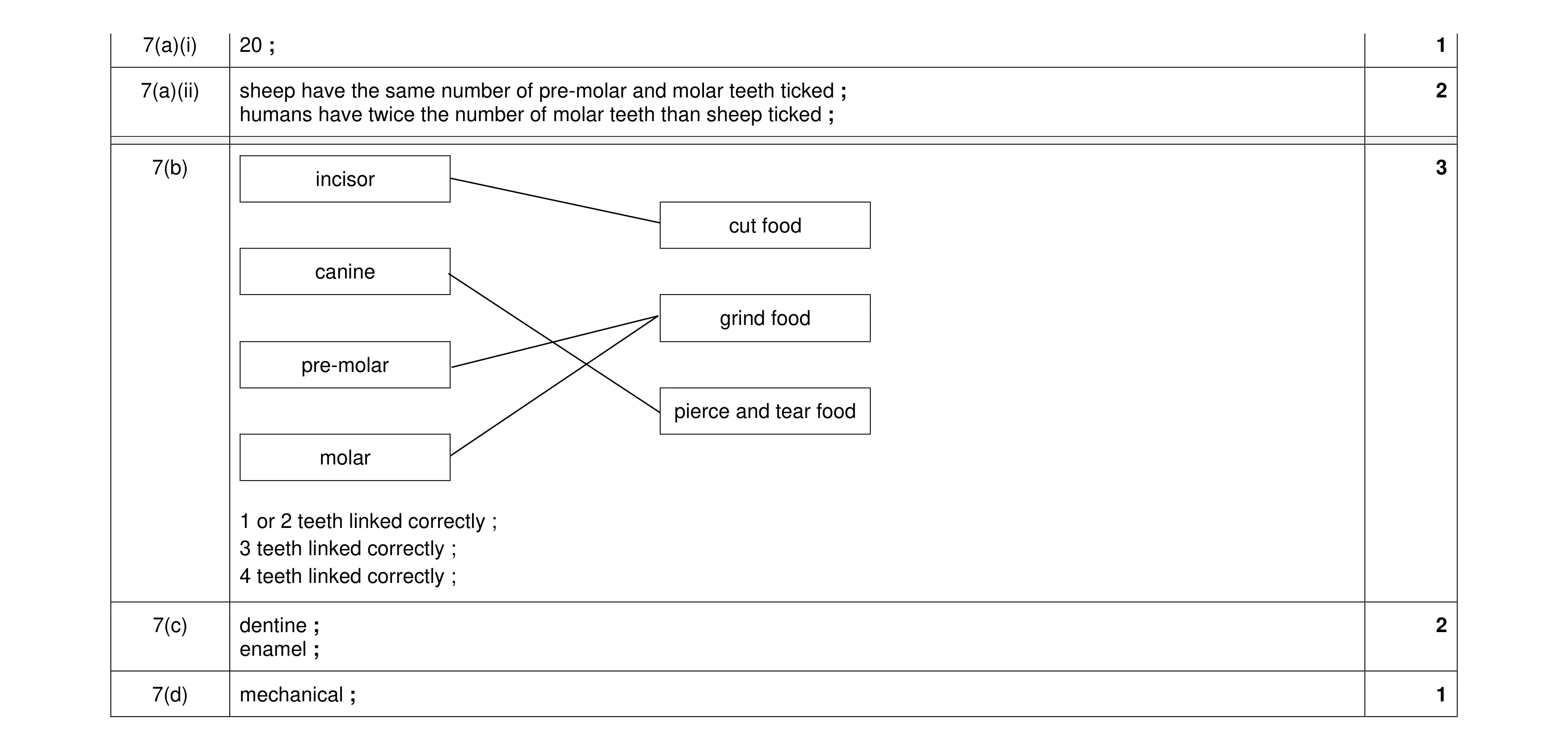 9
9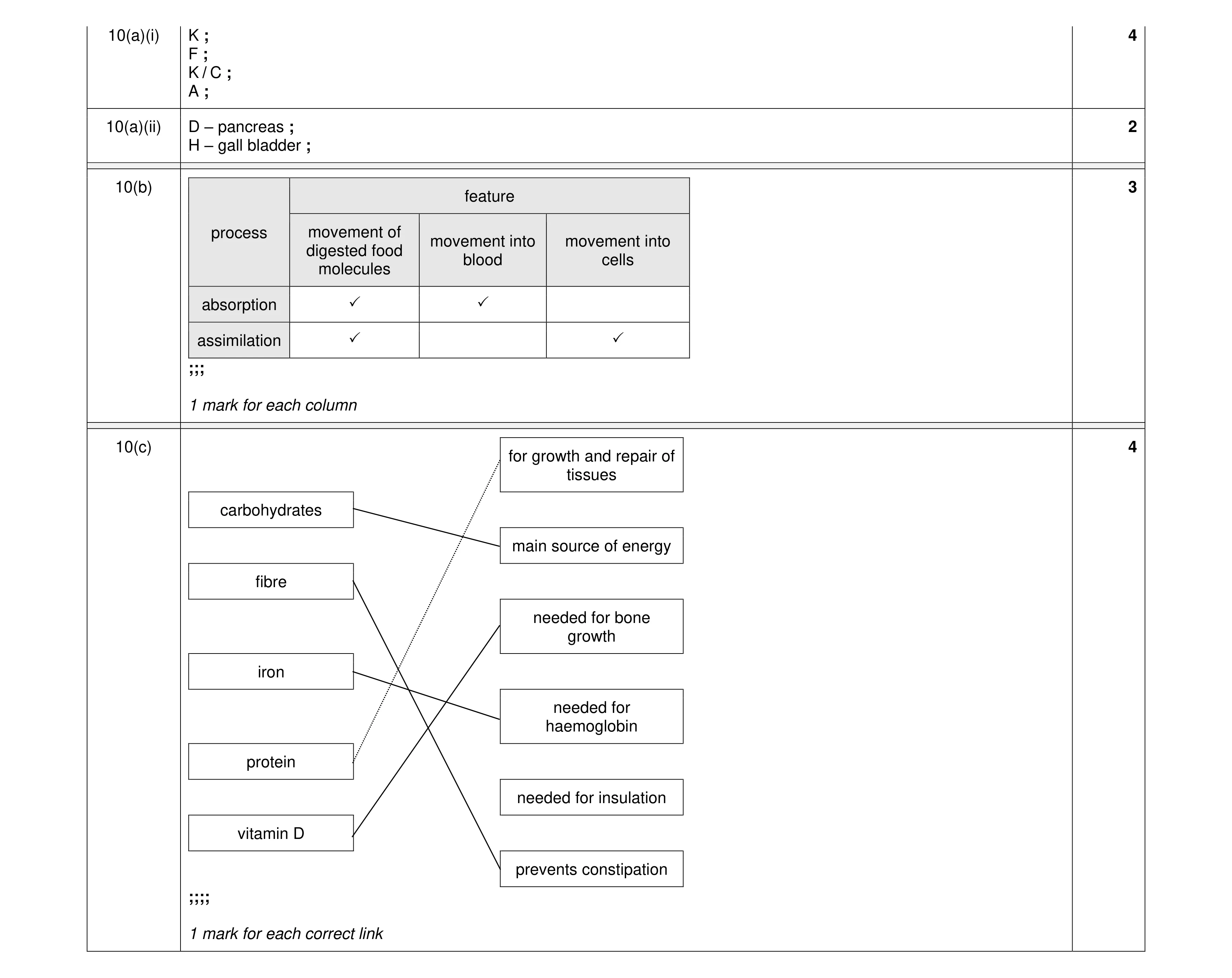 13
13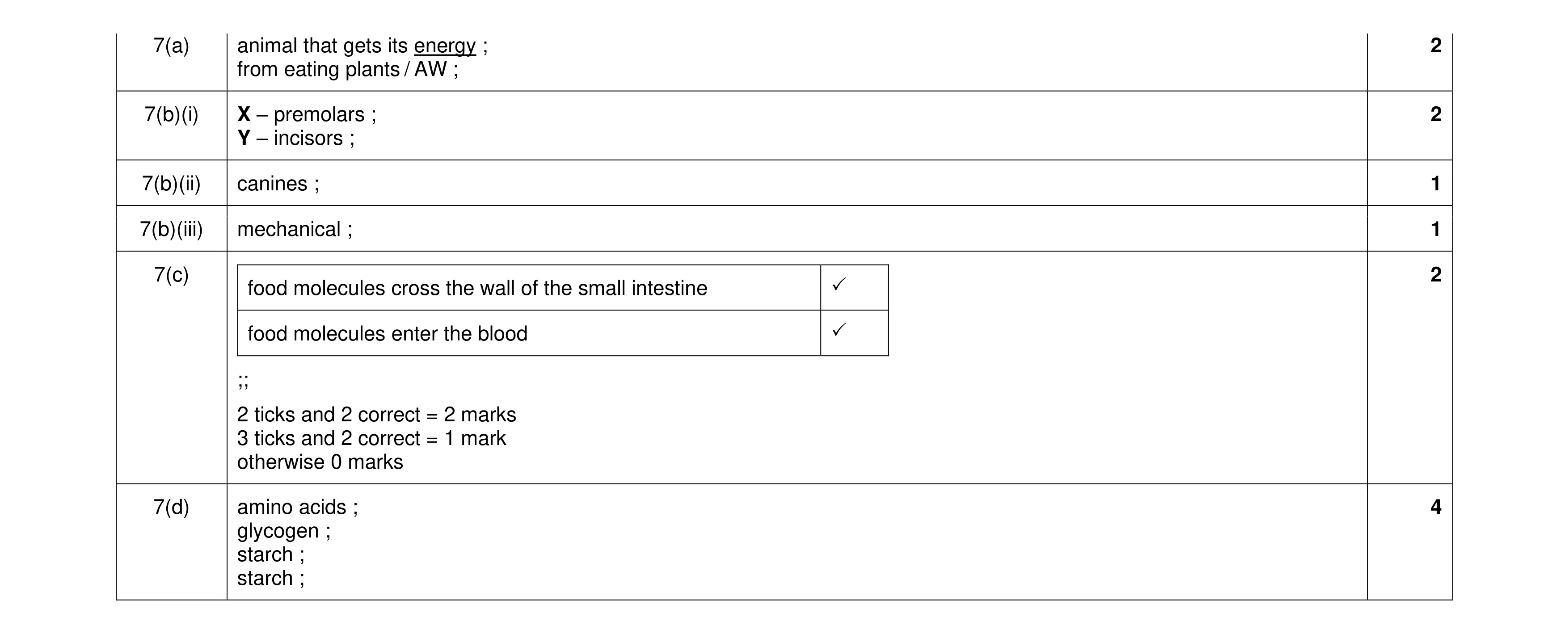 12
12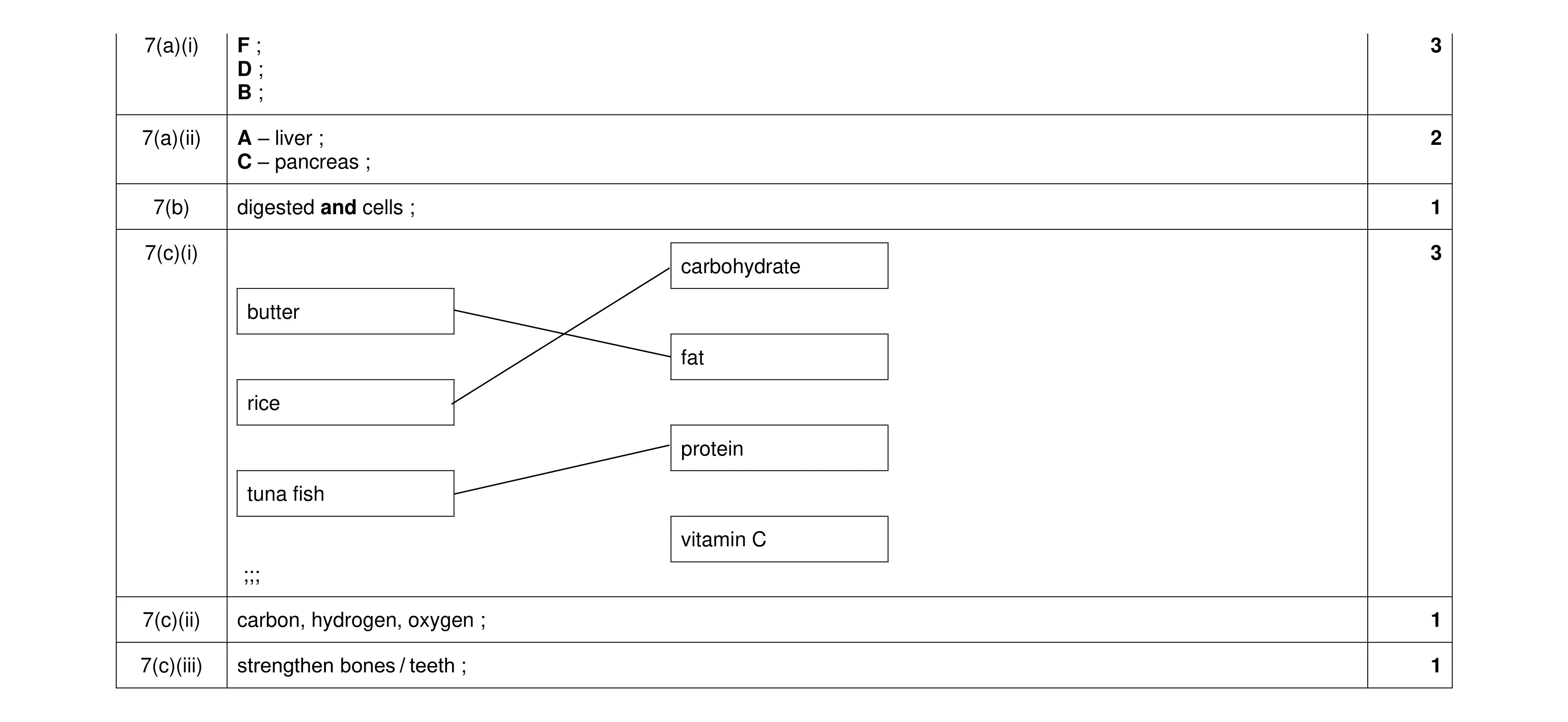 11
11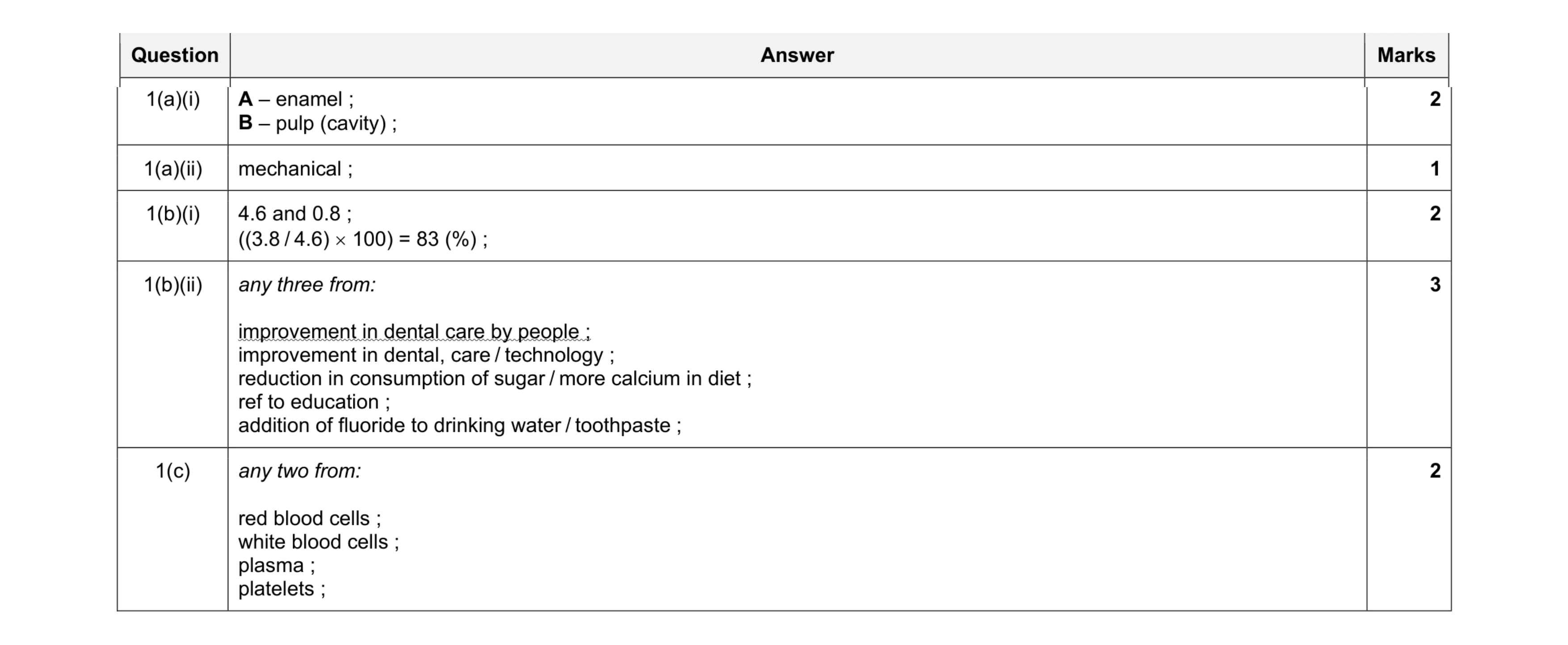 10
10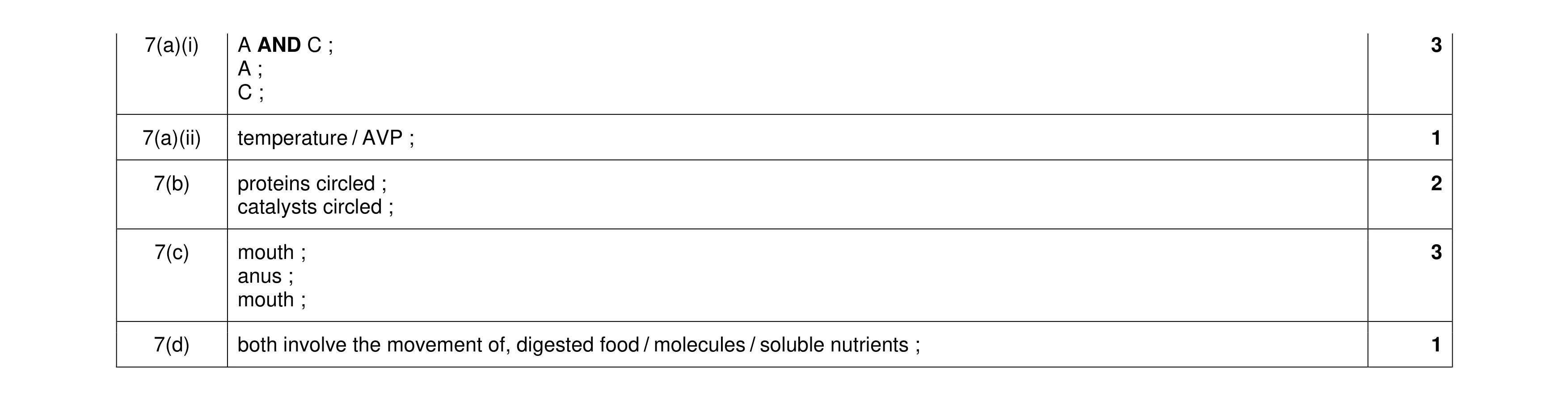 10
10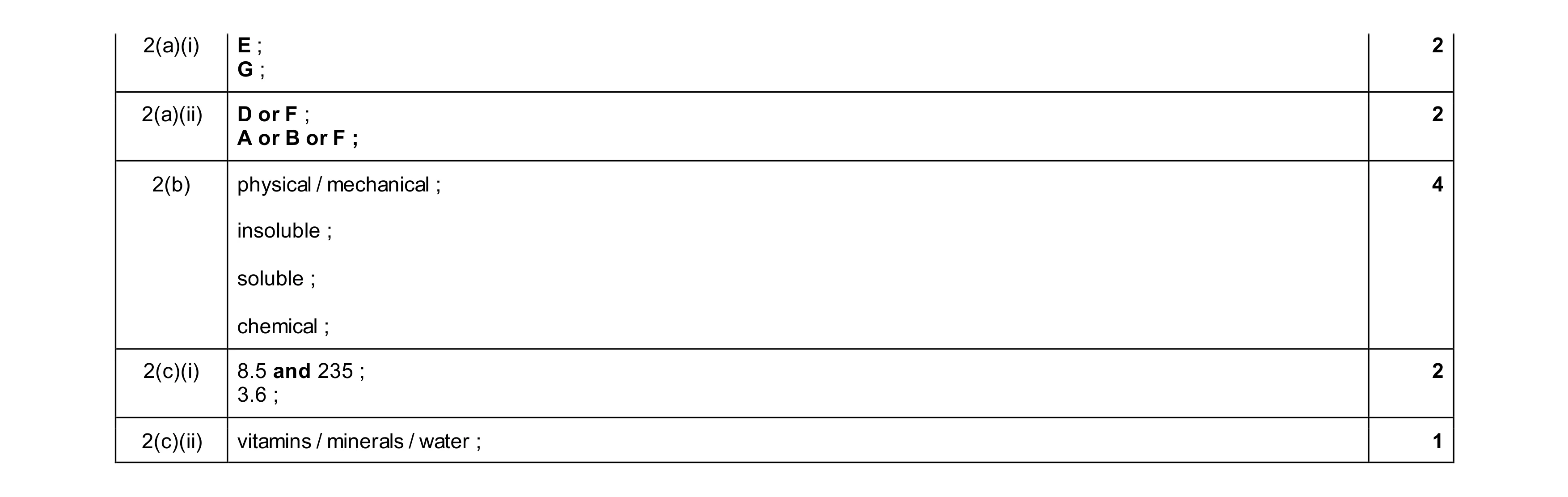 11
11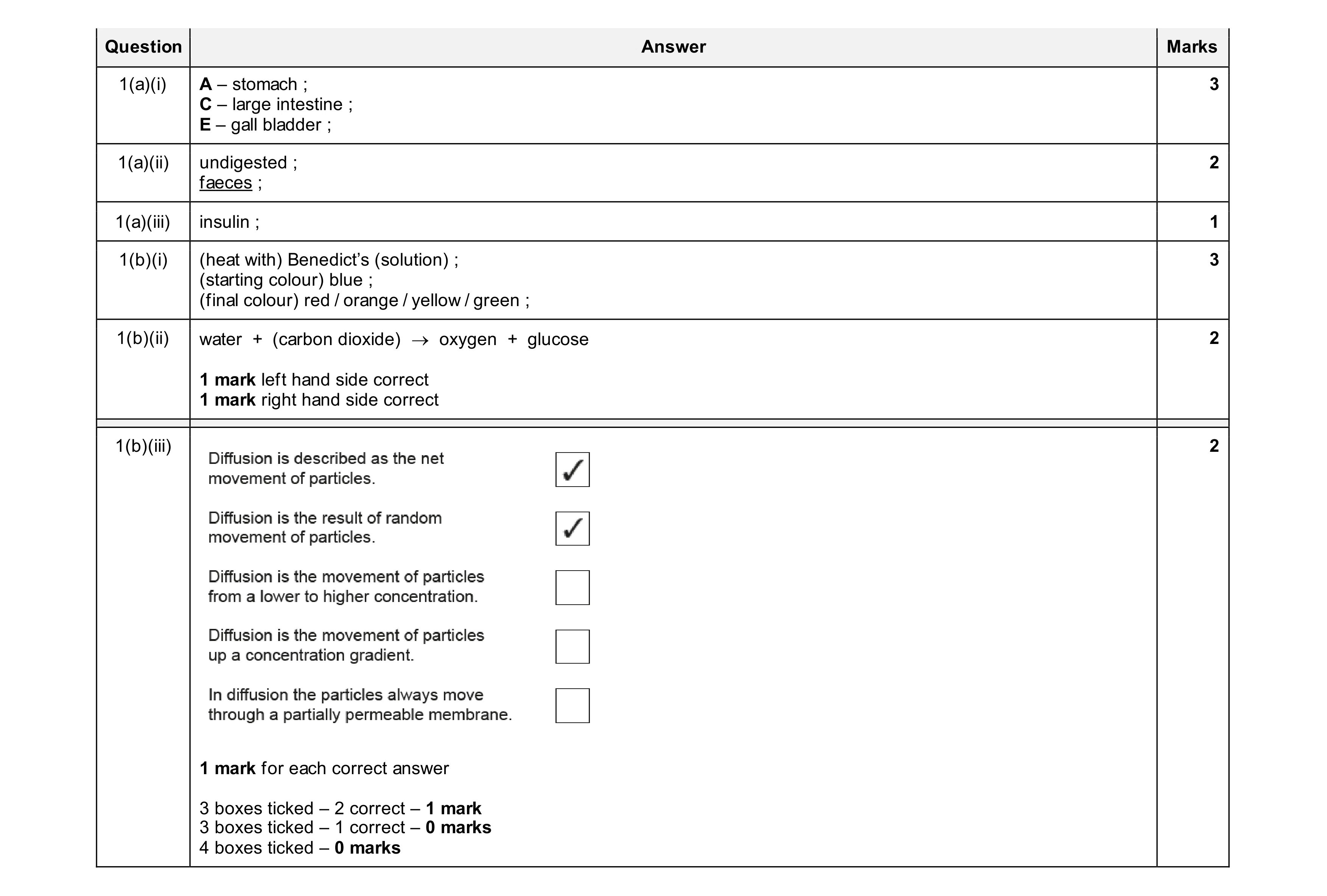 13
13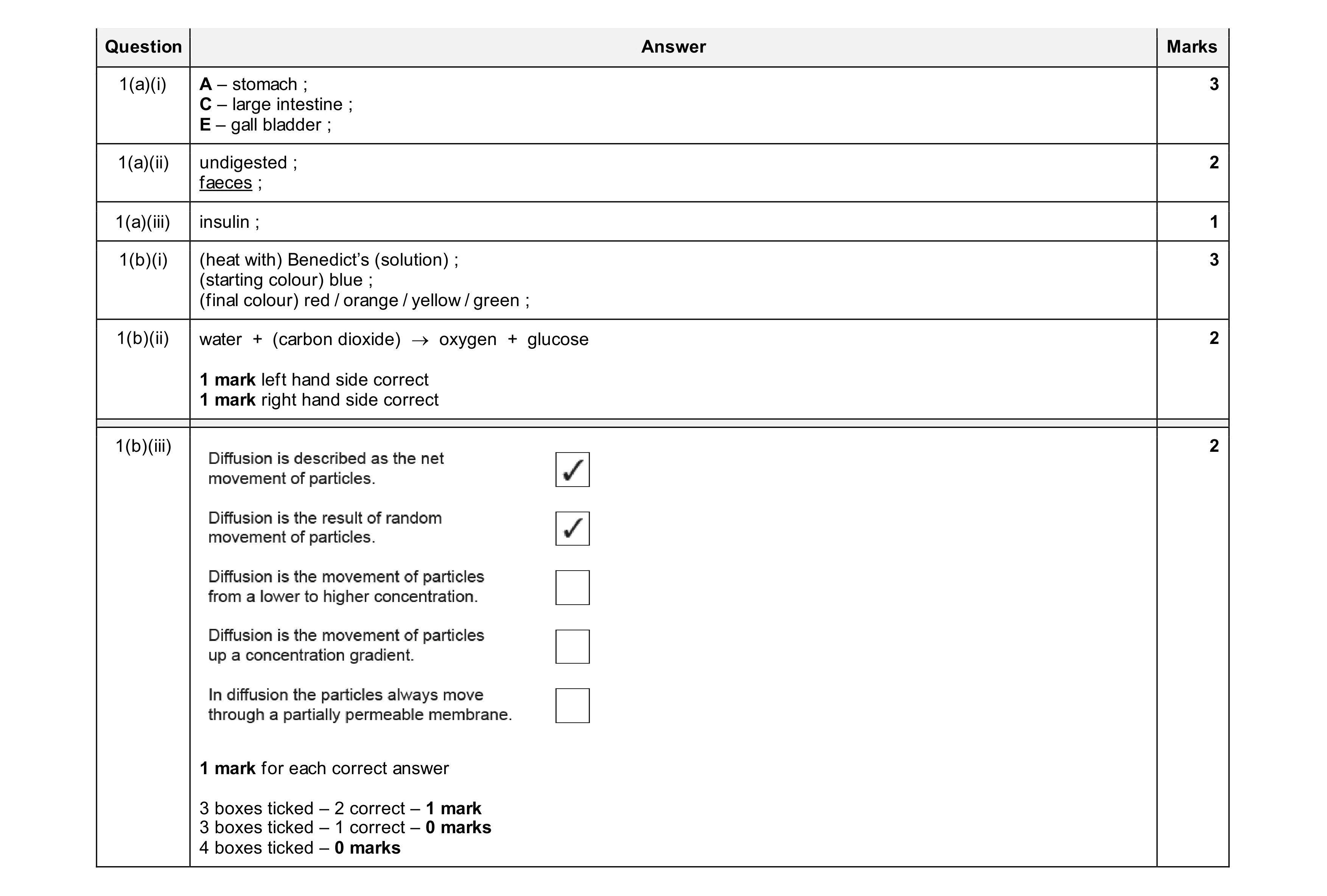 13
13