Questions as text
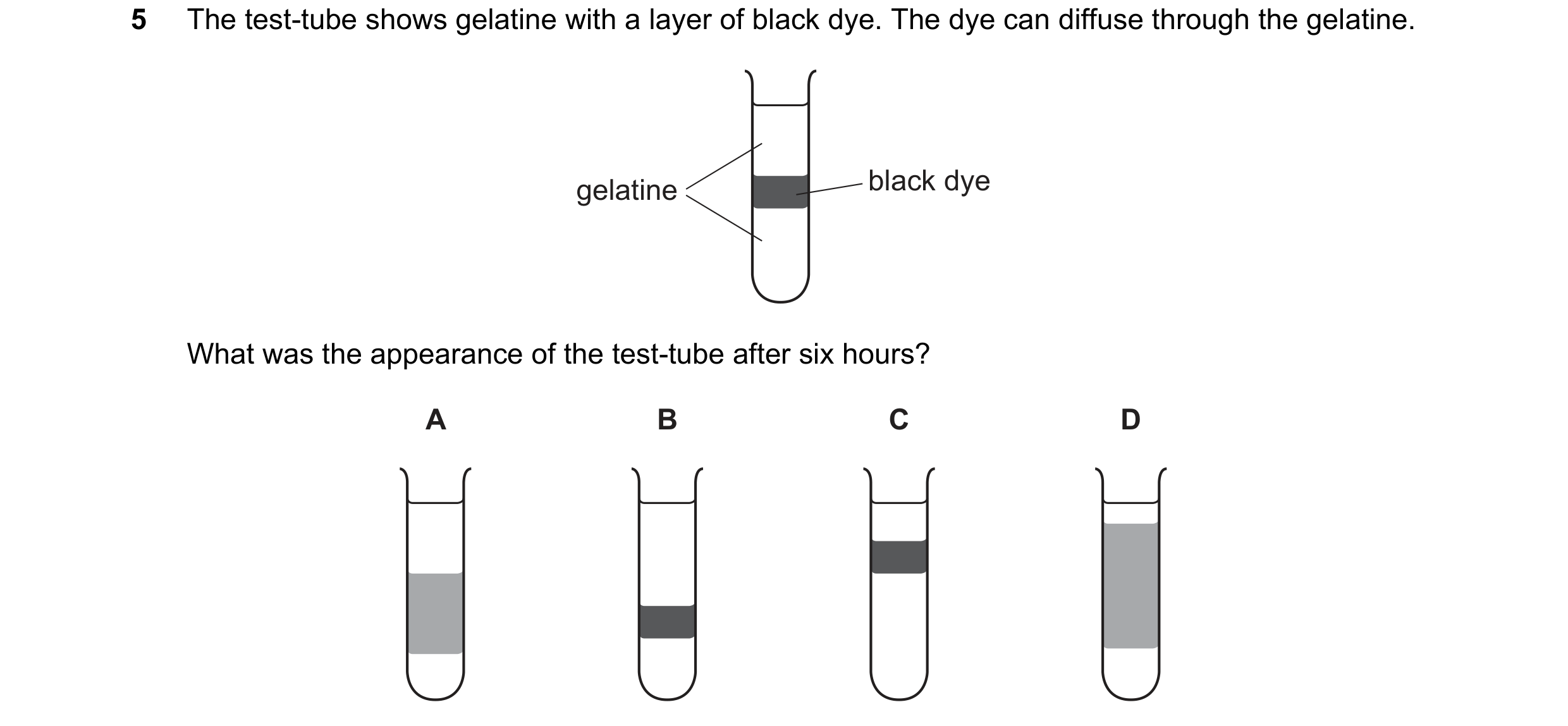
Q1 · The test-tube shows gelatine with a layer of black dye 0654/22 Oct/Nov 2017
5 The test-tube shows gelatine with a layer of black dye. The dye can diffuse through the gelatine. gelatine black dye What was the appearance of the test-tube after six hours? A B C D
1 marks
Answer: D
This question in 0654/22 Oct/Nov 2017
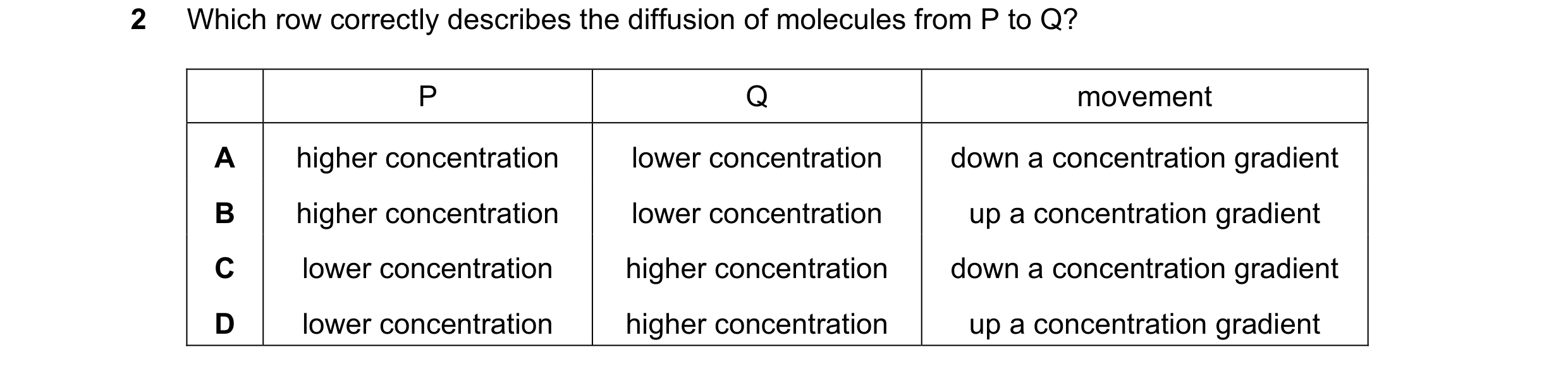
Q2 · Which row correctly describes the diffusion of molecules from P to Q? 0654/21 May/June 2019
2 Which row correctly describes the diffusion of molecules from P to Q? P Q movement A higher concentration lower concentration down a concentration gradient B higher concentration lower concentration up a concentration gradient C lower concentration higher concentration down a concentration gradient D lower concentration higher concentration up a concentration gradient
1 marks
Answer: A
This question in 0654/21 May/June 2019
Q3 · What is the net movement of molecules during diffusion? 0654/21 May/June 2020
2 What is the net movement of molecules during diffusion? A from a higher concentration to a lower concentration down a concentration gradient B from a higher concentration to a lower concentration up a concentration gradient C from a lower concentration to a higher concentration down a concentration gradient D from a lower concentration to a higher concentration up a concentration gradient
1 marks
Answer: A
This question in 0654/21 May/June 2020
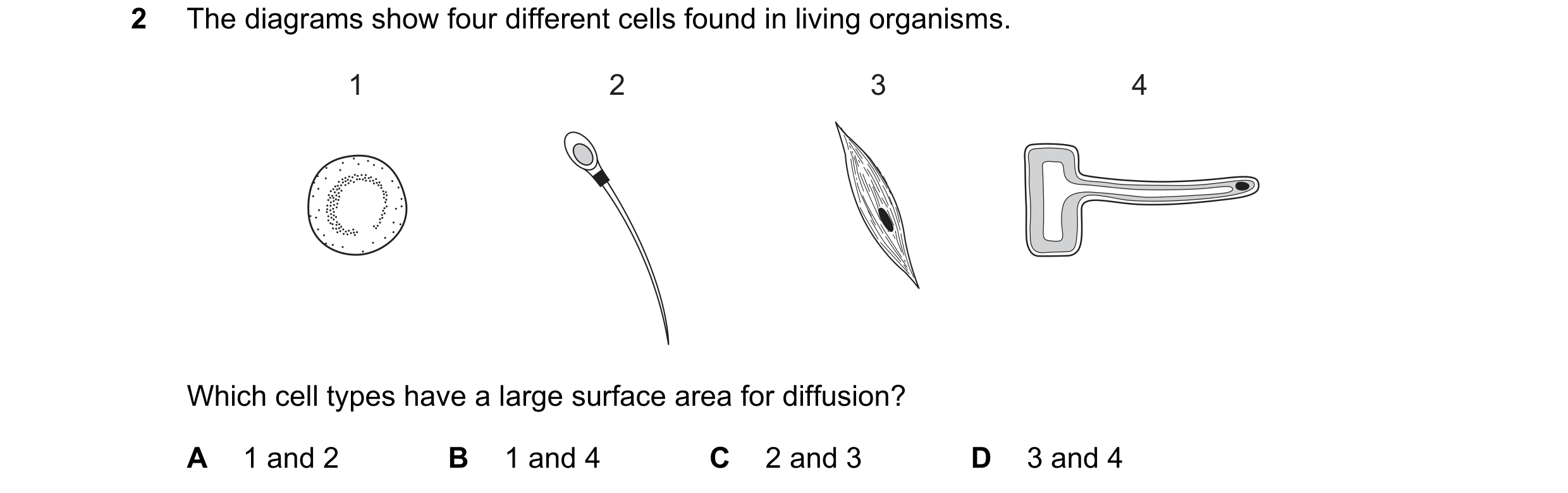
Q4 · The diagrams show four different cells found in living organisms 0654/23 Oct/Nov 2020
2 The diagrams show four different cells found in living organisms. 1 2 3 4 Which cell types have a large surface area for diffusion? A 1 and 2 B 1 and 4 C 2 and 3 D 3 and 4
1 marks
Answer: B
This question in 0654/23 Oct/Nov 2020
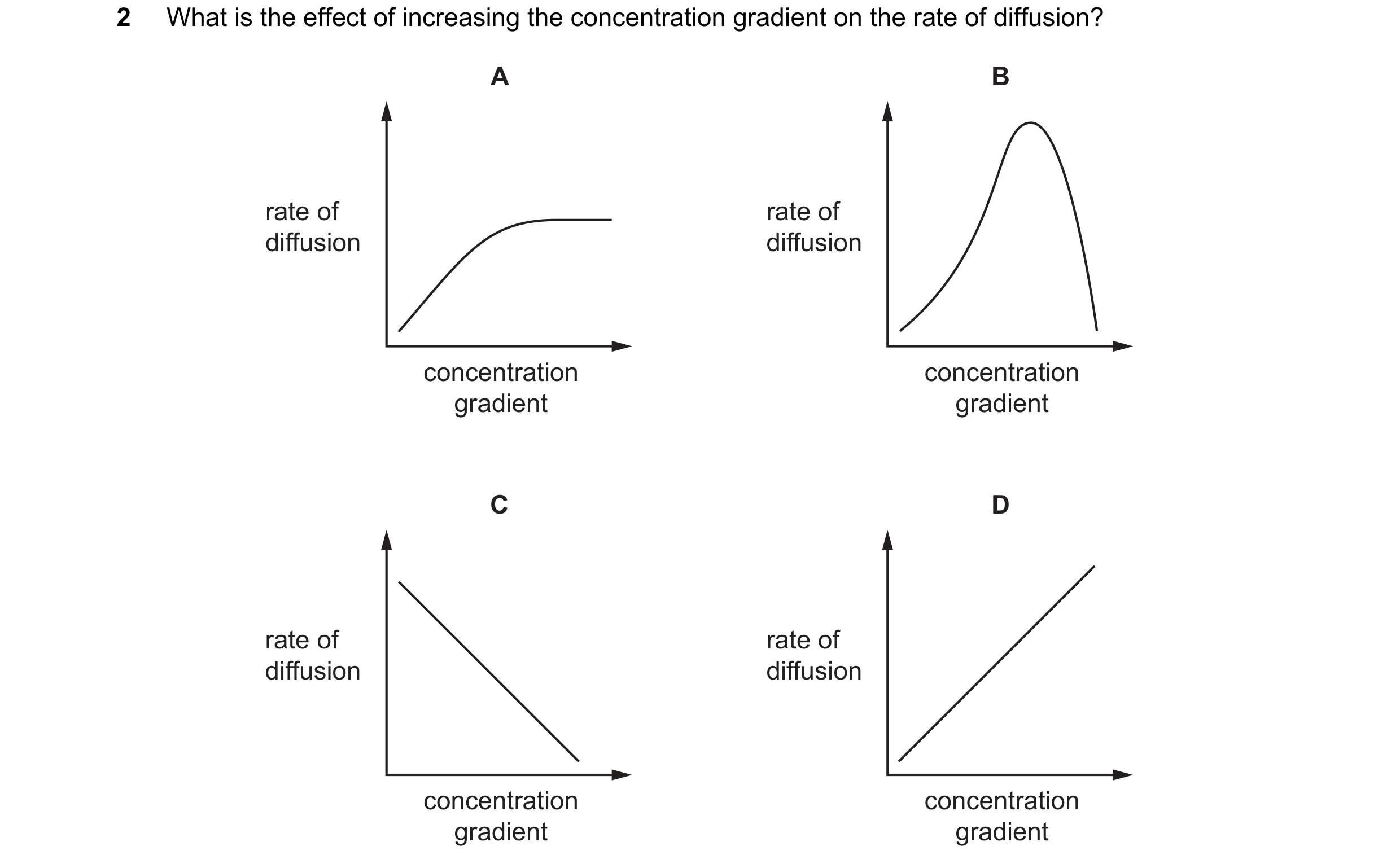
Q5 · What is the effect of increasing the concentration gradient on the rate of diffusion? 0654/21 May/June 2021
2 What is the effect of increasing the concentration gradient on the rate of diffusion? A B rate of rate of diffusion diffusion concentration concentration gradient gradient C D rate of rate of diffusion diffusion concentration concentration gradient gradient
1 marks
Answer: C
This question in 0654/21 May/June 2021
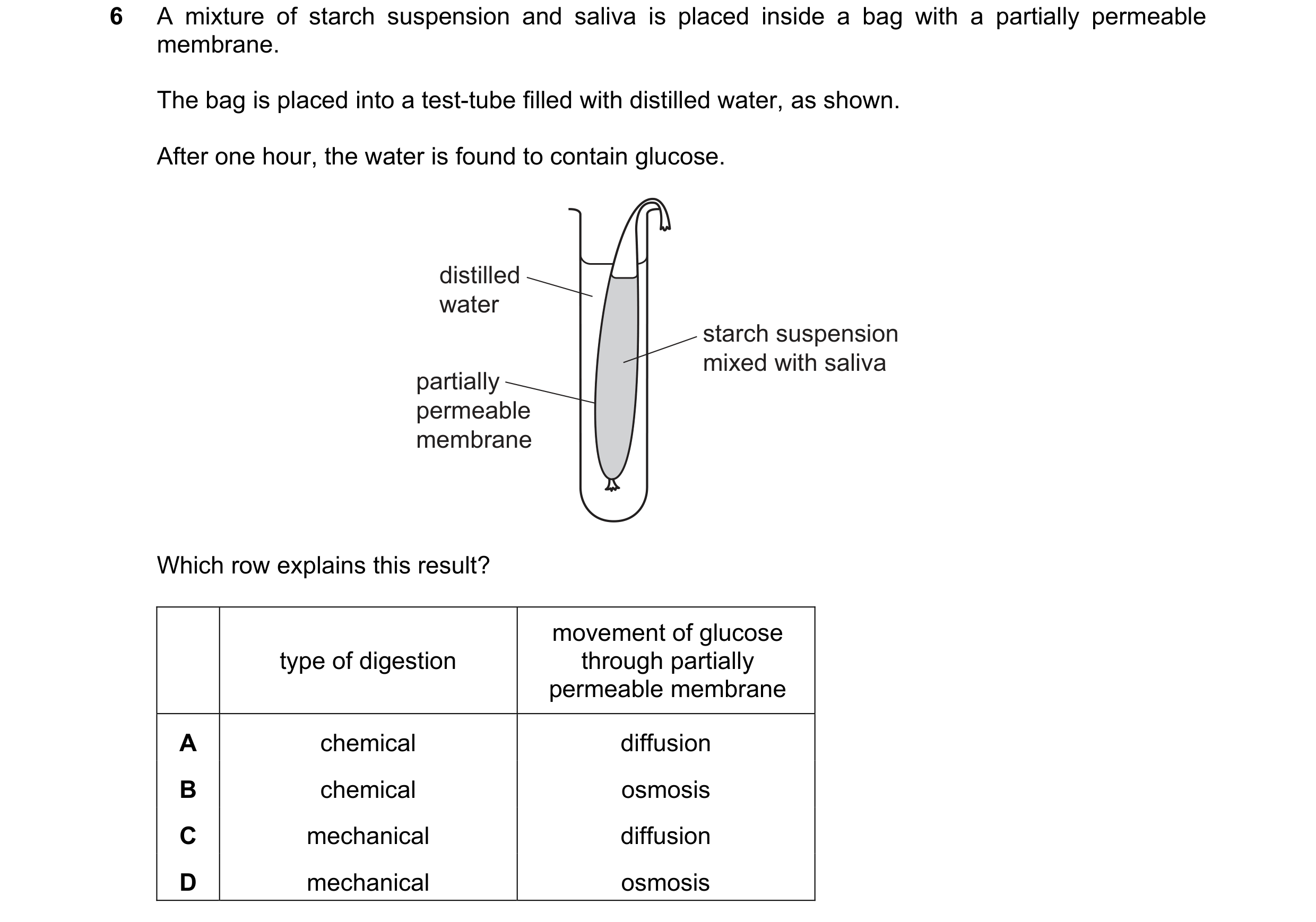
Q6 · A mixture of starch suspension and saliva is placed inside a bag with a partially… 0654/23 May/June 2021
6 A mixture of starch suspension and saliva is placed inside a bag with a partially permeable membrane. The bag is placed into a test-tube filled with distilled water, as shown. After one hour, the water is found to contain glucose. distilled water starch suspension mixed with saliva partially permeable membrane Which row explains this result? movement of glucose type of digestion through partially permeable membrane A chemical diffusion B chemical osmosis C mechanical diffusion D mechanical osmosis
1 marks
Answer: A
This question in 0654/23 May/June 2021
Q7 · The diagrams show four different cells found in living organisms 0654/23 May/June 2023
2 The diagrams show four different cells found in living organisms. 1 2 3 4 Which cell types have a large surface area for diffusion? A 1 and 2 B 1 and 4 C 2 and 3 D 3 and 4
1 marks
Answer: B
This question in 0654/23 May/June 2023
Q8 · What is the effect of increasing the concentration gradient on the rate of diffusion? 0654/22 Feb/March 2024
2 What is the effect of increasing the concentration gradient on the rate of diffusion? A B rate of rate of diffusion diffusion concentration concentration gradient gradient C D rate of rate of diffusion diffusion concentration concentration gradient gradient
1 marks
Answer: D
This question in 0654/22 Feb/March 2024
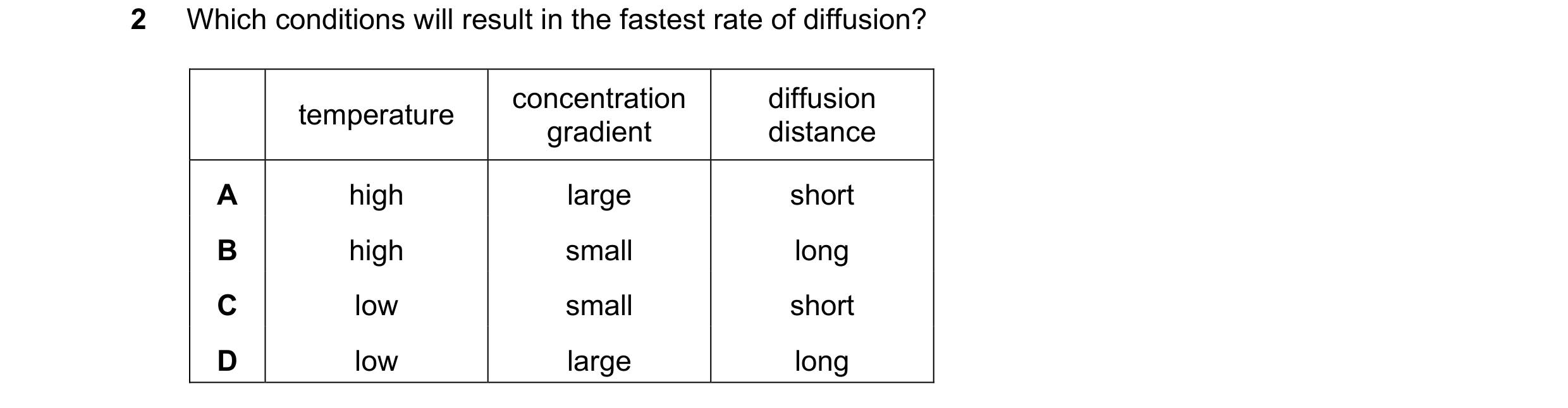
Q9 · Which conditions will result in the fastest rate of diffusion? 0654/21 May/June 2024
2 Which conditions will result in the fastest rate of diffusion? concentration diffusion temperature gradient distance A high large short B high small long C low small short D low large long
1 marks
Answer: A
This question in 0654/21 May/June 2024
Q10 · Oxygen produced in palisade mesophyll cells by photosynthesis diffuses into the air… 0654/23 May/June 2024
2 Oxygen produced in palisade mesophyll cells by photosynthesis diffuses into the air spaces in the leaf. What causes this movement? A osmosis between the leaf cells B evaporation of water from mesophyll cells C difference in oxygen concentration inside and outside the cells D wind blowing over the leaves
1 marks
Answer: C
This question in 0654/23 May/June 2024
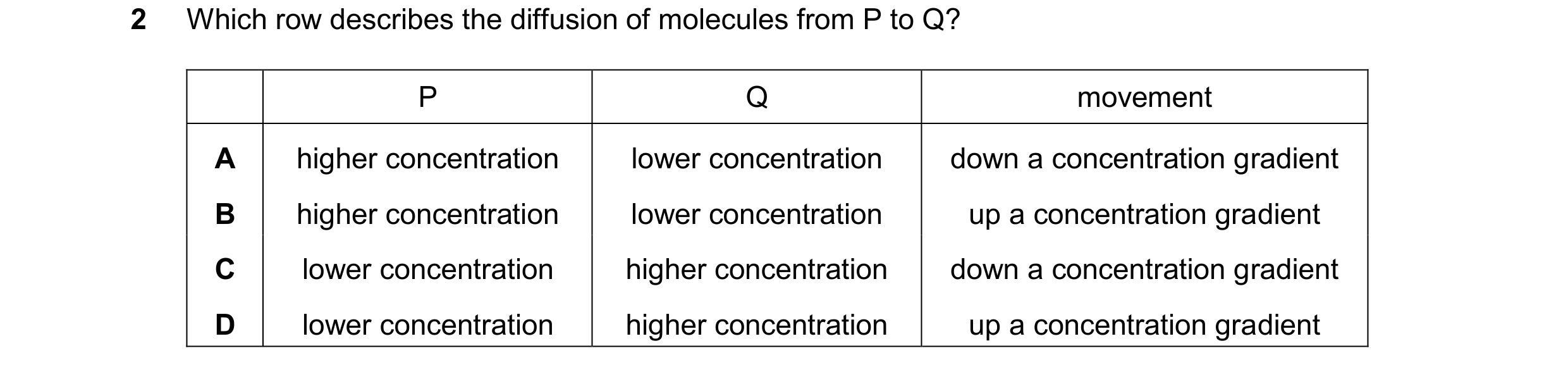
Q11 · Which row describes the diffusion of molecules from P to Q? 0654/23 May/June 2025
2 Which row describes the diffusion of molecules from P to Q? P Q movement A higher concentration lower concentration down a concentration gradient B higher concentration lower concentration up a concentration gradient C lower concentration higher concentration down a concentration gradient D lower concentration higher concentration up a concentration gradient
1 marks
Answer: A
This question in 0654/23 May/June 2025
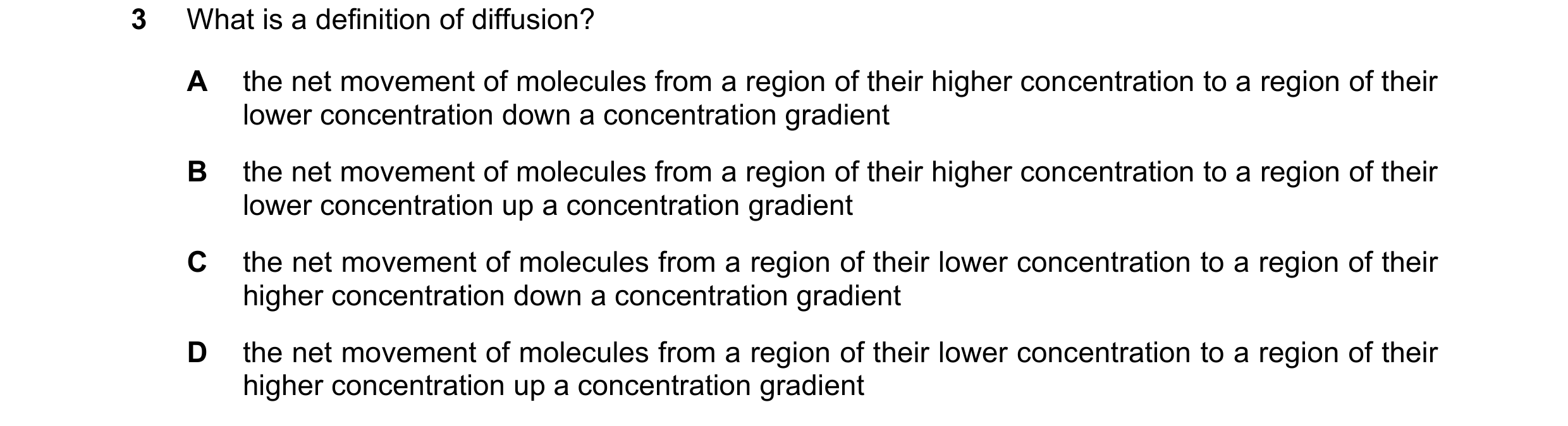
Q12 · What is a definition of diffusion? 0654/23 Oct/Nov 2025
3 What is a definition of diffusion? A the net movement of molecules from a region of their higher concentration to a region of their lower concentration down a concentration gradient B the net movement of molecules from a region of their higher concentration to a region of their lower concentration up a concentration gradient C the net movement of molecules from a region of their lower concentration to a region of their higher concentration down a concentration gradient D the net movement of molecules from a region of their lower concentration to a region of their higher concentration up a concentration gradient
1 marks
Answer: A
This question in 0654/23 Oct/Nov 2025

 1 / 4
1 / 4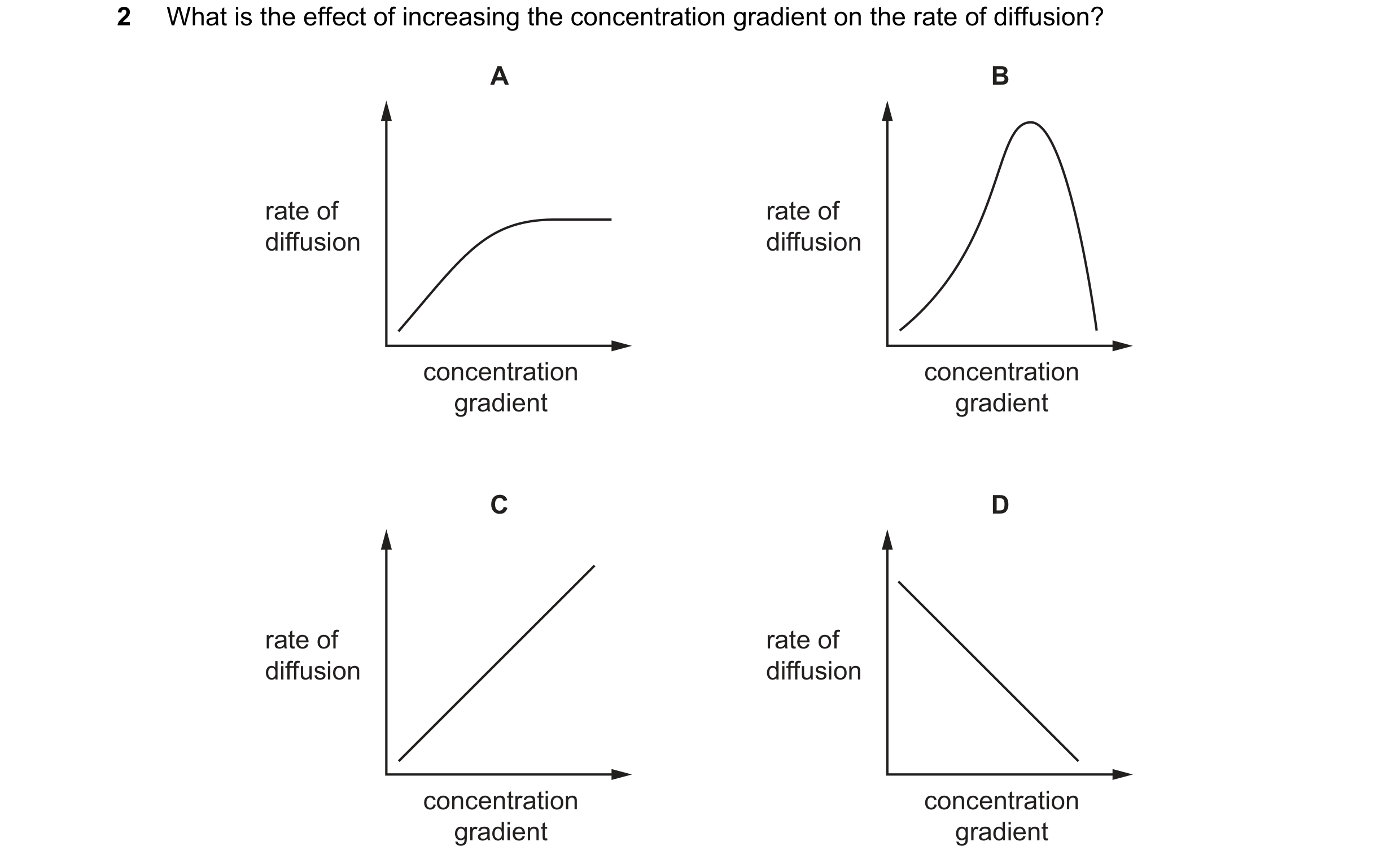
 2 / 4
2 / 4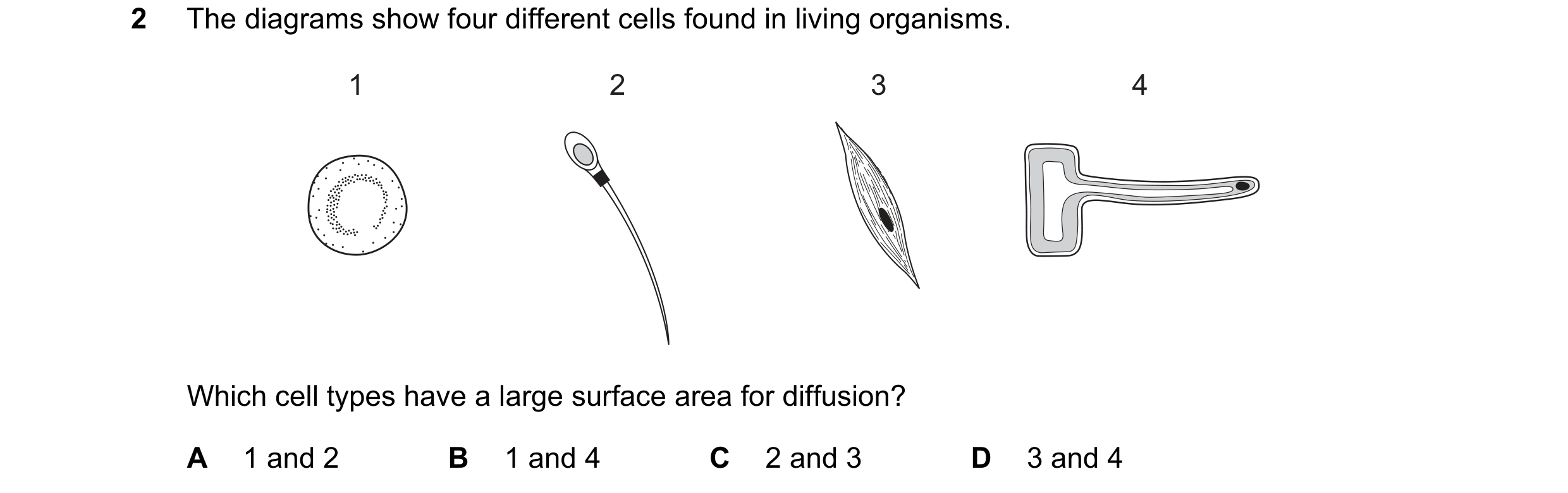
 3 / 4
3 / 4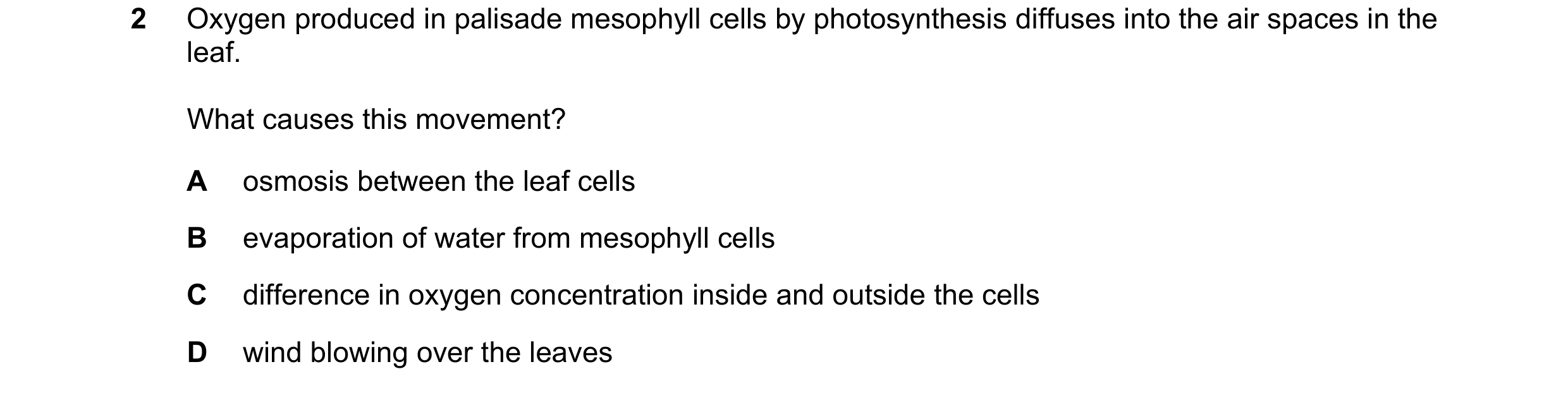
 4 / 4
4 / 4