Questions as text
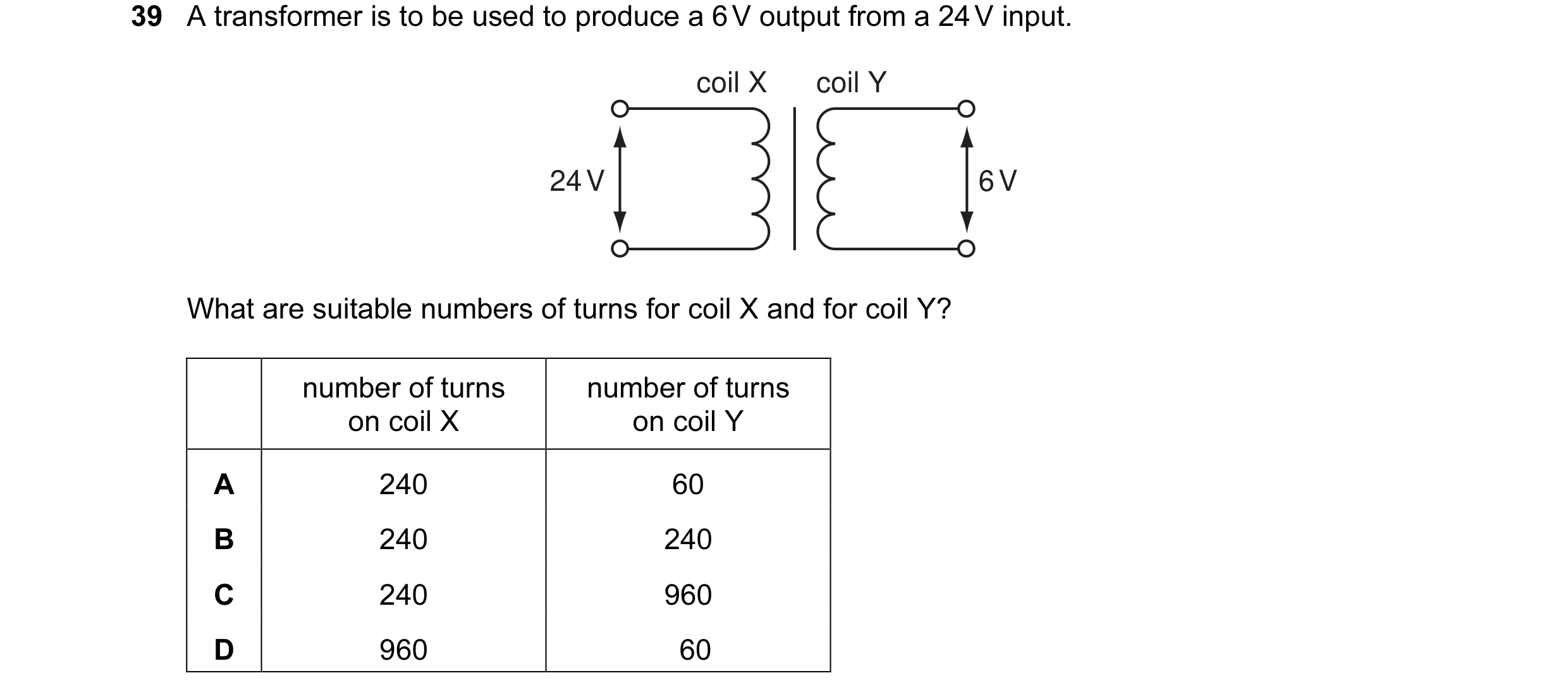
Q1 · A transformer is to be used to produce a 6 V output from a 24 V input 0653/11 May/June 2006
39 A transformer is to be used to produce a 6 V output from a 24 V input. coil X coil Y 24 V 6 V What are suitable numbers of turns for coil X and for coil Y? number of turns number of turns on coil X on coil Y A 240 60 B 240 240 C 240 960 D 960 60
1 marks
Answer: A
This question in 0653/11 May/June 2006
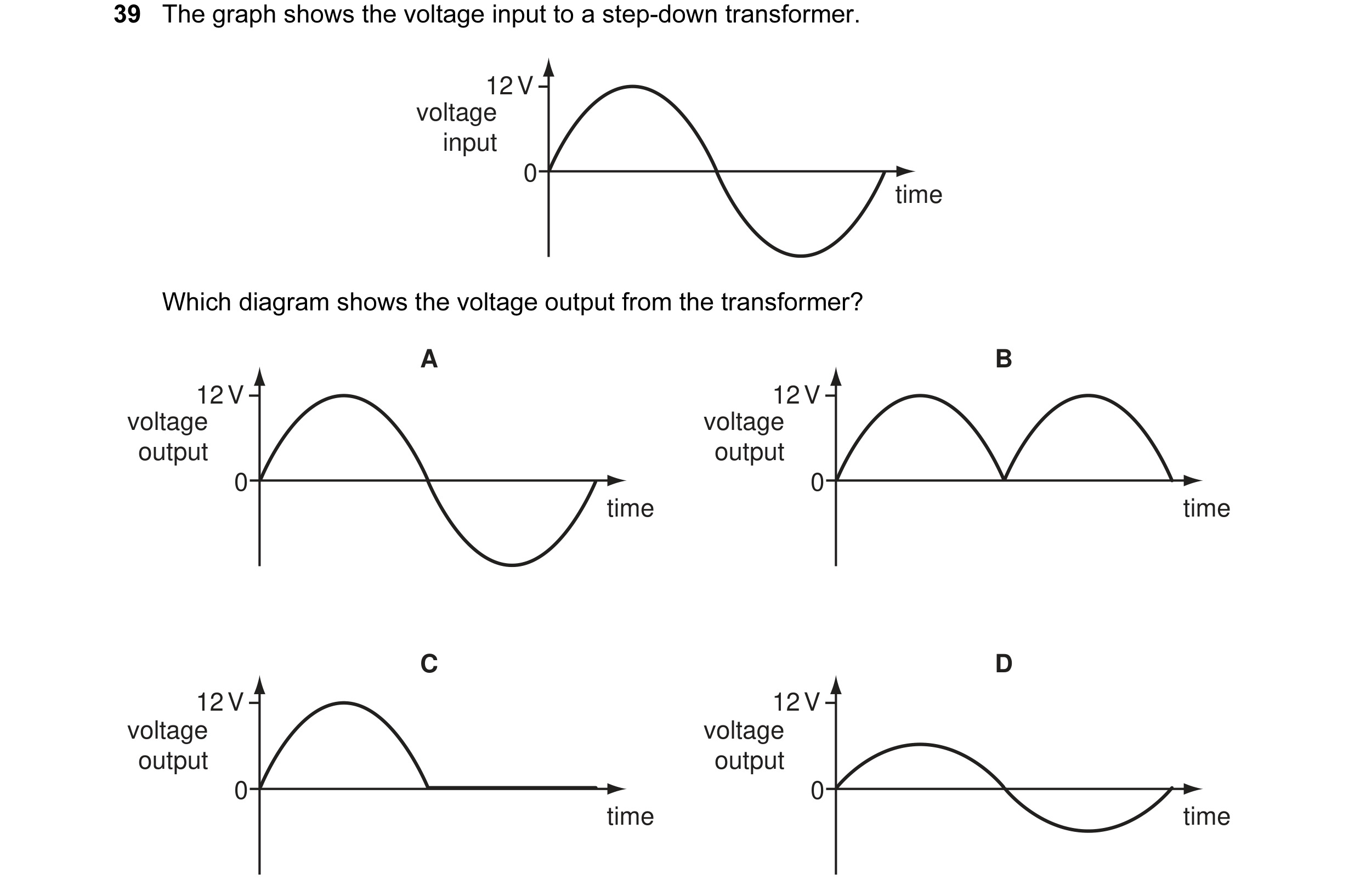
Q2 · The graph shows the voltage input to a step-down transformer 0653/11 Oct/Nov 2006
39 The graph shows the voltage input to a step-down transformer. 12 V voltage input 0 time Which diagram shows the voltage output from the transformer? A B 12 V 12 V voltage voltage output output 0 0 time time C D 12 V 12 V voltage voltage output output 0 0 time time
1 marks
Answer: D
This question in 0653/11 Oct/Nov 2006
Q3 · The diagram shows a lamp connected to a transformer 0653/11 May/June 2007
39 The diagram shows a lamp connected to a transformer. 40 turns 200 turns 12 V a.c. What is the potential difference across the lamp? A 2.4 V B 12 V C 60 V D 240 V
1 marks
Answer: C
This question in 0653/11 May/June 2007
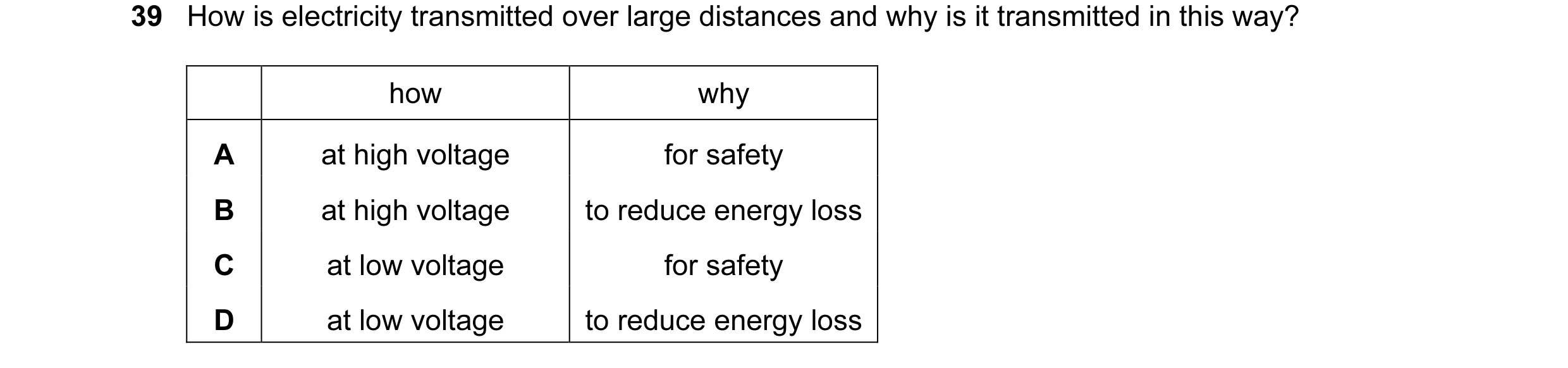
Q4 · How is electricity transmitted over large distances and why is it transmitted in this way? 0653/11 Oct/Nov 2007
39 How is electricity transmitted over large distances and why is it transmitted in this way? how why A at high voltage for safety B at high voltage to reduce energy loss C at low voltage for safety D at low voltage to reduce energy loss
1 marks
Answer: B
This question in 0653/11 Oct/Nov 2007
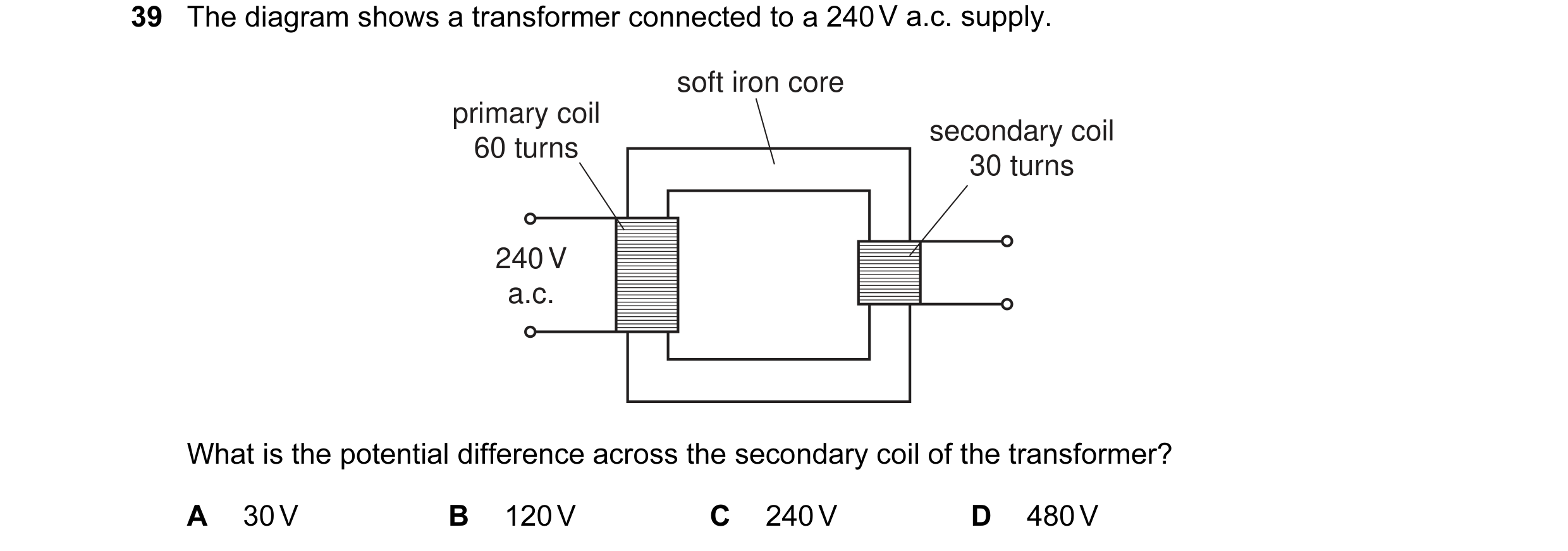
Q5 · The diagram shows a transformer connected to a 240 V a.c 0653/11 May/June 2008
39 The diagram shows a transformer connected to a 240 V a.c. supply. soft iron core primary coil secondary coil 60 turns 30 turns 240 V a.c. What is the potential difference across the secondary coil of the transformer? A 30 V B 120 V C 240 V D 480 V
1 marks
Answer: B
This question in 0653/11 May/June 2008
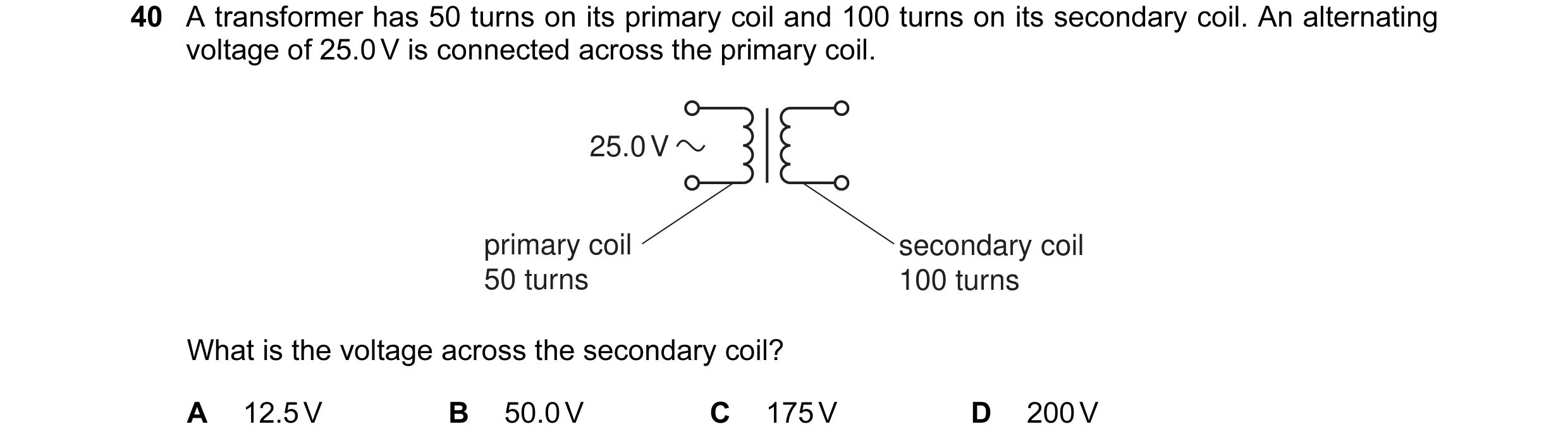
Q6 · A transformer has 50 turns on its primary coil and 100 turns on its secondary coil 0653/11 May/June 2009
40 A transformer has 50 turns on its primary coil and 100 turns on its secondary coil. An alternating voltage of 25.0 V is connected across the primary coil. 25.0 V primary coil secondary coil 50 turns 100 turns What is the voltage across the secondary coil? A 12.5 V B 50.0 V C 175 V D 200 V
1 marks
Answer: B
This question in 0653/11 May/June 2009
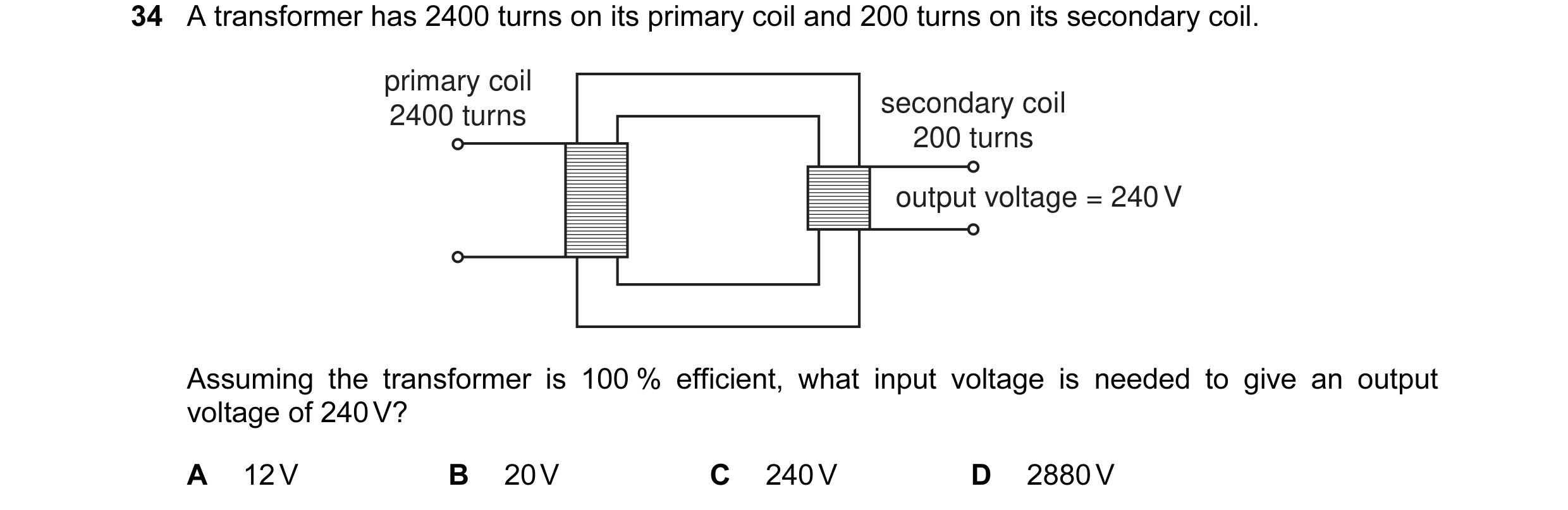
Q7 · A transformer has 2400 turns on its primary coil and 200 turns on its secondary coil 0653/11 May/June 2010
35 A transformer has 2400 turns on its primary coil and 200 turns on its secondary coil. primary coil 2400 turns secondary coil 200 turns output voltage = 240 V Assuming the transformer is 100 % efficient, what input voltage is needed to give an output voltage of 240 V? A 12 V B 20 V C 240 V D 2880 V
1 marks
Answer: D
This question in 0653/11 May/June 2010
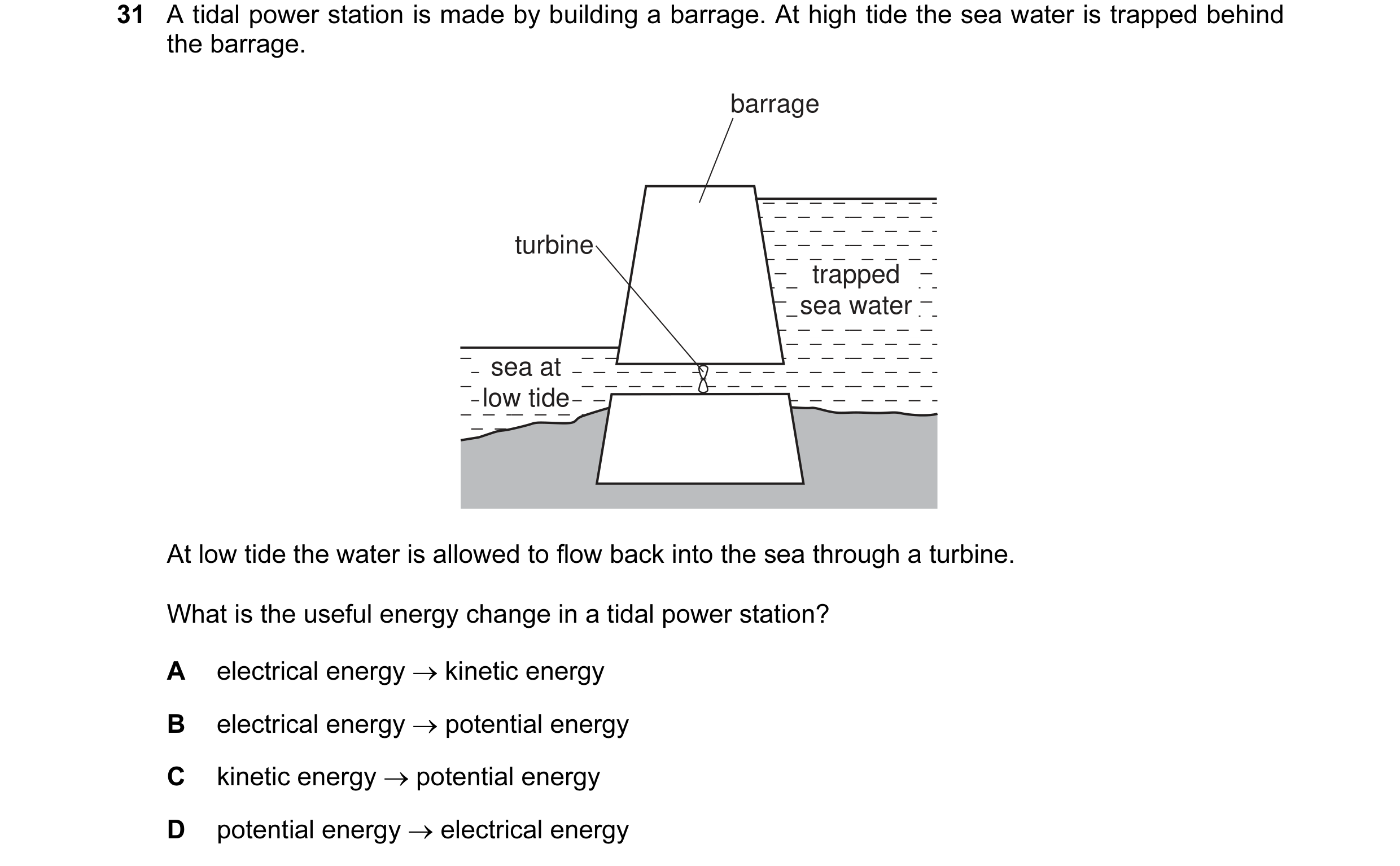
Q8 · A tidal power station is made by building a barrage 0653/12 May/June 2010
31 A tidal power station is made by building a barrage. At high tide the sea water is trapped behind the barrage. barrage turbine trapped sea water sea at low tide At low tide the water is allowed to flow back into the sea through a turbine. What is the useful energy change in a tidal power station? A electrical energy → kinetic energy B electrical energy → potential energy C kinetic energy → potential energy D potential energy → electrical energy
1 marks
Answer: D
This question in 0653/12 May/June 2010
Q9 · A transformer has 2400 turns on its primary coil and 200 turns on its secondary coil 0653/12 May/June 2010
34 A transformer has 2400 turns on its primary coil and 200 turns on its secondary coil. primary coil 2400 turns secondary coil 200 turns output voltage = 240 V Assuming the transformer is 100 % efficient, what input voltage is needed to give an output voltage of 240 V? A 12 V B 20 V C 240 V D 2880 V
1 marks
Answer: D
This question in 0653/12 May/June 2010
Q10 · A transformer has 2400 turns on its primary coil and 200 turns on its secondary coil 0653/13 May/June 2010
34 A transformer has 2400 turns on its primary coil and 200 turns on its secondary coil. primary coil 2400 turns secondary coil 200 turns output voltage = 240 V Assuming the transformer is 100 % efficient, what input voltage is needed to give an output voltage of 240 V? A 12 V B 20 V C 240 V D 2880 V
1 marks
Answer: D
This question in 0653/13 May/June 2010
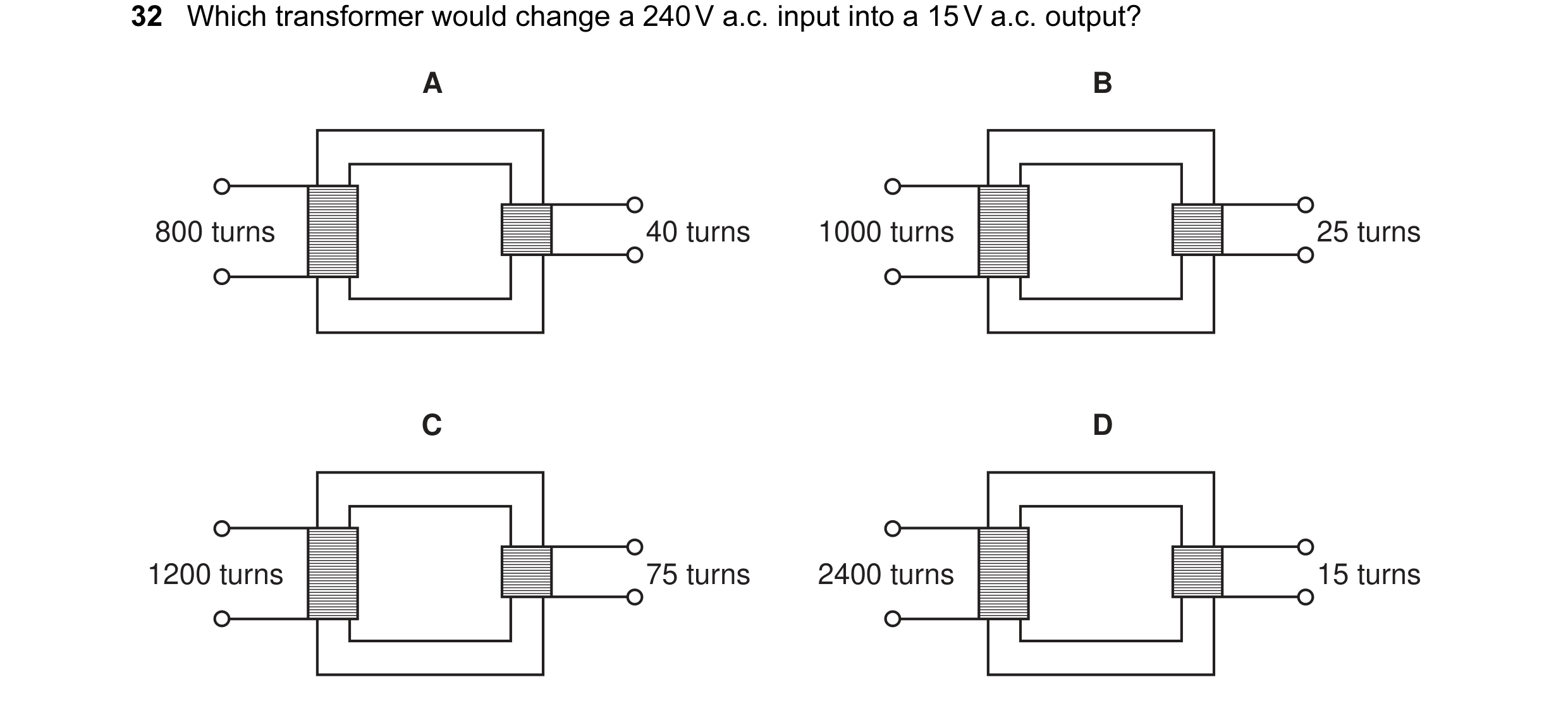
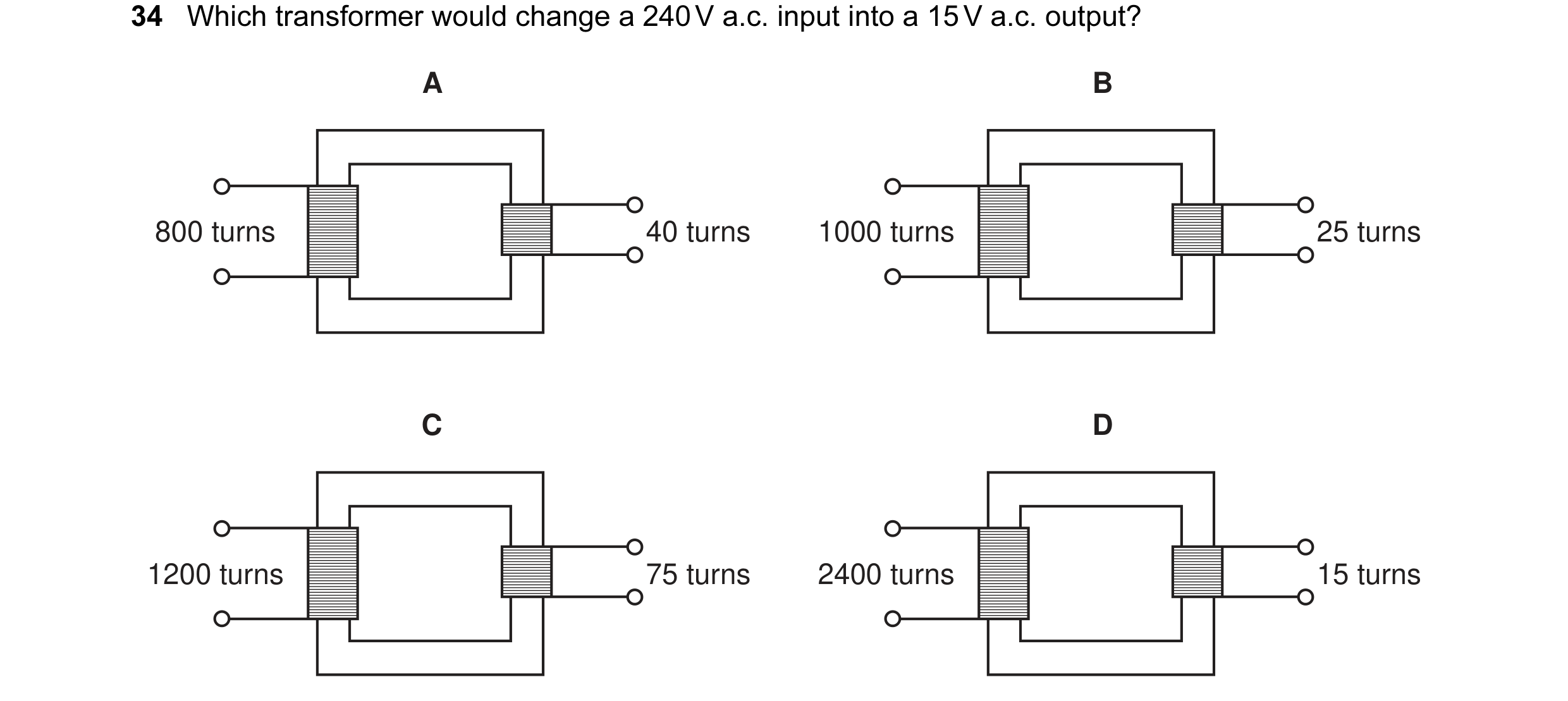
Q11 · Which transformer would change a 240 V a.c 0653/11 May/June 2011
32 Which transformer would change a 240 V a.c. input into a 15 V a.c. output? A B 800 turns 40 turns 1000 turns 25 turns C D 1200 turns 75 turns 2400 turns 15 turns
1 marks
Answer: C
This question in 0653/11 May/June 2011
Q12 · Which transformer would change a 240 V a.c 0653/12 May/June 2011
34 Which transformer would change a 240 V a.c. input into a 15 V a.c. output? A B 800 turns 40 turns 1000 turns 25 turns C D 1200 turns 75 turns 2400 turns 15 turns
1 marks
Answer: C
This question in 0653/12 May/June 2011
Q13 · Which row shows two of the essential items used in the construction of a transformer? 0653/11 Oct/Nov 2011
35 Which row shows two of the essential items used in the construction of a transformer?
iron core permanent primary coil | — slip rings
magnet
A v v
B v v
Cc v v
D v v
1 marks
Answer: B
This question in 0653/11 Oct/Nov 2011
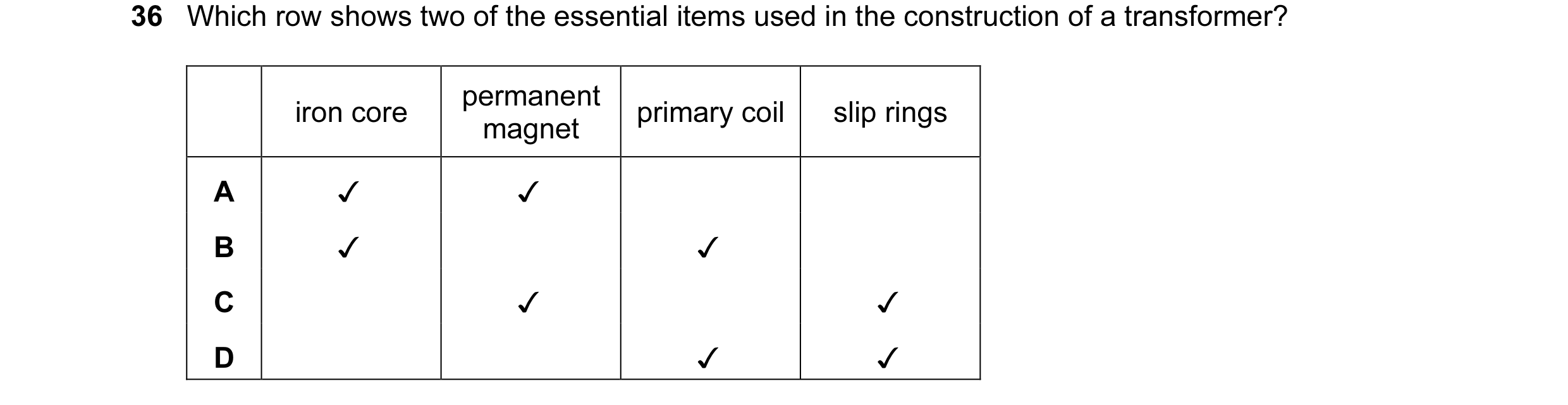
Q14 · Which row shows two of the essential items used in the construction of a transformer? 0653/12 Oct/Nov 2011
36 Which row shows two of the essential items used in the construction of a transformer?
iron core permanent primary coil | — slip rings
magnet
A v v
B v v
Cc v v
D v v
1 marks
Answer: B
This question in 0653/12 Oct/Nov 2011
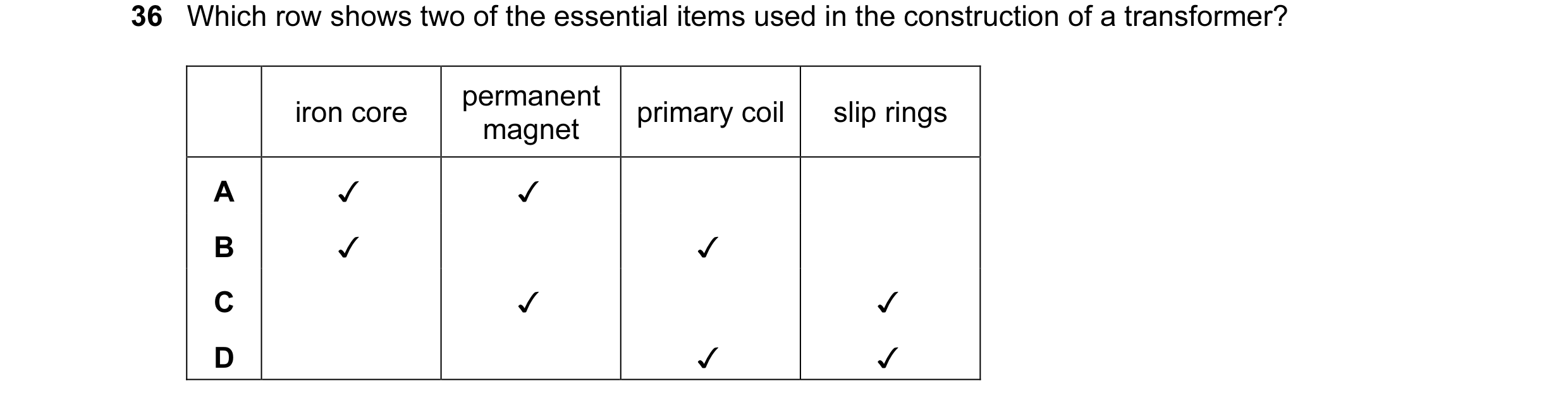
Q15 · Which row shows two of the essential items used in the construction of a transformer? 0653/13 Oct/Nov 2011
36 Which row shows two of the essential items used in the construction of a transformer?
iron core permanent primary coil | slip rings
magnet
A v v
B v v
Cc v v
D v v
1 marks
Answer: B
This question in 0653/13 Oct/Nov 2011
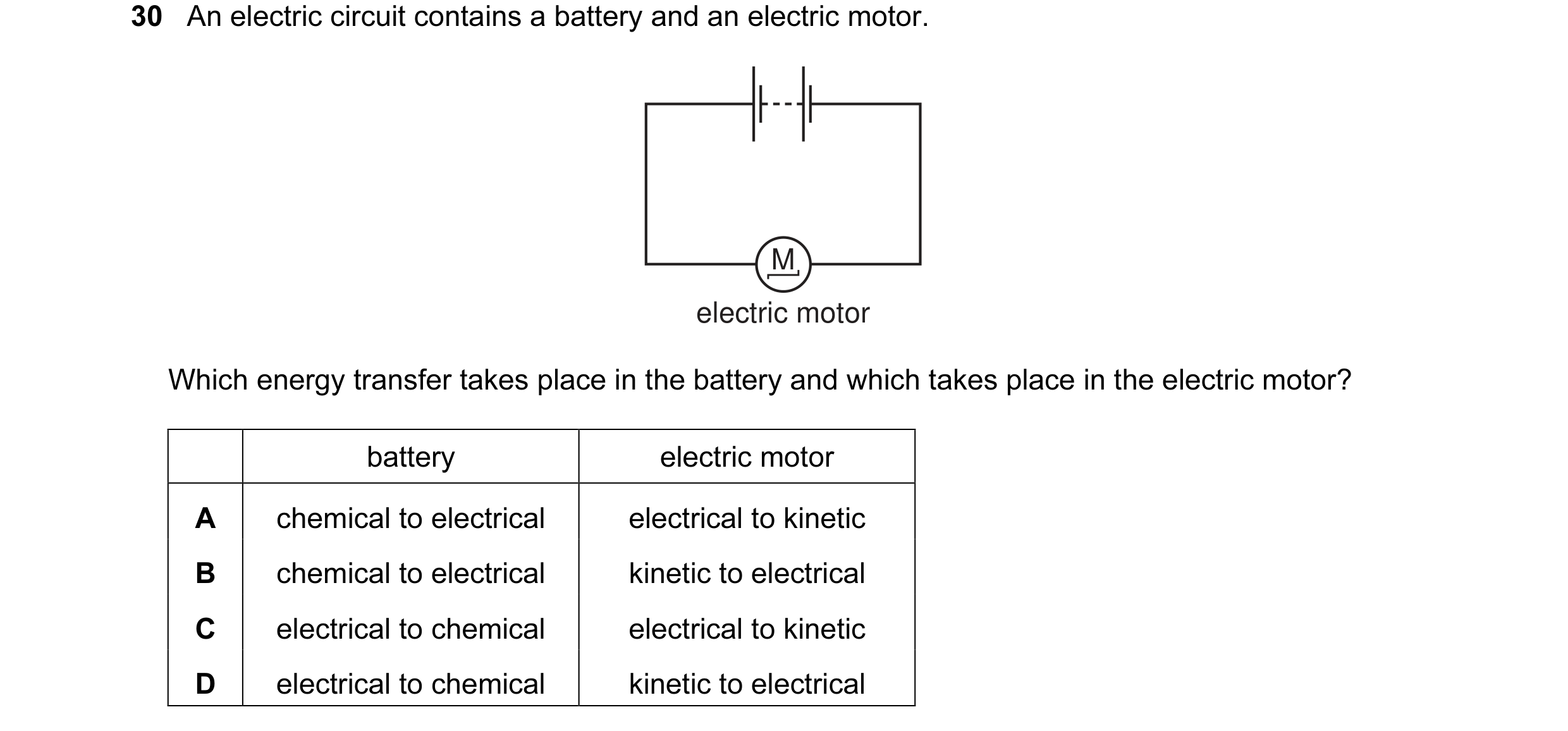
Q16 · An electric circuit contains a battery and an electric motor 0653/13 Oct/Nov 2013
30 An electric circuit contains a battery and an electric motor. M electric motor Which energy transfer takes place in the battery and which takes place in the electric motor? battery electric motor A chemical to electrical electrical to kinetic B chemical to electrical kinetic to electrical C electrical to chemical electrical to kinetic D electrical to chemical kinetic to electrical
1 marks
Answer: A
This question in 0653/13 Oct/Nov 2013
Q17 · Which energy resource can be used to obtain electricity without any moving parts? 0653/13 Oct/Nov 2014
30 Which energy resource can be used to obtain electricity without any moving parts? A hydroelectric B solar cells C tides D wave
1 marks
Answer: B
This question in 0653/13 Oct/Nov 2014
Q18 · Electricity is generated using wind 0653/11 May/June 2020
32 Electricity is generated using wind. Which device is used in the process? A dam B nuclear reactor C solar panel D turbine
1 marks
Answer: D
This question in 0653/11 May/June 2020
 1 / 6
1 / 6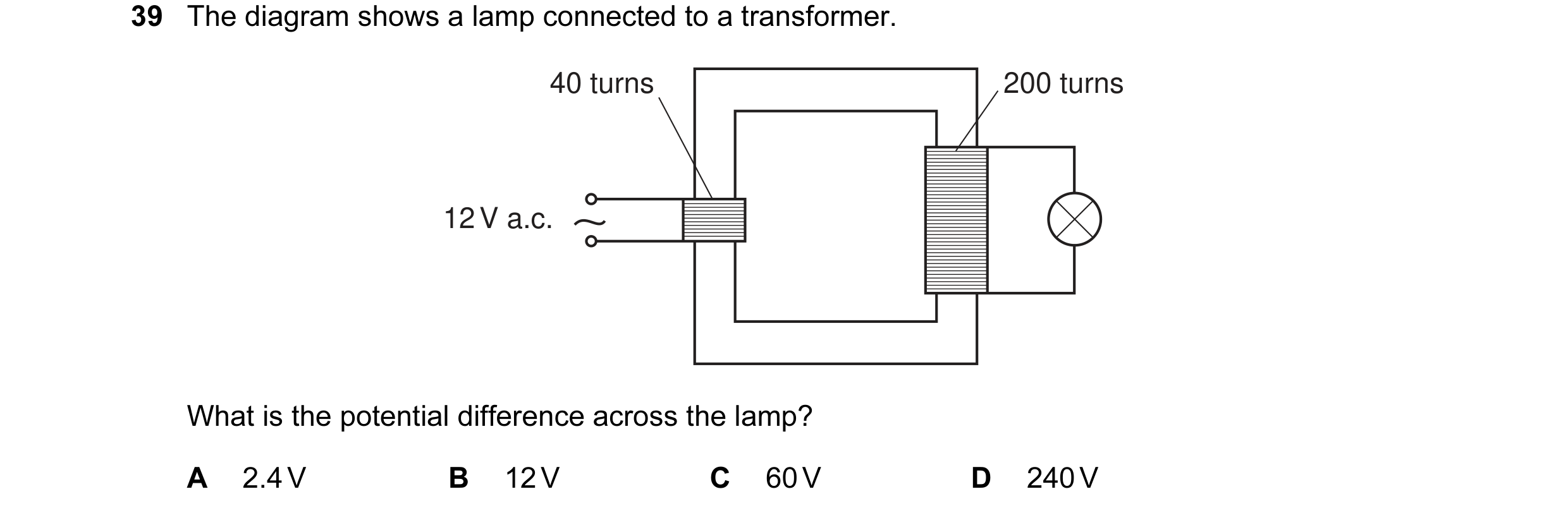
 2 / 6
2 / 6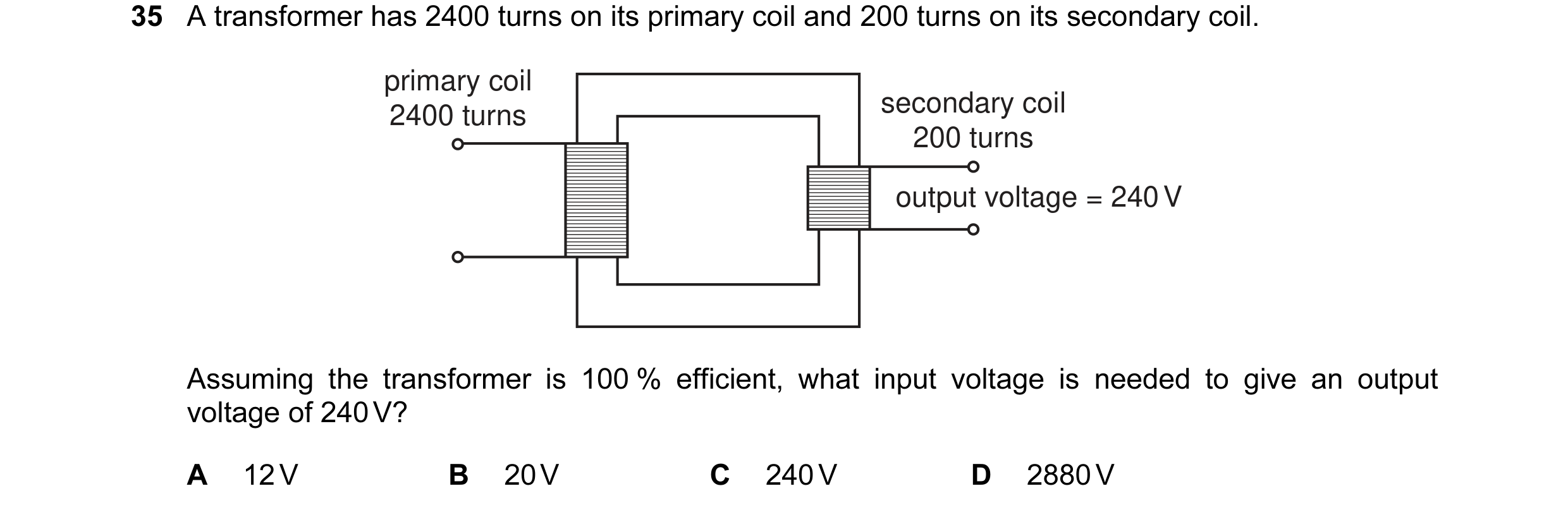
 3 / 6
3 / 6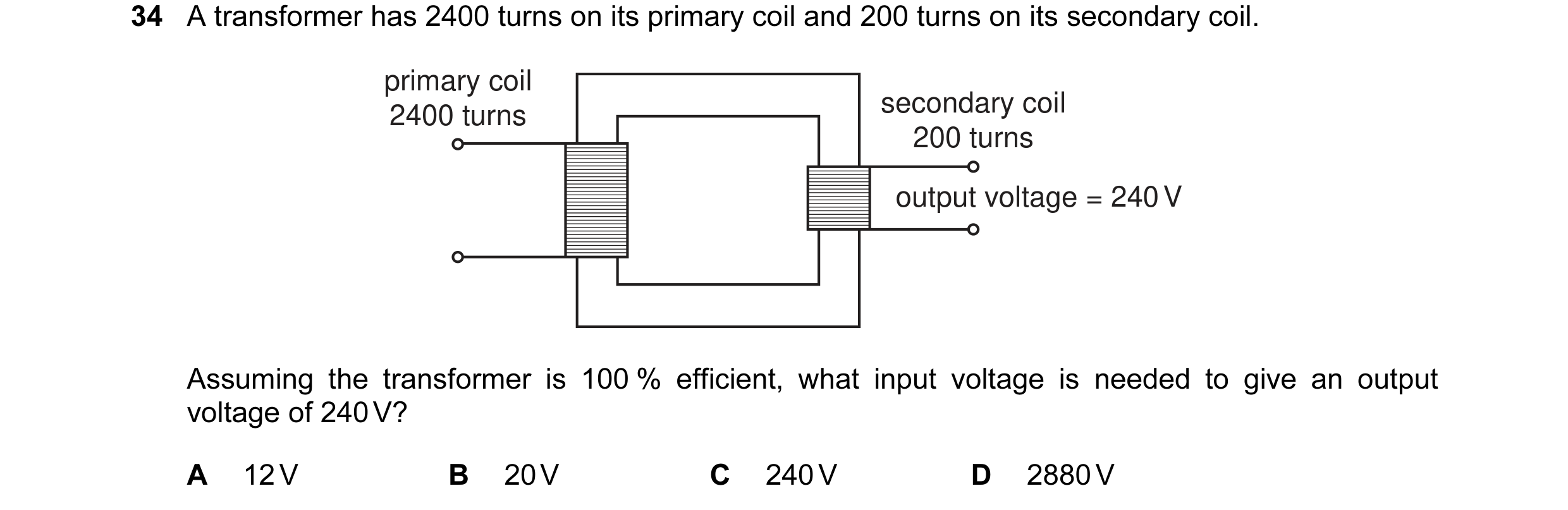
 4 / 6
4 / 6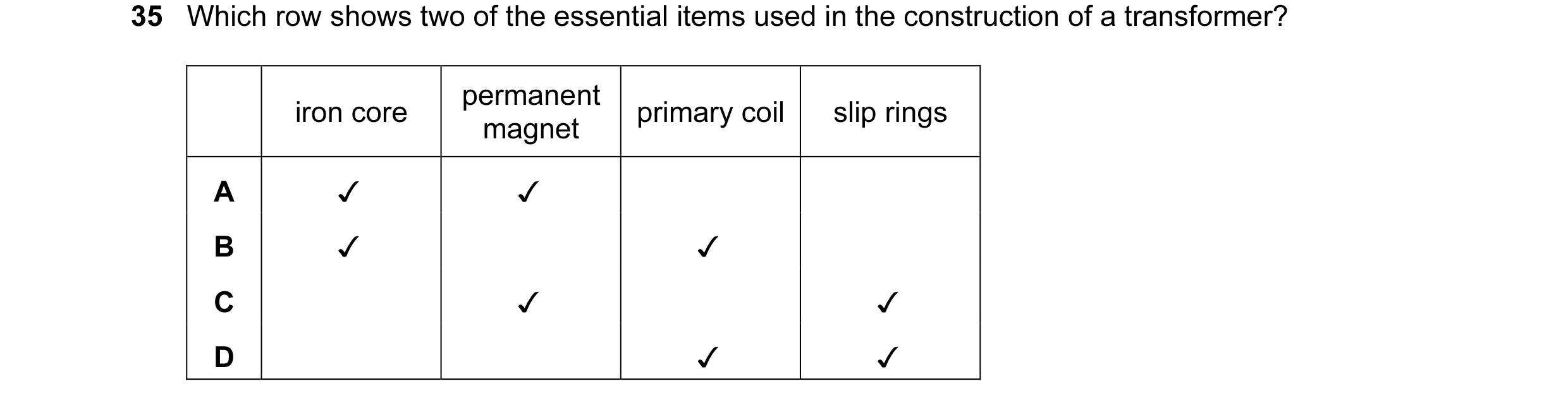
 5 / 6
5 / 6
 6 / 6
6 / 6