Questions as text
Q1 · Transpiration occurs when water vapour is lost from the leaves of plants through the… 0653/32 Feb/March 2017
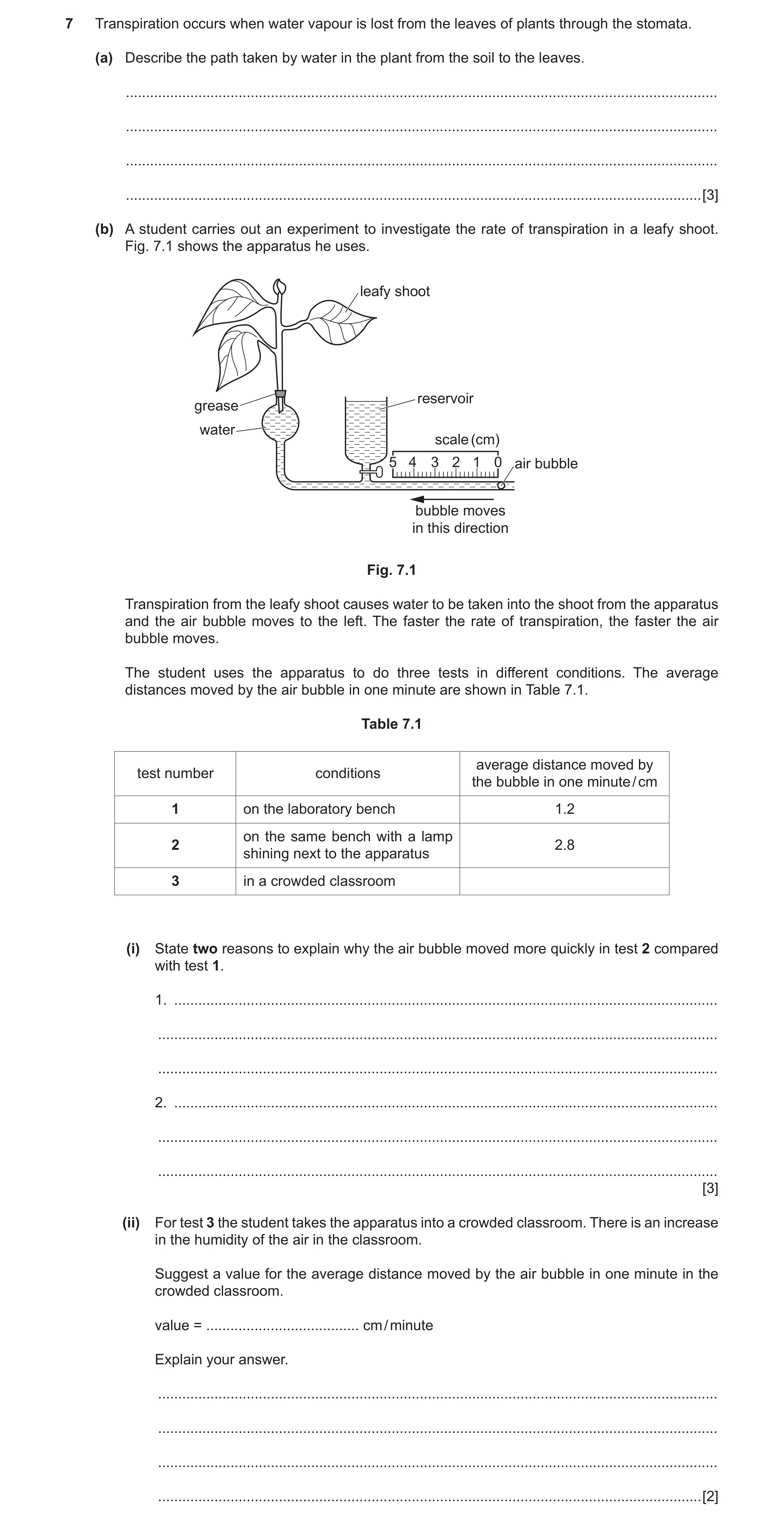
7 Transpiration occurs when water vapour is lost from the leaves of plants through the stomata. (a) Describe the path taken by water in the plant from the soil to the leaves. … … … … [3] (b) A student carries out an experiment to investigate the rate of transpiration in a leafy shoot. Fig. 7.1 shows the apparatus he uses. leafy shoot reservoir grease water scale (cm) 5 4 3 2 1 0 air bubble bubble moves in this direction Fig. 7.1 Transpiration from the leafy shoot causes water to be taken into the shoot from the apparatus and the air bubble moves to the left. The faster the rate of transpiration, the faster the air bubble moves. The student uses the apparatus to do three tests in different conditions. The average distances moved by the air bubble in one minute are shown in Table 7.1. Table 7.1 average distance moved by test number conditions the bubble in one minute / cm 1 on the laboratory bench 1.2 on the same bench with a lamp 2 2.8 shining next to the apparatus 3 in a crowded classroom (i) State two reasons to explain why the air bubble moved more quickly in test 2 compared with test 1. 1. … … … 2. … … … [3] (ii) For test 3 the student takes the apparatus into a crowded classroom. There is an increase in the humidity of the air in the classroom. Suggest a value for the average distance moved by the air bubble in one minute in the crowded classroom. value = … cm / minute Explain your answer. … … … … [2]
8 marks
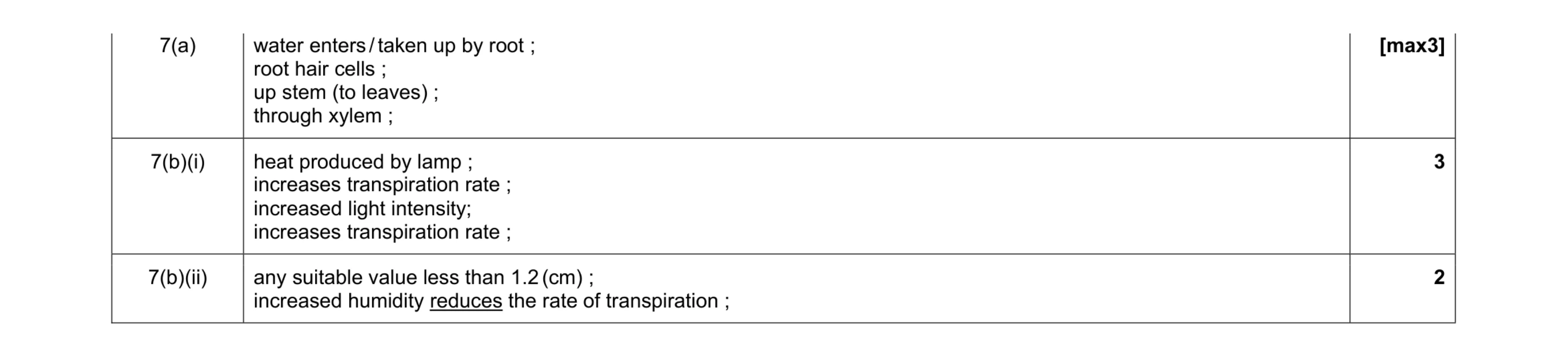
Mark scheme: 7(a) water enters / taken up by root ; root hair cells ; up stem (to leaves) ; through xylem ; [max3] 7(b)(i) heat produced by lamp ; increases transpiration rate ; increased light intensity; increases transpiration rate ; 3 7(b)(ii) any suitable value less than 1.2 (cm) ; increased humidity reduces the rate of transpiration ; 2
This question in 0653/32 Feb/March 2017
Q2 · Use the following words or phrases to complete the flow chart about a possible pathway… 0653/33 Oct/Nov 2017
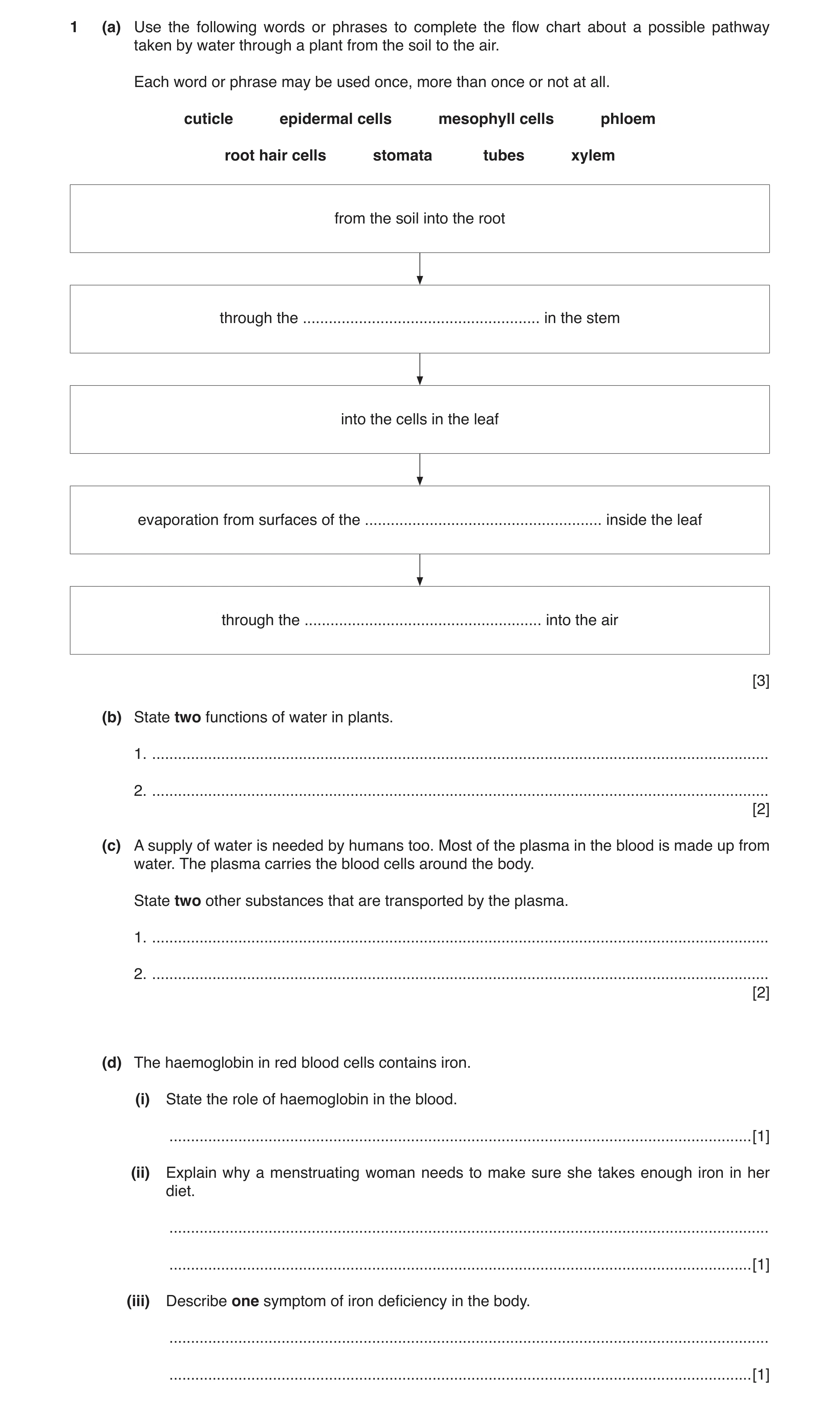
1 (a) Use the following words or phrases to complete the flow chart about a possible pathway taken by water through a plant from the soil to the air. Each word or phrase may be used once, more than once or not at all. cuticle epidermal cells mesophyll cells phloem root hair cells stomata tubes xylem from the soil into the root through the … in the stem into the cells in the leaf evaporation from surfaces of the … inside the leaf through the … into the air [3] (b) State two functions of water in plants. 1. … 2. … [2] (c) A supply of water is needed by humans too. Most of the plasma in the blood is made up from water. The plasma carries the blood cells around the body. State two other substances that are transported by the plasma. 1. … 2. … [2] (d) The haemoglobin in red blood cells contains iron. (i) State the role of haemoglobin in the blood. … [1] (ii) Explain why a menstruating woman needs to make sure she takes enough iron in her diet. … … [1] (iii) Describe one symptom of iron deficiency in the body. … … [1]
10 marks
Mark scheme: 1(a) xylem ; mesophyll cells ; stomata ; 3 1(b) any two from photosynthesis ; transport of ions ; support / turgor ; AVP ; max 2 1(c) ions / named ion ; soluble nutrients / named soluble nutrient ; hormones / named hormone ; carbon dioxide ; AVP ; max 2 1(d)(i) transport of oxygen ; 1 1(d)(ii) to replace iron lost during menstruation / period ; 1 1(d)(iii) feeling tired / dizzy ; 1
This question in 0653/33 Oct/Nov 2017
Q3 · The list shows some processes that occur in living organisms 0653/31 Oct/Nov 2018
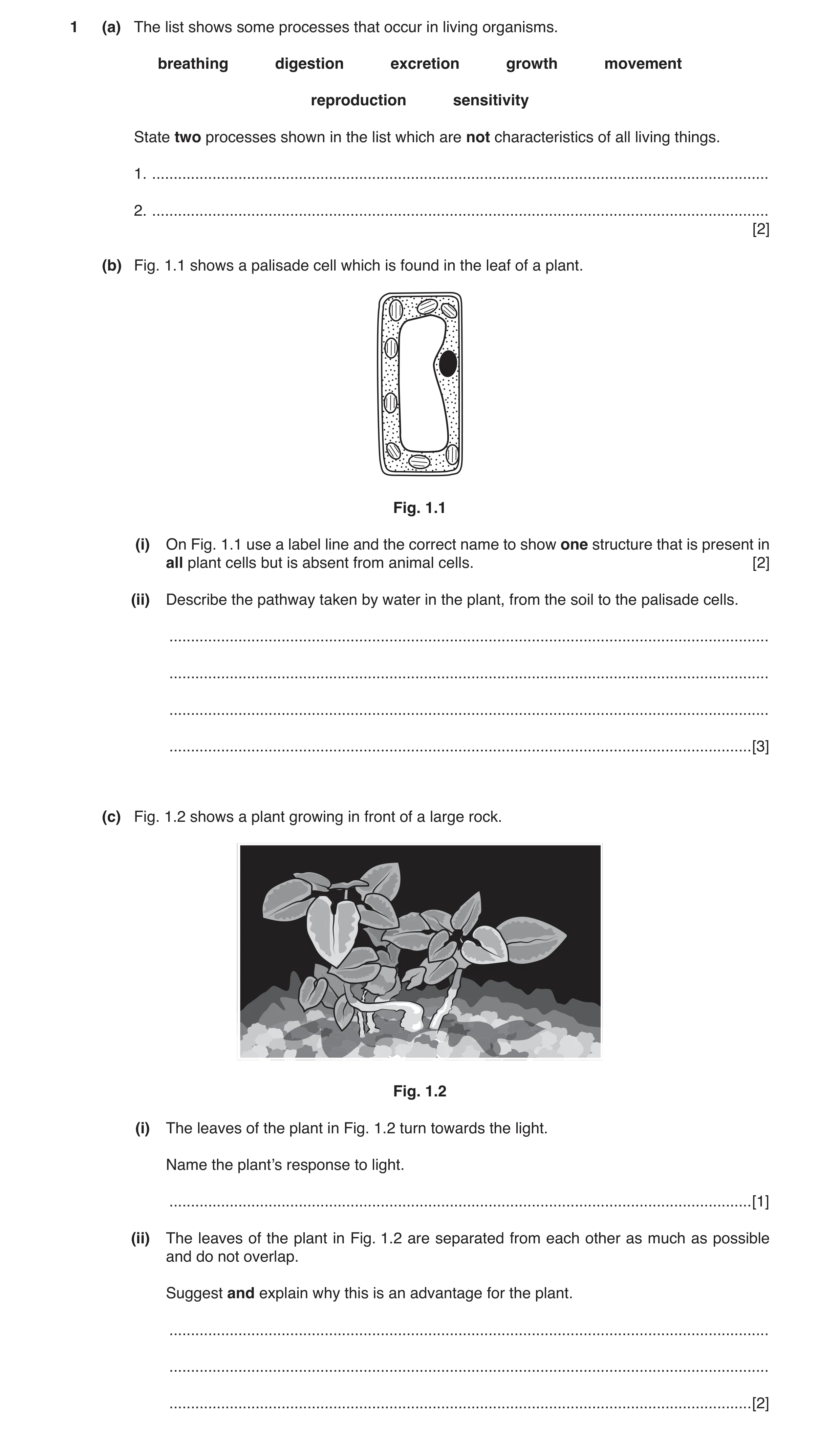
1 (a) The list shows some processes that occur in living organisms. breathing digestion excretion growth movement reproduction sensitivity State two processes shown in the list which are not characteristics of all living things. 1. … 2. … [2] (b) Fig. 1.1 shows a palisade cell which is found in the leaf of a plant. Fig. 1.1 (i) On Fig. 1.1 use a label line and the correct name to show one structure that is present in all plant cells but is absent from animal cells. [2] (ii) Describe the pathway taken by water in the plant, from the soil to the palisade cells. … … … … [3] (c) Fig. 1.2 shows a plant growing in front of a large rock. Fig. 1.2 (i) The leaves of the plant in Fig. 1.2 turn towards the light. Name the plant’s response to light. … [1] (ii) The leaves of the plant in Fig. 1.2 are separated from each other as much as possible and do not overlap. Suggest and explain why this is an advantage for the plant. … … … [2]
10 marks
Mark scheme: 1(a) breathing ; digestion ; 2 1(b)(i) vacuole named ; and label line drawn to vacuole ; OR cell wall named ; and label line drawn to cell wall ; 2 1(b)(ii) root hair cells ; up stem ; through xylem ; extra detail (e.g. by osmosis) ; Max 3 3 1(c)(i) phototropism ; 1 1(c)(ii) leaves have maximum exposure / more sunlight ; for photosynthesis ; 2
This question in 0653/31 Oct/Nov 2018
Q4 · Plants need water to survive 0653/31 Oct/Nov 2019
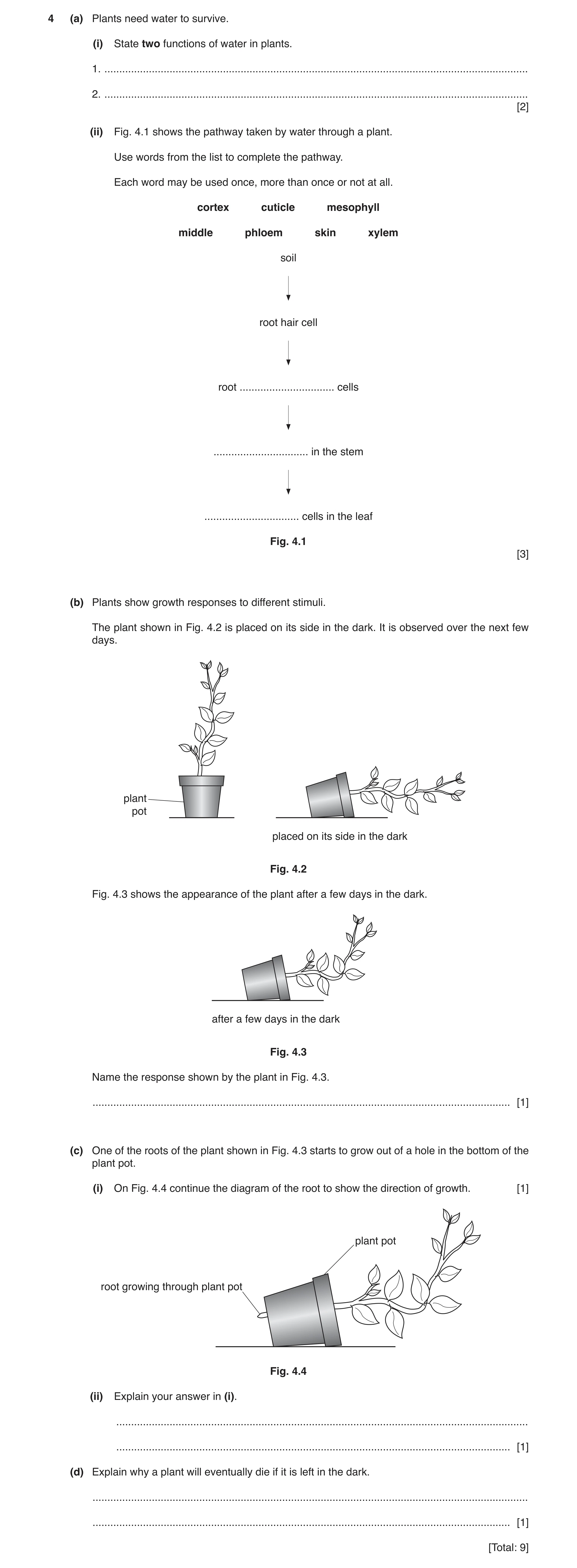
4 (a) Plants need water to survive. (i) State two functions of water in plants. 1. … 2. … [2] (ii) Fig. 4.1 shows the pathway taken by water through a plant. Use words from the list to complete the pathway. Each word may be used once, more than once or not at all. cortex cuticle mesophyll middle phloem skin xylem soil root hair cell root … cells … in the stem … cells in the leaf Fig. 4.1 [3] (b) Plants show growth responses to different stimuli. The plant shown in Fig. 4.2 is placed on its side in the dark. It is observed over the next few days. plant pot placed on its side in the dark Fig. 4.2 Fig. 4.3 shows the appearance of the plant after a few days in the dark. after a few days in the dark Fig. 4.3 Name the response shown by the plant in Fig. 4.3. … [1] (c) One of the roots of the plant shown in Fig. 4.3 starts to grow out of a hole in the bottom of the plant pot. (i) On Fig. 4.4 continue the diagram of the root to show the direction of growth. [1] plant pot root growing through plant pot Fig. 4.4 (ii) Explain your answer in (i). … … [1] (d) Explain why a plant will eventually die if it is left in the dark. … … [1] [Total: 9]
9 marks
Mark scheme: 4(a)(i) any two from: for photosynthesis ; transport in plants ; as a solvent ; 2 4(a)(ii) cortex ; xylem ; mesophyll ; 3 4(b) gravitropism ; 1 4(c)(i) root continued and bending downwards ; 1 4(c)(ii) roots respond to gravity; 1 4(d) no light for photosynthesis ; 1
This question in 0653/31 Oct/Nov 2019
Question 5 0653/33 May/June 2021
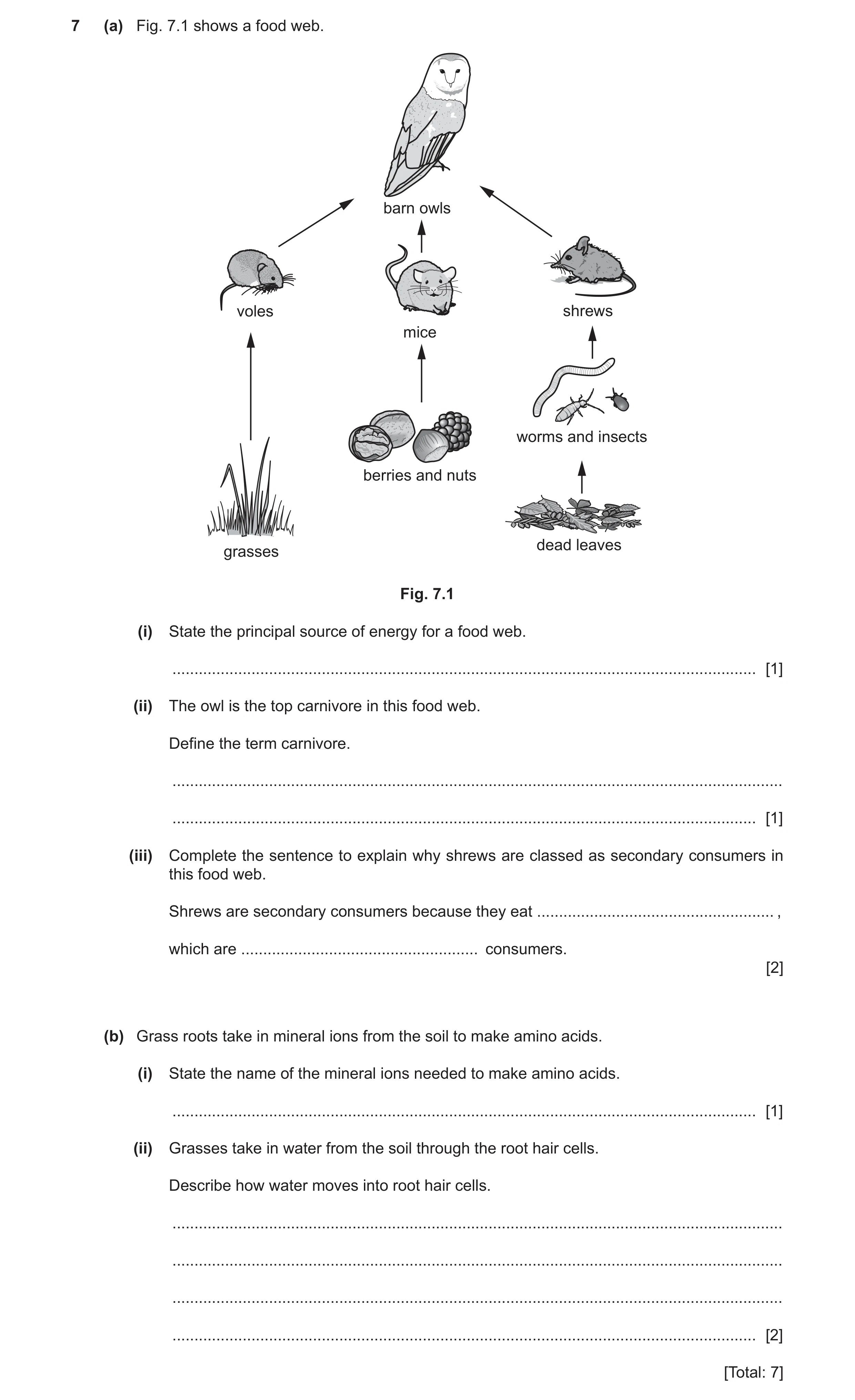
7 (a) Fig. 7.1 shows a food web. barn owls voles shrews mice worms and insects berries and nuts dead leaves grasses Fig. 7.1 (i) State the principal source of energy for a food web. … [1] (ii) The owl is the top carnivore in this food web. Define the term carnivore. … … [1] (iii) Complete the sentence to explain why shrews are classed as secondary consumers in this food web. Shrews are secondary consumers because they eat … , which are … consumers. [2] (b) Grass roots take in mineral ions from the soil to make amino acids. (i) State the name of the mineral ions needed to make amino acids. … [1] (ii) Grasses take in water from the soil through the root hair cells. Describe how water moves into root hair cells. … … … … [2] [Total: 7]
7 marks
Mark scheme: 7(a)(i) Sun ; 1 7(a)(ii) animal that gets its energy by eating only other animals ; 1 7(a)(iii) worm and insects ; primary ; 2 7(b)(i) nitrate (ions) ; 1 7(b)(ii) (water moves) through, partially permeable membranes / cell membranes ; by osmosis ; 2
This question in 0653/33 May/June 2021
Q6 · A student draws a labelled diagram of a human heart 0653/31 Oct/Nov 2022
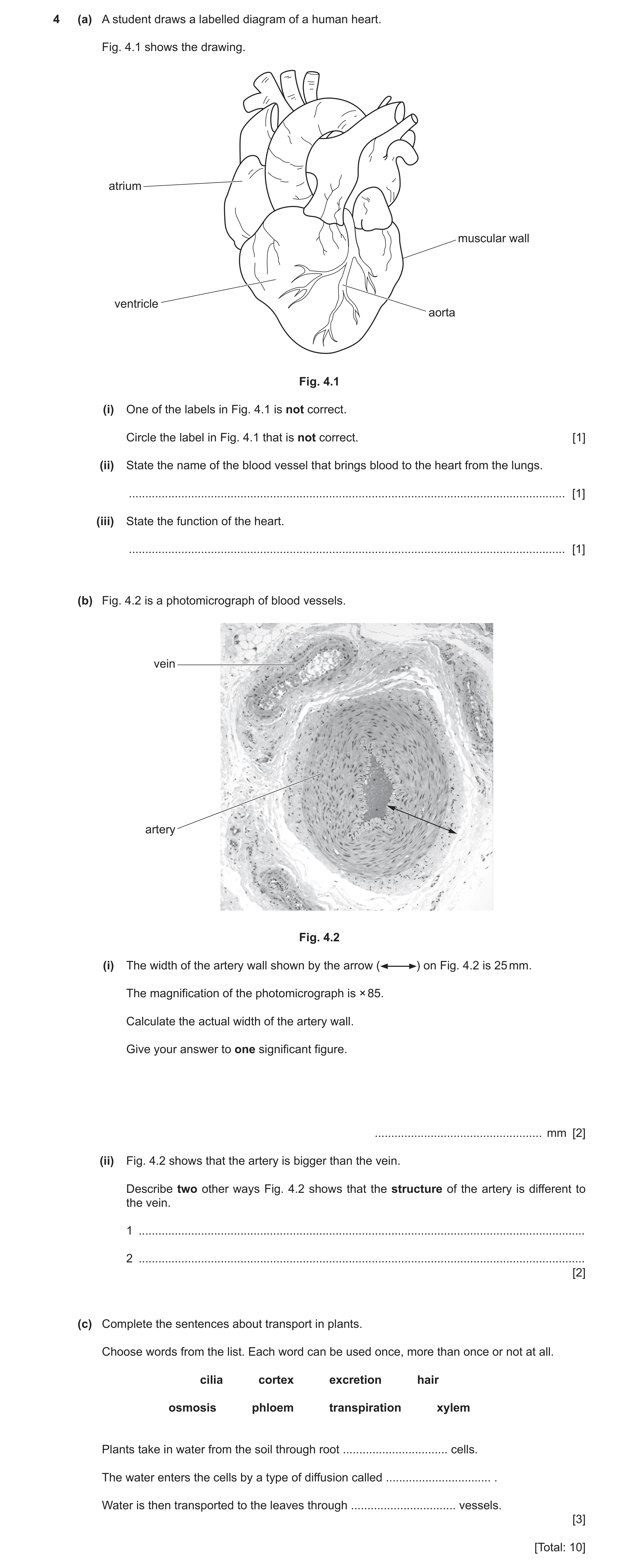
4 (a) A student draws a labelled diagram of a human heart. Fig. 4.1 shows the drawing. atrium muscular wall ventricle aorta Fig. 4.1 (i) One of the labels in Fig. 4.1 is not correct. Circle the label in Fig. 4.1 that is not correct. [1] (ii) State the name of the blood vessel that brings blood to the heart from the lungs. … [1] (iii) State the function of the heart. … [1] (b) Fig. 4.2 is a photomicrograph of blood vessels. vein artery Fig. 4.2 (i) The width of the artery wall shown by the arrow ( ) on Fig. 4.2 is 25 mm. The magnification of the photomicrograph is × 85. Calculate the actual width of the artery wall. Give your answer to one significant figure. … mm [2] (ii) Fig. 4.2 shows that the artery is bigger than the vein. Describe two other ways Fig. 4.2 shows that the structure of the artery is different to the vein. 1 … 2 … [2] (c) Complete the sentences about transport in plants. Choose words from the list. Each word can be used once, more than once or not at all. cilia cortex excretion hair osmosis phloem transpiration xylem Plants take in water from the soil through root … cells. The water enters the cells by a type of diffusion called … . Water is then transported to the leaves through … vessels. [3] [Total: 10]
10 marks
Mark scheme: 4(a)(i) aorta ; 1 4(a)(ii) pulmonary vein ; 1 4(a)(iii) to pump blood ; 1 4(b)(i) 25 ÷ 85 / 0.294117647 ; 2 answer to one sig. fig. / 0.3 ; 4(b)(ii) (artery has / ORA) 2 thicker wall ; smaller hole in centre ; 4(c) hair ; 3 osmosis ; xylem ;
This question in 0653/31 Oct/Nov 2022
Q7 · A photograph of an insect‑pollinated flower 0653/33 Oct/Nov 2022
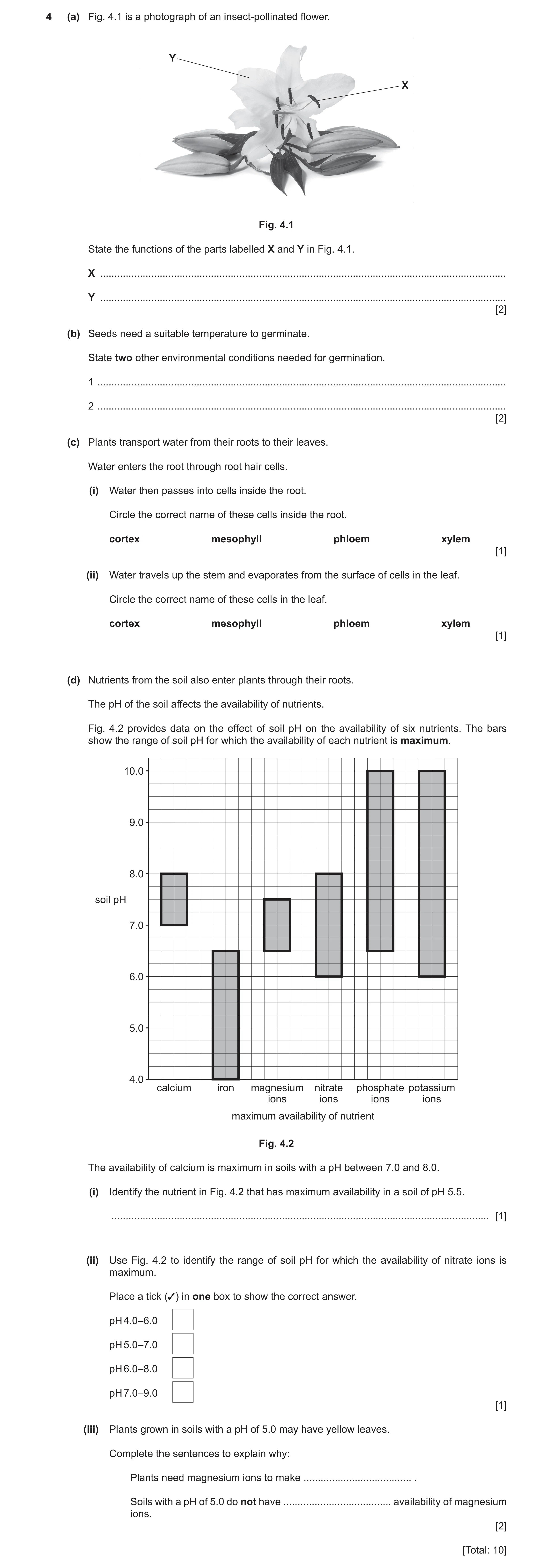
4 (a) Fig. 4.1 is a photograph of an insect‑pollinated flower. Y X Fig. 4.1 State the functions of the parts labelled X and Y in Fig. 4.1. X … Y … [2] (b) Seeds need a suitable temperature to germinate. State two other environmental conditions needed for germination. 1 … 2 … [2] (c) Plants transport water from their roots to their leaves. Water enters the root through root hair cells. (i) Water then passes into cells inside the root. Circle the correct name of these cells inside the root. cortex mesophyll phloem xylem [1] (ii) Water travels up the stem and evaporates from the surface of cells in the leaf. Circle the correct name of these cells in the leaf. cortex mesophyll phloem xylem [1] (d) Nutrients from the soil also enter plants through their roots. The pH of the soil affects the availability of nutrients. Fig. 4.2 provides data on the effect of soil pH on the availability of six nutrients. The bars show the range of soil pH for which the availability of each nutrient is maximum. 10.0 9.0 8.0 soil pH 7.0 6.0 5.0 4.0 calcium iron magnesium nitrate phosphate potassium ions ions ions ions maximum availability of nutrient Fig. 4.2 The availability of calcium is maximum in soils with a pH between 7.0 and 8.0. (i) Identify the nutrient in Fig. 4.2 that has maximum availability in a soil of pH 5.5. … [1] (ii) Use Fig. 4.2 to identify the range of soil pH for which the availability of nitrate ions is maximum. Place a tick (✓) in one box to show the correct answer. pH 4.0–6.0 pH 5.0–7.0 pH 6.0–8.0 pH 7.0–9.0 [1] (iii) Plants grown in soils with a pH of 5.0 may have yellow leaves. Complete the sentences to explain why: Plants need magnesium ions to make … . Soils with a pH of 5.0 do not have … availability of magnesium ions. [2] [Total: 10]
10 marks
Mark scheme: 4(a) X produce / release, pollen ; 2 Y attract insects (for pollination) ; 4(b) (presence of) water ; 2 (presence of) oxygen ; 4(c)(i) cortex ; 1 4(c)(ii) mesophyll ; 1 4(d)(i) iron ; 1 4(d)(ii) pH 6.0–8.0 ; 1 4(d)(iii) chlorophyll ; 2 maximum ;
This question in 0653/33 Oct/Nov 2022
Q8 · The pathway taken by water through a plant root 0653/31 May/June 2024
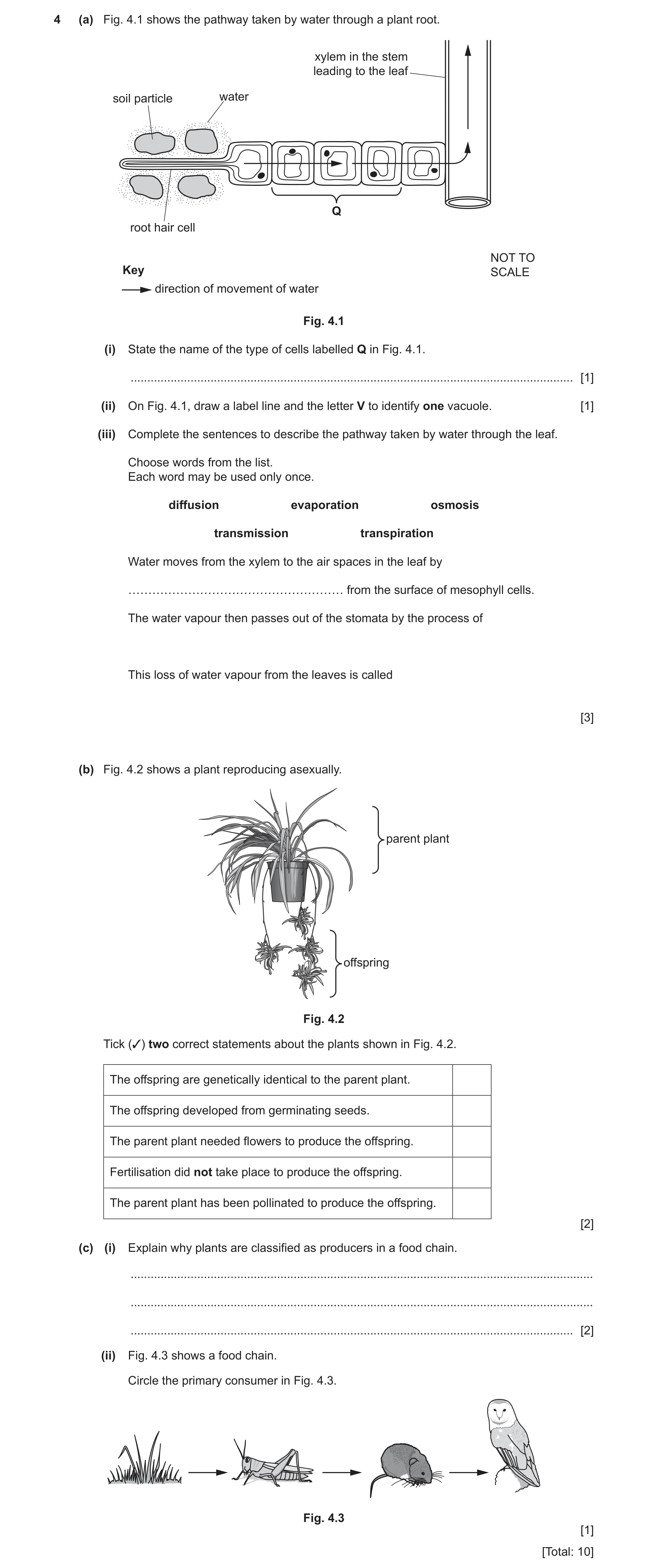
4 (a) Fig. 4.1 shows the pathway taken by water through a plant root. xylem in the stem leading to the leaf soil particle water Q root hair cell NOT TO Key SCALE direction of movement of water Fig. 4.1 (i) State the name of the type of cells labelled Q in Fig. 4.1. … [1] (ii) On Fig. 4.1, draw a label line and the letter V to identify one vacuole. [1] (iii) Complete the sentences to describe the pathway taken by water through the leaf. Choose words from the list. Each word may be used only once. diffusion evaporation osmosis transmission transpiration Water moves from the xylem to the air spaces in the leaf by ……………………………………………… from the surface of mesophyll cells. The water vapour then passes out of the stomata by the process of This loss of water vapour from the leaves is called [3] (b) Fig. 4.2 shows a plant reproducing asexually. parent plant offspring Fig. 4.2 Tick (✓) two correct statements about the plants shown in Fig. 4.2. The offspring are genetically identical to the parent plant. The offspring developed from germinating seeds. The parent plant needed flowers to produce the offspring. Fertilisation did not take place to produce the offspring. The parent plant has been pollinated to produce the offspring. [2] (c) (i) Explain why plants are classified as producers in a food chain. … … … [2] (ii) Fig. 4.3 shows a food chain. Circle the primary consumer in Fig. 4.3. Fig. 4.3 [1] [Total: 10]
10 marks
Mark scheme: 4(a)(i) (root) cortex ; 1 4(a)(ii) one vacuole labelled in any cell ; 1 4(a)(iii) evaporation ; diffusion ; transpiration ; 3 4(b) The offspring are genetically identical to the parent plant. ; Fertilisation did not take place to produce the offspring. ; three ticks two correct = 1 mark three ticks one correct = 0 marks more than three ticks = 0 2 Question Answer Marks 4(c)(i) (plants) make their own, food / glucose / sugar ; by photosynthesis / using the energy from (sun)light / using light energy ; 2 4(c)(ii) grasshopper (circled) ; 1
This question in 0653/31 May/June 2024
Question 9 0653/32 May/June 2024
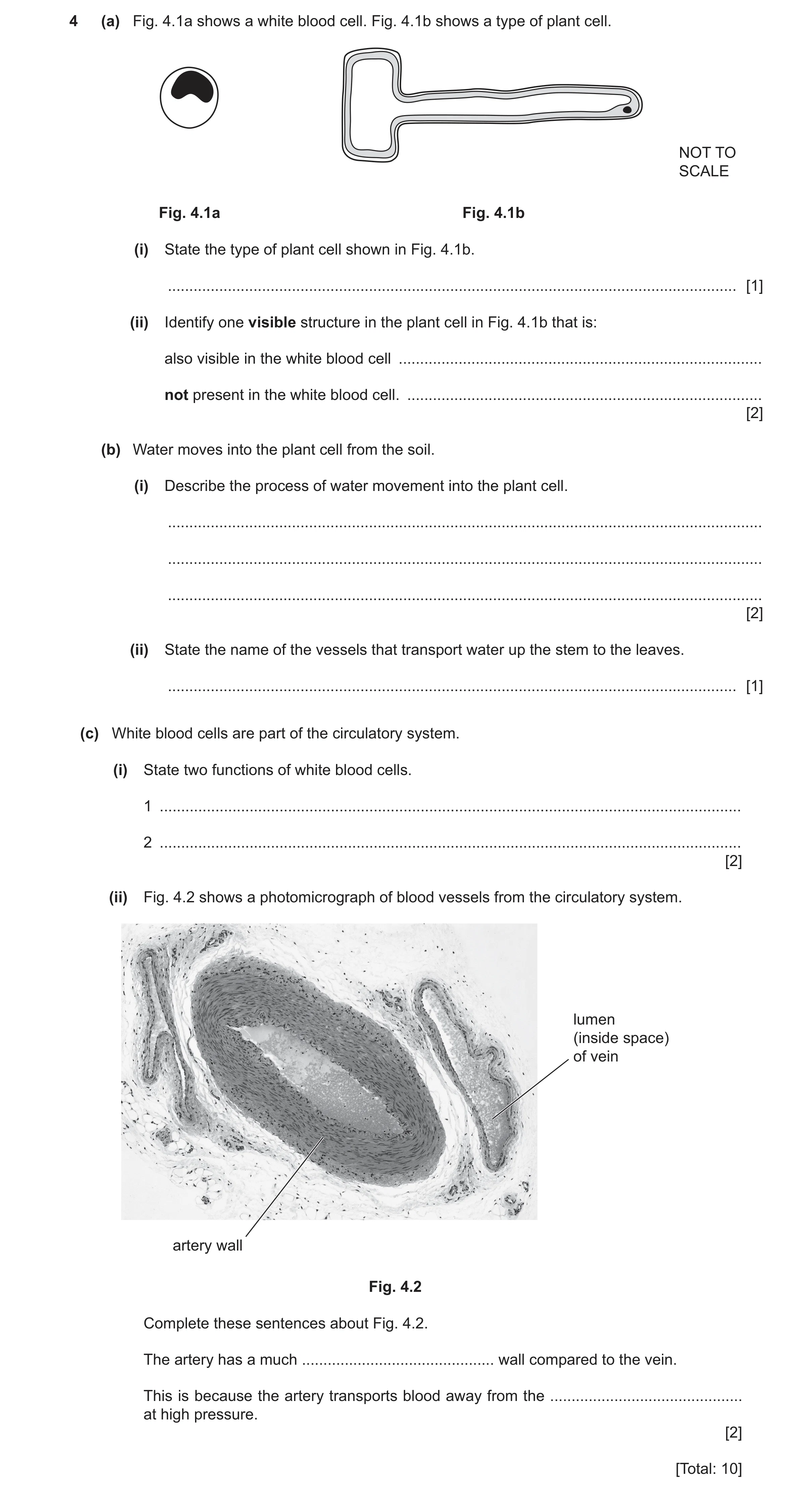
4 (a) Fig. 4.1a shows a white blood cell. Fig. 4.1b shows a type of plant cell. NOT TO SCALE Fig. 4.1a Fig. 4.1b (i) State the type of plant cell shown in Fig. 4.1b. … [1] (ii) Identify one visible structure in the plant cell in Fig. 4.1b that is: also visible in the white blood cell … not present in the white blood cell. … [2] (b) Water moves into the plant cell from the soil. (i) Describe the process of water movement into the plant cell. … … … [2] (ii) State the name of the vessels that transport water up the stem to the leaves. … [1] (c) White blood cells are part of the circulatory system. (i) State two functions of white blood cells. 1 … 2 … [2] (ii) Fig. 4.2 shows a photomicrograph of blood vessels from the circulatory system. lumen (inside space) of vein artery wall Fig. 4.2 Complete these sentences about Fig. 4.2. The artery has a much … wall compared to the vein. This is because the artery transports blood away from the … at high pressure. [2] [Total: 10]
10 marks
Mark scheme: 4(a)(i) root hair (cell) ; 1 4(a)(ii) (also visible in the white blood cell) nucleus / cytoplasm ; (not present in the white blood cell) vacuole / (cell) wall ; 2 4(b)(i) any two from: diffuses ; by osmosis ; through, cell membrane / partially permeable membrane ; 2 Question Answer Marks 4(b)(ii) xylem ; 1 4(c)(i) phagocytosis ; produce antibodies ; 2 4(c)(ii) thicker / more elastic ; heart ; 2
This question in 0653/32 May/June 2024
Q10 · A student’s drawing of a cross-section of a leaf 0653/31 Oct/Nov 2024
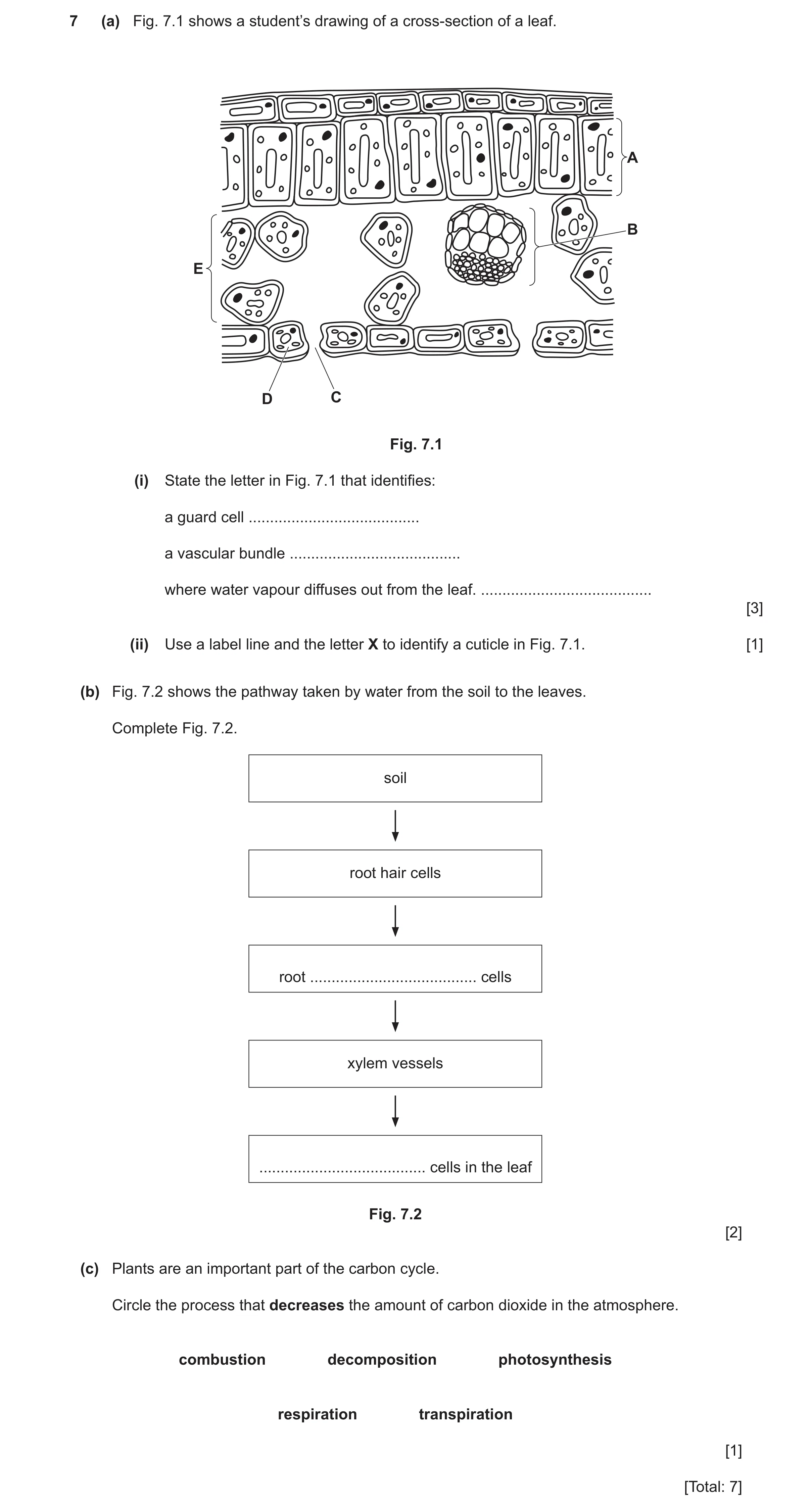
7 (a) Fig. 7.1 shows a student’s drawing of a cross-section of a leaf. A B E D C Fig. 7.1 (i) State the letter in Fig. 7.1 that identifies: a guard cell … a vascular bundle … where water vapour diffuses out from the leaf. … [3] (ii) Use a label line and the letter X to identify a cuticle in Fig. 7.1. [1] (b) Fig. 7.2 shows the pathway taken by water from the soil to the leaves. Complete Fig. 7.2. soil root hair cells root … cells xylem vessels … cells in the leaf Fig. 7.2 [2] (c) Plants are an important part of the carbon cycle. Circle the process that decreases the amount of carbon dioxide in the atmosphere. combustion decomposition photosynthesis respiration transpiration [1] [Total: 7]
7 marks
Mark scheme: 7(a)(i) D ; 3 B ; C ; 7(a)(ii) cuticle labelled ; 1 7(b) cortex ; 2 mesophyll ; 7(c) photosynthesis ; 1
This question in 0653/31 Oct/Nov 2024
Q11 · The structure of an insect-pollinated flower 0653/32 Feb/March 2025
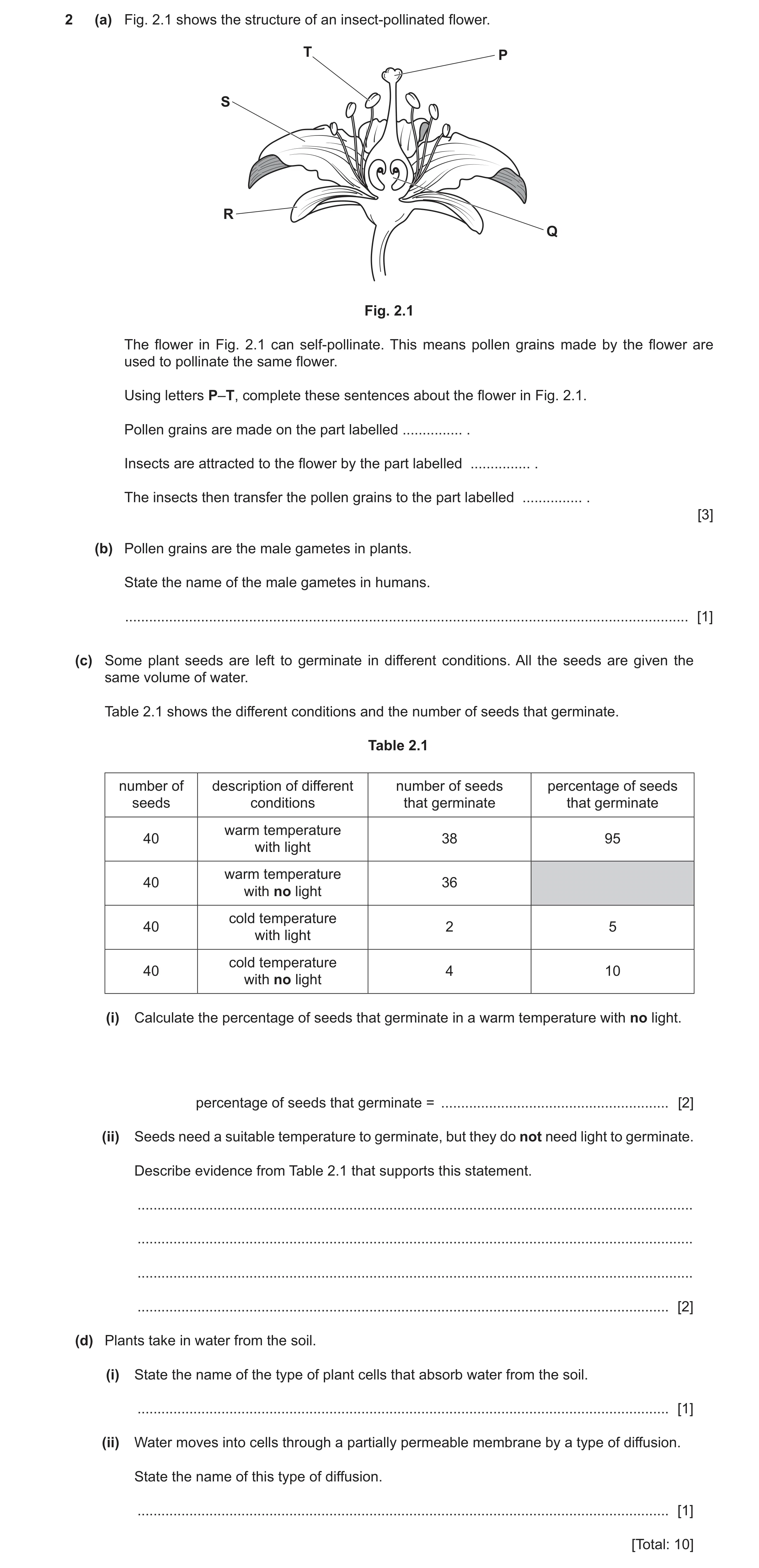
2 (a) Fig. 2.1 shows the structure of an insect-pollinated flower. T P S R Q Fig. 2.1 The flower in Fig. 2.1 can self-pollinate. This means pollen grains made by the flower are used to pollinate the same flower. Using letters P–T, complete these sentences about the flower in Fig. 2.1. Pollen grains are made on the part labelled … . Insects are attracted to the flower by the part labelled … . The insects then transfer the pollen grains to the part labelled … . [3] (b) Pollen grains are the male gametes in plants. State the name of the male gametes in humans. … [1] (c) Some plant seeds are left to germinate in different conditions. All the seeds are given the same volume of water. Table 2.1 shows the different conditions and the number of seeds that germinate. Table 2.1 number of description of different number of seeds percentage of seeds seeds conditions that germinate that germinate warm temperature 40 38 95 with light warm temperature 40 36 with no light cold temperature 40 2 5 with light cold temperature 40 4 10 with no light (i) Calculate the percentage of seeds that germinate in a warm temperature with no light. percentage of seeds that germinate = … [2] (ii) Seeds need a suitable temperature to germinate, but they do not need light to germinate. Describe evidence from Table 2.1 that supports this statement. … … … … [2] (d) Plants take in water from the soil. (i) State the name of the type of plant cells that absorb water from the soil. … [1] (ii) Water moves into cells through a partially permeable membrane by a type of diffusion. State the name of this type of diffusion. … [1] [Total: 10]
10 marks
Mark scheme: 2(a) T ; 3 S ; P ; 2(b) sperm ; 1 2(c)(i) 36 ÷ 40 100 ; 2 90 (%) ; 2(c)(ii) more seeds germinated in warm conditions / less germination in cold ; 2 seeds germinated without light (in warm / cold conditions) ; 2(d)(i) root hair (cells) ; 1 2(d)(ii) osmosis ; 1
This question in 0653/32 Feb/March 2025
 8
8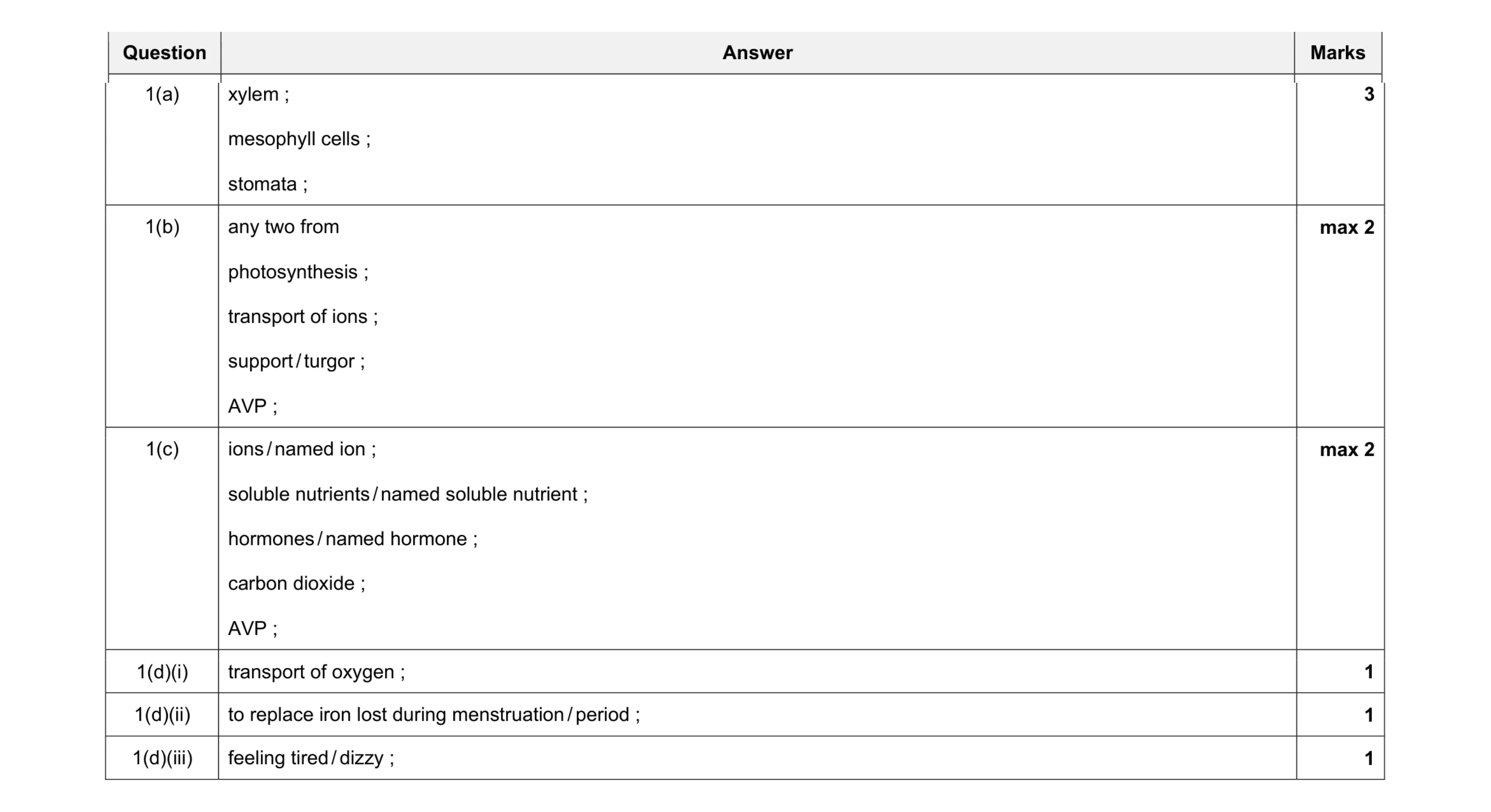 10
10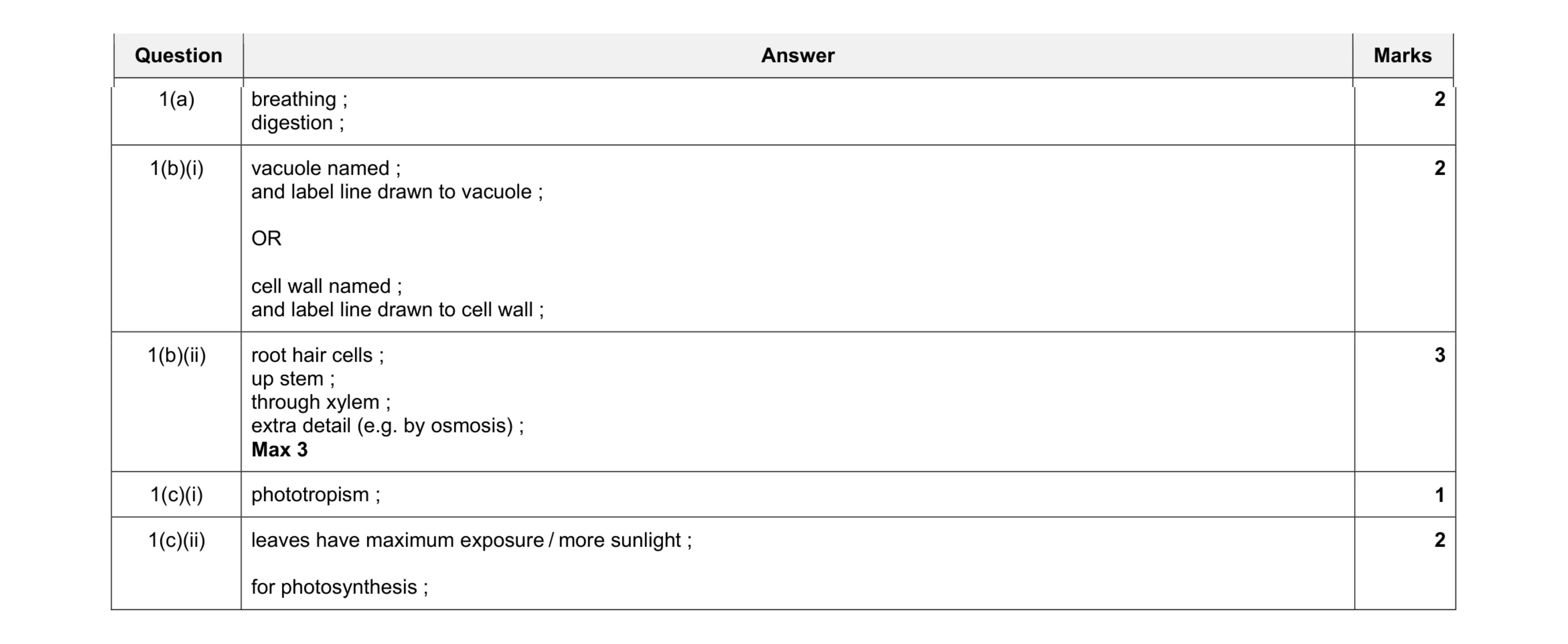 10
10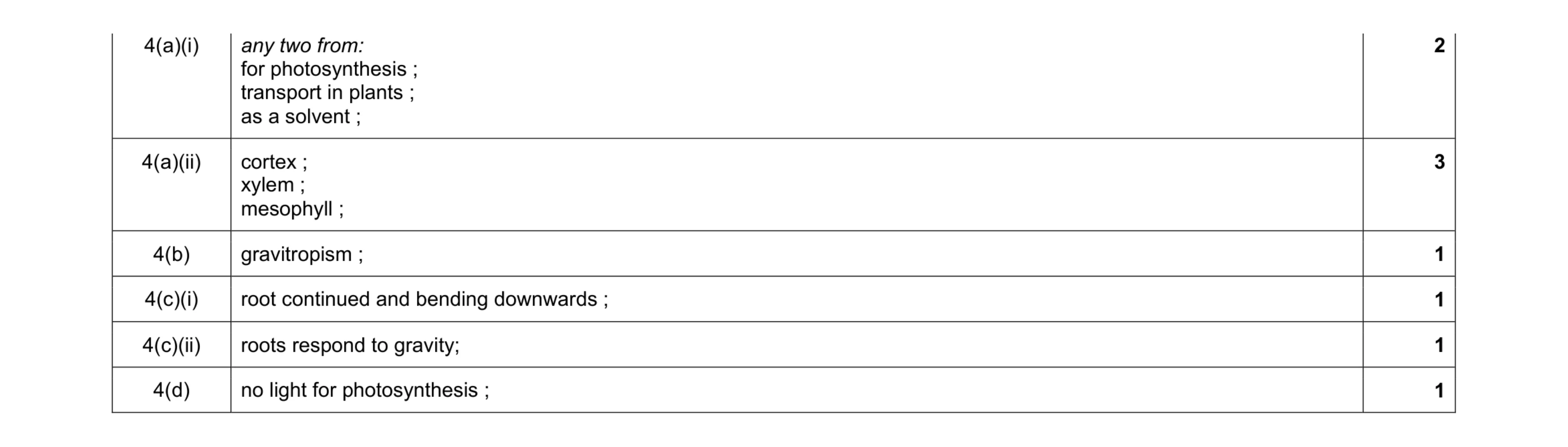 9
9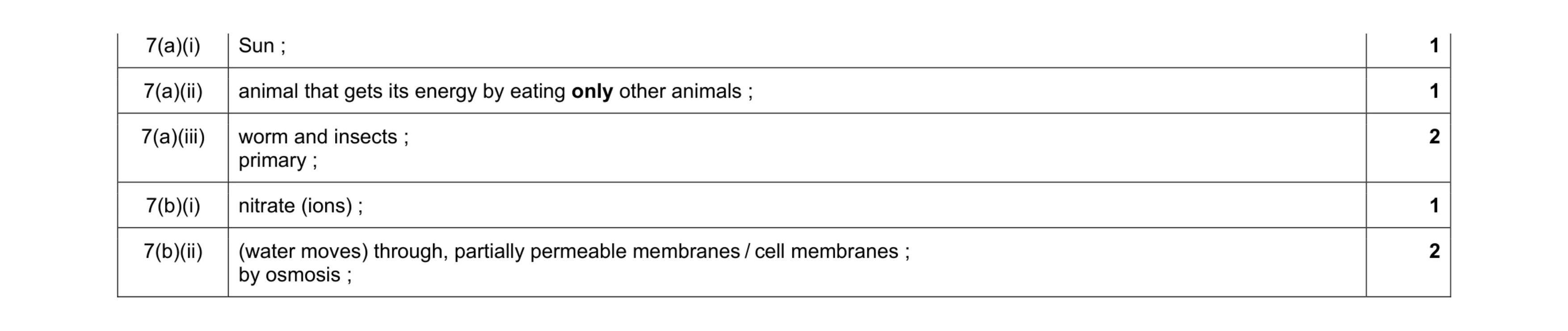 7
7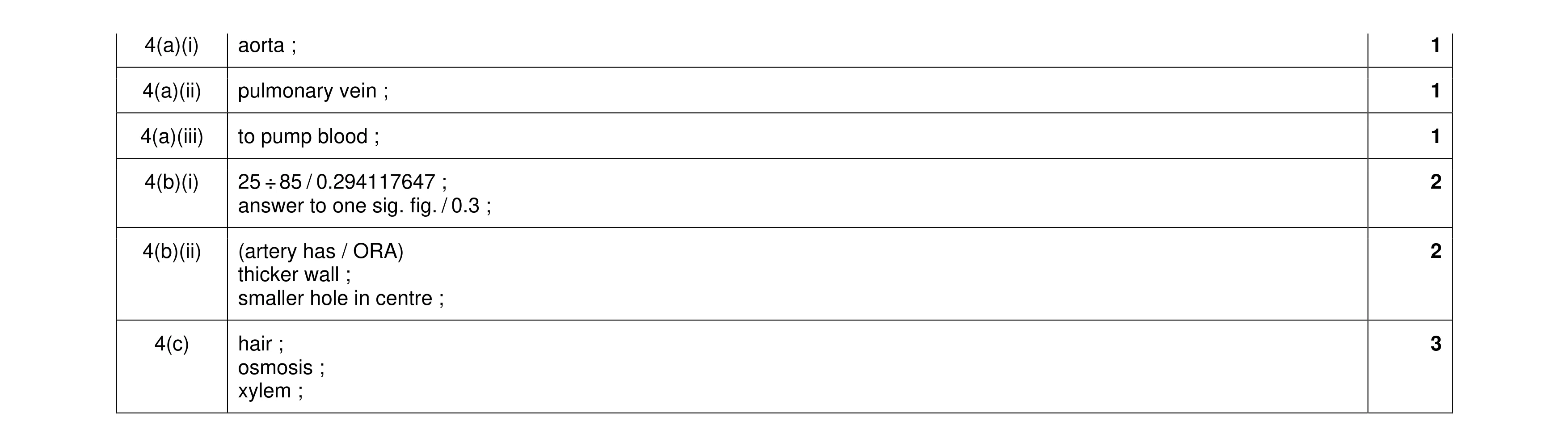 10
10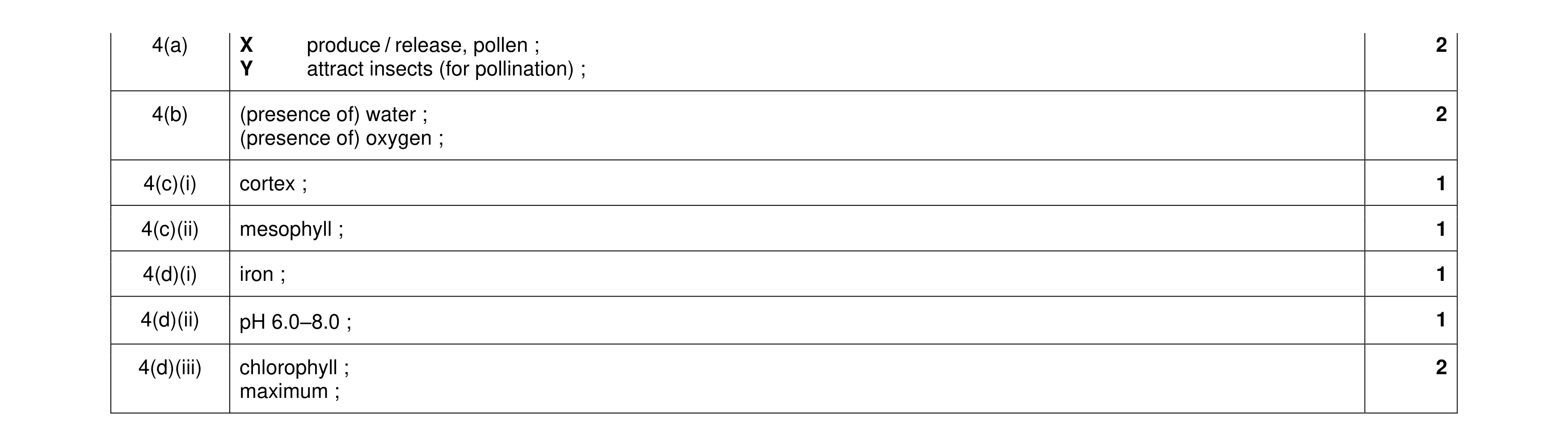 10
10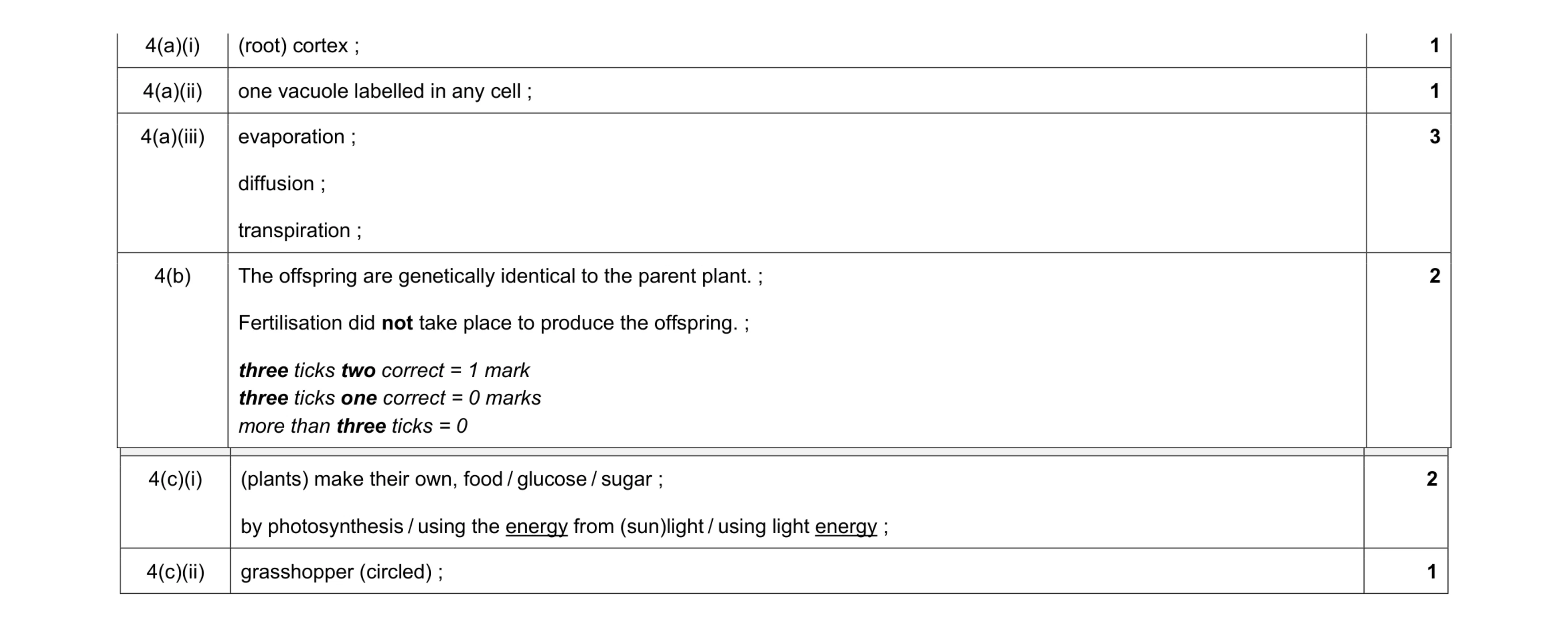 10
10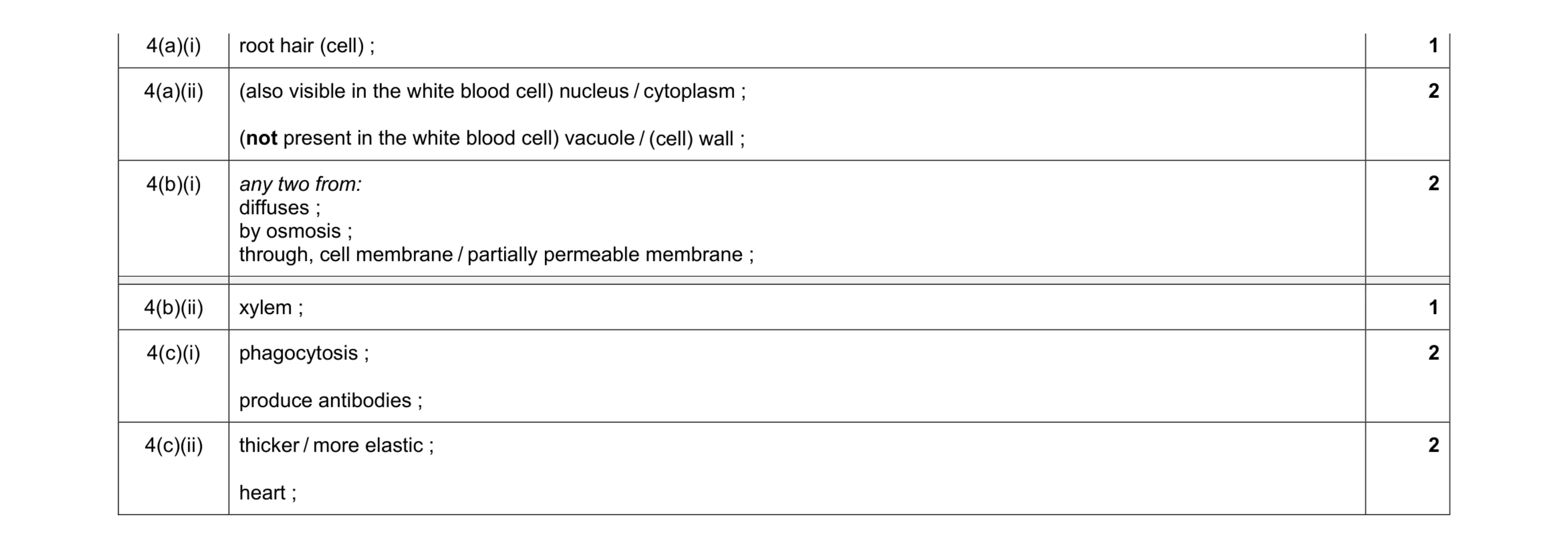 10
10 7
7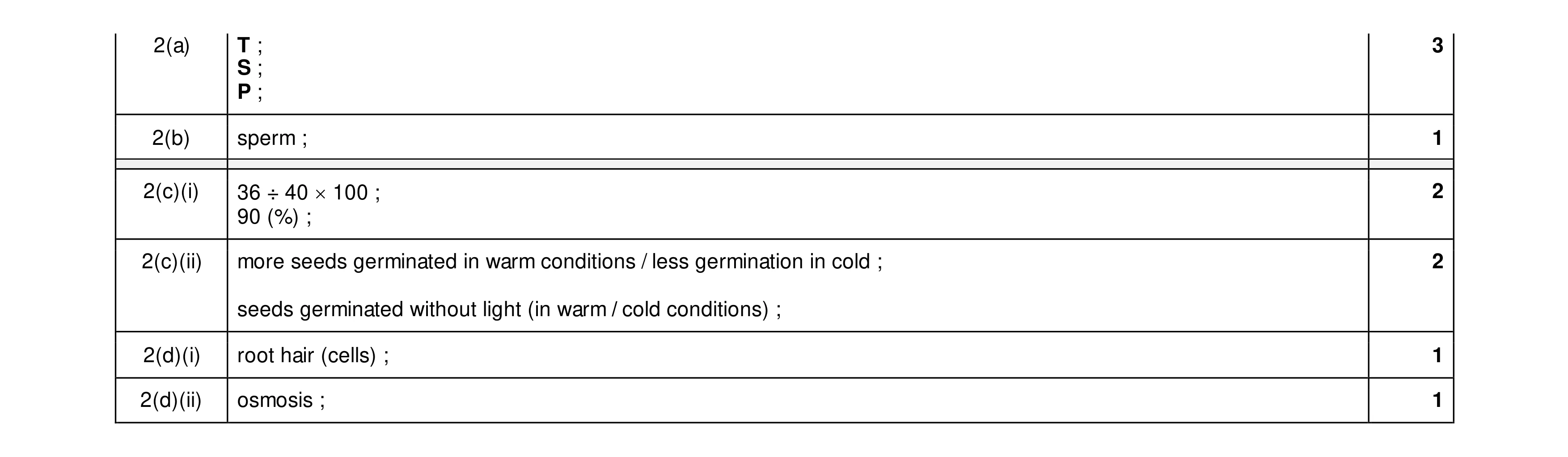 10
10