Questions as text
Q1 · =4 p = KK OO and q KK OO 2 3 L P L P (a) Find 1 (i) the column vector p , 2 J N K O K O… 0607/42 May/June 2017
=4 p = KK OO and q KK OO 2 3 L P L P (a) Find 1 (i) the column vector p , 2 J N K O K O [1] K O L P (ii) the column vector q − 2p, J N K O K O [2] K O L P (iii) p , leaving your answer in surd form. … [2] (b) AB = p + q Mark and label point B on the grid. A [2]
7 marks
Mark scheme: 4(a)(i) −1.5 1 oe 1 4(a)(ii) 10 2 B1 for each − 1 4(a)(iii) 13 final answer 2 M1 for (–3)2 + 22 oe soi by 3.61 or 3.605 to 3.606 13 in working implies M1 4(b) Correct B clearly indicated 2 1 1 B1 for vector drawn not from A or seen 5 5 or correctly following through, from A, their incorrect vector seen. −3 4 or either or correctly drawn only if one 2 3 starts from A.
This question in 0607/42 May/June 2017
Q2 · B NOT TO SCALE b M N A O a In the diagram, OA = a and OB = b 0607/43 May/June 2017
11 B NOT TO SCALE b M N A O a In the diagram, OA = a and OB = b . M is the midpoint of AB and N is the midpoint of AM. (a) Find each of these vectors in terms of a and b. Give each vector in its simplest form. (i) AB AB = … [1] (ii) AN AN = … [1] (iii) ON ON = … [2] (b) O is the point (0, 0). J N J N 8 2 = OA = KK OO and OB KK OO. 0 6 L P L P Find the co-ordinates of N. ( … , … ) [3]
7 marks
Mark scheme: 11(a)(i) – a + b oe 1 11(a)(ii) 1 1 1 FT their (i) − a + b oe 4 4 11(a)(iii) 3 1 2 B1 for correct unsimplified answer or a correct a + b oe route 4 4 11(b) (6.5, 1.5) 3 FT their (a)(iii) 6.5 B2 for 1.5 3 8 1 2 or M1 for × + × 4 0 4 6 OR uuuur 5 B2 for (5, 3) at M or [ OM = ] 3 or B1 for (k, 3) or (5, k) at M uuuur k 5 or [ OM = ] or 3 k
This question in 0607/43 May/June 2017
Q3 · A NOT TO SCALE E D F B C ABC is a triangle and BCFD is a parallelogram 0607/43 Oct/Nov 2017
5 A NOT TO SCALE E D F B C ABC is a triangle and BCFD is a parallelogram. 1 1 AD = AB and A E = A C . 3 3 AB = 6p and AC = 6q . (a) Find an expression, in terms of p and/or q, for (i) BC, … [1] (ii) DE, … [2] (iii) FC, … [1] (iv) BE. … [2] (b) The area of triangle ADE is 24 units2. (i) Find the area of triangle ABC. … units2 [2] (ii) Find the area of triangle EFC. … units2 [3]
11 marks
Mark scheme: 5(a)(i) –6p + 6q oe 1 5(a)(ii) –2p + 2q oe 2 FT their (a)(i) ÷ 3 provided in form ap +bq B1 for –2p + kq or for kp + 2q JJJG JJJG M1 for AD = 2p oe or AE = 2q or correct route 5(a)(iii) 4p cao 1 5(a)(iv) –6p +2q oe 2 B1 for –6p + kq or for kp + 2q M1 for a correct route 5(b)(i) 216 2 2 1 2 M1 for or 3 oe soi 3 5(b)(ii) 96 3 2 1 2 M2 for or 2 oe soi 2 or M1 for triangle EFC is similar to triangle EDA soi
This question in 0607/43 Oct/Nov 2017
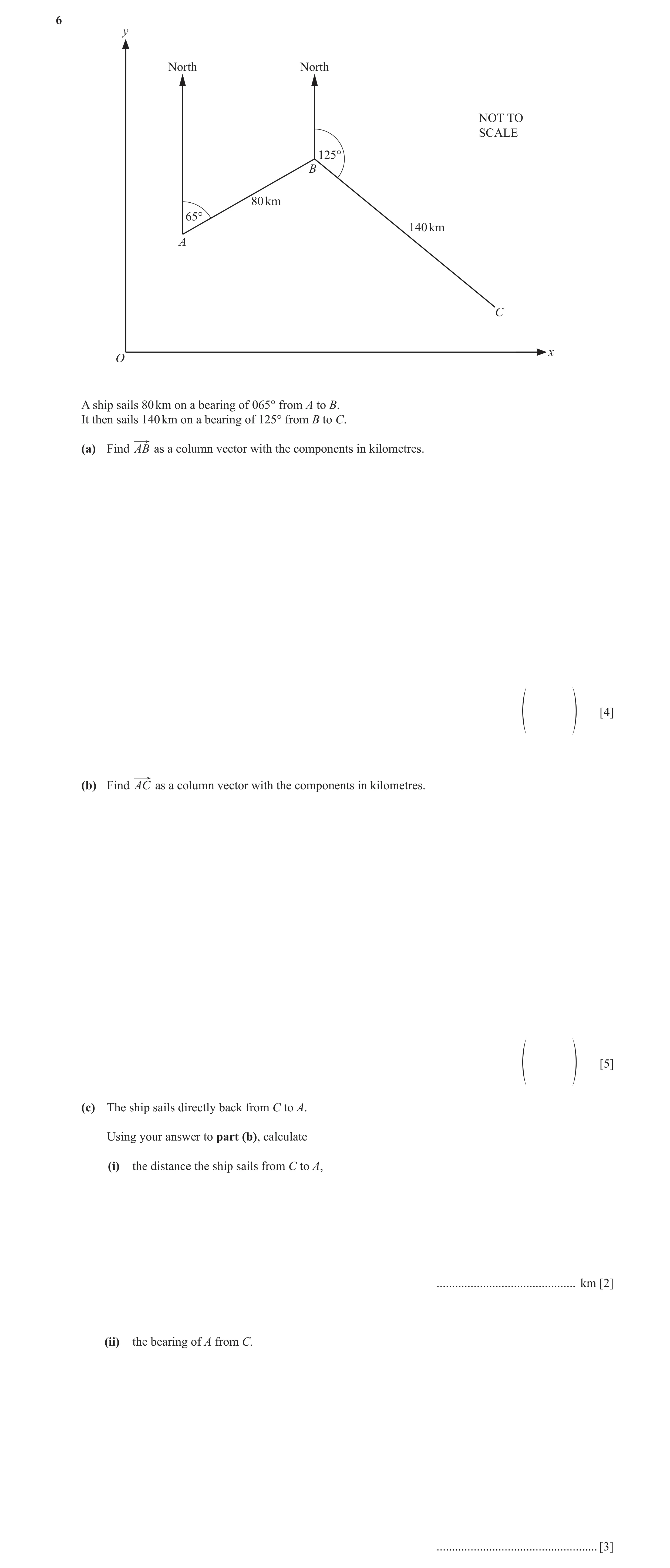
Q4 · Y North North NOT TO SCALE 125° B 80 km 65° 140 km A C x O A ship sails 80 km on a… 0607/43 May/June 2018
6 y North North NOT TO SCALE 125° B 80 km 65° 140 km A C x O A ship sails 80 km on a bearing of 065° from A to B. It then sails 140 km on a bearing of 125° from B to C. (a) Find AB as a column vector with the components in kilometres. [4] f p (b) Find AC as a column vector with the components in kilometres. [5] f p (c) The ship sails directly back from C to A. Using your answer to part (b), calculate (i) the distance the ship sails from C to A, … km [2] (ii) the bearing of A from C. … [3]
14 marks
Mark scheme: 6(a) 72.5 or 72.50... 4 B2 for 72.5 or 72.50... [...] 33.8 or 33.80 to 33.81 or M1 for = sin65 oe seen (80sin65 oe) 80 B2 for 33.8 or 33.80 to 33.81 [...] or M1 for = cos65 oe seen (80cos65 oe) 80 6(b) 187 or 187.1 to 187.2 5 M2 for their 72.5 + 140cos35 oe [...] – 46.5 or – 46.49... or M1 for = cos35 oe seen 140 (140cos35 oe) M2 for their 33.8 – 140sin35 oe [...] or M1 for = sin35 oe seen 140 (140 sin35 oe) 6(c)(i) (their 187)2 + (their[–] 46.5)2 M1 193 or 192.6 to 192.9 B1 6(c)(ii) their 46.5 M1 tan[x] = oe soi by 13.9... their 187 284 or 283.9 to 284.0 B2 M1 for 270 + their x oe
This question in 0607/43 May/June 2018
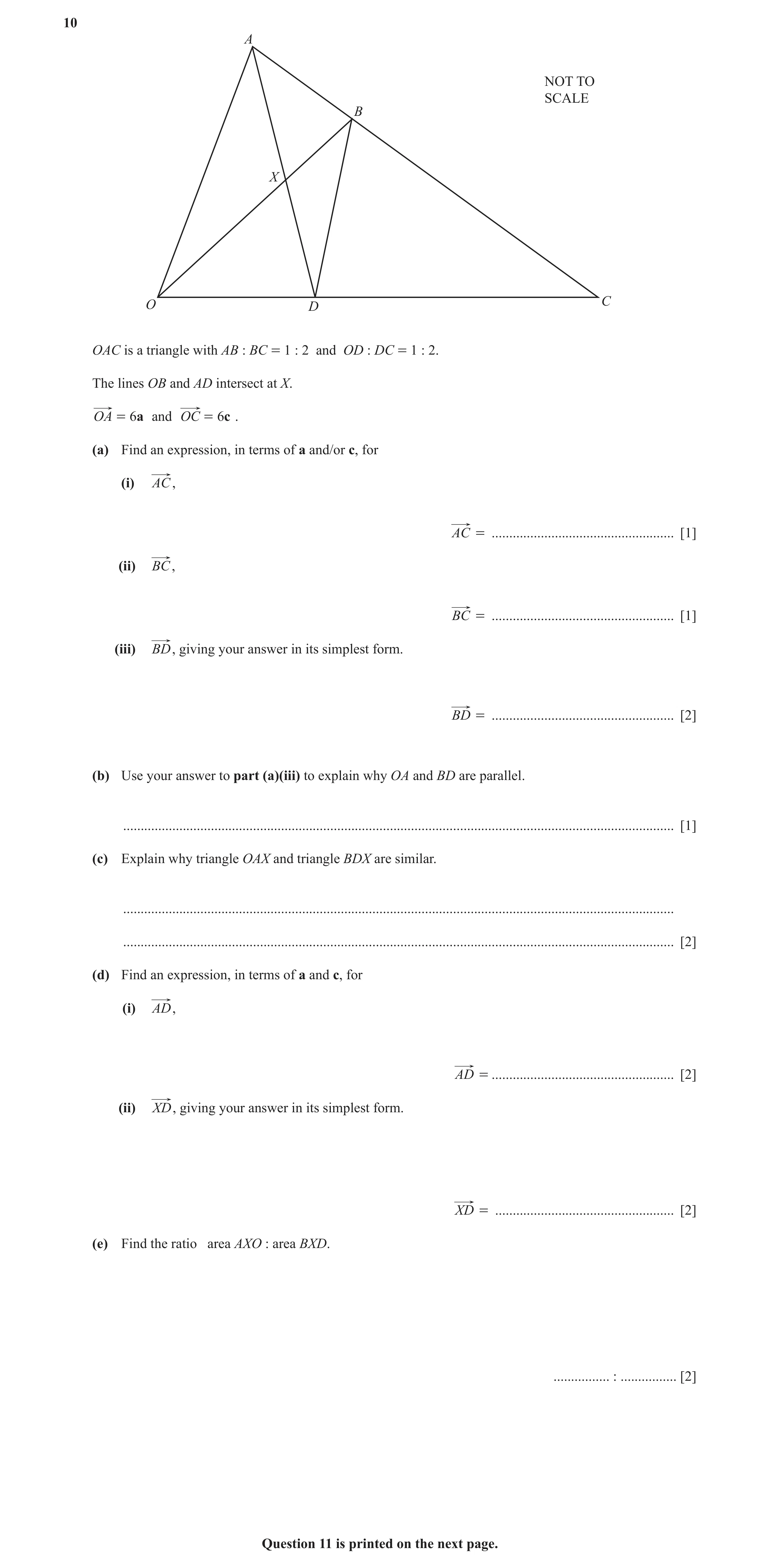
Q5 · A NOT TO SCALE B X O D C OAC is a triangle with AB : BC = 1 : 2 and OD : DC = 1 : 2 0607/41 Oct/Nov 2018
10 A NOT TO SCALE B X O D C OAC is a triangle with AB : BC = 1 : 2 and OD : DC = 1 : 2. The lines OB and AD intersect at X. OA = 6a and OC = 6c . (a) Find an expression, in terms of a and/or c, for (i) AC, AC = … [1] (ii) BC, BC = … [1] (iii) BD, giving your answer in its simplest form. BD = … [2] (b) Use your answer to part (a)(iii) to explain why OA and BD are parallel. … [1] (c) Explain why triangle OAX and triangle BDX are similar. … … [2] (d) Find an expression, in terms of a and c, for (i) AD, AD = … [2] (ii) XD, giving your answer in its simplest form. XD = … [2] (e) Find the ratio area AXO : area BXD. … : … [2] Question 11 is printed on the next page.
13 marks
Mark scheme: 10(a)(i) –6a + 6c oe 1 10(a)(ii) 2 1 FT their (a)(i) if a vector (–6a + 6c ) oe 3 10(a)(iii) –4a 2 2 JJJG M1 for their (a)(ii) + CO 3 or correct unsimplified route 10(b) Both multiples of a oe 1 Depends on (a)(iii) being a multiple of a 10(c) AngleOAX = angle BDX 2 Two correct statements Angle OXA = angle BXD B1 for one correct statement JJJG JJJG 10(d)(i) –6a + 2c oe 2 B1 for a correct route eg AO + OD or for –6a + kc or for ka + 2c , k ≠ 0 10(d)(ii) 1 2 (–12a + 4c ) oe JJJG JJJG 5 M1 for 3 XD = 2( − 6 a + 2 c − XD ) 2 or (their(d)(i)) 5 10(e) 9 : 4 oe 2 B1 for 3 : 2 oe soi or for 1.5 2 2 2 or seen 3
This question in 0607/41 Oct/Nov 2018
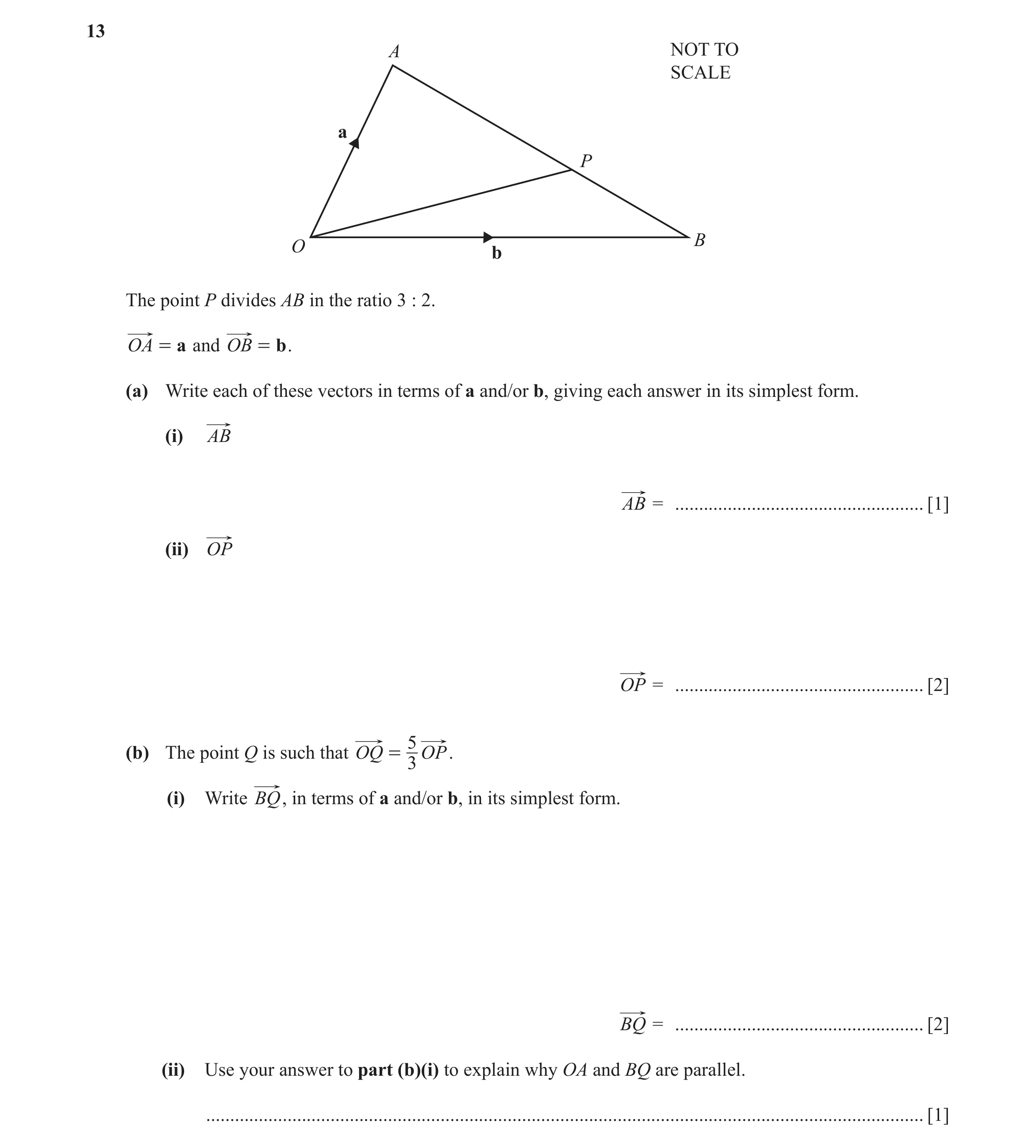
Q6 · A NOT TO SCALE a P B O b The point P divides AB in the ratio 3 : 2 0607/42 Oct/Nov 2018
13 A NOT TO SCALE a P B O b The point P divides AB in the ratio 3 : 2. OA = a and OB = b . (a) Write each of these vectors in terms of a and/or b, giving each answer in its simplest form. (i) AB AB = … [1] (ii) OP OP = … [2] 5 (b) The point Q is such that OQ = OP . 3 (i) Write BQ, in terms of a and/or b, in its simplest form. BQ = … [2] (ii) Use your answer to part (b)(i) to explain why OA and BQ are parallel. … [1]
6 marks
Mark scheme: 13(a)(i) –a + b 1 13(a)(ii) 2 3 2 B1 for unsimplified seen a + b JJJG JJG 5 5 3 2 or M1 for a + AB oe or b + BA oe 5 5 13(b)(i) 2 2 B1 for unsimplified seen a 3 5 or M1 for –b + 3their (a)(ii) JJJG13(b)(ii) 1 Dep on (b)(i) = ka, k ≠ 1 BQ is a multiple of a oe
This question in 0607/42 Oct/Nov 2018
Q7 · The vectors a and b are shown on the grids 0607/41 May/June 2019
7 The vectors a and b are shown on the grids. a b (a) On the grid below, draw and label the following three vectors. 2b 2a + b a - 2b [3] (b) Vectors p, q, and r are drawn on this grid. Write each of the vectors in terms of a and/or b. p q r p = … q = … r = … [3]
6 marks
Mark scheme: 7(a) 4 3 B1 for each with arrows Vector drawn If 0 scored SC1 for all three without arrows 2 or all incorrect arrows 2 Vector drawn 5 −4 Vector drawn 0 7(b) [p = ] –3b oe 3 B1 for each [q = ] 3a + 3b oe [r = ] 2b – a oe
This question in 0607/41 May/June 2019
Q8 · The points A (1, 2) and B (7, 5) are shown on the diagram below 0607/43 May/June 2019
10 The points A (1, 2) and B (7, 5) are shown on the diagram below. y 12 NOT TO SCALE B A 0 16 x (a) Write AB as a column vector. [1] f p (b) Calculate the length of the line AB. … [2] (c) The point C has co-ordinates (10, k). AB = BC and k 2 0. Show that k = 11. [3] (d) Find the equation of the line that is perpendicular to AC that passes through the midpoint of AC. Give your answer in the form y = mx + c. y = … [4] (e) The points A, B, C and D form a rhombus. Find the co-ordinates of D. ( … , … ) [3]
13 marks
Mark scheme: 10(a) 6 1 3 10(b) 6.71 or 6.708… or 45 oe 2 2 2 M1 for (7 −1) + (5 − 2) oe 10(c) 2 2 2 2 2 k −=5 (their (b)) − 3 M2 M1 for (k − 5) + (10 − 7) = (their(b)) oe Reverse process scores 0. k −=5 6 A1 10(d) [ y = ] − x + 12 oe 4 11 − 2 M1 for grad AC = oe 10 − 1 1 M1 for grad perp = − their grad B1 for midpoint (5.5, 6.5) 10(e) (4, 8) 3 10 6 7 −3 M2 for − or − oe 11 3 5 3 6 −3 or M1 for CD = or BD = oe 3 3
This question in 0607/43 May/June 2019
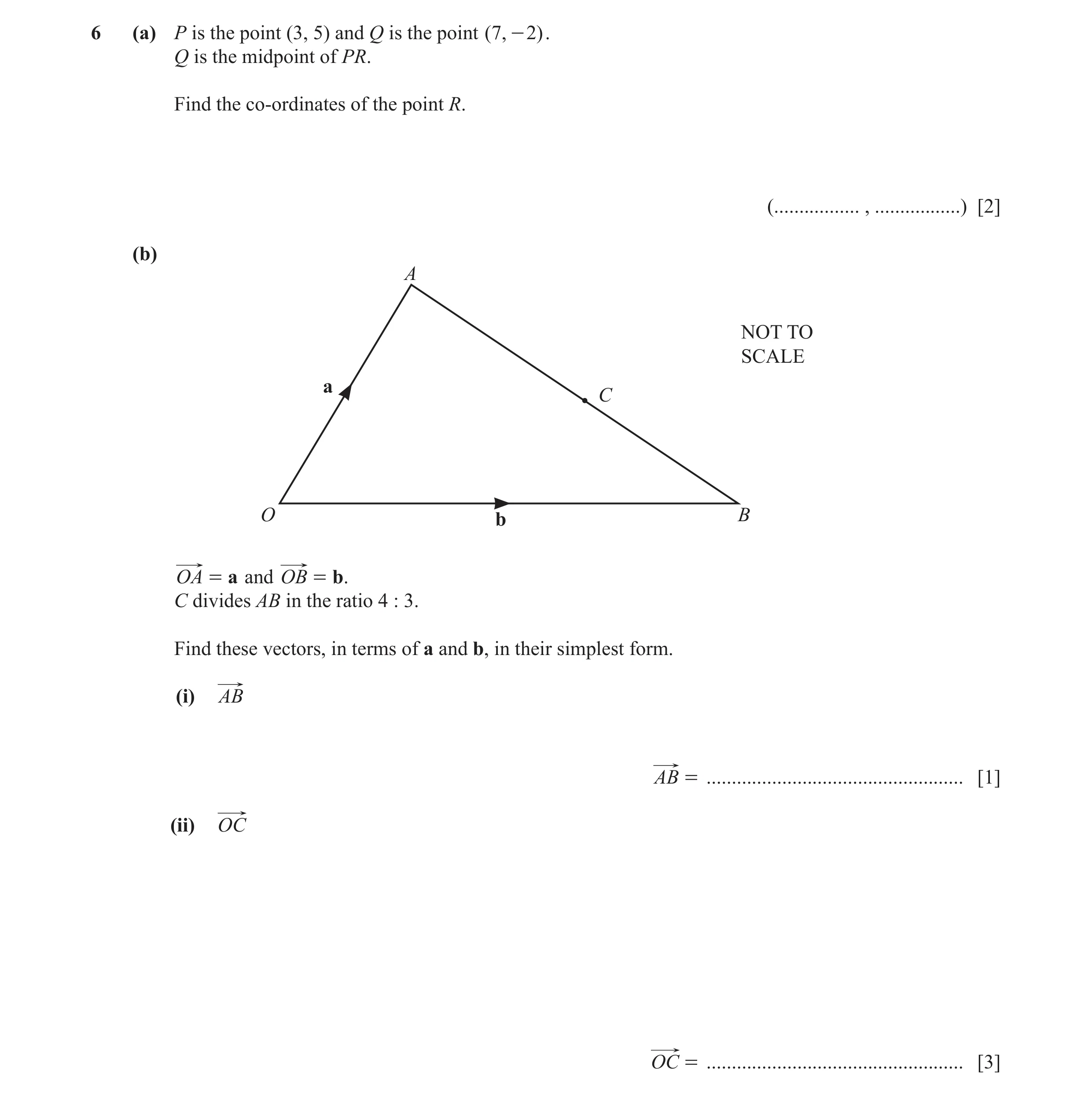
Q9 · P is the point (3, 5) and Q is the point (7, - 2) 0607/43 Oct/Nov 2019
6 (a) P is the point (3, 5) and Q is the point (7, - 2). Q is the midpoint of PR. Find the co-ordinates of the point R. ( … , … ) [2] (b) A NOT TO SCALE a C O b B OA = a and OB = b . C divides AB in the ratio 4 : 3. Find these vectors, in terms of a and b, in their simplest form. (i) AB AB = … [1] (ii) OC OC = … [3]
6 marks
Mark scheme: 6(a) (11, –9) 2 B1 for each co-ordinate 6(b)(i) –a + b 1 6(b)(ii) 3 4 1 3 B2 for unsimplified a + b or ( 3a + 4b) JJJG JJJG 7 7 7 4 or B1 for OA + AB oe or a correct 7 route
This question in 0607/43 Oct/Nov 2019
Q10 · P = q = 3 - 1 A is the point (3, 4) 0607/43 Oct/Nov 2020
9 p = q = 3 - 1 A is the point (3, 4). (a) Find p - q . [1] f p (b) A is translated onto H by the vector p. Find the coordinates of H. ( … , … ) [1] (c) J is translated onto A by the vector q. Find the coordinates of J. ( … , … ) [1] (d) Find the coordinates of the mid-point of HJ. ( … , … ) [1] (e) Find the length of HJ. HJ = … [3] 1 (f) A line L, parallel to the vector q, has gradient - . 2 Find the equation of the line perpendicular to the line L that passes through the point A. … [3]
10 marks
Mark scheme: 9(a) − 3 1 4 9(b) (2, 7) 1 9(c) (1, 5) 1 9(d) (1.5, 6) 1 FT their (b) and (c). 9(e) 2.24 or 2.236... 3 FT their (b) and (c). M2 for (their 2 – their 1)2 + (their 7 – their 5)2 oe or M1 for (their 2 – their 1) and (their 7 – their 5) seen 9(f) y = 2x – 2 oe 3 − 1 M1 for gradient = oe soi 2 1 − 2 M1 for substituting (3, 4) in y = their m x + c Answer 2x – 2 implies M1 M1
This question in 0607/43 Oct/Nov 2020
Q11 · P = r = 4 7 (i) Find 2p 0607/43 Oct/Nov 2022
6 (a) p = r = 4 7 (i) Find 2p. [1] f p 1 (ii) Find p - r . 4 [2] f p (iii) Find the magnitude of p. … [2] (b) K is the point (3, 4). - 1 (i) The vector from K to L is e 1o. Find the coordinates of L. ( … , … ) [1] 5 (ii) The vector from J to K is e- 2o. Find the coordinates of J. ( … , … ) [1] (c) A is the point ( - 1, 3 ) and B is the point (5, 7). The perpendicular bisector of the line AB meets the x-axis at C. Find the coordinates of C. ( … , … ) [7]
14 marks
Mark scheme: 6(a)(i) 4 1 cao 8 6(a)(ii) 1.5 2 1 k oe cao B1 for answers oe or 12 −6 6 − k 1 or for 2 seen 1 6(a)(iii) 2 M1 for 22 + 42 2 5 or 4.47 or 4.472... final answer 6(b)(i) (2, 5) cao 1 6(b)(ii) (–2, 6) cao 1 6(c) 16 7 3 ,0 oe B5 for y = − x + 8 oe 3 2 3 M1 for − x + 8 = 0 oe 2 OR B1 for (2, 5) 7 − 3 M1 for oe (= m1) 5 −−1 1 M1 for grad ( m2 ) = − their m1 M1 for substituting their (2, 5) into y = (their m2) x + c M1 for substituting y = 0 into their equation of line
This question in 0607/43 Oct/Nov 2022
Q12 · P = q = - 2 1 (i) Work out p + 2q 0607/41 Oct/Nov 2023
4 (a) p = q = - 2 1 (i) Work out p + 2q . [2] f p (ii) A is the point (2, 6) and B is the image of point A after a translation by the vector p. Find the coordinates of B. ( … , … ) [1] (iii) Find the magnitude of q. … [2] (b) Find the vector that translates the point (1, 5) to the point ( - 1, 7). [2] f p (c) y 6 5 4 B 3 2 T 1 -6 -5 -4 -3 -2 -1 0 1 2 3 4 5 6 x -1 -2 -3 A -4 -5 -6 (i) Describe fully the single transformation that maps triangle T onto triangle A. … … [2] (ii) Describe fully the single transformation that maps triangle T onto triangle B. … … [3] (iii) Reflect triangle T in the y-axis. [1] (iv) Stretch triangle T with factor 3 and invariant line y = 3 . [2]
15 marks
Mark scheme: 4(a)(i) −7 2 B1 for each −10 0 or for seen 2 4(a)(ii) (5, 4) 1 4(a)(iii) 5.1[0] or 5.099... 2 M1 for (–5)2 + 12 oe 4(b) −2 2 B1 for each 2 4(c)(i) Translation 2 B1 for each 2 −5 4(c)(ii) Rotation 3 B1 for each 90˚ [anticlockwise] oe (0, 2) 4(c)(iii) Image at (–1, 1) (–3, 1), (–1, 2) 1 4(c)(iv) Image at (1, 0), (1, –3), (3, –3) 2 B1 for stretch factor 3 in y = k or in x = 3
This question in 0607/41 Oct/Nov 2023
Q13 · A = e o b = e o 12 -1 1 (a) Work out a - b 0607/42 Feb/March 2025
4 a = e o b = e o 12 -1 1 (a) Work out a - b . 3 f p [2] (b) Find b . … [2]
4 marks
Mark scheme: 4(a) − 3 2 B1 for either component 5 4(b) 2 M1 for 52 + (–1)2 5.1[0] or 5.099… or answer 26
This question in 0607/42 Feb/March 2025
Q14 · Y NOT TO SCALE × A (– 4, 3) x 0 × B (5, –2) Point A is translated to point B 0607/41 May/June 2025
8 y NOT TO SCALE × A (– 4, 3) x 0 × B (5, –2) Point A is translated to point B. Find AB . f p [2]
2 marks
Mark scheme: 8 9 2 B1 for each component −9 −5 If 0 scored SC1 for 5
This question in 0607/41 May/June 2025
![Question 1: =4 p = KK OO and q KK OO 2 3 L P L P (a) Find 1 (i) the column vector p , 2 J N K O K O [1] K O L P (ii) the column vector q − 2p, J N K O …](https://img.pastlit.com/crops/d6b8cdf0-84de-4549-b014-bba7e43daf90/q4.webp) 1 / 17
1 / 17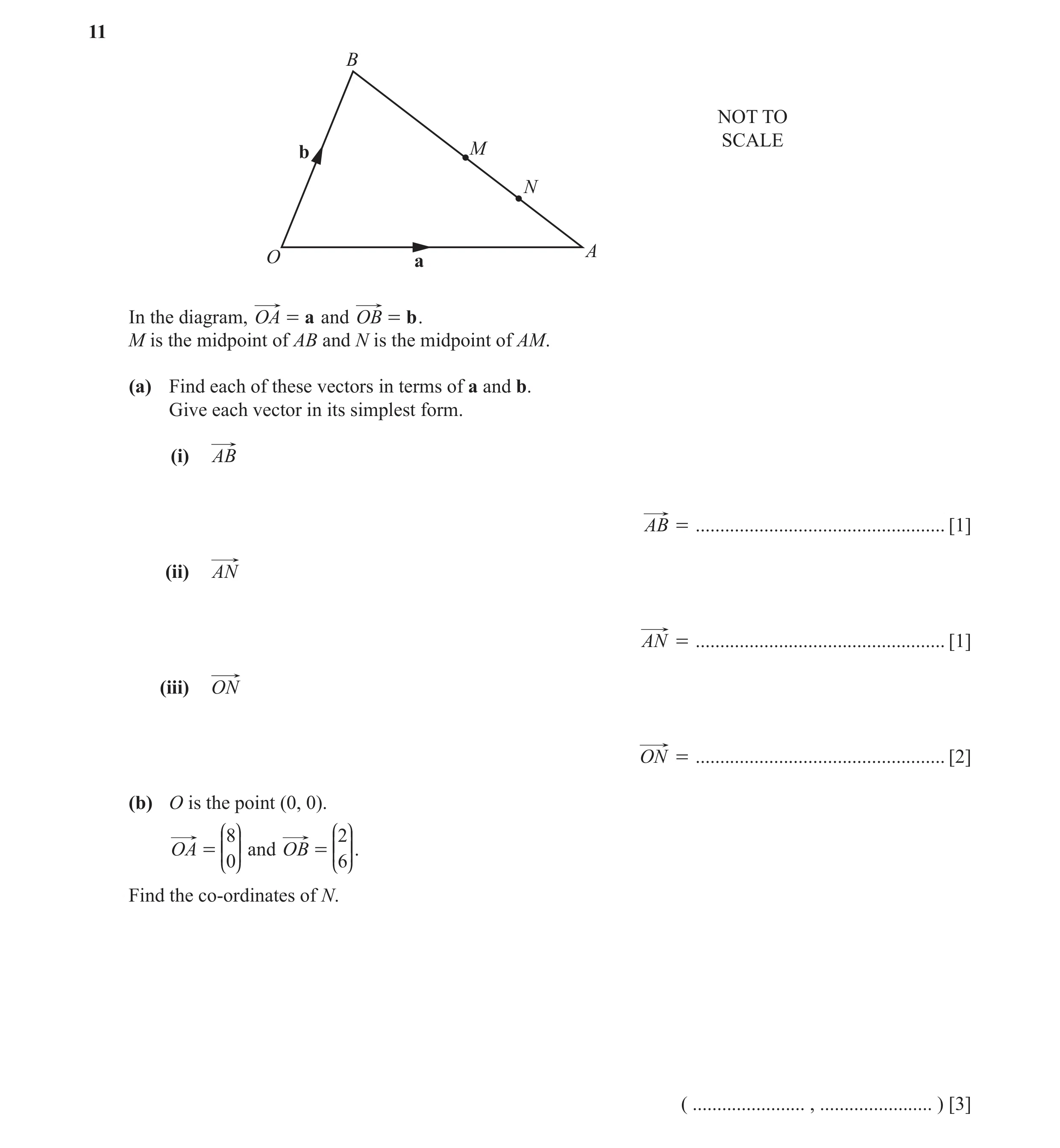 2 / 17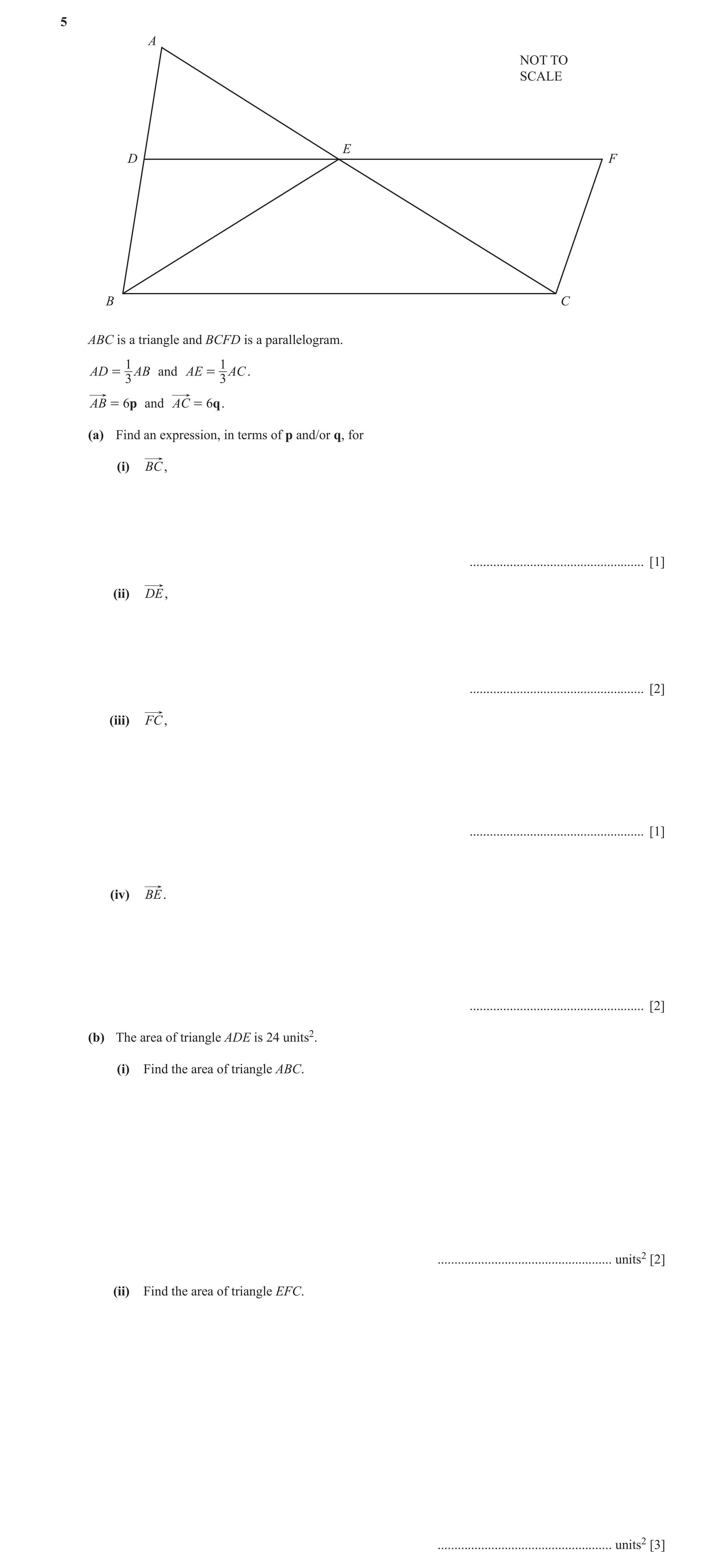
 8 / 17
![Question 7: The vectors a and b are shown on the grids. a b (a) On the grid below, draw and label the following three vectors. 2b 2a + b a - 2b [3] (b)…](https://img.pastlit.com/crops/73ce2179-1507-4170-9646-3503f51b9597/q7.webp)
![Question 8: The points A (1, 2) and B (7, 5) are shown on the diagram below. y 12 NOT TO SCALE B A 0 16 x (a) Write AB as a column vector. [1] f p (b) …](https://img.pastlit.com/crops/802bc314-abf0-45ac-8900-48a1c2fc1e2f/q10.webp)
 12 / 17
![Question 10: p = q = 3 - 1 A is the point (3, 4). (a) Find p - q . [1] f p (b) A is translated onto H by the vector p. Find the coordinates of H. ( ....…](https://img.pastlit.com/crops/c1682ce7-7004-48f5-a553-e846709c547a/q9.webp) 13 / 17
13 / 17![Question 11: (a) p = r = 4 7 (i) Find 2p. [1] f p 1 (ii) Find p - r . 4 [2] f p (iii) Find the magnitude of p. .........................................…](https://img.pastlit.com/crops/b1c6253c-bcbe-4c33-9614-2f00e9d25aa9/q6.webp)
![Question 12: (a) p = q = - 2 1 (i) Work out p + 2q . [2] f p (ii) A is the point (2, 6) and B is the image of point A after a translation by the vector …](https://img.pastlit.com/crops/c7b494a4-3782-4062-b32e-b64c6d434597/q4.webp)
![Question 13: a = e o b = e o 12 -1 1 (a) Work out a - b . 3 f p [2] (b) Find b . ................................................. [2]](https://img.pastlit.com/crops/aca9d155-4423-49fd-8e15-138a6360866d/q4.webp)
![Question 14: y NOT TO SCALE × A (– 4, 3) x 0 × B (5, –2) Point A is translated to point B. Find AB . f p [2]](https://img.pastlit.com/crops/77e7fd2f-200b-42e4-ace4-dee1f30059d5/q8.webp) 17 / 17
17 / 17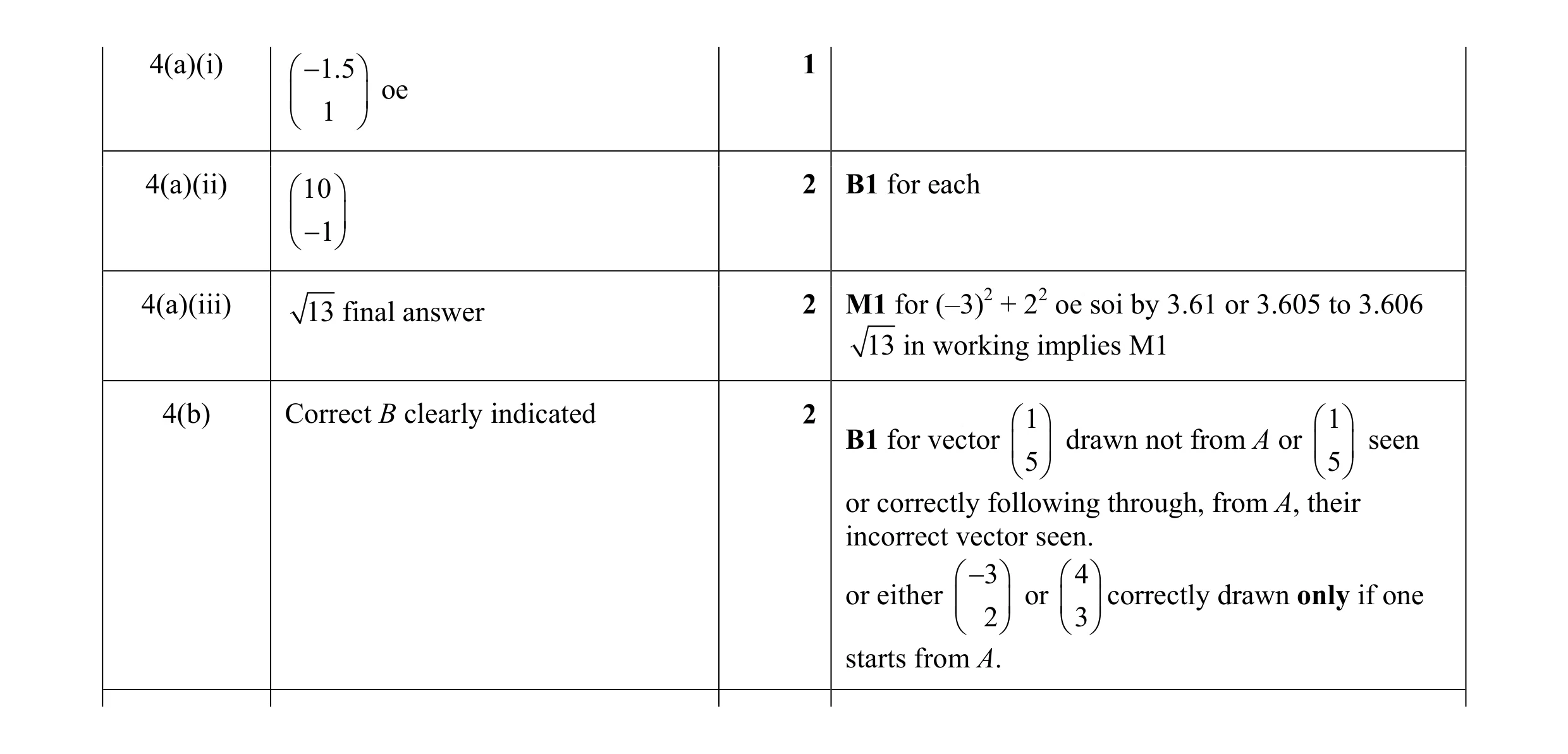 7
7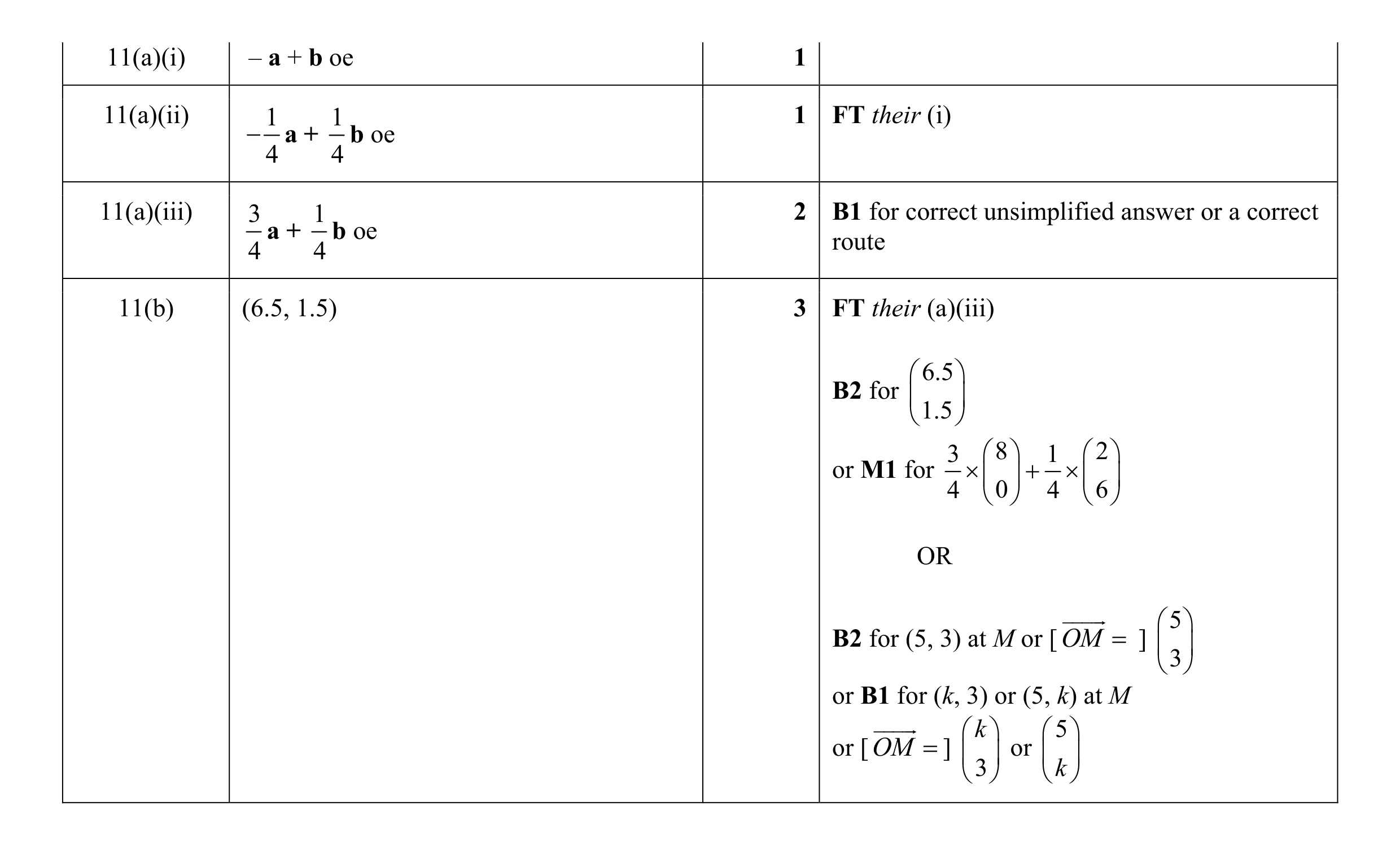 7
7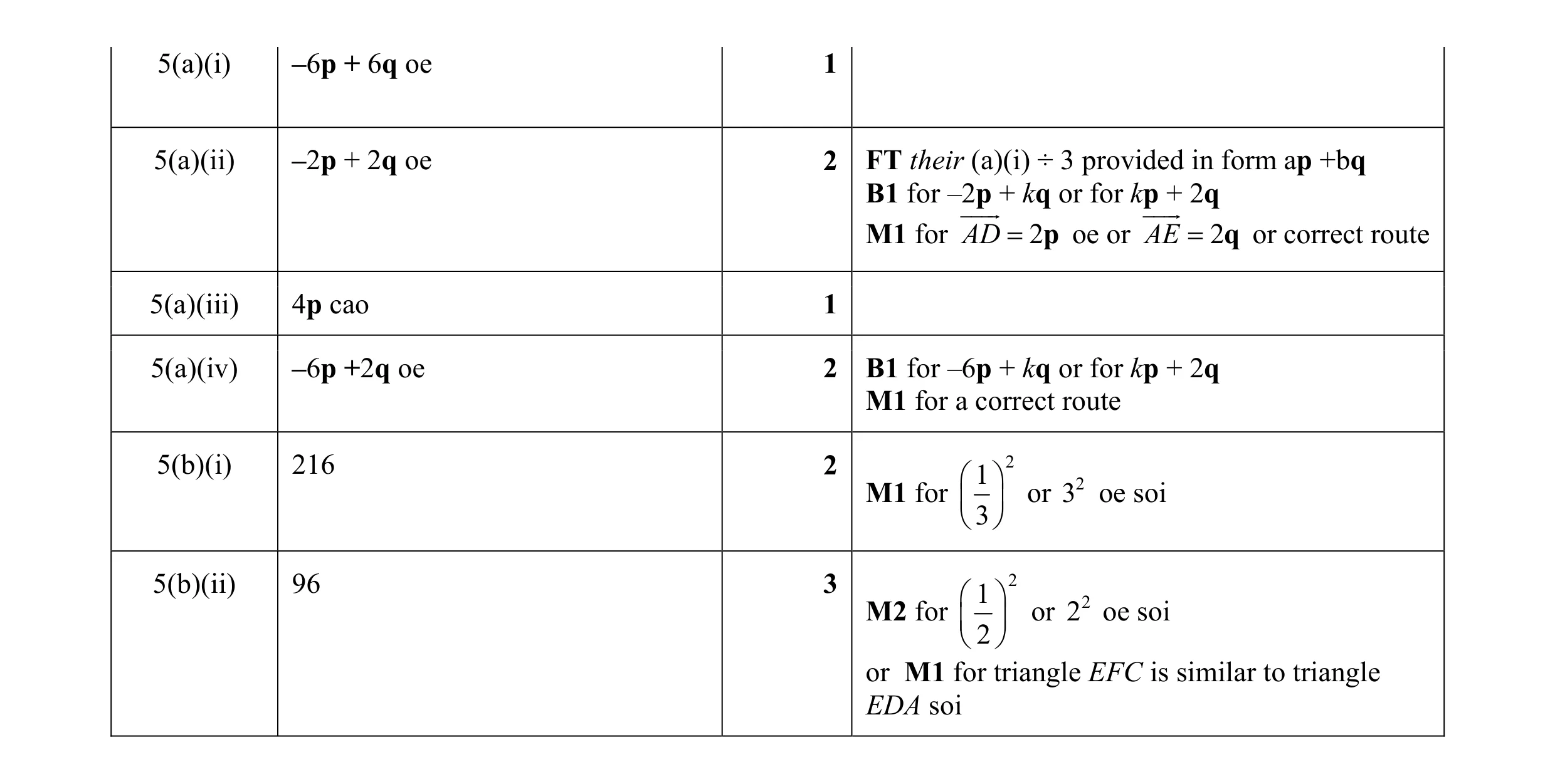 11
11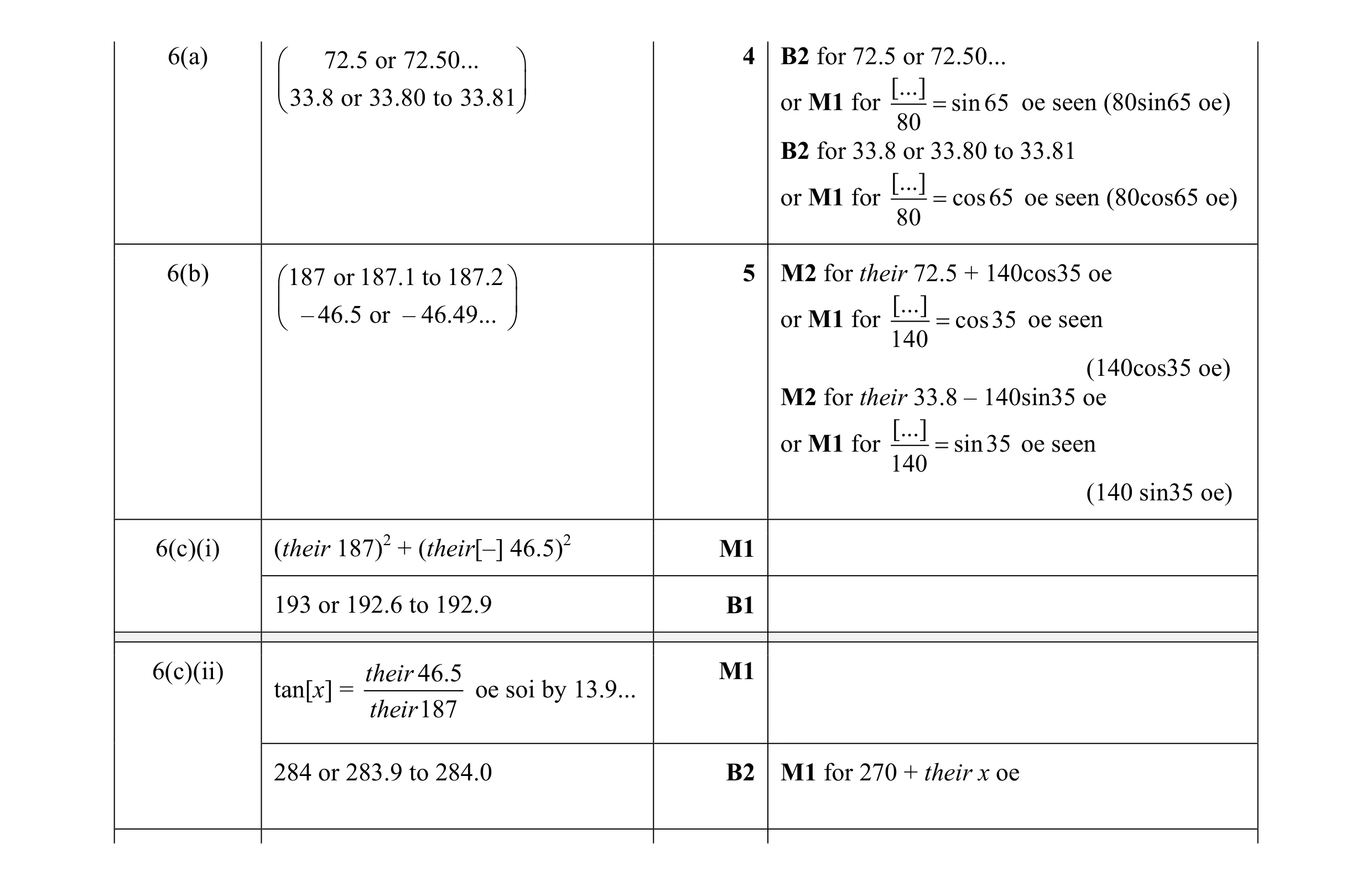 14
14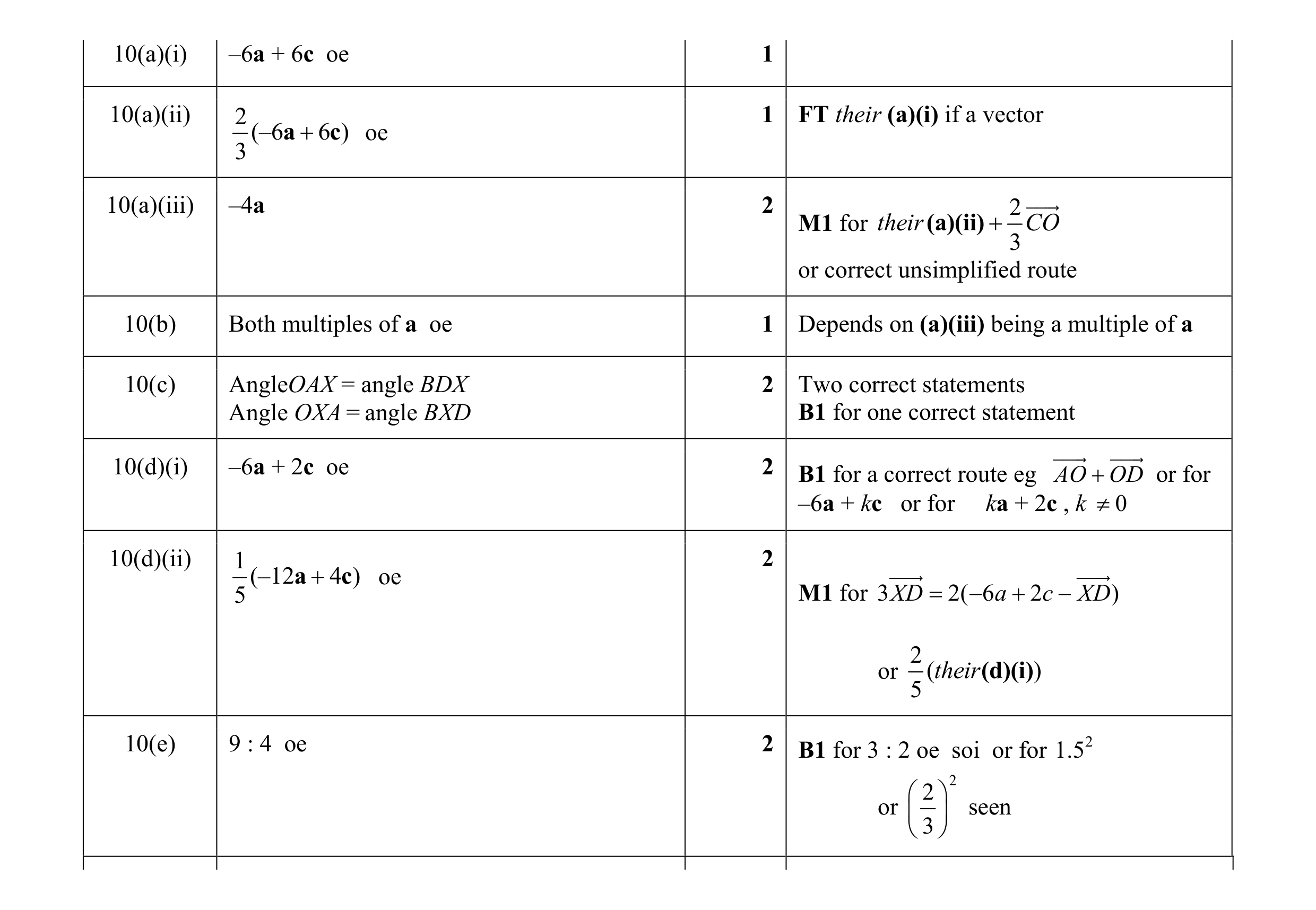 13
13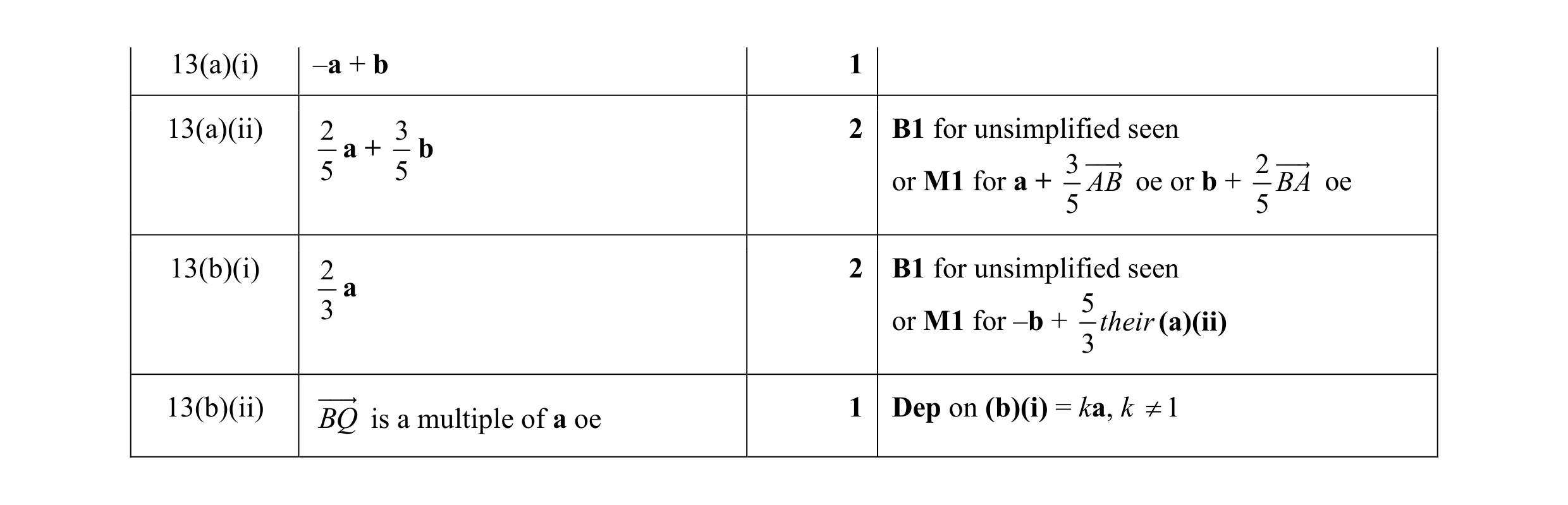 6
6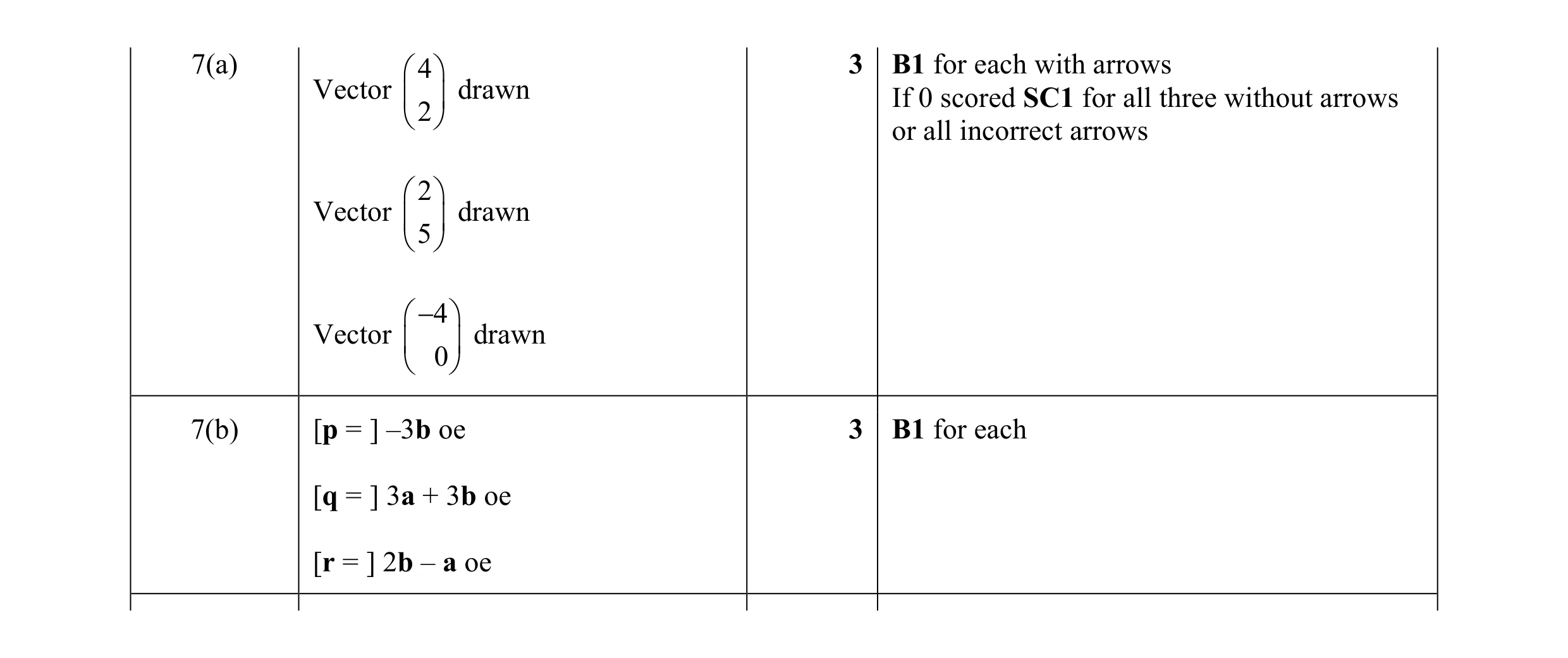 6
6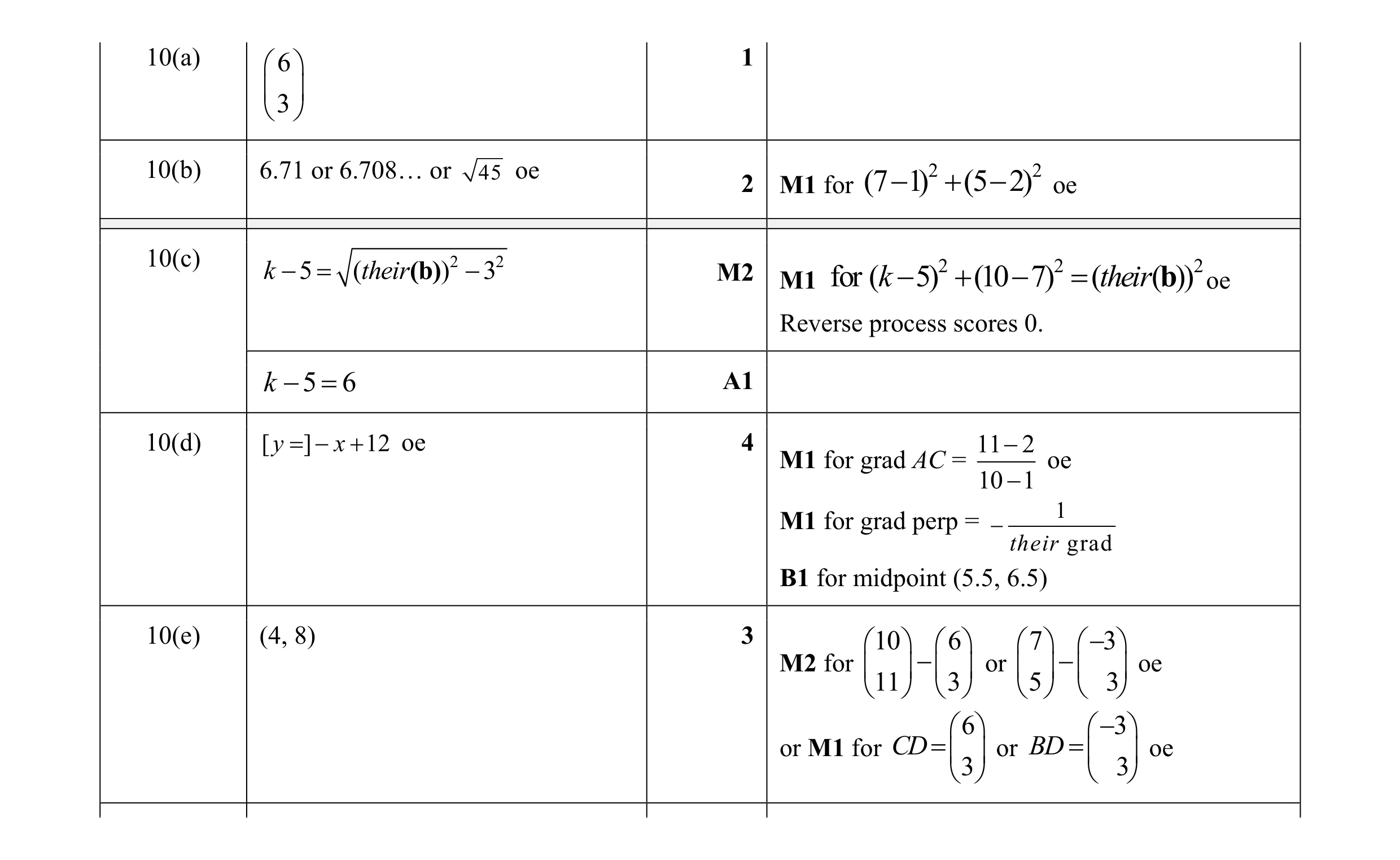 13
13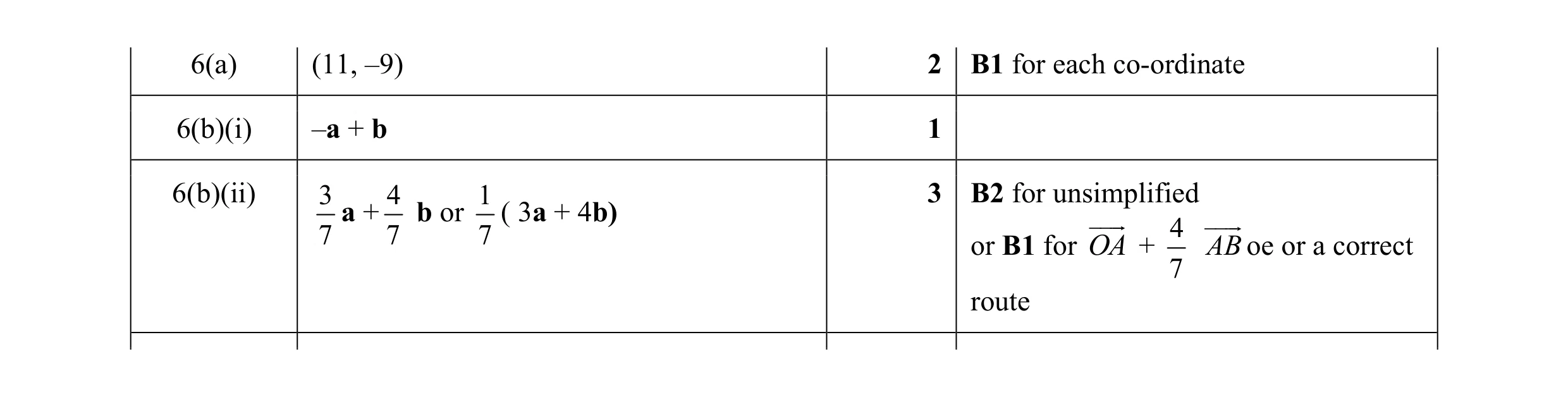 6
6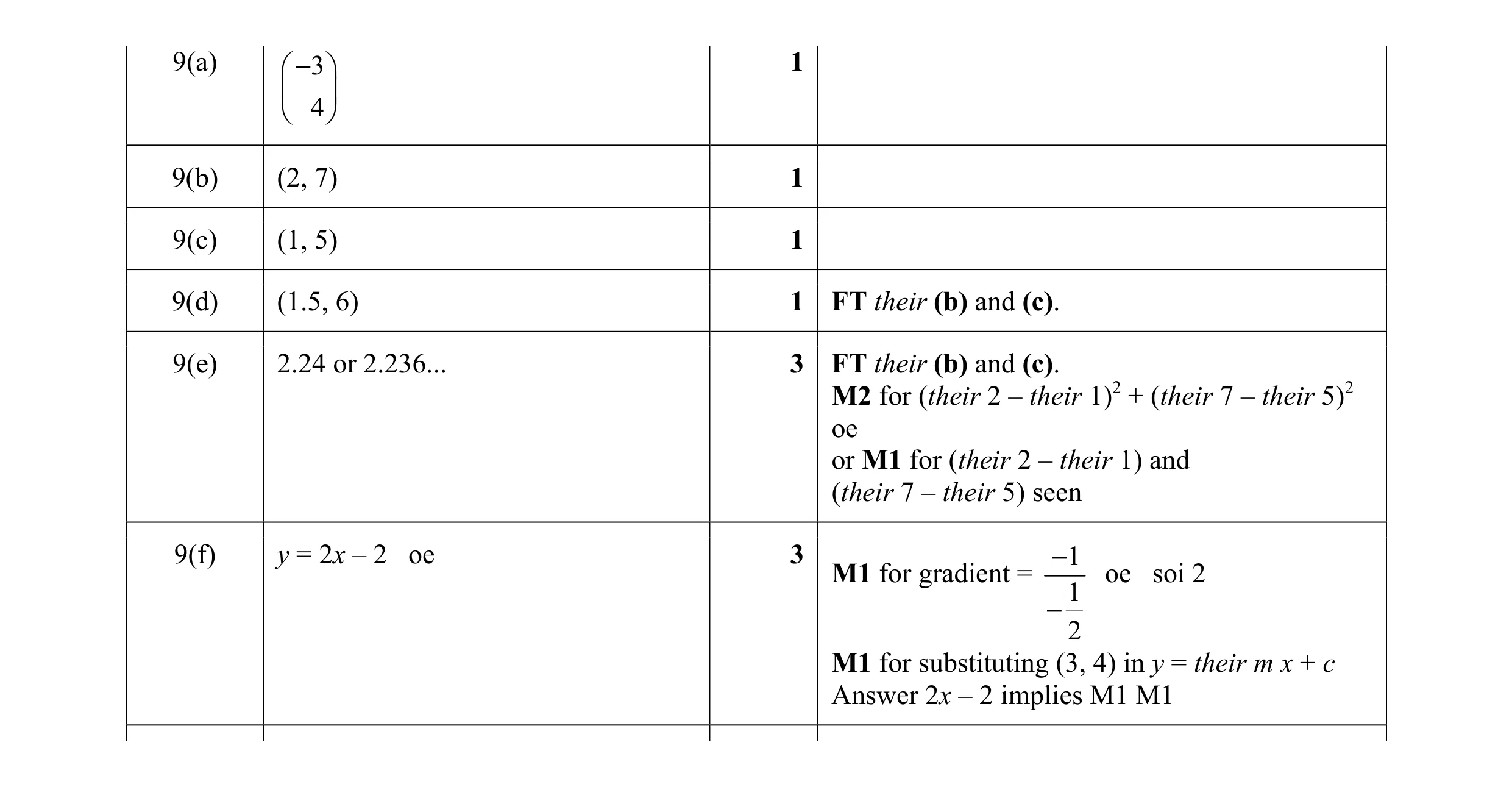 10
10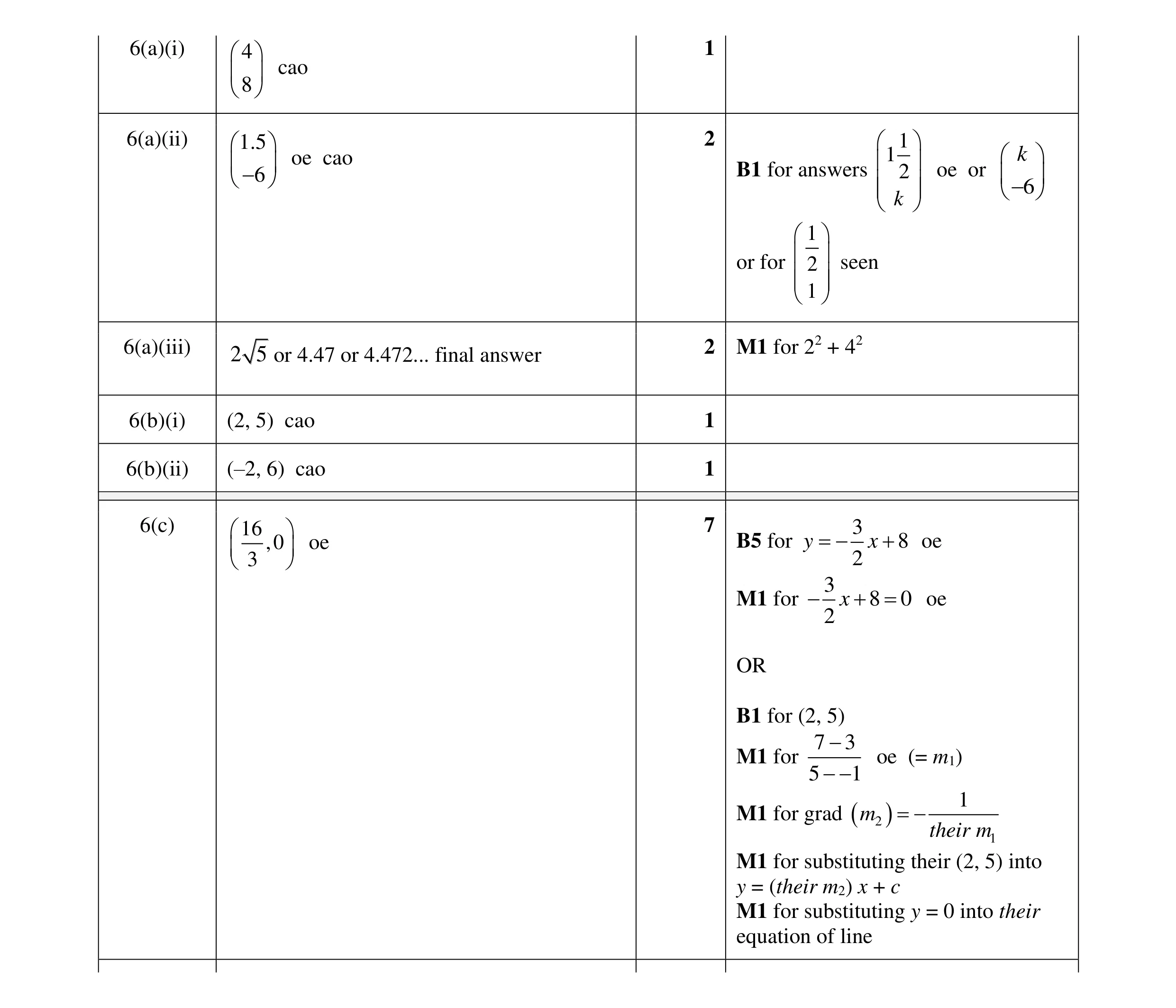 14
14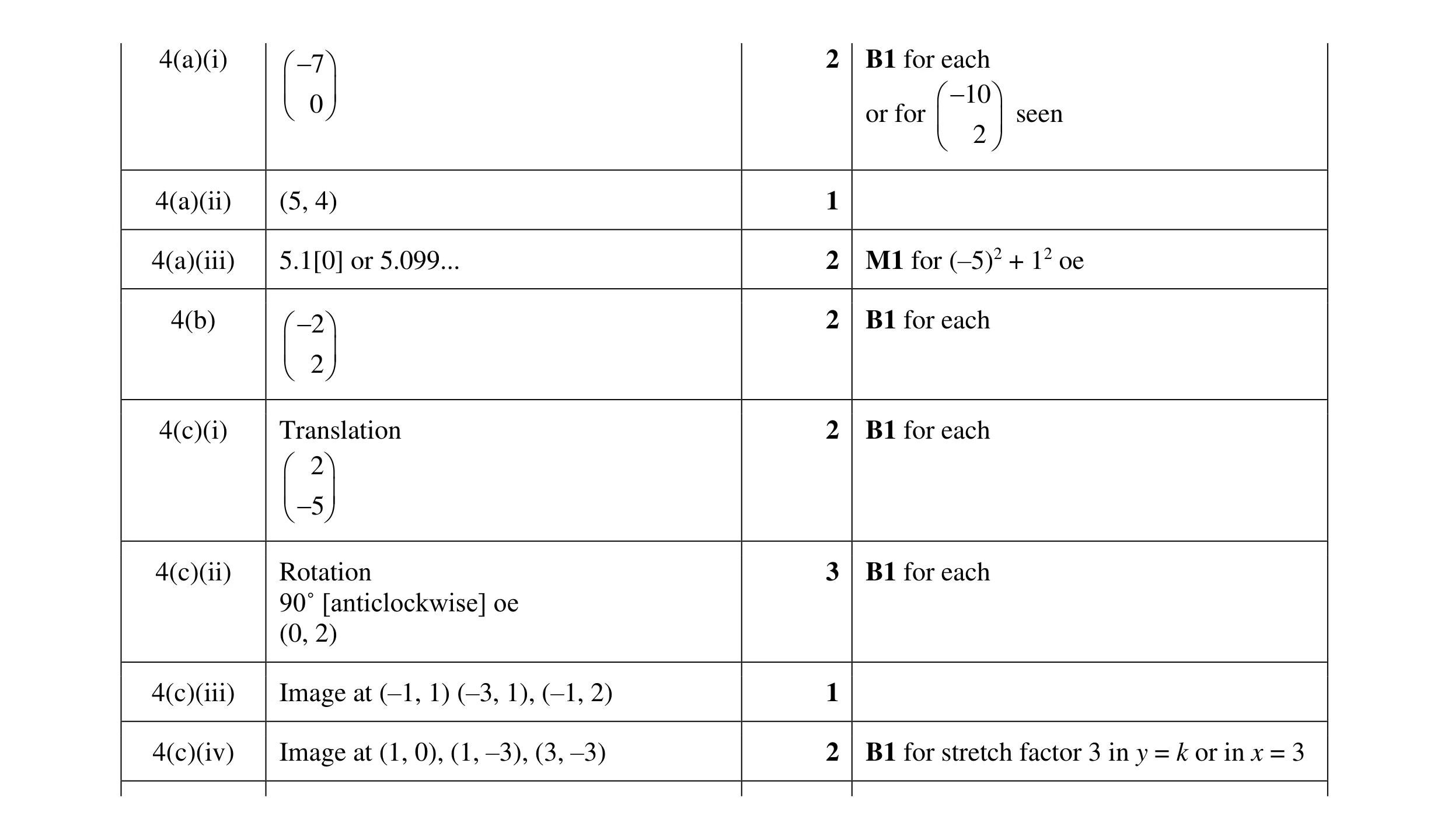 15
15 4
4 2
2