Cambridge IGCSE Mathematics - International 0607 — 2017 May/June Paper 4 · Variant 3
0607/43/M/J/17 · 11 questions · 120 marks · ≈135 min
The question paper and its mark scheme, free to read here and free to download. This is Cambridge’s own paper, exactly as it was sat.
Question paper20 pages
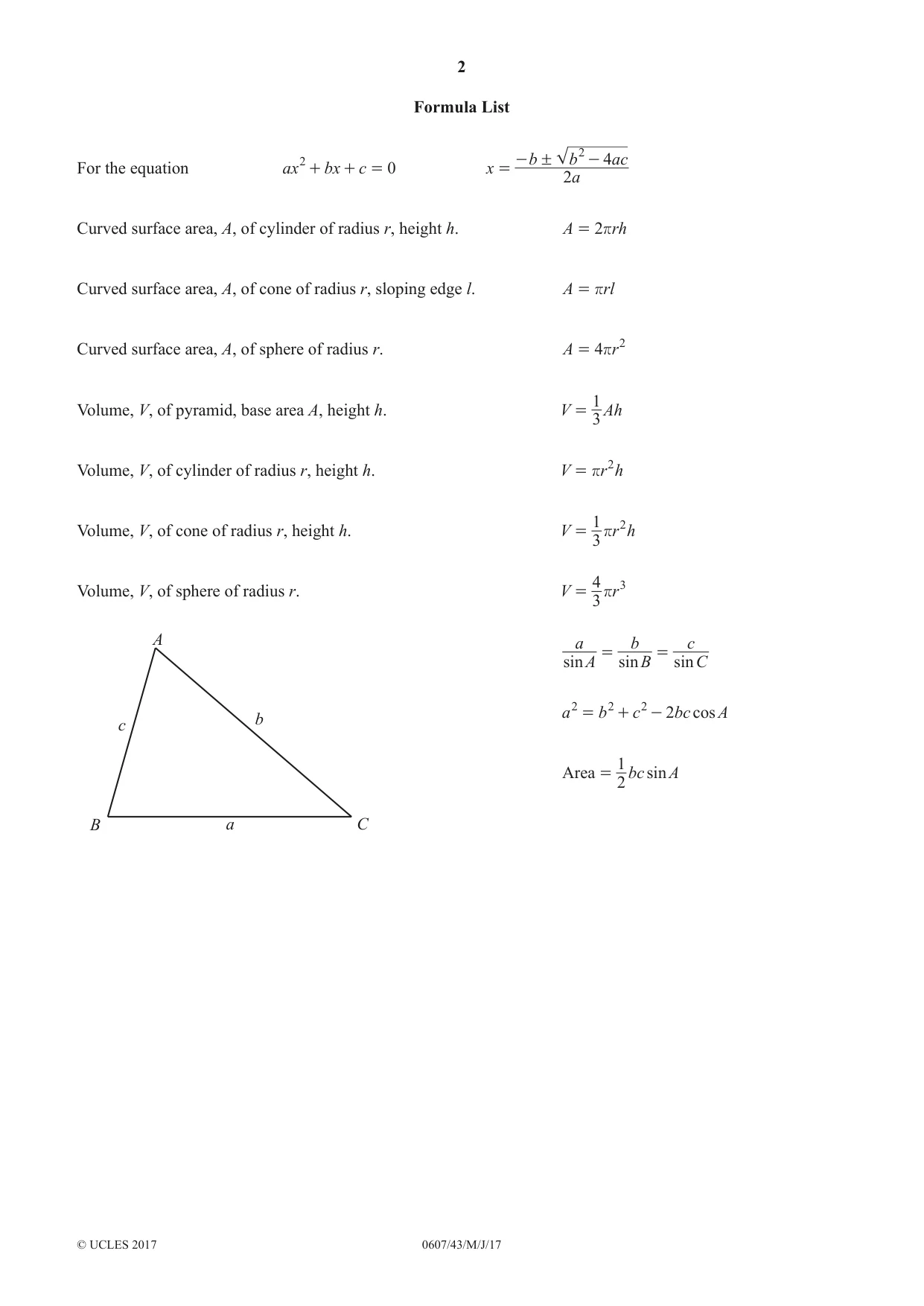
Mark scheme7 pages
Answers below. Sit the paper first if you are practising.
Questions as text
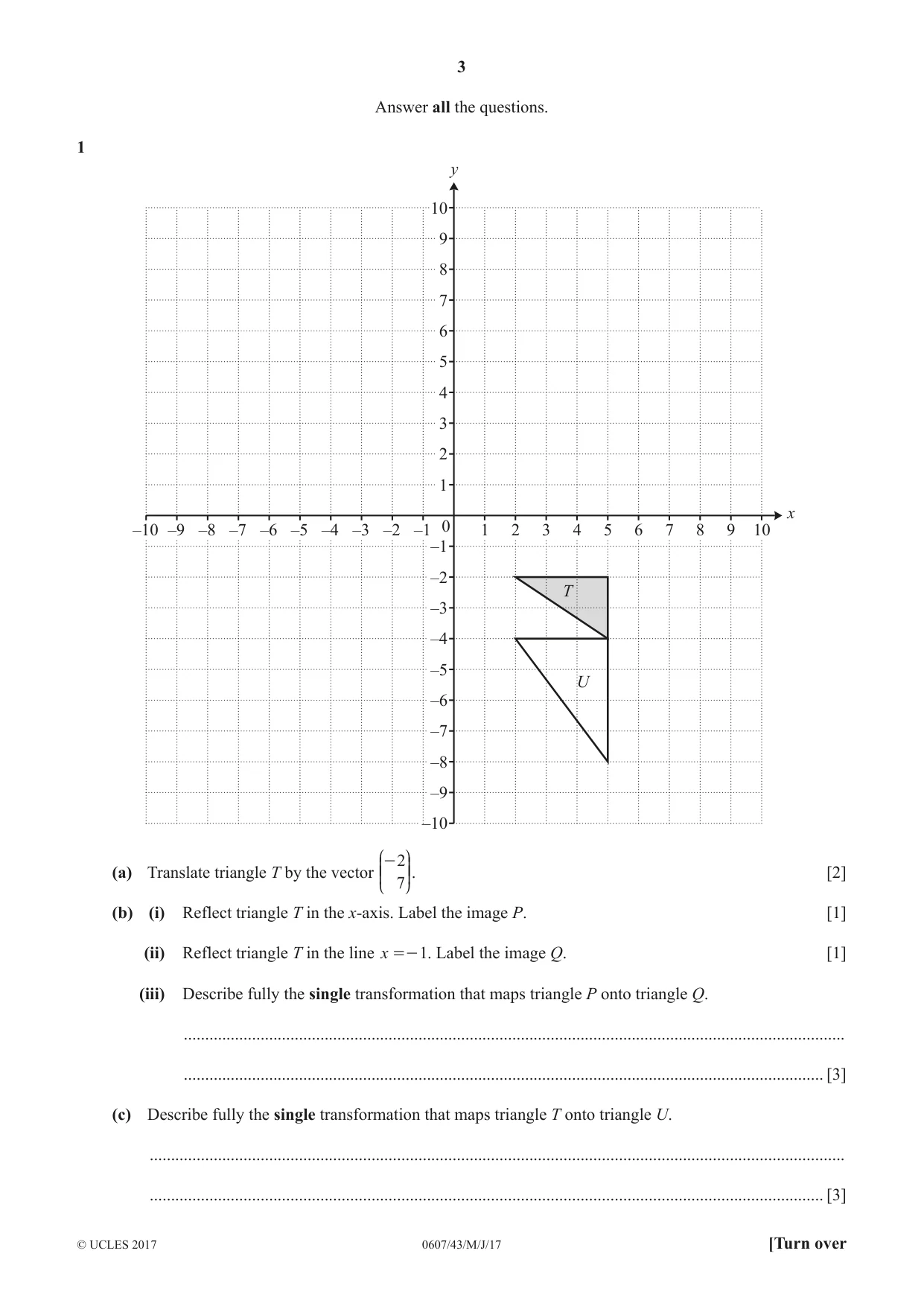
Q1 · Y 10 9 8 7 6 5 4 3 2 1 x –10 –9 –8 –7 –6 –5 –4 –3 –2 –1 0 1 2 3 4 5 6 7 8 9 10 –1 –2 T –3…
1 y 10 9 8 7 6 5 4 3 2 1 x –10 –9 –8 –7 –6 –5 –4 –3 –2 –1 0 1 2 3 4 5 6 7 8 9 10 –1 –2 T –3 –4 –5 U –6 –7 –8 –9 –10 J N - 2 (a) Translate triangle T by the vector KK OO. [2] 7 L P (b) (i) Reflect triangle T in the x-axis. Label the image P. [1] (ii) Reflect triangle T in the line x =- 1. Label the image Q. [1] (iii) Describe fully the single transformation that maps triangle P onto triangle Q. ........................................................................................................................................................... ...................................................................................................................................................... [3] (c) Describe fully the single transformation that maps triangle T onto triangle U. ................................................................................................................................................................... .............................................................................................................................................................. [3]
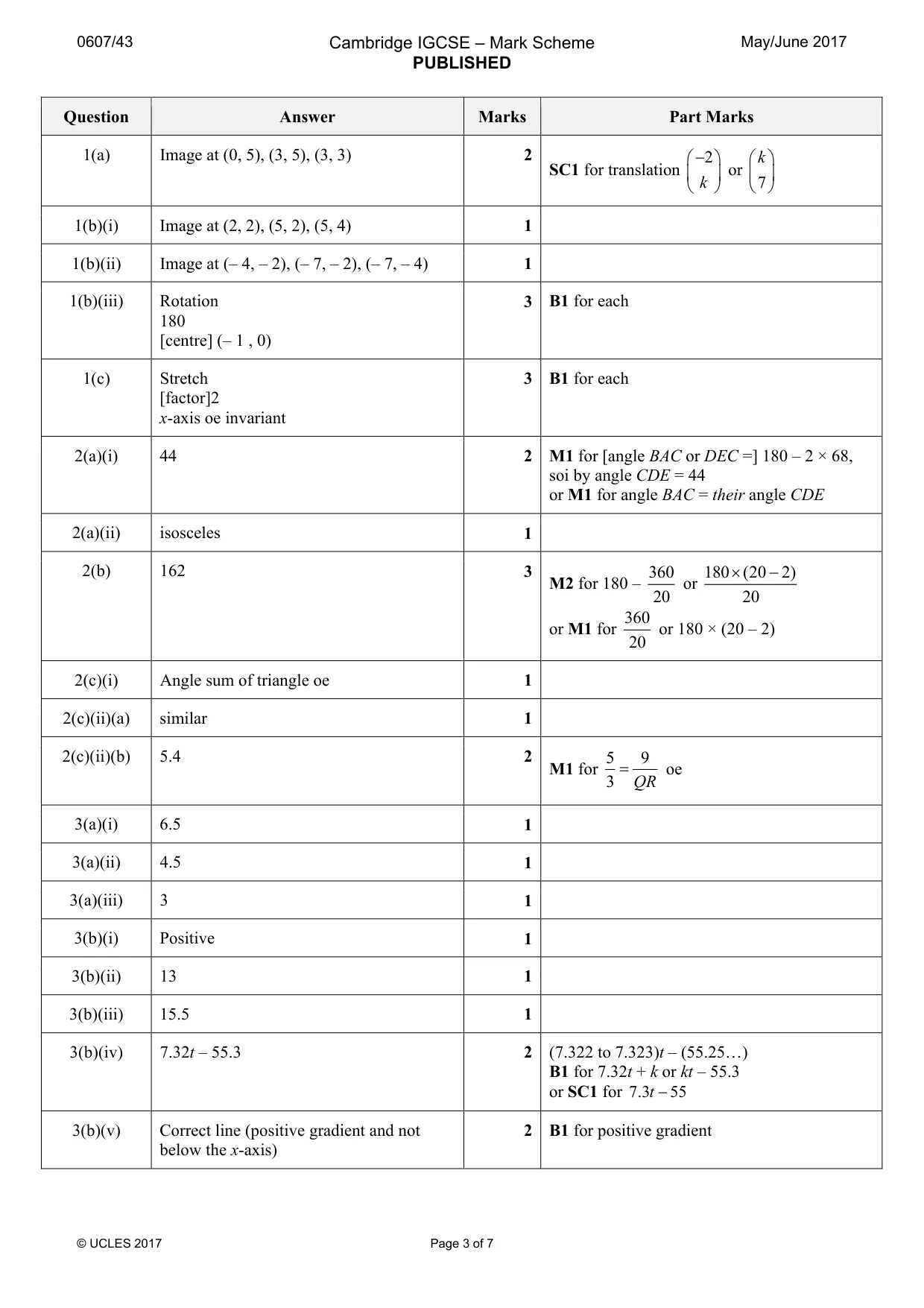
Mark scheme: Question Answer Marks Part Marks 1(a) Image at (0, 5), (3, 5), (3, 3) 2 −2 k SC1 for translation or k 7 1(b)(i) Image at (2, 2), (5, 2), (5, 4) 1 1(b)(ii) Image at (– 4, – 2), (– 7, – 2), (– 7, – 4) 1 1(b)(iii) Rotation 3 B1 for each 180 [centre] (– 1 , 0) 1(c) Stretch 3 B1 for each [factor]2 x-axis oe invariant
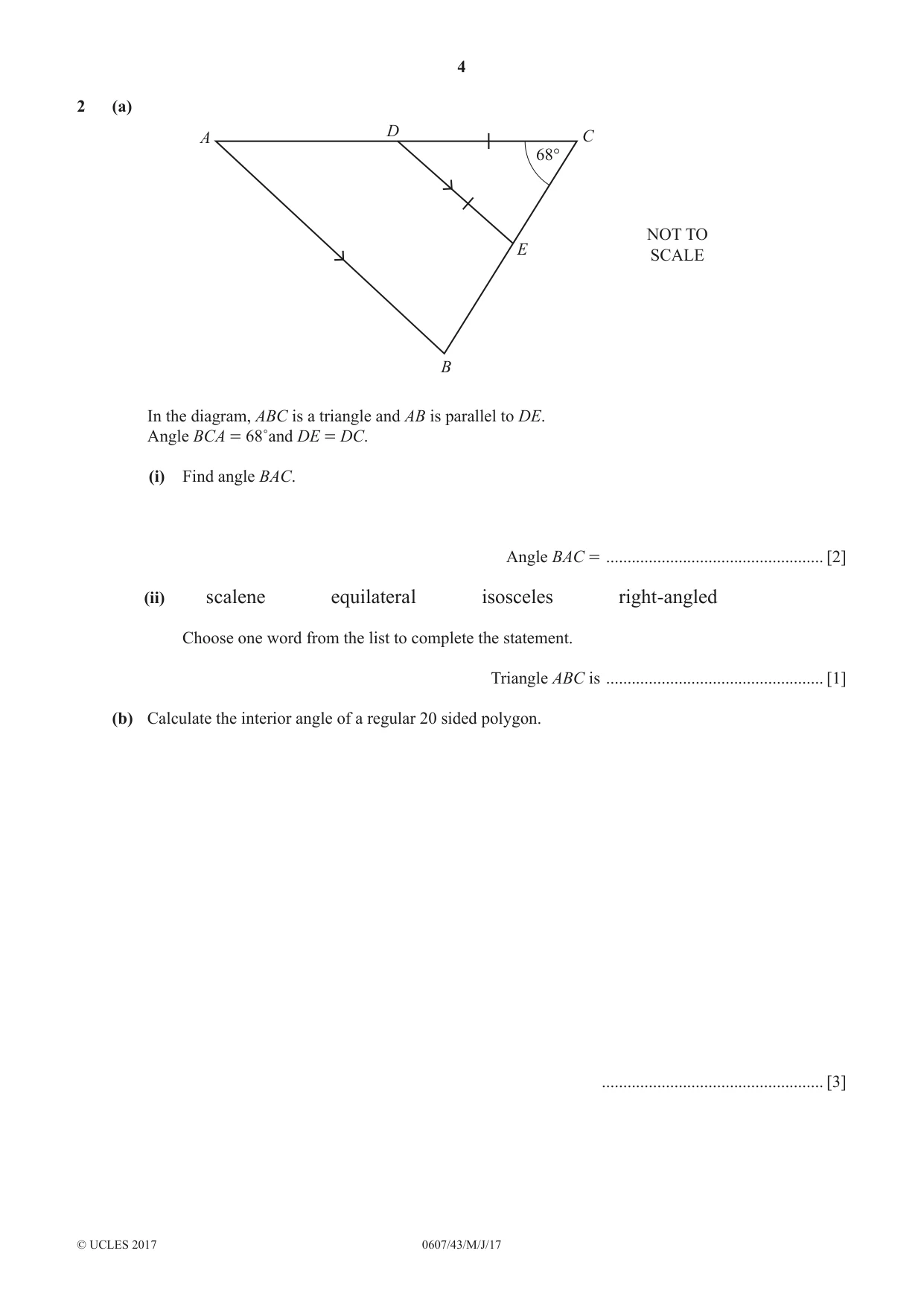
Q2 · D A C 68° NOT TO E SCALE B In the diagram, ABC is a triangle and AB is parallel to DE
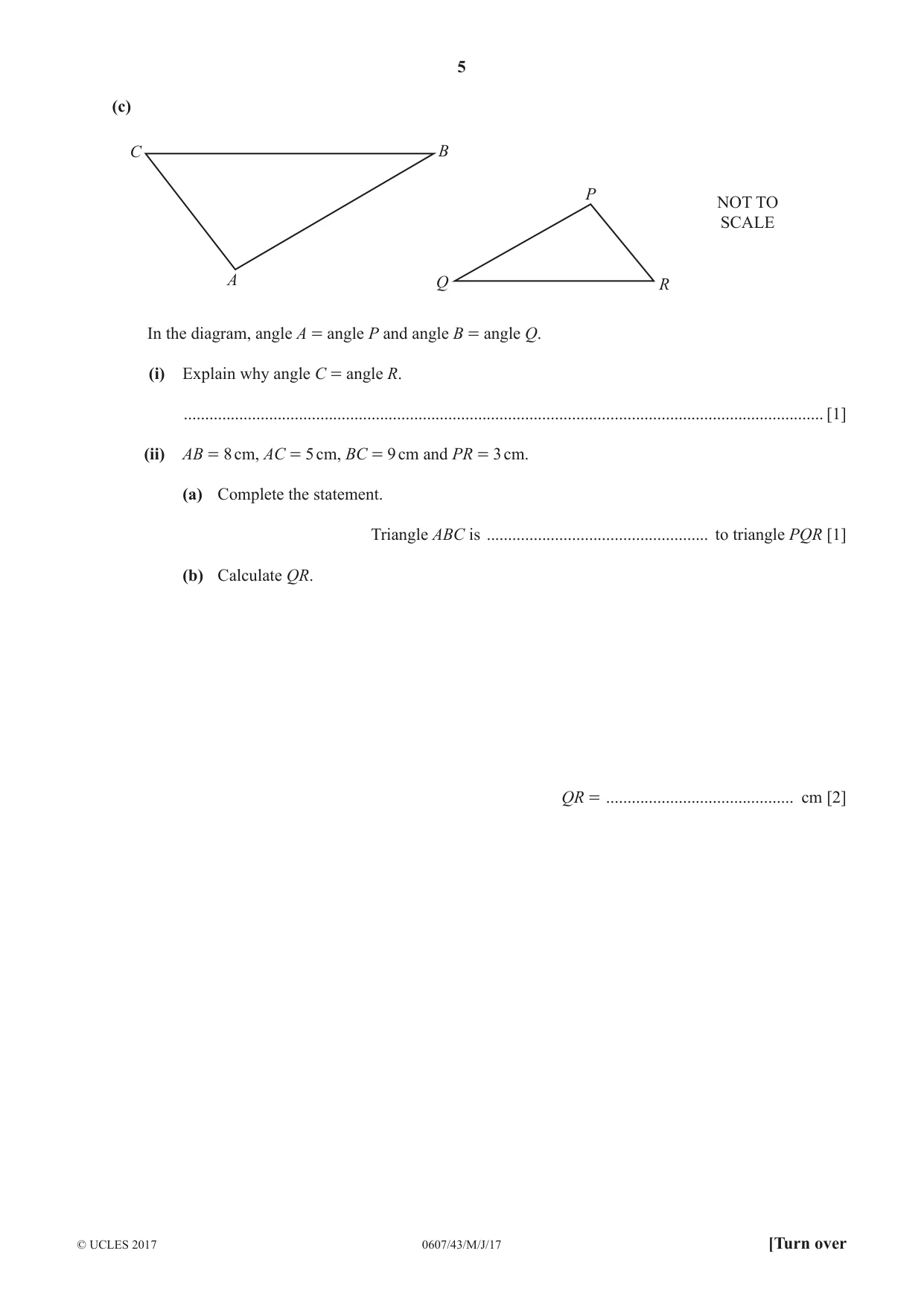
2 (a) D A C 68° NOT TO E SCALE B In the diagram, ABC is a triangle and AB is parallel to DE. Angle BCA = 68˚and DE = DC. (i) Find angle BAC. Angle BAC = ................................................... [2] (ii) scalene equilateral isosceles right-angled Choose one word from the list to complete the statement. Triangle ABC is ................................................... [1] (b) Calculate the interior angle of a regular 20 sided polygon. .................................................... [3] (c) C B P NOT TO SCALE A Q R In the diagram, angle A = angle P and angle B = angle Q. (i) Explain why angle C = angle R. ...................................................................................................................................................... [1] (ii) AB = 8 cm, AC = 5 cm, BC = 9 cm and PR = 3 cm. (a) Complete the statement. Triangle ABC is .................................................... to triangle PQR [1] (b) Calculate QR. QR = ............................................ cm [2]
Mark scheme: 2(a)(i) 44 2 M1 for [angle BAC or DEC =] 180 – 2 × 68, soi by angle CDE = 44 or M1 for angle BAC = their angle CDE 2(a)(ii) isosceles 1 2(b) 162 3 360 180 × (20 − 2) M2 for 180 – or 20 20 360 or M1 for or 180 × (20 – 2) 20 2(c)(i) Angle sum of triangle oe 1 2(c)(ii)(a) similar 1 2(c)(ii)(b) 5.4 2 5 9 M1 for = oe 3 QR
Q3 · 12 students take part in a quiz
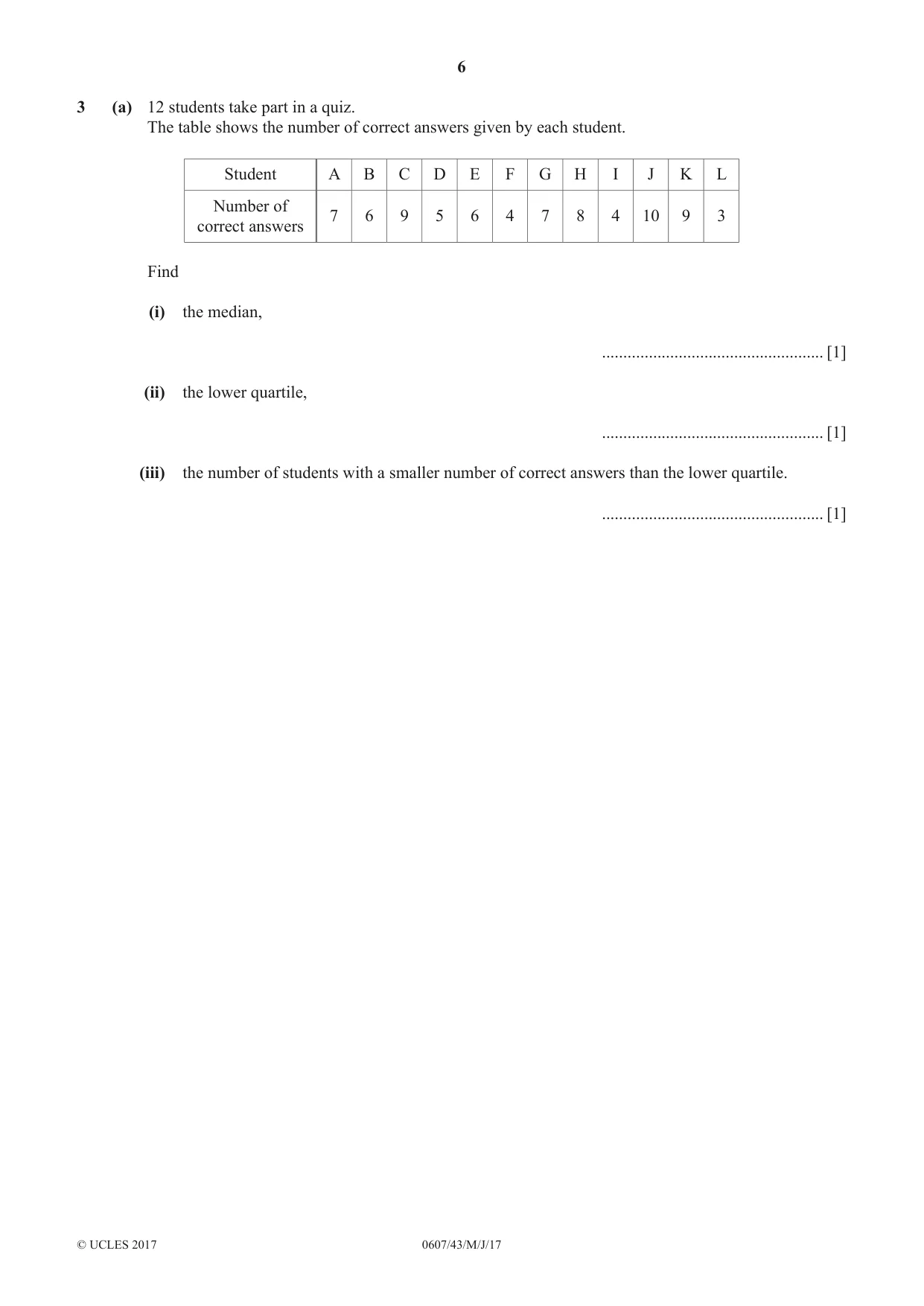
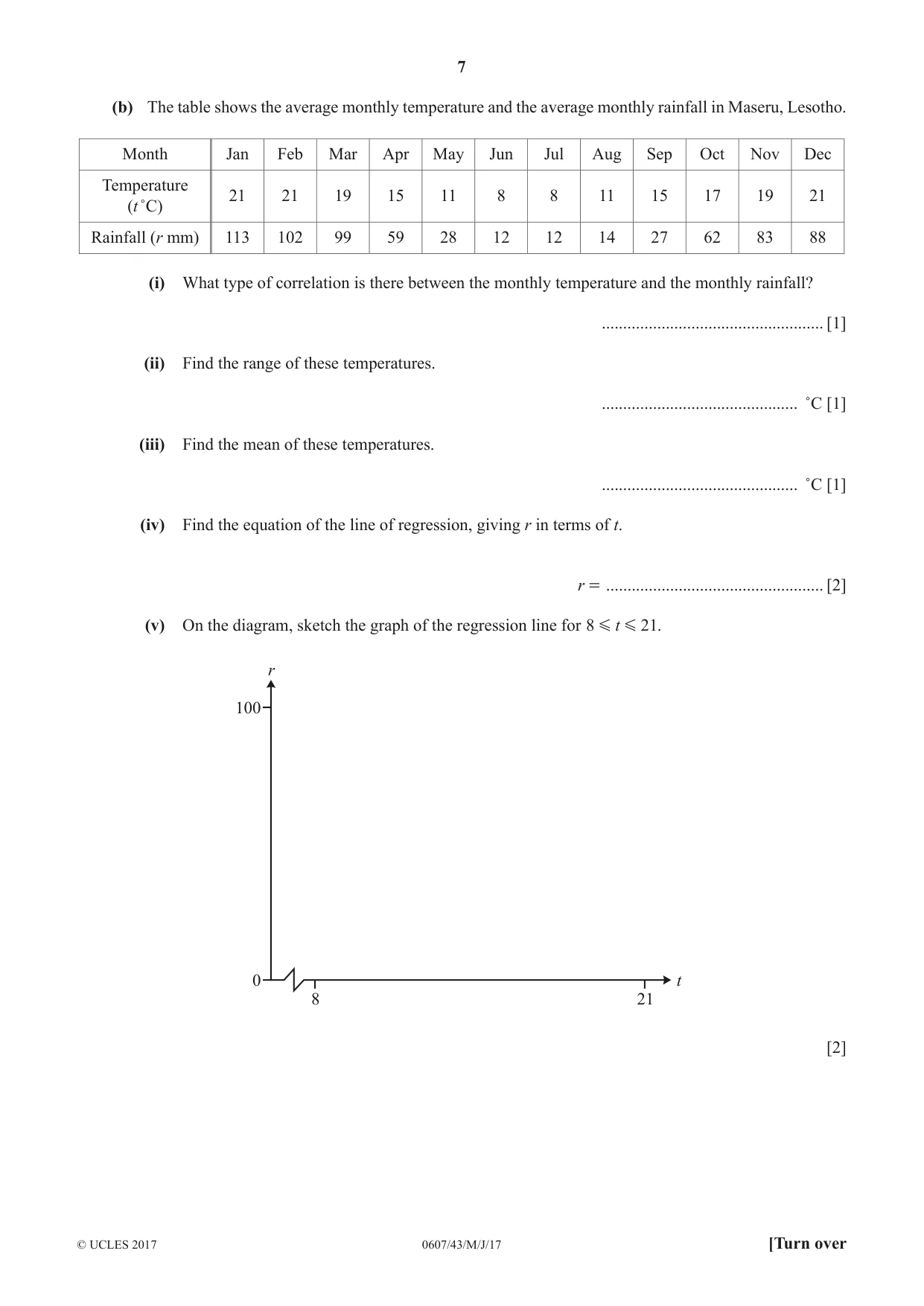
3 (a) 12 students take part in a quiz. The table shows the number of correct answers given by each student. Student A B C D E F G H I J K L Number of 7 6 9 5 6 4 7 8 4 10 9 3 correct answers Find (i) the median, .................................................... [1] (ii) the lower quartile, .................................................... [1] (iii) the number of students with a smaller number of correct answers than the lower quartile. .................................................... [1] (b) The table shows the average monthly temperature and the average monthly rainfall in Maseru, Lesotho. Month Jan Feb Mar Apr May Jun Jul Aug Sep Oct Nov Dec Temperature 21 21 19 15 11 8 8 11 15 17 19 21 (t ˚C) Rainfall (r mm) 113 102 99 59 28 12 12 14 27 62 83 88 (i) What type of correlation is there between the monthly temperature and the monthly rainfall? .................................................... [1] (ii) Find the range of these temperatures. .............................................. ˚C [1] (iii) Find the mean of these temperatures. .............................................. ˚C [1] (iv) Find the equation of the line of regression, giving r in terms of t. r = ................................................... [2] (v) On the diagram, sketch the graph of the regression line for 8 G t G 21. r 100 0 t 8 21 [2]
Mark scheme: 3(a)(i) 6.5 1 3(a)(ii) 4.5 1 3(a)(iii) 3 1 3(b)(i) Positive 1 3(b)(ii) 13 1 3(b)(iii) 15.5 1 3(b)(iv) 7.32t – 55.3 2 (7.322 to 7.323)t – (55.25…) B1 for 7.32t + k or kt – 55.3 or SC1 for 7.3t − 55 3(b)(v) Correct line (positive gradient and not 2 B1 for positive gradient below the x-axis)
Q4 · Marie has $260.50 and Luk has $208.40
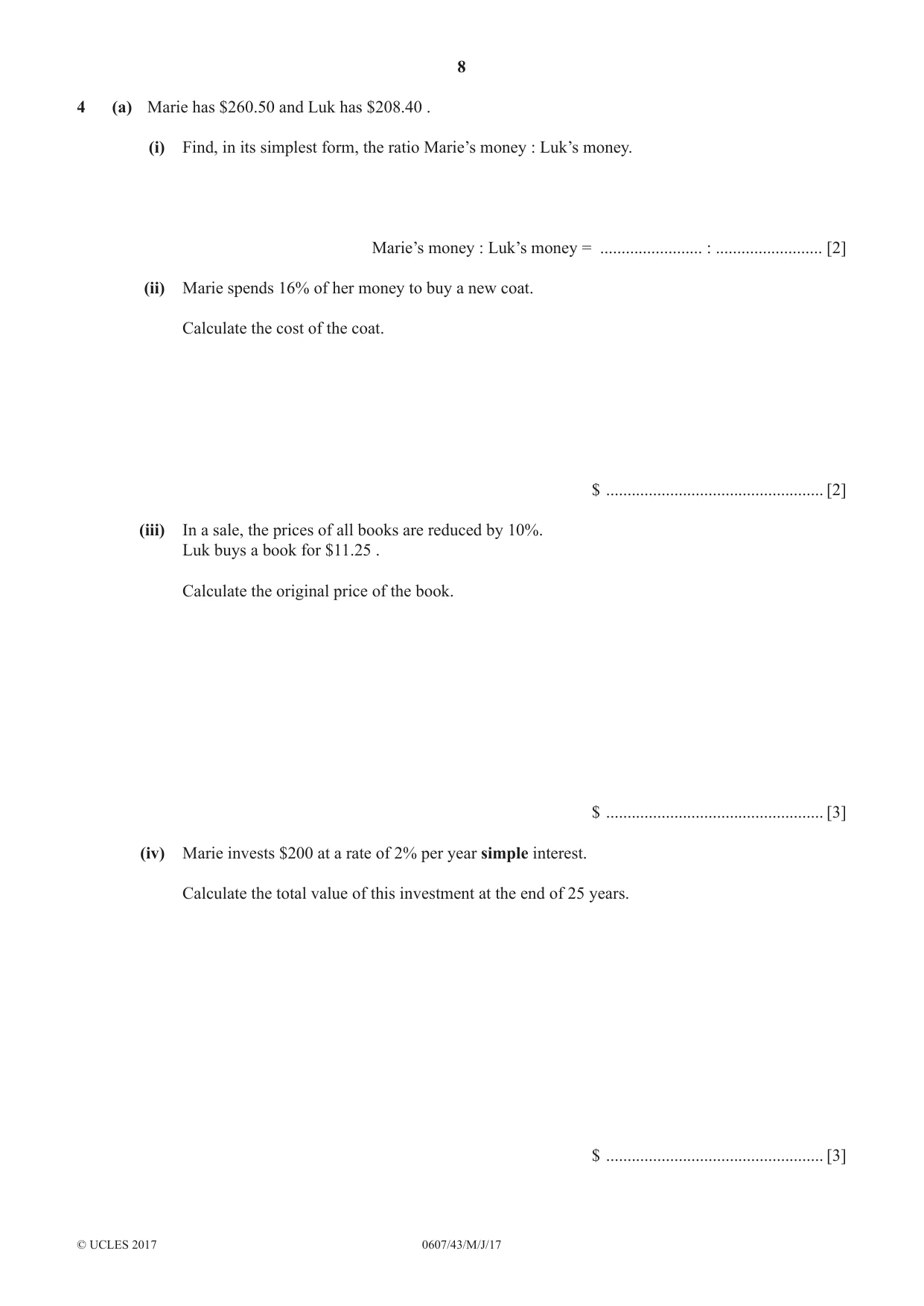
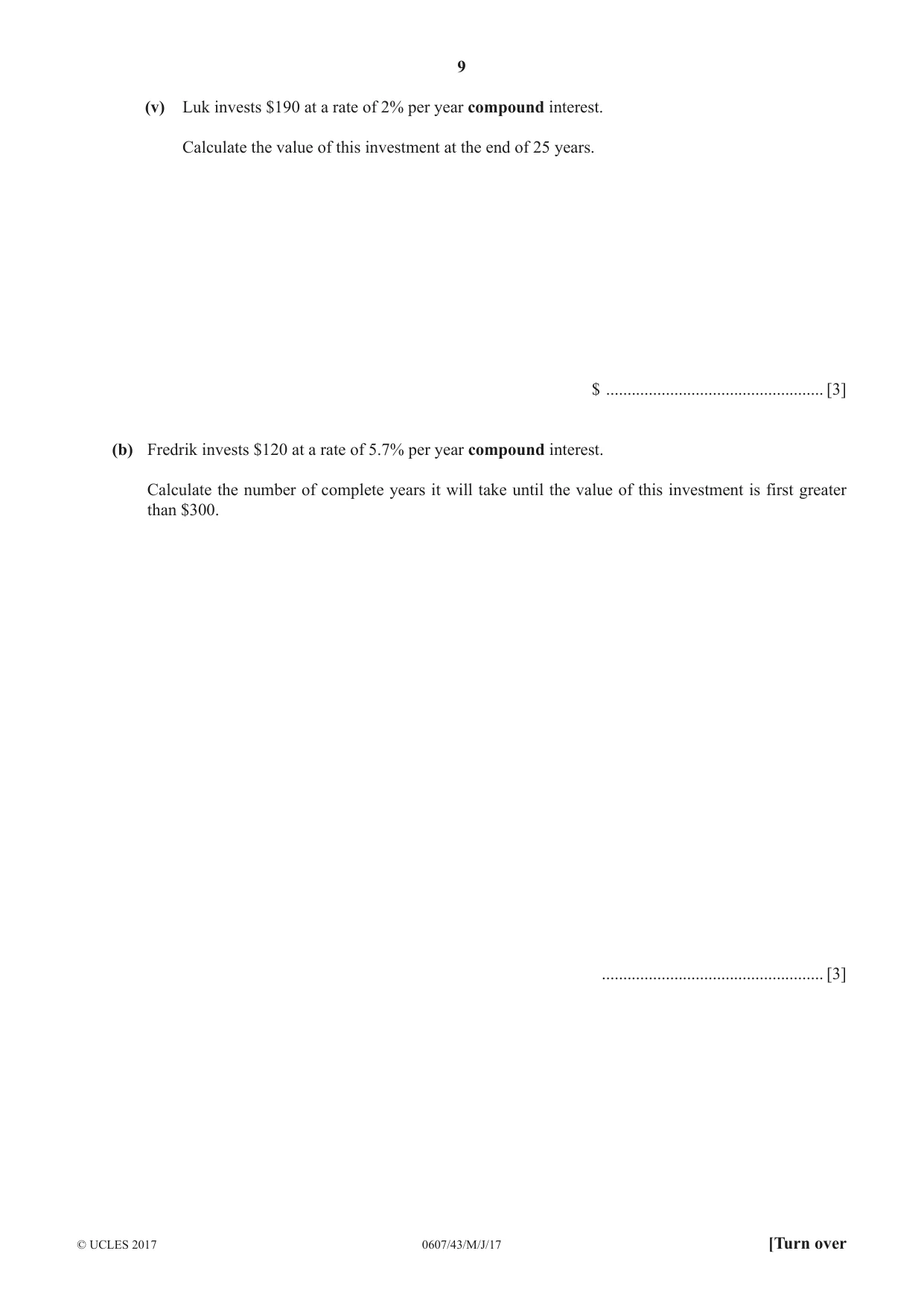
4 (a) Marie has $260.50 and Luk has $208.40 . (i) Find, in its simplest form, the ratio Marie’s money : Luk’s money. Marie’s money : Luk’s money = ........................ : ......................... [2] (ii) Marie spends 16% of her money to buy a new coat. Calculate the cost of the coat. $ ................................................... [2] (iii) In a sale, the prices of all books are reduced by 10%. Luk buys a book for $11.25 . Calculate the original price of the book. $ ................................................... [3] (iv) Marie invests $200 at a rate of 2% per year simple interest. Calculate the total value of this investment at the end of 25 years. $ ................................................... [3] (v) Luk invests $190 at a rate of 2% per year compound interest. Calculate the value of this investment at the end of 25 years. $ ................................................... [3] (b) Fredrik invests $120 at a rate of 5.7% per year compound interest. Calculate the number of complete years it will take until the value of this investment is first greater than $300. .................................................... [3]
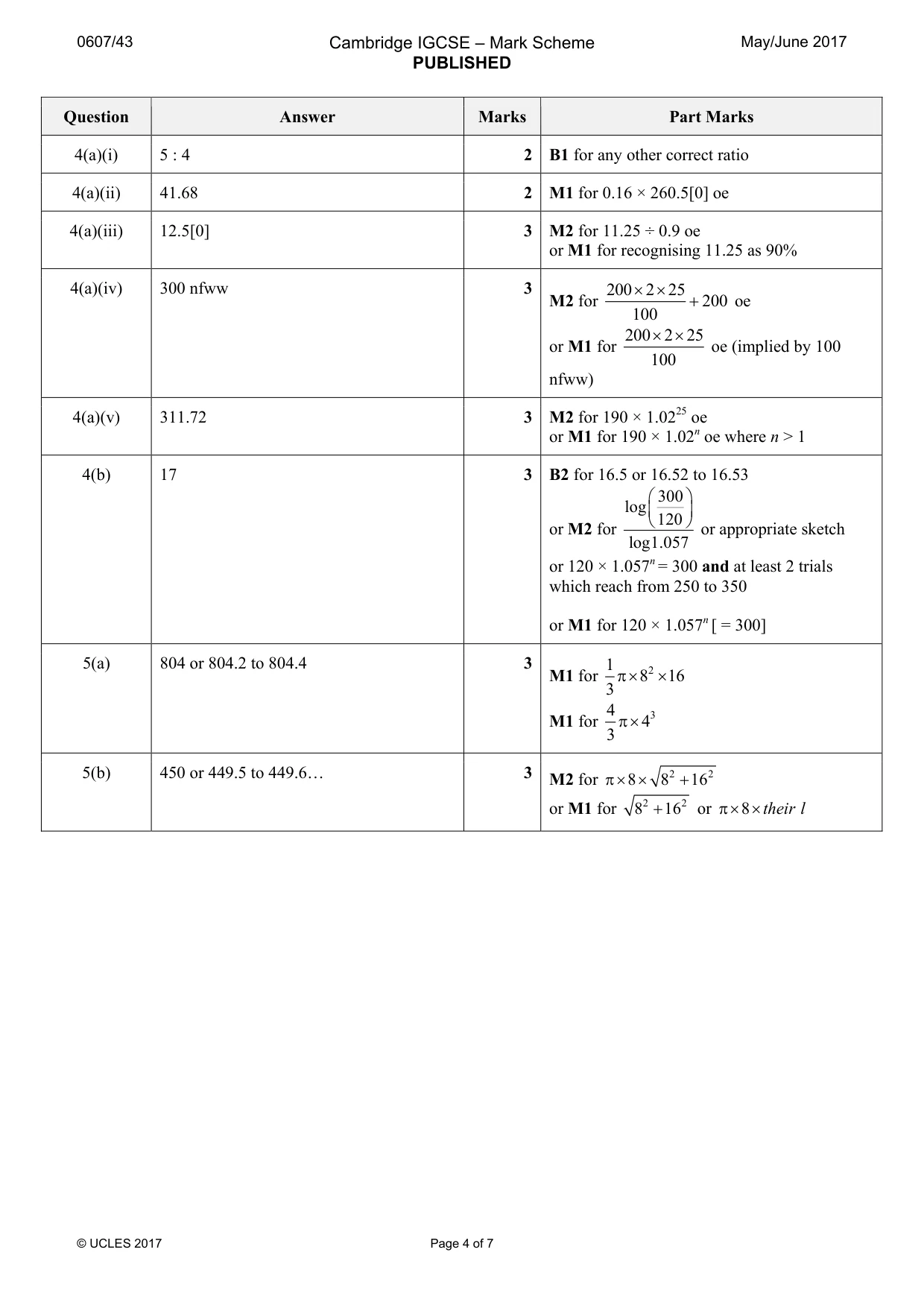
Mark scheme: 4(a)(i) 5 : 4 2 B1 for any other correct ratio 4(a)(ii) 41.68 2 M1 for 0.16 × 260.5[0] oe 4(a)(iii) 12.5[0] 3 M2 for 11.25 ÷ 0.9 oe or M1 for recognising 11.25 as 90% 4(a)(iv) 300 nfww 3 200 × 2 × 25 M2 for + 200 oe 100 200 × 2 × 25 or M1 for oe (implied by 100 100 nfww) 4(a)(v) 311.72 3 M2 for 190 × 1.0225 oe or M1 for 190 × 1.02n oe where n > 1 4(b) 17 3 B2 for 16.5 or 16.52 to 16.53 300 log 120 or M2 for or appropriate sketch log1.057 or 120 × 1.057n = 300 and at least 2 trials which reach from 250 to 350 or M1 for 120 × 1.057n [ = 300]
Q5 · 8 cm NOT TO SCALE 16 cm The diagram shows a solid sphere of radius 4 cm inside a hollow…
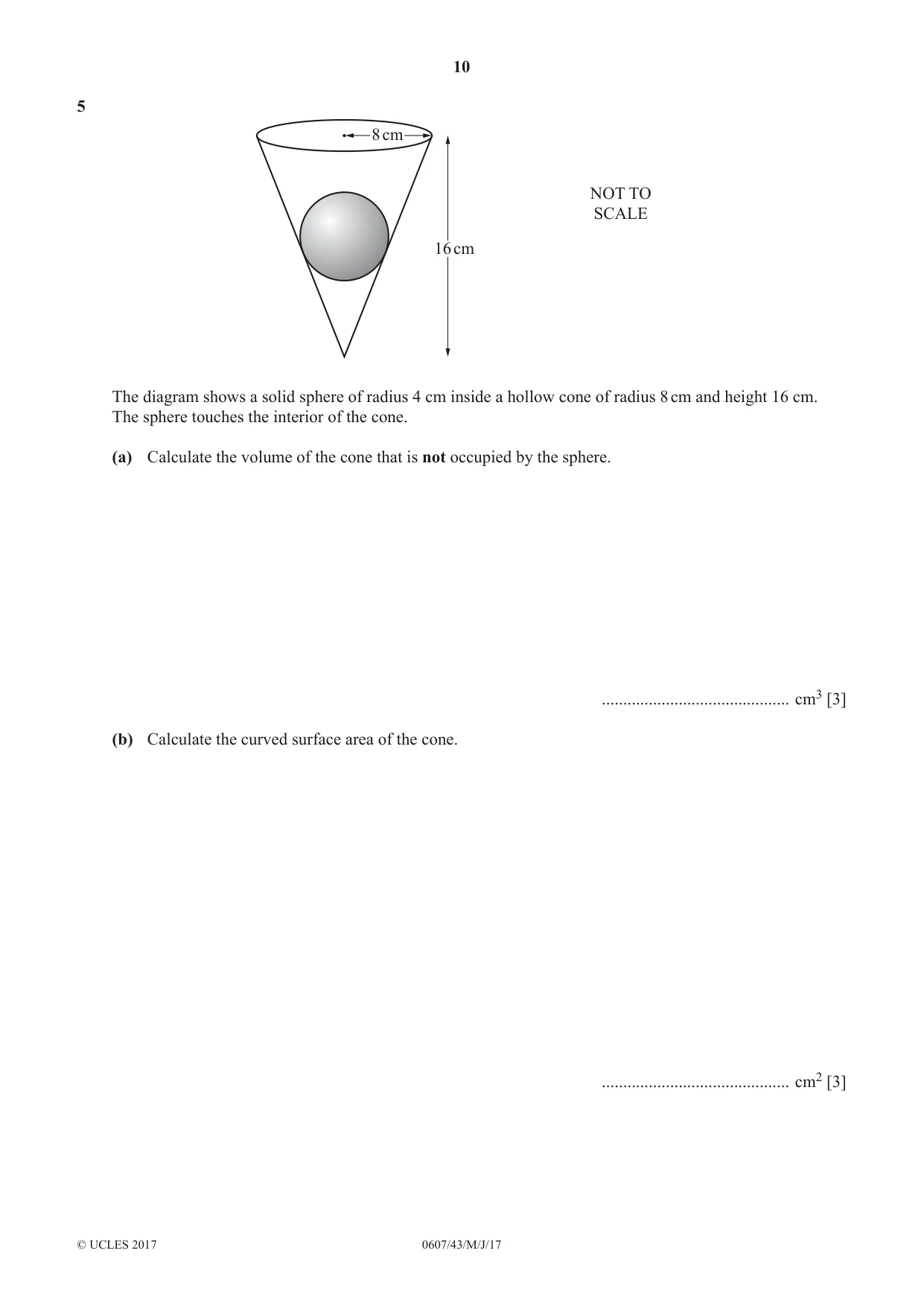
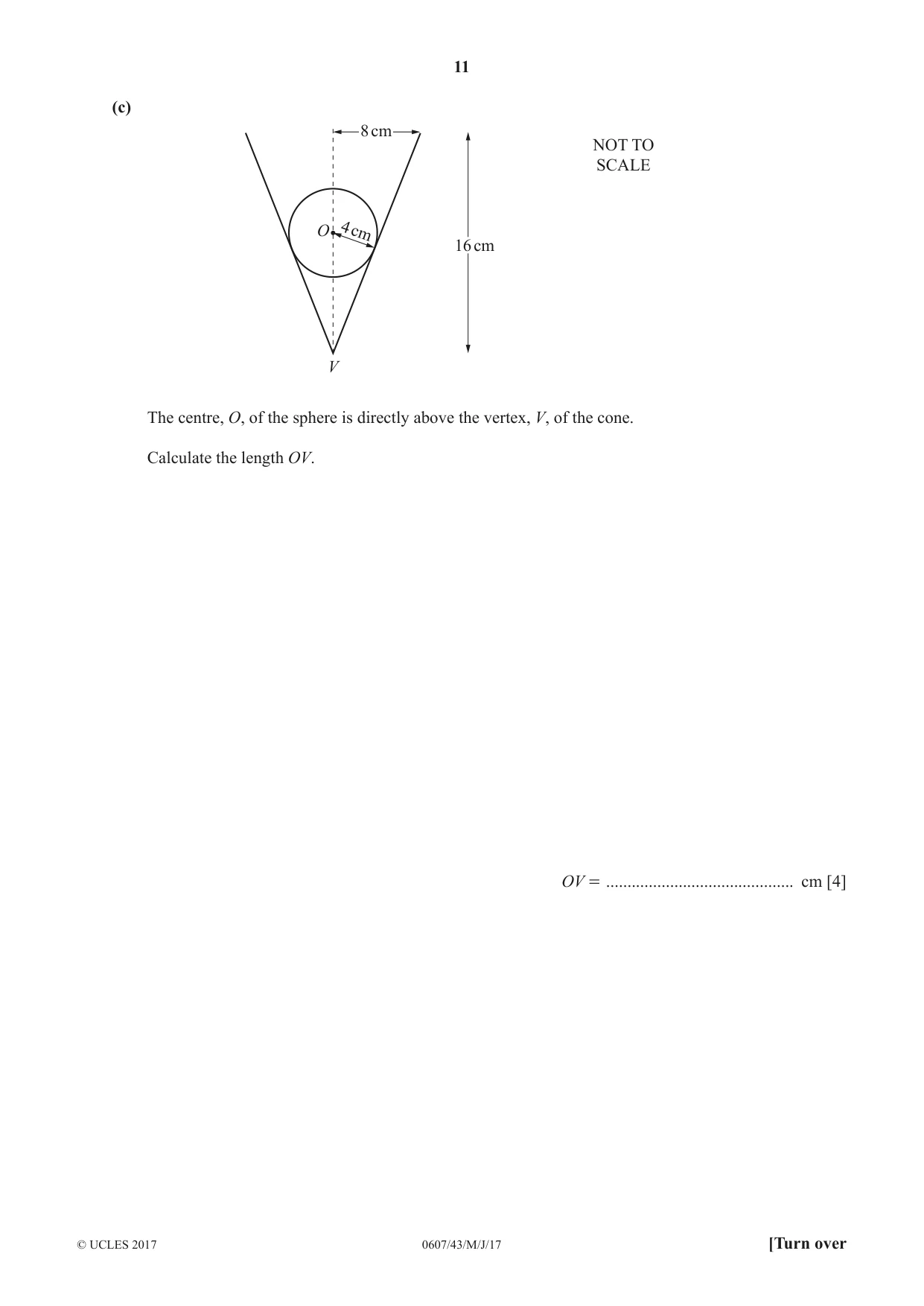
5 8 cm NOT TO SCALE 16 cm The diagram shows a solid sphere of radius 4 cm inside a hollow cone of radius 8 cm and height 16 cm. The sphere touches the interior of the cone. (a) Calculate the volume of the cone that is not occupied by the sphere. ............................................ cm3 [3] (b) Calculate the curved surface area of the cone. ............................................ cm2 [3] (c) 8 cm NOT TO SCALE O 4cm 16 cm V The centre, O, of the sphere is directly above the vertex, V, of the cone. Calculate the length OV. OV = ............................................ cm [4]
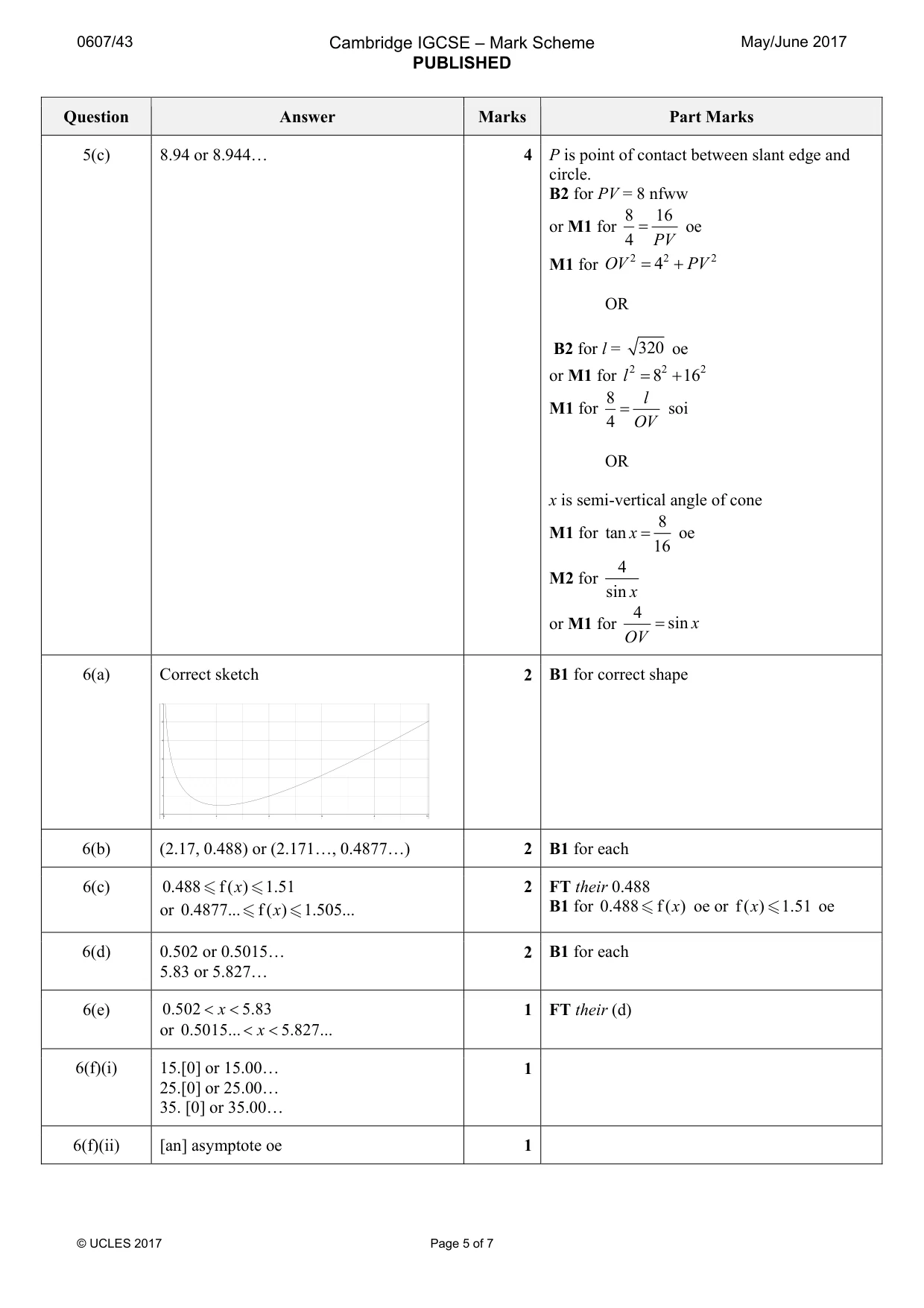
Mark scheme: 5(a) 804 or 804.2 to 804.4 3 1 2 M1 for 3π× 8 × 16 4 3 M1 for π× 4 3 5(b) 450 or 449.5 to 449.6… 3 2 2 M2 for π× 8 × 8 + 16 or M1 for 8 2 + 16 2 or π× 8 ×their l 5(c) 8.94 or 8.944… 4 P is point of contact between slant edge and circle. B2 for PV = 8 nfww 8 16 or M1 for = oe 4 PV M1 for OV 2 = 4 2 + PV 2 OR B2 for l = 320 oe or M1 for l 2 = 82 + 16 2 8 l M1 for = soi 4 OV OR x is semi-vertical angle of cone 8 M1 for tan x = oe 16 4 M2 for sin x 4 or M1 for = sin x OV
Q6 · Y 6 x 0 10 f(x) = x - 5 log x (a) On the diagram, sketch the graph of y = f(x) for 0 1 x…
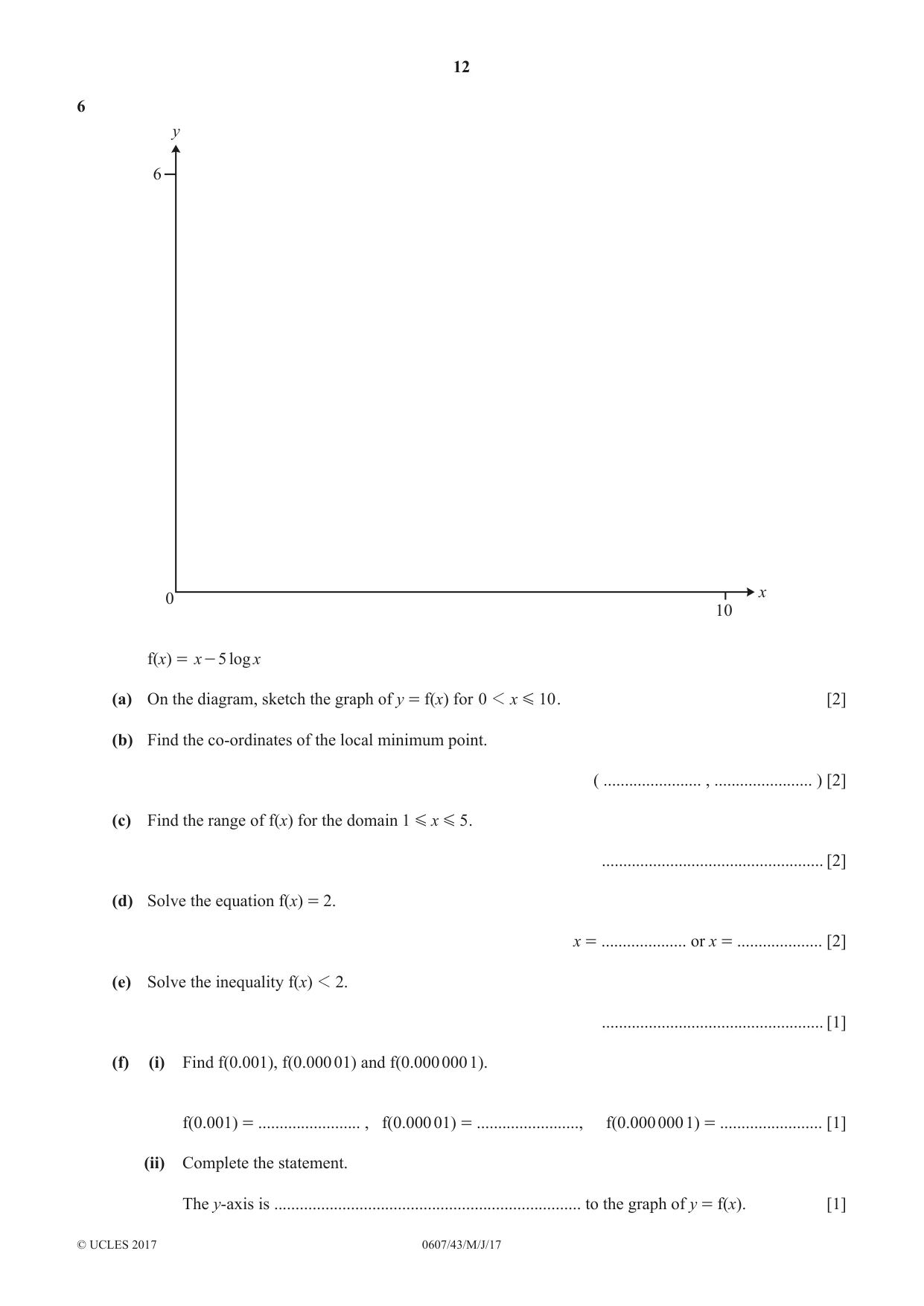
6 y 6 x 0 10 f(x) = x - 5 log x (a) On the diagram, sketch the graph of y = f(x) for 0 1 x G 10 . [2] (b) Find the co-ordinates of the local minimum point. ( ....................... , ....................... ) [2] (c) Find the range of f(x) for the domain 1 G x G 5 . .................................................... [2] (d) Solve the equation f(x) = 2. x = .................... or x = .................... [2] (e) Solve the inequality f(x) 1 2. .................................................... [1] (f) (i) Find f(0.001), f(0.000 01) and f(0.000 000 1). f(0.001) = ........................ , f(0.000 01) = ........................, f(0.000 000 1) = ........................ [1] (ii) Complete the statement. The y-axis is ........................................................................ to the graph of y = f(x). [1]
Mark scheme: 6(a) Correct sketch 2 B1 for correct shape 6666 5555 4444 3333 2222 1111 0000 0000 2222 4444 6666 8888 10101010 6(b) (2.17, 0.488) or (2.171…, 0.4877…) 2 B1 for each 6(c) 0.488 - f ( x ) - 1.51 2 FT their 0.488 or 0.4877... - f ( x ) - 1.505... B1 for 0.488 - f ( x ) oe or f ( x ) - 1.51 oe 6(d) 0.502 or 0.5015… 2 B1 for each 5.83 or 5.827… 6(e) 0.502 < x < 5.83 1 FT their (d) or 0.5015... < x < 5.827... 6(f)(i) 15.[0] or 15.00… 1 25.[0] or 25.00… 35. [0] or 35.00… 6(f)(ii) [an] asymptote oe 1
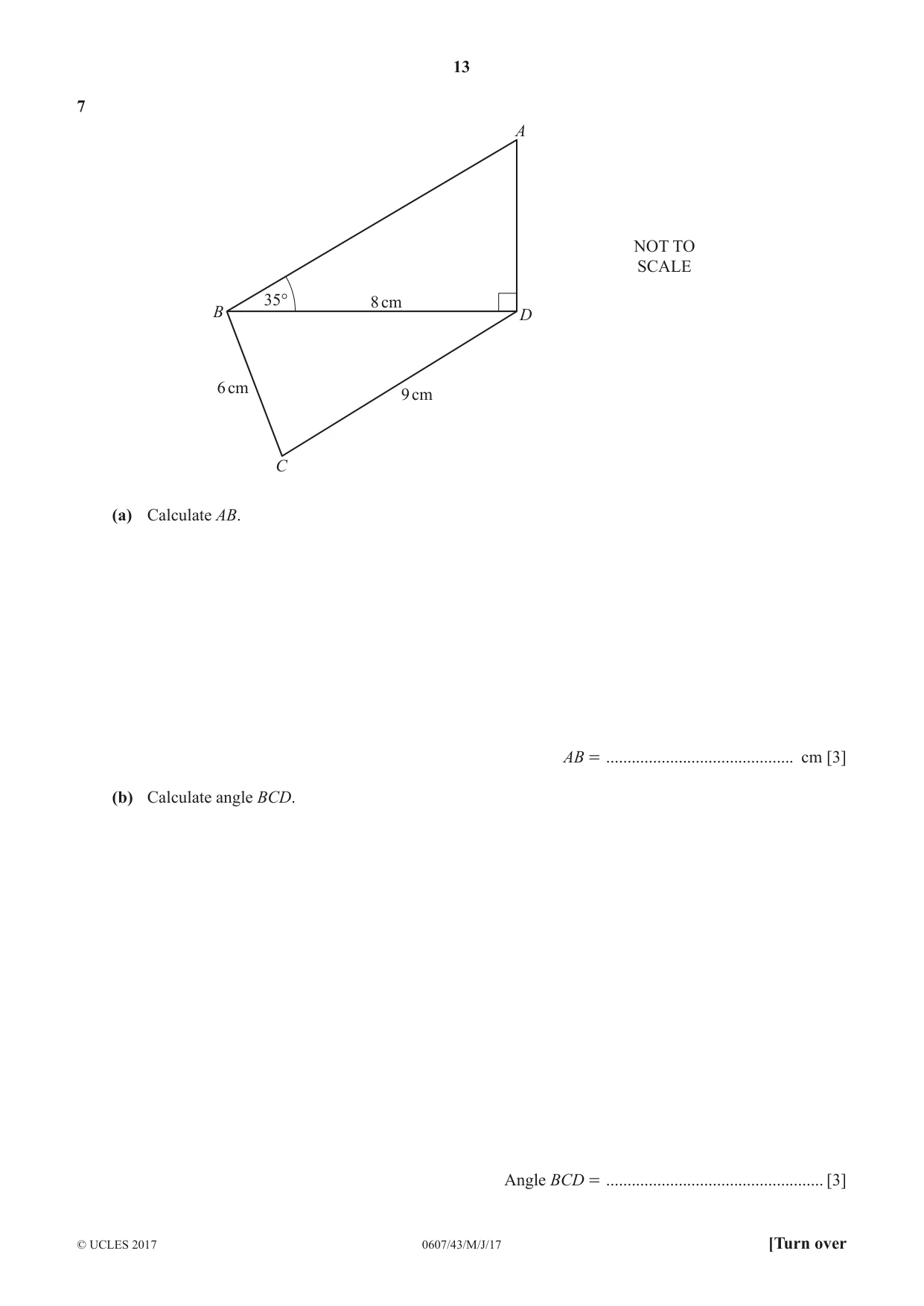
Q7 · A NOT TO SCALE 35° 8 cm B D 6 cm 9 cm C (a) Calculate AB
7 A NOT TO SCALE 35° 8 cm B D 6 cm 9 cm C (a) Calculate AB. AB = ............................................ cm [3] (b) Calculate angle BCD. Angle BCD = ................................................... [3]
Mark scheme: 7(a) 9.77 or 9.766… 3 8 M2 for oe cos35 8 or M1 for cos35 = oe AB 7(b) 60.6 or 60.61… 3 6 2 + 9 2 − 82 M2 for 2 × 6 × 9 or M1 for 82 = 6 2 + 9 2 −×2 6 × 9cos C
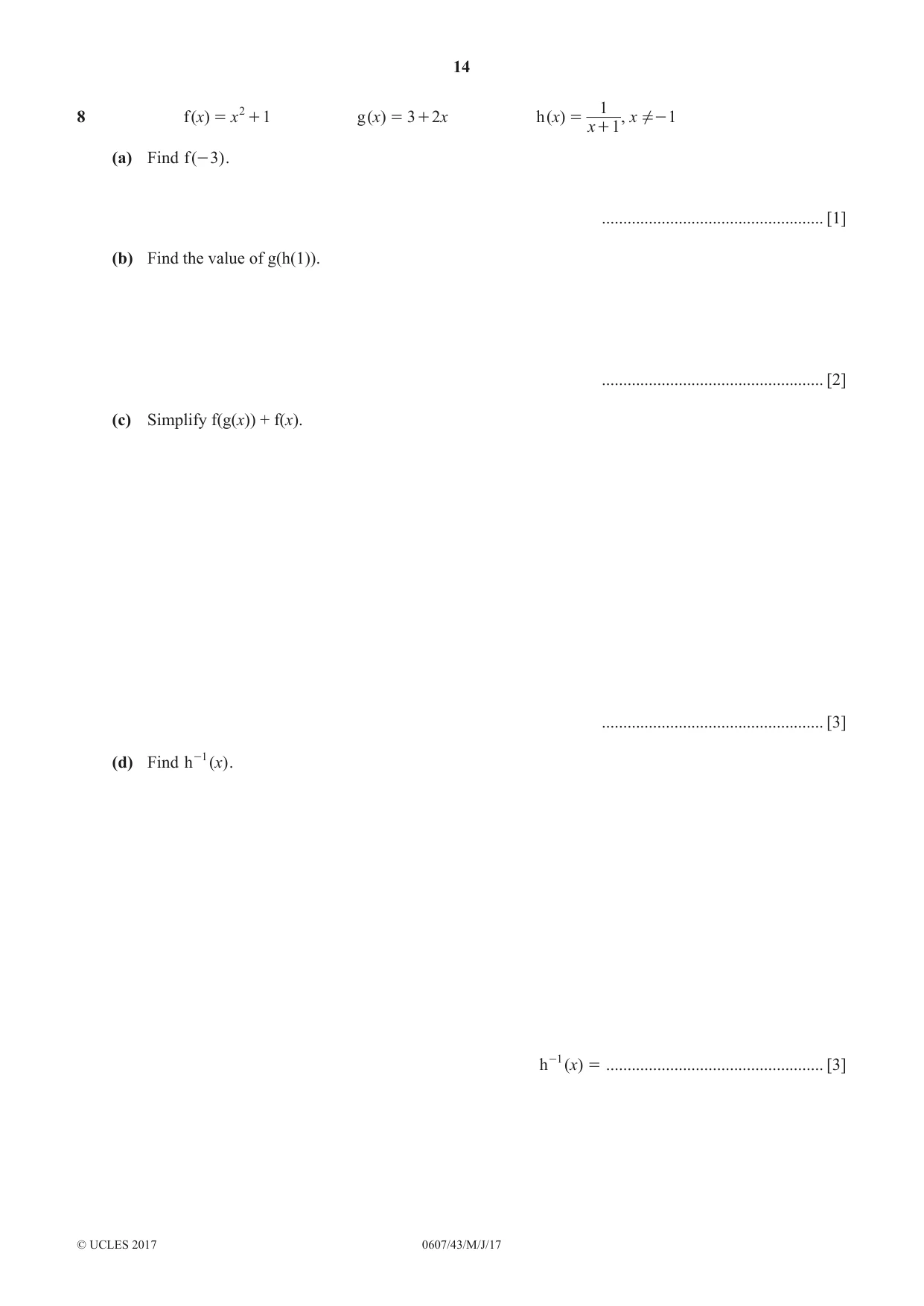
Q8 · F ()x = x 2 + 1 g ()x = 3 + 2x h (x) = , x !
8 f ()x = x 2 + 1 g ()x = 3 + 2x h (x) = , x ! - 1 x + 1 (a) Find f (- 3) . .................................................... [1] (b) Find the value of g(h(1)). .................................................... [2] (c) Simplify f(g(x)) + f(x). .................................................... [3] (d) Find h -1 ()x . h -1 ()x = ................................................... [3] (e) Solve. (i) g(x) = 1 x = ................................................... [2] (ii) g -1 ()x = 1 x = ................................................... [1]
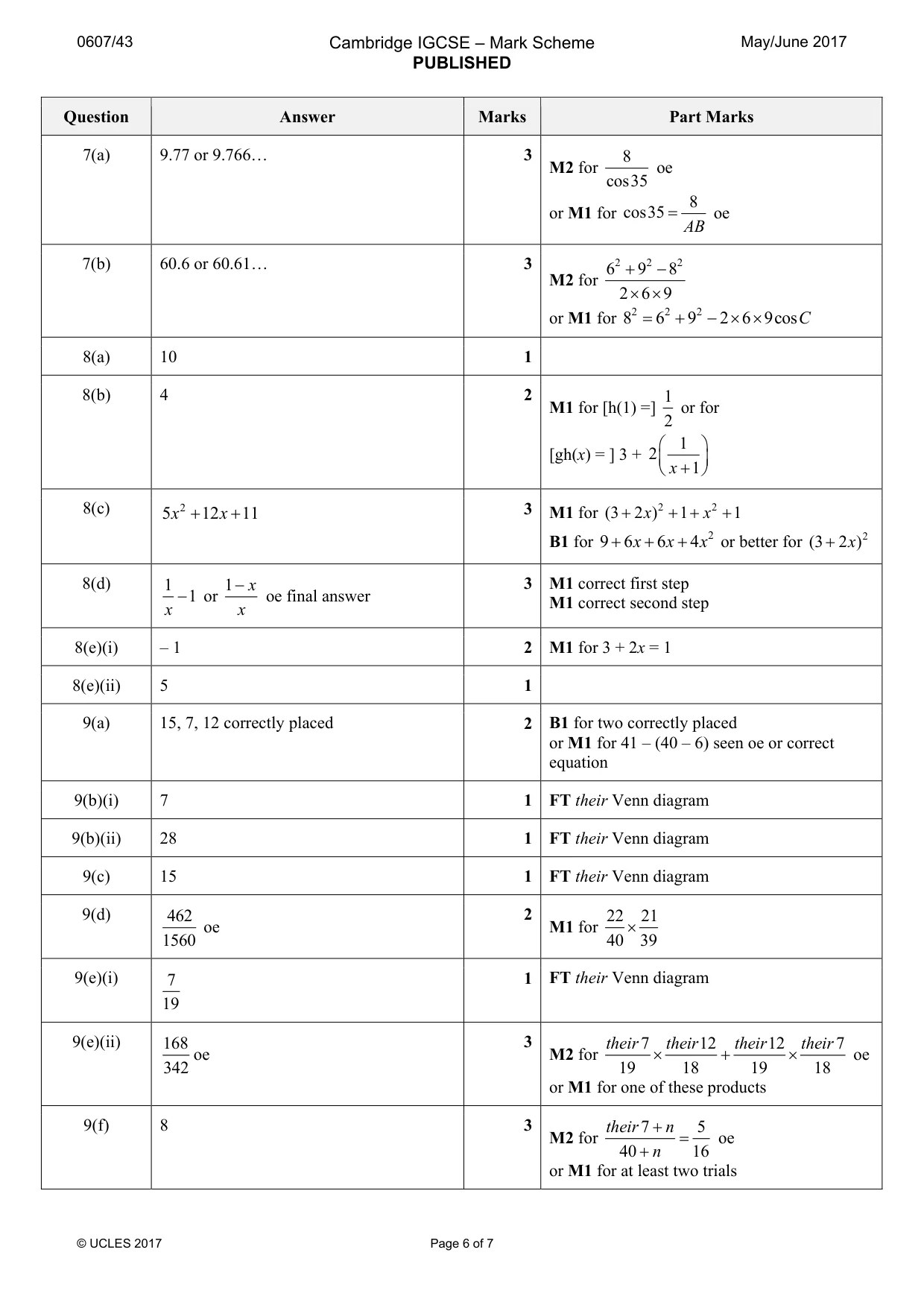
Mark scheme: 8(a) 10 1 8(b) 4 2 1 M1 for [h(1) =] or for 2 1 [gh(x) = ] 3 + 2 x + 1 8(c) 5 x 2 + 12 x + 11 3 M1 for (3 + 2 x ) 2 + 1 + x 2 + 1 B1 for 9 + 6 x + 6 x + 4 x 2 or better for (3 + 2 x ) 2 8(d) 1 1−x 3 M1 correct first step − 1 or oe final answer M1 correct second step x x 8(e)(i) – 1 2 M1 for 3 + 2x = 1 8(e)(ii) 5 1
Q9 · In a survey, 40 students are asked if they like football, F, and if they like baseball, B
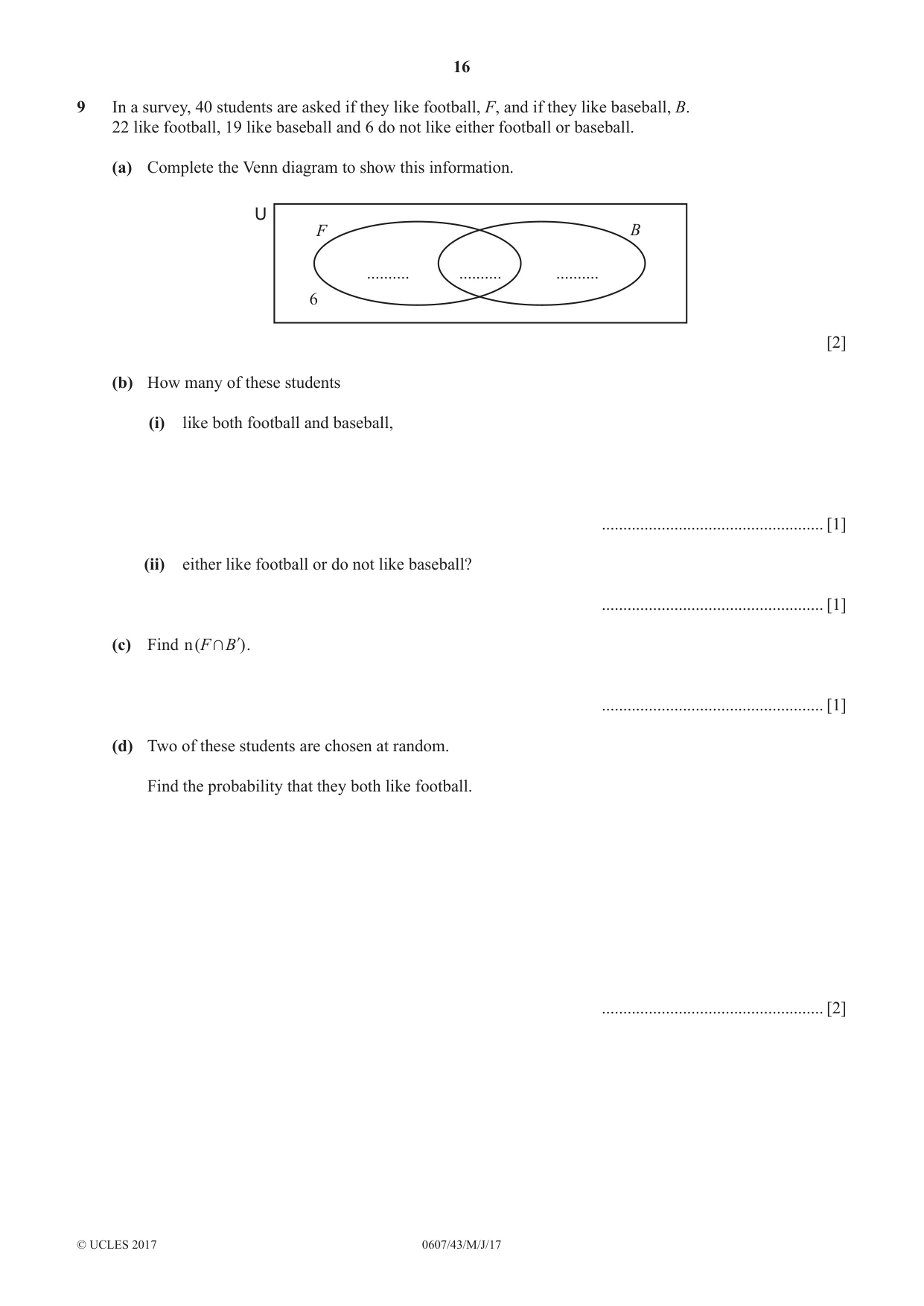
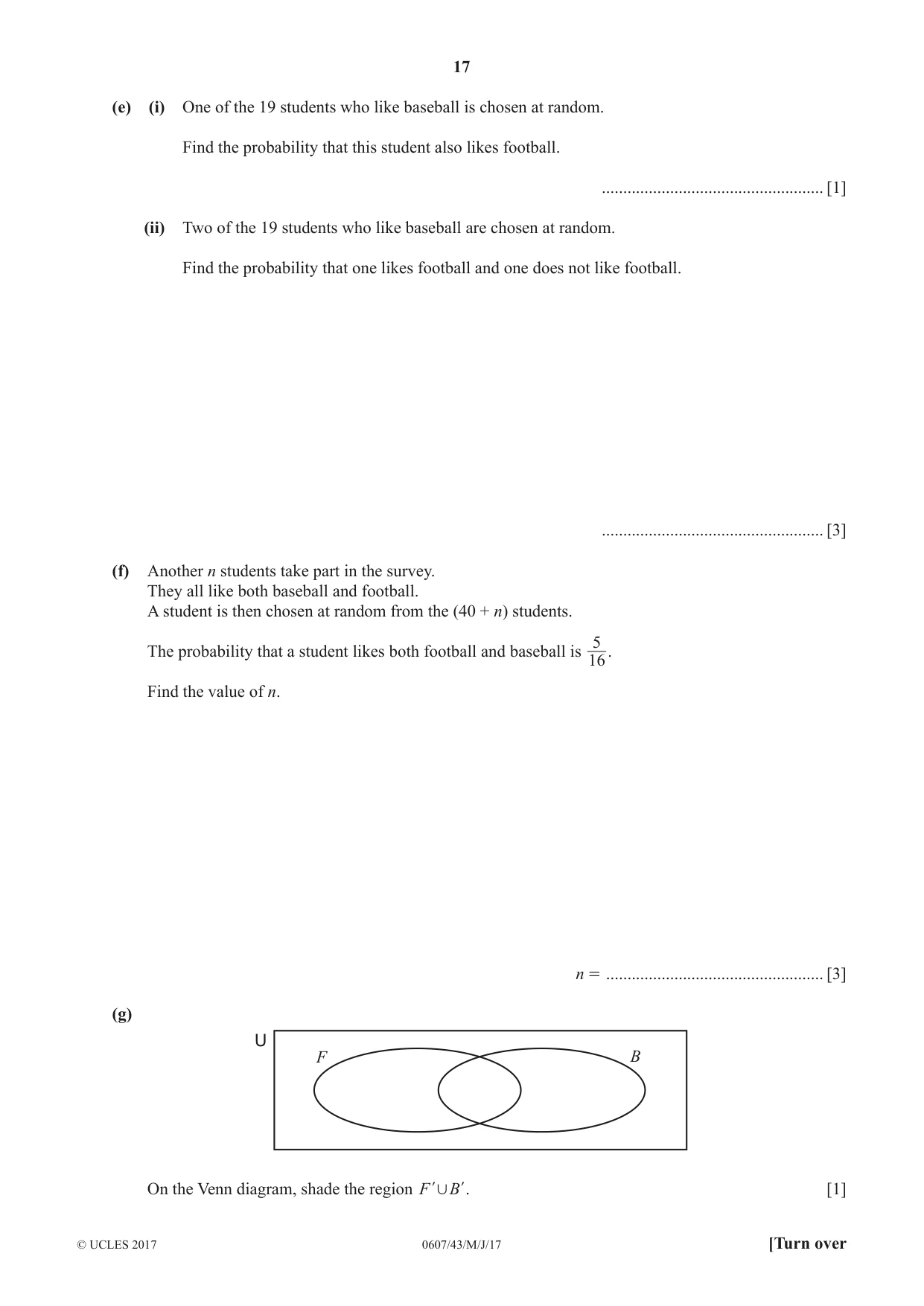
9 In a survey, 40 students are asked if they like football, F, and if they like baseball, B. 22 like football, 19 like baseball and 6 do not like either football or baseball. (a) Complete the Venn diagram to show this information. U F B .......... .......... .......... 6 [2] (b) How many of these students (i) like both football and baseball, .................................................... [1] (ii) either like football or do not like baseball? .................................................... [1] (c) Find n (F + B l) . .................................................... [1] (d) Two of these students are chosen at random. Find the probability that they both like football. .................................................... [2] (e) (i) One of the 19 students who like baseball is chosen at random. Find the probability that this student also likes football. .................................................... [1] (ii) Two of the 19 students who like baseball are chosen at random. Find the probability that one likes football and one does not like football. .................................................... [3] (f) Another n students take part in the survey. They all like both baseball and football. A student is then chosen at random from the (40 + n) students. 5 The probability that a student likes both football and baseball is . 16 Find the value of n. n = ................................................... [3] (g) U F B On the Venn diagram, shade the region F l , B l. [1]
Mark scheme: 9(a) 15, 7, 12 correctly placed 2 B1 for two correctly placed or M1 for 41 – (40 – 6) seen oe or correct equation 9(b)(i) 7 1 FT their Venn diagram 9(b)(ii) 28 1 FT their Venn diagram 9(c) 15 1 FT their Venn diagram 9(d) 462 2 22 21 oe M1 for × 1560 40 39 9(e)(i) 7 1 FT their Venn diagram 19 9(e)(ii) 168 3 their 7 their 12 their 12 their 7 oe M2 for × + × oe 342 19 18 19 18 or M1 for one of these products 9(f) 8 3 their 7 + n 5 M2 for = oe 40 + n 16 or M1 for at least two trials 9(g) 1
Q10 · The time, t hours, taken by each of 200 cars to complete a journey of 200 km is recorded
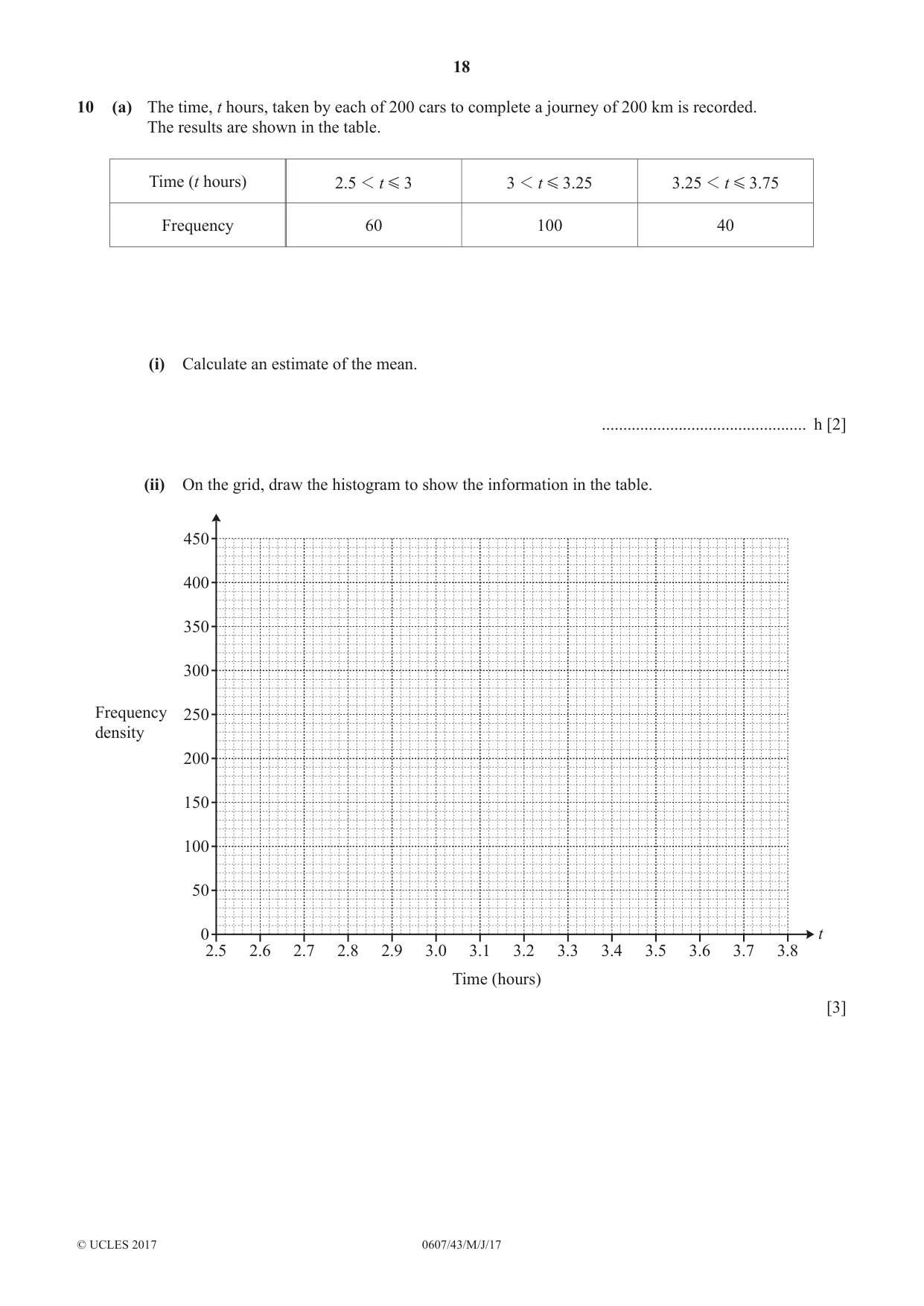
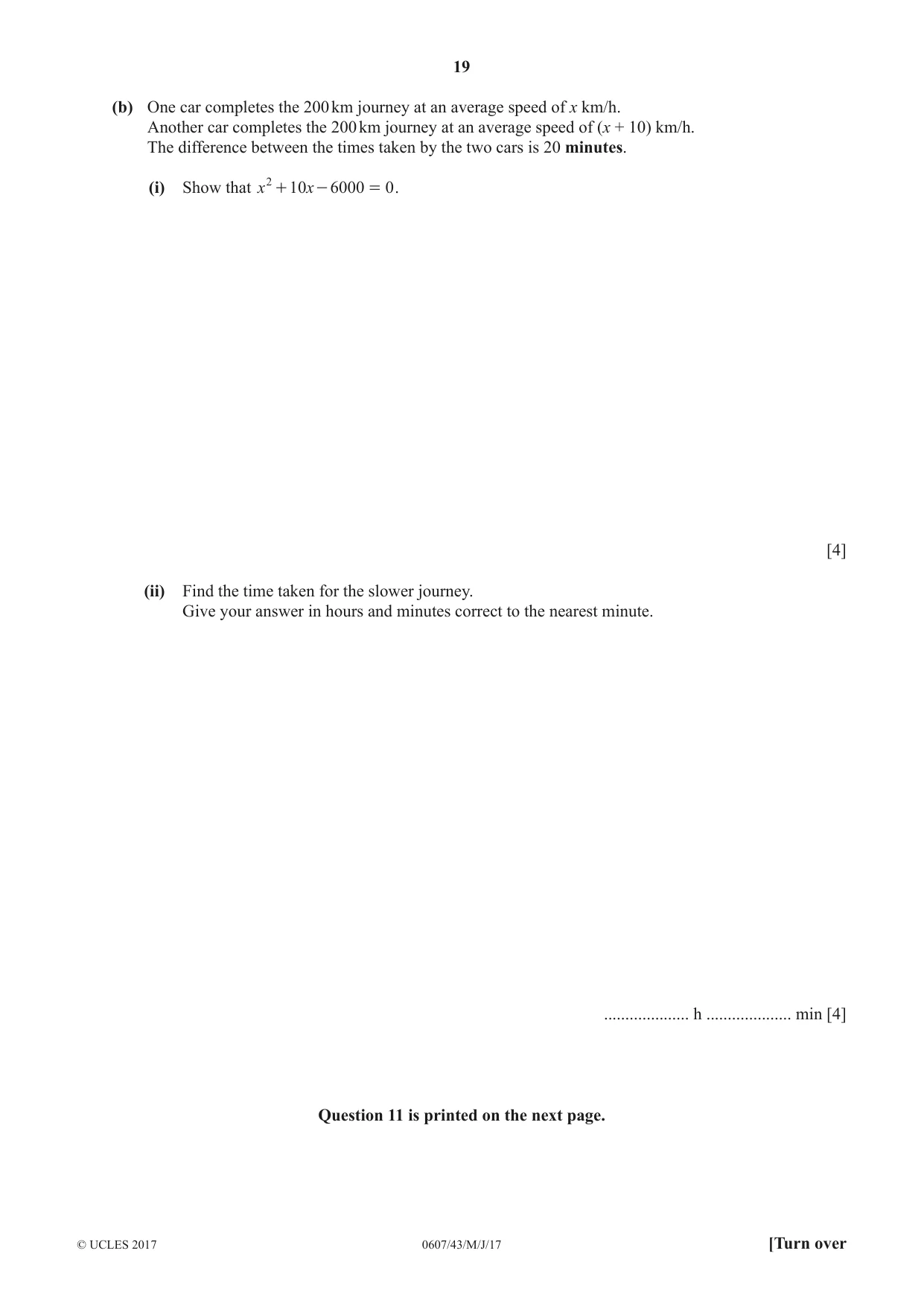
10 (a) The time, t hours, taken by each of 200 cars to complete a journey of 200 km is recorded. The results are shown in the table. Time (t hours) 2.5 1 t G 3 3 1 t G 3.25 3.25 1 t G 3.75 Frequency 60 100 40 (i) Calculate an estimate of the mean. ................................................ h [2] (ii) On the grid, draw the histogram to show the information in the table. 450 400 350 300 Frequency 250 density 200 150 100 50 0 t 2.5 2.6 2.7 2.8 2.9 3.0 3.1 3.2 3.3 3.4 3.5 3.6 3.7 3.8 Time (hours) [3] (b) One car completes the 200 km journey at an average speed of x km/h. Another car completes the 200 km journey at an average speed of (x + 10) km/h. The difference between the times taken by the two cars is 20 minutes. (i) Show that x 2 + 10x - 6000 = 0 . [4] (ii) Find the time taken for the slower journey. Give your answer in hours and minutes correct to the nearest minute. .................... h .................... min [4] Question 11 is printed on the next page.
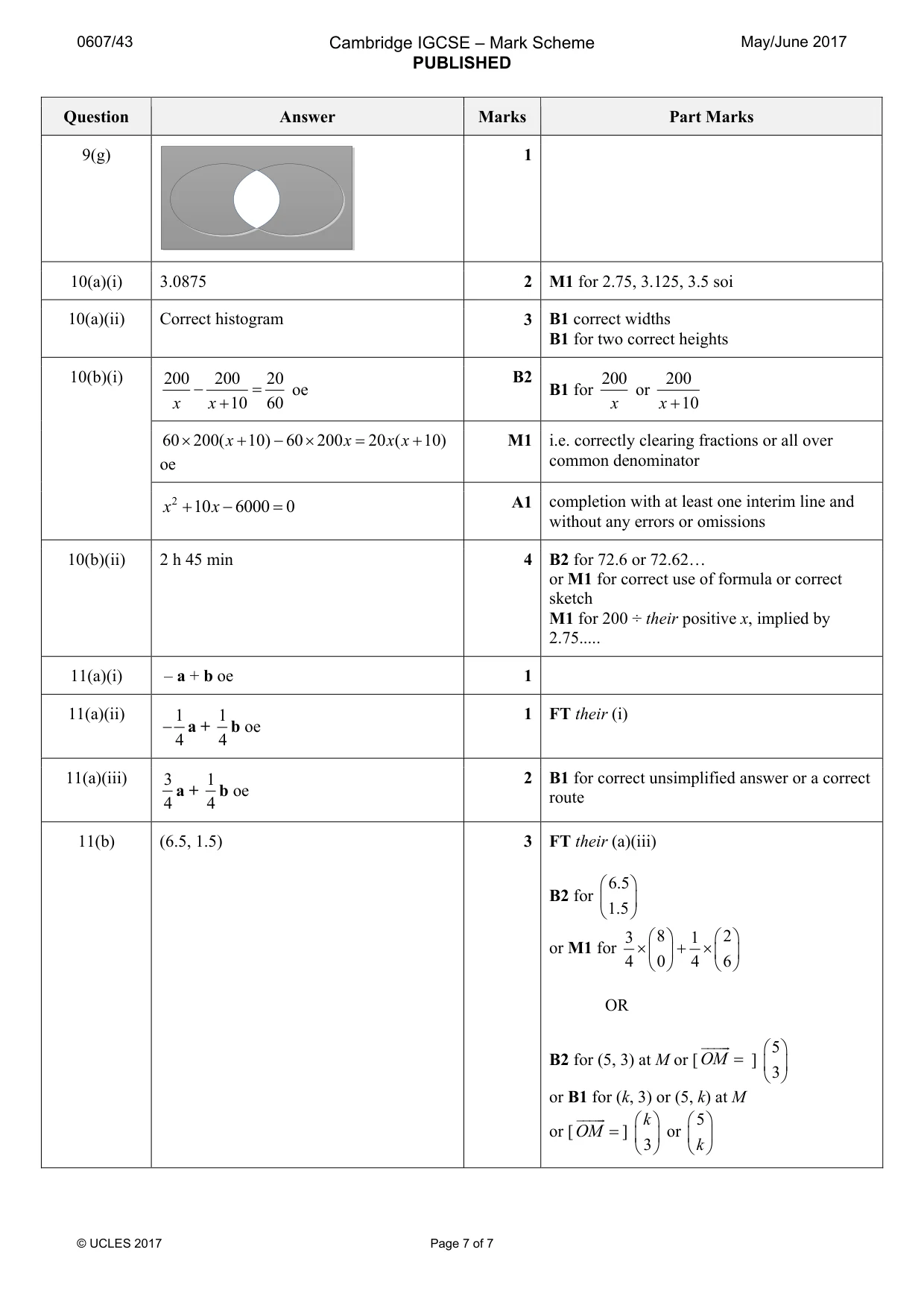
Mark scheme: 10(a)(i) 3.0875 2 M1 for 2.75, 3.125, 3.5 soi 10(a)(ii) Correct histogram 3 B1 correct widths B1 for two correct heights 10(b)(i) 200 200 20 B2 200 200 − = oe B1 for or x x + 10 60 x x + 10 60 × 200( x + 10) − 60 × 200 x = 20 x ( x + 10) M1 i.e. correctly clearing fractions or all over oe common denominator x 2 + 10 x − 6000 = 0 A1 completion with at least one interim line and without any errors or omissions 10(b)(ii) 2 h 45 min 4 B2 for 72.6 or 72.62… or M1 for correct use of formula or correct sketch M1 for 200 ÷ their positive x, implied by 2.75.....
Q11 · B NOT TO SCALE b M N A O a In the diagram, OA = a and OB = b
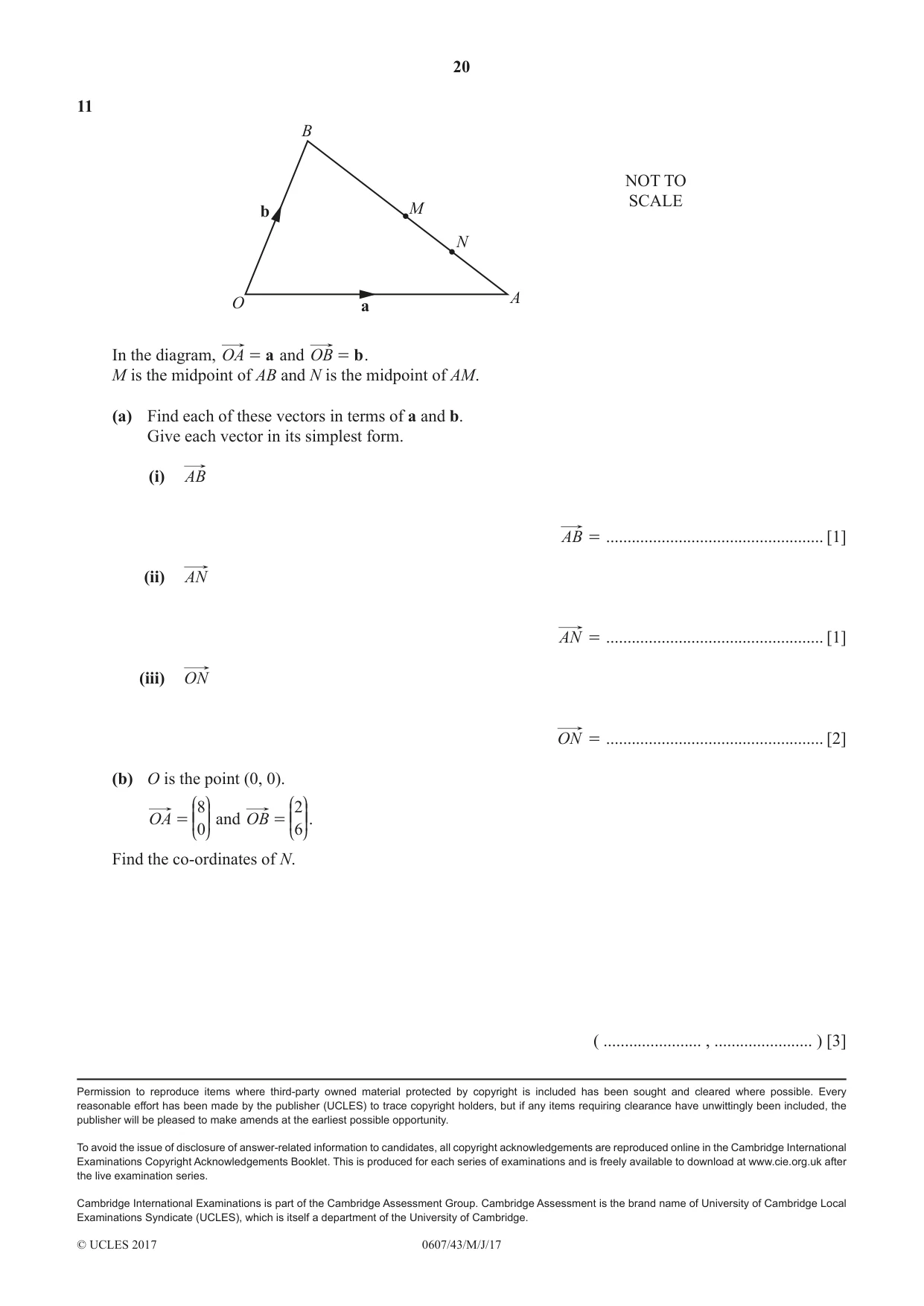
11 B NOT TO SCALE b M N A O a In the diagram, OA = a and OB = b . M is the midpoint of AB and N is the midpoint of AM. (a) Find each of these vectors in terms of a and b. Give each vector in its simplest form. (i) AB AB = ................................................... [1] (ii) AN AN = ................................................... [1] (iii) ON ON = ................................................... [2] (b) O is the point (0, 0). J N J N 8 2 = OA = KK OO and OB KK OO. 0 6 L P L P Find the co-ordinates of N. ( ....................... , ....................... ) [3]
Mark scheme: 11(a)(i) – a + b oe 1 11(a)(ii) 1 1 1 FT their (i) − a + b oe 4 4 11(a)(iii) 3 1 2 B1 for correct unsimplified answer or a correct a + b oe route 4 4 11(b) (6.5, 1.5) 3 FT their (a)(iii) 6.5 B2 for 1.5 3 8 1 2 or M1 for × + × 4 0 4 6 OR uuuur 5 B2 for (5, 3) at M or [ OM = ] 3 or B1 for (k, 3) or (5, k) at M uuuur k 5 or [ OM = ] or 3 k
What was in this paper
The subtopics covered by these 11 questions, and how many questions each got. Open one in a new tab to see every Cambridge question on it.
What you needed in this session
Cambridge’s own grade thresholds for 2017 May/June, Paper 4 · Variant 3. A higher threshold means an easier paper — the bar moves with how the cohort did.