Questions as text
Q1 · Copper is a metallic element 0971/21 May/June 2018
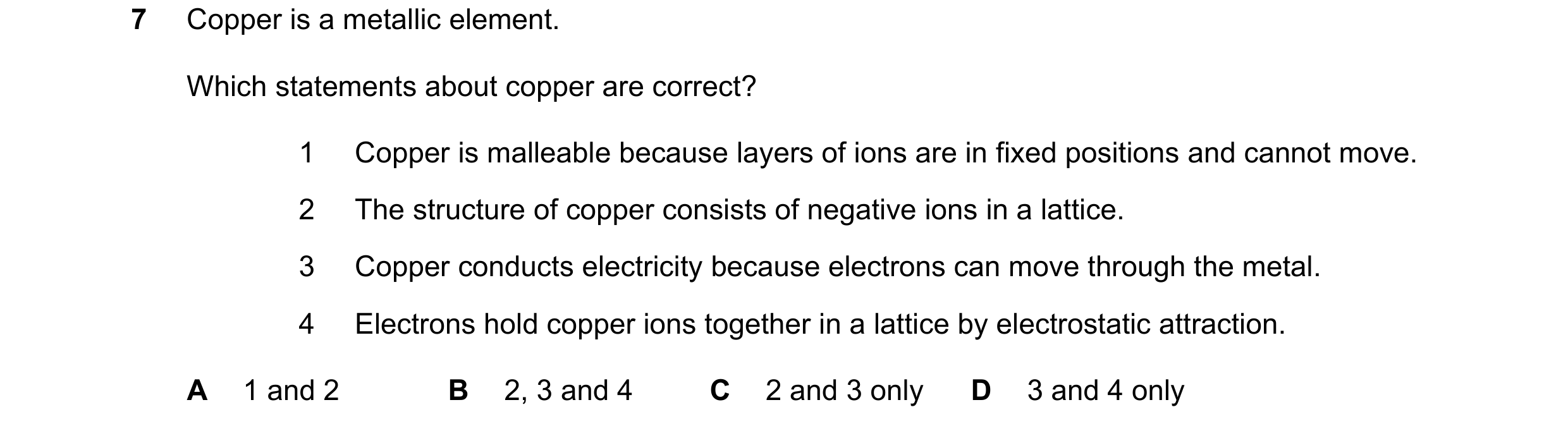
7 Copper is a metallic element. Which statements about copper are correct? 1 Copper is malleable because layers of ions are in fixed positions and cannot move. 2 The structure of copper consists of negative ions in a lattice. 3 Copper conducts electricity because electrons can move through the metal. 4 Electrons hold copper ions together in a lattice by electrostatic attraction. A 1 and 2 B 2, 3 and 4 C 2 and 3 only D 3 and 4 only
1 marks
Answer: D
This question in 0971/21 May/June 2018
Q2 · Which statement describes the structure of copper? 0971/22 Oct/Nov 2019
8 Which statement describes the structure of copper? A It has a lattice of negative ions in a ‘sea of electrons’. B It has a lattice of negative ions in a ‘sea of protons’. C It has a lattice of positive ions in a ‘sea of electrons’. D It has a lattice of positive ions in a ‘sea of protons’.
1 marks
Answer: C
This question in 0971/22 Oct/Nov 2019
Q3 · Which row contains a description of metallic bonding and a property that is explained by… 0971/21 May/June 2020
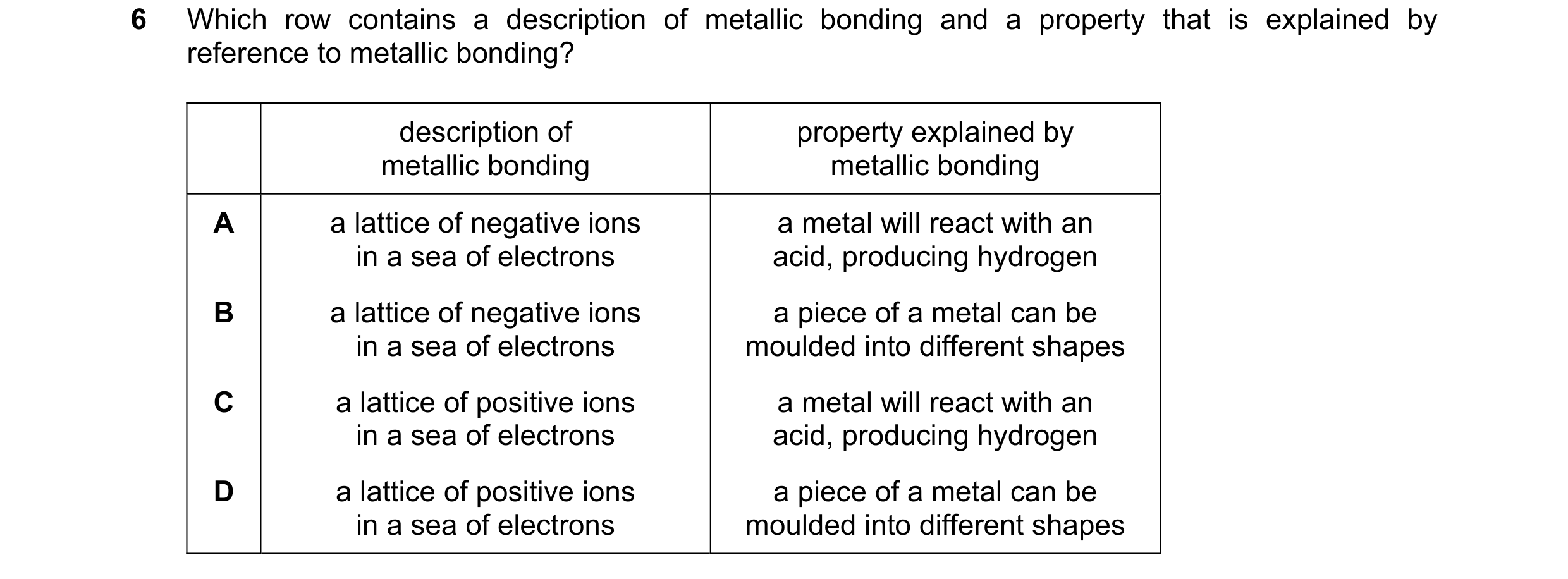
6 Which row contains a description of metallic bonding and a property that is explained by reference to metallic bonding? description of property explained by metallic bonding metallic bonding A a lattice of negative ions a metal will react with an in a sea of electrons acid, producing hydrogen B a lattice of negative ions a piece of a metal can be in a sea of electrons moulded into different shapes C a lattice of positive ions a metal will react with an in a sea of electrons acid, producing hydrogen D a lattice of positive ions a piece of a metal can be in a sea of electrons moulded into different shapes
1 marks
Answer: D
This question in 0971/21 May/June 2020
Q4 · Which statement about the structure of a metal explains why metals are malleable? 0971/22 May/June 2020
6 Which statement about the structure of a metal explains why metals are malleable? A The electrons can move freely throughout the lattice. B The layers of metal ions can slide over each other. C The metal ions are positively charged. D There is a strong force of attraction between the metal ions and the electrons.
1 marks
Answer: B
This question in 0971/22 May/June 2020
Q5 · Which diagram best represents the structure of a substance that is a good conductor of… 0971/22 Oct/Nov 2020
29 Which diagram best represents the structure of a substance that is a good conductor of electricity at 25 C? A B C D – + – + + – + – – + – +
1 marks
Answer: D
This question in 0971/22 Oct/Nov 2020
Q6 · Which statement about metals is correct? 0971/21 May/June 2021
7 Which statement about metals is correct? A Metals conduct electricity when molten because negative ions are free to move. B Metals conduct electricity when solid because positive ions are free to move. C Metals are malleable because the bonds between the atoms are weak. D Metals are malleable because the layers of ions can slide over each other.
1 marks
Answer: D
This question in 0971/21 May/June 2021
Q7 · Information about four substances E, F, G and H is shown 0971/22 May/June 2021
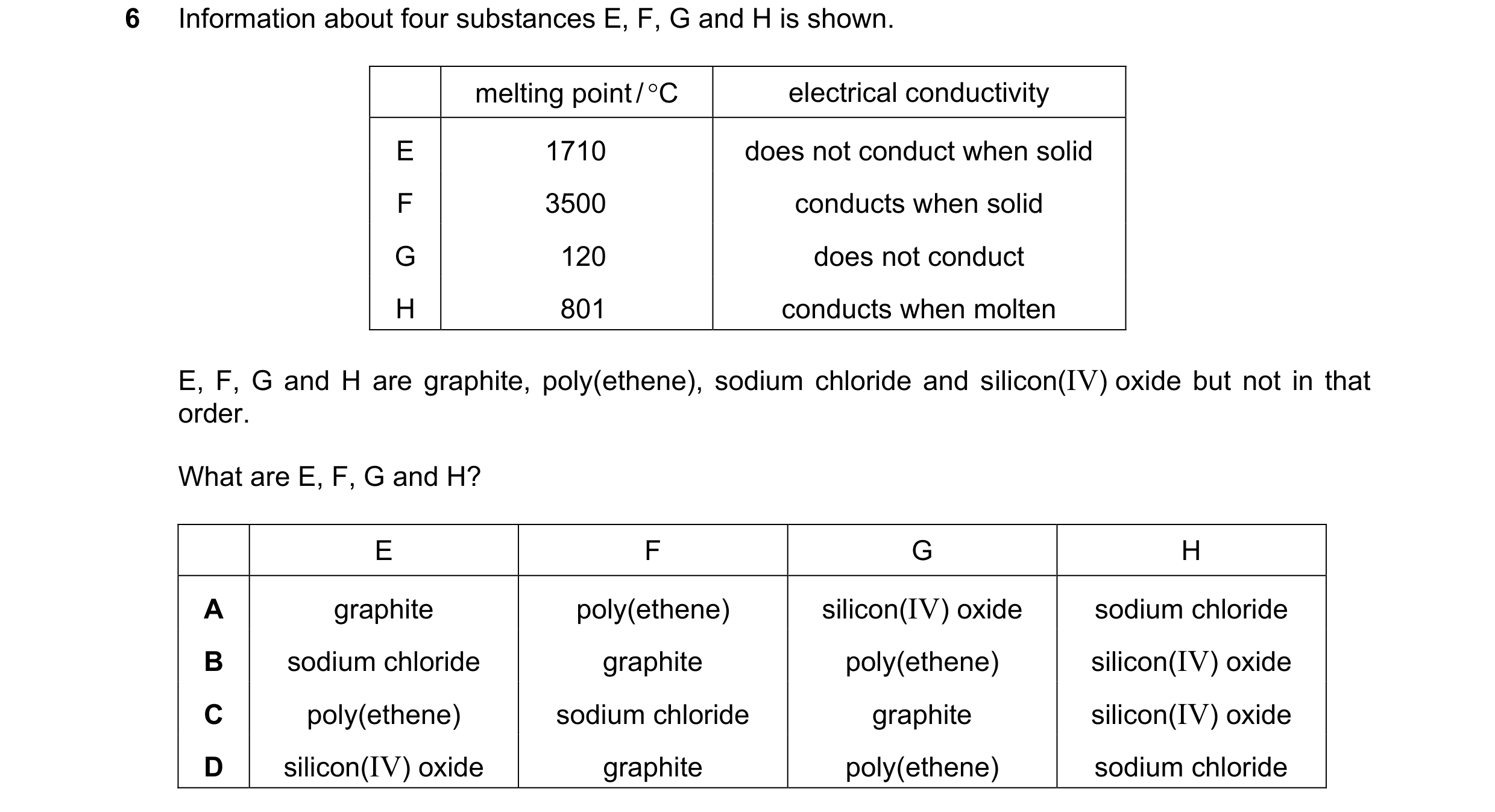
6 Information about four substances E, F, G and H is shown. melting point / C electrical conductivity E 1710 does not conduct when solid F 3500 conducts when solid G 120 does not conduct H 801 conducts when molten E, F, G and H are graphite, poly(ethene), sodium chloride and silicon(IV) oxide but not in that order. What are E, F, G and H? E F G H A graphite poly(ethene) silicon(IV) oxide sodium chloride B sodium chloride graphite poly(ethene) silicon(IV) oxide C poly(ethene) sodium chloride graphite silicon(IV) oxide D silicon(IV) oxide graphite poly(ethene) sodium chloride
1 marks
Answer: D
This question in 0971/22 May/June 2021
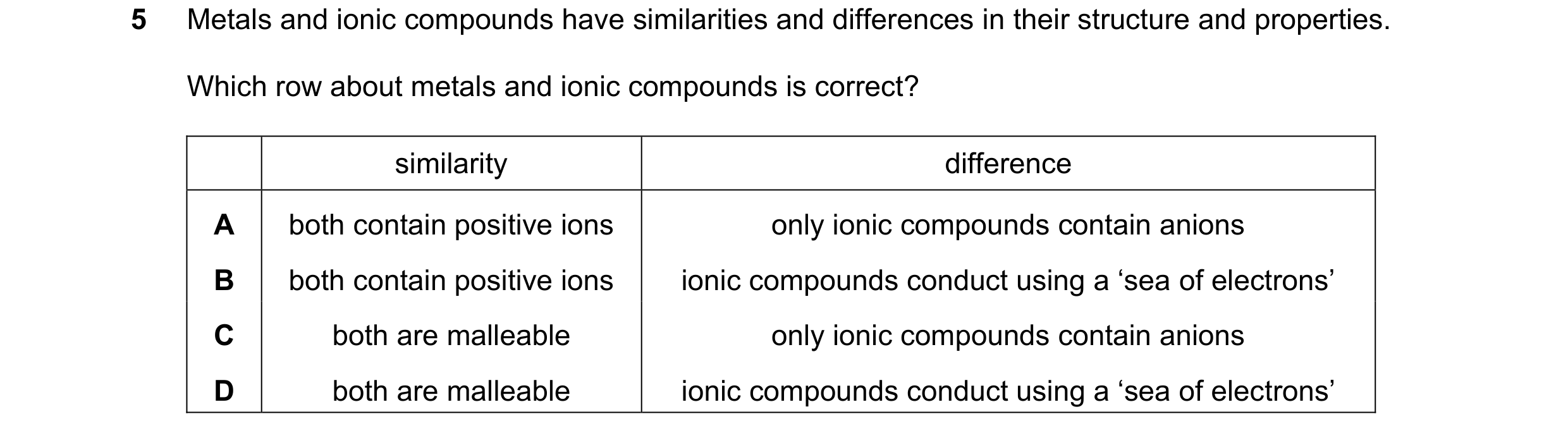
Q8 · Metals and ionic compounds have similarities and differences in their structure and… 0971/21 May/June 2022
5 Metals and ionic compounds have similarities and differences in their structure and properties. Which row about metals and ionic compounds is correct? similarity difference A both contain positive ions only ionic compounds contain anions B both contain positive ions ionic compounds conduct using a ‘sea of electrons’ C both are malleable only ionic compounds contain anions D both are malleable ionic compounds conduct using a ‘sea of electrons’
1 marks
Answer: A
This question in 0971/21 May/June 2022
Q9 · Which particles are present in the structure of metals? 0971/22 Oct/Nov 2022
7 Which particles are present in the structure of metals? 1 positive ions 2 negative ions 3 shared pairs of electrons 4 mobile electrons A 1 and 2 B 1 and 4 C 2 and 3 D 2 and 4
1 marks
Answer: B
This question in 0971/22 Oct/Nov 2022
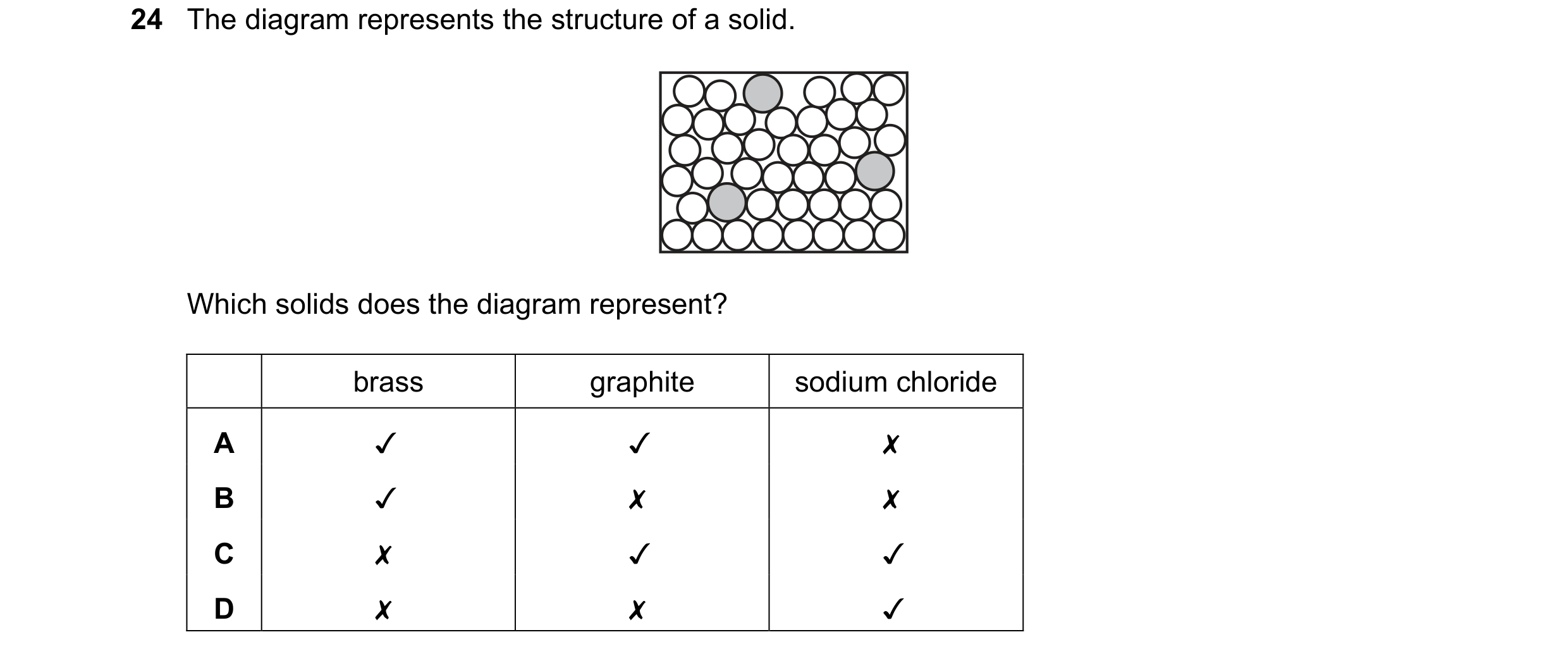
Q10 · The diagram represents the structure of a solid 0971/21 May/June 2023
24 The diagram represents the structure of a solid.
Which solids does the diagram represent?
brass graphite sodium chloride
A Jv v x
B Jv x x
Cc x v v
D x x v
1 marks
Answer: B
This question in 0971/21 May/June 2023
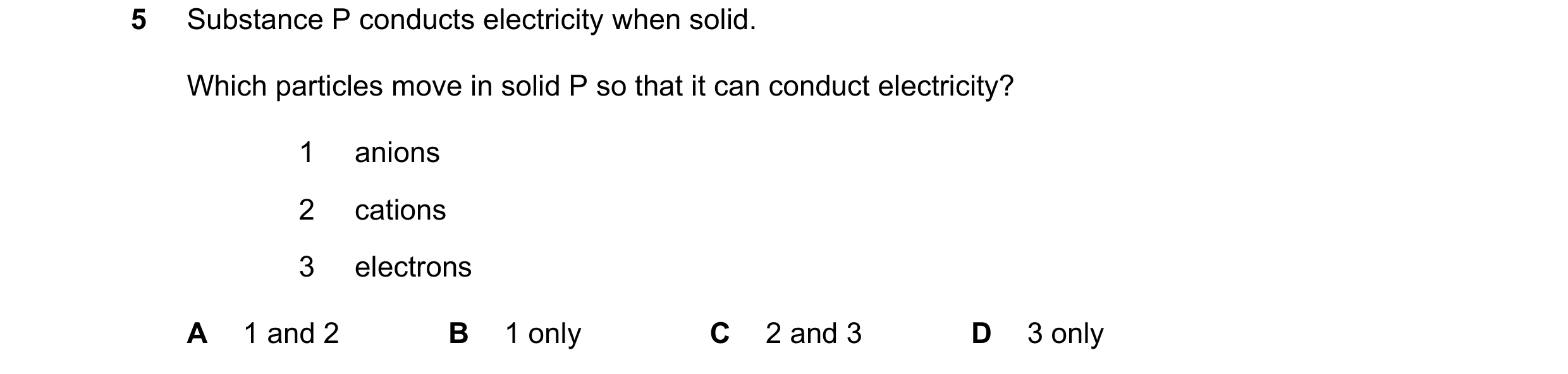
Q11 · Substance P conducts electricity when solid 0971/22 May/June 2023
5 Substance P conducts electricity when solid. Which particles move in solid P so that it can conduct electricity? 1 anions 2 cations 3 electrons A 1 and 2 B 1 only C 2 and 3 D 3 only
1 marks
Answer: D
This question in 0971/22 May/June 2023
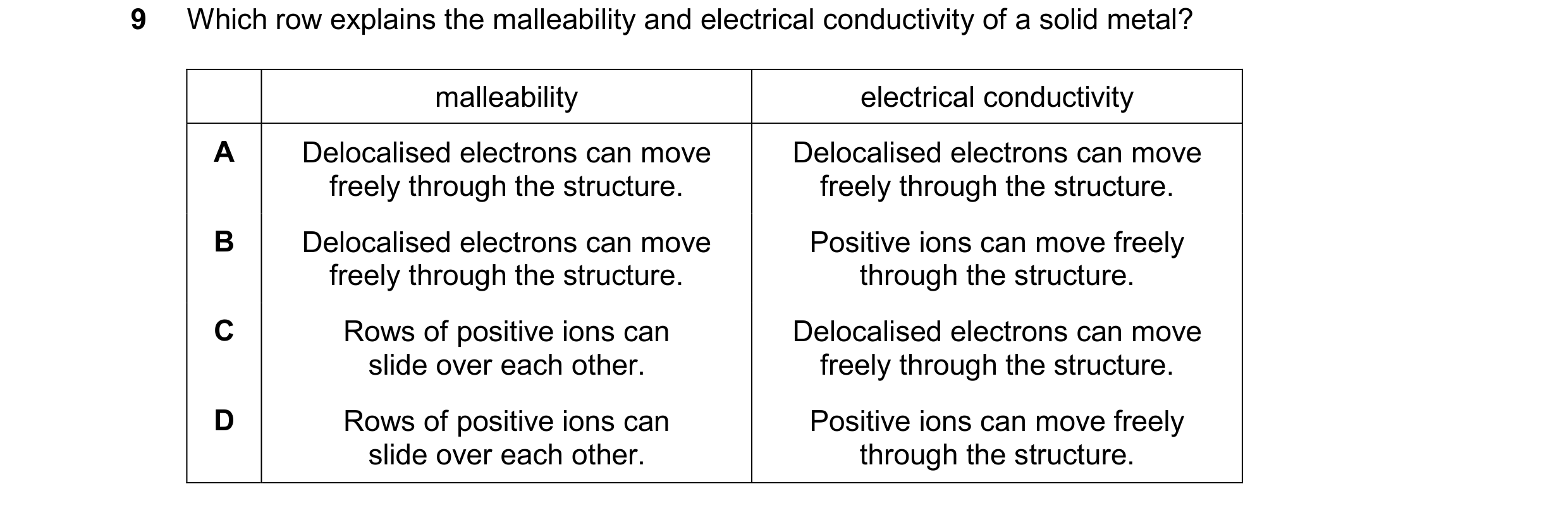
Q12 · Which row explains the malleability and electrical conductivity of a solid metal? 0971/22 Oct/Nov 2024
9 Which row explains the malleability and electrical conductivity of a solid metal? malleability electrical conductivity A Delocalised electrons can move Delocalised electrons can move freely through the structure. freely through the structure. B Delocalised electrons can move Positive ions can move freely freely through the structure. through the structure. C Rows of positive ions can Delocalised electrons can move slide over each other. freely through the structure. D Rows of positive ions can Positive ions can move freely slide over each other. through the structure.
1 marks
Answer: C
This question in 0971/22 Oct/Nov 2024
Q13 · Which row describes the structure and bonding in cobalt? 0971/22 Oct/Nov 2025
9 Which row describes the structure and bonding in cobalt? structure bonding A giant ionic B simple ionic C giant metallic D simple metallic
1 marks
Answer: C
This question in 0971/22 Oct/Nov 2025

 1 / 4
1 / 4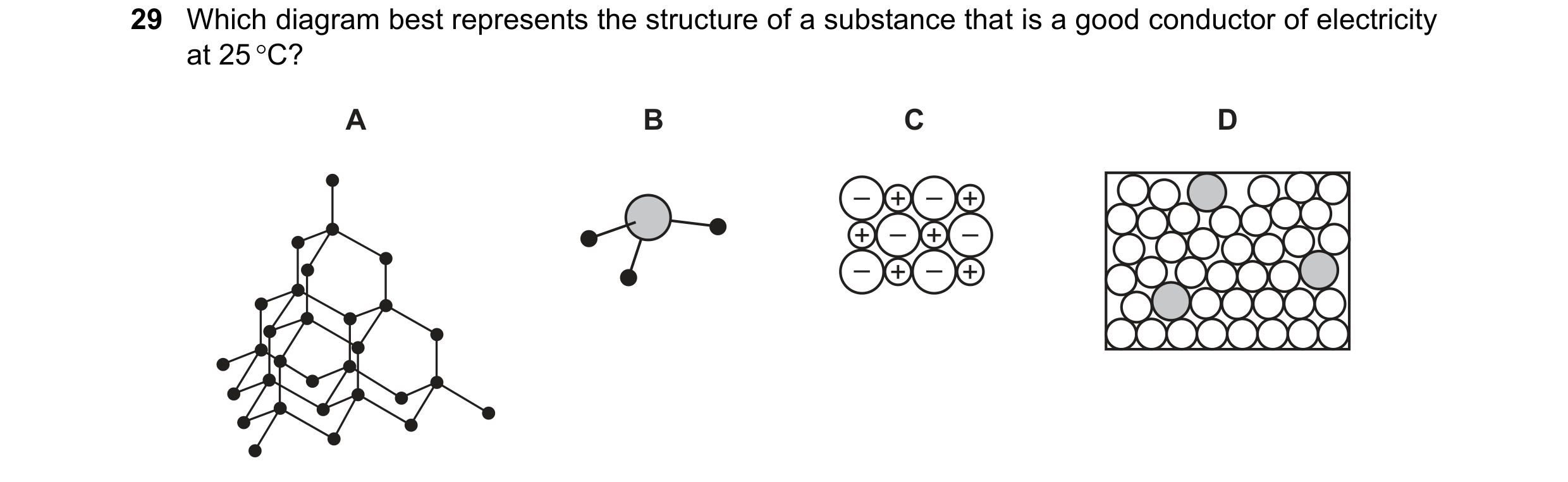

 2 / 4
2 / 4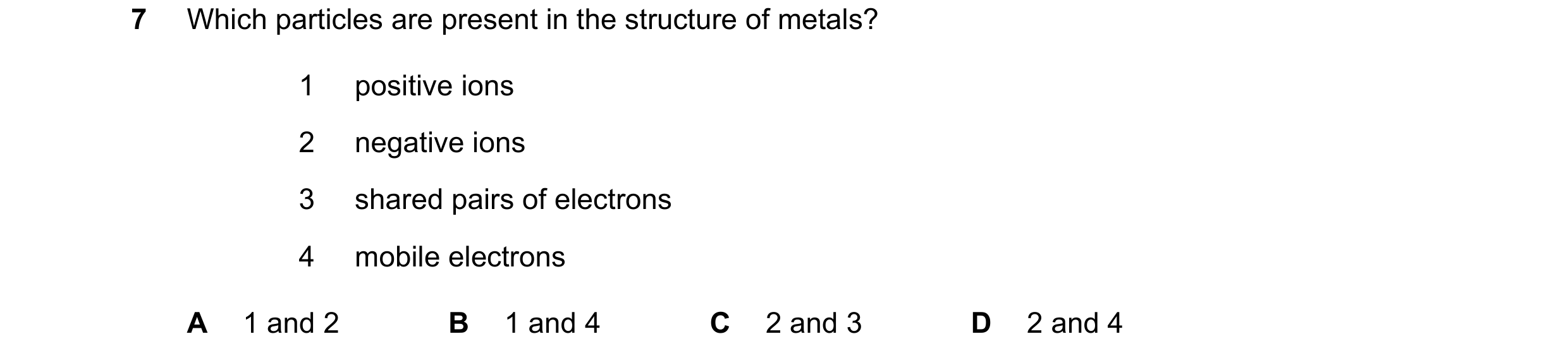
 3 / 4
3 / 4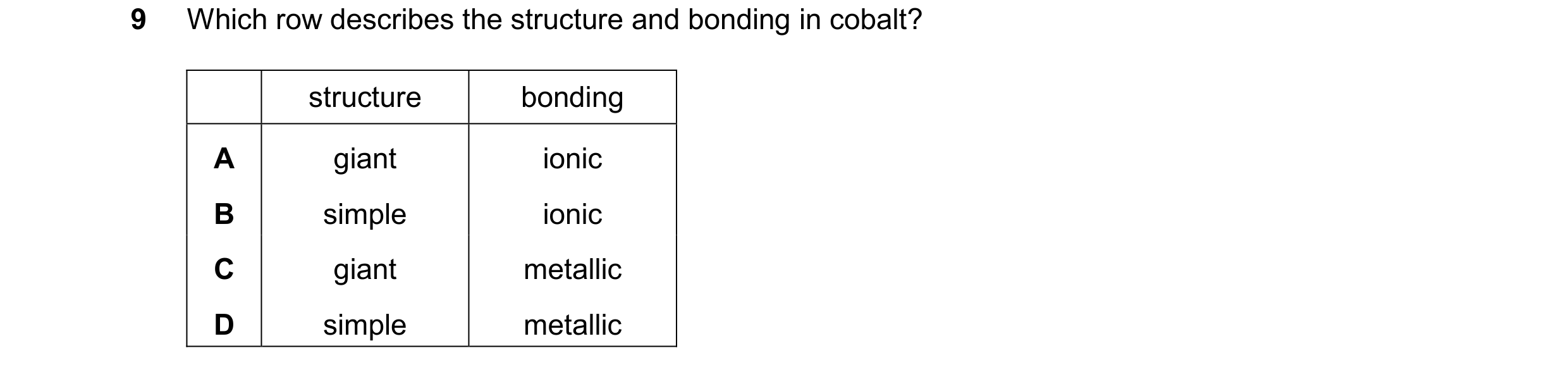 4 / 4
4 / 4