Questions as text
Q1 · Define gravitational field strength 9702/41 Oct/Nov 2017
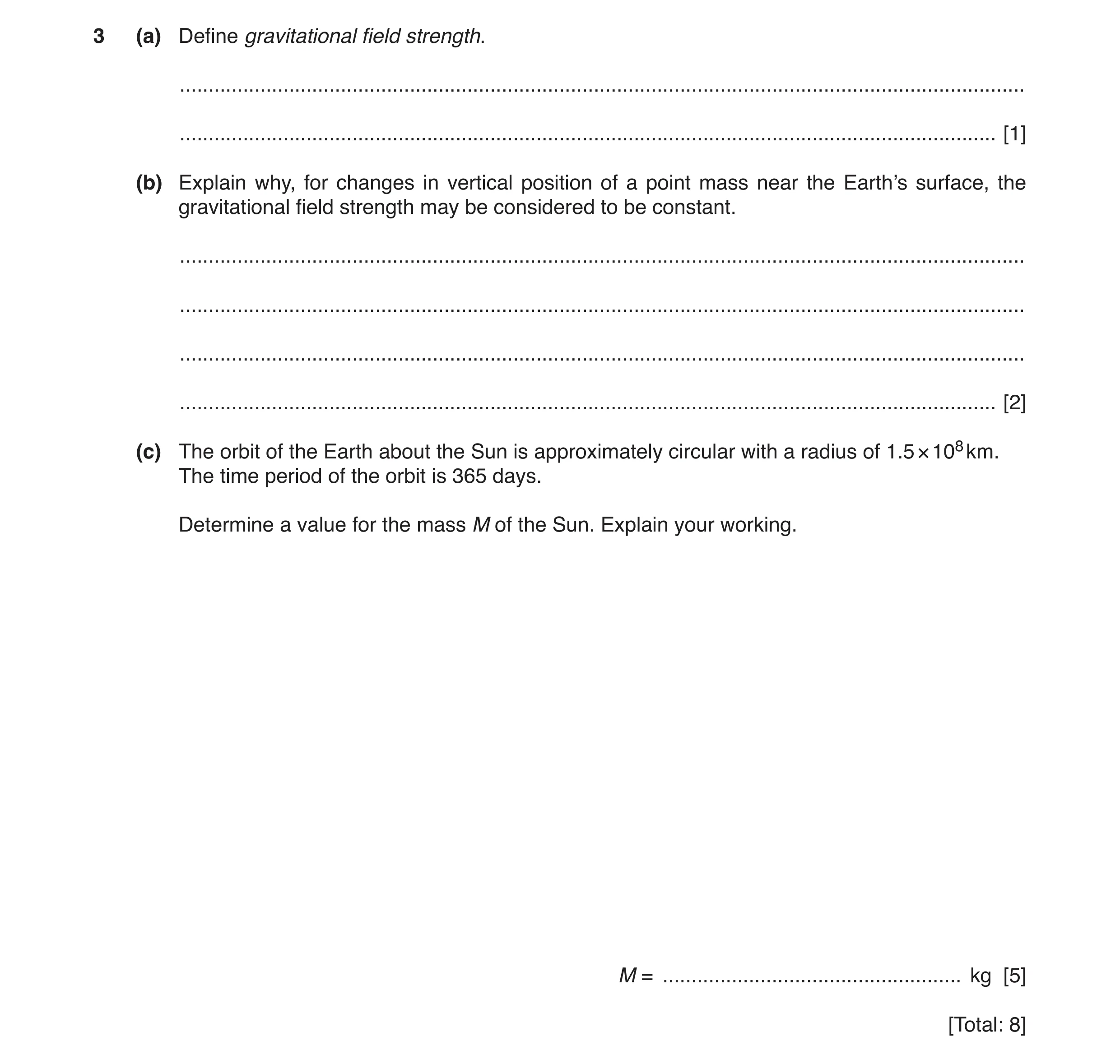
3 (a) Define gravitational field strength. … … [1] (b) Explain why, for changes in vertical position of a point mass near the Earth’s surface, the gravitational field strength may be considered to be constant. … … … … [2] (c) The orbit of the Earth about the Sun is approximately circular with a radius of 1.5 × 10⁸ km. The time period of the orbit is 365 days. Determine a value for the mass M of the Sun. Explain your working. M = … kg [5] [Total: 8]
8 marks
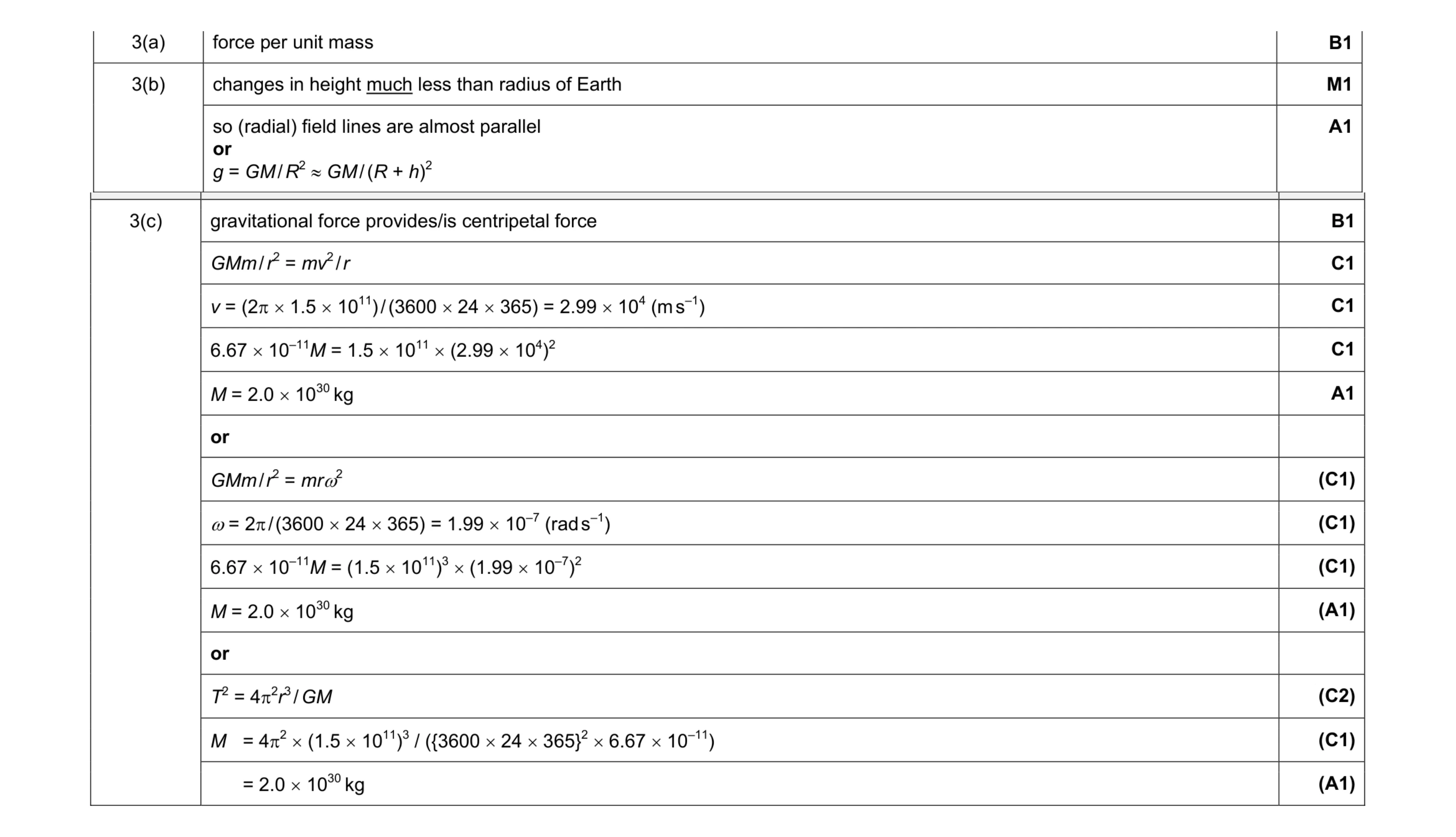
Mark scheme: 3(a) force per unit mass B1 3(b) changes in height much less than radius of Earth M1 so (radial) field lines are almost parallel or g = GM / R2 ≈ GM / (R + h)2 A1 Question Answer Marks 3(c) gravitational force provides/is centripetal force B1 GMm / r2 = mv2 / r C1 v = (2π × 1.5 × 1011) / (3600 × 24 × 365) = 2.99 × 10⁴ (m s–1) C1 6.67 × 10⁻¹¹M = 1.5 × 1011 × (2.99 × 104)2 C1 M = 2.0 × 1030 kg A1 or GMm / r2 = mrω2 (C1) ω = 2π / (3600 × 24 × 365) = 1.99 × 10⁻⁷ (rad s–1) (C1) 6.67 × 10⁻¹¹M = (1.5 × 10¹¹)3 × (1.99 × 10–7)2 (C1) M = 2.0 × 1030 kg (A1) or T2 = 4π2r3 / GM (C2) M = 4π2 × (1.5 × 1011)3 / ({3600 × 24 × 365}2 × 6.67 × 10–11) (C1) = 2.0 × 1030 kg (A1)
This question in 9702/41 Oct/Nov 2017
Q2 · State Newton’s law of gravitation 9702/41 May/June 2018
1 (a) State Newton’s law of gravitation. … … … … [2] (b) A distant star is orbited by several planets. Each planet has a circular orbit with a different radius. (i) Each planet orbits at constant speed. Explain whether the planets are in equilibrium. … … … [1] (ii) The radius of the orbit of a planet is R and the orbital period is T. Data for some of the planets are given in Fig. 1.1. planet R / m T 2 / s2 c 9.6 × 10¹⁰ 2.5 × 10¹¹ e 4.0 × 10¹¹ 1.8 × 10¹³ g 2.1 × 10¹² 2.6 × 10¹⁵ Fig. 1.1 The relationship between R and T is given by the expression R 3 = kT 2. 1. Show that the constant k is given by the expression GM k = 4π2 where G is the gravitational constant and M is the mass of the star. [3] 2. Use data from Fig. 1.1 for the three planets and the expression for k to calculate the mass M of the star. M = … kg [3] [Total: 9]
9 marks
Mark scheme: 1(a) force proportional to product of masses and inversely proportional to square of separation B1 idea of force between point masses B1 1(b)(i) velocity changes/direction of motion changes/there is an acceleration/there is a resultant force so not in equilibrium B1 1(b)(ii)1. gravitational force equals/is centripetal force C1 GMm / R2 = mRω2 and ω = 2π / T or Gm / R2 = mv2 / R and v = 2πr / T or GMm / R2 = mR (2π / T)2 M1 convincing algebra leading to k = GM / 4π2 A1 1(b)(ii)2. correct use of R3 / T2 for one planet (c gives 3.54 × 10²¹; e and g both give 3.56 × 10²¹) C1 3.5(5) × 1021 = (6.67 × 10⁻¹¹ × M) / 4π2 M = 2.1 × 1033 kg A1 two or three values of R3 / T2 correctly calculated and used in a valid way to find a value for M based on more than one k B1
This question in 9702/41 May/June 2018
Q3 · A geostationary satellite orbits the Earth with a period of 24 hours 9702/41 May/June 2018
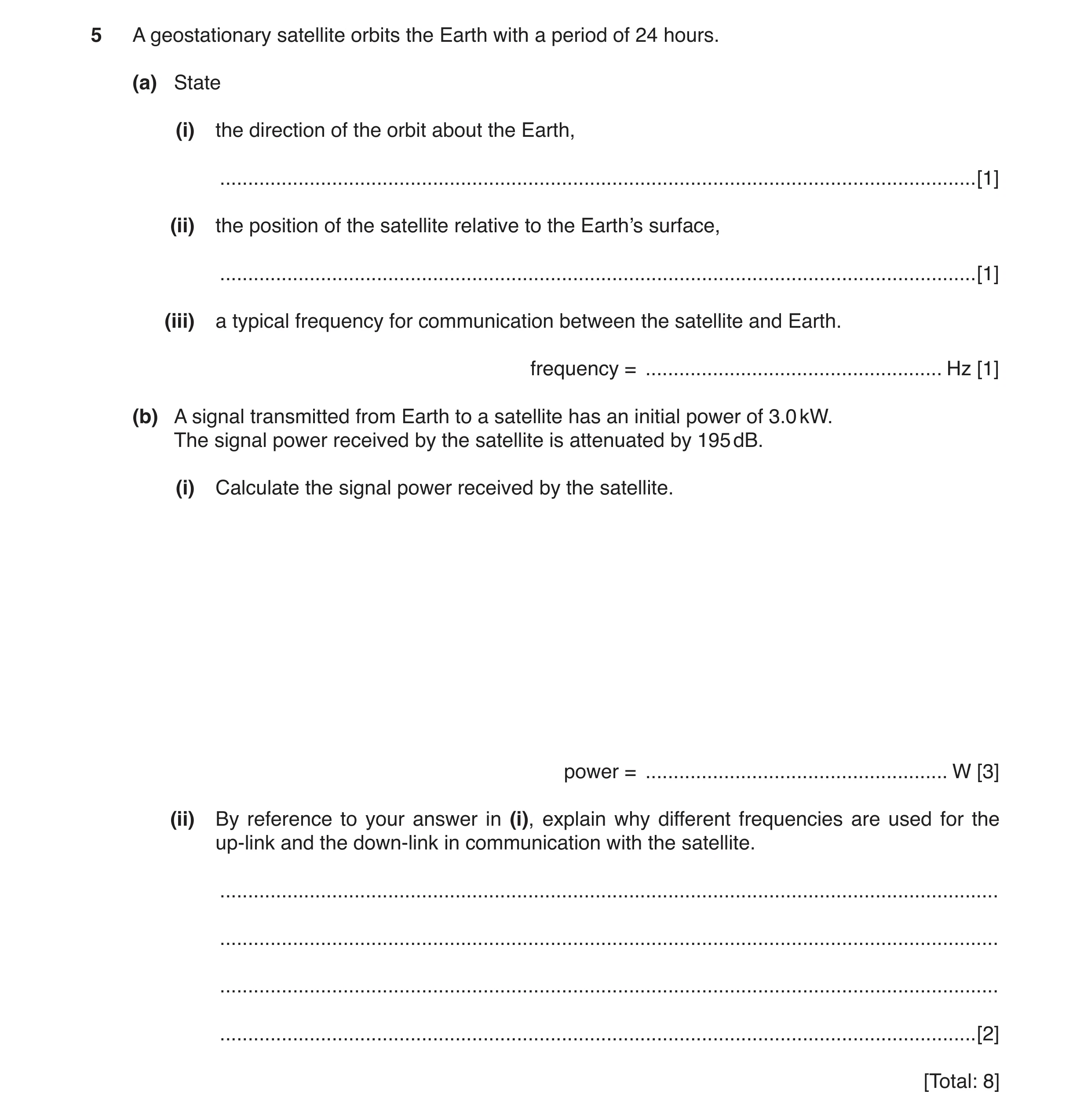
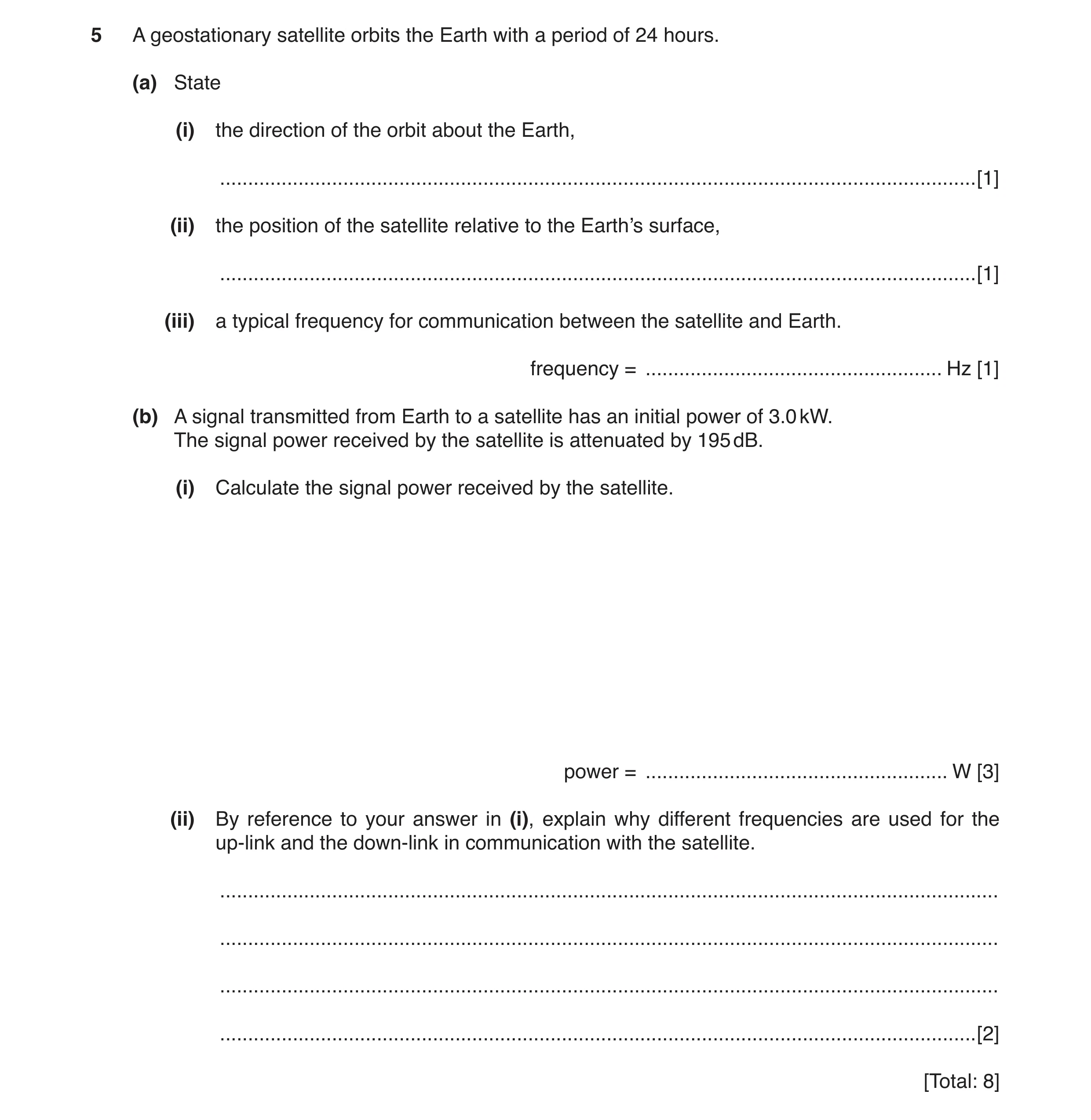
5 A geostationary satellite orbits the Earth with a period of 24 hours. (a) State (i) the direction of the orbit about the Earth, … [1] (ii) the position of the satellite relative to the Earth’s surface, … [1] (iii) a typical frequency for communication between the satellite and Earth. frequency = … Hz [1] (b) A signal transmitted from Earth to a satellite has an initial power of 3.0 kW. The signal power received by the satellite is attenuated by 195 dB. (i) Calculate the signal power received by the satellite. power = … W [3] (ii) By reference to your answer in (i), explain why different frequencies are used for the up-link and the down-link in communication with the satellite. … … … … [2] [Total: 8]
8 marks
Mark scheme: 5(a)(i) west to east B1 5(a)(ii) above the Equator B1 5(a)(iii) value in range (1–300) × 109 Hz A1 5(b)(i) gain / dB = 10 lg (P2 / P1) C1 –195 = 10 lg (P / 3000) or 195 = 10 lg (3000 / P) C1 power = 9.5 × 10⁻¹⁷ W A1 5(b)(ii) up-link has been (greatly) attenuated (before reaching satellite) or down-link signal must be (greatly) amplified (before transmission back to Earth) or up-link has (much) smaller intensity/power than down-link B1 (different frequency) prevents down-link (signal) swamping up-link (signal) B1
This question in 9702/41 May/June 2018
Q4 · State Newton’s law of gravitation 9702/43 May/June 2018
1 (a) State Newton’s law of gravitation. … … … … [2] (b) A distant star is orbited by several planets. Each planet has a circular orbit with a different radius. (i) Each planet orbits at constant speed. Explain whether the planets are in equilibrium. … … … [1] (ii) The radius of the orbit of a planet is R and the orbital period is T. Data for some of the planets are given in Fig. 1.1. planet R / m T 2 / s2 c 9.6 × 10¹⁰ 2.5 × 10¹¹ e 4.0 × 10¹¹ 1.8 × 10¹³ g 2.1 × 10¹² 2.6 × 10¹⁵ Fig. 1.1 The relationship between R and T is given by the expression R 3 = kT 2. 1. Show that the constant k is given by the expression GM k = 4π2 where G is the gravitational constant and M is the mass of the star. [3] 2. Use data from Fig. 1.1 for the three planets and the expression for k to calculate the mass M of the star. M = … kg [3] [Total: 9]
9 marks
Mark scheme: 1(a) force proportional to product of masses and inversely proportional to square of separation B1 idea of force between point masses B1 1(b)(i) velocity changes/direction of motion changes/there is an acceleration/there is a resultant force so not in equilibrium B1 1(b)(ii)1. gravitational force equals/is centripetal force C1 GMm / R2 = mRω2 and ω = 2π / T or Gm / R2 = mv2 / R and v = 2πr / T or GMm / R2 = mR (2π / T)2 M1 convincing algebra leading to k = GM / 4π2 A1 1(b)(ii)2. correct use of R3 / T2 for one planet (c gives 3.54 × 10²¹; e and g both give 3.56 × 10²¹) C1 3.5(5) × 1021 = (6.67 × 10⁻¹¹ × M) / 4π2 M = 2.1 × 1033 kg A1 two or three values of R3 / T2 correctly calculated and used in a valid way to find a value for M based on more than one k B1
This question in 9702/43 May/June 2018
Q5 · A geostationary satellite orbits the Earth with a period of 24 hours 9702/43 May/June 2018
5 A geostationary satellite orbits the Earth with a period of 24 hours. (a) State (i) the direction of the orbit about the Earth, … [1] (ii) the position of the satellite relative to the Earth’s surface, … [1] (iii) a typical frequency for communication between the satellite and Earth. frequency = … Hz [1] (b) A signal transmitted from Earth to a satellite has an initial power of 3.0 kW. The signal power received by the satellite is attenuated by 195 dB. (i) Calculate the signal power received by the satellite. power = … W [3] (ii) By reference to your answer in (i), explain why different frequencies are used for the up-link and the down-link in communication with the satellite. … … … … [2] [Total: 8]
8 marks
Mark scheme: 5(a)(i) west to east B1 5(a)(ii) above the Equator B1 5(a)(iii) value in range (1–300) × 109 Hz A1 5(b)(i) gain / dB = 10 lg (P2 / P1) C1 –195 = 10 lg (P / 3000) or 195 = 10 lg (3000 / P) C1 power = 9.5 × 10⁻¹⁷ W A1 5(b)(ii) up-link has been (greatly) attenuated (before reaching satellite) or down-link signal must be (greatly) amplified (before transmission back to Earth) or up-link has (much) smaller intensity/power than down-link B1 (different frequency) prevents down-link (signal) swamping up-link (signal) B1
This question in 9702/43 May/June 2018
Q6 · Define gravitational potential at a point 9702/42 Feb/March 2019
1 (a) (i) Define gravitational potential at a point. … … … [2] (ii) Use your answer in (i) to explain why the gravitational potential near an isolated mass is always negative. … … … … … … [3] (b) A spherical planet has mass 6.00 × 1024 kg and radius 6.40 × 10⁶ m. The planet may be assumed to be isolated in space with its mass concentrated at its centre. A satellite of mass 340 kg is in a circular orbit about the planet at a height 9.00 × 10⁵ m above its surface. For the satellite: (i) show that its orbital speed is 7.4 × 10³ m s–1 [2] (ii) calculate its gravitational potential energy. energy = … J [3] (c) Rockets on the satellite are fired for a short time. The satellite’s orbit is now closer to the surface of the planet. State and explain the change, if any, in the kinetic energy of the satellite. … … … … [2] [Total: 12]
12 marks
Mark scheme: 1(a)(i) work done per unit mass B1 idea of work done moving mass from infinity (to the point) B1 1(a)(ii) (gravitational) force is attractive B1 (gravitational) potential at infinity is zero B1 decrease in potential energy as masses approach or displacement and force in opposite directions B1 1(b)(i) Either mv2 / R = GMm / R2 Or v = √( GM / R) v2 = (6.67 × 10–11 × 6.00 × 1024) / (7.30 × 10⁶) C1 giving v = 7.4 × 10³ m s–1 A1 1(b)(ii) VP = – GMm / R C1 = – (6.67 × 10–11 × 6.00 × 1024 × 340) / (7.30 × 10⁶) C1 VP = – 1.9 × 10¹⁰ J A1 1(c) v2 ∝ 1 / r, (r smaller) so v greater M1 and EK greater A1
This question in 9702/42 Feb/March 2019
Q7 · State three features of the orbit of a geostationary satellite 9702/42 Feb/March 2019
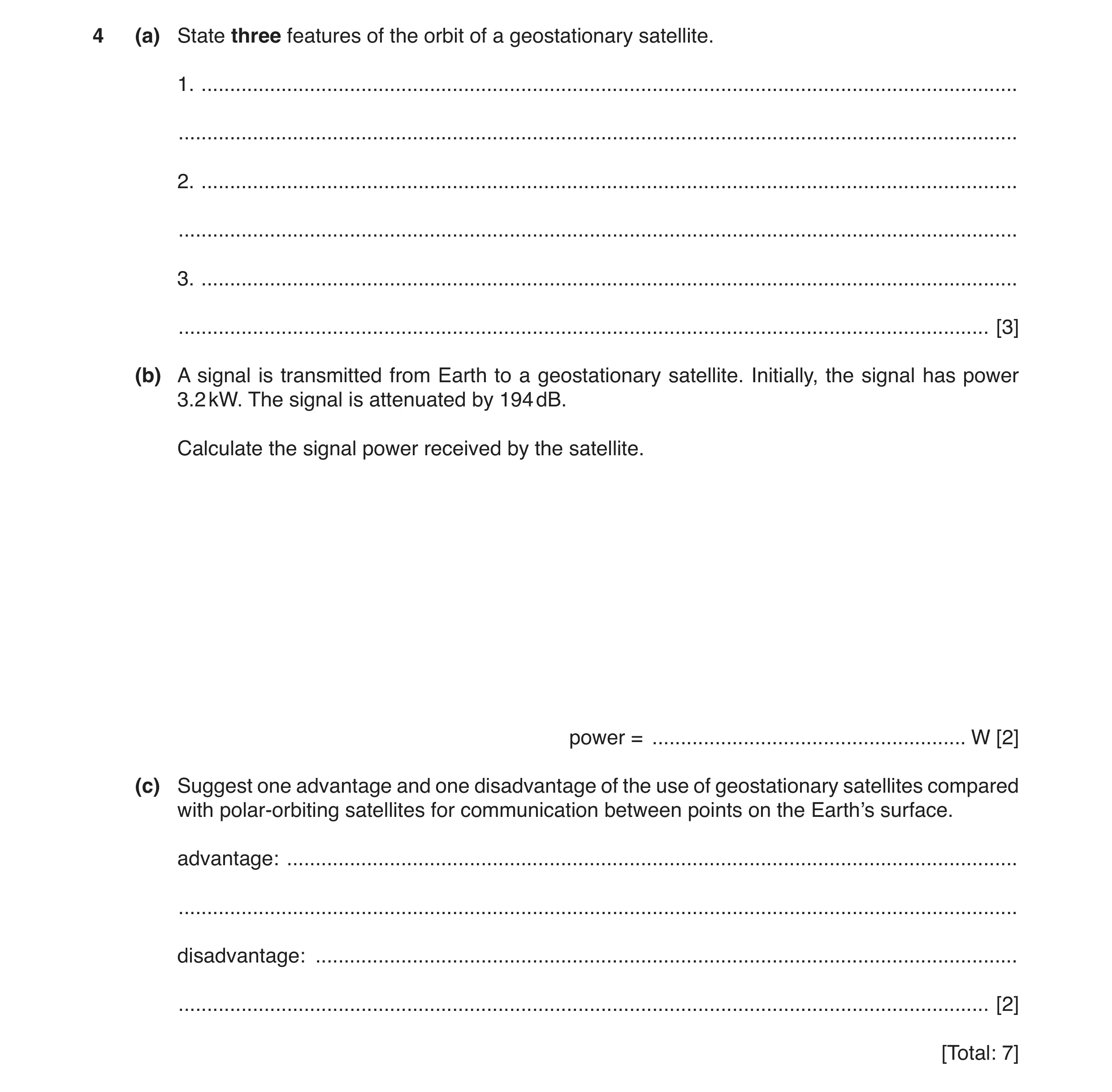
4 (a) State three features of the orbit of a geostationary satellite. 1. … … 2. … … 3. … … [3] (b) A signal is transmitted from Earth to a geostationary satellite. Initially, the signal has power 3.2 kW. The signal is attenuated by 194 dB. Calculate the signal power received by the satellite. power = … W [2] (c) Suggest one advantage and one disadvantage of the use of geostationary satellites compared with polar-orbiting satellites for communication between points on the Earth’s surface. advantage: … … disadvantage: … … [2] [Total: 7]
7 marks
Mark scheme: 4(a) Any three from: above the Equator period 24 hours orbits west to east one particular orbital radius B3 4(b) attenuation = 10 lg(P1 / P2) 194 = 10 lg (3.2 × 10³ / P2) C1 P2 = 1.3 × 10⁻¹⁶ W A1 4(c) advantage: e.g. no tracking required B1 disadvantage: e.g. longer time delay B1
This question in 9702/42 Feb/March 2019
Q8 · State Newton’s law of gravitation 9702/41 Oct/Nov 2019
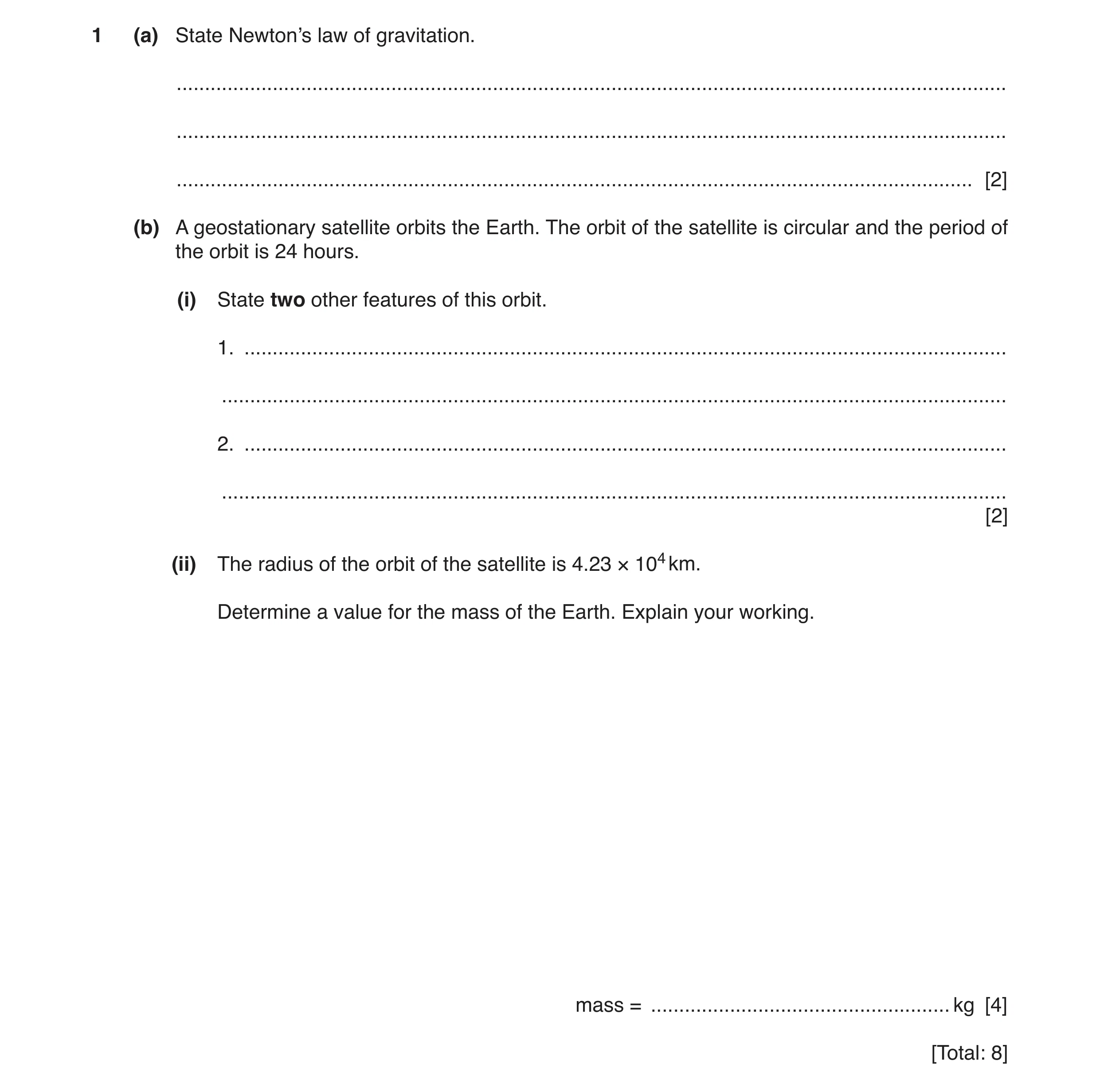
1 (a) State Newton’s law of gravitation. … … … [2] (b) A geostationary satellite orbits the Earth. The orbit of the satellite is circular and the period of the orbit is 24 hours. (i) State two other features of this orbit. 1. … … 2. … … [2] (ii) The radius of the orbit of the satellite is 4.23 × 10⁴ km. Determine a value for the mass of the Earth. Explain your working. mass = … kg [4] [Total: 8]
8 marks
Mark scheme: 1(a) force proportional to product of masses and inversely proportional to square of separation B1 idea of (gravitational) force between point masses B1 1(b)(i) above the equator B1 from west to east B1 1(b)(ii) gravitational force provides/is the centripetal force B1 GM / r2 = r (2π / T)2 C1 (6.67 × 10⁻¹¹ × M) = {(4.23 × 10⁷)3 × 4π2} / (24 × 3600)2 C1 M = 6.0 × 1024 kg A1
This question in 9702/41 Oct/Nov 2019
Q9 · State Newton’s law of gravitation 9702/43 Oct/Nov 2019
1 (a) State Newton’s law of gravitation. … … … [2] (b) A geostationary satellite orbits the Earth. The orbit of the satellite is circular and the period of the orbit is 24 hours. (i) State two other features of this orbit. 1. … … 2. … … [2] (ii) The radius of the orbit of the satellite is 4.23 × 10⁴ km. Determine a value for the mass of the Earth. Explain your working. mass = … kg [4] [Total: 8]
8 marks
Mark scheme: 1(a) force proportional to product of masses and inversely proportional to square of separation B1 idea of (gravitational) force between point masses B1 1(b)(i) above the equator B1 from west to east B1 1(b)(ii) gravitational force provides/is the centripetal force B1 GM / r2 = r (2π / T)2 C1 (6.67 × 10⁻¹¹ × M) = {(4.23 × 10⁷)3 × 4π2} / (24 × 3600)2 C1 M = 6.0 × 1024 kg A1
This question in 9702/43 Oct/Nov 2019
Q10 · Define gravitational potential at a point 9702/42 Feb/March 2020
1 (a) Define gravitational potential at a point. … … … [2] (b) TESS is a satellite of mass 360 kg in a circular orbit about the Earth as shown in Fig. 1.1. Earth satellite TESS radius of orbit radius of Earth 6.4 × 10⁶ m Fig. 1.1 (not to scale) The radius of the Earth is 6.4 × 10⁶ m and the mass of the Earth, considered to be a point mass at its centre, is 6.0 × 1024 kg. (i) It takes TESS 13.7 days to orbit the Earth. Show that the radius of orbit of TESS is 2.4 × 10⁸ m. [3] (ii) Calculate the change in gravitational potential energy between TESS in orbit and TESS on a launch pad on the surface of the Earth. change in gravitational potential energy = … J [3] (iii) Use the information in (b)(i) to calculate the ratio: gravitational field strength on surface of Earth . gravitational field strength at location of TESS in orbit ratio = … [2] [Total: 10]
10 marks
Mark scheme: 1(a) work done per unit mass B1 work done moving mass from infinity (to the point) B1 1(b)(i) gravitational force provides centripetal force C1 mv2 / r = GMm / r2 and v = 2πr / T OR mrω2 = GMm / r2 and ω = 2π / T OR r3 = GMT2 / 4π2 C1 r3 = 6.67 × 10-11 × 6.0 × 1024 × (13.7 × 24 × 3600)2 / 4 π2 so r = 2.4 × 10⁸ m A1 1(b)(ii) (EP = –) GMm / r work done = GMm / r1 – GMm / r2 C1 = 6.67 × 10–11 × 360 × 6.0 × 1024 (1/6.4 × 106 – 1 / 2.4 × 10⁸) C1 = 2.2 × 10¹⁰ J A1 1(b)(iii) g = GM / r2 C1 ratio = rTESS2 / rearth2 = (2.4 × 10⁸ / 6.4 × 10⁶)2 = 1400 A1
This question in 9702/42 Feb/March 2020
Q11 · State what is meant by a gravitational force 9702/41 May/June 2020
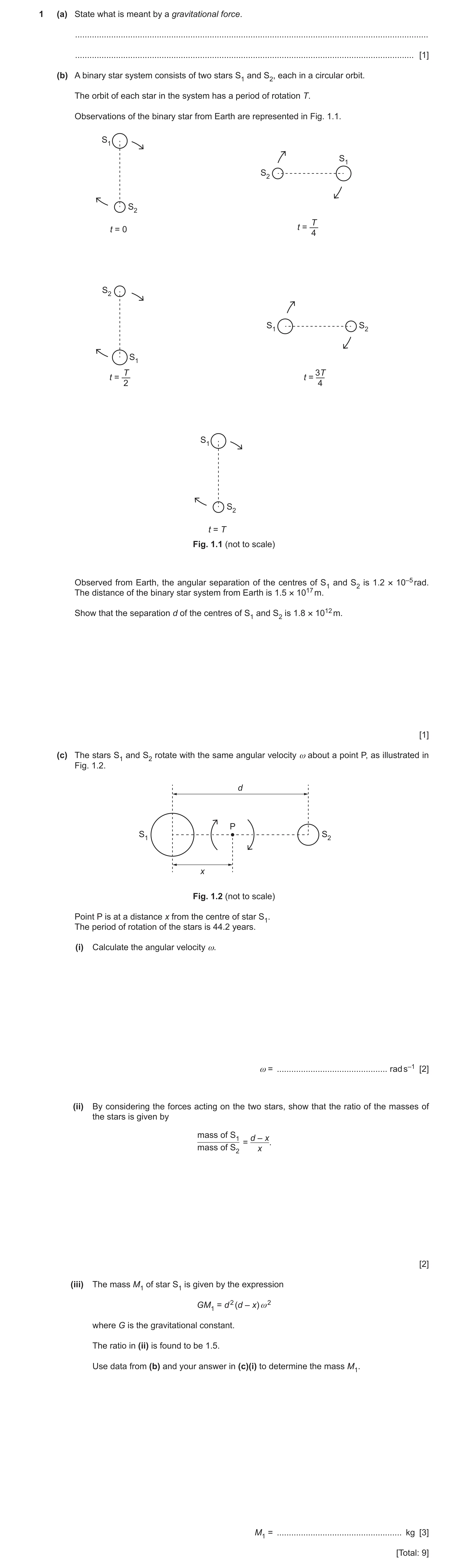
1 (a) State what is meant by a gravitational force. … … [1] (b) A binary star system consists of two stars S1 and S2, each in a circular orbit. The orbit of each star in the system has a period of rotation T. Observations of the binary star from Earth are represented in Fig. 1.1. S1 S1 S2 S2 T t = 0 t = — 4 S2 S1 S2 S1 T 3T t = — t = — 2 4 S1 S2 t = T Fig. 1.1 (not to scale) Observed from Earth, the angular separation of the centres of S1 and S2 is 1.2 × 10⁻⁵ rad. The distance of the binary star system from Earth is 1.5 × 10¹⁷ m. Show that the separation d of the centres of S1 and S2 is 1.8 × 10¹² m. [1] (c) The stars S1 and S2 rotate with the same angular velocity ω about a point P, as illustrated in Fig. 1.2. d P S1 S2 x Fig. 1.2 (not to scale) Point P is at a distance x from the centre of star S1. The period of rotation of the stars is 44.2 years. (i) Calculate the angular velocity ω. ω = … rad s–1 [2] (ii) By considering the forces acting on the two stars, show that the ratio of the masses of the stars is given by mass of S1 d – x = . mass of S2 x [2] (iii) The mass M1 of star S1 is given by the expression GM1 = d 2 (d – x) ω 2 where G is the gravitational constant. The ratio in (ii) is found to be 1.5. Use data from (b) and your answer in (c)(i) to determine the mass M1. M1 = … kg [3] [Total: 9]
9 marks
Mark scheme: 1(a) force acting between two masses or force on mass due to another mass or force on mass in a gravitational field B1 1(b) arc length = rθ d = 1.5 × 1017 × 1.2 × 10–5 = 1.8 × 10¹² m A1 1(c)(i) ω = 2π / T C1 = 2π / (44.2 × 365 × 24 × 3600) = 4.5 × 10⁻⁹ rad s–1 A1 1(c)(ii) gravitational forces are equal or centripetal force about P is the same C1 M1xω2 = M2(d – x)ω2 so M1 / M2 = (d – x) / x A1 1(c)(iii) x = 0.4d C1 6.67 × 10⁻¹¹ × M1 = (1.0 – 0.4) × (1.8 × 1012)3 × (4.5 × 10–9)2 C1 M1 = 1.1 × 1030 kg A1
This question in 9702/41 May/June 2020
Q12 · State what is meant by a gravitational force 9702/43 May/June 2020
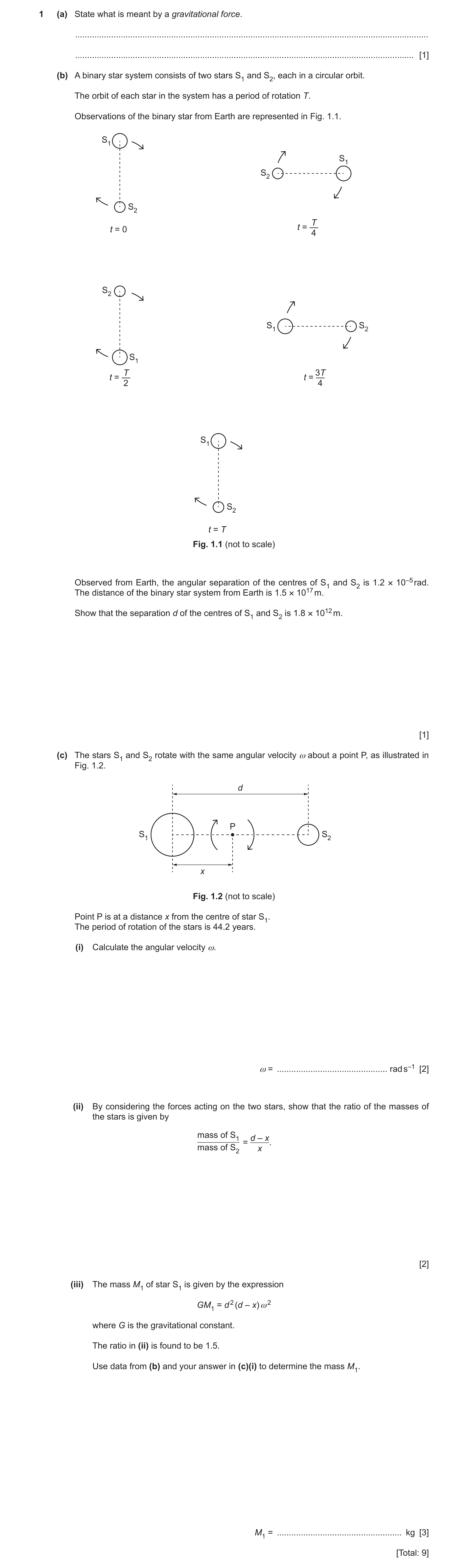
1 (a) State what is meant by a gravitational force. … … [1] (b) A binary star system consists of two stars S1 and S2, each in a circular orbit. The orbit of each star in the system has a period of rotation T. Observations of the binary star from Earth are represented in Fig. 1.1. S1 S1 S2 S2 T t = 0 t = — 4 S2 S1 S2 S1 T 3T t = — t = — 2 4 S1 S2 t = T Fig. 1.1 (not to scale) Observed from Earth, the angular separation of the centres of S1 and S2 is 1.2 × 10⁻⁵ rad. The distance of the binary star system from Earth is 1.5 × 10¹⁷ m. Show that the separation d of the centres of S1 and S2 is 1.8 × 10¹² m. [1] (c) The stars S1 and S2 rotate with the same angular velocity ω about a point P, as illustrated in Fig. 1.2. d P S1 S2 x Fig. 1.2 (not to scale) Point P is at a distance x from the centre of star S1. The period of rotation of the stars is 44.2 years. (i) Calculate the angular velocity ω. ω = … rad s–1 [2] (ii) By considering the forces acting on the two stars, show that the ratio of the masses of the stars is given by mass of S1 d – x = . mass of S2 x [2] (iii) The mass M1 of star S1 is given by the expression GM1 = d 2 (d – x) ω 2 where G is the gravitational constant. The ratio in (ii) is found to be 1.5. Use data from (b) and your answer in (c)(i) to determine the mass M1. M1 = … kg [3] [Total: 9]
9 marks
Mark scheme: 1(a) force acting between two masses or force on mass due to another mass or force on mass in a gravitational field B1 1(b) arc length = rθ d = 1.5 × 1017 × 1.2 × 10–5 = 1.8 × 10¹² m A1 1(c)(i) ω = 2π / T C1 = 2π / (44.2 × 365 × 24 × 3600) = 4.5 × 10⁻⁹ rad s–1 A1 1(c)(ii) gravitational forces are equal or centripetal force about P is the same C1 M1xω2 = M2(d – x)ω2 so M1 / M2 = (d – x) / x A1 1(c)(iii) x = 0.4d C1 6.67 × 10⁻¹¹ × M1 = (1.0 – 0.4) × (1.8 × 1012)3 × (4.5 × 10–9)2 C1 M1 = 1.1 × 1030 kg A1
This question in 9702/43 May/June 2020
Q13 · The Earth may be assumed to be an isolated uniform sphere with its mass of 6.0 × 1024 kg… 9702/41 May/June 2021
1 The Earth may be assumed to be an isolated uniform sphere with its mass of 6.0 × 1024 kg concentrated at its centre. A satellite of mass 1200 kg is in a circular orbit about the Earth in the Earth’s gravitational field. The period of the orbit is 94 minutes. (a) Define gravitational field strength. … … [1] (b) Calculate the radius of the orbit of the satellite. radius = … m [3] (c) Rockets on the satellite are fired so that the satellite enters a different circular orbit that has a period of 150 minutes. The change in the mass of the satellite may be assumed to be negligible. (i) Show that the radius of the new orbit is 9.4 × 10⁶ m. [2] (ii) State, with a reason, whether the gravitational potential energy of the satellite increases or decreases. … … [1] (iii) Determine the magnitude of the change in the gravitational potential energy of the satellite. change in potential energy = … J [3] [Total: 10]
10 marks
Mark scheme: 1(a) force per unit mass B1 1(b) GMm / r 2 = mrω 2 and ω = 2π/T or GMm / r 2 = mv2 / r and v = 2πr / T C1 6.67 × 10–11 × 6.0 × 1024 = r3 × [2π / (94 × 60)]2 C1 r = 6.9 × 10⁶ m A1 1(c)(i) r3ω2 = constant or r3 / T2 = constant C1 r3 / (6.9 × 10⁶)3 = (150 / 94)2 so r = 9.4 × 10⁶ m A1 or GMT2/4π2 = r3 and clear that M is 6.0 × 1024 (C1) 6.67 × 10–11 × 6.0 × 1024 = r3 × [2π / (150 × 60)]2 so r = 9.4 × 10⁶ m (A1) 1(c)(ii) separation increases so (potential energy) increases or movement is against gravitational force so (potential energy) increases B1 1(c)(iii) potential energy = (–)GMm / r C1 ΔEP = 6.67 × 10–11 × 6.0 × 1024 × 1200 × [(6.9 × 10⁶)–1 – (9.4 × 10⁶)–1] C1 = 1.9 × 10¹⁰ J A1
This question in 9702/41 May/June 2021
Q14 · The Earth may be assumed to be an isolated uniform sphere with its mass of 6.0 × 1024 kg… 9702/43 May/June 2021
1 The Earth may be assumed to be an isolated uniform sphere with its mass of 6.0 × 1024 kg concentrated at its centre. A satellite of mass 1200 kg is in a circular orbit about the Earth in the Earth’s gravitational field. The period of the orbit is 94 minutes. (a) Define gravitational field strength. … … [1] (b) Calculate the radius of the orbit of the satellite. radius = … m [3] (c) Rockets on the satellite are fired so that the satellite enters a different circular orbit that has a period of 150 minutes. The change in the mass of the satellite may be assumed to be negligible. (i) Show that the radius of the new orbit is 9.4 × 10⁶ m. [2] (ii) State, with a reason, whether the gravitational potential energy of the satellite increases or decreases. … … [1] (iii) Determine the magnitude of the change in the gravitational potential energy of the satellite. change in potential energy = … J [3] [Total: 10]
10 marks
Mark scheme: 1(a) force per unit mass B1 1(b) GMm / r 2 = mrω 2 and ω = 2π/T or GMm / r 2 = mv2 / r and v = 2πr / T C1 6.67 × 10–11 × 6.0 × 1024 = r3 × [2π / (94 × 60)]2 C1 r = 6.9 × 10⁶ m A1 1(c)(i) r3ω2 = constant or r3 / T2 = constant C1 r3 / (6.9 × 10⁶)3 = (150 / 94)2 so r = 9.4 × 10⁶ m A1 or GMT2/4π2 = r3 and clear that M is 6.0 × 1024 (C1) 6.67 × 10–11 × 6.0 × 1024 = r3 × [2π / (150 × 60)]2 so r = 9.4 × 10⁶ m (A1) 1(c)(ii) separation increases so (potential energy) increases or movement is against gravitational force so (potential energy) increases B1 1(c)(iii) potential energy = (–)GMm / r C1 ΔEP = 6.67 × 10–11 × 6.0 × 1024 × 1200 × [(6.9 × 10⁶)–1 – (9.4 × 10⁶)–1] C1 = 1.9 × 10¹⁰ J A1
This question in 9702/43 May/June 2021
Q15 · With reference to velocity and acceleration, describe uniform circular motion 9702/41 Oct/Nov 2021
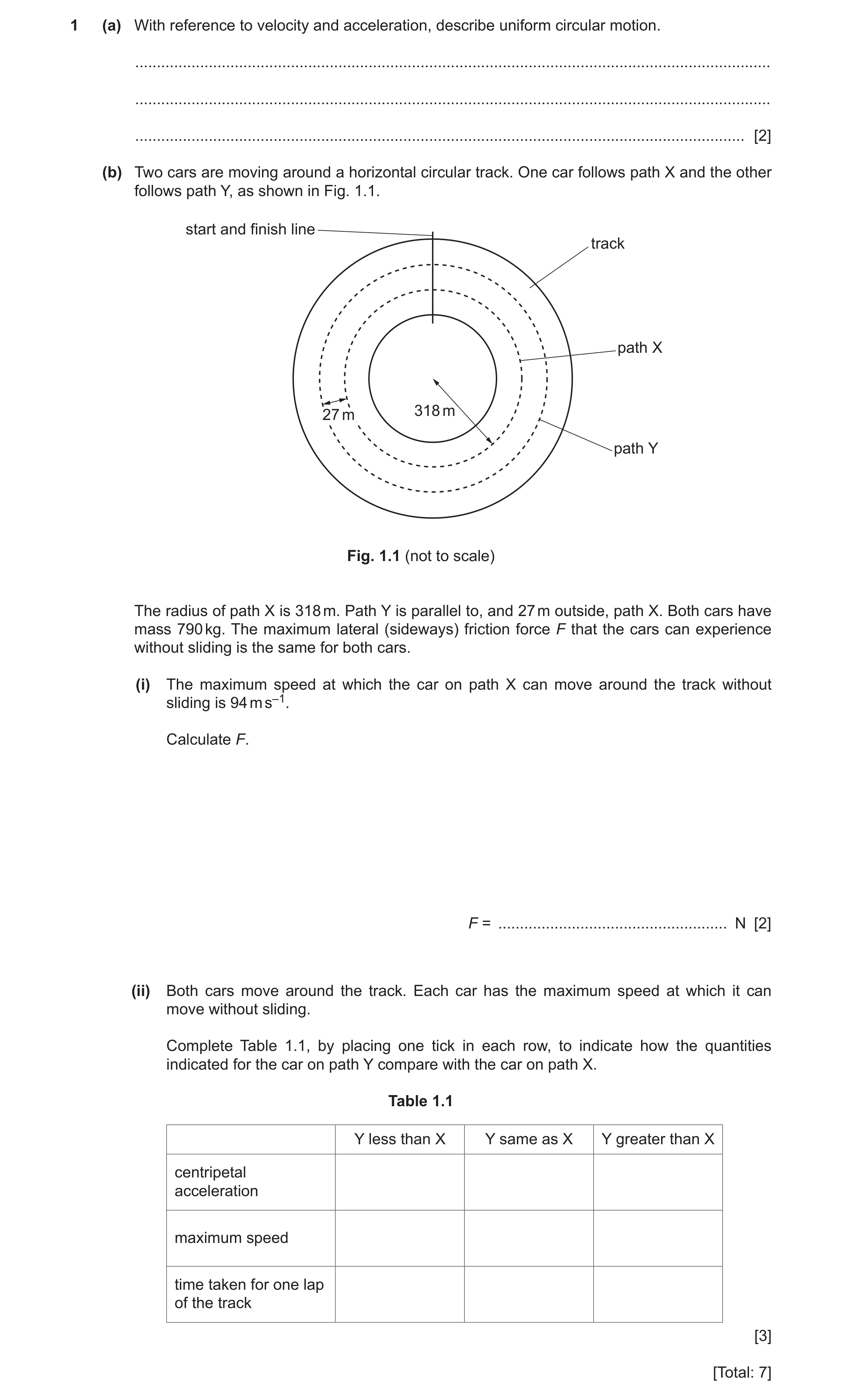
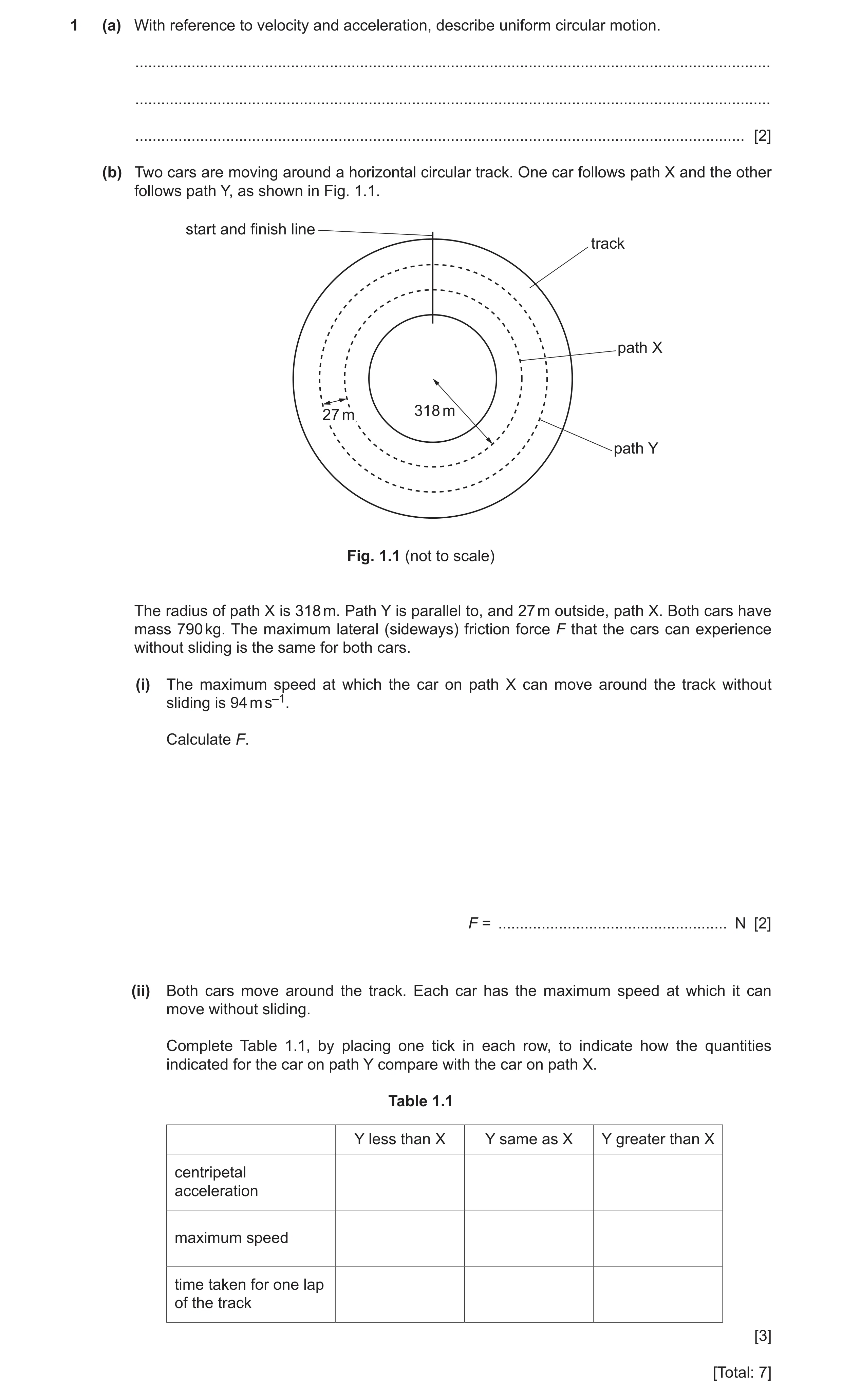
1 (a) With reference to velocity and acceleration, describe uniform circular motion. … … … [2] (b) Two cars are moving around a horizontal circular track. One car follows path X and the other follows path Y, as shown in Fig. 1.1. start and finish line track path X 318 m 27 m path Y Fig. 1.1 (not to scale) The radius of path X is 318 m. Path Y is parallel to, and 27 m outside, path X. Both cars have mass 790 kg. The maximum lateral (sideways) friction force F that the cars can experience without sliding is the same for both cars. (i) The maximum speed at which the car on path X can move around the track without sliding is 94 m s–1. Calculate F. F = … N [2] (ii) Both cars move around the track. Each car has the maximum speed at which it can move without sliding. Complete Table 1.1, by placing one tick in each row, to indicate how the quantities indicated for the car on path Y compare with the car on path X. Table 1.1 Y less than X Y same as X Y greater than X centripetal acceleration maximum speed time taken for one lap of the track [3] [Total: 7]
7 marks
Mark scheme: 1(a) constant speed or constant magnitude of velocity B1 acceleration (always) perpendicular to velocity B1 1(b)(i) F = mv2 / r or v = rω and F = mrω2 C1 F = 790 × 942 / 318 = 22 000 N A1 1(b)(ii) centripetal acceleration: same B1 maximum speed: greater B1 time taken for one lap of the track: greater B1
This question in 9702/41 Oct/Nov 2021
Q16 · With reference to velocity and acceleration, describe uniform circular motion 9702/43 Oct/Nov 2021
1 (a) With reference to velocity and acceleration, describe uniform circular motion. … … … [2] (b) Two cars are moving around a horizontal circular track. One car follows path X and the other follows path Y, as shown in Fig. 1.1. start and finish line track path X 318 m 27 m path Y Fig. 1.1 (not to scale) The radius of path X is 318 m. Path Y is parallel to, and 27 m outside, path X. Both cars have mass 790 kg. The maximum lateral (sideways) friction force F that the cars can experience without sliding is the same for both cars. (i) The maximum speed at which the car on path X can move around the track without sliding is 94 m s–1. Calculate F. F = … N [2] (ii) Both cars move around the track. Each car has the maximum speed at which it can move without sliding. Complete Table 1.1, by placing one tick in each row, to indicate how the quantities indicated for the car on path Y compare with the car on path X. Table 1.1 Y less than X Y same as X Y greater than X centripetal acceleration maximum speed time taken for one lap of the track [3] [Total: 7]
7 marks
Mark scheme: 1(a) constant speed or constant magnitude of velocity B1 acceleration (always) perpendicular to velocity B1 1(b)(i) F = mv2 / r or v = rω and F = mrω2 C1 F = 790 × 942 / 318 = 22 000 N A1 1(b)(ii) centripetal acceleration: same B1 maximum speed: greater B1 time taken for one lap of the track: greater B1
This question in 9702/43 Oct/Nov 2021
Q17 · The point P in Fig 9702/42 Feb/March 2022
1 (a) The point P in Fig. 1.1 represents a point mass. On Fig. 1.1, draw lines to represent the gravitational field around P. P Fig. 1.1 [2] (b) A moon is in circular orbit around a planet. Explain why the path of the moon is circular. … … … … [2] (c) Many moons are in circular orbit about a planet. The angular velocity of a moon is ω when the orbit of the moon has a radius r about the planet. Fig. 1.2 shows the variation of r 3 with 1 / ω2 for these moons. 4 r3 / 1023 m3 3 2 1 0 0 1 2 3 4 5 6 1 2 / 107 rad–2 s2 ω Fig. 1.2 (i) Show that the mass M of the planet is given by the expression gradient M = G where G is the gravitational constant. [2] (ii) Use Fig. 1.2 and the expression in (c)(i) to show that the mass M of the planet is 1.0 × 1026 kg. [1] (iii) Determine the speed of a moon in orbit around the planet with an orbital radius of 1.2 × 10⁸ m. speed = … m s–1 [3] [Total: 10]
10 marks
Mark scheme: 1(a) at least 4 straight radial lines to P B1 all arrows pointing along the lines towards P B1 1(b) Any 2 from: gravitational force provides the centripetal force (centripetal or gravitational) force has constant magnitude (centripetal or gravitational) force is perpendicular to velocity (of moon) / direction of motion (of moon) B2 1(c)(i) 2 2 GMm = mr r ω M1 3 2 r M= G ω and gradient = 3 2 r ω hence gradient M G = or r3 = GM × 1/ω2 so gradient = GM hence gradient M G = A1 1(c)(ii) M = 4.1 × 10²³ / (6.0 × 107 × 6.67 × 10–11) = 1.0 × 1026 kg B1 Question Answer Marks 1(c)(iii) 2 2 GMm mv = r r 2 GM= v r C1 11 26 2 8 6.67 10 1.0 10 v = 1.2 10 − × × × × 2 7 1 v 5.6 10 m s− = × C1 1 v =7500 m s− A1
This question in 9702/42 Feb/March 2022
Question 18 9702/42 May/June 2022
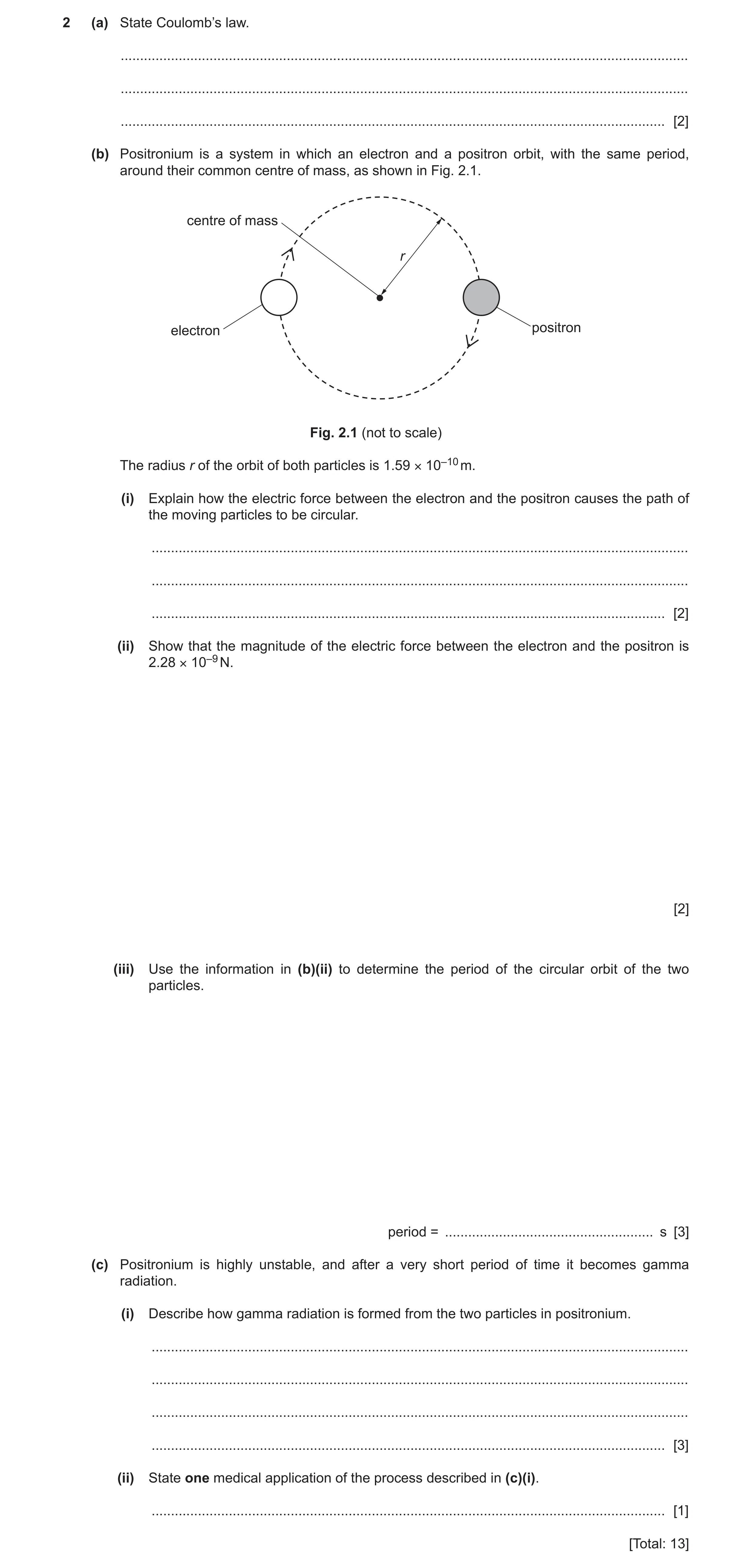
2 (a) State Coulomb’s law. … … … [2] (b) Positronium is a system in which an electron and a positron orbit, with the same period, around their common centre of mass, as shown in Fig. 2.1. centre of mass r electron positron Fig. 2.1 (not to scale) The radius r of the orbit of both particles is 1.59 × 10⁻¹⁰ m. (i) Explain how the electric force between the electron and the positron causes the path of the moving particles to be circular. … … … [2] (ii) Show that the magnitude of the electric force between the electron and the positron is 2.28 × 10⁻⁹ N. [2] (iii) Use the information in (b)(ii) to determine the period of the circular orbit of the two particles. period = … s [3] (c) Positronium is highly unstable, and after a very short period of time it becomes gamma radiation. (i) Describe how gamma radiation is formed from the two particles in positronium. … … … … [3] (ii) State one medical application of the process described in (c)(i). … [1] [Total: 13]
13 marks
Mark scheme: 2(a) (electric) force is (directly) proportional to product of charges B1 force (between point charges) is inversely proportional to the square of their separation B1 2(b)(i) (electric) force is perpendicular to velocity (of particles) B1 force (perpendicular to velocity) causes centripetal acceleration or force does not change the speed of the particles or force has constant magnitude B1 2(b)(ii) F = e2 / 40x2 C1 = (1.60 10–19)2 / [4 8.85 10–12 (2 1.59 10–10)2] = 2.28 10–9 N A1 2(b)(iii) F = mr2 and = 2 / T or F = mv2 / r and v = 2r / T C1 F = 42mr / T2 T = √ [42 9.11 10–31 1.59 10–10 / (2.28 10–9)] C1 = 1.58 10–15 s A1 2(c)(i) electron and positron interact positron is anti-particle of electron (pair) annihilation occurs Any two points, 1 mark each B2 mass of the electron and positron converted into photon energy B1 2(c)(ii) PET scanning B1
This question in 9702/42 May/June 2022
Q19 · State the equation for the gravitational force F between two point masses m1 and m2 that… 9702/41 Oct/Nov 2022
1 (a) State the equation for the gravitational force F between two point masses m1 and m2 that are separated by a distance r. State the meaning of any other symbols you use. [2] (b) A satellite is in a circular orbit of radius R around a planet of mass M. Show that the period T of the orbit is given by T 2 = kR3 where k is a constant that depends on the value of M. Explain your reasoning. [3] (c) A satellite is in a circular orbit around the Earth with a period of 24 hours. The mass of the Earth is 6.0 × 1024 kg. (i) Calculate the radius of the orbit. radius = … m [2] (ii) State the two other conditions that must be met for the orbit to be geostationary. 1 … … 2 … … [2] [Total: 9]
9 marks
Mark scheme: Question Answer Marks 1(a) F = (Gm1m2) / r 2 M1 where G is the gravitational constant A1 1(b) gravitational force provides the centripetal force B1 mR 2 = GMm / R 2 and = 2 / T M1 or mv 2 / R = GMm / R 2 and v = 2R / T or 42mR / T 2 = GMm / R 2 correct completion of algebra to get T2 = (42 / GM) R3, with identification of (42 / GM) as k A1 1(c)(i) (24 3600)2 = (42 R3) / (6.67 10–11 6.0 1024) C1 R = 4.2 107 m A1 1(c)(ii) (orbit) must be above the Equator B1 (direction) must be from west to east B1
This question in 9702/41 Oct/Nov 2022
Q20 · State the equation for the gravitational force F between two point masses m1 and m2 that… 9702/43 Oct/Nov 2022
1 (a) State the equation for the gravitational force F between two point masses m1 and m2 that are separated by a distance r. State the meaning of any other symbols you use. [2] (b) A satellite is in a circular orbit of radius R around a planet of mass M. Show that the period T of the orbit is given by T 2 = kR3 where k is a constant that depends on the value of M. Explain your reasoning. [3] (c) A satellite is in a circular orbit around the Earth with a period of 24 hours. The mass of the Earth is 6.0 × 1024 kg. (i) Calculate the radius of the orbit. radius = … m [2] (ii) State the two other conditions that must be met for the orbit to be geostationary. 1 … … 2 … … [2] [Total: 9]
9 marks
Mark scheme: Question Answer Marks 1(a) F = (Gm1m2) / r 2 M1 where G is the gravitational constant A1 1(b) gravitational force provides the centripetal force B1 mR 2 = GMm / R 2 and = 2 / T M1 or mv 2 / R = GMm / R 2 and v = 2R / T or 42mR / T 2 = GMm / R 2 correct completion of algebra to get T2 = (42 / GM) R3, with identification of (42 / GM) as k A1 1(c)(i) (24 3600)2 = (42 R3) / (6.67 10–11 6.0 1024) C1 R = 4.2 107 m A1 1(c)(ii) (orbit) must be above the Equator B1 (direction) must be from west to east B1
This question in 9702/43 Oct/Nov 2022
Q21 · A steel sphere of mass 0.29 kg is suspended in equilibrium from a vertical spring 9702/41 May/June 2023
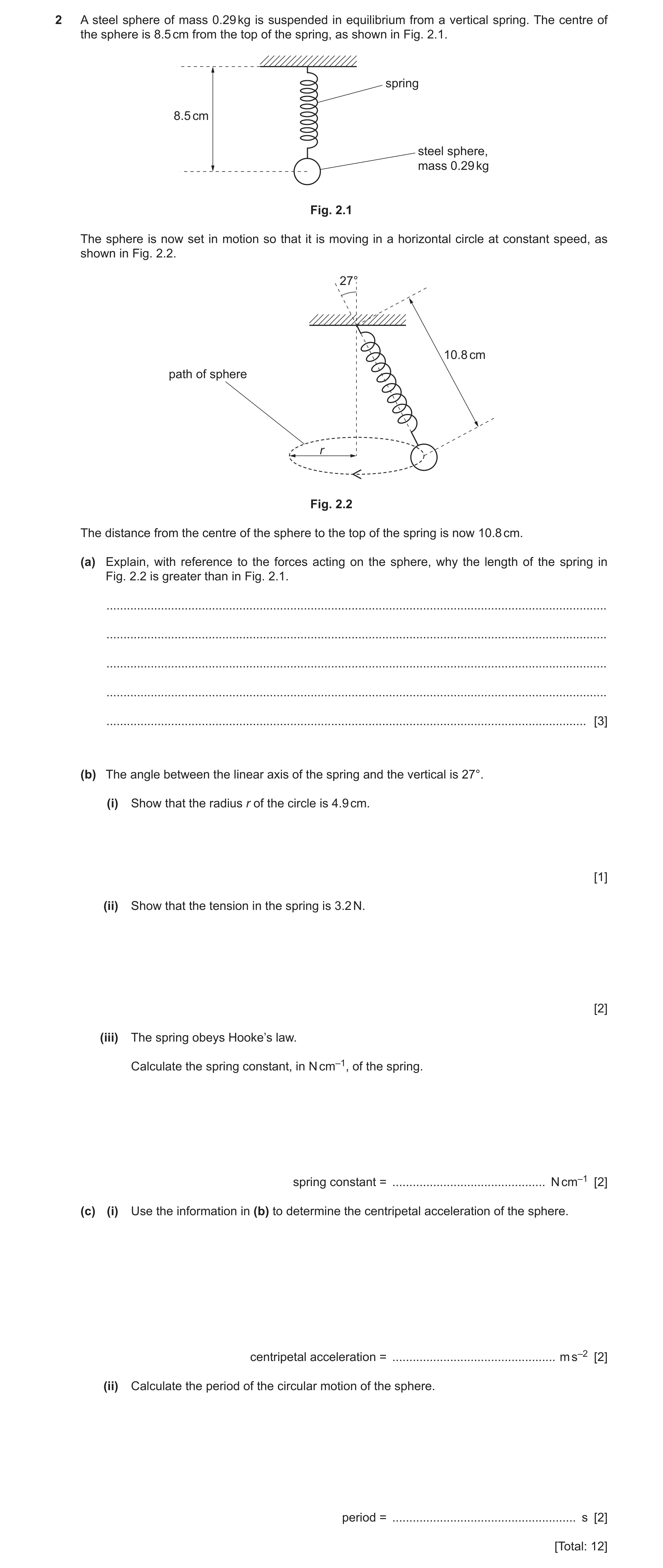
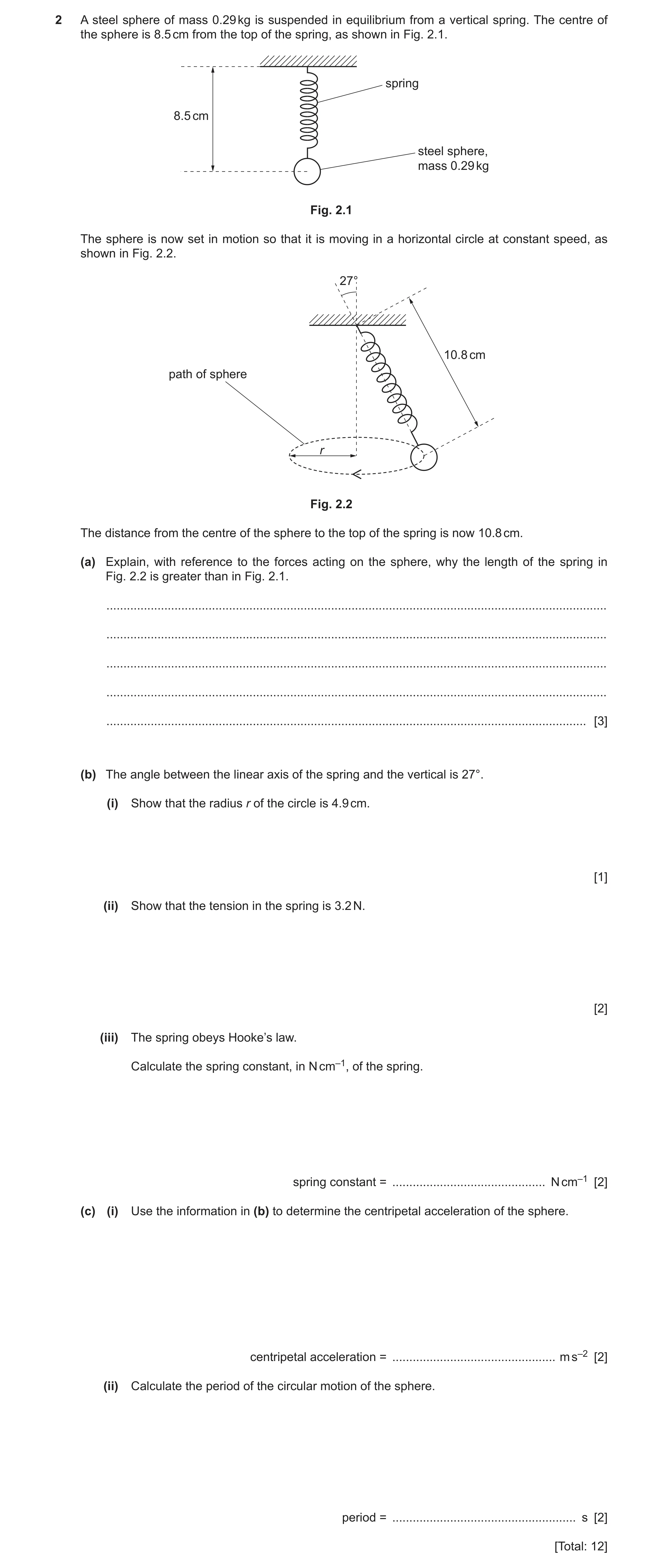
2 A steel sphere of mass 0.29 kg is suspended in equilibrium from a vertical spring. The centre of the sphere is 8.5 cm from the top of the spring, as shown in Fig. 2.1. spring 8.5 cm steel sphere, mass 0.29 kg Fig. 2.1 The sphere is now set in motion so that it is moving in a horizontal circle at constant speed, as shown in Fig. 2.2. 27° 10.8 cm path of sphere r Fig. 2.2 The distance from the centre of the sphere to the top of the spring is now 10.8 cm. (a) Explain, with reference to the forces acting on the sphere, why the length of the spring in Fig. 2.2 is greater than in Fig. 2.1. … … … … … [3] (b) The angle between the linear axis of the spring and the vertical is 27°. (i) Show that the radius r of the circle is 4.9 cm. [1] (ii) Show that the tension in the spring is 3.2 N. [2] (iii) The spring obeys Hooke’s law. Calculate the spring constant, in N cm–1, of the spring. spring constant = … N cm–1 [2] (c) (i) Use the information in (b) to determine the centripetal acceleration of the sphere. centripetal acceleration = … m s–2 [2] (ii) Calculate the period of the circular motion of the sphere. period = … s [2] [Total: 12]
12 marks
Mark scheme: 2(a) horizontal force on sphere causes centripetal acceleration B1 weight of sphere is (now) equal to vertical component of tension or horizontal and vertical components (of force) (now) combine to give greater tension (in spring) B1 greater tension in spring so greater extension of spring B1 2(b)(i) r = 10.8 sin 27° = 4.9 cm A1 2(b)(ii) T cos = mg or T cos = W and W = mg C1 T cos 27° = 0.29 9.81 leading to T = 3.2 N A1 2(b)(iii) T = 3.2 – (0.29 9.81) C1 k = T / x = [3.2 – (0.29 9.81)] / [10.8 – 8.5] = 0.15 N cm–1 A1 2(c)(i) centripetal acceleration = (T sin ) / m = (3.2 sin 27°) / 0.29 C1 = 5.0 m s–2 A1 Question Answer Marks 2(c)(ii) a = r2 and = 2 / T or a = v2 / r and v = 2r / T C1 T = 2 √(0.049 / 5.0) = 0.62 s A1
This question in 9702/41 May/June 2023
Q22 · State Newton’s law of gravitation 9702/42 May/June 2023
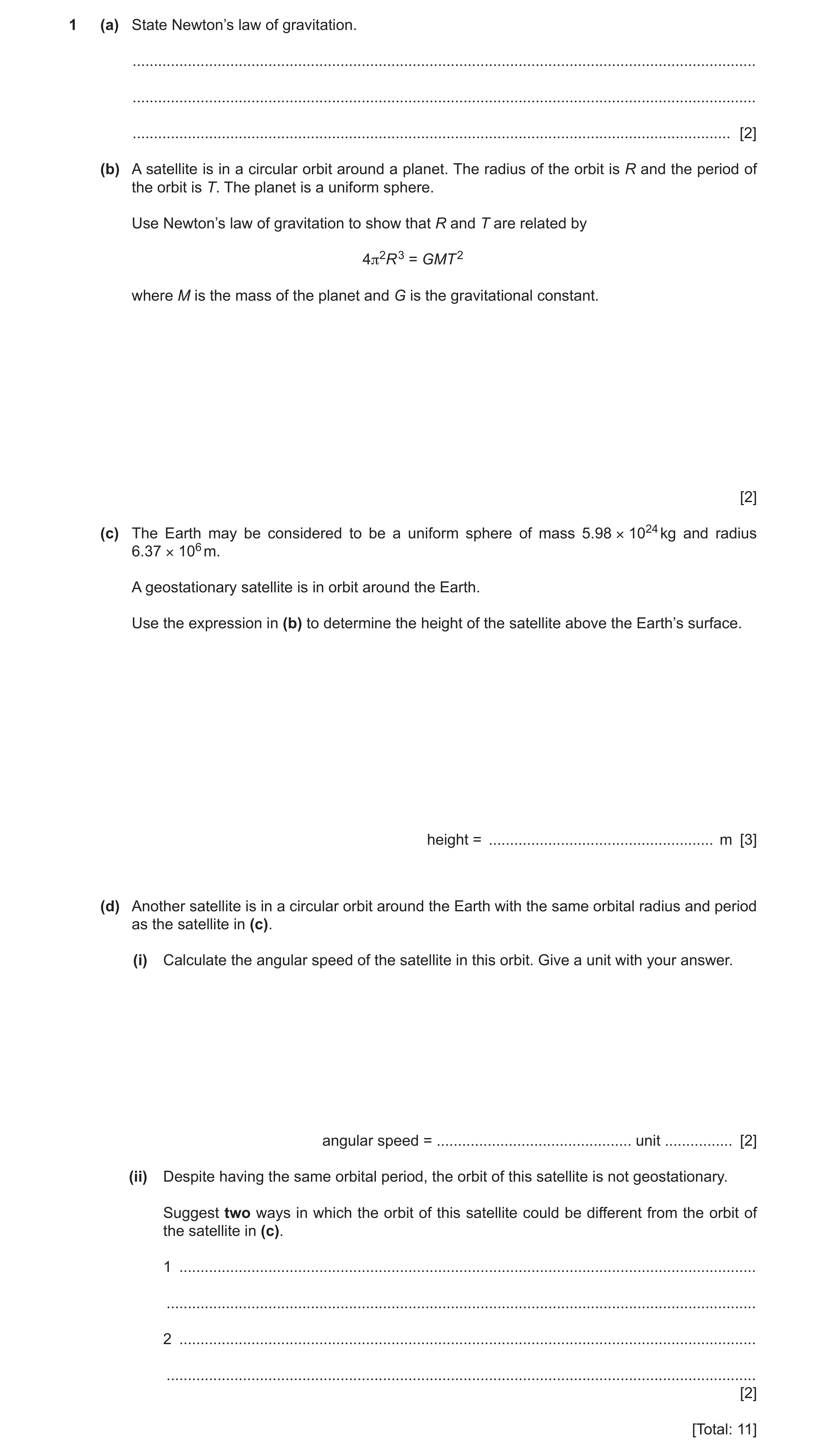
1 (a) State Newton’s law of gravitation. … … … [2] (b) A satellite is in a circular orbit around a planet. The radius of the orbit is R and the period of the orbit is T. The planet is a uniform sphere. Use Newton’s law of gravitation to show that R and T are related by 4π2R 3 = GMT 2 where M is the mass of the planet and G is the gravitational constant. [2] (c) The Earth may be considered to be a uniform sphere of mass 5.98 × 1024 kg and radius 6.37 × 10⁶ m. A geostationary satellite is in orbit around the Earth. Use the expression in (b) to determine the height of the satellite above the Earth’s surface. height = … m [3] (d) Another satellite is in a circular orbit around the Earth with the same orbital radius and period as the satellite in (c). (i) Calculate the angular speed of the satellite in this orbit. Give a unit with your answer. angular speed = … unit … [2] (ii) Despite having the same orbital period, the orbit of this satellite is not geostationary. Suggest two ways in which the orbit of this satellite could be different from the orbit of the satellite in (c). 1 … … 2 … … [2] [Total: 11]
11 marks
Mark scheme: 1(a) (gravitational) force is (directly) proportional to product of masses B1 force (between point masses) is inversely proportional to the square of their separation B1 1(b) GMm / R2 = mR2 M1 = 2 / T and algebra leading to 42R3 = GMT2 A1 or GMm / R2 = mv2 / R (M1) v = 2R / T and algebra leading to 42R3 = GMT2 (A1) 1(c) 42 R3 = 6.67 10–11 5.98 1024 (24 60 60)2 (R = 4.22 107 m) C1 h = R – (6.37 106) C1 h = (4.22 107) – (6.37 106) = 3.6 107 m A1 1(d)(i) = 2 / T C1 = 2 / (24 60 60) = 7.3 10–5 rad s–1 A1 1(d)(ii) orbit is from east to west B1 orbit is not equatorial / orbit is polar B1
This question in 9702/42 May/June 2023
Q23 · A steel sphere of mass 0.29 kg is suspended in equilibrium from a vertical spring 9702/43 May/June 2023
2 A steel sphere of mass 0.29 kg is suspended in equilibrium from a vertical spring. The centre of the sphere is 8.5 cm from the top of the spring, as shown in Fig. 2.1. spring 8.5 cm steel sphere, mass 0.29 kg Fig. 2.1 The sphere is now set in motion so that it is moving in a horizontal circle at constant speed, as shown in Fig. 2.2. 27° 10.8 cm path of sphere r Fig. 2.2 The distance from the centre of the sphere to the top of the spring is now 10.8 cm. (a) Explain, with reference to the forces acting on the sphere, why the length of the spring in Fig. 2.2 is greater than in Fig. 2.1. … … … … … [3] (b) The angle between the linear axis of the spring and the vertical is 27°. (i) Show that the radius r of the circle is 4.9 cm. [1] (ii) Show that the tension in the spring is 3.2 N. [2] (iii) The spring obeys Hooke’s law. Calculate the spring constant, in N cm–1, of the spring. spring constant = … N cm–1 [2] (c) (i) Use the information in (b) to determine the centripetal acceleration of the sphere. centripetal acceleration = … m s–2 [2] (ii) Calculate the period of the circular motion of the sphere. period = … s [2] [Total: 12]
12 marks
Mark scheme: 2(a) horizontal force on sphere causes centripetal acceleration B1 weight of sphere is (now) equal to vertical component of tension or horizontal and vertical components (of force) (now) combine to give greater tension (in spring) B1 greater tension in spring so greater extension of spring B1 2(b)(i) r = 10.8 sin 27° = 4.9 cm A1 2(b)(ii) T cos = mg or T cos = W and W = mg C1 T cos 27° = 0.29 9.81 leading to T = 3.2 N A1 2(b)(iii) T = 3.2 – (0.29 9.81) C1 k = T / x = [3.2 – (0.29 9.81)] / [10.8 – 8.5] = 0.15 N cm–1 A1 2(c)(i) centripetal acceleration = (T sin ) / m = (3.2 sin 27°) / 0.29 C1 = 5.0 m s–2 A1 Question Answer Marks 2(c)(ii) a = r2 and = 2 / T or a = v2 / r and v = 2r / T C1 T = 2 √(0.049 / 5.0) = 0.62 s A1
This question in 9702/43 May/June 2023
Question 24 9702/42 Oct/Nov 2023
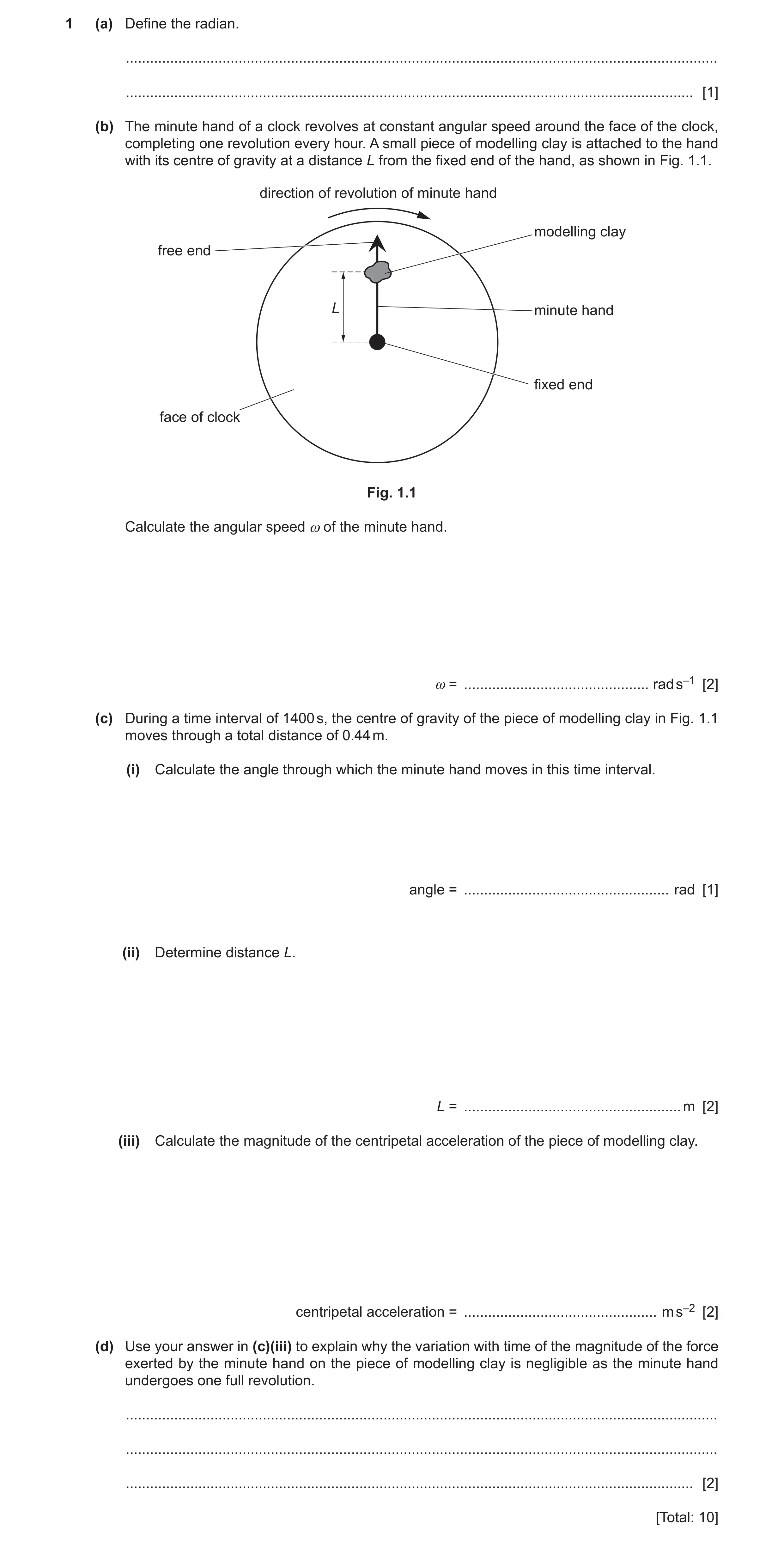
1 (a) Define the radian. … … [1] (b) The minute hand of a clock revolves at constant angular speed around the face of the clock, completing one revolution every hour. A small piece of modelling clay is attached to the hand with its centre of gravity at a distance L from the fixed end of the hand, as shown in Fig. 1.1. direction of revolution of minute hand modelling clay free end L minute hand fixed end face of clock Fig. 1.1 Calculate the angular speed ω of the minute hand. ω = … rad s–1 [2] (c) During a time interval of 1400 s, the centre of gravity of the piece of modelling clay in Fig. 1.1 moves through a total distance of 0.44 m. (i) Calculate the angle through which the minute hand moves in this time interval. angle = … rad [1] (ii) Determine distance L. L = … m [2] (iii) Calculate the magnitude of the centripetal acceleration of the piece of modelling clay. centripetal acceleration = … m s–2 [2] (d) Use your answer in (c)(iii) to explain why the variation with time of the magnitude of the force exerted by the minute hand on the piece of modelling clay is negligible as the minute hand undergoes one full revolution. … … … [2] [Total: 10]
10 marks
Mark scheme: Question Answer Marks 1(a) angle (subtended at centre of circle) when arc length = radius B1 1(b) = 2 / T C1 = 2 / (1.0 60 60) A1 = 1.7 10–3 rad s–1 1(c)(i) angle = 1.7 10–3 1400 A1 = 2.4 rad 1(c)(ii) L = arc length / angle C1 = 0.44 / 2.4 or L = 0.44 (3600 / 1400) / 2 L = 0.18 m A1 1(c)(iii) a = r2 C1 = 0.18 (1.745 10–3)2 A1 = 5.5 10–7 m s–2 1(d) centripetal acceleration is negligible compared with acceleration of free fall B1 or numerical comparison establishing answer to (c)(iii) ≪ 9.81 resultant force is negligible compared with weight (of modelling clay) (so variation is negligible) B1 or force exerted by minute hand (approximately) equal (and opposite) to weight of modelling clay
This question in 9702/42 Oct/Nov 2023
Question 25 9702/42 May/June 2024
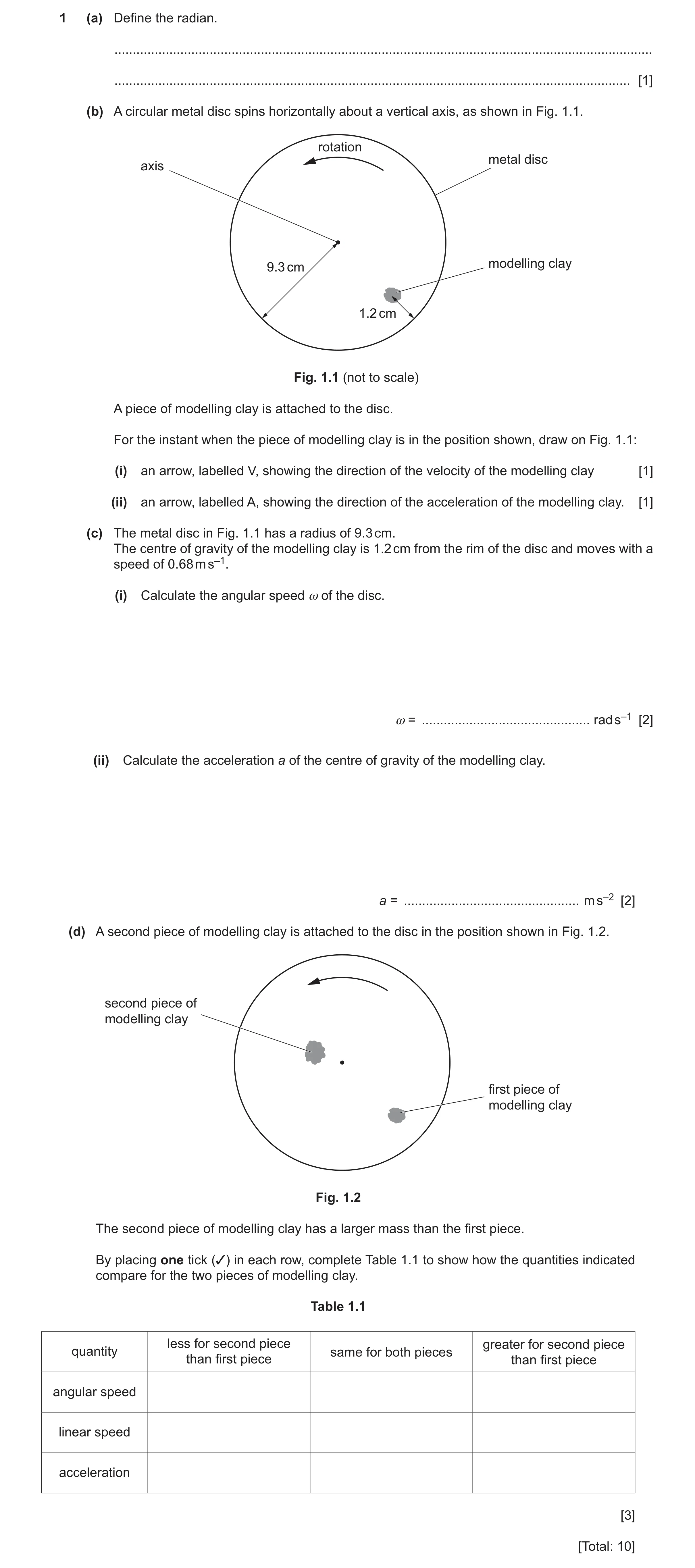
1 (a) Define the radian. … … [1] (b) A circular metal disc spins horizontally about a vertical axis, as shown in Fig. 1.1. rotation metal disc axis modelling clay 9.3 cm 1.2 cm Fig. 1.1 (not to scale) A piece of modelling clay is attached to the disc. For the instant when the piece of modelling clay is in the position shown, draw on Fig. 1.1: (i) an arrow, labelled V, showing the direction of the velocity of the modelling clay [1] (ii) an arrow, labelled A, showing the direction of the acceleration of the modelling clay. [1] (c) The metal disc in Fig. 1.1 has a radius of 9.3 cm. The centre of gravity of the modelling clay is 1.2 cm from the rim of the disc and moves with a speed of 0.68 m s–1. (i) Calculate the angular speed ω of the disc. ω = … rad s–1 [2] (ii) Calculate the acceleration a of the centre of gravity of the modelling clay. a = … m s–2 [2] (d) A second piece of modelling clay is attached to the disc in the position shown in Fig. 1.2. second piece of modelling clay first piece of modelling clay Fig. 1.2 The second piece of modelling clay has a larger mass than the first piece. By placing one tick (3) in each row, complete Table 1.1 to show how the quantities indicated compare for the two pieces of modelling clay. Table 1.1 less for second piece greater for second piece quantity same for both pieces than first piece than first piece angular speed linear speed acceleration [3] [Total: 10]
10 marks
Mark scheme: 1(a) angle (subtended at the centre of a circle) when arc (length) = radius B1 1(b)(i) arrow, labelled V, pointing in NE direction B1 1(b)(ii) arrow, labelled A, pointing in NW direction B1 1(c)(i) v = r C1 = 0.68 / (0.093 – 0.012) = 8.4 rad s–1 A1 1(c)(ii) a = v2 / r or a = r2 C1 a = 0.682 / (0.093 – 0.012) or (0.093 – 0.012) 8.42 = 5.7 m s–2 A1 1(d) angular speed: same for both pieces B1 linear speed: less for second piece than first piece B1 acceleration: less for second piece than first piece B1
This question in 9702/42 May/June 2024
Q26 · State Newton’s law of gravitation 9702/41 Oct/Nov 2024
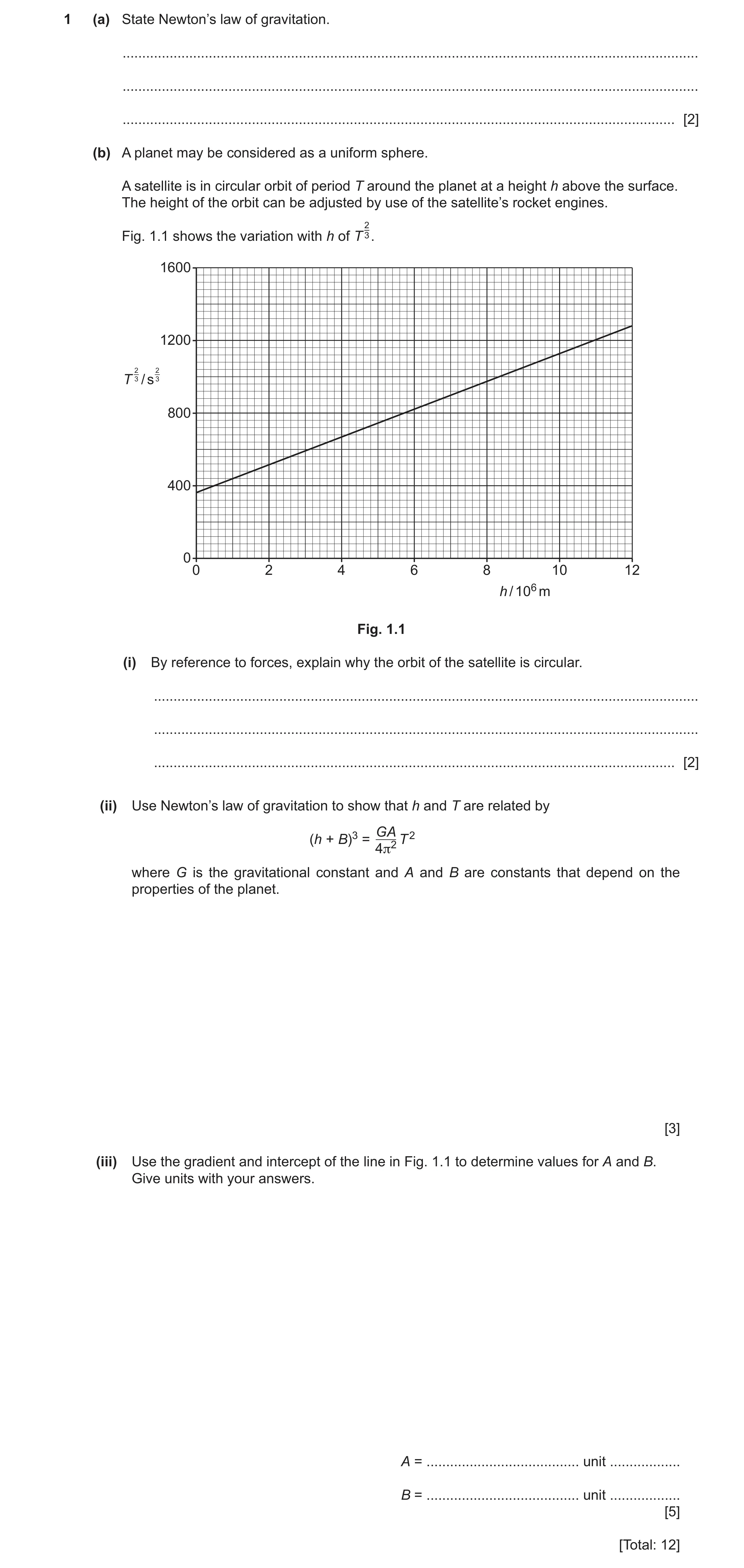
1 (a) State Newton’s law of gravitation. … … … [2] (b) A planet may be considered as a uniform sphere. A satellite is in circular orbit of period T around the planet at a height h above the surface. The height of the orbit can be adjusted by use of the satellite’s rocket engines. 2 Fig. 1.1 shows the variation with h of T 3 . 1600 1200 2 2 T 3 /s 3 800 400 0 0 2 4 6 8 10 12 h / 106 m Fig. 1.1 (i) By reference to forces, explain why the orbit of the satellite is circular. … … … [2] (ii) Use Newton’s law of gravitation to show that h and T are related by GA 2 (h + B)3 = T 4π2 where G is the gravitational constant and A and B are constants that depend on the properties of the planet. [3] (iii) Use the gradient and intercept of the line in Fig. 1.1 to determine values for A and B. Give units with your answers. A = … unit … B = … unit … [5] [Total: 12]
12 marks
Mark scheme: Question Answer Marks 1(a) (gravitational) force is (directly) proportional to product of masses B1 force (between point masses) is inversely proportional to the square of their separation B1 1(b)(i) (gravitational) force acts perpendicular to direction of motion B1 gravitational force provides centripetal acceleration B1 1(b)(ii) (F =) GMm / x2 = mx2 and = 2 / T M1 or GMm / x2 = 42mx / T2 completion of algebra leading to x3 = GMT2 / 42 A1 clear indication that B = radius of planet and that A = mass (of planet) B1 1(b)(iii) gradient = 3√(42 / GA) C1 e.g. (1280 – 360) / (12 106) = 3√(42 / [6.67 10–11 A]) C1 A = 1.3 1024 kg A1 intercept = gradient B C1 e.g. 360 = ((1280 – 360) B) / (12 106) A1 B = 4.7 106 m
This question in 9702/41 Oct/Nov 2024
Q27 · A metal wheel consists of an axle A, eight spokes and a rim, as shown in Fig 9702/42 Oct/Nov 2024
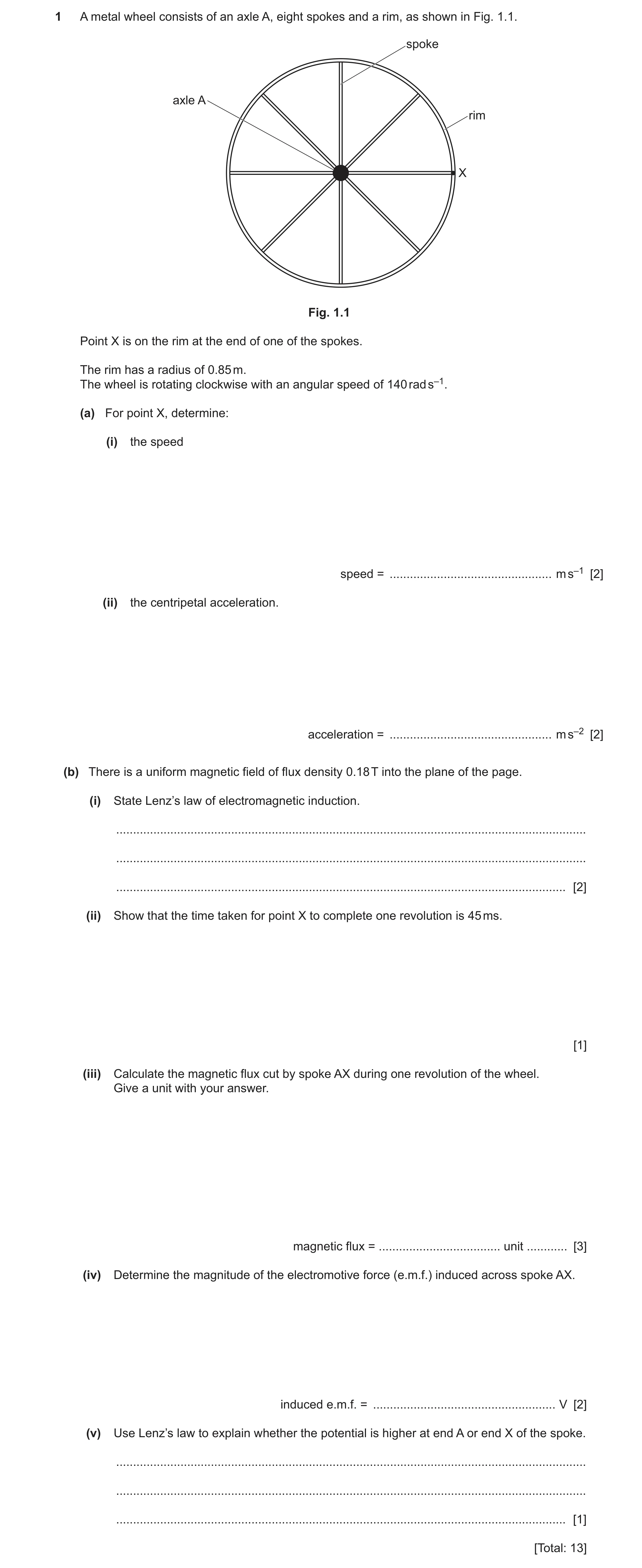
1 A metal wheel consists of an axle A, eight spokes and a rim, as shown in Fig. 1.1. spoke axle A rim X Fig. 1.1 Point X is on the rim at the end of one of the spokes. The rim has a radius of 0.85 m. The wheel is rotating clockwise with an angular speed of 140 rad s–1. (a) For point X, determine: (i) the speed speed = … m s–1 [2] (ii) the centripetal acceleration. acceleration = … m s–2 [2] (b) There is a uniform magnetic field of flux density 0.18 T into the plane of the page. (i) State Lenz’s law of electromagnetic induction. … … … [2] (ii) Show that the time taken for point X to complete one revolution is 45 ms. [1] (iii) Calculate the magnetic flux cut by spoke AX during one revolution of the wheel. Give a unit with your answer. magnetic flux = … unit … [3] (iv) Determine the magnitude of the electromotive force (e.m.f.) induced across spoke AX. induced e.m.f. = … V [2] (v) Use Lenz’s law to explain whether the potential is higher at end A or end X of the spoke. … … … [1] [Total: 13]
13 marks
Mark scheme: Question Answer Marks 1(a)(i) v = r C1 = 0.85 140 A1 = 120 m s–1 1(a)(ii) a = r2 or a = v2 / r C1 a = 0.85 1402 or 1202 / 0.85 A1 = 1.7 104 m s–2 1(b)(i) direction of (induced) e.m.f. M1 is such as to (produce effects that) oppose the change that caused it A1 1(b)(ii) T = 2 / A1 = 2 / 140 = 0.045 s = 45 ms 1(b)(iii) = BA C1 = 0.18 0.852 C1 = 0.41 Wb A1 1(b)(iv) E = / t C1 = 0.41 / 0.045 A1 = 9.1 V 1(b)(v) force (on spoke) must be anticlockwise, so current is from A to X (by Fleming’s left hand rule), so X is at the higher potential B1
This question in 9702/42 Oct/Nov 2024
Q28 · State Newton’s law of gravitation 9702/43 Oct/Nov 2024
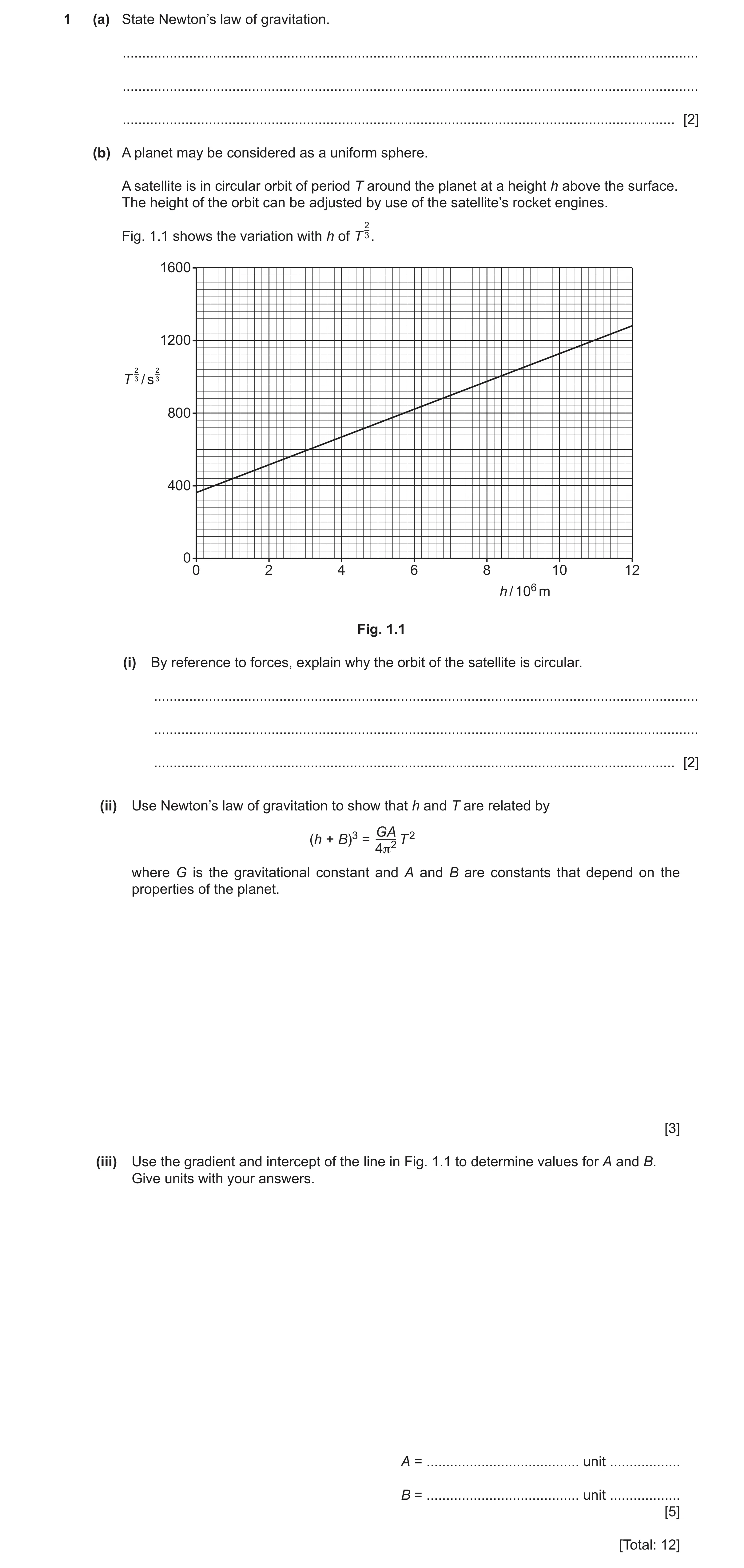
1 (a) State Newton’s law of gravitation. … … … [2] (b) A planet may be considered as a uniform sphere. A satellite is in circular orbit of period T around the planet at a height h above the surface. The height of the orbit can be adjusted by use of the satellite’s rocket engines. 2 Fig. 1.1 shows the variation with h of T 3 . 1600 1200 2 2 T 3 /s 3 800 400 0 0 2 4 6 8 10 12 h / 106 m Fig. 1.1 (i) By reference to forces, explain why the orbit of the satellite is circular. … … … [2] (ii) Use Newton’s law of gravitation to show that h and T are related by GA 2 (h + B)3 = T 4π2 where G is the gravitational constant and A and B are constants that depend on the properties of the planet. [3] (iii) Use the gradient and intercept of the line in Fig. 1.1 to determine values for A and B. Give units with your answers. A = … unit … B = … unit … [5] [Total: 12]
12 marks
Mark scheme: Question Answer Marks 1(a) (gravitational) force is (directly) proportional to product of masses B1 force (between point masses) is inversely proportional to the square of their separation B1 1(b)(i) (gravitational) force acts perpendicular to direction of motion B1 gravitational force provides centripetal acceleration B1 1(b)(ii) (F =) GMm / x2 = mx2 and = 2 / T M1 or GMm / x2 = 42mx / T2 completion of algebra leading to x3 = GMT2 / 42 A1 clear indication that B = radius of planet and that A = mass (of planet) B1 1(b)(iii) gradient = 3√(42 / GA) C1 e.g. (1280 – 360) / (12 106) = 3√(42 / [6.67 10–11 A]) C1 A = 1.3 1024 kg A1 intercept = gradient B C1 e.g. 360 = ((1280 – 360) B) / (12 106) A1 B = 4.7 106 m
This question in 9702/43 Oct/Nov 2024
Q29 · A steel ball is placed on the inside surface of a hollow circular cone 9702/42 Feb/March 2025
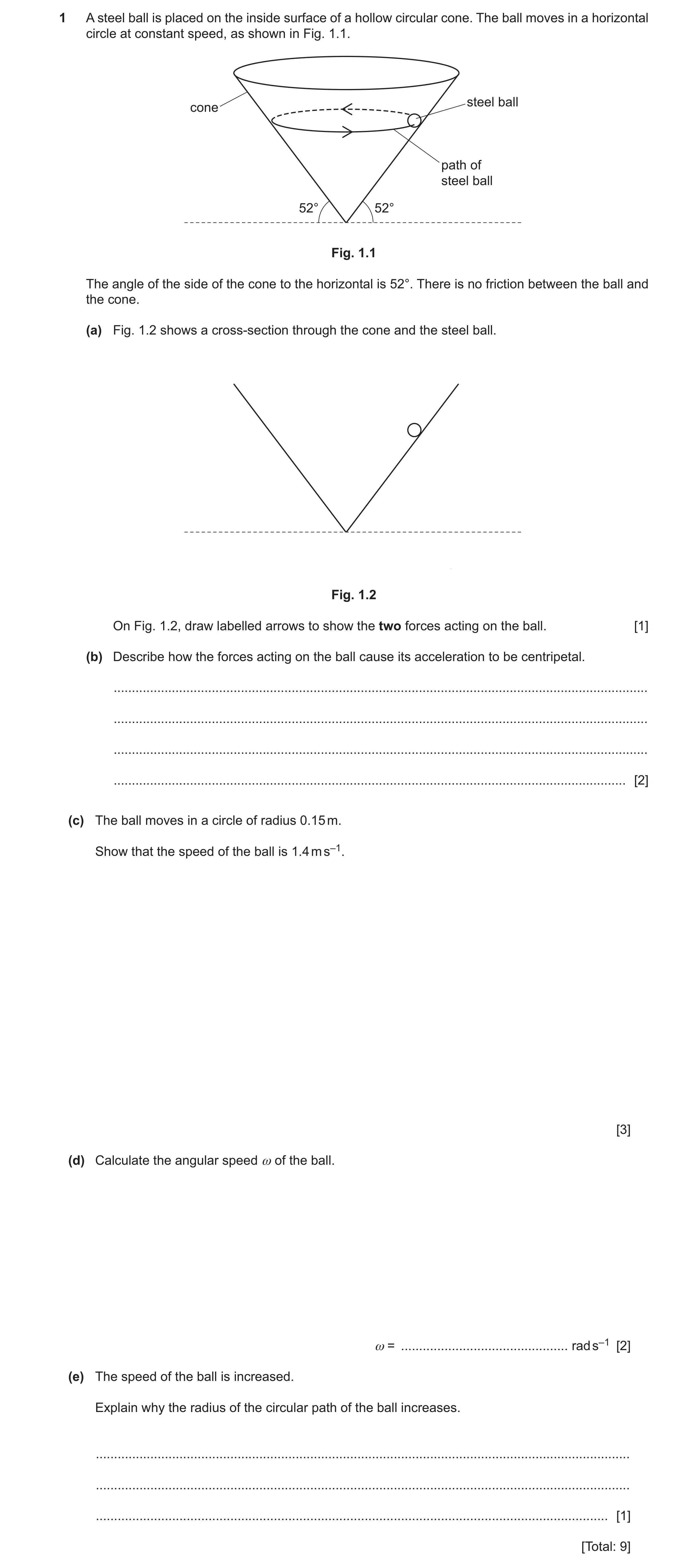
1 A steel ball is placed on the inside surface of a hollow circular cone. The ball moves in a horizontal circle at constant speed, as shown in Fig. 1.1. steel ball cone path of steel ball 52° 52° Fig. 1.1 The angle of the side of the cone to the horizontal is 52°. There is no friction between the ball and the cone. (a) Fig. 1.2 shows a cross‑section through the cone and the steel ball. Fig. 1.2 On Fig. 1.2, draw labelled arrows to show the two forces acting on the ball. [1] (b) Describe how the forces acting on the ball cause its acceleration to be centripetal. … … … … [2] (c) The ball moves in a circle of radius 0.15 m. Show that the speed of the ball is 1.4 m s–1. [3] (d) Calculate the angular speed ω of the ball. ω = … rad s–1 [2] (e) The speed of the ball is increased. Explain why the radius of the circular path of the ball increases. … … … [1] [Total: 9]
9 marks
Mark scheme: Question Answer Marks 1(a) arrow vertically downwards labelled ‘weight’ and arrow perpendicular to cone, inwards and upwards, labelled ‘normal B1 contact force’ 1(b) vertical component of contact force = weight (so no resultant force vertically) B1 horizontal component of contact force is resultant force towards centre (of circle) B1 1(c) a = v2 / r C1 a = g tan 52° C1 9.81 tan 52° = v2 / 0.15 leading to v = 1.4 m s–1 A1 1(d) v = ror a = r2 C1 = 1.4 / 0.15 or √(9.81 tan 52° / 0.15) A1 = 9.3 rad s–1 1(e) same resultant force / same acceleration so v2 is proportional to r (so if speed increases radius must also increase) A1
This question in 9702/42 Feb/March 2025
Q30 · Define gravitational potential at a point 9702/41 May/June 2025
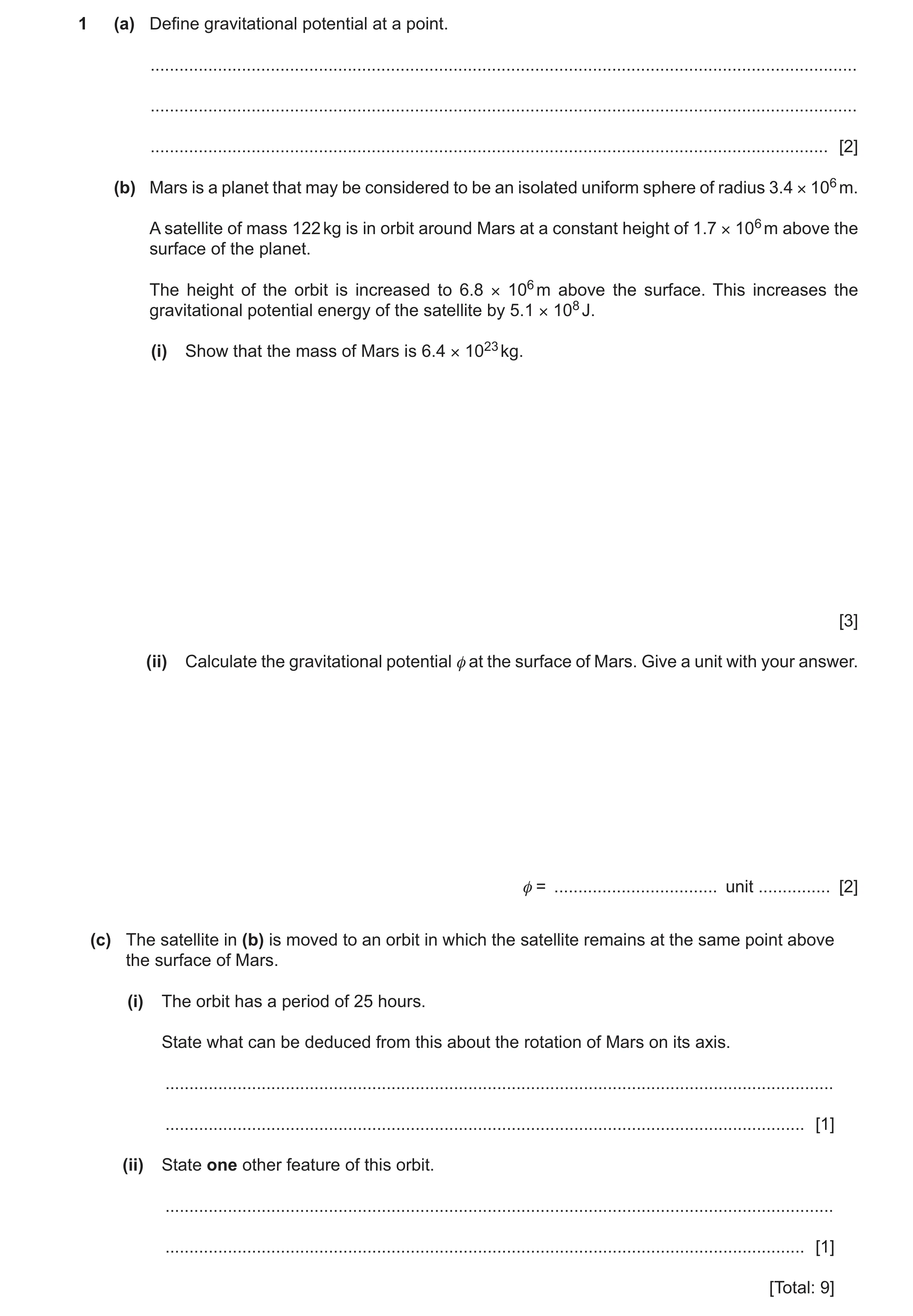
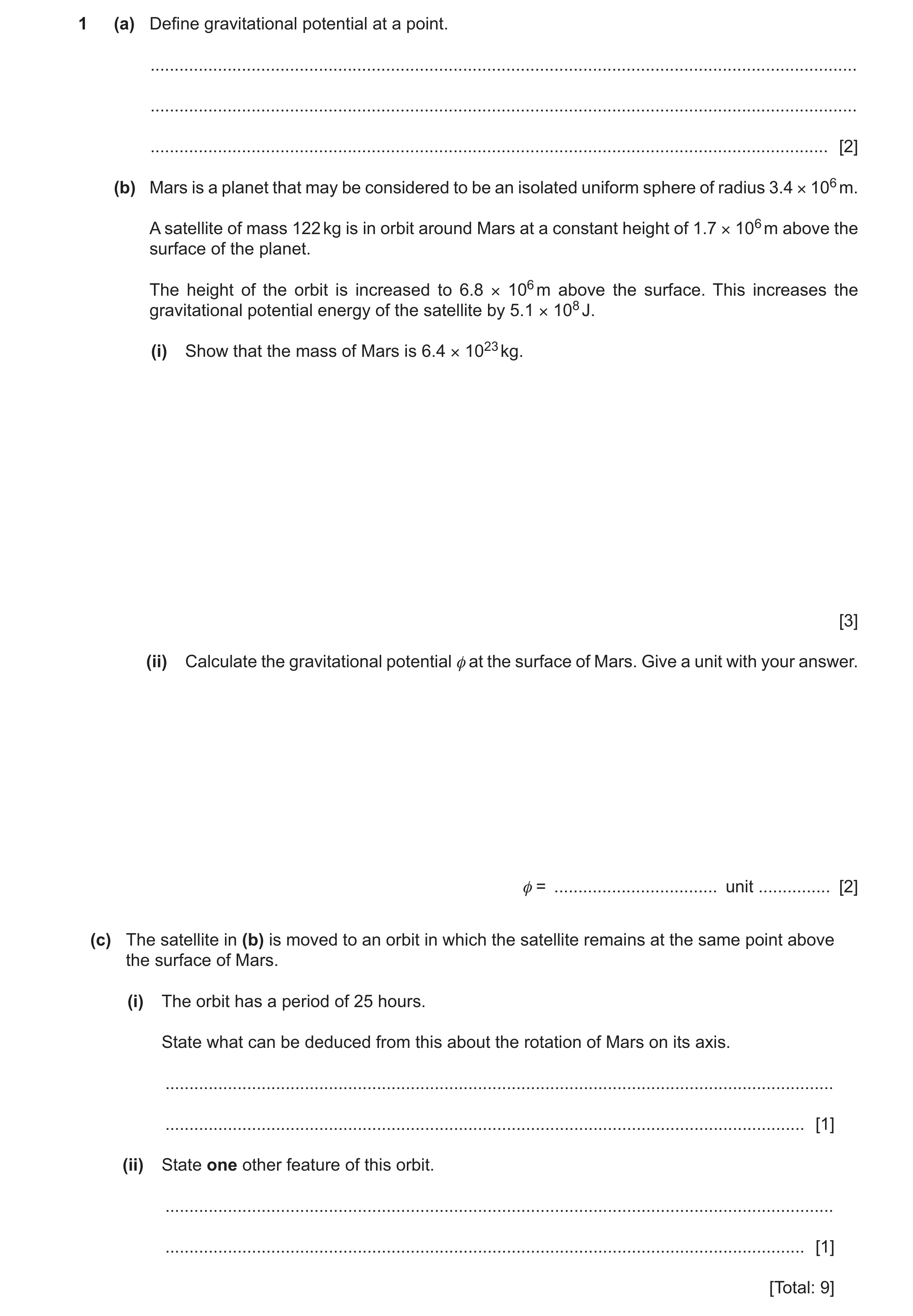
1 (a) Define gravitational potential at a point. … … … [2] (b) Mars is a planet that may be considered to be an isolated uniform sphere of radius 3.4 × 10⁶ m. A satellite of mass 122 kg is in orbit around Mars at a constant height of 1.7 × 10⁶ m above the surface of the planet. The height of the orbit is increased to 6.8 × 10⁶ m above the surface. This increases the gravitational potential energy of the satellite by 5.1 × 10⁸ J. (i) Show that the mass of Mars is 6.4 × 10²³ kg. [3] (ii) Calculate the gravitational potential φ at the surface of Mars. Give a unit with your answer. φ = … unit … [2] (c) The satellite in (b) is moved to an orbit in which the satellite remains at the same point above the surface of Mars. (i) The orbit has a period of 25 hours. State what can be deduced from this about the rotation of Mars on its axis. … … [1] (ii) State one other feature of this orbit. … … [1] [Total: 9]
9 marks
Mark scheme: Question Answer Marks 1(a) work done per unit mass B1 work (done in) moving mass from infinity (to the point) B1 1(b)(i) evidence of addition of 3.4 × 10⁶ to 1.7 × 10⁶ or 6.8 × 10⁶ C1 GM × 122 / (5.1 × 10⁶) or GM × 122 / (10.2 × 10⁶) C1 6.67 × 10⁻¹¹ × M × 122 × [(5.1 × 10⁶)–1 – (10.2 × 10⁶)–1] = 5.1 × 10⁸ A1 leading to M = 6.4 × 10²³ kg 1(b)(ii) = (–) (6.67 × 10–11 × 6.4 × 1023) / (3.4 × 10⁶) C1 = –1.3 × 10⁷ J kg–1 A1 1(c)(i) Mars takes (just under) 25 hours to rotate once on its axis B1 1(c)(ii) orbit is equatorial B1 or orbit is in same direction as direction of rotation of Mars
This question in 9702/41 May/June 2025
Q31 · A helium atom may be modelled as a nucleus surrounded by two electrons in diametrically… 9702/41 May/June 2025
2 A helium atom may be modelled as a nucleus surrounded by two electrons in diametrically opposite circular orbits, each of radius 170 pm, as shown in Fig. 2.1. orbit of electrons 170 pm electron electron nucleus Fig. 2.1 (a) State Coulomb’s law. … … … [2] (b) (i) State the charge on the nucleus, in terms of the elementary charge e. charge = … e [1] (ii) Show that the electric force between the nucleus and one of the electrons is 1.6 × 10⁻⁸ N. [1] (c) Assume that the force in (b)(ii) is the only force on the electrons. (i) Calculate the speed of the orbiting electrons. speed = … m s–1 [2] (ii) Calculate the period of the orbit of the electrons. period = … s [2] (d) In practice, the orbit of each electron is affected by the presence of the other electron. (i) For the position of one of the electrons, determine the ratio electric field strength due to the other electron . electric field strength due to the nucleus ratio = … [2] (ii) Use your answer in (d)(i) to suggest and explain how the orbit of the electron is affected by the presence of the other electron. … … [1] [Total: 11]
11 marks
Mark scheme: 2(a) (electric) force is (directly) proportional to product of charges B1 force (between point charges) is inversely proportional to the square of their separation B1 2(b)(i) charge = (+)2e A1 2(b)(ii) F = 2 × (1.60 × 10–19)2 / [4 × 8.85 × 10–12 × (170 × 10–12)2] = 1.6 × 10⁻⁸ N A1 2(c)(i) F = mv2 / r C1 v = [ (1.6 × 10–8 × 170 × 10–12) / (9.11 × 10⁻³¹) ]½ A1 = 1.7 × 10⁶ m s–1 2(c)(ii) F = mr2 and = 2 / T C1 F = 42mr / T2 T = [ (42 × 9.11 × 10–31 × 170 × 10–12) / (1.6 × 10⁻⁸) ]½ A1 = 6.2 × 10⁻¹⁶ s or v = 2r / T (C1) T = (2 × 170 × 10–12) / (1.73 × 10⁶) (A1) = 6.2 × 10⁻¹⁶ s 2(d)(i) E Q / r2 C1 ratio = [1.60 × 10–19 × (170 × 10–12)2] / [3.2 × 10–19 × (340 × 10–12)2] A1 = 0.13 2(d)(ii) resultant force slightly less (than 1.6 × 10⁻⁸ N) so speed lower B1 or resultant force slightly less (than 1.6 × 10⁻⁸ N) so period greater
This question in 9702/41 May/June 2025
Question 32 9702/42 May/June 2025
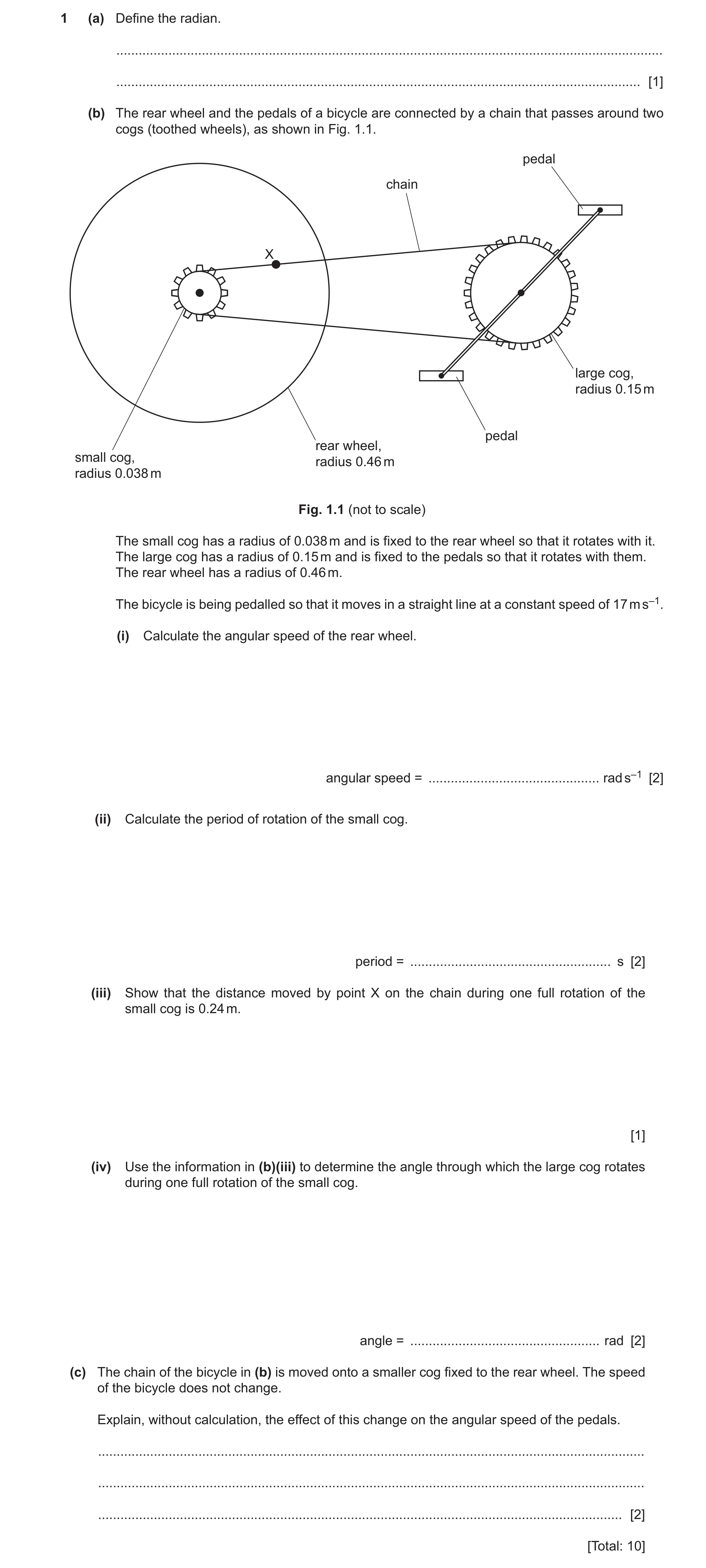
1 (a) Define the radian. … … [1] (b) The rear wheel and the pedals of a bicycle are connected by a chain that passes around two cogs (toothed wheels), as shown in Fig. 1.1. pedal chain X large cog, radius 0.15 m pedal rear wheel, small cog, radius 0.46 m radius 0.038 m Fig. 1.1 (not to scale) The small cog has a radius of 0.038 m and is fixed to the rear wheel so that it rotates with it. The large cog has a radius of 0.15 m and is fixed to the pedals so that it rotates with them. The rear wheel has a radius of 0.46 m. The bicycle is being pedalled so that it moves in a straight line at a constant speed of 17 m s–1. (i) Calculate the angular speed of the rear wheel. angular speed = … rad s–1 [2] (ii) Calculate the period of rotation of the small cog. period = … s [2] (iii) Show that the distance moved by point X on the chain during one full rotation of the small cog is 0.24 m. [1] (iv) Use the information in (b)(iii) to determine the angle through which the large cog rotates during one full rotation of the small cog. angle = … rad [2] (c) The chain of the bicycle in (b) is moved onto a smaller cog fixed to the rear wheel. The speed of the bicycle does not change. Explain, without calculation, the effect of this change on the angular speed of the pedals. … … … [2] [Total: 10]
10 marks
Mark scheme: Question Answer Marks 1(a) angle (subtended at centre of a circle) when arc (length) = radius B1 1(b)(i) v = r C1 = 17 / 0.46 A1 = 37 rad s–1 1(b)(ii) T = 2r / v or T = 2 / C1 = 2 × 0.46 / 17 or 2 / 37 A1 = 0.17 s 1(b)(iii) distance = 2 × 0.038 = 0.24 m A1 1(b)(iv) angle = arc length / radius C1 = 0.24 / 0.15 A1 = 1.6 rad 1(c) point X moves through a smaller distance in the same time B1 or (linear) speed of movement of point X / chain decreases or (linear) speed of (circumference of) both cogs decreases angular speed (of pedals) decreases B1
This question in 9702/42 May/June 2025
Q33 · Define gravitational potential at a point 9702/43 May/June 2025
1 (a) Define gravitational potential at a point. … … … [2] (b) Mars is a planet that may be considered to be an isolated uniform sphere of radius 3.4 × 10⁶ m. A satellite of mass 122 kg is in orbit around Mars at a constant height of 1.7 × 10⁶ m above the surface of the planet. The height of the orbit is increased to 6.8 × 10⁶ m above the surface. This increases the gravitational potential energy of the satellite by 5.1 × 10⁸ J. (i) Show that the mass of Mars is 6.4 × 10²³ kg. [3] (ii) Calculate the gravitational potential φ at the surface of Mars. Give a unit with your answer. φ = … unit … [2] (c) The satellite in (b) is moved to an orbit in which the satellite remains at the same point above the surface of Mars. (i) The orbit has a period of 25 hours. State what can be deduced from this about the rotation of Mars on its axis. … … [1] (ii) State one other feature of this orbit. … … [1] [Total: 9]
9 marks
Mark scheme: Question Answer Marks 1(a) work done per unit mass B1 work (done in) moving mass from infinity (to the point) B1 1(b)(i) evidence of addition of 3.4 × 10⁶ to 1.7 × 10⁶ or 6.8 × 10⁶ C1 GM × 122 / (5.1 × 10⁶) or GM × 122 / (10.2 × 10⁶) C1 6.67 × 10⁻¹¹ × M × 122 × [(5.1 × 10⁶)–1 – (10.2 × 10⁶)–1] = 5.1 × 10⁸ A1 leading to M = 6.4 × 10²³ kg 1(b)(ii) = (–) (6.67 × 10–11 × 6.4 × 1023) / (3.4 × 10⁶) C1 = –1.3 × 10⁷ J kg–1 A1 1(c)(i) Mars takes (just under) 25 hours to rotate once on its axis B1 1(c)(ii) orbit is equatorial B1 or orbit is in same direction as direction of rotation of Mars
This question in 9702/43 May/June 2025
Q34 · A helium atom may be modelled as a nucleus surrounded by two electrons in diametrically… 9702/43 May/June 2025
2 A helium atom may be modelled as a nucleus surrounded by two electrons in diametrically opposite circular orbits, each of radius 170 pm, as shown in Fig. 2.1. orbit of electrons 170 pm electron electron nucleus Fig. 2.1 (a) State Coulomb’s law. … … … [2] (b) (i) State the charge on the nucleus, in terms of the elementary charge e. charge = … e [1] (ii) Show that the electric force between the nucleus and one of the electrons is 1.6 × 10⁻⁸ N. [1] (c) Assume that the force in (b)(ii) is the only force on the electrons. (i) Calculate the speed of the orbiting electrons. speed = … m s–1 [2] (ii) Calculate the period of the orbit of the electrons. period = … s [2] (d) In practice, the orbit of each electron is affected by the presence of the other electron. (i) For the position of one of the electrons, determine the ratio electric field strength due to the other electron . electric field strength due to the nucleus ratio = … [2] (ii) Use your answer in (d)(i) to suggest and explain how the orbit of the electron is affected by the presence of the other electron. … … [1] [Total: 11]
11 marks
Mark scheme: 2(a) (electric) force is (directly) proportional to product of charges B1 force (between point charges) is inversely proportional to the square of their separation B1 2(b)(i) charge = (+)2e A1 2(b)(ii) F = 2 × (1.60 × 10–19)2 / [4 × 8.85 × 10–12 × (170 × 10–12)2] = 1.6 × 10⁻⁸ N A1 2(c)(i) F = mv2 / r C1 v = [ (1.6 × 10–8 × 170 × 10–12) / (9.11 × 10⁻³¹) ]½ A1 = 1.7 × 10⁶ m s–1 2(c)(ii) F = mr2 and = 2 / T C1 F = 42mr / T2 T = [ (42 × 9.11 × 10–31 × 170 × 10–12) / (1.6 × 10⁻⁸) ]½ A1 = 6.2 × 10⁻¹⁶ s or v = 2r / T (C1) T = (2 × 170 × 10–12) / (1.73 × 10⁶) (A1) = 6.2 × 10⁻¹⁶ s 2(d)(i) E Q / r2 C1 ratio = [1.60 × 10–19 × (170 × 10–12)2] / [3.2 × 10–19 × (340 × 10–12)2] A1 = 0.13 2(d)(ii) resultant force slightly less (than 1.6 × 10⁻⁸ N) so speed lower B1 or resultant force slightly less (than 1.6 × 10⁻⁸ N) so period greater
This question in 9702/43 May/June 2025
Q35 · In terms of velocity and acceleration, describe uniform circular motion of an object 9702/41 Oct/Nov 2025
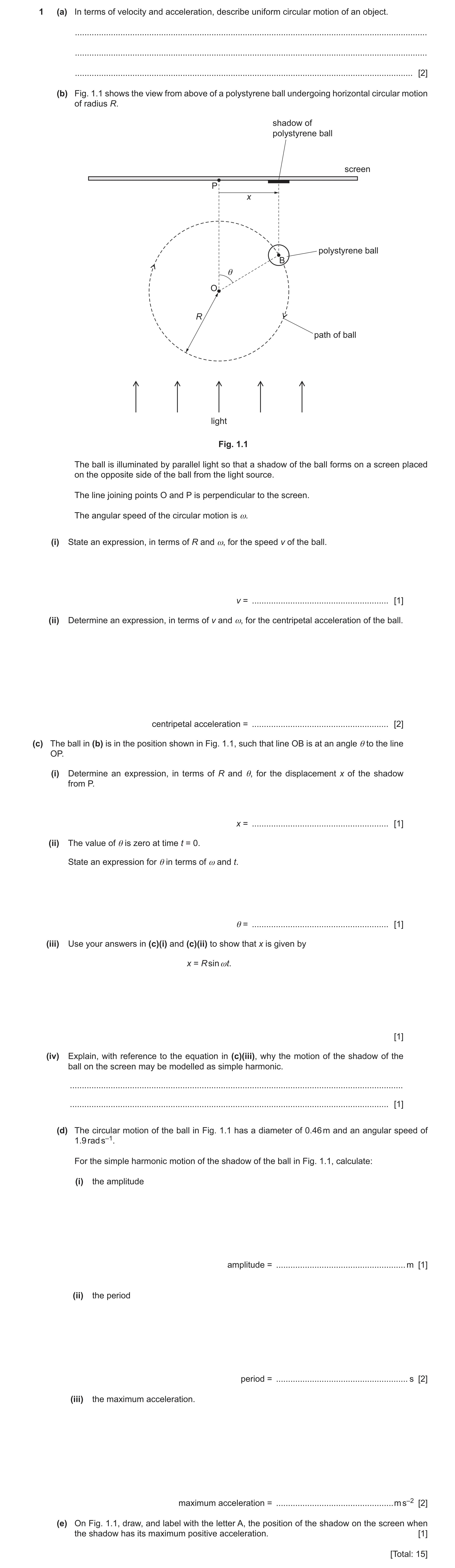
1 (a) In terms of velocity and acceleration, describe uniform circular motion of an object. … … … [2] (b) Fig. 1.1 shows the view from above of a polystyrene ball undergoing horizontal circular motion of radius R. shadow of polystyrene ball screen P x polystyrene ball B θ O R path of ball light Fig. 1.1 The ball is illuminated by parallel light so that a shadow of the ball forms on a screen placed on the opposite side of the ball from the light source. The line joining points O and P is perpendicular to the screen. The angular speed of the circular motion is ω. (i) State an expression, in terms of R and ω, for the speed v of the ball. v = … [1] (ii) Determine an expression, in terms of v and ω, for the centripetal acceleration of the ball. centripetal acceleration = … [2] (c) The ball in (b) is in the position shown in Fig. 1.1, such that line OB is at an angle θ to the line OP. (i) Determine an expression, in terms of R and θ, for the displacement x of the shadow from P. x = … [1] (ii) The value of θ is zero at time t = 0. State an expression for θ in terms of ω and t. θ = … [1] (iii) Use your answers in (c)(i) and (c)(ii) to show that x is given by x = R sin ω t. [1] (iv) Explain, with reference to the equation in (c)(iii), why the motion of the shadow of the ball on the screen may be modelled as simple harmonic. … … [1] (d) The circular motion of the ball in Fig. 1.1 has a diameter of 0.46 m and an angular speed of 1.9 rad s–1. For the simple harmonic motion of the shadow of the ball in Fig. 1.1, calculate: (i) the amplitude amplitude = … m [1] (ii) the period period = … s [2] (iii) the maximum acceleration. maximum acceleration = … m s–2 [2] (e) On Fig. 1.1, draw, and label with the letter A, the position of the shadow on the screen when the shadow has its maximum positive acceleration. [1] [Total: 15]
15 marks
Mark scheme: Question Answer Marks 1(a) velocity and acceleration both have constant magnitude B1 velocity is (always) perpendicular to acceleration B1 1(b)(i) v = R A1 1(b)(ii) a = R2 or a = v2 / R C1 a = v A1 1(c)(i) x = R sin A1 1(c)(ii) = t A1 1(c)(iii) clear substitution of = t into x = R sin leading to x = R sin t A1 1(c)(iv) equation is of the form x = x0 sin t (so simple harmonic motion) B1 1(d)(i) amplitude = 0.46 / 2 A1 = 0.23 m 1(d)(ii) = 2 / T C1 period = 2 / 1.9 A1 = 3.3 s 1(d)(iii) a0 = 2x0 C1 = 1.92 0.23 A1 = 0.83 m s–2 1(e) shadow on screen, labelled A, above left-hand edge of the circular path B1
This question in 9702/41 Oct/Nov 2025
Q36 · The Earth may be considered as a uniform sphere of radius 6.37 × 10⁶ m 9702/42 Oct/Nov 2025
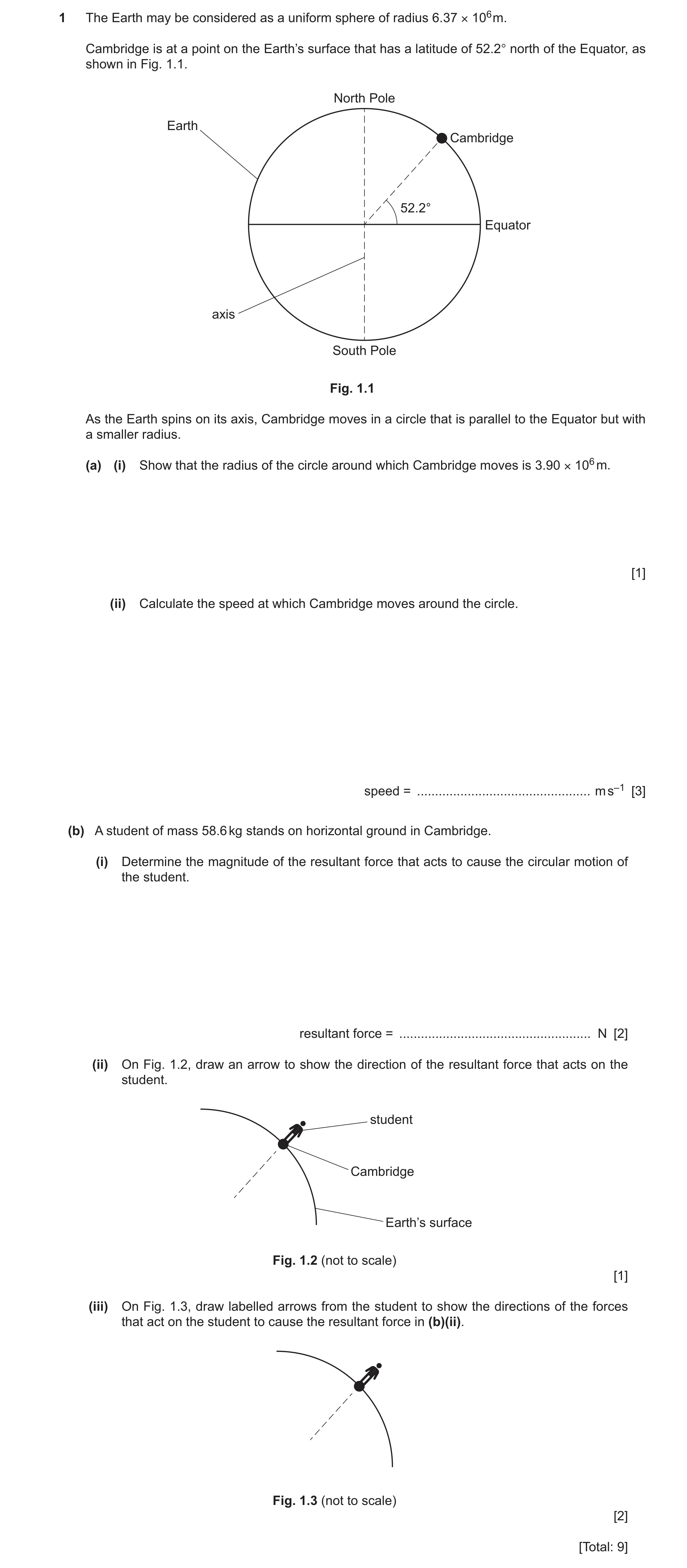
1 The Earth may be considered as a uniform sphere of radius 6.37 × 10⁶ m. Cambridge is at a point on the Earth’s surface that has a latitude of 52.2° north of the Equator, as shown in Fig. 1.1. North Pole Earth Cambridge 52.2° Equator axis South Pole Fig. 1.1 As the Earth spins on its axis, Cambridge moves in a circle that is parallel to the Equator but with a smaller radius. (a) (i) Show that the radius of the circle around which Cambridge moves is 3.90 × 10⁶ m. [1] (ii) Calculate the speed at which Cambridge moves around the circle. speed = … m s–1 [3] (b) A student of mass 58.6 kg stands on horizontal ground in Cambridge. (i) Determine the magnitude of the resultant force that acts to cause the circular motion of the student. resultant force = … N [2] (ii) On Fig. 1.2, draw an arrow to show the direction of the resultant force that acts on the student. student Cambridge Earth’s surface Fig. 1.2 (not to scale) [1] (iii) On Fig. 1.3, draw labelled arrows from the student to show the directions of the forces that act on the student to cause the resultant force in (b)(ii). Fig. 1.3 (not to scale) [2] [Total: 9]
9 marks
Mark scheme: Question Answer Marks 1(a)(i) radius = 6.37 106 cos 52.2° = 3.90 106 m A1 1(a)(ii) period = 24 hours C1 v = 2r / T C1 or v = r and = 2 / T v = (2 3.90 106) / (24 60 60) A1 = 280 m s–1 1(b)(i) F = mv2 / r C1 = (58.6 2802) / (3.90 106) A1 = 1.2 N 1(b)(ii) arrow pointing horizontally to the left B1 1(b)(iii) arrow from student pointing along the dotted line, labelled ‘weight’ B1 upwards arrow from student pointing in a direction to the left of normal and above the tangent to the Earth, labelled ‘contact B1 force’
This question in 9702/42 Oct/Nov 2025
Q37 · In terms of velocity and acceleration, describe uniform circular motion of an object 9702/43 Oct/Nov 2025
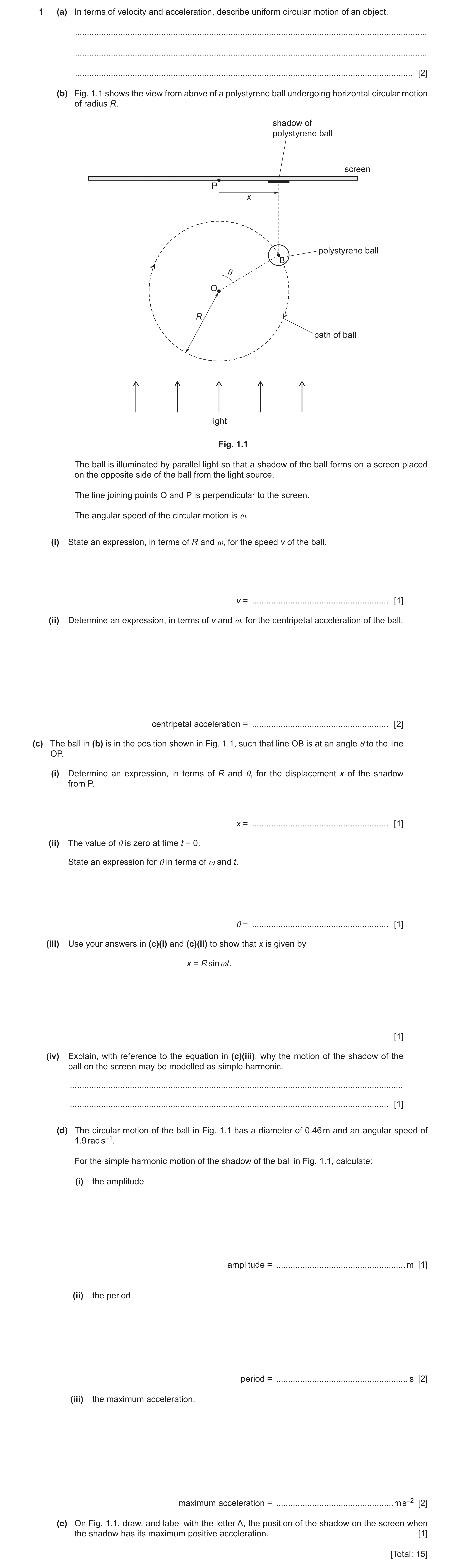
1 (a) In terms of velocity and acceleration, describe uniform circular motion of an object. … … … [2] (b) Fig. 1.1 shows the view from above of a polystyrene ball undergoing horizontal circular motion of radius R. shadow of polystyrene ball screen P x polystyrene ball B θ O R path of ball light Fig. 1.1 The ball is illuminated by parallel light so that a shadow of the ball forms on a screen placed on the opposite side of the ball from the light source. The line joining points O and P is perpendicular to the screen. The angular speed of the circular motion is ω. (i) State an expression, in terms of R and ω, for the speed v of the ball. v = … [1] (ii) Determine an expression, in terms of v and ω, for the centripetal acceleration of the ball. centripetal acceleration = … [2] (c) The ball in (b) is in the position shown in Fig. 1.1, such that line OB is at an angle θ to the line OP. (i) Determine an expression, in terms of R and θ, for the displacement x of the shadow from P. x = … [1] (ii) The value of θ is zero at time t = 0. State an expression for θ in terms of ω and t. θ = … [1] (iii) Use your answers in (c)(i) and (c)(ii) to show that x is given by x = R sin ω t. [1] (iv) Explain, with reference to the equation in (c)(iii), why the motion of the shadow of the ball on the screen may be modelled as simple harmonic. … … [1] (d) The circular motion of the ball in Fig. 1.1 has a diameter of 0.46 m and an angular speed of 1.9 rad s–1. For the simple harmonic motion of the shadow of the ball in Fig. 1.1, calculate: (i) the amplitude amplitude = … m [1] (ii) the period period = … s [2] (iii) the maximum acceleration. maximum acceleration = … m s–2 [2] (e) On Fig. 1.1, draw, and label with the letter A, the position of the shadow on the screen when the shadow has its maximum positive acceleration. [1] [Total: 15]
15 marks
Mark scheme: Question Answer Marks 1(a) velocity and acceleration both have constant magnitude B1 velocity is (always) perpendicular to acceleration B1 1(b)(i) v = R A1 1(b)(ii) a = R2 or a = v2 / R C1 a = v A1 1(c)(i) x = R sin A1 1(c)(ii) = t A1 1(c)(iii) clear substitution of = t into x = R sin leading to x = R sin t A1 1(c)(iv) equation is of the form x = x0 sin t (so simple harmonic motion) B1 1(d)(i) amplitude = 0.46 / 2 A1 = 0.23 m 1(d)(ii) = 2 / T C1 period = 2 / 1.9 A1 = 3.3 s 1(d)(iii) a0 = 2x0 C1 = 1.92 0.23 A1 = 0.83 m s–2 1(e) shadow on screen, labelled A, above left-hand edge of the circular path B1
This question in 9702/43 Oct/Nov 2025
 1 / 57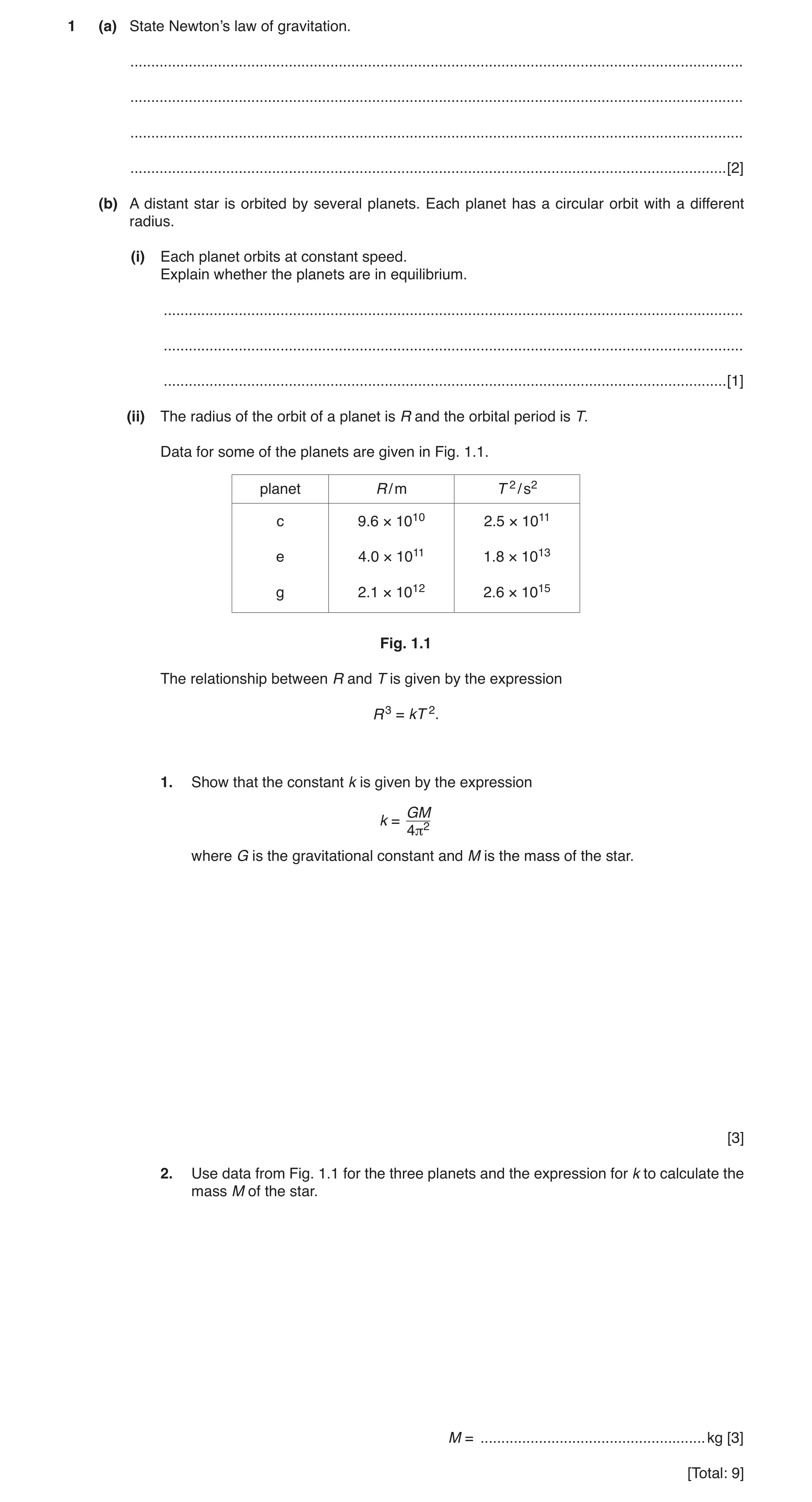
 3 / 57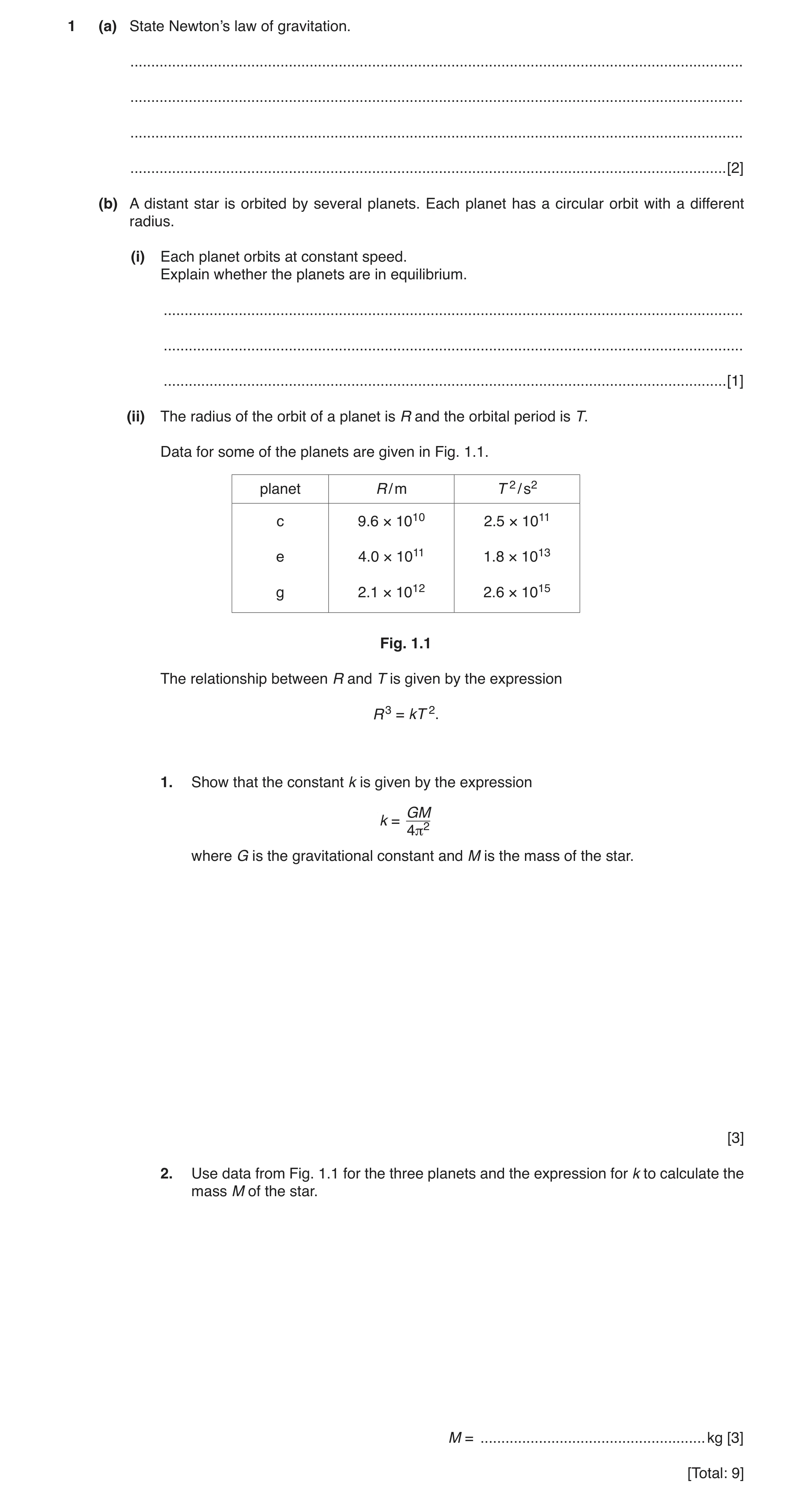
 5 / 57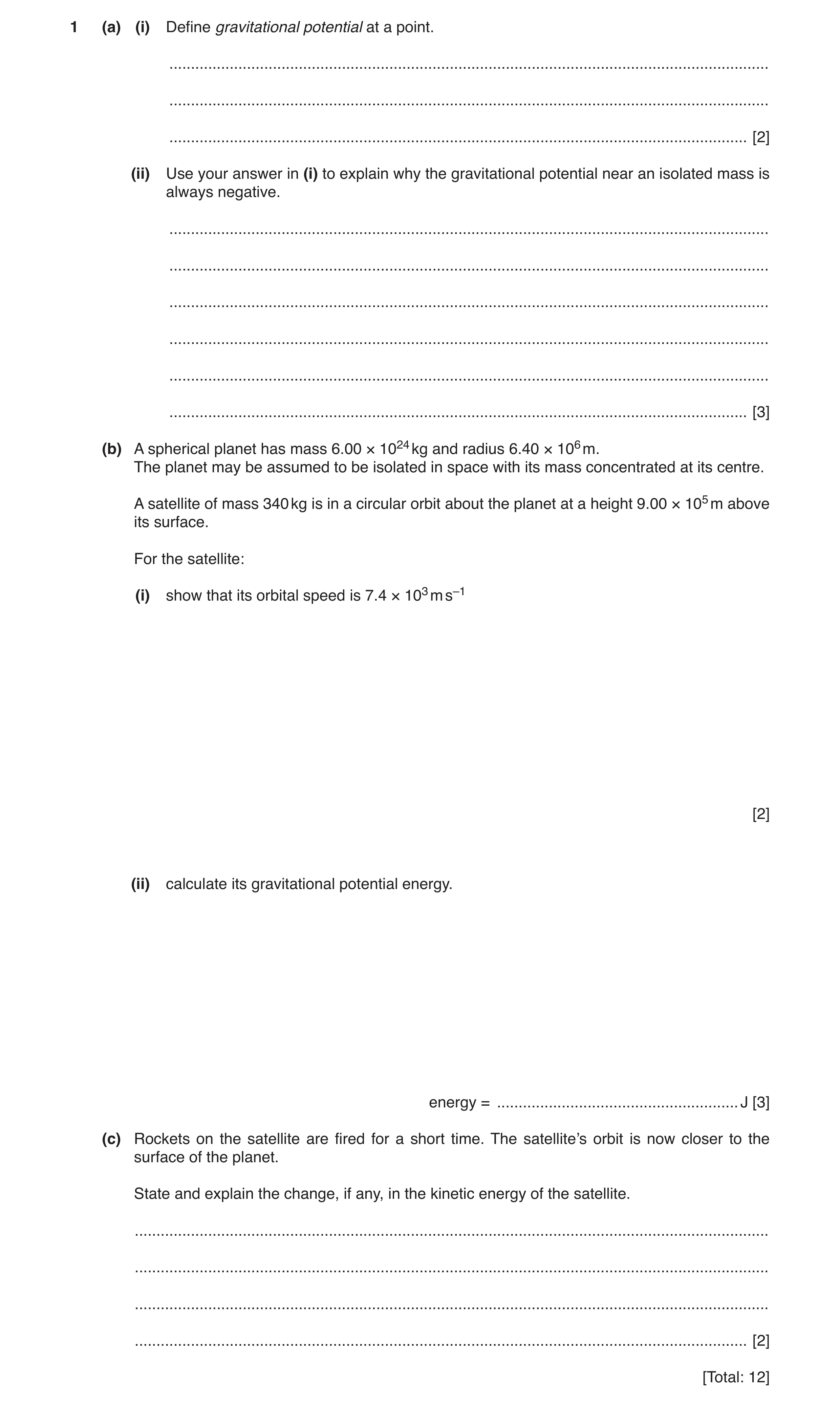
 7 / 57
 8 / 57
 9 / 57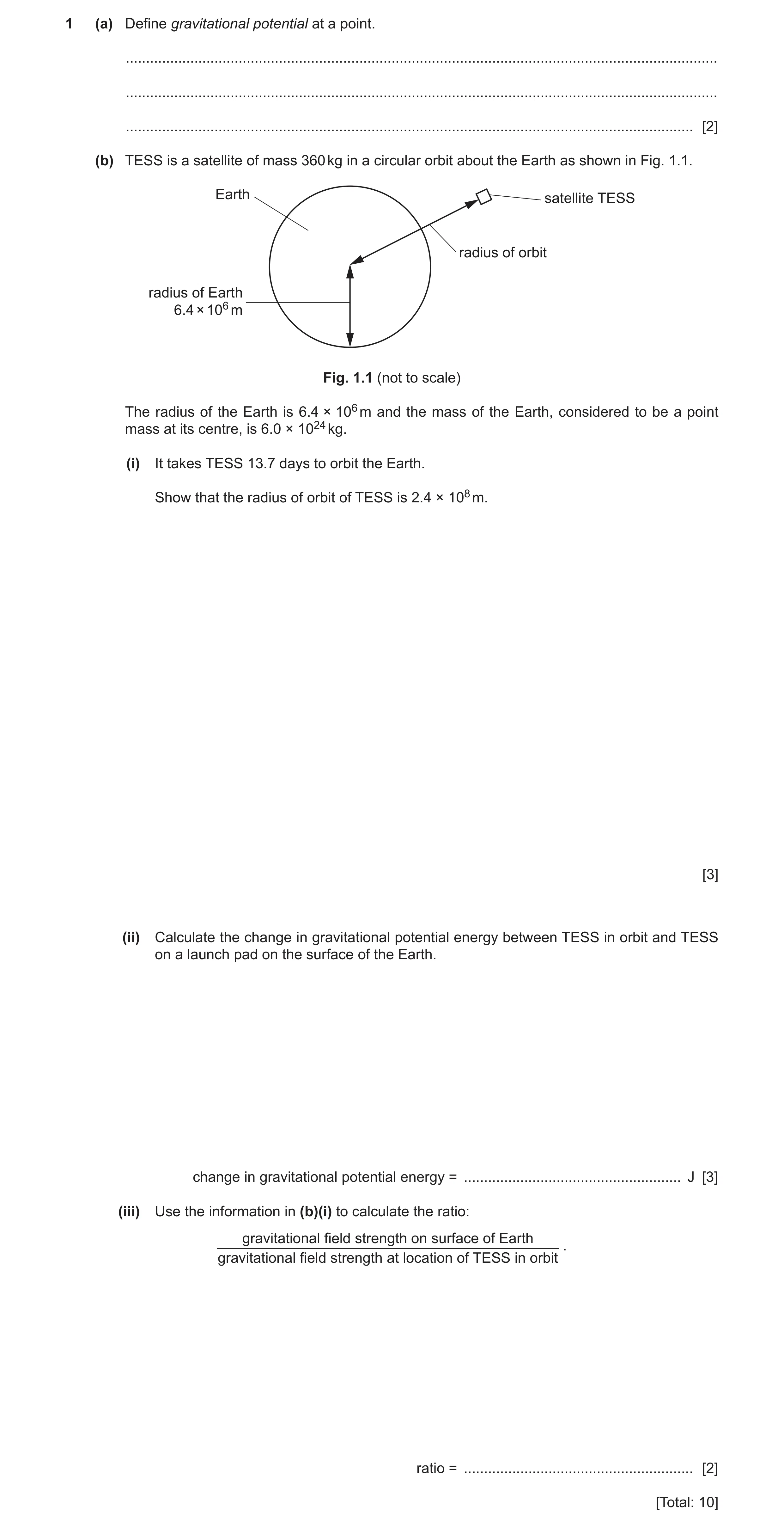
![Question 17: (a) The point P in Fig. 1.1 represents a point mass. On Fig. 1.1, draw lines to represent the gravitational field around P. P Fig. 1.1 [2] …](https://img.pastlit.com/crops/04fa4f38-5b41-437f-b513-62df0534c878/q1.webp)
 43 / 57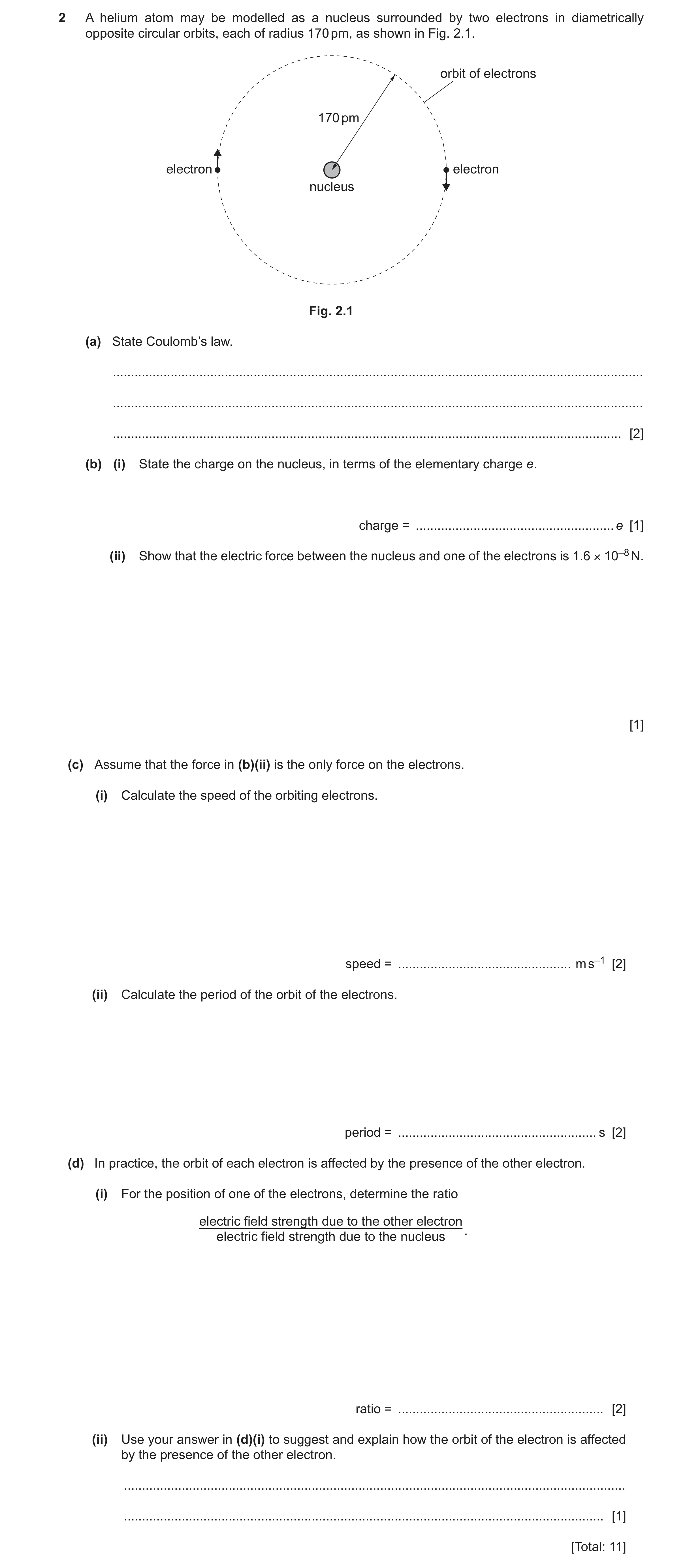
 48 / 57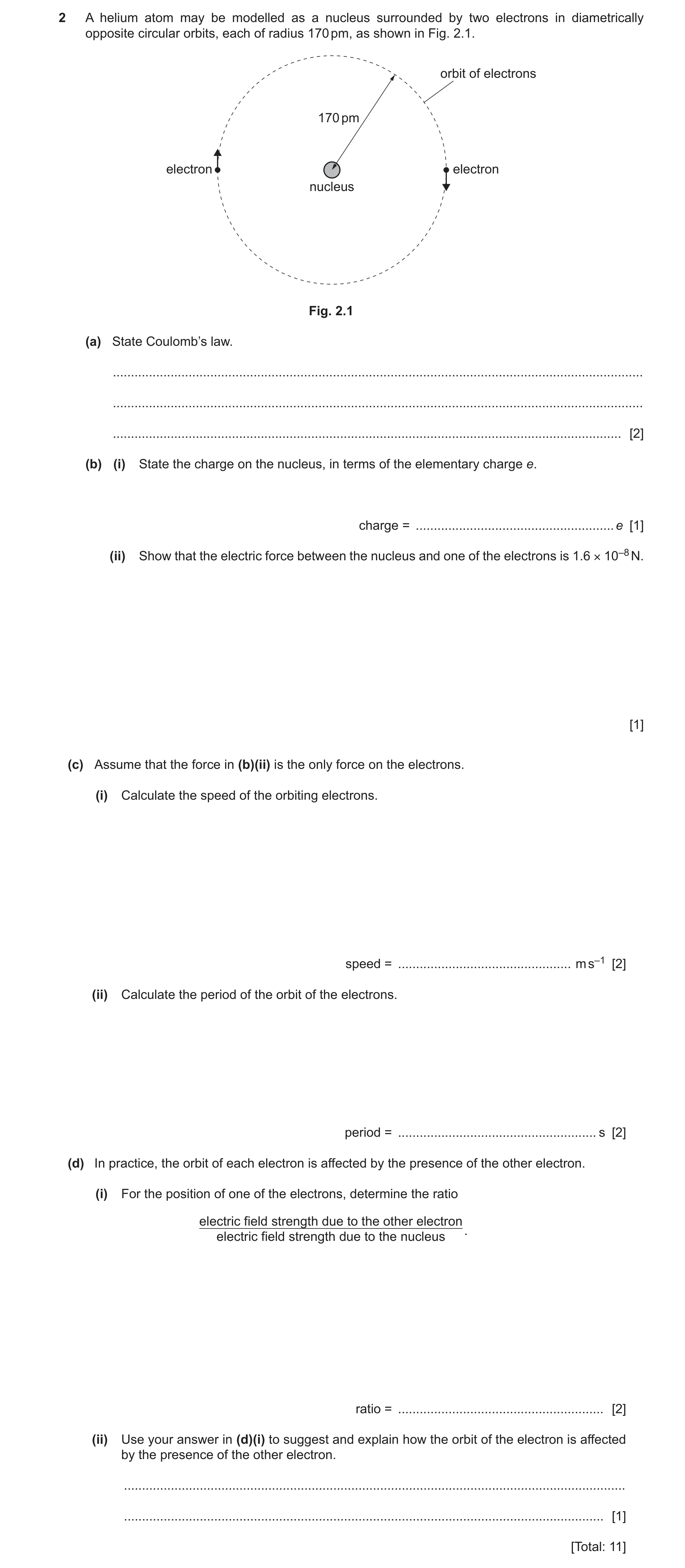
 8
8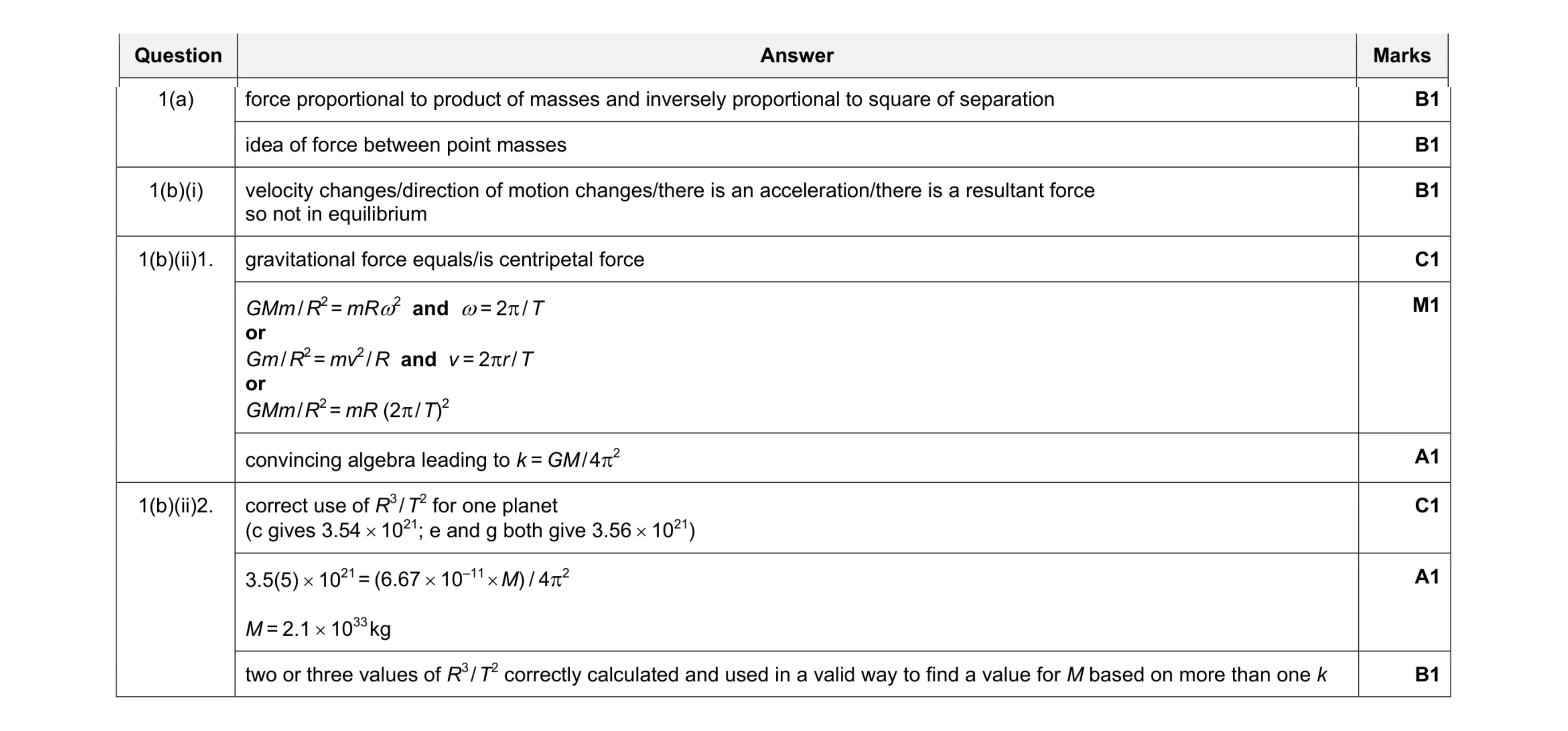 9
9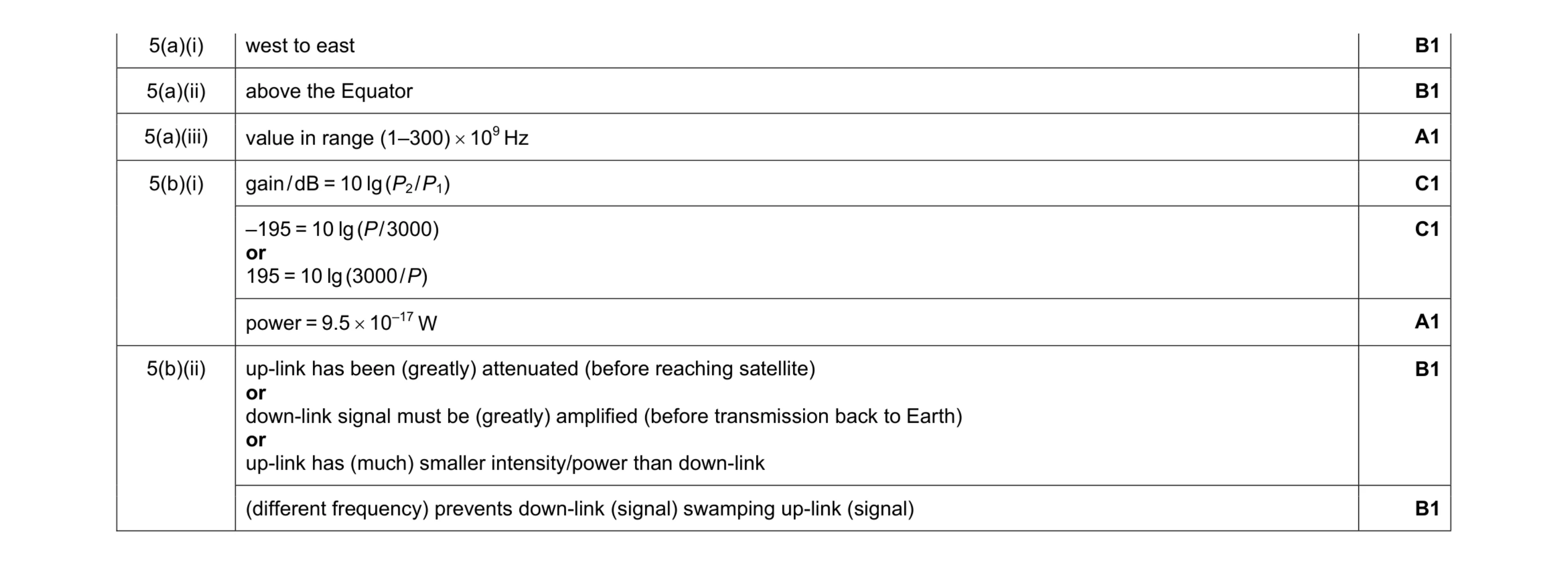 8
8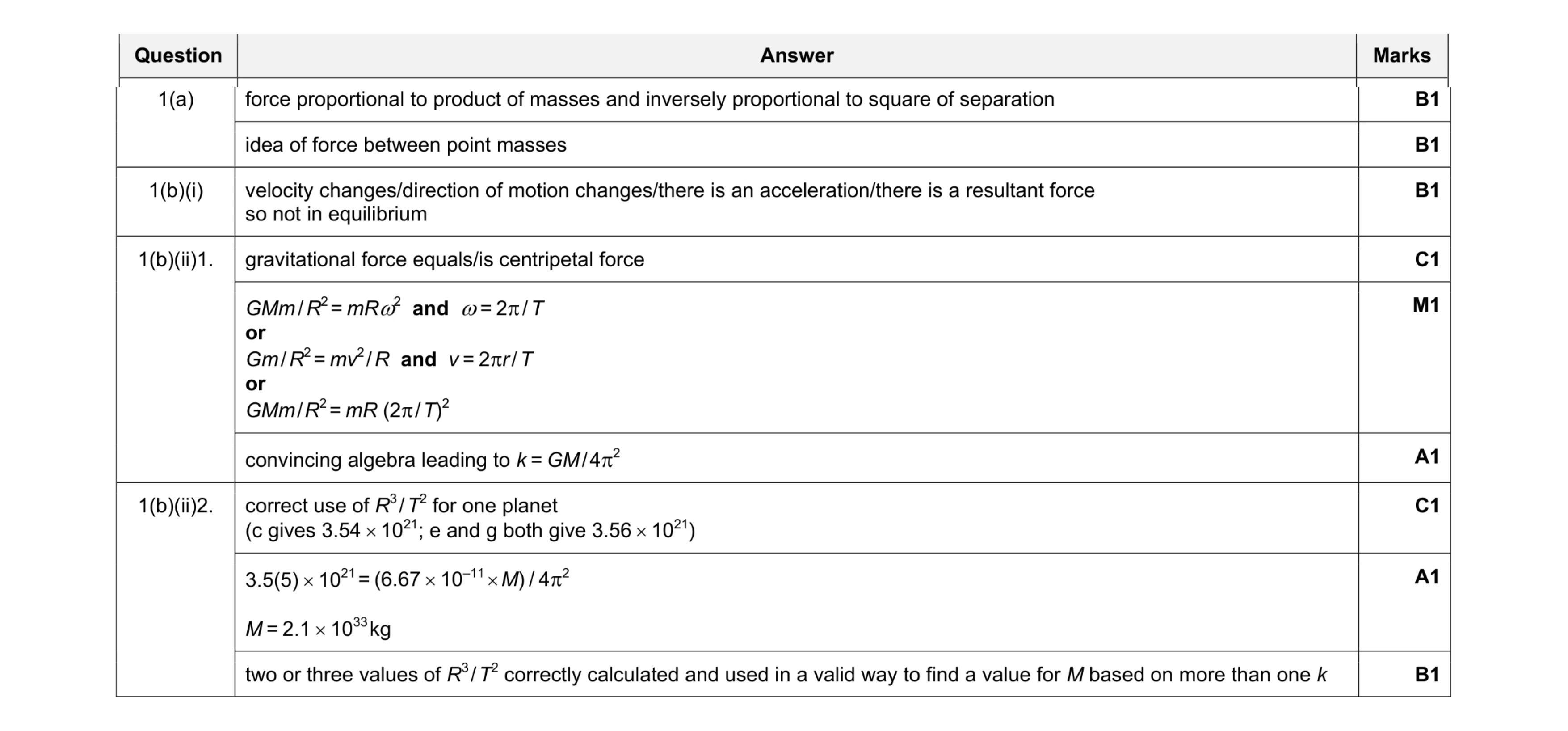 9
9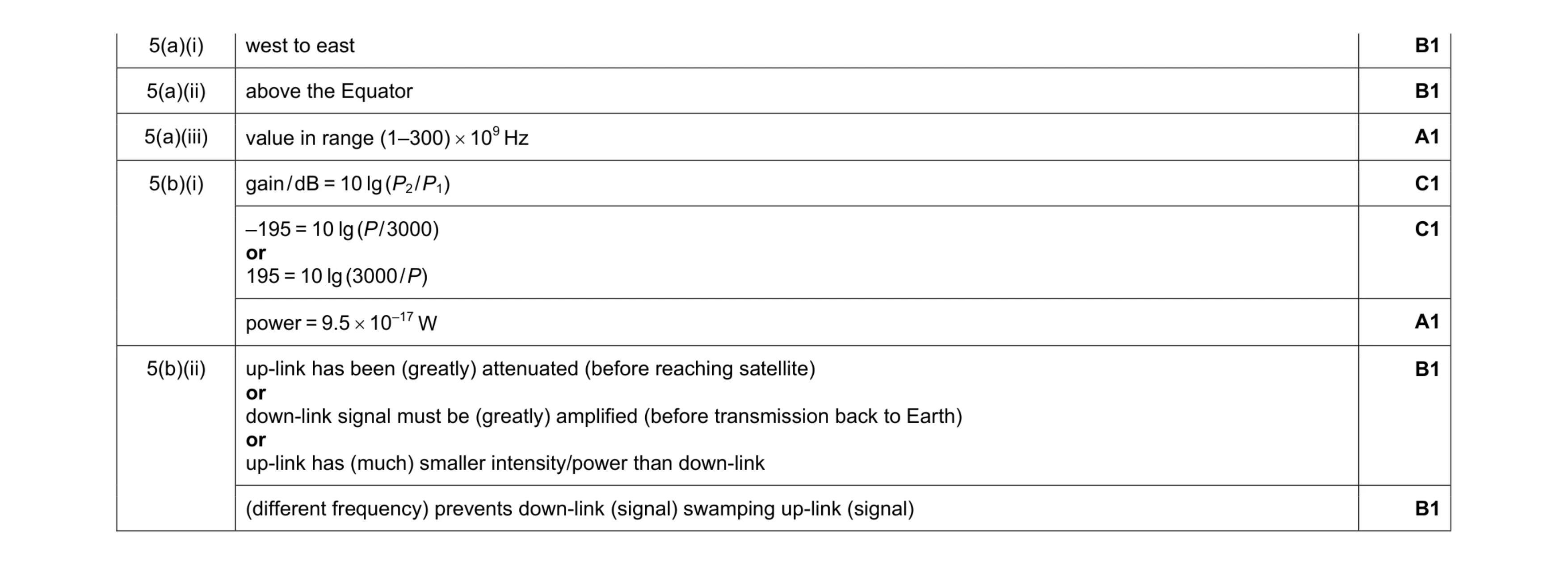 8
8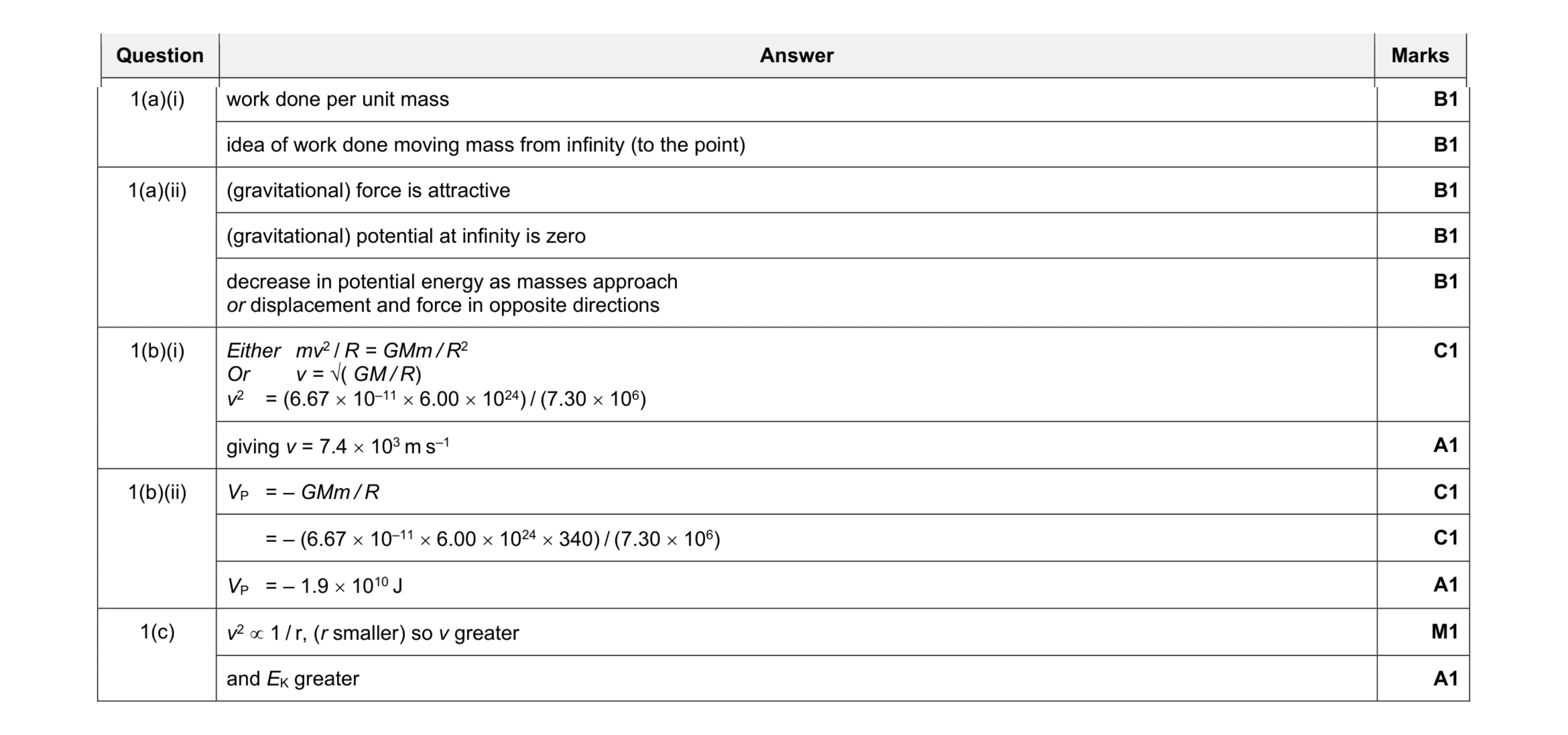 12
12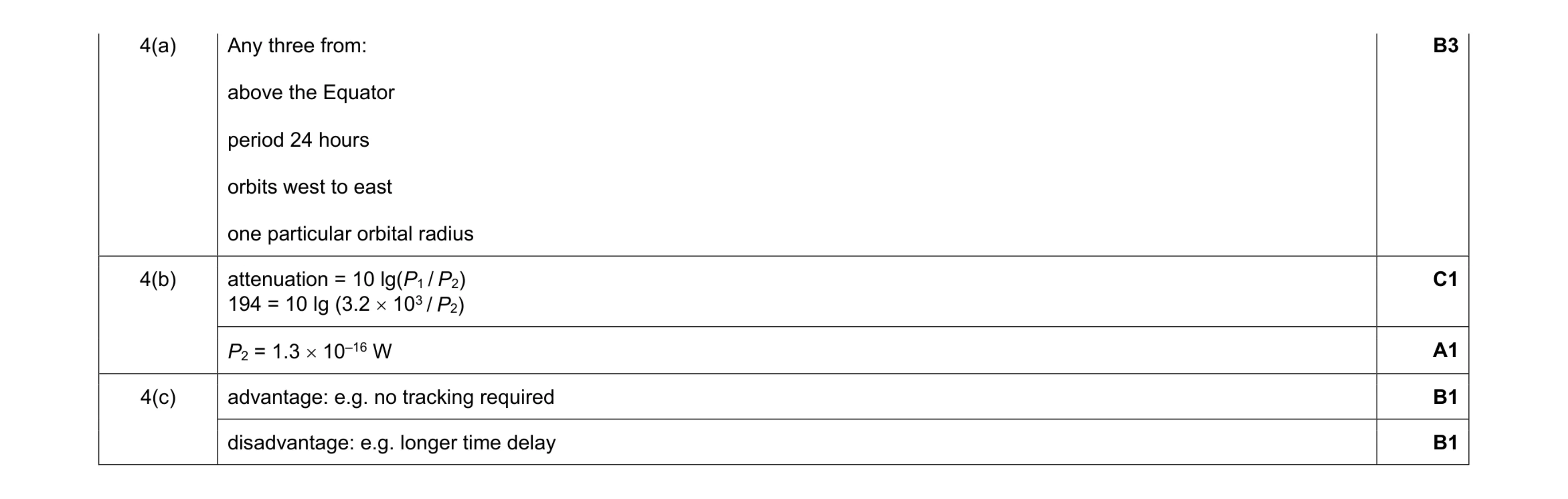 7
7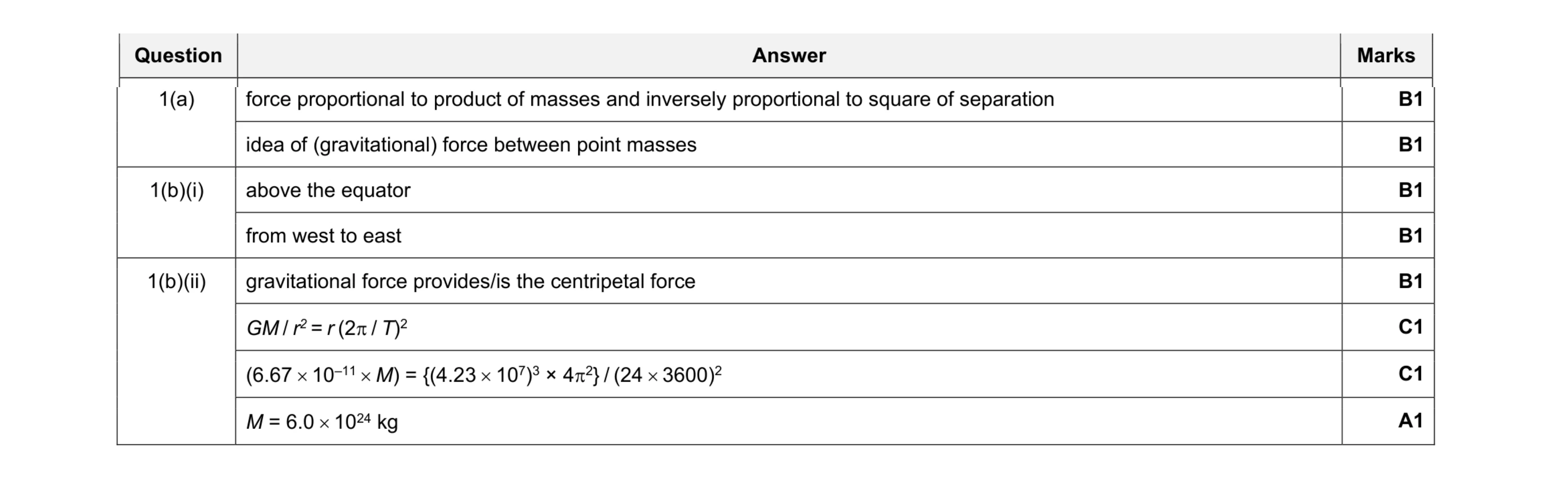 8
8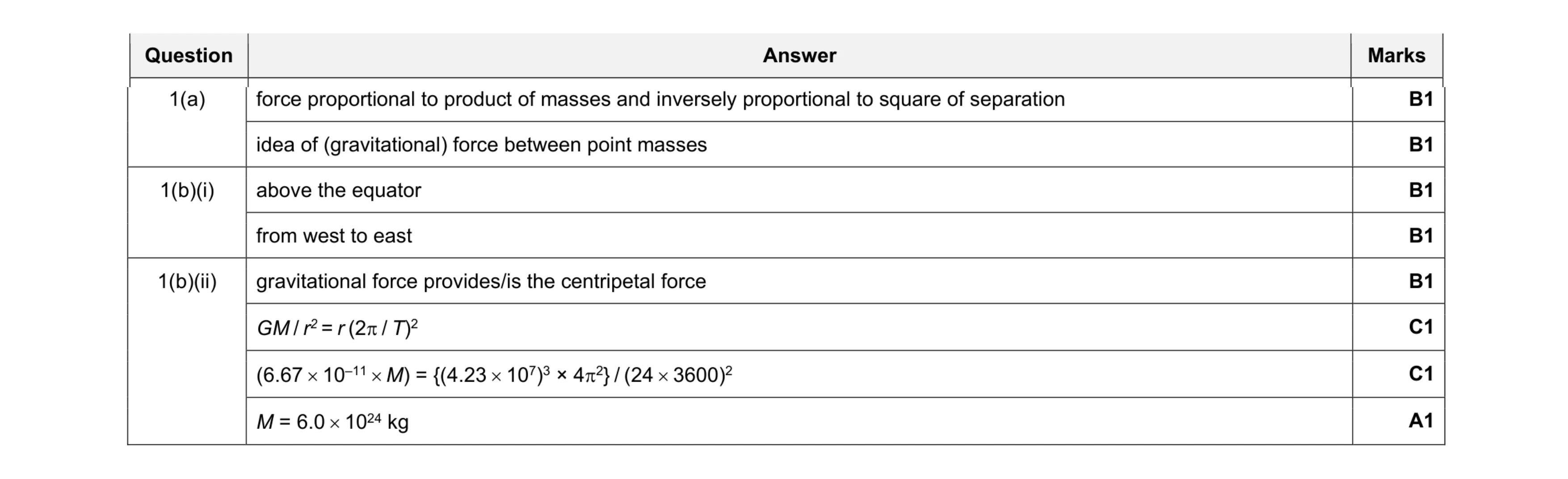 8
8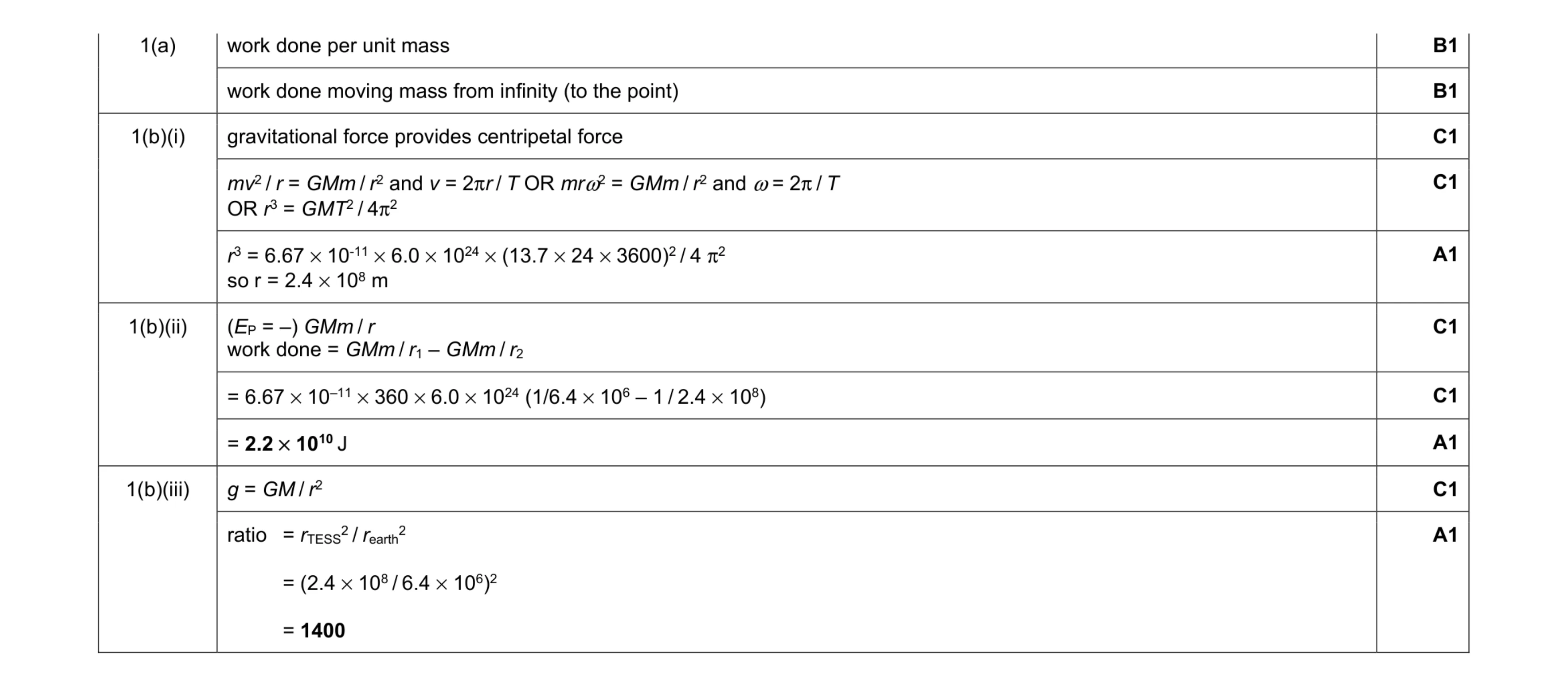 10
10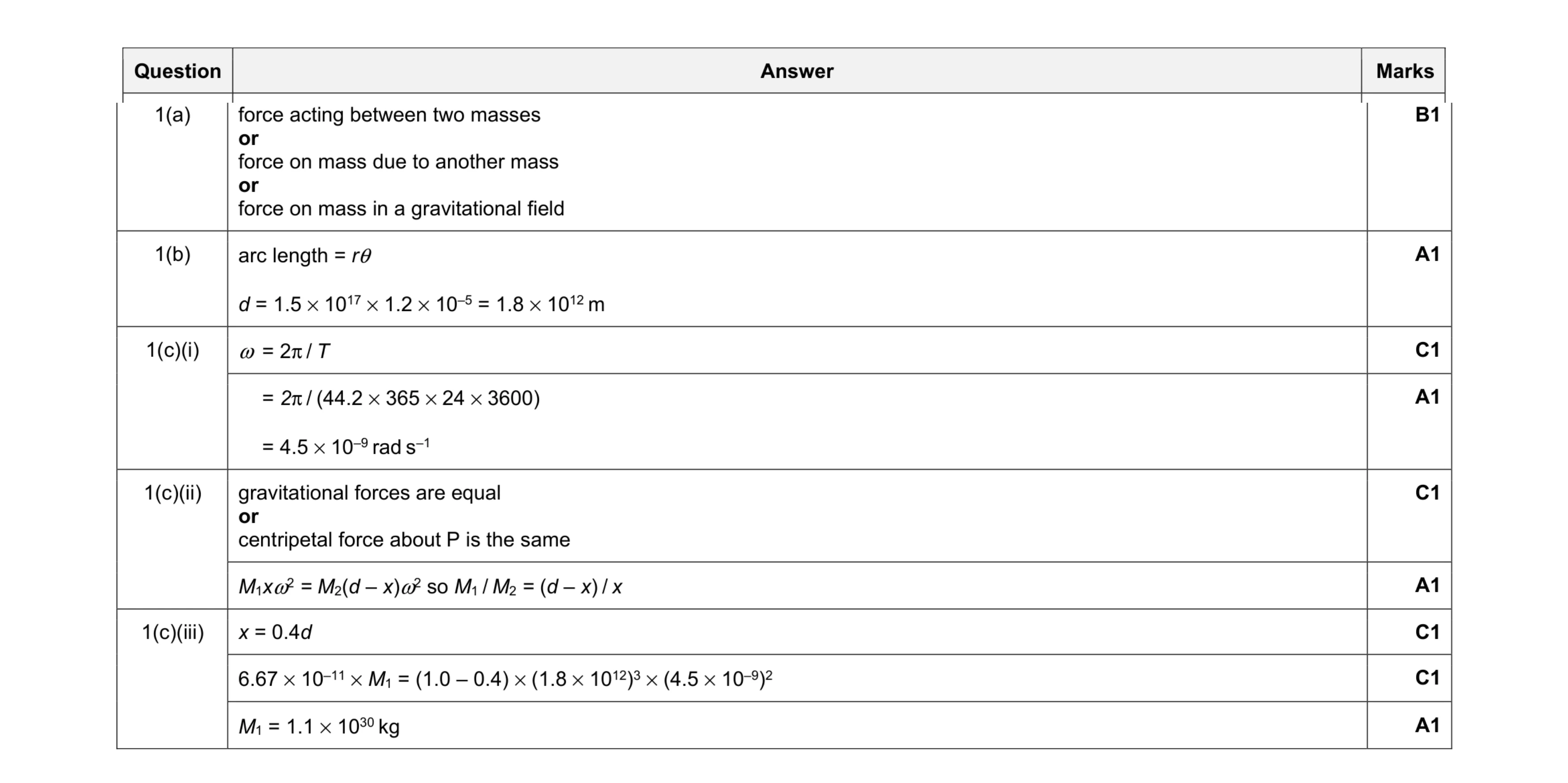 9
9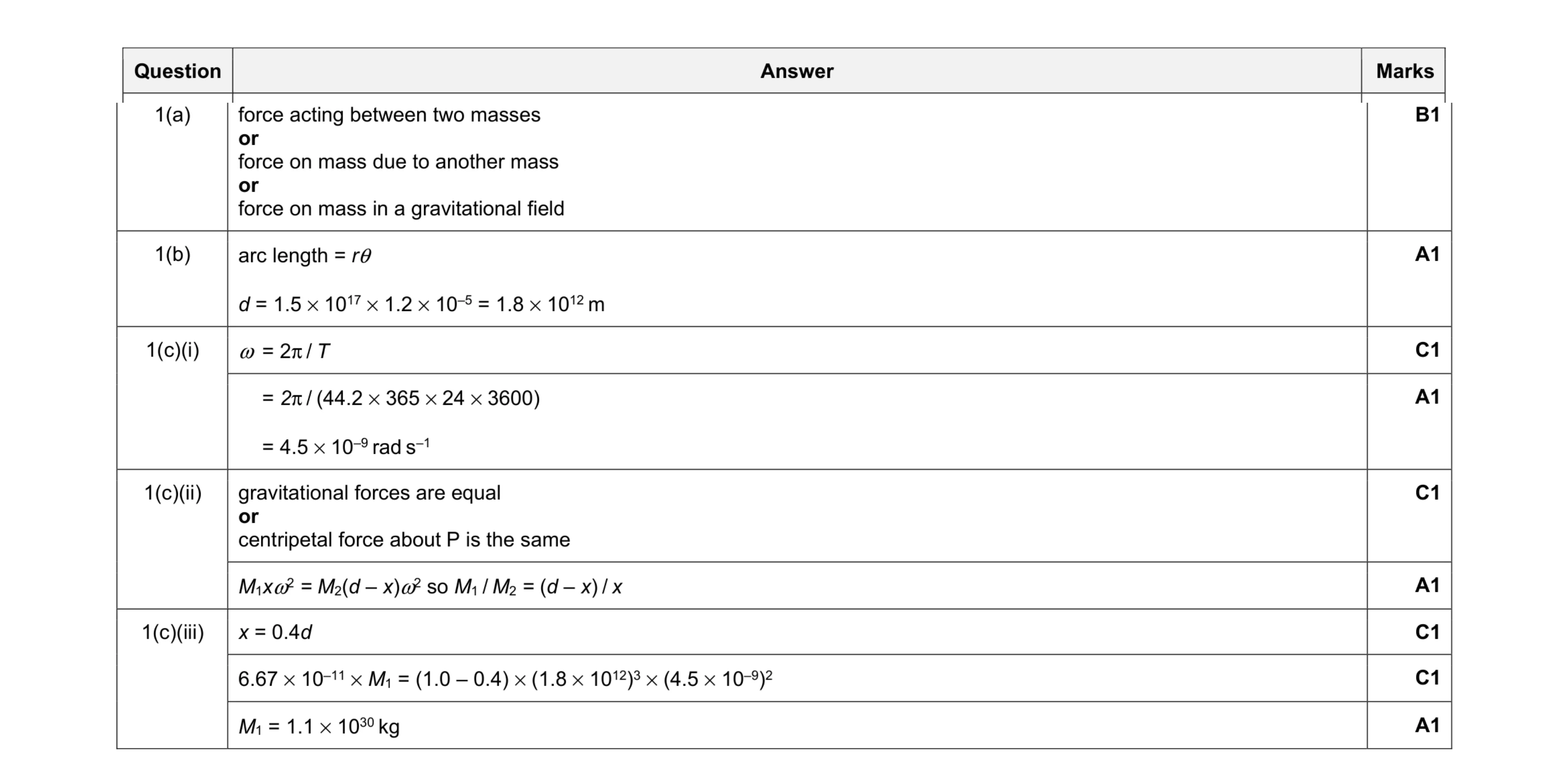 9
9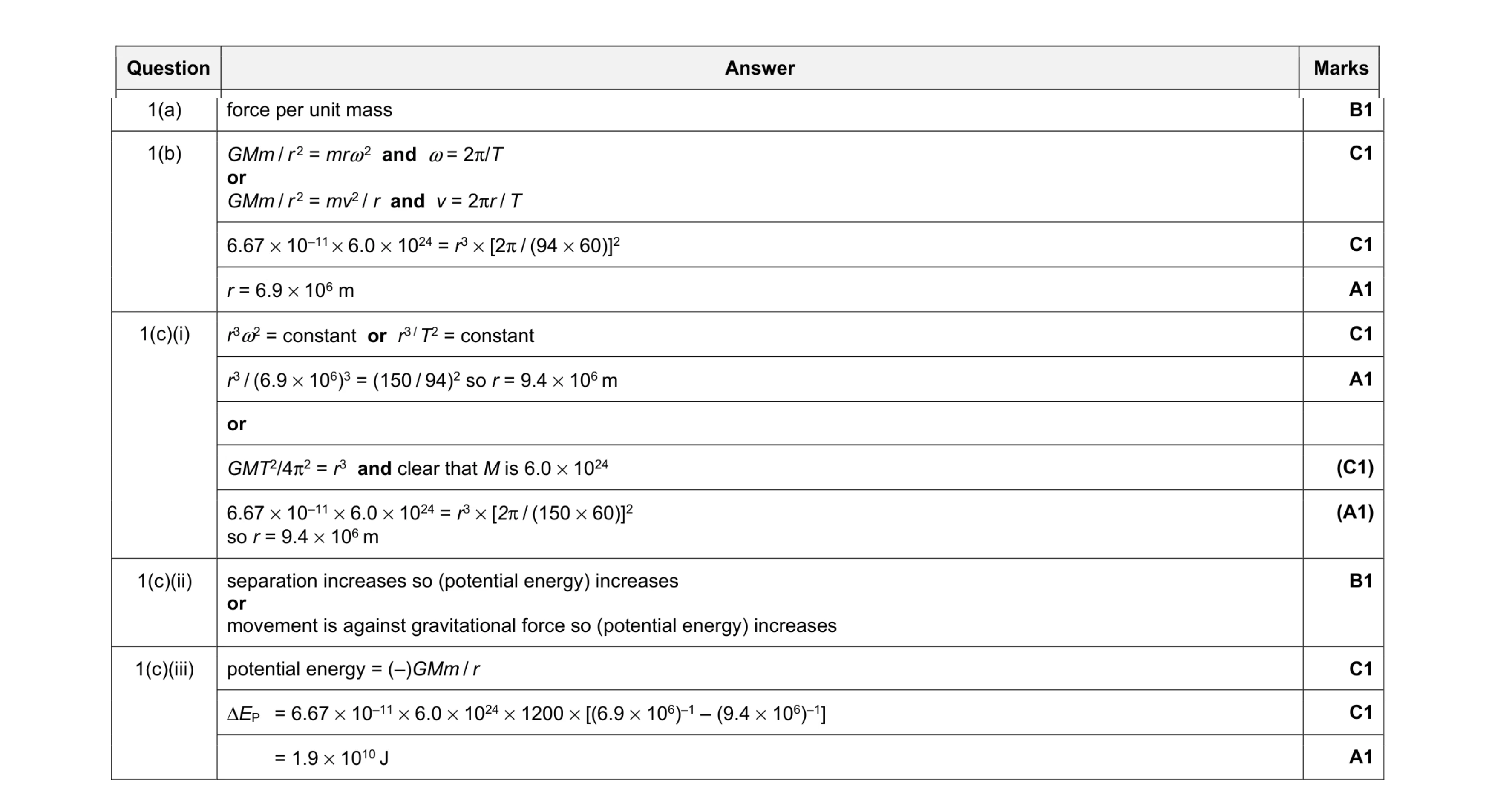 10
10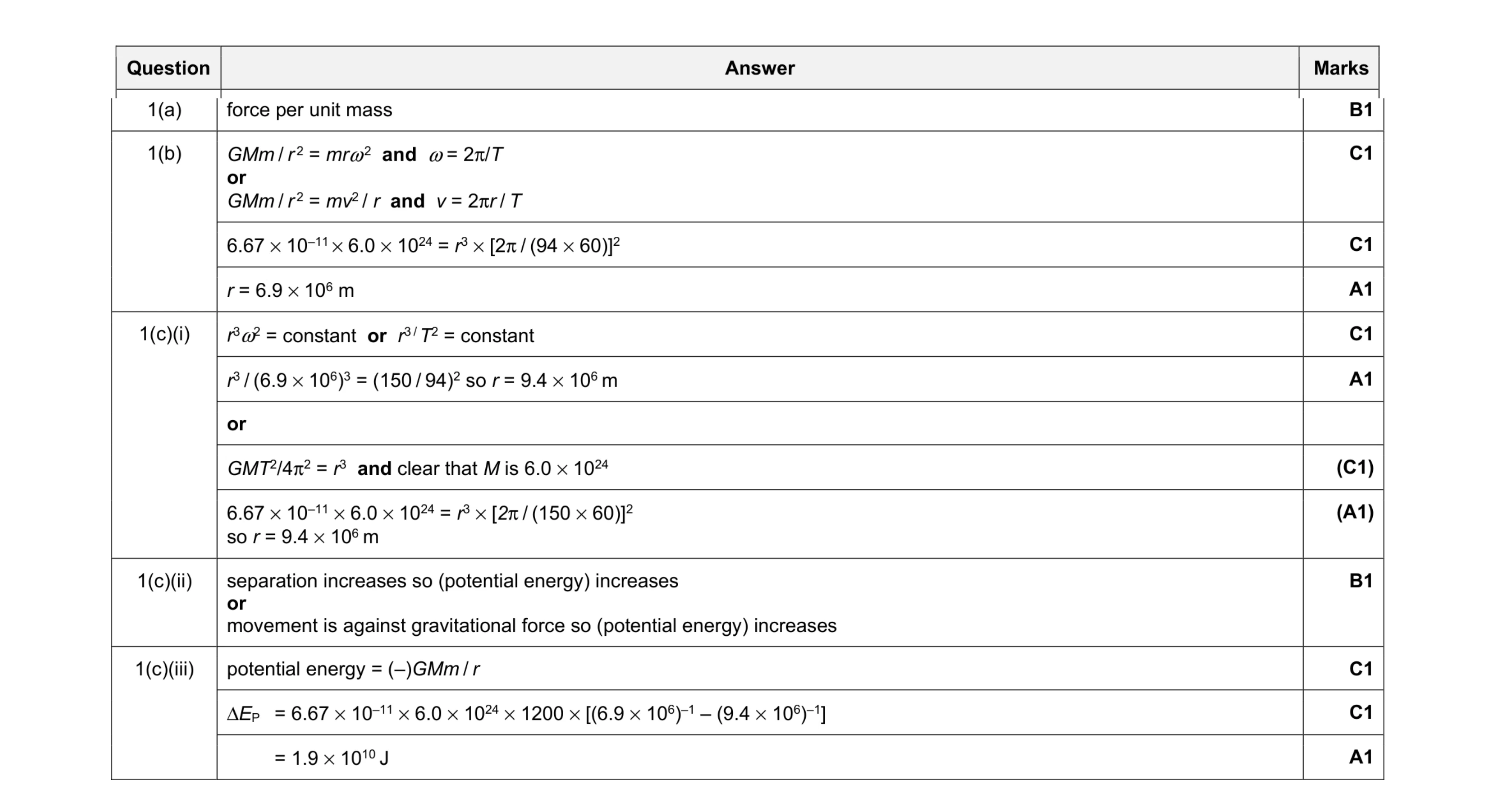 10
10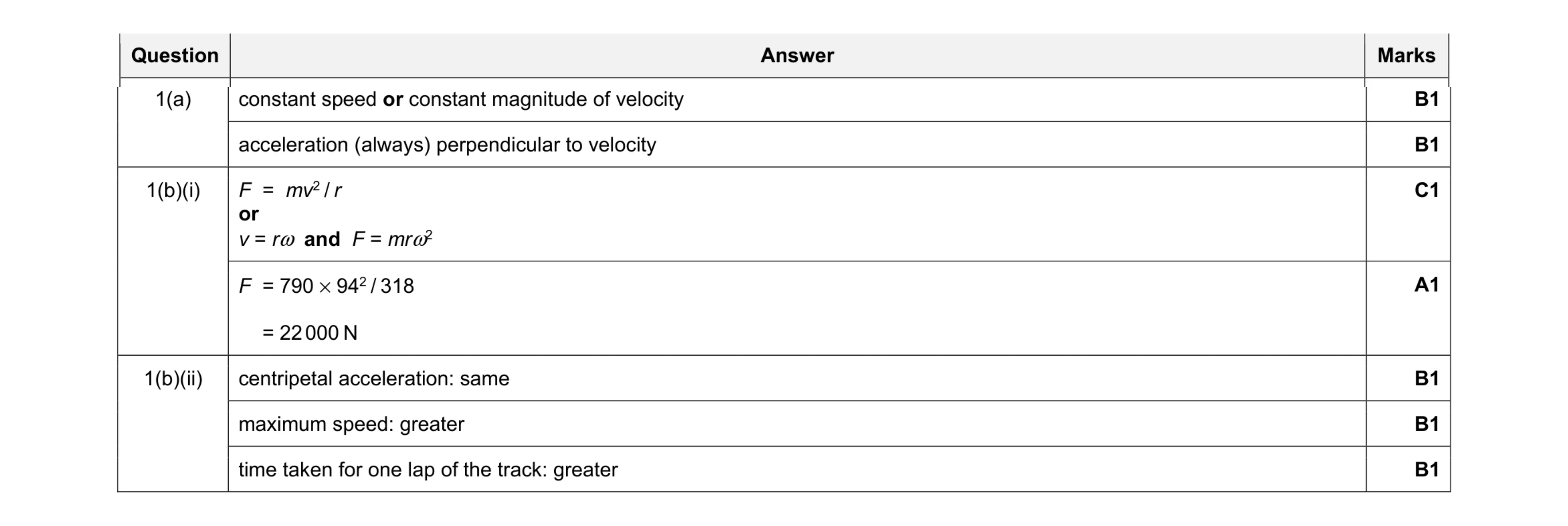 7
7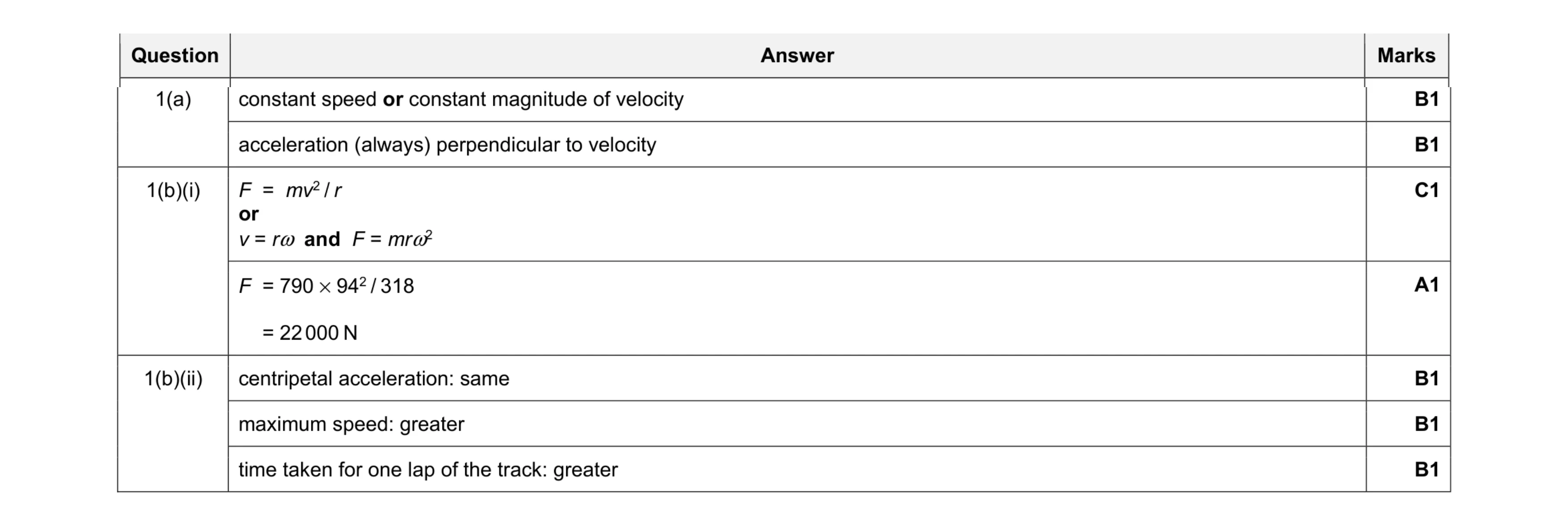 7
7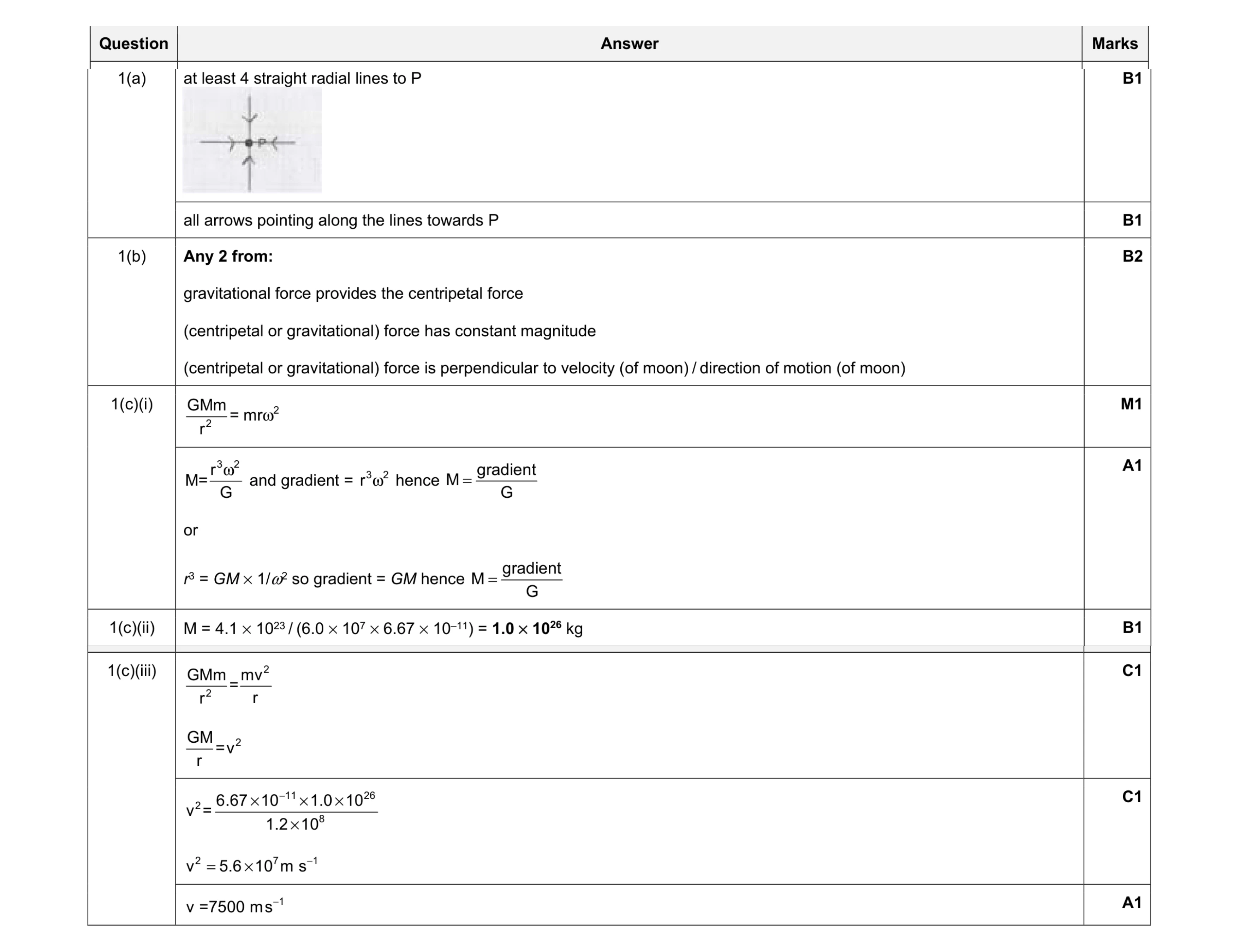 10
10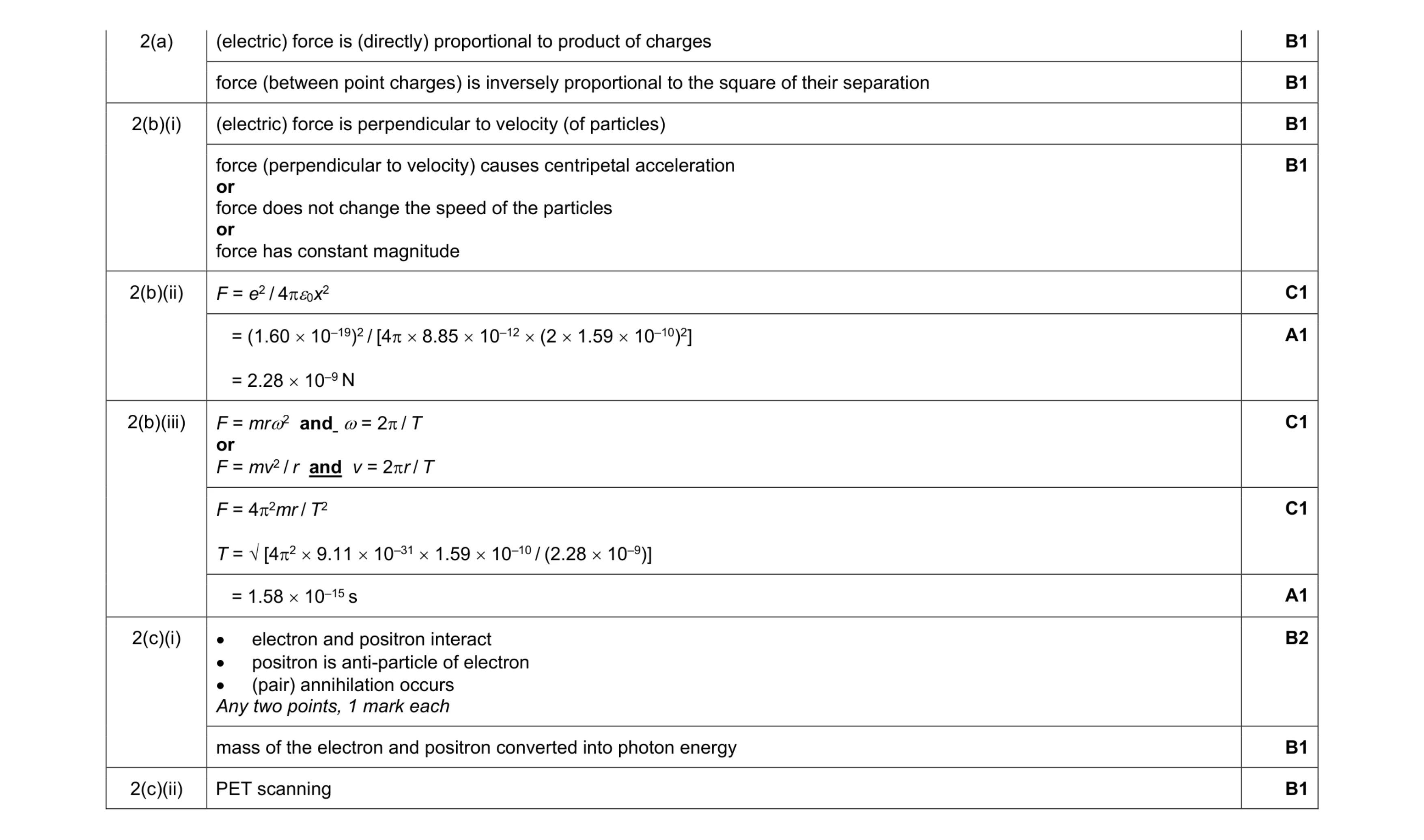 13
13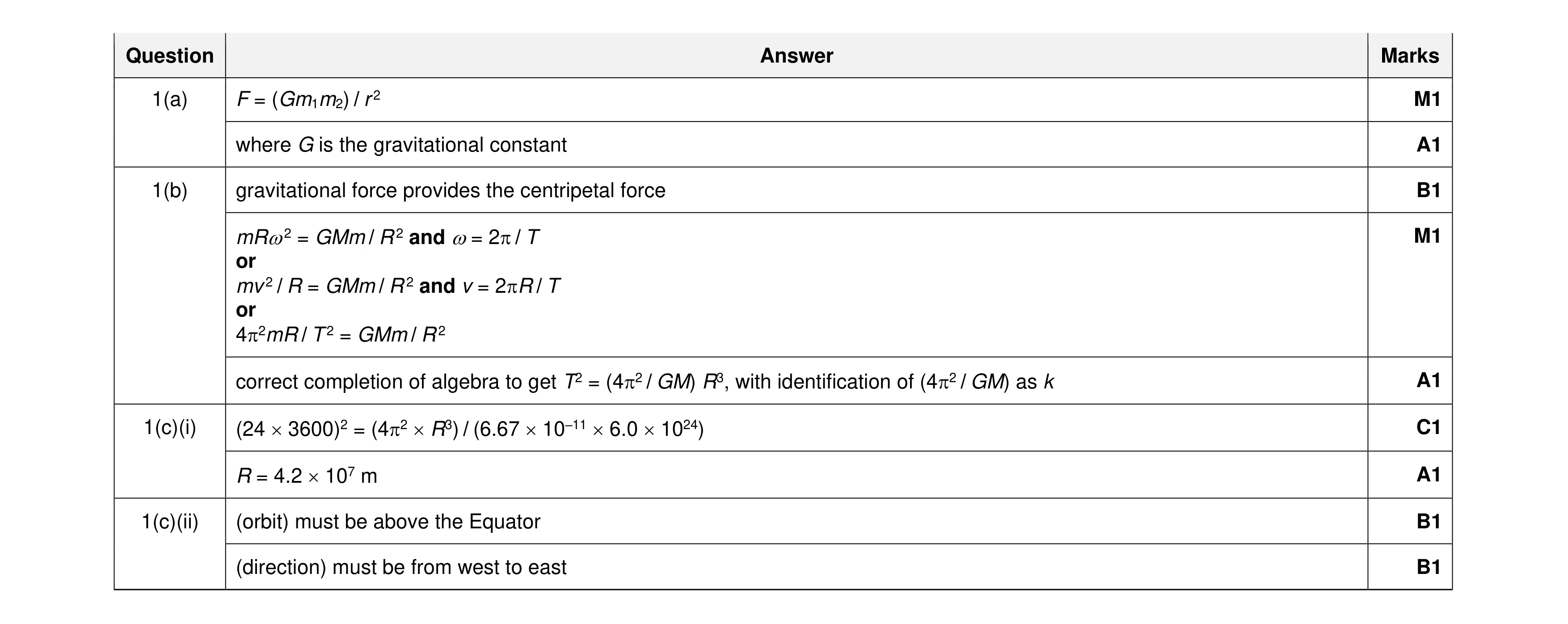 9
9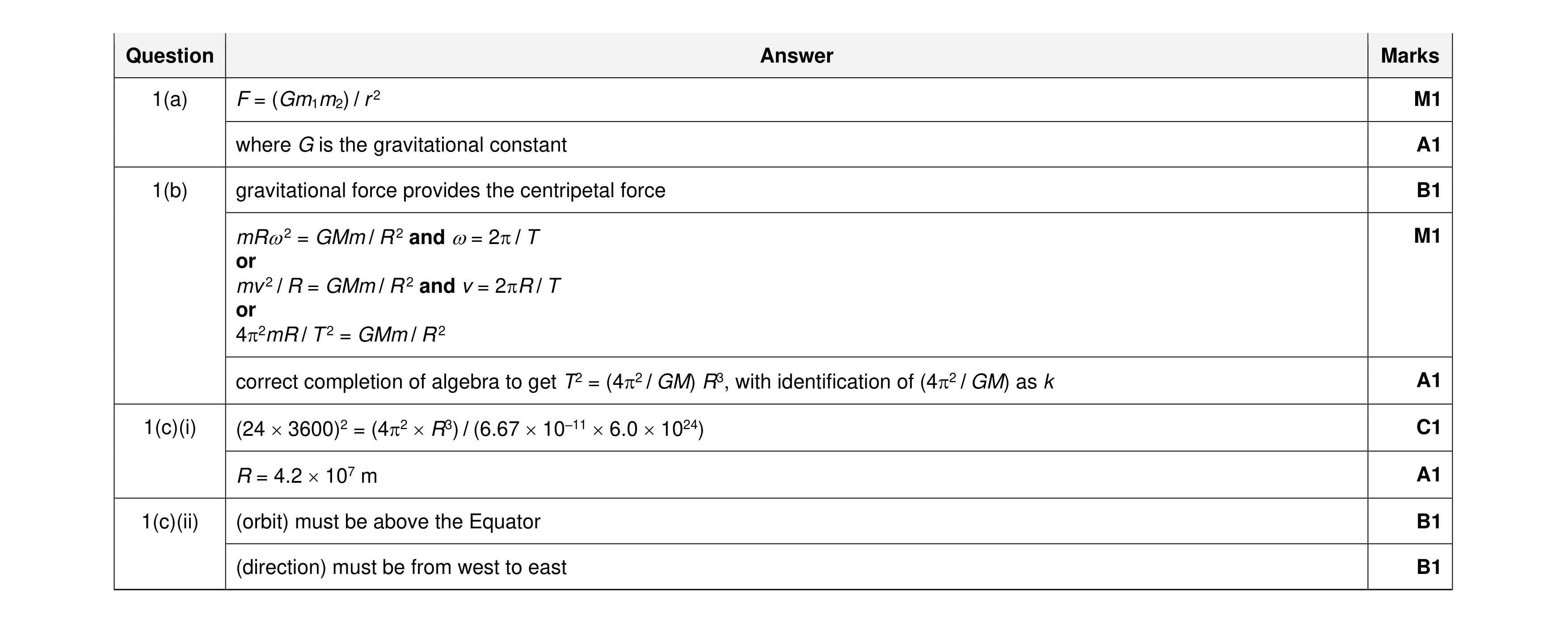 9
9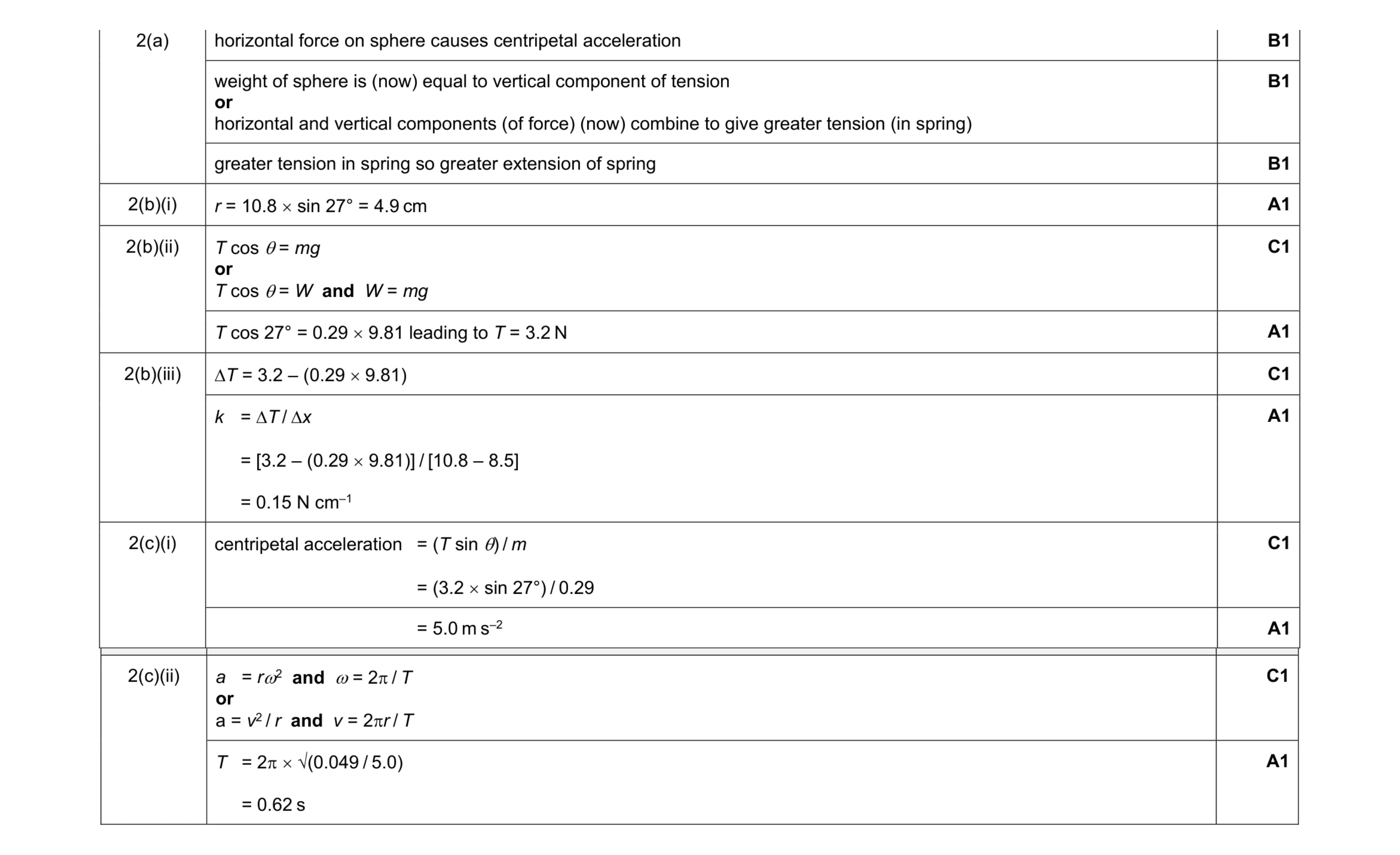 12
12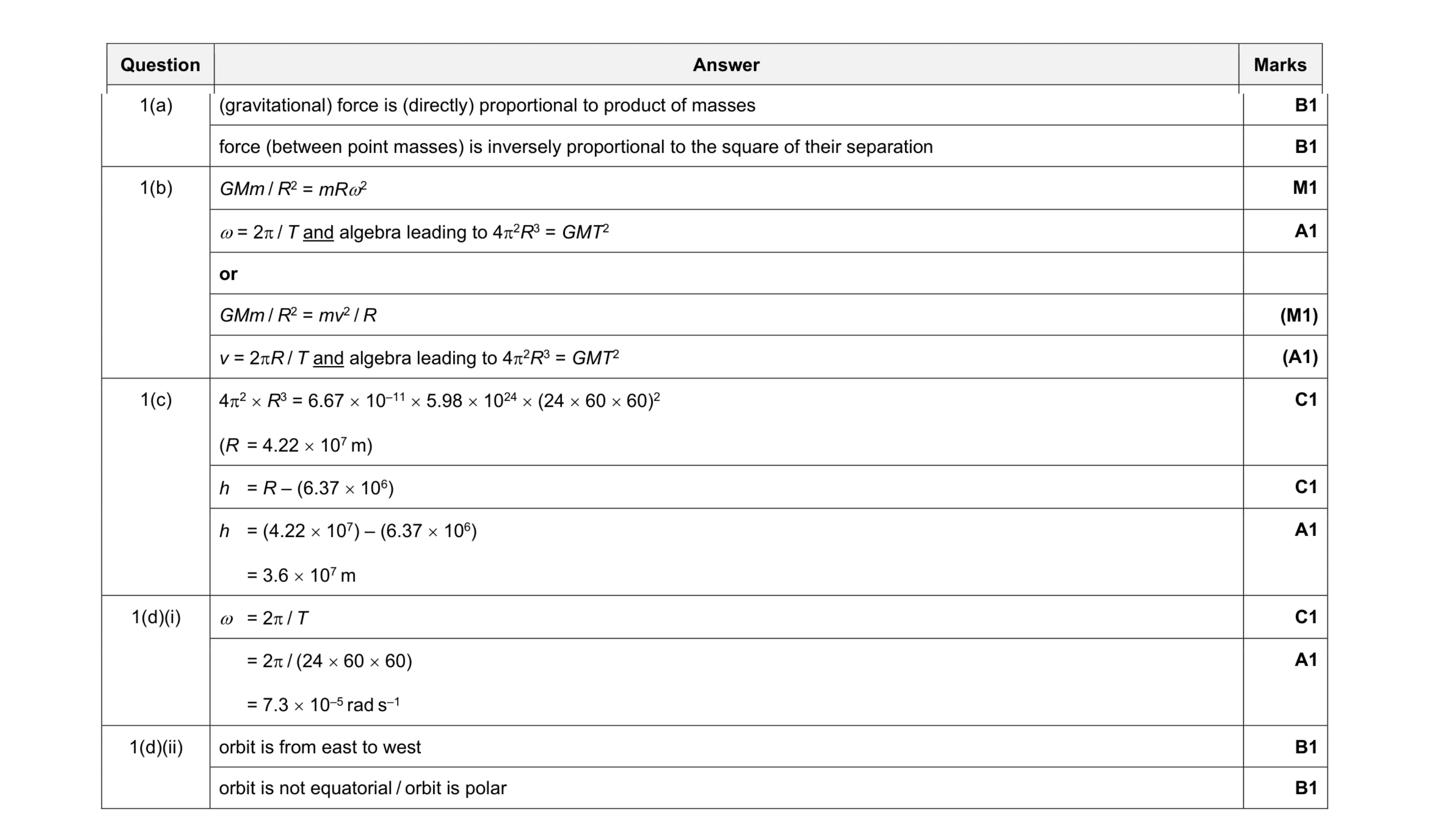 11
11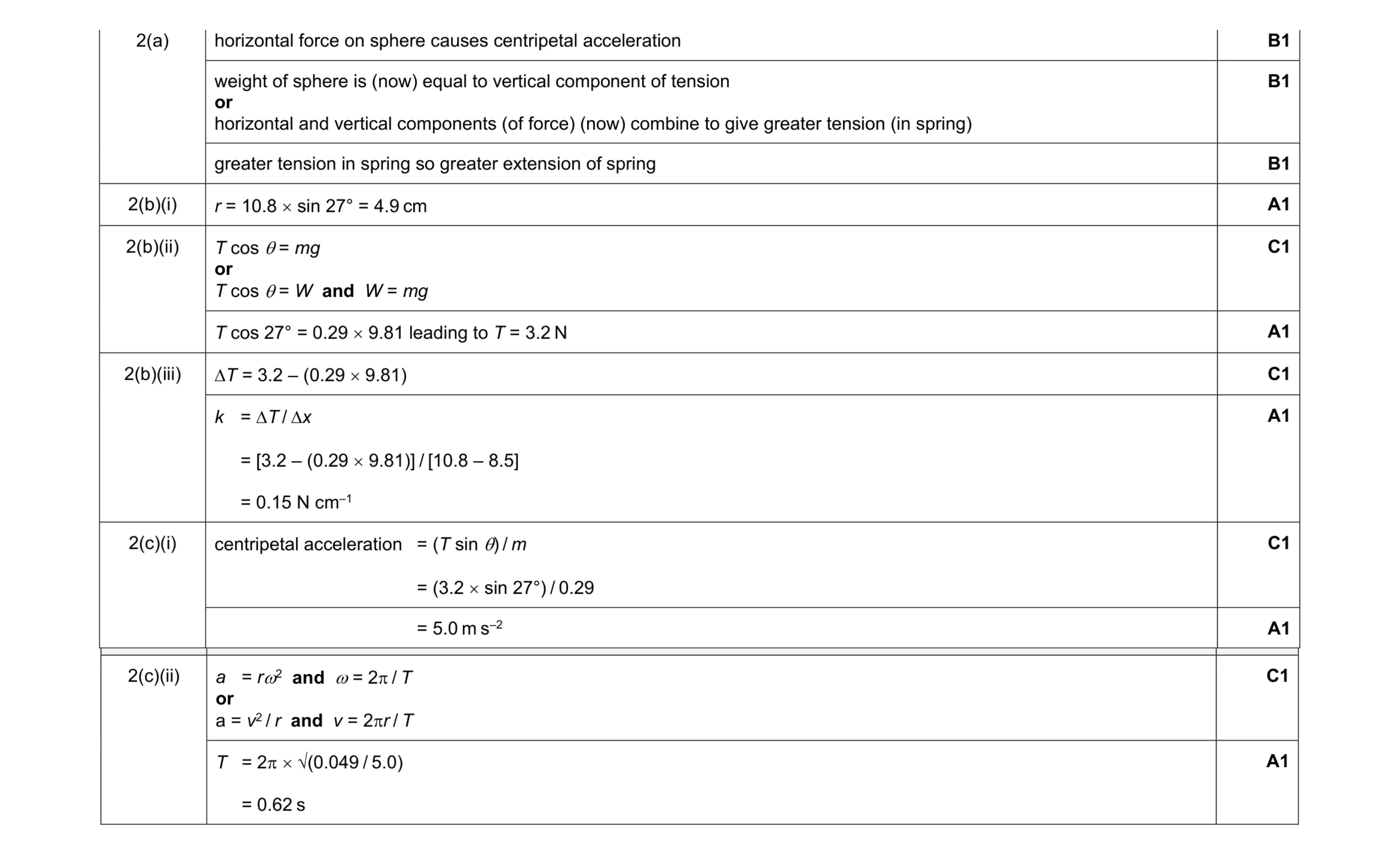 12
12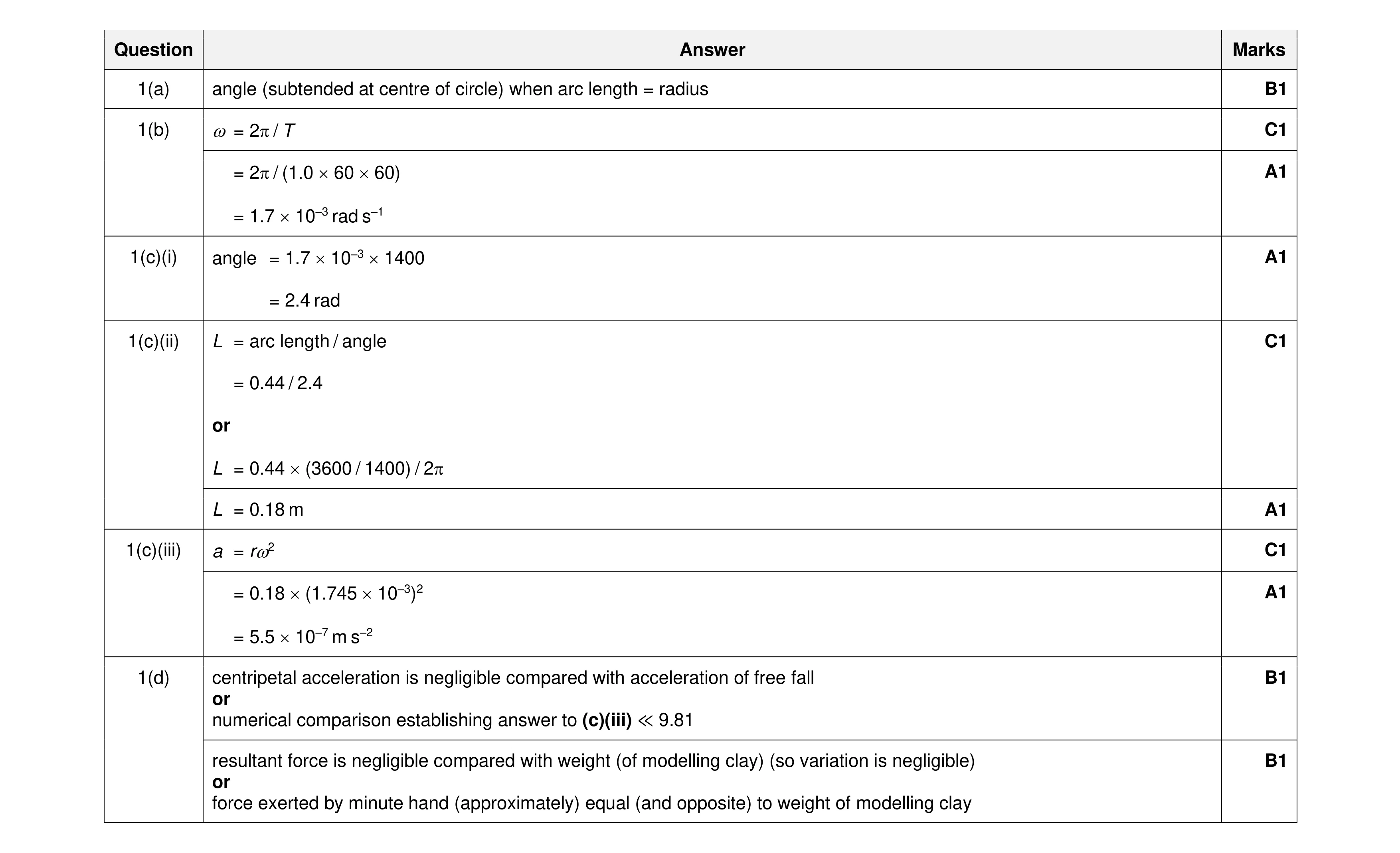 10
10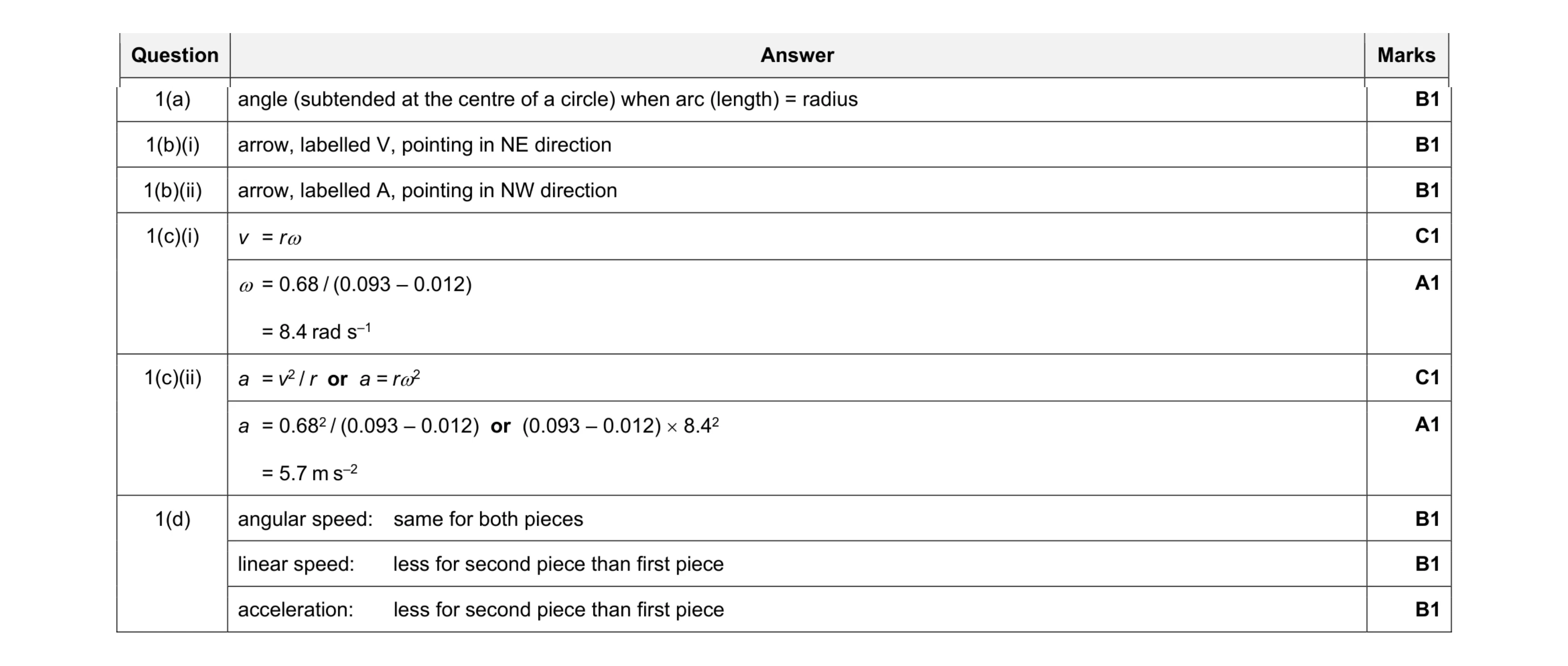 10
10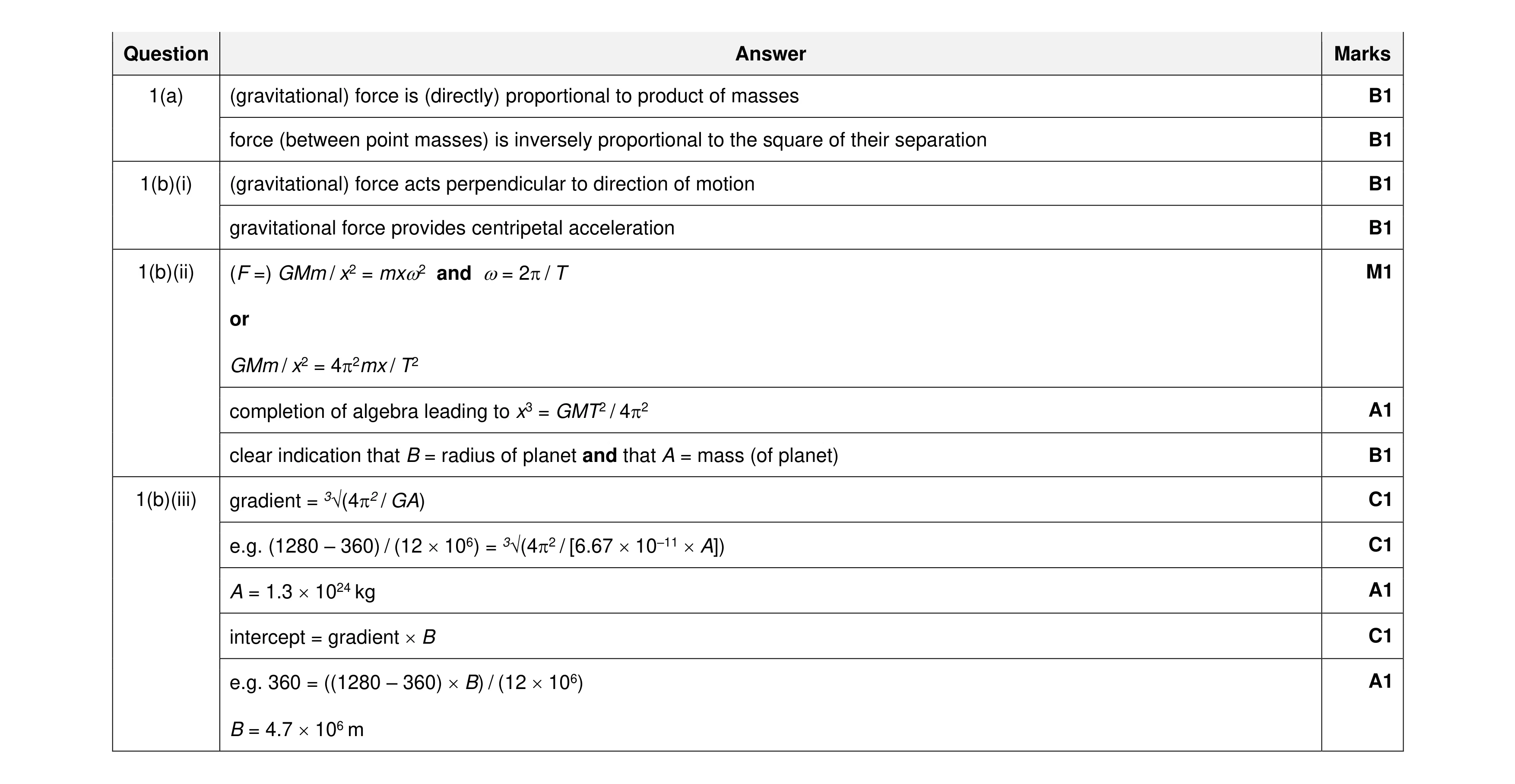 12
12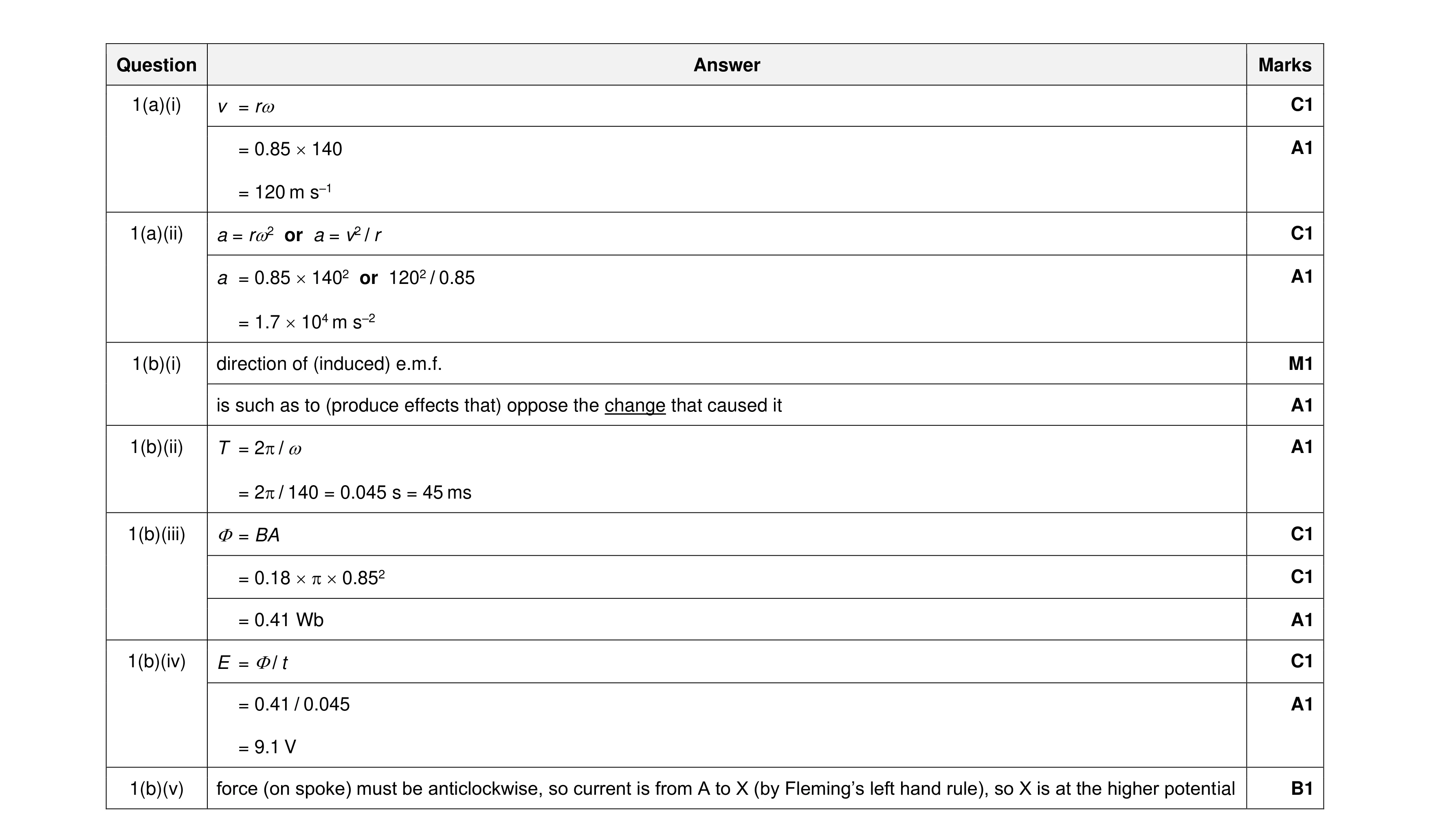 13
13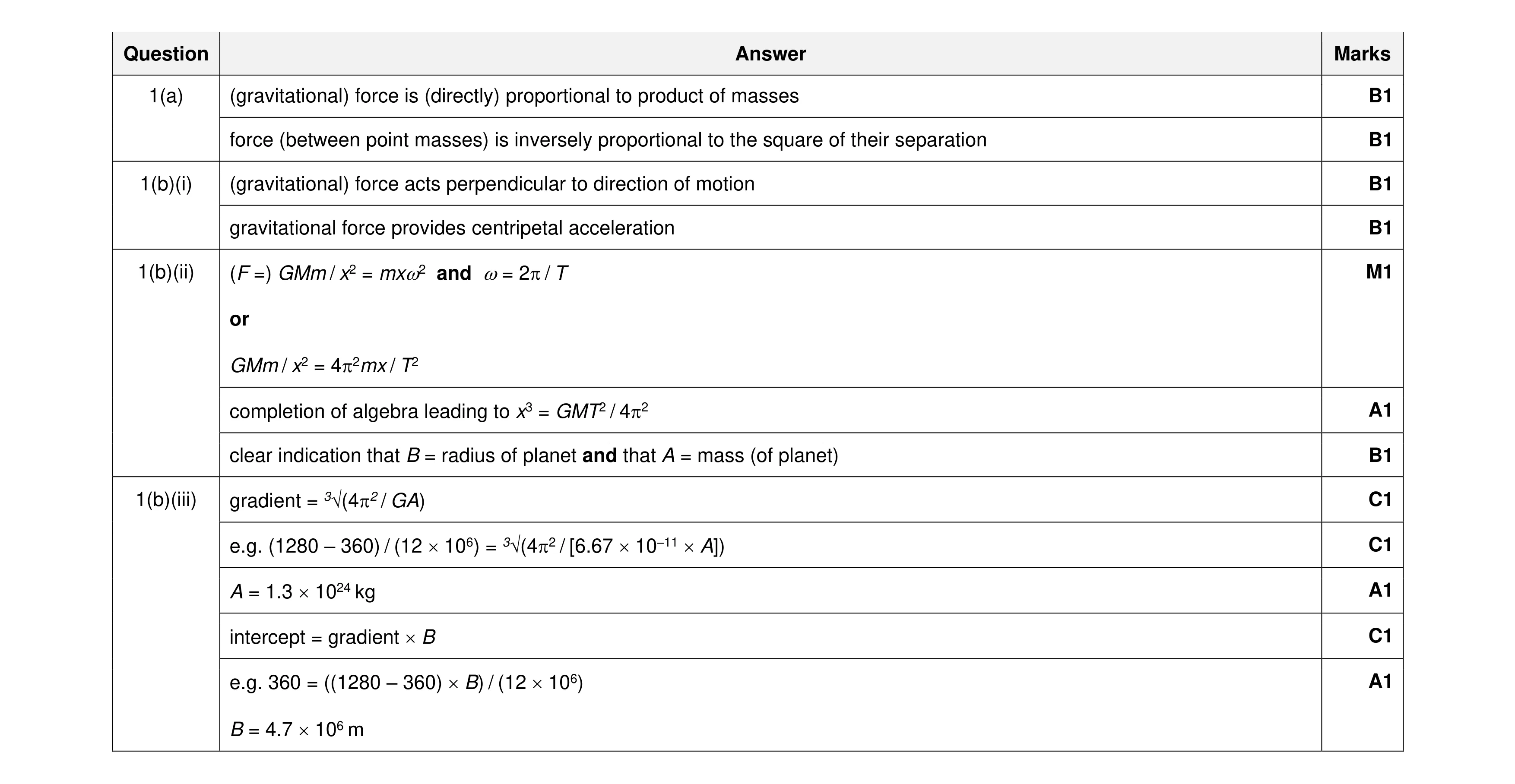 12
12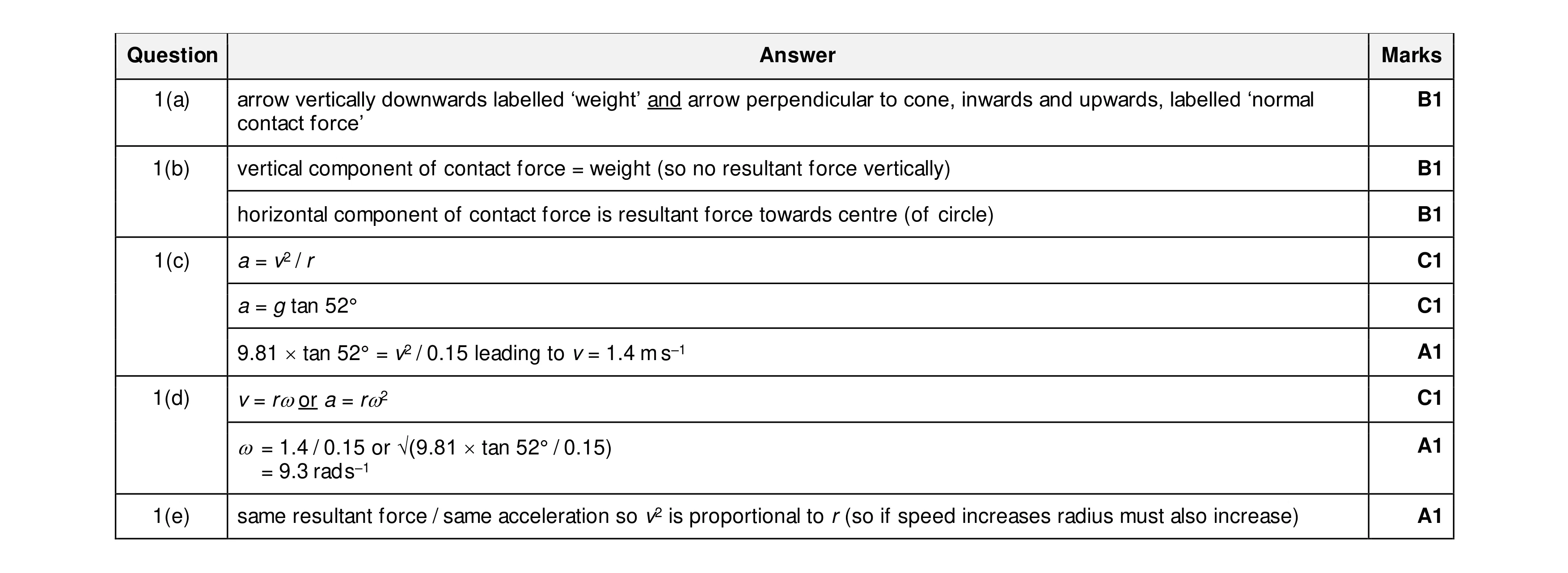 9
9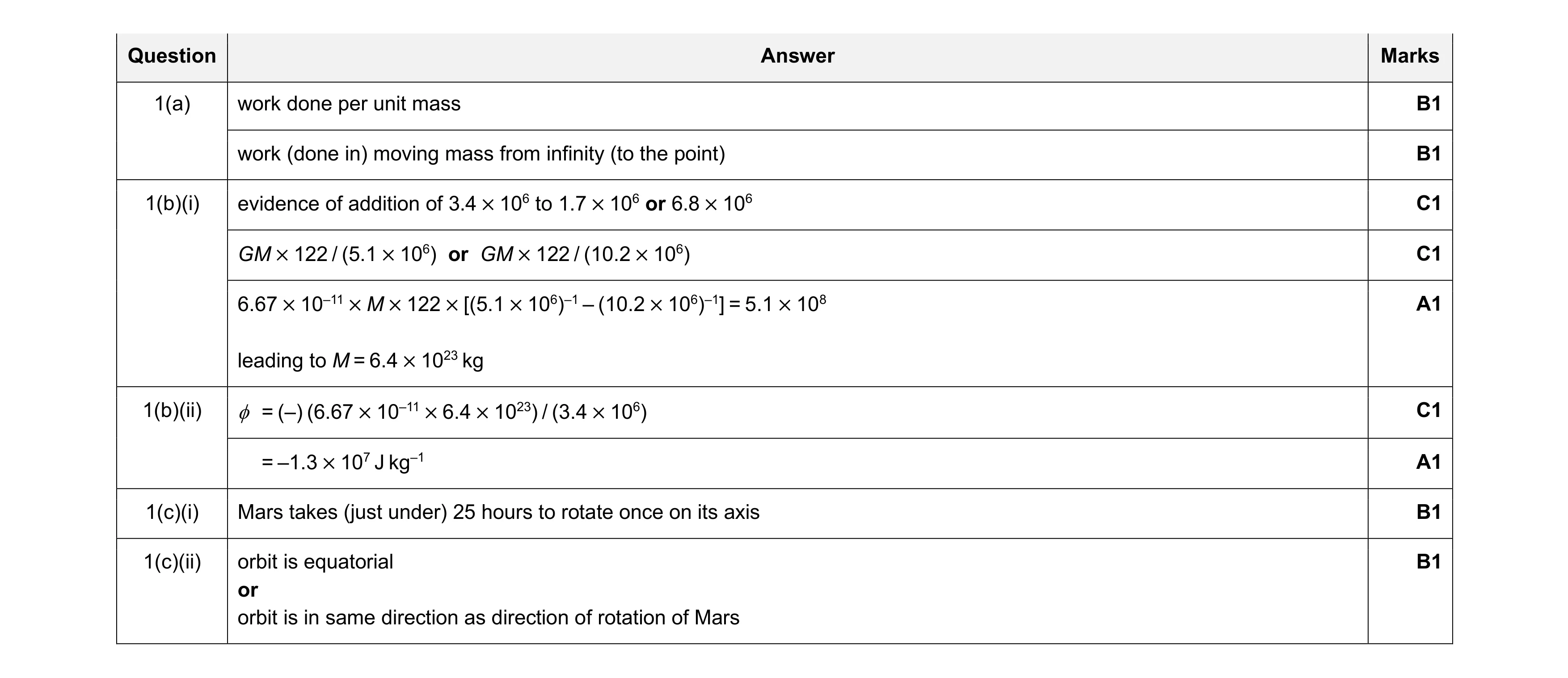 9
9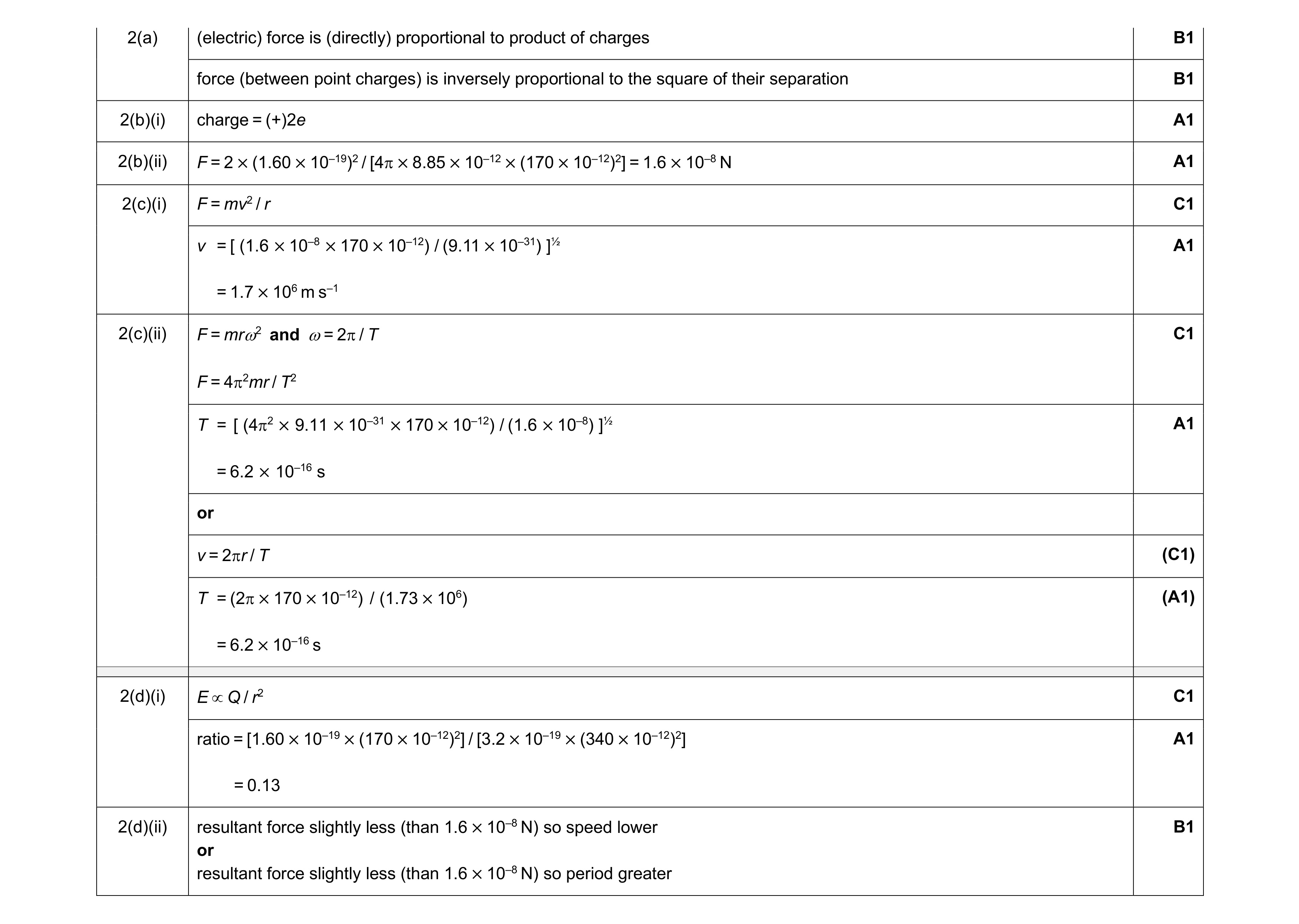 11
11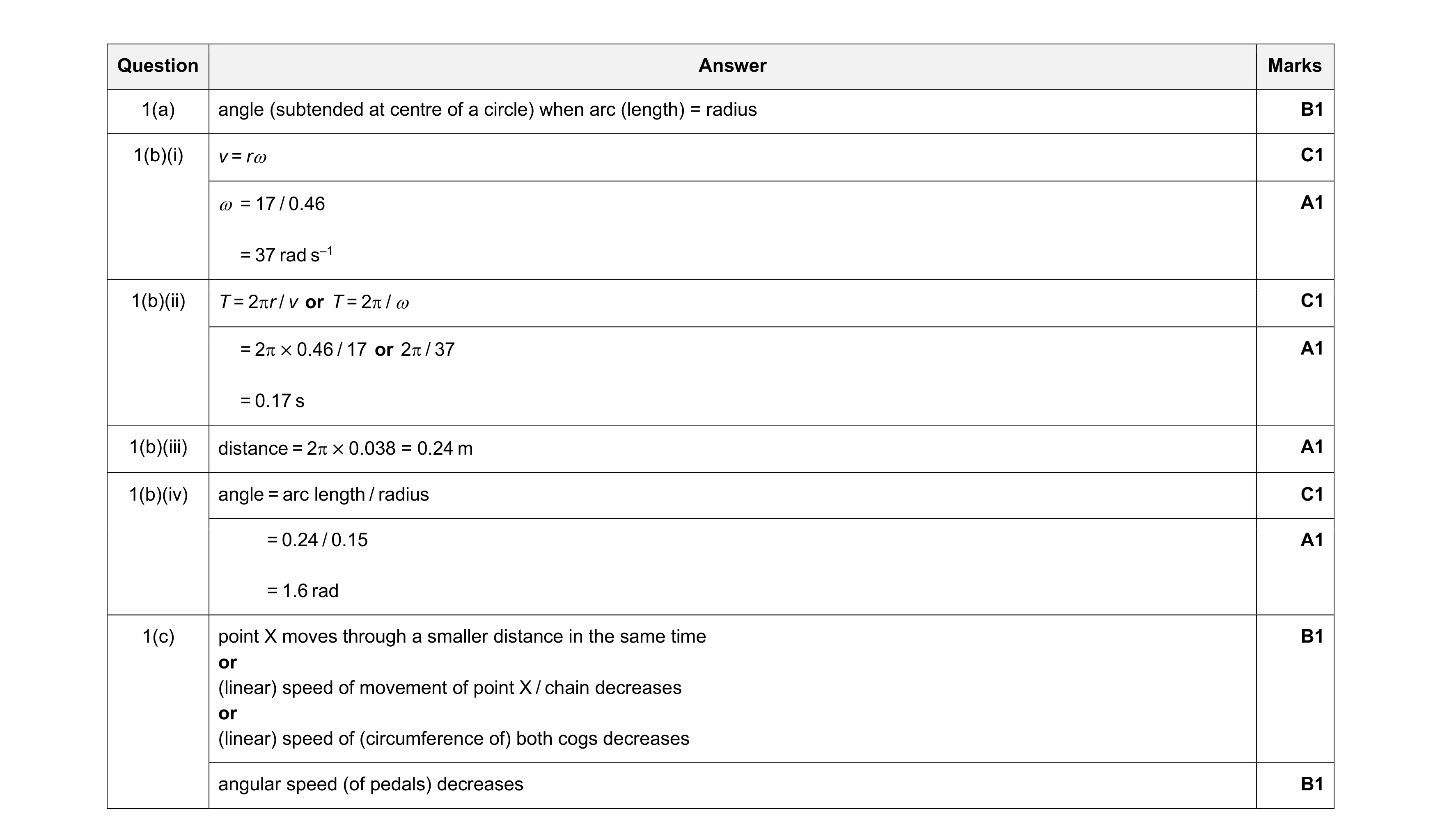 10
10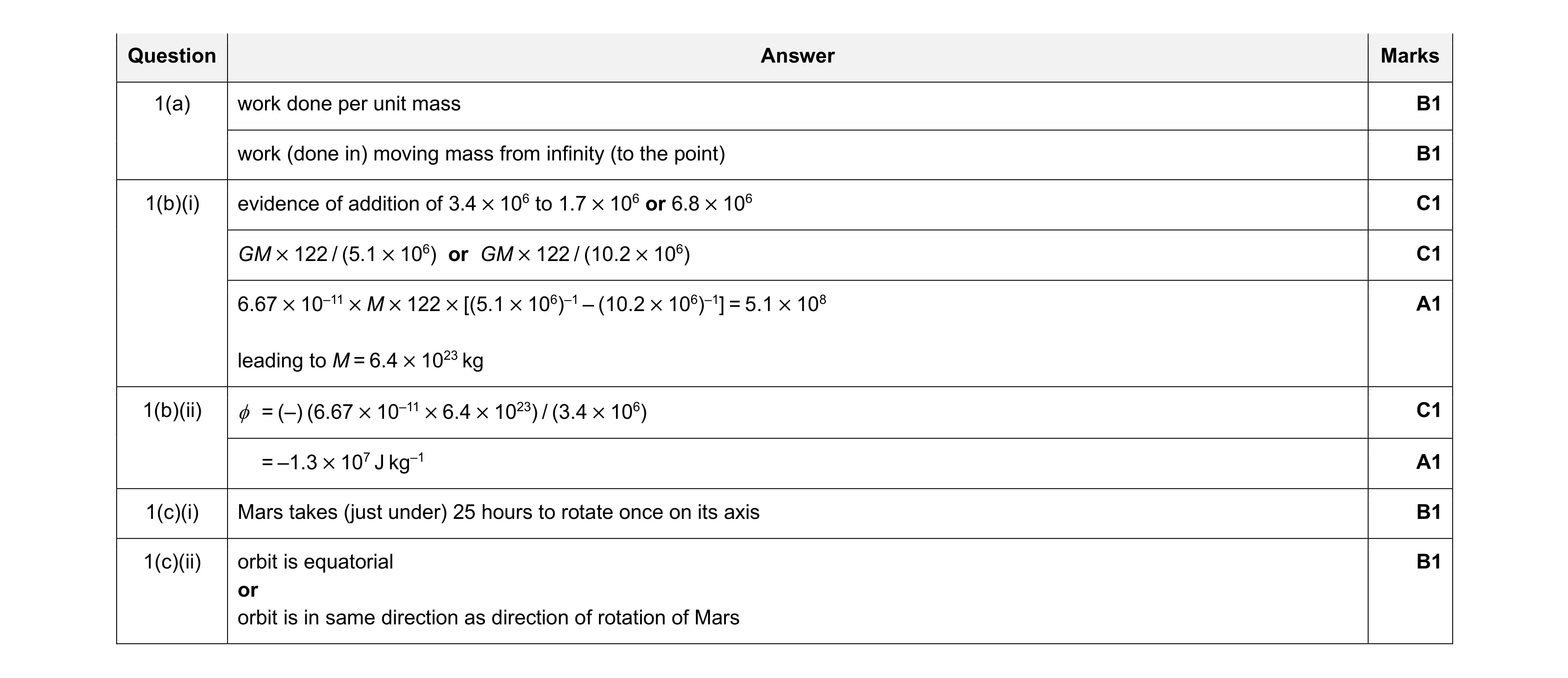 9
9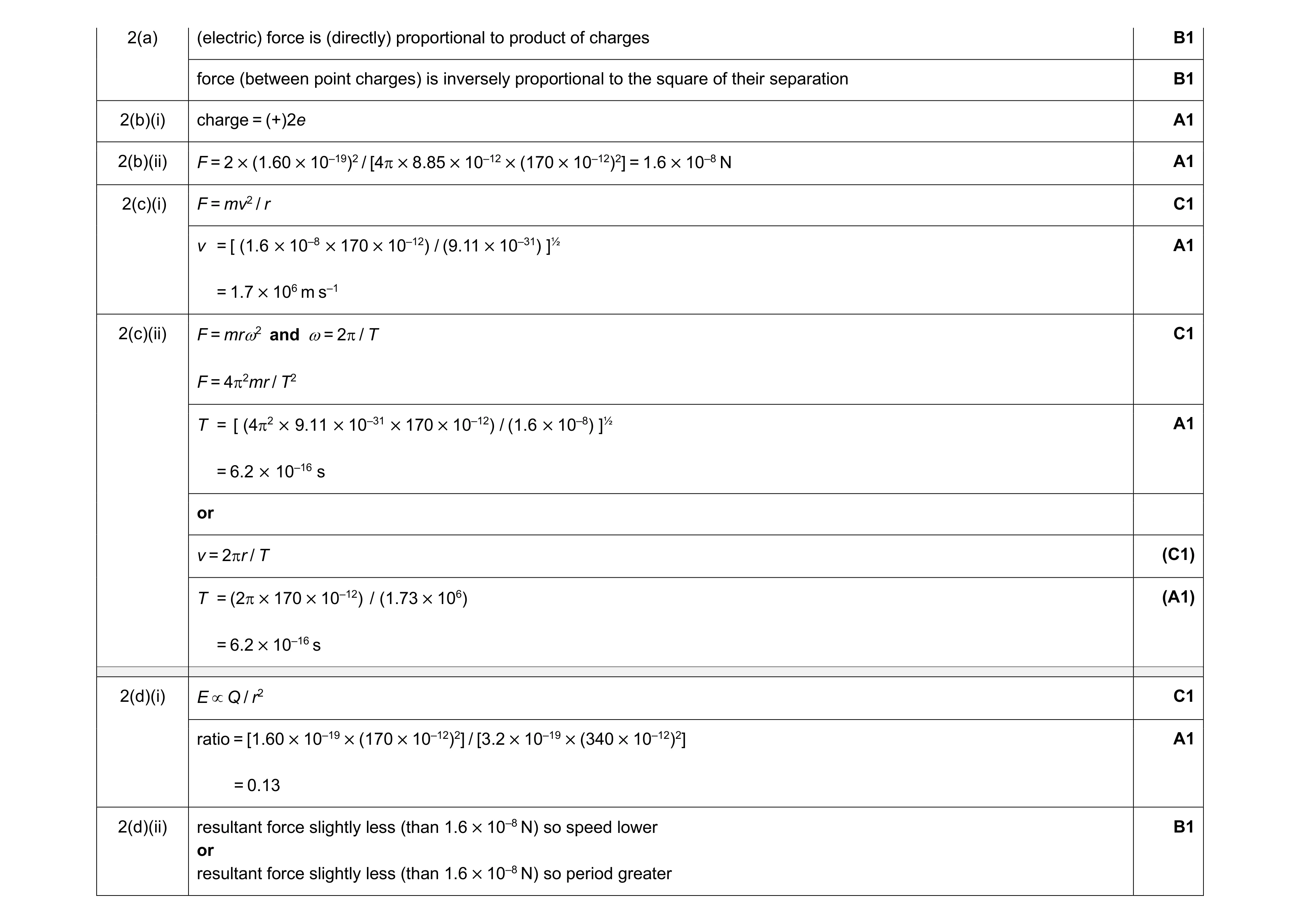 11
11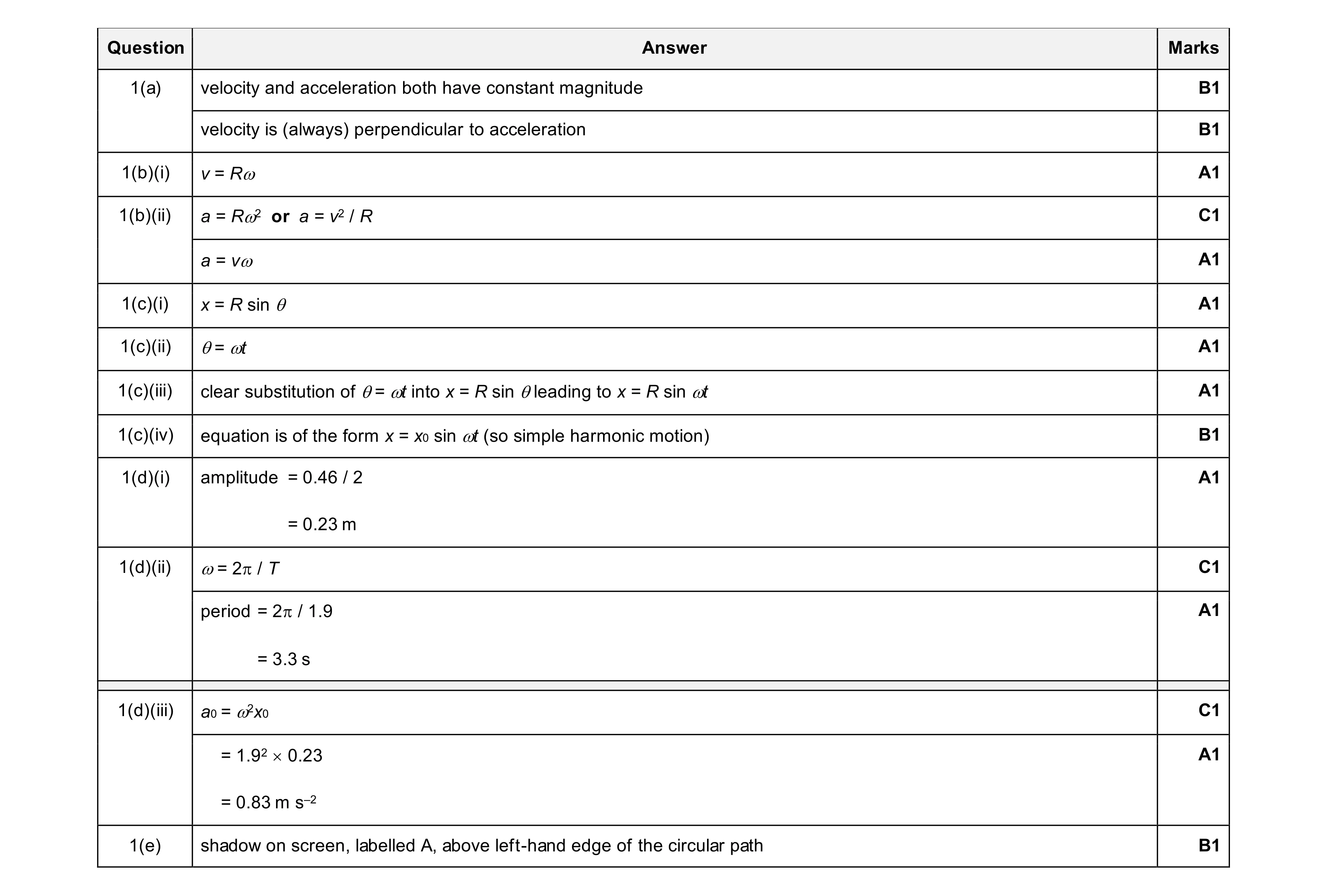 15
15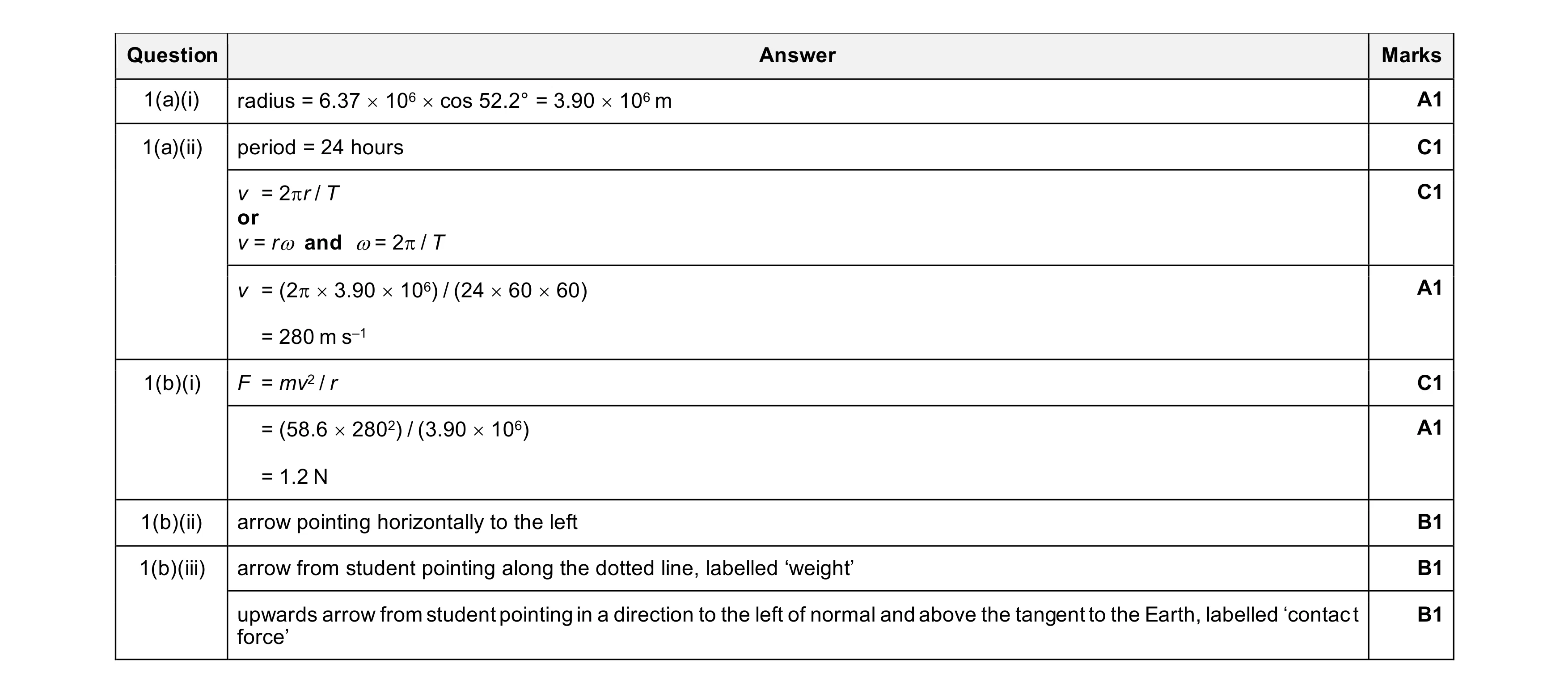 9
9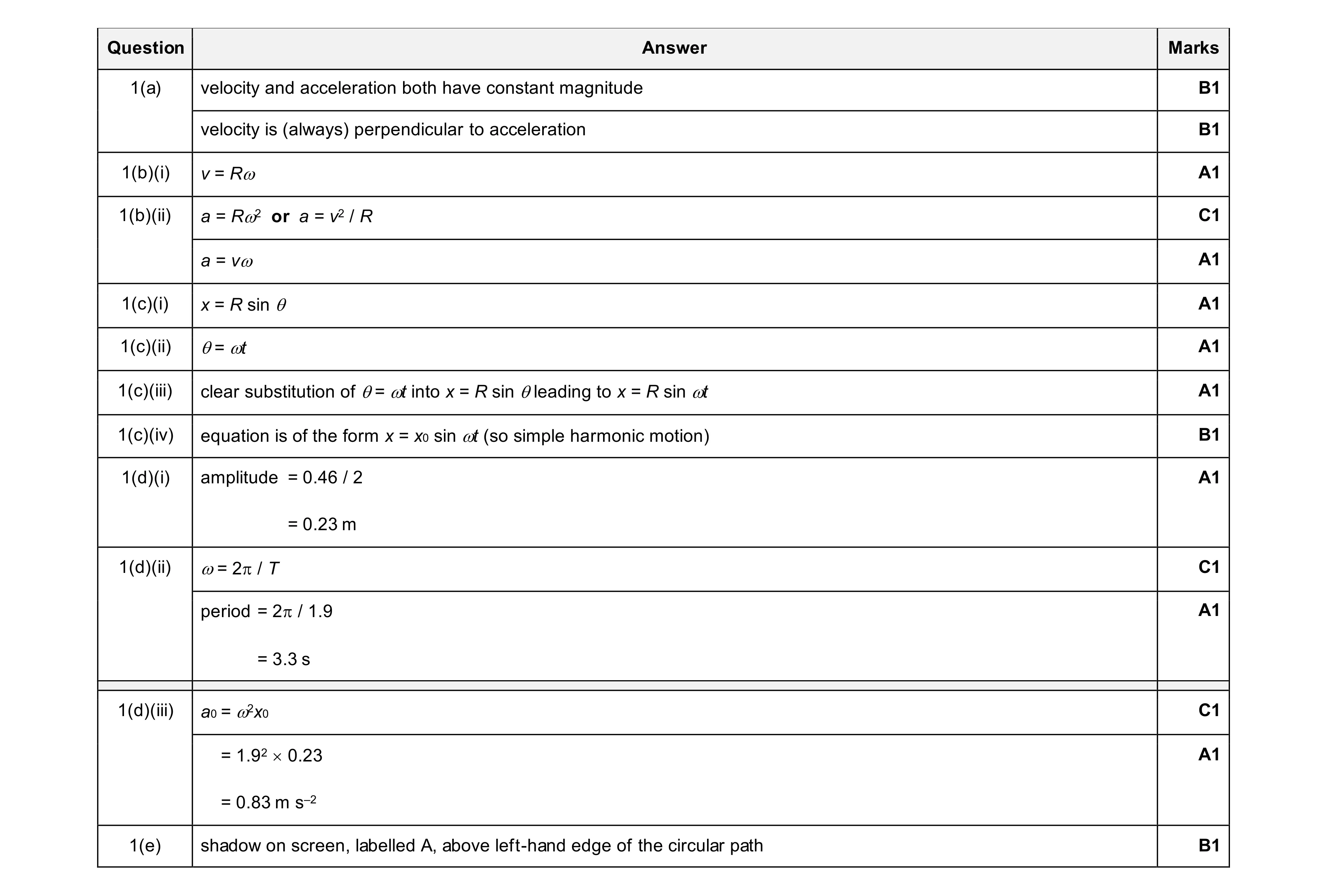 15
15