Questions as text
Question 1 9702/22 Feb/March 2017
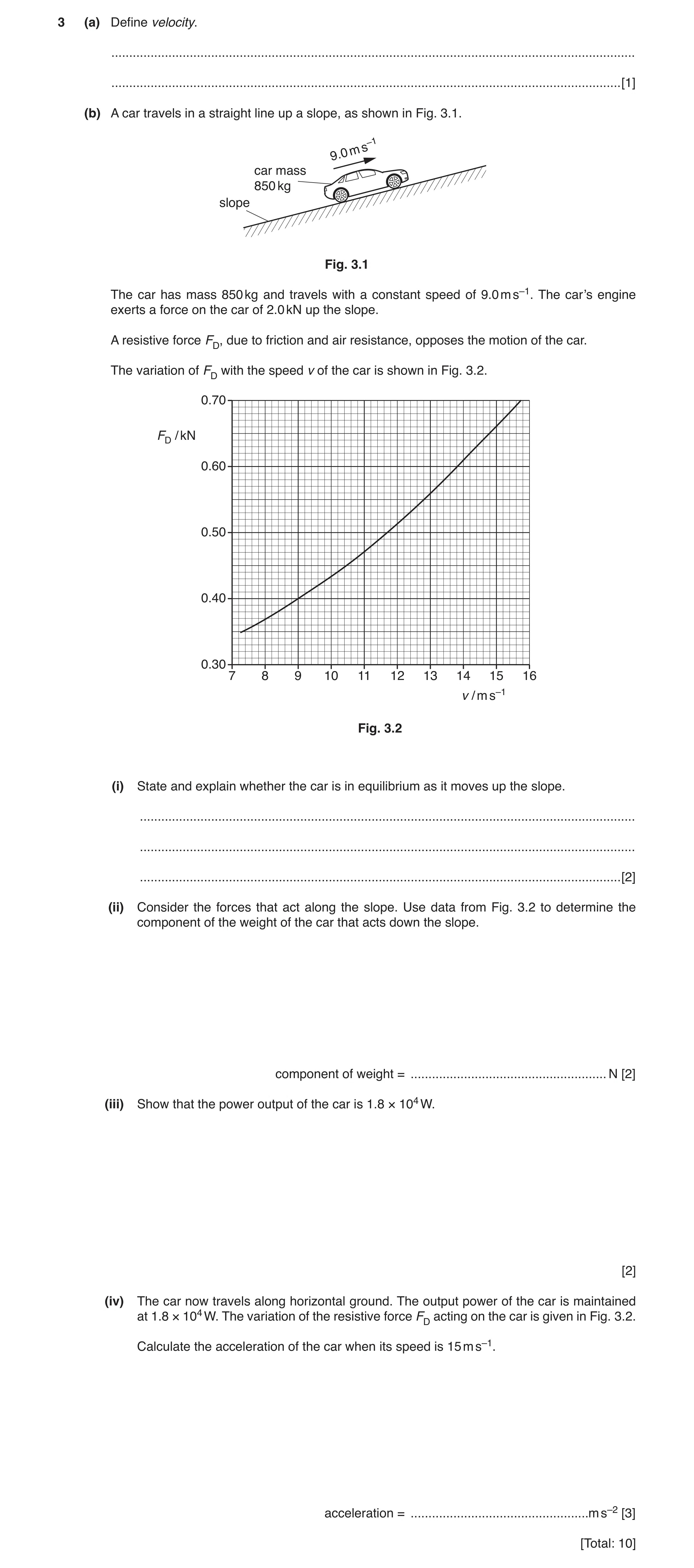
3 (a) Define velocity. … … [1] (b) A car travels in a straight line up a slope, as shown in Fig. 3.1. ms–1 9.0 car mass 850 kg slope Fig. 3.1 The car has mass 850 kg and travels with a constant speed of 9.0 m s–1. The car’s engine exerts a force on the car of 2.0 kN up the slope. A resistive force FD, due to friction and air resistance, opposes the motion of the car. The variation of FD with the speed v of the car is shown in Fig. 3.2. 0.70 FD / kN 0.60 0.50 0.40 0.30 7 8 9 10 11 12 13 14 15 16 v / m s–1 Fig. 3.2 (i) State and explain whether the car is in equilibrium as it moves up the slope. … … … [2] (ii) Consider the forces that act along the slope. Use data from Fig. 3.2 to determine the component of the weight of the car that acts down the slope. component of weight = … N [2] (iii) Show that the power output of the car is 1.8 × 10⁴ W. [2] (iv) The car now travels along horizontal ground. The output power of the car is maintained at 1.8 × 10⁴ W. The variation of the resistive force FD acting on the car is given in Fig. 3.2. Calculate the acceleration of the car when its speed is 15 m s–1. acceleration = … m s–2 [3] [Total: 10]
10 marks
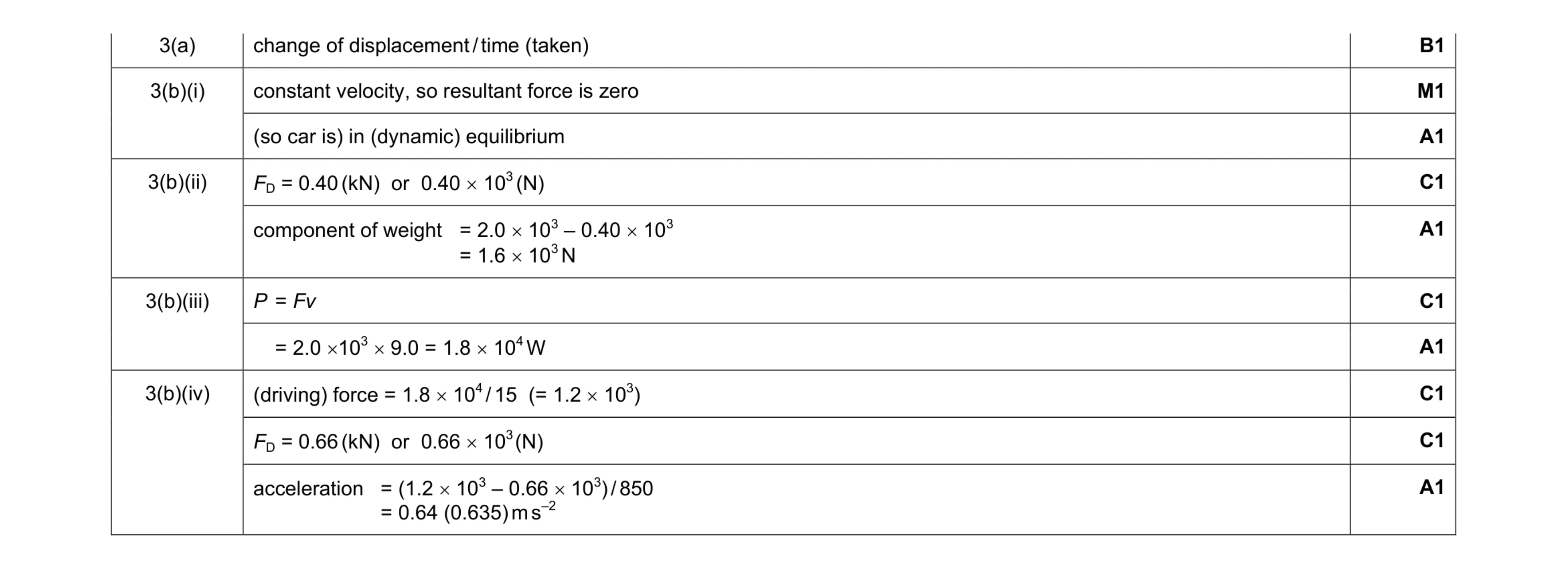
Mark scheme: 3(a) change of displacement / time (taken) B1 3(b)(i) constant velocity, so resultant force is zero M1 (so car is) in (dynamic) equilibrium A1 3(b)(ii) FD = 0.40 (kN) or 0.40 × 10³ (N) C1 component of weight = 2.0 × 10³ – 0.40 × 103 = 1.6 × 10³ N A1 3(b)(iii) P = Fv C1 = 2.0 ×103 × 9.0 = 1.8 × 10⁴ W A1 3(b)(iv) (driving) force = 1.8 × 10⁴ / 15 (= 1.2 × 10³) C1 FD = 0.66 (kN) or 0.66 × 10³ (N) C1 acceleration = (1.2 × 10³ – 0.66 × 10³) / 850 = 0.64 (0.635) m s–2 A1
This question in 9702/22 Feb/March 2017
Q2 · Define (i) displacement, … … [1] (ii) acceleration 9702/21 Oct/Nov 2018
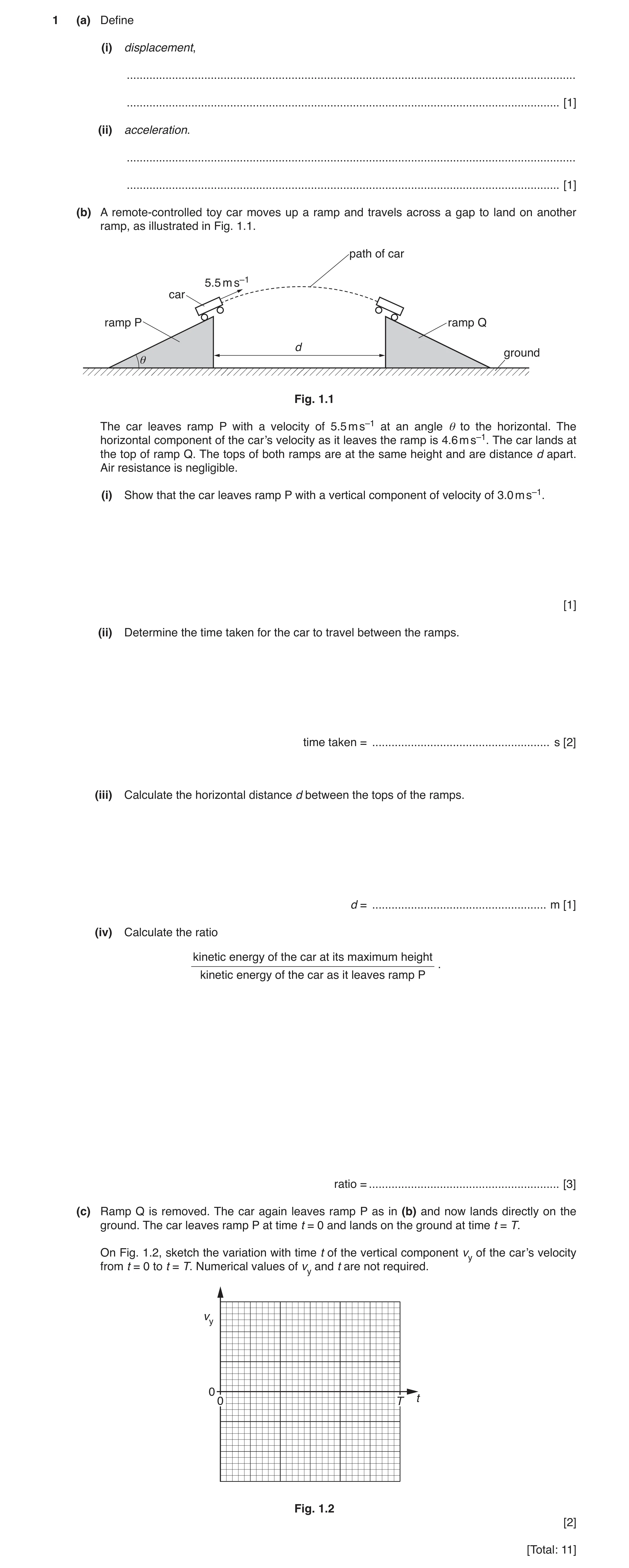
1 (a) Define (i) displacement, … … [1] (ii) acceleration. … … [1] (b) A remote-controlled toy car moves up a ramp and travels across a gap to land on another ramp, as illustrated in Fig. 1.1. path of car 5.5 m s–1 car ramp P ramp Q d ground θ Fig. 1.1 The car leaves ramp P with a velocity of 5.5 m s–1 at an angle θ to the horizontal. The horizontal component of the car’s velocity as it leaves the ramp is 4.6 m s–1. The car lands at the top of ramp Q. The tops of both ramps are at the same height and are distance d apart. Air resistance is negligible. (i) Show that the car leaves ramp P with a vertical component of velocity of 3.0 m s–1. [1] (ii) Determine the time taken for the car to travel between the ramps. time taken = … s [2] (iii) Calculate the horizontal distance d between the tops of the ramps. d = … m [1] (iv) Calculate the ratio kinetic energy of the car at its maximum height . kinetic energy of the car as it leaves ramp P ratio = … [3] (c) Ramp Q is removed. The car again leaves ramp P as in (b) and now lands directly on the ground. The car leaves ramp P at time t = 0 and lands on the ground at time t = T. On Fig. 1.2, sketch the variation with time t of the vertical component vy of the car’s velocity from t = 0 to t = T. Numerical values of vy and t are not required. vy 0 0 TT t t Fig. 1.2 [2] [Total: 11]
11 marks
Mark scheme: 1(a)(i) distance in a specified direction (from a point) B1 1(a)(ii) change in velocity / time (taken) B1 1(b)(i) vertical component of velocity = (5.52 – 4.62)1/2 = 3.0 (m s–1) or 5.5 cos θ = 4.6 (so θ = 33.2°) and 5.5 sin 33.2° = 3.0 (m s–1) A1 1(b)(ii) s = ut + ½at 2 0 = (3.0 × t) – (½ × 9.81 × t 2) or v = u + at –3.0 = 3.0 – 9.81t C1 t = 0.61 s A1 1(b)(iii) d = 4.6 × 0.61 = 2.8 m A1 1(b)(iv) E = ½mv2 C1 ratio = (½ × m × 4.62) / (½ × m × 5.52) or ratio = (½ × m × 5.52 – m × 9.81 × 0.459) / (½ × m × 5.52) C1 ratio = 0.70 A1 1(c) straight line from positive value of vy at t = 0 to negative value of vy M1 straight line ends at t = T and final magnitude of vy greater than initial magnitude of vy A1
This question in 9702/21 Oct/Nov 2018
Q3 · Define: (i) displacement … … [1] (ii) acceleration 9702/22 Feb/March 2019
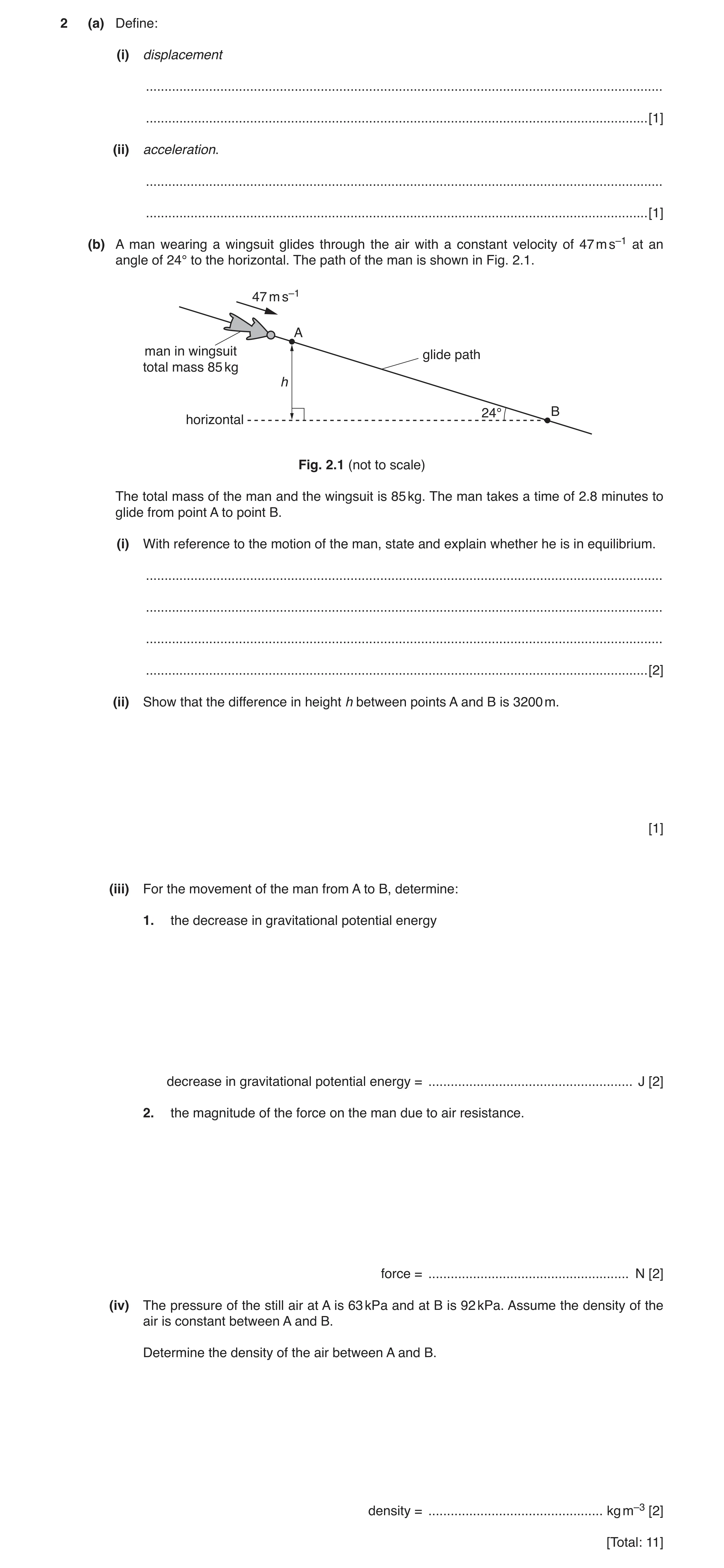
2 (a) Define: (i) displacement … … [1] (ii) acceleration. … … [1] (b) A man wearing a wingsuit glides through the air with a constant velocity of 47 m s–1 at an angle of 24° to the horizontal. The path of the man is shown in Fig. 2.1. 47 m s–1 A man in wingsuit glide path total mass 85 kg h 24° B horizontal Fig. 2.1 (not to scale) The total mass of the man and the wingsuit is 85 kg. The man takes a time of 2.8 minutes to glide from point A to point B. (i) With reference to the motion of the man, state and explain whether he is in equilibrium. … … … … [2] (ii) Show that the difference in height h between points A and B is 3200 m. [1] (iii) For the movement of the man from A to B, determine: 1. the decrease in gravitational potential energy decrease in gravitational potential energy = … J [2] 2. the magnitude of the force on the man due to air resistance. force = … N [2] (iv) The pressure of the still air at A is 63 kPa and at B is 92 kPa. Assume the density of the air is constant between A and B. Determine the density of the air between A and B. density = … kg m–3 [2] [Total: 11]
11 marks
Mark scheme: 2(a)(i) distance in a specified direction (from a point) B1 2(a)(ii) change in velocity / time (taken) B1 2(b)(i) constant velocity so no resultant force B1 no resultant force so in equilibrium B1 2(b)(ii) (difference in height =) 47 × 2.8 × 60 × sin24° = 3200 m A1 Question Answer Marks 2(b)(iii) 1 (∆)E = mg(∆)h = 85 × 9.81 × 3200 C1 = 2.7 × 10⁶ J A1 2 In terms of energy: work done = 2.7 × 10⁶ J force = 2.7 × 10⁶ / (47 × 2.8 × 60) C1 = 340 N A1 In terms of forces: component of weight along path = force due to air resistance force = 85 × 9.81 × sin24° (C1) = 340 N (A1) 2(b)(iv) (∆)p = ρg(∆)h (92 – 63) × 103 = ρ × 9.81 × 3200 C1 ρ = 0.92 kg m–3 A1
This question in 9702/22 Feb/March 2019
Q4 · Make estimates of: (i) the mass, in g, of a new pencil mass = … g [1] (ii) the wavelength… 9702/21 Oct/Nov 2019
1 (a) Make estimates of: (i) the mass, in g, of a new pencil mass = … g [1] (ii) the wavelength of ultraviolet radiation. wavelength = … m [1] (b) The period T of the oscillations of a mass m suspended from a spring is given by m T = 2π k where k is the spring constant of the spring. The manufacturer of a spring states that it has a spring constant of 25 N m–1 ± 8%. A mass of 200 × 10–3 kg ± 4 × 10⁻³ kg is suspended from the end of the spring and then made to oscillate. (i) Calculate the period T of the oscillations. T = … s [1] (ii) Determine the value of T, with its absolute uncertainty, to an appropriate number of significant figures. T = … ± … s [3] [Total: 6]
6 marks
Mark scheme: 1(a)(i) A1 1(a)(ii) wavelength in range 1 × 10⁻⁸ m to 4 × 10⁻⁷ m A1 1(b)(i) T = 2π × (200 × 10–3 / 25)0.5 = 0.56 s A1 1(b)(ii) percentage uncertainty = (2% + 8%) / 2 (= 5%) or fractional uncertainty = (0.02+0.08) / 2 (= 0.05) C1 ∆T = 0.56 × 0.05 = 0.028 (s) C1 T = (0.56 ± 0.03) s A1
This question in 9702/21 Oct/Nov 2019
Question 5 9702/23 May/June 2021
2 (a) Define acceleration. … … [1] (b) A stone falls vertically from the top of a cliff. Fig. 2.1 shows the variation with time t of the velocity v of the stone. 40 v / m s–1 30 20 10 0 0 5 10 15 20 25 30 t / s Fig. 2.1 (i) Explain, with reference to forces acting on the stone, the shape of the curve in Fig. 2.1. … … … … … [3] (ii) Use Fig. 2.1 to determine the speed of the stone when the resultant force on it is zero. speed = … m s–1 [1] (iii) Use Fig. 2.1 to calculate the approximate height through which the stone falls between t = 0 and t = 30 s. height = … m [3] (iv) On Fig. 2.2, sketch the variation with t of the acceleration a of the stone between t = 0 and t = 30 s. 20 a / m s–2 15 10 5 0 0 5 10 15 20 25 30 t / s Fig. 2.2 [3] [Total: 11]
11 marks
Mark scheme: 2(a) change in velocity / time (taken) B1 2(b)(i) air resistance increases (with speed/with time) B1 resultant force decreases (as speed increases/with time) so acceleration decreases (as speed increases/with time) B1 when air resistance equals the weight the speed/velocity/v becomes constant B1 2(b)(ii) speed = 36 m s–1 A1 2(b)(iii) height given by area under the curve C1 height = 950 m Round to two significant figures and award 2 marks for a value in the range 920–980 m and 1 mark for a value in the range 900–910 m or 990–1000 m. A2 2(b)(iv) line starting at (0, 9.8) B1 curve with negative gradient between t = 0 and t = 20 s B1 line showing zero acceleration between t = 20 s and t = 30 s B1 Question Answer Marks
This question in 9702/23 May/June 2021
Question 6 9702/21 Oct/Nov 2021
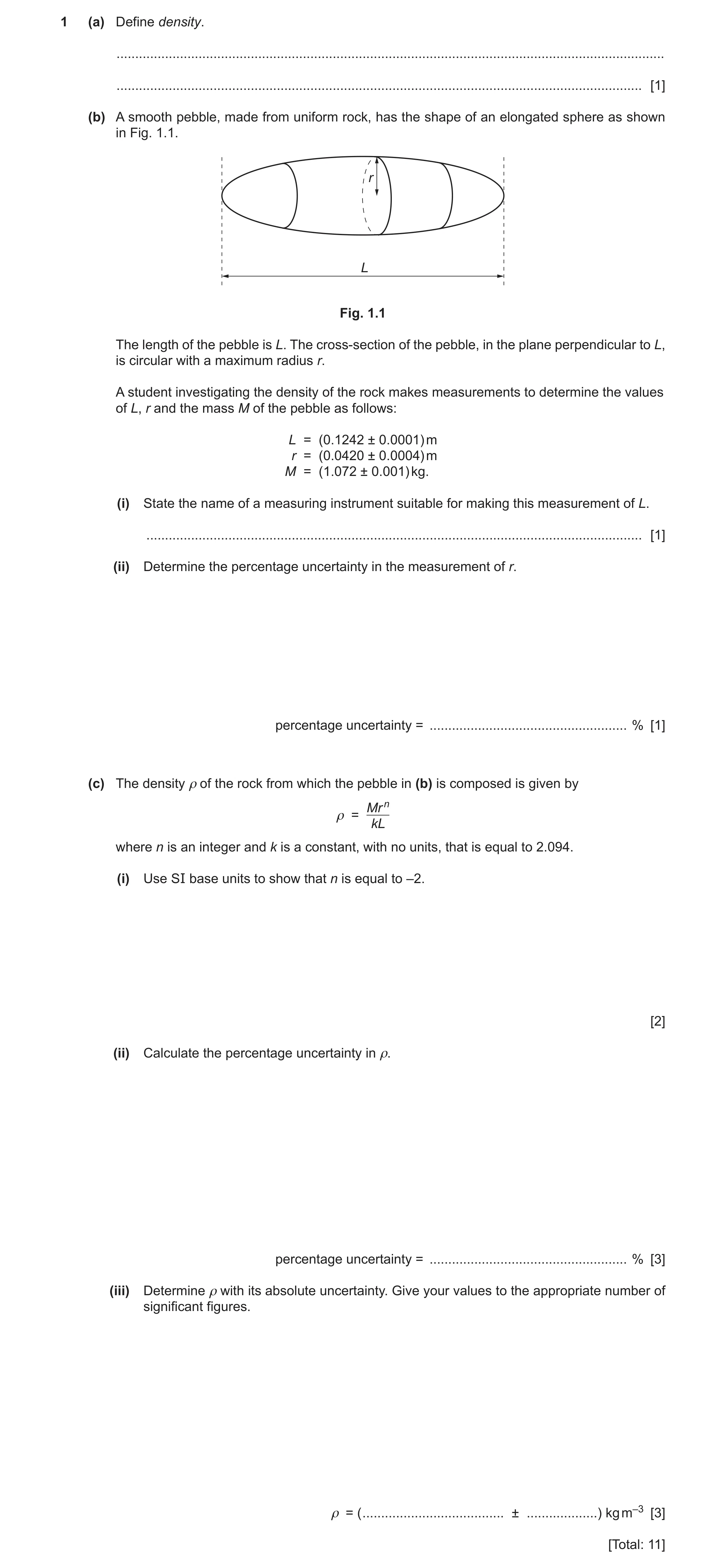
1 (a) Define density. … … [1] (b) A smooth pebble, made from uniform rock, has the shape of an elongated sphere as shown in Fig. 1.1. r L Fig. 1.1 The length of the pebble is L. The cross-section of the pebble, in the plane perpendicular to L, is circular with a maximum radius r. A student investigating the density of the rock makes measurements to determine the values of L, r and the mass M of the pebble as follows: L = (0.1242 ± 0.0001) m r = (0.0420 ± 0.0004) m M = (1.072 ± 0.001) kg. (i) State the name of a measuring instrument suitable for making this measurement of L. … [1] (ii) Determine the percentage uncertainty in the measurement of r. percentage uncertainty = … % [1] (c) The density ρ of the rock from which the pebble in (b) is composed is given by Mr n ρ = kL where n is an integer and k is a constant, with no units, that is equal to 2.094. (i) Use SI base units to show that n is equal to –2. [2] (ii) Calculate the percentage uncertainty in ρ. percentage uncertainty = … % [3] (iii) Determine ρ with its absolute uncertainty. Give your values to the appropriate number of significant figures. ρ = ( … ± … ) kg m–3 [3] [Total: 11]
11 marks
Mark scheme: 1(a) mass / volume B1 1(b)(i) (vernier/digital) calipers B1 1(b)(ii) percentage uncertainty = (0.0004 / 0.0420) × 100 = 1% A1 1(c)(i) kg m–3 = kg × mn / m or kg m–3 = kg × mn × m–1 M1 –3 = n – 1 and (so) n = –2 A1 1(c)(ii) (Δρ / ρ) = (ΔM / M) + 2(Δr / r) + (ΔL / L) C1 percentage uncertainty = [(0.001 / 1.072) + 2 × (0.0004 / 0.0420) + (0.0001 / 0.1242)] (× 100) C1 = 0.09% + 2 × 0.95% + 0.08% = 2% A1 1(c)(iii) ρ = (1.072 × 0.0420–2) / (2.094 × 0.1242) = 2337 (kg m–3) C1 ∆ρ = 0.021 × 2337 = 49 (kg m–3) C1 ρ = (2340 ± 50) kg m–3 A1
This question in 9702/21 Oct/Nov 2021
Q7 · A unit may be stated with a prefix that represents a power-of-ten multiple or submultiple 9702/22 Oct/Nov 2021
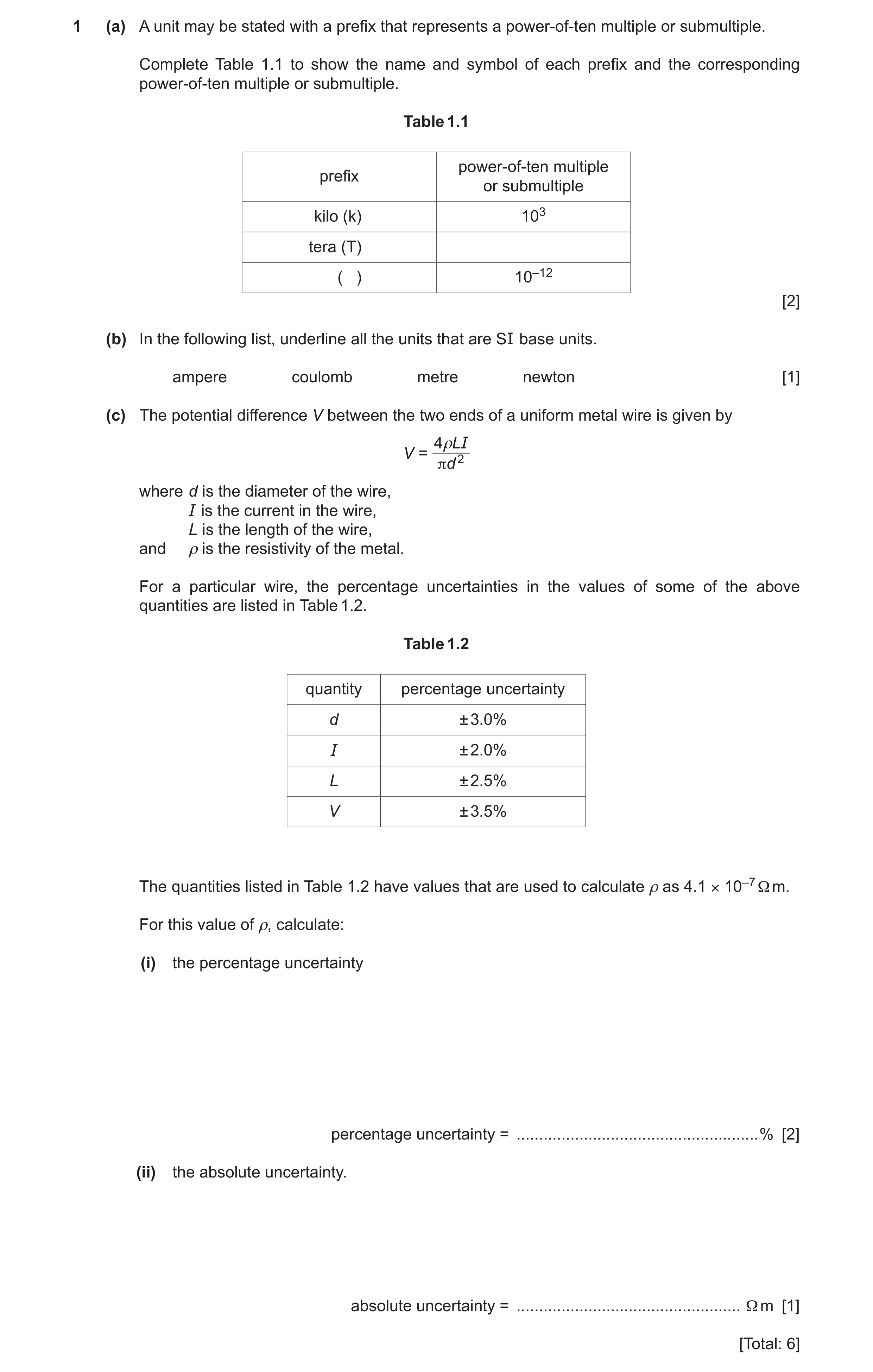
1 (a) A unit may be stated with a prefix that represents a power-of-ten multiple or submultiple. Complete Table 1.1 to show the name and symbol of each prefix and the corresponding power-of-ten multiple or submultiple. Table 1.1 power-of-ten multiple prefix or submultiple kilo (k) 103 tera (T) ( ) 10–12 [2] (b) In the following list, underline all the units that are SI base units. ampere coulomb metre newton [1] (c) The potential difference V between the two ends of a uniform metal wire is given by 4ρLI V = 2 πd where d is the diameter of the wire, I is the current in the wire, L is the length of the wire, and ρ is the resistivity of the metal. For a particular wire, the percentage uncertainties in the values of some of the above quantities are listed in Table 1.2. Table 1.2 quantity percentage uncertainty d ± 3.0% I ± 2.0% L ± 2.5% V ± 3.5% The quantities listed in Table 1.2 have values that are used to calculate ρ as 4.1 × 10⁻⁷ Ω m. For this value of ρ, calculate: (i) the percentage uncertainty percentage uncertainty = … % [2] (ii) the absolute uncertainty. absolute uncertainty = … Ω m [1] [Total: 6]
6 marks
Mark scheme: 1(a) 1012 B1 pico (p) B1 1(b) ampere and metre both underlined (and no other units underlined) B1 1(c)(i) percentage uncertainty = 3.5 + (3.0 × 2) + 2.5 + 2.0 C1 = 14% A1 1(c)(ii) absolute uncertainty = 4.1 × 10–7 × 14 / 100 = 6 × 10⁻⁸ Ω m A1
This question in 9702/22 Oct/Nov 2021
Q8 · The boxes in Fig 9702/21 Oct/Nov 2022
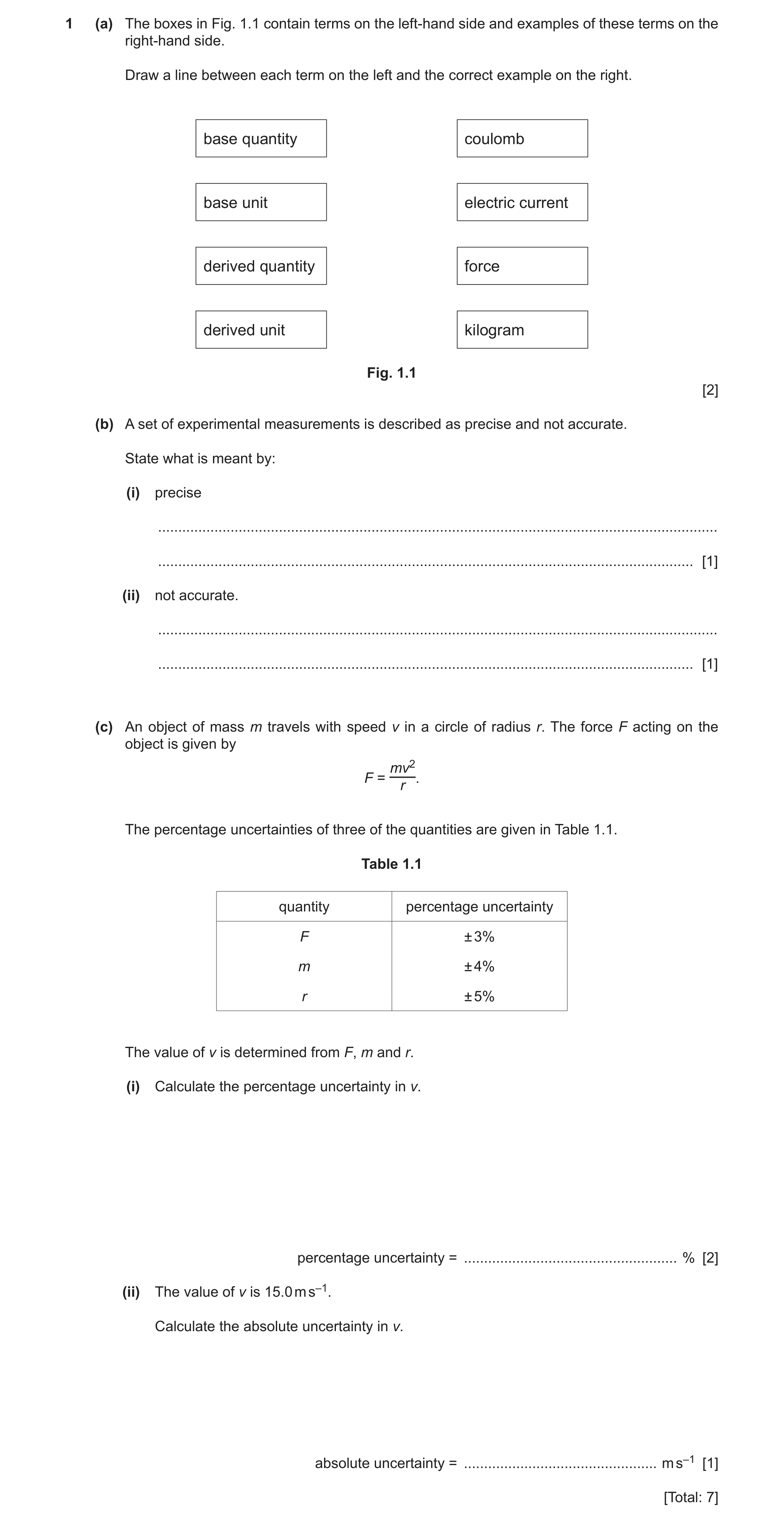
1 (a) The boxes in Fig. 1.1 contain terms on the left-hand side and examples of these terms on the right-hand side. Draw a line between each term on the left and the correct example on the right. base quantity coulomb base unit electric current derived quantity force derived unit kilogram Fig. 1.1 [2] (b) A set of experimental measurements is described as precise and not accurate. State what is meant by: (i) precise … … [1] (ii) not accurate. … … [1] (c) An object of mass m travels with speed v in a circle of radius r. The force F acting on the object is given by mv2 F = . r The percentage uncertainties of three of the quantities are given in Table 1.1. Table 1.1 quantity percentage uncertainty F ± 3% m ± 4% r ± 5% The value of v is determined from F, m and r. (i) Calculate the percentage uncertainty in v. percentage uncertainty = … % [2] (ii) The value of v is 15.0 m s–1. Calculate the absolute uncertainty in v. absolute uncertainty = … m s–1 [1] [Total: 7]
7 marks
Mark scheme: Question Answer Marks 1(a) C1 any two joined correctly all four joined correctly A1 1(b)(i) the measurements have a small range B1 1(b)(ii) (average of the) measurements not close to the true value B1 1(c)(i) percentage uncertainty = (3 + 5 + 4) / 2 C1 = 6% A1 1(c)(ii) absolute uncertainty = (6 / 100) 15.0 A1 = 0.9 ms–1
This question in 9702/21 Oct/Nov 2022
Q9 · The drag force FD acting on an object falling through air is given by 1 FD = CρAv 2 2… 9702/21 May/June 2024
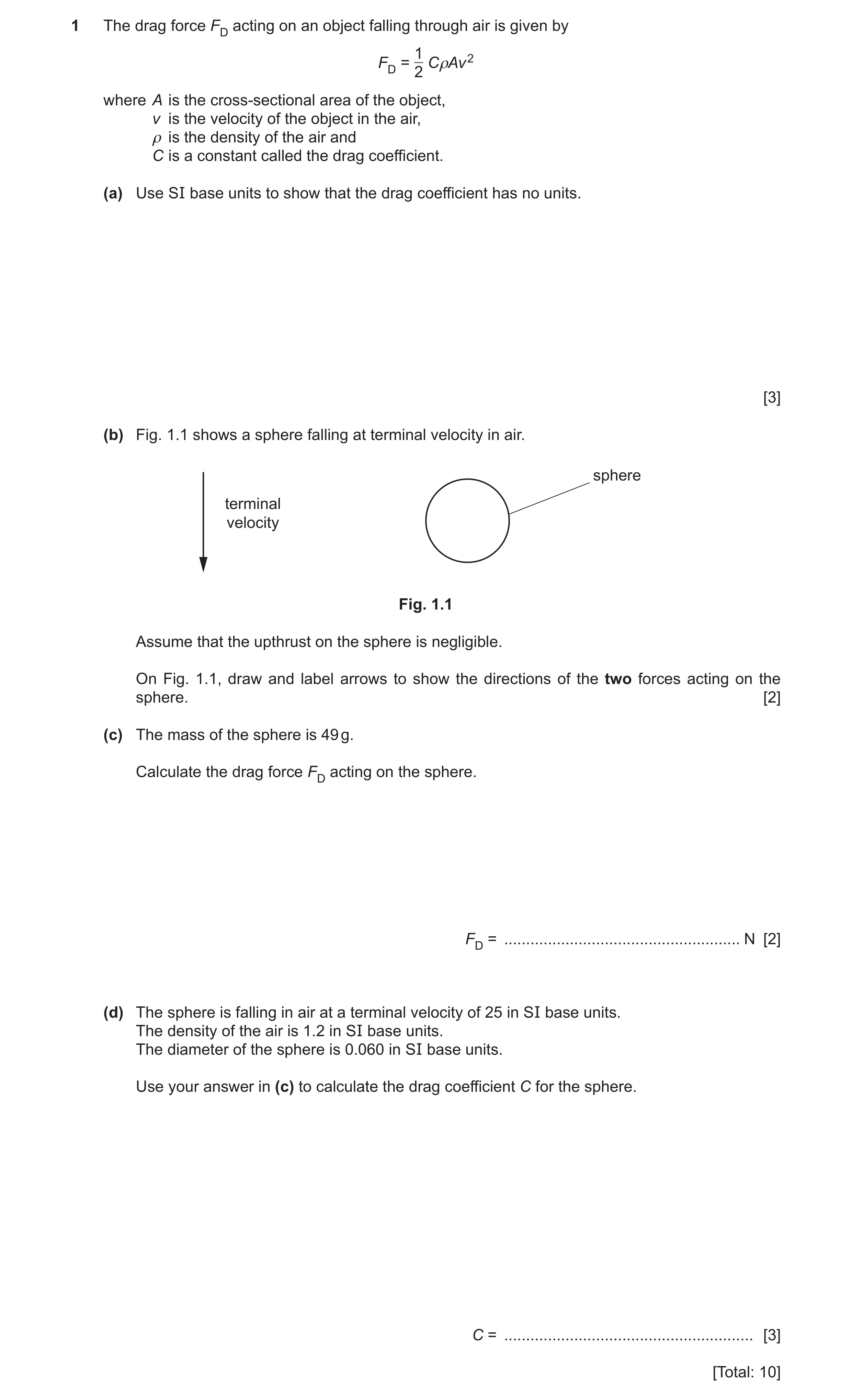
1 The drag force FD acting on an object falling through air is given by 1 FD = CρAv 2 2 where A is the cross-sectional area of the object, v is the velocity of the object in the air, ρ is the density of the air and C is a constant called the drag coefficient. (a) Use SI base units to show that the drag coefficient has no units. [3] (b) Fig. 1.1 shows a sphere falling at terminal velocity in air. sphere terminal velocity Fig. 1.1 Assume that the upthrust on the sphere is negligible. On Fig. 1.1, draw and label arrows to show the directions of the two forces acting on the sphere. [2] (c) The mass of the sphere is 49 g. Calculate the drag force FD acting on the sphere. FD = … N [2] (d) The sphere is falling in air at a terminal velocity of 25 in SI base units. The density of the air is 1.2 in SI base units. The diameter of the sphere is 0.060 in SI base units. Use your answer in (c) to calculate the drag coefficient C for the sphere. C = … [3] [Total: 10]
10 marks
Mark scheme: 1(a) units of FD: kg m s–2 M1 units of kg m–3 and units of A: m2 and units of v: m s−1 or units of v2: m2 s–2 M1 kg m s–2 = C kg m s–2 and comment ‘(so) C has no units’ / unit terms cancelled or C = kg m s−2 / (kg m–3 m2 m2 s–2) and comment ‘(so) C has no units’ / unit terms cancelled A1 1(b) one arrow vertically downward labelled weight to within 10° of the vertical B1 one arrow vertically upwards labelled drag / drag force / FD / air resistance / viscous force to within 10° of the vertical B1 1(c) (at terminal velocity) FD = mg C1 FD = 0.049 9.81 = 0.48 N A1 1(d) area = (0.060 / 2)2 C1 0.48 = ½ C 1.2 (0.060 / 2)2 252 C1 C = 0.45 A1
This question in 9702/21 May/June 2024
Question 10 9702/21 May/June 2024
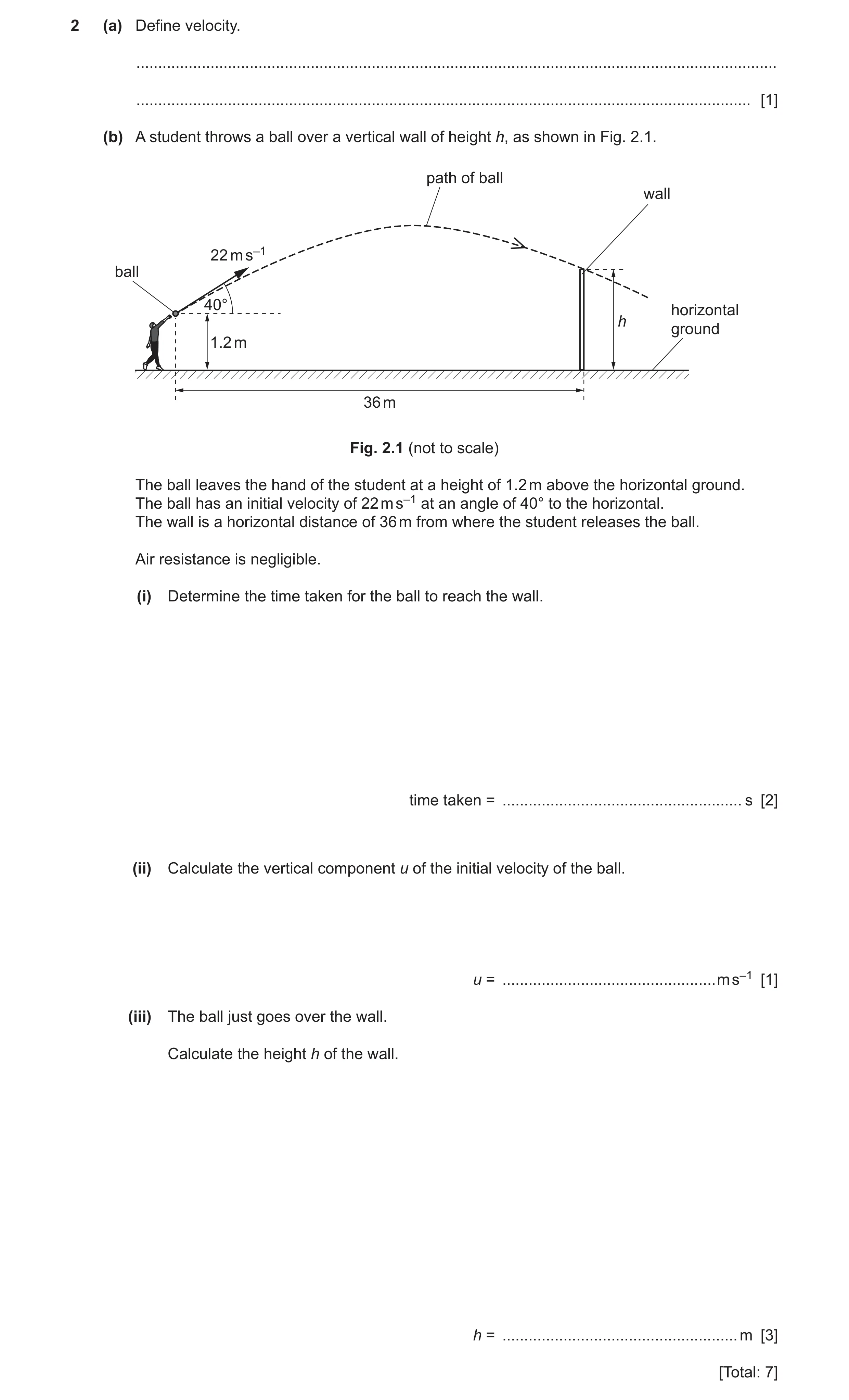
2 (a) Define velocity. … … [1] (b) A student throws a ball over a vertical wall of height h, as shown in Fig. 2.1. path of ball wall 22 m s–1 ball 40° horizontal h ground 1.2 m 36 m Fig. 2.1 (not to scale) The ball leaves the hand of the student at a height of 1.2 m above the horizontal ground. The ball has an initial velocity of 22 m s–1 at an angle of 40° to the horizontal. The wall is a horizontal distance of 36 m from where the student releases the ball. Air resistance is negligible. (i) Determine the time taken for the ball to reach the wall. time taken = … s [2] (ii) Calculate the vertical component u of the initial velocity of the ball. u = … m s–1 [1] (iii) The ball just goes over the wall. Calculate the height h of the wall. h = … m [3] [Total: 7]
7 marks
Mark scheme: 2(a) change in displacement / time (taken) B1 2(b)(i) horizontal velocity = 22 cos 40° C1 time taken = 36 / (22 cos 40°) = 2.1 s A1 2(b)(ii) u = 22 sin 40° = 14 m s−1 A1 2(b)(iii) s = ut + ½ at2 = (14 2.1) + (½ −9.81 2.12) C1 = 7.8 (m) C1 (therefore) height of wall = 7.8 + 1.2 = 9.0 m A1 Question Answer Marks 2(b)(iii) or other methods possible e.g. time to maximum height = (0 – 14) / –9.81 (= 1.43 s) time from maximum height to wall = 2.1 – 1.43 (= 0.67 s) maximum height above release = (14 1.43) + (½ −9.81 1.432) = 9.99 (m) (C1) height from maximum to wall = 0.5 9.81 0.672 (= 2.2 m) height above release = 9.99 – 2.2 = 7.8 (m) (C1) height of wall = 1.2 + 7.8 = 9.0 m (A1)
This question in 9702/21 May/June 2024
Q11 · The drag force FD acting on a sphere falling through a liquid is given by FD = 6πηr v… 9702/23 May/June 2024
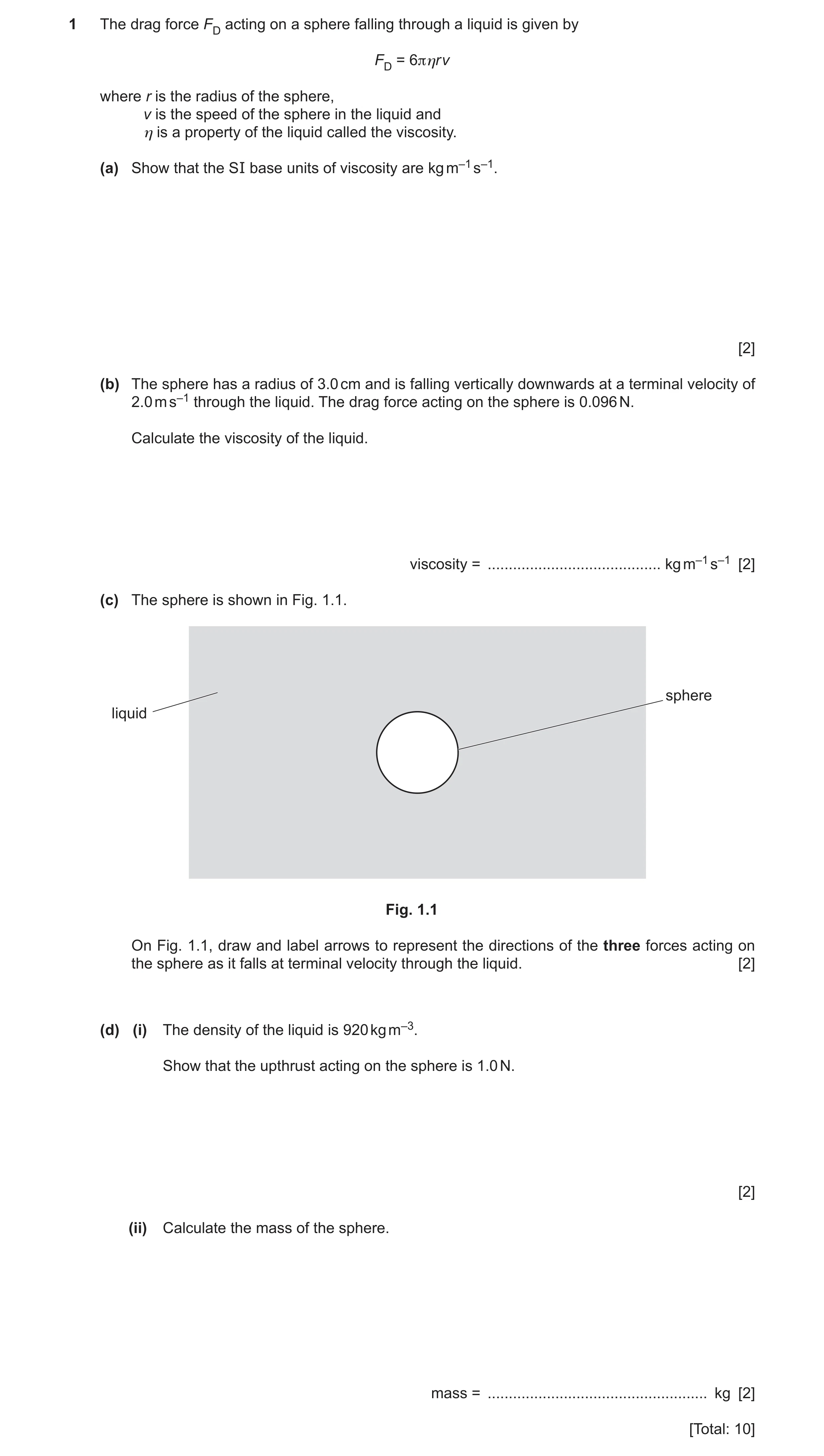
1 The drag force FD acting on a sphere falling through a liquid is given by FD = 6πηr v where r is the radius of the sphere, v is the speed of the sphere in the liquid and η is a property of the liquid called the viscosity. (a) Show that the SI base units of viscosity are kg m–1 s–1. [2] (b) The sphere has a radius of 3.0 cm and is falling vertically downwards at a terminal velocity of 2.0 m s–1 through the liquid. The drag force acting on the sphere is 0.096 N. Calculate the viscosity of the liquid. viscosity = … kg m–1 s–1 [2] (c) The sphere is shown in Fig. 1.1. sphere liquid Fig. 1.1 On Fig. 1.1, draw and label arrows to represent the directions of the three forces acting on the sphere as it falls at terminal velocity through the liquid. [2] (d) (i) The density of the liquid is 920 kg m–3. Show that the upthrust acting on the sphere is 1.0 N. [2] (ii) Calculate the mass of the sphere. mass = … kg [2] [Total: 10]
10 marks
Mark scheme: 1(a) units of F: kg m s–2 C1 units of r: m and units of v: m s–1 units of : kg m s–2 / (m m s–1) = kg m–1 s–1 A1 1(b) viscosity = 0.096 / (6 0.03 2.0) C1 = 0.085 kg m–1 s–1 A1 1(c) one arrow vertically downwards labelled weight / W B1 arrow(s) vertically upwards labelled U / upthrust and drag / FD/viscous force B1 1(d)(i) V = (4 / 3) r3 C1 upthrust = (4 / 3) 0.033 920 9.81 = 1.0 N A1 1(d)(ii) weight = 1.0 + 0.096 (= 1.096 N) C1 m = 1.096 / 9.81 = 0.11 kg A1
This question in 9702/23 May/June 2024
Q12 · Define displacement from a point 9702/23 May/June 2024
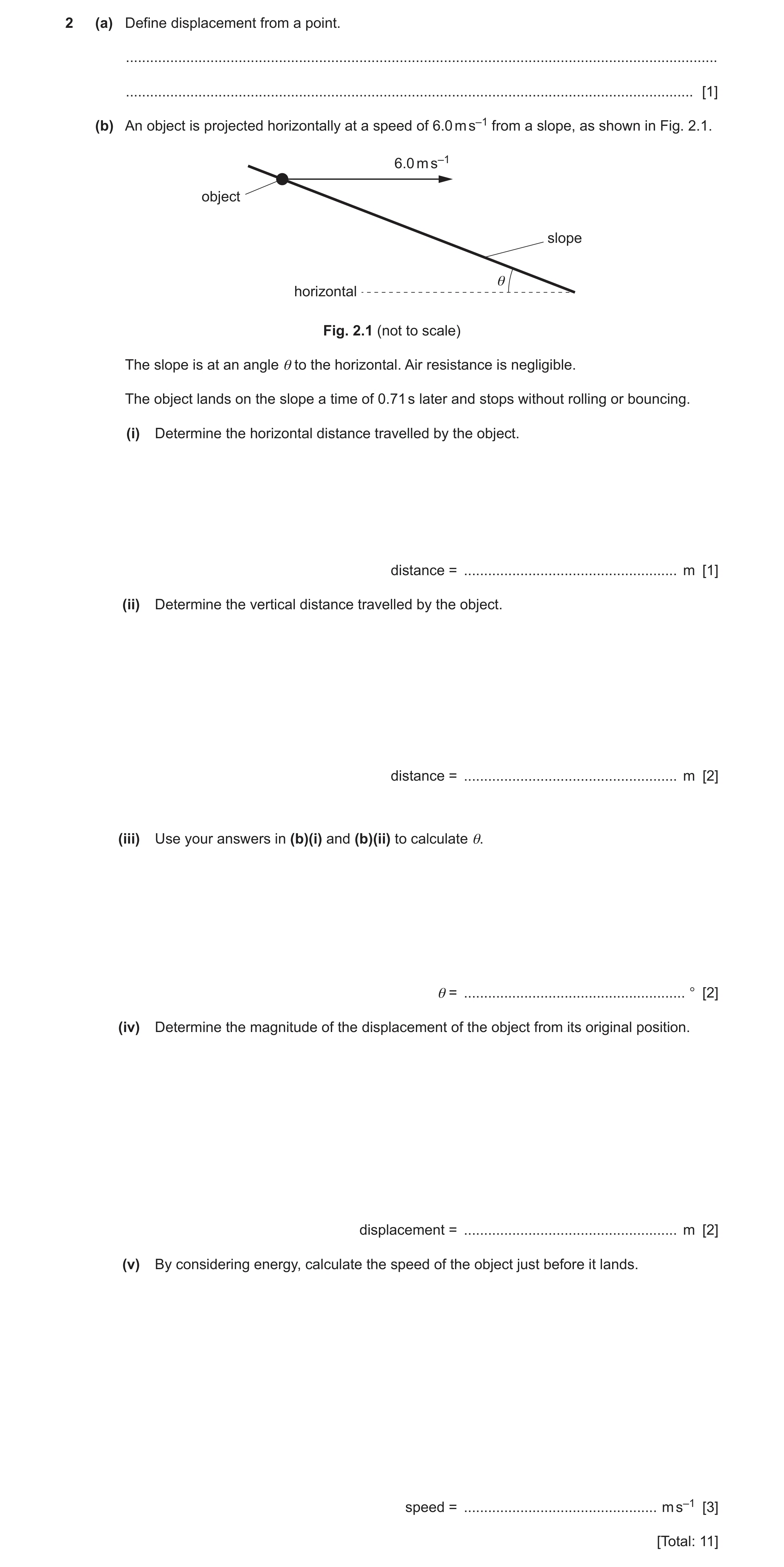
2 (a) Define displacement from a point. … … [1] (b) An object is projected horizontally at a speed of 6.0 m s–1 from a slope, as shown in Fig. 2.1. 6.0 m s–1 object slope θ horizontal Fig. 2.1 (not to scale) The slope is at an angle θ to the horizontal. Air resistance is negligible. The object lands on the slope a time of 0.71 s later and stops without rolling or bouncing. (i) Determine the horizontal distance travelled by the object. distance = … m [1] (ii) Determine the vertical distance travelled by the object. distance = … m [2] (iii) Use your answers in (b)(i) and (b)(ii) to calculate θ. θ = … ° [2] (iv) Determine the magnitude of the displacement of the object from its original position. displacement = … m [2] (v) By considering energy, calculate the speed of the object just before it lands. speed = … m s–1 [3] [Total: 11]
11 marks
Mark scheme: 2(a) distance (from the point) in a straight line in a given direction B1 2(b)(i) distance = speed time = 6.0 0.71 = 4.3 m A1 2(b)(ii) s = ut + ½ at2 = ½ 9.81 0.712 C1 = 2.5 m A1 2(b)(iii) tan = 2.5 / 4.3 or hypotenuse = √(4.32 + 2.52) ( = 4.97 m) cos = 4.3 / 4.97 or sin = 2.5 / 4.97 C1 = 30° A1 Question Answer Marks 2(b)(iv) displacement = √(4.32 + 2.52) C1 = 4.9 m or 5.0 m A1 or displacement = 2.5 / sin 30° or displacement = 4.3 / cos 30° (C1) = 5.0 m (A1) 2(b)(v) KE = ½mv2 or GPE = mgh C1 initial KE + loss in GPE = final KE (½ m 6.02) + (m 9.81 2.5) = (½ m v2) C1 v = 9.2 m s–1 A1
This question in 9702/23 May/June 2024
Question 13 9702/23 Oct/Nov 2024
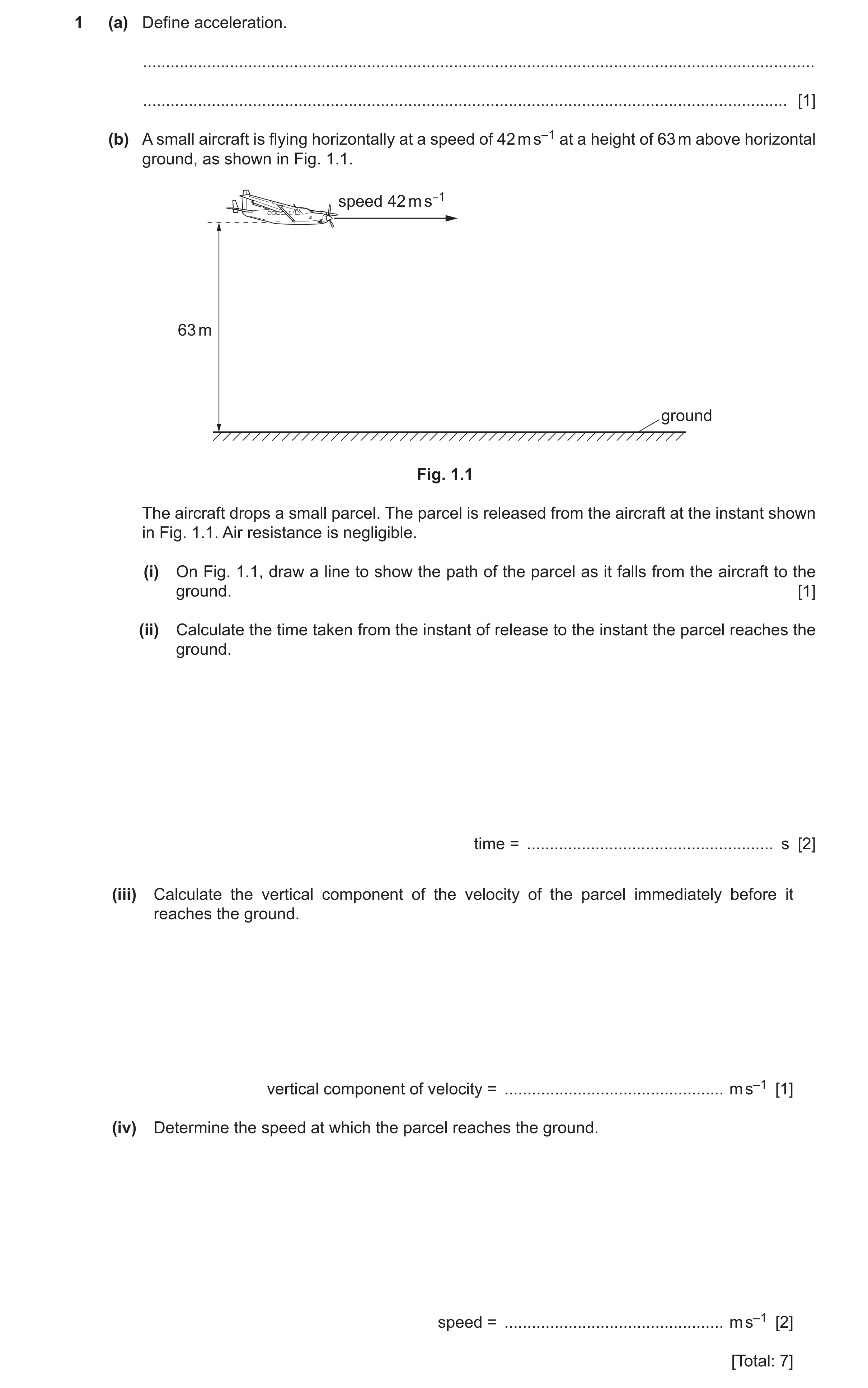
1 (a) Define acceleration. … … [1] (b) A small aircraft is flying horizontally at a speed of 42 m s–1 at a height of 63 m above horizontal ground, as shown in Fig. 1.1. speed 42 m s–1 63 m ground Fig. 1.1 The aircraft drops a small parcel. The parcel is released from the aircraft at the instant shown in Fig. 1.1. Air resistance is negligible. (i) On Fig. 1.1, draw a line to show the path of the parcel as it falls from the aircraft to the ground. [1] (ii) Calculate the time taken from the instant of release to the instant the parcel reaches the ground. time = … s [2] (iii) Calculate the vertical component of the velocity of the parcel immediately before it reaches the ground. vertical component of velocity = … m s–1 [1] (iv) Determine the speed at which the parcel reaches the ground. speed = … m s–1 [2] [Total: 7]
7 marks
Mark scheme: Question Answer Marks 1(a) rate of change of velocity B1 1(b)(i) curved path from aircraft to ground, starting horizontal at aircraft and then with increasing negative gradient as it moves B1 towards the ground 1(b)(ii) s = ut + ½at2 C1 63 = ½ 9.81 t2 time = 3.6 s A1 1(b)(iii) v2 = 2 9.81 63 A1 or v = 0 + (9.81 3.6) or 63 = (v 3.6) – (½ 9.81 3.62) or 63 = ½ (0 + v) 3.6 v = 35 m s–1 1(b)(iv) speed2 = 352 + 422 C1 speed = 55 m s–1 A1
This question in 9702/23 Oct/Nov 2024
Question 14 9702/23 May/June 2025
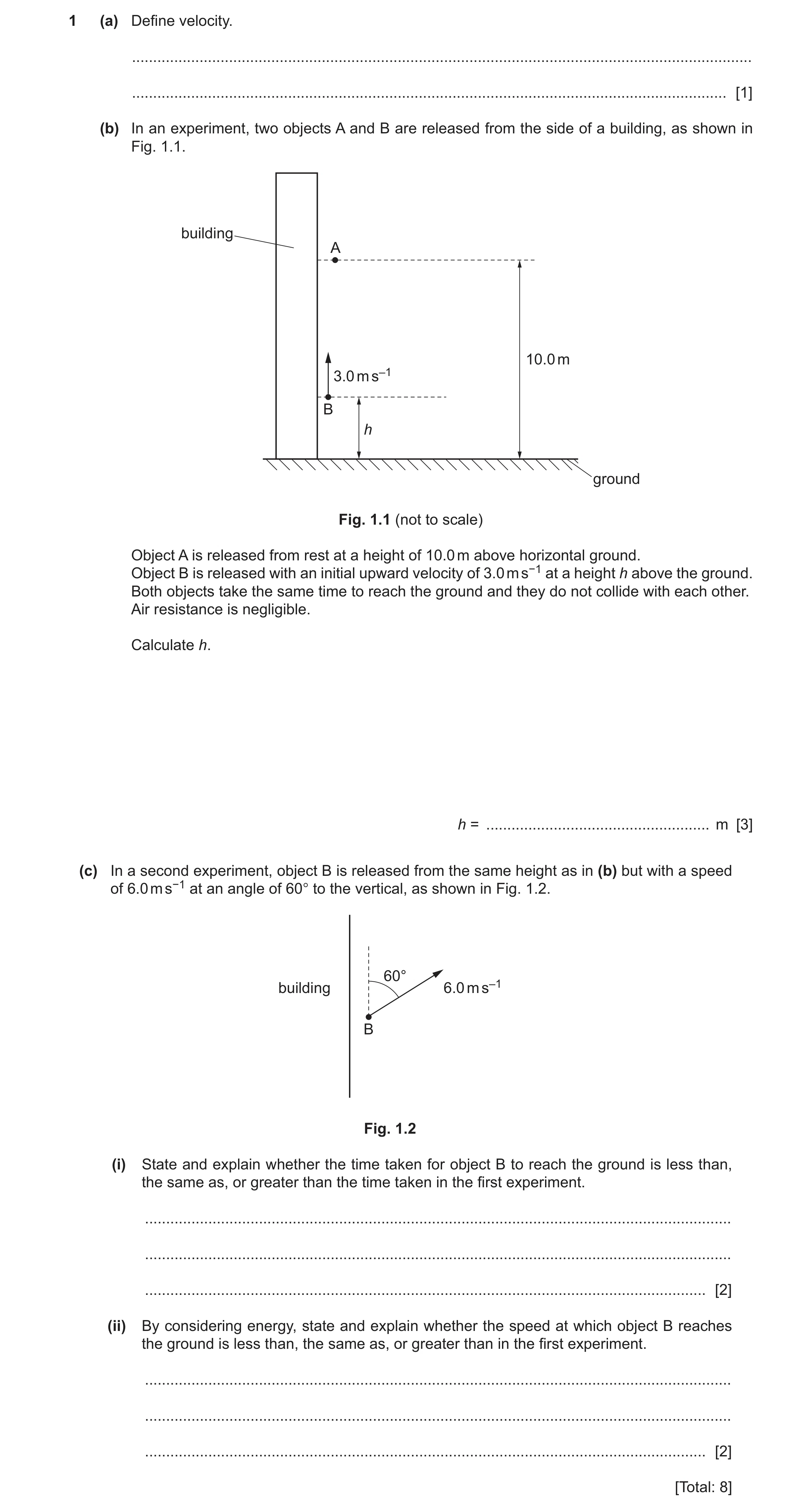
1 (a) Define velocity. … … [1] (b) In an experiment, two objects A and B are released from the side of a building, as shown in Fig. 1.1. building A 10.0 m 3.0 m s–1 B h ground Fig. 1.1 (not to scale) Object A is released from rest at a height of 10.0 m above horizontal ground. Object B is released with an initial upward velocity of 3.0 m s−1 at a height h above the ground. Both objects take the same time to reach the ground and they do not collide with each other. Air resistance is negligible. Calculate h. h = … m [3] (c) In a second experiment, object B is released from the same height as in (b) but with a speed of 6.0 m s−1 at an angle of 60° to the vertical, as shown in Fig. 1.2. 60° building 6.0 m s–1 B Fig. 1.2 (i) State and explain whether the time taken for object B to reach the ground is less than, the same as, or greater than the time taken in the first experiment. … … … [2] (ii) By considering energy, state and explain whether the speed at which object B reaches the ground is less than, the same as, or greater than in the first experiment. … … … [2] [Total: 8]
8 marks
Mark scheme: Question Answer Marks 1(a) Rate of change of displacement B1 1(b) For object A: C1 1 2 s = ut + at 2 2 10 so t = 9.81 =1.4 Then for object B: C1 1 2 s = ut + at 2 h = −(3 1.4) + (0.5 9.81 1.42) = 5.7 m A1 OR (C1) h = −(3 1.4) + 10 = 5.7 m (A1) 1(c)(i) time taken (to reach the ground is) same B1 The initial vertical (component of the) velocity is the same (as in part (1b)) B1 1(c)(ii) The (total) initial energy is greater (than in part (1b)) B1 change in gravitational potential energy is same, so speed is greater B1
This question in 9702/23 May/June 2025
![Question 4: (a) Make estimates of: (i) the mass, in g, of a new pencil mass = ...................................................... g [1] (ii) the wav…](https://img.pastlit.com/crops/0ada0fd3-6d92-4ae4-b6f8-1634138564c2/q1.webp) 7 / 21
7 / 21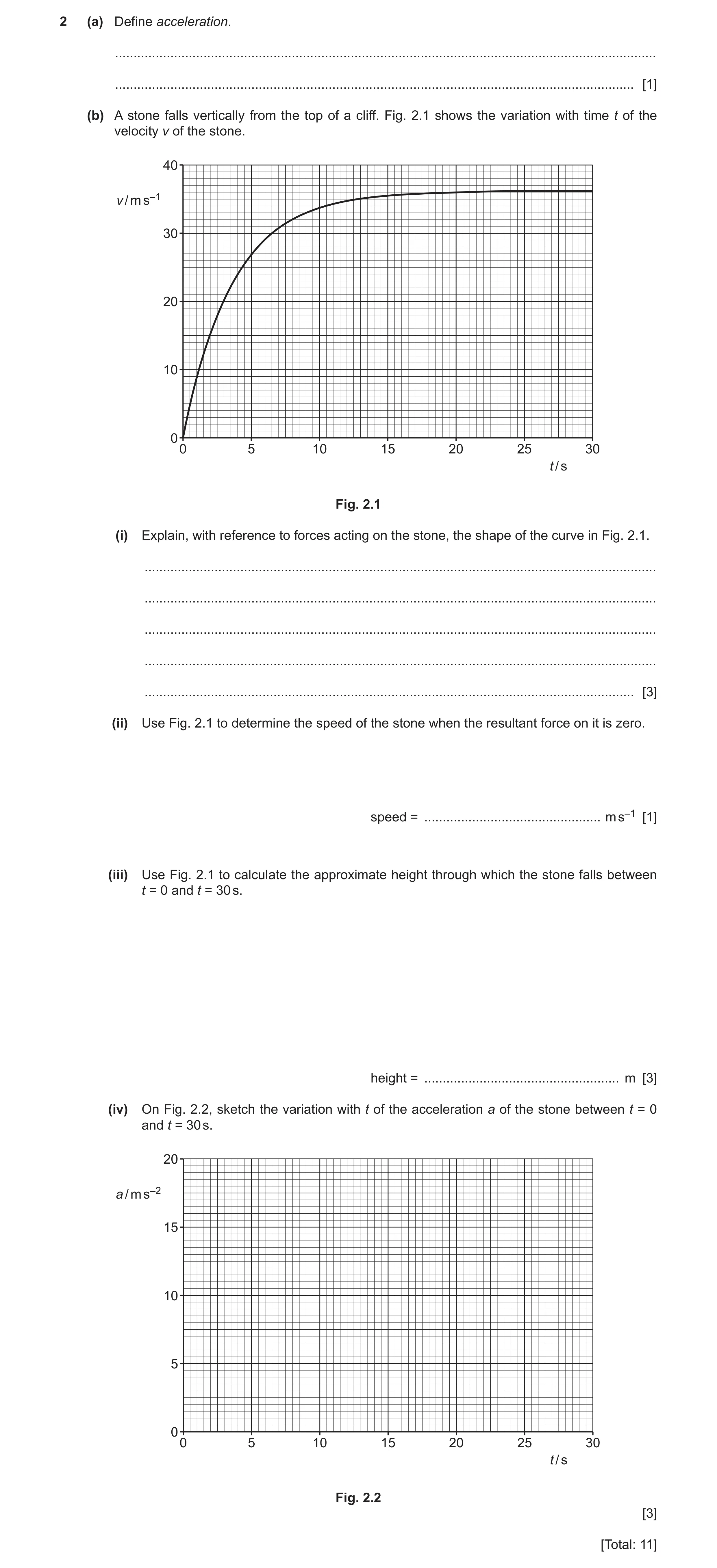
 10
10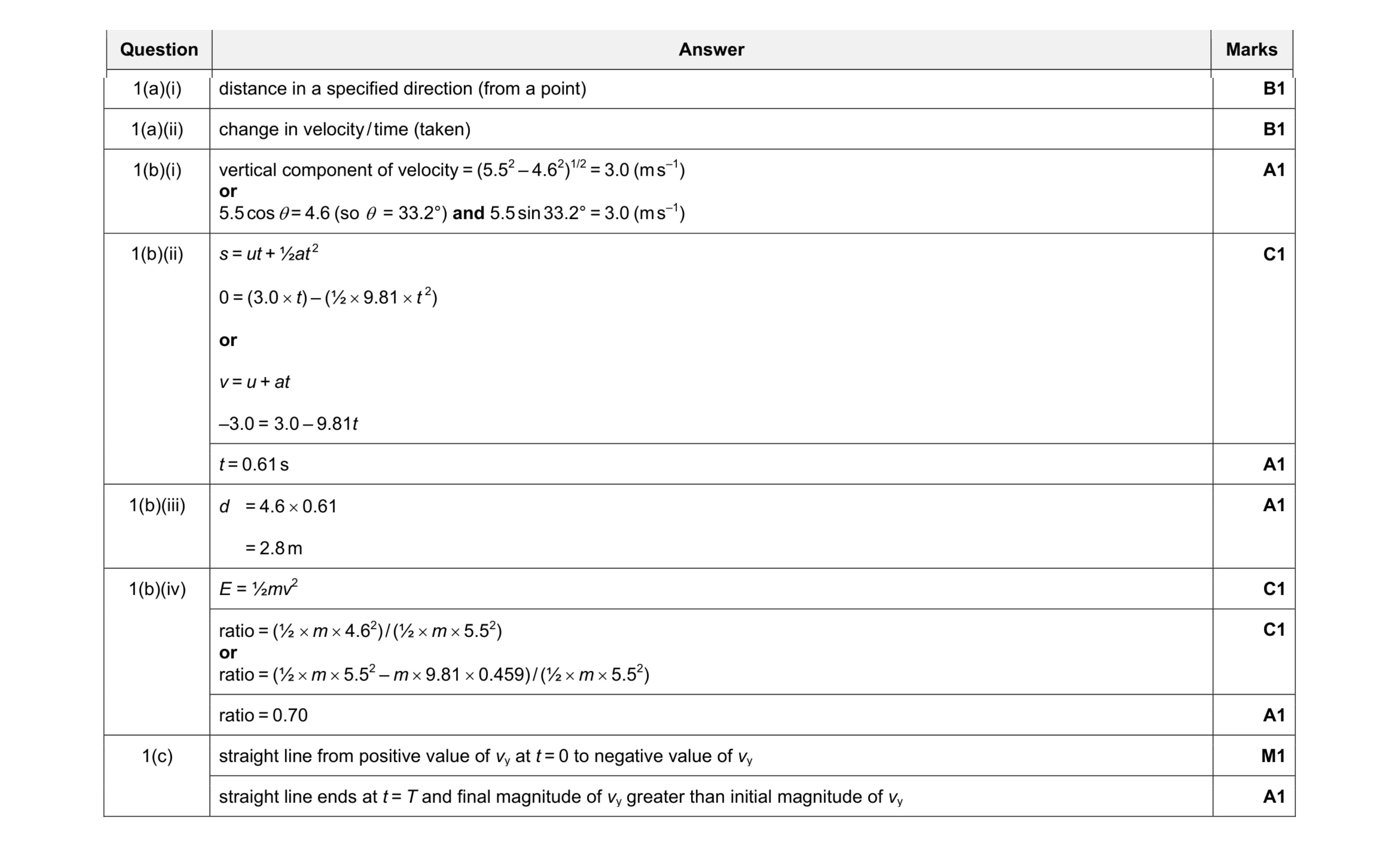 11
11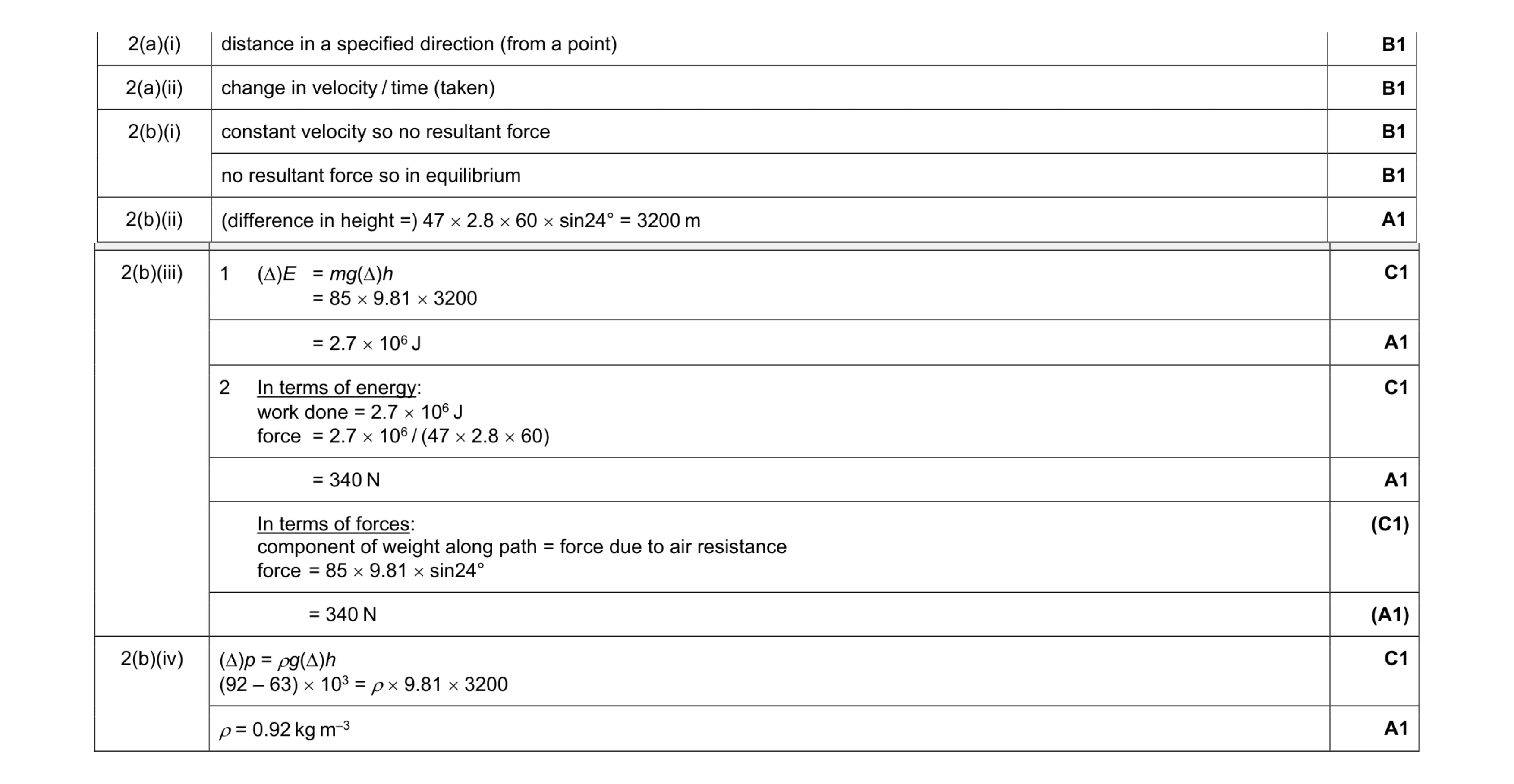 11
11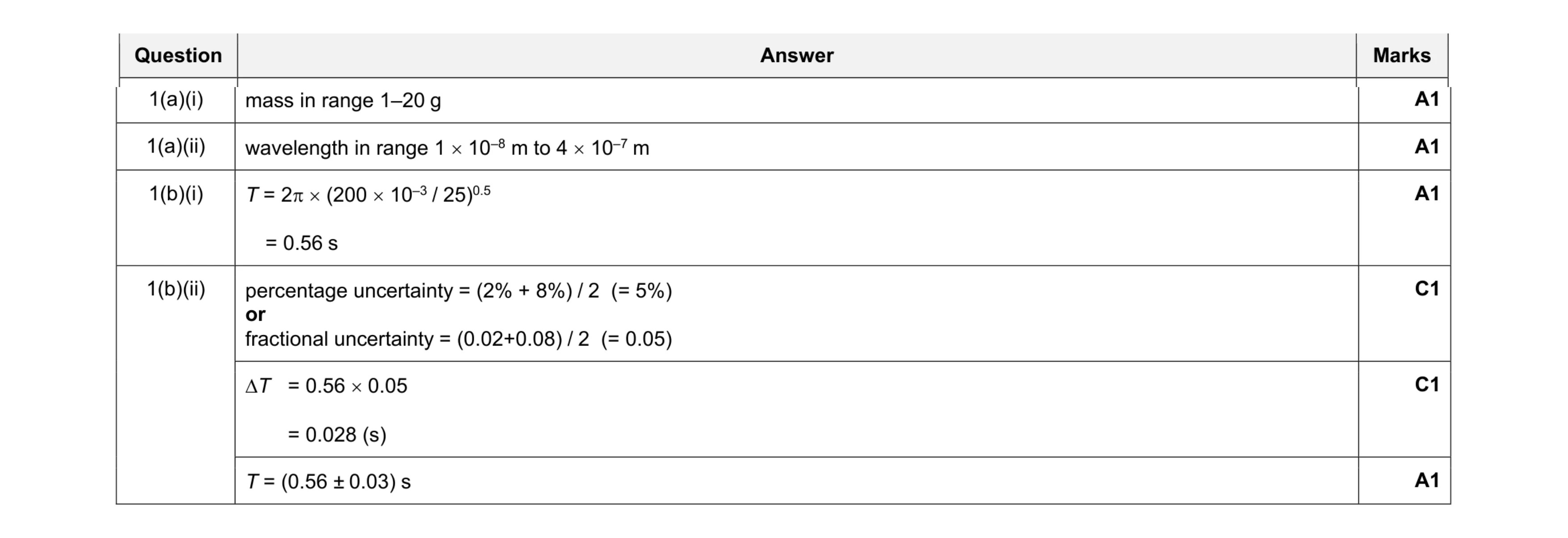 6
6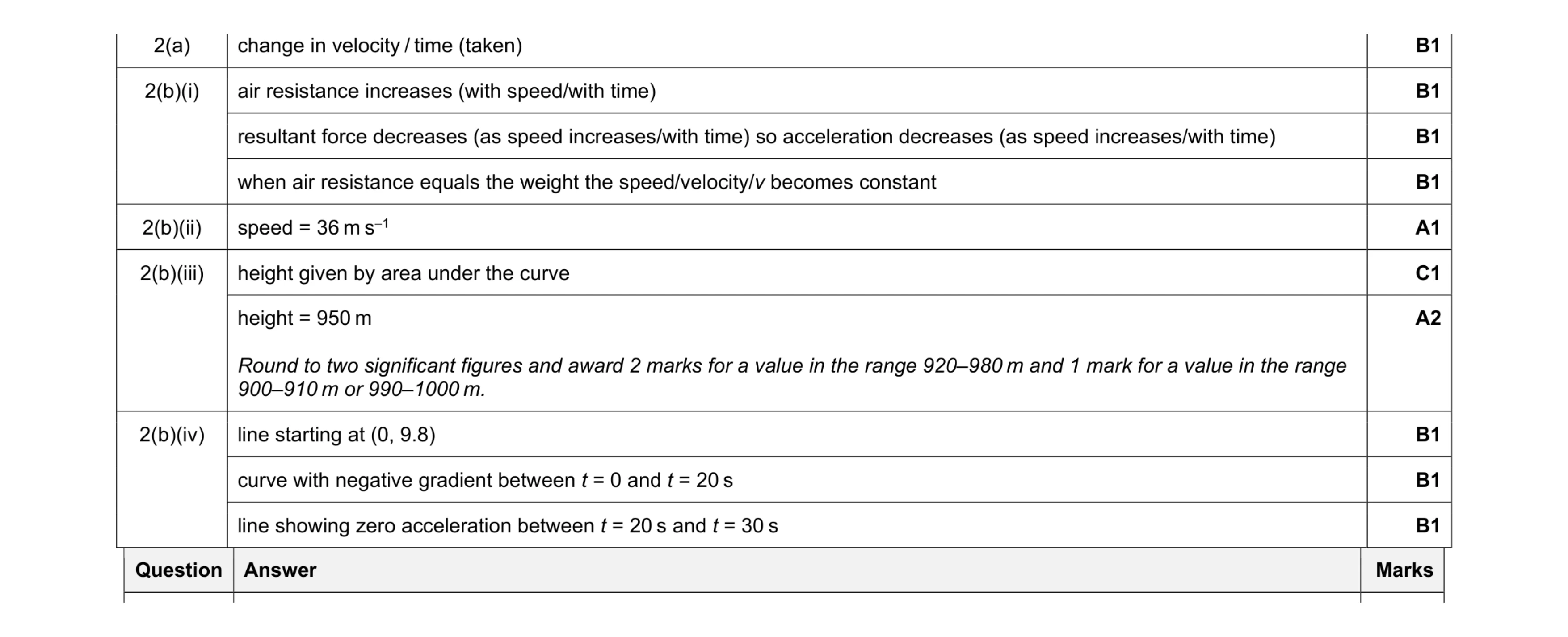 11
11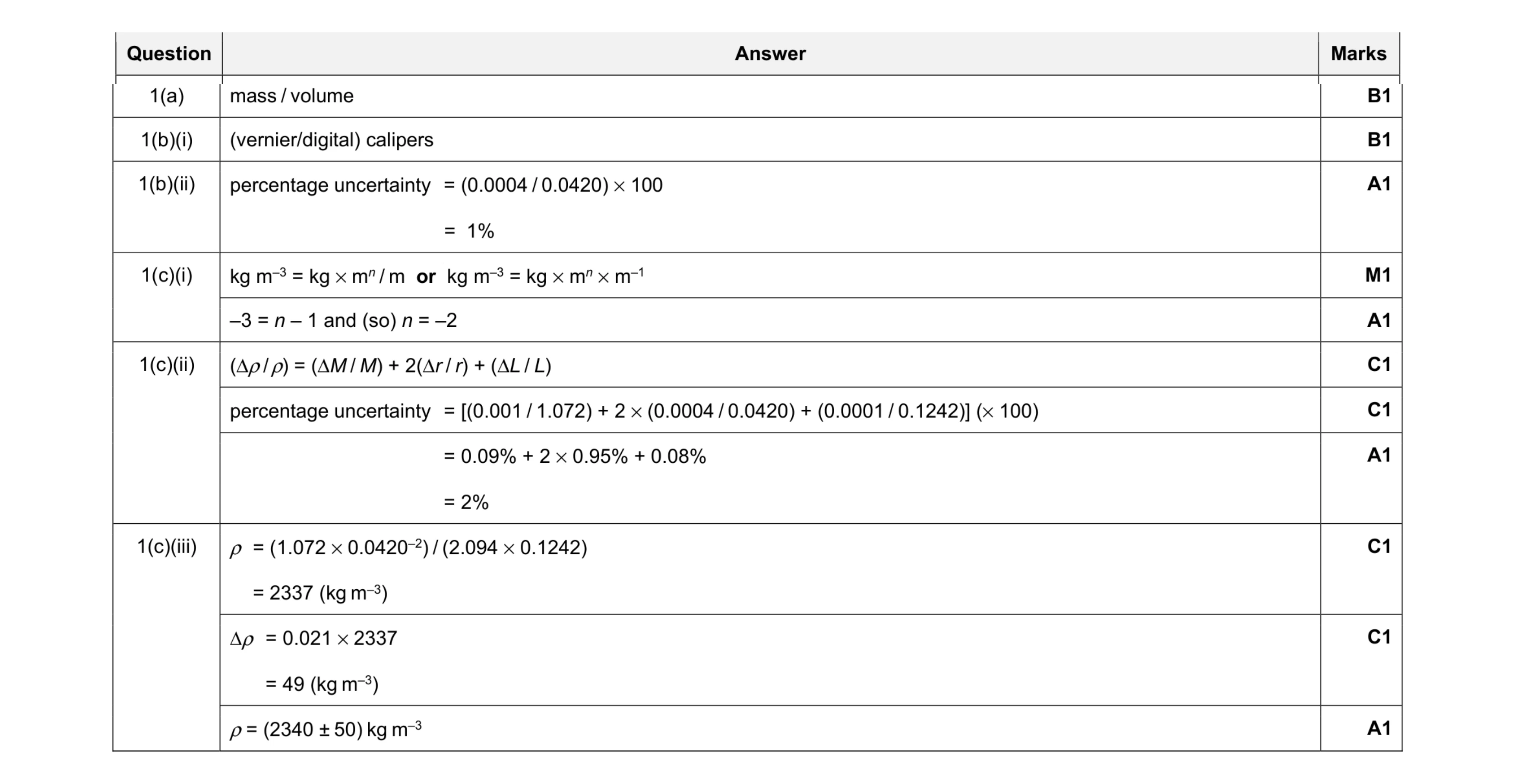 11
11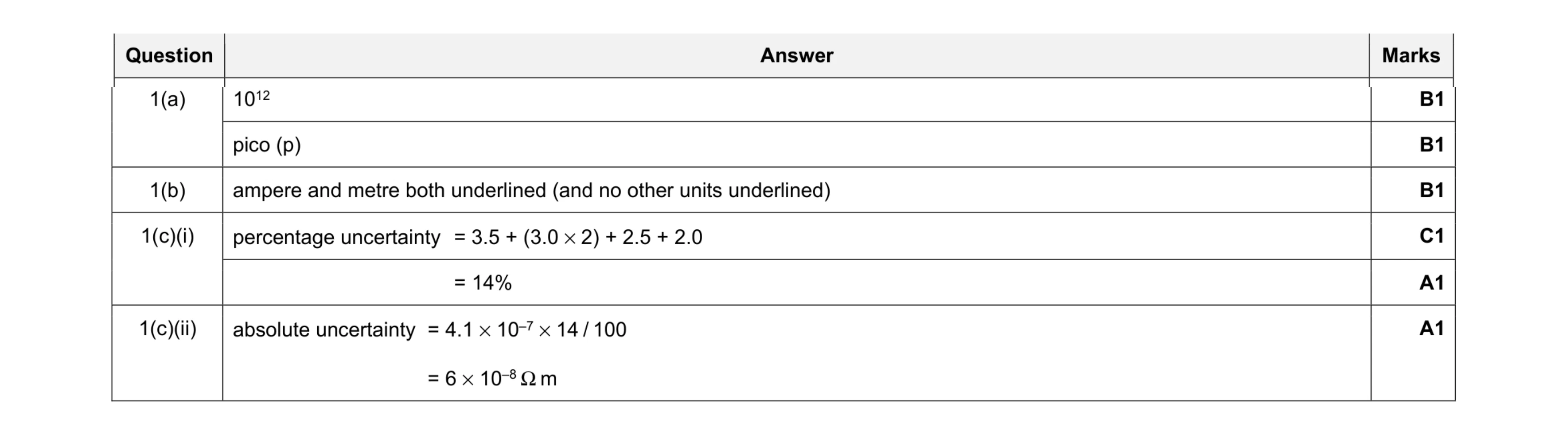 6
6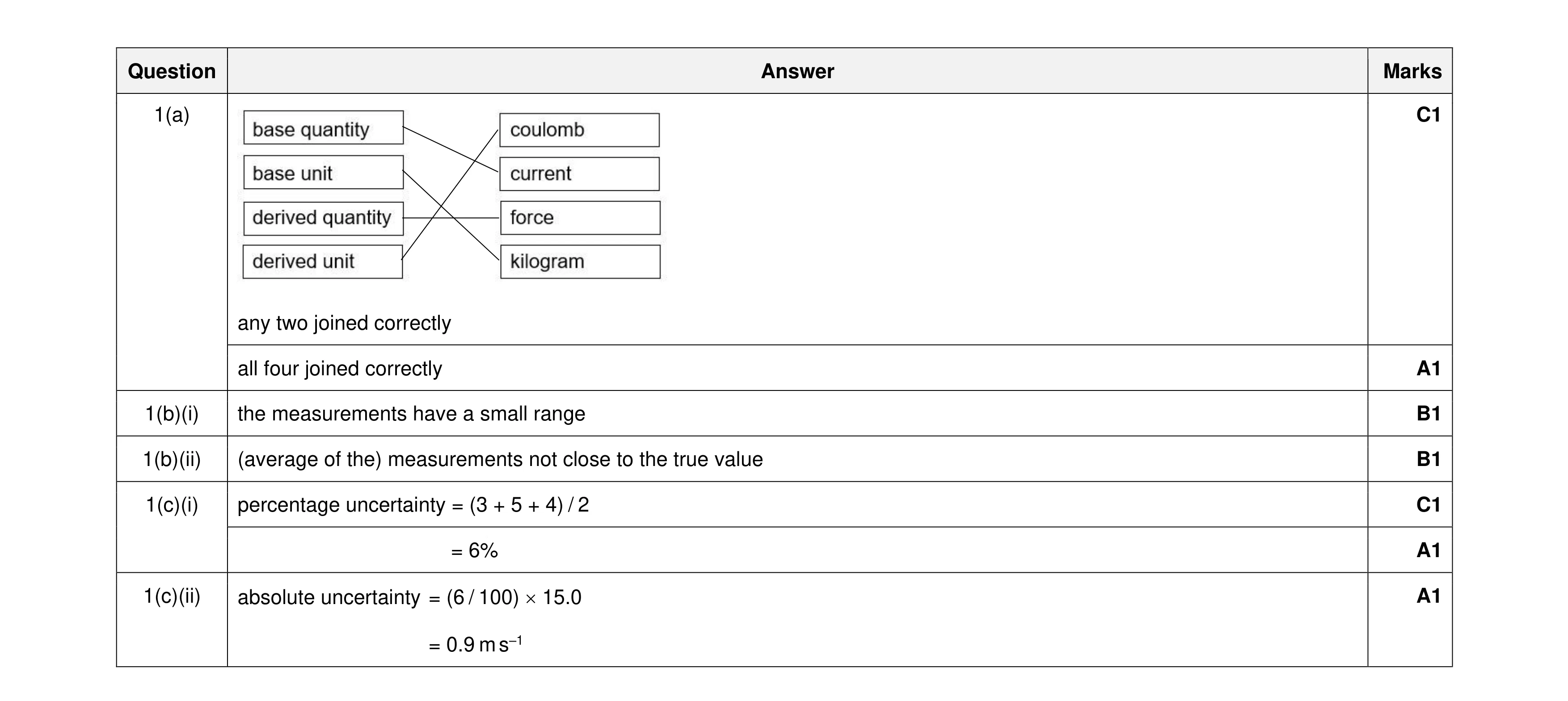 7
7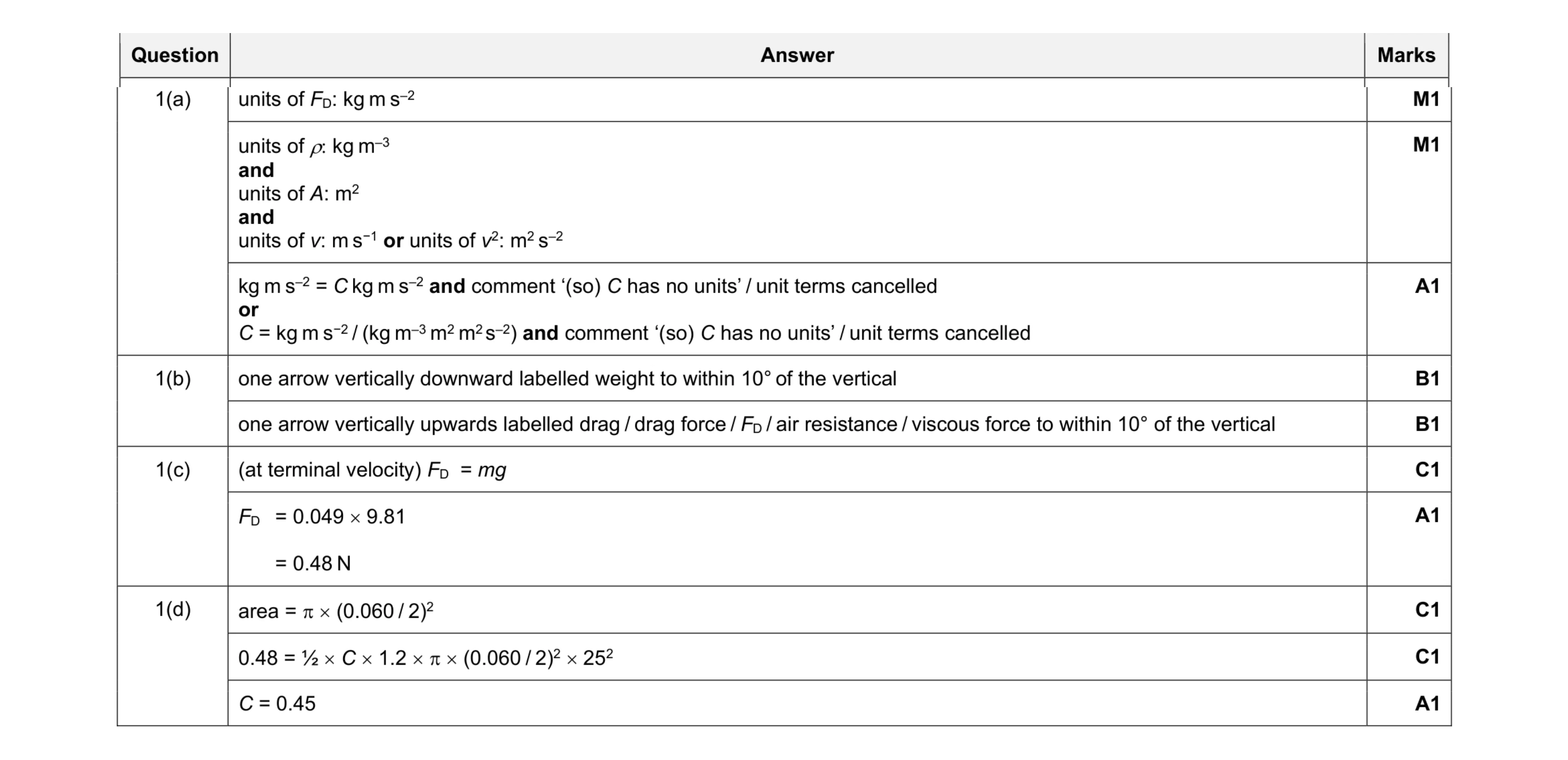 10
10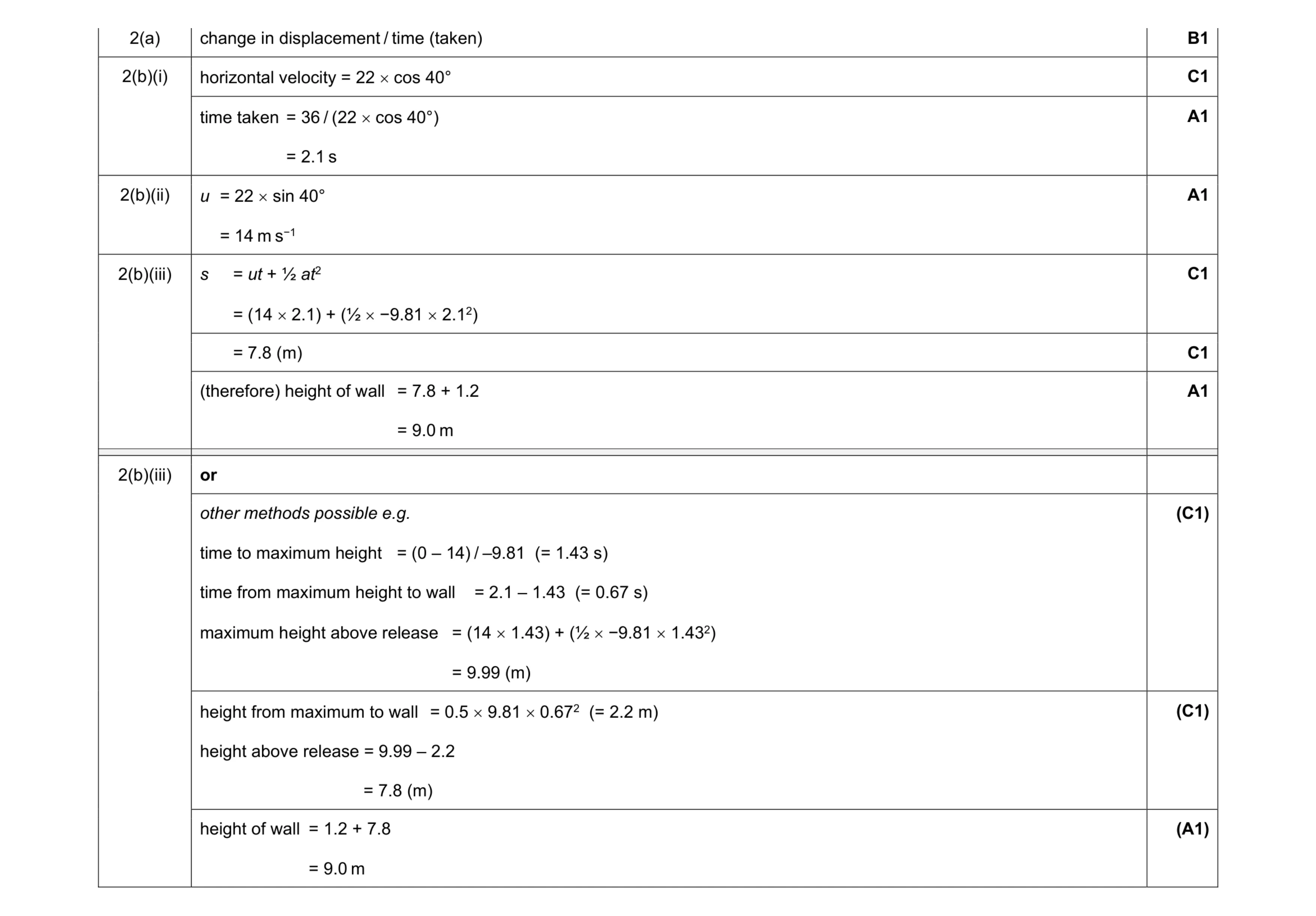 7
7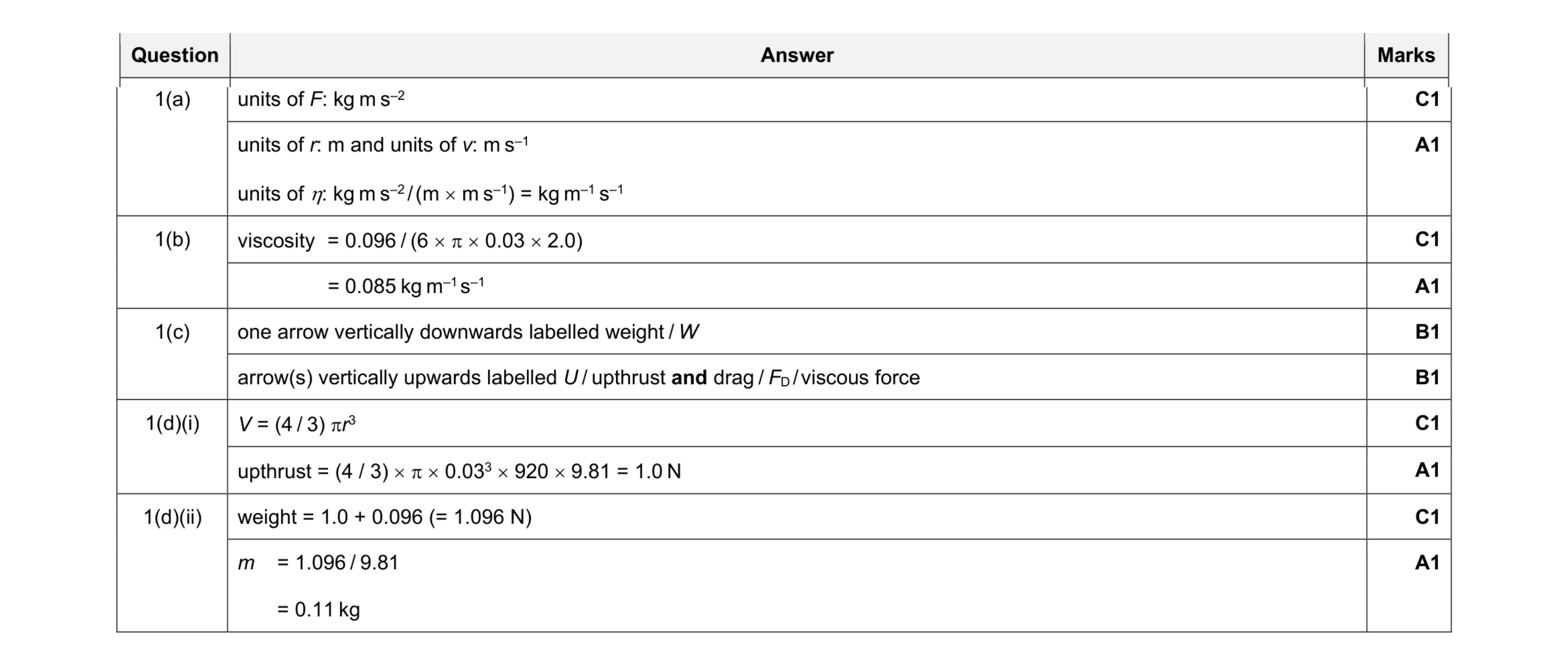 10
10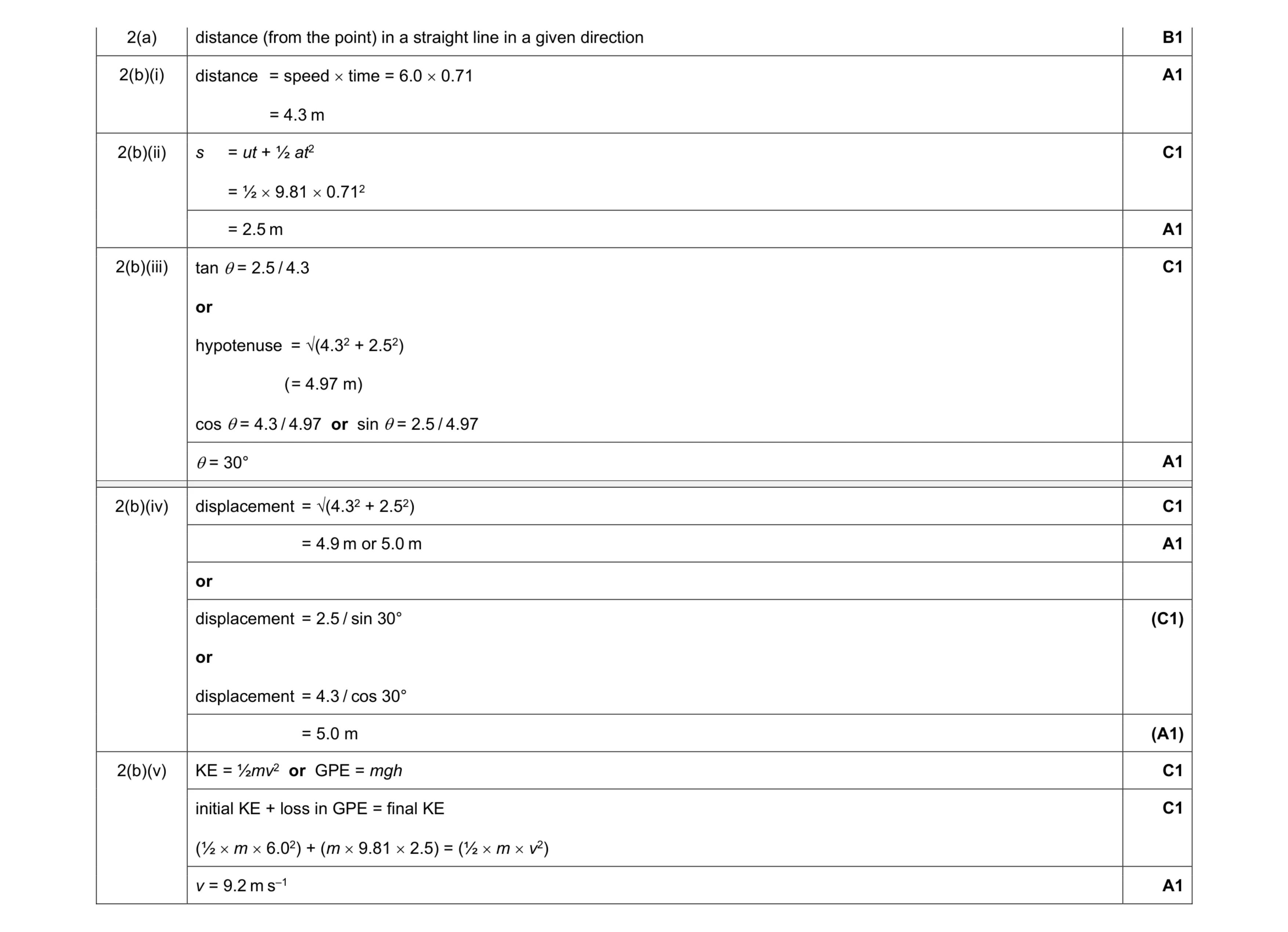 11
11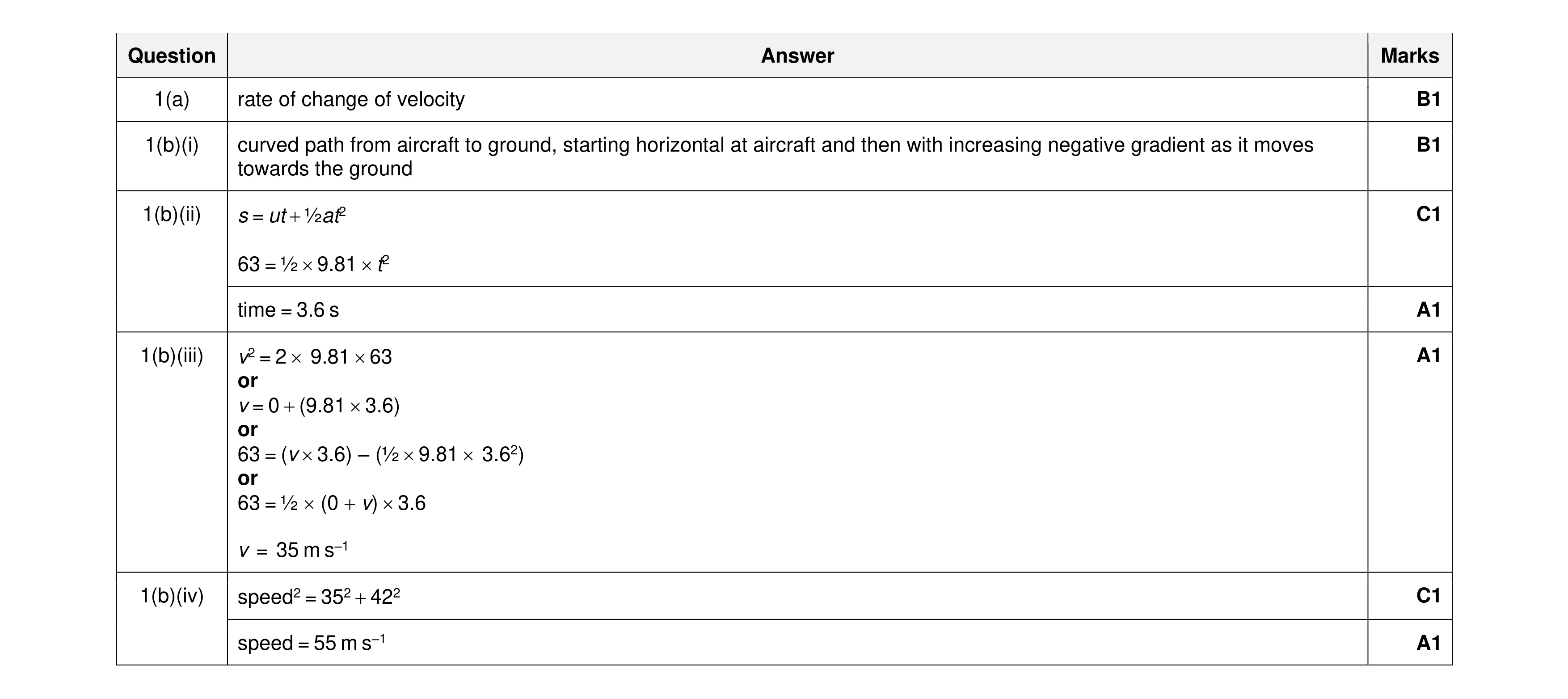 7
7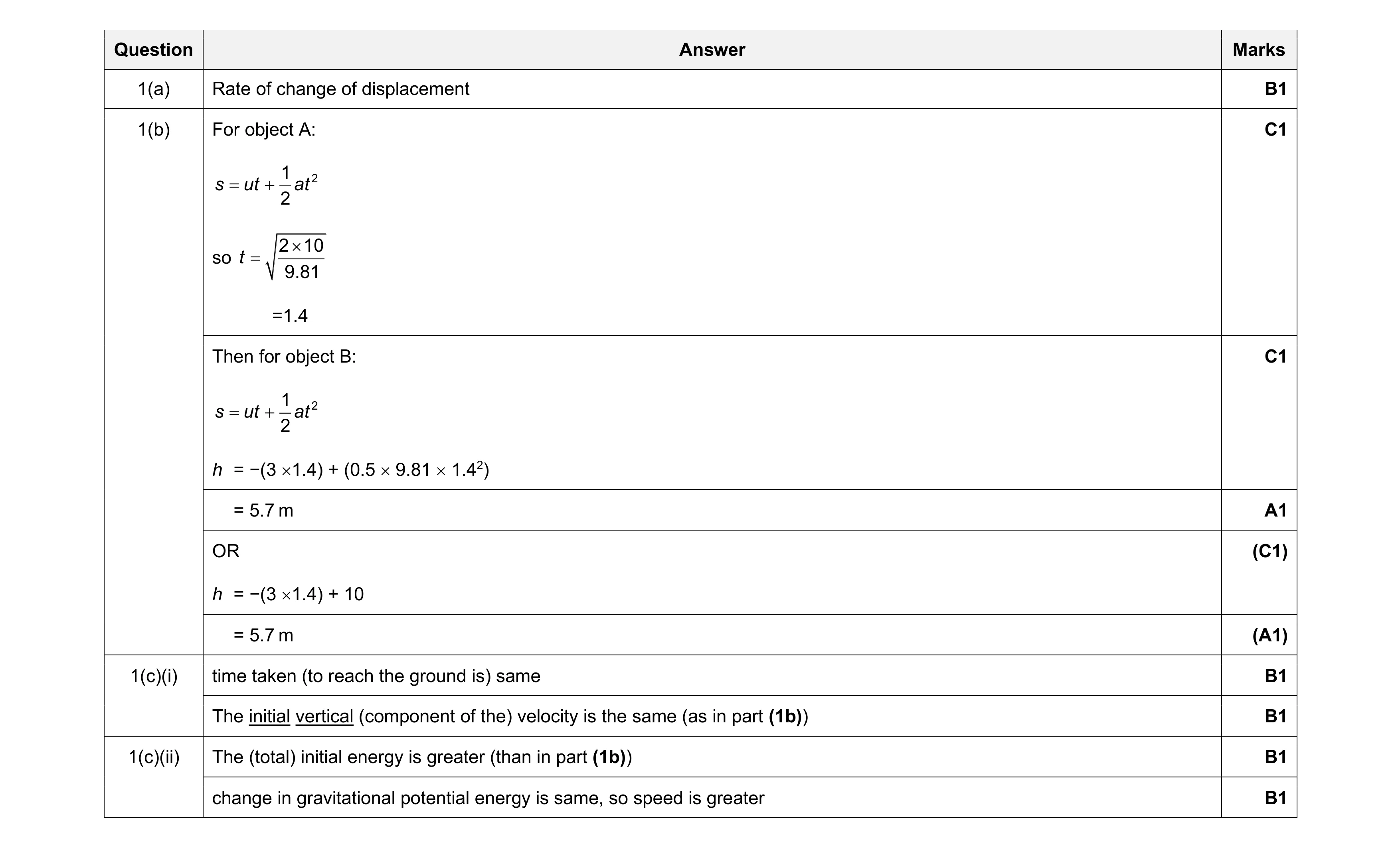 8
8