Questions as text
Q1 · Mussels are osmoconformers commonly found in estuaries 9693/31 Oct/Nov 2017
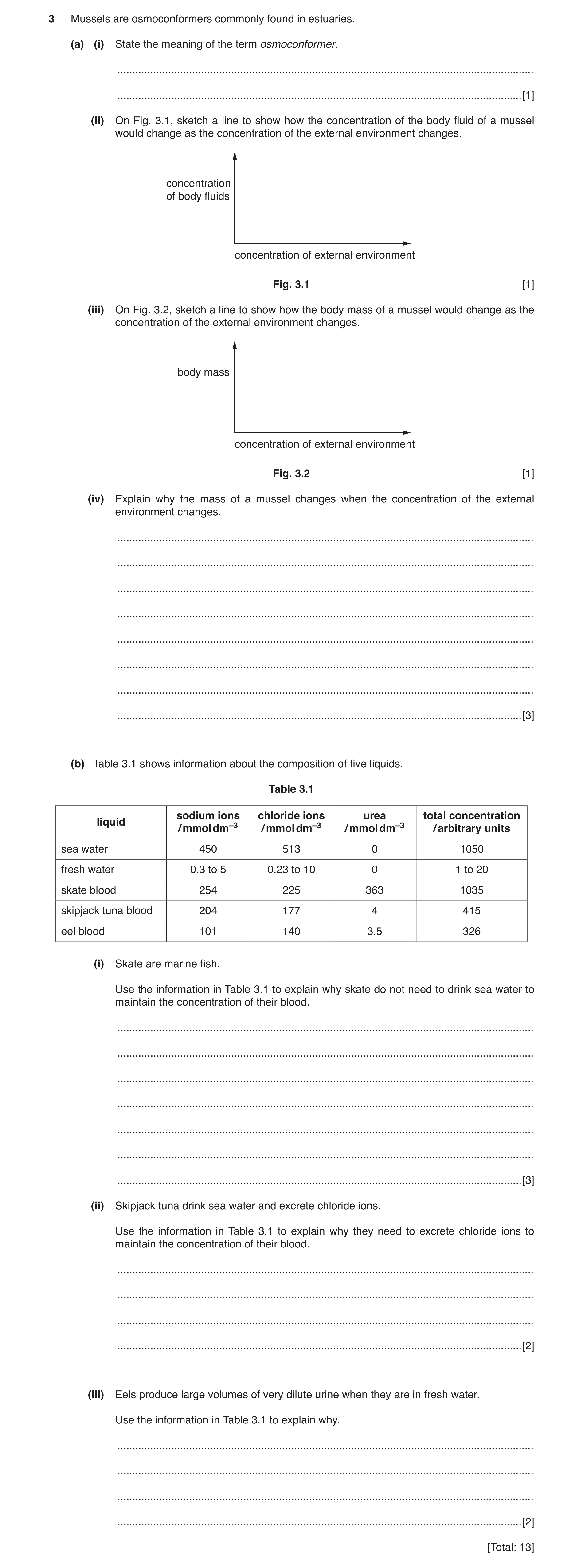
3 Mussels are osmoconformers commonly found in estuaries. (a) (i) State the meaning of the term osmoconformer. … … [1] (ii) On Fig. 3.1, sketch a line to show how the concentration of the body fluid of a mussel would change as the concentration of the external environment changes. concentration of body fluids concentration of external environment Fig. 3.1 [1] (iii) On Fig. 3.2, sketch a line to show how the body mass of a mussel would change as the concentration of the external environment changes. body mass concentration of external environment Fig. 3.2 [1] (iv) Explain why the mass of a mussel changes when the concentration of the external environment changes. … … … … … … … … [3] (b) Table 3.1 shows information about the composition of five liquids. Table 3.1 sodium ions chloride ions urea total concentration liquid / mmol dm–3 / mmol dm–3 / mmol dm–3 / arbitrary units sea water 450 513 0 1050 fresh water 0.3 to 5 0.23 to 10 0 1 to 20 skate blood 254 225 363 1035 skipjack tuna blood 204 177 4 415 eel blood 101 140 3.5 326 (i) Skate are marine fish. Use the information in Table 3.1 to explain why skate do not need to drink sea water to maintain the concentration of their blood. … … … … … … … [3] (ii) Skipjack tuna drink sea water and excrete chloride ions. Use the information in Table 3.1 to explain why they need to excrete chloride ions to maintain the concentration of their blood. … … … … [2] (iii) Eels produce large volumes of very dilute urine when they are in fresh water. Use the information in Table 3.1 to explain why. … … … … [2] [Total: 13]
13 marks
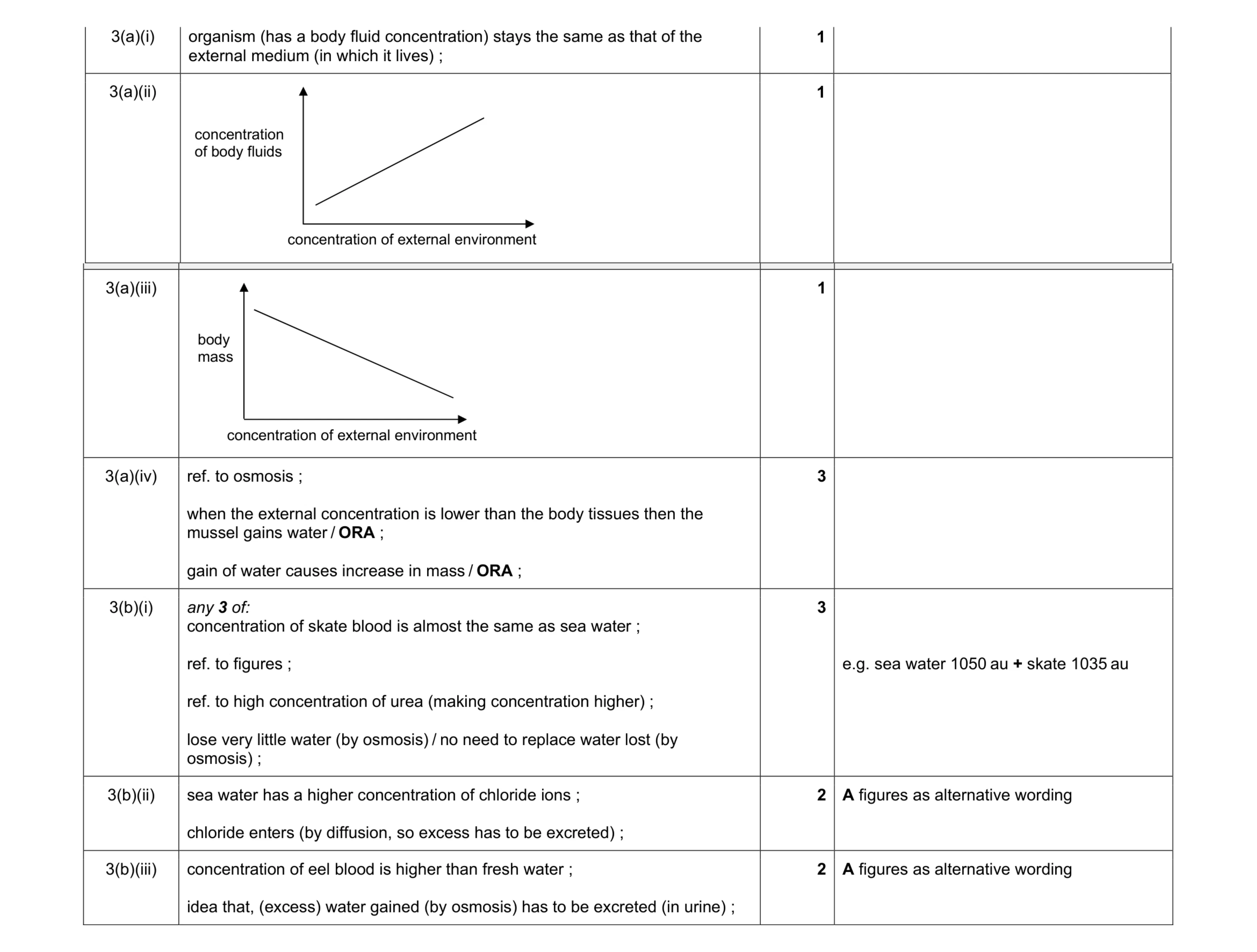
Mark scheme: 3(a)(i) organism (has a body fluid concentration) stays the same as that of the external medium (in which it lives) ; 1 3(a)(ii) 1 concentration of body fluids concentration of external environment Question Answer Marks Guidance 3(a)(iii) 1 3(a)(iv) ref. to osmosis ; when the external concentration is lower than the body tissues then the mussel gains water / ORA ; gain of water causes increase in mass / ORA ; 3 3(b)(i) any 3 of: concentration of skate blood is almost the same as sea water ; ref. to figures ; ref. to high concentration of urea (making concentration higher) ; lose very little water (by osmosis) / no need to replace water lost (by osmosis) ; 3 e.g. sea water 1050 au + skate 1035 au 3(b)(ii) sea water has a higher concentration of chloride ions ; chloride enters (by diffusion, so excess has to be excreted) ; 2 A figures as alternative wording 3(b)(iii) concentration of eel blood is higher than fresh water ; idea that, (excess) water gained (by osmosis) has to be excreted (in urine) ; 2 A figures as alternative wording concentration of external environment body mass
This question in 9693/31 Oct/Nov 2017
Q2 · State why the salinity of a muddy shore changes very little while the tide is out 9693/30 May/June 2018
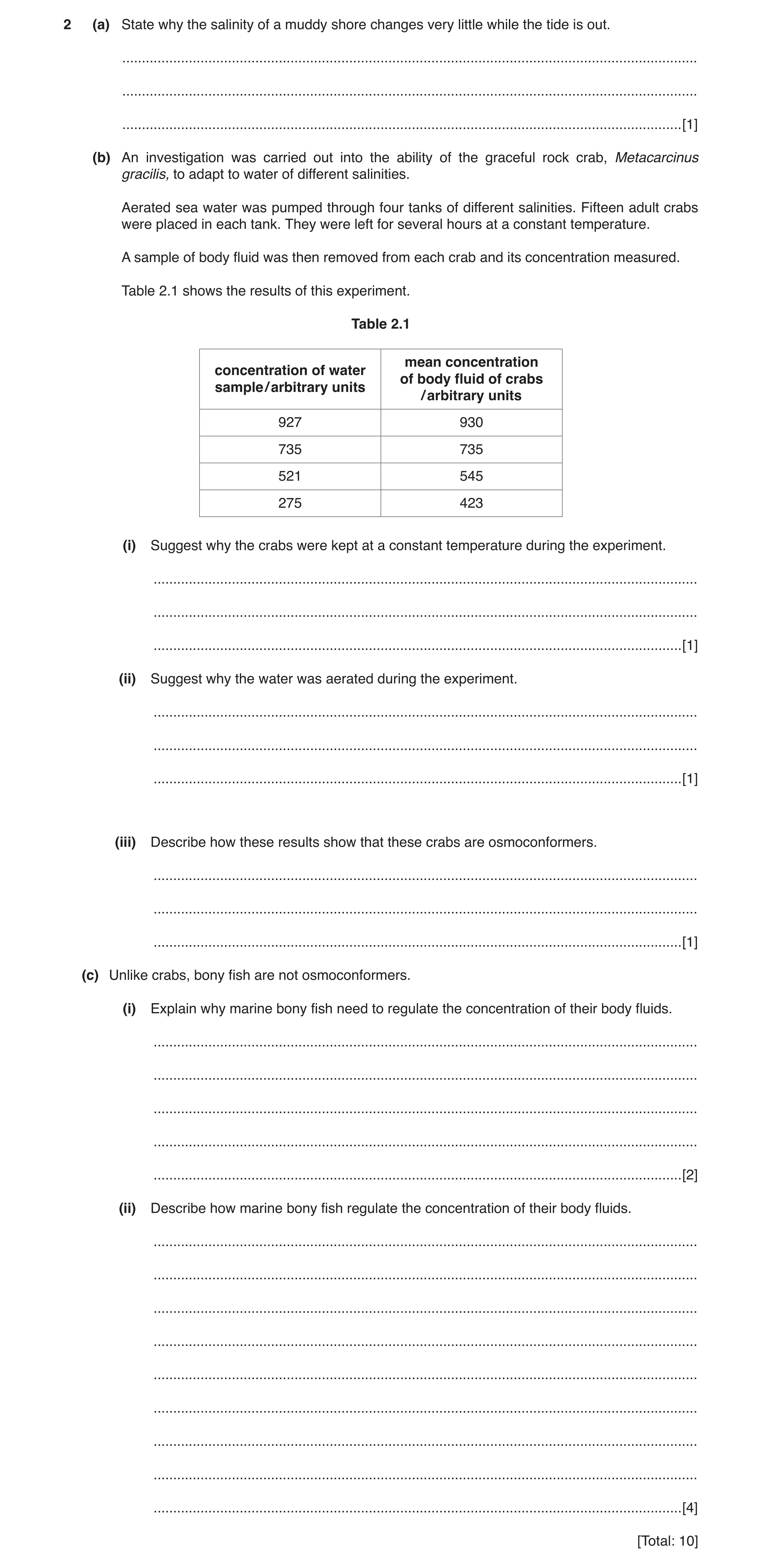
2 (a) State why the salinity of a muddy shore changes very little while the tide is out. … … … [1] (b) An investigation was carried out into the ability of the graceful rock crab, Metacarcinus gracilis, to adapt to water of different salinities. Aerated sea water was pumped through four tanks of different salinities. Fifteen adult crabs were placed in each tank. They were left for several hours at a constant temperature. A sample of body fluid was then removed from each crab and its concentration measured. Table 2.1 shows the results of this experiment. Table 2.1 mean concentration concentration of water of body fluid of crabs sample / arbitrary units / arbitrary units 927 930 735 735 521 545 275 423 (i) Suggest why the crabs were kept at a constant temperature during the experiment. … … … [1] (ii) Suggest why the water was aerated during the experiment. … … … [1] (iii) Describe how these results show that these crabs are osmoconformers. … … … [1] (c) Unlike crabs, bony fish are not osmoconformers. (i) Explain why marine bony fish need to regulate the concentration of their body fluids. … … … … … [2] (ii) Describe how marine bony fish regulate the concentration of their body fluids. … … … … … … … … … [4] [Total: 10]
10 marks
This question in 9693/30 May/June 2018
Q3 · State what is meant by the term osmoregulation 9693/30 May/June 2020
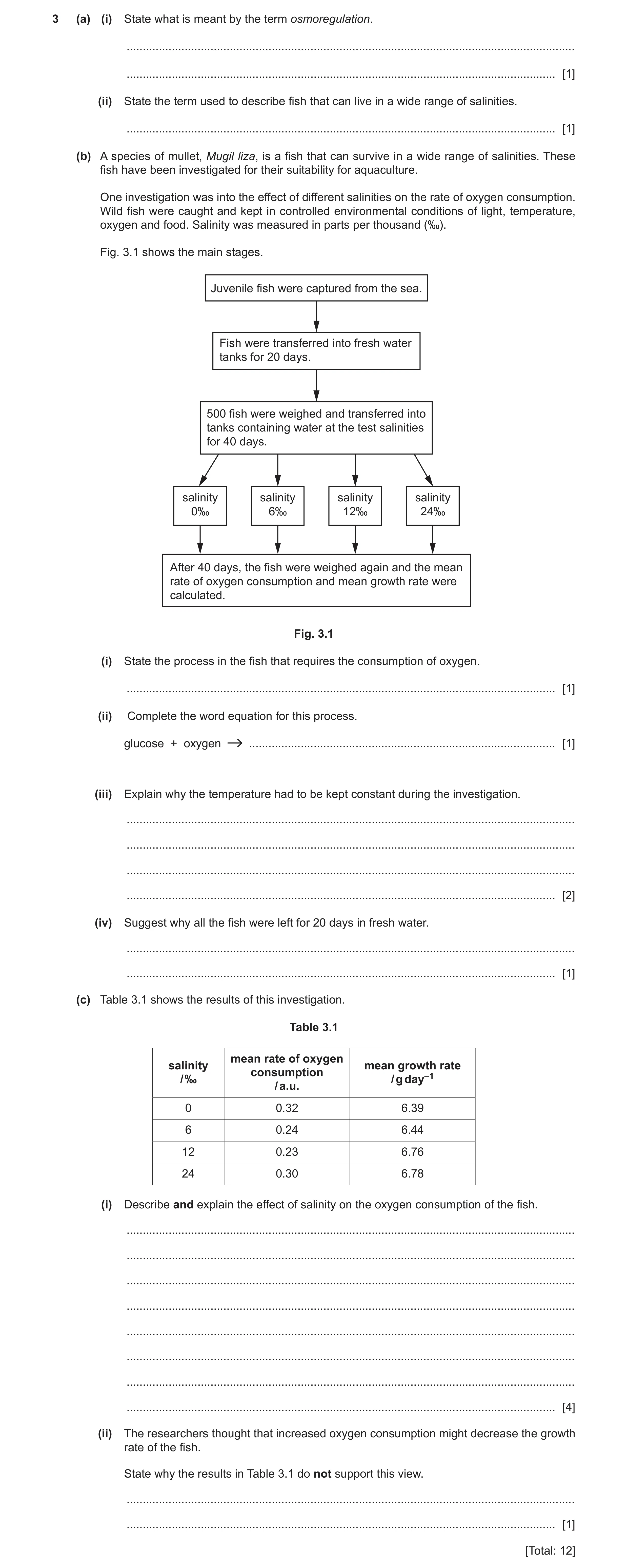
3 (a) (i) State what is meant by the term osmoregulation. … … [1] (ii) State the term used to describe fish that can live in a wide range of salinities. … [1] (b) A species of mullet, Mugil liza, is a fish that can survive in a wide range of salinities. These fish have been investigated for their suitability for aquaculture. One investigation was into the effect of different salinities on the rate of oxygen consumption. Wild fish were caught and kept in controlled environmental conditions of light, temperature, oxygen and food. Salinity was measured in parts per thousand (‰). Fig. 3.1 shows the main stages. Juvenile fish were captured from the sea. Fish were transferred into fresh water tanks for 20 days. 500 fish were weighed and transferred into tanks containing water at the test salinities for 40 days. salinity salinity salinity salinity 0‰ 6‰ 12‰ 24‰ After 40 days, the fish were weighed again and the mean rate of oxygen consumption and mean growth rate were calculated. Fig. 3.1 (i) State the process in the fish that requires the consumption of oxygen. … [1] (ii) Complete the word equation for this process. glucose + oxygen … [1] (iii) Explain why the temperature had to be kept constant during the investigation. … … … … [2] (iv) Suggest why all the fish were left for 20 days in fresh water. … … [1] (c) Table 3.1 shows the results of this investigation. Table 3.1 mean rate of oxygen salinity mean growth rate consumption / ‰ / g day–1 / a.u. 0 0.32 6.39 6 0.24 6.44 12 0.23 6.76 24 0.30 6.78 (i) Describe and explain the effect of salinity on the oxygen consumption of the fish. … … … … … … … … [4] (ii) The researchers thought that increased oxygen consumption might decrease the growth rate of the fish. State why the results in Table 3.1 do not support this view. … … [1] [Total: 12]
12 marks
This question in 9693/30 May/June 2020
Q4 · Marine mussels can tolerate a wide range of salinities 9693/31 Oct/Nov 2022
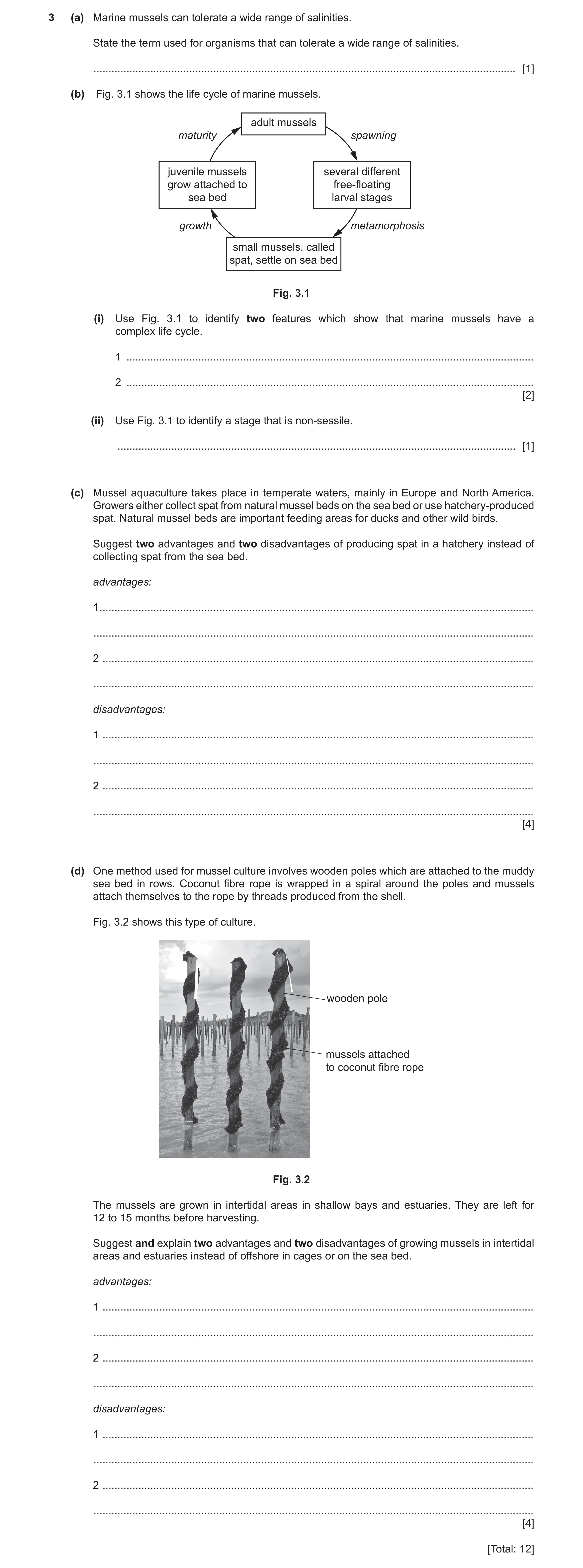
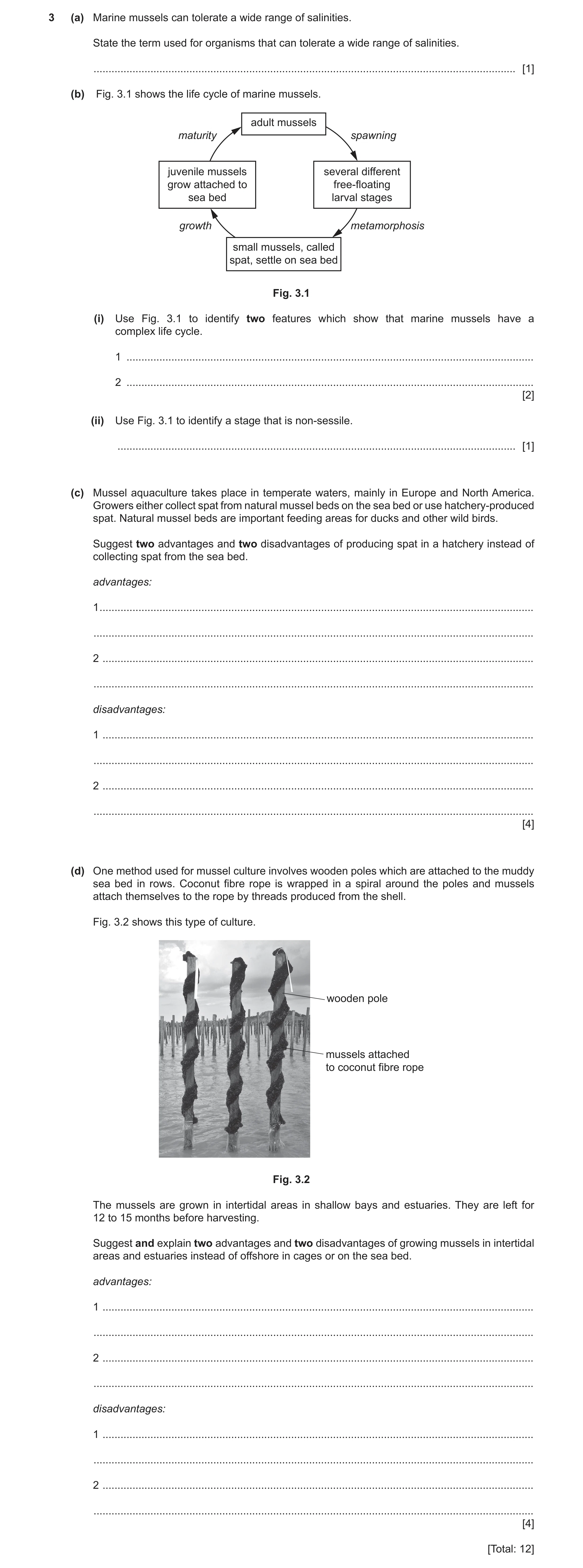
3 (a) Marine mussels can tolerate a wide range of salinities. State the term used for organisms that can tolerate a wide range of salinities. … [1] (b) Fig. 3.1 shows the life cycle of marine mussels. adult mussels maturity spawning juvenile mussels several different grow attached to free-floating sea bed larval stages growth metamorphosis small mussels, called spat, settle on sea bed Fig. 3.1 (i) Use Fig. 3.1 to identify two features which show that marine mussels have a complex life cycle. 1 … 2 … [2] (ii) Use Fig. 3.1 to identify a stage that is non-sessile. … [1] (c) Mussel aquaculture takes place in temperate waters, mainly in Europe and North America. Growers either collect spat from natural mussel beds on the sea bed or use hatchery-produced spat. Natural mussel beds are important feeding areas for ducks and other wild birds. Suggest two advantages and two disadvantages of producing spat in a hatchery instead of collecting spat from the sea bed. advantages: 1 … … 2 … … disadvantages: 1 … … 2 … … [4] (d) One method used for mussel culture involves wooden poles which are attached to the muddy sea bed in rows. Coconut fibre rope is wrapped in a spiral around the poles and mussels attach themselves to the rope by threads produced from the shell. Fig. 3.2 shows this type of culture. wooden pole mussels attached to coconut fibre rope Fig. 3.2 The mussels are grown in intertidal areas in shallow bays and estuaries. They are left for 12 to 15 months before harvesting. Suggest and explain two advantages and two disadvantages of growing mussels in intertidal areas and estuaries instead of offshore in cages or on the sea bed. advantages: 1 … … 2 … … disadvantages: 1 … … 2 … … [4] [Total: 12]
12 marks
Mark scheme: 3(a) euryhaline ; 1 3(b)(i) many larval stages ; 2 metamorphosis occurs ; 3(b)(ii) larvae ; 1 3(c) advantages: any 2 of: 4 supply guaranteed ; does not reduce food supply for wild birds / ducks ; spat protected from, adverse weather / pollution / toxins from algal blooms / predators ; spat protected from temperature increases due to climate change ; AVP ; disadvantages: any 2 of: high cost of setting up hatchery ; high running / maintenance costs e.g. pump / filtration / aeration ; mussels / larvae will need to be fed ; AVP ; 3(d) advantages – any 2 of: 4 easier to check growth ; easier to harvest (from land) / no need for a boat to harvest ; muddy shores and estuaries are high in nutrients ; regular water flow brings food / phytoplankton ; regular water flow washes away waste products ; regular water flow maintains oxygen levels (for respiration) ; easier to check for predators / biofouling ; estuaries more protected from wave action / storms ; disadvantages – any 2 of: mussels exposed, to atmosphere / during low tide ; so greater chance of, predation by birds / desiccation / temperature or salinity fluctuations ; less time available to feed ; so less growth ; longer time before harvest ; greater chance of being affected by algal blooms / pollutants ; greater risk of sediment blocking gills ;
This question in 9693/31 Oct/Nov 2022
Q5 · Marine mussels can tolerate a wide range of salinities 9693/32 Oct/Nov 2022
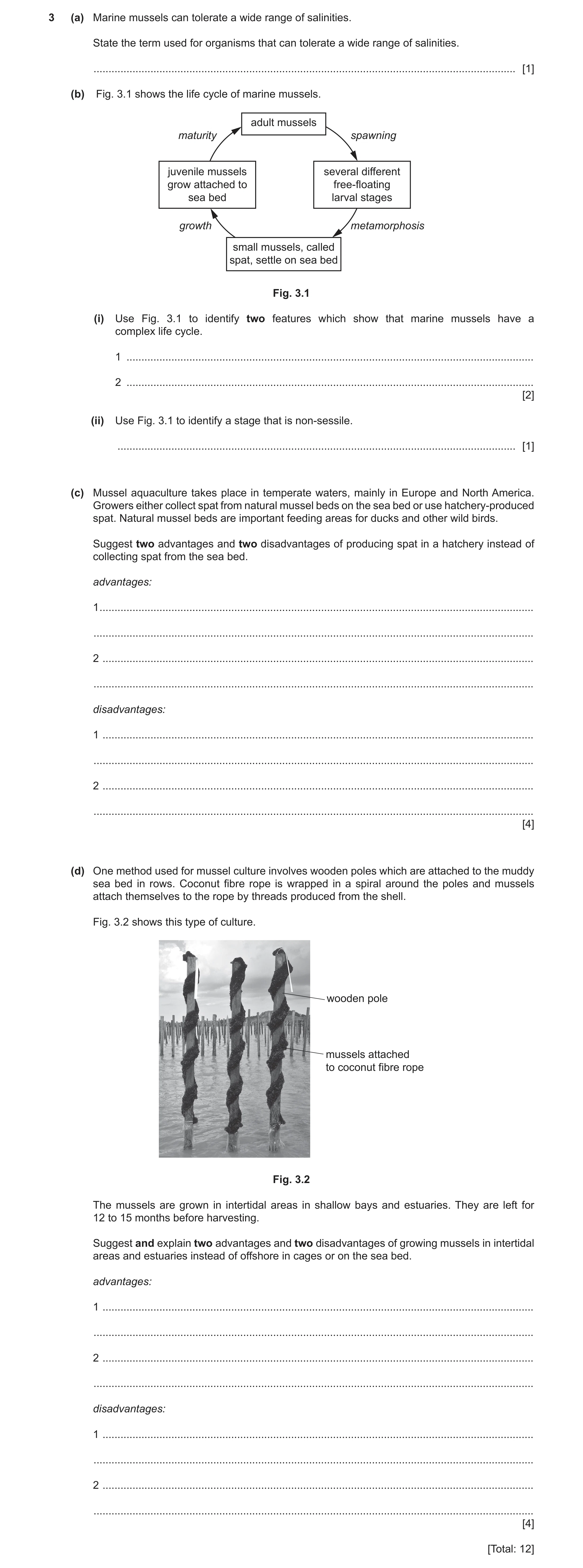
3 (a) Marine mussels can tolerate a wide range of salinities. State the term used for organisms that can tolerate a wide range of salinities. … [1] (b) Fig. 3.1 shows the life cycle of marine mussels. adult mussels maturity spawning juvenile mussels several different grow attached to free-floating sea bed larval stages growth metamorphosis small mussels, called spat, settle on sea bed Fig. 3.1 (i) Use Fig. 3.1 to identify two features which show that marine mussels have a complex life cycle. 1 … 2 … [2] (ii) Use Fig. 3.1 to identify a stage that is non-sessile. … [1] (c) Mussel aquaculture takes place in temperate waters, mainly in Europe and North America. Growers either collect spat from natural mussel beds on the sea bed or use hatchery-produced spat. Natural mussel beds are important feeding areas for ducks and other wild birds. Suggest two advantages and two disadvantages of producing spat in a hatchery instead of collecting spat from the sea bed. advantages: 1 … … 2 … … disadvantages: 1 … … 2 … … [4] (d) One method used for mussel culture involves wooden poles which are attached to the muddy sea bed in rows. Coconut fibre rope is wrapped in a spiral around the poles and mussels attach themselves to the rope by threads produced from the shell. Fig. 3.2 shows this type of culture. wooden pole mussels attached to coconut fibre rope Fig. 3.2 The mussels are grown in intertidal areas in shallow bays and estuaries. They are left for 12 to 15 months before harvesting. Suggest and explain two advantages and two disadvantages of growing mussels in intertidal areas and estuaries instead of offshore in cages or on the sea bed. advantages: 1 … … 2 … … disadvantages: 1 … … 2 … … [4] [Total: 12]
12 marks
Mark scheme: 3(a) euryhaline ; 1 3(b)(i) many larval stages ; 2 metamorphosis occurs ; 3(b)(ii) larvae ; 1 3(c) advantages: any 2 of: 4 supply guaranteed ; does not reduce food supply for wild birds / ducks ; spat protected from, adverse weather / pollution / toxins from algal blooms / predators ; spat protected from temperature increases due to climate change ; AVP ; disadvantages: any 2 of: high cost of setting up hatchery ; high running / maintenance costs e.g. pump / filtration / aeration ; mussels / larvae will need to be fed ; AVP ; 3(d) advantages – any 2 of: 4 easier to check growth ; easier to harvest (from land) / no need for a boat to harvest ; muddy shores and estuaries are high in nutrients ; regular water flow brings food / phytoplankton ; regular water flow washes away waste products ; regular water flow maintains oxygen levels (for respiration) ; easier to check for predators / biofouling ; estuaries more protected from wave action / storms ; disadvantages – any 2 of: mussels exposed, to atmosphere / during low tide ; so greater chance of, predation by birds / desiccation / temperature or salinity fluctuations ; less time available to feed ; so less growth ; longer time before harvest ; greater chance of being affected by algal blooms / pollutants ; greater risk of sediment blocking gills ;
This question in 9693/32 Oct/Nov 2022
Q6 · Marine mussels can tolerate a wide range of salinities 9693/33 Oct/Nov 2022
3 (a) Marine mussels can tolerate a wide range of salinities. State the term used for organisms that can tolerate a wide range of salinities. … [1] (b) Fig. 3.1 shows the life cycle of marine mussels. adult mussels maturity spawning juvenile mussels several different grow attached to free-floating sea bed larval stages growth metamorphosis small mussels, called spat, settle on sea bed Fig. 3.1 (i) Use Fig. 3.1 to identify two features which show that marine mussels have a complex life cycle. 1 … 2 … [2] (ii) Use Fig. 3.1 to identify a stage that is non-sessile. … [1] (c) Mussel aquaculture takes place in temperate waters, mainly in Europe and North America. Growers either collect spat from natural mussel beds on the sea bed or use hatchery-produced spat. Natural mussel beds are important feeding areas for ducks and other wild birds. Suggest two advantages and two disadvantages of producing spat in a hatchery instead of collecting spat from the sea bed. advantages: 1 … … 2 … … disadvantages: 1 … … 2 … … [4] (d) One method used for mussel culture involves wooden poles which are attached to the muddy sea bed in rows. Coconut fibre rope is wrapped in a spiral around the poles and mussels attach themselves to the rope by threads produced from the shell. Fig. 3.2 shows this type of culture. wooden pole mussels attached to coconut fibre rope Fig. 3.2 The mussels are grown in intertidal areas in shallow bays and estuaries. They are left for 12 to 15 months before harvesting. Suggest and explain two advantages and two disadvantages of growing mussels in intertidal areas and estuaries instead of offshore in cages or on the sea bed. advantages: 1 … … 2 … … disadvantages: 1 … … 2 … … [4] [Total: 12]
12 marks
Mark scheme: 3(a) euryhaline ; 1 3(b)(i) many larval stages ; 2 metamorphosis occurs ; 3(b)(ii) larvae ; 1 3(c) advantages: any 2 of: 4 supply guaranteed ; does not reduce food supply for wild birds / ducks ; spat protected from, adverse weather / pollution / toxins from algal blooms / predators ; spat protected from temperature increases due to climate change ; AVP ; disadvantages: any 2 of: high cost of setting up hatchery ; high running / maintenance costs e.g. pump / filtration / aeration ; mussels / larvae will need to be fed ; AVP ; 3(d) advantages – any 2 of: 4 easier to check growth ; easier to harvest (from land) / no need for a boat to harvest ; muddy shores and estuaries are high in nutrients ; regular water flow brings food / phytoplankton ; regular water flow washes away waste products ; regular water flow maintains oxygen levels (for respiration) ; easier to check for predators / biofouling ; estuaries more protected from wave action / storms ; disadvantages – any 2 of: mussels exposed, to atmosphere / during low tide ; so greater chance of, predation by birds / desiccation / temperature or salinity fluctuations ; less time available to feed ; so less growth ; longer time before harvest ; greater chance of being affected by algal blooms / pollutants ; greater risk of sediment blocking gills ;
This question in 9693/33 Oct/Nov 2022
Q7 · Greenland sharks can live for over 200 years and are found in the almost freezing waters… 9693/31 May/June 2023
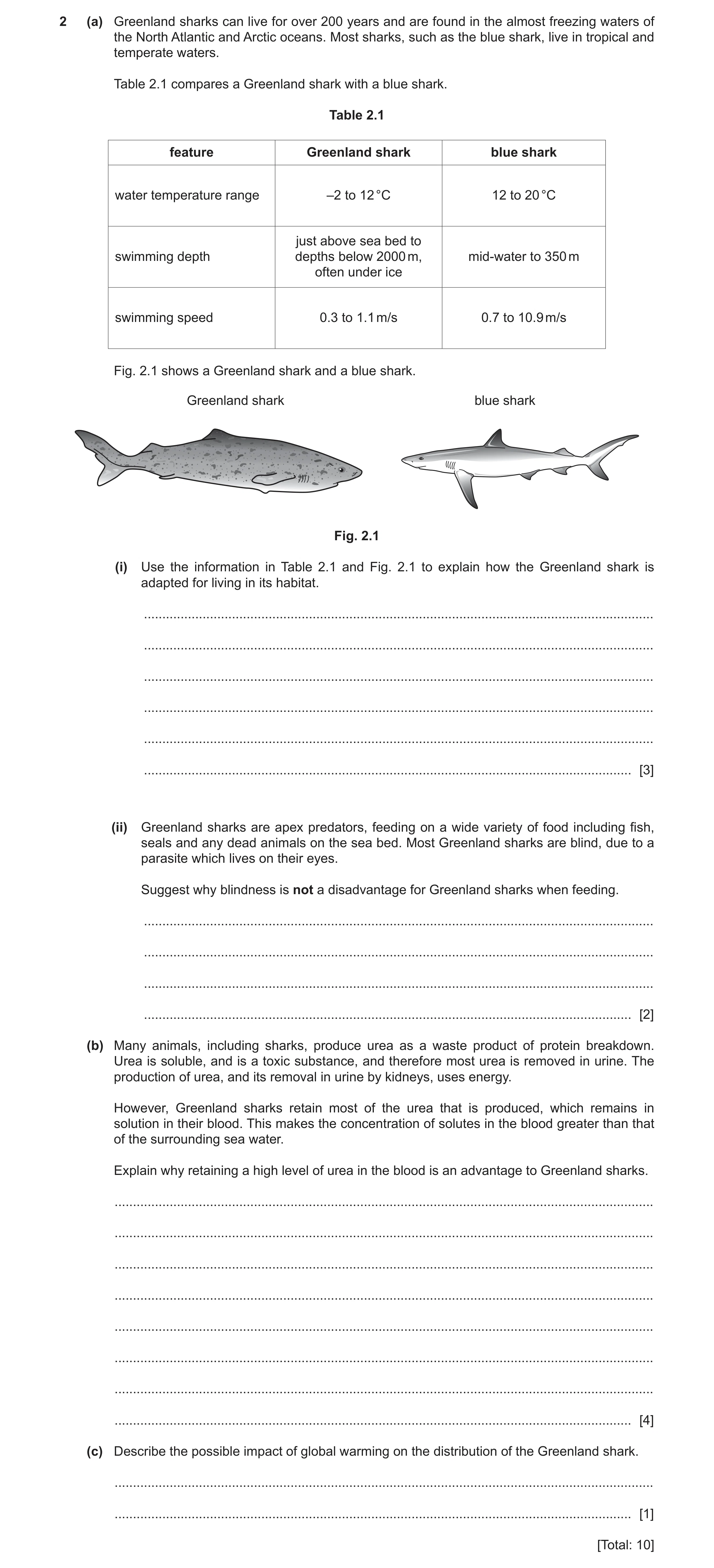
2 (a) Greenland sharks can live for over 200 years and are found in the almost freezing waters of the North Atlantic and Arctic oceans. Most sharks, such as the blue shark, live in tropical and temperate waters. Table 2.1 compares a Greenland shark with a blue shark. Table 2.1 feature Greenland shark blue shark water temperature range –2 to 12 °C 12 to 20 °C just above sea bed to swimming depth depths below 2000 m, mid-water to 350 m often under ice swimming speed 0.3 to 1.1 m/s 0.7 to 10.9 m/s Fig. 2.1 shows a Greenland shark and a blue shark. Greenland shark blue shark Fig. 2.1 (i) Use the information in Table 2.1 and Fig. 2.1 to explain how the Greenland shark is adapted for living in its habitat. … … … … … … [3] (ii) Greenland sharks are apex predators, feeding on a wide variety of food including fish, seals and any dead animals on the sea bed. Most Greenland sharks are blind, due to a parasite which lives on their eyes. Suggest why blindness is not a disadvantage for Greenland sharks when feeding. … … … … [2] (b) Many animals, including sharks, produce urea as a waste product of protein breakdown. Urea is soluble, and is a toxic substance, and therefore most urea is removed in urine. The production of urea, and its removal in urine by kidneys, uses energy. However, Greenland sharks retain most of the urea that is produced, which remains in solution in their blood. This makes the concentration of solutes in the blood greater than that of the surrounding sea water. Explain why retaining a high level of urea in the blood is an advantage to Greenland sharks. … … … … … … … … [4] (c) Describe the possible impact of global warming on the distribution of the Greenland shark. … … [1] [Total: 10]
10 marks
Mark scheme: 2(a)(i) any 3 of: small fins to reduce surface area ; so reducing heat loss ; small fins, as swimming speeds are slow ; correct ref. to named fin and advantage ; slow swimming speeds, use up less energy / conserves energy ; idea of body, more rounded / less streamlined, to retain more heat / to insulate body ; body camouflaged to, blend with substrate / prevent detection by prey ; 3 2(a)(ii) any 2 of: dark / little / no light in these waters / at depth, (so do not use their eyes to find prey) ; use smell / sense organs in lateral line, to detect prey ; (are apex predators so) do not need to look out for predators ; 2 Question Answer Marks 2(b) any 4 of: water enters body (from sea water through the gills / skin) ; by osmosis ; as higher water potential in sea water than in shark / e.q. ; gills pump, less / no, sodium and chloride ions ; so less ATP / energy used (in gills) ; less energy needed to remove urea (in kidney as most retained in blood) ; more energy available for other activities / catching prey / movement ; always maintains (a stable amount of) water in body ; 4 2(c) any 1 of: distribution will, be more restricted / decrease ; migrate northwards (towards North Pole) / to deeper / colder, water ; 1
This question in 9693/31 May/June 2023
Q8 · Explain why and how osmoregulation occurs in tuna 9693/31 Oct/Nov 2023
5 Explain why and how osmoregulation occurs in tuna. … … … … … … … … … … … … … … … … … … [9]
9 marks
Mark scheme: 5 any 9 of: 9 1 sea water has a lower water potential than, the blood / body fluids of tuna ; ORA 2 so water is (continuously) lost (through skin) ; 3 by osmosis ; 4 which could lead to dehydration ; 5 tuna regulates its (internal), water / ion concentration ; 6 so that their, internal concentration / concentration of blood / body fluids is (fairly) constant ; 7 drinks sea water ; 8 which contains salts / ions ; 9 to replace water lost (by osmosis) ; 10 salts diffuse into body through skin ; 11 sodium / chloride, (ions) secreted / removed by gills ; 12 using ATP / energy / is an active process ; 13 magnesium / sulfate ions, (actively) secreted by kidney ; 14 reabsorption of water in kidney ; 15 so small volume of concentrated urine released ;
This question in 9693/31 Oct/Nov 2023
Q9 · Explain why and how osmoregulation occurs in tuna 9693/32 Oct/Nov 2023
5 Explain why and how osmoregulation occurs in tuna. … … … … … … … … … … … … … … … … … … [9]
9 marks
Mark scheme: 5 any 9 of: 9 1 sea water has a lower water potential than, the blood / body fluids of tuna ; ORA 2 so water is (continuously) lost (through skin) ; 3 by osmosis ; 4 which could lead to dehydration ; 5 tuna regulates its (internal), water / ion concentration ; 6 so that their, internal concentration / concentration of blood / body fluids is (fairly) constant ; 7 drinks sea water ; 8 which contains salts / ions ; 9 to replace water lost (by osmosis) ; 10 salts diffuse into body through skin ; 11 sodium / chloride, (ions) secreted / removed by gills ; 12 using ATP / energy / is an active process ; 13 magnesium / sulfate ions, (actively) secreted by kidney ; 14 reabsorption of water in kidney ; 15 so small volume of concentrated urine released ;
This question in 9693/32 Oct/Nov 2023
Q10 · Explain why and how osmoregulation occurs in tuna 9693/33 Oct/Nov 2023
5 Explain why and how osmoregulation occurs in tuna. … … … … … … … … … … … … … … … … … … [9]
9 marks
Mark scheme: 5 any 9 of: 9 1 sea water has a lower water potential than, the blood / body fluids of tuna ; ORA 2 so water is (continuously) lost (through skin) ; 3 by osmosis ; 4 which could lead to dehydration ; 5 tuna regulates its (internal), water / ion concentration ; 6 so that their, internal concentration / concentration of blood / body fluids is (fairly) constant ; 7 drinks sea water ; 8 which contains salts / ions ; 9 to replace water lost (by osmosis) ; 10 salts diffuse into body through skin ; 11 sodium / chloride, (ions) secreted / removed by gills ; 12 using ATP / energy / is an active process ; 13 magnesium / sulfate ions, (actively) secreted by kidney ; 14 reabsorption of water in kidney ; 15 so small volume of concentrated urine released ;
This question in 9693/33 Oct/Nov 2023
Q11 · Describe the process of diffusion and explain its importance in marine organisms 9693/31 May/June 2024
6 (a) Describe the process of diffusion and explain its importance in marine organisms. … … … … … … … … … … … … … … … … [8] (b) Describe how water moves between cells and their environments and explain the effects of this water movement on plant cells and animal cells. … … … … … … … … … … … … … … [7] [Total: 15]
15 marks
Mark scheme: 6(a) any 8 of: 1 diffusion is the random (net) movement of particles ; 2 from a high concentration to a lower concentration / down a conc. gradient ; 3 (the random movement is) caused by the kinetic energy of the particles ; 4 ref. to two (named) examples of particles / gases / liquids / molecules / ions (which move by diffusion) ; 5 it is passive / does not require, ATP / energy ; 6 the greater the difference in concentration, the faster the rate of diffusion ; 7 rate increases with temperature (as particles have more kinetic energy) ; 8 rate increases with surface area ; 9 diffusion can only occur over short distances ; 10 non-polar molecules diffuse more easily through cell membranes than polar ones ; 11 because they are soluble in the non-polar phospholipid tails ; 12 (diffusion used) for gaseous exchange ; 13 for respiration / photosynthesis ; 14 suitable example of a gas exchange surface ; 15 important for mineral uptake (from sea water) ; 16 correct ref.to facilitated diffusion or osmosis ; 6(b) any 7 of: 1 water moves by osmosis ; 2 from an area of high water potential to an area of lower water potential / down a water potential gradient ; 3 through, a selectively permeable membrane / the cell membrane / tonoplast ; 4 the water potential of a cell is affected by the concentration of solutes in the cytoplasm / vacuole ; 5 the higher the concentration of solutes, the lower the water potential ; ORA 6 ref. to pressure increasing water potential ; 7 when a cell gains water its water potential becomes less negative ; ORA 8 if plant cells lose (too much) water they can become flaccid / plasmolysed ; 9 if animal cells lose (too much) water they can shrink ; 10 when plant cells gain water they become turgid ; 11 so providing support ; 12 if animal cells gain (too much) water they can burst ; ORA 13 as they do not have a cell wall (to provide support) ; ORA 14 AVP ; 7
This question in 9693/31 May/June 2024
Q12 · A diagram of a mangrove leaf cell under an electron microscope 9693/31 Oct/Nov 2024
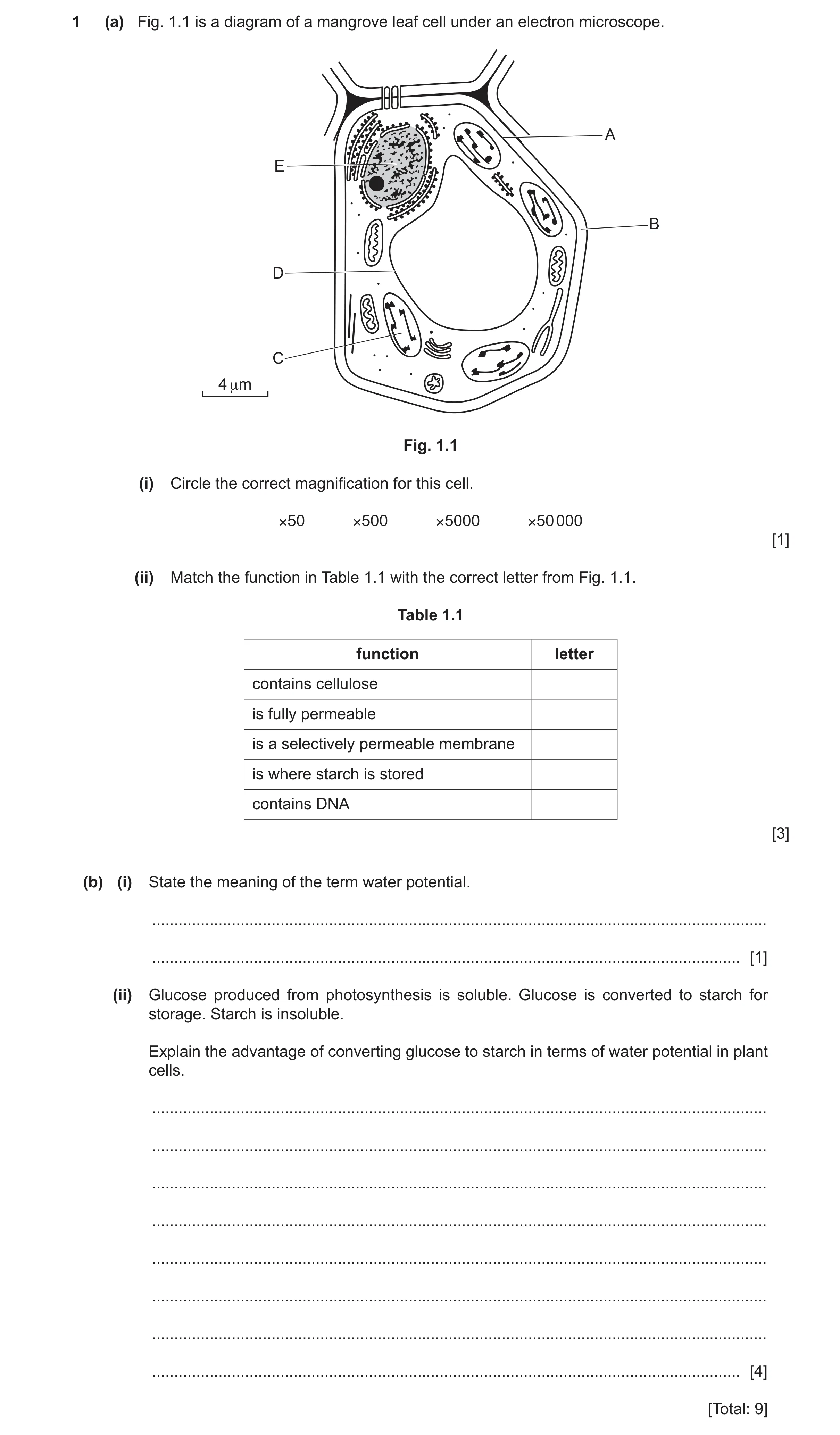
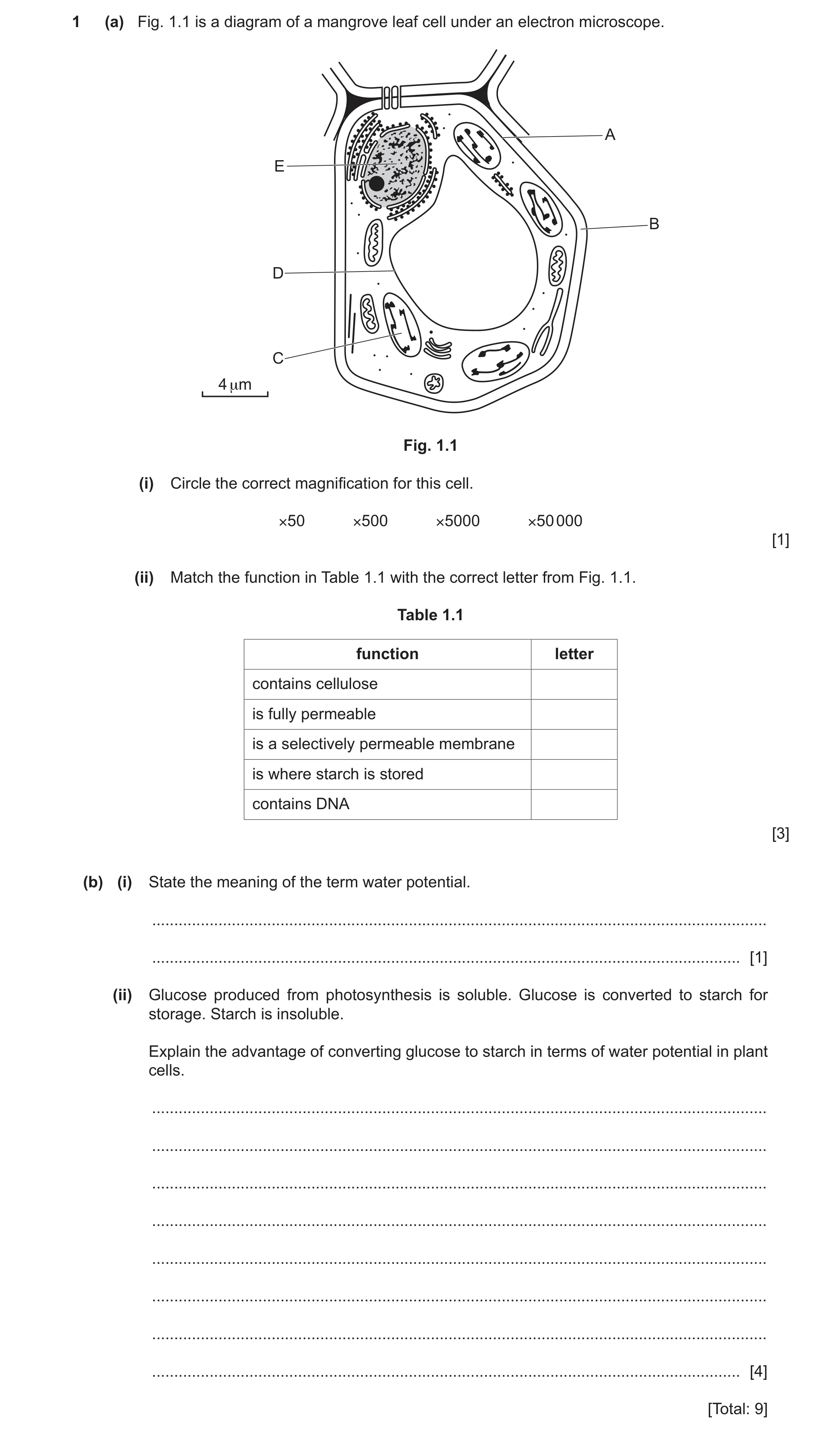
1 (a) Fig. 1.1 is a diagram of a mangrove leaf cell under an electron microscope. A E B D C 4 μm Fig. 1.1 (i) Circle the correct magnification for this cell. ×50 ×500 ×5000 ×50 000 [1] (ii) Match the function in Table 1.1 with the correct letter from Fig. 1.1. Table 1.1 function letter contains cellulose is fully permeable is a selectively permeable membrane is where starch is stored contains DNA [3] (b) (i) State the meaning of the term water potential. … … [1] (ii) Glucose produced from photosynthesis is soluble. Glucose is converted to starch for storage. Starch is insoluble. Explain the advantage of converting glucose to starch in terms of water potential in plant cells. … … … … … … … … [4] [Total: 9]
9 marks
Mark scheme: Question Answer Marks 1(a)(i) x 5000 ; 1 1(a)(ii) B 3 B A or D C E All 5 correct, 3 marks 3 or 4 correct, 2 marks 2 correct, 1 mark 1(b)(i) any correct definition, e.g. the tendency for water to move, out of a solution / from a high water potential to a low water 1 potential ; 1(b)(ii) any 4 of: 4 1 glucose dissolves (in cytoplasm / vacuole) ; 2 so decreases the water potential inside the cell ; 3 higher water potential outside the cell than inside ; 4 so water enters cell (by osmosis) ; 5 starch does not dissolve (in the cytoplasm / vacuole) ; 6 so has no effect on water potential / osmosis ;
This question in 9693/31 Oct/Nov 2024
Q13 · A diagram of a mangrove leaf cell under an electron microscope 9693/32 Oct/Nov 2024
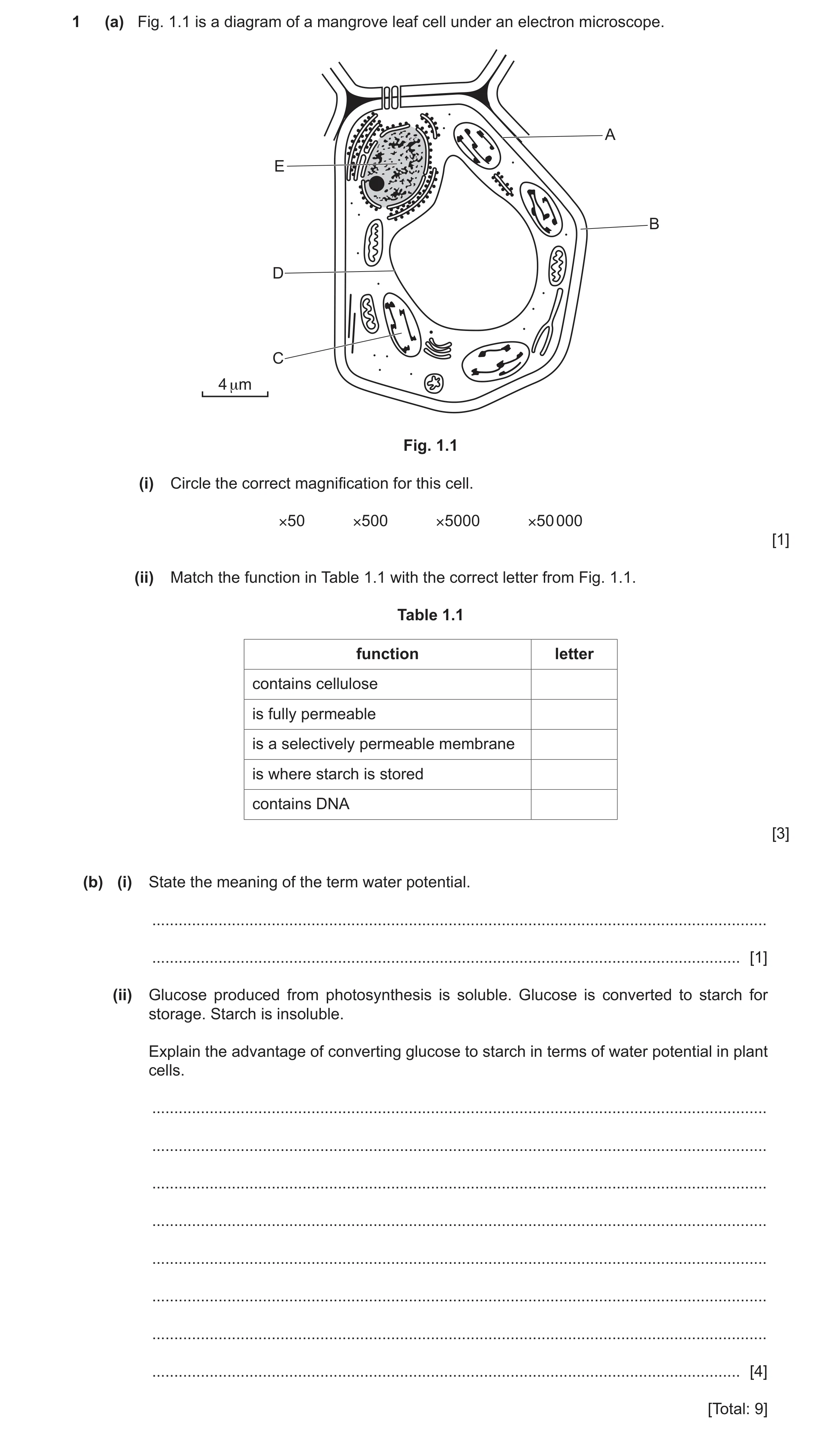
1 (a) Fig. 1.1 is a diagram of a mangrove leaf cell under an electron microscope. A E B D C 4 μm Fig. 1.1 (i) Circle the correct magnification for this cell. ×50 ×500 ×5000 ×50 000 [1] (ii) Match the function in Table 1.1 with the correct letter from Fig. 1.1. Table 1.1 function letter contains cellulose is fully permeable is a selectively permeable membrane is where starch is stored contains DNA [3] (b) (i) State the meaning of the term water potential. … … [1] (ii) Glucose produced from photosynthesis is soluble. Glucose is converted to starch for storage. Starch is insoluble. Explain the advantage of converting glucose to starch in terms of water potential in plant cells. … … … … … … … … [4] [Total: 9]
9 marks
Mark scheme: Question Answer Marks 1(a)(i) x 5000 ; 1 1(a)(ii) B 3 B A or D C E All 5 correct, 3 marks 3 or 4 correct, 2 marks 2 correct, 1 mark 1(b)(i) any correct definition, e.g. the tendency for water to move, out of a solution / from a high water potential to a low water 1 potential ; 1(b)(ii) any 4 of: 4 1 glucose dissolves (in cytoplasm / vacuole) ; 2 so decreases the water potential inside the cell ; 3 higher water potential outside the cell than inside ; 4 so water enters cell (by osmosis) ; 5 starch does not dissolve (in the cytoplasm / vacuole) ; 6 so has no effect on water potential / osmosis ;
This question in 9693/32 Oct/Nov 2024
Q14 · A diagram of a mangrove leaf cell under an electron microscope 9693/33 Oct/Nov 2024
1 (a) Fig. 1.1 is a diagram of a mangrove leaf cell under an electron microscope. A E B D C 4 μm Fig. 1.1 (i) Circle the correct magnification for this cell. ×50 ×500 ×5000 ×50 000 [1] (ii) Match the function in Table 1.1 with the correct letter from Fig. 1.1. Table 1.1 function letter contains cellulose is fully permeable is a selectively permeable membrane is where starch is stored contains DNA [3] (b) (i) State the meaning of the term water potential. … … [1] (ii) Glucose produced from photosynthesis is soluble. Glucose is converted to starch for storage. Starch is insoluble. Explain the advantage of converting glucose to starch in terms of water potential in plant cells. … … … … … … … … [4] [Total: 9]
9 marks
Mark scheme: Question Answer Marks 1(a)(i) x 5000 ; 1 1(a)(ii) B 3 B A or D C E All 5 correct, 3 marks 3 or 4 correct, 2 marks 2 correct, 1 mark 1(b)(i) any correct definition, e.g. the tendency for water to move, out of a solution / from a high water potential to a low water 1 potential ; 1(b)(ii) any 4 of: 4 1 glucose dissolves (in cytoplasm / vacuole) ; 2 so decreases the water potential inside the cell ; 3 higher water potential outside the cell than inside ; 4 so water enters cell (by osmosis) ; 5 starch does not dissolve (in the cytoplasm / vacuole) ; 6 so has no effect on water potential / osmosis ;
This question in 9693/33 Oct/Nov 2024
Q15 · Oysters can grow in a range of salinities from 10 parts per thousand (ppt) in estuaries… 9693/31 May/June 2025
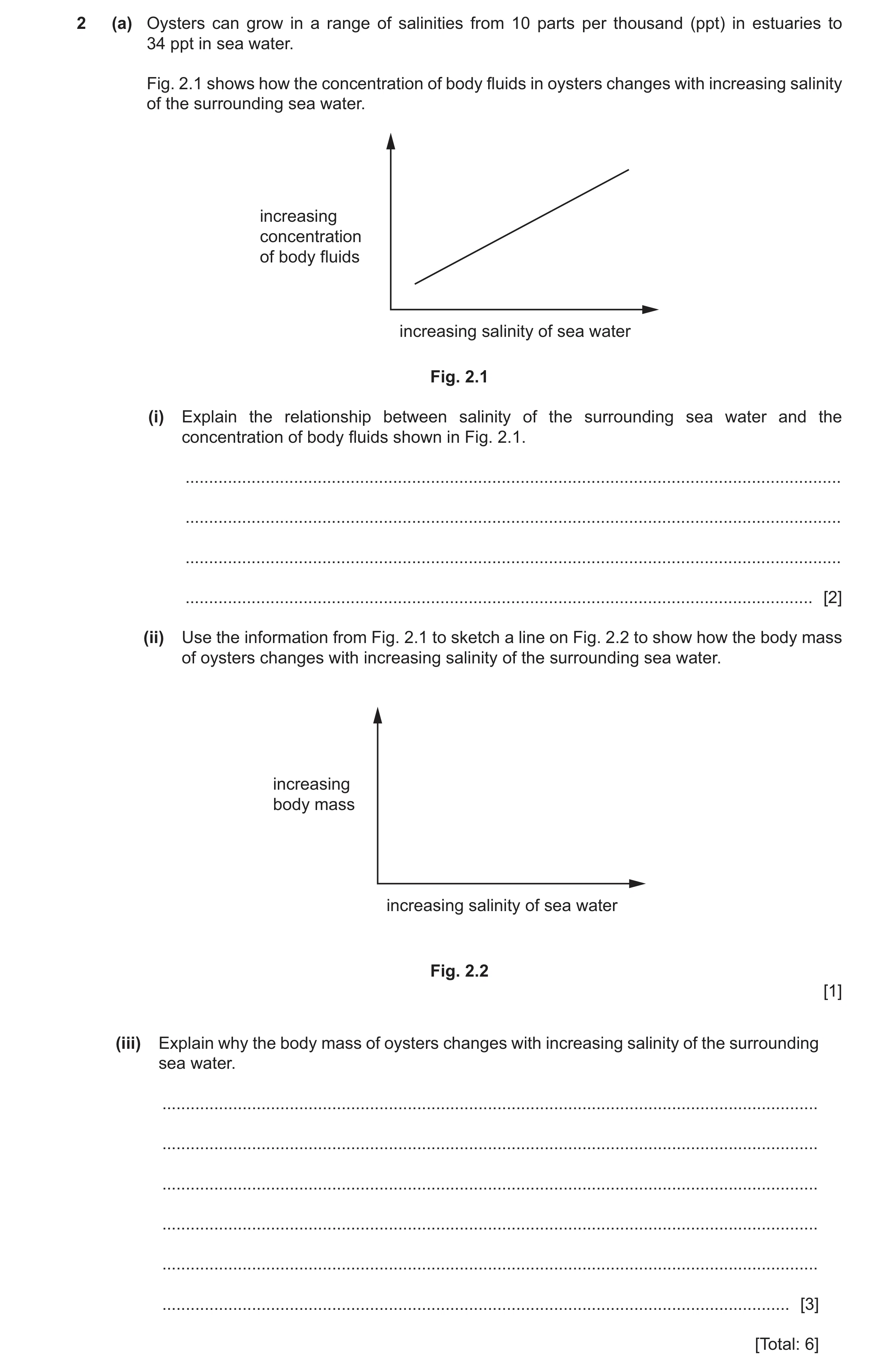
2 (a) Oysters can grow in a range of salinities from 10 parts per thousand (ppt) in estuaries to 34 ppt in sea water. Fig. 2.1 shows how the concentration of body fluids in oysters changes with increasing salinity of the surrounding sea water. increasing concentration of body fluids increasing salinity of sea water Fig. 2.1 (i) Explain the relationship between salinity of the surrounding sea water and the concentration of body fluids shown in Fig. 2.1. … … … … [2] (ii) Use the information from Fig. 2.1 to sketch a line on Fig. 2.2 to show how the body mass of oysters changes with increasing salinity of the surrounding sea water. increasing body mass increasing salinity of sea water Fig. 2.2 [1] (iii) Explain why the body mass of oysters changes with increasing salinity of the surrounding sea water. … … … … … … [3] [Total: 6]
6 marks
Mark scheme: 2(a)(i) as the salinity increases, so does the concentration of body fluids ; 2 oysters are osmoconformers / have the same salinity as their surroundings ; 2(a)(ii) 1 increasing body mass increasing salinity in sea water 2(a)(iii) any 3 of: 3 1 (as the salinity increases) the body mass decreases ; 2 as water is lost from the body ; 3 by osmosis ; 4 because the water potential outside is, lower / more negative, than the water potential in the body ;
This question in 9693/31 May/June 2025
Q16 · State the difference between the meanings of stenohaline and euryhaline 9693/32 May/June 2025
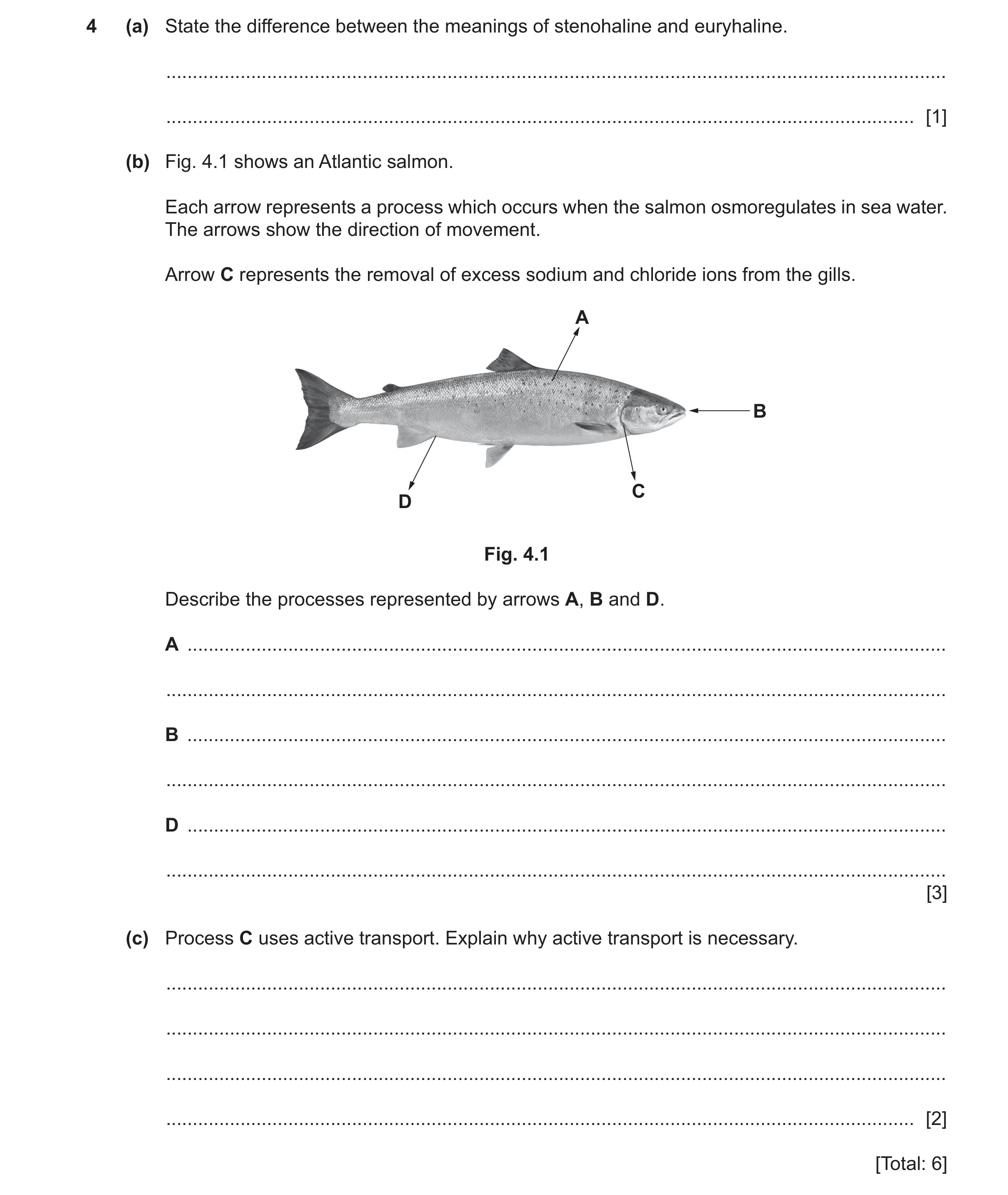
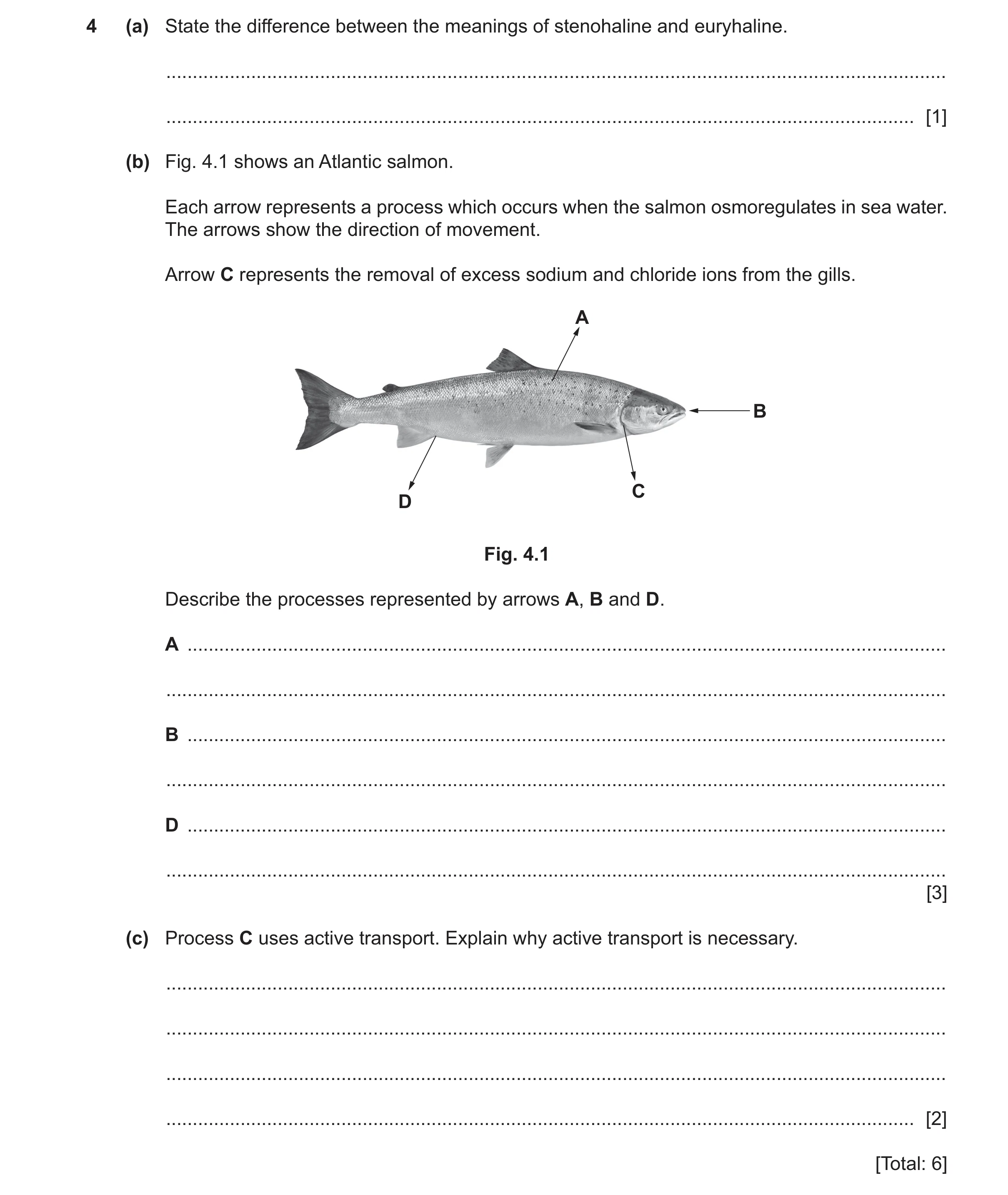
4 (a) State the difference between the meanings of stenohaline and euryhaline. … … [1] (b) Fig. 4.1 shows an Atlantic salmon. Each arrow represents a process which occurs when the salmon osmoregulates in sea water. The arrows show the direction of movement. Arrow C represents the removal of excess sodium and chloride ions from the gills. A B C D Fig. 4.1 Describe the processes represented by arrows A, B and D. A … … B … … D … … [3] (c) Process C uses active transport. Explain why active transport is necessary. … … … … [2] [Total: 6]
6 marks
Mark scheme: 4(a) euryhaline can tolerate in a wide range of salinities AND 1 stenohaline can only tolerate small changes in salinity / AW ; 4(b) A – loss of water through skin ; 3 B – (constantly) drinking (sea water) ; D – removal of, concentrated / low volume of, urine ; 4(c) any 2 of: 2 1 there is a higher concentration of sodium and chloride ions in the sea water than in the fish ; 2 so ions move out against their concentration gradient ; 3 which requires energy from ATP ;
This question in 9693/32 May/June 2025
Q17 · State the difference between the meanings of stenohaline and euryhaline 9693/33 May/June 2025
4 (a) State the difference between the meanings of stenohaline and euryhaline. … … [1] (b) Fig. 4.1 shows an Atlantic salmon. Each arrow represents a process which occurs when the salmon osmoregulates in sea water. The arrows show the direction of movement. Arrow C represents the removal of excess sodium and chloride ions from the gills. A B C D Fig. 4.1 Describe the processes represented by arrows A, B and D. A … … B … … D … … [3] (c) Process C uses active transport. Explain why active transport is necessary. … … … … [2] [Total: 6]
6 marks
Mark scheme: 4(a) euryhaline can tolerate in a wide range of salinities AND 1 stenohaline can only tolerate small changes in salinity / AW ; 4(b) A – loss of water through skin ; 3 B – (constantly) drinking (sea water) ; D – removal of, concentrated / low volume of, urine ; 4(c) any 2 of: 2 1 there is a higher concentration of sodium and chloride ions in the sea water than in the fish ; 2 so ions move out against their concentration gradient ; 3 which requires energy from ATP ;
This question in 9693/33 May/June 2025
 15 / 25
 16 / 25
 17 / 25
 24 / 25
 25 / 25
 13
13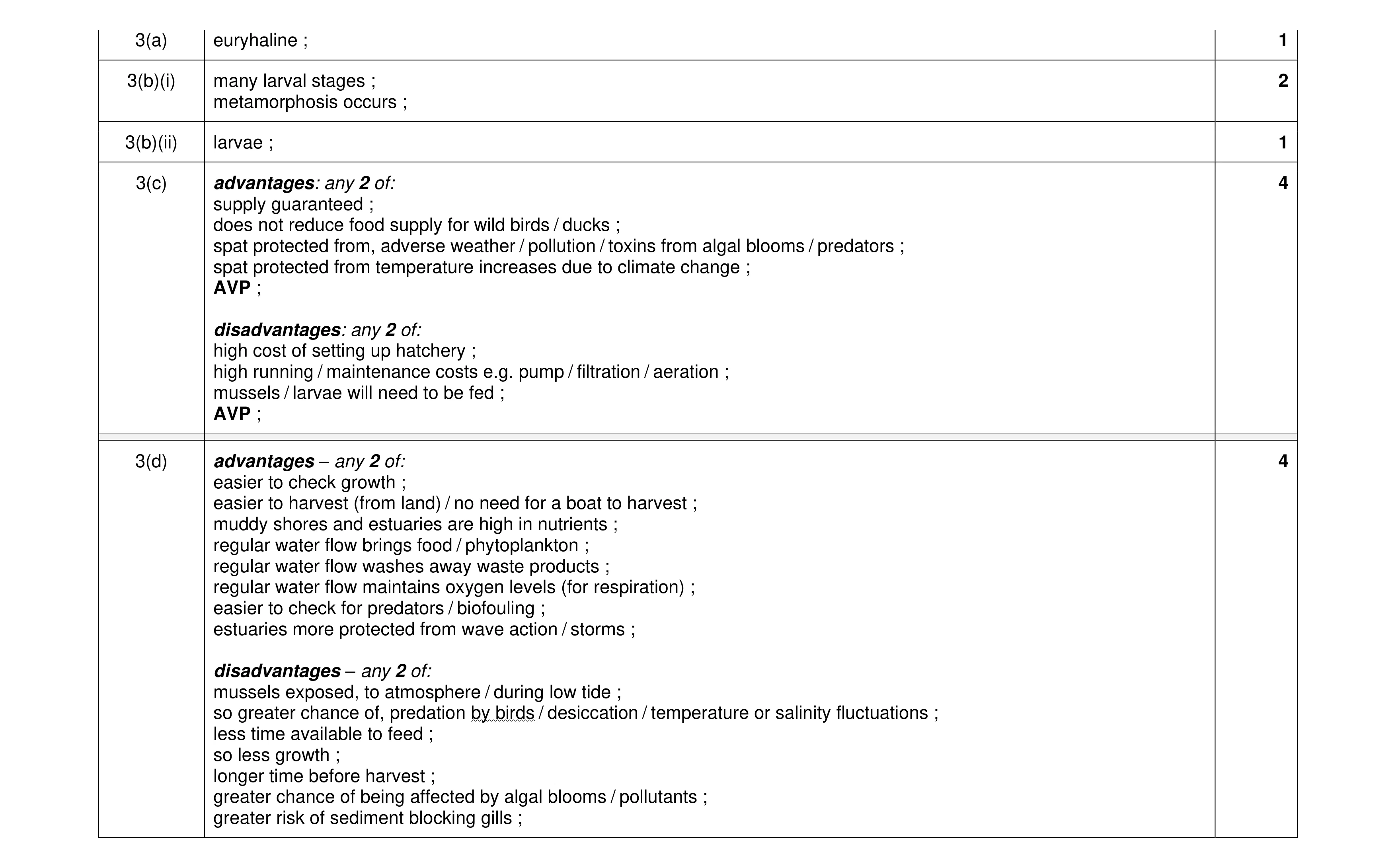 12
12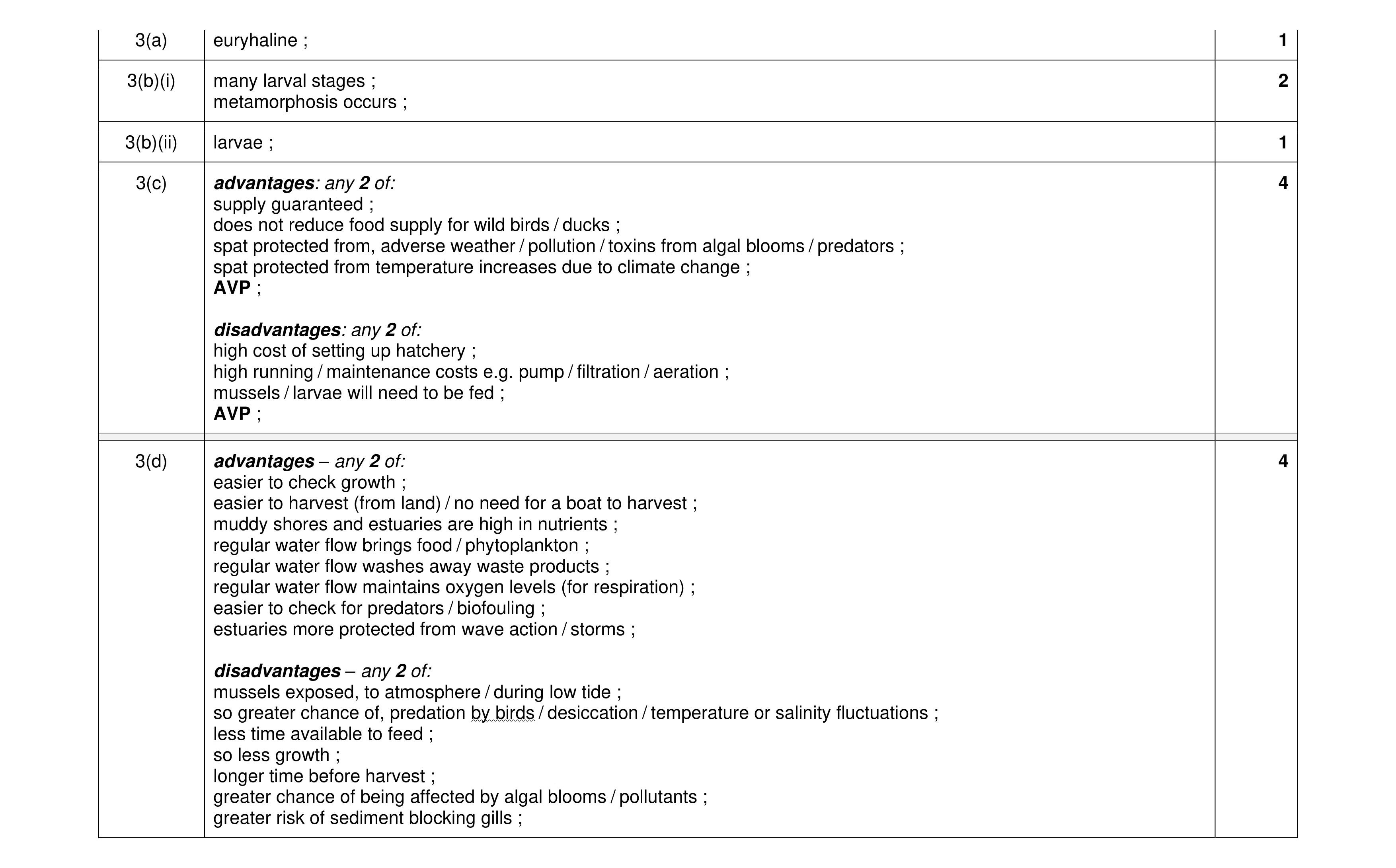 12
12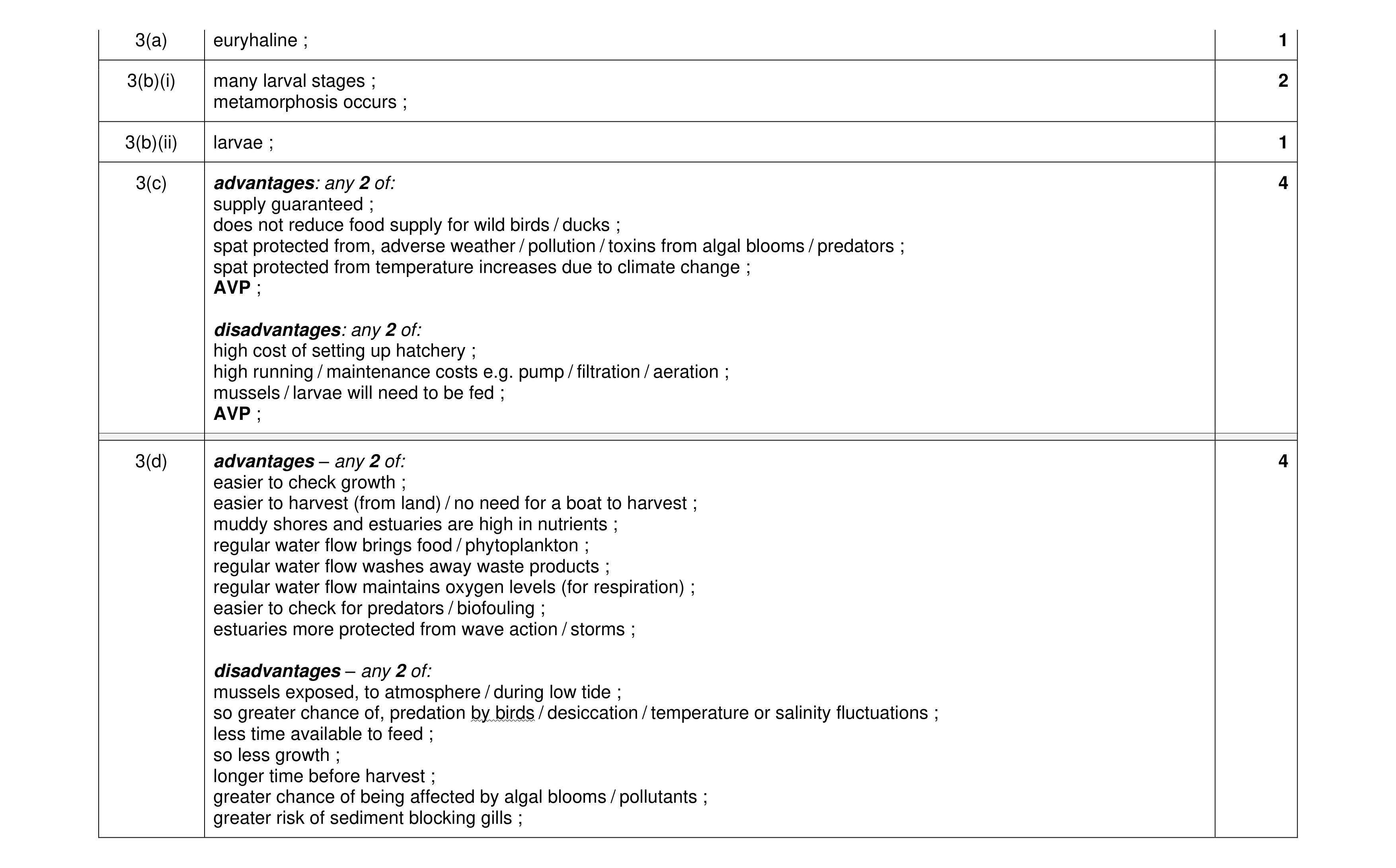 12
12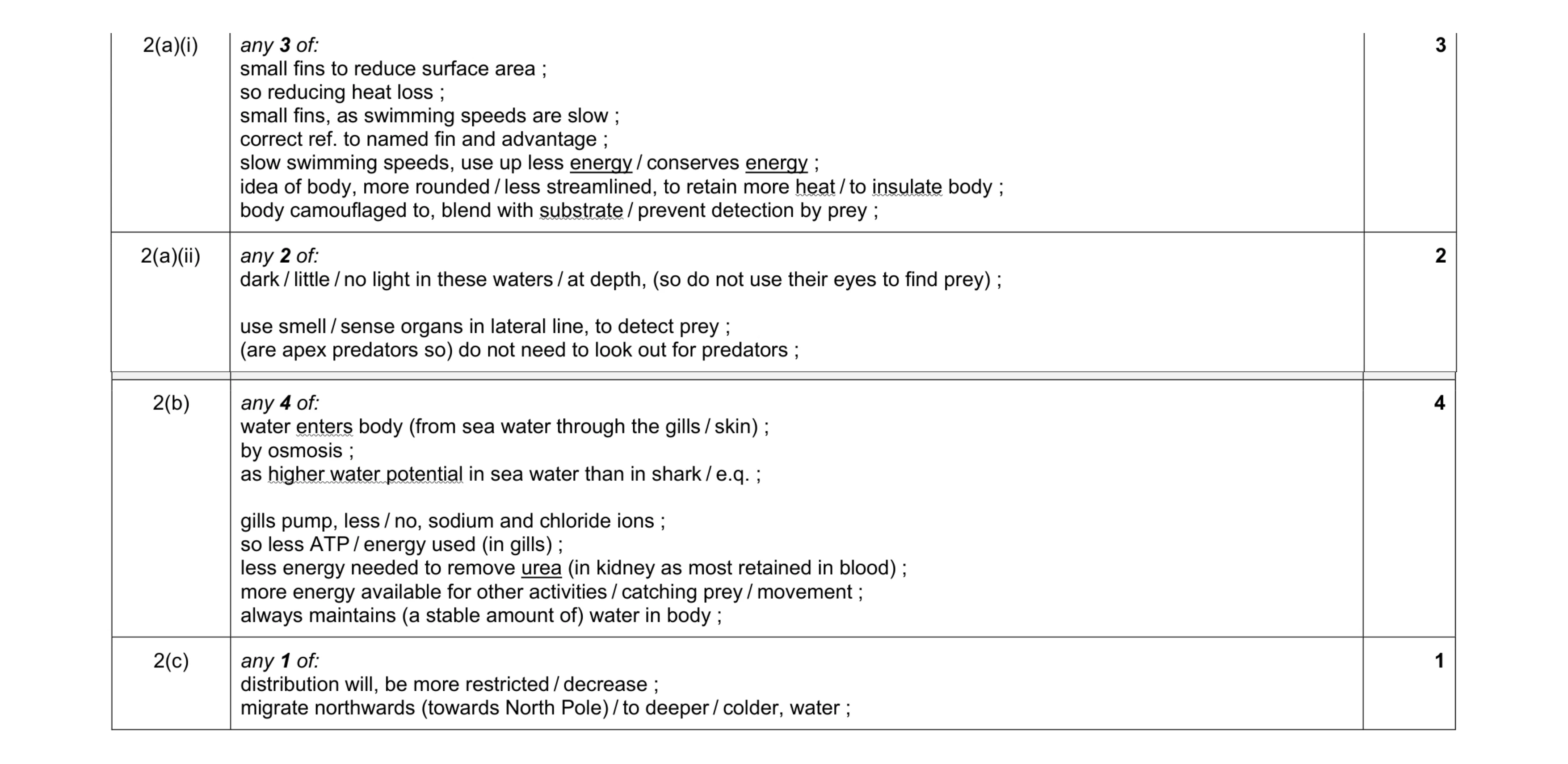 10
10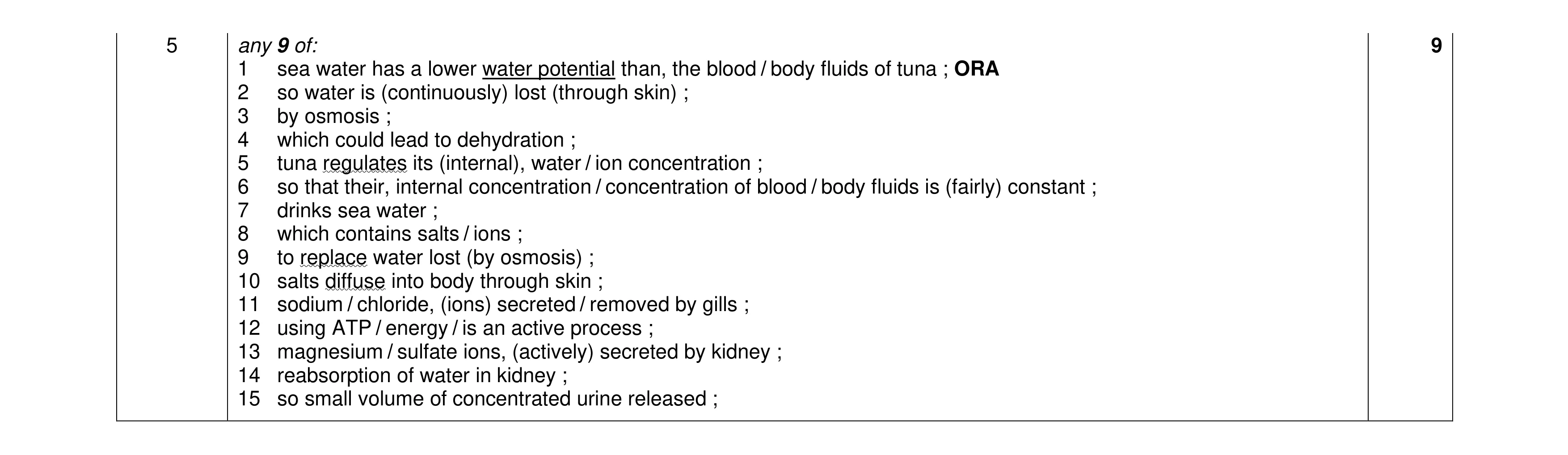 9
9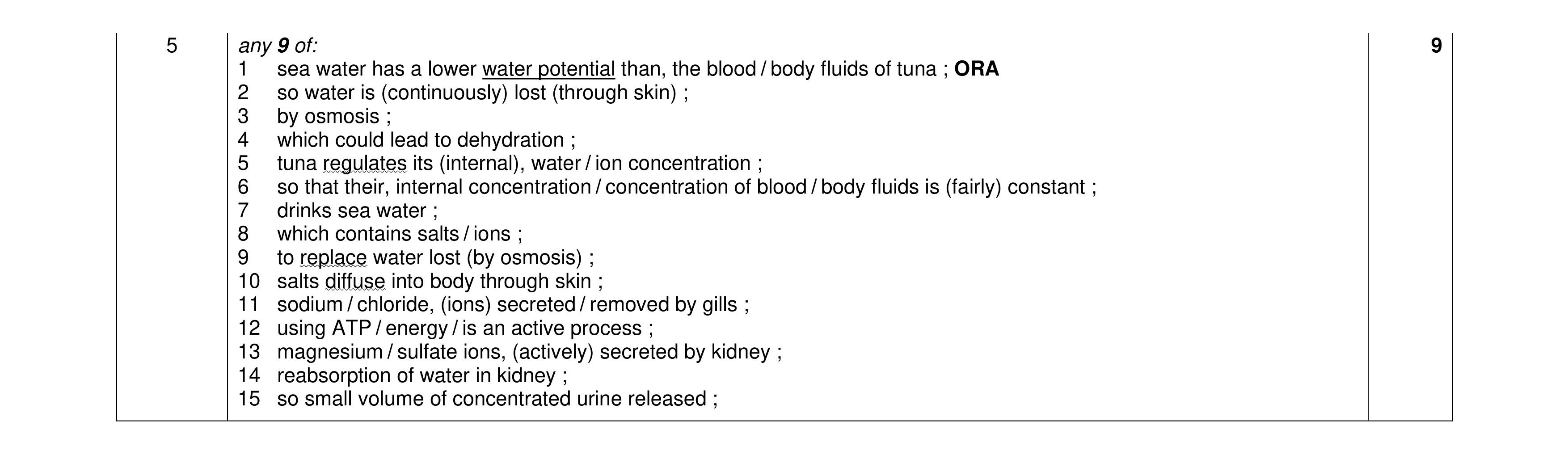 9
9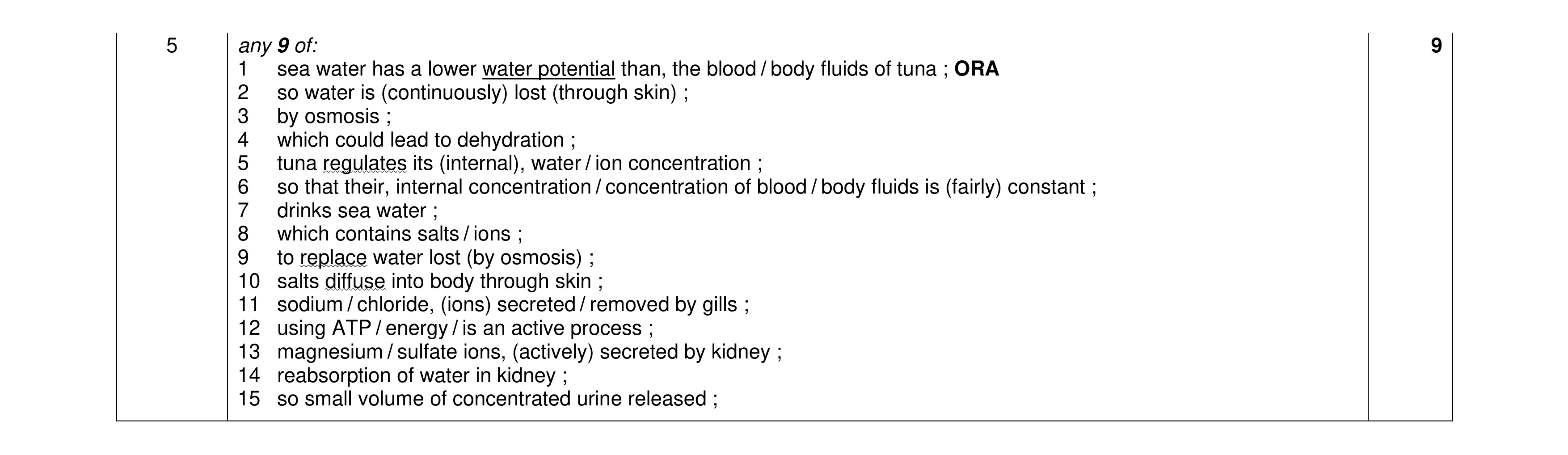 9
9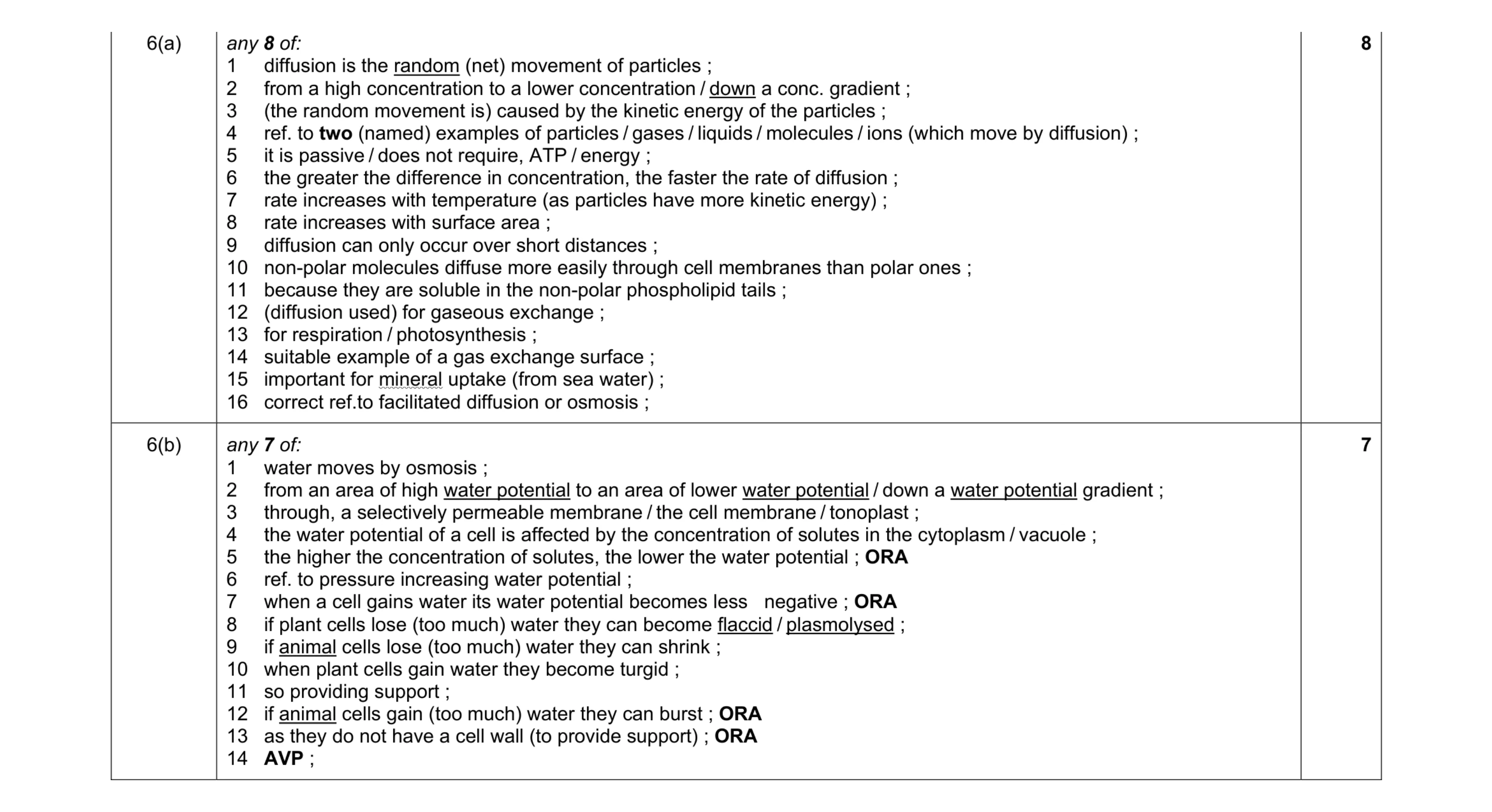 15
15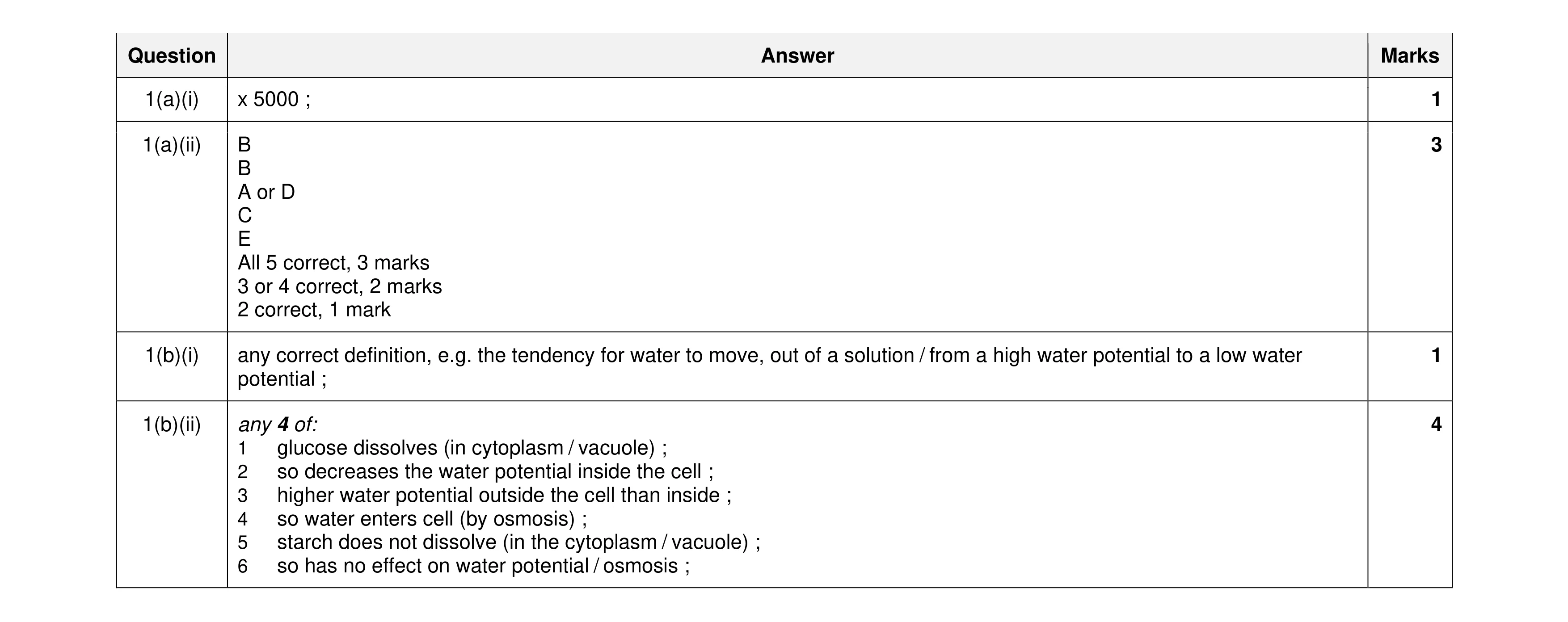 9
9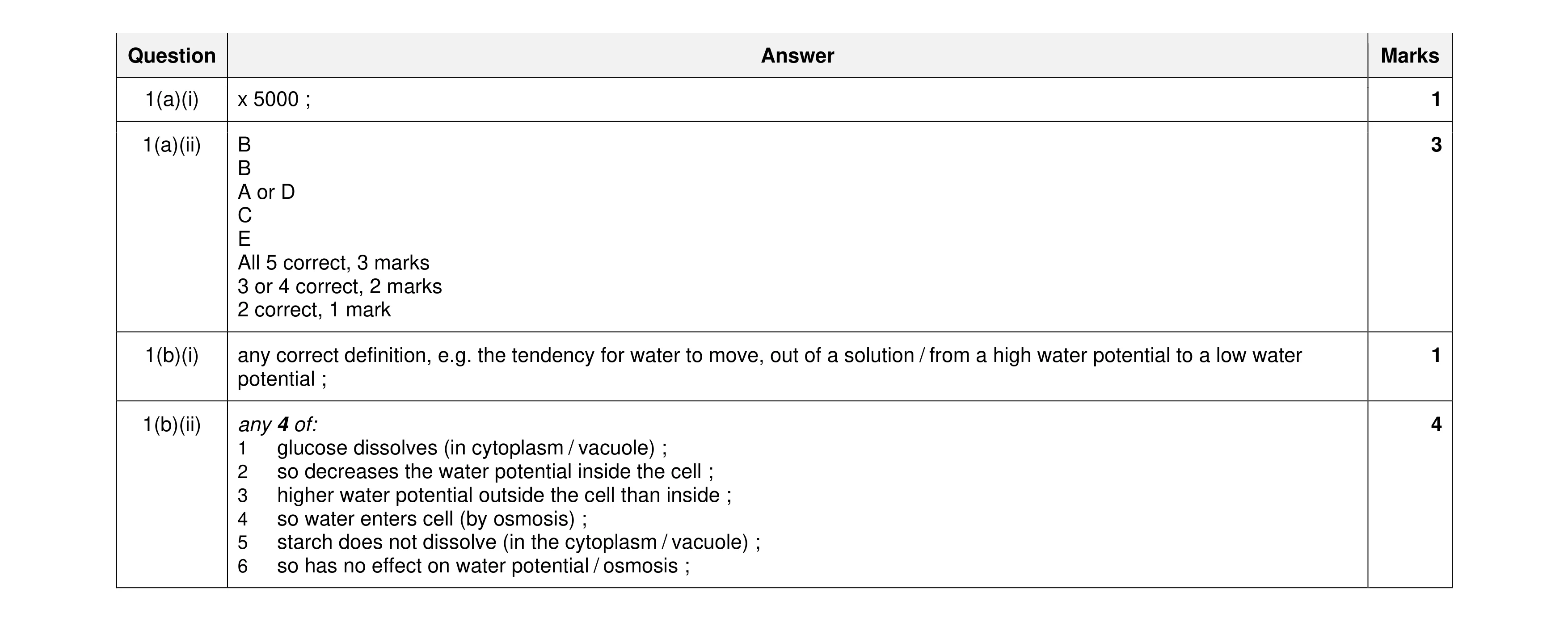 9
9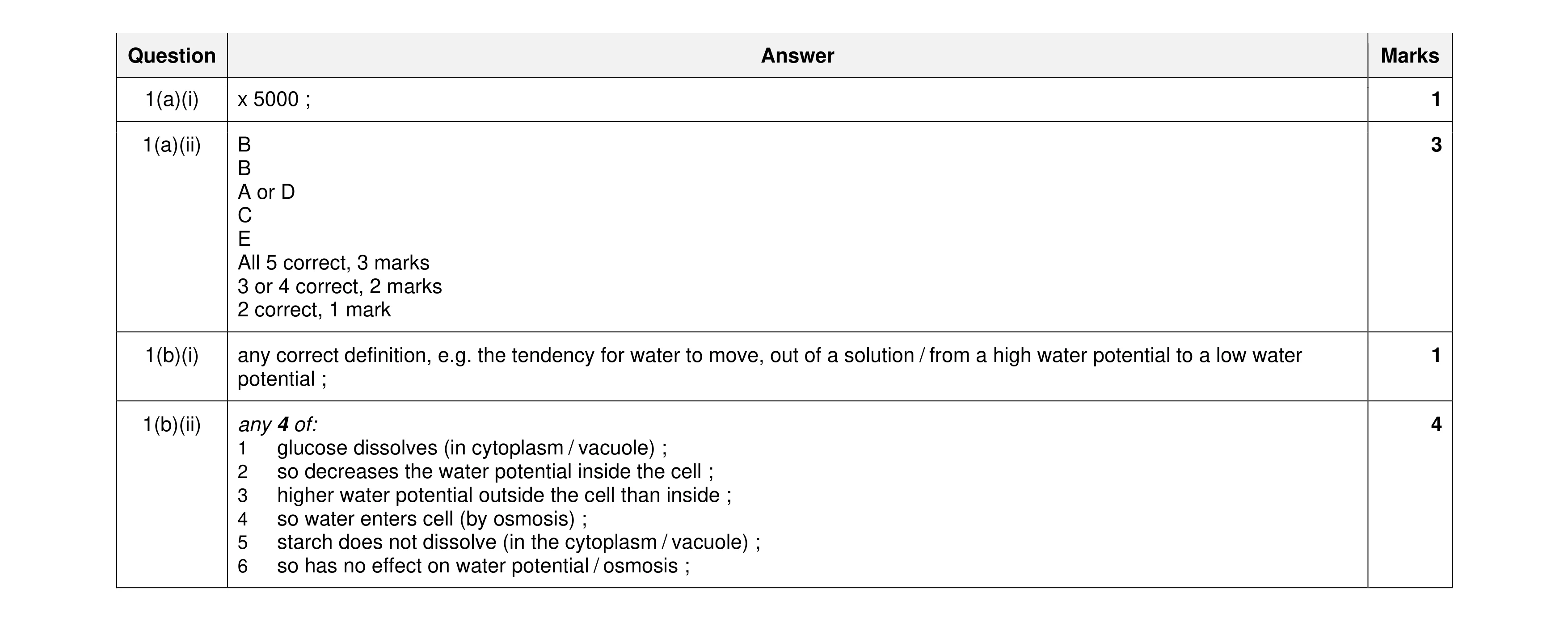 9
9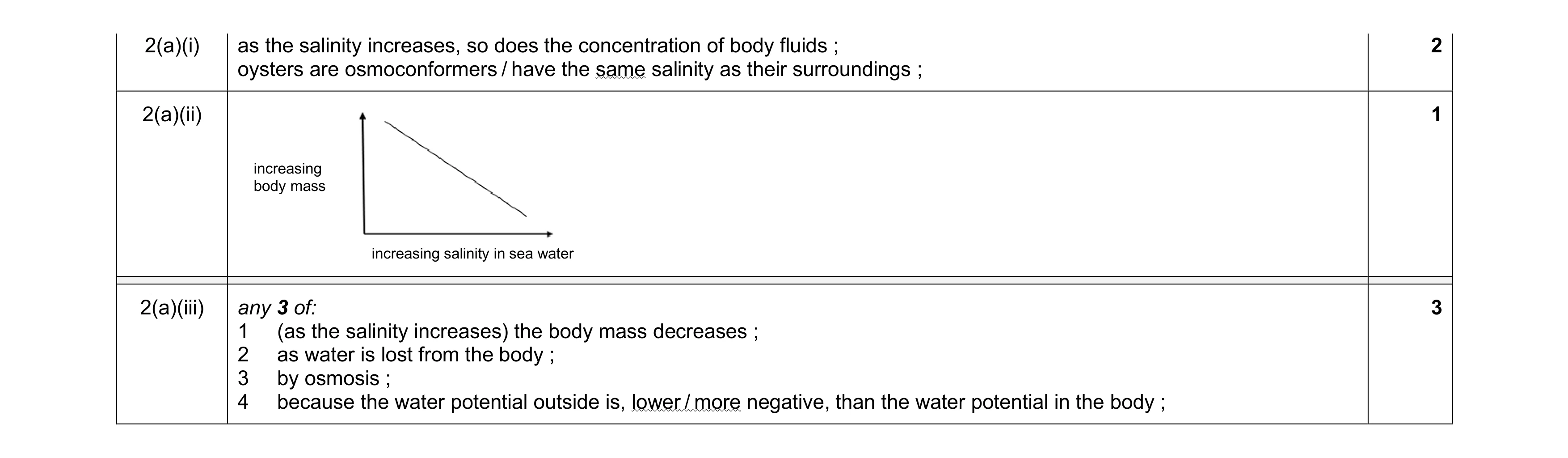 6
6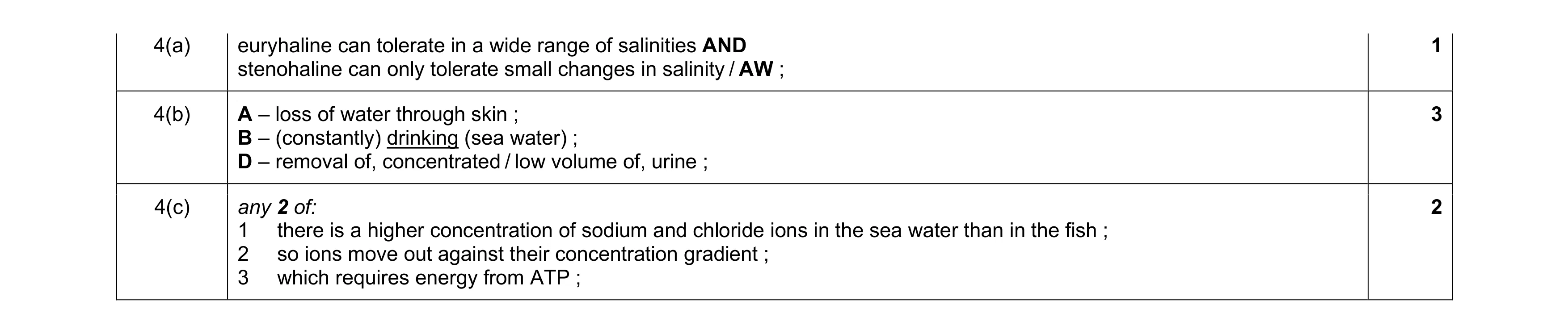 6
6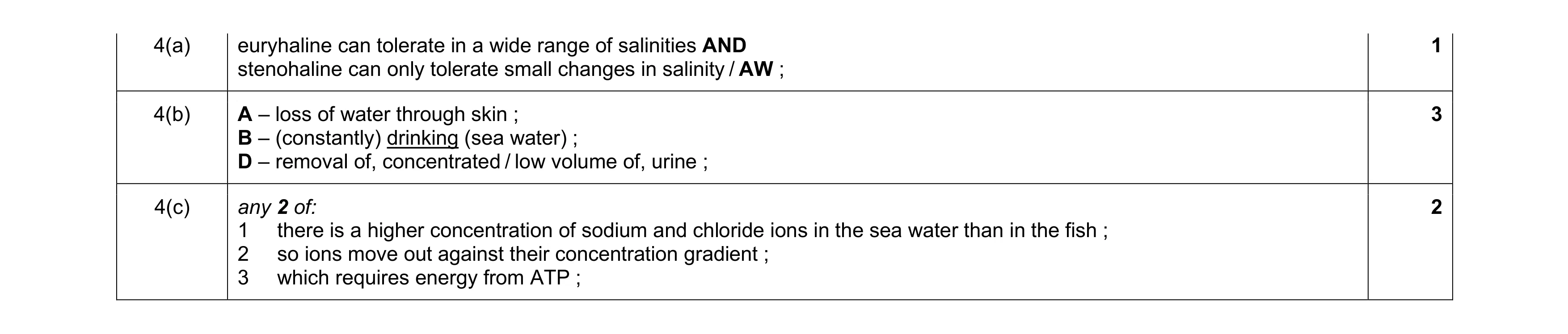 6
6