Questions as text
Q1 · The position of the operculum (gill cover) of a bony fish 9693/31 May/June 2017
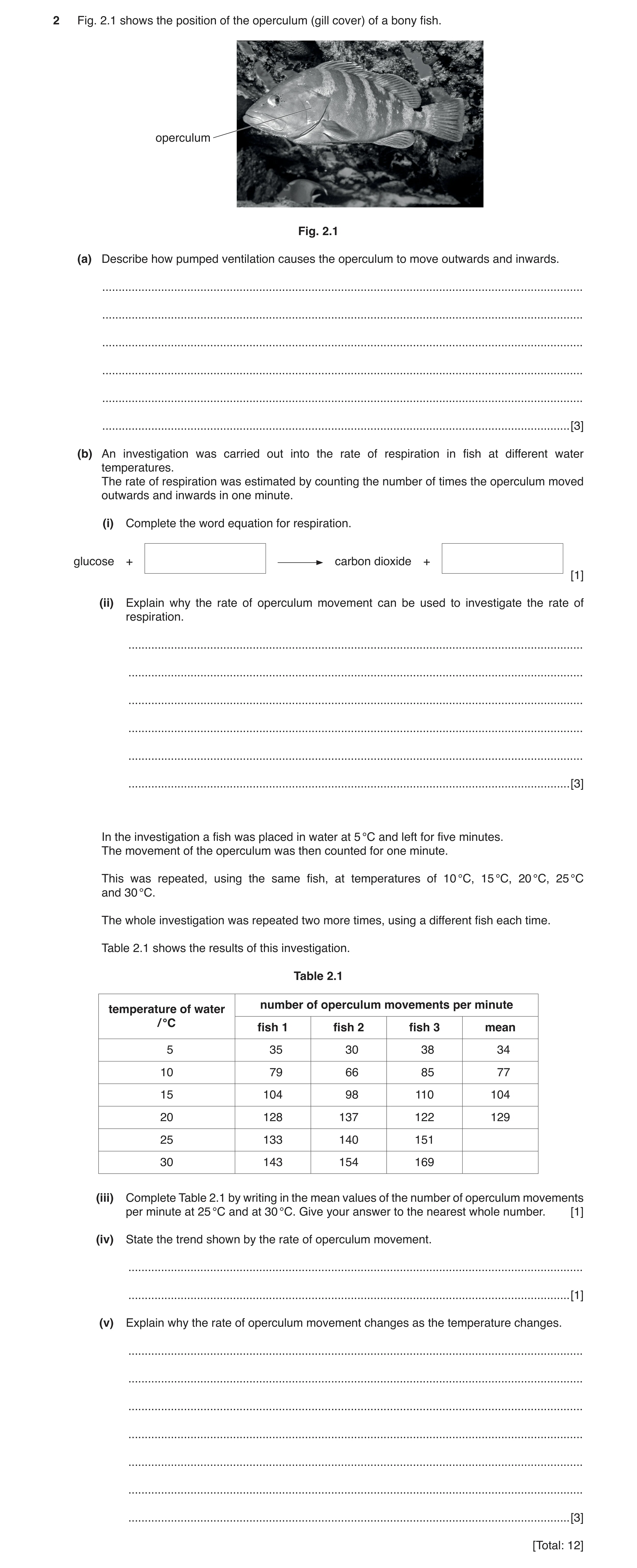
2 Fig. 2.1 shows the position of the operculum (gill cover) of a bony fish. operculum Fig. 2.1 (a) Describe how pumped ventilation causes the operculum to move outwards and inwards. … … … … … … [3] (b) An investigation was carried out into the rate of respiration in fish at different water temperatures. The rate of respiration was estimated by counting the number of times the operculum moved outwards and inwards in one minute. (i) Complete the word equation for respiration. glucose + carbon dioxide + [1] (ii) Explain why the rate of operculum movement can be used to investigate the rate of respiration. … … … … … … [3] In the investigation a fish was placed in water at 5 °C and left for five minutes. The movement of the operculum was then counted for one minute. This was repeated, using the same fish, at temperatures of 10 °C, 15 °C, 20 °C, 25 °C and 30 °C. The whole investigation was repeated two more times, using a different fish each time. Table 2.1 shows the results of this investigation. Table 2.1 number of operculum movements per minute temperature of water / °C fish 1 fish 2 fish 3 mean 5 35 30 38 34 10 79 66 85 77 15 104 98 110 104 20 128 137 122 129 25 133 140 151 30 143 154 169 (iii) Complete Table 2.1 by writing in the mean values of the number of operculum movements per minute at 25 °C and at 30 °C. Give your answer to the nearest whole number. [1] (iv) State the trend shown by the rate of operculum movement. … … [1] (v) Explain why the rate of operculum movement changes as the temperature changes. … … … … … … … [3] [Total: 12]
12 marks
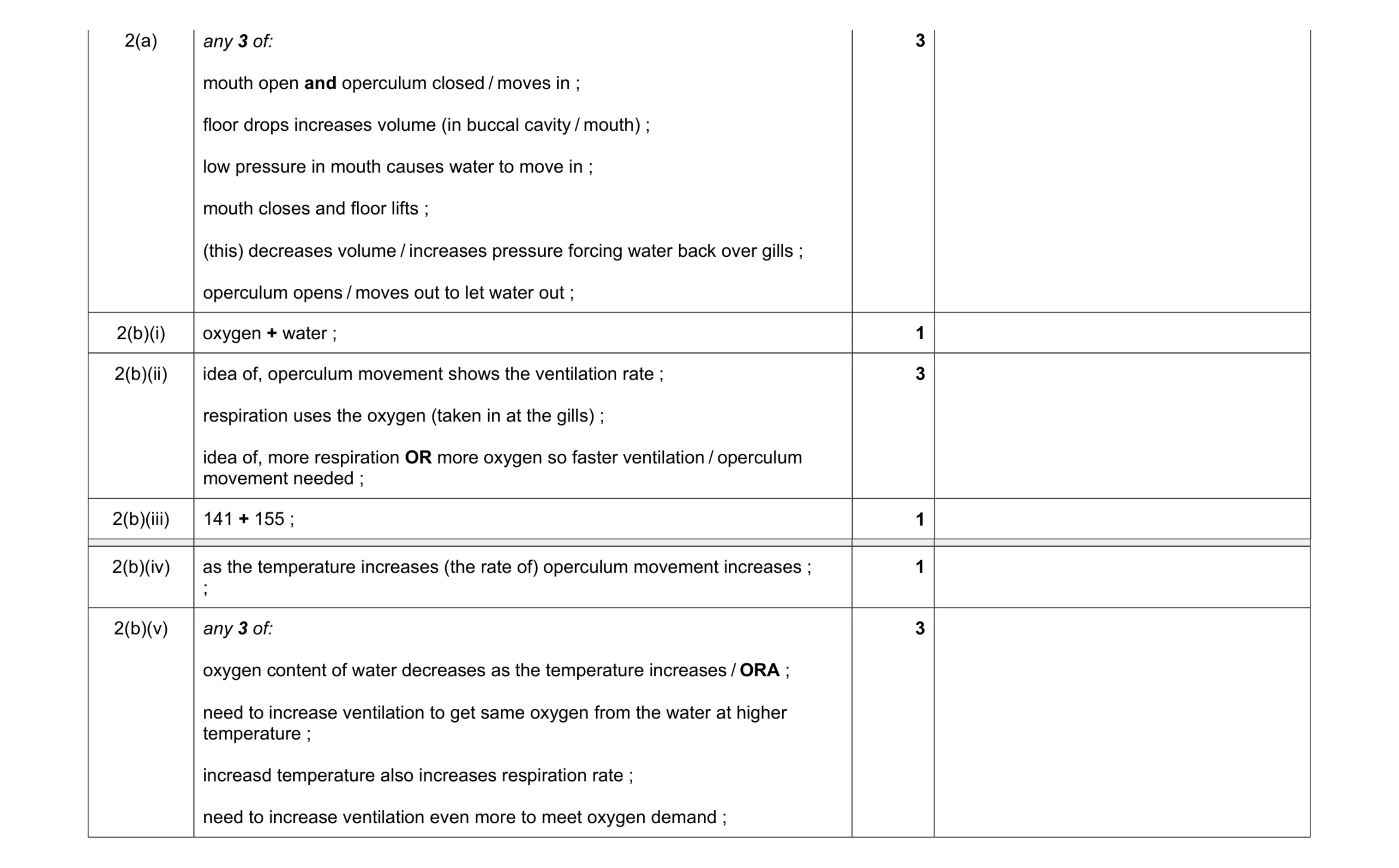
Mark scheme: 2(a) any 3 of: mouth open and operculum closed / moves in ; floor drops increases volume (in buccal cavity / mouth) ; low pressure in mouth causes water to move in ; mouth closes and floor lifts ; (this) decreases volume / increases pressure forcing water back over gills ; operculum opens / moves out to let water out ; 3 2(b)(i) oxygen + water ; 1 2(b)(ii) idea of, operculum movement shows the ventilation rate ; respiration uses the oxygen (taken in at the gills) ; idea of, more respiration OR more oxygen so faster ventilation / operculum movement needed ; 3 2(b)(iii) 141 + 155 ; 1 Question Answer Marks Guidance 2(b)(iv) as the temperature increases (the rate of) operculum movement increases ; ; 1 2(b)(v) any 3 of: oxygen content of water decreases as the temperature increases / ORA ; need to increase ventilation to get same oxygen from the water at higher temperature ; increasd temperature also increases respiration rate ; need to increase ventilation even more to meet oxygen demand ; 3
This question in 9693/31 May/June 2017
Q2 · Respiration is a process common to all marine animals and plants 9693/30 Oct/Nov 2018
2 (a) (i) Respiration is a process common to all marine animals and plants. Complete the word equation for respiration. + + [2] (ii) State the function of respiration. … … … [1] (b) Flatworms are small marine animals that often live on the sea bed. Fig. 2.1 shows a surface view of a flatworm and a cross‑section through this worm. 18 mm 10 mm 1 mm surface view cross-section Fig. 2.1 Use the information in Fig. 2.1 to explain why flatworms have no need for a specialised gaseous exchange surface. … … … … … [2] (c) Lugworms are worms that live in burrows on muddy shores where there is little wave action. The burrows reach to approximately 20 cm below the surface. Fig. 2.2 shows a lugworm and Fig. 2.3 shows the flow of sea water through the burrow. flow of sea water external gills scale: 2 cm Fig. 2.2 Fig. 2.3 Use the information in the question and your own knowledge to suggest why the lugworm has external gills. … … … … … … … [3] [Total: 8]
8 marks
This question in 9693/30 Oct/Nov 2018
Q3 · Adult groupers are solitary fish, but during the breeding season they swim many… 9693/31 May/June 2019
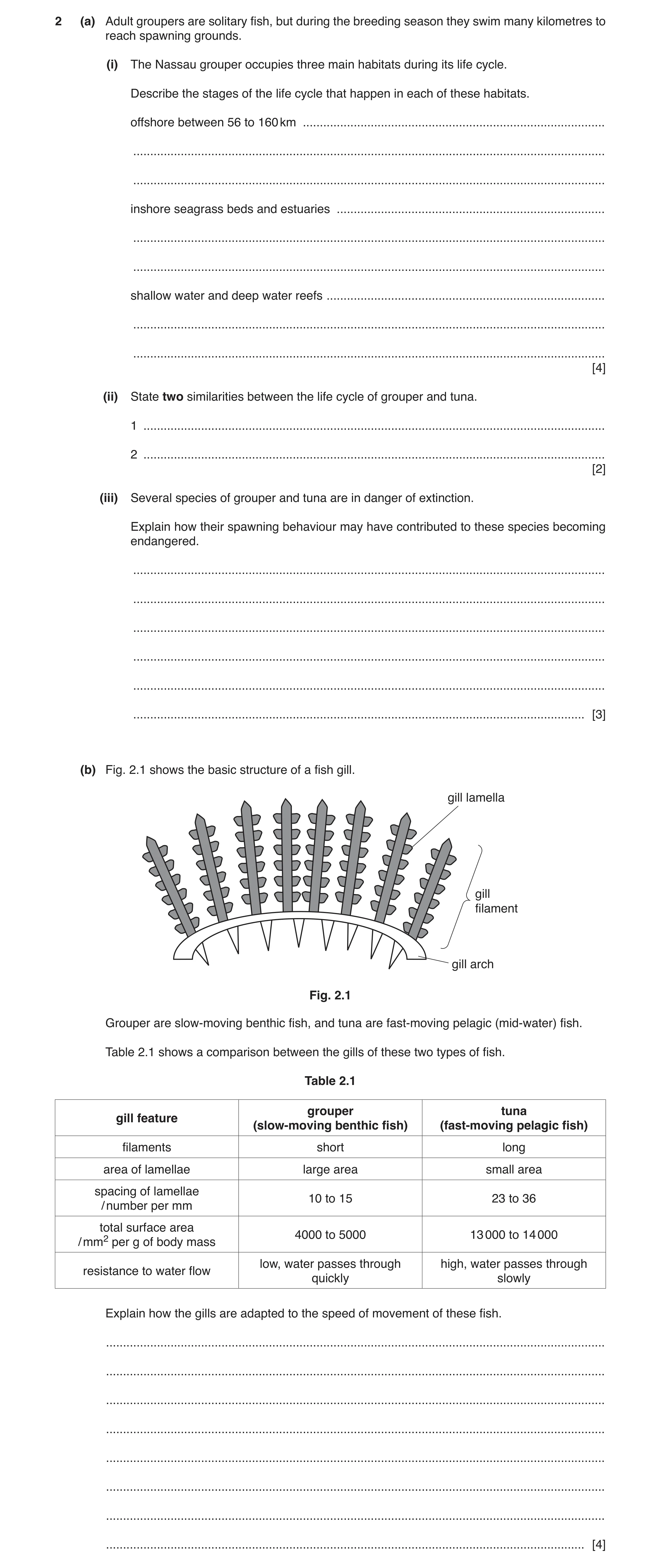
2 (a) Adult groupers are solitary fish, but during the breeding season they swim many kilometres to reach spawning grounds. (i) The Nassau grouper occupies three main habitats during its life cycle. Describe the stages of the life cycle that happen in each of these habitats. offshore between 56 to 160 km … … … inshore seagrass beds and estuaries … … … shallow water and deep water reefs … … … [4] (ii) State two similarities between the life cycle of grouper and tuna. 1 … 2 … [2] (iii) Several species of grouper and tuna are in danger of extinction. Explain how their spawning behaviour may have contributed to these species becoming endangered. … … … … … … [3] (b) Fig. 2.1 shows the basic structure of a fish gill. gill lamella gill filament gill arch Fig. 2.1 Grouper are slow-moving benthic fish, and tuna are fast-moving pelagic (mid-water) fish. Table 2.1 shows a comparison between the gills of these two types of fish. Table 2.1 grouper tuna gill feature (slow-moving benthic fish) (fast-moving pelagic fish) filaments short long area of lamellae large area small area spacing of lamellae 10 to 15 23 to 36 / number per mm total surface area 4000 to 5000 13 000 to 14 000/ mm2 per g of body mass low, water passes through high, water passes through resistance to water flow quickly slowly Explain how the gills are adapted to the speed of movement of these fish. … … … … … … … … [4]
13 marks
Mark scheme: 2(a)(i) minimum of 1 and max 2 for each habitat offshore : ref. to collecting in shoals / groups (for spawning offshore) ; eggs fertilised, externally / in the water / broadcast spawning or description of ; (develop into free-floating) larvae in, surface of ocean / plankton ; inshore: (where) juveniles, feed / grow ; idea of: to avoid competition with adults ; reefs: where they develop into adults / where fish reach maturity ; develop first as female and then become male ; 4 2(a)(ii) any 2 of: idea of: spawning grounds / spawn in open ocean ; planktonic / open ocean, larvae ; external fertilisation / broadcast spawning ; AVP ; 2 e.g. no fresh water stage / no parental care / both are r-strategists / larvae undergo metamorphosis Question Answer Marks Guidance 2(a)(iii) any 3 of: idea of: all the eggs / fish are in one place ; spawning grounds / migration routes, known to fishermen / predators ; catch large numbers of (mature) fish at the same time ; too few left to maintain population / population unsustainable ; adults take years to become sexually mature ; idea of: lots of, egg / larvae wastage ; 3 2(b) any 4 of: 1 grouper / benthic fish move more slowly / less active / use less energy (than tuna / pelagic fish) (so) less oxygen demand ; 2 correct linkage of surface area (of gills) to, movement of fish / oxygen demands / diffusion rates / gas exchange ; 3 larger area of lamellae obtain more oxygen in grouper / benthic fish (from faster water flow) ; 4 longer filaments obtain more oxygen in tuna / pelagic fish (from slower moving water) ; 5 close packing of lamellae obtain more oxygen in tuna / pelagic fish (from slower moving water) ; 6 slower moving water / greater resistance to flow, in tuna / pelagic fish, allows more time to obtain oxygen / greater diffusion / maintains diffusion gradient / greater gas exchange ; 4 I ref. to ram and pumped ventilation and respiration
This question in 9693/31 May/June 2019
Q4 · Chinook salmon lay large eggs compared to other salmon species 9693/30 Oct/Nov 2019
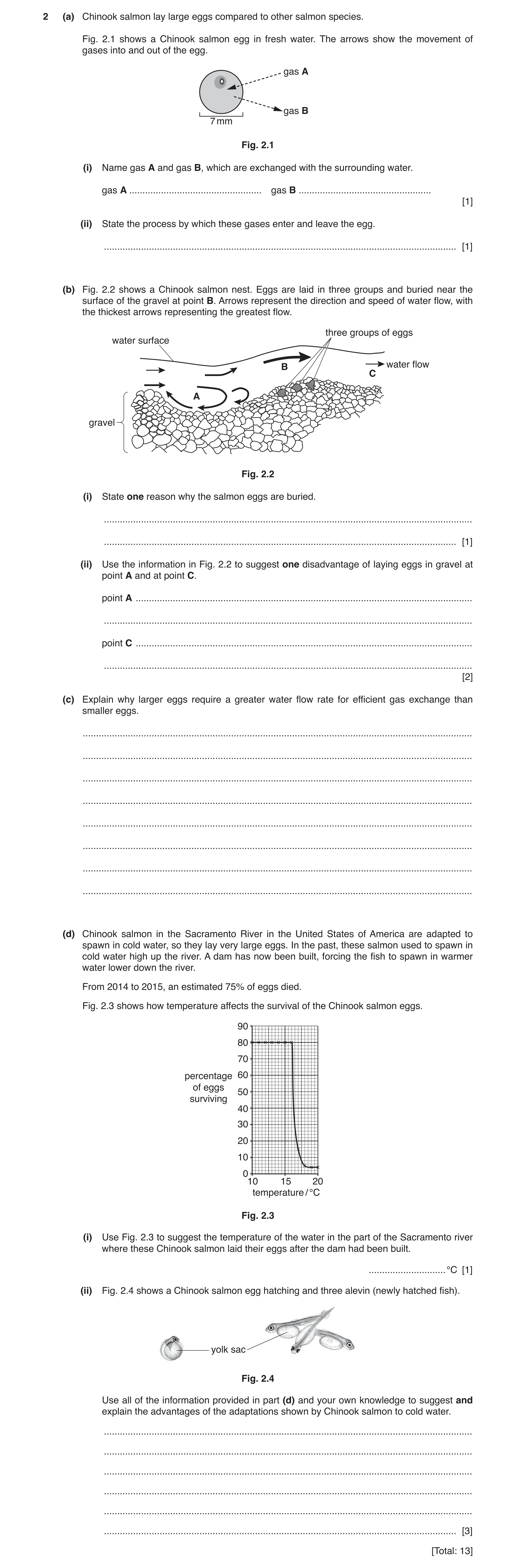
2 (a) Chinook salmon lay large eggs compared to other salmon species. Fig. 2.1 shows a Chinook salmon egg in fresh water. The arrows show the movement of gases into and out of the egg. gas A gas B 7 mm Fig. 2.1 (i) Name gas A and gas B, which are exchanged with the surrounding water. gas A … gas B … [1] (ii) State the process by which these gases enter and leave the egg. … [1] (b) Fig. 2.2 shows a Chinook salmon nest. Eggs are laid in three groups and buried near the surface of the gravel at point B. Arrows represent the direction and speed of water flow, with the thickest arrows representing the greatest flow. three groups of eggs water surface B water flow C A gravel Fig. 2.2 (i) State one reason why the salmon eggs are buried. … … [1] (ii) Use the information in Fig. 2.2 to suggest one disadvantage of laying eggs in gravel at point A and at point C. point A … … point C … … [2] (c) Explain why larger eggs require a greater water flow rate for efficient gas exchange than smaller eggs. … … … … … … … … (d) Chinook salmon in the Sacramento River in the United States of America are adapted to spawn in cold water, so they lay very large eggs. In the past, these salmon used to spawn in cold water high up the river. A dam has now been built, forcing the fish to spawn in warmer water lower down the river. From 2014 to 2015, an estimated 75% of eggs died. Fig. 2.3 shows how temperature affects the survival of the Chinook salmon eggs. 90 80 70 percentage 60 of eggs 50 surviving 40 30 20 10 0 10 15 20 temperature / °C Fig. 2.3 (i) Use Fig. 2.3 to suggest the temperature of the water in the part of the Sacramento river where these Chinook salmon laid their eggs after the dam had been built. … °C [1] (ii) Fig. 2.4 shows a Chinook salmon egg hatching and three alevin (newly hatched fish). yolk sac Fig. 2.4 Use all of the information provided in part (d) and your own knowledge to suggest and explain the advantages of the adaptations shown by Chinook salmon to cold water. … … … … … … [3] [Total: 13]
13 marks
This question in 9693/30 Oct/Nov 2019
Q5 · Fish such as tuna use ram ventilation to obtain oxygen from sea water 9693/30 Oct/Nov 2021
2 (a) Fish such as tuna use ram ventilation to obtain oxygen from sea water. Describe what is meant by the term ram ventilation. … … … … … … [3] (b) Fish such as grouper use pumped ventilation to obtain oxygen from sea water. Outline what happens during outflow of water over the gills. … … … … … … [3] (c) Nurse sharks are a slow-moving benthic species found in tropical and sub-tropical seas. They are nocturnal hunters and rest in crevices and under ledges during the day. Suggest and explain why nurse sharks use pumped ventilation and not ram ventilation. … … … … [2] [Total: 8]
8 marks
This question in 9693/30 Oct/Nov 2021
Q6 · Describe ventilation in grouper during inflow of water 9693/31 Oct/Nov 2022
6 (a) Describe ventilation in grouper during inflow of water. … … … … … … … … … … [5] (b) Explain why sharks and grouper are classified in the same phylum but in different classes. … … … … … … … … … … … … [6] [Total: 11]
11 marks
Mark scheme: 6(a) any 5 of: 5 1 mouth opens + operculum closes ; 2 volume of buccal cavity is increased ; 3 by muscle contraction (and relaxation) ; 4 pressure in buccal cavity is lowered / lower than in sea water ; 5 water flows into mouth (due to pressure difference) ; 6 ref. to pumped ventilation ; 7 ref. to requiring energy / ATP / is an active process ; 6(b) same phylum – max 3 of: 6 1 they are both are chordates ; 2 as they have a notochord ; 3 dorsal neural tube ; 4 pharyngeal slits ; 5 post-anal tail ; different class – max 3 of: 1 shark has a cartilaginous skeleton, grouper has a bony skeleton ; 2 shark has gill slits, grouper has an operculum ; 3 only grouper has a swim bladder ; 4 grouper skin covered in scales, shark skin covered in denticles ;
This question in 9693/31 Oct/Nov 2022
Q7 · Describe ventilation in grouper during inflow of water 9693/32 Oct/Nov 2022
6 (a) Describe ventilation in grouper during inflow of water. … … … … … … … … … … [5] (b) Explain why sharks and grouper are classified in the same phylum but in different classes. … … … … … … … … … … … … [6] [Total: 11]
11 marks
Mark scheme: 6(a) any 5 of: 5 1 mouth opens + operculum closes ; 2 volume of buccal cavity is increased ; 3 by muscle contraction (and relaxation) ; 4 pressure in buccal cavity is lowered / lower than in sea water ; 5 water flows into mouth (due to pressure difference) ; 6 ref. to pumped ventilation ; 7 ref. to requiring energy / ATP / is an active process ; 6(b) same phylum – max 3 of: 6 1 they are both are chordates ; 2 as they have a notochord ; 3 dorsal neural tube ; 4 pharyngeal slits ; 5 post-anal tail ; different class – max 3 of: 1 shark has a cartilaginous skeleton, grouper has a bony skeleton ; 2 shark has gill slits, grouper has an operculum ; 3 only grouper has a swim bladder ; 4 grouper skin covered in scales, shark skin covered in denticles ;
This question in 9693/32 Oct/Nov 2022
Q8 · Describe ventilation in grouper during inflow of water 9693/33 Oct/Nov 2022
6 (a) Describe ventilation in grouper during inflow of water. … … … … … … … … … … [5] (b) Explain why sharks and grouper are classified in the same phylum but in different classes. … … … … … … … … … … … … [6] [Total: 11]
11 marks
Mark scheme: 6(a) any 5 of: 5 1 mouth opens + operculum closes ; 2 volume of buccal cavity is increased ; 3 by muscle contraction (and relaxation) ; 4 pressure in buccal cavity is lowered / lower than in sea water ; 5 water flows into mouth (due to pressure difference) ; 6 ref. to pumped ventilation ; 7 ref. to requiring energy / ATP / is an active process ; 6(b) same phylum – max 3 of: 6 1 they are both are chordates ; 2 as they have a notochord ; 3 dorsal neural tube ; 4 pharyngeal slits ; 5 post-anal tail ; different class – max 3 of: 1 shark has a cartilaginous skeleton, grouper has a bony skeleton ; 2 shark has gill slits, grouper has an operculum ; 3 only grouper has a swim bladder ; 4 grouper skin covered in scales, shark skin covered in denticles ;
This question in 9693/33 Oct/Nov 2022
Q9 · Compare gaseous exchange in coral polyps and in tuna 9693/31 May/June 2023
5 Compare gaseous exchange in coral polyps and in tuna. … … … … … … … … … … … … … … … … … … … … [10]
10 marks
Mark scheme: 5 any 10 of: 1 gas exchange is by diffusion in both organisms ; 2 both have a large surface area (for gas exchange) / large surface area to volume ratio ; 3 gas passes across a thin layer (of cells) ; 4 short diffusion path ; 5 gases move from a high to a lower concentration ; 6 oxygen is taken into the body and carbon dioxide is removed ; 7 coral is, sedentary / sessile, so has a low oxygen demand / tuna swims (continually) so has a high oxygen demand ; 8 coral has no specialised structures for gaseous exchange / tuna has gills ; 9 coral has tentacles (which increase surface area for gaseous exchange) ; 10 tuna has (numerous), gill filaments / lamellae, (to increase surface area for gaseous exchange) ; 11 no transport system required in coral polyps / transport system in tuna to transport gases ; 12 tuna uses ram ventilation (to force water from the mouth, over the gills) ; 13 ref. to polyp tentacles moving to create a current ; 14 ref. to counter-current mechanism in tuna / blood flow and water moving in opposite directions ; 15 so concentration / diffusion gradient maintained ;
This question in 9693/31 May/June 2023
Q10 · Gaseous exchange is a process that occurs in all organisms, including coral polyps and… 9693/31 Oct/Nov 2024
4 (a) Gaseous exchange is a process that occurs in all organisms, including coral polyps and marine fish. (i) State the importance of gaseous exchange in living organisms. … … … … [2] (ii) Explain why fish have gills for gaseous exchange, whereas coral polyps do not. … … … … [2] (b) Gill structure in fish varies depending on habitat and feeding method. Each gill filament is rich in blood vessels and contains many folds on the surface called gill lamellae. Gill rakers are used to filter the water before it passes over the gill filaments. Fig. 4.1 shows 2 gills, A and B. Each gill is from a different species of fish. A B gill filaments gill lamellae (folds on surface of gill filament) gill arch gill rakers Fig. 4.1 Use Fig. 4.1 to suggest which gill, A or B, belongs to a plankton feeder and give reasons for your answer. gill … reasons … … … … [2] (c) Marine catfish are slow-moving fish found in the benthic zone. Mackerel are fast-moving fish found in the epipelagic zone. Table 4.1 compares gill lamellae (folds on the surface of the gill filament) in marine catfish and mackerel. Table 4.1 marine feature mackerel catfish mean thickness of lamellae / μm 25 7 mean distance between lamellae / μm 45 20 mean thickness of lamellae walls / μm 10 >1 area of lamellae large area small area Use the information in Table 4.1 to explain how the differences in lamellae are related to the habitat and motility of each fish. … … … … … … … … [4] (d) Fish transfer oxygen into their blood by diffusion from the surrounding sea water. Fig. 4.2 shows how the oxygen saturation varies with distance along a gill lamella from the gill arch: • when the blood and sea water are moving in the same direction (method A) • when the blood and sea water are moving in opposite directions (method B). method A method B 100 100 sea water sea water percentage percentage 50 50 oxygen oxygen saturation blood saturation blood 0 0 distance along gill lamella distance along gill lamella Fig. 4.2 Use Fig. 4.2 to explain why fish use method B for gaseous exchange. … … … … [2] [Total: 12]
12 marks
Mark scheme: 4(a)(i) important in photosynthesis AND respiration ; 2 (in respiration) provides oxygen AND removes carbon dioxide OR (in photosynthesis) provides carbon dioxide AND removes oxygen ; 4(a)(ii) any 2 of: 2 1 gills increase surface area (to volume ratio) in fish, tentacles increase surface area (to volume ratio) in coral polyps ; 2 most parts of the body in fish are far away from the surface, in coral polyps all parts of the body are close to the surface; 3 too far for diffusion to occur in fish / diffusion distance is large, diffusion is sufficient / diffusion distance is small in coral polyps ; 4 fish move (so require more energy), coral polyps are sedentary ; 5 AVP ; 4(b) any 2 of: 2 gill A – no mark 1 phytoplankton are small / microscopic ; 2 rakers are closer together / longer / more rakers ; 3 so able to filter out phytoplankton ; 4(c) any 4 of: 4 1 mackerel is a fast-moving fish, so requires more oxygen / energy demand (than marine catfish) ; 2 larger area of lamellae in marine catfish, to obtain enough oxygen ; 3 more oxygen present in epipelagic zone (compared with benthic zone) ; 4 lamellae thinner in mackerel, so less distance for diffusion (of oxygen into blood) ; 5 lamellae walls thinner, so faster diffusion of oxygen ; 6 lamellae more closely packed in mackerel, to slow down water movement ; 7 allowing more time for diffusion of gases / maintains diffusion gradient / greater gas exchange ; 4(d) any 2 of: 2 1 ref. to counter-current mechanism ; 2 maintains diffusion gradient (across whole gill surface / length of gill) ; 3 (more efficient as), more / higher percentage of, oxygen can diffuse into blood ; 4 in A diffusion occurs only until, equilibrium is reached / oxygen content of sea water is the same as in the blood ;
This question in 9693/31 Oct/Nov 2024
Q11 · Gaseous exchange is a process that occurs in all organisms, including coral polyps and… 9693/32 Oct/Nov 2024
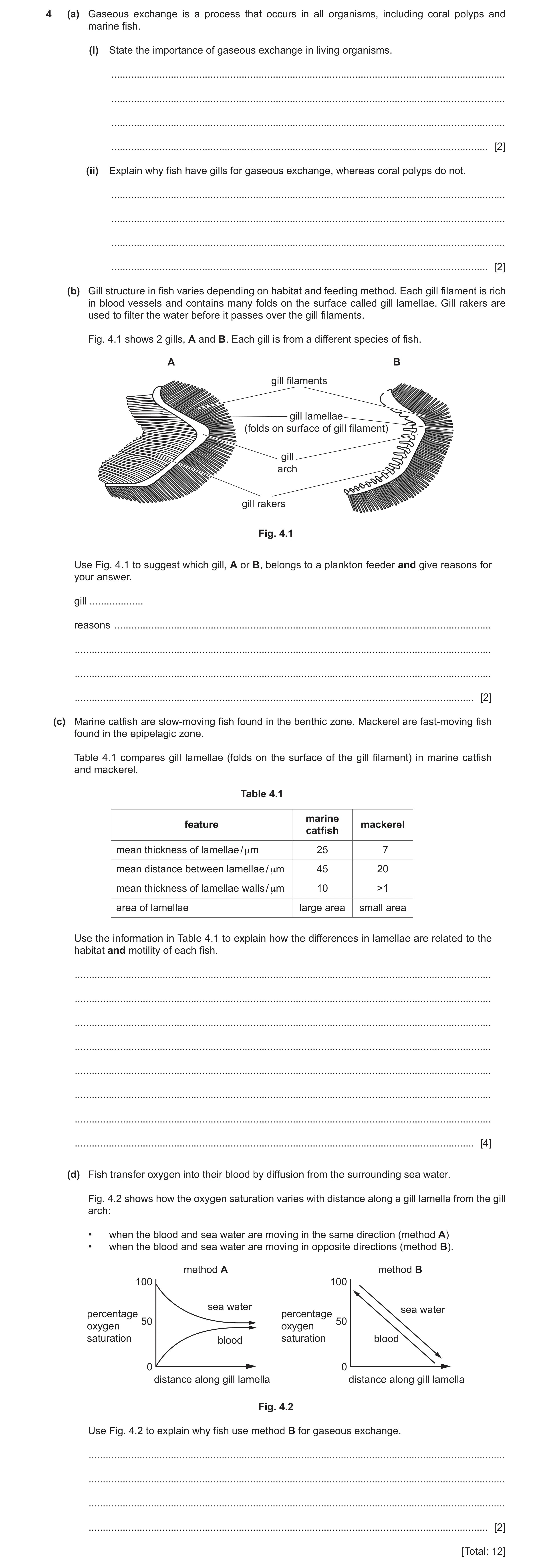
4 (a) Gaseous exchange is a process that occurs in all organisms, including coral polyps and marine fish. (i) State the importance of gaseous exchange in living organisms. … … … … [2] (ii) Explain why fish have gills for gaseous exchange, whereas coral polyps do not. … … … … [2] (b) Gill structure in fish varies depending on habitat and feeding method. Each gill filament is rich in blood vessels and contains many folds on the surface called gill lamellae. Gill rakers are used to filter the water before it passes over the gill filaments. Fig. 4.1 shows 2 gills, A and B. Each gill is from a different species of fish. A B gill filaments gill lamellae (folds on surface of gill filament) gill arch gill rakers Fig. 4.1 Use Fig. 4.1 to suggest which gill, A or B, belongs to a plankton feeder and give reasons for your answer. gill … reasons … … … … [2] (c) Marine catfish are slow-moving fish found in the benthic zone. Mackerel are fast-moving fish found in the epipelagic zone. Table 4.1 compares gill lamellae (folds on the surface of the gill filament) in marine catfish and mackerel. Table 4.1 marine feature mackerel catfish mean thickness of lamellae / μm 25 7 mean distance between lamellae / μm 45 20 mean thickness of lamellae walls / μm 10 >1 area of lamellae large area small area Use the information in Table 4.1 to explain how the differences in lamellae are related to the habitat and motility of each fish. … … … … … … … … [4] (d) Fish transfer oxygen into their blood by diffusion from the surrounding sea water. Fig. 4.2 shows how the oxygen saturation varies with distance along a gill lamella from the gill arch: • when the blood and sea water are moving in the same direction (method A) • when the blood and sea water are moving in opposite directions (method B). method A method B 100 100 sea water sea water percentage percentage 50 50 oxygen oxygen saturation blood saturation blood 0 0 distance along gill lamella distance along gill lamella Fig. 4.2 Use Fig. 4.2 to explain why fish use method B for gaseous exchange. … … … … [2] [Total: 12]
12 marks
Mark scheme: 4(a)(i) important in photosynthesis AND respiration ; 2 (in respiration) provides oxygen AND removes carbon dioxide OR (in photosynthesis) provides carbon dioxide AND removes oxygen ; 4(a)(ii) any 2 of: 2 1 gills increase surface area (to volume ratio) in fish, tentacles increase surface area (to volume ratio) in coral polyps ; 2 most parts of the body in fish are far away from the surface, in coral polyps all parts of the body are close to the surface; 3 too far for diffusion to occur in fish / diffusion distance is large, diffusion is sufficient / diffusion distance is small in coral polyps ; 4 fish move (so require more energy), coral polyps are sedentary ; 5 AVP ; 4(b) any 2 of: 2 gill A – no mark 1 phytoplankton are small / microscopic ; 2 rakers are closer together / longer / more rakers ; 3 so able to filter out phytoplankton ; 4(c) any 4 of: 4 1 mackerel is a fast-moving fish, so requires more oxygen / energy demand (than marine catfish) ; 2 larger area of lamellae in marine catfish, to obtain enough oxygen ; 3 more oxygen present in epipelagic zone (compared with benthic zone) ; 4 lamellae thinner in mackerel, so less distance for diffusion (of oxygen into blood) ; 5 lamellae walls thinner, so faster diffusion of oxygen ; 6 lamellae more closely packed in mackerel, to slow down water movement ; 7 allowing more time for diffusion of gases / maintains diffusion gradient / greater gas exchange ; 4(d) any 2 of: 2 1 ref. to counter-current mechanism ; 2 maintains diffusion gradient (across whole gill surface / length of gill) ; 3 (more efficient as), more / higher percentage of, oxygen can diffuse into blood ; 4 in A diffusion occurs only until, equilibrium is reached / oxygen content of sea water is the same as in the blood ;
This question in 9693/32 Oct/Nov 2024
Q12 · Gaseous exchange is a process that occurs in all organisms, including coral polyps and… 9693/33 Oct/Nov 2024
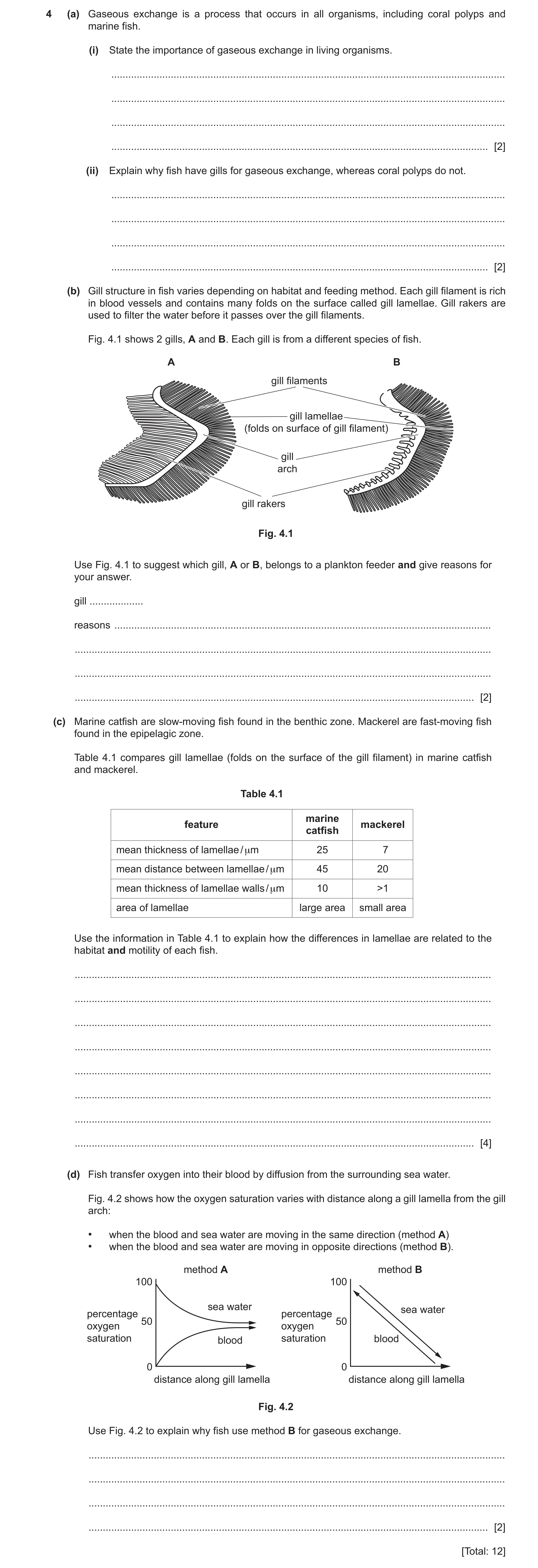
4 (a) Gaseous exchange is a process that occurs in all organisms, including coral polyps and marine fish. (i) State the importance of gaseous exchange in living organisms. … … … … [2] (ii) Explain why fish have gills for gaseous exchange, whereas coral polyps do not. … … … … [2] (b) Gill structure in fish varies depending on habitat and feeding method. Each gill filament is rich in blood vessels and contains many folds on the surface called gill lamellae. Gill rakers are used to filter the water before it passes over the gill filaments. Fig. 4.1 shows 2 gills, A and B. Each gill is from a different species of fish. A B gill filaments gill lamellae (folds on surface of gill filament) gill arch gill rakers Fig. 4.1 Use Fig. 4.1 to suggest which gill, A or B, belongs to a plankton feeder and give reasons for your answer. gill … reasons … … … … [2] (c) Marine catfish are slow-moving fish found in the benthic zone. Mackerel are fast-moving fish found in the epipelagic zone. Table 4.1 compares gill lamellae (folds on the surface of the gill filament) in marine catfish and mackerel. Table 4.1 marine feature mackerel catfish mean thickness of lamellae / μm 25 7 mean distance between lamellae / μm 45 20 mean thickness of lamellae walls / μm 10 >1 area of lamellae large area small area Use the information in Table 4.1 to explain how the differences in lamellae are related to the habitat and motility of each fish. … … … … … … … … [4] (d) Fish transfer oxygen into their blood by diffusion from the surrounding sea water. Fig. 4.2 shows how the oxygen saturation varies with distance along a gill lamella from the gill arch: • when the blood and sea water are moving in the same direction (method A) • when the blood and sea water are moving in opposite directions (method B). method A method B 100 100 sea water sea water percentage percentage 50 50 oxygen oxygen saturation blood saturation blood 0 0 distance along gill lamella distance along gill lamella Fig. 4.2 Use Fig. 4.2 to explain why fish use method B for gaseous exchange. … … … … [2] [Total: 12]
12 marks
Mark scheme: 4(a)(i) important in photosynthesis AND respiration ; 2 (in respiration) provides oxygen AND removes carbon dioxide OR (in photosynthesis) provides carbon dioxide AND removes oxygen ; 4(a)(ii) any 2 of: 2 1 gills increase surface area (to volume ratio) in fish, tentacles increase surface area (to volume ratio) in coral polyps ; 2 most parts of the body in fish are far away from the surface, in coral polyps all parts of the body are close to the surface; 3 too far for diffusion to occur in fish / diffusion distance is large, diffusion is sufficient / diffusion distance is small in coral polyps ; 4 fish move (so require more energy), coral polyps are sedentary ; 5 AVP ; 4(b) any 2 of: 2 gill A – no mark 1 phytoplankton are small / microscopic ; 2 rakers are closer together / longer / more rakers ; 3 so able to filter out phytoplankton ; 4(c) any 4 of: 4 1 mackerel is a fast-moving fish, so requires more oxygen / energy demand (than marine catfish) ; 2 larger area of lamellae in marine catfish, to obtain enough oxygen ; 3 more oxygen present in epipelagic zone (compared with benthic zone) ; 4 lamellae thinner in mackerel, so less distance for diffusion (of oxygen into blood) ; 5 lamellae walls thinner, so faster diffusion of oxygen ; 6 lamellae more closely packed in mackerel, to slow down water movement ; 7 allowing more time for diffusion of gases / maintains diffusion gradient / greater gas exchange ; 4(d) any 2 of: 2 1 ref. to counter-current mechanism ; 2 maintains diffusion gradient (across whole gill surface / length of gill) ; 3 (more efficient as), more / higher percentage of, oxygen can diffuse into blood ; 4 in A diffusion occurs only until, equilibrium is reached / oxygen content of sea water is the same as in the blood ;
This question in 9693/33 Oct/Nov 2024
Q13 · Atlantic cod swim at slow speeds just above the sea bed 9693/31 Oct/Nov 2025
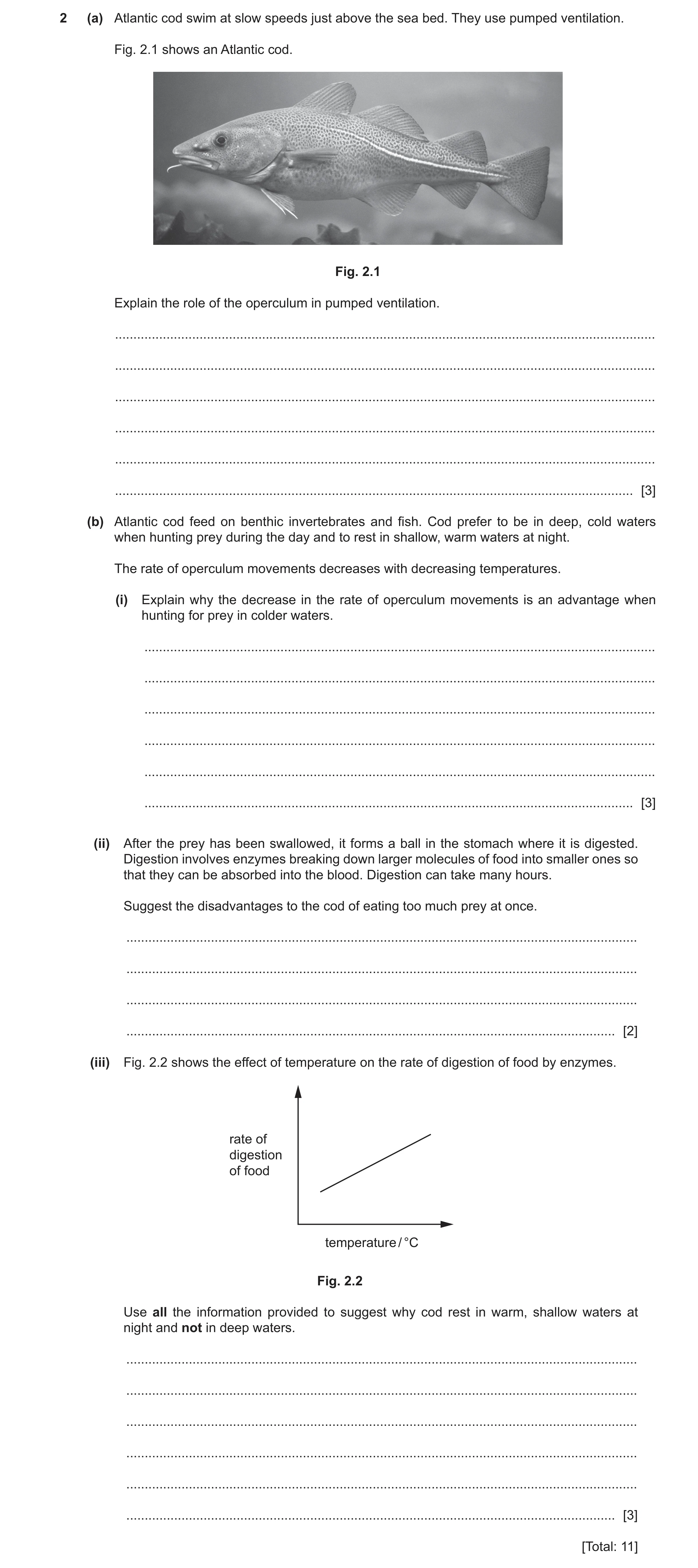
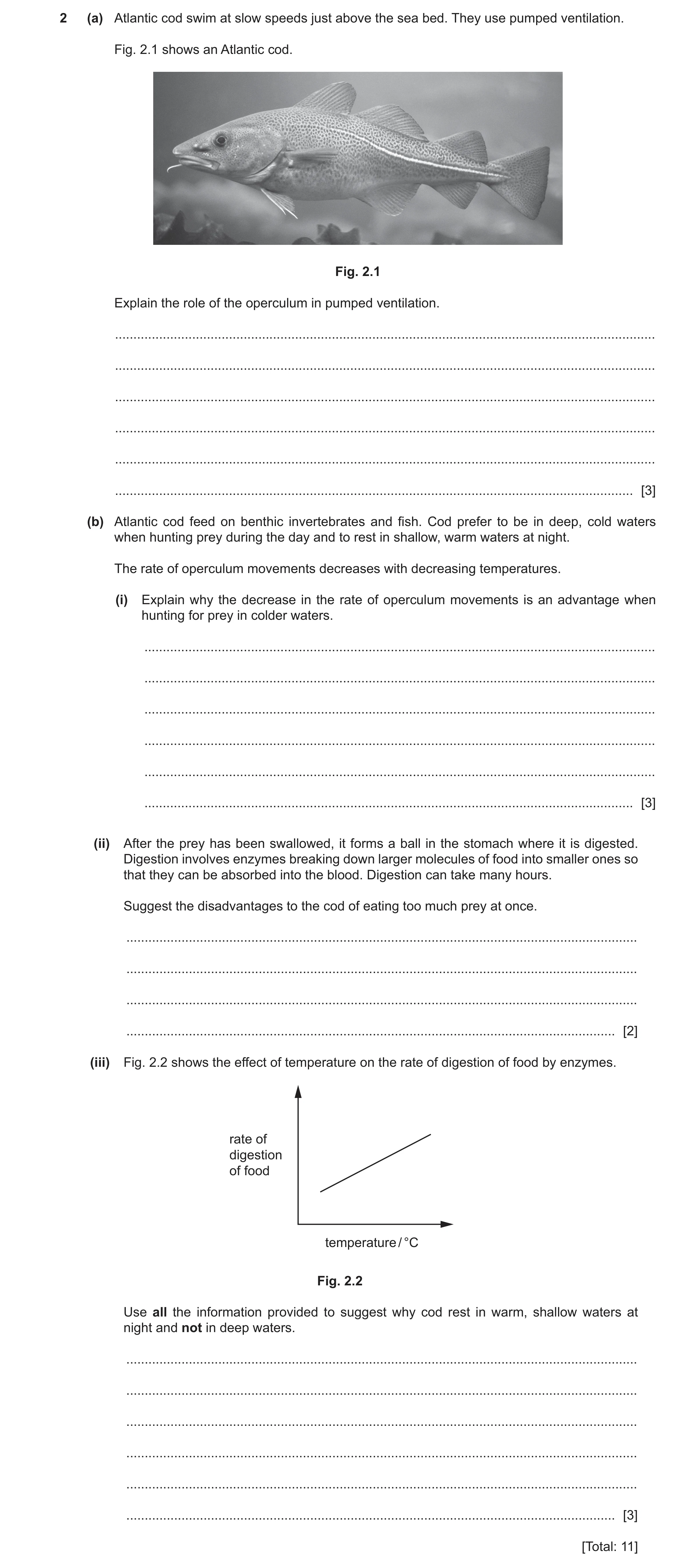
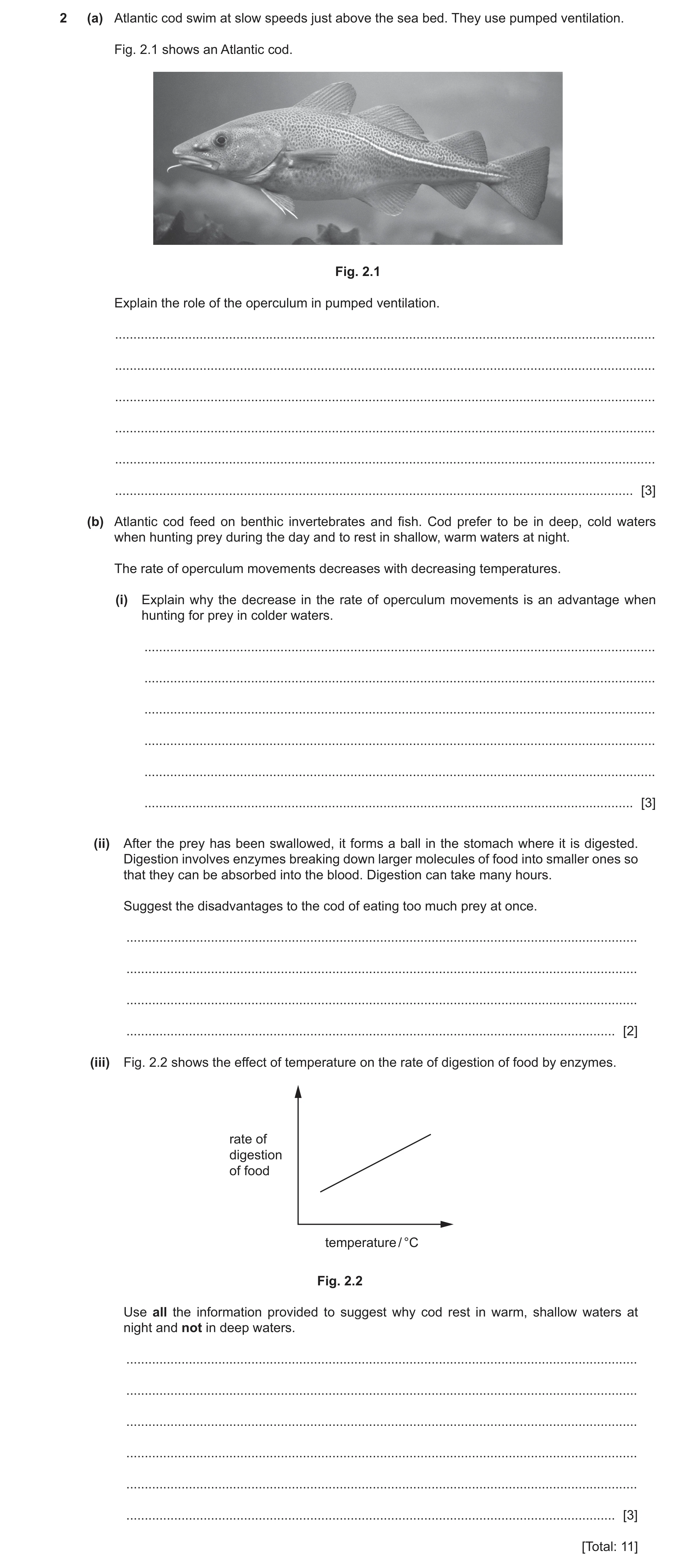
2 (a) Atlantic cod swim at slow speeds just above the sea bed. They use pumped ventilation. Fig. 2.1 shows an Atlantic cod. Fig. 2.1 Explain the role of the operculum in pumped ventilation. … … … … … … [3] (b) Atlantic cod feed on benthic invertebrates and fish. Cod prefer to be in deep, cold waters when hunting prey during the day and to rest in shallow, warm waters at night. The rate of operculum movements decreases with decreasing temperatures. (i) Explain why the decrease in the rate of operculum movements is an advantage when hunting for prey in colder waters. … … … … … … [3] (ii) After the prey has been swallowed, it forms a ball in the stomach where it is digested. Digestion involves enzymes breaking down larger molecules of food into smaller ones so that they can be absorbed into the blood. Digestion can take many hours. Suggest the disadvantages to the cod of eating too much prey at once. … … … … [2] (iii) Fig. 2.2 shows the effect of temperature on the rate of digestion of food by enzymes. rate of digestion of food temperature / °C Fig. 2.2 Use all the information provided to suggest why cod rest in warm, shallow waters at night and not in deep waters. … … … … … … [3] [Total: 11]
11 marks
Mark scheme: 2(a) any three of: 3 1 during inflow, the operculum is, closed / moves inwards ; 2 to prevent water flowing back across the gills ; 3 during outflow, the operculum is forced open / moves outwards ; 4 to allow water to pass out (from the gills) ; 5 correct ref. to pressure changes ; 2(b)(i) any three of: 3 1 operculum movement shows the ventilation rate ; 2 oxygen concentration increases with decreasing temperature ; 3 so ventilation rate decreases ; 4 saves energy (needed for operculum movement / pumped ventilation) ; 5 more energy available for, swimming / hunting prey ; 2(b)(ii) any two of: 2 1 larger ball (in stomach) will have a smaller surface area (to volume ratio) ; 2 enzymes will not be able to reach centre of ball ; 3 so digestion will, be incomplete / take longer ; 4 idea of energy diverted (from swimming/ hunting) to digest food ; 5 AVP ; 2(b)(iii) any three of: 3 1 faster digestion of food in warm water ; 2 will result in, faster food absorption / increased growth ; 3 higher oxygen concentrations not required ; 4 as fish not hunting for food / fish resting ;
This question in 9693/31 Oct/Nov 2025
Q14 · Atlantic cod swim at slow speeds just above the sea bed 9693/32 Oct/Nov 2025
2 (a) Atlantic cod swim at slow speeds just above the sea bed. They use pumped ventilation. Fig. 2.1 shows an Atlantic cod. Fig. 2.1 Explain the role of the operculum in pumped ventilation. … … … … … … [3] (b) Atlantic cod feed on benthic invertebrates and fish. Cod prefer to be in deep, cold waters when hunting prey during the day and to rest in shallow, warm waters at night. The rate of operculum movements decreases with decreasing temperatures. (i) Explain why the decrease in the rate of operculum movements is an advantage when hunting for prey in colder waters. … … … … … … [3] (ii) After the prey has been swallowed, it forms a ball in the stomach where it is digested. Digestion involves enzymes breaking down larger molecules of food into smaller ones so that they can be absorbed into the blood. Digestion can take many hours. Suggest the disadvantages to the cod of eating too much prey at once. … … … … [2] (iii) Fig. 2.2 shows the effect of temperature on the rate of digestion of food by enzymes. rate of digestion of food temperature / °C Fig. 2.2 Use all the information provided to suggest why cod rest in warm, shallow waters at night and not in deep waters. … … … … … … [3] [Total: 11]
11 marks
Mark scheme: 2(a) any three of: 3 1 during inflow, the operculum is, closed / moves inwards ; 2 to prevent water flowing back across the gills ; 3 during outflow, the operculum is forced open / moves outwards ; 4 to allow water to pass out (from the gills) ; 5 correct ref. to pressure changes ; 2(b)(i) any three of: 3 1 operculum movement shows the ventilation rate ; 2 oxygen concentration increases with decreasing temperature ; 3 so ventilation rate decreases ; 4 saves energy (needed for operculum movement / pumped ventilation) ; 5 more energy available for, swimming / hunting prey ; 2(b)(ii) any two of: 2 1 larger ball (in stomach) will have a smaller surface area (to volume ratio) ; 2 enzymes will not be able to reach centre of ball ; 3 so digestion will, be incomplete / take longer ; 4 idea of energy diverted (from swimming/ hunting) to digest food ; 5 AVP ; 2(b)(iii) any three of: 3 1 faster digestion of food in warm water ; 2 will result in, faster food absorption / increased growth ; 3 higher oxygen concentrations not required ; 4 as fish not hunting for food / fish resting ;
This question in 9693/32 Oct/Nov 2025
Q15 · Atlantic cod swim at slow speeds just above the sea bed 9693/33 Oct/Nov 2025
2 (a) Atlantic cod swim at slow speeds just above the sea bed. They use pumped ventilation. Fig. 2.1 shows an Atlantic cod. Fig. 2.1 Explain the role of the operculum in pumped ventilation. … … … … … … [3] (b) Atlantic cod feed on benthic invertebrates and fish. Cod prefer to be in deep, cold waters when hunting prey during the day and to rest in shallow, warm waters at night. The rate of operculum movements decreases with decreasing temperatures. (i) Explain why the decrease in the rate of operculum movements is an advantage when hunting for prey in colder waters. … … … … … … [3] (ii) After the prey has been swallowed, it forms a ball in the stomach where it is digested. Digestion involves enzymes breaking down larger molecules of food into smaller ones so that they can be absorbed into the blood. Digestion can take many hours. Suggest the disadvantages to the cod of eating too much prey at once. … … … … [2] (iii) Fig. 2.2 shows the effect of temperature on the rate of digestion of food by enzymes. rate of digestion of food temperature / °C Fig. 2.2 Use all the information provided to suggest why cod rest in warm, shallow waters at night and not in deep waters. … … … … … … [3] [Total: 11]
11 marks
Mark scheme: 2(a) any three of: 3 1 during inflow, the operculum is, closed / moves inwards ; 2 to prevent water flowing back across the gills ; 3 during outflow, the operculum is forced open / moves outwards ; 4 to allow water to pass out (from the gills) ; 5 correct ref. to pressure changes ; 2(b)(i) any three of: 3 1 operculum movement shows the ventilation rate ; 2 oxygen concentration increases with decreasing temperature ; 3 so ventilation rate decreases ; 4 saves energy (needed for operculum movement / pumped ventilation) ; 5 more energy available for, swimming / hunting prey ; 2(b)(ii) any two of: 2 1 larger ball (in stomach) will have a smaller surface area (to volume ratio) ; 2 enzymes will not be able to reach centre of ball ; 3 so digestion will, be incomplete / take longer ; 4 idea of energy diverted (from swimming/ hunting) to digest food ; 5 AVP ; 2(b)(iii) any three of: 3 1 faster digestion of food in warm water ; 2 will result in, faster food absorption / increased growth ; 3 higher oxygen concentrations not required ; 4 as fish not hunting for food / fish resting ;
This question in 9693/33 Oct/Nov 2025
![Question 2: (a) (i) Respiration is a process common to all marine animals and plants. Complete the word equation for respiration. + + [2] (ii) State th…](https://img.pastlit.com/crops/1c1fb81a-cf99-42af-a39c-94b2302ad836/q2.webp)
 8 / 24
 9 / 24
 10 / 24
 11 / 24
 12 / 24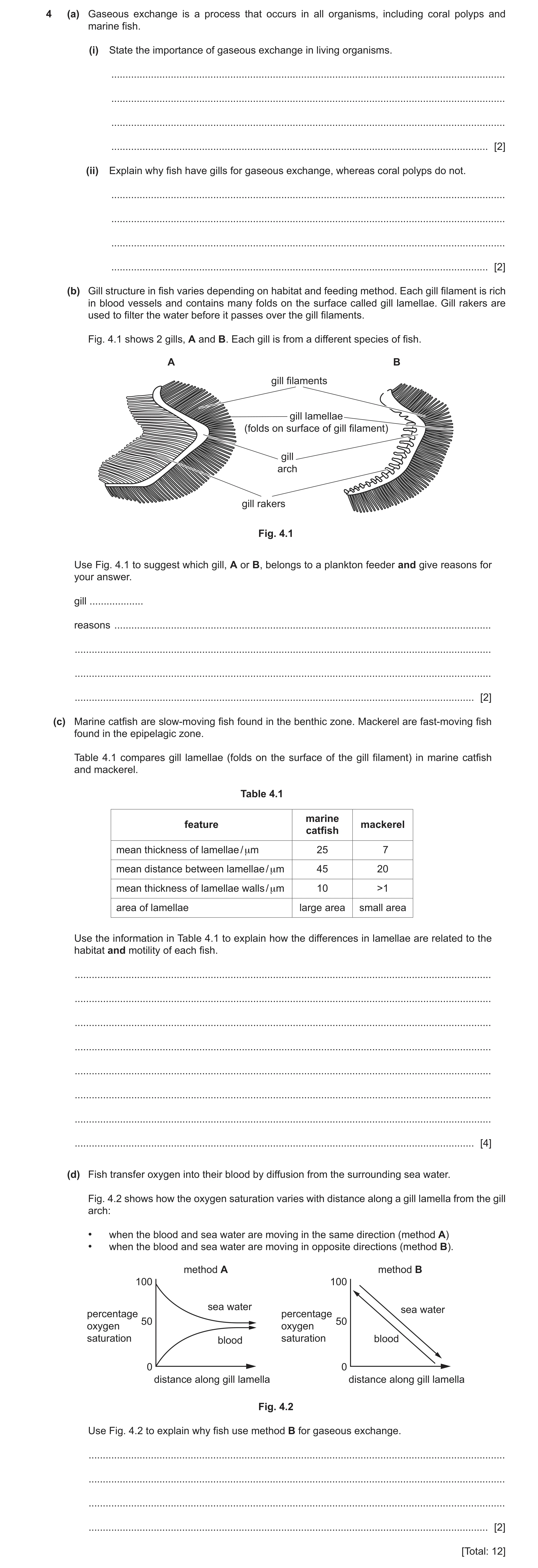
 12
12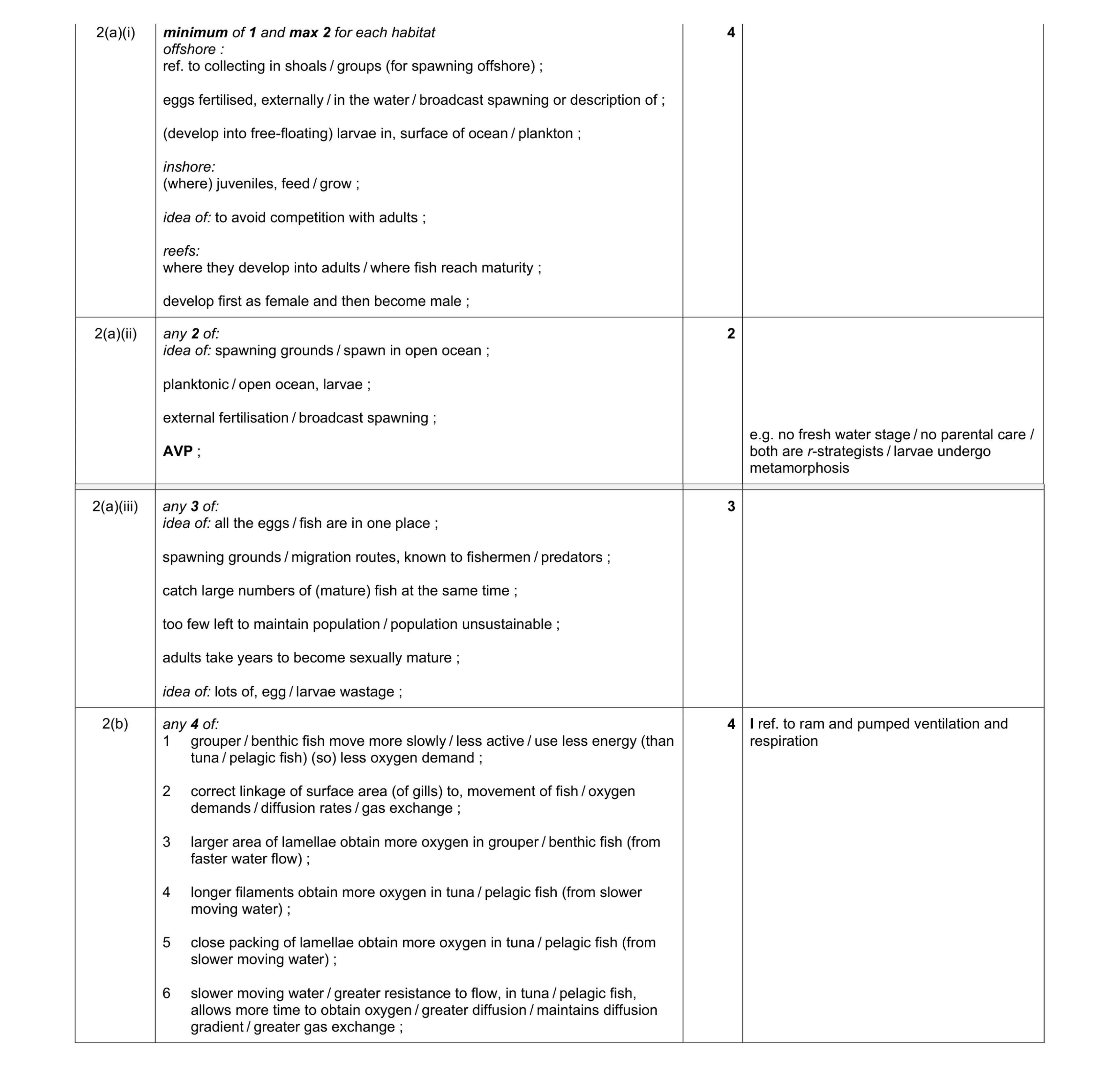 13
13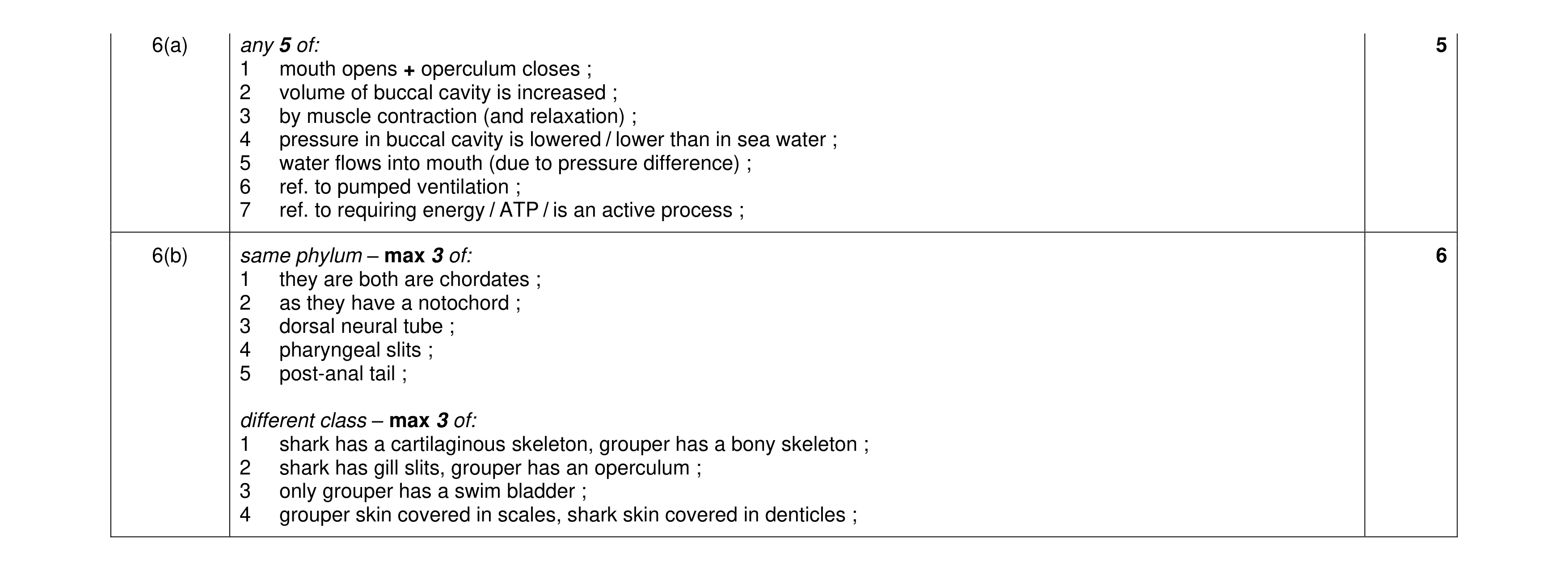 11
11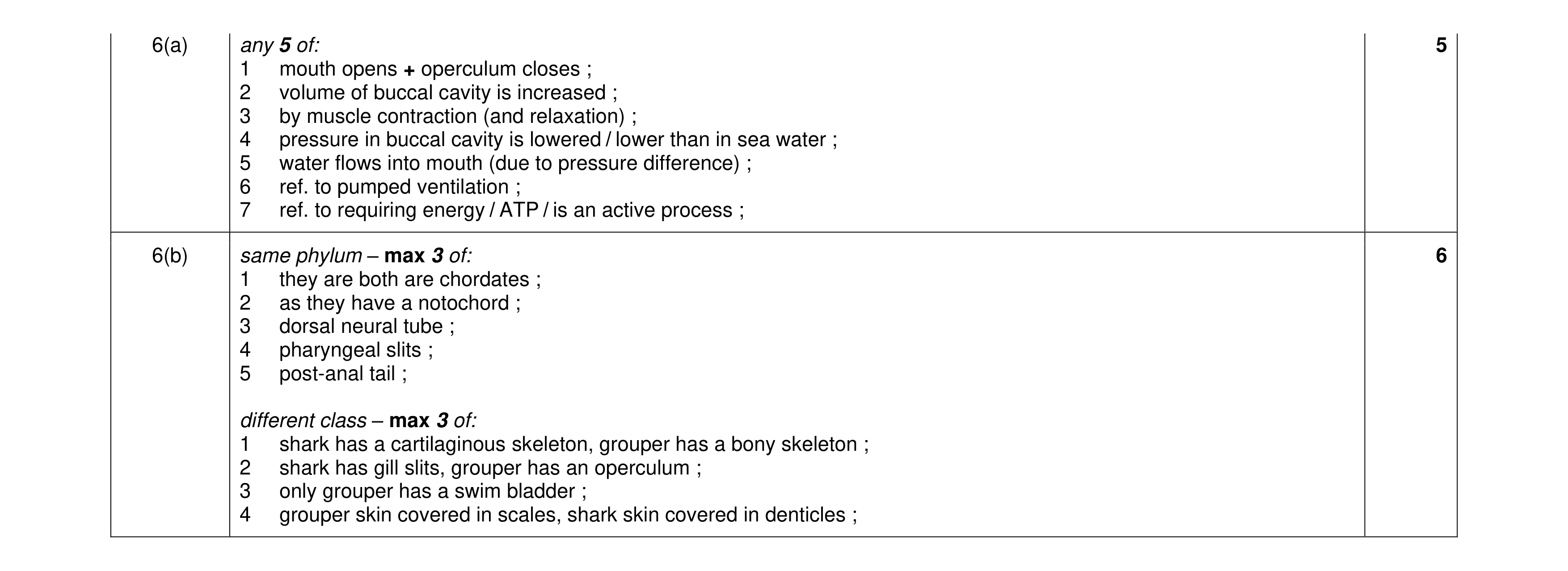 11
11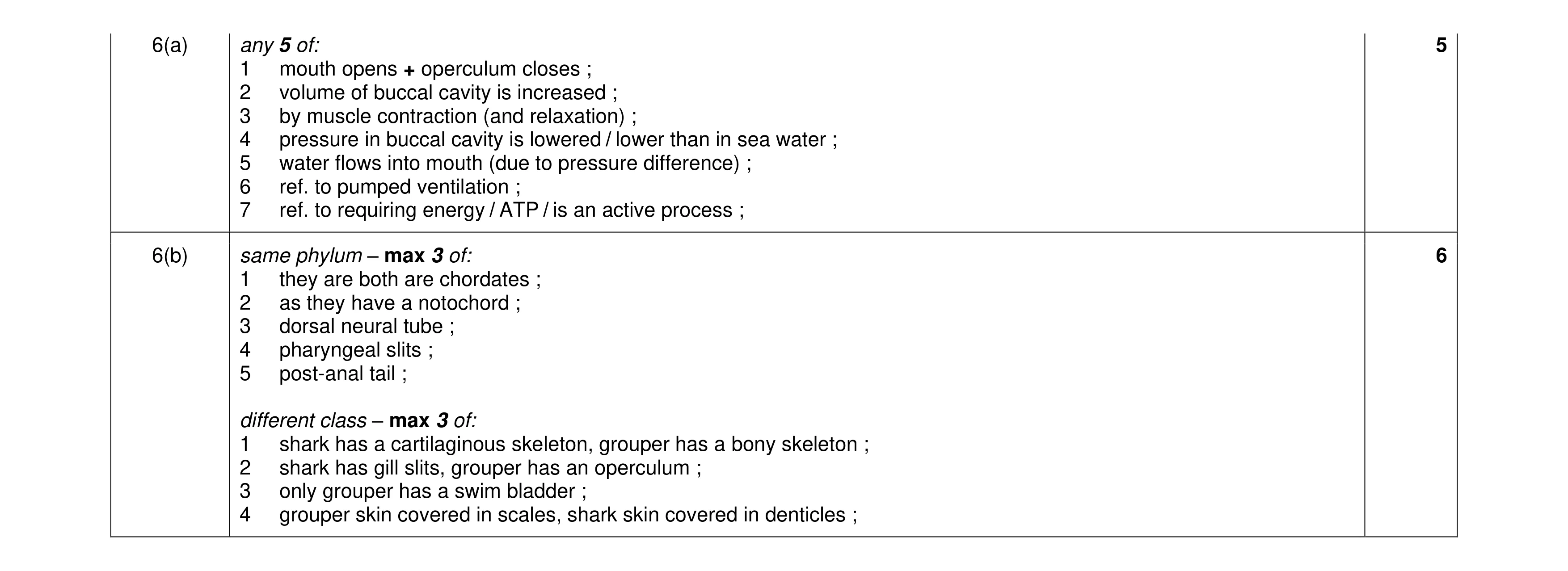 11
11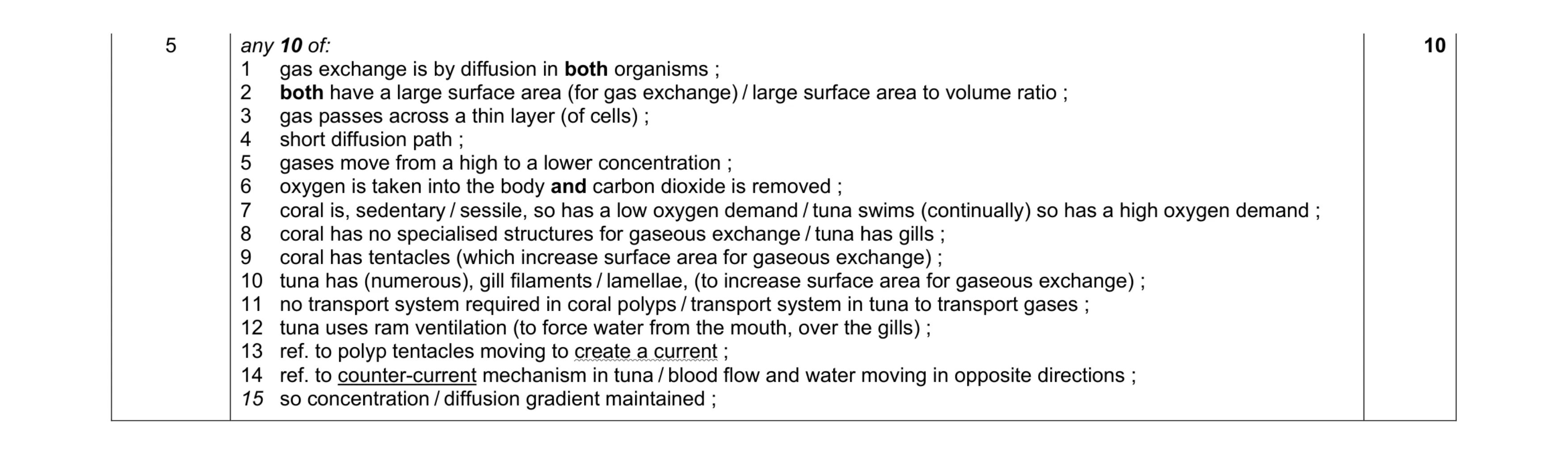 10
10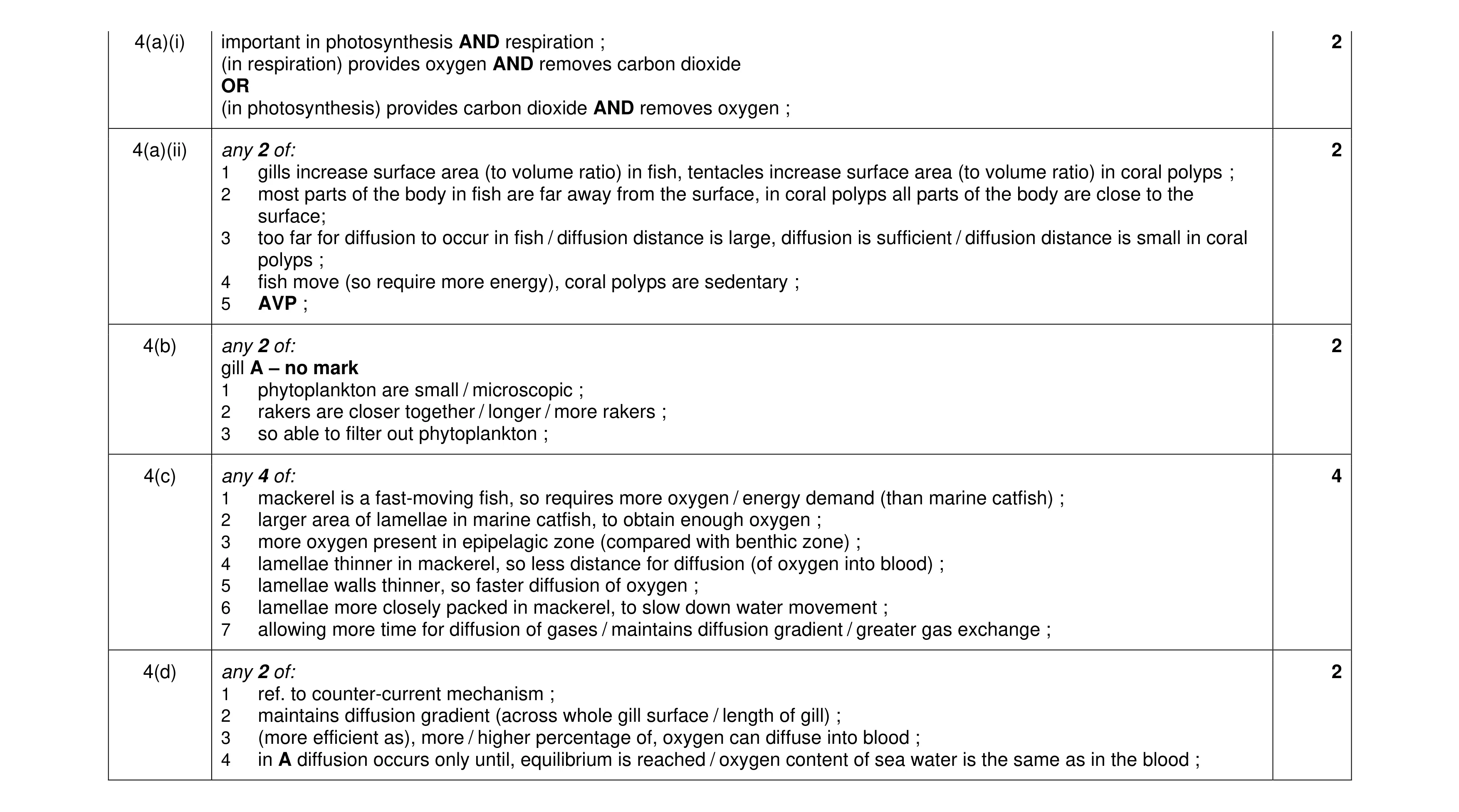 12
12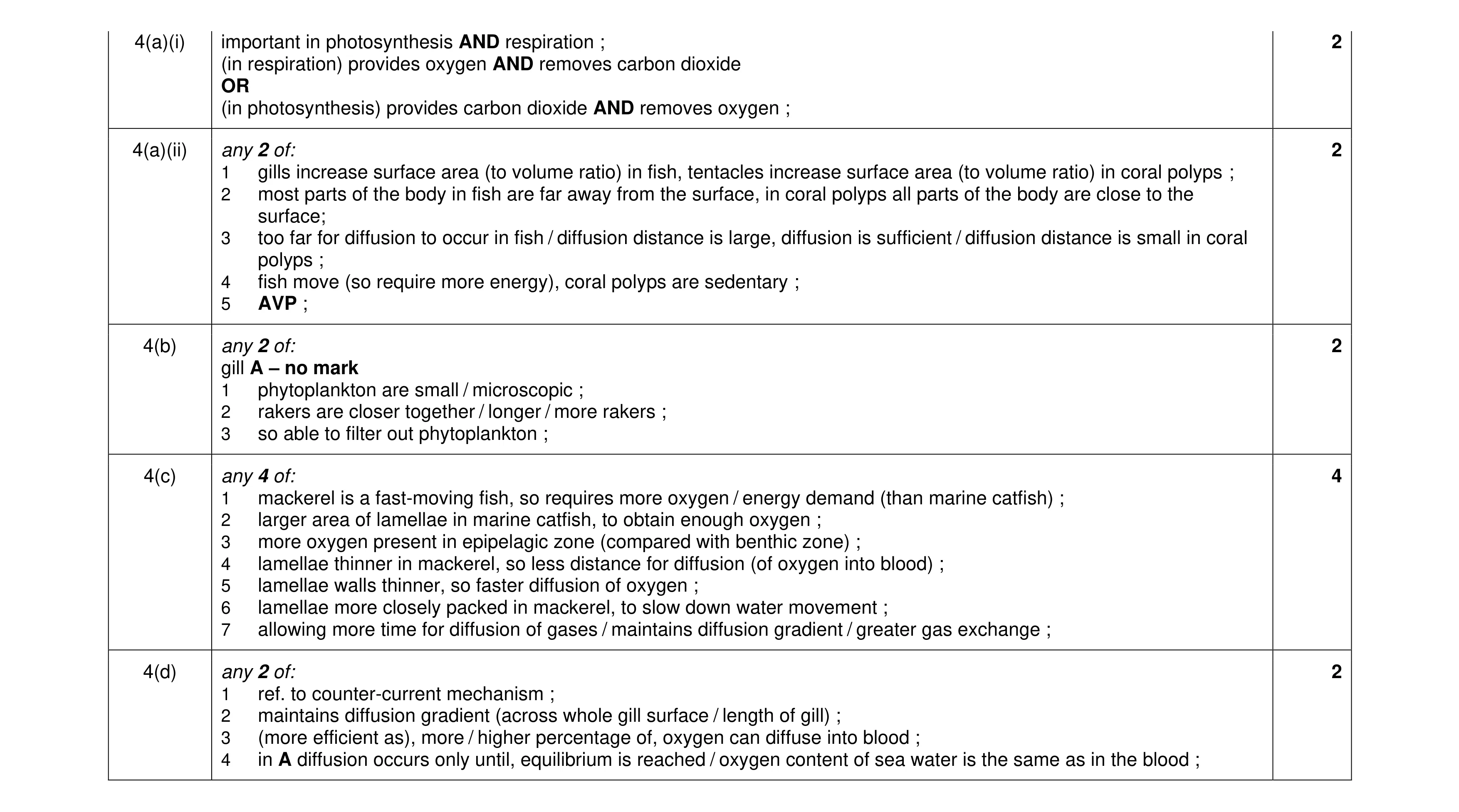 12
12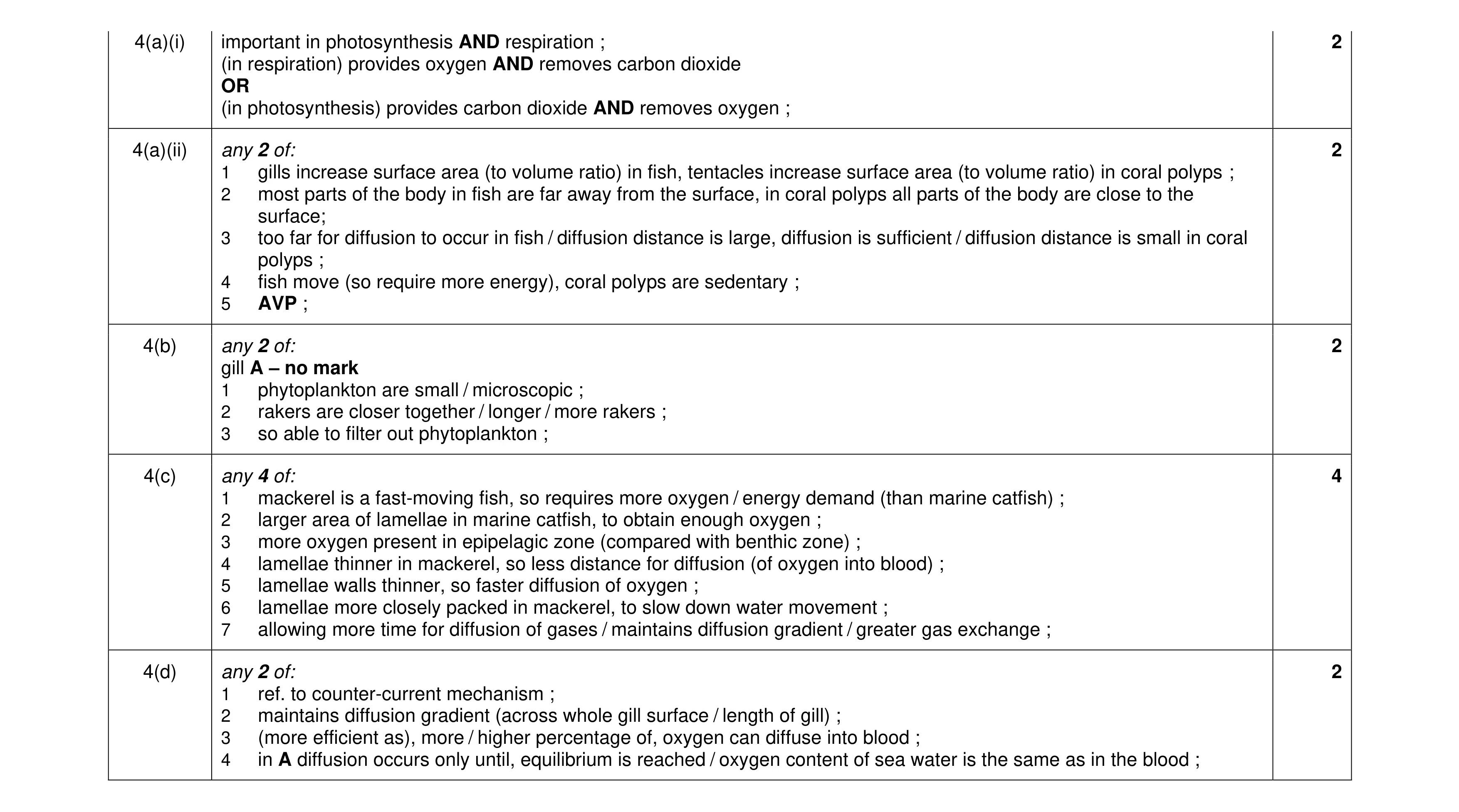 12
12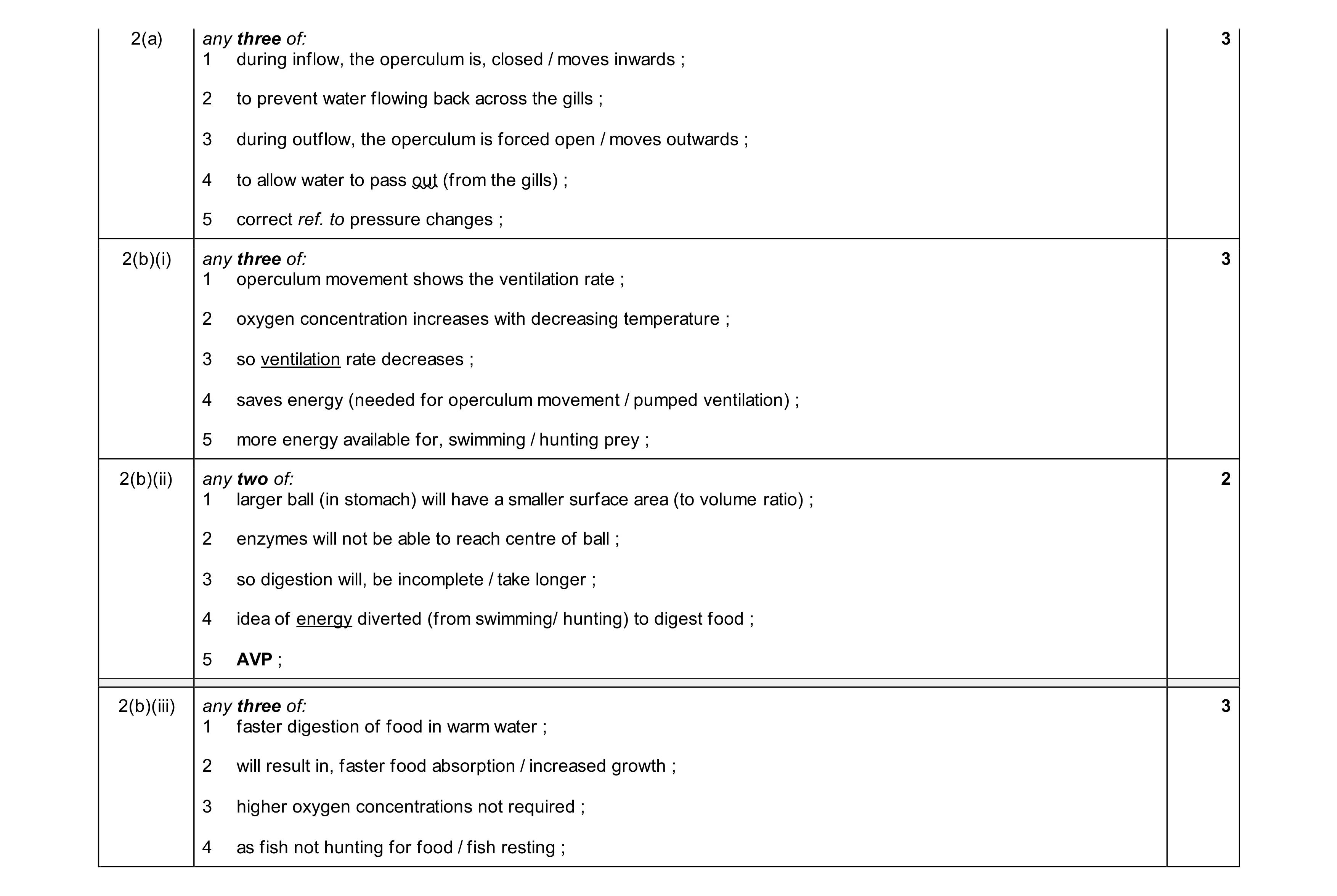 11
11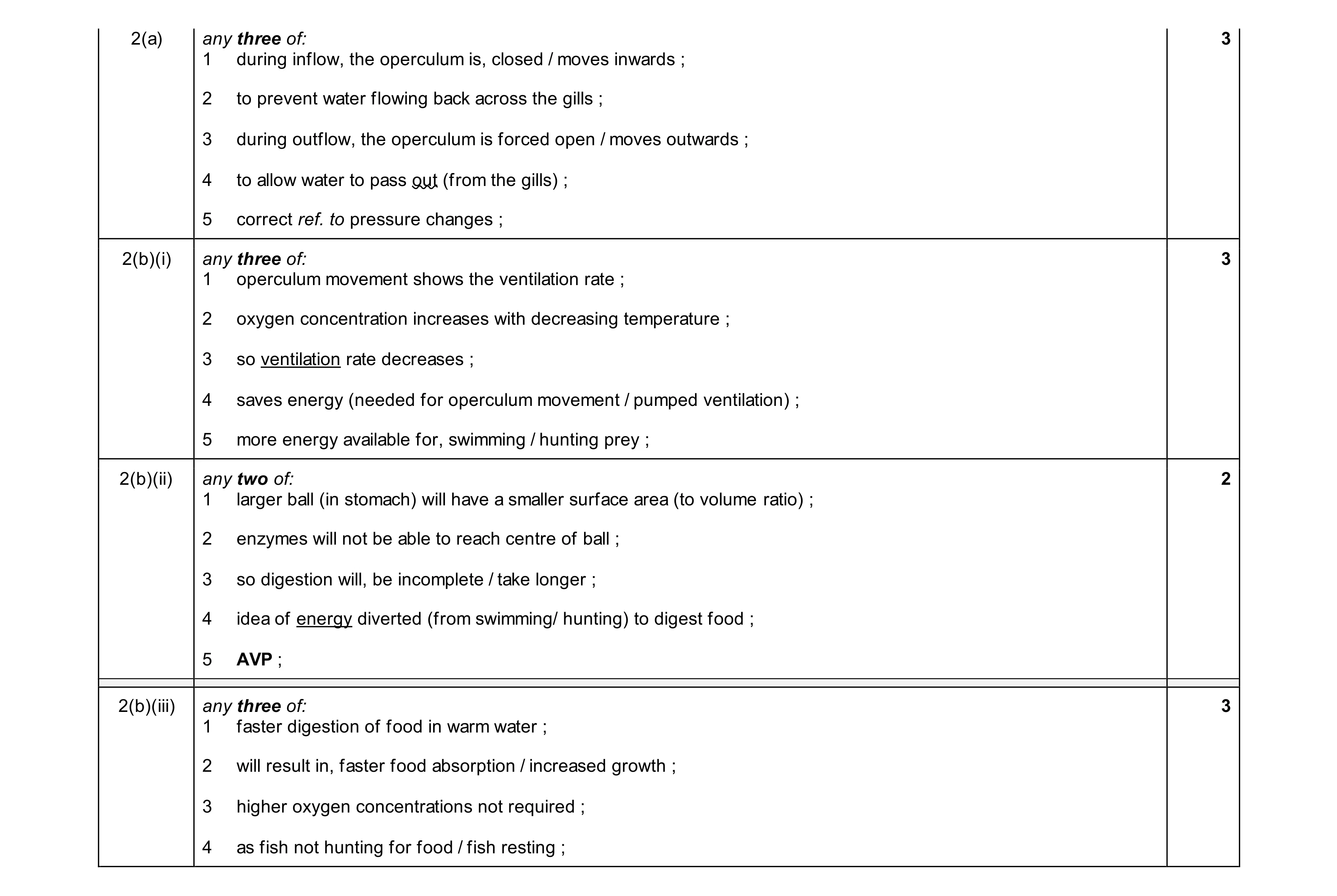 11
11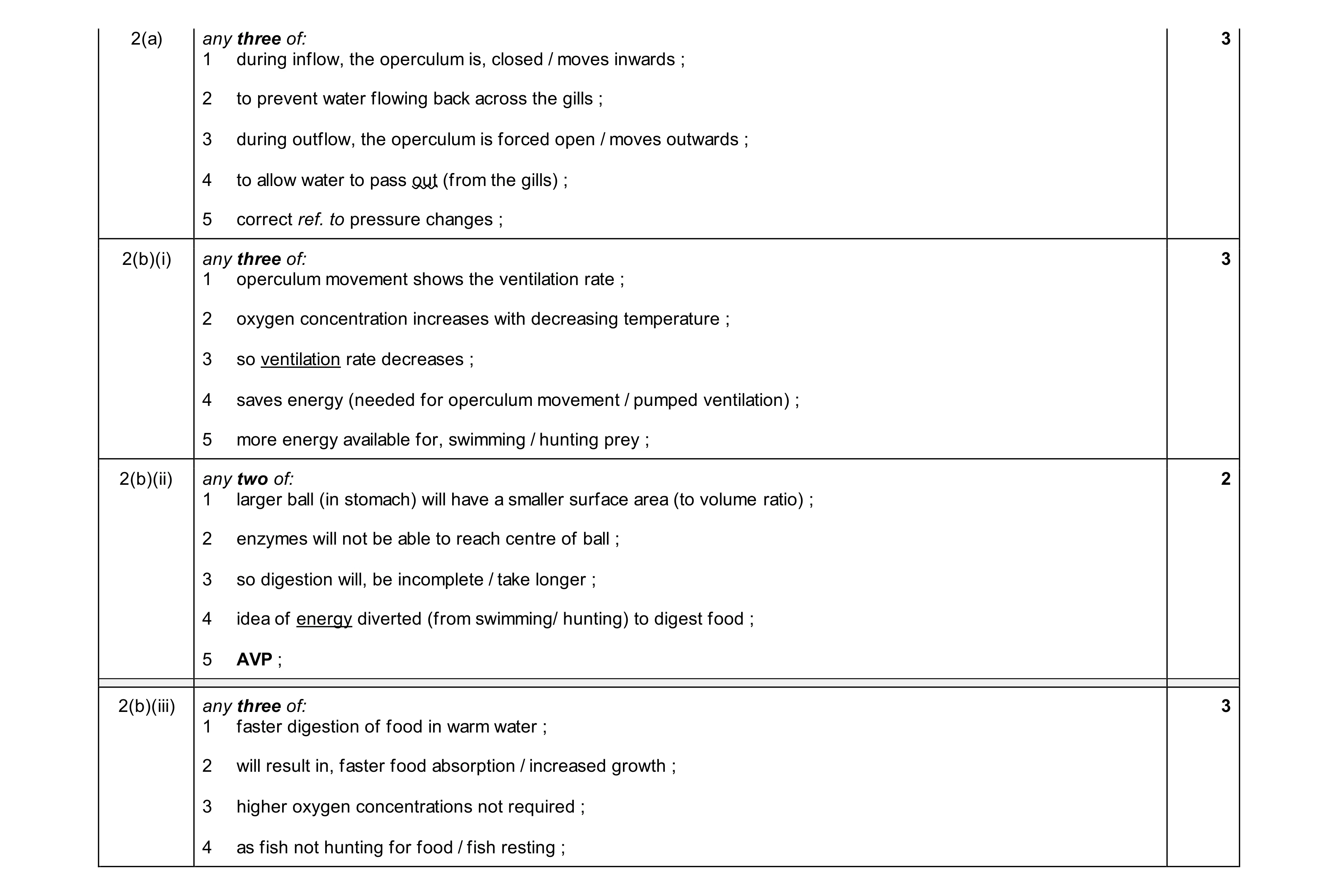 11
11