Questions as text
Q1 · Analyse the reasons why the United Nations failed in Somalia 9489/42 Feb/March 2021
11 Analyse the reasons why the United Nations failed in Somalia. [30]
30 marks
Mark scheme: 11 Analyse the reasons why the United Nations failed in Somalia. 30 President Siyad Barre fell from power in January 1991; he had ruled through his own support network and played off clans against each other causing factional power struggles. The economy of the country began to decline and by 1988 violent opposition to his rule had turned into a civil war. In November 1991, there was intense fighting in Mogadishu between the factions, one supporting Interim President, Ali Mahdi Mohamed and the other supporting the Chairman of the United Somali Congress, Mohamed Farah Aidid. In March 1992 a ceasefire had been agreed but it was ignored by the fighters on both sides. The first United Nations Operation in Somalia (UNOSOM I) was authorised by Security Council Resolution 751 of 24 April 1992. UNOSOM 1 was dispatched to monitor the cease-fire and to protect the personnel involved in the humanitarian work. The collapse of the Somali central government meant that the UN was unable to obtain consent to deploy troops and as a result their mandate was limited; local warlords prevented them from moving much beyond the airport in Mogadishu. Lawlessness and lack of security prevented aid from being distributed. There was looting of supplies by armed gangs and attacks on ships and on airports. However, blame for the failure of UNISOM 1 can also be attributed to the UN itself. Troops often refused to accept orders from UN commanders before checking with their own governments causing delays; the international response to Somalia's problems was also inadequate. Although three separate Security Council resolutions were passed in the first half of 1992, UN humanitarian agencies failed to implement the relief programme. It was also reported in ‘The New York Times’ in December 1991 that the United States held back UN efforts with the State Department because of safety concerns over the peacekeeping force. It was not until January 1992 when Boutros Boutros-Ghali became UN Secretary General that the UN became more heavily involved with humanitarian aid. Public pressure was put on governments internationally as the media drew attention to the catastrophe and the effects of widespread famine. There were also arguments between the UN and other humanitarian workers in Somalia and the UN reported that the failure of relief operations was due to the bureaucracy involved. Resolution 751 called for the establishment of a peacekeeping force to provide security for humanitarian activities in Mogadishu which included the deployment of 50 unarmed military observers to monitor the ceasefire agreement in the city and agreed in principle to the idea of a UN force to escort the delivery of humanitarian aid. By late October 1992, it was clear that the new plan was not working as intended; the small UN peacekeeping contingent could not ensure that humanitarian aid was delivered throughout the country. Following the ineffective UNOSOM I mission, Boutros-Ghali launched the United Nations Task Force (UNITAF) in December 1992. This was an American-led force of 30,000 troops from 23 countries authorised by Security Council Resolution to provide security for relief operations. The widespread famine and continued civil war in Somalia were seen as a threat to international peace and provided the reason for allowing the forces. The UNITAF forces were largely successful in supplying humanitarian aid but in March 1993 they handed over to UNOSOM II This put military and security objectives before political, economic and social ones and turned into a peace enforcement mission.
This question in 9489/42 Feb/March 2021
Q2 · ‘The United Nations failed to act impartially to establish peace in the Congo.’ Discuss… 9489/41 May/June 2021
11 ‘The United Nations failed to act impartially to establish peace in the Congo.’ Discuss this view. [30]
30 marks
Mark scheme: 11 ‘The United Nations failed to act impartially to establish peace in the 30 Congo.’ Discuss this view. Independence was granted on 30th June 1960, following elections in May 1960, with Joseph Kasavubu and Patrice Lumumba becoming President and Prime Minister, respectively. The Eisenhower administration hoped for a stable, pro-Western central government in the Republic of the Congo, but Lumumba was regarded as a communist and anti-Western figure. However, five days after independence, a military mutiny and extensive civil unrest occurred. Belgian paratroopers intervened; Lumumba asked for them to be removed but the Belgians refused. The Congolese government appealed directly to the UN and a resolution was passed on 13th July calling for Belgian withdrawal. The United Nations Organisation in the Congo (ONUC), a peace-keeping force, was established, and soldiers from 30 countries participated for the next four years to protect the Congo from outside interference and to help it in achieving political independence. It can be argued that the United Nations adopted a pro-Western stance. On 11th July, the Province of Katanga had seceded and formed a separate state under Moise Tshombe; it had vast mineral wealth and produced half of the country’s total revenue. Belgian forces remained in Katanga, and on 8th August, a new UN resolution was passed allowing the ONUC soldiers to remove them. Even though Tshombe accepted UN troops replacing Belgian troops, Belgian officers under the direct control of Katanga remained. The UN stated that it could not intervene in a country’s internal matters and refused to end the Katanga secession, blaming Tshombe rather than Belgian involvement. However, Dag Hammarskjold, the UN Secretary General, indicated his support for Tshombe in private statements. Lumumba demanded UN military support from Hammarskjӧld and sought US assistance which was refused. The UN failed to take a firm stance against Belgium, which was against the interests of independence for the Congo. Lumumba turned to the Soviets to reunite Kasai, which had also seceded, with the Congolese Central Government. This increased antagonism from the West because of Cold War hostility. On 14th September, Colonel Mobutu of the Congolese army seized power in a coup; he dismissed Kasavubu and Lumumba with some support from the ONUC military. He also ordered the Soviets out of the country. The UN gave $1 million to unpaid Congolese soldiers and supported Mobutu. 11 In January 1961, Lumumba was moved to Katanga where he was beaten to death by his captors. The US ensured that Cyrille Adoula was elected prime minister and he prioritised reuniting the country. In September 1961, Hammarskjold was replaced by U Thant as UN Secretary General; U Thant was determined to use force. However, in December 1961, the Kitona Accords brought agreement on the reincorporation of Katanga into the Congo. Tshombe refused to act on the agreement and the Kennedy administration decided to use UN force. The UN was in the hands of the Americans by the end of 1962, and they were the only ones who could provide support for the ground forces that finally forced Tshombe to flee in December 1962. In 1964, Tshombe returned as President of a reunited state, but fighting resumed, prompting Belgian troops to intervene once more. In June 1964, the UN left the Congo. In 1965, General Mobutu returned to power with a military coup backed by the Americans and stability returned as a result of brutal repression.
This question in 9489/41 May/June 2021
Q3 · Assess the extent to which the Palestine Liberation Organisation had achieved its aims by… 9489/43 May/June 2021
12 Assess the extent to which the Palestine Liberation Organisation had achieved its aims by 1979. [30]
30 marks
Mark scheme: 12 Assess the extent to which the Palestine Liberation Organisation had 30 achieved its aims by 1979. The PLO was established in 1964 by the Arab League, as a response to the growing importance of the Palestine question in Arab politics, and with the aim of controlling Palestinian nationalism while appearing to support their cause. The 1968 PLO charter considered the partition of Palestine and the creation of Israel illegal and rejected any plans to resettle refugees in Arab nations and called for the elimination of Israel. Syria, Jordan and Egypt were all key supporters of the PLO but they sustained heavy losses in the Six-Day War of 1967 when Israel took over the West Bank, the Gaza Strip, and the Golan Heights. Egypt and Syria were more concerned about the lands that they had lost to Israel than about the Palestinian refugees. Jordan continued to support the PLO until 1970 but King Hussein was afraid of Israeli reprisals because of Palestinian attacks being launched from Jordan. The King also felt that members of the PLO were behaving as though they ruled much of Jordan and were challenging his authority; a civil war in ‘Black September’ followed, resulting in the expulsion of the PLO. The PLO was an umbrella organisation with Fatah, led by Yasser Arafat, emerging as the leading faction by 1969. Arafat rejected Arab meddling in the PLO's affairs. Under him, the PLO aimed to the liberate Palestine and establish a secular, democratic state for Arabs and Jews. However, Black September emerged as a group within the PLO which resorted to violent tactics. In September 1972, it seized eleven Israeli athletes as hostages at the Olympic Games in Munich. All the athletes and five Black September operatives later died during a gun battle with the West German police. The insurgency against Israel inside the newly occupied West Bank and Gaza Strip and the international acts of violence failed to gain much success for the PLO, which gradually turned toward political solutions after the early 1970s. 12 Following its expulsion from Jordan, the PLO established itself as a ‘state- within-a-state’ in Lebanon from where it attacked Israel. In 1975, the US promised Israel not to recognise the PLO until it accepted UN resolution 242 and recognised Israel’s right to exist. Yasser Arafat realised that the PLO would have to adopt a more moderate approach; he aimed to maintain PLO unity and gain international respectability. The defeat of the Arab armed forces in the October 1973 war led Egypt to make a deal with Israel in return for US aid, isolating the PLO. From 1974, the PLO began to move towards a two-state solution that called for a Palestinian state alongside Israel. Arafat advocated an end to the PLO’s attacks on targets outside of Israel, and sought the acceptance of the PLO as the legitimate representative of the Palestinian people. In 1974, the Arab heads of state recognized the PLO as the sole legitimate representative of all Palestinians, and the PLO was admitted to full membership in the Arab League in 1976. The UN resolution 3210 of October 14, 1974 recognised the PLO as the sole legitimate representative of the Palestinian people and the UN invited Arafat to address the General Assembly. However, at the Camp David Summit in 1978, the Carter administration abandoned its support for Palestinian self- determination, blocked the establishment of an independent Palestinian state in Gaza, and the West Bank perpetuating the indefinite Israeli occupation of the occupied Palestinian territories.
This question in 9489/43 May/June 2021
Q4 · ‘In the Korean War, the United States used the United Nations only to promote its own… 9489/42 Feb/March 2022
10 ‘In the Korean War, the United States used the United Nations only to promote its own interests.’ Evaluate this view. [30]
30 marks
Mark scheme: 10 ‘In the Korean War, the United States used the United Nations only to 30 promote its own interests.’ Evaluate this view. The USA believed they had a responsibility to show their commitment to the Truman Doctrine as they had promised to help countries threatened by communism. The invasion of South Korea by the North took place on 25 June 1950. The Security Council of the UN met the same day, but the Soviet delegation to the Security Council did not attend the meeting. They were boycotting the UN for recognising Chiang Kai-shek’s government in Taiwan as the official government of China. The Soviet Union was unable to use its veto. The USA claimed that North Korea had broken world peace by attacking the South and demanded that North Korea withdraw to the 38th parallel. Nine out of the eleven countries in the Security Council supported this resolution. The demand was ignored by North Korea and on 27 June 1950, the United States requested that the UN use force against the North Koreans to stop the communist threat and to restore peace. The Soviets could not use their veto as they were still boycotting the UN. It was agreed that sixteen member states would provide troops under a United Nations Joint Command. It would fight with the South Korean Army. Intervention had been organised by the Security Council and had received the support of the bulk of the membership. Such action would help to strengthen the UN. It was the UN members that agreed to deal with the North Korean aggression, and the UN received much support for taking action against an aggressor nation. The UN General Assembly had reaffirmed at each session since 1947 that its objectives were to establish a united and democratic Korea, but the Soviet Union maintained that this was a one-side resolution of the assembly. However, it can be argued that the UN was very much under the control of the United States during the war, and that the United States effectively made the decisions only in its own interests. Policies had already been determined in Washington; the UN was used to give them legitimacy. The United States had decided to intervene in the war long before the Security Council passed the resolutions authorising it. They would not tolerate communist infiltration into South Korea. They were concerned about the domino effect, and that Japan would be the next to fall to communism affecting US trade. The UN command consisted of American officers who reported to the Joint Chiefs of Staff in Washington, and the UN took no practical part in determining the tactics. It was American pressure that led to the General Assembly’s agreement to cross the 38th parallel, and the decision to advance to the Manchurian border was taken without UN consent. The UN reluctantly condemned the Chinese as aggressors at American request. It was an American war and UN policy was made and executed by the US government. On 15 September 1950, UN troops landed at Inchon. The landing was a great success and the UN effectively cut the North Korean army in half and pushed them out of South Korea. MacArthur then advanced into North Korea ignoring the warnings from communist China. This resulted in a Chinese attack on UN troops and between November 1950 and January 1951, the Chinese managed to push back the UN force. After a clash with President Truman, MacArthur was sacked, and the war degenerated into a war of stalemate. Nearly 90% of all army personnel, 93% of all air power and 86% of all naval power for the Korean War came from the United States. In 1953, a ceasefire was agreed at Panmunjom. South Korea regained its independence and continued to be supported by the United States.
This question in 9489/42 Feb/March 2022
Q5 · Analyse why the United Nations was unable to implement successfully its decision to… 9489/43 May/June 2022
12 Analyse why the United Nations was unable to implement successfully its decision to partition Palestine. [30]
30 marks
Mark scheme: 12 Analyse why the United Nations was unable to implement successfully 30 its decision to partition Palestine. An 11-member Special Committee on Palestine (UNSCOP) was formed in April 1947 to devise a plan to partition Palestine; the Arabs boycotted the committee. Arabs rejected the plan arguing it violated the principles of self- determination in the UN Charter. Nevertheless, the UN held a vote in the Assembly on the partition of Palestine and a two-thirds majority was obtained. US determination for the resolution to be passed meant that pressure was put on UN members. In the autumn of 1947, fearing that failure to support the Jews would lose the Democratic Party support, Truman decided to support partition. A telegram signed by 26 senators with influence on foreign aid bills was sent to wavering countries, seeking support for the partition plan. On 29 November 1947, the UN General Assembly adopted Resolution 181 recommending the partition of Palestine into Jewish and Arab states along with an international zone including Jerusalem and Bethlehem. The Arab State was to be granted 43% of Palestine’s territory, including the coastal city of Jaffa with a significant Arab majority. The Jewish State was to be created on the remaining 56% of the land. It was the British decision to withdraw from Palestine that led to the UN decision on partition despite the struggles experienced by the British. Palestine had been under the control of the British since 1917 and formally became a British mandate of the League of Nations in 1923. The Balfour Declaration of 1917 had stated that the British government viewed with favour the establishment of a national home for the Jewish people but did not want to prejudice the rights of existing non-Jewish communities. In 1937 the Peel Commission suggested the division of Palestine into separate Jewish and Arab states even though they knew that the Arabs would never agree to it. In 1939 a British White Paper stated that it wanted an independent Palestine within 10 years with Jews and Arabs sharing responsibility for governing the country. It also stated that Jewish immigration would be restricted. At the end of the war in 1945 the Zionists were convinced that they had international public opinion on their side and decided on a policy of active opposition to British rule in Palestine and received US support. The British government referred the problem to the UN in 1947 and announced it would withdraw from Palestine on 18 May 1948. Britain objected to the UN partition resolution and did not believe it would work. It refused to help implement it and to permit UN observers to prepare for the partition. It also wanted to avoid damaging British relations with the Arab states. The rejection of the UN partition plan by the Arabs was a major factor in the outbreak of war. The Husseini family’s leadership in Palestine, backed by the Arab League, denied the right of the Jewish-Zionist community to national self-determination even in a part of Palestine. In early 1947 the Arab states and the Arab League had started military preparations to prevent the creation of a Jewish state in Palestine. In late 1947, a pan-Arab ‘Liberation Army’, comprising volunteers from several Arab nations, invaded Palestine to reverse the partition resolution. A civil war erupted in Palestine, becoming an Arab-Israeli war on May 14, 1948, when the state of Israel was proclaimed; several Arab armies invaded Palestine. 12 Following victory, Israel occupied more land than had been allocated to it in 1947. For the Palestinian Arab community, this constituted a grave disaster; about half of this community fled or was driven out by Israeli troops and became refugees in the West Bank, Gaza Strip, Lebanon, Syria and elsewhere.
This question in 9489/43 May/June 2022
Q6 · ‘The United Nations failed in Somalia because it underestimated the scale of its task.’… 9489/43 Oct/Nov 2022
11 ‘The United Nations failed in Somalia because it underestimated the scale of its task.’ Assess this view. [30]
30 marks
Mark scheme: 11 ‘The United Nations failed in Somalia because it underestimated the 30 scale of its task.’ Assess this view. Indicative content The events that led to the 1992 intervention in Somalia began in 1991 when dictator Mohamed Siad Barre was overthrown in a military coup staged by a coalition of opposition warlords, one of most powerful being Muhammed Farah Aidid. The warlords soon began fighting among themselves. The conflict led to the destruction of the country’s agriculture and by autumn of 1991, the UN estimated that 4.5 million Somalis were on the brink of starving to death. The UN intervened to provide humanitarian aid; the warring factions agreed to a cease-fire. On 24 April 1992 under Resolution 751, the UN Security Council established a UN Operation in Somalia (UNOSOM). Operation Provide Relief began in August 1992; US military transport would support the UN relief effort in Somalia. Intense fighting between the warlords impeded the delivery of aid to the needy and the UN contemplated stronger action. Its main purpose was to allow the delivery of emergency assistance to a civilian population; it was not expected to use force. The mission could use weapons only in self-defence. This proved to be the biggest stumbling block. UN forces were faced by irregular forces and insurgents rather than regular armies. There were no ambitious efforts by the UN during this phase to impose peace in Somalia. It failed because of this and also because of resistance from the Somalis. In a country like Somalia with many factional leaders, it proved too difficult to obtain consent for the operation. The cease-fire agreement involved only the two main parties and shifting alliances led to the political chaos. There was also a widespread perception among Somalis that the UN had decided to abandon its policy of neutrality and was planning to ‘invade’ the country. Aidid, used this perception in order to unite his forces against the UN. This political chaos, started to become dangerous for UNOSOM I. Somali resistance led to failure. A United Task Force (UNITAF) operating under the authority of Chapter VII of the charter was set up. This allowed for the use of force to maintain peace and did not require the consent of the states involved. In December 1992, the US Operation Restore Hope began. President Bush dispatched US troops to assist with famine relief as part of the larger UN effort. Critics accused Bush of ordering the mission to end his term on a high note. Most reports agreed that he intended the operation be accomplished with a narrowly defined mission and within a very short period of time. However, this was not possible. UNITAF transitioned to UNOSOM II in March 1993. UNOSOM II’s efforts to protect aid deliveries were directly challenged by Aidid. Lack of a national Somali leadership and chaos in Mogadishu hampered the security operation. Bill Clinton reduced the number of US troops; by June 1993, only 1,200 remained, aided by troops from 28 other countries acting under the authority of the UN. However, 24 Pakistani soldiers were ambushed and killed while inspecting a weapons-storage facility. The UN unofficially blamed Aidid’s militia and US and UN troops attacked targets associated with Aidid’s forces but failed to capture the general. 11 The most significant challenge came on 3 October 1993; Aidid’s forces shot down two Black Hawk helicopters in a battle causing the deaths of 18 US soldiers and hundreds of Somalis. The deaths turned the tide of public opinion in the United States. Clinton pulled US troops out of combat four days later, and all US troops left the country in March 1994 having underestimated the task. The UN withdrew from Somalia in March 1995. Fighting continued in the country.
This question in 9489/43 Oct/Nov 2022
Q7 · ‘The United Nations’ Operation in the Congo had limited effect.’ Discuss this view 9489/42 Feb/March 2023
11 ‘The United Nations’ Operation in the Congo had limited effect.’ Discuss this view. [30]
30 marks
Mark scheme: 11 ‘The United Nations’ Operation in the Congo had limited effect.’ 30 Discuss this view. On 30 June 1960, the Congo gained its independence from Belgium with Joseph Kasavubu and Patrice Lumumba becoming President and Prime Minister respectively. Five days later, a military mutiny and civil unrest occurred. Belgian paratroopers intervened; Lumumba requested their removal, but the Belgians refused. The Congolese government appealed to the UN and a resolution was passed on calling for Belgian withdrawal. A peace-keeping force, the UN Operation in the Congo (ONUC), was established. Its task was to help the Congolese Government restore and maintain the political independence and territorial integrity of the Congo and to help maintain law and order. However, poor organisation, the failure to remain impartial and poor decisions all limited the impact of this force. UN Secretary General, Dag Hammarskjöld, failed to include African experts in his team. Even when the crisis was over the USSR, France and Belgium refused to pay their part of the cost of the operation. Hammarskjöld’s involvement was criticised as it was felt that he supported Tshombe and the fact that the UN had taken sides in an effort to bring peace to the Congo was questioned. On 11 July the Province of Katanga had seceded and formed a separate state under Moise Tshombe. Katanga had vast mineral wealth and Belgian troops were present there. The UN failed to take a firm stance against Belgium and refused to end the Katanga secession. On 8 August, a UN resolution was passed allowing the ONUC soldiers to remove the Belgian troops in Katanga but Belgian officers under the direct control of Katanga remained. The UN stated that it could not intervene in the internal matters of a country. Lumumba demanded UN military support from Hammarskjӧld and sought US assistance both of which were refused. He asked the USSR for help. This increased antagonism from the West because of Cold War hostility. The Soviets provided military equipment and Lumumba launched a failed attack on Katanga. He was then dismissed by Kasavubu who appointed Colonel Mobutu, as the new Prime Minister. Lumumba set up a rival government in Stanleyville, but he was murdered by mercenaries. The UN could do nothing as it had agreed not to take sides; a vicious civil war seemed a real possibility. The UN up to this point had done little to achieve stability. However, it could be argued that the UN was ultimately effective. Following Lumumba’s death, the Security Council allowed the UN army to use force to prevent a civil war occurring. The United States ensured that Cyrille Adoula was elected prime minister; his first priority was to reunite the country. In September 1961 Hammarskjӧld was replaced by U Thant as UN Secretary General; he was determined to use force. However, in December, the Kitona Accords brought agreement on the reincorporation of Katanga into the Congo. Tshombe refused to act on the agreement and the Kennedy administration decided to use UN force. At the end of 1962 the UN was in the hands of the Americans who provided support for the ground forces who finally forced Tshombe to flee. The UN left the Congo in June 1964. In 1965 General Mobutu returned to power with a military coup backed by the Americans and stability returned. The Congo had not descended into civil war; the USSR had been kept out of a sensitive area in Africa; the Congo was kept as a whole and political stability had been achieved.
This question in 9489/42 Feb/March 2023
Q8 · Analyse the extent to which President Kennedy was responsible for the Cuban Missile… 9489/42 May/June 2023
9 Analyse the extent to which President Kennedy was responsible for the Cuban Missile Crisis in 1962. [30]
30 marks
Mark scheme: 9 Analyse the extent to which President Kennedy was responsible for the 30 Cuban Missile Crisis in 1962. Indicative content It can be argued that President Kennedy was largely responsible for the onset of the crisis. The US people had been misled by his administration about the military imbalance between the superpowers. In the 1960 election campaign, he had spoken of a ‘missile gap’ in the Soviets’ favour whereas in fact it was to the US advantage. He had also ordered the largest peacetime expansion of US military power including nuclear forces. This included deploying, from 1961, intermediate-range Jupiter nuclear missiles in Turkey which could be regarded as provoking the USSR. Moscow suspected that Washington, with its nuclear superiority, was attracted by the idea of a nuclear strike first. Kennedy’s deployment of the Jupiter missiles was the main reason why Khrushchev sent missiles to Cuba. Kennedy and his civilian advisers understood that the missiles in Cuba did not alter the strategic nuclear balance but still attempted to force their removal. The president issued an ultimatum to a nuclear power which immediately created a crisis that could have led to catastrophe. He ordered a blockade on Cuba, an act of war which brought the world to the brink of a nuclear confrontation. The Cubans willingly accepted Soviet weapons, so the Soviet’s deployment of the missiles was in accordance with international law. The blockade was illegal. Kennedy contemplated an invasion of Cuba to attack the Soviet missiles there. He also attempted to resolve a crisis he had largely created. According to the version of events propagated by the Kennedy administration, Washington refused Moscow’s offer of 27 October for both sides to remove their missiles and instead forced a unilateral Soviet withdrawal. However, in the late 1980s the truth revealed that the crisis was resolved by a secret deal to remove both the Jupiter and the Cuban missiles. Kennedy in fact threatened to renege on it if the Soviets disclosed it. He did so for domestic politics and the maintenance of America’s image as the indispensable nation. Khrushchev was also responsible as he miscalculated the effects of his actions and underestimated Kennedy who he believed was weak and inexperienced after the failure of the Bay of Pigs invasion. He believed that Kennedy wanted to destroy the Castro regime. The Soviets wanted to deter US attacks, but they could have installed conventional weapons. It seems likely that Khrushchev wanted to appear to have greater military strength than the United States, particularly when U2 spy flights had shown that there was a missile gap in the US favour. Domestically, Khrushchev was under pressure to adopt a more hard-line approach to the West, and he needed to be successful to silence his critics. Appearing to defend the Cuban Revolution gave Khrushchev the opportunity to try to score a nuclear success over the Americans. He felt justified in his actions as the United States had stationed Jupiter missiles in Turkey. However, he underestimated the US reactions to threats in their own backyard and he also underestimated Kennedy. Kennedy did not want to be accused of weakness at home nor to be seen as weak in deterring the communist threat. Many contemporaries praised him for standing up to the USSR. His insistence that Soviet missiles be dismantled and taken away from Cuba earned him widespread support. Those nuclear weapons were a direct threat to American cities. Some historians have admired Kennedy's restraint in ruling out the options of an air strike against the missile bases or a military invasion of Cuba.
This question in 9489/42 May/June 2023
Q9 · Evaluate the nature and extent of UN peacekeeping in Africa 9489/41 Oct/Nov 2023
11 Evaluate the nature and extent of UN peacekeeping in Africa. [30]
30 marks
Mark scheme: 11 Evaluate the nature and extent of UN peacekeeping in Africa. 30 With the establishment of the UN and adoption of the Charter in 1945 many people in Africa became aware of their fundamental rights and felt empowered to work for self-determination. The UN General Assembly enabled them to express their political aspirations. However, newly independent states lacked strong democratic institutions and became areas of civil conflicts whereby rival ethnic, religious or other groups fought for access to power and resources. Aware of the threat such conflicts posed to regional peace and security, the UN sought to address them. However, the defiant attitude of some groups towards the UN could be because it was perceived as generally weak with peacekeepers often seen as passive. UN Peacekeeping is guided by three basic principles; the consent of the parties, impartiality and non-use of force except in self-defence and defence of the mandate. The UN’s first peace-keeping mission was in the Congo in 1960. It was originally mandated to provide the Congolese Government with the military and technical assistance it required following the collapse of many essential services and the military intervention by Belgian troops. However, ONUC became embroiled in a chaotic internal situation and had to assume responsibilities which went beyond normal peacekeeping duties. The instructions of the Security Council to ONUC were strengthened early in 1961 after the assassination in Katanga province of former Prime Minster Patrice Lumumba. It was to protect the Congo from outside interference, particularly by evacuating advisers from Katanga and foreign mercenaries. However, the UN failed to remain impartial and at the end of 1962 the UN was in the hands of the Americans who alone could provide support for the ground forces who finally forced Tshombe to flee from Katanga in December 1962. In February 1963, after Katanga had been reintegrated into the Congo, a phasing out of the peace-keeping force began. In January 1989 the UN Angola Verification Mission (UNAVEM I) was sent to Angola. The war was a power struggle between the Communist People's Movement for the Liberation of Angola and the anti-communist Total Independence of Angola. UNAVEM II was sent in May 1991. Elections were held but were rejected and violence escalated. The mission transitioned to UNIVAM III. UN Operation in Somalia 1 (UNISOM) began in April 1992 during the Somali Civil War. The violence continued to escalate making it difficult to deliver relief aid. However, blame for the failure of UNISOM I can be attributed to the UN itself; troops often refused to accept orders from UN commanders before checking with their own governments, and communication difficulties caused delays. UN humanitarian agencies failed to implement the relief programme or to show the leadership expected of them. The UN created a second operation, UNITAF, a task force, to help UNOSOM I protect and distribute humanitarian aid. In 1993 both were replaced by UNOSOM II. However, it put military and security objectives before political, economic and social ones and turned into a peace enforcement mission. The UN also played a crucial role in the decolonisation of Namibia and the dismantling of apartheid in South Africa. It was the combined action of the international community through the UN and African states within the OAU that eventually led to South Africa’s withdrawal from Namibia and the termination of its apartheid policy. The Namibian and the South African peoples and their liberation movements led by SWAPO and the ANC also played their parts.
This question in 9489/41 Oct/Nov 2023
Q10 · ‘The consequences of the Arab–Israeli War of 1948–49 were more significant for Israel… 9489/43 Oct/Nov 2023
12 ‘The consequences of the Arab–Israeli War of 1948–49 were more significant for Israel than the Arab world.’ Discuss. [30]
30 marks
Mark scheme: 12 ‘The consequences of the Arab-Israeli War of 1948–49 were more 30 significant for Israel than the Arab world.’ Discuss. The war began upon the termination of the British Mandate of Palestine and the Israeli declaration of independence on 15 May 1948, following a period of civil war in 1947–1948. The war ended with the 1949 Armistice Agreements. For Israel 1948 was the year of liberation and the war increased Israeli land, making it easier to defend and gave it more fertile land and access to Jerusalem, which was proclaimed the capital. It increased its territory by 21% in comparison to the partition resolution boundaries. David Ben Gurion was elected Prime Minister before the war ended and in 1950 the Knesset passed the Law of Return. Over the next 3 years the population almost doubled to 1.5 million. Large numbers of Jewish immigrants, many of them survivors of the Holocaust arrived. In certain respects, the war of Independence was Israel’s most successful campaign against the Arabs being the only contest in which Israel succeeded in translating a military victory into a political settlement; one that survived for 18 years. At first, Israel regarded the agreements of 1949 as an interim phase and there would be a permanent peace settlement. However, the armistice regime persisted until 1967 and Israel’s gain of land increased hostility from the Arabs who believed Israel should have no land whatsoever. Jews were also expelled from other Middle Eastern states. In 1949–50, US and British aircraft airlifted 47 000 Jews to Israel following violent anti-Semitic riots in Yemen. In Iraq Jews were sacked from jobs and became the subject of assassination attacks and the Jewish population of 120 000 had to be airlifted to Israel. Six thousand Israelis had died fighting for Israeli independence and Israel became a more militarised state. The Arab League boycotted all trade with Israel and with any country trading with Israel. Egypt blockaded the Gulf of Aqaba to Israel and did nothing to stop the infiltration of Fedayeen through the Gaza Strip. However, for Palestinians 1948–9 was ‘The Catastrophe’ (Al Nakba). About 900 000 lived in the region that became Israel; about 300 000 fled before the war started and a further 400 000 during the war. These Palestinians became landless refugees. Even the lands given to Palestinians by the partition plan had been lost to Israel, Egypt and Jordan. The majority became refugees in neighbouring states where they occupied vast tented camps where they received water, sanitation and health care from the UN Relief Works Agency. The Arab League told its members to deny citizenship to the Palestinian Arab refugees in order that they would keep their identity and ‘right to return’ but as a result Palestinians found it difficult to travel or apply for jobs. Jordan went against the instruction and granted citizenship to Palestinians. The Gaza Strip became densely populated as 190 000 refugees joined the original population of about 20 000 leading to overcrowding, sanitation problems, water shortages and the collapse of the local economy. The refugee camps became the breeding ground for paramilitary resistance groups known as the Fedayeen. The Arab defeat also had significant consequences. Firstly, it demonstrated the lack of united aims and cooperation between the Arab League. The Arab governments all pursued their own objectives, with King Abdullah of Transjordan willing to accept a Jewish state in return for territorial gains. Therefore, the Arab states were divided, with Palestine playing a fairly passive role. Most significantly, the Arab defeat had ‘important domestic repercussions’. It ‘de-legitimised’ the existing leadership leading to revolutions, military coups and instability.
This question in 9489/43 Oct/Nov 2023
Q11 · ‘Khrushchev’s main aim after the Cuban Revolution was to protect Cuba from the United… 9489/42 Oct/Nov 2024
9 ‘Khrushchev’s main aim after the Cuban Revolution was to protect Cuba from the United States.’ Evaluate this view. [30]
30 marks
Mark scheme: 9 ‘Khrushchev’s main aim after the Cuban Revolution was to protect Cuba 30 from the United States.’ Evaluate this view. Khrushchev certainly aimed to protect Cuba from the USA but other considerations also influenced his actions including his desire to spread communism, to enhance his reputation in the USSR, to appear stronger than the USA and to have the Jupiter Missiles removed from Turkey. When Khrushchev stated to Kennedy at the time of the Cuban Missile Crisis in October 1962 that ‘our purpose has been and is to help Cuba’, he maintained that the motives of the USSR were humane and that he wanted Cuba to live peacefully with the people having the right to choose their government. After the Cuban Revolution, Cuba became an ally of the USSR. Although the CIA-backed attack on the Bay of Pigs in 1961 had failed, it was considered that Cuba would be at risk of future US attacks. Raul Castro had convinced his brother, Fidel Castro, that the support of the USSR was vital for the stability of Cuba and Khrushchev had decided in April 1959, to agree to Raul Castro’s request for Soviet aid. From July to September 1960, Fidel Castro nationalised all American holdings in Cuba and formed extensive economic and diplomatic ties with the USSR. The failed American invasion of Cuba at the Bay of Pigs in April 1961 contributed to the unification of the Cuban Revolutionary Movement around the Cuban Communist Party; Fidel Castro became an official member in November 1961. Khrushchev felt justified in helping to spread communism and protecting Castro; missiles would act as a deterrent against an attack on Cuba. However, his decision to install intermediate and medium-range nuclear missiles in Cuba led to the Cuban Missile Crisis. Kennedy saw U2 pictures of the missiles on 16 October 1962; they had been secretly deployed by Khrushchev in April. Khrushchev could have decided to just deploy conventional weapons in Cuba; his actions clearly showed that he also aimed to benefit the USSR. Khrushchev wanted to appear to have greater military strength than the USA, particularly when U2 spy flights showed a missile gap in the US favour. He was also determined to spread communism; he wanted to extend the Soviet sphere of influence and gain new allies in Latin America. Domestically, Khrushchev was under pressure to adopt a more hard-line approach to the West and he needed to be successful to silence his critics. Appearing to defend the Cuban Revolution gave Khrushchev the opportunity to try to score a nuclear success over the Americans. He felt justified in his actions as the Americans had stationed Jupiter missiles in Turkey so they would not have strong grounds for objecting to his actions. He believed that the Americans would accept this just as the missiles in Turkey had been accepted by the Soviets. He believed then that the Soviets would be able to negotiate with the USA on a basis of parity.
This question in 9489/42 Oct/Nov 2024
Q12 · Assess the significance of international involvement in the creation of the state of… 9489/42 Oct/Nov 2024
12 Assess the significance of international involvement in the creation of the state of Israel in 1948. [30]
30 marks
Mark scheme: 12 Assess the significance of international involvement in the creation of 30 the state of Israel in 1948. From 1917 the British controlled Palestine and it became a mandate of the League of Nations in 1923. The Balfour Declaration of 1917 stated that Britain favoured the creation of a national home for the Jewish people but without prejudicing the rights of existing non-Jewish communities. At the end of the Second World War in 1945, the British confirmed that there would be no increase in immigration and no separate Jewish state. The Zionists opposed British rule in Palestine and in 1947 Britain referred the problem to the UN and abandoned the mandate. In November 1947 the UN voted to partition Palestine but the British refused to support the resolution and withdrew from Palestine on 14 May 1948. The UN’s plan for partition was also rejected by Arabs and in late 1947, a pan-Arab ‘Liberation Army’ invaded Palestine to reverse the partition resolution. A civil war erupted in Palestine, becoming an Arab-Israeli war in May 1948, when the state of Israel was proclaimed. Between 1904 and 1914, around 40,000 Jews had settled in Palestine, many as a result of persecution. The Zionist movement spent many years building the political and economic infrastructure for an eventual Jewish state. By 1945 many Jews in the diaspora, previously opposed to Zionism, were convinced of the need for a Jewish state as a result of persecution during the Holocaust. American Jews provided money and arms to Jews in Palestine and played a vital role in persuading the US government to support the partition of Palestine in the UN vote in November 1947, and then to recognise the state of Israel as soon as it was declared. Truman sought the Jewish vote in the 1948 presidential election, and he was subjected to intense lobbying by American Jewish Zionists; US public opinion was deeply affected by the Holocaust. A telegram signed by 26 US senators with influence on foreign aid bills was sent to wavering countries, seeking their support for the partition plan. The USSR hoped that a socialist Israel would be a strong ally of Moscow and supported the resolution; it also intervened by selling heavier weapons to Israel. David Ben-Gurion asserted that without Soviet military aid the Israelis would not have won the 1948 war.
This question in 9489/42 Oct/Nov 2024
Q13 · Analyse how far the UN decision to partition Palestine in 1947 caused the Palestine… 9489/42 Feb/March 2025
12 Analyse how far the UN decision to partition Palestine in 1947 caused the Palestine conflict of 1947–48. [30]
30 marks
Mark scheme: 12 Analyse how far the UN decision to partition Palestine in 1947 caused 30 the Palestine conflict of 1947–48. Analysis might focus on the fact that the decision was made by the UN despite the opposition of the Arabs and that partition had been rejected previously. However, Britain’s abandonment of the mandate and the role of the United States should also be considered alongside the reactions of the Arabs and Jews in order to reach a clear judgement. The UN failed to take into account the history of the region; as a result it was bound to fail. It went ahead with a plan to partition Palestine which it knew the Arabs objected to which resulted in war. An 11-member Special Committee on Palestine (UNSCOP) was formed in April 1947 to devise a plan to partition Palestine; the Arabs boycotted the committee. Nevertheless, the UN held a vote in the Assembly on the partition and a two-thirds majority was obtained. There were 10 abstentions including Britain. The Arab State was to be granted 43% of Palestine’s territory, the Jewish State was to be given 56% of the land and the city of Jerusalem was to be governed via a Special International Regime. US determination for the resolution to be passed meant that pressure was put on UN members. In 1945, Zionists decided on a policy of active opposition to British rule in Palestine and received US support. In the autumn of 1947, against the advice of the State Department, Truman decided to support partition. A telegram signed by 26 US senators with influence on foreign aid bills was sent to wavering countries, seeking their support for the partition plan. However, the problem of Palestine existed long before UN involvement. Palestine had been under the control of the British since 1917 and the Balfour Declaration of 1917 favoured the establishment of a national home for the Jewish people but without prejudicing the rights of existing non-Jewish communities. A British White Paper (1939) stated that it wanted an independent Palestine within 10 years with Jews and Arabs sharing responsibility for governing the country; it rejected the Peel Commission’s idea of partitioning Palestine. Thus, the British had already realised that partition would not work. The British had faced an Arab rebellion in 1936–39 and Zionist opposition after the Second World War. They referred the problem to the UN in 1947 and announced British withdrawal from Palestine on 18 May 1948. It was the British decision to withdraw from Palestine that led to the UN decision on partition. Britain objected to the UN partition resolution and did not believe it would work. It refused to help implement it and to permit UN observers to prepare for the partition. It also wanted to avoid damaging British relations with the Arab states. 12 The Husseinis’ leadership backed by the Arab League ignored the UN and led the Palestinians into a civil war in December 1947. It was characterised by widespread fighting, disruptions of daily life, and significant loss of life. It concluded in May 1948 with the defeat of the Palestinian Arabs by the Jewish inhabitants of Palestine. However, on 14 May 1948 when the Declaration of the Establishment of the State of Israel was made, Egypt, Transjordan, Iraq and Syria invaded and immediately attacked Israeli forces and several Jewish settlements escalating the conflict into the 1948 Arab–Israeli War.
This question in 9489/42 Feb/March 2025
Q14 · ‘The fall of the Berlin Wall resulted in the collapse of communist rule in Eastern Europe… 9489/42 May/June 2025
9 ‘The fall of the Berlin Wall resulted in the collapse of communist rule in Eastern Europe and the USSR.’ Analyse this view. [30]
30 marks
Mark scheme: 9 ‘The fall of the Berlin Wall resulted in the collapse of communist rule in 30 Eastern Europe and the USSR.’ Analyse this view. The fall of the Berlin Wall on 9 November 1989 paved the way for the dissolution of communist power in Eastern Europe and ultimately led to the collapse of the USSR. Almost 90% of East Germans favoured reunification. In March 1990, East Germany held its first free elections, resulting in defeat for the communists. On 3 October, the Unification Treaty came into effect triggering the swift collapse of the other East European governments. A key factor was Gorbachev’s decision that he would not use force to suppress reformist aspirations in Eastern Europe, and this accelerated the demise of Communist Party rule throughout the Soviet bloc. The fall of the Berlin Wall also marked the end of the Cold War. The USSR was already losing its grip on its satellite states; ethnic groups sought freedom from Soviet control. Once nationalism took hold, communism was destroyed. The Berlin Wall was a symbol of Cold War division for more than 25 years. In 1987 Ronald Reagan visited Berlin and challenged Mikhail Gorbachev to ‘tear down this wall’. He sought peace through strength and strove to avoid a nuclear confrontation. He aspired to abolish nuclear weapons, and he appreciated the changes Gorbachev was making. Reagan reassured Gorbachev that Soviet security would not be endangered as Gorbachev struggled to reshape Soviet political, economic, and social institutions. Even before Gorbachev came to power, belief in communist ideology was declining; Soviet actions in Hungary in 1956, Czechoslovakia in 1968 and Poland in 1981 led to a loss of faith in the system. However, it was Gorbachev who created the circumstances that enabled the rapid collapse. He came to power in 1985 during a period of economic stagnation supporting moderate change with perestroika and glasnost to restore the legitimacy of the communist party; instead, the public recognised its shortcomings, and the system collapsed. Gorbachev brought about a series of reforms in 1987–88 which loosened Communist Party control of elections, released political prisoners and expanded freedom of speech; this created a domino effect which saw Eastern European alliances crumble. The cascade began in Poland in June 1989 with the victory of the Solidarity trade movement in free elections, then East Germany, followed by Czechoslovakia, Hungary and finally Bulgaria and Romania. He wanted to reform communism, but his reforms caused a revolution driven from below which, because of his refusal to use force, destroyed the communist system, ended the Soviet Empire and the Cold War. In early 1990, the Communist Party accepted Gorbachev’s proposal that Soviet bloc nations be permitted to hold free elections and referendums on independence. By the end of 1990, the citizens of Latvia, Lithuania, Estonia, Armenia, Georgia and Moldova had voted to leave the USSR and on Christmas Day 1991, Gorbachev announced its dissolution and his resignation.
This question in 9489/42 May/June 2025
Q15 · ‘US fear of communism was the main cause of the Cuban Crisis.’ Discuss this view 9489/43 May/June 2025
9 ‘US fear of communism was the main cause of the Cuban Crisis.’ Discuss this view. [30]
30 marks
Mark scheme: 9 ‘US fear of communism was the main cause of the Cuban Crisis.’ 30 Discuss this view. Responses might argue that the US fear of the spread of communism to Cuba, given its proximity to the USA, was the main cause of the crisis. However, they should also consider other reasons including US desire for influence in Cuba and the extent of Soviet responsibility for the crisis. Kennedy’s fear of a communist country allied to the USSR just 90 miles away from the US mainland helped to precipitate the Cuban Crisis. His reaction to the Cuban Revolution threw Castro into the arms of the USSR. The revolution was an armed uprising led by Fidel Castro that eventually toppled the dictatorship of Batista. By the end of 1958, the guerrilla revolutionaries in Castro’s 26 July Movement had forced Batista to flee Cuba on 1 January 1959. Castro took charge of a new provisional government on 9 January but postponed elections indefinitely once in power. The USA was one of the first countries to recognise his government in Cuba, but relations between the two countries deteriorated as Castro set up a communist regime and forged close ties with the USSR. The USA broke off diplomatic relations with Cuba in early 1961. Tensions between the two countries escalated with the failed Bay of Pigs invasion in April 1961 and Operation Mongoose whereby Cuban exiles and the CIA attacked industry and farmland and assassinated members of Castro’s government. Kennedy was obsessed with defeating Castro and removing any communist threat so close to the USA. Khrushchev decided to protect Cuba. The USA also wanted to retain their influence in Cuba and during the 1950s supported Batista. Much of Cuba's industry was owned by US business and its main export, sugar, was controlled by the USA. However, Castro wanted to be free from US influence. He nationalised businesses and geared the economy to help the poorer Cubans. US refusal to accept Castro’s communist government drove him to seek Soviet support. The USA believed that if Cuba remained communist, communism would also spread to Latin America affecting US interests. The USA stopped selling arms to Cuba and considered banning the purchase of sugar; Castro asked the USSR to buy it instead. This pushed Cuba into the hands of Moscow. However, Khrushchev seized the opportunity to help a communist state in danger, and he saw the possibility of spreading communism to Latin America. He also underestimated Kennedy and thought that he could risk putting IRBMs on Cuba in 1962. He believed that Kennedy was weak because of the Bay of Pigs invasion. Kennedy had not taken military action after the building of the Berlin Wall and Khrushchev believed he would not be able to deal with Soviet military presence in Cuba. Khrushchev wanted to try to score a nuclear success over the US as well as increasing his popularity in the USSR. Kennedy saw U2 pictures of the missiles on 16 October; they had been secretly deployed by Khrushchev in April. The Soviets had lied about their intentions making a US response inevitable. On 22 October, Kennedy ordered a naval ‘quarantine’ to prevent further missiles from reaching Cuba; the world was on the brink of nuclear war.
This question in 9489/43 May/June 2025
Q16 · Evaluate how far the UN was responsible for its failure in Somalia 9489/41 Oct/Nov 2025
11 Evaluate how far the UN was responsible for its failure in Somalia. [30]
30 marks
Mark scheme: 11 Evaluate how far the UN was responsible for its failure in Somalia. 30 Responses might consider that the UN was impeded by the conditions that it faced in Somalia but also weigh this up against the inadequate UN response to reach a clear judgement. It could be argued that the situation in Somalia itself meant that the UN faced difficulties from the outset. President Siyad Barre fell from power in January 1991; he had ruled through his own support network and caused factional power struggles. In November 1991, there was intense fighting in Mogadishu between the factions. Armed groups controlled parts of the country and bandits made the problem worse. In March 1992 a ceasefire had been agreed and UNOSOM I was authorised by Security Council Resolution 751 of 24 April 1992. It was dispatched to monitor the ceasefire and to protect the personnel involved in the humanitarian work. The collapse of the Somali government meant that the UN was unable to obtain consent to deploy troops as a result their mandate was limited and local warlords prevented them from moving much beyond the airport in Mogadishu. Lawlessness and lack of security prevented aid from being distributed. The resulting political chaos and the extensive physical destruction severely constrained the delivery of humanitarian supplies. Several of the Somali de facto authorities refused to agree to the deployment of UN troops to secure delivery of aid in areas of greatest need. UNOSOM troops in Mogadishu were fired upon and their vehicles and arms taken. Relief ships were prevented from docking, threatened and even shelled. The lives of their personnel attempting to distribute supplies to starving people were being put in danger. However, it could also be argued that because of its inadequacies the UN set itself up to fail. UNOSOM I was dispatched by the UN in April 1992 to protect UN personnel during their humanitarian operations. However, troops often refused to accept orders from UN commanders before checking with their own governments, causing delays. Resolution 751 called for the establishment of a peacekeeping force to provide security for humanitarian activities in Mogadishu which included the deployment of 50 unarmed military observers to monitor the ceasefire agreement in the city and agree in principle to the idea of a UN force to escort the delivery of humanitarian aid. By late October 1992, it was clear that the new plan was not working as intended; the UN peacekeeping contingent could not ensure delivery of humanitarian aid throughout Somalia. Following the ineffective UNOSOM I mission, Boutros-Ghali launched the United Nations Task Force (UNITAF) in December 1992. This was an American-led force of 30 000 troops from 23 countries authorised by Security Council Resolution to provide security for relief operations. UNITAF was largely successful in supplying humanitarian aid but in March 1993 they handed over to UNOSOM II which also proved to be a failure.
This question in 9489/41 Oct/Nov 2025
Q17 · ‘The main outcome of the Vietnam War was the humiliation of the United States.’ Discuss… 9489/42 Oct/Nov 2025
10 ‘The main outcome of the Vietnam War was the humiliation of the United States.’ Discuss this view. [30]
30 marks
Mark scheme: 10 ‘The main outcome of the Vietnam War was the humiliation of the United 30 States.’ Discuss this view Responses might consider a range of factors to reach an overall judgement including reaction to the US defeat at home and abroad, the significance of the reunification of Vietnam and the post-war problems facing the Vietnamese. The USA’s main purpose for entering the war was to contain communism. In that respect, it failed. It was one of the USA’s greatest humiliations involving great loss of life, a huge financial cost and years of social domestic strife. Its image was tarnished because of the atrocities it had committed, and it badly misjudged the will of the Vietnamese who believed in self -determination. In 1973 Congress replaced the military draft with an all-volunteer force and reduced the voting age to eighteen. The War Powers Act restricted a president's ability to send US forces into combat without explicit Congressional approval. The war severely damaged the US economy. It also weakened US military morale and undermined, the US commitment to internationalism for a time. It made many Americans deeply suspicious of government. The USA was not invincible, and the war had divided the nation. Many returning veterans faced negative reactions from both the opponents of the war who blamed them for killing innocent civilians and supporters who blamed them for losing. They had also suffered physical damage including the effects of exposure to the chemical weapons used – notably Agent Orange. However, while much of Indochina did become communist, validating the domino theory to an extent, the war did not affect US status as a superpower and communism did not spread throughout southeast Asia. After withdrawing from the country in 1975, the USA imposed a trade embargo on Vietnam, which cut off imports and exports from the USA and other countries. US pressure was also put on international bodies not to help Vietnam. It could be argued that the main outcome was the communist victory. North Vietnam had prevailed against all odds to win the war. The fall of Saigon in 1975 paved the way for the reunification of Vietnam. The government and its allies in the south had beaten the Americans in one of the most brutal conflicts of the Cold War. Vietnam was unified as the Socialist Republic of Vietnam. Recovering from the war was also a big challenge. The North Vietnamese government began to consolidate its political control over the South including eliminating potential rivals and preventing other beliefs from competing with socialism. A mass exodus in 1975 of people loyal to the South Vietnamese cause was followed in 1978 by another wave of ‘boat people’, refugees fleeing the economic restructuring the communist regime had imposed. The country’s infrastructure was ravaged by bombing and landmines, and parts of its landscape had been stripped by toxic chemicals like Agent Orange. As many as two million civilians died in the conflict, along with 1.3 million Vietnamese soldiers. Most of these soldiers died fighting for or alongside North Vietnam. However, by the early 1980s, Vietnam’s government realised that communism would not provide a miracle cure for growing its economy. A broad free market policy was put in place in 1986, and the economy began to improve. Trade and diplomatic relations with the USA resumed in the 1990s.
This question in 9489/42 Oct/Nov 2025
Q18 · Analyse the significance of UN involvement in the Korean War 9489/43 Oct/Nov 2025
10 Analyse the significance of UN involvement in the Korean War. [30]
30 marks
Mark scheme: 10 Analyse the significance of UN involvement in the Korean War. 30 Responses might argue that UN involvement gave the USA the opportunity to attain its objectives without ever declaring war. The USA used the UN for its own ends. However, they might consider that the Korean War had an international impact that destabilised regional and global security and thus UN collective action was merited and was successful in protecting South Korea. On 25 June 1950, North Korean forces invaded South Korea by crossing over the 38th parallel with the support of the USSR. The USA immediately appealed to the UN to act. The UN decision to intervene was significant as it did not have the consent of all five members of the Security Council. The Soviet delegation did not attend the meeting; they were boycotting the UN for recognising Chiang Kai-shek’s government as the official government of China. The USSR was unable to use its veto. It argued that the Charter provisions did not apply since it was an internal conflict. In fact, two separate states were involved. The UN decided to take collective action against an aggressor but in so doing was supporting one side in the Cold War. On 7 July 1950 UN Command was established. UN Security Council Resolutions 83 and 84 provided the international legal authority to restore peace in Korea and they designated the USA as the leader of the unified command. Twenty-two countries contributed either combat forces or medical assistance to support South Korea under the UN flag. It was the UN members that agreed to deal with the North Korean aggression and the UN received much support for acting. Truman classified the conflict as UN-led ‘police action’ operating under the authority of the Security Council and he did not press for Congress to declare war. He wanted to keep Korea a limited war. However, it can be argued that the UN was very much under the control of the USA during the war and that the USA effectively made the decisions only in its own interests. Policies had already been determined in Washington; the UN was used to give them legitimacy. They would not tolerate communist infiltration into South Korea. They were concerned about the domino effect and that Japan would be the next to fall to communism affecting US trade. The UN command consisted of US officers, and the UN took no practical part in determining the tactics. Nearly 90% of all army personnel, 93% of all air power and 86% of all naval power came from the USA. It was US pressure that led to the General Assembly’s agreement to cross the 38th parallel and the decision to advance to the Manchurian border was taken without UN consent. The UN reluctantly condemned the PRC as aggressors at US request. UN troops landed at Inchon on 15 September 1950 and pushed the North Koreans out of South Korea. MacArthur then advanced into North Korea ignoring the warnings from the PRC. This resulted in a PRC attack on UN troops and between November 1950 and January 1951, the PRC pushed back the UN force. After a clash with Truman, MacArthur was sacked and the war degenerated into a war of stalemate. In 1953, a ceasefire was agreed at Panmunjom; South Korea regained its independence and continued to be supported by the USA.
This question in 9489/43 Oct/Nov 2025
Q19 · ‘During the build-up to war in 1967, Nasser had every reason to be confident of achieving… 9489/43 Oct/Nov 2025
12 ‘During the build-up to war in 1967, Nasser had every reason to be confident of achieving victory over Israel.’ Assess this claim. [30]
30 marks
Mark scheme: 12 ‘During the build-up to war in 1967, Nasser had every reason to be 30 confident of achieving victory over Israel.’ Assess this claim. Consideration in support of the statement might discuss Nasser’s own political power in Egypt was secure. Immensely popular because of his socialist policies and attempts to improve the country’s economy, 1967 seemed the ideal time to reinforce his leadership of the Arab world by an attack on Israel. He had the support of both Syria and Iraq. In Syria, the Ba’ath Party had gained power in 1966; it supported the Palestine Liberation Movement and had already begun to bombard Jewish settlements on the Golan Heights. The government of Iraq, influenced by Ba’ath Party ideas, agreed to cooperate with Egypt, its President (Aref) stating that its aim was ‘to wipe Israel off the map’. As preparations for war began, Lebanon, Jordan, Saudi Arabia and Algeria also provided troops. In addition to this show of Arab unity, Nasser also had reason to believe that he could call on the support of the USSR. With the aim of increasing its own influence in the Middle East at the expense of the USA, the USSR had encouraged Egypt’s war efforts with a constant flow of anti-Israeli propaganda and a hint that it would provide military assistance. In challenging the statement discussion might consider how Arab preparations for war had been slow, partly because of difficulties in communication between the various nations involved. The build-up of Arab forces on the border had been slow and ponderous, giving Israeli intelligence plenty of warning of an impending attack. Nasser’s decisions to remove the UN peacekeeping force and to close the Gulf of Aqaba also gave Israel clear indications of Arab intentions. Nasser was aware of Israel’s military power, its modern and well-led army equipped with American weapons. Moreover, he was aware that Israel’s air force was vastly superior to that of the Arab nations. Although giving hints that it might support the Arab cause in a war against Israel, the USSR had provided no guarantee and, in the event, provided no assistance at all. It was highly unlikely that the USSR would become actively involved in such a war since this would almost certainly have led to American involvement in defence of Israel. Denied the element of surprise, the Arab nations were quickly defeated because of Israel’s pre- emptive strike.
This question in 9489/43 Oct/Nov 2025
![Question 1: Analyse the reasons why the United Nations failed in Somalia. [30]](https://img.pastlit.com/crops/690a1aac-b0de-4fa4-b419-a9759e3a4de2/q11.webp)
![Question 2: ‘The United Nations failed to act impartially to establish peace in the Congo.’ Discuss this view. [30]](https://img.pastlit.com/crops/203deb20-462a-4127-9091-d9dc60db5f9d/q11.webp)
![Question 3: Assess the extent to which the Palestine Liberation Organisation had achieved its aims by 1979. [30]](https://img.pastlit.com/crops/5d5af204-39ae-45b1-9d8b-46c00cdfcfb3/q12.webp)
![Question 4: ‘In the Korean War, the United States used the United Nations only to promote its own interests.’ Evaluate this view. [30]](https://img.pastlit.com/crops/be090d48-a06b-44e5-98ea-9f1307ae03ef/q10.webp)
![Question 5: Analyse why the United Nations was unable to implement successfully its decision to partition Palestine. [30]](https://img.pastlit.com/crops/d7fe6fa7-c02a-4c14-898f-c9b58ddad0da/q12.webp)
![Question 6: ‘The United Nations failed in Somalia because it underestimated the scale of its task.’ Assess this view. [30]](https://img.pastlit.com/crops/a500d44d-e3ce-4f25-93a1-742c1f8fd87e/q11.webp)
![Question 7: ‘The United Nations’ Operation in the Congo had limited effect.’ Discuss this view. [30]](https://img.pastlit.com/crops/8468a86d-d25c-44c2-bbba-0d92c802c57e/q11.webp)
![Question 8: Analyse the extent to which President Kennedy was responsible for the Cuban Missile Crisis in 1962. [30]](https://img.pastlit.com/crops/66176dc8-16e1-4d06-bfa4-2ebf96d480df/q9.webp)
![Question 9: Evaluate the nature and extent of UN peacekeeping in Africa. [30]](https://img.pastlit.com/crops/6da671e8-2410-43a3-8f1f-6836c69bfcb4/q11.webp)
![Question 10: ‘The consequences of the Arab–Israeli War of 1948–49 were more significant for Israel than the Arab world.’ Discuss. [30]](https://img.pastlit.com/crops/6772bdf6-831b-4612-a297-7bbabd20e2d7/q12.webp) 1 / 2
1 / 2![Question 11: ‘Khrushchev’s main aim after the Cuban Revolution was to protect Cuba from the United States.’ Evaluate this view. [30]](https://img.pastlit.com/crops/24db16d7-863b-4f30-ad97-efe5236f743c/q9.webp)
![Question 12: Assess the significance of international involvement in the creation of the state of Israel in 1948. [30]](https://img.pastlit.com/crops/24db16d7-863b-4f30-ad97-efe5236f743c/q12.webp)
![Question 13: Analyse how far the UN decision to partition Palestine in 1947 caused the Palestine conflict of 1947–48. [30]](https://img.pastlit.com/crops/2d10de0b-5538-4ca9-b600-156e50272442/q12.webp)
![Question 14: ‘The fall of the Berlin Wall resulted in the collapse of communist rule in Eastern Europe and the USSR.’ Analyse this view. [30]](https://img.pastlit.com/crops/78846cd6-e6fa-4e18-8e27-47abbb61a53f/q9.webp)
![Question 15: ‘US fear of communism was the main cause of the Cuban Crisis.’ Discuss this view. [30]](https://img.pastlit.com/crops/77fd4149-11bf-46bd-830f-c19a0ab13150/q9.webp)
![Question 16: Evaluate how far the UN was responsible for its failure in Somalia. [30]](https://img.pastlit.com/crops/15404279-e3b0-4f18-a0a4-8170be89fbb9/q11.webp)
![Question 17: ‘The main outcome of the Vietnam War was the humiliation of the United States.’ Discuss this view. [30]](https://img.pastlit.com/crops/d9a1dfa7-e72d-45e1-894d-c697206f166c/q10.webp)
![Question 18: Analyse the significance of UN involvement in the Korean War. [30]](https://img.pastlit.com/crops/0fdfaa7f-8a26-469f-a282-4971fee6da14/q10.webp)
![Question 19: ‘During the build-up to war in 1967, Nasser had every reason to be confident of achieving victory over Israel.’ Assess this claim. [30]](https://img.pastlit.com/crops/0fdfaa7f-8a26-469f-a282-4971fee6da14/q12.webp) 2 / 2
2 / 2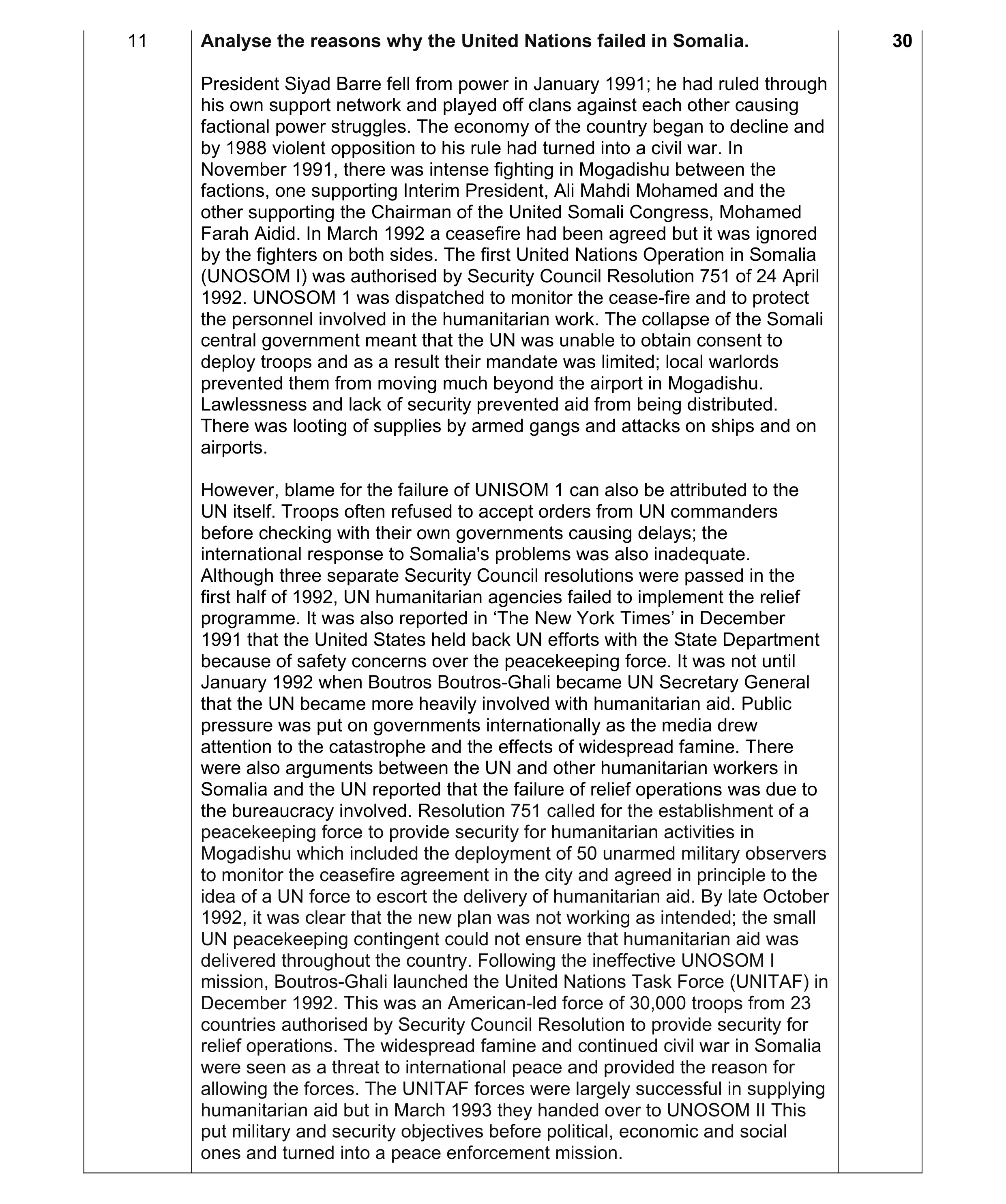 30
30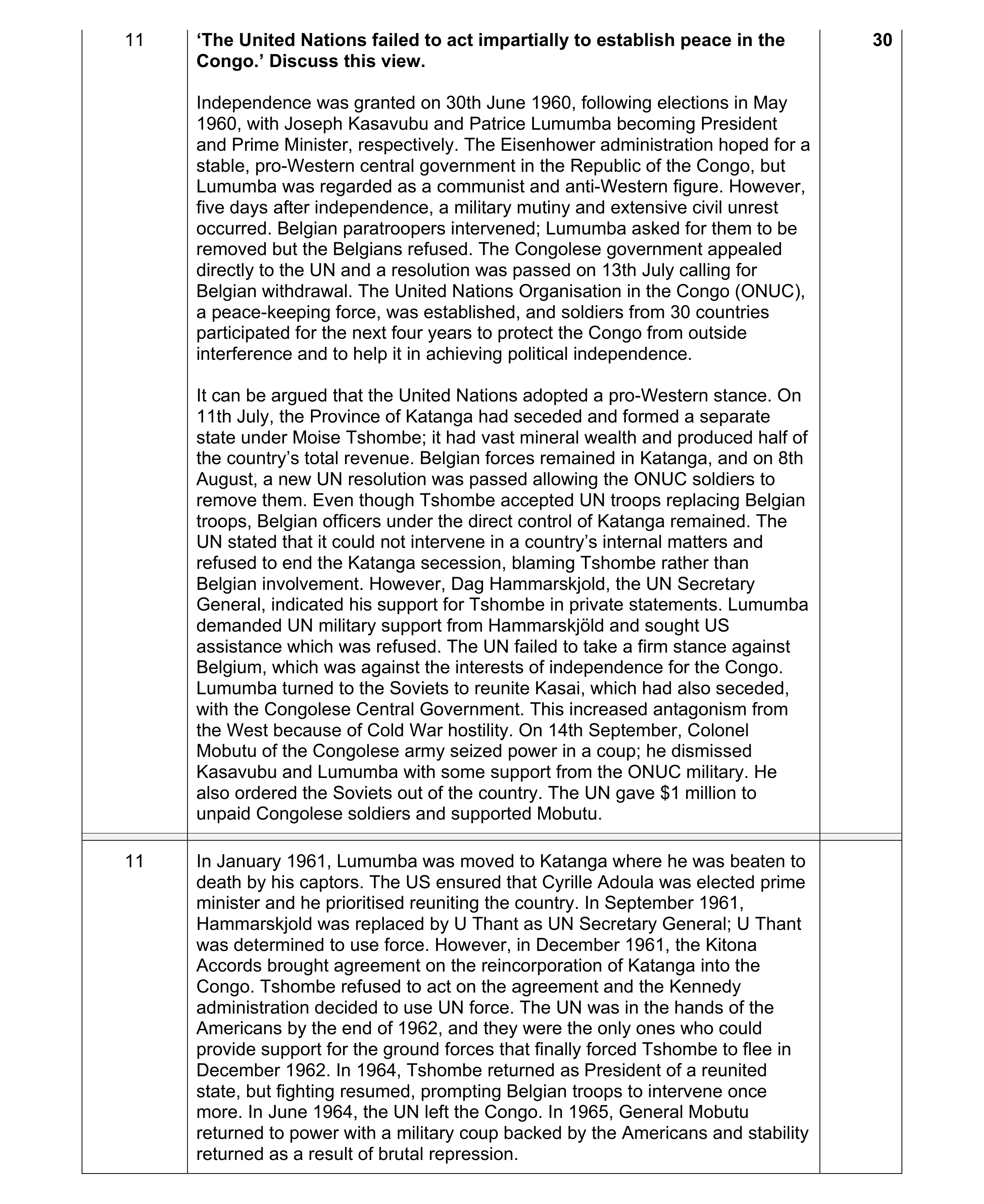 30
30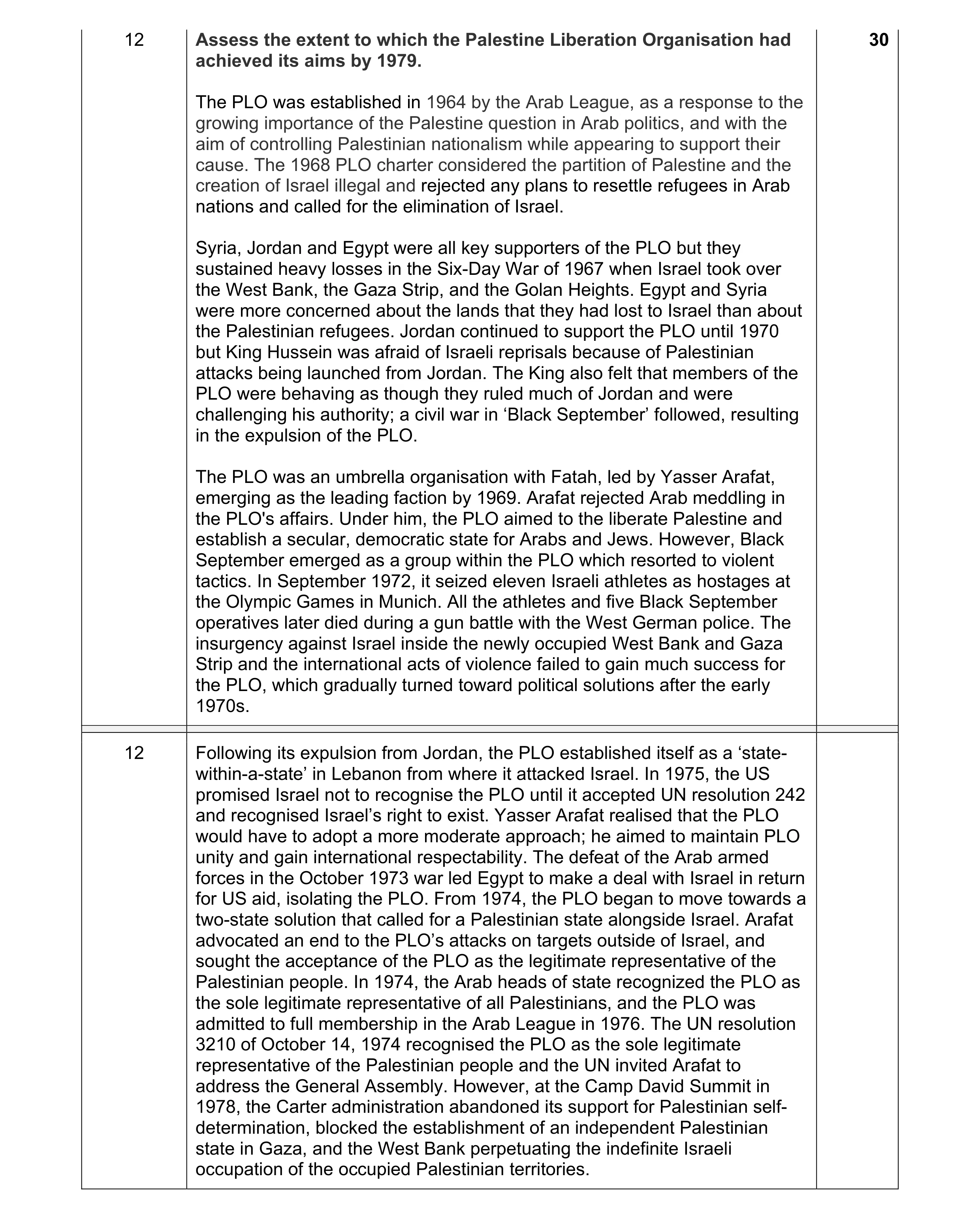 30
30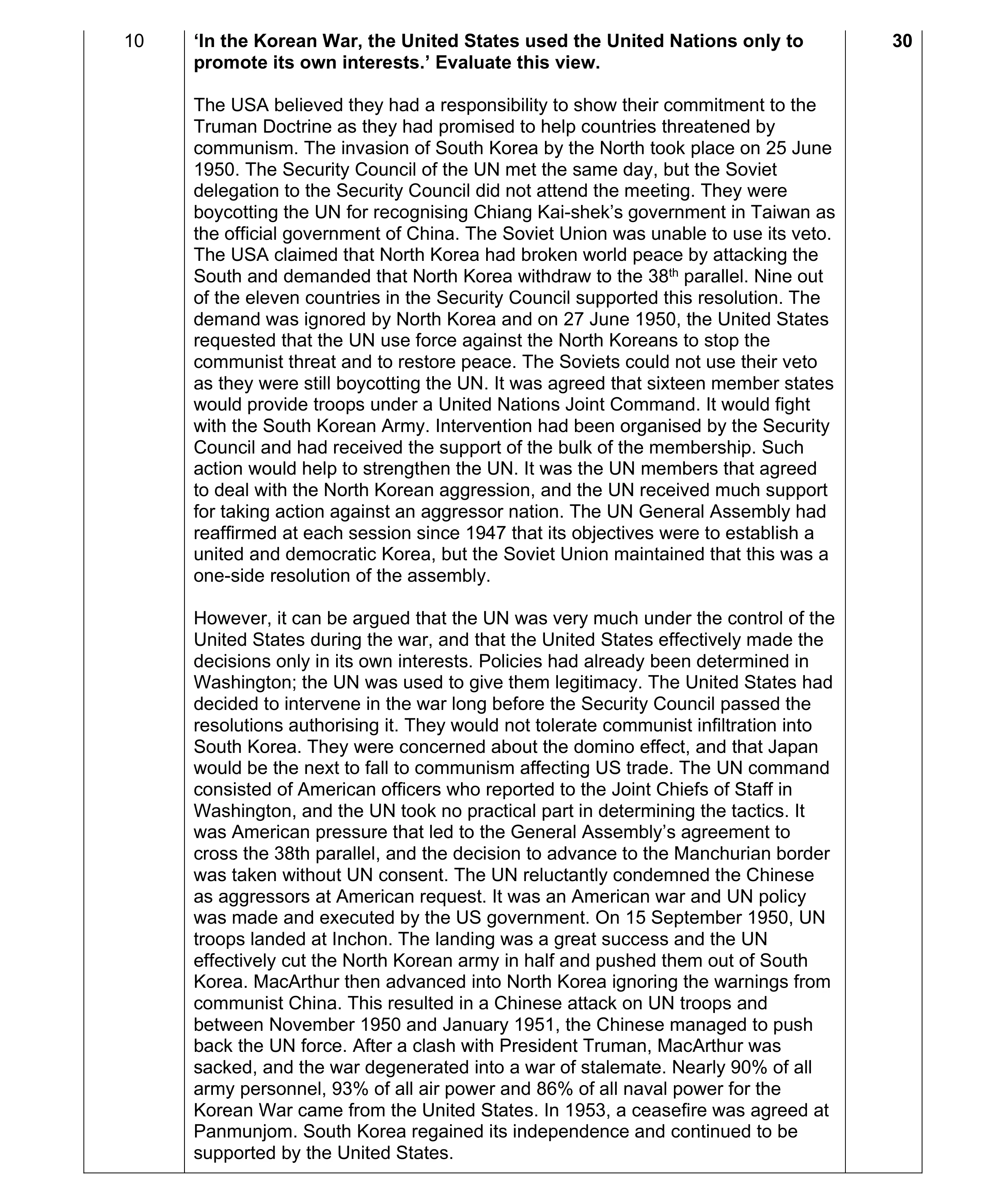 30
30 30
30 30
30 30
30 30
30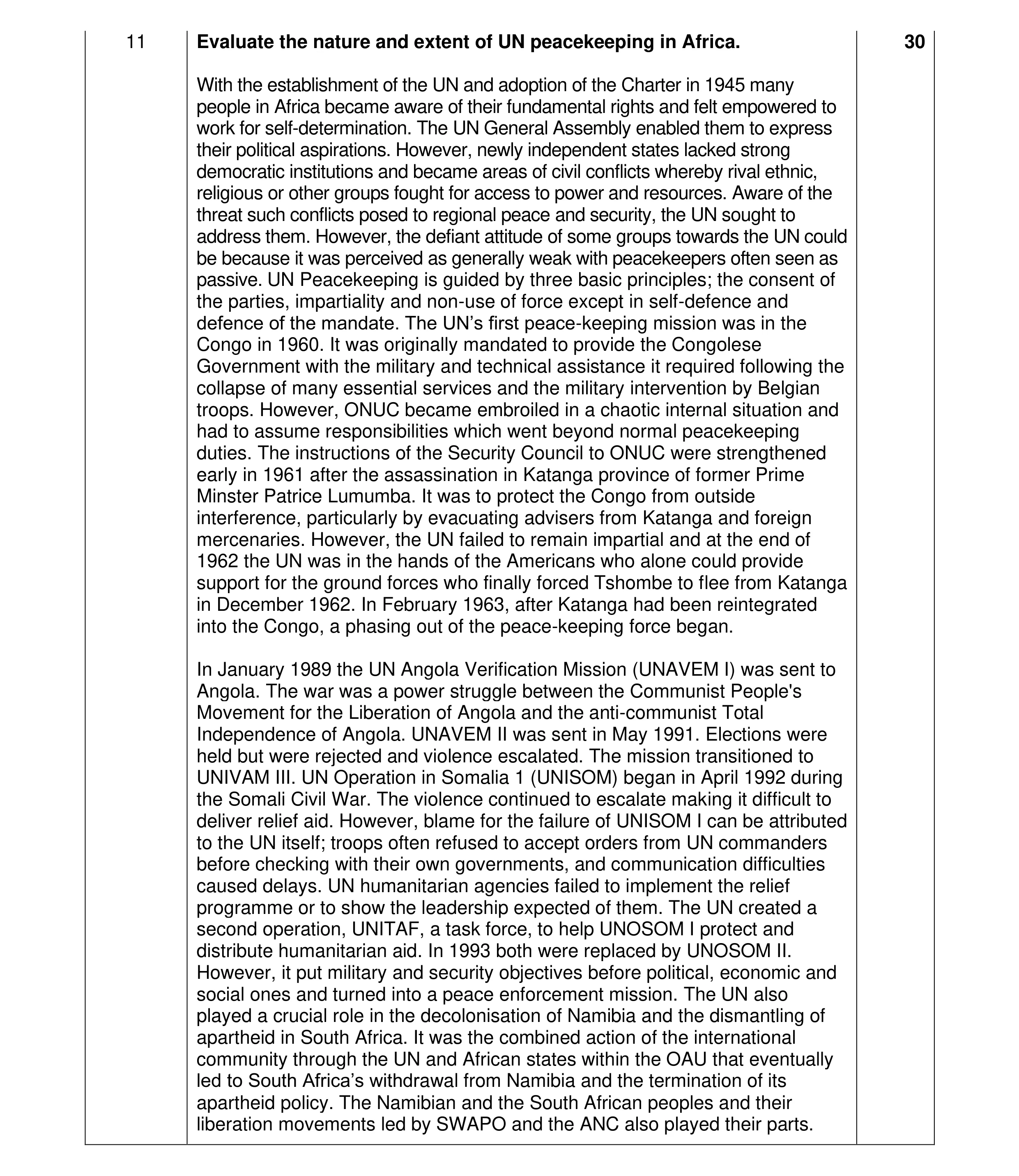 30
30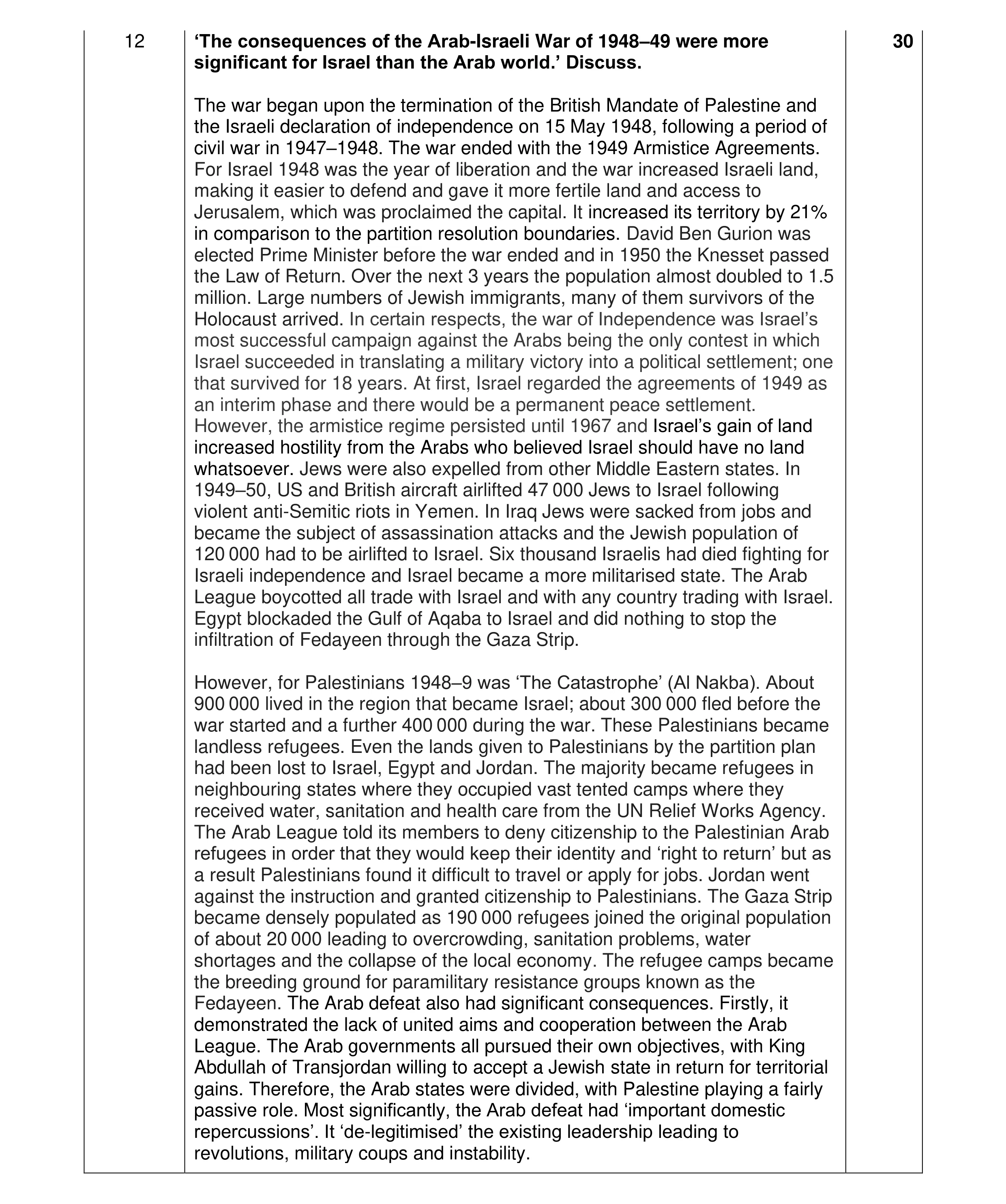 30
30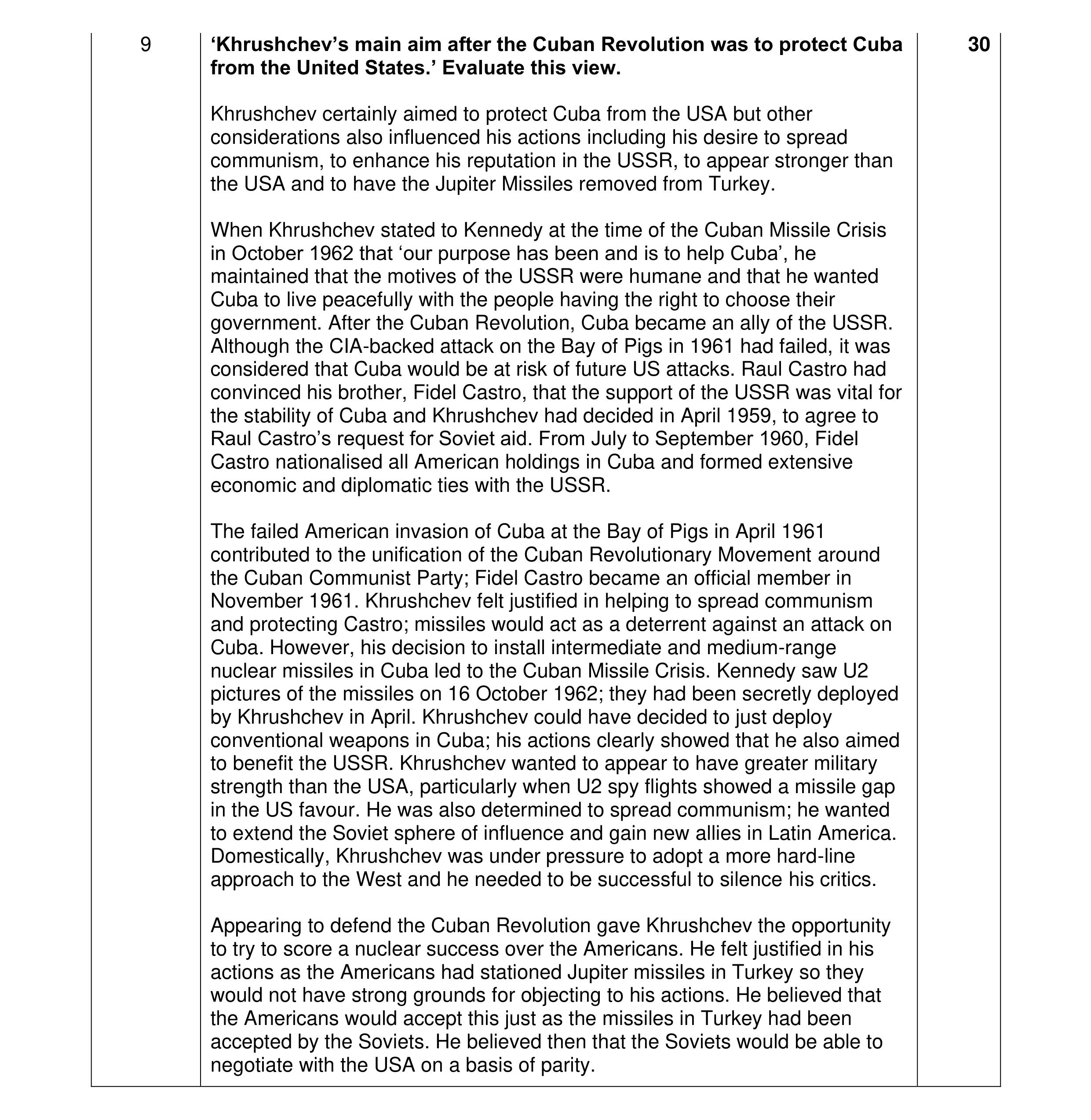 30
30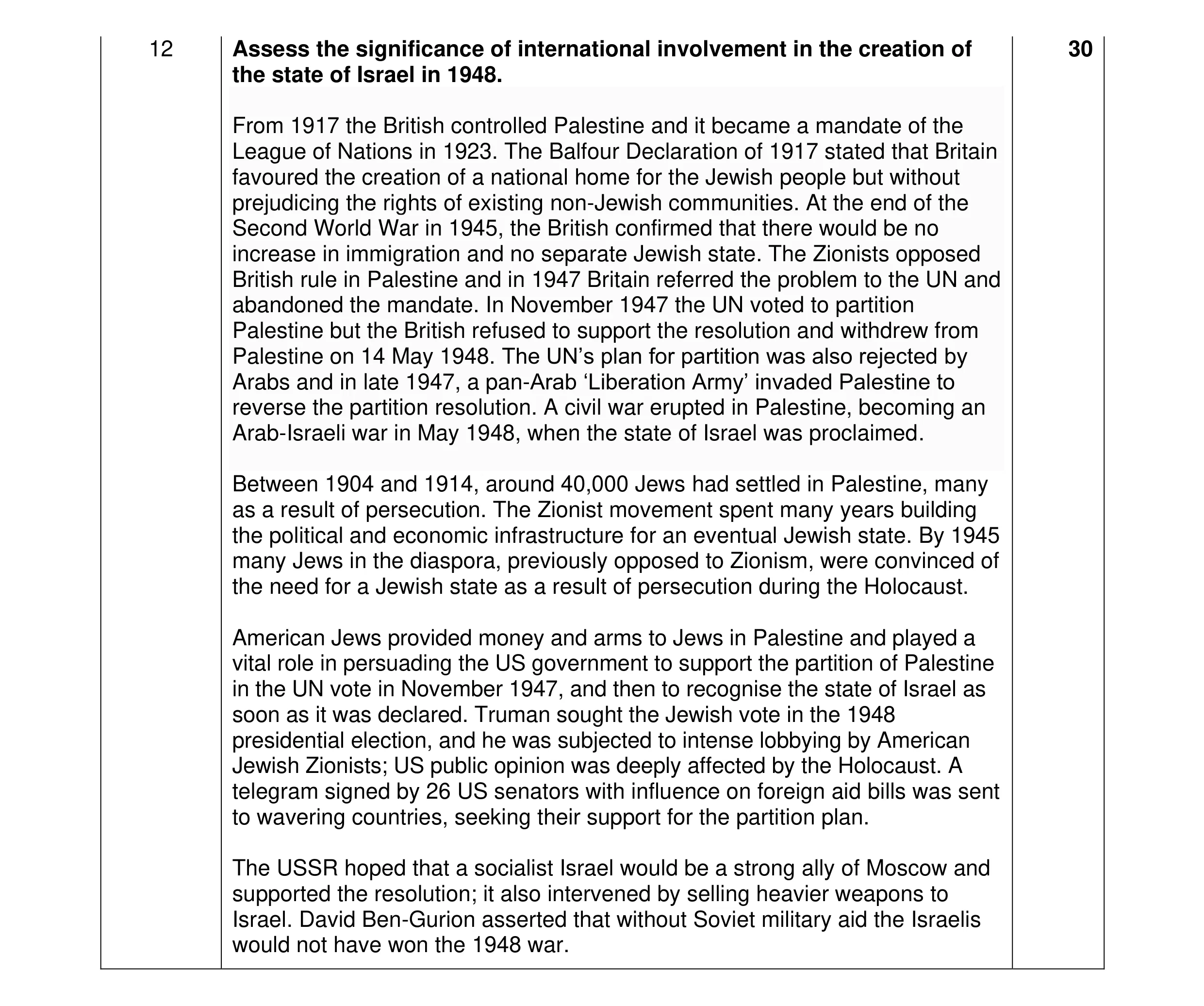 30
30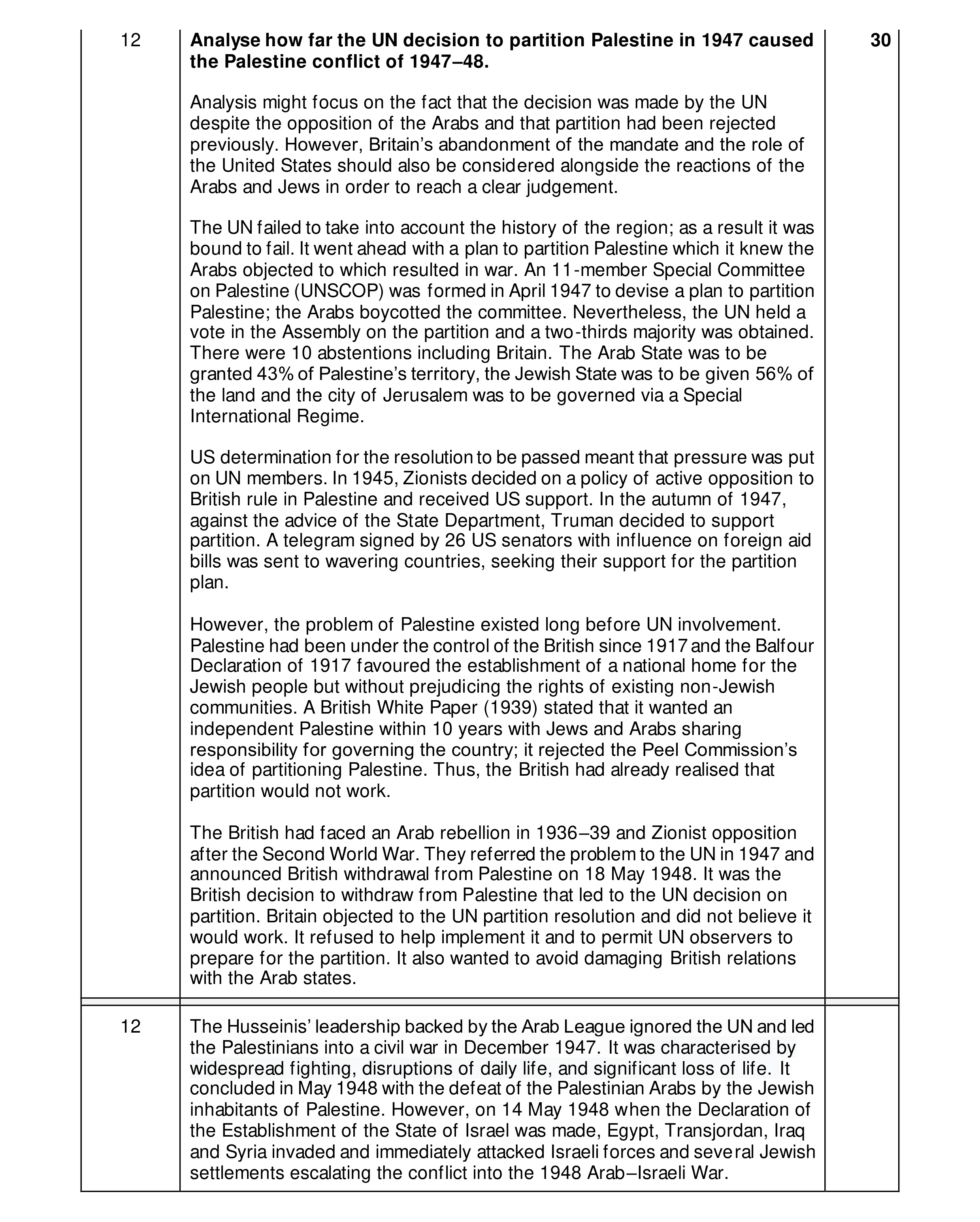 30
30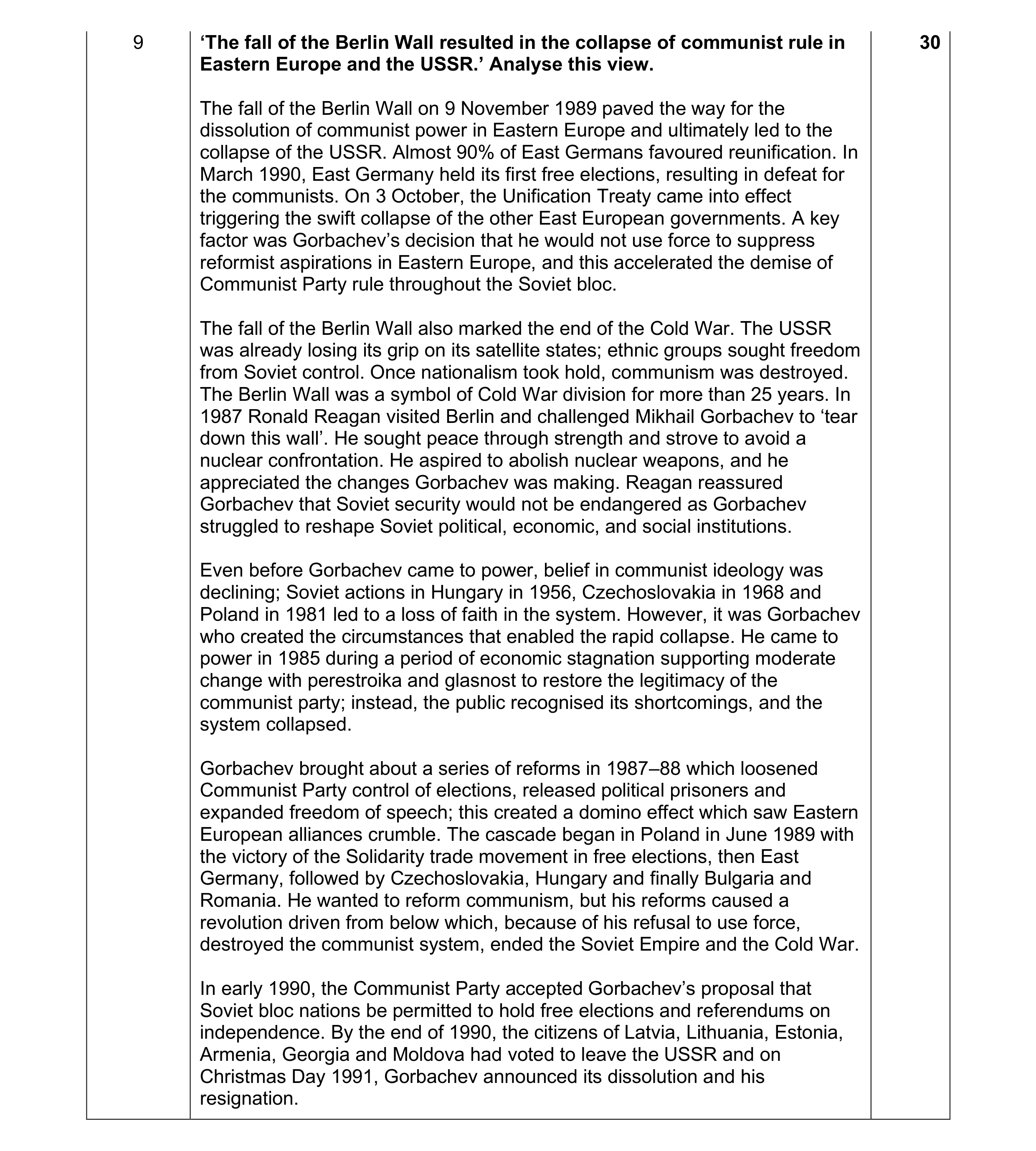 30
30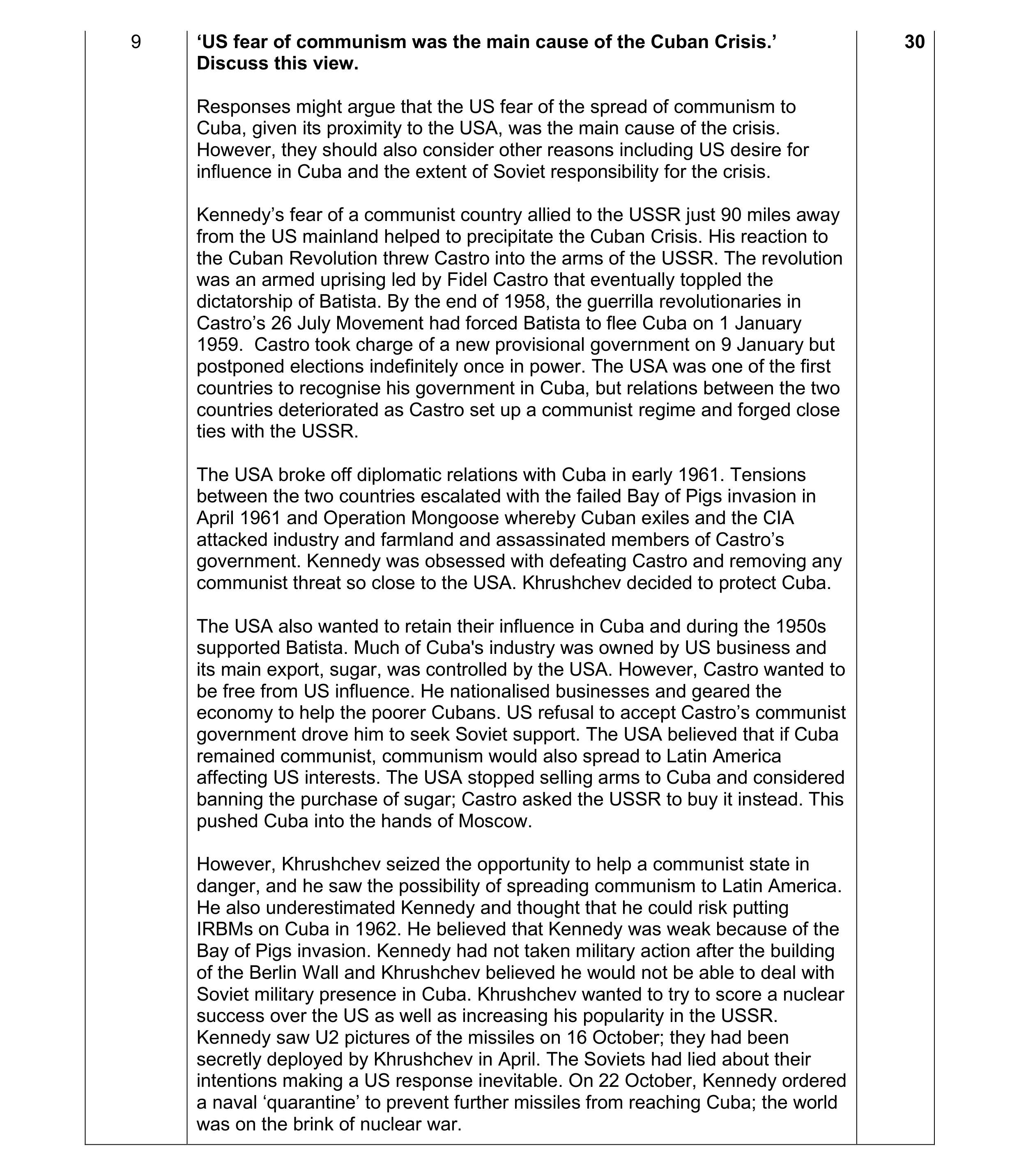 30
30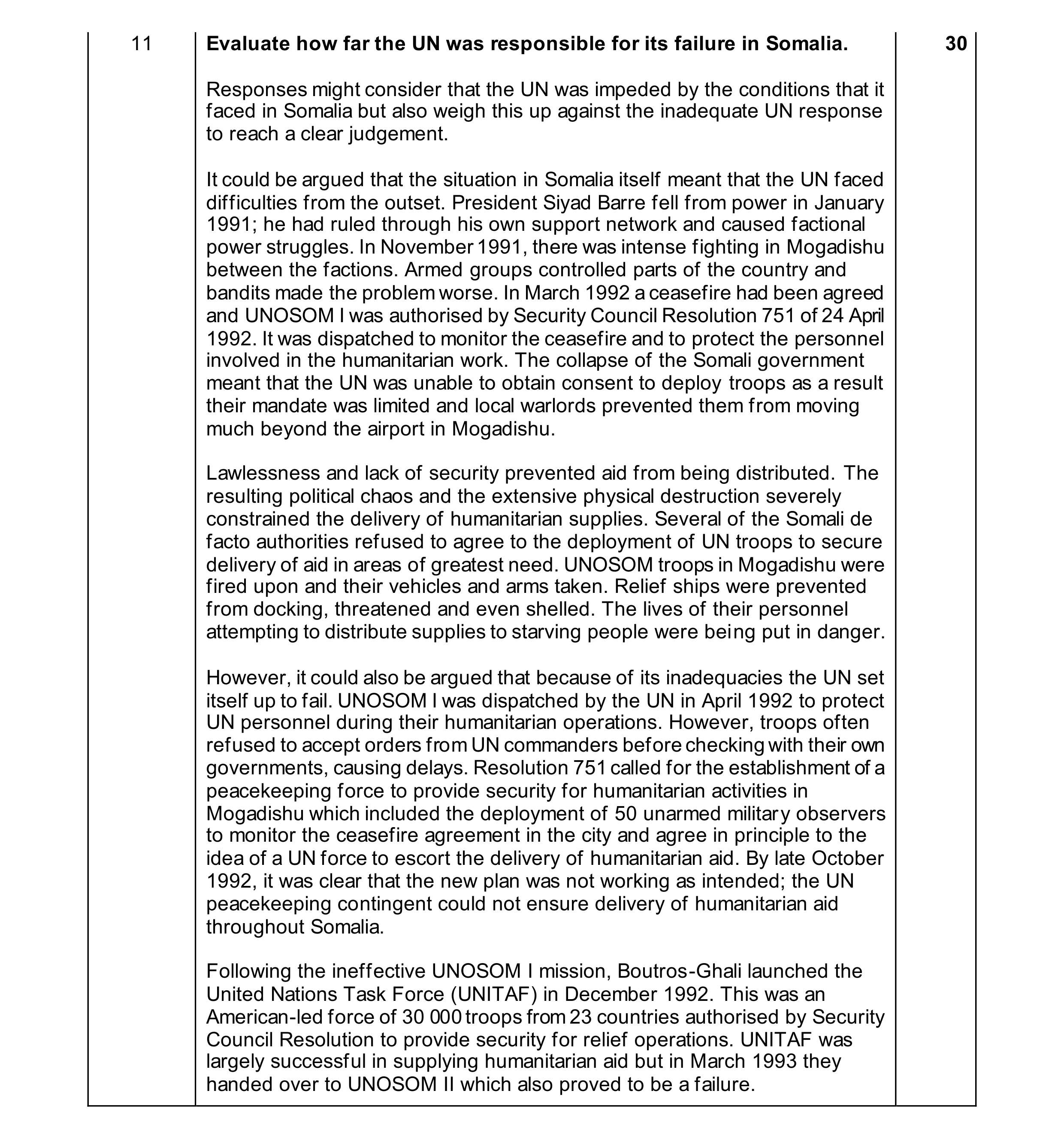 30
30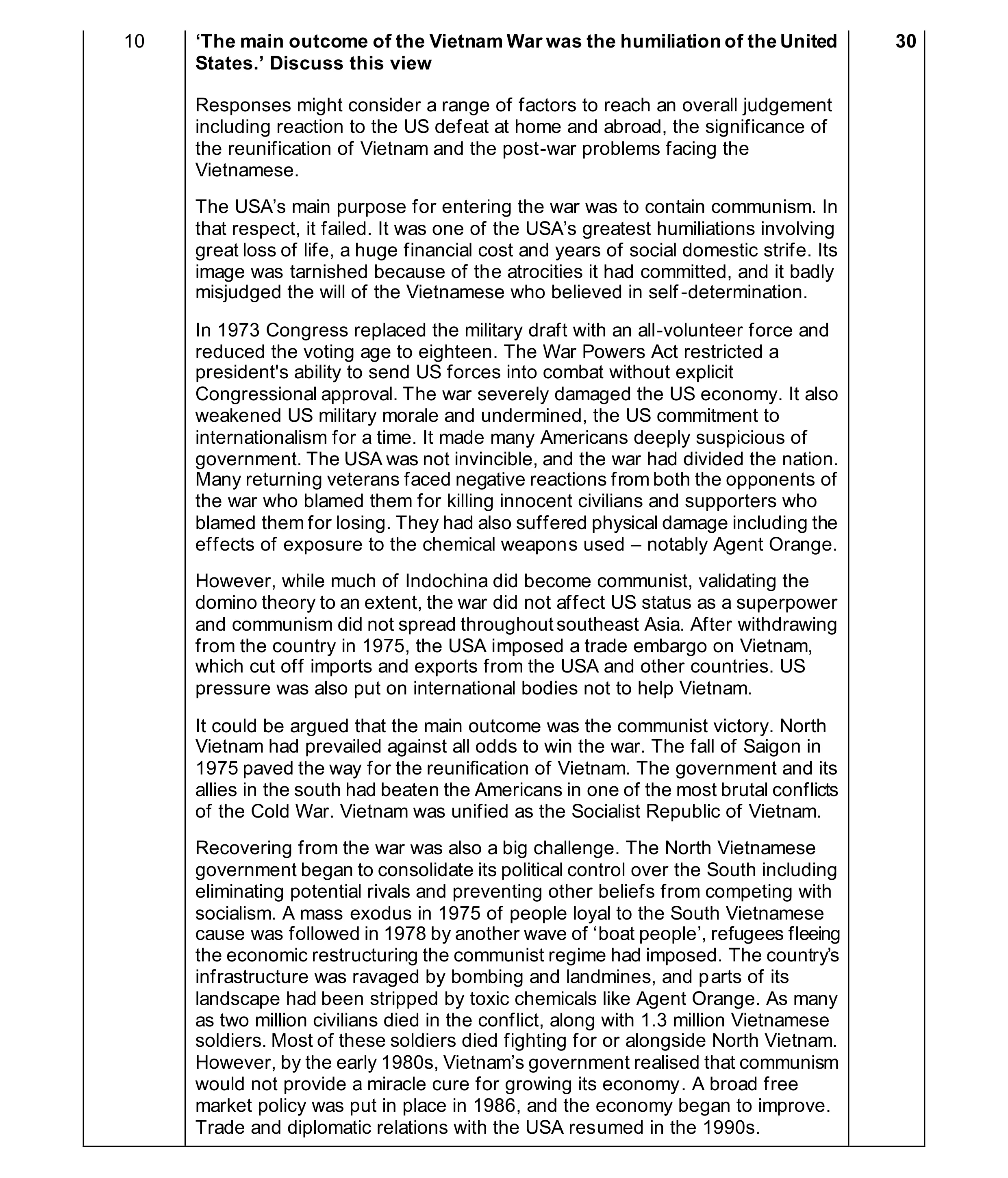 30
30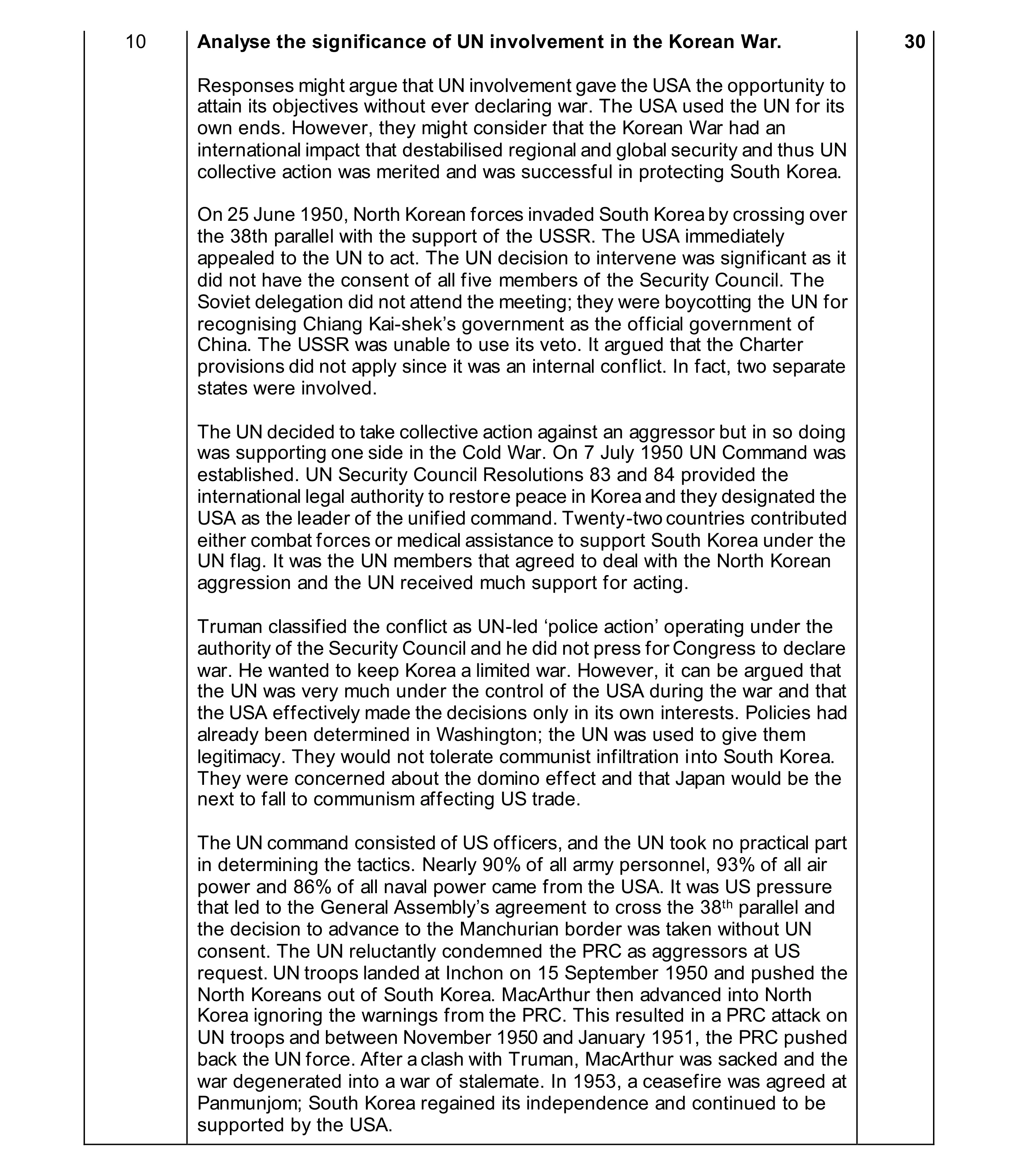 30
30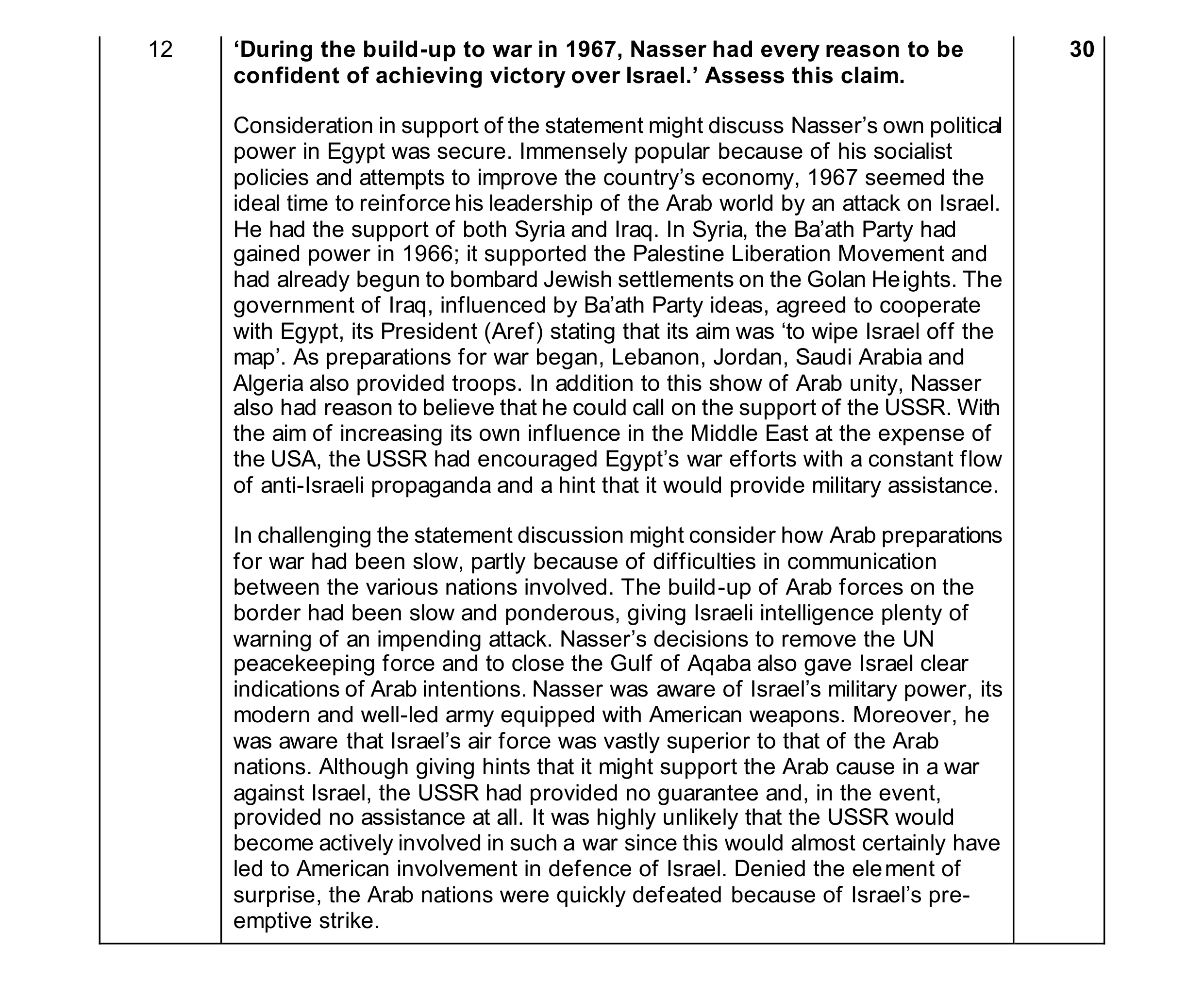 30
30