Questions as text
Q1 · Read the extract and then answer the question 9489/32 Feb/March 2021
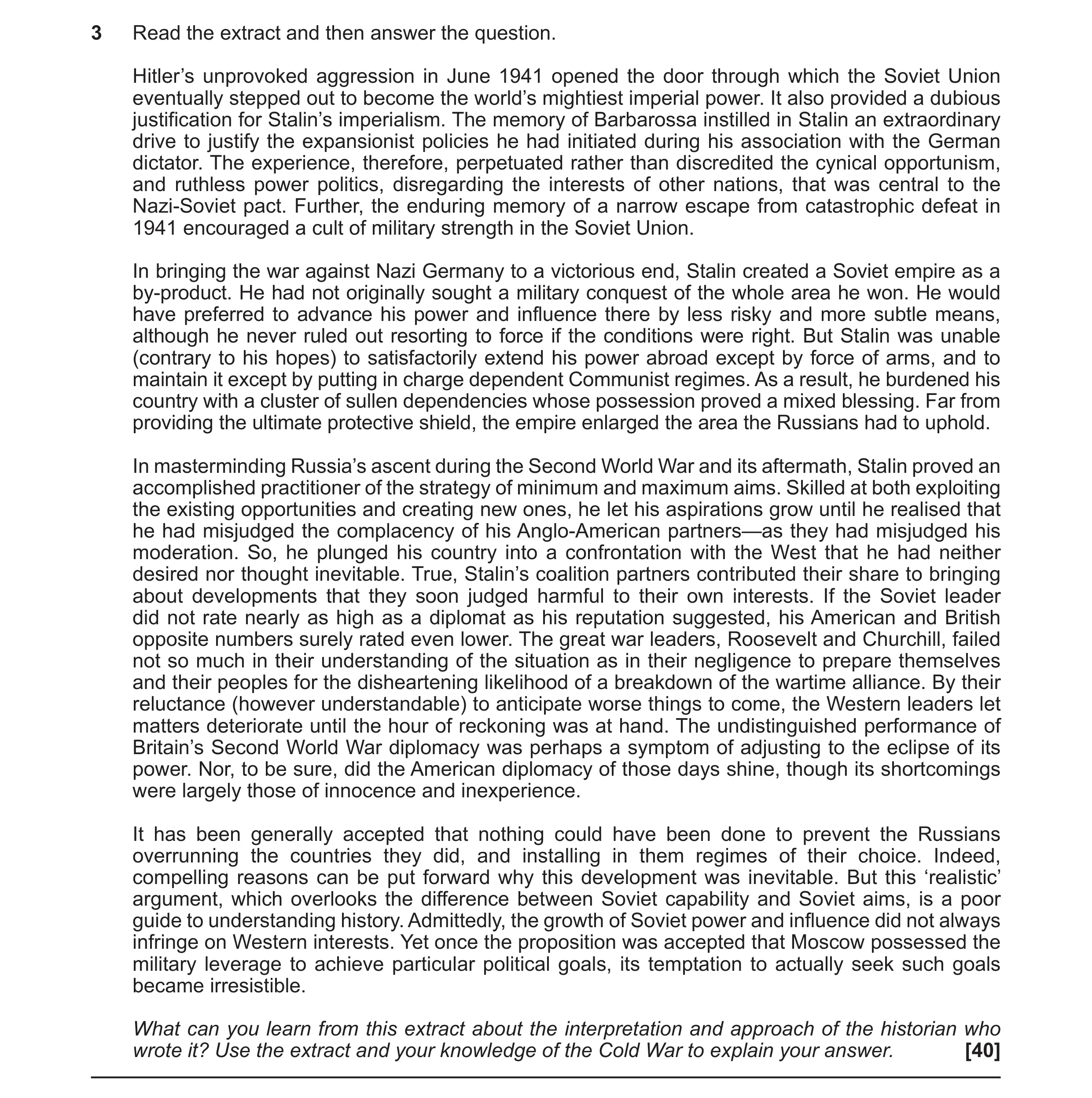
3 Read the extract and then answer the question. Hitler’s unprovoked aggression in June 1941 opened the door through which the Soviet Union eventually stepped out to become the world’s mightiest imperial power. It also provided a dubious justification for Stalin’s imperialism. The memory of Barbarossa instilled in Stalin an extraordinary drive to justify the expansionist policies he had initiated during his association with the German dictator. The experience, therefore, perpetuated rather than discredited the cynical opportunism, and ruthless power politics, disregarding the interests of other nations, that was central to the Nazi-Soviet pact. Further, the enduring memory of a narrow escape from catastrophic defeat in 1941 encouraged a cult of military strength in the Soviet Union. In bringing the war against Nazi Germany to a victorious end, Stalin created a Soviet empire as a by-product. He had not originally sought a military conquest of the whole area he won. He would have preferred to advance his power and influence there by less risky and more subtle means, although he never ruled out resorting to force if the conditions were right. But Stalin was unable (contrary to his hopes) to satisfactorily extend his power abroad except by force of arms, and to maintain it except by putting in charge dependent Communist regimes. As a result, he burdened his country with a cluster of sullen dependencies whose possession proved a mixed blessing. Far from providing the ultimate protective shield, the empire enlarged the area the Russians had to uphold. In masterminding Russia’s ascent during the Second World War and its aftermath, Stalin proved an accomplished practitioner of the strategy of minimum and maximum aims. Skilled at both exploiting the existing opportunities and creating new ones, he let his aspirations grow until he realised that he had misjudged the complacency of his Anglo-American partners—as they had misjudged his moderation. So, he plunged his country into a confrontation with the West that he had neither desired nor thought inevitable. True, Stalin’s coalition partners contributed their share to bringing about developments that they soon judged harmful to their own interests. If the Soviet leader did not rate nearly as high as a diplomat as his reputation suggested, his American and British opposite numbers surely rated even lower. The great war leaders, Roosevelt and Churchill, failed not so much in their understanding of the situation as in their negligence to prepare themselves and their peoples for the disheartening likelihood of a breakdown of the wartime alliance. By their reluctance (however understandable) to anticipate worse things to come, the Western leaders let matters deteriorate until the hour of reckoning was at hand. The undistinguished performance of Britain’s Second World War diplomacy was perhaps a symptom of adjusting to the eclipse of its power. Nor, to be sure, did the American diplomacy of those days shine, though its shortcomings were largely those of innocence and inexperience. It has been generally accepted that nothing could have been done to prevent the Russians overrunning the countries they did, and installing in them regimes of their choice. Indeed, compelling reasons can be put forward why this development was inevitable. But this ‘realistic’ argument, which overlooks the difference between Soviet capability and Soviet aims, is a poor guide to understanding history. Admittedly, the growth of Soviet power and influence did not always infringe on Western interests. Yet once the proposition was accepted that Moscow possessed the military leverage to achieve particular political goals, its temptation to actually seek such goals became irresistible. What can you learn from this extract about the interpretation and approach of the historian who wrote it? Use the extract and your knowledge of the Cold War to explain your answer. [40]
40 marks
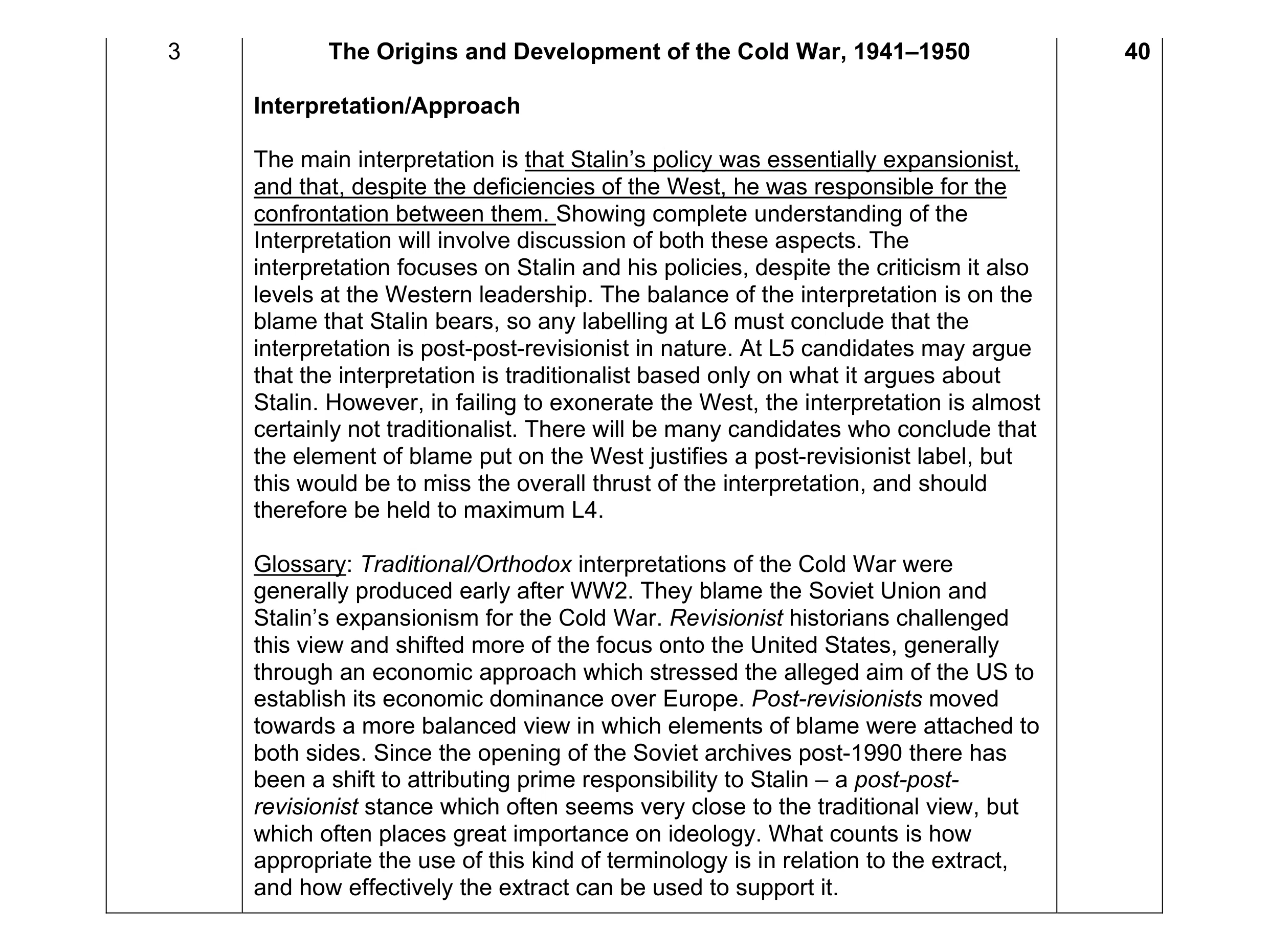
Mark scheme: 3 The Origins and Development of the Cold War, 1941–1950 40 Interpretation/Approach The main interpretation is that Stalin’s policy was essentially expansionist, and that, despite the deficiencies of the West, he was responsible for the confrontation between them. Showing complete understanding of the Interpretation will involve discussion of both these aspects. The interpretation focuses on Stalin and his policies, despite the criticism it also levels at the Western leadership. The balance of the interpretation is on the blame that Stalin bears, so any labelling at L6 must conclude that the interpretation is post-post-revisionist in nature. At L5 candidates may argue that the interpretation is traditionalist based only on what it argues about Stalin. However, in failing to exonerate the West, the interpretation is almost certainly not traditionalist. There will be many candidates who conclude that the element of blame put on the West justifies a post-revisionist label, but this would be to miss the overall thrust of the interpretation, and should therefore be held to maximum L4. Glossary: Traditional/Orthodox interpretations of the Cold War were generally produced early after WW2. They blame the Soviet Union and Stalin’s expansionism for the Cold War. Revisionist historians challenged this view and shifted more of the focus onto the United States, generally through an economic approach which stressed the alleged aim of the US to establish its economic dominance over Europe. Post-revisionists moved towards a more balanced view in which elements of blame were attached to both sides. Since the opening of the Soviet archives post-1990 there has been a shift to attributing prime responsibility to Stalin – a post-post- revisionist stance which often seems very close to the traditional view, but which often places great importance on ideology. What counts is how appropriate the use of this kind of terminology is in relation to the extract, and how effectively the extract can be used to support it.
This question in 9489/32 Feb/March 2021
Q2 · Read the extract and then answer the question 9489/32 Oct/Nov 2021
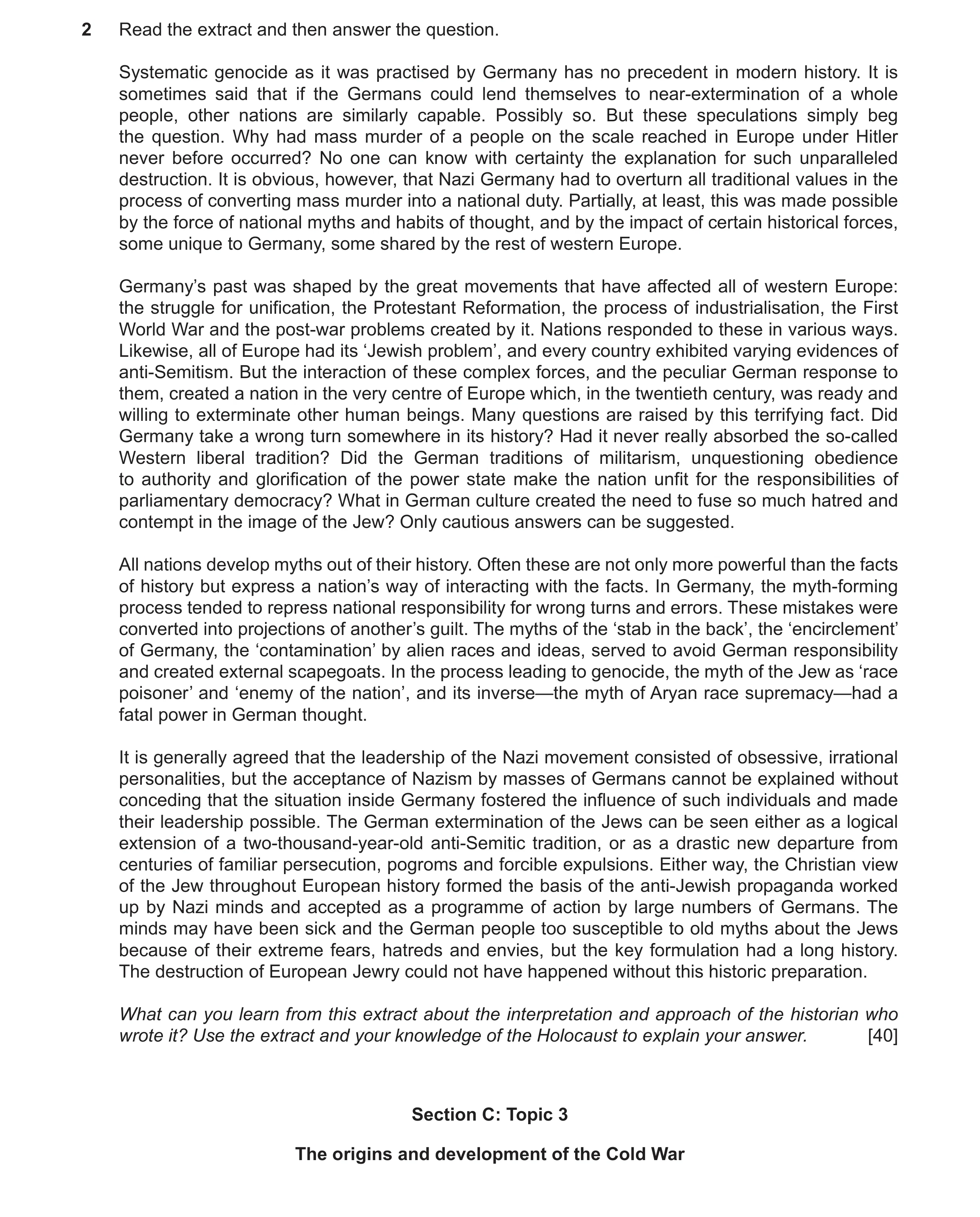
2 Read the extract and then answer the question. Systematic genocide as it was practised by Germany has no precedent in modern history. It is sometimes said that if the Germans could lend themselves to near-extermination of a whole people, other nations are similarly capable. Possibly so. But these speculations simply beg the question. Why had mass murder of a people on the scale reached in Europe under Hitler never before occurred? No one can know with certainty the explanation for such unparalleled destruction. It is obvious, however, that Nazi Germany had to overturn all traditional values in the process of converting mass murder into a national duty. Partially, at least, this was made possible by the force of national myths and habits of thought, and by the impact of certain historical forces, some unique to Germany, some shared by the rest of western Europe. Germany’s past was shaped by the great movements that have affected all of western Europe: the struggle for unification, the Protestant Reformation, the process of industrialisation, the First World War and the post-war problems created by it. Nations responded to these in various ways. Likewise, all of Europe had its ‘Jewish problem’, and every country exhibited varying evidences of anti-Semitism. But the interaction of these complex forces, and the peculiar German response to them, created a nation in the very centre of Europe which, in the twentieth century, was ready and willing to exterminate other human beings. Many questions are raised by this terrifying fact. Did Germany take a wrong turn somewhere in its history? Had it never really absorbed the so-called Western liberal tradition? Did the German traditions of militarism, unquestioning obedience to authority and glorification of the power state make the nation unfit for the responsibilities of parliamentary democracy? What in German culture created the need to fuse so much hatred and contempt in the image of the Jew? Only cautious answers can be suggested. All nations develop myths out of their history. Often these are not only more powerful than the facts of history but express a nation’s way of interacting with the facts. In Germany, the myth-forming process tended to repress national responsibility for wrong turns and errors. These mistakes were converted into projections of another’s guilt. The myths of the ‘stab in the back’, the ‘encirclement’ of Germany, the ‘contamination’ by alien races and ideas, served to avoid German responsibility and created external scapegoats. In the process leading to genocide, the myth of the Jew as ‘race poisoner’ and ‘enemy of the nation’, and its inverse—the myth of Aryan race supremacy—had a fatal power in German thought. It is generally agreed that the leadership of the Nazi movement consisted of obsessive, irrational personalities, but the acceptance of Nazism by masses of Germans cannot be explained without conceding that the situation inside Germany fostered the influence of such individuals and made their leadership possible. The German extermination of the Jews can be seen either as a logical extension of a two-thousand-year-old anti-Semitic tradition, or as a drastic new departure from centuries of familiar persecution, pogroms and forcible expulsions. Either way, the Christian view of the Jew throughout European history formed the basis of the anti-Jewish propaganda worked up by Nazi minds and accepted as a programme of action by large numbers of Germans. The minds may have been sick and the German people too susceptible to old myths about the Jews because of their extreme fears, hatreds and envies, but the key formulation had a long history. The destruction of European Jewry could not have happened without this historic preparation. What can you learn from this extract about the interpretation and approach of the historian who wrote it? Use the extract and your knowledge of the Holocaust to explain your answer. [40] Section C: Topic 3 The origins and development of the Cold War
40 marks
Mark scheme: 2 The Holocaust 40 Interpretation/Approach The main interpretation is that the background of German culture and history made Germany uniquely susceptible to extreme anti-Semitism, but that the Holocaust still could not have occurred without the broader context of historic European hatred of the Jews. Showing complete understanding of the interpretation will involve discussion of both these aspects. The extract argues for the Sonderweg idea – that the coming to power of the Nazis was consistent with previous developments in German history and, in particular, that there was a unique extremism in German anti-Semitism. Nonetheless, the interpretation still seeks to establish the importance of the historic Christian hatred of Jews as a precondition of the Holocaust. Attempts to fit the usual ‘labels’ to this extract will be unsuccessful, and will be evidence of lack of understanding, holding answers down to L3 maximum. Glossary: Candidates may use some/all of the following terms: Intentionalism – interpretations which assume that Hitler/the Nazis planned to exterminate the Jews from the start. Structuralism - interpretations which argue that it was the nature of the Nazi state that produced genocide. There was no coherent plan but the chaotic competition for Hitler’s approval between different elements of the leadership produced a situation in which genocide could occur. Functionalism sees the Holocaust as an unplanned, ad hoc response to wartime developments in Eastern Europe, when Germany conquered areas with large Jewish populations. Candidates may also refer to synthesis interpretations, i.e. interpretations which show characteristics of more than one of the above. What counts is how appropriate the use of this kind of terminology is in relation to the extract, and how effectively the extract can be used to support it.
This question in 9489/32 Oct/Nov 2021
Q3 · Read the extract and then answer the question 9489/31 May/June 2022
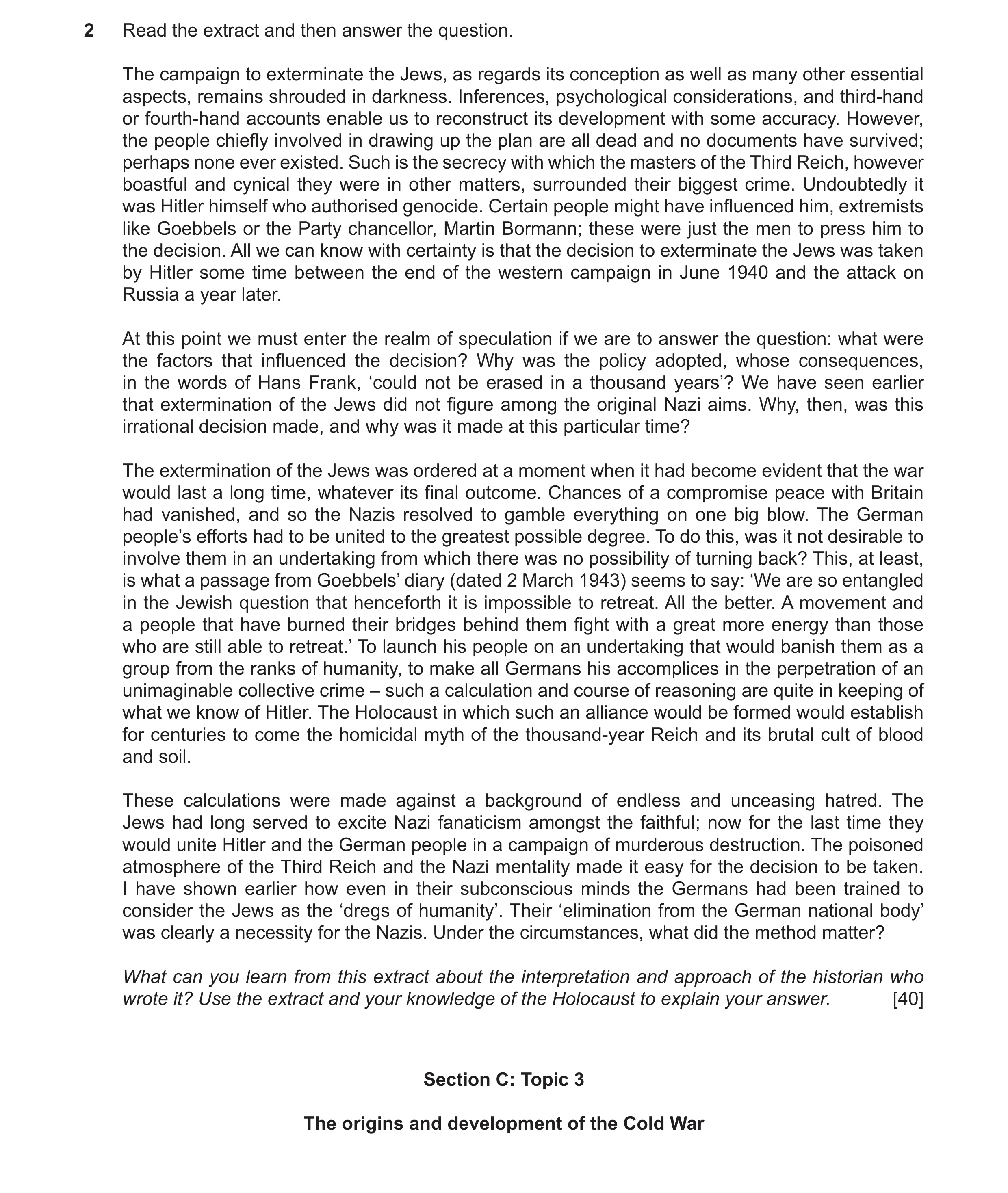
2 Read the extract and then answer the question. The campaign to exterminate the Jews, as regards its conception as well as many other essential aspects, remains shrouded in darkness. Inferences, psychological considerations, and third-hand or fourth-hand accounts enable us to reconstruct its development with some accuracy. However, the people chiefly involved in drawing up the plan are all dead and no documents have survived; perhaps none ever existed. Such is the secrecy with which the masters of the Third Reich, however boastful and cynical they were in other matters, surrounded their biggest crime. Undoubtedly it was Hitler himself who authorised genocide. Certain people might have influenced him, extremists like Goebbels or the Party chancellor, Martin Bormann; these were just the men to press him to the decision. All we can know with certainty is that the decision to exterminate the Jews was taken by Hitler some time between the end of the western campaign in June 1940 and the attack on Russia a year later. At this point we must enter the realm of speculation if we are to answer the question: what were the factors that influenced the decision? Why was the policy adopted, whose consequences, in the words of Hans Frank, ‘could not be erased in a thousand years’? We have seen earlier that extermination of the Jews did not figure among the original Nazi aims. Why, then, was this irrational decision made, and why was it made at this particular time? The extermination of the Jews was ordered at a moment when it had become evident that the war would last a long time, whatever its final outcome. Chances of a compromise peace with Britain had vanished, and so the Nazis resolved to gamble everything on one big blow. The German people’s efforts had to be united to the greatest possible degree. To do this, was it not desirable to involve them in an undertaking from which there was no possibility of turning back? This, at least, is what a passage from Goebbels’ diary (dated 2 March 1943) seems to say: ‘We are so entangled in the Jewish question that henceforth it is impossible to retreat. All the better. A movement and a people that have burned their bridges behind them fight with a great more energy than those who are still able to retreat.’ To launch his people on an undertaking that would banish them as a group from the ranks of humanity, to make all Germans his accomplices in the perpetration of an unimaginable collective crime – such a calculation and course of reasoning are quite in keeping of what we know of Hitler. The Holocaust in which such an alliance would be formed would establish for centuries to come the homicidal myth of the thousand-year Reich and its brutal cult of blood and soil. These calculations were made against a background of endless and unceasing hatred. The Jews had long served to excite Nazi fanaticism amongst the faithful; now for the last time they would unite Hitler and the German people in a campaign of murderous destruction. The poisoned atmosphere of the Third Reich and the Nazi mentality made it easy for the decision to be taken. I have shown earlier how even in their subconscious minds the Germans had been trained to consider the Jews as the ‘dregs of humanity’. Their ‘elimination from the German national body’ was clearly a necessity for the Nazis. Under the circumstances, what did the method matter? What can you learn from this extract about the interpretation and approach of the historian who wrote it? Use the extract and your knowledge of the Holocaust to explain your answer. [40] Section C: Topic 3 The origins and development of the Cold War
40 marks
Mark scheme: 2 The Holocaust 40 Interpretation/Approach The Key Question to be addressed is ‘Why did the Holocaust occur?’ The main interpretation is that there was no original intention to exterminate the Jews, but that under the circumstances of war Hitler took the decision as a means of implicating the entire German people in the crime (the idea of ‘implicating’ is essential – not just uniting the German people in the war effort). Showing complete understanding of the Interpretation will involve discussion of both these aspects. The historian’s argument is that once it became apparent that the war would not be over quickly, Hitler took the opportunity to mobilise the German nation by authorising genocide. This clearly cannot be seen as intentionalist, since it argues that the decision for genocide was brought about by a particular set of circumstances. The only label that can work effectively at L5/L6 is therefore functionalism. Arguments for a synthesis which explain the functionalism of one/both elements of the main interpretation will be L4. Opting for intentionalism or structuralism alone would be ignoring too much and could not be better than L3. Glossary: Candidates may use some/all of the following terms: Intentionalism – interpretations which assume that Hitler/the Nazis planned to exterminate the Jews from the start. Structuralism - interpretations which argue that it was the nature of the Nazi state that produced genocide. There was no coherent plan but the chaotic competition for Hitler’s approval between different elements of the leadership produced a situation in which genocide could occur. Functionalism sees the Holocaust as an unplanned, ad hoc response to wartime developments in Eastern Europe, when Germany conquered areas with large Jewish populations. Candidates may also refer to synthesis interpretations, i.e., interpretations which show characteristics of more than one of the above. What counts is how appropriate the use of this kind of terminology is in relation to the extract, and how effectively the extract can be used to support it.
This question in 9489/31 May/June 2022
Q4 · Read the extract and then answer the question 9489/31 May/June 2022
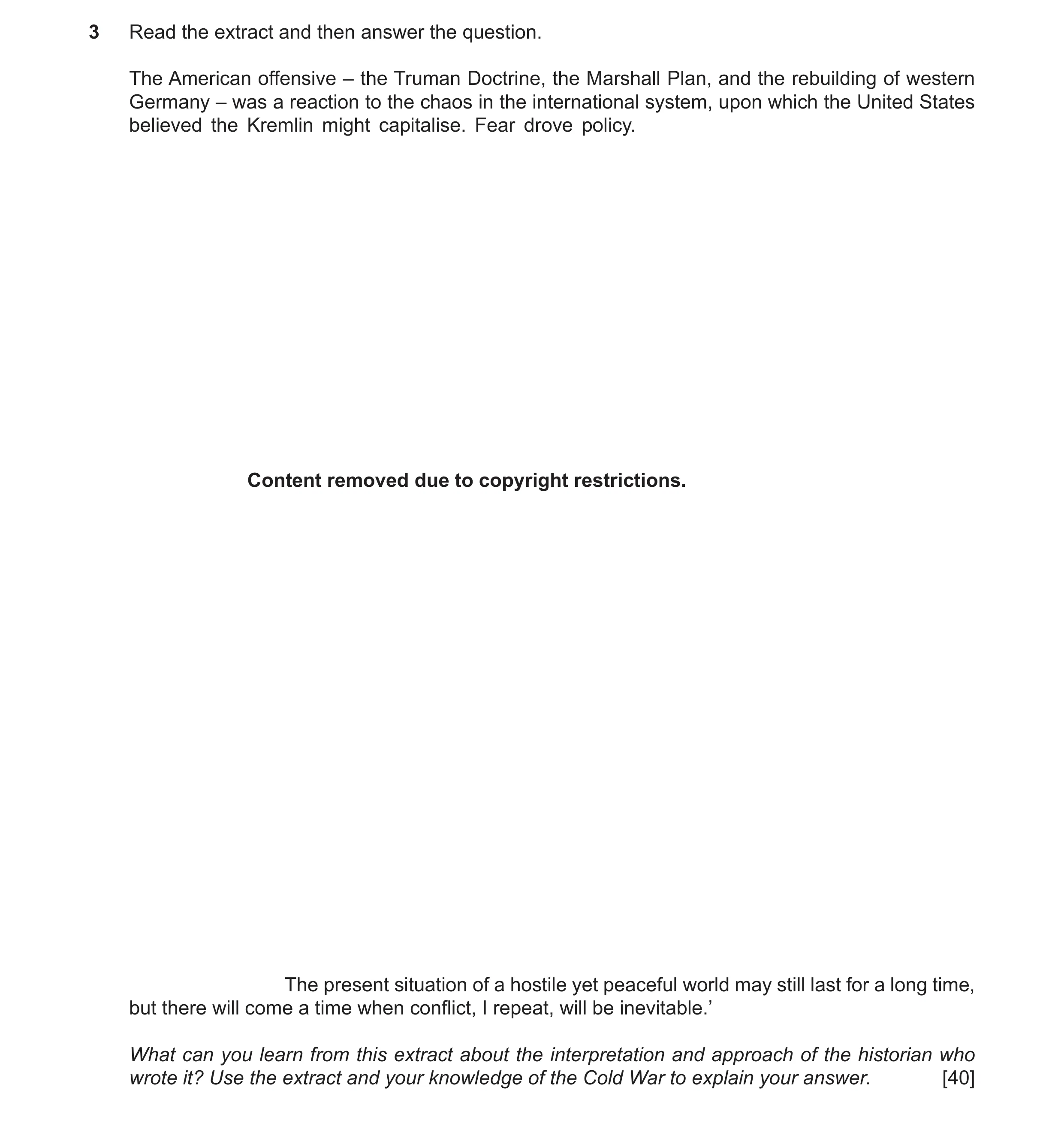
3 Read the extract and then answer the question. The American offensive – the Truman Doctrine, the Marshall Plan, and the rebuilding of western Germany – was a reaction to the chaos in the international system, upon which the United States believed the Kremlin might capitalise. Fear drove policy. Content removed due to copyright restrictions. The present situation of a hostile yet peaceful world may still last for a long time, but there will come a time when conflict, I repeat, will be inevitable.’ What can you learn from this extract about the interpretation and approach of the historian who wrote it? Use the extract and your knowledge of the Cold War to explain your answer. [40]
40 marks
Mark scheme: 3 The Origins and Development of the Cold War 40 Interpretation/Approach The Key Question to be addressed is ‘Who (or what) was to blame for the Cold War?’ The main interpretation is that American policy deliberately risked the breakdown of relations with the Soviets, but that Stalin’s reaction, whilst understandable, was an over-reaction. Showing complete understanding of the Interpretation will involve discussion of both these aspects. There is an element of blame that is placed on both sides, though the interpretation makes it clear that the Americans initiated the process. By implication, this puts a greater share of blame on them. However, this is not a typical revisionist interpretation that would exonerate Stalin. Rather it would be more plausible to see this as a post-revisionist who allocates some blame to both sides. This is the only label that will be able to reach L6, though the answer must address more to blame/less to blame. A revisionist argument, based on the first element of the interpretation, would be acceptable at L5. Arguing that both sides were to blame (i.e. post-revisionist), but missing the comparative dimension, would be L4. Seeing Stalin as taking most blame, or being only to blame, will be misunderstanding and be worth L3 at best. There will be many answers that argue both sides were to blame (i.e., post- revisionist) but lack proper support from the extract OR reach unsupportable conclusions based on inevitability, mutual misunderstanding, nobody to blame etc. These will be L3 if they show some use of the extract. Glossary: Traditional/Orthodox interpretations of the Cold War were generally produced early after the Second World War. They blame the Soviet Union and Stalin’s expansionism for the Cold War. Revisionist historians challenged this view and shifted more of the focus onto the United States, generally through an economic approach which stressed the alleged aim of the US to establish its economic dominance over Europe. Post- revisionists moved towards a more balanced view in which elements of blame were attached to both sides. Since the opening of the Soviet archives post-1990 there has been a shift to attributing prime responsibility to Stalin – a post-post-revisionist stance which often seems very close to the traditional view, but which often places great importance on ideology. What counts is how appropriate the use of this kind of terminology is in relation to the extract, and how effectively the extract can be used to support it.
This question in 9489/31 May/June 2022
Q5 · Read the extract and then answer the question 9489/33 Oct/Nov 2022
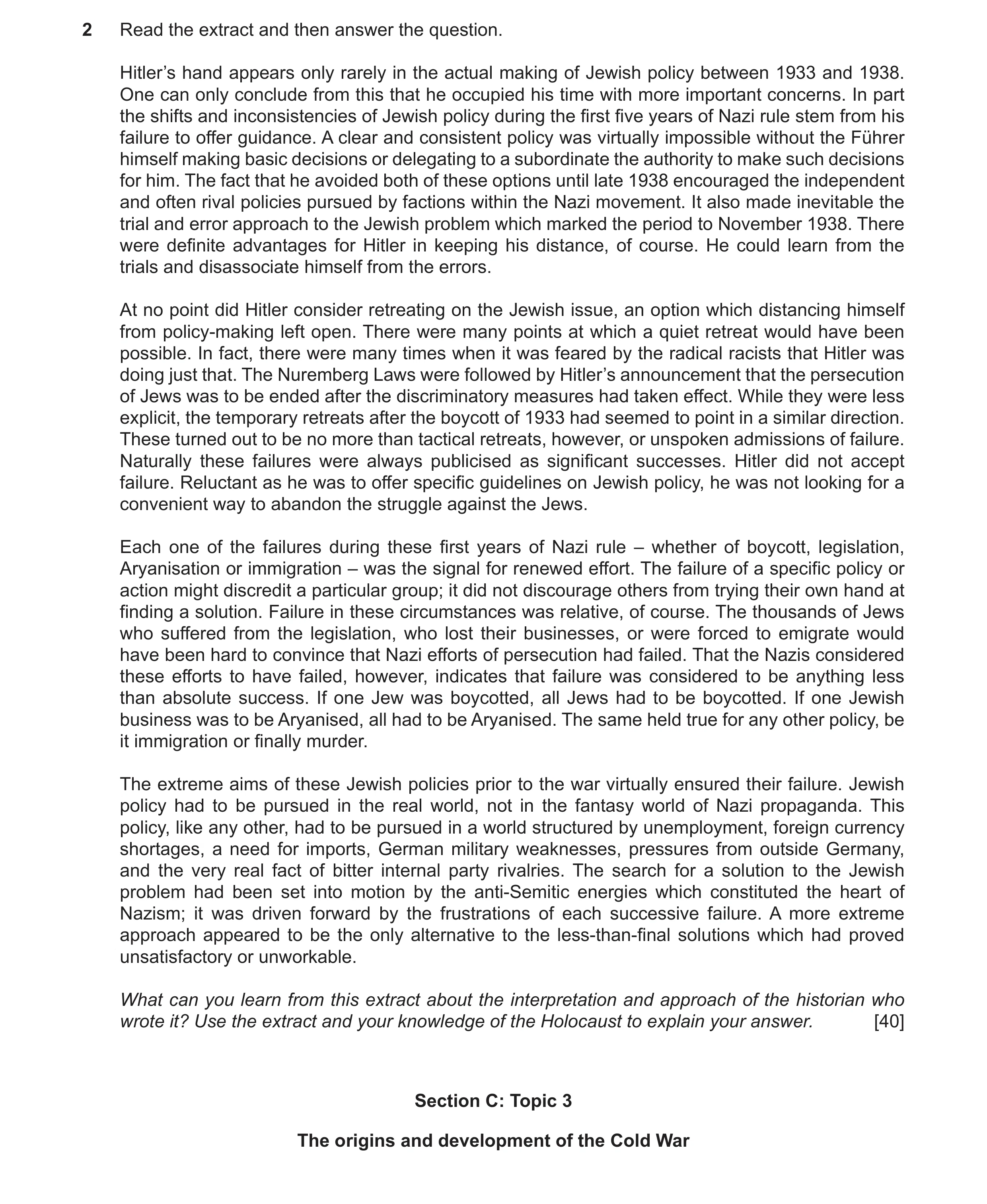
2 Read the extract and then answer the question. Hitler’s hand appears only rarely in the actual making of Jewish policy between 1933 and 1938. One can only conclude from this that he occupied his time with more important concerns. In part the shifts and inconsistencies of Jewish policy during the first five years of Nazi rule stem from his failure to offer guidance. A clear and consistent policy was virtually impossible without the Führer himself making basic decisions or delegating to a subordinate the authority to make such decisions for him. The fact that he avoided both of these options until late 1938 encouraged the independent and often rival policies pursued by factions within the Nazi movement. It also made inevitable the trial and error approach to the Jewish problem which marked the period to November 1938. There were definite advantages for Hitler in keeping his distance, of course. He could learn from the trials and disassociate himself from the errors. At no point did Hitler consider retreating on the Jewish issue, an option which distancing himself from policy-making left open. There were many points at which a quiet retreat would have been possible. In fact, there were many times when it was feared by the radical racists that Hitler was doing just that. The Nuremberg Laws were followed by Hitler’s announcement that the persecution of Jews was to be ended after the discriminatory measures had taken effect. While they were less explicit, the temporary retreats after the boycott of 1933 had seemed to point in a similar direction. These turned out to be no more than tactical retreats, however, or unspoken admissions of failure. Naturally these failures were always publicised as significant successes. Hitler did not accept failure. Reluctant as he was to offer specific guidelines on Jewish policy, he was not looking for a convenient way to abandon the struggle against the Jews. Each one of the failures during these first years of Nazi rule – whether of boycott, legislation, Aryanisation or immigration – was the signal for renewed effort. The failure of a specific policy or action might discredit a particular group; it did not discourage others from trying their own hand at finding a solution. Failure in these circumstances was relative, of course. The thousands of Jews who suffered from the legislation, who lost their businesses, or were forced to emigrate would have been hard to convince that Nazi efforts of persecution had failed. That the Nazis considered these efforts to have failed, however, indicates that failure was considered to be anything less than absolute success. If one Jew was boycotted, all Jews had to be boycotted. If one Jewish business was to be Aryanised, all had to be Aryanised. The same held true for any other policy, be it immigration or finally murder. The extreme aims of these Jewish policies prior to the war virtually ensured their failure. Jewish policy had to be pursued in the real world, not in the fantasy world of Nazi propaganda. This policy, like any other, had to be pursued in a world structured by unemployment, foreign currency shortages, a need for imports, German military weaknesses, pressures from outside Germany, and the very real fact of bitter internal party rivalries. The search for a solution to the Jewish problem had been set into motion by the anti-Semitic energies which constituted the heart of Nazism; it was driven forward by the frustrations of each successive failure. A more extreme approach appeared to be the only alternative to the less-than-final solutions which had proved unsatisfactory or unworkable. What can you learn from this extract about the interpretation and approach of the historian who wrote it? Use the extract and your knowledge of the Holocaust to explain your answer. [40] Section C: Topic 3 The origins and development of the Cold War
40 marks
Mark scheme: 2 The Holocaust 40 Interpretation/Approach The main interpretation deals first with Hitler, seeing him as relatively uninvolved, with no prior plan for genocide, and content to leave Jewish policy to others. Secondly, it argues that it was the structure of the Nazi Party that drove Jewish policy to become ever more extreme. Showing complete understanding of the Interpretation will involve discussion of both these aspects. Hitler is not central to this interpretation; rather it is competing subordinates in the Nazi movement who bring about a cumulative radicalisation. The frustration of continued failures of policy had the effect of making the search for a solution ever more extreme. What is missing from this interpretation is any hint that in the pre-war period Hitler envisaged genocide. For this extract if candidates do use historiographical labels, they should be credited as follows: • To reach L5/L6, Structuralism is the only label that can be accepted. • Synthesis (i.e. structuralism with intentionalism) could be credited at L4 if the structuralist element is properly explained. • The interpretation cannot be intentionalist – there is no prior plan. So this label and functionalism should be awarded L3 at best. Glossary: Candidates may use some/all of the following terms: Intentionalism – interpretations which assume that Hitler / the Nazis planned to exterminate the Jews from the start. Structuralism – interpretations which argue that it was the nature of the Nazi state that produced genocide. There was no coherent plan but the chaotic competition for Hitler’s approval between different elements of the leadership produced a situation in which genocide could occur. Functionalism sees the Holocaust as an unplanned, ad hoc response to wartime developments in Eastern Europe, when Germany conquered areas with large Jewish populations. Candidates may also refer to synthesis interpretations, i.e. interpretations which show characteristics of more than one of the above. What counts is how appropriate the use of this kind of terminology is in relation to the extract, and how effectively the extract can be used to support it.
This question in 9489/33 Oct/Nov 2022
Q6 · Read the extract and then answer the question 9489/31 May/June 2023
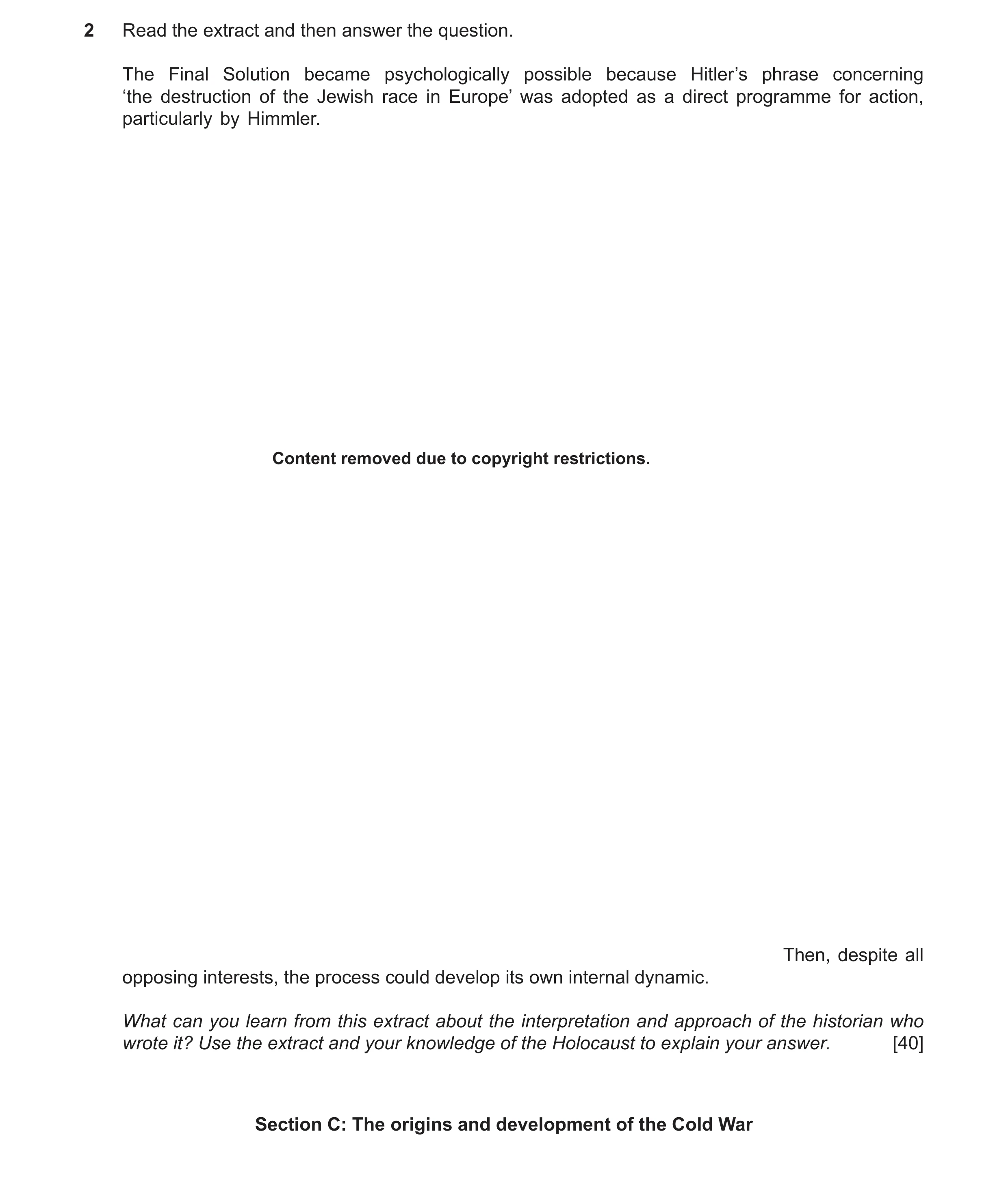
2 Read the extract and then answer the question. The Final Solution became psychologically possible because Hitler’s phrase concerning ‘the destruction of the Jewish race in Europe’ was adopted as a direct programme for action, particularly by Himmler. Content removed due to copyright restrictions. Then, despite all opposing interests, the process could develop its own internal dynamic. What can you learn from this extract about the interpretation and approach of the historian who wrote it? Use the extract and your knowledge of the Holocaust to explain your answer. [40] Section C: The origins and development of the Cold War
40 marks
Mark scheme: 2 The Holocaust 40 Interpretation/Approach The main interpretation is that the historian blames the Holocaust on the nature of the Nazi state (specifically the way Hitler ruled/competition between other Nazi leaders – both needed for L6) which produced a process of cumulative radicalisation of Jewish policy. Showing complete understanding of the Interpretation will involve explanation and illustration from the extract of both these aspects. This is a structuralist extract. Hitler is seen as relatively uninvolved in the development of the Final Solution. Instead, the driving force is the competition for Hitler’s favour and for personal power between party leaders. There was no logical plan, but rather a process of constant escalation. To achieve L5 or L6, the only acceptable ‘label’ would be structuralism. Functionalism is not a satisfactory label as there is little mention of the war, and then with no argument based on circumstances driving genocide, so L3 max. Intentionalism can also be dismissed, so L3 max. Arguments for a synthesis could be L4 if the structuralist element is properly explained. Glossary: Candidates may use some/all of the following terms: Intentionalism – interpretations which assume that Hitler/the Nazis planned to exterminate the Jews from the start. Structuralism – interpretations which argue that it was the nature of the Nazi state that produced genocide. There was no coherent plan but the chaotic competition for Hitler’s approval between different elements of the leadership produced a situation in which genocide could occur. Functionalism sees the Holocaust as an unplanned, ad hoc response to wartime developments in Eastern Europe, when Germany conquered areas with large Jewish populations. Candidates may also refer to synthesis interpretations, i.e. interpretations which show characteristics of more than one of the above. What counts is how appropriate the use of this kind of terminology is in relation to the extract, and how effectively the extract can be used to support it.
This question in 9489/31 May/June 2023
Q7 · Read the extract and then answer the question 9489/33 May/June 2023
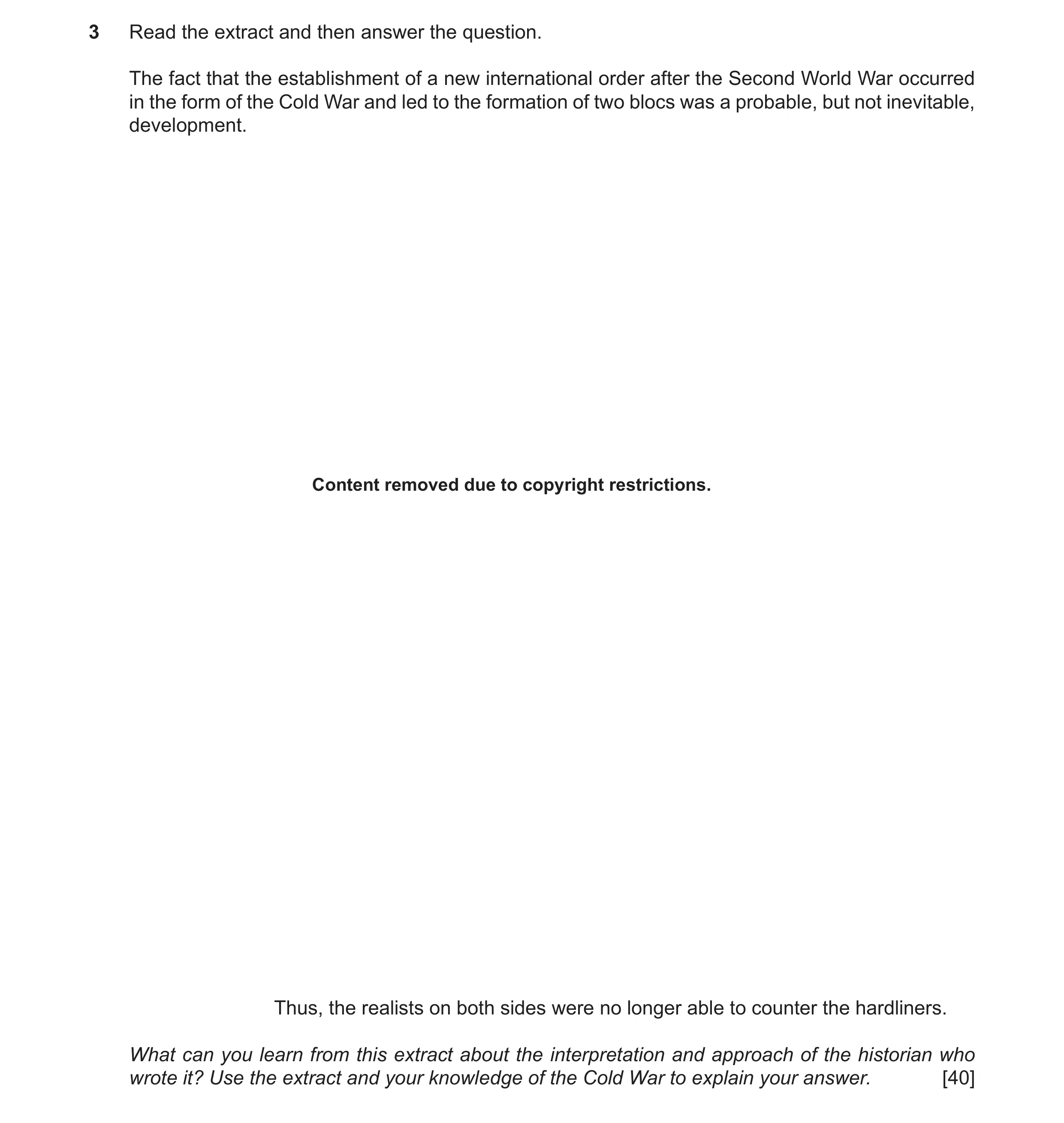
3 Read the extract and then answer the question. The fact that the establishment of a new international order after the Second World War occurred in the form of the Cold War and led to the formation of two blocs was a probable, but not inevitable, development. Content removed due to copyright restrictions. Thus, the realists on both sides were no longer able to counter the hardliners. What can you learn from this extract about the interpretation and approach of the historian who wrote it? Use the extract and your knowledge of the Cold War to explain your answer. [40]
40 marks
Mark scheme: 3 The Origins and Development of the Cold War 40 Interpretation/Approach The main interpretation is that the historian blames both sides for the Cold War, but blames the USA more. Showing complete understanding of the interpretation will involve illustration and explanation of both these aspects from the extract. This is an interpretation that clearly blames the fundamental confrontation on the different natures and characteristics of the two superpowers. However, it places the greater burden of blame on the USA, for escalating the tensions. It never explained the new international realities to its own people, instead exaggerating the threat posed by the Soviets. This simply reinforced negative tendencies in the Soviet leadership, and allowed a downward spiral into confrontation. The USSR is not exonerated, but is shown as reacting to US provocations. Properly supported answers can use either post-revisionist or revisionist as labels. Support must be on illustrating/explaining blame. Blaming both, but blaming the US more = L6 Blaming both = L5 Blaming just the USA (or only properly supporting on the USSR) = L4 Blaming the USSR (i.e. trad/orthodox) = L3 Glossary: Traditional/Orthodox interpretations of the Cold War were generally produced early after WW2. They blame the Soviet Union and Stalin’s expansionism for the Cold War. Revisionist historians challenged this view and shifted more of the focus onto the United States, generally through an economic approach which stressed the alleged aim of the US to establish its economic dominance over Europe. Post-revisionists moved towards a more balanced view in which elements of blame were attached to both sides. Since the opening of the Soviet archives post-1990 there has been a shift to attributing prime responsibility to Stalin – a post-post- revisionist stance which often seems very close to the traditional view, but which often places great importance on ideology. What is important is how appropriate the use of this kind of terminology is in relation to the extract, and how effectively the extract can be used to support it.
This question in 9489/33 May/June 2023
Q8 · Read the extract and then answer the question 9489/32 Oct/Nov 2023
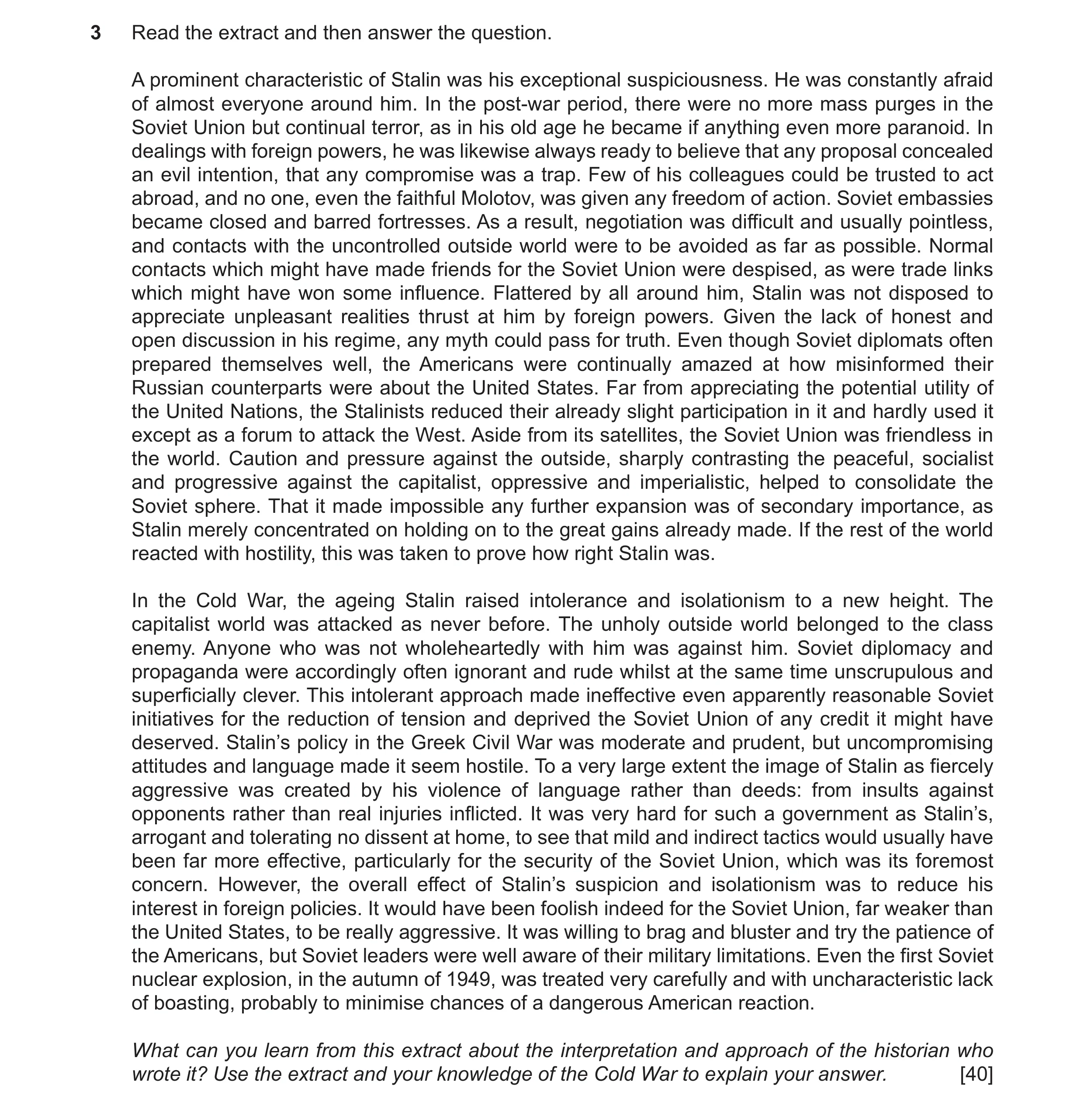
3 Read the extract and then answer the question. A prominent characteristic of Stalin was his exceptional suspiciousness. He was constantly afraid of almost everyone around him. In the post-war period, there were no more mass purges in the Soviet Union but continual terror, as in his old age he became if anything even more paranoid. In dealings with foreign powers, he was likewise always ready to believe that any proposal concealed an evil intention, that any compromise was a trap. Few of his colleagues could be trusted to act abroad, and no one, even the faithful Molotov, was given any freedom of action. Soviet embassies became closed and barred fortresses. As a result, negotiation was difficult and usually pointless, and contacts with the uncontrolled outside world were to be avoided as far as possible. Normal contacts which might have made friends for the Soviet Union were despised, as were trade links which might have won some influence. Flattered by all around him, Stalin was not disposed to appreciate unpleasant realities thrust at him by foreign powers. Given the lack of honest and open discussion in his regime, any myth could pass for truth. Even though Soviet diplomats often prepared themselves well, the Americans were continually amazed at how misinformed their Russian counterparts were about the United States. Far from appreciating the potential utility of the United Nations, the Stalinists reduced their already slight participation in it and hardly used it except as a forum to attack the West. Aside from its satellites, the Soviet Union was friendless in the world. Caution and pressure against the outside, sharply contrasting the peaceful, socialist and progressive against the capitalist, oppressive and imperialistic, helped to consolidate the Soviet sphere. That it made impossible any further expansion was of secondary importance, as Stalin merely concentrated on holding on to the great gains already made. If the rest of the world reacted with hostility, this was taken to prove how right Stalin was. In the Cold War, the ageing Stalin raised intolerance and isolationism to a new height. The capitalist world was attacked as never before. The unholy outside world belonged to the class enemy. Anyone who was not wholeheartedly with him was against him. Soviet diplomacy and propaganda were accordingly often ignorant and rude whilst at the same time unscrupulous and superficially clever. This intolerant approach made ineffective even apparently reasonable Soviet initiatives for the reduction of tension and deprived the Soviet Union of any credit it might have deserved. Stalin’s policy in the Greek Civil War was moderate and prudent, but uncompromising attitudes and language made it seem hostile. To a very large extent the image of Stalin as fiercely aggressive was created by his violence of language rather than deeds: from insults against opponents rather than real injuries inflicted. It was very hard for such a government as Stalin’s, arrogant and tolerating no dissent at home, to see that mild and indirect tactics would usually have been far more effective, particularly for the security of the Soviet Union, which was its foremost concern. However, the overall effect of Stalin’s suspicion and isolationism was to reduce his interest in foreign policies. It would have been foolish indeed for the Soviet Union, far weaker than the United States, to be really aggressive. It was willing to brag and bluster and try the patience of the Americans, but Soviet leaders were well aware of their military limitations. Even the first Soviet nuclear explosion, in the autumn of 1949, was treated very carefully and with uncharacteristic lack of boasting, probably to minimise chances of a dangerous American reaction. What can you learn from this extract about the interpretation and approach of the historian who wrote it? Use the extract and your knowledge of the Cold War to explain your answer. [40]
40 marks
Mark scheme: 3 The Origins and Development of the Cold War 40 Interpretation/Approach The main interpretation is that the historian blames Stalin (i.e. not the Soviet Union) (i) because of his personality, and (ii) for his obstructionism being harmful/ unnecessary/unwise (must be clear that Stalin is blameworthy for this). Showing complete understanding of the Interpretation will involve discussion of both these aspects. This is an interpretation that focuses on Stalin. It sees him as obstructive and paranoid, at home as much as abroad, and deliberately closing off the USSR from the outside world. Stalin’s personality and approach made the Cold War more intense, and that this was not to the benefit of the USSR. The harsh, unyielding image this gave him, often contrary to the actual policies he pursued, made it harder for these policies to succeed. This picture of Stalin, with its stress on the importance of his personality, is characteristic of a post-post-revisionist approach. This ‘label’ would be the only one acceptable at L6. Traditionalism would be less persuasive but could be L5 if Stalin’s blame was properly argued. Arguing for post-revisionism would be L4 at best (i.e. if Stalin’s blame was properly argued), but revisionism would represent L3 misunderstanding. Glossary: Traditional/Orthodox interpretations of the Cold War were generally produced early after WW2. They blame the Soviet Union and Stalin’s expansionism for the Cold War. Revisionist historians challenged this view and shifted more of the focus onto the United States, generally through an economic approach which stressed the alleged aim of the US to establish its economic dominance over Europe. Post-revisionists moved towards a more balanced view in which elements of blame were attached to both sides. Since the opening of the Soviet archives post-1990 there has been a shift to attributing prime responsibility to Stalin – a post-post-revisionist stance which often seems very close to the traditional view, but which often places great importance on ideology. What counts is how appropriate the use of this kind of terminology is in relation to the extract, and how effectively the extract can be used to support it.
This question in 9489/32 Oct/Nov 2023
Q9 · Read the extract and then answer the question 9489/31 May/June 2024
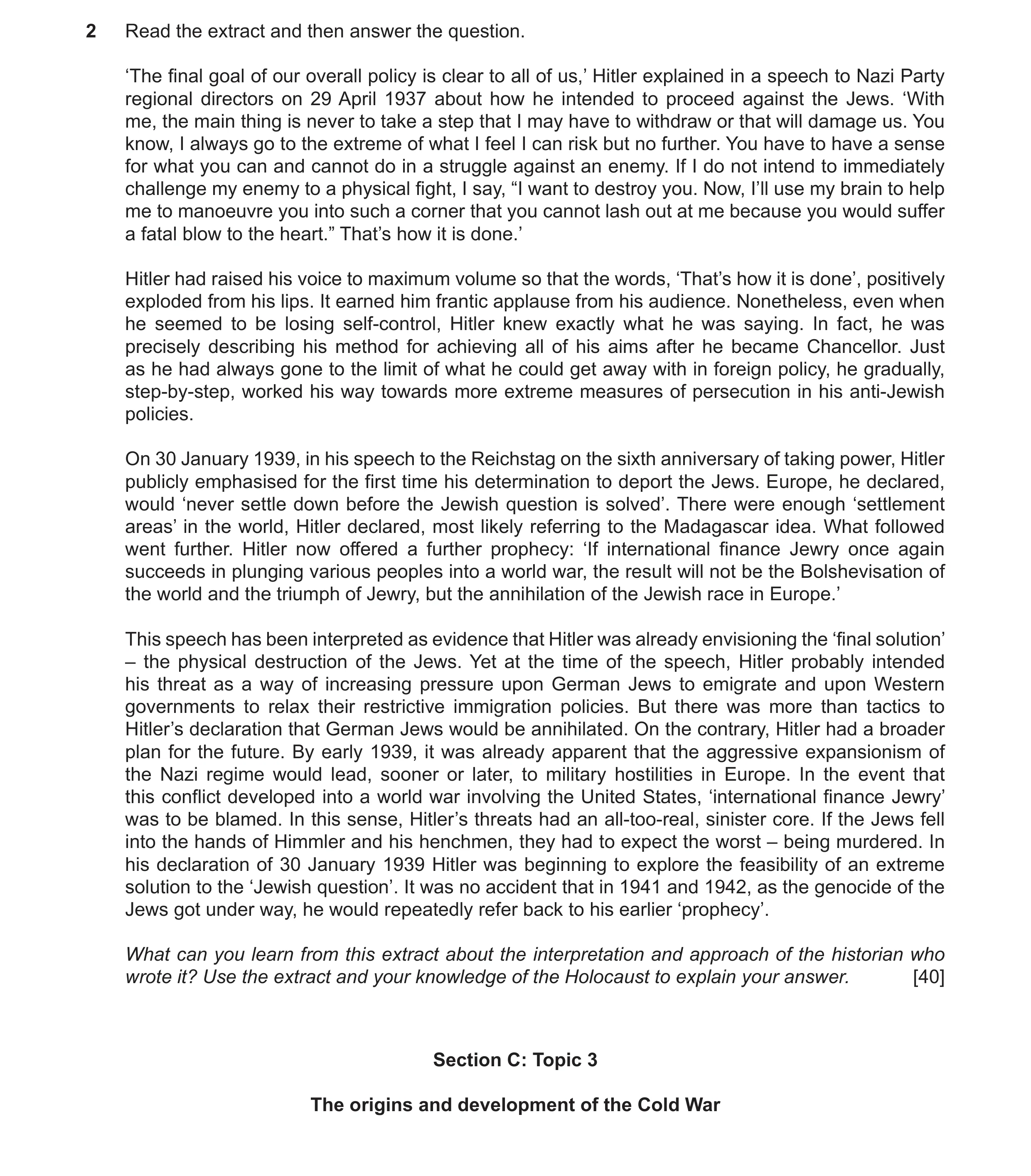
2 Read the extract and then answer the question. ‘The final goal of our overall policy is clear to all of us,’ Hitler explained in a speech to Nazi Party regional directors on 29 April 1937 about how he intended to proceed against the Jews. ‘With me, the main thing is never to take a step that I may have to withdraw or that will damage us. You know, I always go to the extreme of what I feel I can risk but no further. You have to have a sense for what you can and cannot do in a struggle against an enemy. If I do not intend to immediately challenge my enemy to a physical fight, I say, “I want to destroy you. Now, I’ll use my brain to help me to manoeuvre you into such a corner that you cannot lash out at me because you would suffer a fatal blow to the heart.” That’s how it is done.’ Hitler had raised his voice to maximum volume so that the words, ‘That’s how it is done’, positively exploded from his lips. It earned him frantic applause from his audience. Nonetheless, even when he seemed to be losing self-control, Hitler knew exactly what he was saying. In fact, he was precisely describing his method for achieving all of his aims after he became Chancellor. Just as he had always gone to the limit of what he could get away with in foreign policy, he gradually, step-by-step, worked his way towards more extreme measures of persecution in his anti-Jewish policies. On 30 January 1939, in his speech to the Reichstag on the sixth anniversary of taking power, Hitler publicly emphasised for the first time his determination to deport the Jews. Europe, he declared, would ‘never settle down before the Jewish question is solved’. There were enough ‘settlement areas’ in the world, Hitler declared, most likely referring to the Madagascar idea. What followed went further. Hitler now offered a further prophecy: ‘If international finance Jewry once again succeeds in plunging various peoples into a world war, the result will not be the Bolshevisation of the world and the triumph of Jewry, but the annihilation of the Jewish race in Europe.’ This speech has been interpreted as evidence that Hitler was already envisioning the ‘final solution’ – the physical destruction of the Jews. Yet at the time of the speech, Hitler probably intended his threat as a way of increasing pressure upon German Jews to emigrate and upon Western governments to relax their restrictive immigration policies. But there was more than tactics to Hitler’s declaration that German Jews would be annihilated. On the contrary, Hitler had a broader plan for the future. By early 1939, it was already apparent that the aggressive expansionism of the Nazi regime would lead, sooner or later, to military hostilities in Europe. In the event that this conflict developed into a world war involving the United States, ‘international finance Jewry’ was to be blamed. In this sense, Hitler’s threats had an all-too-real, sinister core. If the Jews fell into the hands of Himmler and his henchmen, they had to expect the worst – being murdered. In his declaration of 30 January 1939 Hitler was beginning to explore the feasibility of an extreme solution to the ‘Jewish question’. It was no accident that in 1941 and 1942, as the genocide of the Jews got under way, he would repeatedly refer back to his earlier ‘prophecy’. What can you learn from this extract about the interpretation and approach of the historian who wrote it? Use the extract and your knowledge of the Holocaust to explain your answer. [40] Section C: Topic 3 The origins and development of the Cold War
40 marks
Mark scheme: 2 The Holocaust 40 Interpretation/Approach The main interpretation blames Hitler because he always wanted to take the most extreme measures towards the Jews that he could, and for planning a war that he knew would bring about genocide. Showing complete understanding of the Interpretation will involve discussion of both these aspects. This historian sees Hitler as always planning harm towards the Jews; at first this could not, because of practical restraints, be genocidal, but given the opportunity it would become so. The interpretation is intentionalist in seeing Hitler as having a long-term plan. Whilst this was not initially genocidal, it was always a plan to do the most at any time that he thought he could get away with. He intended war knowing that it would give the opportunity for mass murder, but there is no argument that the Holocaust emerged as a response to the circumstances of war. Intentionalist is therefore the only label that can work in L5/L6. ‘Synthesis’, with the intentionalism properly explained through an aspect of the main interpretation, will be L4. Arguments for functionalism and structuralism cannot be properly supported from the extract, so will be L3 if plausible. Glossary: Candidates may use some/all of the following terms: Intentionalism – interpretations which assume that Hitler/the Nazis planned to exterminate the Jews from the start. Structuralism – interpretations which argue that it was the nature of the Nazi state that produced genocide. There was no coherent plan but the chaotic competition for Hitler’s approval between different elements of the leadership produced a situation in which genocide could occur. Functionalism sees the Holocaust as an unplanned, ad hoc response to wartime developments in Eastern Europe, when Germany conquered areas with large Jewish populations. Candidates may also refer to synthesis interpretations, i.e. interpretations which show characteristics of more than one of the above. What counts is how appropriate the use of this kind of terminology is in relation to the extract, and how effectively the extract can be used to support it.
This question in 9489/31 May/June 2024
Q10 · Read the extract and then answer the question 9489/32 Oct/Nov 2024
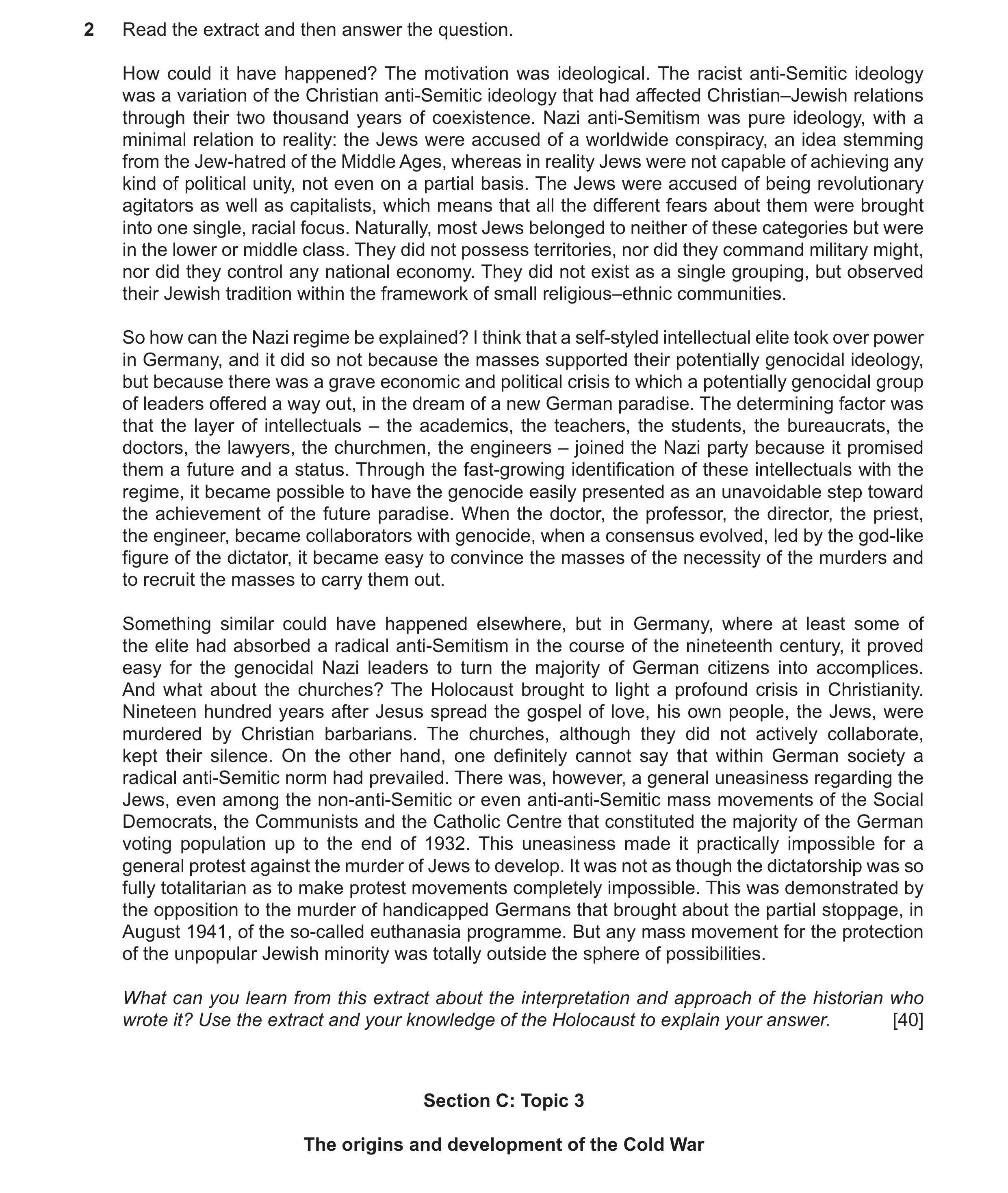
2 Read the extract and then answer the question. How could it have happened? The motivation was ideological. The racist anti‑Semitic ideology was a variation of the Christian anti‑Semitic ideology that had affected Christian–Jewish relations through their two thousand years of coexistence. Nazi anti‑Semitism was pure ideology, with a minimal relation to reality: the Jews were accused of a worldwide conspiracy, an idea stemming from the Jew‑hatred of the Middle Ages, whereas in reality Jews were not capable of achieving any kind of political unity, not even on a partial basis. The Jews were accused of being revolutionary agitators as well as capitalists, which means that all the different fears about them were brought into one single, racial focus. Naturally, most Jews belonged to neither of these categories but were in the lower or middle class. They did not possess territories, nor did they command military might, nor did they control any national economy. They did not exist as a single grouping, but observed their Jewish tradition within the framework of small religious–ethnic communities. So how can the Nazi regime be explained? I think that a self‑styled intellectual elite took over power in Germany, and it did so not because the masses supported their potentially genocidal ideology, but because there was a grave economic and political crisis to which a potentially genocidal group of leaders offered a way out, in the dream of a new German paradise. The determining factor was that the layer of intellectuals – the academics, the teachers, the students, the bureaucrats, the doctors, the lawyers, the churchmen, the engineers – joined the Nazi party because it promised them a future and a status. Through the fast‑growing identification of these intellectuals with the regime, it became possible to have the genocide easily presented as an unavoidable step toward the achievement of the future paradise. When the doctor, the professor, the director, the priest, the engineer, became collaborators with genocide, when a consensus evolved, led by the god‑like figure of the dictator, it became easy to convince the masses of the necessity of the murders and to recruit the masses to carry them out. Something similar could have happened elsewhere, but in Germany, where at least some of the elite had absorbed a radical anti‑Semitism in the course of the nineteenth century, it proved easy for the genocidal Nazi leaders to turn the majority of German citizens into accomplices. And what about the churches? The Holocaust brought to light a profound crisis in Christianity. Nineteen hundred years after Jesus spread the gospel of love, his own people, the Jews, were murdered by Christian barbarians. The churches, although they did not actively collaborate, kept their silence. On the other hand, one definitely cannot say that within German society a radical anti‑Semitic norm had prevailed. There was, however, a general uneasiness regarding the Jews, even among the non‑anti‑Semitic or even anti‑anti‑Semitic mass movements of the Social Democrats, the Communists and the Catholic Centre that constituted the majority of the German voting population up to the end of 1932. This uneasiness made it practically impossible for a general protest against the murder of Jews to develop. It was not as though the dictatorship was so fully totalitarian as to make protest movements completely impossible. This was demonstrated by the opposition to the murder of handicapped Germans that brought about the partial stoppage, in August 1941, of the so‑called euthanasia programme. But any mass movement for the protection of the unpopular Jewish minority was totally outside the sphere of possibilities. What can you learn from this extract about the interpretation and approach of the historian who wrote it? Use the extract and your knowledge of the Holocaust to explain your answer. [40] Section C: Topic 3 The origins and development of the Cold War
40 marks
Mark scheme: 2 The Holocaust 40 Interpretation/Approach The extract blames Nazi anti-Semitism for the Holocaust, but the main interpretation is that genocide could not have occurred (i) without the contribution of the intellectual elites, and (ii) without the willingness of German society to stand aside. Showing complete understanding of the Interpretation will involve discussion of both these aspects. The historian argues that the central motive for genocide was the anti-Semitism of the Nazis. Once they achieved power, intellectuals were won over to this ideology by the prospect of national salvation. This gave the regime a plausibility which would make it possible to make the masses complicit in the murders. The historian does not argue that the masses shared the radical, murderous antisemitism, but rather that they felt sufficiently uneasy about the Jews to make significant protests against Nazi policy impossible. Candidates will probably attach the intentionalist label to this interpretation, which is justifiable since it deals with the central importance of Nazi ideology. Other labels would not be supportable from this extract. Glossary: Candidates may use some/all of the following terms: Intentionalism – interpretations which assume that Hitler/the Nazis planned to exterminate the Jews from the start. Structuralism – interpretations which argue that it was the nature of the Nazi state that produced genocide. There was no coherent plan but the chaotic competition for Hitler’s approval between different elements of the leadership produced a situation in which genocide could occur. Functionalism sees the Holocaust as an unplanned, ad hoc response to wartime developments in Eastern Europe, when Germany conquered areas with large Jewish populations. Candidates may also refer to synthesis interpretations, i.e. interpretations which show characteristics of more than one of the above. What counts is how appropriate the use of this kind of terminology is in relation to the extract, and how effectively the extract can be used to support it.
This question in 9489/32 Oct/Nov 2024
Q11 · Read the extract and then answer the question 9489/31 May/June 2025
2 Read the extract and then answer the question. The signs are that ‘Kristallnacht’ had a profound impact upon Hitler. Content removed due to copyright restrictions. But, somehow, he was certain that this would be the outcome of any new conflict. What can you learn from this extract about the interpretation and approach of the historian who wrote it? Use the extract and your knowledge of the Holocaust to explain your answer. [40] Section C: Topic 3 The origins and development of the Cold War
40 marks
Mark scheme: 2 The Holocaust 40 Interpretation/Approach The main interpretation is that Hitler is blamed because (i) despite his desire to destroy/do harm to the Jews, he did not have a clear plan to exterminate the Jews before the war, (ii) but he was clear in his own mind that war would mean their destruction. Showing complete understanding of the Interpretation will involve discussion of both these aspects. The historian suggests that Hitler might not have had genocidal intent from an early stage but assumed that resumption of war would bring the destruction of the Jews. The argument is that Hitler did not have a clear plan prior to the war, but that genocide was certainly implicit in his ideology. This is not a functionalist argument about genocide emerging from the circumstances of war. Rather war simply provides Hitler with the opportunity. His pre-war statements made his wish to eradicate the Jews perfectly clear. The only label acceptable in L5/L6 will be intentionalist. Claims that it is a synthesis can be L4 if the intentionalist aspect of the main interpretation is explained. Any other label can be no better than L3. Glossary: Candidates may use some/all of the following terms: Intentionalism – interpretations which assume that Hitler/the Nazis planned to exterminate the Jews from the start. Structuralism – interpretations which argue that it was the nature of the Nazi state that produced genocide. There was no coherent plan but the chaotic competition for Hitler’s approval between different elements of the leadership produced a situation in which genocide could occur. Functionalism sees the Holocaust as an unplanned, ad hoc response to wartime developments in Eastern Europe, when Germany conquered areas with large Jewish populations. Candidates may also refer to synthesis interpretations, i.e. interpretations which show characteristics of more than one of the above. What counts is how appropriate the use of this kind of terminology is in relation to the extract, and how effectively the extract can be used to support it.
This question in 9489/31 May/June 2025
Q12 · Read the extract and then answer the question 9489/31 Oct/Nov 2025
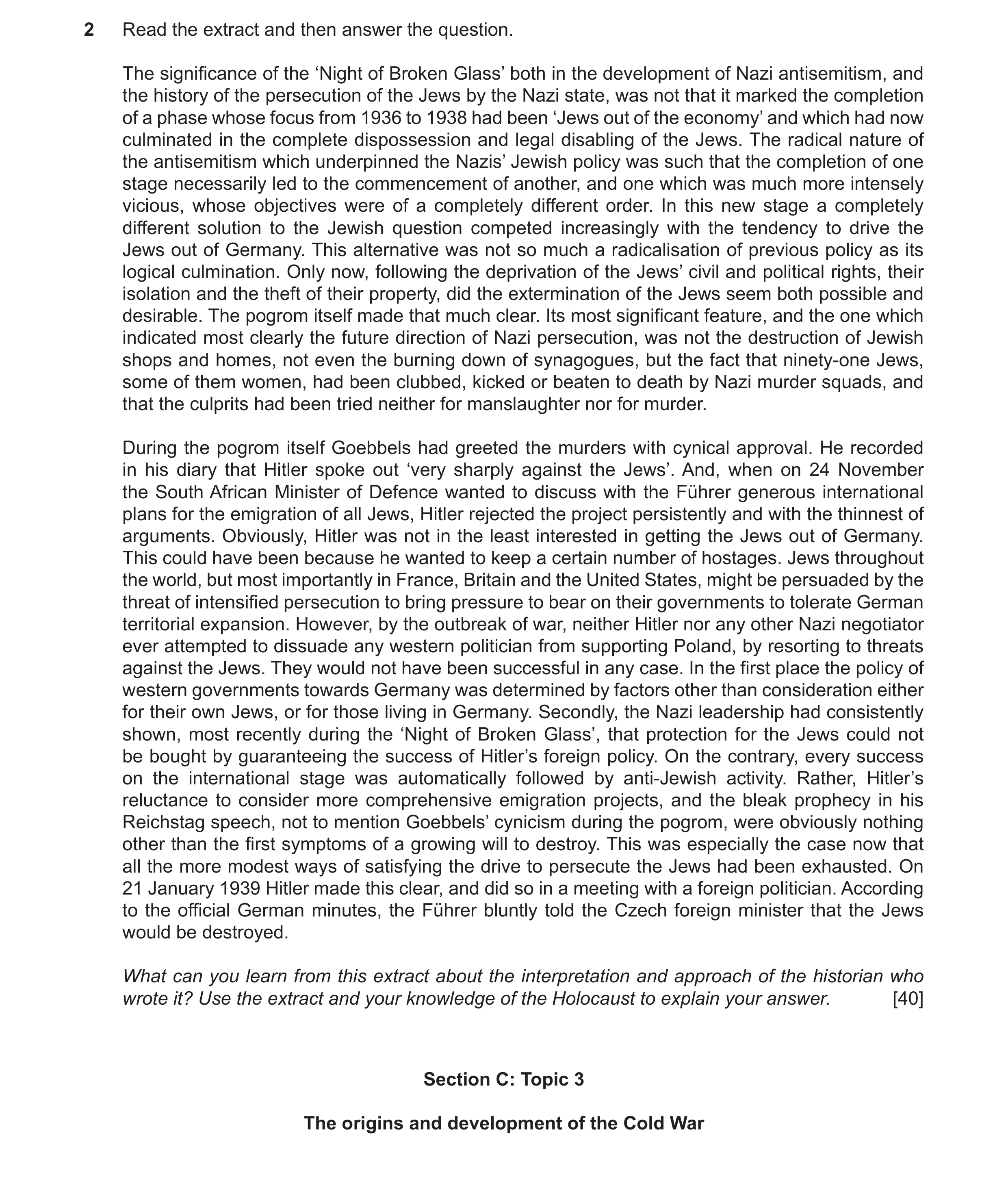
2 Read the extract and then answer the question. The significance of the ‘Night of Broken Glass’ both in the development of Nazi antisemitism, and the history of the persecution of the Jews by the Nazi state, was not that it marked the completion of a phase whose focus from 1936 to 1938 had been ‘Jews out of the economy’ and which had now culminated in the complete dispossession and legal disabling of the Jews. The radical nature of the antisemitism which underpinned the Nazis’ Jewish policy was such that the completion of one stage necessarily led to the commencement of another, and one which was much more intensely vicious, whose objectives were of a completely different order. In this new stage a completely different solution to the Jewish question competed increasingly with the tendency to drive the Jews out of Germany. This alternative was not so much a radicalisation of previous policy as its logical culmination. Only now, following the deprivation of the Jews’ civil and political rights, their isolation and the theft of their property, did the extermination of the Jews seem both possible and desirable. The pogrom itself made that much clear. Its most significant feature, and the one which indicated most clearly the future direction of Nazi persecution, was not the destruction of Jewish shops and homes, not even the burning down of synagogues, but the fact that ninety‑one Jews, some of them women, had been clubbed, kicked or beaten to death by Nazi murder squads, and that the culprits had been tried neither for manslaughter nor for murder. During the pogrom itself Goebbels had greeted the murders with cynical approval. He recorded in his diary that Hitler spoke out ‘very sharply against the Jews’. And, when on 24 November the South African Minister of Defence wanted to discuss with the Führer generous international plans for the emigration of all Jews, Hitler rejected the project persistently and with the thinnest of arguments. Obviously, Hitler was not in the least interested in getting the Jews out of Germany. This could have been because he wanted to keep a certain number of hostages. Jews throughout the world, but most importantly in France, Britain and the United States, might be persuaded by the threat of intensified persecution to bring pressure to bear on their governments to tolerate German territorial expansion. However, by the outbreak of war, neither Hitler nor any other Nazi negotiator ever attempted to dissuade any western politician from supporting Poland, by resorting to threats against the Jews. They would not have been successful in any case. In the first place the policy of western governments towards Germany was determined by factors other than consideration either for their own Jews, or for those living in Germany. Secondly, the Nazi leadership had consistently shown, most recently during the ‘Night of Broken Glass’, that protection for the Jews could not be bought by guaranteeing the success of Hitler’s foreign policy. On the contrary, every success on the international stage was automatically followed by anti‑Jewish activity. Rather, Hitler’s reluctance to consider more comprehensive emigration projects, and the bleak prophecy in his Reichstag speech, not to mention Goebbels’ cynicism during the pogrom, were obviously nothing other than the first symptoms of a growing will to destroy. This was especially the case now that all the more modest ways of satisfying the drive to persecute the Jews had been exhausted. On 21 January 1939 Hitler made this clear, and did so in a meeting with a foreign politician. According to the official German minutes, the Führer bluntly told the Czech foreign minister that the Jews would be destroyed. What can you learn from this extract about the interpretation and approach of the historian who wrote it? Use the extract and your knowledge of the Holocaust to explain your answer. [40] Section C: Topic 3 The origins and development of the Cold War
40 marks
Mark scheme: 2 The Holocaust 40 Interpretation/Approach The main interpretation is that Hitler is to blame for the Holocaust because (i) the logical end point of his antisemitic policies was the destruction of the Jews and (ii) the Night of Broken Glass made the radical shift from exclusion to destruction apparent. Showing complete understanding of the interpretation will involve discussion of both these aspects. The historian argues that the Night of Broken Glass initiated a new, more malicious phase in Jewish policy, which previous measures of persecution had made possible. This phase envisaged extermination of the Jews as the goal, and Hitler’s reluctance to consider emigration projects, as well as the increasingly violent nature of his threats to the Jews, are evidence of this. The argument insists that the intent to commit genocide was implicit from the start. The extract is intentionalist. However, the term functionalist can be used to describe Kristallnacht as an event which is a turning point in Jewish policy. Glossary: Candidates may use some/all of the following terms: Intentionalism – interpretations which assume that Hitler/the Nazis planned to exterminate the Jews from the start. Structuralism – interpretations which argue that it was the nature of the Nazi state that produced genocide. There was no coherent plan but the chaotic competition for Hitler’s approval between different elements of the leadership produced a situation in which genocide could occur. Functionalism sees the Holocaust as an unplanned, ad hoc response to wartime developments in Eastern Europe, when Germany conquered areas with large Jewish populations. Candidates may also refer to synthesis interpretations, i.e. interpretations which show characteristics of more than one of the above. What counts is how appropriate the use of this kind of terminology is in relation to the extract, and how effectively the extract can be used to support it.
This question in 9489/31 Oct/Nov 2025
Q13 · Read the extract and then answer the question 9489/32 Oct/Nov 2025
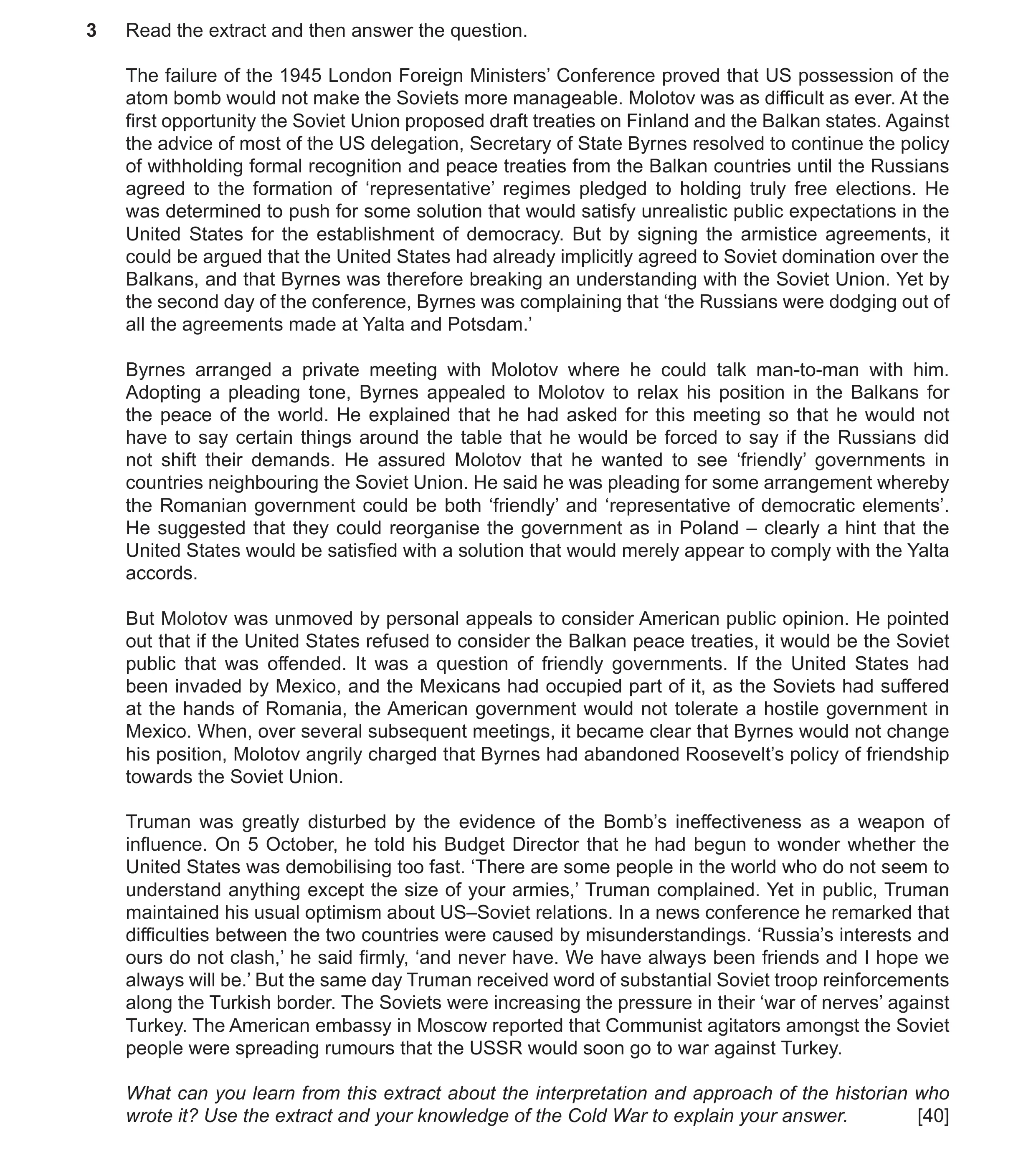
3 Read the extract and then answer the question. The failure of the 1945 London Foreign Ministers’ Conference proved that US possession of the atom bomb would not make the Soviets more manageable. Molotov was as difficult as ever. At the first opportunity the Soviet Union proposed draft treaties on Finland and the Balkan states. Against the advice of most of the US delegation, Secretary of State Byrnes resolved to continue the policy of withholding formal recognition and peace treaties from the Balkan countries until the Russians agreed to the formation of ‘representative’ regimes pledged to holding truly free elections. He was determined to push for some solution that would satisfy unrealistic public expectations in the United States for the establishment of democracy. But by signing the armistice agreements, it could be argued that the United States had already implicitly agreed to Soviet domination over the Balkans, and that Byrnes was therefore breaking an understanding with the Soviet Union. Yet by the second day of the conference, Byrnes was complaining that ‘the Russians were dodging out of all the agreements made at Yalta and Potsdam.’ Byrnes arranged a private meeting with Molotov where he could talk man-to-man with him. Adopting a pleading tone, Byrnes appealed to Molotov to relax his position in the Balkans for the peace of the world. He explained that he had asked for this meeting so that he would not have to say certain things around the table that he would be forced to say if the Russians did not shift their demands. He assured Molotov that he wanted to see ‘friendly’ governments in countries neighbouring the Soviet Union. He said he was pleading for some arrangement whereby the Romanian government could be both ‘friendly’ and ‘representative of democratic elements’. He suggested that they could reorganise the government as in Poland – clearly a hint that the United States would be satisfied with a solution that would merely appear to comply with the Yalta accords. But Molotov was unmoved by personal appeals to consider American public opinion. He pointed out that if the United States refused to consider the Balkan peace treaties, it would be the Soviet public that was offended. It was a question of friendly governments. If the United States had been invaded by Mexico, and the Mexicans had occupied part of it, as the Soviets had suffered at the hands of Romania, the American government would not tolerate a hostile government in Mexico. When, over several subsequent meetings, it became clear that Byrnes would not change his position, Molotov angrily charged that Byrnes had abandoned Roosevelt’s policy of friendship towards the Soviet Union. Truman was greatly disturbed by the evidence of the Bomb’s ineffectiveness as a weapon of influence. On 5 October, he told his Budget Director that he had begun to wonder whether the United States was demobilising too fast. ‘There are some people in the world who do not seem to understand anything except the size of your armies,’ Truman complained. Yet in public, Truman maintained his usual optimism about US–Soviet relations. In a news conference he remarked that difficulties between the two countries were caused by misunderstandings. ‘Russia’s interests and ours do not clash,’ he said firmly, ‘and never have. We have always been friends and I hope we always will be.’ But the same day Truman received word of substantial Soviet troop reinforcements along the Turkish border. The Soviets were increasing the pressure in their ‘war of nerves’ against Turkey. The American embassy in Moscow reported that Communist agitators amongst the Soviet people were spreading rumours that the USSR would soon go to war against Turkey. What can you learn from this extract about the interpretation and approach of the historian who wrote it? Use the extract and your knowledge of the Cold War to explain your answer. [40]
40 marks
Mark scheme: 3 The Origins and Development of the Cold War 40 Interpretation/Approach The main interpretation is that both the US and USSR were to blame for the Cold War because (i) The US attempted to manipulate / apply pressure to the USSR to achieve their own aims (ii) The USSR continued to be inflexible and aggressive Showing complete understanding of the interpretation will involve discussion of both these aspects. The historian’s interpretation portrays Molotov as difficult and resistant to all attempts by Byrnes to get along with him. Yet the Americans are not exonerated, with suggestions that they were playing to the domestic audience and not keeping to their agreements. Given that the Russians are shown as unyielding and aggressive, there is clearly some blame placed upon them. The Americans are also shown as at fault, maybe to a lesser degree than the USSR, as they make some attempt to reach agreements. The most appropriate label for L6 would be post-revisionist. However, trad argued properly could be placed in L5 depending on the support. Glossary: Traditional/Orthodox interpretations of the Cold War were generally produced early after the Second World War. They blame the Soviet Union and Stalin’s expansionism for the Cold War. Revisionist historians challenged this view and shifted more of the focus onto the United States, generally through an economic approach which stressed the alleged aim of the US to establish its economic dominance over Europe. Post-revisionists moved towards a more balanced view in which elements of blame were attached to both sides. Since the opening of the Soviet archives post-1990 there has been a shift to attributing prime responsibility to Stalin – a post-post-revisionist stance which often seems very close to the traditional view, but which often places great importance on ideology. What counts is how appropriate the use of this kind of terminology is in relation to the extract, and how effectively the extract can be used to support it.
This question in 9489/32 Oct/Nov 2025
Q14 · Read the extract and then answer the question 9489/33 Oct/Nov 2025
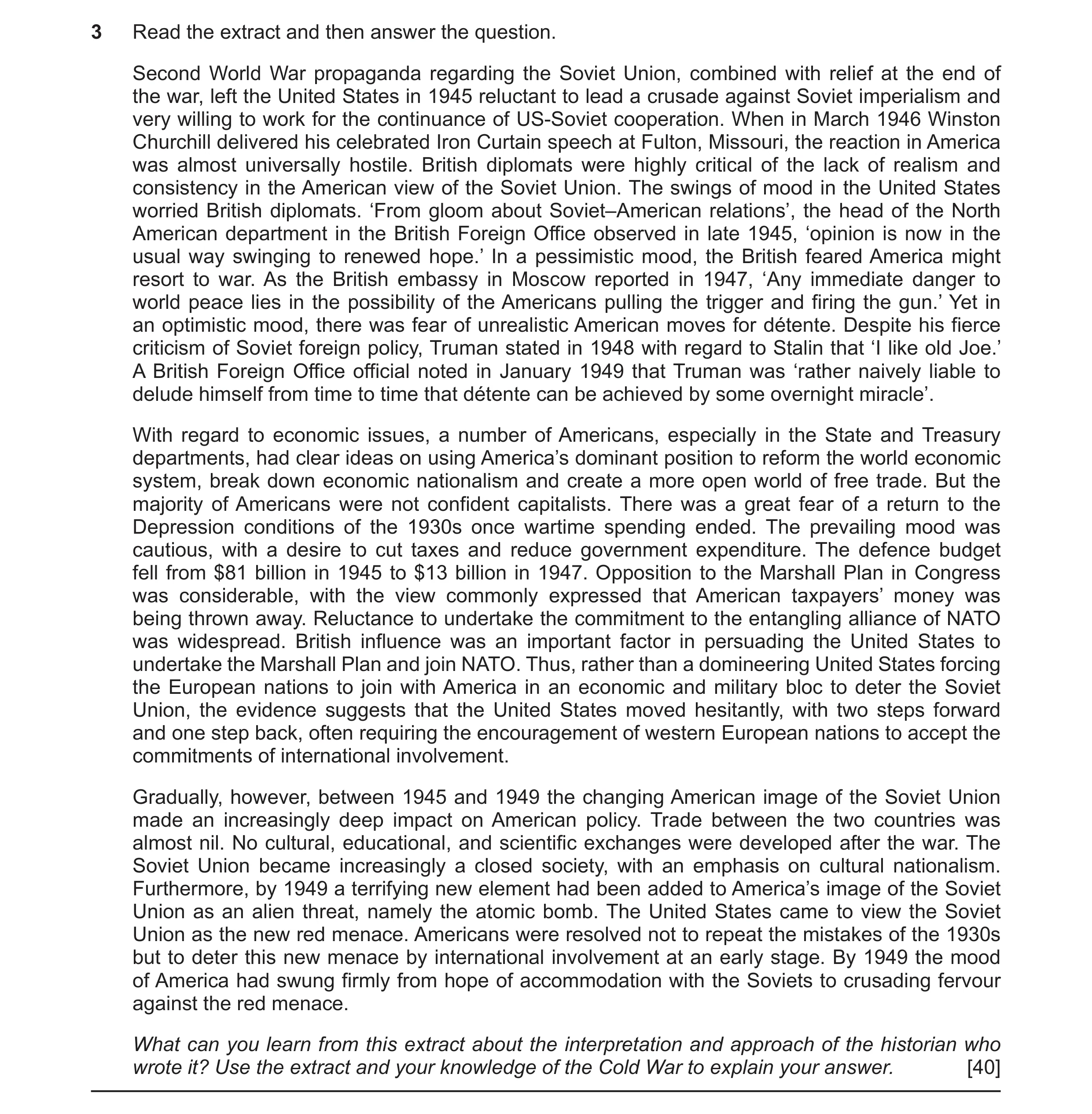
3 Read the extract and then answer the question. Second World War propaganda regarding the Soviet Union, combined with relief at the end of the war, left the United States in 1945 reluctant to lead a crusade against Soviet imperialism and very willing to work for the continuance of US-Soviet cooperation. When in March 1946 Winston Churchill delivered his celebrated Iron Curtain speech at Fulton, Missouri, the reaction in America was almost universally hostile. British diplomats were highly critical of the lack of realism and consistency in the American view of the Soviet Union. The swings of mood in the United States worried British diplomats. ‘From gloom about Soviet–American relations’, the head of the North American department in the British Foreign Office observed in late 1945, ‘opinion is now in the usual way swinging to renewed hope.’ In a pessimistic mood, the British feared America might resort to war. As the British embassy in Moscow reported in 1947, ‘Any immediate danger to world peace lies in the possibility of the Americans pulling the trigger and firing the gun.’ Yet in an optimistic mood, there was fear of unrealistic American moves for détente. Despite his fierce criticism of Soviet foreign policy, Truman stated in 1948 with regard to Stalin that ‘I like old Joe.’ A British Foreign Office official noted in January 1949 that Truman was ‘rather naively liable to delude himself from time to time that détente can be achieved by some overnight miracle’. With regard to economic issues, a number of Americans, especially in the State and Treasury departments, had clear ideas on using America’s dominant position to reform the world economic system, break down economic nationalism and create a more open world of free trade. But the majority of Americans were not confident capitalists. There was a great fear of a return to the Depression conditions of the 1930s once wartime spending ended. The prevailing mood was cautious, with a desire to cut taxes and reduce government expenditure. The defence budget fell from $81 billion in 1945 to $13 billion in 1947. Opposition to the Marshall Plan in Congress was considerable, with the view commonly expressed that American taxpayers’ money was being thrown away. Reluctance to undertake the commitment to the entangling alliance of NATO was widespread. British influence was an important factor in persuading the United States to undertake the Marshall Plan and join NATO. Thus, rather than a domineering United States forcing the European nations to join with America in an economic and military bloc to deter the Soviet Union, the evidence suggests that the United States moved hesitantly, with two steps forward and one step back, often requiring the encouragement of western European nations to accept the commitments of international involvement. Gradually, however, between 1945 and 1949 the changing American image of the Soviet Union made an increasingly deep impact on American policy. Trade between the two countries was almost nil. No cultural, educational, and scientific exchanges were developed after the war. The Soviet Union became increasingly a closed society, with an emphasis on cultural nationalism. Furthermore, by 1949 a terrifying new element had been added to America’s image of the Soviet Union as an alien threat, namely the atomic bomb. The United States came to view the Soviet Union as the new red menace. Americans were resolved not to repeat the mistakes of the 1930s but to deter this new menace by international involvement at an early stage. By 1949 the mood of America had swung firmly from hope of accommodation with the Soviets to crusading fervour against the red menace. What can you learn from this extract about the interpretation and approach of the historian who wrote it? Use the extract and your knowledge of the Cold War to explain your answer. [40]
40 marks
Mark scheme: 3 The Origins and Development of the Cold War 40 Interpretation/Approach The main interpretation is that the Cold War came about because (i) the USA was initially reluctant to assume a dominant position in the immediate postwar period, (ii) but, by 1949, this attitude had changed to one of active involvement to counter the perceived menace of Russia Showing complete understanding of the interpretation will involve discussion of both these aspects. The historian’s interpretation seems to reject revisionist ideas of the USA as an economically imperialist power, and sees it as uncertain of its role, and inconsistent in its attitudes towards Russia. However, by the late 1940s any attempt to cooperate with the Soviet Union had been abandoned, replaced by a policy of confrontation. There are ways in which the historian is critical of the USA, though not in the conventional revisionist manner. Candidates might label it as revisionist, and properly argued this could be acceptable in L5/L6. Glossary: Traditional/Orthodox interpretations of the Cold War were generally produced early after WW2. They blame the Soviet Union and Stalin’s expansionism for the Cold War. Revisionist historians challenged this view and shifted more of the focus onto the United States, generally through an economic approach which stressed the alleged aim of the US to establish its economic dominance over Europe. Post-revisionists moved towards a more balanced view in which elements of blame were attached to both sides. Since the opening of the Soviet archives post-1990 there has been a shift to attributing prime responsibility to Stalin – a post-post-revisionist stance which often seems very close to the traditional view, but which often places great importance on ideology. What counts is how appropriate the use of this kind of terminology is in relation to the extract, and how effectively the extract can be used to support it.
This question in 9489/33 Oct/Nov 2025
 1 / 14
 2 / 14
 3 / 14
 4 / 14
 5 / 14
 6 / 14
 7 / 14
 8 / 14
 9 / 14
 10 / 14
 11 / 14
 12 / 14
 13 / 14
 14 / 14
 40
40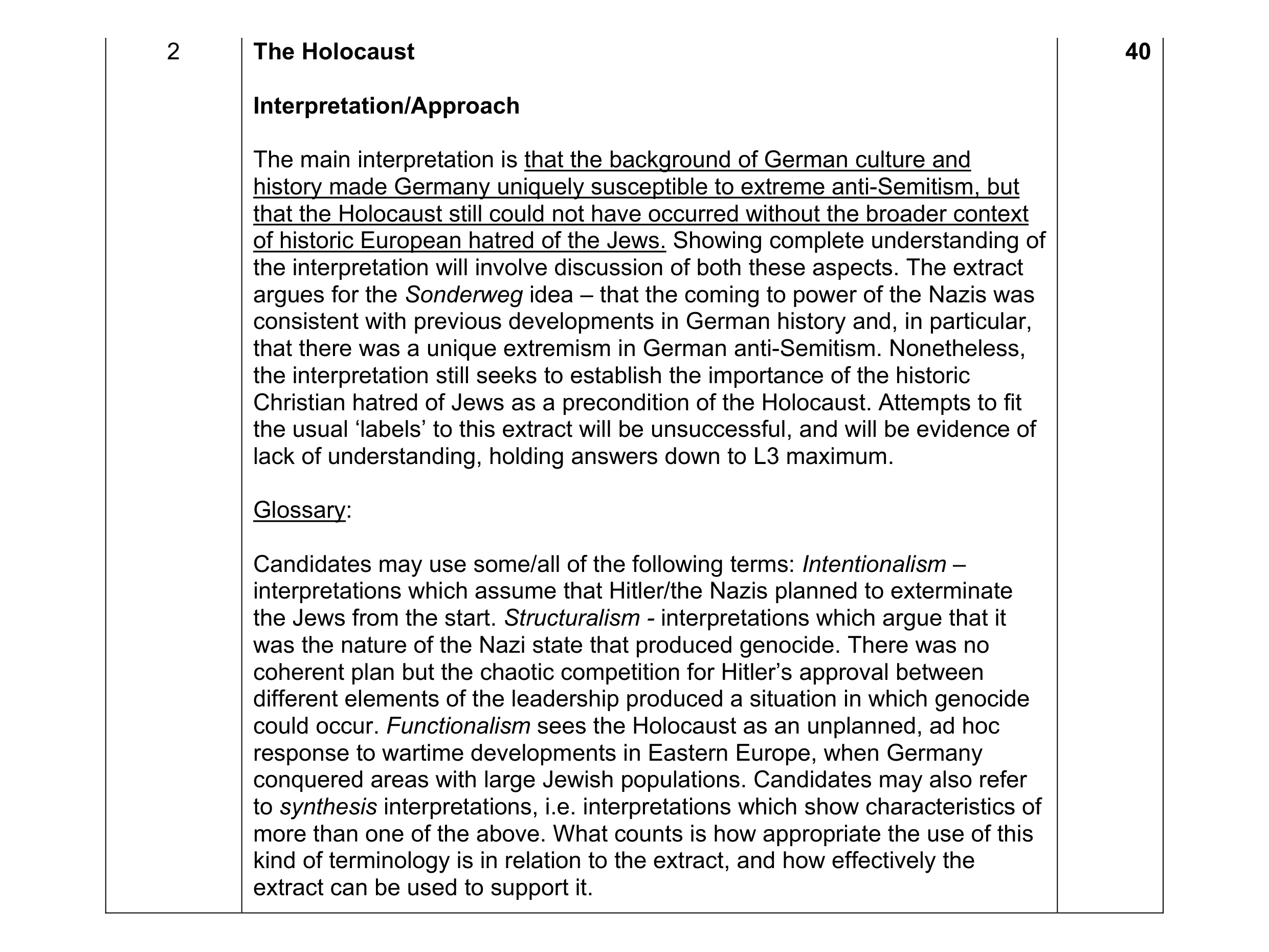 40
40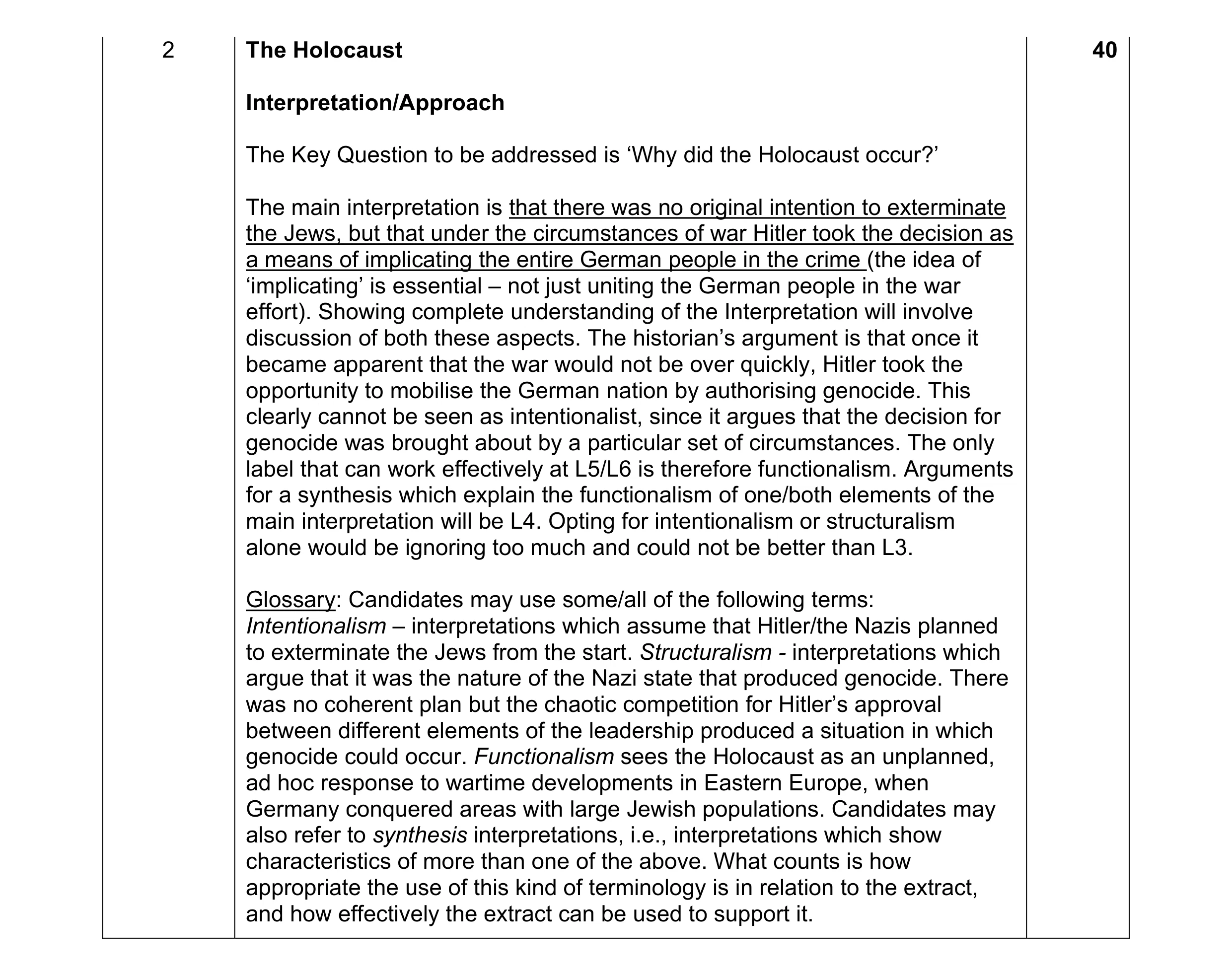 40
40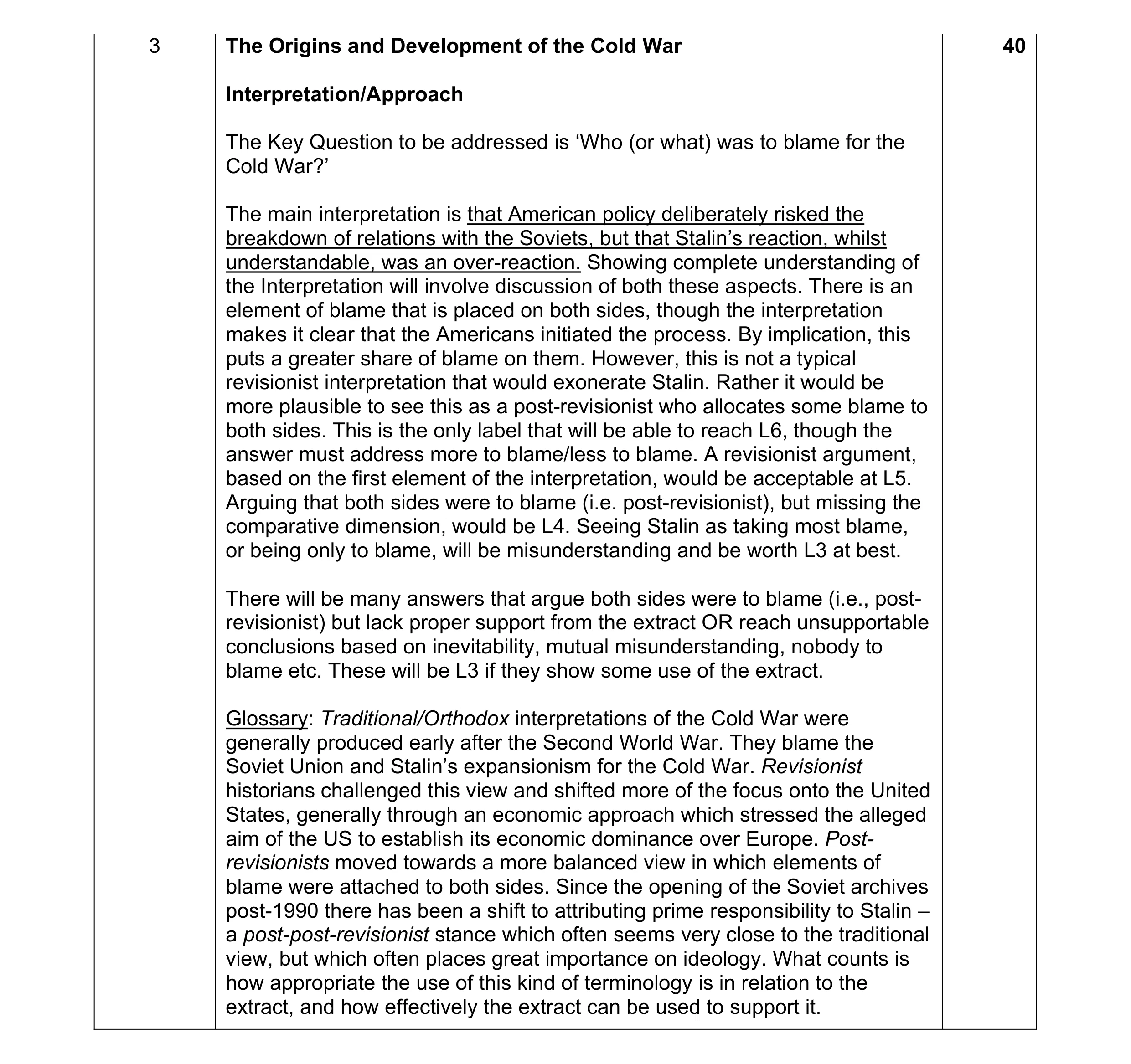 40
40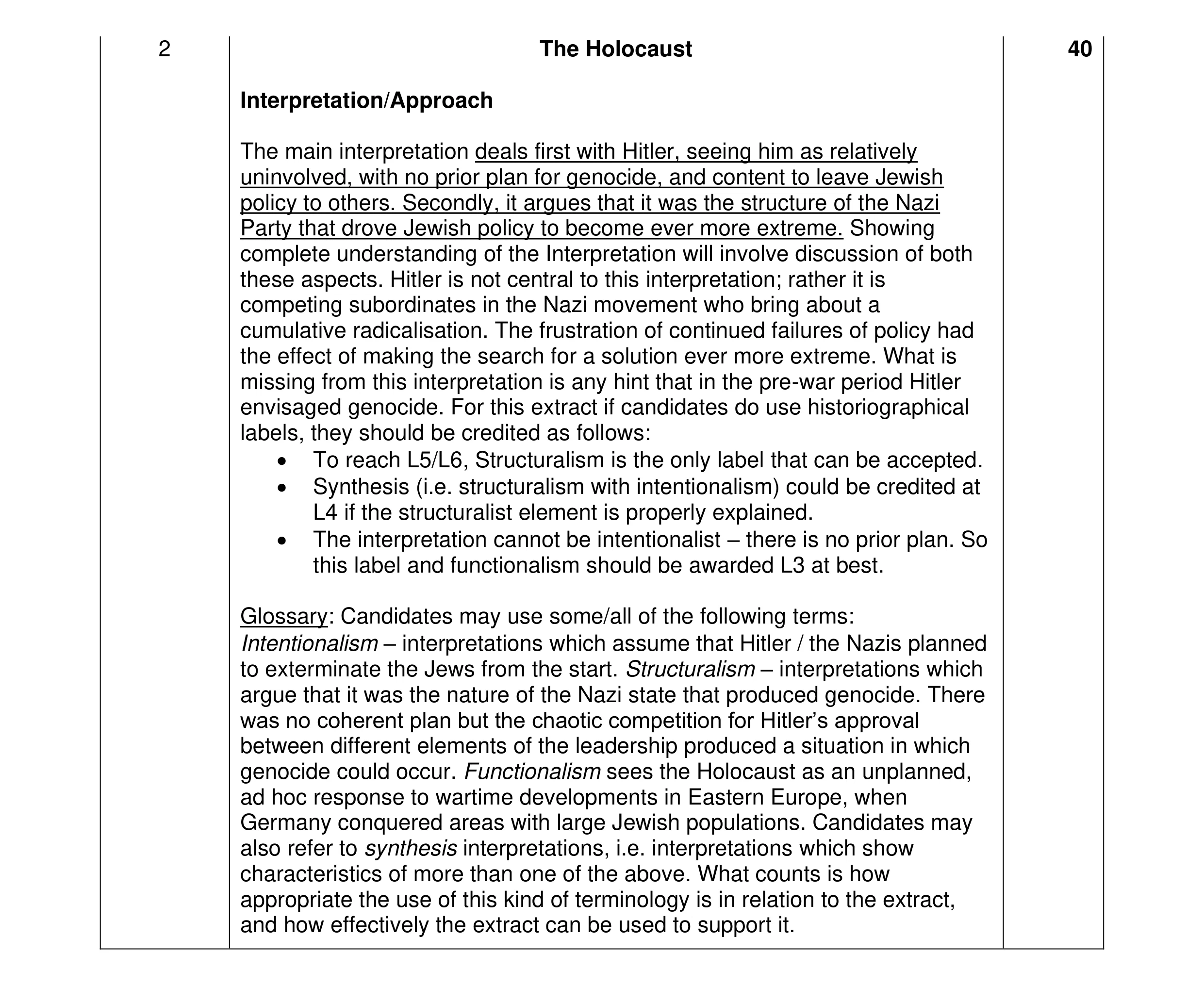 40
40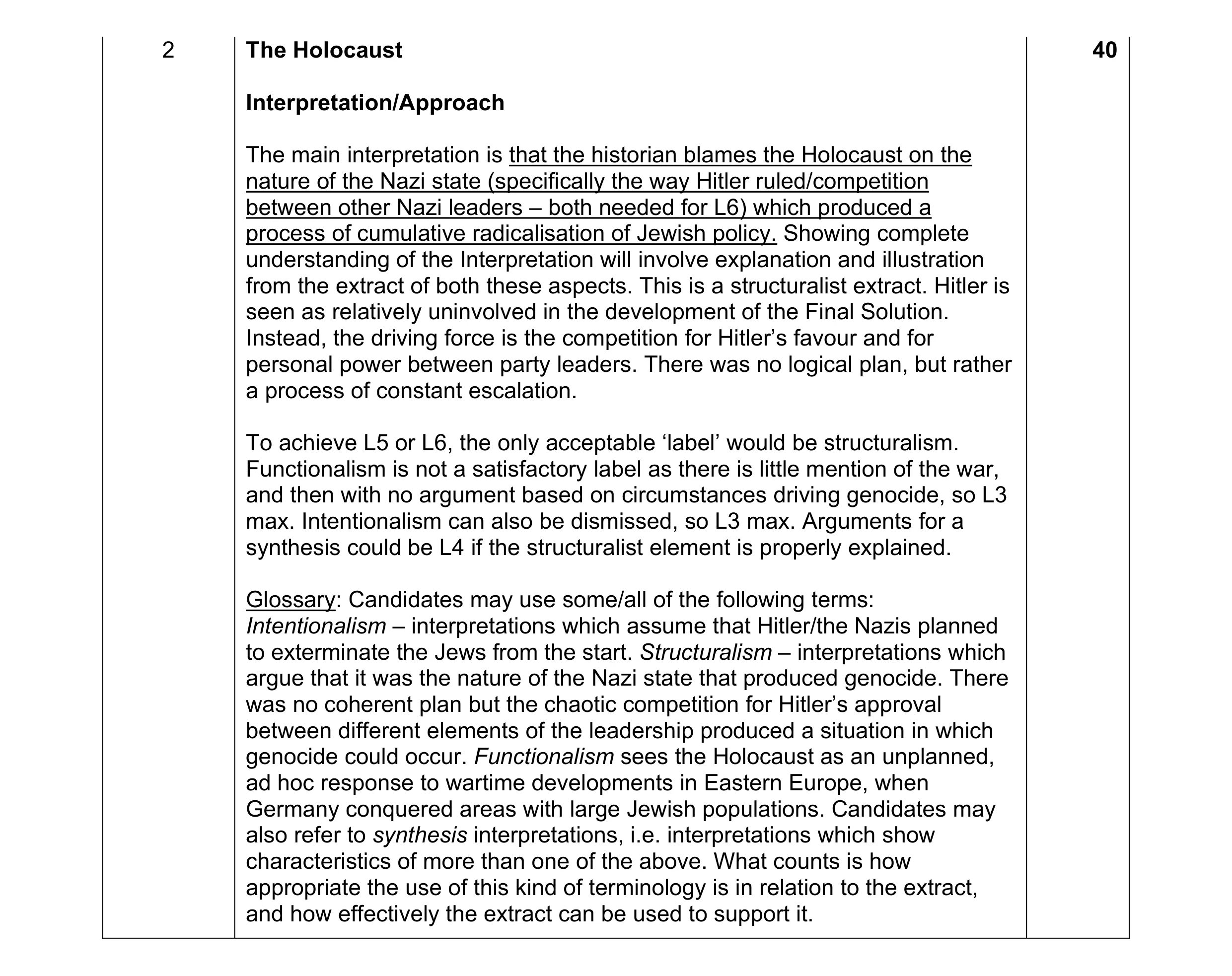 40
40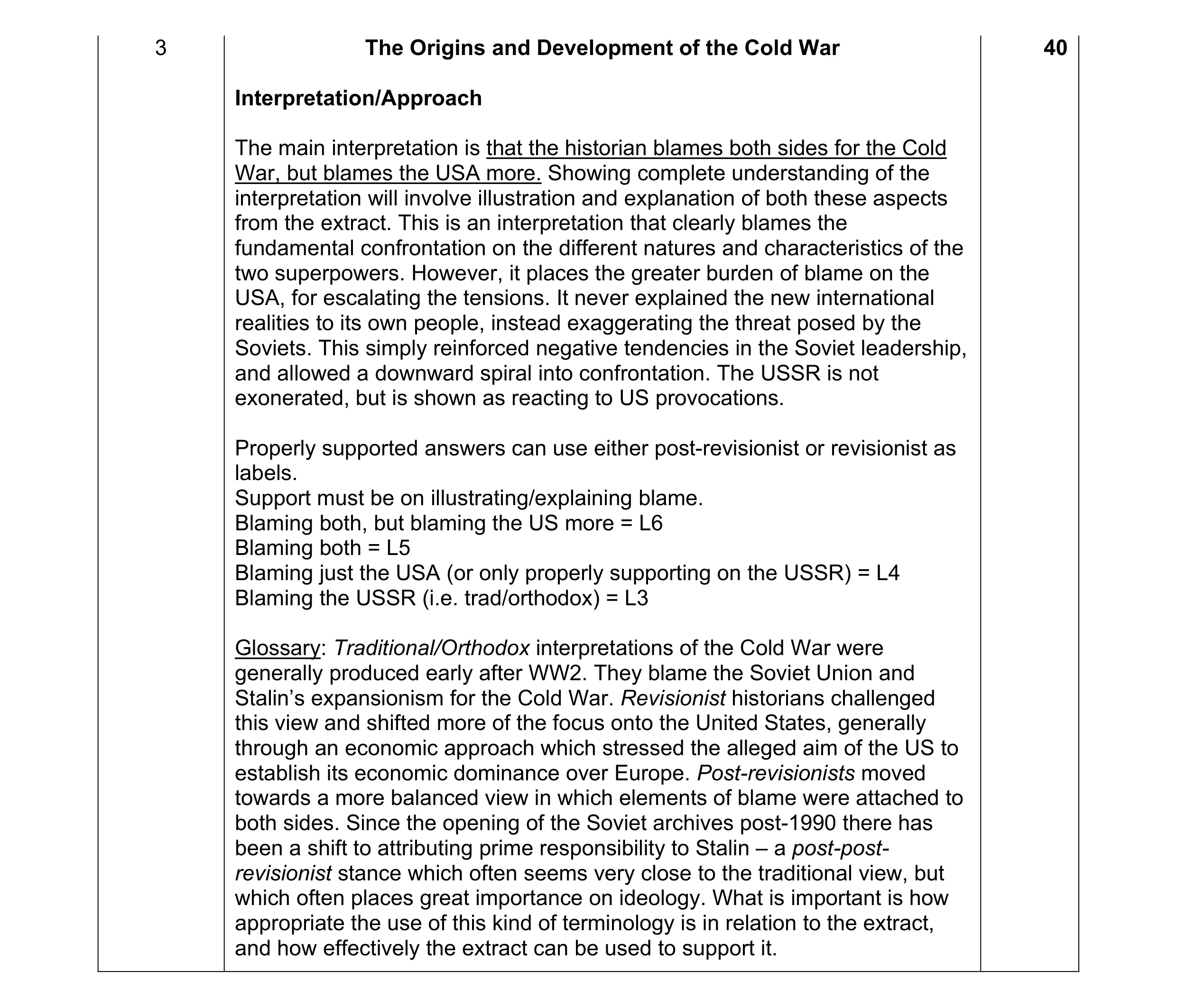 40
40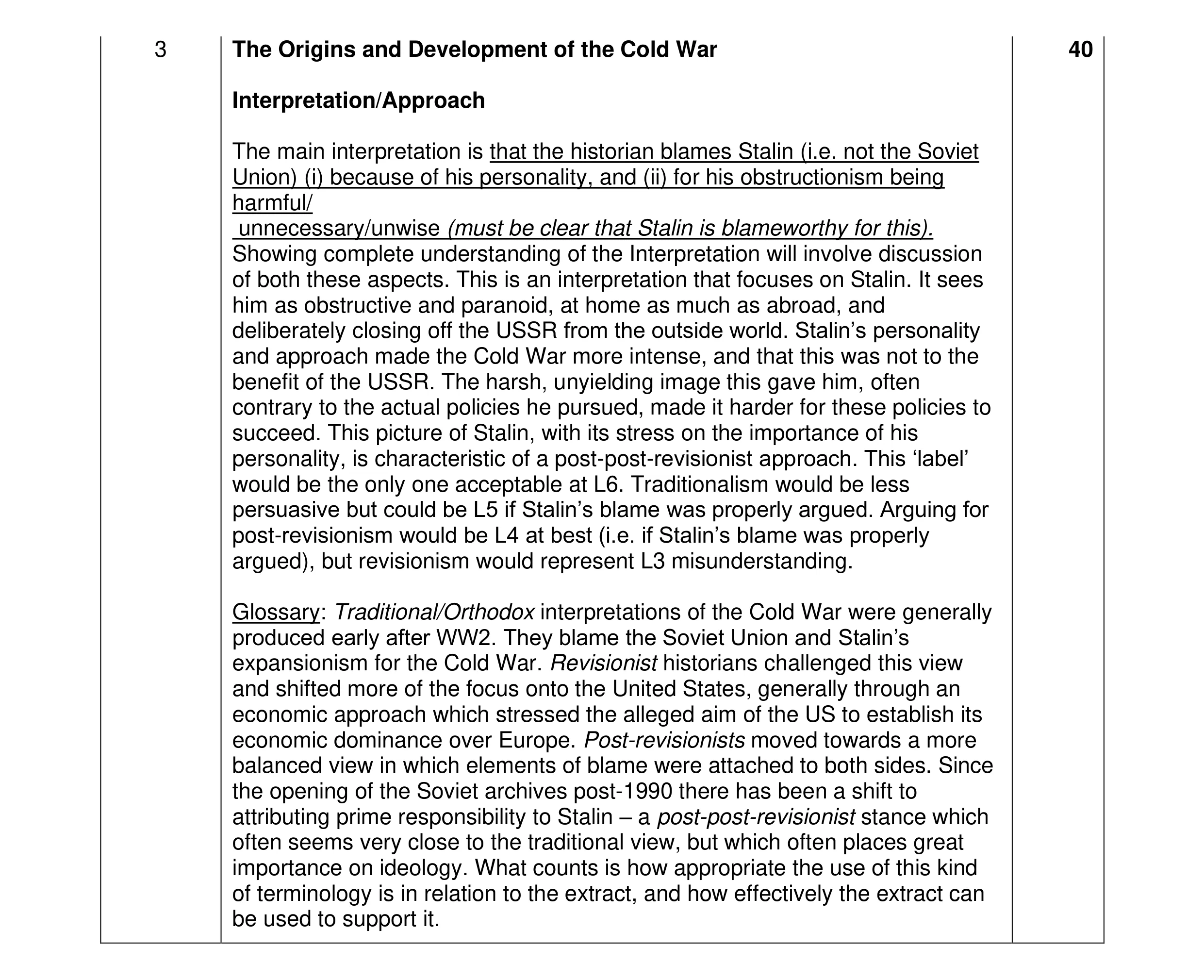 40
40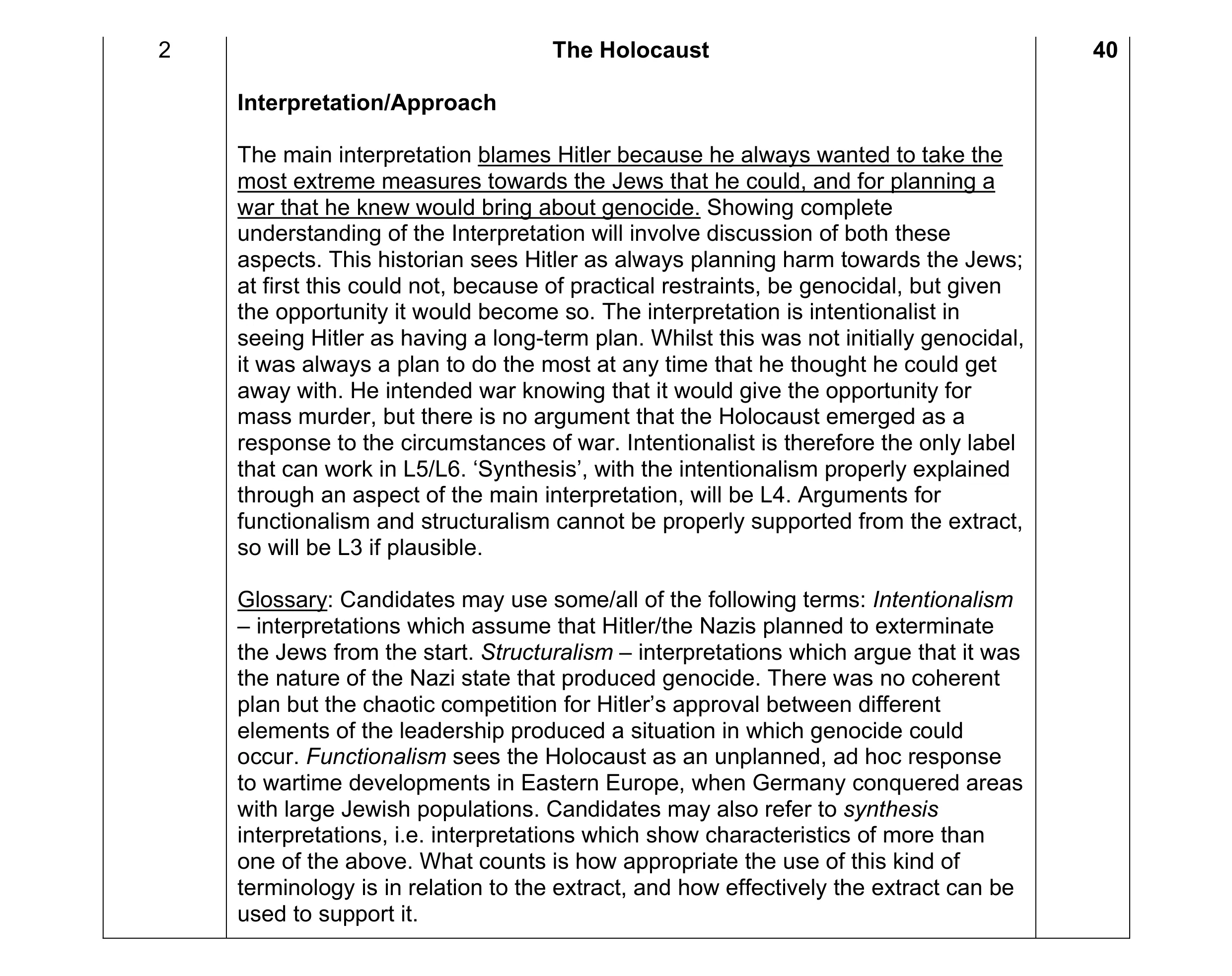 40
40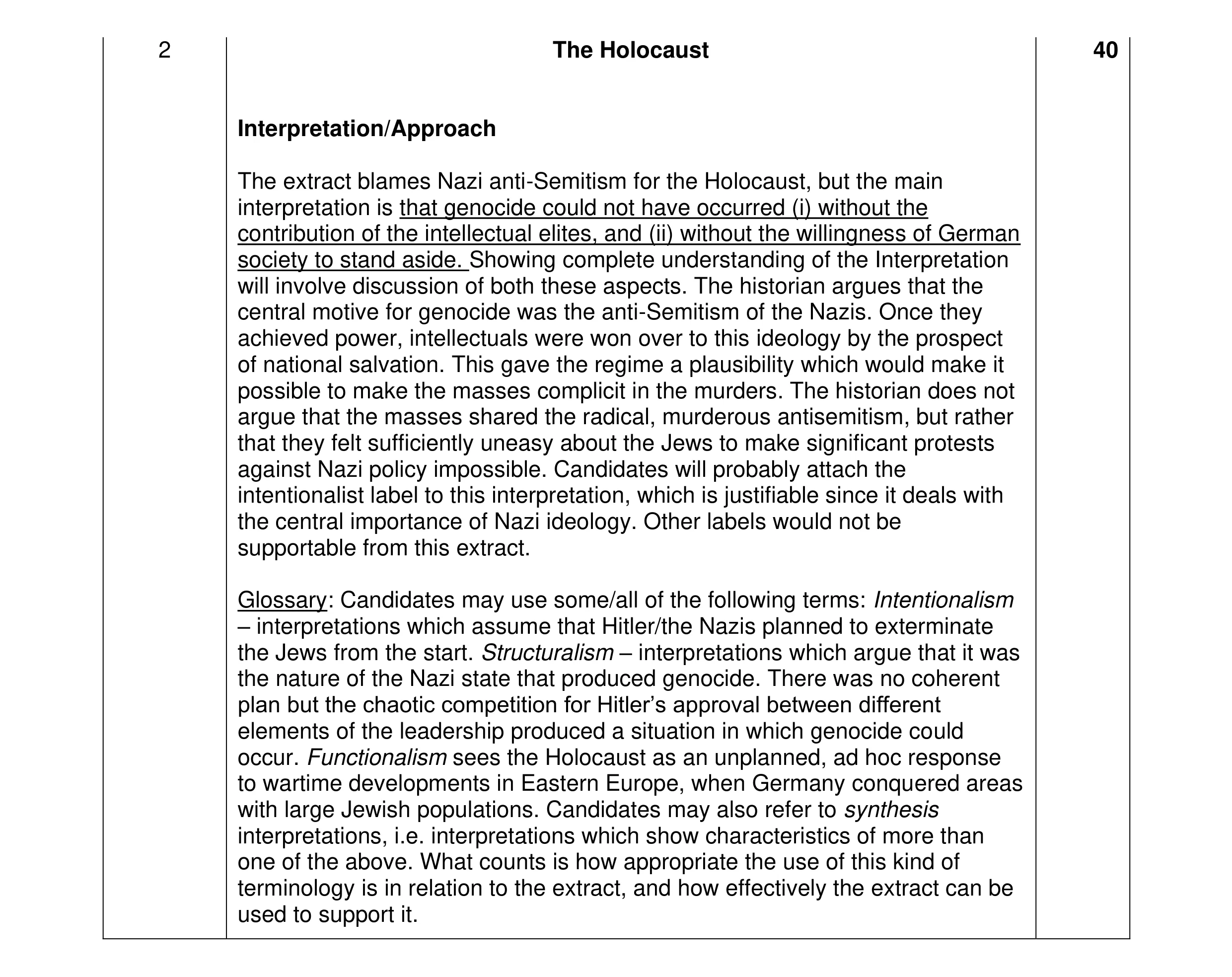 40
40 40
40 40
40 40
40 40
40