Cambridge A Level History 9489 — 2021 Oct/Nov Paper 3 · Variant 2
9489/32/O/N/21 · 3 questions · 40 marks · ≈45 min
The question paper and its mark scheme, free to read here and free to download. This is Cambridge’s own paper, exactly as it was sat.
Question paper4 pages
Mark scheme7 pages
Answers below. Sit the paper first if you are practising.
Questions as text
Q1 · Read the extract and then answer the question
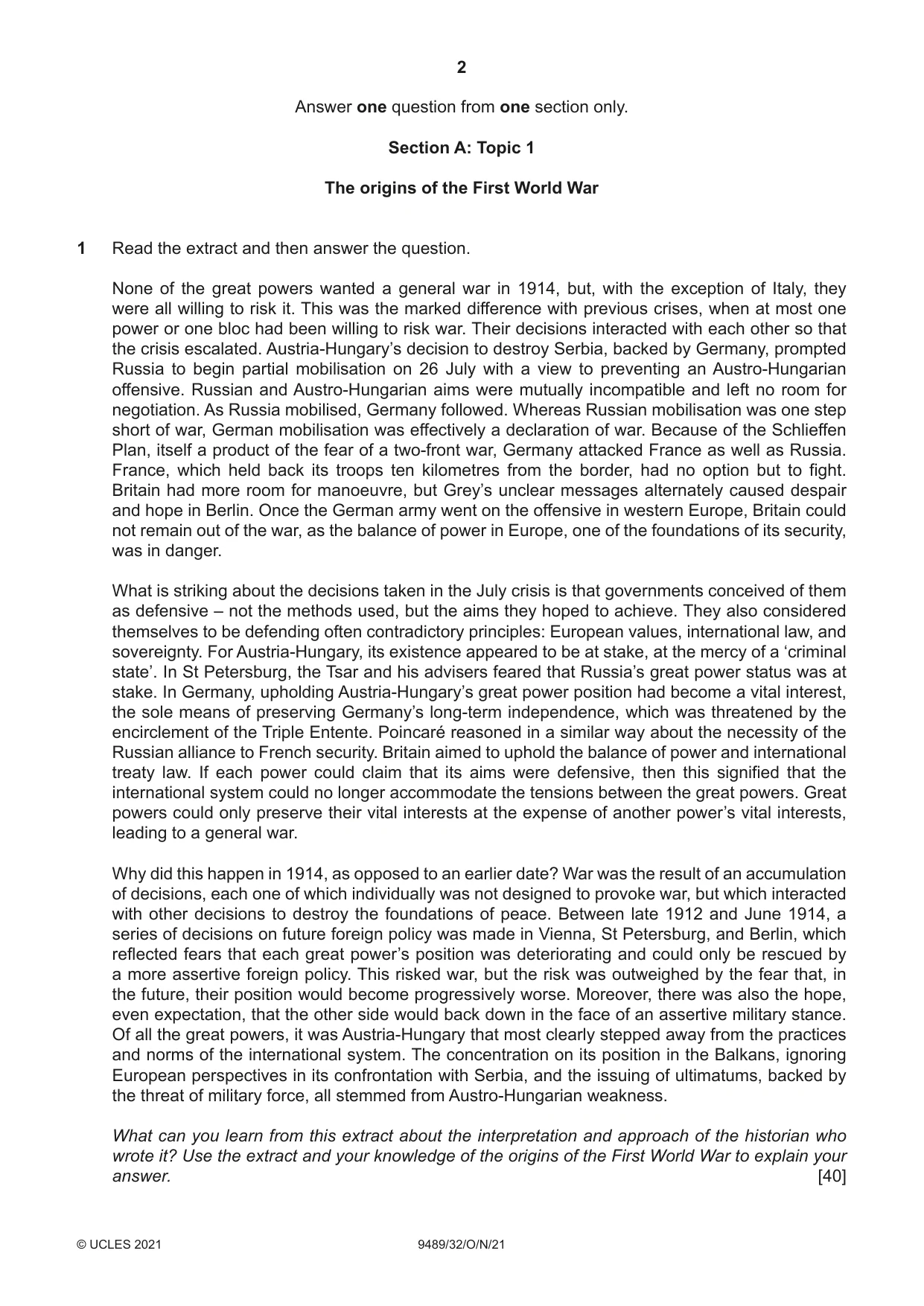
1 Read the extract and then answer the question. None of the great powers wanted a general war in 1914, but, with the exception of Italy, they were all willing to risk it. This was the marked difference with previous crises, when at most one power or one bloc had been willing to risk war. Their decisions interacted with each other so that the crisis escalated. Austria-Hungary’s decision to destroy Serbia, backed by Germany, prompted Russia to begin partial mobilisation on 26 July with a view to preventing an Austro-Hungarian offensive. Russian and Austro-Hungarian aims were mutually incompatible and left no room for negotiation. As Russia mobilised, Germany followed. Whereas Russian mobilisation was one step short of war, German mobilisation was effectively a declaration of war. Because of the Schlieffen Plan, itself a product of the fear of a two-front war, Germany attacked France as well as Russia. France, which held back its troops ten kilometres from the border, had no option but to fight. Britain had more room for manoeuvre, but Grey’s unclear messages alternately caused despair and hope in Berlin. Once the German army went on the offensive in western Europe, Britain could not remain out of the war, as the balance of power in Europe, one of the foundations of its security, was in danger. What is striking about the decisions taken in the July crisis is that governments conceived of them as defensive – not the methods used, but the aims they hoped to achieve. They also considered themselves to be defending often contradictory principles: European values, international law, and sovereignty. For Austria-Hungary, its existence appeared to be at stake, at the mercy of a ‘criminal state’. In St Petersburg, the Tsar and his advisers feared that Russia’s great power status was at stake. In Germany, upholding Austria-Hungary’s great power position had become a vital interest, the sole means of preserving Germany’s long-term independence, which was threatened by the encirclement of the Triple Entente. Poincaré reasoned in a similar way about the necessity of the Russian alliance to French security. Britain aimed to uphold the balance of power and international treaty law. If each power could claim that its aims were defensive, then this signified that the international system could no longer accommodate the tensions between the great powers. Great powers could only preserve their vital interests at the expense of another power’s vital interests, leading to a general war. Why did this happen in 1914, as opposed to an earlier date? War was the result of an accumulation of decisions, each one of which individually was not designed to provoke war, but which interacted with other decisions to destroy the foundations of peace. Between late 1912 and June 1914, a series of decisions on future foreign policy was made in Vienna, St Petersburg, and Berlin, which reflected fears that each great power’s position was deteriorating and could only be rescued by a more assertive foreign policy. This risked war, but the risk was outweighed by the fear that, in the future, their position would become progressively worse. Moreover, there was also the hope, even expectation, that the other side would back down in the face of an assertive military stance. Of all the great powers, it was Austria-Hungary that most clearly stepped away from the practices and norms of the international system. The concentration on its position in the Balkans, ignoring European perspectives in its confrontation with Serbia, and the issuing of ultimatums, backed by the threat of military force, all stemmed from Austro-Hungarian weakness. What can you learn from this extract about the interpretation and approach of the historian who wrote it? Use the extract and your knowledge of the origins of the First World War to explain your answer. [40]
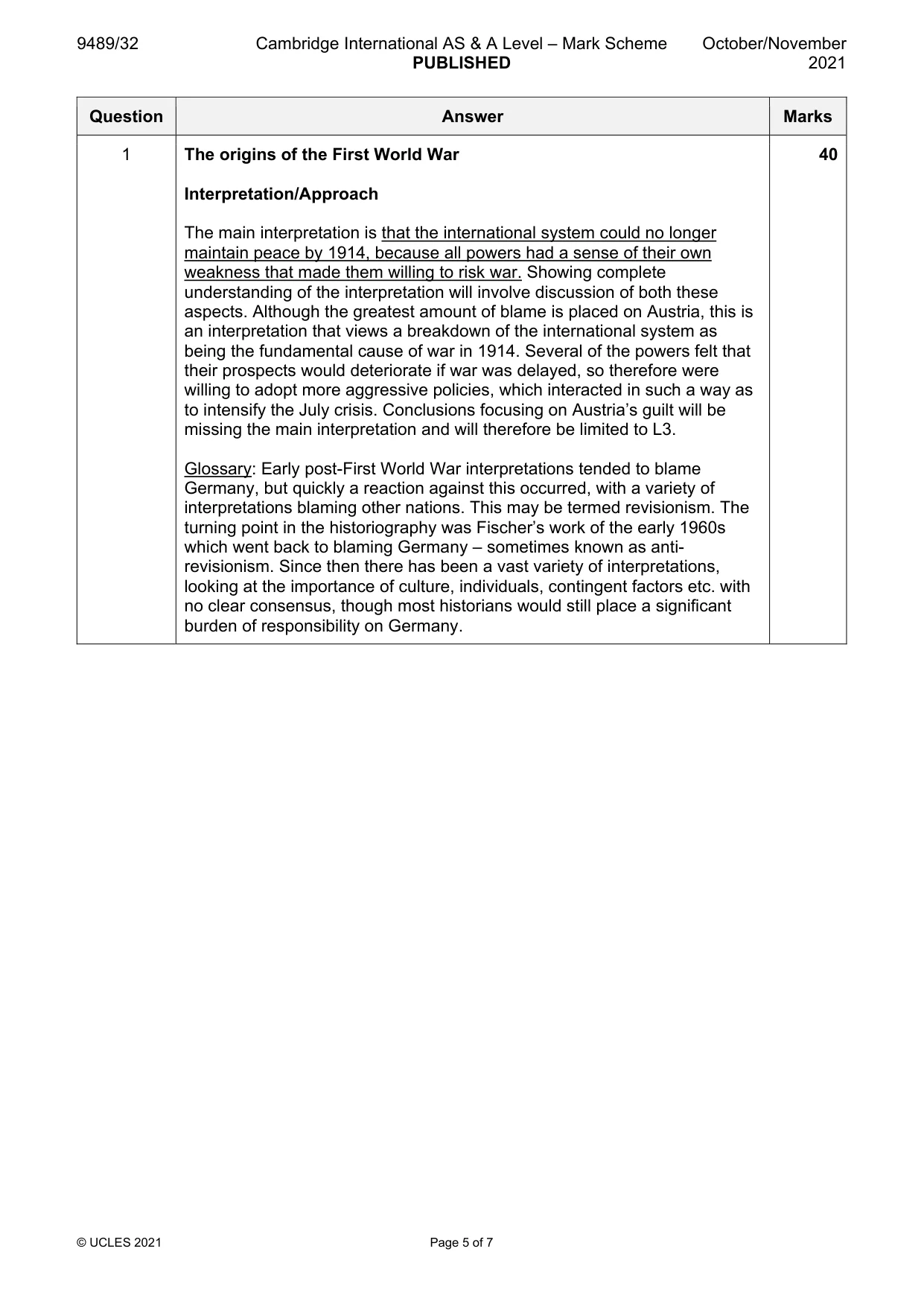
Mark scheme: Question Answer Marks 1 The origins of the First World War 40 Interpretation/Approach The main interpretation is that the international system could no longer maintain peace by 1914, because all powers had a sense of their own weakness that made them willing to risk war. Showing complete understanding of the interpretation will involve discussion of both these aspects. Although the greatest amount of blame is placed on Austria, this is an interpretation that views a breakdown of the international system as being the fundamental cause of war in 1914. Several of the powers felt that their prospects would deteriorate if war was delayed, so therefore were willing to adopt more aggressive policies, which interacted in such a way as to intensify the July crisis. Conclusions focusing on Austria’s guilt will be missing the main interpretation and will therefore be limited to L3. Glossary: Early post-First World War interpretations tended to blame Germany, but quickly a reaction against this occurred, with a variety of interpretations blaming other nations. This may be termed revisionism. The turning point in the historiography was Fischer’s work of the early 1960s which went back to blaming Germany – sometimes known as anti- revisionism. Since then there has been a vast variety of interpretations, looking at the importance of culture, individuals, contingent factors etc. with no clear consensus, though most historians would still place a significant burden of responsibility on Germany.
Q2 · Read the extract and then answer the question
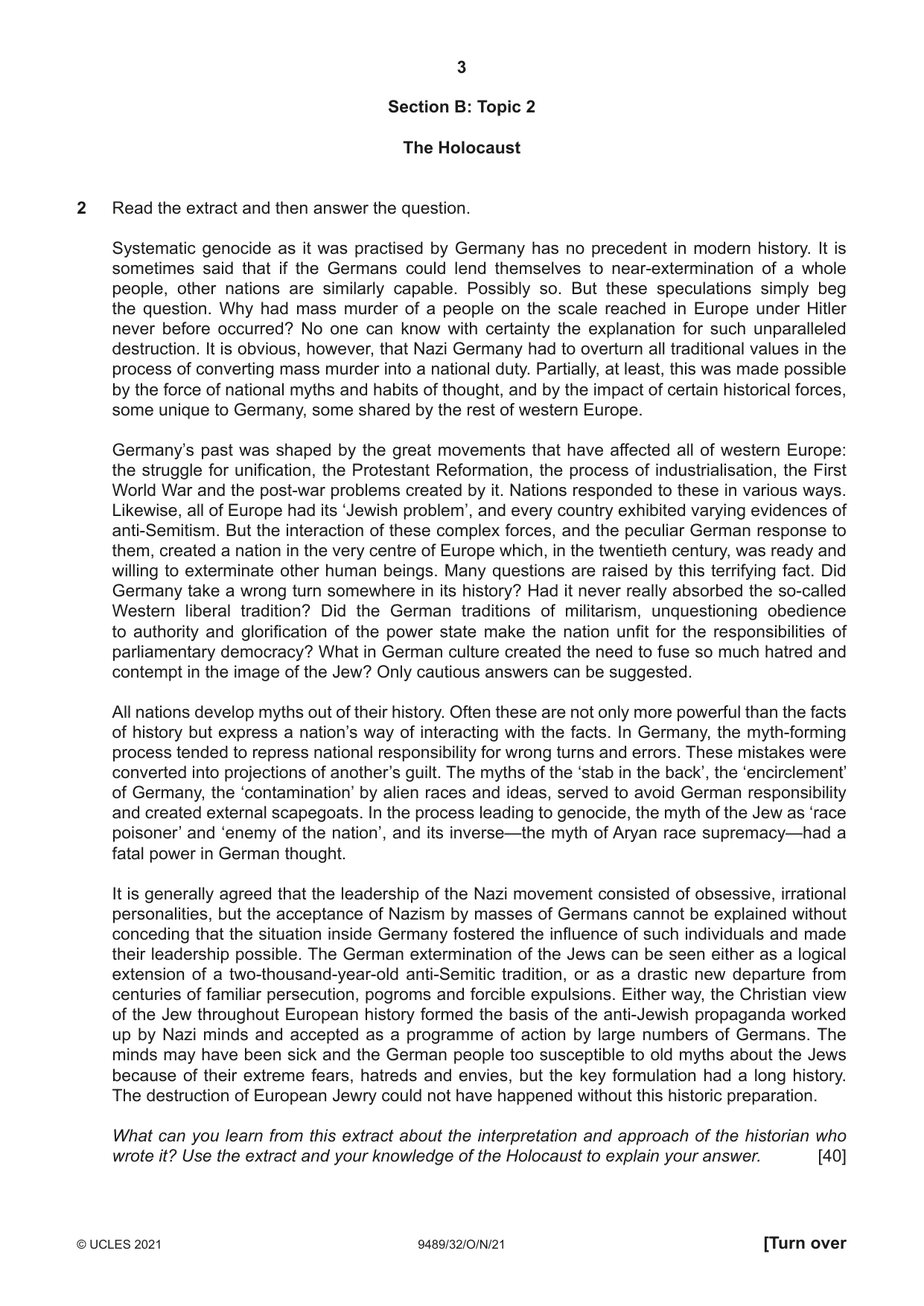
2 Read the extract and then answer the question. Systematic genocide as it was practised by Germany has no precedent in modern history. It is sometimes said that if the Germans could lend themselves to near-extermination of a whole people, other nations are similarly capable. Possibly so. But these speculations simply beg the question. Why had mass murder of a people on the scale reached in Europe under Hitler never before occurred? No one can know with certainty the explanation for such unparalleled destruction. It is obvious, however, that Nazi Germany had to overturn all traditional values in the process of converting mass murder into a national duty. Partially, at least, this was made possible by the force of national myths and habits of thought, and by the impact of certain historical forces, some unique to Germany, some shared by the rest of western Europe. Germany’s past was shaped by the great movements that have affected all of western Europe: the struggle for unification, the Protestant Reformation, the process of industrialisation, the First World War and the post-war problems created by it. Nations responded to these in various ways. Likewise, all of Europe had its ‘Jewish problem’, and every country exhibited varying evidences of anti-Semitism. But the interaction of these complex forces, and the peculiar German response to them, created a nation in the very centre of Europe which, in the twentieth century, was ready and willing to exterminate other human beings. Many questions are raised by this terrifying fact. Did Germany take a wrong turn somewhere in its history? Had it never really absorbed the so-called Western liberal tradition? Did the German traditions of militarism, unquestioning obedience to authority and glorification of the power state make the nation unfit for the responsibilities of parliamentary democracy? What in German culture created the need to fuse so much hatred and contempt in the image of the Jew? Only cautious answers can be suggested. All nations develop myths out of their history. Often these are not only more powerful than the facts of history but express a nation’s way of interacting with the facts. In Germany, the myth-forming process tended to repress national responsibility for wrong turns and errors. These mistakes were converted into projections of another’s guilt. The myths of the ‘stab in the back’, the ‘encirclement’ of Germany, the ‘contamination’ by alien races and ideas, served to avoid German responsibility and created external scapegoats. In the process leading to genocide, the myth of the Jew as ‘race poisoner’ and ‘enemy of the nation’, and its inverse—the myth of Aryan race supremacy—had a fatal power in German thought. It is generally agreed that the leadership of the Nazi movement consisted of obsessive, irrational personalities, but the acceptance of Nazism by masses of Germans cannot be explained without conceding that the situation inside Germany fostered the influence of such individuals and made their leadership possible. The German extermination of the Jews can be seen either as a logical extension of a two-thousand-year-old anti-Semitic tradition, or as a drastic new departure from centuries of familiar persecution, pogroms and forcible expulsions. Either way, the Christian view of the Jew throughout European history formed the basis of the anti-Jewish propaganda worked up by Nazi minds and accepted as a programme of action by large numbers of Germans. The minds may have been sick and the German people too susceptible to old myths about the Jews because of their extreme fears, hatreds and envies, but the key formulation had a long history. The destruction of European Jewry could not have happened without this historic preparation. What can you learn from this extract about the interpretation and approach of the historian who wrote it? Use the extract and your knowledge of the Holocaust to explain your answer. [40] Section C: Topic 3 The origins and development of the Cold War
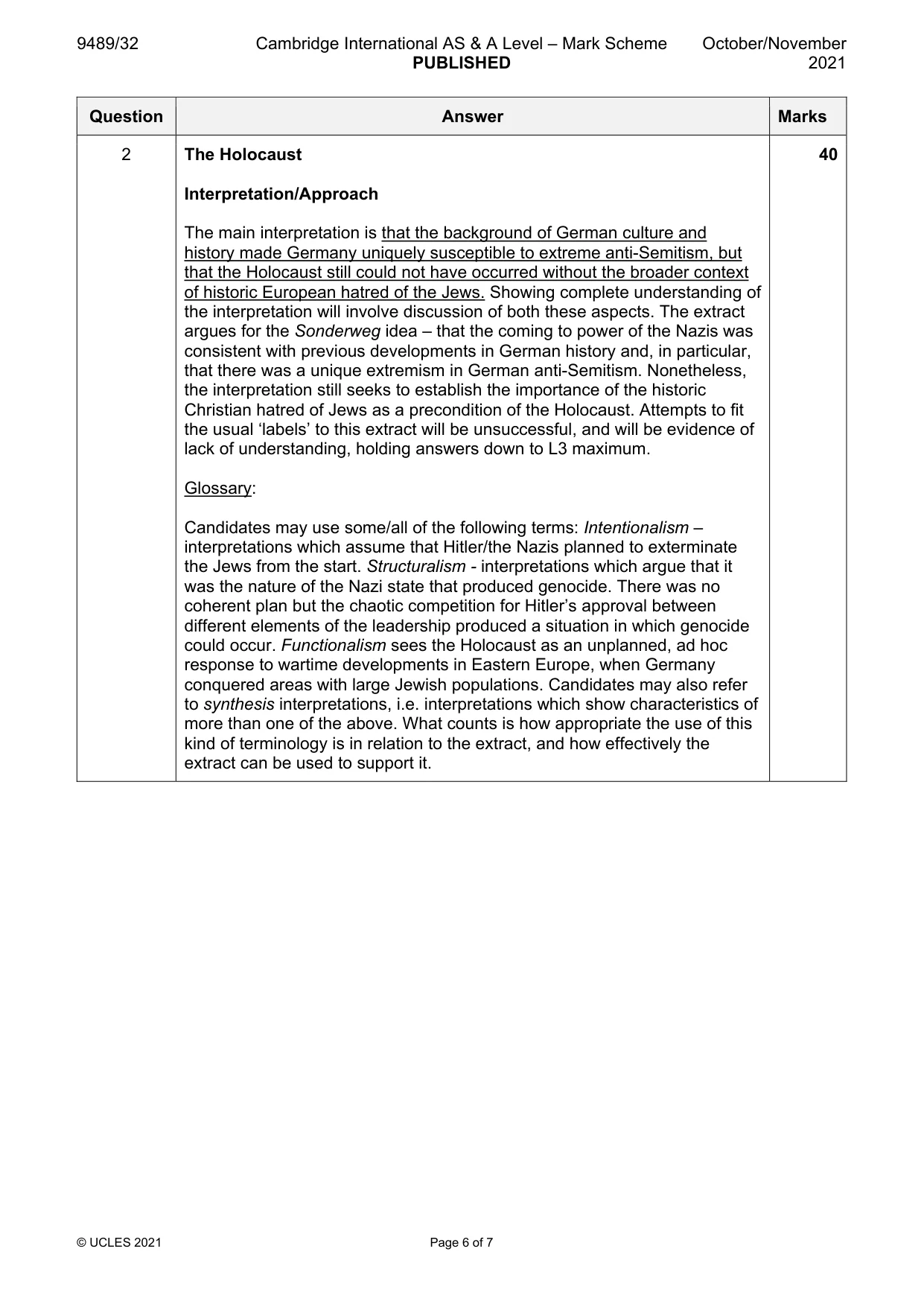
Mark scheme: 2 The Holocaust 40 Interpretation/Approach The main interpretation is that the background of German culture and history made Germany uniquely susceptible to extreme anti-Semitism, but that the Holocaust still could not have occurred without the broader context of historic European hatred of the Jews. Showing complete understanding of the interpretation will involve discussion of both these aspects. The extract argues for the Sonderweg idea – that the coming to power of the Nazis was consistent with previous developments in German history and, in particular, that there was a unique extremism in German anti-Semitism. Nonetheless, the interpretation still seeks to establish the importance of the historic Christian hatred of Jews as a precondition of the Holocaust. Attempts to fit the usual ‘labels’ to this extract will be unsuccessful, and will be evidence of lack of understanding, holding answers down to L3 maximum. Glossary: Candidates may use some/all of the following terms: Intentionalism – interpretations which assume that Hitler/the Nazis planned to exterminate the Jews from the start. Structuralism - interpretations which argue that it was the nature of the Nazi state that produced genocide. There was no coherent plan but the chaotic competition for Hitler’s approval between different elements of the leadership produced a situation in which genocide could occur. Functionalism sees the Holocaust as an unplanned, ad hoc response to wartime developments in Eastern Europe, when Germany conquered areas with large Jewish populations. Candidates may also refer to synthesis interpretations, i.e. interpretations which show characteristics of more than one of the above. What counts is how appropriate the use of this kind of terminology is in relation to the extract, and how effectively the extract can be used to support it.
More questions on How did the rise of extremism affect international relations?
Q3 · Read the extract and then answer the question
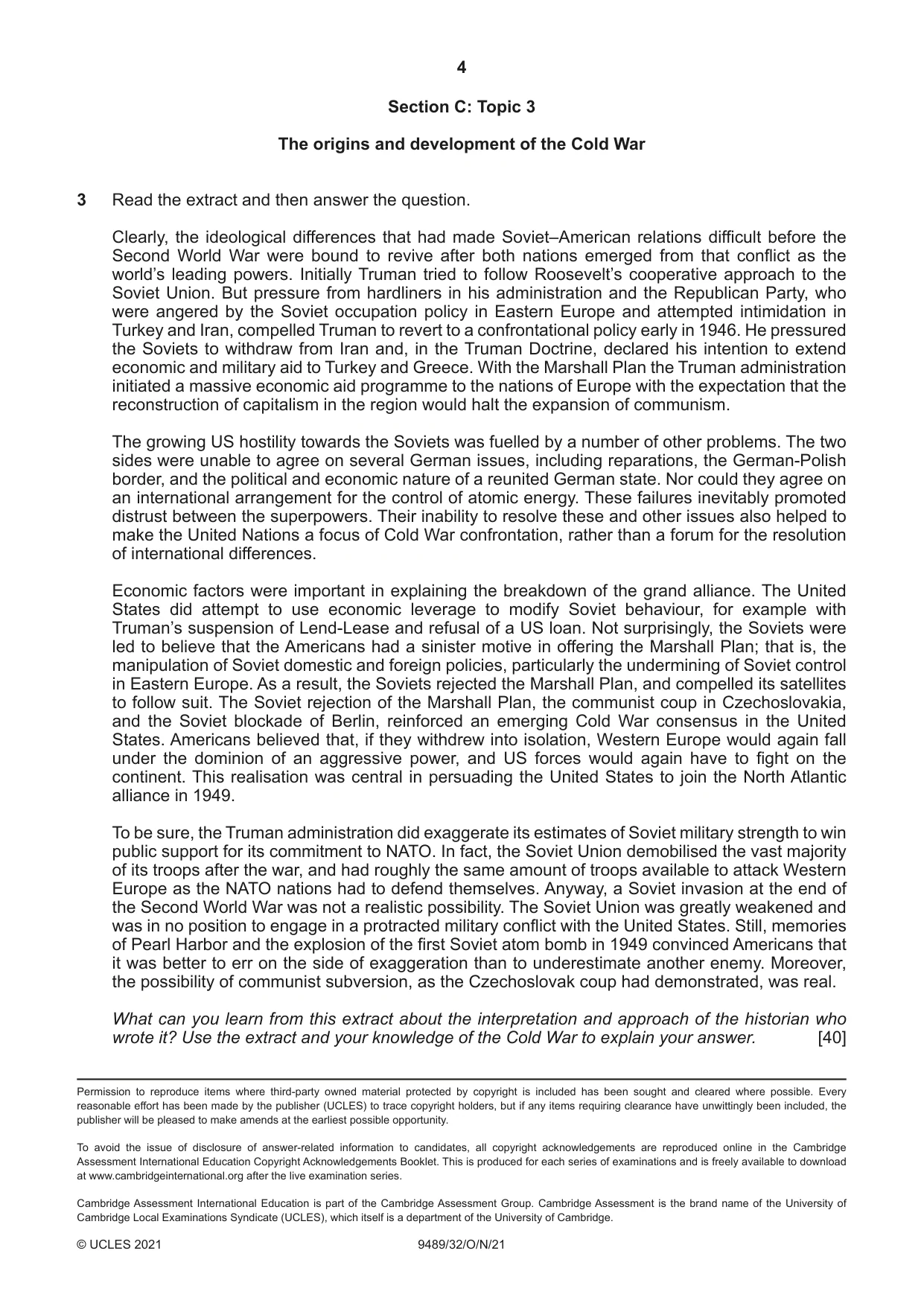
3 Read the extract and then answer the question. Clearly, the ideological differences that had made Soviet–American relations difficult before the Second World War were bound to revive after both nations emerged from that conflict as the world’s leading powers. Initially Truman tried to follow Roosevelt’s cooperative approach to the Soviet Union. But pressure from hardliners in his administration and the Republican Party, who were angered by the Soviet occupation policy in Eastern Europe and attempted intimidation in Turkey and Iran, compelled Truman to revert to a confrontational policy early in 1946. He pressured the Soviets to withdraw from Iran and, in the Truman Doctrine, declared his intention to extend economic and military aid to Turkey and Greece. With the Marshall Plan the Truman administration initiated a massive economic aid programme to the nations of Europe with the expectation that the reconstruction of capitalism in the region would halt the expansion of communism. The growing US hostility towards the Soviets was fuelled by a number of other problems. The two sides were unable to agree on several German issues, including reparations, the German-Polish border, and the political and economic nature of a reunited German state. Nor could they agree on an international arrangement for the control of atomic energy. These failures inevitably promoted distrust between the superpowers. Their inability to resolve these and other issues also helped to make the United Nations a focus of Cold War confrontation, rather than a forum for the resolution of international differences. Economic factors were important in explaining the breakdown of the grand alliance. The United States did attempt to use economic leverage to modify Soviet behaviour, for example with Truman’s suspension of Lend-Lease and refusal of a US loan. Not surprisingly, the Soviets were led to believe that the Americans had a sinister motive in offering the Marshall Plan; that is, the manipulation of Soviet domestic and foreign policies, particularly the undermining of Soviet control in Eastern Europe. As a result, the Soviets rejected the Marshall Plan, and compelled its satellites to follow suit. The Soviet rejection of the Marshall Plan, the communist coup in Czechoslovakia, and the Soviet blockade of Berlin, reinforced an emerging Cold War consensus in the United States. Americans believed that, if they withdrew into isolation, Western Europe would again fall under the dominion of an aggressive power, and US forces would again have to fight on the continent. This realisation was central in persuading the United States to join the North Atlantic alliance in 1949. To be sure, the Truman administration did exaggerate its estimates of Soviet military strength to win public support for its commitment to NATO. In fact, the Soviet Union demobilised the vast majority of its troops after the war, and had roughly the same amount of troops available to attack Western Europe as the NATO nations had to defend themselves. Anyway, a Soviet invasion at the end of the Second World War was not a realistic possibility. The Soviet Union was greatly weakened and was in no position to engage in a protracted military conflict with the United States. Still, memories of Pearl Harbor and the explosion of the first Soviet atom bomb in 1949 convinced Americans that it was better to err on the side of exaggeration than to underestimate another enemy. Moreover, the possibility of communist subversion, as the Czechoslovak coup had demonstrated, was real. What can you learn from this extract about the interpretation and approach of the historian who wrote it? Use the extract and your knowledge of the Cold War to explain your answer. [40]
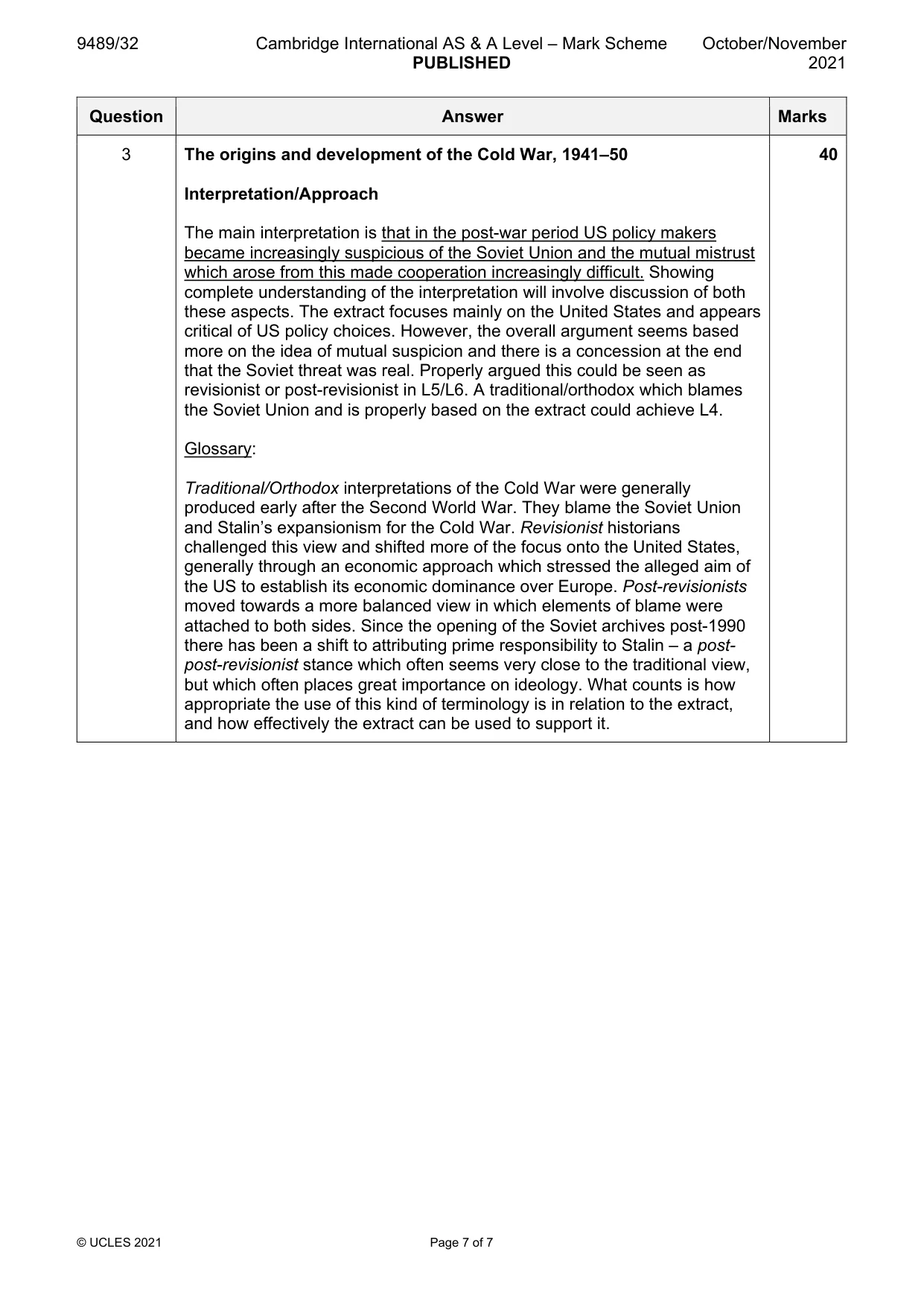
Mark scheme: 3 The origins and development of the Cold War, 1941–50 40 Interpretation/Approach The main interpretation is that in the post-war period US policy makers became increasingly suspicious of the Soviet Union and the mutual mistrust which arose from this made cooperation increasingly difficult. Showing complete understanding of the interpretation will involve discussion of both these aspects. The extract focuses mainly on the United States and appears critical of US policy choices. However, the overall argument seems based more on the idea of mutual suspicion and there is a concession at the end that the Soviet threat was real. Properly argued this could be seen as revisionist or post-revisionist in L5/L6. A traditional/orthodox which blames the Soviet Union and is properly based on the extract could achieve L4. Glossary: Traditional/Orthodox interpretations of the Cold War were generally produced early after the Second World War. They blame the Soviet Union and Stalin’s expansionism for the Cold War. Revisionist historians challenged this view and shifted more of the focus onto the United States, generally through an economic approach which stressed the alleged aim of the US to establish its economic dominance over Europe. Post-revisionists moved towards a more balanced view in which elements of blame were attached to both sides. Since the opening of the Soviet archives post-1990 there has been a shift to attributing prime responsibility to Stalin – a post- post-revisionist stance which often seems very close to the traditional view, but which often places great importance on ideology. What counts is how appropriate the use of this kind of terminology is in relation to the extract, and how effectively the extract can be used to support it.
What was in this paper
The subtopics covered by these 3 questions, and how many questions each got. Open one in a new tab to see every Cambridge question on it.
What you needed in this session
Cambridge’s own grade thresholds for 2021 Oct/Nov, Paper 3 · Variant 2. A higher threshold means an easier paper — the bar moves with how the cohort did.