Cambridge A Level History 9489 — 2025 Oct/Nov Paper 3 · Variant 1
9489/31/O/N/25 · 3 questions · 40 marks · ≈45 min
The question paper and its mark scheme, free to read here and free to download. This is Cambridge’s own paper, exactly as it was sat.
Question paper4 pages
Mark scheme9 pages
Answers below. Sit the paper first if you are practising.
Questions as text
Q1 · Read the extract and then answer the question
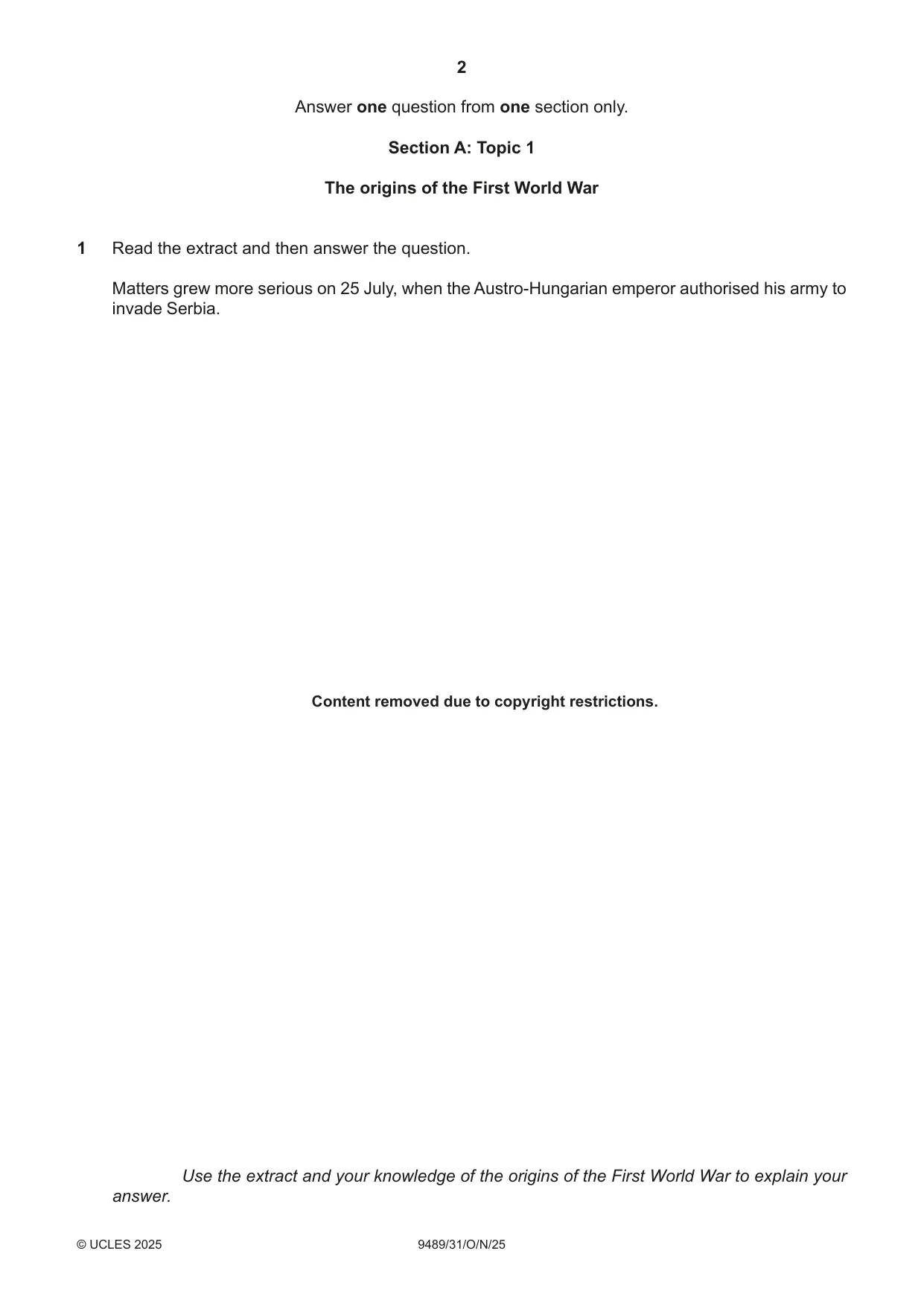
1 Read the extract and then answer the question. Matters grew more serious on 25 July, when the Austro‑Hungarian emperor authorised his army to invade Serbia. Content removed due to copyright restrictions. Use the extract and your knowledge of the origins of the First World War to explain your answer.
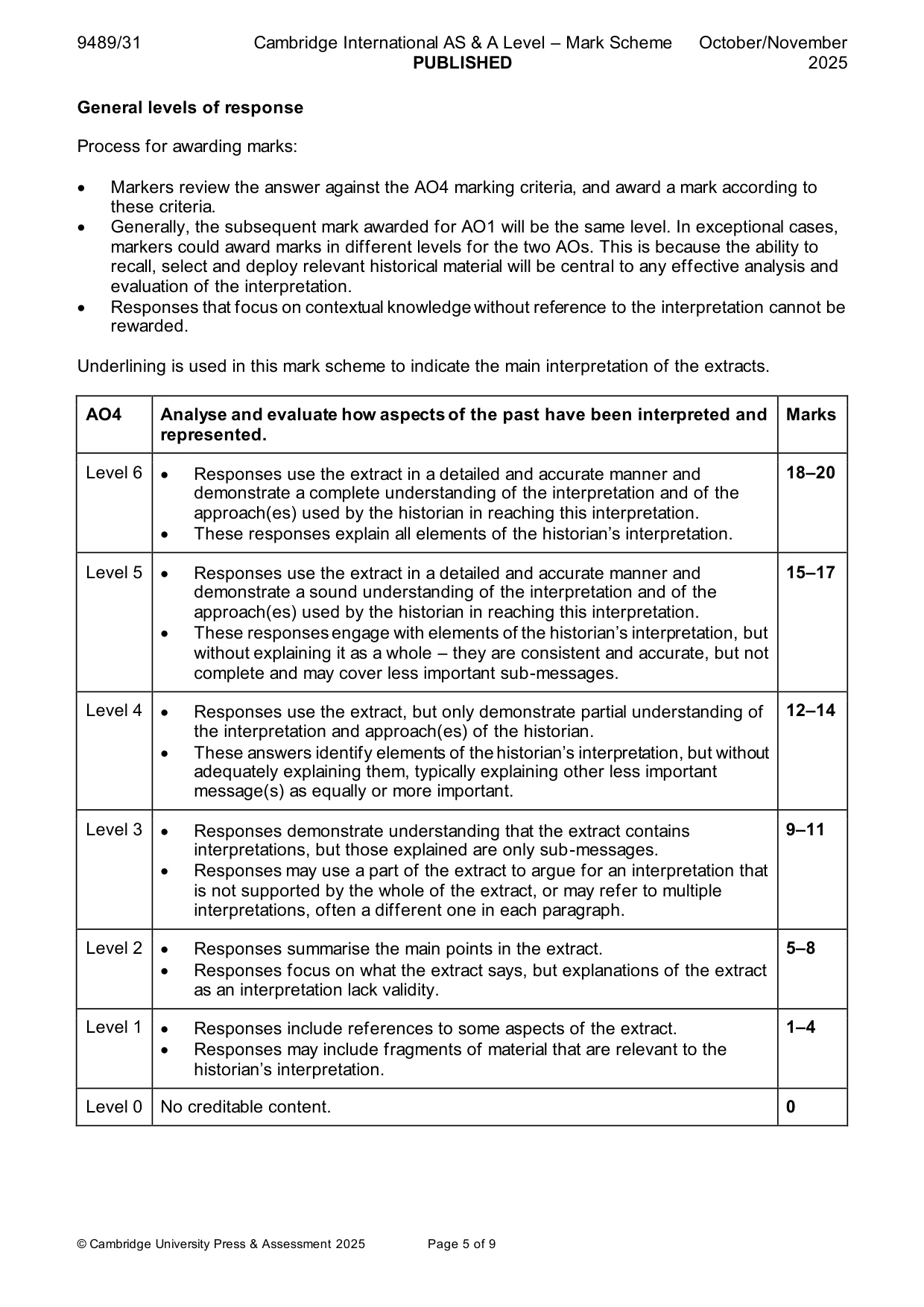
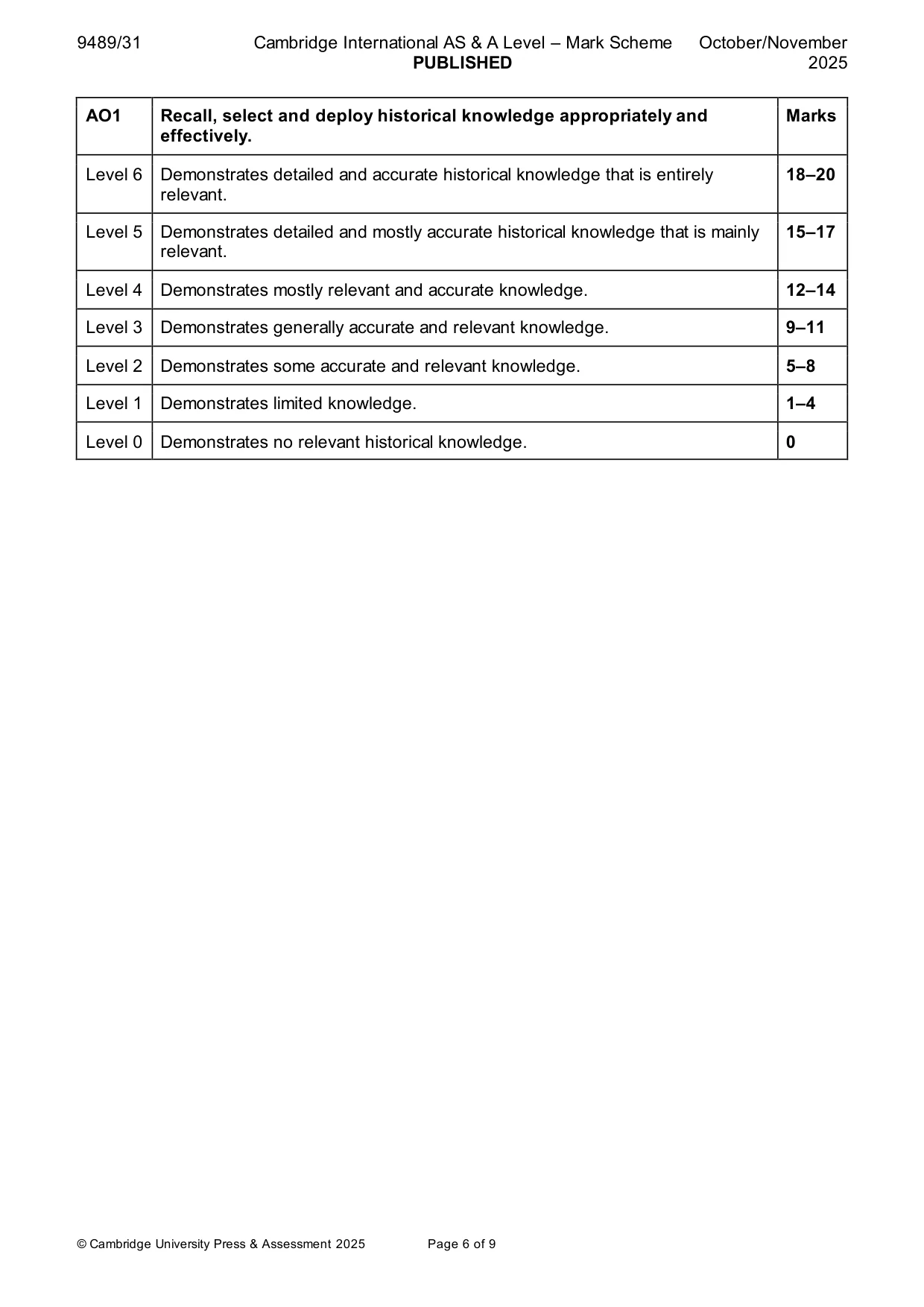
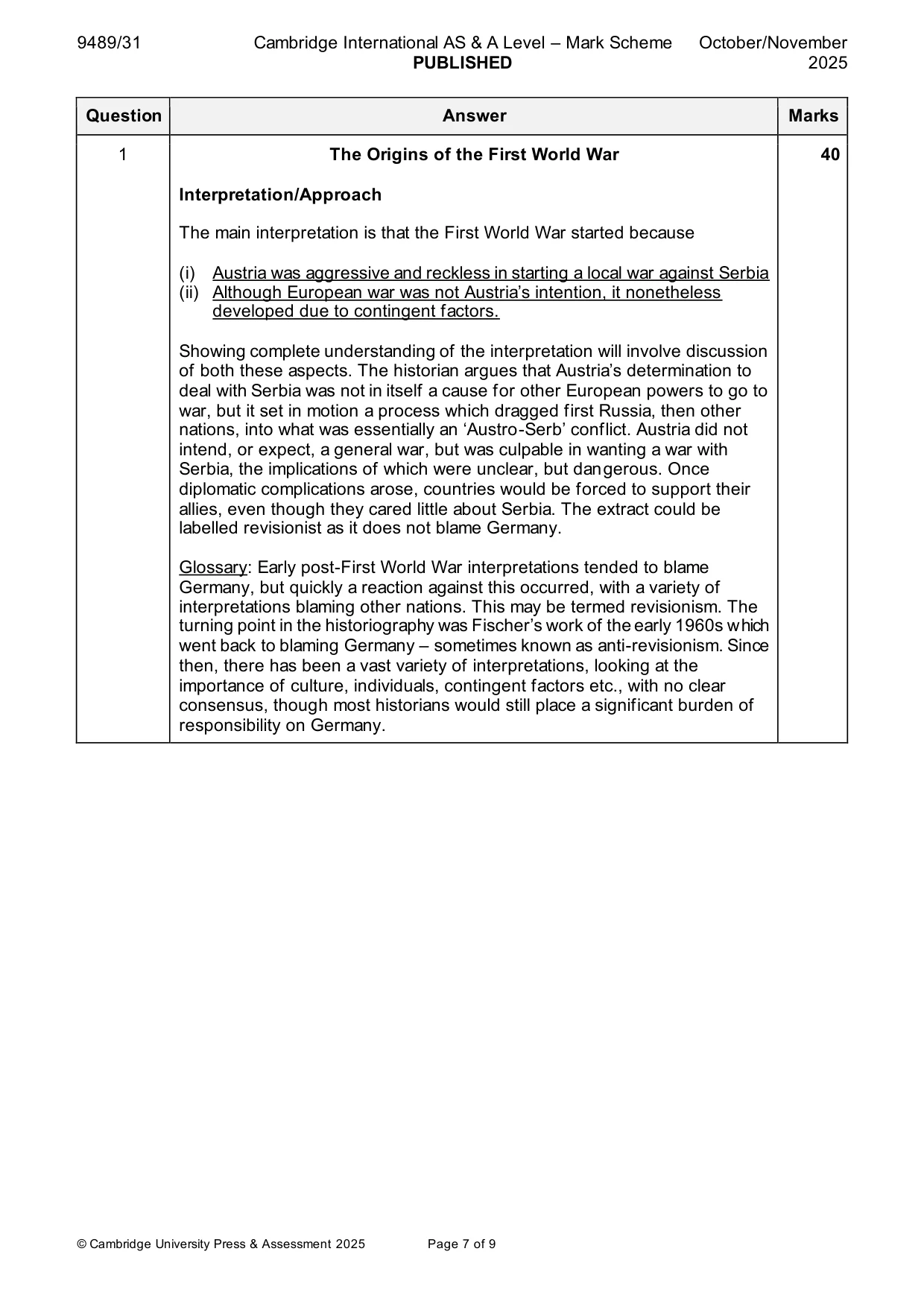
Mark scheme: Question Answer Marks 1 The Origins of the First World War 40 Interpretation/Approach The main interpretation is that the First World War started because (i) Austria was aggressive and reckless in starting a local war against Serbia (ii) Although European war was not Austria’s intention, it nonetheless developed due to contingent factors. Showing complete understanding of the interpretation will involve discussion of both these aspects. The historian argues that Austria’s determination to deal with Serbia was not in itself a cause for other European powers to go to war, but it set in motion a process which dragged first Russia, then other nations, into what was essentially an ‘Austro-Serb’ conflict. Austria did not intend, or expect, a general war, but was culpable in wanting a war with Serbia, the implications of which were unclear, but dangerous. Once diplomatic complications arose, countries would be forced to support their allies, even though they cared little about Serbia. The extract could be labelled revisionist as it does not blame Germany. Glossary: Early post-First World War interpretations tended to blame Germany, but quickly a reaction against this occurred, with a variety of interpretations blaming other nations. This may be termed revisionism. The turning point in the historiography was Fischer’s work of the early 1960s which went back to blaming Germany – sometimes known as anti-revisionism. Since then, there has been a vast variety of interpretations, looking at the importance of culture, individuals, contingent factors etc., with no clear consensus, though most historians would still place a significant burden of responsibility on Germany.
Q2 · Read the extract and then answer the question
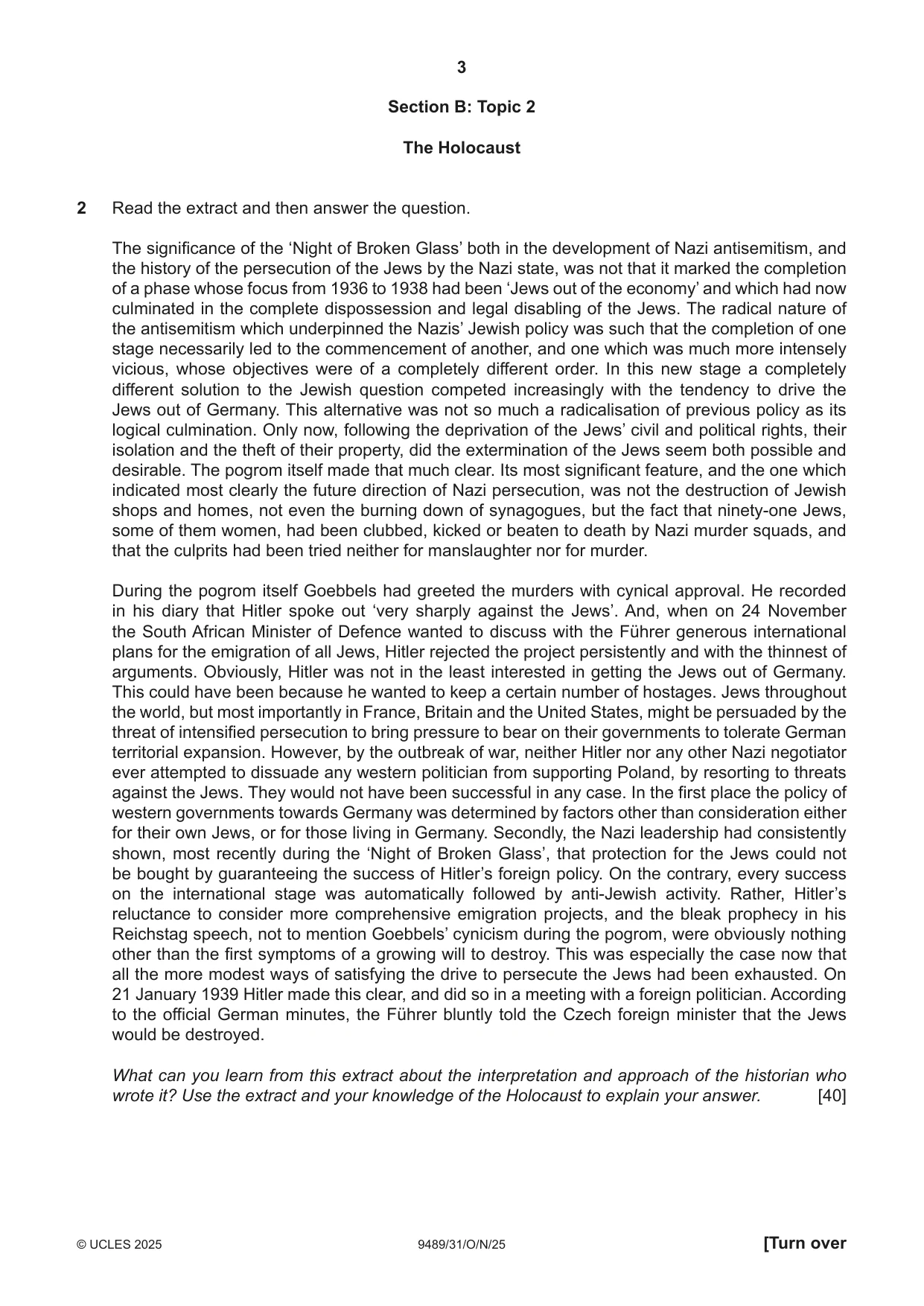
2 Read the extract and then answer the question. The significance of the ‘Night of Broken Glass’ both in the development of Nazi antisemitism, and the history of the persecution of the Jews by the Nazi state, was not that it marked the completion of a phase whose focus from 1936 to 1938 had been ‘Jews out of the economy’ and which had now culminated in the complete dispossession and legal disabling of the Jews. The radical nature of the antisemitism which underpinned the Nazis’ Jewish policy was such that the completion of one stage necessarily led to the commencement of another, and one which was much more intensely vicious, whose objectives were of a completely different order. In this new stage a completely different solution to the Jewish question competed increasingly with the tendency to drive the Jews out of Germany. This alternative was not so much a radicalisation of previous policy as its logical culmination. Only now, following the deprivation of the Jews’ civil and political rights, their isolation and the theft of their property, did the extermination of the Jews seem both possible and desirable. The pogrom itself made that much clear. Its most significant feature, and the one which indicated most clearly the future direction of Nazi persecution, was not the destruction of Jewish shops and homes, not even the burning down of synagogues, but the fact that ninety‑one Jews, some of them women, had been clubbed, kicked or beaten to death by Nazi murder squads, and that the culprits had been tried neither for manslaughter nor for murder. During the pogrom itself Goebbels had greeted the murders with cynical approval. He recorded in his diary that Hitler spoke out ‘very sharply against the Jews’. And, when on 24 November the South African Minister of Defence wanted to discuss with the Führer generous international plans for the emigration of all Jews, Hitler rejected the project persistently and with the thinnest of arguments. Obviously, Hitler was not in the least interested in getting the Jews out of Germany. This could have been because he wanted to keep a certain number of hostages. Jews throughout the world, but most importantly in France, Britain and the United States, might be persuaded by the threat of intensified persecution to bring pressure to bear on their governments to tolerate German territorial expansion. However, by the outbreak of war, neither Hitler nor any other Nazi negotiator ever attempted to dissuade any western politician from supporting Poland, by resorting to threats against the Jews. They would not have been successful in any case. In the first place the policy of western governments towards Germany was determined by factors other than consideration either for their own Jews, or for those living in Germany. Secondly, the Nazi leadership had consistently shown, most recently during the ‘Night of Broken Glass’, that protection for the Jews could not be bought by guaranteeing the success of Hitler’s foreign policy. On the contrary, every success on the international stage was automatically followed by anti‑Jewish activity. Rather, Hitler’s reluctance to consider more comprehensive emigration projects, and the bleak prophecy in his Reichstag speech, not to mention Goebbels’ cynicism during the pogrom, were obviously nothing other than the first symptoms of a growing will to destroy. This was especially the case now that all the more modest ways of satisfying the drive to persecute the Jews had been exhausted. On 21 January 1939 Hitler made this clear, and did so in a meeting with a foreign politician. According to the official German minutes, the Führer bluntly told the Czech foreign minister that the Jews would be destroyed. What can you learn from this extract about the interpretation and approach of the historian who wrote it? Use the extract and your knowledge of the Holocaust to explain your answer. [40] Section C: Topic 3 The origins and development of the Cold War
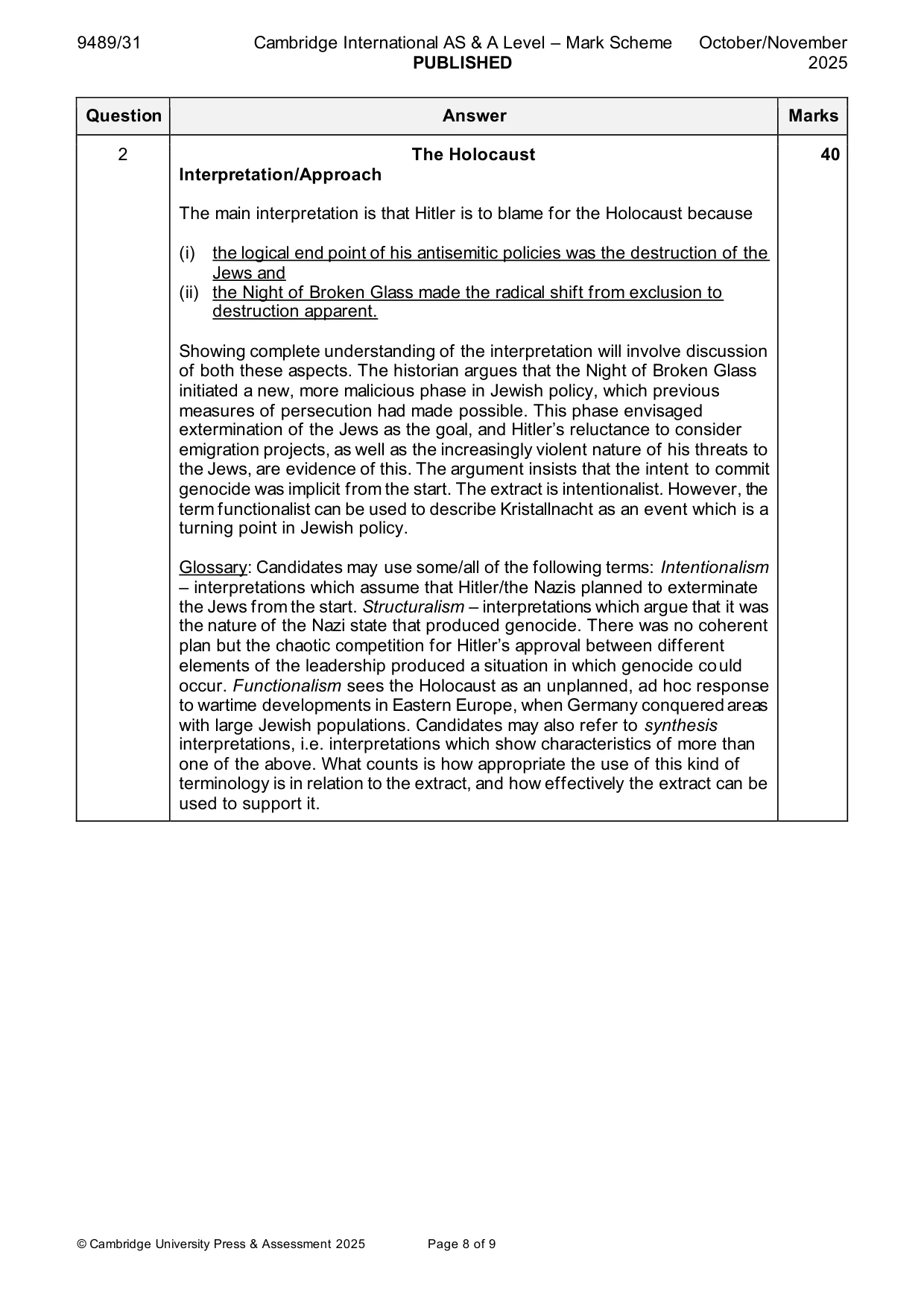
Mark scheme: 2 The Holocaust 40 Interpretation/Approach The main interpretation is that Hitler is to blame for the Holocaust because (i) the logical end point of his antisemitic policies was the destruction of the Jews and (ii) the Night of Broken Glass made the radical shift from exclusion to destruction apparent. Showing complete understanding of the interpretation will involve discussion of both these aspects. The historian argues that the Night of Broken Glass initiated a new, more malicious phase in Jewish policy, which previous measures of persecution had made possible. This phase envisaged extermination of the Jews as the goal, and Hitler’s reluctance to consider emigration projects, as well as the increasingly violent nature of his threats to the Jews, are evidence of this. The argument insists that the intent to commit genocide was implicit from the start. The extract is intentionalist. However, the term functionalist can be used to describe Kristallnacht as an event which is a turning point in Jewish policy. Glossary: Candidates may use some/all of the following terms: Intentionalism – interpretations which assume that Hitler/the Nazis planned to exterminate the Jews from the start. Structuralism – interpretations which argue that it was the nature of the Nazi state that produced genocide. There was no coherent plan but the chaotic competition for Hitler’s approval between different elements of the leadership produced a situation in which genocide could occur. Functionalism sees the Holocaust as an unplanned, ad hoc response to wartime developments in Eastern Europe, when Germany conquered areas with large Jewish populations. Candidates may also refer to synthesis interpretations, i.e. interpretations which show characteristics of more than one of the above. What counts is how appropriate the use of this kind of terminology is in relation to the extract, and how effectively the extract can be used to support it.
More questions on How did the rise of extremism affect international relations?
Q3 · Read the extract and then answer the question
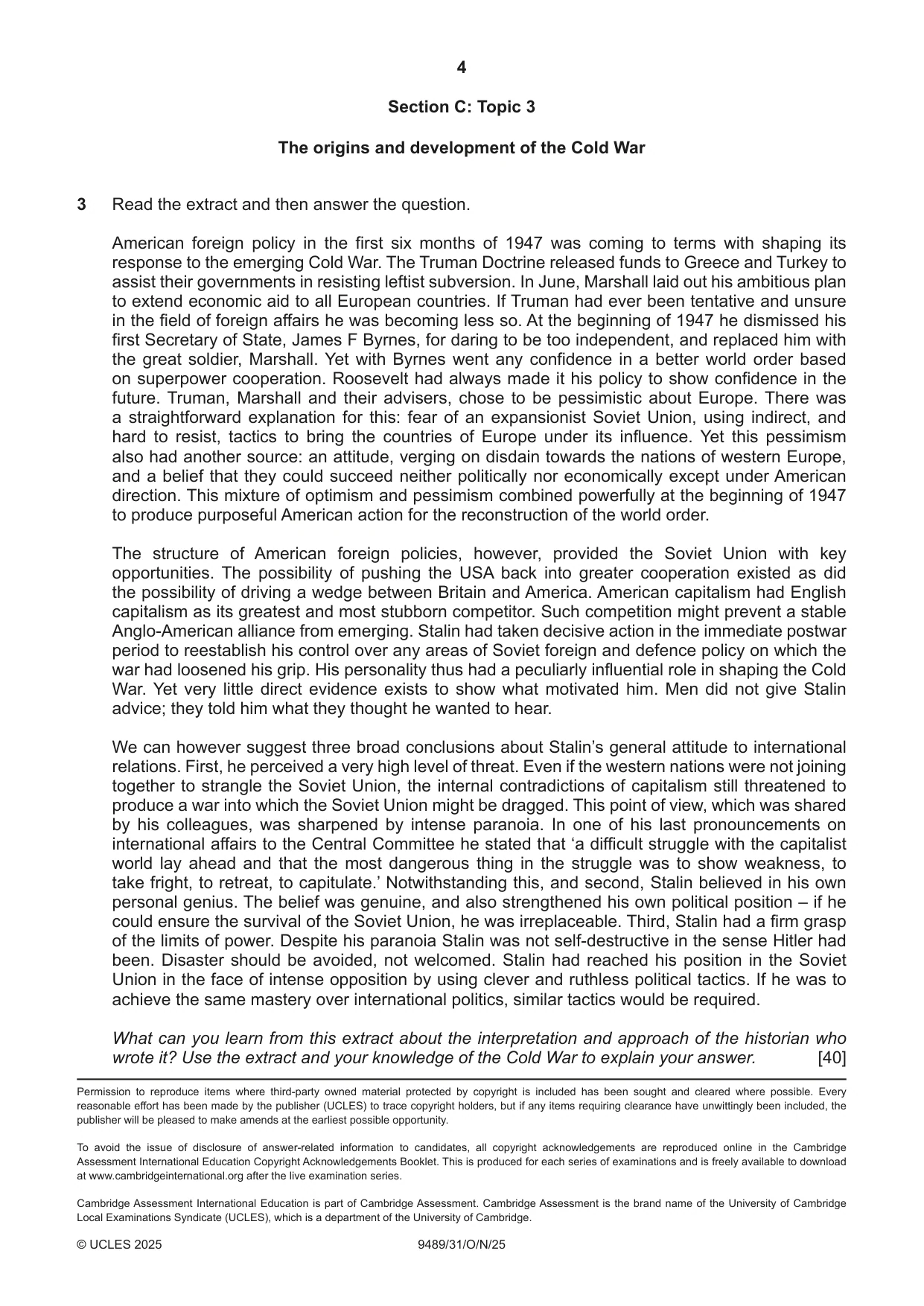
3 Read the extract and then answer the question. American foreign policy in the first six months of 1947 was coming to terms with shaping its response to the emerging Cold War. The Truman Doctrine released funds to Greece and Turkey to assist their governments in resisting leftist subversion. In June, Marshall laid out his ambitious plan to extend economic aid to all European countries. If Truman had ever been tentative and unsure in the field of foreign affairs he was becoming less so. At the beginning of 1947 he dismissed his first Secretary of State, James F Byrnes, for daring to be too independent, and replaced him with the great soldier, Marshall. Yet with Byrnes went any confidence in a better world order based on superpower cooperation. Roosevelt had always made it his policy to show confidence in the future. Truman, Marshall and their advisers, chose to be pessimistic about Europe. There was a straightforward explanation for this: fear of an expansionist Soviet Union, using indirect, and hard to resist, tactics to bring the countries of Europe under its influence. Yet this pessimism also had another source: an attitude, verging on disdain towards the nations of western Europe, and a belief that they could succeed neither politically nor economically except under American direction. This mixture of optimism and pessimism combined powerfully at the beginning of 1947 to produce purposeful American action for the reconstruction of the world order. The structure of American foreign policies, however, provided the Soviet Union with key opportunities. The possibility of pushing the USA back into greater cooperation existed as did the possibility of driving a wedge between Britain and America. American capitalism had English capitalism as its greatest and most stubborn competitor. Such competition might prevent a stable Anglo‑American alliance from emerging. Stalin had taken decisive action in the immediate postwar period to reestablish his control over any areas of Soviet foreign and defence policy on which the war had loosened his grip. His personality thus had a peculiarly influential role in shaping the Cold War. Yet very little direct evidence exists to show what motivated him. Men did not give Stalin advice; they told him what they thought he wanted to hear. We can however suggest three broad conclusions about Stalin’s general attitude to international relations. First, he perceived a very high level of threat. Even if the western nations were not joining together to strangle the Soviet Union, the internal contradictions of capitalism still threatened to produce a war into which the Soviet Union might be dragged. This point of view, which was shared by his colleagues, was sharpened by intense paranoia. In one of his last pronouncements on international affairs to the Central Committee he stated that ‘a difficult struggle with the capitalist world lay ahead and that the most dangerous thing in the struggle was to show weakness, to take fright, to retreat, to capitulate.’ Notwithstanding this, and second, Stalin believed in his own personal genius. The belief was genuine, and also strengthened his own political position – if he could ensure the survival of the Soviet Union, he was irreplaceable. Third, Stalin had a firm grasp of the limits of power. Despite his paranoia Stalin was not self‑destructive in the sense Hitler had been. Disaster should be avoided, not welcomed. Stalin had reached his position in the Soviet Union in the face of intense opposition by using clever and ruthless political tactics. If he was to achieve the same mastery over international politics, similar tactics would be required. What can you learn from this extract about the interpretation and approach of the historian who wrote it? Use the extract and your knowledge of the Cold War to explain your answer. [40]
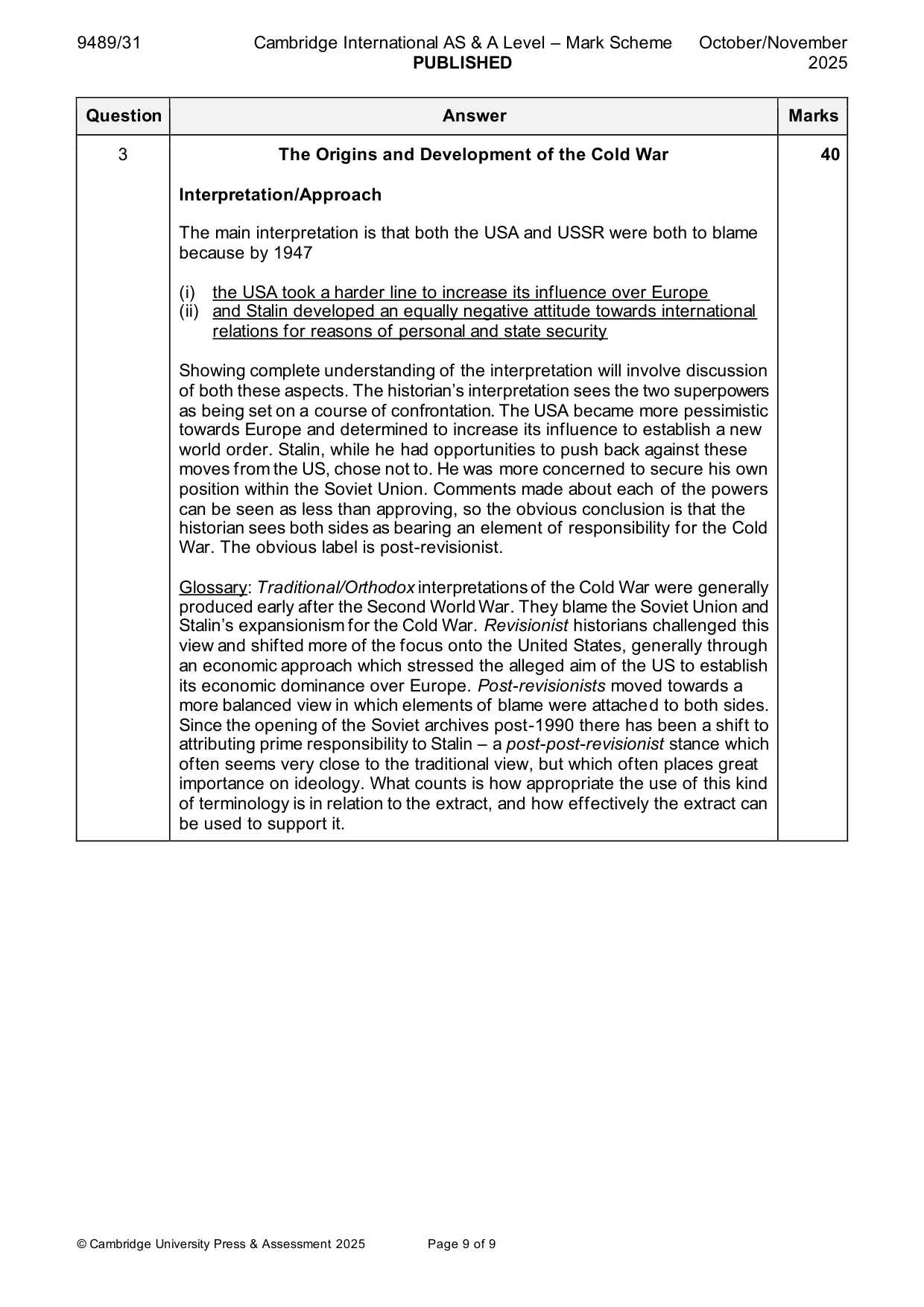
Mark scheme: 3 The Origins and Development of the Cold War 40 Interpretation/Approach The main interpretation is that both the USA and USSR were both to blame because by 1947 (i) the USA took a harder line to increase its influence over Europe (ii) and Stalin developed an equally negative attitude towards international relations for reasons of personal and state security Showing complete understanding of the interpretation will involve discussion of both these aspects. The historian’s interpretation sees the two superpowers as being set on a course of confrontation. The USA became more pessimistic towards Europe and determined to increase its influence to establish a new world order. Stalin, while he had opportunities to push back against these moves from the US, chose not to. He was more concerned to secure his own position within the Soviet Union. Comments made about each of the powers can be seen as less than approving, so the obvious conclusion is that the historian sees both sides as bearing an element of responsibility for the Cold War. The obvious label is post-revisionist. Glossary: Traditional/Orthodox interpretations of the Cold War were generally produced early after the Second World War. They blame the Soviet Union and Stalin’s expansionism for the Cold War. Revisionist historians challenged this view and shifted more of the focus onto the United States, generally through an economic approach which stressed the alleged aim of the US to establish its economic dominance over Europe. Post-revisionists moved towards a more balanced view in which elements of blame were attached to both sides. Since the opening of the Soviet archives post-1990 there has been a shift to attributing prime responsibility to Stalin – a post-post-revisionist stance which often seems very close to the traditional view, but which often places great importance on ideology. What counts is how appropriate the use of this kind of terminology is in relation to the extract, and how effectively the extract can be used to support it.
What was in this paper
The subtopics covered by these 3 questions, and how many questions each got. Open one in a new tab to see every Cambridge question on it.
What you needed in this session
Cambridge’s own grade thresholds for 2025 Oct/Nov, Paper 3 · Variant 1. A higher threshold means an easier paper — the bar moves with how the cohort did.