Cambridge A Level History 9489 — 2022 May/June Paper 3 · Variant 1
9489/31/M/J/22 · 3 questions · 40 marks · ≈45 min
The question paper and its mark scheme, free to read here and free to download. This is Cambridge’s own paper, exactly as it was sat.
Question paper8 pages



Mark scheme5 pages
Answers below. Sit the paper first if you are practising.
Questions as text
Q1 · Read the extract and then answer the question
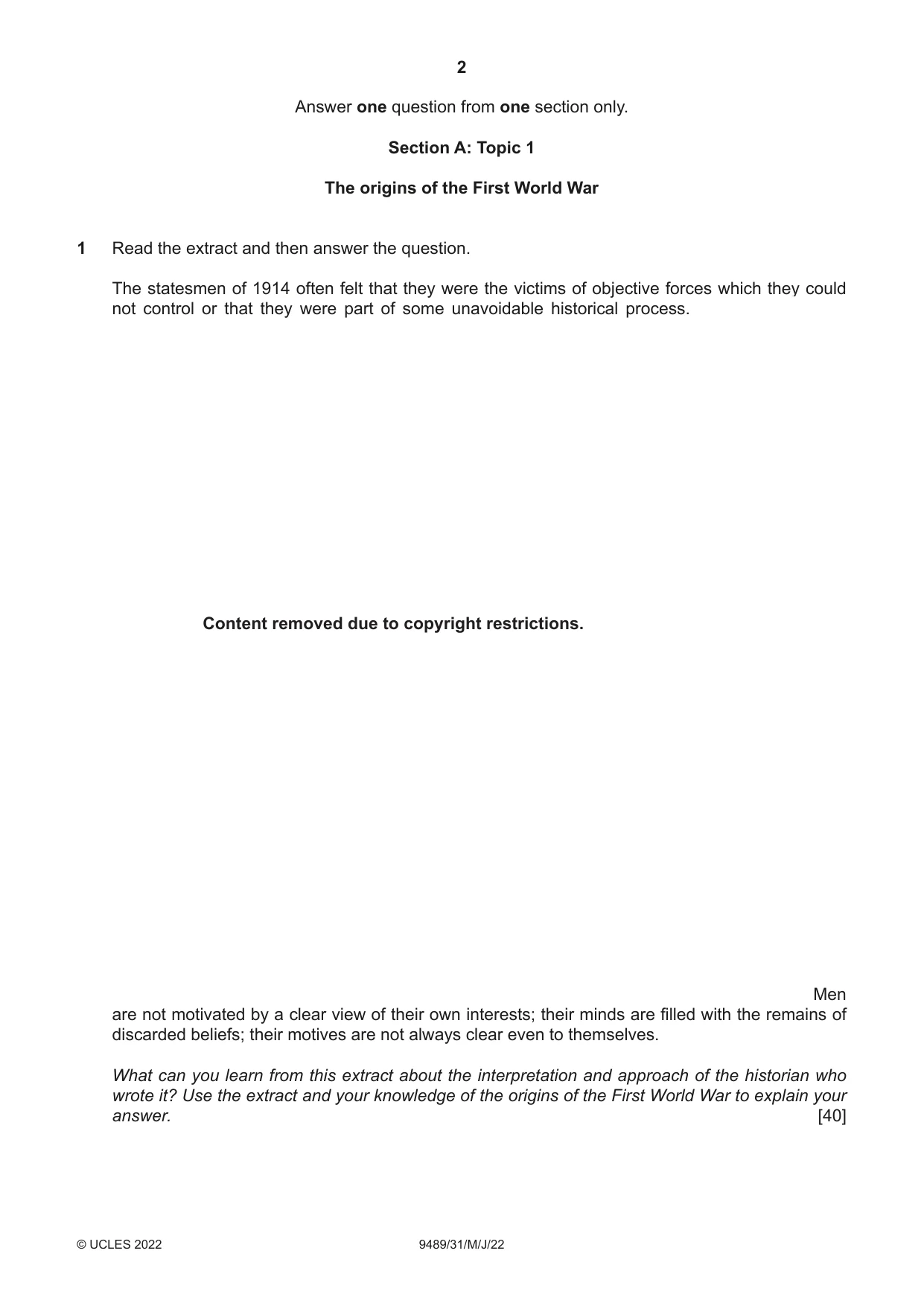
1 Read the extract and then answer the question. The statesmen of 1914 often felt that they were the victims of objective forces which they could not control or that they were part of some unavoidable historical process. Content removed due to copyright restrictions. Men are not motivated by a clear view of their own interests; their minds are filled with the remains of discarded beliefs; their motives are not always clear even to themselves. What can you learn from this extract about the interpretation and approach of the historian who wrote it? Use the extract and your knowledge of the origins of the First World War to explain your answer. [40]
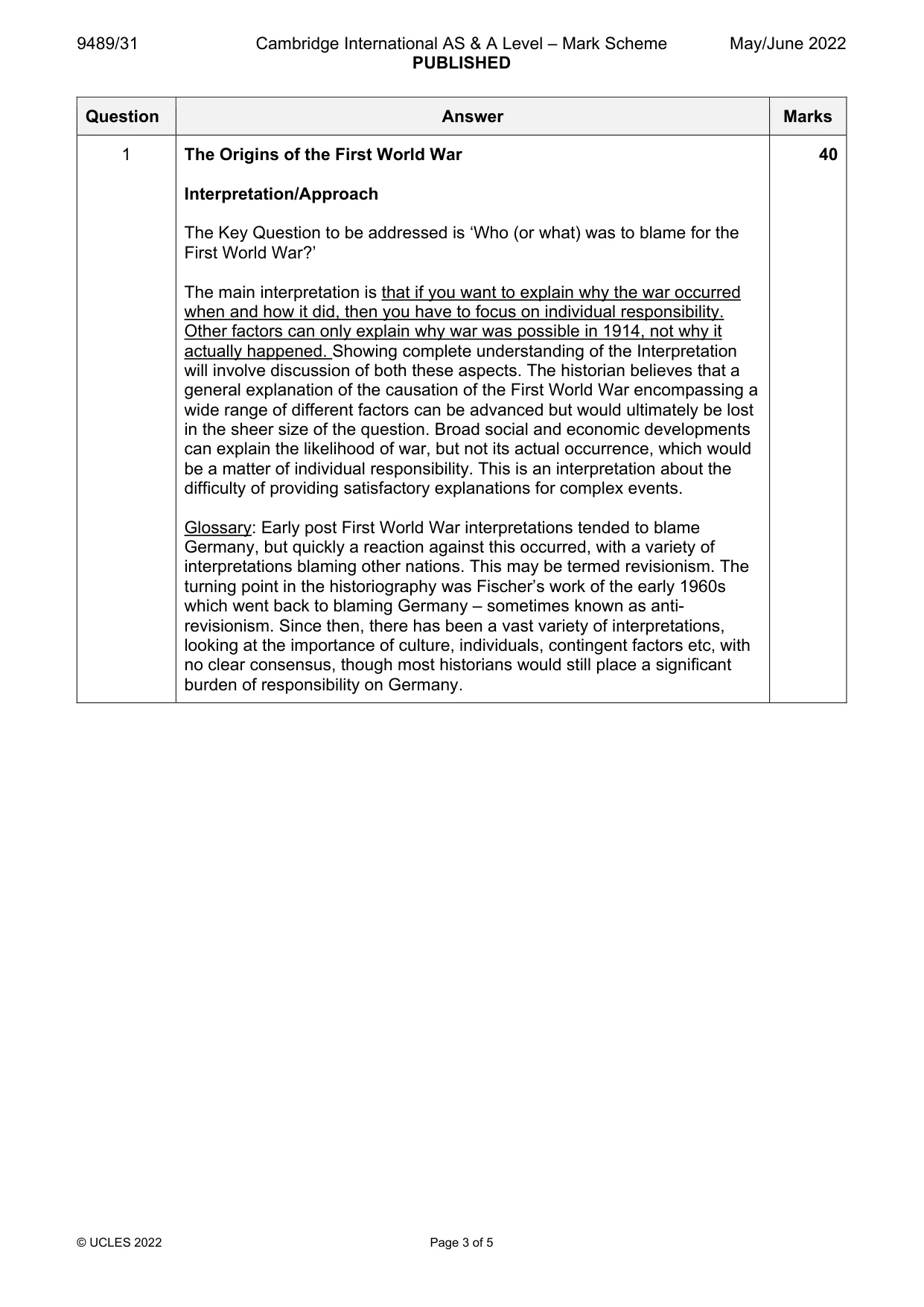
Mark scheme: Question Answer Marks 1 The Origins of the First World War 40 Interpretation/Approach The Key Question to be addressed is ‘Who (or what) was to blame for the First World War?’ The main interpretation is that if you want to explain why the war occurred when and how it did, then you have to focus on individual responsibility. Other factors can only explain why war was possible in 1914, not why it actually happened. Showing complete understanding of the Interpretation will involve discussion of both these aspects. The historian believes that a general explanation of the causation of the First World War encompassing a wide range of different factors can be advanced but would ultimately be lost in the sheer size of the question. Broad social and economic developments can explain the likelihood of war, but not its actual occurrence, which would be a matter of individual responsibility. This is an interpretation about the difficulty of providing satisfactory explanations for complex events. Glossary: Early post First World War interpretations tended to blame Germany, but quickly a reaction against this occurred, with a variety of interpretations blaming other nations. This may be termed revisionism. The turning point in the historiography was Fischer’s work of the early 1960s which went back to blaming Germany – sometimes known as anti- revisionism. Since then, there has been a vast variety of interpretations, looking at the importance of culture, individuals, contingent factors etc, with no clear consensus, though most historians would still place a significant burden of responsibility on Germany.
Q2 · Read the extract and then answer the question
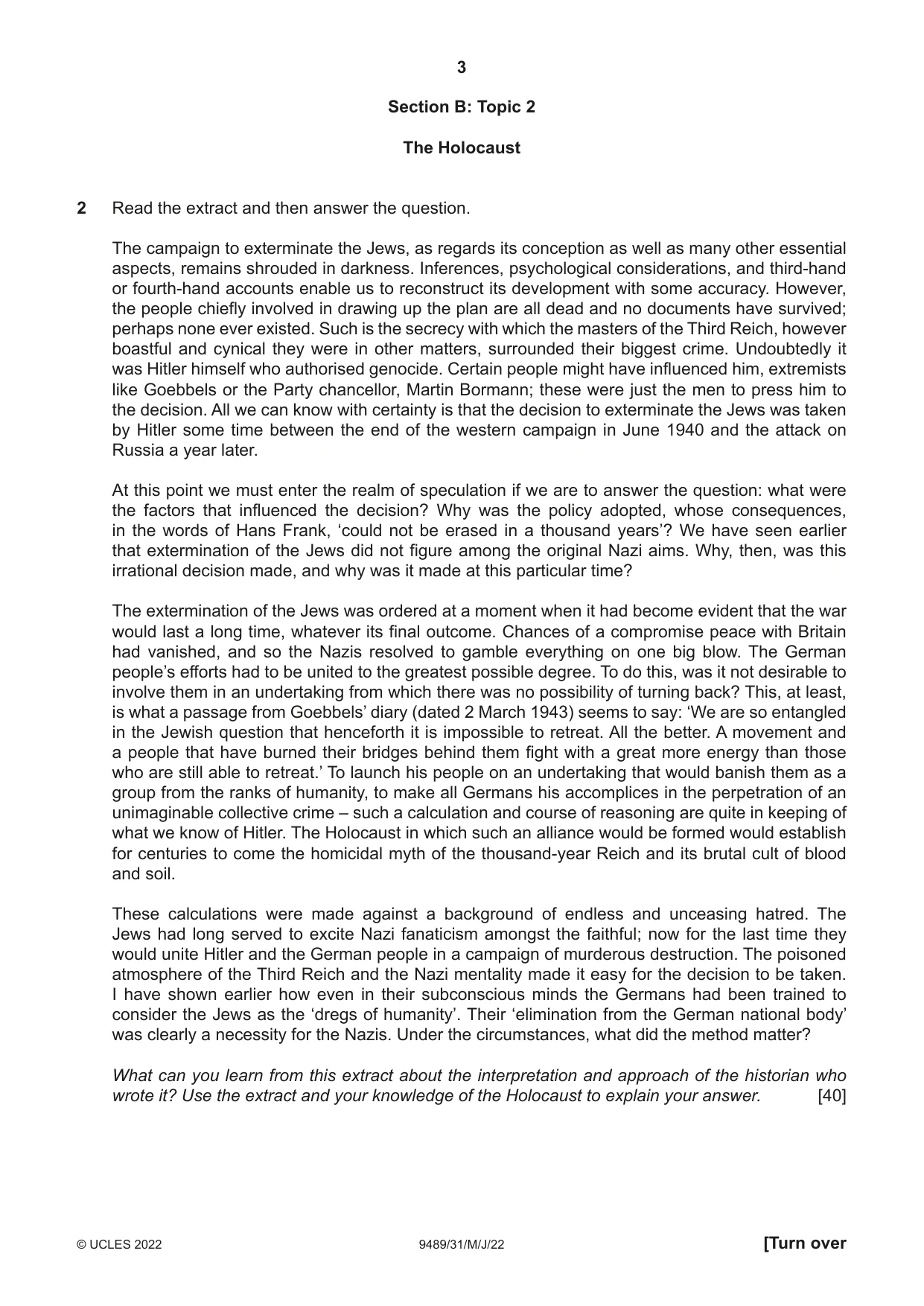
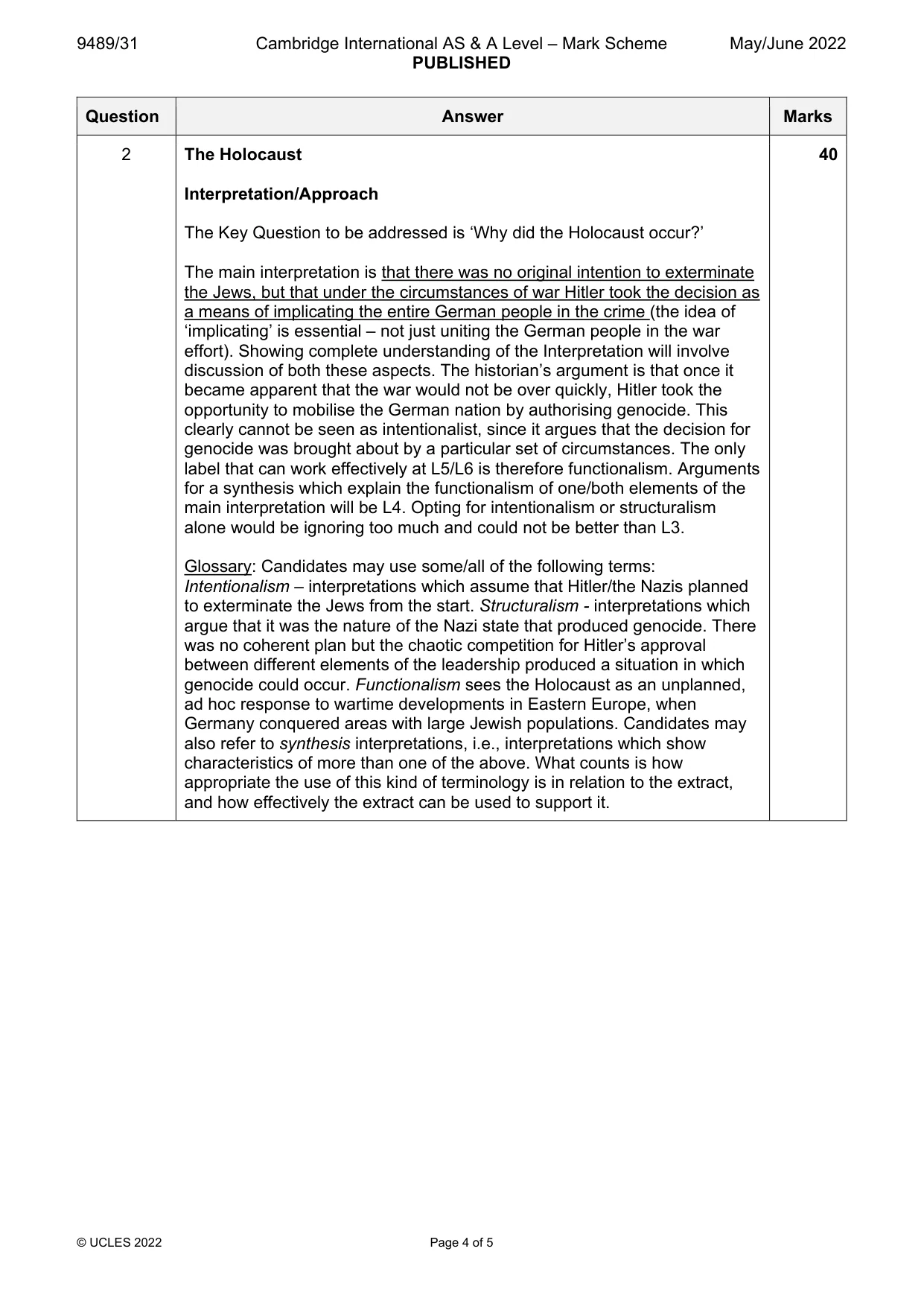
2 Read the extract and then answer the question. The campaign to exterminate the Jews, as regards its conception as well as many other essential aspects, remains shrouded in darkness. Inferences, psychological considerations, and third-hand or fourth-hand accounts enable us to reconstruct its development with some accuracy. However, the people chiefly involved in drawing up the plan are all dead and no documents have survived; perhaps none ever existed. Such is the secrecy with which the masters of the Third Reich, however boastful and cynical they were in other matters, surrounded their biggest crime. Undoubtedly it was Hitler himself who authorised genocide. Certain people might have influenced him, extremists like Goebbels or the Party chancellor, Martin Bormann; these were just the men to press him to the decision. All we can know with certainty is that the decision to exterminate the Jews was taken by Hitler some time between the end of the western campaign in June 1940 and the attack on Russia a year later. At this point we must enter the realm of speculation if we are to answer the question: what were the factors that influenced the decision? Why was the policy adopted, whose consequences, in the words of Hans Frank, ‘could not be erased in a thousand years’? We have seen earlier that extermination of the Jews did not figure among the original Nazi aims. Why, then, was this irrational decision made, and why was it made at this particular time? The extermination of the Jews was ordered at a moment when it had become evident that the war would last a long time, whatever its final outcome. Chances of a compromise peace with Britain had vanished, and so the Nazis resolved to gamble everything on one big blow. The German people’s efforts had to be united to the greatest possible degree. To do this, was it not desirable to involve them in an undertaking from which there was no possibility of turning back? This, at least, is what a passage from Goebbels’ diary (dated 2 March 1943) seems to say: ‘We are so entangled in the Jewish question that henceforth it is impossible to retreat. All the better. A movement and a people that have burned their bridges behind them fight with a great more energy than those who are still able to retreat.’ To launch his people on an undertaking that would banish them as a group from the ranks of humanity, to make all Germans his accomplices in the perpetration of an unimaginable collective crime – such a calculation and course of reasoning are quite in keeping of what we know of Hitler. The Holocaust in which such an alliance would be formed would establish for centuries to come the homicidal myth of the thousand-year Reich and its brutal cult of blood and soil. These calculations were made against a background of endless and unceasing hatred. The Jews had long served to excite Nazi fanaticism amongst the faithful; now for the last time they would unite Hitler and the German people in a campaign of murderous destruction. The poisoned atmosphere of the Third Reich and the Nazi mentality made it easy for the decision to be taken. I have shown earlier how even in their subconscious minds the Germans had been trained to consider the Jews as the ‘dregs of humanity’. Their ‘elimination from the German national body’ was clearly a necessity for the Nazis. Under the circumstances, what did the method matter? What can you learn from this extract about the interpretation and approach of the historian who wrote it? Use the extract and your knowledge of the Holocaust to explain your answer. [40] Section C: Topic 3 The origins and development of the Cold War
Mark scheme: 2 The Holocaust 40 Interpretation/Approach The Key Question to be addressed is ‘Why did the Holocaust occur?’ The main interpretation is that there was no original intention to exterminate the Jews, but that under the circumstances of war Hitler took the decision as a means of implicating the entire German people in the crime (the idea of ‘implicating’ is essential – not just uniting the German people in the war effort). Showing complete understanding of the Interpretation will involve discussion of both these aspects. The historian’s argument is that once it became apparent that the war would not be over quickly, Hitler took the opportunity to mobilise the German nation by authorising genocide. This clearly cannot be seen as intentionalist, since it argues that the decision for genocide was brought about by a particular set of circumstances. The only label that can work effectively at L5/L6 is therefore functionalism. Arguments for a synthesis which explain the functionalism of one/both elements of the main interpretation will be L4. Opting for intentionalism or structuralism alone would be ignoring too much and could not be better than L3. Glossary: Candidates may use some/all of the following terms: Intentionalism – interpretations which assume that Hitler/the Nazis planned to exterminate the Jews from the start. Structuralism - interpretations which argue that it was the nature of the Nazi state that produced genocide. There was no coherent plan but the chaotic competition for Hitler’s approval between different elements of the leadership produced a situation in which genocide could occur. Functionalism sees the Holocaust as an unplanned, ad hoc response to wartime developments in Eastern Europe, when Germany conquered areas with large Jewish populations. Candidates may also refer to synthesis interpretations, i.e., interpretations which show characteristics of more than one of the above. What counts is how appropriate the use of this kind of terminology is in relation to the extract, and how effectively the extract can be used to support it.
More questions on How did the rise of extremism affect international relations?
Q3 · Read the extract and then answer the question
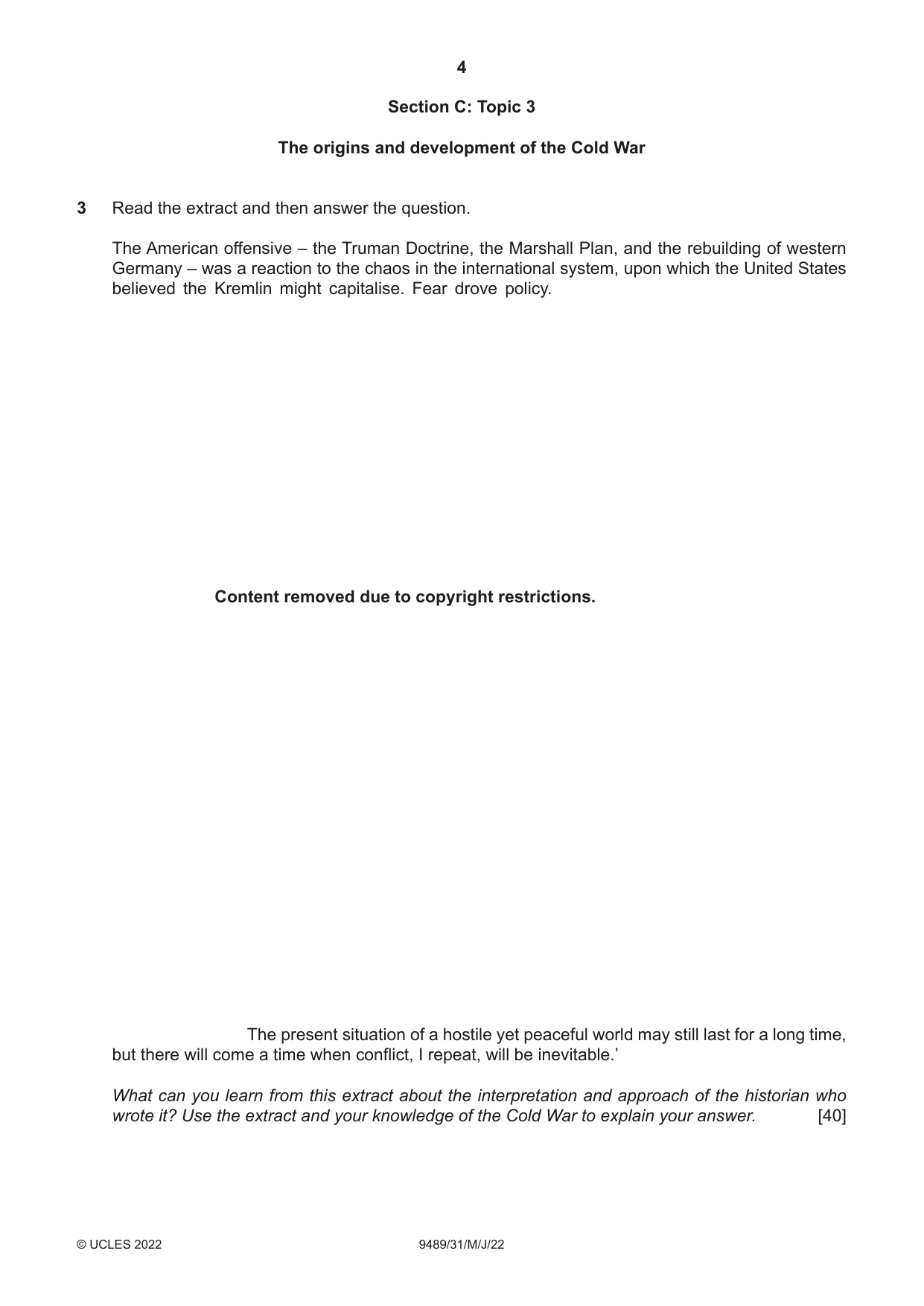
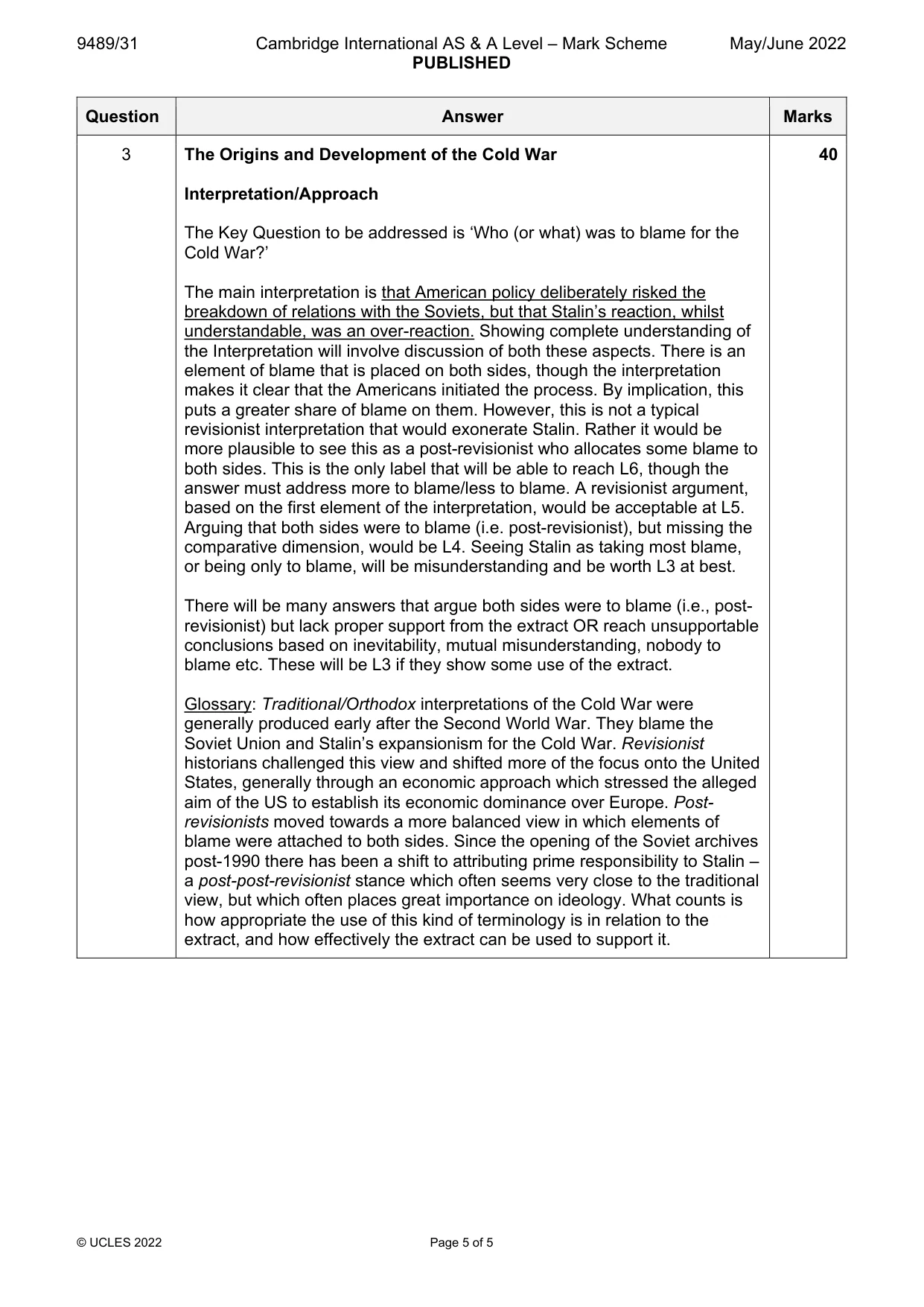
3 Read the extract and then answer the question. The American offensive – the Truman Doctrine, the Marshall Plan, and the rebuilding of western Germany – was a reaction to the chaos in the international system, upon which the United States believed the Kremlin might capitalise. Fear drove policy. Content removed due to copyright restrictions. The present situation of a hostile yet peaceful world may still last for a long time, but there will come a time when conflict, I repeat, will be inevitable.’ What can you learn from this extract about the interpretation and approach of the historian who wrote it? Use the extract and your knowledge of the Cold War to explain your answer. [40]
Mark scheme: 3 The Origins and Development of the Cold War 40 Interpretation/Approach The Key Question to be addressed is ‘Who (or what) was to blame for the Cold War?’ The main interpretation is that American policy deliberately risked the breakdown of relations with the Soviets, but that Stalin’s reaction, whilst understandable, was an over-reaction. Showing complete understanding of the Interpretation will involve discussion of both these aspects. There is an element of blame that is placed on both sides, though the interpretation makes it clear that the Americans initiated the process. By implication, this puts a greater share of blame on them. However, this is not a typical revisionist interpretation that would exonerate Stalin. Rather it would be more plausible to see this as a post-revisionist who allocates some blame to both sides. This is the only label that will be able to reach L6, though the answer must address more to blame/less to blame. A revisionist argument, based on the first element of the interpretation, would be acceptable at L5. Arguing that both sides were to blame (i.e. post-revisionist), but missing the comparative dimension, would be L4. Seeing Stalin as taking most blame, or being only to blame, will be misunderstanding and be worth L3 at best. There will be many answers that argue both sides were to blame (i.e., post- revisionist) but lack proper support from the extract OR reach unsupportable conclusions based on inevitability, mutual misunderstanding, nobody to blame etc. These will be L3 if they show some use of the extract. Glossary: Traditional/Orthodox interpretations of the Cold War were generally produced early after the Second World War. They blame the Soviet Union and Stalin’s expansionism for the Cold War. Revisionist historians challenged this view and shifted more of the focus onto the United States, generally through an economic approach which stressed the alleged aim of the US to establish its economic dominance over Europe. Post- revisionists moved towards a more balanced view in which elements of blame were attached to both sides. Since the opening of the Soviet archives post-1990 there has been a shift to attributing prime responsibility to Stalin – a post-post-revisionist stance which often seems very close to the traditional view, but which often places great importance on ideology. What counts is how appropriate the use of this kind of terminology is in relation to the extract, and how effectively the extract can be used to support it.
More questions on How did the rise of extremism affect international relations?
What was in this paper
The subtopics covered by these 3 questions, and how many questions each got. Open one in a new tab to see every Cambridge question on it.
What you needed in this session
Cambridge’s own grade thresholds for 2022 May/June, Paper 3 · Variant 1. A higher threshold means an easier paper — the bar moves with how the cohort did.