Cambridge A Level History 9489 — 2023 May/June Paper 3 · Variant 1
9489/31/M/J/23 · 3 questions · 40 marks · ≈45 min
The question paper and its mark scheme, free to read here and free to download. This is Cambridge’s own paper, exactly as it was sat.
Question paper4 pages
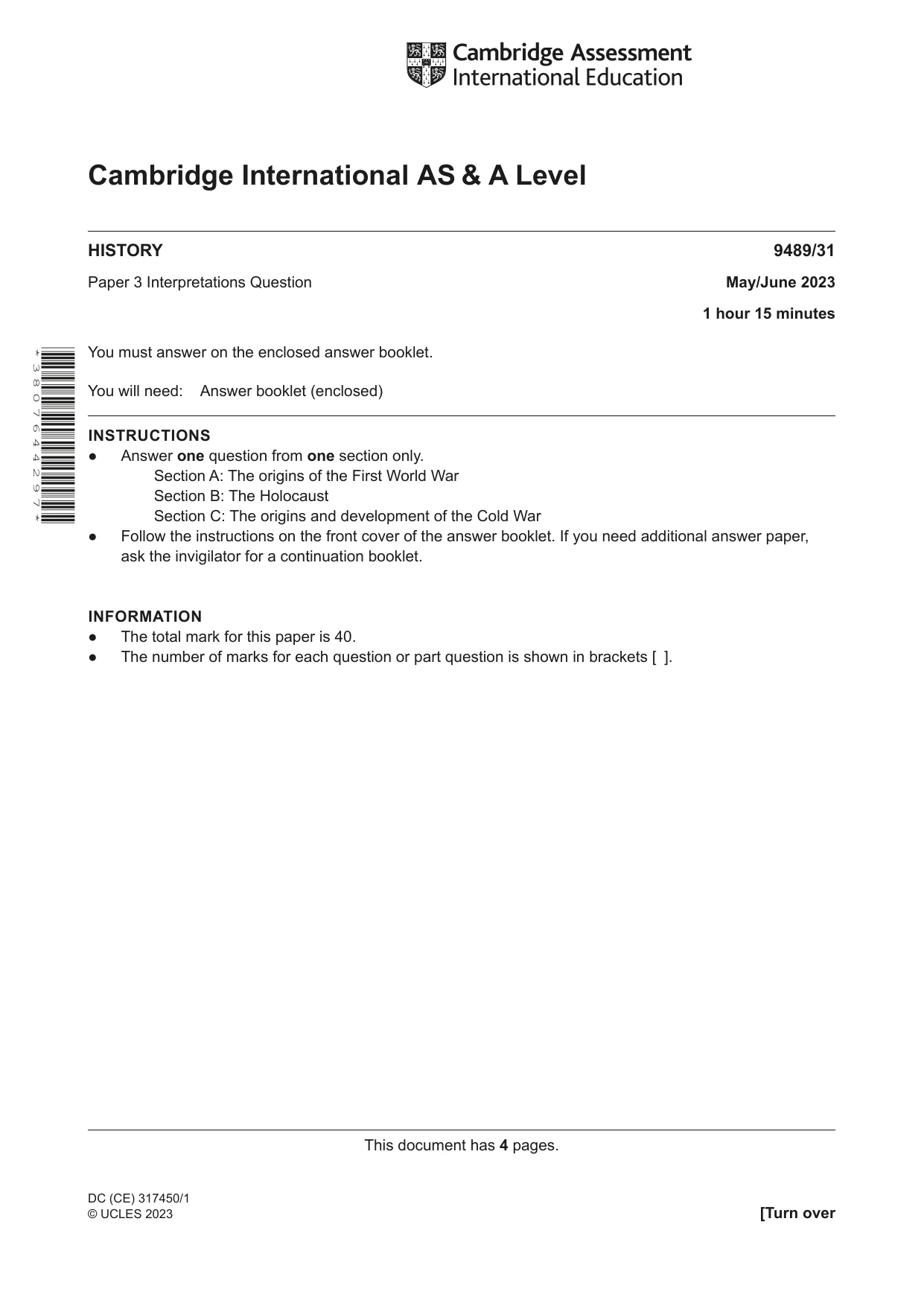
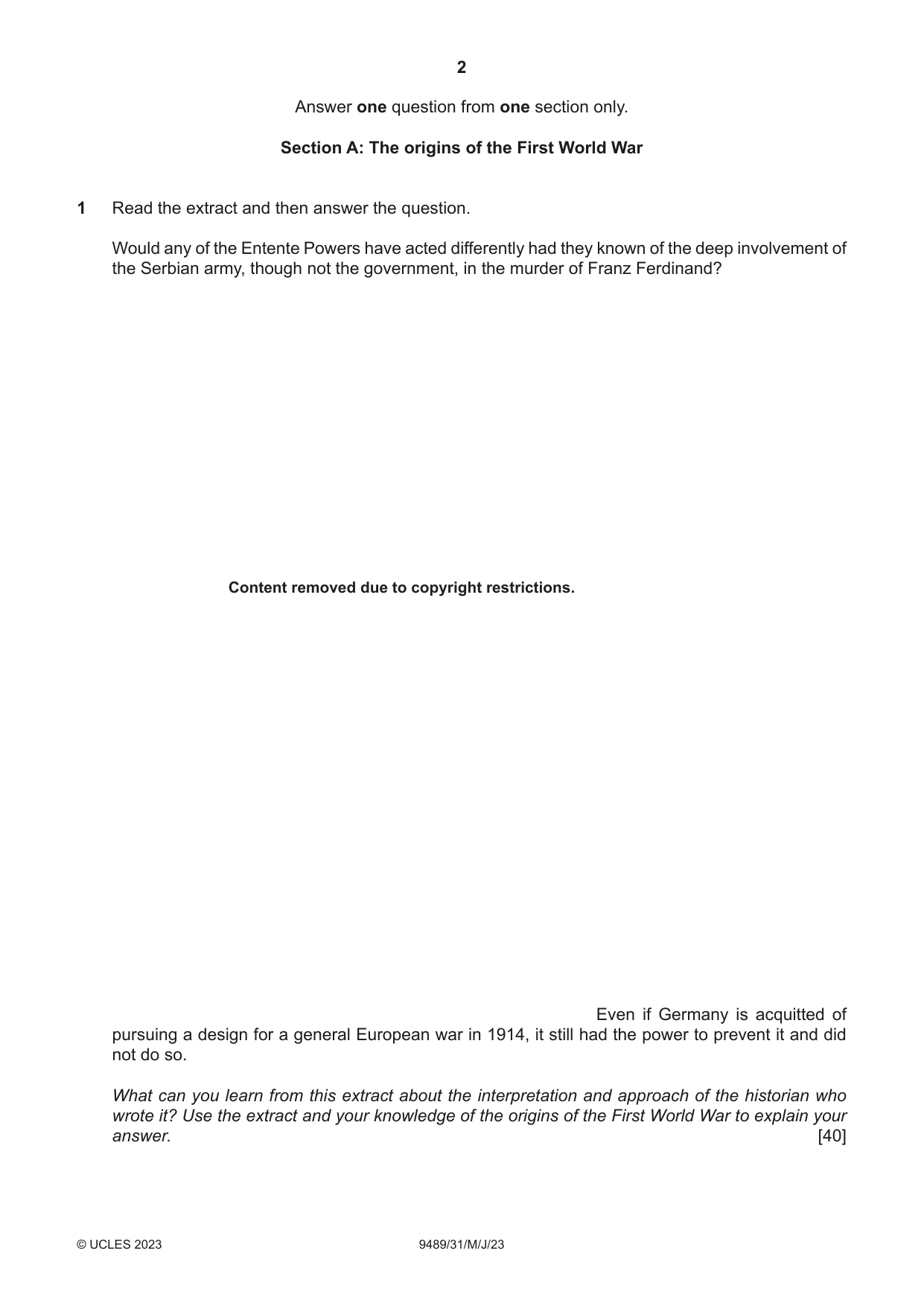
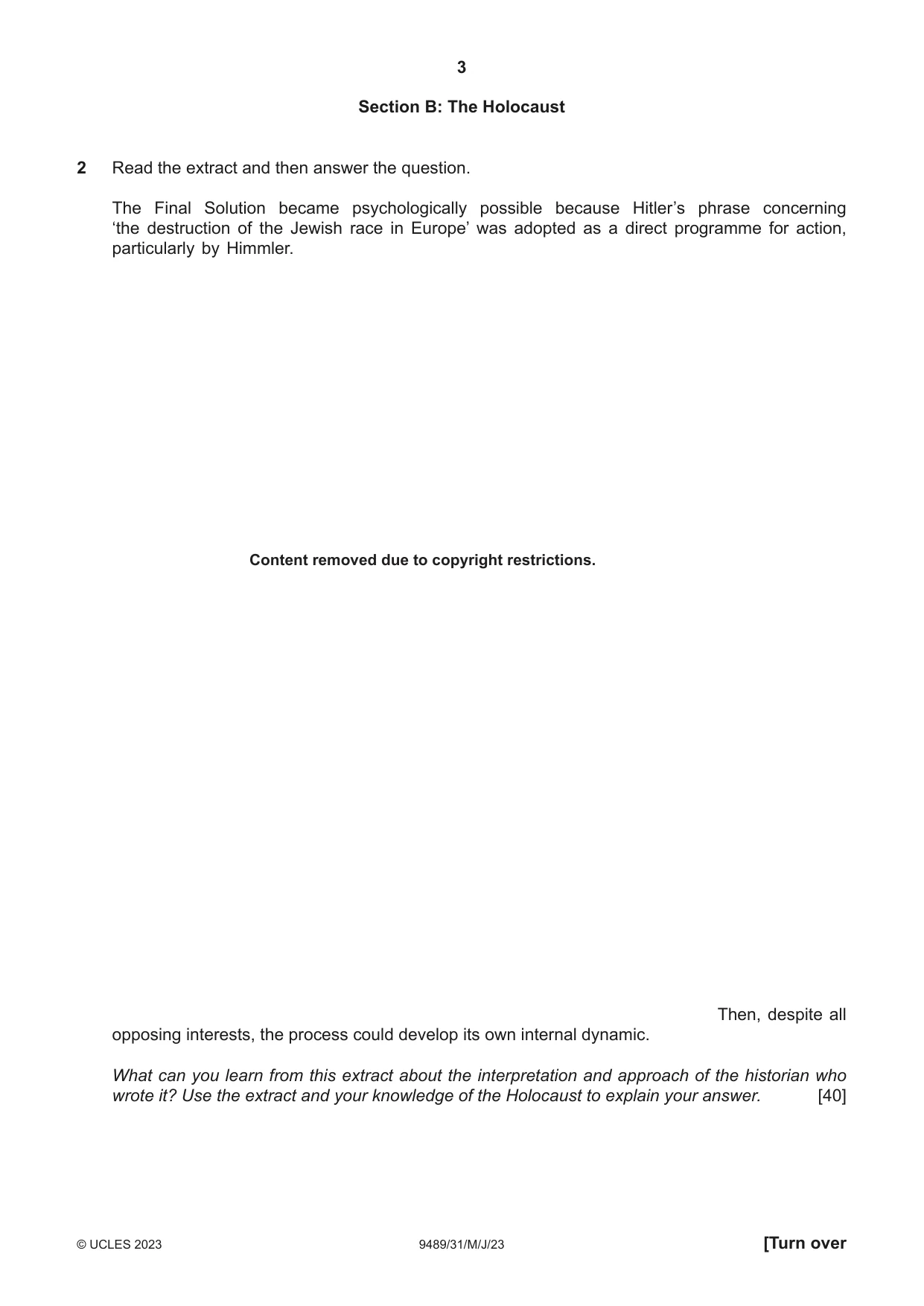
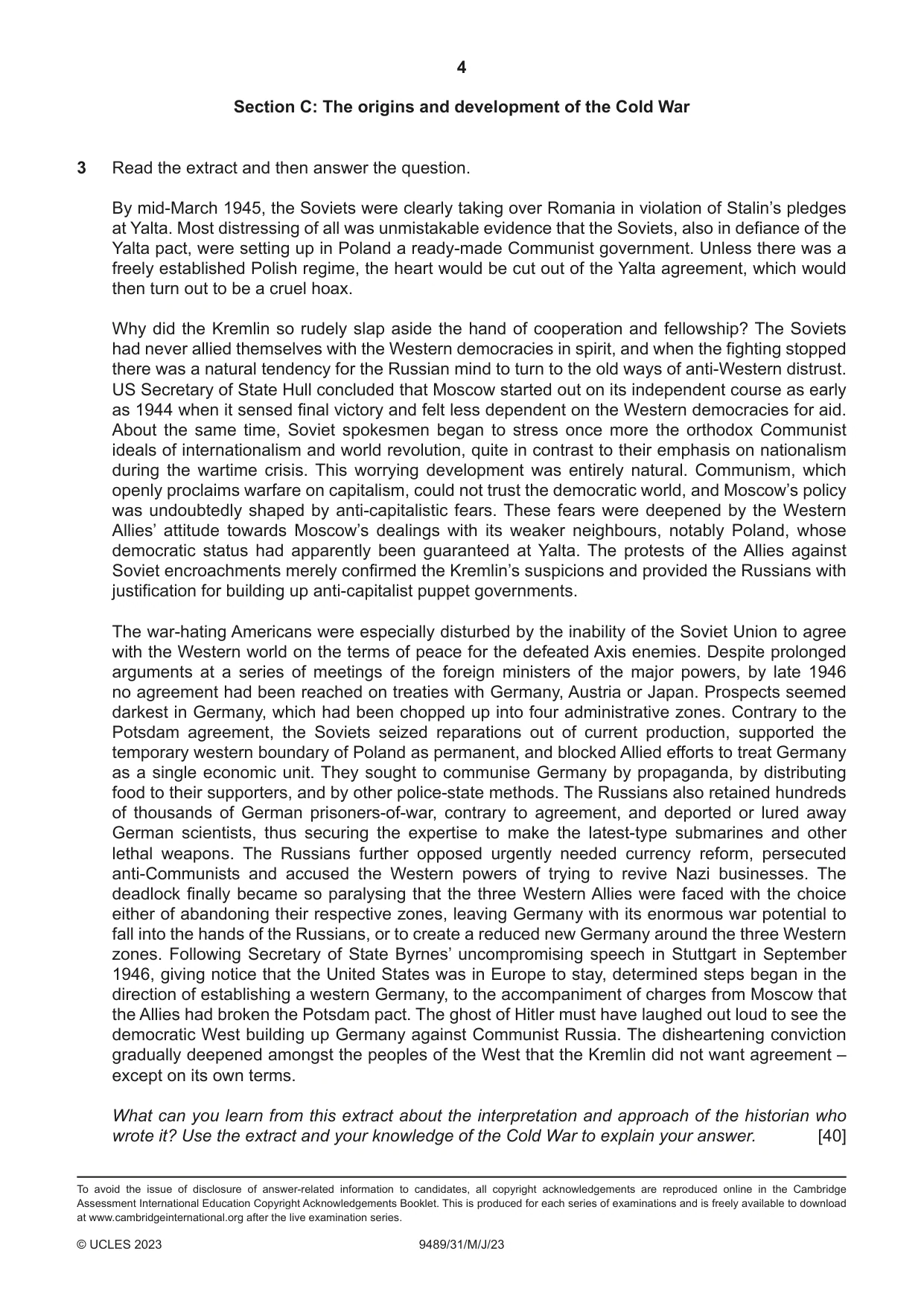
Mark scheme7 pages
Answers below. Sit the paper first if you are practising.
Questions as text
Q1 · Read the extract and then answer the question
1 Read the extract and then answer the question. Would any of the Entente Powers have acted differently had they known of the deep involvement of the Serbian army, though not the government, in the murder of Franz Ferdinand? Content removed due to copyright restrictions. Even if Germany is acquitted of pursuing a design for a general European war in 1914, it still had the power to prevent it and did not do so. What can you learn from this extract about the interpretation and approach of the historian who wrote it? Use the extract and your knowledge of the origins of the First World War to explain your answer. [40]
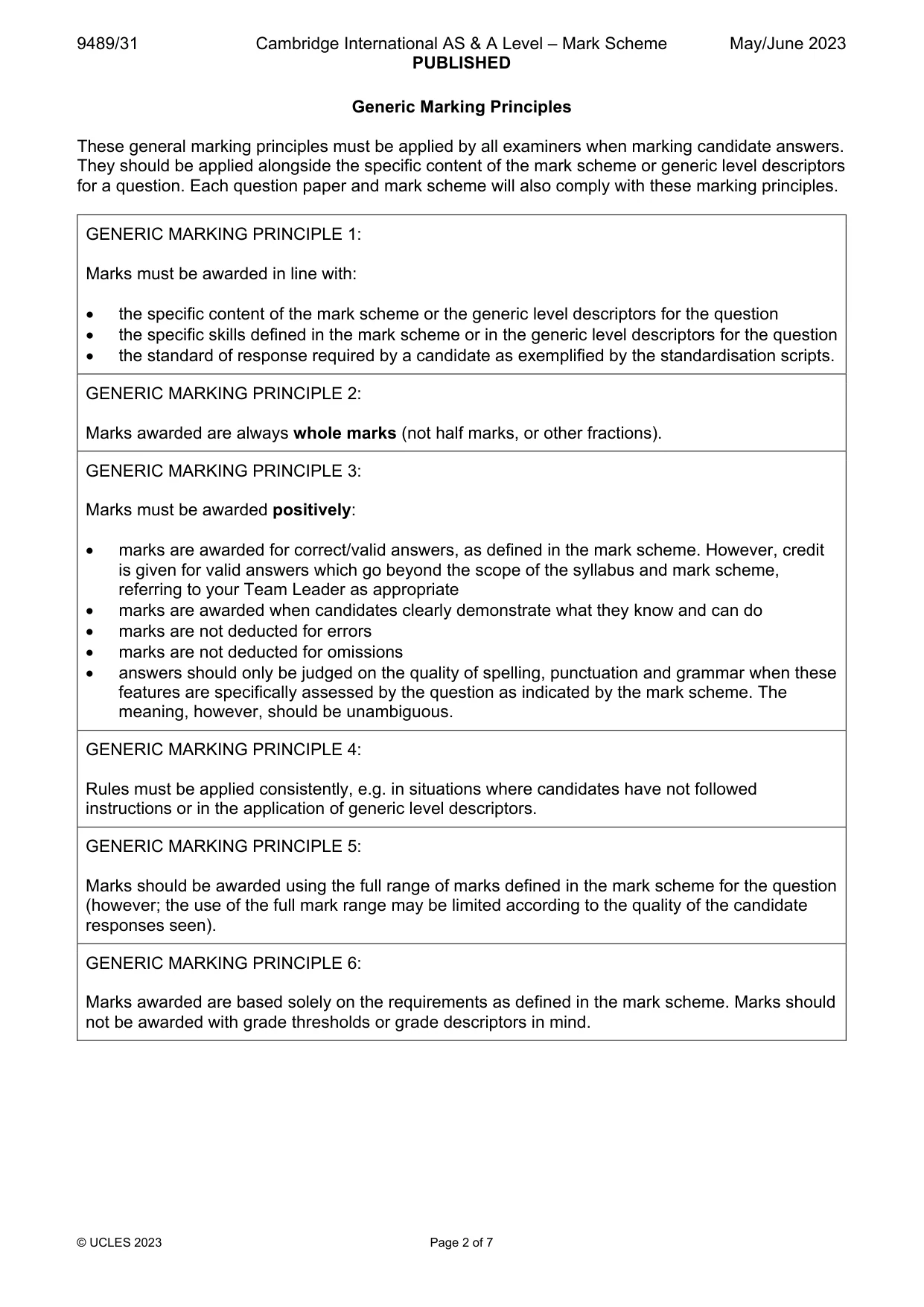
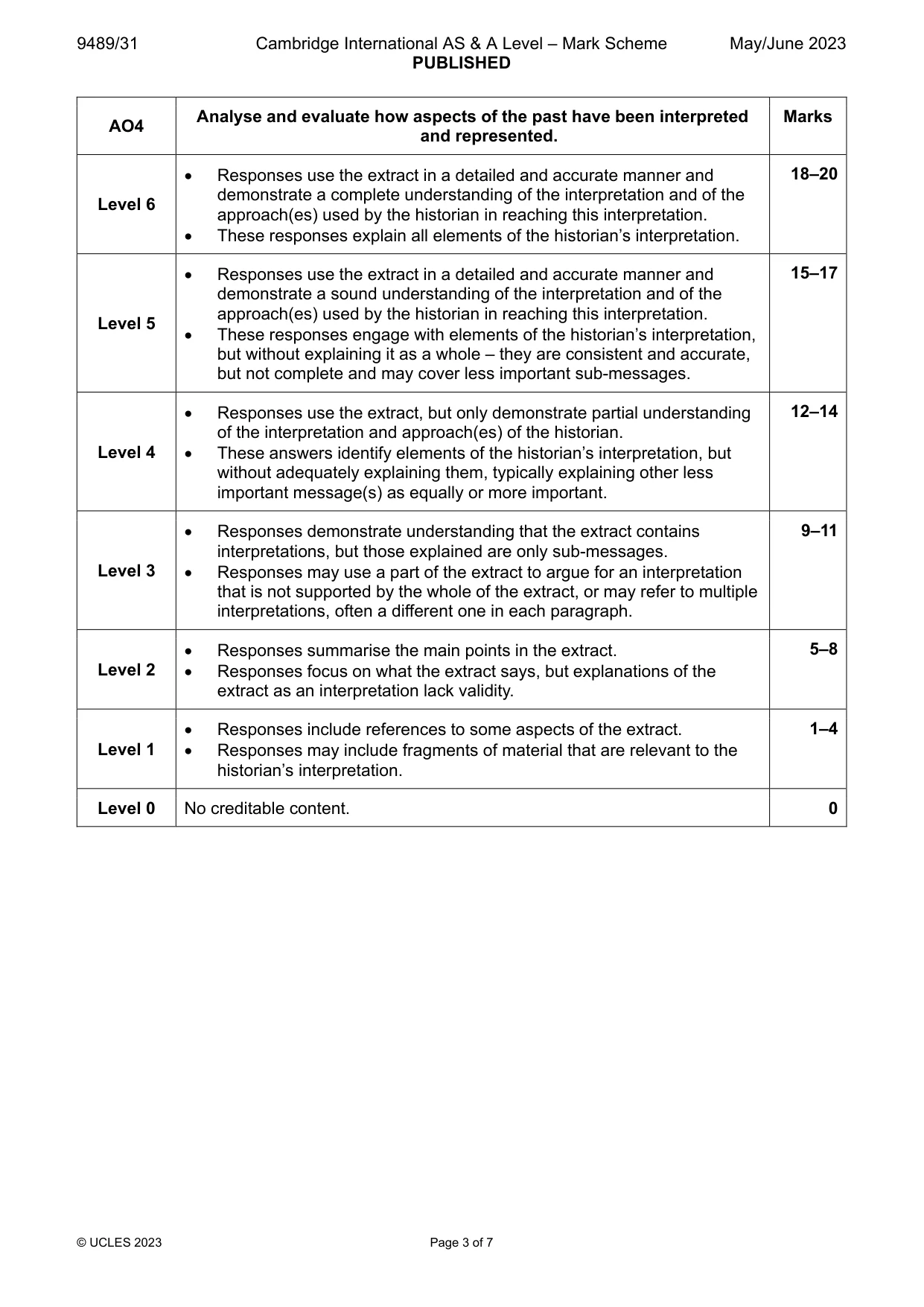
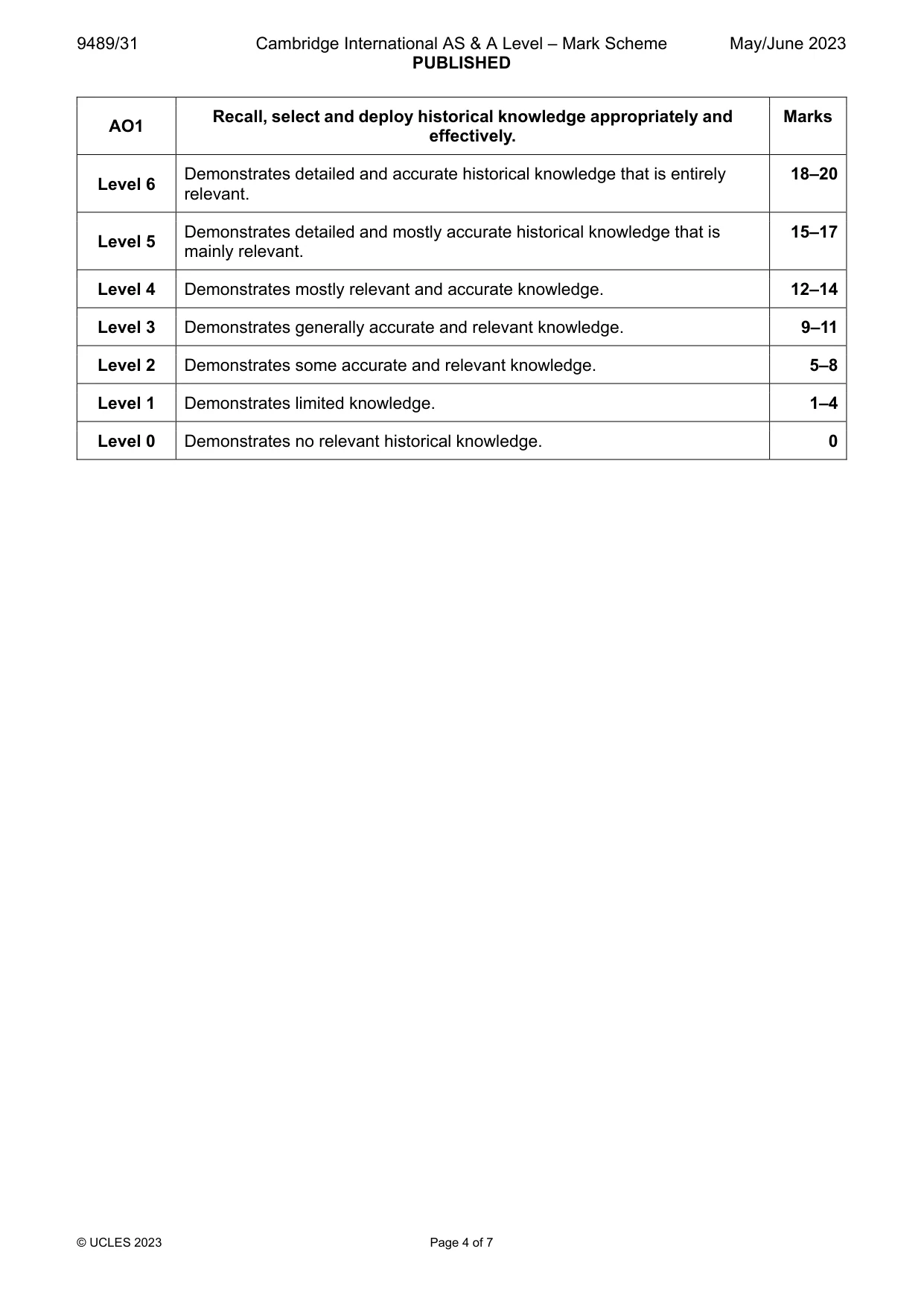
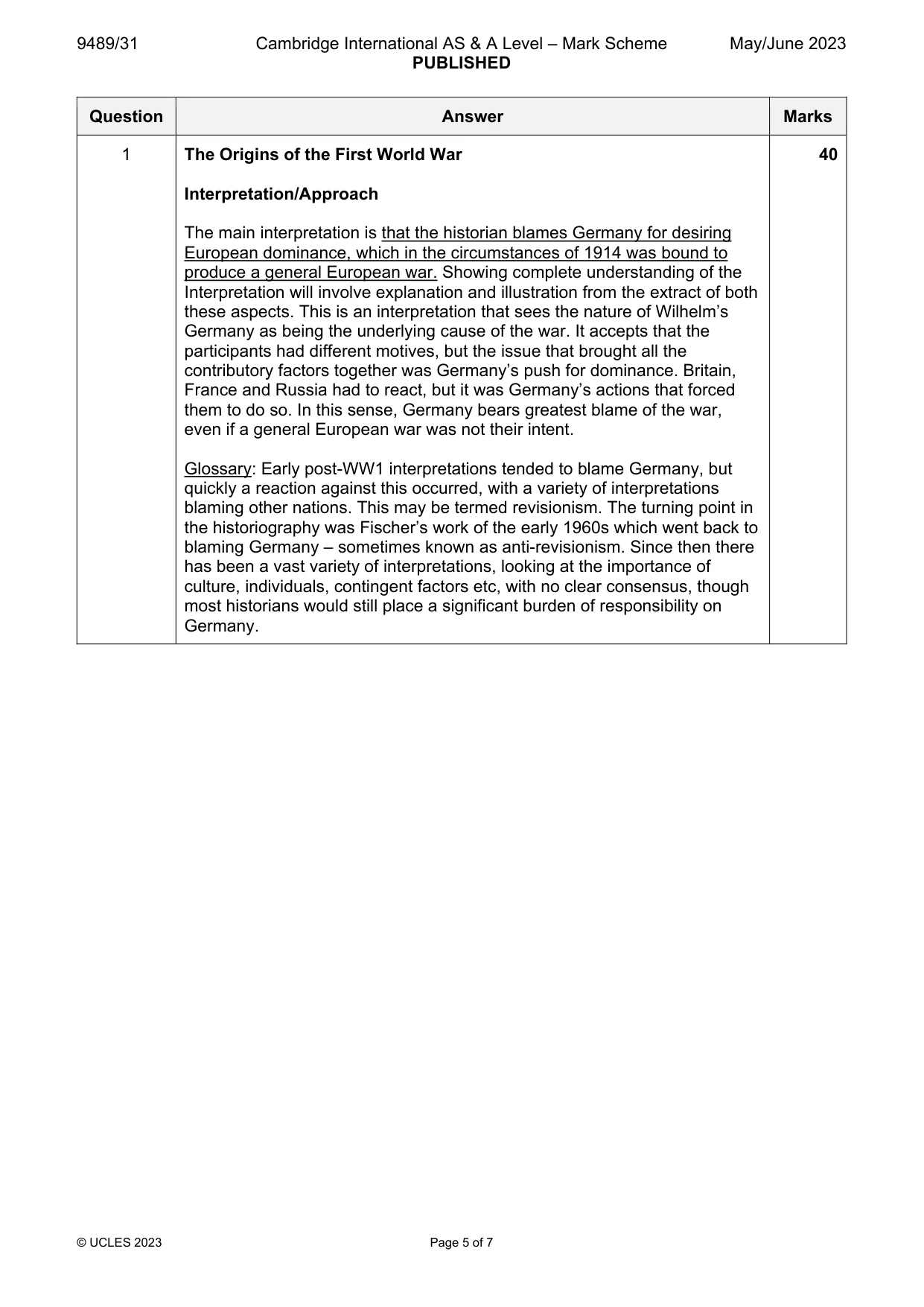
Mark scheme: Question Answer Marks 1 The Origins of the First World War 40 Interpretation/Approach The main interpretation is that the historian blames Germany for desiring European dominance, which in the circumstances of 1914 was bound to produce a general European war. Showing complete understanding of the Interpretation will involve explanation and illustration from the extract of both these aspects. This is an interpretation that sees the nature of Wilhelm’s Germany as being the underlying cause of the war. It accepts that the participants had different motives, but the issue that brought all the contributory factors together was Germany’s push for dominance. Britain, France and Russia had to react, but it was Germany’s actions that forced them to do so. In this sense, Germany bears greatest blame of the war, even if a general European war was not their intent. Glossary: Early post-WW1 interpretations tended to blame Germany, but quickly a reaction against this occurred, with a variety of interpretations blaming other nations. This may be termed revisionism. The turning point in the historiography was Fischer’s work of the early 1960s which went back to blaming Germany – sometimes known as anti-revisionism. Since then there has been a vast variety of interpretations, looking at the importance of culture, individuals, contingent factors etc, with no clear consensus, though most historians would still place a significant burden of responsibility on Germany.
Q2 · Read the extract and then answer the question
2 Read the extract and then answer the question. The Final Solution became psychologically possible because Hitler’s phrase concerning ‘the destruction of the Jewish race in Europe’ was adopted as a direct programme for action, particularly by Himmler. Content removed due to copyright restrictions. Then, despite all opposing interests, the process could develop its own internal dynamic. What can you learn from this extract about the interpretation and approach of the historian who wrote it? Use the extract and your knowledge of the Holocaust to explain your answer. [40] Section C: The origins and development of the Cold War
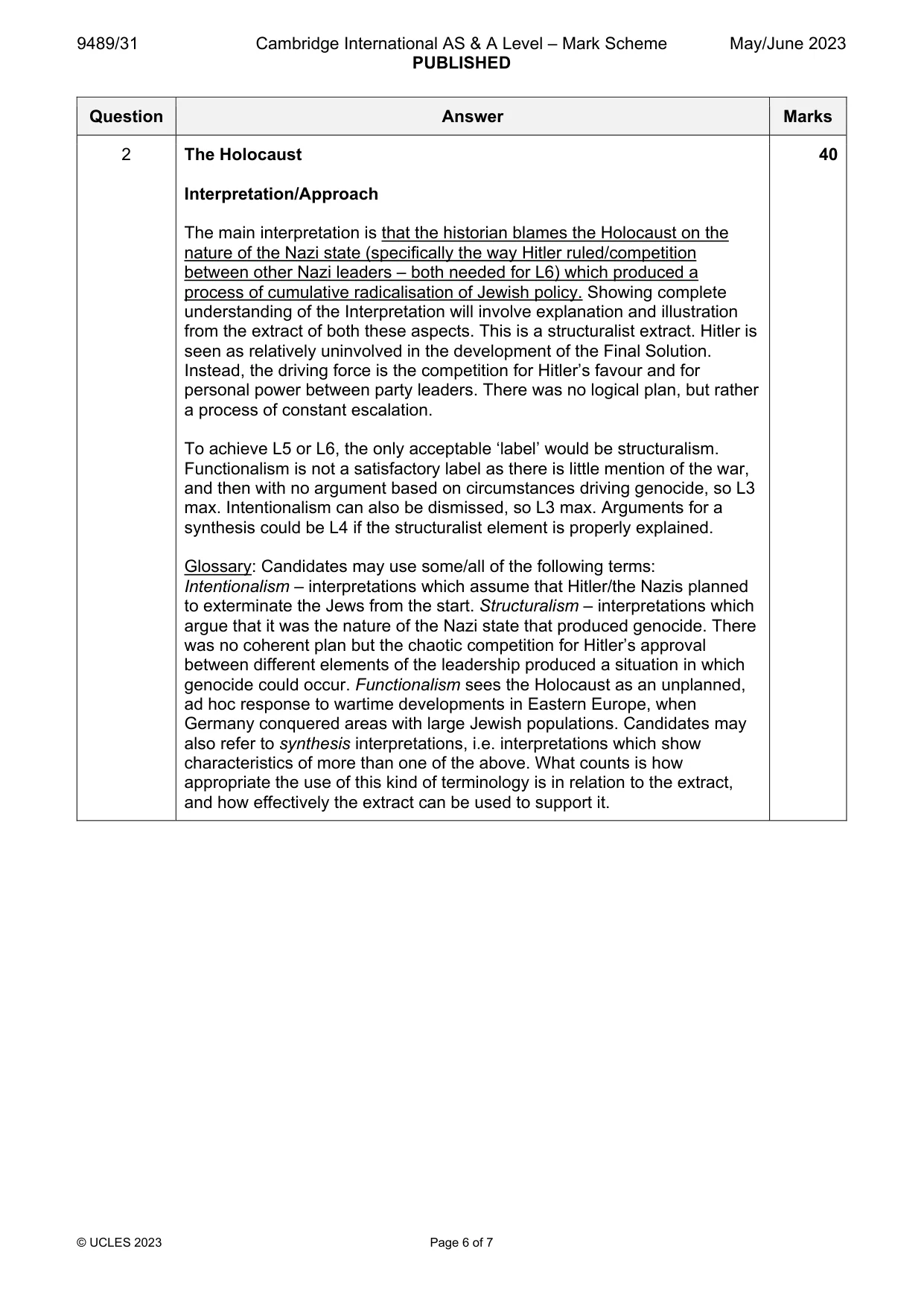
Mark scheme: 2 The Holocaust 40 Interpretation/Approach The main interpretation is that the historian blames the Holocaust on the nature of the Nazi state (specifically the way Hitler ruled/competition between other Nazi leaders – both needed for L6) which produced a process of cumulative radicalisation of Jewish policy. Showing complete understanding of the Interpretation will involve explanation and illustration from the extract of both these aspects. This is a structuralist extract. Hitler is seen as relatively uninvolved in the development of the Final Solution. Instead, the driving force is the competition for Hitler’s favour and for personal power between party leaders. There was no logical plan, but rather a process of constant escalation. To achieve L5 or L6, the only acceptable ‘label’ would be structuralism. Functionalism is not a satisfactory label as there is little mention of the war, and then with no argument based on circumstances driving genocide, so L3 max. Intentionalism can also be dismissed, so L3 max. Arguments for a synthesis could be L4 if the structuralist element is properly explained. Glossary: Candidates may use some/all of the following terms: Intentionalism – interpretations which assume that Hitler/the Nazis planned to exterminate the Jews from the start. Structuralism – interpretations which argue that it was the nature of the Nazi state that produced genocide. There was no coherent plan but the chaotic competition for Hitler’s approval between different elements of the leadership produced a situation in which genocide could occur. Functionalism sees the Holocaust as an unplanned, ad hoc response to wartime developments in Eastern Europe, when Germany conquered areas with large Jewish populations. Candidates may also refer to synthesis interpretations, i.e. interpretations which show characteristics of more than one of the above. What counts is how appropriate the use of this kind of terminology is in relation to the extract, and how effectively the extract can be used to support it.
More questions on How did the rise of extremism affect international relations?
Q3 · Read the extract and then answer the question
3 Read the extract and then answer the question. By mid‑March 1945, the Soviets were clearly taking over Romania in violation of Stalin’s pledges at Yalta. Most distressing of all was unmistakable evidence that the Soviets, also in defiance of the Yalta pact, were setting up in Poland a ready‑made Communist government. Unless there was a freely established Polish regime, the heart would be cut out of the Yalta agreement, which would then turn out to be a cruel hoax. Why did the Kremlin so rudely slap aside the hand of cooperation and fellowship? The Soviets had never allied themselves with the Western democracies in spirit, and when the fighting stopped there was a natural tendency for the Russian mind to turn to the old ways of anti‑Western distrust. US Secretary of State Hull concluded that Moscow started out on its independent course as early as 1944 when it sensed final victory and felt less dependent on the Western democracies for aid. About the same time, Soviet spokesmen began to stress once more the orthodox Communist ideals of internationalism and world revolution, quite in contrast to their emphasis on nationalism during the wartime crisis. This worrying development was entirely natural. Communism, which openly proclaims warfare on capitalism, could not trust the democratic world, and Moscow’s policy was undoubtedly shaped by anti‑capitalistic fears. These fears were deepened by the Western Allies’ attitude towards Moscow’s dealings with its weaker neighbours, notably Poland, whose democratic status had apparently been guaranteed at Yalta. The protests of the Allies against Soviet encroachments merely confirmed the Kremlin’s suspicions and provided the Russians with justification for building up anti‑capitalist puppet governments. The war‑hating Americans were especially disturbed by the inability of the Soviet Union to agree with the Western world on the terms of peace for the defeated Axis enemies. Despite prolonged arguments at a series of meetings of the foreign ministers of the major powers, by late 1946 no agreement had been reached on treaties with Germany, Austria or Japan. Prospects seemed darkest in Germany, which had been chopped up into four administrative zones. Contrary to the Potsdam agreement, the Soviets seized reparations out of current production, supported the temporary western boundary of Poland as permanent, and blocked Allied efforts to treat Germany as a single economic unit. They sought to communise Germany by propaganda, by distributing food to their supporters, and by other police‑state methods. The Russians also retained hundreds of thousands of German prisoners‑of‑war, contrary to agreement, and deported or lured away German scientists, thus securing the expertise to make the latest‑type submarines and other lethal weapons. The Russians further opposed urgently needed currency reform, persecuted anti‑Communists and accused the Western powers of trying to revive Nazi businesses. The deadlock finally became so paralysing that the three Western Allies were faced with the choice either of abandoning their respective zones, leaving Germany with its enormous war potential to fall into the hands of the Russians, or to create a reduced new Germany around the three Western zones. Following Secretary of State Byrnes’ uncompromising speech in Stuttgart in September 1946, giving notice that the United States was in Europe to stay, determined steps began in the direction of establishing a western Germany, to the accompaniment of charges from Moscow that the Allies had broken the Potsdam pact. The ghost of Hitler must have laughed out loud to see the democratic West building up Germany against Communist Russia. The disheartening conviction gradually deepened amongst the peoples of the West that the Kremlin did not want agreement – except on its own terms. What can you learn from this extract about the interpretation and approach of the historian who wrote it? Use the extract and your knowledge of the Cold War to explain your answer. [40] To avoid the issue of disclosure of answer‑related information to candidates, all copyright acknowledgements are reproduced online in the Cambridge Assessment International Education Copyright Acknowledgements Booklet. This is produced for each series of examinations and is freely available to download
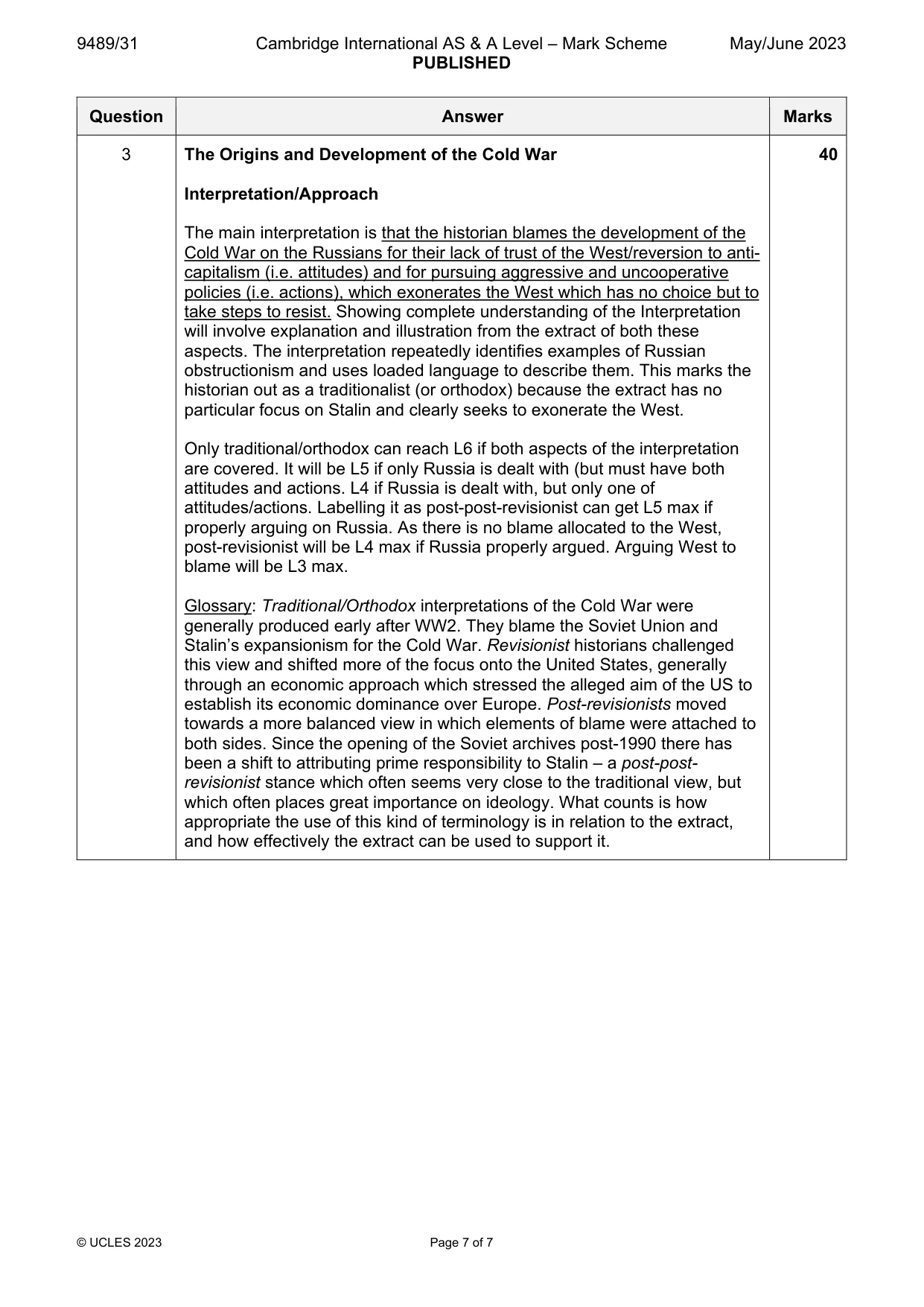
Mark scheme: 3 The Origins and Development of the Cold War 40 Interpretation/Approach The main interpretation is that the historian blames the development of the Cold War on the Russians for their lack of trust of the West/reversion to anti- capitalism (i.e. attitudes) and for pursuing aggressive and uncooperative policies (i.e. actions), which exonerates the West which has no choice but to take steps to resist. Showing complete understanding of the Interpretation will involve explanation and illustration from the extract of both these aspects. The interpretation repeatedly identifies examples of Russian obstructionism and uses loaded language to describe them. This marks the historian out as a traditionalist (or orthodox) because the extract has no particular focus on Stalin and clearly seeks to exonerate the West. Only traditional/orthodox can reach L6 if both aspects of the interpretation are covered. It will be L5 if only Russia is dealt with (but must have both attitudes and actions. L4 if Russia is dealt with, but only one of attitudes/actions. Labelling it as post-post-revisionist can get L5 max if properly arguing on Russia. As there is no blame allocated to the West, post-revisionist will be L4 max if Russia properly argued. Arguing West to blame will be L3 max. Glossary: Traditional/Orthodox interpretations of the Cold War were generally produced early after WW2. They blame the Soviet Union and Stalin’s expansionism for the Cold War. Revisionist historians challenged this view and shifted more of the focus onto the United States, generally through an economic approach which stressed the alleged aim of the US to establish its economic dominance over Europe. Post-revisionists moved towards a more balanced view in which elements of blame were attached to both sides. Since the opening of the Soviet archives post-1990 there has been a shift to attributing prime responsibility to Stalin – a post-post- revisionist stance which often seems very close to the traditional view, but which often places great importance on ideology. What counts is how appropriate the use of this kind of terminology is in relation to the extract, and how effectively the extract can be used to support it.
What was in this paper
The subtopics covered by these 3 questions, and how many questions each got. Open one in a new tab to see every Cambridge question on it.
What you needed in this session
Cambridge’s own grade thresholds for 2023 May/June, Paper 3 · Variant 1. A higher threshold means an easier paper — the bar moves with how the cohort did.