Cambridge A Level History 9489 — 2024 May/June Paper 3 · Variant 1
9489/31/M/J/24 · 3 questions · 40 marks · ≈45 min
The question paper and its mark scheme, free to read here and free to download. This is Cambridge’s own paper, exactly as it was sat.
Question paper4 pages
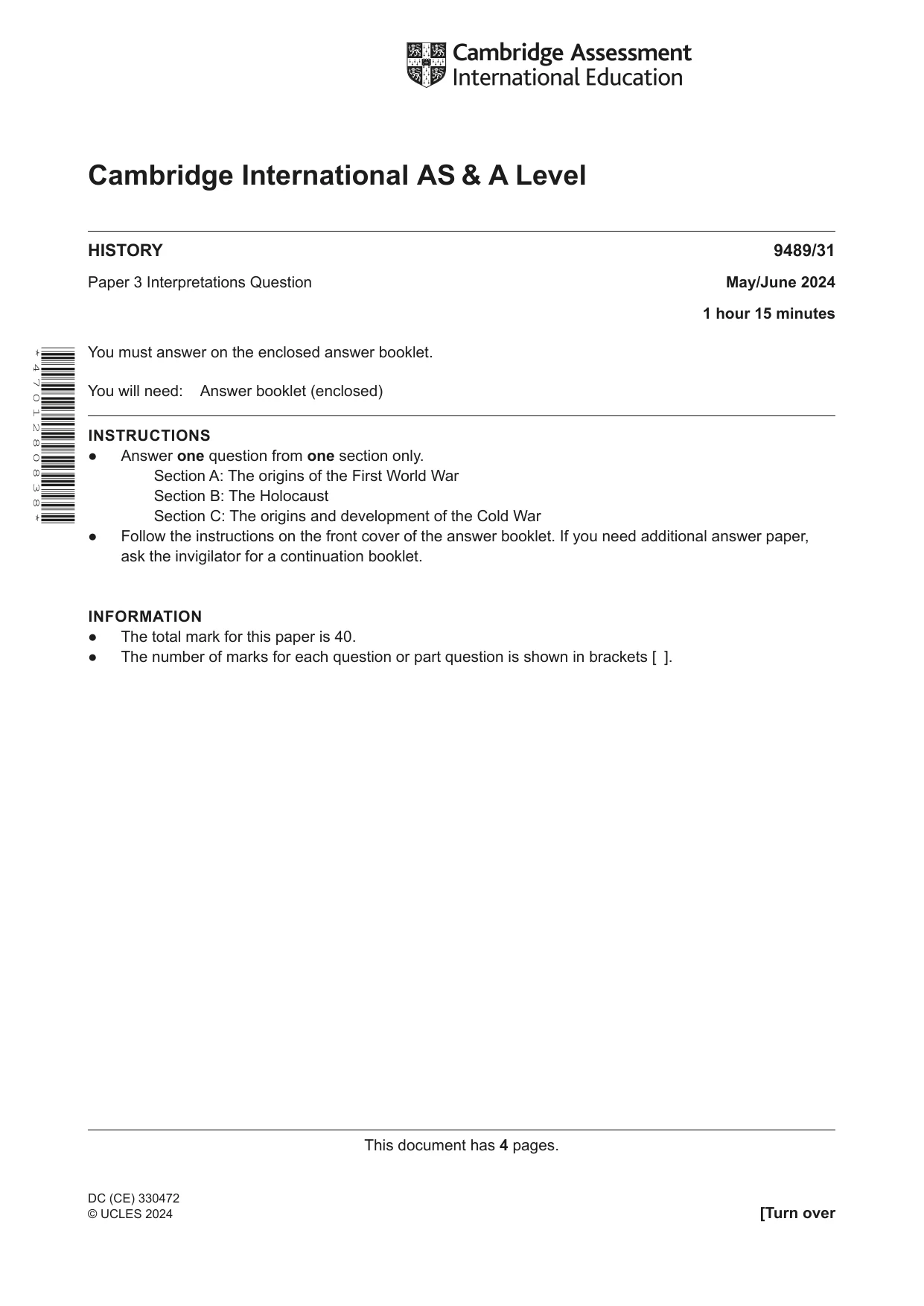
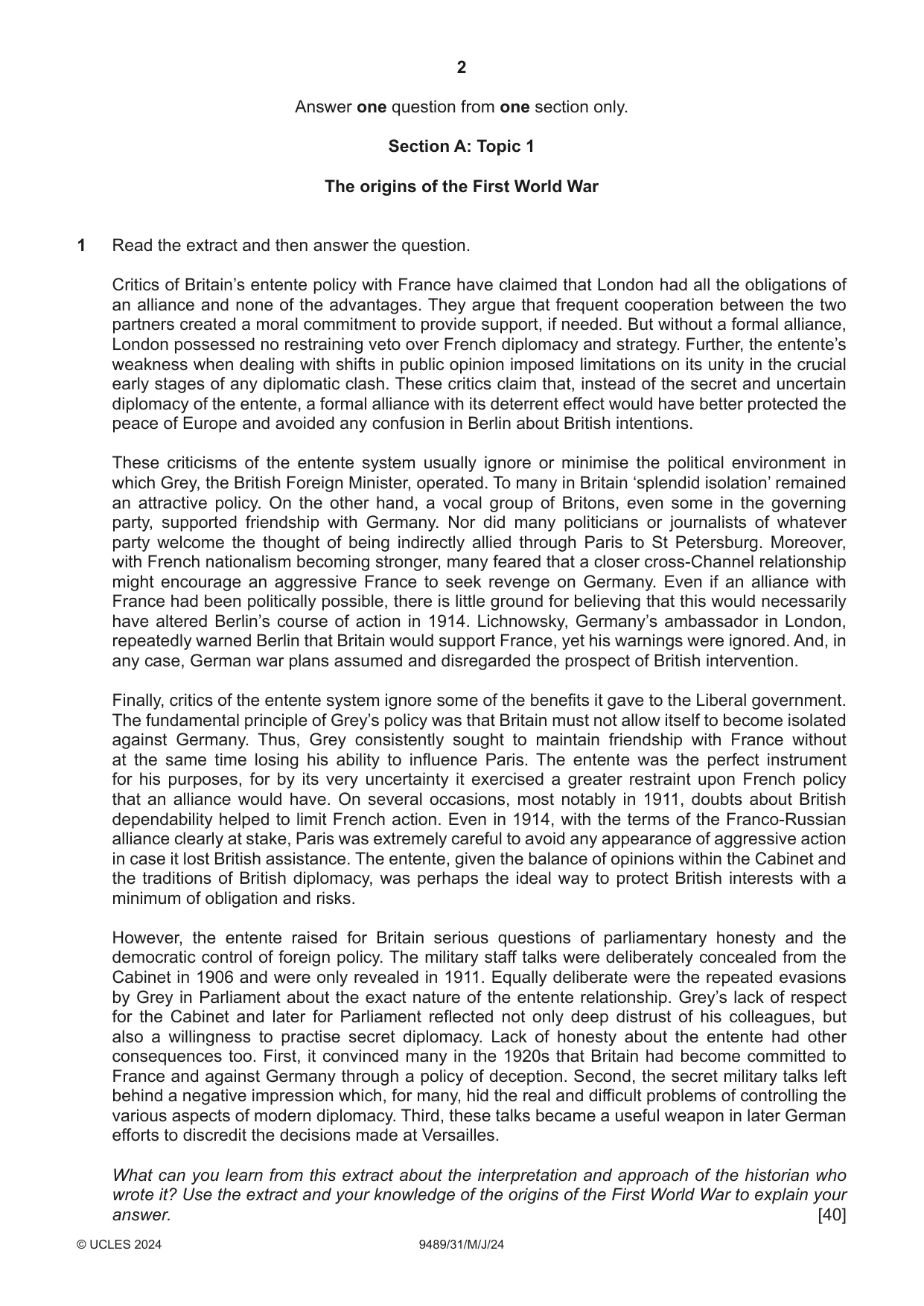
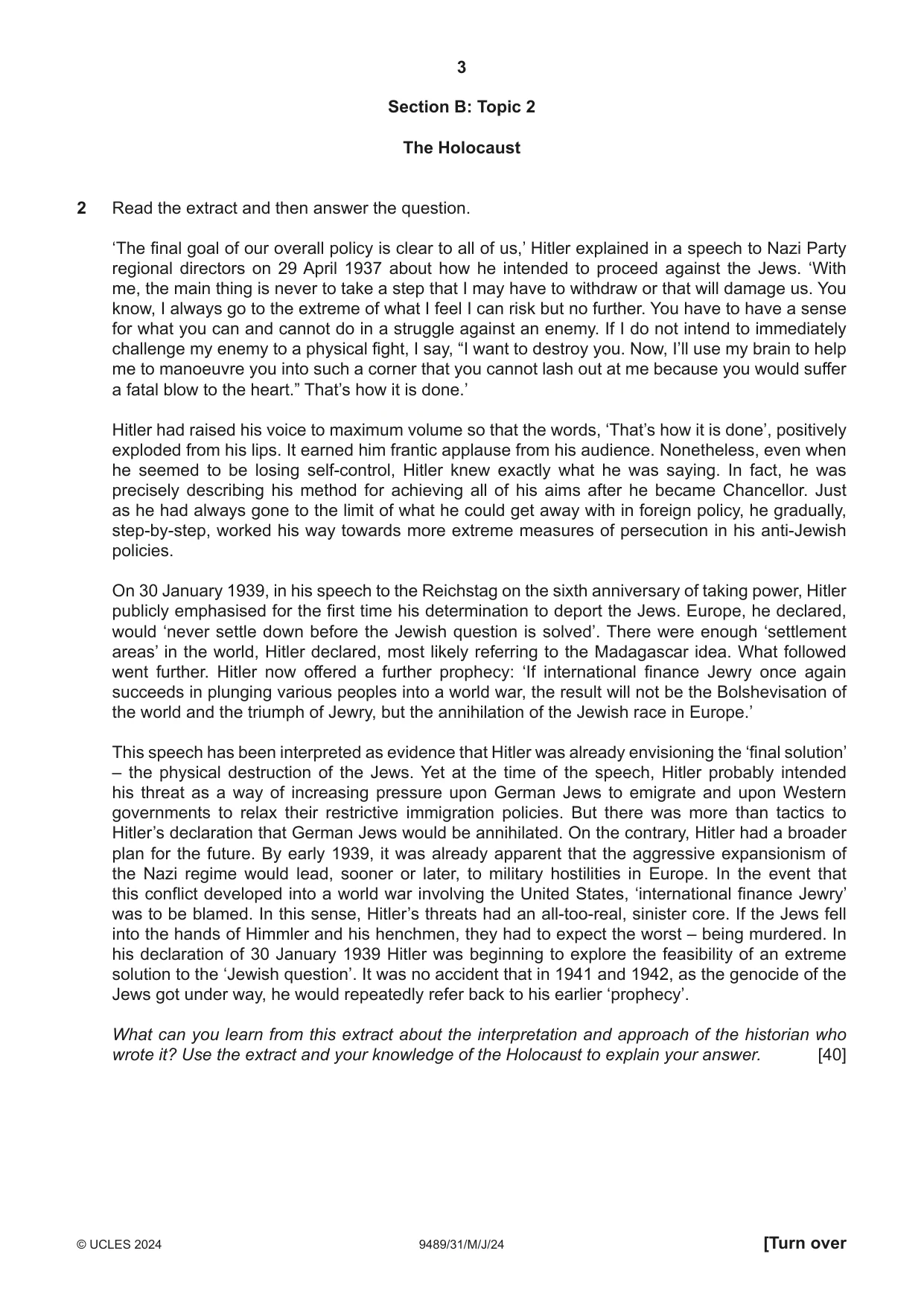
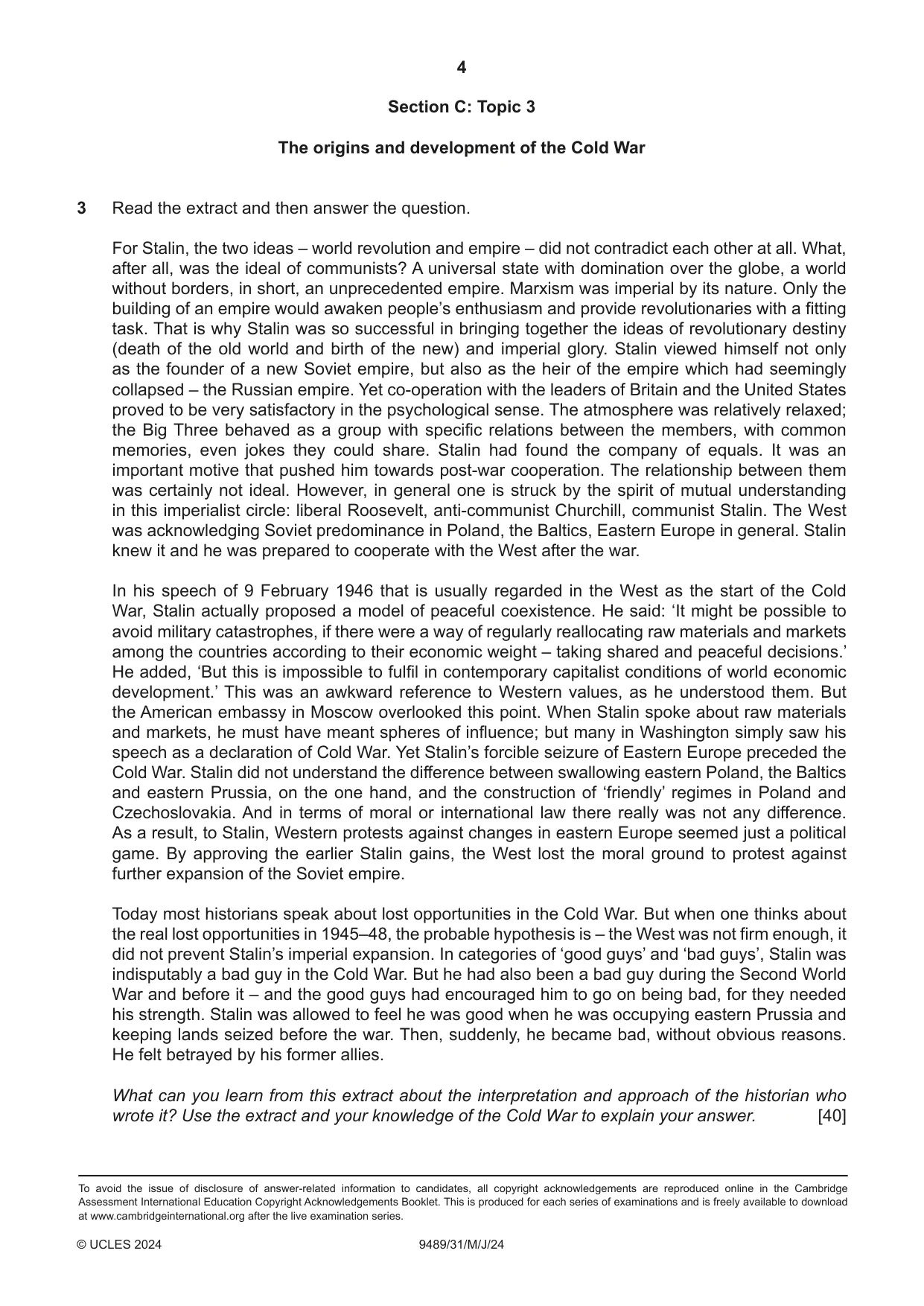
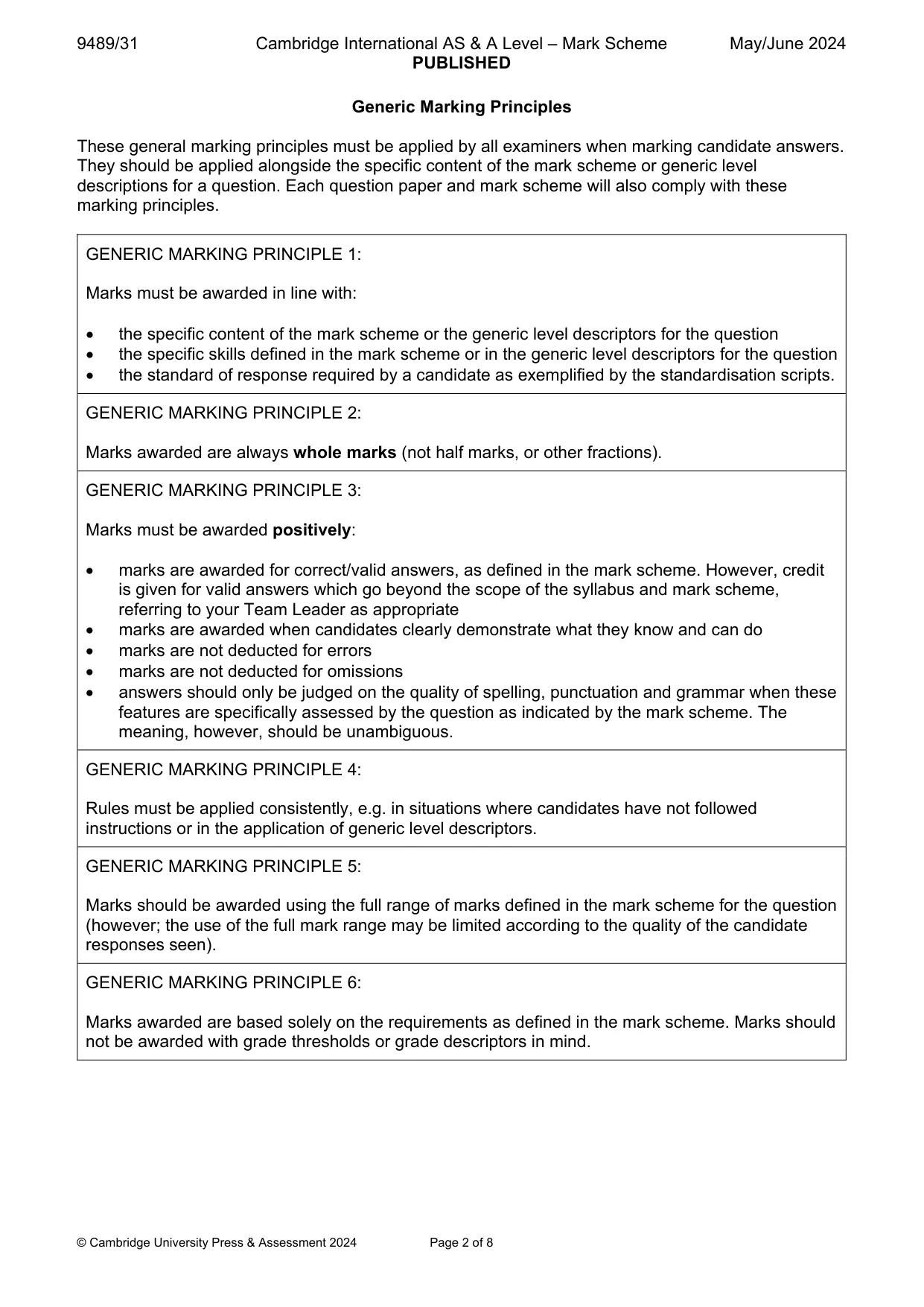
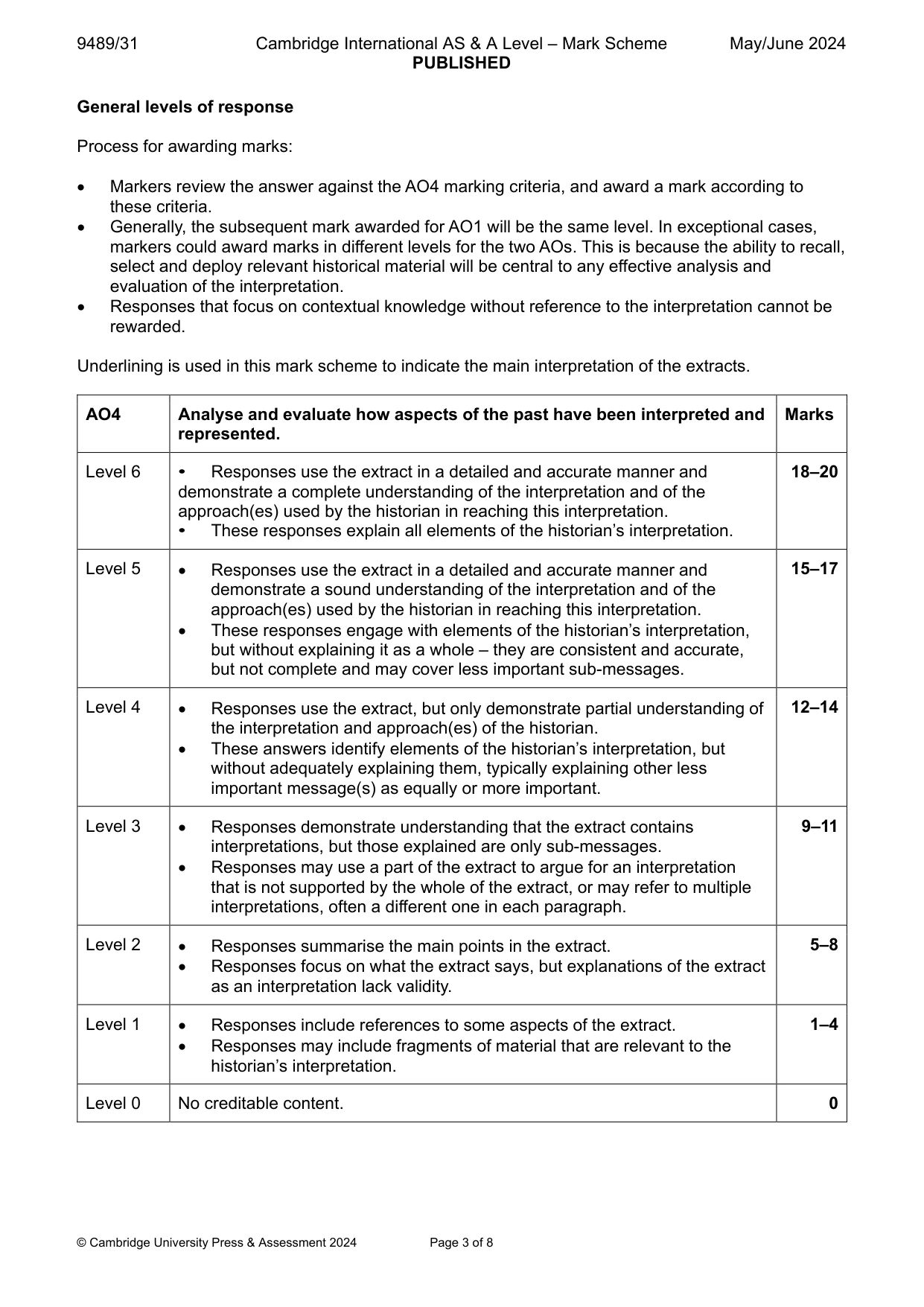
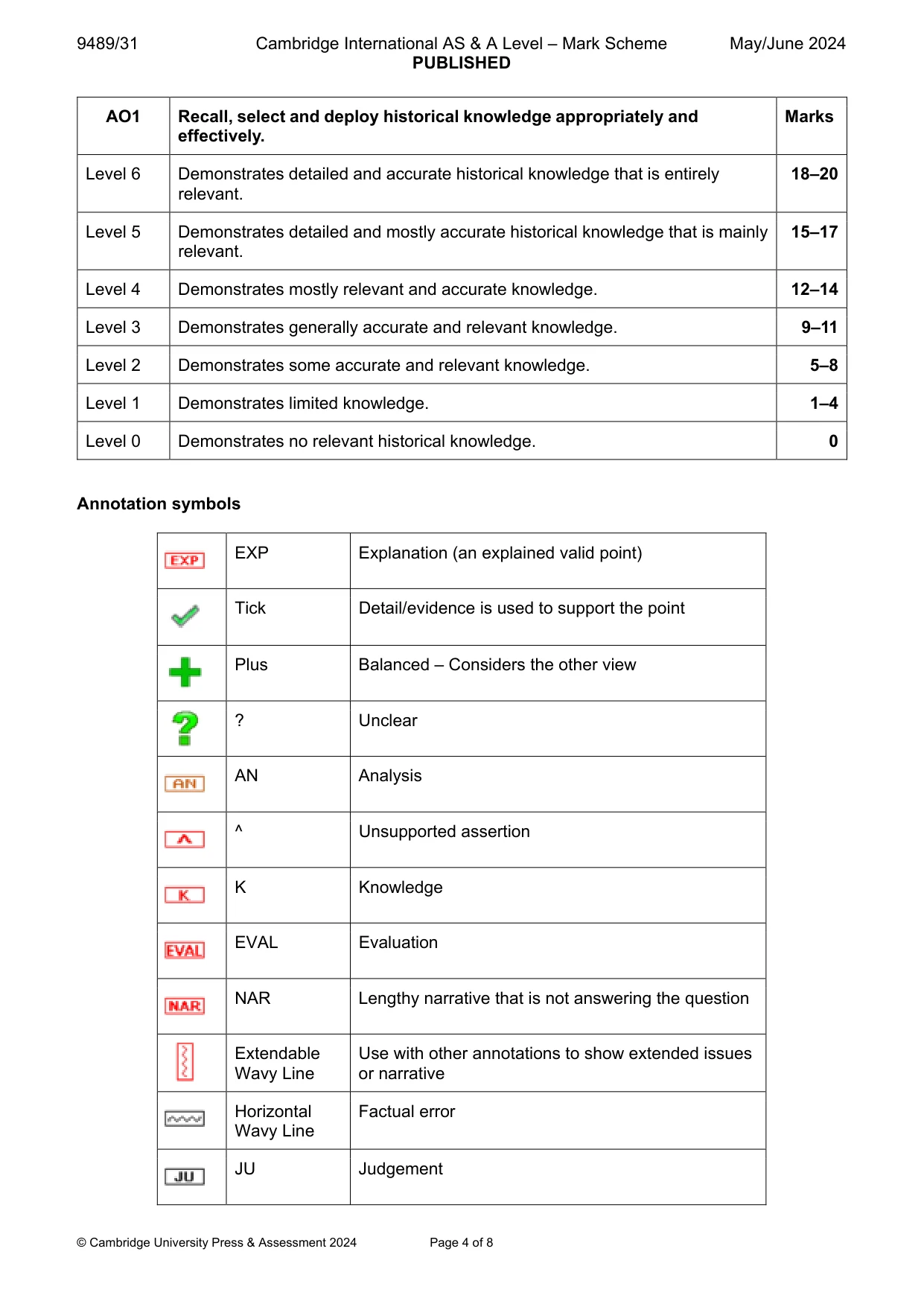
Mark scheme8 pages
Answers below. Sit the paper first if you are practising.
Questions as text
Q1 · Read the extract and then answer the question
1 Read the extract and then answer the question. Critics of Britain’s entente policy with France have claimed that London had all the obligations of an alliance and none of the advantages. They argue that frequent cooperation between the two partners created a moral commitment to provide support, if needed. But without a formal alliance, London possessed no restraining veto over French diplomacy and strategy. Further, the entente’s weakness when dealing with shifts in public opinion imposed limitations on its unity in the crucial early stages of any diplomatic clash. These critics claim that, instead of the secret and uncertain diplomacy of the entente, a formal alliance with its deterrent effect would have better protected the peace of Europe and avoided any confusion in Berlin about British intentions. These criticisms of the entente system usually ignore or minimise the political environment in which Grey, the British Foreign Minister, operated. To many in Britain ‘splendid isolation’ remained an attractive policy. On the other hand, a vocal group of Britons, even some in the governing party, supported friendship with Germany. Nor did many politicians or journalists of whatever party welcome the thought of being indirectly allied through Paris to St Petersburg. Moreover, with French nationalism becoming stronger, many feared that a closer cross-Channel relationship might encourage an aggressive France to seek revenge on Germany. Even if an alliance with France had been politically possible, there is little ground for believing that this would necessarily have altered Berlin’s course of action in 1914. Lichnowsky, Germany’s ambassador in London, repeatedly warned Berlin that Britain would support France, yet his warnings were ignored. And, in any case, German war plans assumed and disregarded the prospect of British intervention. Finally, critics of the entente system ignore some of the benefits it gave to the Liberal government. The fundamental principle of Grey’s policy was that Britain must not allow itself to become isolated against Germany. Thus, Grey consistently sought to maintain friendship with France without at the same time losing his ability to influence Paris. The entente was the perfect instrument for his purposes, for by its very uncertainty it exercised a greater restraint upon French policy that an alliance would have. On several occasions, most notably in 1911, doubts about British dependability helped to limit French action. Even in 1914, with the terms of the Franco-Russian alliance clearly at stake, Paris was extremely careful to avoid any appearance of aggressive action in case it lost British assistance. The entente, given the balance of opinions within the Cabinet and the traditions of British diplomacy, was perhaps the ideal way to protect British interests with a minimum of obligation and risks. However, the entente raised for Britain serious questions of parliamentary honesty and the democratic control of foreign policy. The military staff talks were deliberately concealed from the Cabinet in 1906 and were only revealed in 1911. Equally deliberate were the repeated evasions by Grey in Parliament about the exact nature of the entente relationship. Grey’s lack of respect for the Cabinet and later for Parliament reflected not only deep distrust of his colleagues, but also a willingness to practise secret diplomacy. Lack of honesty about the entente had other consequences too. First, it convinced many in the 1920s that Britain had become committed to France and against Germany through a policy of deception. Second, the secret military talks left behind a negative impression which, for many, hid the real and difficult problems of controlling the various aspects of modern diplomacy. Third, these talks became a useful weapon in later German efforts to discredit the decisions made at Versailles. What can you learn from this extract about the interpretation and approach of the historian who wrote it? Use the extract and your knowledge of the origins of the First World War to explain your answer. [40]
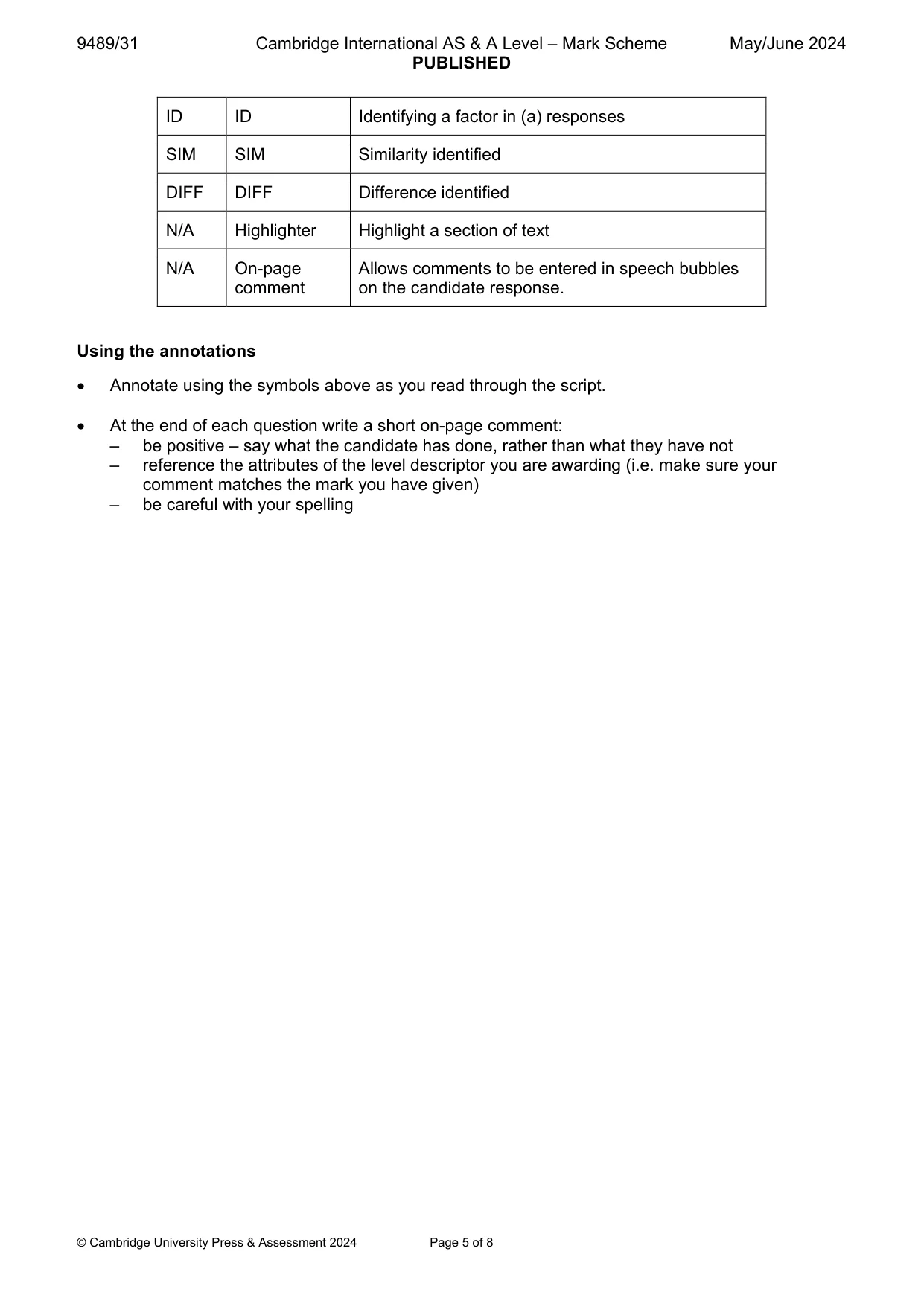
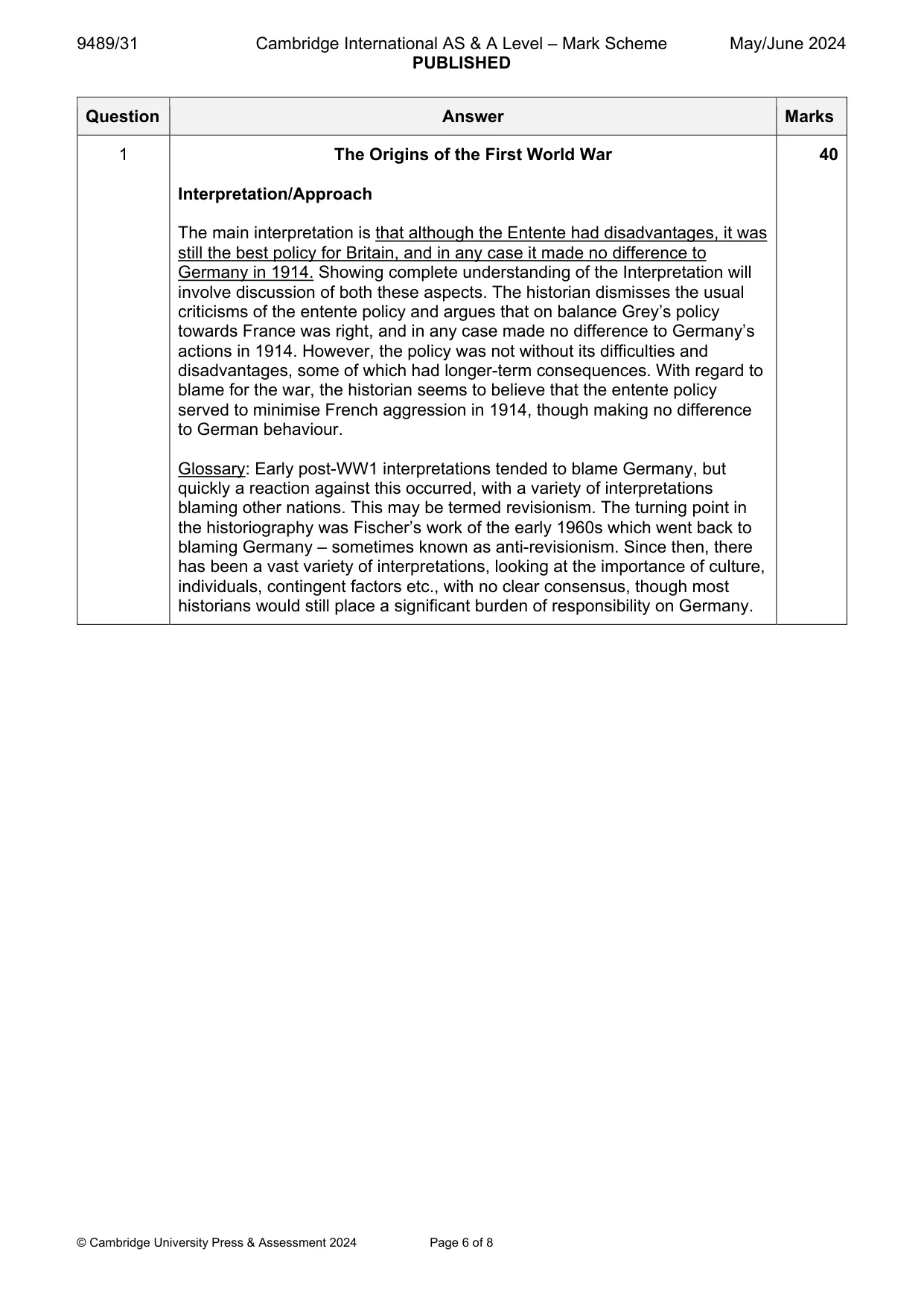
Mark scheme: Question Answer Marks 1 The Origins of the First World War 40 Interpretation/Approach The main interpretation is that although the Entente had disadvantages, it was still the best policy for Britain, and in any case it made no difference to Germany in 1914. Showing complete understanding of the Interpretation will involve discussion of both these aspects. The historian dismisses the usual criticisms of the entente policy and argues that on balance Grey’s policy towards France was right, and in any case made no difference to Germany’s actions in 1914. However, the policy was not without its difficulties and disadvantages, some of which had longer-term consequences. With regard to blame for the war, the historian seems to believe that the entente policy served to minimise French aggression in 1914, though making no difference to German behaviour. Glossary: Early post-WW1 interpretations tended to blame Germany, but quickly a reaction against this occurred, with a variety of interpretations blaming other nations. This may be termed revisionism. The turning point in the historiography was Fischer’s work of the early 1960s which went back to blaming Germany – sometimes known as anti-revisionism. Since then, there has been a vast variety of interpretations, looking at the importance of culture, individuals, contingent factors etc., with no clear consensus, though most historians would still place a significant burden of responsibility on Germany.
Q2 · Read the extract and then answer the question
2 Read the extract and then answer the question. ‘The final goal of our overall policy is clear to all of us,’ Hitler explained in a speech to Nazi Party regional directors on 29 April 1937 about how he intended to proceed against the Jews. ‘With me, the main thing is never to take a step that I may have to withdraw or that will damage us. You know, I always go to the extreme of what I feel I can risk but no further. You have to have a sense for what you can and cannot do in a struggle against an enemy. If I do not intend to immediately challenge my enemy to a physical fight, I say, “I want to destroy you. Now, I’ll use my brain to help me to manoeuvre you into such a corner that you cannot lash out at me because you would suffer a fatal blow to the heart.” That’s how it is done.’ Hitler had raised his voice to maximum volume so that the words, ‘That’s how it is done’, positively exploded from his lips. It earned him frantic applause from his audience. Nonetheless, even when he seemed to be losing self-control, Hitler knew exactly what he was saying. In fact, he was precisely describing his method for achieving all of his aims after he became Chancellor. Just as he had always gone to the limit of what he could get away with in foreign policy, he gradually, step-by-step, worked his way towards more extreme measures of persecution in his anti-Jewish policies. On 30 January 1939, in his speech to the Reichstag on the sixth anniversary of taking power, Hitler publicly emphasised for the first time his determination to deport the Jews. Europe, he declared, would ‘never settle down before the Jewish question is solved’. There were enough ‘settlement areas’ in the world, Hitler declared, most likely referring to the Madagascar idea. What followed went further. Hitler now offered a further prophecy: ‘If international finance Jewry once again succeeds in plunging various peoples into a world war, the result will not be the Bolshevisation of the world and the triumph of Jewry, but the annihilation of the Jewish race in Europe.’ This speech has been interpreted as evidence that Hitler was already envisioning the ‘final solution’ – the physical destruction of the Jews. Yet at the time of the speech, Hitler probably intended his threat as a way of increasing pressure upon German Jews to emigrate and upon Western governments to relax their restrictive immigration policies. But there was more than tactics to Hitler’s declaration that German Jews would be annihilated. On the contrary, Hitler had a broader plan for the future. By early 1939, it was already apparent that the aggressive expansionism of the Nazi regime would lead, sooner or later, to military hostilities in Europe. In the event that this conflict developed into a world war involving the United States, ‘international finance Jewry’ was to be blamed. In this sense, Hitler’s threats had an all-too-real, sinister core. If the Jews fell into the hands of Himmler and his henchmen, they had to expect the worst – being murdered. In his declaration of 30 January 1939 Hitler was beginning to explore the feasibility of an extreme solution to the ‘Jewish question’. It was no accident that in 1941 and 1942, as the genocide of the Jews got under way, he would repeatedly refer back to his earlier ‘prophecy’. What can you learn from this extract about the interpretation and approach of the historian who wrote it? Use the extract and your knowledge of the Holocaust to explain your answer. [40] Section C: Topic 3 The origins and development of the Cold War
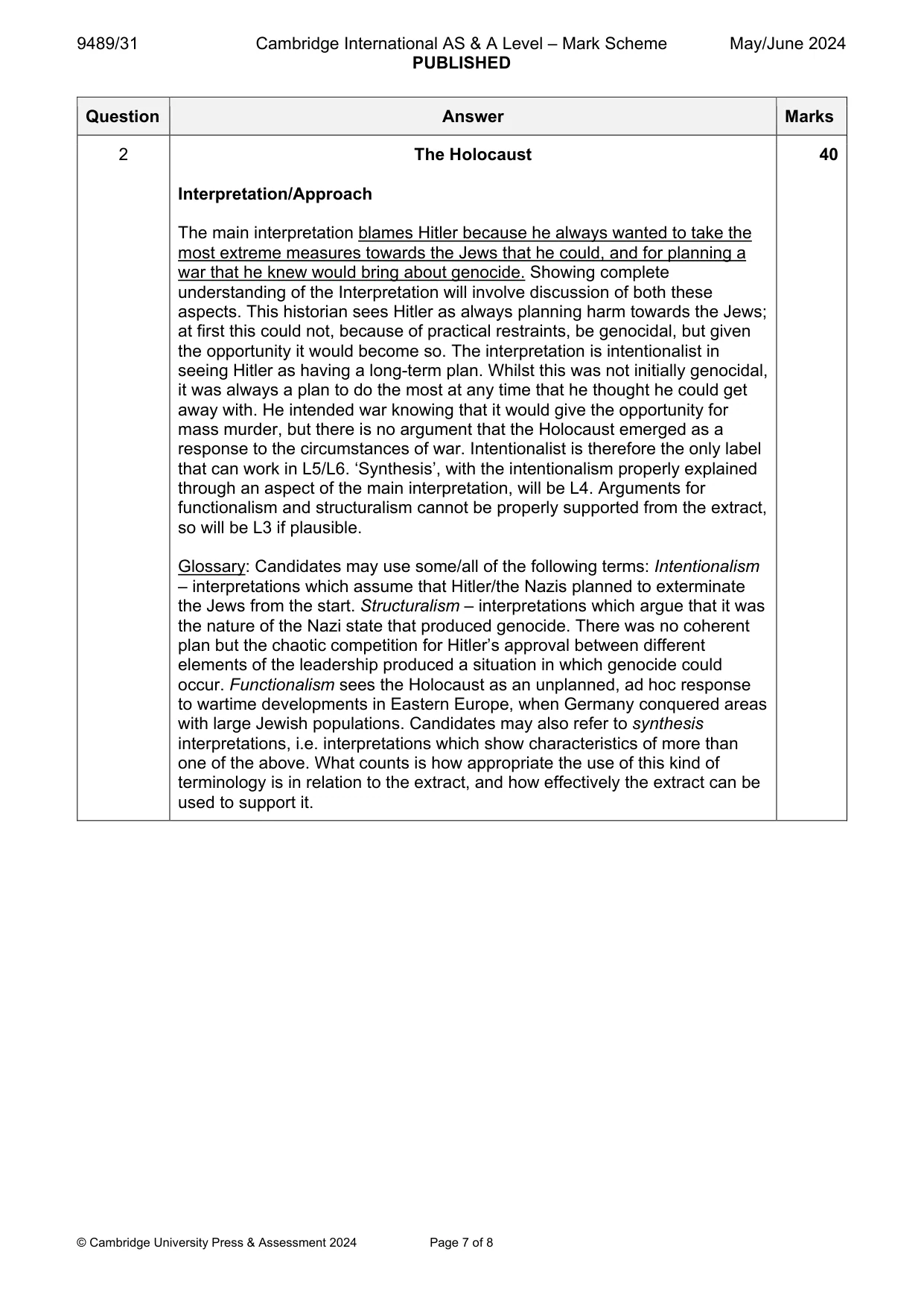
Mark scheme: 2 The Holocaust 40 Interpretation/Approach The main interpretation blames Hitler because he always wanted to take the most extreme measures towards the Jews that he could, and for planning a war that he knew would bring about genocide. Showing complete understanding of the Interpretation will involve discussion of both these aspects. This historian sees Hitler as always planning harm towards the Jews; at first this could not, because of practical restraints, be genocidal, but given the opportunity it would become so. The interpretation is intentionalist in seeing Hitler as having a long-term plan. Whilst this was not initially genocidal, it was always a plan to do the most at any time that he thought he could get away with. He intended war knowing that it would give the opportunity for mass murder, but there is no argument that the Holocaust emerged as a response to the circumstances of war. Intentionalist is therefore the only label that can work in L5/L6. ‘Synthesis’, with the intentionalism properly explained through an aspect of the main interpretation, will be L4. Arguments for functionalism and structuralism cannot be properly supported from the extract, so will be L3 if plausible. Glossary: Candidates may use some/all of the following terms: Intentionalism – interpretations which assume that Hitler/the Nazis planned to exterminate the Jews from the start. Structuralism – interpretations which argue that it was the nature of the Nazi state that produced genocide. There was no coherent plan but the chaotic competition for Hitler’s approval between different elements of the leadership produced a situation in which genocide could occur. Functionalism sees the Holocaust as an unplanned, ad hoc response to wartime developments in Eastern Europe, when Germany conquered areas with large Jewish populations. Candidates may also refer to synthesis interpretations, i.e. interpretations which show characteristics of more than one of the above. What counts is how appropriate the use of this kind of terminology is in relation to the extract, and how effectively the extract can be used to support it.
More questions on How did the rise of extremism affect international relations?
Q3 · Read the extract and then answer the question
3 Read the extract and then answer the question. For Stalin, the two ideas – world revolution and empire – did not contradict each other at all. What, after all, was the ideal of communists? A universal state with domination over the globe, a world without borders, in short, an unprecedented empire. Marxism was imperial by its nature. Only the building of an empire would awaken people’s enthusiasm and provide revolutionaries with a fitting task. That is why Stalin was so successful in bringing together the ideas of revolutionary destiny (death of the old world and birth of the new) and imperial glory. Stalin viewed himself not only as the founder of a new Soviet empire, but also as the heir of the empire which had seemingly collapsed – the Russian empire. Yet co-operation with the leaders of Britain and the United States proved to be very satisfactory in the psychological sense. The atmosphere was relatively relaxed; the Big Three behaved as a group with specific relations between the members, with common memories, even jokes they could share. Stalin had found the company of equals. It was an important motive that pushed him towards post-war cooperation. The relationship between them was certainly not ideal. However, in general one is struck by the spirit of mutual understanding in this imperialist circle: liberal Roosevelt, anti-communist Churchill, communist Stalin. The West was acknowledging Soviet predominance in Poland, the Baltics, Eastern Europe in general. Stalin knew it and he was prepared to cooperate with the West after the war. In his speech of 9 February 1946 that is usually regarded in the West as the start of the Cold War, Stalin actually proposed a model of peaceful coexistence. He said: ‘It might be possible to avoid military catastrophes, if there were a way of regularly reallocating raw materials and markets among the countries according to their economic weight – taking shared and peaceful decisions.’ He added, ‘But this is impossible to fulfil in contemporary capitalist conditions of world economic development.’ This was an awkward reference to Western values, as he understood them. But the American embassy in Moscow overlooked this point. When Stalin spoke about raw materials and markets, he must have meant spheres of influence; but many in Washington simply saw his speech as a declaration of Cold War. Yet Stalin’s forcible seizure of Eastern Europe preceded the Cold War. Stalin did not understand the difference between swallowing eastern Poland, the Baltics and eastern Prussia, on the one hand, and the construction of ‘friendly’ regimes in Poland and Czechoslovakia. And in terms of moral or international law there really was not any difference. As a result, to Stalin, Western protests against changes in eastern Europe seemed just a political game. By approving the earlier Stalin gains, the West lost the moral ground to protest against further expansion of the Soviet empire. Today most historians speak about lost opportunities in the Cold War. But when one thinks about the real lost opportunities in 1945–48, the probable hypothesis is – the West was not firm enough, it did not prevent Stalin’s imperial expansion. In categories of ‘good guys’ and ‘bad guys’, Stalin was indisputably a bad guy in the Cold War. But he had also been a bad guy during the Second World War and before it – and the good guys had encouraged him to go on being bad, for they needed his strength. Stalin was allowed to feel he was good when he was occupying eastern Prussia and keeping lands seized before the war. Then, suddenly, he became bad, without obvious reasons. He felt betrayed by his former allies. What can you learn from this extract about the interpretation and approach of the historian who wrote it? Use the extract and your knowledge of the Cold War to explain your answer. [40]
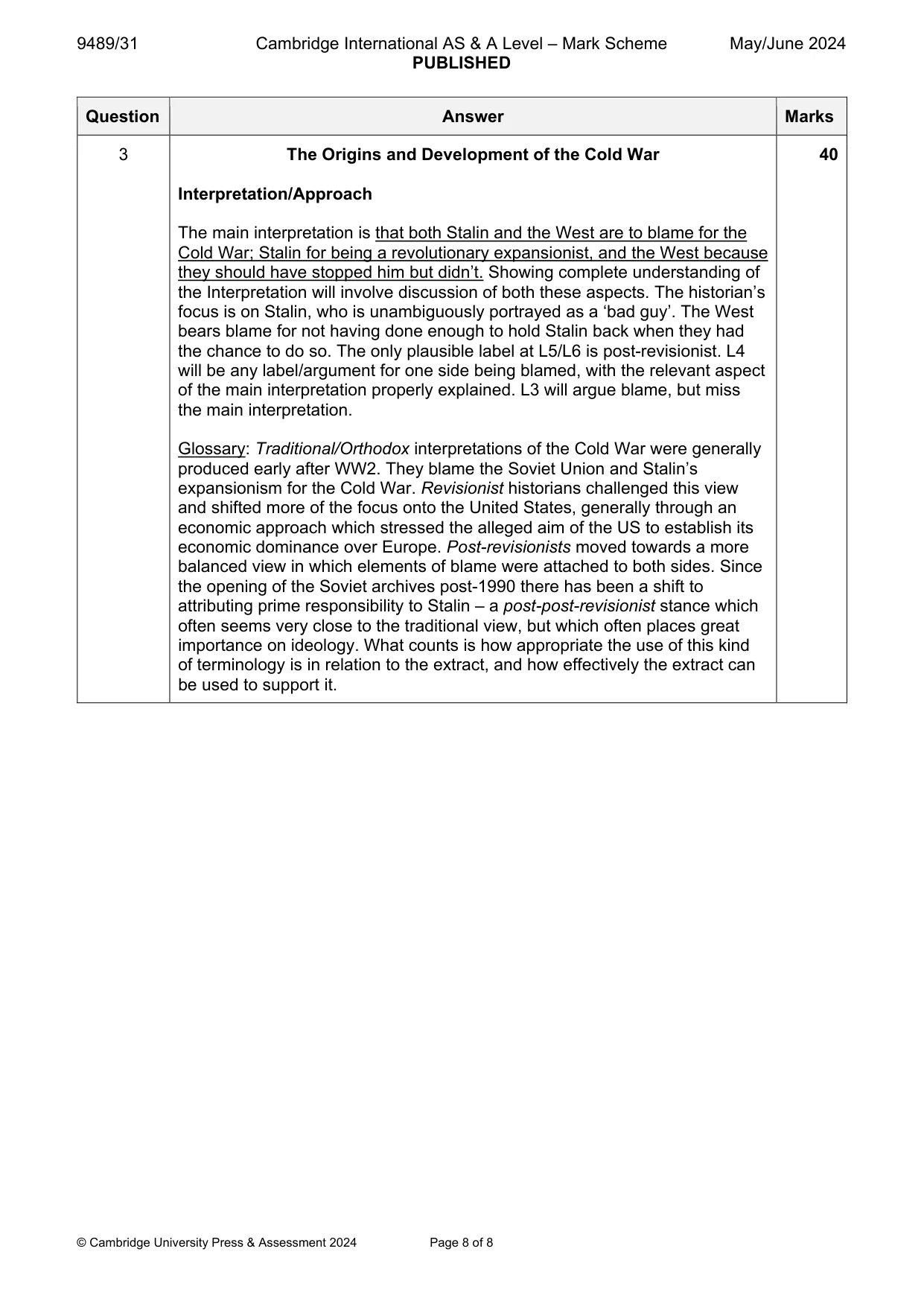
Mark scheme: 3 The Origins and Development of the Cold War 40 Interpretation/Approach The main interpretation is that both Stalin and the West are to blame for the Cold War; Stalin for being a revolutionary expansionist, and the West because they should have stopped him but didn’t. Showing complete understanding of the Interpretation will involve discussion of both these aspects. The historian’s focus is on Stalin, who is unambiguously portrayed as a ‘bad guy’. The West bears blame for not having done enough to hold Stalin back when they had the chance to do so. The only plausible label at L5/L6 is post-revisionist. L4 will be any label/argument for one side being blamed, with the relevant aspect of the main interpretation properly explained. L3 will argue blame, but miss the main interpretation. Glossary: Traditional/Orthodox interpretations of the Cold War were generally produced early after WW2. They blame the Soviet Union and Stalin’s expansionism for the Cold War. Revisionist historians challenged this view and shifted more of the focus onto the United States, generally through an economic approach which stressed the alleged aim of the US to establish its economic dominance over Europe. Post-revisionists moved towards a more balanced view in which elements of blame were attached to both sides. Since the opening of the Soviet archives post-1990 there has been a shift to attributing prime responsibility to Stalin – a post-post-revisionist stance which often seems very close to the traditional view, but which often places great importance on ideology. What counts is how appropriate the use of this kind of terminology is in relation to the extract, and how effectively the extract can be used to support it.
What was in this paper
The subtopics covered by these 3 questions, and how many questions each got. Open one in a new tab to see every Cambridge question on it.
What you needed in this session
Cambridge’s own grade thresholds for 2024 May/June, Paper 3 · Variant 1. A higher threshold means an easier paper — the bar moves with how the cohort did.