Cambridge A Level History 9489 — 2022 Oct/Nov Paper 3 · Variant 3
9489/33/O/N/22 · 3 questions · 40 marks · ≈45 min
The question paper and its mark scheme, free to read here and free to download. This is Cambridge’s own paper, exactly as it was sat.
Question paper4 pages
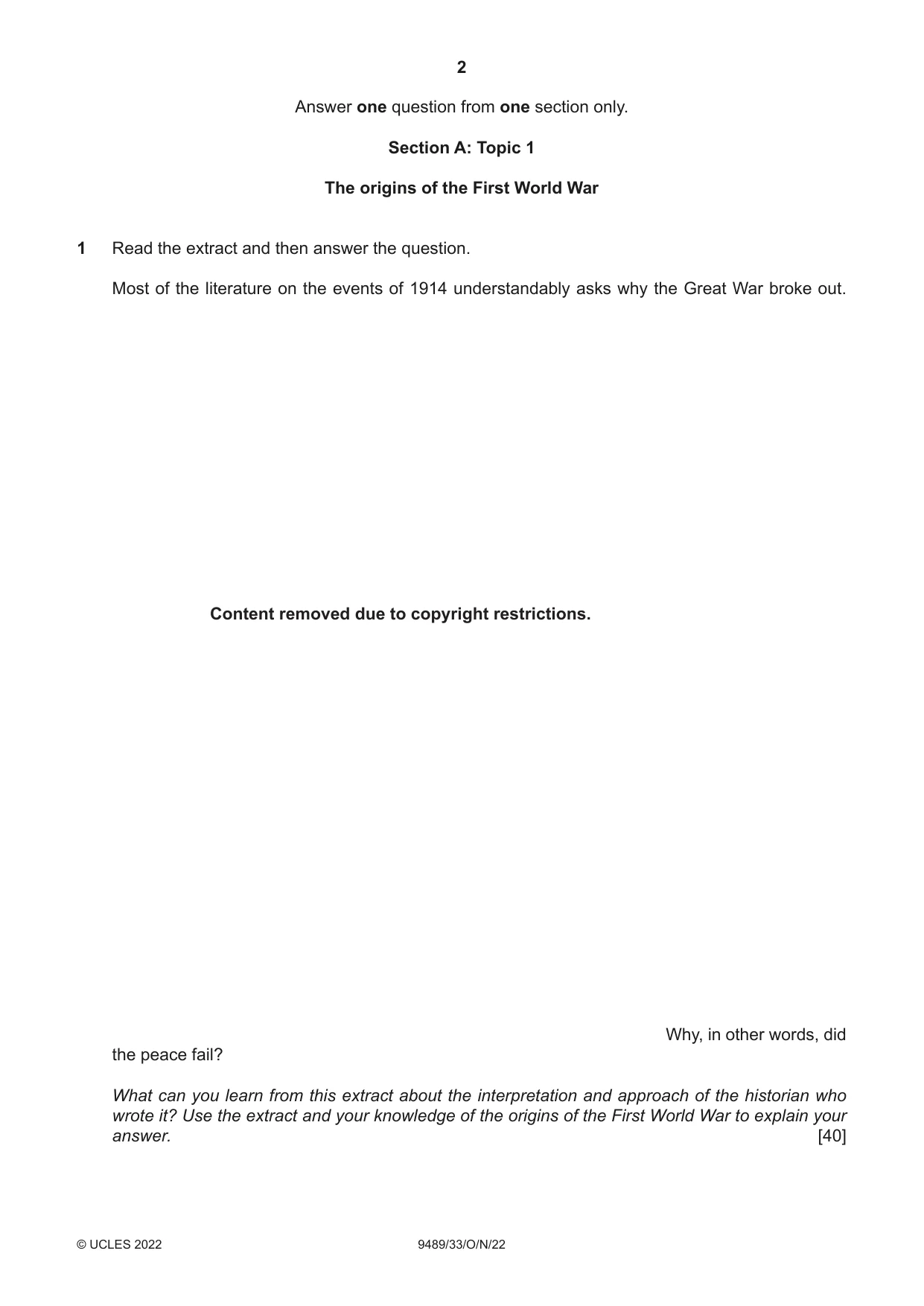
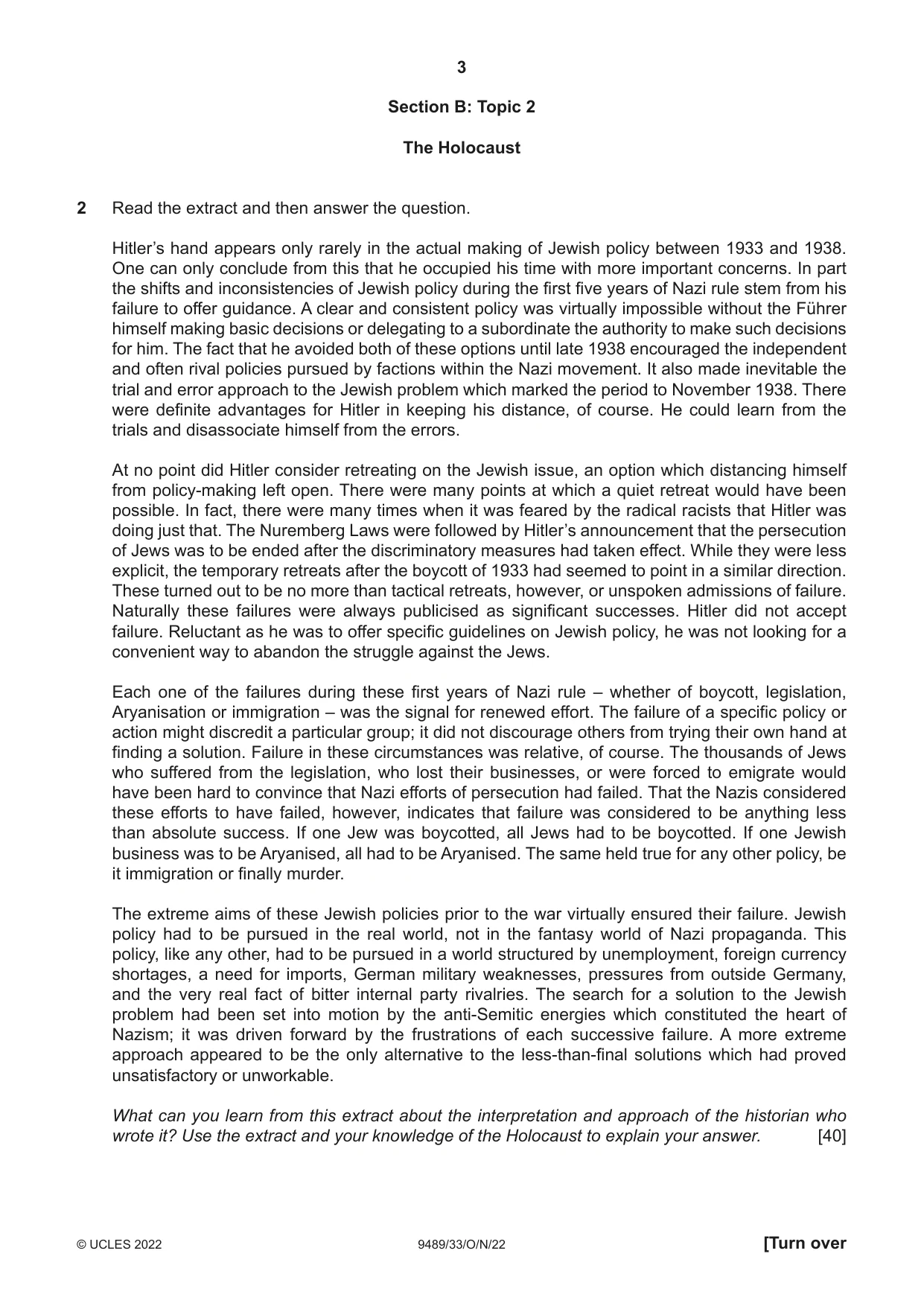
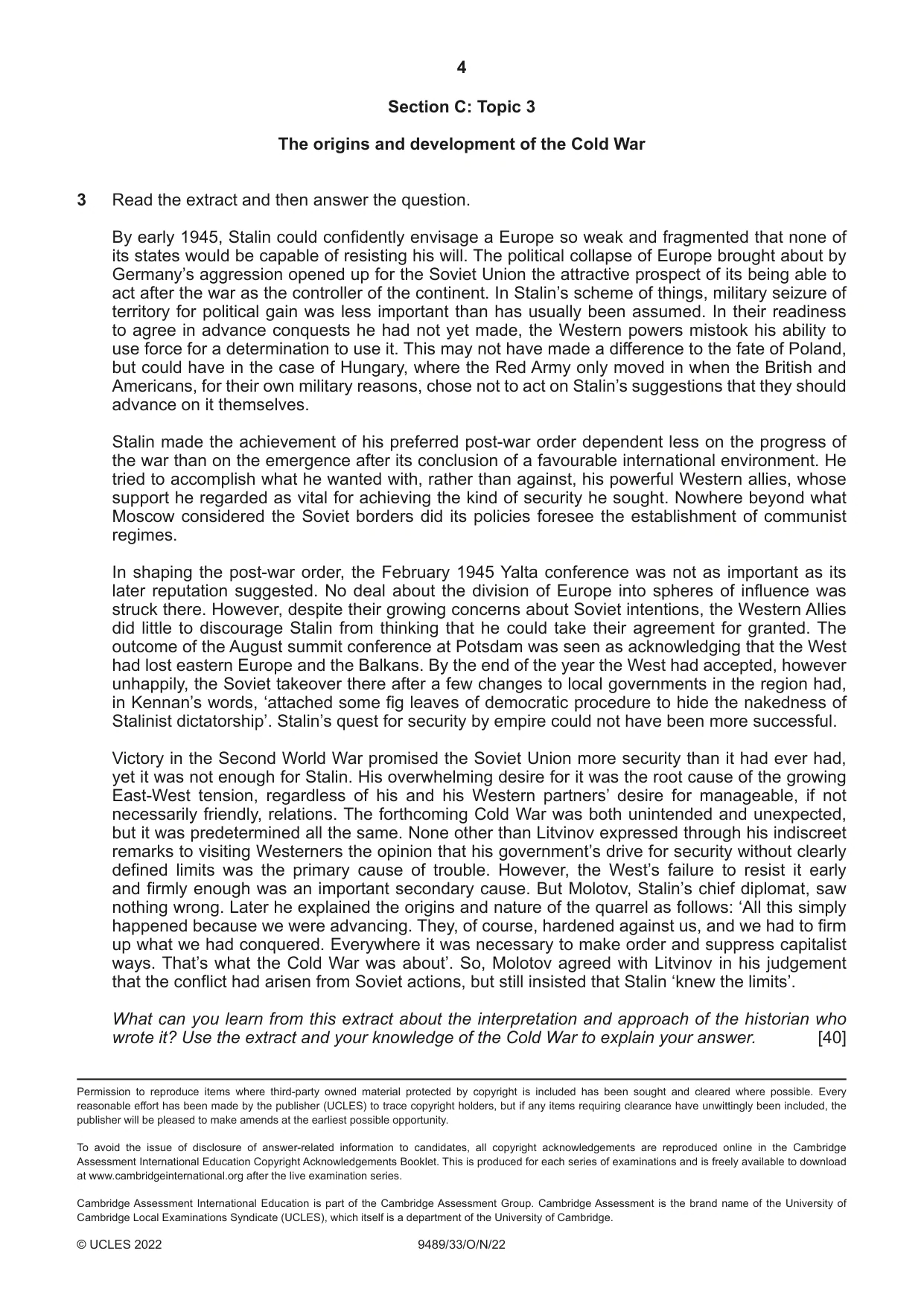
Mark scheme7 pages
Answers below. Sit the paper first if you are practising.
Questions as text
Q1 · Read the extract and then answer the question
1 Read the extract and then answer the question. Most of the literature on the events of 1914 understandably asks why the Great War broke out. Content removed due to copyright restrictions. Why, in other words, did the peace fail? What can you learn from this extract about the interpretation and approach of the historian who wrote it? Use the extract and your knowledge of the origins of the First World War to explain your answer. [40]
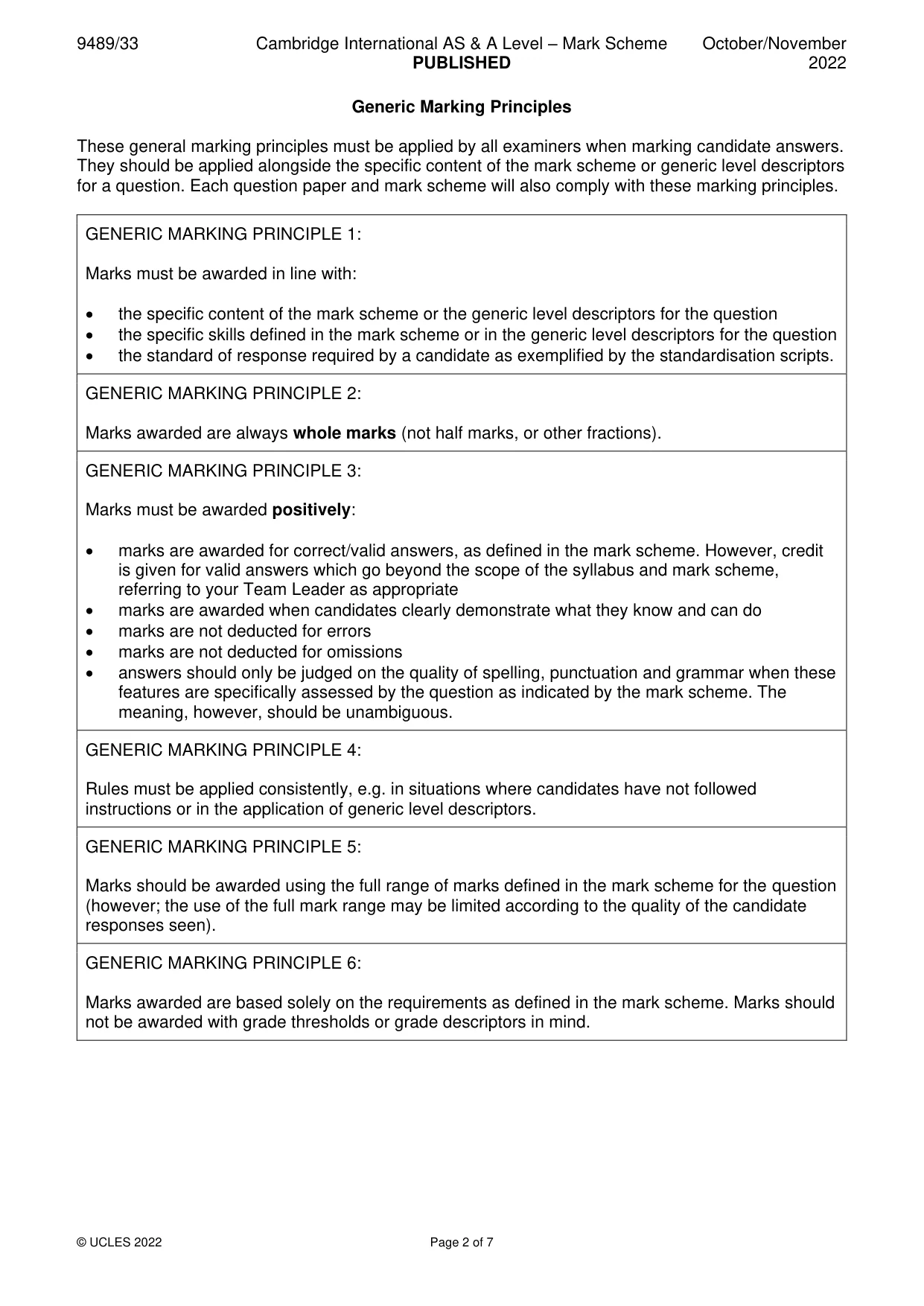
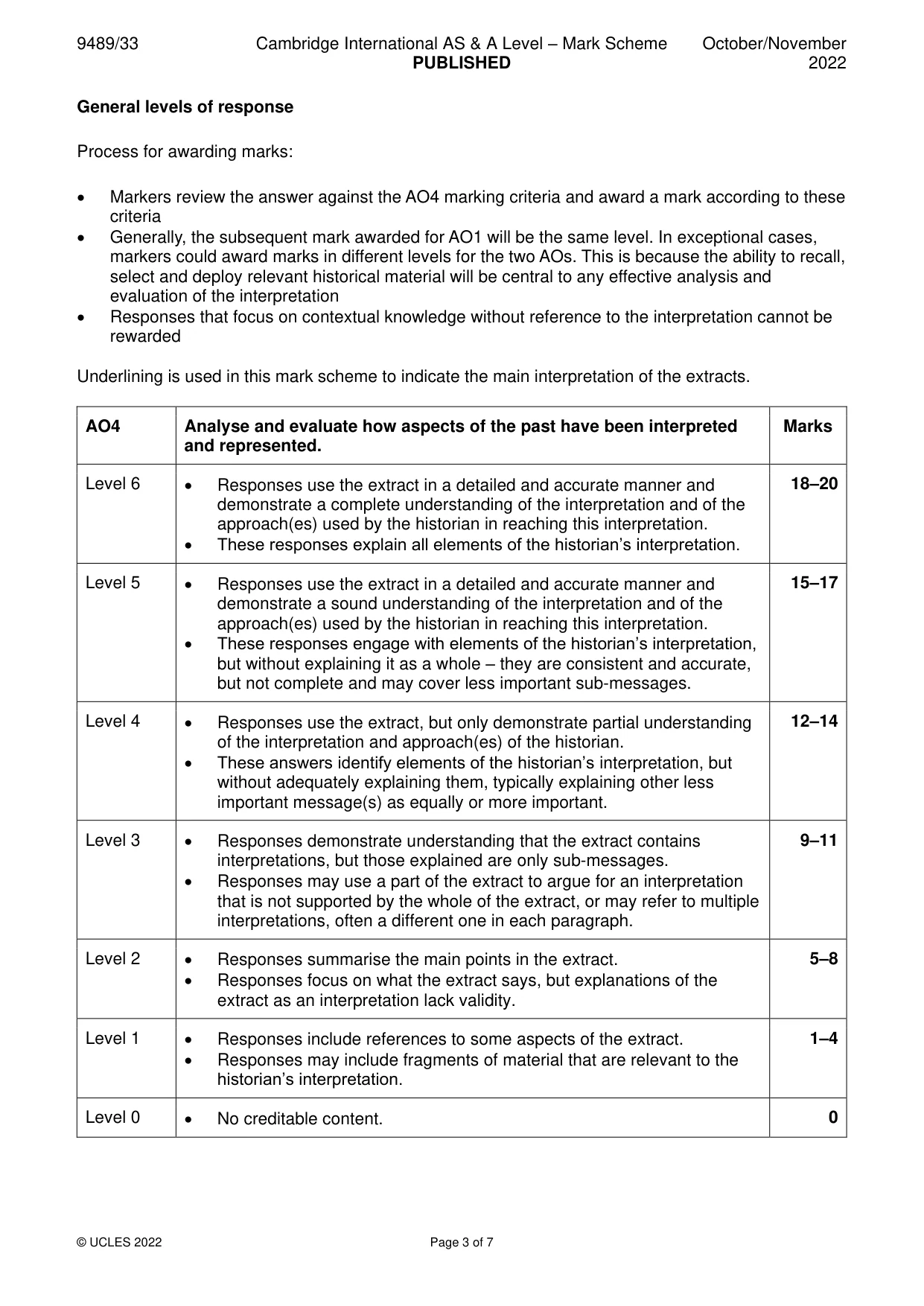
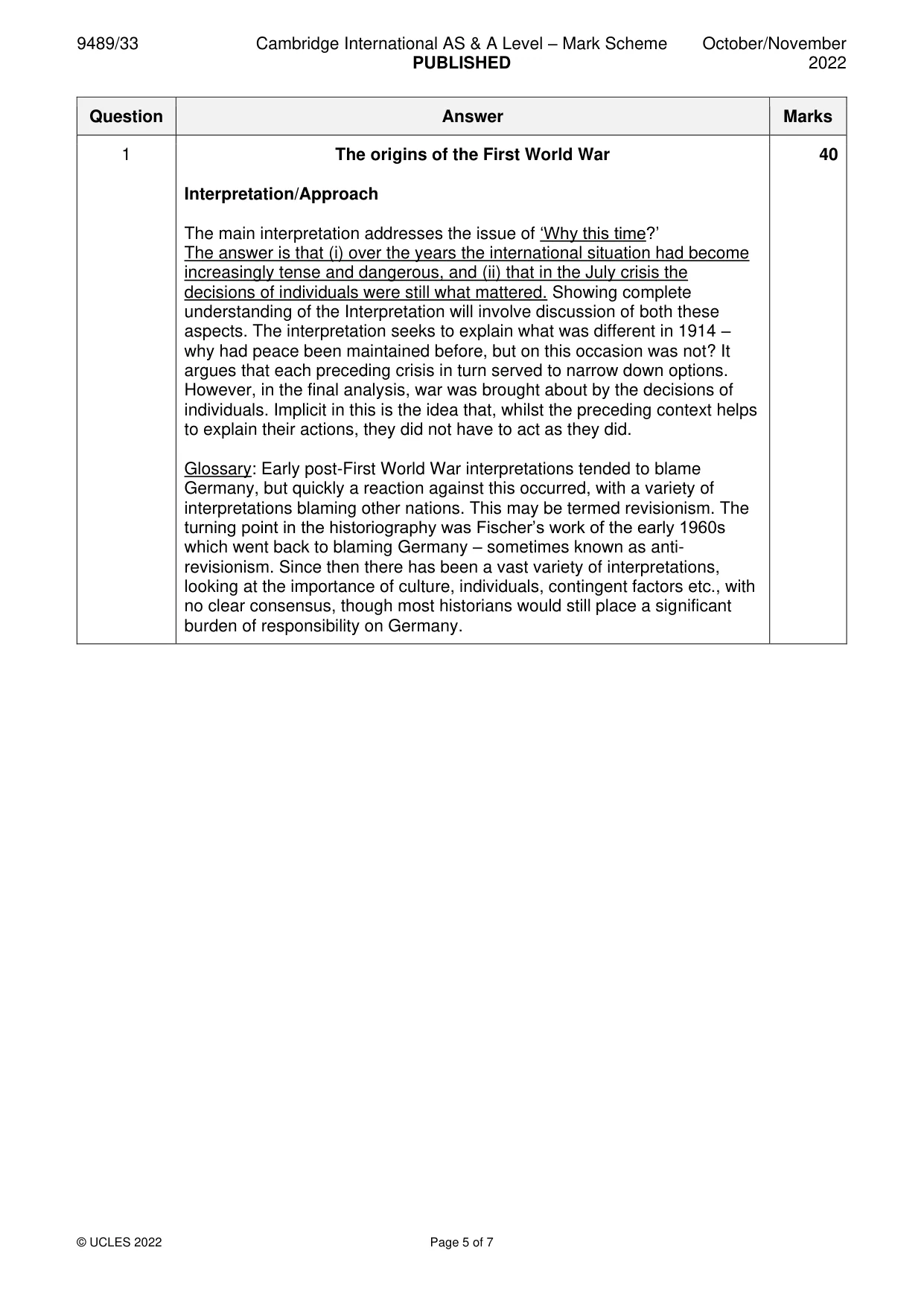
Mark scheme: Question Answer Marks 1 The origins of the First World War 40 Interpretation/Approach The main interpretation addresses the issue of ‘Why this time?’ The answer is that (i) over the years the international situation had become increasingly tense and dangerous, and (ii) that in the July crisis the decisions of individuals were still what mattered. Showing complete understanding of the Interpretation will involve discussion of both these aspects. The interpretation seeks to explain what was different in 1914 – why had peace been maintained before, but on this occasion was not? It argues that each preceding crisis in turn served to narrow down options. However, in the final analysis, war was brought about by the decisions of individuals. Implicit in this is the idea that, whilst the preceding context helps to explain their actions, they did not have to act as they did. Glossary: Early post-First World War interpretations tended to blame Germany, but quickly a reaction against this occurred, with a variety of interpretations blaming other nations. This may be termed revisionism. The turning point in the historiography was Fischer’s work of the early 1960s which went back to blaming Germany – sometimes known as anti- revisionism. Since then there has been a vast variety of interpretations, looking at the importance of culture, individuals, contingent factors etc., with no clear consensus, though most historians would still place a significant burden of responsibility on Germany.
Q2 · Read the extract and then answer the question
2 Read the extract and then answer the question. Hitler’s hand appears only rarely in the actual making of Jewish policy between 1933 and 1938. One can only conclude from this that he occupied his time with more important concerns. In part the shifts and inconsistencies of Jewish policy during the first five years of Nazi rule stem from his failure to offer guidance. A clear and consistent policy was virtually impossible without the Führer himself making basic decisions or delegating to a subordinate the authority to make such decisions for him. The fact that he avoided both of these options until late 1938 encouraged the independent and often rival policies pursued by factions within the Nazi movement. It also made inevitable the trial and error approach to the Jewish problem which marked the period to November 1938. There were definite advantages for Hitler in keeping his distance, of course. He could learn from the trials and disassociate himself from the errors. At no point did Hitler consider retreating on the Jewish issue, an option which distancing himself from policy-making left open. There were many points at which a quiet retreat would have been possible. In fact, there were many times when it was feared by the radical racists that Hitler was doing just that. The Nuremberg Laws were followed by Hitler’s announcement that the persecution of Jews was to be ended after the discriminatory measures had taken effect. While they were less explicit, the temporary retreats after the boycott of 1933 had seemed to point in a similar direction. These turned out to be no more than tactical retreats, however, or unspoken admissions of failure. Naturally these failures were always publicised as significant successes. Hitler did not accept failure. Reluctant as he was to offer specific guidelines on Jewish policy, he was not looking for a convenient way to abandon the struggle against the Jews. Each one of the failures during these first years of Nazi rule – whether of boycott, legislation, Aryanisation or immigration – was the signal for renewed effort. The failure of a specific policy or action might discredit a particular group; it did not discourage others from trying their own hand at finding a solution. Failure in these circumstances was relative, of course. The thousands of Jews who suffered from the legislation, who lost their businesses, or were forced to emigrate would have been hard to convince that Nazi efforts of persecution had failed. That the Nazis considered these efforts to have failed, however, indicates that failure was considered to be anything less than absolute success. If one Jew was boycotted, all Jews had to be boycotted. If one Jewish business was to be Aryanised, all had to be Aryanised. The same held true for any other policy, be it immigration or finally murder. The extreme aims of these Jewish policies prior to the war virtually ensured their failure. Jewish policy had to be pursued in the real world, not in the fantasy world of Nazi propaganda. This policy, like any other, had to be pursued in a world structured by unemployment, foreign currency shortages, a need for imports, German military weaknesses, pressures from outside Germany, and the very real fact of bitter internal party rivalries. The search for a solution to the Jewish problem had been set into motion by the anti-Semitic energies which constituted the heart of Nazism; it was driven forward by the frustrations of each successive failure. A more extreme approach appeared to be the only alternative to the less-than-final solutions which had proved unsatisfactory or unworkable. What can you learn from this extract about the interpretation and approach of the historian who wrote it? Use the extract and your knowledge of the Holocaust to explain your answer. [40] Section C: Topic 3 The origins and development of the Cold War
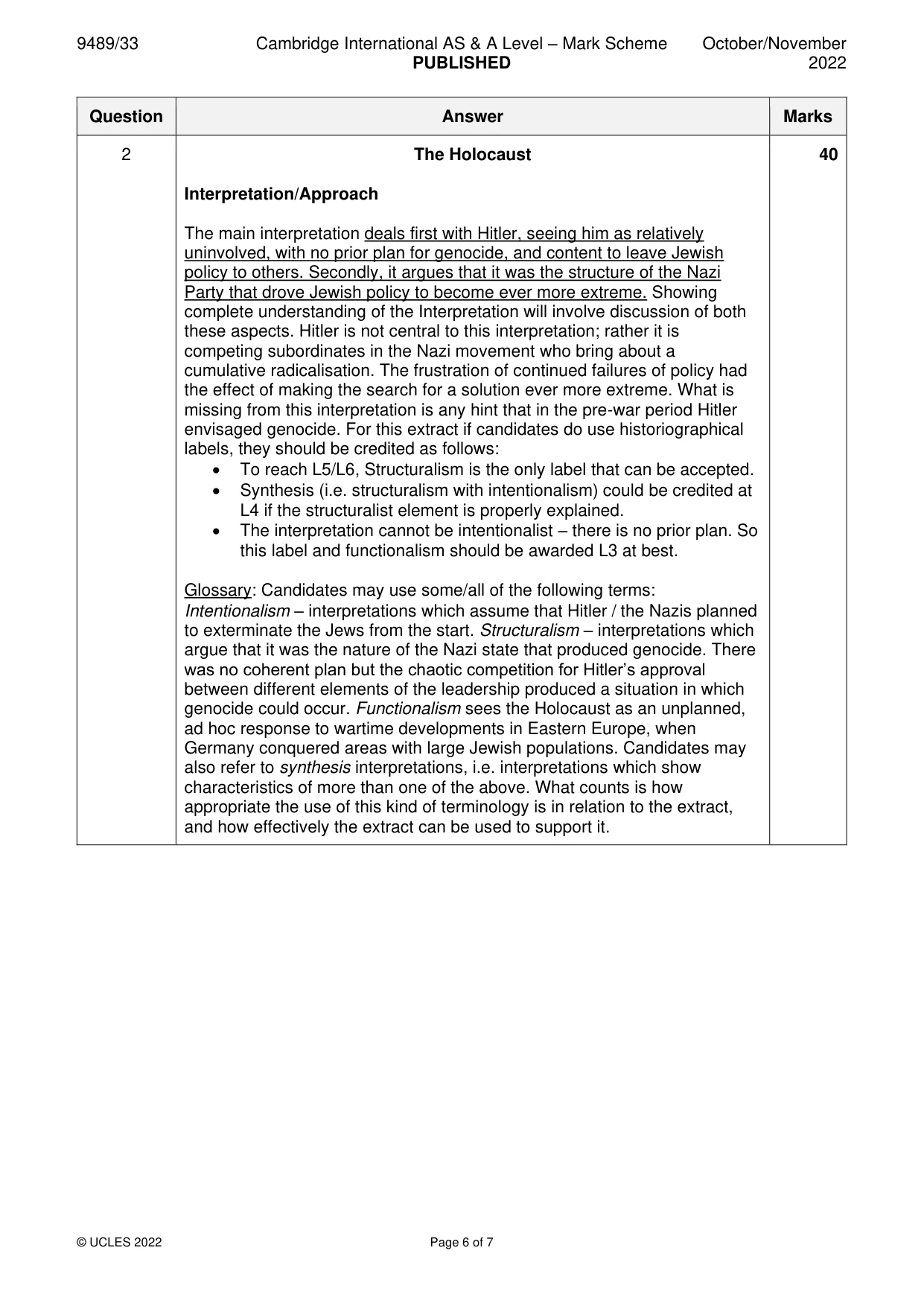
Mark scheme: 2 The Holocaust 40 Interpretation/Approach The main interpretation deals first with Hitler, seeing him as relatively uninvolved, with no prior plan for genocide, and content to leave Jewish policy to others. Secondly, it argues that it was the structure of the Nazi Party that drove Jewish policy to become ever more extreme. Showing complete understanding of the Interpretation will involve discussion of both these aspects. Hitler is not central to this interpretation; rather it is competing subordinates in the Nazi movement who bring about a cumulative radicalisation. The frustration of continued failures of policy had the effect of making the search for a solution ever more extreme. What is missing from this interpretation is any hint that in the pre-war period Hitler envisaged genocide. For this extract if candidates do use historiographical labels, they should be credited as follows: • To reach L5/L6, Structuralism is the only label that can be accepted. • Synthesis (i.e. structuralism with intentionalism) could be credited at L4 if the structuralist element is properly explained. • The interpretation cannot be intentionalist – there is no prior plan. So this label and functionalism should be awarded L3 at best. Glossary: Candidates may use some/all of the following terms: Intentionalism – interpretations which assume that Hitler / the Nazis planned to exterminate the Jews from the start. Structuralism – interpretations which argue that it was the nature of the Nazi state that produced genocide. There was no coherent plan but the chaotic competition for Hitler’s approval between different elements of the leadership produced a situation in which genocide could occur. Functionalism sees the Holocaust as an unplanned, ad hoc response to wartime developments in Eastern Europe, when Germany conquered areas with large Jewish populations. Candidates may also refer to synthesis interpretations, i.e. interpretations which show characteristics of more than one of the above. What counts is how appropriate the use of this kind of terminology is in relation to the extract, and how effectively the extract can be used to support it.
More questions on How did the rise of extremism affect international relations?
Q3 · Read the extract and then answer the question
3 Read the extract and then answer the question. By early 1945, Stalin could confidently envisage a Europe so weak and fragmented that none of its states would be capable of resisting his will. The political collapse of Europe brought about by Germany’s aggression opened up for the Soviet Union the attractive prospect of its being able to act after the war as the controller of the continent. In Stalin’s scheme of things, military seizure of territory for political gain was less important than has usually been assumed. In their readiness to agree in advance conquests he had not yet made, the Western powers mistook his ability to use force for a determination to use it. This may not have made a difference to the fate of Poland, but could have in the case of Hungary, where the Red Army only moved in when the British and Americans, for their own military reasons, chose not to act on Stalin’s suggestions that they should advance on it themselves. Stalin made the achievement of his preferred post-war order dependent less on the progress of the war than on the emergence after its conclusion of a favourable international environment. He tried to accomplish what he wanted with, rather than against, his powerful Western allies, whose support he regarded as vital for achieving the kind of security he sought. Nowhere beyond what Moscow considered the Soviet borders did its policies foresee the establishment of communist regimes. In shaping the post-war order, the February 1945 Yalta conference was not as important as its later reputation suggested. No deal about the division of Europe into spheres of influence was struck there. However, despite their growing concerns about Soviet intentions, the Western Allies did little to discourage Stalin from thinking that he could take their agreement for granted. The outcome of the August summit conference at Potsdam was seen as acknowledging that the West had lost eastern Europe and the Balkans. By the end of the year the West had accepted, however unhappily, the Soviet takeover there after a few changes to local governments in the region had, in Kennan’s words, ‘attached some fig leaves of democratic procedure to hide the nakedness of Stalinist dictatorship’. Stalin’s quest for security by empire could not have been more successful. Victory in the Second World War promised the Soviet Union more security than it had ever had, yet it was not enough for Stalin. His overwhelming desire for it was the root cause of the growing East-West tension, regardless of his and his Western partners’ desire for manageable, if not necessarily friendly, relations. The forthcoming Cold War was both unintended and unexpected, but it was predetermined all the same. None other than Litvinov expressed through his indiscreet remarks to visiting Westerners the opinion that his government’s drive for security without clearly defined limits was the primary cause of trouble. However, the West’s failure to resist it early and firmly enough was an important secondary cause. But Molotov, Stalin’s chief diplomat, saw nothing wrong. Later he explained the origins and nature of the quarrel as follows: ‘All this simply happened because we were advancing. They, of course, hardened against us, and we had to firm up what we had conquered. Everywhere it was necessary to make order and suppress capitalist ways. That’s what the Cold War was about’. So, Molotov agreed with Litvinov in his judgement that the conflict had arisen from Soviet actions, but still insisted that Stalin ‘knew the limits’. What can you learn from this extract about the interpretation and approach of the historian who wrote it? Use the extract and your knowledge of the Cold War to explain your answer. [40]
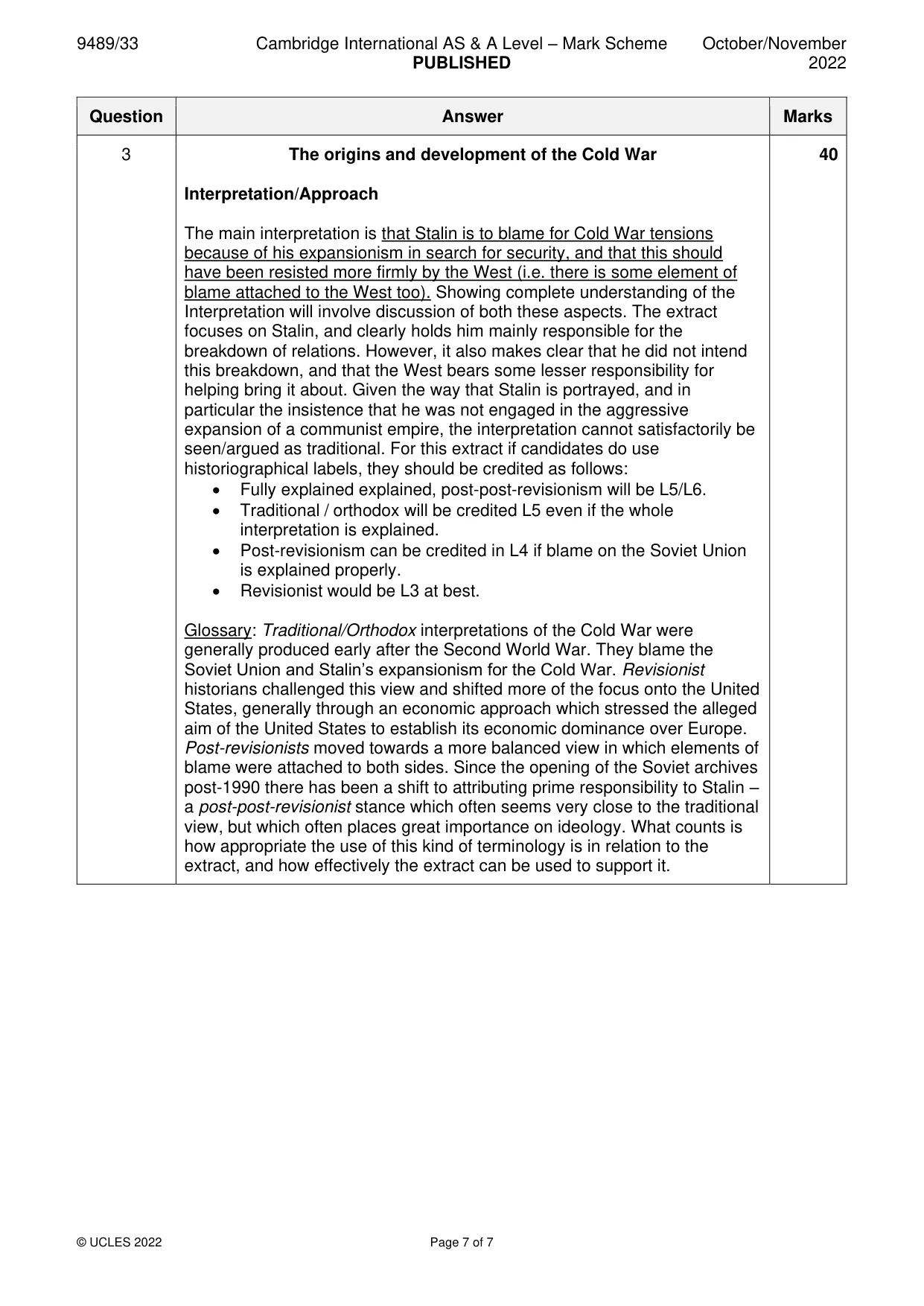
Mark scheme: 3 The origins and development of the Cold War 40 Interpretation/Approach The main interpretation is that Stalin is to blame for Cold War tensions because of his expansionism in search for security, and that this should have been resisted more firmly by the West (i.e. there is some element of blame attached to the West too). Showing complete understanding of the Interpretation will involve discussion of both these aspects. The extract focuses on Stalin, and clearly holds him mainly responsible for the breakdown of relations. However, it also makes clear that he did not intend this breakdown, and that the West bears some lesser responsibility for helping bring it about. Given the way that Stalin is portrayed, and in particular the insistence that he was not engaged in the aggressive expansion of a communist empire, the interpretation cannot satisfactorily be seen/argued as traditional. For this extract if candidates do use historiographical labels, they should be credited as follows: • Fully explained explained, post-post-revisionism will be L5/L6. • Traditional / orthodox will be credited L5 even if the whole interpretation is explained. • Post-revisionism can be credited in L4 if blame on the Soviet Union is explained properly. • Revisionist would be L3 at best. Glossary: Traditional/Orthodox interpretations of the Cold War were generally produced early after the Second World War. They blame the Soviet Union and Stalin’s expansionism for the Cold War. Revisionist historians challenged this view and shifted more of the focus onto the United States, generally through an economic approach which stressed the alleged aim of the United States to establish its economic dominance over Europe. Post-revisionists moved towards a more balanced view in which elements of blame were attached to both sides. Since the opening of the Soviet archives post-1990 there has been a shift to attributing prime responsibility to Stalin – a post-post-revisionist stance which often seems very close to the traditional view, but which often places great importance on ideology. What counts is how appropriate the use of this kind of terminology is in relation to the extract, and how effectively the extract can be used to support it.
What was in this paper
The subtopics covered by these 3 questions, and how many questions each got. Open one in a new tab to see every Cambridge question on it.
What you needed in this session
Cambridge’s own grade thresholds for 2022 Oct/Nov, Paper 3 · Variant 3. A higher threshold means an easier paper — the bar moves with how the cohort did.