Cambridge A Level History 9489 — 2025 May/June Paper 3 · Variant 1
9489/31/M/J/25 · 3 questions · 40 marks · ≈45 min
The question paper and its mark scheme, free to read here and free to download. This is Cambridge’s own paper, exactly as it was sat.
Question paper4 pages
Mark scheme10 pages
Answers below. Sit the paper first if you are practising.
Questions as text
Q1 · Read the extract and then answer the question
1 Read the extract and then answer the question. No one can say exactly when the war started. Content removed due to copyright restrictions. Once started, the momentum for war could not be stopped. What can you learn from this extract about the interpretation and approach of the historian who wrote it? Use the extract and your knowledge of the origins of the First World War to explain your answer. [40]
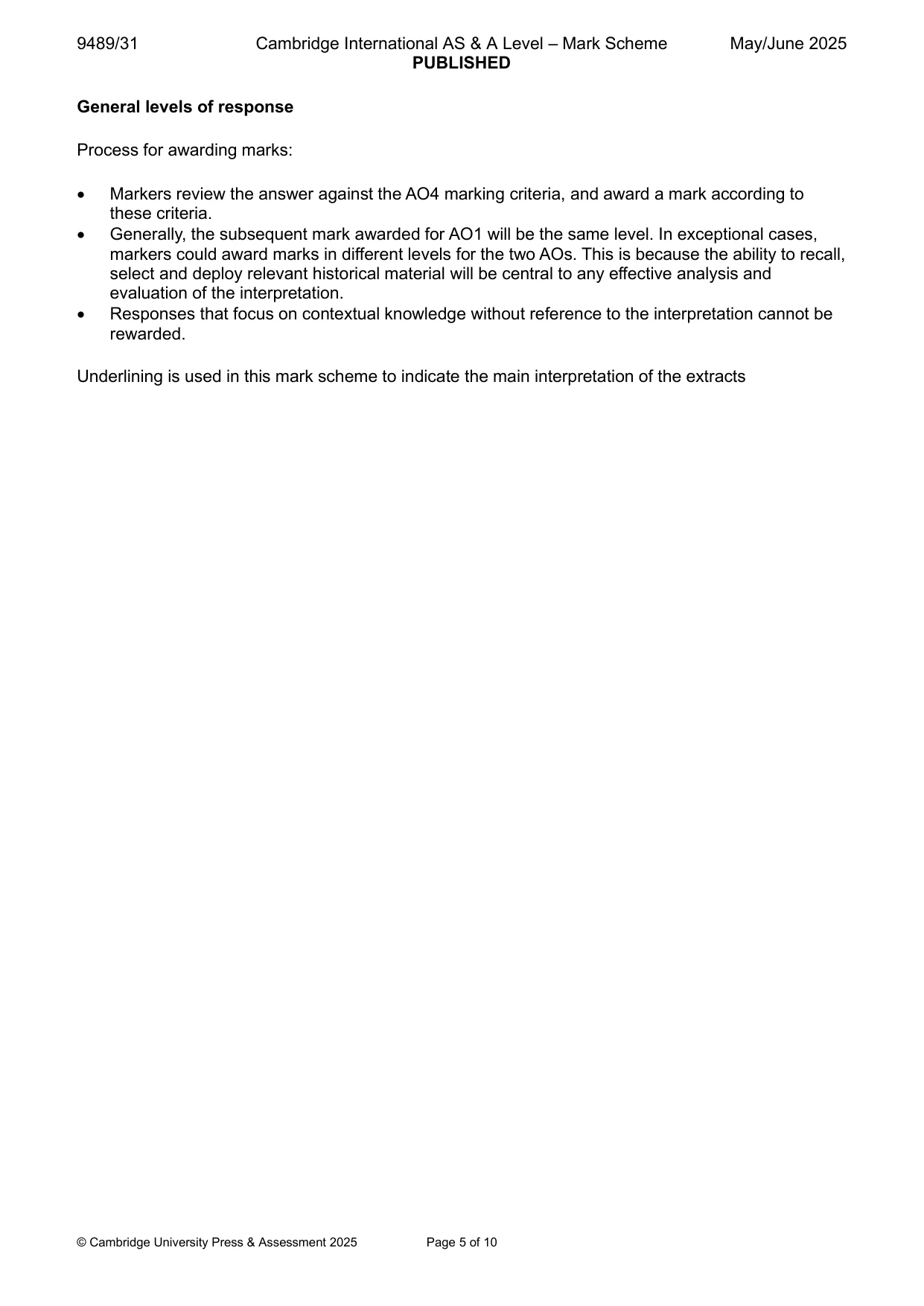
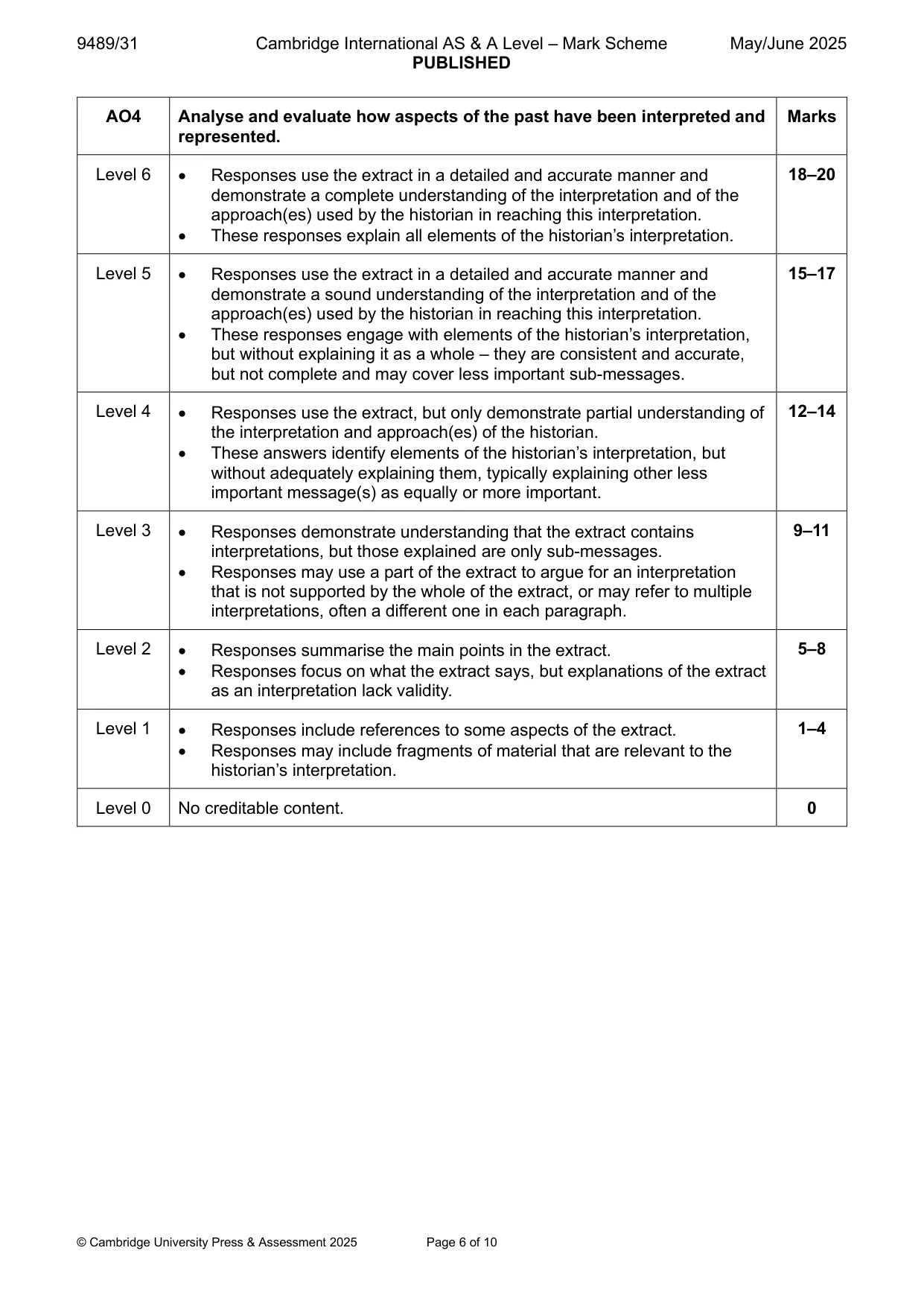
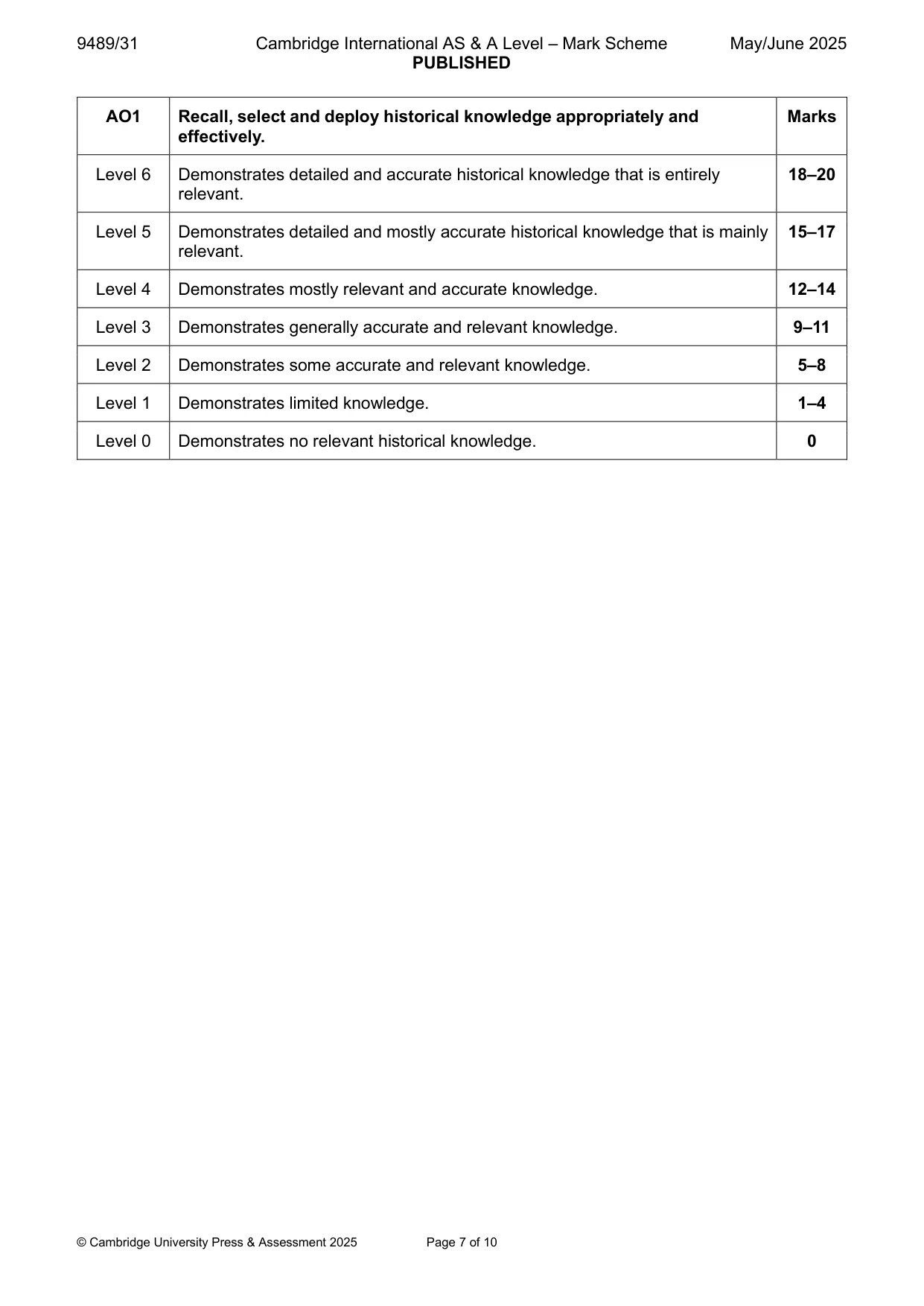
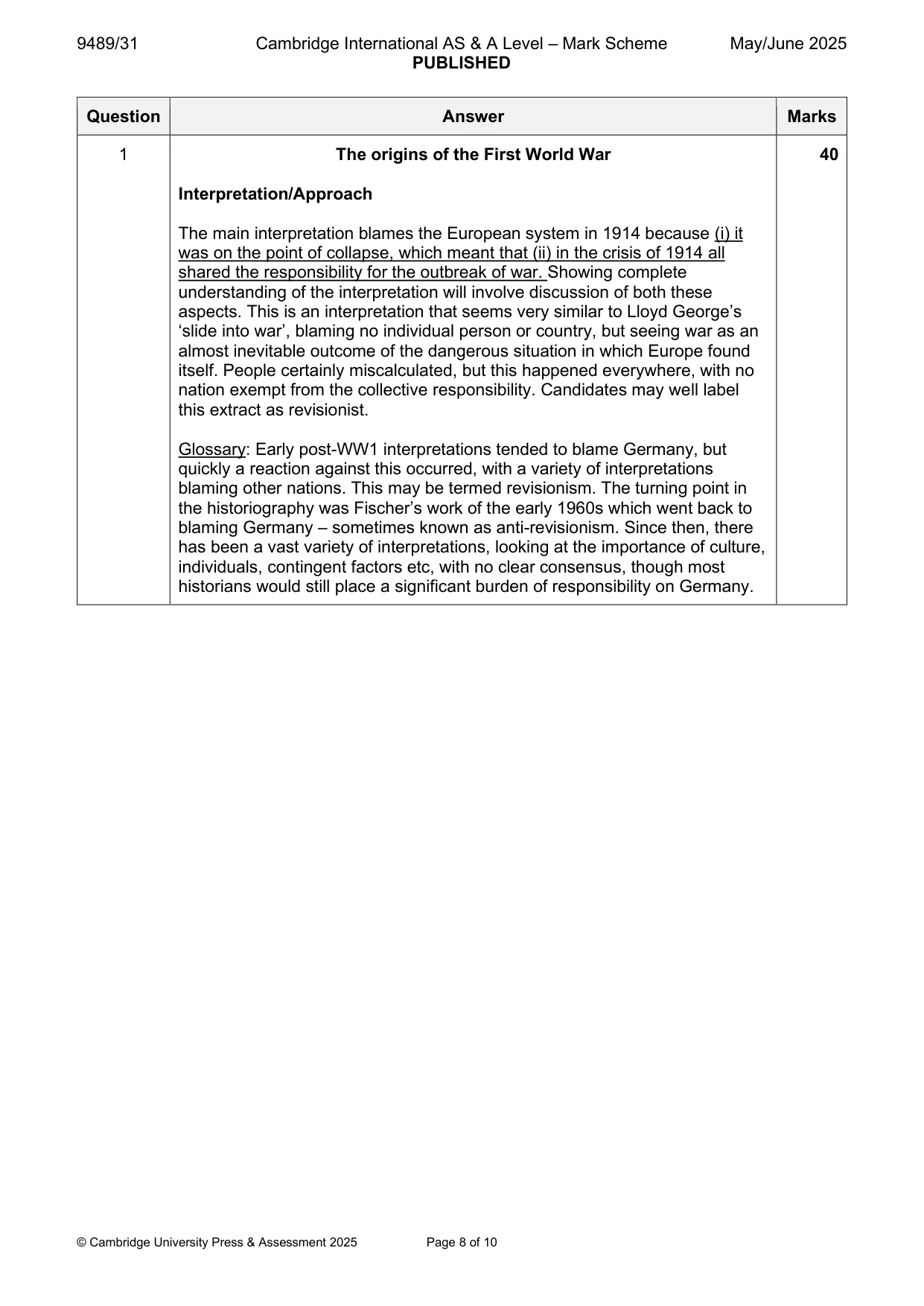
Mark scheme: Question Answer Marks 1 The origins of the First World War 40 Interpretation/Approach The main interpretation blames the European system in 1914 because (i) it was on the point of collapse, which meant that (ii) in the crisis of 1914 all shared the responsibility for the outbreak of war. Showing complete understanding of the interpretation will involve discussion of both these aspects. This is an interpretation that seems very similar to Lloyd George’s ‘slide into war’, blaming no individual person or country, but seeing war as an almost inevitable outcome of the dangerous situation in which Europe found itself. People certainly miscalculated, but this happened everywhere, with no nation exempt from the collective responsibility. Candidates may well label this extract as revisionist. Glossary: Early post-WW1 interpretations tended to blame Germany, but quickly a reaction against this occurred, with a variety of interpretations blaming other nations. This may be termed revisionism. The turning point in the historiography was Fischer’s work of the early 1960s which went back to blaming Germany – sometimes known as anti-revisionism. Since then, there has been a vast variety of interpretations, looking at the importance of culture, individuals, contingent factors etc, with no clear consensus, though most historians would still place a significant burden of responsibility on Germany.
Q2 · Read the extract and then answer the question
2 Read the extract and then answer the question. The signs are that ‘Kristallnacht’ had a profound impact upon Hitler. Content removed due to copyright restrictions. But, somehow, he was certain that this would be the outcome of any new conflict. What can you learn from this extract about the interpretation and approach of the historian who wrote it? Use the extract and your knowledge of the Holocaust to explain your answer. [40] Section C: Topic 3 The origins and development of the Cold War
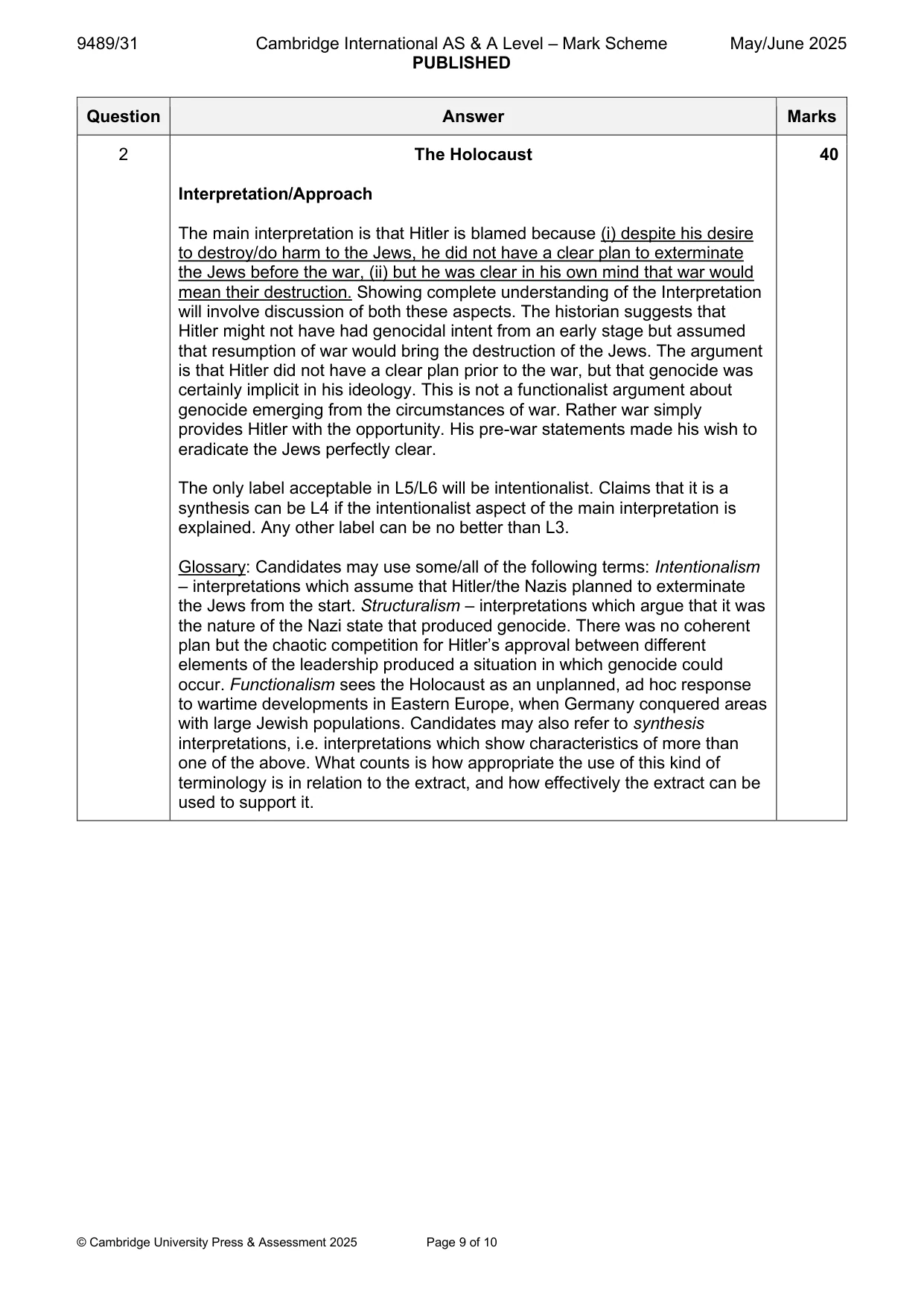
Mark scheme: 2 The Holocaust 40 Interpretation/Approach The main interpretation is that Hitler is blamed because (i) despite his desire to destroy/do harm to the Jews, he did not have a clear plan to exterminate the Jews before the war, (ii) but he was clear in his own mind that war would mean their destruction. Showing complete understanding of the Interpretation will involve discussion of both these aspects. The historian suggests that Hitler might not have had genocidal intent from an early stage but assumed that resumption of war would bring the destruction of the Jews. The argument is that Hitler did not have a clear plan prior to the war, but that genocide was certainly implicit in his ideology. This is not a functionalist argument about genocide emerging from the circumstances of war. Rather war simply provides Hitler with the opportunity. His pre-war statements made his wish to eradicate the Jews perfectly clear. The only label acceptable in L5/L6 will be intentionalist. Claims that it is a synthesis can be L4 if the intentionalist aspect of the main interpretation is explained. Any other label can be no better than L3. Glossary: Candidates may use some/all of the following terms: Intentionalism – interpretations which assume that Hitler/the Nazis planned to exterminate the Jews from the start. Structuralism – interpretations which argue that it was the nature of the Nazi state that produced genocide. There was no coherent plan but the chaotic competition for Hitler’s approval between different elements of the leadership produced a situation in which genocide could occur. Functionalism sees the Holocaust as an unplanned, ad hoc response to wartime developments in Eastern Europe, when Germany conquered areas with large Jewish populations. Candidates may also refer to synthesis interpretations, i.e. interpretations which show characteristics of more than one of the above. What counts is how appropriate the use of this kind of terminology is in relation to the extract, and how effectively the extract can be used to support it.
More questions on How did the rise of extremism affect international relations?
Q3 · Read the extract and then answer the question
3 Read the extract and then answer the question. The Potsdam Conference should have been a time of celebration. Content removed due to copyright restrictions. Yet not for a long time, not for a dozen years, would Truman concede that he had been naïve at Potsdam – ‘an innocent idealist’ in his own words, dealing with an unscrupulous Russian dictator. What can you learn from this extract about the interpretation and approach of the historian who wrote it? Use the extract and your knowledge of the Cold War to explain your answer. [40] To avoid the issue of disclosure of answer‑related information to candidates, all copyright acknowledgements are reproduced online in the Cambridge Assessment International Education Copyright Acknowledgements Booklet. This is produced for each series of examinations and is freely available to download
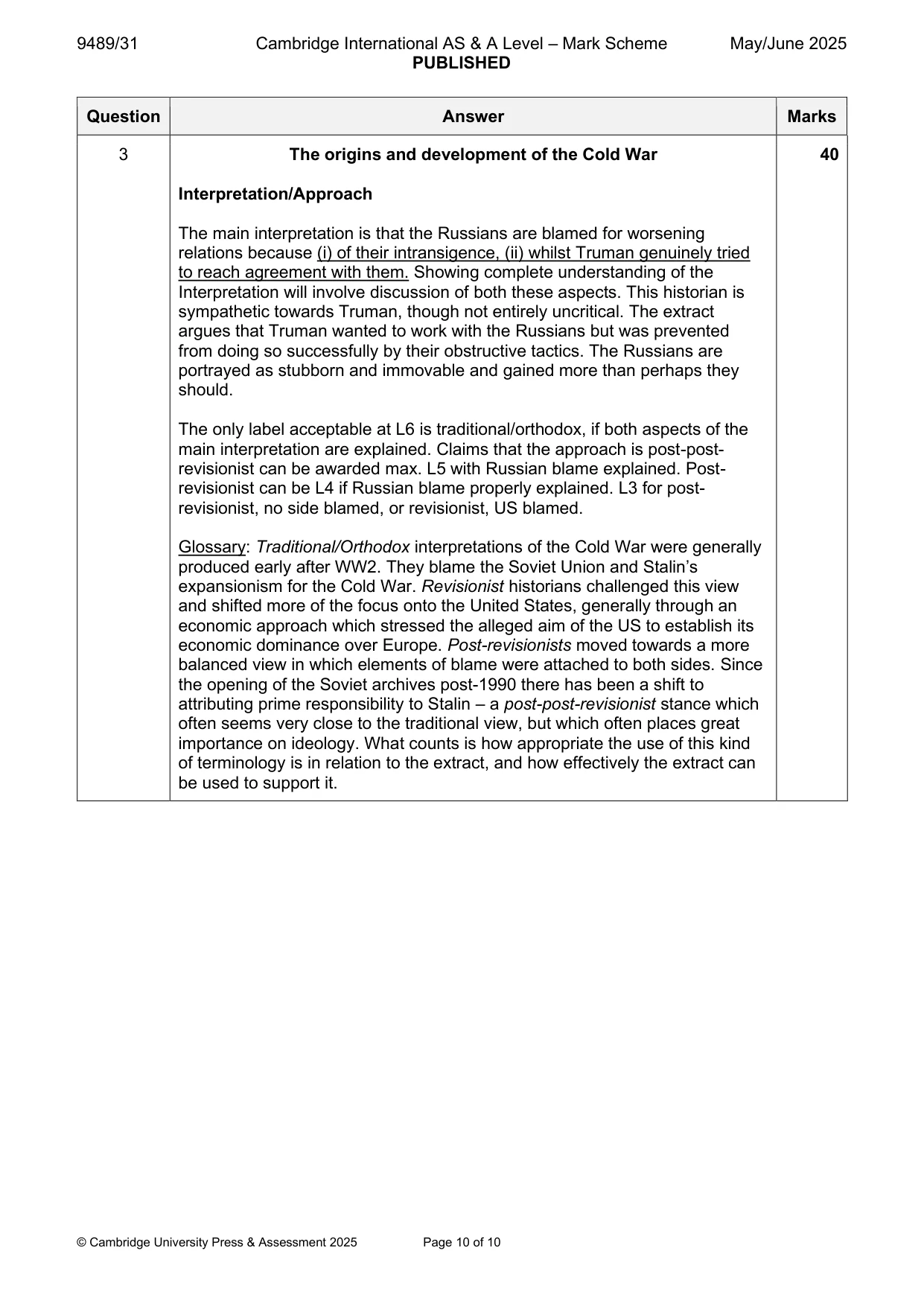
Mark scheme: 3 The origins and development of the Cold War 40 Interpretation/Approach The main interpretation is that the Russians are blamed for worsening relations because (i) of their intransigence, (ii) whilst Truman genuinely tried to reach agreement with them. Showing complete understanding of the Interpretation will involve discussion of both these aspects. This historian is sympathetic towards Truman, though not entirely uncritical. The extract argues that Truman wanted to work with the Russians but was prevented from doing so successfully by their obstructive tactics. The Russians are portrayed as stubborn and immovable and gained more than perhaps they should. The only label acceptable at L6 is traditional/orthodox, if both aspects of the main interpretation are explained. Claims that the approach is post-post- revisionist can be awarded max. L5 with Russian blame explained. Post- revisionist can be L4 if Russian blame properly explained. L3 for post- revisionist, no side blamed, or revisionist, US blamed. Glossary: Traditional/Orthodox interpretations of the Cold War were generally produced early after WW2. They blame the Soviet Union and Stalin’s expansionism for the Cold War. Revisionist historians challenged this view and shifted more of the focus onto the United States, generally through an economic approach which stressed the alleged aim of the US to establish its economic dominance over Europe. Post-revisionists moved towards a more balanced view in which elements of blame were attached to both sides. Since the opening of the Soviet archives post-1990 there has been a shift to attributing prime responsibility to Stalin – a post-post-revisionist stance which often seems very close to the traditional view, but which often places great importance on ideology. What counts is how appropriate the use of this kind of terminology is in relation to the extract, and how effectively the extract can be used to support it.
What was in this paper
The subtopics covered by these 3 questions, and how many questions each got. Open one in a new tab to see every Cambridge question on it.
What you needed in this session
Cambridge’s own grade thresholds for 2025 May/June, Paper 3 · Variant 1. A higher threshold means an easier paper — the bar moves with how the cohort did.