Cambridge A Level History 9489 — 2021 Feb/March Paper 3 · Variant 2
9489/32/F/M/21 · 3 questions · 40 marks · ≈45 min
The question paper and its mark scheme, free to read here and free to download. This is Cambridge’s own paper, exactly as it was sat.
Question paper4 pages
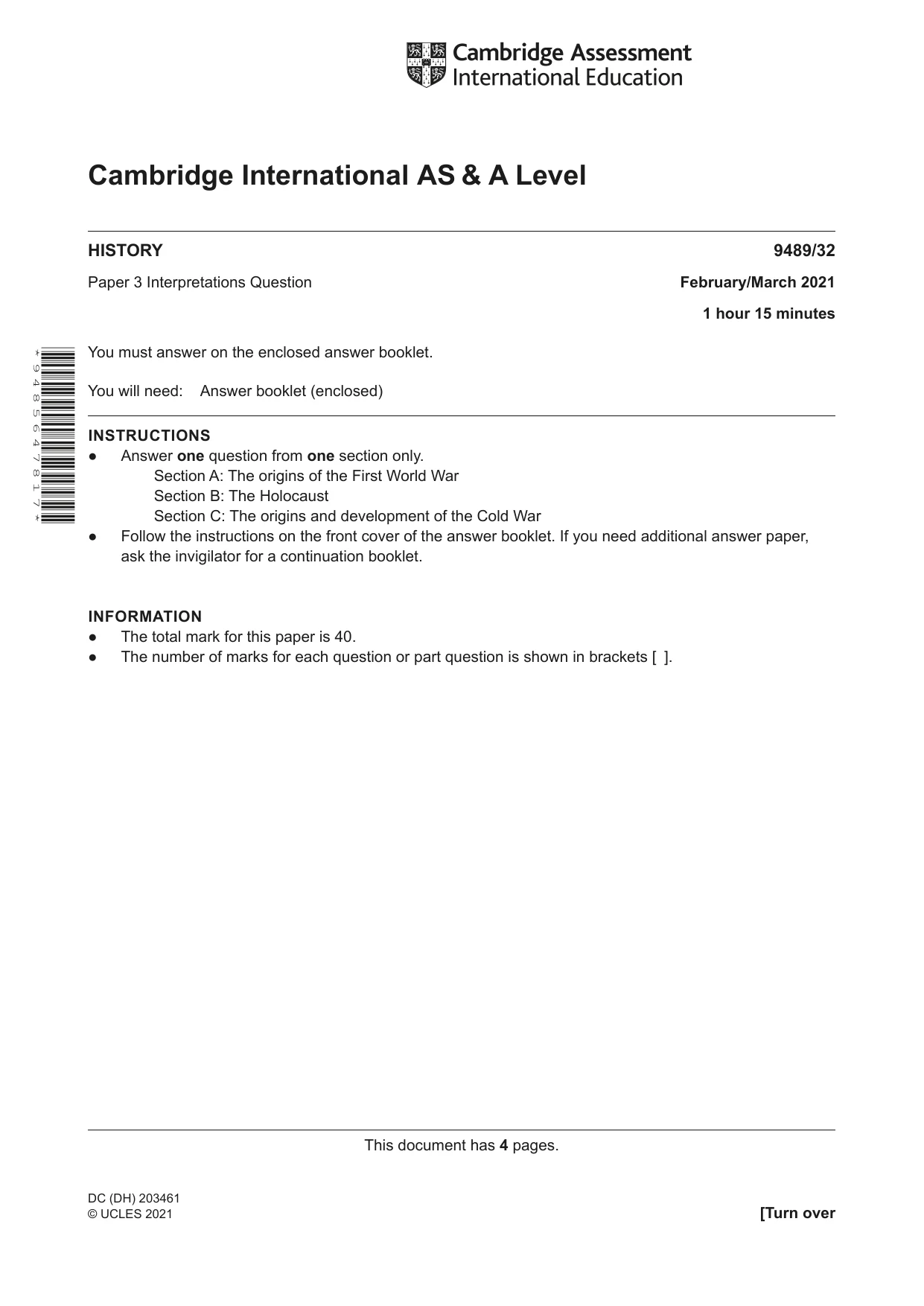
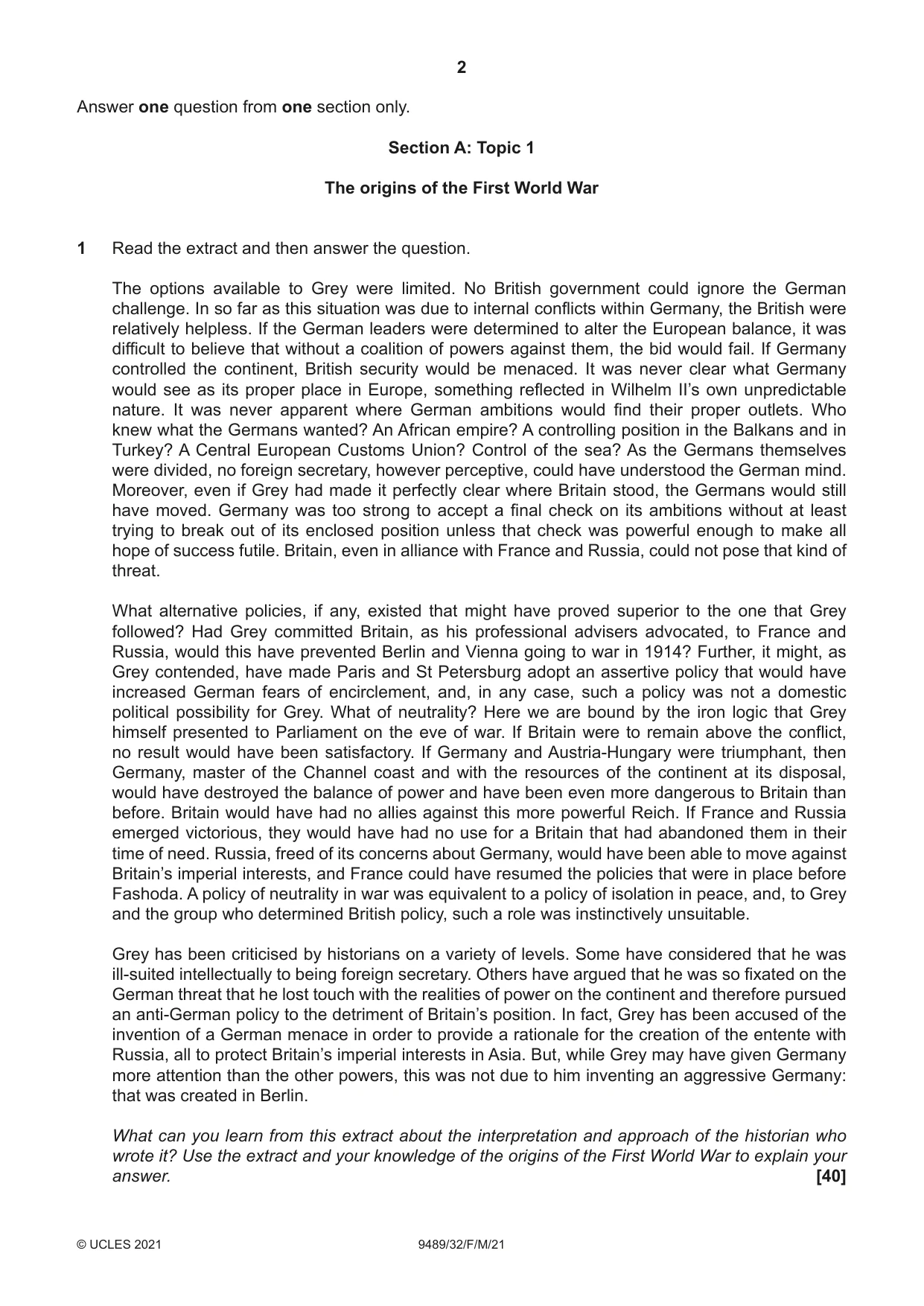
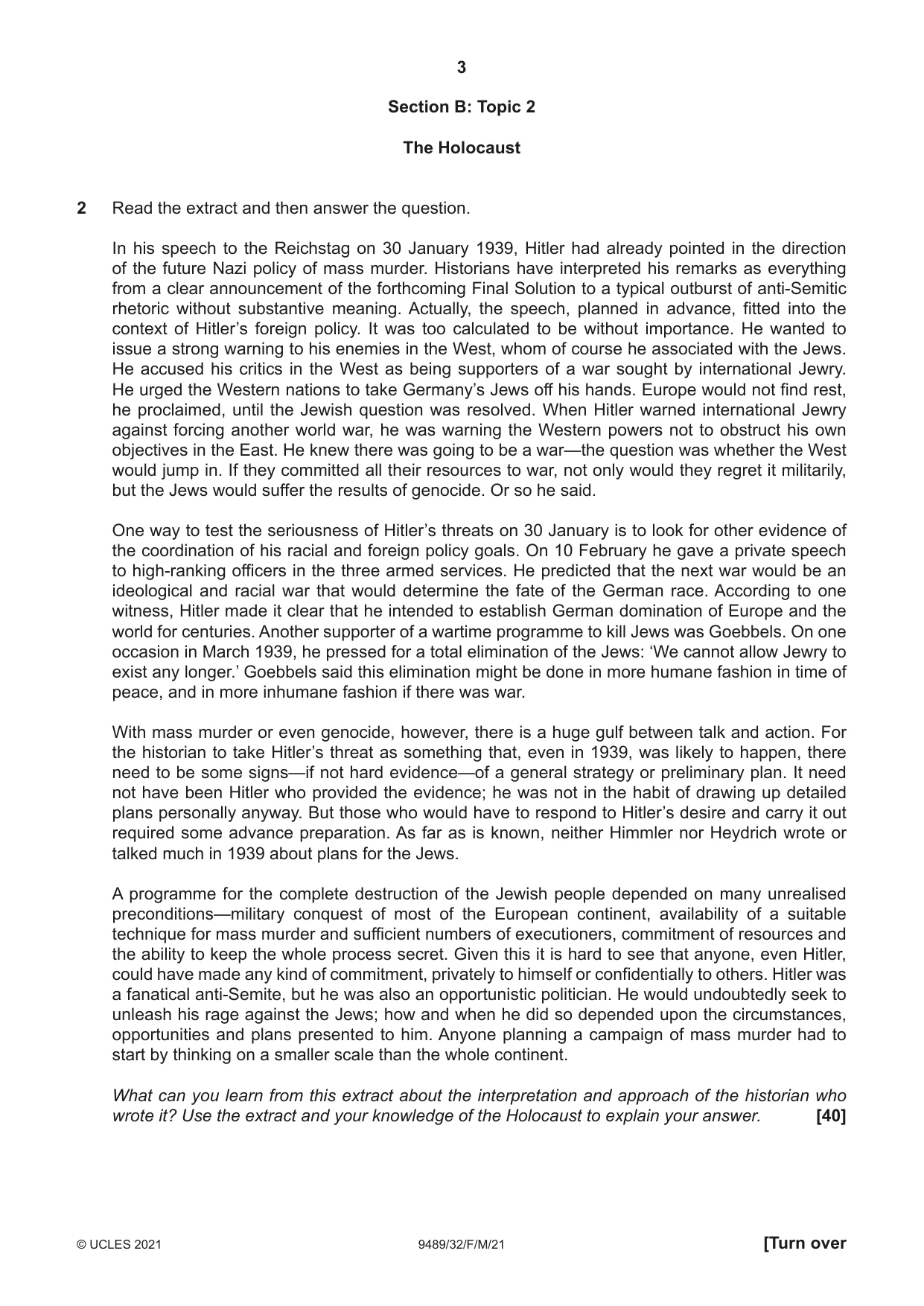
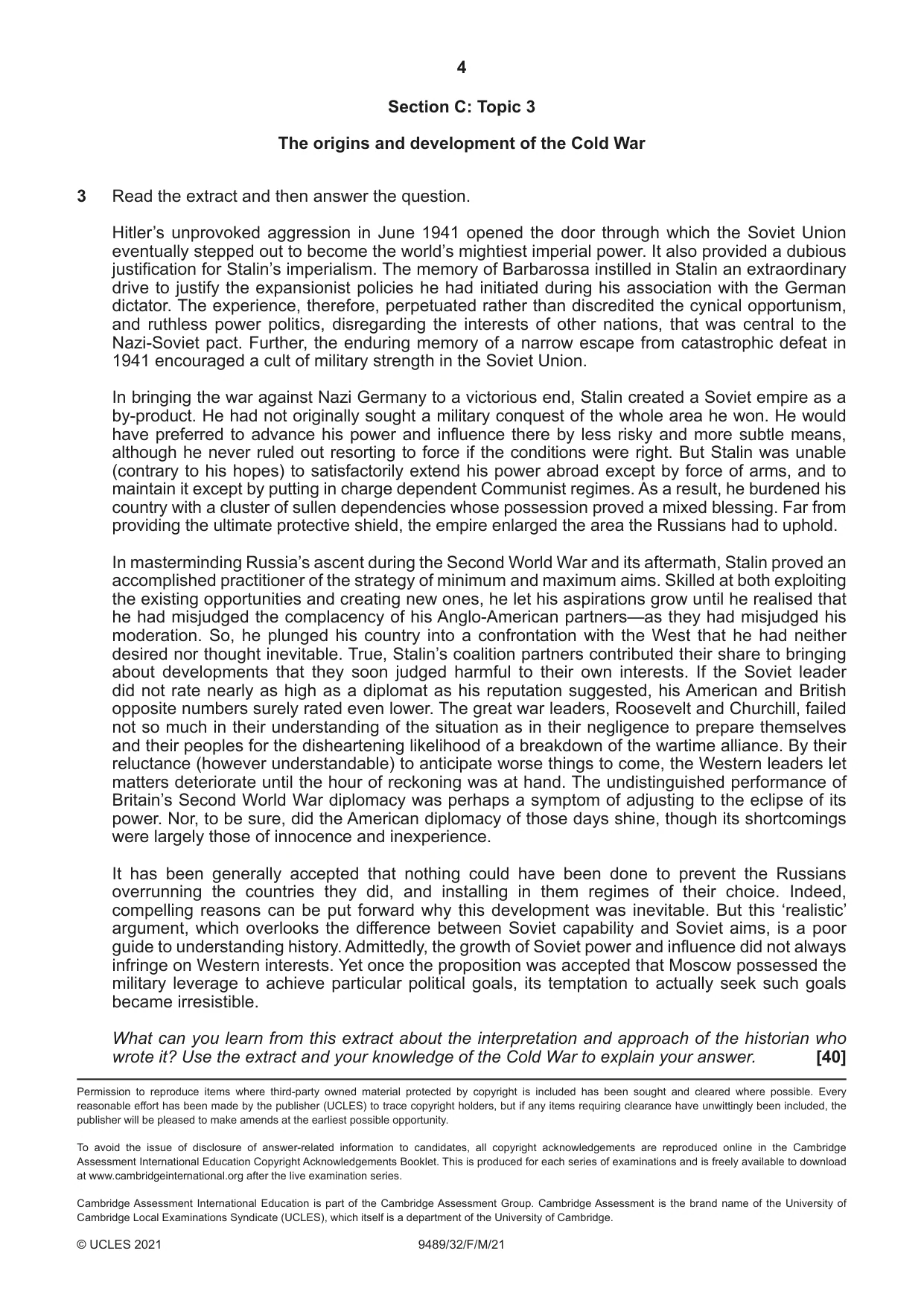
Mark scheme7 pages
Answers below. Sit the paper first if you are practising.
Questions as text
Q1 · Read the extract and then answer the question
1 Read the extract and then answer the question. The options available to Grey were limited. No British government could ignore the German challenge. In so far as this situation was due to internal conflicts within Germany, the British were relatively helpless. If the German leaders were determined to alter the European balance, it was difficult to believe that without a coalition of powers against them, the bid would fail. If Germany controlled the continent, British security would be menaced. It was never clear what Germany would see as its proper place in Europe, something reflected in Wilhelm II’s own unpredictable nature. It was never apparent where German ambitions would find their proper outlets. Who knew what the Germans wanted? An African empire? A controlling position in the Balkans and in Turkey? A Central European Customs Union? Control of the sea? As the Germans themselves were divided, no foreign secretary, however perceptive, could have understood the German mind. Moreover, even if Grey had made it perfectly clear where Britain stood, the Germans would still have moved. Germany was too strong to accept a final check on its ambitions without at least trying to break out of its enclosed position unless that check was powerful enough to make all hope of success futile. Britain, even in alliance with France and Russia, could not pose that kind of threat. What alternative policies, if any, existed that might have proved superior to the one that Grey followed? Had Grey committed Britain, as his professional advisers advocated, to France and Russia, would this have prevented Berlin and Vienna going to war in 1914? Further, it might, as Grey contended, have made Paris and St Petersburg adopt an assertive policy that would have increased German fears of encirclement, and, in any case, such a policy was not a domestic political possibility for Grey. What of neutrality? Here we are bound by the iron logic that Grey himself presented to Parliament on the eve of war. If Britain were to remain above the conflict, no result would have been satisfactory. If Germany and Austria-Hungary were triumphant, then Germany, master of the Channel coast and with the resources of the continent at its disposal, would have destroyed the balance of power and have been even more dangerous to Britain than before. Britain would have had no allies against this more powerful Reich. If France and Russia emerged victorious, they would have had no use for a Britain that had abandoned them in their time of need. Russia, freed of its concerns about Germany, would have been able to move against Britain’s imperial interests, and France could have resumed the policies that were in place before Fashoda. A policy of neutrality in war was equivalent to a policy of isolation in peace, and, to Grey and the group who determined British policy, such a role was instinctively unsuitable. Grey has been criticised by historians on a variety of levels. Some have considered that he was ill-suited intellectually to being foreign secretary. Others have argued that he was so fixated on the German threat that he lost touch with the realities of power on the continent and therefore pursued an anti-German policy to the detriment of Britain’s position. In fact, Grey has been accused of the invention of a German menace in order to provide a rationale for the creation of the entente with Russia, all to protect Britain’s imperial interests in Asia. But, while Grey may have given Germany more attention than the other powers, this was not due to him inventing an aggressive Germany: that was created in Berlin. What can you learn from this extract about the interpretation and approach of the historian who wrote it? Use the extract and your knowledge of the origins of the First World War to explain your answer. [40]
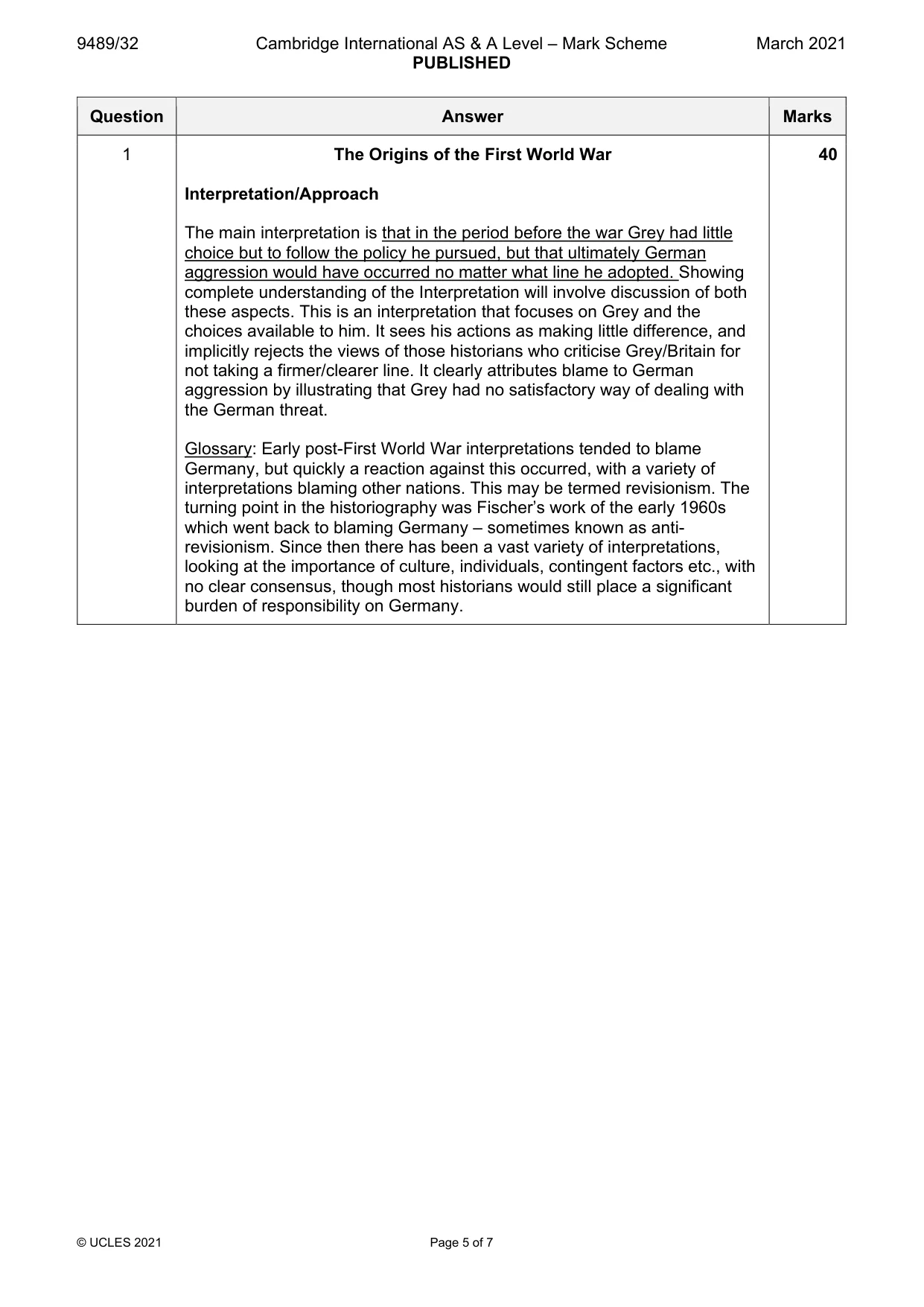
Mark scheme: Question Answer Marks 1 The Origins of the First World War 40 Interpretation/Approach The main interpretation is that in the period before the war Grey had little choice but to follow the policy he pursued, but that ultimately German aggression would have occurred no matter what line he adopted. Showing complete understanding of the Interpretation will involve discussion of both these aspects. This is an interpretation that focuses on Grey and the choices available to him. It sees his actions as making little difference, and implicitly rejects the views of those historians who criticise Grey/Britain for not taking a firmer/clearer line. It clearly attributes blame to German aggression by illustrating that Grey had no satisfactory way of dealing with the German threat. Glossary: Early post-First World War interpretations tended to blame Germany, but quickly a reaction against this occurred, with a variety of interpretations blaming other nations. This may be termed revisionism. The turning point in the historiography was Fischer’s work of the early 1960s which went back to blaming Germany – sometimes known as anti- revisionism. Since then there has been a vast variety of interpretations, looking at the importance of culture, individuals, contingent factors etc., with no clear consensus, though most historians would still place a significant burden of responsibility on Germany.
Q2 · Read the extract and then answer the question
2 Read the extract and then answer the question. In his speech to the Reichstag on 30 January 1939, Hitler had already pointed in the direction of the future Nazi policy of mass murder. Historians have interpreted his remarks as everything from a clear announcement of the forthcoming Final Solution to a typical outburst of anti-Semitic rhetoric without substantive meaning. Actually, the speech, planned in advance, fitted into the context of Hitler’s foreign policy. It was too calculated to be without importance. He wanted to issue a strong warning to his enemies in the West, whom of course he associated with the Jews. He accused his critics in the West as being supporters of a war sought by international Jewry. He urged the Western nations to take Germany’s Jews off his hands. Europe would not find rest, he proclaimed, until the Jewish question was resolved. When Hitler warned international Jewry against forcing another world war, he was warning the Western powers not to obstruct his own objectives in the East. He knew there was going to be a war—the question was whether the West would jump in. If they committed all their resources to war, not only would they regret it militarily, but the Jews would suffer the results of genocide. Or so he said. One way to test the seriousness of Hitler’s threats on 30 January is to look for other evidence of the coordination of his racial and foreign policy goals. On 10 February he gave a private speech to high-ranking officers in the three armed services. He predicted that the next war would be an ideological and racial war that would determine the fate of the German race. According to one witness, Hitler made it clear that he intended to establish German domination of Europe and the world for centuries. Another supporter of a wartime programme to kill Jews was Goebbels. On one occasion in March 1939, he pressed for a total elimination of the Jews: ‘We cannot allow Jewry to exist any longer.’ Goebbels said this elimination might be done in more humane fashion in time of peace, and in more inhumane fashion if there was war. With mass murder or even genocide, however, there is a huge gulf between talk and action. For the historian to take Hitler’s threat as something that, even in 1939, was likely to happen, there need to be some signs—if not hard evidence—of a general strategy or preliminary plan. It need not have been Hitler who provided the evidence; he was not in the habit of drawing up detailed plans personally anyway. But those who would have to respond to Hitler’s desire and carry it out required some advance preparation. As far as is known, neither Himmler nor Heydrich wrote or talked much in 1939 about plans for the Jews. A programme for the complete destruction of the Jewish people depended on many unrealised preconditions—military conquest of most of the European continent, availability of a suitable technique for mass murder and sufficient numbers of executioners, commitment of resources and the ability to keep the whole process secret. Given this it is hard to see that anyone, even Hitler, could have made any kind of commitment, privately to himself or confidentially to others. Hitler was a fanatical anti-Semite, but he was also an opportunistic politician. He would undoubtedly seek to unleash his rage against the Jews; how and when he did so depended upon the circumstances, opportunities and plans presented to him. Anyone planning a campaign of mass murder had to start by thinking on a smaller scale than the whole continent. What can you learn from this extract about the interpretation and approach of the historian who wrote it? Use the extract and your knowledge of the Holocaust to explain your answer. [40] Section C: Topic 3 The origins and development of the Cold War
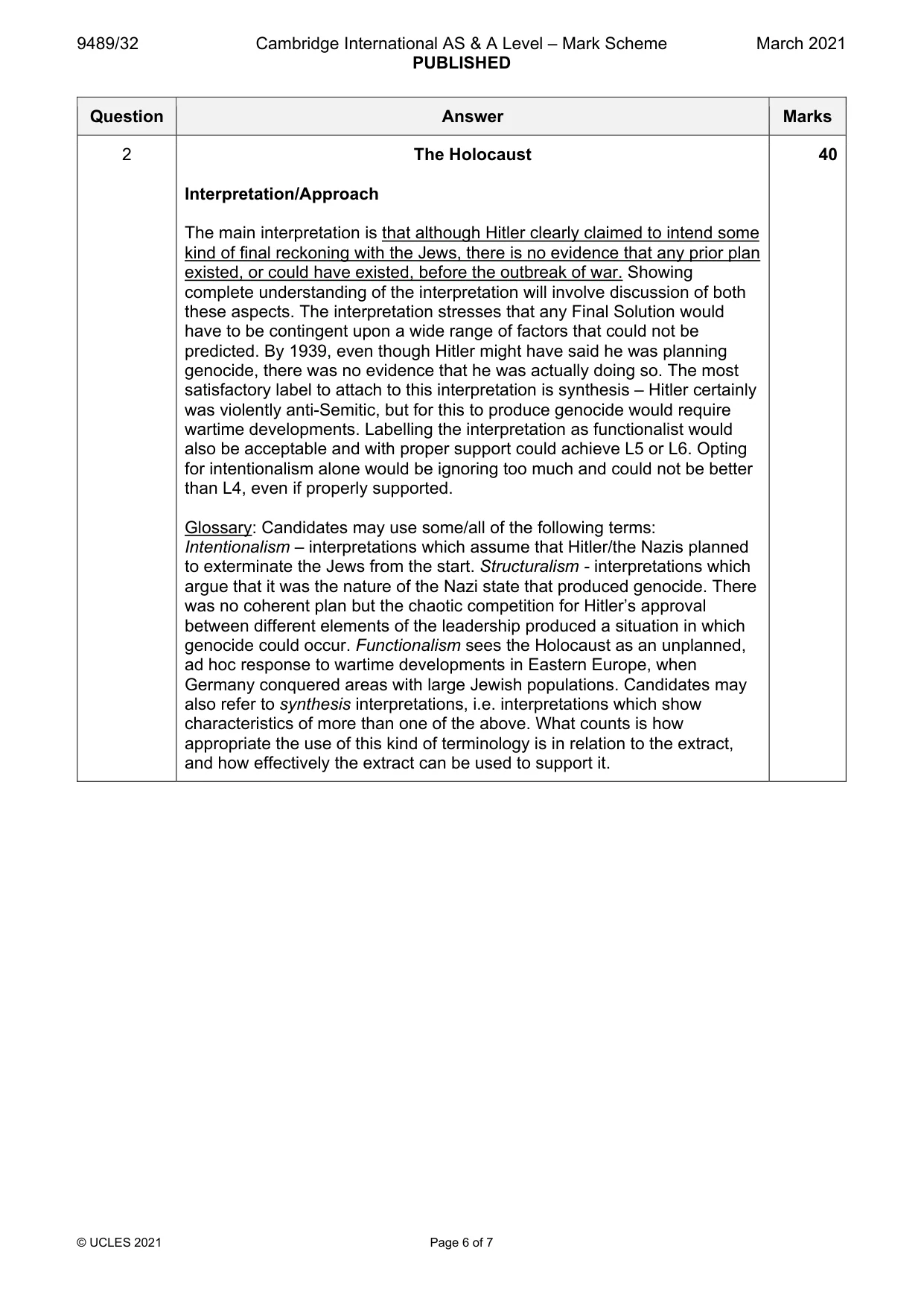
Mark scheme: 2 The Holocaust 40 Interpretation/Approach The main interpretation is that although Hitler clearly claimed to intend some kind of final reckoning with the Jews, there is no evidence that any prior plan existed, or could have existed, before the outbreak of war. Showing complete understanding of the interpretation will involve discussion of both these aspects. The interpretation stresses that any Final Solution would have to be contingent upon a wide range of factors that could not be predicted. By 1939, even though Hitler might have said he was planning genocide, there was no evidence that he was actually doing so. The most satisfactory label to attach to this interpretation is synthesis – Hitler certainly was violently anti-Semitic, but for this to produce genocide would require wartime developments. Labelling the interpretation as functionalist would also be acceptable and with proper support could achieve L5 or L6. Opting for intentionalism alone would be ignoring too much and could not be better than L4, even if properly supported. Glossary: Candidates may use some/all of the following terms: Intentionalism – interpretations which assume that Hitler/the Nazis planned to exterminate the Jews from the start. Structuralism - interpretations which argue that it was the nature of the Nazi state that produced genocide. There was no coherent plan but the chaotic competition for Hitler’s approval between different elements of the leadership produced a situation in which genocide could occur. Functionalism sees the Holocaust as an unplanned, ad hoc response to wartime developments in Eastern Europe, when Germany conquered areas with large Jewish populations. Candidates may also refer to synthesis interpretations, i.e. interpretations which show characteristics of more than one of the above. What counts is how appropriate the use of this kind of terminology is in relation to the extract, and how effectively the extract can be used to support it.
Q3 · Read the extract and then answer the question
3 Read the extract and then answer the question. Hitler’s unprovoked aggression in June 1941 opened the door through which the Soviet Union eventually stepped out to become the world’s mightiest imperial power. It also provided a dubious justification for Stalin’s imperialism. The memory of Barbarossa instilled in Stalin an extraordinary drive to justify the expansionist policies he had initiated during his association with the German dictator. The experience, therefore, perpetuated rather than discredited the cynical opportunism, and ruthless power politics, disregarding the interests of other nations, that was central to the Nazi-Soviet pact. Further, the enduring memory of a narrow escape from catastrophic defeat in 1941 encouraged a cult of military strength in the Soviet Union. In bringing the war against Nazi Germany to a victorious end, Stalin created a Soviet empire as a by-product. He had not originally sought a military conquest of the whole area he won. He would have preferred to advance his power and influence there by less risky and more subtle means, although he never ruled out resorting to force if the conditions were right. But Stalin was unable (contrary to his hopes) to satisfactorily extend his power abroad except by force of arms, and to maintain it except by putting in charge dependent Communist regimes. As a result, he burdened his country with a cluster of sullen dependencies whose possession proved a mixed blessing. Far from providing the ultimate protective shield, the empire enlarged the area the Russians had to uphold. In masterminding Russia’s ascent during the Second World War and its aftermath, Stalin proved an accomplished practitioner of the strategy of minimum and maximum aims. Skilled at both exploiting the existing opportunities and creating new ones, he let his aspirations grow until he realised that he had misjudged the complacency of his Anglo-American partners—as they had misjudged his moderation. So, he plunged his country into a confrontation with the West that he had neither desired nor thought inevitable. True, Stalin’s coalition partners contributed their share to bringing about developments that they soon judged harmful to their own interests. If the Soviet leader did not rate nearly as high as a diplomat as his reputation suggested, his American and British opposite numbers surely rated even lower. The great war leaders, Roosevelt and Churchill, failed not so much in their understanding of the situation as in their negligence to prepare themselves and their peoples for the disheartening likelihood of a breakdown of the wartime alliance. By their reluctance (however understandable) to anticipate worse things to come, the Western leaders let matters deteriorate until the hour of reckoning was at hand. The undistinguished performance of Britain’s Second World War diplomacy was perhaps a symptom of adjusting to the eclipse of its power. Nor, to be sure, did the American diplomacy of those days shine, though its shortcomings were largely those of innocence and inexperience. It has been generally accepted that nothing could have been done to prevent the Russians overrunning the countries they did, and installing in them regimes of their choice. Indeed, compelling reasons can be put forward why this development was inevitable. But this ‘realistic’ argument, which overlooks the difference between Soviet capability and Soviet aims, is a poor guide to understanding history. Admittedly, the growth of Soviet power and influence did not always infringe on Western interests. Yet once the proposition was accepted that Moscow possessed the military leverage to achieve particular political goals, its temptation to actually seek such goals became irresistible. What can you learn from this extract about the interpretation and approach of the historian who wrote it? Use the extract and your knowledge of the Cold War to explain your answer. [40]
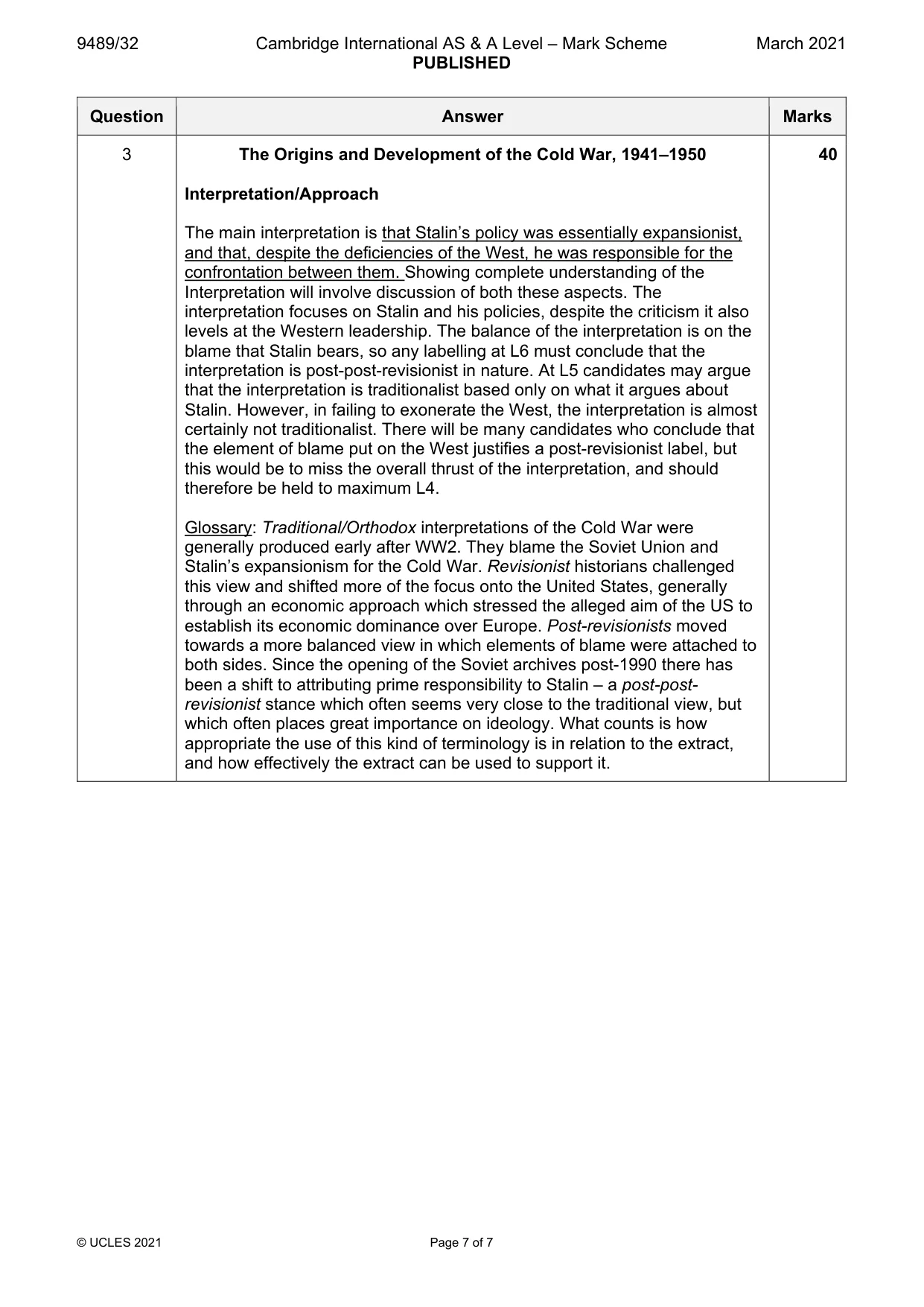
Mark scheme: 3 The Origins and Development of the Cold War, 1941–1950 40 Interpretation/Approach The main interpretation is that Stalin’s policy was essentially expansionist, and that, despite the deficiencies of the West, he was responsible for the confrontation between them. Showing complete understanding of the Interpretation will involve discussion of both these aspects. The interpretation focuses on Stalin and his policies, despite the criticism it also levels at the Western leadership. The balance of the interpretation is on the blame that Stalin bears, so any labelling at L6 must conclude that the interpretation is post-post-revisionist in nature. At L5 candidates may argue that the interpretation is traditionalist based only on what it argues about Stalin. However, in failing to exonerate the West, the interpretation is almost certainly not traditionalist. There will be many candidates who conclude that the element of blame put on the West justifies a post-revisionist label, but this would be to miss the overall thrust of the interpretation, and should therefore be held to maximum L4. Glossary: Traditional/Orthodox interpretations of the Cold War were generally produced early after WW2. They blame the Soviet Union and Stalin’s expansionism for the Cold War. Revisionist historians challenged this view and shifted more of the focus onto the United States, generally through an economic approach which stressed the alleged aim of the US to establish its economic dominance over Europe. Post-revisionists moved towards a more balanced view in which elements of blame were attached to both sides. Since the opening of the Soviet archives post-1990 there has been a shift to attributing prime responsibility to Stalin – a post-post- revisionist stance which often seems very close to the traditional view, but which often places great importance on ideology. What counts is how appropriate the use of this kind of terminology is in relation to the extract, and how effectively the extract can be used to support it.
More questions on How did the rise of extremism affect international relations?
What was in this paper
The subtopics covered by these 3 questions, and how many questions each got. Open one in a new tab to see every Cambridge question on it.
What you needed in this session
Cambridge’s own grade thresholds for 2021 Feb/March, Paper 3 · Variant 2. A higher threshold means an easier paper — the bar moves with how the cohort did.