Questions as text
Q1 · Read the extract and then answer the question 9489/31 May/June 2021
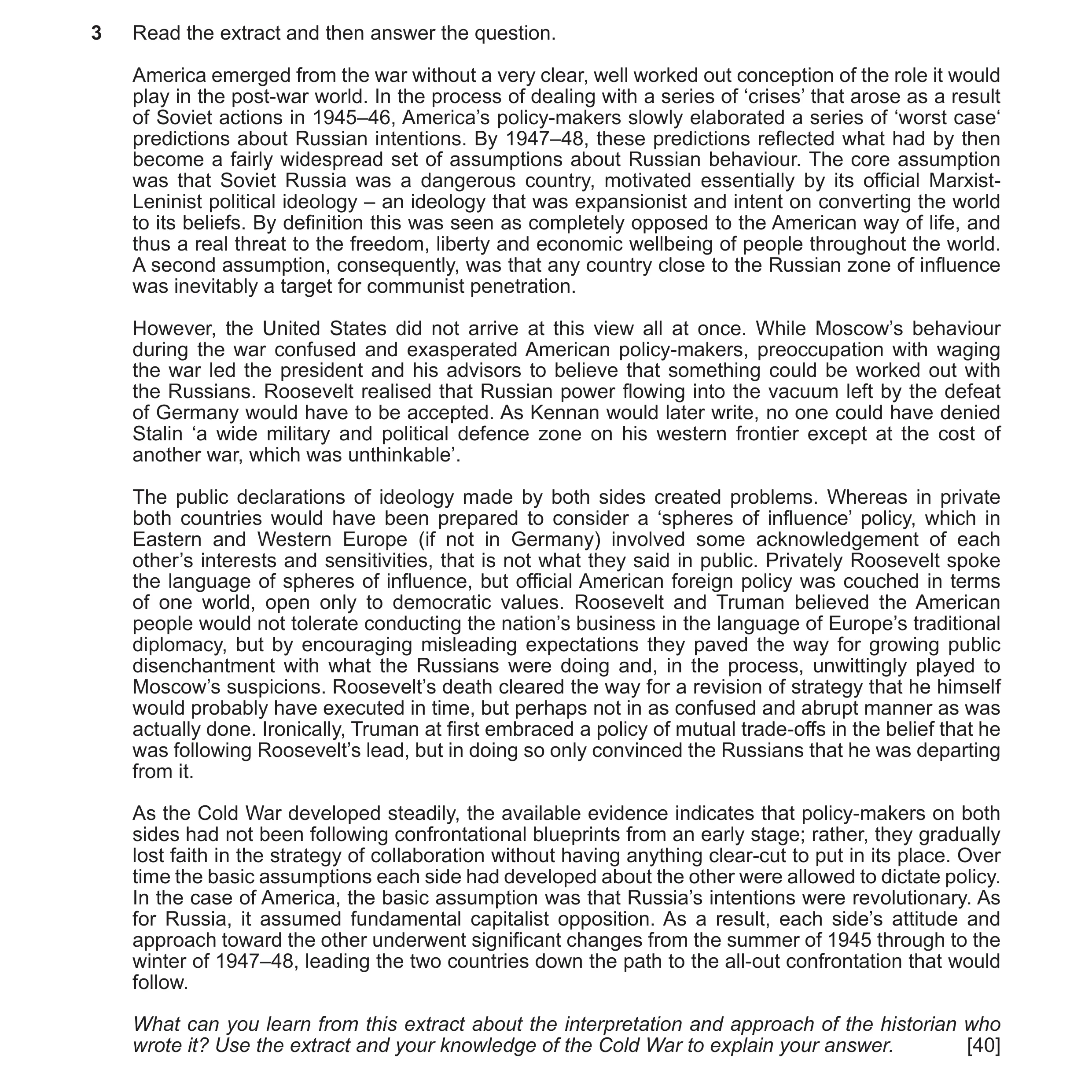
3 Read the extract and then answer the question. America emerged from the war without a very clear, well worked out conception of the role it would play in the post-war world. In the process of dealing with a series of ‘crises’ that arose as a result of Soviet actions in 1945–46, America’s policy-makers slowly elaborated a series of ‘worst case‘ predictions about Russian intentions. By 1947–48, these predictions reflected what had by then become a fairly widespread set of assumptions about Russian behaviour. The core assumption was that Soviet Russia was a dangerous country, motivated essentially by its official Marxist- Leninist political ideology – an ideology that was expansionist and intent on converting the world to its beliefs. By definition this was seen as completely opposed to the American way of life, and thus a real threat to the freedom, liberty and economic wellbeing of people throughout the world. A second assumption, consequently, was that any country close to the Russian zone of influence was inevitably a target for communist penetration. However, the United States did not arrive at this view all at once. While Moscow’s behaviour during the war confused and exasperated American policy-makers, preoccupation with waging the war led the president and his advisors to believe that something could be worked out with the Russians. Roosevelt realised that Russian power flowing into the vacuum left by the defeat of Germany would have to be accepted. As Kennan would later write, no one could have denied Stalin ‘a wide military and political defence zone on his western frontier except at the cost of another war, which was unthinkable’. The public declarations of ideology made by both sides created problems. Whereas in private both countries would have been prepared to consider a ‘spheres of influence’ policy, which in Eastern and Western Europe (if not in Germany) involved some acknowledgement of each other’s interests and sensitivities, that is not what they said in public. Privately Roosevelt spoke the language of spheres of influence, but official American foreign policy was couched in terms of one world, open only to democratic values. Roosevelt and Truman believed the American people would not tolerate conducting the nation’s business in the language of Europe’s traditional diplomacy, but by encouraging misleading expectations they paved the way for growing public disenchantment with what the Russians were doing and, in the process, unwittingly played to Moscow’s suspicions. Roosevelt’s death cleared the way for a revision of strategy that he himself would probably have executed in time, but perhaps not in as confused and abrupt manner as was actually done. Ironically, Truman at first embraced a policy of mutual trade-offs in the belief that he was following Roosevelt’s lead, but in doing so only convinced the Russians that he was departing from it. As the Cold War developed steadily, the available evidence indicates that policy-makers on both sides had not been following confrontational blueprints from an early stage; rather, they gradually lost faith in the strategy of collaboration without having anything clear-cut to put in its place. Over time the basic assumptions each side had developed about the other were allowed to dictate policy. In the case of America, the basic assumption was that Russia’s intentions were revolutionary. As for Russia, it assumed fundamental capitalist opposition. As a result, each side’s attitude and approach toward the other underwent significant changes from the summer of 1945 through to the winter of 1947–48, leading the two countries down the path to the all-out confrontation that would follow. What can you learn from this extract about the interpretation and approach of the historian who wrote it? Use the extract and your knowledge of the Cold War to explain your answer. [40]
40 marks
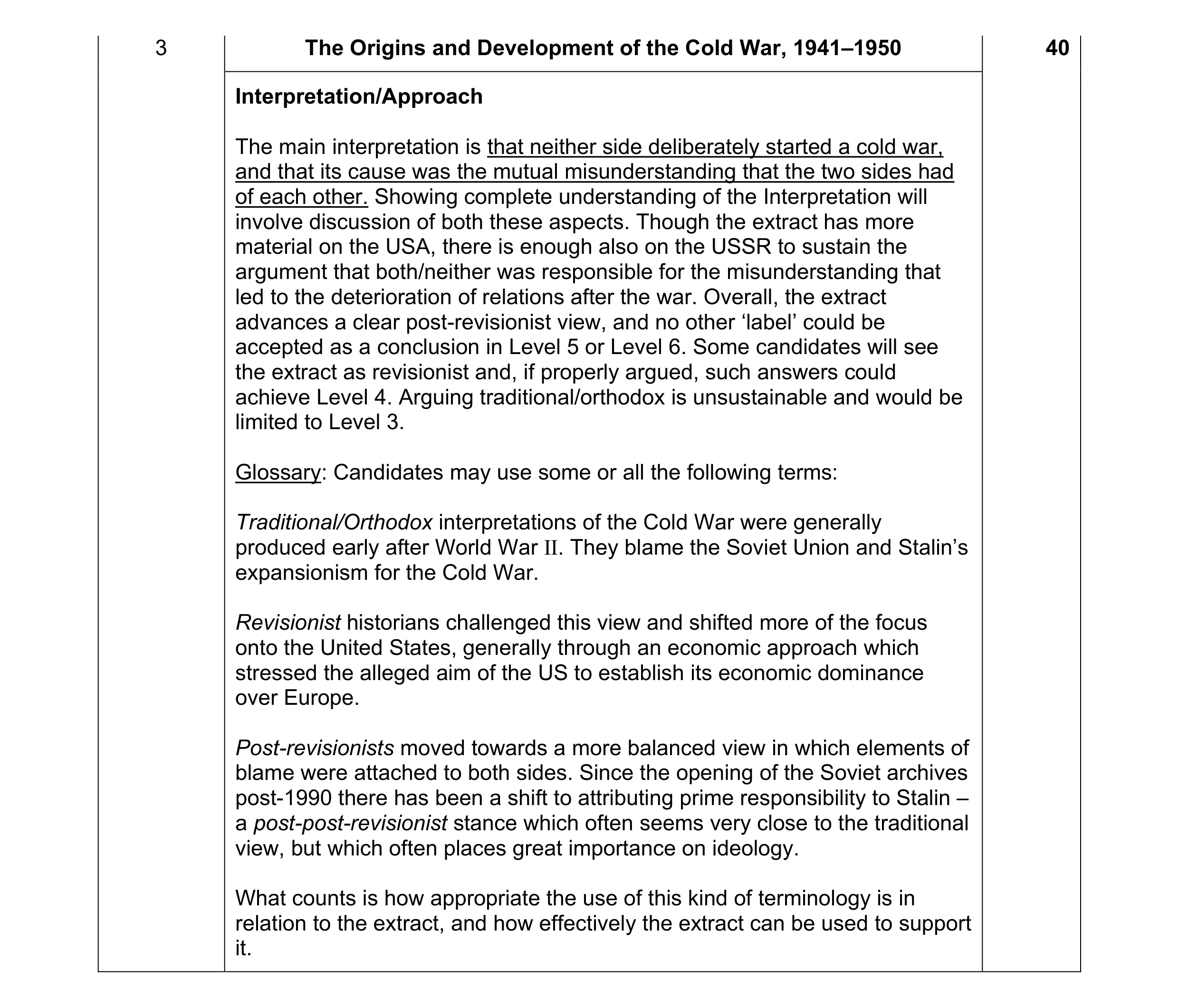
Mark scheme: 3 The Origins and Development of the Cold War, 1941–1950 40 Interpretation/Approach The main interpretation is that neither side deliberately started a cold war, and that its cause was the mutual misunderstanding that the two sides had of each other. Showing complete understanding of the Interpretation will involve discussion of both these aspects. Though the extract has more material on the USA, there is enough also on the USSR to sustain the argument that both/neither was responsible for the misunderstanding that led to the deterioration of relations after the war. Overall, the extract advances a clear post-revisionist view, and no other ‘label’ could be accepted as a conclusion in Level 5 or Level 6. Some candidates will see the extract as revisionist and, if properly argued, such answers could achieve Level 4. Arguing traditional/orthodox is unsustainable and would be limited to Level 3. Glossary: Candidates may use some or all the following terms: Traditional/Orthodox interpretations of the Cold War were generally produced early after World War Ⅱ. They blame the Soviet Union and Stalin’s expansionism for the Cold War. Revisionist historians challenged this view and shifted more of the focus onto the United States, generally through an economic approach which stressed the alleged aim of the US to establish its economic dominance over Europe. Post-revisionists moved towards a more balanced view in which elements of blame were attached to both sides. Since the opening of the Soviet archives post-1990 there has been a shift to attributing prime responsibility to Stalin – a post-post-revisionist stance which often seems very close to the traditional view, but which often places great importance on ideology. What counts is how appropriate the use of this kind of terminology is in relation to the extract, and how effectively the extract can be used to support it.
This question in 9489/31 May/June 2021
Q2 · Read the extract and then answer the question 9489/32 May/June 2021
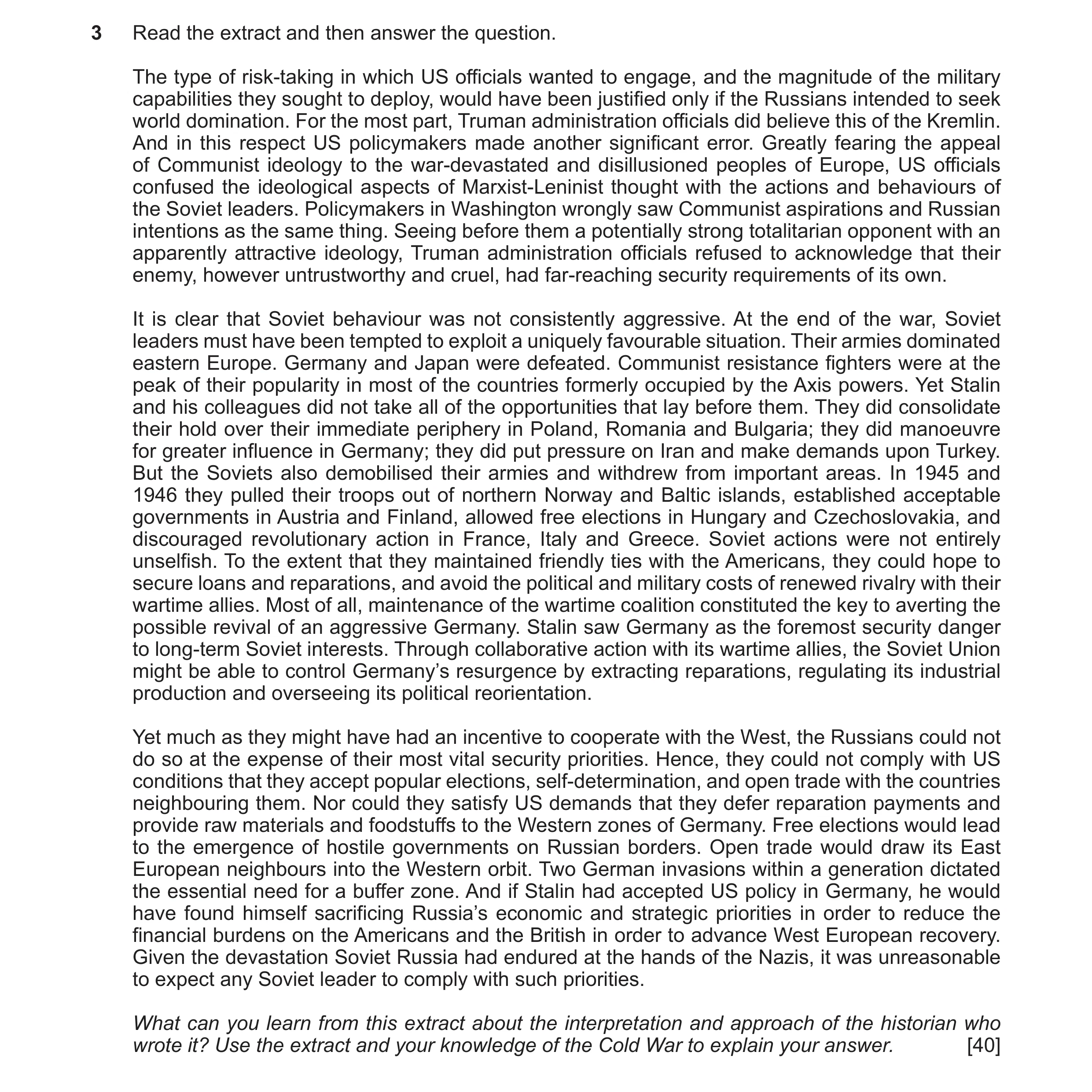
3 Read the extract and then answer the question. The type of risk-taking in which US officials wanted to engage, and the magnitude of the military capabilities they sought to deploy, would have been justified only if the Russians intended to seek world domination. For the most part, Truman administration officials did believe this of the Kremlin. And in this respect US policymakers made another significant error. Greatly fearing the appeal of Communist ideology to the war-devastated and disillusioned peoples of Europe, US officials confused the ideological aspects of Marxist-Leninist thought with the actions and behaviours of the Soviet leaders. Policymakers in Washington wrongly saw Communist aspirations and Russian intentions as the same thing. Seeing before them a potentially strong totalitarian opponent with an apparently attractive ideology, Truman administration officials refused to acknowledge that their enemy, however untrustworthy and cruel, had far-reaching security requirements of its own. It is clear that Soviet behaviour was not consistently aggressive. At the end of the war, Soviet leaders must have been tempted to exploit a uniquely favourable situation. Their armies dominated eastern Europe. Germany and Japan were defeated. Communist resistance fighters were at the peak of their popularity in most of the countries formerly occupied by the Axis powers. Yet Stalin and his colleagues did not take all of the opportunities that lay before them. They did consolidate their hold over their immediate periphery in Poland, Romania and Bulgaria; they did manoeuvre for greater influence in Germany; they did put pressure on Iran and make demands upon Turkey. But the Soviets also demobilised their armies and withdrew from important areas. In 1945 and 1946 they pulled their troops out of northern Norway and Baltic islands, established acceptable governments in Austria and Finland, allowed free elections in Hungary and Czechoslovakia, and discouraged revolutionary action in France, Italy and Greece. Soviet actions were not entirely unselfish. To the extent that they maintained friendly ties with the Americans, they could hope to secure loans and reparations, and avoid the political and military costs of renewed rivalry with their wartime allies. Most of all, maintenance of the wartime coalition constituted the key to averting the possible revival of an aggressive Germany. Stalin saw Germany as the foremost security danger to long-term Soviet interests. Through collaborative action with its wartime allies, the Soviet Union might be able to control Germany’s resurgence by extracting reparations, regulating its industrial production and overseeing its political reorientation. Yet much as they might have had an incentive to cooperate with the West, the Russians could not do so at the expense of their most vital security priorities. Hence, they could not comply with US conditions that they accept popular elections, self-determination, and open trade with the countries neighbouring them. Nor could they satisfy US demands that they defer reparation payments and provide raw materials and foodstuffs to the Western zones of Germany. Free elections would lead to the emergence of hostile governments on Russian borders. Open trade would draw its East European neighbours into the Western orbit. Two German invasions within a generation dictated the essential need for a buffer zone. And if Stalin had accepted US policy in Germany, he would have found himself sacrificing Russia’s economic and strategic priorities in order to reduce the financial burdens on the Americans and the British in order to advance West European recovery. Given the devastation Soviet Russia had endured at the hands of the Nazis, it was unreasonable to expect any Soviet leader to comply with such priorities. What can you learn from this extract about the interpretation and approach of the historian who wrote it? Use the extract and your knowledge of the Cold War to explain your answer. [40]
40 marks
Mark scheme: 3 The Origins and Development of the Cold War, 1941–1950 40 Interpretation/Approach The main interpretation is that the US was wrong to see the USSR as expansionist, and to make demands on the USSR which were incompatible with its security needs, and thus impossible for it to accept. Showing complete understanding of the interpretation involves discussing both aspects. The sympathetic view taken of Soviet security needs, and the focus on the failure of the US to appreciate these, marks this out as a revisionist view. No other ‘label’ would be acceptable in Level 5 or Level 6. Answers that place blame on both sides may achieve Level 4 if the US is argued properly but viewing the interpretation as traditional in blaming the USSR would be limited to Level 3. Glossary: Candidates may use some or all the following terms: Traditional/Orthodox interpretations of the Cold War were generally produced early after World War Ⅱ. They blame the Soviet Union and Stalin’s expansionism for the Cold War. Revisionist historians challenged this view and shifted more of the focus onto the United States, generally through an economic approach which stressed the alleged aim of the US to establish its economic dominance over Europe. Post-revisionists moved towards a more balanced view in which elements of blame were attached to both sides. Since the opening of the Soviet archives post-1990 there has been a shift to attributing prime responsibility to Stalin – a post-post-revisionist stance which often seems very close to the traditional view, but which often places great importance on ideology. What counts is how appropriate the use of this kind of terminology is in relation to the extract, and how effectively the extract can be used to support it.
This question in 9489/32 May/June 2021
Q3 · Read the extract and then answer the question 9489/31 Oct/Nov 2021
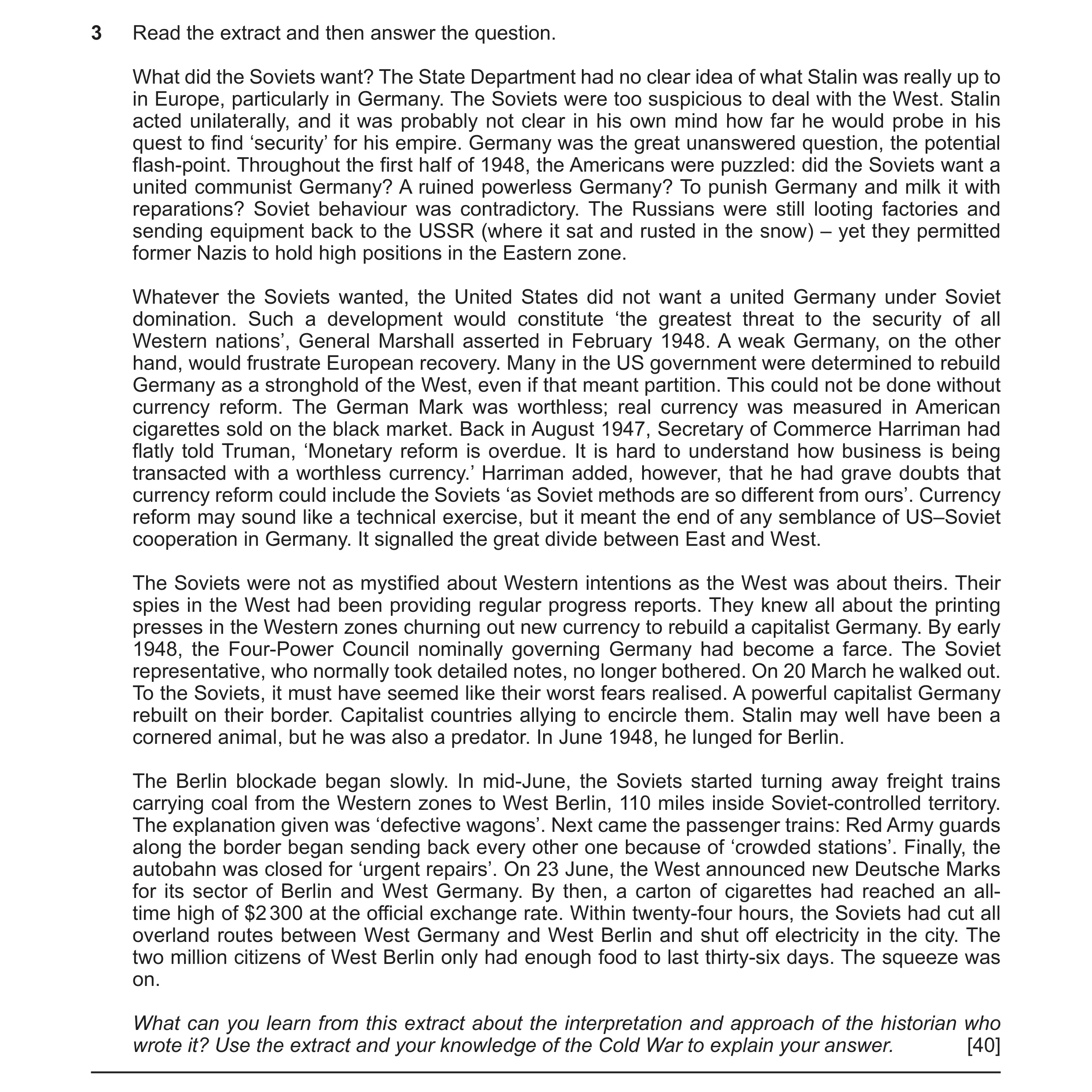
3 Read the extract and then answer the question. What did the Soviets want? The State Department had no clear idea of what Stalin was really up to in Europe, particularly in Germany. The Soviets were too suspicious to deal with the West. Stalin acted unilaterally, and it was probably not clear in his own mind how far he would probe in his quest to find ‘security’ for his empire. Germany was the great unanswered question, the potential flash-point. Throughout the first half of 1948, the Americans were puzzled: did the Soviets want a united communist Germany? A ruined powerless Germany? To punish Germany and milk it with reparations? Soviet behaviour was contradictory. The Russians were still looting factories and sending equipment back to the USSR (where it sat and rusted in the snow) – yet they permitted former Nazis to hold high positions in the Eastern zone. Whatever the Soviets wanted, the United States did not want a united Germany under Soviet domination. Such a development would constitute ‘the greatest threat to the security of all Western nations’, General Marshall asserted in February 1948. A weak Germany, on the other hand, would frustrate European recovery. Many in the US government were determined to rebuild Germany as a stronghold of the West, even if that meant partition. This could not be done without currency reform. The German Mark was worthless; real currency was measured in American cigarettes sold on the black market. Back in August 1947, Secretary of Commerce Harriman had flatly told Truman, ‘Monetary reform is overdue. It is hard to understand how business is being transacted with a worthless currency.’ Harriman added, however, that he had grave doubts that currency reform could include the Soviets ‘as Soviet methods are so different from ours’. Currency reform may sound like a technical exercise, but it meant the end of any semblance of US–Soviet cooperation in Germany. It signalled the great divide between East and West. The Soviets were not as mystified about Western intentions as the West was about theirs. Their spies in the West had been providing regular progress reports. They knew all about the printing presses in the Western zones churning out new currency to rebuild a capitalist Germany. By early 1948, the Four-Power Council nominally governing Germany had become a farce. The Soviet representative, who normally took detailed notes, no longer bothered. On 20 March he walked out. To the Soviets, it must have seemed like their worst fears realised. A powerful capitalist Germany rebuilt on their border. Capitalist countries allying to encircle them. Stalin may well have been a cornered animal, but he was also a predator. In June 1948, he lunged for Berlin. The Berlin blockade began slowly. In mid-June, the Soviets started turning away freight trains carrying coal from the Western zones to West Berlin, 110 miles inside Soviet-controlled territory. The explanation given was ‘defective wagons’. Next came the passenger trains: Red Army guards along the border began sending back every other one because of ‘crowded stations’. Finally, the autobahn was closed for ‘urgent repairs’. On 23 June, the West announced new Deutsche Marks for its sector of Berlin and West Germany. By then, a carton of cigarettes had reached an all- time high of $2 300 at the official exchange rate. Within twenty-four hours, the Soviets had cut all overland routes between West Germany and West Berlin and shut off electricity in the city. The two million citizens of West Berlin only had enough food to last thirty-six days. The squeeze was on. What can you learn from this extract about the interpretation and approach of the historian who wrote it? Use the extract and your knowledge of the Cold War to explain your answer. [40]
40 marks
Mark scheme: 3 The origins and development of the Cold War, 1941–50 40 Interpretation/Approach The main interpretation is that both sides bear some blame for increasing tensions over Germany, but these were brought to a head by the currency reforms. Showing complete understanding of the interpretation will involve discussion of both these aspects. The language used by the author in their discussion of the Soviet Union makes their standpoint clear. It portrays the Soviet Union as threatening and hostile in a way that is entirely missing from the remarks about the West. However, there are elements of blame being placed on the West in this extract which drives forward currency reform knowing it will alienate the Soviets and destroy any chance of cooperation. The interpretation is therefore post-revisionist in nature. Only this label would be acceptable at L5/L6. Some will argue for traditional finding blame being put the Soviet Union, which could, if properly argued, reach L4. Glossary: Traditional/Orthodox interpretations of the Cold War were generally produced early after the Second World War. They blame the Soviet Union and Stalin’s expansionism for the Cold War. Revisionist historians challenged this view and shifted more of the focus onto the United States, generally through an economic approach which stressed the alleged aim of the US to establish its economic dominance over Europe. Post- revisionists moved towards a more balanced view in which elements of blame were attached to both sides. Since the opening of the Soviet archives post-1990 there has been a shift to attributing prime responsibility to Stalin – a post-post-revisionist stance which often seems very close to the traditional view, but which often places great importance on ideology. What counts is how appropriate the use of this kind of terminology is in relation to the extract, and how effectively the extract can be used to support it.
This question in 9489/31 Oct/Nov 2021
Q4 · Read the extract and then answer the question 9489/32 Feb/March 2023
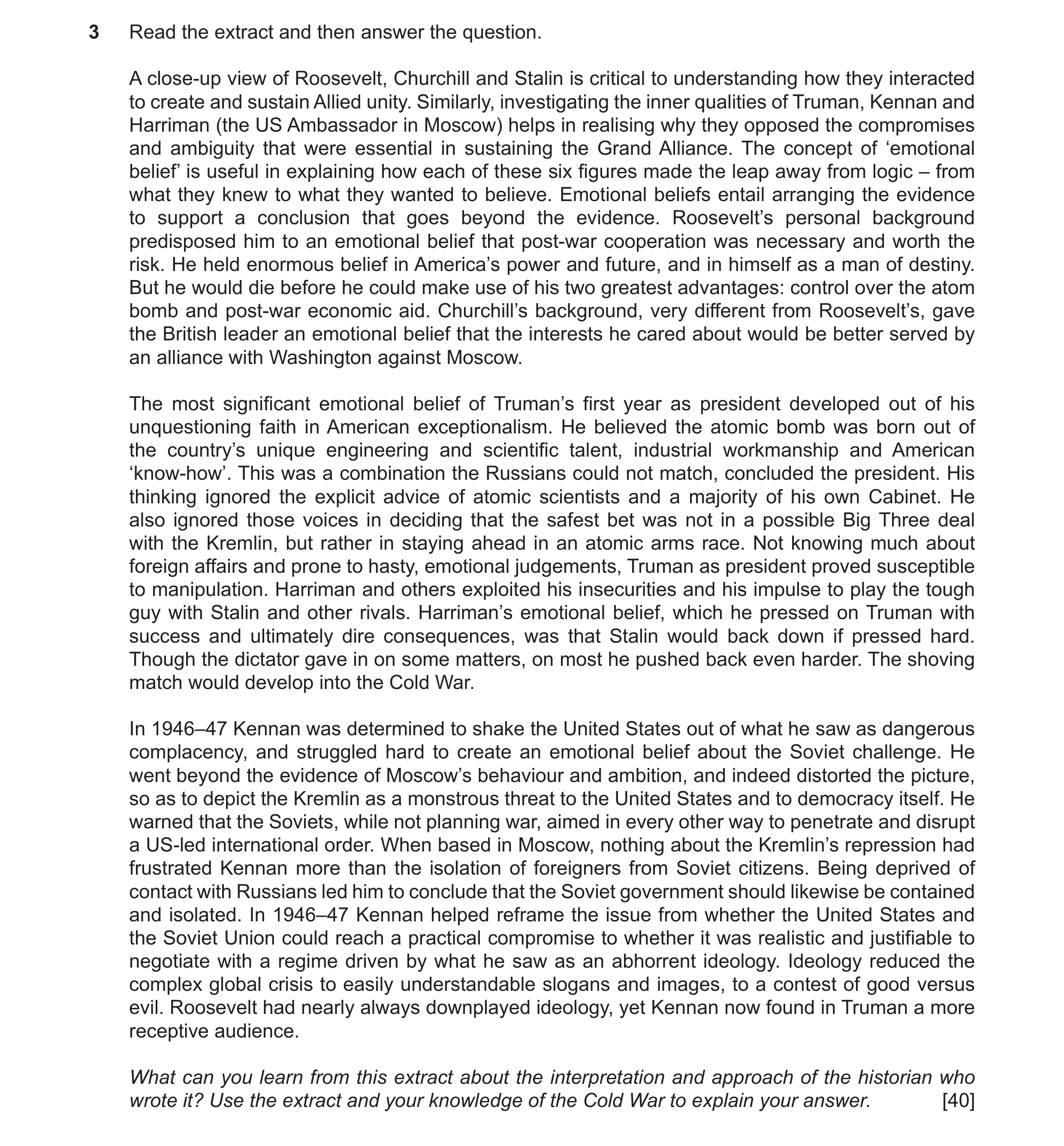
3 Read the extract and then answer the question. A close-up view of Roosevelt, Churchill and Stalin is critical to understanding how they interacted to create and sustain Allied unity. Similarly, investigating the inner qualities of Truman, Kennan and Harriman (the US Ambassador in Moscow) helps in realising why they opposed the compromises and ambiguity that were essential in sustaining the Grand Alliance. The concept of ‘emotional belief’ is useful in explaining how each of these six figures made the leap away from logic – from what they knew to what they wanted to believe. Emotional beliefs entail arranging the evidence to support a conclusion that goes beyond the evidence. Roosevelt’s personal background predisposed him to an emotional belief that post-war cooperation was necessary and worth the risk. He held enormous belief in America’s power and future, and in himself as a man of destiny. But he would die before he could make use of his two greatest advantages: control over the atom bomb and post-war economic aid. Churchill’s background, very different from Roosevelt’s, gave the British leader an emotional belief that the interests he cared about would be better served by an alliance with Washington against Moscow. The most significant emotional belief of Truman’s first year as president developed out of his unquestioning faith in American exceptionalism. He believed the atomic bomb was born out of the country’s unique engineering and scientific talent, industrial workmanship and American ‘know-how’. This was a combination the Russians could not match, concluded the president. His thinking ignored the explicit advice of atomic scientists and a majority of his own Cabinet. He also ignored those voices in deciding that the safest bet was not in a possible Big Three deal with the Kremlin, but rather in staying ahead in an atomic arms race. Not knowing much about foreign affairs and prone to hasty, emotional judgements, Truman as president proved susceptible to manipulation. Harriman and others exploited his insecurities and his impulse to play the tough guy with Stalin and other rivals. Harriman’s emotional belief, which he pressed on Truman with success and ultimately dire consequences, was that Stalin would back down if pressed hard. Though the dictator gave in on some matters, on most he pushed back even harder. The shoving match would develop into the Cold War. In 1946–47 Kennan was determined to shake the United States out of what he saw as dangerous complacency, and struggled hard to create an emotional belief about the Soviet challenge. He went beyond the evidence of Moscow’s behaviour and ambition, and indeed distorted the picture, so as to depict the Kremlin as a monstrous threat to the United States and to democracy itself. He warned that the Soviets, while not planning war, aimed in every other way to penetrate and disrupt a US-led international order. When based in Moscow, nothing about the Kremlin’s repression had frustrated Kennan more than the isolation of foreigners from Soviet citizens. Being deprived of contact with Russians led him to conclude that the Soviet government should likewise be contained and isolated. In 1946–47 Kennan helped reframe the issue from whether the United States and the Soviet Union could reach a practical compromise to whether it was realistic and justifiable to negotiate with a regime driven by what he saw as an abhorrent ideology. Ideology reduced the complex global crisis to easily understandable slogans and images, to a contest of good versus evil. Roosevelt had nearly always downplayed ideology, yet Kennan now found in Truman a more receptive audience. What can you learn from this extract about the interpretation and approach of the historian who wrote it? Use the extract and your knowledge of the Cold War to explain your answer. [40]
40 marks
Mark scheme: 3 The Origins and Development of the Cold War 40 Interpretation/Approach The main interpretation is that all actors in the Cold War were motivated by ‘emotional beliefs’ rather than logic, but those held by Truman and the US policy-making elite were particularly harmful. The interpretation stresses the importance of American ‘emotional beliefs’ in shaping the Cold War. In the way in which it focuses on the anti-Soviet beliefs of key US figures, and especially of Truman, it places blame on the United States for initiating the shift from wartime cooperation to Cold War confrontation. Truman is seen as hasty and ill-informed, open to manipulation by advisers who shared his beliefs. No label other than ‘revisionist’ can be acceptable at L5 and L6. Arguments that the US is to blame, but no engagement with the idea of ‘emotional beliefs’, will be L3 only. Glossary: Traditional/Orthodox interpretations of the Cold War were generally produced early after WW2. They blame the Soviet Union and Stalin’s expansionism for the Cold War. Revisionist historians challenged this view and shifted more of the focus onto the United States, generally through an economic approach which stressed the alleged aim of the US to establish its economic dominance over Europe. Post-revisionists moved towards a more balanced view in which elements of blame were attached to both sides. Since the opening of the Soviet archives post-1990 there has been a shift to attributing prime responsibility to Stalin – a post-post- revisionist stance which often seems very close to the traditional view, but which often places great importance on ideology. What counts is how appropriate the use of this kind of terminology is in relation to the extract, and how effectively the extract can be used to support it.
This question in 9489/32 Feb/March 2023
Q5 · Read the extract and then answer the question 9489/32 May/June 2023
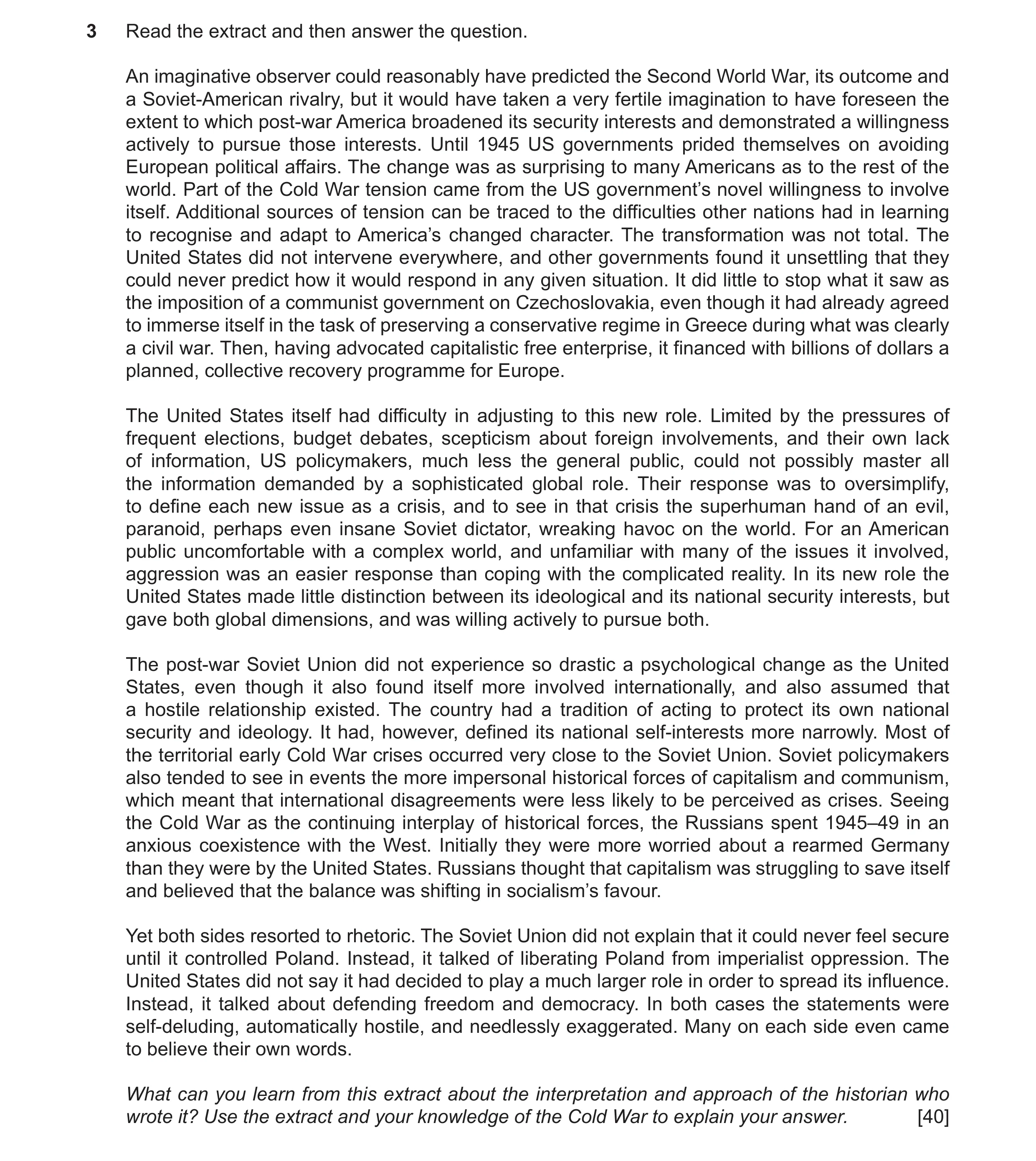
3 Read the extract and then answer the question. An imaginative observer could reasonably have predicted the Second World War, its outcome and a Soviet-American rivalry, but it would have taken a very fertile imagination to have foreseen the extent to which post-war America broadened its security interests and demonstrated a willingness actively to pursue those interests. Until 1945 US governments prided themselves on avoiding European political affairs. The change was as surprising to many Americans as to the rest of the world. Part of the Cold War tension came from the US government’s novel willingness to involve itself. Additional sources of tension can be traced to the difficulties other nations had in learning to recognise and adapt to America’s changed character. The transformation was not total. The United States did not intervene everywhere, and other governments found it unsettling that they could never predict how it would respond in any given situation. It did little to stop what it saw as the imposition of a communist government on Czechoslovakia, even though it had already agreed to immerse itself in the task of preserving a conservative regime in Greece during what was clearly a civil war. Then, having advocated capitalistic free enterprise, it financed with billions of dollars a planned, collective recovery programme for Europe. The United States itself had difficulty in adjusting to this new role. Limited by the pressures of frequent elections, budget debates, scepticism about foreign involvements, and their own lack of information, US policymakers, much less the general public, could not possibly master all the information demanded by a sophisticated global role. Their response was to oversimplify, to define each new issue as a crisis, and to see in that crisis the superhuman hand of an evil, paranoid, perhaps even insane Soviet dictator, wreaking havoc on the world. For an American public uncomfortable with a complex world, and unfamiliar with many of the issues it involved, aggression was an easier response than coping with the complicated reality. In its new role the United States made little distinction between its ideological and its national security interests, but gave both global dimensions, and was willing actively to pursue both. The post-war Soviet Union did not experience so drastic a psychological change as the United States, even though it also found itself more involved internationally, and also assumed that a hostile relationship existed. The country had a tradition of acting to protect its own national security and ideology. It had, however, defined its national self-interests more narrowly. Most of the territorial early Cold War crises occurred very close to the Soviet Union. Soviet policymakers also tended to see in events the more impersonal historical forces of capitalism and communism, which meant that international disagreements were less likely to be perceived as crises. Seeing the Cold War as the continuing interplay of historical forces, the Russians spent 1945–49 in an anxious coexistence with the West. Initially they were more worried about a rearmed Germany than they were by the United States. Russians thought that capitalism was struggling to save itself and believed that the balance was shifting in socialism’s favour. Yet both sides resorted to rhetoric. The Soviet Union did not explain that it could never feel secure until it controlled Poland. Instead, it talked of liberating Poland from imperialist oppression. The United States did not say it had decided to play a much larger role in order to spread its influence. Instead, it talked about defending freedom and democracy. In both cases the statements were self-deluding, automatically hostile, and needlessly exaggerated. Many on each side even came to believe their own words. What can you learn from this extract about the interpretation and approach of the historian who wrote it? Use the extract and your knowledge of the Cold War to explain your answer. [40]
40 marks
Mark scheme: 3 The Origins and Development of the Cold War 40 Interpretation/Approach The main interpretation is that whilst both sides assumed they would have antagonistic relations post WW2, it was the USA that had the more difficult transition to coping with its new world role, and therefore contributed more to heightened tensions. Showing complete understanding of the Interpretation will involve discussion of both these aspects. The historian sees the USA as unprepared for the role that it had taken on, and lapsing, because of ignorance, into unnecessary belligerence. The USSR is not absolved from blame, but is seen as a more predictable, less volatile influence on international relations. In apportioning some blame to both sides, the approach seems to be post-revisionist, which would be the most plausible ‘label’ in L5 or L6, though no answer should be allowed into L6 if it misses the greater blame being placed on the USA. ‘Revisionism’ could be argued in L5, but any answers perceiving the USSR as being the main culprit will be L4 at best. Glossary: Traditional/Orthodox interpretations of the Cold War were generally produced early after WW2. They blame the Soviet Union and Stalin’s expansionism for the Cold War. Revisionist historians challenged this view and shifted more of the focus onto the United States, generally through an economic approach which stressed the alleged aim of the US to establish its economic dominance over Europe. Post-revisionists moved towards a more balanced view in which elements of blame were attached to both sides. Since the opening of the Soviet archives post-1990 there has been a shift to attributing prime responsibility to Stalin – a post-post-revisionist stance which often seems very close to the traditional view, but which often places great importance on ideology. What counts is how appropriate the use of this kind of terminology is in relation to the extract, and how effectively the extract can be used to support it.
This question in 9489/32 May/June 2023
Q6 · Read the extract and then answer the question 9489/31 Oct/Nov 2023
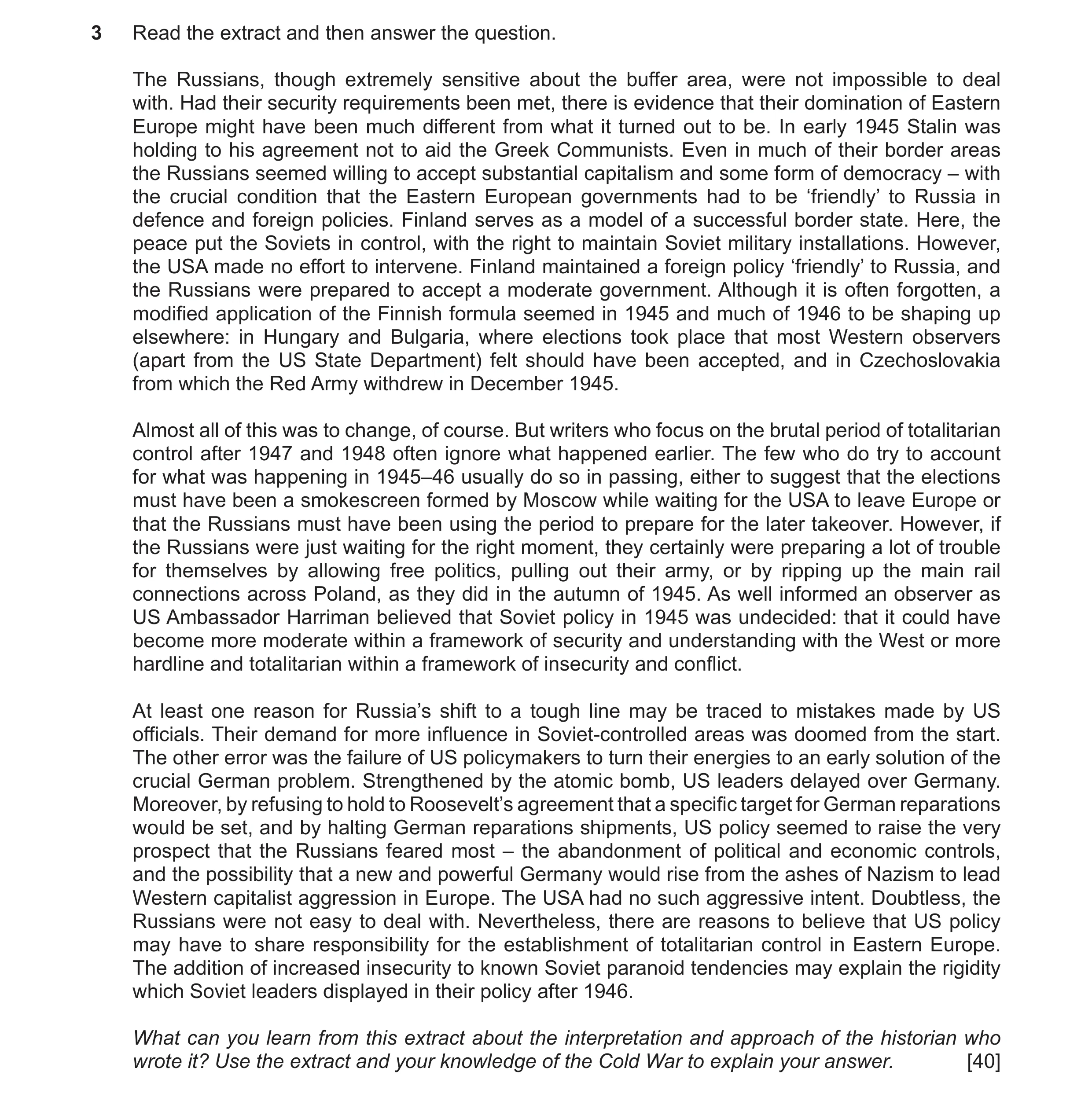
3 Read the extract and then answer the question. The Russians, though extremely sensitive about the buffer area, were not impossible to deal with. Had their security requirements been met, there is evidence that their domination of Eastern Europe might have been much different from what it turned out to be. In early 1945 Stalin was holding to his agreement not to aid the Greek Communists. Even in much of their border areas the Russians seemed willing to accept substantial capitalism and some form of democracy – with the crucial condition that the Eastern European governments had to be ‘friendly’ to Russia in defence and foreign policies. Finland serves as a model of a successful border state. Here, the peace put the Soviets in control, with the right to maintain Soviet military installations. However, the USA made no effort to intervene. Finland maintained a foreign policy ‘friendly’ to Russia, and the Russians were prepared to accept a moderate government. Although it is often forgotten, a modified application of the Finnish formula seemed in 1945 and much of 1946 to be shaping up elsewhere: in Hungary and Bulgaria, where elections took place that most Western observers (apart from the US State Department) felt should have been accepted, and in Czechoslovakia from which the Red Army withdrew in December 1945. Almost all of this was to change, of course. But writers who focus on the brutal period of totalitarian control after 1947 and 1948 often ignore what happened earlier. The few who do try to account for what was happening in 1945–46 usually do so in passing, either to suggest that the elections must have been a smokescreen formed by Moscow while waiting for the USA to leave Europe or that the Russians must have been using the period to prepare for the later takeover. However, if the Russians were just waiting for the right moment, they certainly were preparing a lot of trouble for themselves by allowing free politics, pulling out their army, or by ripping up the main rail connections across Poland, as they did in the autumn of 1945. As well informed an observer as US Ambassador Harriman believed that Soviet policy in 1945 was undecided: that it could have become more moderate within a framework of security and understanding with the West or more hardline and totalitarian within a framework of insecurity and conflict. At least one reason for Russia’s shift to a tough line may be traced to mistakes made by US officials. Their demand for more influence in Soviet-controlled areas was doomed from the start. The other error was the failure of US policymakers to turn their energies to an early solution of the crucial German problem. Strengthened by the atomic bomb, US leaders delayed over Germany. Moreover, by refusing to hold to Roosevelt’s agreement that a specific target for German reparations would be set, and by halting German reparations shipments, US policy seemed to raise the very prospect that the Russians feared most – the abandonment of political and economic controls, and the possibility that a new and powerful Germany would rise from the ashes of Nazism to lead Western capitalist aggression in Europe. The USA had no such aggressive intent. Doubtless, the Russians were not easy to deal with. Nevertheless, there are reasons to believe that US policy may have to share responsibility for the establishment of totalitarian control in Eastern Europe. The addition of increased insecurity to known Soviet paranoid tendencies may explain the rigidity which Soviet leaders displayed in their policy after 1946. What can you learn from this extract about the interpretation and approach of the historian who wrote it? Use the extract and your knowledge of the Cold War to explain your answer. [40]
40 marks
Mark scheme: 3 The Origins and Development of the Cold War ,40 Interpretation/Approach The main interpretation is that the historian blames the US (i) for mistakes made in 1945-6 that pushed the Soviets into hard-line policies, (ii) when they might otherwise have cooperated (must include awareness that the US is blameworthy for not having taken advantage of this). Showing complete understanding of the interpretation will involve discussion of both these aspects. In 1945-6 the Russians would possibly have been prepared to reach an accommodation with the West, and the Americans were responsible for this not happening. The historian believes that the Russians’ main concern was security, and that US policy served to heighten these concerns, and thus brought about the imposition of Soviet totalitarian control in Eastern Europe. Whilst the historian does not exonerate the Russians, the focus of the extract is on the errors and shortcomings of US policy. The only ‘label’ that can work at L5 or L6 is ‘revisionist’. Thinking that the historian is placing blame on the Russians is missing the point and will be L3 at best. Post-revisionist could reach L4 if US blame is properly argued. Glossary: Traditional/Orthodox interpretations of the Cold War were generally produced early after WW2. They blame the Soviet Union and Stalin’s expansionism for the Cold War. Revisionist historians challenged this view and shifted more of the focus onto the United States, generally through an economic approach which stressed the alleged aim of the US to establish its economic dominance over Europe. Post-revisionists moved towards a more balanced view in which elements of blame were attached to both sides. Since the opening of the Soviet archives post-1990 there has been a shift to attributing prime responsibility to Stalin – a post-post-revisionist stance which often seems very close to the traditional view, but which often places great importance on ideology. What counts is how appropriate the use of this kind of terminology is in relation to the extract, and how effectively the extract can be used to support it.
This question in 9489/31 Oct/Nov 2023
Q7 · Read the extract and then answer the question 9489/32 May/June 2024
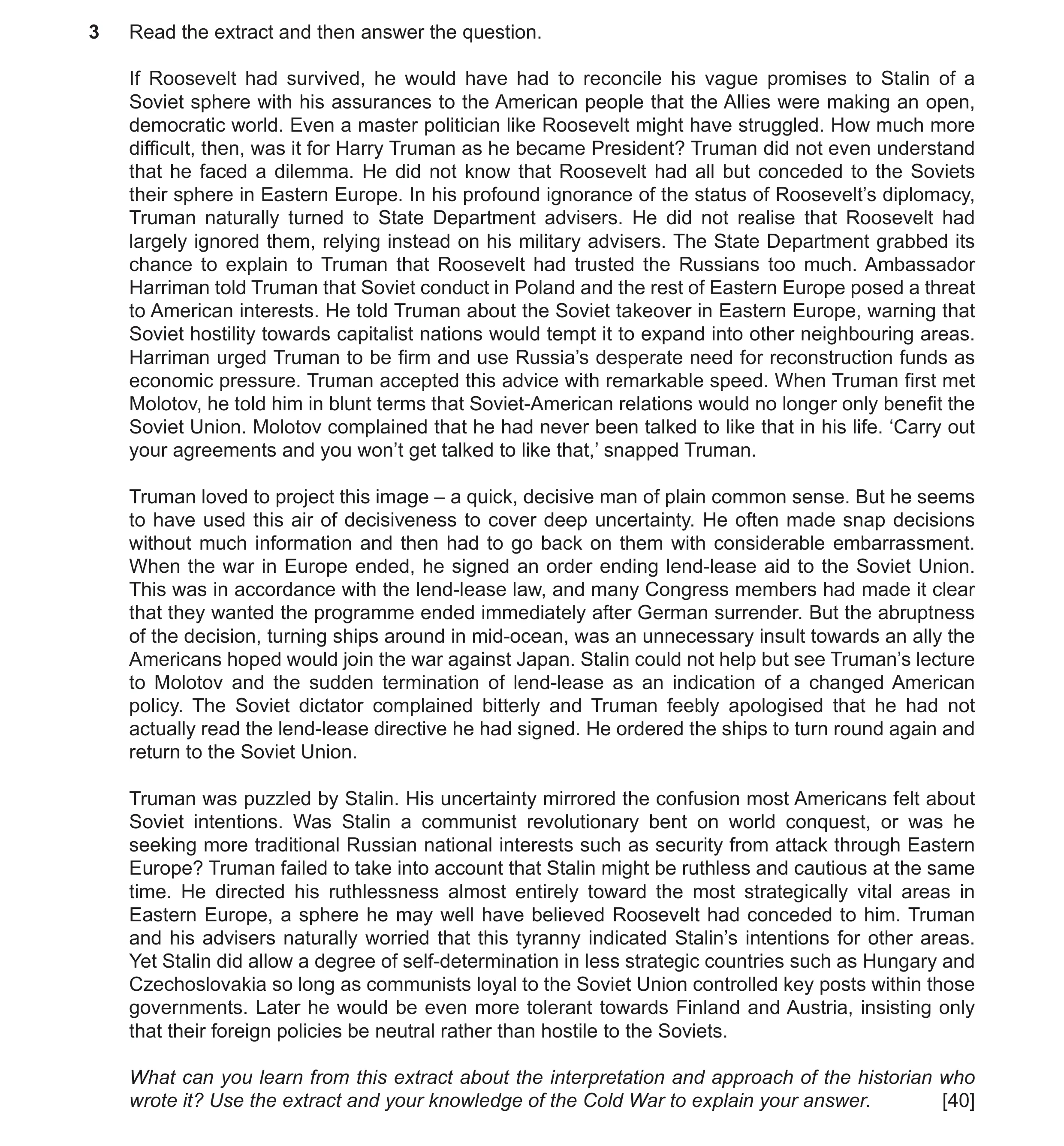
3 Read the extract and then answer the question. If Roosevelt had survived, he would have had to reconcile his vague promises to Stalin of a Soviet sphere with his assurances to the American people that the Allies were making an open, democratic world. Even a master politician like Roosevelt might have struggled. How much more difficult, then, was it for Harry Truman as he became President? Truman did not even understand that he faced a dilemma. He did not know that Roosevelt had all but conceded to the Soviets their sphere in Eastern Europe. In his profound ignorance of the status of Roosevelt’s diplomacy, Truman naturally turned to State Department advisers. He did not realise that Roosevelt had largely ignored them, relying instead on his military advisers. The State Department grabbed its chance to explain to Truman that Roosevelt had trusted the Russians too much. Ambassador Harriman told Truman that Soviet conduct in Poland and the rest of Eastern Europe posed a threat to American interests. He told Truman about the Soviet takeover in Eastern Europe, warning that Soviet hostility towards capitalist nations would tempt it to expand into other neighbouring areas. Harriman urged Truman to be firm and use Russia’s desperate need for reconstruction funds as economic pressure. Truman accepted this advice with remarkable speed. When Truman first met Molotov, he told him in blunt terms that Soviet-American relations would no longer only benefit the Soviet Union. Molotov complained that he had never been talked to like that in his life. ‘Carry out your agreements and you won’t get talked to like that,’ snapped Truman. Truman loved to project this image – a quick, decisive man of plain common sense. But he seems to have used this air of decisiveness to cover deep uncertainty. He often made snap decisions without much information and then had to go back on them with considerable embarrassment. When the war in Europe ended, he signed an order ending lend-lease aid to the Soviet Union. This was in accordance with the lend-lease law, and many Congress members had made it clear that they wanted the programme ended immediately after German surrender. But the abruptness of the decision, turning ships around in mid-ocean, was an unnecessary insult towards an ally the Americans hoped would join the war against Japan. Stalin could not help but see Truman’s lecture to Molotov and the sudden termination of lend-lease as an indication of a changed American policy. The Soviet dictator complained bitterly and Truman feebly apologised that he had not actually read the lend-lease directive he had signed. He ordered the ships to turn round again and return to the Soviet Union. Truman was puzzled by Stalin. His uncertainty mirrored the confusion most Americans felt about Soviet intentions. Was Stalin a communist revolutionary bent on world conquest, or was he seeking more traditional Russian national interests such as security from attack through Eastern Europe? Truman failed to take into account that Stalin might be ruthless and cautious at the same time. He directed his ruthlessness almost entirely toward the most strategically vital areas in Eastern Europe, a sphere he may well have believed Roosevelt had conceded to him. Truman and his advisers naturally worried that this tyranny indicated Stalin’s intentions for other areas. Yet Stalin did allow a degree of self-determination in less strategic countries such as Hungary and Czechoslovakia so long as communists loyal to the Soviet Union controlled key posts within those governments. Later he would be even more tolerant towards Finland and Austria, insisting only that their foreign policies be neutral rather than hostile to the Soviets. What can you learn from this extract about the interpretation and approach of the historian who wrote it? Use the extract and your knowledge of the Cold War to explain your answer. [40]
40 marks
Mark scheme: 3 The Origins and Development of the Cold War 40 Interpretation/Approach The main interpretation blames Truman for shortcomings in his personality (e.g. ignorance, uncertainty, inability to understand), and for his actions which worsened relations with the USSR. Showing complete understanding of the interpretation will involve discussion of both these aspects, but they need explaining separately for L6. Answers making no distinction between actions/personality, but still properly explained, are L5. The historian paints a picture of Truman as ignorant and weak, though not downplaying the problems that Roosevelt left for him. When he takes action, generally it makes matters worse. The only label to attach to this interpretation is revisionist, i.e. as viewing Truman as being at fault, and no other label will be able to attain L5 or L6. Post-revisionist could be L4 if blame on Truman is properly explained. Traditional and post-post-revisionist will be L3 max. Glossary: Traditional/Orthodox interpretations of the Cold War were generally produced early after WW2. They blame the Soviet Union and Stalin’s expansionism for the Cold War. Revisionist historians challenged this view and shifted more of the focus onto the United States, generally through an economic approach which stressed the alleged aim of the US to establish its economic dominance over Europe. Post-revisionists moved towards a more balanced view in which elements of blame were attached to both sides. Since the opening of the Soviet archives post-1990 there has been a shift to attributing prime responsibility to Stalin – a post-post-revisionist stance which often seems very close to the traditional view, but which often places great importance on ideology. What counts is how appropriate the use of this kind of terminology is in relation to the extract, and how effectively the extract can be used to support it.
This question in 9489/32 May/June 2024
Q8 · Read the extract and then answer the question 9489/32 Oct/Nov 2024
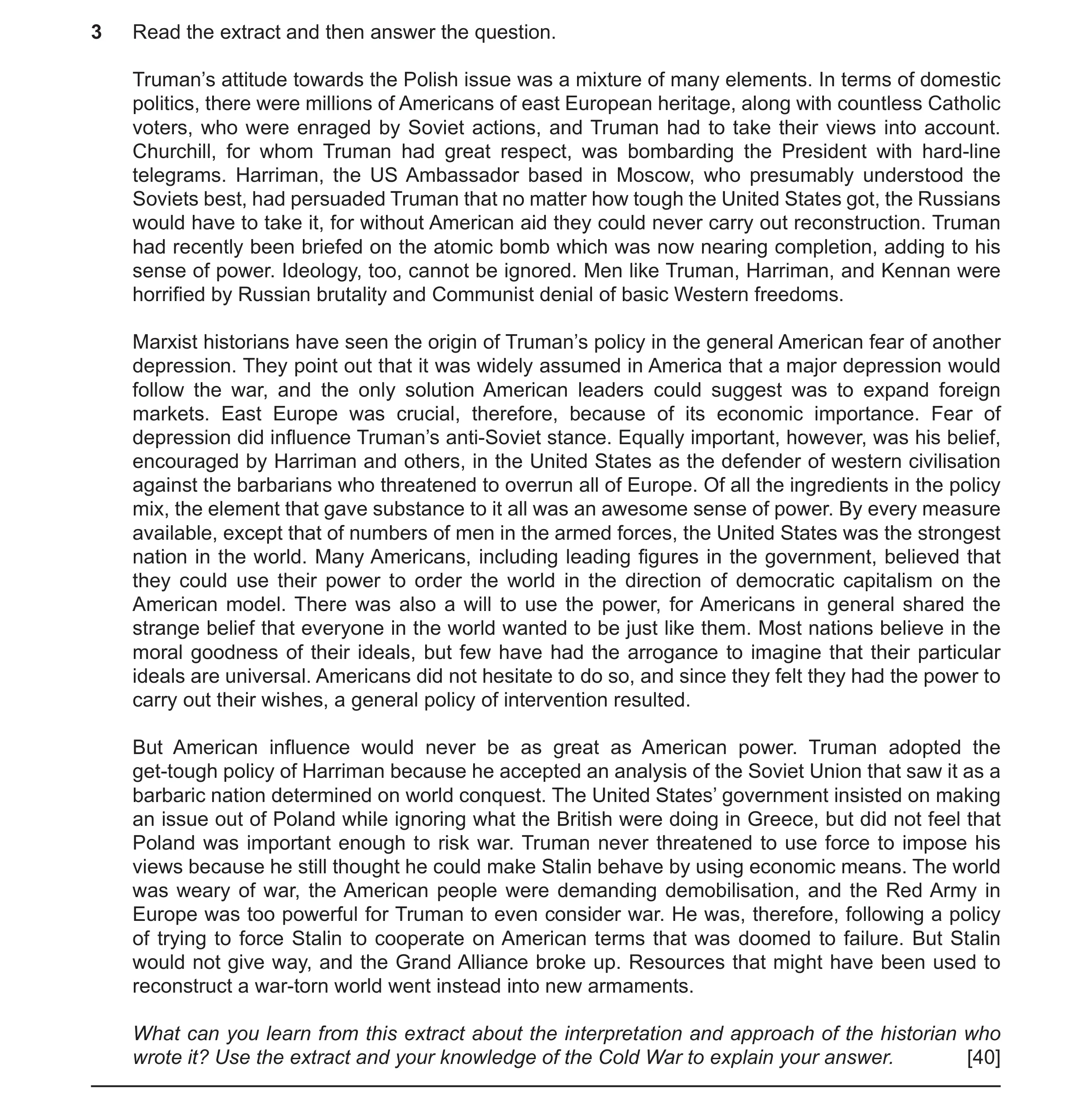
3 Read the extract and then answer the question. Truman’s attitude towards the Polish issue was a mixture of many elements. In terms of domestic politics, there were millions of Americans of east European heritage, along with countless Catholic voters, who were enraged by Soviet actions, and Truman had to take their views into account. Churchill, for whom Truman had great respect, was bombarding the President with hard‑line telegrams. Harriman, the US Ambassador based in Moscow, who presumably understood the Soviets best, had persuaded Truman that no matter how tough the United States got, the Russians would have to take it, for without American aid they could never carry out reconstruction. Truman had recently been briefed on the atomic bomb which was now nearing completion, adding to his sense of power. Ideology, too, cannot be ignored. Men like Truman, Harriman, and Kennan were horrified by Russian brutality and Communist denial of basic Western freedoms. Marxist historians have seen the origin of Truman’s policy in the general American fear of another depression. They point out that it was widely assumed in America that a major depression would follow the war, and the only solution American leaders could suggest was to expand foreign markets. East Europe was crucial, therefore, because of its economic importance. Fear of depression did influence Truman’s anti‑Soviet stance. Equally important, however, was his belief, encouraged by Harriman and others, in the United States as the defender of western civilisation against the barbarians who threatened to overrun all of Europe. Of all the ingredients in the policy mix, the element that gave substance to it all was an awesome sense of power. By every measure available, except that of numbers of men in the armed forces, the United States was the strongest nation in the world. Many Americans, including leading figures in the government, believed that they could use their power to order the world in the direction of democratic capitalism on the American model. There was also a will to use the power, for Americans in general shared the strange belief that everyone in the world wanted to be just like them. Most nations believe in the moral goodness of their ideals, but few have had the arrogance to imagine that their particular ideals are universal. Americans did not hesitate to do so, and since they felt they had the power to carry out their wishes, a general policy of intervention resulted. But American influence would never be as great as American power. Truman adopted the get‑tough policy of Harriman because he accepted an analysis of the Soviet Union that saw it as a barbaric nation determined on world conquest. The United States’ government insisted on making an issue out of Poland while ignoring what the British were doing in Greece, but did not feel that Poland was important enough to risk war. Truman never threatened to use force to impose his views because he still thought he could make Stalin behave by using economic means. The world was weary of war, the American people were demanding demobilisation, and the Red Army in Europe was too powerful for Truman to even consider war. He was, therefore, following a policy of trying to force Stalin to cooperate on American terms that was doomed to failure. But Stalin would not give way, and the Grand Alliance broke up. Resources that might have been used to reconstruct a war‑torn world went instead into new armaments. What can you learn from this extract about the interpretation and approach of the historian who wrote it? Use the extract and your knowledge of the Cold War to explain your answer. [40]
40 marks
Mark scheme: 3 The origins and development of the Cold War 40 Interpretation/Approach The extract blames the US/Truman for heightened tensions. The main interpretation is that the US/Truman is blamed because of (i) misplaced attitudes/assumptions about the rest of the world, and (ii) ineffective/flawed policies towards the Soviet Union. Showing complete understanding of the interpretation will involve discussion of both these aspects. This is an extract that focuses on Truman. It shows him as seeing himself as the defender of Western civilisation against the Soviets, but as lacking a genuine understanding of the real nature and extent of the Soviet threat. He mistook American power for American influence, and in the final analysis was not able to force Stalin to comply. Overall, the historian offers a negative view of the impact of Truman’s policy. This is therefore likely to be seen as a revisionist account, not least with its suggestion of economic motives underpinning US actions. There is relatively little about the Soviet Union in the extract, and certainly no argument that it was to blame for the Cold War. This rules out any other label being appropriate for L5 or L6. Glossary: Traditional/Orthodox interpretations of the Cold War were generally produced early after WW2. They blame the Soviet Union and Stalin’s expansionism for the Cold War. Revisionist historians challenged this view and shifted more of the focus onto the United States, generally through an economic approach which stressed the alleged aim of the US to establish its economic dominance over Europe. Post-revisionists moved towards a more balanced view in which elements of blame were attached to both sides. Since the opening of the Soviet archives post-1990 there has been a shift to attributing prime responsibility to Stalin – a post-post-revisionist stance which often seems very close to the traditional view, but which often places great importance on ideology. What counts is how appropriate the use of this kind of terminology is in relation to the extract, and how effectively the extract can be used to support it.
This question in 9489/32 Oct/Nov 2024
Q9 · Read the extract and then answer the question 9489/32 Feb/March 2025
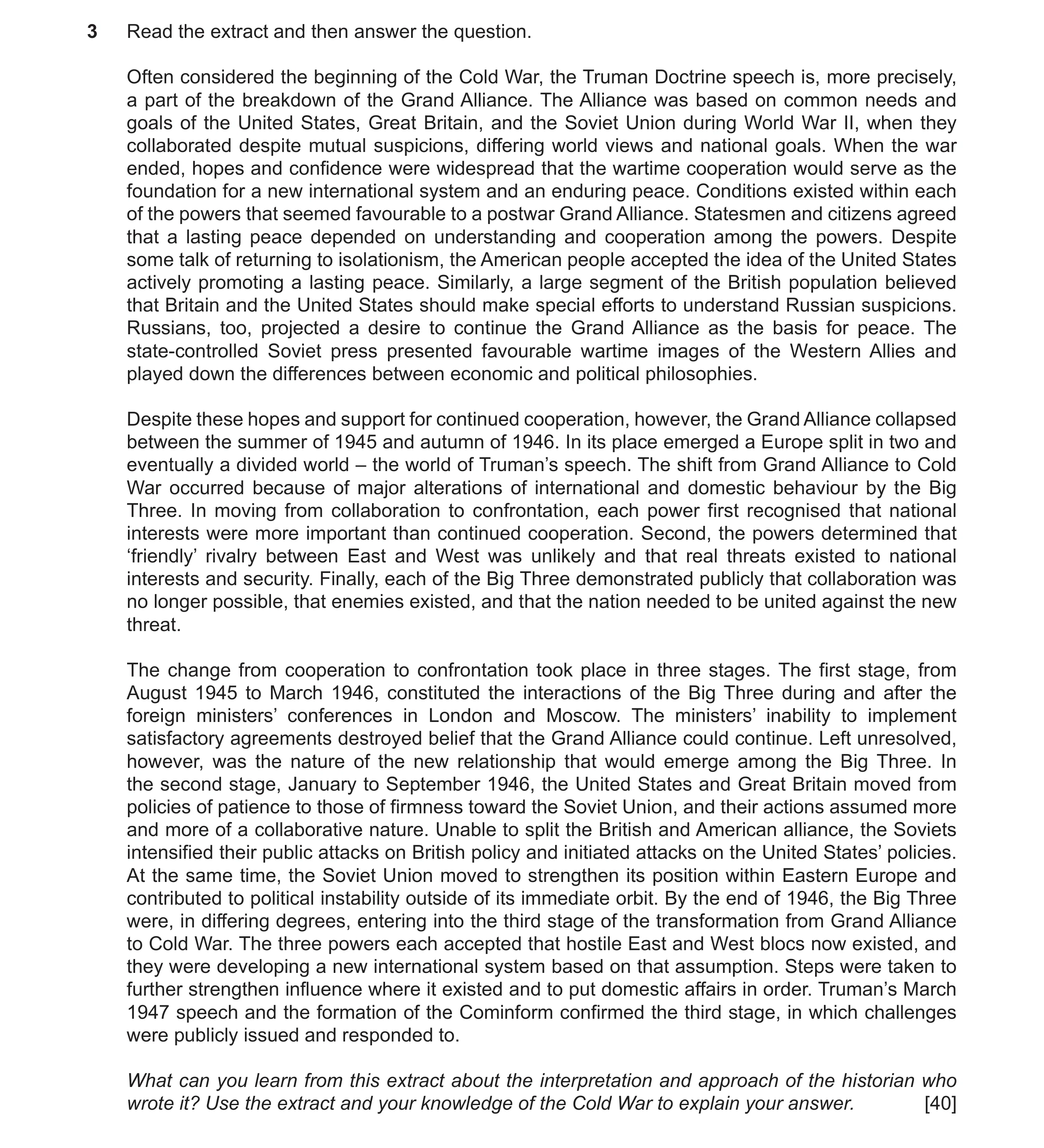
3 Read the extract and then answer the question. Often considered the beginning of the Cold War, the Truman Doctrine speech is, more precisely, a part of the breakdown of the Grand Alliance. The Alliance was based on common needs and goals of the United States, Great Britain, and the Soviet Union during World War II, when they collaborated despite mutual suspicions, differing world views and national goals. When the war ended, hopes and confidence were widespread that the wartime cooperation would serve as the foundation for a new international system and an enduring peace. Conditions existed within each of the powers that seemed favourable to a postwar Grand Alliance. Statesmen and citizens agreed that a lasting peace depended on understanding and cooperation among the powers. Despite some talk of returning to isolationism, the American people accepted the idea of the United States actively promoting a lasting peace. Similarly, a large segment of the British population believed that Britain and the United States should make special efforts to understand Russian suspicions. Russians, too, projected a desire to continue the Grand Alliance as the basis for peace. The state-controlled Soviet press presented favourable wartime images of the Western Allies and played down the differences between economic and political philosophies. Despite these hopes and support for continued cooperation, however, the Grand Alliance collapsed between the summer of 1945 and autumn of 1946. In its place emerged a Europe split in two and eventually a divided world – the world of Truman’s speech. The shift from Grand Alliance to Cold War occurred because of major alterations of international and domestic behaviour by the Big Three. In moving from collaboration to confrontation, each power first recognised that national interests were more important than continued cooperation. Second, the powers determined that ‘friendly’ rivalry between East and West was unlikely and that real threats existed to national interests and security. Finally, each of the Big Three demonstrated publicly that collaboration was no longer possible, that enemies existed, and that the nation needed to be united against the new threat. The change from cooperation to confrontation took place in three stages. The first stage, from August 1945 to March 1946, constituted the interactions of the Big Three during and after the foreign ministers’ conferences in London and Moscow. The ministers’ inability to implement satisfactory agreements destroyed belief that the Grand Alliance could continue. Left unresolved, however, was the nature of the new relationship that would emerge among the Big Three. In the second stage, January to September 1946, the United States and Great Britain moved from policies of patience to those of firmness toward the Soviet Union, and their actions assumed more and more of a collaborative nature. Unable to split the British and American alliance, the Soviets intensified their public attacks on British policy and initiated attacks on the United States’ policies. At the same time, the Soviet Union moved to strengthen its position within Eastern Europe and contributed to political instability outside of its immediate orbit. By the end of 1946, the Big Three were, in differing degrees, entering into the third stage of the transformation from Grand Alliance to Cold War. The three powers each accepted that hostile East and West blocs now existed, and they were developing a new international system based on that assumption. Steps were taken to further strengthen influence where it existed and to put domestic affairs in order. Truman’s March 1947 speech and the formation of the Cominform confirmed the third stage, in which challenges were publicly issued and responded to. What can you learn from this extract about the interpretation and approach of the historian who wrote it? Use the extract and your knowledge of the Cold War to explain your answer. [40]
40 marks
Mark scheme: 3 The Origins and Development of the Cold War 40 Interpretation/Approach The main interpretation blames all three powers, (i) for deciding that cooperation could no longer be the policy, and (ii) for taking steps that led towards confrontation. Showing complete understanding of the Interpretation will involve discussion of both these aspects. Despite good intentions, the Grand Alliance was bound to collapse because the national interests of the Big Three had only aligned in wartime, and postwar they found it impossible to continue working together. In portraying the Cold War being brought about by the three powers equally, the approach is clearly post-revisionist, which is the only label acceptable in L5/L6. L3 may be given for arguing any individual country is being blamed, and L4 for identifying the interpretation but without giving valid explanation and support. Glossary: Traditional/Orthodox interpretations of the Cold War were generally produced early after WW2. They blame the Soviet Union and Stalin’s expansionism for the Cold War. Revisionist historians challenged this view and shifted more of the focus onto the United States, generally through an economic approach which stressed the alleged aim of the US to establish its economic dominance over Europe. Post-revisionists moved towards a more balanced view in which elements of blame were attached to both sides. Since the opening of the Soviet archives post-1990 there has been a shift to attributing prime responsibility to Stalin – a post-post-revisionist stance which often seems very close to the traditional view, but which often places great importance on ideology. What counts is how appropriate the use of this kind of terminology is in relation to the extract, and how effectively the extract can be used to support it.
This question in 9489/32 Feb/March 2025
Q10 · Read the extract and then answer the question 9489/31 May/June 2025
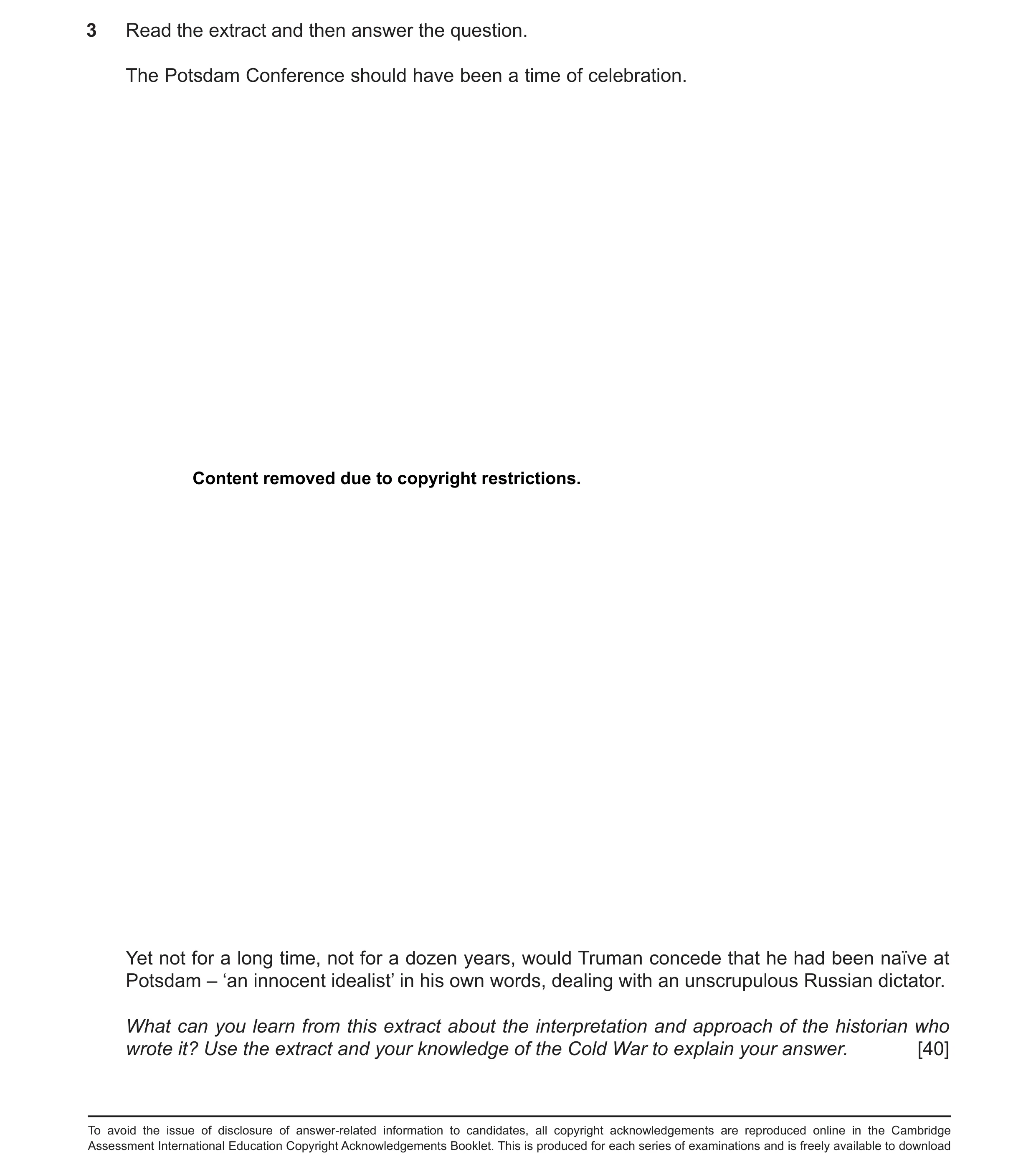
3 Read the extract and then answer the question. The Potsdam Conference should have been a time of celebration. Content removed due to copyright restrictions. Yet not for a long time, not for a dozen years, would Truman concede that he had been naïve at Potsdam – ‘an innocent idealist’ in his own words, dealing with an unscrupulous Russian dictator. What can you learn from this extract about the interpretation and approach of the historian who wrote it? Use the extract and your knowledge of the Cold War to explain your answer. [40] To avoid the issue of disclosure of answer‑related information to candidates, all copyright acknowledgements are reproduced online in the Cambridge Assessment International Education Copyright Acknowledgements Booklet. This is produced for each series of examinations and is freely available to download
40 marks
Mark scheme: 3 The origins and development of the Cold War 40 Interpretation/Approach The main interpretation is that the Russians are blamed for worsening relations because (i) of their intransigence, (ii) whilst Truman genuinely tried to reach agreement with them. Showing complete understanding of the Interpretation will involve discussion of both these aspects. This historian is sympathetic towards Truman, though not entirely uncritical. The extract argues that Truman wanted to work with the Russians but was prevented from doing so successfully by their obstructive tactics. The Russians are portrayed as stubborn and immovable and gained more than perhaps they should. The only label acceptable at L6 is traditional/orthodox, if both aspects of the main interpretation are explained. Claims that the approach is post-post- revisionist can be awarded max. L5 with Russian blame explained. Post- revisionist can be L4 if Russian blame properly explained. L3 for post- revisionist, no side blamed, or revisionist, US blamed. Glossary: Traditional/Orthodox interpretations of the Cold War were generally produced early after WW2. They blame the Soviet Union and Stalin’s expansionism for the Cold War. Revisionist historians challenged this view and shifted more of the focus onto the United States, generally through an economic approach which stressed the alleged aim of the US to establish its economic dominance over Europe. Post-revisionists moved towards a more balanced view in which elements of blame were attached to both sides. Since the opening of the Soviet archives post-1990 there has been a shift to attributing prime responsibility to Stalin – a post-post-revisionist stance which often seems very close to the traditional view, but which often places great importance on ideology. What counts is how appropriate the use of this kind of terminology is in relation to the extract, and how effectively the extract can be used to support it.
This question in 9489/31 May/June 2025
Q11 · Read the extract and then answer the question 9489/32 May/June 2025
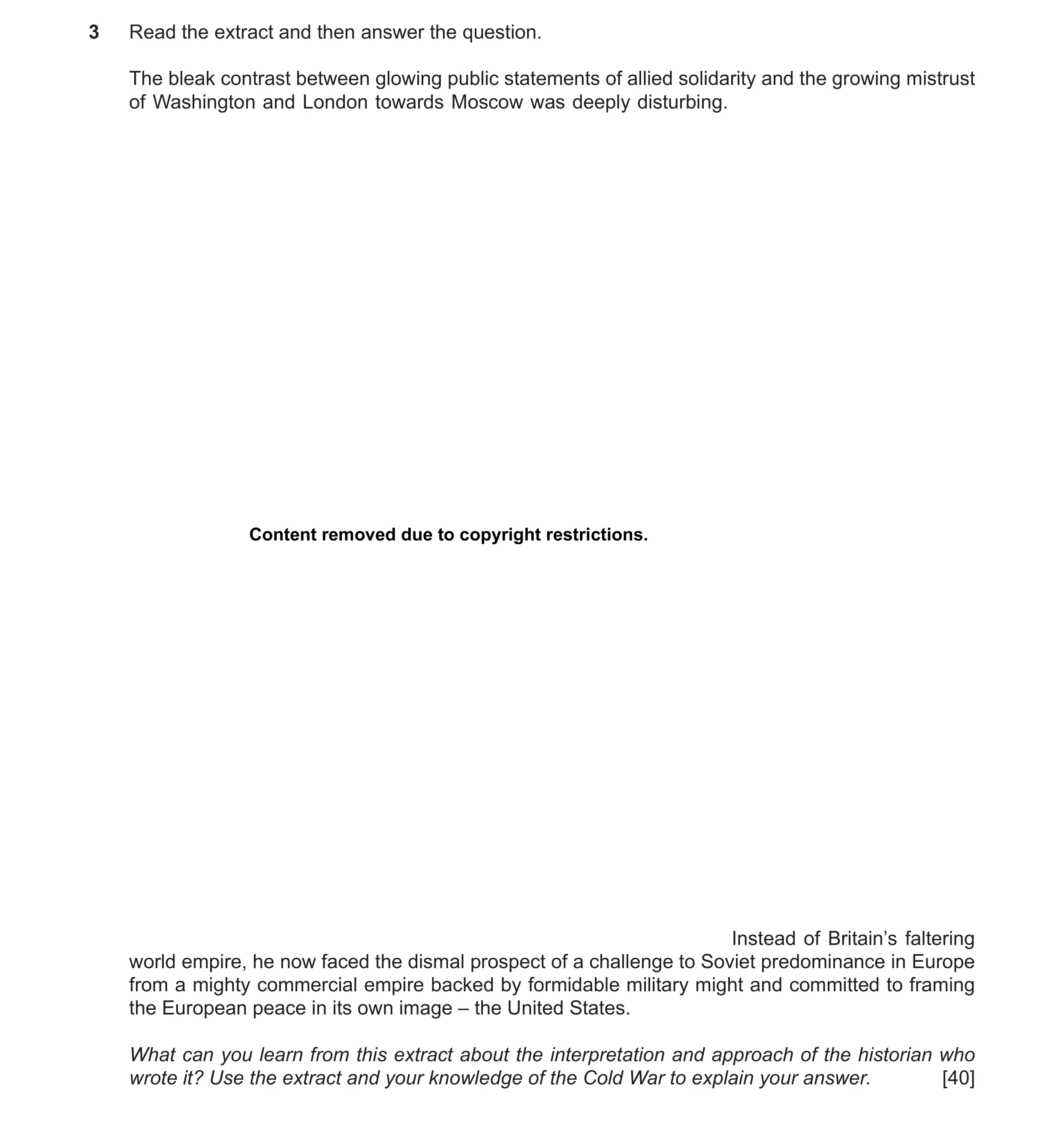
3 Read the extract and then answer the question. The bleak contrast between glowing public statements of allied solidarity and the growing mistrust of Washington and London towards Moscow was deeply disturbing. Content removed due to copyright restrictions. Instead of Britain’s faltering world empire, he now faced the dismal prospect of a challenge to Soviet predominance in Europe from a mighty commercial empire backed by formidable military might and committed to framing the European peace in its own image – the United States. What can you learn from this extract about the interpretation and approach of the historian who wrote it? Use the extract and your knowledge of the Cold War to explain your answer. [40]
40 marks
Mark scheme: 3 The origins and development of the Cold War 40 Interpretation/Approach The main interpretation blames Stalin because (i) by the end of the war he was already withdrawing into ideologically driven hostility towards the West, and (ii) was pursuing expansionist policies to support this. Showing complete understanding of the interpretation will involve discussion of both these aspects. The historian clearly holds Stalin responsible for the worsening of relations and makes no suggestion that the West was culpable. With its stress on Stalin, and on ideology as being the basis for Soviet expansionism, the approach is post-post revisionist, which is the only label acceptable at L6. Traditional/orthodox can be L5 if Russian blame is properly explained from the main interpretation. Post-revisionist, with Russian blame properly explained, will be L4. Post-revisionist with nobody blamed is L3, as is revisionism (US blamed). Note: if ideology and expansionism are not dealt with separately, but are rolled together into a single point, then max L5. Glossary: Traditional/Orthodox interpretations of the Cold War were generally produced early after WW2. They blame the Soviet Union and Stalin’s expansionism for the Cold War. Revisionist historians challenged this view and shifted more of the focus onto the United States, generally through an economic approach which stressed the alleged aim of the US to establish its economic dominance over Europe. Post-revisionists moved towards a more balanced view in which elements of blame were attached to both sides. Since the opening of the Soviet archives post-1990 there has been a shift to attributing prime responsibility to Stalin – a post-post-revisionist stance which often seems very close to the traditional view, but which often places great importance on ideology. What counts is how appropriate the use of this kind of terminology is in relation to the extract, and how effectively the extract can be used to support it.
This question in 9489/32 May/June 2025
Q12 · Read the extract and then answer the question 9489/33 May/June 2025
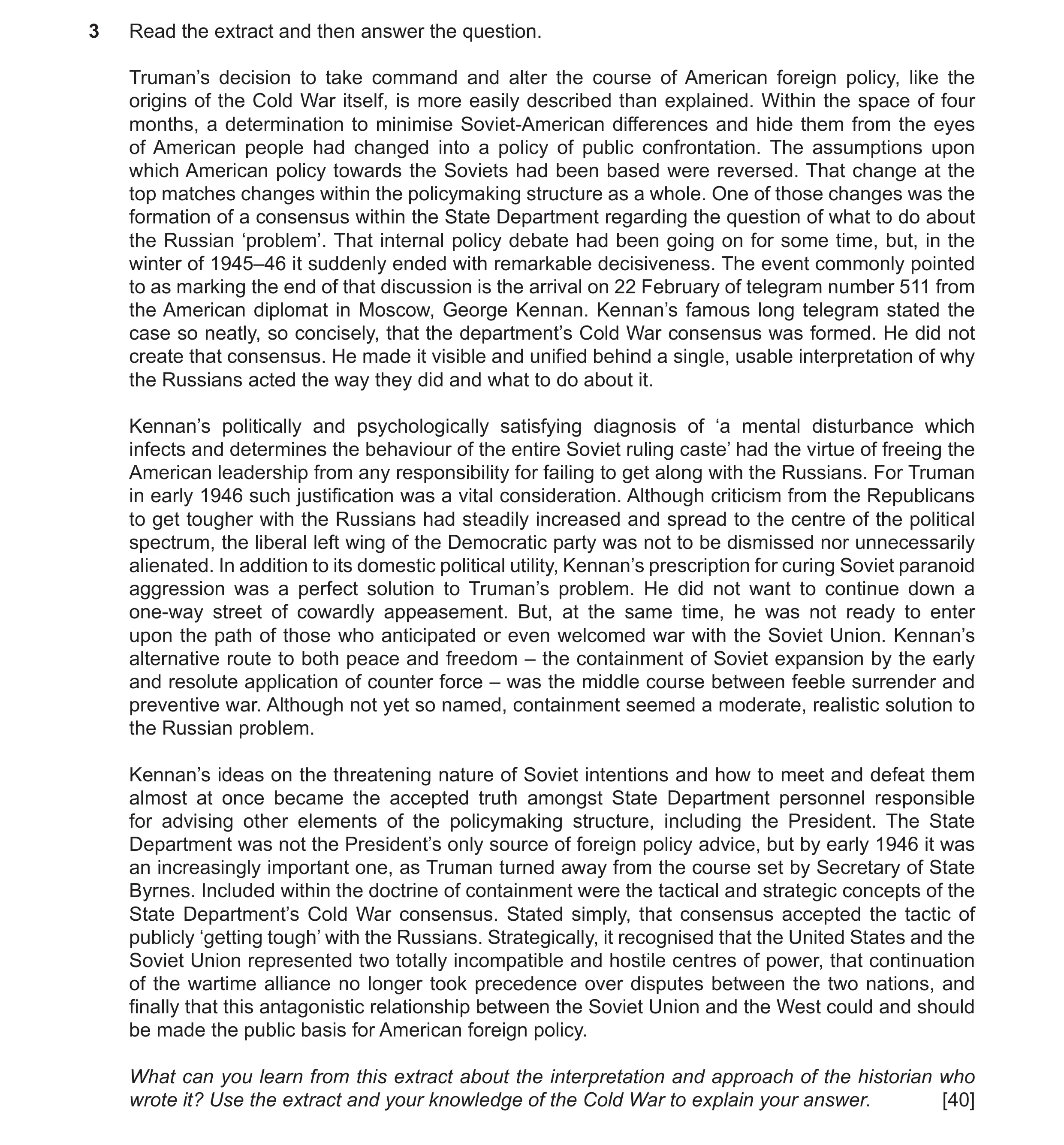
3 Read the extract and then answer the question. Truman’s decision to take command and alter the course of American foreign policy, like the origins of the Cold War itself, is more easily described than explained. Within the space of four months, a determination to minimise Soviet-American differences and hide them from the eyes of American people had changed into a policy of public confrontation. The assumptions upon which American policy towards the Soviets had been based were reversed. That change at the top matches changes within the policymaking structure as a whole. One of those changes was the formation of a consensus within the State Department regarding the question of what to do about the Russian ‘problem’. That internal policy debate had been going on for some time, but, in the winter of 1945–46 it suddenly ended with remarkable decisiveness. The event commonly pointed to as marking the end of that discussion is the arrival on 22 February of telegram number 511 from the American diplomat in Moscow, George Kennan. Kennan’s famous long telegram stated the case so neatly, so concisely, that the department’s Cold War consensus was formed. He did not create that consensus. He made it visible and unified behind a single, usable interpretation of why the Russians acted the way they did and what to do about it. Kennan’s politically and psychologically satisfying diagnosis of ‘a mental disturbance which infects and determines the behaviour of the entire Soviet ruling caste’ had the virtue of freeing the American leadership from any responsibility for failing to get along with the Russians. For Truman in early 1946 such justification was a vital consideration. Although criticism from the Republicans to get tougher with the Russians had steadily increased and spread to the centre of the political spectrum, the liberal left wing of the Democratic party was not to be dismissed nor unnecessarily alienated. In addition to its domestic political utility, Kennan’s prescription for curing Soviet paranoid aggression was a perfect solution to Truman’s problem. He did not want to continue down a one-way street of cowardly appeasement. But, at the same time, he was not ready to enter upon the path of those who anticipated or even welcomed war with the Soviet Union. Kennan’s alternative route to both peace and freedom – the containment of Soviet expansion by the early and resolute application of counter force – was the middle course between feeble surrender and preventive war. Although not yet so named, containment seemed a moderate, realistic solution to the Russian problem. Kennan’s ideas on the threatening nature of Soviet intentions and how to meet and defeat them almost at once became the accepted truth amongst State Department personnel responsible for advising other elements of the policymaking structure, including the President. The State Department was not the President’s only source of foreign policy advice, but by early 1946 it was an increasingly important one, as Truman turned away from the course set by Secretary of State Byrnes. Included within the doctrine of containment were the tactical and strategic concepts of the State Department’s Cold War consensus. Stated simply, that consensus accepted the tactic of publicly ‘getting tough’ with the Russians. Strategically, it recognised that the United States and the Soviet Union represented two totally incompatible and hostile centres of power, that continuation of the wartime alliance no longer took precedence over disputes between the two nations, and finally that this antagonistic relationship between the Soviet Union and the West could and should be made the public basis for American foreign policy. What can you learn from this extract about the interpretation and approach of the historian who wrote it? Use the extract and your knowledge of the Cold War to explain your answer. [40]
40 marks
Mark scheme: 3 The origins and development of the Cold War 40 Interpretation/Approach The main interpretation blames Truman for (i) the change in US policy in early 1946, and (ii) the new consensus to ‘get tough’ it brought about in US policymaking circles. Showing complete understanding of the interpretation will involve discussion of both these aspects. The historian states that this change is not easy to explain and does not offer an explanation. There is no explicit blame placed on Truman for adopting the policy of containment, but the focus on US policymaking, and the allocation to Truman of responsibility for the change, can be seen as revisionist. There is not enough material on the USSR to justify seeing it as being blamed. Revisionist is the only acceptable label in L5/L6 and MUST be focused on Truman. General answers on US being blamed (i.e. not clearly on Truman) will be L4. Post-revisionist can only get to L4 if blame on TRUMAN (not US) is properly explained. Blame on the USSR/Stalin will be L3 at best. Glossary: Traditional/Orthodox interpretations of the Cold War were generally produced early after WW2. They blame the Soviet Union and Stalin’s expansionism for the Cold War. Revisionist historians challenged this view and shifted more of the focus onto the United States, generally through an economic approach which stressed the alleged aim of the US to establish its economic dominance over Europe. Post-revisionists moved towards a more balanced view in which elements of blame were attached to both sides. Since the opening of the Soviet archives post-1990 there has been a shift to attributing prime responsibility to Stalin – a post-post-revisionist stance which often seems very close to the traditional view, but which often places great importance on ideology. What counts is how appropriate the use of this kind of terminology is in relation to the extract, and how effectively the extract can be used to support it.
This question in 9489/33 May/June 2025
 1 / 12
 2 / 12
 3 / 12
 4 / 12
 5 / 12
 6 / 12
 7 / 12
 8 / 12
 9 / 12
 10 / 12
 11 / 12
 12 / 12
 40
40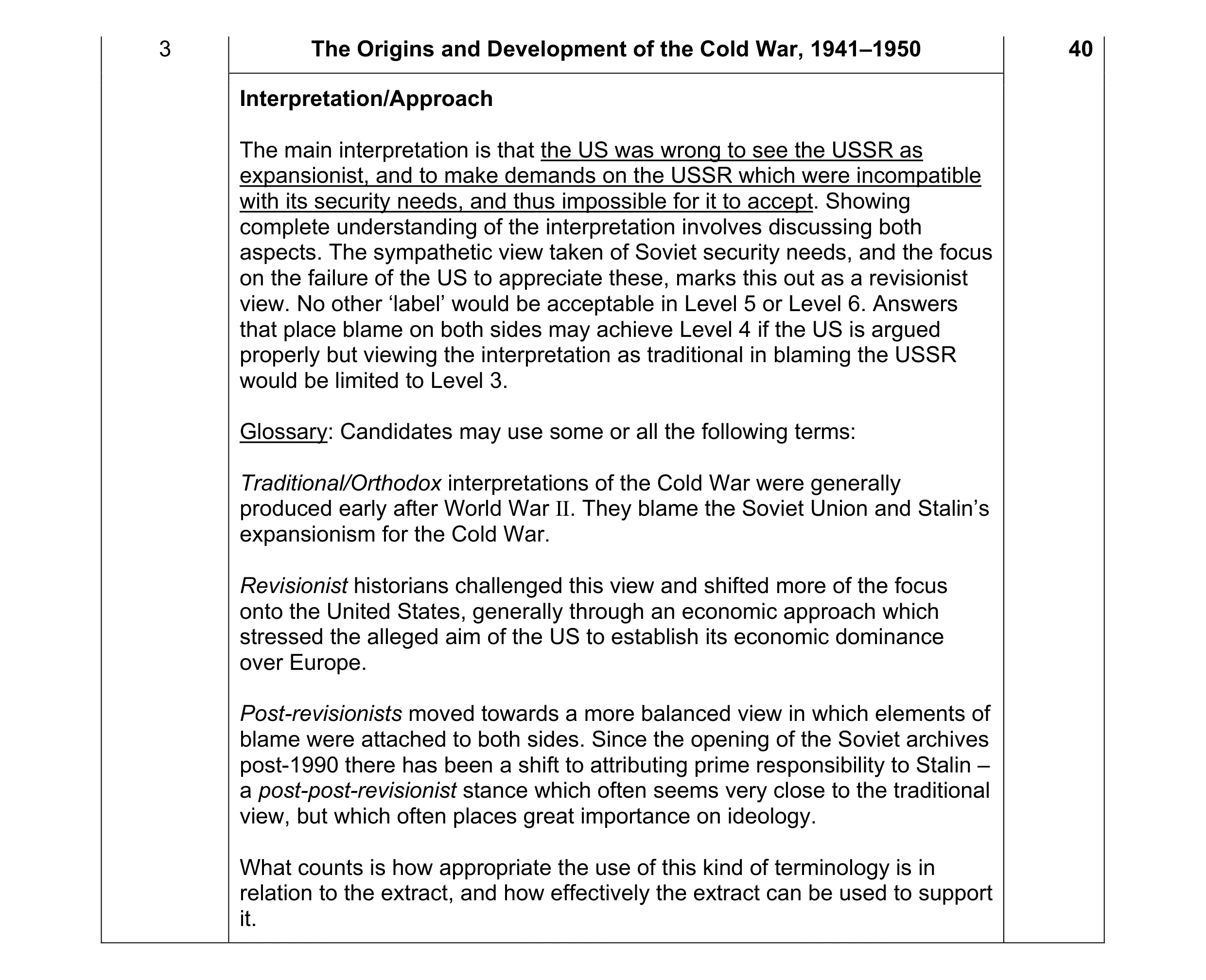 40
40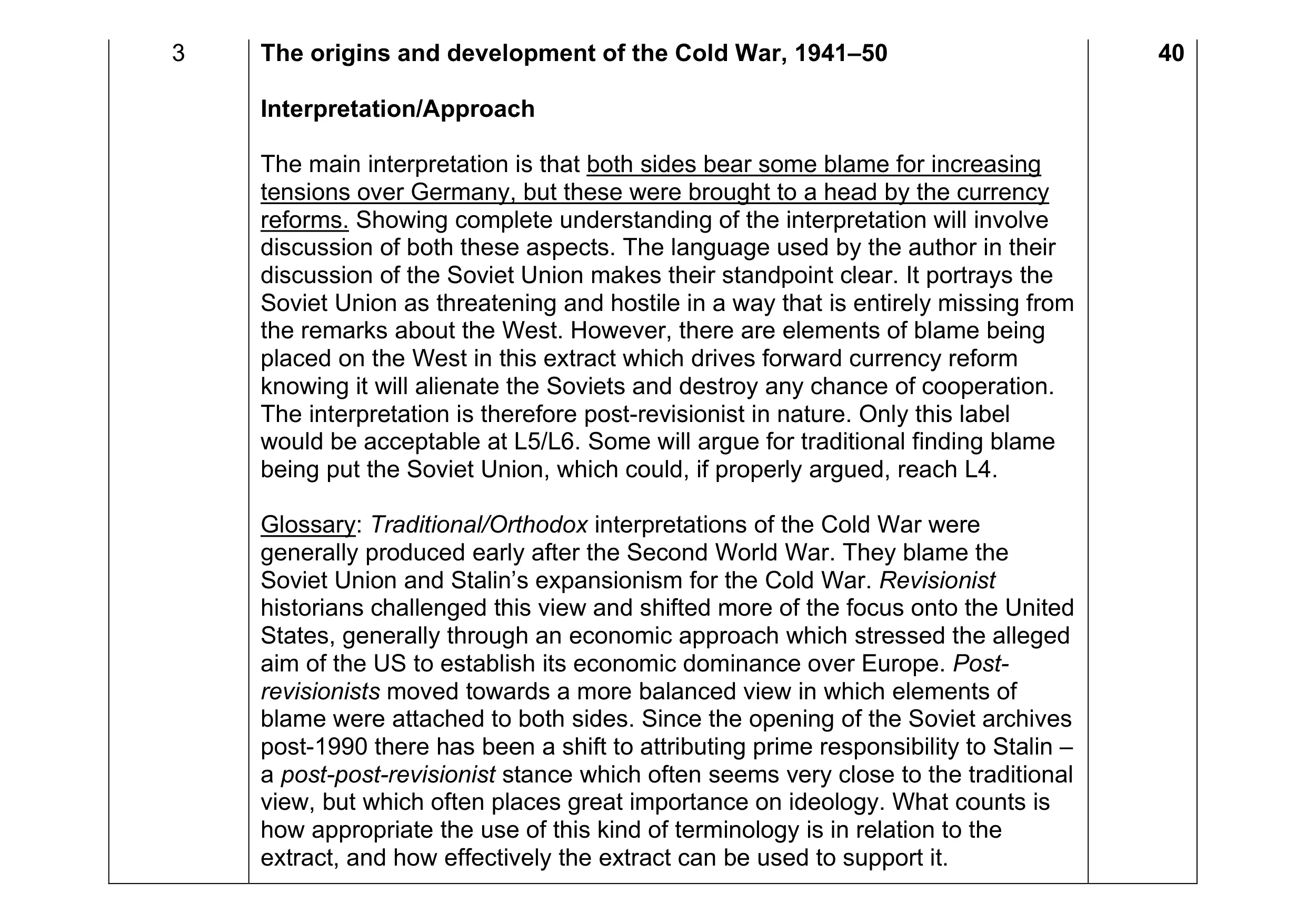 40
40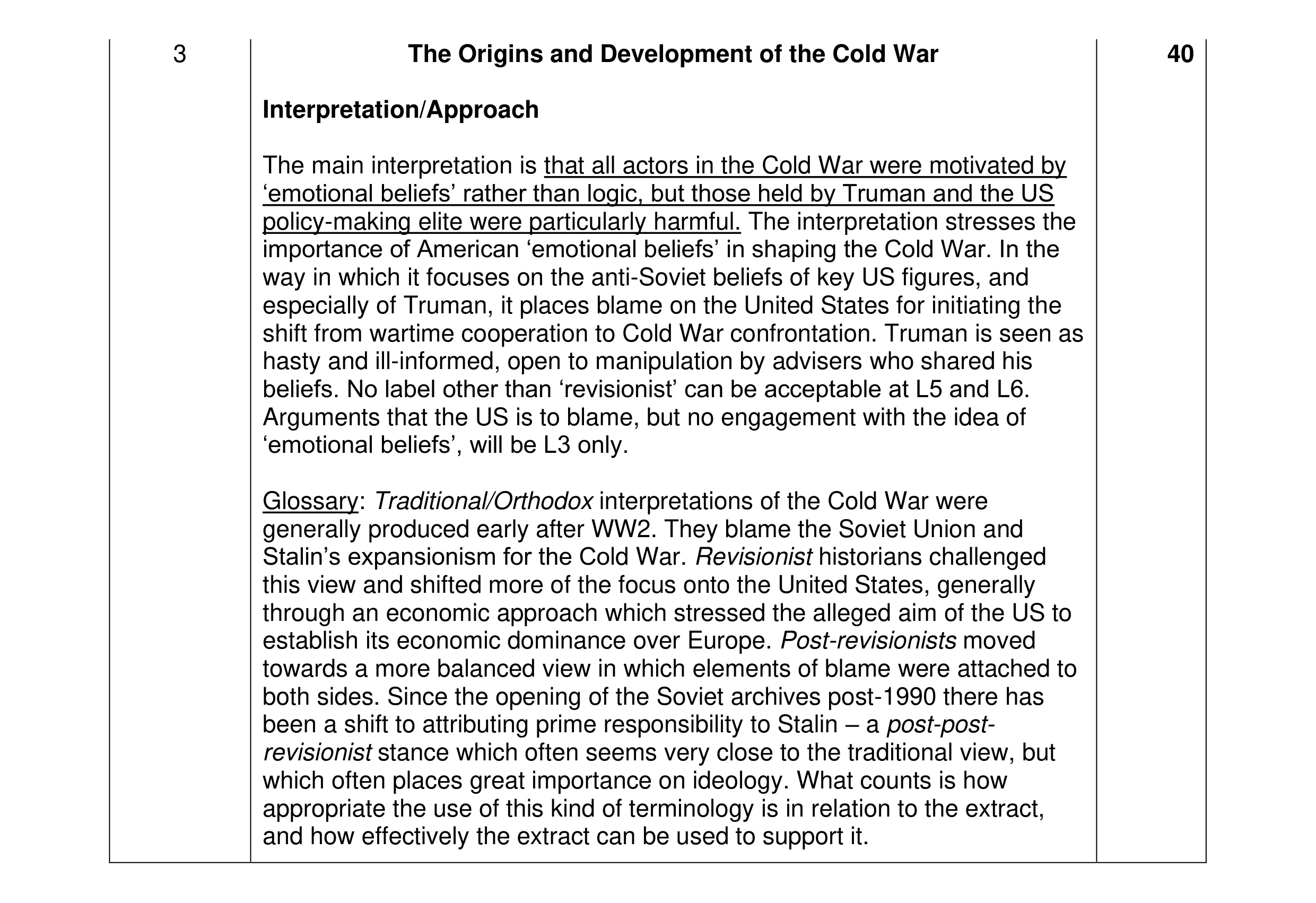 40
40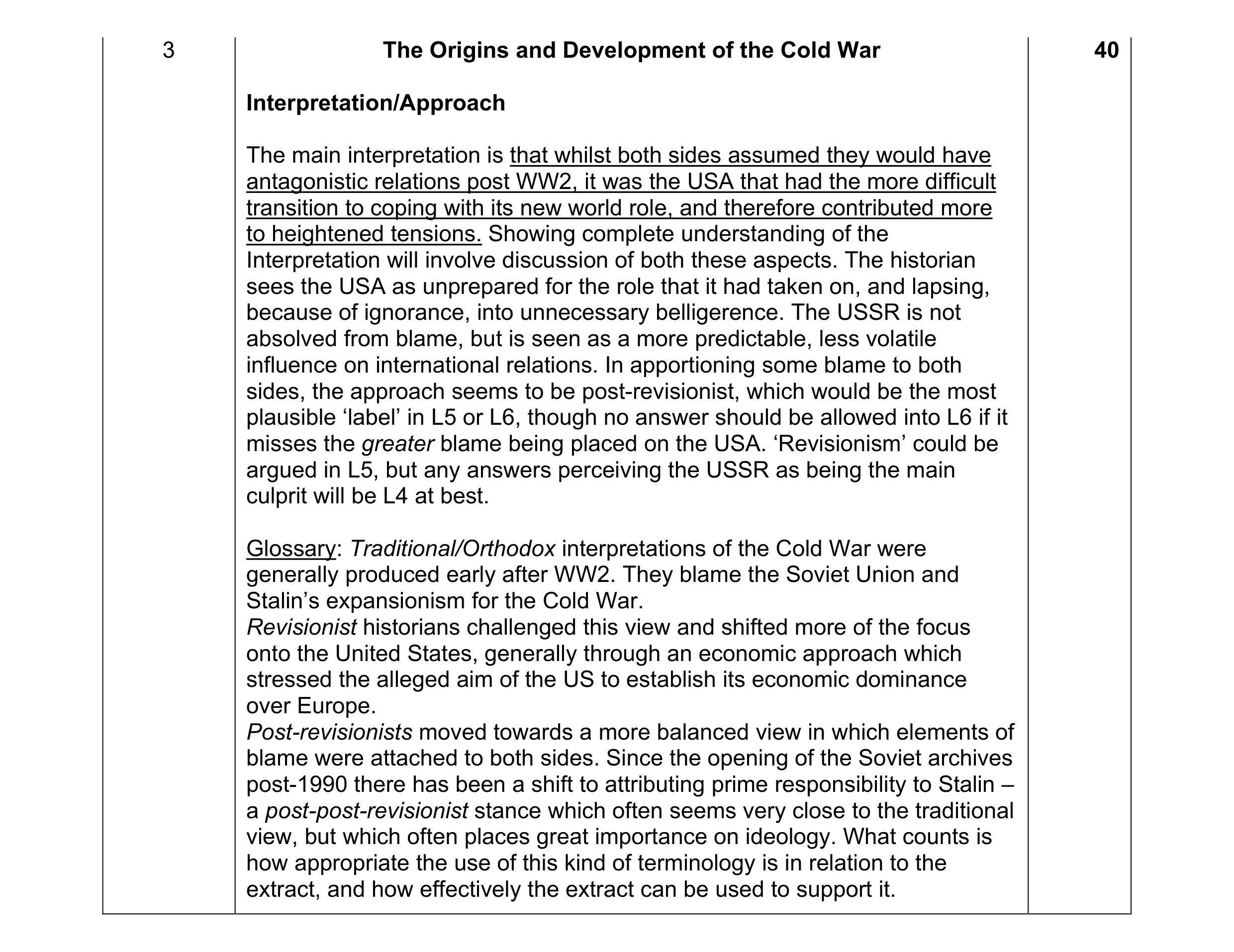 40
40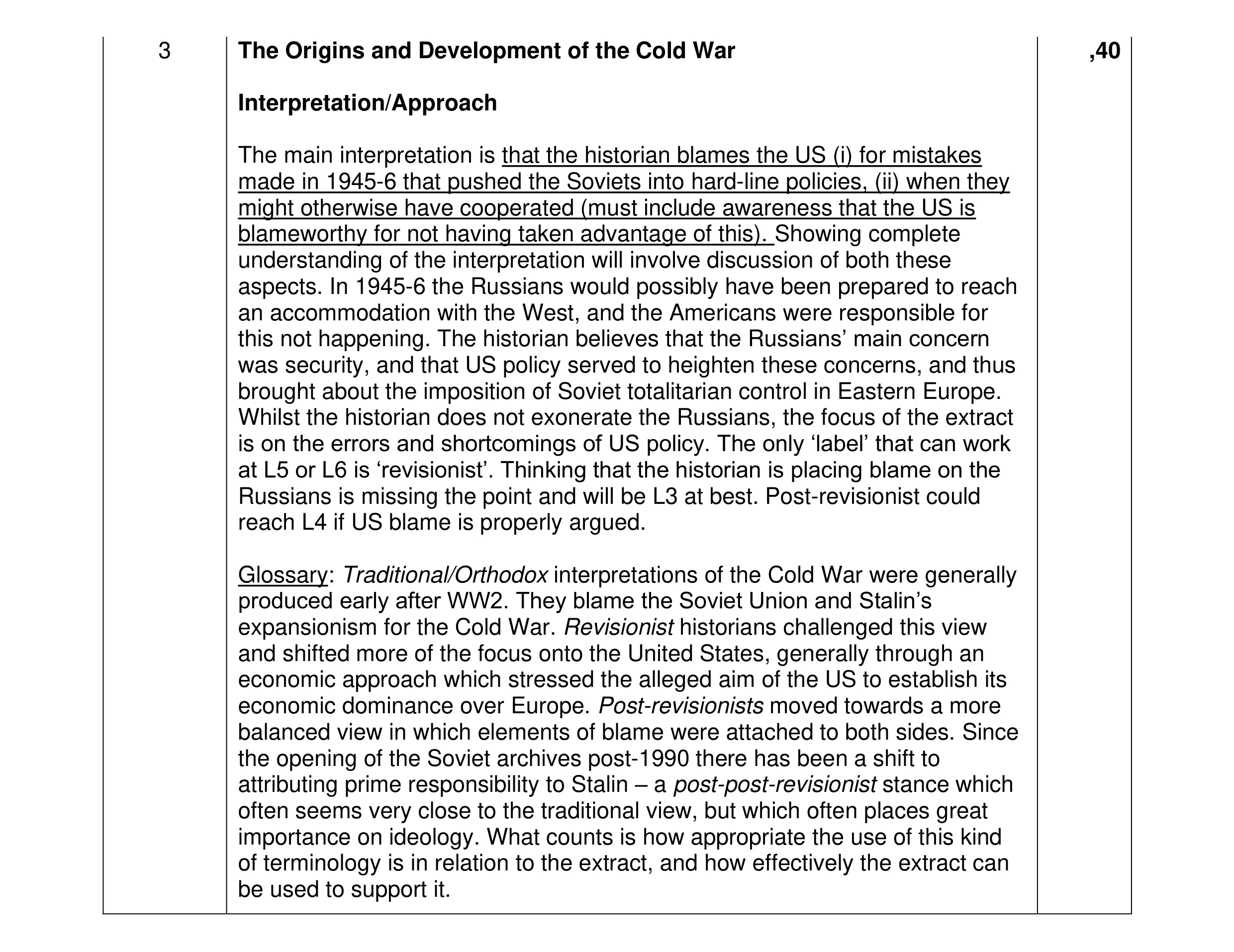 40
40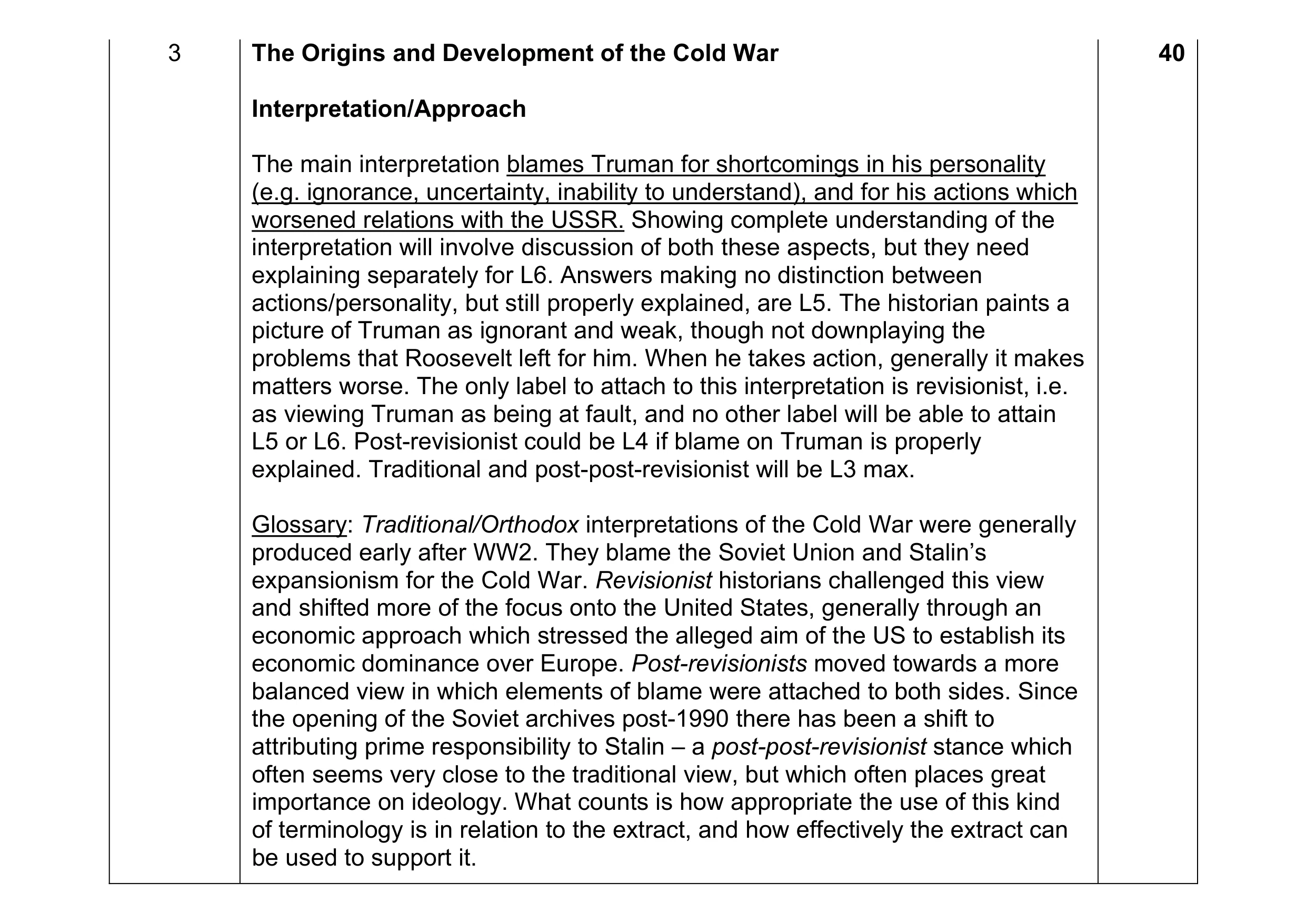 40
40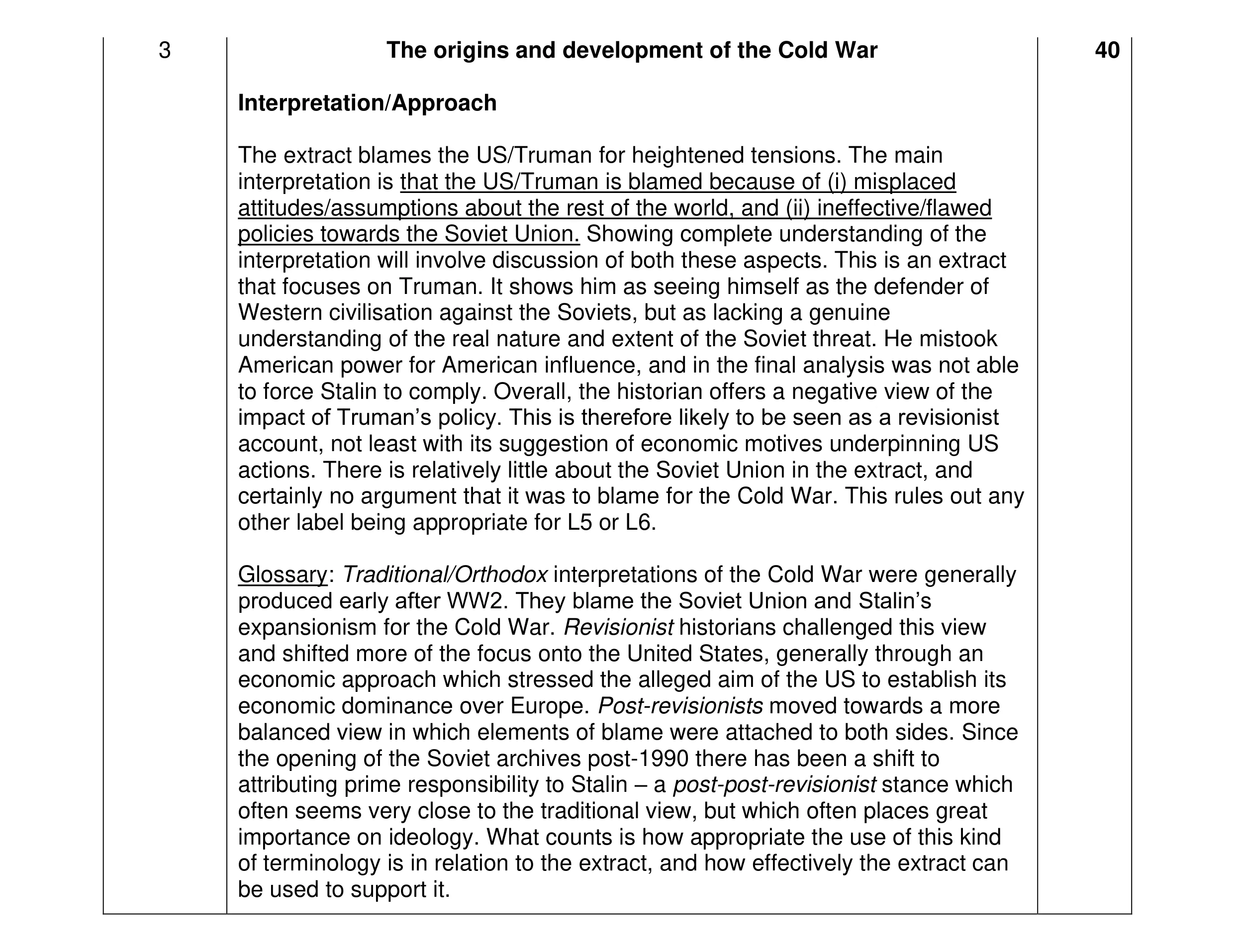 40
40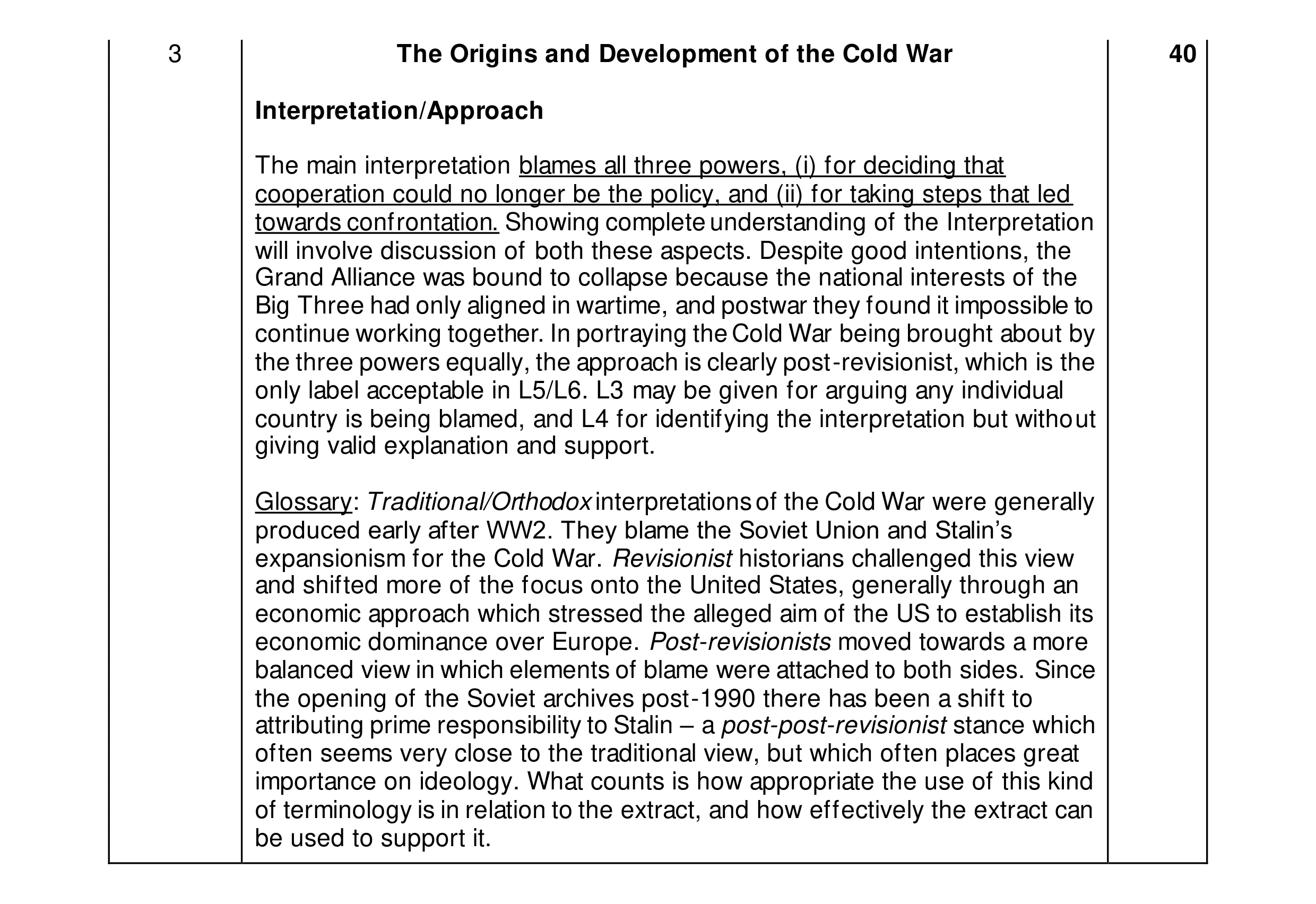 40
40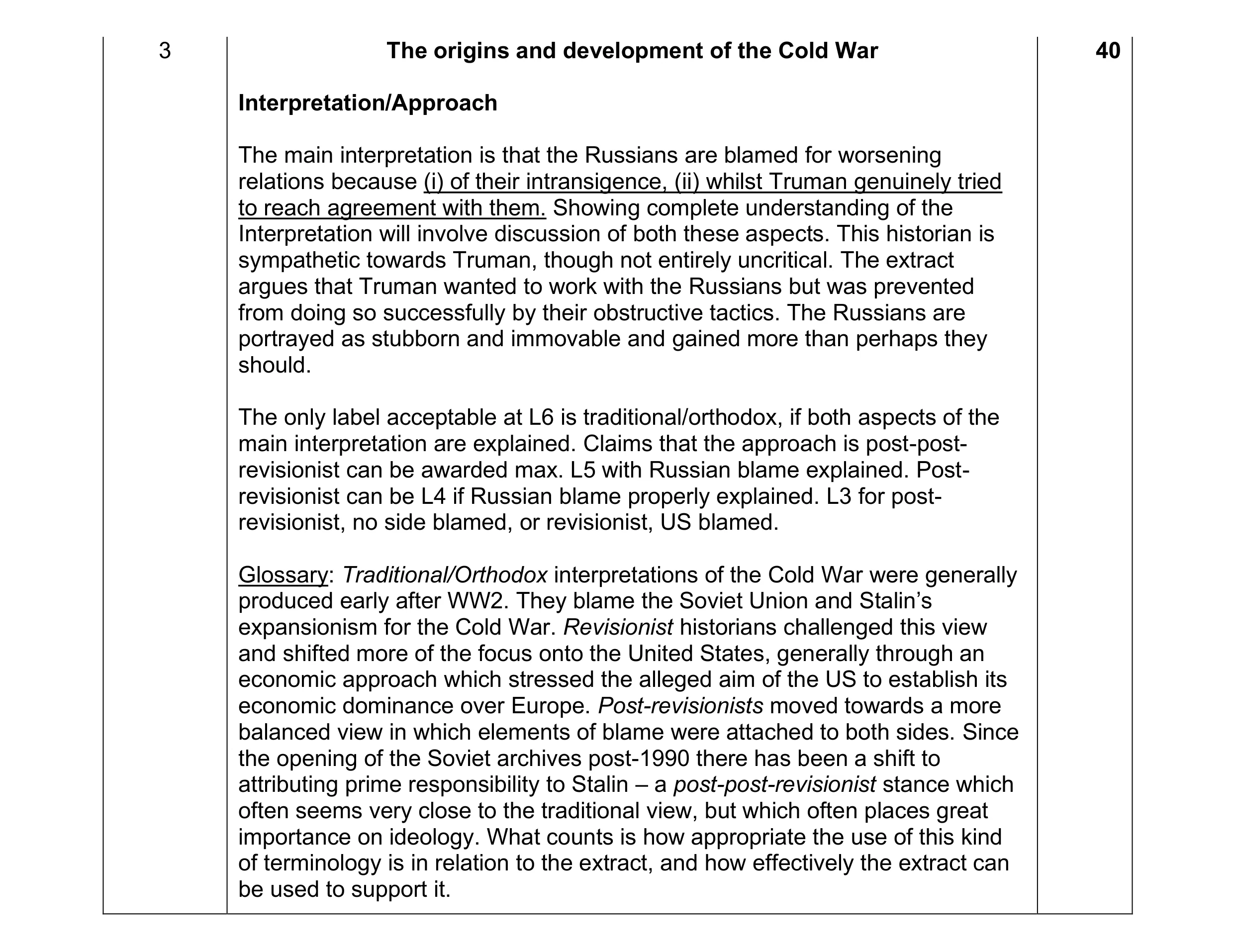 40
40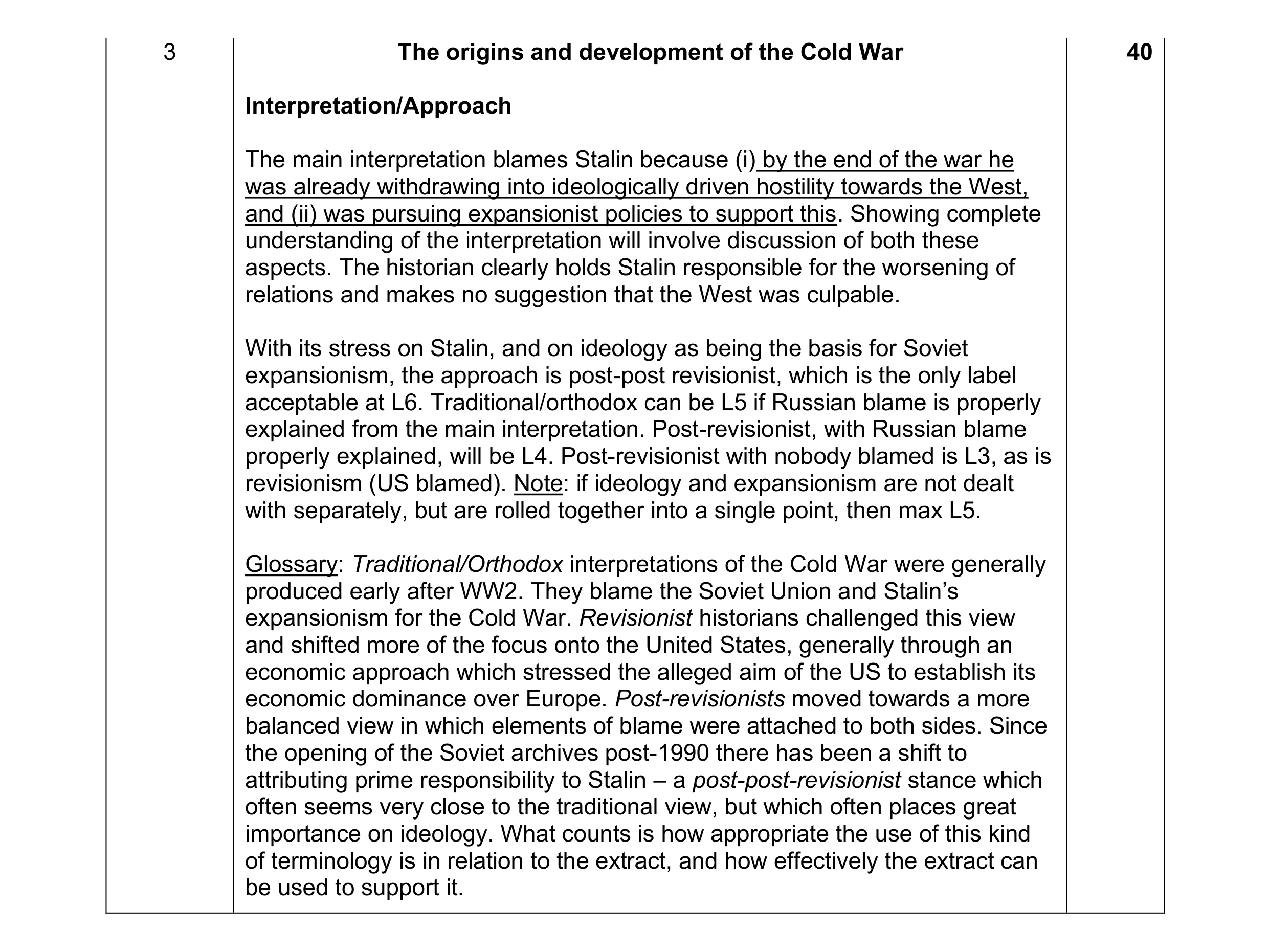 40
40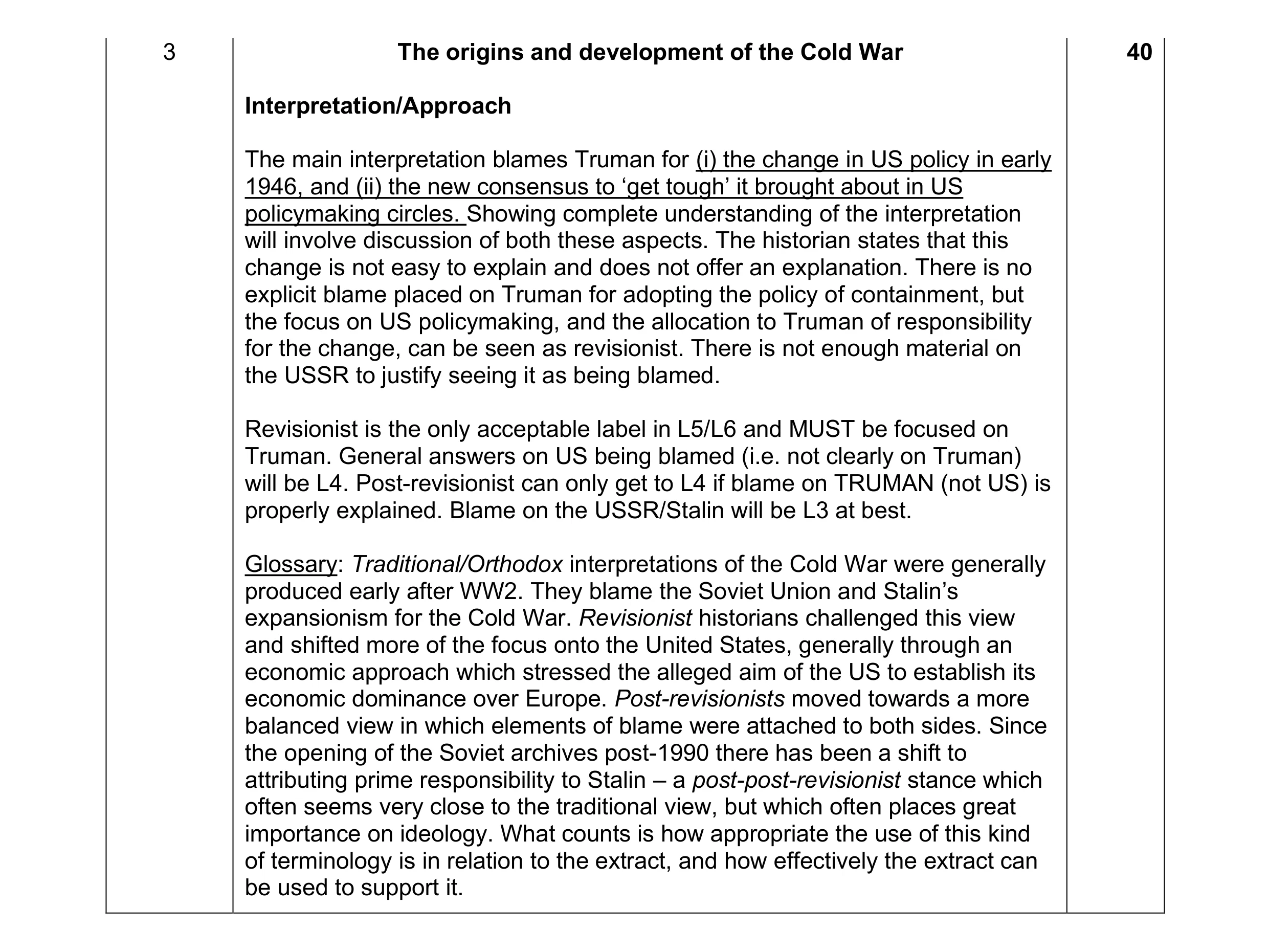 40
40