Cambridge A Level History 9489 — 2023 Oct/Nov Paper 3 · Variant 1
9489/31/O/N/23 · 3 questions · 40 marks · ≈45 min
The question paper and its mark scheme, free to read here and free to download. This is Cambridge’s own paper, exactly as it was sat.
Question paper4 pages
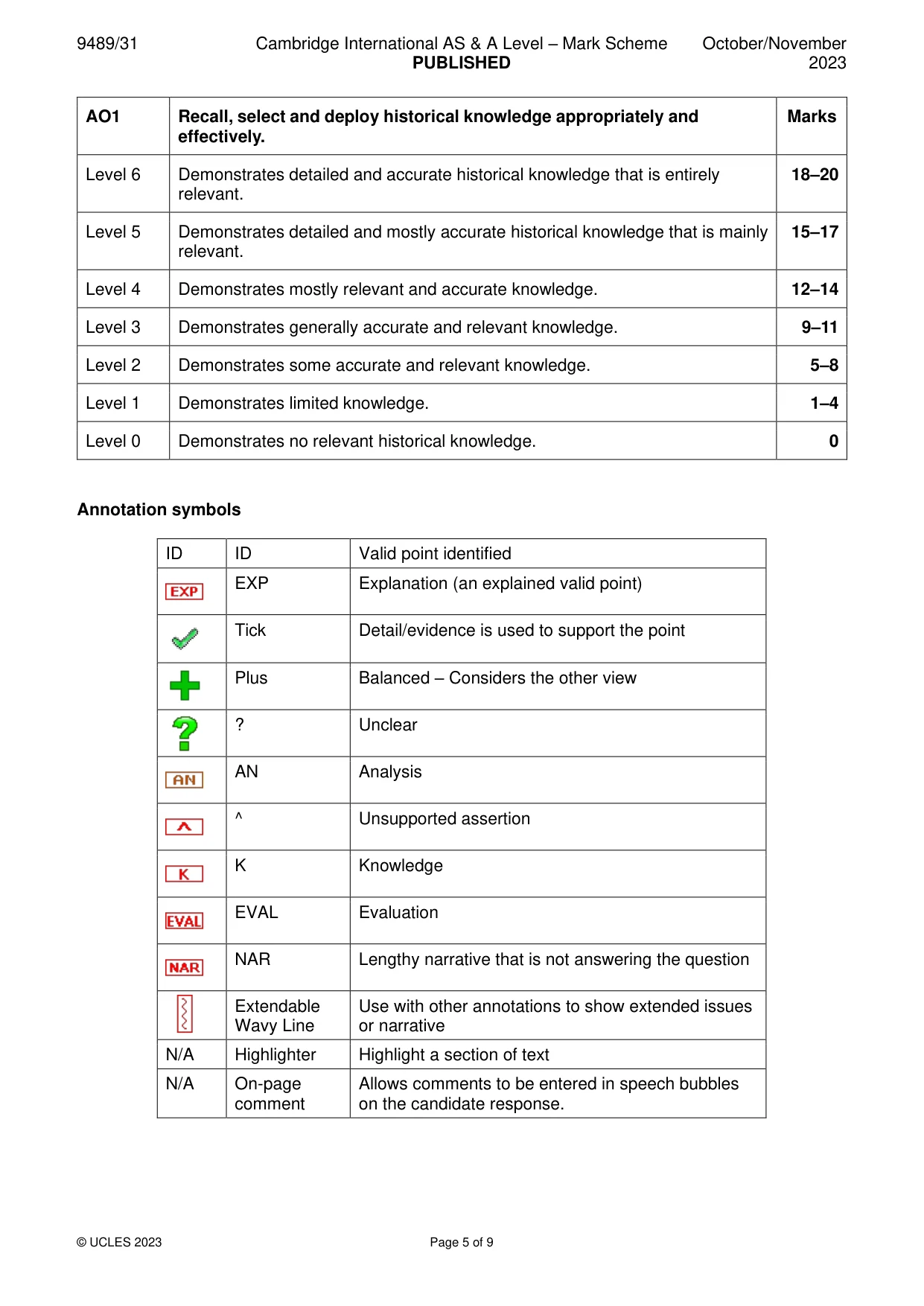
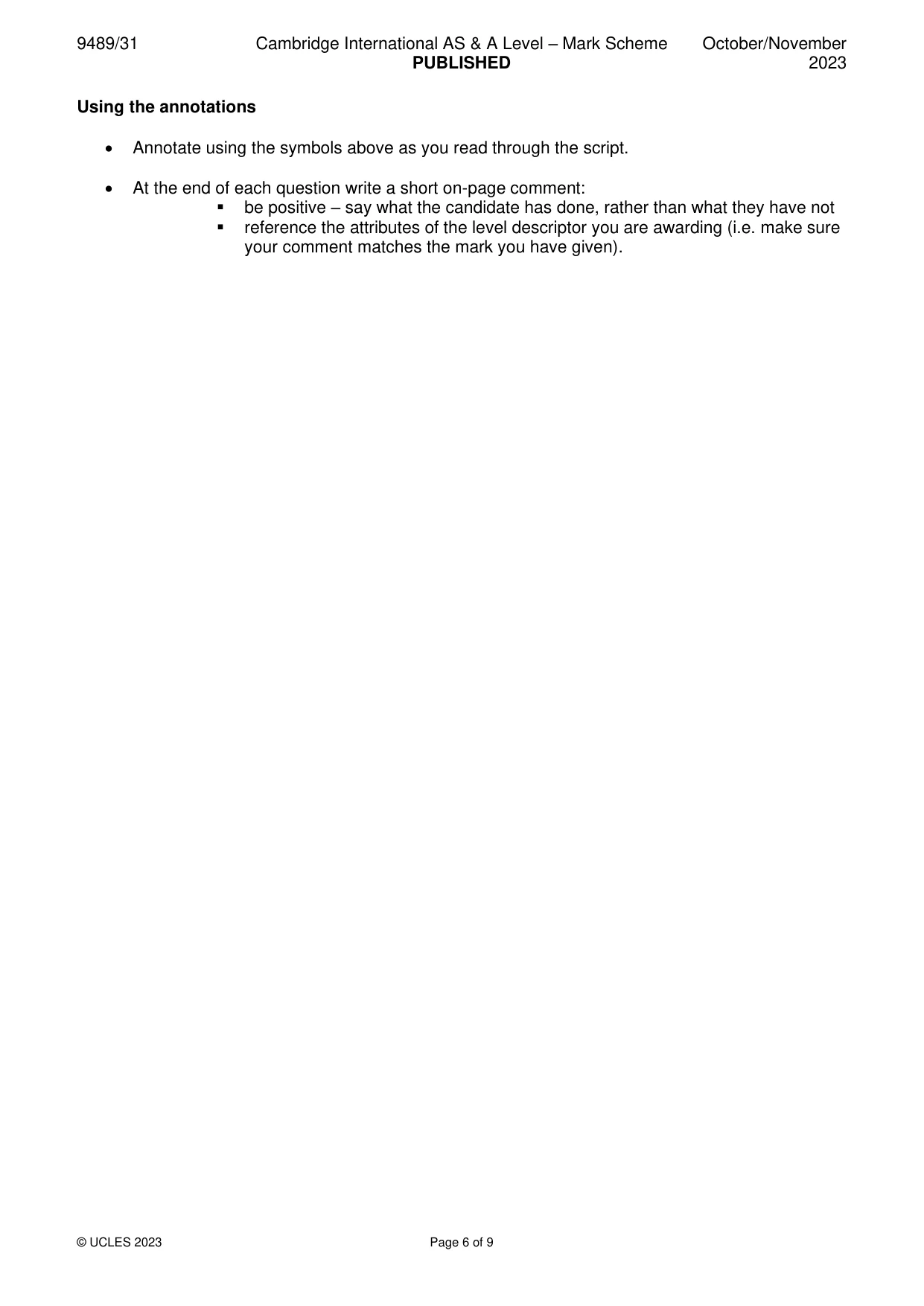
Mark scheme9 pages
Answers below. Sit the paper first if you are practising.
Questions as text
Q1 · Read the extract and then answer the question
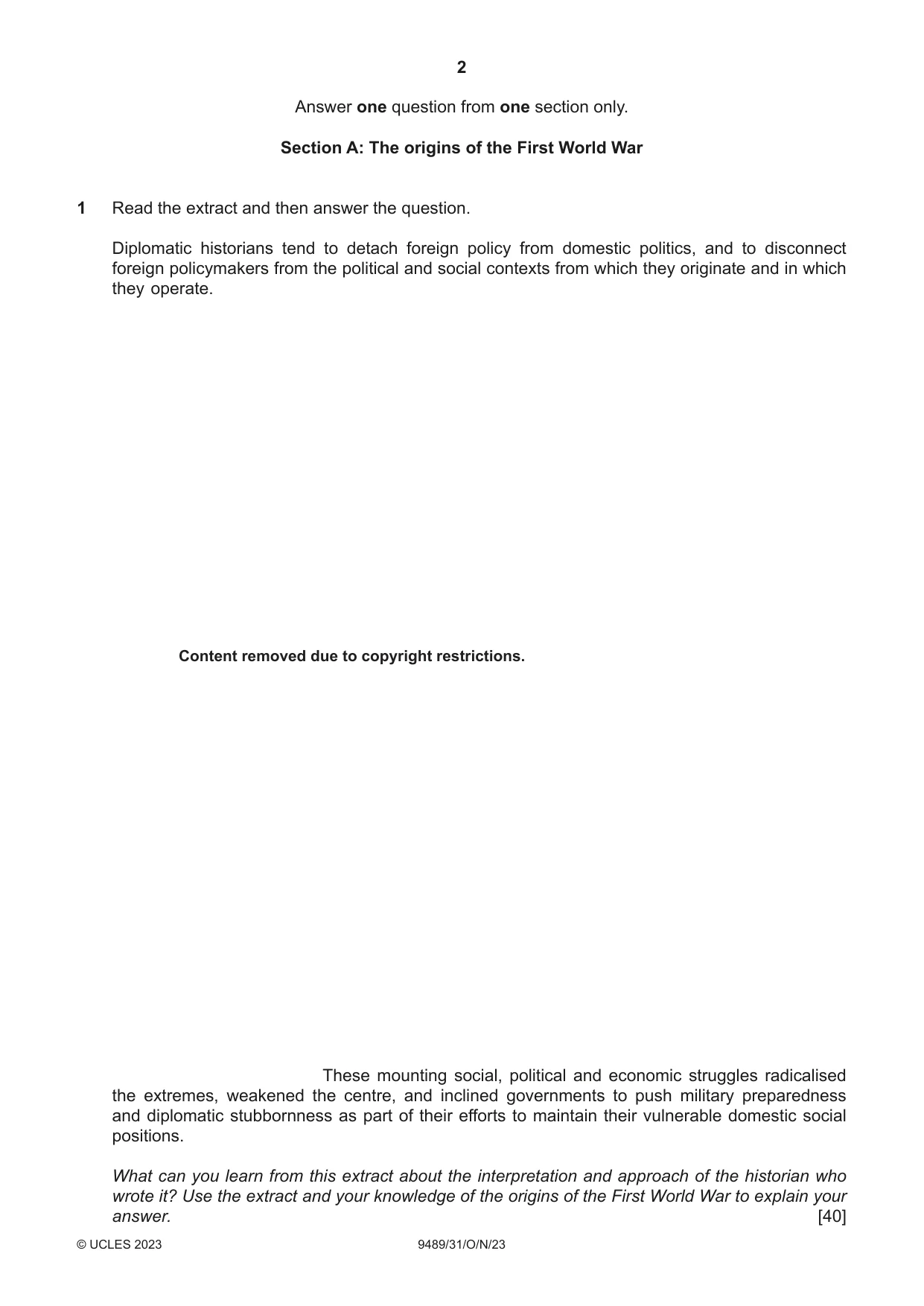
1 Read the extract and then answer the question. Diplomatic historians tend to detach foreign policy from domestic politics, and to disconnect foreign policymakers from the political and social contexts from which they originate and in which they operate. Content removed due to copyright restrictions. These mounting social, political and economic struggles radicalised the extremes, weakened the centre, and inclined governments to push military preparedness and diplomatic stubbornness as part of their efforts to maintain their vulnerable domestic social positions. What can you learn from this extract about the interpretation and approach of the historian who wrote it? Use the extract and your knowledge of the origins of the First World War to explain your answer. [40]
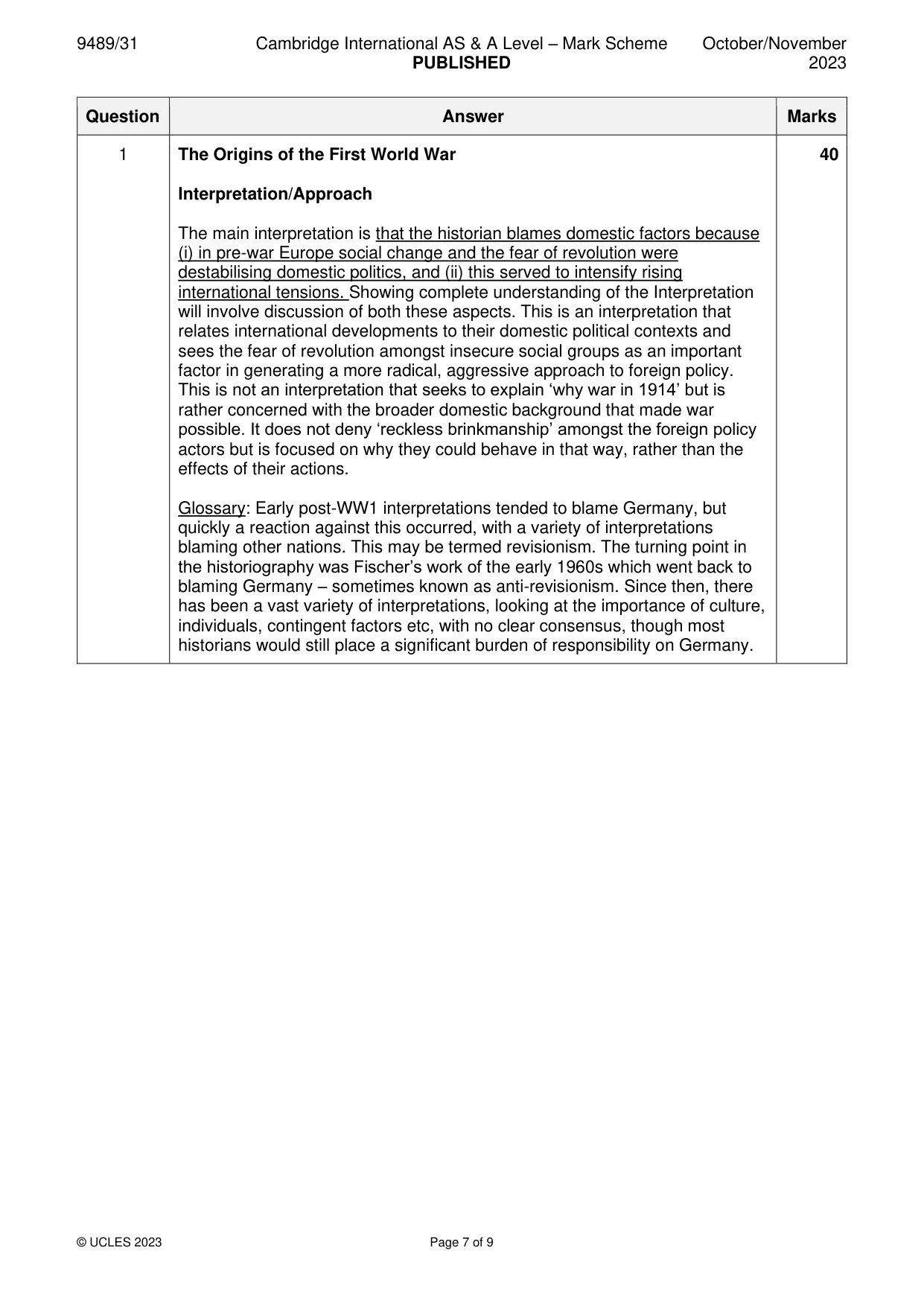
Mark scheme: Question Answer Marks 1 The Origins of the First World War 40 Interpretation/Approach The main interpretation is that the historian blames domestic factors because (i) in pre-war Europe social change and the fear of revolution were destabilising domestic politics, and (ii) this served to intensify rising international tensions. Showing complete understanding of the Interpretation will involve discussion of both these aspects. This is an interpretation that relates international developments to their domestic political contexts and sees the fear of revolution amongst insecure social groups as an important factor in generating a more radical, aggressive approach to foreign policy. This is not an interpretation that seeks to explain ‘why war in 1914’ but is rather concerned with the broader domestic background that made war possible. It does not deny ‘reckless brinkmanship’ amongst the foreign policy actors but is focused on why they could behave in that way, rather than the effects of their actions. Glossary: Early post-WW1 interpretations tended to blame Germany, but quickly a reaction against this occurred, with a variety of interpretations blaming other nations. This may be termed revisionism. The turning point in the historiography was Fischer’s work of the early 1960s which went back to blaming Germany – sometimes known as anti-revisionism. Since then, there has been a vast variety of interpretations, looking at the importance of culture, individuals, contingent factors etc, with no clear consensus, though most historians would still place a significant burden of responsibility on Germany.
Q2 · Read the extract and then answer the question
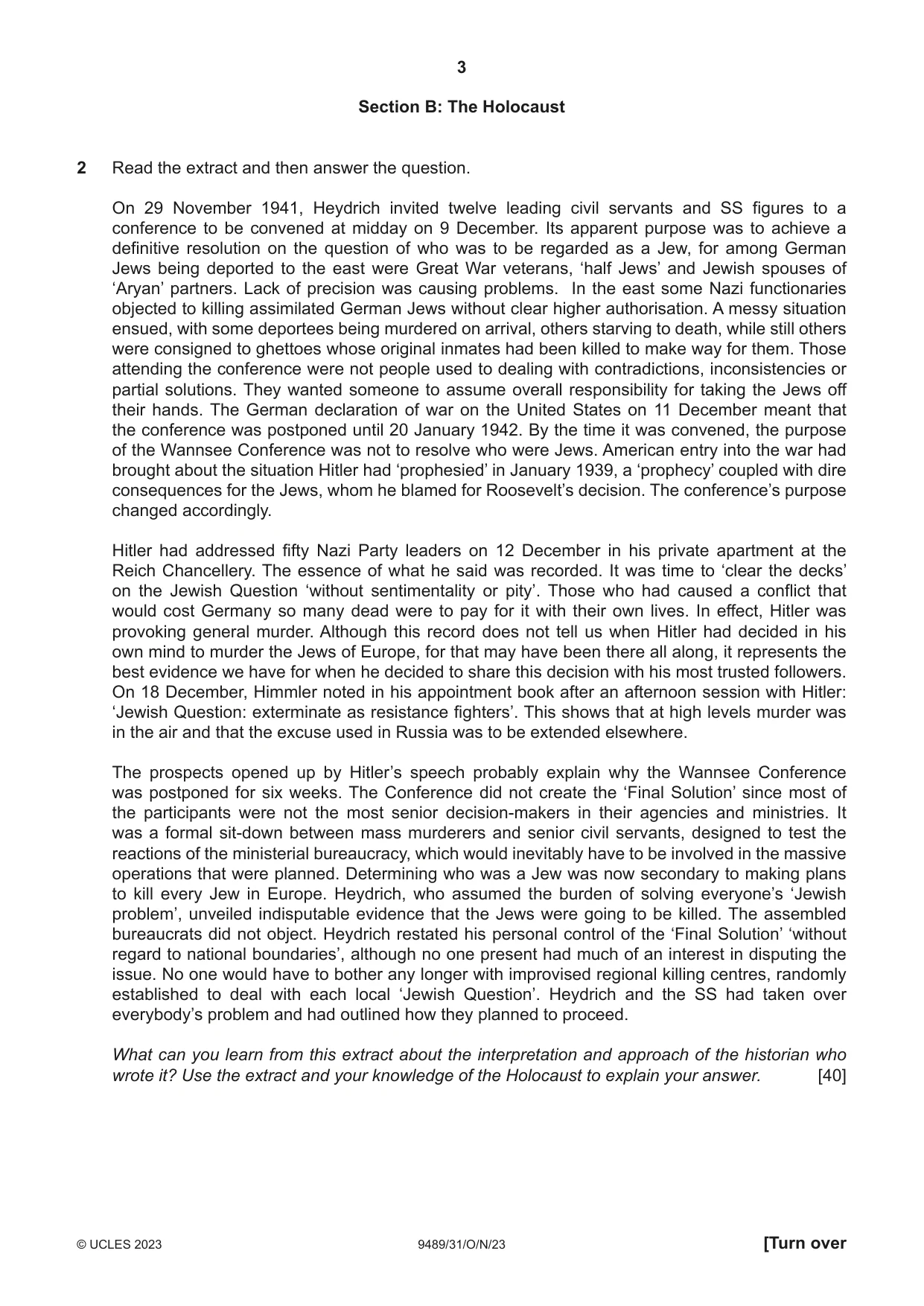
2 Read the extract and then answer the question. On 29 November 1941, Heydrich invited twelve leading civil servants and SS figures to a conference to be convened at midday on 9 December. Its apparent purpose was to achieve a definitive resolution on the question of who was to be regarded as a Jew, for among German Jews being deported to the east were Great War veterans, ‘half Jews’ and Jewish spouses of ‘Aryan’ partners. Lack of precision was causing problems. In the east some Nazi functionaries objected to killing assimilated German Jews without clear higher authorisation. A messy situation ensued, with some deportees being murdered on arrival, others starving to death, while still others were consigned to ghettoes whose original inmates had been killed to make way for them. Those attending the conference were not people used to dealing with contradictions, inconsistencies or partial solutions. They wanted someone to assume overall responsibility for taking the Jews off their hands. The German declaration of war on the United States on 11 December meant that the conference was postponed until 20 January 1942. By the time it was convened, the purpose of the Wannsee Conference was not to resolve who were Jews. American entry into the war had brought about the situation Hitler had ‘prophesied’ in January 1939, a ‘prophecy’ coupled with dire consequences for the Jews, whom he blamed for Roosevelt’s decision. The conference’s purpose changed accordingly. Hitler had addressed fifty Nazi Party leaders on 12 December in his private apartment at the Reich Chancellery. The essence of what he said was recorded. It was time to ‘clear the decks’ on the Jewish Question ‘without sentimentality or pity’. Those who had caused a conflict that would cost Germany so many dead were to pay for it with their own lives. In effect, Hitler was provoking general murder. Although this record does not tell us when Hitler had decided in his own mind to murder the Jews of Europe, for that may have been there all along, it represents the best evidence we have for when he decided to share this decision with his most trusted followers. On 18 December, Himmler noted in his appointment book after an afternoon session with Hitler: ‘Jewish Question: exterminate as resistance fighters’. This shows that at high levels murder was in the air and that the excuse used in Russia was to be extended elsewhere. The prospects opened up by Hitler’s speech probably explain why the Wannsee Conference was postponed for six weeks. The Conference did not create the ‘Final Solution’ since most of the participants were not the most senior decision-makers in their agencies and ministries. It was a formal sit-down between mass murderers and senior civil servants, designed to test the reactions of the ministerial bureaucracy, which would inevitably have to be involved in the massive operations that were planned. Determining who was a Jew was now secondary to making plans to kill every Jew in Europe. Heydrich, who assumed the burden of solving everyone’s ‘Jewish problem’, unveiled indisputable evidence that the Jews were going to be killed. The assembled bureaucrats did not object. Heydrich restated his personal control of the ‘Final Solution’ ‘without regard to national boundaries’, although no one present had much of an interest in disputing the issue. No one would have to bother any longer with improvised regional killing centres, randomly established to deal with each local ‘Jewish Question’. Heydrich and the SS had taken over everybody’s problem and had outlined how they planned to proceed. What can you learn from this extract about the interpretation and approach of the historian who wrote it? Use the extract and your knowledge of the Holocaust to explain your answer. [40] Section C: The origins and development of the Cold War
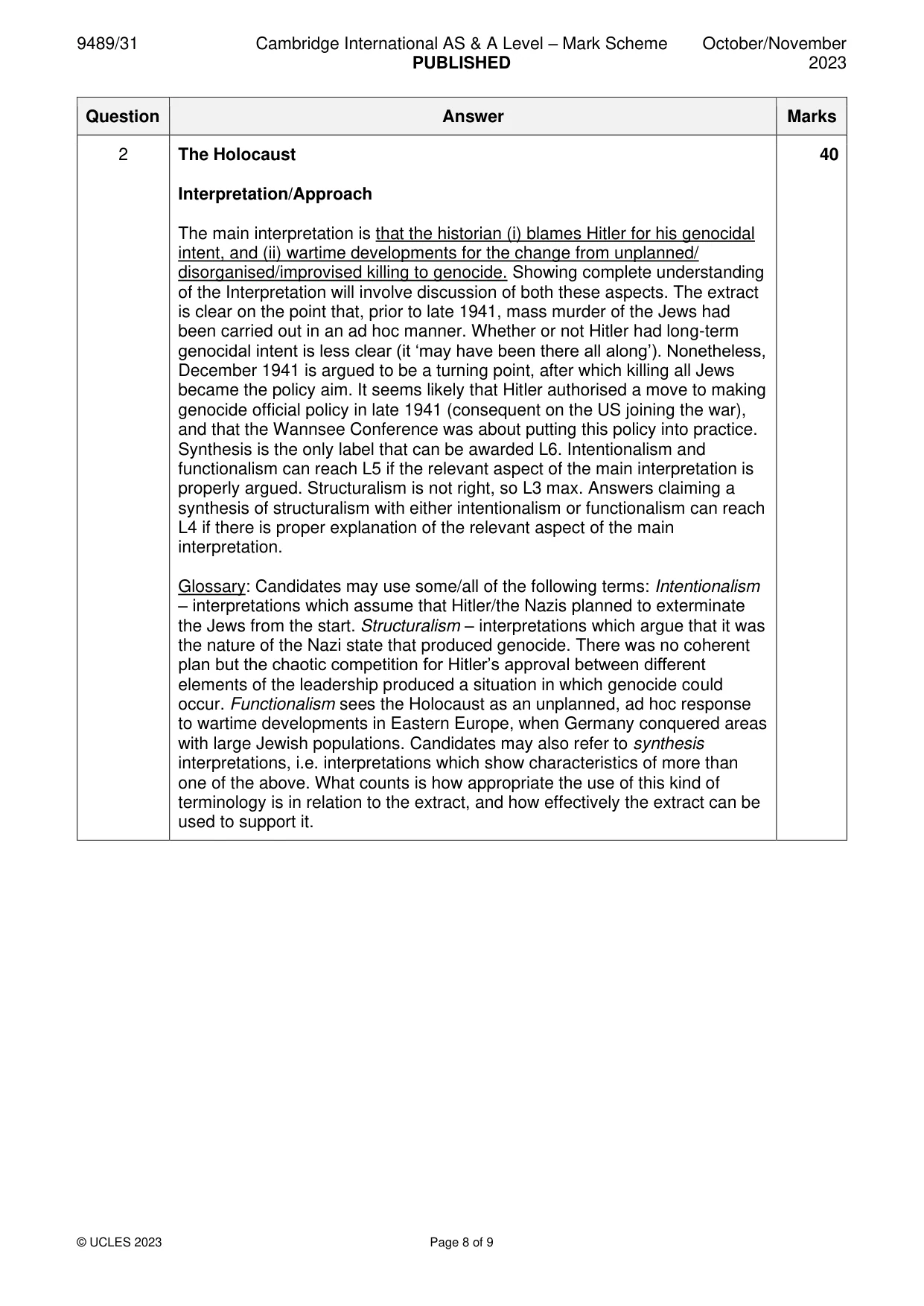
Mark scheme: 2 The Holocaust 40 Interpretation/Approach The main interpretation is that the historian (i) blames Hitler for his genocidal intent, and (ii) wartime developments for the change from unplanned/ disorganised/improvised killing to genocide. Showing complete understanding of the Interpretation will involve discussion of both these aspects. The extract is clear on the point that, prior to late 1941, mass murder of the Jews had been carried out in an ad hoc manner. Whether or not Hitler had long-term genocidal intent is less clear (it ‘may have been there all along’). Nonetheless, December 1941 is argued to be a turning point, after which killing all Jews became the policy aim. It seems likely that Hitler authorised a move to making genocide official policy in late 1941 (consequent on the US joining the war), and that the Wannsee Conference was about putting this policy into practice. Synthesis is the only label that can be awarded L6. Intentionalism and functionalism can reach L5 if the relevant aspect of the main interpretation is properly argued. Structuralism is not right, so L3 max. Answers claiming a synthesis of structuralism with either intentionalism or functionalism can reach L4 if there is proper explanation of the relevant aspect of the main interpretation. Glossary: Candidates may use some/all of the following terms: Intentionalism – interpretations which assume that Hitler/the Nazis planned to exterminate the Jews from the start. Structuralism – interpretations which argue that it was the nature of the Nazi state that produced genocide. There was no coherent plan but the chaotic competition for Hitler’s approval between different elements of the leadership produced a situation in which genocide could occur. Functionalism sees the Holocaust as an unplanned, ad hoc response to wartime developments in Eastern Europe, when Germany conquered areas with large Jewish populations. Candidates may also refer to synthesis interpretations, i.e. interpretations which show characteristics of more than one of the above. What counts is how appropriate the use of this kind of terminology is in relation to the extract, and how effectively the extract can be used to support it.
Q3 · Read the extract and then answer the question
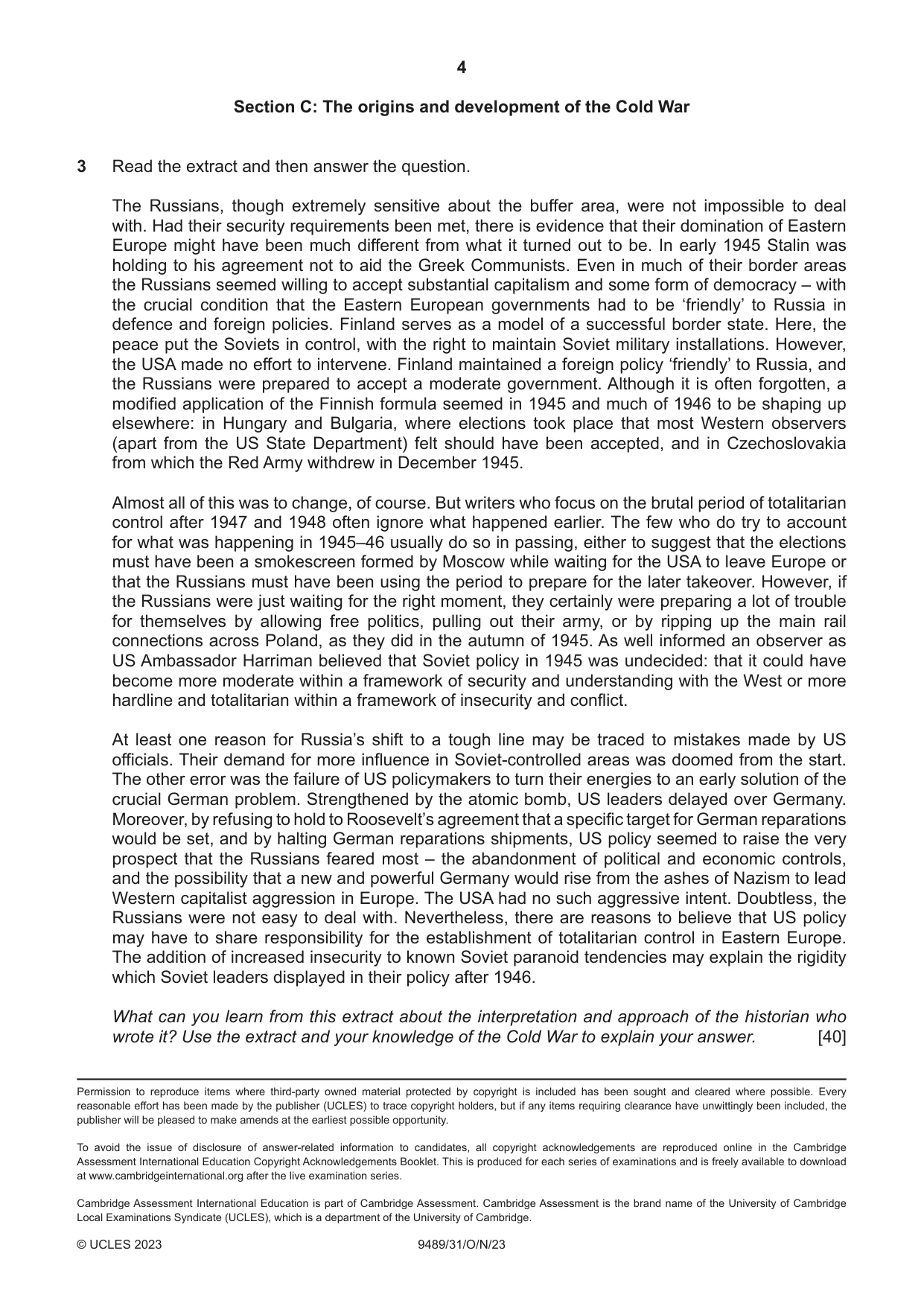
3 Read the extract and then answer the question. The Russians, though extremely sensitive about the buffer area, were not impossible to deal with. Had their security requirements been met, there is evidence that their domination of Eastern Europe might have been much different from what it turned out to be. In early 1945 Stalin was holding to his agreement not to aid the Greek Communists. Even in much of their border areas the Russians seemed willing to accept substantial capitalism and some form of democracy – with the crucial condition that the Eastern European governments had to be ‘friendly’ to Russia in defence and foreign policies. Finland serves as a model of a successful border state. Here, the peace put the Soviets in control, with the right to maintain Soviet military installations. However, the USA made no effort to intervene. Finland maintained a foreign policy ‘friendly’ to Russia, and the Russians were prepared to accept a moderate government. Although it is often forgotten, a modified application of the Finnish formula seemed in 1945 and much of 1946 to be shaping up elsewhere: in Hungary and Bulgaria, where elections took place that most Western observers (apart from the US State Department) felt should have been accepted, and in Czechoslovakia from which the Red Army withdrew in December 1945. Almost all of this was to change, of course. But writers who focus on the brutal period of totalitarian control after 1947 and 1948 often ignore what happened earlier. The few who do try to account for what was happening in 1945–46 usually do so in passing, either to suggest that the elections must have been a smokescreen formed by Moscow while waiting for the USA to leave Europe or that the Russians must have been using the period to prepare for the later takeover. However, if the Russians were just waiting for the right moment, they certainly were preparing a lot of trouble for themselves by allowing free politics, pulling out their army, or by ripping up the main rail connections across Poland, as they did in the autumn of 1945. As well informed an observer as US Ambassador Harriman believed that Soviet policy in 1945 was undecided: that it could have become more moderate within a framework of security and understanding with the West or more hardline and totalitarian within a framework of insecurity and conflict. At least one reason for Russia’s shift to a tough line may be traced to mistakes made by US officials. Their demand for more influence in Soviet-controlled areas was doomed from the start. The other error was the failure of US policymakers to turn their energies to an early solution of the crucial German problem. Strengthened by the atomic bomb, US leaders delayed over Germany. Moreover, by refusing to hold to Roosevelt’s agreement that a specific target for German reparations would be set, and by halting German reparations shipments, US policy seemed to raise the very prospect that the Russians feared most – the abandonment of political and economic controls, and the possibility that a new and powerful Germany would rise from the ashes of Nazism to lead Western capitalist aggression in Europe. The USA had no such aggressive intent. Doubtless, the Russians were not easy to deal with. Nevertheless, there are reasons to believe that US policy may have to share responsibility for the establishment of totalitarian control in Eastern Europe. The addition of increased insecurity to known Soviet paranoid tendencies may explain the rigidity which Soviet leaders displayed in their policy after 1946. What can you learn from this extract about the interpretation and approach of the historian who wrote it? Use the extract and your knowledge of the Cold War to explain your answer. [40]
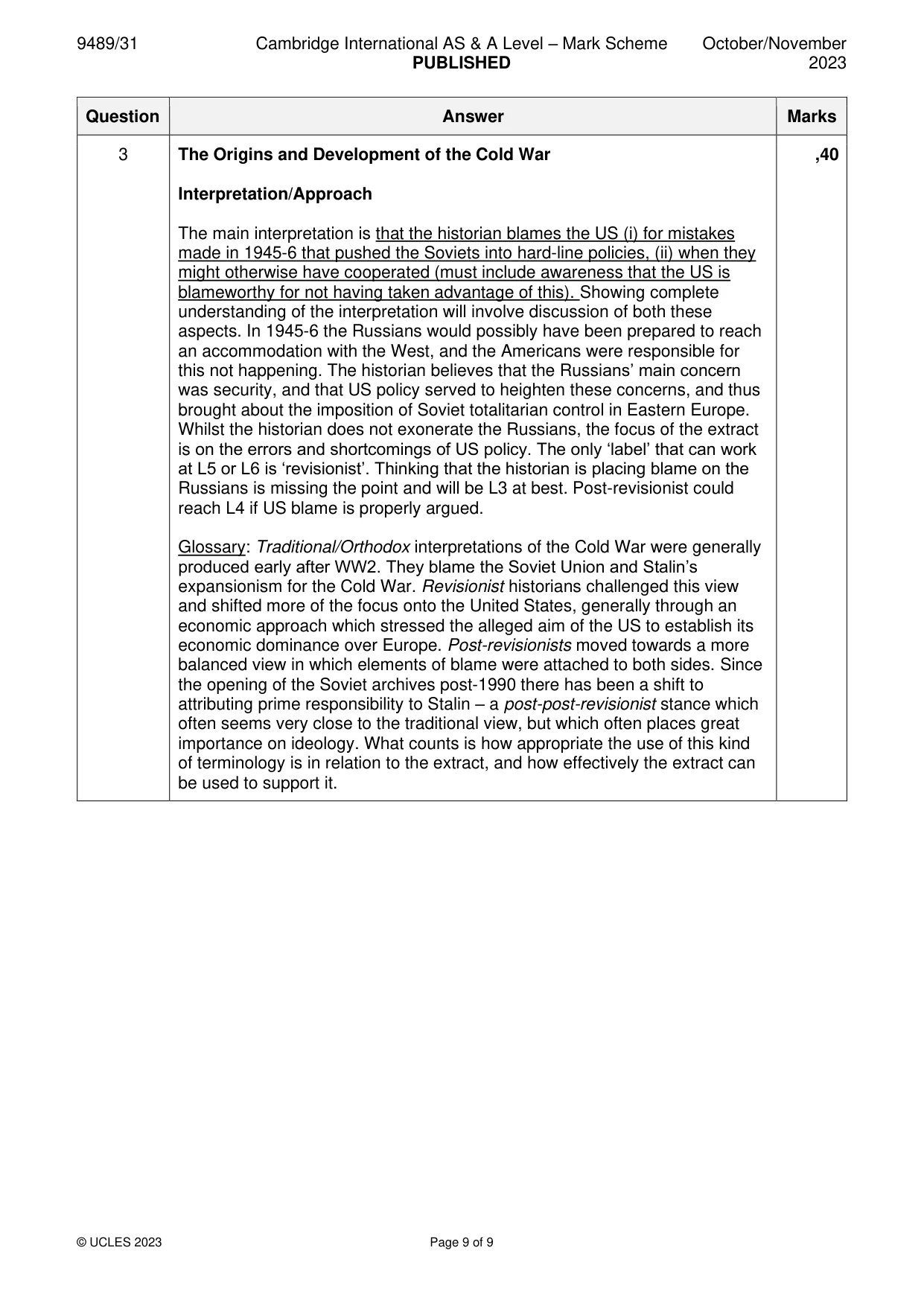
Mark scheme: 3 The Origins and Development of the Cold War ,40 Interpretation/Approach The main interpretation is that the historian blames the US (i) for mistakes made in 1945-6 that pushed the Soviets into hard-line policies, (ii) when they might otherwise have cooperated (must include awareness that the US is blameworthy for not having taken advantage of this). Showing complete understanding of the interpretation will involve discussion of both these aspects. In 1945-6 the Russians would possibly have been prepared to reach an accommodation with the West, and the Americans were responsible for this not happening. The historian believes that the Russians’ main concern was security, and that US policy served to heighten these concerns, and thus brought about the imposition of Soviet totalitarian control in Eastern Europe. Whilst the historian does not exonerate the Russians, the focus of the extract is on the errors and shortcomings of US policy. The only ‘label’ that can work at L5 or L6 is ‘revisionist’. Thinking that the historian is placing blame on the Russians is missing the point and will be L3 at best. Post-revisionist could reach L4 if US blame is properly argued. Glossary: Traditional/Orthodox interpretations of the Cold War were generally produced early after WW2. They blame the Soviet Union and Stalin’s expansionism for the Cold War. Revisionist historians challenged this view and shifted more of the focus onto the United States, generally through an economic approach which stressed the alleged aim of the US to establish its economic dominance over Europe. Post-revisionists moved towards a more balanced view in which elements of blame were attached to both sides. Since the opening of the Soviet archives post-1990 there has been a shift to attributing prime responsibility to Stalin – a post-post-revisionist stance which often seems very close to the traditional view, but which often places great importance on ideology. What counts is how appropriate the use of this kind of terminology is in relation to the extract, and how effectively the extract can be used to support it.
What was in this paper
The subtopics covered by these 3 questions, and how many questions each got. Open one in a new tab to see every Cambridge question on it.
What you needed in this session
Cambridge’s own grade thresholds for 2023 Oct/Nov, Paper 3 · Variant 1. A higher threshold means an easier paper — the bar moves with how the cohort did.