Cambridge A Level History 9489 — 2024 May/June Paper 3 · Variant 2
9489/32/M/J/24 · 3 questions · 40 marks · ≈45 min
The question paper and its mark scheme, free to read here and free to download. This is Cambridge’s own paper, exactly as it was sat.
Question paper4 pages
Mark scheme8 pages
Answers below. Sit the paper first if you are practising.
Questions as text
Q1 · Read the extract and then answer the question
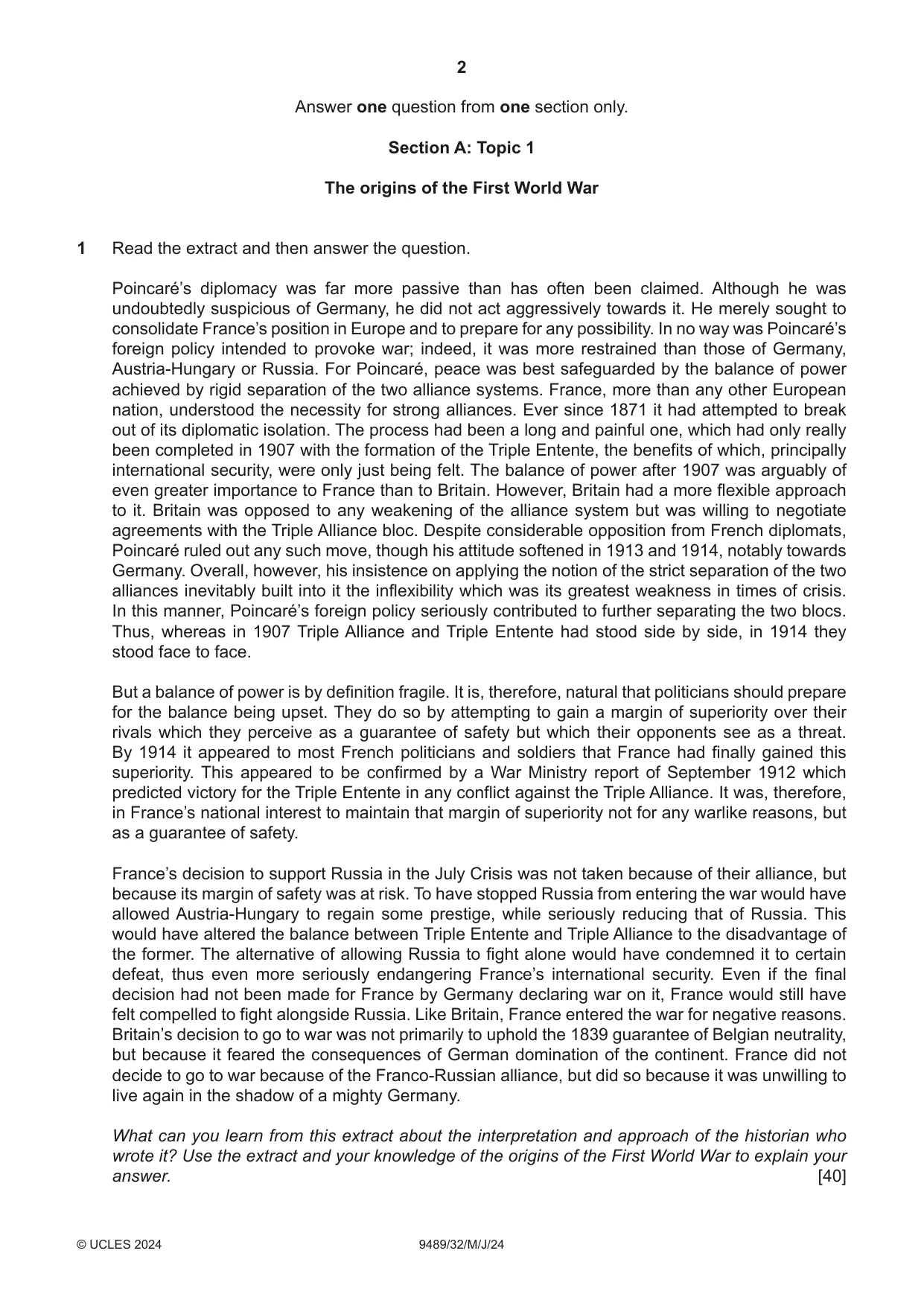
1 Read the extract and then answer the question. Poincaré’s diplomacy was far more passive than has often been claimed. Although he was undoubtedly suspicious of Germany, he did not act aggressively towards it. He merely sought to consolidate France’s position in Europe and to prepare for any possibility. In no way was Poincaré’s foreign policy intended to provoke war; indeed, it was more restrained than those of Germany, Austria-Hungary or Russia. For Poincaré, peace was best safeguarded by the balance of power achieved by rigid separation of the two alliance systems. France, more than any other European nation, understood the necessity for strong alliances. Ever since 1871 it had attempted to break out of its diplomatic isolation. The process had been a long and painful one, which had only really been completed in 1907 with the formation of the Triple Entente, the benefits of which, principally international security, were only just being felt. The balance of power after 1907 was arguably of even greater importance to France than to Britain. However, Britain had a more flexible approach to it. Britain was opposed to any weakening of the alliance system but was willing to negotiate agreements with the Triple Alliance bloc. Despite considerable opposition from French diplomats, Poincaré ruled out any such move, though his attitude softened in 1913 and 1914, notably towards Germany. Overall, however, his insistence on applying the notion of the strict separation of the two alliances inevitably built into it the inflexibility which was its greatest weakness in times of crisis. In this manner, Poincaré’s foreign policy seriously contributed to further separating the two blocs. Thus, whereas in 1907 Triple Alliance and Triple Entente had stood side by side, in 1914 they stood face to face. But a balance of power is by definition fragile. It is, therefore, natural that politicians should prepare for the balance being upset. They do so by attempting to gain a margin of superiority over their rivals which they perceive as a guarantee of safety but which their opponents see as a threat. By 1914 it appeared to most French politicians and soldiers that France had finally gained this superiority. This appeared to be confirmed by a War Ministry report of September 1912 which predicted victory for the Triple Entente in any conflict against the Triple Alliance. It was, therefore, in France’s national interest to maintain that margin of superiority not for any warlike reasons, but as a guarantee of safety. France’s decision to support Russia in the July Crisis was not taken because of their alliance, but because its margin of safety was at risk. To have stopped Russia from entering the war would have allowed Austria-Hungary to regain some prestige, while seriously reducing that of Russia. This would have altered the balance between Triple Entente and Triple Alliance to the disadvantage of the former. The alternative of allowing Russia to fight alone would have condemned it to certain defeat, thus even more seriously endangering France’s international security. Even if the final decision had not been made for France by Germany declaring war on it, France would still have felt compelled to fight alongside Russia. Like Britain, France entered the war for negative reasons. Britain’s decision to go to war was not primarily to uphold the 1839 guarantee of Belgian neutrality, but because it feared the consequences of German domination of the continent. France did not decide to go to war because of the Franco-Russian alliance, but did so because it was unwilling to live again in the shadow of a mighty Germany. What can you learn from this extract about the interpretation and approach of the historian who wrote it? Use the extract and your knowledge of the origins of the First World War to explain your answer. [40]
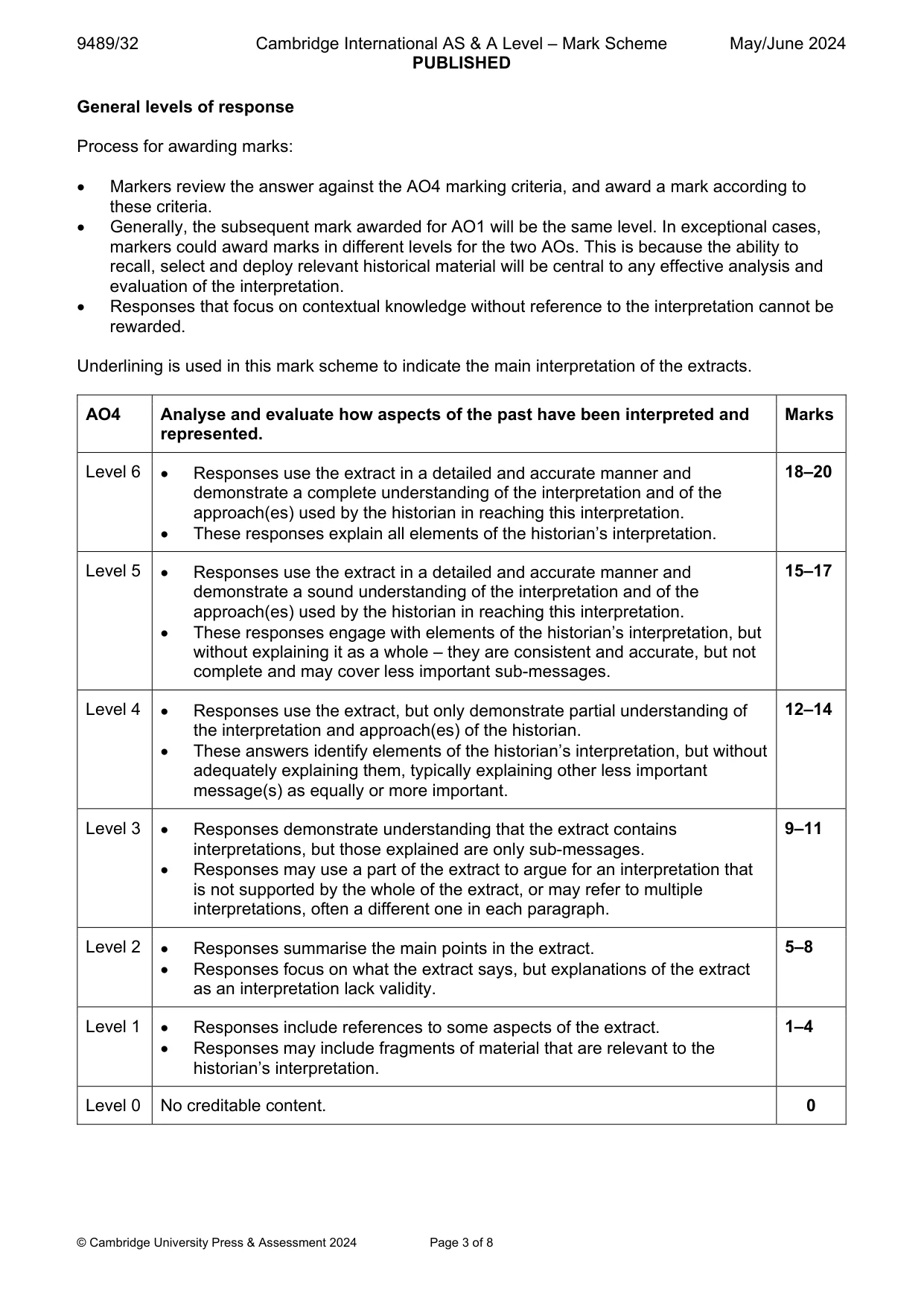
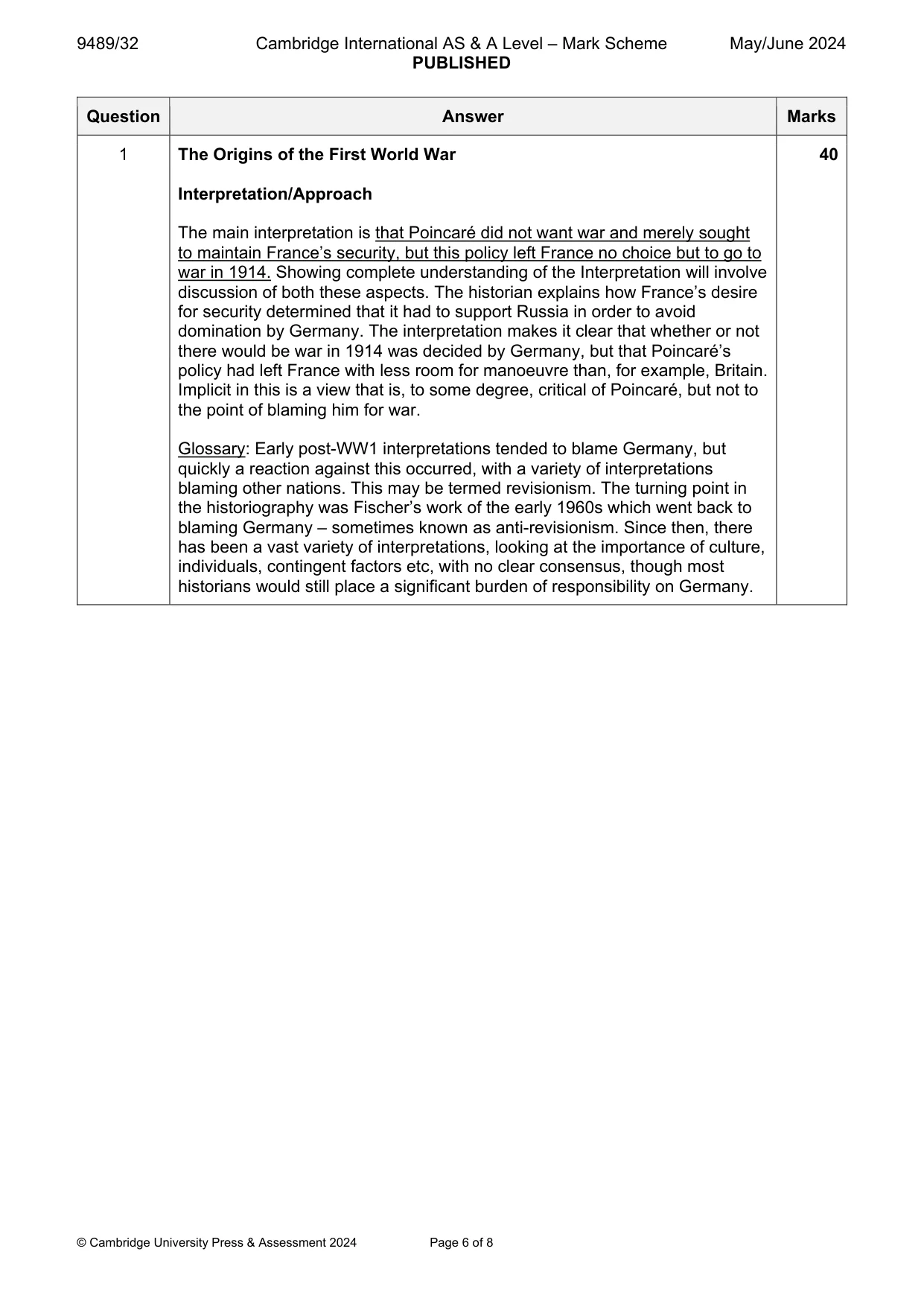
Mark scheme: Question Answer Marks 1 The Origins of the First World War 40 Interpretation/Approach The main interpretation is that Poincaré did not want war and merely sought to maintain France’s security, but this policy left France no choice but to go to war in 1914. Showing complete understanding of the Interpretation will involve discussion of both these aspects. The historian explains how France’s desire for security determined that it had to support Russia in order to avoid domination by Germany. The interpretation makes it clear that whether or not there would be war in 1914 was decided by Germany, but that Poincaré’s policy had left France with less room for manoeuvre than, for example, Britain. Implicit in this is a view that is, to some degree, critical of Poincaré, but not to the point of blaming him for war. Glossary: Early post-WW1 interpretations tended to blame Germany, but quickly a reaction against this occurred, with a variety of interpretations blaming other nations. This may be termed revisionism. The turning point in the historiography was Fischer’s work of the early 1960s which went back to blaming Germany – sometimes known as anti-revisionism. Since then, there has been a vast variety of interpretations, looking at the importance of culture, individuals, contingent factors etc, with no clear consensus, though most historians would still place a significant burden of responsibility on Germany.
Q2 · Read the extract and then answer the question
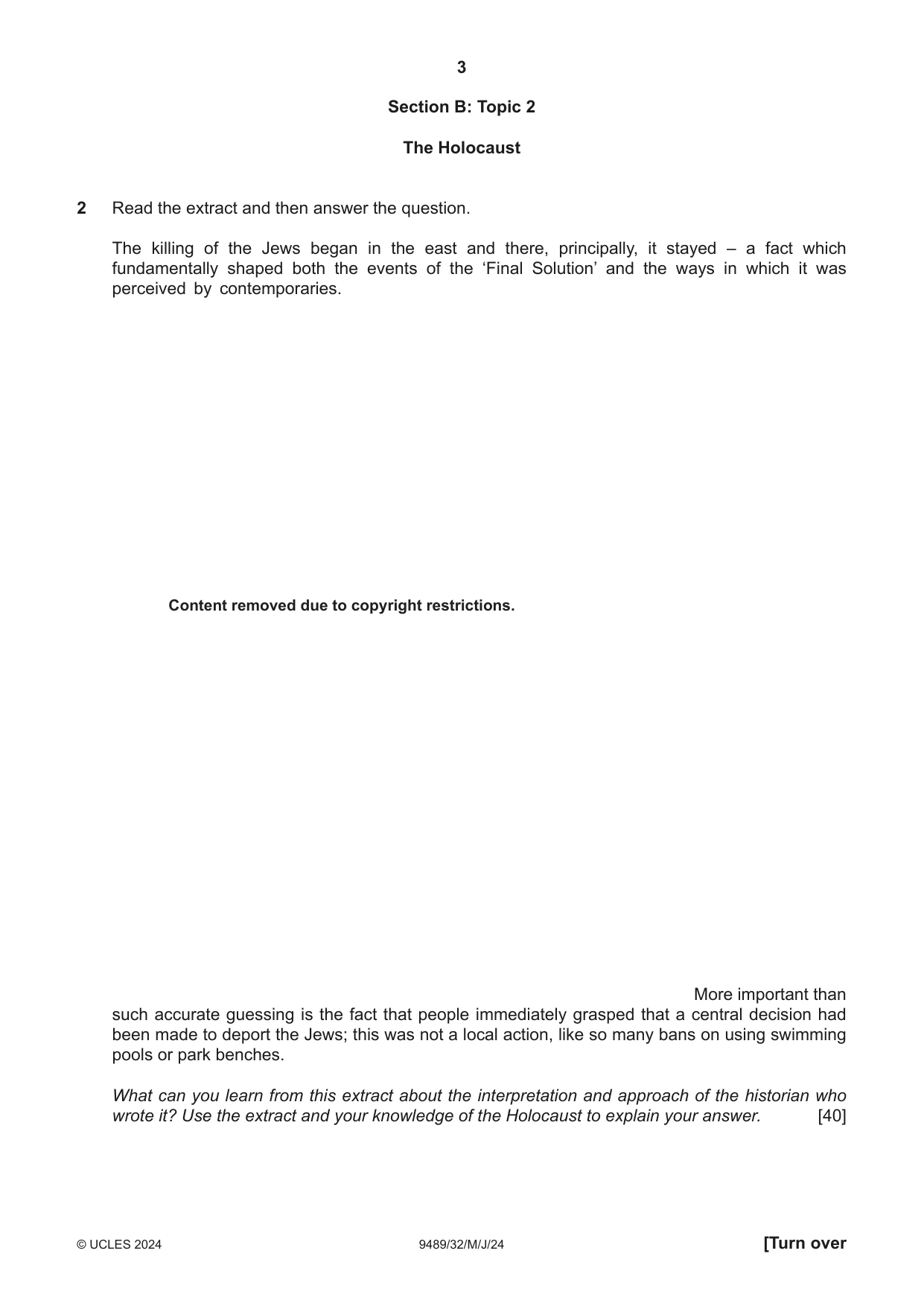
2 Read the extract and then answer the question. The killing of the Jews began in the east and there, principally, it stayed – a fact which fundamentally shaped both the events of the ‘Final Solution’ and the ways in which it was perceived by contemporaries. Content removed due to copyright restrictions. More important than such accurate guessing is the fact that people immediately grasped that a central decision had been made to deport the Jews; this was not a local action, like so many bans on using swimming pools or park benches. What can you learn from this extract about the interpretation and approach of the historian who wrote it? Use the extract and your knowledge of the Holocaust to explain your answer. [40] Section C: Topic 3 The origins and development of the Cold War
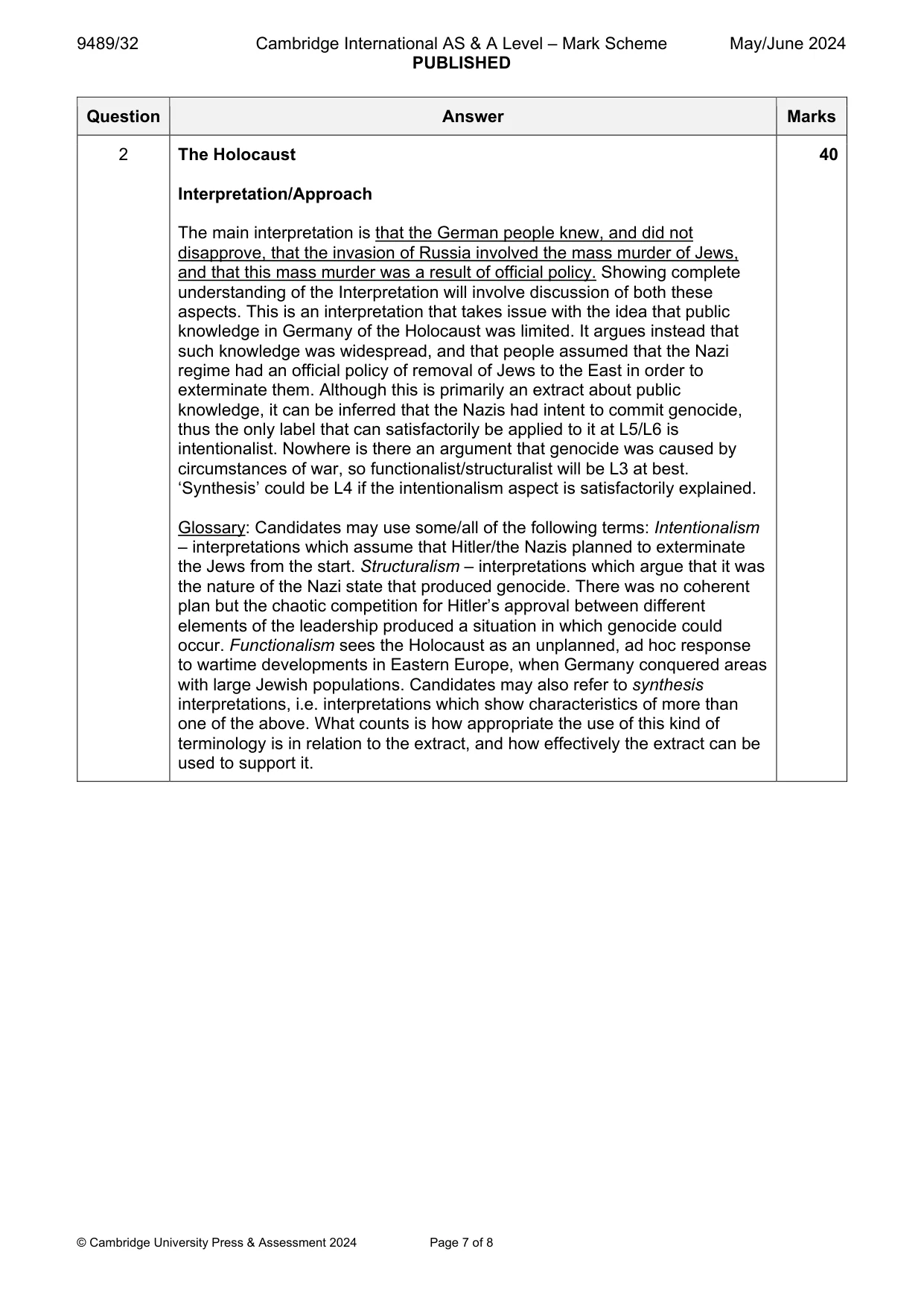
Mark scheme: 2 The Holocaust 40 Interpretation/Approach The main interpretation is that the German people knew, and did not disapprove, that the invasion of Russia involved the mass murder of Jews, and that this mass murder was a result of official policy. Showing complete understanding of the Interpretation will involve discussion of both these aspects. This is an interpretation that takes issue with the idea that public knowledge in Germany of the Holocaust was limited. It argues instead that such knowledge was widespread, and that people assumed that the Nazi regime had an official policy of removal of Jews to the East in order to exterminate them. Although this is primarily an extract about public knowledge, it can be inferred that the Nazis had intent to commit genocide, thus the only label that can satisfactorily be applied to it at L5/L6 is intentionalist. Nowhere is there an argument that genocide was caused by circumstances of war, so functionalist/structuralist will be L3 at best. ‘Synthesis’ could be L4 if the intentionalism aspect is satisfactorily explained. Glossary: Candidates may use some/all of the following terms: Intentionalism – interpretations which assume that Hitler/the Nazis planned to exterminate the Jews from the start. Structuralism – interpretations which argue that it was the nature of the Nazi state that produced genocide. There was no coherent plan but the chaotic competition for Hitler’s approval between different elements of the leadership produced a situation in which genocide could occur. Functionalism sees the Holocaust as an unplanned, ad hoc response to wartime developments in Eastern Europe, when Germany conquered areas with large Jewish populations. Candidates may also refer to synthesis interpretations, i.e. interpretations which show characteristics of more than one of the above. What counts is how appropriate the use of this kind of terminology is in relation to the extract, and how effectively the extract can be used to support it.
Q3 · Read the extract and then answer the question
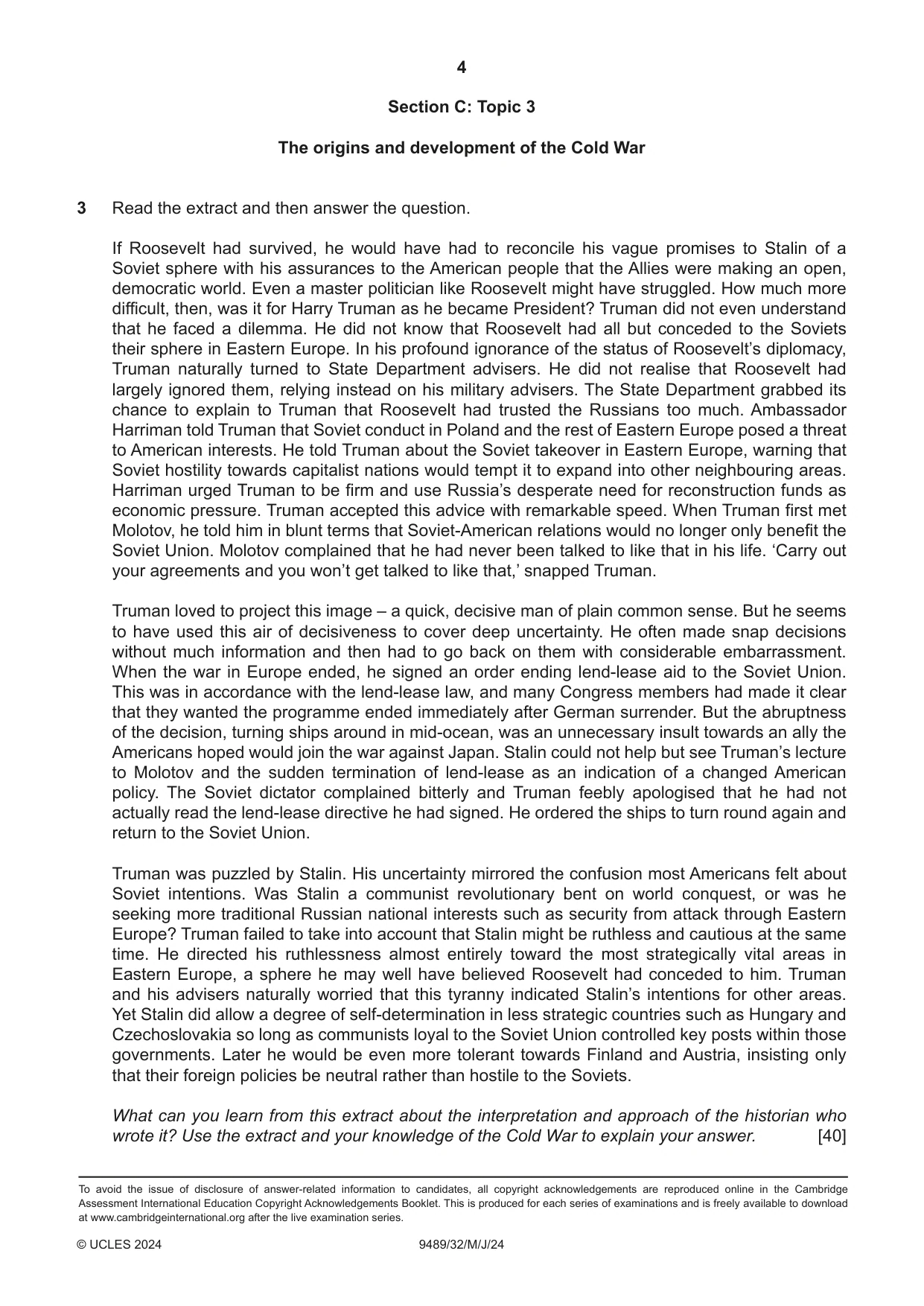
3 Read the extract and then answer the question. If Roosevelt had survived, he would have had to reconcile his vague promises to Stalin of a Soviet sphere with his assurances to the American people that the Allies were making an open, democratic world. Even a master politician like Roosevelt might have struggled. How much more difficult, then, was it for Harry Truman as he became President? Truman did not even understand that he faced a dilemma. He did not know that Roosevelt had all but conceded to the Soviets their sphere in Eastern Europe. In his profound ignorance of the status of Roosevelt’s diplomacy, Truman naturally turned to State Department advisers. He did not realise that Roosevelt had largely ignored them, relying instead on his military advisers. The State Department grabbed its chance to explain to Truman that Roosevelt had trusted the Russians too much. Ambassador Harriman told Truman that Soviet conduct in Poland and the rest of Eastern Europe posed a threat to American interests. He told Truman about the Soviet takeover in Eastern Europe, warning that Soviet hostility towards capitalist nations would tempt it to expand into other neighbouring areas. Harriman urged Truman to be firm and use Russia’s desperate need for reconstruction funds as economic pressure. Truman accepted this advice with remarkable speed. When Truman first met Molotov, he told him in blunt terms that Soviet-American relations would no longer only benefit the Soviet Union. Molotov complained that he had never been talked to like that in his life. ‘Carry out your agreements and you won’t get talked to like that,’ snapped Truman. Truman loved to project this image – a quick, decisive man of plain common sense. But he seems to have used this air of decisiveness to cover deep uncertainty. He often made snap decisions without much information and then had to go back on them with considerable embarrassment. When the war in Europe ended, he signed an order ending lend-lease aid to the Soviet Union. This was in accordance with the lend-lease law, and many Congress members had made it clear that they wanted the programme ended immediately after German surrender. But the abruptness of the decision, turning ships around in mid-ocean, was an unnecessary insult towards an ally the Americans hoped would join the war against Japan. Stalin could not help but see Truman’s lecture to Molotov and the sudden termination of lend-lease as an indication of a changed American policy. The Soviet dictator complained bitterly and Truman feebly apologised that he had not actually read the lend-lease directive he had signed. He ordered the ships to turn round again and return to the Soviet Union. Truman was puzzled by Stalin. His uncertainty mirrored the confusion most Americans felt about Soviet intentions. Was Stalin a communist revolutionary bent on world conquest, or was he seeking more traditional Russian national interests such as security from attack through Eastern Europe? Truman failed to take into account that Stalin might be ruthless and cautious at the same time. He directed his ruthlessness almost entirely toward the most strategically vital areas in Eastern Europe, a sphere he may well have believed Roosevelt had conceded to him. Truman and his advisers naturally worried that this tyranny indicated Stalin’s intentions for other areas. Yet Stalin did allow a degree of self-determination in less strategic countries such as Hungary and Czechoslovakia so long as communists loyal to the Soviet Union controlled key posts within those governments. Later he would be even more tolerant towards Finland and Austria, insisting only that their foreign policies be neutral rather than hostile to the Soviets. What can you learn from this extract about the interpretation and approach of the historian who wrote it? Use the extract and your knowledge of the Cold War to explain your answer. [40]
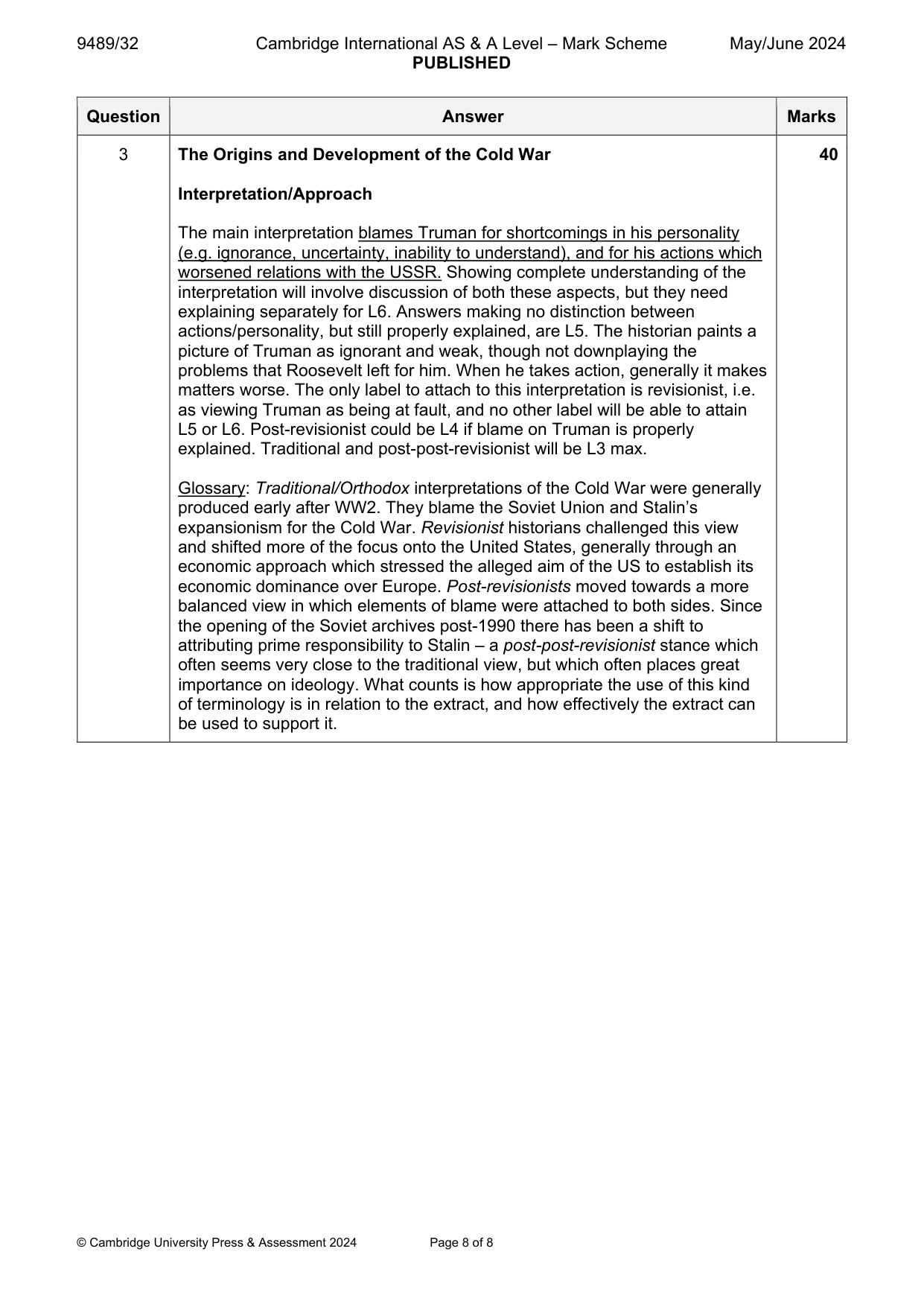
Mark scheme: 3 The Origins and Development of the Cold War 40 Interpretation/Approach The main interpretation blames Truman for shortcomings in his personality (e.g. ignorance, uncertainty, inability to understand), and for his actions which worsened relations with the USSR. Showing complete understanding of the interpretation will involve discussion of both these aspects, but they need explaining separately for L6. Answers making no distinction between actions/personality, but still properly explained, are L5. The historian paints a picture of Truman as ignorant and weak, though not downplaying the problems that Roosevelt left for him. When he takes action, generally it makes matters worse. The only label to attach to this interpretation is revisionist, i.e. as viewing Truman as being at fault, and no other label will be able to attain L5 or L6. Post-revisionist could be L4 if blame on Truman is properly explained. Traditional and post-post-revisionist will be L3 max. Glossary: Traditional/Orthodox interpretations of the Cold War were generally produced early after WW2. They blame the Soviet Union and Stalin’s expansionism for the Cold War. Revisionist historians challenged this view and shifted more of the focus onto the United States, generally through an economic approach which stressed the alleged aim of the US to establish its economic dominance over Europe. Post-revisionists moved towards a more balanced view in which elements of blame were attached to both sides. Since the opening of the Soviet archives post-1990 there has been a shift to attributing prime responsibility to Stalin – a post-post-revisionist stance which often seems very close to the traditional view, but which often places great importance on ideology. What counts is how appropriate the use of this kind of terminology is in relation to the extract, and how effectively the extract can be used to support it.
What was in this paper
The subtopics covered by these 3 questions, and how many questions each got. Open one in a new tab to see every Cambridge question on it.
What you needed in this session
Cambridge’s own grade thresholds for 2024 May/June, Paper 3 · Variant 2. A higher threshold means an easier paper — the bar moves with how the cohort did.