Cambridge A Level History 9489 — 2025 Feb/March Paper 3 · Variant 2
9489/32/F/M/25 · 3 questions · 40 marks · ≈45 min
The question paper and its mark scheme, free to read here and free to download. This is Cambridge’s own paper, exactly as it was sat.
Question paper4 pages
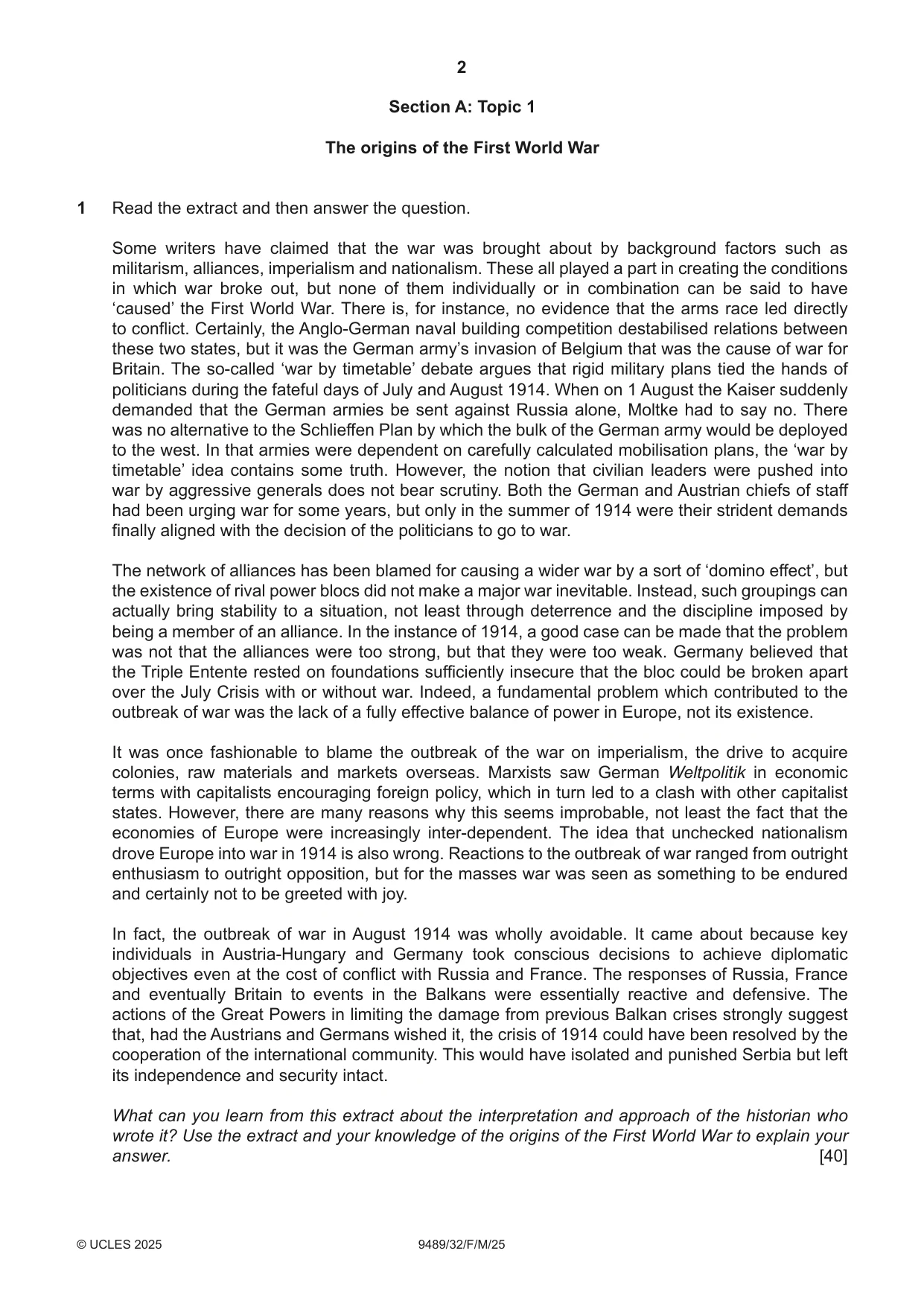
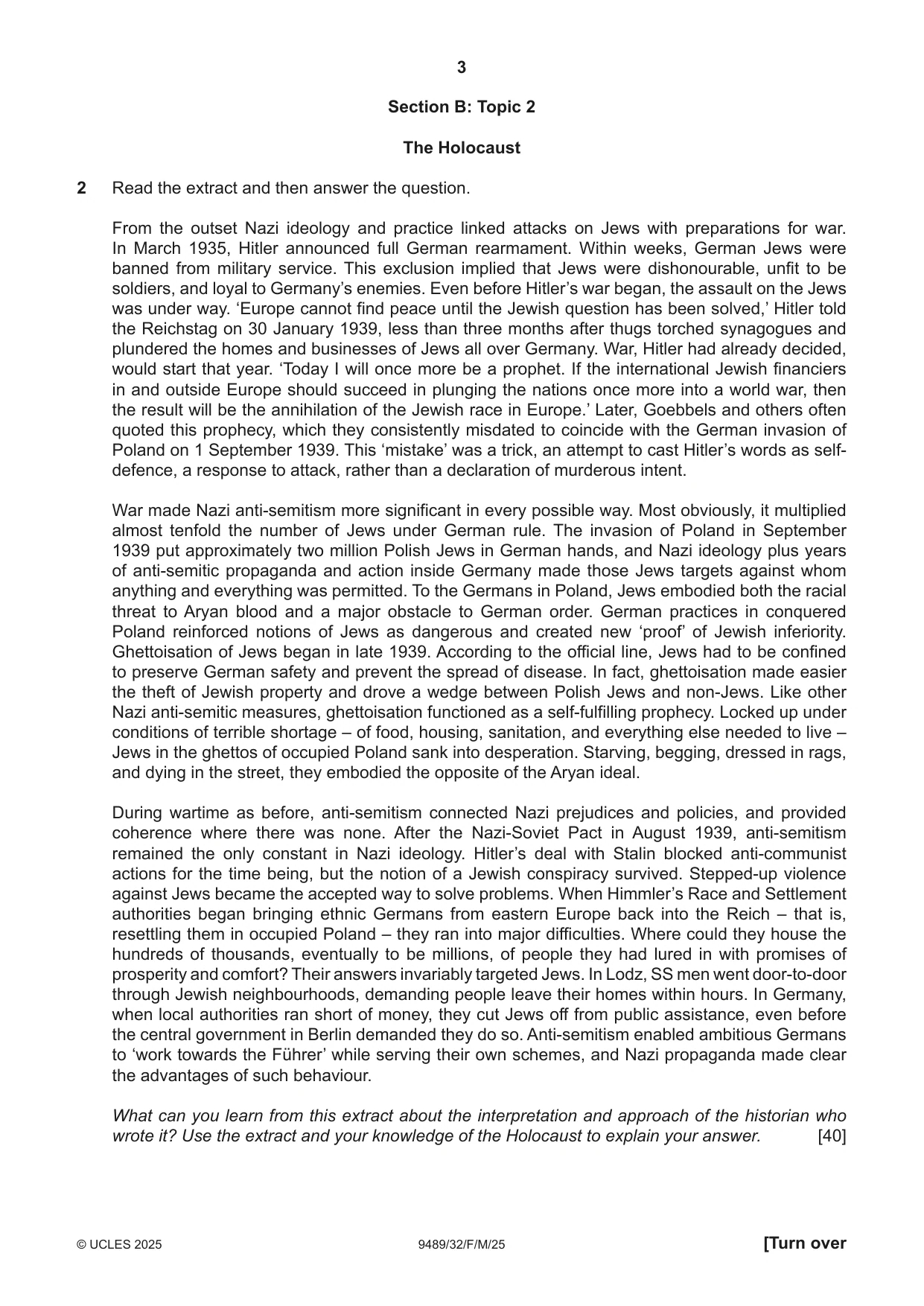
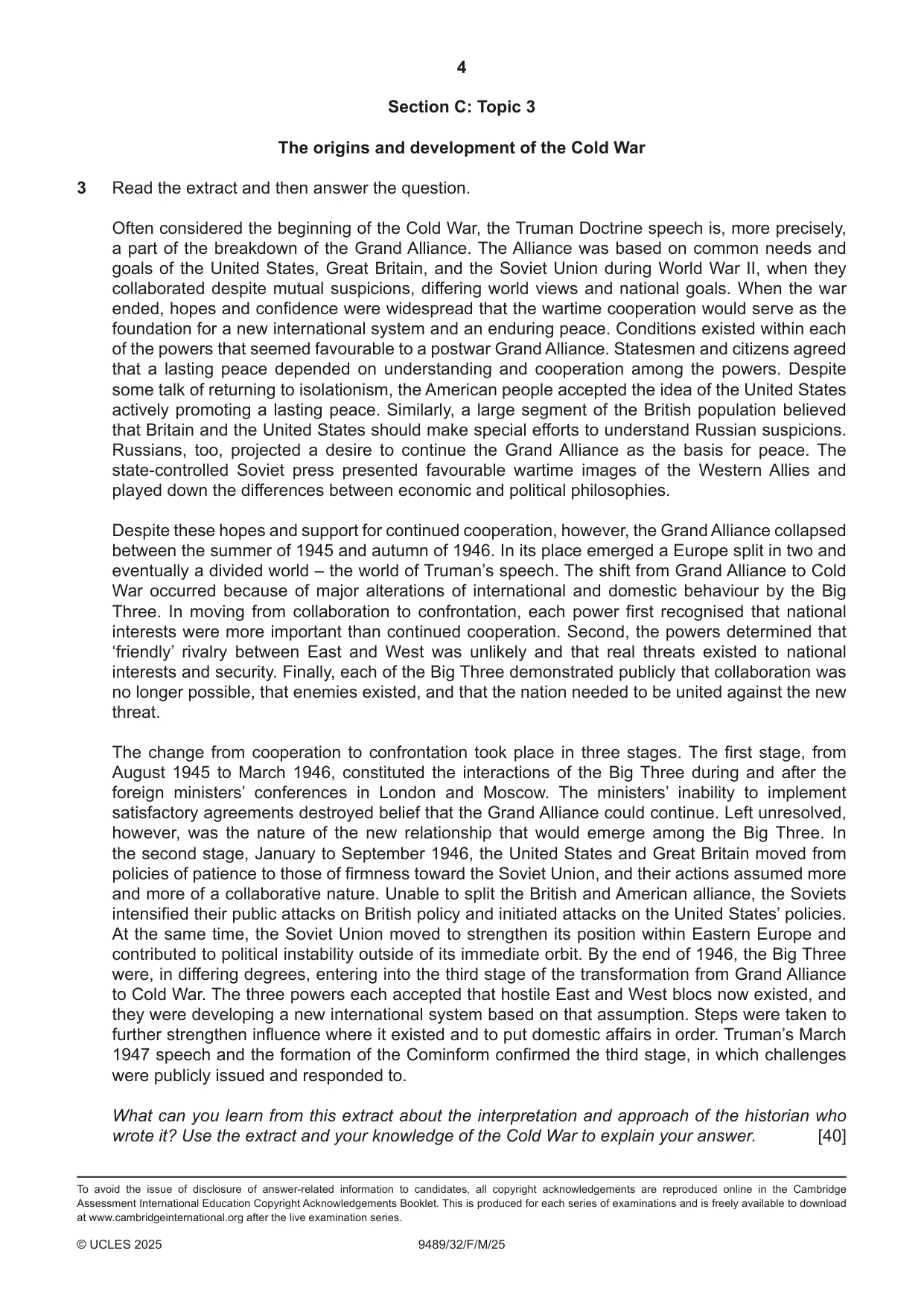
Mark scheme9 pages
Answers below. Sit the paper first if you are practising.
Questions as text
Q1 · Read the extract and then answer the question
1 Read the extract and then answer the question. Some writers have claimed that the war was brought about by background factors such as militarism, alliances, imperialism and nationalism. These all played a part in creating the conditions in which war broke out, but none of them individually or in combination can be said to have ‘caused’ the First World War. There is, for instance, no evidence that the arms race led directly to conflict. Certainly, the Anglo-German naval building competition destabilised relations between these two states, but it was the German army’s invasion of Belgium that was the cause of war for Britain. The so-called ‘war by timetable’ debate argues that rigid military plans tied the hands of politicians during the fateful days of July and August 1914. When on 1 August the Kaiser suddenly demanded that the German armies be sent against Russia alone, Moltke had to say no. There was no alternative to the Schlieffen Plan by which the bulk of the German army would be deployed to the west. In that armies were dependent on carefully calculated mobilisation plans, the ‘war by timetable’ idea contains some truth. However, the notion that civilian leaders were pushed into war by aggressive generals does not bear scrutiny. Both the German and Austrian chiefs of staff had been urging war for some years, but only in the summer of 1914 were their strident demands finally aligned with the decision of the politicians to go to war. The network of alliances has been blamed for causing a wider war by a sort of ‘domino effect’, but the existence of rival power blocs did not make a major war inevitable. Instead, such groupings can actually bring stability to a situation, not least through deterrence and the discipline imposed by being a member of an alliance. In the instance of 1914, a good case can be made that the problem was not that the alliances were too strong, but that they were too weak. Germany believed that the Triple Entente rested on foundations sufficiently insecure that the bloc could be broken apart over the July Crisis with or without war. Indeed, a fundamental problem which contributed to the outbreak of war was the lack of a fully effective balance of power in Europe, not its existence. It was once fashionable to blame the outbreak of the war on imperialism, the drive to acquire colonies, raw materials and markets overseas. Marxists saw German Weltpolitik in economic terms with capitalists encouraging foreign policy, which in turn led to a clash with other capitalist states. However, there are many reasons why this seems improbable, not least the fact that the economies of Europe were increasingly inter-dependent. The idea that unchecked nationalism drove Europe into war in 1914 is also wrong. Reactions to the outbreak of war ranged from outright enthusiasm to outright opposition, but for the masses war was seen as something to be endured and certainly not to be greeted with joy. In fact, the outbreak of war in August 1914 was wholly avoidable. It came about because key individuals in Austria-Hungary and Germany took conscious decisions to achieve diplomatic objectives even at the cost of conflict with Russia and France. The responses of Russia, France and eventually Britain to events in the Balkans were essentially reactive and defensive. The actions of the Great Powers in limiting the damage from previous Balkan crises strongly suggest that, had the Austrians and Germans wished it, the crisis of 1914 could have been resolved by the cooperation of the international community. This would have isolated and punished Serbia but left its independence and security intact. What can you learn from this extract about the interpretation and approach of the historian who wrote it? Use the extract and your knowledge of the origins of the First World War to explain your answer. [40]
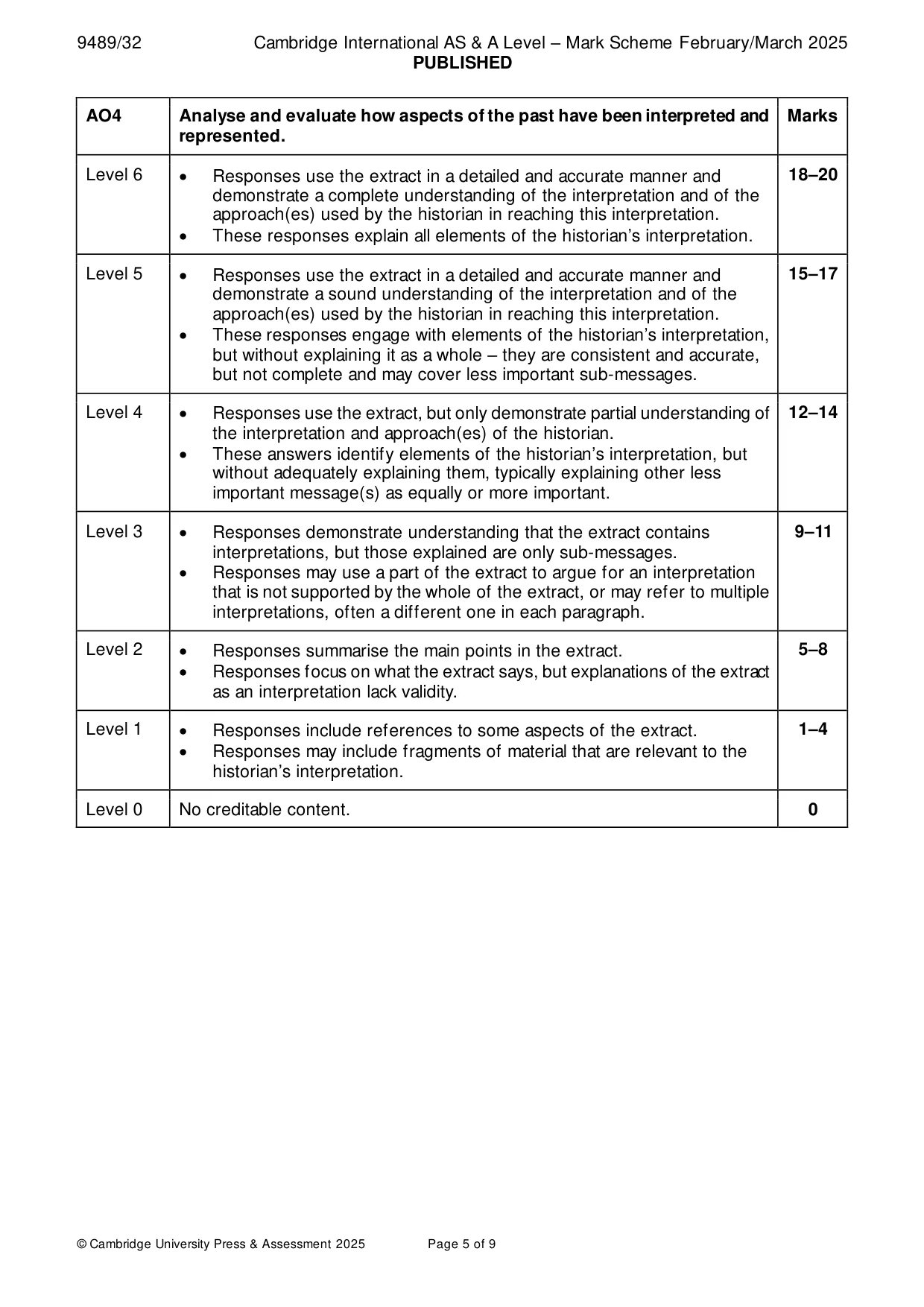
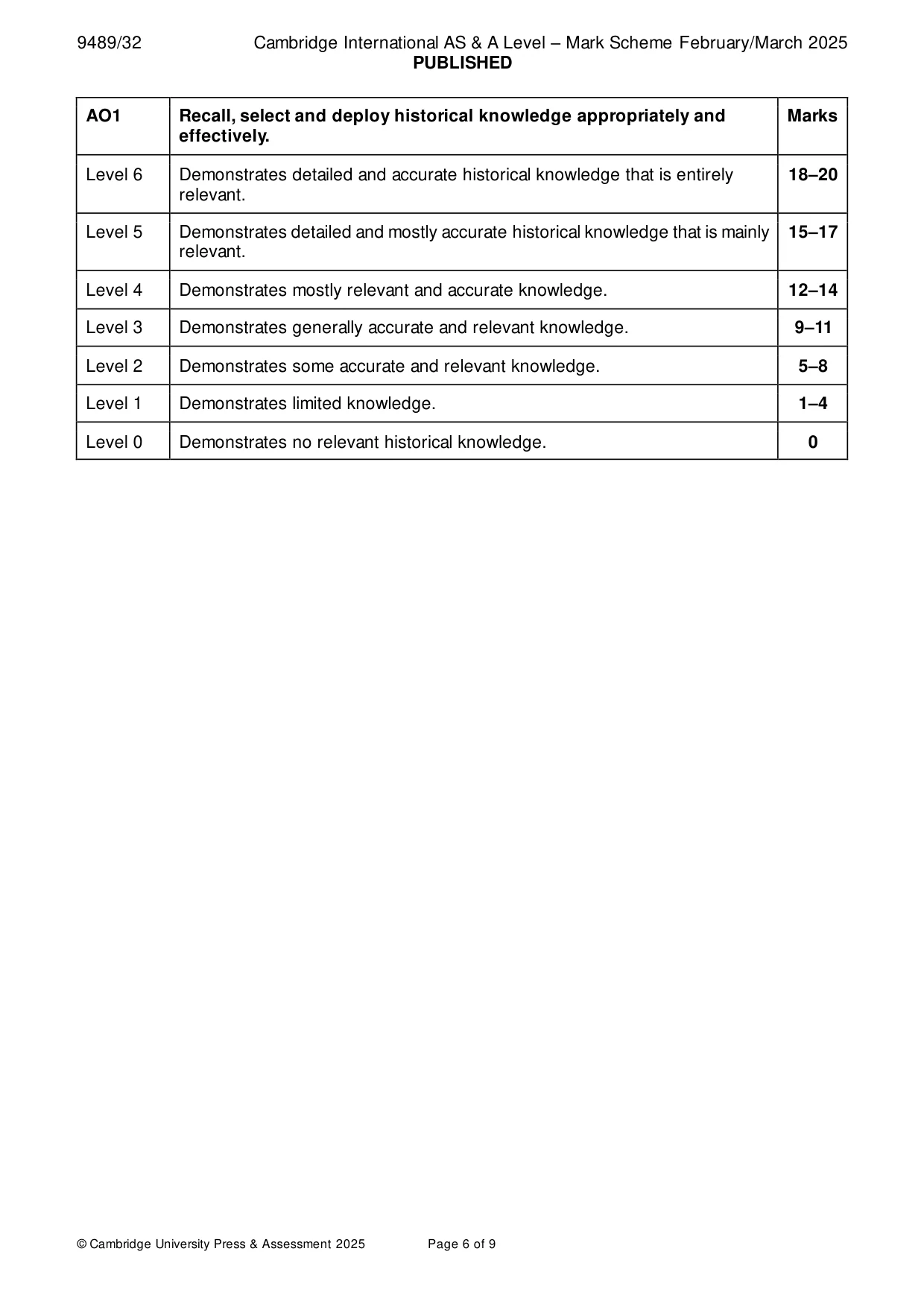
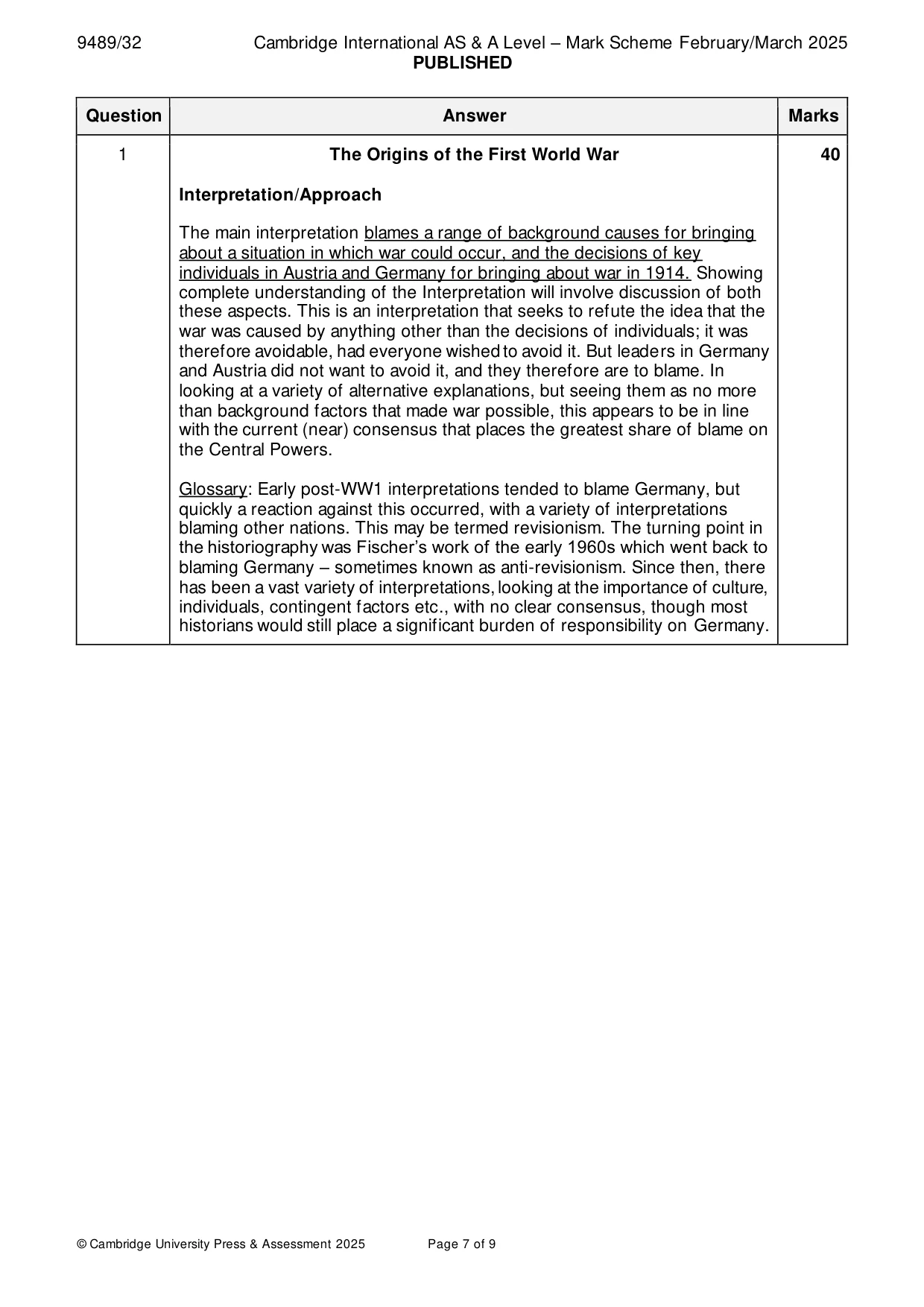
Mark scheme: Question Answer Marks 1 The Origins of the First World War 40 Interpretation/Approach The main interpretation blames a range of background causes for bringing about a situation in which war could occur, and the decisions of key individuals in Austria and Germany for bringing about war in 1914. Showing complete understanding of the Interpretation will involve discussion of both these aspects. This is an interpretation that seeks to refute the idea that the war was caused by anything other than the decisions of individuals; it was therefore avoidable, had everyone wished to avoid it. But leaders in Germany and Austria did not want to avoid it, and they therefore are to blame. In looking at a variety of alternative explanations, but seeing them as no more than background factors that made war possible, this appears to be in line with the current (near) consensus that places the greatest share of blame on the Central Powers. Glossary: Early post-WW1 interpretations tended to blame Germany, but quickly a reaction against this occurred, with a variety of interpretations blaming other nations. This may be termed revisionism. The turning point in the historiography was Fischer’s work of the early 1960s which went back to blaming Germany – sometimes known as anti-revisionism. Since then, there has been a vast variety of interpretations, looking at the importance of culture, individuals, contingent factors etc., with no clear consensus, though most historians would still place a significant burden of responsibility on Germany.
Q2 · Read the extract and then answer the question
2 Read the extract and then answer the question. From the outset Nazi ideology and practice linked attacks on Jews with preparations for war. In March 1935, Hitler announced full German rearmament. Within weeks, German Jews were banned from military service. This exclusion implied that Jews were dishonourable, unfit to be soldiers, and loyal to Germany’s enemies. Even before Hitler’s war began, the assault on the Jews was under way. ‘Europe cannot find peace until the Jewish question has been solved,’ Hitler told the Reichstag on 30 January 1939, less than three months after thugs torched synagogues and plundered the homes and businesses of Jews all over Germany. War, Hitler had already decided, would start that year. ‘Today I will once more be a prophet. If the international Jewish financiers in and outside Europe should succeed in plunging the nations once more into a world war, then the result will be the annihilation of the Jewish race in Europe.’ Later, Goebbels and others often quoted this prophecy, which they consistently misdated to coincide with the German invasion of Poland on 1 September 1939. This ‘mistake’ was a trick, an attempt to cast Hitler’s words as self- defence, a response to attack, rather than a declaration of murderous intent. War made Nazi anti-semitism more significant in every possible way. Most obviously, it multiplied almost tenfold the number of Jews under German rule. The invasion of Poland in September 1939 put approximately two million Polish Jews in German hands, and Nazi ideology plus years of anti-semitic propaganda and action inside Germany made those Jews targets against whom anything and everything was permitted. To the Germans in Poland, Jews embodied both the racial threat to Aryan blood and a major obstacle to German order. German practices in conquered Poland reinforced notions of Jews as dangerous and created new ‘proof’ of Jewish inferiority. Ghettoisation of Jews began in late 1939. According to the official line, Jews had to be confined to preserve German safety and prevent the spread of disease. In fact, ghettoisation made easier the theft of Jewish property and drove a wedge between Polish Jews and non-Jews. Like other Nazi anti-semitic measures, ghettoisation functioned as a self-fulfilling prophecy. Locked up under conditions of terrible shortage – of food, housing, sanitation, and everything else needed to live – Jews in the ghettos of occupied Poland sank into desperation. Starving, begging, dressed in rags, and dying in the street, they embodied the opposite of the Aryan ideal. During wartime as before, anti-semitism connected Nazi prejudices and policies, and provided coherence where there was none. After the Nazi-Soviet Pact in August 1939, anti-semitism remained the only constant in Nazi ideology. Hitler’s deal with Stalin blocked anti-communist actions for the time being, but the notion of a Jewish conspiracy survived. Stepped-up violence against Jews became the accepted way to solve problems. When Himmler’s Race and Settlement authorities began bringing ethnic Germans from eastern Europe back into the Reich – that is, resettling them in occupied Poland – they ran into major difficulties. Where could they house the hundreds of thousands, eventually to be millions, of people they had lured in with promises of prosperity and comfort? Their answers invariably targeted Jews. In Lodz, SS men went door-to-door through Jewish neighbourhoods, demanding people leave their homes within hours. In Germany, when local authorities ran short of money, they cut Jews off from public assistance, even before the central government in Berlin demanded they do so. Anti-semitism enabled ambitious Germans to ‘work towards the Führer’ while serving their own schemes, and Nazi propaganda made clear the advantages of such behaviour. What can you learn from this extract about the interpretation and approach of the historian who wrote it? Use the extract and your knowledge of the Holocaust to explain your answer. [40] Section C: Topic 3 The origins and development of the Cold War
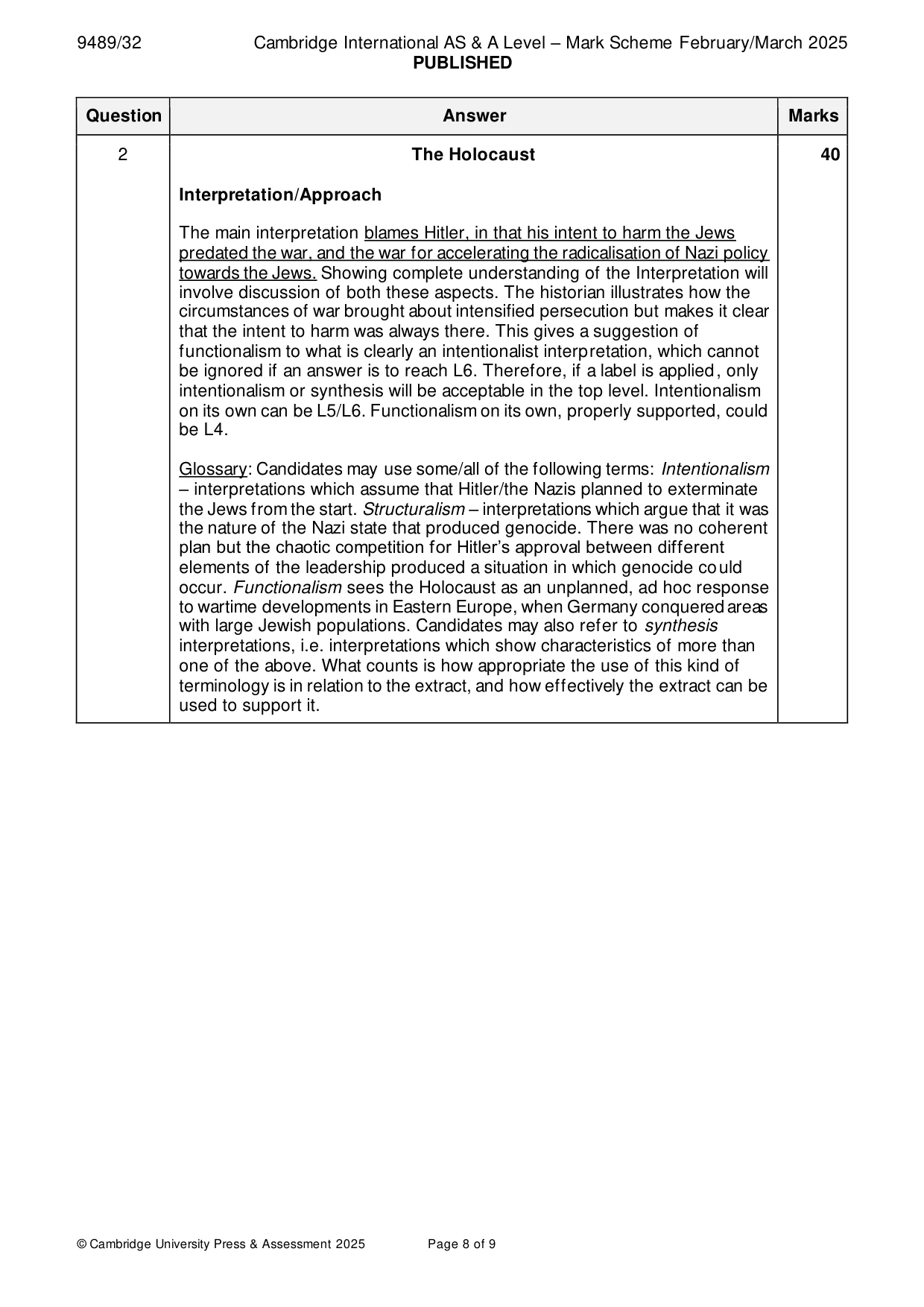
Mark scheme: 2 The Holocaust 40 Interpretation/Approach The main interpretation blames Hitler, in that his intent to harm the Jews predated the war, and the war for accelerating the radicalisation of Nazi policy towards the Jews. Showing complete understanding of the Interpretation will involve discussion of both these aspects. The historian illustrates how the circumstances of war brought about intensified persecution but makes it clear that the intent to harm was always there. This gives a suggestion of functionalism to what is clearly an intentionalist interpretation, which cannot be ignored if an answer is to reach L6. Therefore, if a label is applied, only intentionalism or synthesis will be acceptable in the top level. Intentionalism on its own can be L5/L6. Functionalism on its own, properly supported, could be L4. Glossary: Candidates may use some/all of the following terms: Intentionalism – interpretations which assume that Hitler/the Nazis planned to exterminate the Jews from the start. Structuralism – interpretations which argue that it was the nature of the Nazi state that produced genocide. There was no coherent plan but the chaotic competition for Hitler’s approval between different elements of the leadership produced a situation in which genocide could occur. Functionalism sees the Holocaust as an unplanned, ad hoc response to wartime developments in Eastern Europe, when Germany conquered areas with large Jewish populations. Candidates may also refer to synthesis interpretations, i.e. interpretations which show characteristics of more than one of the above. What counts is how appropriate the use of this kind of terminology is in relation to the extract, and how effectively the extract can be used to support it.
Q3 · Read the extract and then answer the question
3 Read the extract and then answer the question. Often considered the beginning of the Cold War, the Truman Doctrine speech is, more precisely, a part of the breakdown of the Grand Alliance. The Alliance was based on common needs and goals of the United States, Great Britain, and the Soviet Union during World War II, when they collaborated despite mutual suspicions, differing world views and national goals. When the war ended, hopes and confidence were widespread that the wartime cooperation would serve as the foundation for a new international system and an enduring peace. Conditions existed within each of the powers that seemed favourable to a postwar Grand Alliance. Statesmen and citizens agreed that a lasting peace depended on understanding and cooperation among the powers. Despite some talk of returning to isolationism, the American people accepted the idea of the United States actively promoting a lasting peace. Similarly, a large segment of the British population believed that Britain and the United States should make special efforts to understand Russian suspicions. Russians, too, projected a desire to continue the Grand Alliance as the basis for peace. The state-controlled Soviet press presented favourable wartime images of the Western Allies and played down the differences between economic and political philosophies. Despite these hopes and support for continued cooperation, however, the Grand Alliance collapsed between the summer of 1945 and autumn of 1946. In its place emerged a Europe split in two and eventually a divided world – the world of Truman’s speech. The shift from Grand Alliance to Cold War occurred because of major alterations of international and domestic behaviour by the Big Three. In moving from collaboration to confrontation, each power first recognised that national interests were more important than continued cooperation. Second, the powers determined that ‘friendly’ rivalry between East and West was unlikely and that real threats existed to national interests and security. Finally, each of the Big Three demonstrated publicly that collaboration was no longer possible, that enemies existed, and that the nation needed to be united against the new threat. The change from cooperation to confrontation took place in three stages. The first stage, from August 1945 to March 1946, constituted the interactions of the Big Three during and after the foreign ministers’ conferences in London and Moscow. The ministers’ inability to implement satisfactory agreements destroyed belief that the Grand Alliance could continue. Left unresolved, however, was the nature of the new relationship that would emerge among the Big Three. In the second stage, January to September 1946, the United States and Great Britain moved from policies of patience to those of firmness toward the Soviet Union, and their actions assumed more and more of a collaborative nature. Unable to split the British and American alliance, the Soviets intensified their public attacks on British policy and initiated attacks on the United States’ policies. At the same time, the Soviet Union moved to strengthen its position within Eastern Europe and contributed to political instability outside of its immediate orbit. By the end of 1946, the Big Three were, in differing degrees, entering into the third stage of the transformation from Grand Alliance to Cold War. The three powers each accepted that hostile East and West blocs now existed, and they were developing a new international system based on that assumption. Steps were taken to further strengthen influence where it existed and to put domestic affairs in order. Truman’s March 1947 speech and the formation of the Cominform confirmed the third stage, in which challenges were publicly issued and responded to. What can you learn from this extract about the interpretation and approach of the historian who wrote it? Use the extract and your knowledge of the Cold War to explain your answer. [40]
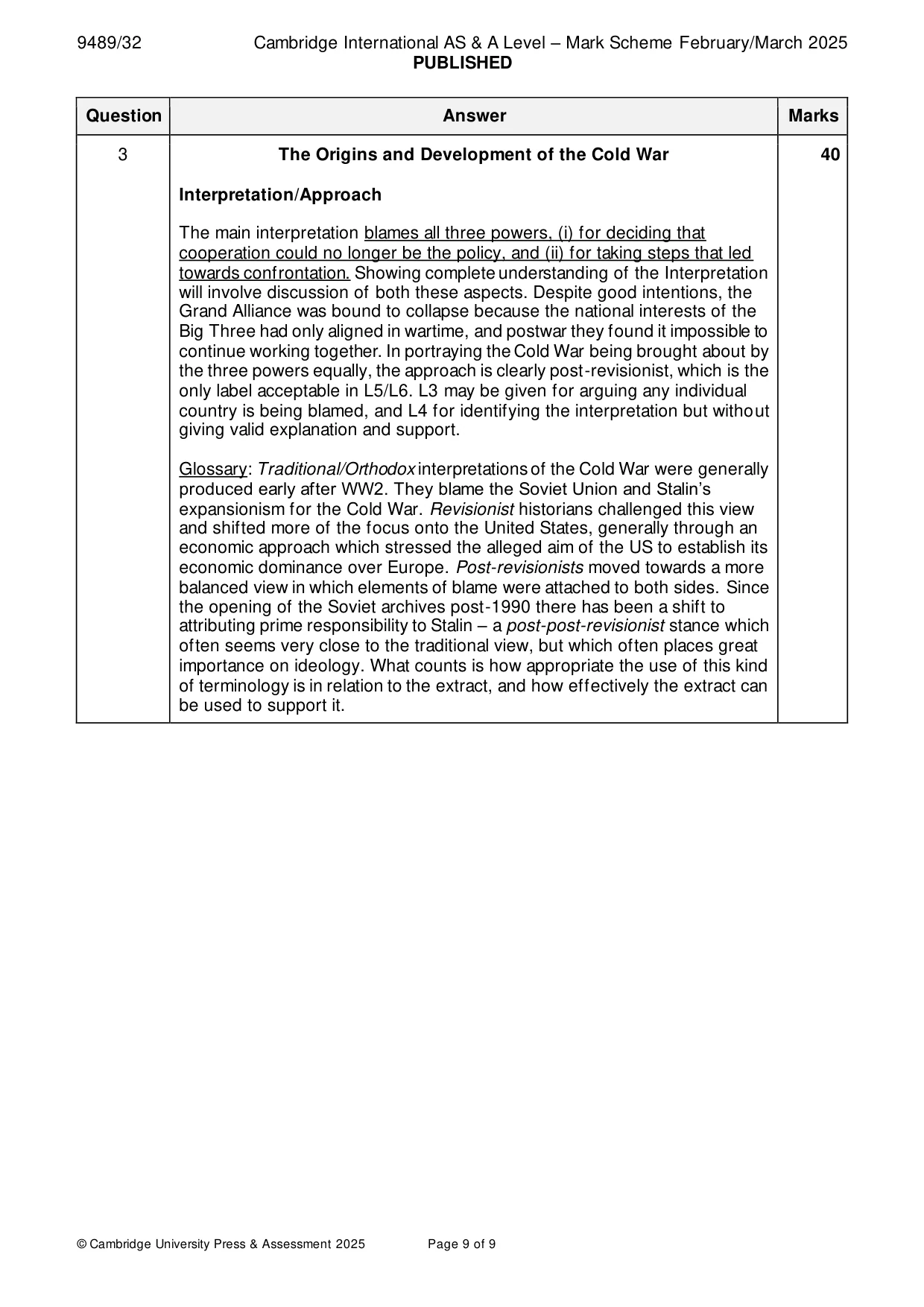
Mark scheme: 3 The Origins and Development of the Cold War 40 Interpretation/Approach The main interpretation blames all three powers, (i) for deciding that cooperation could no longer be the policy, and (ii) for taking steps that led towards confrontation. Showing complete understanding of the Interpretation will involve discussion of both these aspects. Despite good intentions, the Grand Alliance was bound to collapse because the national interests of the Big Three had only aligned in wartime, and postwar they found it impossible to continue working together. In portraying the Cold War being brought about by the three powers equally, the approach is clearly post-revisionist, which is the only label acceptable in L5/L6. L3 may be given for arguing any individual country is being blamed, and L4 for identifying the interpretation but without giving valid explanation and support. Glossary: Traditional/Orthodox interpretations of the Cold War were generally produced early after WW2. They blame the Soviet Union and Stalin’s expansionism for the Cold War. Revisionist historians challenged this view and shifted more of the focus onto the United States, generally through an economic approach which stressed the alleged aim of the US to establish its economic dominance over Europe. Post-revisionists moved towards a more balanced view in which elements of blame were attached to both sides. Since the opening of the Soviet archives post-1990 there has been a shift to attributing prime responsibility to Stalin – a post-post-revisionist stance which often seems very close to the traditional view, but which often places great importance on ideology. What counts is how appropriate the use of this kind of terminology is in relation to the extract, and how effectively the extract can be used to support it.
What was in this paper
The subtopics covered by these 3 questions, and how many questions each got. Open one in a new tab to see every Cambridge question on it.
What you needed in this session
Cambridge’s own grade thresholds for 2025 Feb/March, Paper 3 · Variant 2. A higher threshold means an easier paper — the bar moves with how the cohort did.