Cambridge A Level History 9489 — 2023 Feb/March Paper 3 · Variant 2
9489/32/F/M/23 · 3 questions · 40 marks · ≈45 min
The question paper and its mark scheme, free to read here and free to download. This is Cambridge’s own paper, exactly as it was sat.
Question paper4 pages
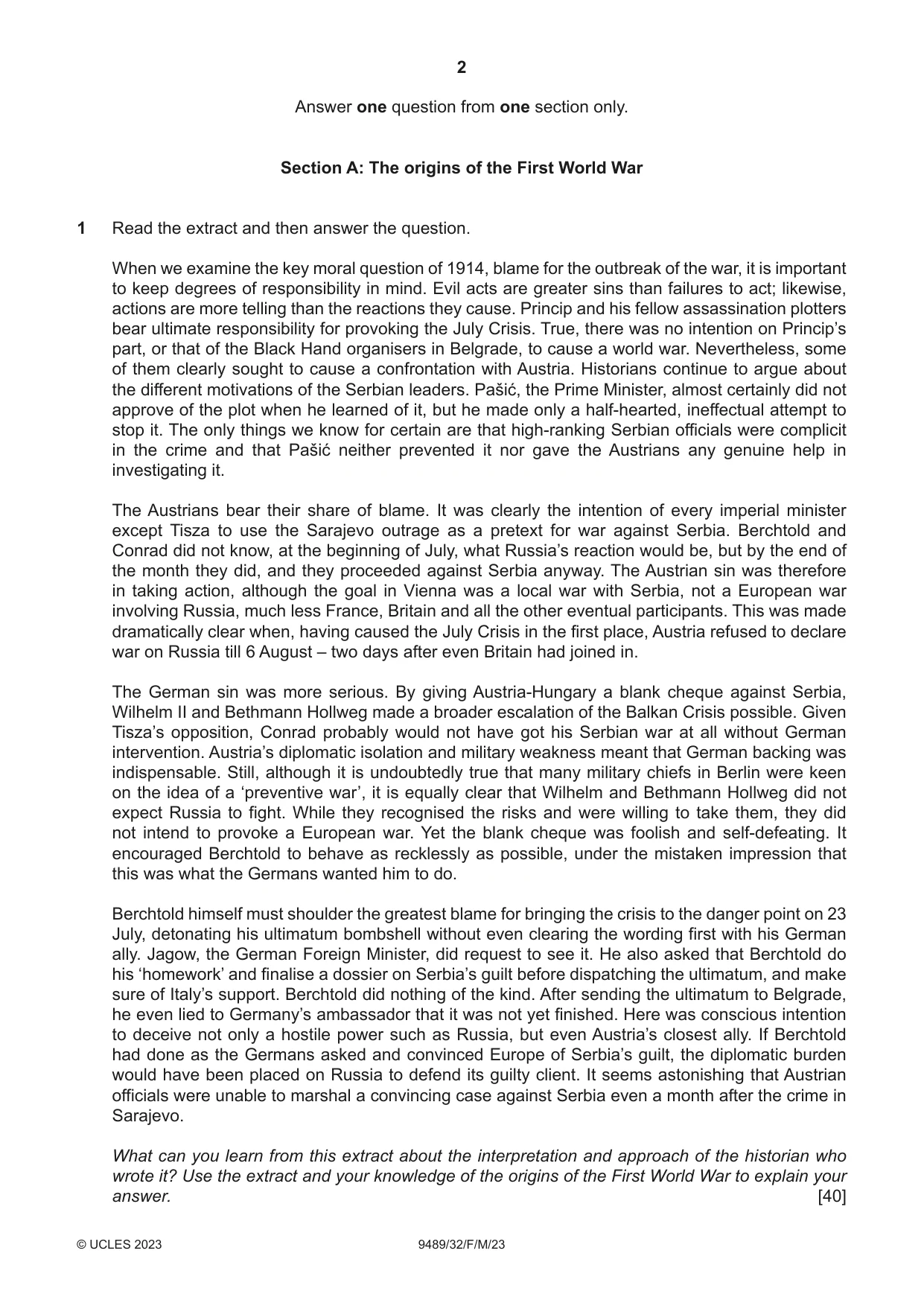
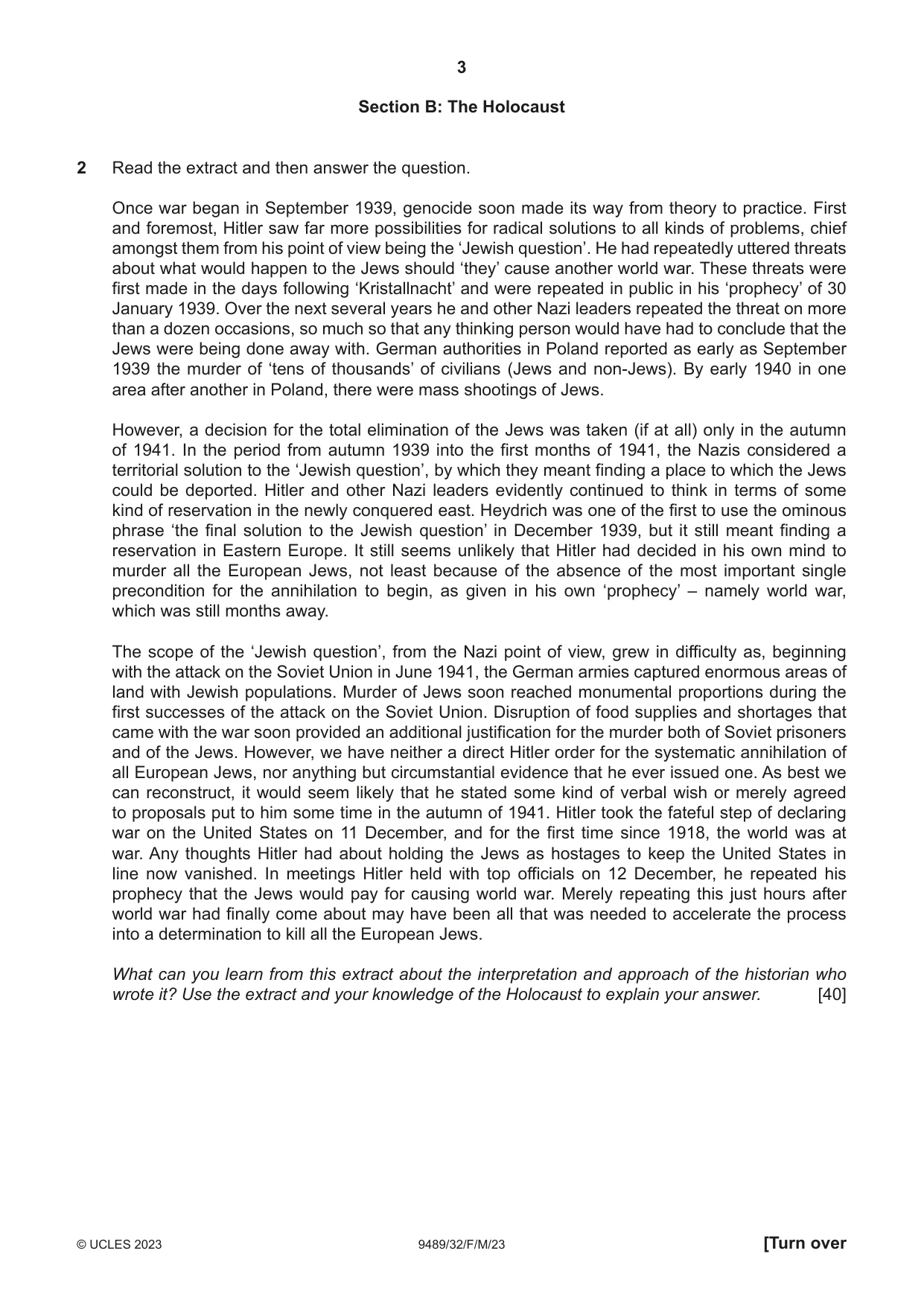
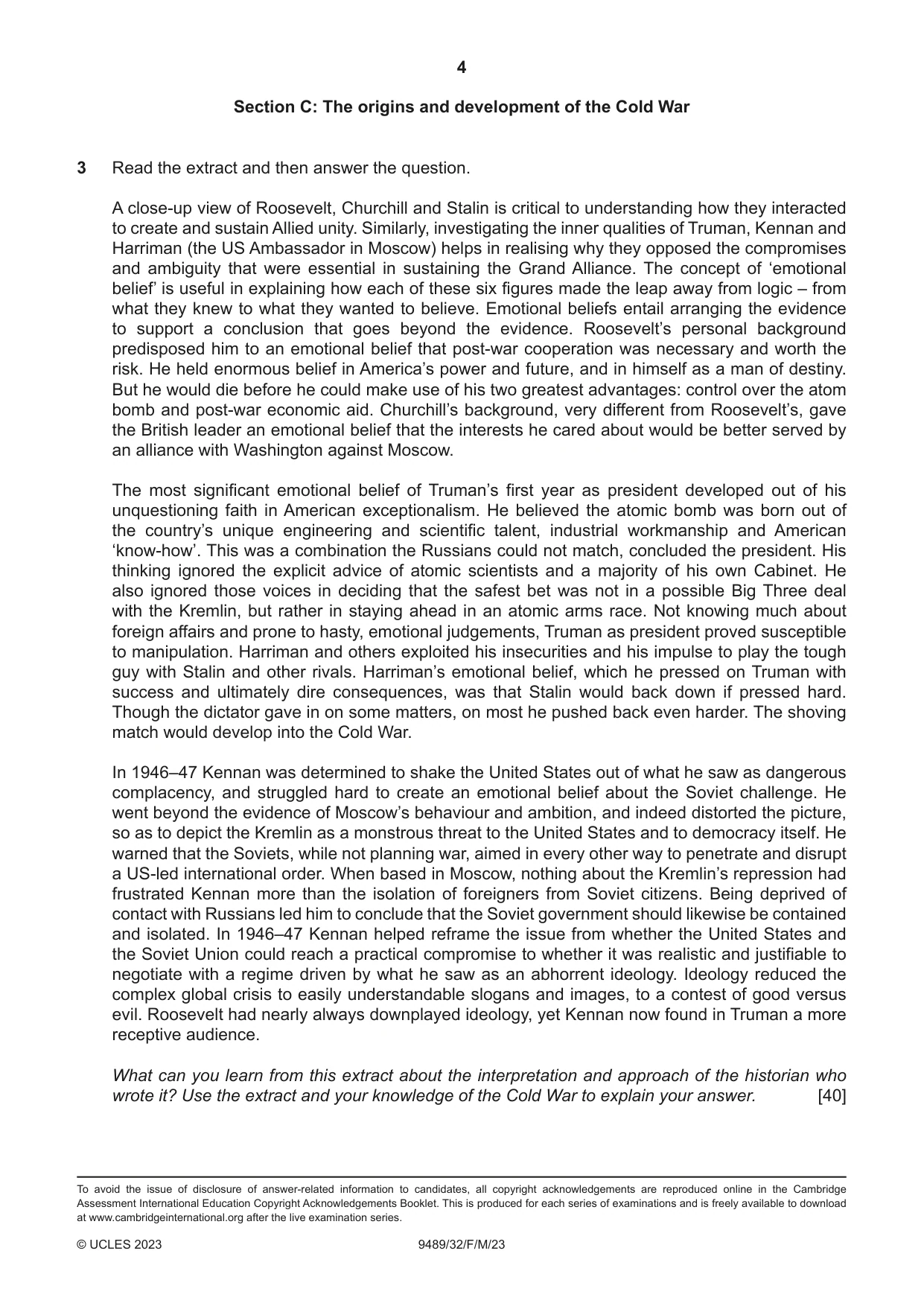
Mark scheme8 pages
Answers below. Sit the paper first if you are practising.
Questions as text
Q1 · Read the extract and then answer the question
1 Read the extract and then answer the question. When we examine the key moral question of 1914, blame for the outbreak of the war, it is important to keep degrees of responsibility in mind. Evil acts are greater sins than failures to act; likewise, actions are more telling than the reactions they cause. Princip and his fellow assassination plotters bear ultimate responsibility for provoking the July Crisis. True, there was no intention on Princip’s part, or that of the Black Hand organisers in Belgrade, to cause a world war. Nevertheless, some of them clearly sought to cause a confrontation with Austria. Historians continue to argue about the different motivations of the Serbian leaders. Pašić, the Prime Minister, almost certainly did not approve of the plot when he learned of it, but he made only a half-hearted, ineffectual attempt to stop it. The only things we know for certain are that high-ranking Serbian officials were complicit in the crime and that Pašić neither prevented it nor gave the Austrians any genuine help in investigating it. The Austrians bear their share of blame. It was clearly the intention of every imperial minister except Tisza to use the Sarajevo outrage as a pretext for war against Serbia. Berchtold and Conrad did not know, at the beginning of July, what Russia’s reaction would be, but by the end of the month they did, and they proceeded against Serbia anyway. The Austrian sin was therefore in taking action, although the goal in Vienna was a local war with Serbia, not a European war involving Russia, much less France, Britain and all the other eventual participants. This was made dramatically clear when, having caused the July Crisis in the first place, Austria refused to declare war on Russia till 6 August – two days after even Britain had joined in. The German sin was more serious. By giving Austria-Hungary a blank cheque against Serbia, Wilhelm II and Bethmann Hollweg made a broader escalation of the Balkan Crisis possible. Given Tisza’s opposition, Conrad probably would not have got his Serbian war at all without German intervention. Austria’s diplomatic isolation and military weakness meant that German backing was indispensable. Still, although it is undoubtedly true that many military chiefs in Berlin were keen on the idea of a ‘preventive war’, it is equally clear that Wilhelm and Bethmann Hollweg did not expect Russia to fight. While they recognised the risks and were willing to take them, they did not intend to provoke a European war. Yet the blank cheque was foolish and self-defeating. It encouraged Berchtold to behave as recklessly as possible, under the mistaken impression that this was what the Germans wanted him to do. Berchtold himself must shoulder the greatest blame for bringing the crisis to the danger point on 23 July, detonating his ultimatum bombshell without even clearing the wording first with his German ally. Jagow, the German Foreign Minister, did request to see it. He also asked that Berchtold do his ‘homework’ and finalise a dossier on Serbia’s guilt before dispatching the ultimatum, and make sure of Italy’s support. Berchtold did nothing of the kind. After sending the ultimatum to Belgrade, he even lied to Germany’s ambassador that it was not yet finished. Here was conscious intention to deceive not only a hostile power such as Russia, but even Austria’s closest ally. If Berchtold had done as the Germans asked and convinced Europe of Serbia’s guilt, the diplomatic burden would have been placed on Russia to defend its guilty client. It seems astonishing that Austrian officials were unable to marshal a convincing case against Serbia even a month after the crime in Sarajevo. What can you learn from this extract about the interpretation and approach of the historian who wrote it? Use the extract and your knowledge of the origins of the First World War to explain your answer. [40]
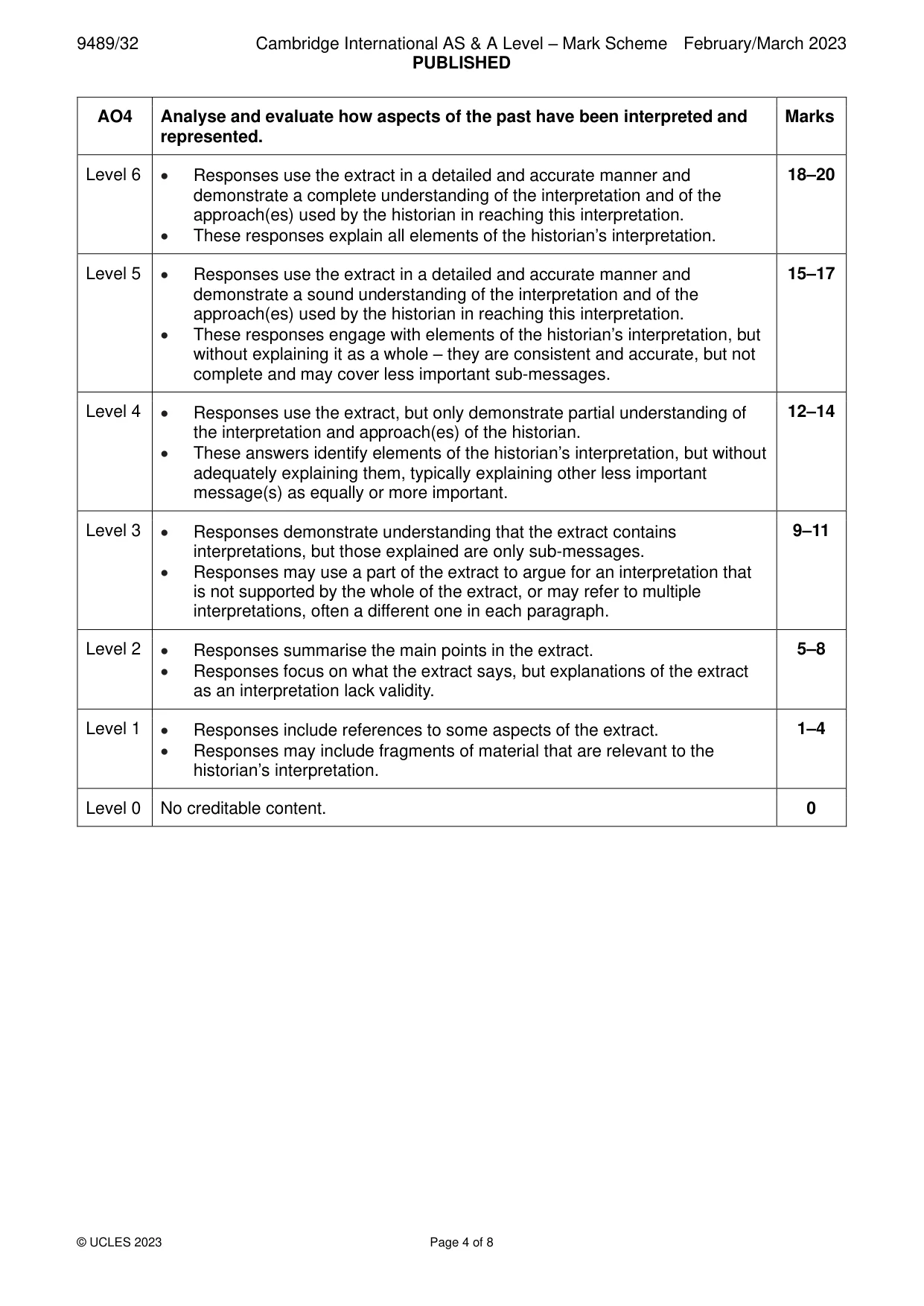
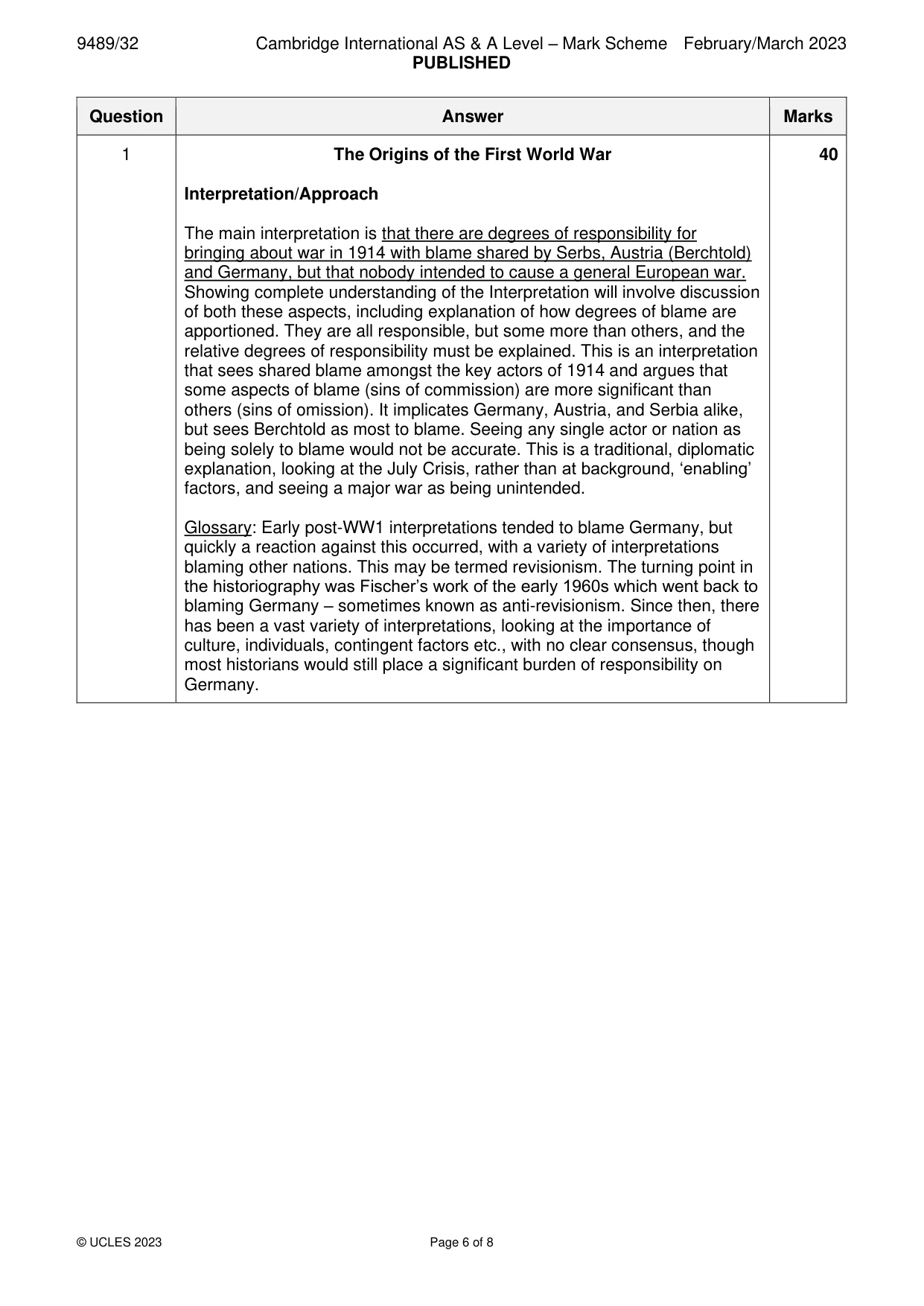
Mark scheme: Question Answer Marks 1 The Origins of the First World War 40 Interpretation/Approach The main interpretation is that there are degrees of responsibility for bringing about war in 1914 with blame shared by Serbs, Austria (Berchtold) and Germany, but that nobody intended to cause a general European war. Showing complete understanding of the Interpretation will involve discussion of both these aspects, including explanation of how degrees of blame are apportioned. They are all responsible, but some more than others, and the relative degrees of responsibility must be explained. This is an interpretation that sees shared blame amongst the key actors of 1914 and argues that some aspects of blame (sins of commission) are more significant than others (sins of omission). It implicates Germany, Austria, and Serbia alike, but sees Berchtold as most to blame. Seeing any single actor or nation as being solely to blame would not be accurate. This is a traditional, diplomatic explanation, looking at the July Crisis, rather than at background, ‘enabling’ factors, and seeing a major war as being unintended. Glossary: Early post-WW1 interpretations tended to blame Germany, but quickly a reaction against this occurred, with a variety of interpretations blaming other nations. This may be termed revisionism. The turning point in the historiography was Fischer’s work of the early 1960s which went back to blaming Germany – sometimes known as anti-revisionism. Since then, there has been a vast variety of interpretations, looking at the importance of culture, individuals, contingent factors etc., with no clear consensus, though most historians would still place a significant burden of responsibility on Germany.
Q2 · Read the extract and then answer the question
2 Read the extract and then answer the question. Once war began in September 1939, genocide soon made its way from theory to practice. First and foremost, Hitler saw far more possibilities for radical solutions to all kinds of problems, chief amongst them from his point of view being the ‘Jewish question’. He had repeatedly uttered threats about what would happen to the Jews should ‘they’ cause another world war. These threats were first made in the days following ‘Kristallnacht’ and were repeated in public in his ‘prophecy’ of 30 January 1939. Over the next several years he and other Nazi leaders repeated the threat on more than a dozen occasions, so much so that any thinking person would have had to conclude that the Jews were being done away with. German authorities in Poland reported as early as September 1939 the murder of ‘tens of thousands’ of civilians (Jews and non-Jews). By early 1940 in one area after another in Poland, there were mass shootings of Jews. However, a decision for the total elimination of the Jews was taken (if at all) only in the autumn of 1941. In the period from autumn 1939 into the first months of 1941, the Nazis considered a territorial solution to the ‘Jewish question’, by which they meant finding a place to which the Jews could be deported. Hitler and other Nazi leaders evidently continued to think in terms of some kind of reservation in the newly conquered east. Heydrich was one of the first to use the ominous phrase ‘the final solution to the Jewish question’ in December 1939, but it still meant finding a reservation in Eastern Europe. It still seems unlikely that Hitler had decided in his own mind to murder all the European Jews, not least because of the absence of the most important single precondition for the annihilation to begin, as given in his own ‘prophecy’ – namely world war, which was still months away. The scope of the ‘Jewish question’, from the Nazi point of view, grew in difficulty as, beginning with the attack on the Soviet Union in June 1941, the German armies captured enormous areas of land with Jewish populations. Murder of Jews soon reached monumental proportions during the first successes of the attack on the Soviet Union. Disruption of food supplies and shortages that came with the war soon provided an additional justification for the murder both of Soviet prisoners and of the Jews. However, we have neither a direct Hitler order for the systematic annihilation of all European Jews, nor anything but circumstantial evidence that he ever issued one. As best we can reconstruct, it would seem likely that he stated some kind of verbal wish or merely agreed to proposals put to him some time in the autumn of 1941. Hitler took the fateful step of declaring war on the United States on 11 December, and for the first time since 1918, the world was at war. Any thoughts Hitler had about holding the Jews as hostages to keep the United States in line now vanished. In meetings Hitler held with top officials on 12 December, he repeated his prophecy that the Jews would pay for causing world war. Merely repeating this just hours after world war had finally come about may have been all that was needed to accelerate the process into a determination to kill all the European Jews. What can you learn from this extract about the interpretation and approach of the historian who wrote it? Use the extract and your knowledge of the Holocaust to explain your answer. [40] Section C: The origins and development of the Cold War
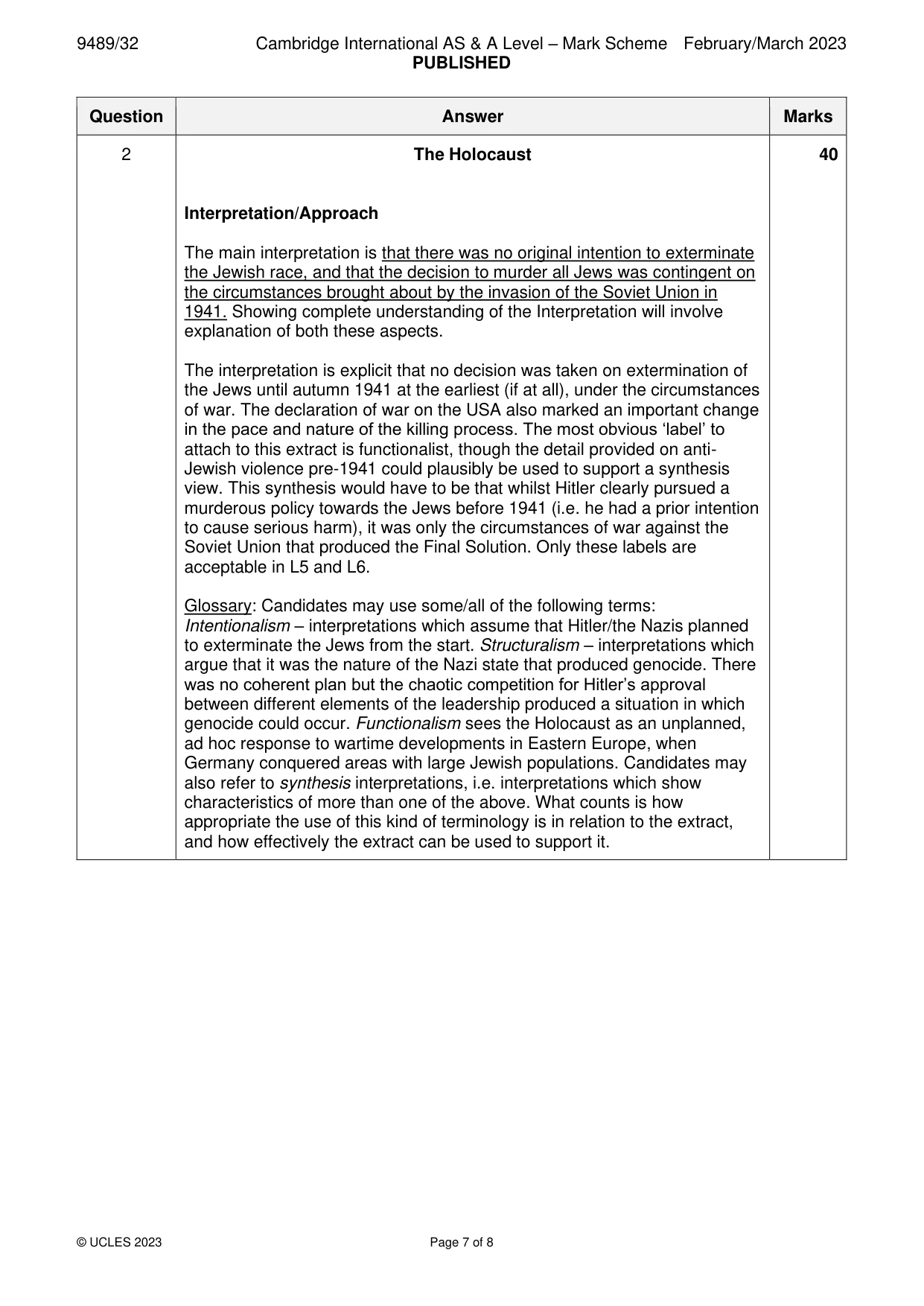
Mark scheme: 2 The Holocaust 40 Interpretation/Approach The main interpretation is that there was no original intention to exterminate the Jewish race, and that the decision to murder all Jews was contingent on the circumstances brought about by the invasion of the Soviet Union in 1941. Showing complete understanding of the Interpretation will involve explanation of both these aspects. The interpretation is explicit that no decision was taken on extermination of the Jews until autumn 1941 at the earliest (if at all), under the circumstances of war. The declaration of war on the USA also marked an important change in the pace and nature of the killing process. The most obvious ‘label’ to attach to this extract is functionalist, though the detail provided on anti- Jewish violence pre-1941 could plausibly be used to support a synthesis view. This synthesis would have to be that whilst Hitler clearly pursued a murderous policy towards the Jews before 1941 (i.e. he had a prior intention to cause serious harm), it was only the circumstances of war against the Soviet Union that produced the Final Solution. Only these labels are acceptable in L5 and L6. Glossary: Candidates may use some/all of the following terms: Intentionalism – interpretations which assume that Hitler/the Nazis planned to exterminate the Jews from the start. Structuralism – interpretations which argue that it was the nature of the Nazi state that produced genocide. There was no coherent plan but the chaotic competition for Hitler’s approval between different elements of the leadership produced a situation in which genocide could occur. Functionalism sees the Holocaust as an unplanned, ad hoc response to wartime developments in Eastern Europe, when Germany conquered areas with large Jewish populations. Candidates may also refer to synthesis interpretations, i.e. interpretations which show characteristics of more than one of the above. What counts is how appropriate the use of this kind of terminology is in relation to the extract, and how effectively the extract can be used to support it.
Q3 · Read the extract and then answer the question
3 Read the extract and then answer the question. A close-up view of Roosevelt, Churchill and Stalin is critical to understanding how they interacted to create and sustain Allied unity. Similarly, investigating the inner qualities of Truman, Kennan and Harriman (the US Ambassador in Moscow) helps in realising why they opposed the compromises and ambiguity that were essential in sustaining the Grand Alliance. The concept of ‘emotional belief’ is useful in explaining how each of these six figures made the leap away from logic – from what they knew to what they wanted to believe. Emotional beliefs entail arranging the evidence to support a conclusion that goes beyond the evidence. Roosevelt’s personal background predisposed him to an emotional belief that post-war cooperation was necessary and worth the risk. He held enormous belief in America’s power and future, and in himself as a man of destiny. But he would die before he could make use of his two greatest advantages: control over the atom bomb and post-war economic aid. Churchill’s background, very different from Roosevelt’s, gave the British leader an emotional belief that the interests he cared about would be better served by an alliance with Washington against Moscow. The most significant emotional belief of Truman’s first year as president developed out of his unquestioning faith in American exceptionalism. He believed the atomic bomb was born out of the country’s unique engineering and scientific talent, industrial workmanship and American ‘know-how’. This was a combination the Russians could not match, concluded the president. His thinking ignored the explicit advice of atomic scientists and a majority of his own Cabinet. He also ignored those voices in deciding that the safest bet was not in a possible Big Three deal with the Kremlin, but rather in staying ahead in an atomic arms race. Not knowing much about foreign affairs and prone to hasty, emotional judgements, Truman as president proved susceptible to manipulation. Harriman and others exploited his insecurities and his impulse to play the tough guy with Stalin and other rivals. Harriman’s emotional belief, which he pressed on Truman with success and ultimately dire consequences, was that Stalin would back down if pressed hard. Though the dictator gave in on some matters, on most he pushed back even harder. The shoving match would develop into the Cold War. In 1946–47 Kennan was determined to shake the United States out of what he saw as dangerous complacency, and struggled hard to create an emotional belief about the Soviet challenge. He went beyond the evidence of Moscow’s behaviour and ambition, and indeed distorted the picture, so as to depict the Kremlin as a monstrous threat to the United States and to democracy itself. He warned that the Soviets, while not planning war, aimed in every other way to penetrate and disrupt a US-led international order. When based in Moscow, nothing about the Kremlin’s repression had frustrated Kennan more than the isolation of foreigners from Soviet citizens. Being deprived of contact with Russians led him to conclude that the Soviet government should likewise be contained and isolated. In 1946–47 Kennan helped reframe the issue from whether the United States and the Soviet Union could reach a practical compromise to whether it was realistic and justifiable to negotiate with a regime driven by what he saw as an abhorrent ideology. Ideology reduced the complex global crisis to easily understandable slogans and images, to a contest of good versus evil. Roosevelt had nearly always downplayed ideology, yet Kennan now found in Truman a more receptive audience. What can you learn from this extract about the interpretation and approach of the historian who wrote it? Use the extract and your knowledge of the Cold War to explain your answer. [40]
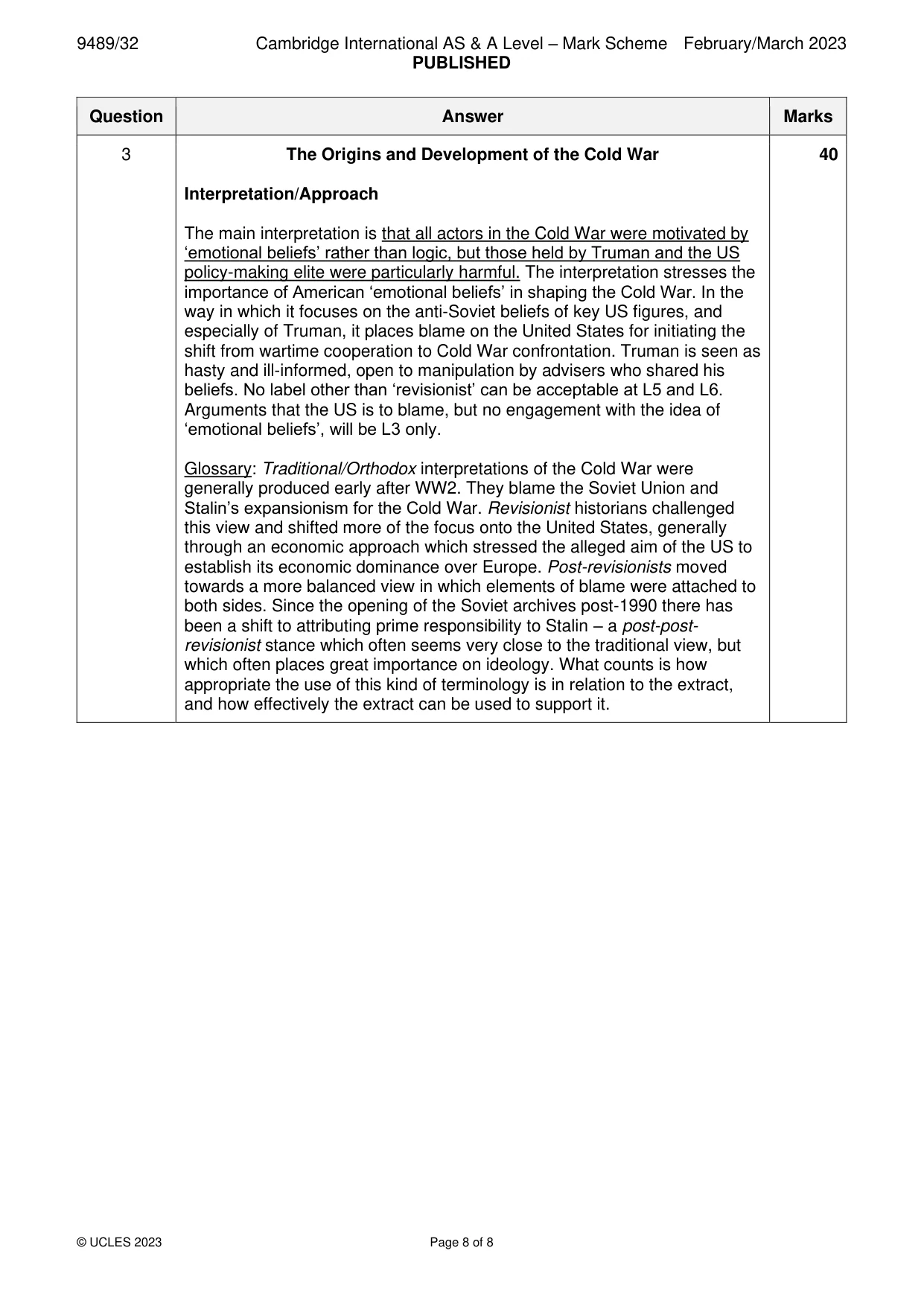
Mark scheme: 3 The Origins and Development of the Cold War 40 Interpretation/Approach The main interpretation is that all actors in the Cold War were motivated by ‘emotional beliefs’ rather than logic, but those held by Truman and the US policy-making elite were particularly harmful. The interpretation stresses the importance of American ‘emotional beliefs’ in shaping the Cold War. In the way in which it focuses on the anti-Soviet beliefs of key US figures, and especially of Truman, it places blame on the United States for initiating the shift from wartime cooperation to Cold War confrontation. Truman is seen as hasty and ill-informed, open to manipulation by advisers who shared his beliefs. No label other than ‘revisionist’ can be acceptable at L5 and L6. Arguments that the US is to blame, but no engagement with the idea of ‘emotional beliefs’, will be L3 only. Glossary: Traditional/Orthodox interpretations of the Cold War were generally produced early after WW2. They blame the Soviet Union and Stalin’s expansionism for the Cold War. Revisionist historians challenged this view and shifted more of the focus onto the United States, generally through an economic approach which stressed the alleged aim of the US to establish its economic dominance over Europe. Post-revisionists moved towards a more balanced view in which elements of blame were attached to both sides. Since the opening of the Soviet archives post-1990 there has been a shift to attributing prime responsibility to Stalin – a post-post- revisionist stance which often seems very close to the traditional view, but which often places great importance on ideology. What counts is how appropriate the use of this kind of terminology is in relation to the extract, and how effectively the extract can be used to support it.
What was in this paper
The subtopics covered by these 3 questions, and how many questions each got. Open one in a new tab to see every Cambridge question on it.
What you needed in this session
Cambridge’s own grade thresholds for 2023 Feb/March, Paper 3 · Variant 2. A higher threshold means an easier paper — the bar moves with how the cohort did.