Cambridge A Level History 9489 — 2025 May/June Paper 3 · Variant 2
9489/32/M/J/25 · 3 questions · 40 marks · ≈45 min
The question paper and its mark scheme, free to read here and free to download. This is Cambridge’s own paper, exactly as it was sat.
Question paper4 pages
Mark scheme10 pages
Answers below. Sit the paper first if you are practising.
Questions as text
Q1 · Read the extract and then answer the question
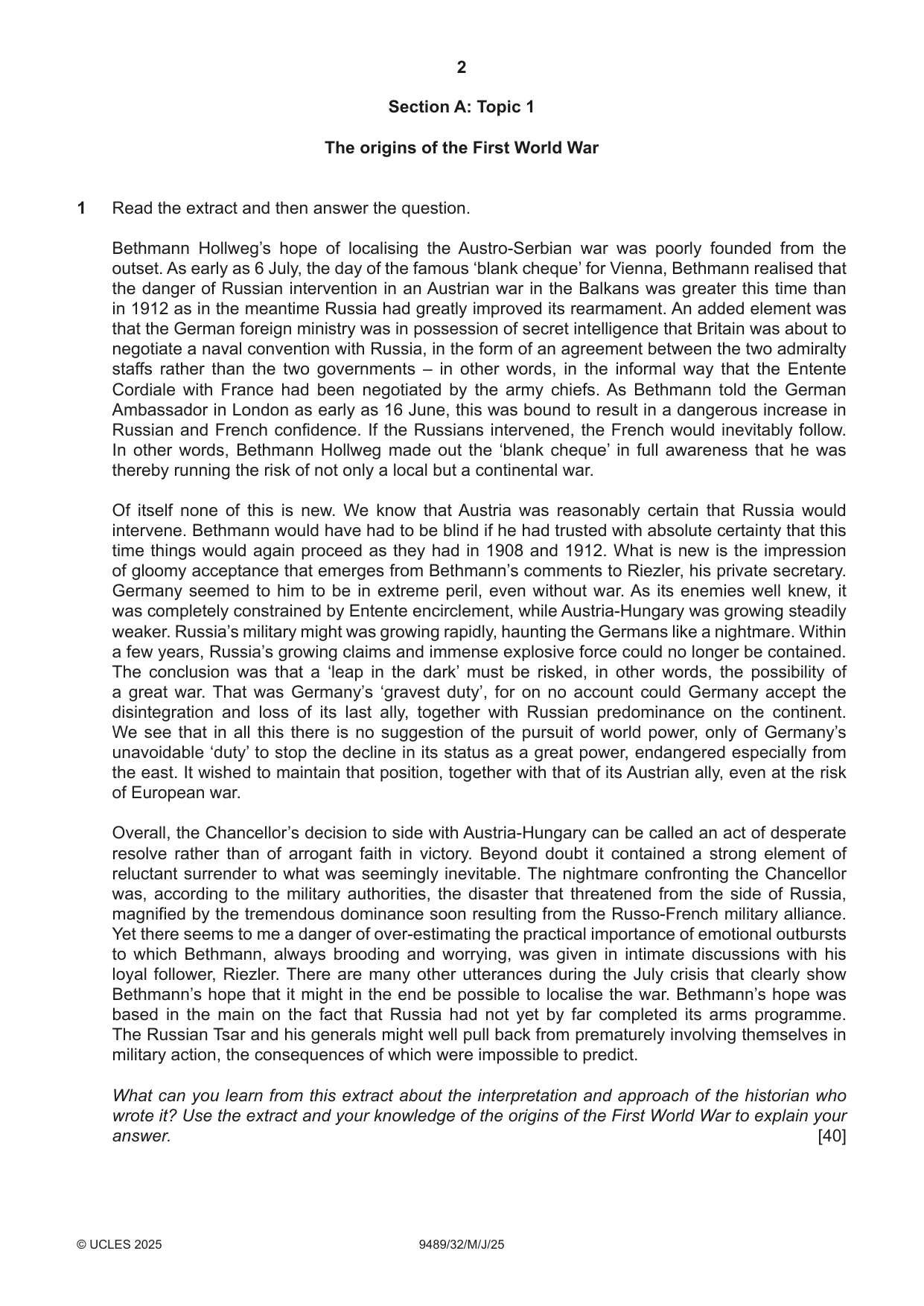
1 Read the extract and then answer the question. Bethmann Hollweg’s hope of localising the Austro-Serbian war was poorly founded from the outset. As early as 6 July, the day of the famous ‘blank cheque’ for Vienna, Bethmann realised that the danger of Russian intervention in an Austrian war in the Balkans was greater this time than in 1912 as in the meantime Russia had greatly improved its rearmament. An added element was that the German foreign ministry was in possession of secret intelligence that Britain was about to negotiate a naval convention with Russia, in the form of an agreement between the two admiralty staffs rather than the two governments – in other words, in the informal way that the Entente Cordiale with France had been negotiated by the army chiefs. As Bethmann told the German Ambassador in London as early as 16 June, this was bound to result in a dangerous increase in Russian and French confidence. If the Russians intervened, the French would inevitably follow. In other words, Bethmann Hollweg made out the ‘blank cheque’ in full awareness that he was thereby running the risk of not only a local but a continental war. Of itself none of this is new. We know that Austria was reasonably certain that Russia would intervene. Bethmann would have had to be blind if he had trusted with absolute certainty that this time things would again proceed as they had in 1908 and 1912. What is new is the impression of gloomy acceptance that emerges from Bethmann’s comments to Riezler, his private secretary. Germany seemed to him to be in extreme peril, even without war. As its enemies well knew, it was completely constrained by Entente encirclement, while Austria-Hungary was growing steadily weaker. Russia’s military might was growing rapidly, haunting the Germans like a nightmare. Within a few years, Russia’s growing claims and immense explosive force could no longer be contained. The conclusion was that a ‘leap in the dark’ must be risked, in other words, the possibility of a great war. That was Germany’s ‘gravest duty’, for on no account could Germany accept the disintegration and loss of its last ally, together with Russian predominance on the continent. We see that in all this there is no suggestion of the pursuit of world power, only of Germany’s unavoidable ‘duty’ to stop the decline in its status as a great power, endangered especially from the east. It wished to maintain that position, together with that of its Austrian ally, even at the risk of European war. Overall, the Chancellor’s decision to side with Austria-Hungary can be called an act of desperate resolve rather than of arrogant faith in victory. Beyond doubt it contained a strong element of reluctant surrender to what was seemingly inevitable. The nightmare confronting the Chancellor was, according to the military authorities, the disaster that threatened from the side of Russia, magnified by the tremendous dominance soon resulting from the Russo-French military alliance. Yet there seems to me a danger of over-estimating the practical importance of emotional outbursts to which Bethmann, always brooding and worrying, was given in intimate discussions with his loyal follower, Riezler. There are many other utterances during the July crisis that clearly show Bethmann’s hope that it might in the end be possible to localise the war. Bethmann’s hope was based in the main on the fact that Russia had not yet by far completed its arms programme. The Russian Tsar and his generals might well pull back from prematurely involving themselves in military action, the consequences of which were impossible to predict. What can you learn from this extract about the interpretation and approach of the historian who wrote it? Use the extract and your knowledge of the origins of the First World War to explain your answer. [40]
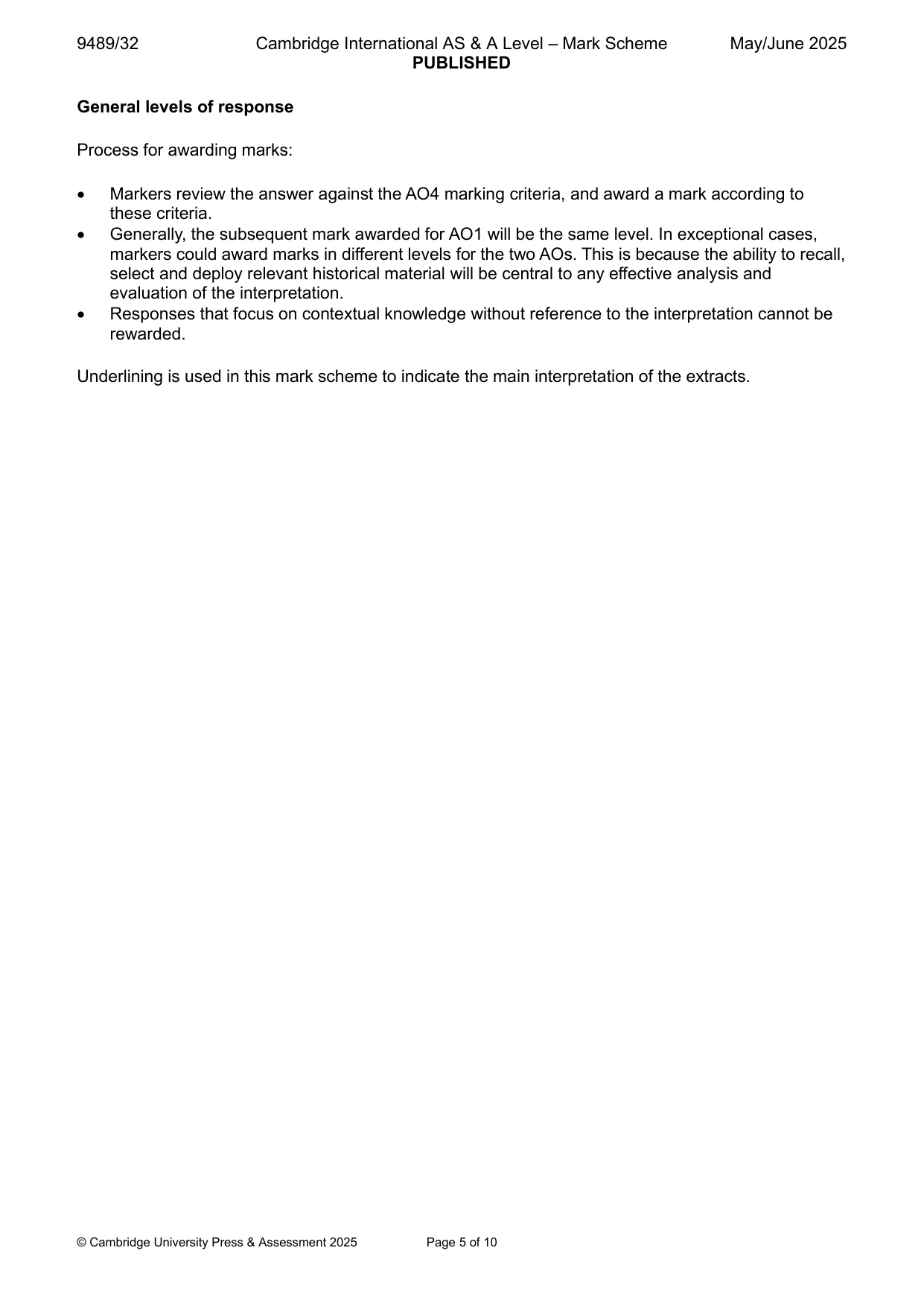
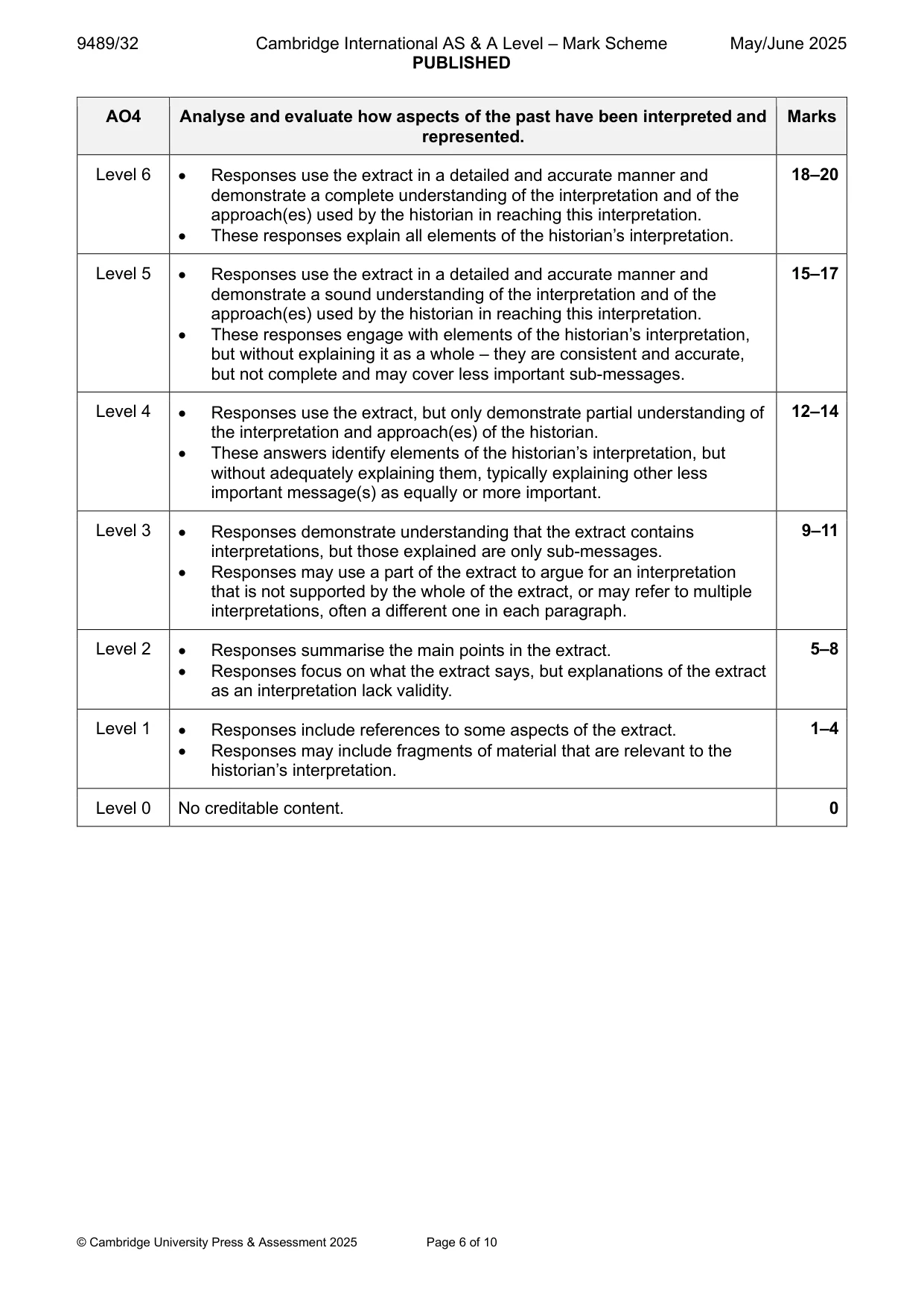
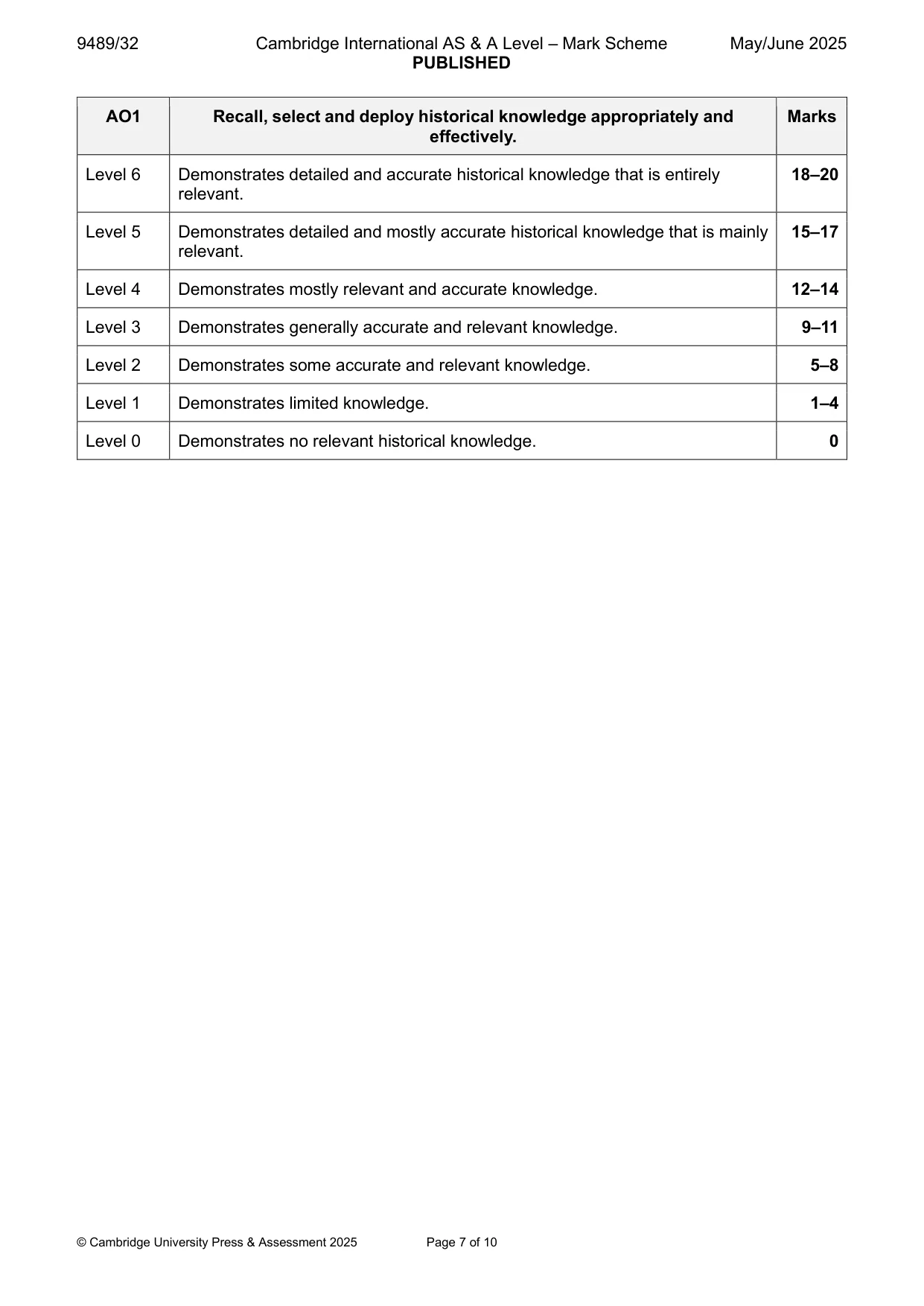
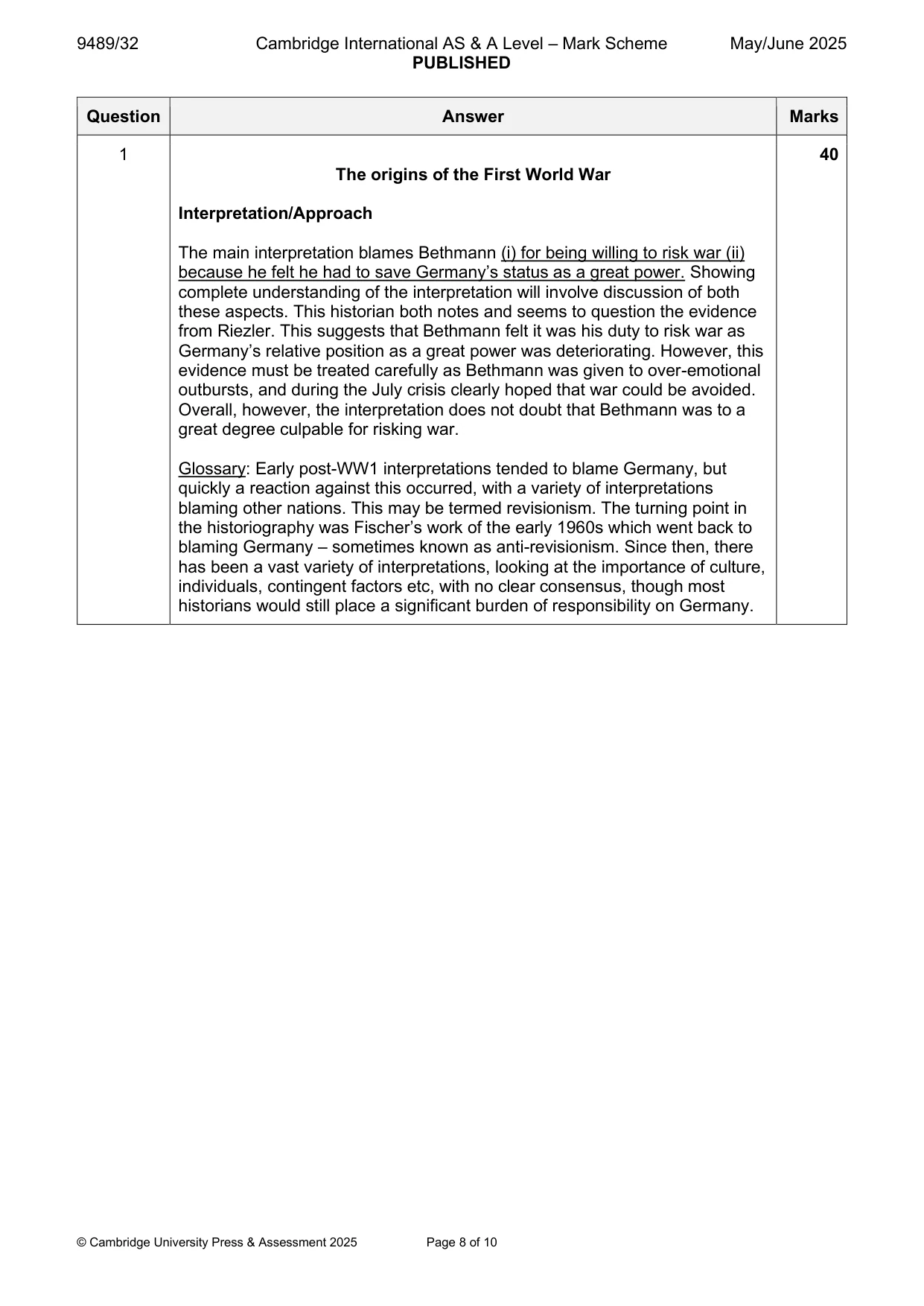
Mark scheme: Question Answer Marks 1 40 The origins of the First World War Interpretation/Approach The main interpretation blames Bethmann (i) for being willing to risk war (ii) because he felt he had to save Germany’s status as a great power. Showing complete understanding of the interpretation will involve discussion of both these aspects. This historian both notes and seems to question the evidence from Riezler. This suggests that Bethmann felt it was his duty to risk war as Germany’s relative position as a great power was deteriorating. However, this evidence must be treated carefully as Bethmann was given to over-emotional outbursts, and during the July crisis clearly hoped that war could be avoided. Overall, however, the interpretation does not doubt that Bethmann was to a great degree culpable for risking war. Glossary: Early post-WW1 interpretations tended to blame Germany, but quickly a reaction against this occurred, with a variety of interpretations blaming other nations. This may be termed revisionism. The turning point in the historiography was Fischer’s work of the early 1960s which went back to blaming Germany – sometimes known as anti-revisionism. Since then, there has been a vast variety of interpretations, looking at the importance of culture, individuals, contingent factors etc, with no clear consensus, though most historians would still place a significant burden of responsibility on Germany.
Q2 · Read the extract and then answer the question
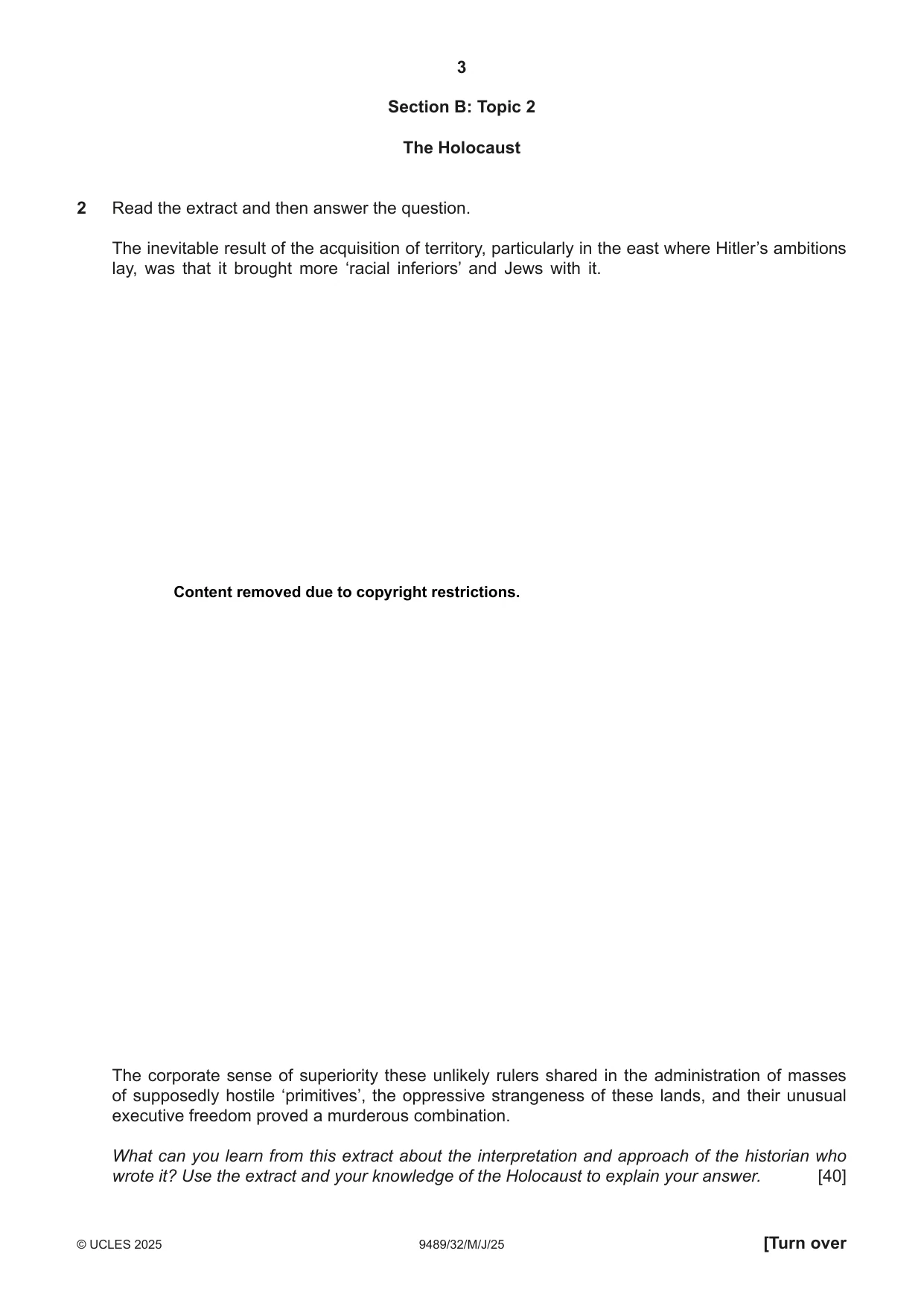
2 Read the extract and then answer the question. The inevitable result of the acquisition of territory, particularly in the east where Hitler’s ambitions lay, was that it brought more ‘racial inferiors’ and Jews with it. Content removed due to copyright restrictions. The corporate sense of superiority these unlikely rulers shared in the administration of masses of supposedly hostile ‘primitives’, the oppressive strangeness of these lands, and their unusual executive freedom proved a murderous combination. What can you learn from this extract about the interpretation and approach of the historian who wrote it? Use the extract and your knowledge of the Holocaust to explain your answer. [40] Section C: Topic 3 The origins and development of the Cold War
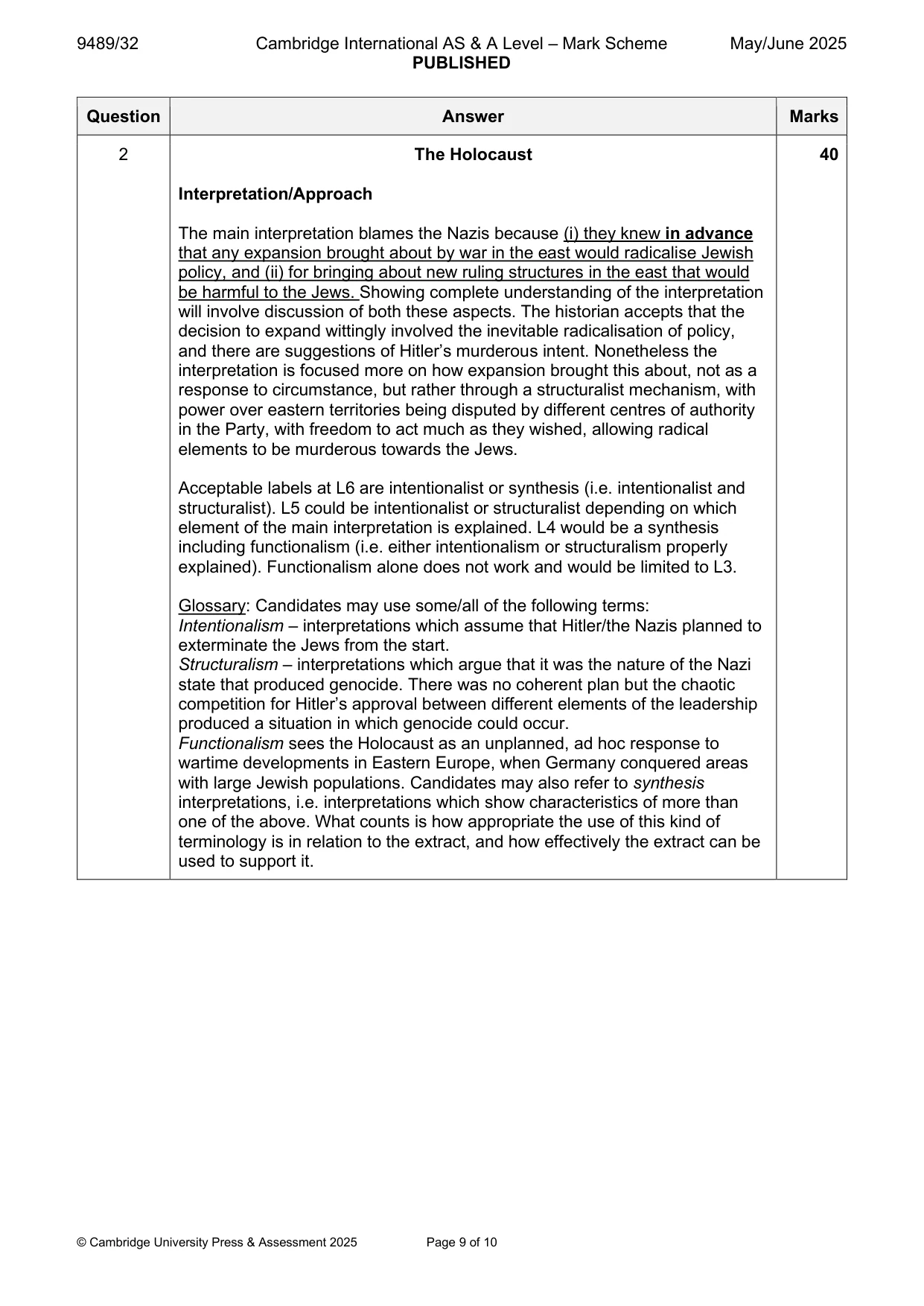
Mark scheme: 2 The Holocaust 40 Interpretation/Approach The main interpretation blames the Nazis because (i) they knew in advance that any expansion brought about by war in the east would radicalise Jewish policy, and (ii) for bringing about new ruling structures in the east that would be harmful to the Jews. Showing complete understanding of the interpretation will involve discussion of both these aspects. The historian accepts that the decision to expand wittingly involved the inevitable radicalisation of policy, and there are suggestions of Hitler’s murderous intent. Nonetheless the interpretation is focused more on how expansion brought this about, not as a response to circumstance, but rather through a structuralist mechanism, with power over eastern territories being disputed by different centres of authority in the Party, with freedom to act much as they wished, allowing radical elements to be murderous towards the Jews. Acceptable labels at L6 are intentionalist or synthesis (i.e. intentionalist and structuralist). L5 could be intentionalist or structuralist depending on which element of the main interpretation is explained. L4 would be a synthesis including functionalism (i.e. either intentionalism or structuralism properly explained). Functionalism alone does not work and would be limited to L3. Glossary: Candidates may use some/all of the following terms: Intentionalism – interpretations which assume that Hitler/the Nazis planned to exterminate the Jews from the start. Structuralism – interpretations which argue that it was the nature of the Nazi state that produced genocide. There was no coherent plan but the chaotic competition for Hitler’s approval between different elements of the leadership produced a situation in which genocide could occur. Functionalism sees the Holocaust as an unplanned, ad hoc response to wartime developments in Eastern Europe, when Germany conquered areas with large Jewish populations. Candidates may also refer to synthesis interpretations, i.e. interpretations which show characteristics of more than one of the above. What counts is how appropriate the use of this kind of terminology is in relation to the extract, and how effectively the extract can be used to support it.
Q3 · Read the extract and then answer the question
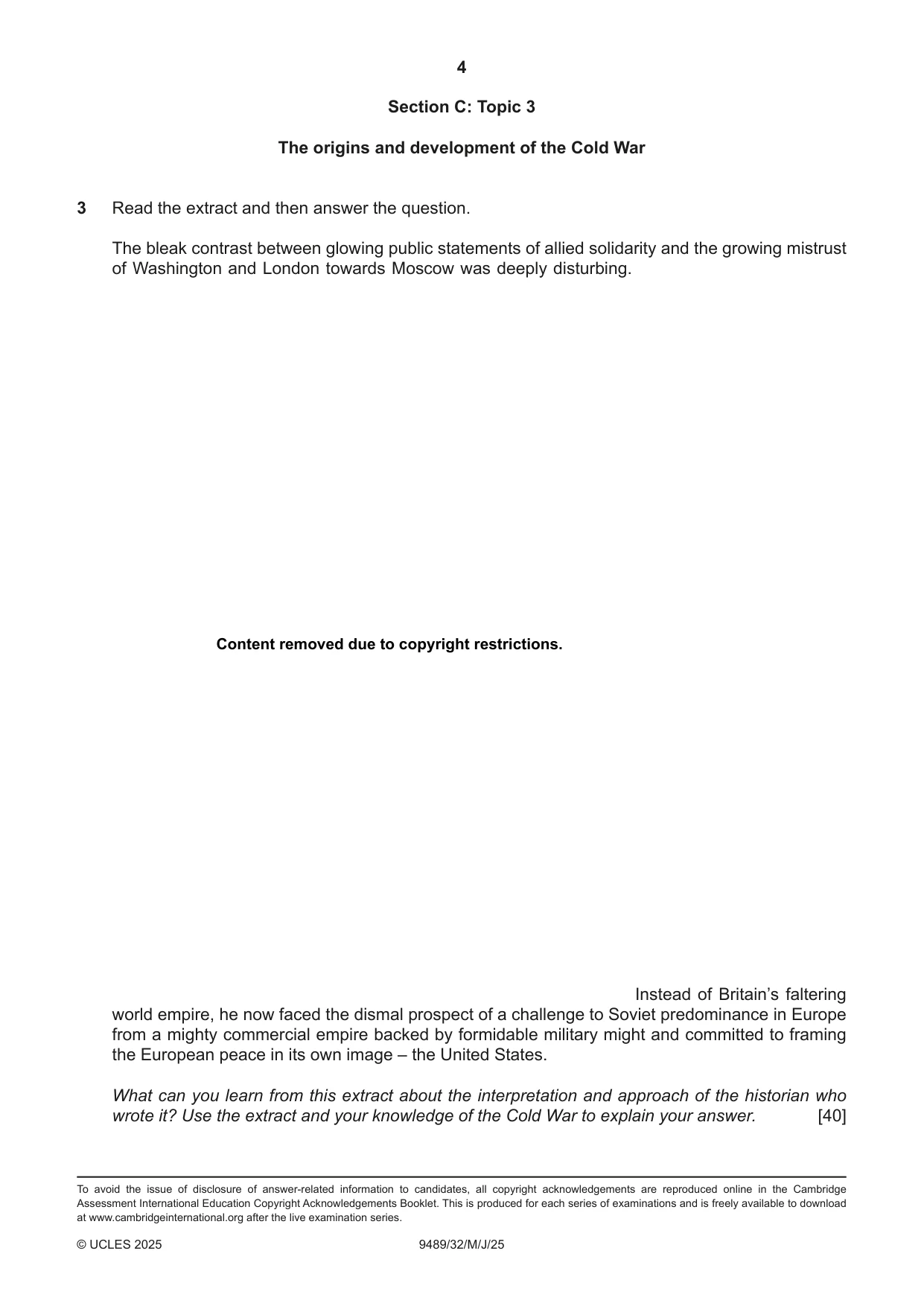
3 Read the extract and then answer the question. The bleak contrast between glowing public statements of allied solidarity and the growing mistrust of Washington and London towards Moscow was deeply disturbing. Content removed due to copyright restrictions. Instead of Britain’s faltering world empire, he now faced the dismal prospect of a challenge to Soviet predominance in Europe from a mighty commercial empire backed by formidable military might and committed to framing the European peace in its own image – the United States. What can you learn from this extract about the interpretation and approach of the historian who wrote it? Use the extract and your knowledge of the Cold War to explain your answer. [40]
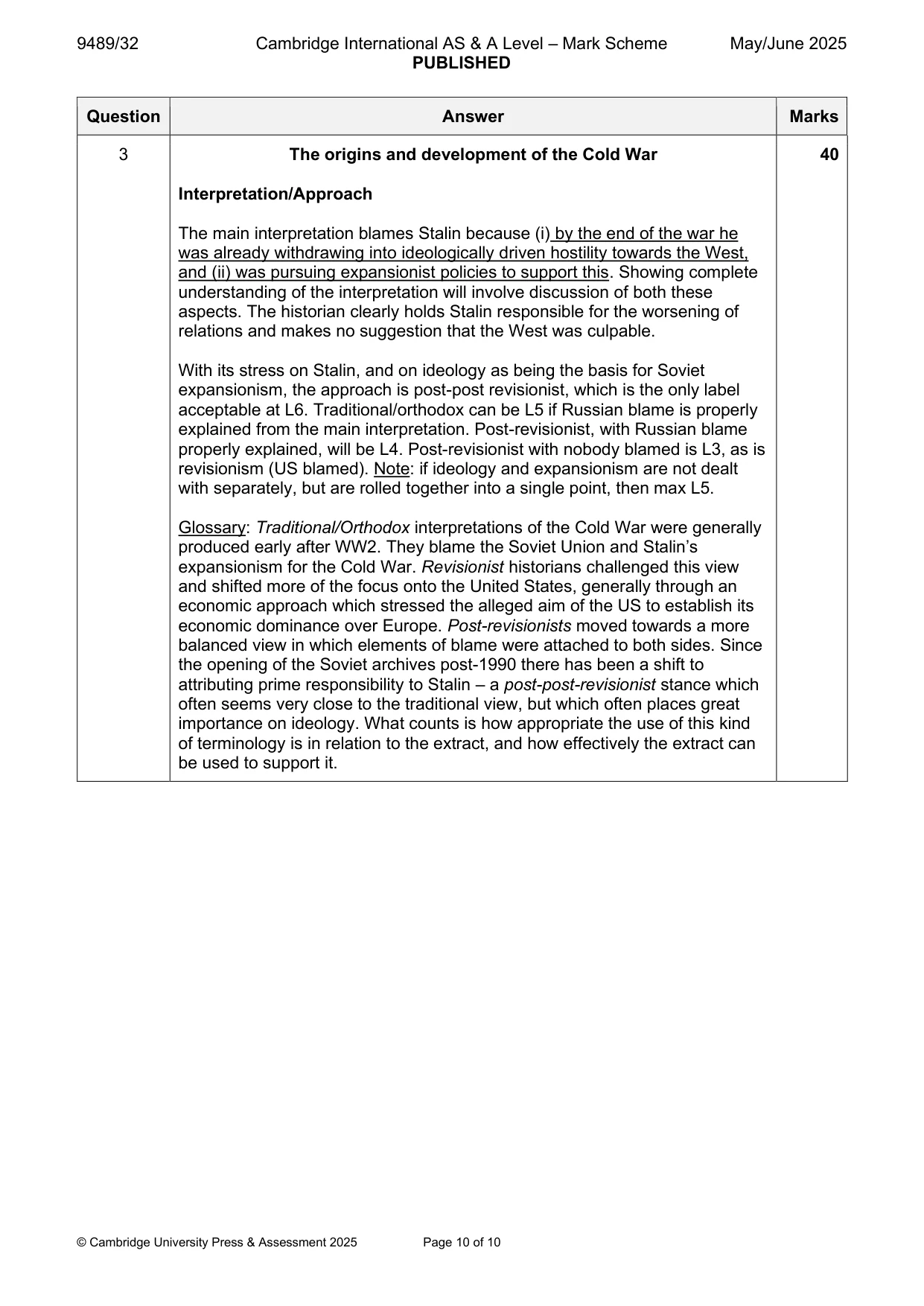
Mark scheme: 3 The origins and development of the Cold War 40 Interpretation/Approach The main interpretation blames Stalin because (i) by the end of the war he was already withdrawing into ideologically driven hostility towards the West, and (ii) was pursuing expansionist policies to support this. Showing complete understanding of the interpretation will involve discussion of both these aspects. The historian clearly holds Stalin responsible for the worsening of relations and makes no suggestion that the West was culpable. With its stress on Stalin, and on ideology as being the basis for Soviet expansionism, the approach is post-post revisionist, which is the only label acceptable at L6. Traditional/orthodox can be L5 if Russian blame is properly explained from the main interpretation. Post-revisionist, with Russian blame properly explained, will be L4. Post-revisionist with nobody blamed is L3, as is revisionism (US blamed). Note: if ideology and expansionism are not dealt with separately, but are rolled together into a single point, then max L5. Glossary: Traditional/Orthodox interpretations of the Cold War were generally produced early after WW2. They blame the Soviet Union and Stalin’s expansionism for the Cold War. Revisionist historians challenged this view and shifted more of the focus onto the United States, generally through an economic approach which stressed the alleged aim of the US to establish its economic dominance over Europe. Post-revisionists moved towards a more balanced view in which elements of blame were attached to both sides. Since the opening of the Soviet archives post-1990 there has been a shift to attributing prime responsibility to Stalin – a post-post-revisionist stance which often seems very close to the traditional view, but which often places great importance on ideology. What counts is how appropriate the use of this kind of terminology is in relation to the extract, and how effectively the extract can be used to support it.
What was in this paper
The subtopics covered by these 3 questions, and how many questions each got. Open one in a new tab to see every Cambridge question on it.
What you needed in this session
Cambridge’s own grade thresholds for 2025 May/June, Paper 3 · Variant 2. A higher threshold means an easier paper — the bar moves with how the cohort did.