Cambridge A Level History 9489 — 2023 May/June Paper 3 · Variant 2
9489/32/M/J/23 · 3 questions · 40 marks · ≈45 min
The question paper and its mark scheme, free to read here and free to download. This is Cambridge’s own paper, exactly as it was sat.
Question paper4 pages
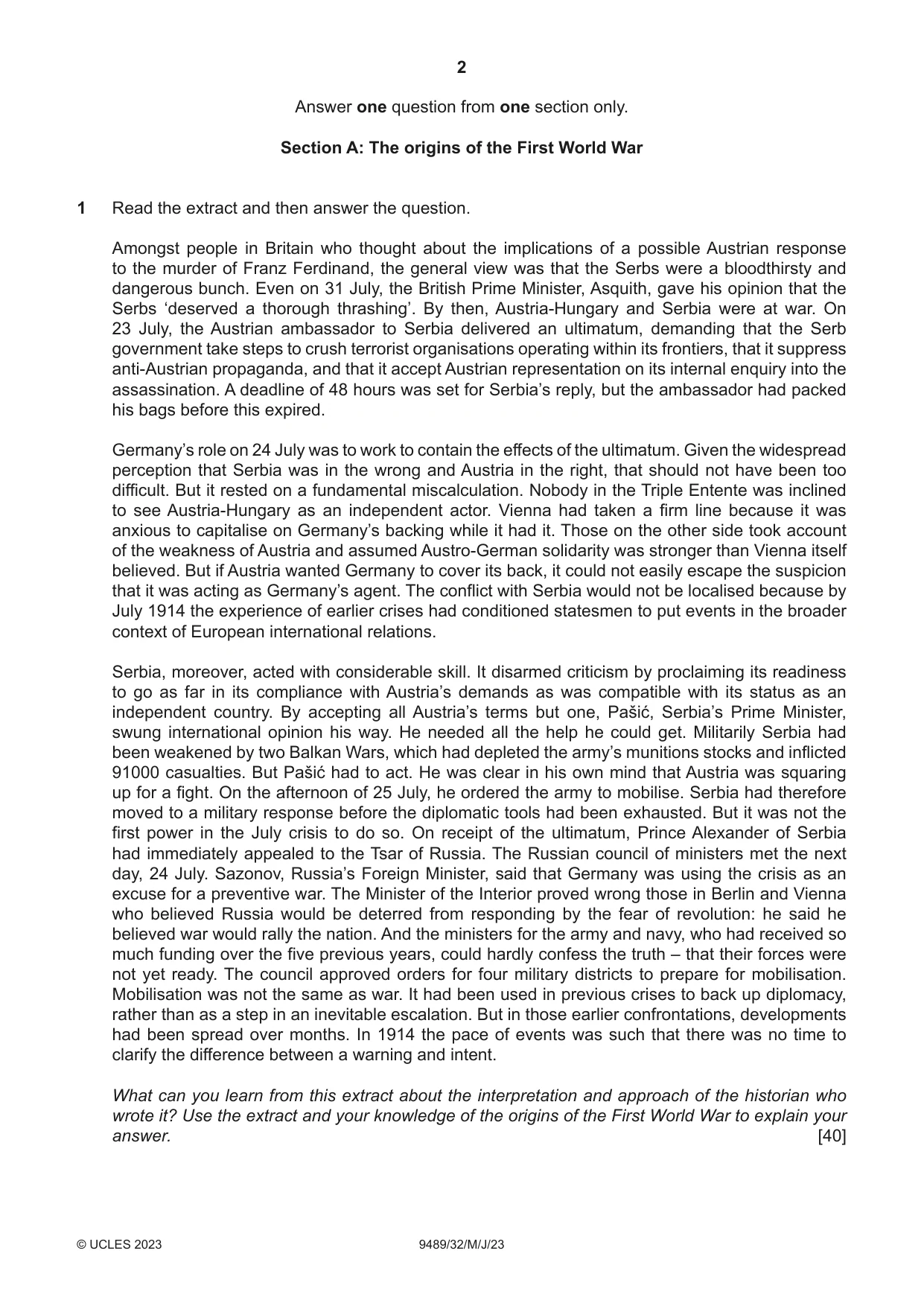
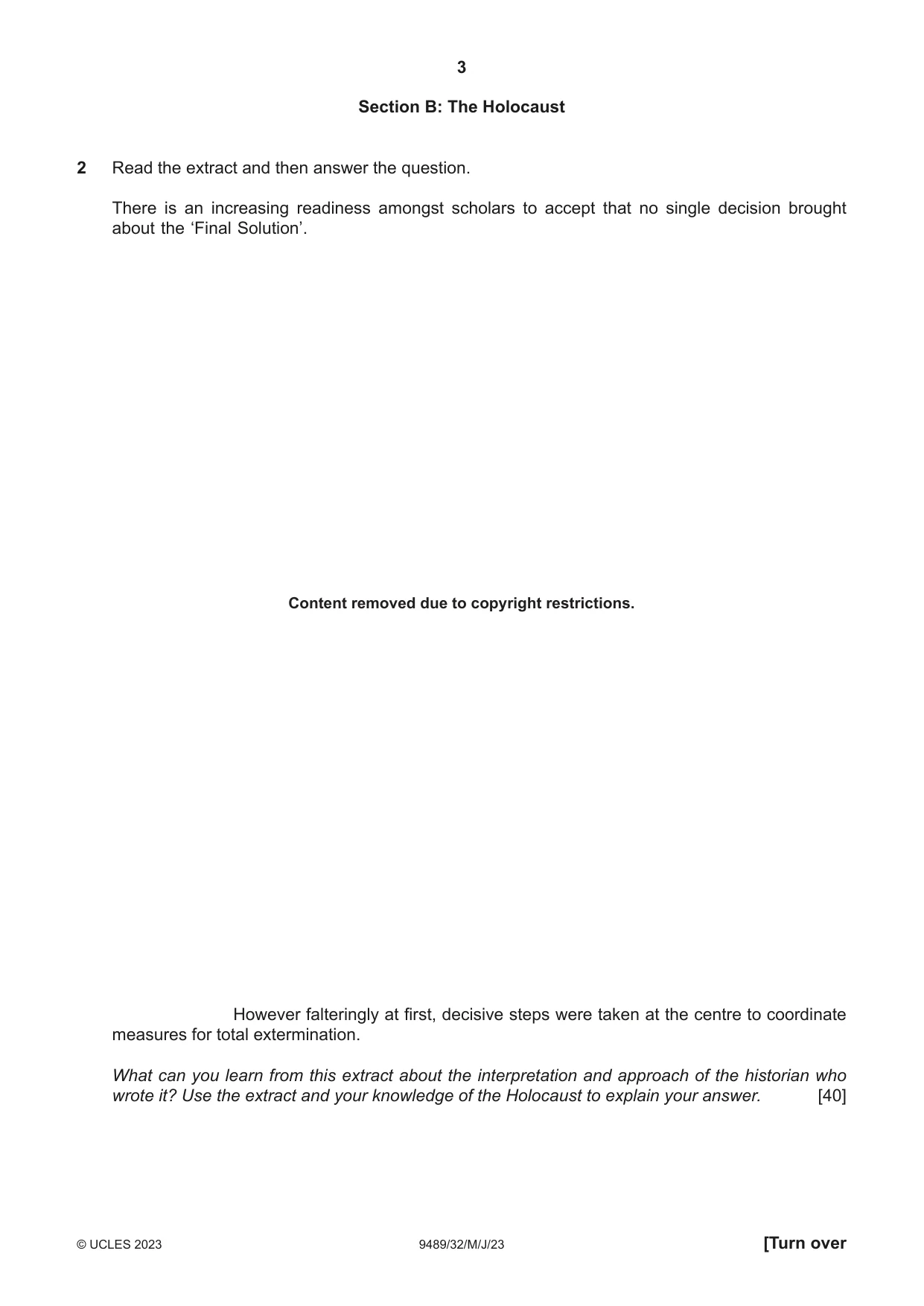
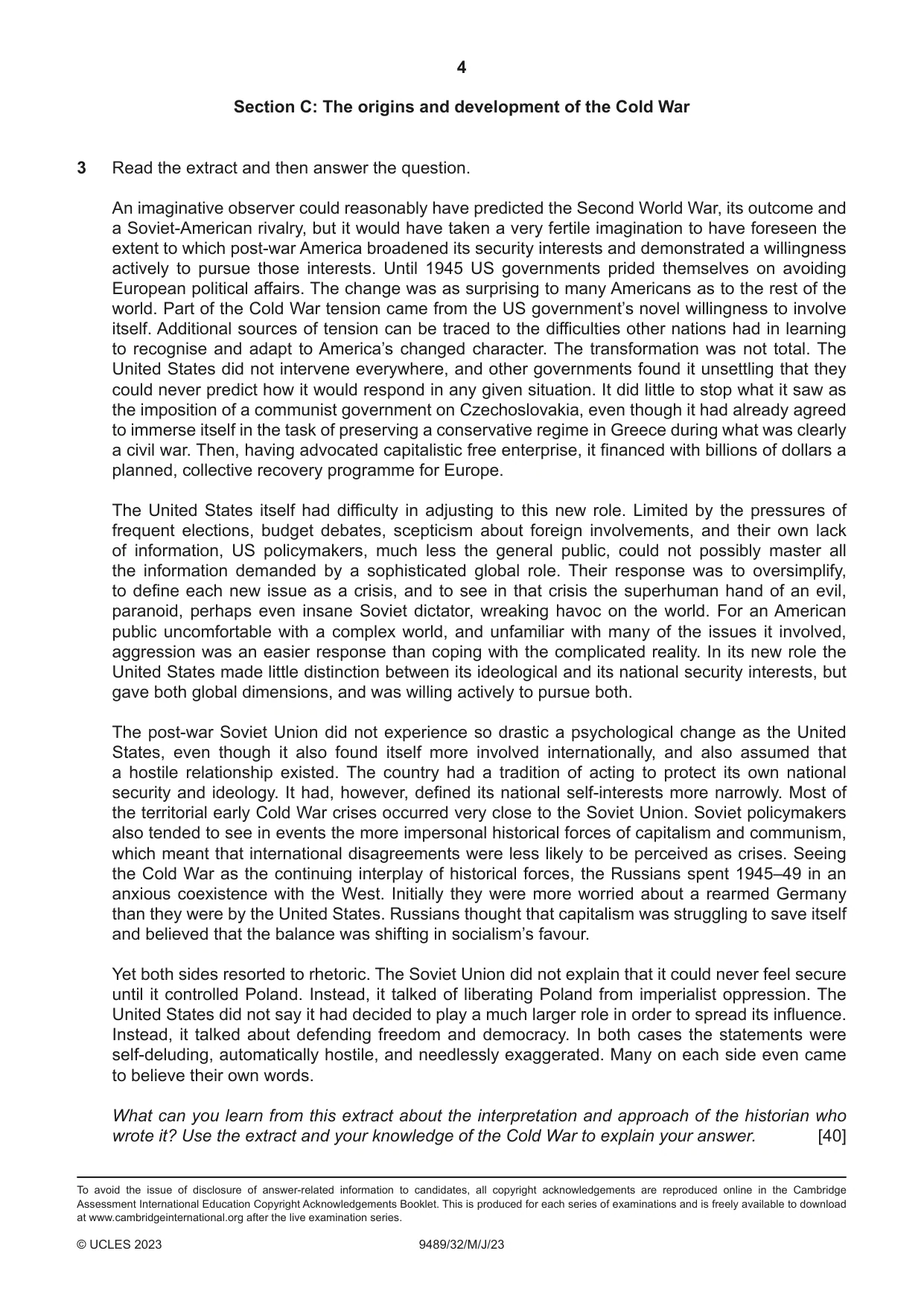
Mark scheme8 pages
Answers below. Sit the paper first if you are practising.
Questions as text
Q1 · Read the extract and then answer the question
1 Read the extract and then answer the question. Amongst people in Britain who thought about the implications of a possible Austrian response to the murder of Franz Ferdinand, the general view was that the Serbs were a bloodthirsty and dangerous bunch. Even on 31 July, the British Prime Minister, Asquith, gave his opinion that the Serbs ‘deserved a thorough thrashing’. By then, Austria-Hungary and Serbia were at war. On 23 July, the Austrian ambassador to Serbia delivered an ultimatum, demanding that the Serb government take steps to crush terrorist organisations operating within its frontiers, that it suppress anti-Austrian propaganda, and that it accept Austrian representation on its internal enquiry into the assassination. A deadline of 48 hours was set for Serbia’s reply, but the ambassador had packed his bags before this expired. Germany’s role on 24 July was to work to contain the effects of the ultimatum. Given the widespread perception that Serbia was in the wrong and Austria in the right, that should not have been too difficult. But it rested on a fundamental miscalculation. Nobody in the Triple Entente was inclined to see Austria-Hungary as an independent actor. Vienna had taken a firm line because it was anxious to capitalise on Germany’s backing while it had it. Those on the other side took account of the weakness of Austria and assumed Austro-German solidarity was stronger than Vienna itself believed. But if Austria wanted Germany to cover its back, it could not easily escape the suspicion that it was acting as Germany’s agent. The conflict with Serbia would not be localised because by July 1914 the experience of earlier crises had conditioned statesmen to put events in the broader context of European international relations. Serbia, moreover, acted with considerable skill. It disarmed criticism by proclaiming its readiness to go as far in its compliance with Austria’s demands as was compatible with its status as an independent country. By accepting all Austria’s terms but one, Pašić, Serbia’s Prime Minister, swung international opinion his way. He needed all the help he could get. Militarily Serbia had been weakened by two Balkan Wars, which had depleted the army’s munitions stocks and inflicted 91000 casualties. But Pašić had to act. He was clear in his own mind that Austria was squaring up for a fight. On the afternoon of 25 July, he ordered the army to mobilise. Serbia had therefore moved to a military response before the diplomatic tools had been exhausted. But it was not the first power in the July crisis to do so. On receipt of the ultimatum, Prince Alexander of Serbia had immediately appealed to the Tsar of Russia. The Russian council of ministers met the next day, 24 July. Sazonov, Russia’s Foreign Minister, said that Germany was using the crisis as an excuse for a preventive war. The Minister of the Interior proved wrong those in Berlin and Vienna who believed Russia would be deterred from responding by the fear of revolution: he said he believed war would rally the nation. And the ministers for the army and navy, who had received so much funding over the five previous years, could hardly confess the truth – that their forces were not yet ready. The council approved orders for four military districts to prepare for mobilisation. Mobilisation was not the same as war. It had been used in previous crises to back up diplomacy, rather than as a step in an inevitable escalation. But in those earlier confrontations, developments had been spread over months. In 1914 the pace of events was such that there was no time to clarify the difference between a warning and intent. What can you learn from this extract about the interpretation and approach of the historian who wrote it? Use the extract and your knowledge of the origins of the First World War to explain your answer. [40]
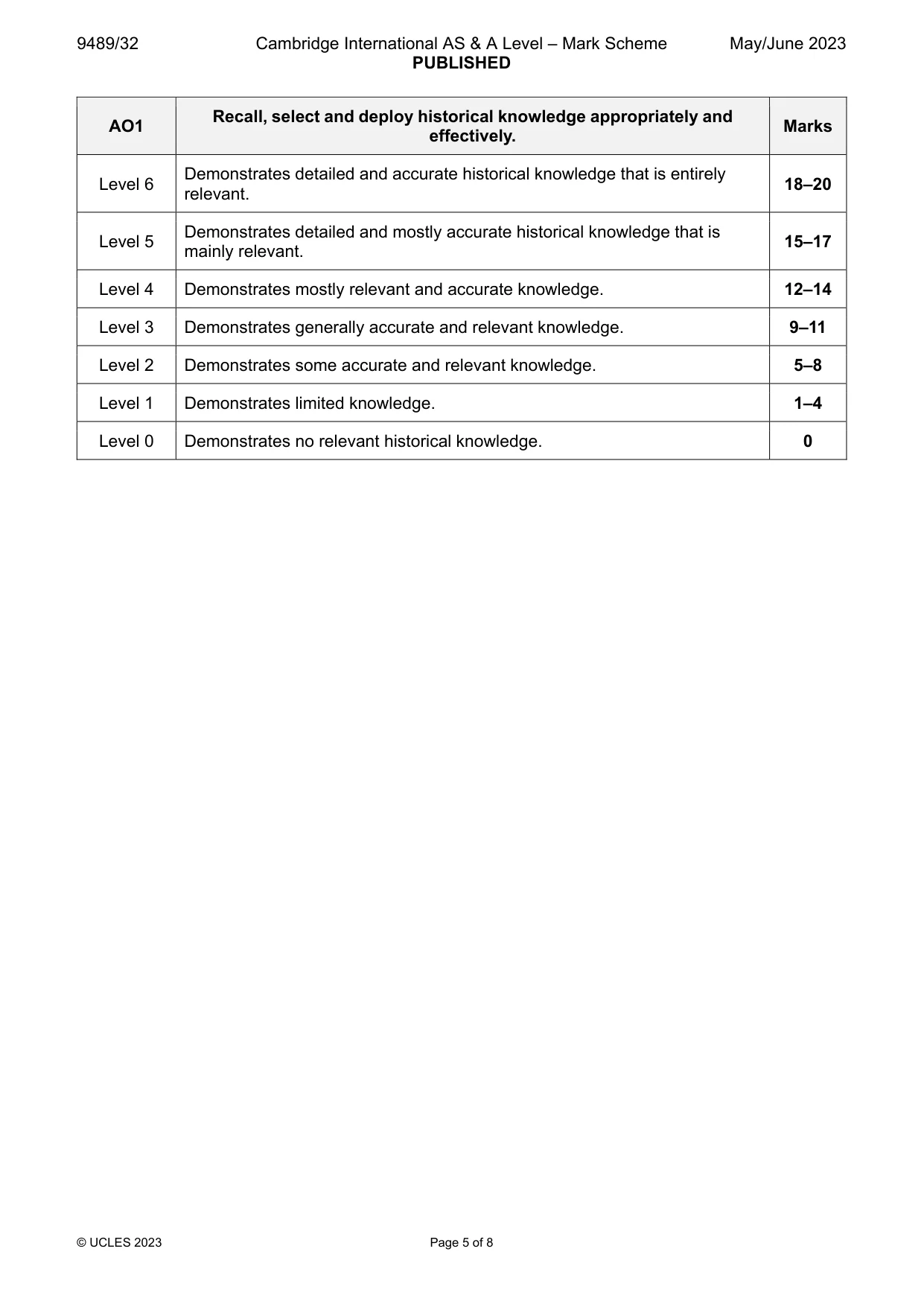
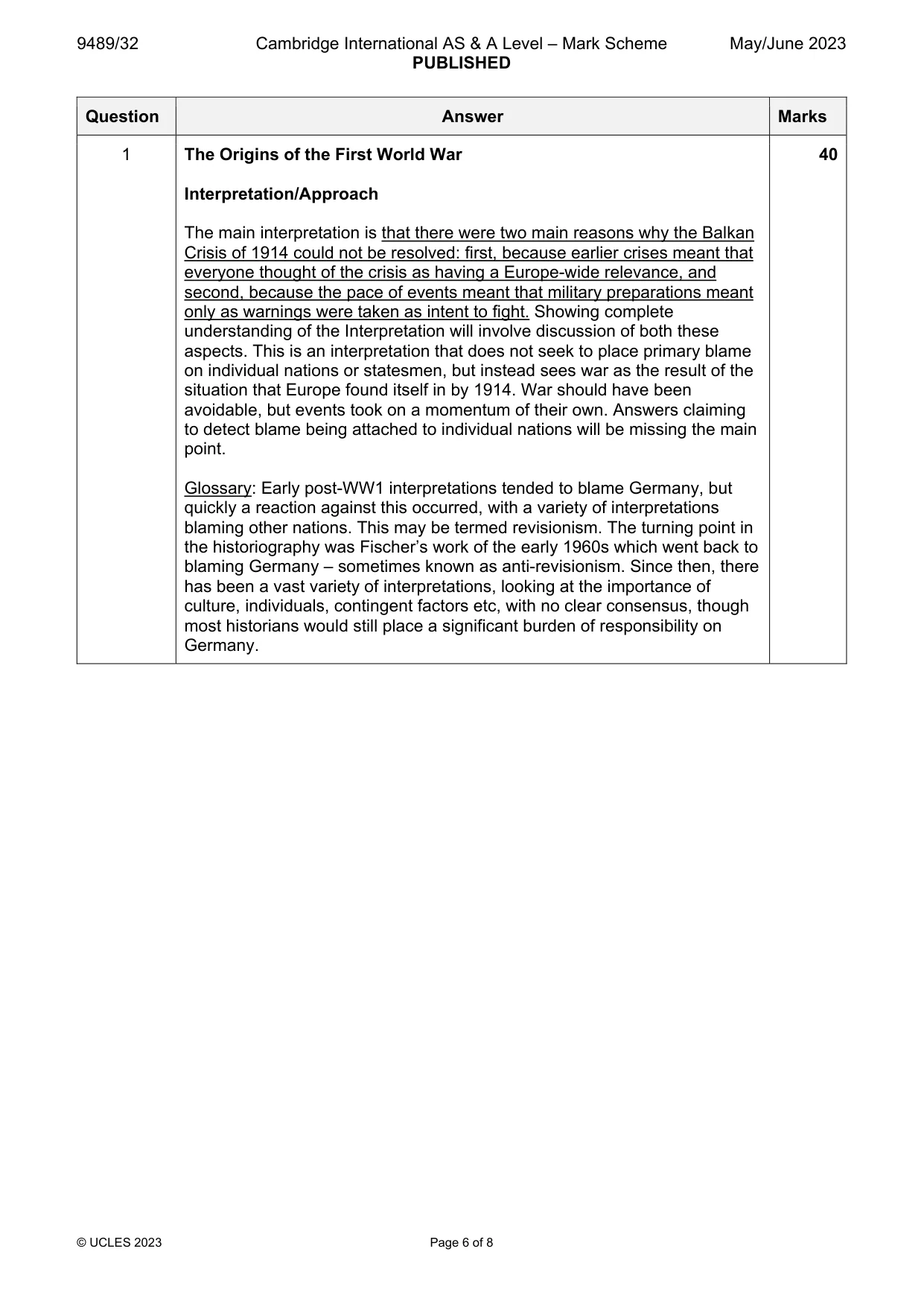
Mark scheme: Question Answer Marks 1 The Origins of the First World War 40 Interpretation/Approach The main interpretation is that there were two main reasons why the Balkan Crisis of 1914 could not be resolved: first, because earlier crises meant that everyone thought of the crisis as having a Europe-wide relevance, and second, because the pace of events meant that military preparations meant only as warnings were taken as intent to fight. Showing complete understanding of the Interpretation will involve discussion of both these aspects. This is an interpretation that does not seek to place primary blame on individual nations or statesmen, but instead sees war as the result of the situation that Europe found itself in by 1914. War should have been avoidable, but events took on a momentum of their own. Answers claiming to detect blame being attached to individual nations will be missing the main point. Glossary: Early post-WW1 interpretations tended to blame Germany, but quickly a reaction against this occurred, with a variety of interpretations blaming other nations. This may be termed revisionism. The turning point in the historiography was Fischer’s work of the early 1960s which went back to blaming Germany – sometimes known as anti-revisionism. Since then, there has been a vast variety of interpretations, looking at the importance of culture, individuals, contingent factors etc, with no clear consensus, though most historians would still place a significant burden of responsibility on Germany.
Q2 · Read the extract and then answer the question
2 Read the extract and then answer the question. There is an increasing readiness amongst scholars to accept that no single decision brought about the ‘Final Solution’. Content removed due to copyright restrictions. However falteringly at first, decisive steps were taken at the centre to coordinate measures for total extermination. What can you learn from this extract about the interpretation and approach of the historian who wrote it? Use the extract and your knowledge of the Holocaust to explain your answer. [40] Section C: The origins and development of the Cold War
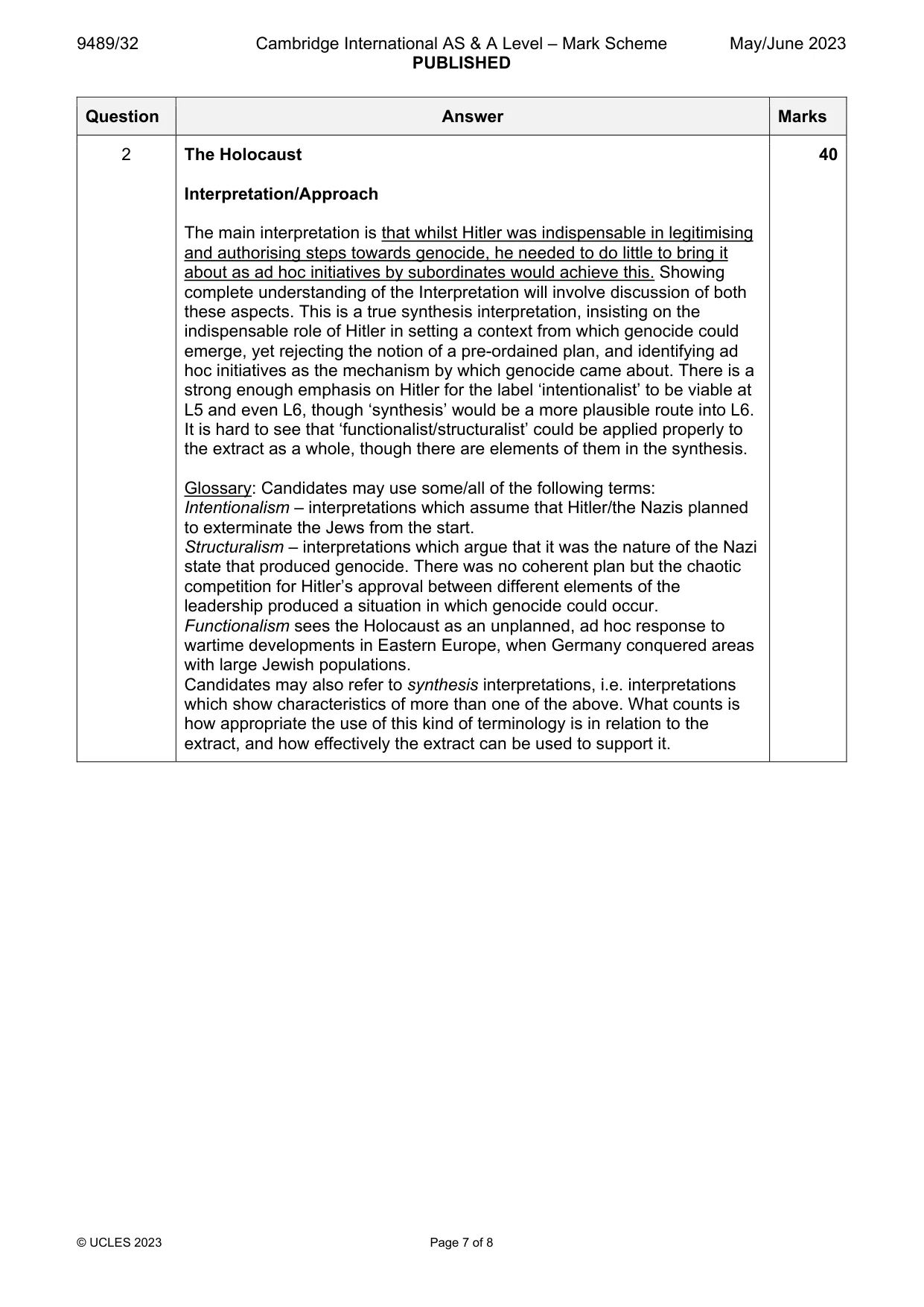
Mark scheme: 2 The Holocaust 40 Interpretation/Approach The main interpretation is that whilst Hitler was indispensable in legitimising and authorising steps towards genocide, he needed to do little to bring it about as ad hoc initiatives by subordinates would achieve this. Showing complete understanding of the Interpretation will involve discussion of both these aspects. This is a true synthesis interpretation, insisting on the indispensable role of Hitler in setting a context from which genocide could emerge, yet rejecting the notion of a pre-ordained plan, and identifying ad hoc initiatives as the mechanism by which genocide came about. There is a strong enough emphasis on Hitler for the label ‘intentionalist’ to be viable at L5 and even L6, though ‘synthesis’ would be a more plausible route into L6. It is hard to see that ‘functionalist/structuralist’ could be applied properly to the extract as a whole, though there are elements of them in the synthesis. Glossary: Candidates may use some/all of the following terms: Intentionalism – interpretations which assume that Hitler/the Nazis planned to exterminate the Jews from the start. Structuralism – interpretations which argue that it was the nature of the Nazi state that produced genocide. There was no coherent plan but the chaotic competition for Hitler’s approval between different elements of the leadership produced a situation in which genocide could occur. Functionalism sees the Holocaust as an unplanned, ad hoc response to wartime developments in Eastern Europe, when Germany conquered areas with large Jewish populations. Candidates may also refer to synthesis interpretations, i.e. interpretations which show characteristics of more than one of the above. What counts is how appropriate the use of this kind of terminology is in relation to the extract, and how effectively the extract can be used to support it.
Q3 · Read the extract and then answer the question
3 Read the extract and then answer the question. An imaginative observer could reasonably have predicted the Second World War, its outcome and a Soviet-American rivalry, but it would have taken a very fertile imagination to have foreseen the extent to which post-war America broadened its security interests and demonstrated a willingness actively to pursue those interests. Until 1945 US governments prided themselves on avoiding European political affairs. The change was as surprising to many Americans as to the rest of the world. Part of the Cold War tension came from the US government’s novel willingness to involve itself. Additional sources of tension can be traced to the difficulties other nations had in learning to recognise and adapt to America’s changed character. The transformation was not total. The United States did not intervene everywhere, and other governments found it unsettling that they could never predict how it would respond in any given situation. It did little to stop what it saw as the imposition of a communist government on Czechoslovakia, even though it had already agreed to immerse itself in the task of preserving a conservative regime in Greece during what was clearly a civil war. Then, having advocated capitalistic free enterprise, it financed with billions of dollars a planned, collective recovery programme for Europe. The United States itself had difficulty in adjusting to this new role. Limited by the pressures of frequent elections, budget debates, scepticism about foreign involvements, and their own lack of information, US policymakers, much less the general public, could not possibly master all the information demanded by a sophisticated global role. Their response was to oversimplify, to define each new issue as a crisis, and to see in that crisis the superhuman hand of an evil, paranoid, perhaps even insane Soviet dictator, wreaking havoc on the world. For an American public uncomfortable with a complex world, and unfamiliar with many of the issues it involved, aggression was an easier response than coping with the complicated reality. In its new role the United States made little distinction between its ideological and its national security interests, but gave both global dimensions, and was willing actively to pursue both. The post-war Soviet Union did not experience so drastic a psychological change as the United States, even though it also found itself more involved internationally, and also assumed that a hostile relationship existed. The country had a tradition of acting to protect its own national security and ideology. It had, however, defined its national self-interests more narrowly. Most of the territorial early Cold War crises occurred very close to the Soviet Union. Soviet policymakers also tended to see in events the more impersonal historical forces of capitalism and communism, which meant that international disagreements were less likely to be perceived as crises. Seeing the Cold War as the continuing interplay of historical forces, the Russians spent 1945–49 in an anxious coexistence with the West. Initially they were more worried about a rearmed Germany than they were by the United States. Russians thought that capitalism was struggling to save itself and believed that the balance was shifting in socialism’s favour. Yet both sides resorted to rhetoric. The Soviet Union did not explain that it could never feel secure until it controlled Poland. Instead, it talked of liberating Poland from imperialist oppression. The United States did not say it had decided to play a much larger role in order to spread its influence. Instead, it talked about defending freedom and democracy. In both cases the statements were self-deluding, automatically hostile, and needlessly exaggerated. Many on each side even came to believe their own words. What can you learn from this extract about the interpretation and approach of the historian who wrote it? Use the extract and your knowledge of the Cold War to explain your answer. [40]
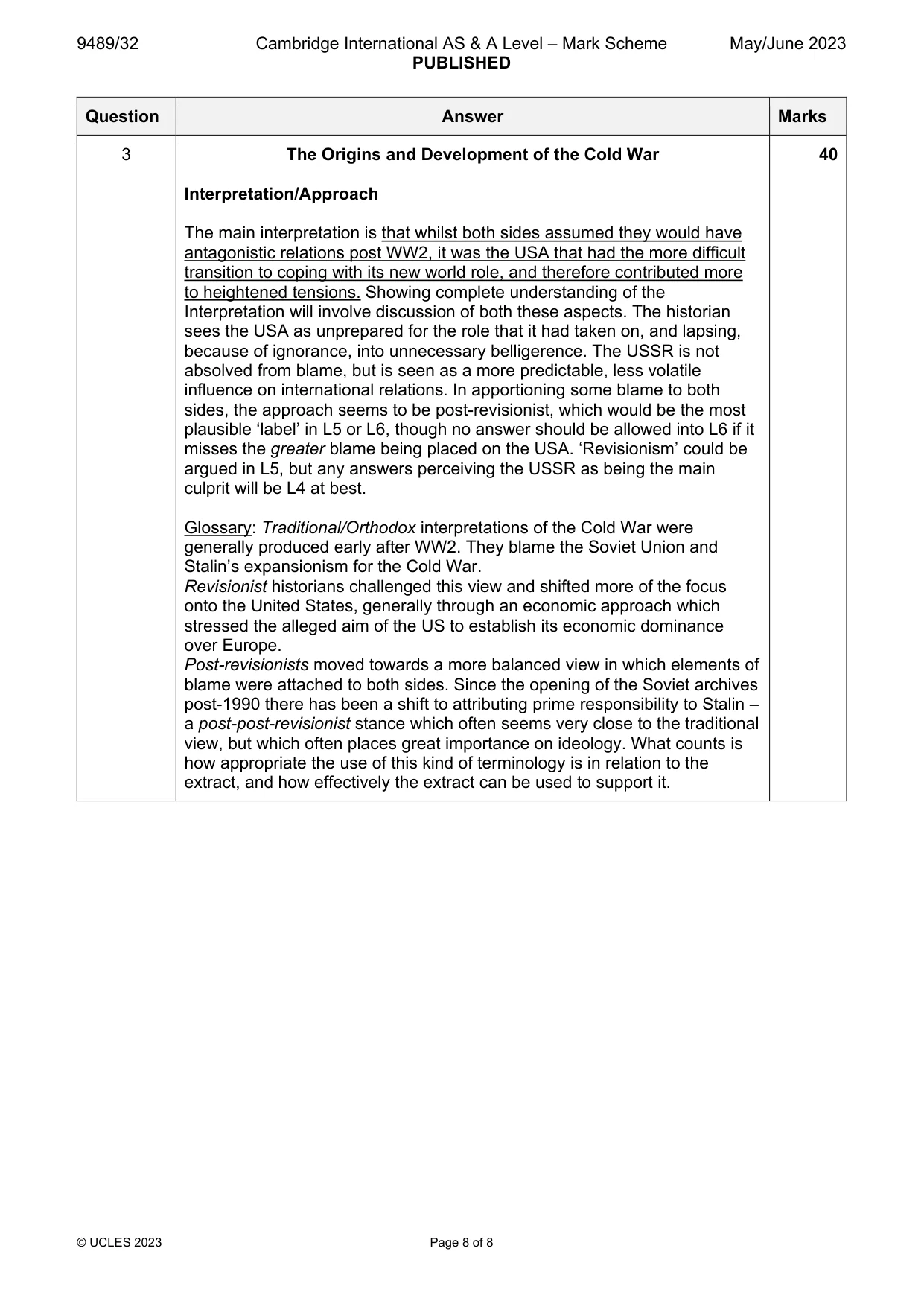
Mark scheme: 3 The Origins and Development of the Cold War 40 Interpretation/Approach The main interpretation is that whilst both sides assumed they would have antagonistic relations post WW2, it was the USA that had the more difficult transition to coping with its new world role, and therefore contributed more to heightened tensions. Showing complete understanding of the Interpretation will involve discussion of both these aspects. The historian sees the USA as unprepared for the role that it had taken on, and lapsing, because of ignorance, into unnecessary belligerence. The USSR is not absolved from blame, but is seen as a more predictable, less volatile influence on international relations. In apportioning some blame to both sides, the approach seems to be post-revisionist, which would be the most plausible ‘label’ in L5 or L6, though no answer should be allowed into L6 if it misses the greater blame being placed on the USA. ‘Revisionism’ could be argued in L5, but any answers perceiving the USSR as being the main culprit will be L4 at best. Glossary: Traditional/Orthodox interpretations of the Cold War were generally produced early after WW2. They blame the Soviet Union and Stalin’s expansionism for the Cold War. Revisionist historians challenged this view and shifted more of the focus onto the United States, generally through an economic approach which stressed the alleged aim of the US to establish its economic dominance over Europe. Post-revisionists moved towards a more balanced view in which elements of blame were attached to both sides. Since the opening of the Soviet archives post-1990 there has been a shift to attributing prime responsibility to Stalin – a post-post-revisionist stance which often seems very close to the traditional view, but which often places great importance on ideology. What counts is how appropriate the use of this kind of terminology is in relation to the extract, and how effectively the extract can be used to support it.
What was in this paper
The subtopics covered by these 3 questions, and how many questions each got. Open one in a new tab to see every Cambridge question on it.
What you needed in this session
Cambridge’s own grade thresholds for 2023 May/June, Paper 3 · Variant 2. A higher threshold means an easier paper — the bar moves with how the cohort did.