Cambridge A Level History 9489 — 2021 Oct/Nov Paper 3 · Variant 1
9489/31/O/N/21 · 3 questions · 40 marks · ≈45 min
The question paper and its mark scheme, free to read here and free to download. This is Cambridge’s own paper, exactly as it was sat.
Question paper4 pages
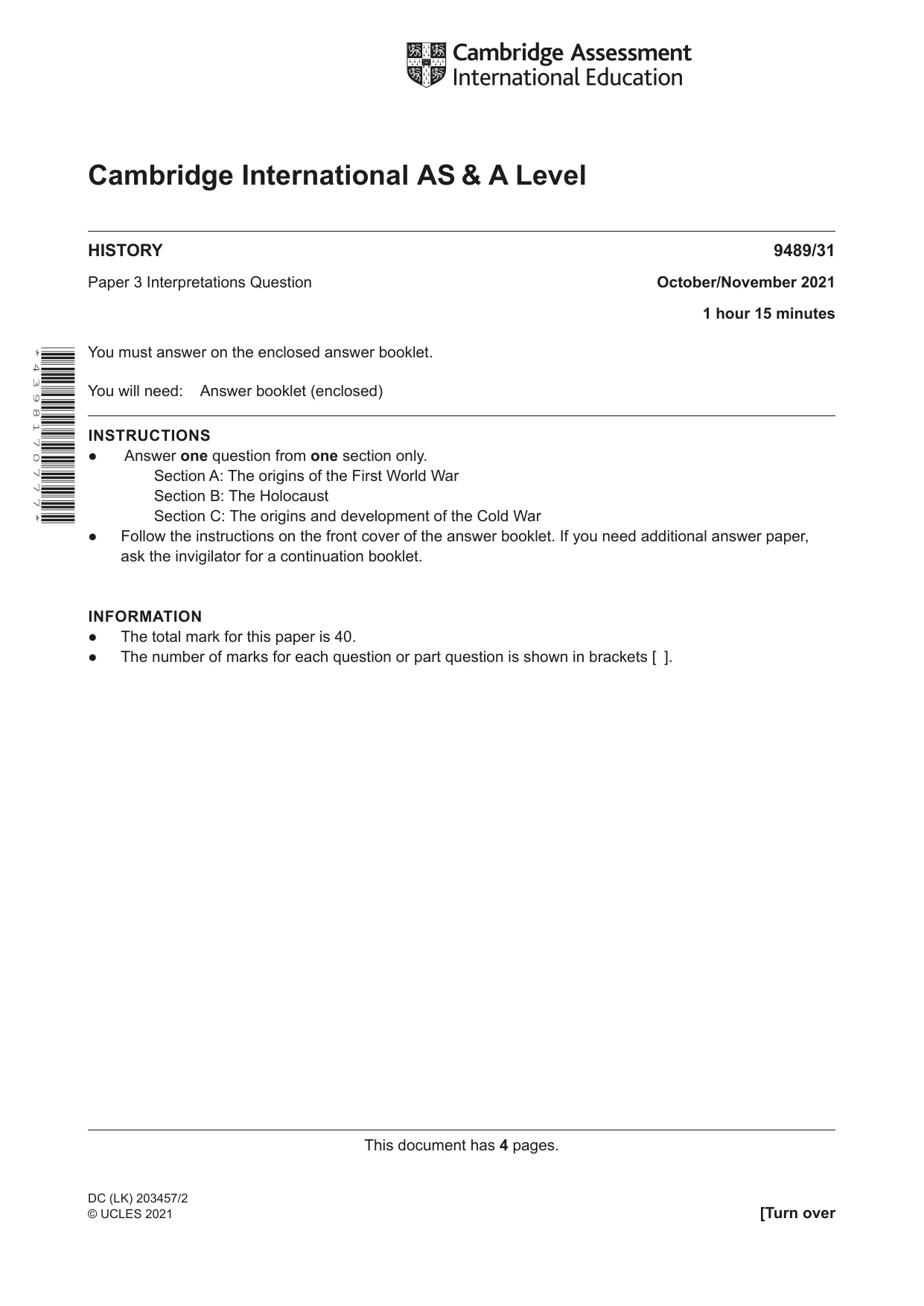
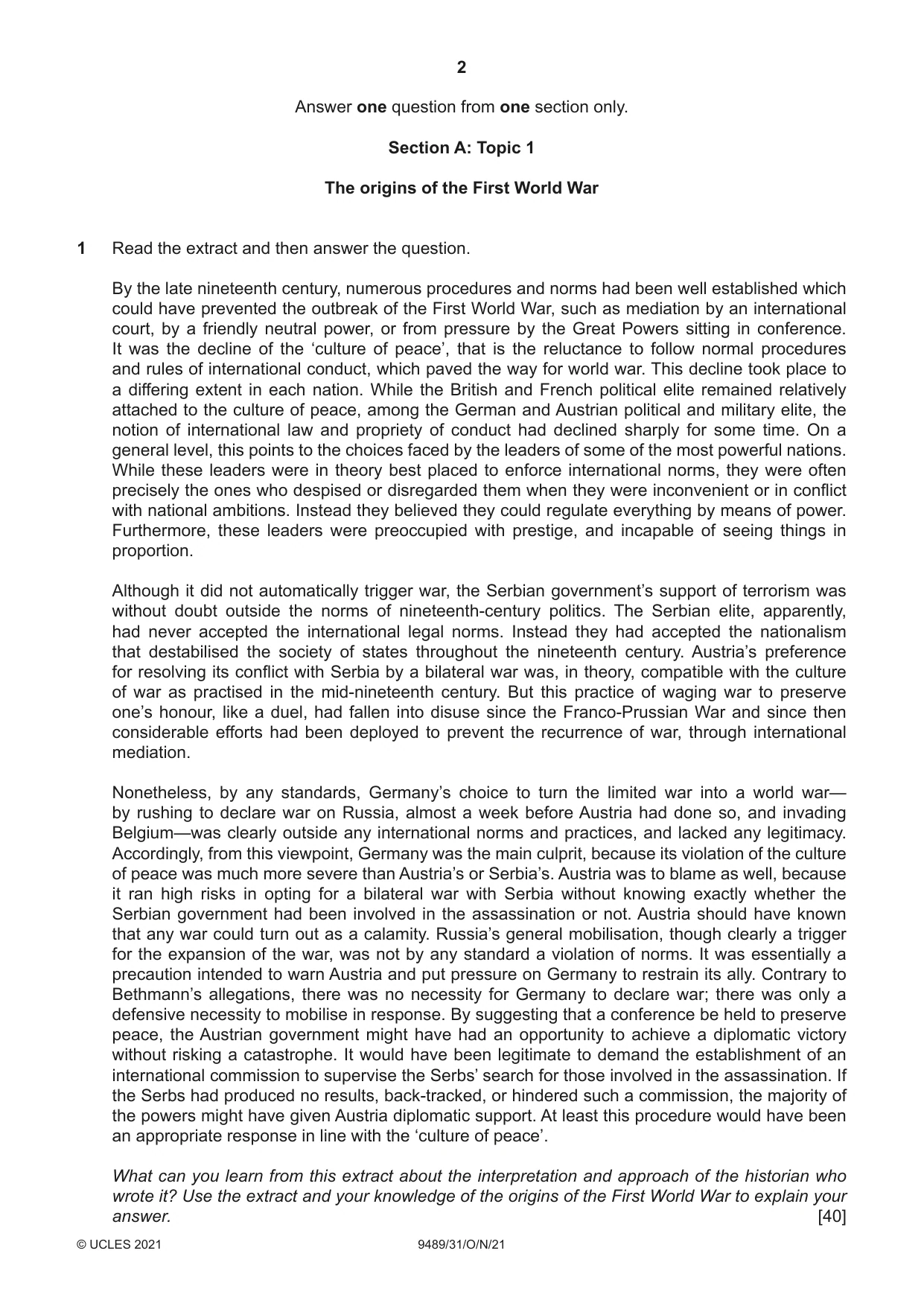
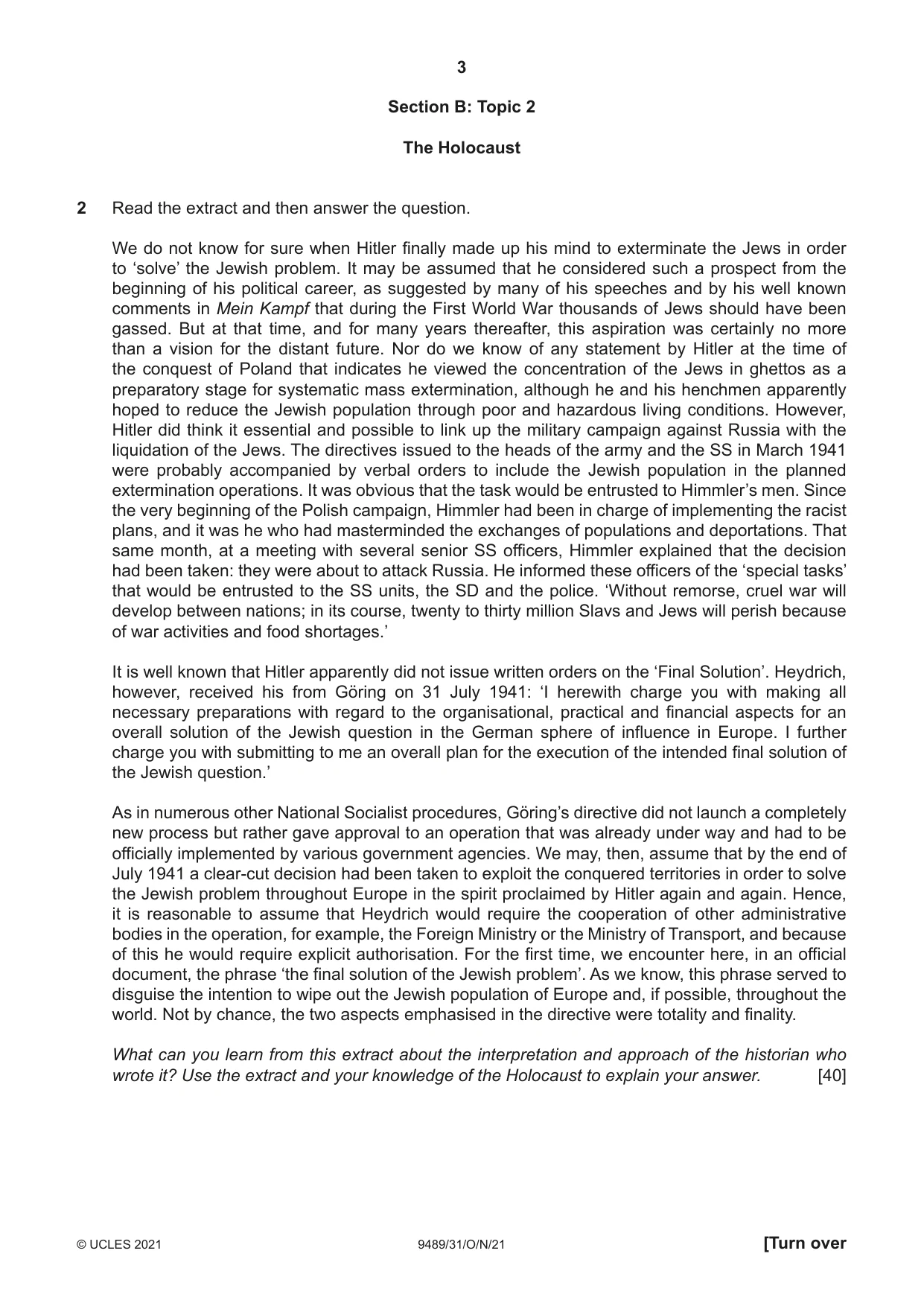
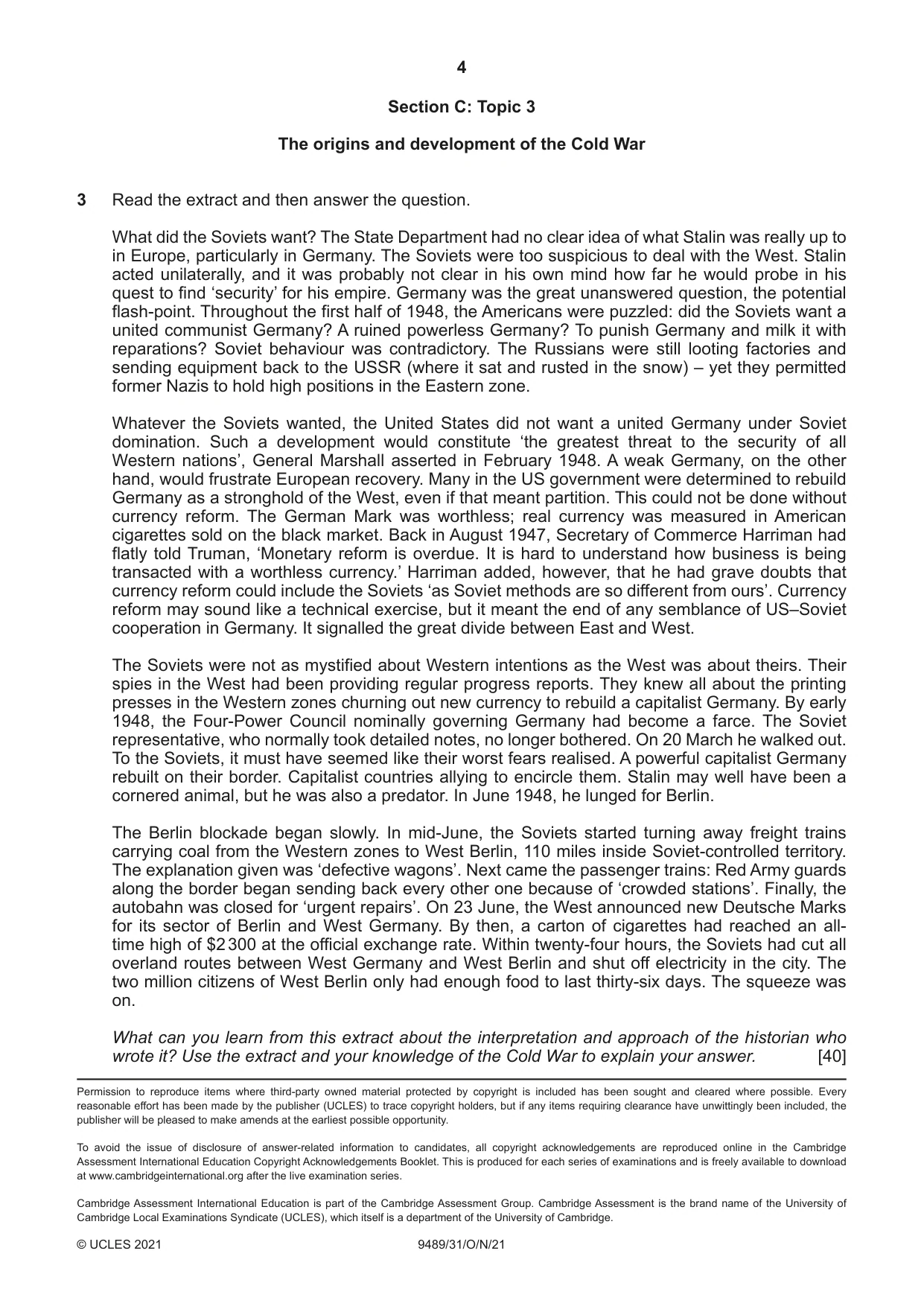
Mark scheme8 pages
Answers below. Sit the paper first if you are practising.
Questions as text
Q1 · Read the extract and then answer the question
1 Read the extract and then answer the question. By the late nineteenth century, numerous procedures and norms had been well established which could have prevented the outbreak of the First World War, such as mediation by an international court, by a friendly neutral power, or from pressure by the Great Powers sitting in conference. It was the decline of the ‘culture of peace’, that is the reluctance to follow normal procedures and rules of international conduct, which paved the way for world war. This decline took place to a differing extent in each nation. While the British and French political elite remained relatively attached to the culture of peace, among the German and Austrian political and military elite, the notion of international law and propriety of conduct had declined sharply for some time. On a general level, this points to the choices faced by the leaders of some of the most powerful nations. While these leaders were in theory best placed to enforce international norms, they were often precisely the ones who despised or disregarded them when they were inconvenient or in conflict with national ambitions. Instead they believed they could regulate everything by means of power. Furthermore, these leaders were preoccupied with prestige, and incapable of seeing things in proportion. Although it did not automatically trigger war, the Serbian government’s support of terrorism was without doubt outside the norms of nineteenth-century politics. The Serbian elite, apparently, had never accepted the international legal norms. Instead they had accepted the nationalism that destabilised the society of states throughout the nineteenth century. Austria’s preference for resolving its conflict with Serbia by a bilateral war was, in theory, compatible with the culture of war as practised in the mid-nineteenth century. But this practice of waging war to preserve one’s honour, like a duel, had fallen into disuse since the Franco-Prussian War and since then considerable efforts had been deployed to prevent the recurrence of war, through international mediation. Nonetheless, by any standards, Germany’s choice to turn the limited war into a world war— by rushing to declare war on Russia, almost a week before Austria had done so, and invading Belgium—was clearly outside any international norms and practices, and lacked any legitimacy. Accordingly, from this viewpoint, Germany was the main culprit, because its violation of the culture of peace was much more severe than Austria’s or Serbia’s. Austria was to blame as well, because it ran high risks in opting for a bilateral war with Serbia without knowing exactly whether the Serbian government had been involved in the assassination or not. Austria should have known that any war could turn out as a calamity. Russia’s general mobilisation, though clearly a trigger for the expansion of the war, was not by any standard a violation of norms. It was essentially a precaution intended to warn Austria and put pressure on Germany to restrain its ally. Contrary to Bethmann’s allegations, there was no necessity for Germany to declare war; there was only a defensive necessity to mobilise in response. By suggesting that a conference be held to preserve peace, the Austrian government might have had an opportunity to achieve a diplomatic victory without risking a catastrophe. It would have been legitimate to demand the establishment of an international commission to supervise the Serbs’ search for those involved in the assassination. If the Serbs had produced no results, back-tracked, or hindered such a commission, the majority of the powers might have given Austria diplomatic support. At least this procedure would have been an appropriate response in line with the ‘culture of peace’. What can you learn from this extract about the interpretation and approach of the historian who wrote it? Use the extract and your knowledge of the origins of the First World War to explain your answer. [40]
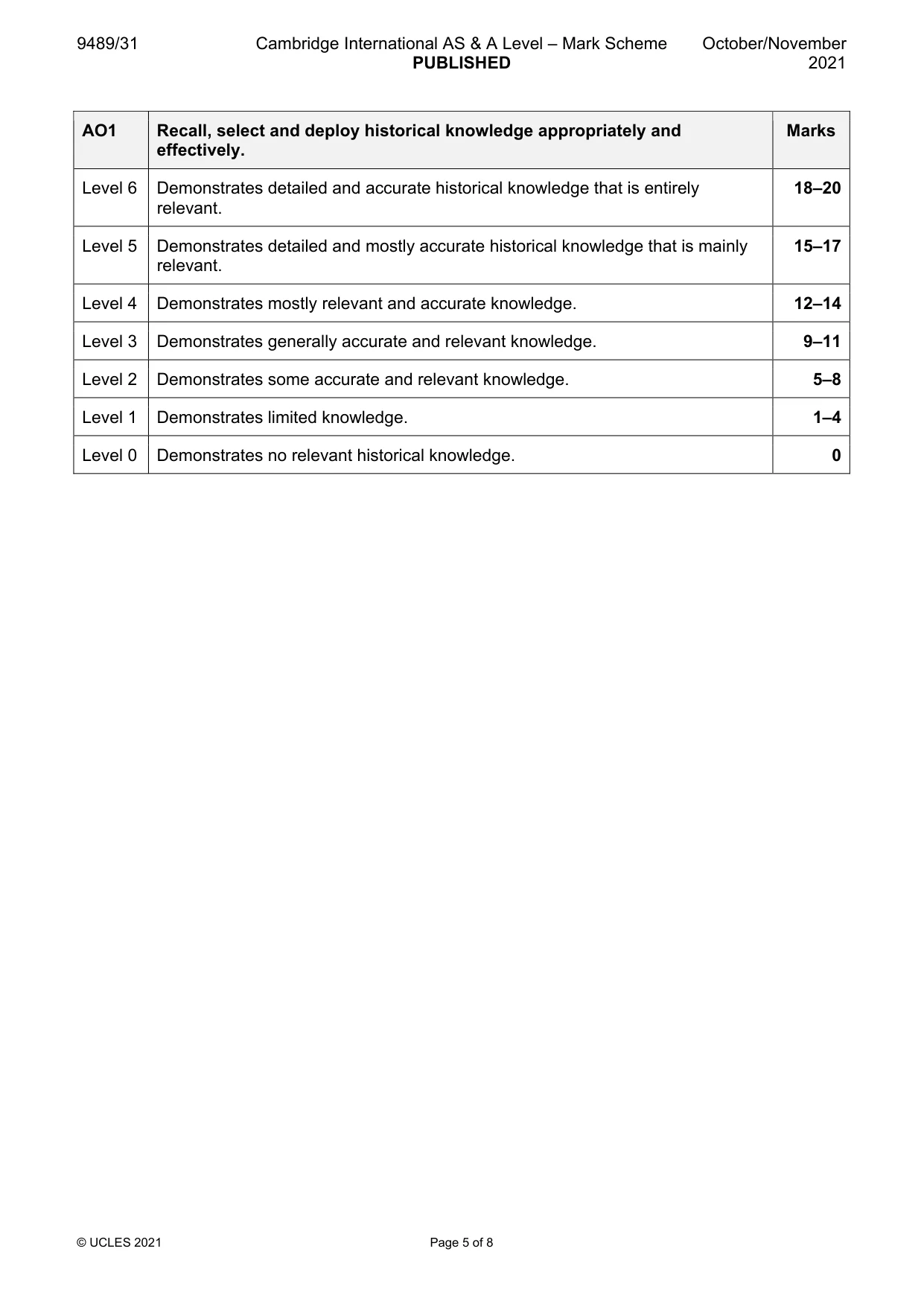
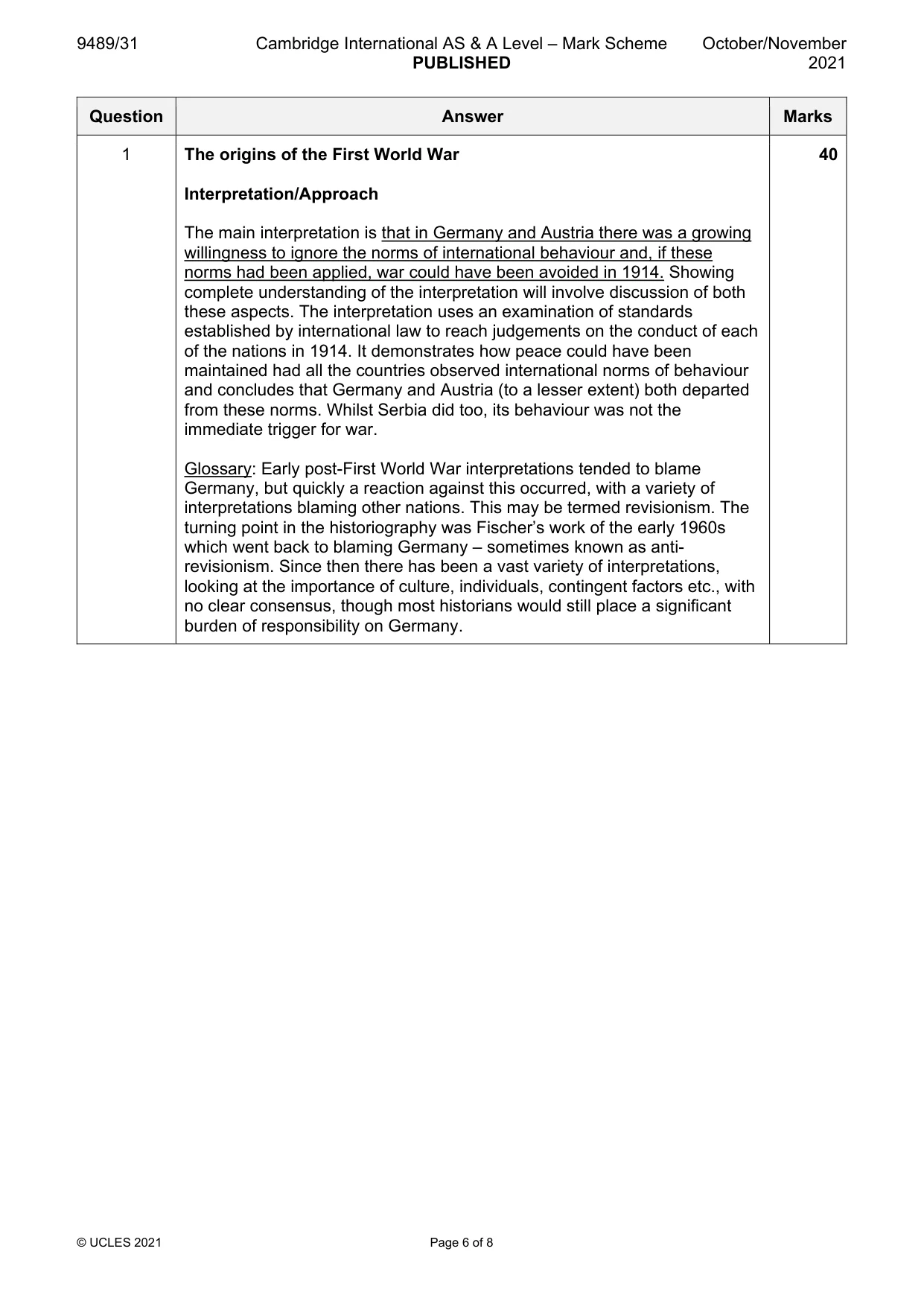
Mark scheme: Question Answer Marks 1 The origins of the First World War 40 Interpretation/Approach The main interpretation is that in Germany and Austria there was a growing willingness to ignore the norms of international behaviour and, if these norms had been applied, war could have been avoided in 1914. Showing complete understanding of the interpretation will involve discussion of both these aspects. The interpretation uses an examination of standards established by international law to reach judgements on the conduct of each of the nations in 1914. It demonstrates how peace could have been maintained had all the countries observed international norms of behaviour and concludes that Germany and Austria (to a lesser extent) both departed from these norms. Whilst Serbia did too, its behaviour was not the immediate trigger for war. Glossary: Early post-First World War interpretations tended to blame Germany, but quickly a reaction against this occurred, with a variety of interpretations blaming other nations. This may be termed revisionism. The turning point in the historiography was Fischer’s work of the early 1960s which went back to blaming Germany – sometimes known as anti- revisionism. Since then there has been a vast variety of interpretations, looking at the importance of culture, individuals, contingent factors etc., with no clear consensus, though most historians would still place a significant burden of responsibility on Germany.
Q2 · Read the extract and then answer the question
2 Read the extract and then answer the question. We do not know for sure when Hitler finally made up his mind to exterminate the Jews in order to ‘solve’ the Jewish problem. It may be assumed that he considered such a prospect from the beginning of his political career, as suggested by many of his speeches and by his well known comments in Mein Kampf that during the First World War thousands of Jews should have been gassed. But at that time, and for many years thereafter, this aspiration was certainly no more than a vision for the distant future. Nor do we know of any statement by Hitler at the time of the conquest of Poland that indicates he viewed the concentration of the Jews in ghettos as a preparatory stage for systematic mass extermination, although he and his henchmen apparently hoped to reduce the Jewish population through poor and hazardous living conditions. However, Hitler did think it essential and possible to link up the military campaign against Russia with the liquidation of the Jews. The directives issued to the heads of the army and the SS in March 1941 were probably accompanied by verbal orders to include the Jewish population in the planned extermination operations. It was obvious that the task would be entrusted to Himmler’s men. Since the very beginning of the Polish campaign, Himmler had been in charge of implementing the racist plans, and it was he who had masterminded the exchanges of populations and deportations. That same month, at a meeting with several senior SS officers, Himmler explained that the decision had been taken: they were about to attack Russia. He informed these officers of the ‘special tasks’ that would be entrusted to the SS units, the SD and the police. ‘Without remorse, cruel war will develop between nations; in its course, twenty to thirty million Slavs and Jews will perish because of war activities and food shortages.’ It is well known that Hitler apparently did not issue written orders on the ‘Final Solution’. Heydrich, however, received his from Göring on 31 July 1941: ‘I herewith charge you with making all necessary preparations with regard to the organisational, practical and financial aspects for an overall solution of the Jewish question in the German sphere of influence in Europe. I further charge you with submitting to me an overall plan for the execution of the intended final solution of the Jewish question.’ As in numerous other National Socialist procedures, Göring’s directive did not launch a completely new process but rather gave approval to an operation that was already under way and had to be officially implemented by various government agencies. We may, then, assume that by the end of July 1941 a clear-cut decision had been taken to exploit the conquered territories in order to solve the Jewish problem throughout Europe in the spirit proclaimed by Hitler again and again. Hence, it is reasonable to assume that Heydrich would require the cooperation of other administrative bodies in the operation, for example, the Foreign Ministry or the Ministry of Transport, and because of this he would require explicit authorisation. For the first time, we encounter here, in an official document, the phrase ‘the final solution of the Jewish problem’. As we know, this phrase served to disguise the intention to wipe out the Jewish population of Europe and, if possible, throughout the world. Not by chance, the two aspects emphasised in the directive were totality and finality. What can you learn from this extract about the interpretation and approach of the historian who wrote it? Use the extract and your knowledge of the Holocaust to explain your answer. [40] Section C: Topic 3 The origins and development of the Cold War
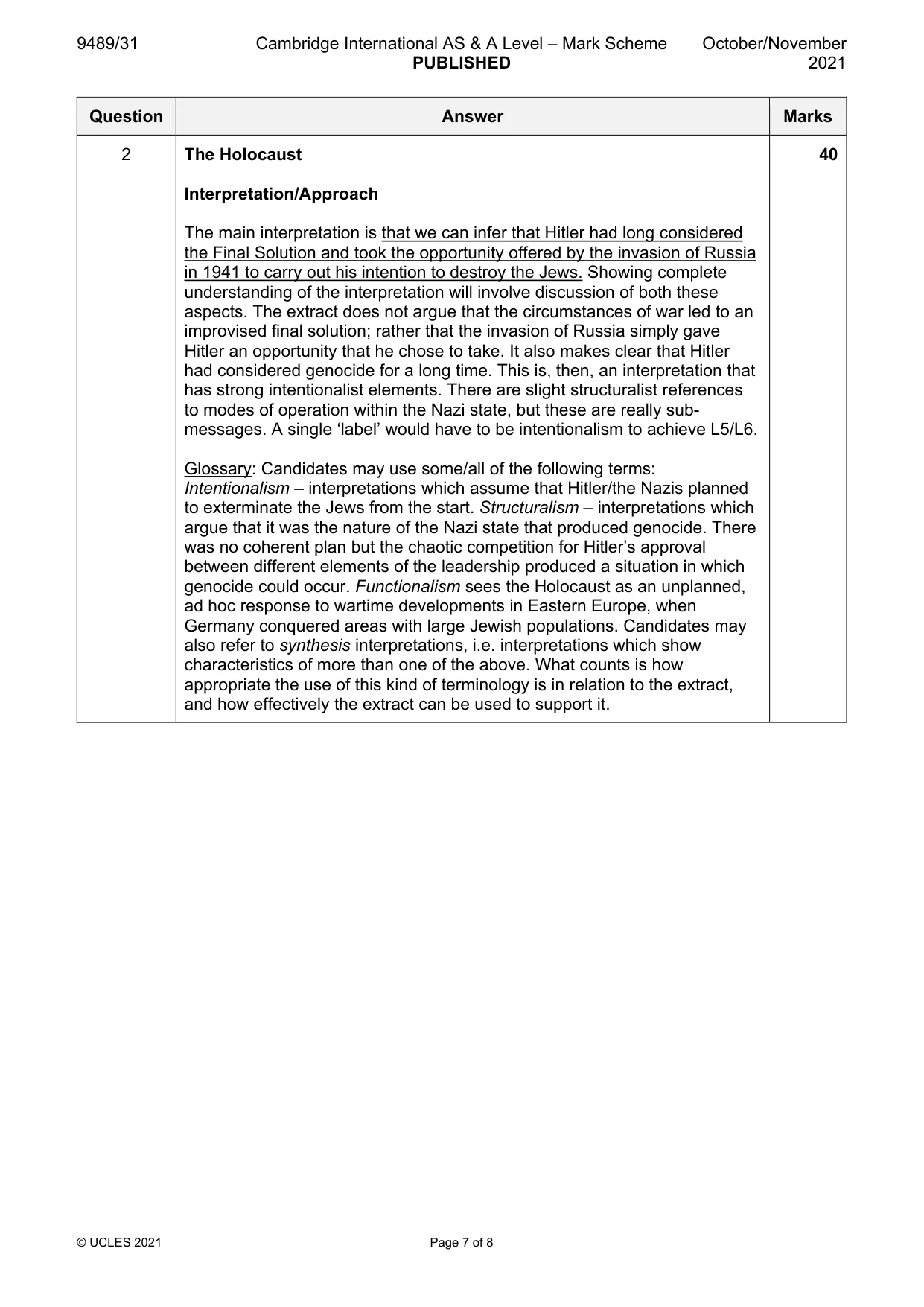
Mark scheme: 2 The Holocaust 40 Interpretation/Approach The main interpretation is that we can infer that Hitler had long considered the Final Solution and took the opportunity offered by the invasion of Russia in 1941 to carry out his intention to destroy the Jews. Showing complete understanding of the interpretation will involve discussion of both these aspects. The extract does not argue that the circumstances of war led to an improvised final solution; rather that the invasion of Russia simply gave Hitler an opportunity that he chose to take. It also makes clear that Hitler had considered genocide for a long time. This is, then, an interpretation that has strong intentionalist elements. There are slight structuralist references to modes of operation within the Nazi state, but these are really sub- messages. A single ‘label’ would have to be intentionalism to achieve L5/L6. Glossary: Candidates may use some/all of the following terms: Intentionalism – interpretations which assume that Hitler/the Nazis planned to exterminate the Jews from the start. Structuralism – interpretations which argue that it was the nature of the Nazi state that produced genocide. There was no coherent plan but the chaotic competition for Hitler’s approval between different elements of the leadership produced a situation in which genocide could occur. Functionalism sees the Holocaust as an unplanned, ad hoc response to wartime developments in Eastern Europe, when Germany conquered areas with large Jewish populations. Candidates may also refer to synthesis interpretations, i.e. interpretations which show characteristics of more than one of the above. What counts is how appropriate the use of this kind of terminology is in relation to the extract, and how effectively the extract can be used to support it.
Q3 · Read the extract and then answer the question
3 Read the extract and then answer the question. What did the Soviets want? The State Department had no clear idea of what Stalin was really up to in Europe, particularly in Germany. The Soviets were too suspicious to deal with the West. Stalin acted unilaterally, and it was probably not clear in his own mind how far he would probe in his quest to find ‘security’ for his empire. Germany was the great unanswered question, the potential flash-point. Throughout the first half of 1948, the Americans were puzzled: did the Soviets want a united communist Germany? A ruined powerless Germany? To punish Germany and milk it with reparations? Soviet behaviour was contradictory. The Russians were still looting factories and sending equipment back to the USSR (where it sat and rusted in the snow) – yet they permitted former Nazis to hold high positions in the Eastern zone. Whatever the Soviets wanted, the United States did not want a united Germany under Soviet domination. Such a development would constitute ‘the greatest threat to the security of all Western nations’, General Marshall asserted in February 1948. A weak Germany, on the other hand, would frustrate European recovery. Many in the US government were determined to rebuild Germany as a stronghold of the West, even if that meant partition. This could not be done without currency reform. The German Mark was worthless; real currency was measured in American cigarettes sold on the black market. Back in August 1947, Secretary of Commerce Harriman had flatly told Truman, ‘Monetary reform is overdue. It is hard to understand how business is being transacted with a worthless currency.’ Harriman added, however, that he had grave doubts that currency reform could include the Soviets ‘as Soviet methods are so different from ours’. Currency reform may sound like a technical exercise, but it meant the end of any semblance of US–Soviet cooperation in Germany. It signalled the great divide between East and West. The Soviets were not as mystified about Western intentions as the West was about theirs. Their spies in the West had been providing regular progress reports. They knew all about the printing presses in the Western zones churning out new currency to rebuild a capitalist Germany. By early 1948, the Four-Power Council nominally governing Germany had become a farce. The Soviet representative, who normally took detailed notes, no longer bothered. On 20 March he walked out. To the Soviets, it must have seemed like their worst fears realised. A powerful capitalist Germany rebuilt on their border. Capitalist countries allying to encircle them. Stalin may well have been a cornered animal, but he was also a predator. In June 1948, he lunged for Berlin. The Berlin blockade began slowly. In mid-June, the Soviets started turning away freight trains carrying coal from the Western zones to West Berlin, 110 miles inside Soviet-controlled territory. The explanation given was ‘defective wagons’. Next came the passenger trains: Red Army guards along the border began sending back every other one because of ‘crowded stations’. Finally, the autobahn was closed for ‘urgent repairs’. On 23 June, the West announced new Deutsche Marks for its sector of Berlin and West Germany. By then, a carton of cigarettes had reached an all- time high of $2 300 at the official exchange rate. Within twenty-four hours, the Soviets had cut all overland routes between West Germany and West Berlin and shut off electricity in the city. The two million citizens of West Berlin only had enough food to last thirty-six days. The squeeze was on. What can you learn from this extract about the interpretation and approach of the historian who wrote it? Use the extract and your knowledge of the Cold War to explain your answer. [40]
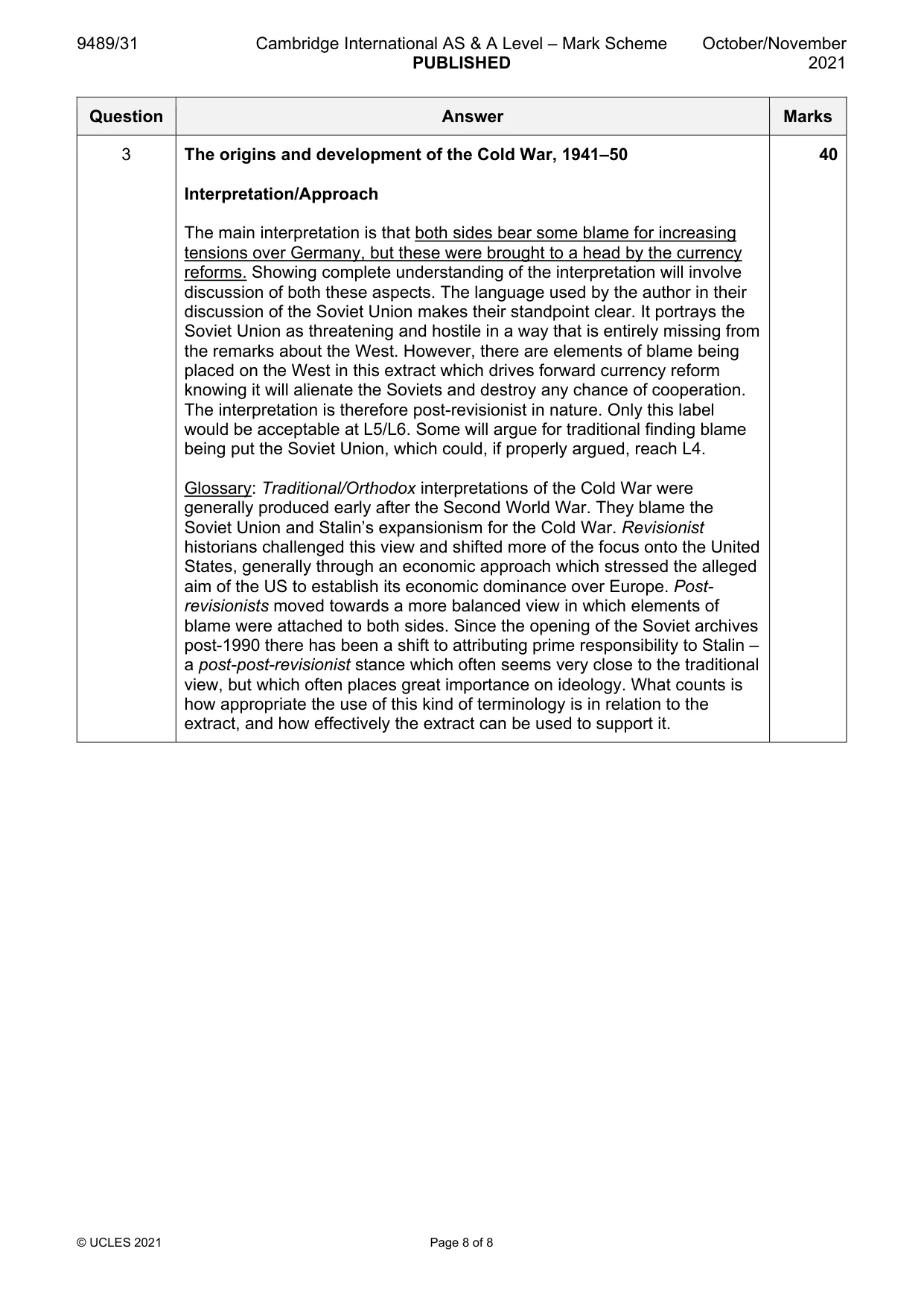
Mark scheme: 3 The origins and development of the Cold War, 1941–50 40 Interpretation/Approach The main interpretation is that both sides bear some blame for increasing tensions over Germany, but these were brought to a head by the currency reforms. Showing complete understanding of the interpretation will involve discussion of both these aspects. The language used by the author in their discussion of the Soviet Union makes their standpoint clear. It portrays the Soviet Union as threatening and hostile in a way that is entirely missing from the remarks about the West. However, there are elements of blame being placed on the West in this extract which drives forward currency reform knowing it will alienate the Soviets and destroy any chance of cooperation. The interpretation is therefore post-revisionist in nature. Only this label would be acceptable at L5/L6. Some will argue for traditional finding blame being put the Soviet Union, which could, if properly argued, reach L4. Glossary: Traditional/Orthodox interpretations of the Cold War were generally produced early after the Second World War. They blame the Soviet Union and Stalin’s expansionism for the Cold War. Revisionist historians challenged this view and shifted more of the focus onto the United States, generally through an economic approach which stressed the alleged aim of the US to establish its economic dominance over Europe. Post- revisionists moved towards a more balanced view in which elements of blame were attached to both sides. Since the opening of the Soviet archives post-1990 there has been a shift to attributing prime responsibility to Stalin – a post-post-revisionist stance which often seems very close to the traditional view, but which often places great importance on ideology. What counts is how appropriate the use of this kind of terminology is in relation to the extract, and how effectively the extract can be used to support it.
What was in this paper
The subtopics covered by these 3 questions, and how many questions each got. Open one in a new tab to see every Cambridge question on it.
What you needed in this session
Cambridge’s own grade thresholds for 2021 Oct/Nov, Paper 3 · Variant 1. A higher threshold means an easier paper — the bar moves with how the cohort did.