Cambridge A Level History 9489 — 2021 May/June Paper 3 · Variant 2
9489/32/M/J/21 · 3 questions · 40 marks · ≈45 min
The question paper and its mark scheme, free to read here and free to download. This is Cambridge’s own paper, exactly as it was sat.
Question paper4 pages
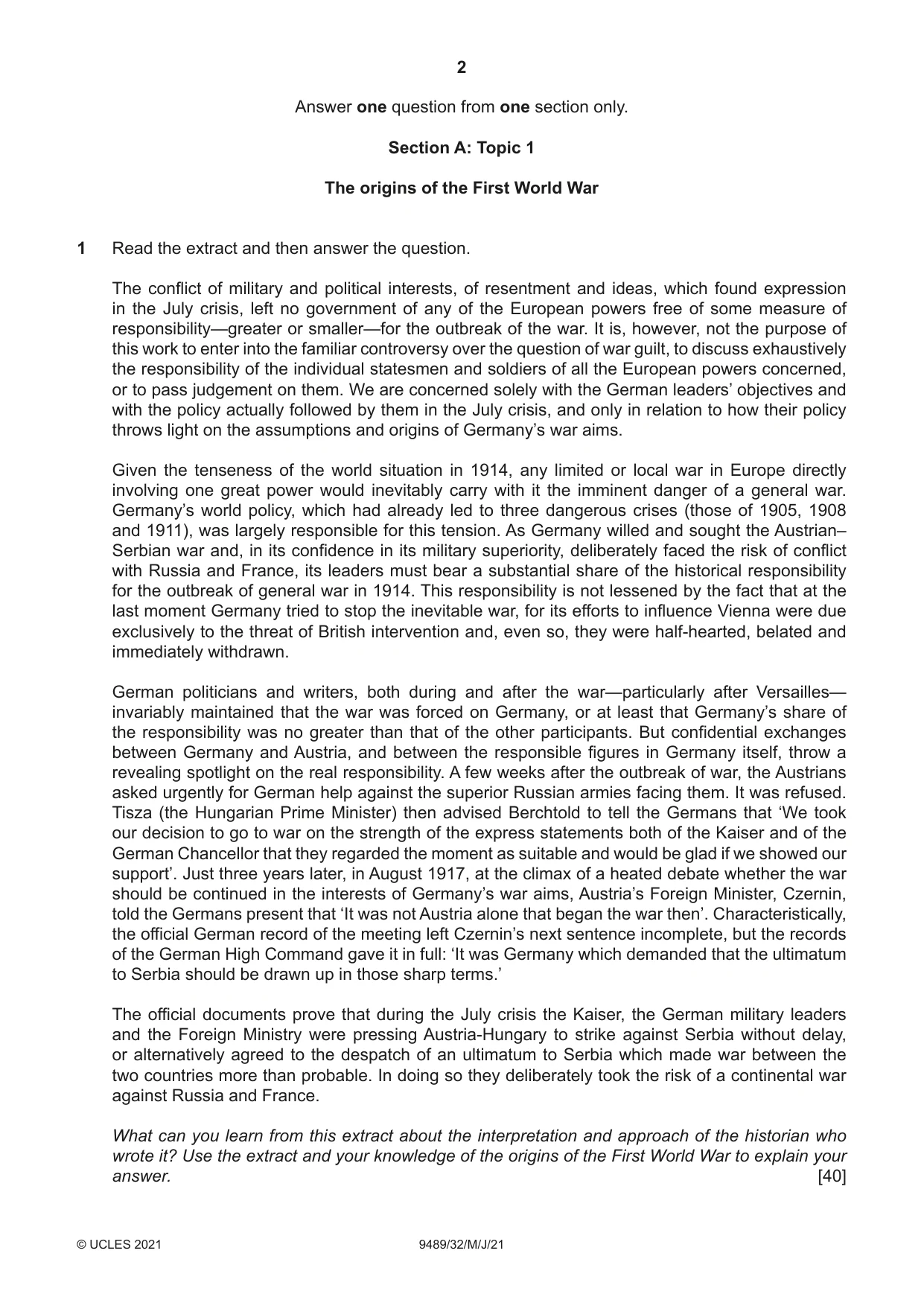
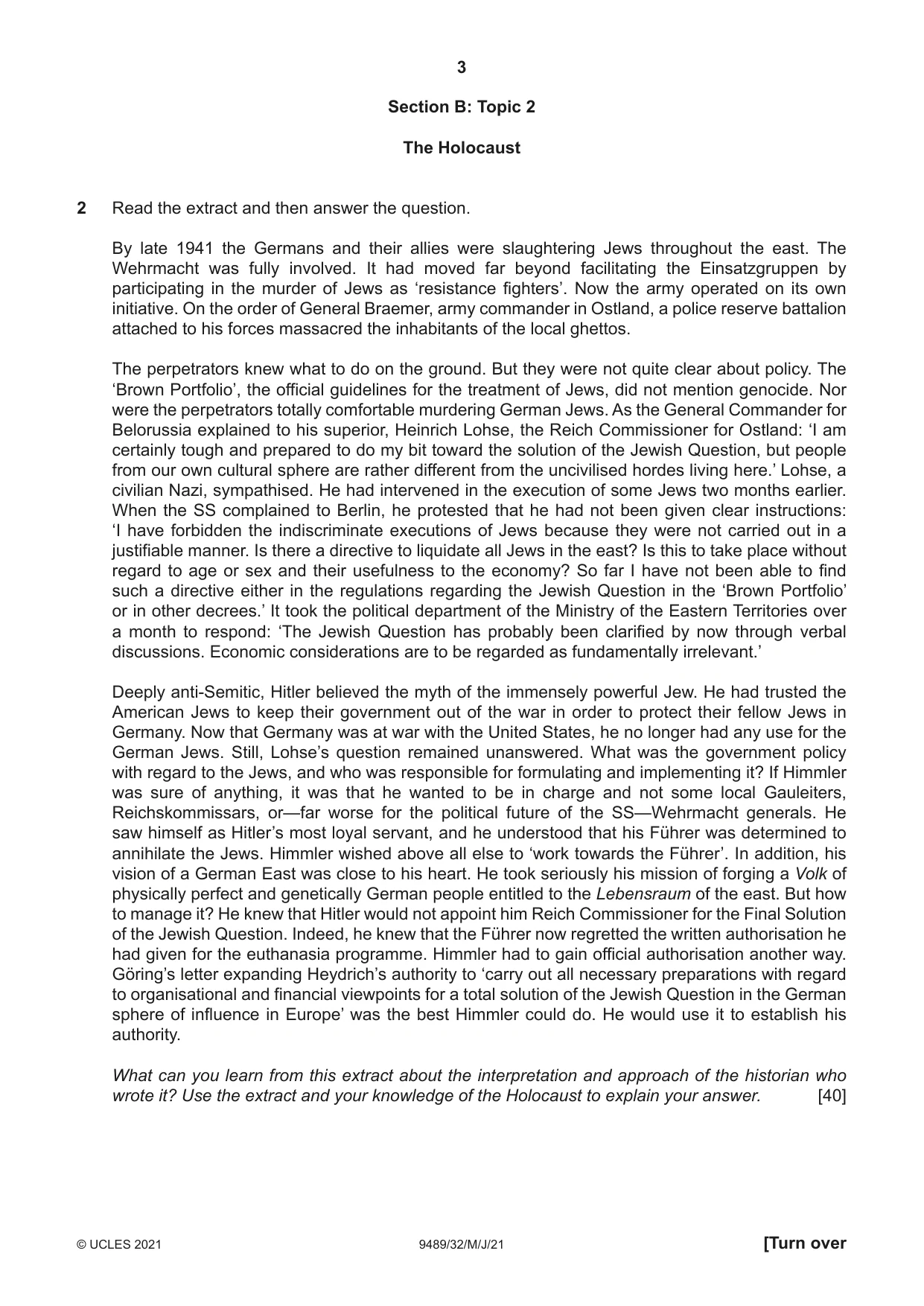
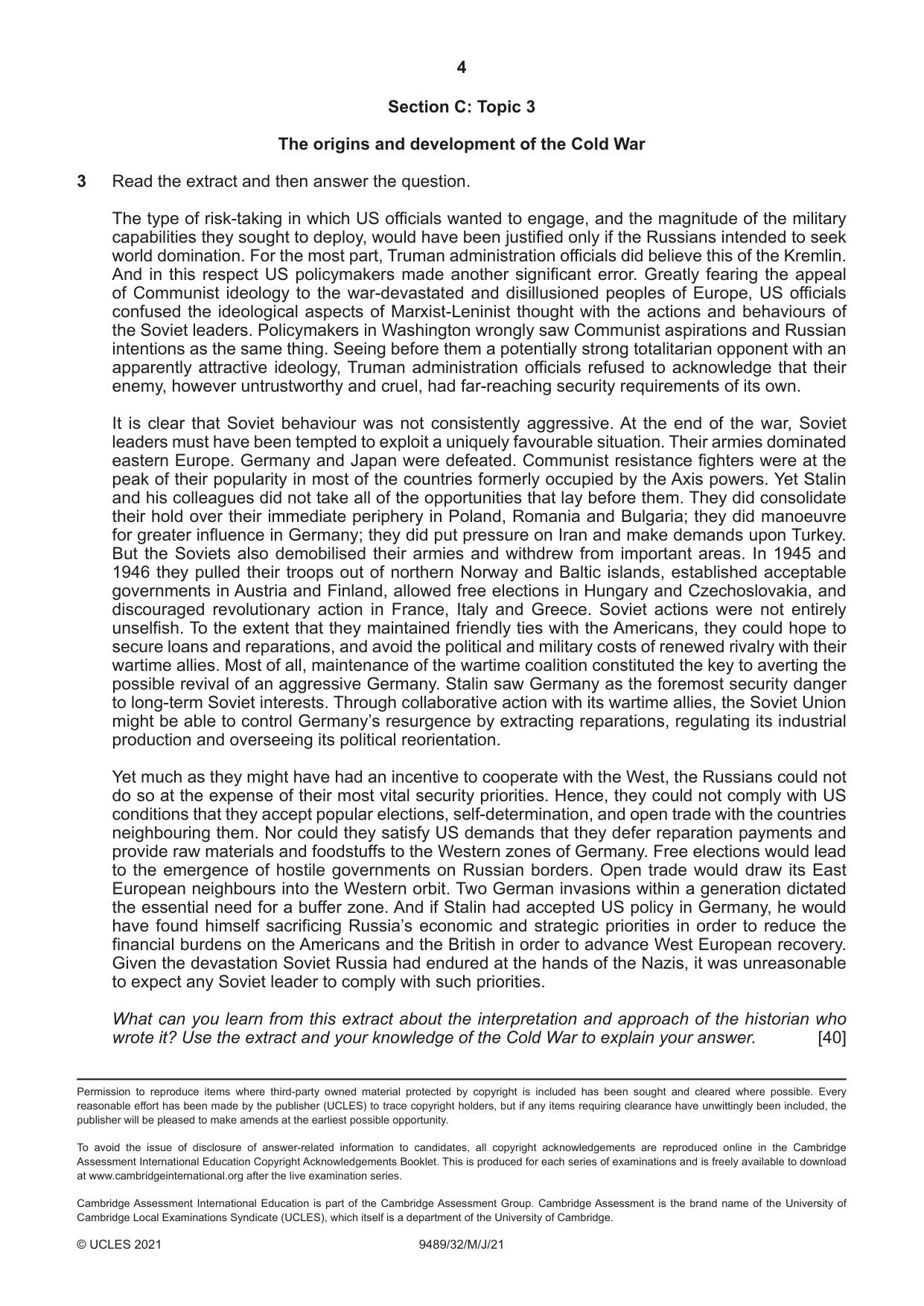
Mark scheme8 pages
Answers below. Sit the paper first if you are practising.
Questions as text
Q1 · Read the extract and then answer the question
1 Read the extract and then answer the question. The conflict of military and political interests, of resentment and ideas, which found expression in the July crisis, left no government of any of the European powers free of some measure of responsibility —greater or smaller—for the outbreak of the war. It is, however, not the purpose of this work to enter into the familiar controversy over the question of war guilt, to discuss exhaustively the responsibility of the individual statesmen and soldiers of all the European powers concerned, or to pass judgement on them. We are concerned solely with the German leaders’ objectives and with the policy actually followed by them in the July crisis, and only in relation to how their policy throws light on the assumptions and origins of Germany’s war aims. Given the tenseness of the world situation in 1914, any limited or local war in Europe directly involving one great power would inevitably carry with it the imminent danger of a general war. Germany’s world policy, which had already led to three dangerous crises (those of 1905, 1908 and 1911), was largely responsible for this tension. As Germany willed and sought the Austrian– Serbian war and, in its confidence in its military superiority, deliberately faced the risk of conflict with Russia and France, its leaders must bear a substantial share of the historical responsibility for the outbreak of general war in 1914. This responsibility is not lessened by the fact that at the last moment Germany tried to stop the inevitable war, for its efforts to influence Vienna were due exclusively to the threat of British intervention and, even so, they were half-hearted, belated and immediately withdrawn. German politicians and writers, both during and after the war—particularly after Versailles— invariably maintained that the war was forced on Germany, or at least that Germany’s share of the responsibility was no greater than that of the other participants. But confidential exchanges between Germany and Austria, and between the responsible figures in Germany itself, throw a revealing spotlight on the real responsibility. A few weeks after the outbreak of war, the Austrians asked urgently for German help against the superior Russian armies facing them. It was refused. Tisza (the Hungarian Prime Minister) then advised Berchtold to tell the Germans that ‘We took our decision to go to war on the strength of the express statements both of the Kaiser and of the German Chancellor that they regarded the moment as suitable and would be glad if we showed our support’. Just three years later, in August 1917, at the climax of a heated debate whether the war should be continued in the interests of Germany’s war aims, Austria’s Foreign Minister, Czernin, told the Germans present that ‘It was not Austria alone that began the war then’. Characteristically, the official German record of the meeting left Czernin’s next sentence incomplete, but the records of the German High Command gave it in full: ‘It was Germany which demanded that the ultimatum to Serbia should be drawn up in those sharp terms.’ The official documents prove that during the July crisis the Kaiser, the German military leaders and the Foreign Ministry were pressing Austria-Hungary to strike against Serbia without delay, or alternatively agreed to the despatch of an ultimatum to Serbia which made war between the two countries more than probable. In doing so they deliberately took the risk of a continental war against Russia and France. What can you learn from this extract about the interpretation and approach of the historian who wrote it? Use the extract and your knowledge of the origins of the First World War to explain your answer. [40]
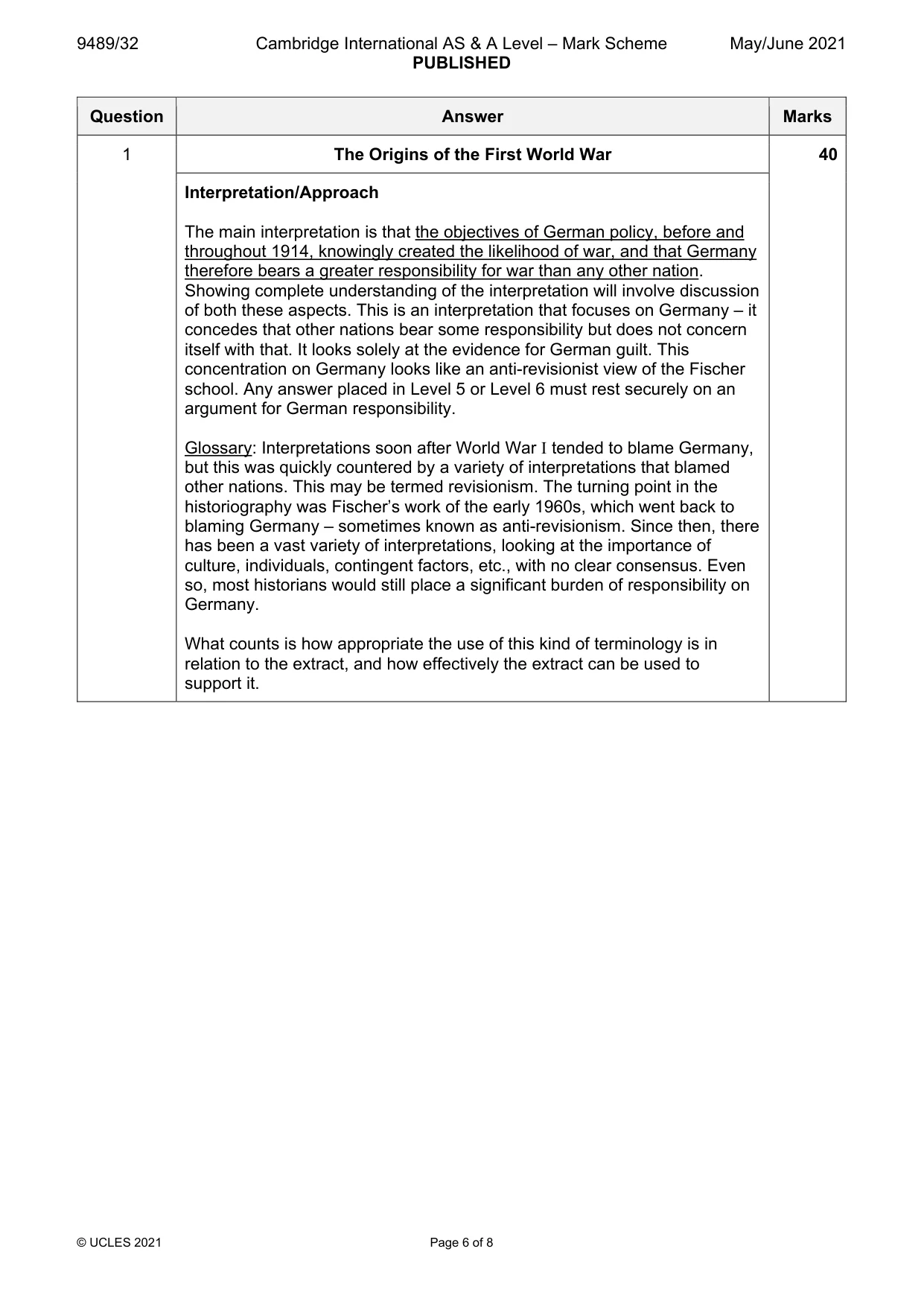
Mark scheme: Question Answer Marks 1 The Origins of the First World War 40 Interpretation/Approach The main interpretation is that the objectives of German policy, before and throughout 1914, knowingly created the likelihood of war, and that Germany therefore bears a greater responsibility for war than any other nation. Showing complete understanding of the interpretation will involve discussion of both these aspects. This is an interpretation that focuses on Germany – it concedes that other nations bear some responsibility but does not concern itself with that. It looks solely at the evidence for German guilt. This concentration on Germany looks like an anti-revisionist view of the Fischer school. Any answer placed in Level 5 or Level 6 must rest securely on an argument for German responsibility. Glossary: Interpretations soon after World War Ⅰ tended to blame Germany, but this was quickly countered by a variety of interpretations that blamed other nations. This may be termed revisionism. The turning point in the historiography was Fischer’s work of the early 1960s, which went back to blaming Germany – sometimes known as anti-revisionism. Since then, there has been a vast variety of interpretations, looking at the importance of culture, individuals, contingent factors, etc., with no clear consensus. Even so, most historians would still place a significant burden of responsibility on Germany. What counts is how appropriate the use of this kind of terminology is in relation to the extract, and how effectively the extract can be used to support it.
Q2 · Read the extract and then answer the question
2 Read the extract and then answer the question. By late 1941 the Germans and their allies were slaughtering Jews throughout the east. The Wehrmacht was fully involved. It had moved far beyond facilitating the Einsatzgruppen by participating in the murder of Jews as ‘resistance fighters’. Now the army operated on its own initiative. On the order of General Braemer, army commander in Ostland, a police reserve battalion attached to his forces massacred the inhabitants of the local ghettos. The perpetrators knew what to do on the ground. But they were not quite clear about policy. The ‘Brown Portfolio’, the official guidelines for the treatment of Jews, did not mention genocide. Nor were the perpetrators totally comfortable murdering German Jews. As the General Commander for Belorussia explained to his superior, Heinrich Lohse, the Reich Commissioner for Ostland: ‘I am certainly tough and prepared to do my bit toward the solution of the Jewish Question, but people from our own cultural sphere are rather different from the uncivilised hordes living here.’ Lohse, a civilian Nazi, sympathised. He had intervened in the execution of some Jews two months earlier. When the SS complained to Berlin, he protested that he had not been given clear instructions: ‘I have forbidden the indiscriminate executions of Jews because they were not carried out in a justifiable manner. Is there a directive to liquidate all Jews in the east? Is this to take place without regard to age or sex and their usefulness to the economy? So far I have not been able to find such a directive either in the regulations regarding the Jewish Question in the ‘Brown Portfolio’ or in other decrees.’ It took the political department of the Ministry of the Eastern Territories over a month to respond: ‘The Jewish Question has probably been clarified by now through verbal discussions. Economic considerations are to be regarded as fundamentally irrelevant.’ Deeply anti-Semitic, Hitler believed the myth of the immensely powerful Jew. He had trusted the American Jews to keep their government out of the war in order to protect their fellow Jews in Germany. Now that Germany was at war with the United States, he no longer had any use for the German Jews. Still, Lohse’s question remained unanswered. What was the government policy with regard to the Jews, and who was responsible for formulating and implementing it? If Himmler was sure of anything, it was that he wanted to be in charge and not some local Gauleiters, Reichskommissars, or—far worse for the political future of the SS—Wehrmacht generals. He saw himself as Hitler’s most loyal servant, and he understood that his Führer was determined to annihilate the Jews. Himmler wished above all else to ‘work towards the Führer’. In addition, his vision of a German East was close to his heart. He took seriously his mission of forging a Volk of physically perfect and genetically German people entitled to the Lebensraum of the east. But how to manage it? He knew that Hitler would not appoint him Reich Commissioner for the Final Solution of the Jewish Question. Indeed, he knew that the Führer now regretted the written authorisation he had given for the euthanasia programme. Himmler had to gain official authorisation another way. Göring’s letter expanding Heydrich’s authority to ‘carry out all necessary preparations with regard to organisational and financial viewpoints for a total solution of the Jewish Question in the German sphere of influence in Europe’ was the best Himmler could do. He would use it to establish his authority. What can you learn from this extract about the interpretation and approach of the historian who wrote it? Use the extract and your knowledge of the Holocaust to explain your answer. [40] Section C: Topic 3 The origins and development of the Cold War
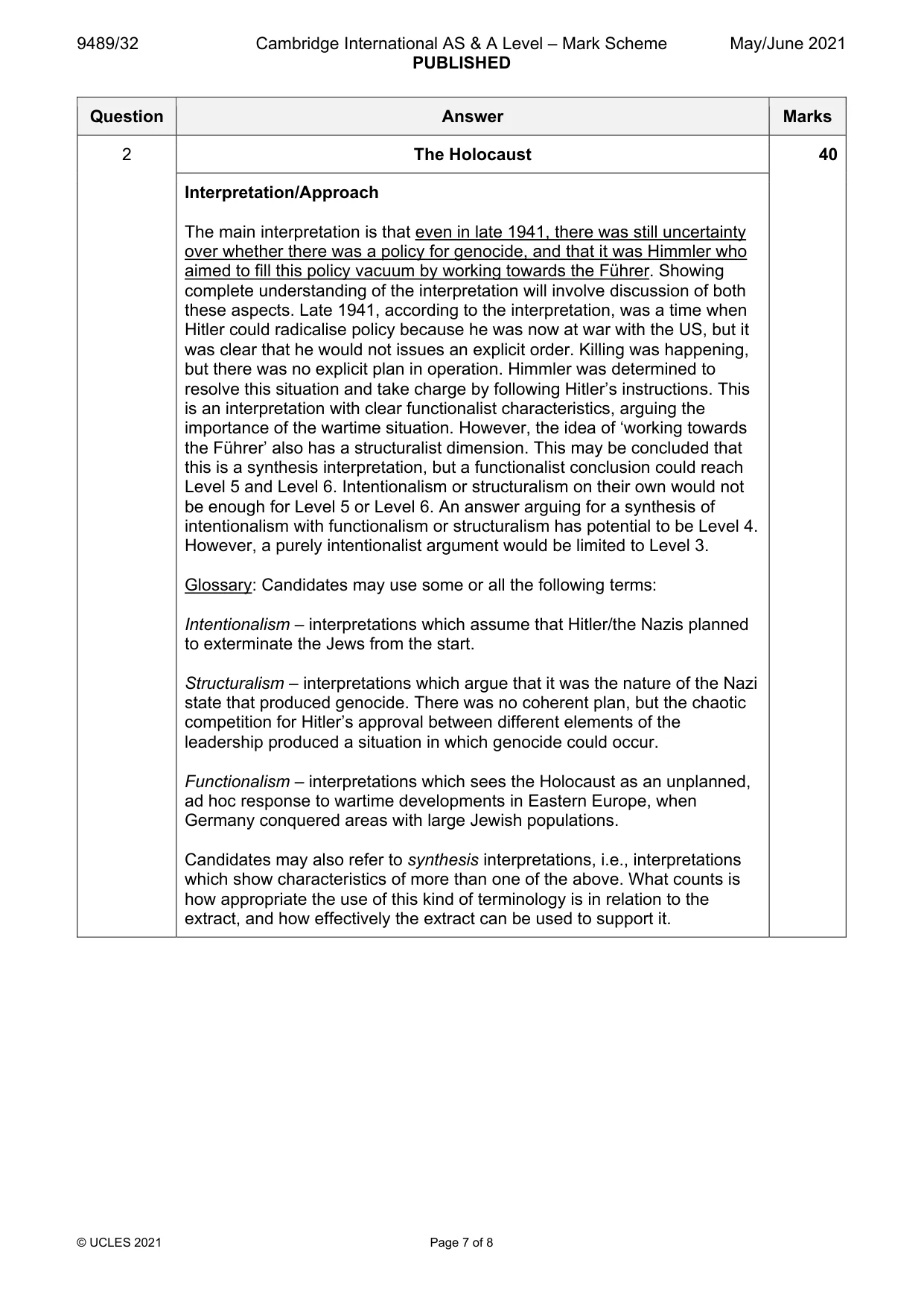
Mark scheme: 2 The Holocaust 40 Interpretation/Approach The main interpretation is that even in late 1941, there was still uncertainty over whether there was a policy for genocide, and that it was Himmler who aimed to fill this policy vacuum by working towards the Führer. Showing complete understanding of the interpretation will involve discussion of both these aspects. Late 1941, according to the interpretation, was a time when Hitler could radicalise policy because he was now at war with the US, but it was clear that he would not issues an explicit order. Killing was happening, but there was no explicit plan in operation. Himmler was determined to resolve this situation and take charge by following Hitler’s instructions. This is an interpretation with clear functionalist characteristics, arguing the importance of the wartime situation. However, the idea of ‘working towards the Führer’ also has a structuralist dimension. This may be concluded that this is a synthesis interpretation, but a functionalist conclusion could reach Level 5 and Level 6. Intentionalism or structuralism on their own would not be enough for Level 5 or Level 6. An answer arguing for a synthesis of intentionalism with functionalism or structuralism has potential to be Level 4. However, a purely intentionalist argument would be limited to Level 3. Glossary: Candidates may use some or all the following terms: Intentionalism – interpretations which assume that Hitler/the Nazis planned to exterminate the Jews from the start. Structuralism – interpretations which argue that it was the nature of the Nazi state that produced genocide. There was no coherent plan, but the chaotic competition for Hitler’s approval between different elements of the leadership produced a situation in which genocide could occur. Functionalism – interpretations which sees the Holocaust as an unplanned, ad hoc response to wartime developments in Eastern Europe, when Germany conquered areas with large Jewish populations. Candidates may also refer to synthesis interpretations, i.e., interpretations which show characteristics of more than one of the above. What counts is how appropriate the use of this kind of terminology is in relation to the extract, and how effectively the extract can be used to support it.
Q3 · Read the extract and then answer the question
3 Read the extract and then answer the question. The type of risk-taking in which US officials wanted to engage, and the magnitude of the military capabilities they sought to deploy, would have been justified only if the Russians intended to seek world domination. For the most part, Truman administration officials did believe this of the Kremlin. And in this respect US policymakers made another significant error. Greatly fearing the appeal of Communist ideology to the war-devastated and disillusioned peoples of Europe, US officials confused the ideological aspects of Marxist-Leninist thought with the actions and behaviours of the Soviet leaders. Policymakers in Washington wrongly saw Communist aspirations and Russian intentions as the same thing. Seeing before them a potentially strong totalitarian opponent with an apparently attractive ideology, Truman administration officials refused to acknowledge that their enemy, however untrustworthy and cruel, had far-reaching security requirements of its own. It is clear that Soviet behaviour was not consistently aggressive. At the end of the war, Soviet leaders must have been tempted to exploit a uniquely favourable situation. Their armies dominated eastern Europe. Germany and Japan were defeated. Communist resistance fighters were at the peak of their popularity in most of the countries formerly occupied by the Axis powers. Yet Stalin and his colleagues did not take all of the opportunities that lay before them. They did consolidate their hold over their immediate periphery in Poland, Romania and Bulgaria; they did manoeuvre for greater influence in Germany; they did put pressure on Iran and make demands upon Turkey. But the Soviets also demobilised their armies and withdrew from important areas. In 1945 and 1946 they pulled their troops out of northern Norway and Baltic islands, established acceptable governments in Austria and Finland, allowed free elections in Hungary and Czechoslovakia, and discouraged revolutionary action in France, Italy and Greece. Soviet actions were not entirely unselfish. To the extent that they maintained friendly ties with the Americans, they could hope to secure loans and reparations, and avoid the political and military costs of renewed rivalry with their wartime allies. Most of all, maintenance of the wartime coalition constituted the key to averting the possible revival of an aggressive Germany. Stalin saw Germany as the foremost security danger to long-term Soviet interests. Through collaborative action with its wartime allies, the Soviet Union might be able to control Germany’s resurgence by extracting reparations, regulating its industrial production and overseeing its political reorientation. Yet much as they might have had an incentive to cooperate with the West, the Russians could not do so at the expense of their most vital security priorities. Hence, they could not comply with US conditions that they accept popular elections, self-determination, and open trade with the countries neighbouring them. Nor could they satisfy US demands that they defer reparation payments and provide raw materials and foodstuffs to the Western zones of Germany. Free elections would lead to the emergence of hostile governments on Russian borders. Open trade would draw its East European neighbours into the Western orbit. Two German invasions within a generation dictated the essential need for a buffer zone. And if Stalin had accepted US policy in Germany, he would have found himself sacrificing Russia’s economic and strategic priorities in order to reduce the financial burdens on the Americans and the British in order to advance West European recovery. Given the devastation Soviet Russia had endured at the hands of the Nazis, it was unreasonable to expect any Soviet leader to comply with such priorities. What can you learn from this extract about the interpretation and approach of the historian who wrote it? Use the extract and your knowledge of the Cold War to explain your answer. [40]
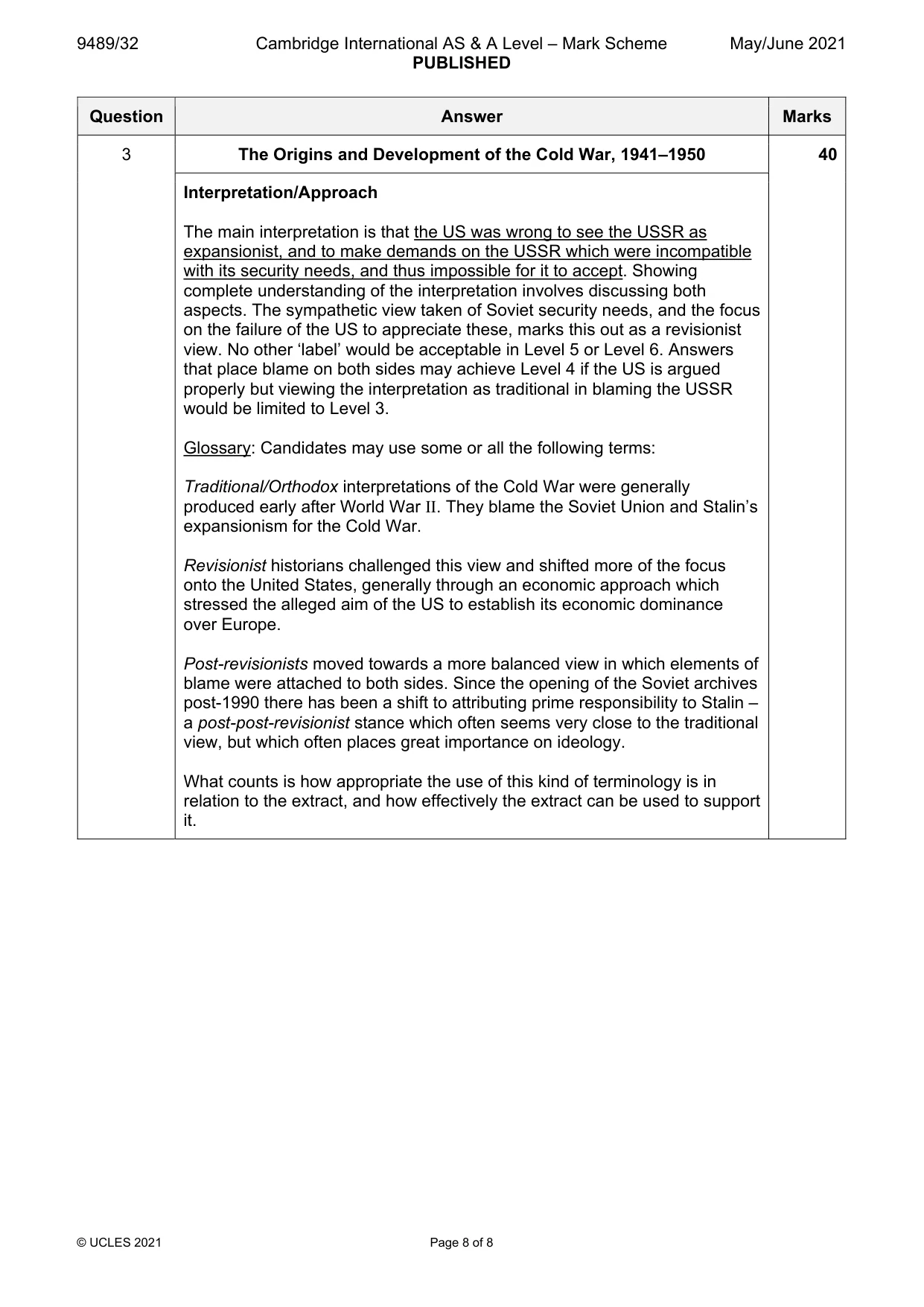
Mark scheme: 3 The Origins and Development of the Cold War, 1941–1950 40 Interpretation/Approach The main interpretation is that the US was wrong to see the USSR as expansionist, and to make demands on the USSR which were incompatible with its security needs, and thus impossible for it to accept. Showing complete understanding of the interpretation involves discussing both aspects. The sympathetic view taken of Soviet security needs, and the focus on the failure of the US to appreciate these, marks this out as a revisionist view. No other ‘label’ would be acceptable in Level 5 or Level 6. Answers that place blame on both sides may achieve Level 4 if the US is argued properly but viewing the interpretation as traditional in blaming the USSR would be limited to Level 3. Glossary: Candidates may use some or all the following terms: Traditional/Orthodox interpretations of the Cold War were generally produced early after World War Ⅱ. They blame the Soviet Union and Stalin’s expansionism for the Cold War. Revisionist historians challenged this view and shifted more of the focus onto the United States, generally through an economic approach which stressed the alleged aim of the US to establish its economic dominance over Europe. Post-revisionists moved towards a more balanced view in which elements of blame were attached to both sides. Since the opening of the Soviet archives post-1990 there has been a shift to attributing prime responsibility to Stalin – a post-post-revisionist stance which often seems very close to the traditional view, but which often places great importance on ideology. What counts is how appropriate the use of this kind of terminology is in relation to the extract, and how effectively the extract can be used to support it.
What was in this paper
The subtopics covered by these 3 questions, and how many questions each got. Open one in a new tab to see every Cambridge question on it.
What you needed in this session
Cambridge’s own grade thresholds for 2021 May/June, Paper 3 · Variant 2. A higher threshold means an easier paper — the bar moves with how the cohort did.