Questions as text
Q1 · In some countries in the last twenty years the amount of freight traffic carried by roads… 9708/11 Oct/Nov 2005
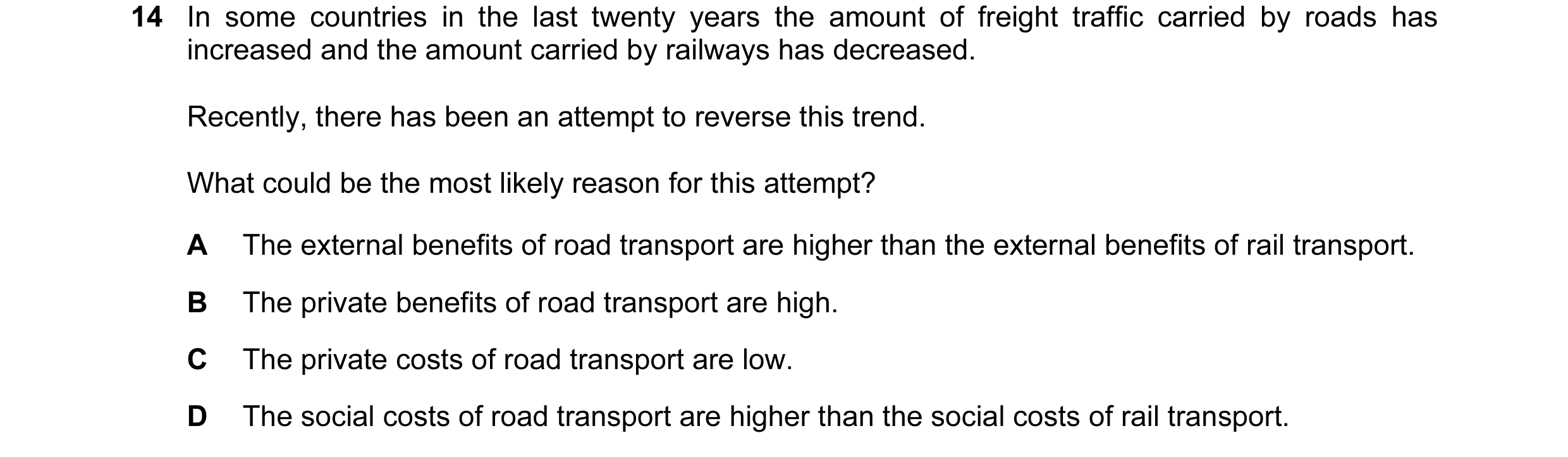
14 In some countries in the last twenty years the amount of freight traffic carried by roads has increased and the amount carried by railways has decreased. Recently, there has been an attempt to reverse this trend. What could be the most likely reason for this attempt? A The external benefits of road transport are higher than the external benefits of rail transport. B The private benefits of road transport are high. C The private costs of road transport are low. D The social costs of road transport are higher than the social costs of rail transport.
1 marks
Answer: D
This question in 9708/11 Oct/Nov 2005
Q2 · When is cost-benefit analysis most likely to be used? 9708/11 Oct/Nov 2005
15 When is cost-benefit analysis most likely to be used? A by a firm when deciding whether to relocate B by a firm when deciding to purchase new machinery C by a government when choosing between two road schemes D by a local authority when deciding its tax rate
1 marks
Answer: C
This question in 9708/11 Oct/Nov 2005
Q3 · In which situation are there definitely positive externalities? 9708/11 May/June 2006
14 In which situation are there definitely positive externalities? A Private benefits exceed private costs. B Private benefits exceed social benefits. C Social benefits exceed private benefits. D Social benefits exceed private costs.
1 marks
Answer: C
This question in 9708/11 May/June 2006
Q4 · Correct use of cost-benefit analysis should produce an outcome where A social costs are… 9708/11 May/June 2006
15 Correct use of cost-benefit analysis should produce an outcome where A social costs are minimised and social benefits are maximised. B social benefits are in excess of social costs. C marginal private benefits equal marginal social benefits. D marginal social benefits equal marginal social costs.
1 marks
Answer: D
This question in 9708/11 May/June 2006
Q5 · What is an external cost of building new houses in a city centre? 9708/11 Oct/Nov 2006
14 What is an external cost of building new houses in a city centre? A the cost of compensating residents for mud on local roads B the cost of city centre traffic congestion resulting from the building C the cost of obtaining planning permission D the cost of painting the outside of the new houses
1 marks
Answer: B
This question in 9708/11 Oct/Nov 2006
Q6 · What is an advantage of using cost-benefit analysis in decision-making rather than using… 9708/11 Oct/Nov 2006
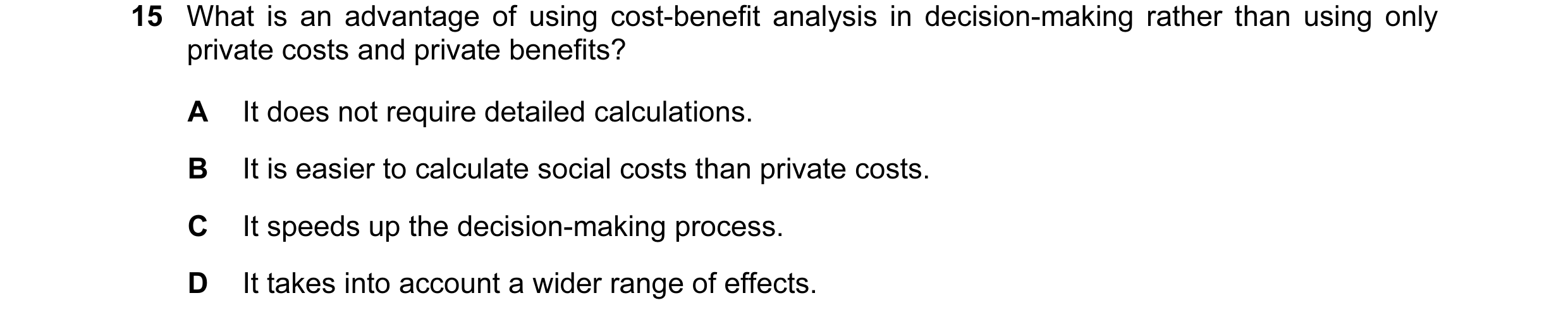
15 What is an advantage of using cost-benefit analysis in decision-making rather than using only private costs and private benefits? A It does not require detailed calculations. B It is easier to calculate social costs than private costs. C It speeds up the decision-making process. D It takes into account a wider range of effects.
1 marks
Answer: D
This question in 9708/11 Oct/Nov 2006
Q7 · Which consequence of building an underground railway line would be classified as an… 9708/11 May/June 2007
15 Which consequence of building an underground railway line would be classified as an externality? A a reduction in road accidents B the gain in profit for the train operators C the revenue from foreign visitors travelling on the line D the saving in travel time by passengers who travel on the line
1 marks
Answer: A
This question in 9708/11 May/June 2007
Q8 · The costs and benefits of building a bridge have been calculated as follows 9708/11 May/June 2007
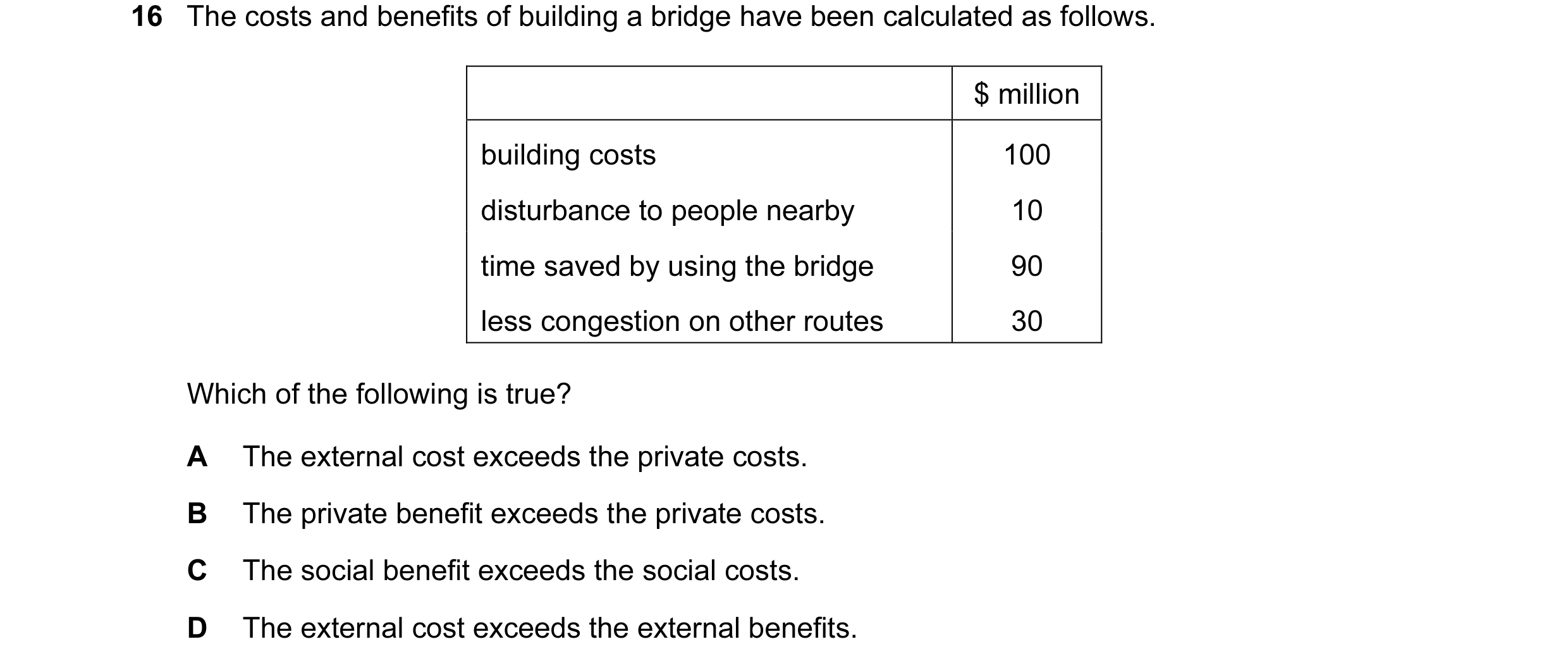
16 The costs and benefits of building a bridge have been calculated as follows. $ million building costs 100 disturbance to people nearby 10 time saved by using the bridge 90 less congestion on other routes 30 Which of the following is true? A The external cost exceeds the private costs. B The private benefit exceeds the private costs. C The social benefit exceeds the social costs. D The external cost exceeds the external benefits.
1 marks
Answer: C
This question in 9708/11 May/June 2007
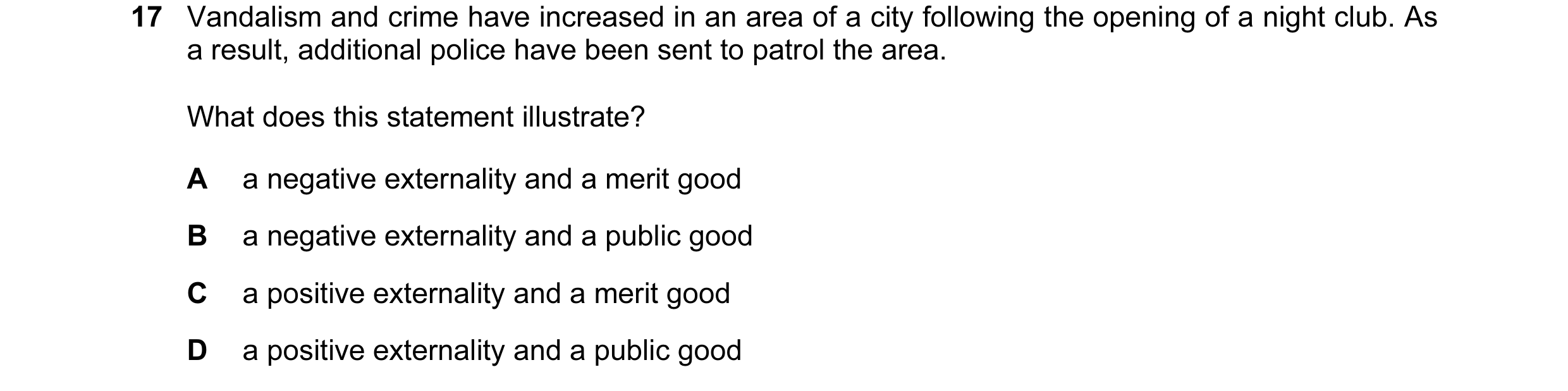
Q9 · Vandalism and crime have increased in an area of a city following the opening of a night… 9708/11 May/June 2007
17 Vandalism and crime have increased in an area of a city following the opening of a night club. As a result, additional police have been sent to patrol the area. What does this statement illustrate? A a negative externality and a merit good B a negative externality and a public good C a positive externality and a merit good D a positive externality and a public good
1 marks
Answer: B
This question in 9708/11 May/June 2007
Q10 · For which one of the following reasons might education be considered a merit good? 9708/11 May/June 2007
18 For which one of the following reasons might education be considered a merit good? A It benefits both the recipient and society as a whole. B Left to market forces, it would be over-provided. C It does not have a social cost. D Its consumption by one person does not reduce the amount available to others.
1 marks
Answer: A
This question in 9708/11 May/June 2007
Q11 · A government decided to approve a private airport-building scheme because it was socially… 9708/11 Oct/Nov 2007
14 A government decided to approve a private airport-building scheme because it was socially beneficial. In making its decision it calculated private costs at $700 m, private benefits at $800 m and external costs at $200 m. What does this suggest must have been true about the external benefits of the scheme? A External benefits equalled private benefits. B External benefits exceeded $100 m. C External benefits exceeded external costs. D There were no external benefits.
1 marks
Answer: B
This question in 9708/11 Oct/Nov 2007
Q12 · In cost-benefit analysis the term net social benefit refers to A private benefit plus… 9708/11 Oct/Nov 2007
15 In cost-benefit analysis the term net social benefit refers to A private benefit plus social benefit. B social benefit minus private benefit. C social benefit minus private cost. D social benefit minus social cost.
1 marks
Answer: D
This question in 9708/11 Oct/Nov 2007
Q13 · What is true of merit goods? 9708/11 Oct/Nov 2007
17 What is true of merit goods? A Consumers underestimate the benefit they provide. B The free rider problem restricts their supply. C Their social cost is greater than their private cost. D The market system over-provides them.
1 marks
Answer: A
This question in 9708/11 Oct/Nov 2007
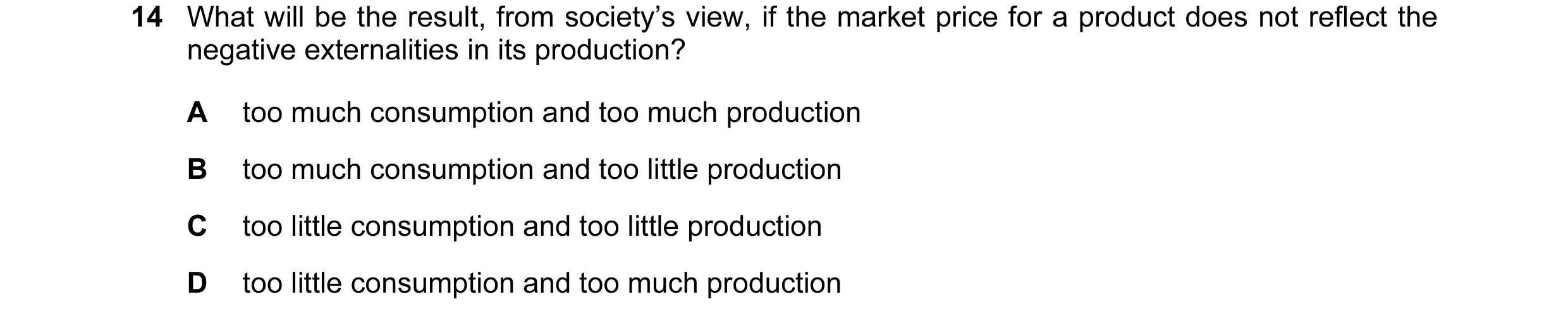
Q14 · What will be the result, from society’s view, if the market price for a product does not… 9708/11 May/June 2008
14 What will be the result, from society’s view, if the market price for a product does not reflect the negative externalities in its production? A too much consumption and too much production B too much consumption and too little production C too little consumption and too little production D too little consumption and too much production
1 marks
Answer: A
This question in 9708/11 May/June 2008
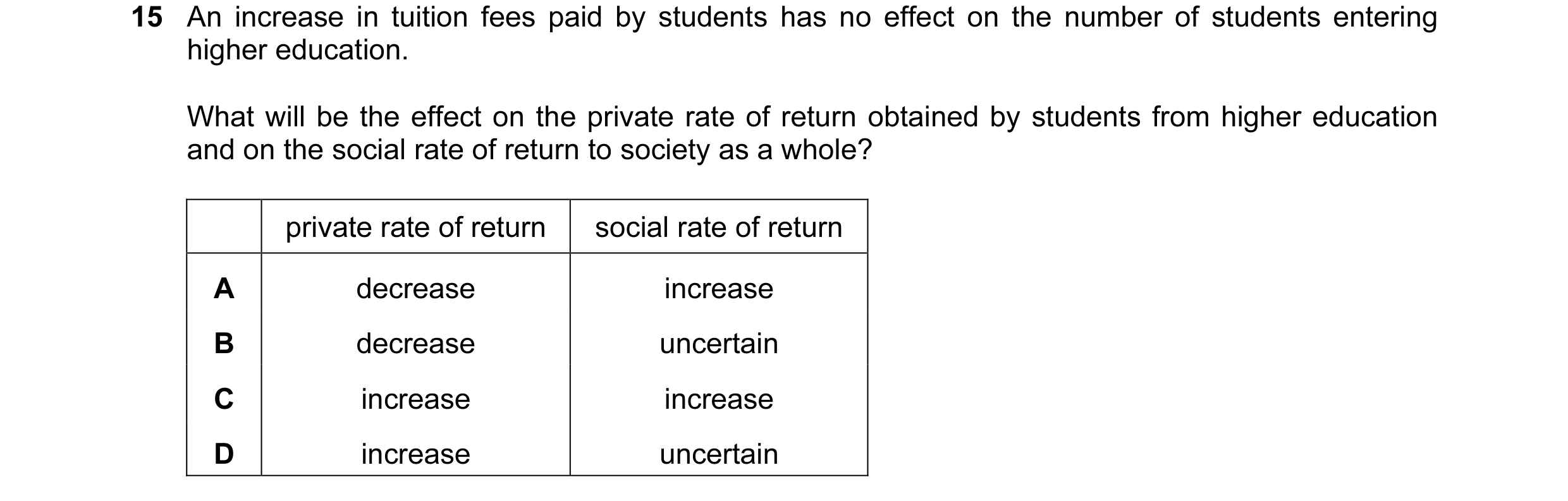
Q15 · An increase in tuition fees paid by students has no effect on the number of students… 9708/11 May/June 2008
15 An increase in tuition fees paid by students has no effect on the number of students entering higher education. What will be the effect on the private rate of return obtained by students from higher education and on the social rate of return to society as a whole? private rate of return social rate of return A decrease increase B decrease uncertain C increase increase D increase uncertain
1 marks
Answer: B
This question in 9708/11 May/June 2008
Q16 · The government has to choose the best one of four possible sites to locate a port 9708/11 May/June 2008
16 The government has to choose the best one of four possible sites to locate a port. The benefits and costs of each site are shown in $m in the table. Which site would be chosen? private external private external benefits benefits costs costs A 900 600 10 50 B 700 1100 20 5 C 800 1100 80 40 D 1000 900 100 200
1 marks
Answer: C
This question in 9708/11 May/June 2008
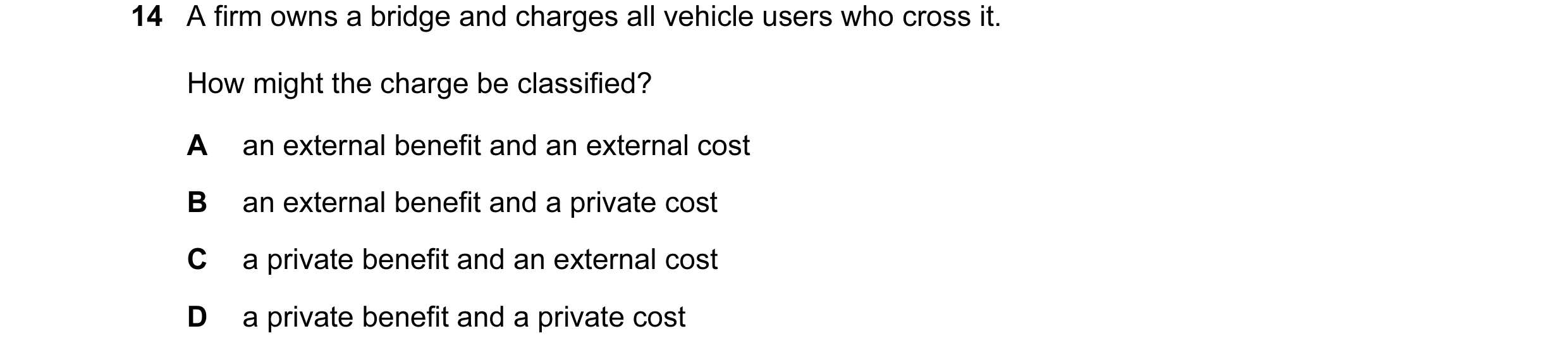
Q17 · A firm owns a bridge and charges all vehicle users who cross it 9708/11 Oct/Nov 2008
14 A firm owns a bridge and charges all vehicle users who cross it. How might the charge be classified? A an external benefit and an external cost B an external benefit and a private cost C a private benefit and an external cost D a private benefit and a private cost
1 marks
Answer: D
This question in 9708/11 Oct/Nov 2008
Q18 · Which statement about externalities is correct? 9708/11 Oct/Nov 2008
15 Which statement about externalities is correct? A Externalities are easier to value than private costs and benefits. B Externalities are only associated with industrial production. C Externalities can be both beneficial and harmful. D Externalities cannot exceed private costs and benefits.
1 marks
Answer: C
This question in 9708/11 Oct/Nov 2008
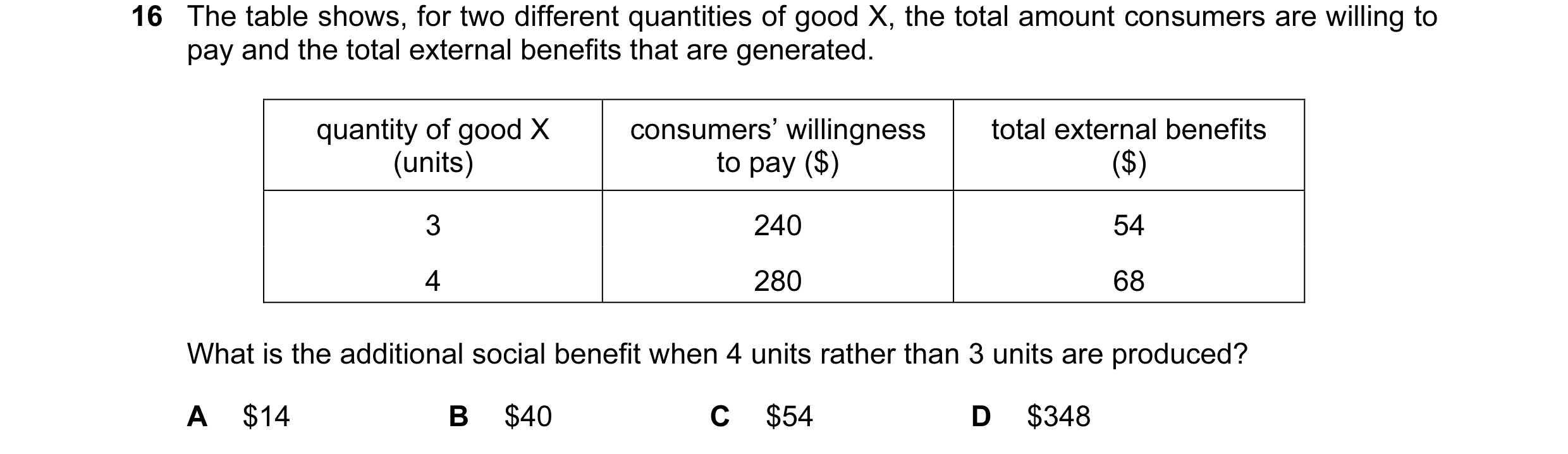
Q19 · The table shows, for two different quantities of good X, the total amount consumers are… 9708/11 Oct/Nov 2008
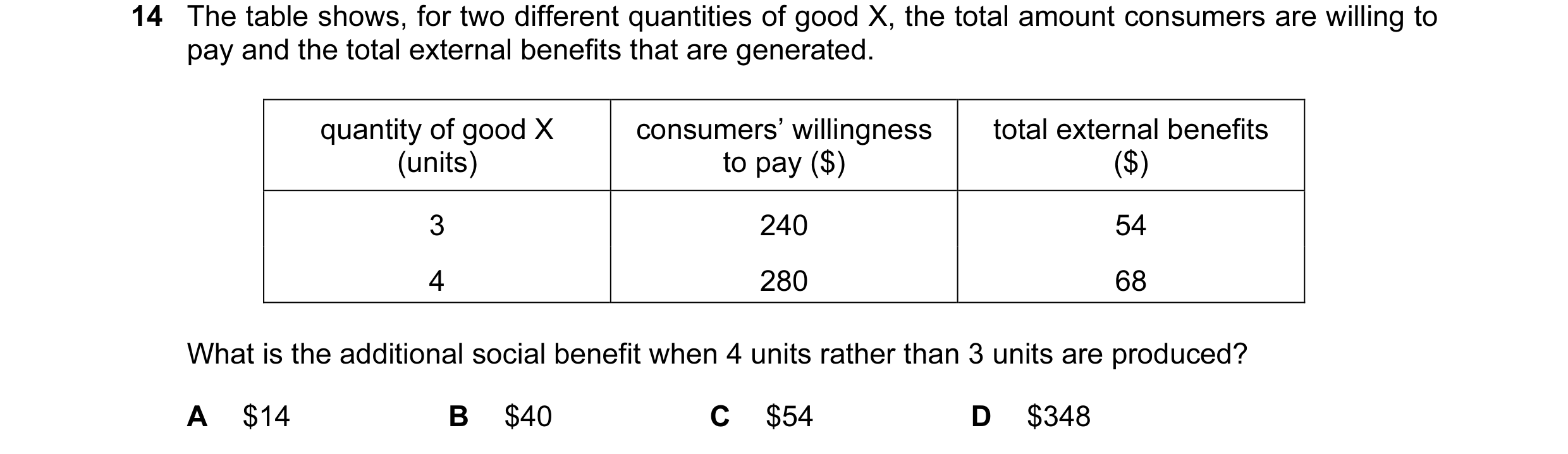
16 The table shows, for two different quantities of good X, the total amount consumers are willing to pay and the total external benefits that are generated. quantity of good X consumers’ willingness total external benefits (units) to pay ($) ($) 3 240 54 4 280 68 What is the additional social benefit when 4 units rather than 3 units are produced? A $14 B $40 C $54 D $348
1 marks
Answer: C
This question in 9708/11 Oct/Nov 2008
Q20 · A government is planning to intervene in a market to fix output at the economically… 9708/11 May/June 2009
14 A government is planning to intervene in a market to fix output at the economically desirable level by giving a subsidy. MSC T costs / Y benefits S X MSB MPB O R W output To achieve its objective, what should be the subsidy per unit? A ST B SX C TY D XY
1 marks
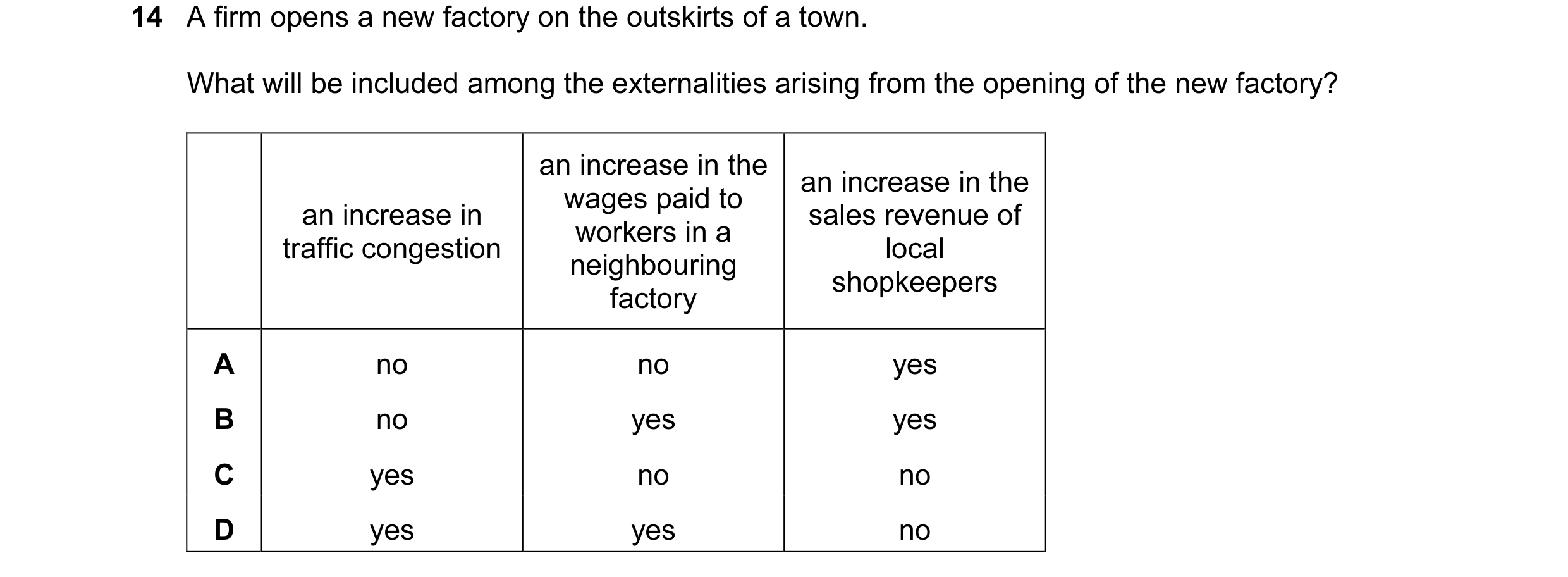
Answer: D
This question in 9708/11 May/June 2009
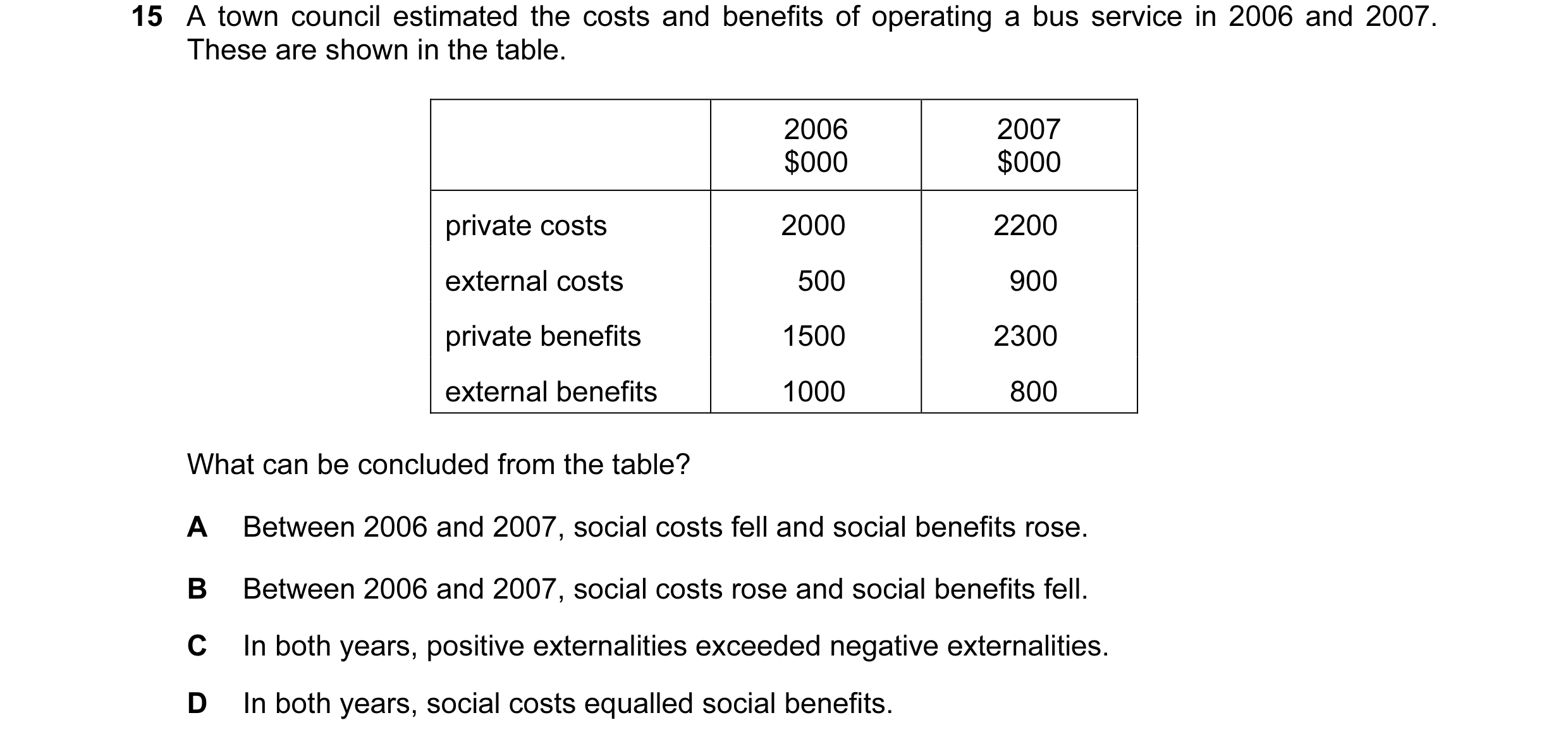
Q21 · A town council estimated the costs and benefits of operating a bus service in 2006 and… 9708/11 May/June 2009
15 A town council estimated the costs and benefits of operating a bus service in 2006 and 2007. These are shown in the table. 2006 2007 $000 $000 private costs 2000 2200 external costs 500 900 private benefits 1500 2300 external benefits 1000 800 What can be concluded from the table? A Between 2006 and 2007, social costs fell and social benefits rose. B Between 2006 and 2007, social costs rose and social benefits fell. C In both years, positive externalities exceeded negative externalities. D In both years, social costs equalled social benefits.
1 marks
Answer: D
This question in 9708/11 May/June 2009
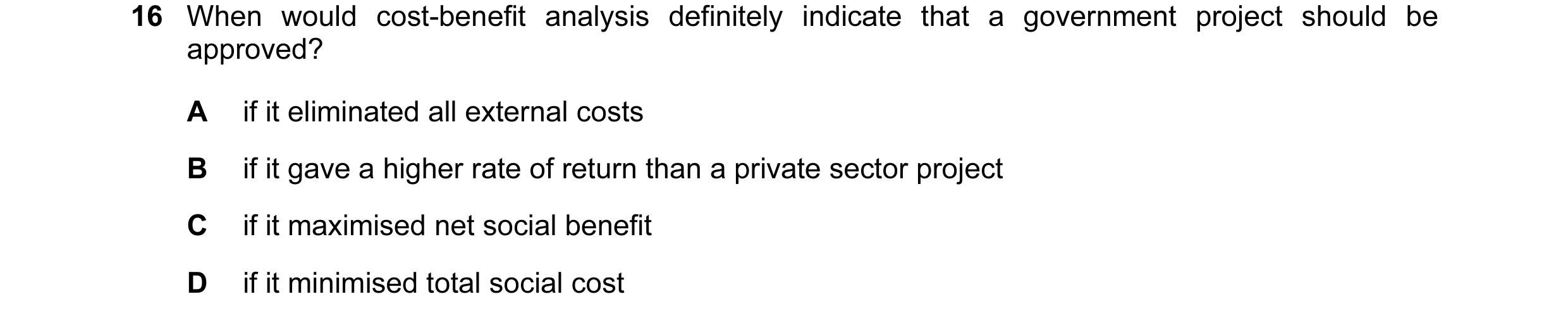
Q22 · When would cost-benefit analysis definitely indicate that a government project should be… 9708/11 May/June 2009
16 When would cost-benefit analysis definitely indicate that a government project should be approved? A if it eliminated all external costs B if it gave a higher rate of return than a private sector project C if it maximised net social benefit D if it minimised total social cost
1 marks
Answer: C
This question in 9708/11 May/June 2009
Q23 · The government is considering building flood defences along a river 9708/11 Oct/Nov 2009
14 The government is considering building flood defences along a river. It has calculated the costs and benefits as follows. costs benefits $m $m private 450 260 external 60 190 According to cost-benefit analysis, which decision and reasoning about flood defences is correct? decision reasoning A Build. External benefits are greater than external costs. B Build. Social benefits are greater than private benefits. C Do not build. Private costs are greater than the external benefits. D Do not build. Social costs are greater than the social benefits.
1 marks
Answer: D
This question in 9708/11 Oct/Nov 2009
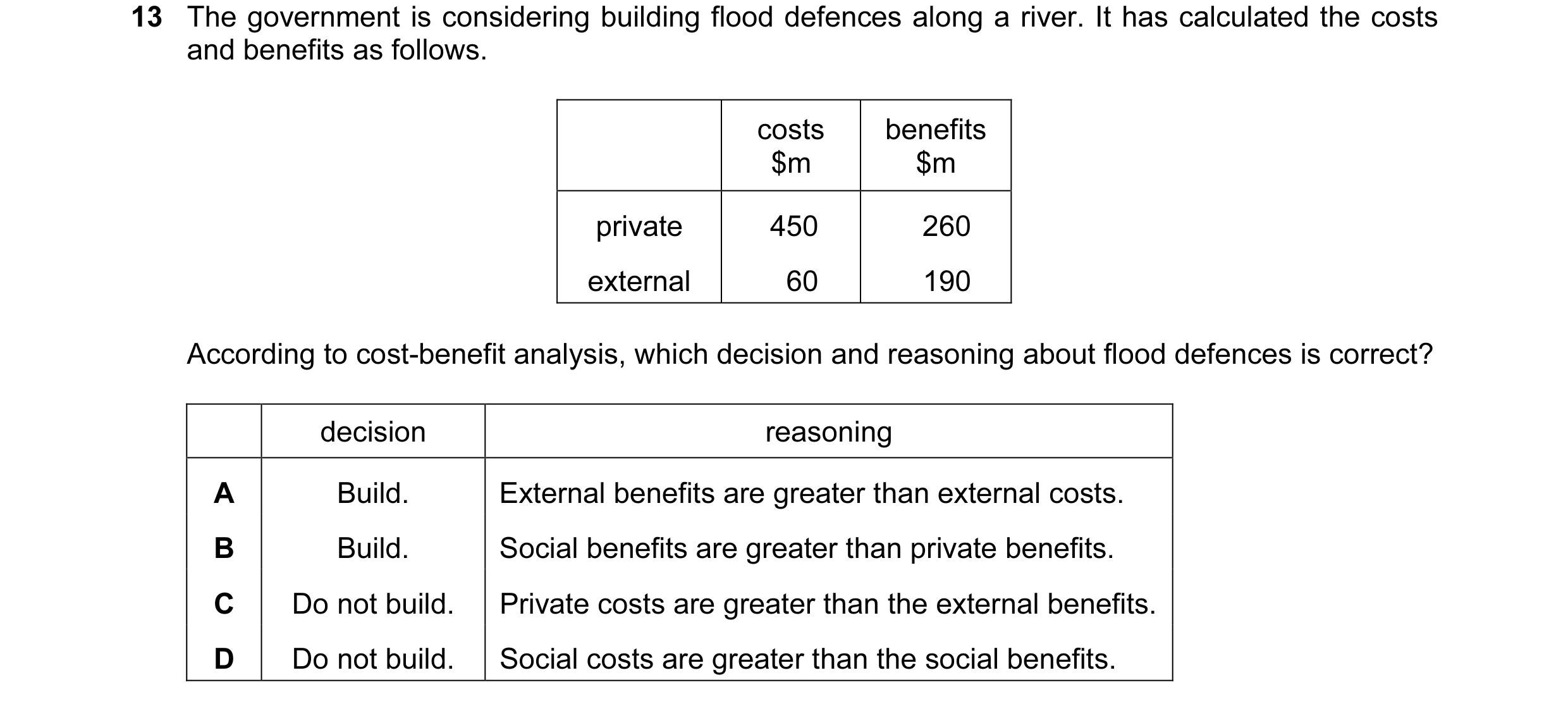
Q24 · The government is considering building flood defences along a river 9708/12 Oct/Nov 2009
13 The government is considering building flood defences along a river. It has calculated the costs and benefits as follows. costs benefits $m $m private 450 260 external 60 190 According to cost-benefit analysis, which decision and reasoning about flood defences is correct? decision reasoning A Build. External benefits are greater than external costs. B Build. Social benefits are greater than private benefits. C Do not build. Private costs are greater than the external benefits. D Do not build. Social costs are greater than the social benefits.
1 marks
Answer: D
This question in 9708/12 Oct/Nov 2009
Q25 · James grows fruit trees in his garden 9708/11 May/June 2010
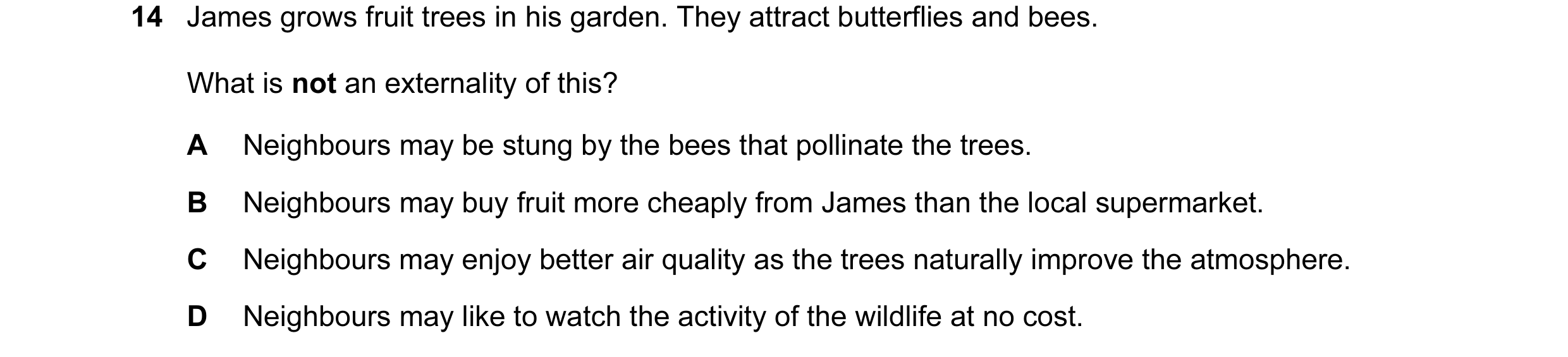
14 James grows fruit trees in his garden. They attract butterflies and bees. What is not an externality of this? A Neighbours may be stung by the bees that pollinate the trees. B Neighbours may buy fruit more cheaply from James than the local supermarket. C Neighbours may enjoy better air quality as the trees naturally improve the atmosphere. D Neighbours may like to watch the activity of the wildlife at no cost.
1 marks
Answer: B
This question in 9708/11 May/June 2010
Q26 · The table shows some of the costs when a firm produces a good 9708/11 May/June 2010
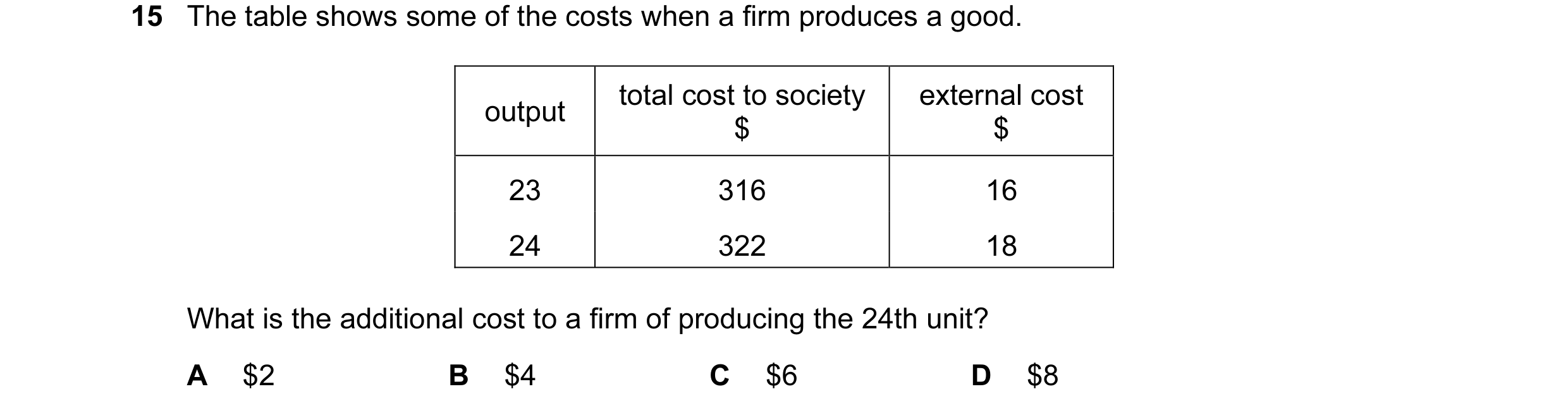
15 The table shows some of the costs when a firm produces a good. total cost to society external cost output $ $ 23 316 16 24 322 18 What is the additional cost to a firm of producing the 24th unit? A $2 B $4 C $6 D $8
1 marks
Answer: B
This question in 9708/11 May/June 2010
Q27 · What makes it particularly difficult to take decisions using cost-benefit analysis? 9708/11 May/June 2010
16 What makes it particularly difficult to take decisions using cost-benefit analysis? A External costs are difficult to estimate accurately. B Governments have no method of valuing time savings. C Market forces have no influence on the outcome. D Private costs can vary from one day to the next.
1 marks
Answer: A
This question in 9708/11 May/June 2010
Q28 · James grows fruit trees in his garden 9708/12 May/June 2010
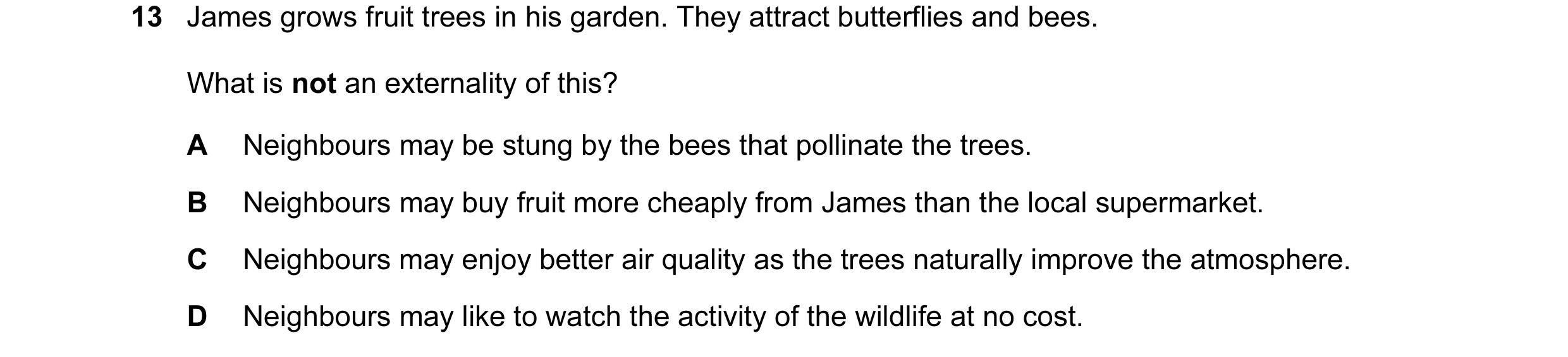
13 James grows fruit trees in his garden. They attract butterflies and bees. What is not an externality of this? A Neighbours may be stung by the bees that pollinate the trees. B Neighbours may buy fruit more cheaply from James than the local supermarket. C Neighbours may enjoy better air quality as the trees naturally improve the atmosphere. D Neighbours may like to watch the activity of the wildlife at no cost.
1 marks
Answer: B
This question in 9708/12 May/June 2010
Q29 · The table shows some of the costs when a firm produces a good 9708/12 May/June 2010
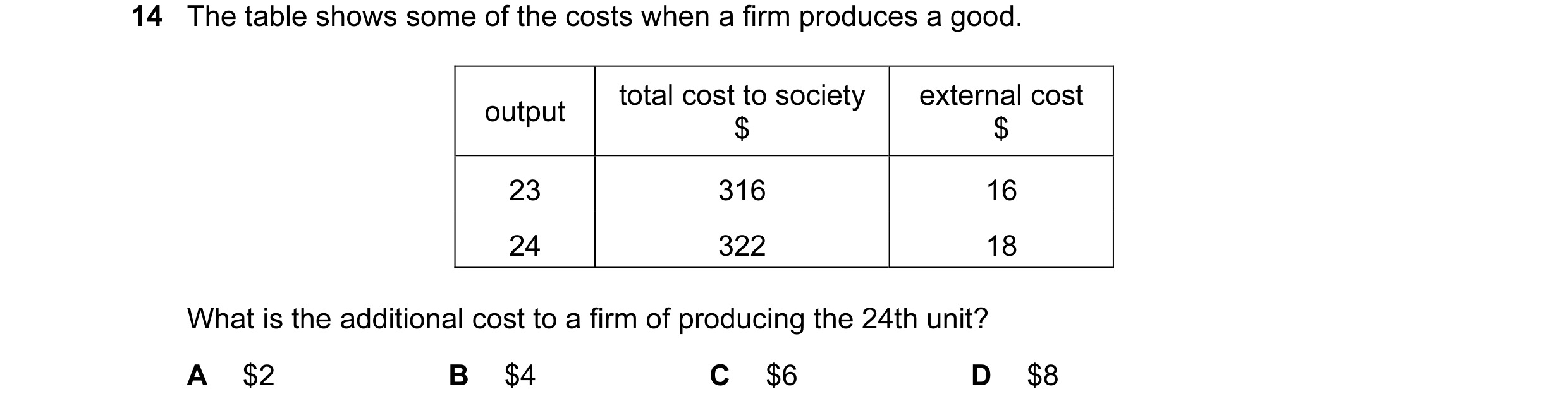
14 The table shows some of the costs when a firm produces a good. total cost to society external cost output $ $ 23 316 16 24 322 18 What is the additional cost to a firm of producing the 24th unit? A $2 B $4 C $6 D $8
1 marks
Answer: B
This question in 9708/12 May/June 2010
Q30 · What makes it particularly difficult to take decisions using cost-benefit analysis? 9708/12 May/June 2010
15 What makes it particularly difficult to take decisions using cost-benefit analysis? A External costs are difficult to estimate accurately. B Governments have no method of valuing time savings. C Market forces have no influence on the outcome. D Private costs can vary from one day to the next.
1 marks
Answer: A
This question in 9708/12 May/June 2010
Q31 · The table shows some of the costs when a firm produces a good 9708/13 May/June 2010
13 The table shows some of the costs when a firm produces a good. total cost to society external cost output $ $ 23 316 16 24 322 18 What is the additional cost to a firm of producing the 24th unit? A $2 B $4 C $6 D $8
1 marks
Answer: B
This question in 9708/13 May/June 2010
Q32 · What makes it particularly difficult to take decisions using cost-benefit analysis? 9708/13 May/June 2010
14 What makes it particularly difficult to take decisions using cost-benefit analysis? A External costs are difficult to estimate accurately. B Governments have no method of valuing time savings. C Market forces have no influence on the outcome. D Private costs can vary from one day to the next.
1 marks
Answer: A
This question in 9708/13 May/June 2010
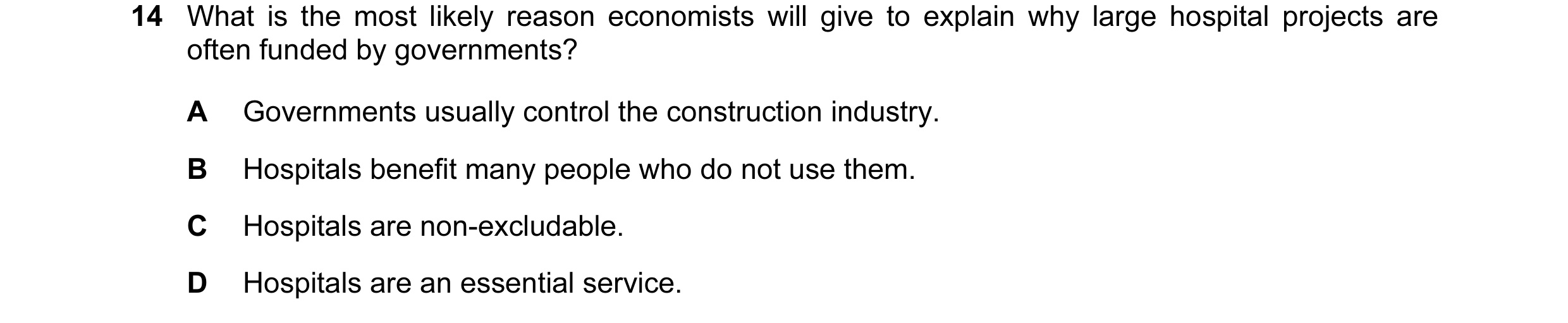
Q33 · What is the most likely reason economists will give to explain why large hospital… 9708/11 Oct/Nov 2010
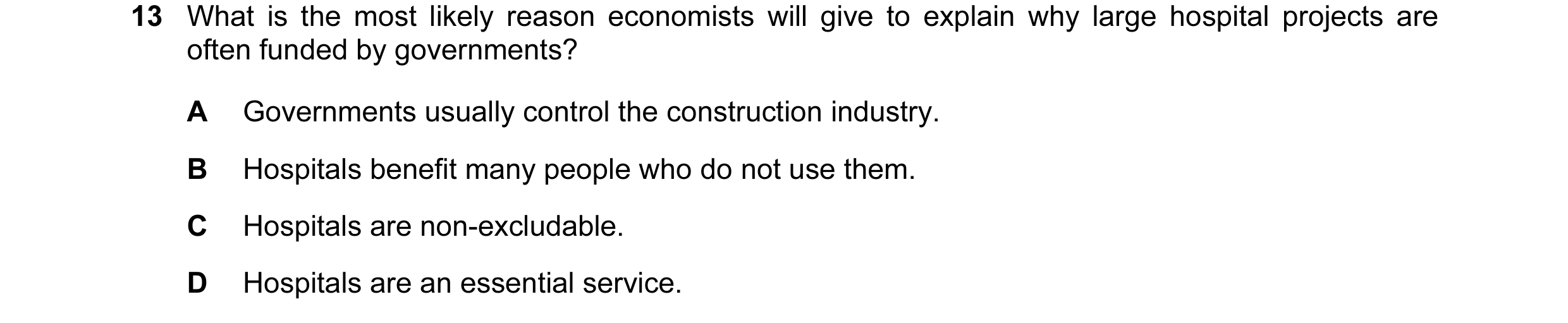
14 What is the most likely reason economists will give to explain why large hospital projects are often funded by governments? A Governments usually control the construction industry. B Hospitals benefit many people who do not use them. C Hospitals are non-excludable. D Hospitals are an essential service.
1 marks
Answer: B
This question in 9708/11 Oct/Nov 2010
Q34 · How would net external benefit be calculated? 9708/11 Oct/Nov 2010
15 How would net external benefit be calculated? A external benefit minus external cost B external benefit plus private benefit C private benefit plus social benefit D social benefit minus private cost
1 marks
Answer: A
This question in 9708/11 Oct/Nov 2010
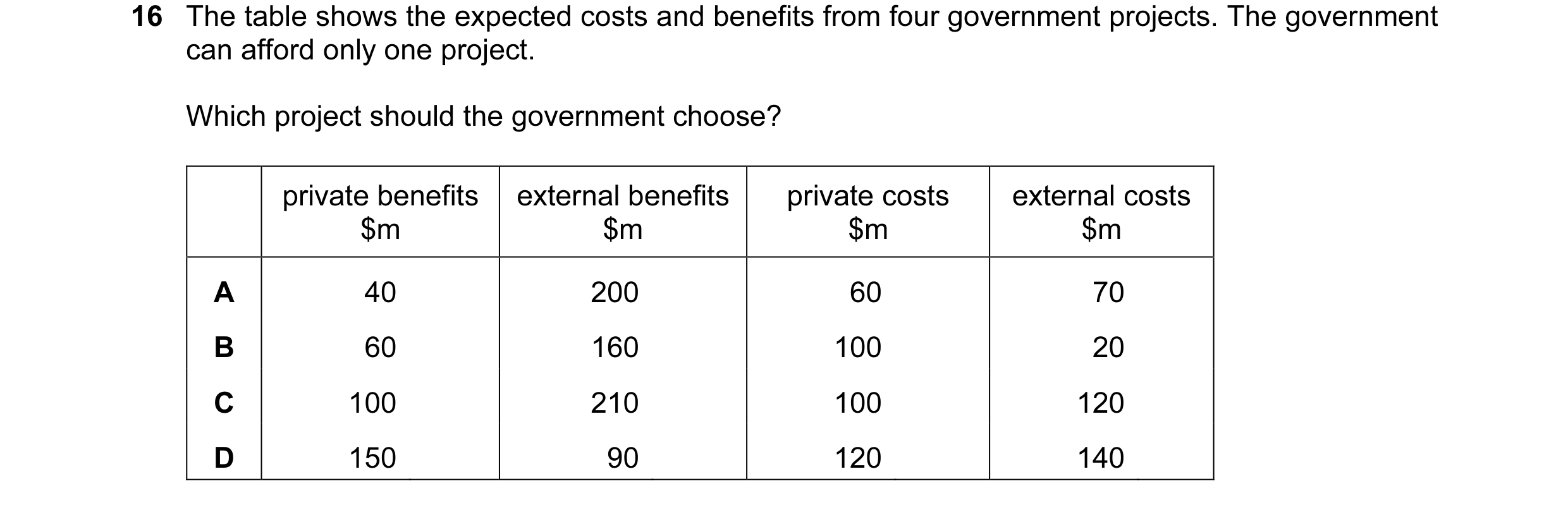
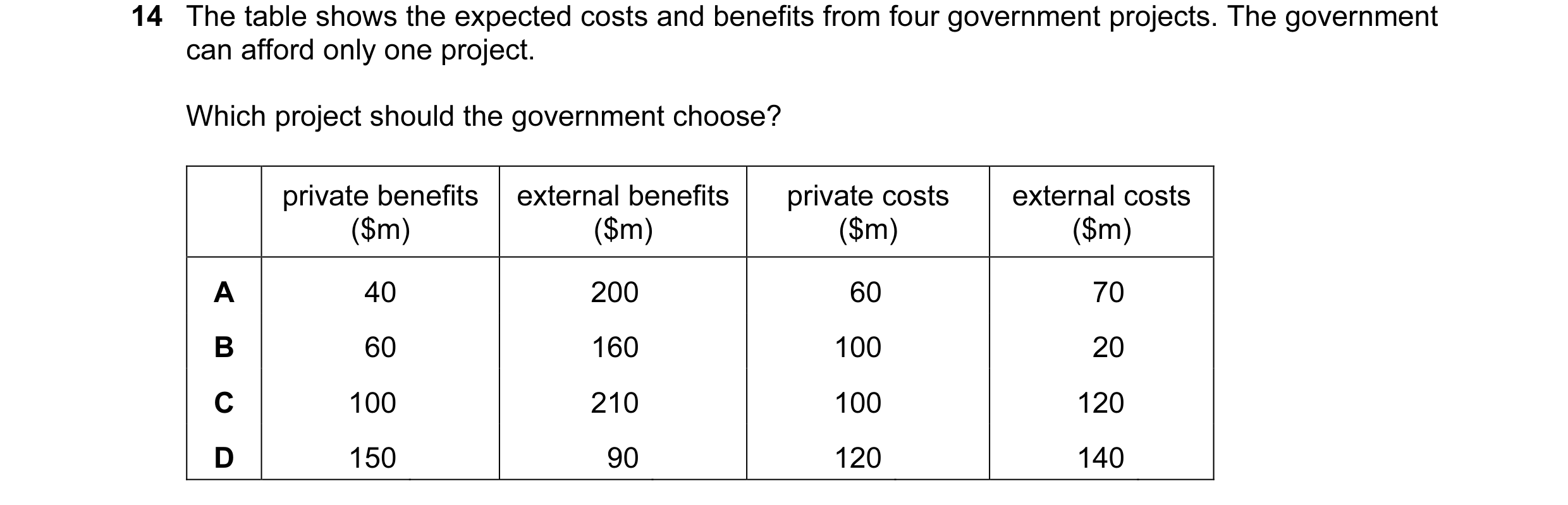
Q35 · The table shows the expected costs and benefits from four government projects 9708/11 Oct/Nov 2010
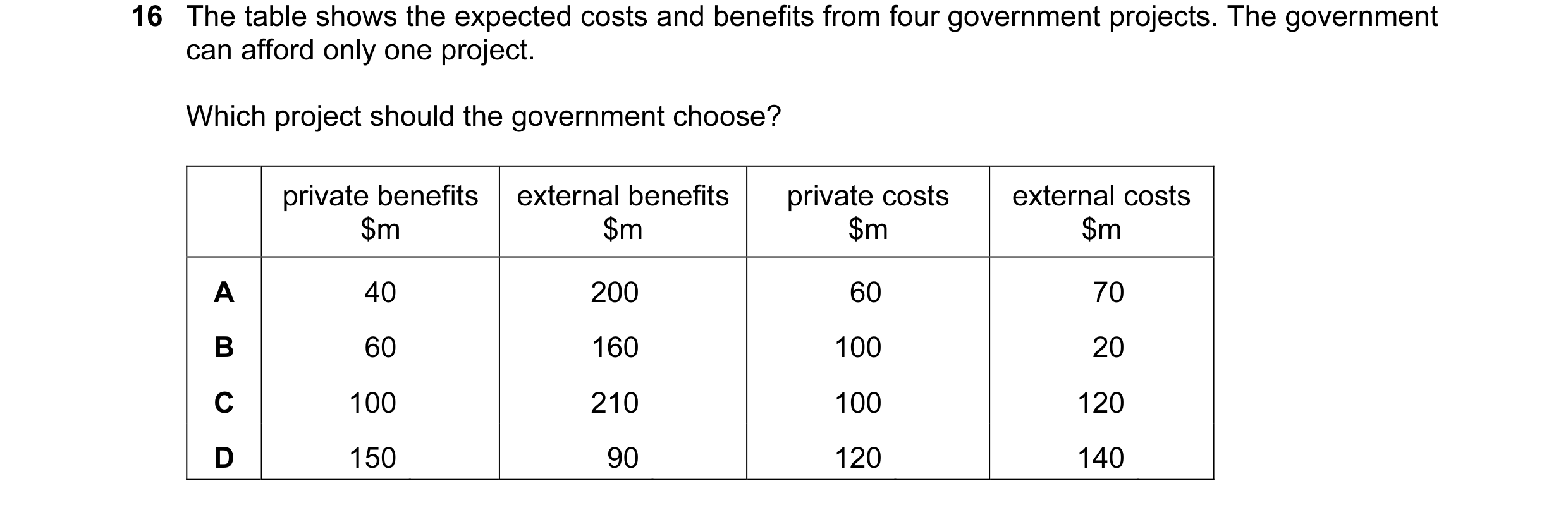
16 The table shows the expected costs and benefits from four government projects. The government can afford only one project. Which project should the government choose? private benefits external benefits private costs external costs $m $m $m $m A 40 200 60 70 B 60 160 100 20 C 100 210 100 120 D 150 90 120 140
1 marks
Answer: A
This question in 9708/11 Oct/Nov 2010
Q36 · What is the most likely reason economists will give to explain why large hospital… 9708/12 Oct/Nov 2010
14 What is the most likely reason economists will give to explain why large hospital projects are often funded by governments? A Governments usually control the construction industry. B Hospitals benefit many people who do not use them. C Hospitals are non-excludable. D Hospitals are an essential service.
1 marks
Answer: B
This question in 9708/12 Oct/Nov 2010
Q37 · How would net external benefit be calculated? 9708/12 Oct/Nov 2010
15 How would net external benefit be calculated? A external benefit minus external cost B external benefit plus private benefit C private benefit plus social benefit D social benefit minus private cost
1 marks
Answer: A
This question in 9708/12 Oct/Nov 2010
Q38 · The table shows the expected costs and benefits from four government projects 9708/12 Oct/Nov 2010
16 The table shows the expected costs and benefits from four government projects. The government can afford only one project. Which project should the government choose? private benefits external benefits private costs external costs $m $m $m $m A 40 200 60 70 B 60 160 100 20 C 100 210 100 120 D 150 90 120 140
1 marks
Answer: A
This question in 9708/12 Oct/Nov 2010
Q39 · What is the most likely reason economists will give to explain why large hospital… 9708/13 Oct/Nov 2010
13 What is the most likely reason economists will give to explain why large hospital projects are often funded by governments? A Governments usually control the construction industry. B Hospitals benefit many people who do not use them. C Hospitals are non-excludable. D Hospitals are an essential service.
1 marks
Answer: B
This question in 9708/13 Oct/Nov 2010
Q40 · How would net external benefit be calculated? 9708/13 Oct/Nov 2010
14 How would net external benefit be calculated? A external benefit minus external cost B external benefit plus private benefit C private benefit plus social benefit D social benefit minus private cost
1 marks
Answer: A
This question in 9708/13 Oct/Nov 2010
Q41 · The table shows the expected costs and benefits from four government projects 9708/13 Oct/Nov 2010
15 The table shows the expected costs and benefits from four government projects. The government can afford only one project. Which project should the government choose? private benefits external benefits private costs external costs $m $m $m $m A 40 200 60 70 B 60 160 100 20 C 100 210 100 120 D 150 90 120 140
1 marks
Answer: A
This question in 9708/13 Oct/Nov 2010
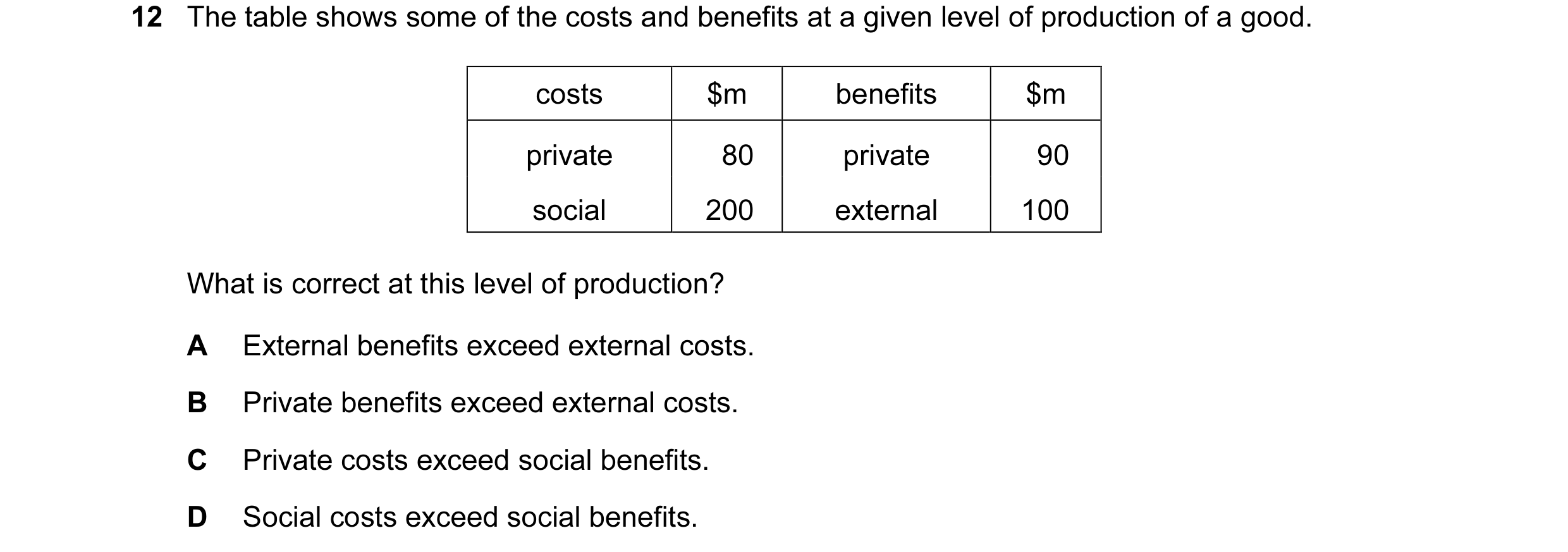
Q42 · The table shows some of the costs and benefits at a given level of production of a good 9708/11 May/June 2011
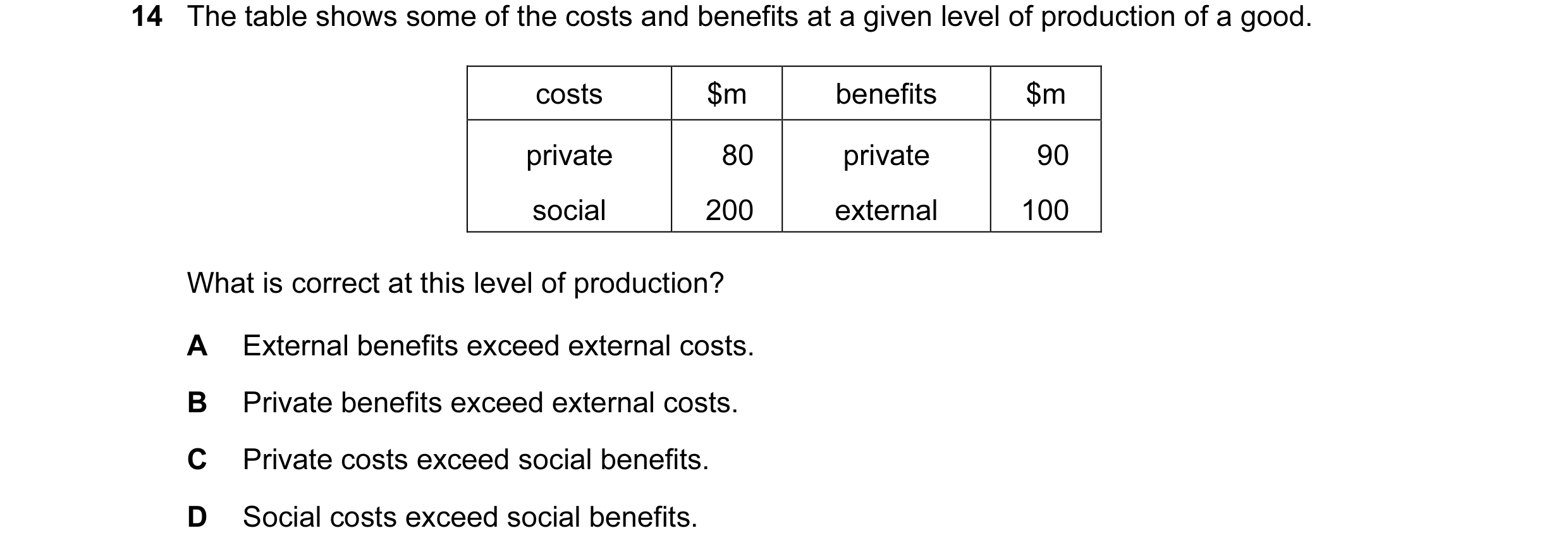
14 The table shows some of the costs and benefits at a given level of production of a good. costs $m benefits $m private 80 private 90 social 200 external 100 What is correct at this level of production? A External benefits exceed external costs. B Private benefits exceed external costs. C Private costs exceed social benefits. D Social costs exceed social benefits.
1 marks
Answer: D
This question in 9708/11 May/June 2011
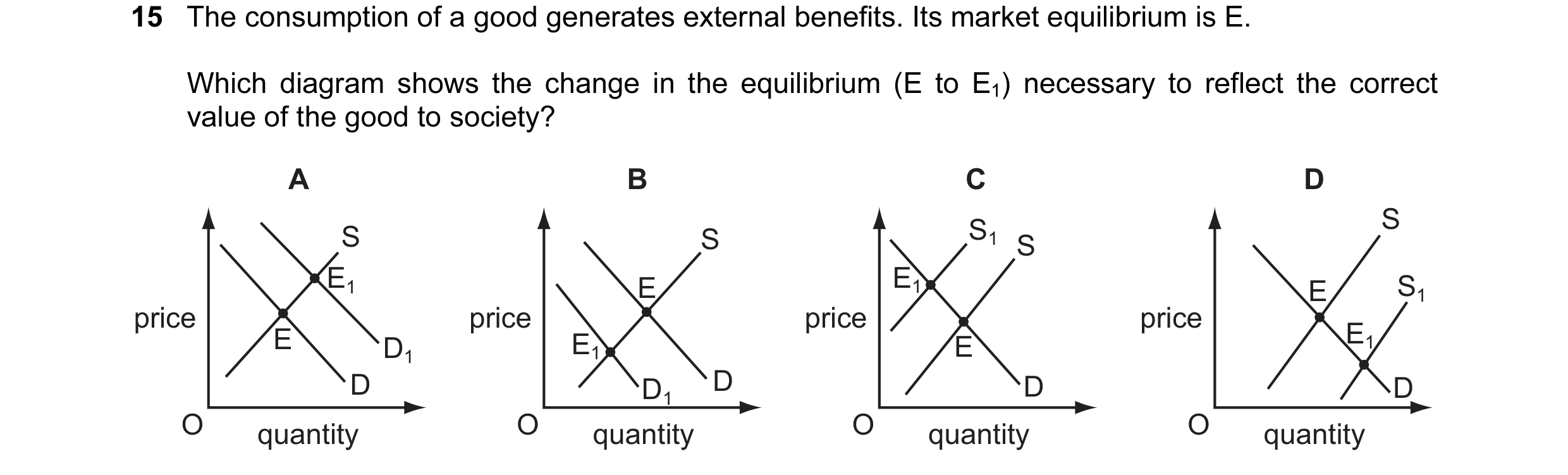
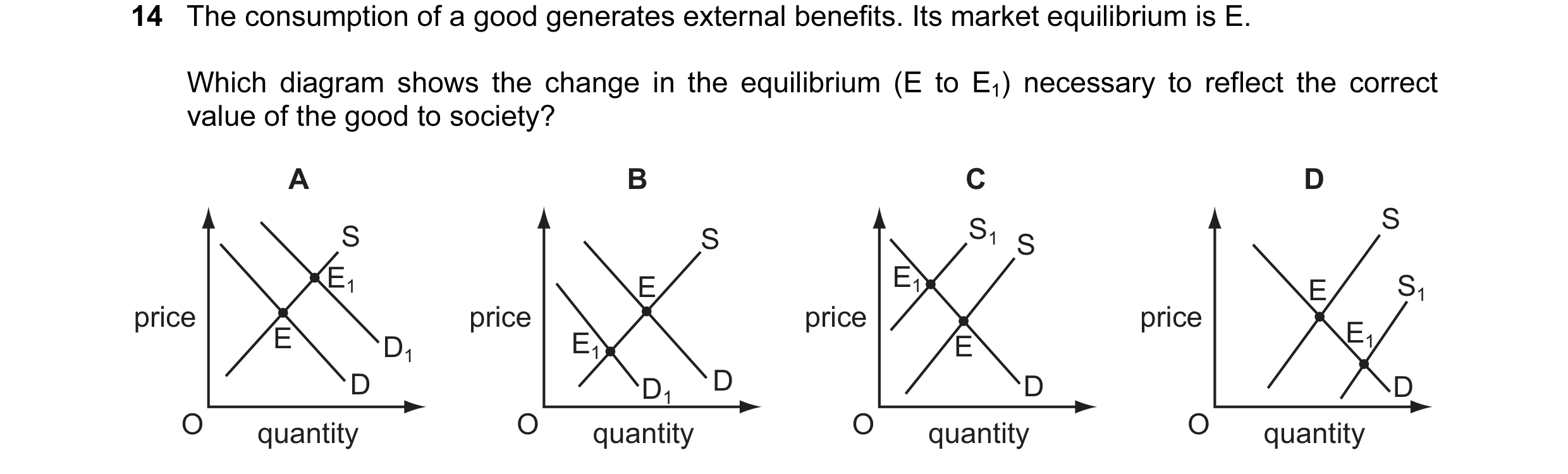
Q43 · The consumption of a good generates external benefits 9708/11 May/June 2011
15 The consumption of a good generates external benefits. Its market equilibrium is E. Which diagram shows the change in the equilibrium (E to E1) necessary to reflect the correct value of the good to society? A B C D S1 S S S S E1 E E1 S1 E price price price price E E1 E1 D1 E D D1 D D D O quantity O quantity O quantity O quantity
1 marks
Answer: A
This question in 9708/11 May/June 2011
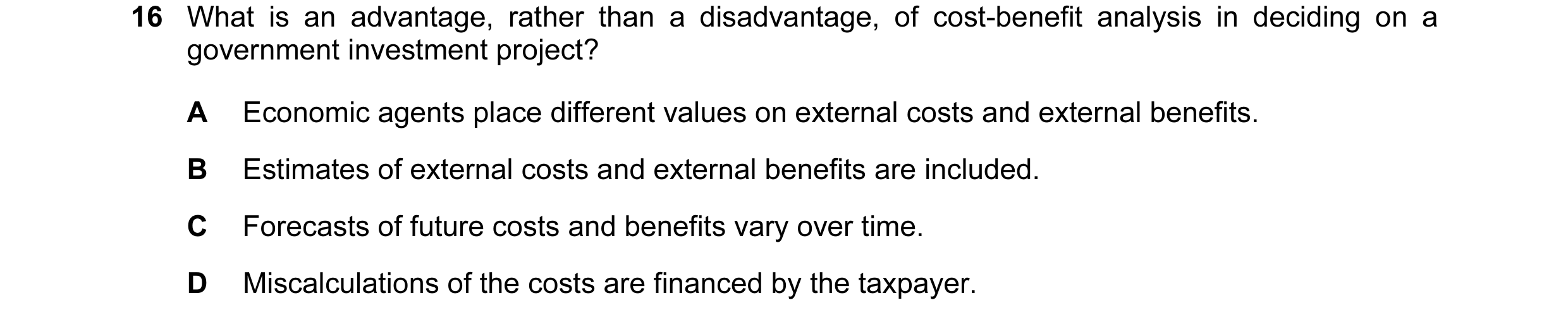
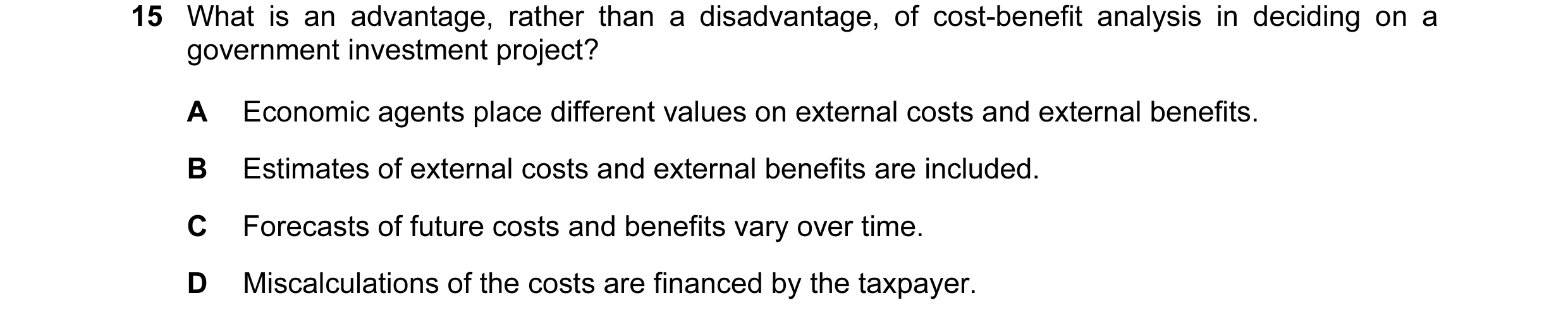
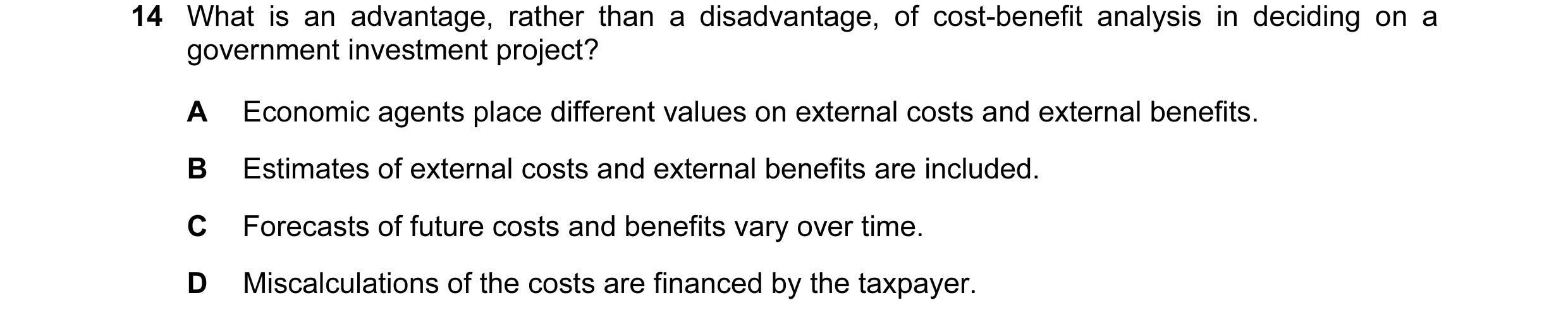
Q44 · What is an advantage, rather than a disadvantage, of cost-benefit analysis in deciding on… 9708/11 May/June 2011
16 What is an advantage, rather than a disadvantage, of cost-benefit analysis in deciding on a government investment project? A Economic agents place different values on external costs and external benefits. B Estimates of external costs and external benefits are included. C Forecasts of future costs and benefits vary over time. D Miscalculations of the costs are financed by the taxpayer.
1 marks
Answer: B
This question in 9708/11 May/June 2011
Q45 · The table shows some of the costs and benefits at a given level of production of a good 9708/12 May/June 2011
13 The table shows some of the costs and benefits at a given level of production of a good. costs $m benefits $m private 80 private 90 social 200 external 100 What is correct at this level of production? A External benefits exceed external costs. B Private benefits exceed external costs. C Private costs exceed social benefits. D Social costs exceed social benefits.
1 marks
Answer: D
This question in 9708/12 May/June 2011
Q46 · The consumption of a good generates external benefits 9708/12 May/June 2011
14 The consumption of a good generates external benefits. Its market equilibrium is E. Which diagram shows the change in the equilibrium (E to E1) necessary to reflect the correct value of the good to society? A B C D S1 S S S S E1 E E1 S1 E price price price price E E1 E1 D1 E D D1 D D D O quantity O quantity O quantity O quantity
1 marks
Answer: A
This question in 9708/12 May/June 2011
Q47 · What is an advantage, rather than a disadvantage, of cost-benefit analysis in deciding on… 9708/12 May/June 2011
15 What is an advantage, rather than a disadvantage, of cost-benefit analysis in deciding on a government investment project? A Economic agents place different values on external costs and external benefits. B Estimates of external costs and external benefits are included. C Forecasts of future costs and benefits vary over time. D Miscalculations of the costs are financed by the taxpayer.
1 marks
Answer: B
This question in 9708/12 May/June 2011
Q48 · The table shows some of the costs and benefits at a given level of production of a good 9708/13 May/June 2011
12 The table shows some of the costs and benefits at a given level of production of a good. costs $m benefits $m private 80 private 90 social 200 external 100 What is correct at this level of production? A External benefits exceed external costs. B Private benefits exceed external costs. C Private costs exceed social benefits. D Social costs exceed social benefits.
1 marks
Answer: D
This question in 9708/13 May/June 2011
Q49 · The consumption of a good generates external benefits 9708/13 May/June 2011
13 The consumption of a good generates external benefits. Its market equilibrium is E. Which diagram shows the change in the equilibrium (E to E1) necessary to reflect the correct value of the good to society? A B C D S1 S S S S E1 E E1 S1 E price price price price E E1 E1 D1 E D D1 D D D O quantity O quantity O quantity O quantity
1 marks
Answer: A
This question in 9708/13 May/June 2011
Q50 · What is an advantage, rather than a disadvantage, of cost-benefit analysis in deciding on… 9708/13 May/June 2011
14 What is an advantage, rather than a disadvantage, of cost-benefit analysis in deciding on a government investment project? A Economic agents place different values on external costs and external benefits. B Estimates of external costs and external benefits are included. C Forecasts of future costs and benefits vary over time. D Miscalculations of the costs are financed by the taxpayer.
1 marks
Answer: B
This question in 9708/13 May/June 2011
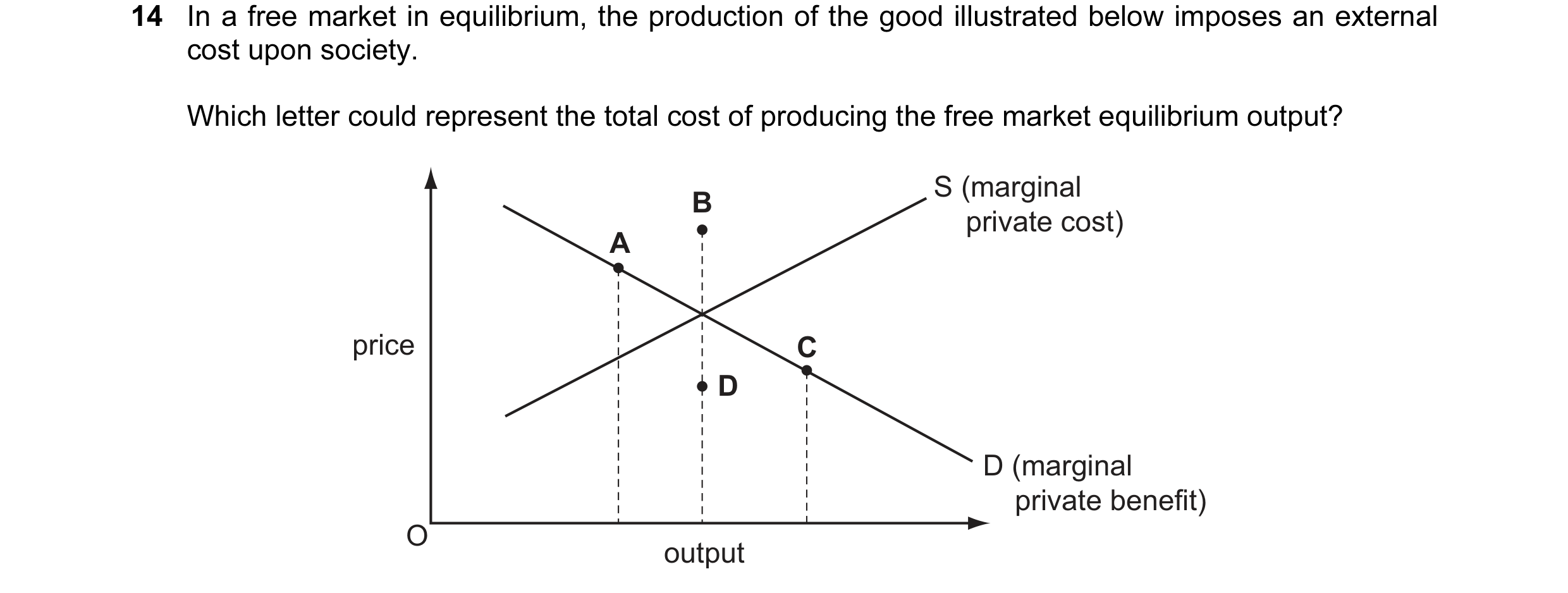
Q51 · In a free market in equilibrium, the production of the good illustrated below imposes an… 9708/11 Oct/Nov 2011
14 In a free market in equilibrium, the production of the good illustrated below imposes an external cost upon society. Which letter could represent the total cost of producing the free market equilibrium output? S (marginal B private cost) A price C D D (marginal private benefit) O output
1 marks
Answer: B
This question in 9708/11 Oct/Nov 2011
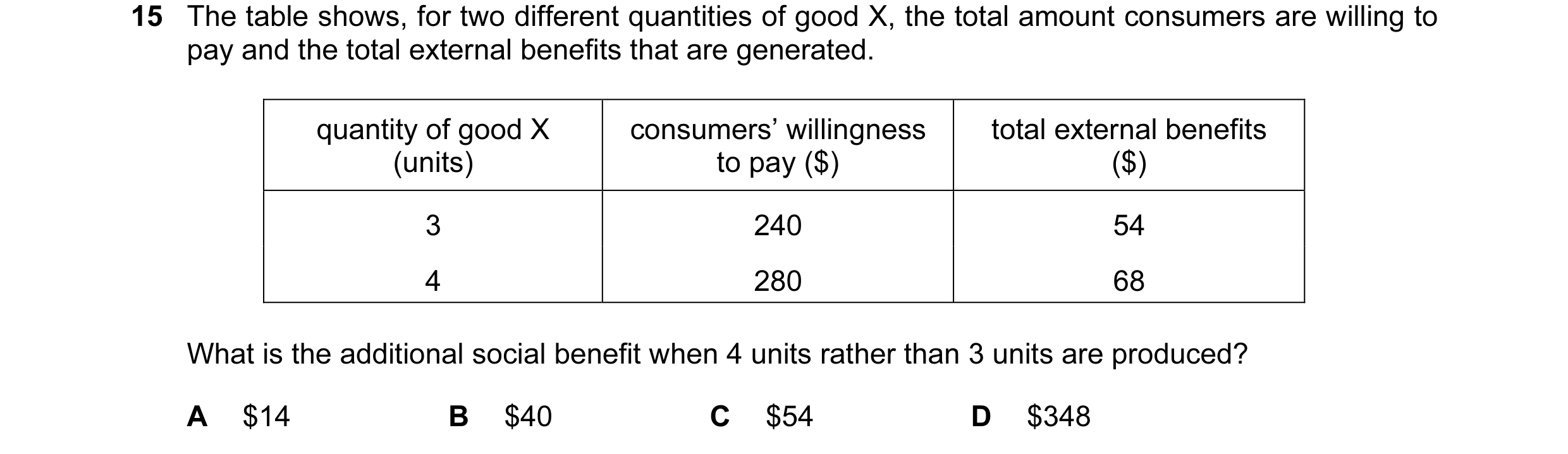
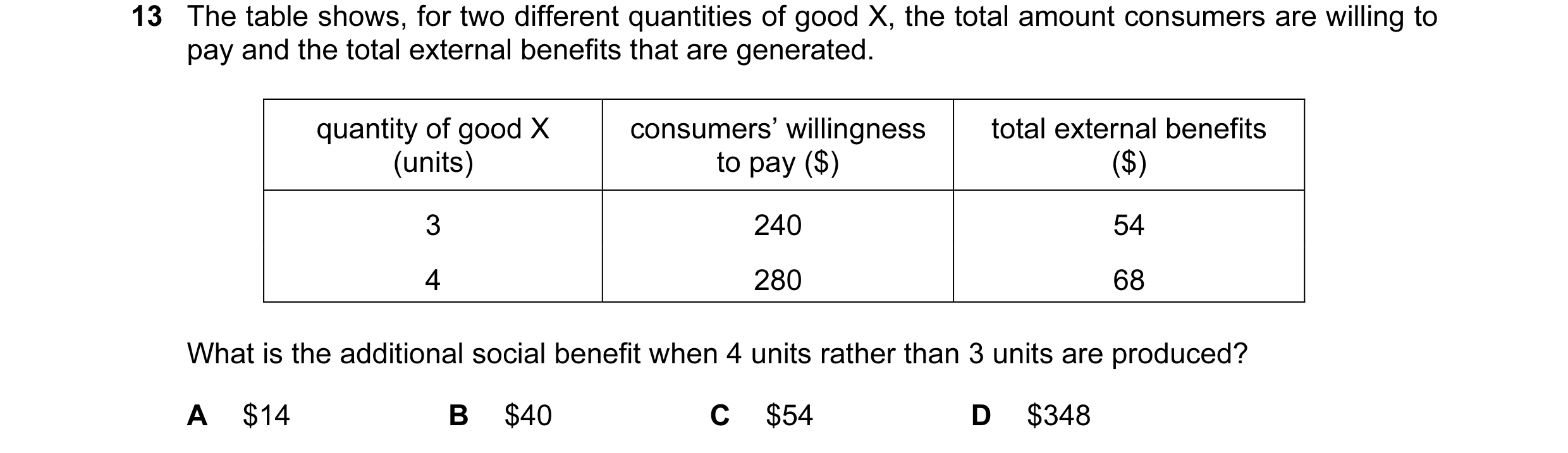
Q52 · The table shows, for two different quantities of good X, the total amount consumers are… 9708/11 Oct/Nov 2011
15 The table shows, for two different quantities of good X, the total amount consumers are willing to pay and the total external benefits that are generated. quantity of good X consumers’ willingness total external benefits (units) to pay ($) ($) 3 240 54 4 280 68 What is the additional social benefit when 4 units rather than 3 units are produced? A $14 B $40 C $54 D $348
1 marks
Answer: C
This question in 9708/11 Oct/Nov 2011
Q53 · A congestion charge of £10 per day has been imposed on motorists taking their cars into… 9708/12 Oct/Nov 2011
14 A congestion charge of £10 per day has been imposed on motorists taking their cars into Central London. What is it about driving into Central London that provides the economic justification for this charge? A The external benefits are greater than the external costs. B The private costs are greater than the external costs. C The social benefits are greater than the private benefits. D The social costs are greater than the private costs.
1 marks
Answer: D
This question in 9708/12 Oct/Nov 2011
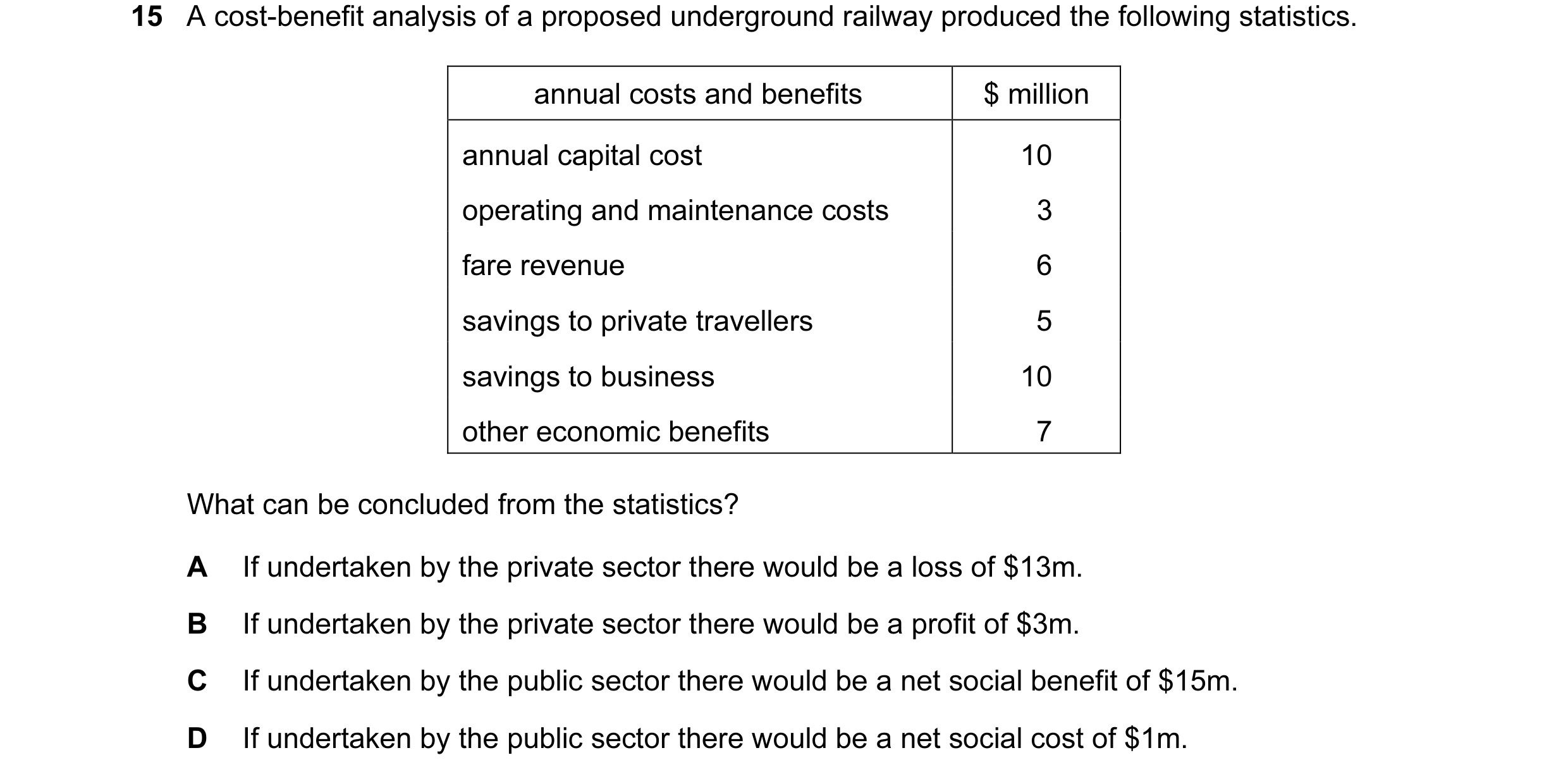
Q54 · A cost-benefit analysis of a proposed underground railway produced the following… 9708/12 Oct/Nov 2011
15 A cost-benefit analysis of a proposed underground railway produced the following statistics. annual costs and benefits $ million annual capital cost 10 operating and maintenance costs 3 fare revenue 6 savings to private travellers 5 savings to business 10 other economic benefits 7 What can be concluded from the statistics? A If undertaken by the private sector there would be a loss of $13m. B If undertaken by the private sector there would be a profit of $3m. C If undertaken by the public sector there would be a net social benefit of $15m. D If undertaken by the public sector there would be a net social cost of $1m.
1 marks
Answer: C
This question in 9708/12 Oct/Nov 2011
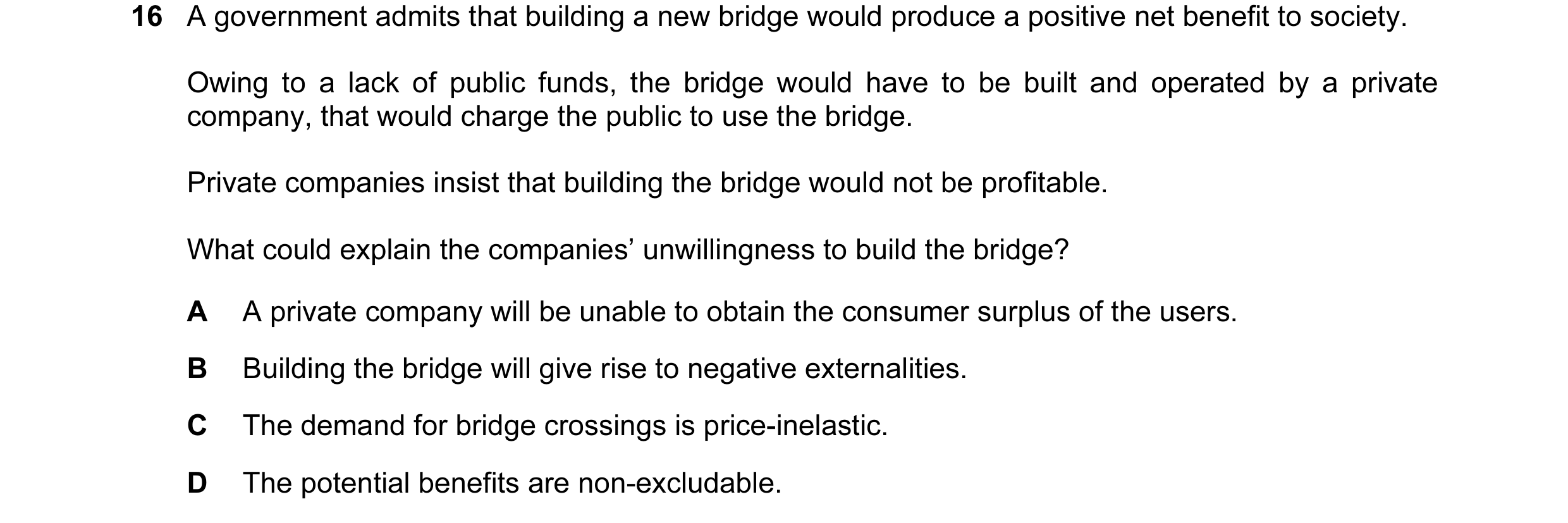
Q55 · A government admits that building a new bridge would produce a positive net benefit to… 9708/12 Oct/Nov 2011
16 A government admits that building a new bridge would produce a positive net benefit to society. Owing to a lack of public funds, the bridge would have to be built and operated by a private company, that would charge the public to use the bridge. Private companies insist that building the bridge would not be profitable. What could explain the companies’ unwillingness to build the bridge? A A private company will be unable to obtain the consumer surplus of the users. B Building the bridge will give rise to negative externalities. C The demand for bridge crossings is price-inelastic. D The potential benefits are non-excludable.
1 marks
Answer: A
This question in 9708/12 Oct/Nov 2011
Q56 · What is a merit good? 9708/12 Oct/Nov 2011
17 What is a merit good? A a good or service which has higher social costs than private costs B a good or service which has no opportunity cost C a good or service which is both non-excludable and non-rival D a good or service which has a greater value than individuals recognise
1 marks
Answer: D
This question in 9708/12 Oct/Nov 2011
Q57 · In a free market in equilibrium, the production of the good illustrated below imposes an… 9708/13 Oct/Nov 2011
12 In a free market in equilibrium, the production of the good illustrated below imposes an external cost upon society. Which letter could represent the total cost of producing the free market equilibrium output? S (marginal B private cost) A price C D D (marginal private benefit) O output
1 marks
Answer: B
This question in 9708/13 Oct/Nov 2011
Q58 · The table shows, for two different quantities of good X, the total amount consumers are… 9708/13 Oct/Nov 2011
13 The table shows, for two different quantities of good X, the total amount consumers are willing to pay and the total external benefits that are generated. quantity of good X consumers’ willingness total external benefits (units) to pay ($) ($) 3 240 54 4 280 68 What is the additional social benefit when 4 units rather than 3 units are produced? A $14 B $40 C $54 D $348
1 marks
Answer: C
This question in 9708/13 Oct/Nov 2011
Q59 · Which statement is correct? 9708/11 May/June 2012
14 Which statement is correct? A External cost equals social cost minus private cost. B Private cost equals external cost minus social cost. C Social cost equals external cost minus private cost. D Social cost equals private cost minus external cost.
1 marks
Answer: A
This question in 9708/11 May/June 2012
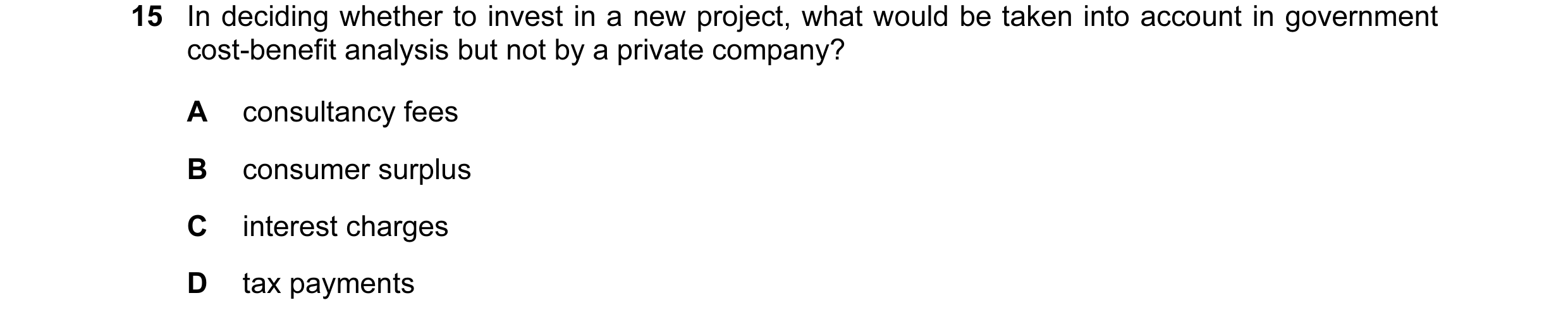
Q60 · In deciding whether to invest in a new project, what would be taken into account in… 9708/11 May/June 2012
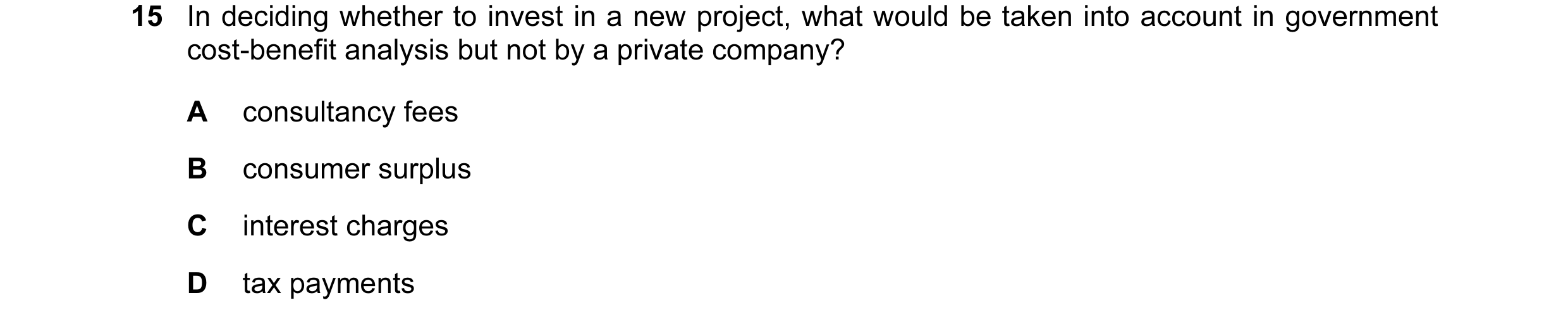
15 In deciding whether to invest in a new project, what would be taken into account in government cost-benefit analysis but not by a private company? A consultancy fees B consumer surplus C interest charges D tax payments
1 marks
Answer: B
This question in 9708/11 May/June 2012
Q61 · Why does the production of public goods have to be financed by the government? 9708/11 May/June 2012
16 Why does the production of public goods have to be financed by the government? A One person’s consumption of a public good means it is not available for anyone else. B People are able to consume public goods without paying for them. C Private sector firms will charge a price significantly above cost for public goods. D The cost of producing public goods is higher in the private sector.
1 marks
Answer: B
This question in 9708/11 May/June 2012
Q62 · The government has to choose the best one of four possible sites to locate a port 9708/11 May/June 2012
17 The government has to choose the best one of four possible sites to locate a port. The benefits and costs of each site are shown in $m in the table. Which site would be chosen? private external private external benefits benefits costs costs A 700 1100 20 5 B 800 1100 80 40 C 900 600 10 50 D 1000 900 100 200
1 marks
Answer: B
This question in 9708/11 May/June 2012
Q63 · Which statement is correct? 9708/12 May/June 2012
14 Which statement is correct? A External cost equals social cost minus private cost. B Private cost equals external cost minus social cost. C Social cost equals external cost minus private cost. D Social cost equals private cost minus external cost.
1 marks
Answer: A
This question in 9708/12 May/June 2012
Q64 · In deciding whether to invest in a new project, what would be taken into account in… 9708/12 May/June 2012
15 In deciding whether to invest in a new project, what would be taken into account in government cost-benefit analysis but not by a private company? A consultancy fees B consumer surplus C interest charges D tax payments
1 marks
Answer: B
This question in 9708/12 May/June 2012
Q65 · In Europe it was decided that farm subsidies would be paid to farmers who protect the… 9708/13 May/June 2012
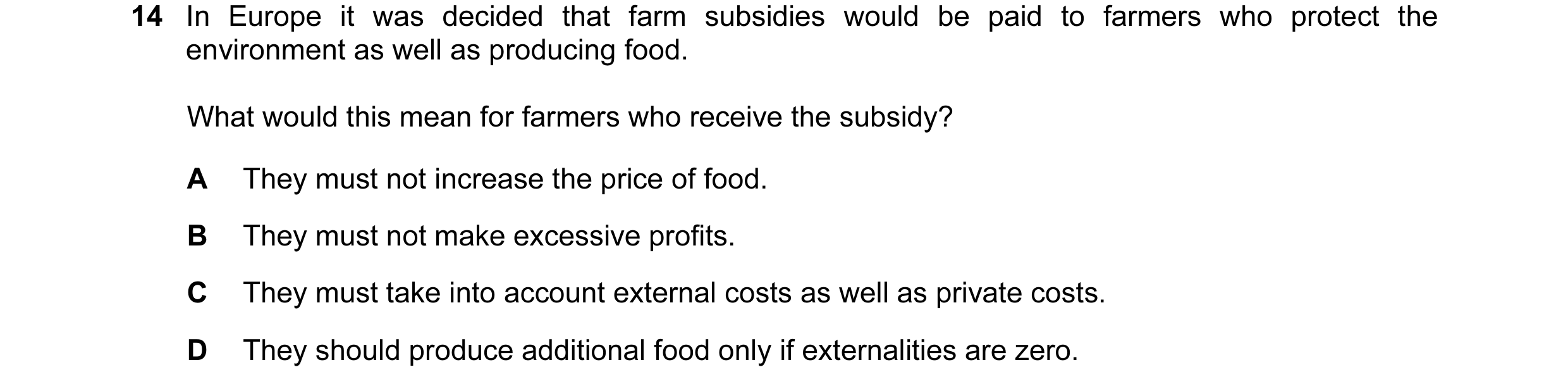
14 In Europe it was decided that farm subsidies would be paid to farmers who protect the environment as well as producing food. What would this mean for farmers who receive the subsidy? A They must not increase the price of food. B They must not make excessive profits. C They must take into account external costs as well as private costs. D They should produce additional food only if externalities are zero.
1 marks
Answer: C
This question in 9708/13 May/June 2012
Q66 · UK supermarkets can buy some vegetables at a lower price from Kenyan farmers than from UK… 9708/13 May/June 2012
15 UK supermarkets can buy some vegetables at a lower price from Kenyan farmers than from UK farmers. When the environmental damage caused by transporting the vegetables is taken into account, the social costs of UK supermarkets buying Kenyan vegetables is higher than the social costs of buying UK grown ones. What can be concluded from this information about the buying by UK supermarkets? A The external benefit of buying vegetables from Kenya is higher than buying them from the UK. B The external cost of buying vegetables from Kenya is higher than buying them from the UK. C The private cost of buying vegetables from Kenya is higher than buying them from the UK. D The social cost of buying vegetables from Kenya is lower than buying them from the UK.
1 marks
Answer: B
This question in 9708/13 May/June 2012
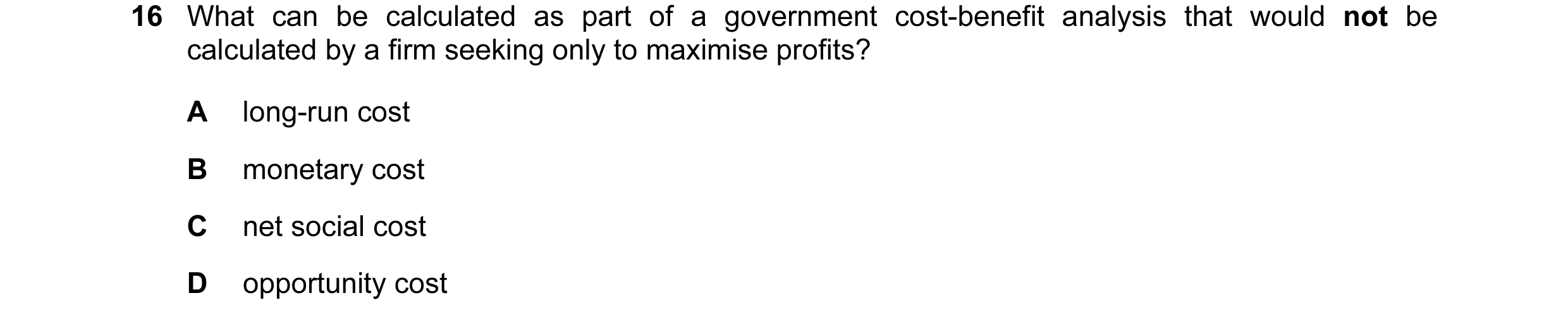
Q67 · What can be calculated as part of a government cost-benefit analysis that would not be… 9708/13 May/June 2012
16 What can be calculated as part of a government cost-benefit analysis that would not be calculated by a firm seeking only to maximise profits? A long-run cost B monetary cost C net social cost D opportunity cost
1 marks
Answer: C
This question in 9708/13 May/June 2012
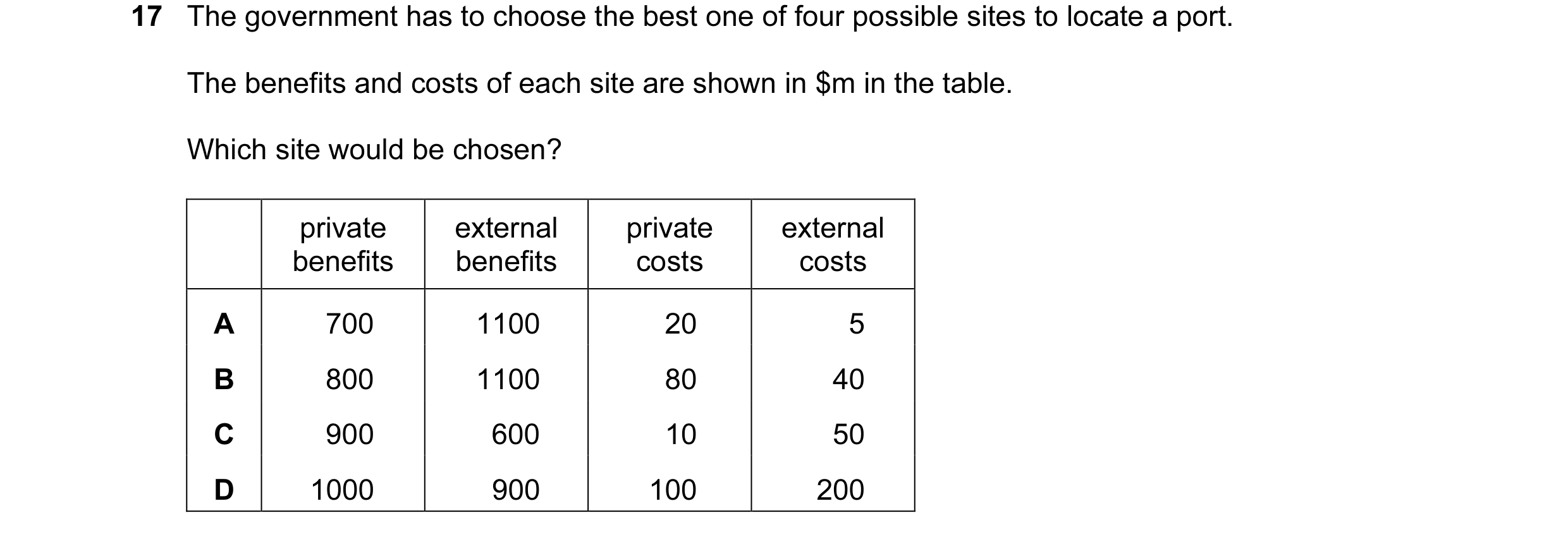
Q68 · The government has to choose the best one of four possible sites to locate a port 9708/13 May/June 2012
17 The government has to choose the best one of four possible sites to locate a port. The benefits and costs of each site are shown in $m in the table. Which site would be chosen? private external private external benefits benefits costs costs A 700 1100 20 5 B 800 1100 80 40 C 900 600 10 50 D 1000 900 100 200
1 marks
Answer: B
This question in 9708/13 May/June 2012
Q69 · In the diagram, Q1 is the quantity produced of a good as the result of market forces 9708/11 Oct/Nov 2012
14 In the diagram, Q1 is the quantity produced of a good as the result of market forces. S2 (social cost) S1 (private cost) price D O Q1 quantity What concept is present at output Q1? A a government subsidy B a negative externality C a positive externality D price instability
1 marks
Answer: B
This question in 9708/11 Oct/Nov 2012
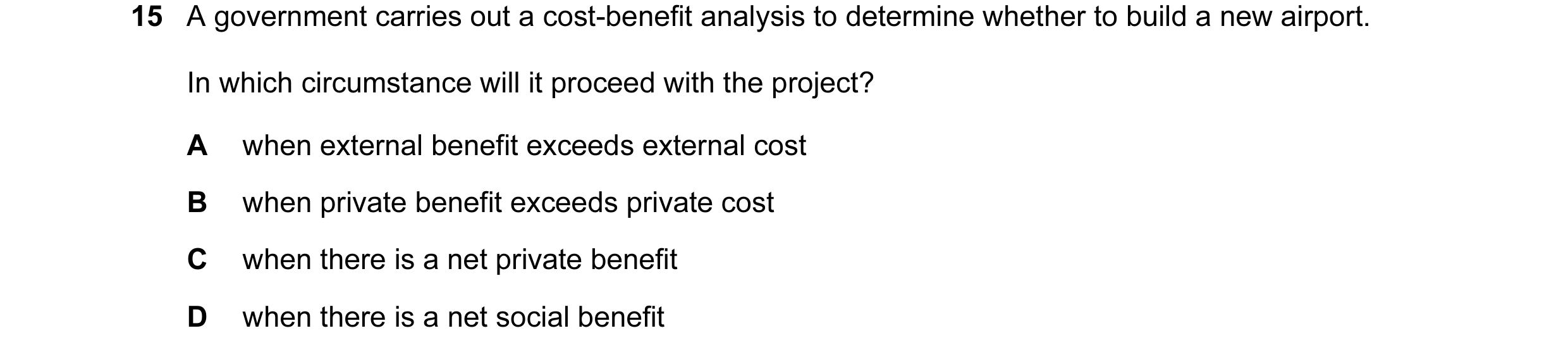
Q70 · A government carries out a cost-benefit analysis to determine whether to build a new… 9708/11 Oct/Nov 2012
15 A government carries out a cost-benefit analysis to determine whether to build a new airport. In which circumstance will it proceed with the project? A when external benefit exceeds external cost B when private benefit exceeds private cost C when there is a net private benefit D when there is a net social benefit
1 marks
Answer: D
This question in 9708/11 Oct/Nov 2012
Q71 · An international oil company announced that it would stop exploring for oil off the coast… 9708/11 Oct/Nov 2012
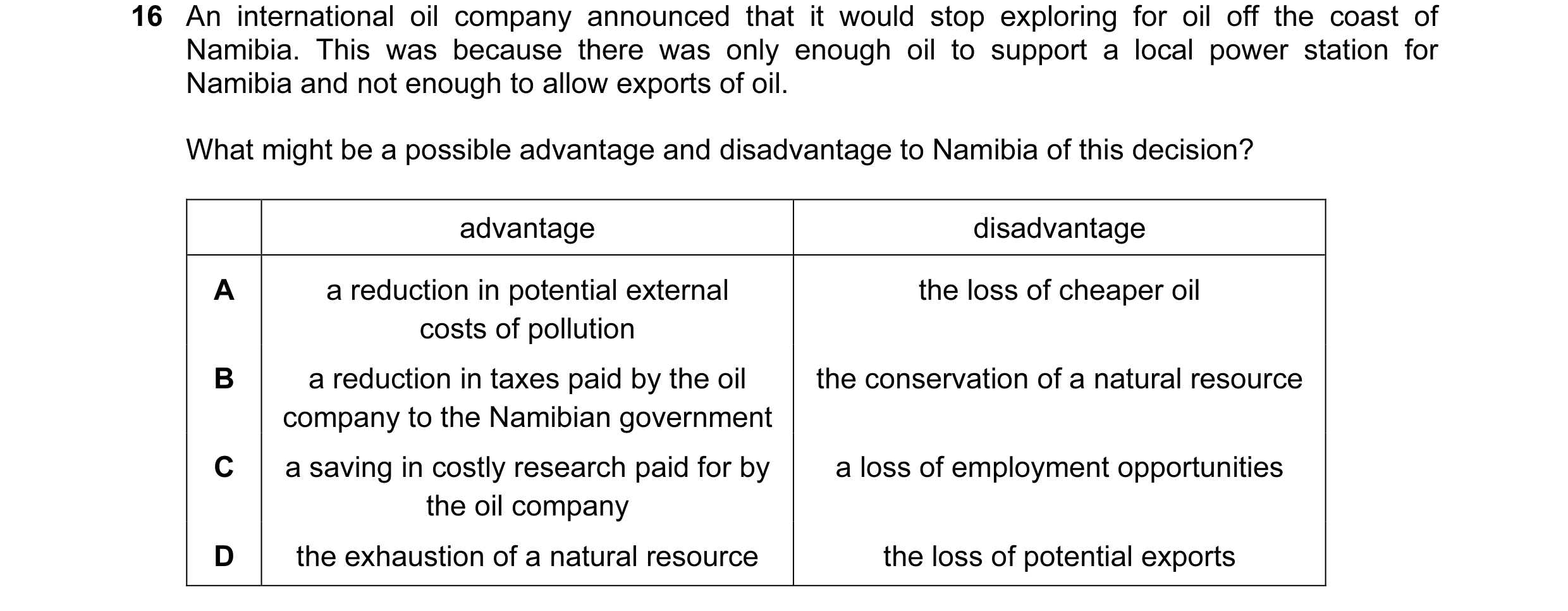
16 An international oil company announced that it would stop exploring for oil off the coast of Namibia. This was because there was only enough oil to support a local power station for Namibia and not enough to allow exports of oil. What might be a possible advantage and disadvantage to Namibia of this decision? advantage disadvantage A a reduction in potential external the loss of cheaper oil costs of pollution B a reduction in taxes paid by the oil the conservation of a natural resource company to the Namibian government C a saving in costly research paid for by a loss of employment opportunities the oil company D the exhaustion of a natural resource the loss of potential exports
1 marks
Answer: A
This question in 9708/11 Oct/Nov 2012
Q72 · Which policy adopted by an airline is the result of an externality? 9708/12 Oct/Nov 2012
14 Which policy adopted by an airline is the result of an externality? A price cutting against rival airlines B the prohibition of smoking on aircraft C the provision of different classes of seating accommodation D the use of internet booking facilities
1 marks
Answer: B
This question in 9708/12 Oct/Nov 2012
Q73 · What will be the result, from society’s view, if the market price for a product does not… 9708/12 Oct/Nov 2012
15 What will be the result, from society’s view, if the market price for a product does not reflect the negative externalities in its production? A too little consumption and too little production B too little consumption and too much production C too much consumption and too little production D too much consumption and too much production
1 marks
Answer: D
This question in 9708/12 Oct/Nov 2012
Q74 · The table shows some of the costs and benefits, in $ millions, associated with a road… 9708/12 Oct/Nov 2012
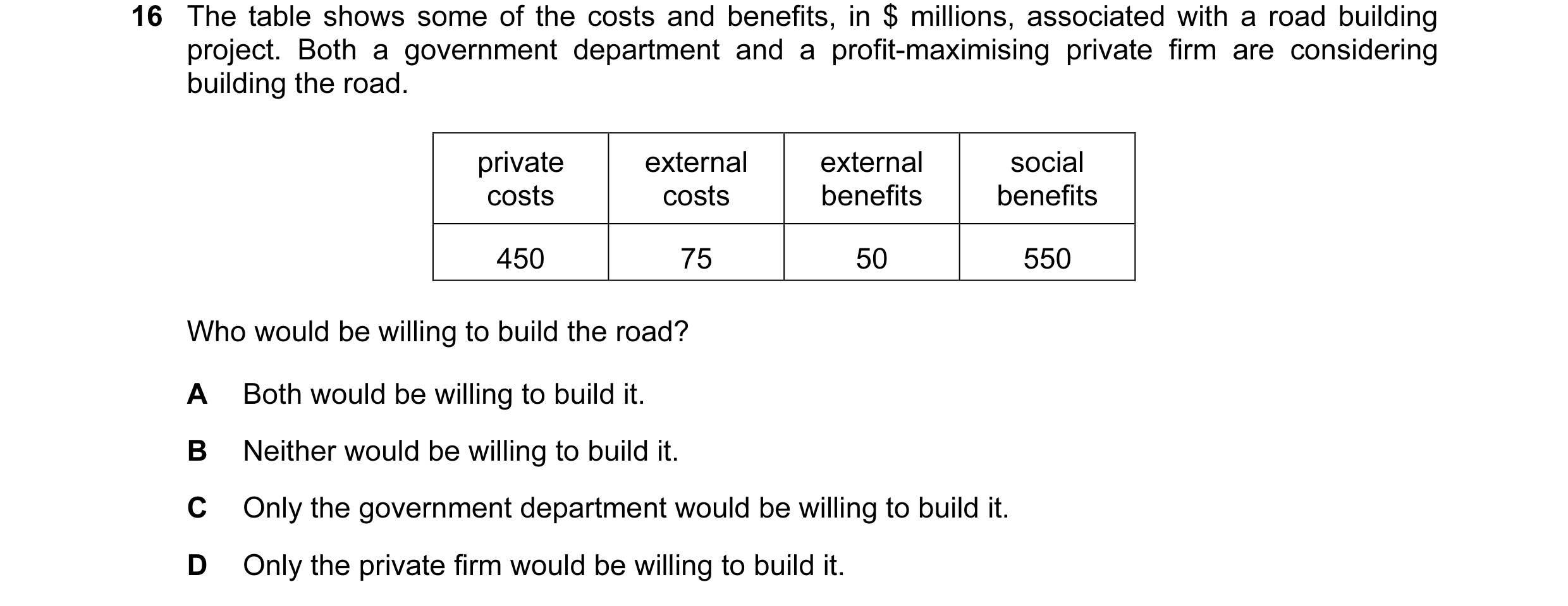
16 The table shows some of the costs and benefits, in $ millions, associated with a road building project. Both a government department and a profit-maximising private firm are considering building the road. private external external social costs costs benefits benefits 450 75 50 550 Who would be willing to build the road? A Both would be willing to build it. B Neither would be willing to build it. C Only the government department would be willing to build it. D Only the private firm would be willing to build it.
1 marks
Answer: A
This question in 9708/12 Oct/Nov 2012
Q75 · A government is planning to intervene in a market to fix output at the socially desirable… 9708/13 Oct/Nov 2012
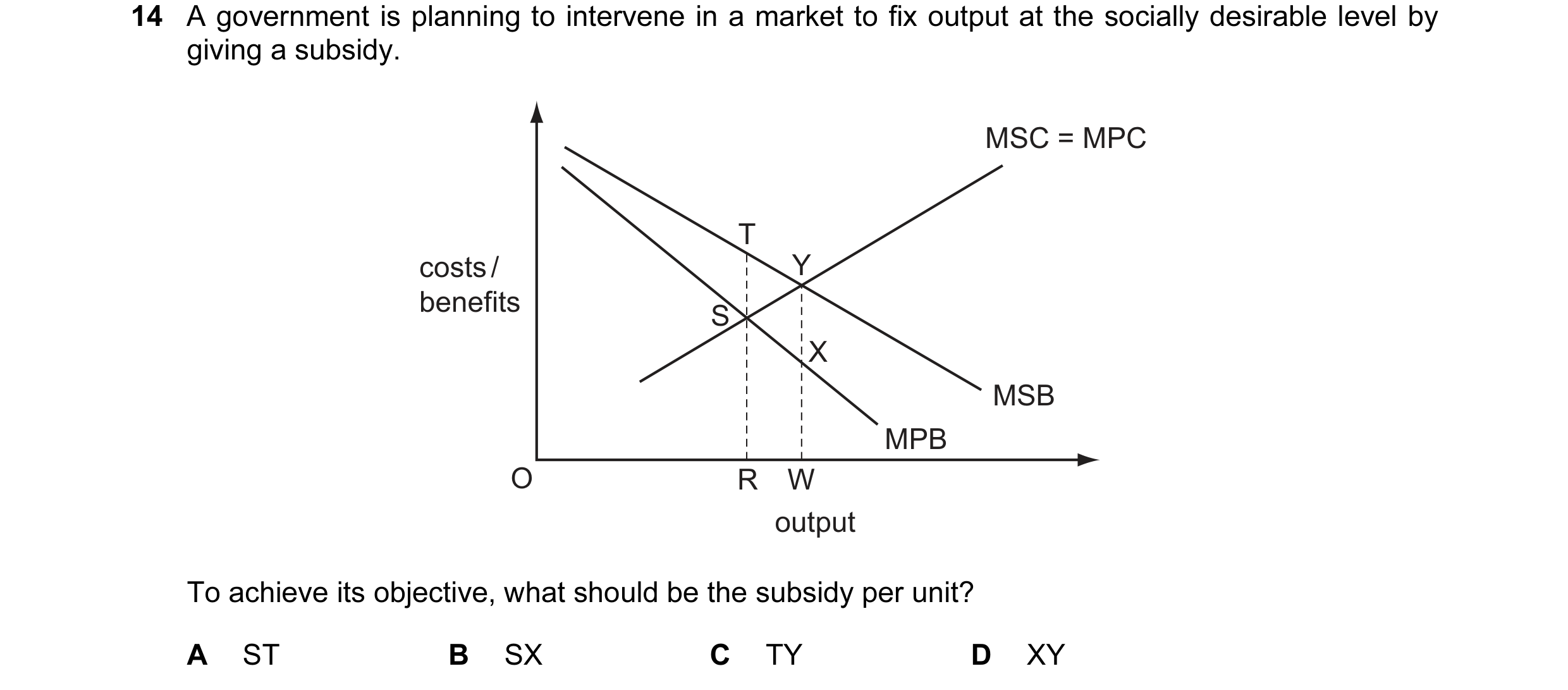
14 A government is planning to intervene in a market to fix output at the socially desirable level by giving a subsidy. MSC = MPC T costs / Y benefits S X MSB MPB O R W output To achieve its objective, what should be the subsidy per unit? A ST B SX C TY D XY
1 marks
Answer: D
This question in 9708/13 Oct/Nov 2012
Q76 · Which statement is correct? 9708/13 Oct/Nov 2012
15 Which statement is correct? A External benefit minus private benefit equals social benefit. B Private benefit minus external benefit equals social benefit. C Social benefit minus external benefit equals private benefit. D Social benefit plus private benefit equals external benefit.
1 marks
Answer: C
This question in 9708/13 Oct/Nov 2012
Q77 · A government carries out a cost-benefit analysis on the building of a new airport 9708/13 Oct/Nov 2012
16 A government carries out a cost-benefit analysis on the building of a new airport. It calculates that the cost of constructing and running the airport will be less than the revenue the airport will generate. It also estimates that benefits to third parties will be greater than the cost to third parties. Which reason might the government give for not building this airport? A The external costs exceed the external benefits. B The net private benefit is greater on another project. C The net social benefit is greater on another project. D The social costs exceed the social benefits.
1 marks
Answer: C
This question in 9708/13 Oct/Nov 2012
Q78 · A town council estimated the costs and benefits of operating a bus service in 2010 and… 9708/11 May/June 2013
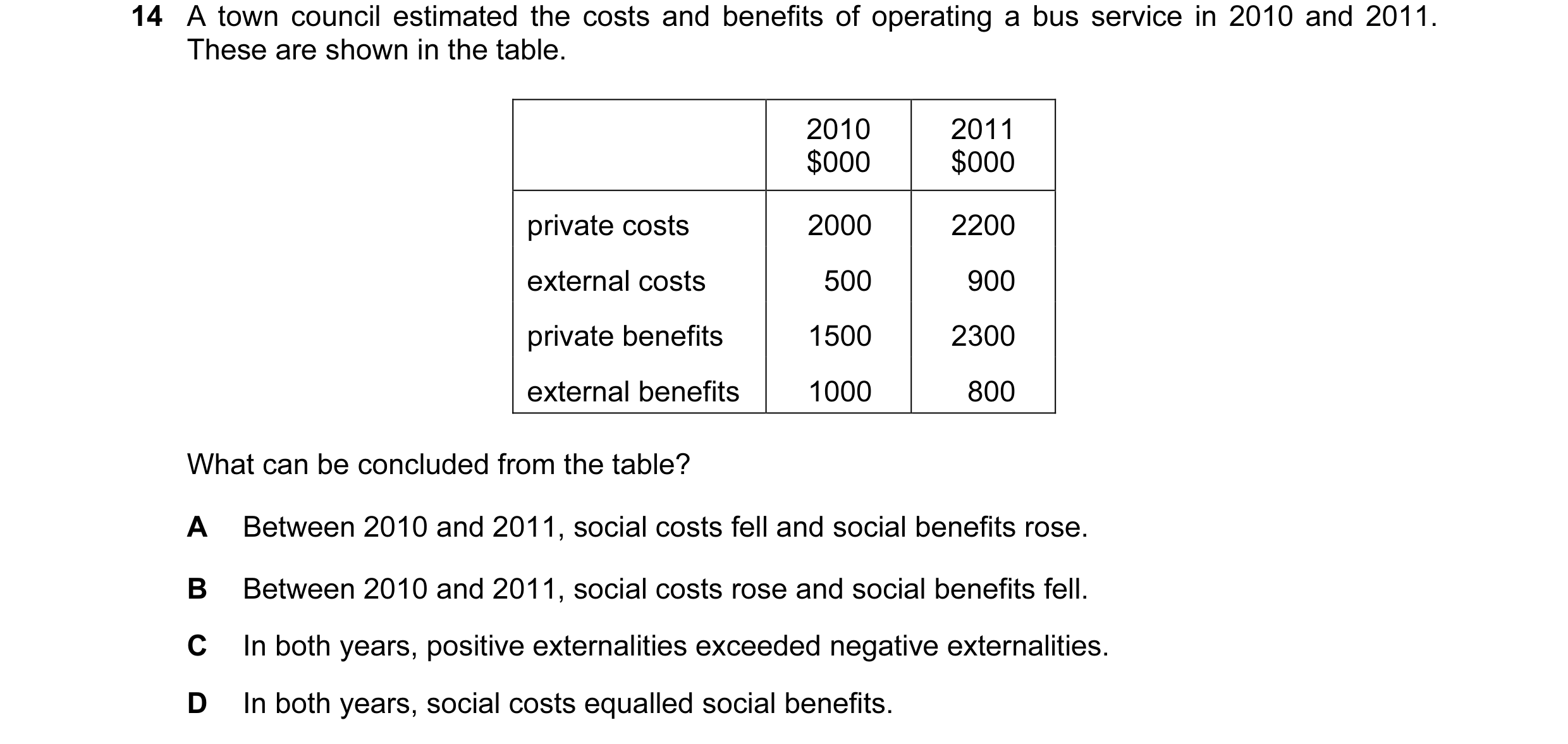
14 A town council estimated the costs and benefits of operating a bus service in 2010 and 2011. These are shown in the table. 2010 2011 $000 $000 private costs 2000 2200 external costs 500 900 private benefits 1500 2300 external benefits 1000 800 What can be concluded from the table? A Between 2010 and 2011, social costs fell and social benefits rose. B Between 2010 and 2011, social costs rose and social benefits fell. C In both years, positive externalities exceeded negative externalities. D In both years, social costs equalled social benefits.
1 marks
Answer: D
This question in 9708/11 May/June 2013
Q79 · A cost-benefit analysis concludes that a nuclear power station project might be socially… 9708/11 May/June 2013
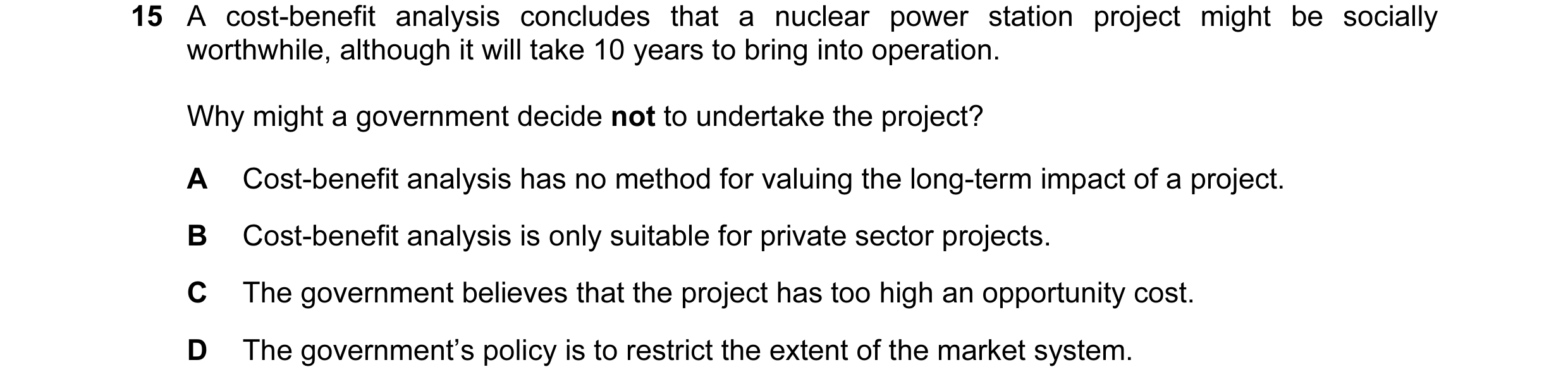
15 A cost-benefit analysis concludes that a nuclear power station project might be socially worthwhile, although it will take 10 years to bring into operation. Why might a government decide not to undertake the project? A Cost-benefit analysis has no method for valuing the long-term impact of a project. B Cost-benefit analysis is only suitable for private sector projects. C The government believes that the project has too high an opportunity cost. D The government’s policy is to restrict the extent of the market system.
1 marks
Answer: C
This question in 9708/11 May/June 2013
Q80 · Which is not an example of an externality? 9708/12 May/June 2013
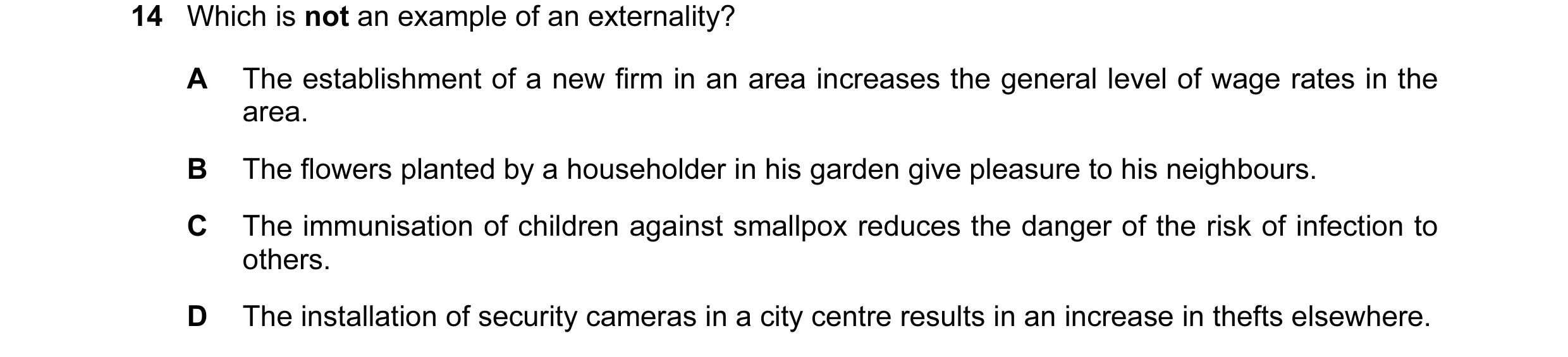
14 Which is not an example of an externality? A The establishment of a new firm in an area increases the general level of wage rates in the area. B The flowers planted by a householder in his garden give pleasure to his neighbours. C The immunisation of children against smallpox reduces the danger of the risk of infection to others. D The installation of security cameras in a city centre results in an increase in thefts elsewhere.
1 marks
Answer: A
This question in 9708/12 May/June 2013
Q81 · A government decided to approve a private airport-building scheme because it was socially… 9708/12 May/June 2013
15 A government decided to approve a private airport-building scheme because it was socially beneficial. In making its decision it calculated private costs at $700 m, private benefits at $800 m and external costs at $200 m. What must have been true about the external benefits of the scheme? A External benefits equalled private benefits. B External benefits exceeded external costs. C External benefits exceeded $100 m. D There were no external benefits.
1 marks
Answer: C
This question in 9708/12 May/June 2013
Q82 · The table below shows the results of a government survey into the economic effects of the… 9708/13 May/June 2013
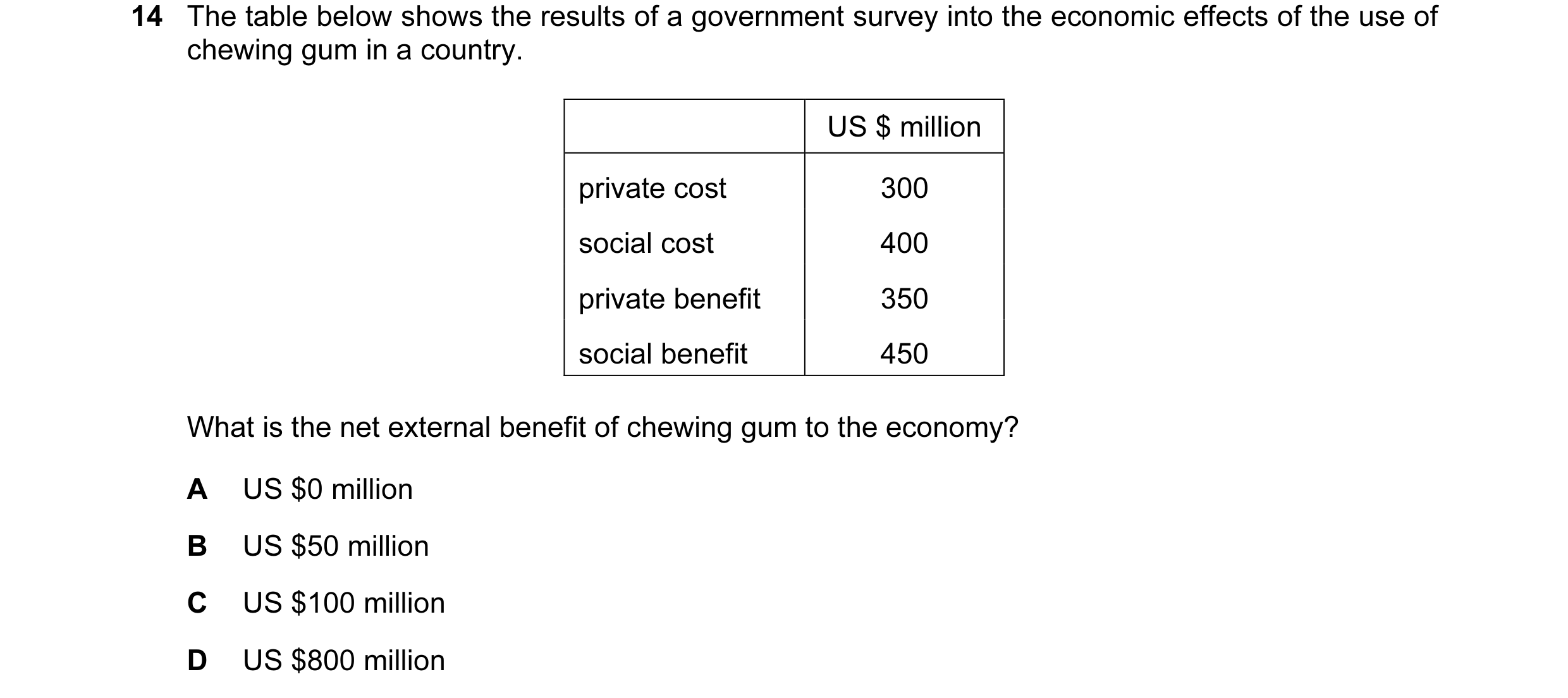
14 The table below shows the results of a government survey into the economic effects of the use of chewing gum in a country. US $ million private cost 300 social cost 400 private benefit 350 social benefit 450 What is the net external benefit of chewing gum to the economy? A US $0 million B US $50 million C US $100 million D US $800 million
1 marks
Answer: A
This question in 9708/13 May/June 2013
Q83 · Which statement about a product with external costs must be correct? 9708/13 May/June 2013
15 Which statement about a product with external costs must be correct? A The consumption of the product has positive effects on third parties. B The private costs of its production exceed the social costs of its production. C The production of the product has negative effects on third parties. D The social costs of its production exceed the social benefits of its production.
1 marks
Answer: C
This question in 9708/13 May/June 2013
Q84 · The government buys more speed cameras from the manufacturer 9708/13 May/June 2013
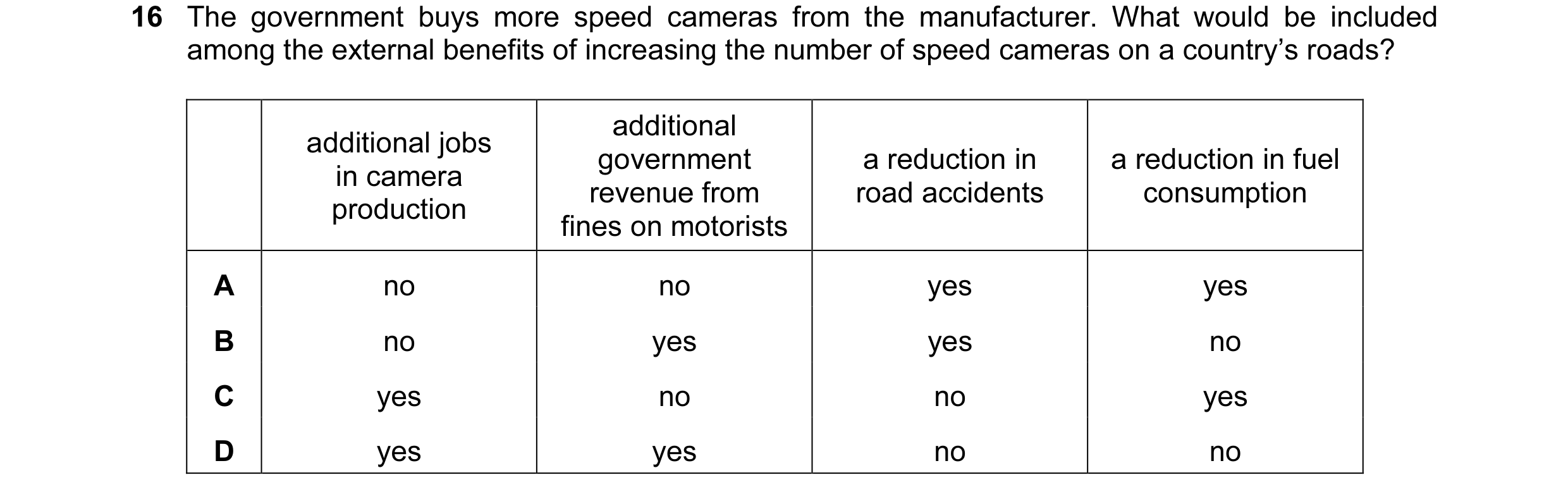
16 The government buys more speed cameras from the manufacturer. What would be included among the external benefits of increasing the number of speed cameras on a country’s roads? additional additional jobs government a reduction in a reduction in fuel in camera revenue from road accidents consumption production fines on motorists A no no yes yes B no yes yes no C yes no no yes D yes yes no no
1 marks
Answer: A
This question in 9708/13 May/June 2013
Q85 · Which situation would indicate the presence of an externality? 9708/11 Oct/Nov 2013
14 Which situation would indicate the presence of an externality? A Producers’ actions cause a shortage of a particular good. B Private motorists contribute to traffic congestion in city centres. C Differences in ability cause inequality in the distribution of income in an economy. D Increased demand for a good by the rich raises its price for poorer consumers.
1 marks
Answer: B
This question in 9708/11 Oct/Nov 2013
Q86 · The term ‘cost’ in public sector cost-benefit analysis is defined as A external costs 9708/11 Oct/Nov 2013
15 The term ‘cost’ in public sector cost-benefit analysis is defined as A external costs. B financial costs. C private costs. D social costs.
1 marks
Answer: D
This question in 9708/11 Oct/Nov 2013
Q87 · The government is considering building flood defences along a river 9708/11 Oct/Nov 2013
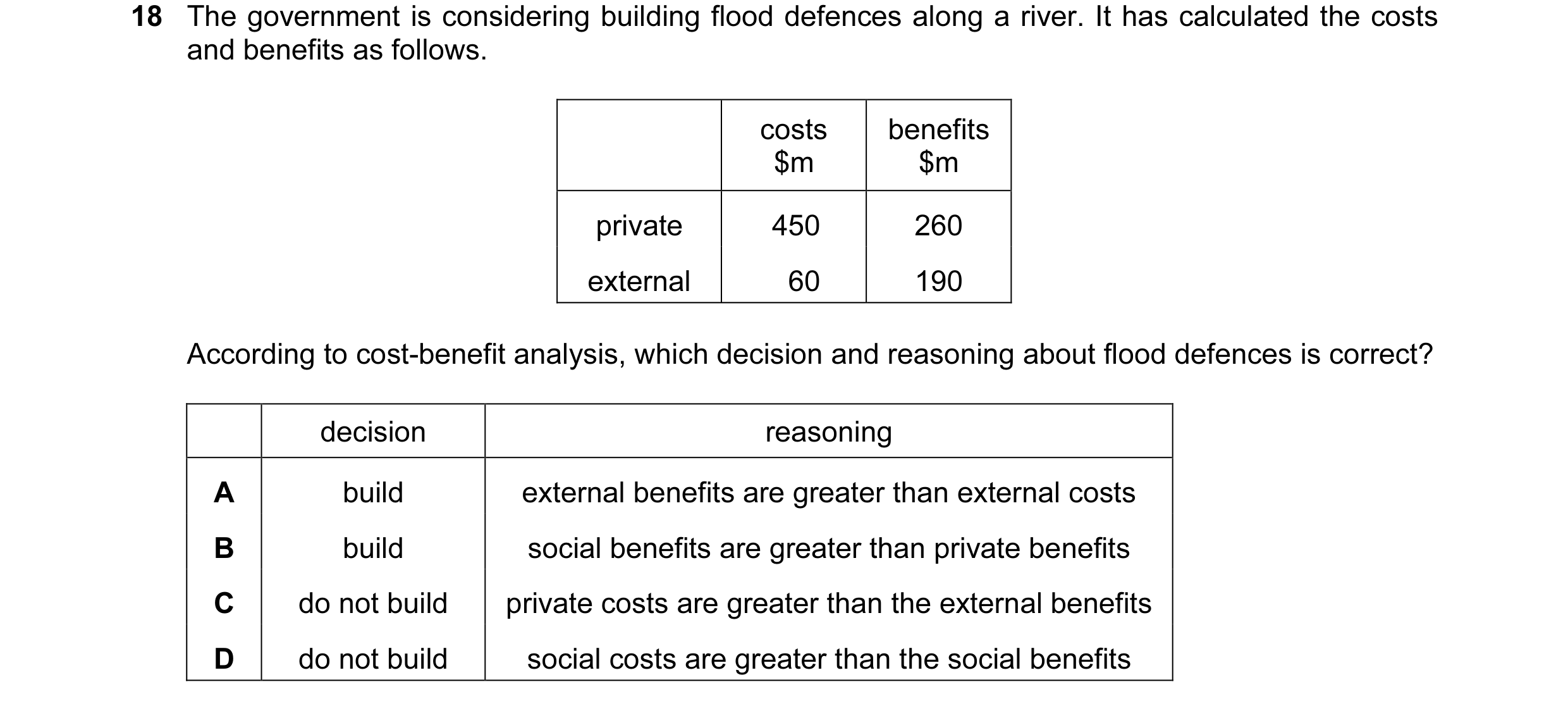
18 The government is considering building flood defences along a river. It has calculated the costs and benefits as follows. costs benefits $m $m private 450 260 external 60 190 According to cost-benefit analysis, which decision and reasoning about flood defences is correct? decision reasoning A build external benefits are greater than external costs B build social benefits are greater than private benefits C do not build private costs are greater than the external benefits D do not build social costs are greater than the social benefits
1 marks
Answer: D
This question in 9708/11 Oct/Nov 2013
Q88 · The table shows the expected costs and benefits from four government projects 9708/12 Oct/Nov 2013
14 The table shows the expected costs and benefits from four government projects. The government can afford only one project. Which project should the government choose? private benefits external benefits private costs external costs ($m) ($m) ($m) ($m) A 40 200 60 70 B 60 160 100 20 C 100 210 100 120 D 150 90 120 140
1 marks
Answer: A
This question in 9708/12 Oct/Nov 2013
Q89 · What will be the result, from society’s view, if the market price for a product does not… 9708/12 Oct/Nov 2013
15 What will be the result, from society’s view, if the market price for a product does not reflect the positive externalities in its production? A too little consumption and too little production B too little consumption and too much production C too much consumption and too little production D too much consumption and too much production
1 marks
Answer: A
This question in 9708/12 Oct/Nov 2013
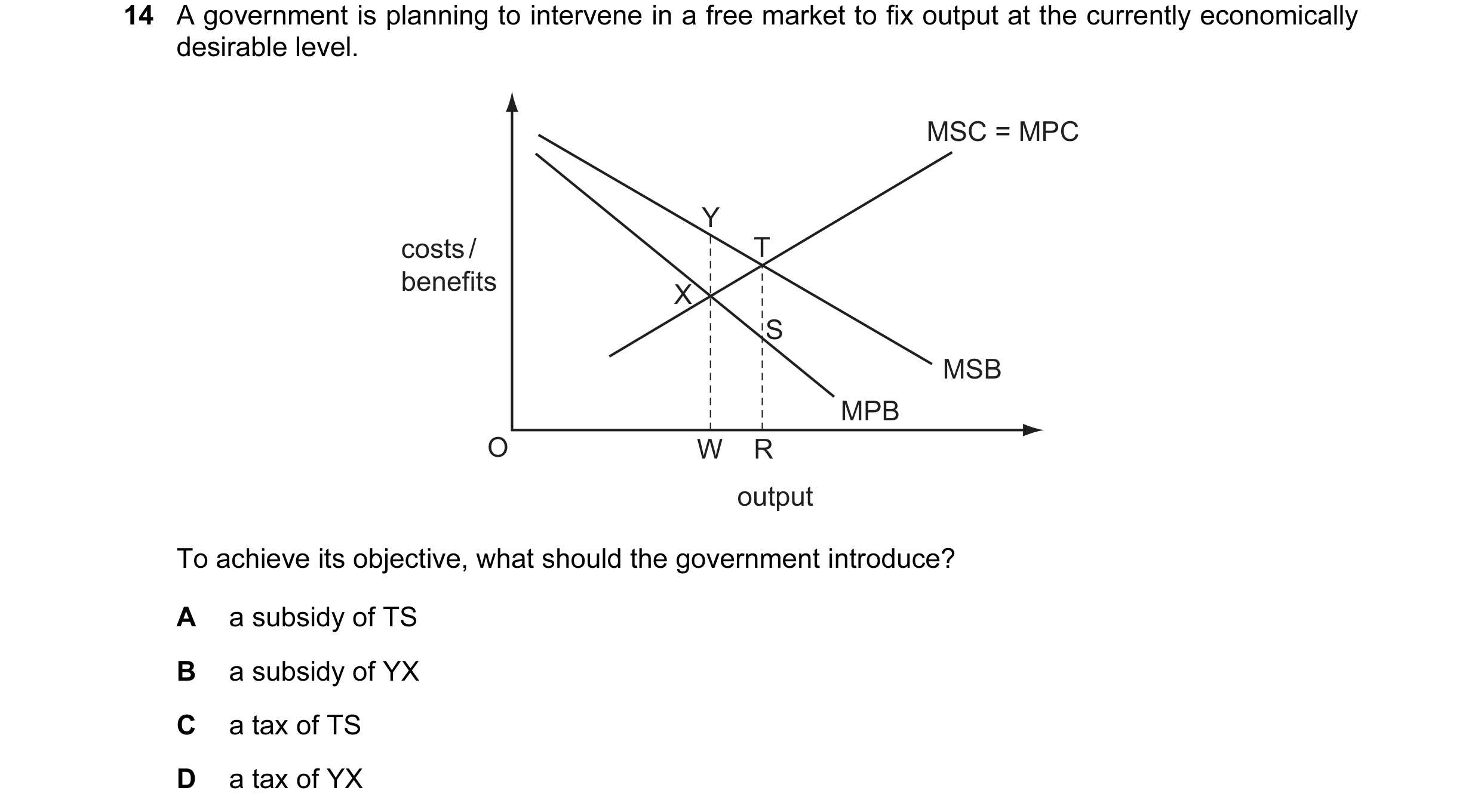
Q90 · A government is planning to intervene in a free market to fix output at the currently… 9708/13 Oct/Nov 2013
14 A government is planning to intervene in a free market to fix output at the currently economically desirable level. MSC = MPC Y costs/ T benefits X S MSB MPB O W R output To achieve its objective, what should the government introduce? A a subsidy of TS B a subsidy of YX C a tax of TS D a tax of YX
1 marks
Answer: A
This question in 9708/13 Oct/Nov 2013
Q91 · What does a government compare when carrying out a cost-benefit analysis of a project? 9708/13 Oct/Nov 2013
15 What does a government compare when carrying out a cost-benefit analysis of a project? A external benefit and external cost B financial benefit and opportunity cost C real benefit and monetary cost D social benefit and social cost
1 marks
Answer: D
This question in 9708/13 Oct/Nov 2013
Q92 · What is an externality created by an individual consuming take-away food? 9708/11 May/June 2014
14 What is an externality created by an individual consuming take-away food? A the cost to the individual of purchasing the take-away food B the litter created by the individual’s take-away food packaging being discarded C the pleasure derived by the individual from eating the take-away food D the time saved by the individual purchasing the take-away food
1 marks
Answer: B
This question in 9708/11 May/June 2014
Q93 · A project has a social cost of $100 million, a private cost of $40 million and an… 9708/11 May/June 2014
15 A project has a social cost of $100 million, a private cost of $40 million and an external benefit of $20 million. Its net social value is zero. What can be concluded about the project? A External cost is greater than external benefit. B Private cost is greater than external cost. C Private cost is greater than private benefit. D Social cost is greater than social benefit.
1 marks
Answer: A
This question in 9708/11 May/June 2014
Q94 · What is least likely to be included in a cost-benefit analysis of a proposed new… 9708/11 May/June 2014
16 What is least likely to be included in a cost-benefit analysis of a proposed new university? A the costs of building the new university B the extra income earned by the new university’s graduates C the future staffing costs of other universities D the staffing costs of the new university five years into the future
1 marks
Answer: C
This question in 9708/11 May/June 2014
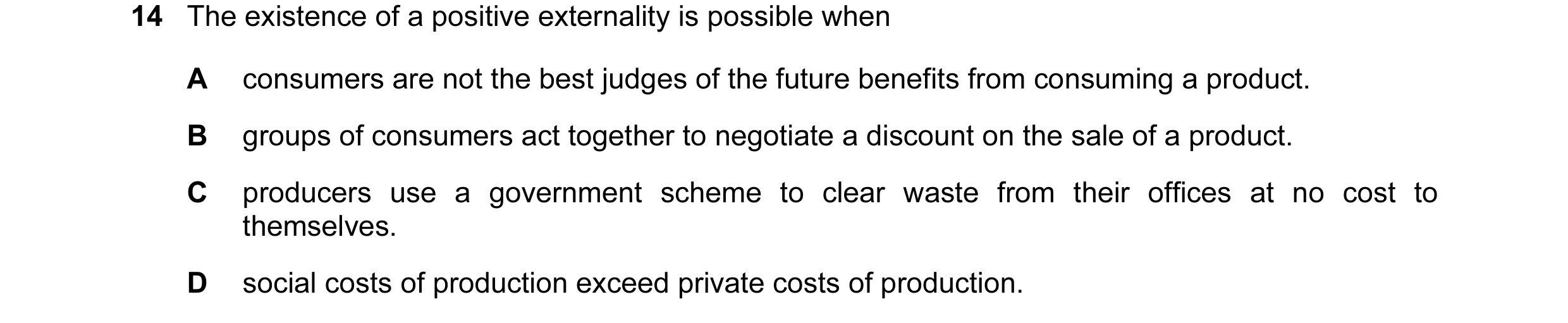
Q95 · The existence of a positive externality is possible when A consumers are not the best… 9708/12 May/June 2014
14 The existence of a positive externality is possible when A consumers are not the best judges of the future benefits from consuming a product. B groups of consumers act together to negotiate a discount on the sale of a product. C producers use a government scheme to clear waste from their offices at no cost to themselves. D social costs of production exceed private costs of production.
1 marks
Answer: A
This question in 9708/12 May/June 2014
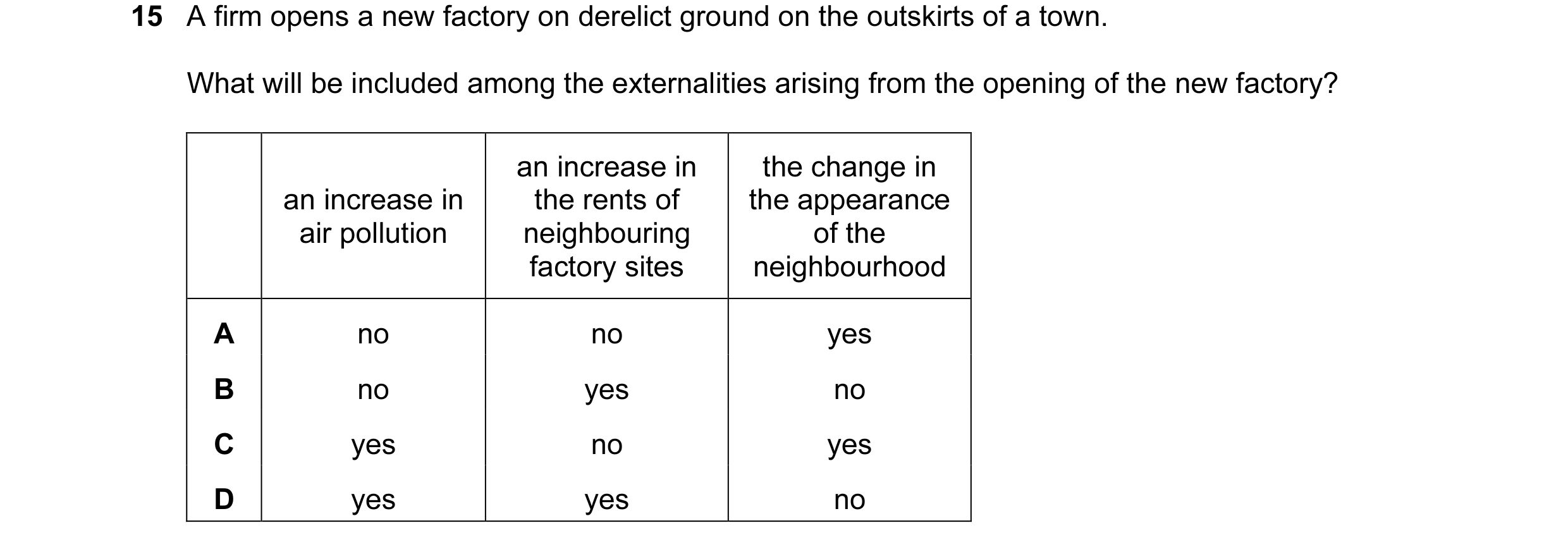
Q96 · A firm opens a new factory on derelict ground on the outskirts of a town 9708/12 May/June 2014
15 A firm opens a new factory on derelict ground on the outskirts of a town. What will be included among the externalities arising from the opening of the new factory? an increase in the change in an increase in the rents of the appearance air pollution neighbouring of the factory sites neighbourhood A no no yes B no yes no C yes no yes D yes yes no
1 marks
Answer: C
This question in 9708/12 May/June 2014
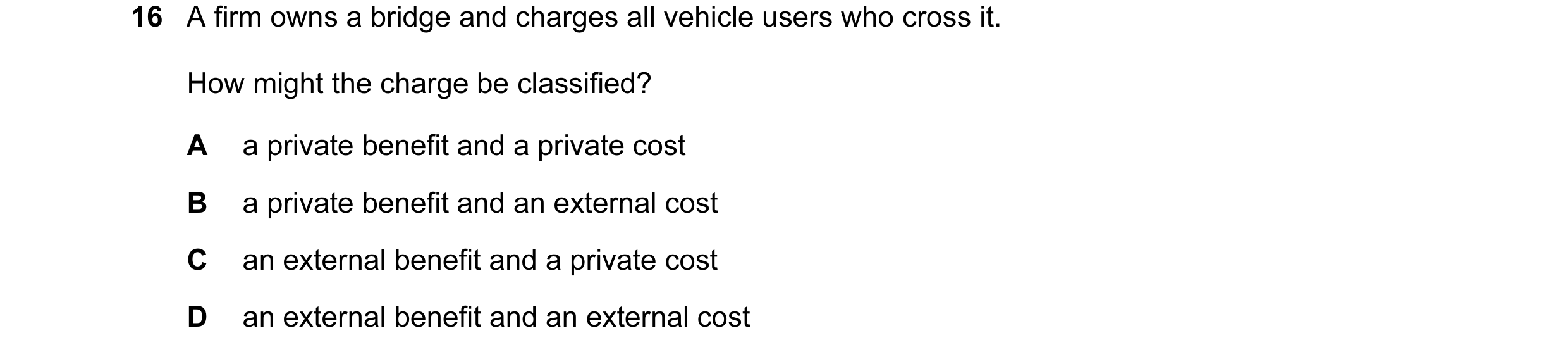
Q97 · A firm owns a bridge and charges all vehicle users who cross it 9708/12 May/June 2014
16 A firm owns a bridge and charges all vehicle users who cross it. How might the charge be classified? A a private benefit and a private cost B a private benefit and an external cost C an external benefit and a private cost D an external benefit and an external cost
1 marks
Answer: A
This question in 9708/12 May/June 2014
Q98 · The table shows the results of a cost-benefit analysis into the building of a new runway… 9708/12 May/June 2014
17 The table shows the results of a cost-benefit analysis into the building of a new runway at an airport. costs benefits US$m US$m private 100 125 external 25 20 Which statement about the new runway is correct? A The net external benefit is US$5 million. B The net private benefit is US$25 million. C The net social benefit is US$105 million. D The net social benefit is US$145 million.
1 marks
Answer: B
This question in 9708/12 May/June 2014
Q99 · A firm opens a new factory on the outskirts of a town 9708/13 May/June 2014
14 A firm opens a new factory on the outskirts of a town. What will be included among the externalities arising from the opening of the new factory? an increase in the an increase in the wages paid to an increase in sales revenue of workers in a traffic congestion local neighbouring shopkeepers factory A no no yes B no yes yes C yes no no D yes yes no
1 marks
Answer: C
This question in 9708/13 May/June 2014
Q100 · The table shows some of the costs when a firm produces a good 9708/13 May/June 2014
15 The table shows some of the costs when a firm produces a good. total cost to society external cost output $ $ 23 316 16 24 322 18 What is the additional cost to a firm of producing the 24th unit? A $2 B $4 C $6 D $8
1 marks
Answer: B
This question in 9708/13 May/June 2014
Q101 · What impact would internalising negative externalities have on the output and price of a… 9708/13 May/June 2014
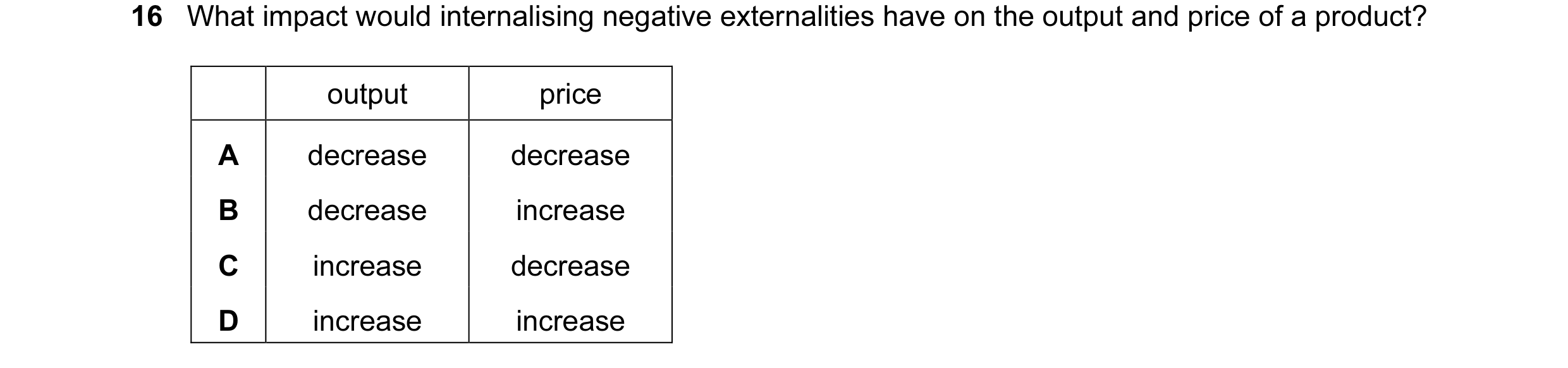
16 What impact would internalising negative externalities have on the output and price of a product? output price A decrease decrease B decrease increase C increase decrease D increase increase
1 marks
Answer: B
This question in 9708/13 May/June 2014
Q102 · What types of externalities arise from 1 a firm creating an extra supply of trained… 9708/11 Oct/Nov 2014
14 What types of externalities arise from 1 a firm creating an extra supply of trained labour and, 2 the excessive noise made by a householder cutting his lawn? 1 2 A negative production externality negative consumption externality B negative production externality positive consumption externality C positive production externality negative consumption externality D positive production externality positive consumption externality
1 marks
This question in 9708/11 Oct/Nov 2014
Q103 · The table shows the total amount consumers are willing to pay for different quantities of… 9708/11 Oct/Nov 2014
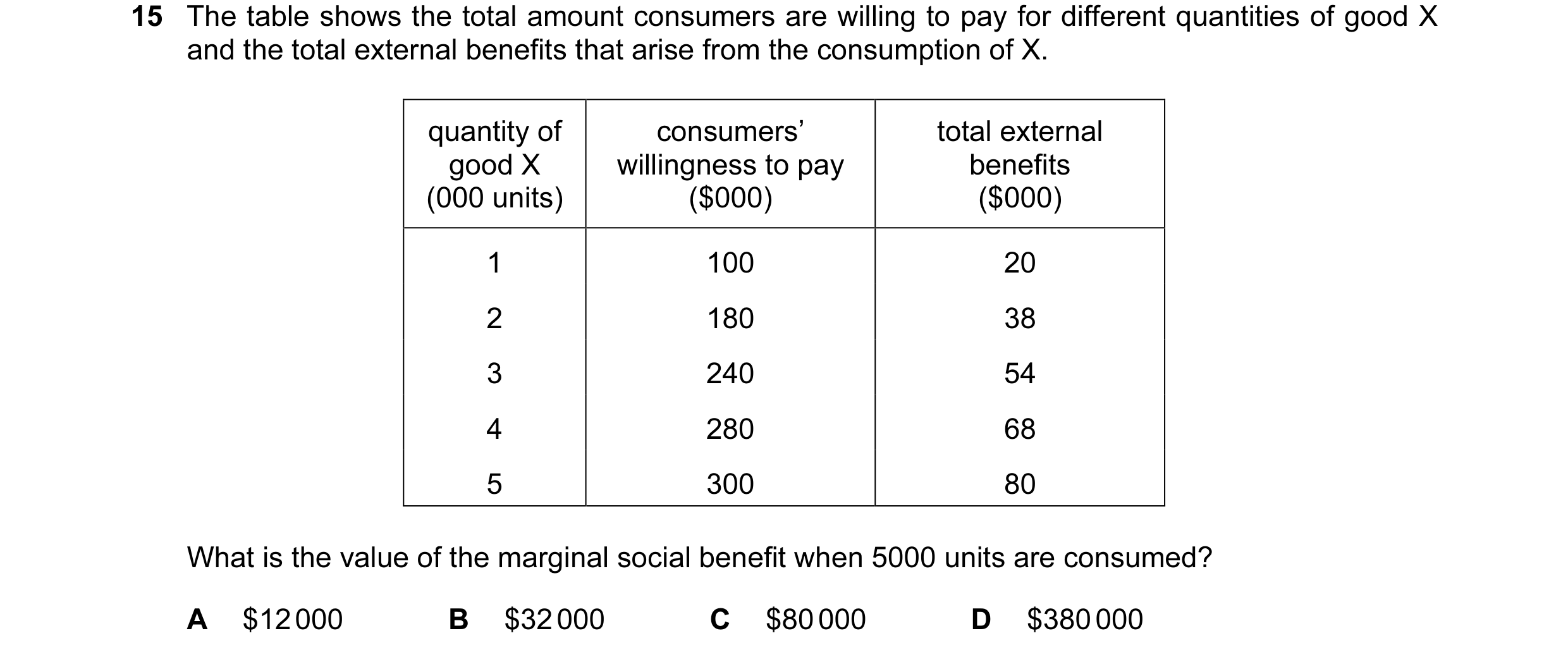
15 The table shows the total amount consumers are willing to pay for different quantities of good X and the total external benefits that arise from the consumption of X. quantity of consumers’ total external good X willingness to pay benefits (000 units) ($000) ($000) 1 100 20 2 180 38 3 240 54 4 280 68 5 300 80 What is the value of the marginal social benefit when 5000 units are consumed? A $12 000 B $32 000 C $80 000 D $380 000
1 marks
This question in 9708/11 Oct/Nov 2014
Q104 · A company applied to build a supermarket on the edge of a town near a river 9708/11 Oct/Nov 2014
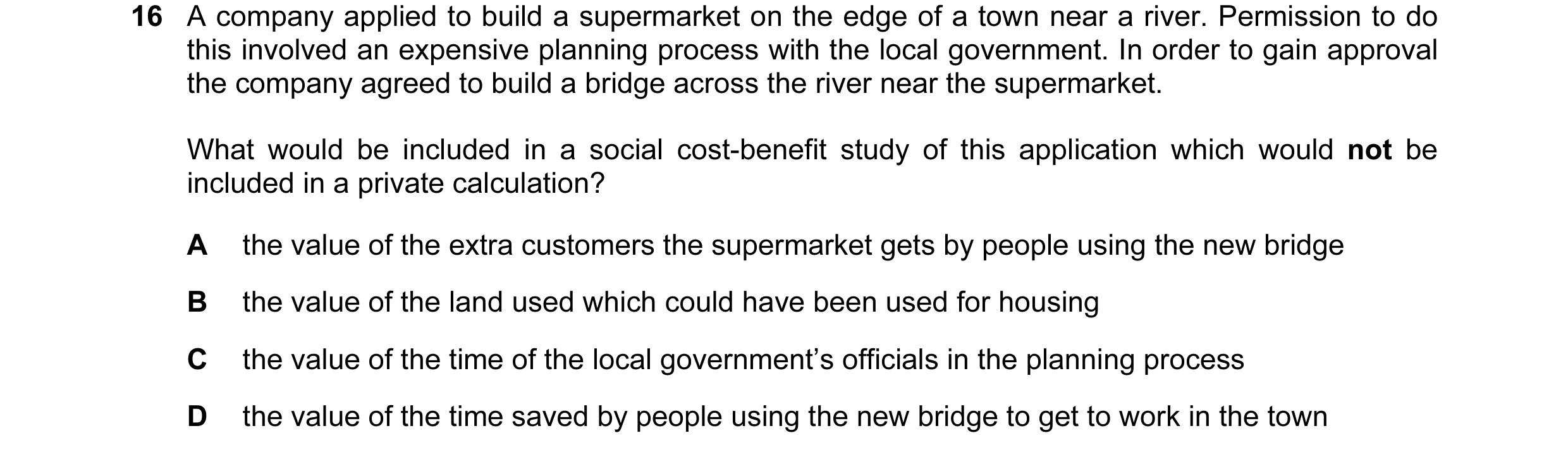
16 A company applied to build a supermarket on the edge of a town near a river. Permission to do this involved an expensive planning process with the local government. In order to gain approval the company agreed to build a bridge across the river near the supermarket. What would be included in a social cost-benefit study of this application which would not be included in a private calculation? A the value of the extra customers the supermarket gets by people using the new bridge B the value of the land used which could have been used for housing C the value of the time of the local government’s officials in the planning process D the value of the time saved by people using the new bridge to get to work in the town
1 marks
This question in 9708/11 Oct/Nov 2014
Q105 · A firm wishes to build a factory extension 9708/12 Oct/Nov 2014
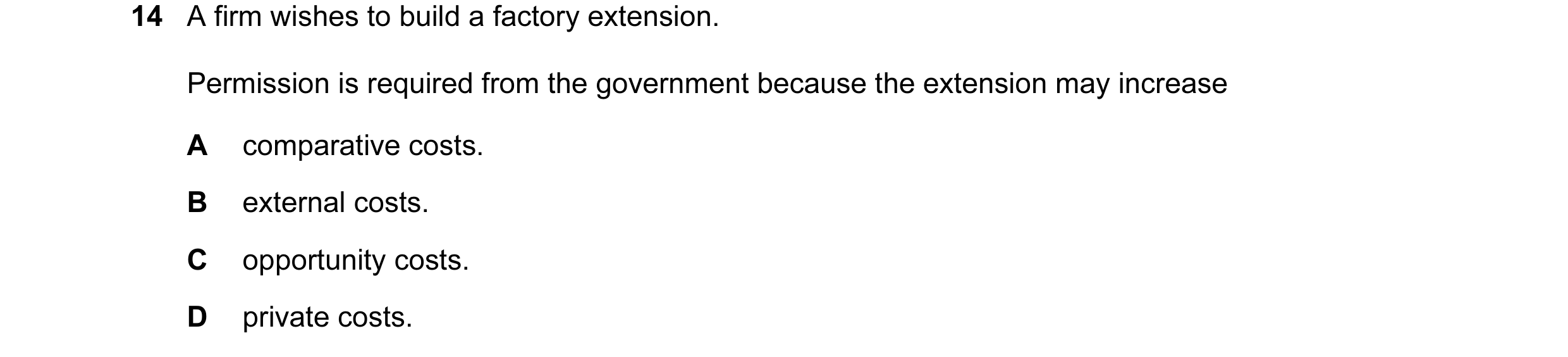
14 A firm wishes to build a factory extension. Permission is required from the government because the extension may increase A comparative costs. B external costs. C opportunity costs. D private costs.
1 marks
Answer: B
This question in 9708/12 Oct/Nov 2014
Q106 · The diagram shows the private and social costs and benefits that arise from the… 9708/12 Oct/Nov 2014
15 The diagram shows the private and social costs and benefits that arise from the consumption and production of a good. MSC = MPC 14 costs / 13 benefits $ 10 8 MSB MPB 0 20 25 quantity If there is no government intervention, what is the value of the marginal external benefit? A $2 B $3 C $4 D $6
1 marks
Answer: C
This question in 9708/12 Oct/Nov 2014
Q107 · The table shows, for two different quantities of good X, the total amount consumers are… 9708/13 Oct/Nov 2014
14 The table shows, for two different quantities of good X, the total amount consumers are willing to pay and the total external benefits that are generated. quantity of good X consumers’ willingness total external benefits (units) to pay ($) ($) 3 240 54 4 280 68 What is the additional social benefit when 4 units rather than 3 units are produced? A $14 B $40 C $54 D $348
1 marks
Answer: C
This question in 9708/13 Oct/Nov 2014
Q108 · The table shows demand and supply schedules for a product 9708/13 Oct/Nov 2014
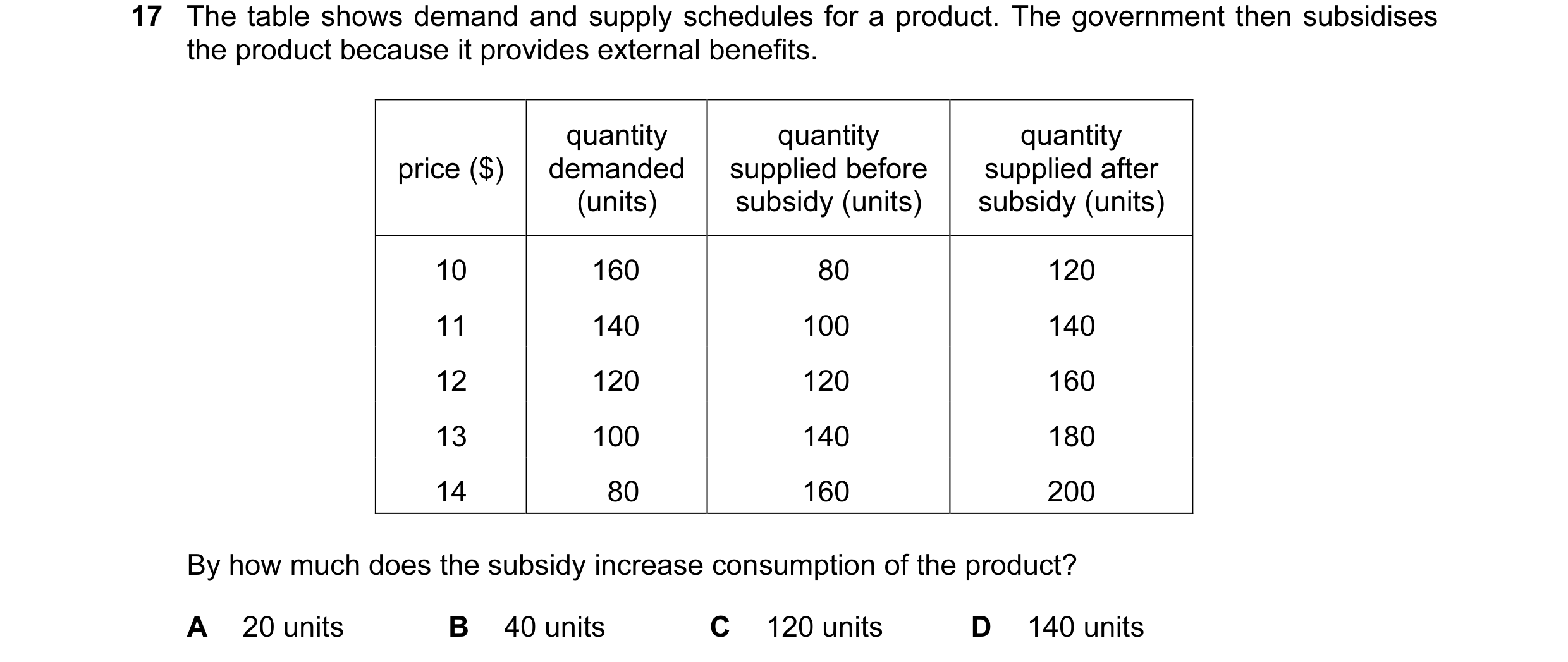
17 The table shows demand and supply schedules for a product. The government then subsidises the product because it provides external benefits. quantity quantity quantity price ($) demanded supplied before supplied after (units) subsidy (units) subsidy (units) 10 160 80 120 11 140 100 140 12 120 120 160 13 100 140 180 14 80 160 200 By how much does the subsidy increase consumption of the product? A 20 units B 40 units C 120 units D 140 units
1 marks
Answer: A
This question in 9708/13 Oct/Nov 2014
Q109 · What is an economic reason why hospitals are often built and funded by the government? 9708/11 May/June 2015
13 What is an economic reason why hospitals are often built and funded by the government? A Hospitals are a public good. B Hospitals are very expensive to build and run. C Hospitals cannot use price to allocate demand. D Hospital treatments may benefit many apart from those who use them.
1 marks
Answer: D
This question in 9708/11 May/June 2015
Q110 · The diagrams show the costs and benefits in four markets 9708/11 May/June 2015
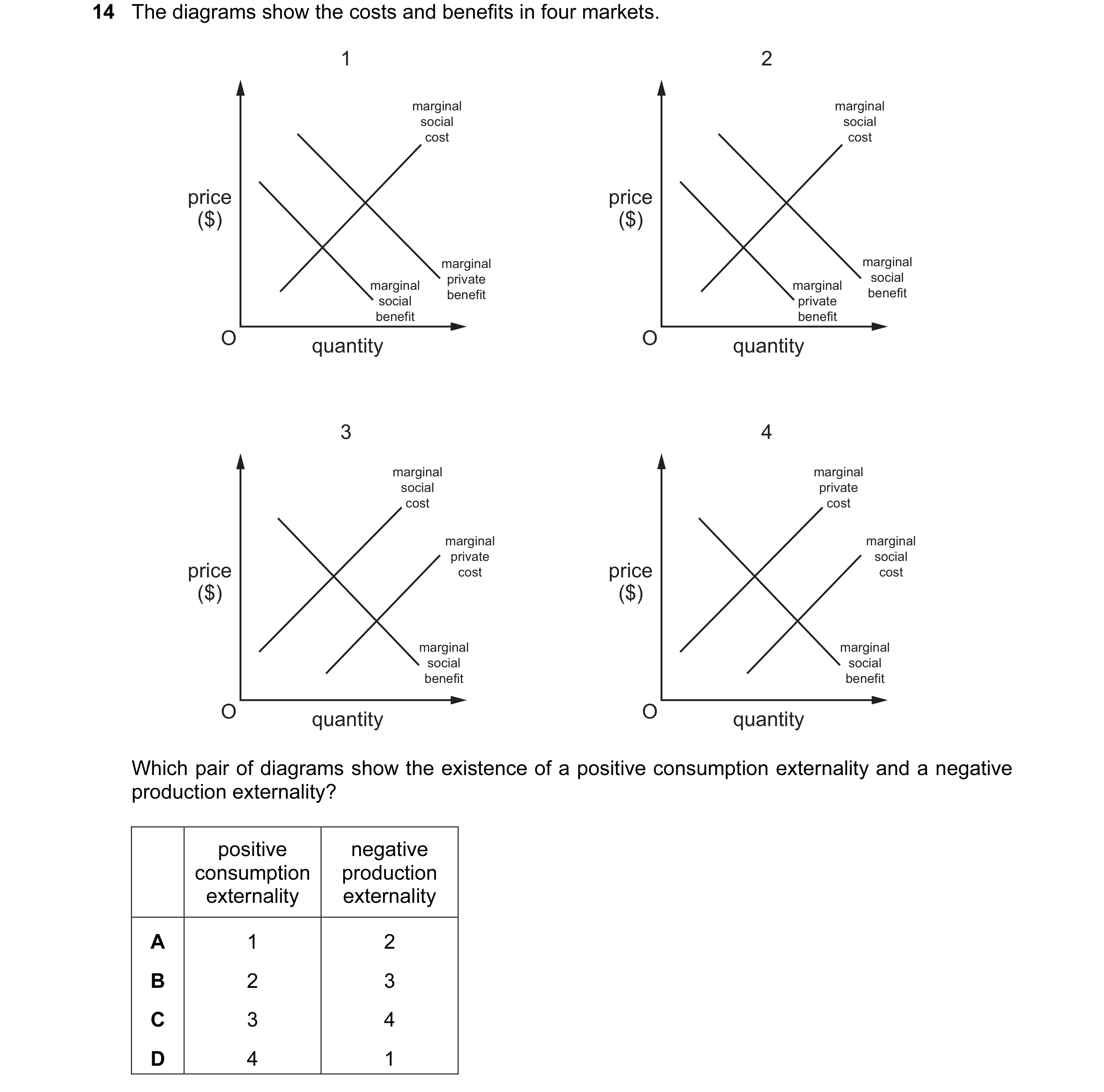
14 The diagrams show the costs and benefits in four markets. 1 2 marginal marginal social social cost cost price price ($) ($) marginal marginal marginal private marginal social social benefit private benefit benefit benefit O quantity O quantity 3 4 marginal marginal social private cost cost marginal marginal private social price cost price cost ($) ($) marginal marginal social social benefit benefit O quantity O quantity Which pair of diagrams show the existence of a positive consumption externality and a negative production externality? positive negative consumption production externality externality A 1 2 B 2 3 C 3 4 D 4 1
1 marks
Answer: B
This question in 9708/11 May/June 2015
Q111 · Which statement about costs is correct? 9708/11 May/June 2015
15 Which statement about costs is correct? A External cost only affects consumers. B Opportunity cost affects all transactions. C Private cost only affects producers. D Social cost affects all members of society equally.
1 marks
Answer: B
This question in 9708/11 May/June 2015
Q112 · A government is considering building a high-speed rail link 9708/11 May/June 2015
16 A government is considering building a high-speed rail link. Why would it not proceed with the project? A The external benefit is greater than the external cost. B The private cost is greater than the private benefit. C The social benefit is greater than the social cost. D The social cost is greater than the social benefit.
1 marks
Answer: D
This question in 9708/11 May/June 2015
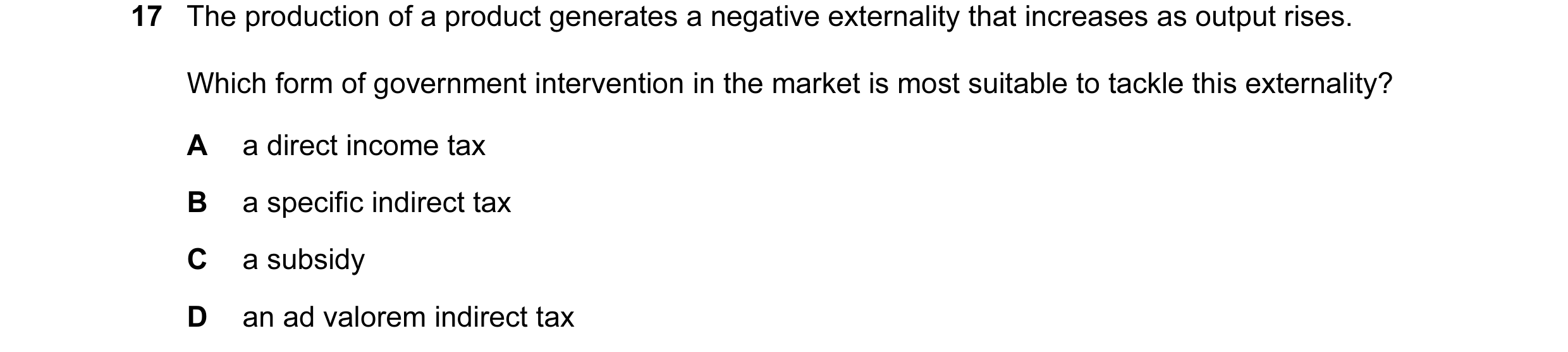
Q113 · The production of a product generates a negative externality that increases as output… 9708/11 May/June 2015
17 The production of a product generates a negative externality that increases as output rises. Which form of government intervention in the market is most suitable to tackle this externality? A a direct income tax B a specific indirect tax C a subsidy D an ad valorem indirect tax
1 marks
Answer: D
This question in 9708/11 May/June 2015
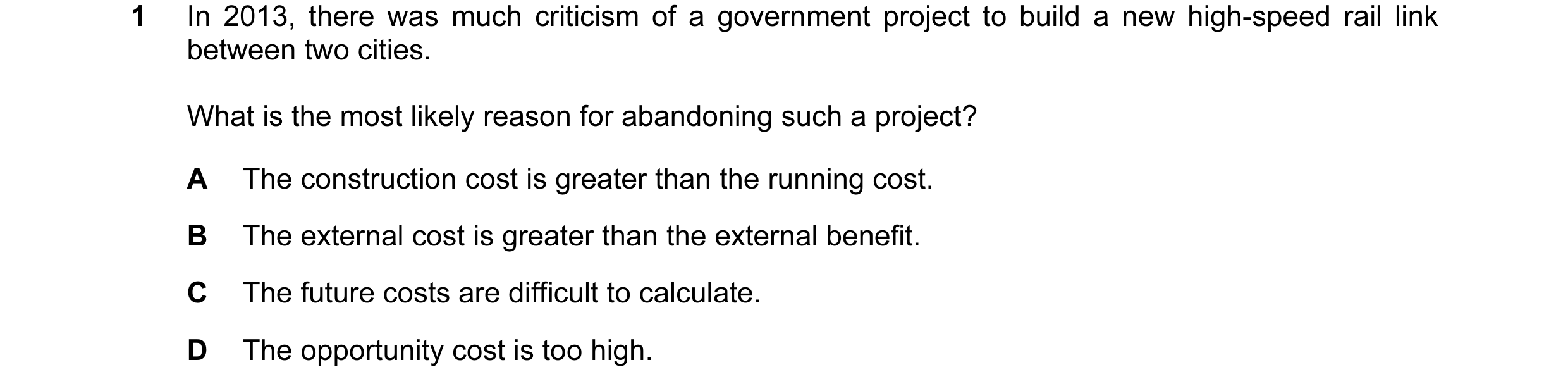
Q114 · In 2013, there was much criticism of a government project to build a new high-speed rail… 9708/12 May/June 2015
1 In 2013, there was much criticism of a government project to build a new high-speed rail link between two cities. What is the most likely reason for abandoning such a project? A The construction cost is greater than the running cost. B The external cost is greater than the external benefit. C The future costs are difficult to calculate. D The opportunity cost is too high.
1 marks
Answer: D
This question in 9708/12 May/June 2015
Q115 · What is an example of an externality? 9708/12 May/June 2015
14 What is an example of an externality? A Production of good X directly affects the cost of producing good Y. B The entry of a new firm reduces the profits of existing firms producing good X. C The introduction of bus-only lanes reduces the travel times of bus passengers. D The opening of a new underground railway reduces the revenue of bus operators.
1 marks
Answer: A
This question in 9708/12 May/June 2015
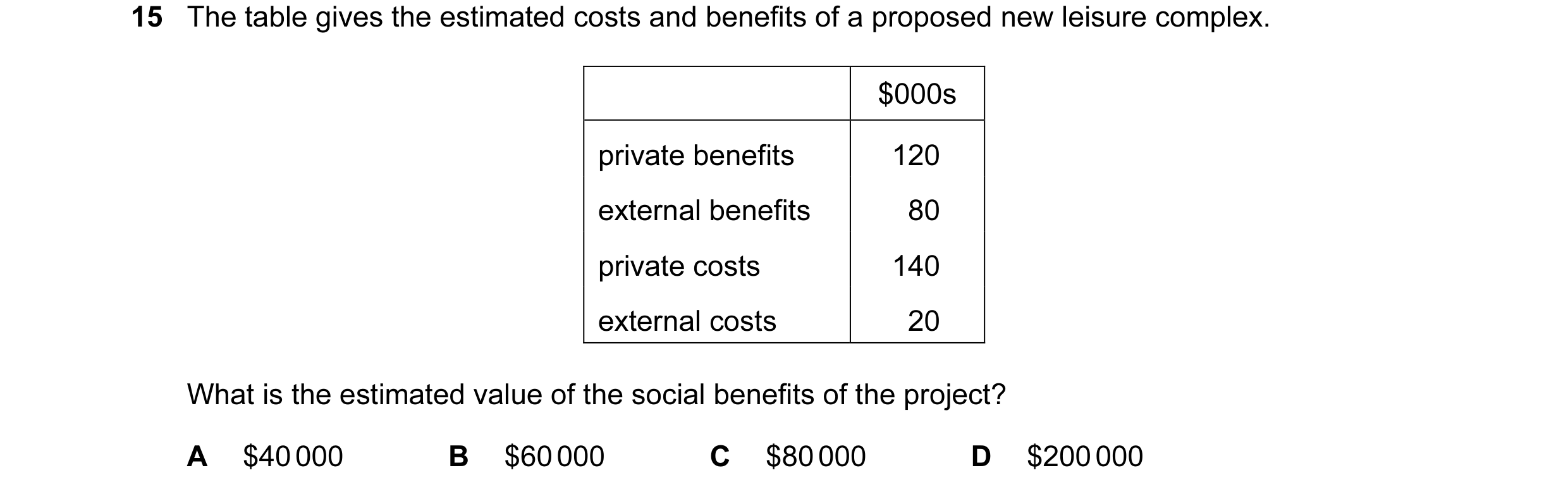
Q116 · The table gives the estimated costs and benefits of a proposed new leisure complex 9708/12 May/June 2015
15 The table gives the estimated costs and benefits of a proposed new leisure complex. $000s private benefits 120 external benefits 80 private costs 140 external costs 20 What is the estimated value of the social benefits of the project? A $40 000 B $60 000 C $80 000 D $200 000
1 marks
Answer: D
This question in 9708/12 May/June 2015
Q117 · The production of what is most likely to require a government cost-benefit analysis? 9708/12 May/June 2015
16 The production of what is most likely to require a government cost-benefit analysis? A houses B medicines C roads D schools
1 marks
Answer: C
This question in 9708/12 May/June 2015
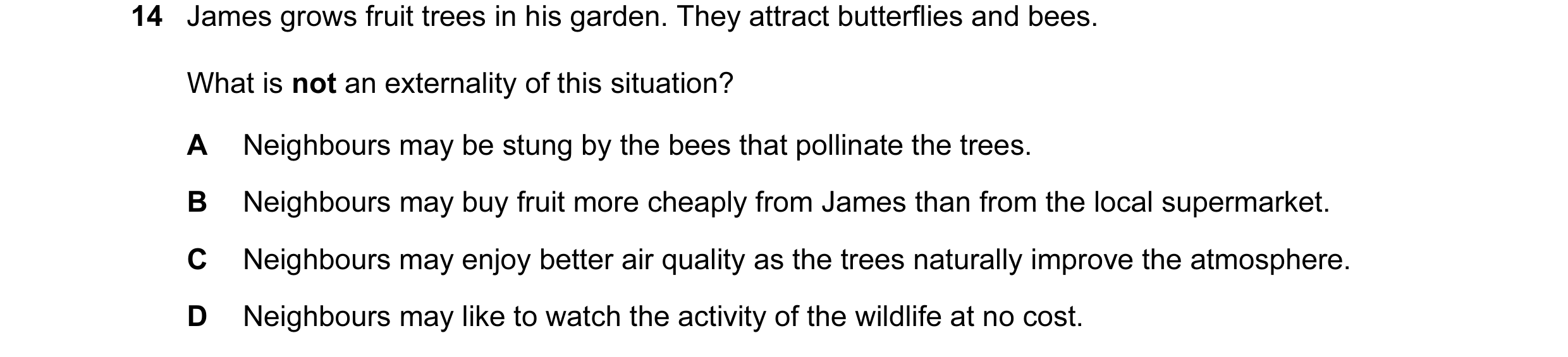
Q118 · James grows fruit trees in his garden 9708/13 May/June 2015
14 James grows fruit trees in his garden. They attract butterflies and bees. What is not an externality of this situation? A Neighbours may be stung by the bees that pollinate the trees. B Neighbours may buy fruit more cheaply from James than from the local supermarket. C Neighbours may enjoy better air quality as the trees naturally improve the atmosphere. D Neighbours may like to watch the activity of the wildlife at no cost.
1 marks
Answer: B
This question in 9708/13 May/June 2015
Q119 · Jaguar-Land Rover launched a car in 2013 that could run on electricity as well as gas… 9708/13 May/June 2015
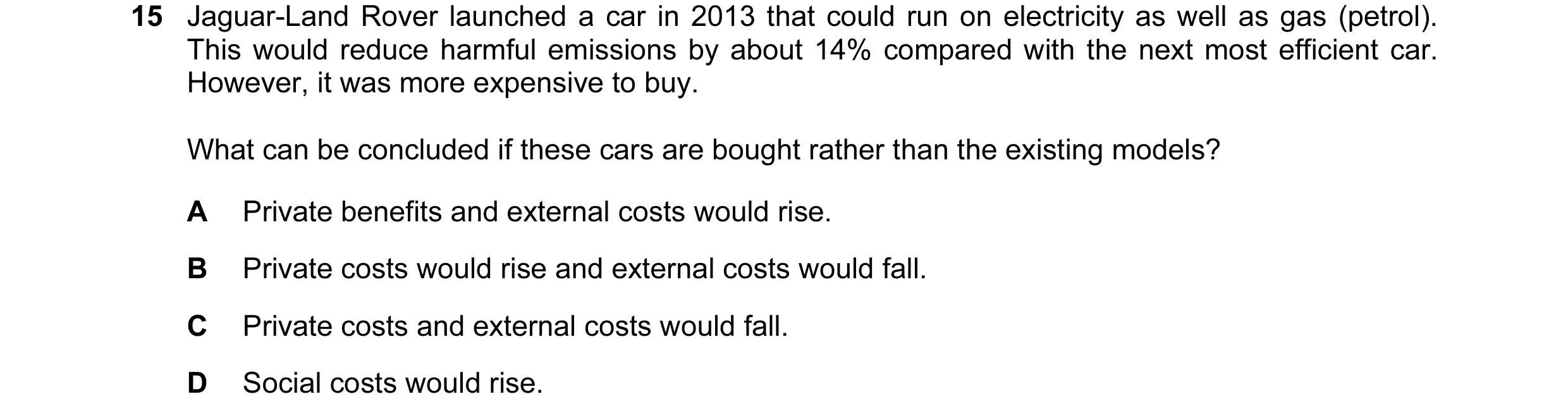
15 Jaguar-Land Rover launched a car in 2013 that could run on electricity as well as gas (petrol). This would reduce harmful emissions by about 14% compared with the next most efficient car. However, it was more expensive to buy. What can be concluded if these cars are bought rather than the existing models? A Private benefits and external costs would rise. B Private costs would rise and external costs would fall. C Private costs and external costs would fall. D Social costs would rise.
1 marks
Answer: B
This question in 9708/13 May/June 2015
Q120 · A government conducts a cost-benefit analysis into the construction of a new high-speed… 9708/13 May/June 2015
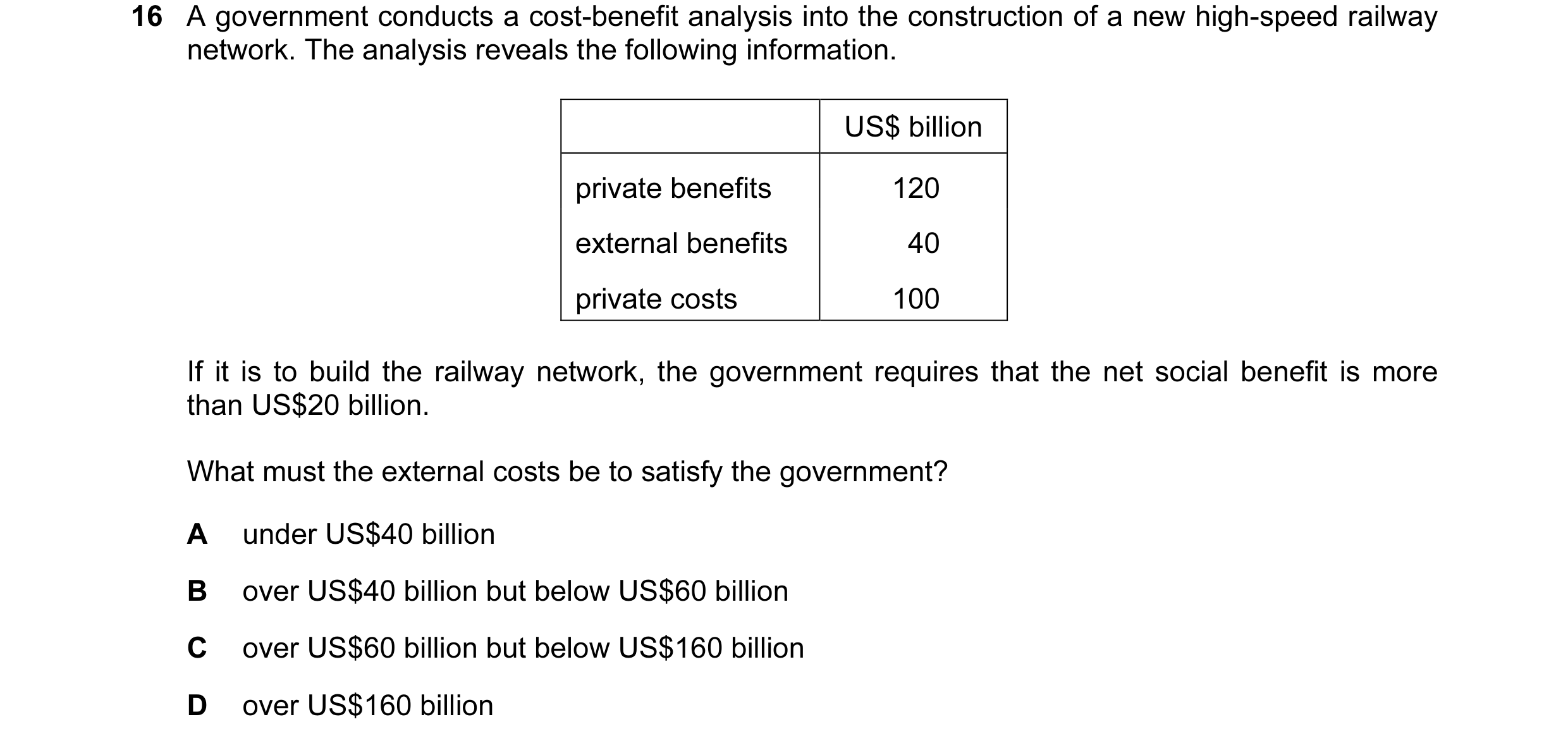
16 A government conducts a cost-benefit analysis into the construction of a new high-speed railway network. The analysis reveals the following information. US$ billion private benefits 120 external benefits 40 private costs 100 If it is to build the railway network, the government requires that the net social benefit is more than US$20 billion. What must the external costs be to satisfy the government? A under US$40 billion B over US$40 billion but below US$60 billion C over US$60 billion but below US$160 billion D over US$160 billion
1 marks
Answer: A
This question in 9708/13 May/June 2015
Q121 · What would be least likely to have an external benefit? 9708/11 Oct/Nov 2015
14 What would be least likely to have an external benefit? A a new drug to prevent malaria in Nigeria B the granting of permission to develop a rural area in Bangladesh C the imposition of a quota on fishing in the Atlantic Ocean D the purchase of tickets to attend the Olympics in Brazil
1 marks
Answer: D
This question in 9708/11 Oct/Nov 2015
Q122 · Which statement is correct? 9708/11 Oct/Nov 2015
15 Which statement is correct? A External cost is the sum of social cost and private cost. B Private costs are usually larger than social costs. C Social costs are usually smaller than external costs. D Social cost is the sum of private cost and external cost.
1 marks
Answer: D
This question in 9708/11 Oct/Nov 2015
Q123 · A government has sufficient funds to pay for two transport projects 9708/11 Oct/Nov 2015
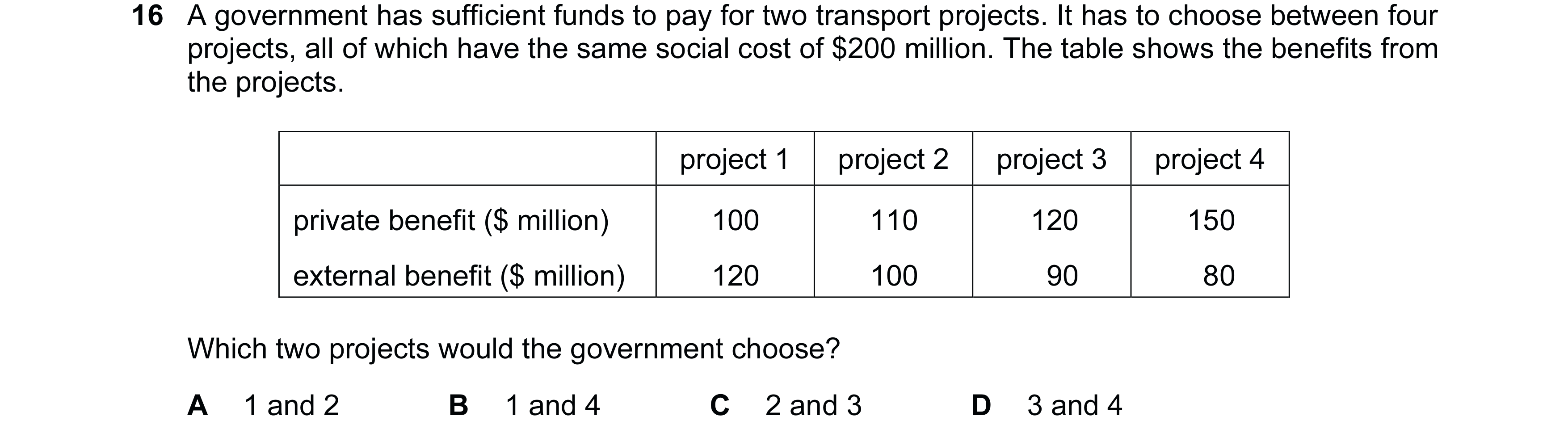
16 A government has sufficient funds to pay for two transport projects. It has to choose between four projects, all of which have the same social cost of $200 million. The table shows the benefits from the projects. project 1 project 2 project 3 project 4 private benefit ($ million) 100 110 120 150 external benefit ($ million) 120 100 90 80 Which two projects would the government choose? A 1 and 2 B 1 and 4 C 2 and 3 D 3 and 4
1 marks
Answer: B
This question in 9708/11 Oct/Nov 2015
Q124 · A gardener plants bamboo to create an attractive environment along the roadside 9708/12 Oct/Nov 2015
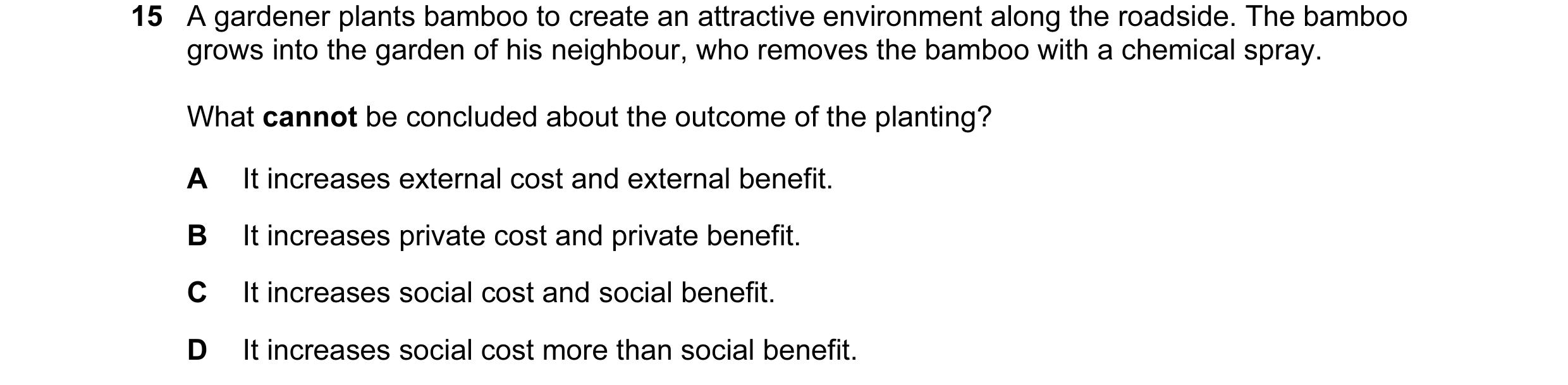
15 A gardener plants bamboo to create an attractive environment along the roadside. The bamboo grows into the garden of his neighbour, who removes the bamboo with a chemical spray. What cannot be concluded about the outcome of the planting? A It increases external cost and external benefit. B It increases private cost and private benefit. C It increases social cost and social benefit. D It increases social cost more than social benefit.
1 marks
Answer: D
This question in 9708/12 Oct/Nov 2015
Q125 · A cost-benefit analysis of a proposed underground railway produced the following… 9708/12 Oct/Nov 2015
16 A cost-benefit analysis of a proposed underground railway produced the following statistics. annual costs and benefits $ million annual capital cost 10 operating and maintenance costs 3 fare revenue 6 savings to private travellers 5 savings to business 10 other economic benefits 7 What can be concluded from the statistics? A If undertaken by the private sector there would be a loss of $13 million. B If undertaken by the private sector there would be a profit of $3 million. C If undertaken by the public sector there would be a net social benefit of $15 million. D If undertaken by the public sector there would be a net social cost of $1 million.
1 marks
Answer: C
This question in 9708/12 Oct/Nov 2015
Q126 · People walking past a bakery often comment on the pleasure of smelling freshly baked bread 9708/13 Oct/Nov 2015
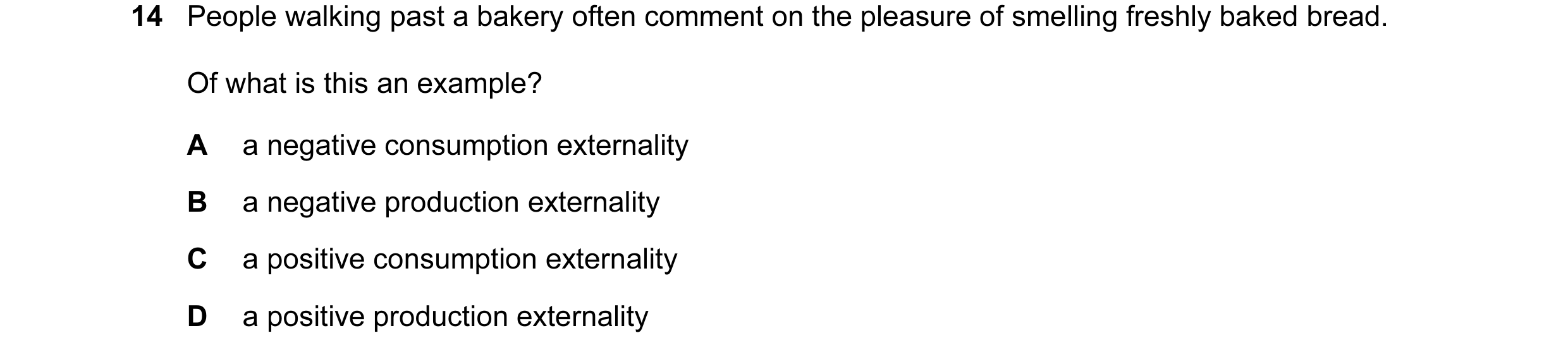
14 People walking past a bakery often comment on the pleasure of smelling freshly baked bread. Of what is this an example? A a negative consumption externality B a negative production externality C a positive consumption externality D a positive production externality
1 marks
Answer: D
This question in 9708/13 Oct/Nov 2015
Q127 · When would cost-benefit analysis definitely indicate that a government project should be… 9708/13 Oct/Nov 2015
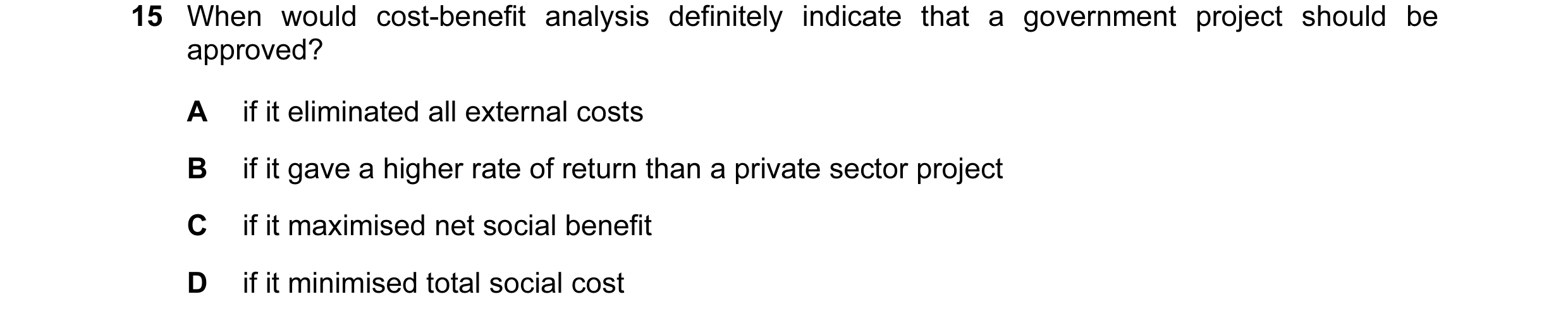
15 When would cost-benefit analysis definitely indicate that a government project should be approved? A if it eliminated all external costs B if it gave a higher rate of return than a private sector project C if it maximised net social benefit D if it minimised total social cost
1 marks
Answer: C
This question in 9708/13 Oct/Nov 2015
Q128 · The table gives information about the 2011 Australian Grand Prix in Australian dollars… 9708/13 Oct/Nov 2015
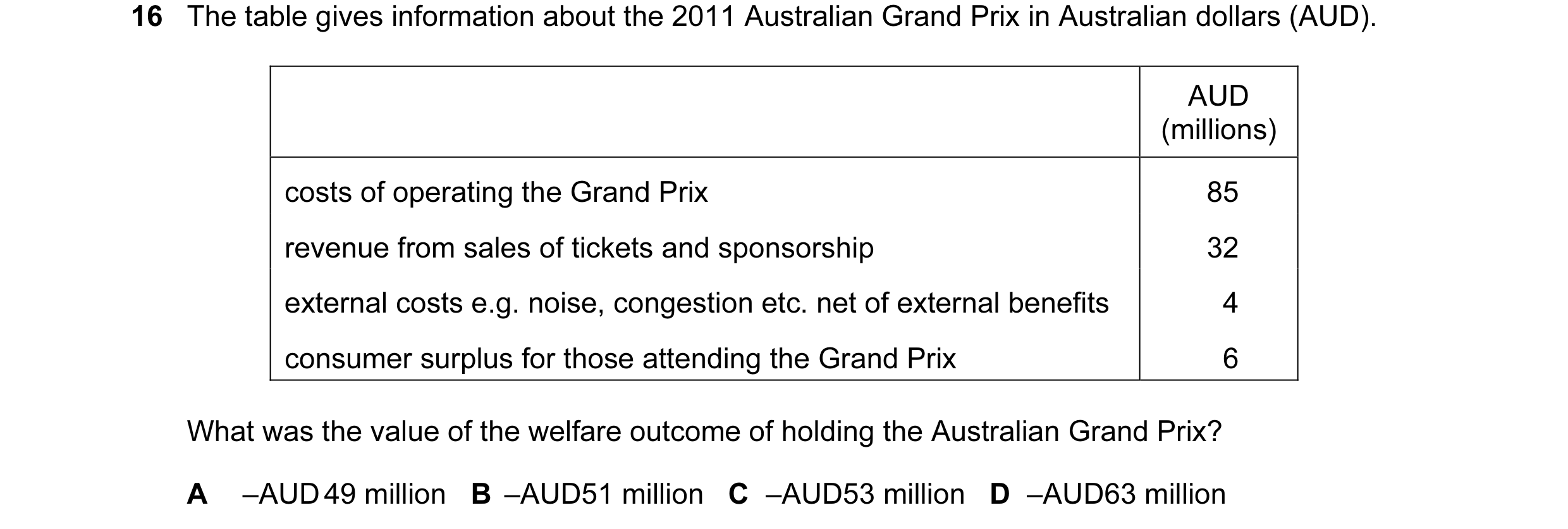
16 The table gives information about the 2011 Australian Grand Prix in Australian dollars (AUD). AUD (millions) costs of operating the Grand Prix 85 revenue from sales of tickets and sponsorship 32 external costs e.g. noise, congestion etc. net of external benefits 4 consumer surplus for those attending the Grand Prix 6 What was the value of the welfare outcome of holding the Australian Grand Prix? A –AUD 49 million B –AUD51 million C –AUD53 million D –AUD63 million
1 marks
Answer: B
This question in 9708/13 Oct/Nov 2015
Q129 · Many governments are concerned that the high sugar content in fizzy drinks might lead to… 9708/13 Oct/Nov 2017
4 Many governments are concerned that the high sugar content in fizzy drinks might lead to health problems such as obesity. These governments are also concerned about the lack of public awareness of the dangers. What can be concluded from this? A Consumers of fizzy drinks have information failures. B Consumers under-consume fizzy drinks. C Fizzy drinks are merit goods. D Fizzy drinks are non-excludable.
1 marks
Answer: A
This question in 9708/13 Oct/Nov 2017
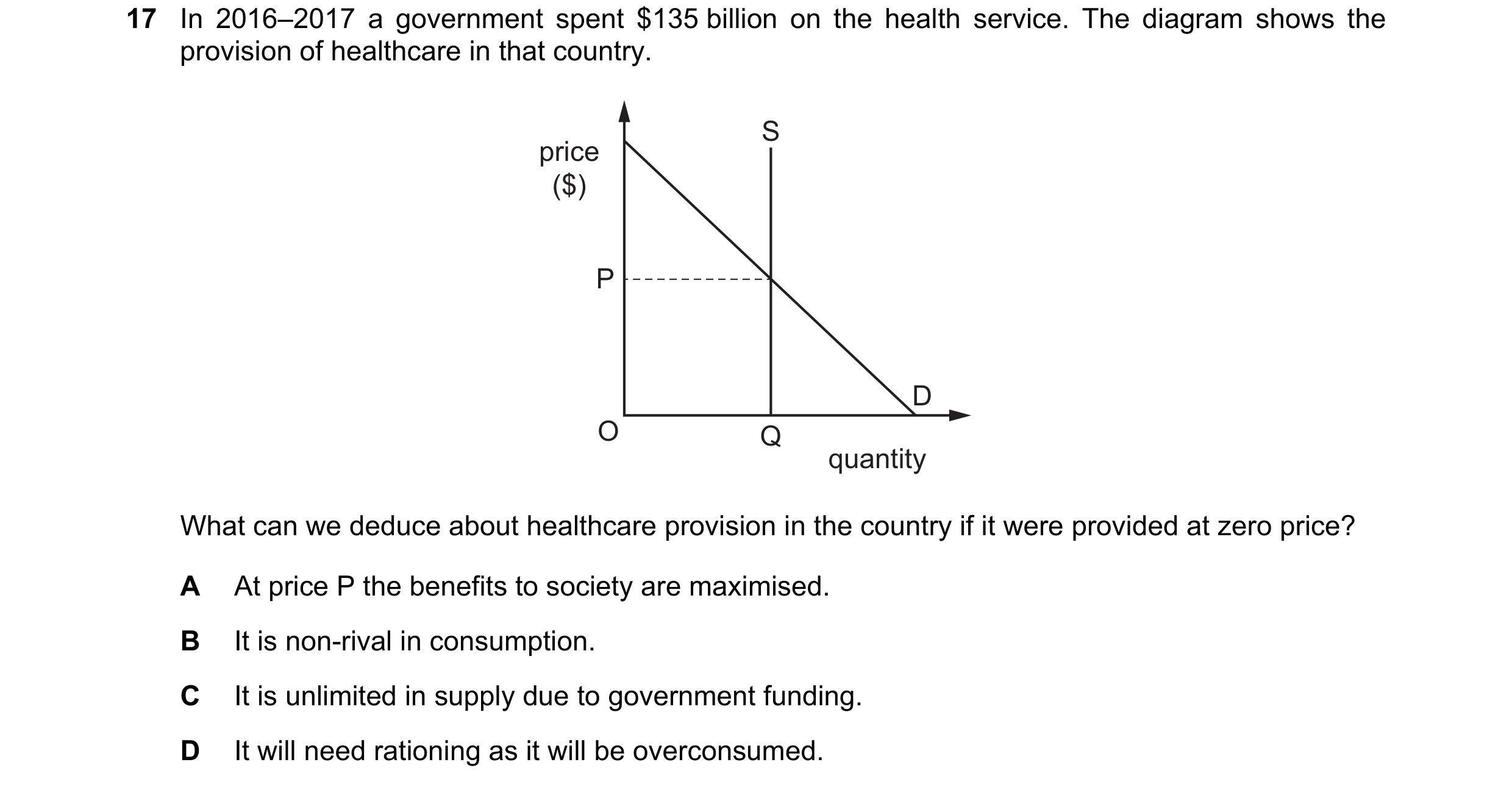
Q130 · In 2016–2017 a government spent $135 billion on the health service 9708/12 May/June 2018
17 In 2016–2017 a government spent $135 billion on the health service. The diagram shows the provision of healthcare in that country. S price ($) P D O Q quantity What can we deduce about healthcare provision in the country if it were provided at zero price? A At price P the benefits to society are maximised. B It is non-rival in consumption. C It is unlimited in supply due to government funding. D It will need rationing as it will be overconsumed.
1 marks
Answer: D
This question in 9708/12 May/June 2018
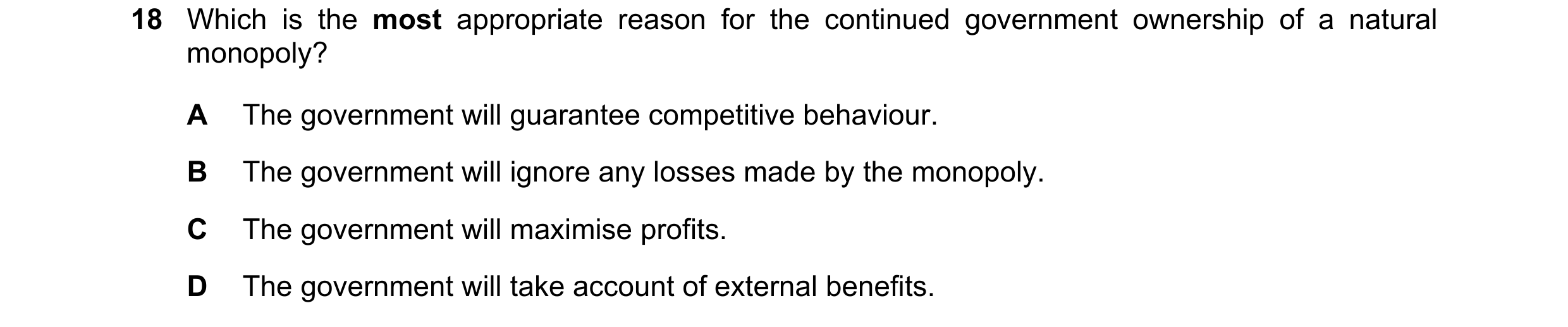
Q131 · Which is the most appropriate reason for the continued government ownership of a natural… 9708/11 Oct/Nov 2019
18 Which is the most appropriate reason for the continued government ownership of a natural monopoly? A The government will guarantee competitive behaviour. B The government will ignore any losses made by the monopoly. C The government will maximise profits. D The government will take account of external benefits.
1 marks
Answer: D
This question in 9708/11 Oct/Nov 2019
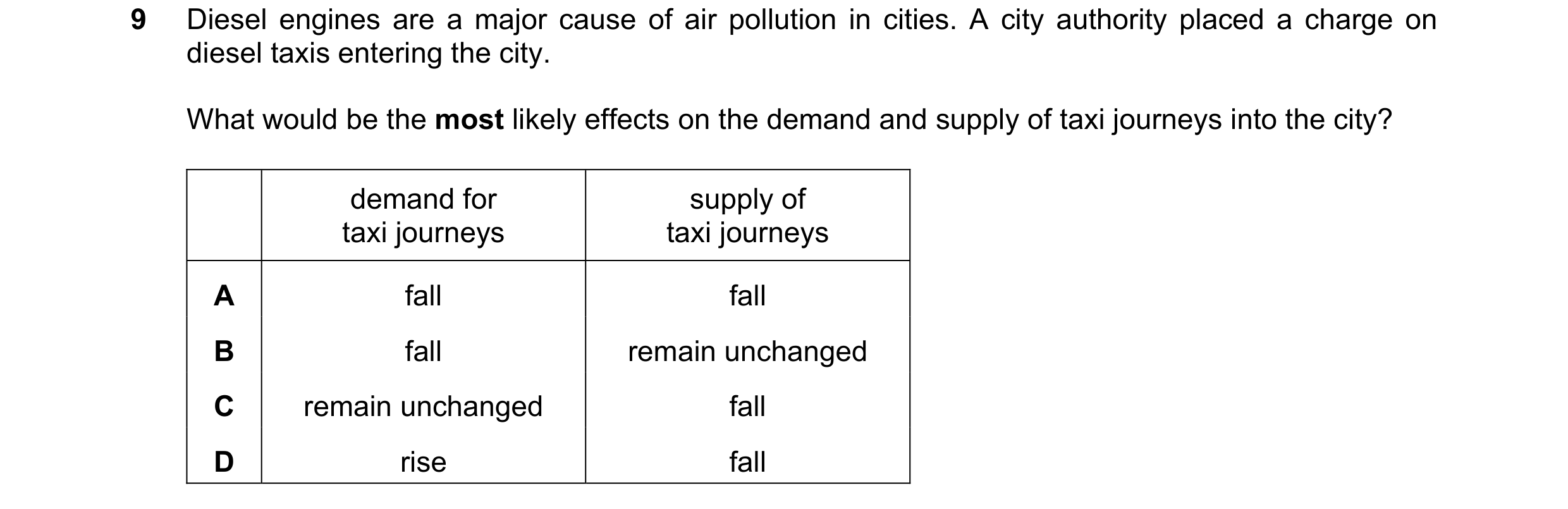
Q132 · Diesel engines are a major cause of air pollution in cities 9708/13 May/June 2020
9 Diesel engines are a major cause of air pollution in cities. A city authority placed a charge on diesel taxis entering the city. What would be the most likely effects on the demand and supply of taxi journeys into the city? demand for supply of taxi journeys taxi journeys A fall fall B fall remain unchanged C remain unchanged fall D rise fall
1 marks
Answer: A
This question in 9708/13 May/June 2020
Q133 · The diagram shows the demand and supply curves for healthcare in a private market 9708/11 Oct/Nov 2020
16 The diagram shows the demand and supply curves for healthcare in a private market. supply price P demand O Q quantity What would happen if the government provides the same amount of healthcare free of charge? A Healthcare will become a public good. B Healthcare will no longer have external benefits. C There will be over-consumption of healthcare. D There will need to be rationing.
1 marks
Answer: D
This question in 9708/11 Oct/Nov 2020
Q134 · Why is national defence provided by the government? 9708/12 Feb/March 2021
18 Why is national defence provided by the government? A In a free market it is excludable and rival in consumption. B In a free market it is non-excludable and non-rival in consumption. C The government has perfect information, so it can set the correct quantity required. D The private sector firm would charge a high price for its use as it is a necessity.
1 marks
Answer: B
This question in 9708/12 Feb/March 2021
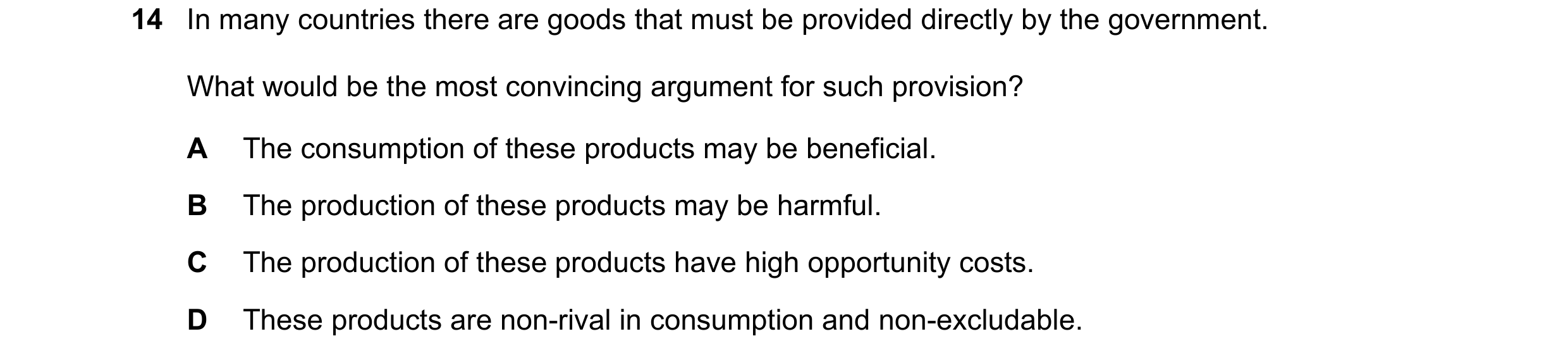
Q135 · In many countries there are goods that must be provided directly by the government 9708/13 May/June 2021
14 In many countries there are goods that must be provided directly by the government. What would be the most convincing argument for such provision? A The consumption of these products may be beneficial. B The production of these products may be harmful. C The production of these products have high opportunity costs. D These products are non-rival in consumption and non-excludable.
1 marks
Answer: D
This question in 9708/13 May/June 2021
Q136 · Why do some local governments subsidise the provision of bicycles to encourage their use? 9708/12 Feb/March 2023
13 Why do some local governments subsidise the provision of bicycles to encourage their use? A Consumers are afraid of having car accidents. B Consumers are unable to afford bicycles. C Consumers are not aware of the external benefits of using bicycles. D Consumers ignore the external costs of using bicycles.
1 marks
Answer: C
This question in 9708/12 Feb/March 2023
Q137 · A government wishes to intervene in a free market to allocate healthcare at the socially… 9708/11 Oct/Nov 2024
14 A government wishes to intervene in a free market to allocate healthcare at the socially optimal level. Which combination correctly identifies the reason for government intervention in the healthcare market? healthcare healthcare provision of consumption in a production in a information in a free market free market free market A overconsumption overproduction too little B overconsumption underproduction too much C underconsumption underproduction too little D underconsumption overproduction too much
1 marks
Answer: C
This question in 9708/11 Oct/Nov 2024
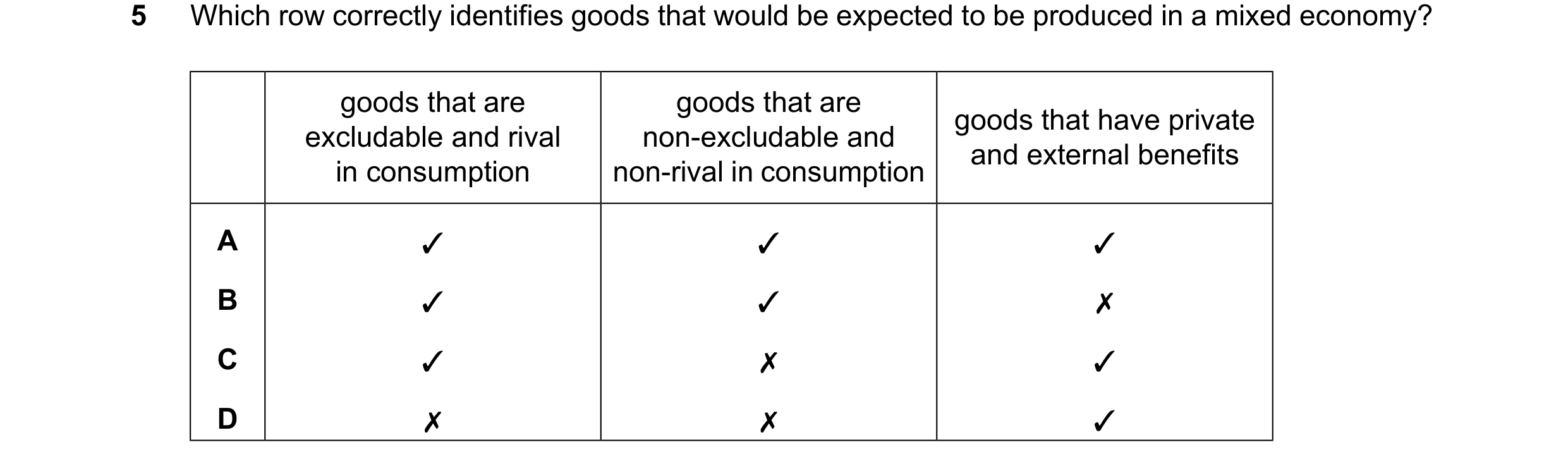
Q138 · Which row correctly identifies goods that would be expected to be produced in a mixed… 9708/13 May/June 2025
5 Which row correctly identifies goods that would be expected to be produced in a mixed economy? goods that are goods that are goods that have private excludable and rival non-excludable and and external benefits in consumption non-rival in consumption A ✓ ✓ ✓ B ✓ ✓ ✗ C ✓ ✗ ✓ D ✗ ✗ ✓
1 marks
Answer: A
This question in 9708/13 May/June 2025




 1 / 34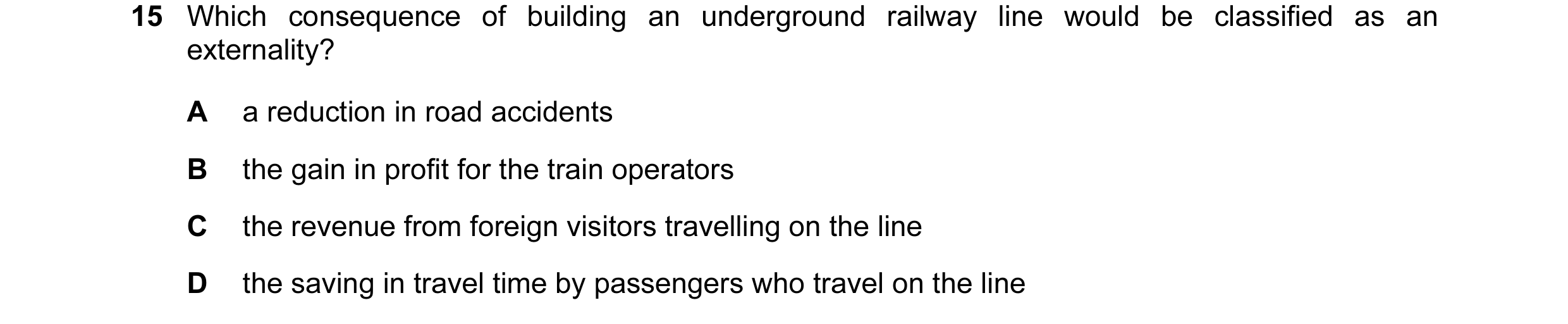
 2 / 34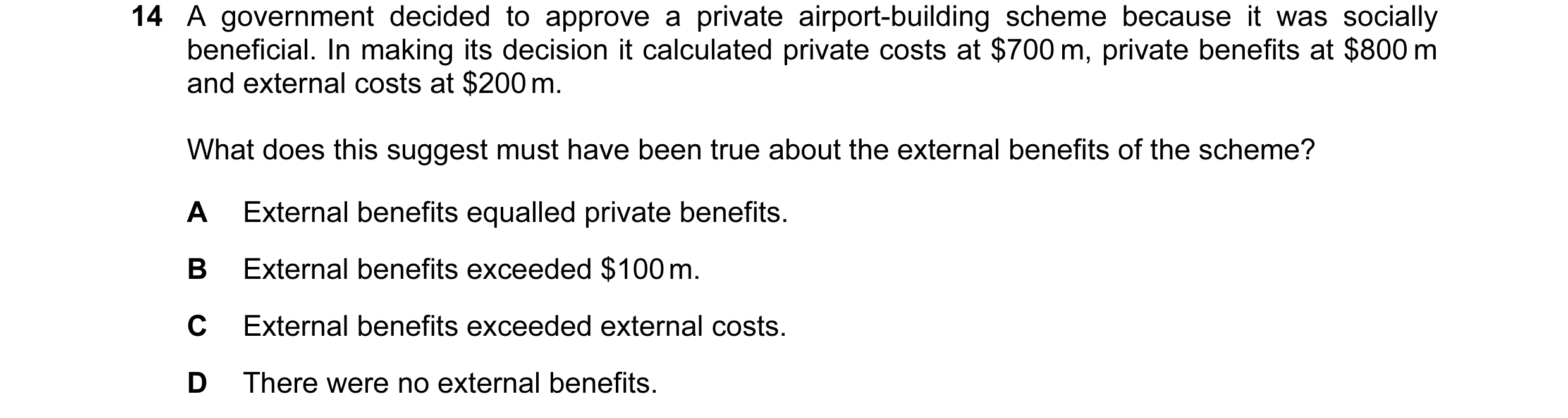


 3 / 34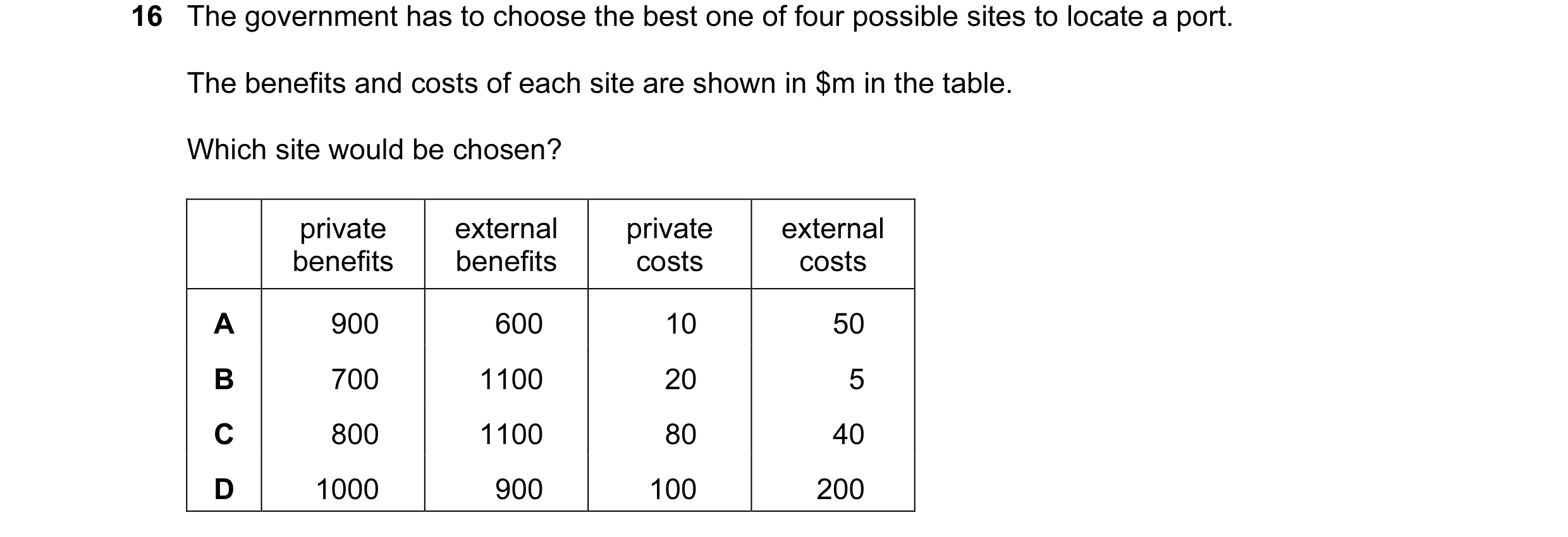

 4 / 34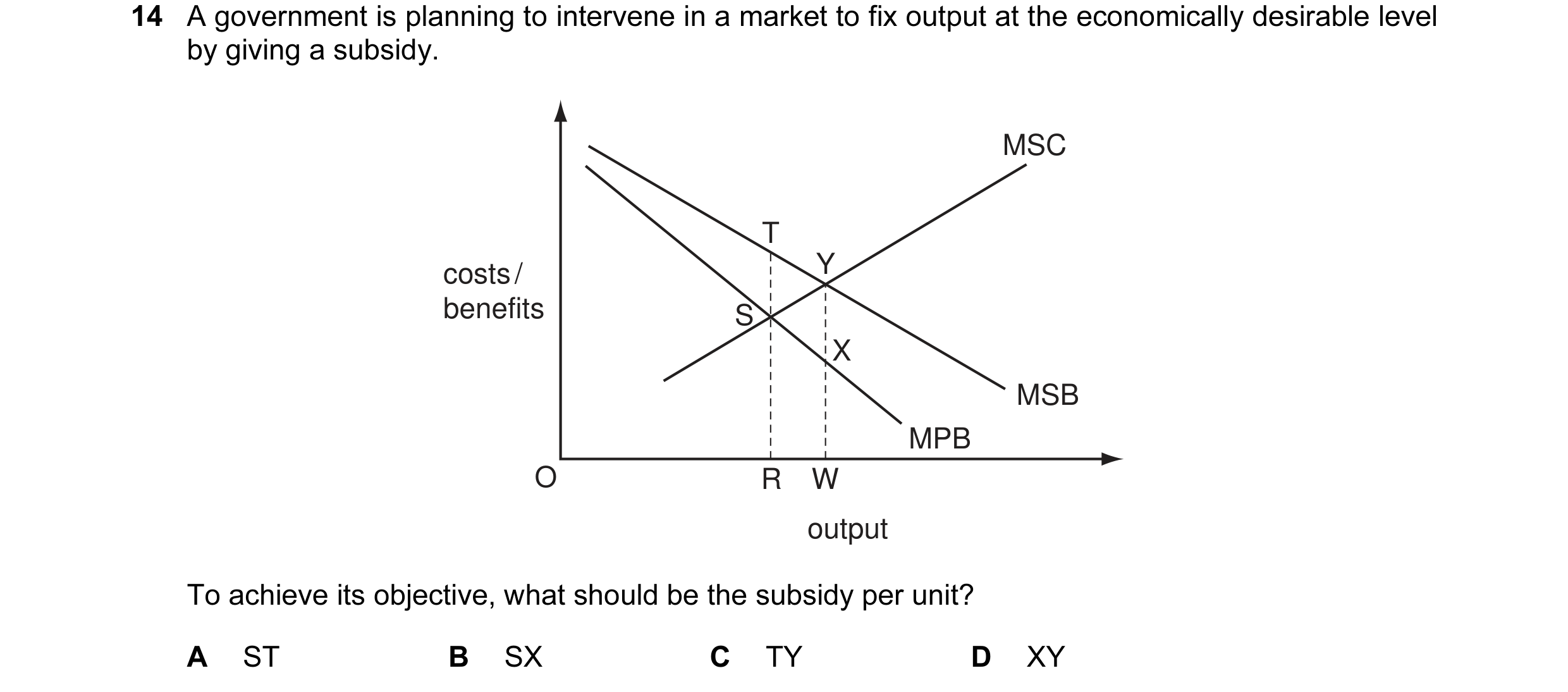
 5 / 34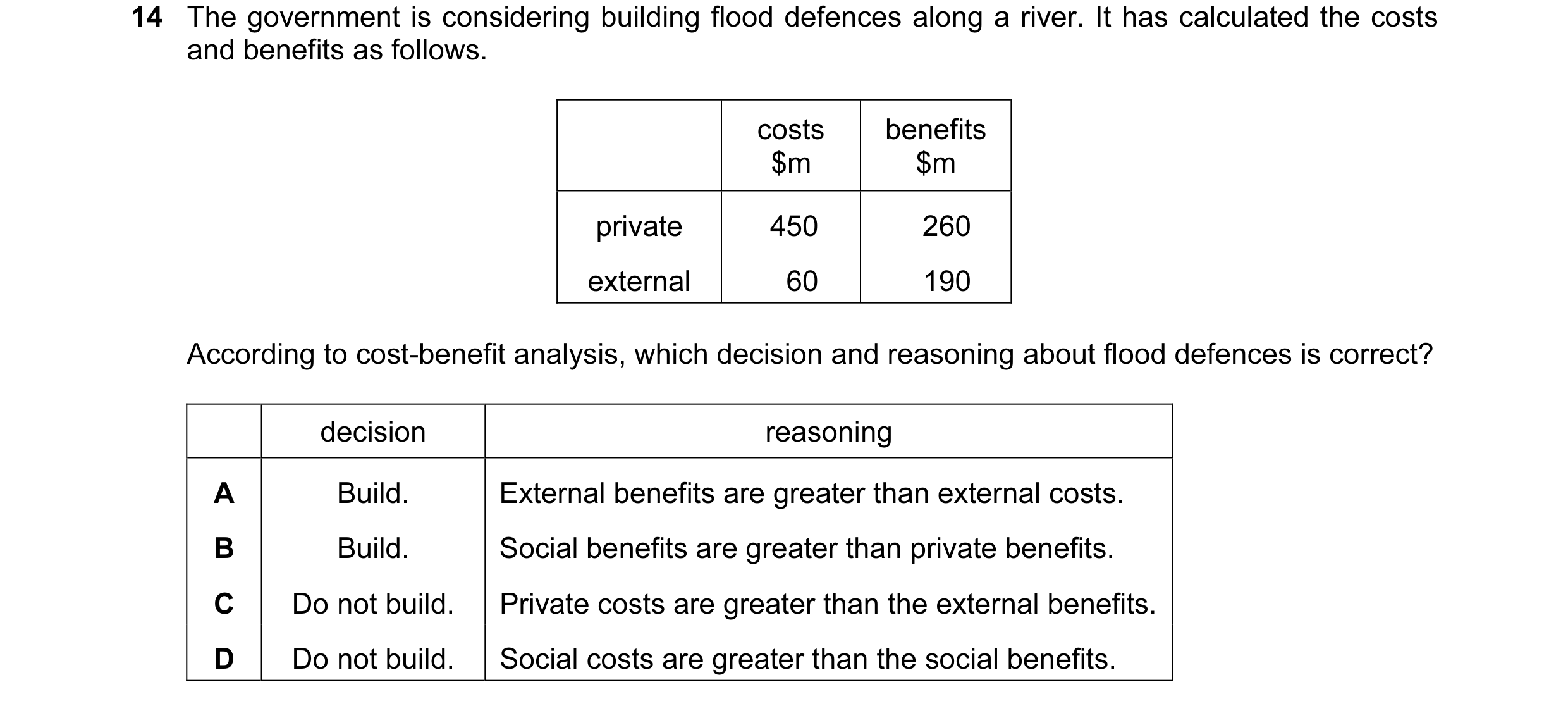
 6 / 34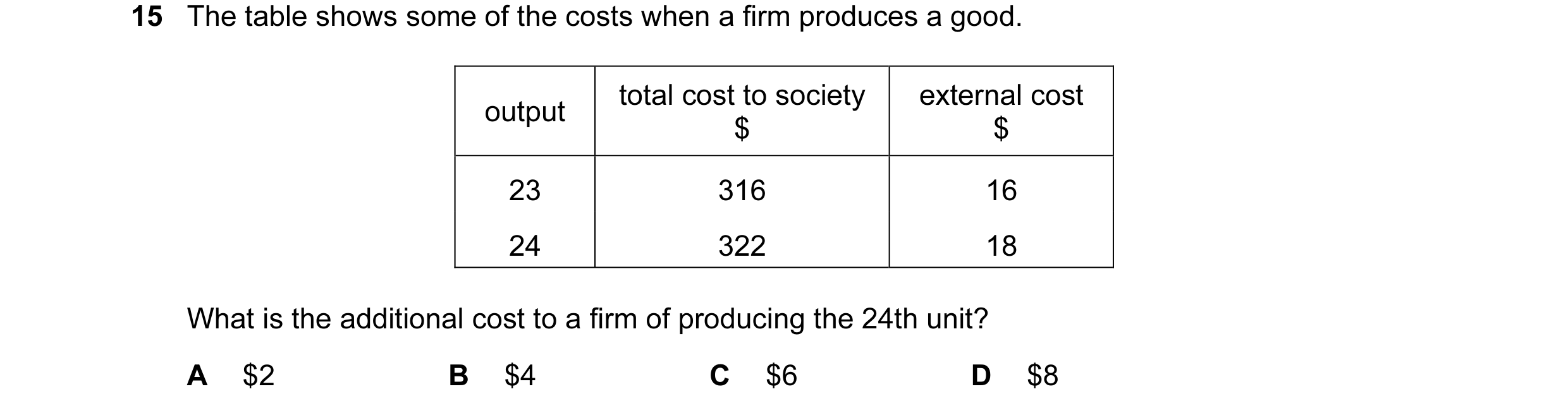

 7 / 34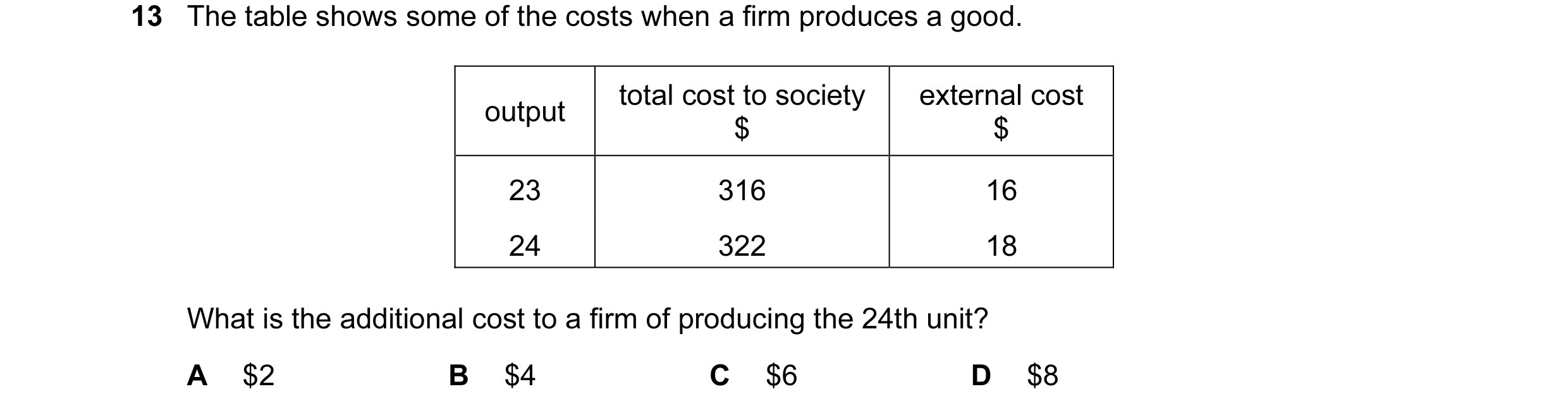


 8 / 34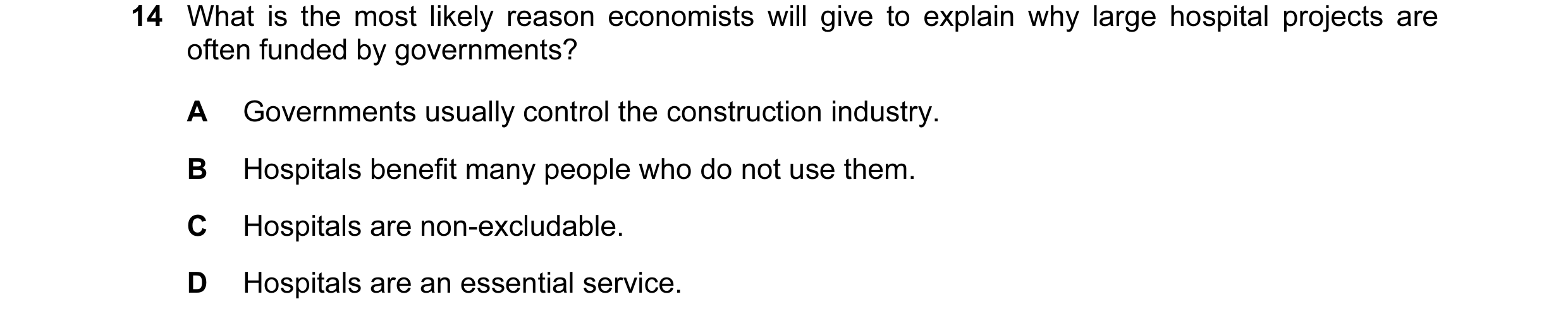

 9 / 34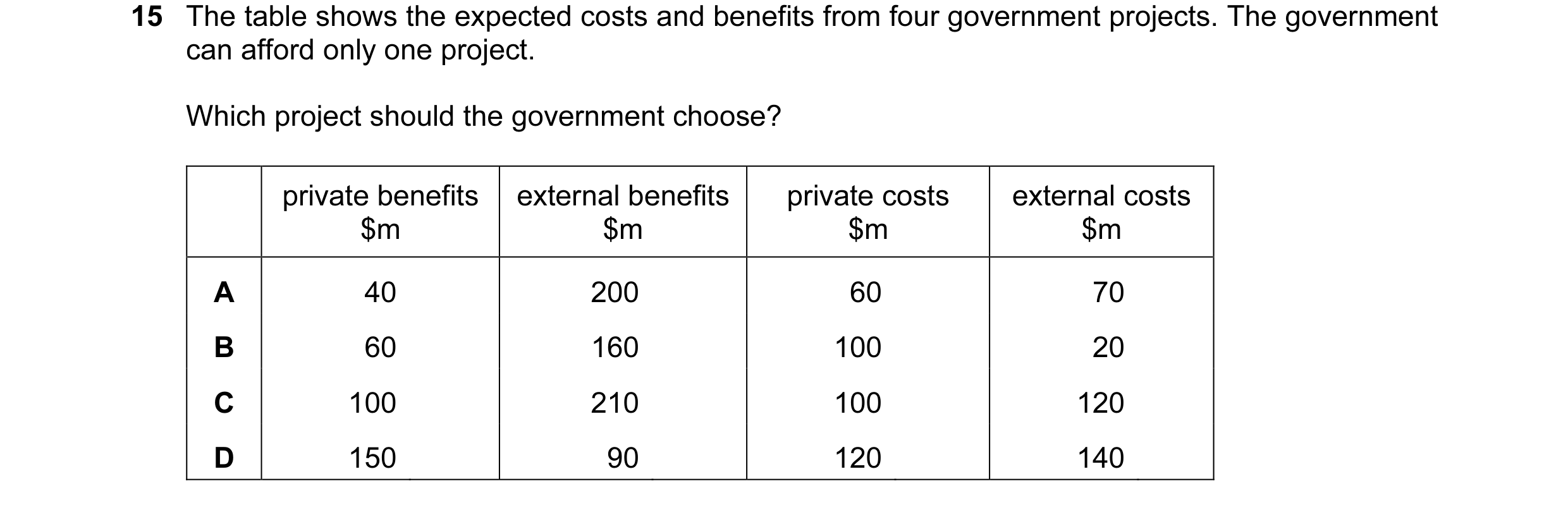
 10 / 34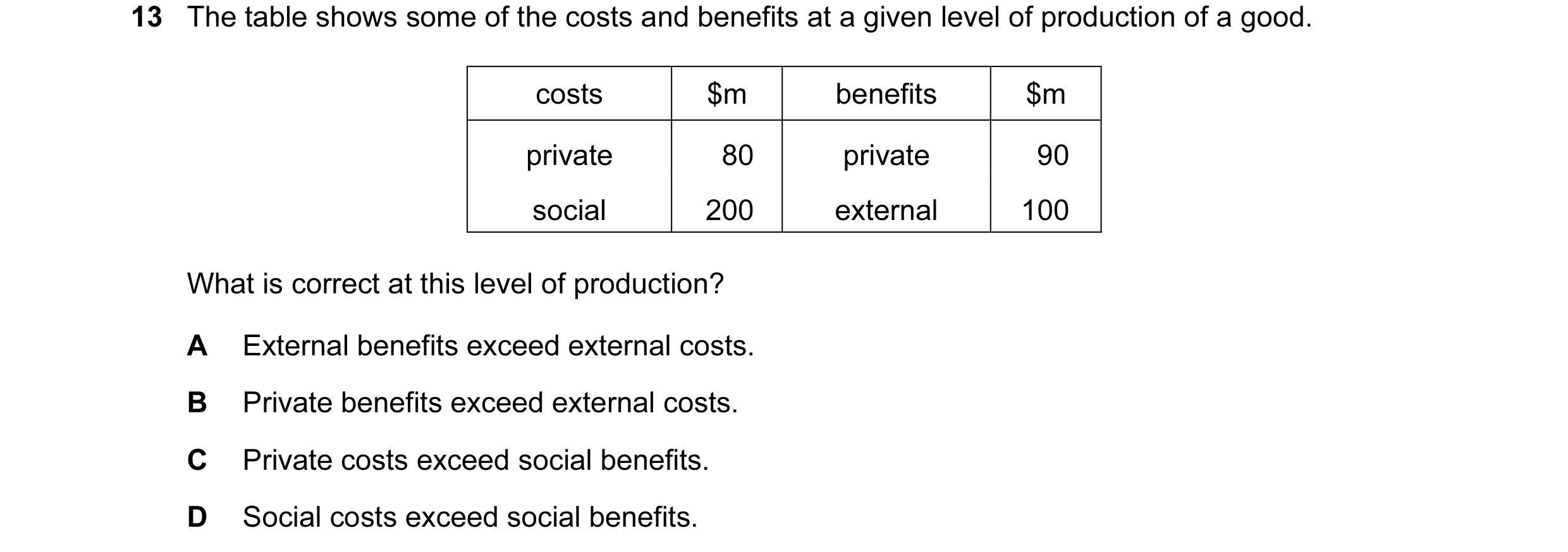
 11 / 34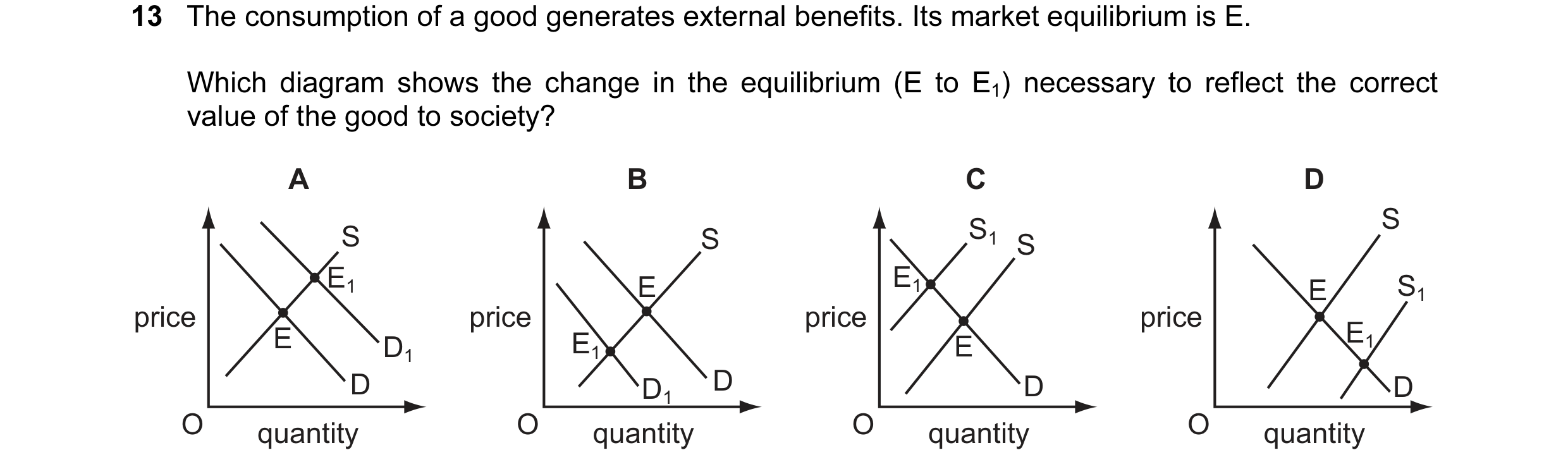
 12 / 34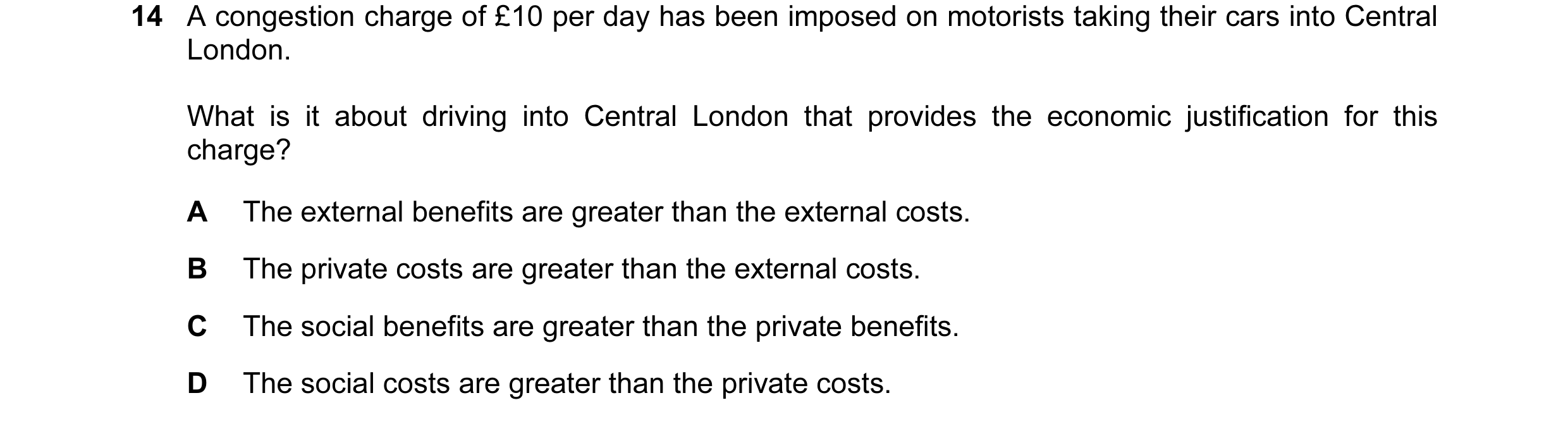
 13 / 34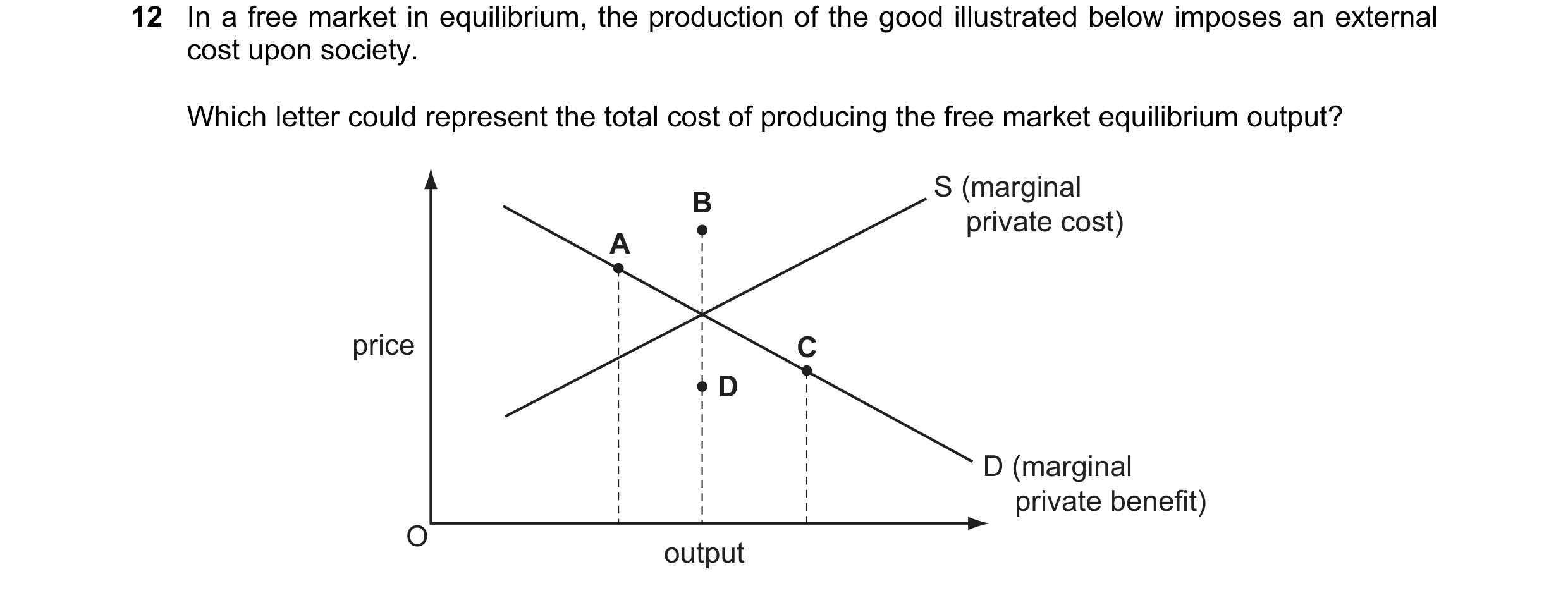

 14 / 34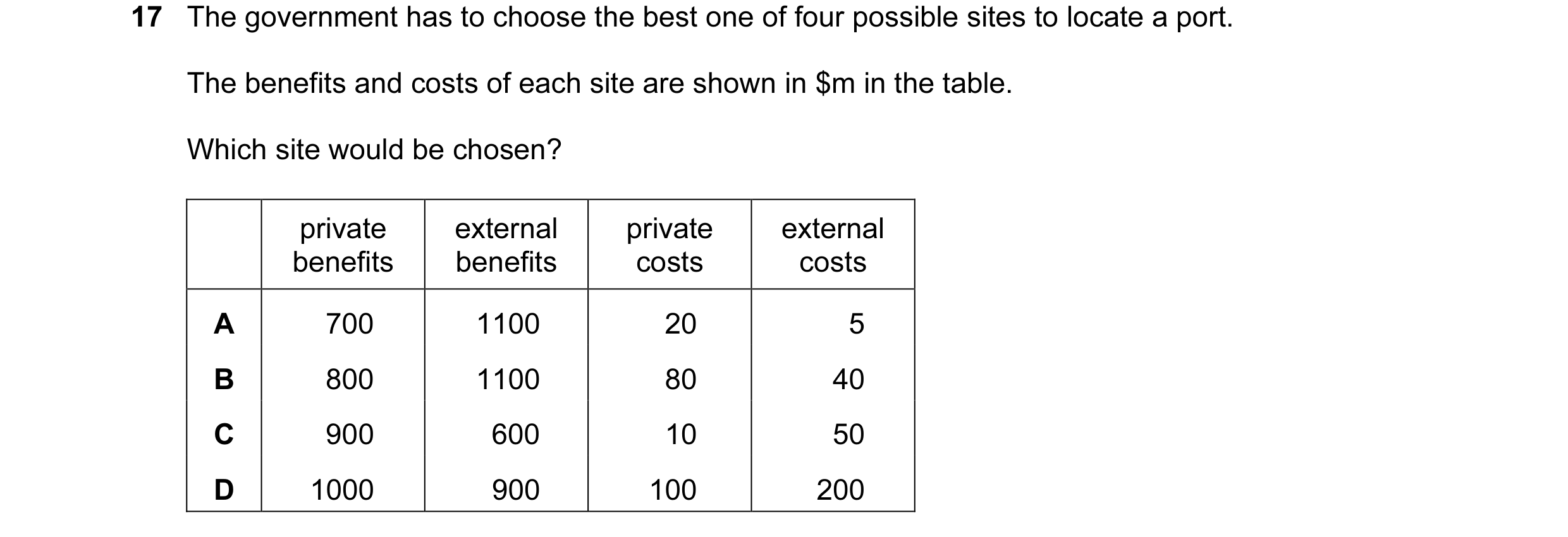

 15 / 34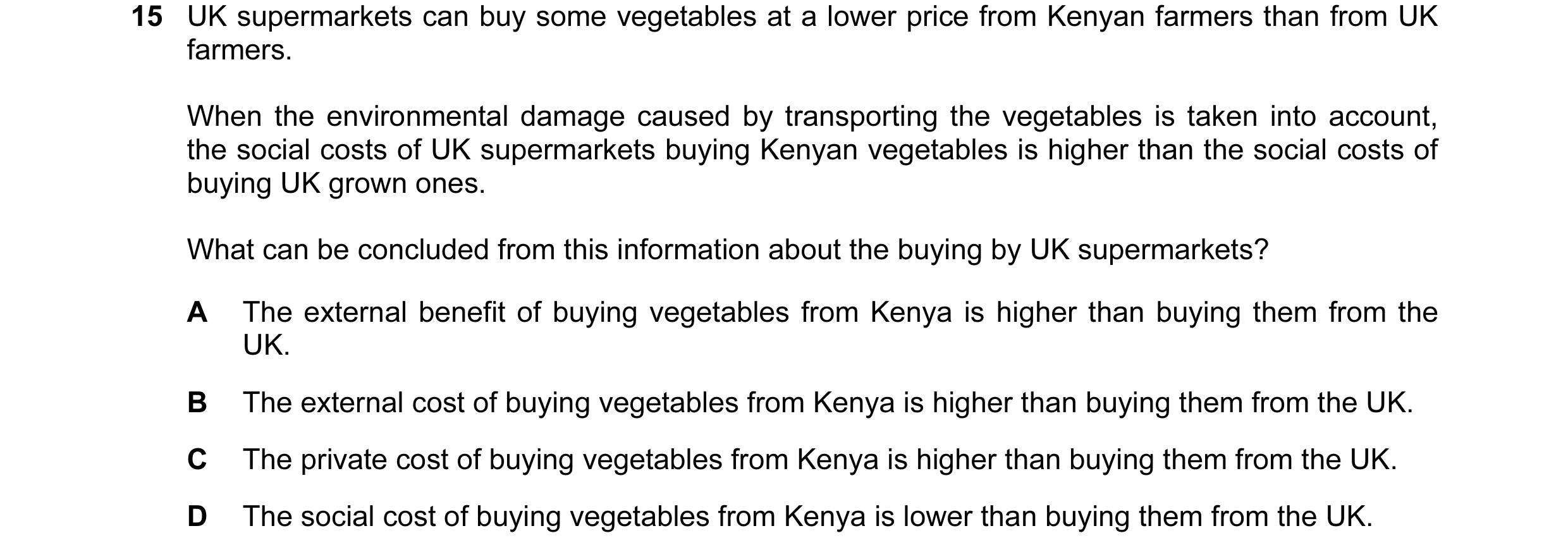
 16 / 34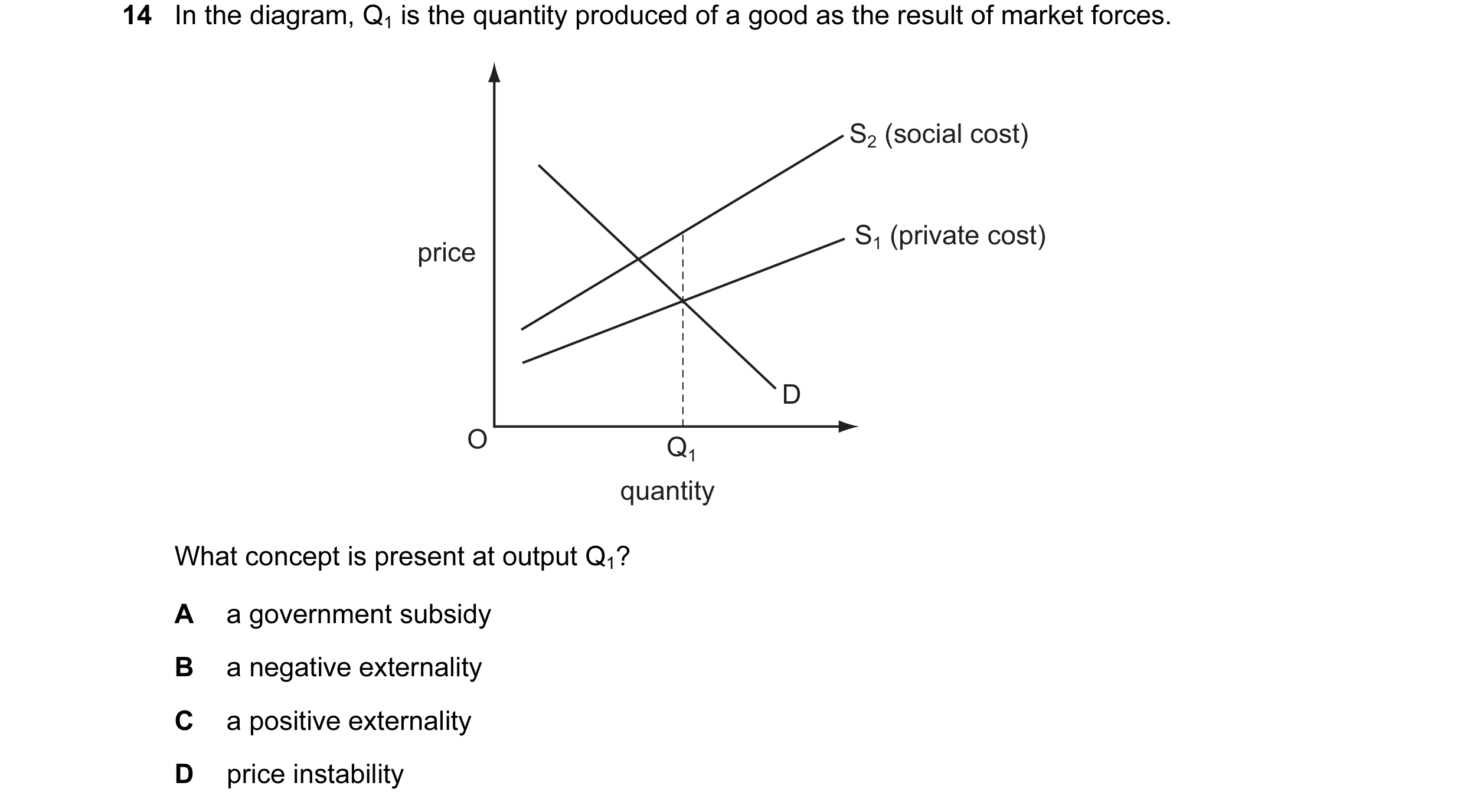
 17 / 34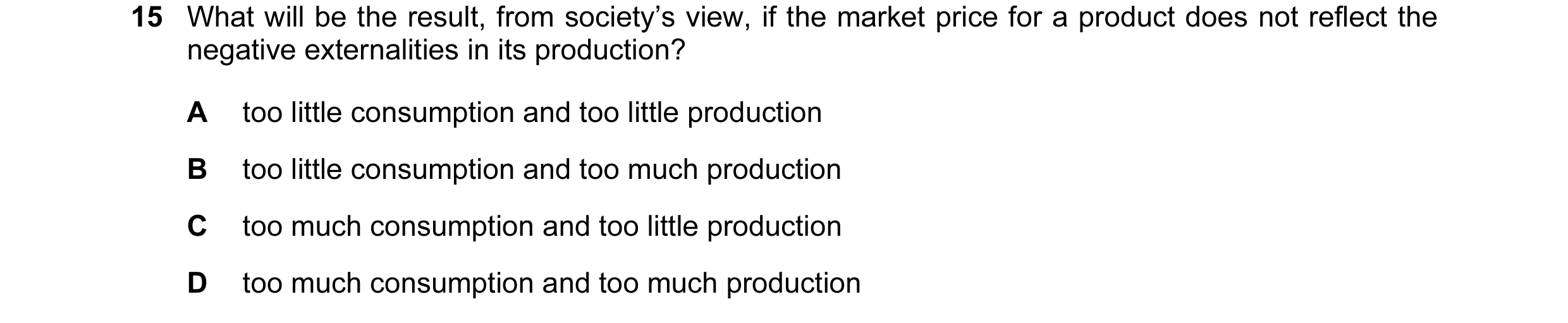
 18 / 34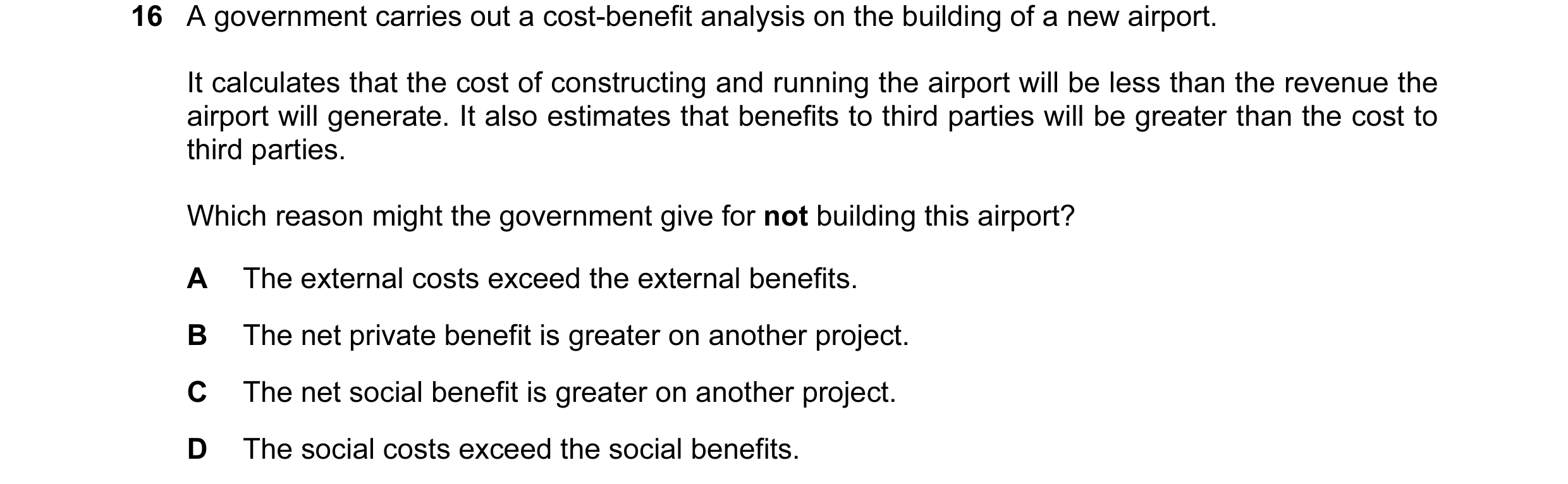
 19 / 34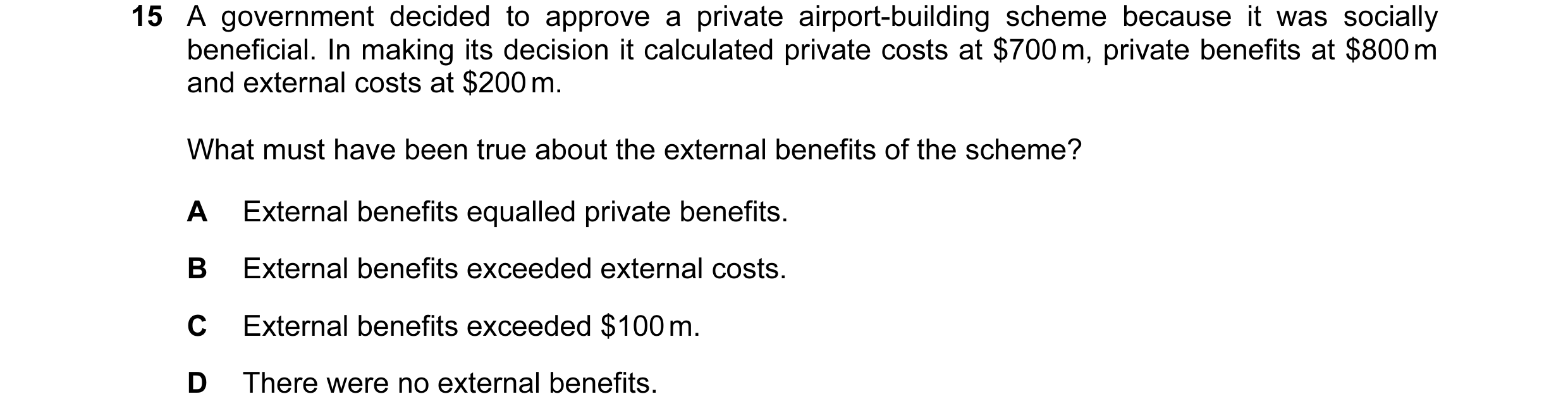

 20 / 34

 21 / 34

 22 / 34

 23 / 34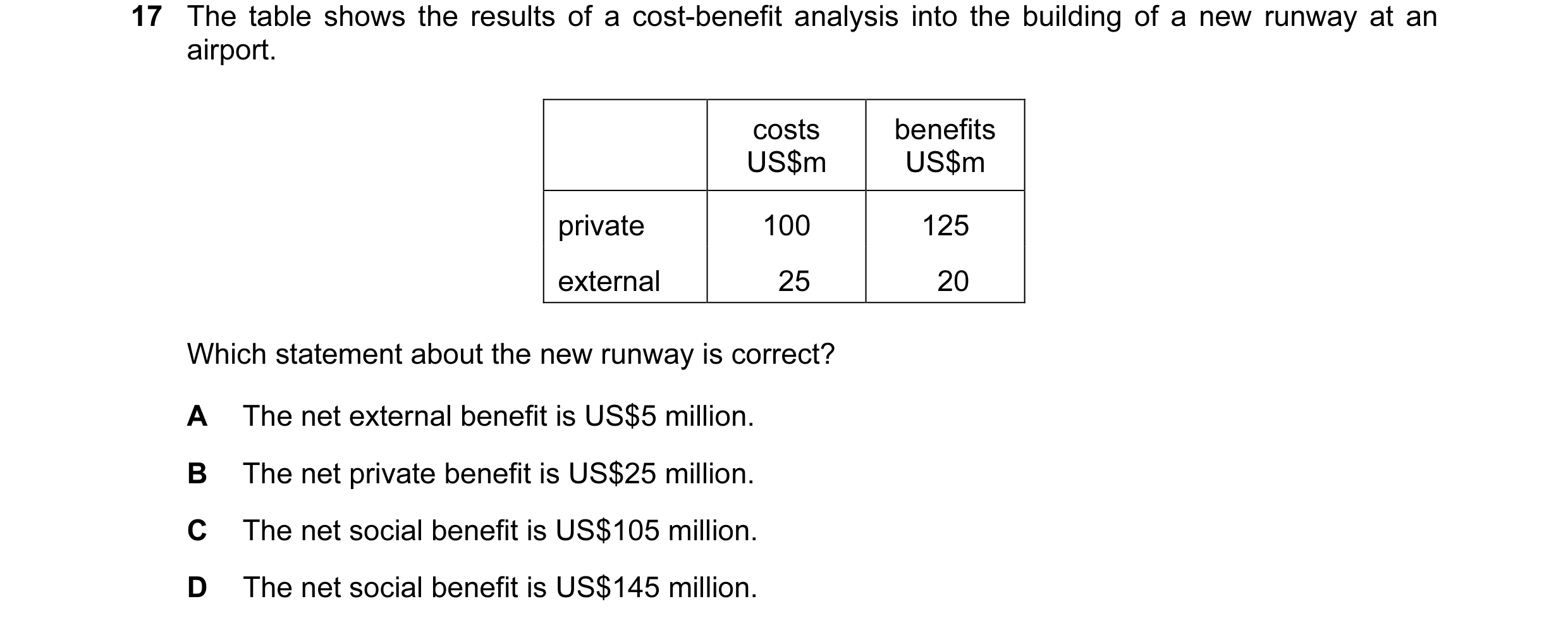
 24 / 34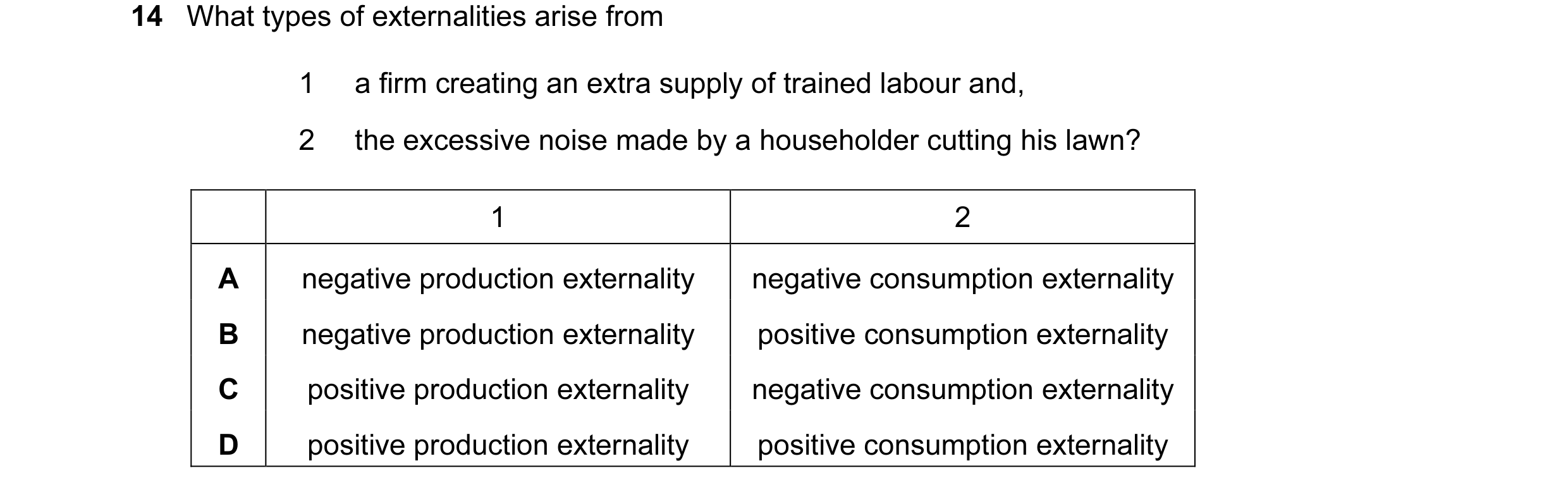
 25 / 34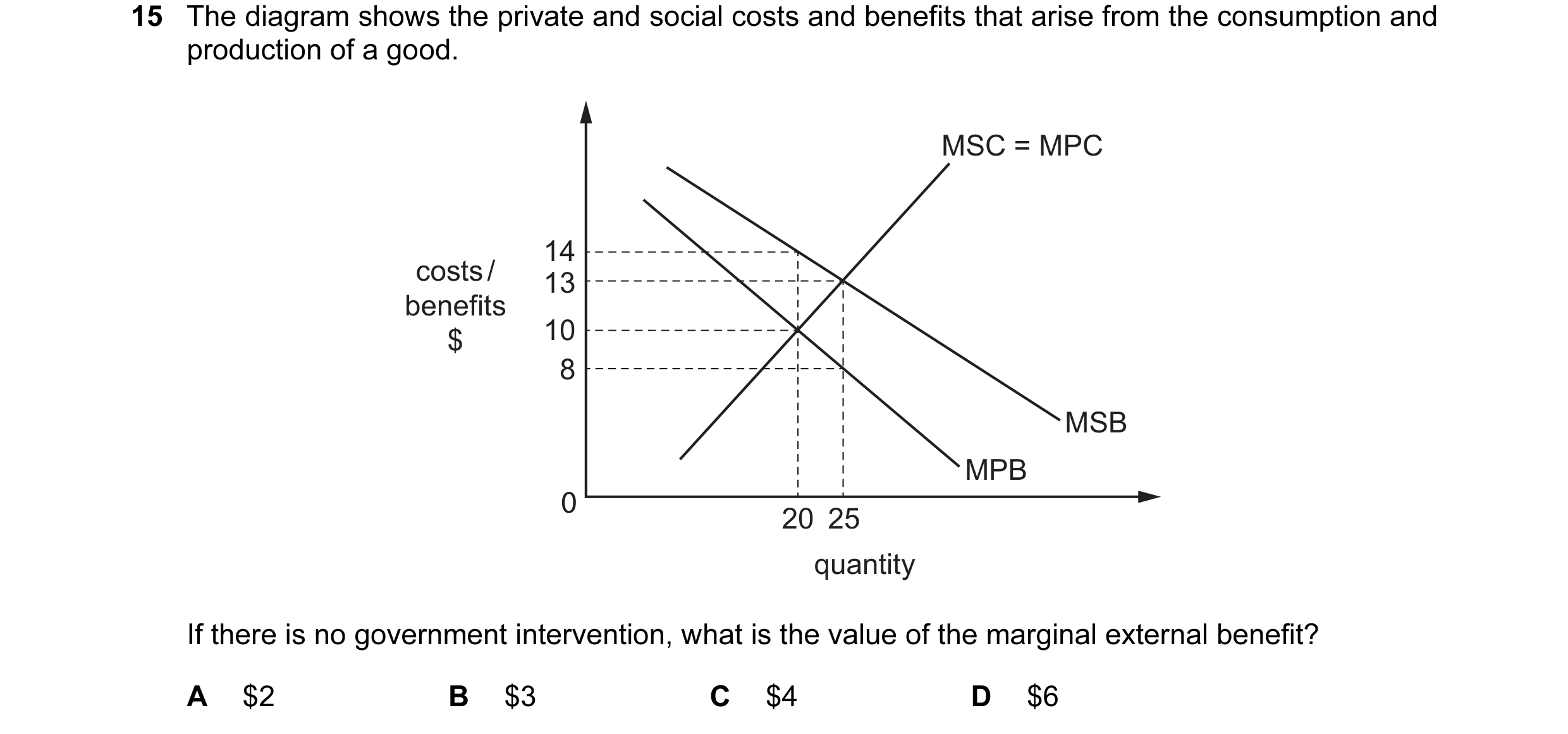
 26 / 34
 27 / 34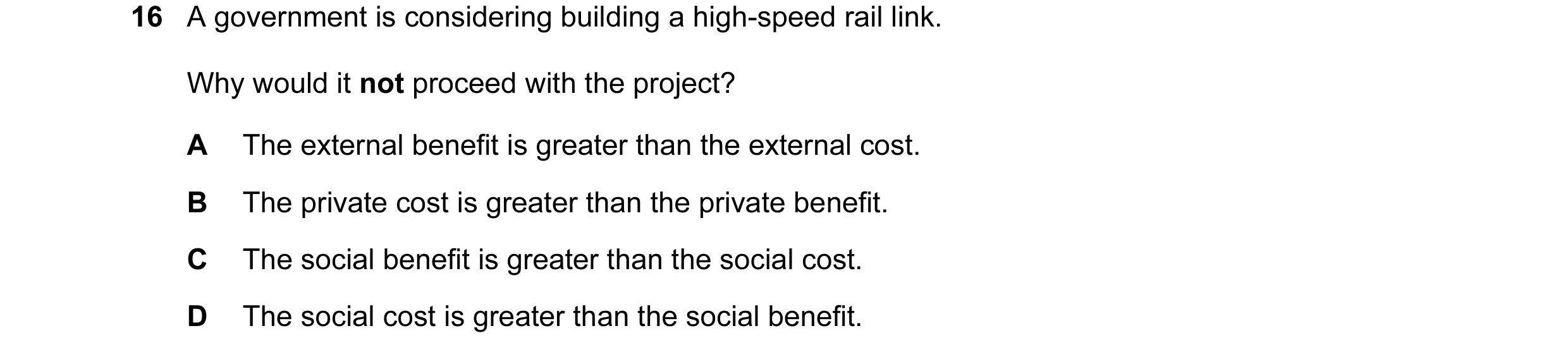

 28 / 34
 29 / 34

 30 / 34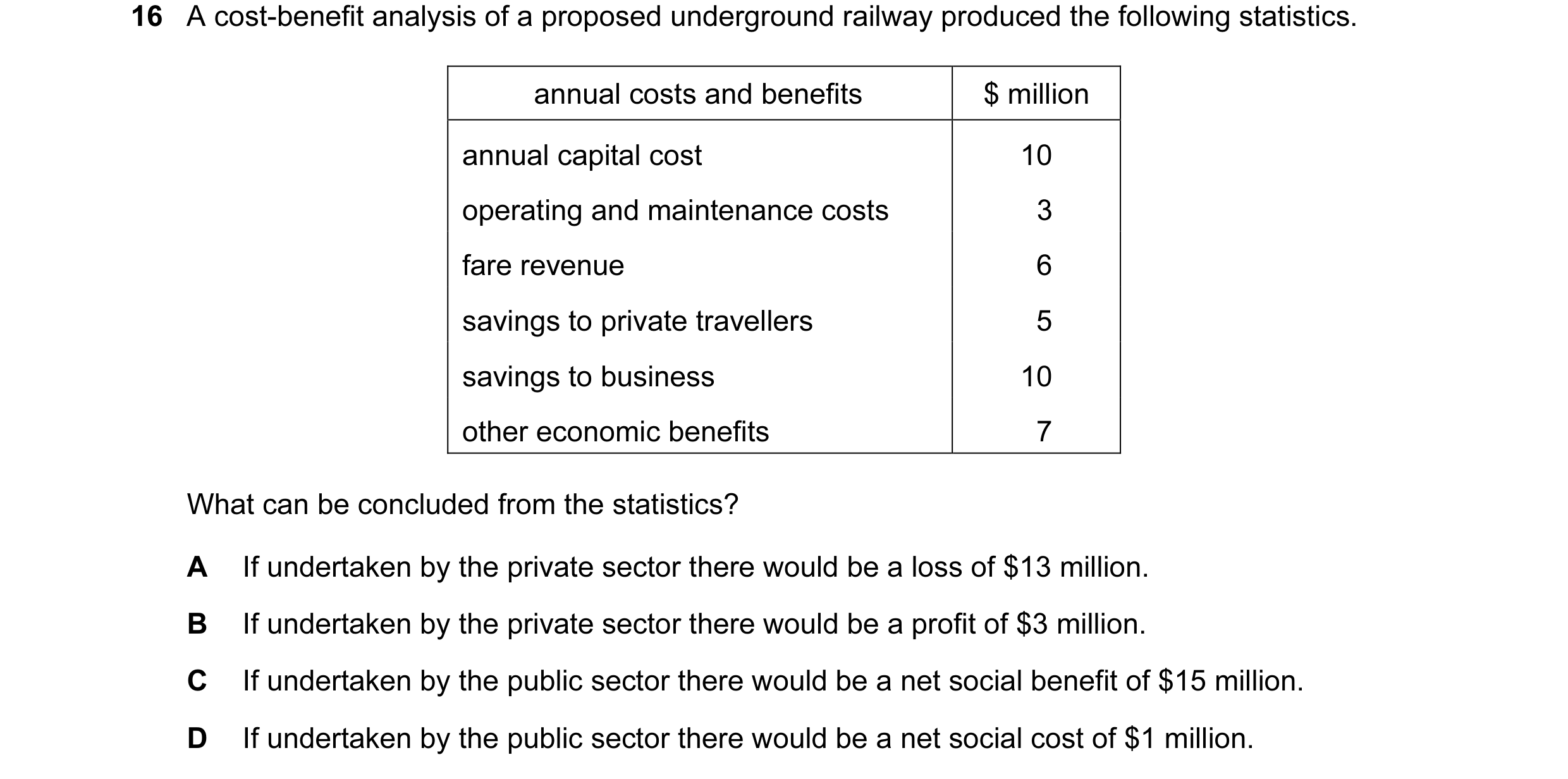
 31 / 34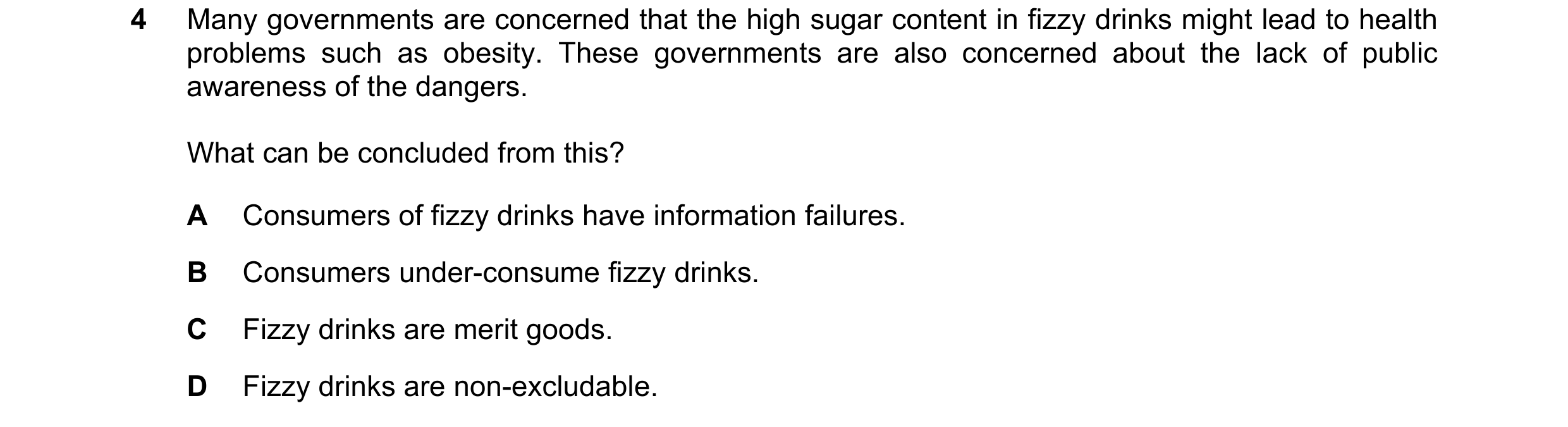
 32 / 34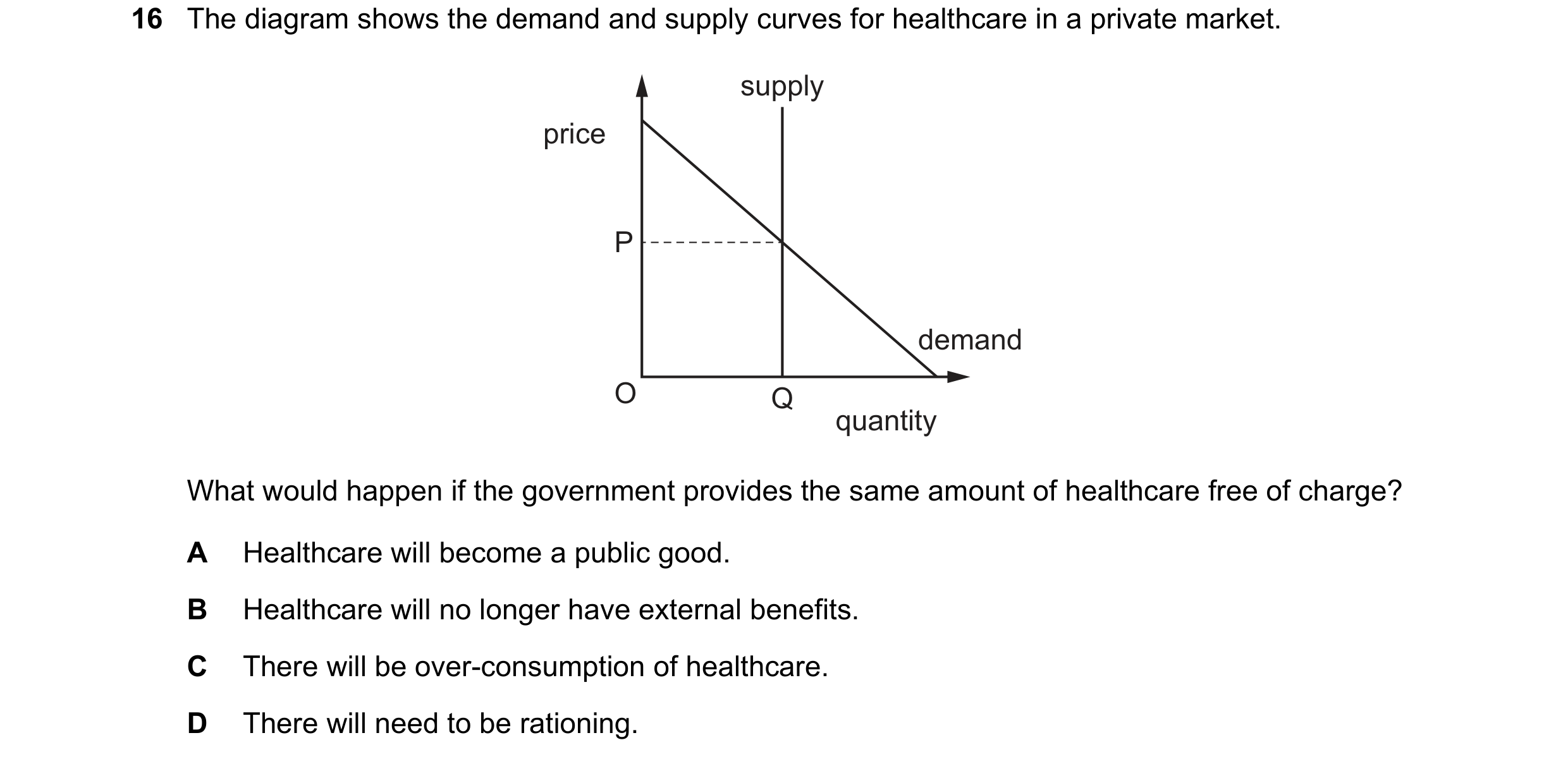

 33 / 34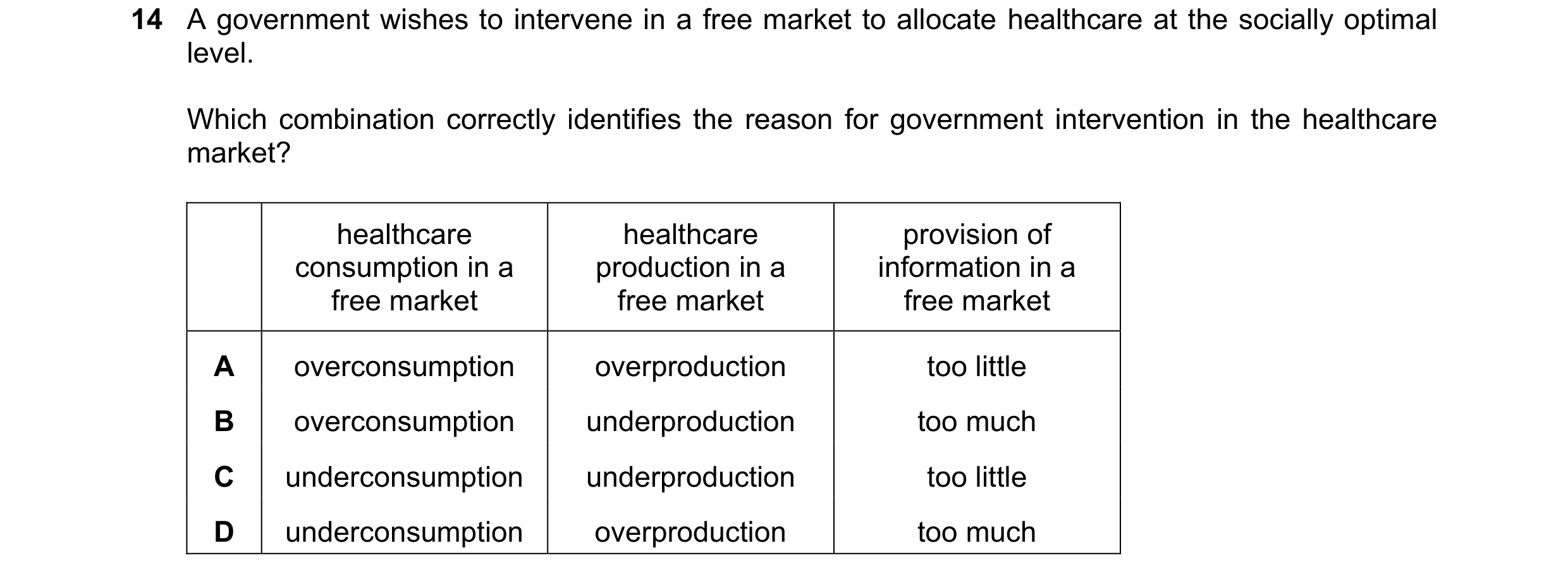
 34 / 34