Questions as text
Q1 · When will taxes be most effective in dampening cyclical changes in national output? 9708/31 Oct/Nov 2010
28 When will taxes be most effective in dampening cyclical changes in national output? A when the tax yield is independent of national income B when the tax yield varies inversely with national income C when the tax yield varies less than proportionately with national income D when the tax yield varies more than proportionately with national income
1 marks
Answer: D
This question in 9708/31 Oct/Nov 2010
Q2 · When will taxes be most effective in dampening cyclical changes in national output? 9708/33 Oct/Nov 2010
27 When will taxes be most effective in dampening cyclical changes in national output? A when the tax yield is independent of national income B when the tax yield varies inversely with national income C when the tax yield varies less than proportionately with national income D when the tax yield varies more than proportionately with national income
1 marks
Answer: D
This question in 9708/33 Oct/Nov 2010
Q3 · The diagram shows the relationship between the rate of inflation and the rate of… 9708/31 May/June 2011
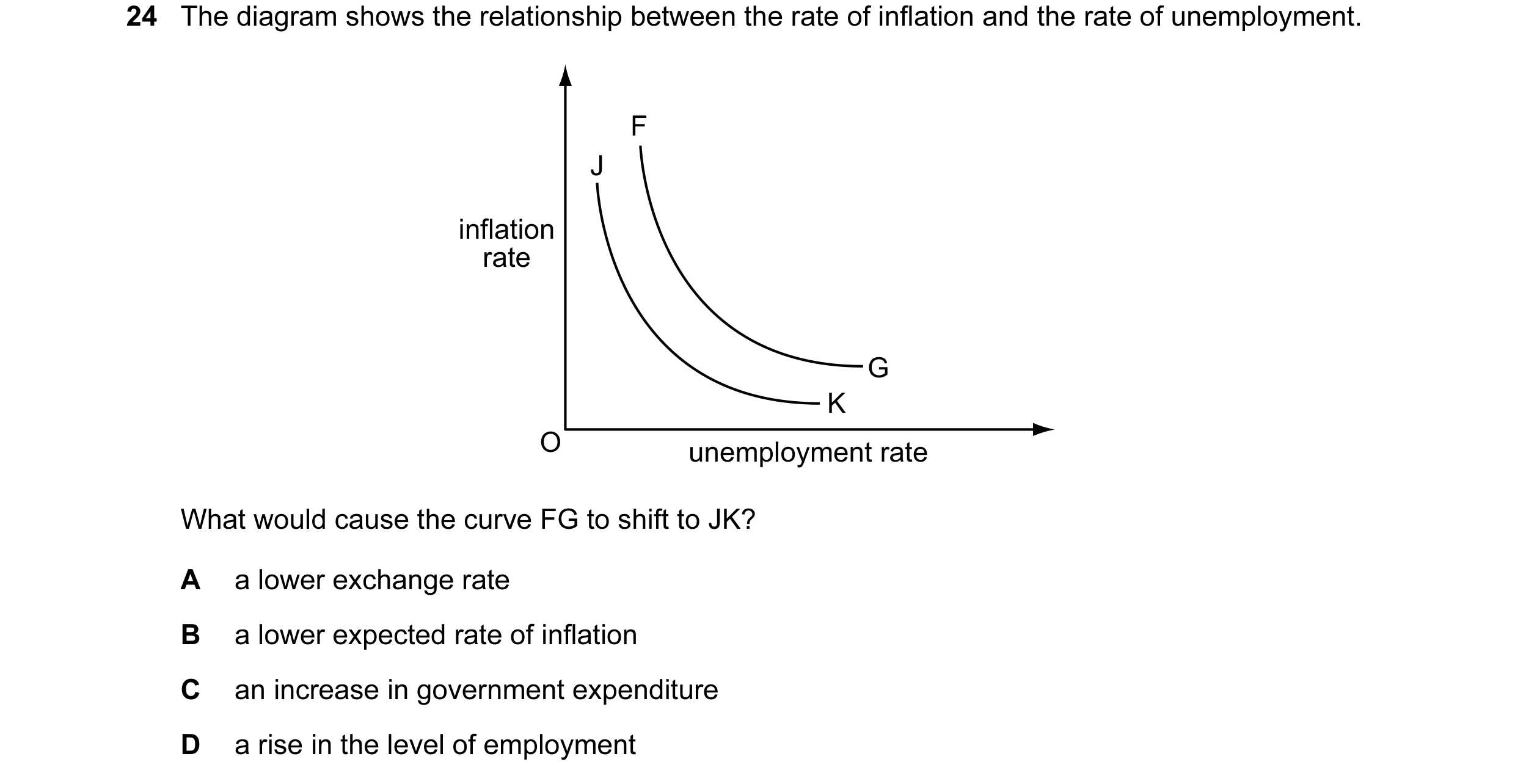
24 The diagram shows the relationship between the rate of inflation and the rate of unemployment. F J inflation rate G K O unemployment rate What would cause the curve FG to shift to JK? A a lower exchange rate B a lower expected rate of inflation C an increase in government expenditure D a rise in the level of employment
1 marks
Answer: B
This question in 9708/31 May/June 2011
Q4 · The diagram shows the relationship between the rate of inflation and the rate of… 9708/33 May/June 2011
23 The diagram shows the relationship between the rate of inflation and the rate of unemployment. F J inflation rate G K O unemployment rate What would cause the curve FG to shift to JK? A a lower exchange rate B a lower expected rate of inflation C an increase in government expenditure D a rise in the level of employment
1 marks
Answer: B
This question in 9708/33 May/June 2011
Q5 · The diagram shows the time path of actual output and of long-term potential output of an… 9708/31 Oct/Nov 2011
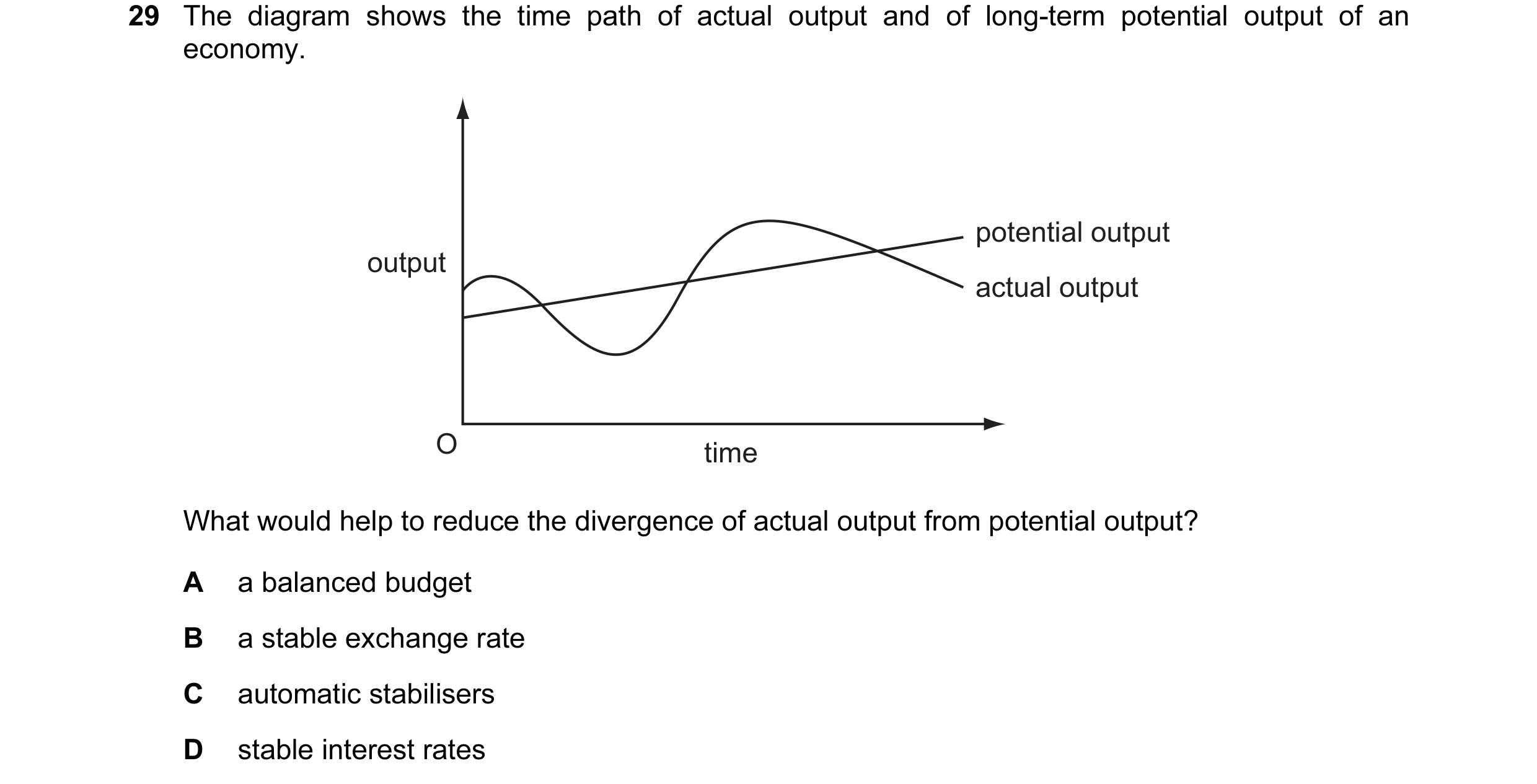
29 The diagram shows the time path of actual output and of long-term potential output of an economy. potential output output actual output O time What would help to reduce the divergence of actual output from potential output? A a balanced budget B a stable exchange rate C automatic stabilisers D stable interest rates
1 marks
Answer: C
This question in 9708/31 Oct/Nov 2011
Q6 · When might the effectiveness of fiscal expansion in increasing the level of output be… 9708/31 Oct/Nov 2011
30 When might the effectiveness of fiscal expansion in increasing the level of output be increased? A when it is accompanied by an increase in the money supply B when it leads to an appreciation of the country’s exchange rate C when it results in a decrease in the price of government bonds D when the price level increases
1 marks
Answer: A
This question in 9708/31 Oct/Nov 2011
Q7 · The economy of a country is simultaneously experiencing a balance of payments deficit, a… 9708/32 Oct/Nov 2011
27 The economy of a country is simultaneously experiencing a balance of payments deficit, a budget deficit, demand-pull inflation and unemployment. The government decides to cut personal income taxes. What does this suggest is its main macroeconomic objective? A to improve the balance of payments position B to reduce the budget deficit C to reduce the level of unemployment D to reduce the rate of inflation
1 marks
Answer: C
This question in 9708/32 Oct/Nov 2011
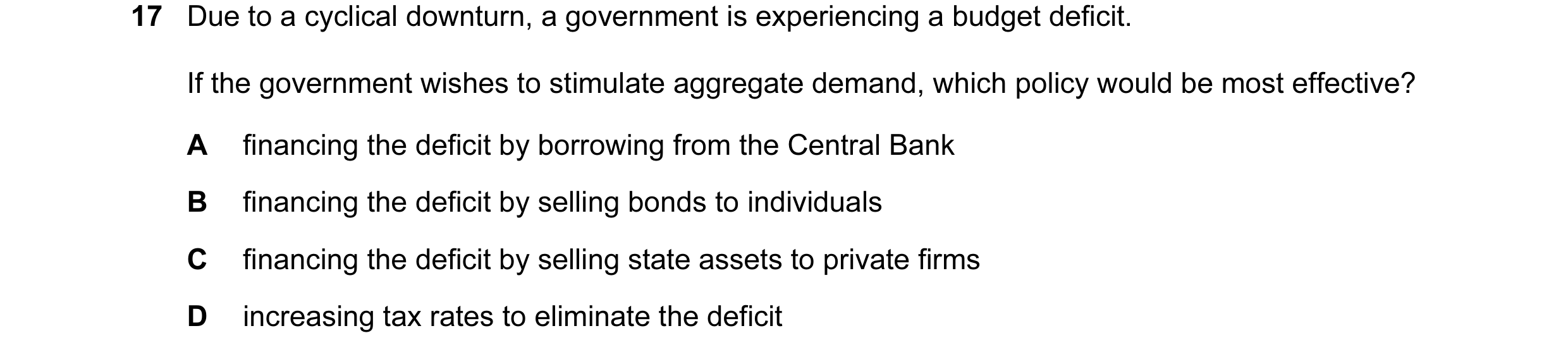
Q8 · Due to a cyclical downturn, a government is experiencing a budget deficit 9708/31 May/June 2012
17 Due to a cyclical downturn, a government is experiencing a budget deficit. If the government wishes to stimulate aggregate demand, which policy would be most effective? A financing the deficit by borrowing from the Central Bank B financing the deficit by selling bonds to individuals C financing the deficit by selling state assets to private firms D increasing tax rates to eliminate the deficit
1 marks
Answer: A
This question in 9708/31 May/June 2012
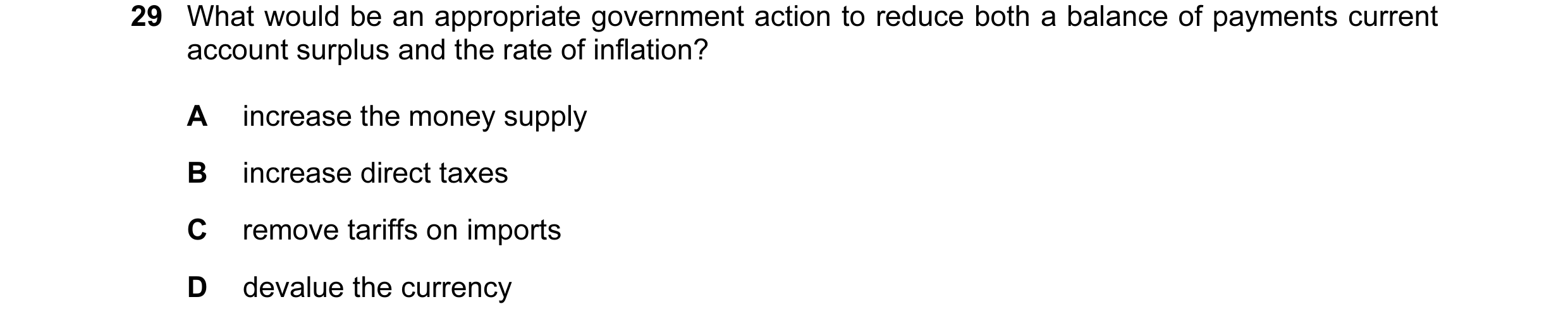
Q9 · What would be an appropriate government action to reduce both a balance of payments… 9708/32 May/June 2012
29 What would be an appropriate government action to reduce both a balance of payments current account surplus and the rate of inflation? A increase the money supply B increase direct taxes C remove tariffs on imports D devalue the currency
1 marks
Answer: C
This question in 9708/32 May/June 2012
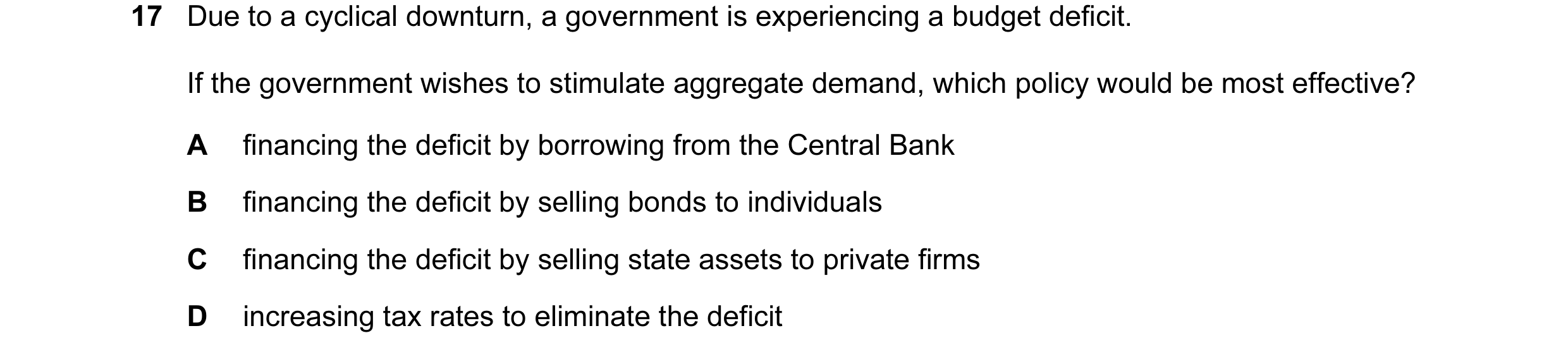
Q10 · Due to a cyclical downturn, a government is experiencing a budget deficit 9708/33 May/June 2012
17 Due to a cyclical downturn, a government is experiencing a budget deficit. If the government wishes to stimulate aggregate demand, which policy would be most effective? A financing the deficit by borrowing from the Central Bank B financing the deficit by selling bonds to individuals C financing the deficit by selling state assets to private firms D increasing tax rates to eliminate the deficit
1 marks
Answer: A
This question in 9708/33 May/June 2012
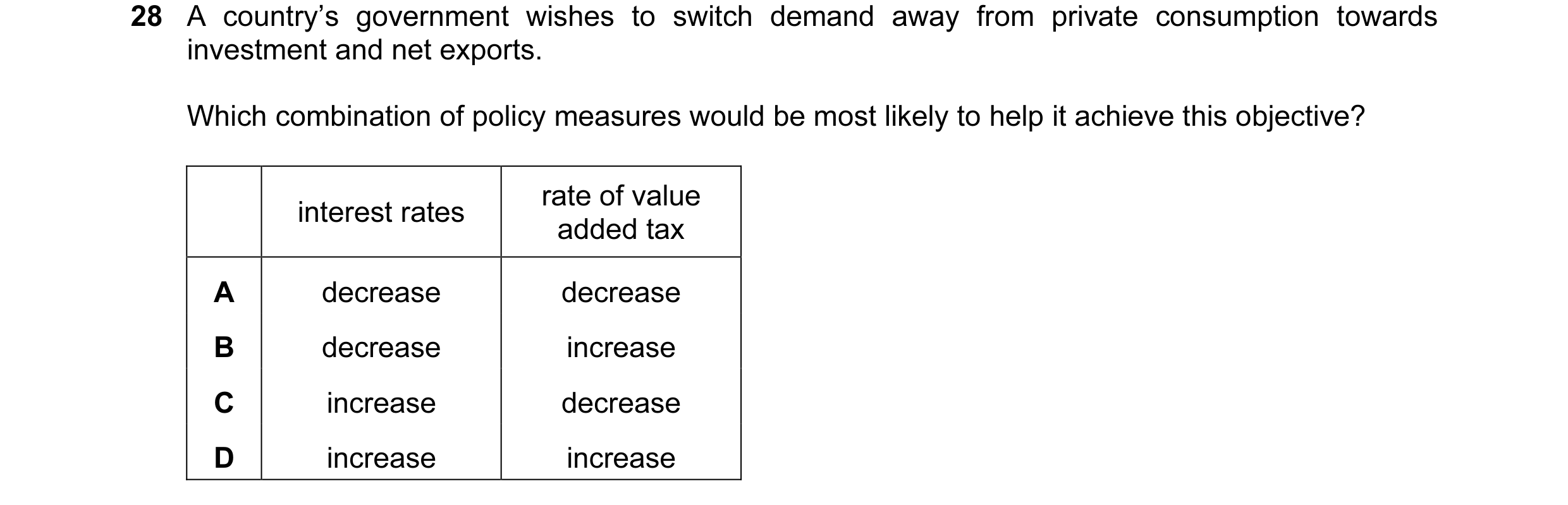
Q11 · A country’s government wishes to switch demand away from private consumption towards… 9708/32 Oct/Nov 2013
28 A country’s government wishes to switch demand away from private consumption towards investment and net exports. Which combination of policy measures would be most likely to help it achieve this objective? rate of value interest rates added tax A decrease decrease B decrease increase C increase decrease D increase increase
1 marks
Answer: B
This question in 9708/32 Oct/Nov 2013
Q12 · A country’s government wishes to switch demand away from private consumption towards… 9708/33 Oct/Nov 2013
30 A country’s government wishes to switch demand away from private consumption towards investment and net exports. Which combination of policy measures would be most likely to help it achieve this objective? interest rates rate of income tax A decrease decrease B decrease increase C increase decrease D increase increase
1 marks
Answer: B
This question in 9708/33 Oct/Nov 2013
Q13 · In an economy with a fixed exchange rate, which combination of policies is likely to be… 9708/31 May/June 2015
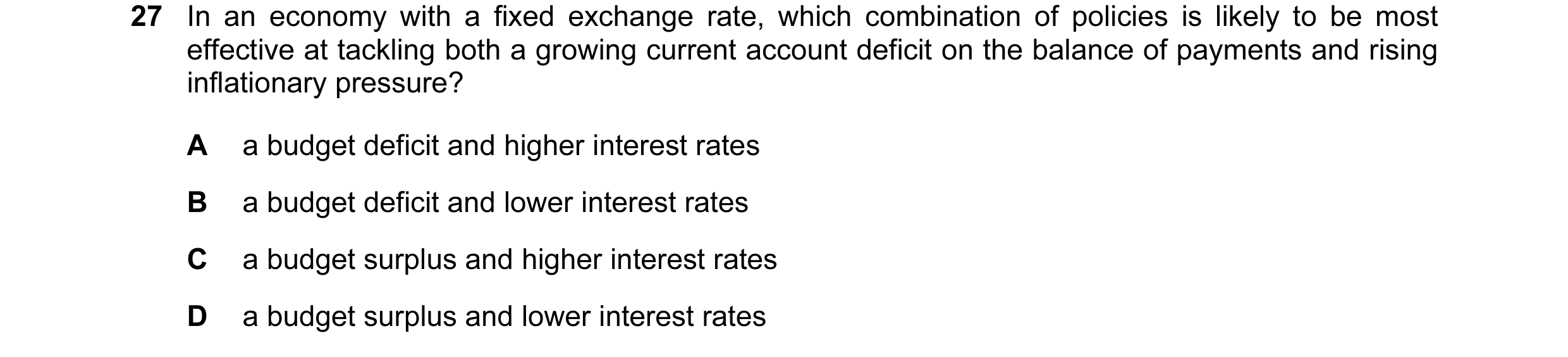
27 In an economy with a fixed exchange rate, which combination of policies is likely to be most effective at tackling both a growing current account deficit on the balance of payments and rising inflationary pressure? A a budget deficit and higher interest rates B a budget deficit and lower interest rates C a budget surplus and higher interest rates D a budget surplus and lower interest rates
1 marks
Answer: C
This question in 9708/31 May/June 2015
Q14 · A government responds to a fall in national income by increasing its spending 9708/31 May/June 2015
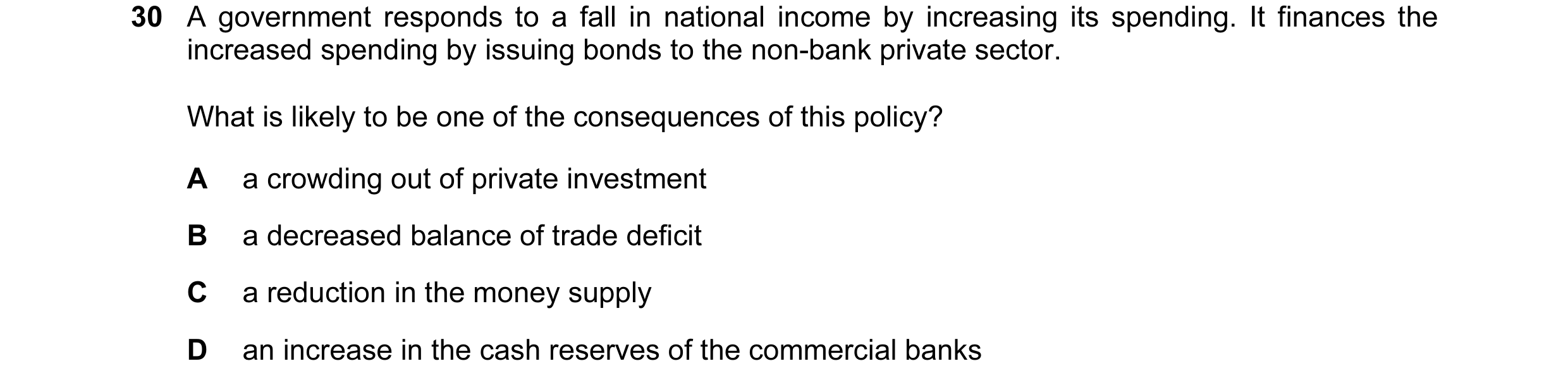
30 A government responds to a fall in national income by increasing its spending. It finances the increased spending by issuing bonds to the non-bank private sector. What is likely to be one of the consequences of this policy? A a crowding out of private investment B a decreased balance of trade deficit C a reduction in the money supply D an increase in the cash reserves of the commercial banks
1 marks
Answer: A
This question in 9708/31 May/June 2015
Q15 · Increased borrowing by the government results in higher interest charges and this leads… 9708/32 May/June 2015
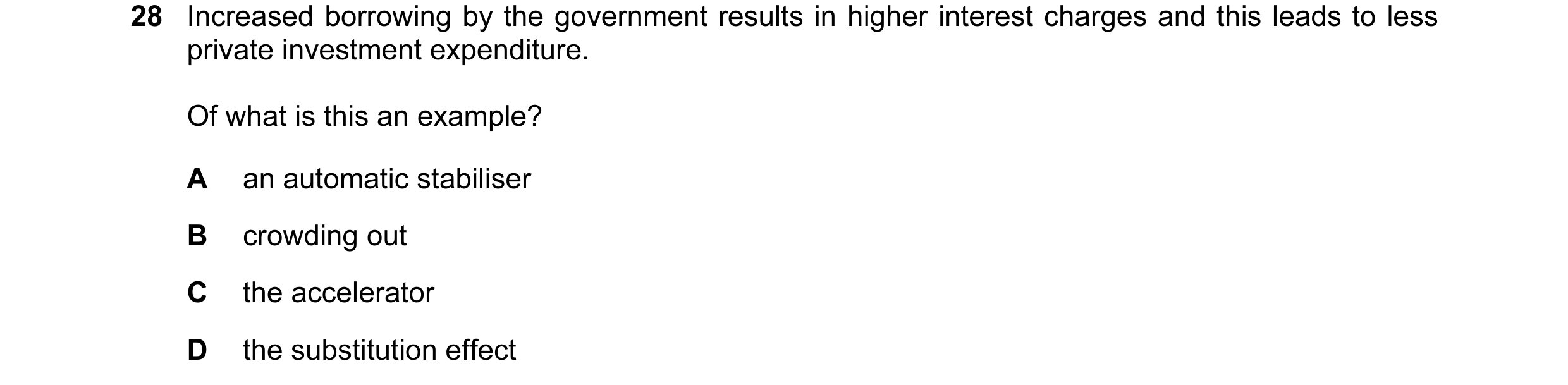
28 Increased borrowing by the government results in higher interest charges and this leads to less private investment expenditure. Of what is this an example? A an automatic stabiliser B crowding out C the accelerator D the substitution effect
1 marks
Answer: B
This question in 9708/32 May/June 2015
Q16 · A government’s budget is balanced at a time when the economy is fully employed, but an… 9708/32 May/June 2015
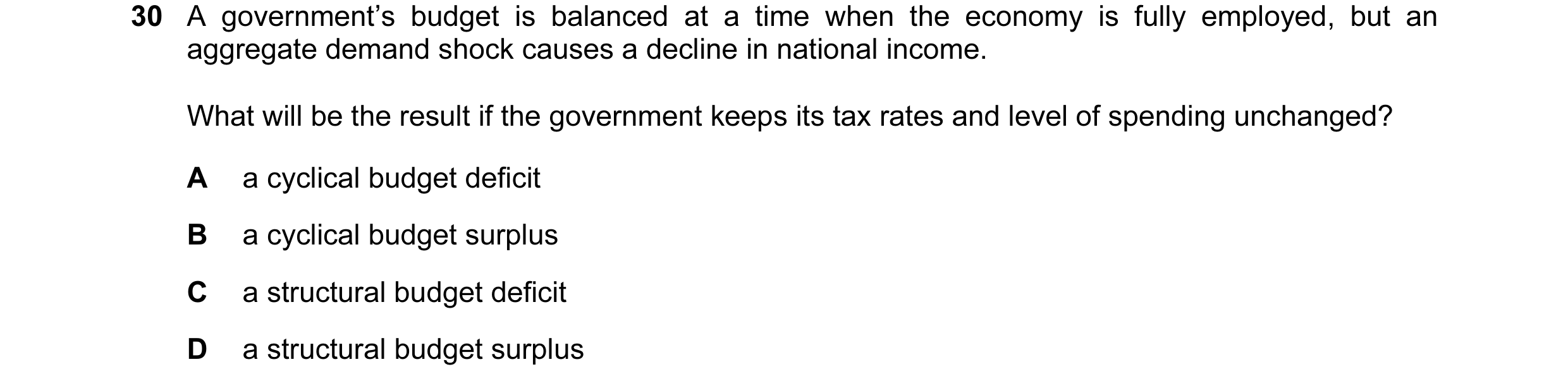
30 A government’s budget is balanced at a time when the economy is fully employed, but an aggregate demand shock causes a decline in national income. What will be the result if the government keeps its tax rates and level of spending unchanged? A a cyclical budget deficit B a cyclical budget surplus C a structural budget deficit D a structural budget surplus
1 marks
Answer: A
This question in 9708/32 May/June 2015
Q17 · Some European countries experienced a decline in investment spending in 2011-2012 9708/31 Oct/Nov 2015
29 Some European countries experienced a decline in investment spending in 2011-2012. What might a government do to stop such a decline? A increase quotas on imports B lower interest rates C raise income tax D set up training courses
1 marks
This question in 9708/31 Oct/Nov 2015
Q18 · Government economic advisers disagree over the relative impact of fiscal and monetary… 9708/32 Oct/Nov 2016
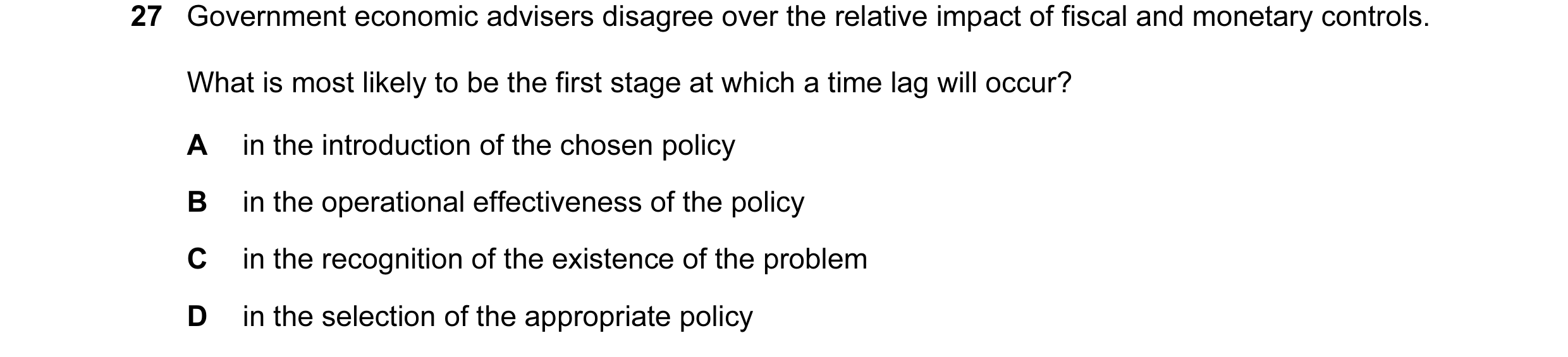
27 Government economic advisers disagree over the relative impact of fiscal and monetary controls. What is most likely to be the first stage at which a time lag will occur? A in the introduction of the chosen policy B in the operational effectiveness of the policy C in the recognition of the existence of the problem D in the selection of the appropriate policy
1 marks
Answer: D
This question in 9708/32 Oct/Nov 2016
Q19 · In which exchange rate regime would the central bank of a country be best able to pursue… 9708/32 Oct/Nov 2019
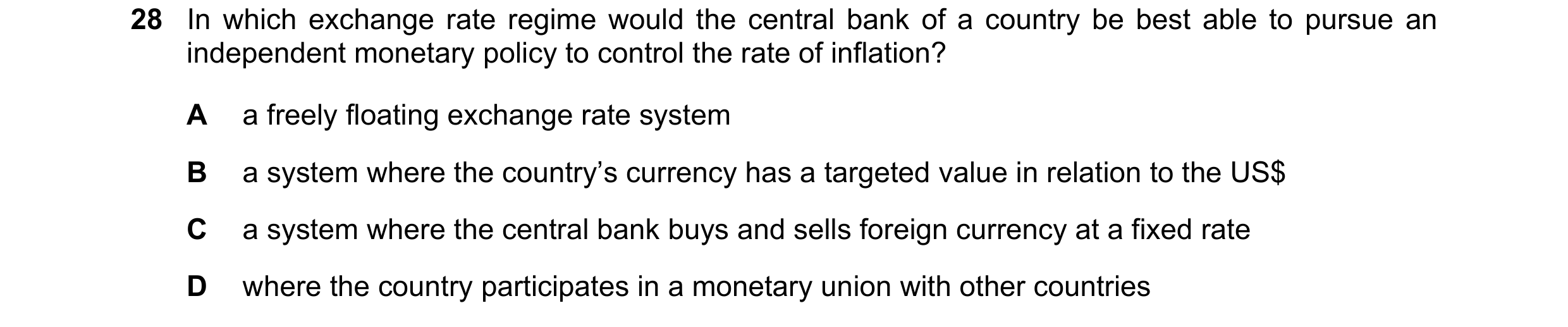
28 In which exchange rate regime would the central bank of a country be best able to pursue an independent monetary policy to control the rate of inflation? A a freely floating exchange rate system B a system where the country’s currency has a targeted value in relation to the US$ C a system where the central bank buys and sells foreign currency at a fixed rate D where the country participates in a monetary union with other countries
1 marks
Answer: A
This question in 9708/32 Oct/Nov 2019
Q20 · What is an important assumption of Monetarism? 9708/32 Oct/Nov 2020
25 What is an important assumption of Monetarism? A Fiscal policy is more effective than monetary policy in reducing inflation. B Long-term unemployment results from deficient demand. C The interest elasticity of investment spending is low. D The velocity of circulation is stable.
1 marks
Answer: D
This question in 9708/32 Oct/Nov 2020
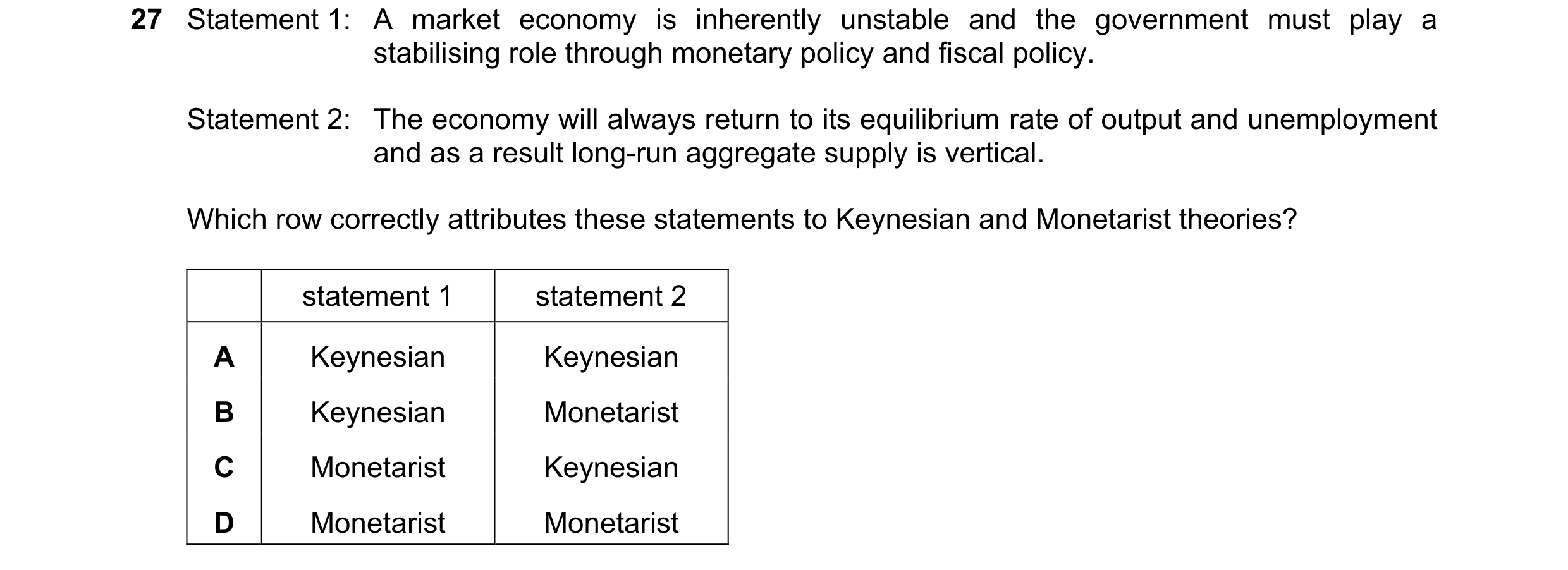
Q21 · Statement 1: A market economy is inherently unstable and the government must play a… 9708/32 Oct/Nov 2020
27 Statement 1: A market economy is inherently unstable and the government must play a stabilising role through monetary policy and fiscal policy. Statement 2: The economy will always return to its equilibrium rate of output and unemployment and as a result long-run aggregate supply is vertical. Which row correctly attributes these statements to Keynesian and Monetarist theories? statement 1 statement 2 A Keynesian Keynesian B Keynesian Monetarist C Monetarist Keynesian D Monetarist Monetarist
1 marks
Answer: B
This question in 9708/32 Oct/Nov 2020
Q22 · Which combination of macroeconomic policies will most likely be successful if the aim… 9708/32 Oct/Nov 2020
30 Which combination of macroeconomic policies will most likely be successful if the aim were to reduce unemployment and reduce inflation? A contractionary supply-side policies and higher interest rates B expansionary supply-side policies and reduced indirect taxes C increased direct taxes and reduced indirect taxes D reduced rates of interest and depreciation of exchange rate
1 marks
Answer: B
This question in 9708/32 Oct/Nov 2020
Q23 · What describes a Keynesian measure to reduce cyclical unemployment? 9708/33 Oct/Nov 2020
28 What describes a Keynesian measure to reduce cyclical unemployment? A adopting a supply-side policy to retrain unskilled workers B allowing the private sector to take over the supply of merit goods C increasing the ratio of capital equipment to manual labour in production D using fiscal policy to increase effective demand
1 marks
Answer: D
This question in 9708/33 Oct/Nov 2020
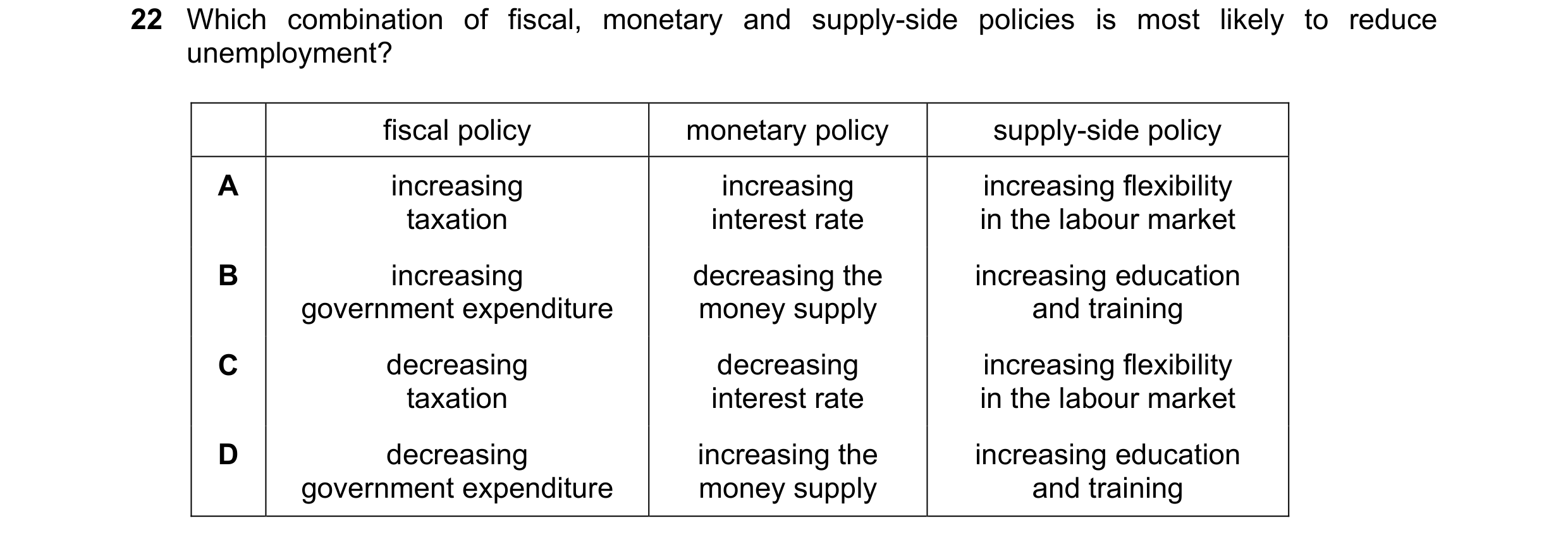
Q24 · Which combination of fiscal, monetary and supply-side policies is most likely to reduce… 9708/32 Feb/March 2021
22 Which combination of fiscal, monetary and supply-side policies is most likely to reduce unemployment? fiscal policy monetary policy supply-side policy A increasing increasing increasing flexibility taxation interest rate in the labour market B increasing decreasing the increasing education government expenditure money supply and training C decreasing decreasing increasing flexibility taxation interest rate in the labour market D decreasing increasing the increasing education government expenditure money supply and training
1 marks
Answer: C
This question in 9708/32 Feb/March 2021
Q25 · Which policy combination will reduce the level of national income by the greatest amount? 9708/32 Feb/March 2021
23 Which policy combination will reduce the level of national income by the greatest amount? A decrease direct taxation and increase interest rates B decrease direct taxation and increase quantitative easing C increase direct taxation and increase interest rates D increase direct taxation and increase quantitative easing
1 marks
Answer: C
This question in 9708/32 Feb/March 2021
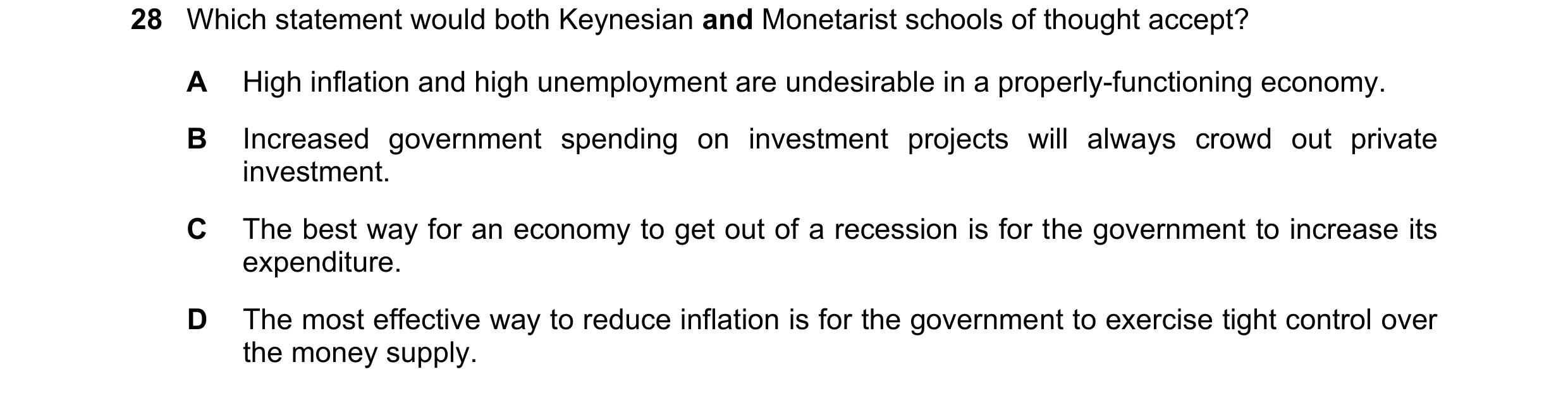
Q26 · Which statement would both Keynesian and Monetarist schools of thought accept? 9708/33 May/June 2021
28 Which statement would both Keynesian and Monetarist schools of thought accept? A High inflation and high unemployment are undesirable in a properly-functioning economy. B Increased government spending on investment projects will always crowd out private investment. C The best way for an economy to get out of a recession is for the government to increase its expenditure. D The most effective way to reduce inflation is for the government to exercise tight control over the money supply.
1 marks
Answer: A
This question in 9708/33 May/June 2021
Q27 · The diagram shows the relationship between tax revenue and the tax rate 9708/31 May/June 2022
29 The diagram shows the relationship between tax revenue and the tax rate. tax revenue collected 0 25 50 75 100 tax rate on income (%) What is the curve on the diagram called? A income elasticity curve B J curve C Lorenz curve D Laffer curve
1 marks
Answer: D
This question in 9708/31 May/June 2022
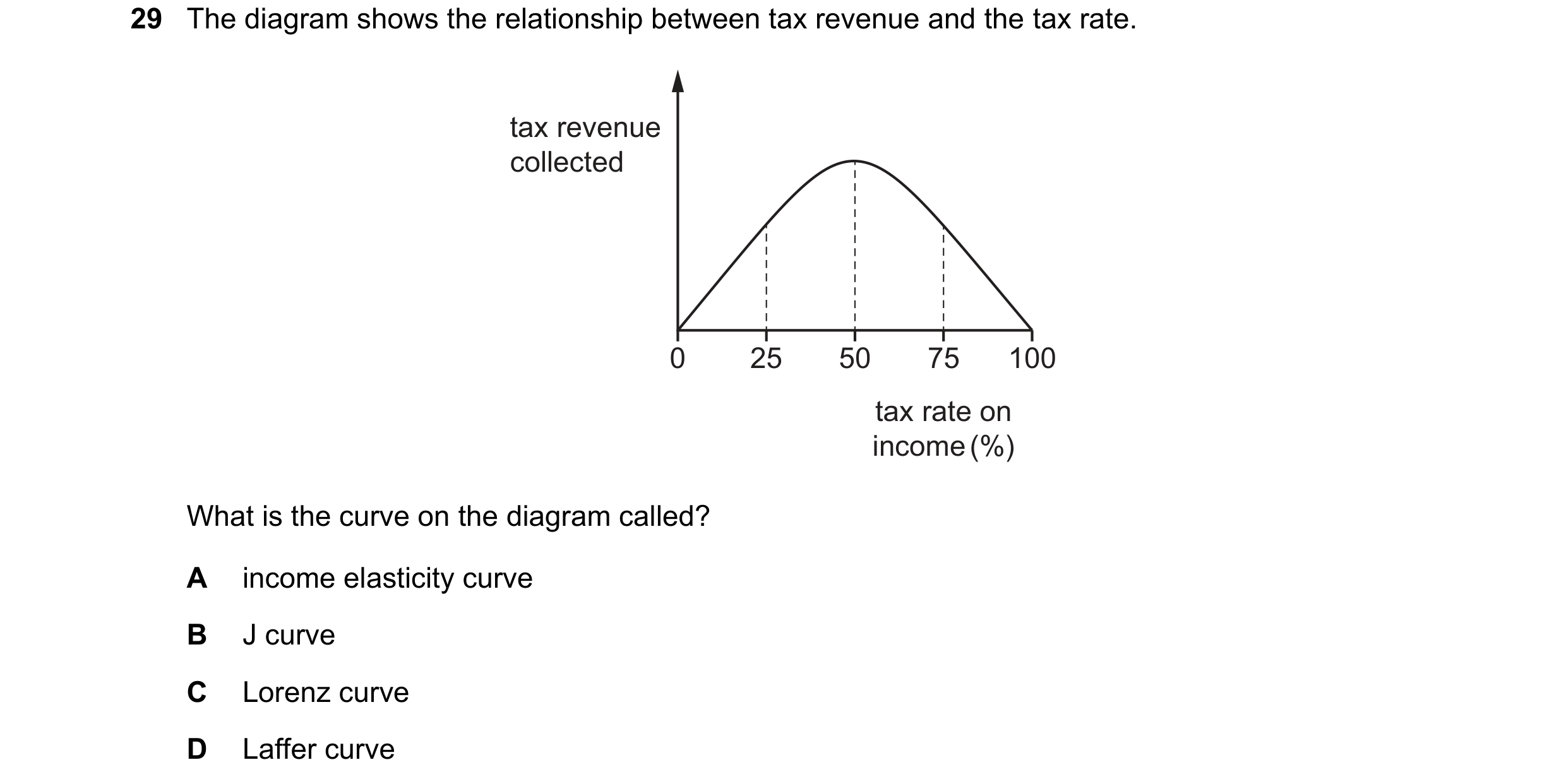
Q28 · The diagram shows the relationship between tax revenue and the tax rate 9708/33 May/June 2022
29 The diagram shows the relationship between tax revenue and the tax rate. tax revenue collected 0 25 50 75 100 tax rate on income (%) What is the curve on the diagram called? A income elasticity curve B J curve C Lorenz curve D Laffer curve
1 marks
Answer: D
This question in 9708/33 May/June 2022
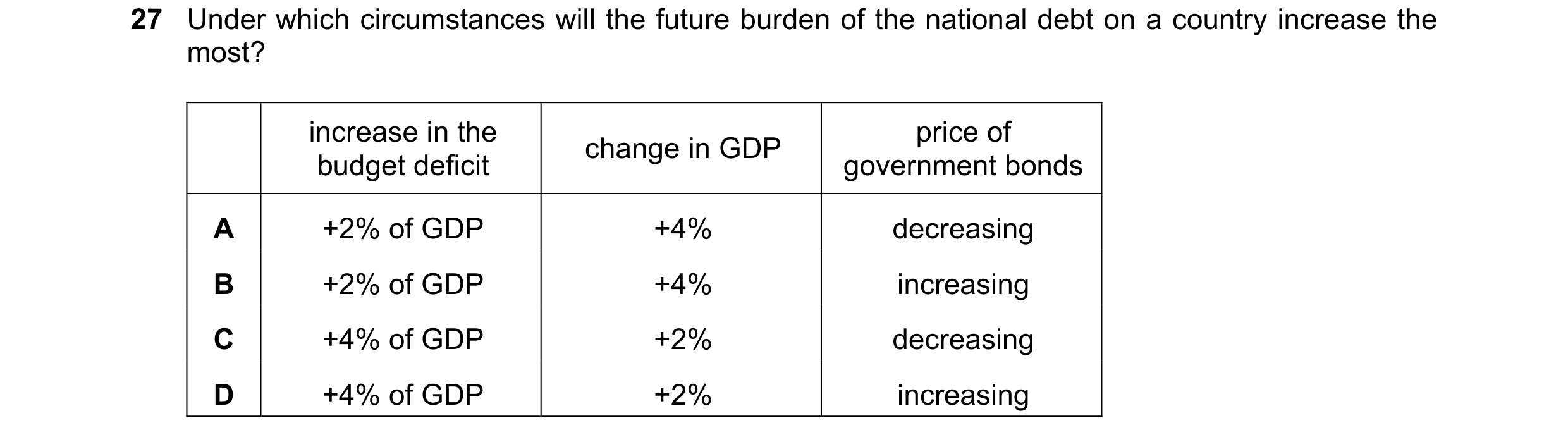
Q29 · Under which circumstances will the future burden of the national debt on a country… 9708/32 Oct/Nov 2022
27 Under which circumstances will the future burden of the national debt on a country increase the most? increase in the price of change in GDP budget deficit government bonds A +2% of GDP +4% decreasing B +2% of GDP +4% increasing C +4% of GDP +2% decreasing D +4% of GDP +2% increasing
1 marks
Answer: C
This question in 9708/32 Oct/Nov 2022
Q30 · Keynesian and Monetarist economists believe different things about the way the economy… 9708/33 Oct/Nov 2022
25 Keynesian and Monetarist economists believe different things about the way the economy works. Which combination is correct? Keynesian Monetarist A decreasing AD will always lead to economic growth is achieved an increase in economic growth using fiscal policy B increasing AD brings the the economy always tends to economy out of recession full employment in the long run C increasing AD will always lead economic growth is achieved to increased employment by cutting taxation D increasing AS brings the full employment will always economy out of recession be achieved in the long run
1 marks
Answer: B
This question in 9708/33 Oct/Nov 2022
Q31 · What is illustrated by the Laffer curve? 9708/33 Oct/Nov 2022
28 What is illustrated by the Laffer curve? A As income increases, fewer hours will be worked. B As income increases, tax revenue will increase. C As the tax rate increases, tax revenue always increases. D As the tax rate increases, tax revenue will eventually fall.
1 marks
Answer: D
This question in 9708/33 Oct/Nov 2022
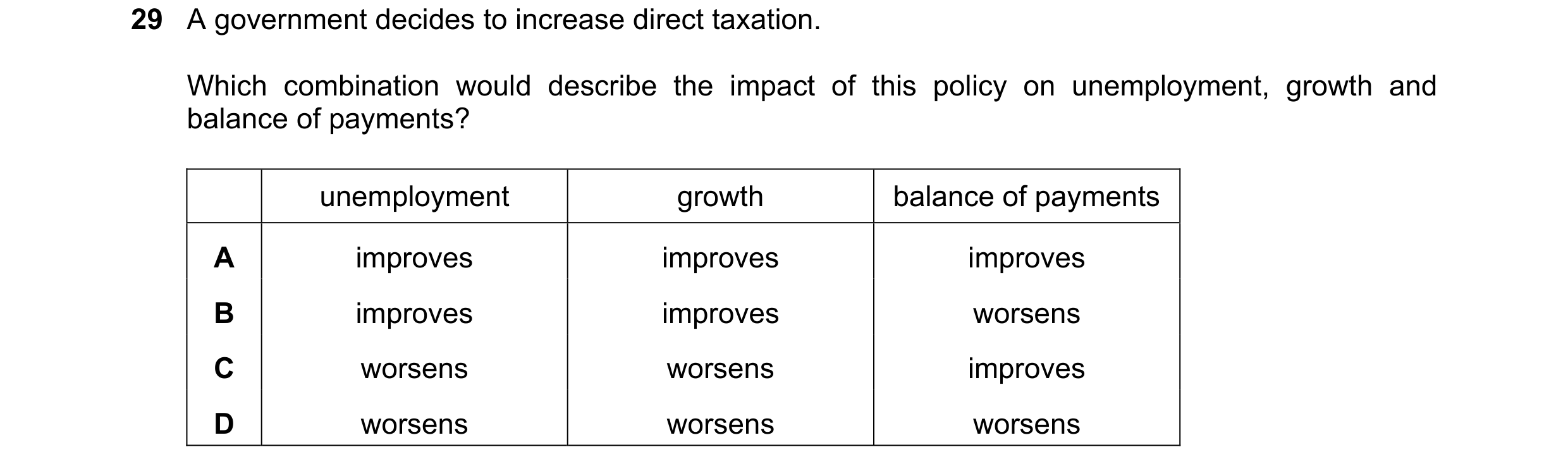
Q32 · A government decides to increase direct taxation 9708/33 Oct/Nov 2022
29 A government decides to increase direct taxation. Which combination would describe the impact of this policy on unemployment, growth and balance of payments? unemployment growth balance of payments A improves improves improves B improves improves worsens C worsens worsens improves D worsens worsens worsens
1 marks
Answer: C
This question in 9708/33 Oct/Nov 2022
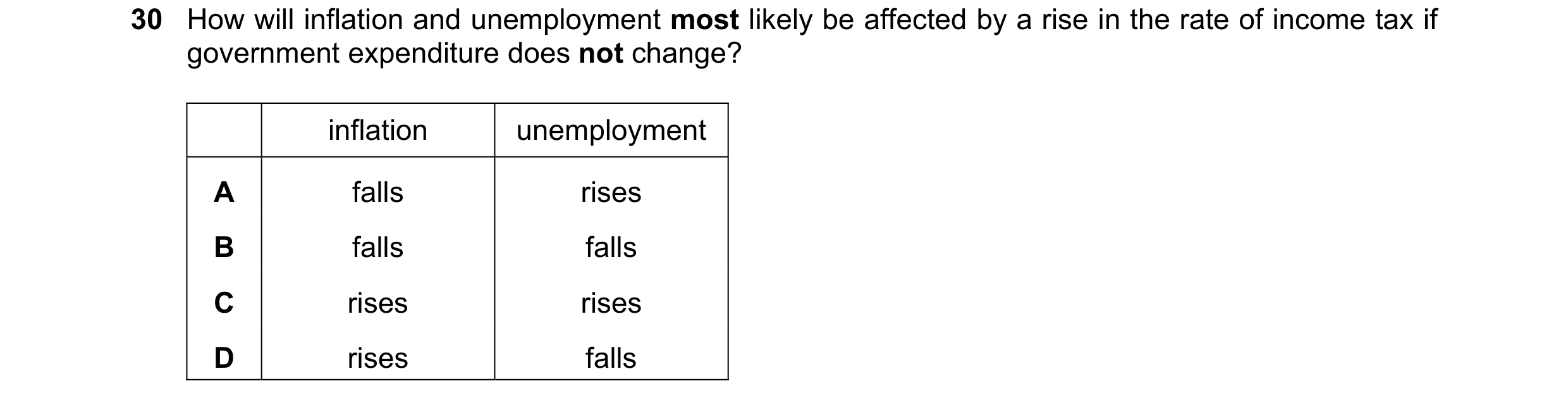
Q33 · How will inflation and unemployment most likely be affected by a rise in the rate of… 9708/33 Oct/Nov 2022
30 How will inflation and unemployment most likely be affected by a rise in the rate of income tax if government expenditure does not change? inflation unemployment A falls rises B falls falls C rises rises D rises falls
1 marks
Answer: A
This question in 9708/33 Oct/Nov 2022
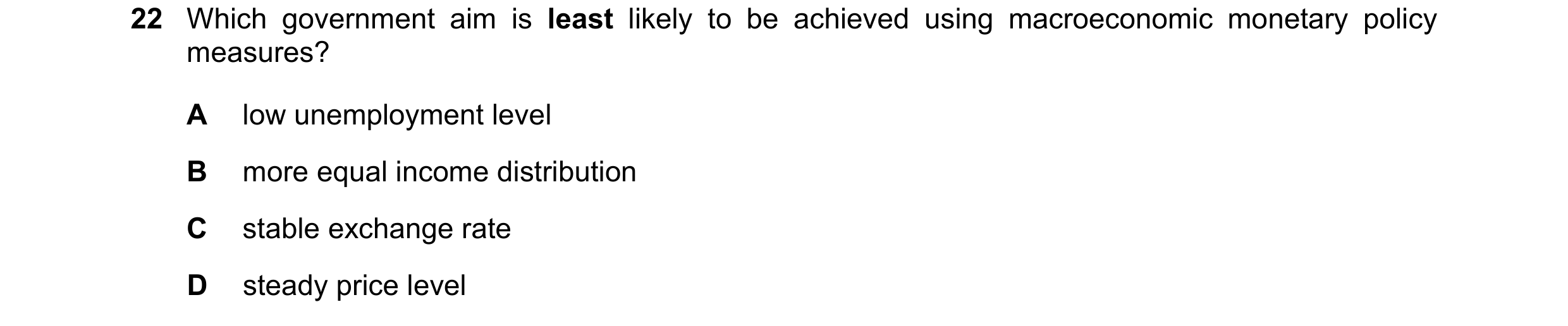
Q34 · Which government aim is least likely to be achieved using macroeconomic monetary policy… 9708/32 Feb/March 2023
22 Which government aim is least likely to be achieved using macroeconomic monetary policy measures? A low unemployment level B more equal income distribution C stable exchange rate D steady price level
1 marks
Answer: B
This question in 9708/32 Feb/March 2023
Q35 · Which combination of policies is most likely to increase output? 9708/31 May/June 2023
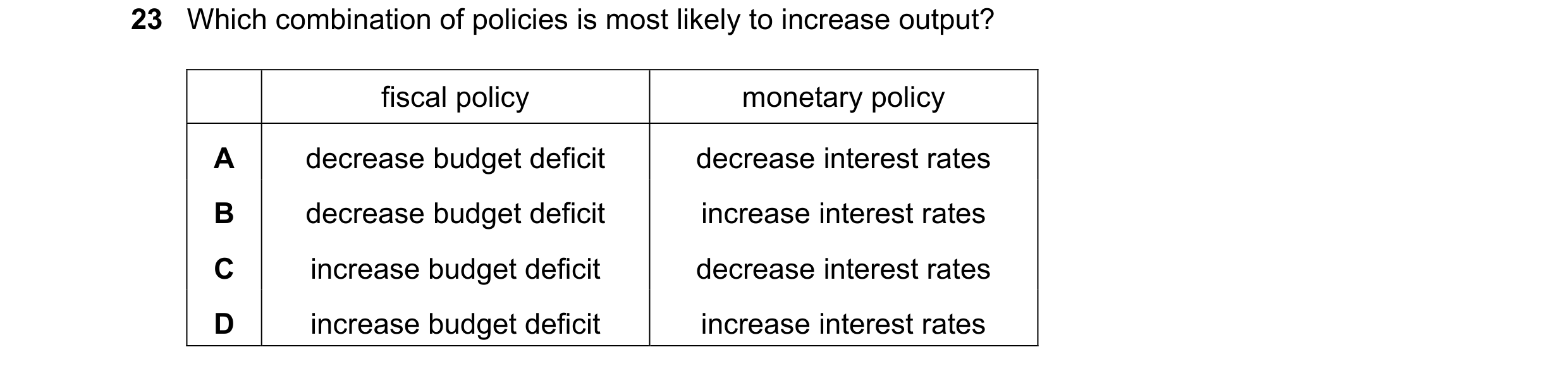
23 Which combination of policies is most likely to increase output? fiscal policy monetary policy A decrease budget deficit decrease interest rates B decrease budget deficit increase interest rates C increase budget deficit decrease interest rates D increase budget deficit increase interest rates
1 marks
Answer: C
This question in 9708/31 May/June 2023
Q36 · Increased borrowing by the government results in higher interest charges and this leads… 9708/32 May/June 2023
23 Increased borrowing by the government results in higher interest charges and this leads to less private investment expenditure. Of what is this an example? A an automatic stabiliser B crowding out C the accelerator D the substitution effect
1 marks
Answer: B
This question in 9708/32 May/June 2023
Q37 · Which combination of policies is most likely to increase output? 9708/33 May/June 2023
23 Which combination of policies is most likely to increase output? fiscal policy monetary policy A decrease budget deficit decrease interest rates B decrease budget deficit increase interest rates C increase budget deficit decrease interest rates D increase budget deficit increase interest rates
1 marks
Answer: C
This question in 9708/33 May/June 2023
Q38 · What would reduce the effectiveness of a supply-side stimulus to the economy? 9708/33 May/June 2023
25 What would reduce the effectiveness of a supply-side stimulus to the economy? A an imposition of maximum hours in a working week B an increase in public sector spending C the provision of new training schemes D the relaxation of import controls on raw materials
1 marks
Answer: A
This question in 9708/33 May/June 2023
Q39 · What shows the correct outcome for the policy option? 9708/31 Oct/Nov 2023
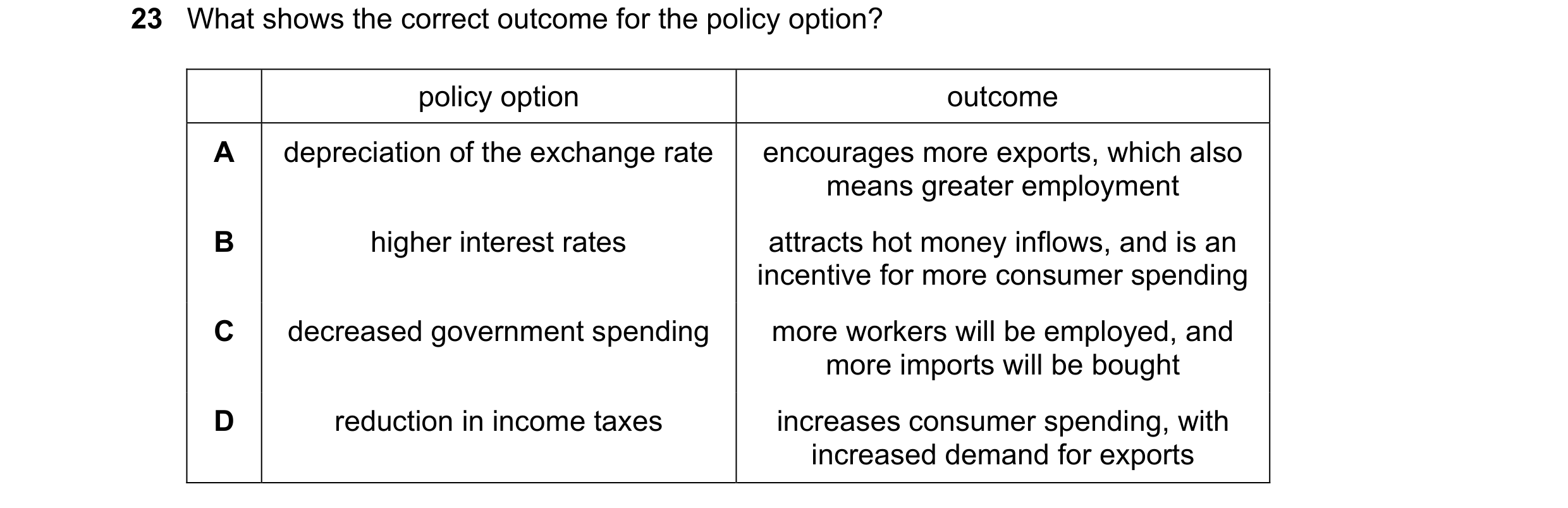
23 What shows the correct outcome for the policy option? policy option outcome A depreciation of the exchange rate encourages more exports, which also means greater employment B higher interest rates attracts hot money inflows, and is an incentive for more consumer spending C decreased government spending more workers will be employed, and more imports will be bought D reduction in income taxes increases consumer spending, with increased demand for exports
1 marks
Answer: A
This question in 9708/31 Oct/Nov 2023
Q40 · The Laffer curve shows expected tax revenues at different tax rates 9708/31 Oct/Nov 2023
24 The Laffer curve shows expected tax revenues at different tax rates. R1 tax R2 revenue 0 50 60 tax rate / % An increase in the tax rate above 50% is expected to decrease tax revenue. What is the reason for this? A decreased incentive for emigration B decreased incentive for tax evasion C increased incentive for people to work D increased incentive for people to work fewer hours
1 marks
Answer: D
This question in 9708/31 Oct/Nov 2023
Q41 · The diagram represents the short-run Phillips curves SRPC1 and SRPC2 and the long-run… 9708/31 May/June 2024
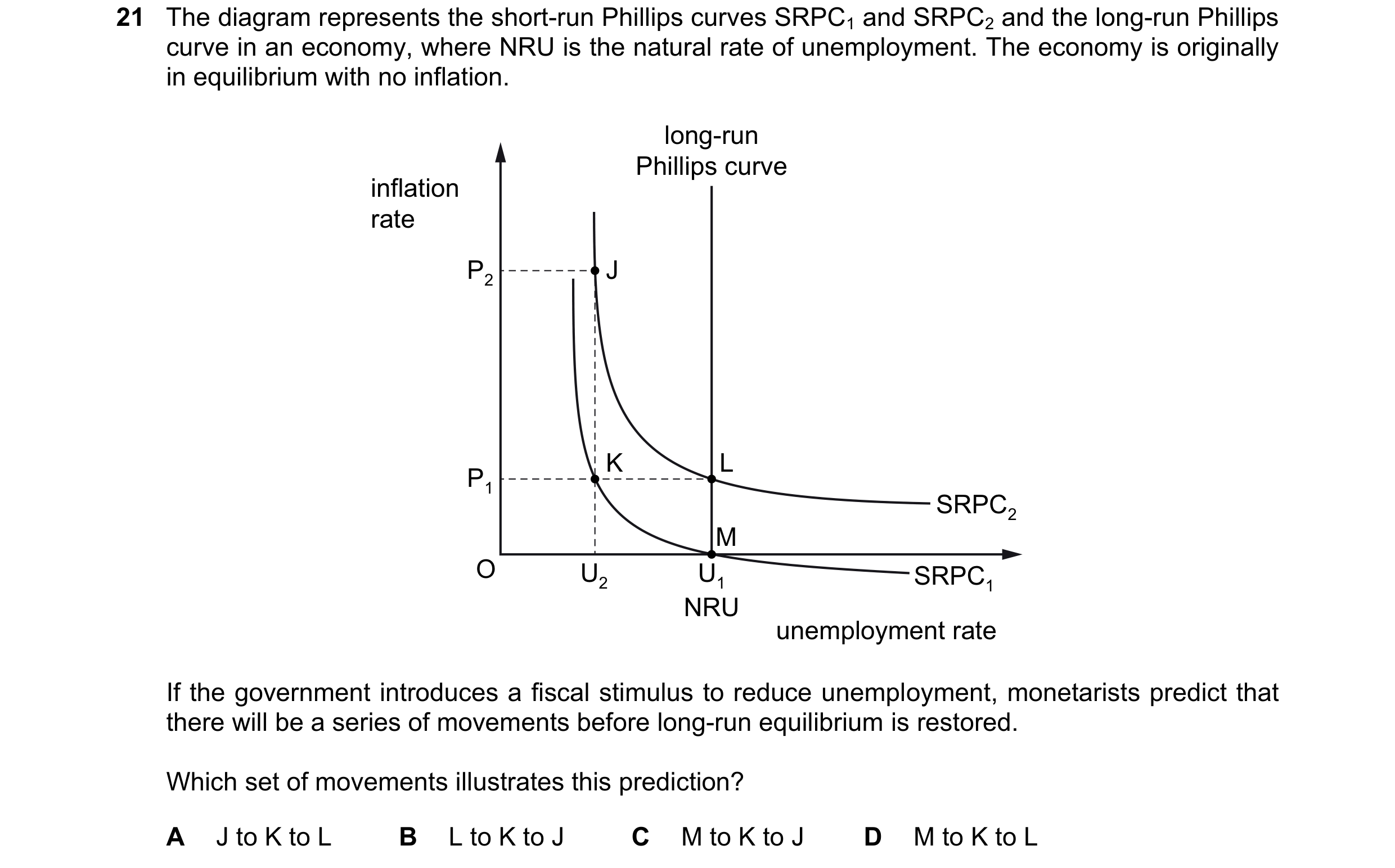
21 The diagram represents the short-run Phillips curves SRPC1 and SRPC2 and the long-run Phillips curve in an economy, where NRU is the natural rate of unemployment. The economy is originally in equilibrium with no inflation. long-run Phillips curve inflation rate P2 J K L P1 SRPC2 M O U2 U1 SRPC1 NRU unemployment rate If the government introduces a fiscal stimulus to reduce unemployment, monetarists predict that there will be a series of movements before long-run equilibrium is restored. Which set of movements illustrates this prediction? A J to K to L B L to K to J C M to K to J D M to K to L
1 marks
Answer: D
This question in 9708/31 May/June 2024
Q42 · An economy has a sudden increase in inflation caused by a large rise in energy prices 9708/31 May/June 2024
22 An economy has a sudden increase in inflation caused by a large rise in energy prices. It also enters a recession with rising unemployment. A decrease in which policy variable is most likely to reduce the impact of the recession without increasing the price level further? A direct taxation B government spending C indirect taxation D interest rate
1 marks
Answer: C
This question in 9708/31 May/June 2024
Q43 · The diagram represents the short-run Phillips curves SRPC1 and SRPC2 and the long-run… 9708/33 May/June 2024
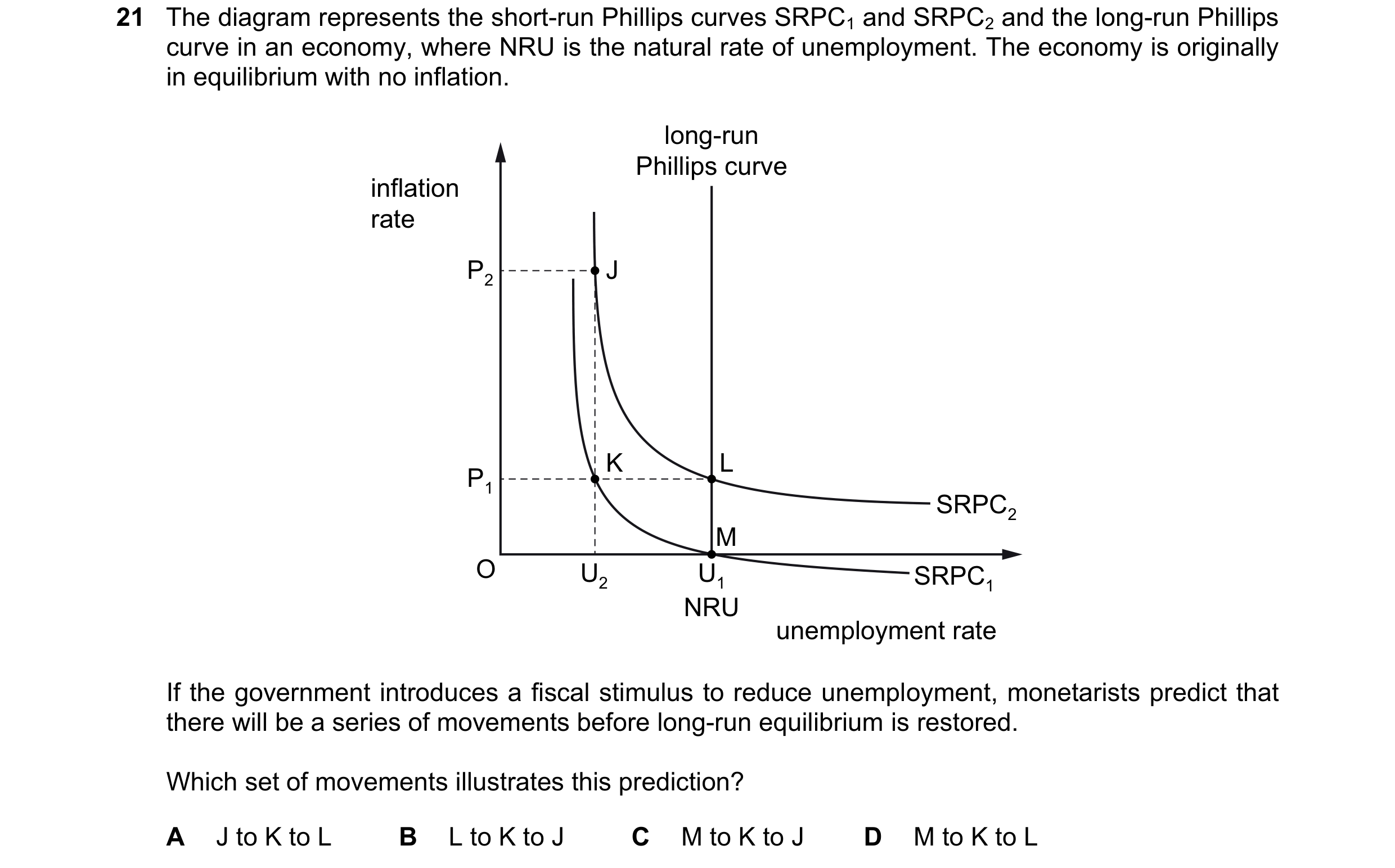
21 The diagram represents the short-run Phillips curves SRPC1 and SRPC2 and the long-run Phillips curve in an economy, where NRU is the natural rate of unemployment. The economy is originally in equilibrium with no inflation. long-run Phillips curve inflation rate P2 J K L P1 SRPC2 M O U2 U1 SRPC1 NRU unemployment rate If the government introduces a fiscal stimulus to reduce unemployment, monetarists predict that there will be a series of movements before long-run equilibrium is restored. Which set of movements illustrates this prediction? A J to K to L B L to K to J C M to K to J D M to K to L
1 marks
Answer: D
This question in 9708/33 May/June 2024
Q44 · An economy has a sudden increase in inflation caused by a large rise in energy prices 9708/33 May/June 2024
22 An economy has a sudden increase in inflation caused by a large rise in energy prices. It also enters a recession with rising unemployment. A decrease in which policy variable is most likely to reduce the impact of the recession without increasing the price level further? A direct taxation B government spending C indirect taxation D interest rate
1 marks
Answer: C
This question in 9708/33 May/June 2024
Q45 · Which policy may increase economic growth without causing inflation? 9708/32 Feb/March 2025
21 Which policy may increase economic growth without causing inflation? A giving subsidies to producers B increasing government spending C lowering direct taxes D lowering interest rates
1 marks
Answer: A
This question in 9708/32 Feb/March 2025
Q46 · In an economy with unemployed resources the marginal propensity to consume is 0.2 9708/32 Feb/March 2025
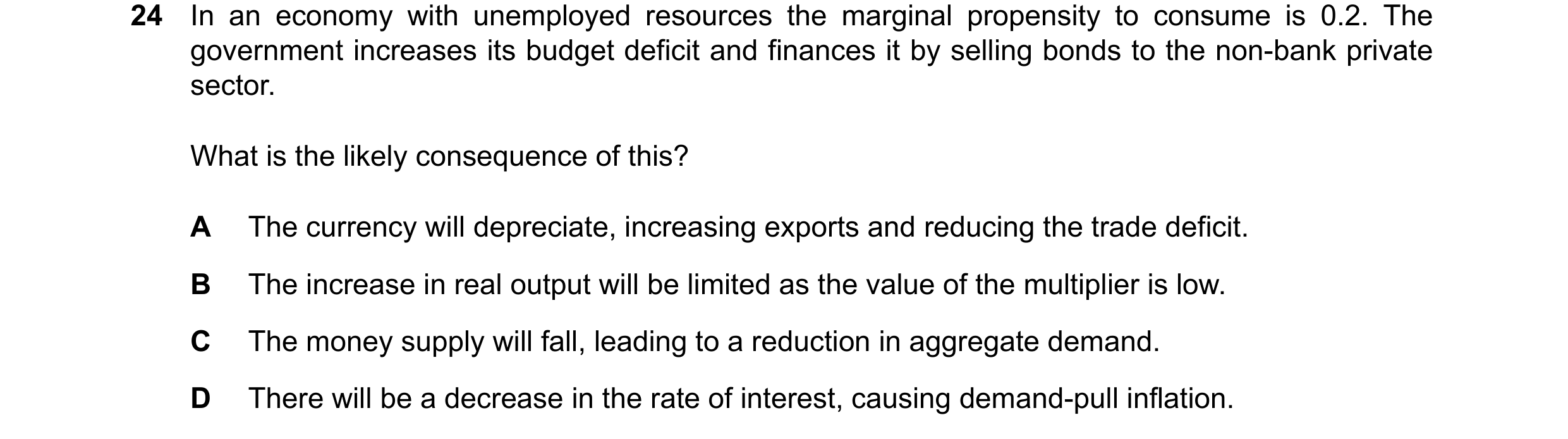
24 In an economy with unemployed resources the marginal propensity to consume is 0.2. The government increases its budget deficit and finances it by selling bonds to the non-bank private sector. What is the likely consequence of this? A The currency will depreciate, increasing exports and reducing the trade deficit. B The increase in real output will be limited as the value of the multiplier is low. C The money supply will fall, leading to a reduction in aggregate demand. D There will be a decrease in the rate of interest, causing demand-pull inflation.
1 marks
Answer: B
This question in 9708/32 Feb/March 2025


 1 / 12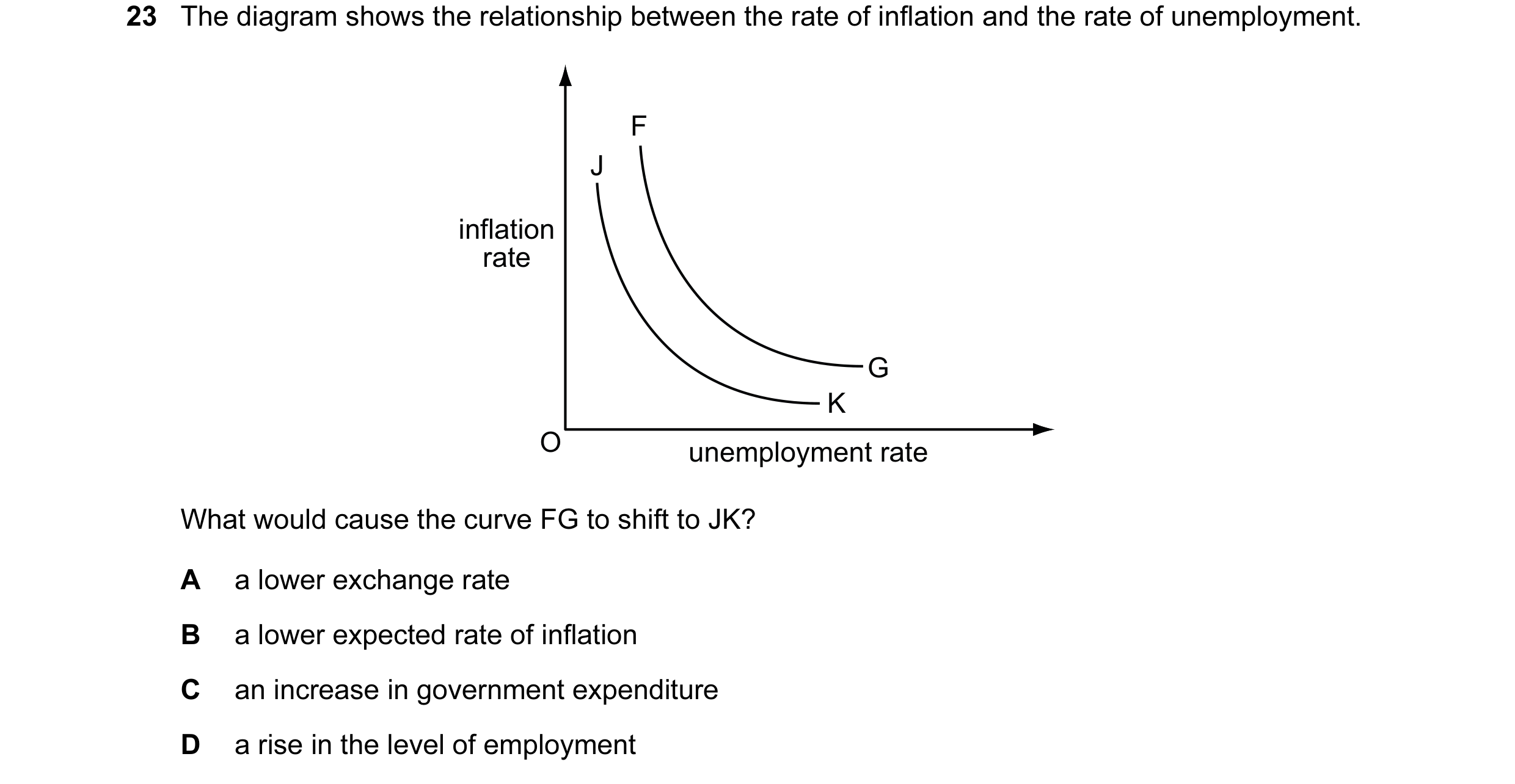
 2 / 12
 3 / 12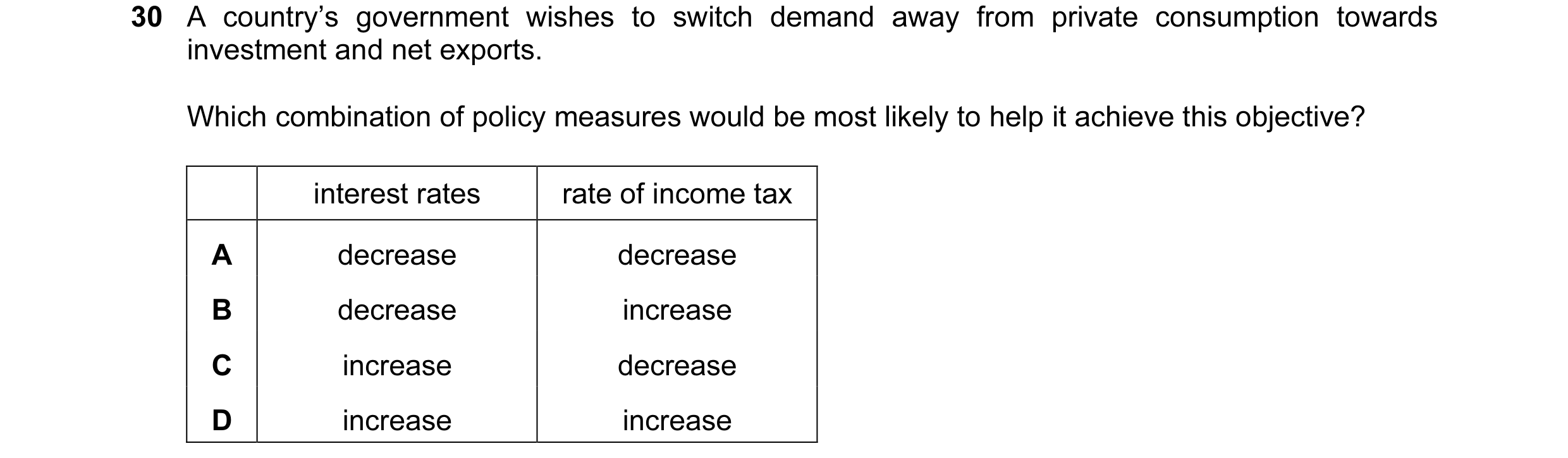
 4 / 12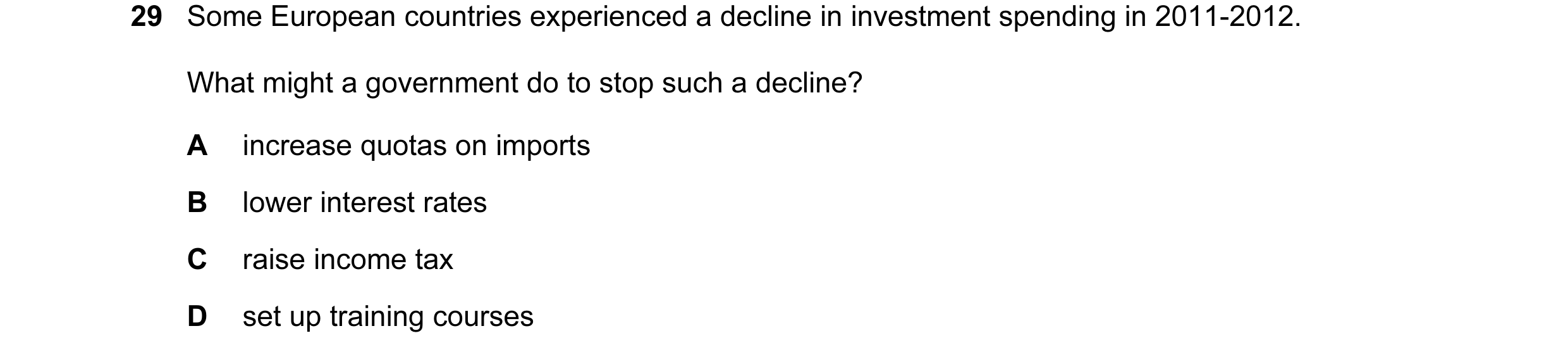

 5 / 12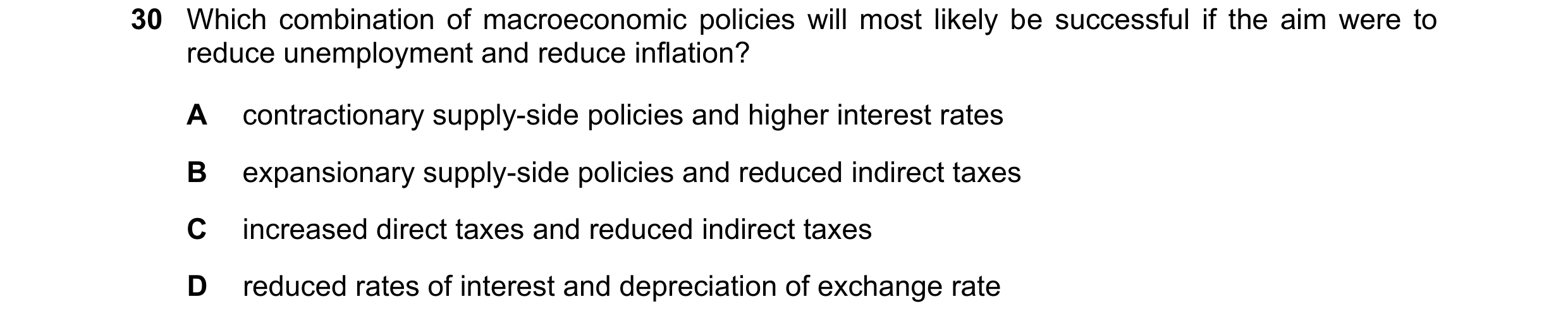


 6 / 12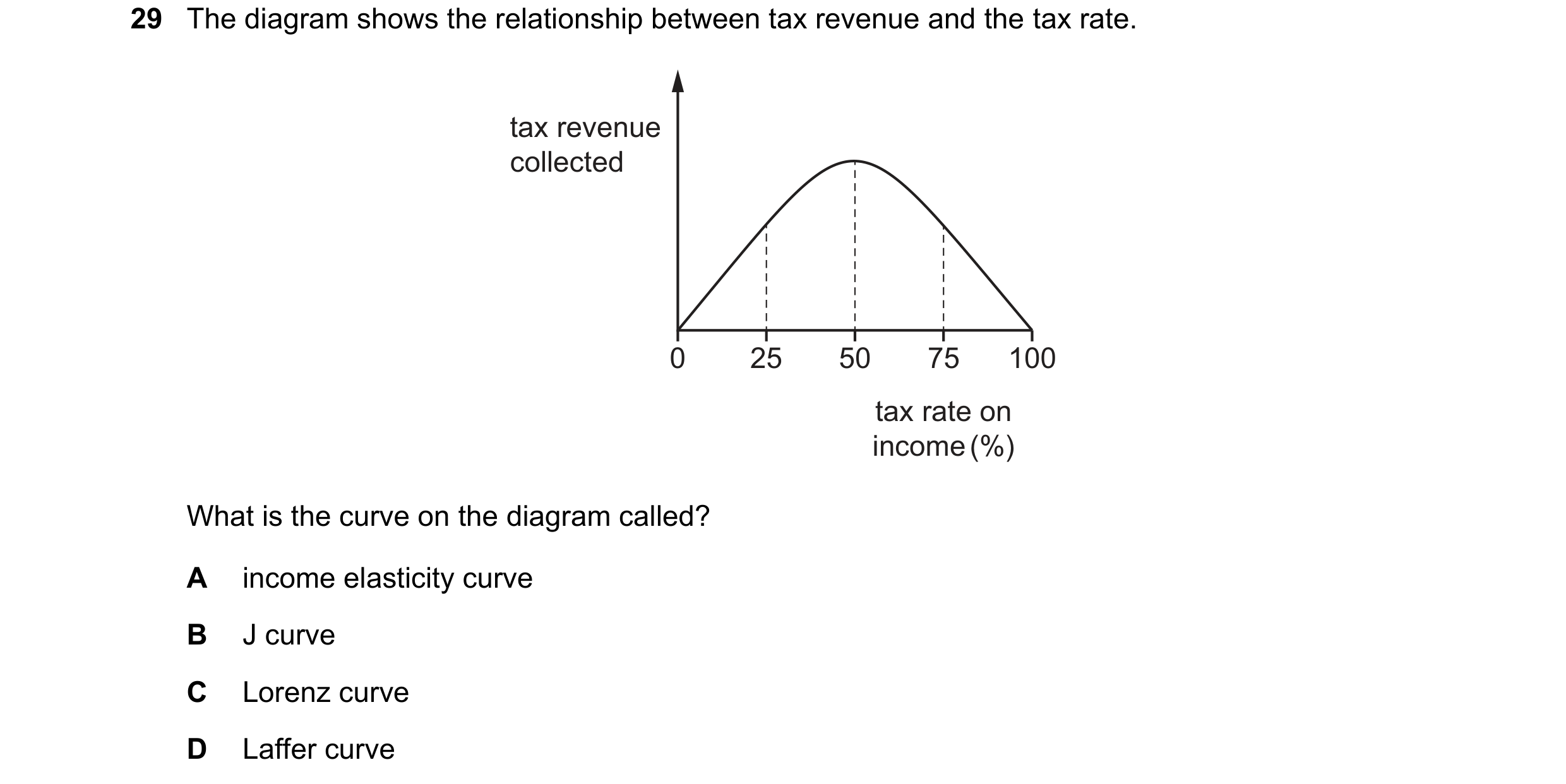
 7 / 12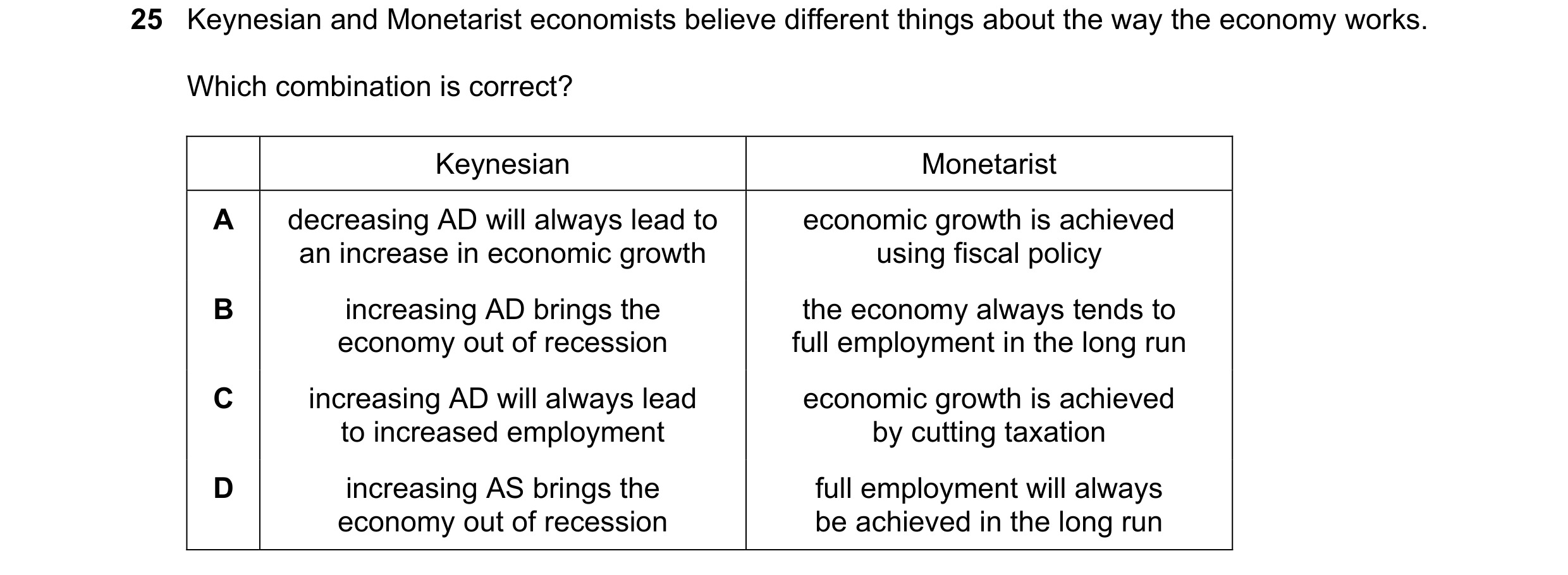

 8 / 12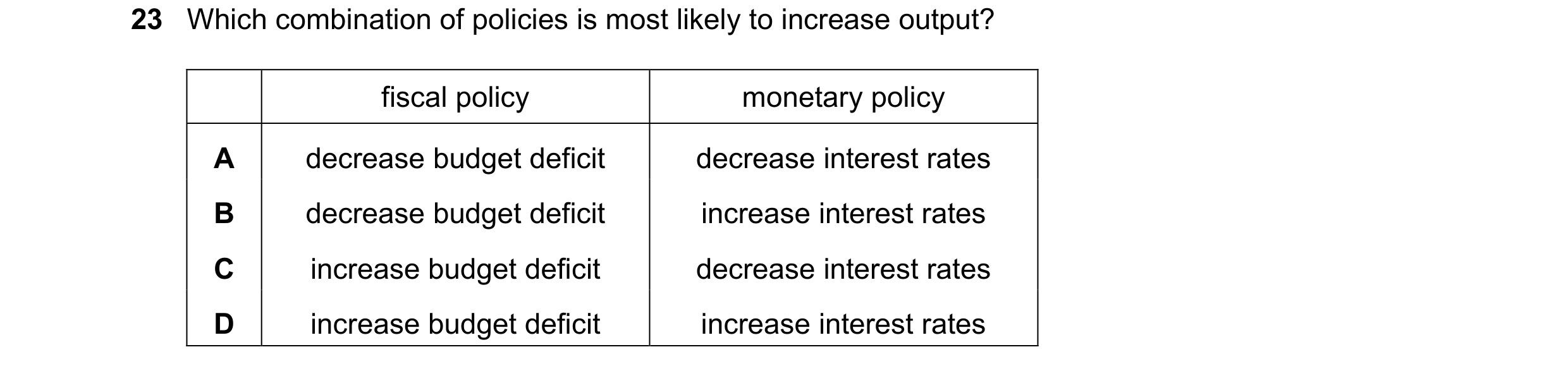

 9 / 12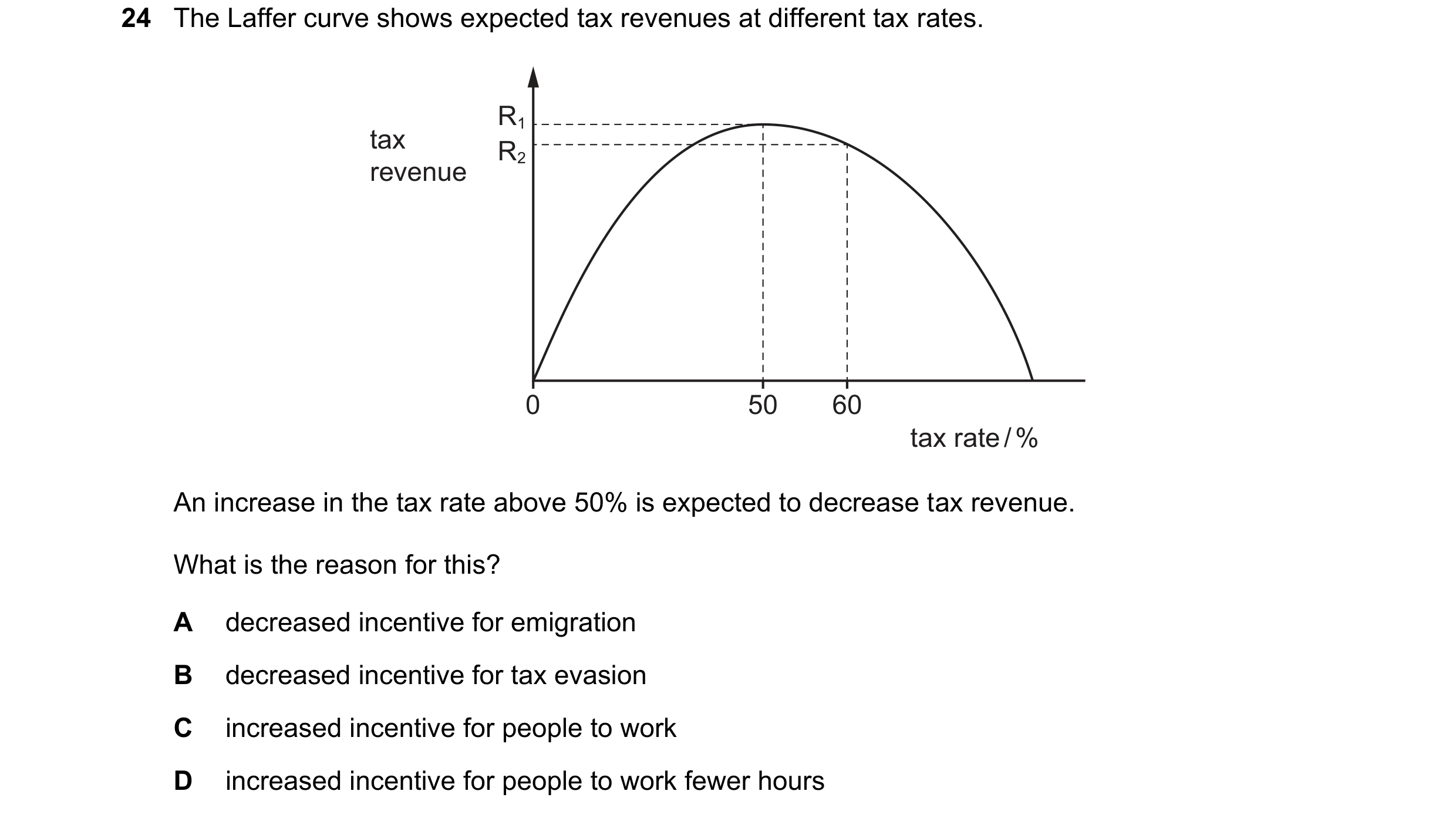
 10 / 12
 11 / 12
 12 / 12