Questions as text
Q1 · An economy is operating at its natural rate of unemployment 9708/31 May/June 2010
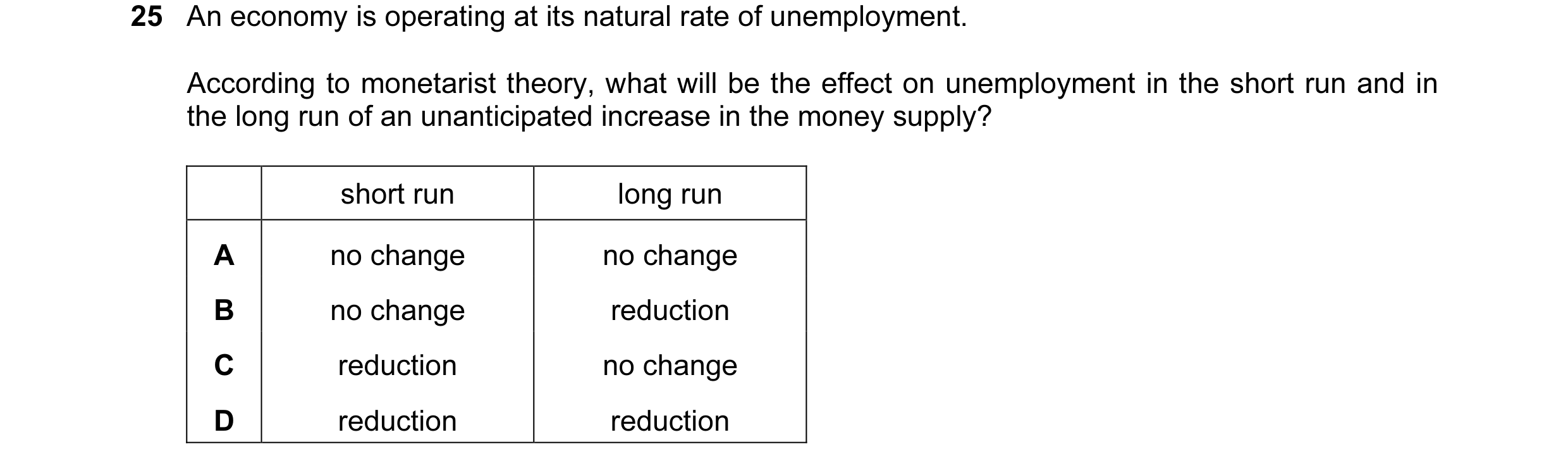
25 An economy is operating at its natural rate of unemployment. According to monetarist theory, what will be the effect on unemployment in the short run and in the long run of an unanticipated increase in the money supply? short run long run A no change no change B no change reduction C reduction no change D reduction reduction
1 marks
Answer: C
This question in 9708/31 May/June 2010
Q2 · What could be expected to increase the pressure of demand-pull inflation in an open… 9708/33 Oct/Nov 2010
26 What could be expected to increase the pressure of demand-pull inflation in an open economy? A an appreciation of the foreign exchange rate B an increase in indirect taxes C an increase in interest rates D the imposition of import controls
1 marks
Answer: D
This question in 9708/33 Oct/Nov 2010
Q3 · The diagram shows a government’s revenue and expenditure for three years 9708/32 May/June 2011
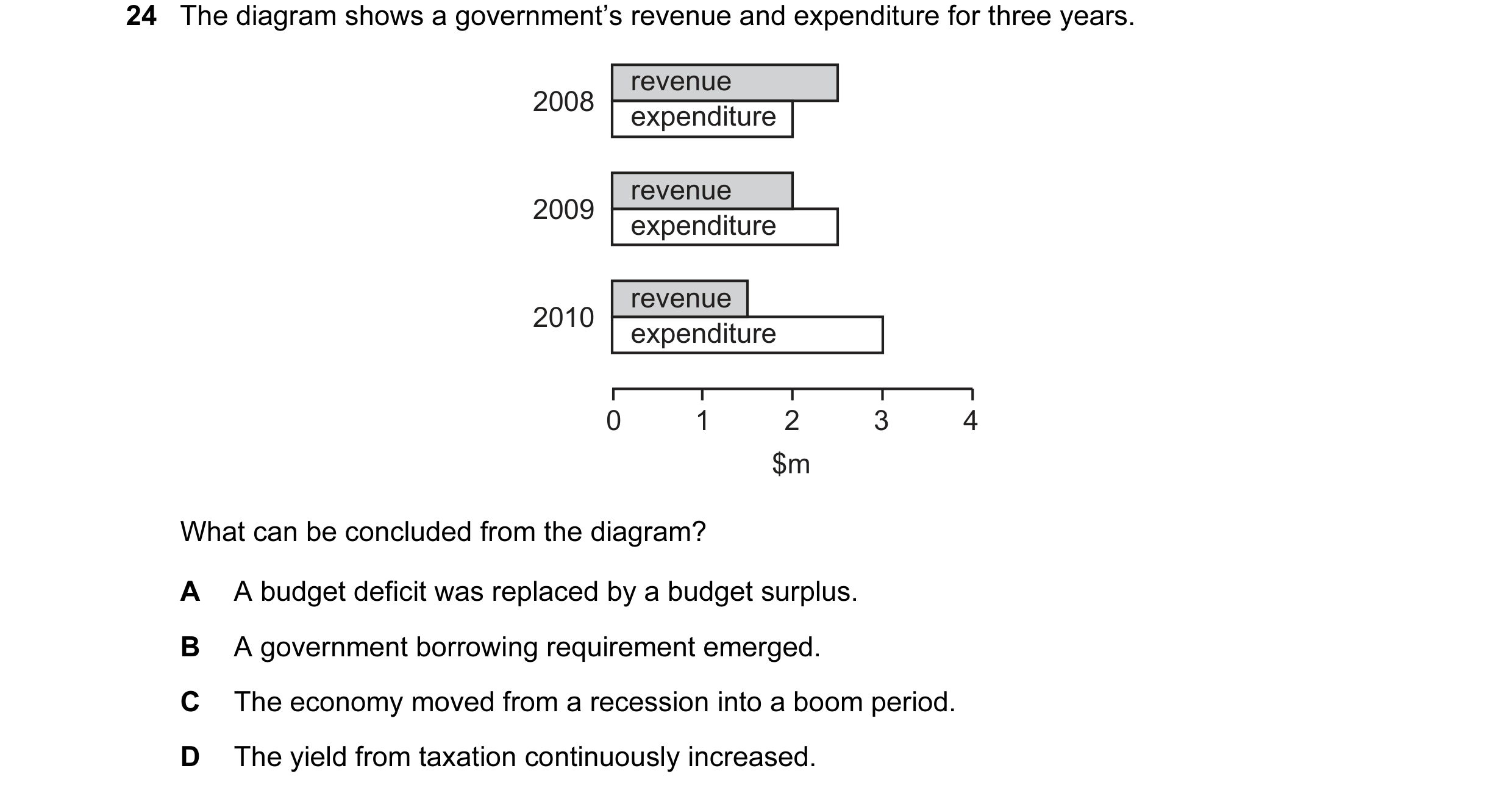
24 The diagram shows a government’s revenue and expenditure for three years. revenue 2008 expenditure revenue 2009 expenditure revenue 2010 expenditure 0 1 2 3 4 $m What can be concluded from the diagram? A A budget deficit was replaced by a budget surplus. B A government borrowing requirement emerged. C The economy moved from a recession into a boom period. D The yield from taxation continuously increased.
1 marks
Answer: B
This question in 9708/32 May/June 2011
Q4 · The table shows some indicators of macro-economic performance in the US economy for five… 9708/33 May/June 2011
22 The table shows some indicators of macro-economic performance in the US economy for five decades. economic target 1950s 1960s 1970s 1980s 1990s real GDP growth (average %) 4.18 4.43 3.28 3.02 3.03 inflation (average %) 2.07 2.33 7.09 5.66 3.00 unemployment (average %) 4.51 4.78 6.22 7.27 5.76 Between which decades did the US government achieve an overall improvement in its performance with no trade-off between individual policy goals? A 1950s to 1960s B 1960s to 1970s C 1970s to 1980s D 1980s to 1990s
1 marks
Answer: D
This question in 9708/33 May/June 2011
Q5 · What is a likely consequence of an increase in cyclical unemployment? 9708/31 Oct/Nov 2011
22 What is a likely consequence of an increase in cyclical unemployment? A a deficit on the current account of the balance of payments B a deterioration in the fiscal balance of the government C an increased rate of inflation D an increase in immigration
1 marks
Answer: B
This question in 9708/31 Oct/Nov 2011
Q6 · The economy of a country is simultaneously experiencing a balance of payments deficit, a… 9708/32 Oct/Nov 2011
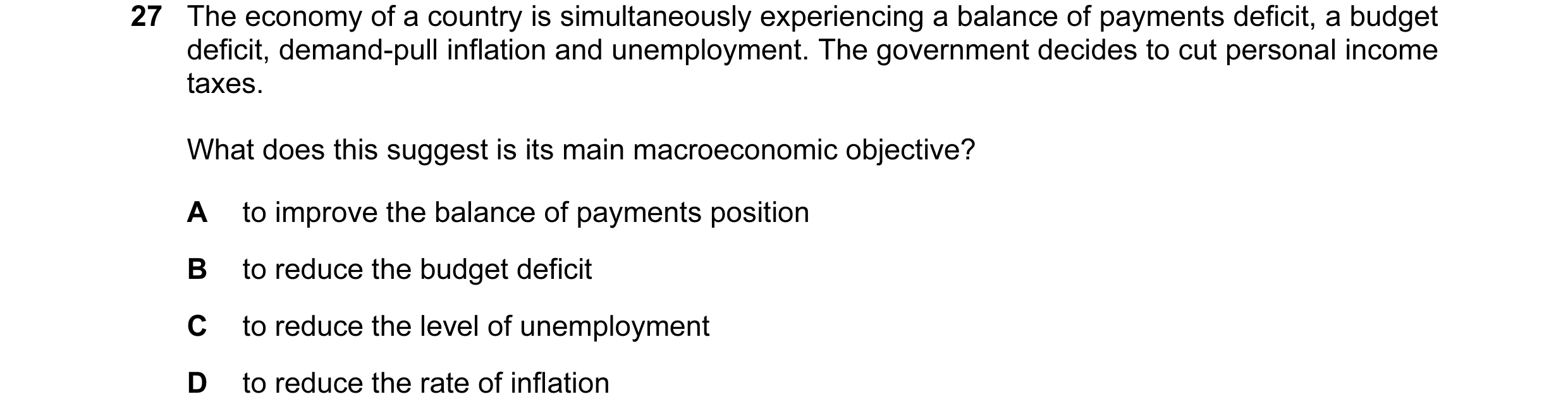
27 The economy of a country is simultaneously experiencing a balance of payments deficit, a budget deficit, demand-pull inflation and unemployment. The government decides to cut personal income taxes. What does this suggest is its main macroeconomic objective? A to improve the balance of payments position B to reduce the budget deficit C to reduce the level of unemployment D to reduce the rate of inflation
1 marks
Answer: C
This question in 9708/32 Oct/Nov 2011
Q7 · The diagram shows the time path of actual output and of long-term potential output of an… 9708/33 Oct/Nov 2011
28 The diagram shows the time path of actual output and of long-term potential output of an economy. potential output output actual output O time What would help to reduce the divergence of actual output from potential output? A a balanced budget B a stable exchange rate C automatic stabilisers D stable interest rates
1 marks
Answer: C
This question in 9708/33 Oct/Nov 2011
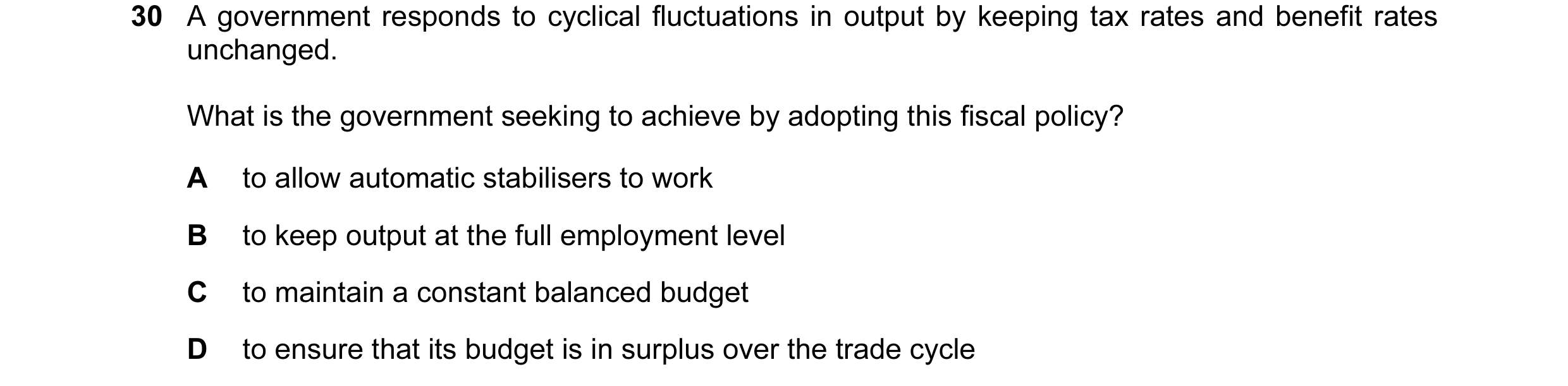
Q8 · A government responds to cyclical fluctuations in output by keeping tax rates and benefit… 9708/33 May/June 2012
30 A government responds to cyclical fluctuations in output by keeping tax rates and benefit rates unchanged. What is the government seeking to achieve by adopting this fiscal policy? A to allow automatic stabilisers to work B to keep output at the full employment level C to maintain a constant balanced budget D to ensure that its budget is in surplus over the trade cycle
1 marks
Answer: A
This question in 9708/33 May/June 2012
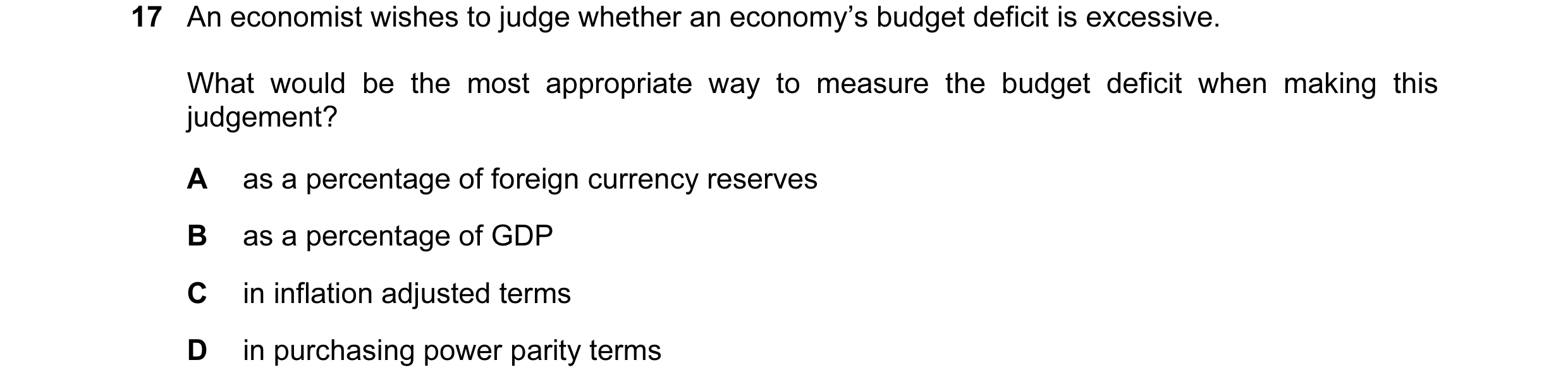
Q9 · An economist wishes to judge whether an economy’s budget deficit is excessive 9708/32 Oct/Nov 2012
17 An economist wishes to judge whether an economy’s budget deficit is excessive. What would be the most appropriate way to measure the budget deficit when making this judgement? A as a percentage of foreign currency reserves B as a percentage of GDP C in inflation adjusted terms D in purchasing power parity terms
1 marks
Answer: B
This question in 9708/32 Oct/Nov 2012
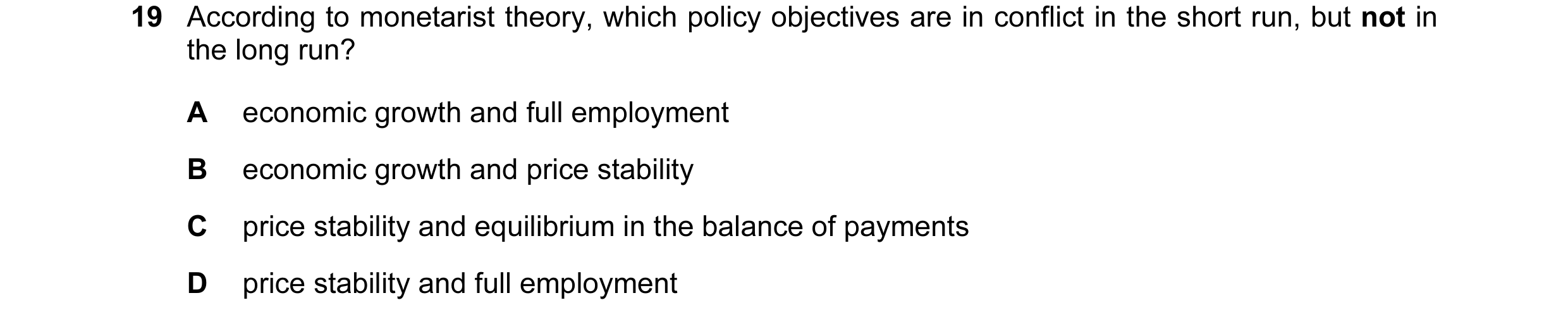
Q10 · According to monetarist theory, which policy objectives are in conflict in the short run… 9708/33 Oct/Nov 2012
19 According to monetarist theory, which policy objectives are in conflict in the short run, but not in the long run? A economic growth and full employment B economic growth and price stability C price stability and equilibrium in the balance of payments D price stability and full employment
1 marks
This question in 9708/33 Oct/Nov 2012
Q11 · What does a government need to do to maintain a balanced budget? 9708/33 May/June 2013
30 What does a government need to do to maintain a balanced budget? A keep tax rates and benefit rates unchanged in a slump B raise taxes in a slump and lower taxes in a boom C raise both tax rates and benefit rates in a boom D raise both tax rates and benefit rates in a slump
1 marks
Answer: B
This question in 9708/33 May/June 2013
Q12 · When might an increase in a government budget deficit be considered the most appropriate… 9708/31 Oct/Nov 2013
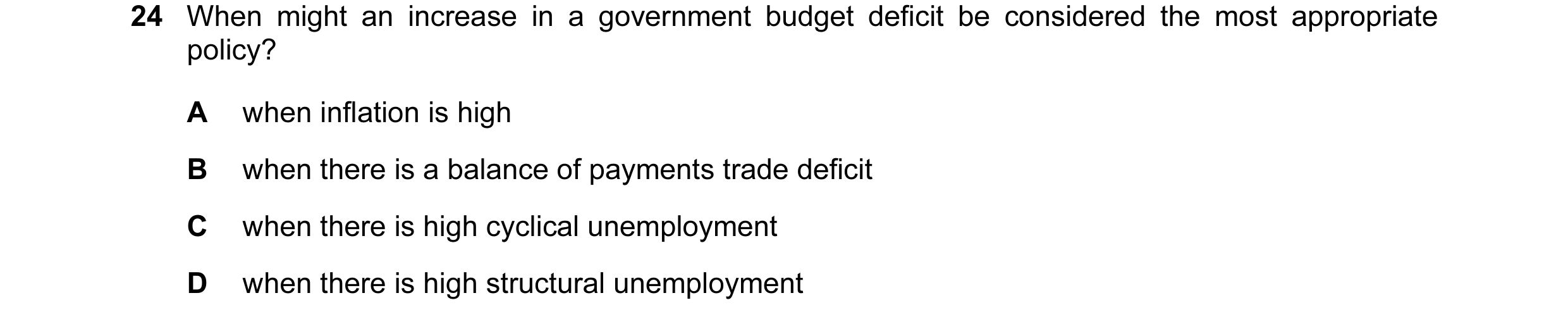
24 When might an increase in a government budget deficit be considered the most appropriate policy? A when inflation is high B when there is a balance of payments trade deficit C when there is high cyclical unemployment D when there is high structural unemployment
1 marks
Answer: C
This question in 9708/31 Oct/Nov 2013
Q13 · A country experiences cyclical unemployment due to a decrease in domestic spending 9708/32 Oct/Nov 2013
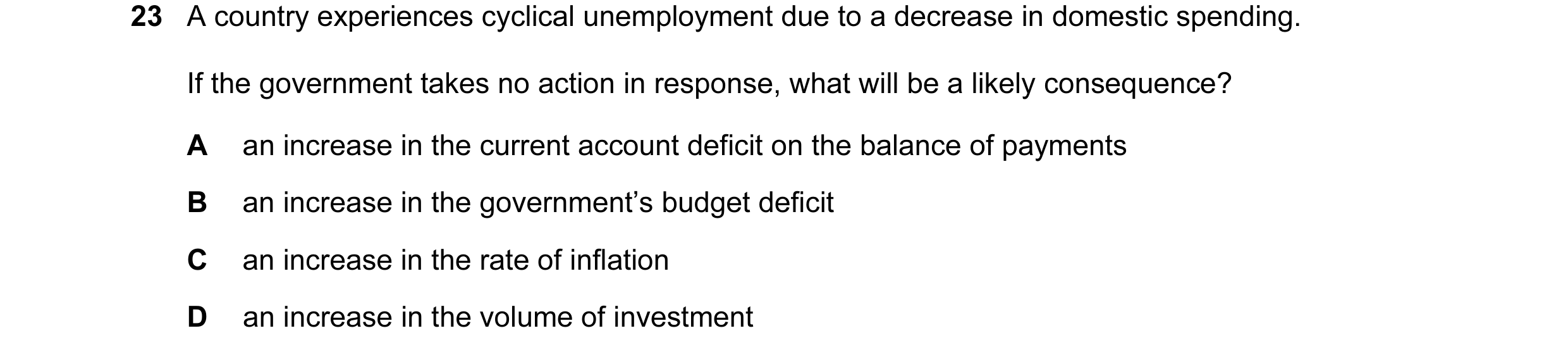
23 A country experiences cyclical unemployment due to a decrease in domestic spending. If the government takes no action in response, what will be a likely consequence? A an increase in the current account deficit on the balance of payments B an increase in the government’s budget deficit C an increase in the rate of inflation D an increase in the volume of investment
1 marks
Answer: B
This question in 9708/32 Oct/Nov 2013
Q14 · The diagram shows the actual output and expected output of an economy 9708/31 May/June 2015
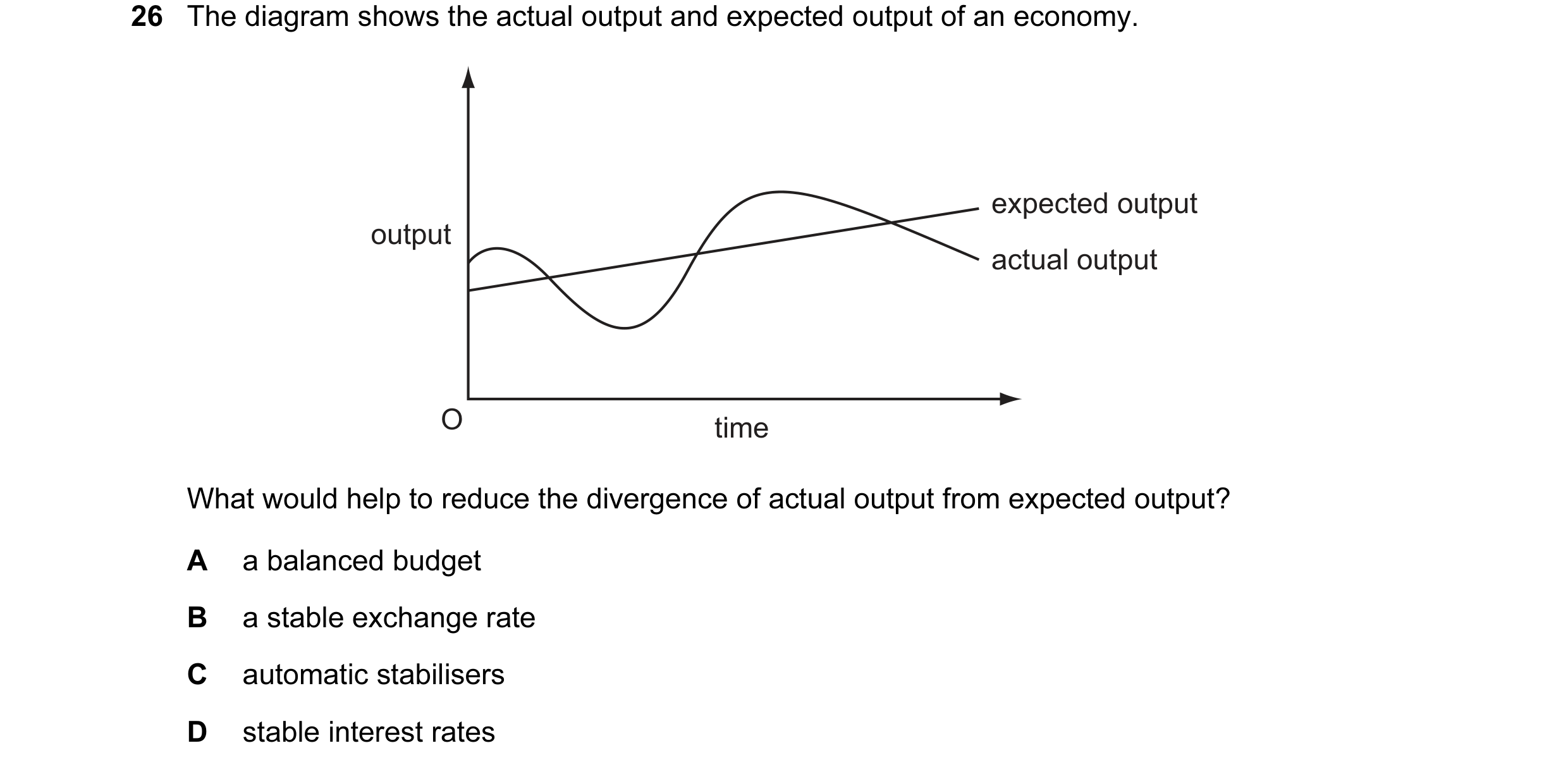
26 The diagram shows the actual output and expected output of an economy. expected output output actual output O time What would help to reduce the divergence of actual output from expected output? A a balanced budget B a stable exchange rate C automatic stabilisers D stable interest rates
1 marks
Answer: C
This question in 9708/31 May/June 2015
Q15 · The table gives details of a government’s budget over two years 9708/31 May/June 2015
28 The table gives details of a government’s budget over two years. 2012 / 13 2013 / 14 (US$ millions) (US$ millions) government revenue 2 630 000 3 730 000 government spending 3 000 300 3 770 000 What happened to government finances between 2012 / 13 and 2013 / 14? A The annual budget deficit rose. B The annual budget surplus fell. C The national debt fell. D The national debt rose.
1 marks
Answer: D
This question in 9708/31 May/June 2015
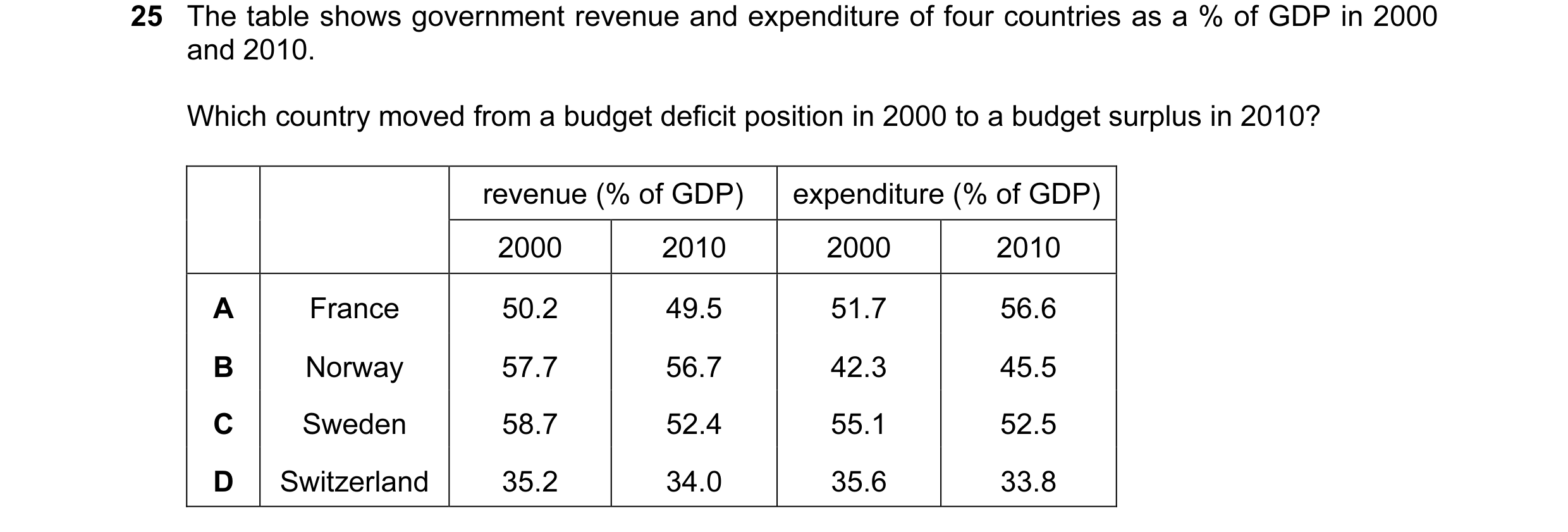
Q16 · The table shows government revenue and expenditure of four countries as a % of GDP in… 9708/31 Oct/Nov 2015
25 The table shows government revenue and expenditure of four countries as a % of GDP in 2000 and 2010. Which country moved from a budget deficit position in 2000 to a budget surplus in 2010? revenue (% of GDP) expenditure (% of GDP) 2000 2010 2000 2010 A France 50.2 49.5 51.7 56.6 B Norway 57.7 56.7 42.3 45.5 C Sweden 58.7 52.4 55.1 52.5 D Switzerland 35.2 34.0 35.6 33.8
1 marks
This question in 9708/31 Oct/Nov 2015
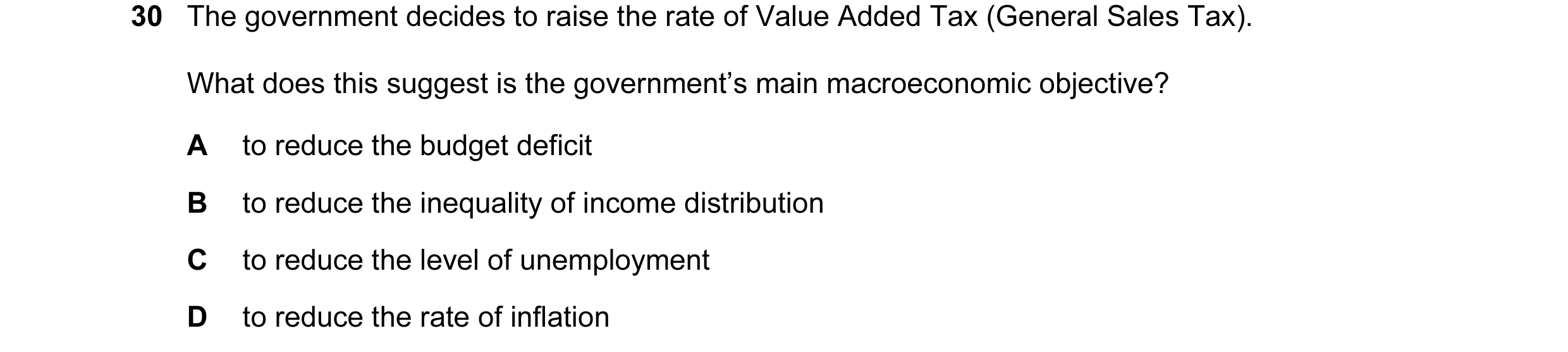
Q17 · The government decides to raise the rate of Value Added Tax (General Sales Tax) 9708/31 Oct/Nov 2015
30 The government decides to raise the rate of Value Added Tax (General Sales Tax). What does this suggest is the government’s main macroeconomic objective? A to reduce the budget deficit B to reduce the inequality of income distribution C to reduce the level of unemployment D to reduce the rate of inflation
1 marks
This question in 9708/31 Oct/Nov 2015
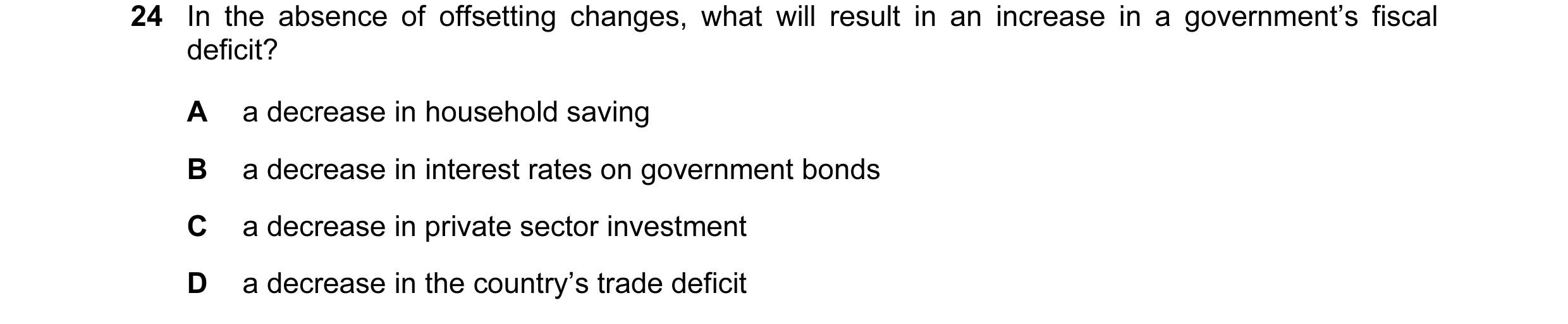
Q18 · In the absence of offsetting changes, what will result in an increase in a government’s… 9708/32 Oct/Nov 2015
24 In the absence of offsetting changes, what will result in an increase in a government’s fiscal deficit? A a decrease in household saving B a decrease in interest rates on government bonds C a decrease in private sector investment D a decrease in the country’s trade deficit
1 marks
Answer: C
This question in 9708/32 Oct/Nov 2015
Q19 · What could be expected to increase the pressure of demand-pull inflation in an open… 9708/33 Oct/Nov 2015
29 What could be expected to increase the pressure of demand-pull inflation in an open economy? A an appreciation of the foreign exchange rate B an increase in interest rates C an increase in sales taxes D an increase in the budget deficit
1 marks
Answer: D
This question in 9708/33 Oct/Nov 2015
Q20 · What will be most likely to rise if unemployment is increasing in an economy? 9708/32 May/June 2016
28 What will be most likely to rise if unemployment is increasing in an economy? A the human capital of unemployed workers B the living standards of all workers C the nominal money wage rate of employed workers D the tax burden on employed workers
1 marks
Answer: D
This question in 9708/32 May/June 2016
Q21 · What is the aim of stabilisation policy? 9708/33 May/June 2016
28 What is the aim of stabilisation policy? A to keep the exchange rate stable B to keep the price level stable C to reduce fluctuations in interest rates D to reduce fluctuations in national output
1 marks
Answer: D
This question in 9708/33 May/June 2016
Q22 · Which policy’s principal aim is to ensure sound public finances? 9708/32 Oct/Nov 2016
30 Which policy’s principal aim is to ensure sound public finances? A environmental policy B fiscal policy C monetary policy D supply-side policy
1 marks
Answer: B
This question in 9708/32 Oct/Nov 2016
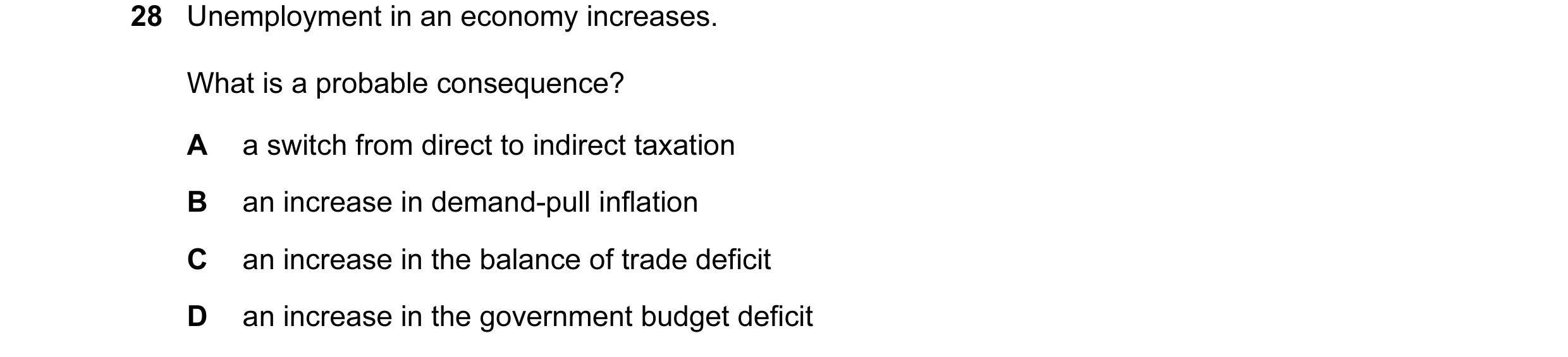
Q23 · Unemployment in an economy increases 9708/33 Oct/Nov 2016
28 Unemployment in an economy increases. What is a probable consequence? A a switch from direct to indirect taxation B an increase in demand-pull inflation C an increase in the balance of trade deficit D an increase in the government budget deficit
1 marks
Answer: D
This question in 9708/33 Oct/Nov 2016
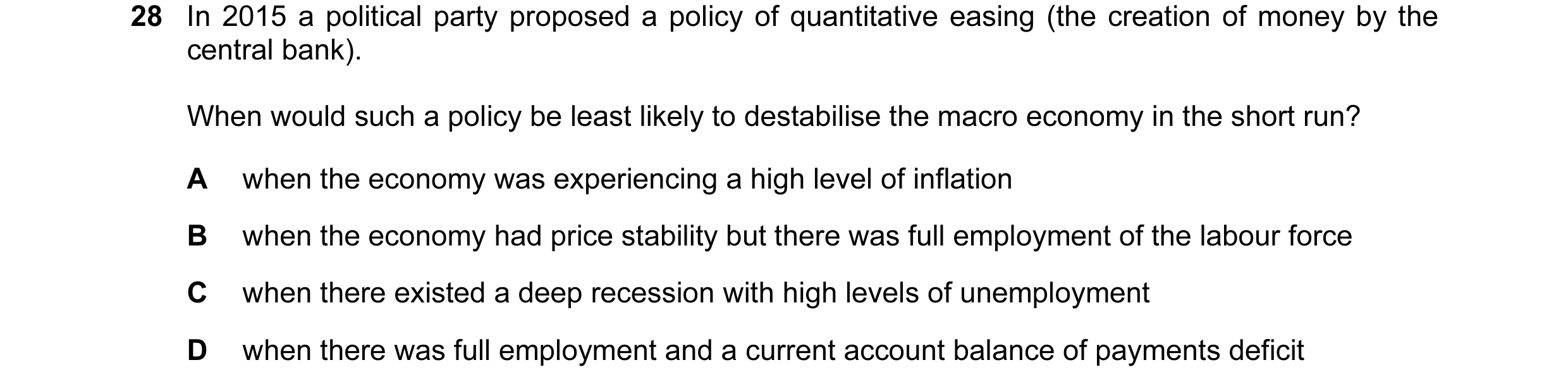
Q24 · In 2015 a political party proposed a policy of quantitative easing (the creation of money… 9708/33 May/June 2017
28 In 2015 a political party proposed a policy of quantitative easing (the creation of money by the central bank). When would such a policy be least likely to destabilise the macro economy in the short run? A when the economy was experiencing a high level of inflation B when the economy had price stability but there was full employment of the labour force C when there existed a deep recession with high levels of unemployment D when there was full employment and a current account balance of payments deficit
1 marks
Answer: C
This question in 9708/33 May/June 2017
Q25 · The table identifies pairs of possible government aims 9708/32 Oct/Nov 2018
29 The table identifies pairs of possible government aims. In which case is achievement of aim 1 likely to be consistent with the achievement of aim 2? aim 1 aim 2 A higher foreign exchange rate lower rate of unemployment B low rate of inflation balance of payments surplus C more even distribution of income higher rate of saving D rapid economic growth sustainable economic development
1 marks
Answer: B
This question in 9708/32 Oct/Nov 2018
Q26 · What would most likely result from a sustained increase in real GDP in an economy? 9708/31 Oct/Nov 2020
27 What would most likely result from a sustained increase in real GDP in an economy? A a decrease in the government’s budget deficit B a decrease in output per worker C an increase in a balance of payments surplus D an increase in frictional unemployment
1 marks
Answer: A
This question in 9708/31 Oct/Nov 2020
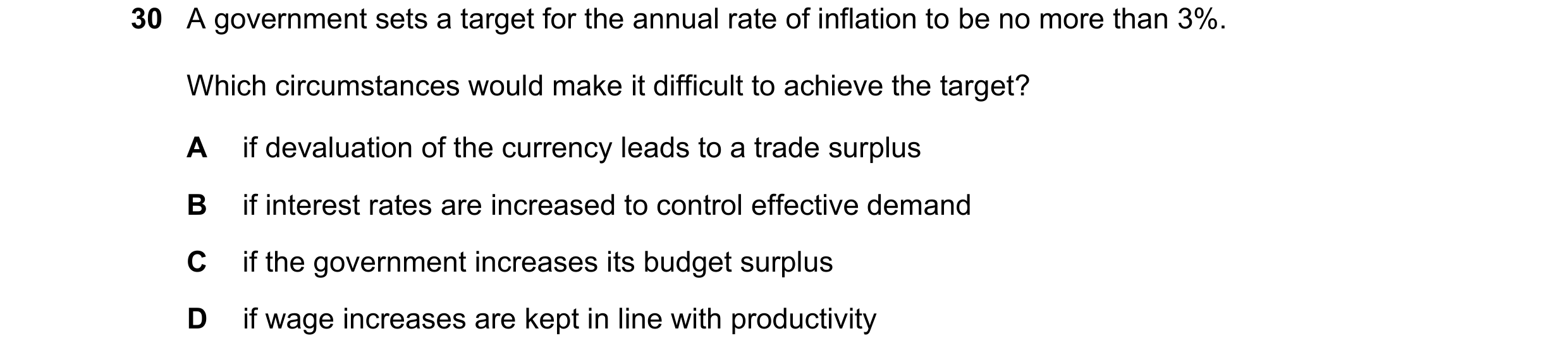
Q27 · A government sets a target for the annual rate of inflation to be no more than 3% 9708/31 Oct/Nov 2020
30 A government sets a target for the annual rate of inflation to be no more than 3%. Which circumstances would make it difficult to achieve the target? A if devaluation of the currency leads to a trade surplus B if interest rates are increased to control effective demand C if the government increases its budget surplus D if wage increases are kept in line with productivity
1 marks
Answer: A
This question in 9708/31 Oct/Nov 2020
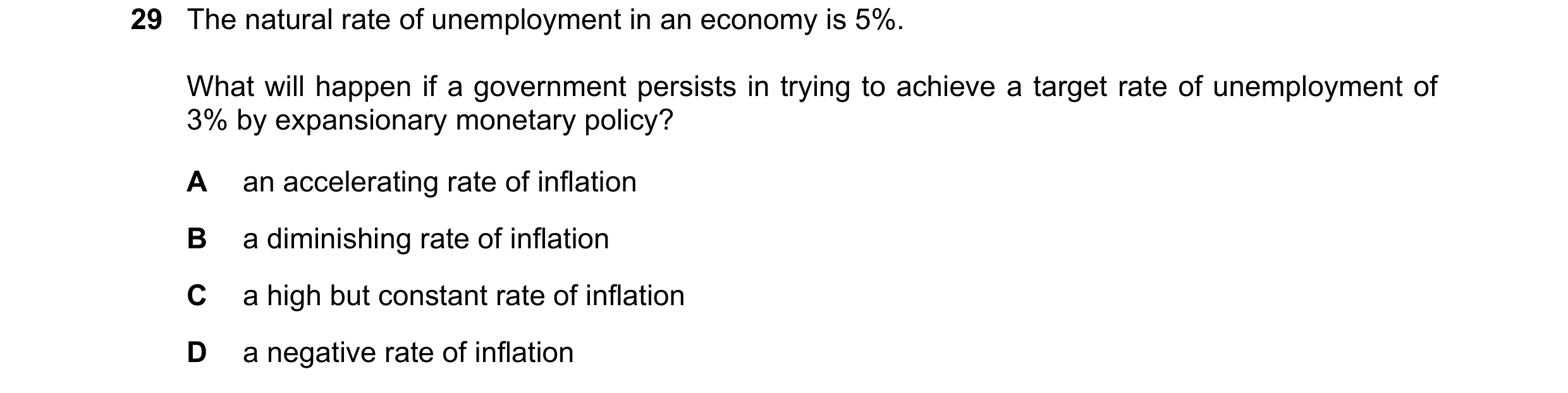
Q28 · The natural rate of unemployment in an economy is 5% 9708/32 Feb/March 2021
29 The natural rate of unemployment in an economy is 5%. What will happen if a government persists in trying to achieve a target rate of unemployment of 3% by expansionary monetary policy? A an accelerating rate of inflation B a diminishing rate of inflation C a high but constant rate of inflation D a negative rate of inflation
1 marks
Answer: A
This question in 9708/32 Feb/March 2021
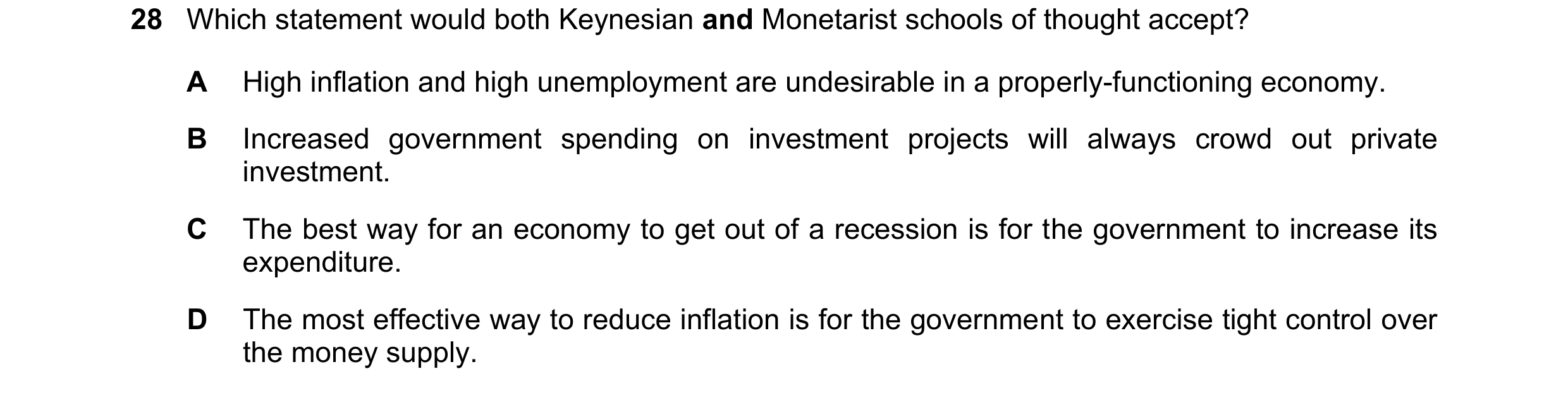
Q29 · Which statement would both Keynesian and Monetarist schools of thought accept? 9708/31 May/June 2021
28 Which statement would both Keynesian and Monetarist schools of thought accept? A High inflation and high unemployment are undesirable in a properly-functioning economy. B Increased government spending on investment projects will always crowd out private investment. C The best way for an economy to get out of a recession is for the government to increase its expenditure. D The most effective way to reduce inflation is for the government to exercise tight control over the money supply.
1 marks
Answer: A
This question in 9708/31 May/June 2021
Q30 · In country X the marginal rate of income tax imposed on the highest earners was 83% which… 9708/31 May/June 2021
29 In country X the marginal rate of income tax imposed on the highest earners was 83% which increased to 98% if income was received from interest or dividends. The highest marginal rate was then reduced to 40%. Despite this reduction, the tax revenue raised from the highest earners increased substantially. Which theoretical concept illustrates this relationship between tax rates and tax revenue? A the J curve B the Laffer curve C the Marshall-Lerner condition D the Phillips curve
1 marks
Answer: B
This question in 9708/31 May/June 2021
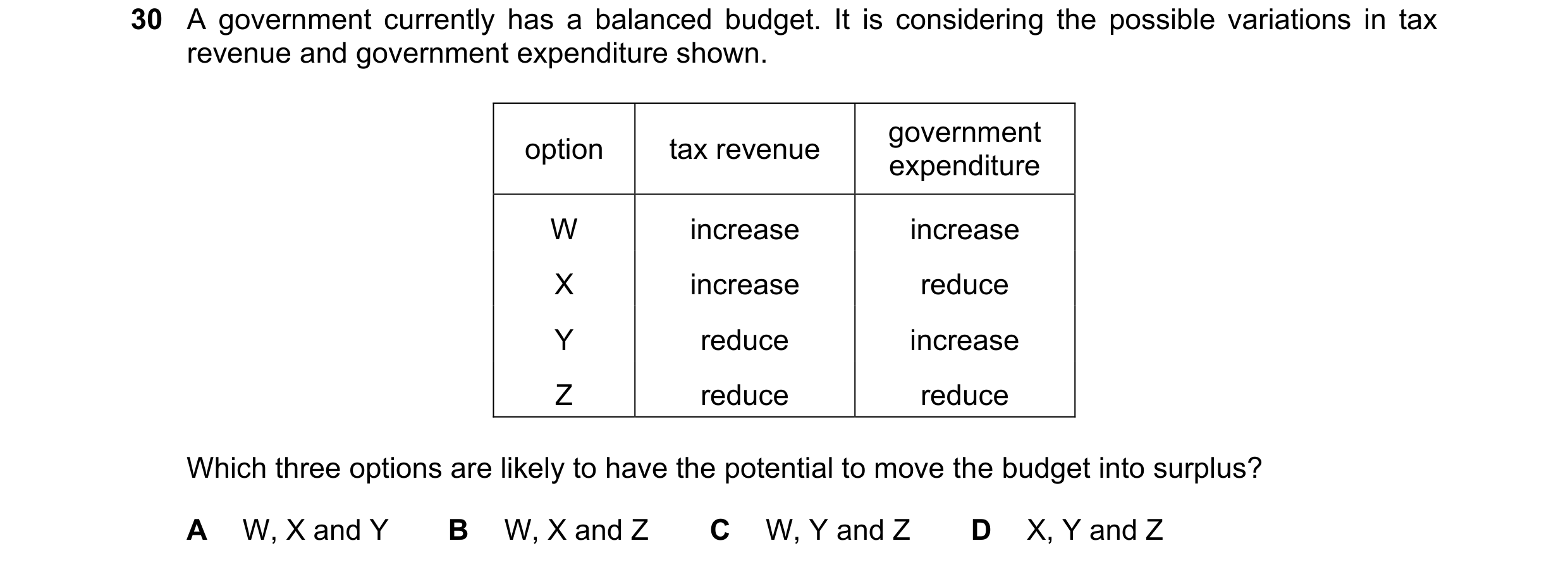
Q31 · A government currently has a balanced budget 9708/32 May/June 2021
30 A government currently has a balanced budget. It is considering the possible variations in tax revenue and government expenditure shown. government option tax revenue expenditure W increase increase X increase reduce Y reduce increase Z reduce reduce Which three options are likely to have the potential to move the budget into surplus? A W, X and Y B W, X and Z C W, Y and Z D X, Y and Z
1 marks
Answer: B
This question in 9708/32 May/June 2021
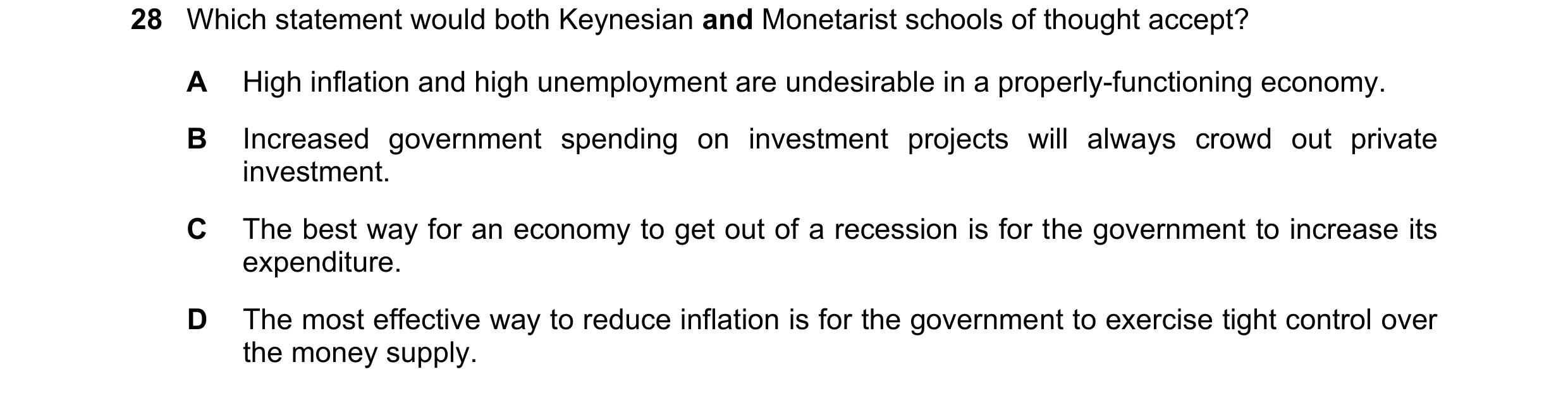
Q32 · Which statement would both Keynesian and Monetarist schools of thought accept? 9708/33 May/June 2021
28 Which statement would both Keynesian and Monetarist schools of thought accept? A High inflation and high unemployment are undesirable in a properly-functioning economy. B Increased government spending on investment projects will always crowd out private investment. C The best way for an economy to get out of a recession is for the government to increase its expenditure. D The most effective way to reduce inflation is for the government to exercise tight control over the money supply.
1 marks
Answer: A
This question in 9708/33 May/June 2021
Q33 · Which policy is most likely to conflict with a government’s aim of price stability in the… 9708/32 Oct/Nov 2021
29 Which policy is most likely to conflict with a government’s aim of price stability in the short run? A increasing spending on education and health B increasing the basic rate of income tax C limiting wage increases in the public sector D preventing mergers of large companies
1 marks
Answer: A
This question in 9708/32 Oct/Nov 2021
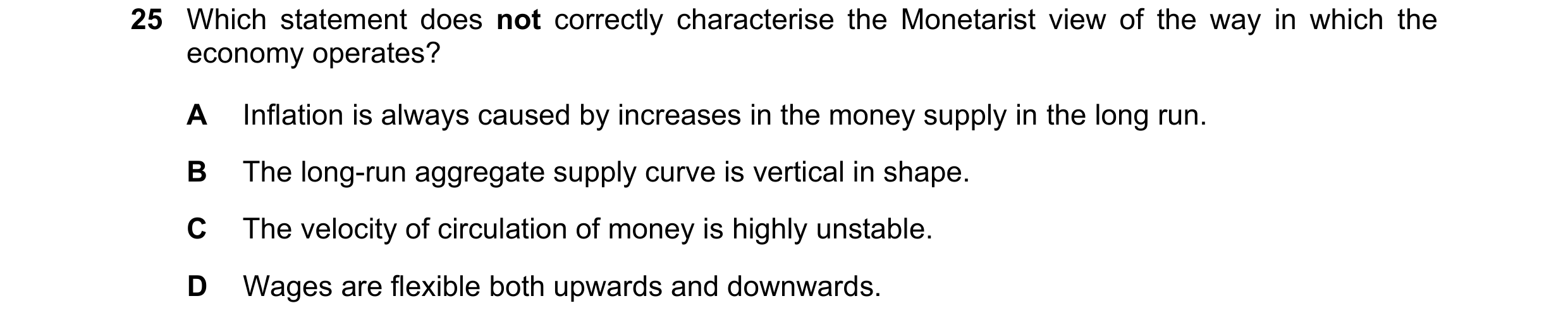
Q34 · Which statement does not correctly characterise the Monetarist view of the way in which… 9708/31 Oct/Nov 2022
25 Which statement does not correctly characterise the Monetarist view of the way in which the economy operates? A Inflation is always caused by increases in the money supply in the long run. B The long-run aggregate supply curve is vertical in shape. C The velocity of circulation of money is highly unstable. D Wages are flexible both upwards and downwards.
1 marks
Answer: C
This question in 9708/31 Oct/Nov 2022
Q35 · Which combination of circumstances is most likely to lead to an increase in a country’s… 9708/32 Feb/March 2023
17 Which combination of circumstances is most likely to lead to an increase in a country’s budget deficit? government total GDP unemployment spending A decreases rises decreases B decreases rises no change C increases falls increases D increases falls no change
1 marks
Answer: B
This question in 9708/32 Feb/March 2023
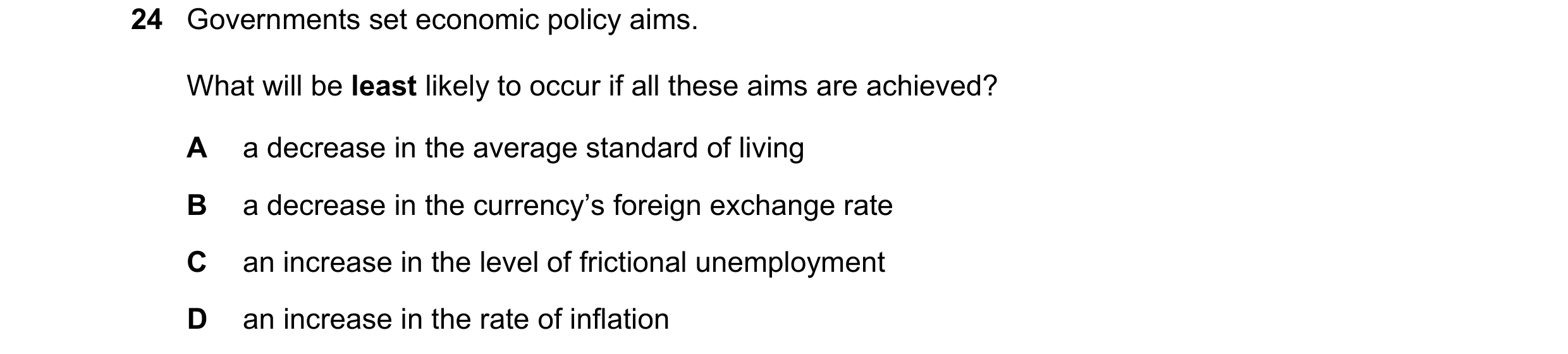
Q36 · Governments set economic policy aims 9708/32 May/June 2023
24 Governments set economic policy aims. What will be least likely to occur if all these aims are achieved? A a decrease in the average standard of living B a decrease in the currency’s foreign exchange rate C an increase in the level of frictional unemployment D an increase in the rate of inflation
1 marks
Answer: A
This question in 9708/32 May/June 2023
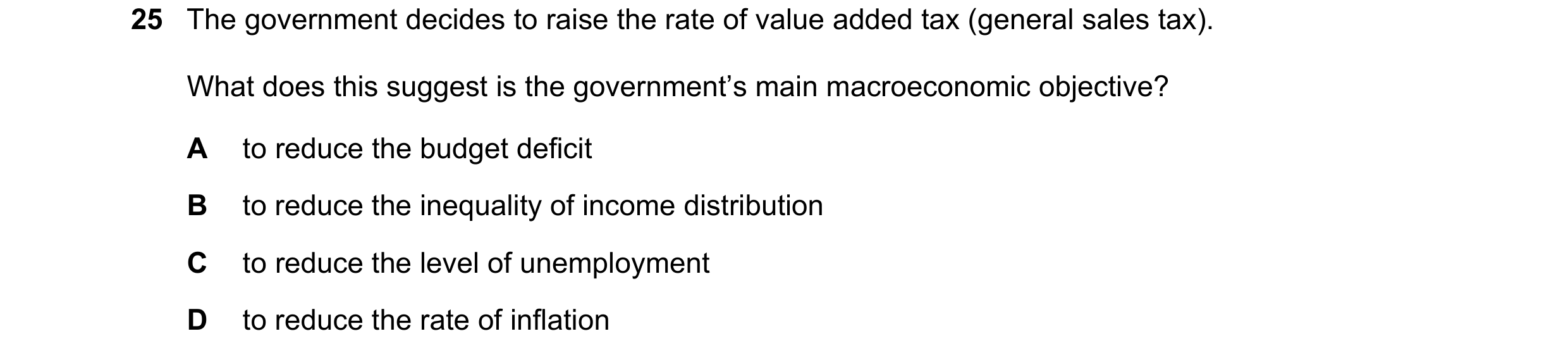
Q37 · The government decides to raise the rate of value added tax (general sales tax) 9708/32 May/June 2023
25 The government decides to raise the rate of value added tax (general sales tax). What does this suggest is the government’s main macroeconomic objective? A to reduce the budget deficit B to reduce the inequality of income distribution C to reduce the level of unemployment D to reduce the rate of inflation
1 marks
Answer: A
This question in 9708/32 May/June 2023
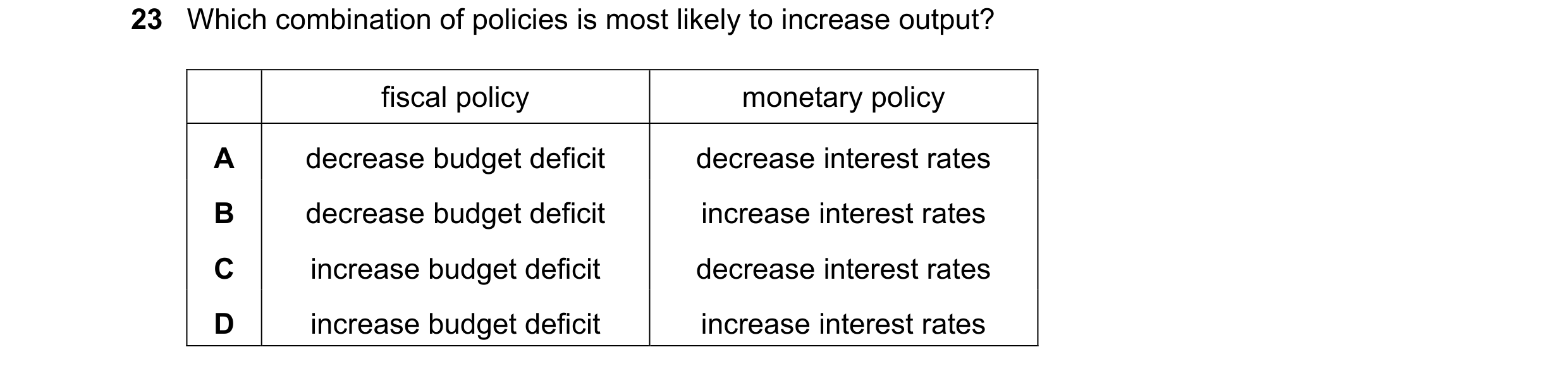
Q38 · Which combination of policies is most likely to increase output? 9708/33 May/June 2023
23 Which combination of policies is most likely to increase output? fiscal policy monetary policy A decrease budget deficit decrease interest rates B decrease budget deficit increase interest rates C increase budget deficit decrease interest rates D increase budget deficit increase interest rates
1 marks
Answer: C
This question in 9708/33 May/June 2023
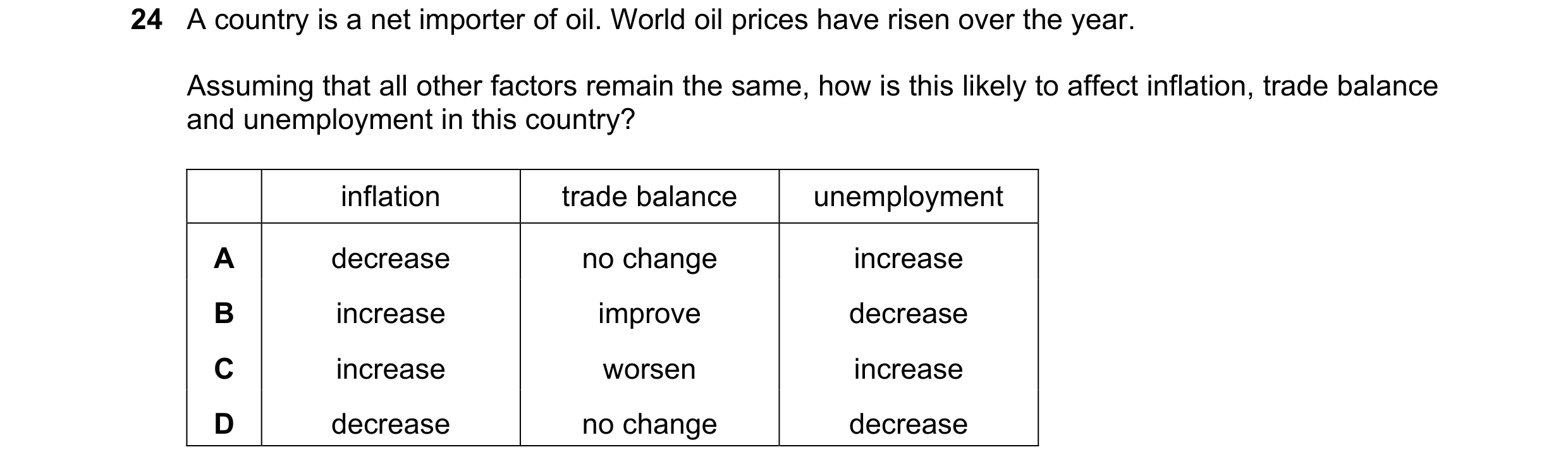
Q39 · A country is a net importer of oil 9708/33 May/June 2023
24 A country is a net importer of oil. World oil prices have risen over the year. Assuming that all other factors remain the same, how is this likely to affect inflation, trade balance and unemployment in this country? inflation trade balance unemployment A decrease no change increase B increase improve decrease C increase worsen increase D decrease no change decrease
1 marks
Answer: C
This question in 9708/33 May/June 2023
Q40 · The table gives some economic indicators for four countries 9708/33 Oct/Nov 2023
25 The table gives some economic indicators for four countries. Which country is closest to achieving the principal aims of government economic policy? balance of change in GDP rate of inflation unemployment payments (%) (%) (%) (% of GDP) A 0.47 0.8 3.4 +3.3 B 1.13 0.9 10.5 –0.1 C 1.18 1.1 6.9 –3.3 D 1.45 0.1 4.6 +8.5
1 marks
Answer: D
This question in 9708/33 Oct/Nov 2023
Q41 · What is a government macroeconomic aim? 9708/33 Oct/Nov 2023
26 What is a government macroeconomic aim? A a fall in the general price level of goods and services B an increase in monopoly regulation C lower taxes on consumer goods D a minimum wage for low paid agricultural workers
1 marks
Answer: A
This question in 9708/33 Oct/Nov 2023

 1 / 10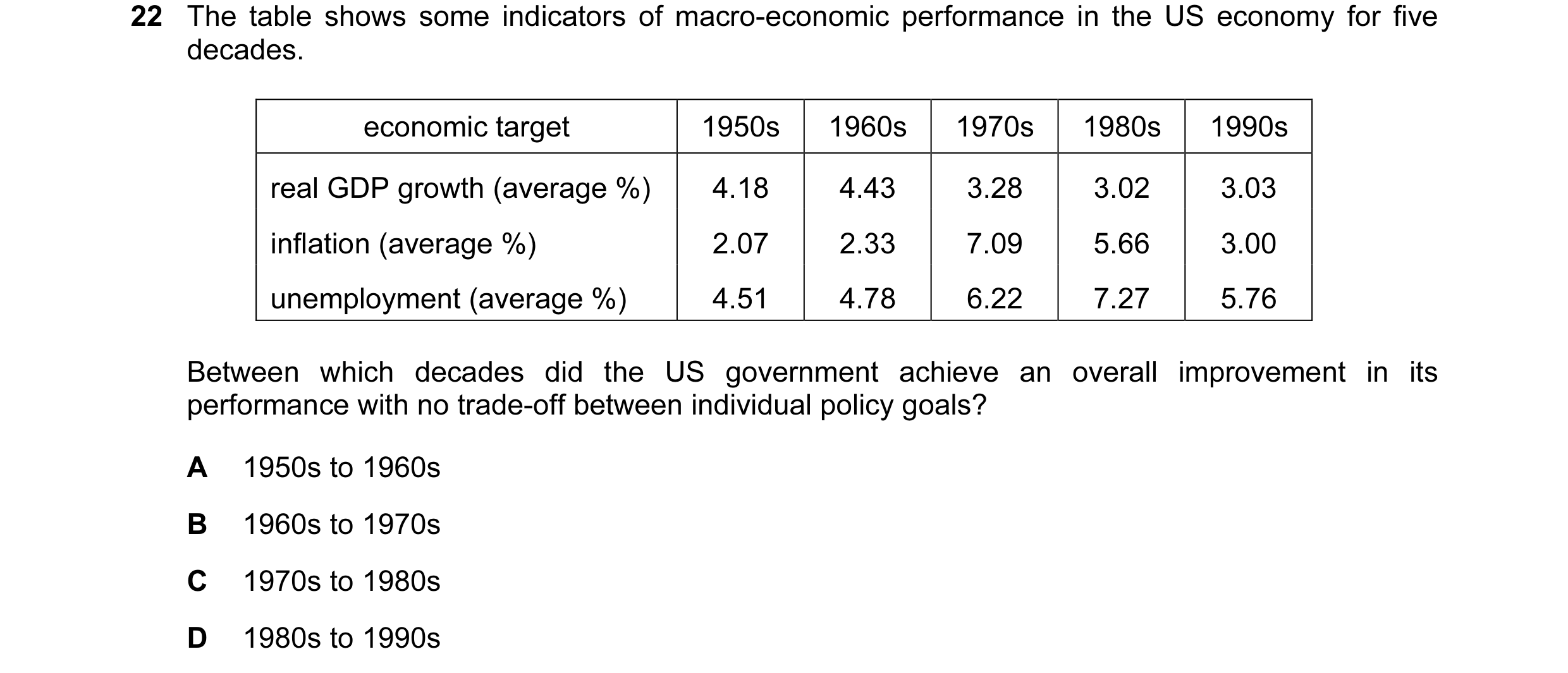

 2 / 10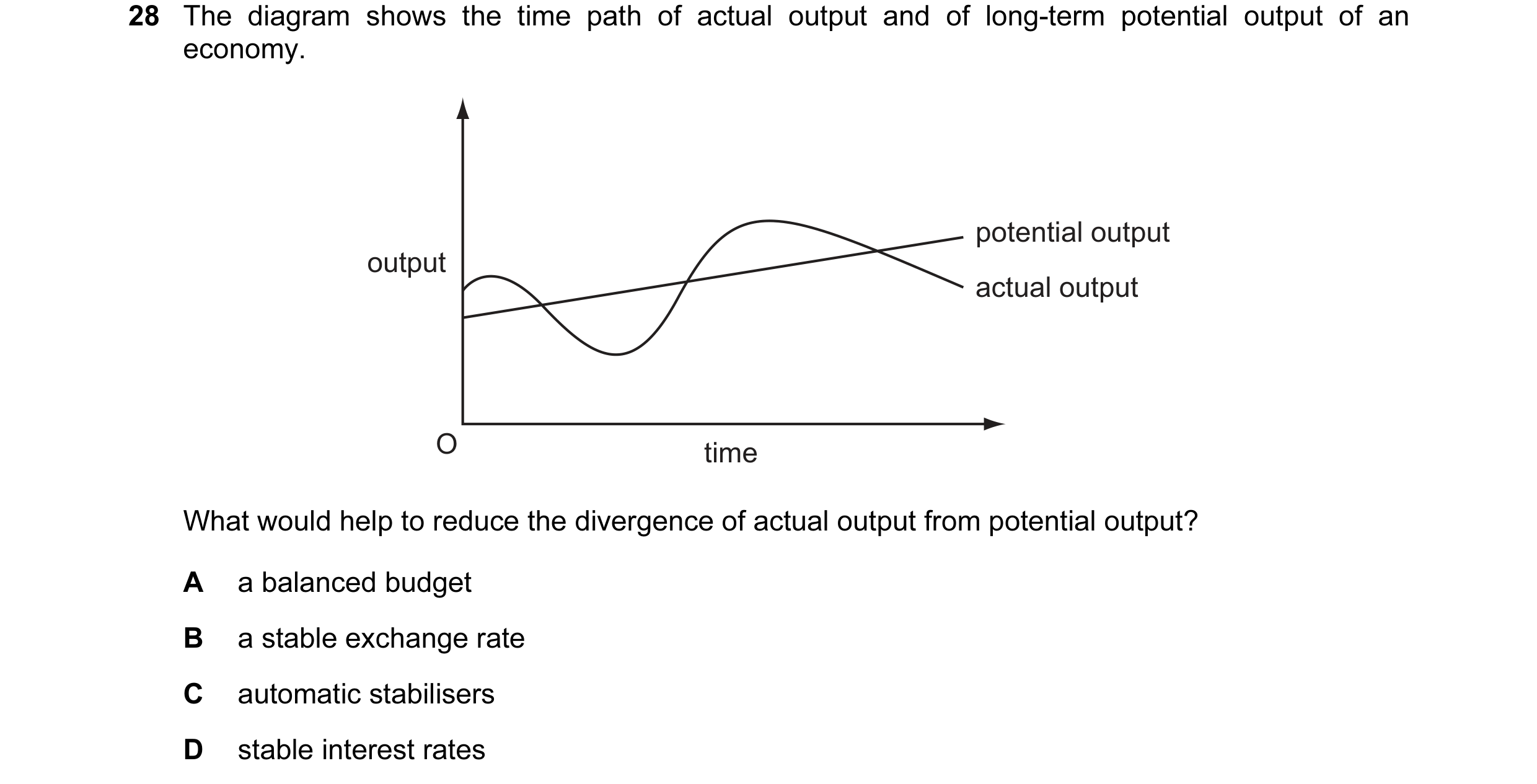
 3 / 10
 4 / 10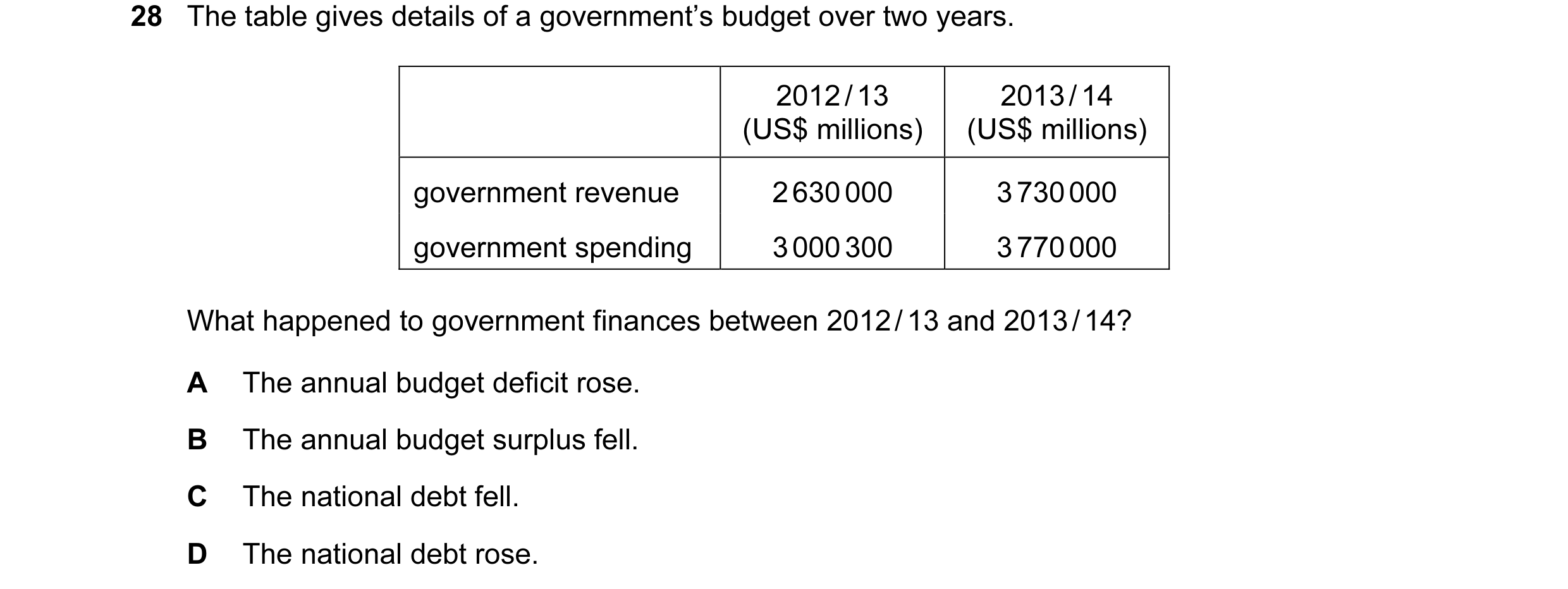
 5 / 10



 6 / 10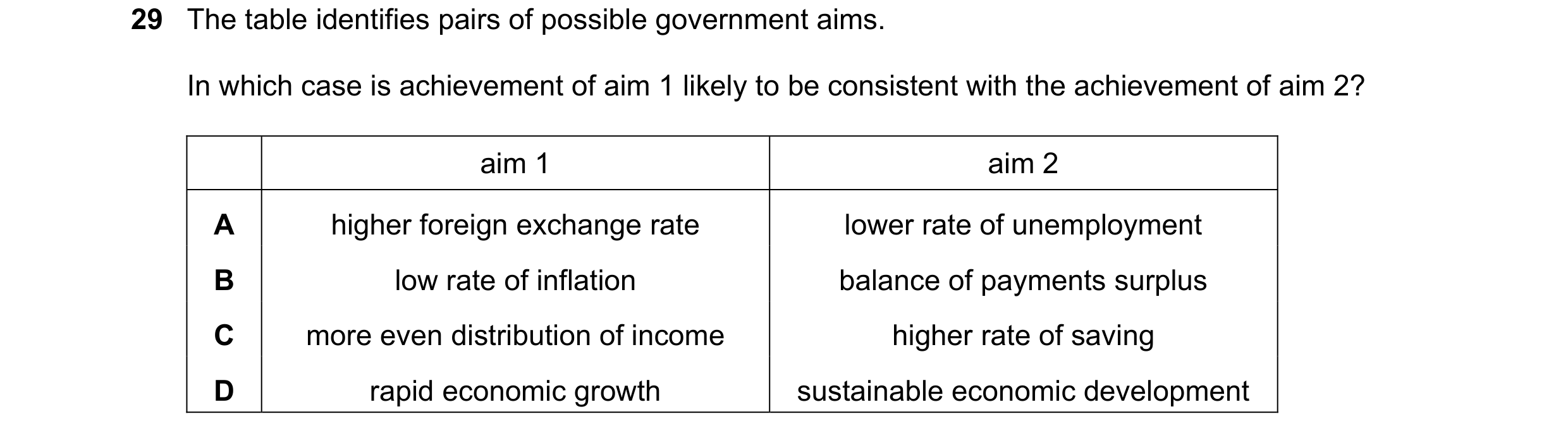

 7 / 10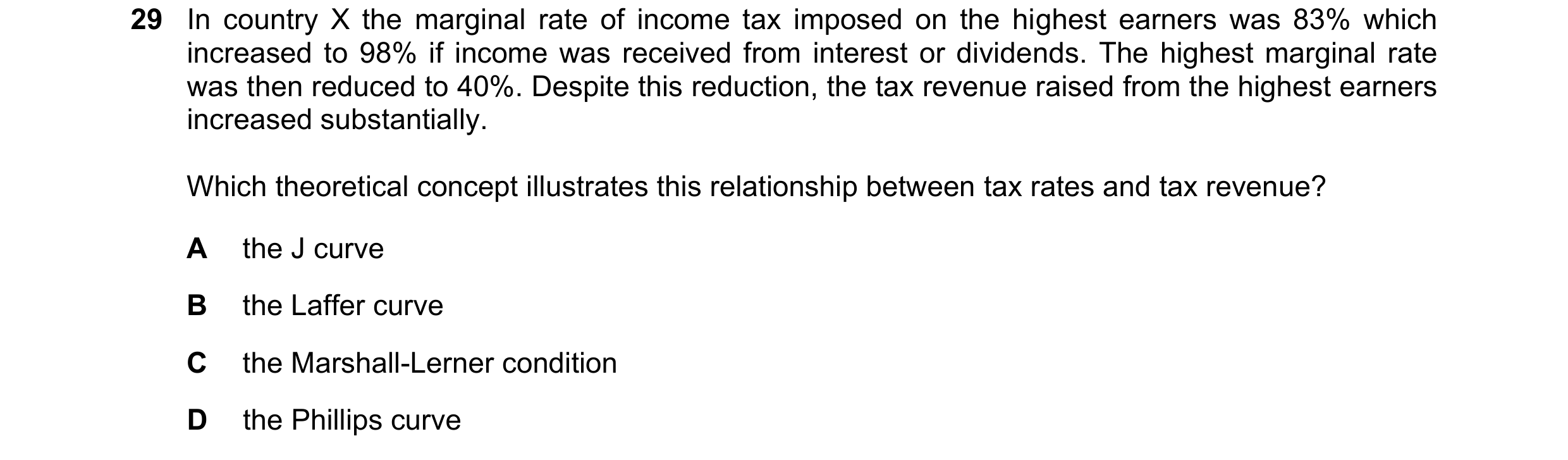

 8 / 10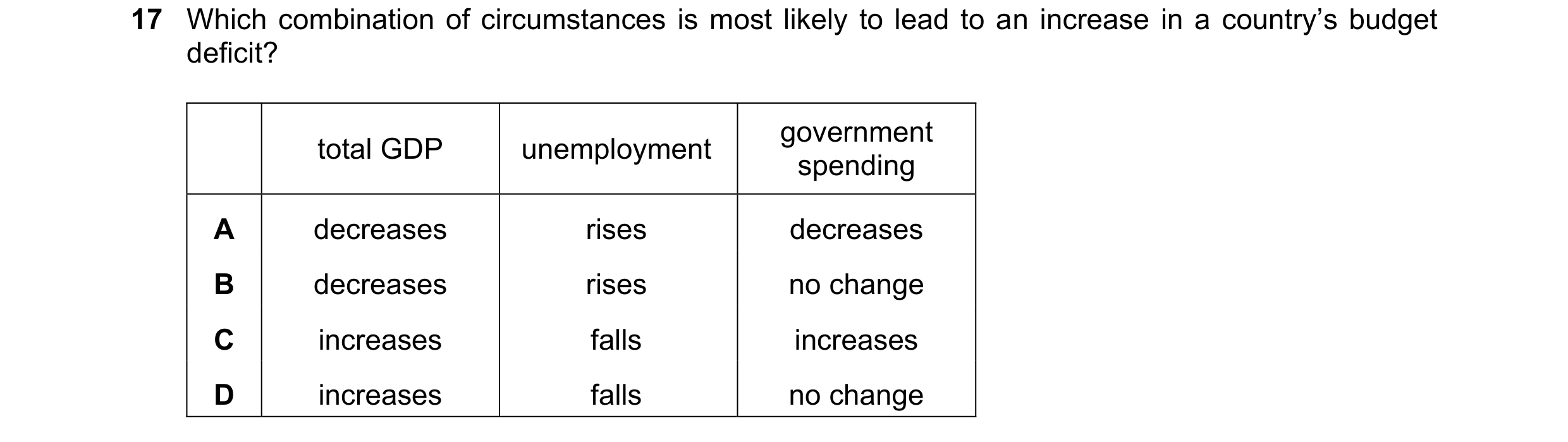
 9 / 10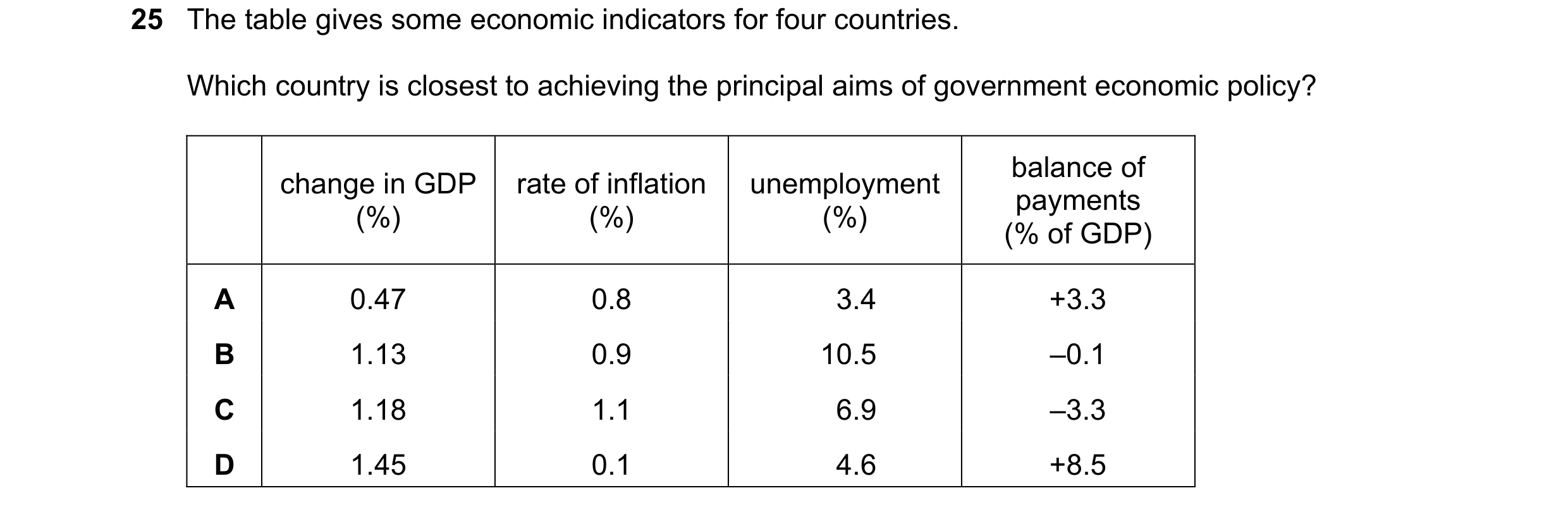
 10 / 10