Questions as text
Q1 · A tree carries out photosynthesis and provides organic compounds for other organisms in a… 9700/11 May/June 2006
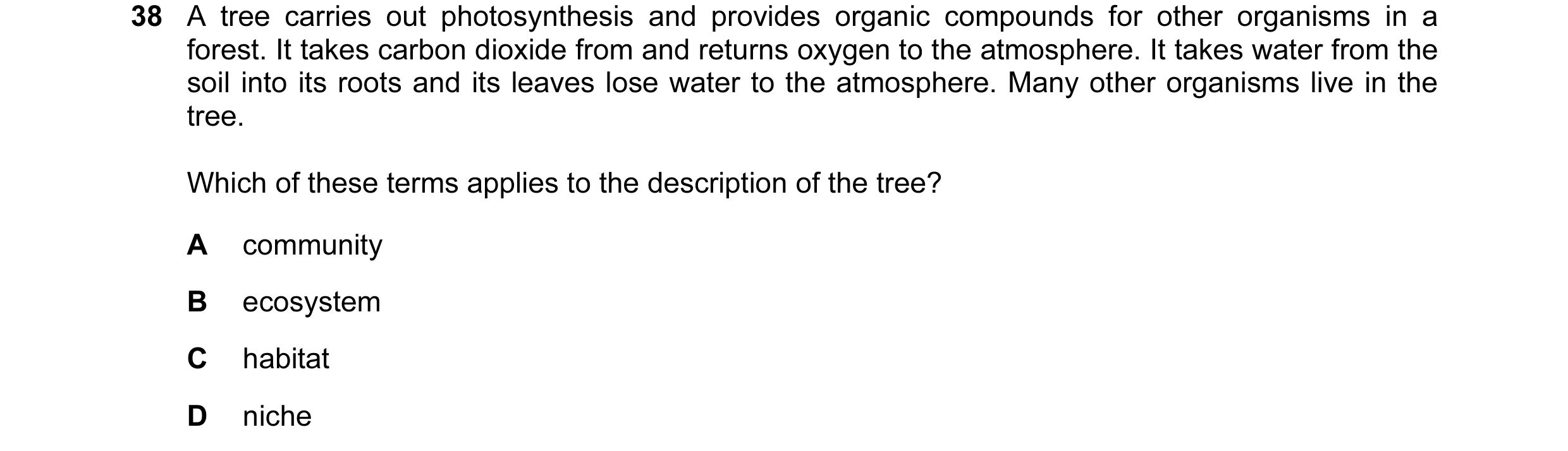
38 A tree carries out photosynthesis and provides organic compounds for other organisms in a forest. It takes carbon dioxide from and returns oxygen to the atmosphere. It takes water from the soil into its roots and its leaves lose water to the atmosphere. Many other organisms live in the tree. Which of these terms applies to the description of the tree? A community B ecosystem C habitat D niche
1 marks
Answer: D
This question in 9700/11 May/June 2006
Q2 · The diagram represents part of the nitrogen cycle 9700/11 Oct/Nov 2006
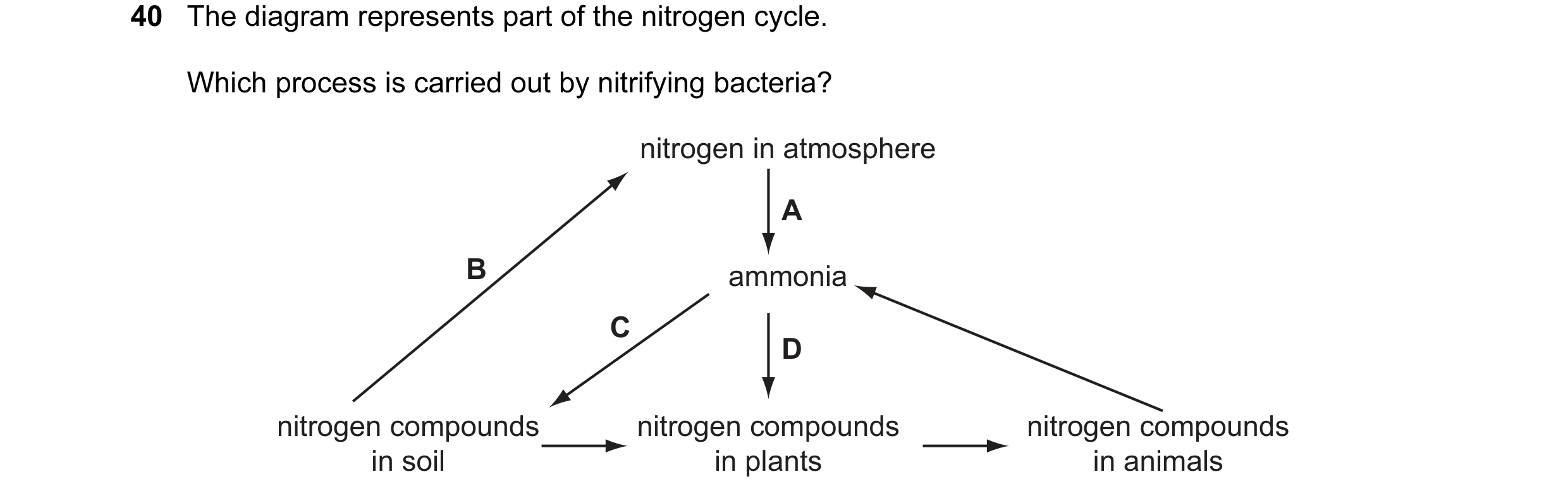
40 The diagram represents part of the nitrogen cycle. Which process is carried out by nitrifying bacteria? nitrogen in atmosphere A B ammonia C D nitrogen compounds nitrogen compounds nitrogen compounds in soil in plants in animals
1 marks
Answer: C
This question in 9700/11 Oct/Nov 2006
Q3 · In an investigation, discs of 2.5 cm diameter were cut from leaves 9700/12 Oct/Nov 2009
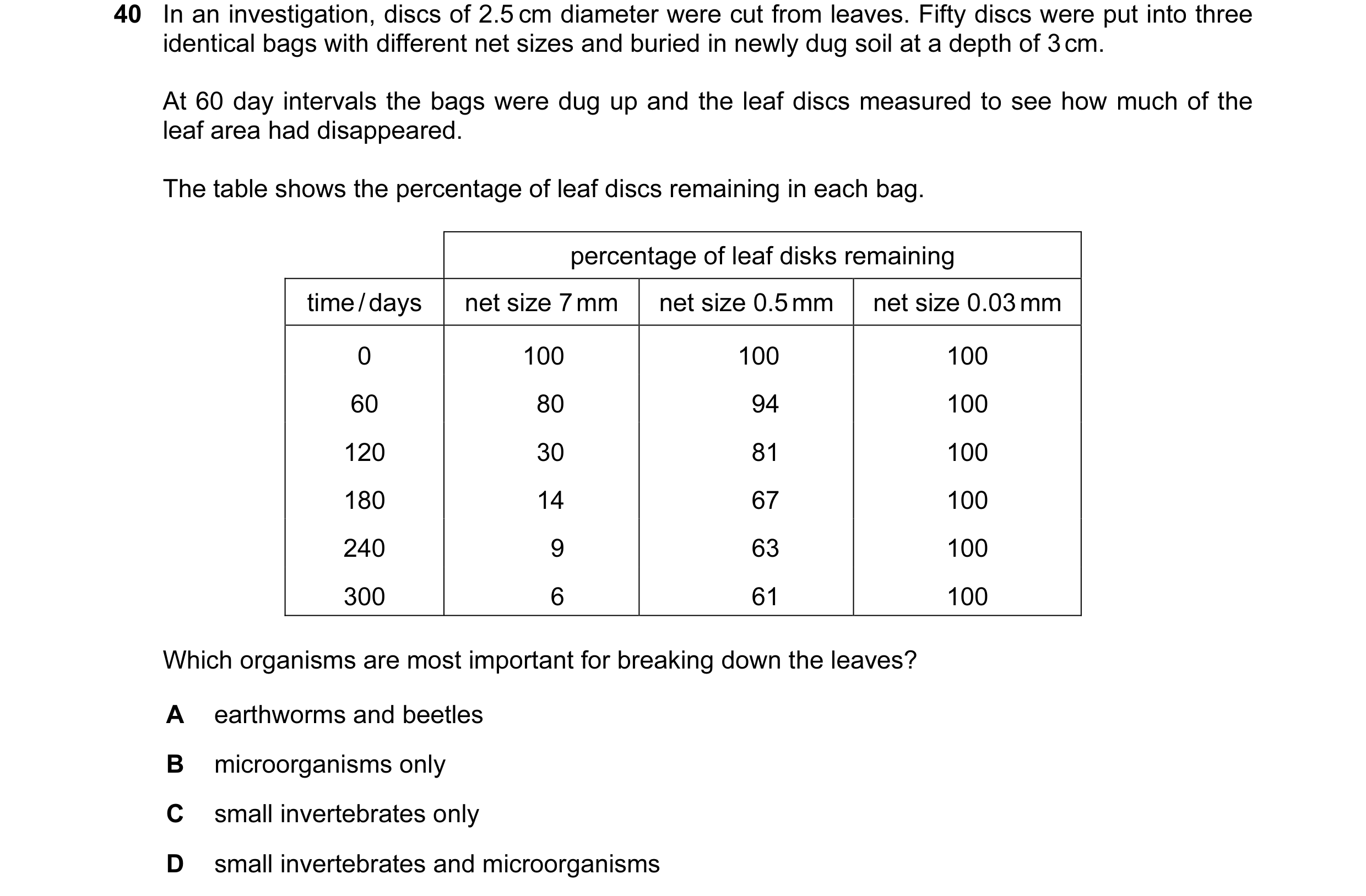
40 In an investigation, discs of 2.5 cm diameter were cut from leaves. Fifty discs were put into three identical bags with different net sizes and buried in newly dug soil at a depth of 3 cm. At 60 day intervals the bags were dug up and the leaf discs measured to see how much of the leaf area had disappeared. The table shows the percentage of leaf discs remaining in each bag. percentage of leaf disks remaining time / days net size 7 mm net size 0.5 mm net size 0.03 mm 0 100 100 100 60 80 94 100 120 30 81 100 180 14 67 100 240 9 63 100 300 6 61 100 Which organisms are most important for breaking down the leaves? A earthworms and beetles B microorganisms only C small invertebrates only D small invertebrates and microorganisms
1 marks
Answer: A
This question in 9700/12 Oct/Nov 2009
Q4 · A farmer grows a different crop in a field each year for three years 9700/11 Oct/Nov 2010
40 A farmer grows a different crop in a field each year for three years. In the fourth year the farmer plants a leguminous crop and then ploughs this into the soil. The next year the rotation starts again. Which microorganisms will increase by the time the rotation starts again? 1 denitrifying bacteria 2 nitrifying bacteria 3 nitrogen-fixing bacteria 4 decomposing bacteria A 1, 2 and 3 B 1, 2 and 4 C 1, 3 and 4 D 2, 3 and 4
1 marks
Answer: D
This question in 9700/11 Oct/Nov 2010
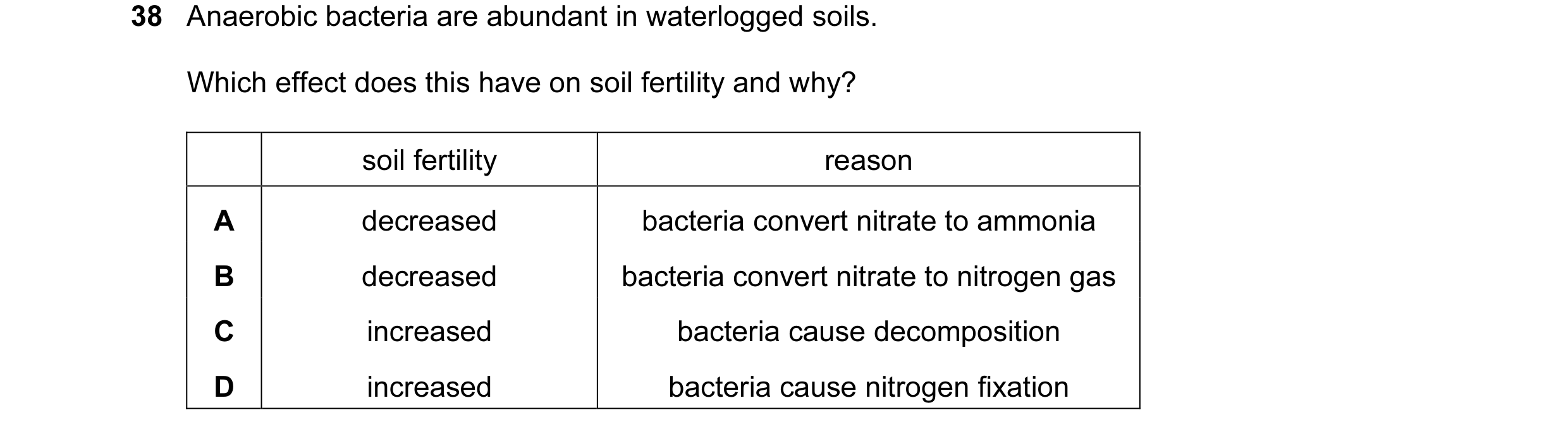
Q5 · Anaerobic bacteria are abundant in waterlogged soils 9700/12 May/June 2011
38 Anaerobic bacteria are abundant in waterlogged soils. Which effect does this have on soil fertility and why? soil fertility reason A decreased bacteria convert nitrate to ammonia B decreased bacteria convert nitrate to nitrogen gas C increased bacteria cause decomposition D increased bacteria cause nitrogen fixation
1 marks
Answer: B
This question in 9700/12 May/June 2011
Q6 · What is the function of nitrifying bacteria in the soil? 9700/12 May/June 2011
40 What is the function of nitrifying bacteria in the soil? A oxidation of ammonium compounds to nitrates B oxidation of nitrogen gas to nitrates C reduction of ammonium compounds to nitrates D reduction of nitrates to nitrites
1 marks
Answer: A
This question in 9700/12 May/June 2011
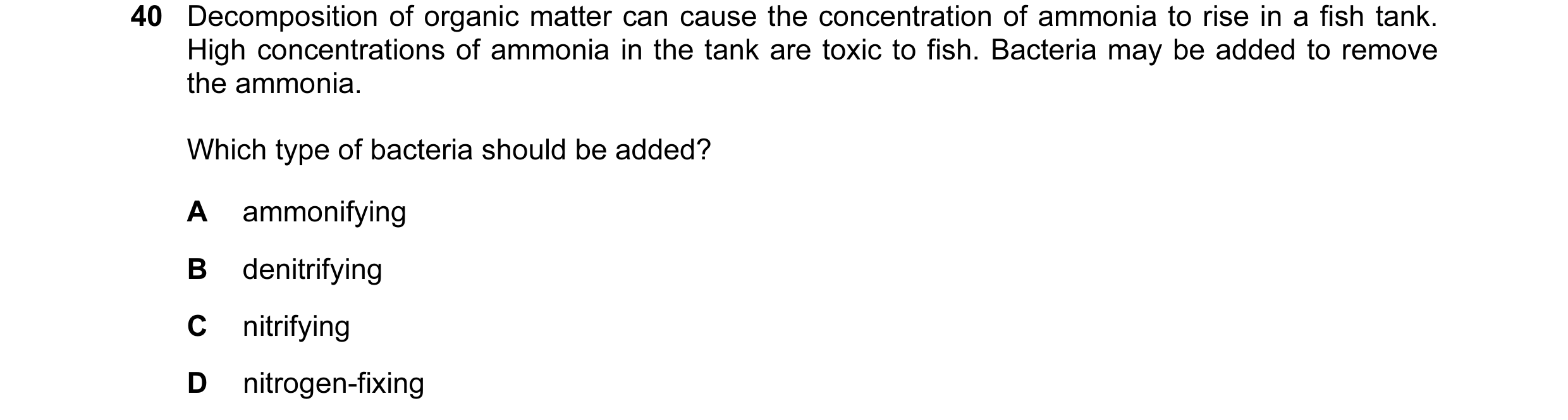
Q7 · Decomposition of organic matter can cause the concentration of ammonia to rise in a fish… 9700/11 Oct/Nov 2013
40 Decomposition of organic matter can cause the concentration of ammonia to rise in a fish tank. High concentrations of ammonia in the tank are toxic to fish. Bacteria may be added to remove the ammonia. Which type of bacteria should be added? A ammonifying B denitrifying C nitrifying D nitrogen-fixing
1 marks
Answer: C
This question in 9700/11 Oct/Nov 2013
Q8 · A farmer grows a different crop in a field each year for three years 9700/11 May/June 2014
40 A farmer grows a different crop in a field each year for three years. In the fourth year the farmer plants a leguminous crop and then ploughs this into the soil. The next year the rotation starts again. Which microorganisms will increase by the time the rotation starts again? 1 denitrifying bacteria 2 nitrifying bacteria 3 nitrogen-fixing bacteria 4 decomposing bacteria A 1, 2 and 3 B 1, 2 and 4 C 1, 3 and 4 D 2, 3 and 4
1 marks
Answer: D
This question in 9700/11 May/June 2014
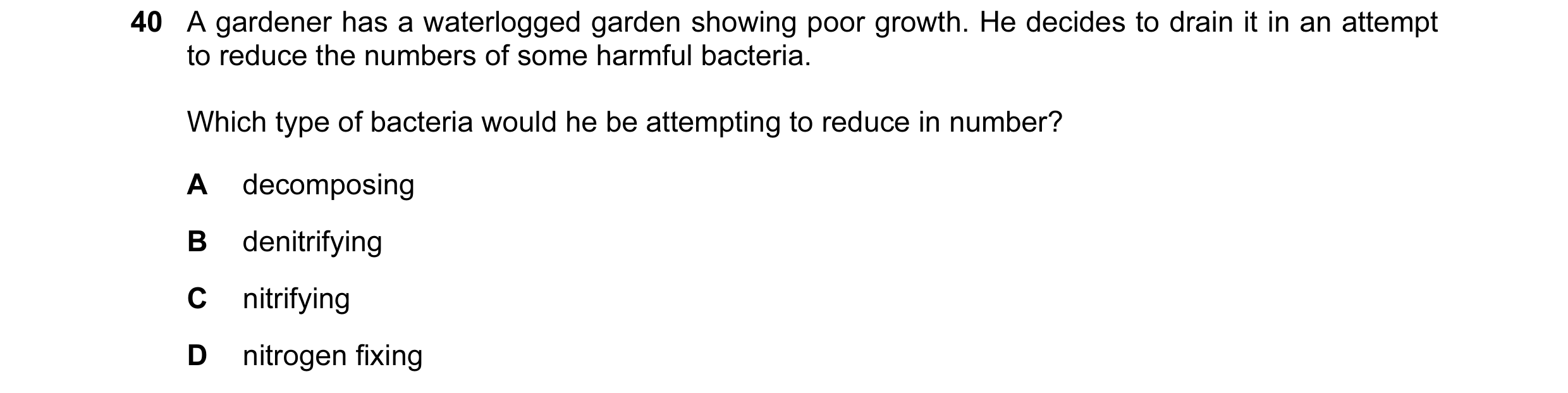
Q9 · A gardener has a waterlogged garden showing poor growth 9700/12 May/June 2014
40 A gardener has a waterlogged garden showing poor growth. He decides to drain it in an attempt to reduce the numbers of some harmful bacteria. Which type of bacteria would he be attempting to reduce in number? A decomposing B denitrifying C nitrifying D nitrogen fixing
1 marks
Answer: B
This question in 9700/12 May/June 2014
Q10 · Which statement concerning events occurring in the nitrogen cycle is not correct? 9700/11 Oct/Nov 2014
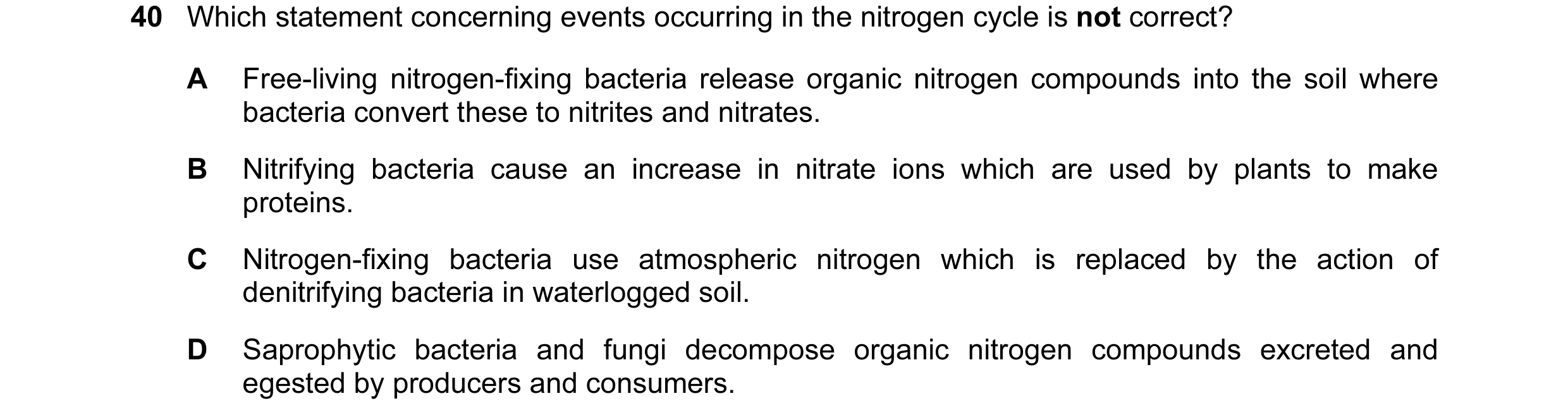
40 Which statement concerning events occurring in the nitrogen cycle is not correct? A Free-living nitrogen-fixing bacteria release organic nitrogen compounds into the soil where bacteria convert these to nitrites and nitrates. B Nitrifying bacteria cause an increase in nitrate ions which are used by plants to make proteins. C Nitrogen-fixing bacteria use atmospheric nitrogen which is replaced by the action of denitrifying bacteria in waterlogged soil. D Saprophytic bacteria and fungi decompose organic nitrogen compounds excreted and egested by producers and consumers.
1 marks
Answer: D
This question in 9700/11 Oct/Nov 2014
Q11 · Which soil would have the smallest number of denitrifying bacteria? 9700/11 May/June 2015
38 Which soil would have the smallest number of denitrifying bacteria? A compressed agricultural soil B poorly drained forest soil C water-logged clay soil D well-aerated garden soil
1 marks
Answer: D
This question in 9700/11 May/June 2015
Q12 · A farmer grows a different crop in a field each year for three years 9700/12 May/June 2015
39 A farmer grows a different crop in a field each year for three years. In the fourth year he grows a leguminous crop, such as clover, and then ploughs this into the soil. The next year he starts the rotation again. How does the fourth year crop add mineral ions to the soil? decomposition nitrification nitrogen fixation A no yes yes B yes no yes C yes yes no D yes yes yes
1 marks
Answer: D
This question in 9700/12 May/June 2015
Q13 · Why does the application of nitrate fertilisers cause an increase in crop production? 9700/11 Oct/Nov 2015
40 Why does the application of nitrate fertilisers cause an increase in crop production? A Green plants manufacture more protein. B More nitrogen is fixed in leguminous plants. C The fertiliser adds energy to the ecosystem. D The number of denitrifying bacteria decreases.
1 marks
Answer: A
This question in 9700/11 Oct/Nov 2015
Q14 · Anaerobic bacteria are found in large numbers in waterlogged soils 9700/12 Oct/Nov 2015
40 Anaerobic bacteria are found in large numbers in waterlogged soils. Which effect does this have on soil fertility and why? soil fertility reason A decreased bacteria convert nitrate to ammonia B decreased bacteria convert nitrate to nitrogen gas C increased bacteria cause decomposition D increased bacteria cause nitrogen fixation
1 marks
Answer: B
This question in 9700/12 Oct/Nov 2015
 1 / 4
1 / 4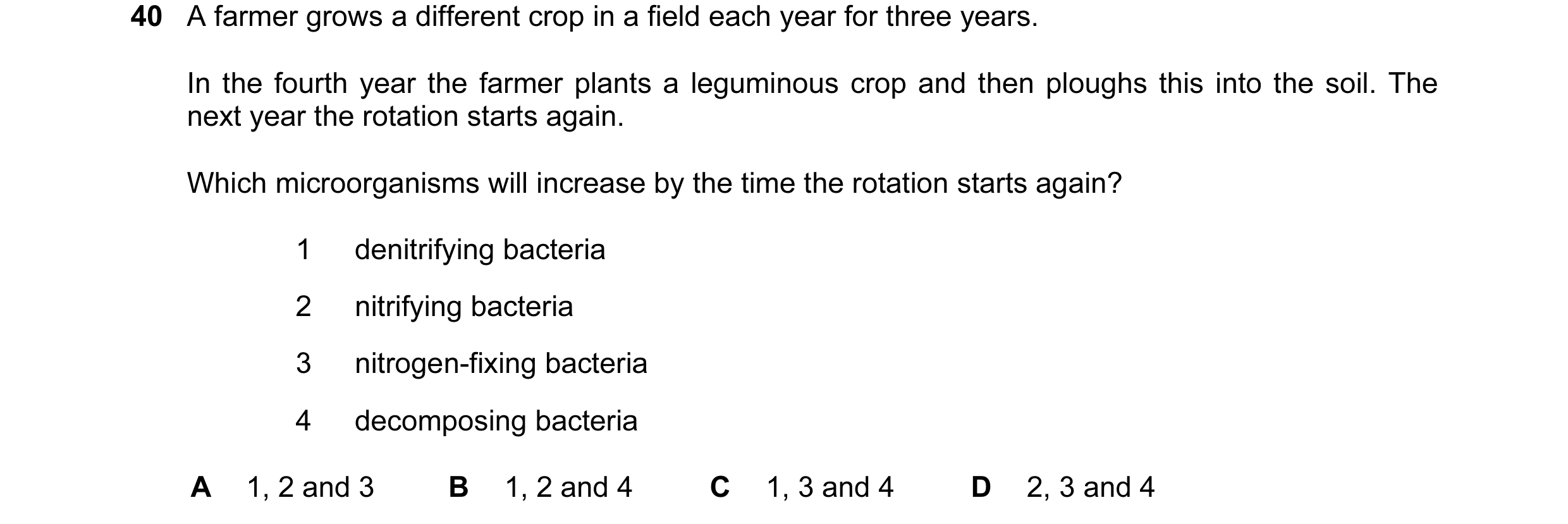

 2 / 4
2 / 4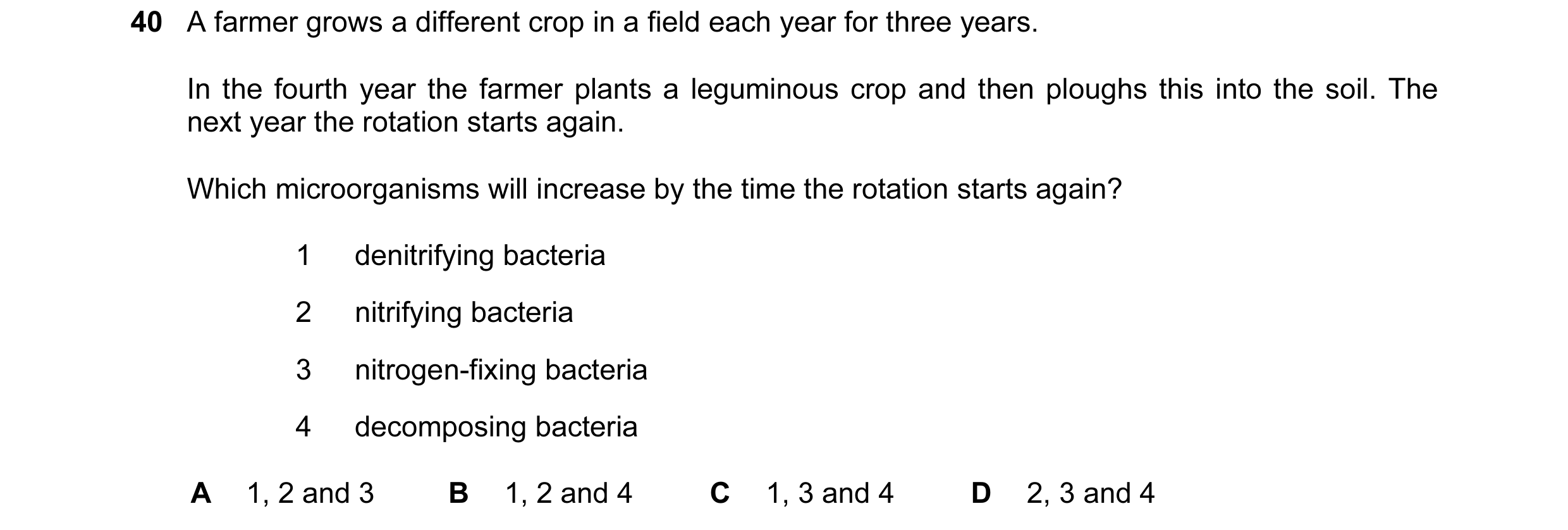
 3 / 4
3 / 4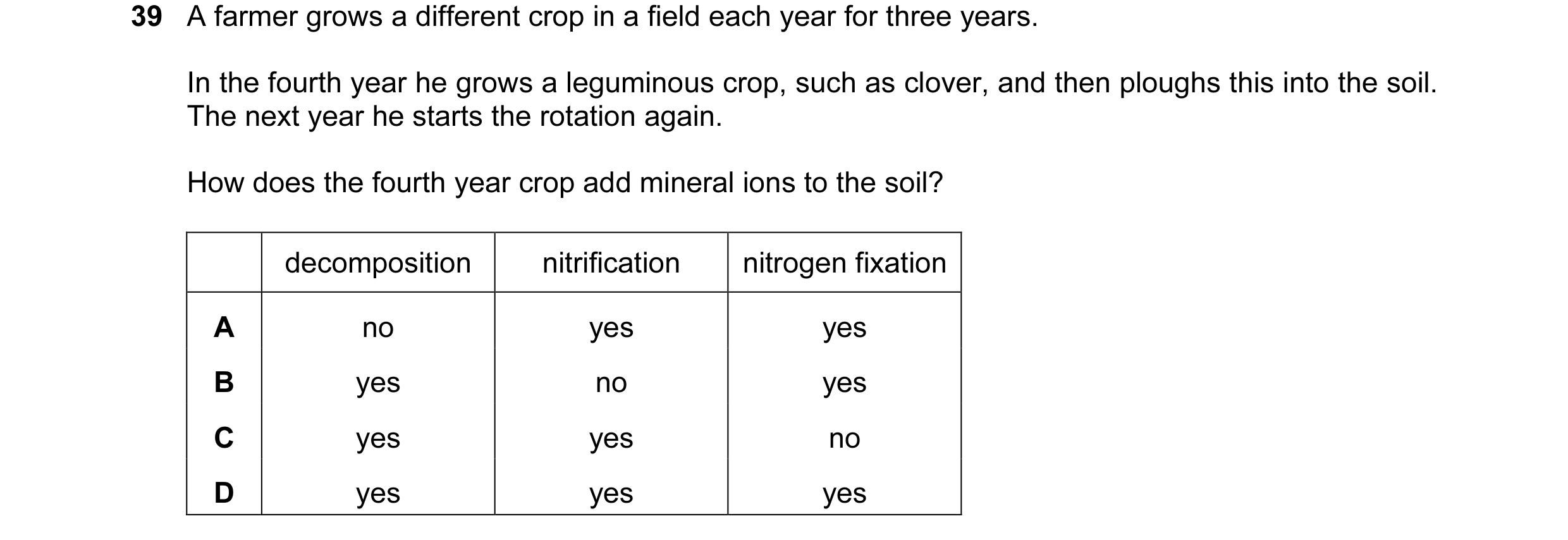

 4 / 4
4 / 4