Questions as text
Q1 · Limestone is a useful material obtained from the Earth’s crust 0654/42 Oct/Nov 2018
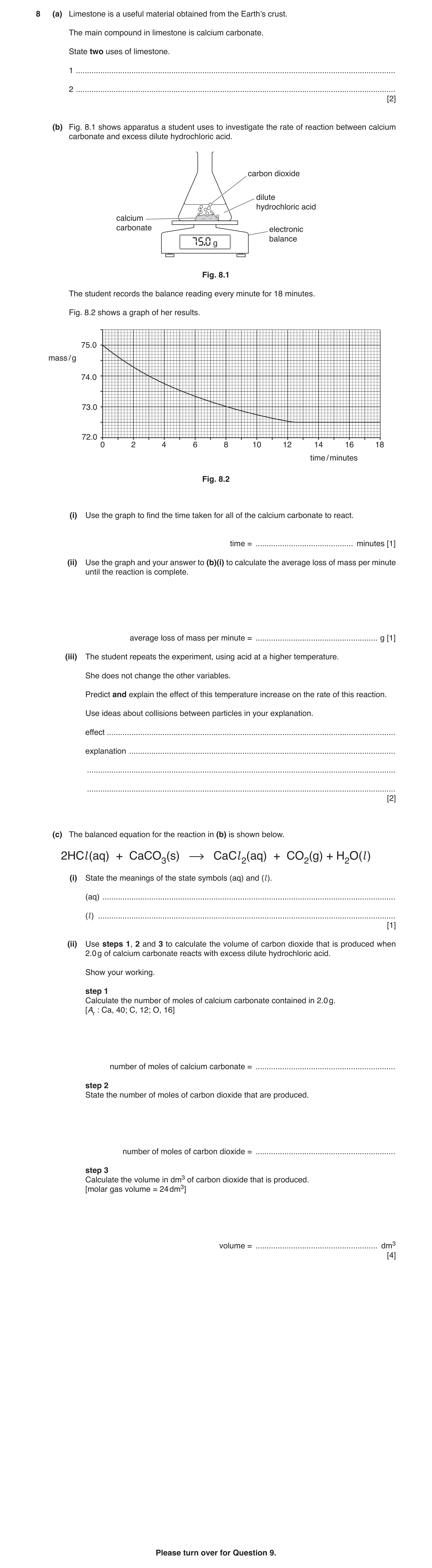
8 (a) Limestone is a useful material obtained from the Earth’s crust. The main compound in limestone is calcium carbonate. State two uses of limestone. 1 … 2 … [2] (b) Fig. 8.1 shows apparatus a student uses to investigate the rate of reaction between calcium carbonate and excess dilute hydrochloric acid. carbon dioxide dilute hydrochloric acid calcium carbonate electronic 75.0 g balance Fig. 8.1 The student records the balance reading every minute for 18 minutes. Fig. 8.2 shows a graph of her results. 75.0 mass / g 74.0 73.0 72.0 0 2 4 6 8 10 12 14 16 18 time / minutes Fig. 8.2 (i) Use the graph to find the time taken for all of the calcium carbonate to react. time = … minutes [1] (ii) Use the graph and your answer to (b)(i) to calculate the average loss of mass per minute until the reaction is complete. average loss of mass per minute = … g [1] (iii) The student repeats the experiment, using acid at a higher temperature. She does not change the other variables. Predict and explain the effect of this temperature increase on the rate of this reaction. Use ideas about collisions between particles in your explanation. effect … explanation … … … [2] (c) The balanced equation for the reaction in (b) is shown below. 2HCl (aq) + CaCO3(s) CaCl 2(aq) + CO2(g) + H2O(l ) (i) State the meanings of the state symbols (aq) and (l ). (aq) … (l ) … [1] (ii) Use steps 1, 2 and 3 to calculate the volume of carbon dioxide that is produced when 2.0 g of calcium carbonate reacts with excess dilute hydrochloric acid. Show your working. step 1 Calculate the number of moles of calcium carbonate contained in 2.0 g. [Ar : Ca, 40; C, 12; O, 16] number of moles of calcium carbonate = … step 2 State the number of moles of carbon dioxide that are produced. number of moles of carbon dioxide = … step 3 Calculate the volume in dm3 of carbon dioxide that is produced. [molar gas volume = 24 dm3] volume = … dm3 [4] Please turn over for Question 9.
11 marks
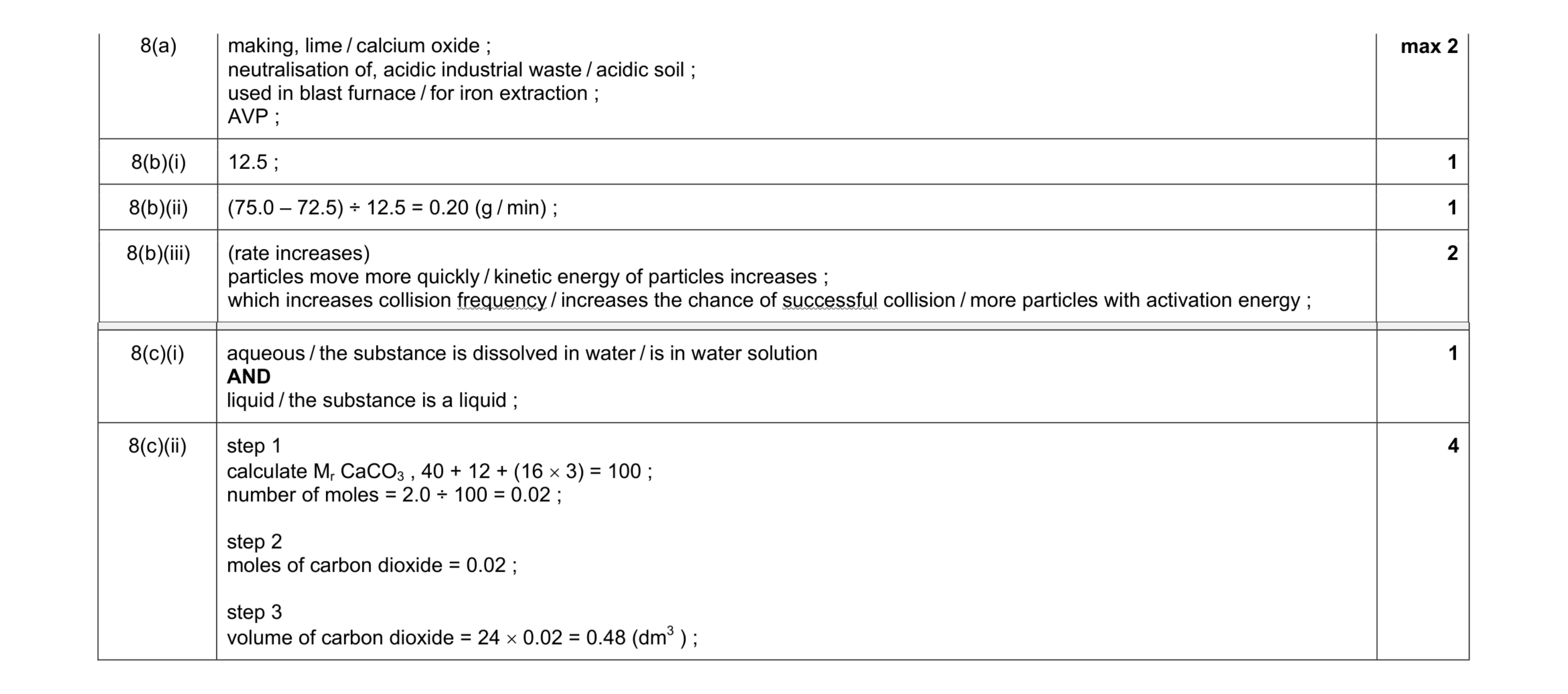
Mark scheme: 8(a) making, lime / calcium oxide ; neutralisation of, acidic industrial waste / acidic soil ; used in blast furnace / for iron extraction ; AVP ; max 2 8(b)(i) 12.5 ; 1 8(b)(ii) (75.0 – 72.5) ÷ 12.5 = 0.20 (g / min) ; 1 8(b)(iii) (rate increases) particles move more quickly / kinetic energy of particles increases ; which increases collision frequency / increases the chance of successful collision / more particles with activation energy ; 2 Question Answer Marks 8(c)(i) aqueous / the substance is dissolved in water / is in water solution AND liquid / the substance is a liquid ; 1 8(c)(ii) step 1 calculate Mr CaCO3 , 40 + 12 + (16 × 3) = 100 ; number of moles = 2.0 ÷ 100 = 0.02 ; step 2 moles of carbon dioxide = 0.02 ; step 3 volume of carbon dioxide = 24 × 0.02 = 0.48 (dm3 ) ; 4
This question in 0654/42 Oct/Nov 2018
Q2 · Petroleum is the raw material for the production of many useful substances 0654/41 May/June 2019
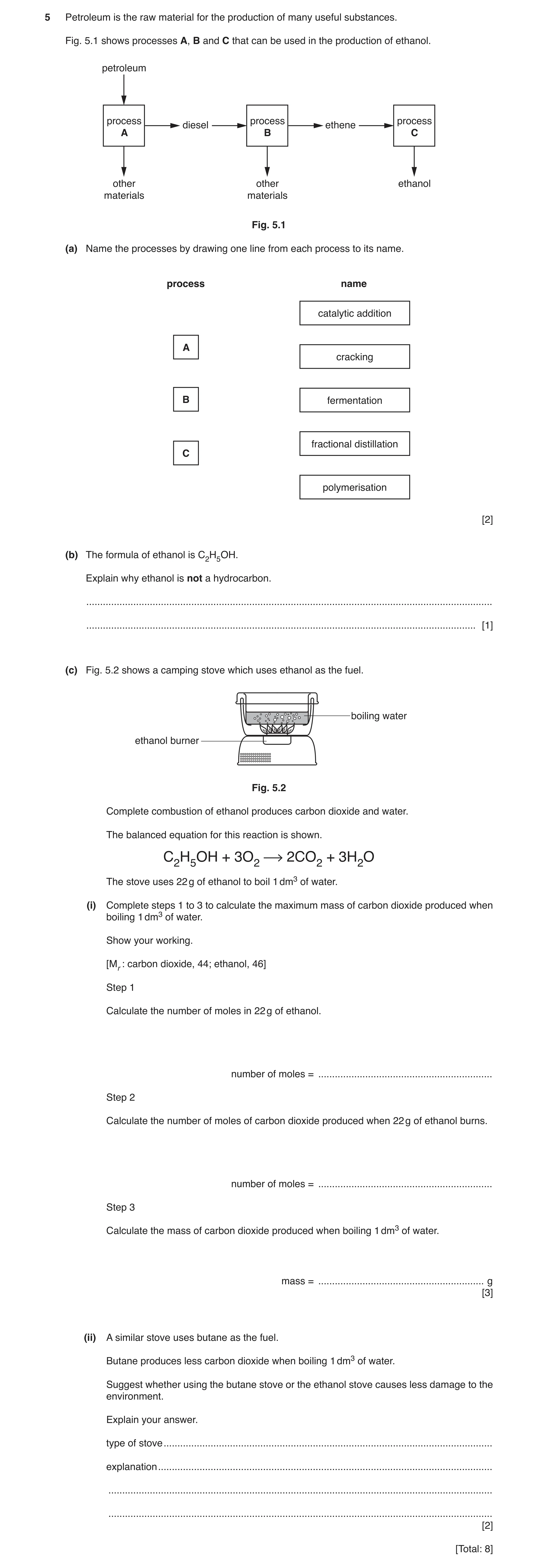
5 Petroleum is the raw material for the production of many useful substances. Fig. 5.1 shows processes A, B and C that can be used in the production of ethanol. petroleum process process process diesel ethene A B C other other ethanol materials materials Fig. 5.1 (a) Name the processes by drawing one line from each process to its name. process name catalytic addition A cracking B fermentation fractional distillation C polymerisation [2] (b) The formula of ethanol is C2H5OH. Explain why ethanol is not a hydrocarbon. … … [1] (c) Fig. 5.2 shows a camping stove which uses ethanol as the fuel. boiling water ethanol burner Fig. 5.2 Complete combustion of ethanol produces carbon dioxide and water. The balanced equation for this reaction is shown. C2H5OH + 3O2 2CO2 + 3H2O The stove uses 22 g of ethanol to boil 1 dm3 of water. (i) Complete steps 1 to 3 to calculate the maximum mass of carbon dioxide produced when boiling 1 dm3 of water. Show your working. [Mr : carbon dioxide, 44; ethanol, 46] Step 1 Calculate the number of moles in 22 g of ethanol. number of moles = … Step 2 Calculate the number of moles of carbon dioxide produced when 22 g of ethanol burns. number of moles = … Step 3 Calculate the mass of carbon dioxide produced when boiling 1 dm3 of water. mass = … g [3] (ii) A similar stove uses butane as the fuel. Butane produces less carbon dioxide when boiling 1 dm3 of water. Suggest whether using the butane stove or the ethanol stove causes less damage to the environment. Explain your answer. type of stove … explanation … … … [2] [Total: 8]
8 marks
Mark scheme: 5(a) 1 correct ; 3 correct ; 2 5(b) a hydrocarbon consists of only hydrogen and carbon ; 1 5(c)(i) Step 1: (22/46 =) 0.48 ; Step 2: (0.48 × 2 =) 0.96 ; Step 3: 0.96 × 44 = 42 (g) ; 3 5(c)(ii) (butane) least amount of greenhouse gas / carbon dioxide is a greenhouse gas; climate change / global warming / consequence of climate change ; 2 catalytic A cracking fermentation fractional polymerisation B C
This question in 0654/41 May/June 2019
Q3 · Ethene, C2H4, and propene, C3H6, are in the same homologous series 0654/42 Oct/Nov 2019
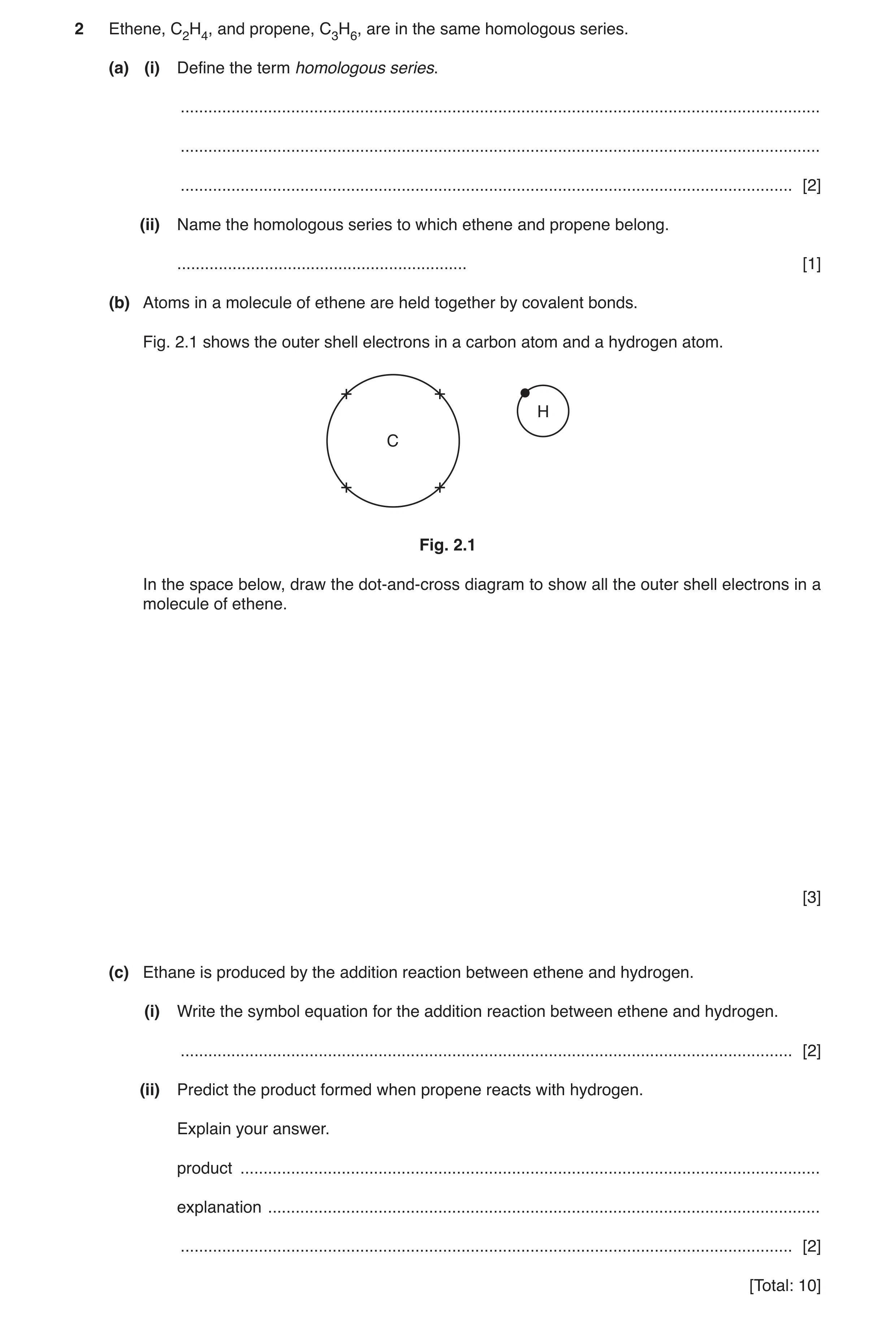
2 Ethene, C2H4, and propene, C3H6, are in the same homologous series. (a) (i) Define the term homologous series. … … … [2] (ii) Name the homologous series to which ethene and propene belong. … [1] (b) Atoms in a molecule of ethene are held together by covalent bonds. Fig. 2.1 shows the outer shell electrons in a carbon atom and a hydrogen atom. H C Fig. 2.1 In the space below, draw the dot-and-cross diagram to show all the outer shell electrons in a molecule of ethene. [3] (c) Ethane is produced by the addition reaction between ethene and hydrogen. (i) Write the symbol equation for the addition reaction between ethene and hydrogen. … [2] (ii) Predict the product formed when propene reacts with hydrogen. Explain your answer. product … explanation … … [2] [Total: 10]
10 marks
Mark scheme: 2(a)(i) same general formula ; similar chemical properties ; 2 2(a)(ii) alkenes ; 1 2(b) correct arrangement of atoms ; 2 carbon atoms sharing 2 bonding pairs ; 2 hydrogen atoms sharing bonding pair with each carbon atom ; 3 2(c)(i) C2H4 + H2 → C2H6 LHS ; RHS ; 2 2(c)(ii) to make propane ; same homologous series / similar or same reactions / ref. to double bond / it is also an addition reaction ; 2
This question in 0654/42 Oct/Nov 2019
Q4 · Petroleum is a fossil fuel 0654/42 Feb/March 2021
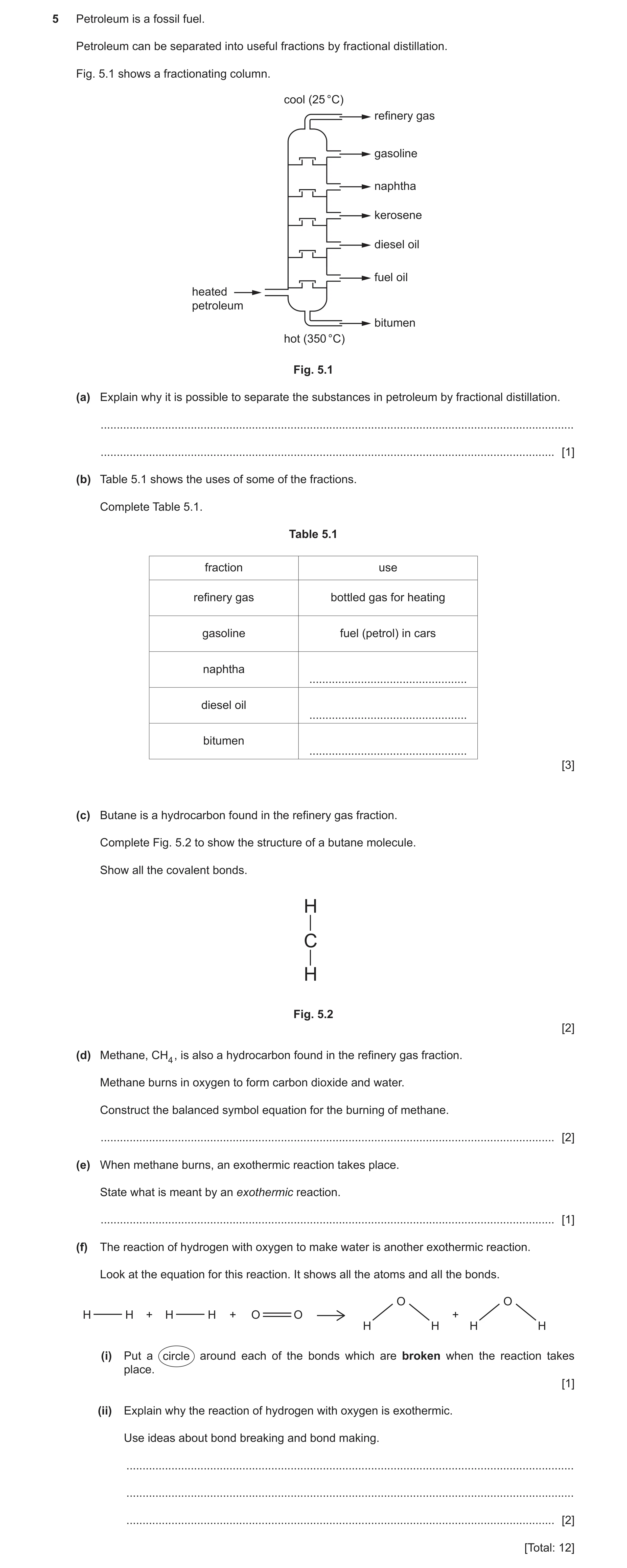
5 Petroleum is a fossil fuel. Petroleum can be separated into useful fractions by fractional distillation. Fig. 5.1 shows a fractionating column. cool (25 °C) refinery gas gasoline naphtha kerosene diesel oil fuel oil heated petroleum bitumen hot (350 °C) Fig. 5.1 (a) Explain why it is possible to separate the substances in petroleum by fractional distillation. … … [1] (b) Table 5.1 shows the uses of some of the fractions. Complete Table 5.1. Table 5.1 fraction use refinery gas bottled gas for heating gasoline fuel (petrol) in cars naphtha … diesel oil … bitumen … [3] (c) Butane is a hydrocarbon found in the refinery gas fraction. Complete Fig. 5.2 to show the structure of a butane molecule. Show all the covalent bonds. H C H Fig. 5.2 [2] (d) Methane, CH4 , is also a hydrocarbon found in the refinery gas fraction. Methane burns in oxygen to form carbon dioxide and water. Construct the balanced symbol equation for the burning of methane. … [2] (e) When methane burns, an exothermic reaction takes place. State what is meant by an exothermic reaction. … [1] (f) The reaction of hydrogen with oxygen to make water is another exothermic reaction. Look at the equation for this reaction. It shows all the atoms and all the bonds. O O H H + H H + O O + H H H H (i) Put a circle around each of the bonds which are broken when the reaction takes place. [1] (ii) Explain why the reaction of hydrogen with oxygen is exothermic. Use ideas about bond breaking and bond making. … … … [2] [Total: 12]
12 marks
Mark scheme: 5(a) substances have different boiling points ; 1 5(b) fraction use refinery gas bottled gas for heating gasoline fuel (petrol) in cars naphtha feedstock for making chemicals ; diesel oil fuel in diesel engines ; bitumen road surfaces ; 3 Question Answer Marks 5(c) ;; 2 5(d) CH4 + 2O2 → CO2 + 2H2O ;; 2 5(e) reaction in which thermal energy is given out ; 1 5(f)(i) + → ; 1 5(f)(ii) bond breaking is endothermic / owtte AND bond making is exothermic / owtte ; more energy is given out in bond making than is taken in in bond breaking ; 2
This question in 0654/42 Feb/March 2021
Q5 · Clean air contains nitrogen gas and oxygen gas 0654/42 May/June 2022
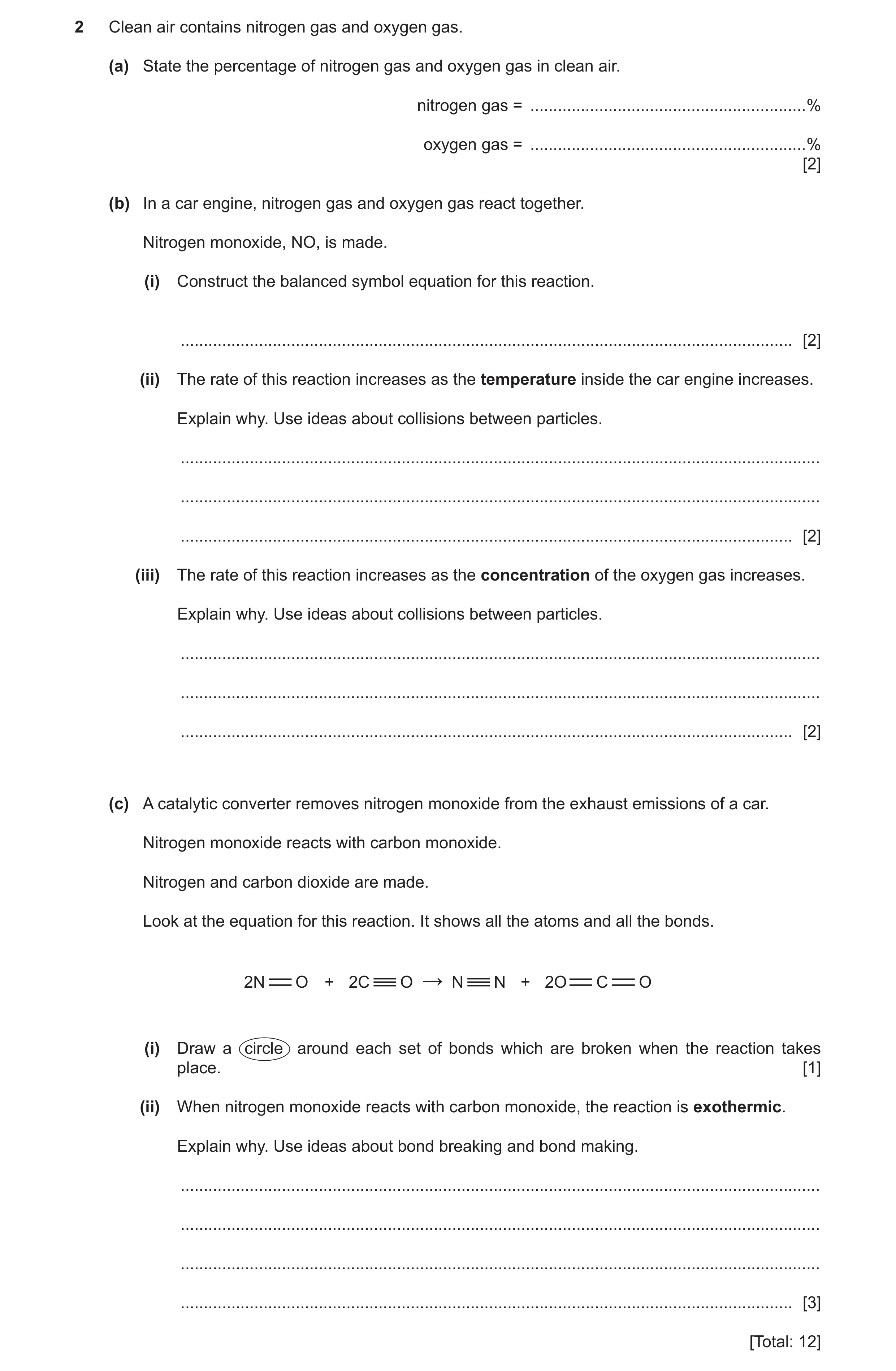
2 Clean air contains nitrogen gas and oxygen gas. (a) State the percentage of nitrogen gas and oxygen gas in clean air. nitrogen gas = … % oxygen gas = … % [2] (b) In a car engine, nitrogen gas and oxygen gas react together. Nitrogen monoxide, NO, is made. (i) Construct the balanced symbol equation for this reaction. … [2] (ii) The rate of this reaction increases as the temperature inside the car engine increases. Explain why. Use ideas about collisions between particles. … … … [2] (iii) The rate of this reaction increases as the concentration of the oxygen gas increases. Explain why. Use ideas about collisions between particles. … … … [2] (c) A catalytic converter removes nitrogen monoxide from the exhaust emissions of a car. Nitrogen monoxide reacts with carbon monoxide. Nitrogen and carbon dioxide are made. Look at the equation for this reaction. It shows all the atoms and all the bonds. 2N O + 2C O → N N + 2O C O (i) Draw a circle around each set of bonds which are broken when the reaction takes place. [1] (ii) When nitrogen monoxide reacts with carbon monoxide, the reaction is exothermic. Explain why. Use ideas about bond breaking and bond making. … … … … [3] [Total: 12]
12 marks
Mark scheme: 2(a) nitrogen gas – 78% ; oxygen gas – 21% ; 2 2(b)(i) N2 + O2 2NO ;; 2 2(b)(ii) any two from: particles move faster / particles have more kinetic energy ; more particles have, activation energy / sufficient energy, to react ; increased rate of (successful) collisions ; 2 2(b)(iii) more particles per unit volume / less space between particles ; increased rate of (successful) collisions ; 2 Question Answer Marks 2(c)(i) 2 + 2 ; 1 2(c)(ii) bond breaking, is endothermic / absorbs energy owtte ; bond making, is exothermic / releases energy owtte ; more energy is given out (in bond making) than is taken in (in bond breaking) ; 3
This question in 0654/42 May/June 2022
Q6 · Alkanes are a type of hydrocarbon 0654/41 Oct/Nov 2022
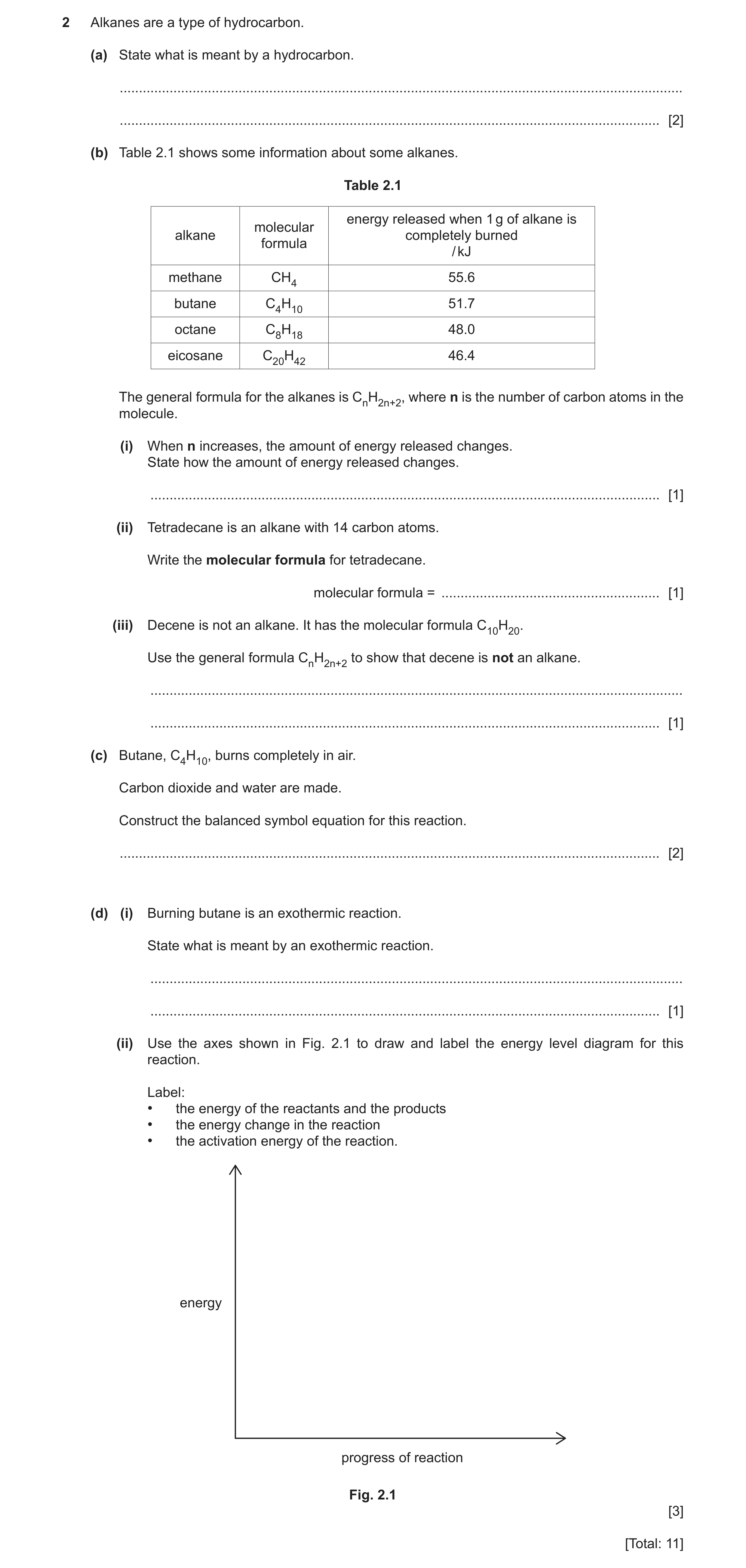
2 Alkanes are a type of hydrocarbon. (a) State what is meant by a hydrocarbon. … … [2] (b) Table 2.1 shows some information about some alkanes. Table 2.1 energy released when 1 g of alkane is molecular alkane completely burned formula / kJ methane CH4 55.6 butane C4H10 51.7 octane C8H18 48.0 eicosane C20H42 46.4 The general formula for the alkanes is CnH2n+2, where n is the number of carbon atoms in the molecule. (i) When n increases, the amount of energy released changes. State how the amount of energy released changes. … [1] (ii) Tetradecane is an alkane with 14 carbon atoms. Write the molecular formula for tetradecane. molecular formula = … [1] (iii) Decene is not an alkane. It has the molecular formula C10H20. Use the general formula CnH2n+2 to show that decene is not an alkane. … … [1] (c) Butane, C4H10, burns completely in air. Carbon dioxide and water are made. Construct the balanced symbol equation for this reaction. … [2] (d) (i) Burning butane is an exothermic reaction. State what is meant by an exothermic reaction. … … [1] (ii) Use the axes shown in Fig. 2.1 to draw and label the energy level diagram for this reaction. Label: • the energy of the reactants and the products • the energy change in the reaction • the activation energy of the reaction. energy progress of reaction Fig. 2.1 [3] [Total: 11]
11 marks
Mark scheme: 2(a) (compound that contains) carbon and hydrogen ; 2 only / owtte ; 2(b)(i) decreases / owtte ; 1 2(b)(ii) C14H30 ; 1 2(b)(iii) idea that if n = 10 then H will be 22, but in decene it is 20 ; 1 2(c) 2C4H10 + 13O2→8CO2 + 10H2O 2 correct formulae ; correct balancing ; 2(d)(i) (reaction in which) energy is given out / heat is given out ; 1 2(d)(ii) 3 products shown below reactants; energy change or H correctly labelled; activation energy or Ea correctly labelled;
This question in 0654/41 Oct/Nov 2022
Q7 · Ethane and ethene are members of two different homologous series 0654/42 Oct/Nov 2022
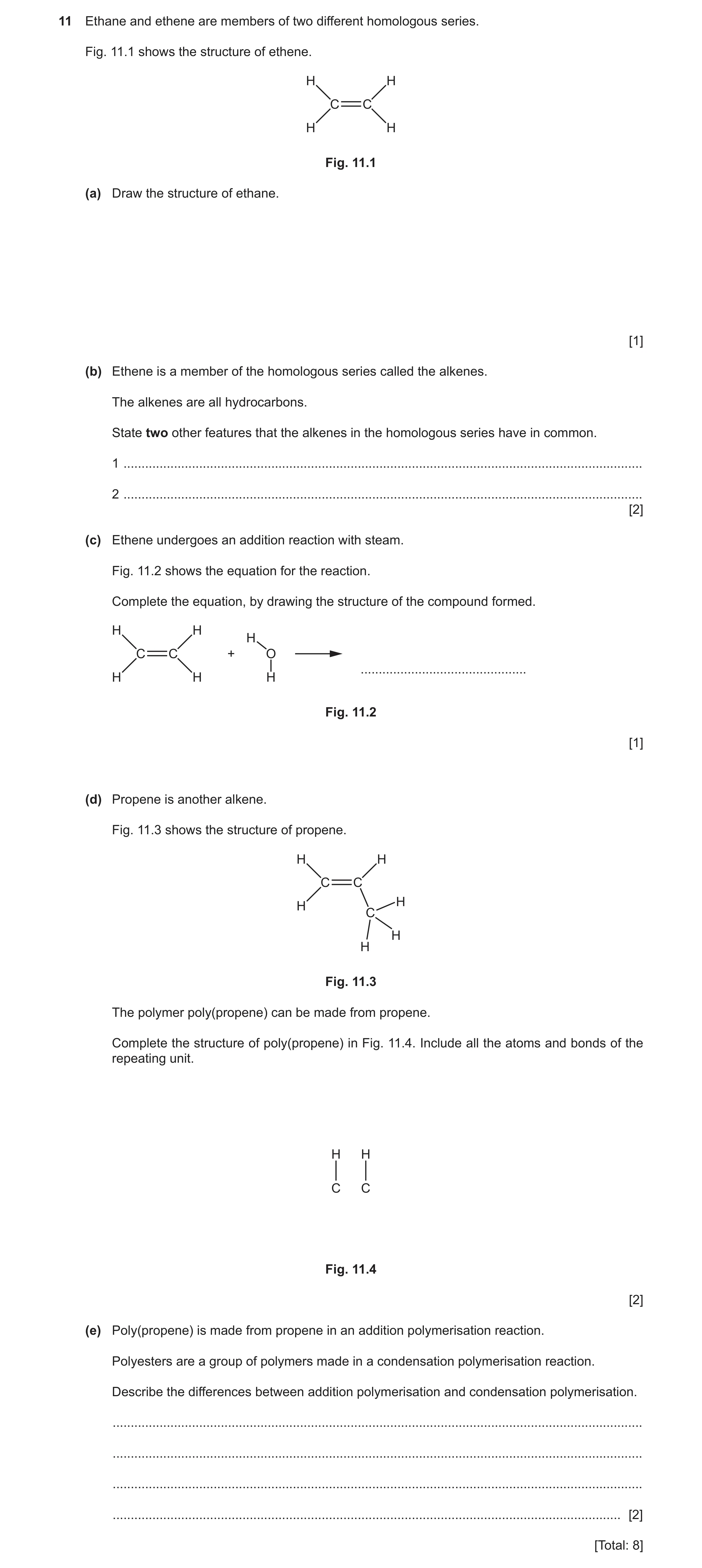
11 Ethane and ethene are members of two different homologous series. Fig. 11.1 shows the structure of ethene. H H C C H H Fig. 11.1 (a) Draw the structure of ethane. [1] (b) Ethene is a member of the homologous series called the alkenes. The alkenes are all hydrocarbons. State two other features that the alkenes in the homologous series have in common. 1 … 2 … [2] (c) Ethene undergoes an addition reaction with steam. Fig. 11.2 shows the equation for the reaction. Complete the equation, by drawing the structure of the compound formed. H H H C C + O … H H H Fig. 11.2 [1] (d) Propene is another alkene. Fig. 11.3 shows the structure of propene. H H C C H H C H H Fig. 11.3 The polymer poly(propene) can be made from propene. Complete the structure of poly(propene) in Fig. 11.4. Include all the atoms and bonds of the repeating unit. H H C C Fig. 11.4 [2] (e) Poly(propene) is made from propene in an addition polymerisation reaction. Polyesters are a group of polymers made in a condensation polymerisation reaction. Describe the differences between addition polymerisation and condensation polymerisation. … … … … [2] [Total: 8]
8 marks
Mark scheme: 11(a) 1 ; 11(b) any two from: 2 same general formula / have formula C2H2 ; similar chemical properties ; contain (at least one) double bond ; 11(c) 1 ; 11(d) 2 mark for single bond between carbon atoms ; mark for rest of structure correct ; 11(e) addition polymerisation requires one monomer / condensation 2 polymerisation requires two monomers ; addition polymerisation produces a polymer only / condensation polymerisation produces a polymer molecule and a small molecule ;
This question in 0654/42 Oct/Nov 2022
Q8 · A student investigates the reaction between calcium carbonate, CaCO3, and dilute… 0654/43 May/June 2023
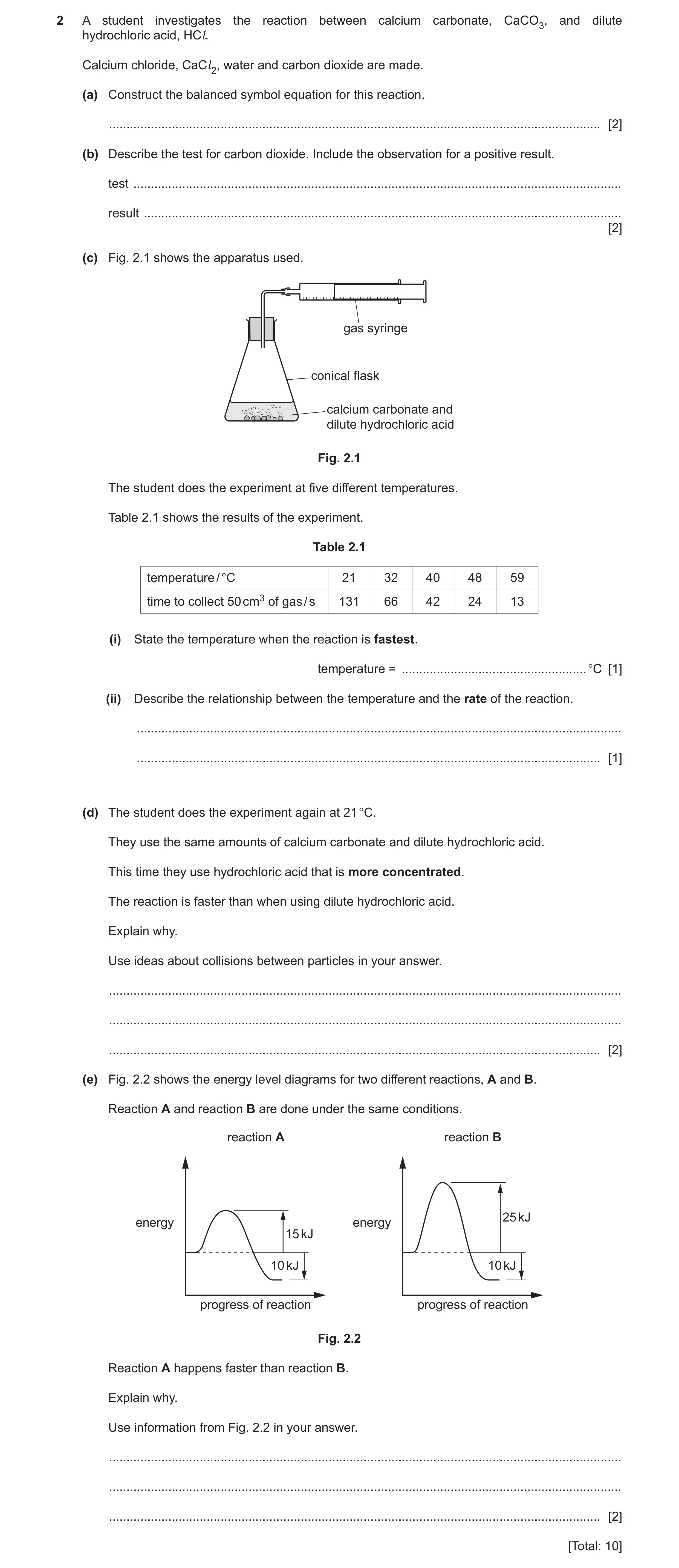
2 A student investigates the reaction between calcium carbonate, CaCO3, and dilute hydrochloric acid, HCl. Calcium chloride, CaCl 2, water and carbon dioxide are made. (a) Construct the balanced symbol equation for this reaction. … [2] (b) Describe the test for carbon dioxide. Include the observation for a positive result. test … result … [2] (c) Fig. 2.1 shows the apparatus used. gas syringe conical flask calcium carbonate and dilute hydrochloric acid Fig. 2.1 The student does the experiment at five different temperatures. Table 2.1 shows the results of the experiment. Table 2.1 temperature / °C 21 32 40 48 59 time to collect 50 cm3 of gas / s 131 66 42 24 13 (i) State the temperature when the reaction is fastest. temperature = … °C [1] (ii) Describe the relationship between the temperature and the rate of the reaction. … … [1] (d) The student does the experiment again at 21 °C. They use the same amounts of calcium carbonate and dilute hydrochloric acid. This time they use hydrochloric acid that is more concentrated. The reaction is faster than when using dilute hydrochloric acid. Explain why. Use ideas about collisions between particles in your answer. … … … [2] (e) Fig. 2.2 shows the energy level diagrams for two different reactions, A and B. Reaction A and reaction B are done under the same conditions. reaction A reaction B 25 kJ energy energy 15 kJ 10 kJ 10 kJ progress of reaction progress of reaction Fig. 2.2 Reaction A happens faster than reaction B. Explain why. Use information from Fig. 2.2 in your answer. … … … [2] [Total: 10]
10 marks
Mark scheme: 2(a) correct formulae ; correct balancing ; 2 2(b) test – limewater ; result – turns milky / cloudy ; 2 2(c)(i) 59 (°C) ; 1 2(c)(ii) as the temperature increases the rate of reaction increases / owtte ; 1 2(d) particles are more crowded / more particles per cm³ / owtte ; more frequent collisions / more collisions per second / owtte ; 2 2(e) activation energy for reaction A is lower than for reaction B ; idea that more / higher proportion of reactant particles can react on collision in reaction A ; 2
This question in 0654/43 May/June 2023
Q9 · The displayed formulae of some carbon compounds 0654/43 Oct/Nov 2024
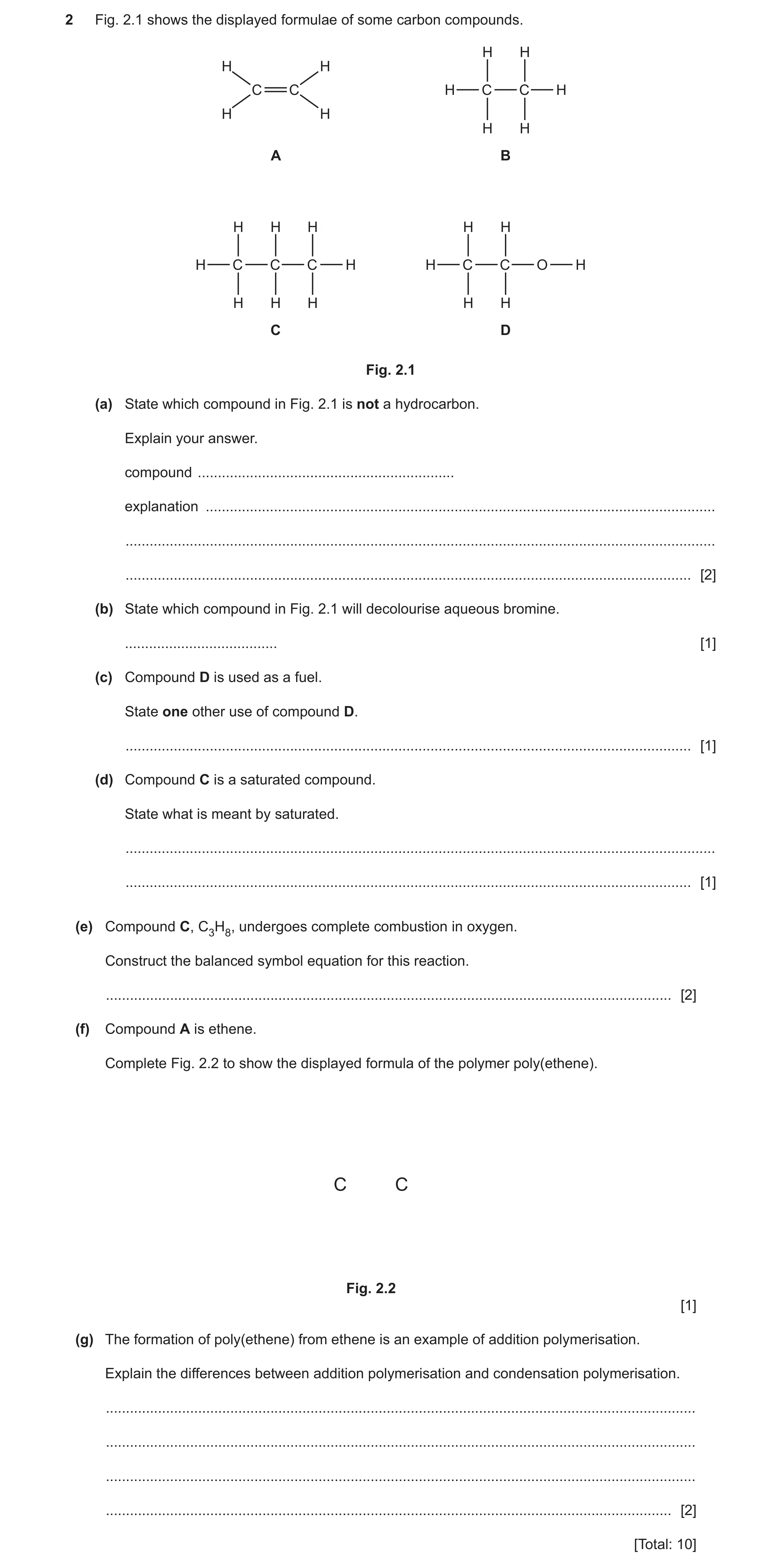
2 Fig. 2.1 shows the displayed formulae of some carbon compounds. H H H H C C H C C H H H H H A B H H H H H H C C C H H C C O H H H H H H C D Fig. 2.1 (a) State which compound in Fig. 2.1 is not a hydrocarbon. Explain your answer. compound … explanation … … … [2] (b) State which compound in Fig. 2.1 will decolourise aqueous bromine. … [1] (c) Compound D is used as a fuel. State one other use of compound D. … [1] (d) Compound C is a saturated compound. State what is meant by saturated. … … [1] (e) Compound C, C3H8, undergoes complete combustion in oxygen. Construct the balanced symbol equation for this reaction. … [2] (f) Compound A is ethene. Complete Fig. 2.2 to show the displayed formula of the polymer poly(ethene). C C Fig. 2.2 [1] (g) The formation of poly(ethene) from ethene is an example of addition polymerisation. Explain the differences between addition polymerisation and condensation polymerisation. … … … … [2] [Total: 10]
10 marks
Mark scheme: 2(a) D ; 2 contains oxygen / does not contain only carbon and hydrogen ; 2(b) A ; 1 2(c) solvent ; 1 2(d) contains only C-C single bonds ; 1 2(e) C3H8 + 5O2 → 3CO2 + 4H2O 2 correct formulae (reactants in either order and products in either order) ; balanced correctly ; 2(f) 1 2(g) addition polymerisation 2 only occurs in unsaturated monomers or monomers that contain C=C bonds / idea that involves the addition of many (identical) monomers (to make a long chained polymer) / monomers have one functional group / forms the polymer molecule only ; condensation polymerisation idea that two different monomers join together / (forms the polymer molecule and one) water molecule (per linkage) / monomers have two functional groups (one at each end) ;
This question in 0654/43 Oct/Nov 2024
Q10 · Magnesium reacts with dilute hydrochloric acid 0654/42 Feb/March 2025
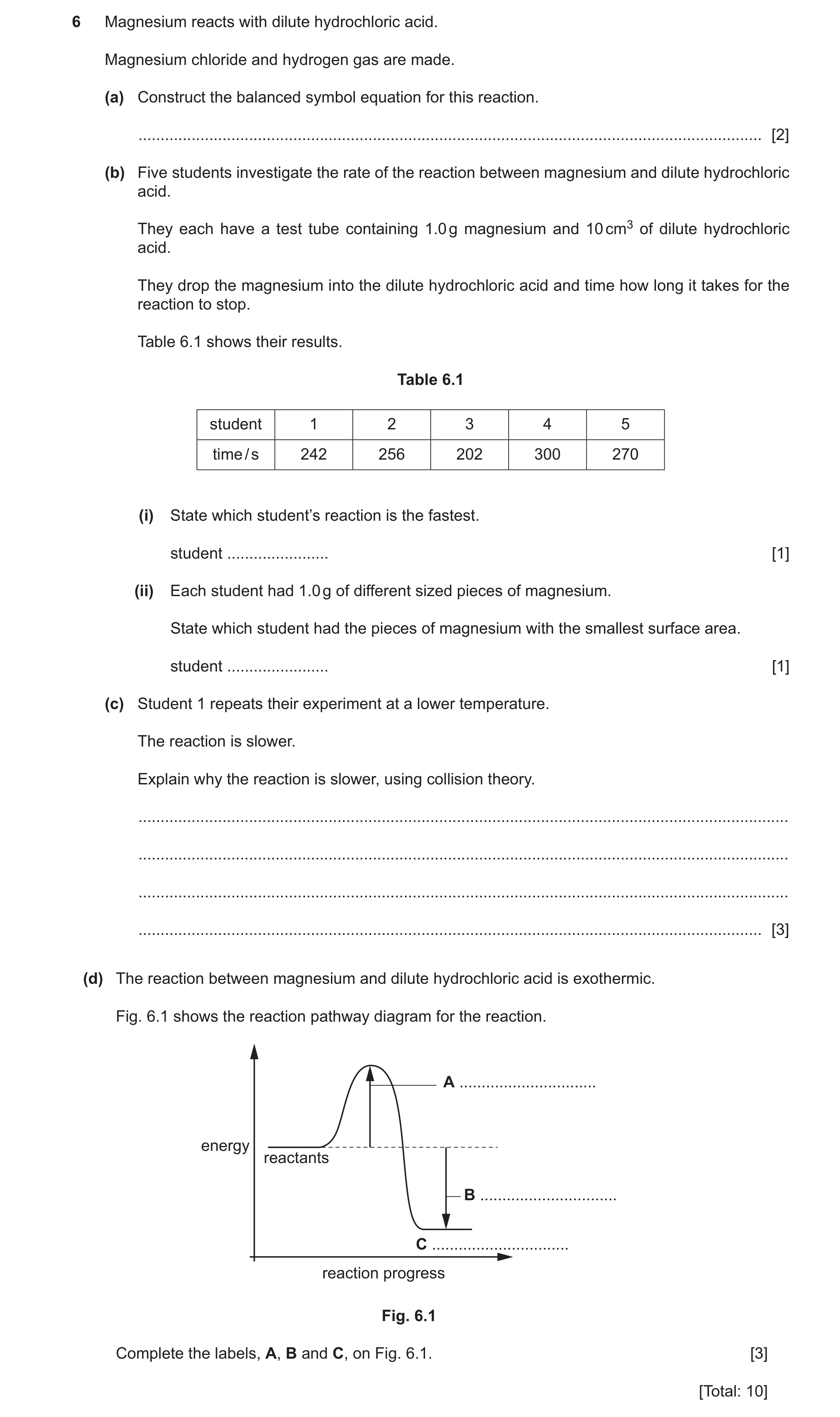
6 Magnesium reacts with dilute hydrochloric acid. Magnesium chloride and hydrogen gas are made. (a) Construct the balanced symbol equation for this reaction. … [2] (b) Five students investigate the rate of the reaction between magnesium and dilute hydrochloric acid. They each have a test tube containing 1.0 g magnesium and 10 cm3 of dilute hydrochloric acid. They drop the magnesium into the dilute hydrochloric acid and time how long it takes for the reaction to stop. Table 6.1 shows their results. Table 6.1 student 1 2 3 4 5 time / s 242 256 202 300 270 (i) State which student’s reaction is the fastest. student … [1] (ii) Each student had 1.0 g of different sized pieces of magnesium. State which student had the pieces of magnesium with the smallest surface area. student … [1] (c) Student 1 repeats their experiment at a lower temperature. The reaction is slower. Explain why the reaction is slower, using collision theory. … … … … [3] (d) The reaction between magnesium and dilute hydrochloric acid is exothermic. Fig. 6.1 shows the reaction pathway diagram for the reaction. A … energy reactants B … C … reaction progress Fig. 6.1 Complete the labels, A, B and C, on Fig. 6.1. [3] [Total: 10]
10 marks
Mark scheme: 6(a) Mg + 2HCl → MgCl2 + H2 ; ; 2 6(b)(i) (student) 3 ; 1 6(b)(ii) (student) 4 ; 1 6(c) any three from: 3 molecules have lower (average) energy / molecules are moving slower fewer molecules with activation energy frequency of collision of molecules is, lower / fewer, collisions per second less successful collisions ; ; ; 6(d) A - Activation energy ; 3 B - Enthalpy change; C - Products ;
This question in 0654/42 Feb/March 2025
 11
11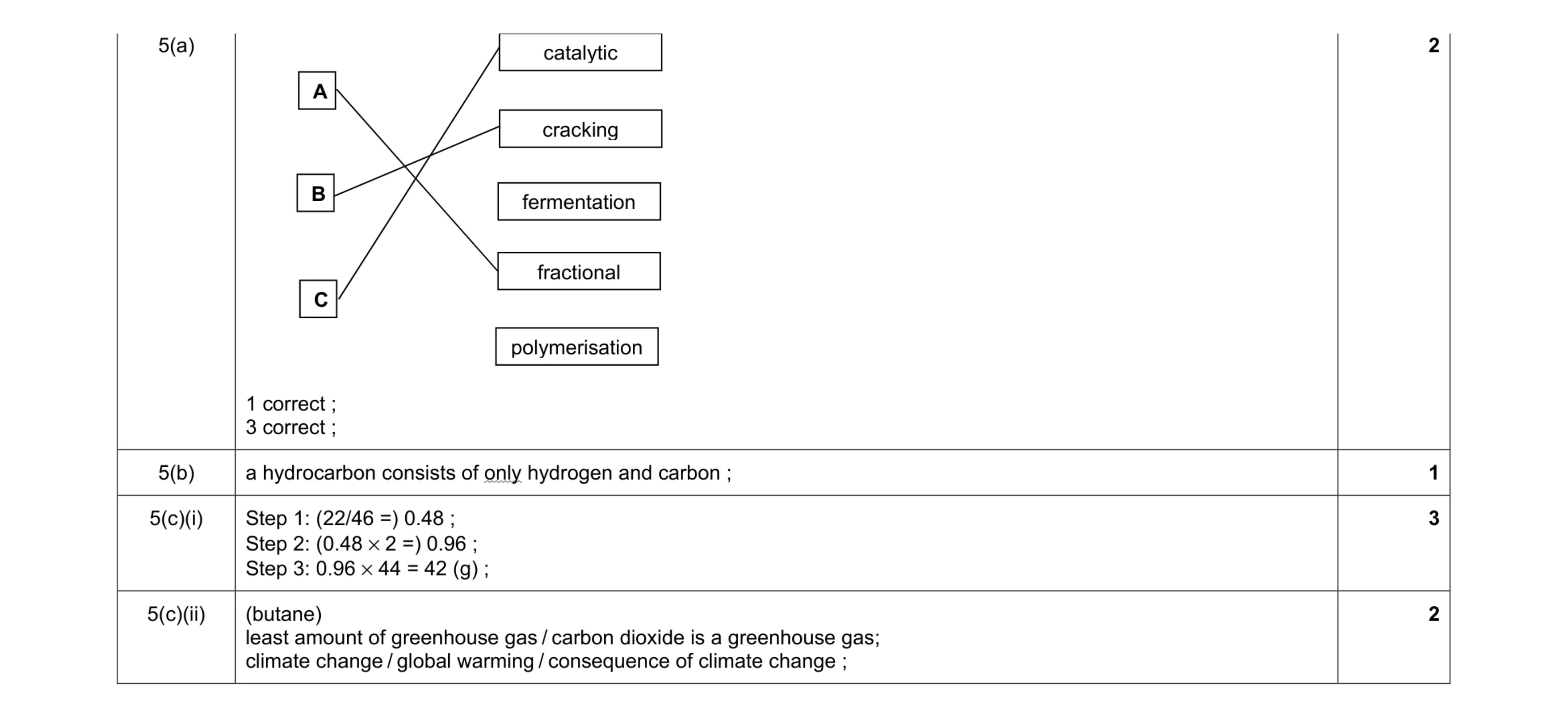 8
8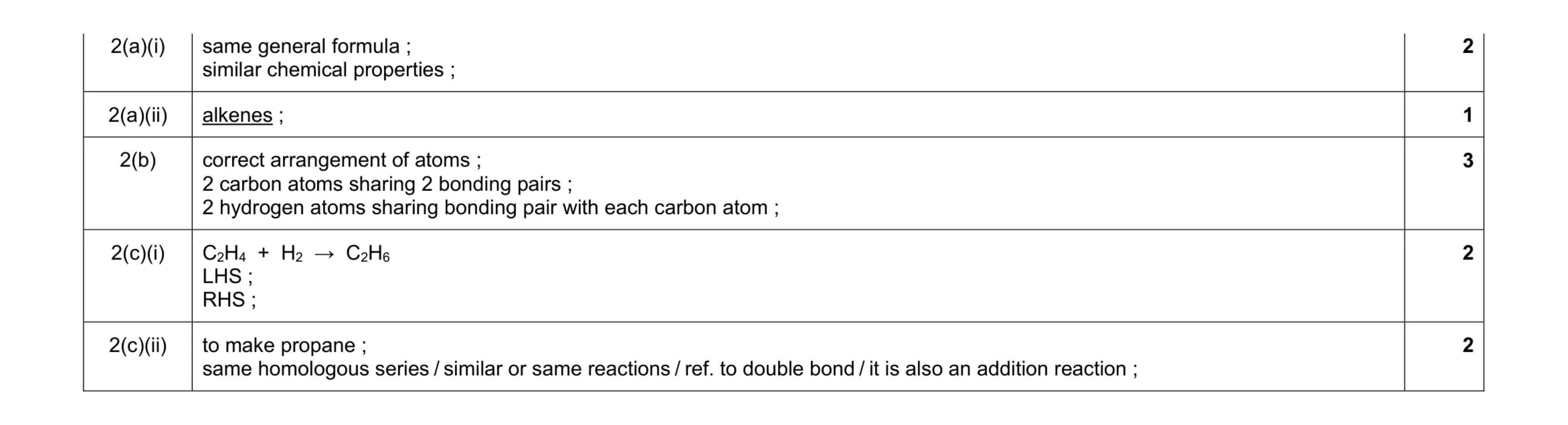 10
10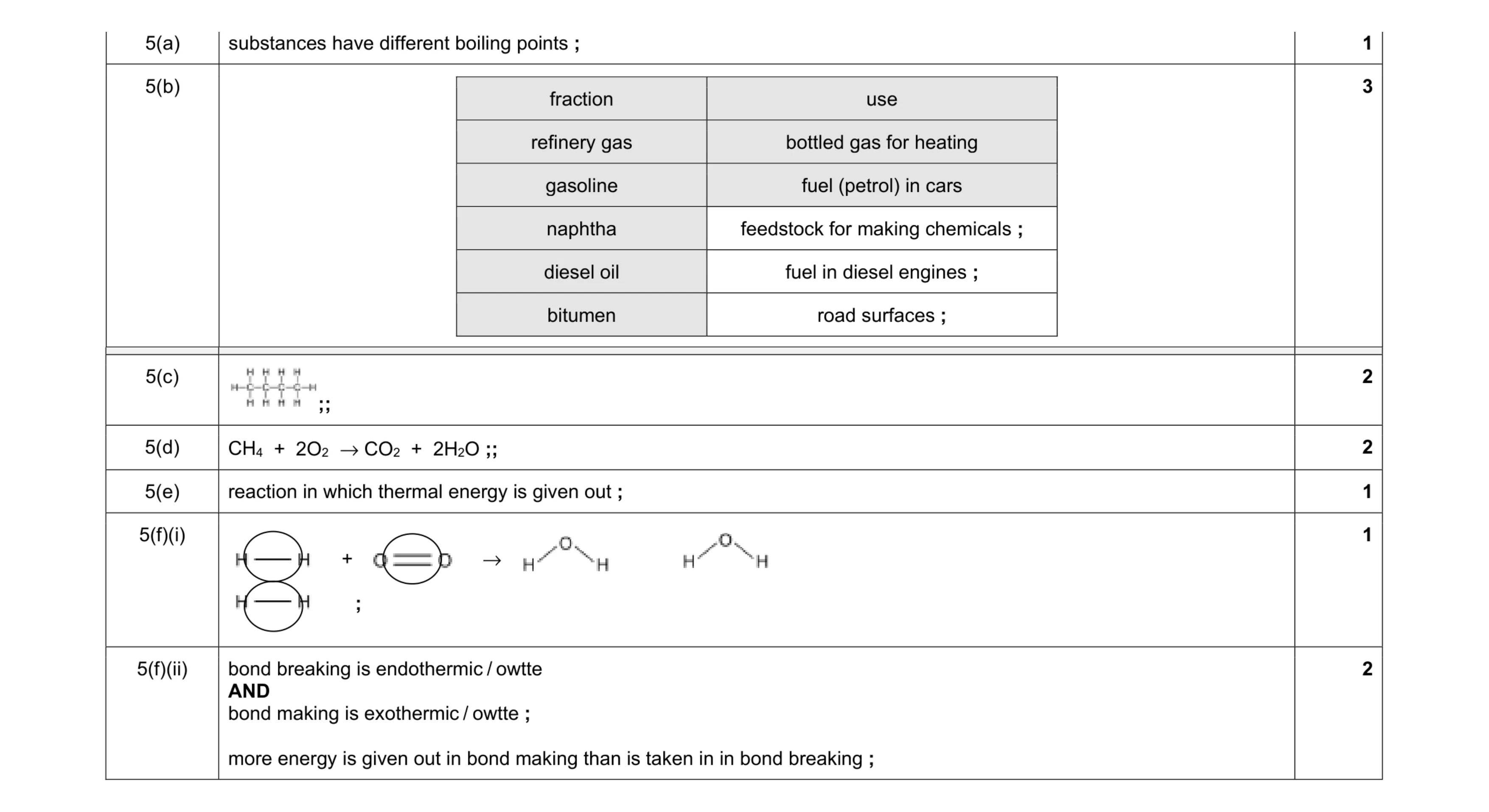 12
12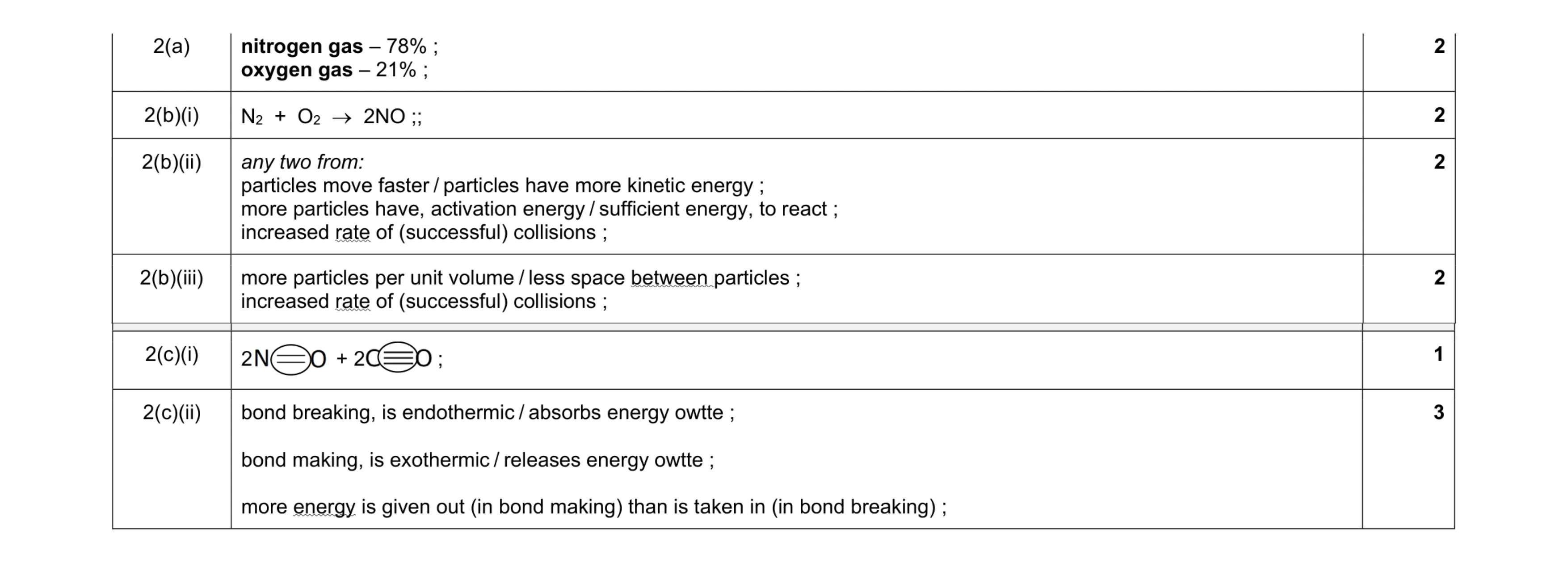 12
12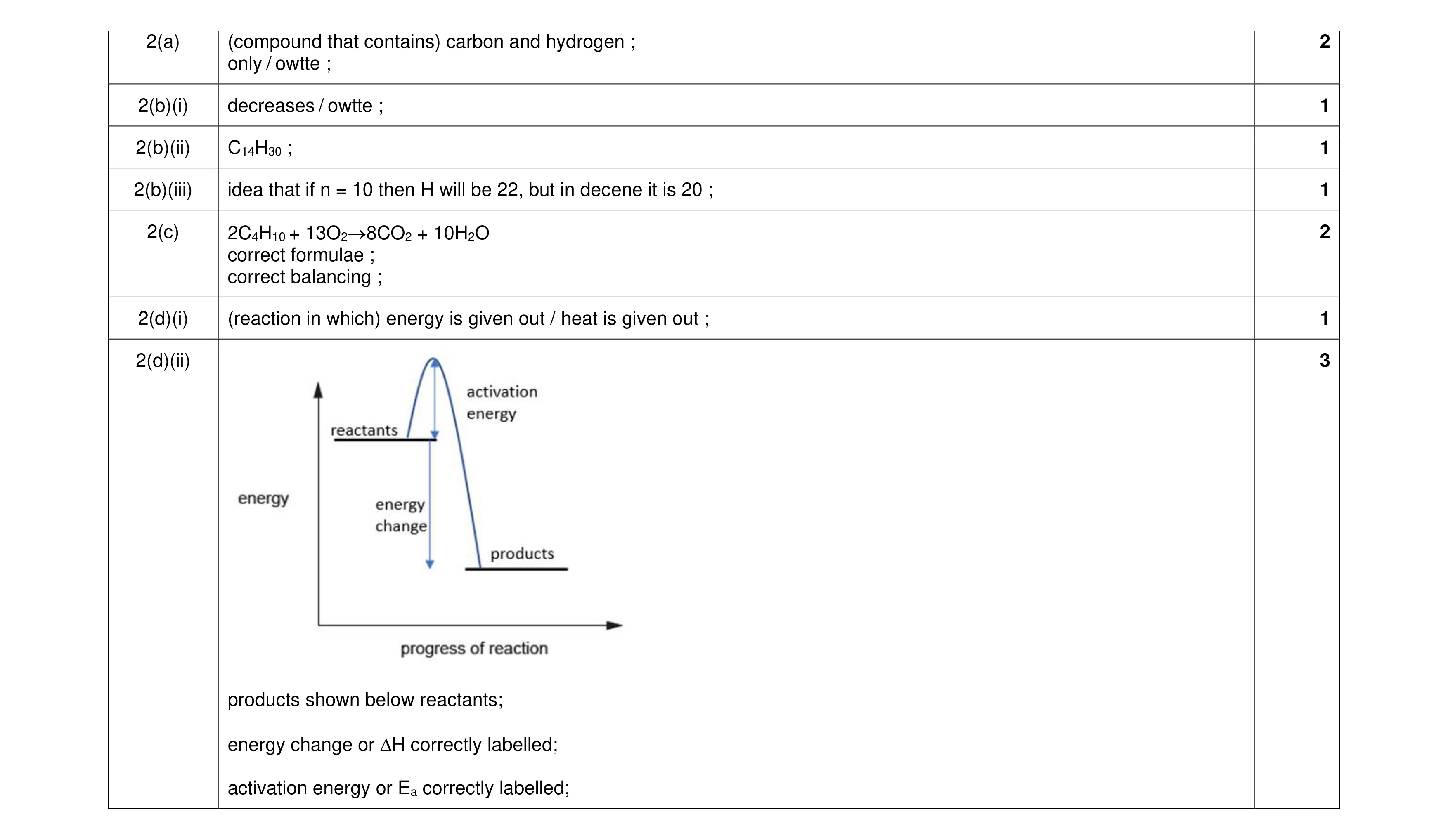 11
11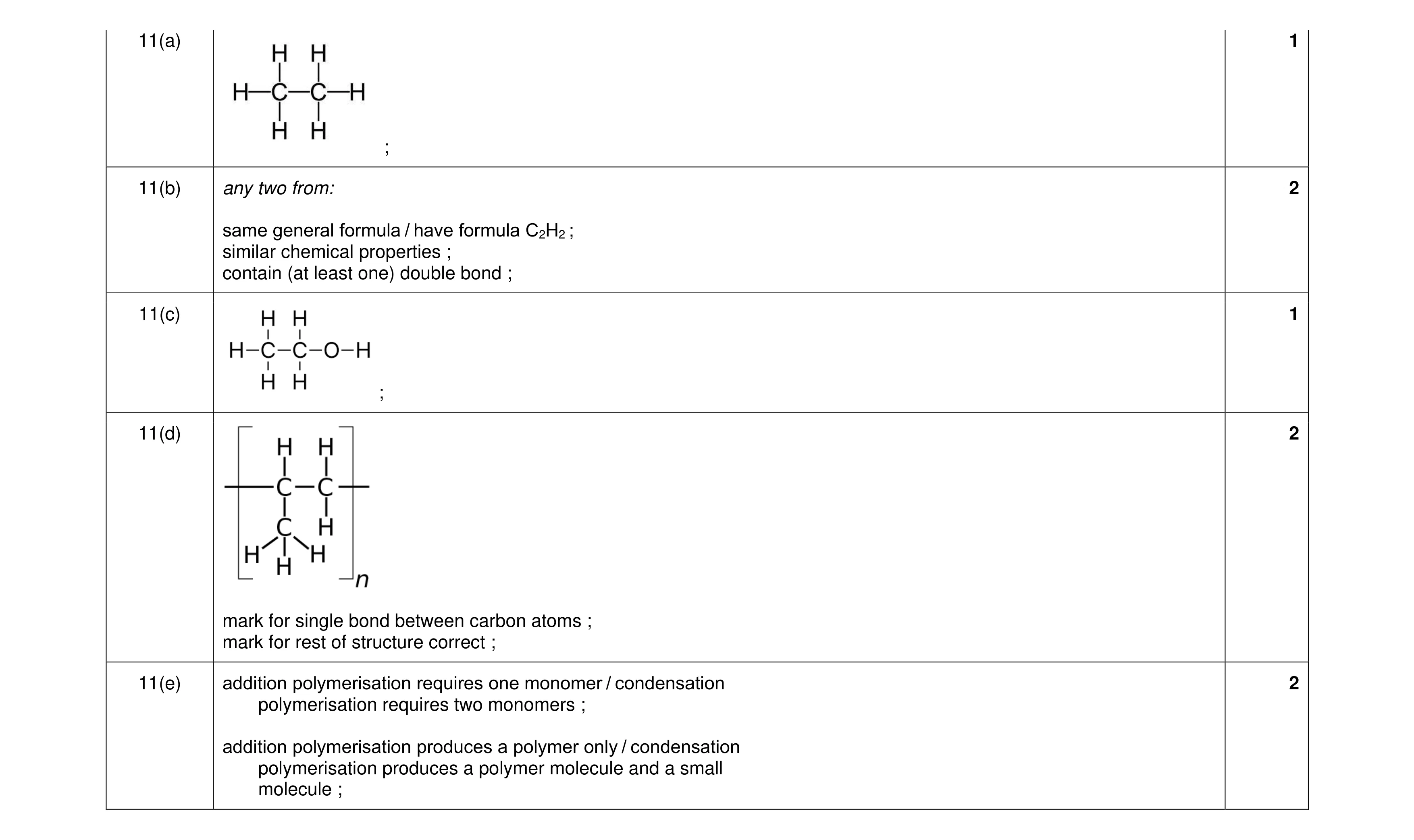 8
8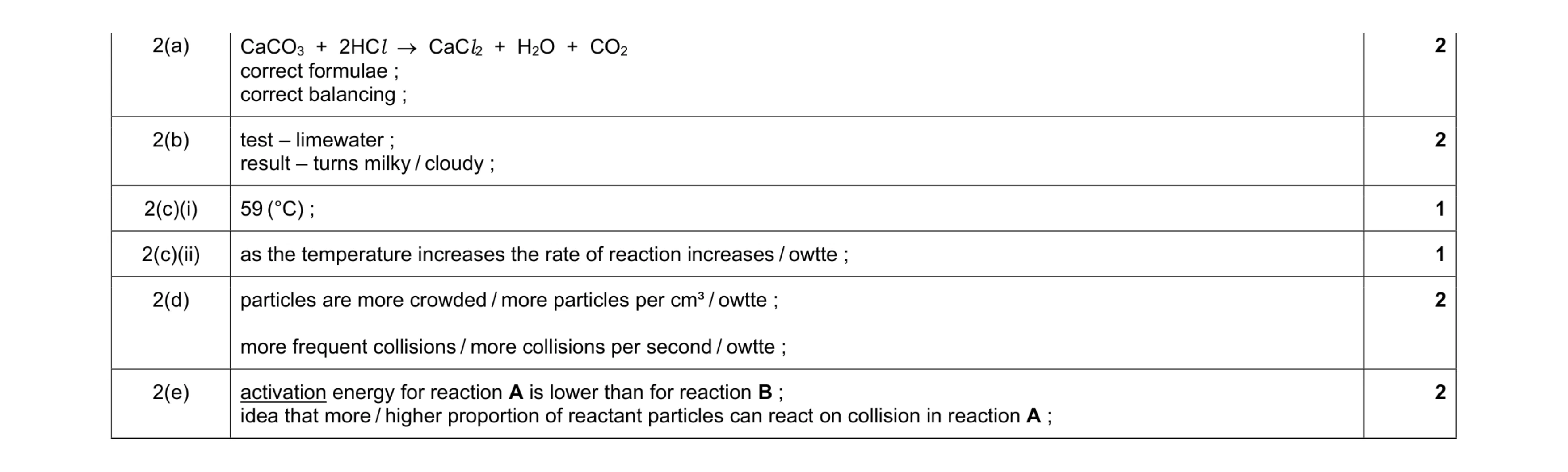 10
10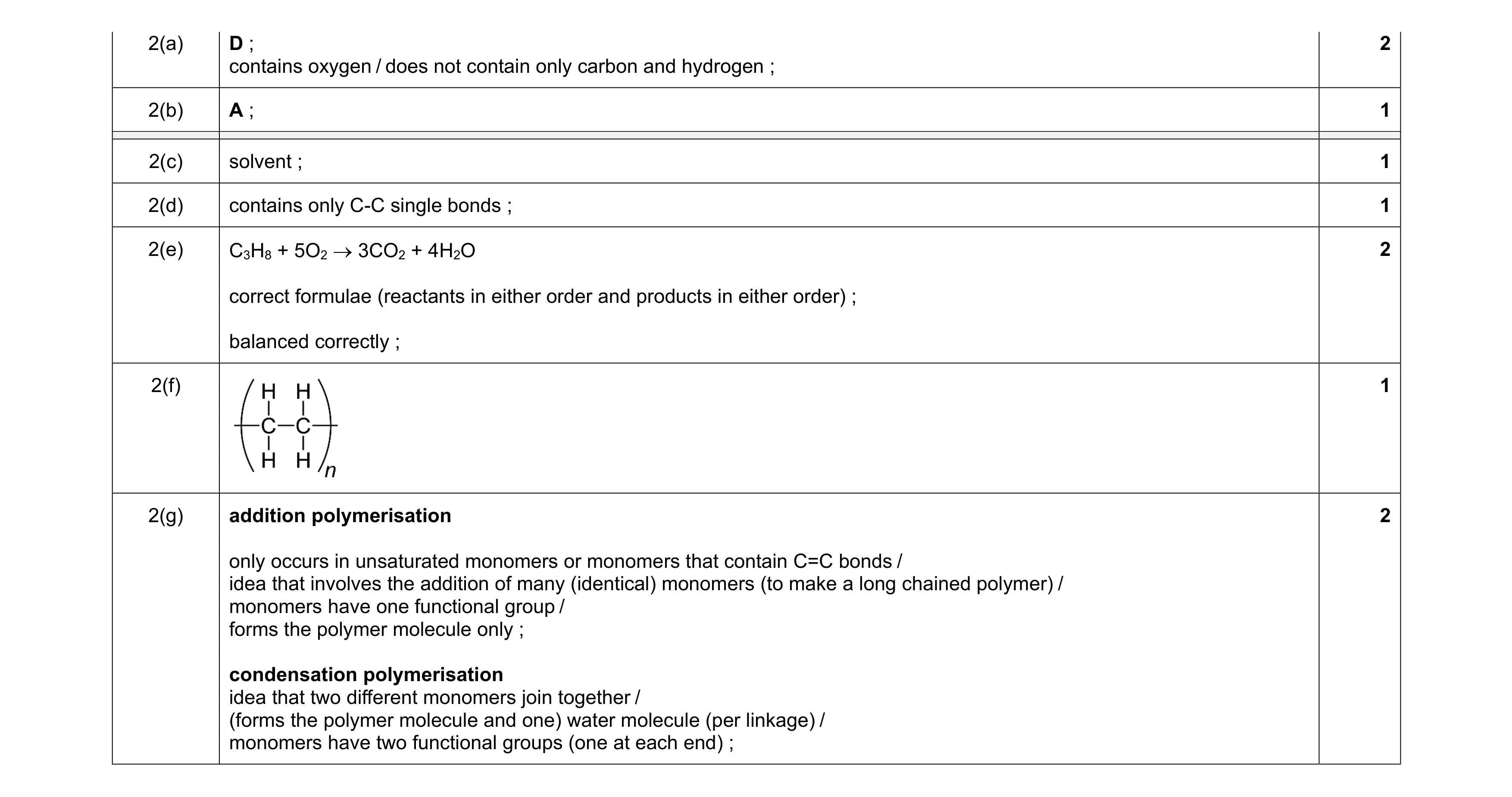 10
10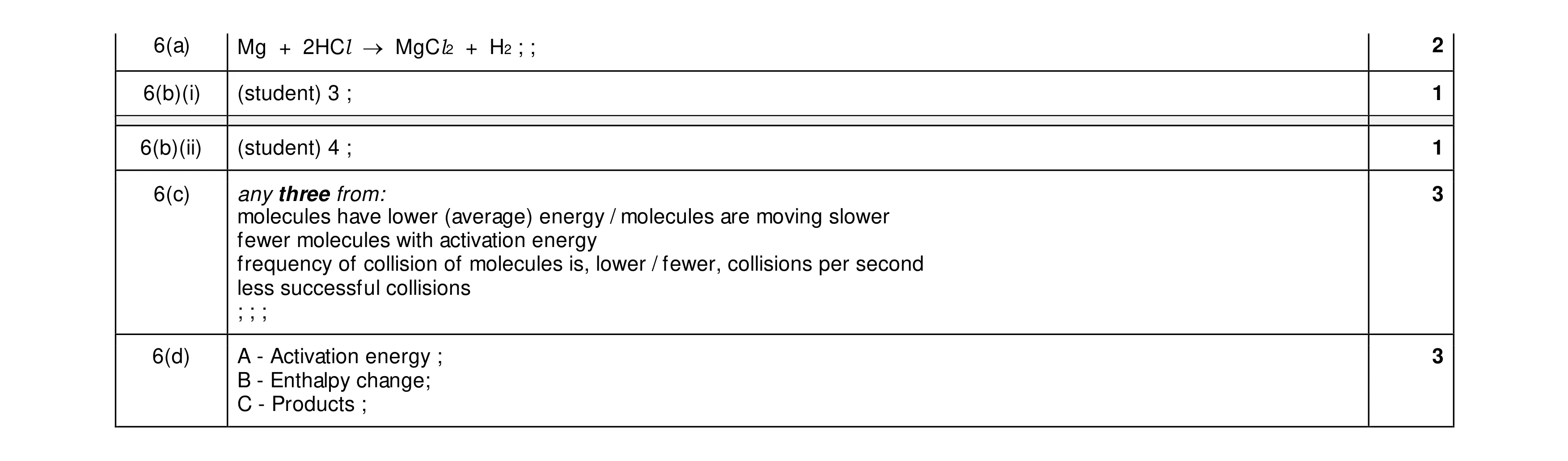 10
10