Questions as text
Q1 · Diagrams of atoms of two elements, J and Q 0654/32 May/June 2017
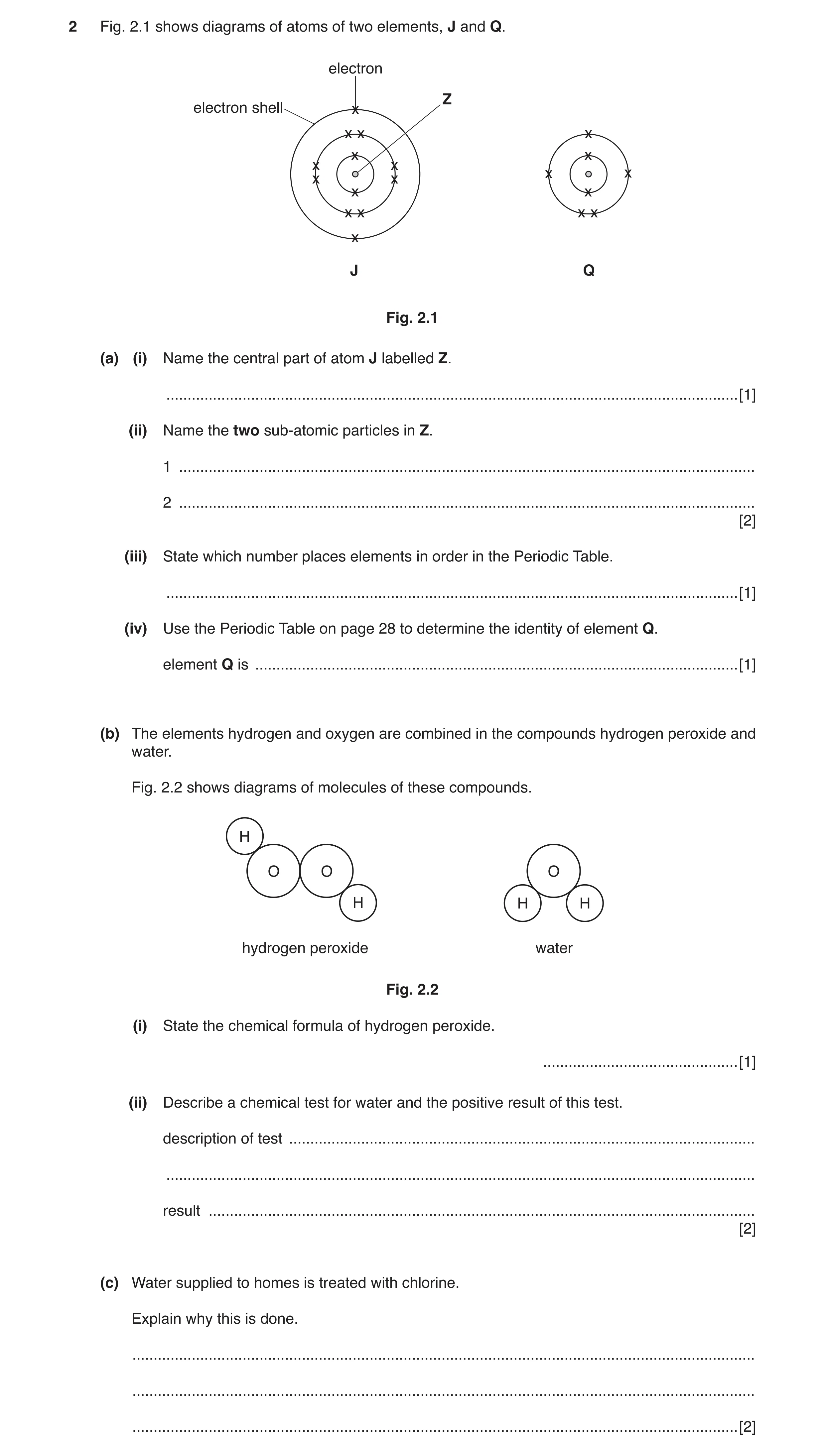
2 Fig. 2.1 shows diagrams of atoms of two elements, J and Q. electron Z electron shell x x x x x x x x x x x x x x x x x x x J Q Fig. 2.1 (a) (i) Name the central part of atom J labelled Z. … [1] (ii) Name the two sub-atomic particles in Z. 1 … 2 … [2] (iii) State which number places elements in order in the Periodic Table. … [1] (iv) Use the Periodic Table on page 28 to determine the identity of element Q. element Q is … [1] (b) The elements hydrogen and oxygen are combined in the compounds hydrogen peroxide and water. Fig. 2.2 shows diagrams of molecules of these compounds. H O O O H H H hydrogen peroxide water Fig. 2.2 (i) State the chemical formula of hydrogen peroxide. … [1] (ii) Describe a chemical test for water and the positive result of this test. description of test … … result … [2] (c) Water supplied to homes is treated with chlorine. Explain why this is done. … … … [2]
10 marks
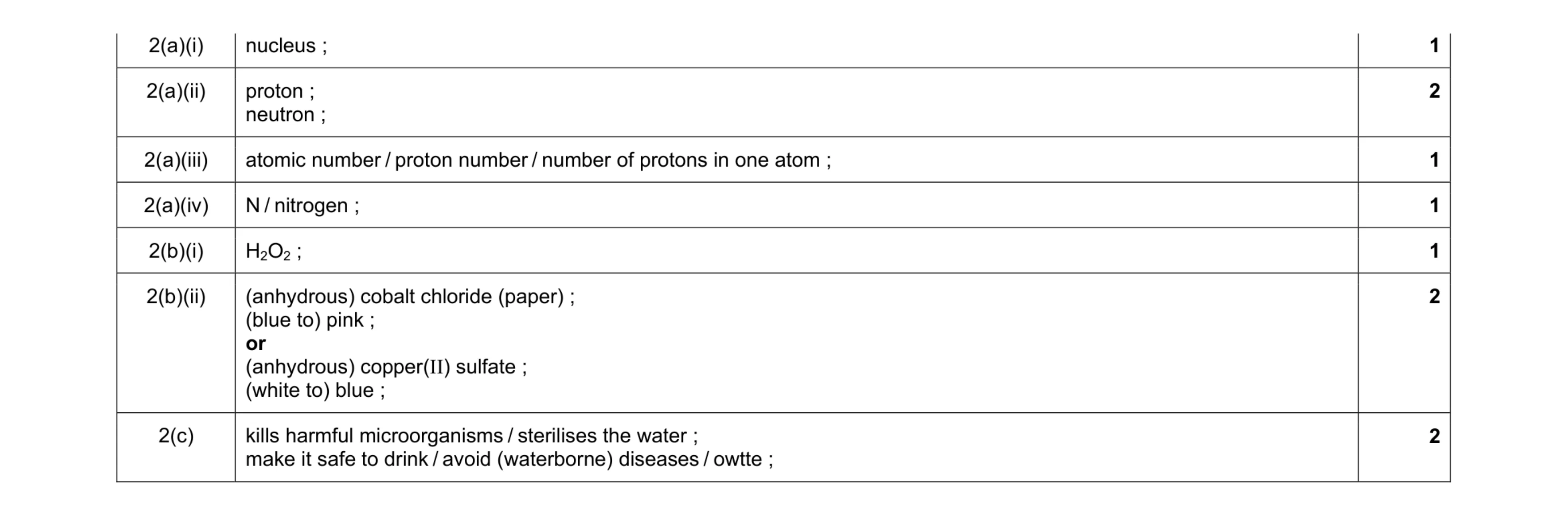
Mark scheme: 2(a)(i) nucleus ; 1 2(a)(ii) proton ; neutron ; 2 2(a)(iii) atomic number / proton number / number of protons in one atom ; 1 2(a)(iv) N / nitrogen ; 1 2(b)(i) H2O2 ; 1 2(b)(ii) (anhydrous) cobalt chloride (paper) ; (blue to) pink ; or (anhydrous) copper(II) sulfate ; (white to) blue ; 2 2(c) kills harmful microorganisms / sterilises the water ; make it safe to drink / avoid (waterborne) diseases / owtte ; 2
This question in 0654/32 May/June 2017
Q2 · The Periodic Table shows the elements arranged in order of atomic number 0654/33 May/June 2017
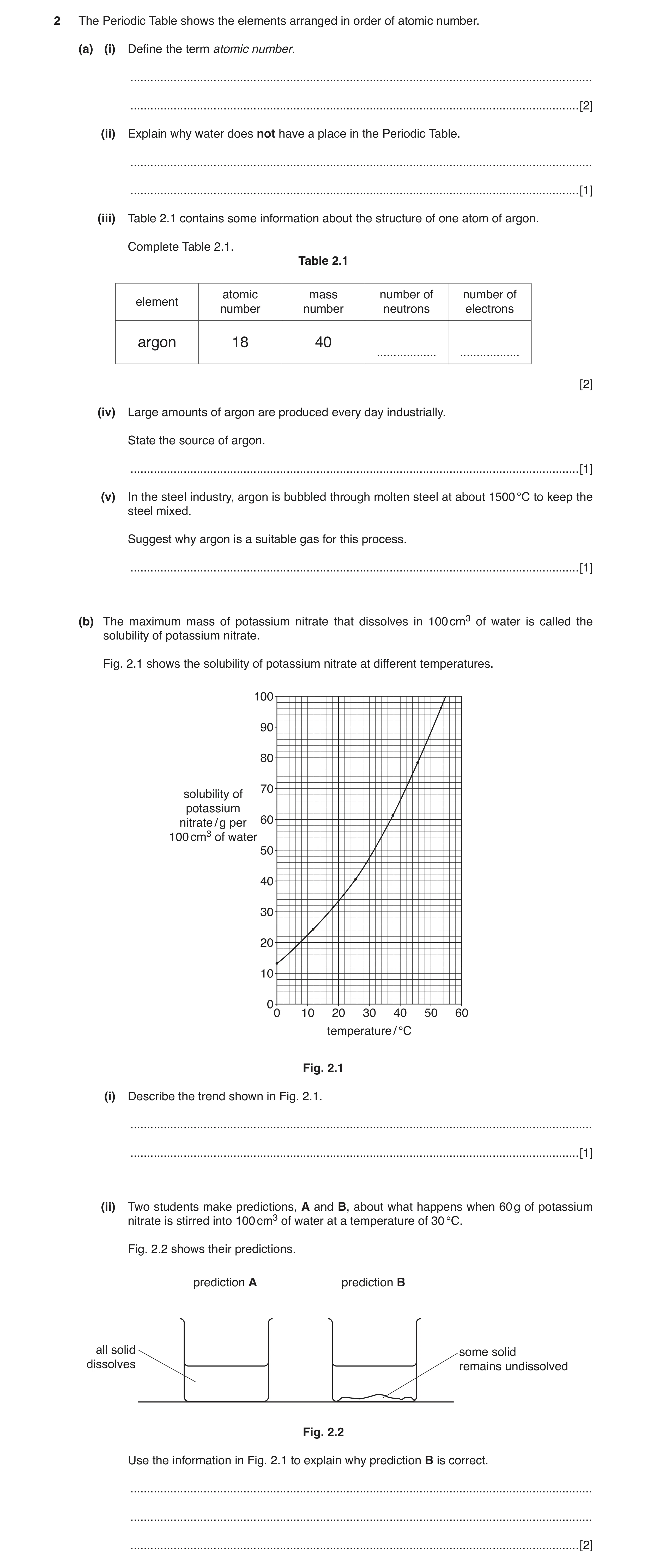
2 The Periodic Table shows the elements arranged in order of atomic number. (a) (i) Define the term atomic number. … … [2] (ii) Explain why water does not have a place in the Periodic Table. … … [1] (iii) Table 2.1 contains some information about the structure of one atom of argon. Complete Table 2.1. Table 2.1 atomic mass number of number of element number number neutrons electrons argon 18 40 … … [2] (iv) Large amounts of argon are produced every day industrially. State the source of argon. … [1] (v) In the steel industry, argon is bubbled through molten steel at about 1500 °C to keep the steel mixed. Suggest why argon is a suitable gas for this process. … [1] (b) The maximum mass of potassium nitrate that dissolves in 100 cm3 of water is called the solubility of potassium nitrate. Fig. 2.1 shows the solubility of potassium nitrate at different temperatures. 100 90 80 70 solubility of potassium nitrate / g per 60 100 cm3 of water 50 40 30 20 10 0 0 10 20 30 40 50 60 temperature / °C Fig. 2.1 (i) Describe the trend shown in Fig. 2.1. … … [1] (ii) Two students make predictions, A and B, about what happens when 60 g of potassium nitrate is stirred into 100 cm3 of water at a temperature of 30 °C. Fig. 2.2 shows their predictions. prediction A prediction B all solid some solid dissolves remains undissolved Fig. 2.2 Use the information in Fig. 2.1 to explain why prediction B is correct. … … … [2]
10 marks
Mark scheme: 2(a)(i) number of protons ; in one atom (of an element) ; 2 2(a)(ii) water is not an element / is a compound / only elements in Periodic Table ; 1 2(a)(iii) 22 ; 18 ; 2 2(a)(iv) air ; 1 2(a)(v) argon does not react with the steel / argon is unreactive ; 1 2(b)(i) the higher the temperature the higher the solubility ; 1 2(b)(ii) at 30 °C maximum mass that dissolves is (about) 47 g / less than 60 g ; so not all the solid can dissolve / some solid settles out / owtte ; 2
This question in 0654/33 May/June 2017
Q3 · The diagram in Fig 0654/31 May/June 2020
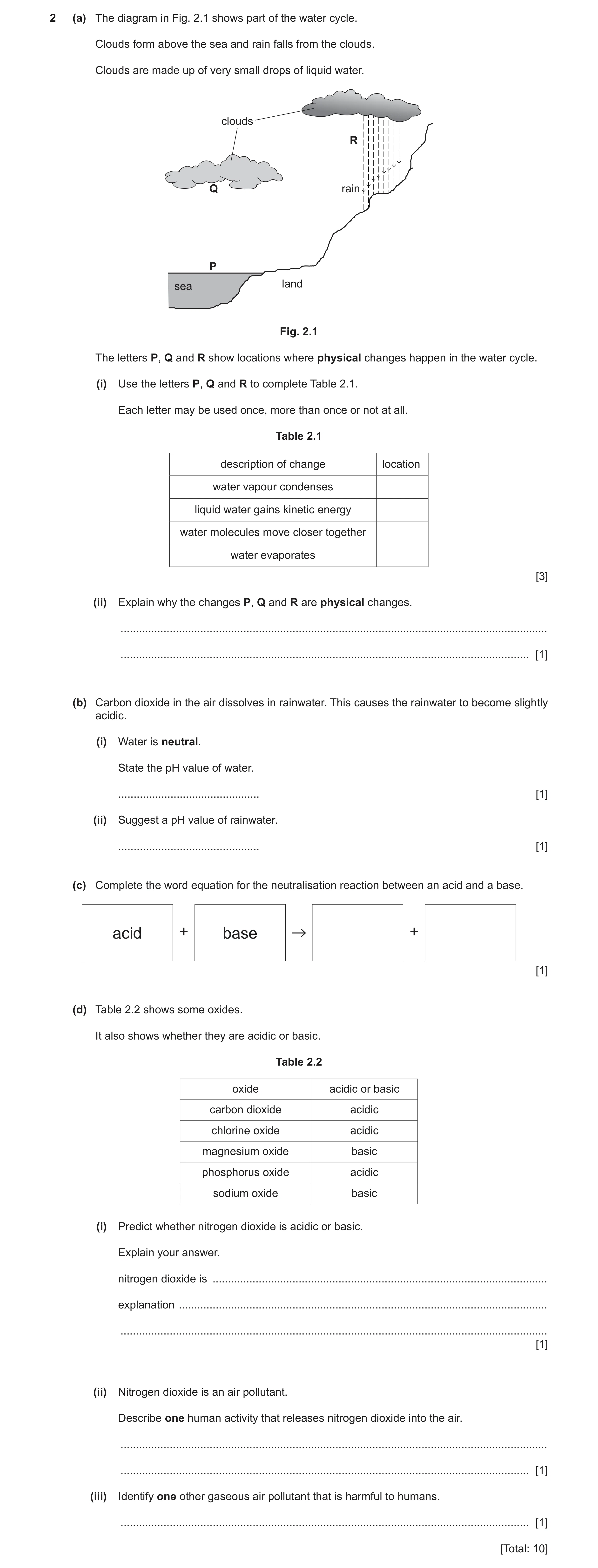
2 (a) The diagram in Fig. 2.1 shows part of the water cycle. Clouds form above the sea and rain falls from the clouds. Clouds are made up of very small drops of liquid water. clouds R Q rain P sea land Fig. 2.1 The letters P, Q and R show locations where physical changes happen in the water cycle. (i) Use the letters P, Q and R to complete Table 2.1. Each letter may be used once, more than once or not at all. Table 2.1 description of change location water vapour condenses liquid water gains kinetic energy water molecules move closer together water evaporates [3] (ii) Explain why the changes P, Q and R are physical changes. … … [1] (b) Carbon dioxide in the air dissolves in rainwater. This causes the rainwater to become slightly acidic. (i) Water is neutral. State the pH value of water. … [1] (ii) Suggest a pH value of rainwater. … [1] (c) Complete the word equation for the neutralisation reaction between an acid and a base. acid + base + [1] (d) Table 2.2 shows some oxides. It also shows whether they are acidic or basic. Table 2.2 oxide acidic or basic carbon dioxide acidic chlorine oxide acidic magnesium oxide basic phosphorus oxide acidic sodium oxide basic (i) Predict whether nitrogen dioxide is acidic or basic. Explain your answer. nitrogen dioxide is … explanation … … [1] (ii) Nitrogen dioxide is an air pollutant. Describe one human activity that releases nitrogen dioxide into the air. … … [1] (iii) Identify one other gaseous air pollutant that is harmful to humans. … [1] [Total: 10]
10 marks
Mark scheme: 2(a)(i) Q R Q P ;;; 1 correct for 1 mark 2 or 3 correct for 2 marks all correct for 3 marks 2(a)(ii) only changes of state occurring / no new substances formed ; 1 2(b)(i) 7 ; 1 2(b)(ii) allow a range from <7 to 3 ; 1 2(c) salt + water ; 1 2(d)(i) (acidic) oxide of a non-metal / non-metal oxides in the table are acidic ; 1 2(d)(ii) burning of fuel / named fuel / hydrocarbons in car engines ; 1 2(d)(iii) carbon monoxide / CO / sulfur dioxide / SO2 / other correct ; 1
This question in 0654/31 May/June 2020
Q4 · Non-metallic elements are placed in groups towards the right hand side of the Periodic… 0654/31 May/June 2020
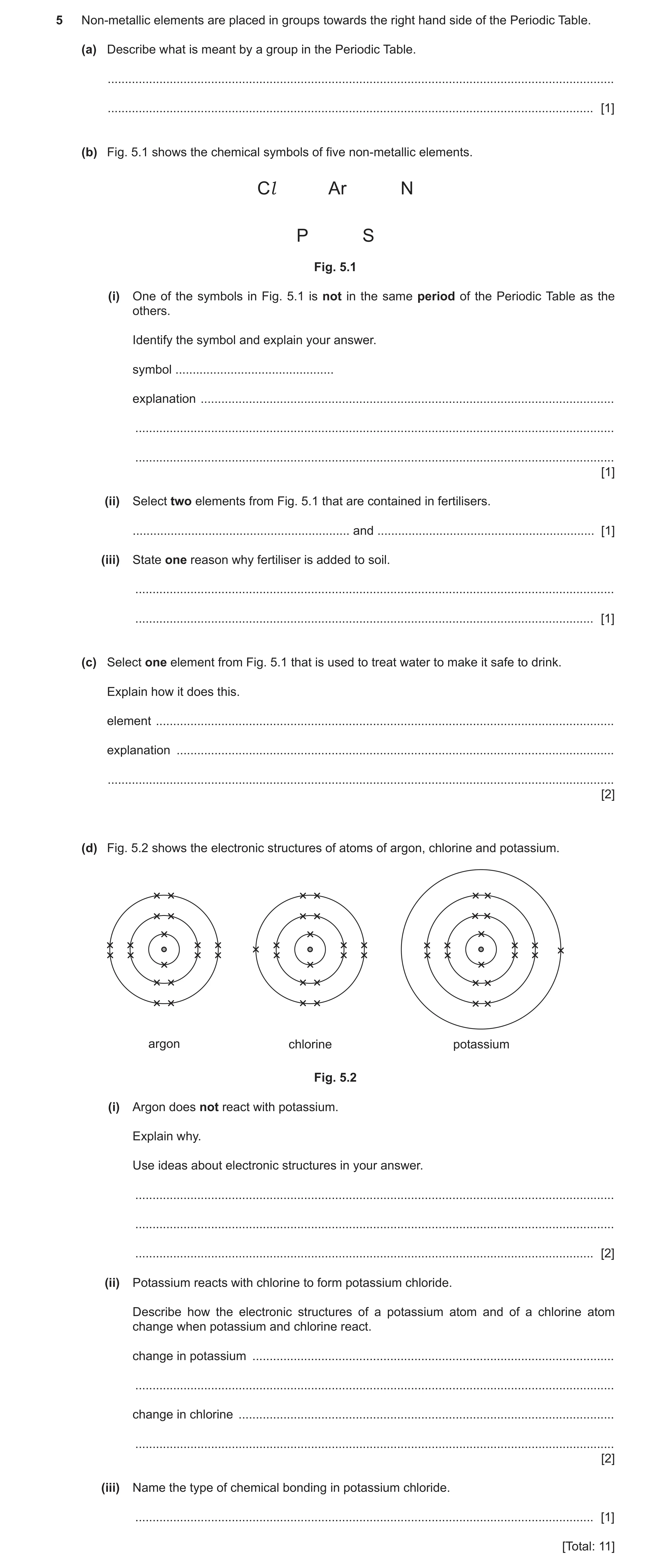
5 Non-metallic elements are placed in groups towards the right hand side of the Periodic Table. (a) Describe what is meant by a group in the Periodic Table. … … [1] (b) Fig. 5.1 shows the chemical symbols of five non-metallic elements. Cl Ar N P S Fig. 5.1 (i) One of the symbols in Fig. 5.1 is not in the same period of the Periodic Table as the others. Identify the symbol and explain your answer. symbol … explanation … … … [1] (ii) Select two elements from Fig. 5.1 that are contained in fertilisers. … and … [1] (iii) State one reason why fertiliser is added to soil. … … [1] (c) Select one element from Fig. 5.1 that is used to treat water to make it safe to drink. Explain how it does this. element … explanation … … [2] (d) Fig. 5.2 shows the electronic structures of atoms of argon, chlorine and potassium. argon chlorine potassium Fig. 5.2 (i) Argon does not react with potassium. Explain why. Use ideas about electronic structures in your answer. … … … [2] (ii) Potassium reacts with chlorine to form potassium chloride. Describe how the electronic structures of a potassium atom and of a chlorine atom change when potassium and chlorine react. change in potassium … … change in chlorine … … [2] (iii) Name the type of chemical bonding in potassium chloride. … [1] [Total: 11]
11 marks
Mark scheme: 5(a) vertical column of elements / elements whose atoms have same number of outer electrons ; 1 5(b)(i) (N) idea that the other four are in same horizontal row ; 1 Question Answer Marks 5(b)(ii) two from N / P / S ; 1 5(b)(iii) improves fertility / increases crop yield (size) / to replenish nutrients ; 1 5(c) Cl / chlorine ; sterilises the water / kills (harmful) microorganisms ; 2 5(d)(i) argon has full outer shell (of electrons) ; filled shell is stable / means argon is inert / does not lose or gain electrons to become stable ; 2 5(d)(ii) (potassium atom) loses one electron ; changes from 2.8.8.1 to 2.8.8 ; (chlorine atom ) gains one electron; changes from 2.8.7. to 2.8.8 ; 2 5(d)(iii) ionic / electrovalent ; 1
This question in 0654/31 May/June 2020
Q5 · Water is a compound of the elements hydrogen and oxygen 0654/33 May/June 2020
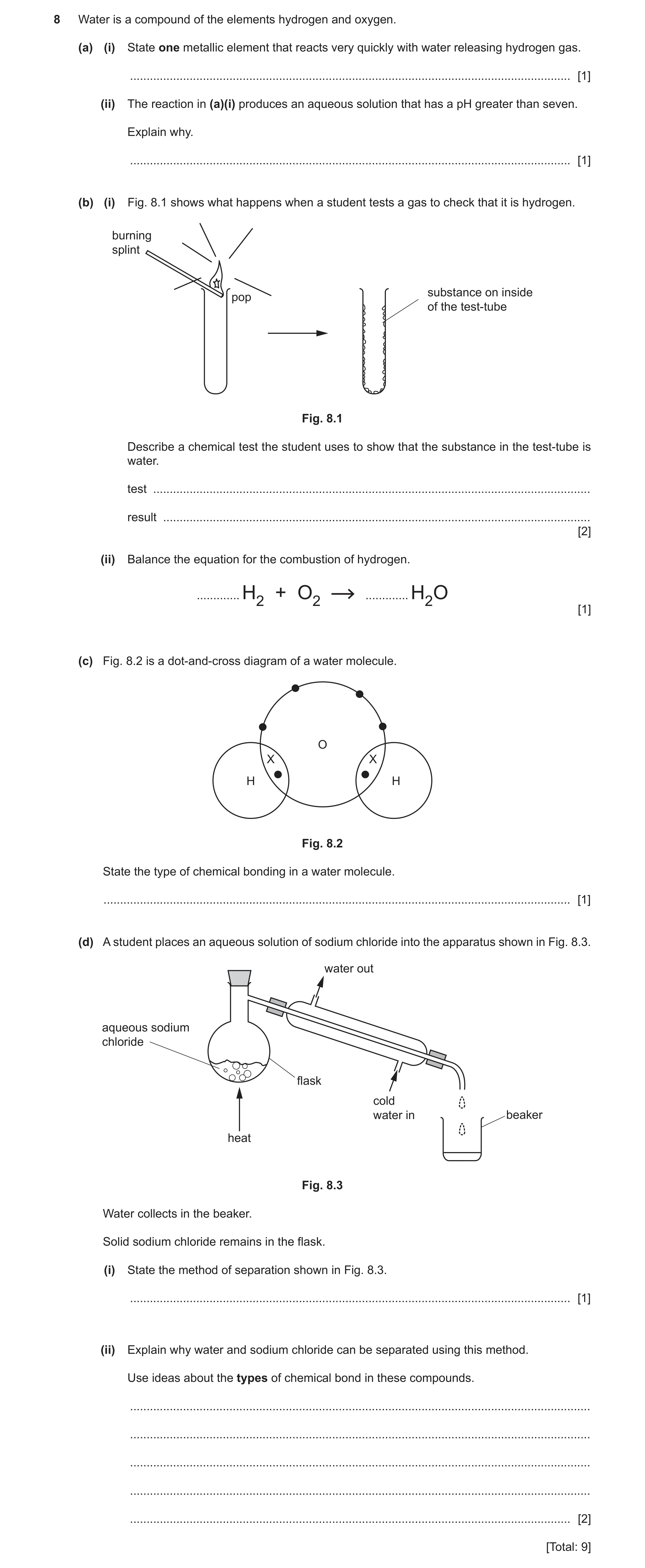
8 Water is a compound of the elements hydrogen and oxygen. (a) (i) State one metallic element that reacts very quickly with water releasing hydrogen gas. … [1] (ii) The reaction in (a)(i) produces an aqueous solution that has a pH greater than seven. Explain why. … [1] (b) (i) Fig. 8.1 shows what happens when a student tests a gas to check that it is hydrogen. burning splint substance on inside pop of the test-tube Fig. 8.1 Describe a chemical test the student uses to show that the substance in the test-tube is water. test … result … [2] (ii) Balance the equation for the combustion of hydrogen. … … H2 + O2 H2O [1] (c) Fig. 8.2 is a dot-and-cross diagram of a water molecule. O X X H H Fig. 8.2 State the type of chemical bonding in a water molecule. … [1] (d) A student places an aqueous solution of sodium chloride into the apparatus shown in Fig. 8.3. water out aqueous sodium chloride flask cold water in beaker heat Fig. 8.3 Water collects in the beaker. Solid sodium chloride remains in the flask. (i) State the method of separation shown in Fig. 8.3. … [1] (ii) Explain why water and sodium chloride can be separated using this method. Use ideas about the types of chemical bond in these compounds. … … … … … [2] [Total: 9]
9 marks
Mark scheme: 8(a)(i) any Group 1 element / other correct (e.g. calcium); 1 8(a)(ii) solution is alkaline / reaction produces (soluble) base / hydroxide of element in (i) ; 1 8(b)(i) cobalt chloride ; blue to pink ; OR anhydrous copper(II) sulfate ; white to blue ; 2 8(b)(ii) 2H2 + O2 → 2 H2O ; 1 8(c) covalent ; 1 8(d)(i) (simple) distillation ; 1 8(d)(ii) the idea that water boils and sodium chloride does not / water is more volatile than sodium chloride ; because covalent compounds tend to have low bpts / ionic compounds high bpts; 2
This question in 0654/33 May/June 2020
Q6 · Hydrogen burning in air 0654/32 Oct/Nov 2020
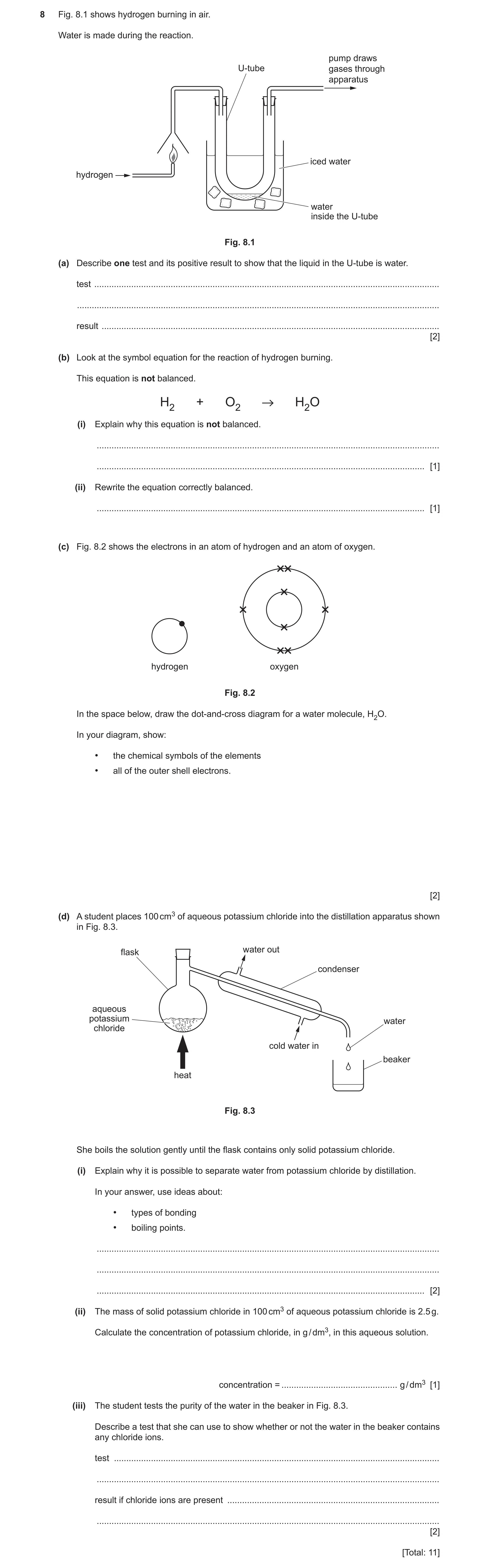
8 Fig. 8.1 shows hydrogen burning in air. Water is made during the reaction. pump draws U-tube gases through apparatus iced water hydrogen water inside the U-tube Fig. 8.1 (a) Describe one test and its positive result to show that the liquid in the U-tube is water. test … … result … [2] (b) Look at the symbol equation for the reaction of hydrogen burning. This equation is not balanced. H2 + O2 H2O (i) Explain why this equation is not balanced. … … [1] (ii) Rewrite the equation correctly balanced. … [1] (c) Fig. 8.2 shows the electrons in an atom of hydrogen and an atom of oxygen. hydrogen oxygen Fig. 8.2 In the space below, draw the dot-and-cross diagram for a water molecule, H2O. In your diagram, show: • the chemical symbols of the elements • all of the outer shell electrons. [2] (d) A student places 100 cm3 of aqueous potassium chloride into the distillation apparatus shown in Fig. 8.3. water out flask condenser aqueous potassium water chloride cold water in beaker heat Fig. 8.3 She boils the solution gently until the flask contains only solid potassium chloride. (i) Explain why it is possible to separate water from potassium chloride by distillation. In your answer, use ideas about: • types of bonding • boiling points. … … … [2] (ii) The mass of solid potassium chloride in 100 cm3 of aqueous potassium chloride is 2.5 g. Calculate the concentration of potassium chloride, in g / dm3, in this aqueous solution. concentration = … g / dm3 [1] (iii) The student tests the purity of the water in the beaker in Fig. 8.3. Describe a test that she can use to show whether or not the water in the beaker contains any chloride ions. test … … result if chloride ions are present … … [2] [Total: 11]
11 marks
Mark scheme: 8(a) cobalt chloride ; (blue to) pink ; OR anhydrous copper(II) sulfate ; (white to) blue ; 8(b)(i) different numbers of oxygen atoms on LHS and RHS / the numbers of each type of atom is not the same on both sides ; 1 8(b)(ii) 2 H2 + O2 → 2 H2O ; 1 8(c) symbols correct ; dot-and -cross diagram correct; 2 8(d)(i) the idea that water boils and potassium chloride does not / water is more volatile than potassium chloride ; because water is covalent / molecular and potassium chloride is ionic ; 2 8(d)(ii) 100 cm3 contains 2.5 g KCl so concentration is 25 (g / dm3 ) ; 1 8(d)(iii) addition of (acidified aqueous) silver nitrate ; white precipitate ; 2
This question in 0654/32 Oct/Nov 2020
Q7 · The list below shows some chemical processes 0654/31 Oct/Nov 2022
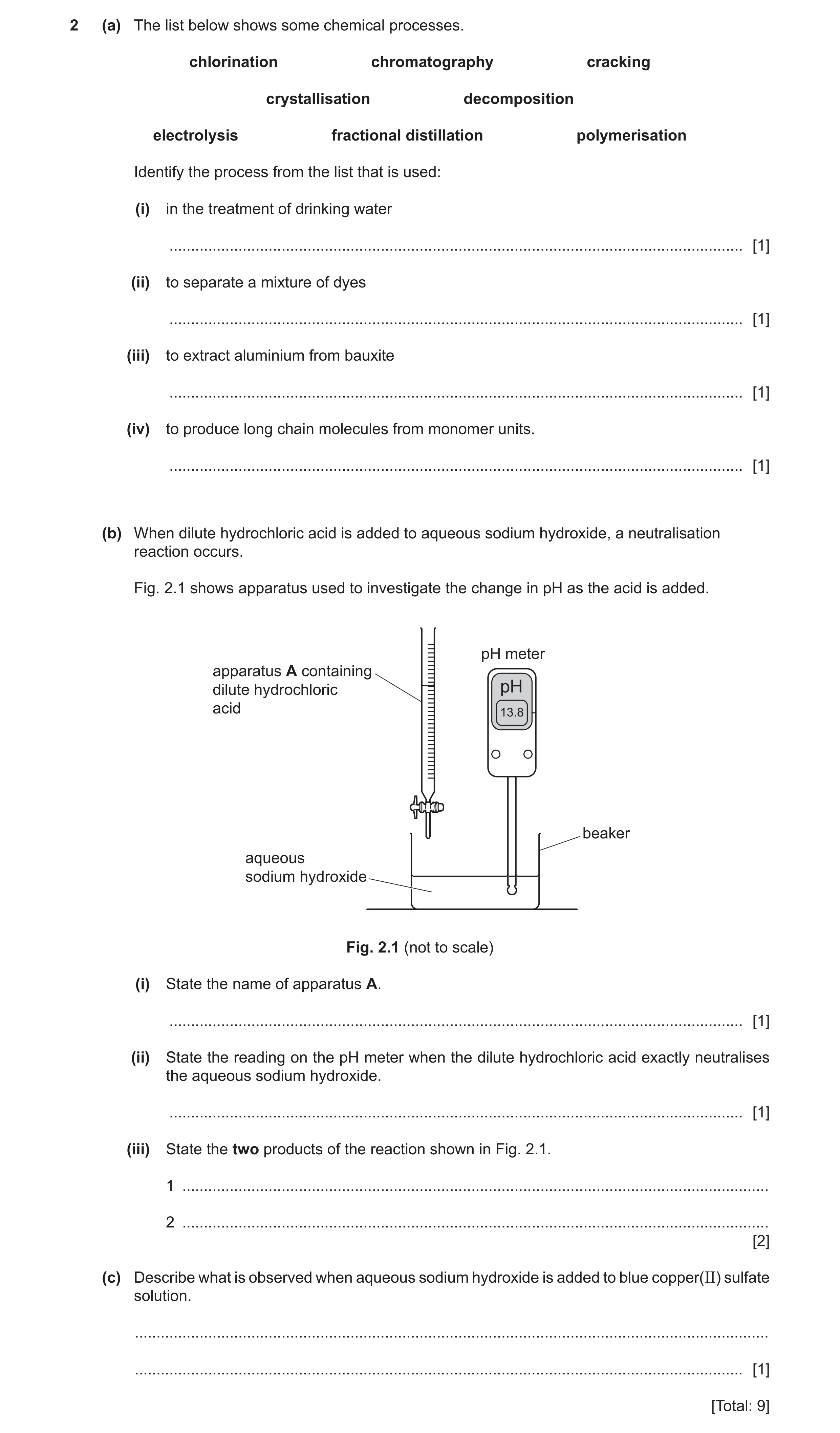
2 (a) The list below shows some chemical processes. chlorination chromatography cracking crystallisation decomposition electrolysis fractional distillation polymerisation Identify the process from the list that is used: (i) in the treatment of drinking water … [1] (ii) to separate a mixture of dyes … [1] (iii) to extract aluminium from bauxite … [1] (iv) to produce long chain molecules from monomer units. … [1] (b) When dilute hydrochloric acid is added to aqueous sodium hydroxide, a neutralisation reaction occurs. Fig. 2.1 shows apparatus used to investigate the change in pH as the acid is added. pH meter apparatus A containing dilute hydrochloric pH acid 13.8 beaker aqueous sodium hydroxide Fig. 2.1 (not to scale) (i) State the name of apparatus A. … [1] (ii) State the reading on the pH meter when the dilute hydrochloric acid exactly neutralises the aqueous sodium hydroxide. … [1] (iii) State the two products of the reaction shown in Fig. 2.1. 1 … 2 … [2] (c) Describe what is observed when aqueous sodium hydroxide is added to blue copper(II) sulfate solution. … … [1] [Total: 9]
9 marks
Mark scheme: 2(a)(i) chlorination ; 1 2(a)(ii) chromatography ; 1 2(a)(iii) electrolysis ; 1 2(a)(iv) polymerisation ; 1 2(b)(i) burette ; 1 2(b)(ii) 7 ; 1 2(b)(iii) sodium chloride ; 2 water ; 2(c) pale blue precipitate ; 1
This question in 0654/31 Oct/Nov 2022
Q8 · Orange bromine gas, Br2, is put into the bottom of a gas jar which is immediately sealed 0654/32 Oct/Nov 2022
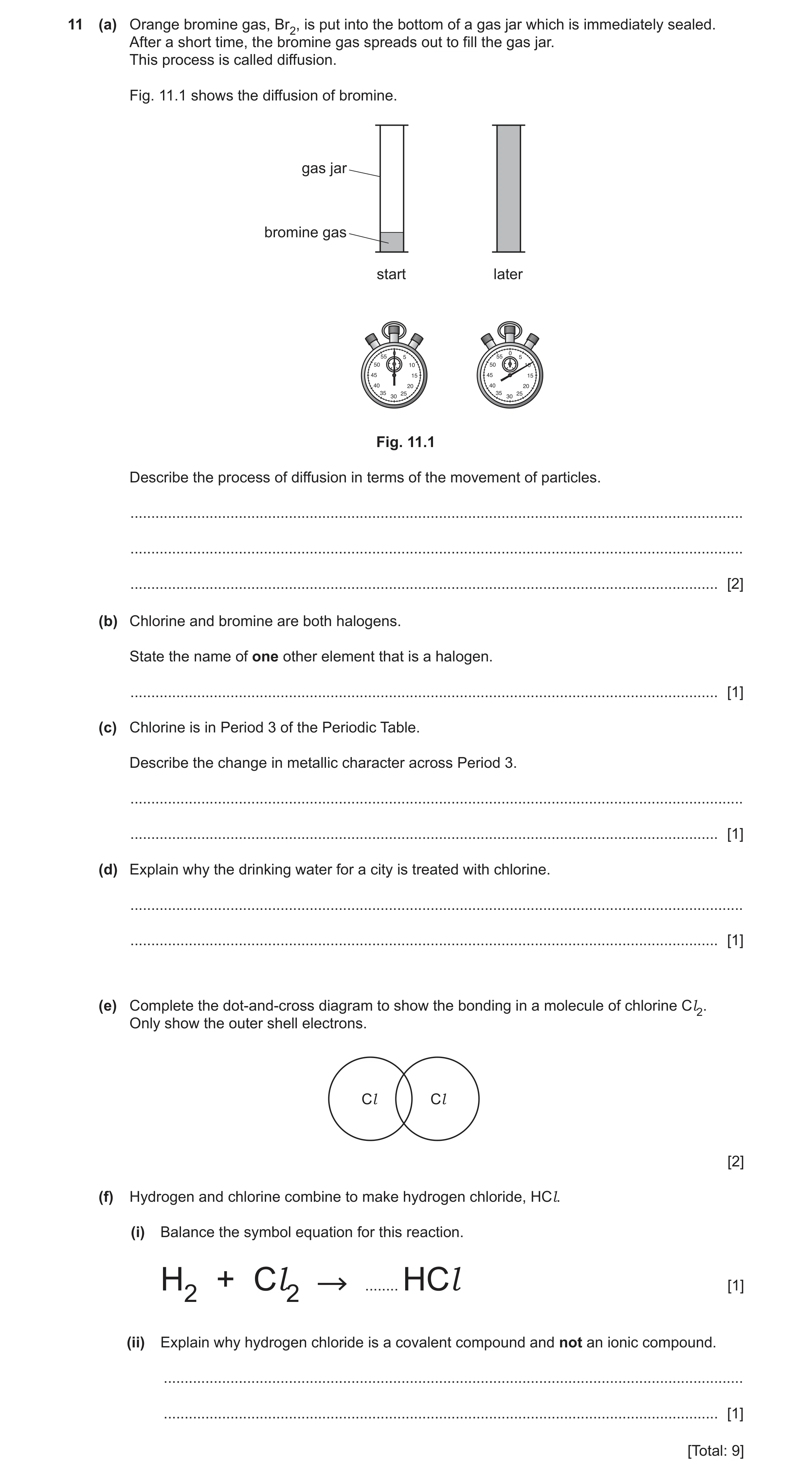
11 (a) Orange bromine gas, Br2, is put into the bottom of a gas jar which is immediately sealed. After a short time, the bromine gas spreads out to fill the gas jar. This process is called diffusion. Fig. 11.1 shows the diffusion of bromine. gas jar bromine gas start later Fig. 11.1 Describe the process of diffusion in terms of the movement of particles. … … … [2] (b) Chlorine and bromine are both halogens. State the name of one other element that is a halogen. … [1] (c) Chlorine is in Period 3 of the Periodic Table. Describe the change in metallic character across Period 3. … … [1] (d) Explain why the drinking water for a city is treated with chlorine. … … [1] (e) Complete the dot-and-cross diagram to show the bonding in a molecule of chlorine Cl2. Only show the outer shell electrons. Cl Cl [2] (f) Hydrogen and chlorine combine to make hydrogen chloride, HCl. (i) Balance the symbol equation for this reaction. … [1] H2 + Cl2 HCl (ii) Explain why hydrogen chloride is a covalent compound and not an ionic compound. … … [1] [Total: 9]
9 marks
Mark scheme: 11(a) gas particles in (constant) random motion ; 2 (particles move) from region of high concentration to region of low concentration ; 11(b) iodine / fluorine / astatine ; 1 11(c) metallic to non-metallic (from left to right) ; 1 11(d) to kill, microorganisms/bacteria/pathogens ; 1 11(e) shared pair ; 2 correct number of electrons on each atom / 14 electrons in total ; 11(f)(i) 2 HCl ; 1 11(f)(ii) two non-metals bonding / shared pair of electrons ; 1
This question in 0654/32 Oct/Nov 2022
Q9 · Chlorine, bromine and iodine are halogens in Group VII of the Periodic Table 0654/32 Oct/Nov 2023
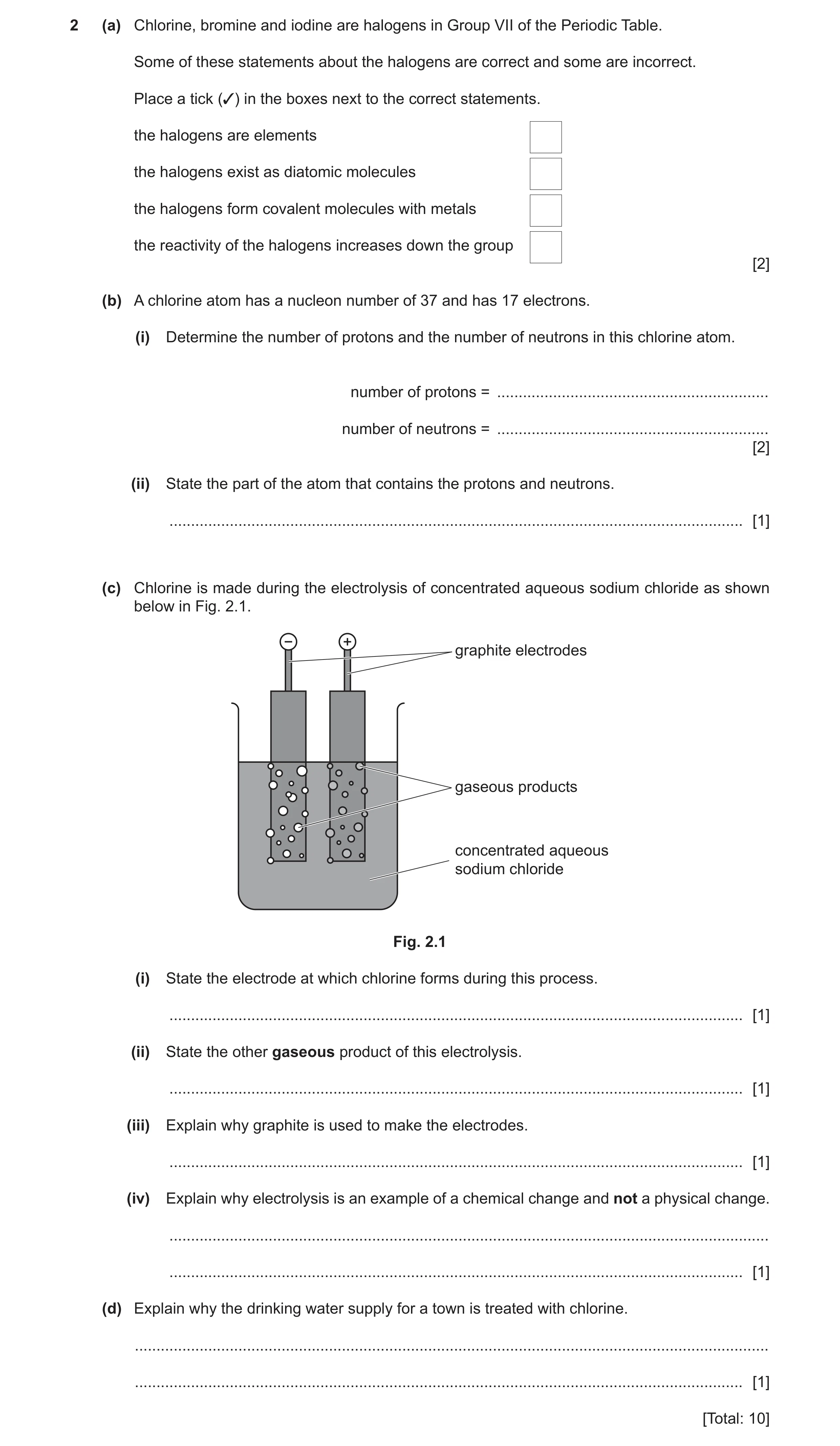
2 (a) Chlorine, bromine and iodine are halogens in Group VII of the Periodic Table. Some of these statements about the halogens are correct and some are incorrect. Place a tick (✓) in the boxes next to the correct statements. the halogens are elements the halogens exist as diatomic molecules the halogens form covalent molecules with metals the reactivity of the halogens increases down the group [2] (b) A chlorine atom has a nucleon number of 37 and has 17 electrons. (i) Determine the number of protons and the number of neutrons in this chlorine atom. number of protons = … number of neutrons = … [2] (ii) State the part of the atom that contains the protons and neutrons. … [1] (c) Chlorine is made during the electrolysis of concentrated aqueous sodium chloride as shown below in Fig. 2.1. graphite electrodes gaseous products concentrated aqueous sodium chloride Fig. 2.1 (i) State the electrode at which chlorine forms during this process. … [1] (ii) State the other gaseous product of this electrolysis. … [1] (iii) Explain why graphite is used to make the electrodes. … [1] (iv) Explain why electrolysis is an example of a chemical change and not a physical change. … … [1] (d) Explain why the drinking water supply for a town is treated with chlorine. … … [1] [Total: 10]
10 marks
Mark scheme: 2(a) 2 the halogens are elements the halogens exist as diatomic molecules ;; 2 ticks 2 correct = 2 marks 3 ticks 2 correct = 1 mark 2 ticks 1 correct = 1 mark 1 tick 1 correct = 1 mark 4 ticks 2 correct = 0 marks 2(b)(i) protons = 17 ; 2 neutrons = 20 ; 2(b)(ii) nucleus ; 1 2(c)(i) anode / positive ; 1 2(c)(ii) hydrogen ; 1 2(c)(iii) it is inert / will not react / good electrical conductor ; 1 2(c)(iv) new substances formed / cannot be reversed ; 1 2(d) kills microbes / sterilise water ; 1
This question in 0654/32 Oct/Nov 2023
Q10 · There are different methods of separating mixtures 0654/33 Oct/Nov 2023
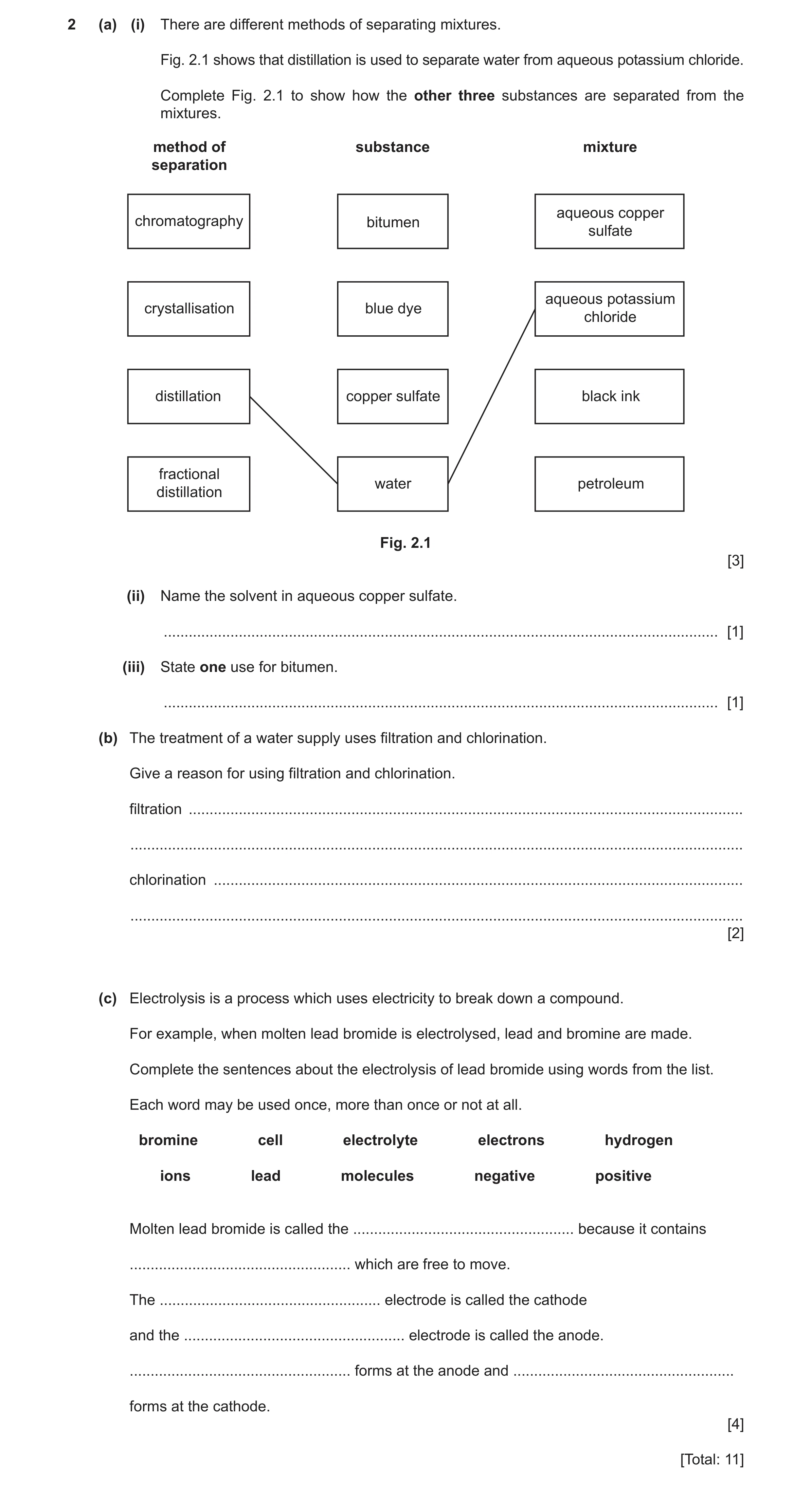
2 (a) (i) There are different methods of separating mixtures. Fig. 2.1 shows that distillation is used to separate water from aqueous potassium chloride. Complete Fig. 2.1 to show how the other three substances are separated from the mixtures. method of substance mixture separation aqueous copper chromatography bitumen sulfate aqueous potassium crystallisation blue dye chloride distillation copper sulfate black ink fractional water petroleum distillation Fig. 2.1 [3] (ii) Name the solvent in aqueous copper sulfate. … [1] (iii) State one use for bitumen. … [1] (b) The treatment of a water supply uses filtration and chlorination. Give a reason for using filtration and chlorination. filtration … … chlorination … … [2] (c) Electrolysis is a process which uses electricity to break down a compound. For example, when molten lead bromide is electrolysed, lead and bromine are made. Complete the sentences about the electrolysis of lead bromide using words from the list. Each word may be used once, more than once or not at all. bromine cell electrolyte electrons hydrogen ions lead molecules negative positive Molten lead bromide is called the … because it contains … which are free to move. The … electrode is called the cathode and the … electrode is called the anode. … forms at the anode and … forms at the cathode. [4] [Total: 11]
11 marks
Mark scheme: 2(a)(i) 3 method of separation substance mixture aqueous copper chromatography bitumen sulfate aqueous potassium crystallisation blue dye chloride distillation copper sulfate black ink fractional water petroleum distillation one pair of links correct ; two pairs of links correct ; three pairs of links correct ; 2(a)(ii) water ; 1 2(a)(iii) road surfaces ; 1 2(b) filtration – removes solid particles ; 2 chlorination – kills microbes / sterilises water ; 2(c) electrolyte ; 4 ions ; negative and positive (in that order) ; bromine and lead (in that order) ;
This question in 0654/33 Oct/Nov 2023
Q11 · Ice is a solid 0654/31 May/June 2024
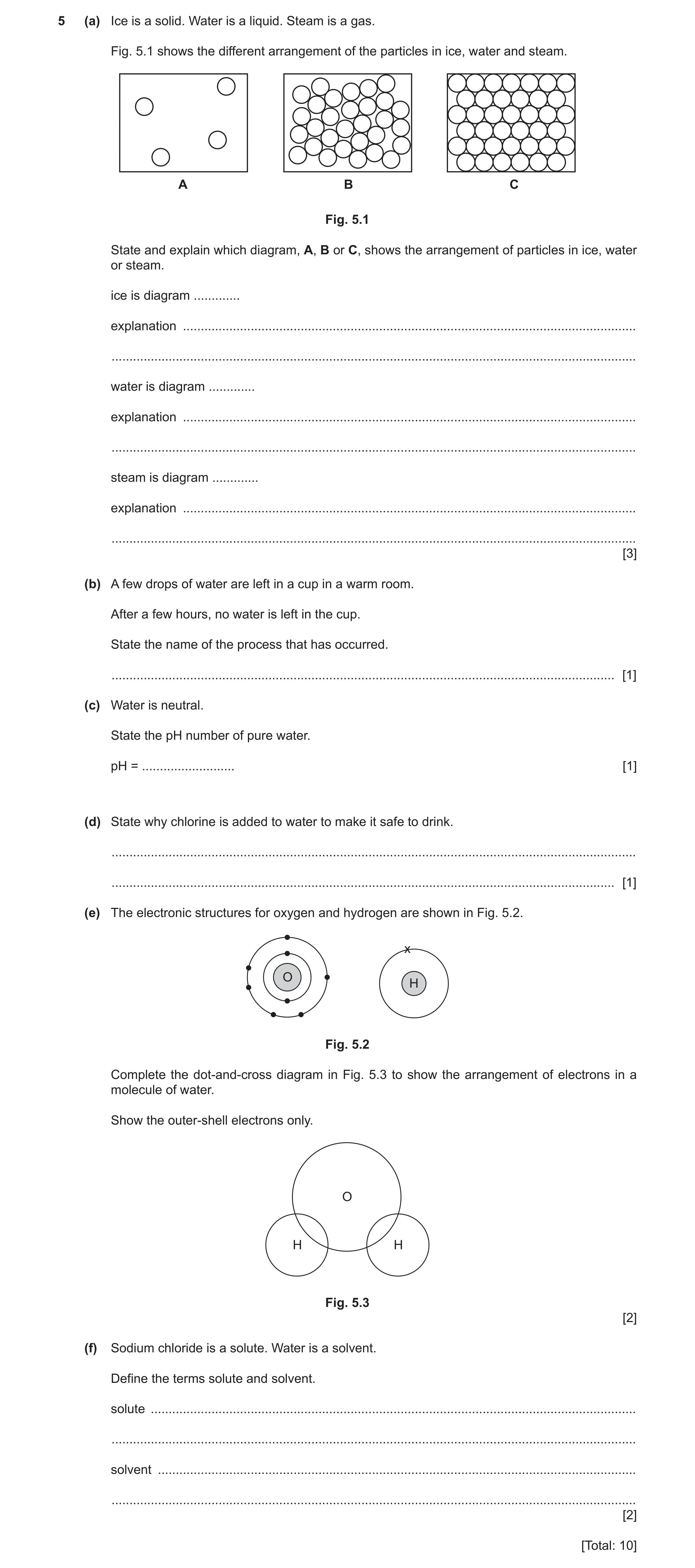
5 (a) Ice is a solid. Water is a liquid. Steam is a gas. Fig. 5.1 shows the different arrangement of the particles in ice, water and steam. A B C Fig. 5.1 State and explain which diagram, A, B or C, shows the arrangement of particles in ice, water or steam. ice is diagram … explanation … … water is diagram … explanation … … steam is diagram … explanation … … [3] (b) A few drops of water are left in a cup in a warm room. After a few hours, no water is left in the cup. State the name of the process that has occurred. … [1] (c) Water is neutral. State the pH number of pure water. pH = … [1] (d) State why chlorine is added to water to make it safe to drink. … … [1] (e) The electronic structures for oxygen and hydrogen are shown in Fig. 5.2. x O H Fig. 5.2 Complete the dot‑and‑cross diagram in Fig. 5.3 to show the arrangement of electrons in a molecule of water. Show the outer‑shell electrons only. O H H Fig. 5.3 [2] (f) Sodium chloride is a solute. Water is a solvent. Define the terms solute and solvent. solute … … solvent … … [2] [Total: 10]
10 marks
Mark scheme: 5(a) ice is C – particles are in regular arrangement water is B – particles are (mostly) touching and irregular arrangement steam is A – particles are widely spaced C B A ; one correct explanation ; three correct explanations ; 3 5(b) evaporation ; 1 5(c) 7 ; 1 5(d) kills bacteria ; 1 Question Answer Marks 5(e) 1 pair of bonding electrons ; all else correct ; 2 5(f) a solute – a substance that is dissolved in a solvent ; a solvent – a substance / liquid that dissolves a solute ; 2
This question in 0654/31 May/June 2024
Q12 · The changes of state of water 0654/31 Oct/Nov 2024
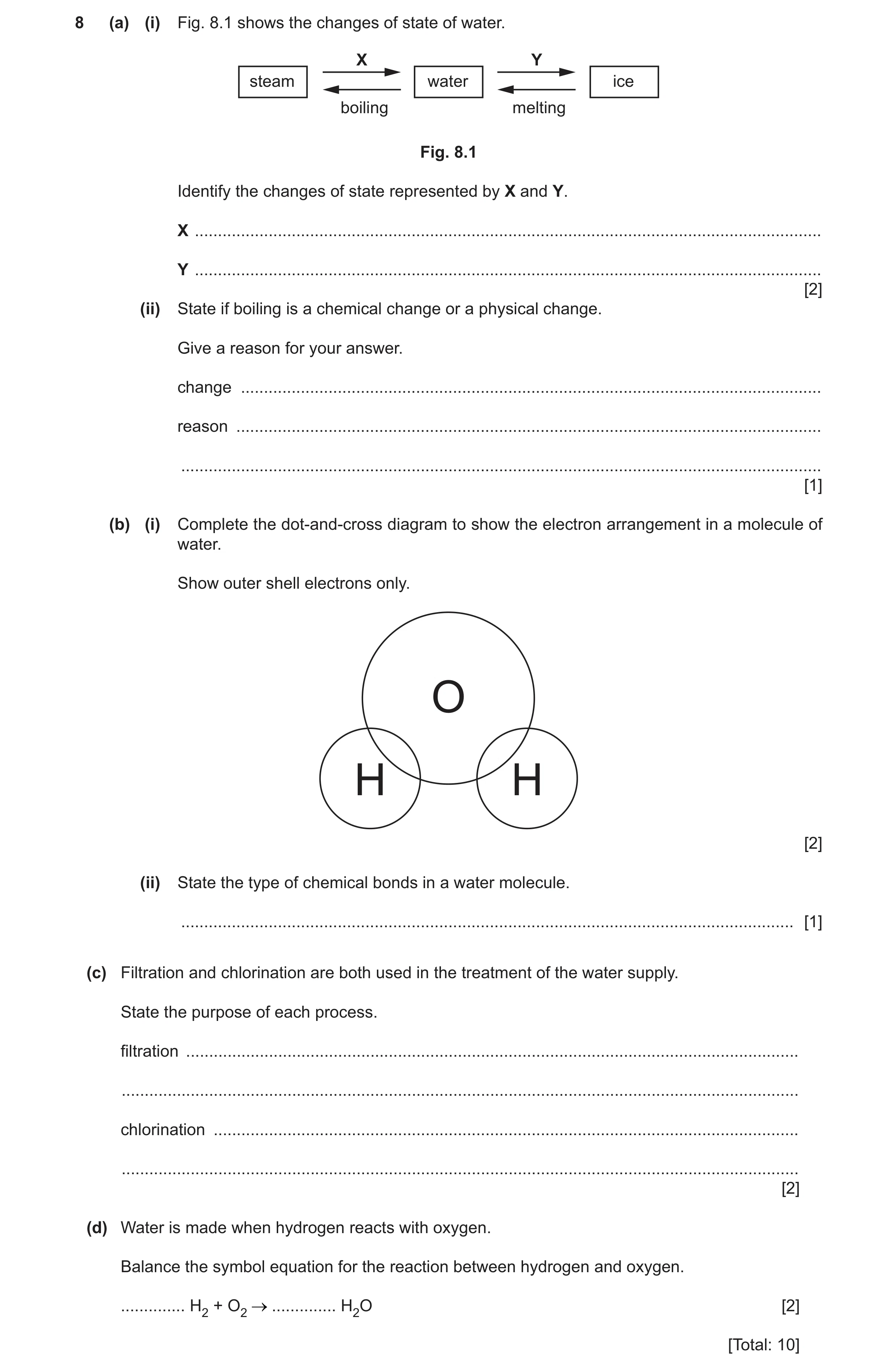
8 (a) (i) Fig. 8.1 shows the changes of state of water. X Y steam water ice boiling melting Fig. 8.1 Identify the changes of state represented by X and Y. X … Y … [2] (ii) State if boiling is a chemical change or a physical change. Give a reason for your answer. change … reason … … [1] (b) (i) Complete the dot-and-cross diagram to show the electron arrangement in a molecule of water. Show outer shell electrons only. O H H [2] (ii) State the type of chemical bonds in a water molecule. … [1] (c) Filtration and chlorination are both used in the treatment of the water supply. State the purpose of each process. filtration … … chlorination … … [2] (d) Water is made when hydrogen reacts with oxygen. Balance the symbol equation for the reaction between hydrogen and oxygen. … H2 + O2 … H2O [2] [Total: 10]
10 marks
Mark scheme: 8(a)(i) X = condensation ; 2 Y = solidification or freezing ; 8(a)(ii) physical (no mark) ; 1 no new substance formed / can be reversed ; 8(b)(i) 2 one pair of bonding electrons ; all else correct ; 8(b)(ii) covalent ; 1 8(c) filtration – remove solid matter OWTTE ; 2 chlorination – kill bacteria / microorganisms ; 8(d) 2 H2 + O2 → 2 H2O 2 2 H2 ; 2 H2O ;
This question in 0654/31 Oct/Nov 2024
Q13 · Choose from the following substances to answer the questions 0654/33 Oct/Nov 2024
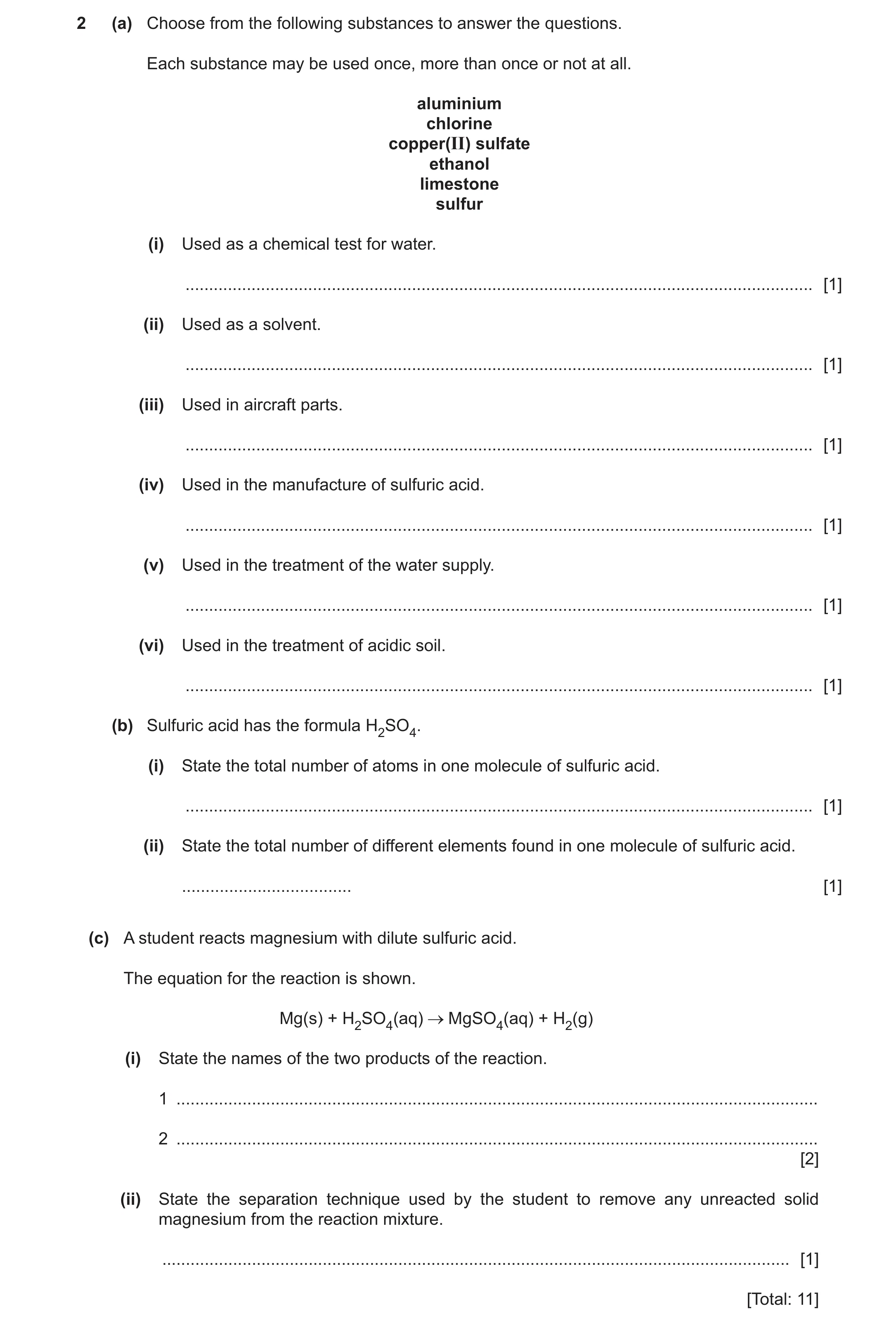
2 (a) Choose from the following substances to answer the questions. Each substance may be used once, more than once or not at all. aluminium chlorine copper(II) sulfate ethanol limestone sulfur (i) Used as a chemical test for water. … [1] (ii) Used as a solvent. … [1] (iii) Used in aircraft parts. … [1] (iv) Used in the manufacture of sulfuric acid. … [1] (v) Used in the treatment of the water supply. … [1] (vi) Used in the treatment of acidic soil. … [1] (b) Sulfuric acid has the formula H2SO4. (i) State the total number of atoms in one molecule of sulfuric acid. … [1] (ii) State the total number of different elements found in one molecule of sulfuric acid. … [1] (c) A student reacts magnesium with dilute sulfuric acid. The equation for the reaction is shown. Mg(s) + H2SO4(aq) MgSO4(aq) + H2(g) (i) State the names of the two products of the reaction. 1 … 2 … [2] (ii) State the separation technique used by the student to remove any unreacted solid magnesium from the reaction mixture. … [1] [Total: 11]
11 marks
Mark scheme: 2(a)(i) copper sulfate ; 1 2(a)(ii) ethanol ; 1 2(a)(iii) aluminium ; 1 2(a)(iv) sulfur ; 1 2(a)(v) chlorine ; 1 2(a)(vi) limestone ; 1 2(b)(i) 7 ; 1 2(b)(ii) 3 ; 1 2(c)(i) magnesium sulfate ; 2 hydrogen ; 2(c)(ii) filtration ; 1
This question in 0654/33 Oct/Nov 2024
Q14 · Table 5.1 contains information about 6 atoms or ions A, B, C, D, E and F 0654/31 May/June 2025
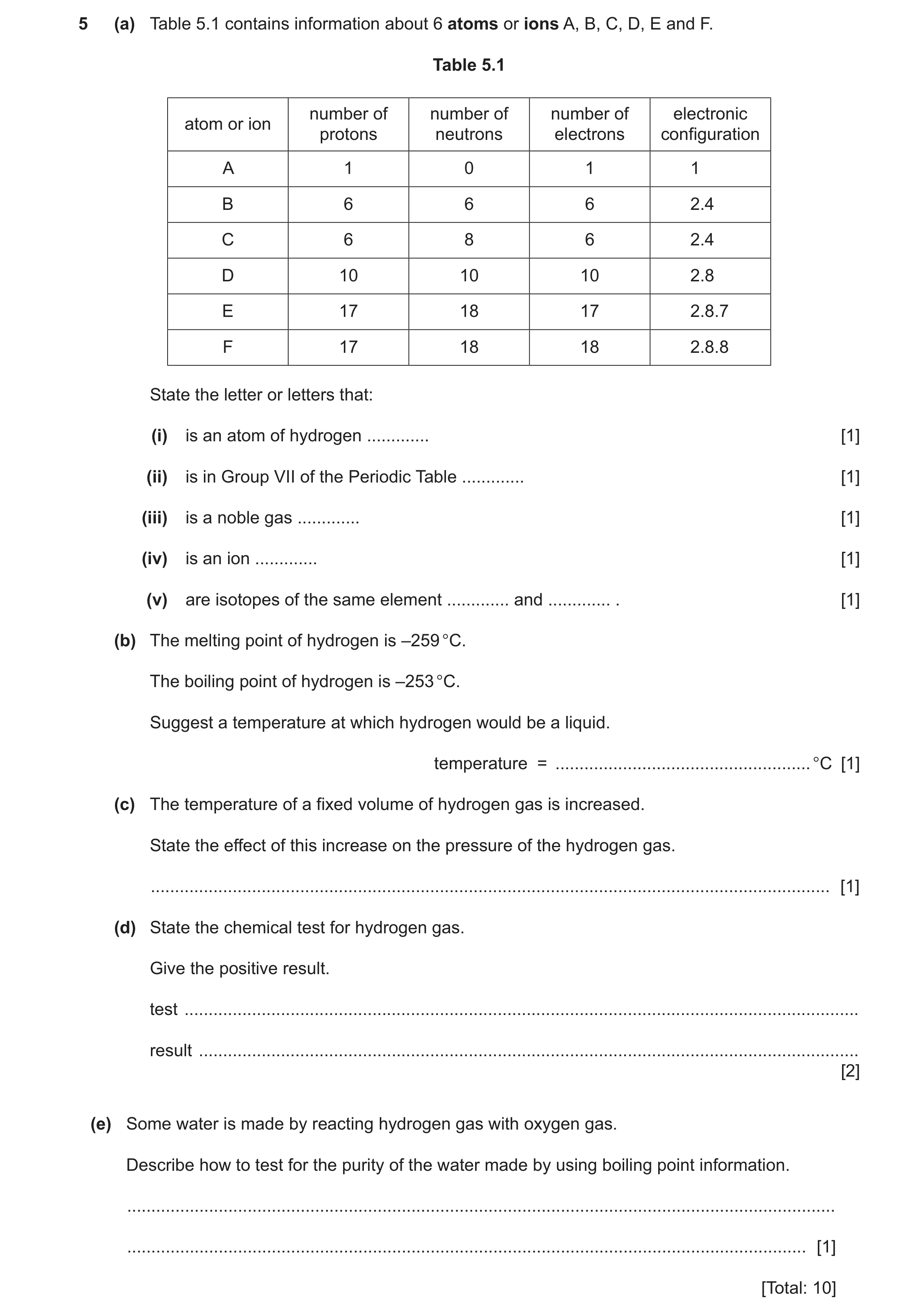
5 (a) Table 5.1 contains information about 6 atoms or ions A, B, C, D, E and F. Table 5.1 number of number of number of electronic atom or ion protons neutrons electrons configuration A 1 0 1 1 B 6 6 6 2.4 C 6 8 6 2.4 D 10 10 10 2.8 E 17 18 17 2.8.7 F 17 18 18 2.8.8 State the letter or letters that: (i) is an atom of hydrogen … [1] (ii) is in Group VII of the Periodic Table … [1] (iii) is a noble gas … [1] (iv) is an ion … [1] (v) are isotopes of the same element … and … . [1] (b) The melting point of hydrogen is –259 °C. The boiling point of hydrogen is –253 °C. Suggest a temperature at which hydrogen would be a liquid. temperature = … °C [1] (c) The temperature of a fixed volume of hydrogen gas is increased. State the effect of this increase on the pressure of the hydrogen gas. … [1] (d) State the chemical test for hydrogen gas. Give the positive result. test … result … [2] (e) Some water is made by reacting hydrogen gas with oxygen gas. Describe how to test for the purity of the water made by using boiling point information. … … [1] [Total: 10]
10 marks
Mark scheme: 5(a)(i) A ; 1 5(a)(ii) E ; 1 5(a)(iii) D ; 1 5(a)(iv) F ; 1 5(a)(v) B and C ; 1 5(b) between – 254 and – 258 °C ; 1 5(c) (pressure) increases ; 1 5(d) lighted splint ; 2 goes pop ; 5(e) pure water will boil at 100°C / ora ; 1
This question in 0654/31 May/June 2025
Q15 · Ethane, C2H6, is an alkane 0654/33 Oct/Nov 2025
6 (a) Ethane, C2H6, is an alkane. Ethene, C2H4, is an alkene. Complete the sentences to explain why alkanes are described as saturated and alkenes are described as unsaturated. Alkanes are saturated because they contain only … carbon–carbon covalent bonds. Alkenes are unsaturated because they contain a … covalent bond. [1] (b) Draw the displayed formula of ethane, C2H6. [2] (c) Determine the relative molecular mass, Mr, of ethane, C2H6. [Ar: C, 12; H, 1] relative molecular mass, Mr = … [2] (d) When ethane is completely combusted in oxygen, the two products are carbon dioxide gas and water vapour. (i) A chemical test for water is the use of anhydrous cobalt(II) chloride. State the colour change observed for a positive test. from … to … [2] (ii) The boiling point of a sample of water is 102 °C at standard atmospheric pressure. Explain how this shows that the sample of water is impure. … … … … [2] (iii) Higher levels of carbon dioxide in the atmosphere cause climate change. State and explain one strategy which will reduce the effects of climate change. strategy … … explanation … … … [2] [Total: 11]
11 marks
Mark scheme: 6(a) single and double ; 1 6(b) 2 carbon – carbon single bond ; all else correct ; 6(c) 24 + 6 or 2 12 + 6 1 ; 2 30 ; 6(d)(i) blue ; 2 (to) pink ; 6(d)(ii) pure water boils at 100 °C ; 2 impurities increase boiling point / AW ; 6(d)(iii) planting trees / planting plants ; 2 CO2 removed by trees / CO2 removed by plants ; OR reduction in livestock farming ; less CO2 emitted / less methane emitted ; OR decreasing use of fossil fuels ; less CO2 produced (during combustion) ; OR increasing use of hydrogen / increasing use of renewables ; no CO2 produced ;
This question in 0654/33 Oct/Nov 2025
 22 / 24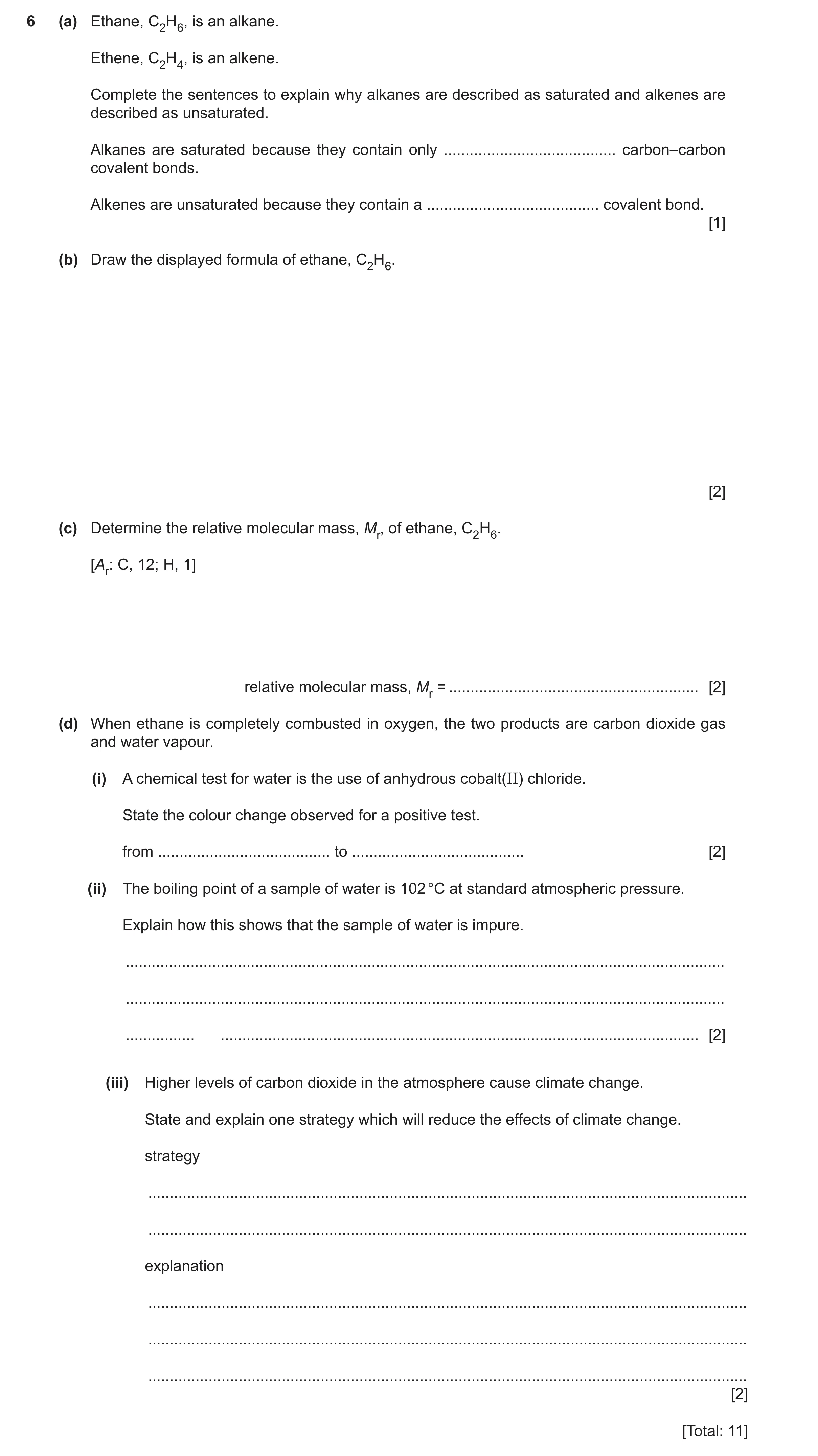
 10
10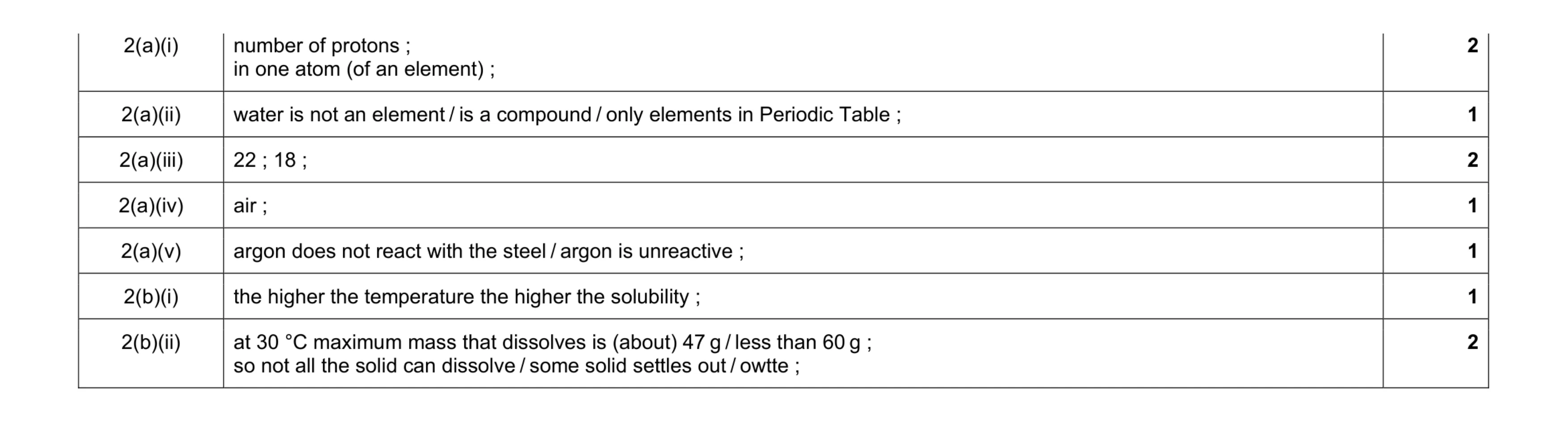 10
10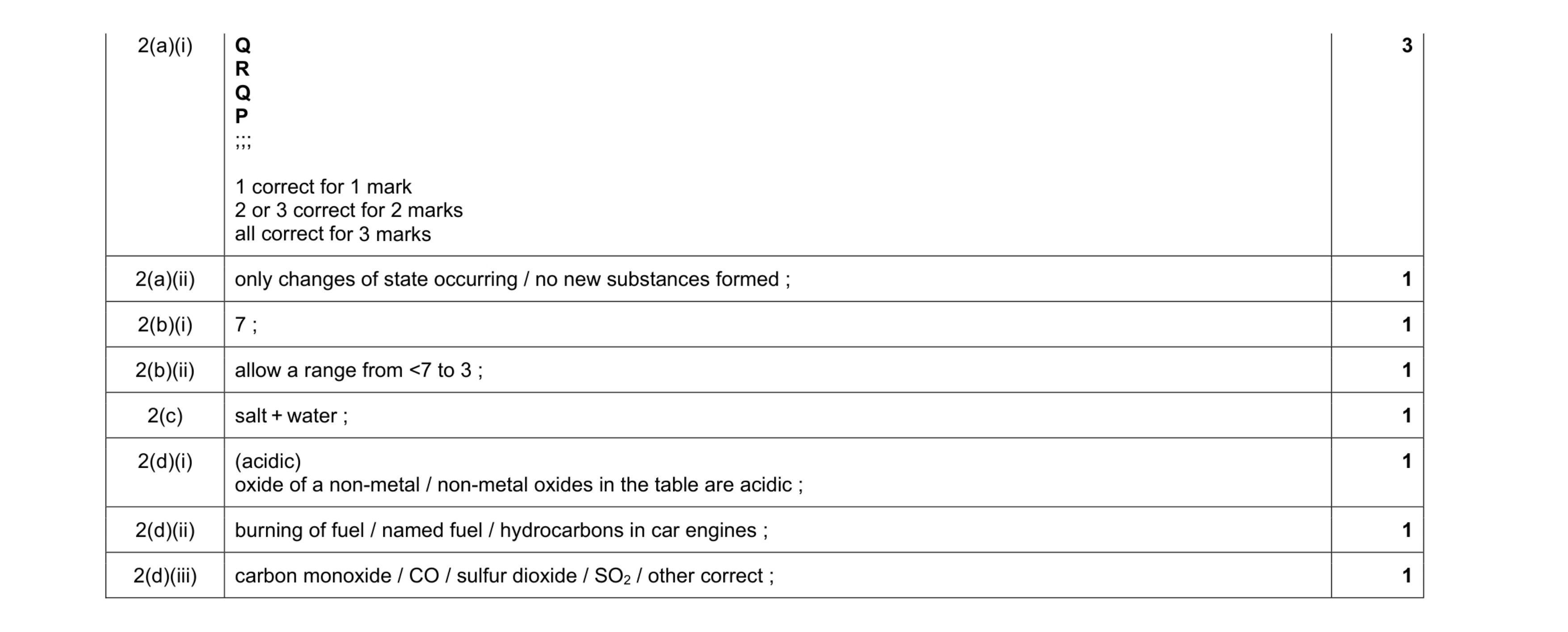 10
10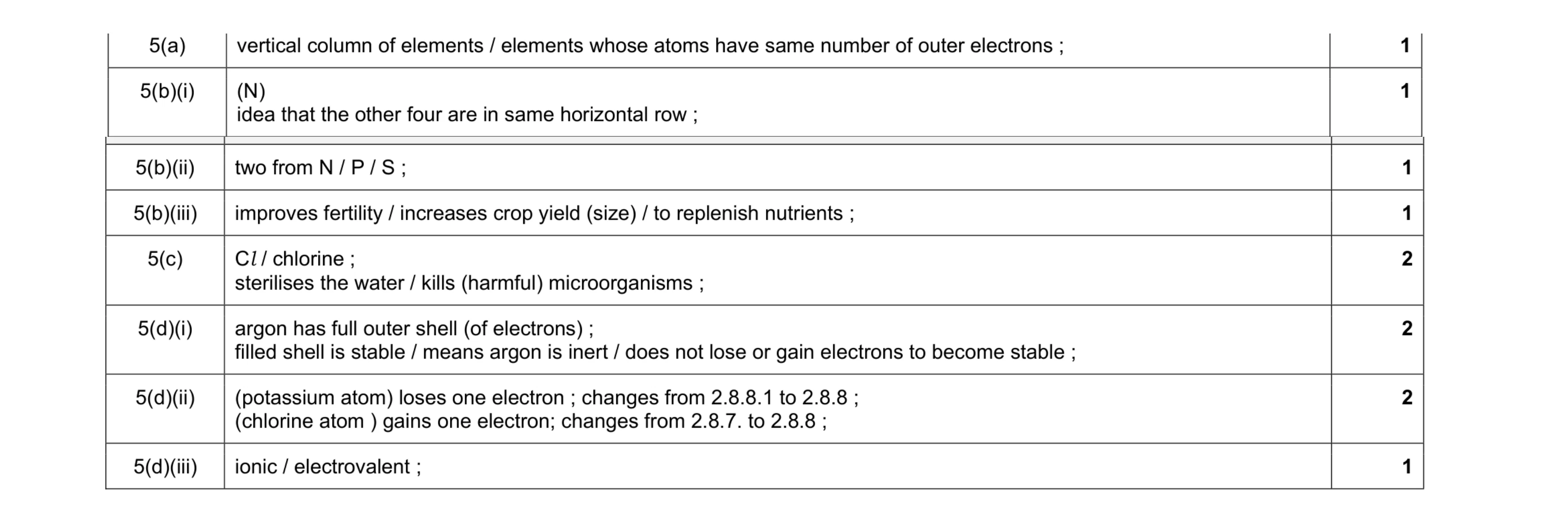 11
11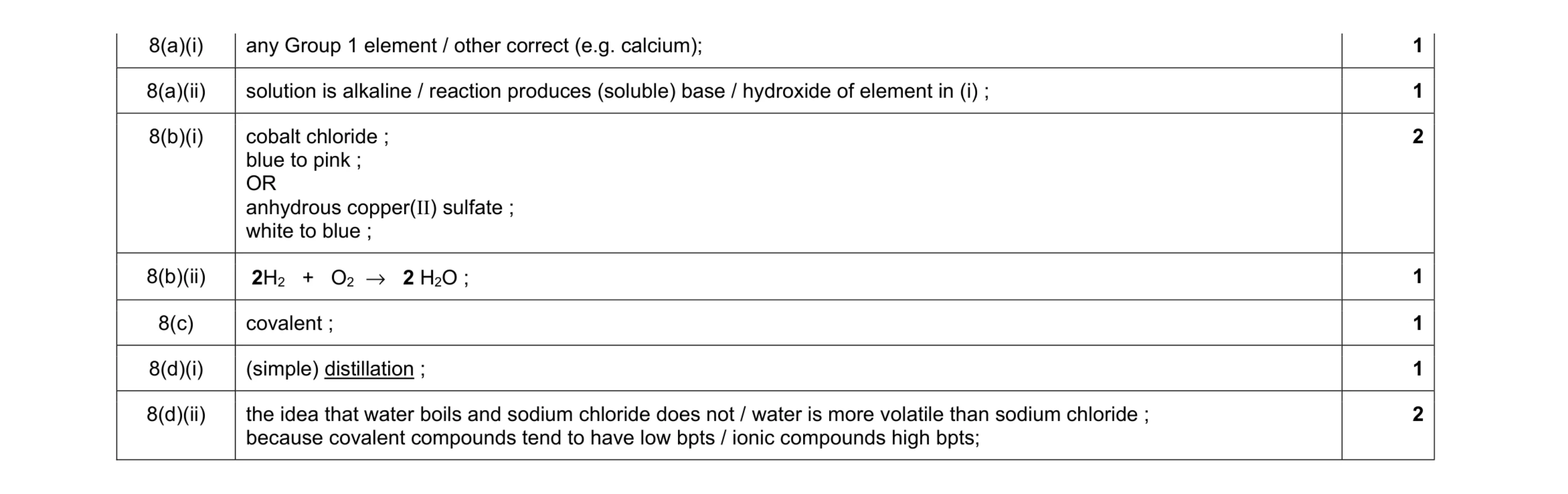 9
9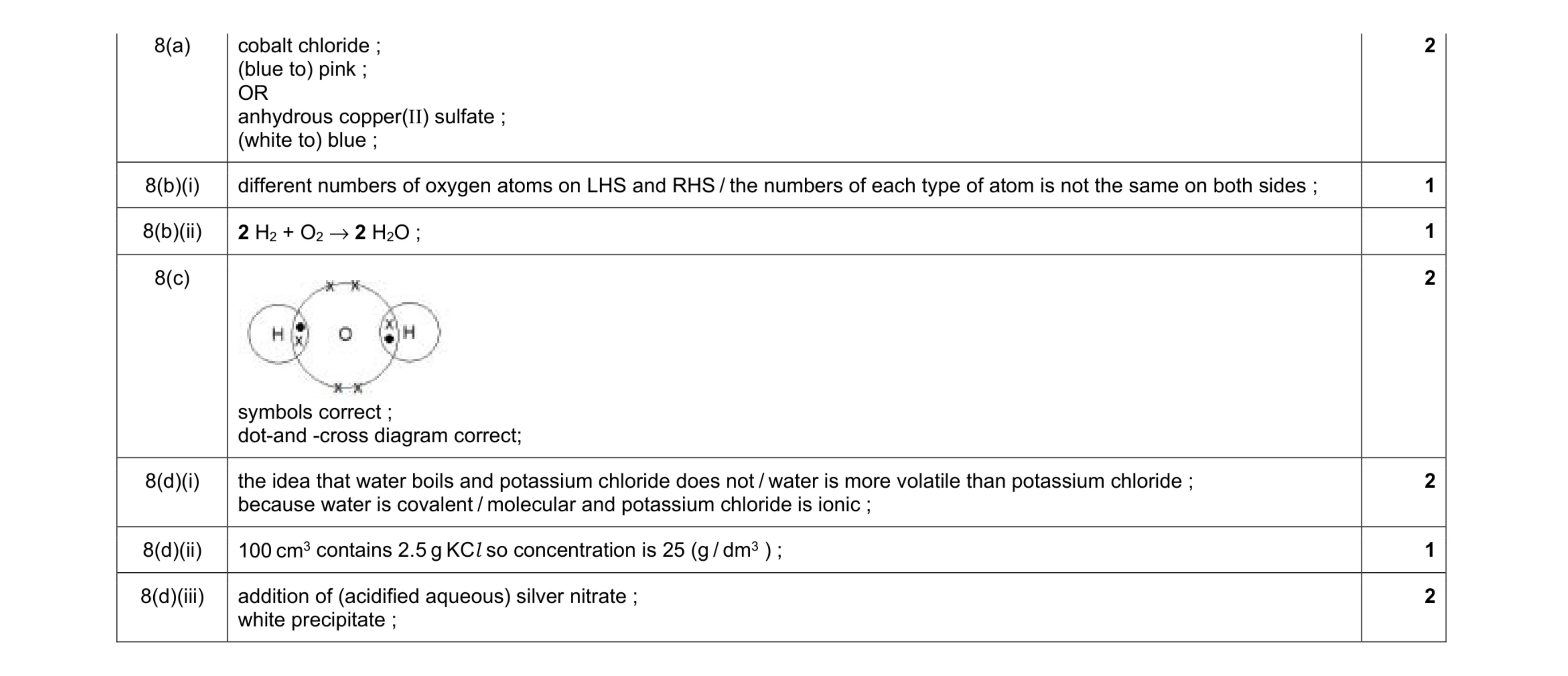 11
11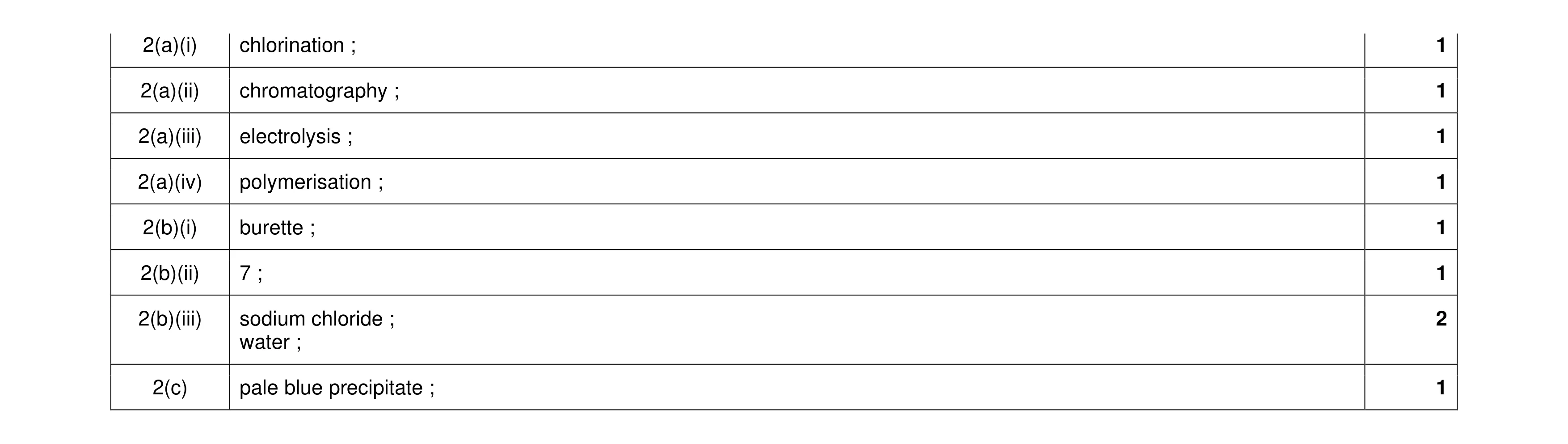 9
9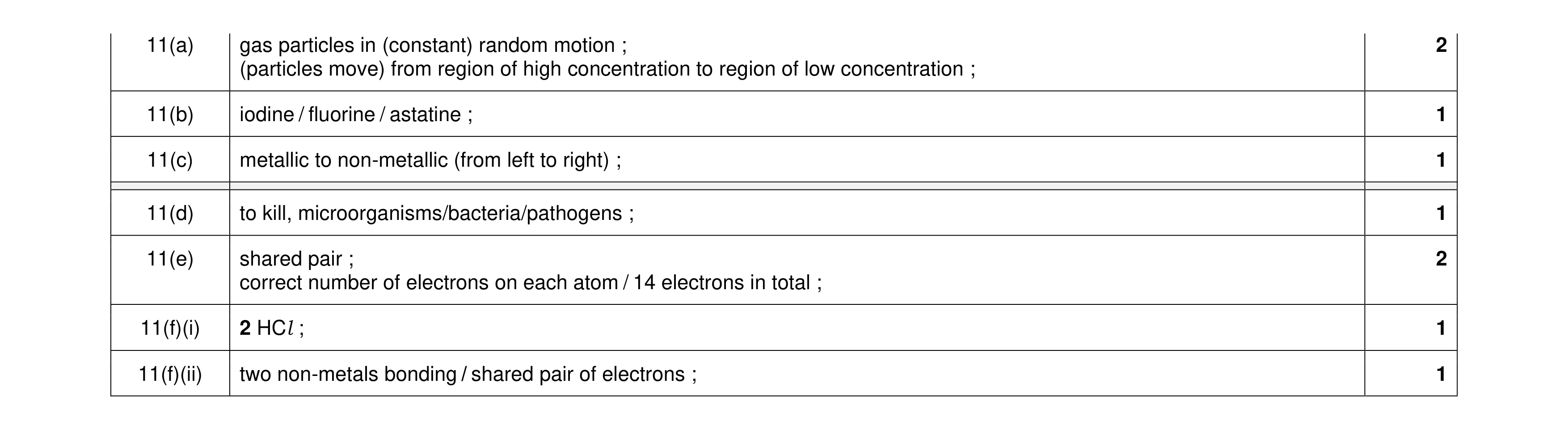 9
9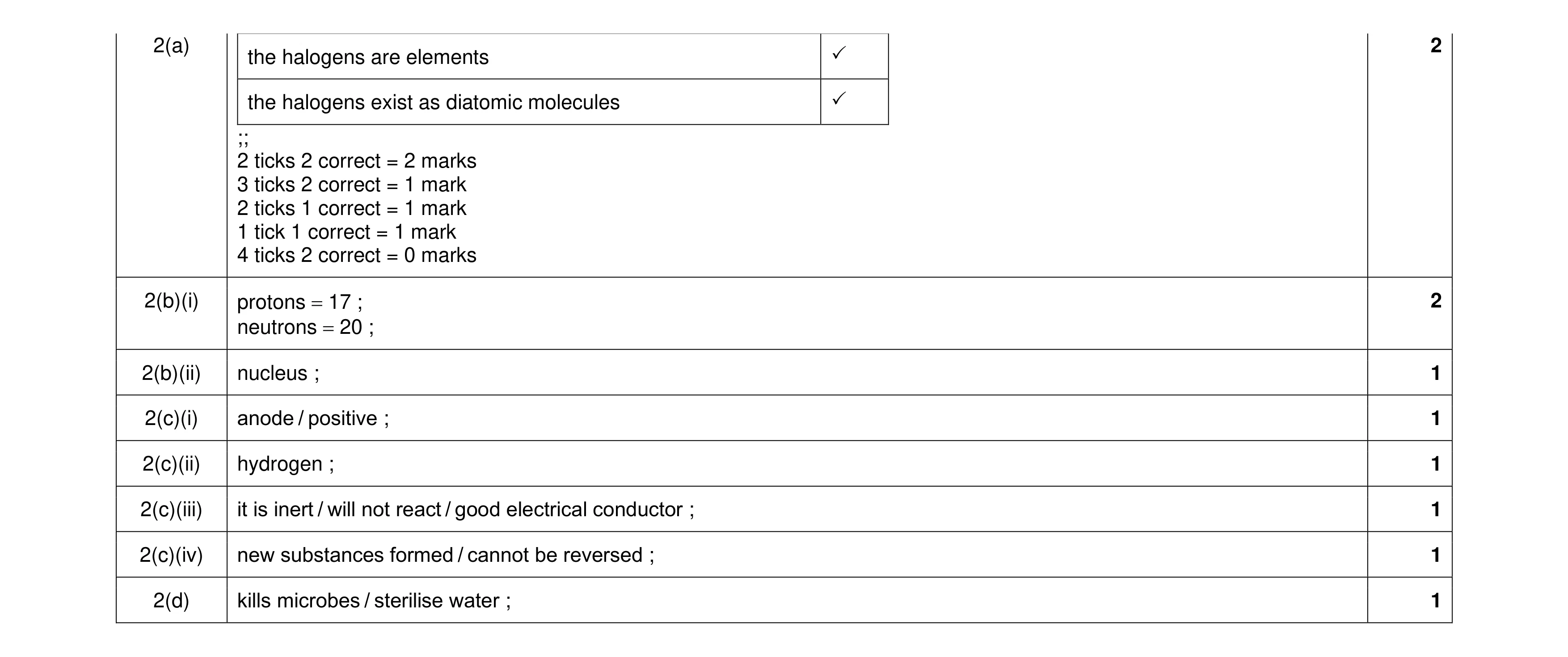 10
10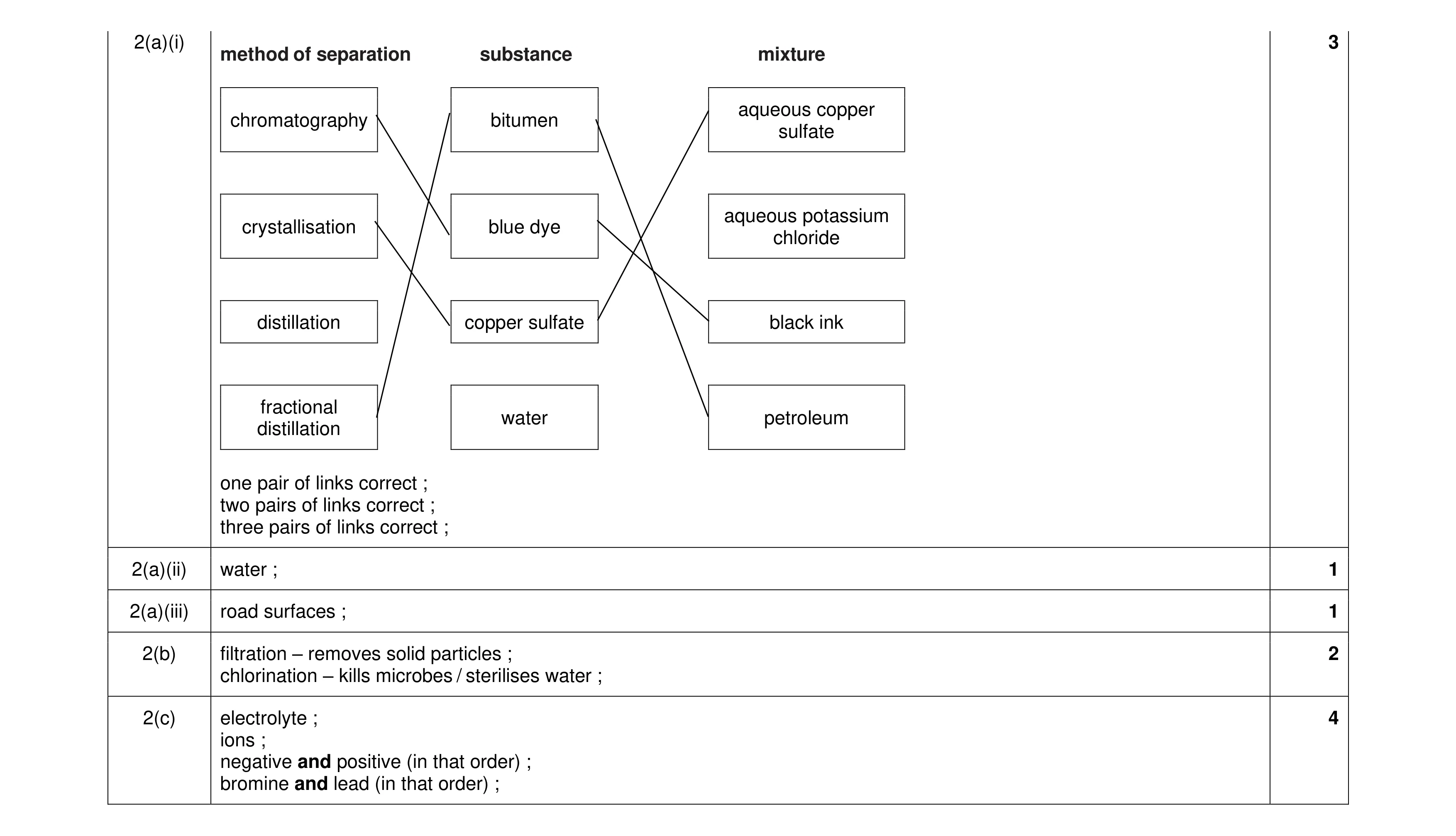 11
11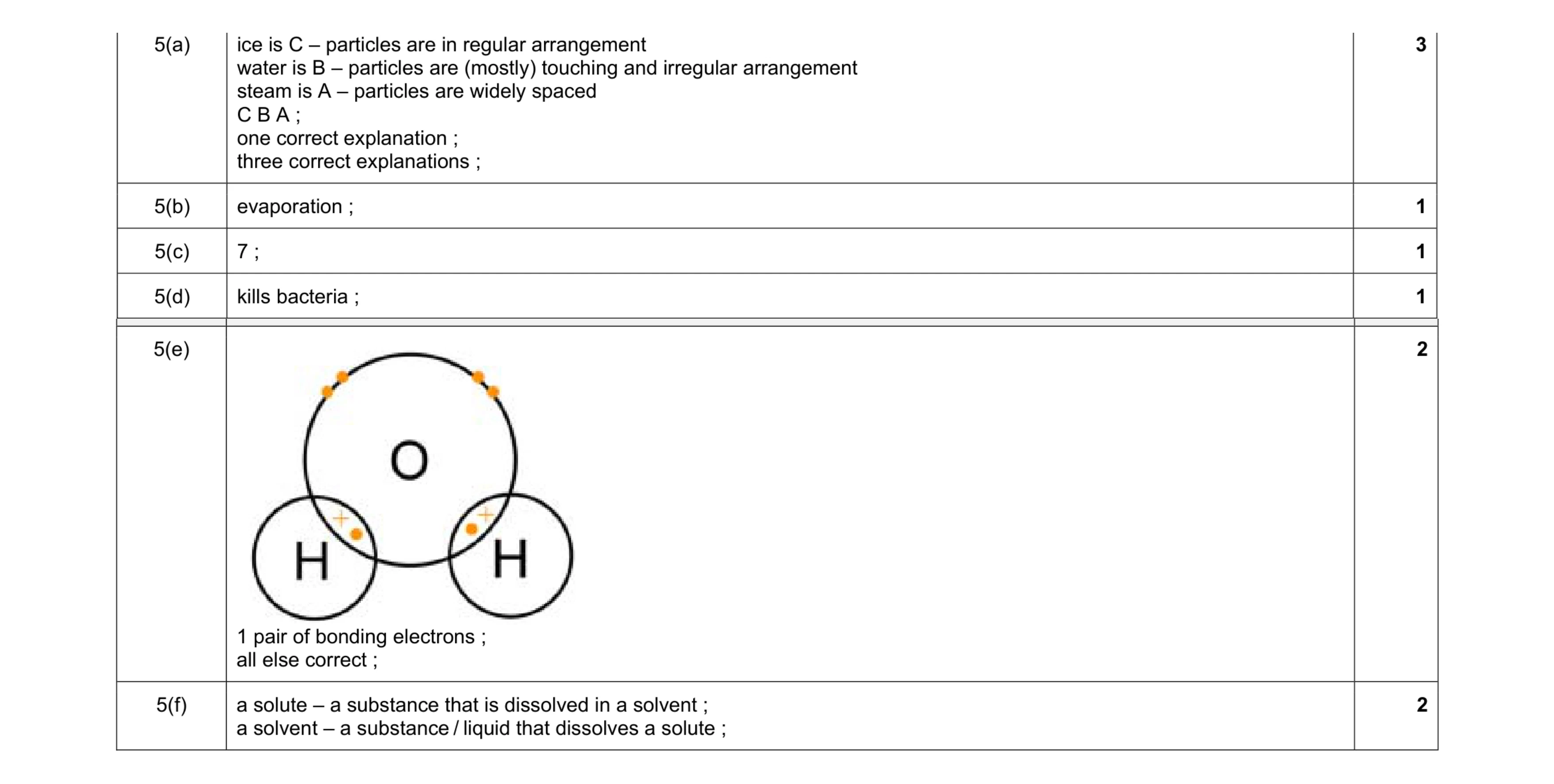 10
10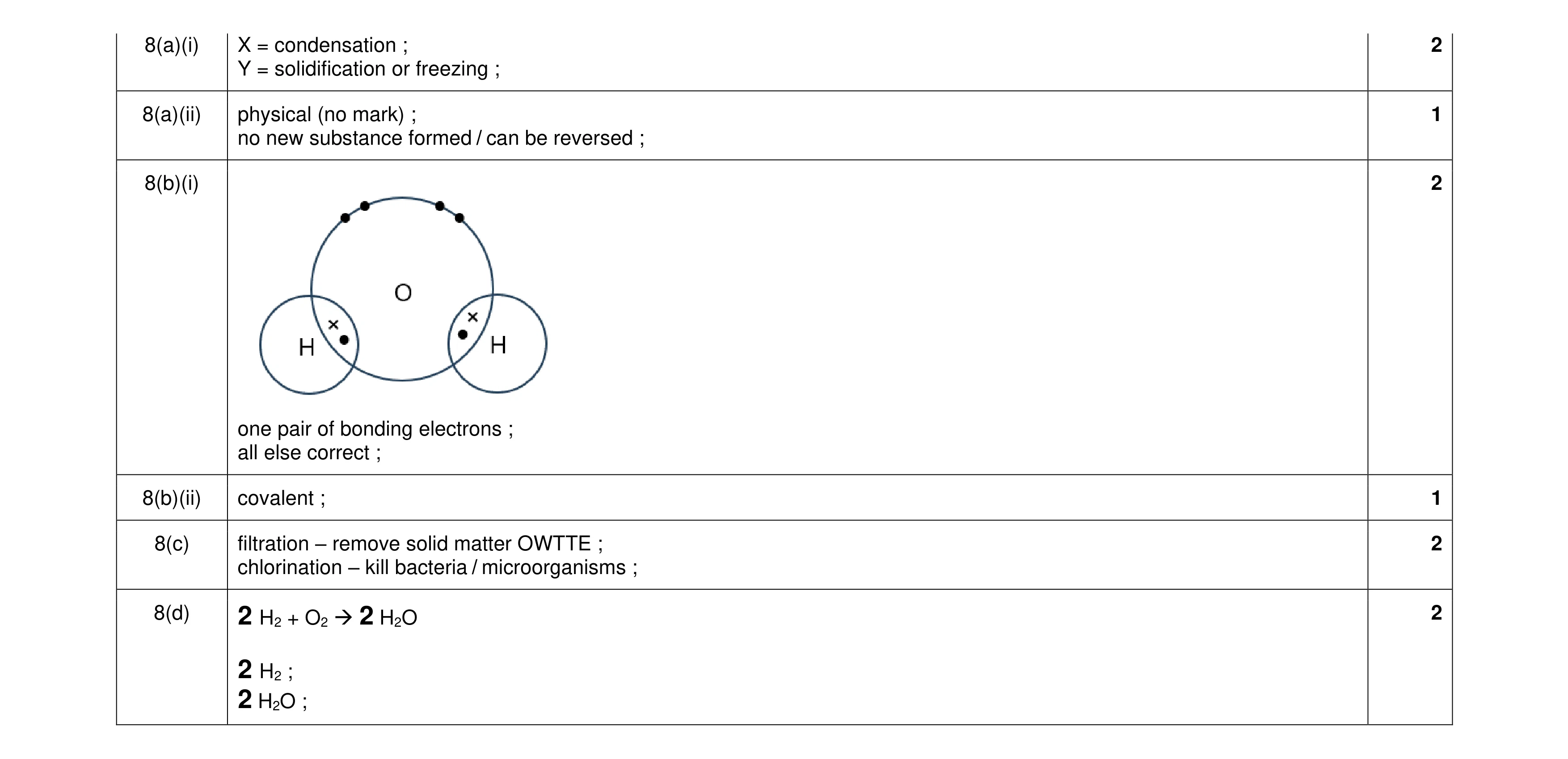 10
10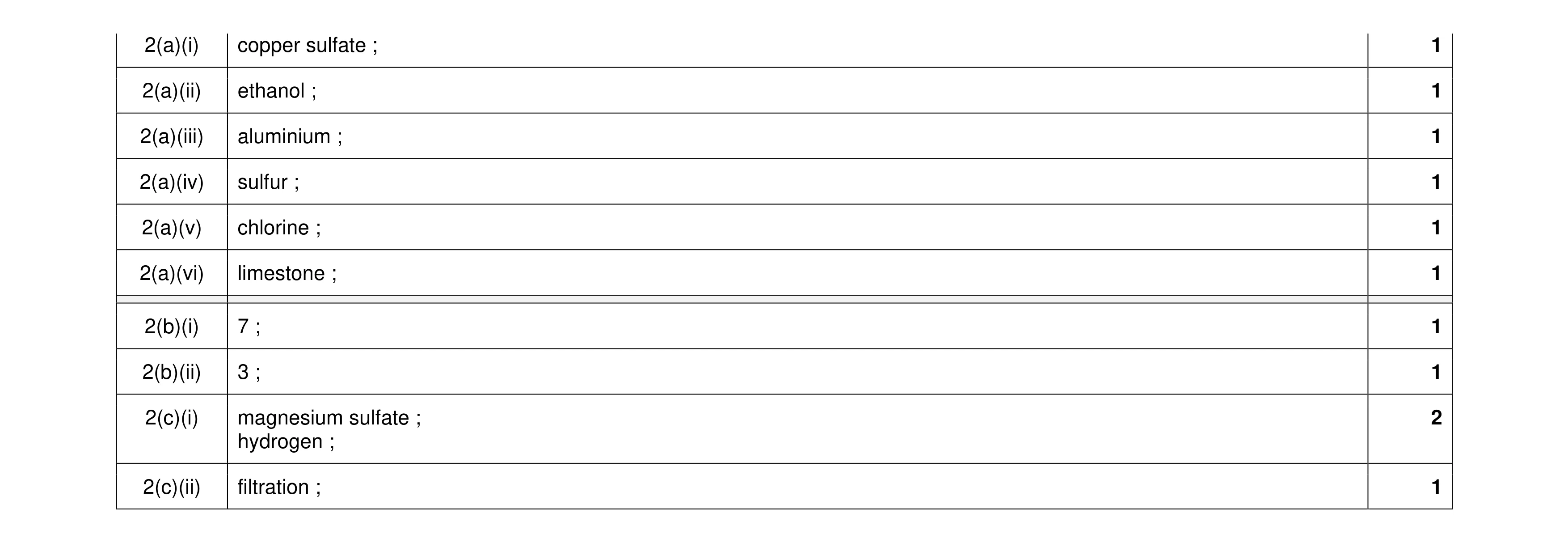 11
11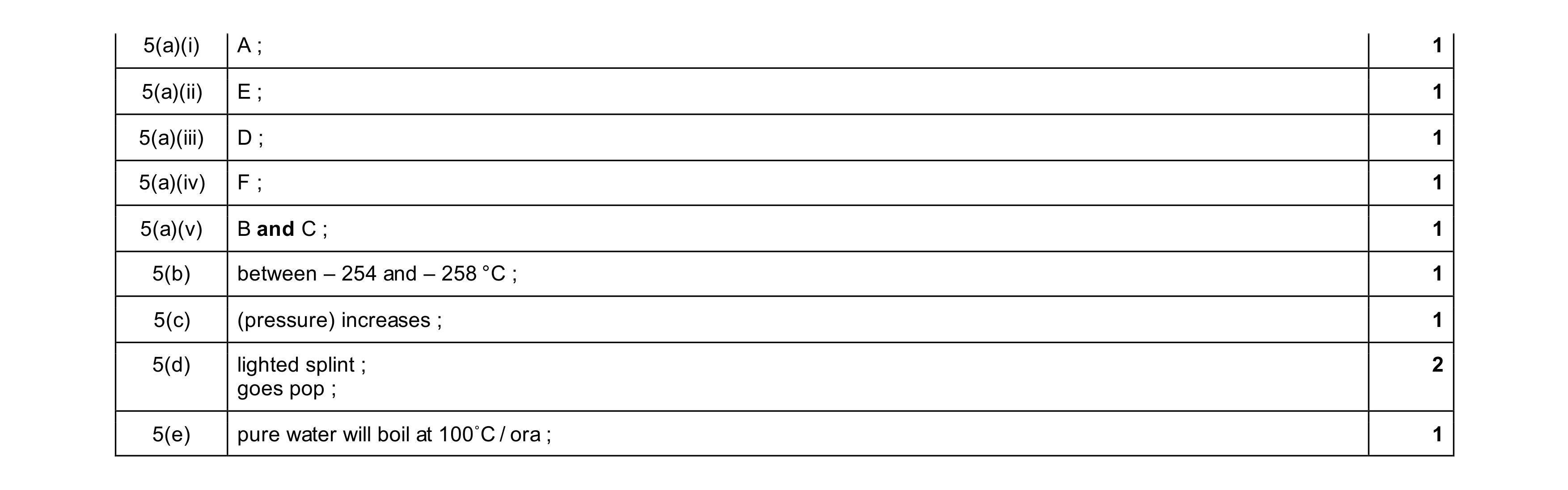 10
10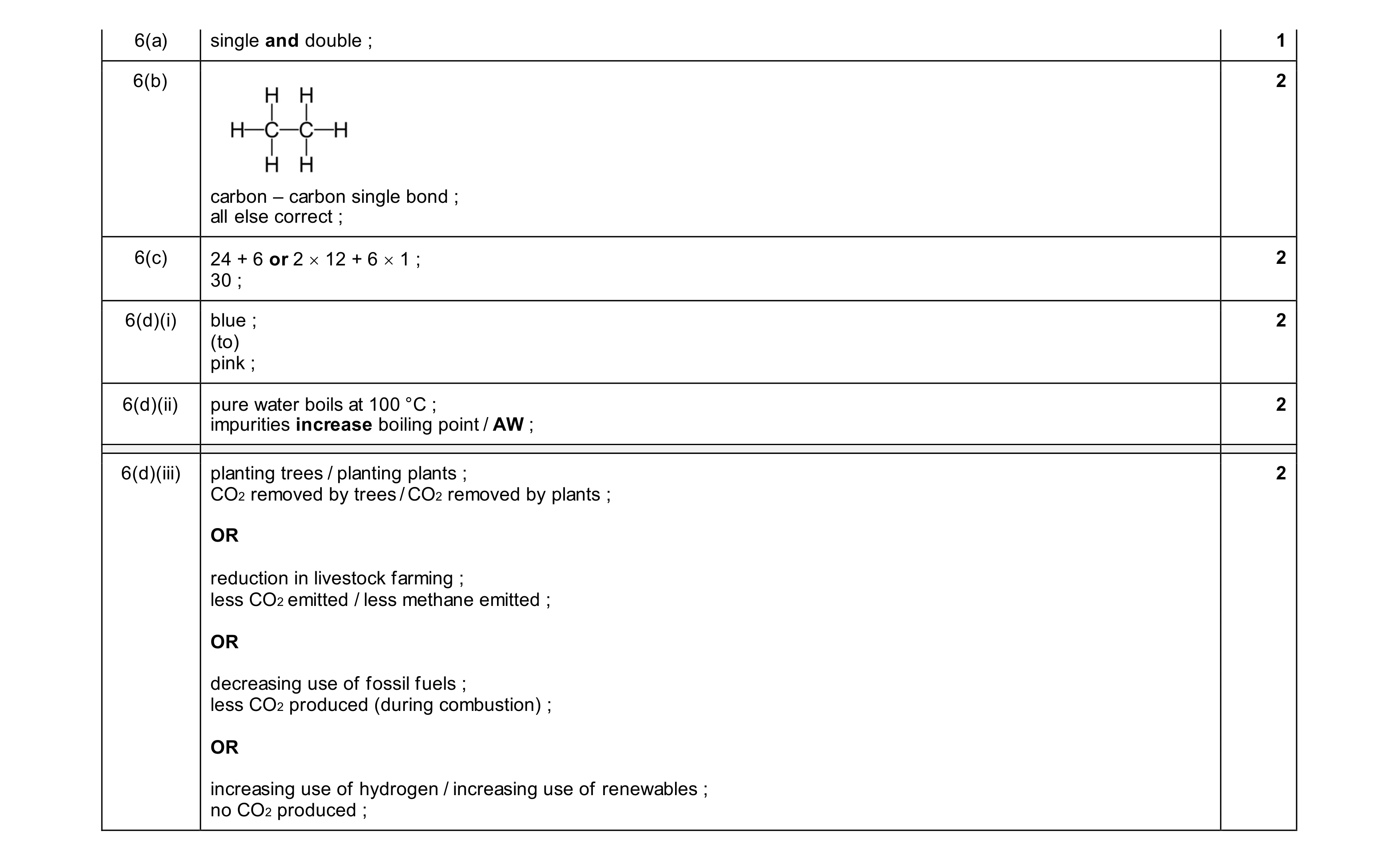 11
11