Questions as text
Q1 · A drawing of a green plant 0654/31 May/June 2017
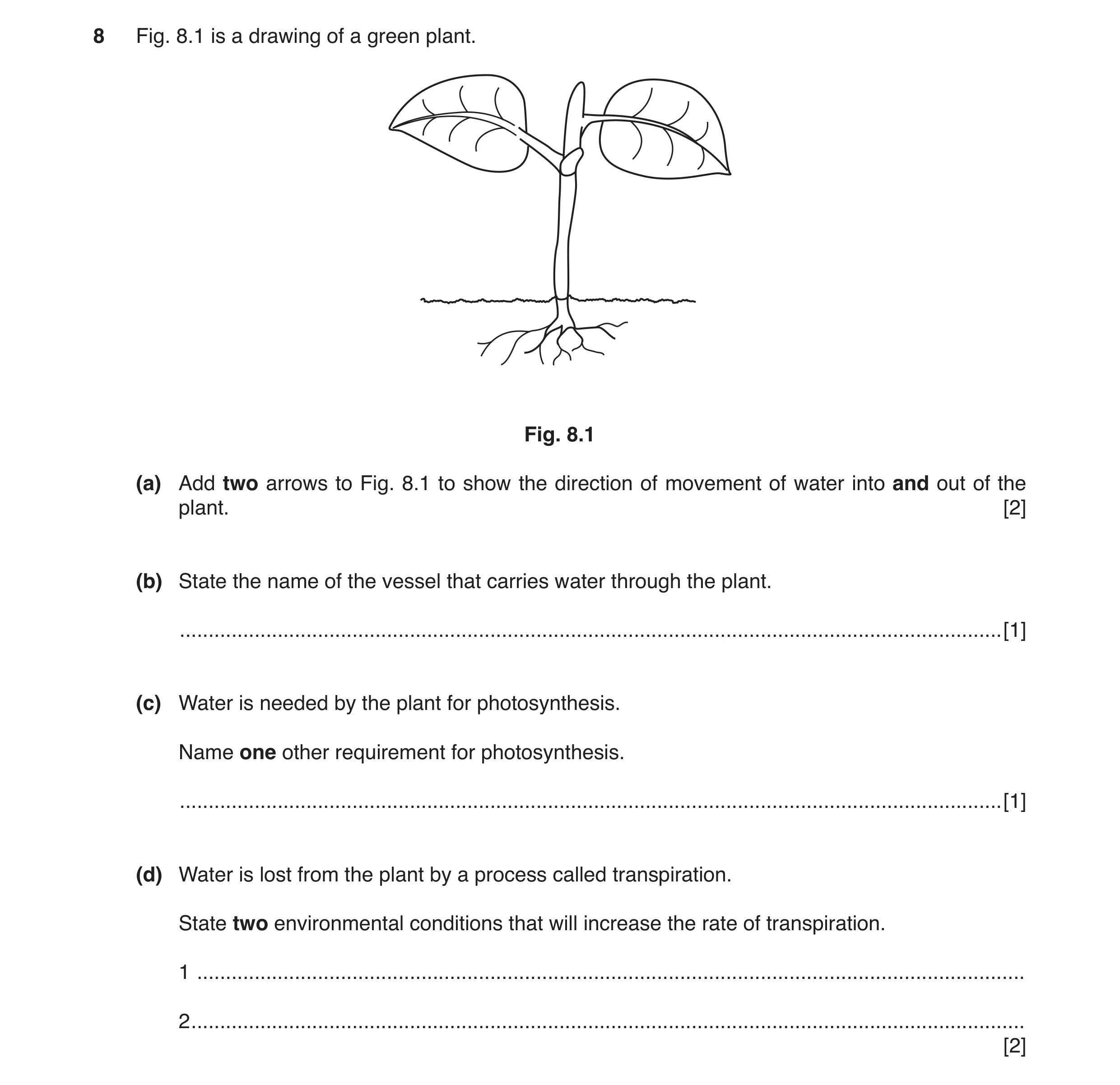
8 Fig. 8.1 is a drawing of a green plant. Fig. 8.1 (a) Add two arrows to Fig. 8.1 to show the direction of movement of water into and out of the plant. [2] (b) State the name of the vessel that carries water through the plant. … [1] (c) Water is needed by the plant for photosynthesis. Name one other requirement for photosynthesis. … [1] (d) Water is lost from the plant by a process called transpiration. State two environmental conditions that will increase the rate of transpiration. 1 … 2 … [2]
6 marks
Mark scheme: 8(a) one arrow pointing into the roots ; one arrow pointing out from the leaf ; 2 8(b) xylem ; 1 8(c) light / carbon dioxide / chlorophyll ; 1 8(d) higher temperature / hot ; increased wind speed / windy ; arid / dry (conditions) ; max 2
This question in 0654/31 May/June 2017
Q2 · Use words or phrases from the list to complete the definition of the term transpiration 0654/31 Oct/Nov 2018
4 (a) Use words or phrases from the list to complete the definition of the term transpiration. Each word or phrase may be used once, more than once or not at all. boiling chlorophyll chloroplast evaporation mesophyll respiration root hair stomata Transpiration is defined as the … of water at the surfaces of the … cells followed by loss of water vapour from plant leaves through the … . [3] (b) Two leaves of similar size are removed from the same plant. They are kept at different temperatures and their masses are recorded for six hours. All other variables are kept the same. • Leaf A is kept at 18 °C. • Leaf B is kept at 35 °C. Fig. 4.1 shows a graph of the results. 1.0 0.9 0.8 0.7 leaf A 0.6 mass / g 0.5 0.4 leaf B 0.3 0.2 0.1 0.0 0 1 2 3 4 5 6 time / hours Fig. 4.1 (i) Using values from the graph, calculate the mass lost by leaf B during the six hours. Show your working. … g [2] (ii) Explain why leaf B lost more mass than leaf A. … … … [2] (c) Describe how water moves from the soil to the cells in the leaves. … … … … [3]
10 marks
Mark scheme: 4(a) evaporation ; mesophyll ; stomata ; 3 4(b)(i) 0.9 – 0.35 ; 0.55 ; 2 4(b)(ii) kept at a higher temperature ; increased rate of transpiration / more water (vapour) is lost ; 2 4(c) enters through root hair (cells) ; by diffusion ; transported by xylem ; up the stem ; max 3
This question in 0654/31 Oct/Nov 2018
Q3 · State the term used to describe the loss of water from a leaf by evaporation 0654/33 Oct/Nov 2018
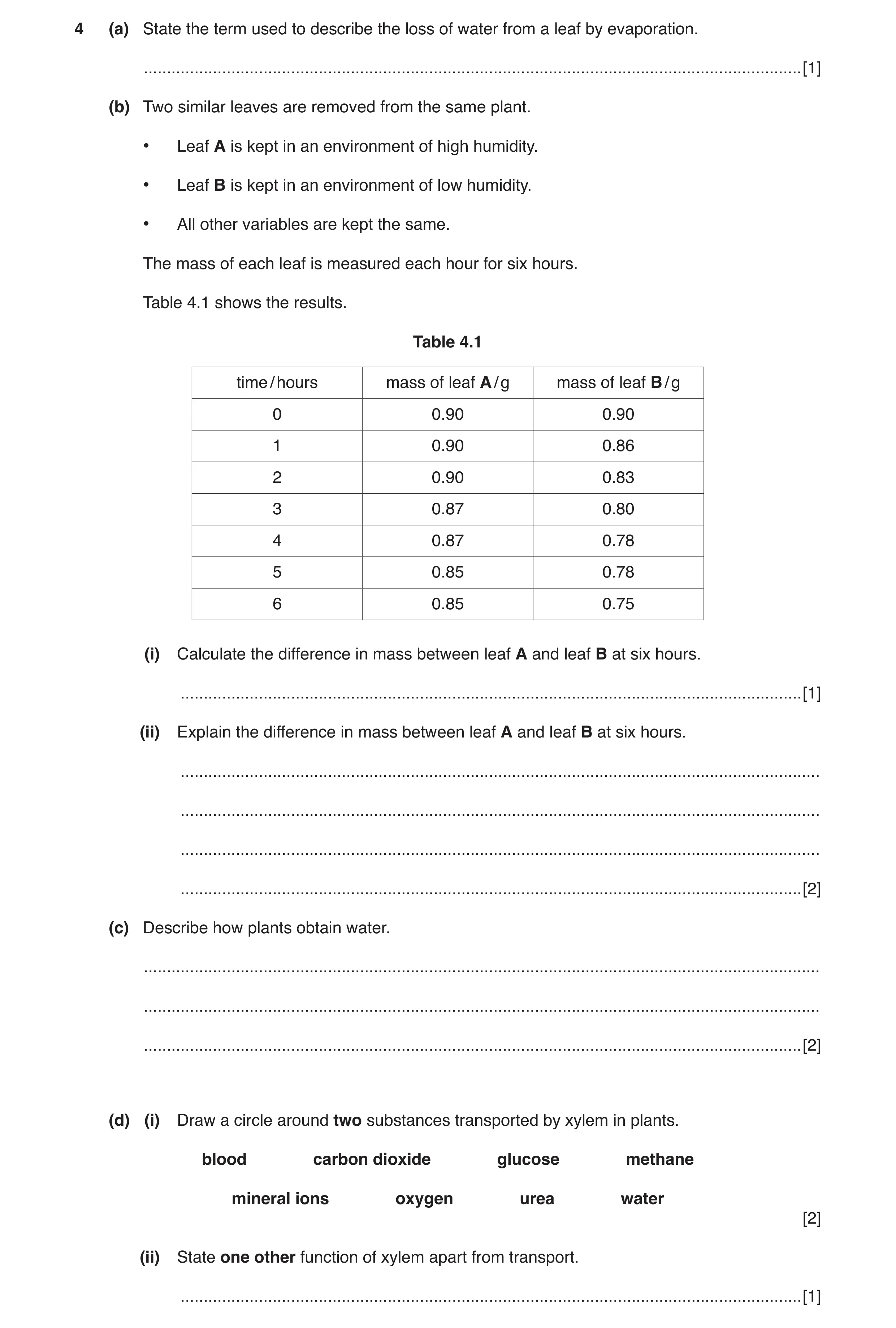
4 (a) State the term used to describe the loss of water from a leaf by evaporation. … [1] (b) Two similar leaves are removed from the same plant. • Leaf A is kept in an environment of high humidity. • Leaf B is kept in an environment of low humidity. • All other variables are kept the same. The mass of each leaf is measured each hour for six hours. Table 4.1 shows the results. Table 4.1 time / hours mass of leaf A / g mass of leaf B / g 0 0.90 0.90 1 0.90 0.86 2 0.90 0.83 3 0.87 0.80 4 0.87 0.78 5 0.85 0.78 6 0.85 0.75 (i) Calculate the difference in mass between leaf A and leaf B at six hours. … [1] (ii) Explain the difference in mass between leaf A and leaf B at six hours. … … … … [2] (c) Describe how plants obtain water. … … … [2] (d) (i) Draw a circle around two substances transported by xylem in plants. blood carbon dioxide glucose methane mineral ions oxygen urea water [2] (ii) State one other function of xylem apart from transport. … [1]
9 marks
Mark scheme: 4(a) transpiration ; 1 4(b)(i) 0.10 g ; 1 4(b)(ii) leaf A loses less mass – no mark increased humidity ; less transpiration / evaporation ; less water lost ; max 2 4(c) absorbed / uptake through root hair (cells) ; by diffusion ; 2 4(d)(i) water ; mineral ions ; 2 4(d)(ii) support ; 1
This question in 0654/33 Oct/Nov 2018
Q4 · The graph in Fig 0654/31 May/June 2019
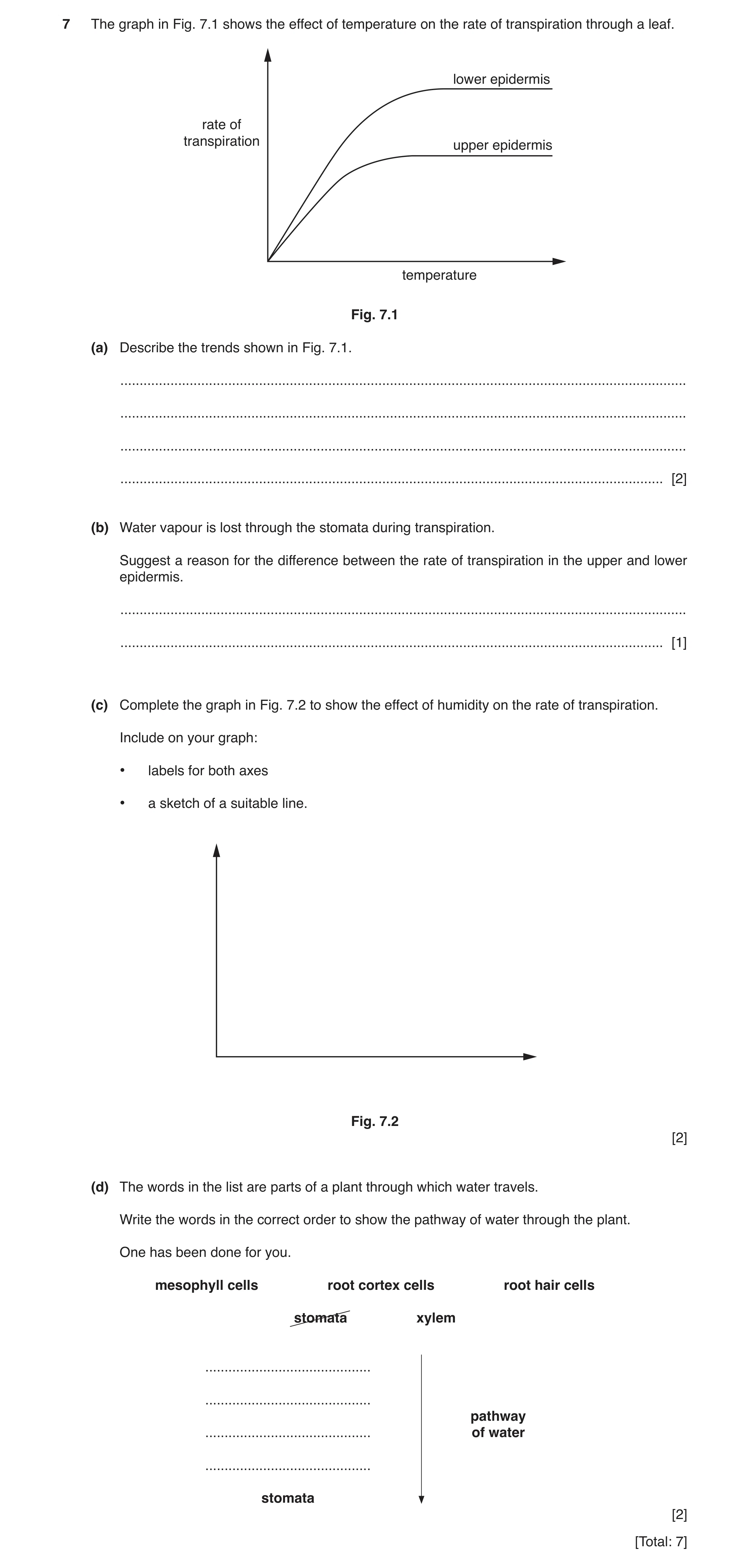
7 The graph in Fig. 7.1 shows the effect of temperature on the rate of transpiration through a leaf. lower epidermis rate of transpiration upper epidermis temperature Fig. 7.1 (a) Describe the trends shown in Fig. 7.1. … … … … [2] (b) Water vapour is lost through the stomata during transpiration. Suggest a reason for the difference between the rate of transpiration in the upper and lower epidermis. … … [1] (c) Complete the graph in Fig. 7.2 to show the effect of humidity on the rate of transpiration. Include on your graph: • labels for both axes • a sketch of a suitable line. Fig. 7.2 [2] (d) The words in the list are parts of a plant through which water travels. Write the words in the correct order to show the pathway of water through the plant. One has been done for you. mesophyll cells root cortex cells root hair cells stomata xylem … … pathway … of water … stomata [2] [Total: 7]
7 marks
Mark scheme: 7(a) rate of transpiration increases, then levels out with increasing temperature ; rate of transpiration is greater in the lower epidermis than upper epidermis ; 2 7(b) lower epidermis has more stomata (than upper epidermis) ; 1 7(c) y axis labelled rate of transpiration, x axis labelled humidity ; negative correlation ; 2 7(d) root hair cells root cortex cells xylem mesophyll cells root hair cells correct ; rest correct ; 2
This question in 0654/31 May/June 2019
Q5 · In plants, glucose produced by photosynthesis is stored in leaves as starch 0654/32 Oct/Nov 2019
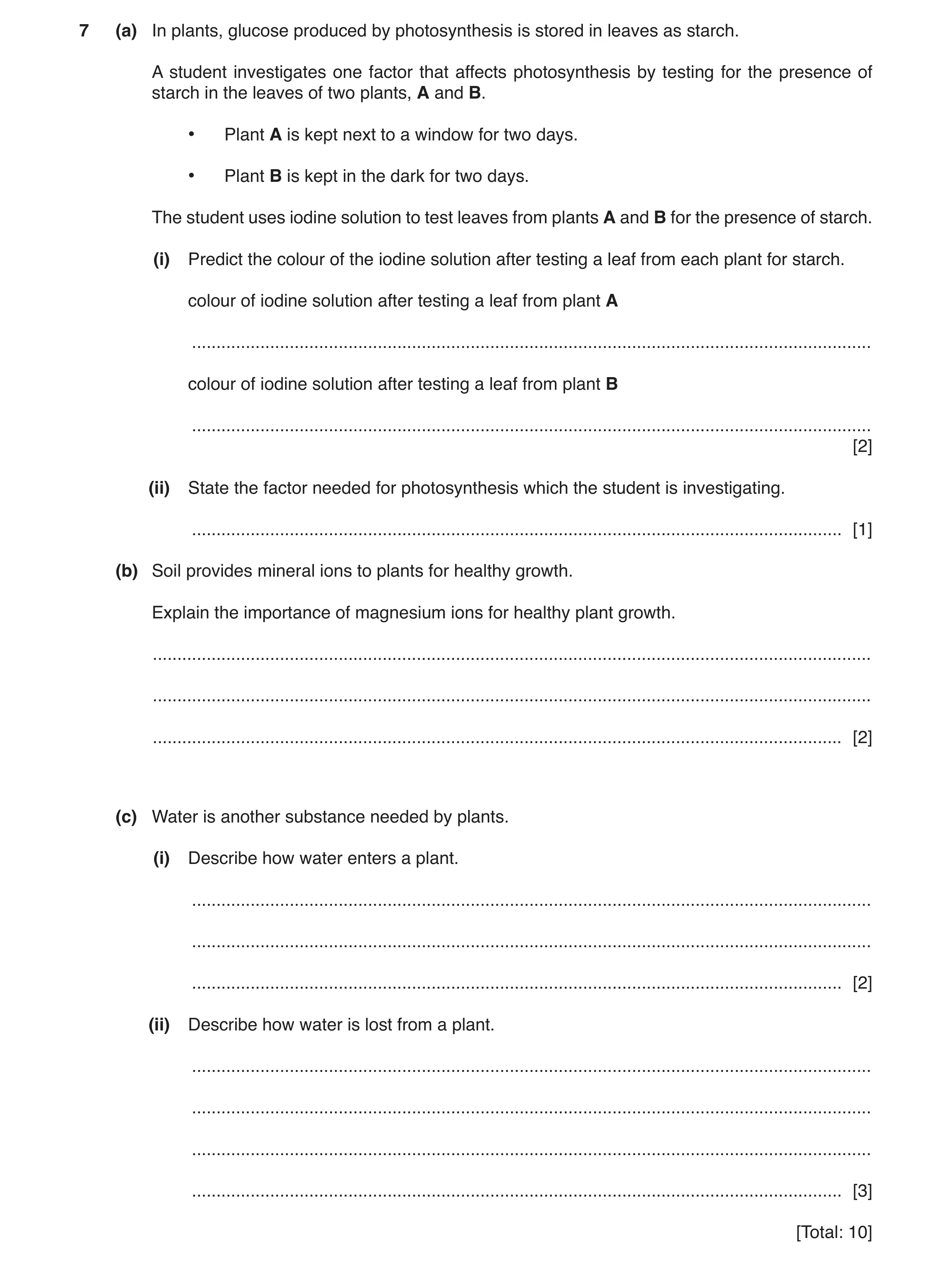
7 (a) In plants, glucose produced by photosynthesis is stored in leaves as starch. A student investigates one factor that affects photosynthesis by testing for the presence of starch in the leaves of two plants, A and B. • Plant A is kept next to a window for two days. • Plant B is kept in the dark for two days. The student uses iodine solution to test leaves from plants A and B for the presence of starch. (i) Predict the colour of the iodine solution after testing a leaf from each plant for starch. colour of iodine solution after testing a leaf from plant A … colour of iodine solution after testing a leaf from plant B … [2] (ii) State the factor needed for photosynthesis which the student is investigating. … [1] (b) Soil provides mineral ions to plants for healthy growth. Explain the importance of magnesium ions for healthy plant growth. … … … [2] (c) Water is another substance needed by plants. (i) Describe how water enters a plant. … … … [2] (ii) Describe how water is lost from a plant. … … … … [3] [Total: 10]
10 marks
Mark scheme: 7(a)(i) part A blue-black ; part B orange / yellow / brown ; 2 7(a)(ii) light ; 1 7(b) (magnesium ions are) needed for production of chlorophyll ; chlorophyll is necessary for photosynthesis ; 2 7(c)(i) (water enters) through the root hair cell ; by osmosis ; 2 7(c)(ii) ref. to transpiration ; evaporation of water (from mesophyll cells) ; diffusion (of water vapour) ; through the stomata ; max 3 3
This question in 0654/32 Oct/Nov 2019
Q6 · Water is lost from leaves by transpiration 0654/31 May/June 2022
10 (a) Water is lost from leaves by transpiration. This causes a loss in mass. A student records the mass of leaves from a plant. He places the leaves under a heat lamp. He records the mass of the leaves every 24 hours for 5 days. The results are shown in Table 10.1. Table 10.1 day mass of leaves / g 1 115 2 100 3 85 4 65 5 58 (i) Calculate the total decrease in mass between day 1 and day 5. … g [1] (ii) The investigation is repeated at a lower temperature. The statements show some predictions. Tick (3) one box to show the correct prediction. The decrease in mass will be less than in the first investigation. The decrease in mass will be more than in the first investigation. The mass will increase not decrease. The decrease in mass will be the same as in the first investigation. [1] (b) State the process by which water is lost from the surfaces of the mesophyll cells during transpiration. … [1] (c) State the name of the part of the leaf where water exits the plant. … [1] (d) A plant obtains water from the soil. Describe how water enters the plant and is transported to the mesophyll cells in the leaves. … … … … … [3] (e) One use of water in a plant is for photosynthesis. (i) State one other use of water in a plant. … [1] (ii) State two other requirements of photosynthesis. 1 … 2 … [2] [Total: 10]
10 marks
Mark scheme: 10(a)(i) 57 (g) ; 1 10(a)(ii) The decrease in mass will be less than in the first investigation ticked ; 1 10(b) evaporation ; 1 10(c) stomata ; 1 10(d) any three from water enters root hair cells ; by osmosis ; ref to root cortex cells ; transferred to leaves by xylem ; Max 3 marks 3 Question Answer Marks 10(e)(i) support / as a solvent / AVP ; 1 10(e)(ii) any two from: light ; warm / suitable, temperature ; carbon dioxide ; chlorophyll ; Max 2 marks 2
This question in 0654/31 May/June 2022
Q7 · A diagram of a cross-section through a leaf 0654/33 May/June 2022
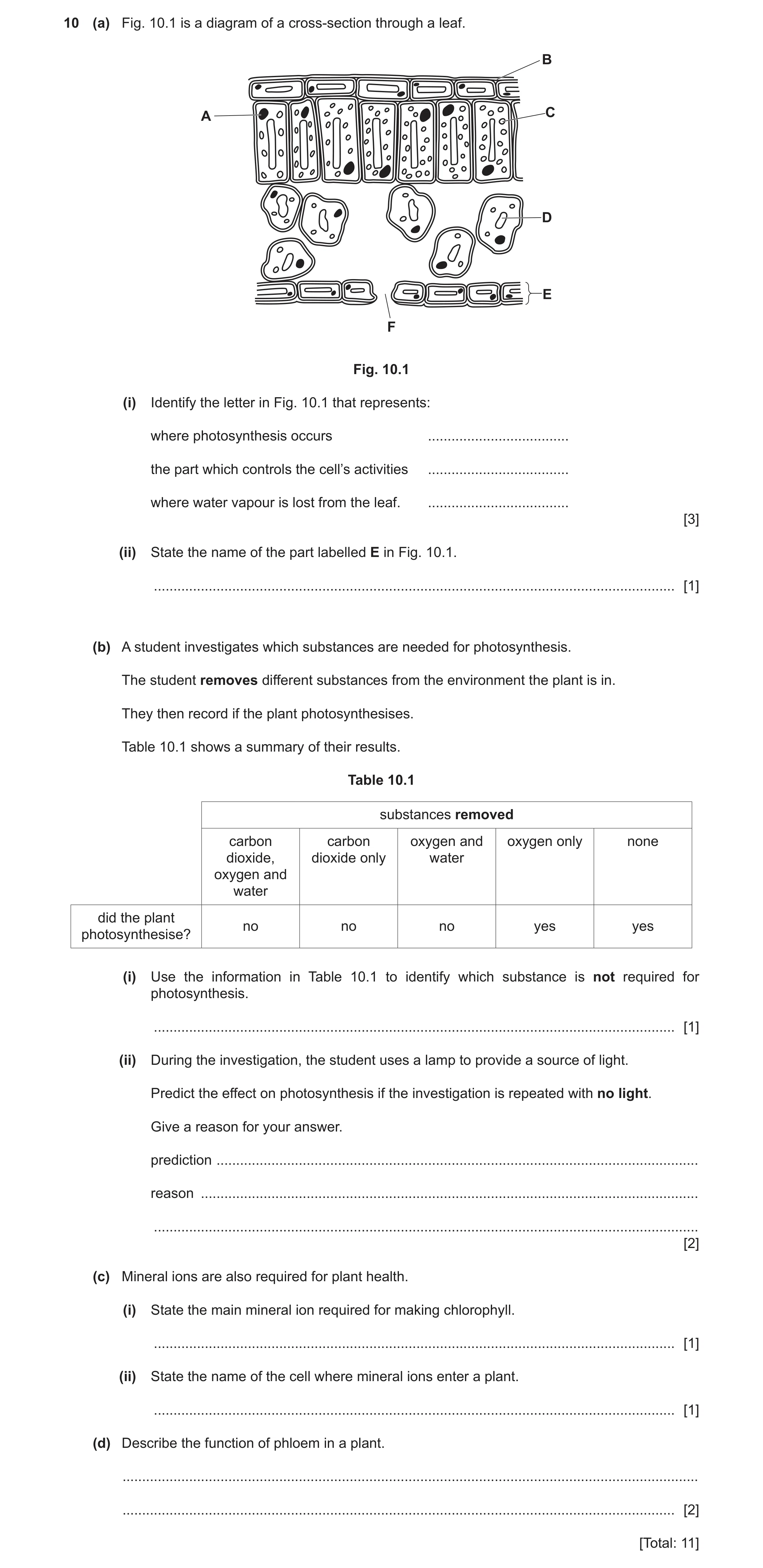
10 (a) Fig. 10.1 is a diagram of a cross-section through a leaf. B A C D E F Fig. 10.1 (i) Identify the letter in Fig. 10.1 that represents: where photosynthesis occurs … the part which controls the cell’s activities … where water vapour is lost from the leaf. … [3] (ii) State the name of the part labelled E in Fig. 10.1. … [1] (b) A student investigates which substances are needed for photosynthesis. The student removes different substances from the environment the plant is in. They then record if the plant photosynthesises. Table 10.1 shows a summary of their results. Table 10.1 substances removed carbon carbon oxygen and oxygen only none dioxide, dioxide only water oxygen and water did the plant no no no yes yesphotosynthesise? (i) Use the information in Table 10.1 to identify which substance is not required for photosynthesis. … [1] (ii) During the investigation, the student uses a lamp to provide a source of light. Predict the effect on photosynthesis if the investigation is repeated with no light. Give a reason for your answer. prediction … reason … … [2] (c) Mineral ions are also required for plant health. (i) State the main mineral ion required for making chlorophyll. … [1] (ii) State the name of the cell where mineral ions enter a plant. … [1] (d) Describe the function of phloem in a plant. … … [2] [Total: 11]
11 marks
Mark scheme: 10(a)(i) C ; A ; F ; 3 10(a)(ii) (lower) epidermis ; 1 10(b)(i) oxygen ; 1 10(b)(ii) no photosynthesis ; light is required (for photosynthesis) ; 2 10(c)(i) magnesium ; 1 10(c)(ii) root hair (cell) ; 1 10(d) transport ; of, sucrose / amino acids ; 2
This question in 0654/33 May/June 2022
Q8 · A diagram of a cross-section through a leaf 0654/33 Oct/Nov 2023
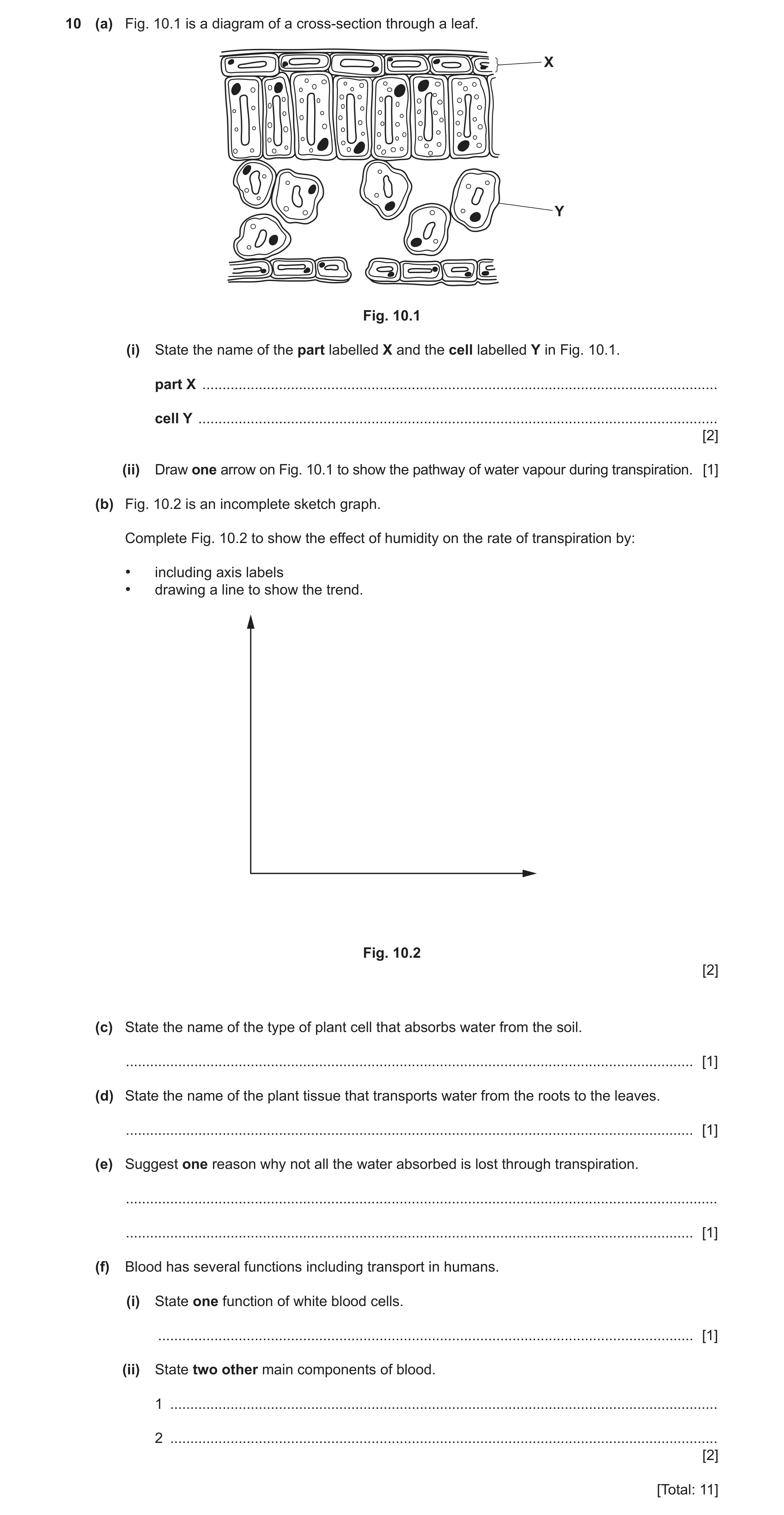
10 (a) Fig. 10.1 is a diagram of a cross-section through a leaf. X Y Fig. 10.1 (i) State the name of the part labelled X and the cell labelled Y in Fig. 10.1. part X … cell Y … [2] (ii) Draw one arrow on Fig. 10.1 to show the pathway of water vapour during transpiration. [1] (b) Fig. 10.2 is an incomplete sketch graph. Complete Fig. 10.2 to show the effect of humidity on the rate of transpiration by: • including axis labels • drawing a line to show the trend. Fig. 10.2 [2] (c) State the name of the type of plant cell that absorbs water from the soil. … [1] (d) State the name of the plant tissue that transports water from the roots to the leaves. … [1] (e) Suggest one reason why not all the water absorbed is lost through transpiration. … … [1] (f) Blood has several functions including transport in humans. (i) State one function of white blood cells. … [1] (ii) State two other main components of blood. 1 … 2 … [2] [Total: 11]
11 marks
Mark scheme: 10(a)(i) X – (upper) epidermis ; 2 Y – spongy mesophyll ; 10(a)(ii) arrow drawn from leaf going out of stoma ; 1 10(b) axis labels ; 2 negative correlation ; 10(c) root hair (cell) ; 1 10(d) xylem ; 1 10(e) some used in, photosynthesis / support ; 1 10(f)(i) phagocytosis / production of antibodies ; 1 10(f)(ii) any two from: 2 red blood cells ; plasma ; platelets ;
This question in 0654/33 Oct/Nov 2023
Q9 · A student investigates responses in seeds 0654/31 Oct/Nov 2024
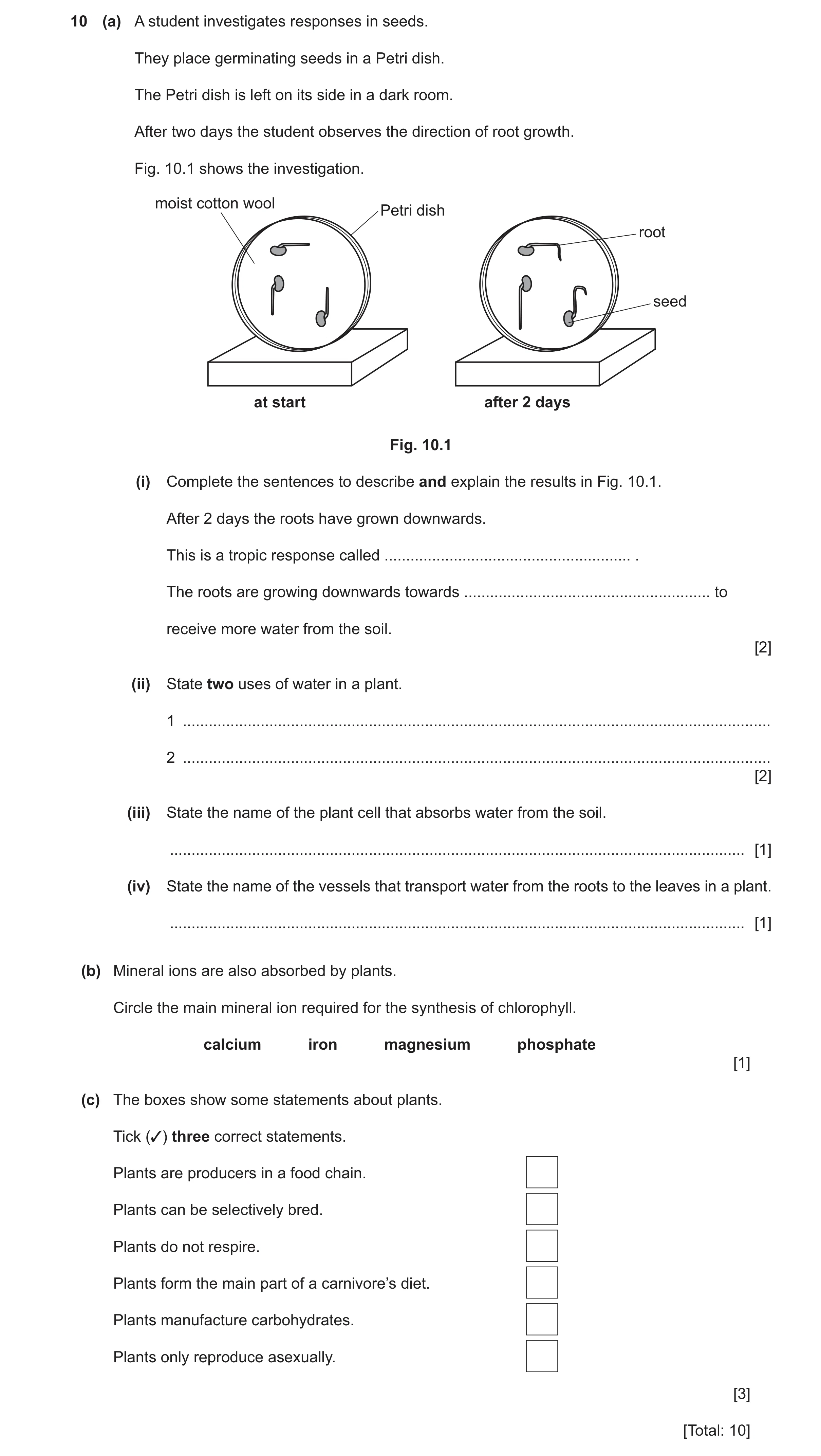
10 (a) A student investigates responses in seeds. They place germinating seeds in a Petri dish. The Petri dish is left on its side in a dark room. After two days the student observes the direction of root growth. Fig. 10.1 shows the investigation. moist cotton wool Petri dish root seed at start after 2 days Fig. 10.1 (i) Complete the sentences to describe and explain the results in Fig. 10.1. After 2 days the roots have grown downwards. This is a tropic response called … . The roots are growing downwards towards … to receive more water from the soil. [2] (ii) State two uses of water in a plant. 1 … 2 … [2] (iii) State the name of the plant cell that absorbs water from the soil. … [1] (iv) State the name of the vessels that transport water from the roots to the leaves in a plant. … [1] (b) Mineral ions are also absorbed by plants. Circle the main mineral ion required for the synthesis of chlorophyll. calcium iron magnesium phosphate [1] (c) The boxes show some statements about plants. Tick (3) three correct statements. Plants are producers in a food chain. Plants can be selectively bred. Plants do not respire. Plants form the main part of a carnivore’s diet. Plants manufacture carbohydrates. Plants only reproduce asexually. [3] [Total: 10]
10 marks
Mark scheme: 10(a)(i) gravitropism ; 2 gravity ; 10(a)(ii) any two from: 2 photosynthesis ; support ; solvent ; germination ; AVP ; 10(a)(iii) root hair cell ; 1 10(a)(iv) xylem ; 1 10(b) magnesium circled ; 1 10(c) 3 Plants are producers in a food chain. Plants can be selectively bred. Plants do not respire. Plants form the main part of a carnivore’s diet. Plants manufacture carbohydrates. Plants only reproduce asexually. ;;;
This question in 0654/31 Oct/Nov 2024
Q10 · A part of a cross-section of a plant stem 0654/31 May/June 2025
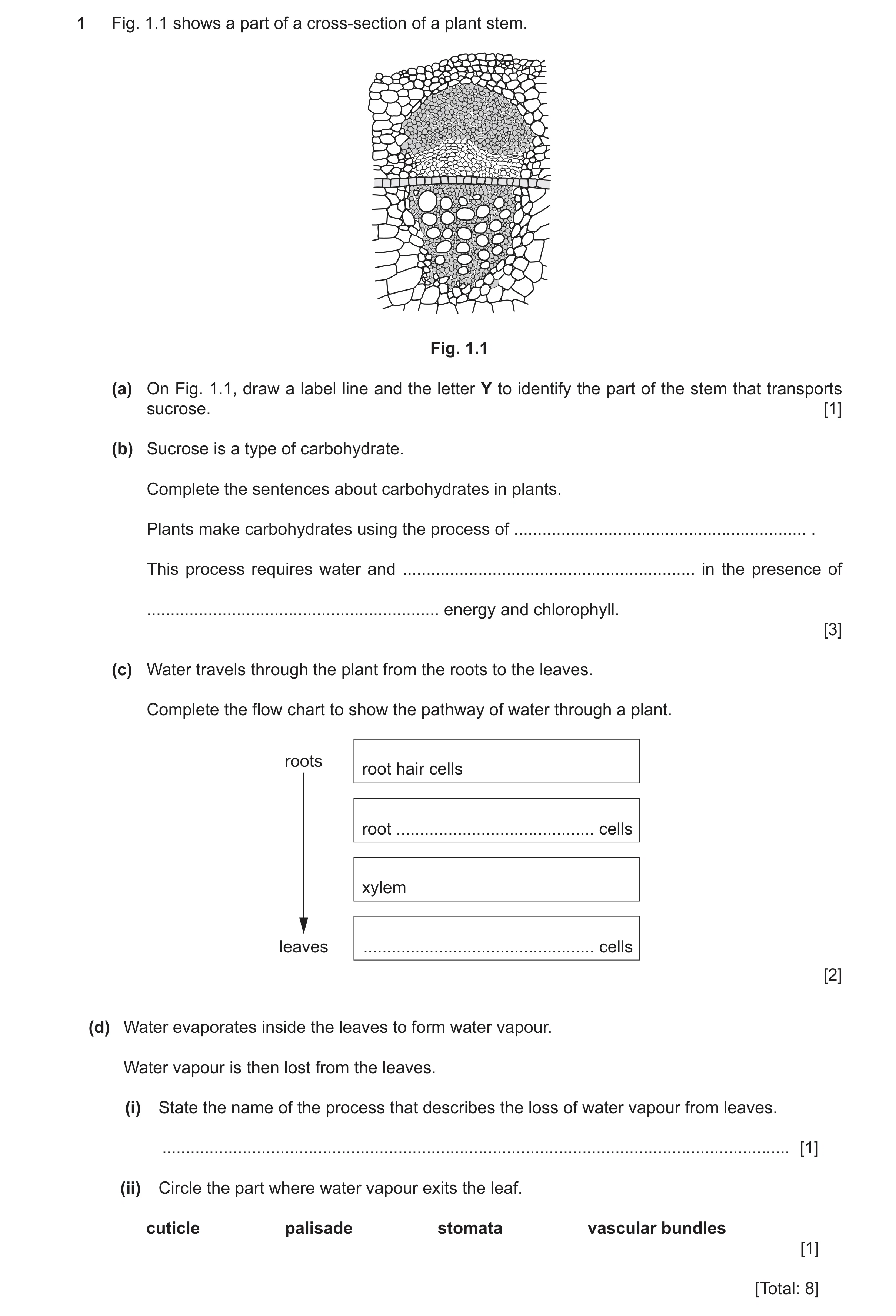
1 Fig. 1.1 shows a part of a cross-section of a plant stem. Fig. 1.1 (a) On Fig. 1.1, draw a label line and the letter Y to identify the part of the stem that transports sucrose. [1] (b) Sucrose is a type of carbohydrate. Complete the sentences about carbohydrates in plants. Plants make carbohydrates using the process of … . This process requires water and … in the presence of … energy and chlorophyll. [3] (c) Water travels through the plant from the roots to the leaves. Complete the flow chart to show the pathway of water through a plant. roots root hair cells root … cells xylem leaves … cells [2] (d) Water evaporates inside the leaves to form water vapour. Water vapour is then lost from the leaves. (i) State the name of the process that describes the loss of water vapour from leaves. … [1] (ii) Circle the part where water vapour exits the leaf. cuticle palisade stomata vascular bundles [1] [Total: 8]
8 marks
Mark scheme: Question Answer Marks 1(a) correct line drawn and labelled Y ; 1 1(b) photosynthesis ; 3 carbon dioxide / CO2 ; light ; 1(c) cortex ; 2 mesophyll ; 1(d)(i) transpiration ; 1 1(d)(ii) stomata ; 1
This question in 0654/31 May/June 2025
 1 / 13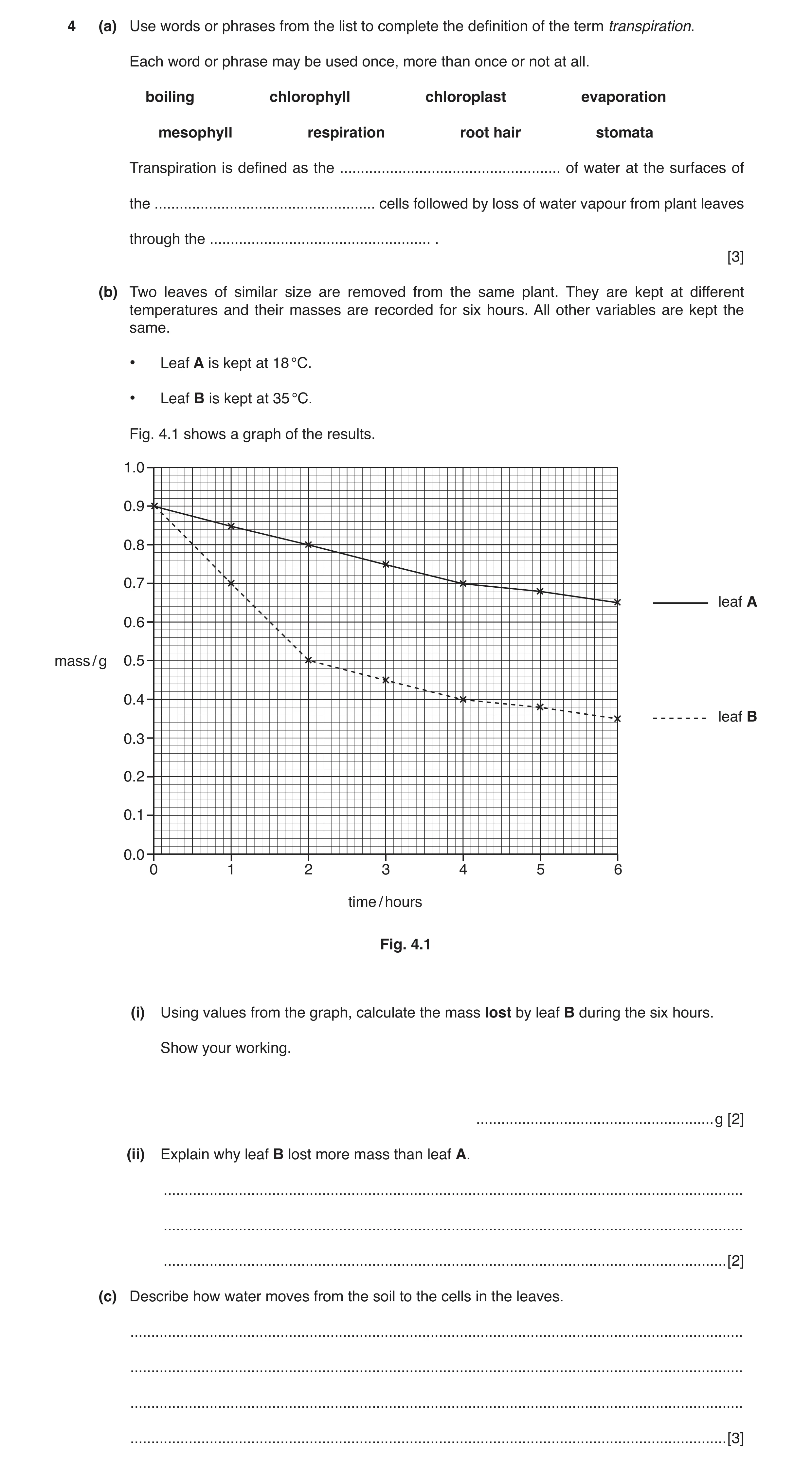
 6 / 13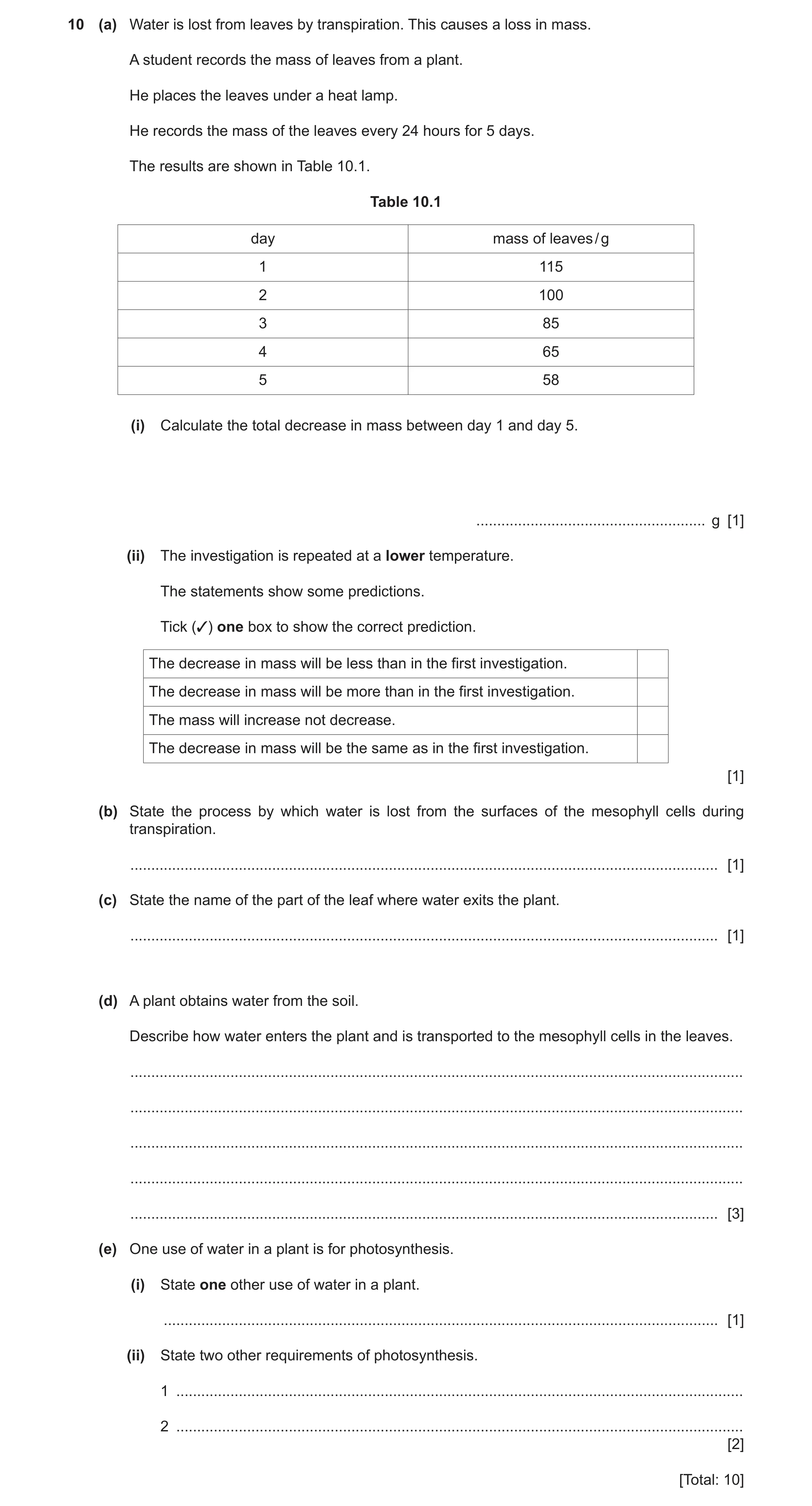
 6
6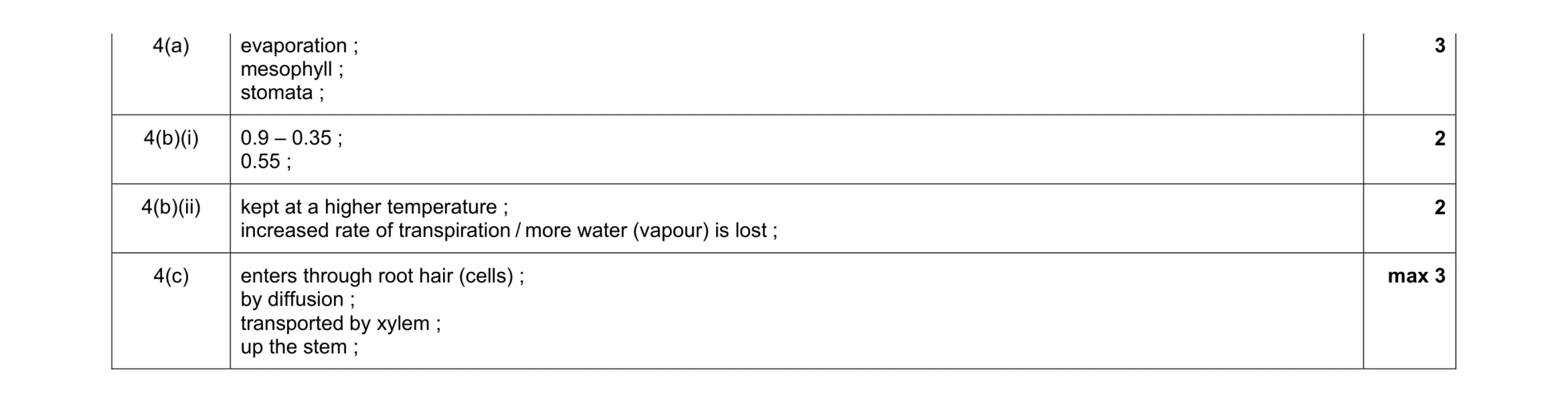 10
10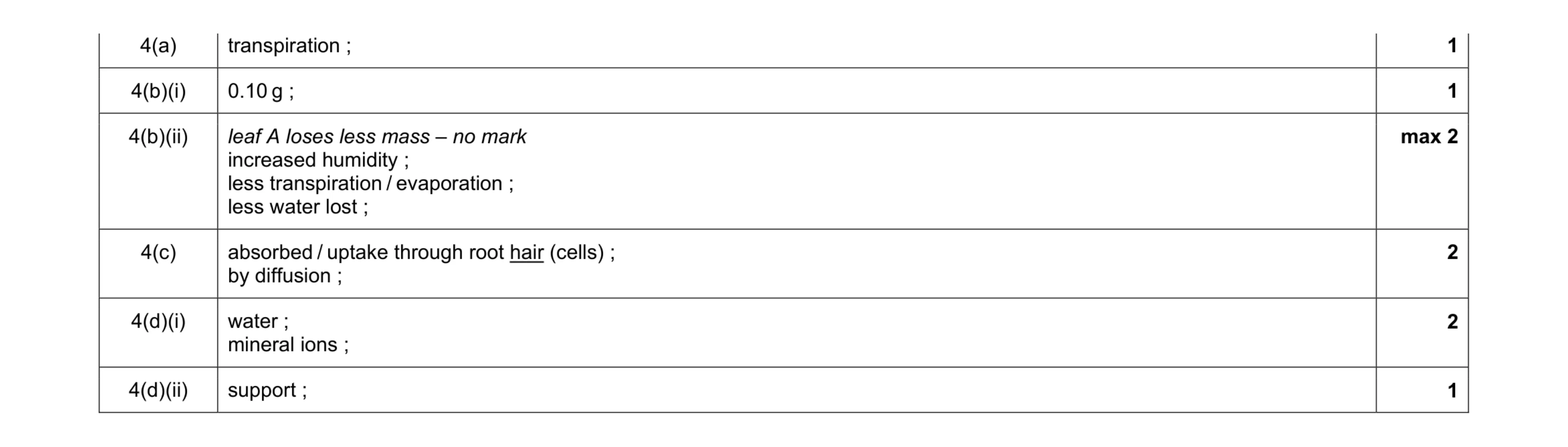 9
9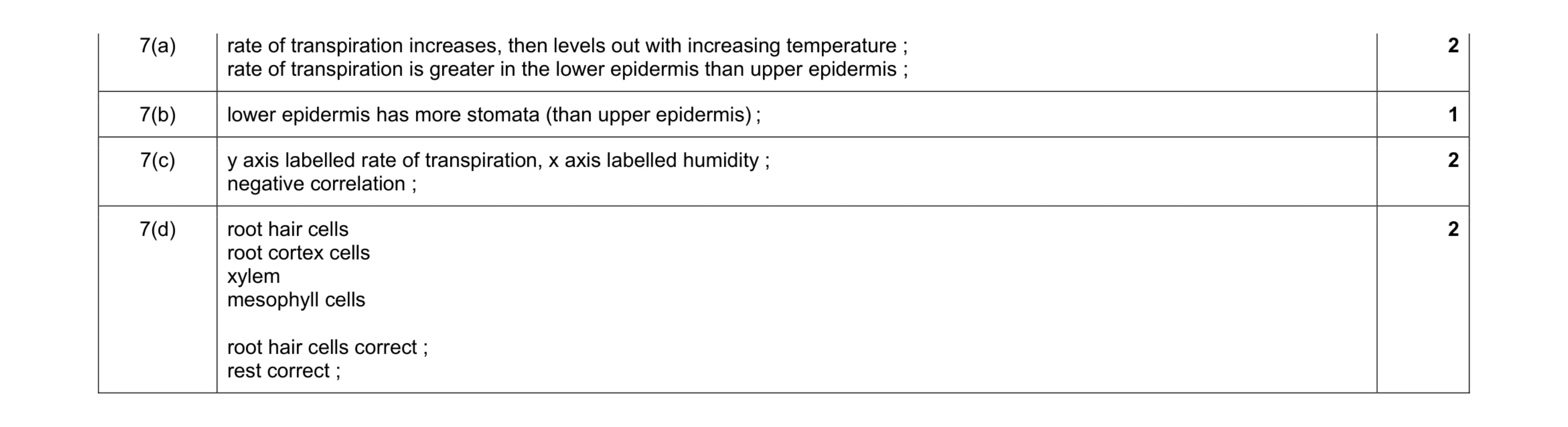 7
7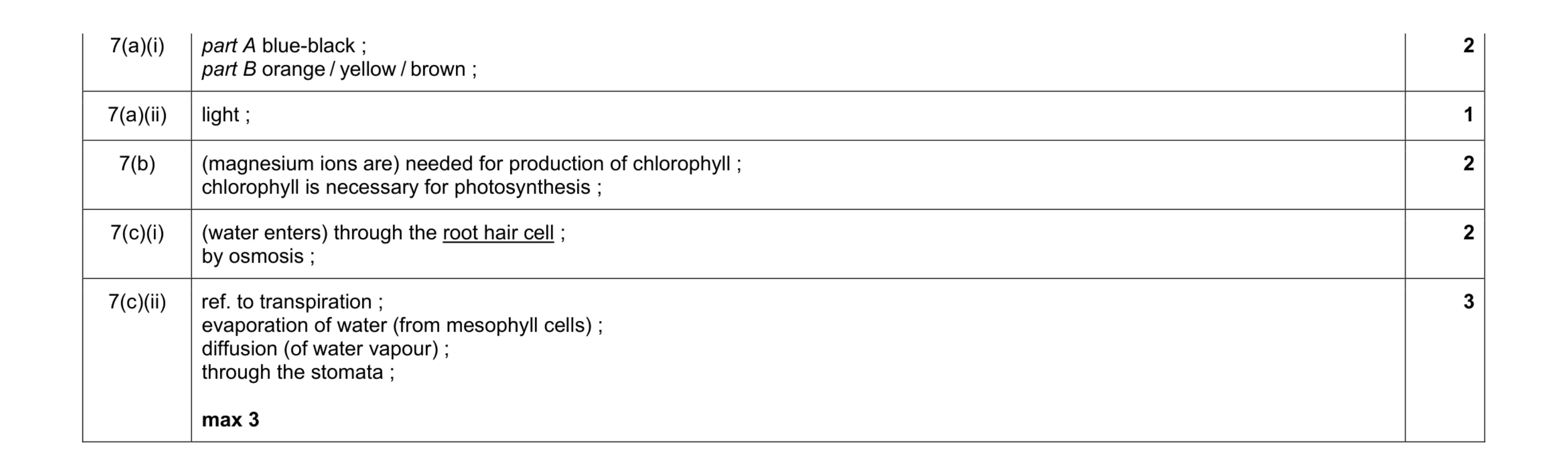 10
10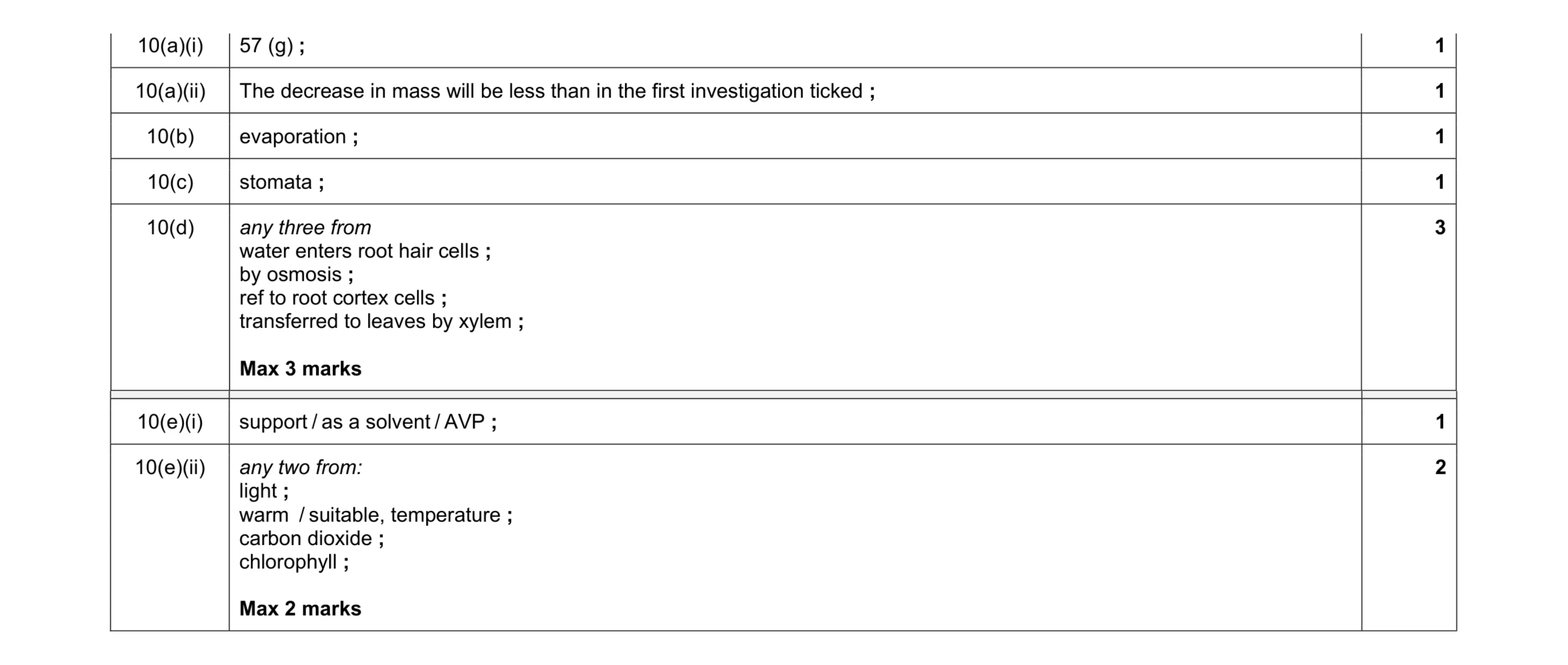 10
10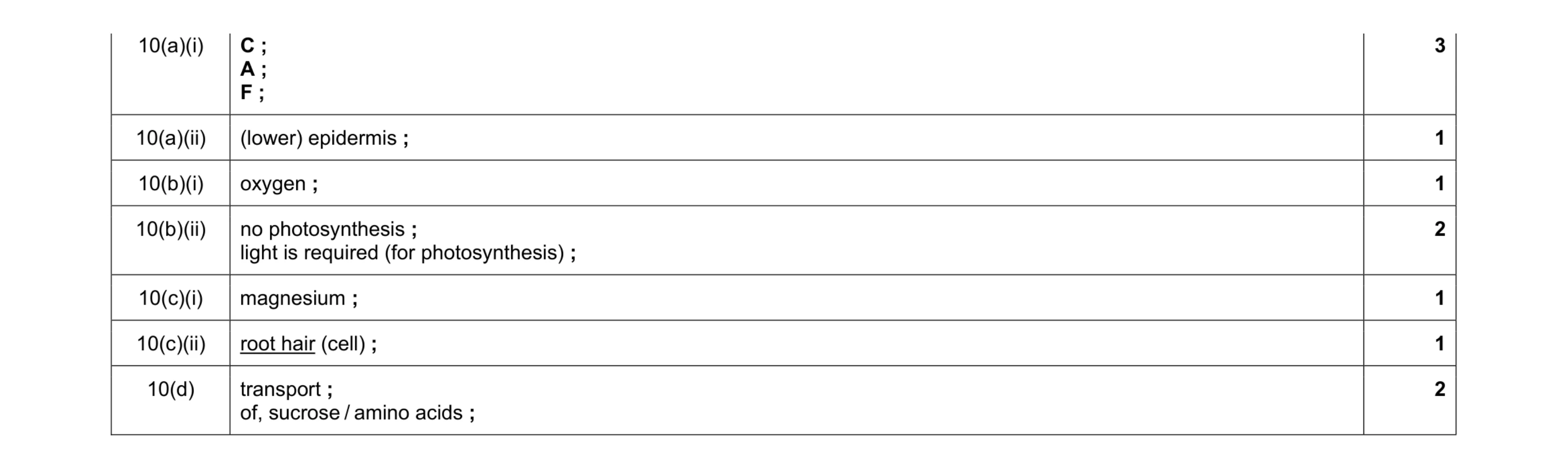 11
11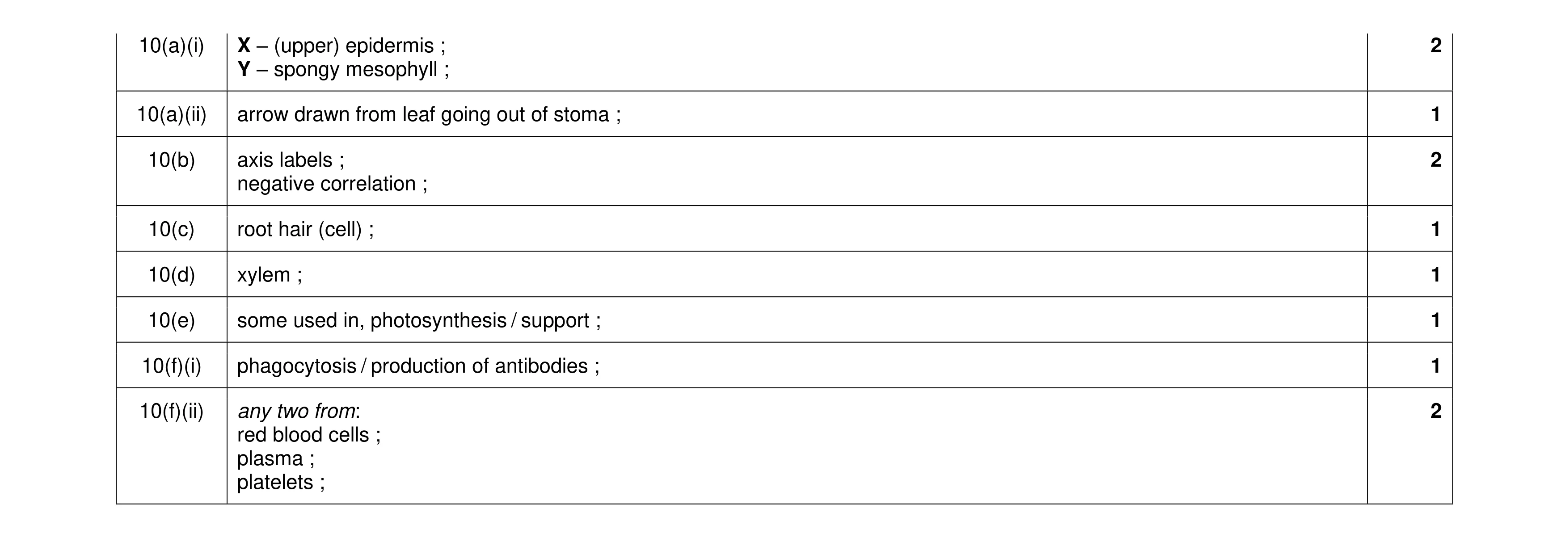 11
11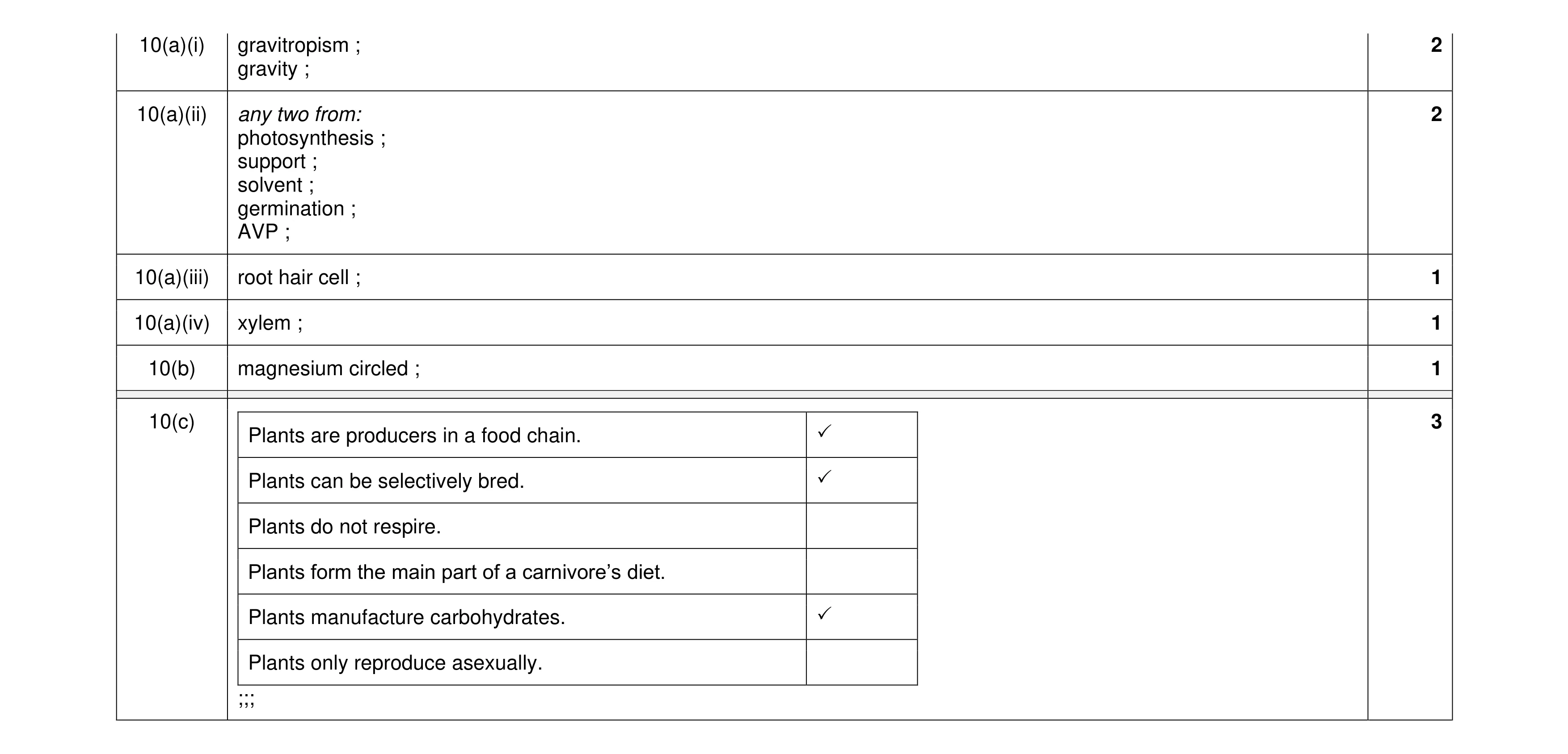 10
10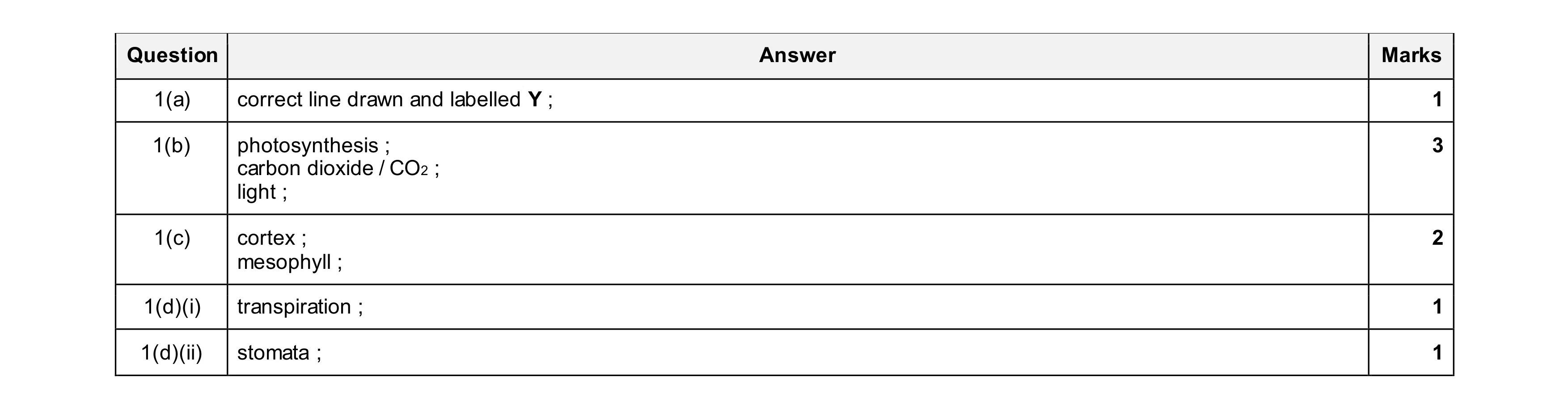 8
8