Cambridge IGCSE Physical Science 0652 — 2022 Oct/Nov Paper 2 · Variant 2
0652/22/O/N/22 · 40 questions · 40 marks · ≈45 min
The question paper and its mark scheme, free to read here and free to download. This is Cambridge’s own paper, exactly as it was sat.
Question paper16 pages
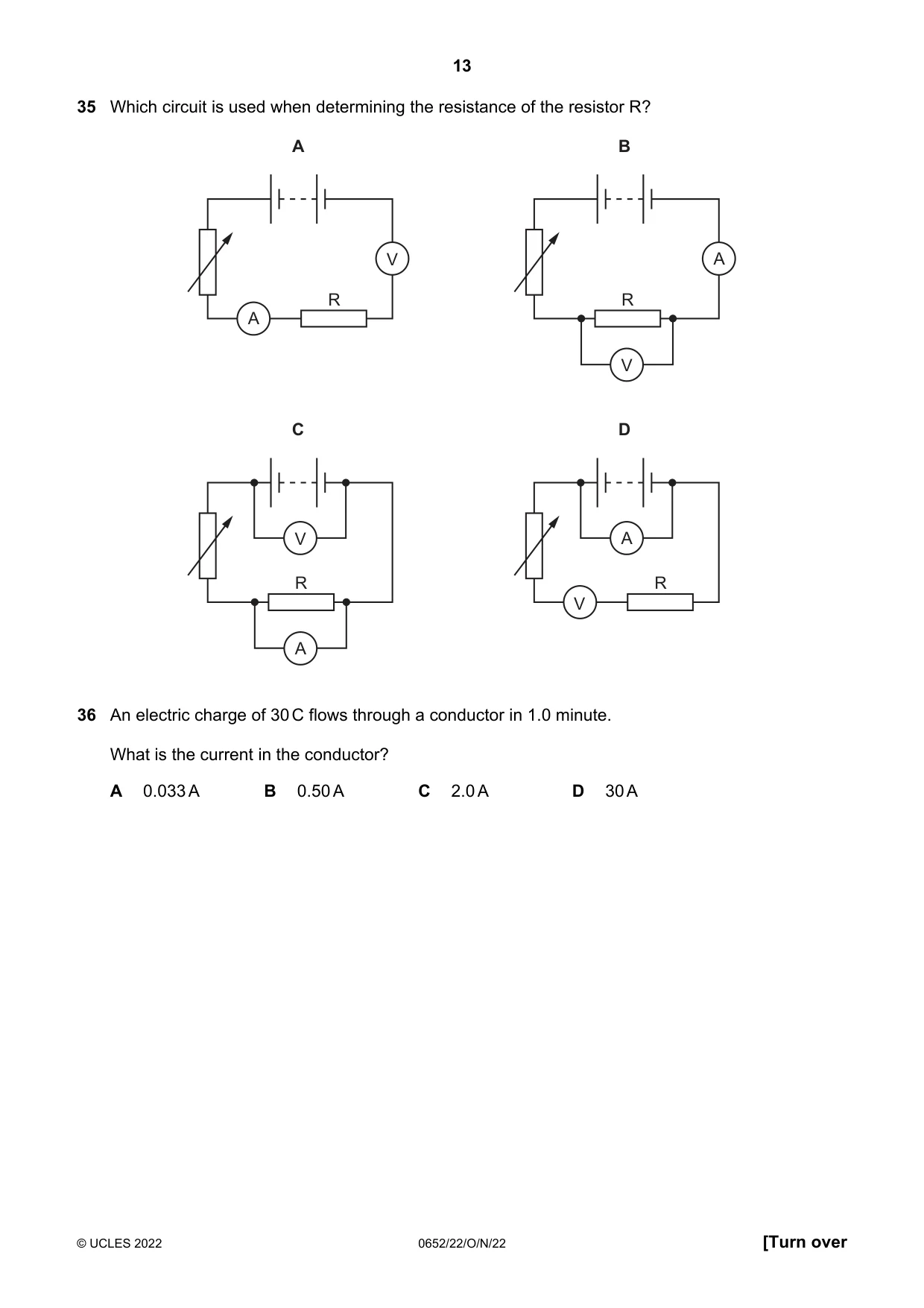
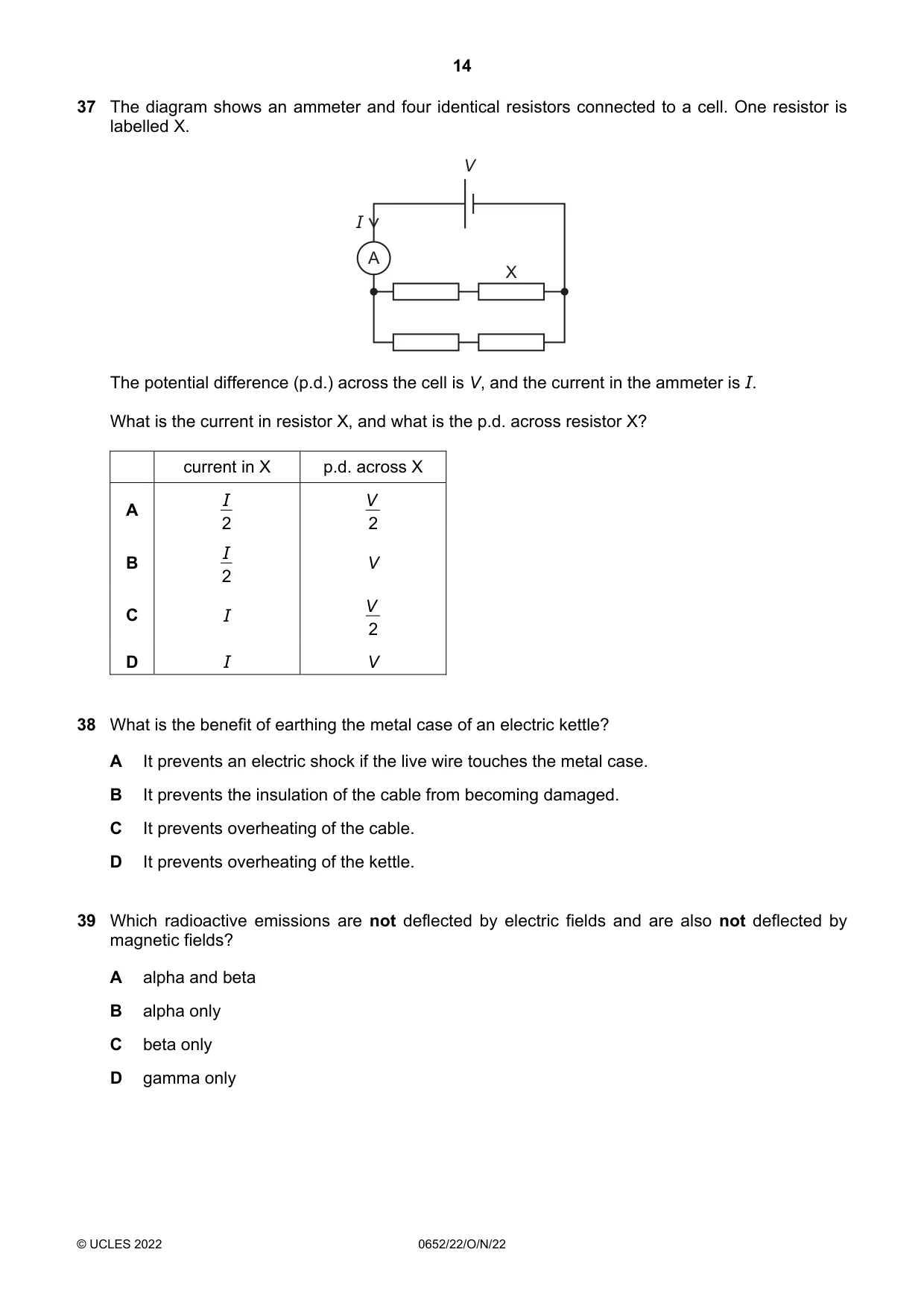
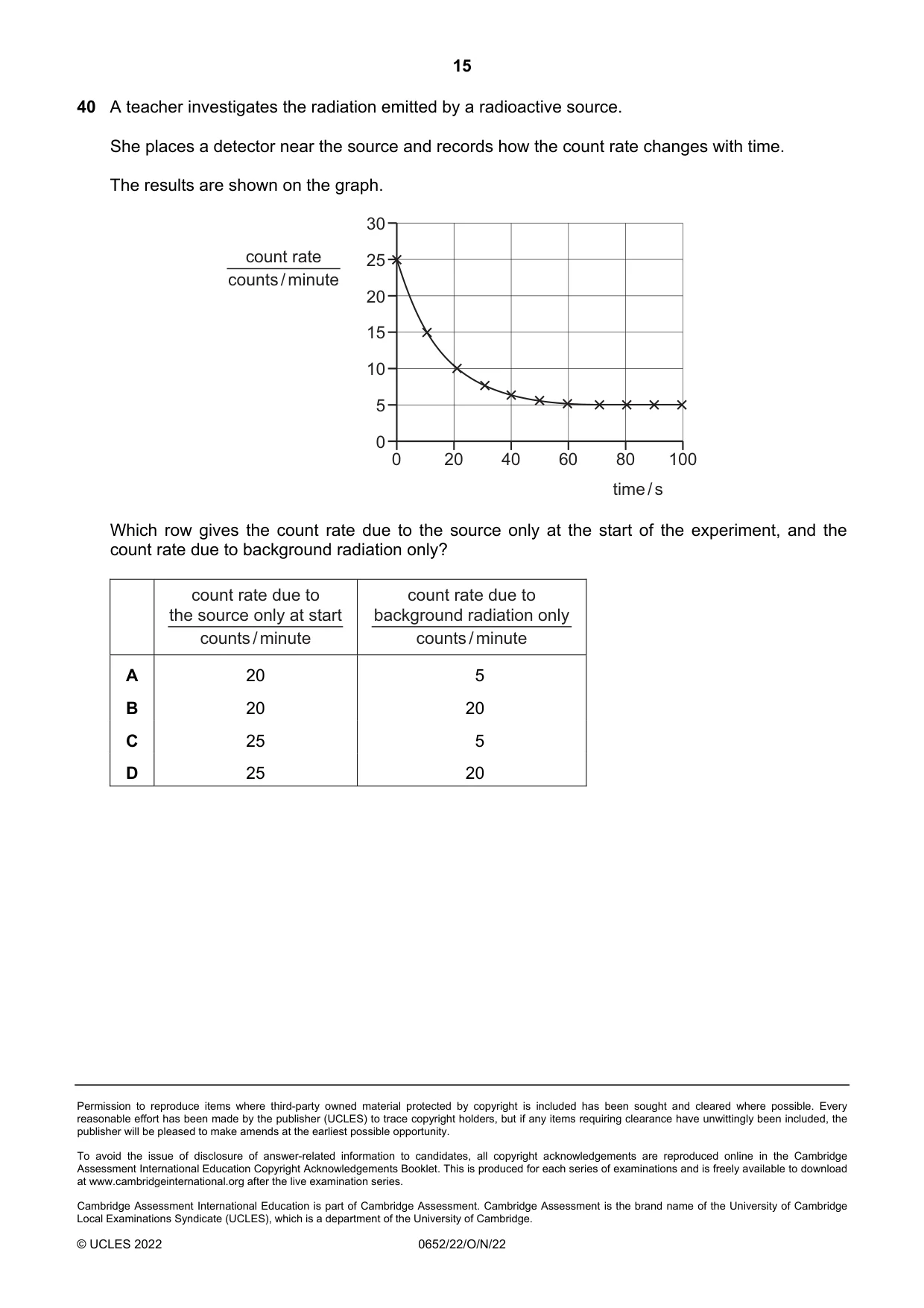
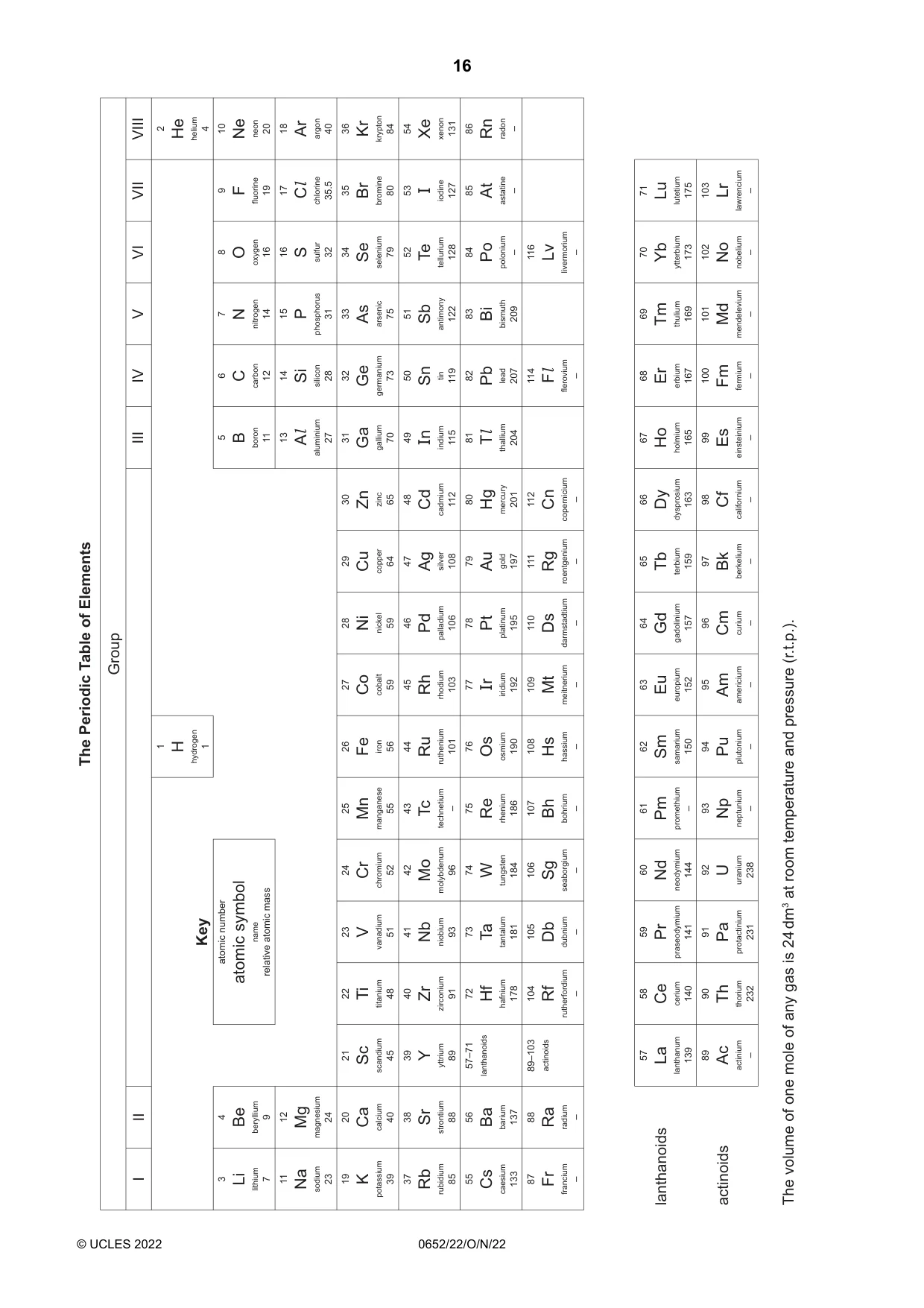
Mark scheme3 pages
Answers below. Sit the paper first if you are practising.
Questions as text
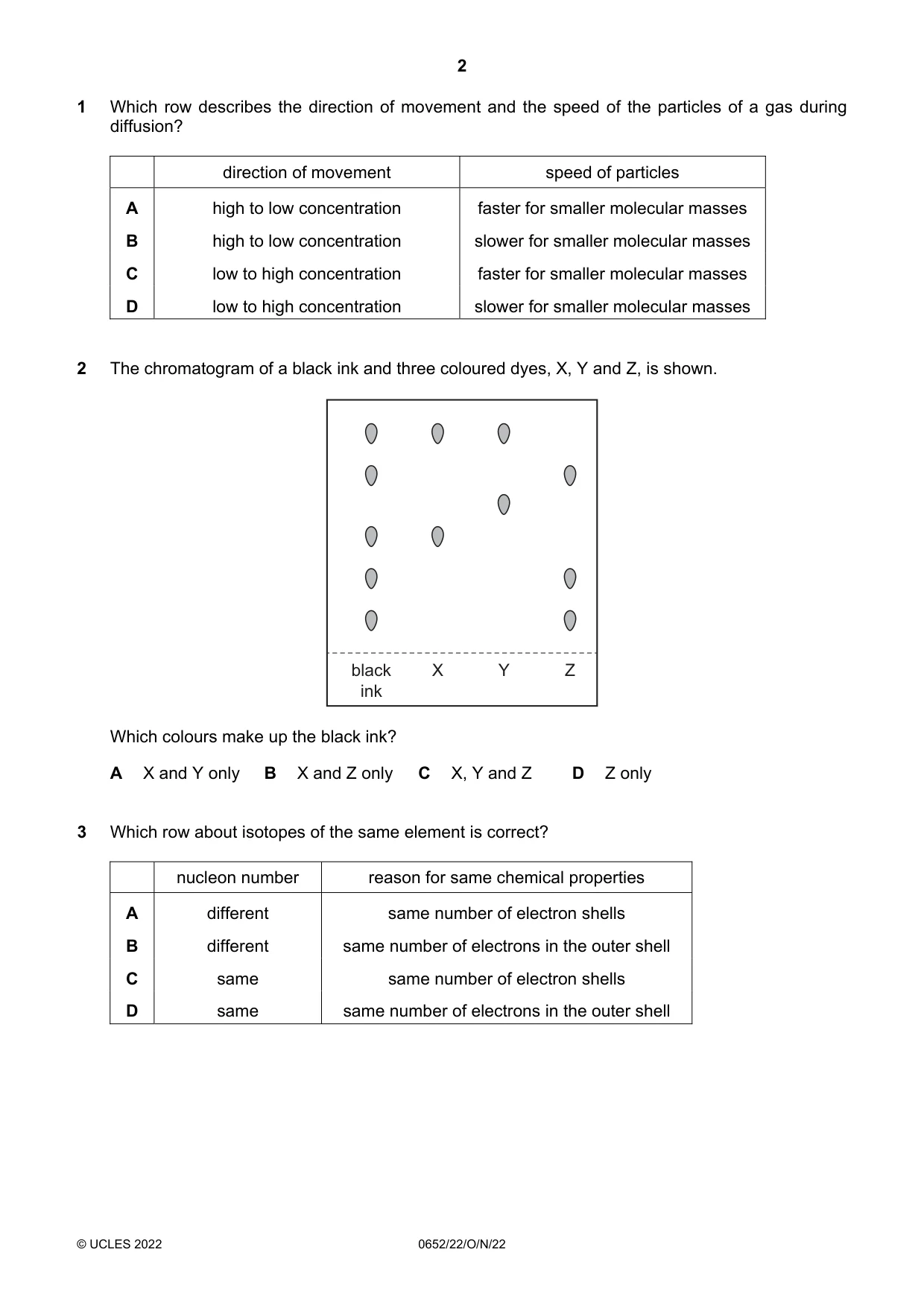
Q1 · Which row describes the direction of movement and the speed of the particles of a gas…
1 Which row describes the direction of movement and the speed of the particles of a gas during diffusion? direction of movement speed of particles A high to low concentration faster for smaller molecular masses B high to low concentration slower for smaller molecular masses C low to high concentration faster for smaller molecular masses D low to high concentration slower for smaller molecular masses
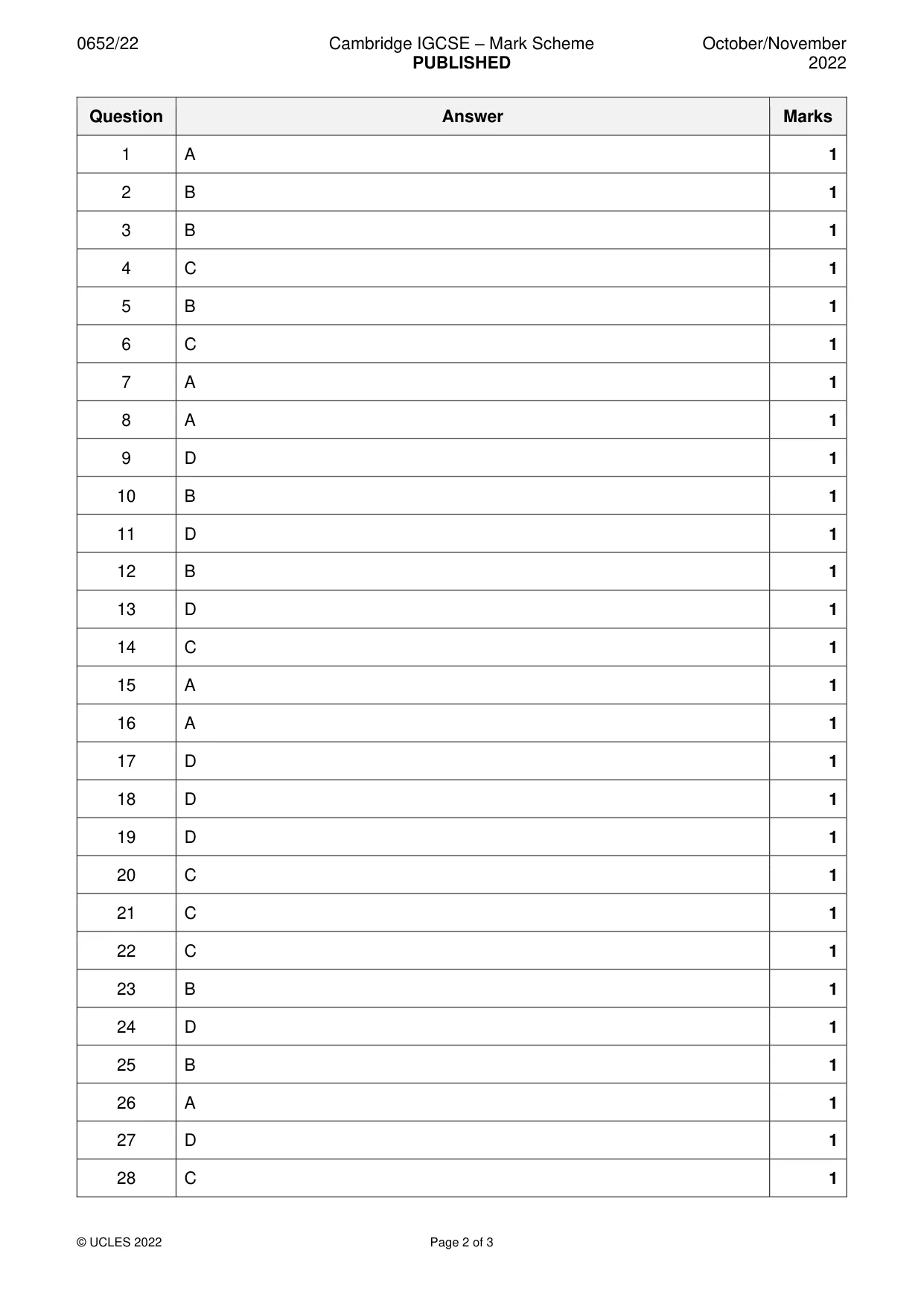
Mark scheme: A
Q2 · The chromatogram of a black ink and three coloured dyes, X, Y and Z, is shown
2 The chromatogram of a black ink and three coloured dyes, X, Y and Z, is shown. black X Y Z ink Which colours make up the black ink? A X and Y only B X and Z only C X, Y and Z D Z only
Mark scheme: B
Q3 · Which row about isotopes of the same element is correct?
3 Which row about isotopes of the same element is correct? nucleon number reason for same chemical properties A different same number of electron shells B different same number of electrons in the outer shell C same same number of electron shells D same same number of electrons in the outer shell
Mark scheme: B
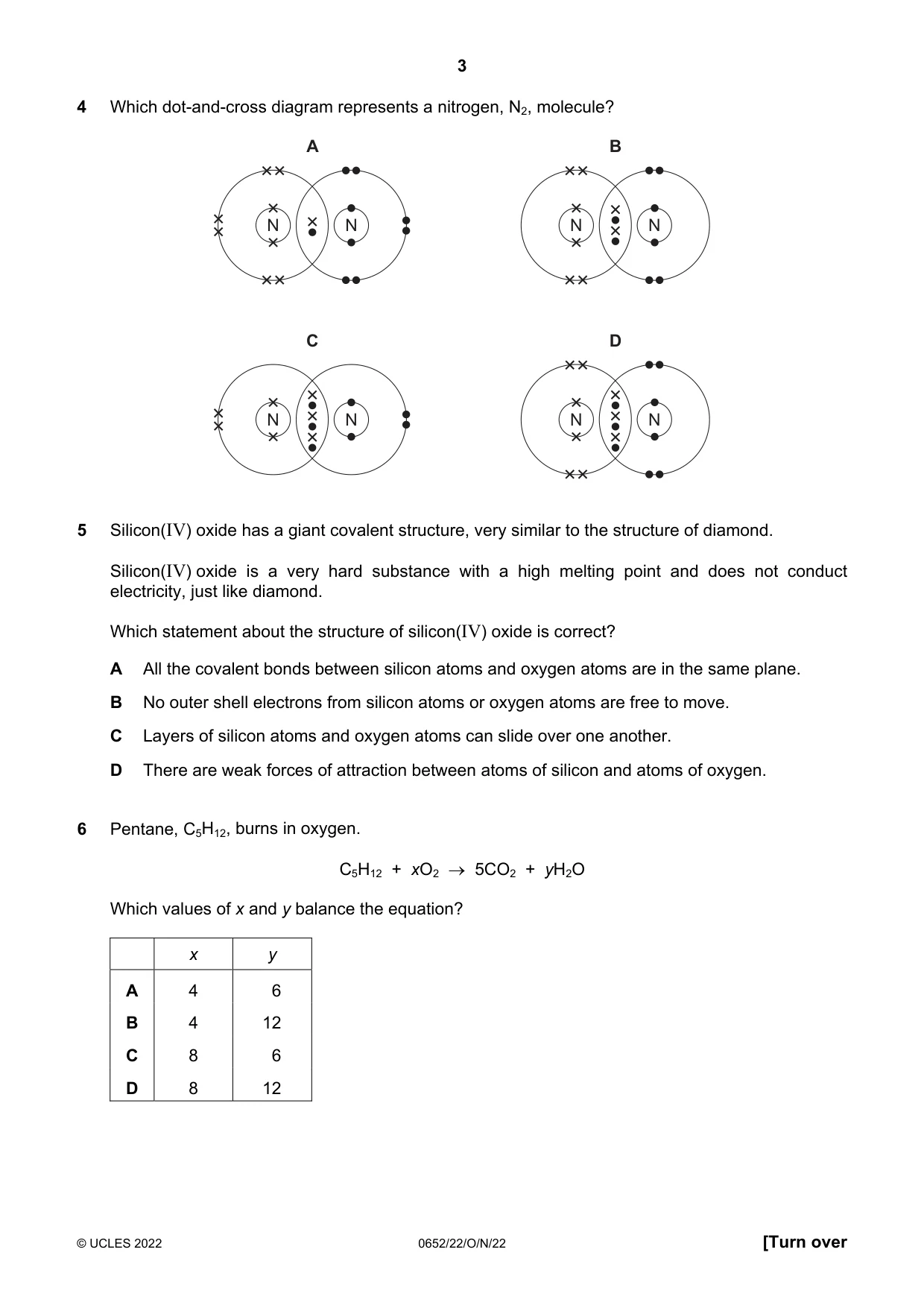
Q4 · Which dot-and-cross diagram represents a nitrogen, N2, molecule?
4 Which dot-and-cross diagram represents a nitrogen, N2, molecule? A B N N N N C D N N N N
Mark scheme: C
Q5 · Silicon(IV) oxide has a giant covalent structure, very similar to the structure of diamond
5 Silicon(IV) oxide has a giant covalent structure, very similar to the structure of diamond. Silicon(IV) oxide is a very hard substance with a high melting point and does not conduct electricity, just like diamond. Which statement about the structure of silicon(IV) oxide is correct? A All the covalent bonds between silicon atoms and oxygen atoms are in the same plane. B No outer shell electrons from silicon atoms or oxygen atoms are free to move. C Layers of silicon atoms and oxygen atoms can slide over one another. D There are weak forces of attraction between atoms of silicon and atoms of oxygen.
Mark scheme: B
Q6 · Pentane, C5H12, burns in oxygen
6 Pentane, C5H12, burns in oxygen. C5H12 + xO2 → 5CO2 + yH2O Which values of x and y balance the equation? x y A 4 6 B 4 12 C 8 6 D 8 12
Mark scheme: C
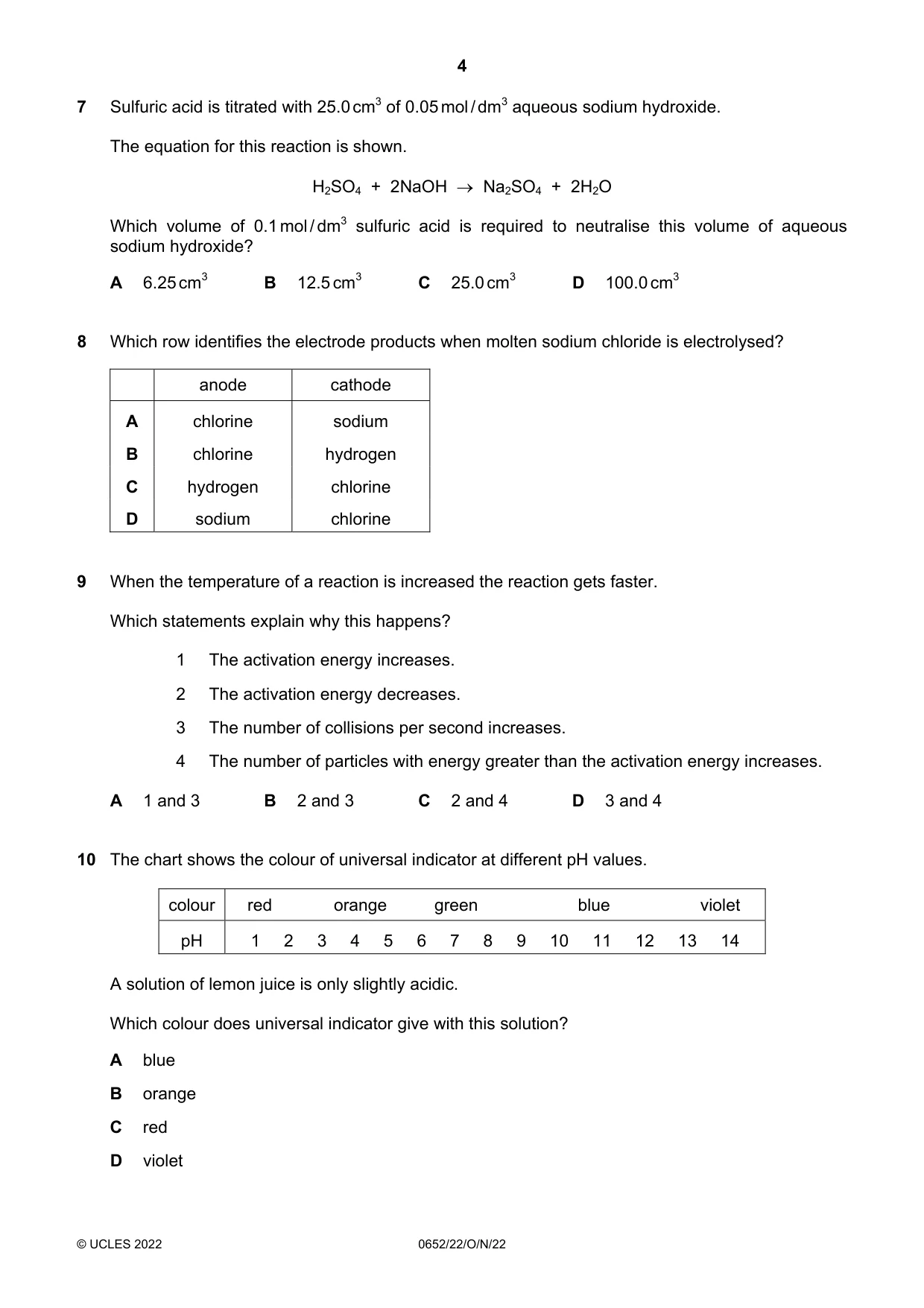
Q7 · Sulfuric acid is titrated with 25.0 cm3 of 0.05 mol / dm3 aqueous sodium hydroxide
7 Sulfuric acid is titrated with 25.0 cm3 of 0.05 mol / dm3 aqueous sodium hydroxide. The equation for this reaction is shown. H2SO4 + 2NaOH → Na2SO4 + 2H2O Which volume of 0.1 mol / dm3 sulfuric acid is required to neutralise this volume of aqueous sodium hydroxide? A 6.25 cm3 B 12.5 cm3 C 25.0 cm3 D 100.0 cm3
Mark scheme: A
Q8 · Which row identifies the electrode products when molten sodium chloride is electrolysed?
8 Which row identifies the electrode products when molten sodium chloride is electrolysed? anode cathode A chlorine sodium B chlorine hydrogen C hydrogen chlorine D sodium chlorine
Mark scheme: A
Q9 · When the temperature of a reaction is increased the reaction gets faster
9 When the temperature of a reaction is increased the reaction gets faster. Which statements explain why this happens? 1 The activation energy increases. 2 The activation energy decreases. 3 The number of collisions per second increases. 4 The number of particles with energy greater than the activation energy increases. A 1 and 3 B 2 and 3 C 2 and 4 D 3 and 4
Mark scheme: D
Q10 · The chart shows the colour of universal indicator at different pH values
10 The chart shows the colour of universal indicator at different pH values. colour red orange green blue violet pH 1 2 3 4 5 6 7 8 9 10 11 12 13 14 A solution of lemon juice is only slightly acidic. Which colour does universal indicator give with this solution? A blue B orange C red D violet
Mark scheme: B
More questions on The characteristic properties of acids and bases
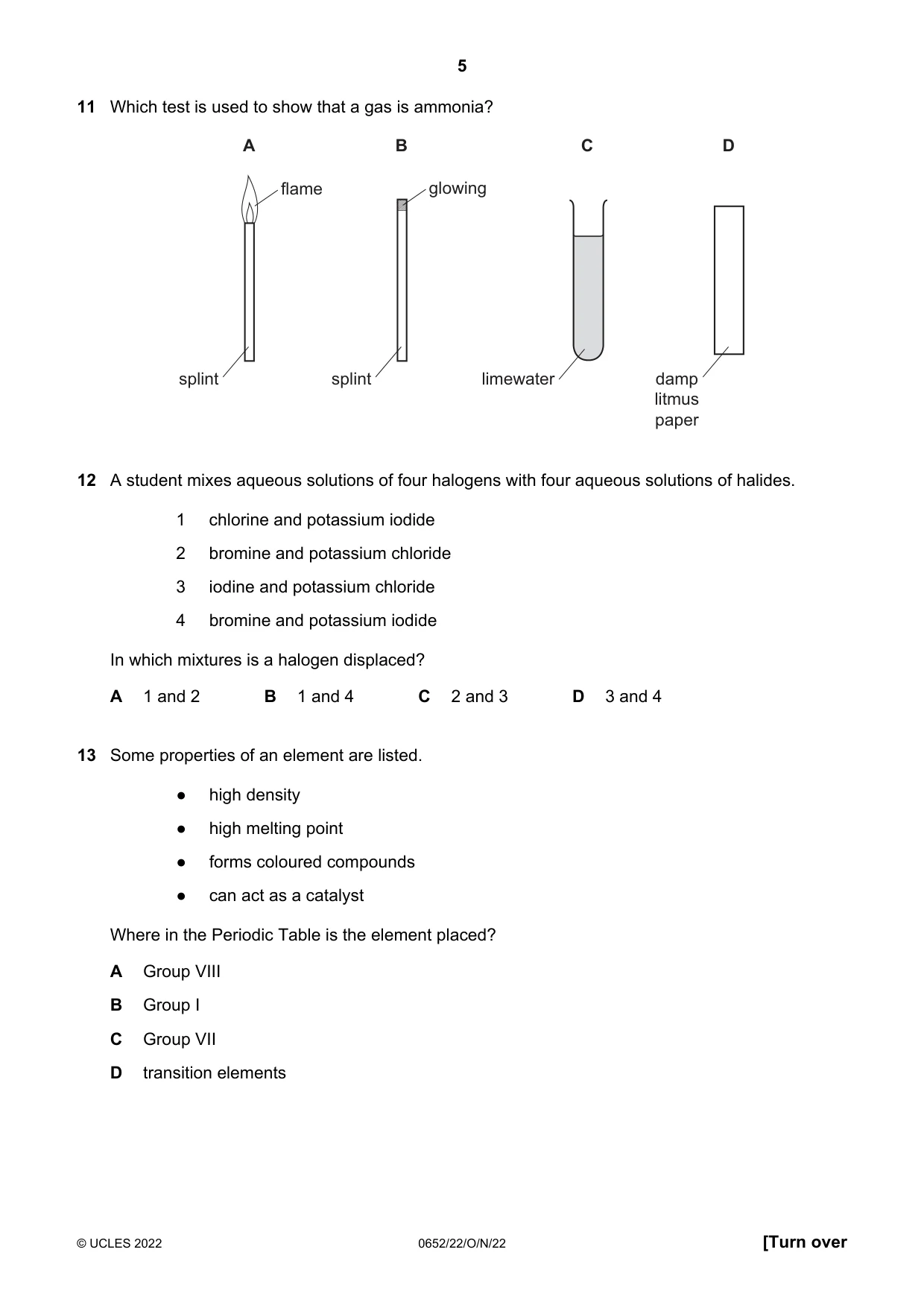
Q11 · Which test is used to show that a gas is ammonia?
11 Which test is used to show that a gas is ammonia? A B C D flame glowing splint splint limewater damp litmus paper
Mark scheme: D
Q12 · A student mixes aqueous solutions of four halogens with four aqueous solutions of halides
12 A student mixes aqueous solutions of four halogens with four aqueous solutions of halides. 1 chlorine and potassium iodide 2 bromine and potassium chloride 3 iodine and potassium chloride 4 bromine and potassium iodide In which mixtures is a halogen displaced? A 1 and 2 B 1 and 4 C 2 and 3 D 3 and 4
Mark scheme: B
Q13 · Some properties of an element are listed
13 Some properties of an element are listed. ● high density ● high melting point ● forms coloured compounds ● can act as a catalyst Where in the Periodic Table is the element placed? A Group VIII B Group I C Group VII D transition elements
Mark scheme: D
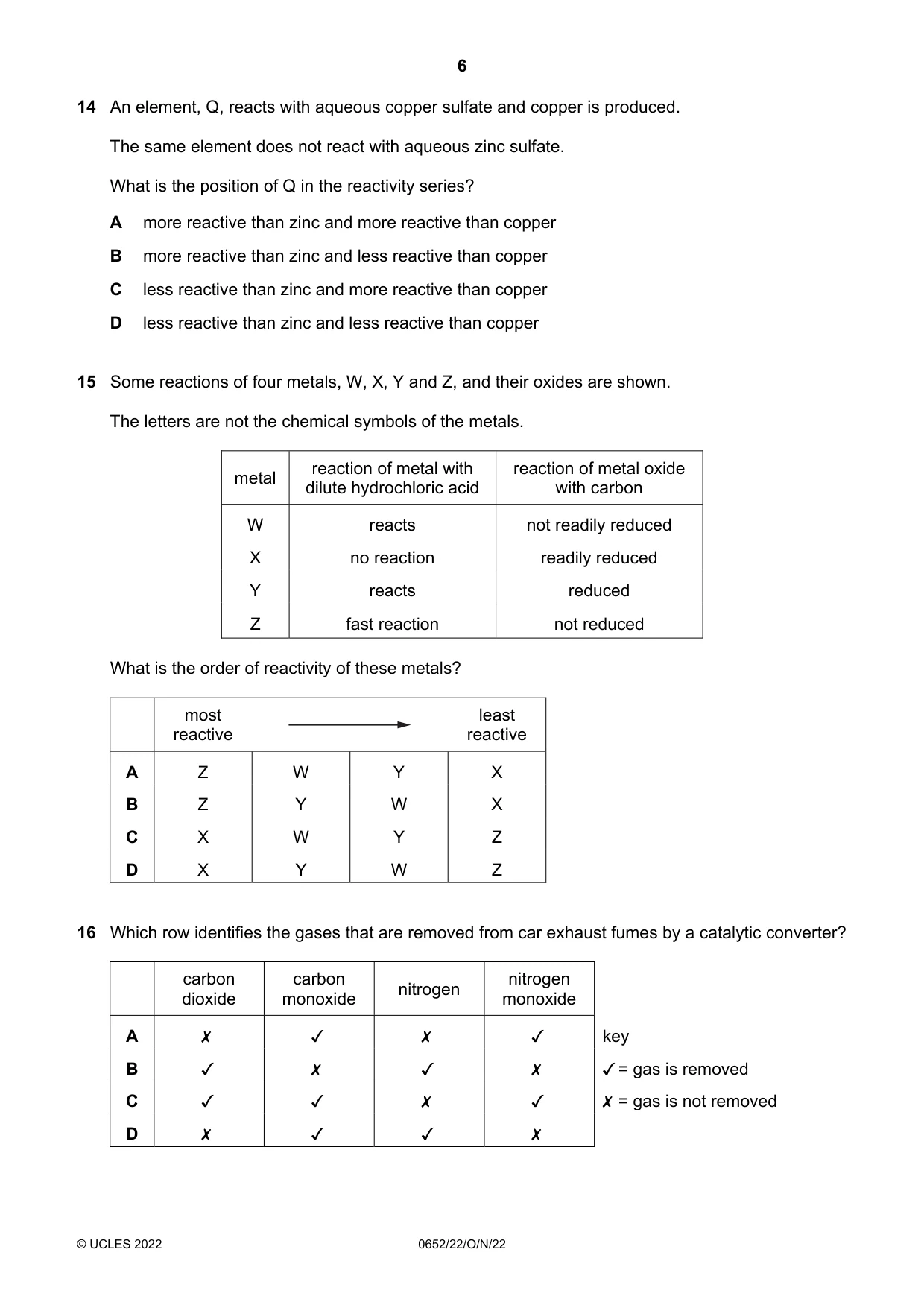
Q14 · An element, Q, reacts with aqueous copper sulfate and copper is produced
14 An element, Q, reacts with aqueous copper sulfate and copper is produced. The same element does not react with aqueous zinc sulfate. What is the position of Q in the reactivity series? A more reactive than zinc and more reactive than copper B more reactive than zinc and less reactive than copper C less reactive than zinc and more reactive than copper D less reactive than zinc and less reactive than copper
Mark scheme: C
Q15 · Some reactions of four metals, W, X, Y and Z, and their oxides are shown
15 Some reactions of four metals, W, X, Y and Z, and their oxides are shown. The letters are not the chemical symbols of the metals. reaction of metal with reaction of metal oxide metal dilute hydrochloric acid with carbon W reacts not readily reduced X no reaction readily reduced Y reacts reduced Z fast reaction not reduced What is the order of reactivity of these metals? most least reactive reactive A Z W Y X B Z Y W X C X W Y Z D X Y W Z
Mark scheme: A
Q16 · Which row identifies the gases that are removed from car exhaust fumes by a catalytic…
16 Which row identifies the gases that are removed from car exhaust fumes by a catalytic converter? A x J x J key B Jv x v x / = gas is removed Cc Jv Jv x Jv X = gas is not removed D x J Jv x
Mark scheme: A
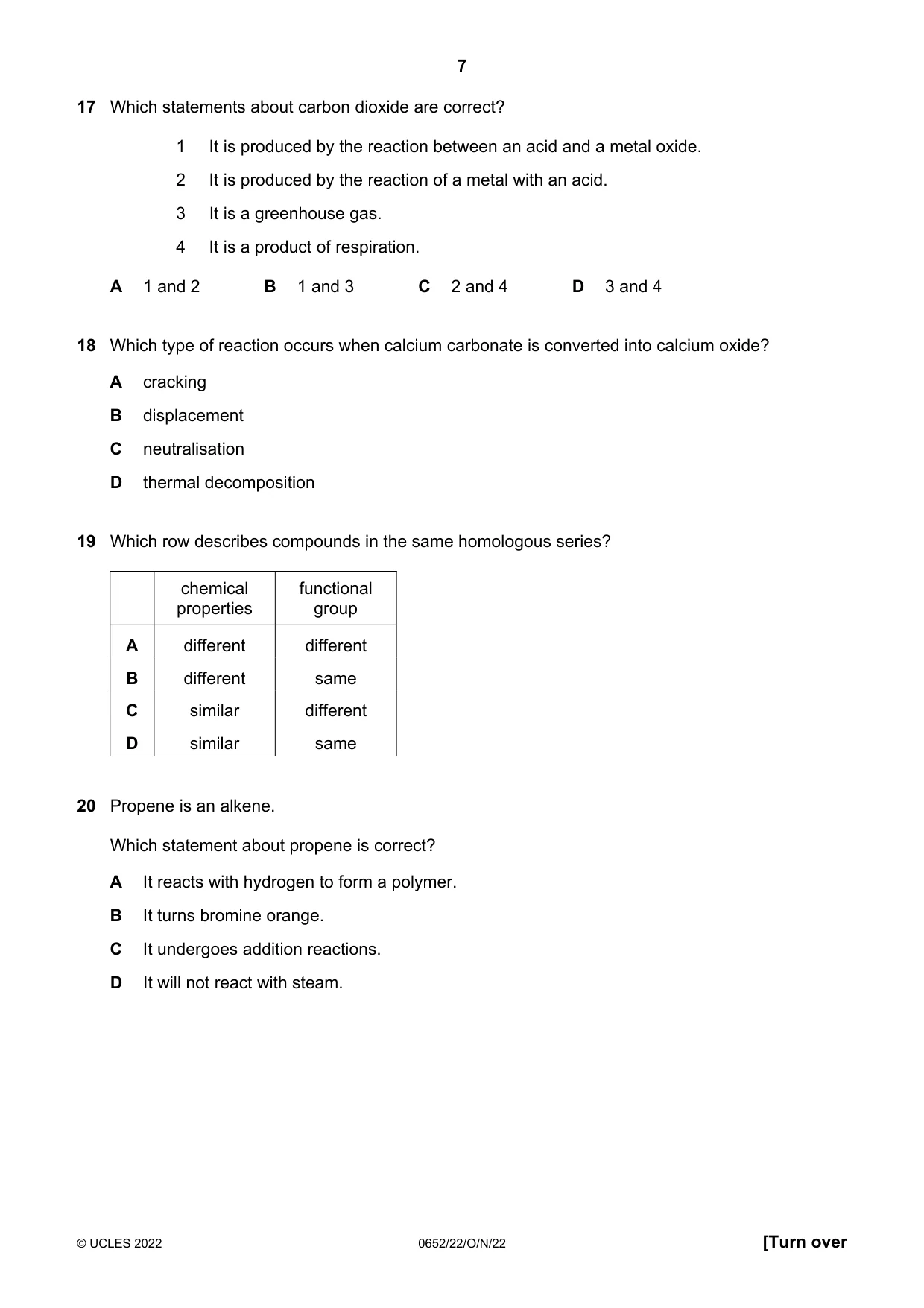
Q17 · Which statements about carbon dioxide are correct?
17 Which statements about carbon dioxide are correct? 1 It is produced by the reaction between an acid and a metal oxide. 2 It is produced by the reaction of a metal with an acid. 3 It is a greenhouse gas. 4 It is a product of respiration. A 1 and 2 B 1 and 3 C 2 and 4 D 3 and 4
Mark scheme: D
Q18 · Which type of reaction occurs when calcium carbonate is converted into calcium oxide?
18 Which type of reaction occurs when calcium carbonate is converted into calcium oxide? A cracking B displacement C neutralisation D thermal decomposition
Mark scheme: D
Q19 · Which row describes compounds in the same homologous series?
19 Which row describes compounds in the same homologous series? chemical functional properties group A different different B different same C similar different D similar same
Mark scheme: D
Q20 · Propene is an alkene
20 Propene is an alkene. Which statement about propene is correct? A It reacts with hydrogen to form a polymer. B It turns bromine orange. C It undergoes addition reactions. D It will not react with steam.
Mark scheme: C
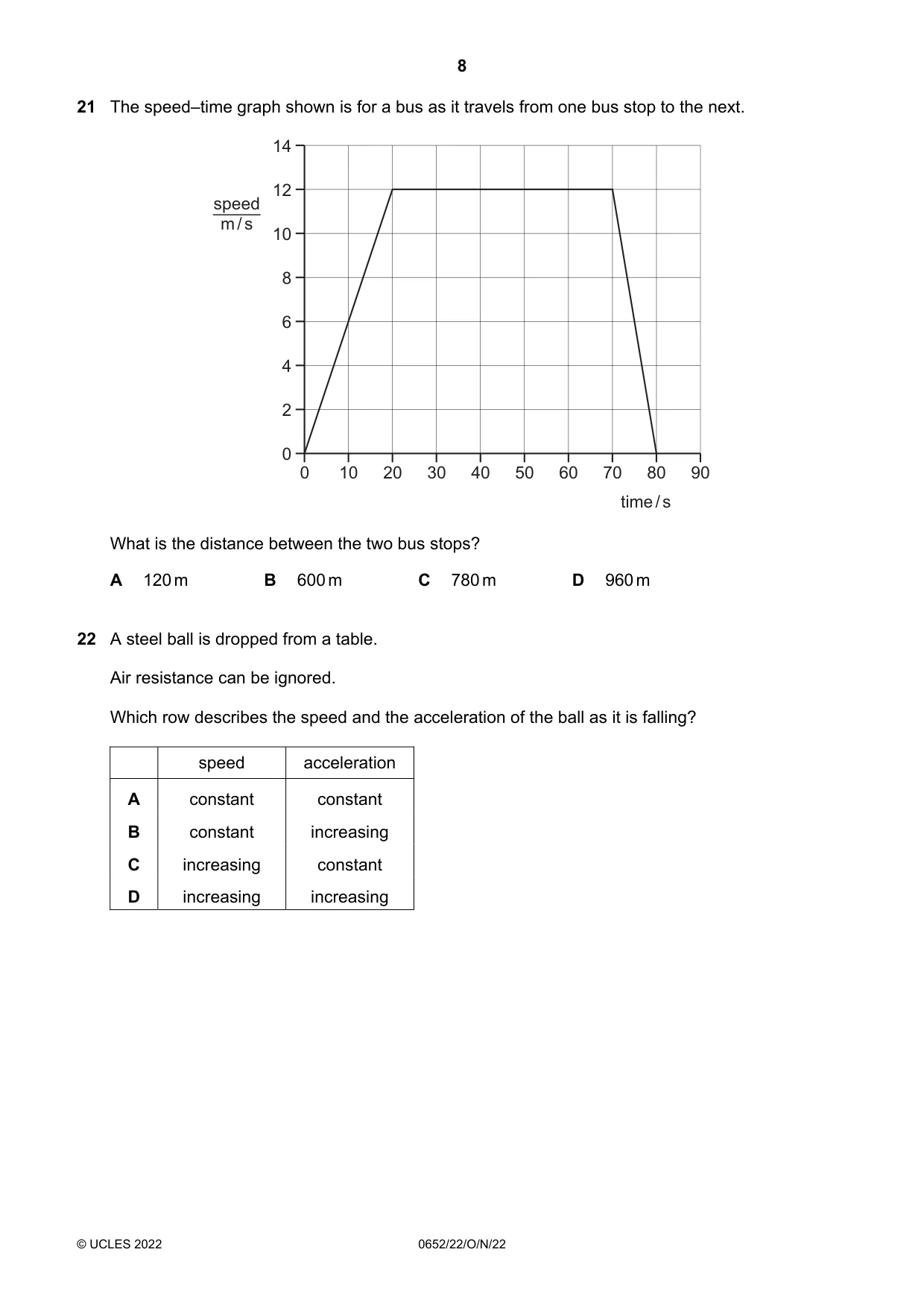
Q21 · The speed–time graph shown is for a bus as it travels from one bus stop to the next
21 The speed–time graph shown is for a bus as it travels from one bus stop to the next. 14 12 speed m / s 10 8 6 4 2 0 0 10 20 30 40 50 60 70 80 90 time / s What is the distance between the two bus stops? A 120 m B 600 m C 780 m D 960 m
Mark scheme: C
Q22 · A steel ball is dropped from a table
22 A steel ball is dropped from a table. Air resistance can be ignored. Which row describes the speed and the acceleration of the ball as it is falling? speed acceleration A constant constant B constant increasing C increasing constant D increasing increasing
Mark scheme: C
Q23 · A measuring cylinder containing water rests on a balance, as shown in diagram 1
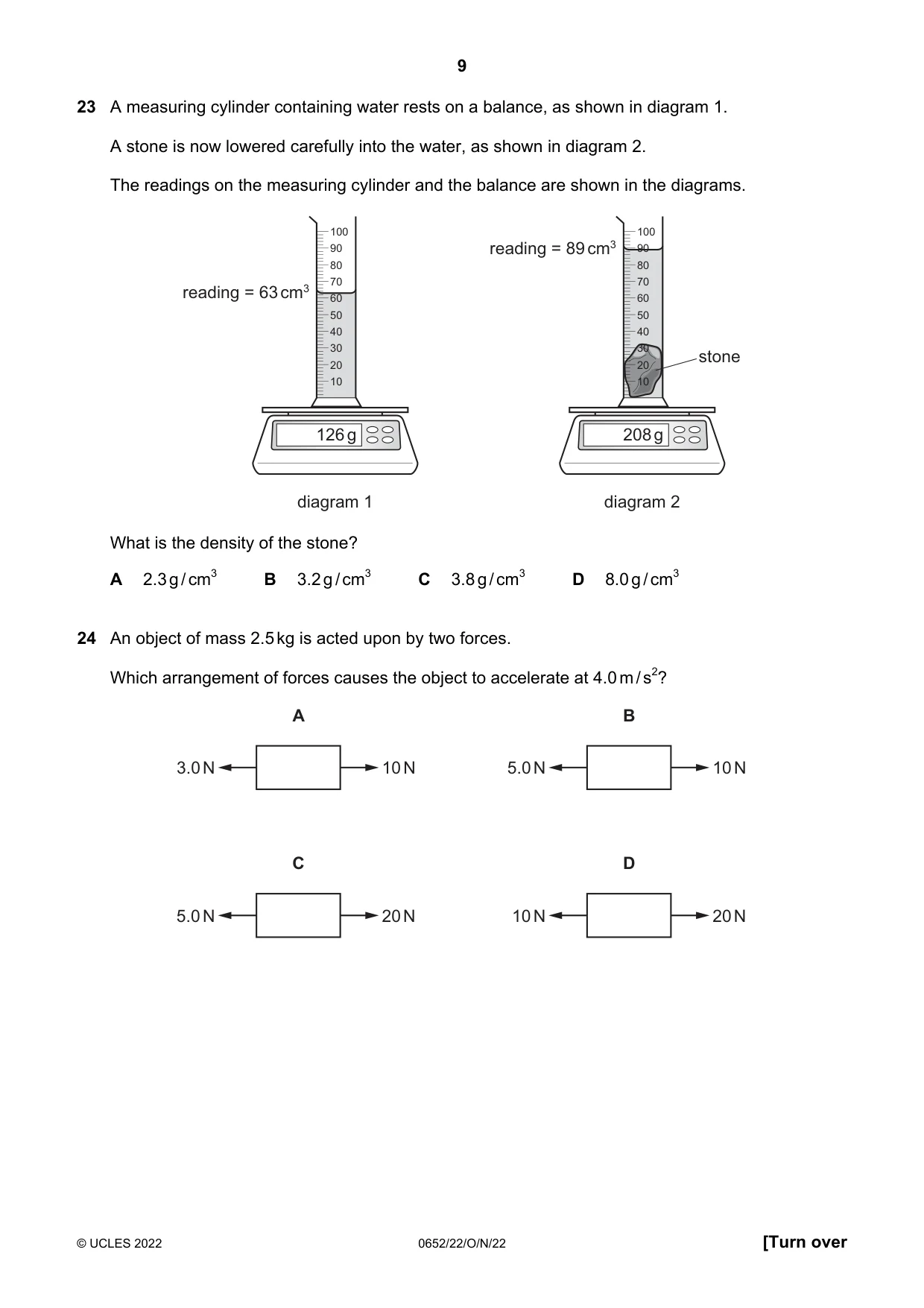
23 A measuring cylinder containing water rests on a balance, as shown in diagram 1. A stone is now lowered carefully into the water, as shown in diagram 2. The readings on the measuring cylinder and the balance are shown in the diagrams. 100 100 90 reading = 89 cm3 90 80 80 reading = 63 cm3 70 70 60 60 50 50 40 40 30 30 stone 20 20 10 10 126 g 208 g diagram 1 diagram 2 What is the density of the stone? A 2.3 g / cm3 B 3.2 g / cm3 C 3.8 g / cm3 D 8.0 g / cm3
Mark scheme: B
Q24 · An object of mass 2.5 kg is acted upon by two forces
24 An object of mass 2.5 kg is acted upon by two forces. Which arrangement of forces causes the object to accelerate at 4.0 m / s2? A B 3.0 N 10 N 5.0 N 10 N C D 5.0 N 20 N 10 N 20 N
Mark scheme: D
Q25 · A stool of weight 620 N has four legs
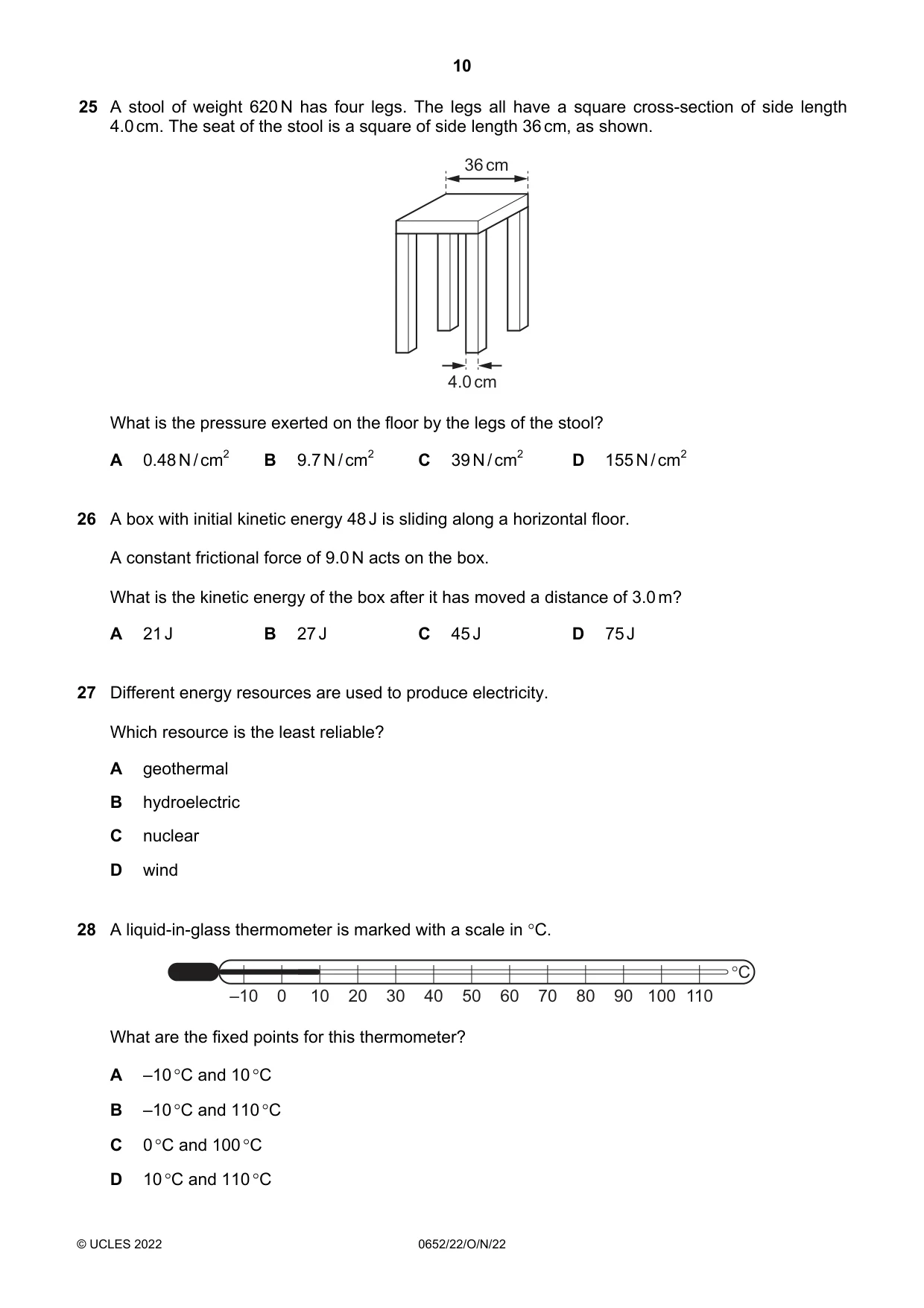
25 A stool of weight 620 N has four legs. The legs all have a square cross-section of side length 4.0 cm. The seat of the stool is a square of side length 36 cm, as shown. 36 cm 4.0 cm What is the pressure exerted on the floor by the legs of the stool? A 0.48 N / cm2 B 9.7 N / cm2 C 39 N / cm2 D 155 N / cm2
Mark scheme: B
Q26 · A box with initial kinetic energy 48 J is sliding along a horizontal floor
26 A box with initial kinetic energy 48 J is sliding along a horizontal floor. A constant frictional force of 9.0 N acts on the box. What is the kinetic energy of the box after it has moved a distance of 3.0 m? A 21 J B 27 J C 45 J D 75 J
Mark scheme: A
Q27 · Different energy resources are used to produce electricity
27 Different energy resources are used to produce electricity. Which resource is the least reliable? A geothermal B hydroelectric C nuclear D wind
Mark scheme: D
Q28 · A liquid-in-glass thermometer is marked with a scale in °C
28 A liquid-in-glass thermometer is marked with a scale in °C. -10 0 10 20 30 40 50 60 70 80 90 100 110 What are the fixed points for this thermometer? A -10°C and 10°C B -10°C and 110°C C 0°C and 100°C D 10°C and 110°C
Mark scheme: C
Q29 · Light travelling in medium 1 strikes a boundary with medium 2 and undergoes total…
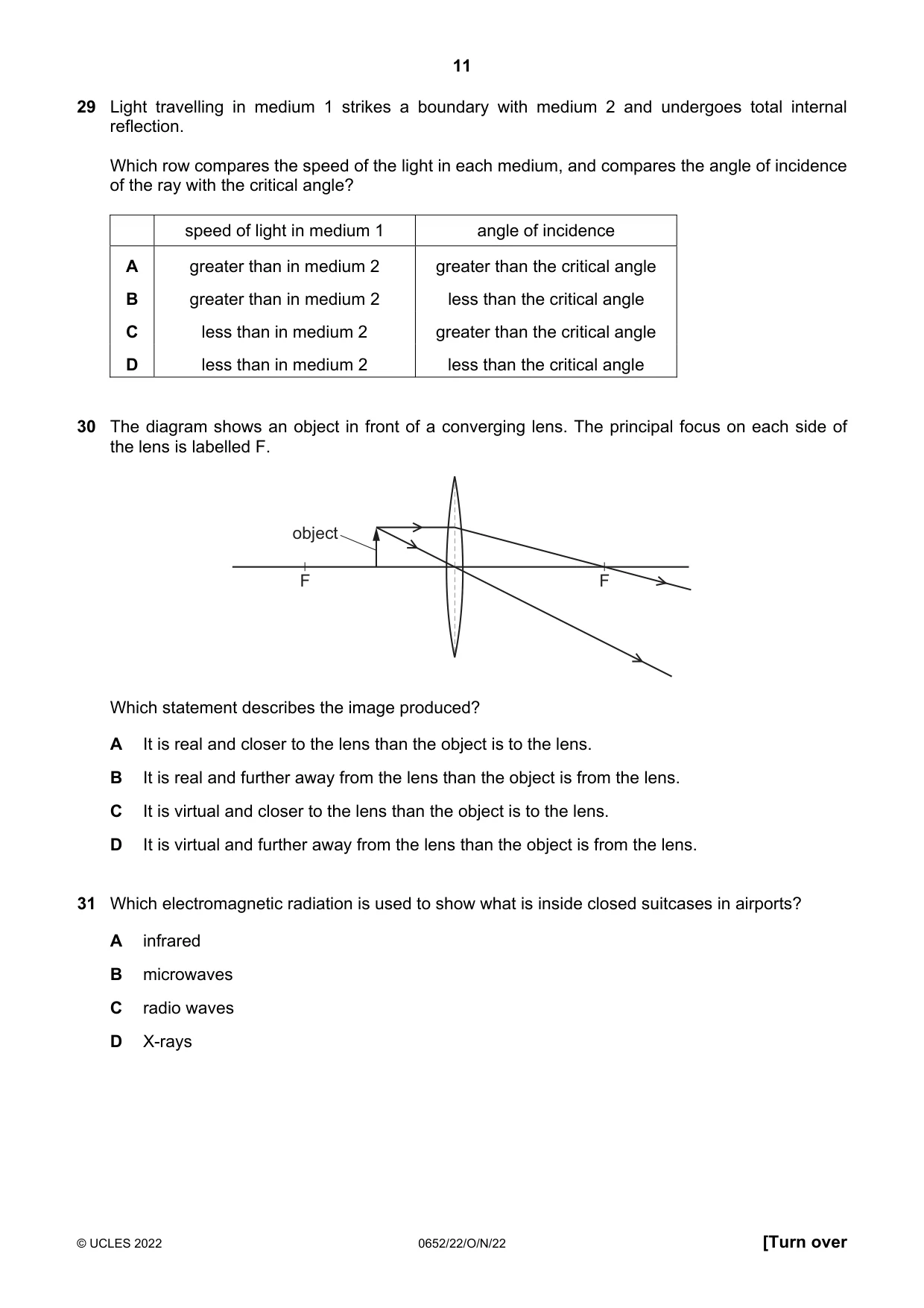
29 Light travelling in medium 1 strikes a boundary with medium 2 and undergoes total internal reflection. Which row compares the speed of the light in each medium, and compares the angle of incidence of the ray with the critical angle? speed of light in medium 1 angle of incidence A greater than in medium 2 greater than the critical angle B greater than in medium 2 less than the critical angle C less than in medium 2 greater than the critical angle D less than in medium 2 less than the critical angle
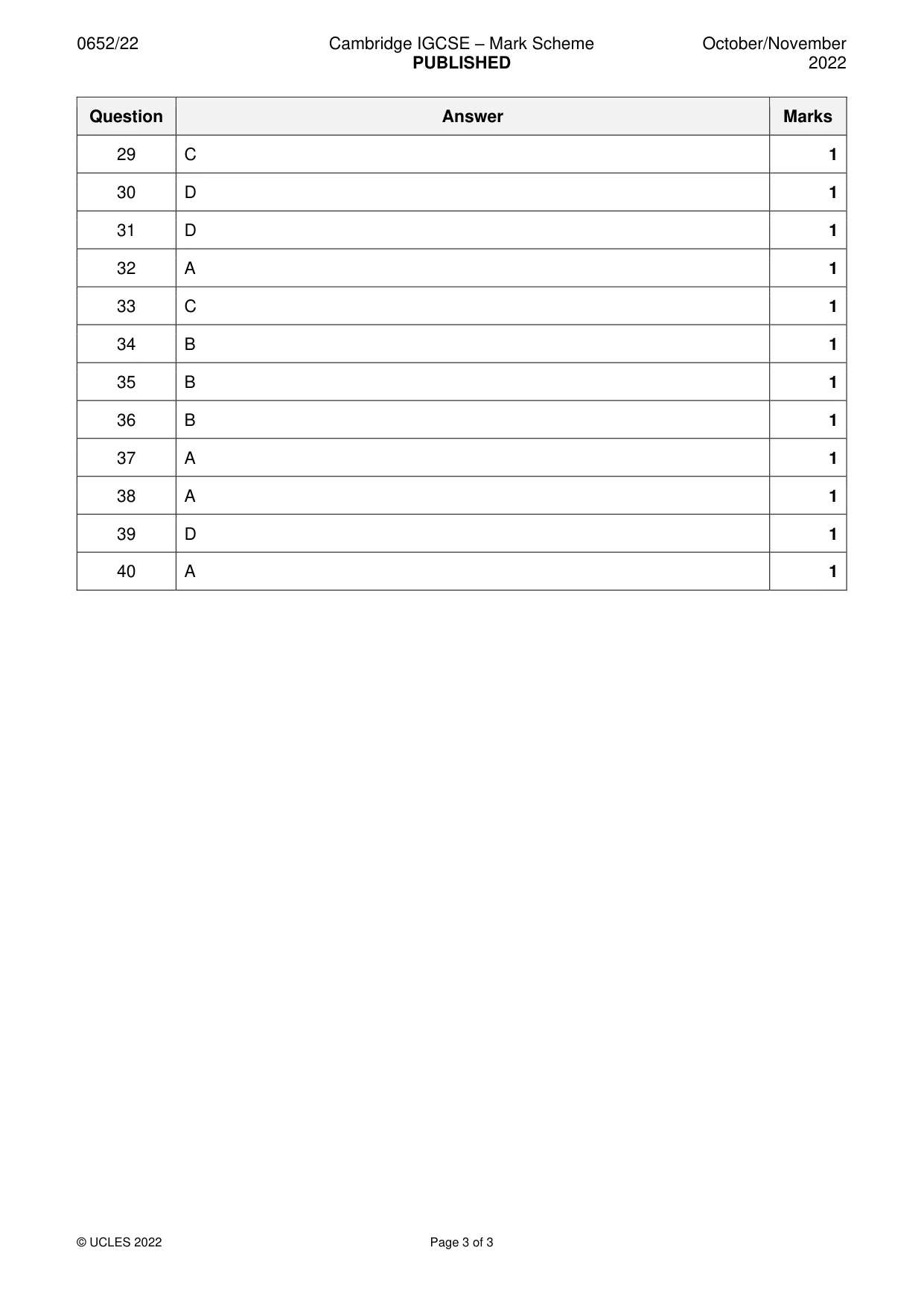
Mark scheme: C
Q30 · The diagram shows an object in front of a converging lens
30 The diagram shows an object in front of a converging lens. The principal focus on each side of the lens is labelled F. object F F Which statement describes the image produced? A It is real and closer to the lens than the object is to the lens. B It is real and further away from the lens than the object is from the lens. C It is virtual and closer to the lens than the object is to the lens. D It is virtual and further away from the lens than the object is from the lens.
Mark scheme: D
Q31 · Which electromagnetic radiation is used to show what is inside closed suitcases in…
31 Which electromagnetic radiation is used to show what is inside closed suitcases in airports? A infrared B microwaves C radio waves D X-rays
Mark scheme: D
Q32 · Three objects, P, Q and R, vibrate with the frequencies shown, producing longitudinal…
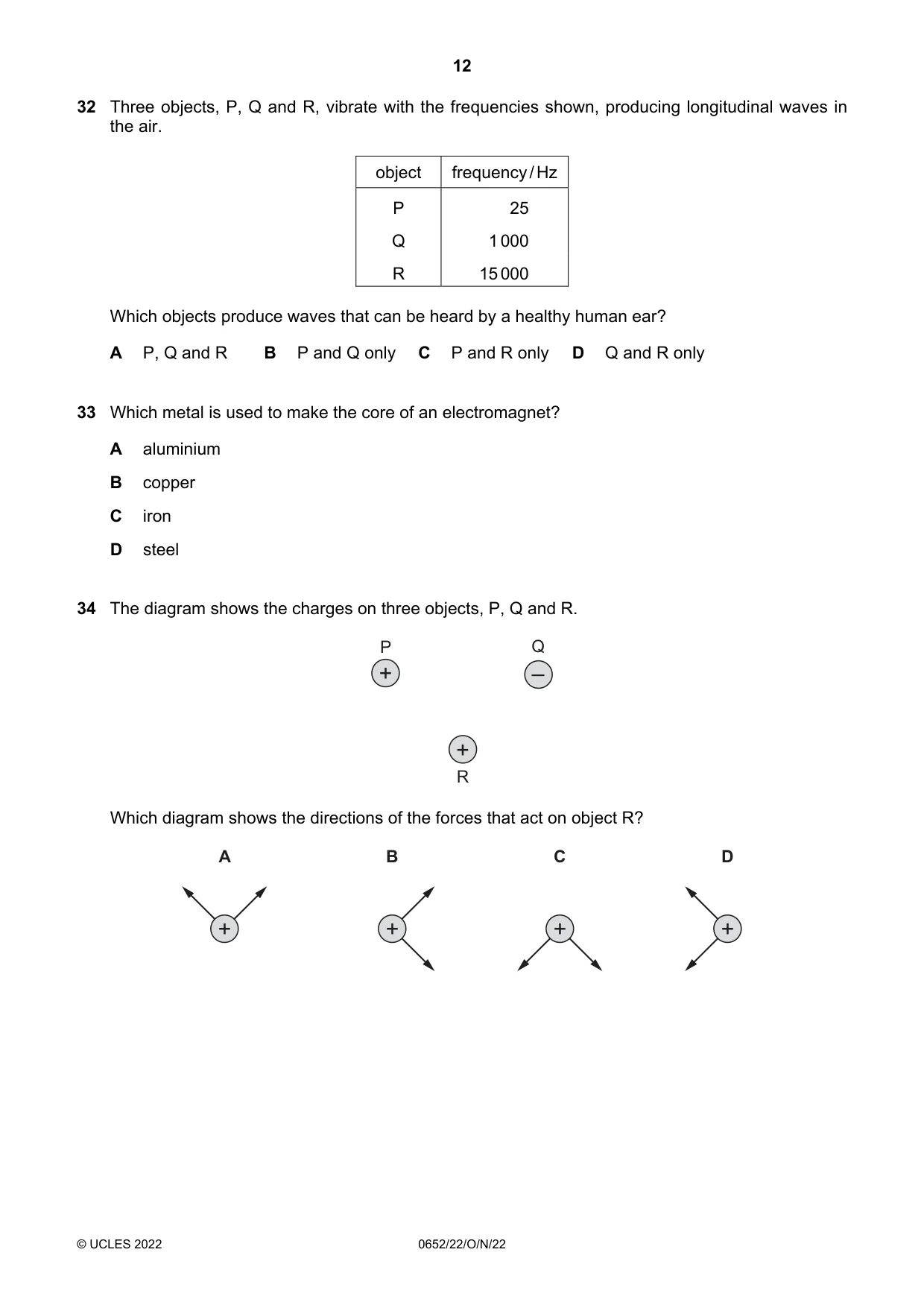
32 Three objects, P, Q and R, vibrate with the frequencies shown, producing longitudinal waves in the air. object frequency / Hz P 25 Q 1 000 R 15 000 Which objects produce waves that can be heard by a healthy human ear? A P, Q and R B P and Q only C P and R only D Q and R only
Mark scheme: A
Q33 · Which metal is used to make the core of an electromagnet?
33 Which metal is used to make the core of an electromagnet? A aluminium B copper C iron D steel
Mark scheme: C
Q34 · The diagram shows the charges on three objects, P, Q and R
34 The diagram shows the charges on three objects, P, Q and R. P Q + – + R Which diagram shows the directions of the forces that act on object R? A B C D + + + +
Mark scheme: B
Q35 · Which circuit is used when determining the resistance of the resistor R?
35 Which circuit is used when determining the resistance of the resistor R? A B V A R R A V C D V A R R V A
Mark scheme: B
Q36 · An electric charge of 30 C flows through a conductor in 1.0 minute
36 An electric charge of 30 C flows through a conductor in 1.0 minute. What is the current in the conductor? A 0.033 A B 0.50 A C 2.0 A D 30 A
Mark scheme: B
Q37 · The diagram shows an ammeter and four identical resistors connected to a cell
37 The diagram shows an ammeter and four identical resistors connected to a cell. One resistor is labelled X. V I A X The potential difference (p.d.) across the cell is V, and the current in the ammeter is I. What is the current in resistor X, and what is the p.d. across resistor X? current in X p.d. across X I V A 2 2 I B V 2 V C I 2 D I V
Mark scheme: A
Q38 · What is the benefit of earthing the metal case of an electric kettle?
38 What is the benefit of earthing the metal case of an electric kettle? A It prevents an electric shock if the live wire touches the metal case. B It prevents the insulation of the cable from becoming damaged. C It prevents overheating of the cable. D It prevents overheating of the kettle.
Mark scheme: A
Q39 · Which radioactive emissions are not deflected by electric fields and are also not…
39 Which radioactive emissions are not deflected by electric fields and are also not deflected by magnetic fields? A alpha and beta B alpha only C beta only D gamma only
Mark scheme: D
Q40 · A teacher investigates the radiation emitted by a radioactive source
40 A teacher investigates the radiation emitted by a radioactive source. She places a detector near the source and records how the count rate changes with time. The results are shown on the graph. 30 count rate 25 counts / minute 20 15 10 5 0 0 20 40 60 80 100 time / s Which row gives the count rate due to the source only at the start of the experiment, and the count rate due to background radiation only? count rate due to count rate due to the source only at start background radiation only counts / minute counts / minute A 20 5 B 20 20 C 25 5 D 25 20
Mark scheme: A
What was in this paper
The subtopics covered by these 40 questions, and how many questions each got. Open one in a new tab to see every Cambridge question on it.
2Forces2Light2Motion2Radioactivity2Reactivity series2Simple phenomena of magnetism2Stoichiometry2Work, energy and power2Air1Alkenes1Atomic structure and the Periodic Table1Carbon dioxide and methane1Carbonates1Dangers of electricity1Density1Electrical quantities1Electricity and chemistry1General wave properties1Group properties1Homologous series1Identification of ions and gases1Macromolecules1Methods of purification1Molecules and covalent bonds1Rate (speed) of reaction1Sound1The characteristic properties of acids and bases1The particulate nature of matter1Thermal properties and temperature1Transition elements1What you needed in this session
Cambridge’s own grade thresholds for 2022 Oct/Nov, Paper 2 · Variant 2. A higher threshold means an easier paper — the bar moves with how the cohort did.