Cambridge IGCSE Physical Science 0652 — 2023 Oct/Nov Paper 2 · Variant 2
0652/22/O/N/23 · 40 questions · 40 marks · ≈45 min
The question paper and its mark scheme, free to read here and free to download. This is Cambridge’s own paper, exactly as it was sat.
Question paper16 pages

Mark scheme3 pages
Answers below. Sit the paper first if you are practising.
Questions as text
Q1 · The relative molecular mass of carbon dioxide is 44
1 The relative molecular mass of carbon dioxide is 44. The relative molecular mass of oxygen is 32. Which statement about the rate of diffusion of these gases at the same temperature is correct? A Carbon dioxide diffuses faster because its particles move faster. B Carbon dioxide diffuses faster because its particles move slower. C Oxygen diffuses faster because its particles move faster. D Oxygen diffuses faster because its particles move slower.
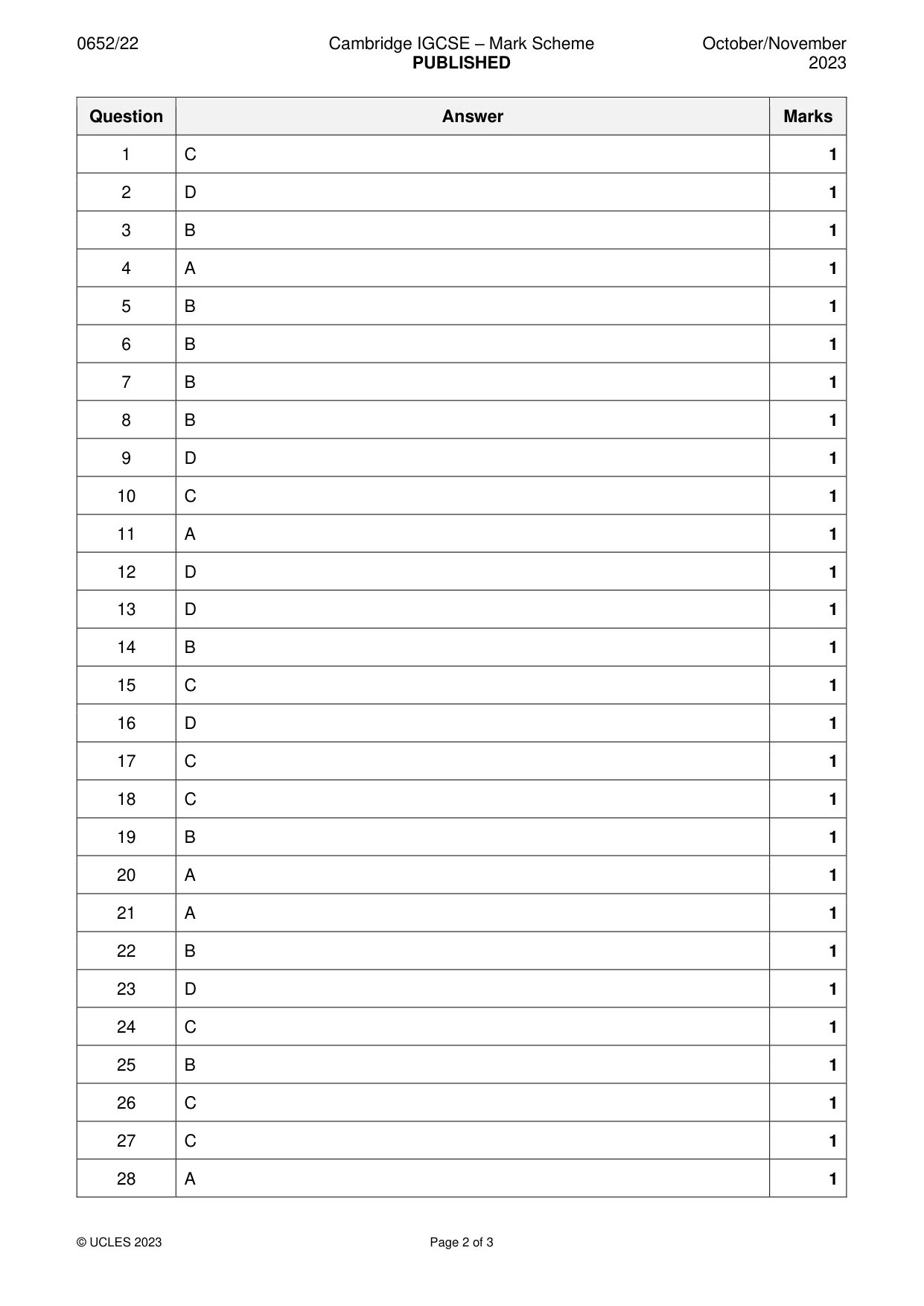
Mark scheme: C
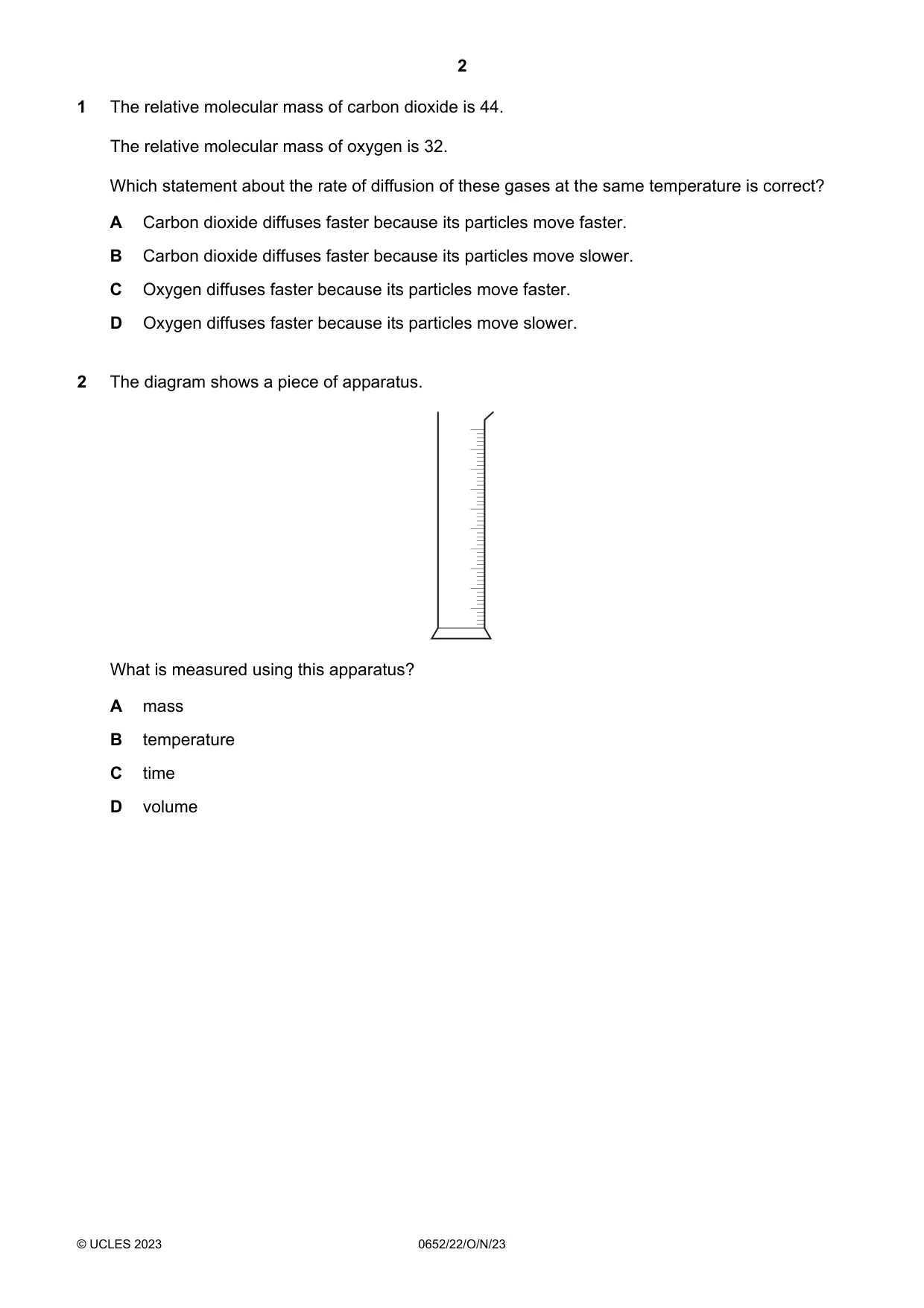
Q2 · The diagram shows a piece of apparatus
2 The diagram shows a piece of apparatus. What is measured using this apparatus? A mass B temperature C time D volume
Mark scheme: D
Q3 · Mixture X is separated into its components W and Y by chromatography
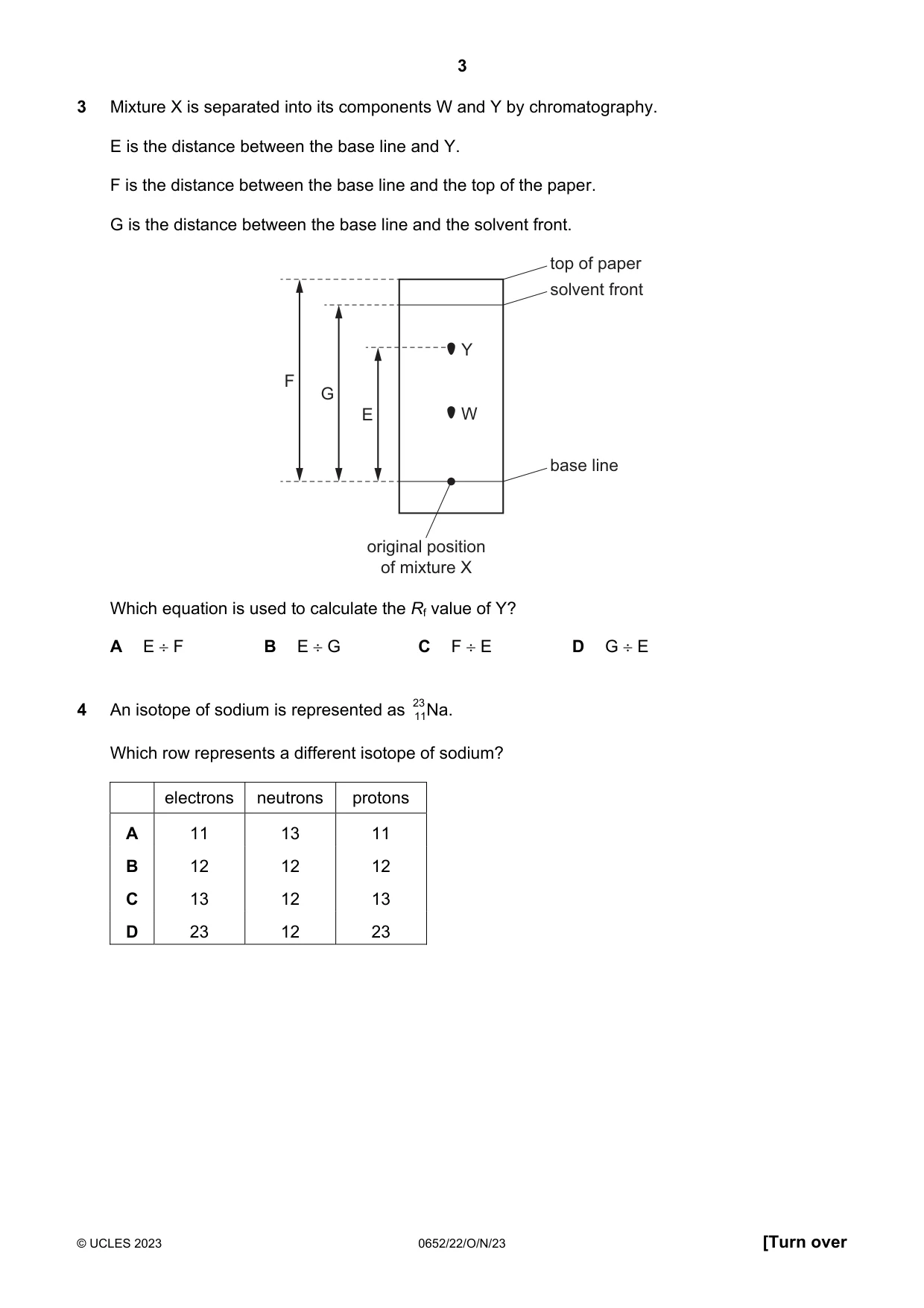
3 Mixture X is separated into its components W and Y by chromatography. E is the distance between the base line and Y. F is the distance between the base line and the top of the paper. G is the distance between the base line and the solvent front. top of paper solvent front Y F G E W base line original position of mixture X Which equation is used to calculate the Rf value of Y? A E F B E G C F E D G E
Mark scheme: B
Q4 · An isotope of sodium is represented as 23 Na
4 An isotope of sodium is represented as 23 Na. 11 Which row represents a different isotope of sodium? electrons neutrons protons A 11 13 11 B 12 12 12 C 13 12 13 D 23 12 23
Mark scheme: A
Q5 · The numbers of protons, neutrons and electrons in particles W, X, Y and Z are shown
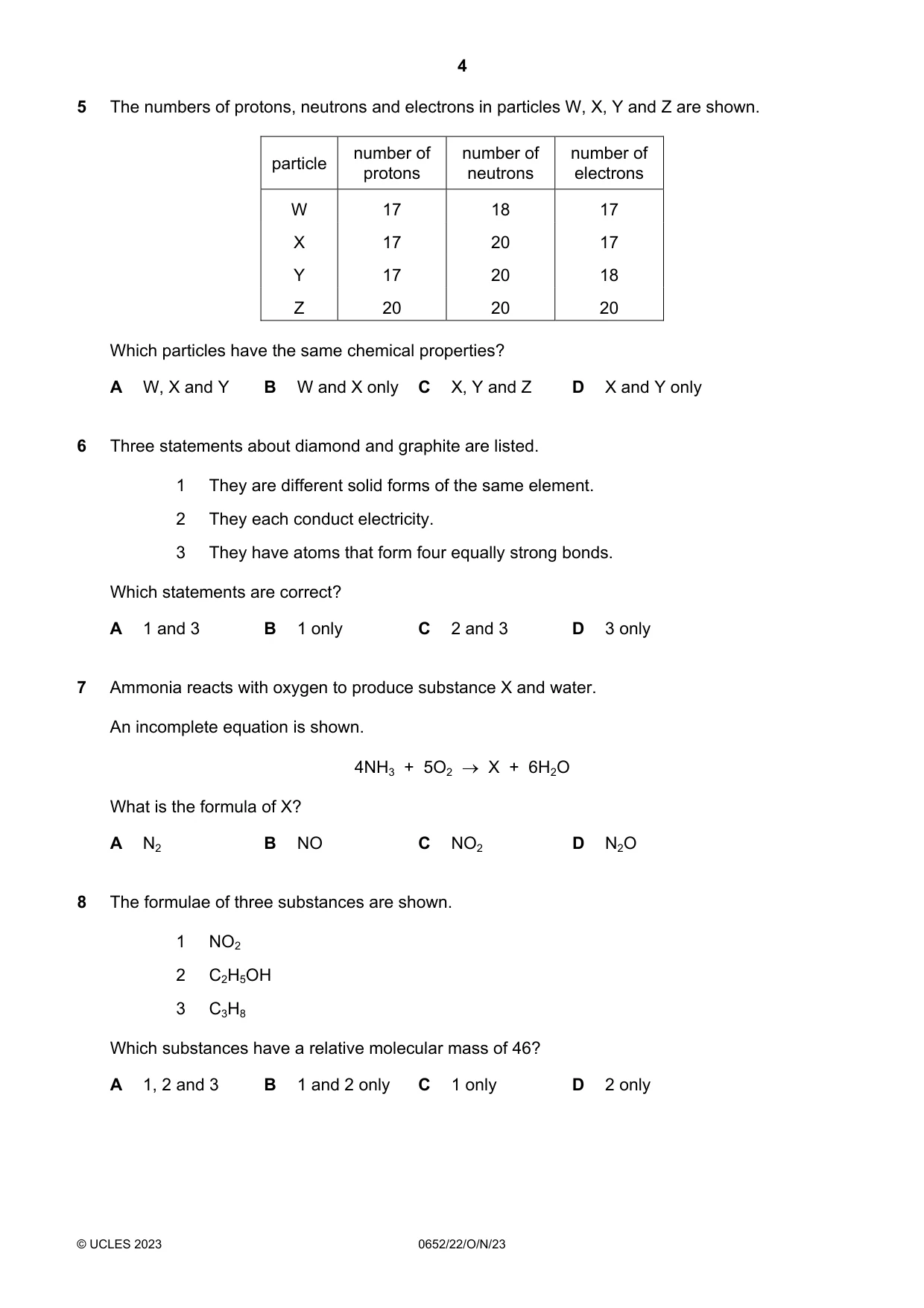
5 The numbers of protons, neutrons and electrons in particles W, X, Y and Z are shown. number of number of number of particle protons neutrons electrons W 17 18 17 X 17 20 17 Y 17 20 18 Z 20 20 20 Which particles have the same chemical properties? A W, X and Y B W and X only C X, Y and Z D X and Y only
Mark scheme: B
Q6 · Three statements about diamond and graphite are listed
6 Three statements about diamond and graphite are listed. 1 They are different solid forms of the same element. 2 They each conduct electricity. 3 They have atoms that form four equally strong bonds. Which statements are correct? A 1 and 3 B 1 only C 2 and 3 D 3 only
Mark scheme: B
Q7 · Ammonia reacts with oxygen to produce substance X and water
7 Ammonia reacts with oxygen to produce substance X and water. An incomplete equation is shown. 4NH3 + 5O2 X + 6H2O What is the formula of X? A N2 B NO C NO2 D N2O
Mark scheme: B
Q8 · The formulae of three substances are shown
8 The formulae of three substances are shown. 1 NO2 2 C2H5OH 3 C3H8 Which substances have a relative molecular mass of 46? A 1, 2 and 3 B 1 and 2 only C 1 only D 2 only
Mark scheme: B
Q9 · Which row describes what happens to the ions at each electrode during electrolysis?
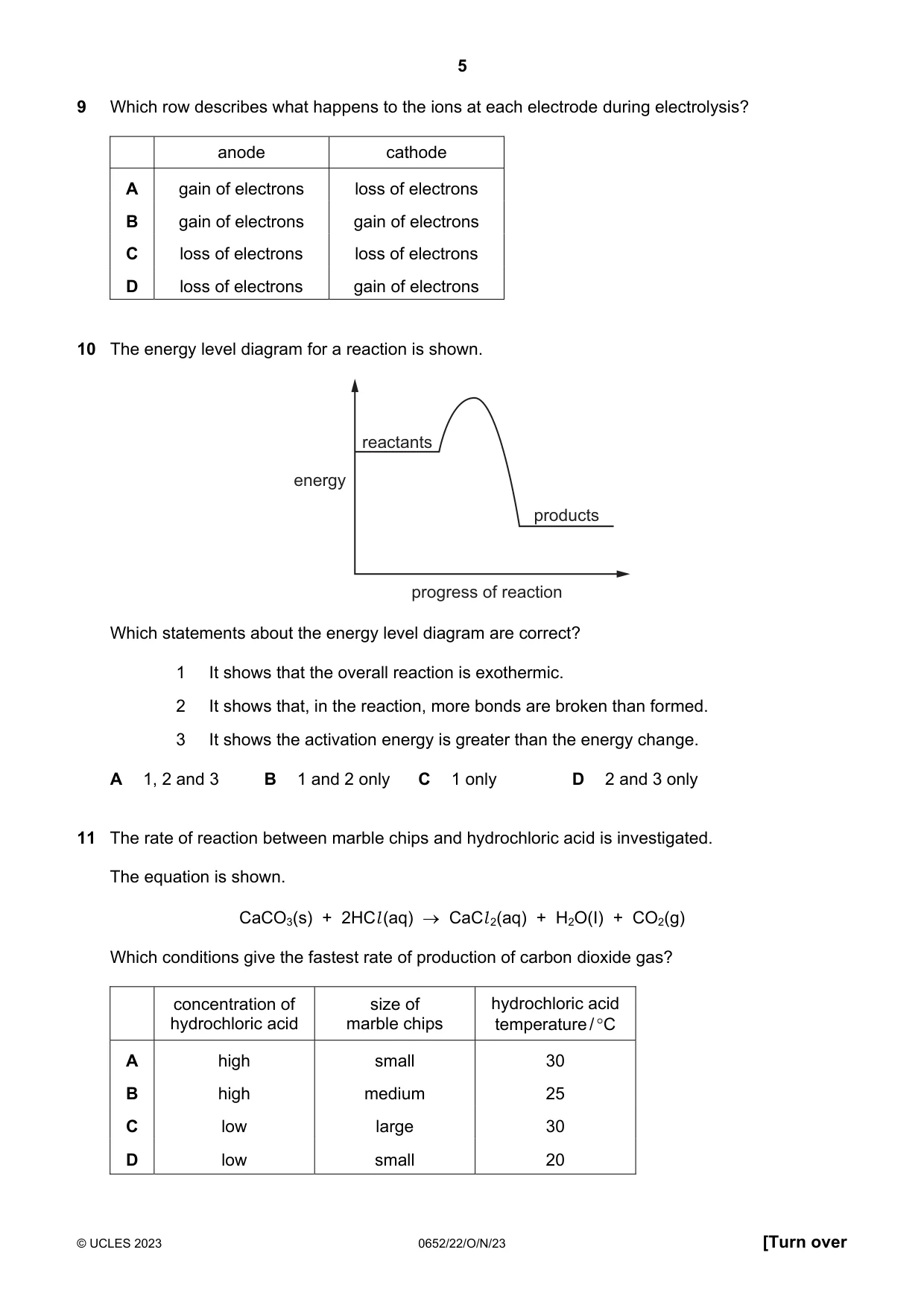
9 Which row describes what happens to the ions at each electrode during electrolysis? anode cathode A gain of electrons loss of electrons B gain of electrons gain of electrons C loss of electrons loss of electrons D loss of electrons gain of electrons
Mark scheme: D
Q10 · The energy level diagram for a reaction is shown
10 The energy level diagram for a reaction is shown. reactants energy products progress of reaction Which statements about the energy level diagram are correct? 1 It shows that the overall reaction is exothermic. 2 It shows that, in the reaction, more bonds are broken than formed. 3 It shows the activation energy is greater than the energy change. A 1, 2 and 3 B 1 and 2 only C 1 only D 2 and 3 only
Mark scheme: C
Q11 · The rate of reaction between marble chips and hydrochloric acid is investigated
11 The rate of reaction between marble chips and hydrochloric acid is investigated. The equation is shown. CaCO3(s) + 2HCl (aq) CaCl 2(aq) + H2O(I) + CO2(g) Which conditions give the fastest rate of production of carbon dioxide gas? concentration of size of hydrochloric acid hydrochloric acid marble chips temperature / C A high small 30 B high medium 25 C low large 30 D low small 20
Mark scheme: A
Q12 · Lead is extracted from its ore using carbon monoxide
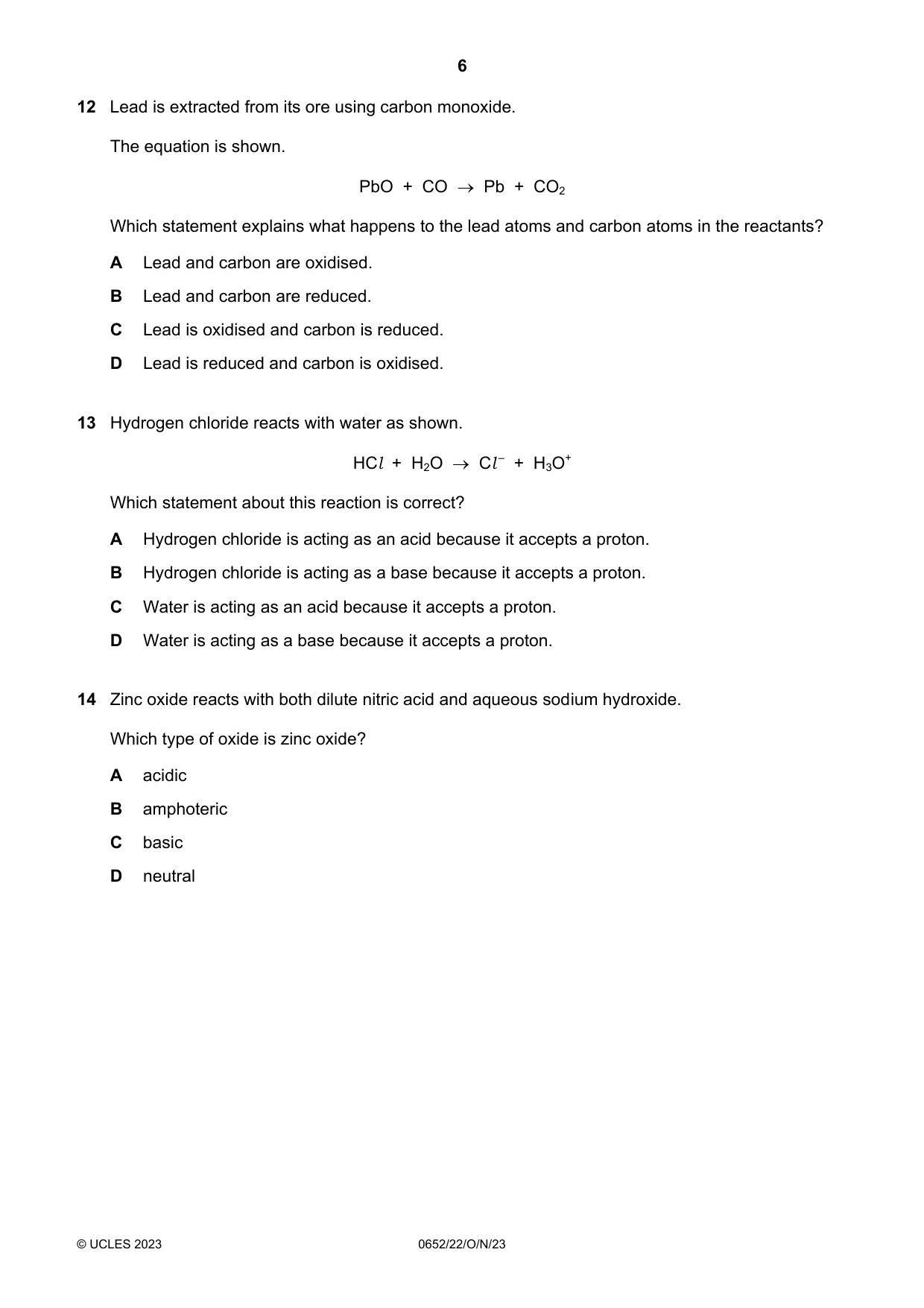
12 Lead is extracted from its ore using carbon monoxide. The equation is shown. PbO + CO Pb + CO2 Which statement explains what happens to the lead atoms and carbon atoms in the reactants? A Lead and carbon are oxidised. B Lead and carbon are reduced. C Lead is oxidised and carbon is reduced. D Lead is reduced and carbon is oxidised.
Mark scheme: D
Q13 · Hydrogen chloride reacts with water as shown
13 Hydrogen chloride reacts with water as shown. HCl + H2O Cl – + H3O+ Which statement about this reaction is correct? A Hydrogen chloride is acting as an acid because it accepts a proton. B Hydrogen chloride is acting as a base because it accepts a proton. C Water is acting as an acid because it accepts a proton. D Water is acting as a base because it accepts a proton.
Mark scheme: D
More questions on The characteristic properties of acids and bases
Q14 · Zinc oxide reacts with both dilute nitric acid and aqueous sodium hydroxide
14 Zinc oxide reacts with both dilute nitric acid and aqueous sodium hydroxide. Which type of oxide is zinc oxide? A acidic B amphoteric C basic D neutral
Mark scheme: B
Q15 · Elements in the Periodic Table are arranged in groups
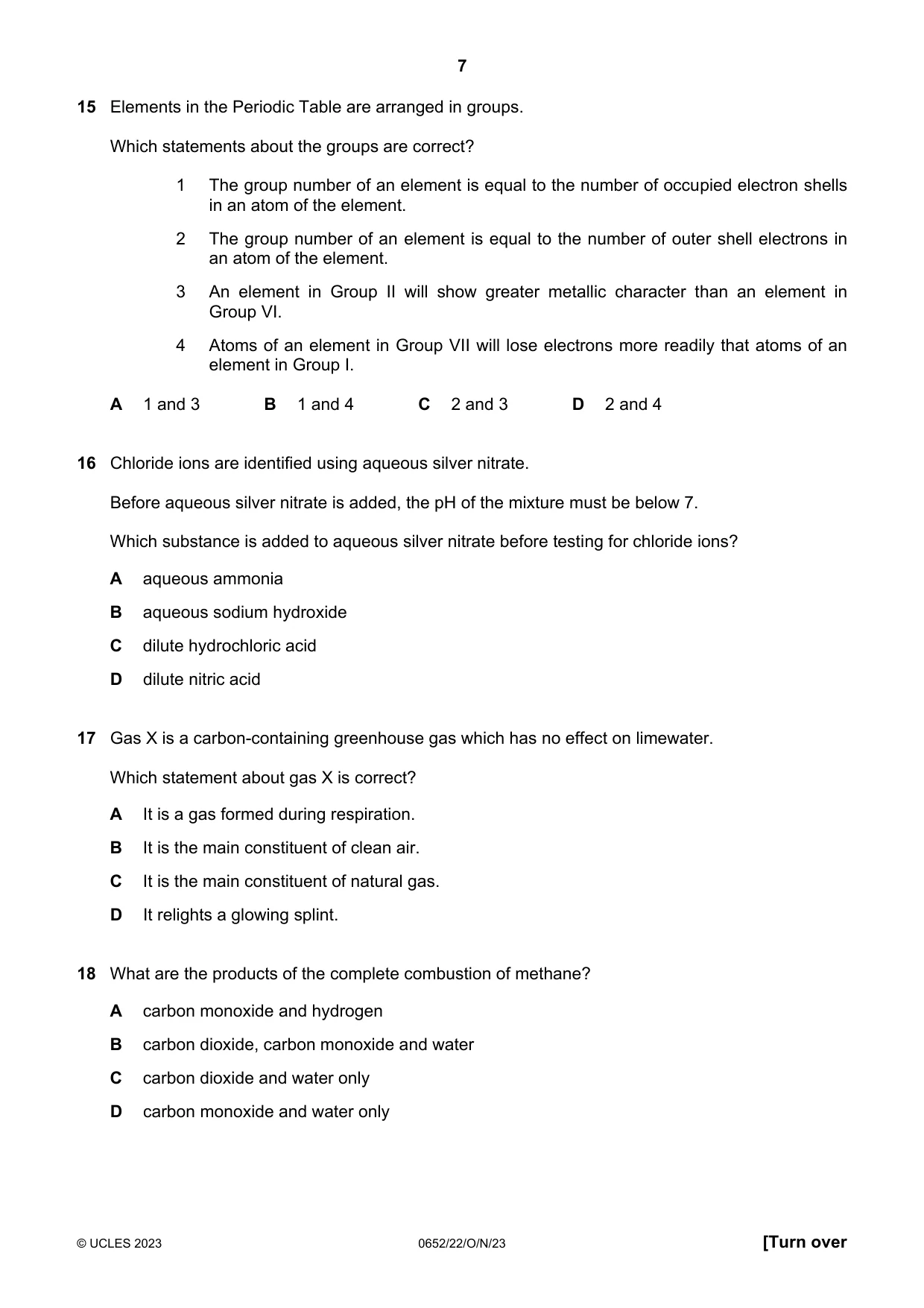
15 Elements in the Periodic Table are arranged in groups. Which statements about the groups are correct? 1 The group number of an element is equal to the number of occupied electron shells in an atom of the element. 2 The group number of an element is equal to the number of outer shell electrons in an atom of the element. 3 An element in Group II will show greater metallic character than an element in Group VI. 4 Atoms of an element in Group VII will lose electrons more readily that atoms of an element in Group I. A 1 and 3 B 1 and 4 C 2 and 3 D 2 and 4
Mark scheme: C
Q16 · Chloride ions are identified using aqueous silver nitrate
16 Chloride ions are identified using aqueous silver nitrate. Before aqueous silver nitrate is added, the pH of the mixture must be below 7. Which substance is added to aqueous silver nitrate before testing for chloride ions? A aqueous ammonia B aqueous sodium hydroxide C dilute hydrochloric acid D dilute nitric acid
Mark scheme: D
Q17 · Gas X is a carbon-containing greenhouse gas which has no effect on limewater
17 Gas X is a carbon-containing greenhouse gas which has no effect on limewater. Which statement about gas X is correct? A It is a gas formed during respiration. B It is the main constituent of clean air. C It is the main constituent of natural gas. D It relights a glowing splint.
Mark scheme: C
Q18 · What are the products of the complete combustion of methane?
18 What are the products of the complete combustion of methane? A carbon monoxide and hydrogen B carbon dioxide, carbon monoxide and water C carbon dioxide and water only D carbon monoxide and water only
Mark scheme: C
Q19 · The formula of but-2-ene is CH3CH=CHCH3
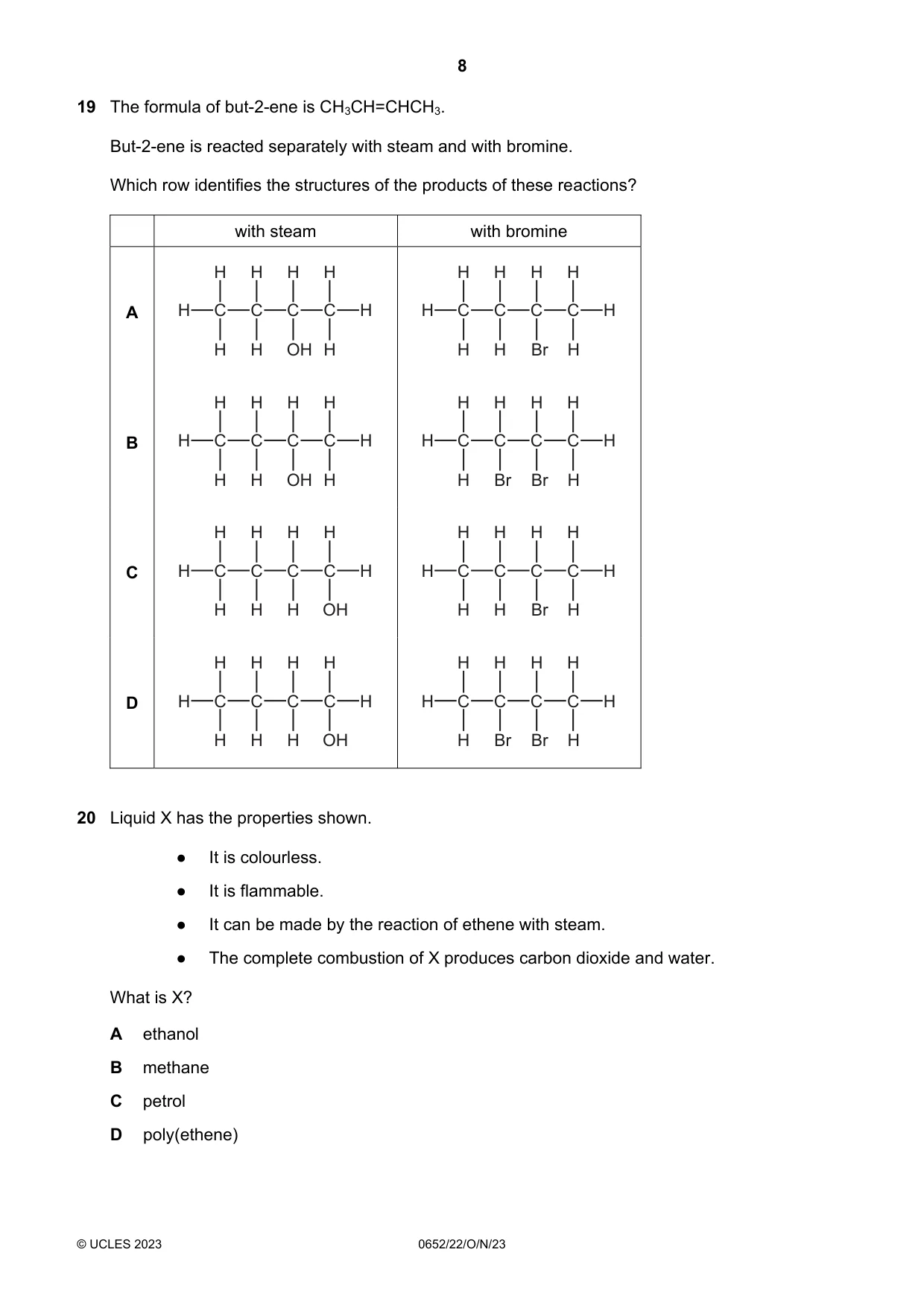
19 The formula of but-2-ene is CH3CH=CHCH3. But-2-ene is reacted separately with steam and with bromine. Which row identifies the structures of the products of these reactions? with steam with bromine H H H H H H H H A H C C C C H H C C C C H H H OH H H H Br H H H H H H H H H B H C C C C H H C C C C H H H OH H H Br Br H H H H H H H H H C H C C C C H H C C C C H H H H OH H H Br H H H H H H H H H D H C C C C H H C C C C H H H H OH H Br Br H
Mark scheme: B
Q20 · Liquid X has the properties shown
20 Liquid X has the properties shown. ● It is colourless. ● It is flammable. ● It can be made by the reaction of ethene with steam. ● The complete combustion of X produces carbon dioxide and water. What is X? A ethanol B methane C petrol D poly(ethene)
Mark scheme: A
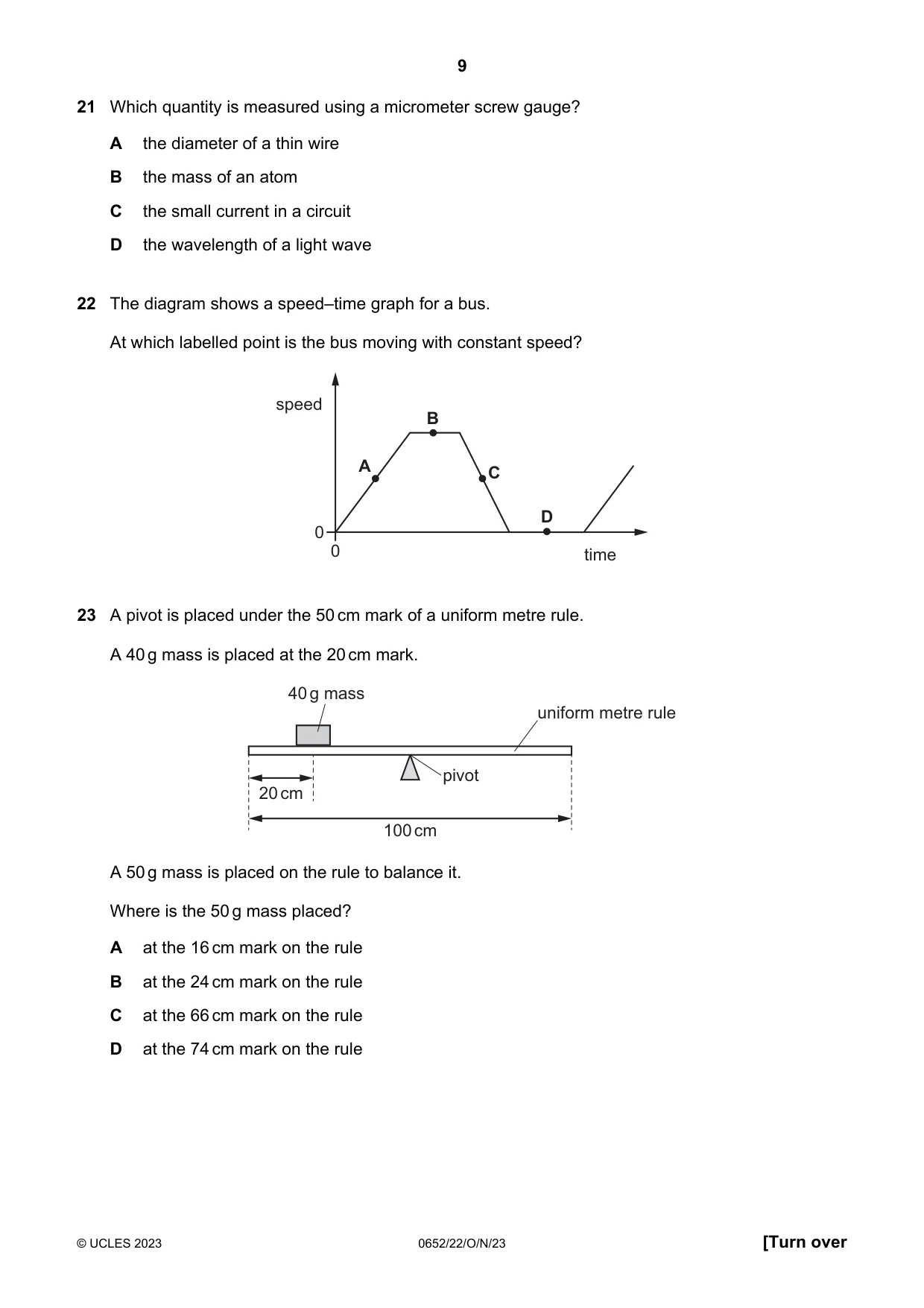
Q21 · Which quantity is measured using a micrometer screw gauge?
21 Which quantity is measured using a micrometer screw gauge? A the diameter of a thin wire B the mass of an atom C the small current in a circuit D the wavelength of a light wave
Mark scheme: A
Q22 · The diagram shows a speed–time graph for a bus
22 The diagram shows a speed–time graph for a bus. At which labelled point is the bus moving with constant speed? speed B A C D 0 0 time
Mark scheme: B
Q23 · A pivot is placed under the 50 cm mark of a uniform metre rule
23 A pivot is placed under the 50 cm mark of a uniform metre rule. A 40 g mass is placed at the 20 cm mark. 40 g mass uniform metre rule pivot 20 cm 100 cm A 50 g mass is placed on the rule to balance it. Where is the 50 g mass placed? A at the 16 cm mark on the rule B at the 24 cm mark on the rule C at the 66 cm mark on the rule D at the 74 cm mark on the rule
Mark scheme: D
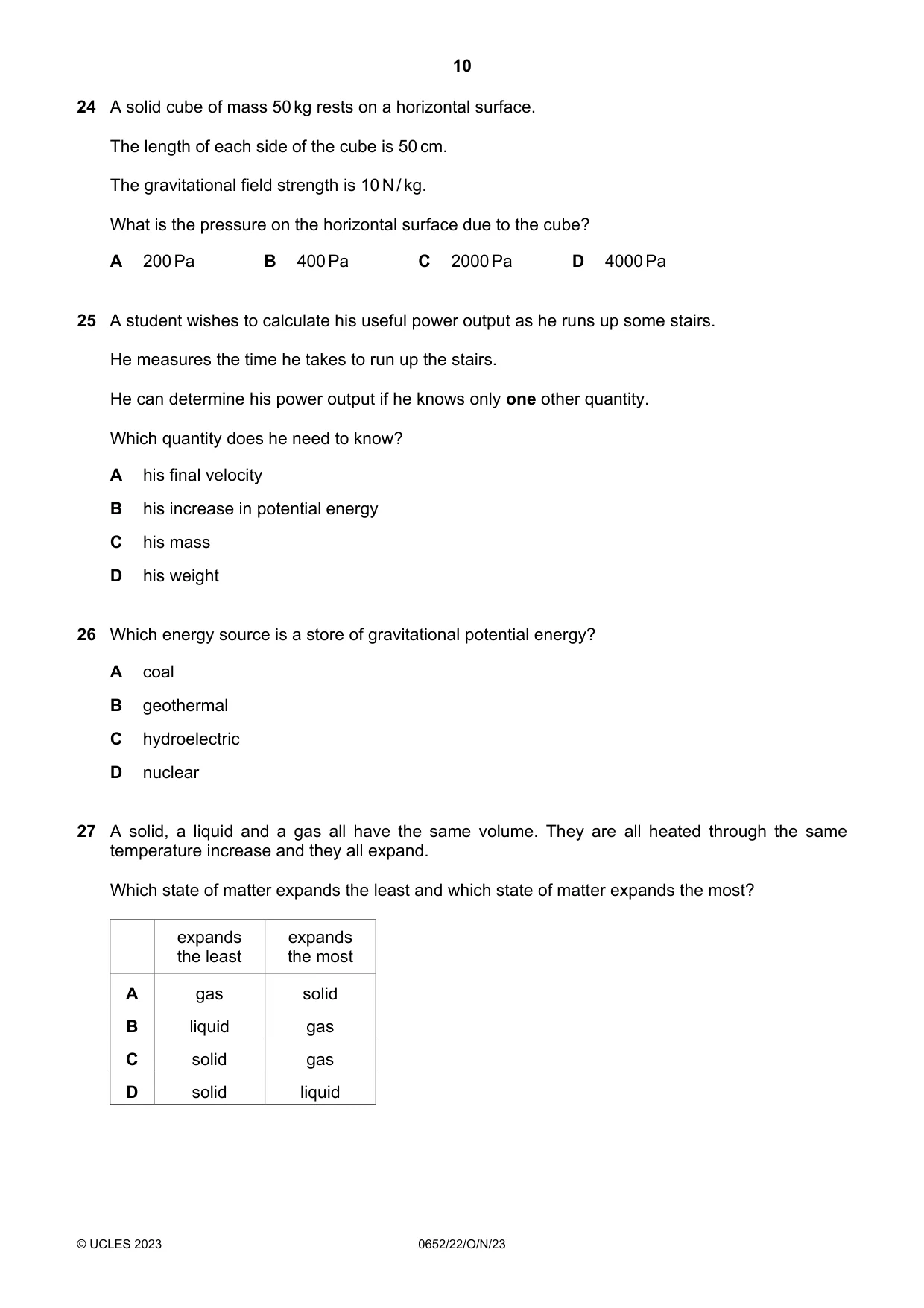
Q24 · A solid cube of mass 50 kg rests on a horizontal surface
24 A solid cube of mass 50 kg rests on a horizontal surface. The length of each side of the cube is 50 cm. The gravitational field strength is 10 N / kg. What is the pressure on the horizontal surface due to the cube? A 200 Pa B 400 Pa C 2000 Pa D 4000 Pa
Mark scheme: C
Q25 · A student wishes to calculate his useful power output as he runs up some stairs
25 A student wishes to calculate his useful power output as he runs up some stairs. He measures the time he takes to run up the stairs. He can determine his power output if he knows only one other quantity. Which quantity does he need to know? A his final velocity B his increase in potential energy C his mass D his weight
Mark scheme: B
Q26 · Which energy source is a store of gravitational potential energy?
26 Which energy source is a store of gravitational potential energy? A coal B geothermal C hydroelectric D nuclear
Mark scheme: C
Q27 · A solid, a liquid and a gas all have the same volume
27 A solid, a liquid and a gas all have the same volume. They are all heated through the same temperature increase and they all expand. Which state of matter expands the least and which state of matter expands the most? expands expands the least the most A gas solid B liquid gas C solid gas D solid liquid
Mark scheme: C
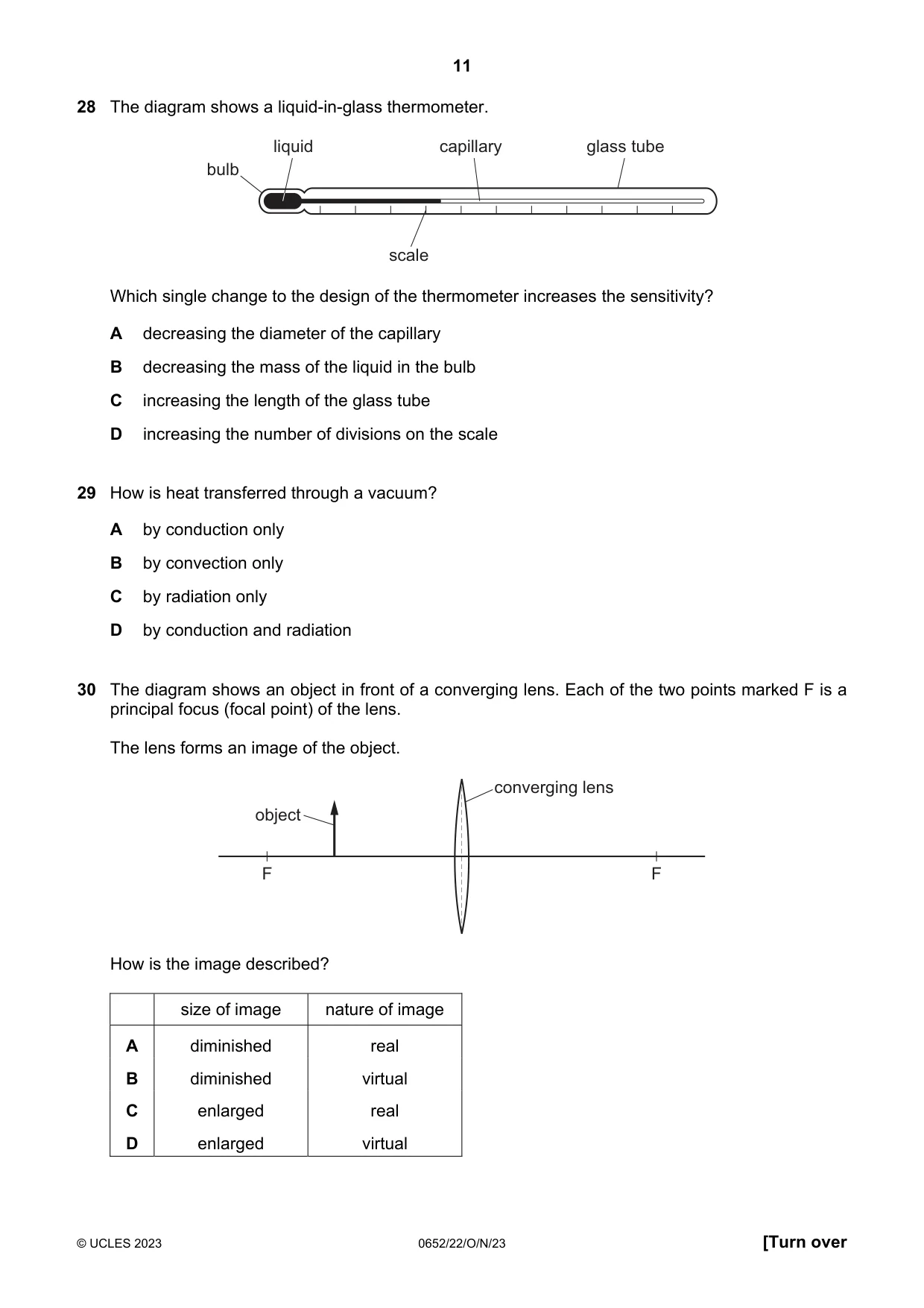
Q28 · The diagram shows a liquid-in-glass thermometer
28 The diagram shows a liquid-in-glass thermometer. liquid capillary glass tube bulb scale Which single change to the design of the thermometer increases the sensitivity? A decreasing the diameter of the capillary B decreasing the mass of the liquid in the bulb C increasing the length of the glass tube D increasing the number of divisions on the scale
Mark scheme: A
Q29 · How is heat transferred through a vacuum?
29 How is heat transferred through a vacuum? A by conduction only B by convection only C by radiation only D by conduction and radiation
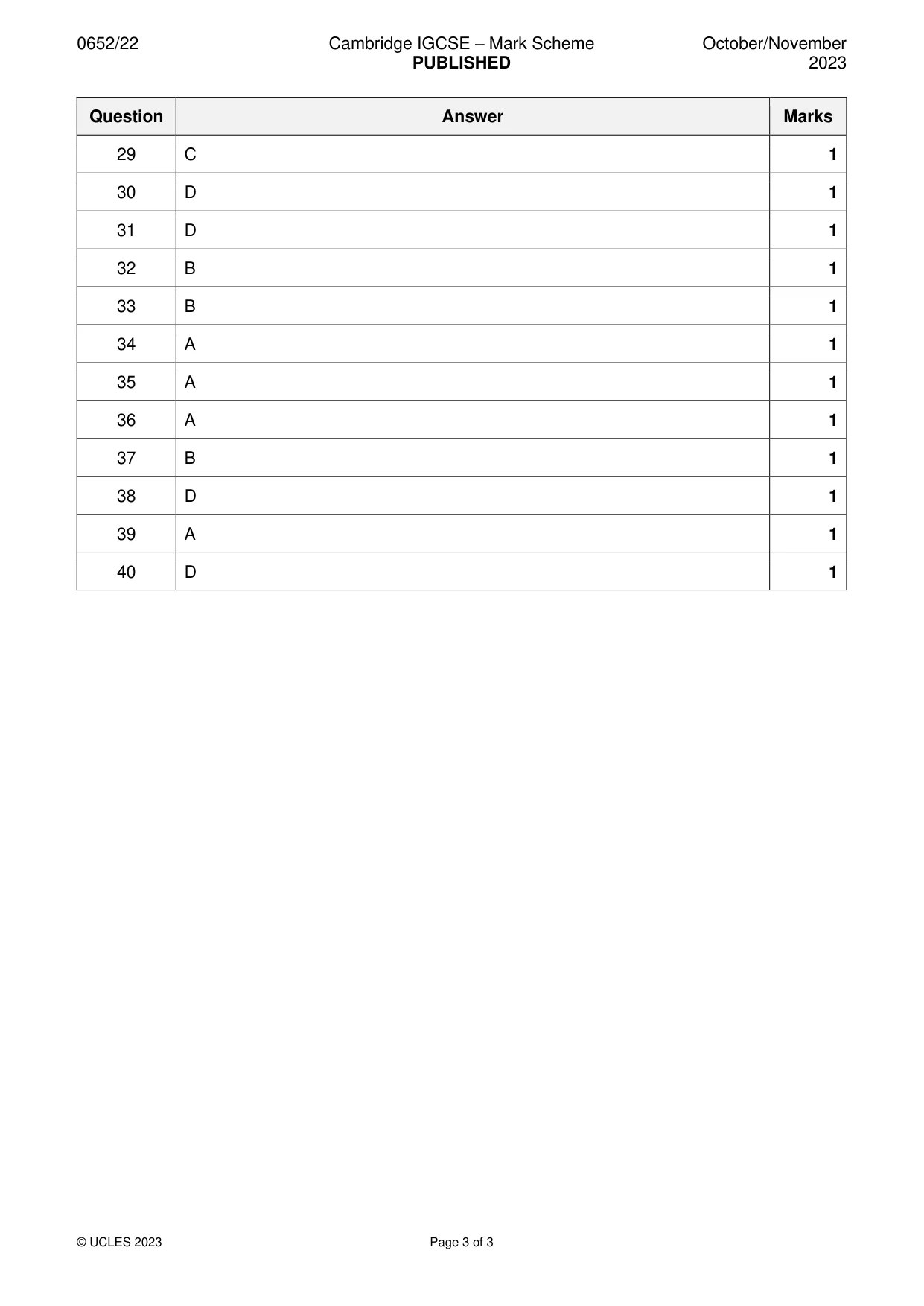
Mark scheme: C
Q30 · The diagram shows an object in front of a converging lens
30 The diagram shows an object in front of a converging lens. Each of the two points marked F is a principal focus (focal point) of the lens. The lens forms an image of the object. converging lens object F F How is the image described? size of image nature of image A diminished real B diminished virtual C enlarged real D enlarged virtual
Mark scheme: D
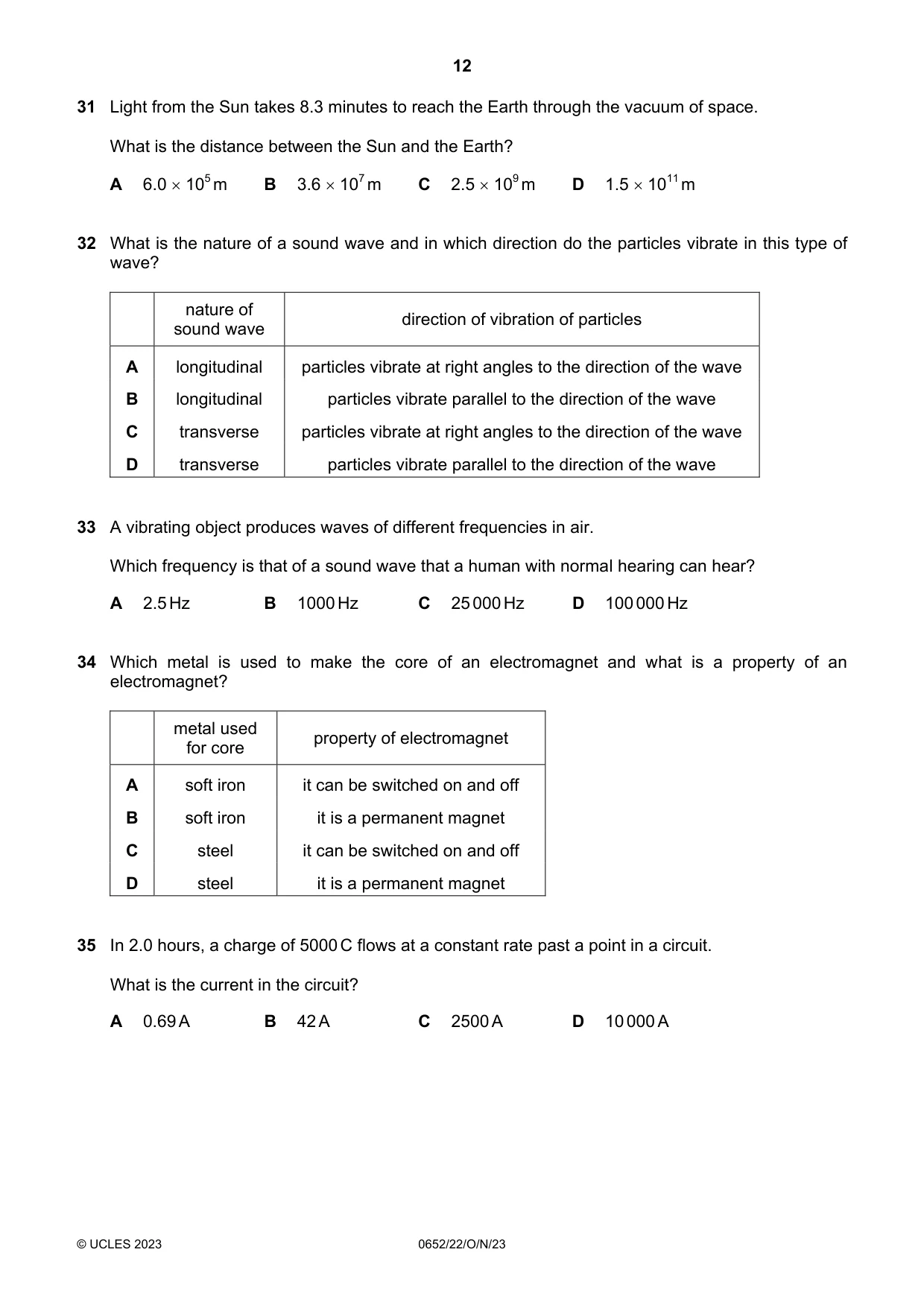
Q31 · Light from the Sun takes 8.3 minutes to reach the Earth through the vacuum of space
31 Light from the Sun takes 8.3 minutes to reach the Earth through the vacuum of space. What is the distance between the Sun and the Earth? A 6.0 105 m B 3.6 107 m C 2.5 109 m D 1.5 1011 m
Mark scheme: D
Q32 · What is the nature of a sound wave and in which direction do the particles vibrate in…
32 What is the nature of a sound wave and in which direction do the particles vibrate in this type of wave? nature of direction of vibration of particles sound wave A longitudinal particles vibrate at right angles to the direction of the wave B longitudinal particles vibrate parallel to the direction of the wave C transverse particles vibrate at right angles to the direction of the wave D transverse particles vibrate parallel to the direction of the wave
Mark scheme: B
Q33 · A vibrating object produces waves of different frequencies in air
33 A vibrating object produces waves of different frequencies in air. Which frequency is that of a sound wave that a human with normal hearing can hear? A 2.5 Hz B 1000 Hz C 25 000 Hz D 100 000 Hz
Mark scheme: B
Q34 · Which metal is used to make the core of an electromagnet and what is a property of an…
34 Which metal is used to make the core of an electromagnet and what is a property of an electromagnet? metal used property of electromagnet for core A soft iron it can be switched on and off B soft iron it is a permanent magnet C steel it can be switched on and off D steel it is a permanent magnet
Mark scheme: A
Q35 · In 2.0 hours, a charge of 5000 C flows at a constant rate past a point in a circuit
35 In 2.0 hours, a charge of 5000 C flows at a constant rate past a point in a circuit. What is the current in the circuit? A 0.69 A B 42 A C 2500 A D 10 000 A
Mark scheme: A
Q36 · A lamp is in a circuit that is protected by a 1 A fuse
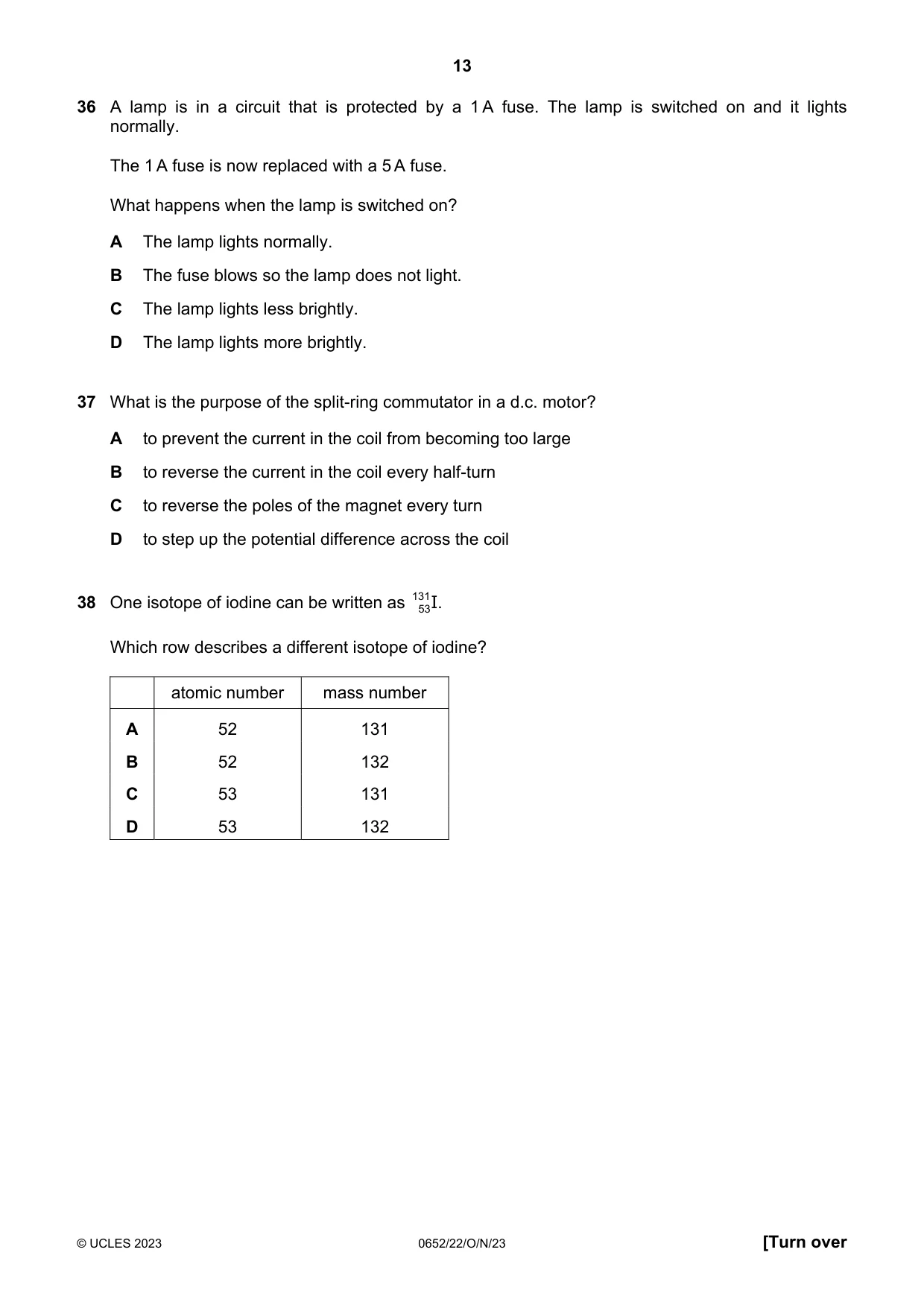
36 A lamp is in a circuit that is protected by a 1 A fuse. The lamp is switched on and it lights normally. The 1 A fuse is now replaced with a 5 A fuse. What happens when the lamp is switched on? A The lamp lights normally. B The fuse blows so the lamp does not light. C The lamp lights less brightly. D The lamp lights more brightly.
Mark scheme: A
Q37 · What is the purpose of the split-ring commutator in a d.c
37 What is the purpose of the split-ring commutator in a d.c. motor? A to prevent the current in the coil from becoming too large B to reverse the current in the coil every half-turn C to reverse the poles of the magnet every turn D to step up the potential difference across the coil
Mark scheme: B
Q38 · One isotope of iodine can be written as 131 53I
38 One isotope of iodine can be written as 131 53I . Which row describes a different isotope of iodine? atomic number mass number A 52 131 B 52 132 C 53 131 D 53 132
Mark scheme: D
Q39 · The first diagram shows a beam of alpha-particles entering an electric field
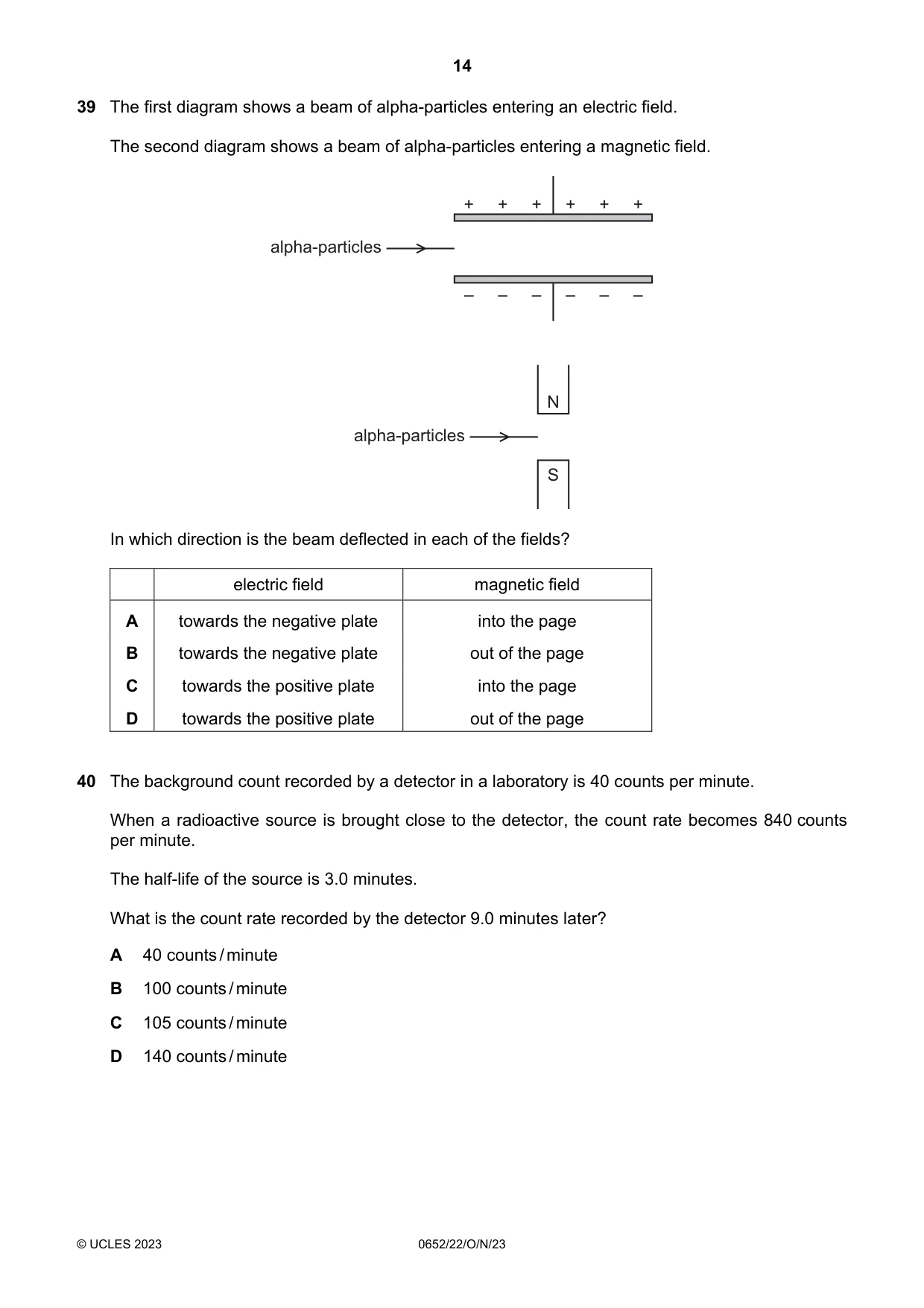
39 The first diagram shows a beam of alpha-particles entering an electric field. The second diagram shows a beam of alpha-particles entering a magnetic field. + + + + + + alpha-particles – – – – – – N alpha-particles S In which direction is the beam deflected in each of the fields? electric field magnetic field A towards the negative plate into the page B towards the negative plate out of the page C towards the positive plate into the page D towards the positive plate out of the page
Mark scheme: A
Q40 · The background count recorded by a detector in a laboratory is 40 counts per minute
40 The background count recorded by a detector in a laboratory is 40 counts per minute. When a radioactive source is brought close to the detector, the count rate becomes 840 counts per minute. The half-life of the source is 3.0 minutes. What is the count rate recorded by the detector 9.0 minutes later? A 40 counts / minute B 100 counts / minute C 105 counts / minute D 140 counts / minute
Mark scheme: D
What was in this paper
The subtopics covered by these 40 questions, and how many questions each got. Open one in a new tab to see every Cambridge question on it.
2Light2Radioactivity2Stoichiometry2Thermal properties and temperature2Work, energy and power2Alcohols1Alkenes1Carbon dioxide and methane1Dangers of electricity1Density1Electrical quantities1Electricity and chemistry1Electromagnetic effects1Energetics of a reaction1Forces1Fuels1General wave properties1Identification of ions and gases1Length and time1Macromolecules1Measurement1Methods of purification1Motion1Periodic Trends1Rate (speed) of reaction1Redox1Simple phenomena of magnetism1Sound1The characteristic properties of acids and bases1The nuclear atom1The particulate nature of matter1Thermal processes1Types of oxides1What you needed in this session
Cambridge’s own grade thresholds for 2023 Oct/Nov, Paper 2 · Variant 2. A higher threshold means an easier paper — the bar moves with how the cohort did.