Cambridge IGCSE Physical Science 0652 — 2018 Oct/Nov Paper 2 · Variant 1
0652/21/O/N/18 · 40 questions · 40 marks · ≈45 min
The question paper and its mark scheme, free to read here and free to download. This is Cambridge’s own paper, exactly as it was sat.
Question paper16 pages
Mark scheme3 pages
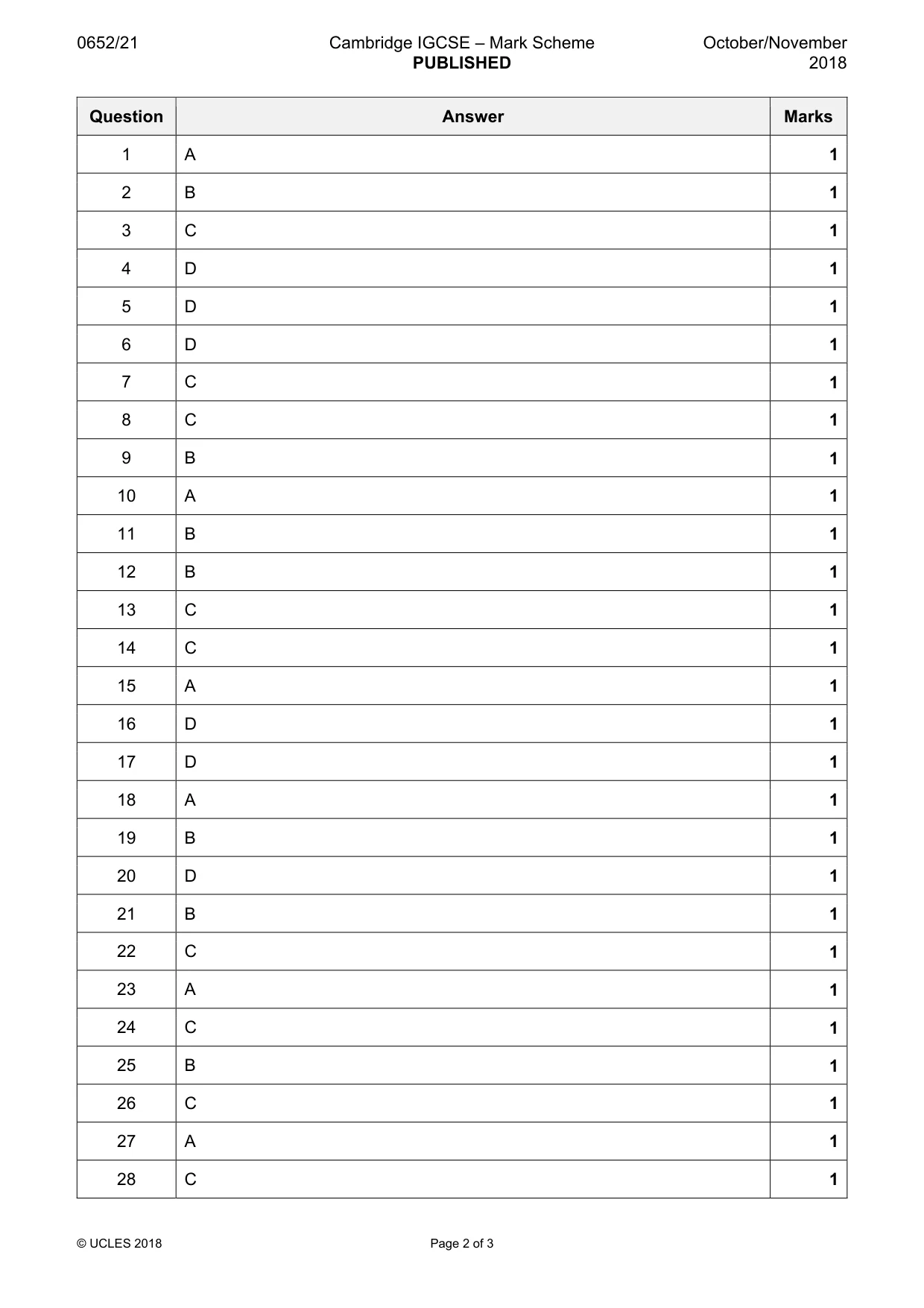
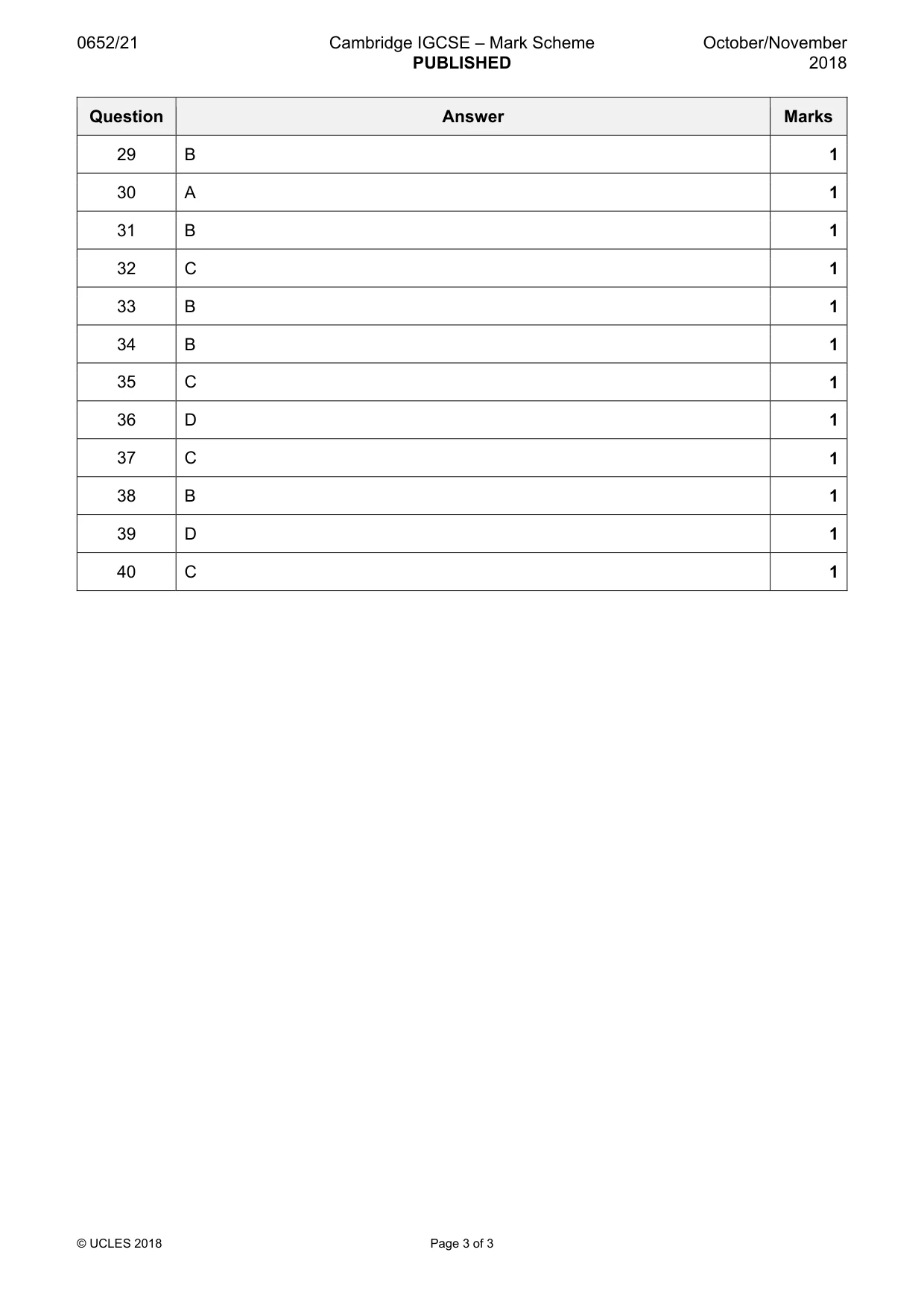
Answers below. Sit the paper first if you are practising.
Questions as text
Q1 · When smoke particles collide with molecules in the air, the smoke particles move randomly
1 When smoke particles collide with molecules in the air, the smoke particles move randomly. How is the movement of the smoke particles described? A Brownian motion B condensation C diffusion D evaporation
Mark scheme: A
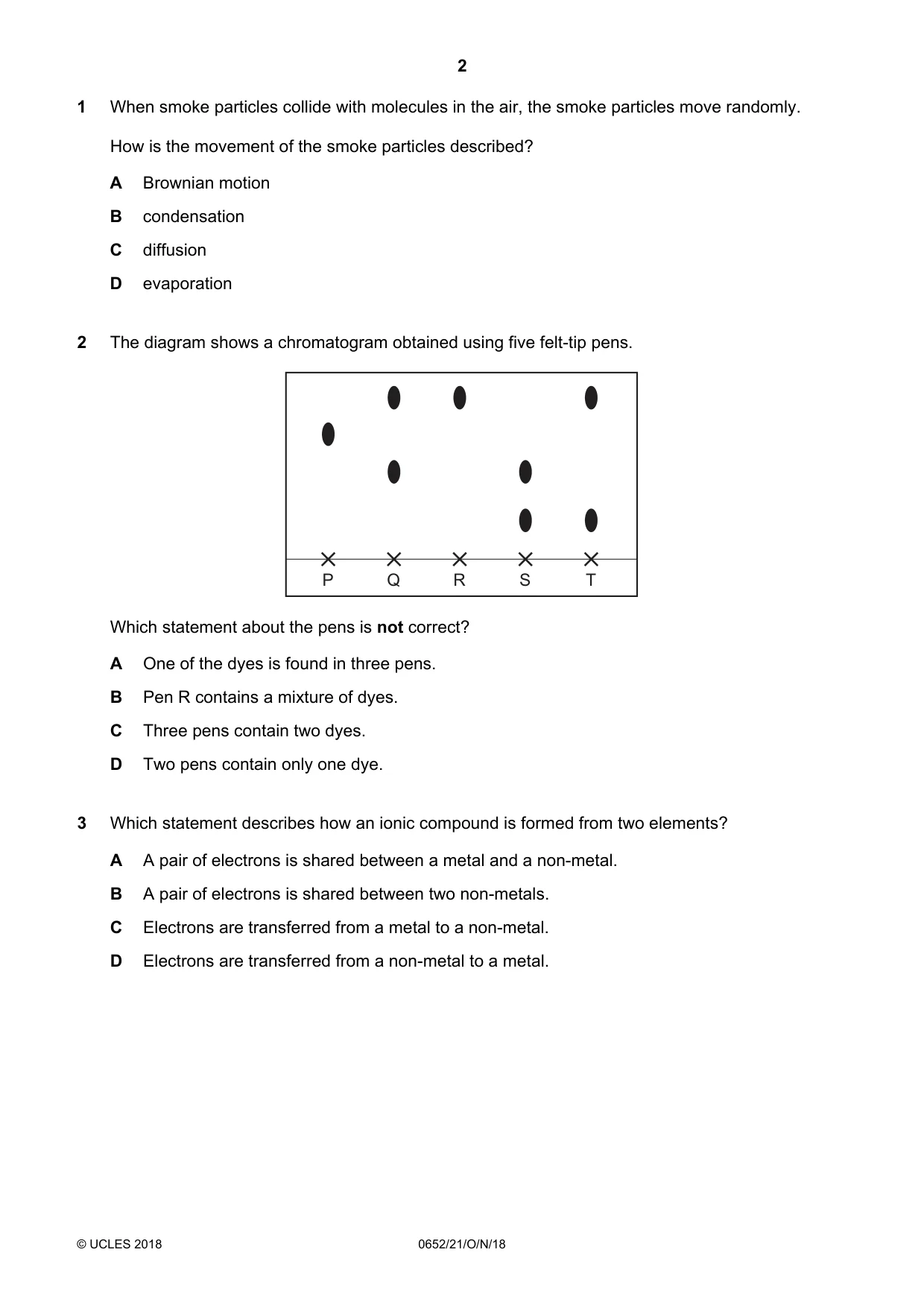
Q2 · The diagram shows a chromatogram obtained using five felt-tip pens
2 The diagram shows a chromatogram obtained using five felt-tip pens. P Q R S T Which statement about the pens is not correct? A One of the dyes is found in three pens. B Pen R contains a mixture of dyes. C Three pens contain two dyes. D Two pens contain only one dye.
Mark scheme: B
Q3 · Which statement describes how an ionic compound is formed from two elements?
3 Which statement describes how an ionic compound is formed from two elements? A A pair of electrons is shared between a metal and a non-metal. B A pair of electrons is shared between two non-metals. C Electrons are transferred from a metal to a non-metal. D Electrons are transferred from a non-metal to a metal.
Mark scheme: C
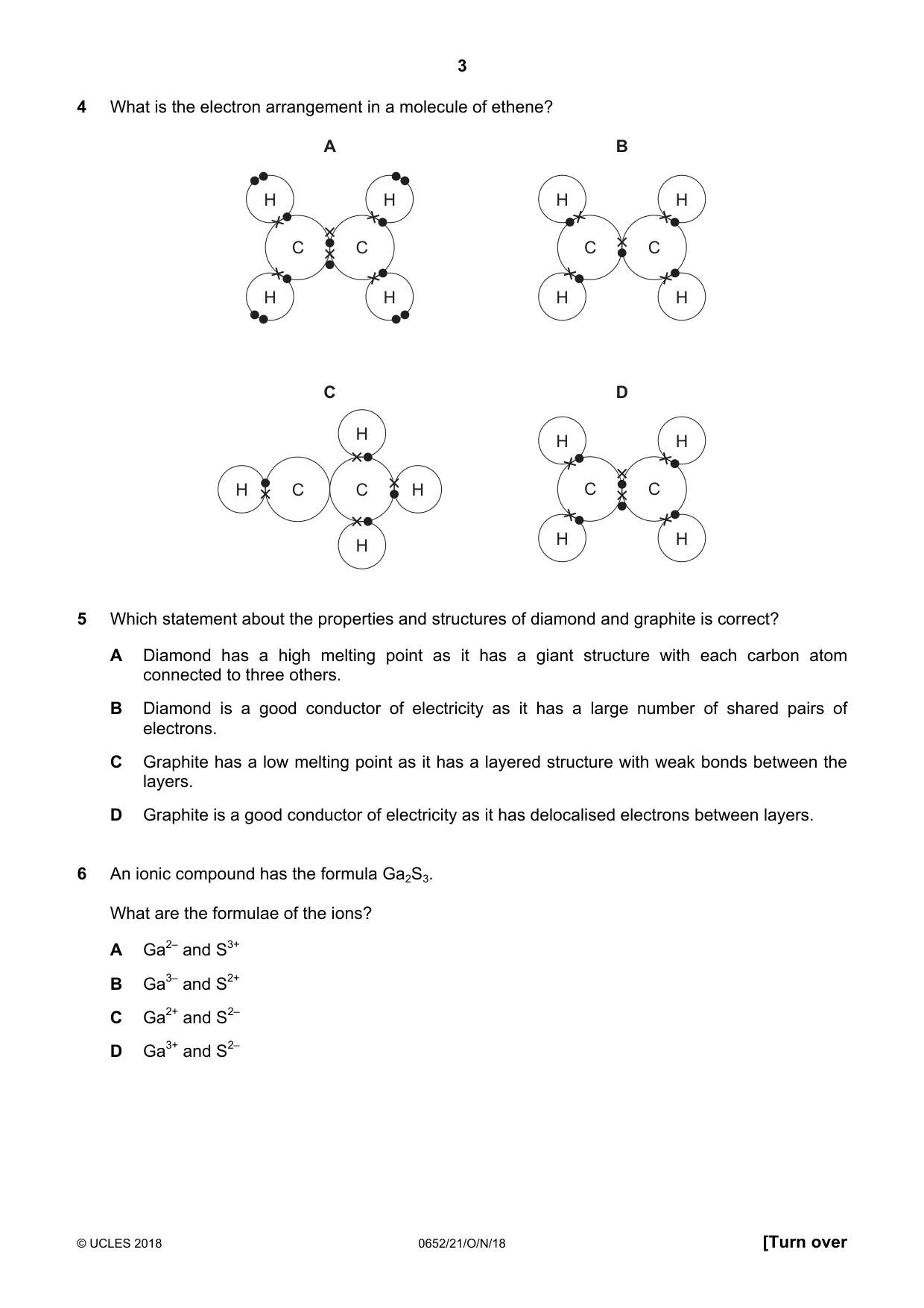
Q4 · What is the electron arrangement in a molecule of ethene?
4 What is the electron arrangement in a molecule of ethene? A B H H H H C C C C H H H H C D H H H H C C H C C H H H
Mark scheme: D
Q5 · Which statement about the properties and structures of diamond and graphite is correct?
5 Which statement about the properties and structures of diamond and graphite is correct? A Diamond has a high melting point as it has a giant structure with each carbon atom connected to three others. B Diamond is a good conductor of electricity as it has a large number of shared pairs of electrons. C Graphite has a low melting point as it has a layered structure with weak bonds between the layers. D Graphite is a good conductor of electricity as it has delocalised electrons between layers.
Mark scheme: D
Q6 · An ionic compound has the formula Ga2S3
6 An ionic compound has the formula Ga2S3. What are the formulae of the ions? A Ga2– and S3+ B Ga3– and S2+ C Ga2+ and S2– D Ga3+ and S2–
Mark scheme: D
Q7 · Butane gas is used as the fuel in camping stoves
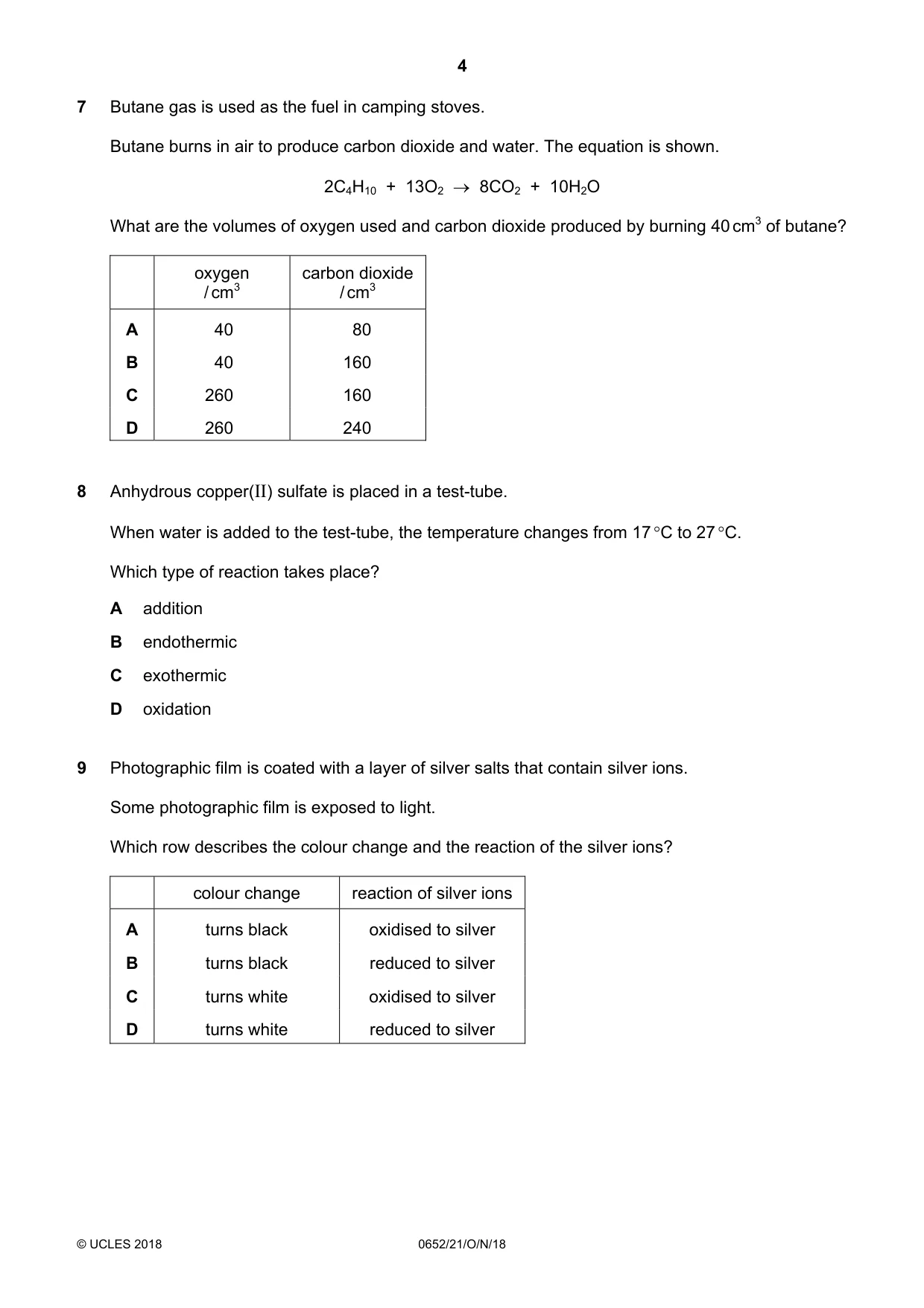
7 Butane gas is used as the fuel in camping stoves. Butane burns in air to produce carbon dioxide and water. The equation is shown. 2C4H10 + 13O2 → 8CO2 + 10H2O What are the volumes of oxygen used and carbon dioxide produced by burning 40 cm3 of butane? oxygen carbon dioxide / cm3 / cm3 A 40 80 B 40 160 C 260 160 D 260 240
Mark scheme: C
Q8 · Anhydrous copper(II) sulfate is placed in a test-tube
8 Anhydrous copper(II) sulfate is placed in a test-tube. When water is added to the test-tube, the temperature changes from 17 °C to 27 °C. Which type of reaction takes place? A addition B endothermic C exothermic D oxidation
Mark scheme: C
Q9 · Photographic film is coated with a layer of silver salts that contain silver ions
9 Photographic film is coated with a layer of silver salts that contain silver ions. Some photographic film is exposed to light. Which row describes the colour change and the reaction of the silver ions? colour change reaction of silver ions A turns black oxidised to silver B turns black reduced to silver C turns white oxidised to silver D turns white reduced to silver
Mark scheme: B
Q10 · Which reaction is an oxidation?
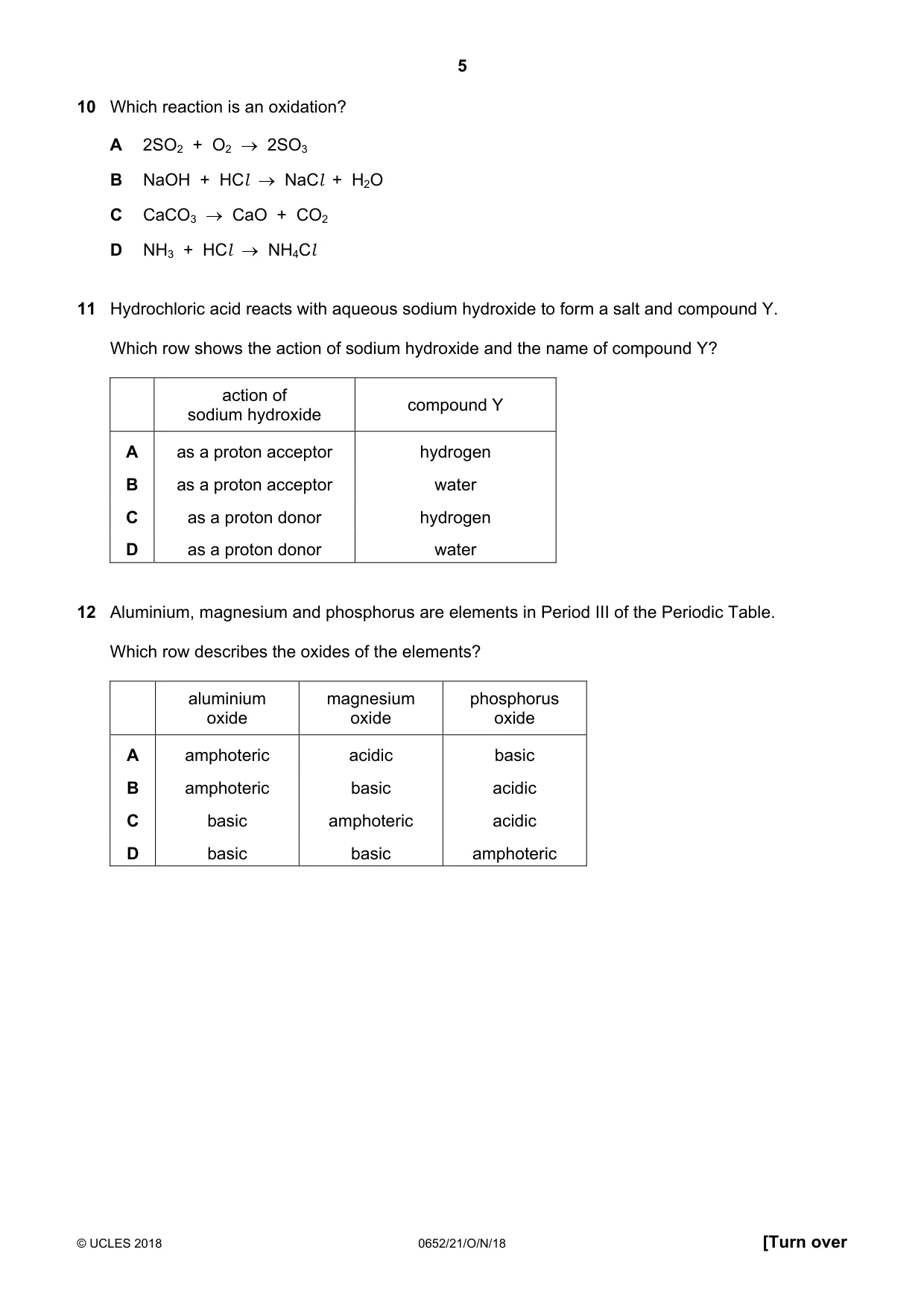
10 Which reaction is an oxidation? A 2SO2 + O2 → 2SO3 B NaOH + HCl → NaCl + H2O C CaCO3 → CaO + CO2 D NH3 + HCl → NH4Cl
Mark scheme: A
Q11 · Hydrochloric acid reacts with aqueous sodium hydroxide to form a salt and compound Y
11 Hydrochloric acid reacts with aqueous sodium hydroxide to form a salt and compound Y. Which row shows the action of sodium hydroxide and the name of compound Y? action of compound Y sodium hydroxide A as a proton acceptor hydrogen B as a proton acceptor water C as a proton donor hydrogen D as a proton donor water
Mark scheme: B
More questions on The characteristic properties of acids and bases
Q12 · Aluminium, magnesium and phosphorus are elements in Period III of the Periodic Table
12 Aluminium, magnesium and phosphorus are elements in Period III of the Periodic Table. Which row describes the oxides of the elements? aluminium magnesium phosphorus oxide oxide oxide A amphoteric acidic basic B amphoteric basic acidic C basic amphoteric acidic D basic basic amphoteric
Mark scheme: B
Q13 · The diagram shows the electronic structure of an atom of an element
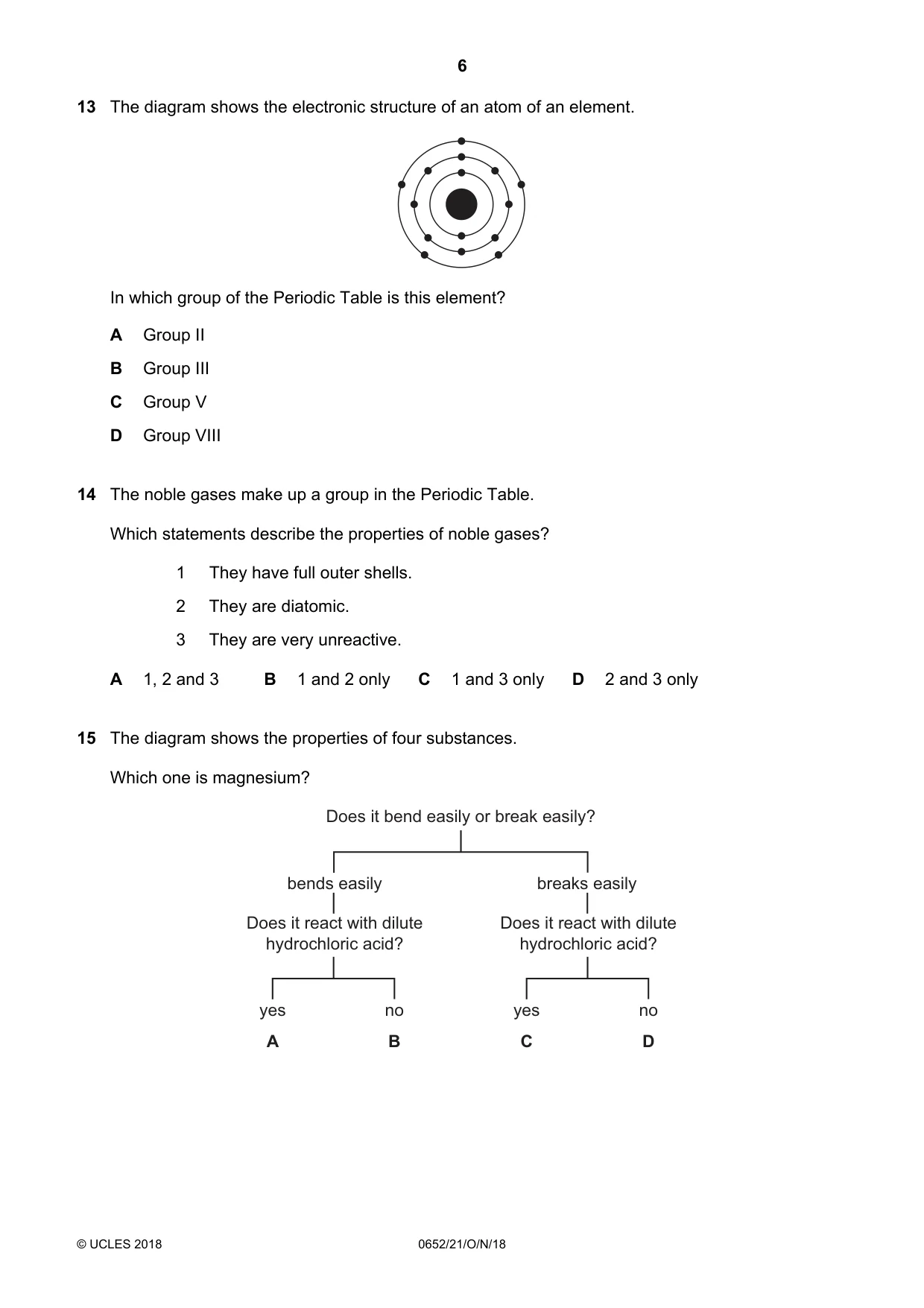
13 The diagram shows the electronic structure of an atom of an element. In which group of the Periodic Table is this element? A Group II B Group III C Group V D Group VIII
Mark scheme: C
Q14 · The noble gases make up a group in the Periodic Table
14 The noble gases make up a group in the Periodic Table. Which statements describe the properties of noble gases? 1 They have full outer shells. 2 They are diatomic. 3 They are very unreactive. A 1, 2 and 3 B 1 and 2 only C 1 and 3 only D 2 and 3 only
Mark scheme: C
Q15 · The diagram shows the properties of four substances
15 The diagram shows the properties of four substances. Which one is magnesium? Does it bend easily or break easily? bends easily breaks easily Does it react with dilute Does it react with dilute hydrochloric acid? hydrochloric acid? yes no yes no A B C D
Mark scheme: A
Q16 · Iron is extracted from its ore, hematite, in the Blast Furnace
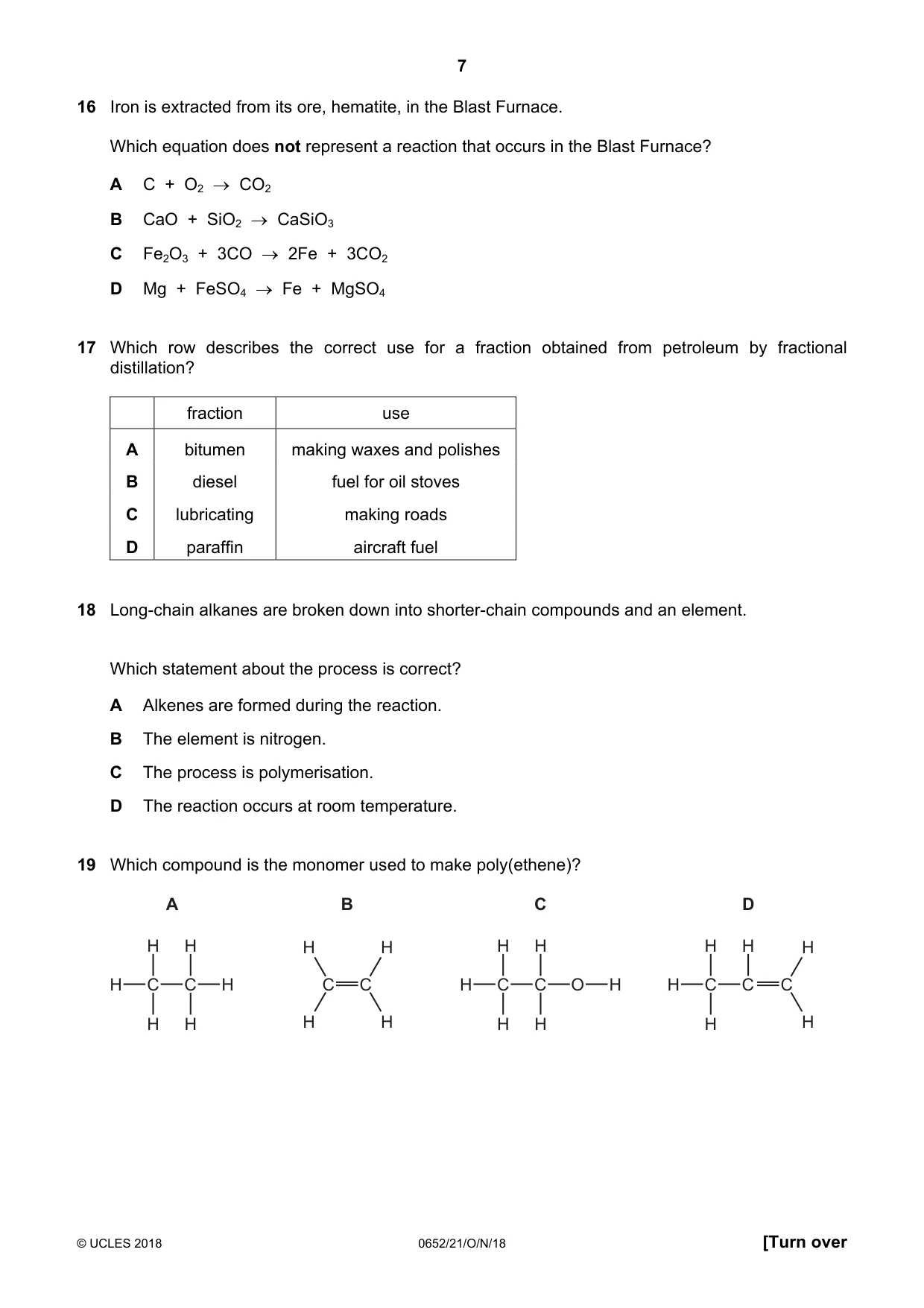
16 Iron is extracted from its ore, hematite, in the Blast Furnace. Which equation does not represent a reaction that occurs in the Blast Furnace? A C + O2 → CO2 B CaO + SiO2 → CaSiO3 C Fe2O3 + 3CO → 2Fe + 3CO2 D Mg + FeSO4 → Fe + MgSO4
Mark scheme: D
Q17 · Which row describes the correct use for a fraction obtained from petroleum by fractional…
17 Which row describes the correct use for a fraction obtained from petroleum by fractional distillation? fraction use A bitumen making waxes and polishes B diesel fuel for oil stoves C lubricating making roads D paraffin aircraft fuel
Mark scheme: D
Q18 · Long-chain alkanes are broken down into shorter-chain compounds and an element
18 Long-chain alkanes are broken down into shorter-chain compounds and an element. Which statement about the process is correct? A Alkenes are formed during the reaction. B The element is nitrogen. C The process is polymerisation. D The reaction occurs at room temperature.
Mark scheme: A
Q19 · Which compound is the monomer used to make poly(ethene)?
19 Which compound is the monomer used to make poly(ethene)? A B C D H H H H H H H H H H C C H C C H C C O H H C C C H H H H H H H H
Mark scheme: B
Q20 · Which row describes the starting material and conditions used to make ethanol?
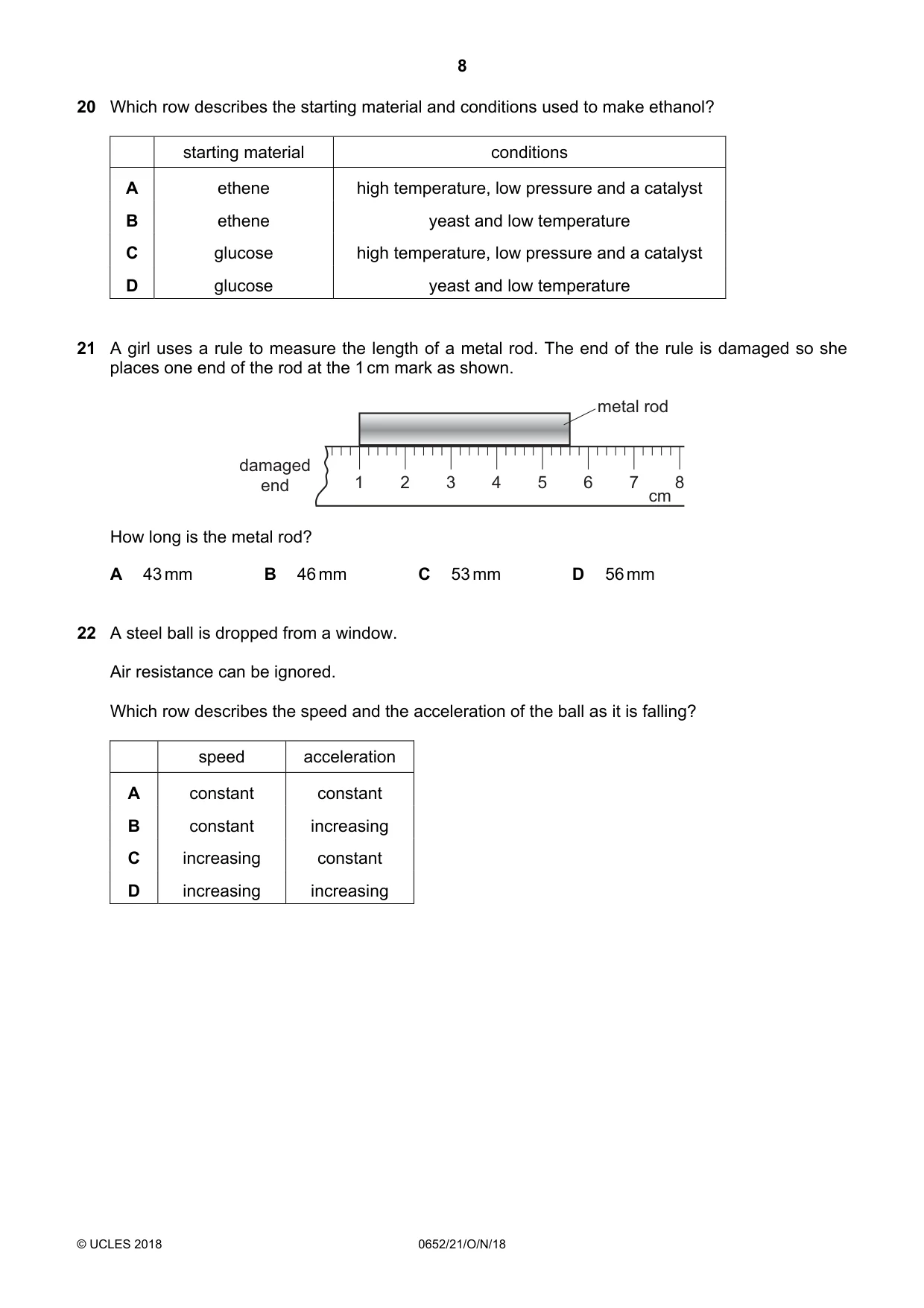
20 Which row describes the starting material and conditions used to make ethanol? starting material conditions A ethene high temperature, low pressure and a catalyst B ethene yeast and low temperature C glucose high temperature, low pressure and a catalyst D glucose yeast and low temperature
Mark scheme: D
Q21 · A girl uses a rule to measure the length of a metal rod
21 A girl uses a rule to measure the length of a metal rod. The end of the rule is damaged so she places one end of the rod at the 1 cm mark as shown. metal rod damaged end 1 2 3 4 5 6 7 8 cm How long is the metal rod? A 43 mm B 46 mm C 53 mm D 56 mm
Mark scheme: B
Q22 · A steel ball is dropped from a window
22 A steel ball is dropped from a window. Air resistance can be ignored. Which row describes the speed and the acceleration of the ball as it is falling? speed acceleration A constant constant B constant increasing C increasing constant D increasing increasing
Mark scheme: C
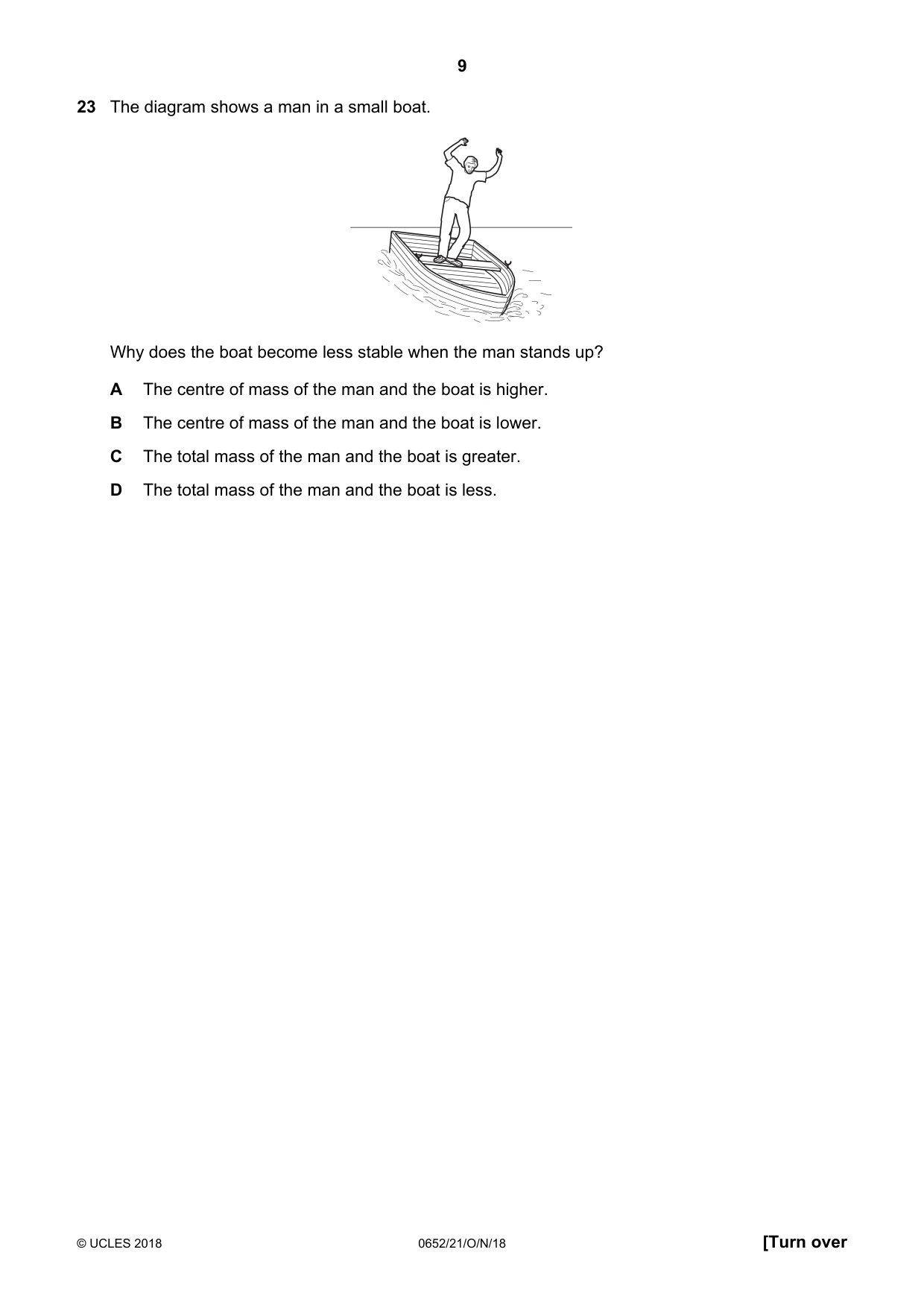
Q23 · The diagram shows a man in a small boat
23 The diagram shows a man in a small boat. Why does the boat become less stable when the man stands up? A The centre of mass of the man and the boat is higher. B The centre of mass of the man and the boat is lower. C The total mass of the man and the boat is greater. D The total mass of the man and the boat is less.
Mark scheme: A
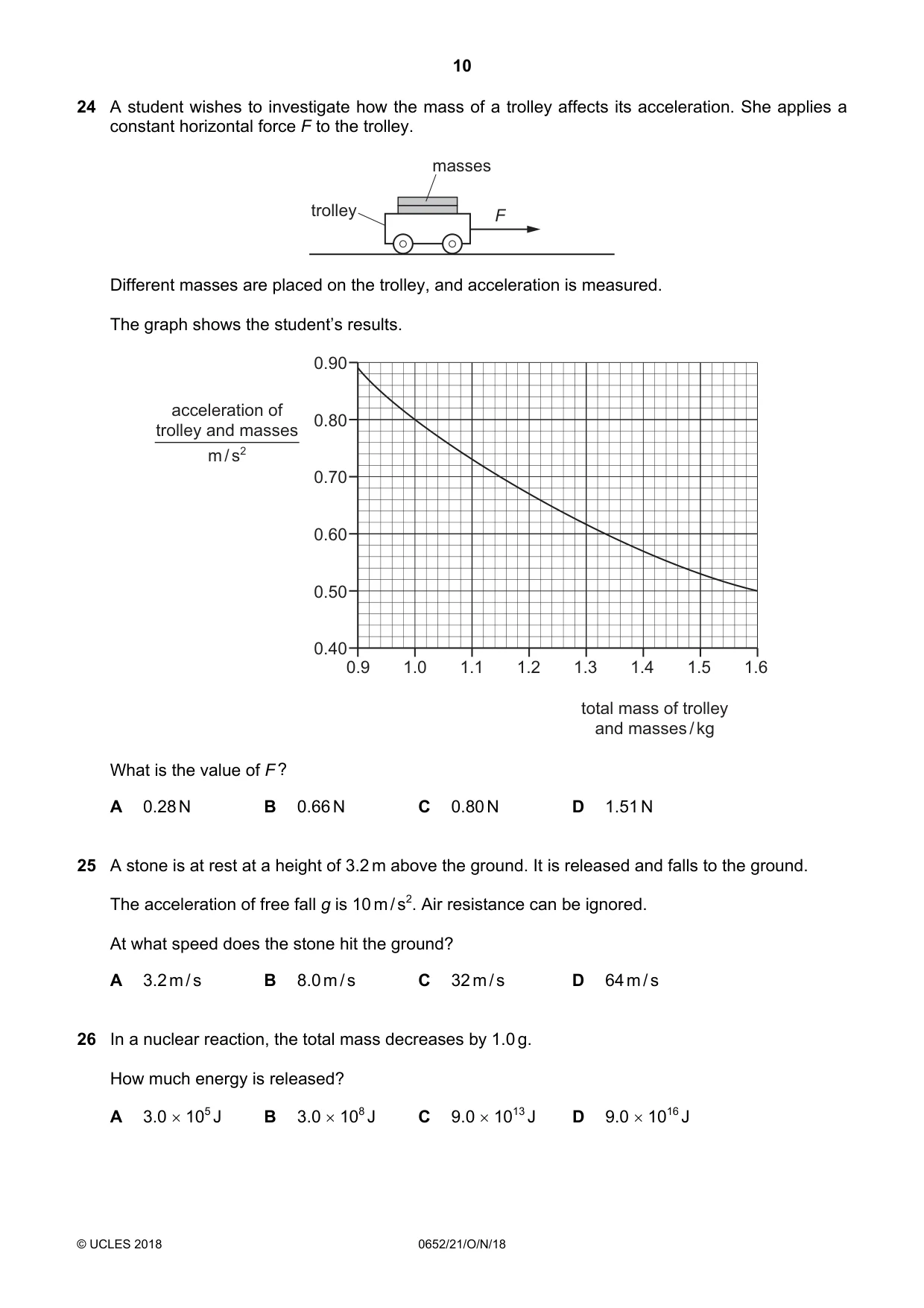
Q24 · A student wishes to investigate how the mass of a trolley affects its acceleration
24 A student wishes to investigate how the mass of a trolley affects its acceleration. She applies a constant horizontal force F to the trolley. masses trolley F Different masses are placed on the trolley, and acceleration is measured. The graph shows the student’s results. 0.90 acceleration of 0.80 trolley and masses m / s2 0.70 0.60 0.50 0.40 0.9 1.0 1.1 1.2 1.3 1.4 1.5 1.6 total mass of trolley and masses / kg What is the value of F ? A 0.28 N B 0.66 N C 0.80 N D 1.51 N
Mark scheme: C
Q25 · A stone is at rest at a height of 3.2 m above the ground
25 A stone is at rest at a height of 3.2 m above the ground. It is released and falls to the ground. The acceleration of free fall g is 10 m / s2. Air resistance can be ignored. At what speed does the stone hit the ground? A 3.2 m / s B 8.0 m / s C 32 m / s D 64 m / s
Mark scheme: B
Q26 · In a nuclear reaction, the total mass decreases by 1.0 g
26 In a nuclear reaction, the total mass decreases by 1.0 g. How much energy is released? A 3.0 × 10⁵ J B 3.0 × 10⁸ J C 9.0 × 10¹³ J D 9.0 × 10¹⁶ J
Mark scheme: C
Q27 · A chemical process causes energy to be released
27 A chemical process causes energy to be released. Which type of power station makes use of this type of process? A a gas-fired power station B a geothermal power station C a hydroelectric power station D a nuclear power station
Mark scheme: A
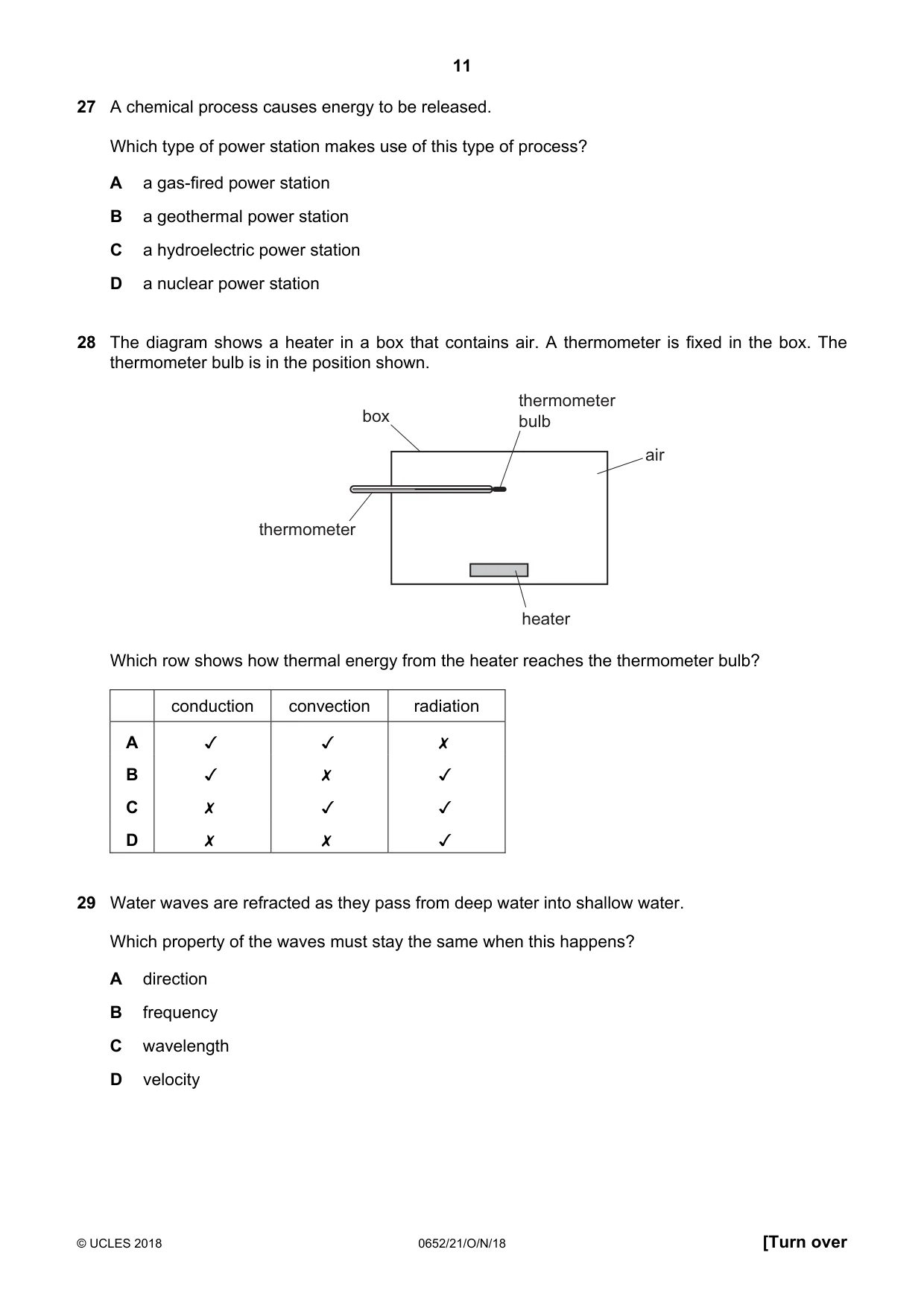
Q28 · The diagram shows a heater in a box that contains air
28 The diagram shows a heater in a box that contains air. A thermometer is fixed in the box. The thermometer bulb is in the position shown. thermometer box bulb air thermometer heater Which row shows how thermal energy from the heater reaches the thermometer bulb? conduction convection radiation v v x 0 0O WwW D> v x v x v v x x v
Mark scheme: C
Q29 · Water waves are refracted as they pass from deep water into shallow water
29 Water waves are refracted as they pass from deep water into shallow water. Which property of the waves must stay the same when this happens? A direction B frequency C wavelength D velocity
Mark scheme: B
Q30 · A convex lens of focal length 15 cm is used as a magnifying glass
30 A convex lens of focal length 15 cm is used as a magnifying glass. Which position of the object gives a virtual, magnified image? A object 8.0 cm from the lens B object 16 cm from the lens C object 32 cm from the lens D object 64 cm from the lens
Mark scheme: A
Q31 · A vibrating object produces waves of different frequencies in air
31 A vibrating object produces waves of different frequencies in air. Which frequency is a sound wave that someone with normal hearing is able to hear? A 2.5 Hz B 1000 Hz C 25 000 Hz D 100 000 Hz
Mark scheme: B
Q32 · Why is iron a suitable material for the core of an electromagnet?
32 Why is iron a suitable material for the core of an electromagnet? A It is a good conductor of electricity. B It is a poor conductor of electricity. C It loses its magnetism when the current is switched off. D It stays magnetised when the current is switched off.
Mark scheme: C
Q33 · Which combination of units can be used to measure current?
33 Which combination of units can be used to measure current? A coulomb per joule B coulomb per second C joule per coulomb D joule per second
Mark scheme: B
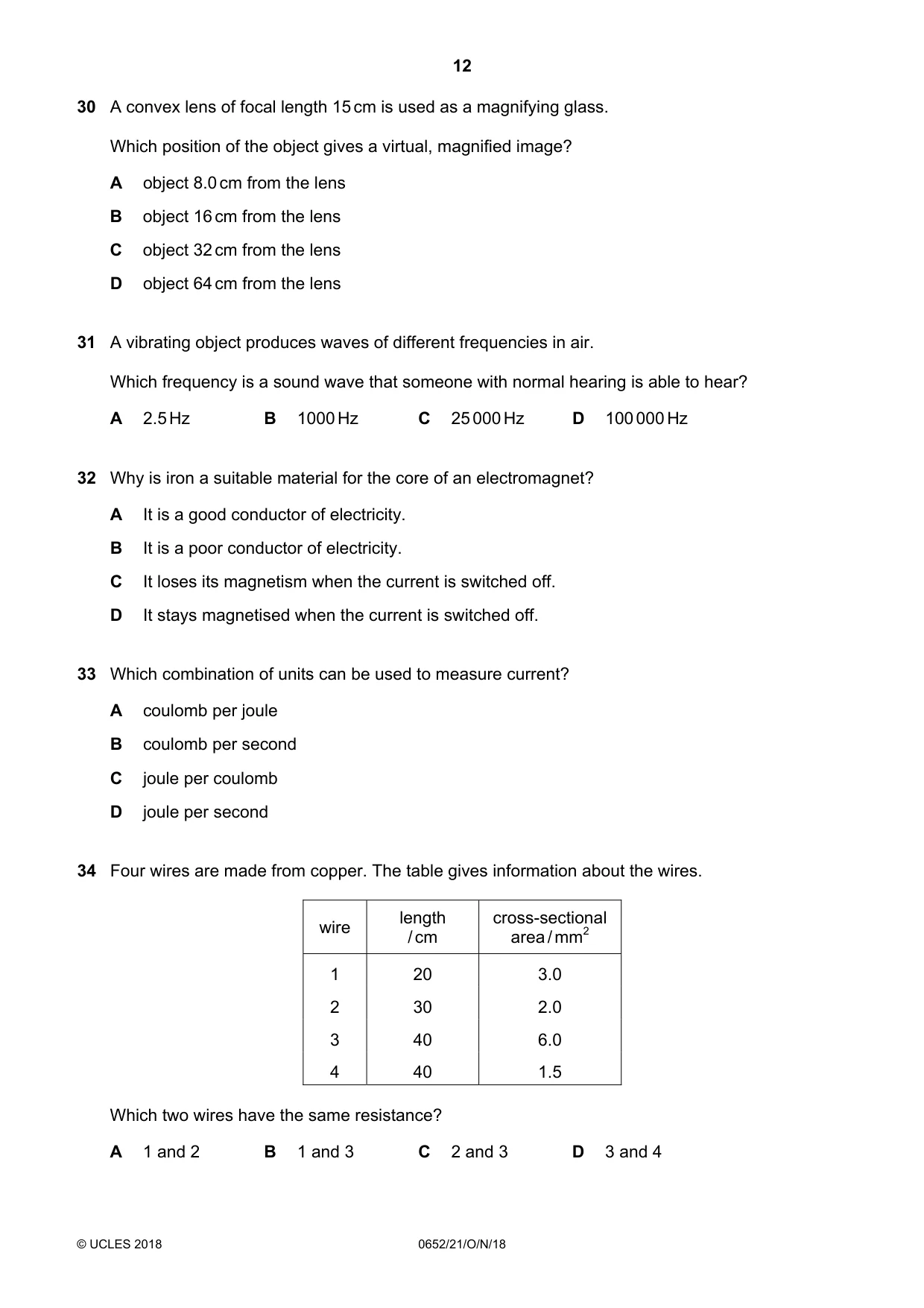
Q34 · Four wires are made from copper
34 Four wires are made from copper. The table gives information about the wires. length cross-sectional wire area / mm2 / cm 1 20 3.0 2 30 2.0 3 40 6.0 4 40 1.5 Which two wires have the same resistance? A 1 and 2 B 1 and 3 C 2 and 3 D 3 and 4
Mark scheme: B
Q35 · Two resistors, each of resistance R, are connected in parallel
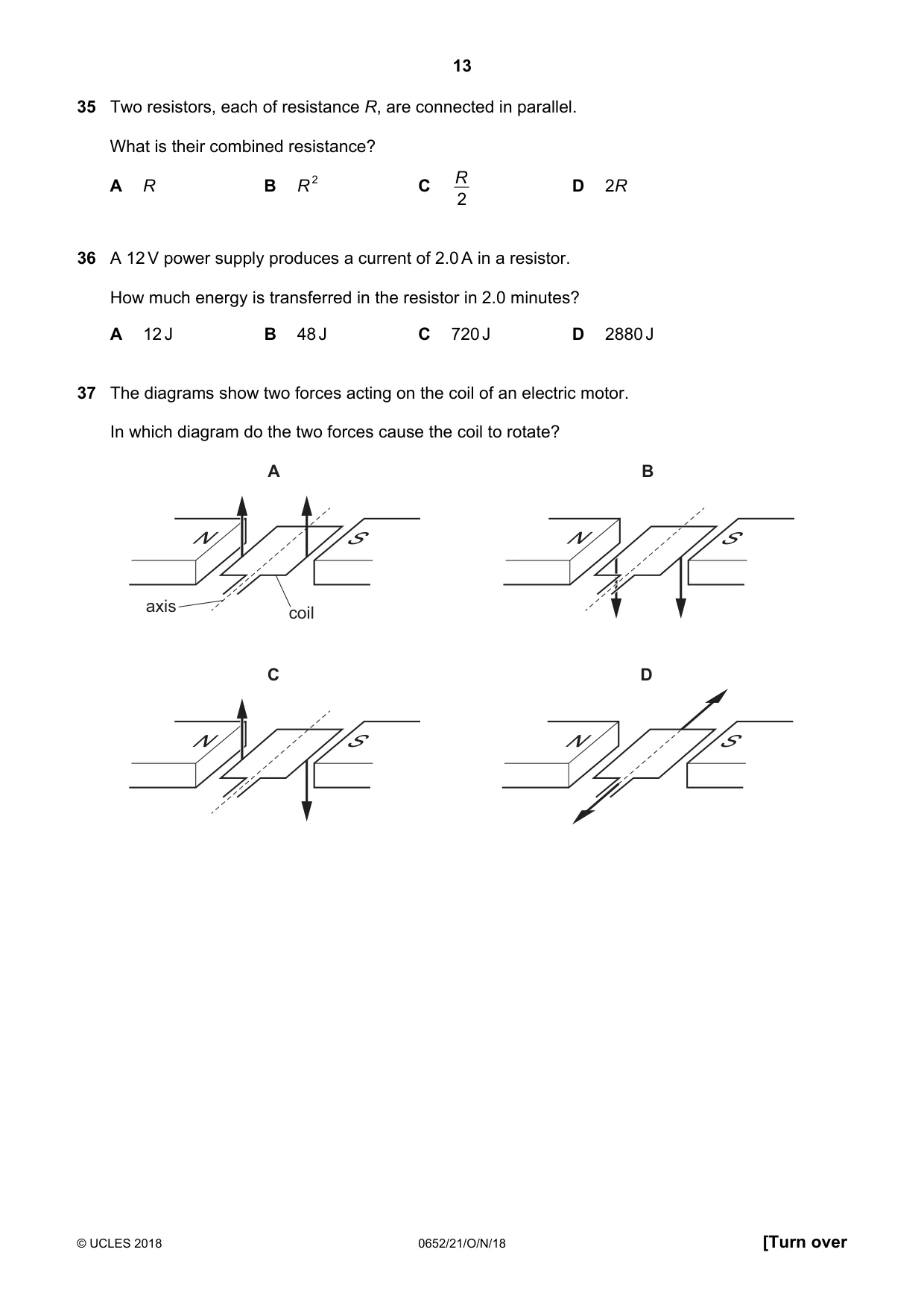
35 Two resistors, each of resistance R, are connected in parallel. What is their combined resistance? R 2 R A R B C D 2R 2
Mark scheme: C
Q36 · A 12 V power supply produces a current of 2.0 A in a resistor
36 A 12 V power supply produces a current of 2.0 A in a resistor. How much energy is transferred in the resistor in 2.0 minutes? A 12 J B 48 J C 720 J D 2880 J
Mark scheme: D
Q37 · The diagrams show two forces acting on the coil of an electric motor
37 The diagrams show two forces acting on the coil of an electric motor. In which diagram do the two forces cause the coil to rotate? A B N S N S axis coil C D N S N S
Mark scheme: C
Q38 · The diagram shows a magnet being moved slowly downwards into a stationary coil to induce…
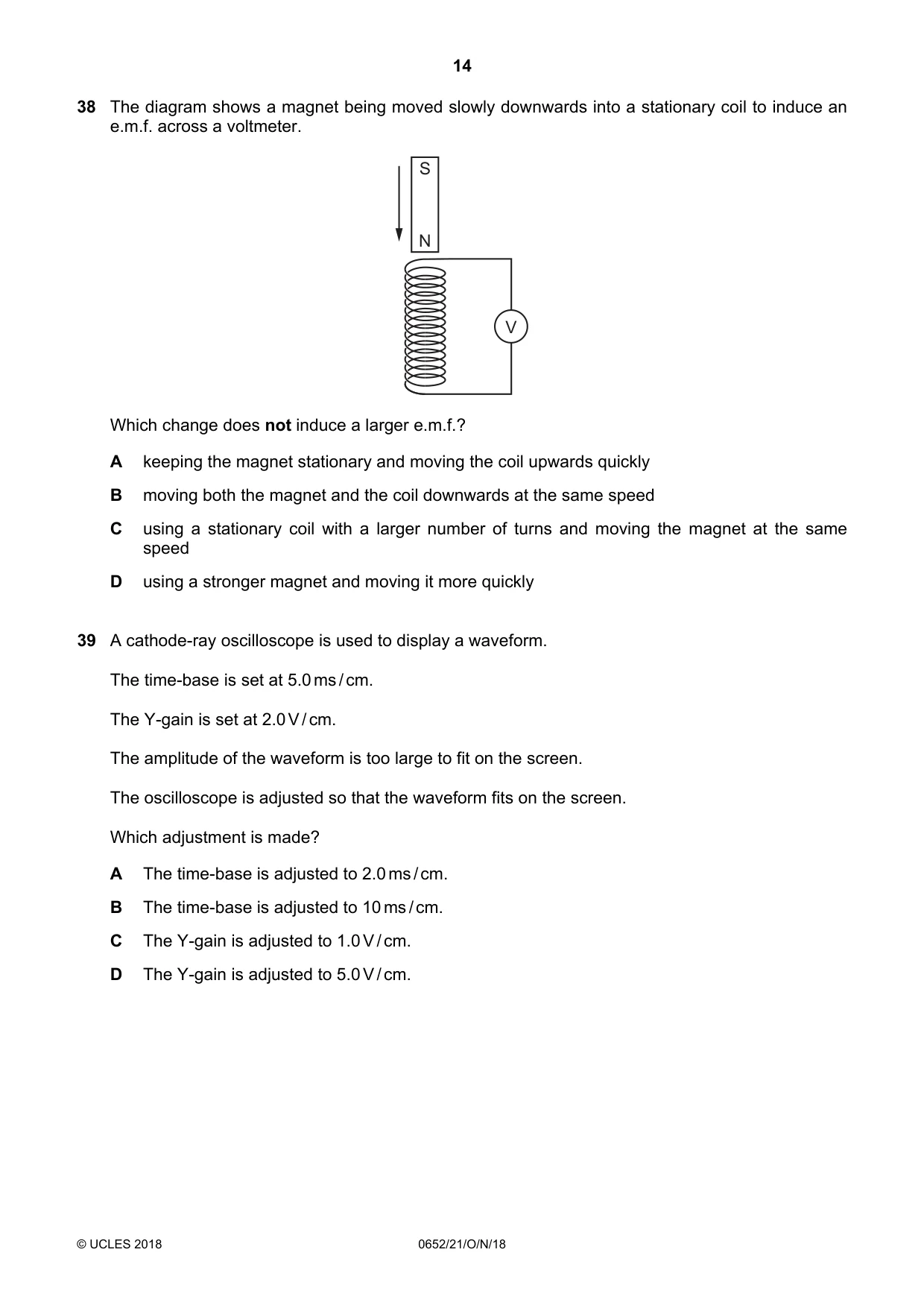
38 The diagram shows a magnet being moved slowly downwards into a stationary coil to induce an e.m.f. across a voltmeter. S N V Which change does not induce a larger e.m.f.? A keeping the magnet stationary and moving the coil upwards quickly B moving both the magnet and the coil downwards at the same speed C using a stationary coil with a larger number of turns and moving the magnet at the same speed D using a stronger magnet and moving it more quickly
Mark scheme: B
Q39 · A cathode-ray oscilloscope is used to display a waveform
39 A cathode-ray oscilloscope is used to display a waveform. The time-base is set at 5.0 ms / cm. The Y-gain is set at 2.0 V / cm. The amplitude of the waveform is too large to fit on the screen. The oscilloscope is adjusted so that the waveform fits on the screen. Which adjustment is made? A The time-base is adjusted to 2.0 ms / cm. B The time-base is adjusted to 10 ms / cm. C The Y-gain is adjusted to 1.0 V / cm. D The Y-gain is adjusted to 5.0 V / cm.
Mark scheme: D
Q40 · The graph shows the decay curve for one particular radioactive isotope
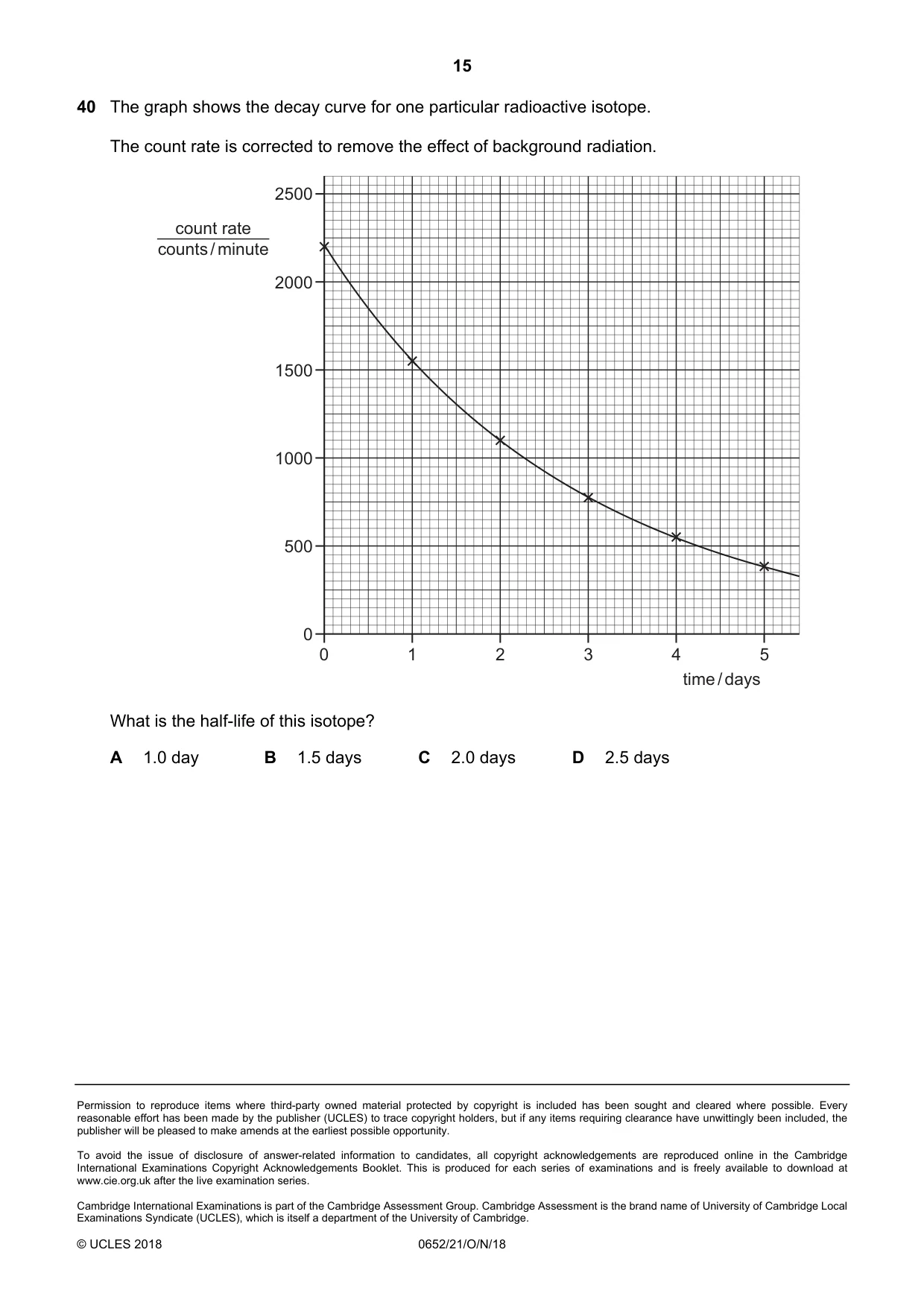
40 The graph shows the decay curve for one particular radioactive isotope. The count rate is corrected to remove the effect of background radiation. 2500 count rate counts / minute 2000 1500 1000 500 0 0 1 2 3 4 5 time / days What is the half-life of this isotope? A 1.0 day B 1.5 days C 2.0 days D 2.5 days
Mark scheme: C
What was in this paper
The subtopics covered by these 40 questions, and how many questions each got. Open one in a new tab to see every Cambridge question on it.
2Electrical quantities2Electromagnetic effects2Forces2Ions and ionic bonds2Radioactivity2Redox2Alcohols1Alkanes1Alkenes1Electrical energy1Energy transfer1Extraction of metals1Fuels1General wave properties1Length and time1Light1Macromolecules1Methods of purification1Molecules and covalent bonds1Motion1Noble gases1Properties of metals1Simple phenomena of magnetism1Sound1Stoichiometry1The characteristic properties of acids and bases1The nuclear atom1The particulate nature of matter1The Periodic Table1Thermal processes1Types of oxides1Work, energy and power1What you needed in this session
Cambridge’s own grade thresholds for 2018 Oct/Nov, Paper 2 · Variant 1. A higher threshold means an easier paper — the bar moves with how the cohort did.