Cambridge IGCSE Physical Science 0652 — 2017 Oct/Nov Paper 2 · Variant 2
0652/22/O/N/17 · 40 questions · 40 marks · ≈45 min
The question paper and its mark scheme, free to read here and free to download. This is Cambridge’s own paper, exactly as it was sat.
Question paper16 pages
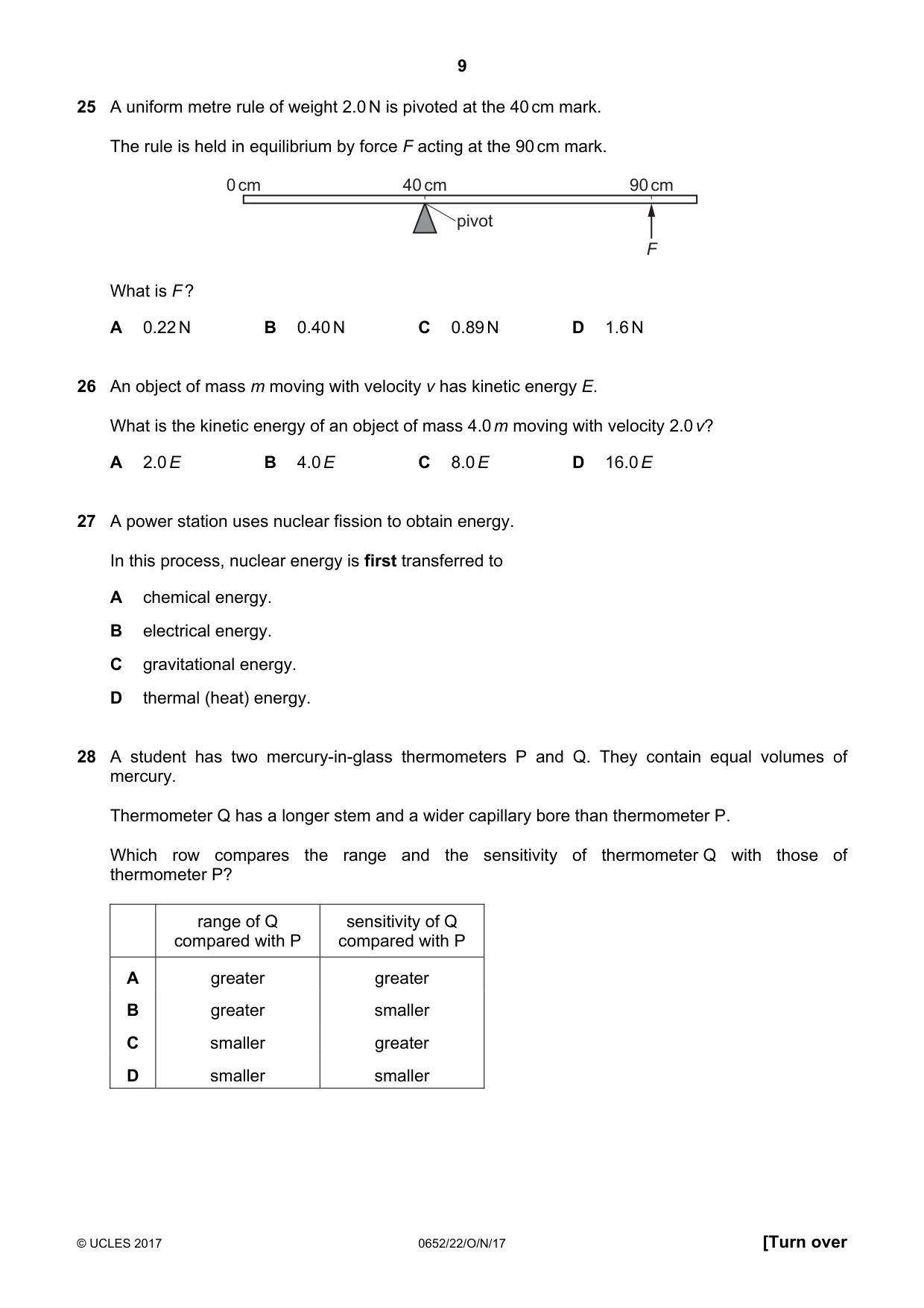
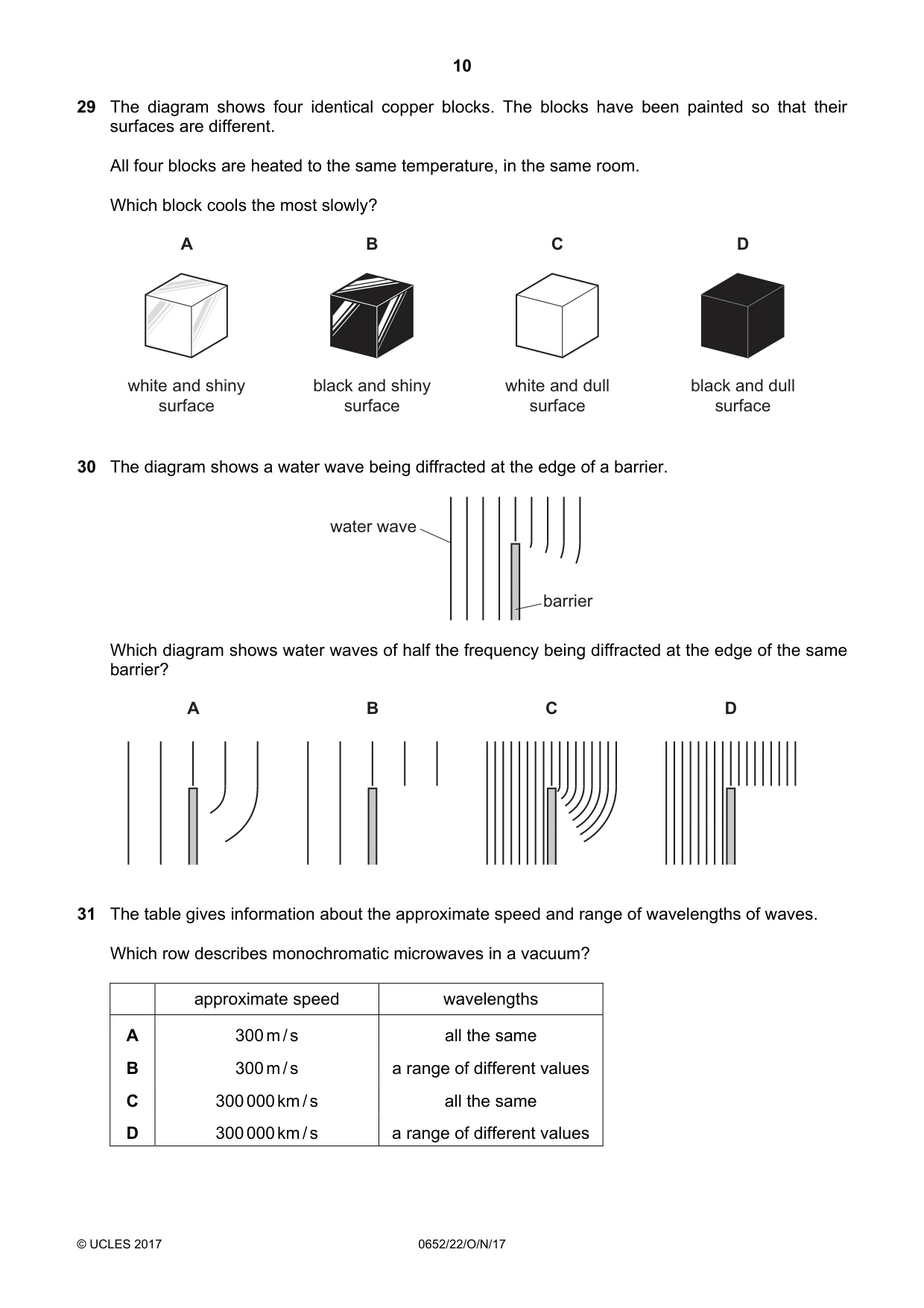
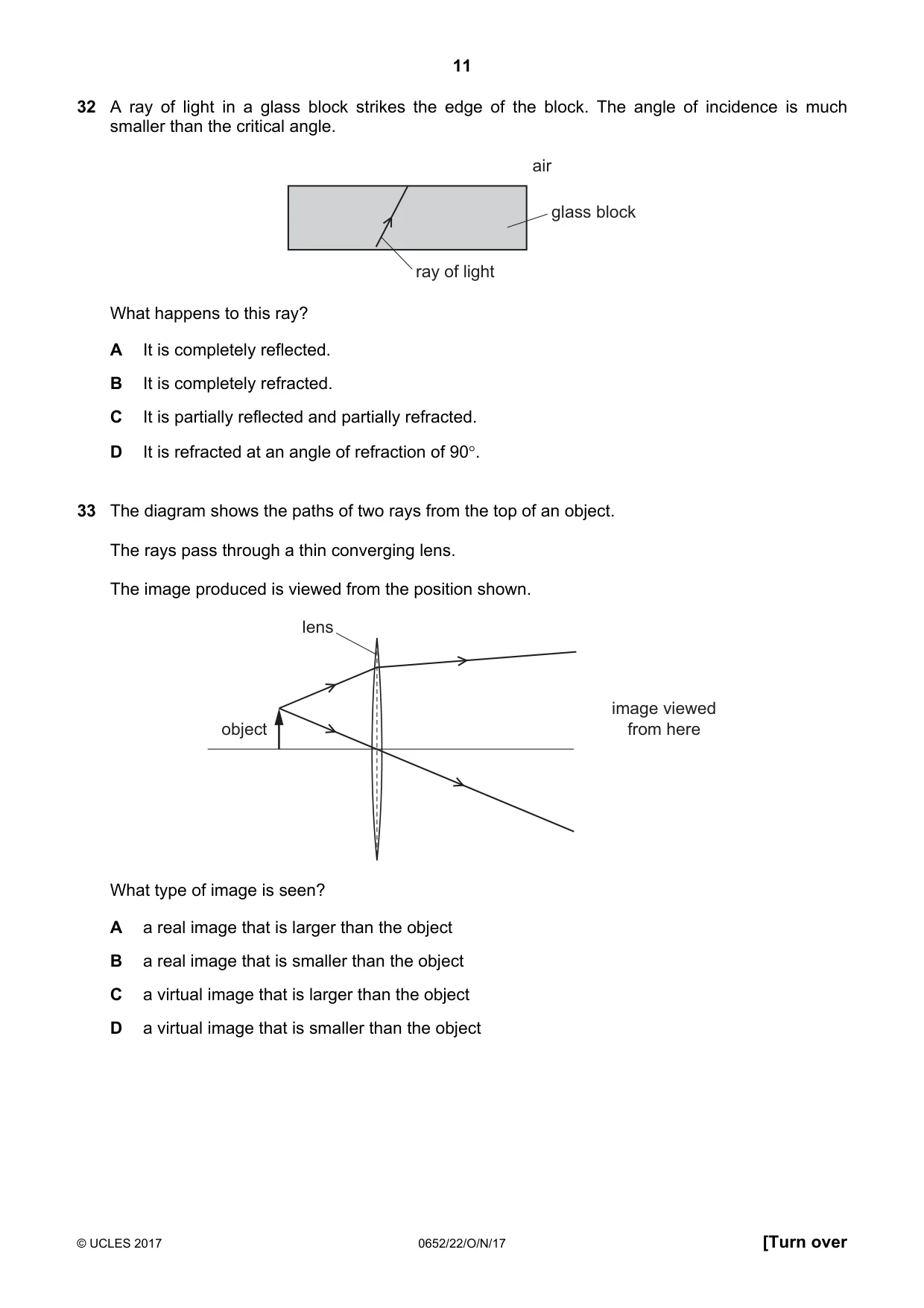
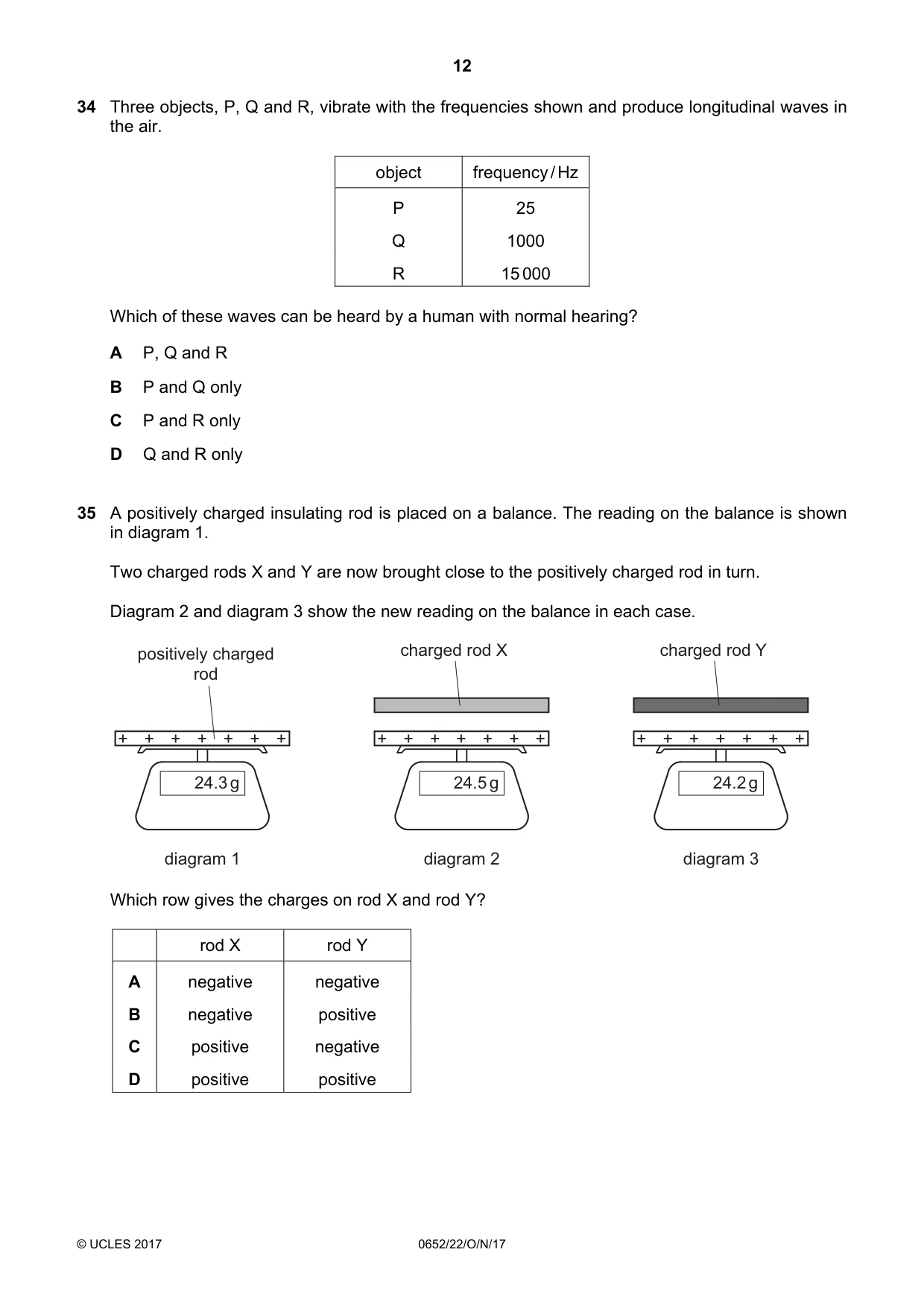
Mark scheme3 pages
Answers below. Sit the paper first if you are practising.
Questions as text
Q1 · What is the name of the process by which gas particles move to occupy all the available…
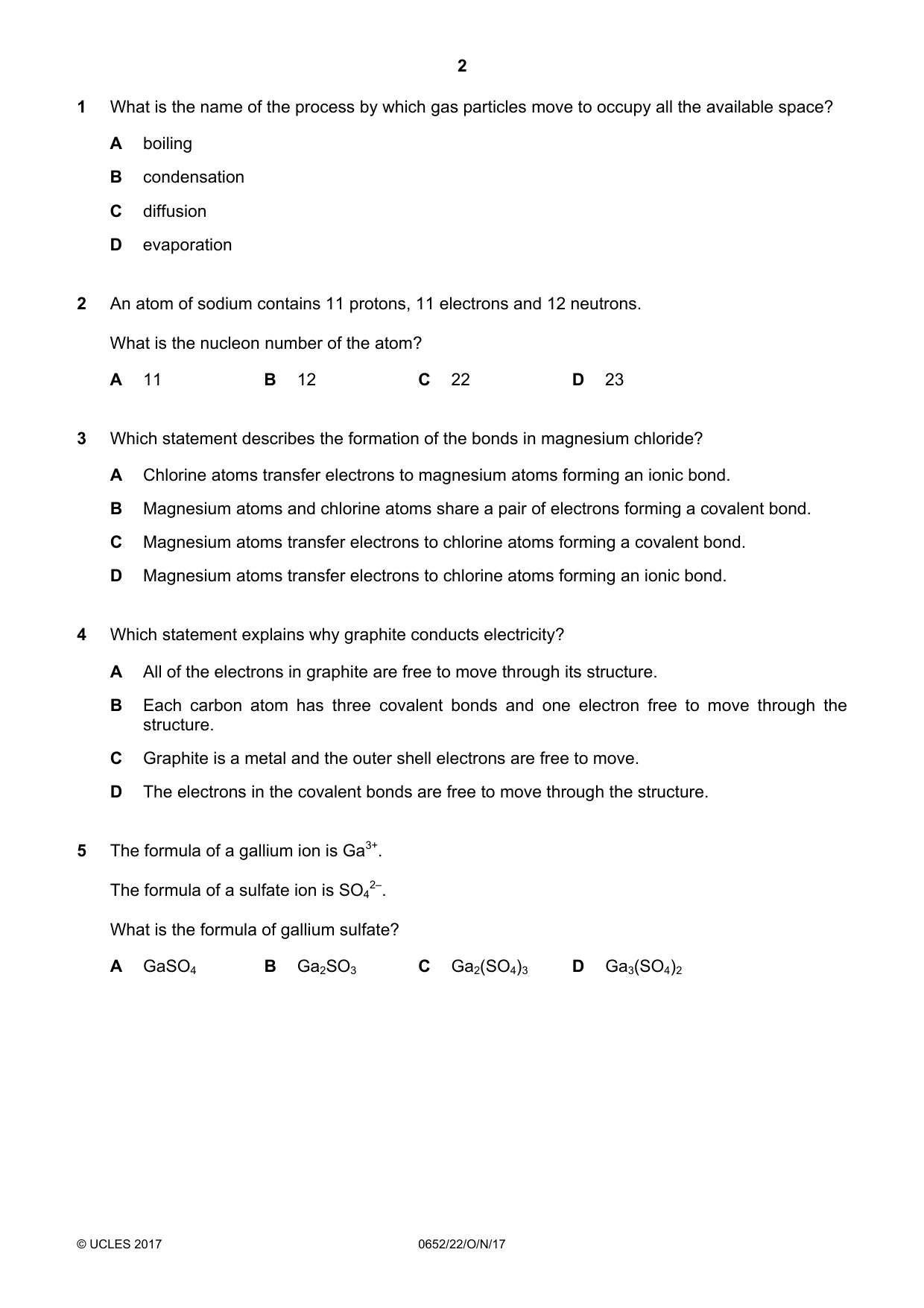
1 What is the name of the process by which gas particles move to occupy all the available space? A boiling B condensation C diffusion D evaporation
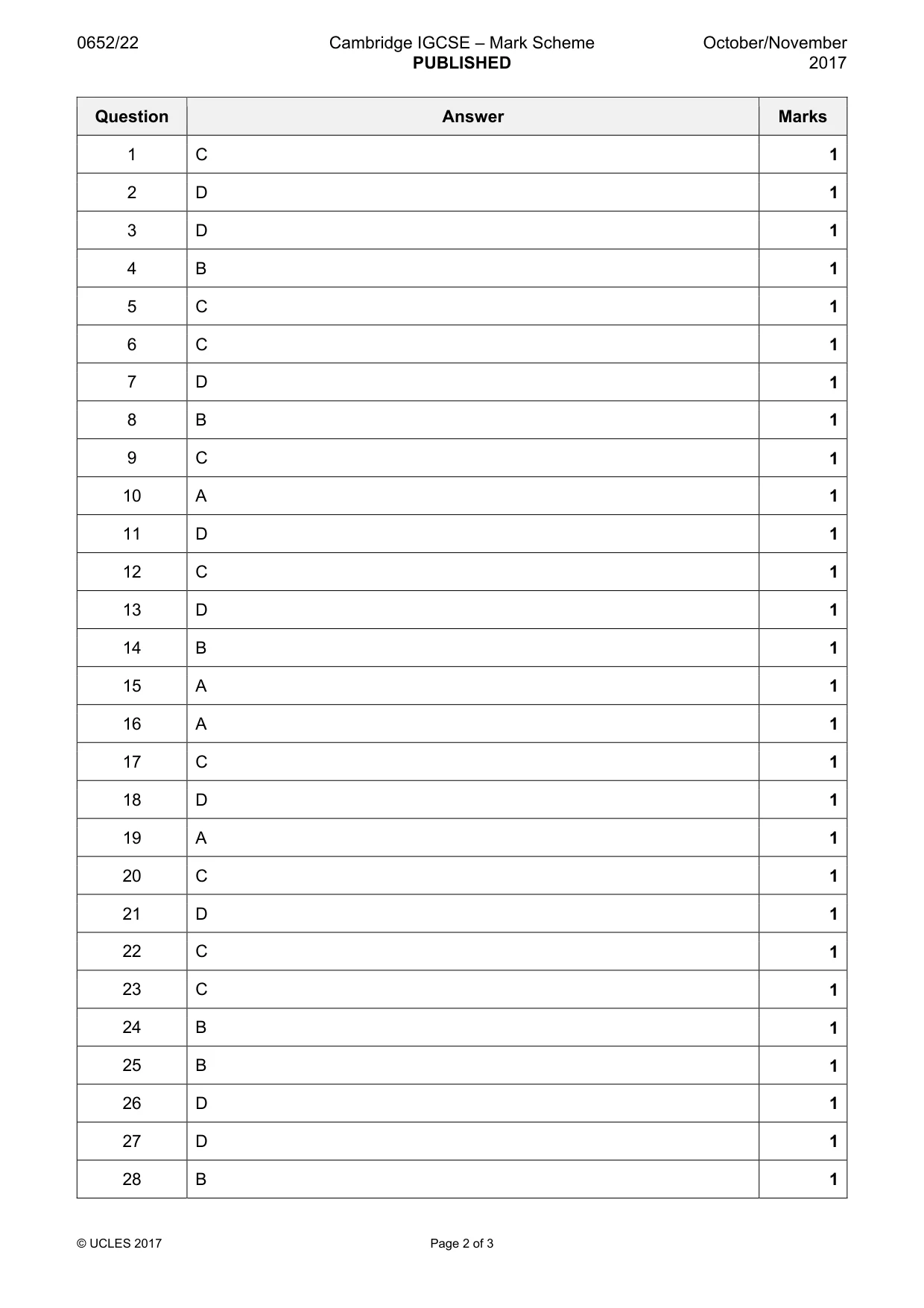
Mark scheme: C
Q2 · An atom of sodium contains 11 protons, 11 electrons and 12 neutrons
2 An atom of sodium contains 11 protons, 11 electrons and 12 neutrons. What is the nucleon number of the atom? A 11 B 12 C 22 D 23
Mark scheme: D
Q3 · Which statement describes the formation of the bonds in magnesium chloride?
3 Which statement describes the formation of the bonds in magnesium chloride? A Chlorine atoms transfer electrons to magnesium atoms forming an ionic bond. B Magnesium atoms and chlorine atoms share a pair of electrons forming a covalent bond. C Magnesium atoms transfer electrons to chlorine atoms forming a covalent bond. D Magnesium atoms transfer electrons to chlorine atoms forming an ionic bond.
Mark scheme: D
Q4 · Which statement explains why graphite conducts electricity?
4 Which statement explains why graphite conducts electricity? A All of the electrons in graphite are free to move through its structure. B Each carbon atom has three covalent bonds and one electron free to move through the structure. C Graphite is a metal and the outer shell electrons are free to move. D The electrons in the covalent bonds are free to move through the structure.
Mark scheme: B
Q5 · The formula of a gallium ion is Ga3+
5 The formula of a gallium ion is Ga3+. The formula of a sulfate ion is SO4 2–. What is the formula of gallium sulfate? A GaSO4 B Ga2SO3 C Ga2(SO4)3 D Ga3(SO4)2
Mark scheme: C
Q6 · Chromium(III) oxide reacts with dilute nitric acid to give chromium(III) nitrate and water
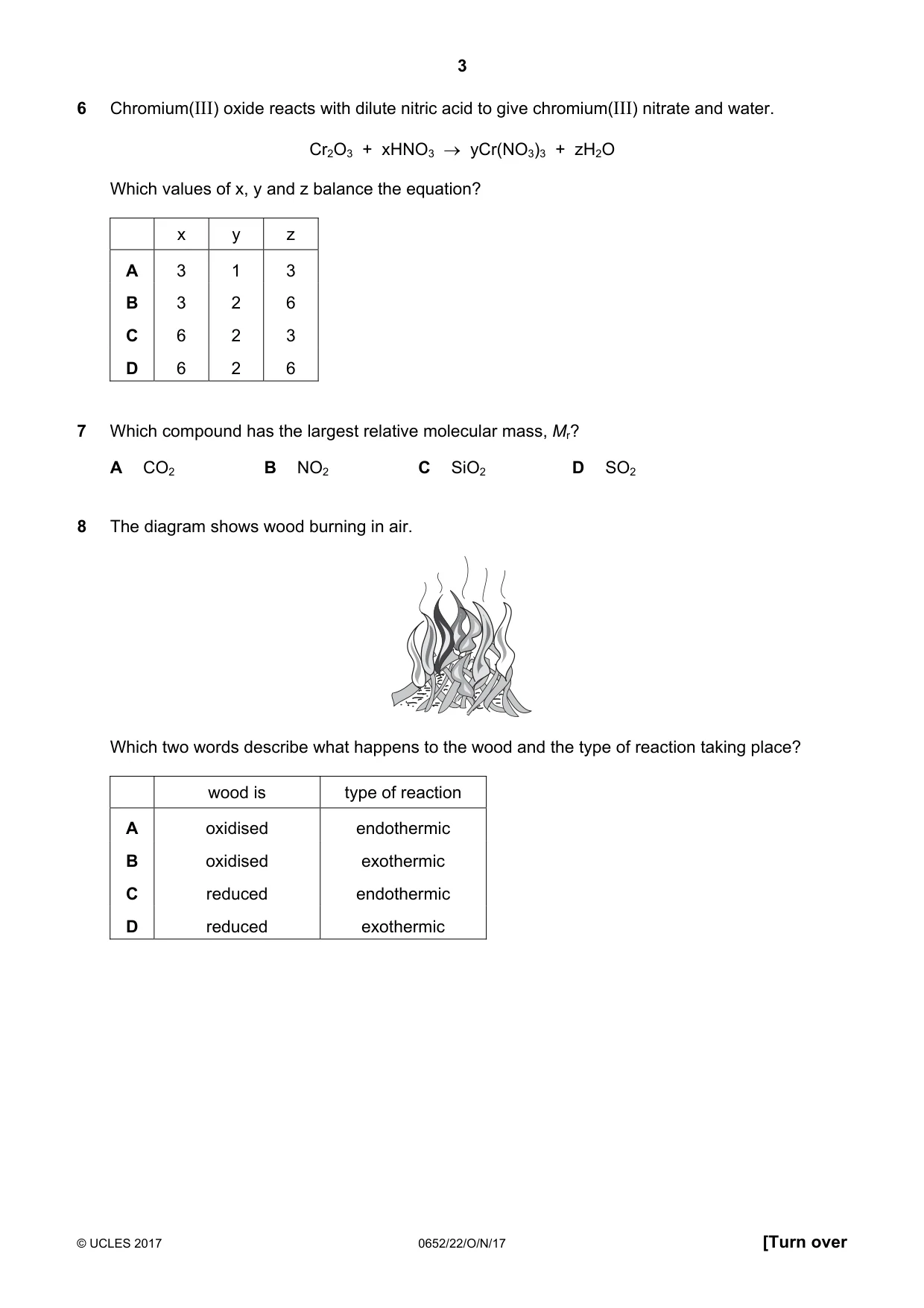
6 Chromium(III) oxide reacts with dilute nitric acid to give chromium(III) nitrate and water. Cr2O3 + xHNO3 → yCr(NO3)3 + zH2O Which values of x, y and z balance the equation? x y z A 3 1 3 B 3 2 6 C 6 2 3 D 6 2 6
Mark scheme: C
Q7 · Which compound has the largest relative molecular mass, Mr?
7 Which compound has the largest relative molecular mass, Mr? A CO2 B NO2 C SiO2 D SO2
Mark scheme: D
Q8 · The diagram shows wood burning in air
8 The diagram shows wood burning in air. Which two words describe what happens to the wood and the type of reaction taking place? wood is type of reaction A oxidised endothermic B oxidised exothermic C reduced endothermic D reduced exothermic
Mark scheme: B
Q9 · Hydrogen bromide gas reacts with water to produce an acidic solution
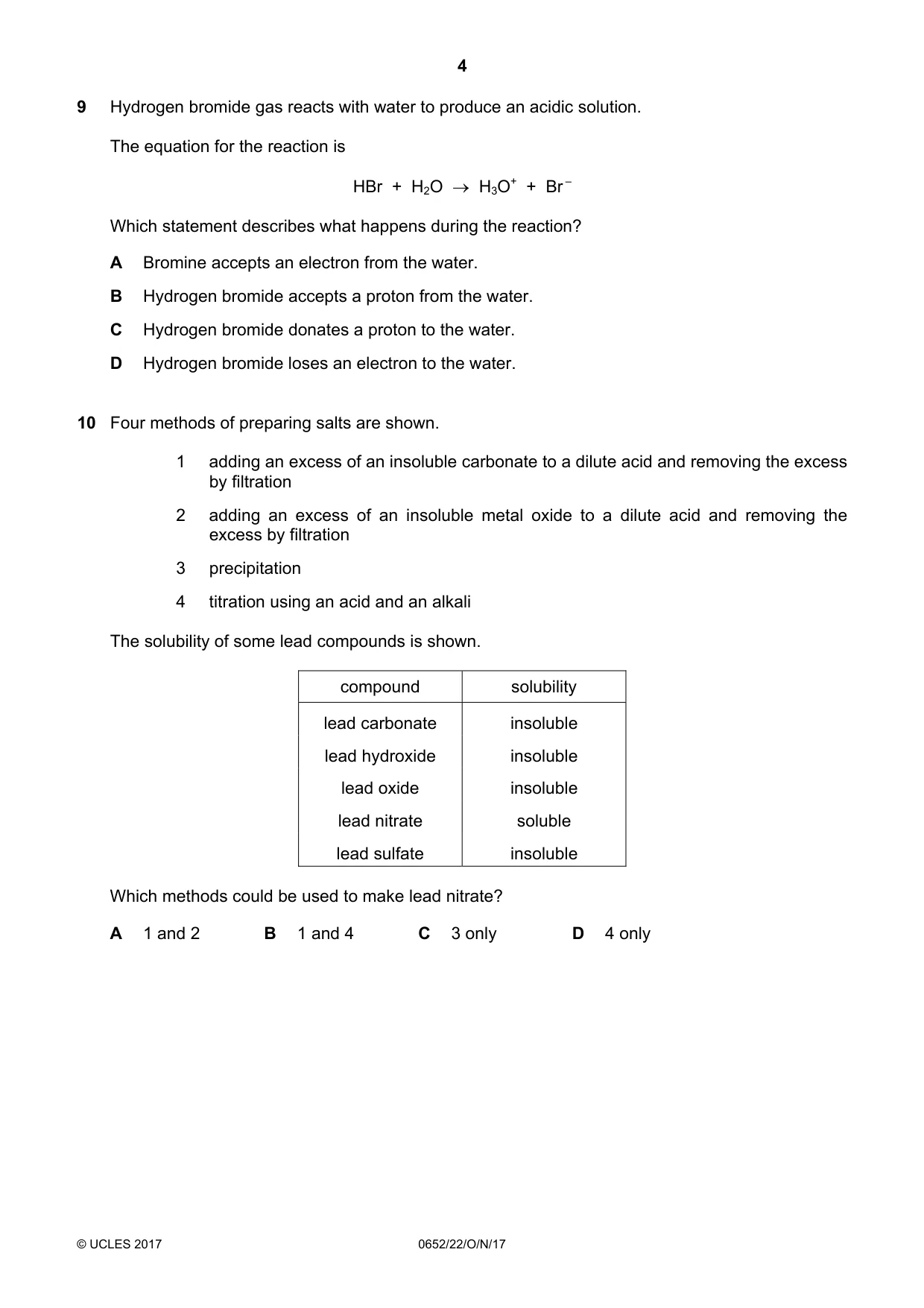
9 Hydrogen bromide gas reacts with water to produce an acidic solution. The equation for the reaction is HBr + H2O → H3O+ + Br – Which statement describes what happens during the reaction? A Bromine accepts an electron from the water. B Hydrogen bromide accepts a proton from the water. C Hydrogen bromide donates a proton to the water. D Hydrogen bromide loses an electron to the water.
Mark scheme: C
More questions on The characteristic properties of acids and bases
Q10 · Four methods of preparing salts are shown
10 Four methods of preparing salts are shown. 1 adding an excess of an insoluble carbonate to a dilute acid and removing the excess by filtration 2 adding an excess of an insoluble metal oxide to a dilute acid and removing the excess by filtration 3 precipitation 4 titration using an acid and an alkali The solubility of some lead compounds is shown. compound solubility lead carbonate insoluble lead hydroxide insoluble lead oxide insoluble lead nitrate soluble lead sulfate insoluble Which methods could be used to make lead nitrate? A 1 and 2 B 1 and 4 C 3 only D 4 only
Mark scheme: A
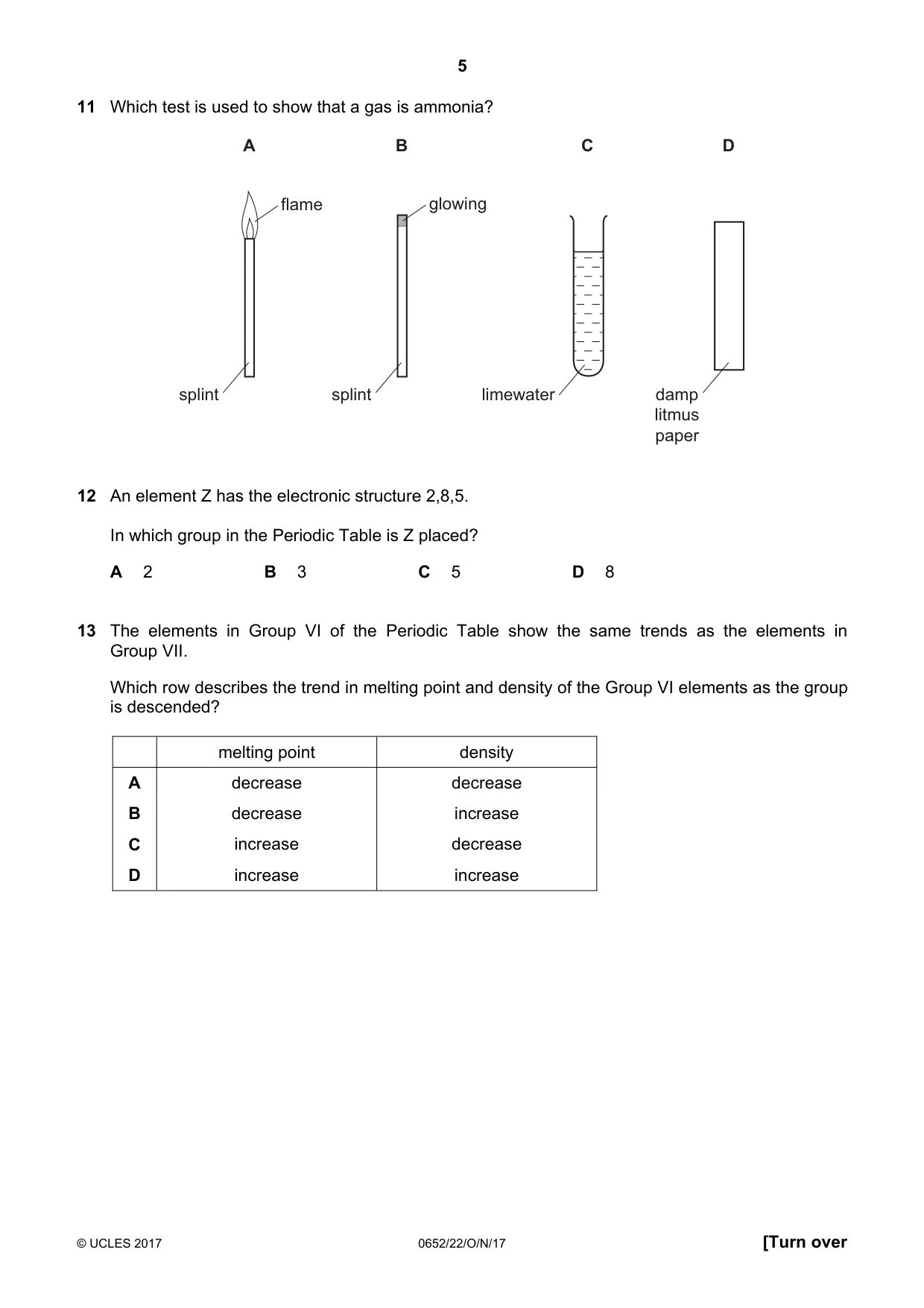
Q11 · Which test is used to show that a gas is ammonia?
11 Which test is used to show that a gas is ammonia? A B C D flame glowing splint splint limewater damp litmus paper
Mark scheme: D
Q12 · An element Z has the electronic structure 2,8,5
12 An element Z has the electronic structure 2,8,5. In which group in the Periodic Table is Z placed? A 2 B 3 C 5 D 8
Mark scheme: C
Q13 · The elements in Group VI of the Periodic Table show the same trends as the elements in…
13 The elements in Group VI of the Periodic Table show the same trends as the elements in Group VII. Which row describes the trend in melting point and density of the Group VI elements as the group is descended? melting point density A decrease decrease B decrease increase C increase decrease D increase increase
Mark scheme: D
Q14 · Bauxite and haematite are important ores
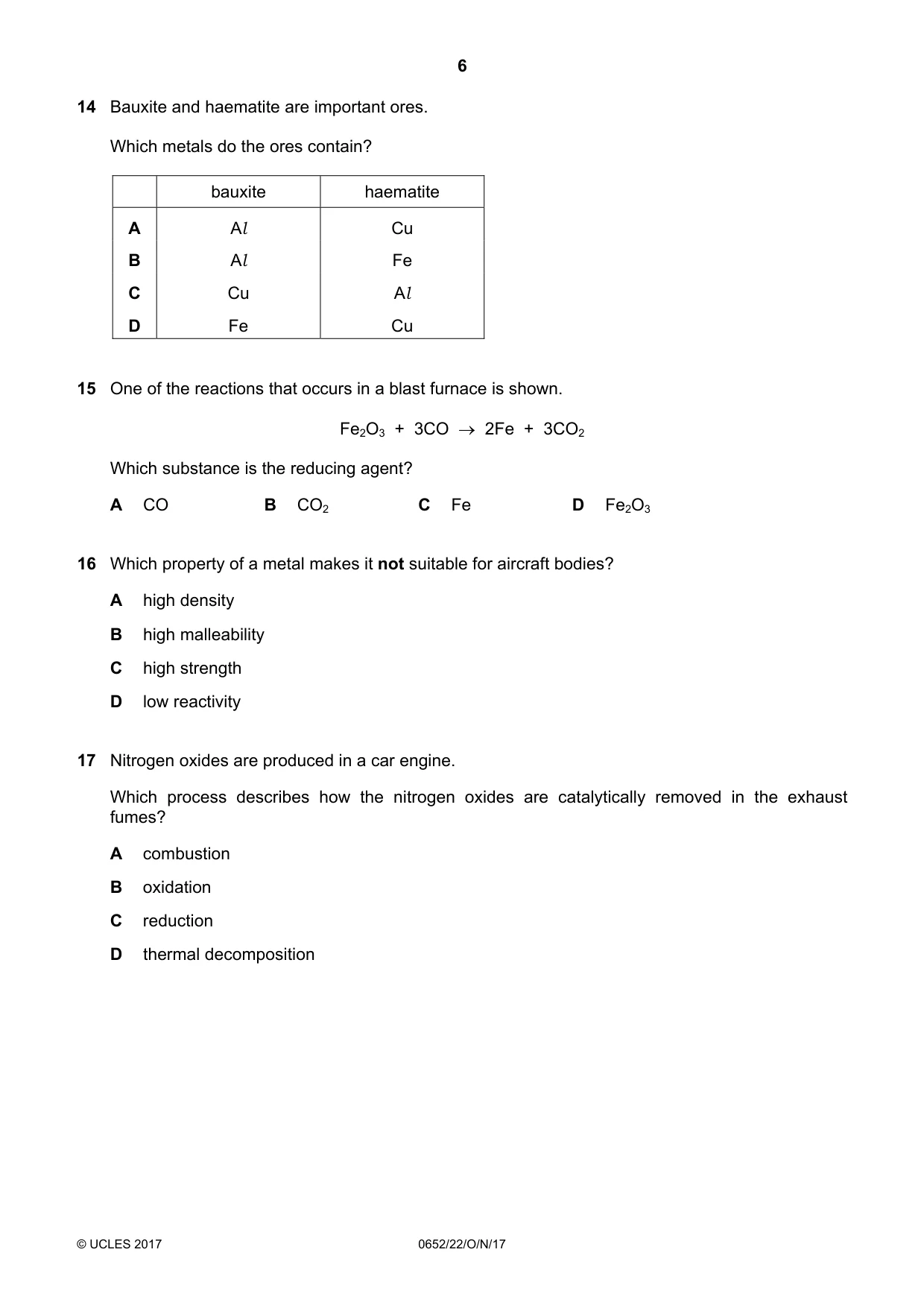
14 Bauxite and haematite are important ores. Which metals do the ores contain? bauxite haematite A Al Cu B Al Fe C Cu Al D Fe Cu
Mark scheme: B
Q15 · One of the reactions that occurs in a blast furnace is shown
15 One of the reactions that occurs in a blast furnace is shown. Fe2O3 + 3CO → 2Fe + 3CO2 Which substance is the reducing agent? A CO B CO2 C Fe D Fe2O3
Mark scheme: A
Q16 · Which property of a metal makes it not suitable for aircraft bodies?
16 Which property of a metal makes it not suitable for aircraft bodies? A high density B high malleability C high strength D low reactivity
Mark scheme: A
Q17 · Nitrogen oxides are produced in a car engine
17 Nitrogen oxides are produced in a car engine. Which process describes how the nitrogen oxides are catalytically removed in the exhaust fumes? A combustion B oxidation C reduction D thermal decomposition
Mark scheme: C
Q18 · Which row describes compounds in the same homologous series?
18 Which row describes compounds in the same homologous series? chemical functional properties group A different different B different the same C similar different D similar the same
Mark scheme: D
Q19 · When decane is heated over a catalyst, it breaks down to make octane and ethene
19 When decane is heated over a catalyst, it breaks down to make octane and ethene. Which name is given to this process? A cracking B distilling C polymerising D reducing
Mark scheme: A
Q20 · Limonene is a colourless, unsaturated hydrocarbon found in lemons
20 Limonene is a colourless, unsaturated hydrocarbon found in lemons. Which row describes the colour change when a few drops of limonene are shaken with bromine? colour of bromine colour of bromine at the start of experiment after mixing with limonene A colourless colourless B colourless orange C orange colourless D orange orange
Mark scheme: C
Q21 · An object falls vertically in air, from rest, through a large distance
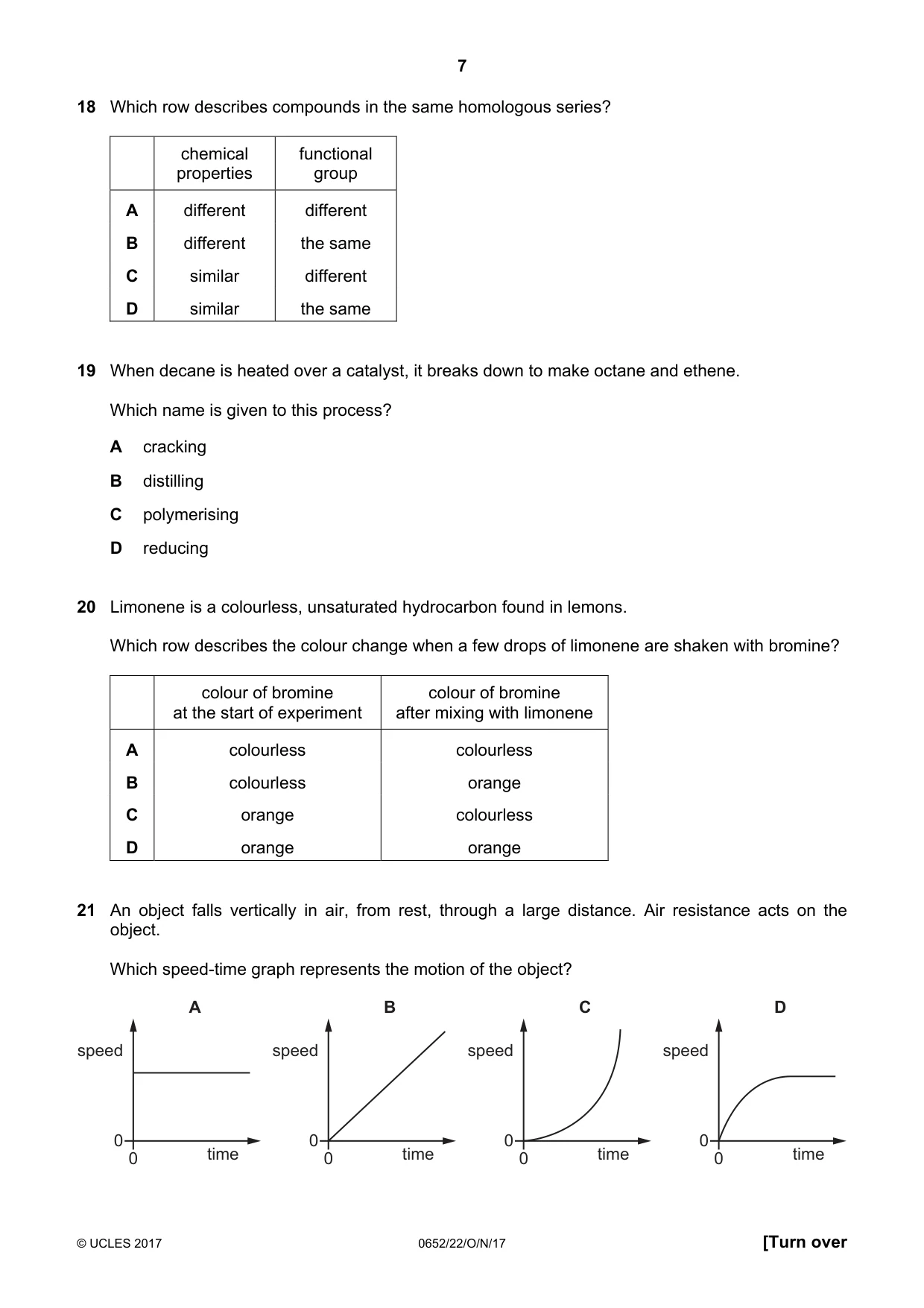
21 An object falls vertically in air, from rest, through a large distance. Air resistance acts on the object. Which speed-time graph represents the motion of the object? A B C D speed speed speed speed 0 0 0 0 0 time 0 time 0 time 0 time
Mark scheme: D
Q22 · A student does work by pulling a case across a horizontal floor
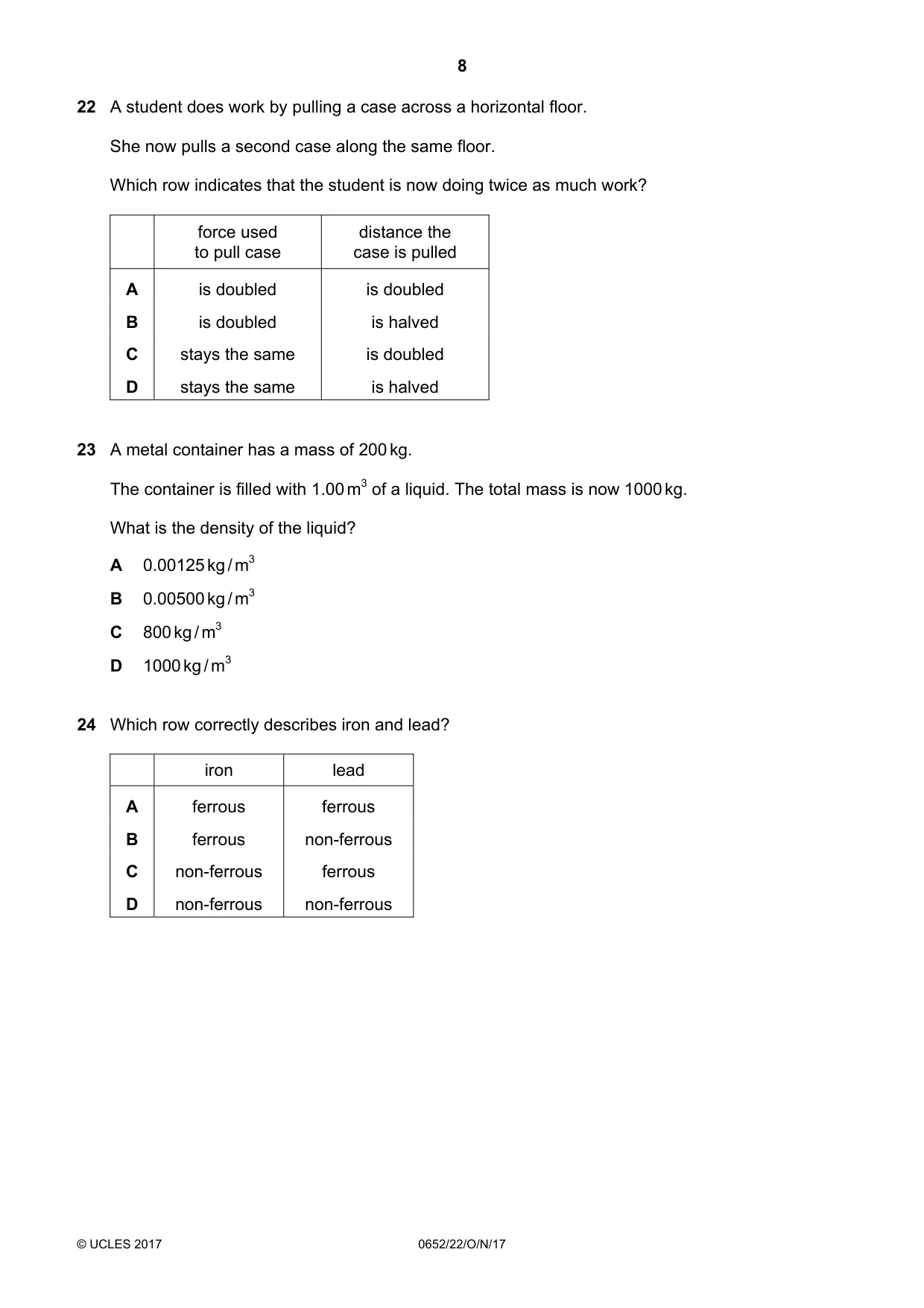
22 A student does work by pulling a case across a horizontal floor. She now pulls a second case along the same floor. Which row indicates that the student is now doing twice as much work? force used distance the to pull case case is pulled A is doubled is doubled B is doubled is halved C stays the same is doubled D stays the same is halved
Mark scheme: C
Q23 · A metal container has a mass of 200 kg
23 A metal container has a mass of 200 kg. The container is filled with 1.00 m3 of a liquid. The total mass is now 1000 kg. What is the density of the liquid? A 0.00125 kg / m3 B 0.00500 kg / m3 C 800 kg / m3 D 1000 kg / m3
Mark scheme: C
Q24 · Which row correctly describes iron and lead?
24 Which row correctly describes iron and lead? iron lead A ferrous ferrous B ferrous non-ferrous C non-ferrous ferrous D non-ferrous non-ferrous
Mark scheme: B
Q25 · A uniform metre rule of weight 2.0 N is pivoted at the 40 cm mark
25 A uniform metre rule of weight 2.0 N is pivoted at the 40 cm mark. The rule is held in equilibrium by force F acting at the 90 cm mark. 0 cm 40 cm 90 cm pivot F What is F ? A 0.22 N B 0.40 N C 0.89 N D 1.6 N
Mark scheme: B
Q26 · An object of mass m moving with velocity v has kinetic energy E
26 An object of mass m moving with velocity v has kinetic energy E. What is the kinetic energy of an object of mass 4.0 m moving with velocity 2.0 v? A 2.0 E B 4.0 E C 8.0 E D 16.0 E
Mark scheme: D
Q27 · A power station uses nuclear fission to obtain energy
27 A power station uses nuclear fission to obtain energy. In this process, nuclear energy is first transferred to A chemical energy. B electrical energy. C gravitational energy. D thermal (heat) energy.
Mark scheme: D
Q28 · A student has two mercury-in-glass thermometers P and Q
28 A student has two mercury-in-glass thermometers P and Q. They contain equal volumes of mercury. Thermometer Q has a longer stem and a wider capillary bore than thermometer P. Which row compares the range and the sensitivity of thermometer Q with those of thermometer P? range of Q sensitivity of Q compared with P compared with P A greater greater B greater smaller C smaller greater D smaller smaller
Mark scheme: B
Q29 · The diagram shows four identical copper blocks
29 The diagram shows four identical copper blocks. The blocks have been painted so that their surfaces are different. All four blocks are heated to the same temperature, in the same room. Which block cools the most slowly? A B C D white and shiny black and shiny white and dull black and dull surface surface surface surface
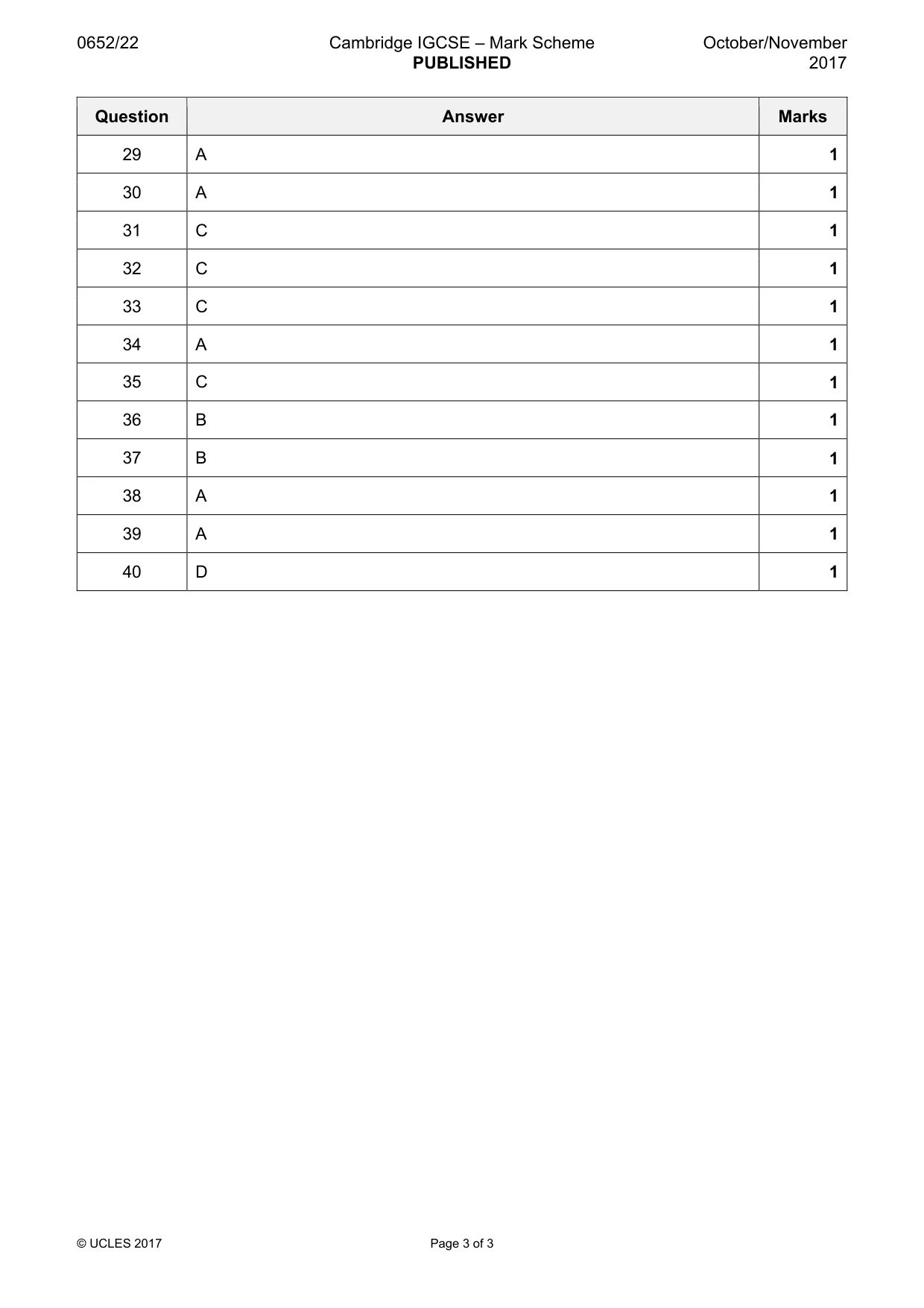
Mark scheme: A
Q30 · The diagram shows a water wave being diffracted at the edge of a barrier
30 The diagram shows a water wave being diffracted at the edge of a barrier. water wave barrier Which diagram shows water waves of half the frequency being diffracted at the edge of the same barrier? A B C D
Mark scheme: A
Q31 · The table gives information about the approximate speed and range of wavelengths of waves
31 The table gives information about the approximate speed and range of wavelengths of waves. Which row describes monochromatic microwaves in a vacuum? approximate speed wavelengths A 300 m / s all the same B 300 m / s a range of different values C 300 000 km / s all the same D 300 000 km / s a range of different values
Mark scheme: C
Q32 · A ray of light in a glass block strikes the edge of the block
32 A ray of light in a glass block strikes the edge of the block. The angle of incidence is much smaller than the critical angle. air glass block ray of light What happens to this ray? A It is completely reflected. B It is completely refracted. C It is partially reflected and partially refracted. D It is refracted at an angle of refraction of 90°.
Mark scheme: C
Q33 · The diagram shows the paths of two rays from the top of an object
33 The diagram shows the paths of two rays from the top of an object. The rays pass through a thin converging lens. The image produced is viewed from the position shown. lens image viewed object from here What type of image is seen? A a real image that is larger than the object B a real image that is smaller than the object C a virtual image that is larger than the object D a virtual image that is smaller than the object
Mark scheme: C
Q34 · Three objects, P, Q and R, vibrate with the frequencies shown and produce longitudinal…
34 Three objects, P, Q and R, vibrate with the frequencies shown and produce longitudinal waves in the air. object frequency / Hz P 25 Q 1000 R 15 000 Which of these waves can be heard by a human with normal hearing? A P, Q and R B P and Q only C P and R only D Q and R only
Mark scheme: A
Q35 · A positively charged insulating rod is placed on a balance
35 A positively charged insulating rod is placed on a balance. The reading on the balance is shown in diagram 1. Two charged rods X and Y are now brought close to the positively charged rod in turn. Diagram 2 and diagram 3 show the new reading on the balance in each case. positively charged charged rod X charged rod Y rod + + + + + + + + + + + + + + + + + + + + + 24.3 g 24.5 g 24.2 g diagram 1 diagram 2 diagram 3 Which row gives the charges on rod X and rod Y? rod X rod Y A negative negative B negative positive C positive negative D positive positive
Mark scheme: C
Q36 · A charger for a mobile phone (cell phone) supplies 50 mA of current to the phone battery…
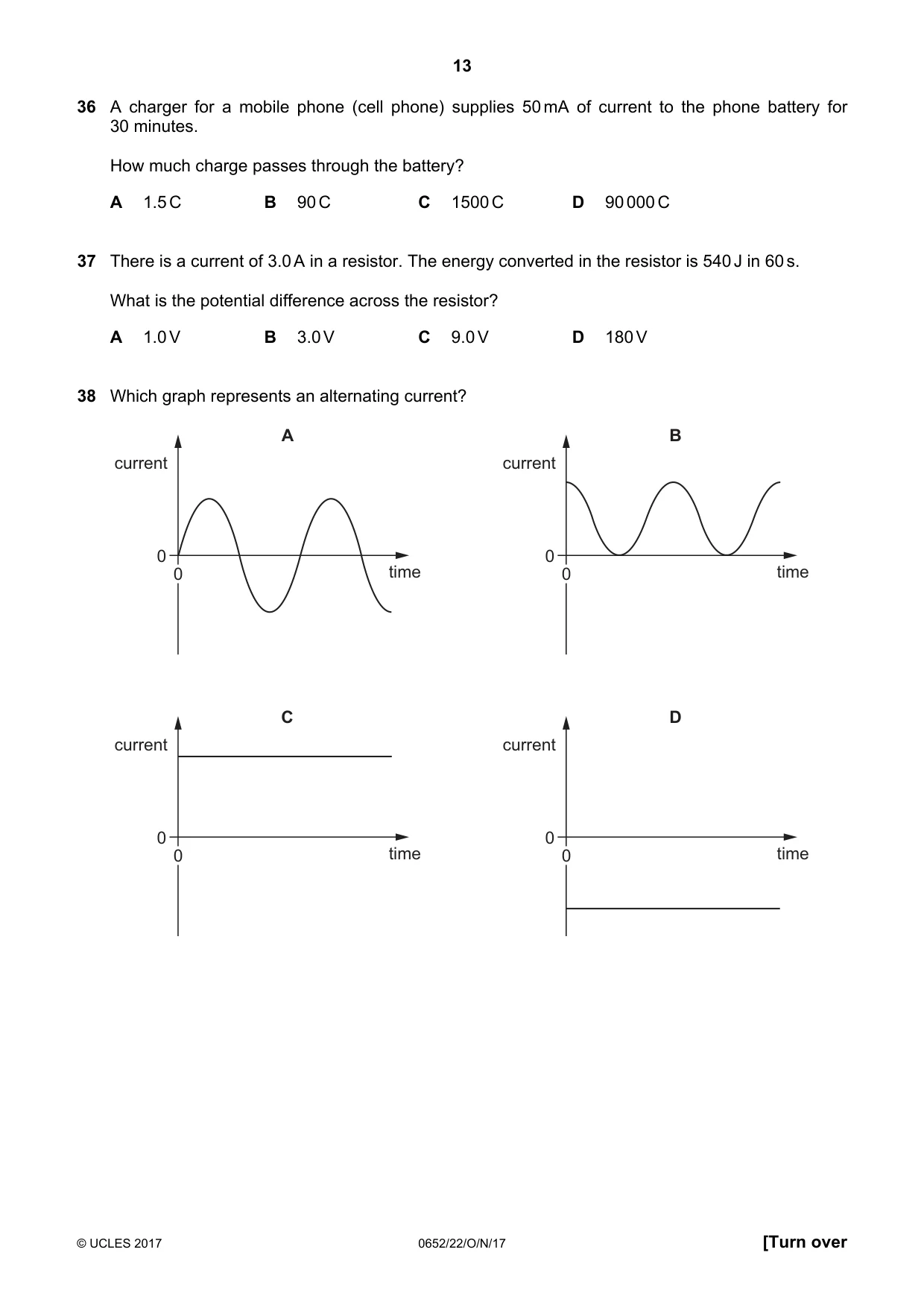
36 A charger for a mobile phone (cell phone) supplies 50 mA of current to the phone battery for 30 minutes. How much charge passes through the battery? A 1.5 C B 90 C C 1500 C D 90 000 C
Mark scheme: B
Q37 · There is a current of 3.0 A in a resistor
37 There is a current of 3.0 A in a resistor. The energy converted in the resistor is 540 J in 60 s. What is the potential difference across the resistor? A 1.0 V B 3.0 V C 9.0 V D 180 V
Mark scheme: B
Q38 · Which graph represents an alternating current?
38 Which graph represents an alternating current? A B current current 0 0 0 time 0 time C D current current 0 0 0 time 0 time
Mark scheme: A
Q39 · The diagram represents a transformer
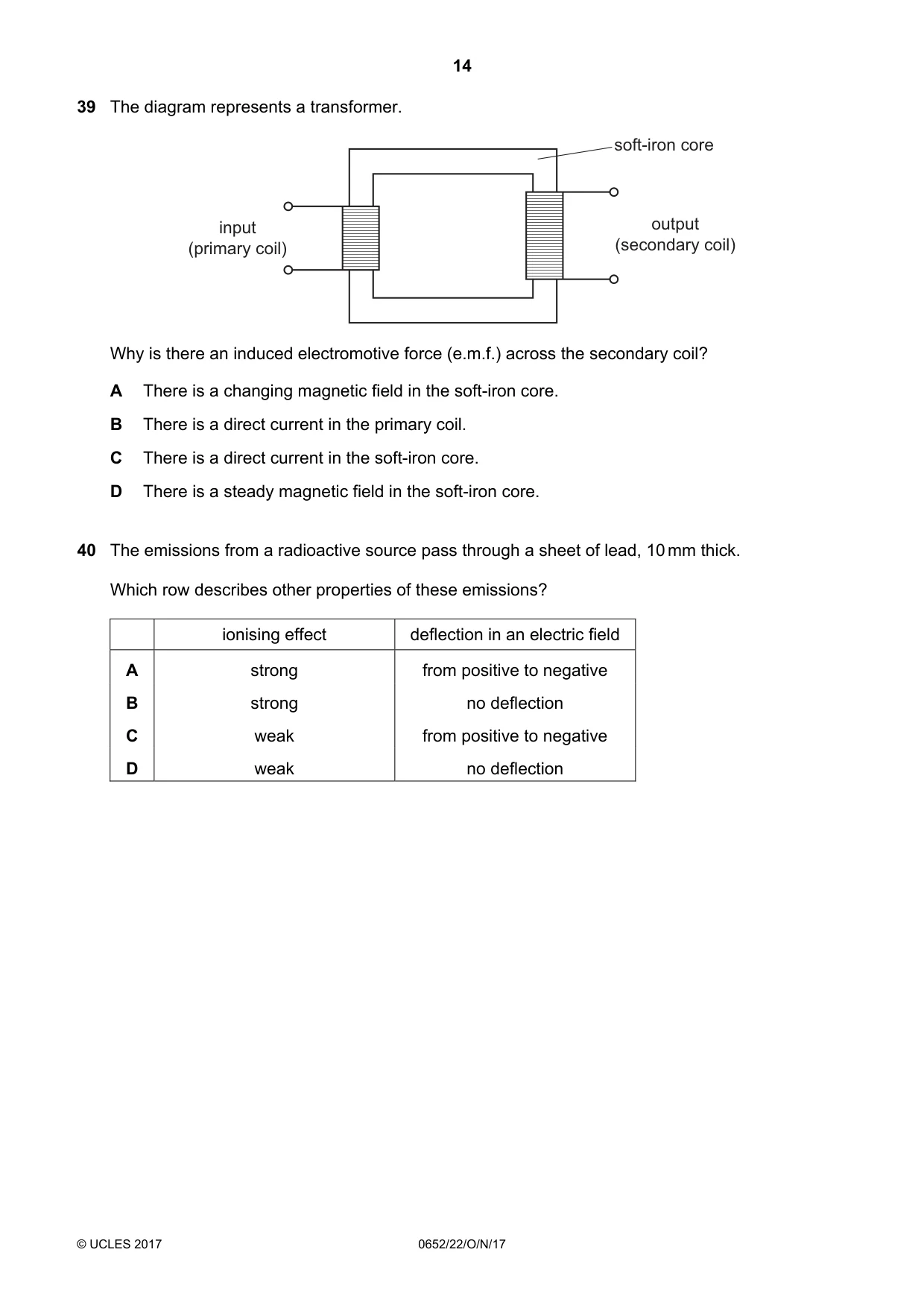
39 The diagram represents a transformer. soft-iron core input output (primary coil) (secondary coil) Why is there an induced electromotive force (e.m.f.) across the secondary coil? A There is a changing magnetic field in the soft-iron core. B There is a direct current in the primary coil. C There is a direct current in the soft-iron core. D There is a steady magnetic field in the soft-iron core.
Mark scheme: A
Q40 · The emissions from a radioactive source pass through a sheet of lead, 10 mm thick
40 The emissions from a radioactive source pass through a sheet of lead, 10 mm thick. Which row describes other properties of these emissions? ionising effect deflection in an electric field A strong from positive to negative B strong no deflection C weak from positive to negative D weak no deflection
Mark scheme: D
What was in this paper
The subtopics covered by these 40 questions, and how many questions each got. Open one in a new tab to see every Cambridge question on it.
3Work, energy and power3Electrical quantities2General wave properties2Light2Simple phenomena of magnetism2Air1Alkanes1Alkenes1Atomic structure and the Periodic Table1Density1Electric circuits1Electromagnetic effects1Energy transfer1Extraction of metals1Forces1Group properties1Homologous series1Identification of ions and gases1Ions and ionic bonds1Macromolecules1Motion1Periodic Trends1Preparation of salts1Radioactivity1Redox1Sound1The characteristic properties of acids and bases1The particulate nature of matter1Thermal processes1Thermal properties and temperature1Uses of metals1What you needed in this session
Cambridge’s own grade thresholds for 2017 Oct/Nov, Paper 2 · Variant 2. A higher threshold means an easier paper — the bar moves with how the cohort did.