Cambridge IGCSE Physical Science 0652 — 2021 Oct/Nov Paper 2 · Variant 1
0652/21/O/N/21 · 40 questions · 40 marks · ≈45 min
The question paper and its mark scheme, free to read here and free to download. This is Cambridge’s own paper, exactly as it was sat.
Question paper20 pages



Mark scheme3 pages
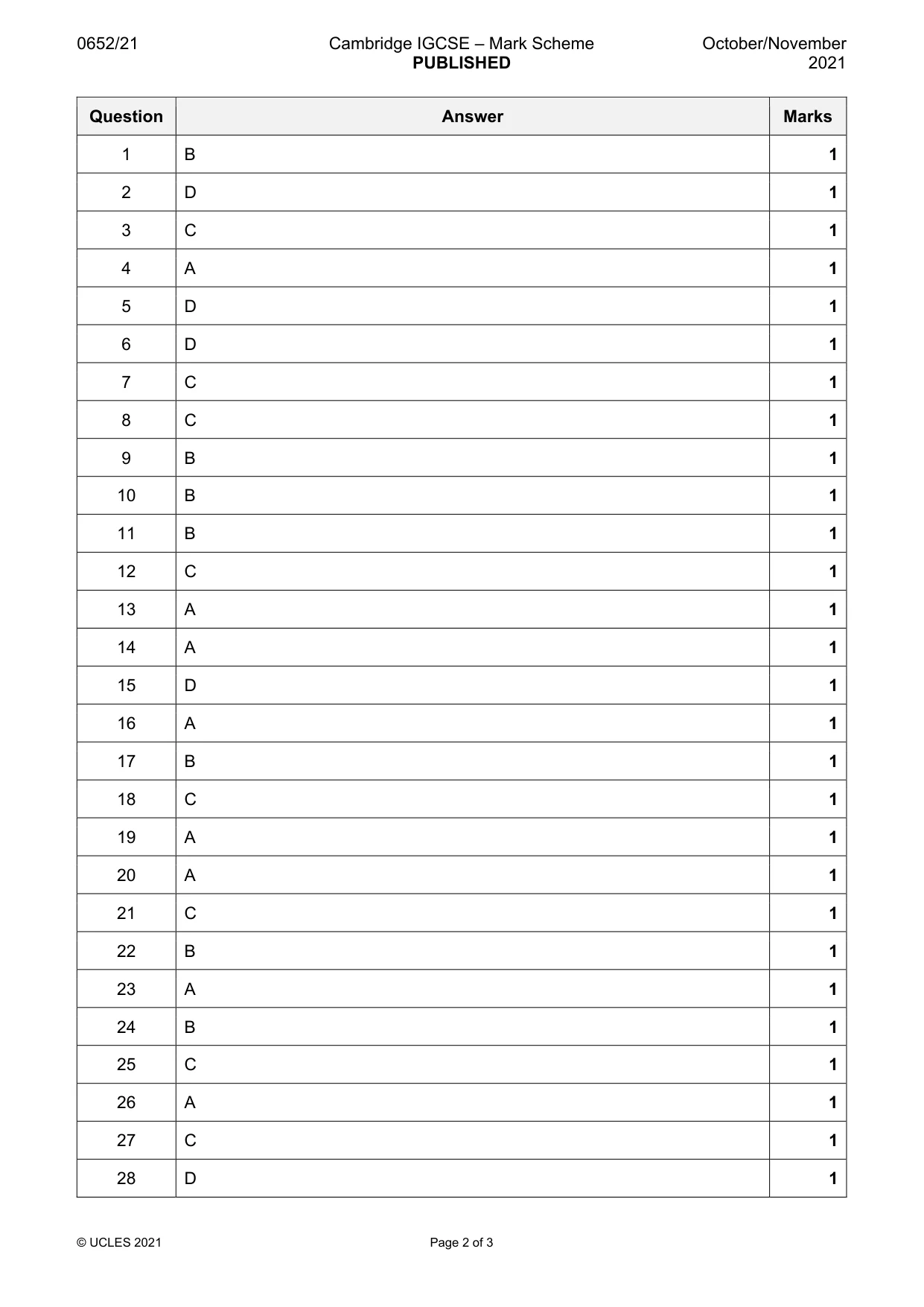
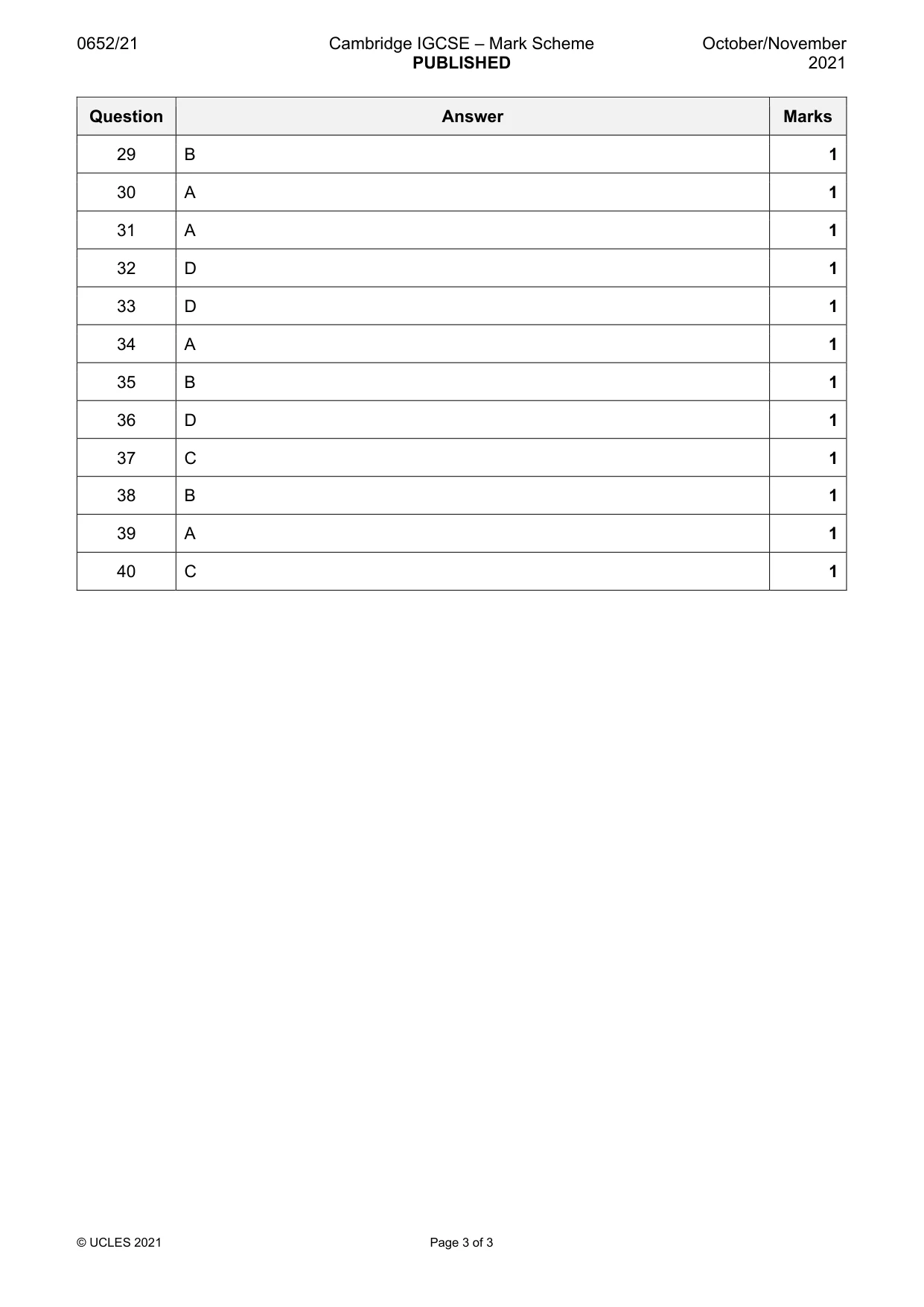
Answers below. Sit the paper first if you are practising.
Questions as text
Q1 · The diagram shows the movement of particles during a physical change
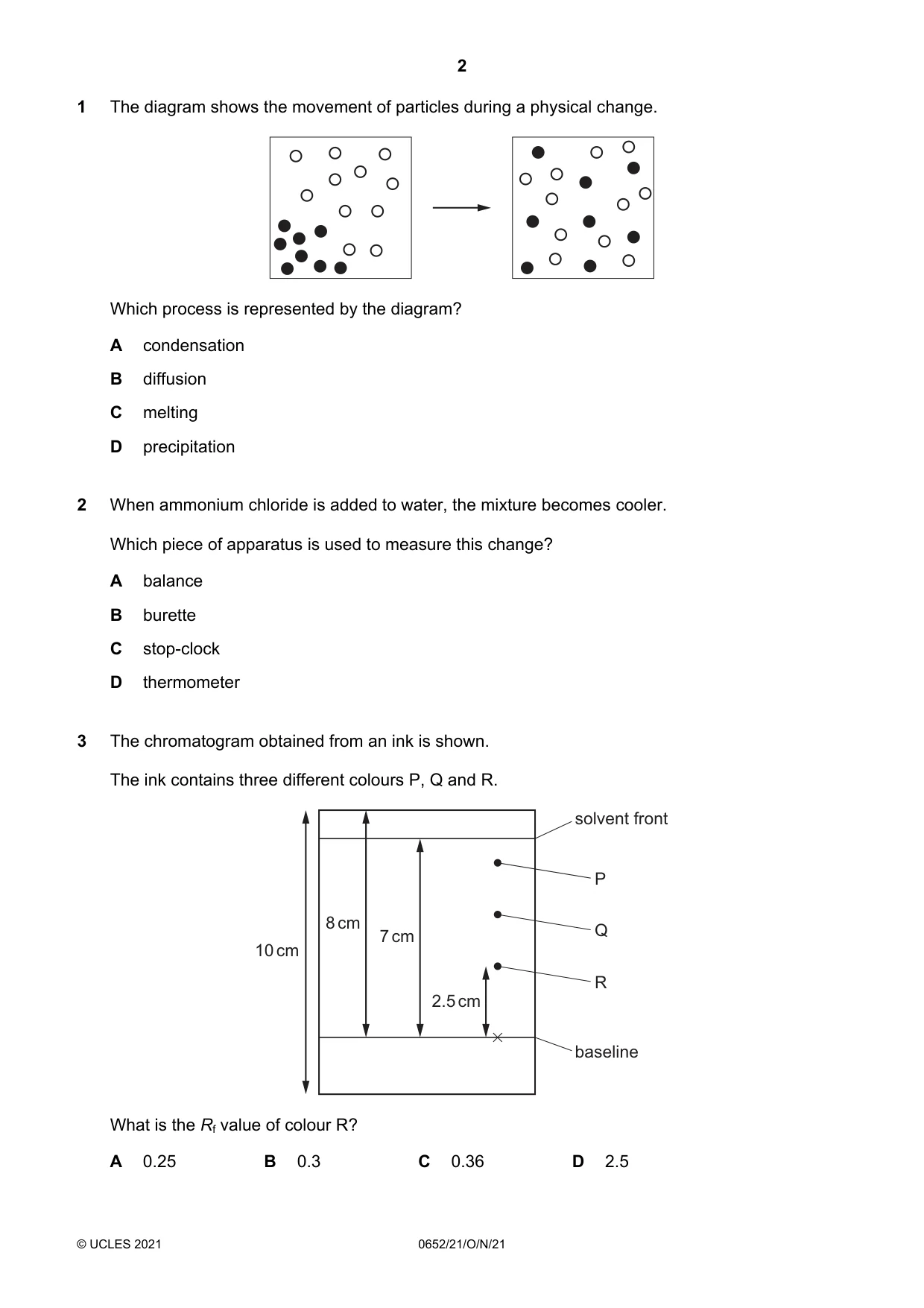
1 The diagram shows the movement of particles during a physical change. Which process is represented by the diagram? A condensation B diffusion C melting D precipitation
Mark scheme: B
Q2 · When ammonium chloride is added to water, the mixture becomes cooler
2 When ammonium chloride is added to water, the mixture becomes cooler. Which piece of apparatus is used to measure this change? A balance B burette C stop-clock D thermometer
Mark scheme: D
Q3 · The chromatogram obtained from an ink is shown
3 The chromatogram obtained from an ink is shown. The ink contains three different colours P, Q and R. solvent front P 8 cm 7 cm Q 10 cm R 2.5 cm baseline What is the Rf value of colour R? A 0.25 B 0.3 C 0.36 D 2.5
Mark scheme: C
Q4 · The table shows the electronic structure of four atoms from four different elements
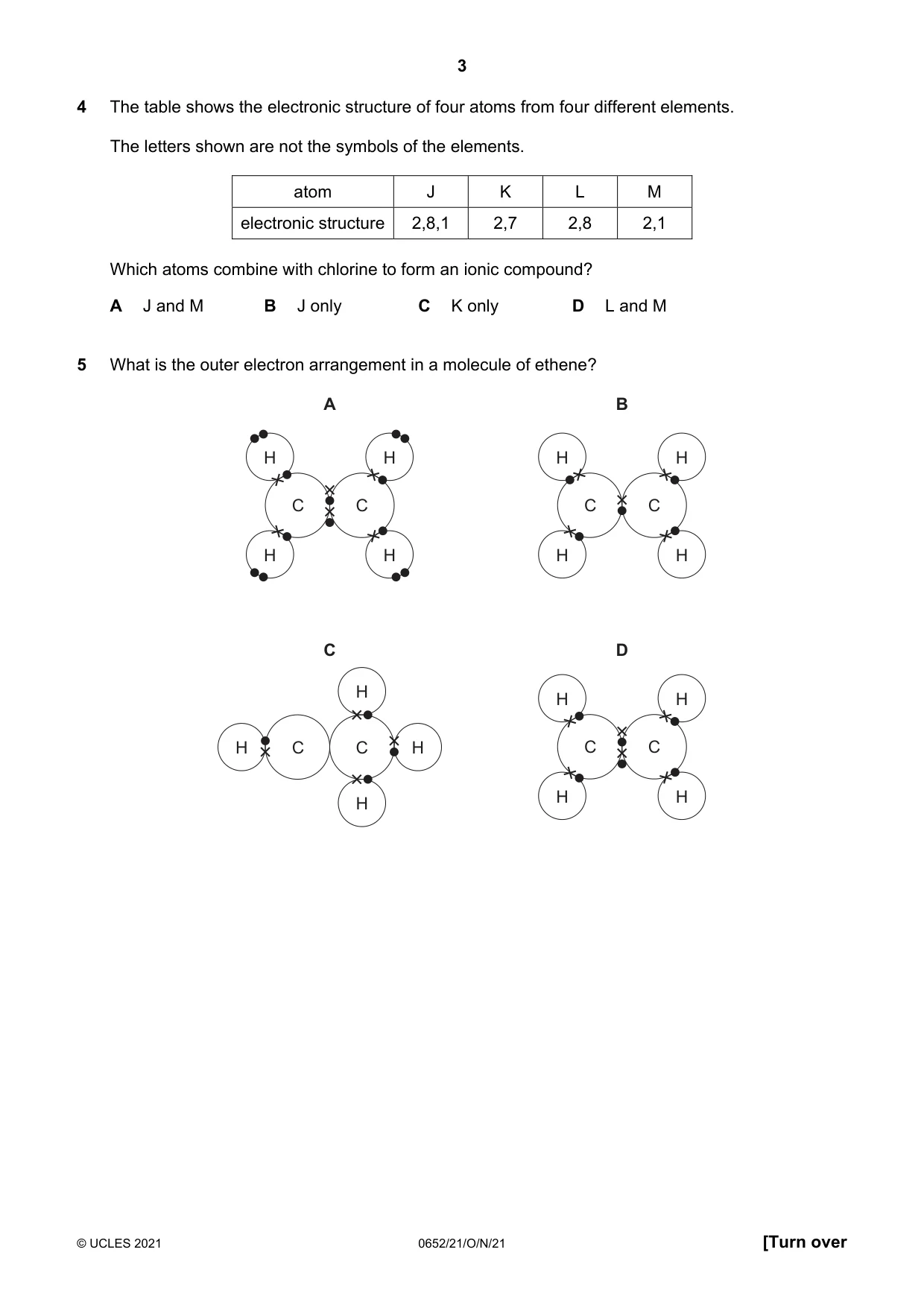
4 The table shows the electronic structure of four atoms from four different elements. The letters shown are not the symbols of the elements. atom J K L M electronic structure 2,8,1 2,7 2,8 2,1 Which atoms combine with chlorine to form an ionic compound? A J and M B J only C K only D L and M
Mark scheme: A
Q5 · What is the outer electron arrangement in a molecule of ethene?
5 What is the outer electron arrangement in a molecule of ethene? A B H H H H C C C C H H H H C D H H H H C C H C C H H H
Mark scheme: D
Q6 · Two structures X and Y are shown
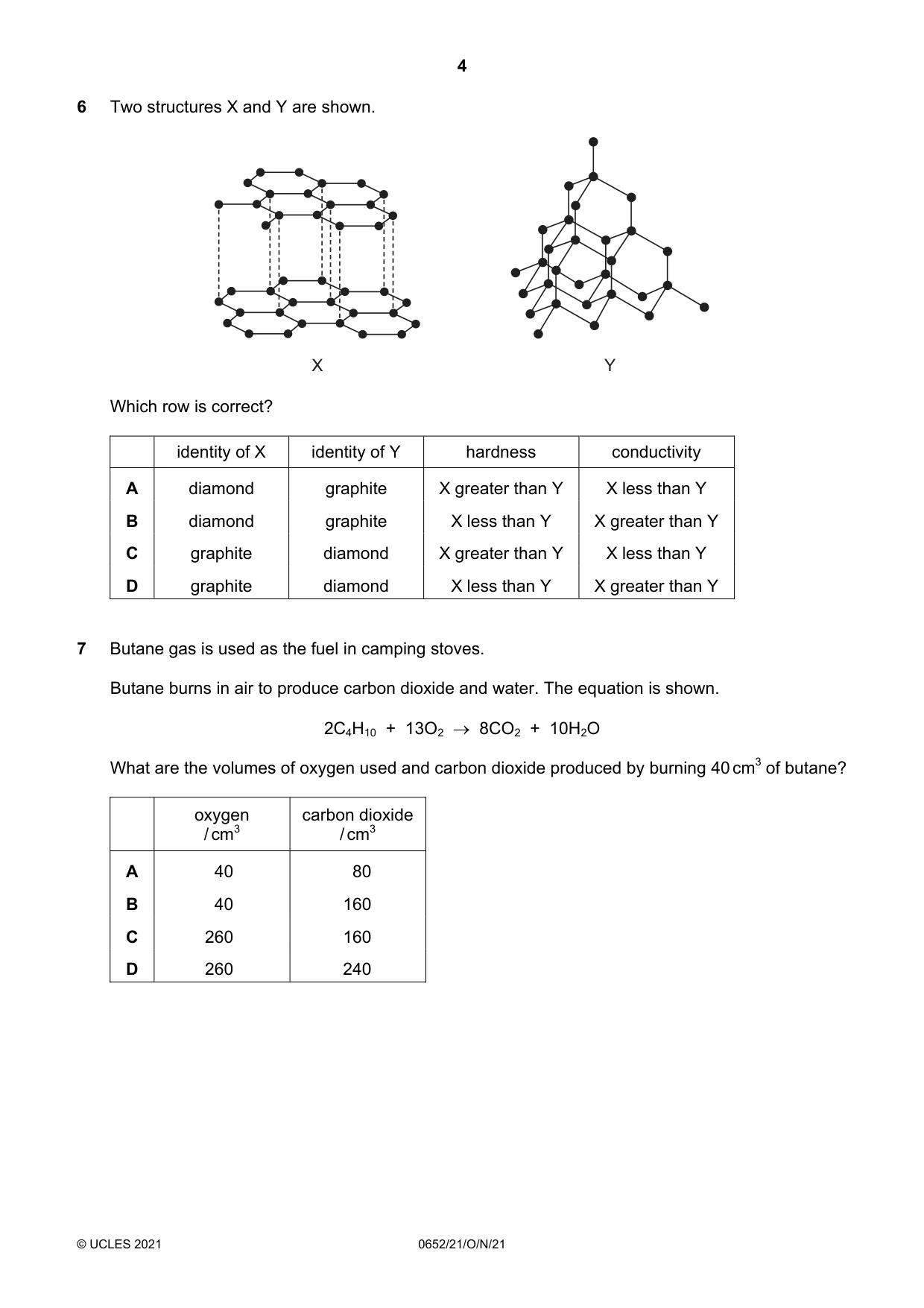
6 Two structures X and Y are shown. X Y Which row is correct? identity of X identity of Y hardness conductivity A diamond graphite X greater than Y X less than Y B diamond graphite X less than Y X greater than Y C graphite diamond X greater than Y X less than Y D graphite diamond X less than Y X greater than Y
Mark scheme: D
Q7 · Butane gas is used as the fuel in camping stoves
7 Butane gas is used as the fuel in camping stoves. Butane burns in air to produce carbon dioxide and water. The equation is shown. 2C4H10 + 13O2 8CO2 + 10H2O What are the volumes of oxygen used and carbon dioxide produced by burning 40 cm3 of butane? oxygen carbon dioxide / cm3 / cm3 A 40 80 B 40 160 C 260 160 D 260 240
Mark scheme: C
Q8 · Molten lead(II) bromide is electrolysed using inert electrodes
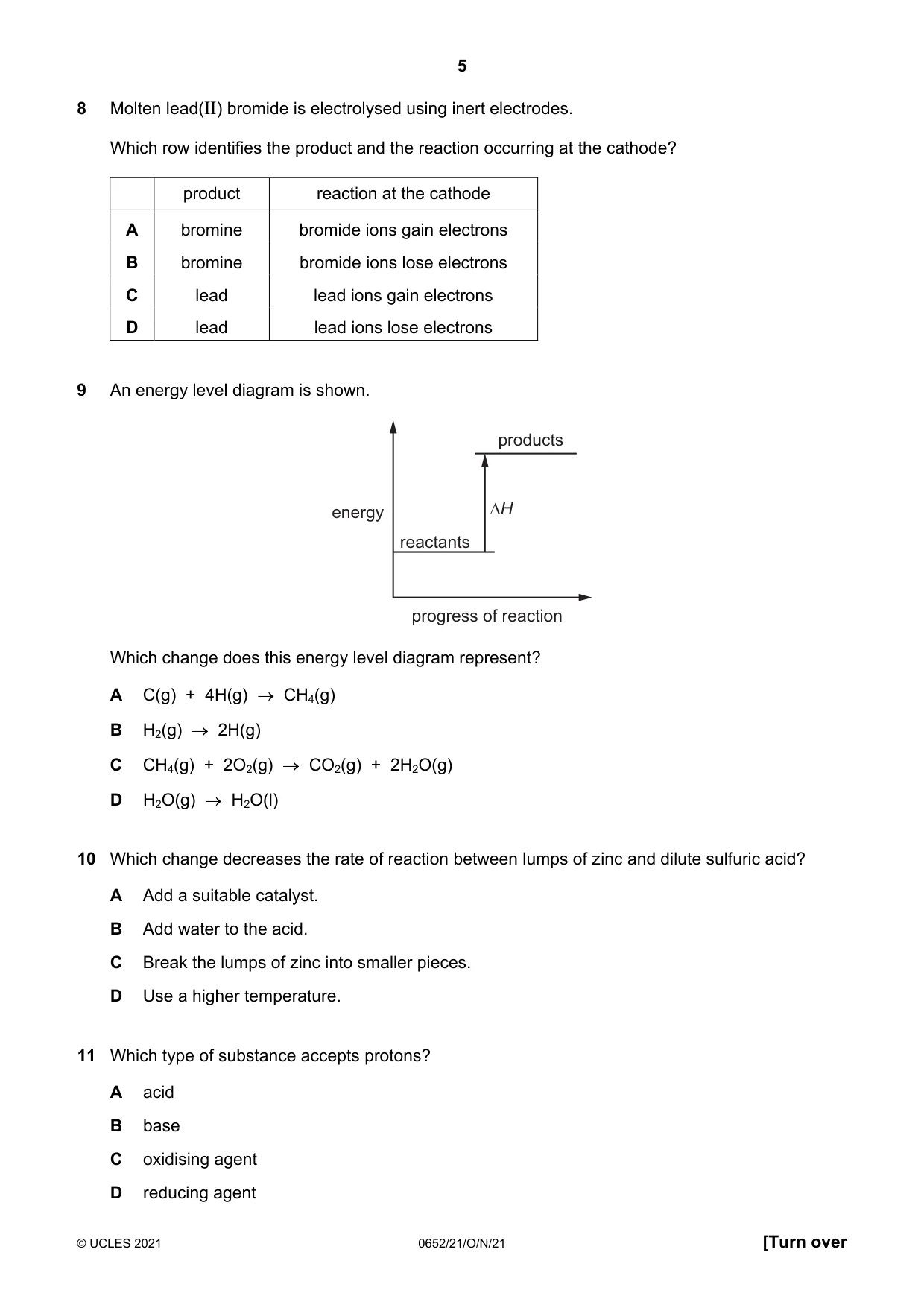
8 Molten lead(II) bromide is electrolysed using inert electrodes. Which row identifies the product and the reaction occurring at the cathode? product reaction at the cathode A bromine bromide ions gain electrons B bromine bromide ions lose electrons C lead lead ions gain electrons D lead lead ions lose electrons
Mark scheme: C
Q9 · An energy level diagram is shown
9 An energy level diagram is shown. products energy ∆H reactants progress of reaction Which change does this energy level diagram represent? A C(g) + 4H(g) CH4(g) B H2(g) 2H(g) C CH4(g) + 2O2(g) CO2(g) + 2H2O(g) D H2O(g) H2O(l)
Mark scheme: B
Q10 · Which change decreases the rate of reaction between lumps of zinc and dilute sulfuric…
10 Which change decreases the rate of reaction between lumps of zinc and dilute sulfuric acid? A Add a suitable catalyst. B Add water to the acid. C Break the lumps of zinc into smaller pieces. D Use a higher temperature.
Mark scheme: B
Q11 · Which type of substance accepts protons?
11 Which type of substance accepts protons? A acid B base C oxidising agent D reducing agent
Mark scheme: B
More questions on The characteristic properties of acids and bases
Q12 · Substances P and Q are oxides
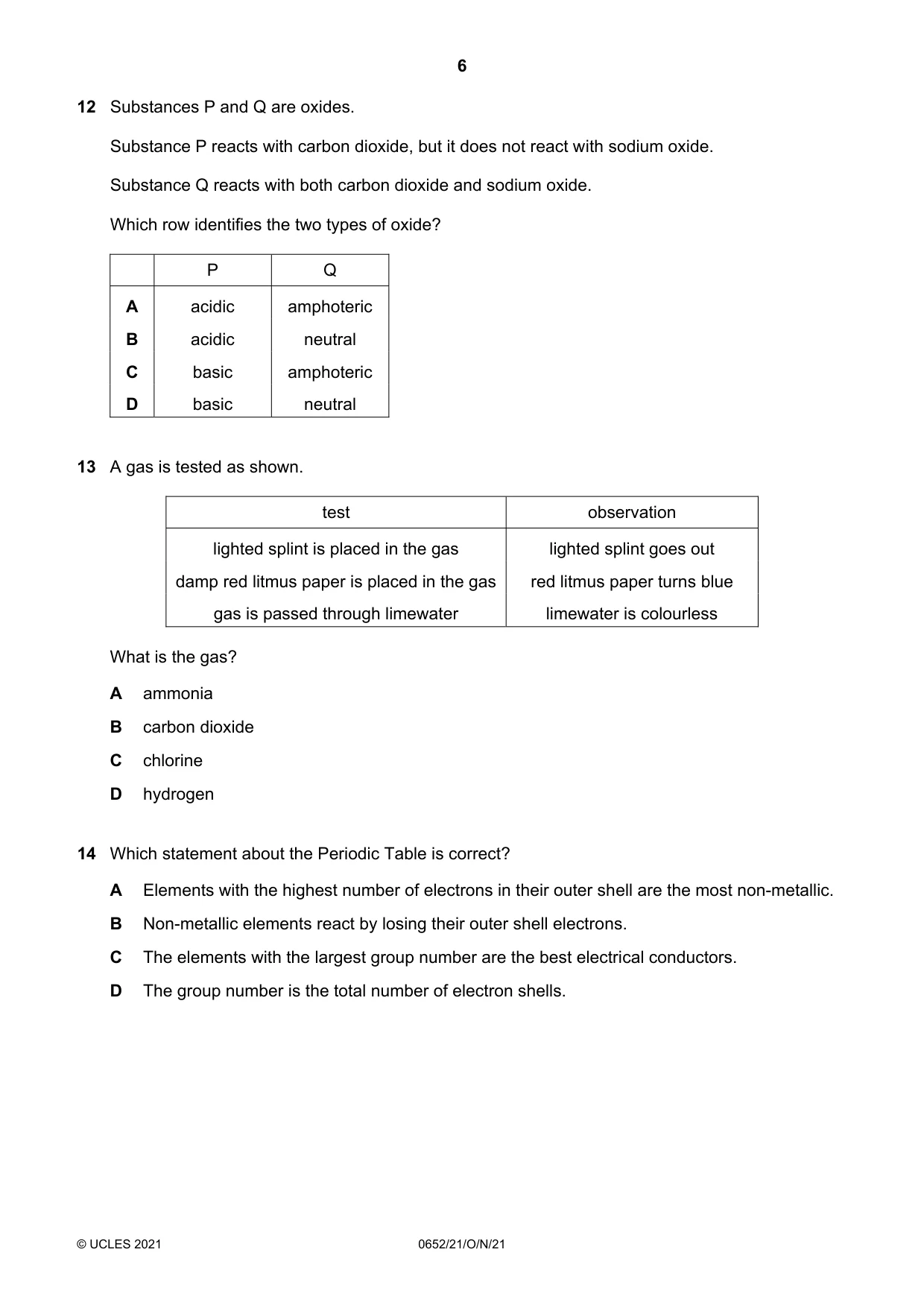
12 Substances P and Q are oxides. Substance P reacts with carbon dioxide, but it does not react with sodium oxide. Substance Q reacts with both carbon dioxide and sodium oxide. Which row identifies the two types of oxide? P Q A acidic amphoteric B acidic neutral C basic amphoteric D basic neutral
Mark scheme: C
Q13 · A gas is tested as shown
13 A gas is tested as shown. test observation lighted splint is placed in the gas lighted splint goes out damp red litmus paper is placed in the gas red litmus paper turns blue gas is passed through limewater limewater is colourless What is the gas? A ammonia B carbon dioxide C chlorine D hydrogen
Mark scheme: A
Q14 · Which statement about the Periodic Table is correct?
14 Which statement about the Periodic Table is correct? A Elements with the highest number of electrons in their outer shell are the most non-metallic. B Non-metallic elements react by losing their outer shell electrons. C The elements with the largest group number are the best electrical conductors. D The group number is the total number of electron shells.
Mark scheme: A
Q15 · Which row describes the properties of a transition element?
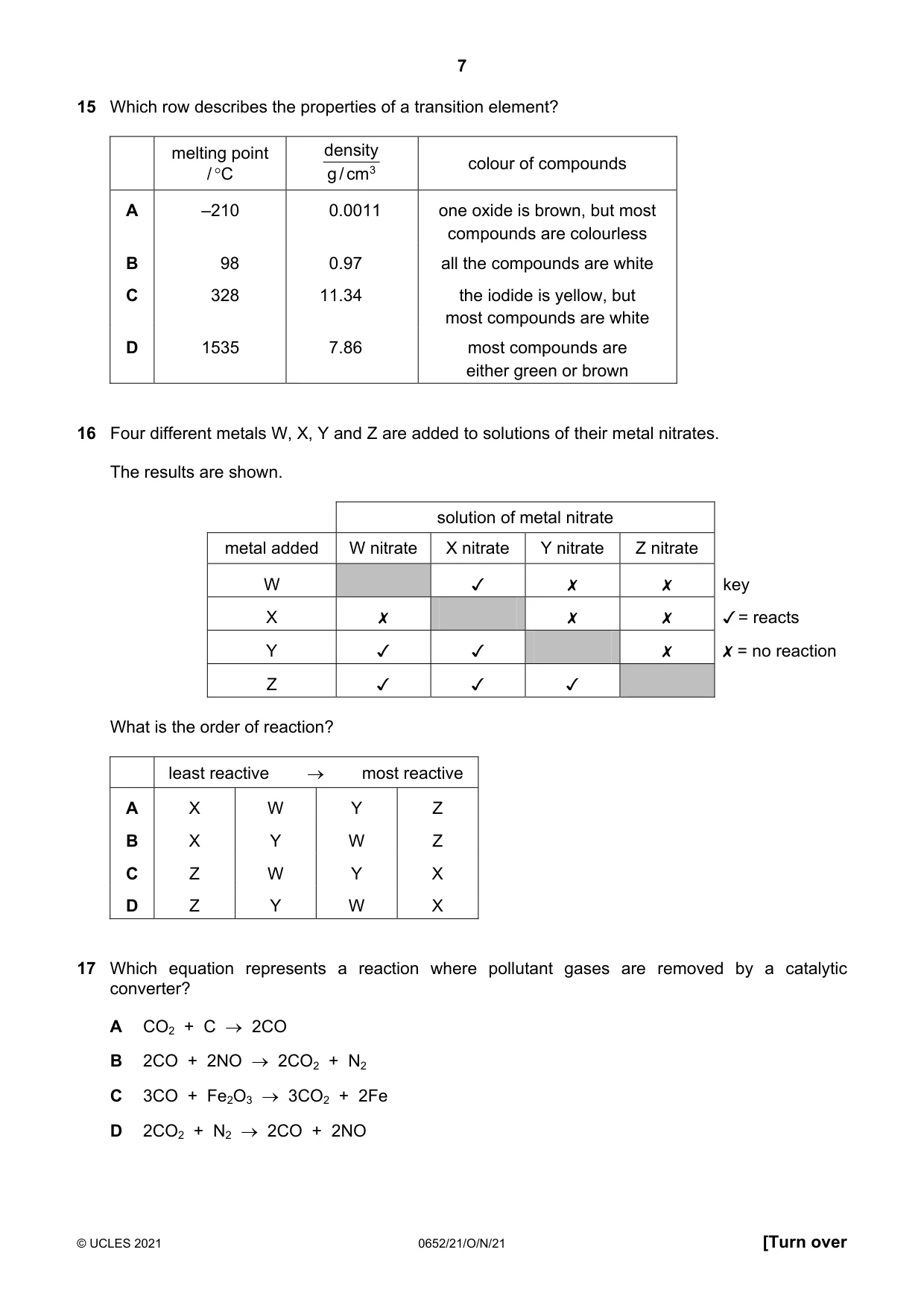
15 Which row describes the properties of a transition element? melting point density colour of compounds / C g/cm 3 A –210 0.0011 one oxide is brown, but most compounds are colourless B 98 0.97 all the compounds are white C 328 11.34 the iodide is yellow, but most compounds are white D 1535 7.86 most compounds are either green or brown
Mark scheme: D
Q16 · Four different metals W, X, Y and Z are added to solutions of their metal nitrates
16 Four different metals W, X, Y and Z are added to solutions of their metal nitrates. The results are shown. solution of metal nitrate metal added | Wnitrate | Xnitrate | Y nitrate Z nitrate WwW v x x key X x x v= reacts Y J x X = no reaction Z v v What is the order of reaction? least reactive > most reactive A X WwW Y Z B X Y WwW Z Cc Z WwW Y X D Z Y WwW X
Mark scheme: A
Q17 · Which equation represents a reaction where pollutant gases are removed by a catalytic…
17 Which equation represents a reaction where pollutant gases are removed by a catalytic converter? A CO2 + C 2CO B 2CO + 2NO 2CO2 + N2 C 3CO + Fe2O3 3CO2 + 2Fe D 2CO2 + N2 2CO + 2NO
Mark scheme: B
Q18 · Which process does not produce carbon dioxide?
18 Which process does not produce carbon dioxide? A an acid reacting with a carbonate B burning coal C burning hydrogen D respiration
Mark scheme: C
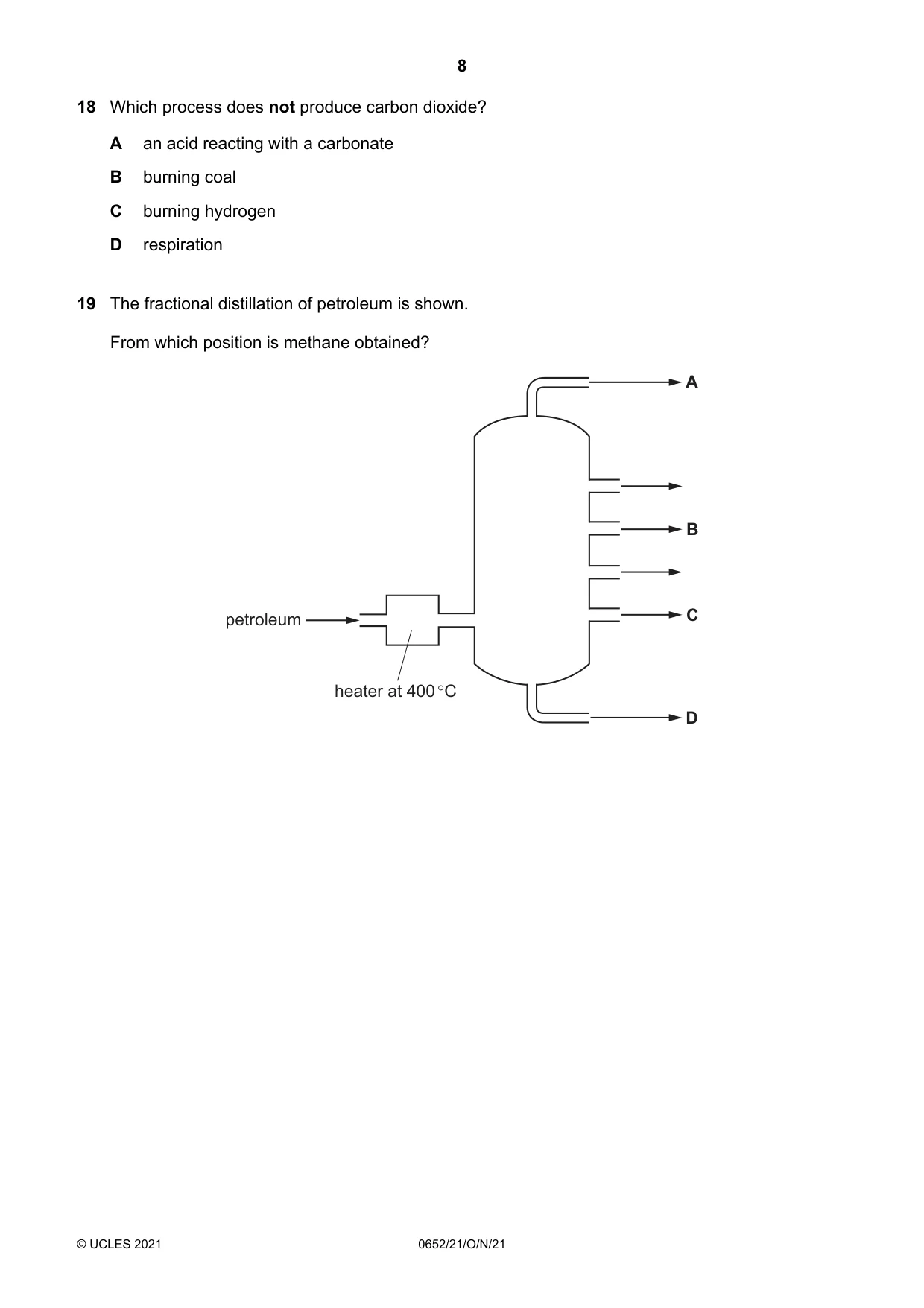
Q19 · The fractional distillation of petroleum is shown
19 The fractional distillation of petroleum is shown. From which position is methane obtained? A B C petroleum heater at 400 °C D
Mark scheme: A
Q20 · The diagram shows a two-step reaction scheme
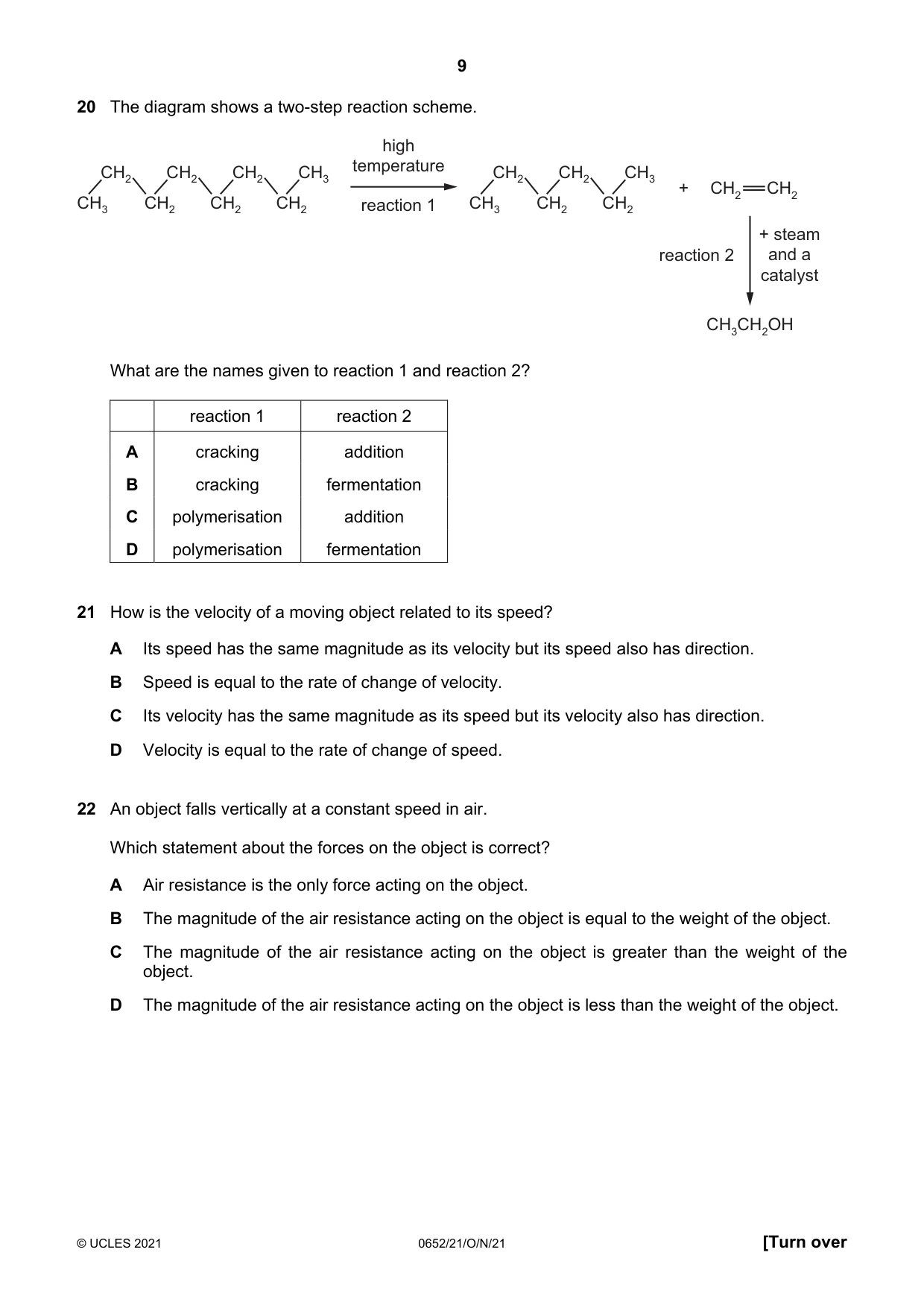
20 The diagram shows a two-step reaction scheme. high CH2 CH2 CH2 CH3 temperature CH2 CH2 CH3 + CH2 CH2 CH3 CH2 CH2 CH2 reaction 1 CH3 CH2 CH2 + steam reaction 2 and a catalyst CH3CH2OH What are the names given to reaction 1 and reaction 2? reaction 1 reaction 2 A cracking addition B cracking fermentation C polymerisation addition D polymerisation fermentation
Mark scheme: A
Q21 · How is the velocity of a moving object related to its speed?
21 How is the velocity of a moving object related to its speed? A Its speed has the same magnitude as its velocity but its speed also has direction. B Speed is equal to the rate of change of velocity. C Its velocity has the same magnitude as its speed but its velocity also has direction. D Velocity is equal to the rate of change of speed.
Mark scheme: C
Q22 · An object falls vertically at a constant speed in air
22 An object falls vertically at a constant speed in air. Which statement about the forces on the object is correct? A Air resistance is the only force acting on the object. B The magnitude of the air resistance acting on the object is equal to the weight of the object. C The magnitude of the air resistance acting on the object is greater than the weight of the object. D The magnitude of the air resistance acting on the object is less than the weight of the object.
Mark scheme: B
Q23 · The diagrams show a steel spring and a graph of its length against the load applied to it
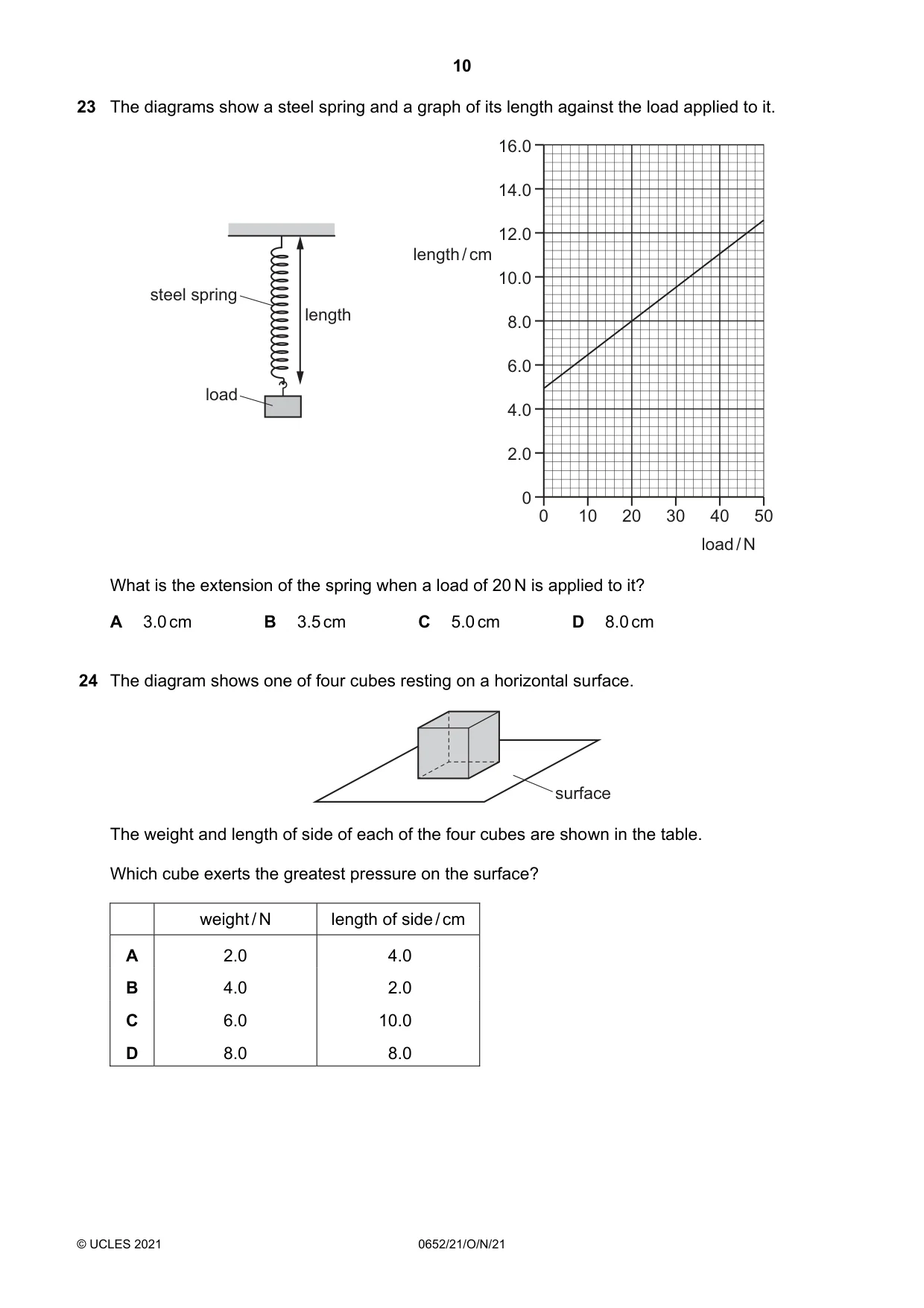
23 The diagrams show a steel spring and a graph of its length against the load applied to it. 16.0 14.0 12.0 length / cm 10.0 steel spring length 8.0 6.0 load 4.0 2.0 0 0 10 20 30 40 50 load / N What is the extension of the spring when a load of 20 N is applied to it? A 3.0 cm B 3.5 cm C 5.0 cm D 8.0 cm
Mark scheme: A
Q24 · The diagram shows one of four cubes resting on a horizontal surface
24 The diagram shows one of four cubes resting on a horizontal surface. surface The weight and length of side of each of the four cubes are shown in the table. Which cube exerts the greatest pressure on the surface? weight / N length of side / cm A 2.0 4.0 B 4.0 2.0 C 6.0 10.0 D 8.0 8.0
Mark scheme: B
Q25 · Which energy does an object possess due to its motion?
25 Which energy does an object possess due to its motion? A elastic (strain) B gravitational potential C kinetic D thermal
Mark scheme: C
Q26 · An engineer needs to fit an iron bar into a gap in an iron base
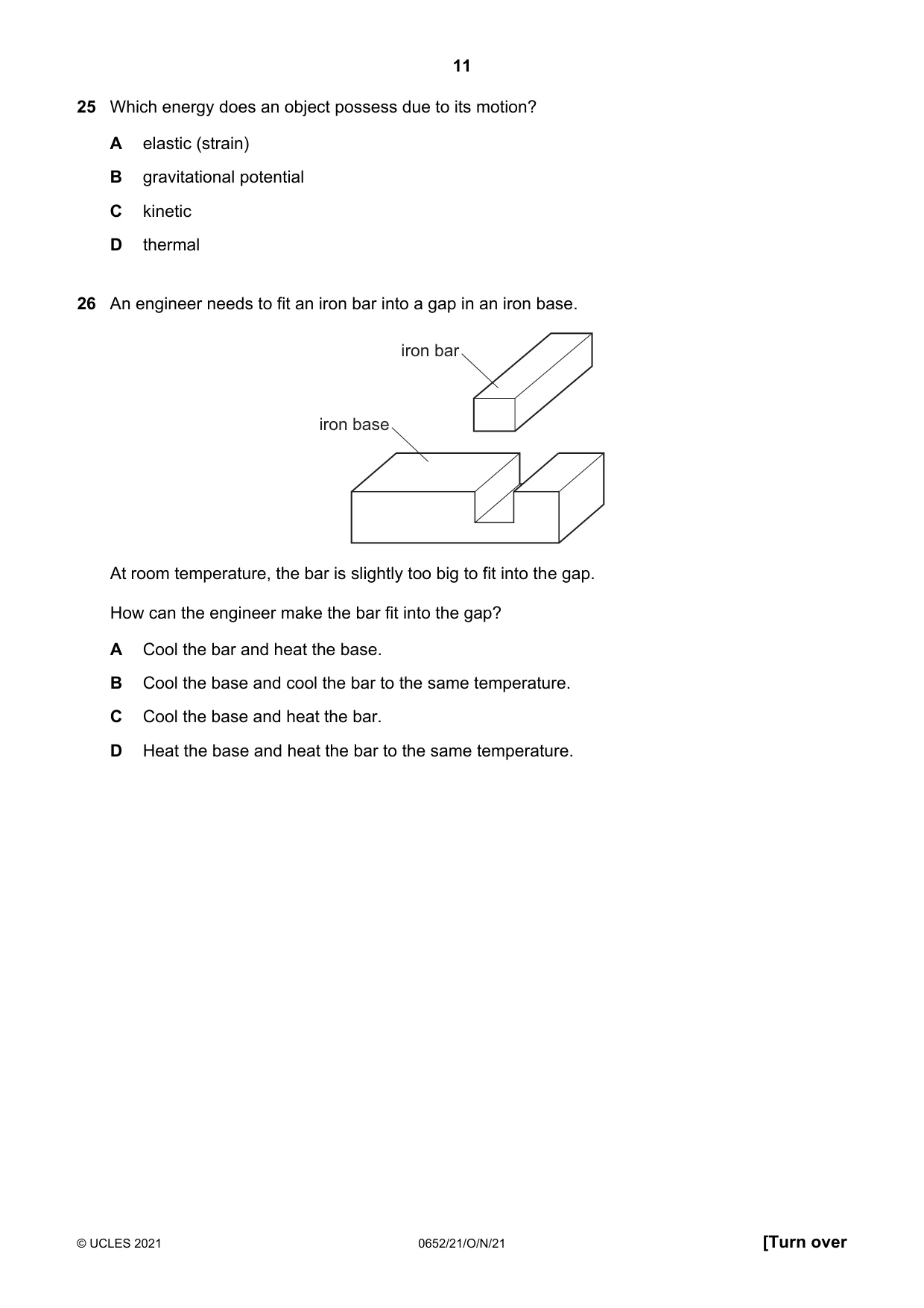
26 An engineer needs to fit an iron bar into a gap in an iron base. iron bar iron base At room temperature, the bar is slightly too big to fit into the gap. How can the engineer make the bar fit into the gap? A Cool the bar and heat the base. B Cool the base and cool the bar to the same temperature. C Cool the base and heat the bar. D Heat the base and heat the bar to the same temperature.
Mark scheme: A
Q27 · The diagram shows a liquid-in-glass thermometer
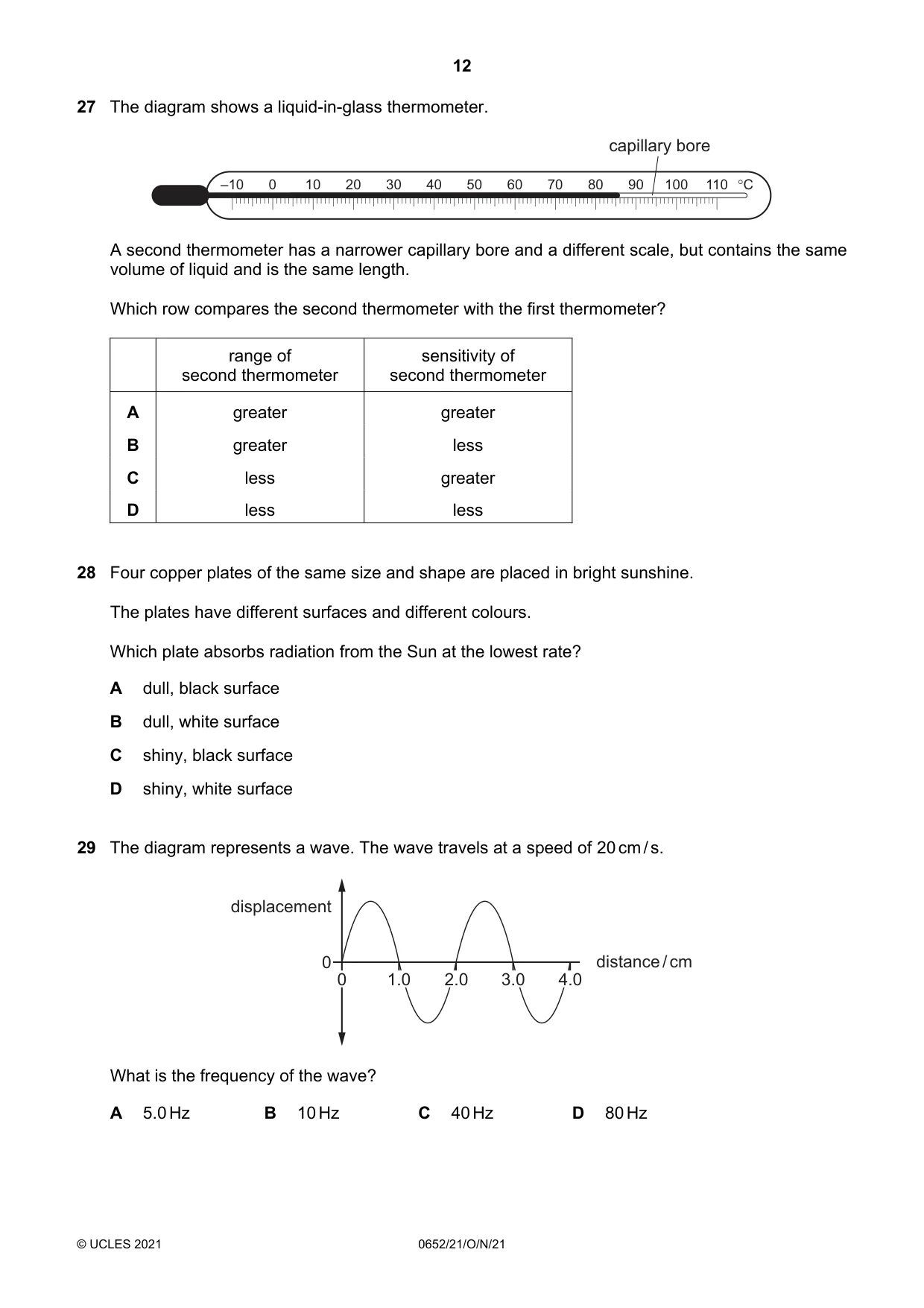
27 The diagram shows a liquid-in-glass thermometer. capillary bore –10 0 10 20 30 40 50 60 70 80 90 100 110 °C A second thermometer has a narrower capillary bore and a different scale, but contains the same volume of liquid and is the same length. Which row compares the second thermometer with the first thermometer? range of sensitivity of second thermometer second thermometer A greater greater B greater less C less greater D less less
Mark scheme: C
Q28 · Four copper plates of the same size and shape are placed in bright sunshine
28 Four copper plates of the same size and shape are placed in bright sunshine. The plates have different surfaces and different colours. Which plate absorbs radiation from the Sun at the lowest rate? A dull, black surface B dull, white surface C shiny, black surface D shiny, white surface
Mark scheme: D
Q29 · The diagram represents a wave
29 The diagram represents a wave. The wave travels at a speed of 20 cm / s. displacement 0 distance / cm 0 1.0 2.0 3.0 4.0 What is the frequency of the wave? A 5.0 Hz B 10 Hz C 40 Hz D 80 Hz
Mark scheme: B
Q30 · The diagram shows two rays of light P and Q passing from air into glass
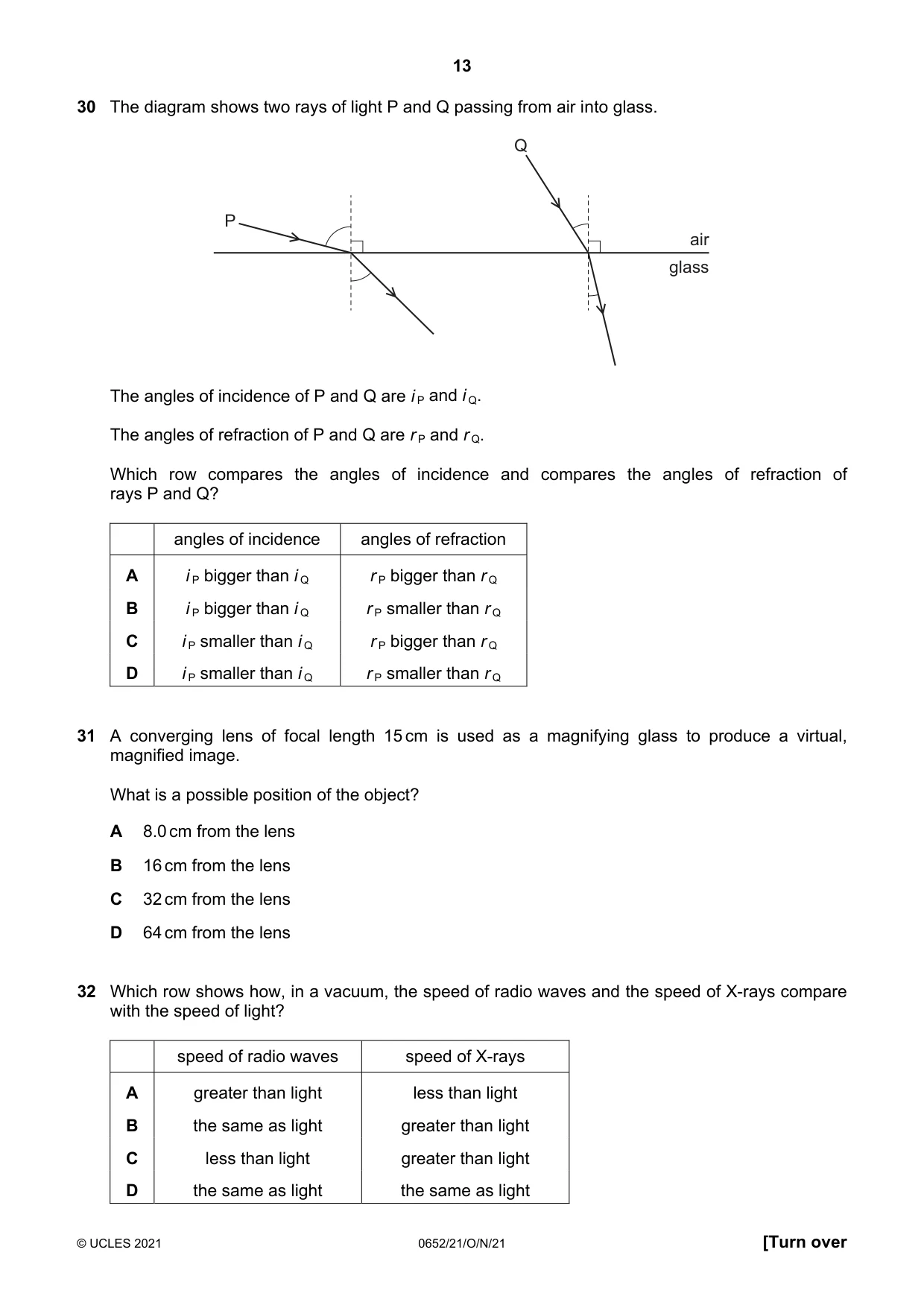
30 The diagram shows two rays of light P and Q passing from air into glass. Q P air glass The angles of incidence of P and Q are i P and i Q. The angles of refraction of P and Q are r P and r Q. Which row compares the angles of incidence and compares the angles of refraction of rays P and Q? angles of incidence angles of refraction A i P bigger than i Q r P bigger than r Q B i P bigger than i Q r P smaller than r Q C i P smaller than i Q r P bigger than r Q D i P smaller than i Q r P smaller than r Q
Mark scheme: A
Q31 · A converging lens of focal length 15 cm is used as a magnifying glass to produce a…
31 A converging lens of focal length 15 cm is used as a magnifying glass to produce a virtual, magnified image. What is a possible position of the object? A 8.0 cm from the lens B 16 cm from the lens C 32 cm from the lens D 64 cm from the lens
Mark scheme: A
Q32 · Which row shows how, in a vacuum, the speed of radio waves and the speed of X-rays…
32 Which row shows how, in a vacuum, the speed of radio waves and the speed of X-rays compare with the speed of light? speed of radio waves speed of X-rays A greater than light less than light B the same as light greater than light C less than light greater than light D the same as light the same as light
Mark scheme: D
Q33 · Which frequency is outside the range of audible frequencies for a healthy human ear?
33 Which frequency is outside the range of audible frequencies for a healthy human ear? A 30 Hz B 300 Hz C 3000 Hz D 30 000 Hz
Mark scheme: D
Q34 · The diagram shows two light plastic balls suspended by insulating threads from a support
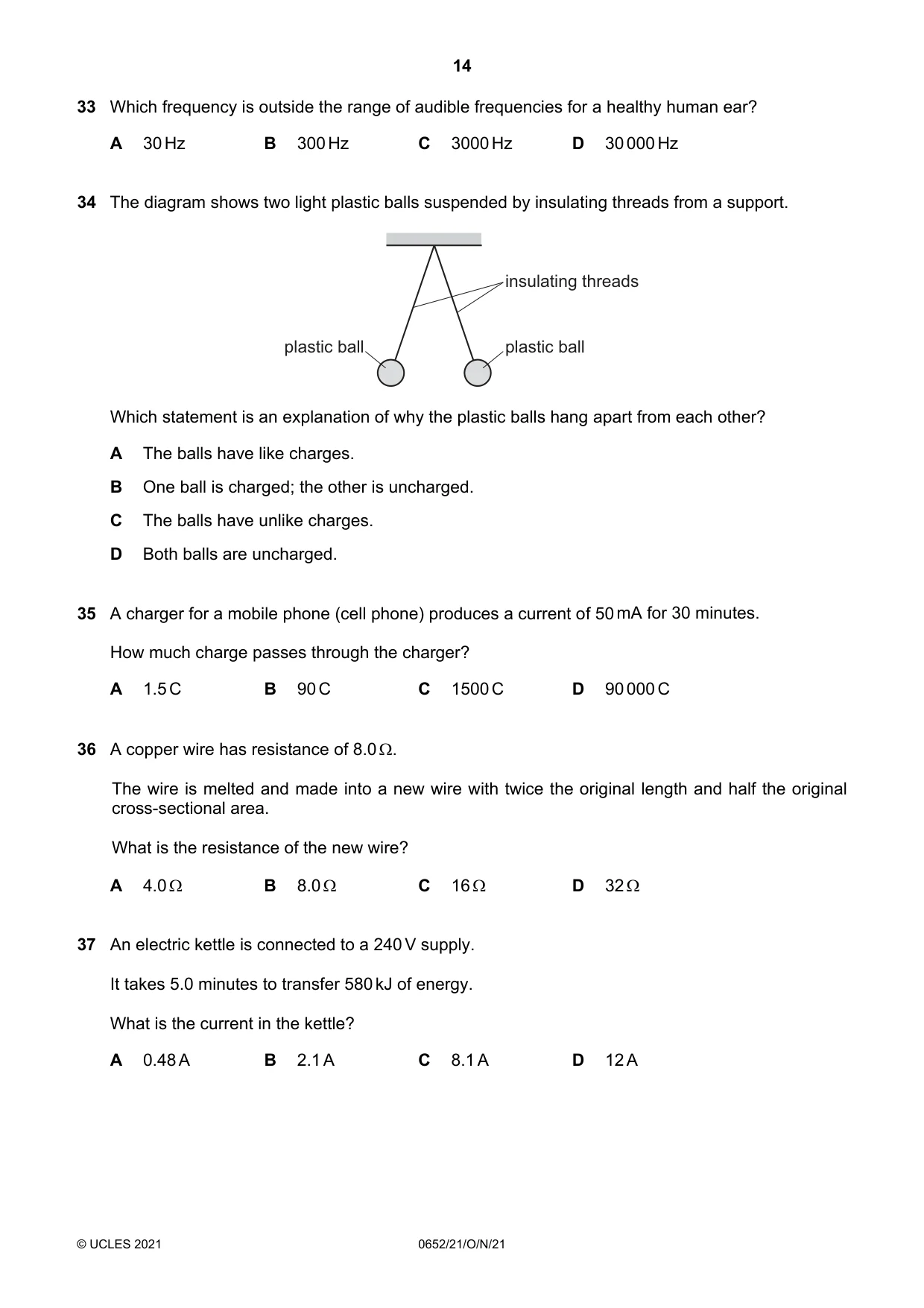
34 The diagram shows two light plastic balls suspended by insulating threads from a support. insulating threads plastic ball plastic ball Which statement is an explanation of why the plastic balls hang apart from each other? A The balls have like charges. B One ball is charged; the other is uncharged. C The balls have unlike charges. D Both balls are uncharged.
Mark scheme: A
Q35 · A charger for a mobile phone (cell phone) produces a current of 50 mA for 30 minutes
35 A charger for a mobile phone (cell phone) produces a current of 50 mA for 30 minutes. How much charge passes through the charger? A 1.5 C B 90 C C 1500 C D 90 000 C
Mark scheme: B
Q36 · A copper wire has resistance of 8.0
36 A copper wire has resistance of 8.0 . The wire is melted and made into a new wire with twice the original length and half the original cross-sectional area. What is the resistance of the new wire? A 4.0 B 8.0 C 16 D 32
Mark scheme: D
Q37 · An electric kettle is connected to a 240 V supply
37 An electric kettle is connected to a 240 V supply. It takes 5.0 minutes to transfer 580 kJ of energy. What is the current in the kettle? A 0.48 A B 2.1 A C 8.1 A D 12 A
Mark scheme: C
Q38 · A student investigates how the current in a resistor R varies with the voltage across it
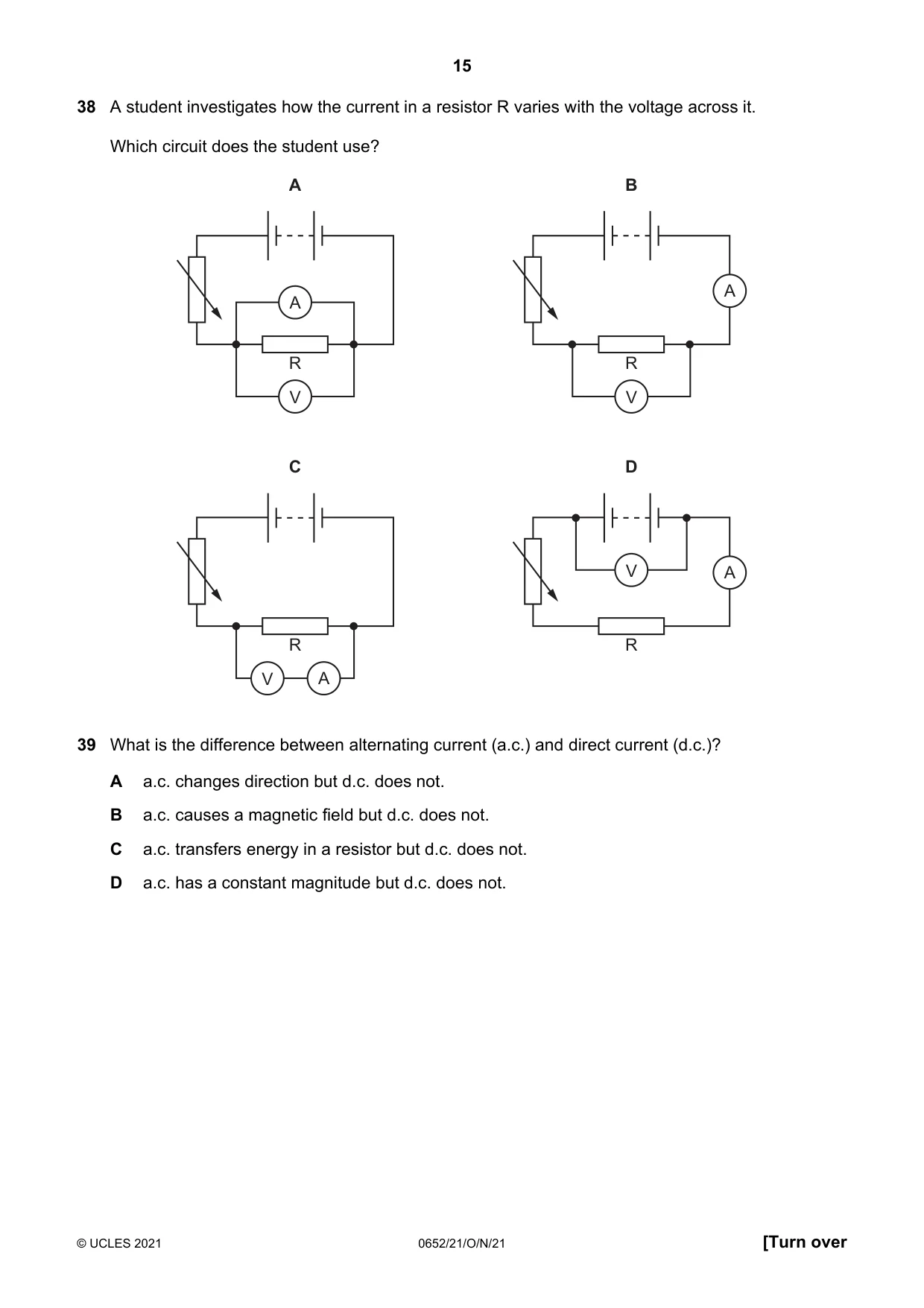
38 A student investigates how the current in a resistor R varies with the voltage across it. Which circuit does the student use? A B A A R R V V C D V A R R V A
Mark scheme: B
Q39 · What is the difference between alternating current (a.c.) and direct current (d.c.)?
39 What is the difference between alternating current (a.c.) and direct current (d.c.)? A a.c. changes direction but d.c. does not. B a.c. causes a magnetic field but d.c. does not. C a.c. transfers energy in a resistor but d.c. does not. D a.c. has a constant magnitude but d.c. does not.
Mark scheme: A
Q40 · The graph shows the decay curve for one particular radioactive isotope
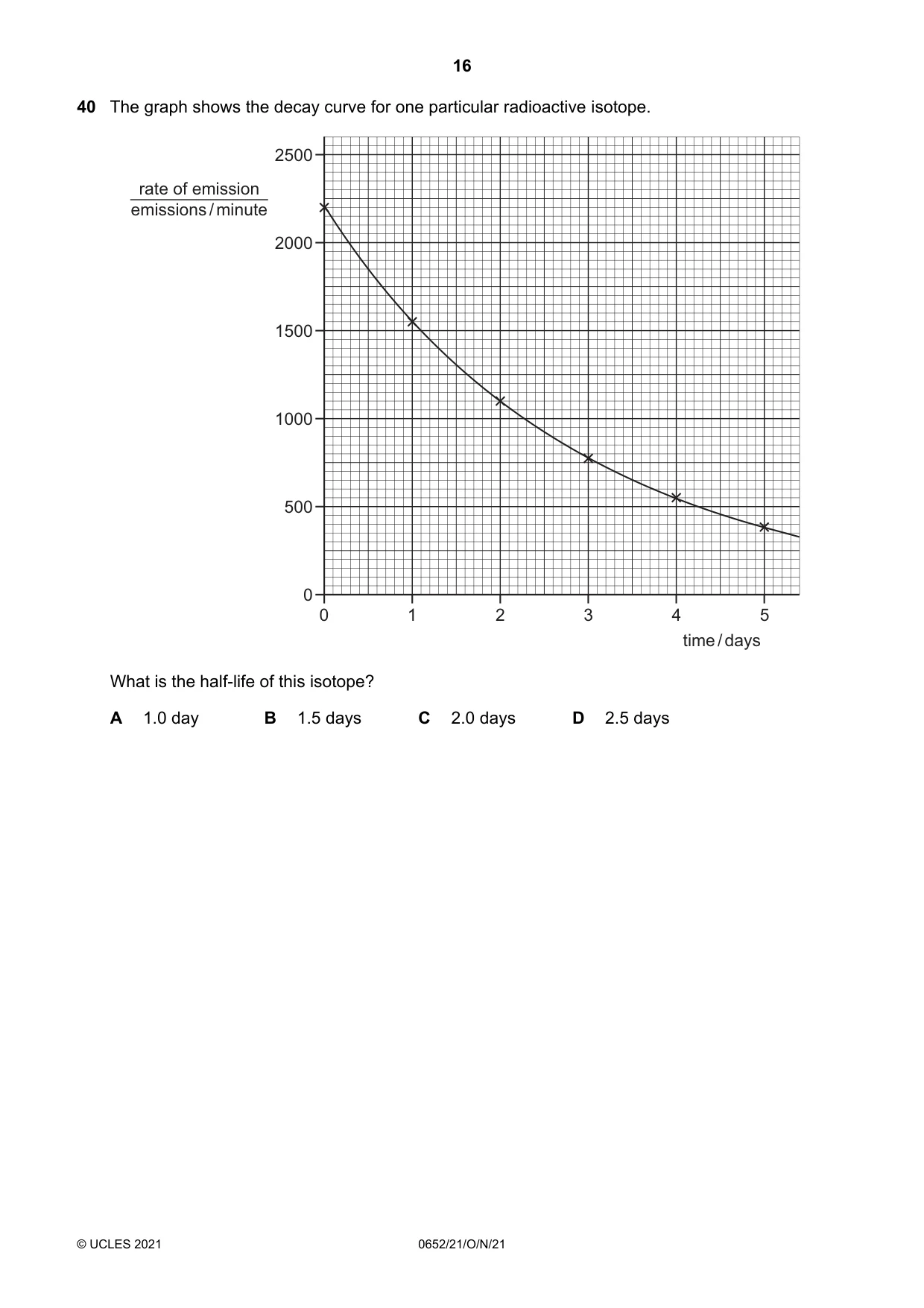
40 The graph shows the decay curve for one particular radioactive isotope. 2500 rate of emission emissions / minute 2000 1500 1000 500 0 0 1 2 3 4 5 time / days What is the half-life of this isotope? A 1.0 day B 1.5 days C 2.0 days D 2.5 days
Mark scheme: C
What was in this paper
The subtopics covered by these 40 questions, and how many questions each got. Open one in a new tab to see every Cambridge question on it.
3Electric circuits2Energetics of a reaction2Forces2Thermal properties and temperature2Air1Alkenes1Carbon dioxide and methane1Criteria of purity1Density1Electrical energy1Electrical quantities1Electricity and chemistry1Electromagnetic effects1Fuels1General wave properties1Identification of ions and gases1Ions and ionic bonds1Macromolecules1Molecules and covalent bonds1Motion1Periodic Trends1Radioactivity1Rate (speed) of reaction1Reactivity series1Simple phenomena of magnetism1Sound1Stoichiometry1The characteristic properties of acids and bases1The particulate nature of matter1Thermal processes1Transition elements1Types of oxides1Work, energy and power1What you needed in this session
Cambridge’s own grade thresholds for 2021 Oct/Nov, Paper 2 · Variant 1. A higher threshold means an easier paper — the bar moves with how the cohort did.