Cambridge IGCSE Physical Science 0652 — 2020 Oct/Nov Paper 2 · Variant 1
0652/21/O/N/20 · 40 questions · 40 marks · ≈45 min
The question paper and its mark scheme, free to read here and free to download. This is Cambridge’s own paper, exactly as it was sat.
Question paper16 pages
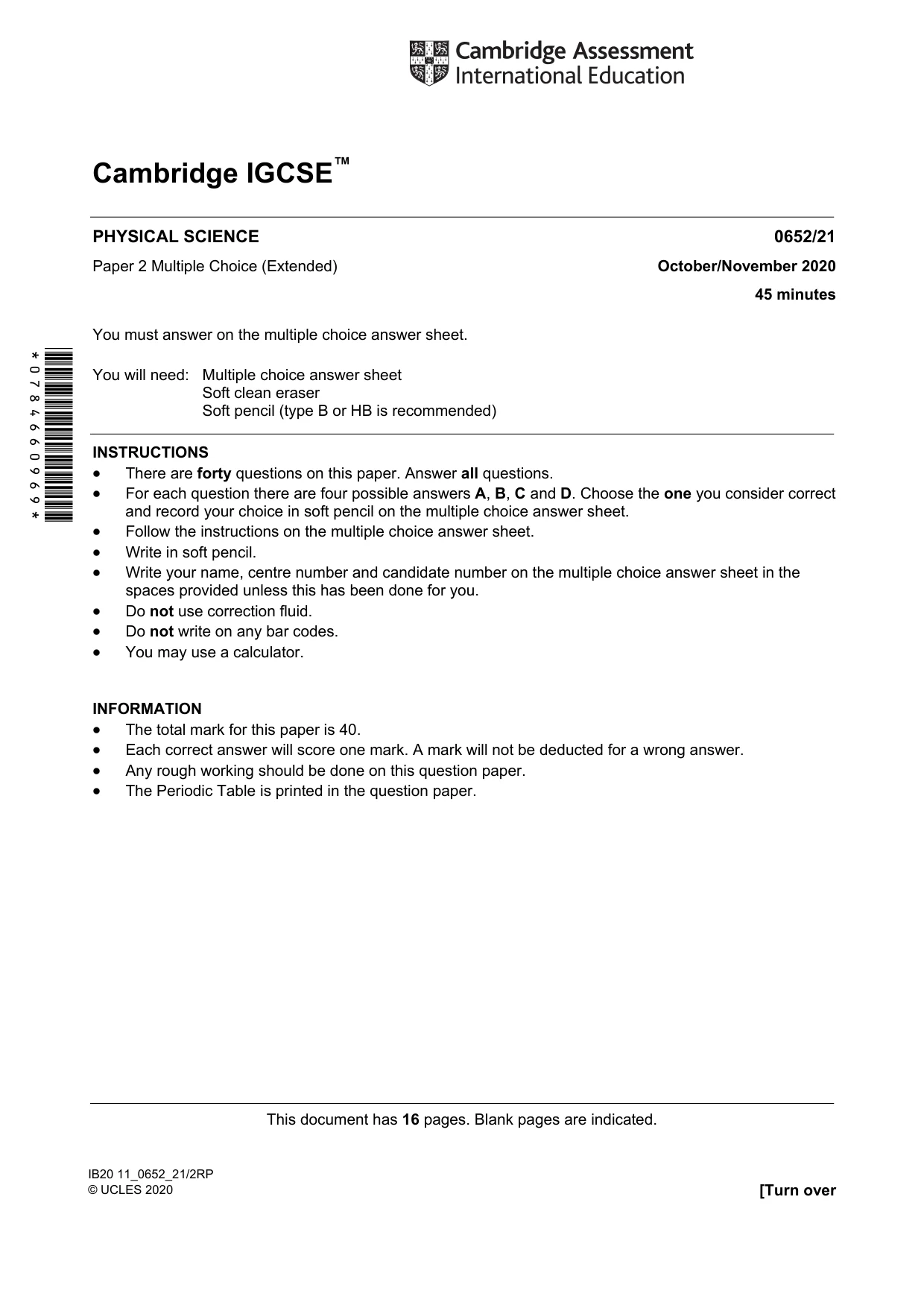

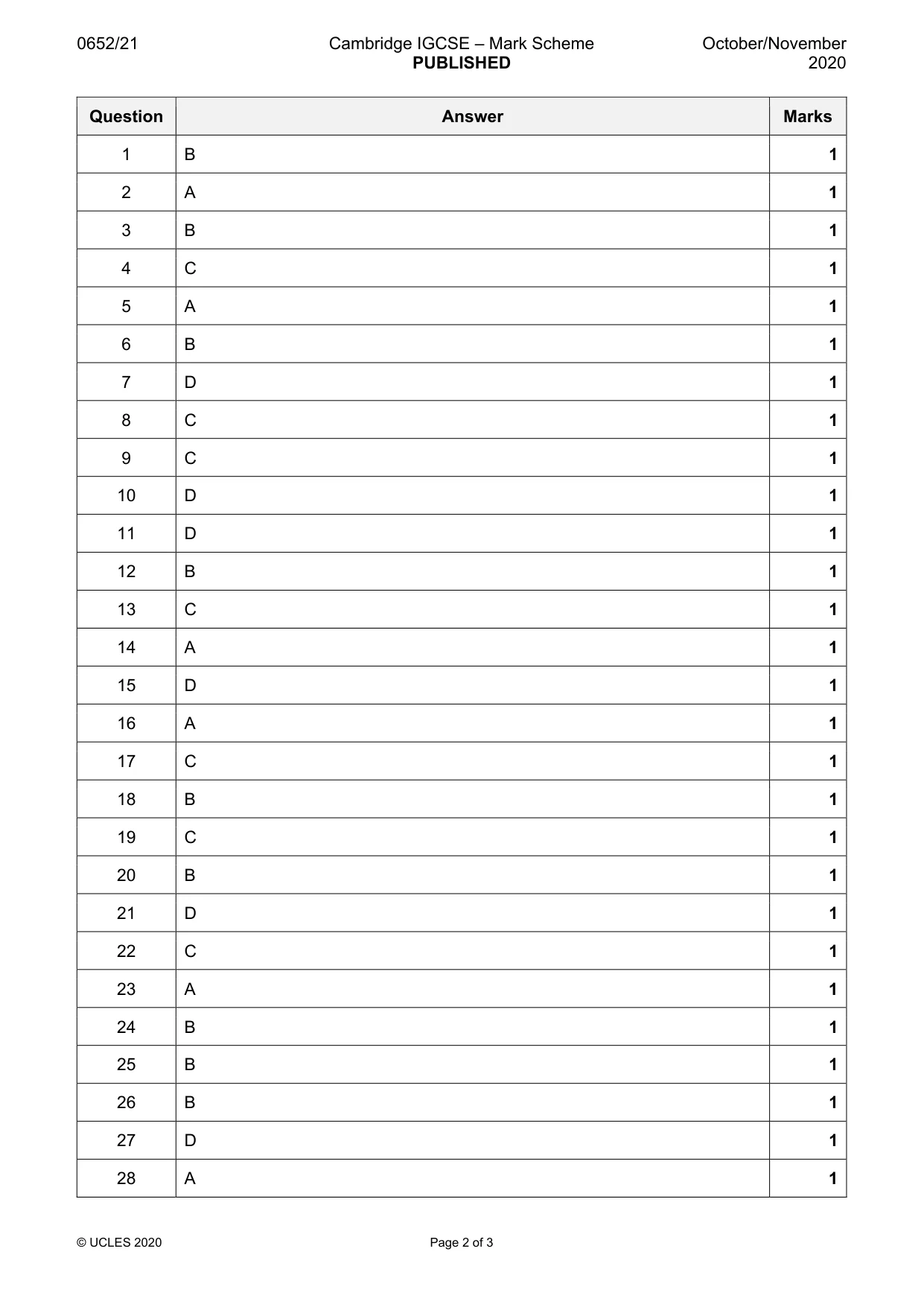
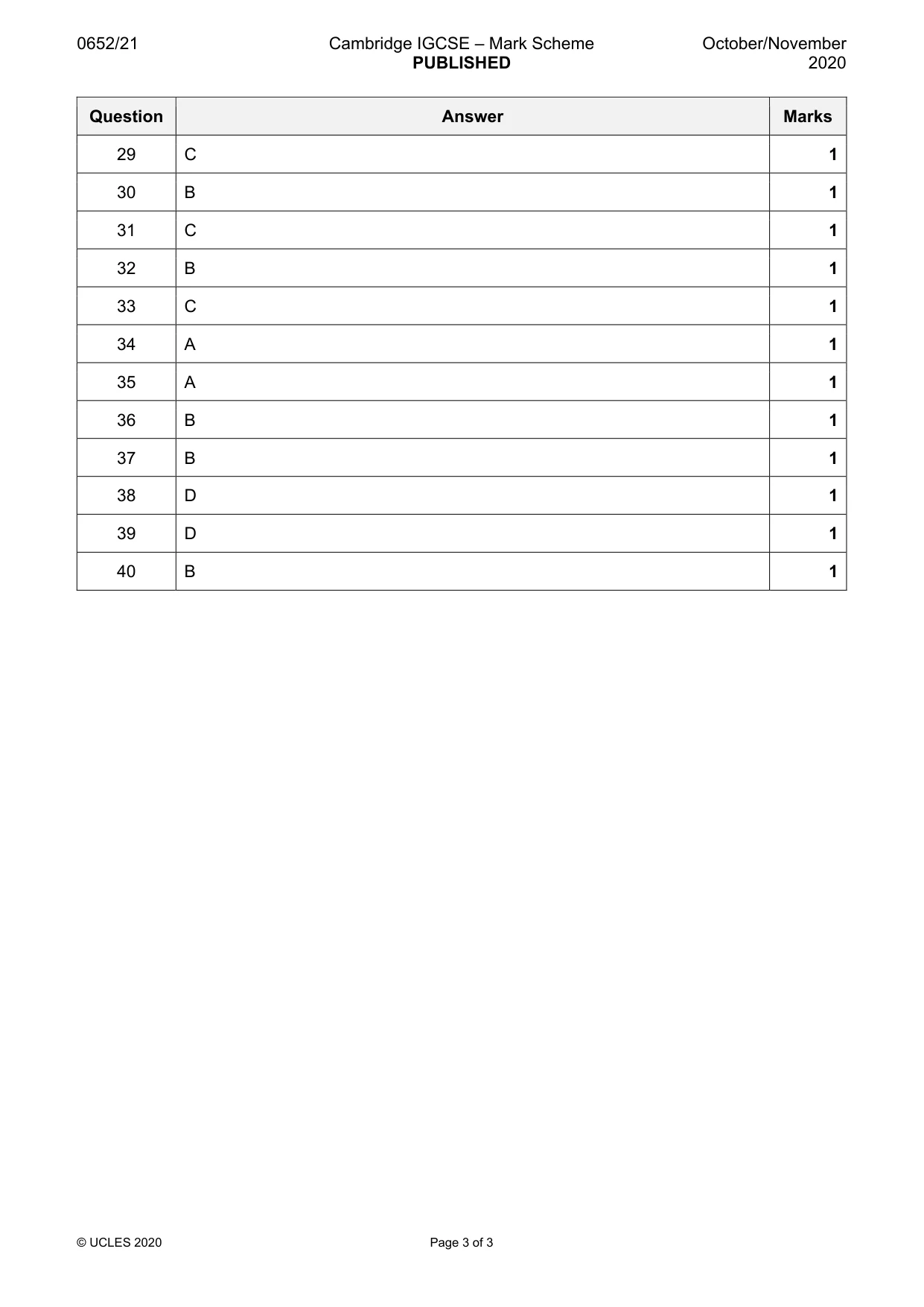
Mark scheme3 pages
Answers below. Sit the paper first if you are practising.
Questions as text
Q1 · Which diagram represents the arrangement of particles in a liquid?
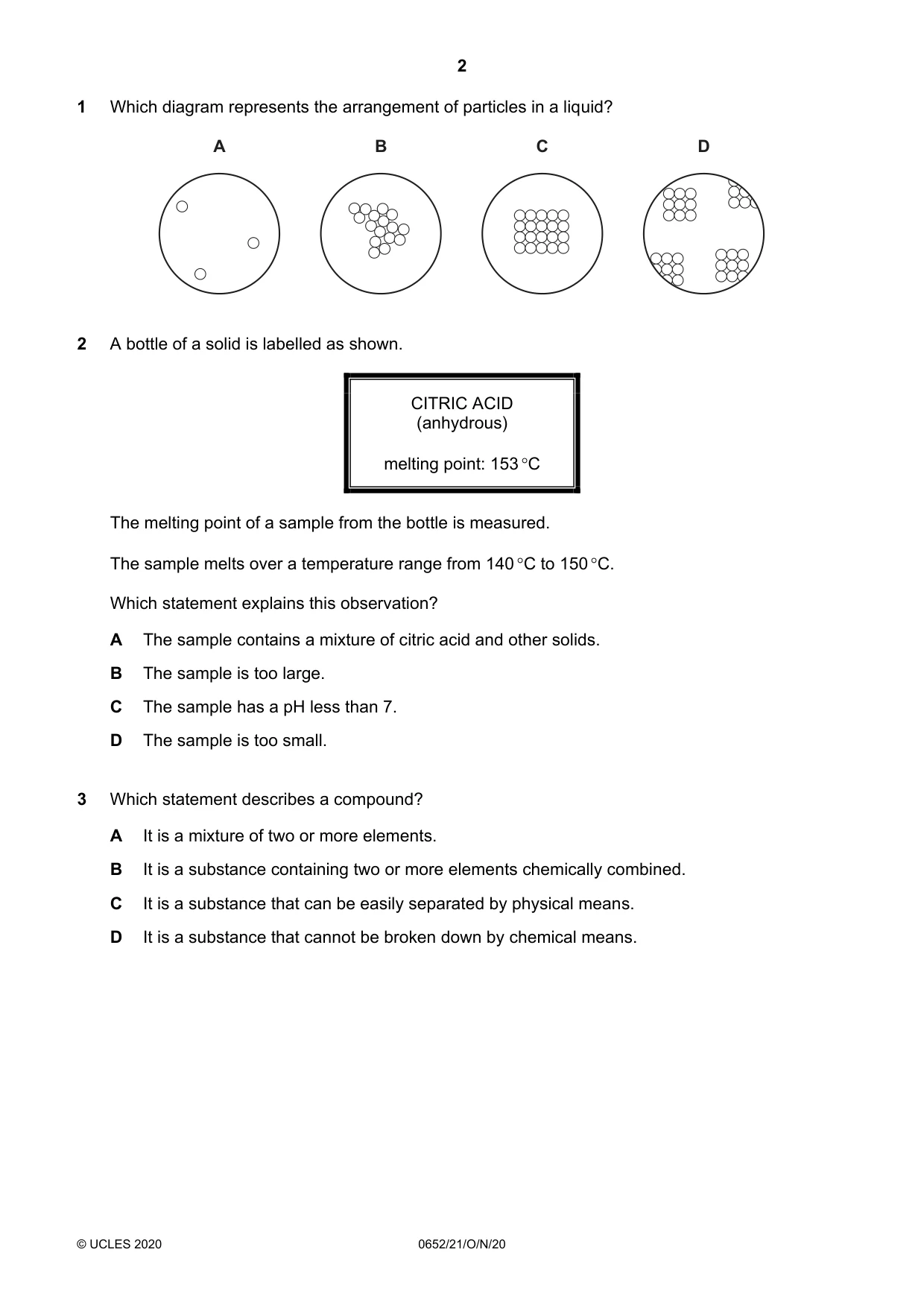
1 Which diagram represents the arrangement of particles in a liquid? A B C D
Mark scheme: B
Q2 · A bottle of a solid is labelled as shown
2 A bottle of a solid is labelled as shown. CITRIC ACID (anhydrous) melting point: 153 C The melting point of a sample from the bottle is measured. The sample melts over a temperature range from 140 C to 150 C. Which statement explains this observation? A The sample contains a mixture of citric acid and other solids. B The sample is too large. C The sample has a pH less than 7. D The sample is too small.
Mark scheme: A
Q3 · Which statement describes a compound?
3 Which statement describes a compound? A It is a mixture of two or more elements. B It is a substance containing two or more elements chemically combined. C It is a substance that can be easily separated by physical means. D It is a substance that cannot be broken down by chemical means.
Mark scheme: B
Q4 · Four different atoms are represented by the symbols shown
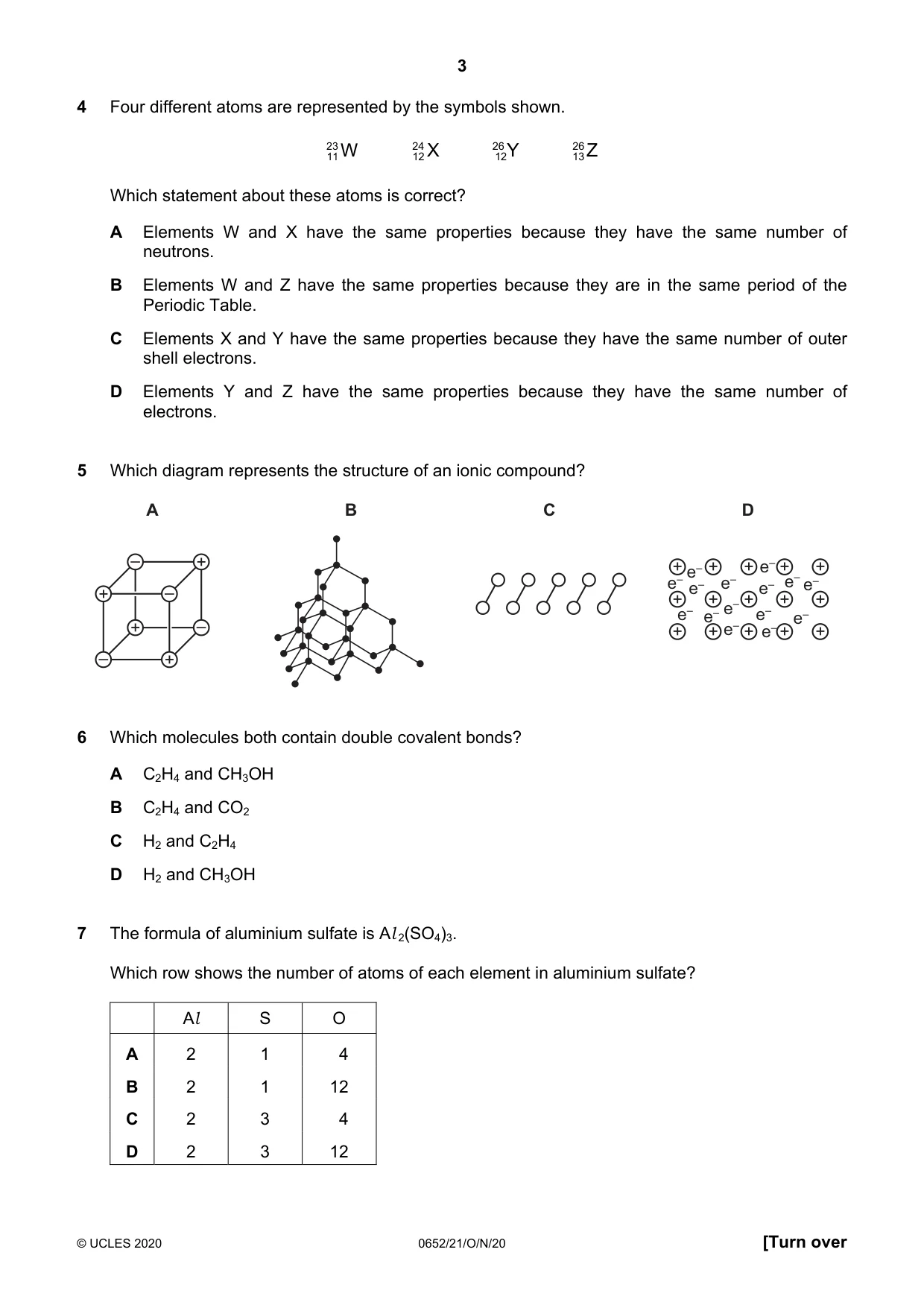
4 Four different atoms are represented by the symbols shown. 23 11W 24 12X 26 12Y 26 13Z Which statement about these atoms is correct? A Elements W and X have the same properties because they have the same number of neutrons. B Elements W and Z have the same properties because they are in the same period of the Periodic Table. C Elements X and Y have the same properties because they have the same number of outer shell electrons. D Elements Y and Z have the same properties because they have the same number of electrons.
Mark scheme: C
Q5 · Which diagram represents the structure of an ionic compound?
5 Which diagram represents the structure of an ionic compound? A B C D – + + + + e– + + e– e– e– e– e– e– e– + – + + + + + e– e– e– e– e– + – + + e– + e– + + – +
Mark scheme: A
Q6 · Which molecules both contain double covalent bonds?
6 Which molecules both contain double covalent bonds? A C2H4 and CH3OH B C2H4 and CO2 C H2 and C2H4 D H2 and CH3OH
Mark scheme: B
Q7 · The formula of aluminium sulfate is Al 2(SO4)3
7 The formula of aluminium sulfate is Al 2(SO4)3. Which row shows the number of atoms of each element in aluminium sulfate? Al S O A 2 1 4 B 2 1 12 C 2 3 4 D 2 3 12
Mark scheme: D
Q8 · Ethyl ethanoate has the formula CH3CO2C2H5
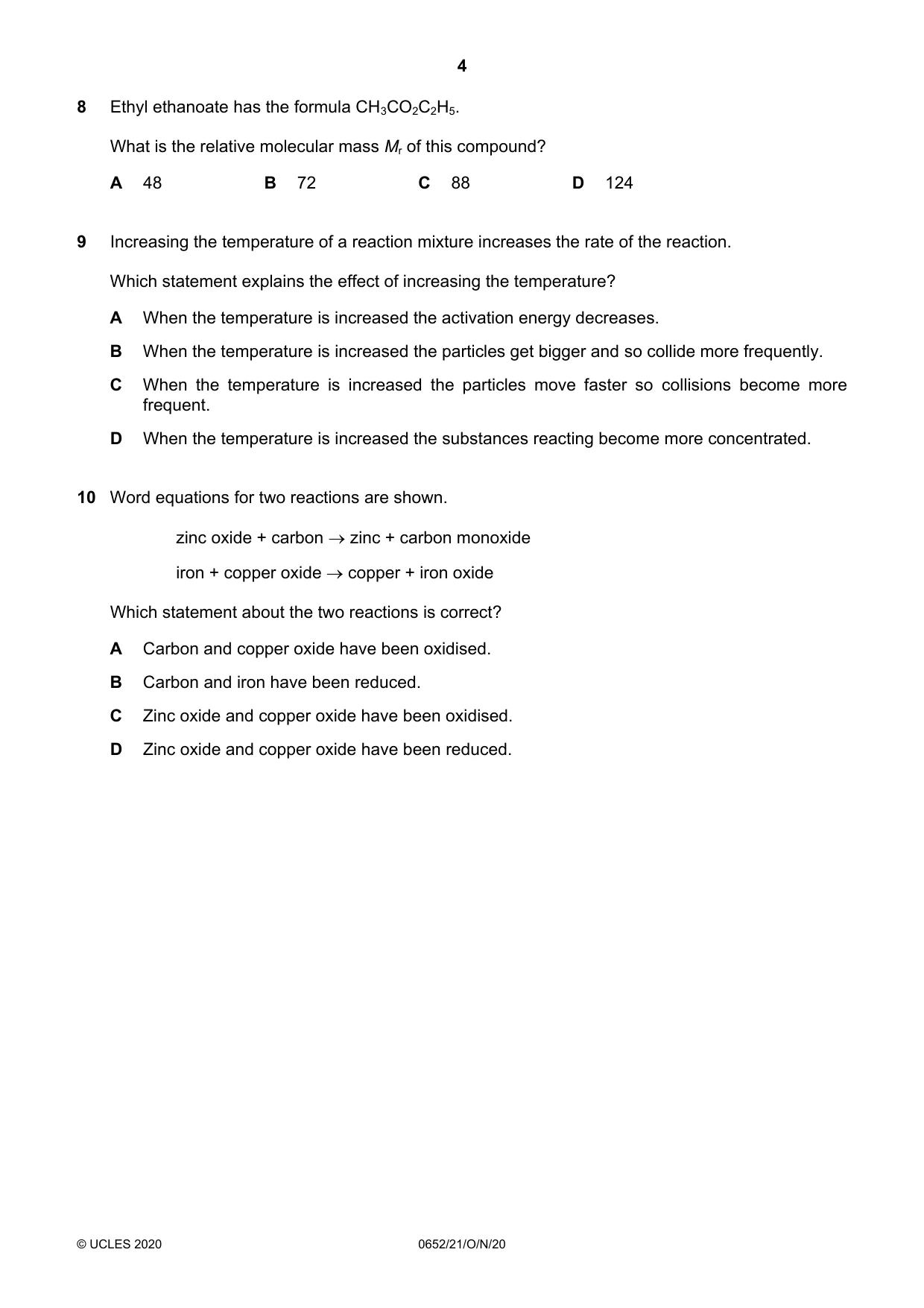
8 Ethyl ethanoate has the formula CH3CO2C2H5. What is the relative molecular mass Mr of this compound? A 48 B 72 C 88 D 124
Mark scheme: C
Q9 · Increasing the temperature of a reaction mixture increases the rate of the reaction
9 Increasing the temperature of a reaction mixture increases the rate of the reaction. Which statement explains the effect of increasing the temperature? A When the temperature is increased the activation energy decreases. B When the temperature is increased the particles get bigger and so collide more frequently. C When the temperature is increased the particles move faster so collisions become more frequent. D When the temperature is increased the substances reacting become more concentrated.
Mark scheme: C
Q10 · Word equations for two reactions are shown
10 Word equations for two reactions are shown. zinc oxide + carbon zinc + carbon monoxide iron + copper oxide copper + iron oxide Which statement about the two reactions is correct? A Carbon and copper oxide have been oxidised. B Carbon and iron have been reduced. C Zinc oxide and copper oxide have been oxidised. D Zinc oxide and copper oxide have been reduced.
Mark scheme: D
Q11 · Wasp stings contain an alkali
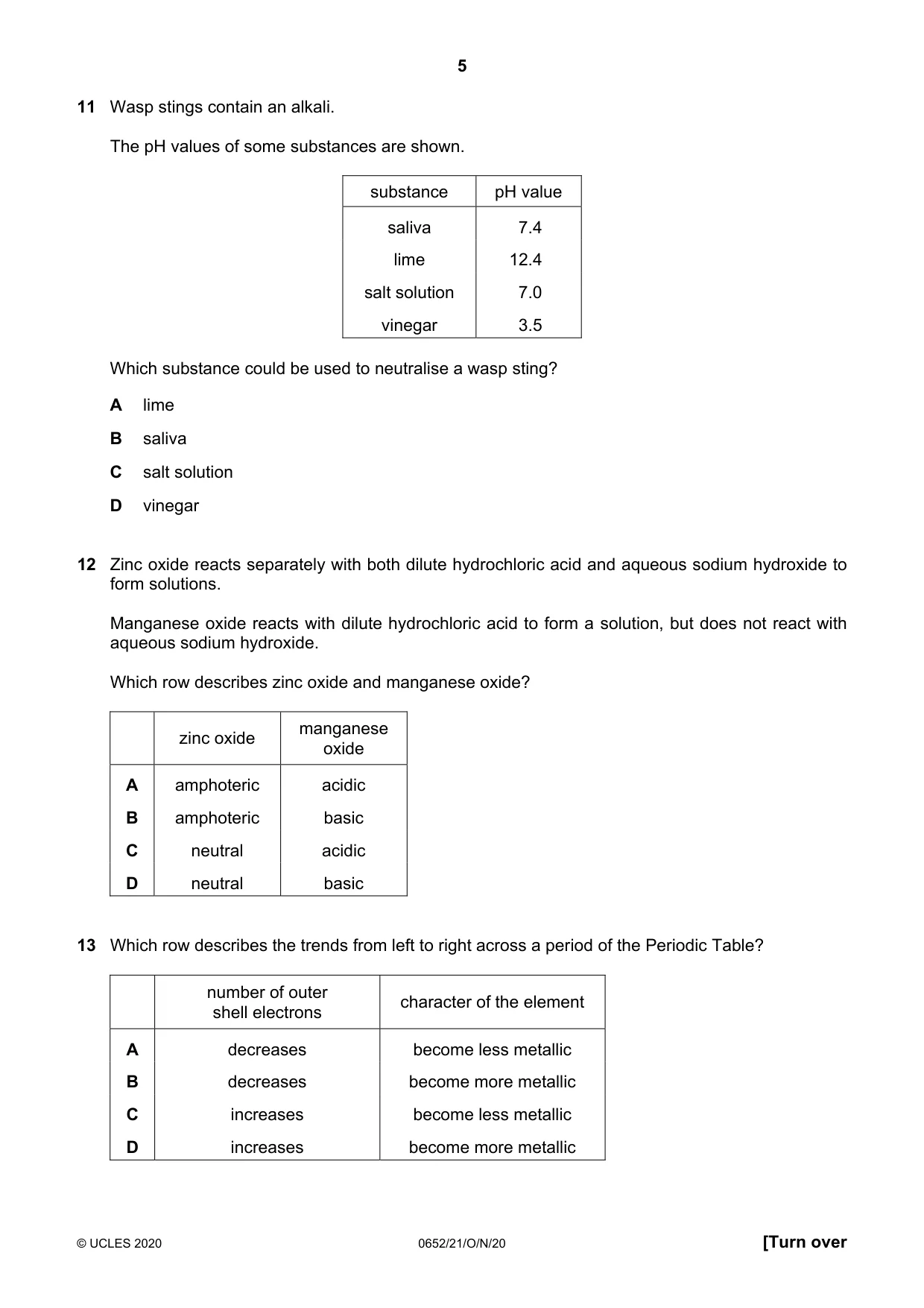
11 Wasp stings contain an alkali. The pH values of some substances are shown. substance pH value saliva 7.4 lime 12.4 salt solution 7.0 vinegar 3.5 Which substance could be used to neutralise a wasp sting? A lime B saliva C salt solution D vinegar
Mark scheme: D
More questions on The characteristic properties of acids and bases
Q12 · Zinc oxide reacts separately with both dilute hydrochloric acid and aqueous sodium…
12 Zinc oxide reacts separately with both dilute hydrochloric acid and aqueous sodium hydroxide to form solutions. Manganese oxide reacts with dilute hydrochloric acid to form a solution, but does not react with aqueous sodium hydroxide. Which row describes zinc oxide and manganese oxide? manganese zinc oxide oxide A amphoteric acidic B amphoteric basic C neutral acidic D neutral basic
Mark scheme: B
Q13 · Which row describes the trends from left to right across a period of the Periodic Table?
13 Which row describes the trends from left to right across a period of the Periodic Table? number of outer character of the element shell electrons A decreases become less metallic B decreases become more metallic C increases become less metallic D increases become more metallic
Mark scheme: C
Q14 · The elements in Group VII of the Periodic Table are known as the halogens
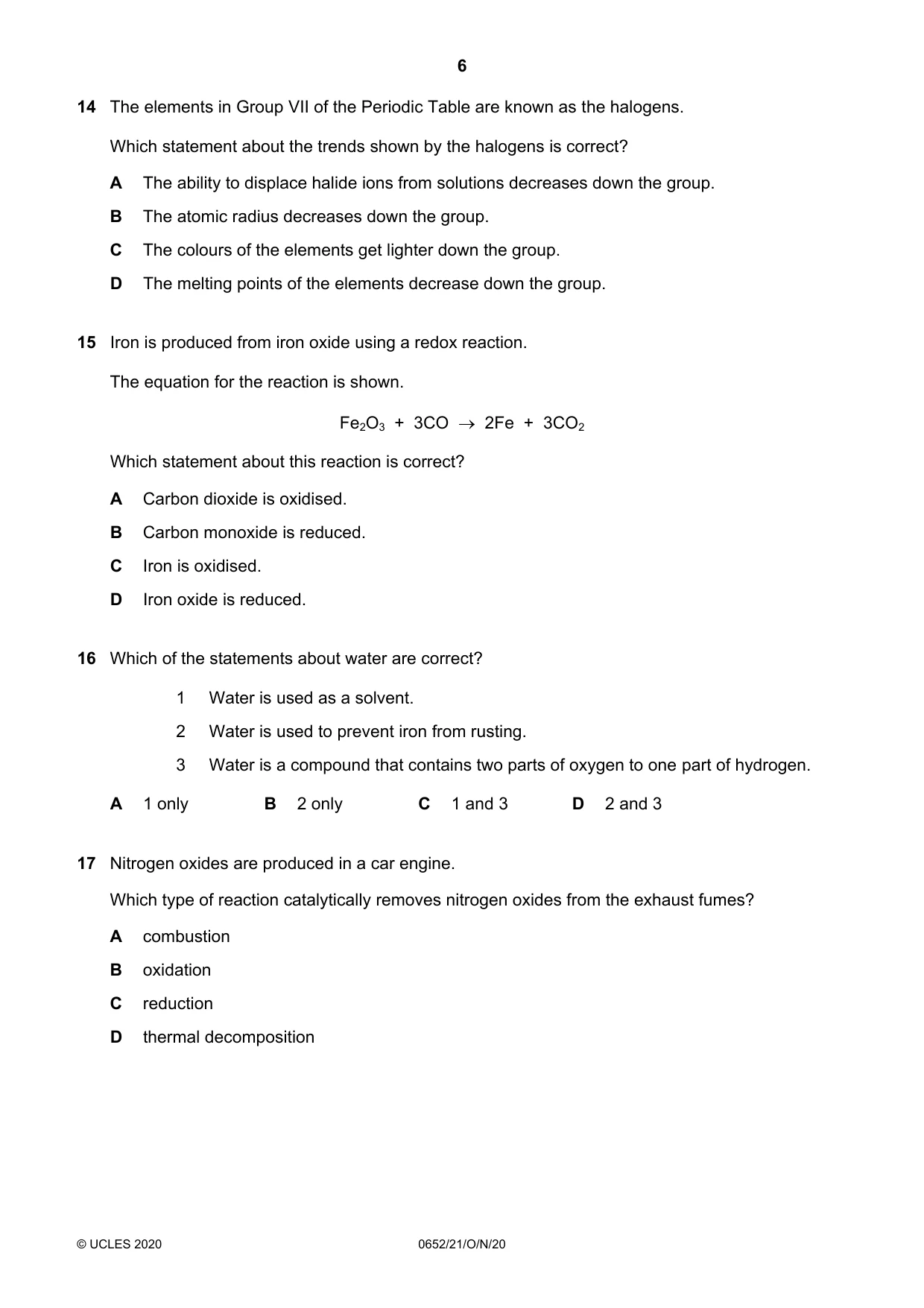
14 The elements in Group VII of the Periodic Table are known as the halogens. Which statement about the trends shown by the halogens is correct? A The ability to displace halide ions from solutions decreases down the group. B The atomic radius decreases down the group. C The colours of the elements get lighter down the group. D The melting points of the elements decrease down the group.
Mark scheme: A
Q15 · Iron is produced from iron oxide using a redox reaction
15 Iron is produced from iron oxide using a redox reaction. The equation for the reaction is shown. Fe2O3 + 3CO 2Fe + 3CO2 Which statement about this reaction is correct? A Carbon dioxide is oxidised. B Carbon monoxide is reduced. C Iron is oxidised. D Iron oxide is reduced.
Mark scheme: D
Q16 · Which of the statements about water are correct?
16 Which of the statements about water are correct? 1 Water is used as a solvent. 2 Water is used to prevent iron from rusting. 3 Water is a compound that contains two parts of oxygen to one part of hydrogen. A 1 only B 2 only C 1 and 3 D 2 and 3
Mark scheme: A
Q17 · Nitrogen oxides are produced in a car engine
17 Nitrogen oxides are produced in a car engine. Which type of reaction catalytically removes nitrogen oxides from the exhaust fumes? A combustion B oxidation C reduction D thermal decomposition
Mark scheme: C
Q18 · Which statement explains why the members of a homologous series have similar chemical…
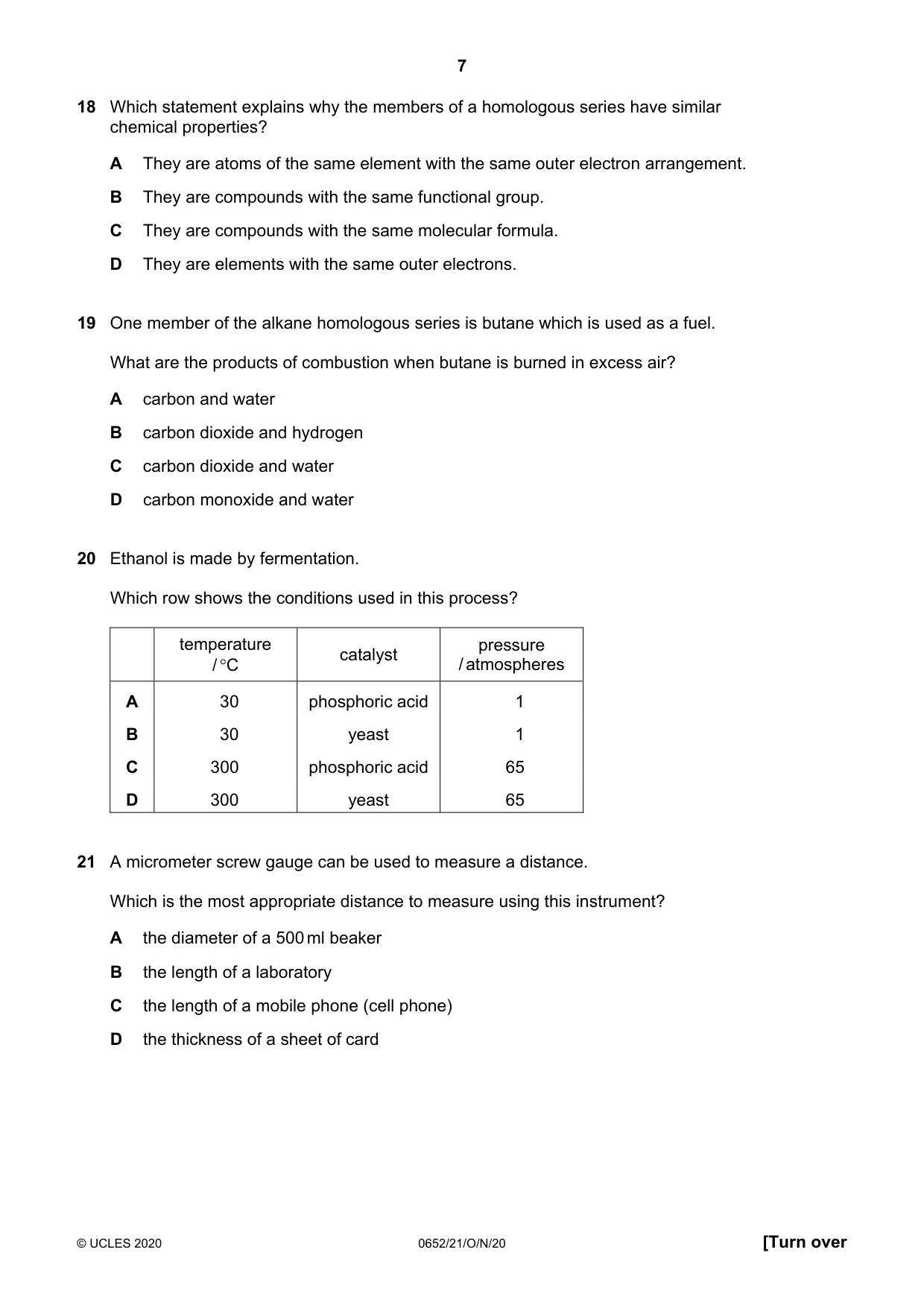
18 Which statement explains why the members of a homologous series have similar chemical properties? A They are atoms of the same element with the same outer electron arrangement. B They are compounds with the same functional group. C They are compounds with the same molecular formula. D They are elements with the same outer electrons.
Mark scheme: B
Q19 · One member of the alkane homologous series is butane which is used as a fuel
19 One member of the alkane homologous series is butane which is used as a fuel. What are the products of combustion when butane is burned in excess air? A carbon and water B carbon dioxide and hydrogen C carbon dioxide and water D carbon monoxide and water
Mark scheme: C
Q20 · Ethanol is made by fermentation
20 Ethanol is made by fermentation. Which row shows the conditions used in this process? temperature pressure catalyst / C / atmospheres A 30 phosphoric acid 1 B 30 yeast 1 C 300 phosphoric acid 65 D 300 yeast 65
Mark scheme: B
Q21 · A micrometer screw gauge can be used to measure a distance
21 A micrometer screw gauge can be used to measure a distance. Which is the most appropriate distance to measure using this instrument? A the diameter of a 500 ml beaker B the length of a laboratory C the length of a mobile phone (cell phone) D the thickness of a sheet of card
Mark scheme: D
Q22 · The distance of an object above the surface of a planet is gradually increased
22 The distance of an object above the surface of a planet is gradually increased. The value of the gravitational field strength decreases as the distance increases. What happens to the mass and what happens to the weight of the object as the distance increases? mass weight A decreases decreases B decreases stays the same C stays the same decreases D stays the same stays the same
Mark scheme: C
Q23 · The diagram shows a solid cube of metal
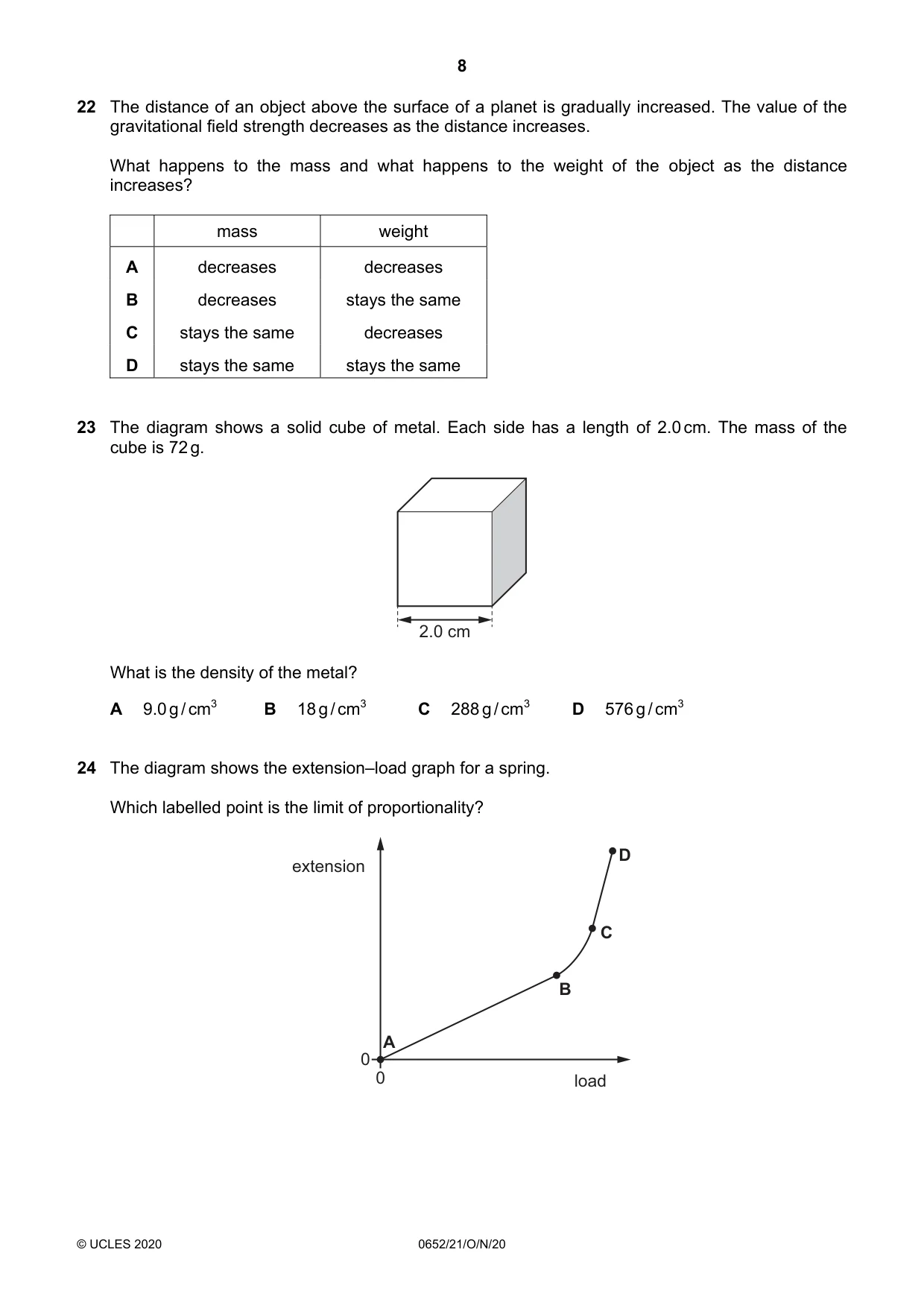
23 The diagram shows a solid cube of metal. Each side has a length of 2.0 cm. The mass of the cube is 72 g. 2.0 cm What is the density of the metal? A 9.0 g / cm3 B 18 g / cm3 C 288 g / cm3 D 576 g / cm3
Mark scheme: A
Q24 · The diagram shows the extension–load graph for a spring
24 The diagram shows the extension–load graph for a spring. Which labelled point is the limit of proportionality? D extension C B A 0 0 load
Mark scheme: B
Q25 · An object of mass 5.0 kg moves at a constant speed to the right in a straight line
25 An object of mass 5.0 kg moves at a constant speed to the right in a straight line. A resultant force of 25 N to the left starts to act on the object. What happens to the object immediately after the force is applied? A Its speed decreases at 0.20 m / s2. B Its speed decreases at 5.0 m / s2. C Its speed increases at 0.20 m / s2. D Its speed increases at 5.0 m / s2.
Mark scheme: B
Q26 · The diagram shows a uniform metre rule that is in equilibrium
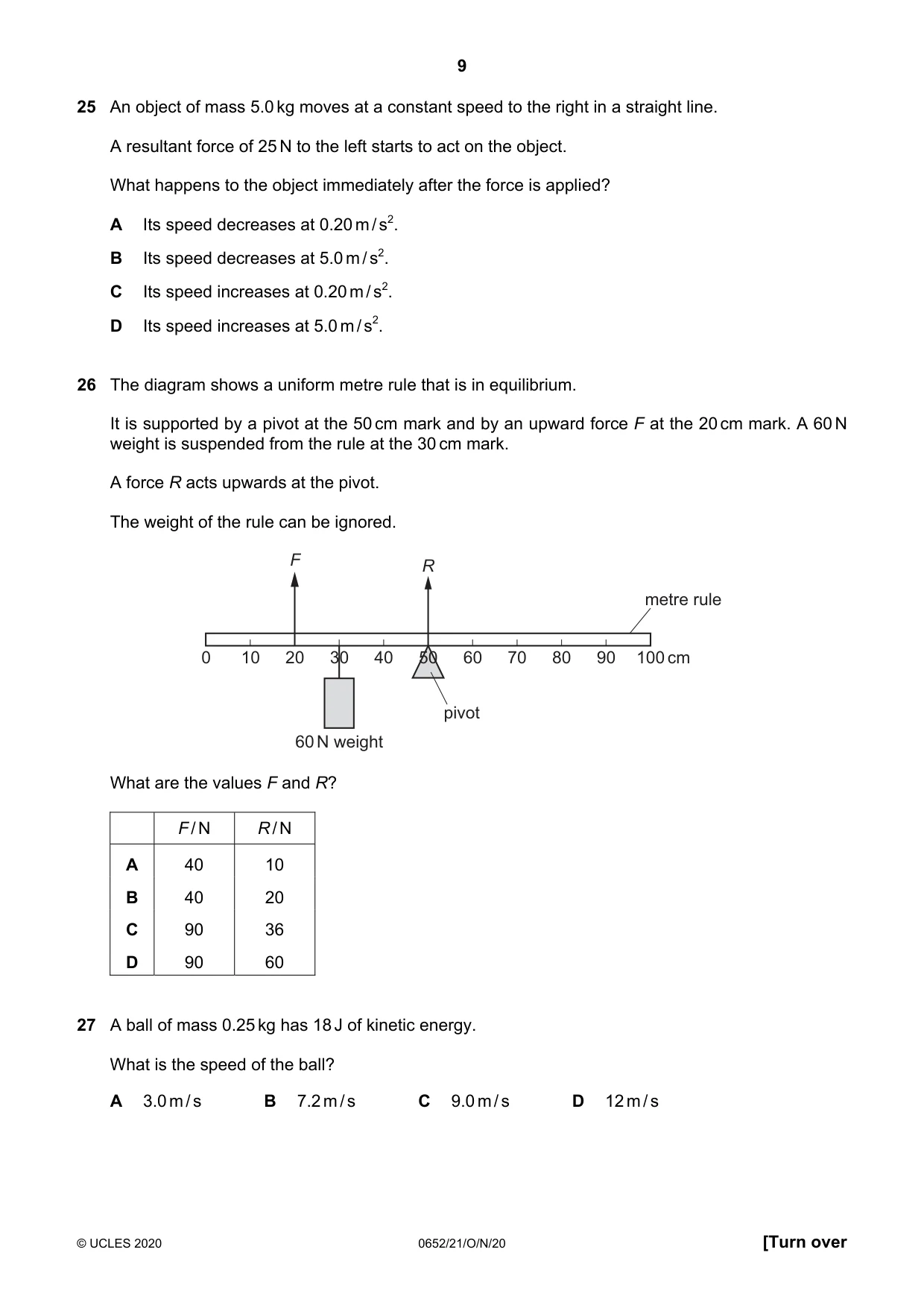
26 The diagram shows a uniform metre rule that is in equilibrium. It is supported by a pivot at the 50 cm mark and by an upward force F at the 20 cm mark. A 60 N weight is suspended from the rule at the 30 cm mark. A force R acts upwards at the pivot. The weight of the rule can be ignored. F R metre rule 0 10 20 30 40 50 60 70 80 90 100 cm pivot 60 N weight What are the values F and R? F / N R / N A 40 10 B 40 20 C 90 36 D 90 60
Mark scheme: B
Q27 · A ball of mass 0.25 kg has 18 J of kinetic energy
27 A ball of mass 0.25 kg has 18 J of kinetic energy. What is the speed of the ball? A 3.0 m / s B 7.2 m / s C 9.0 m / s D 12 m / s
Mark scheme: D
Q28 · A toy car without a motor is pushed, then follows the looped track shown
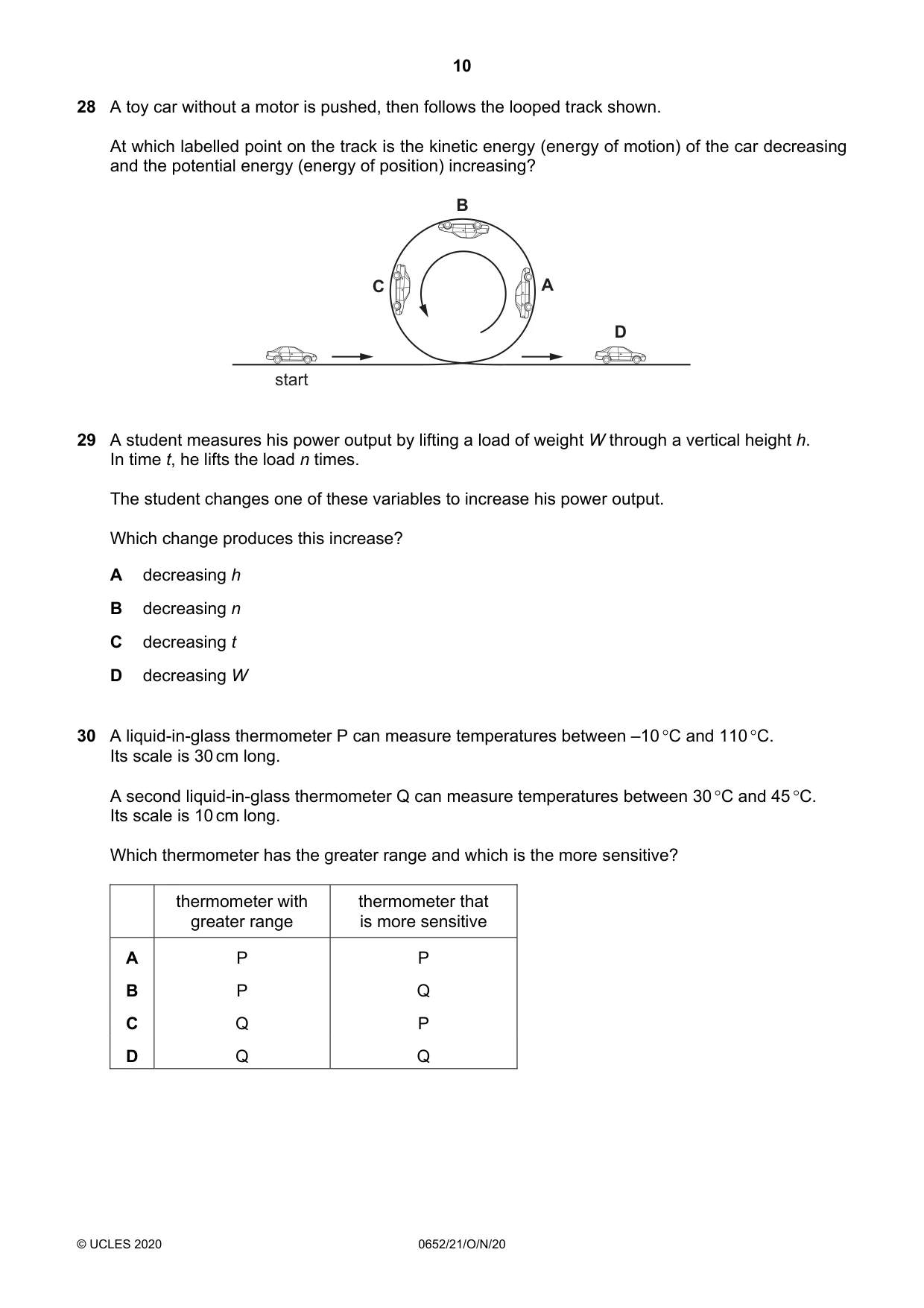
28 A toy car without a motor is pushed, then follows the looped track shown. At which labelled point on the track is the kinetic energy (energy of motion) of the car decreasing and the potential energy (energy of position) increasing? B C A D start
Mark scheme: A
Q29 · A student measures his power output by lifting a load of weight W through a vertical…
29 A student measures his power output by lifting a load of weight W through a vertical height h. In time t, he lifts the load n times. The student changes one of these variables to increase his power output. Which change produces this increase? A decreasing h B decreasing n C decreasing t D decreasing W
Mark scheme: C
Q30 · A liquid-in-glass thermometer P can measure temperatures between –10 C and 110 C
30 A liquid-in-glass thermometer P can measure temperatures between –10 C and 110 C. Its scale is 30 cm long. A second liquid-in-glass thermometer Q can measure temperatures between 30 C and 45 C. Its scale is 10 cm long. Which thermometer has the greater range and which is the more sensitive? thermometer with thermometer that greater range is more sensitive A P P B P Q C Q P D Q Q
Mark scheme: B
Q31 · The diagram represents a water wave on the surface of a pond
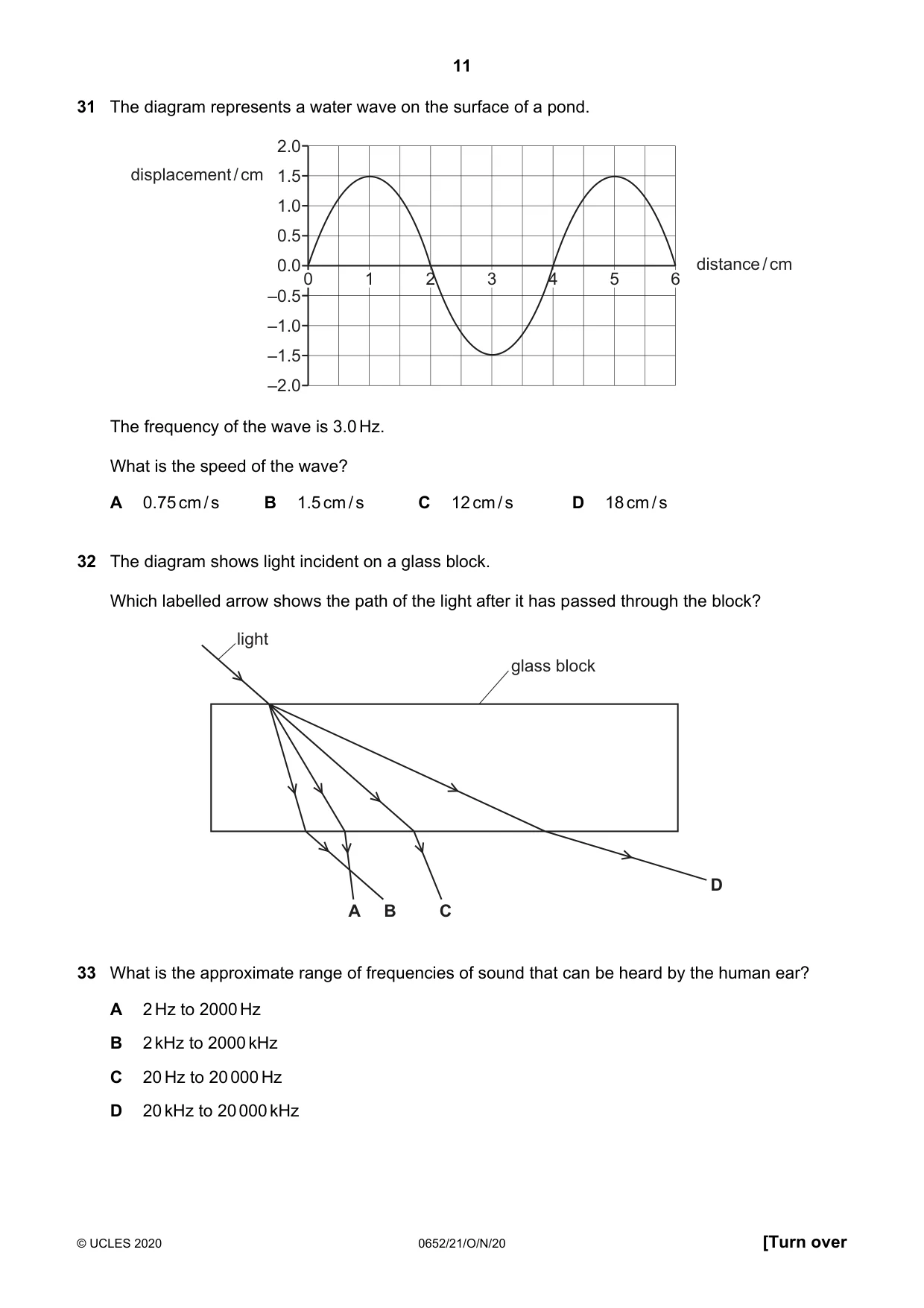
31 The diagram represents a water wave on the surface of a pond. 2.0 displacement / cm 1.5 1.0 0.5 0.0 distance / cm 0 1 2 3 4 5 6 –0.5 –1.0 –1.5 –2.0 The frequency of the wave is 3.0 Hz. What is the speed of the wave? A 0.75 cm / s B 1.5 cm / s C 12 cm / s D 18 cm / s
Mark scheme: C
Q32 · The diagram shows light incident on a glass block
32 The diagram shows light incident on a glass block. Which labelled arrow shows the path of the light after it has passed through the block? light glass block D A B C
Mark scheme: B
Q33 · What is the approximate range of frequencies of sound that can be heard by the human ear?
33 What is the approximate range of frequencies of sound that can be heard by the human ear? A 2 Hz to 2000 Hz B 2 kHz to 2000 kHz C 20 Hz to 20 000 Hz D 20 kHz to 20 000 kHz
Mark scheme: C
Q34 · A strong permanent magnet is placed close to an iron block, as shown in the diagram
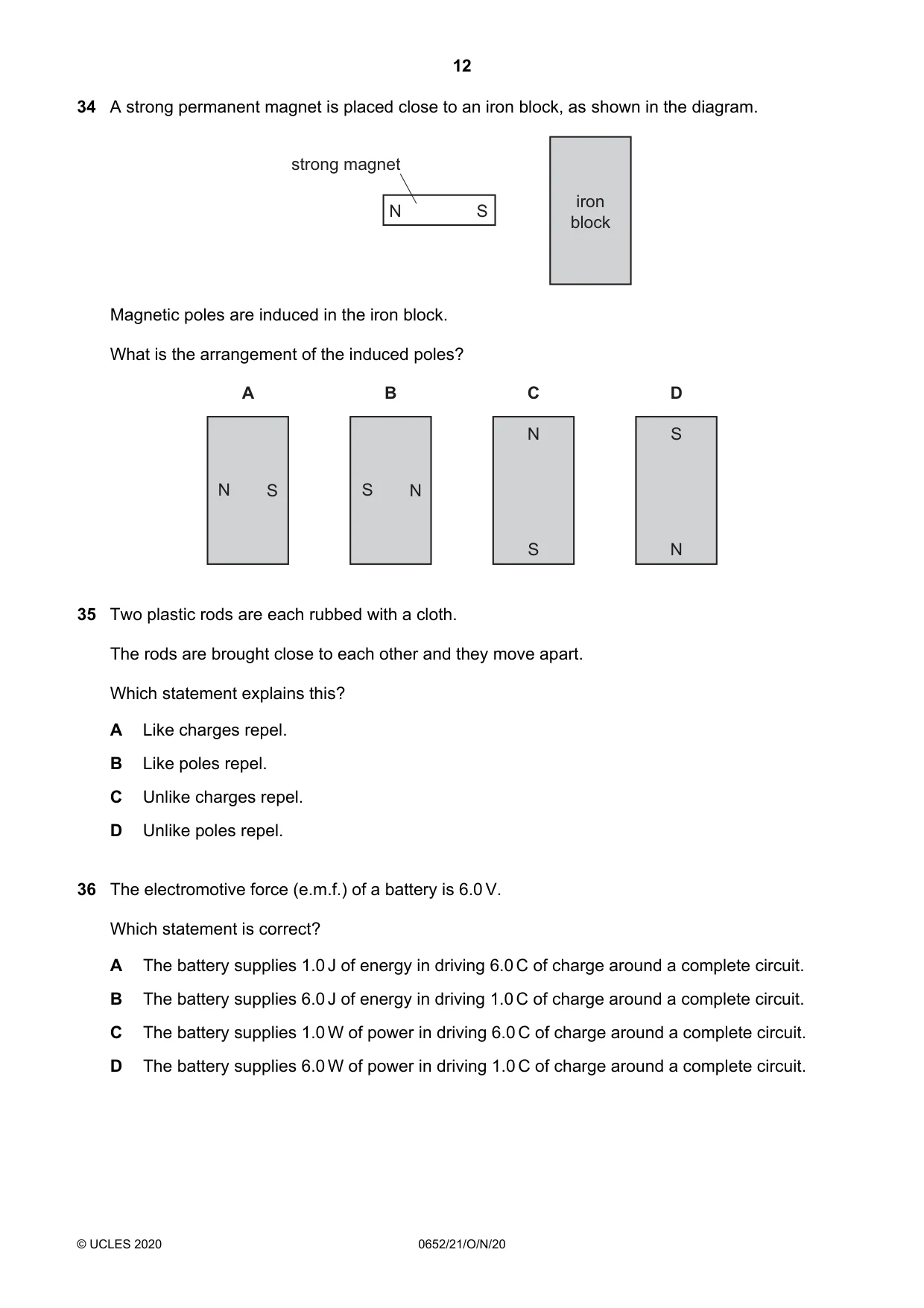
34 A strong permanent magnet is placed close to an iron block, as shown in the diagram. strong magnet iron N S block Magnetic poles are induced in the iron block. What is the arrangement of the induced poles? A B C D N S N S S N S N
Mark scheme: A
Q35 · Two plastic rods are each rubbed with a cloth
35 Two plastic rods are each rubbed with a cloth. The rods are brought close to each other and they move apart. Which statement explains this? A Like charges repel. B Like poles repel. C Unlike charges repel. D Unlike poles repel.
Mark scheme: A
Q36 · The electromotive force (e.m.f.) of a battery is 6.0 V
36 The electromotive force (e.m.f.) of a battery is 6.0 V. Which statement is correct? A The battery supplies 1.0 J of energy in driving 6.0 C of charge around a complete circuit. B The battery supplies 6.0 J of energy in driving 1.0 C of charge around a complete circuit. C The battery supplies 1.0 W of power in driving 6.0 C of charge around a complete circuit. D The battery supplies 6.0 W of power in driving 1.0 C of charge around a complete circuit.
Mark scheme: B
Q37 · Overheating of a cable in an electric circuit is a safety hazard
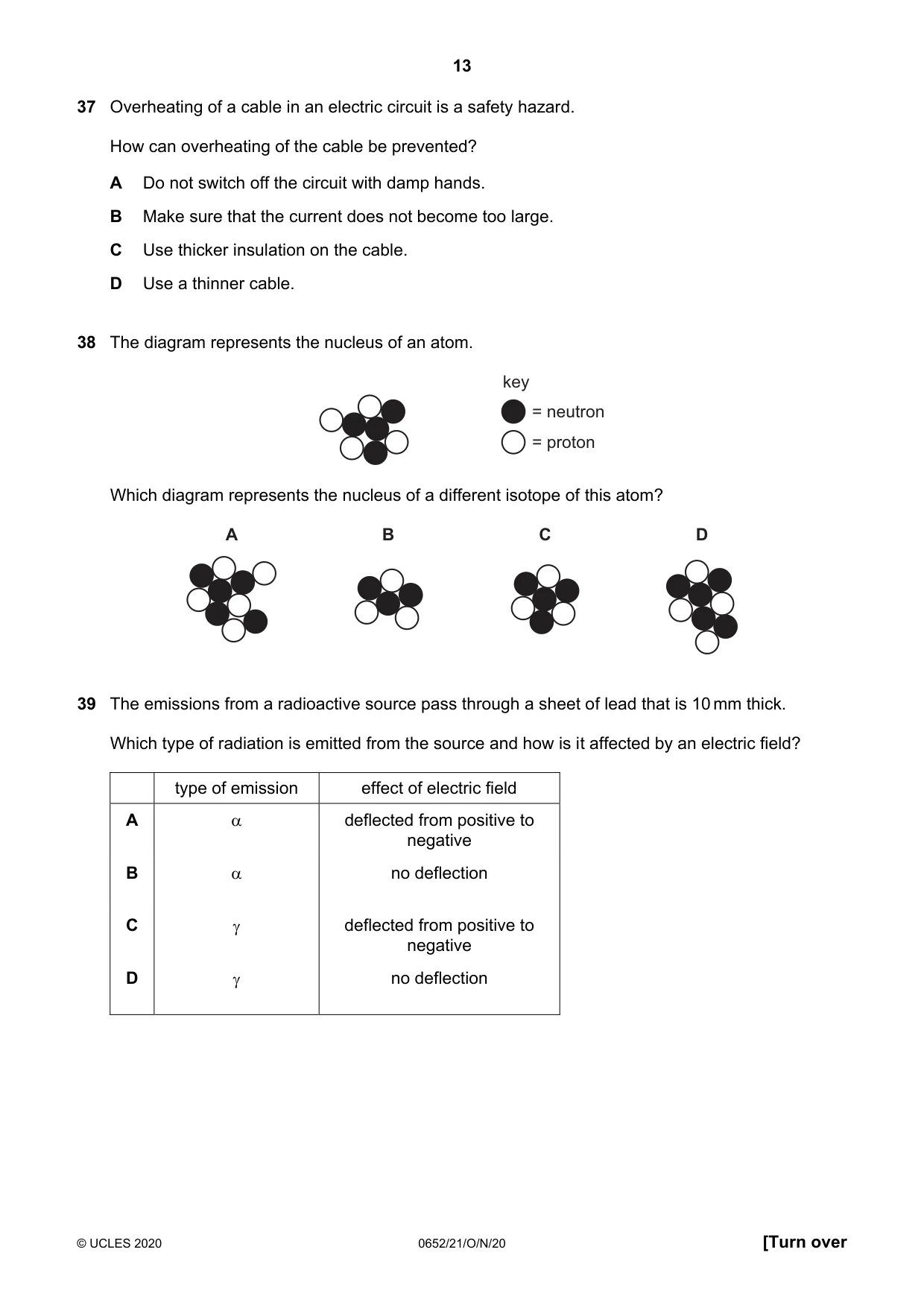
37 Overheating of a cable in an electric circuit is a safety hazard. How can overheating of the cable be prevented? A Do not switch off the circuit with damp hands. B Make sure that the current does not become too large. C Use thicker insulation on the cable. D Use a thinner cable.
Mark scheme: B
Q38 · The diagram represents the nucleus of an atom
38 The diagram represents the nucleus of an atom. key = neutron = proton Which diagram represents the nucleus of a different isotope of this atom? A B C D
Mark scheme: D
Q39 · The emissions from a radioactive source pass through a sheet of lead that is 10 mm thick
39 The emissions from a radioactive source pass through a sheet of lead that is 10 mm thick. Which type of radiation is emitted from the source and how is it affected by an electric field? type of emission effect of electric field A deflected from positive to negative B no deflection C deflected from positive to negative D no deflection
Mark scheme: D
Q40 · A radioactive nucleus emits a -particle
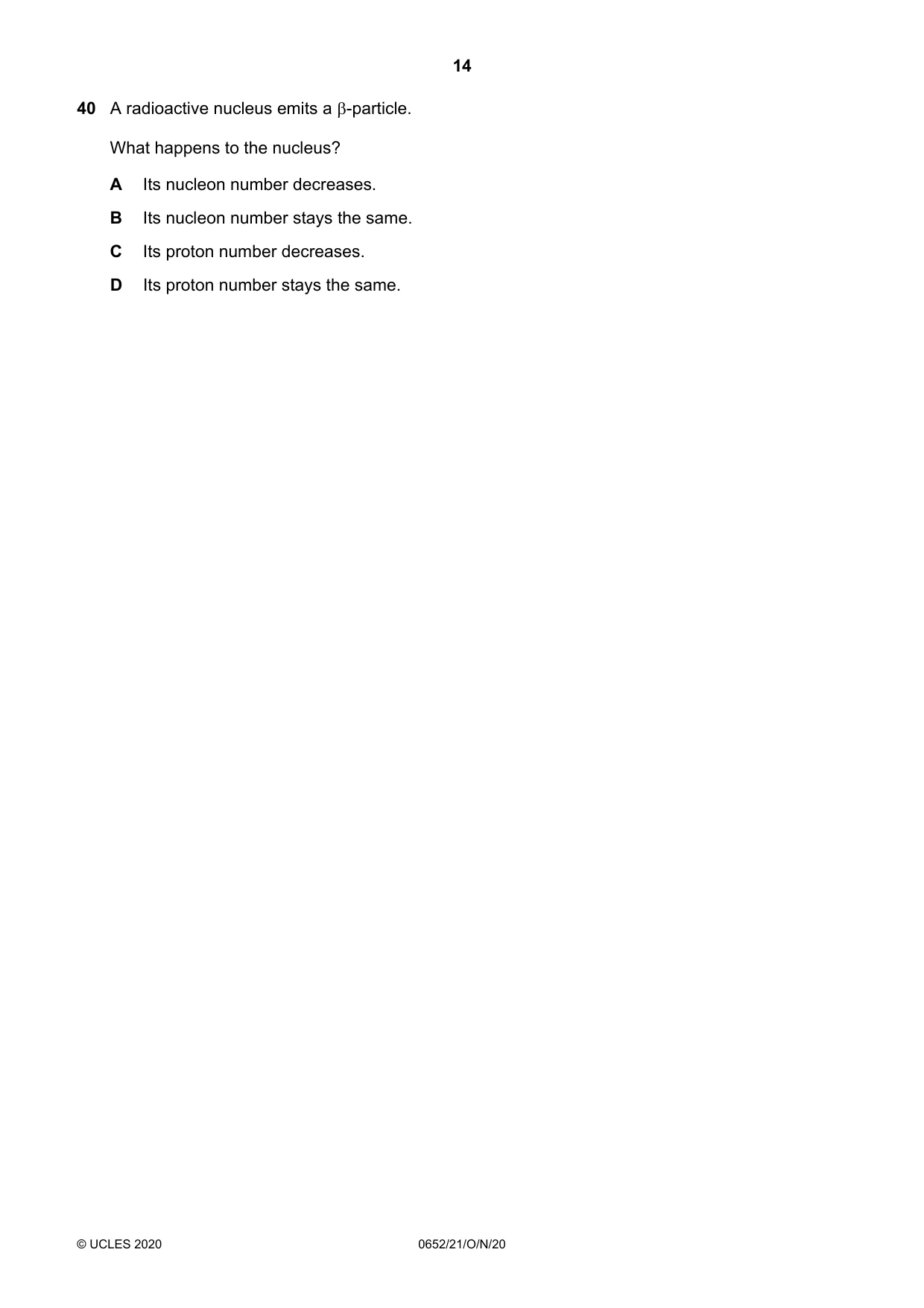
40 A radioactive nucleus emits a -particle. What happens to the nucleus? A Its nucleon number decreases. B Its nucleon number stays the same. C Its proton number decreases. D Its proton number stays the same.
Mark scheme: B
What was in this paper
The subtopics covered by these 40 questions, and how many questions each got. Open one in a new tab to see every Cambridge question on it.
3Work, energy and power3Electrical quantities2Radioactivity2Redox2Stoichiometry2Air1Alcohols1Alkanes1Atomic structure and the Periodic Table1Criteria of purity1Dangers of electricity1Density1Elements, compounds and mixtures1General wave properties1Group properties1Homologous series1Ions and ionic bonds1Length and time1Light1Mass and weight1Molecules and covalent bonds1Periodic Trends1Rate (speed) of reaction1Simple phenomena of magnetism1Sound1The characteristic properties of acids and bases1The nuclear atom1The particulate nature of matter1Thermal properties and temperature1Types of oxides1Water1What you needed in this session
Cambridge’s own grade thresholds for 2020 Oct/Nov, Paper 2 · Variant 1. A higher threshold means an easier paper — the bar moves with how the cohort did.