Cambridge IGCSE Physical Science 0652 — 2024 Oct/Nov Paper 2 · Variant 1
0652/21/O/N/24 · 40 questions · 40 marks · ≈45 min
The question paper and its mark scheme, free to read here and free to download. This is Cambridge’s own paper, exactly as it was sat.
Question paper16 pages
Mark scheme3 pages
Answers below. Sit the paper first if you are practising.
Questions as text
Q1 · Which statement describes and explains the relative rates of diffusion of carbon dioxide…
1 Which statement describes and explains the relative rates of diffusion of carbon dioxide and of methane? A Carbon dioxide diffuses more rapidly because its molecules have a higher relative molecular mass than molecules of methane. B Carbon dioxide diffuses more rapidly because its molecules have a lower relative molecular mass than molecules of methane. C Methane diffuses more rapidly because its molecules have a higher relative molecular mass than molecules of carbon dioxide. D Methane diffuses more rapidly because its molecules have a lower relative molecular mass than molecules of carbon dioxide.
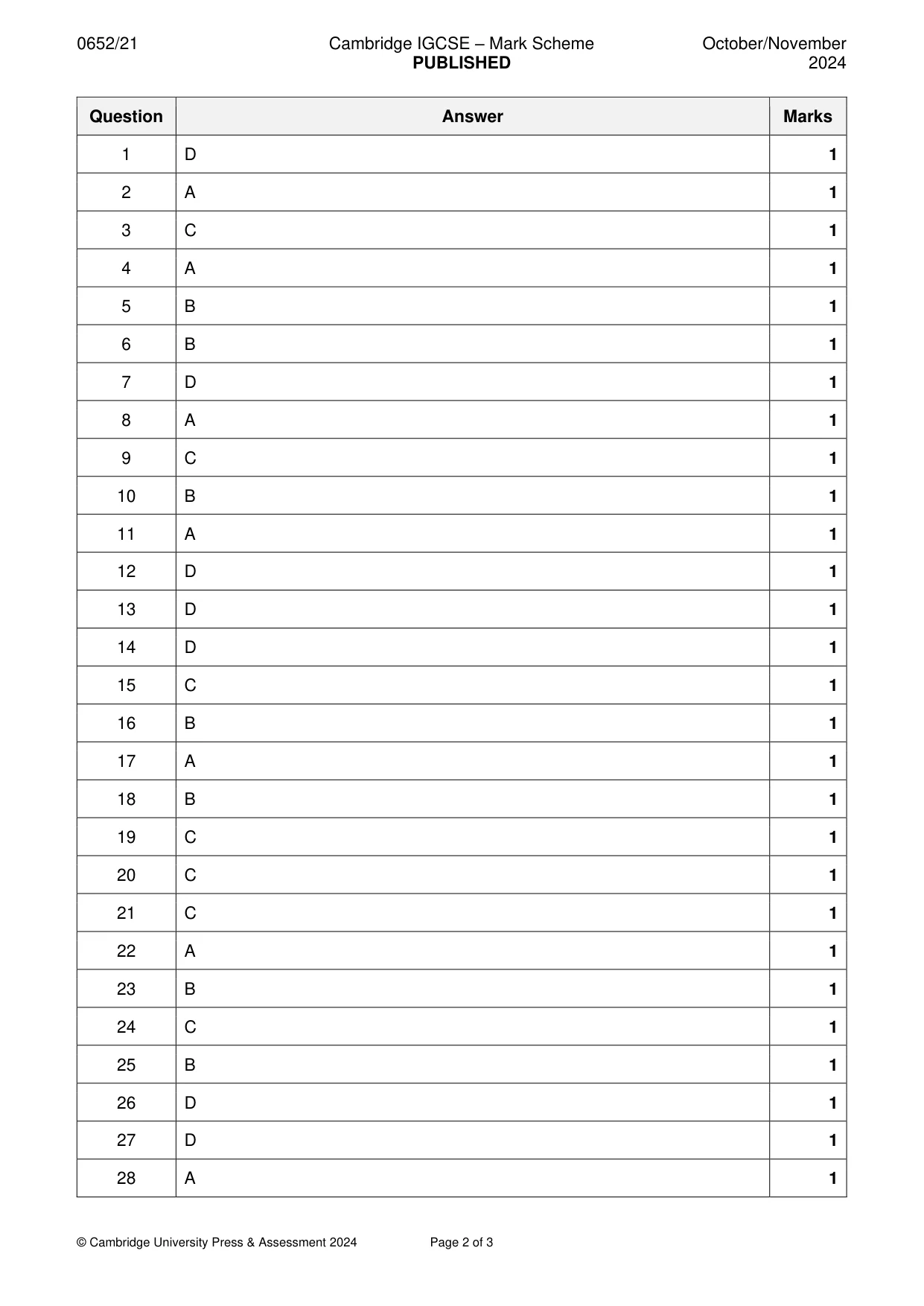
Mark scheme: D
Q2 · In an experiment, the mass of a sample of solid calcium carbonate is measured and added…
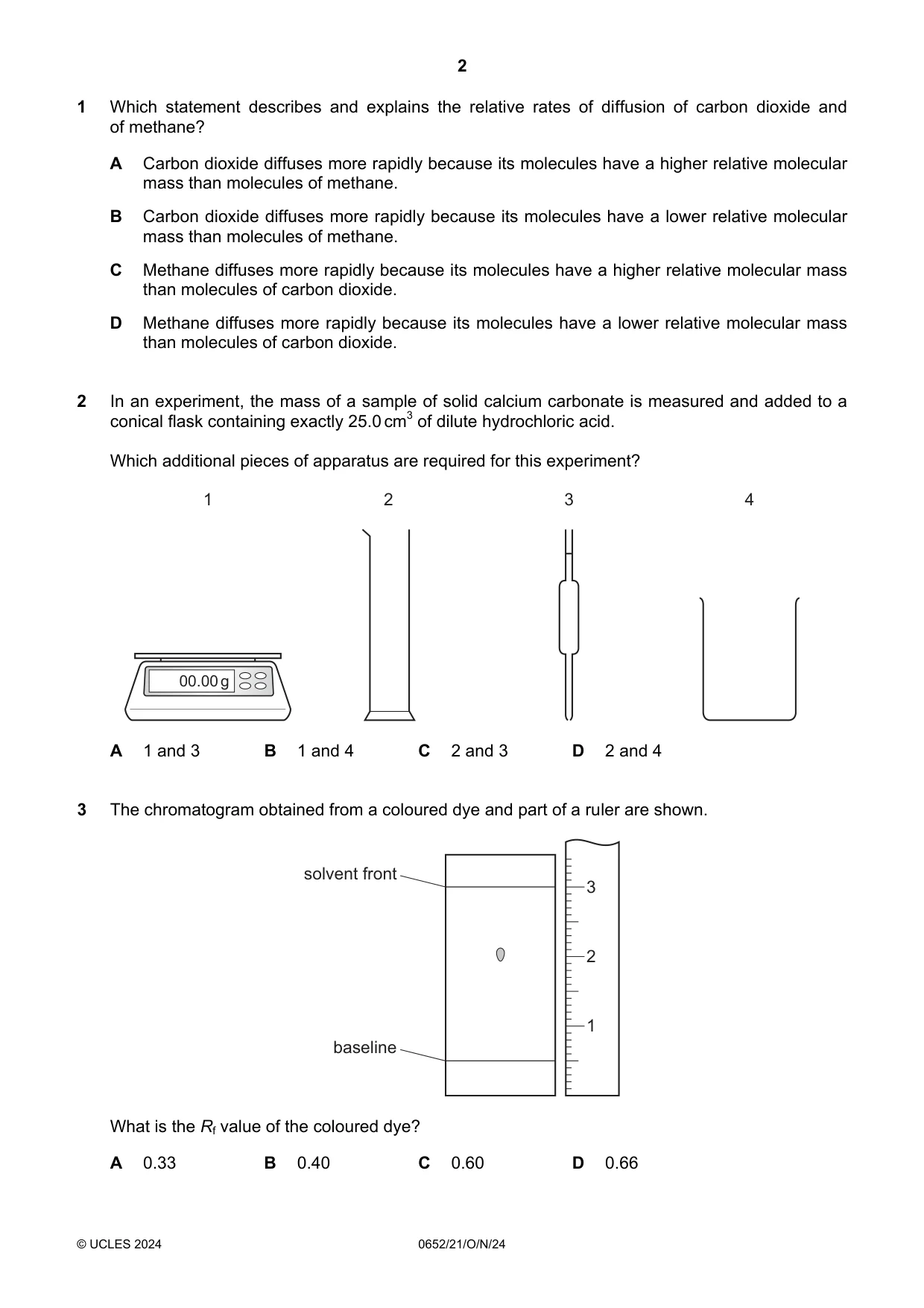
2 In an experiment, the mass of a sample of solid calcium carbonate is measured and added to a conical flask containing exactly 25.0 cm3 of dilute hydrochloric acid. Which additional pieces of apparatus are required for this experiment? 1 2 3 4 00.00 g A 1 and 3 B 1 and 4 C 2 and 3 D 2 and 4
Mark scheme: A
Q3 · The chromatogram obtained from a coloured dye and part of a ruler are shown
3 The chromatogram obtained from a coloured dye and part of a ruler are shown. solvent front 3 2 1 baseline What is the Rf value of the coloured dye? A 0.33 B 0.40 C 0.60 D 0.66
Mark scheme: C
Q4 · Some salt is dissolved in water to form a solution
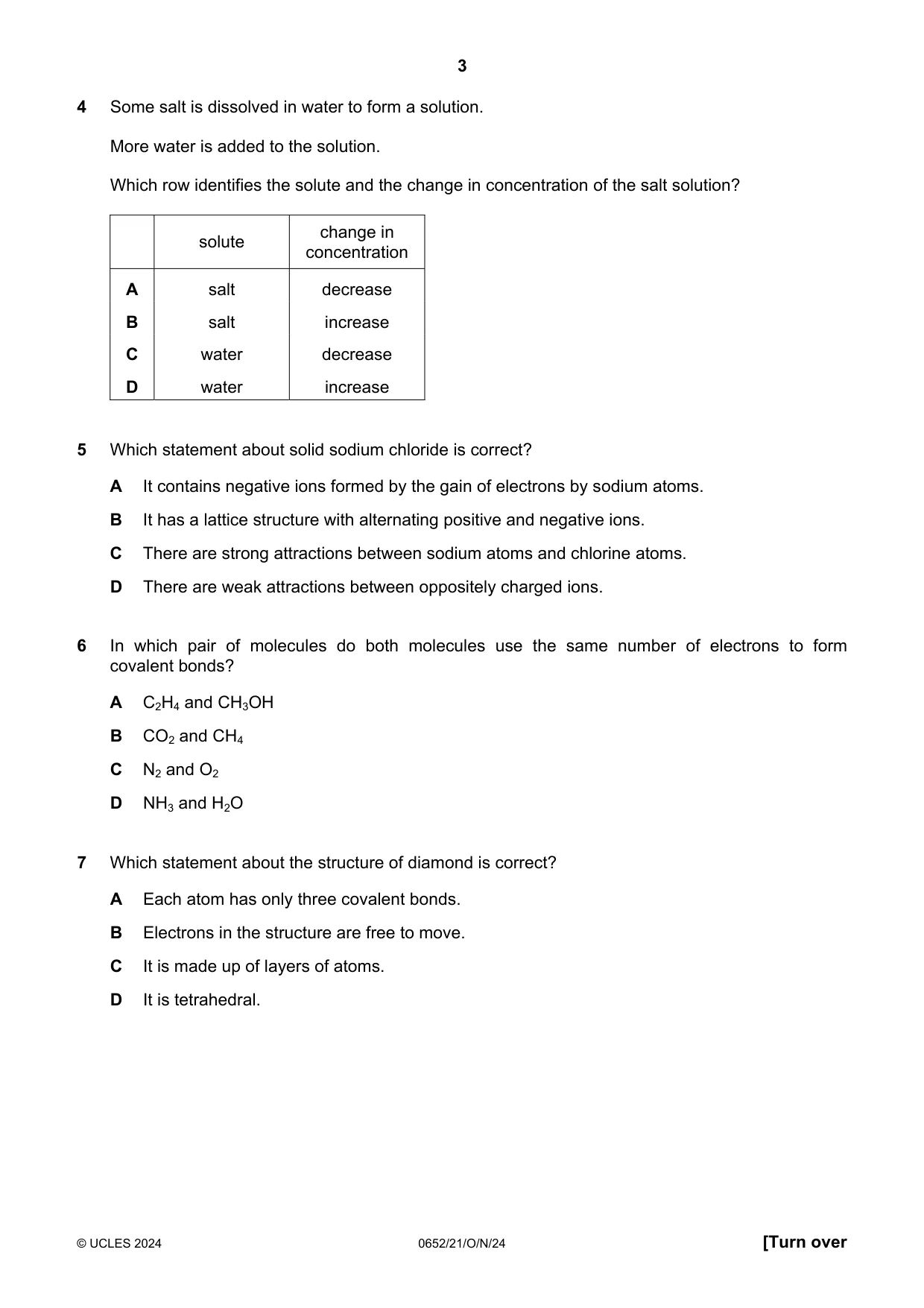
4 Some salt is dissolved in water to form a solution. More water is added to the solution. Which row identifies the solute and the change in concentration of the salt solution? change in solute concentration A salt decrease B salt increase C water decrease D water increase
Mark scheme: A
Q5 · Which statement about solid sodium chloride is correct?
5 Which statement about solid sodium chloride is correct? A It contains negative ions formed by the gain of electrons by sodium atoms. B It has a lattice structure with alternating positive and negative ions. C There are strong attractions between sodium atoms and chlorine atoms. D There are weak attractions between oppositely charged ions.
Mark scheme: B
Q6 · In which pair of molecules do both molecules use the same number of electrons to form…
6 In which pair of molecules do both molecules use the same number of electrons to form covalent bonds? A C2H4 and CH3OH B CO2 and CH4 C N2 and O2 D NH3 and H2O
Mark scheme: B
Q7 · Which statement about the structure of diamond is correct?
7 Which statement about the structure of diamond is correct? A Each atom has only three covalent bonds. B Electrons in the structure are free to move. C It is made up of layers of atoms. D It is tetrahedral.
Mark scheme: D
Q8 · The equation for the decomposition of hydrogen peroxide, H2O2, is shown
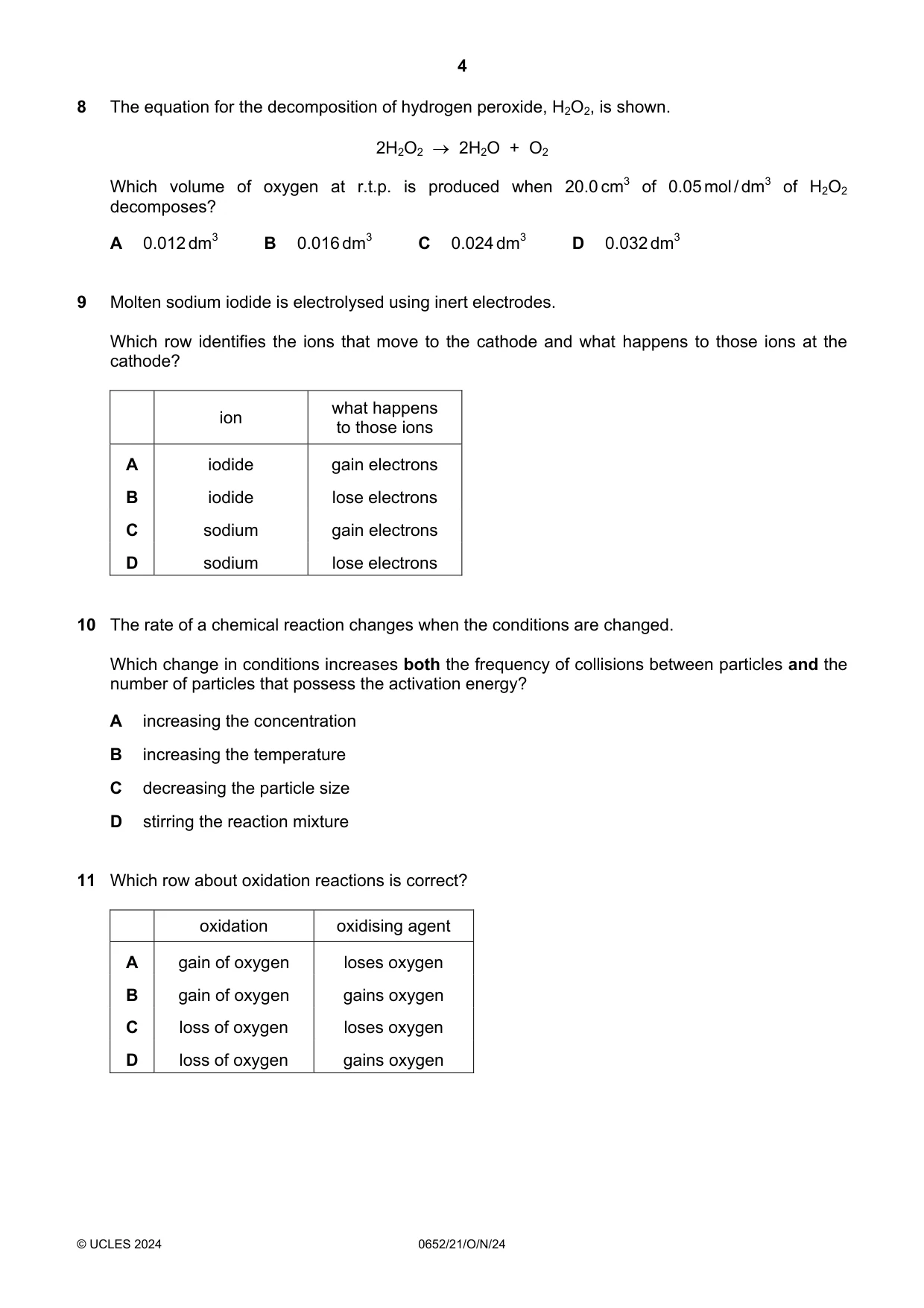
8 The equation for the decomposition of hydrogen peroxide, H2O2, is shown. 2H2O2 2H2O + O2 Which volume of oxygen at r.t.p. is produced when 20.0 cm3 of 0.05 mol / dm3 of H2O2 decomposes? A 0.012 dm3 B 0.016 dm3 C 0.024 dm3 D 0.032 dm3
Mark scheme: A
Q9 · Molten sodium iodide is electrolysed using inert electrodes
9 Molten sodium iodide is electrolysed using inert electrodes. Which row identifies the ions that move to the cathode and what happens to those ions at the cathode? what happens ion to those ions A iodide gain electrons B iodide lose electrons C sodium gain electrons D sodium lose electrons
Mark scheme: C
Q10 · The rate of a chemical reaction changes when the conditions are changed
10 The rate of a chemical reaction changes when the conditions are changed. Which change in conditions increases both the frequency of collisions between particles and the number of particles that possess the activation energy? A increasing the concentration B increasing the temperature C decreasing the particle size D stirring the reaction mixture
Mark scheme: B
Q11 · Which row about oxidation reactions is correct?
11 Which row about oxidation reactions is correct? oxidation oxidising agent A gain of oxygen loses oxygen B gain of oxygen gains oxygen C loss of oxygen loses oxygen D loss of oxygen gains oxygen
Mark scheme: A
Q12 · Which statement describes the behaviour of an acid and a base in aqueous solution?
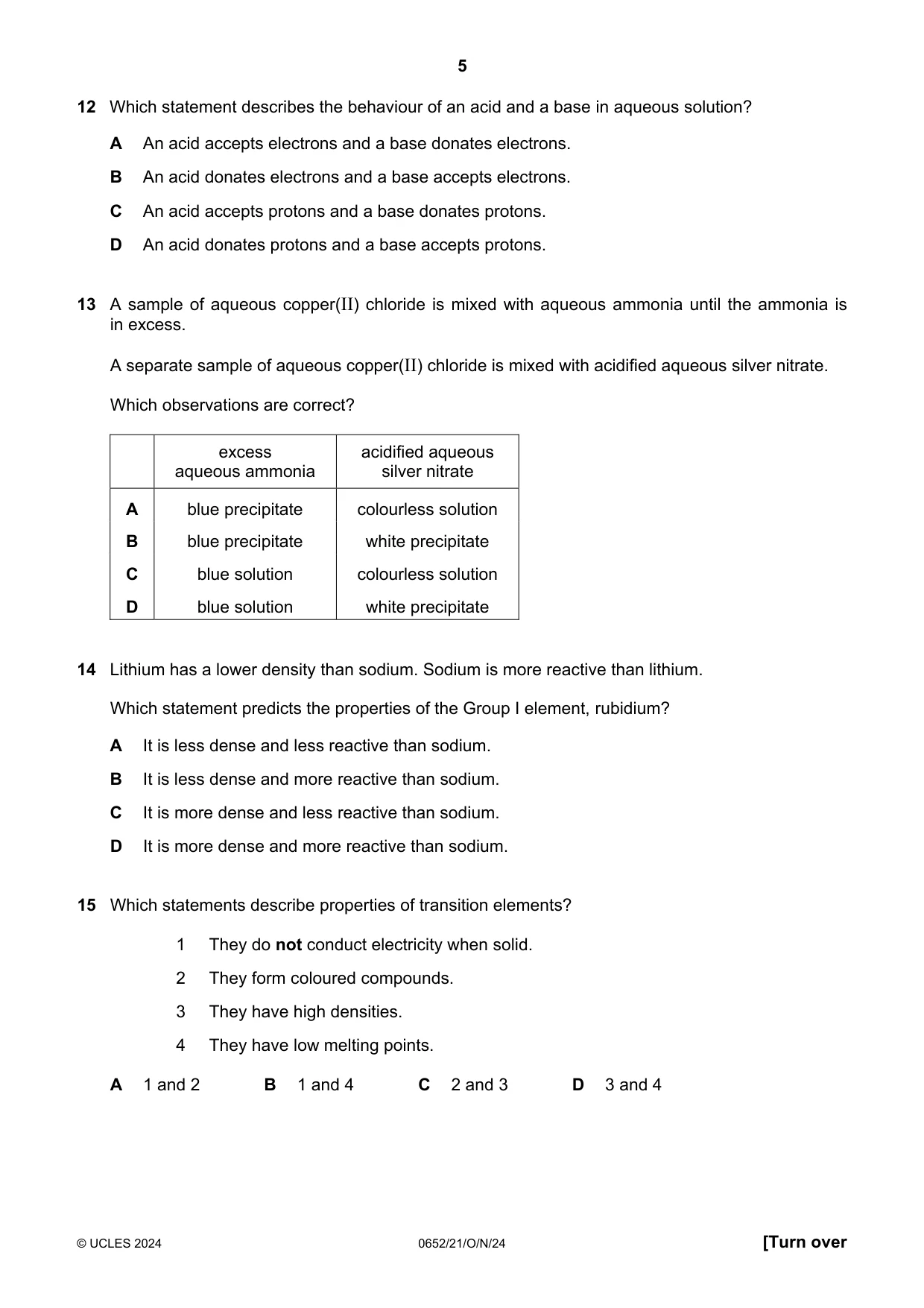
12 Which statement describes the behaviour of an acid and a base in aqueous solution? A An acid accepts electrons and a base donates electrons. B An acid donates electrons and a base accepts electrons. C An acid accepts protons and a base donates protons. D An acid donates protons and a base accepts protons.
Mark scheme: D
More questions on The characteristic properties of acids and bases
Q13 · A sample of aqueous copper(II) chloride is mixed with aqueous ammonia until the ammonia…
13 A sample of aqueous copper(II) chloride is mixed with aqueous ammonia until the ammonia is in excess. A separate sample of aqueous copper(II) chloride is mixed with acidified aqueous silver nitrate. Which observations are correct? excess acidified aqueous aqueous ammonia silver nitrate A blue precipitate colourless solution B blue precipitate white precipitate C blue solution colourless solution D blue solution white precipitate
Mark scheme: D
Q14 · Lithium has a lower density than sodium
14 Lithium has a lower density than sodium. Sodium is more reactive than lithium. Which statement predicts the properties of the Group I element, rubidium? A It is less dense and less reactive than sodium. B It is less dense and more reactive than sodium. C It is more dense and less reactive than sodium. D It is more dense and more reactive than sodium.
Mark scheme: D
Q15 · Which statements describe properties of transition elements?
15 Which statements describe properties of transition elements? 1 They do not conduct electricity when solid. 2 They form coloured compounds. 3 They have high densities. 4 They have low melting points. A 1 and 2 B 1 and 4 C 2 and 3 D 3 and 4
Mark scheme: C
Q16 · Zinc is a metal which has many uses
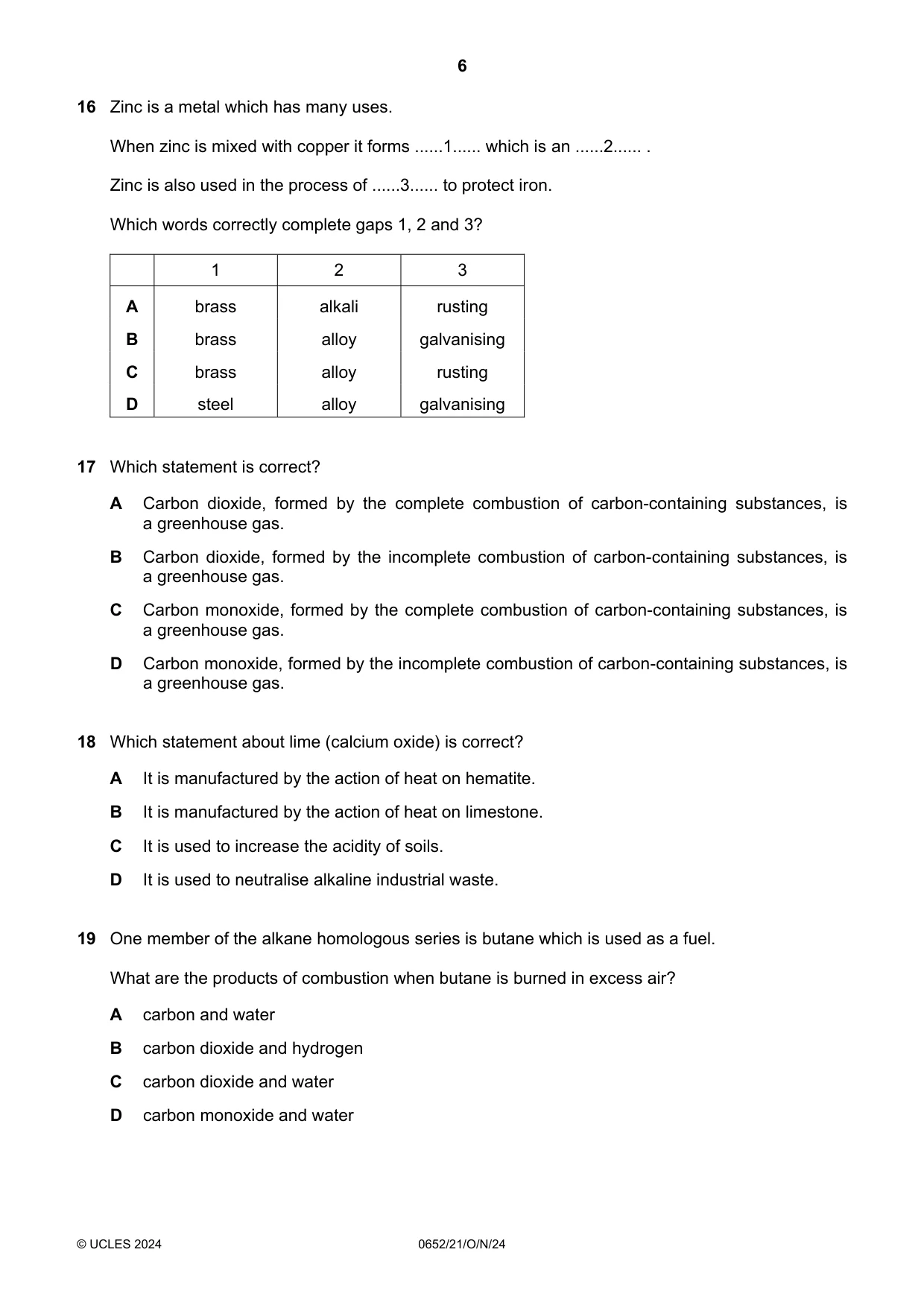
16 Zinc is a metal which has many uses. When zinc is mixed with copper it forms ......1...... which is an ......2...... . Zinc is also used in the process of ......3...... to protect iron. Which words correctly complete gaps 1, 2 and 3? 1 2 3 A brass alkali rusting B brass alloy galvanising C brass alloy rusting D steel alloy galvanising
Mark scheme: B
Q17 · Which statement is correct?
17 Which statement is correct? A Carbon dioxide, formed by the complete combustion of carbon-containing substances, is a greenhouse gas. B Carbon dioxide, formed by the incomplete combustion of carbon-containing substances, is a greenhouse gas. C Carbon monoxide, formed by the complete combustion of carbon-containing substances, is a greenhouse gas. D Carbon monoxide, formed by the incomplete combustion of carbon-containing substances, is a greenhouse gas.
Mark scheme: A
Q18 · Which statement about lime (calcium oxide) is correct?
18 Which statement about lime (calcium oxide) is correct? A It is manufactured by the action of heat on hematite. B It is manufactured by the action of heat on limestone. C It is used to increase the acidity of soils. D It is used to neutralise alkaline industrial waste.
Mark scheme: B
Q19 · One member of the alkane homologous series is butane which is used as a fuel
19 One member of the alkane homologous series is butane which is used as a fuel. What are the products of combustion when butane is burned in excess air? A carbon and water B carbon dioxide and hydrogen C carbon dioxide and water D carbon monoxide and water
Mark scheme: C
Q20 · The formulae of four compounds are shown
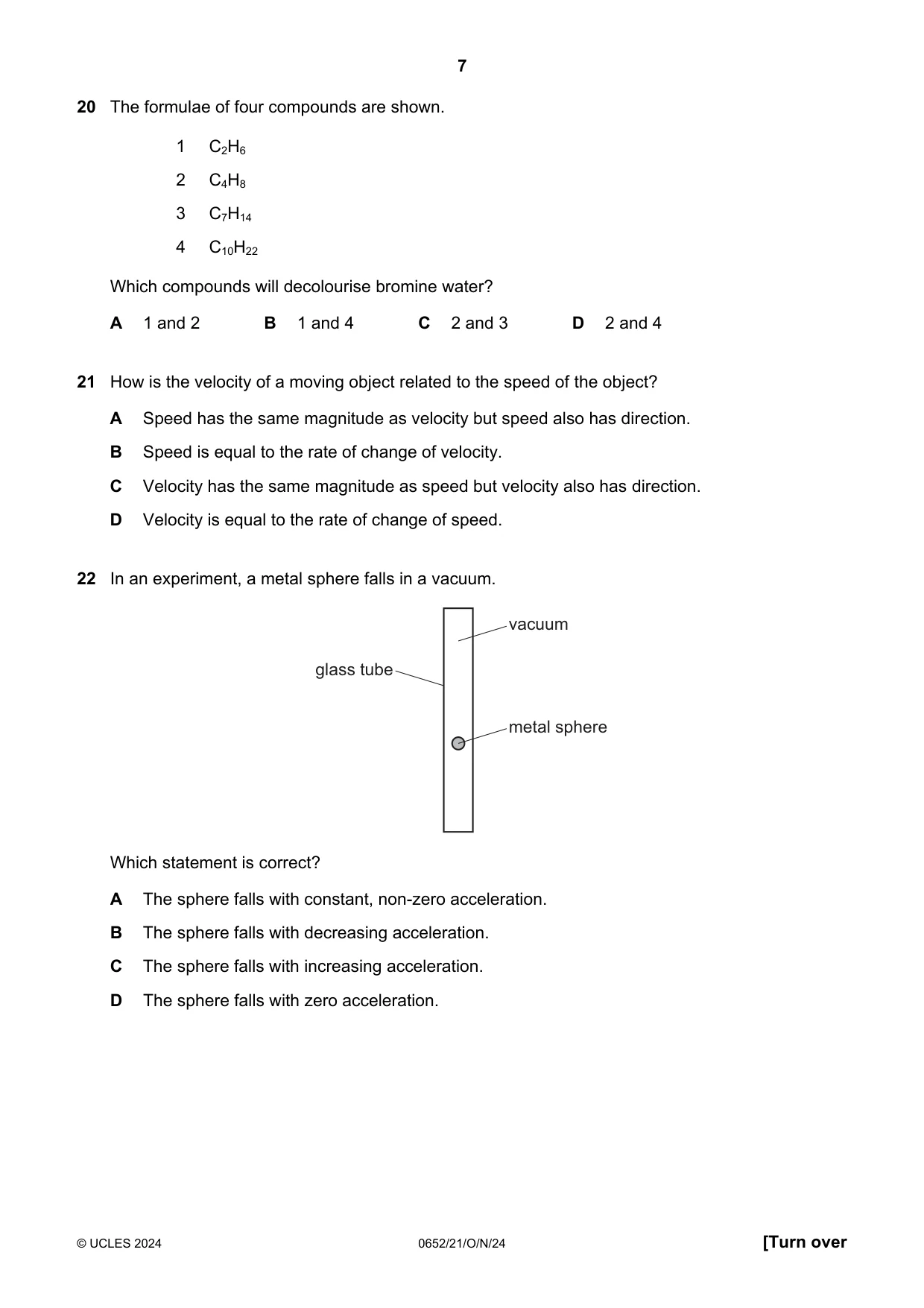
20 The formulae of four compounds are shown. 1 C2H6 2 C4H8 3 C7H14 4 C10H22 Which compounds will decolourise bromine water? A 1 and 2 B 1 and 4 C 2 and 3 D 2 and 4
Mark scheme: C
Q21 · How is the velocity of a moving object related to the speed of the object?
21 How is the velocity of a moving object related to the speed of the object? A Speed has the same magnitude as velocity but speed also has direction. B Speed is equal to the rate of change of velocity. C Velocity has the same magnitude as speed but velocity also has direction. D Velocity is equal to the rate of change of speed.
Mark scheme: C
Q22 · In an experiment, a metal sphere falls in a vacuum
22 In an experiment, a metal sphere falls in a vacuum. vacuum glass tube metal sphere Which statement is correct? A The sphere falls with constant, non-zero acceleration. B The sphere falls with decreasing acceleration. C The sphere falls with increasing acceleration. D The sphere falls with zero acceleration.
Mark scheme: A
Q23 · The diagram shows a glass that can hold water
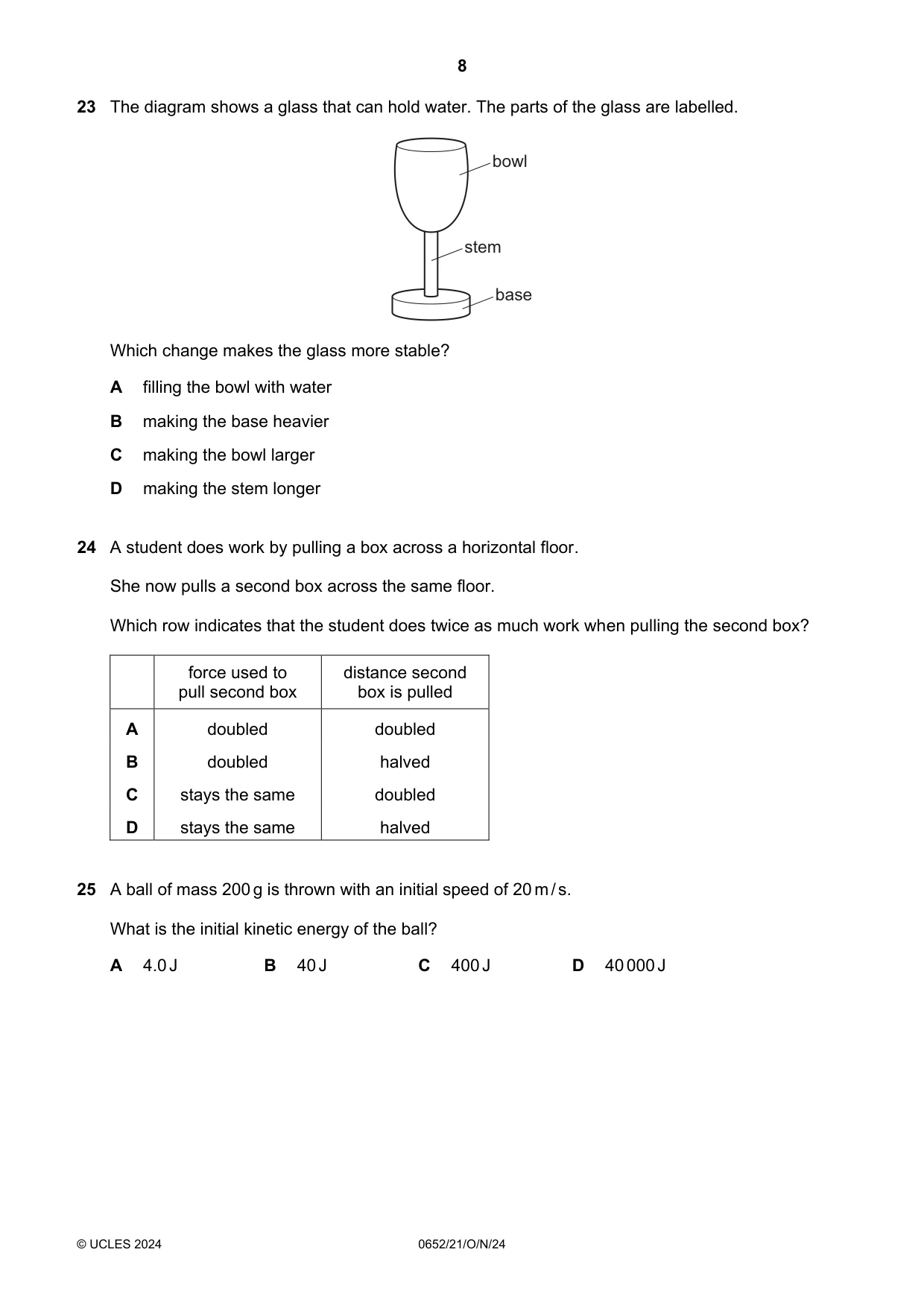
23 The diagram shows a glass that can hold water. The parts of the glass are labelled. bowl stem base Which change makes the glass more stable? A filling the bowl with water B making the base heavier C making the bowl larger D making the stem longer
Mark scheme: B
Q24 · A student does work by pulling a box across a horizontal floor
24 A student does work by pulling a box across a horizontal floor. She now pulls a second box across the same floor. Which row indicates that the student does twice as much work when pulling the second box? force used to distance second pull second box box is pulled A doubled doubled B doubled halved C stays the same doubled D stays the same halved
Mark scheme: C
Q25 · A ball of mass 200 g is thrown with an initial speed of 20 m / s
25 A ball of mass 200 g is thrown with an initial speed of 20 m / s. What is the initial kinetic energy of the ball? A 4.0 J B 40 J C 400 J D 40 000 J
Mark scheme: B
Q26 · A power station uses nuclear fission to generate electricity
26 A power station uses nuclear fission to generate electricity. In this process, energy from the nuclear fuel is transferred to energy in water. What is the energy stored in the water? A chemical energy B electrical energy C gravitational energy D thermal energy
Mark scheme: D
Q27 · The diagram shows the dimensions of a liquid-in-glass thermometer and the positions of…
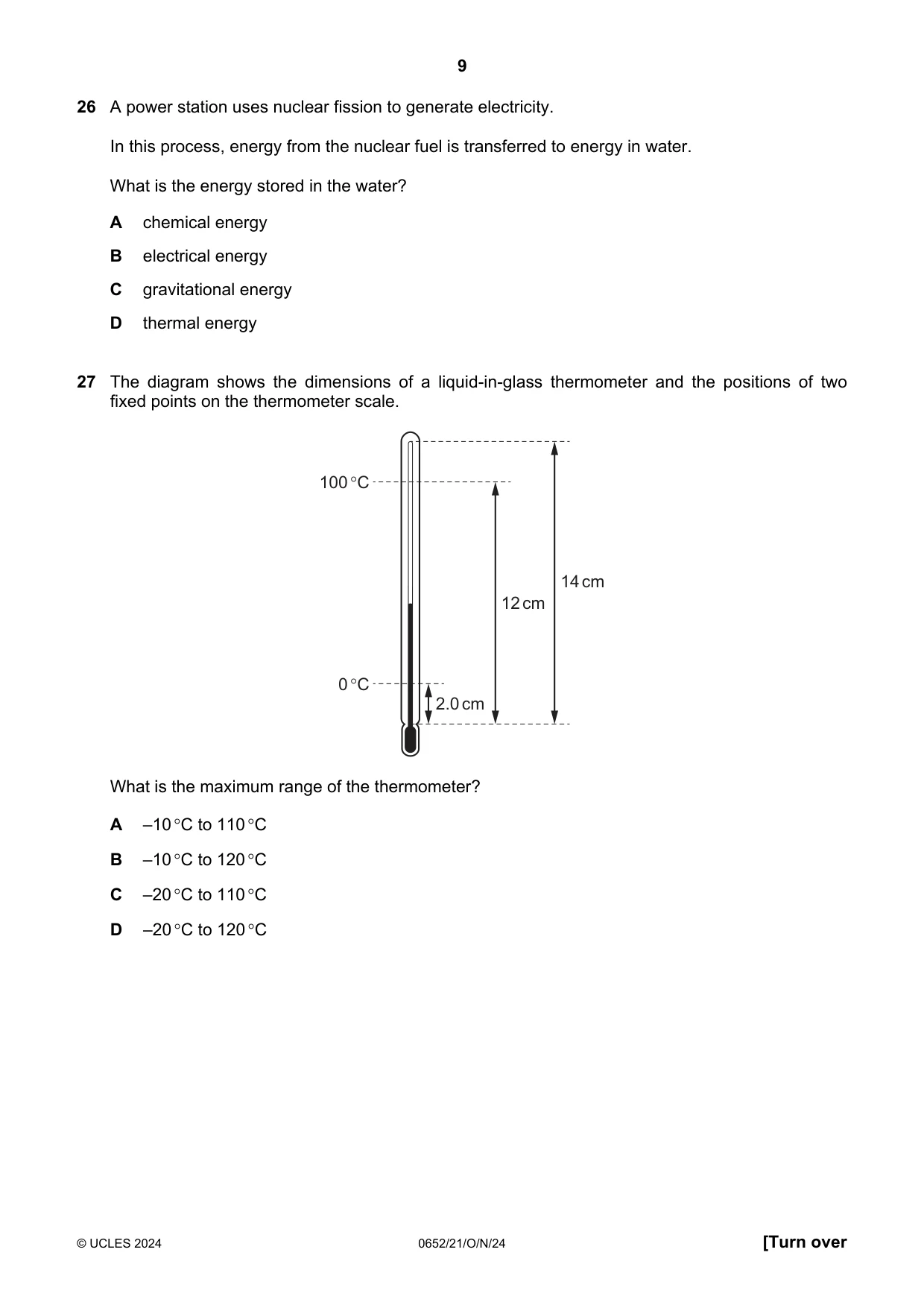
27 The diagram shows the dimensions of a liquid-in-glass thermometer and the positions of two fixed points on the thermometer scale. 100°C ---- 14cm 12cm What is the maximum range of the thermometer? A B Cc D -—10°C to 110°C -—10°C to 120°C —20°C to 110°C —20°C to 120°C
Mark scheme: D
Q28 · A laboratory is built on the Moon
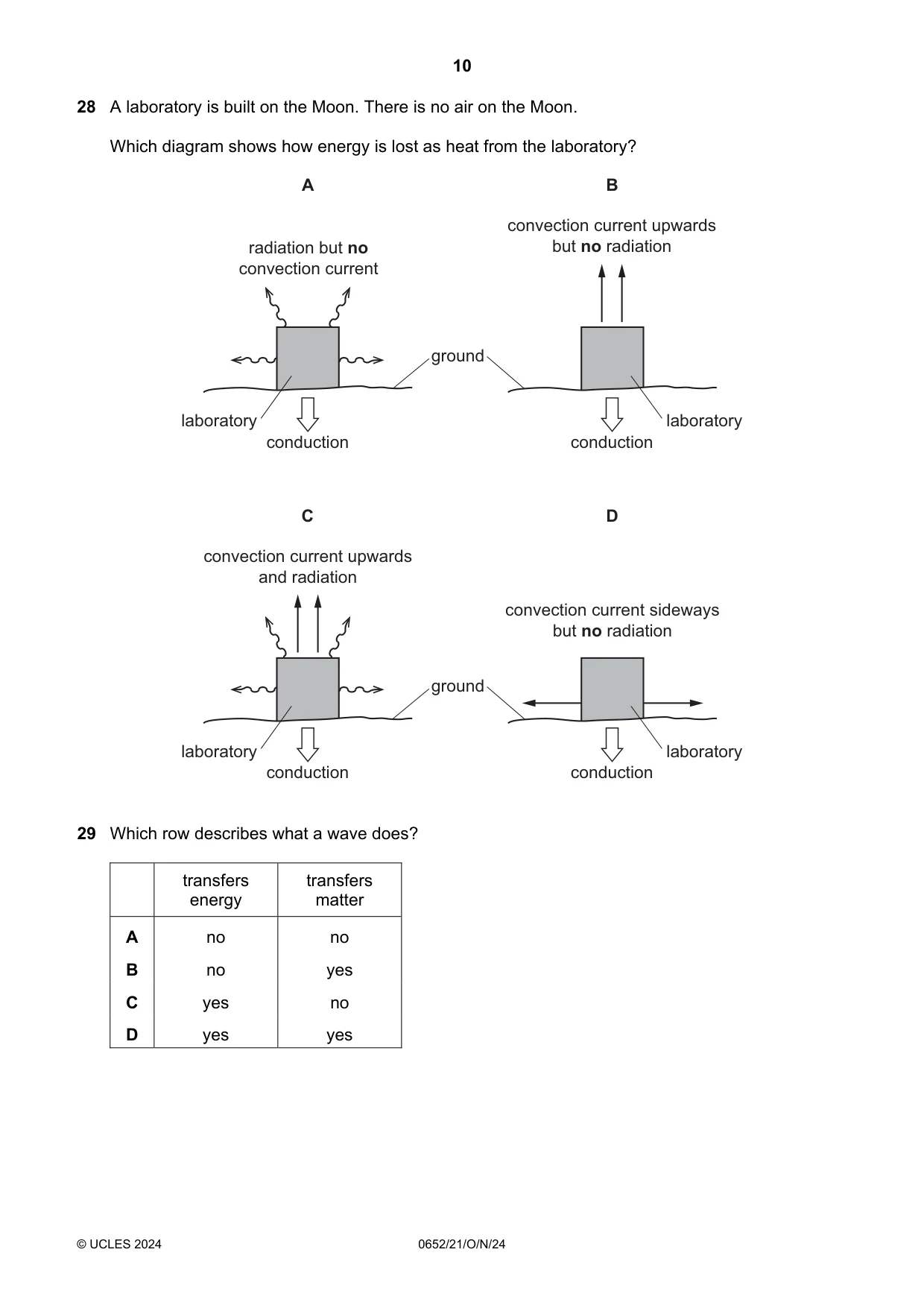
28 A laboratory is built on the Moon. There is no air on the Moon. Which diagram shows how energy is lost as heat from the laboratory? A B convection current upwards radiation but no but no radiation convection current ground laboratory laboratory conduction conduction C D convection current upwards and radiation convection current sideways but no radiation ground laboratory laboratory conduction conduction
Mark scheme: A
Q29 · Which row describes what a wave does?
29 Which row describes what a wave does? transfers transfers energy matter A no no B no yes C yes no D yes yes
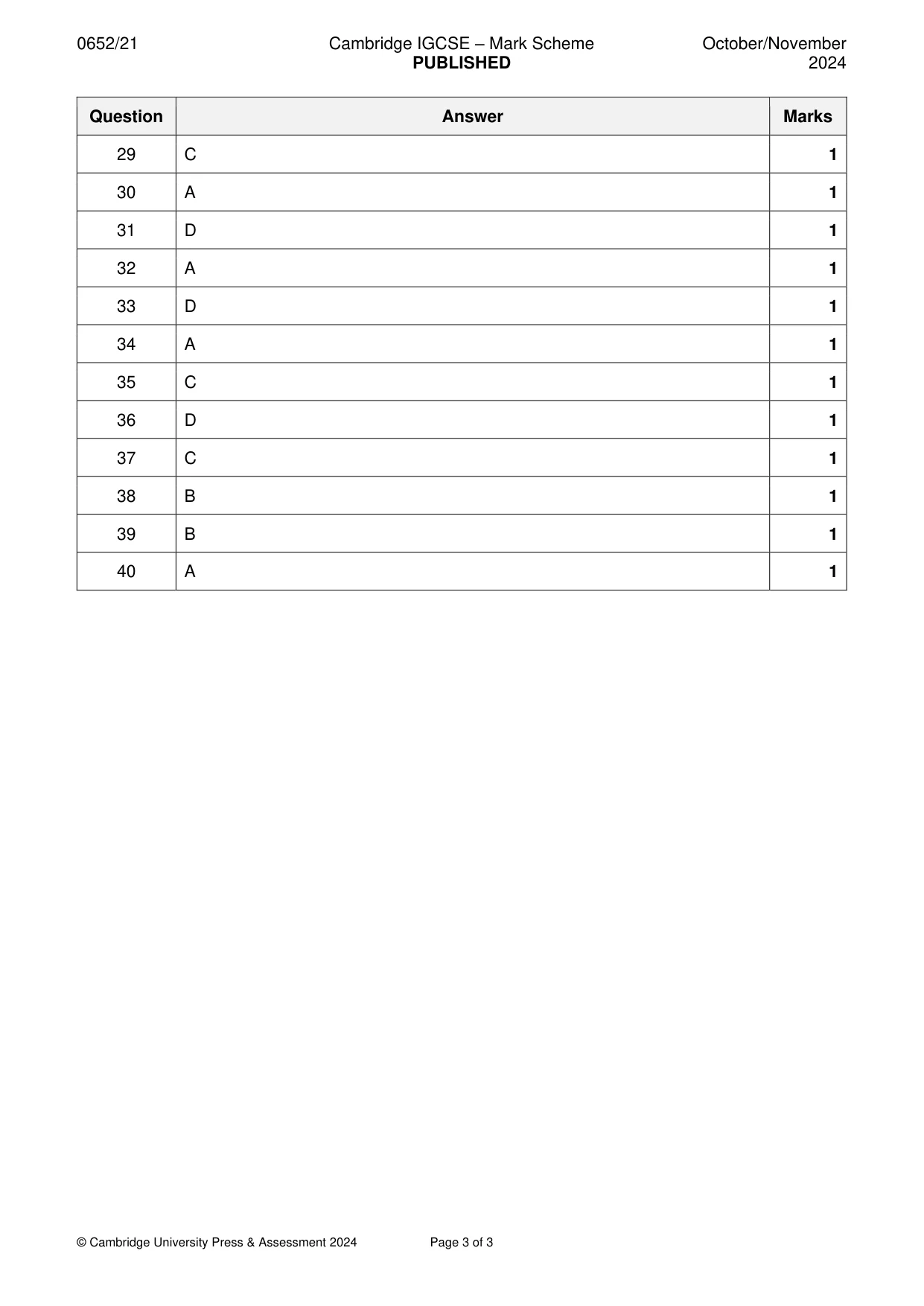
Mark scheme: C
Q30 · A converging lens of focal length 15 cm is used as a magnifying glass to produce a…
30 A converging lens of focal length 15 cm is used as a magnifying glass to produce a virtual, magnified image of an object. What is a possible position of the object? A 8.0 cm from the lens B 16 cm from the lens C 32 cm from the lens D 64 cm from the lens
Mark scheme: A
Q31 · Which row contains electromagnetic waves in order of increasing wavelength?
31 Which row contains electromagnetic waves in order of increasing wavelength? smallest largest wavelength wavelength A ultraviolet X-rays microwaves radio B visible light infrared radio gamma ()-rays C visible light ultraviolet X-rays gamma ()-rays D X-rays ultraviolet visible light microwaves
Mark scheme: D
Q32 · The diagram shows a longitudinal wave on a spring
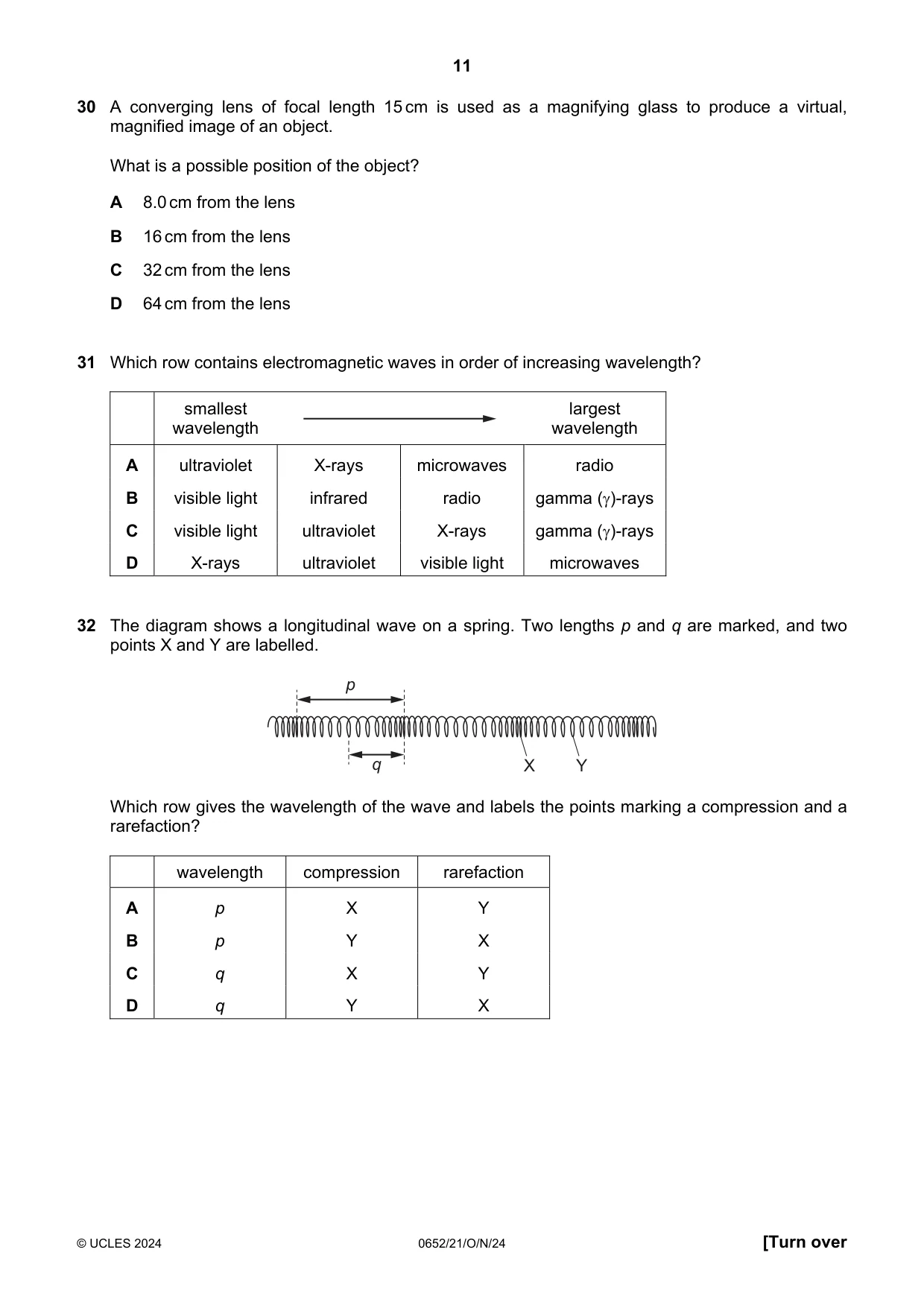
32 The diagram shows a longitudinal wave on a spring. Two lengths p and q are marked, and two points X and Y are labelled. p q X Y Which row gives the wavelength of the wave and labels the points marking a compression and a rarefaction? wavelength compression rarefaction A p X Y B p Y X C q X Y D q Y X
Mark scheme: A
Q33 · The diagram shows a battery connected to a 12 resistor and a voltmeter
33 The diagram shows a battery connected to a 12 resistor and a voltmeter. The reading on the voltmeter is 24 V. 12 Ω V Which row shows the current in the circuit and the electromotive force (e.m.f.) of the battery? current in e.m.f. of circuit / A battery / V A 0.50 2.0 B 0.50 24 C 2.0 2.0 D 2.0 24
Mark scheme: D
Q34 · Which resistor combination has a combined resistance of 160 Q?
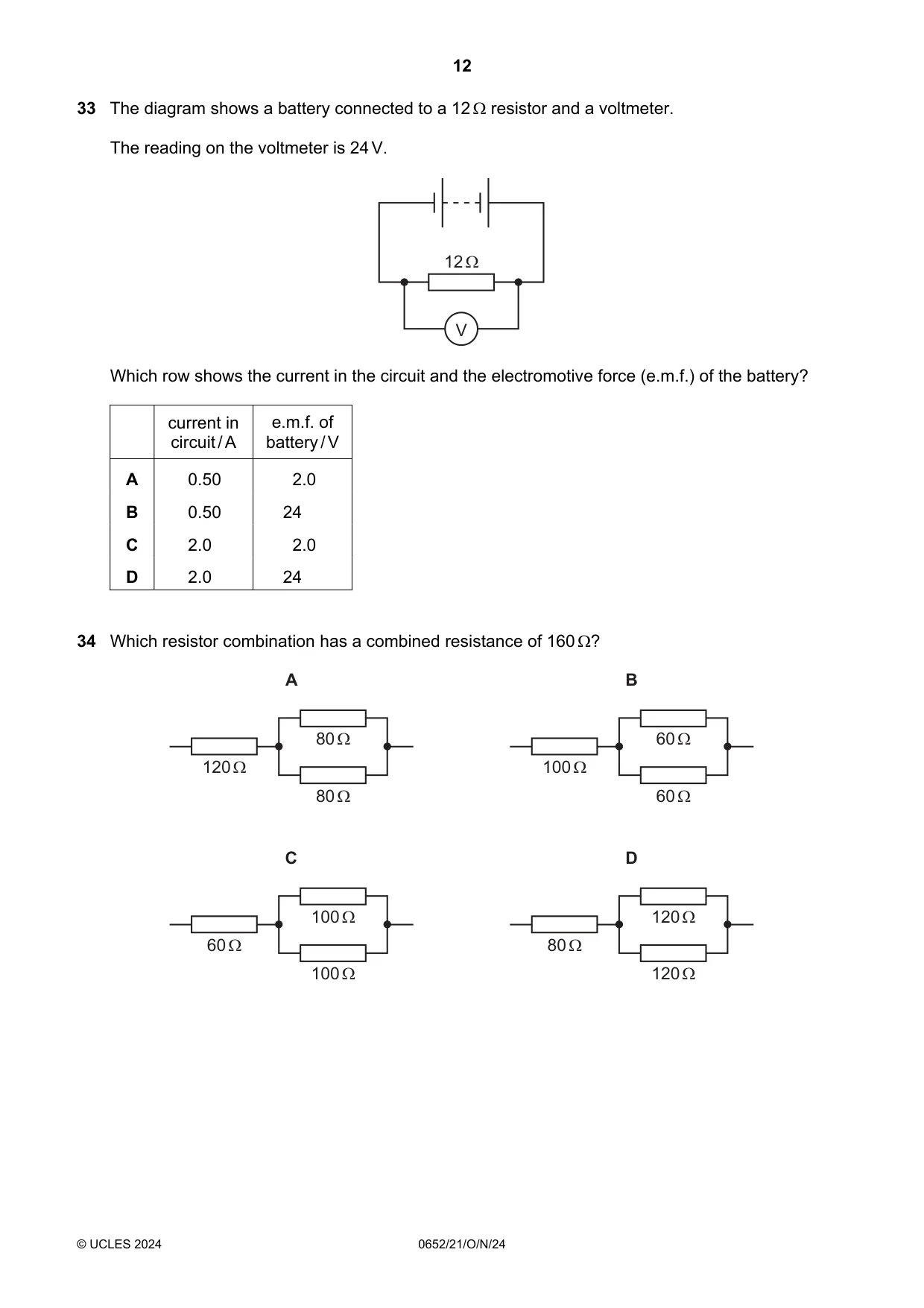
34 Which resistor combination has a combined resistance of 160 Q?
Mark scheme: A
Q35 · The current in an electric heater is 8.0 A
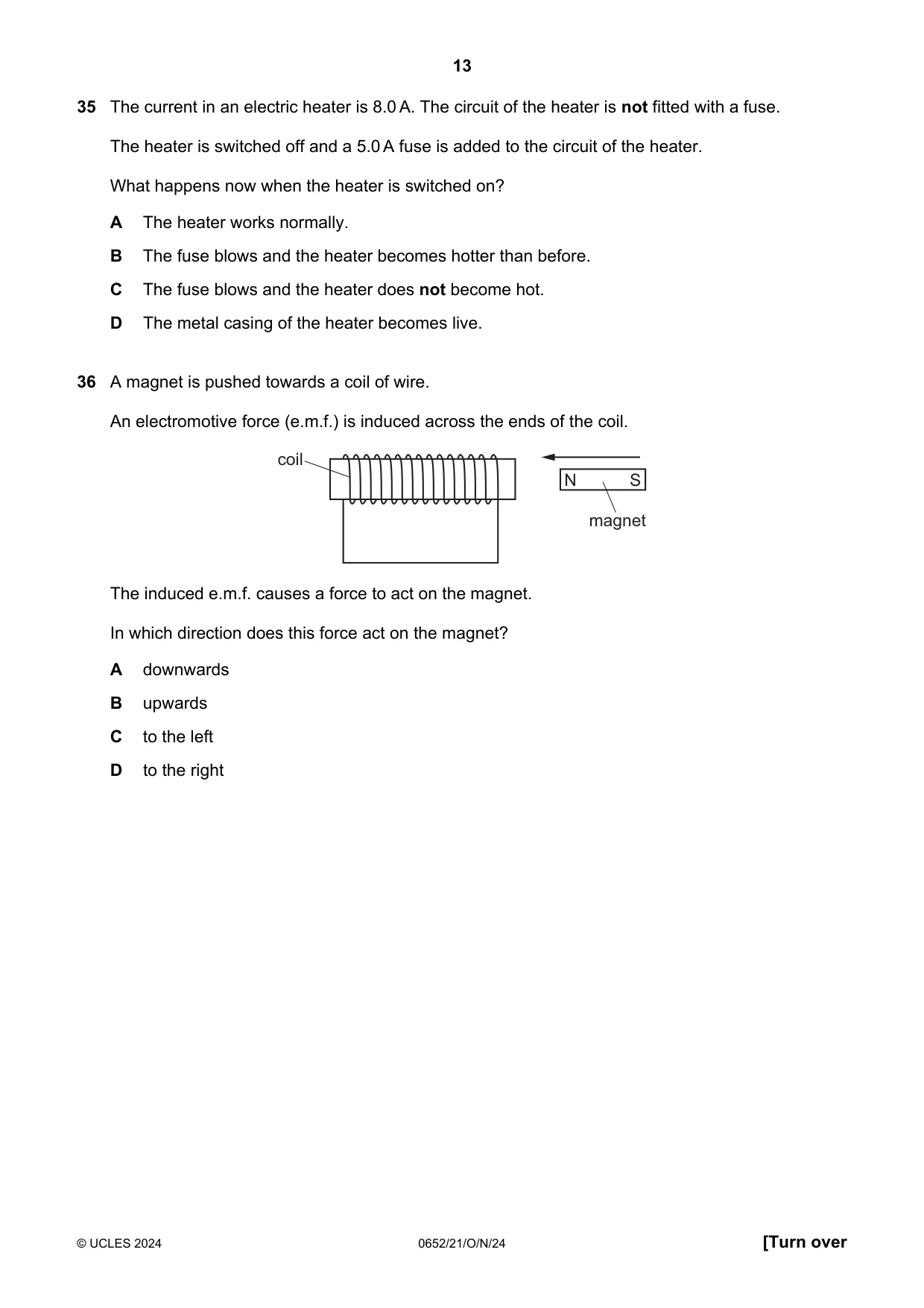
35 The current in an electric heater is 8.0 A. The circuit of the heater is not fitted with a fuse. The heater is switched off and a 5.0 A fuse is added to the circuit of the heater. What happens now when the heater is switched on? A The heater works normally. B The fuse blows and the heater becomes hotter than before. C The fuse blows and the heater does not become hot. D The metal casing of the heater becomes live.
Mark scheme: C
Q36 · A magnet is pushed towards a coil of wire
36 A magnet is pushed towards a coil of wire. An electromotive force (e.m.f.) is induced across the ends of the coil. coil N S magnet The induced e.m.f. causes a force to act on the magnet. In which direction does this force act on the magnet? A downwards B upwards C to the left D to the right
Mark scheme: D
Q37 · A transformer is 100% efficient
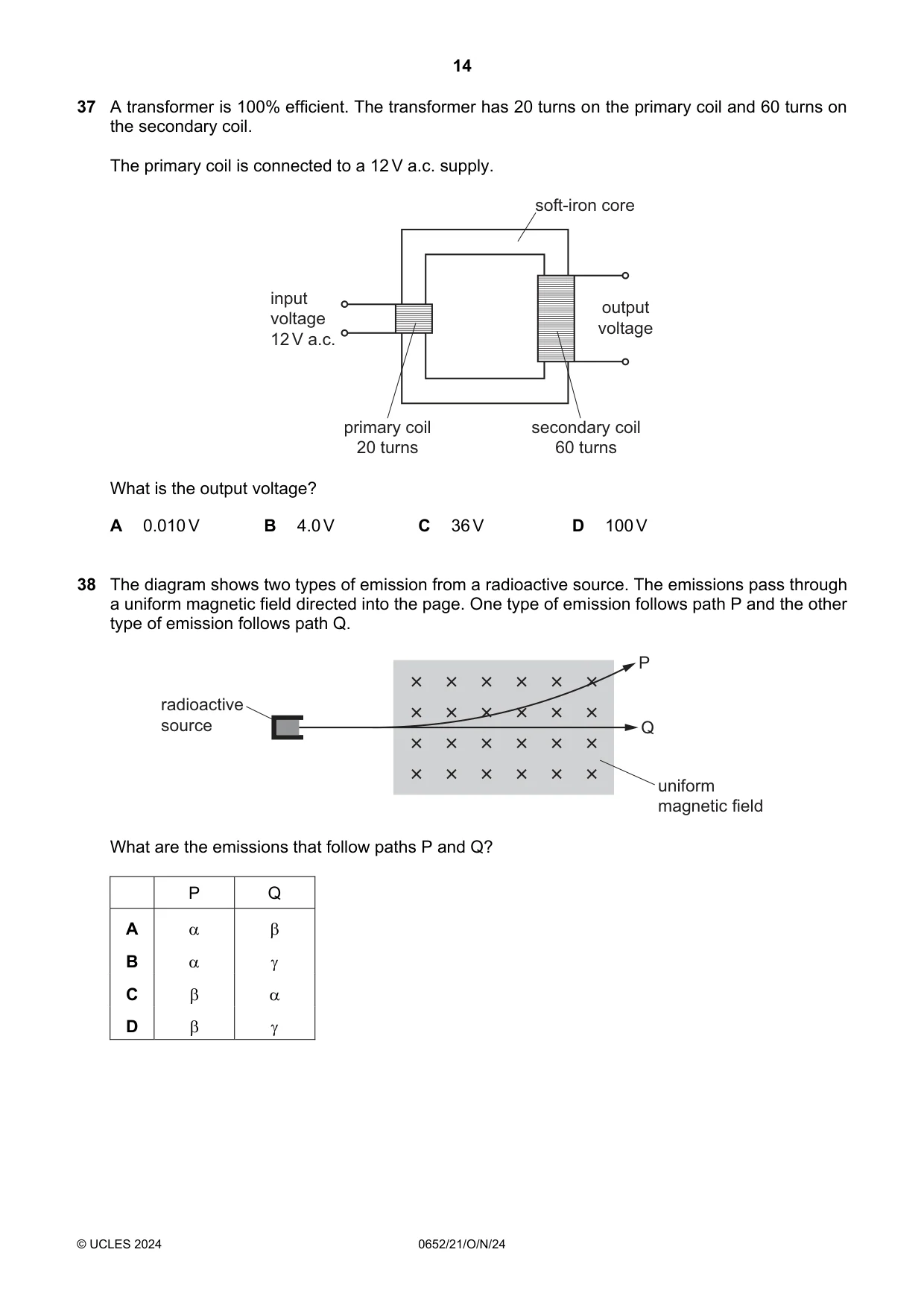
37 A transformer is 100% efficient. The transformer has 20 turns on the primary coil and 60 turns on the secondary coil. The primary coil is connected to a 12 V a.c. supply. soft-iron core input output voltage voltage 12 V a.c. primary coil secondary coil 20 turns 60 turns What is the output voltage? A 0.010 V B 4.0 V C 36 V D 100 V
Mark scheme: C
Q38 · The diagram shows two types of emission from a radioactive source
38 The diagram shows two types of emission from a radioactive source. The emissions pass through a uniform magnetic field directed into the page. One type of emission follows path P and the other type of emission follows path Q. P radioactive source Q uniform magnetic field What are the emissions that follow paths P and Q? P Q A B C D
Mark scheme: B
Q39 · Strontium-90 (Sr) is a radioactive isotope
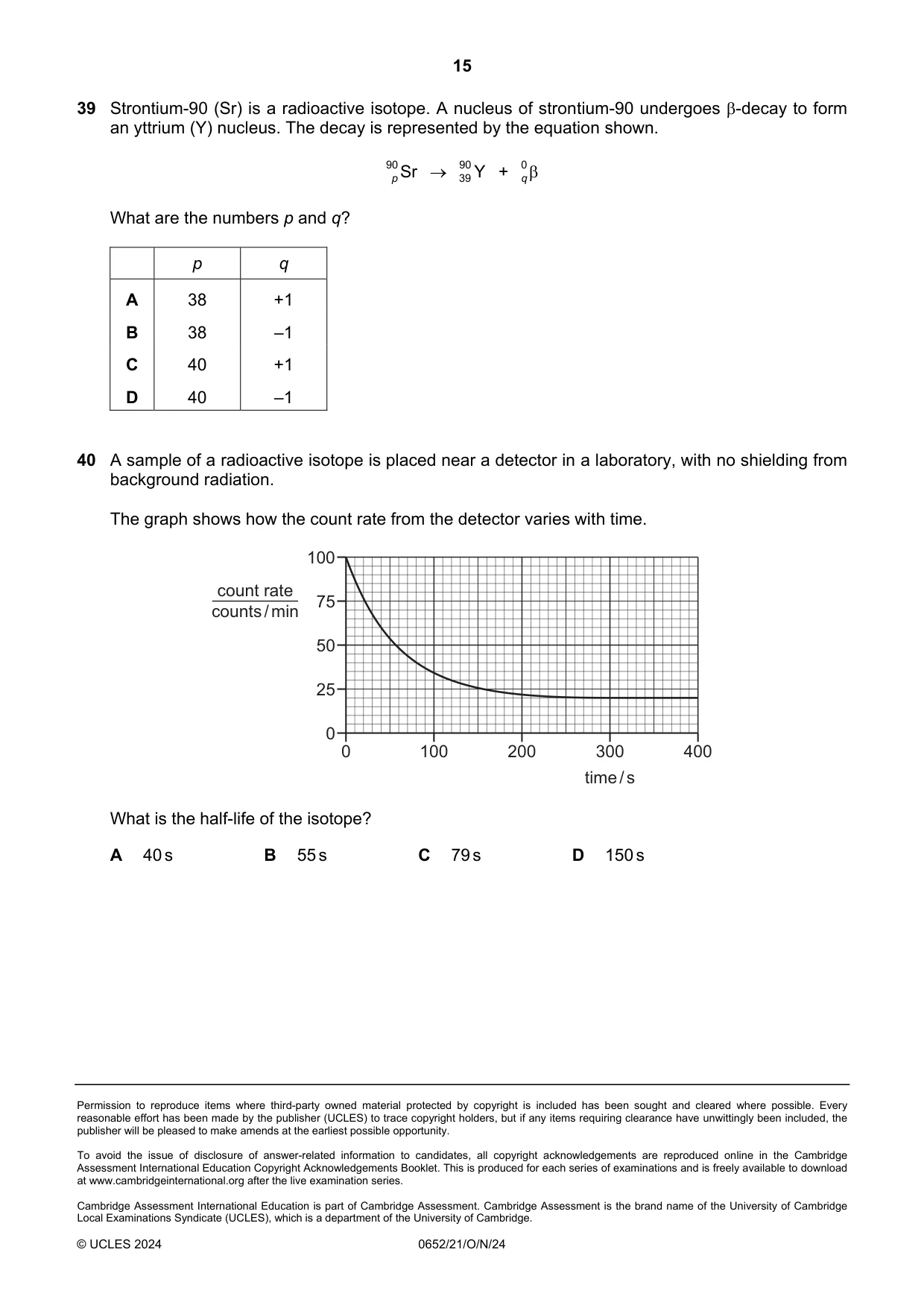
39 Strontium-90 (Sr) is a radioactive isotope. A nucleus of strontium-90 undergoes -decay to form an yttrium (Y) nucleus. The decay is represented by the equation shown. 90 Sr 90 Y + 0 p 39 q What are the numbers p and q? p q A 38 +1 B 38 –1 C 40 +1 D 40 –1
Mark scheme: B
Q40 · A sample of a radioactive isotope is placed near a detector in a laboratory, with no…
40 A sample of a radioactive isotope is placed near a detector in a laboratory, with no shielding from background radiation. The graph shows how the count rate from the detector varies with time. 100 count rate 75 counts / min 50 25 0 0 100 200 300 400 time / s What is the half-life of the isotope? A 40 s B 55 s C 79 s D 150 s
Mark scheme: A
What was in this paper
The subtopics covered by these 40 questions, and how many questions each got. Open one in a new tab to see every Cambridge question on it.
3Work, energy and power3Electric circuits2Electromagnetic effects2Motion2Radioactivity2Alkenes1Carbon dioxide and methane1Carbonates1Criteria of purity1Dangers of electricity1Electricity and chemistry1Elements, compounds and mixtures1Forces1Fuels1Group properties1Identification of ions and gases1Ions and ionic bonds1Light1Macromolecules1Measurement1Molecules and covalent bonds1Rate (speed) of reaction1Redox1Stoichiometry1The characteristic properties of acids and bases1The nuclear atom1The particulate nature of matter1Thermal processes1Thermal properties and temperature1Transition elements1Uses of metals1What you needed in this session
Cambridge’s own grade thresholds for 2024 Oct/Nov, Paper 2 · Variant 1. A higher threshold means an easier paper — the bar moves with how the cohort did.