Cambridge IGCSE Physical Science 0652 — 2019 Oct/Nov Paper 2 · Variant 2
0652/22/O/N/19 · 40 questions · 40 marks · ≈45 min
The question paper and its mark scheme, free to read here and free to download. This is Cambridge’s own paper, exactly as it was sat.
Question paper16 pages
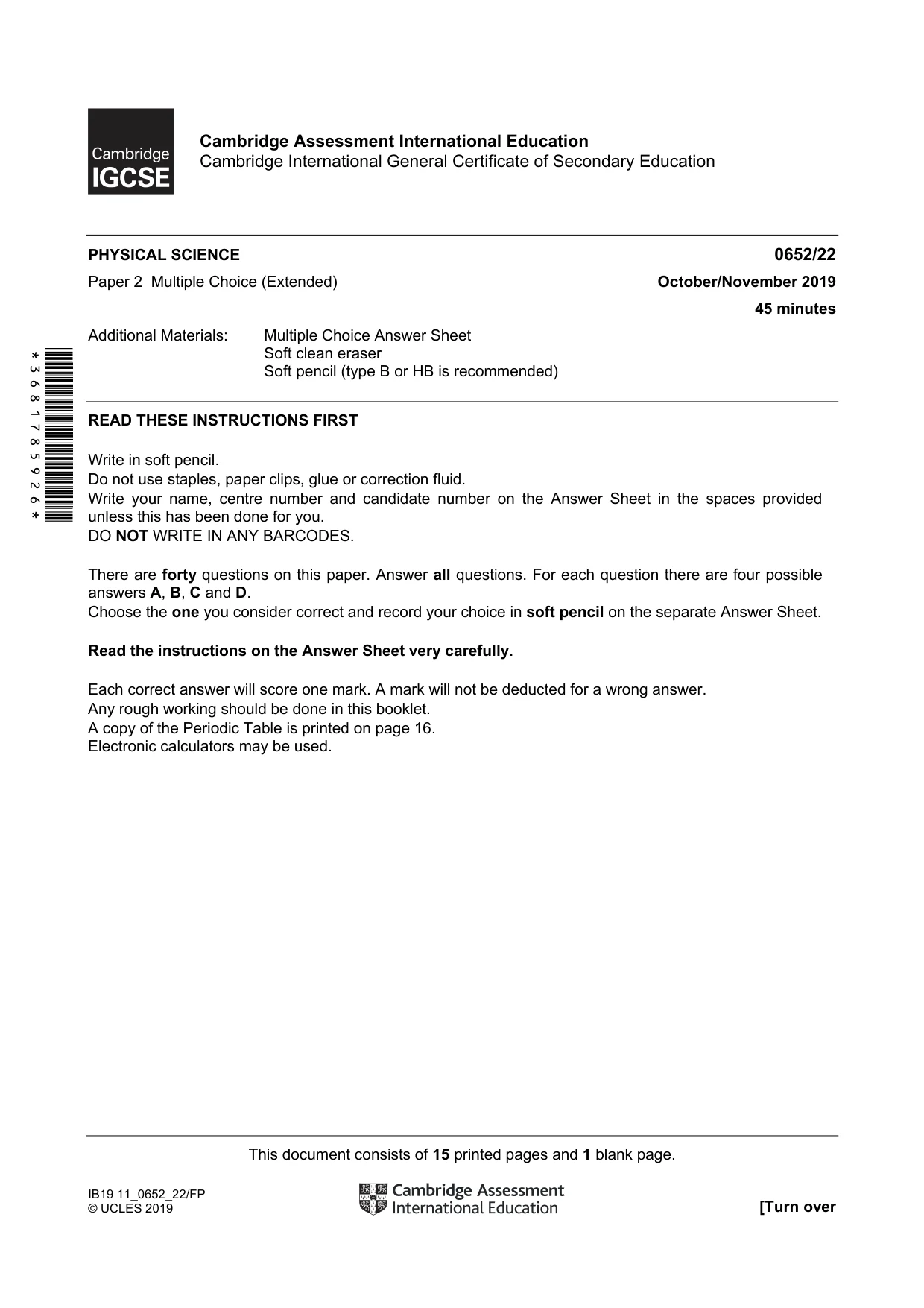
Mark scheme3 pages
Answers below. Sit the paper first if you are practising.
Questions as text
Q1 · Carbon dioxide is a solid at temperatures below –78 °C
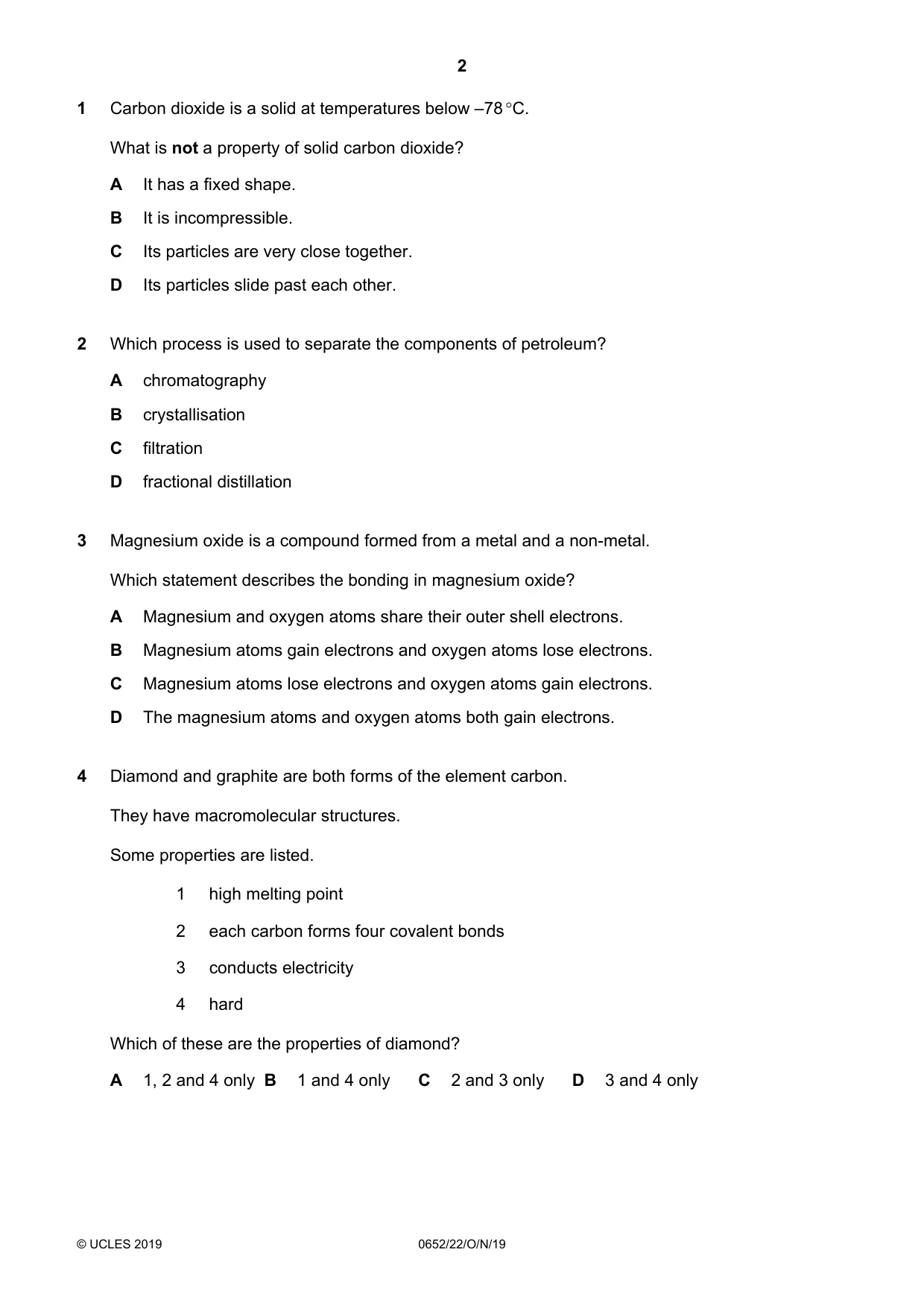
1 Carbon dioxide is a solid at temperatures below –78 °C. What is not a property of solid carbon dioxide? A It has a fixed shape. B It is incompressible. C Its particles are very close together. D Its particles slide past each other.
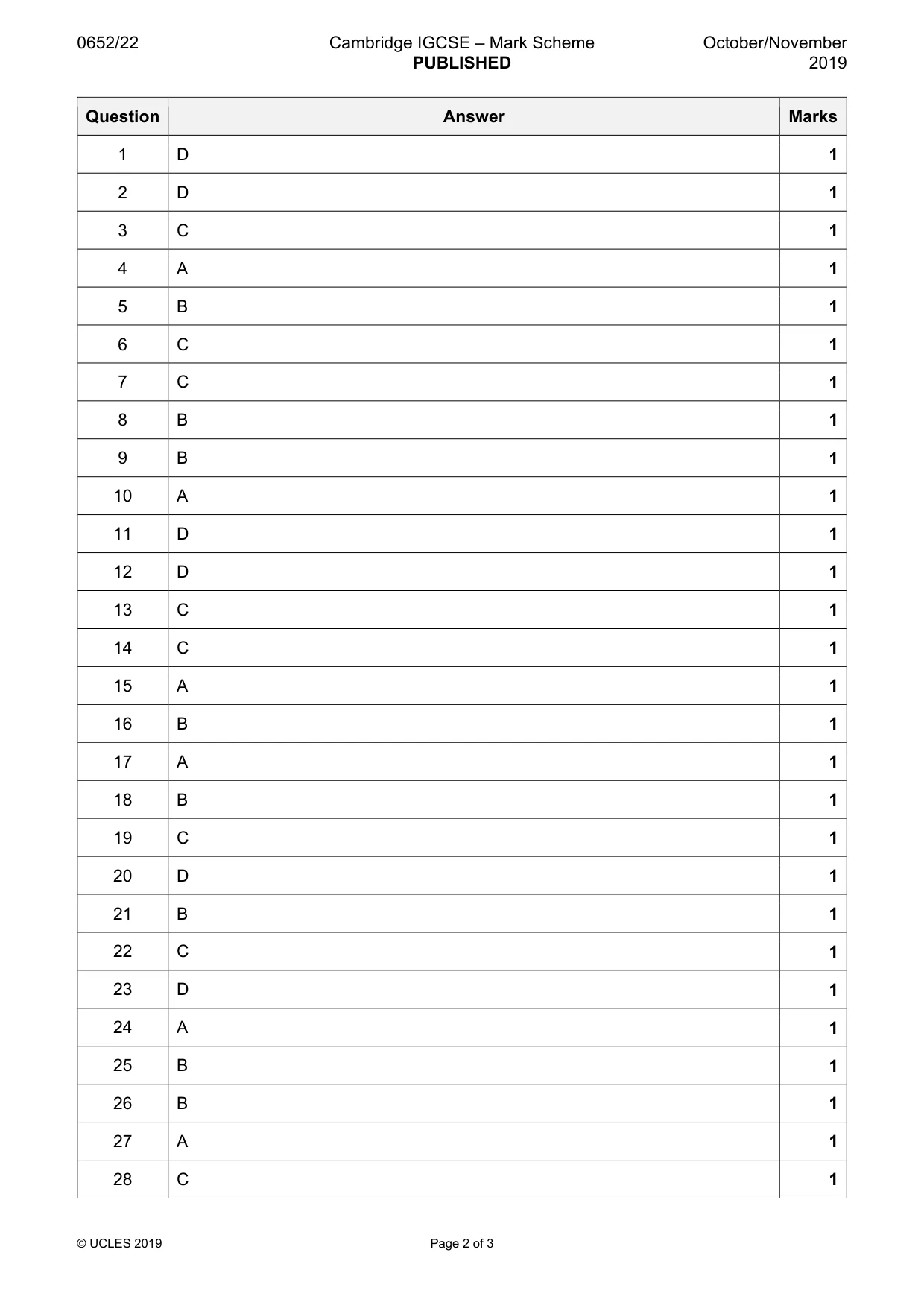
Mark scheme: D
Q2 · Which process is used to separate the components of petroleum?
2 Which process is used to separate the components of petroleum? A chromatography B crystallisation C filtration D fractional distillation
Mark scheme: D
Q3 · Magnesium oxide is a compound formed from a metal and a non-metal
3 Magnesium oxide is a compound formed from a metal and a non-metal. Which statement describes the bonding in magnesium oxide? A Magnesium and oxygen atoms share their outer shell electrons. B Magnesium atoms gain electrons and oxygen atoms lose electrons. C Magnesium atoms lose electrons and oxygen atoms gain electrons. D The magnesium atoms and oxygen atoms both gain electrons.
Mark scheme: C
Q4 · Diamond and graphite are both forms of the element carbon
4 Diamond and graphite are both forms of the element carbon. They have macromolecular structures. Some properties are listed. 1 high melting point 2 each carbon forms four covalent bonds 3 conducts electricity 4 hard Which of these are the properties of diamond? A 1, 2 and 4 only B 1 and 4 only C 2 and 3 only D 3 and 4 only
Mark scheme: A
Q5 · Chromium(III) sulfate is made of chromium(III) ions, Cr3+, and sulfate ions, SO4 2–
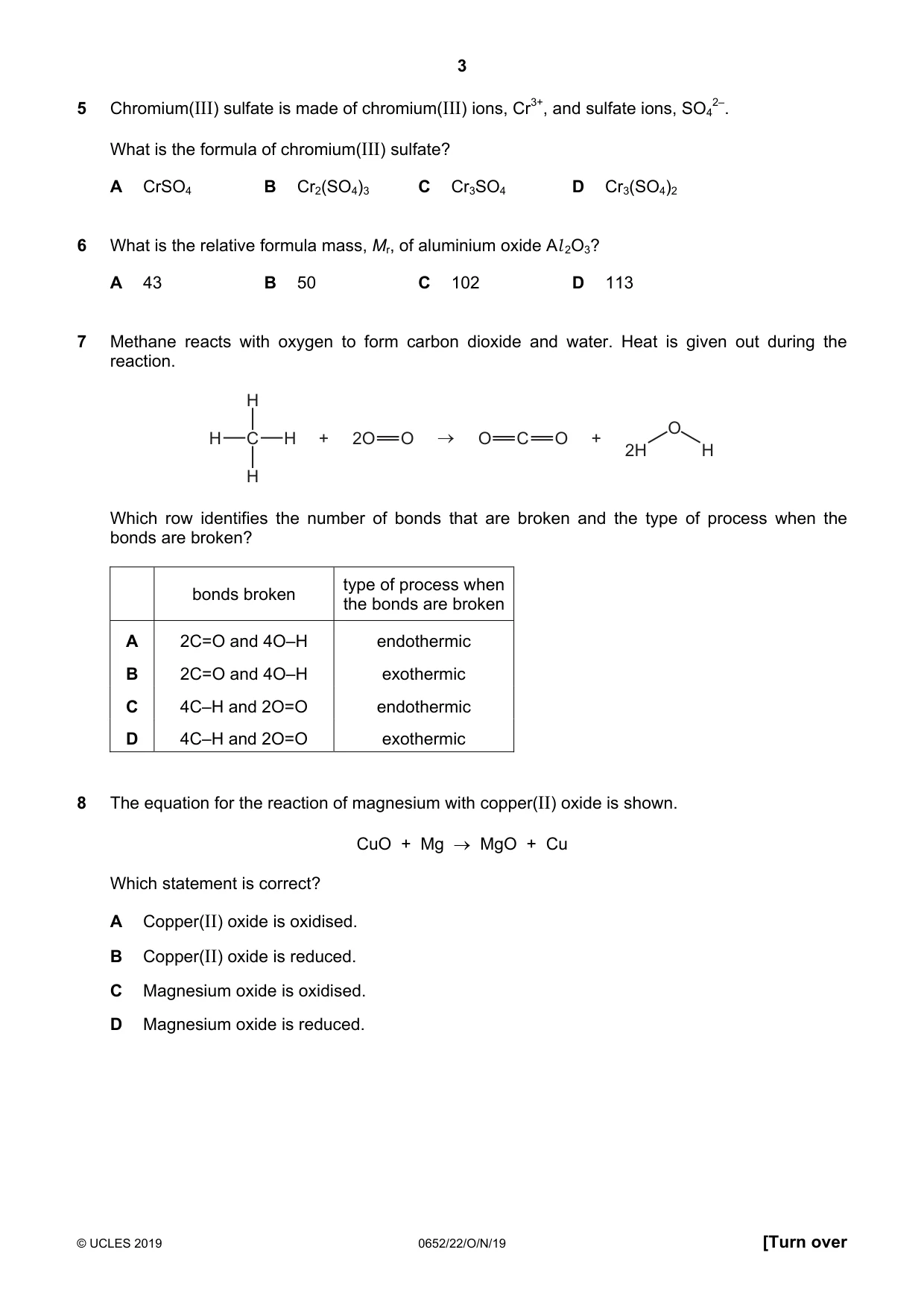
5 Chromium(III) sulfate is made of chromium(III) ions, Cr3+, and sulfate ions, SO4 2–. What is the formula of chromium(III) sulfate? A CrSO4 B Cr2(SO4)3 C Cr3SO4 D Cr3(SO4)2
Mark scheme: B
Q6 · What is the relative formula mass, Mr, of aluminium oxide Al 2O3?
6 What is the relative formula mass, Mr, of aluminium oxide Al 2O3? A 43 B 50 C 102 D 113
Mark scheme: C
Q7 · Methane reacts with oxygen to form carbon dioxide and water
7 Methane reacts with oxygen to form carbon dioxide and water. Heat is given out during the reaction. H O H C H + 2O O → O C O + 2H H H Which row identifies the number of bonds that are broken and the type of process when the bonds are broken? type of process when bonds broken the bonds are broken A 2C=O and 4O–H endothermic B 2C=O and 4O–H exothermic C 4C–H and 2O=O endothermic D 4C–H and 2O=O exothermic
Mark scheme: C
Q8 · The equation for the reaction of magnesium with copper(II) oxide is shown
8 The equation for the reaction of magnesium with copper(II) oxide is shown. CuO + Mg → MgO + Cu Which statement is correct? A Copper(II) oxide is oxidised. B Copper(II) oxide is reduced. C Magnesium oxide is oxidised. D Magnesium oxide is reduced.
Mark scheme: B
Q9 · Which row describes metallic and non-metallic oxides?
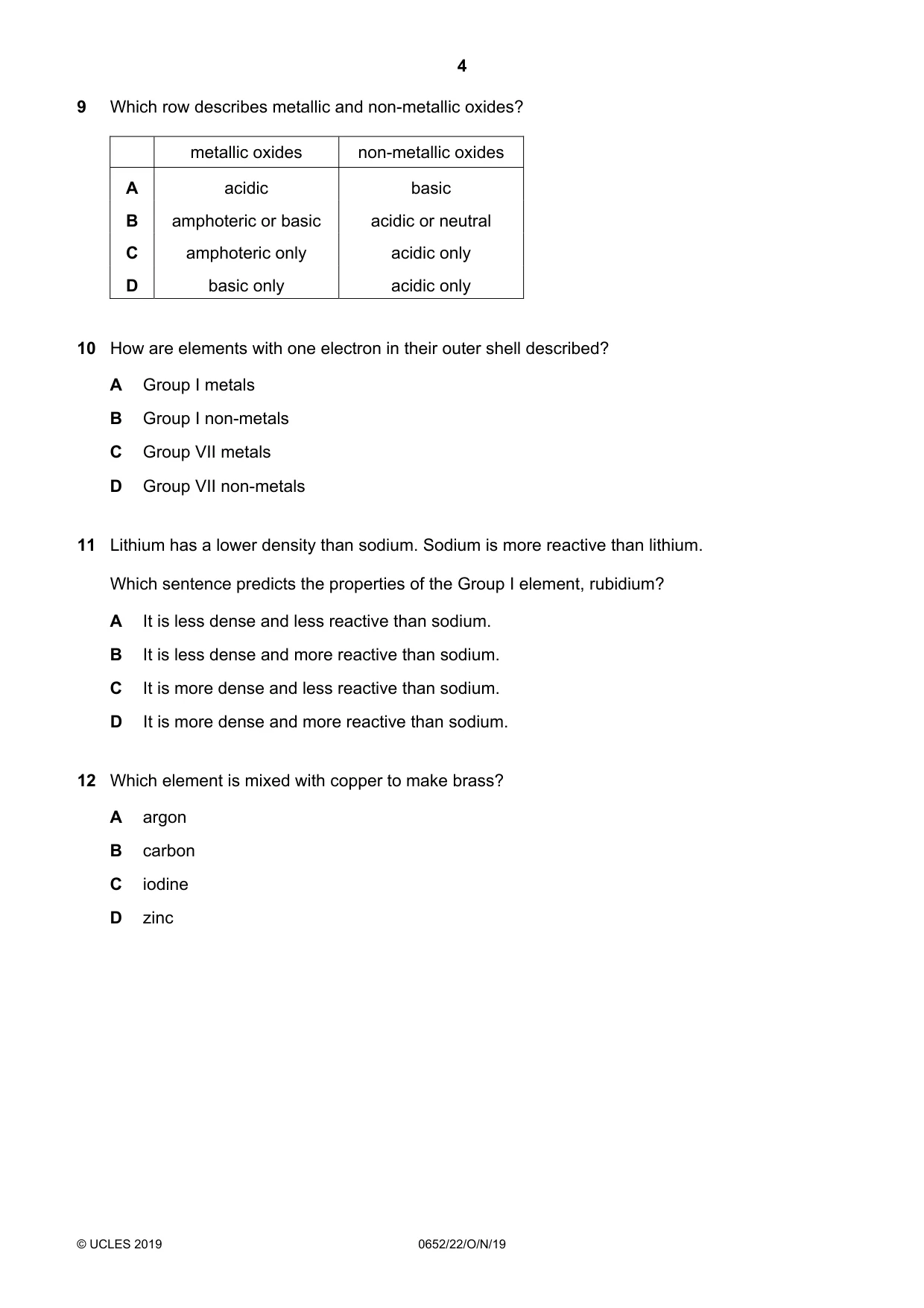
9 Which row describes metallic and non-metallic oxides? metallic oxides non-metallic oxides A acidic basic B amphoteric or basic acidic or neutral C amphoteric only acidic only D basic only acidic only
Mark scheme: B
Q10 · How are elements with one electron in their outer shell described?
10 How are elements with one electron in their outer shell described? A Group I metals B Group I non-metals C Group VII metals D Group VII non-metals
Mark scheme: A
Q11 · Lithium has a lower density than sodium
11 Lithium has a lower density than sodium. Sodium is more reactive than lithium. Which sentence predicts the properties of the Group I element, rubidium? A It is less dense and less reactive than sodium. B It is less dense and more reactive than sodium. C It is more dense and less reactive than sodium. D It is more dense and more reactive than sodium.
Mark scheme: D
Q12 · Which element is mixed with copper to make brass?
12 Which element is mixed with copper to make brass? A argon B carbon C iodine D zinc
Mark scheme: D
Q13 · An element, Y, reacts with aqueous copper sulfate and copper is produced
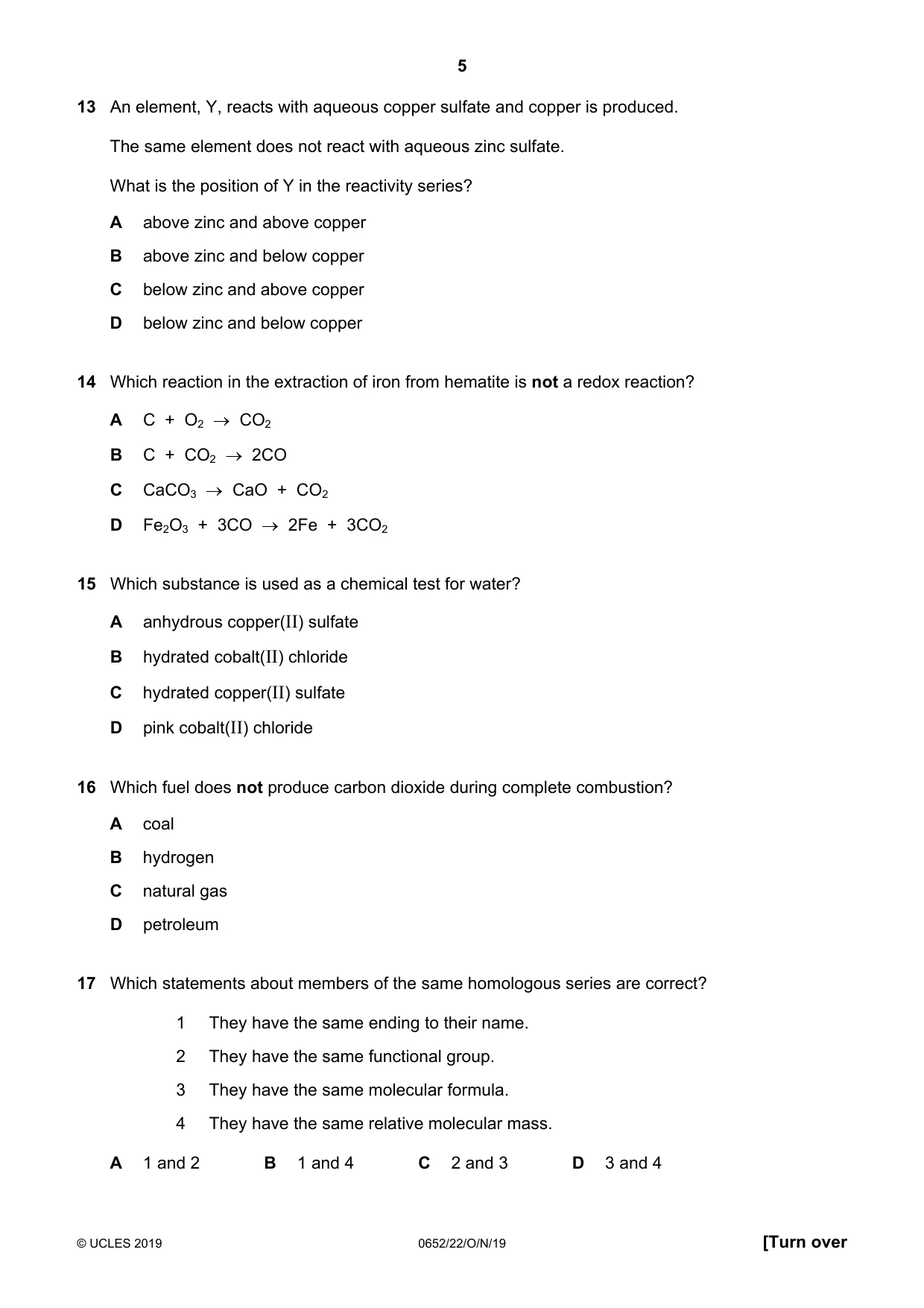
13 An element, Y, reacts with aqueous copper sulfate and copper is produced. The same element does not react with aqueous zinc sulfate. What is the position of Y in the reactivity series? A above zinc and above copper B above zinc and below copper C below zinc and above copper D below zinc and below copper
Mark scheme: C
Q14 · Which reaction in the extraction of iron from hematite is not a redox reaction?
14 Which reaction in the extraction of iron from hematite is not a redox reaction? A C + O2 → CO2 B C + CO2 → 2CO C CaCO3 → CaO + CO2 D Fe2O3 + 3CO → 2Fe + 3CO2
Mark scheme: C
Q15 · Which substance is used as a chemical test for water?
15 Which substance is used as a chemical test for water? A anhydrous copper(II) sulfate B hydrated cobalt(II) chloride C hydrated copper(II) sulfate D pink cobalt(II) chloride
Mark scheme: A
Q16 · Which fuel does not produce carbon dioxide during complete combustion?
16 Which fuel does not produce carbon dioxide during complete combustion? A coal B hydrogen C natural gas D petroleum
Mark scheme: B
Q17 · Which statements about members of the same homologous series are correct?
17 Which statements about members of the same homologous series are correct? 1 They have the same ending to their name. 2 They have the same functional group. 3 They have the same molecular formula. 4 They have the same relative molecular mass. A 1 and 2 B 1 and 4 C 2 and 3 D 3 and 4
Mark scheme: A
Q18 · Which statements about the alkanes are correct?
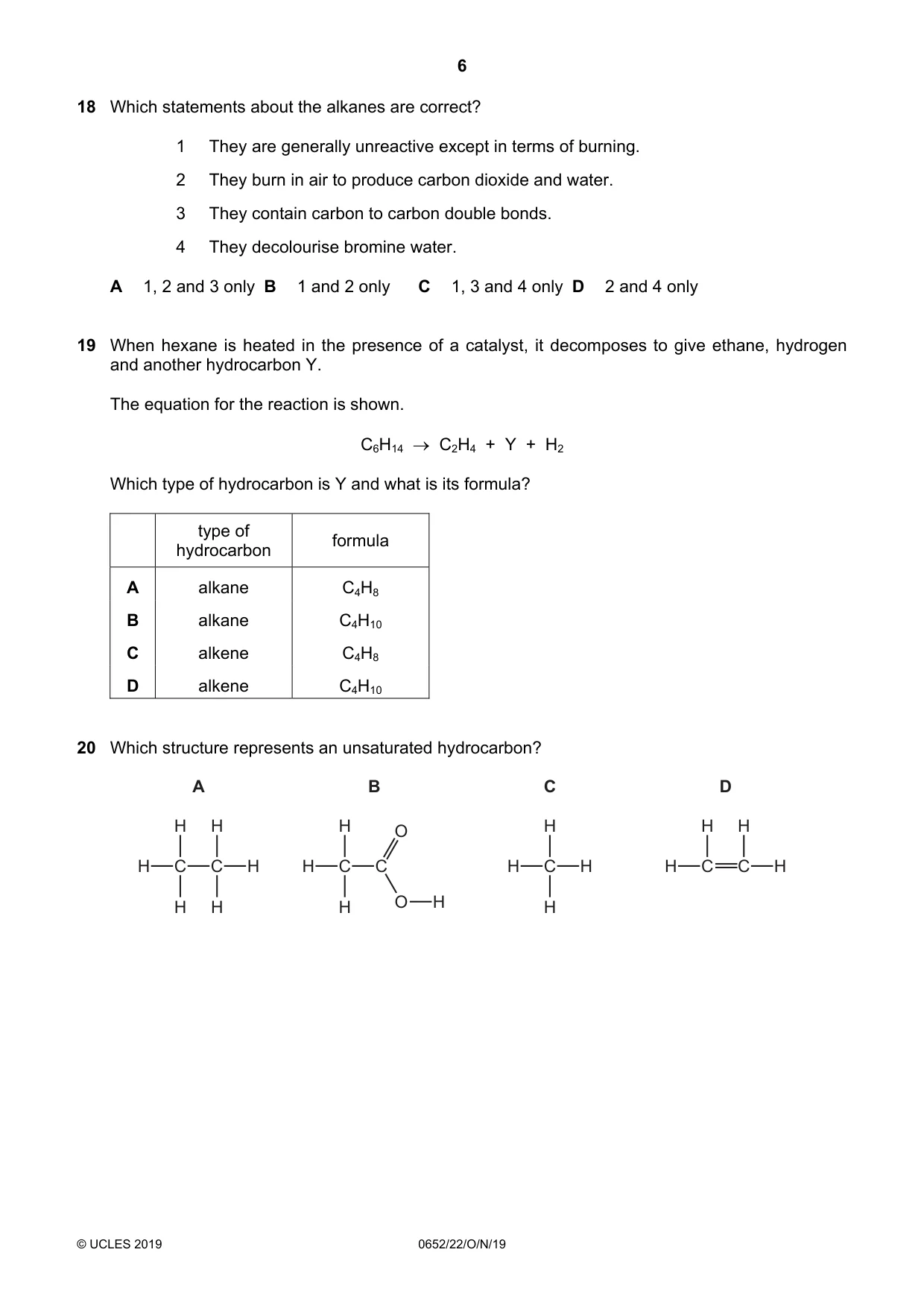
18 Which statements about the alkanes are correct? 1 They are generally unreactive except in terms of burning. 2 They burn in air to produce carbon dioxide and water. 3 They contain carbon to carbon double bonds. 4 They decolourise bromine water. A 1, 2 and 3 only B 1 and 2 only C 1, 3 and 4 only D 2 and 4 only
Mark scheme: B
Q19 · When hexane is heated in the presence of a catalyst, it decomposes to give ethane…
19 When hexane is heated in the presence of a catalyst, it decomposes to give ethane, hydrogen and another hydrocarbon Y. The equation for the reaction is shown. C6H14 → C2H4 + Y + H2 Which type of hydrocarbon is Y and what is its formula? type of formula hydrocarbon A alkane C4H8 B alkane C4H10 C alkene C4H8 D alkene C4H10
Mark scheme: C
Q20 · Which structure represents an unsaturated hydrocarbon?
20 Which structure represents an unsaturated hydrocarbon? A B C D H H H O H H H H C C H H C C H C H H C C H H H H O H H
Mark scheme: D
Q21 · A student carries out an experiment to determine the period of a simple pendulum
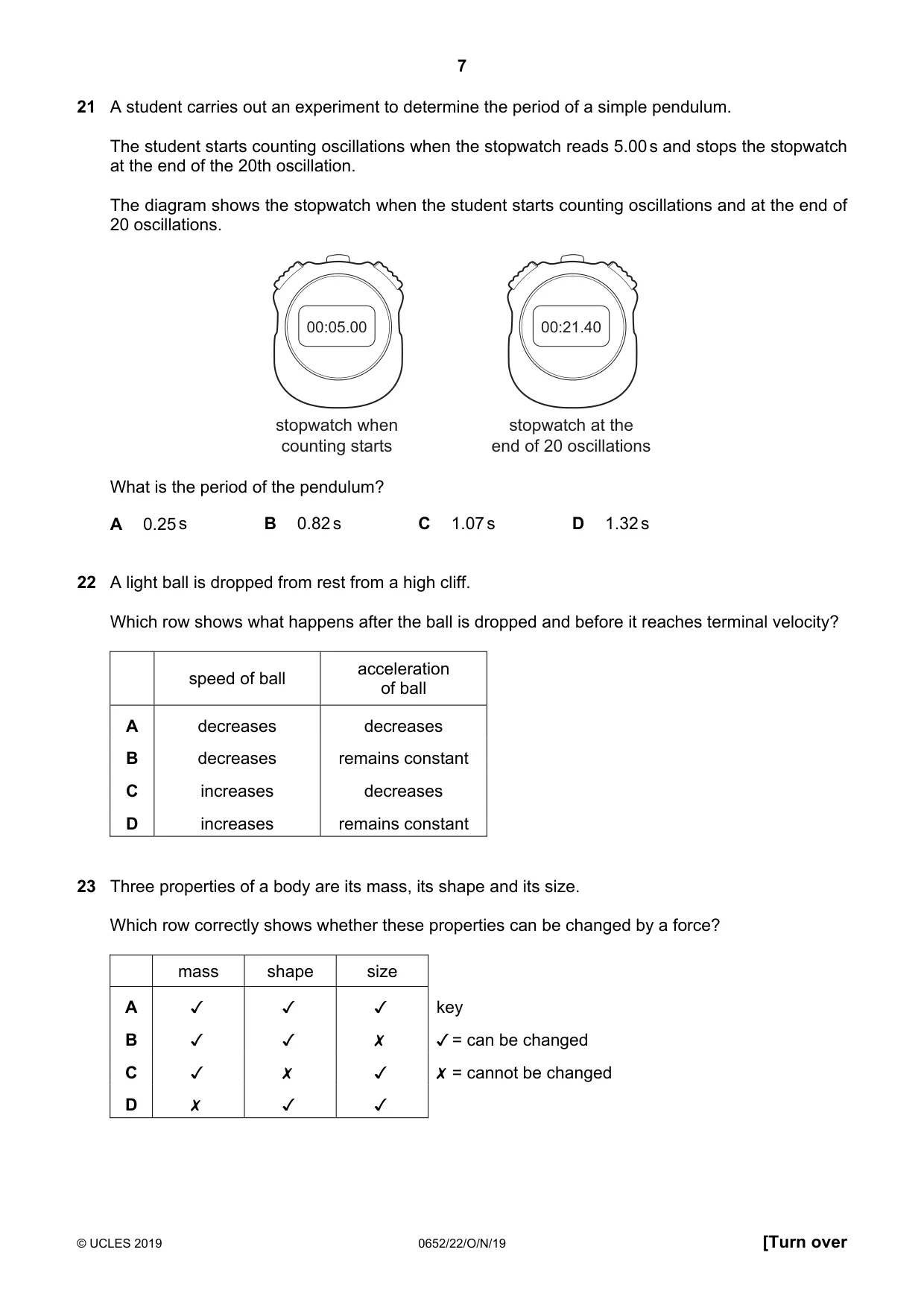
21 A student carries out an experiment to determine the period of a simple pendulum. The student starts counting oscillations when the stopwatch reads 5.00 s and stops the stopwatch at the end of the 20th oscillation. The diagram shows the stopwatch when the student starts counting oscillations and at the end of 20 oscillations. 00:05.00 00:21.40 stopwatch when stopwatch at the counting starts end of 20 oscillations What is the period of the pendulum? A 0.25 s B 0.82 s C 1.07 s D 1.32 s
Mark scheme: B
Q22 · A light ball is dropped from rest from a high cliff
22 A light ball is dropped from rest from a high cliff. Which row shows what happens after the ball is dropped and before it reaches terminal velocity? acceleration speed of ball of ball A decreases decreases B decreases remains constant C increases decreases D increases remains constant
Mark scheme: C
Q23 · Three properties of a body are its mass, its shape and its size
23 Three properties of a body are its mass, its shape and its size. Which row correctly shows whether these properties can be changed by a force? size v key / = can be changed X = cannot be changed \ <x
Mark scheme: D
Q24 · A force F acts on an object that moves in a straight line through a distance d
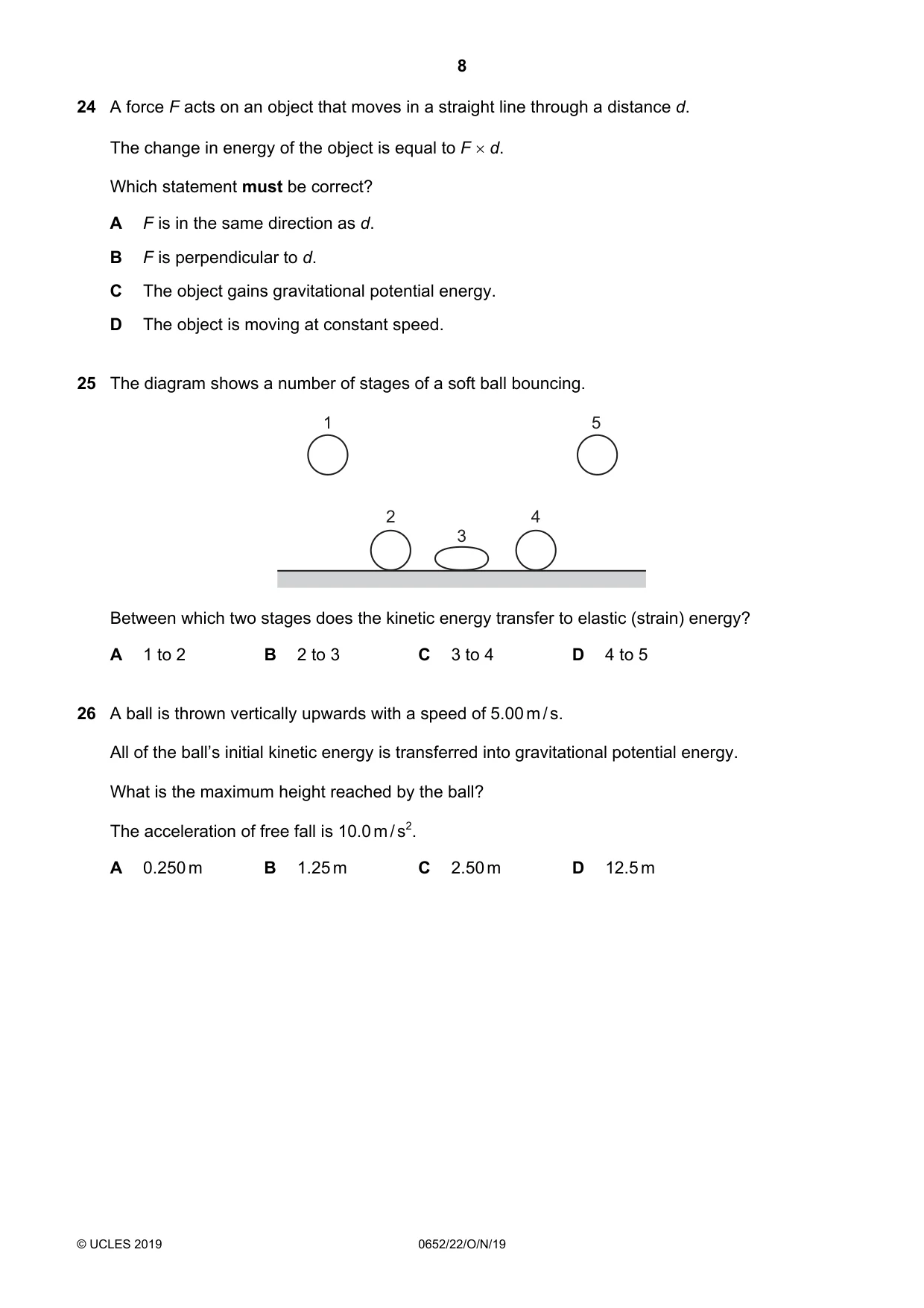
24 A force F acts on an object that moves in a straight line through a distance d. The change in energy of the object is equal to F × d. Which statement must be correct? A F is in the same direction as d. B F is perpendicular to d. C The object gains gravitational potential energy. D The object is moving at constant speed.
Mark scheme: A
Q25 · The diagram shows a number of stages of a soft ball bouncing
25 The diagram shows a number of stages of a soft ball bouncing. 1 5 2 4 3 Between which two stages does the kinetic energy transfer to elastic (strain) energy? A 1 to 2 B 2 to 3 C 3 to 4 D 4 to 5
Mark scheme: B
Q26 · A ball is thrown vertically upwards with a speed of 5.00 m / s
26 A ball is thrown vertically upwards with a speed of 5.00 m / s. All of the ball’s initial kinetic energy is transferred into gravitational potential energy. What is the maximum height reached by the ball? The acceleration of free fall is 10.0 m / s2. A 0.250 m B 1.25 m C 2.50 m D 12.5 m
Mark scheme: B
Q27 · The internal diameter of the capillary bore of a thermometer is increased
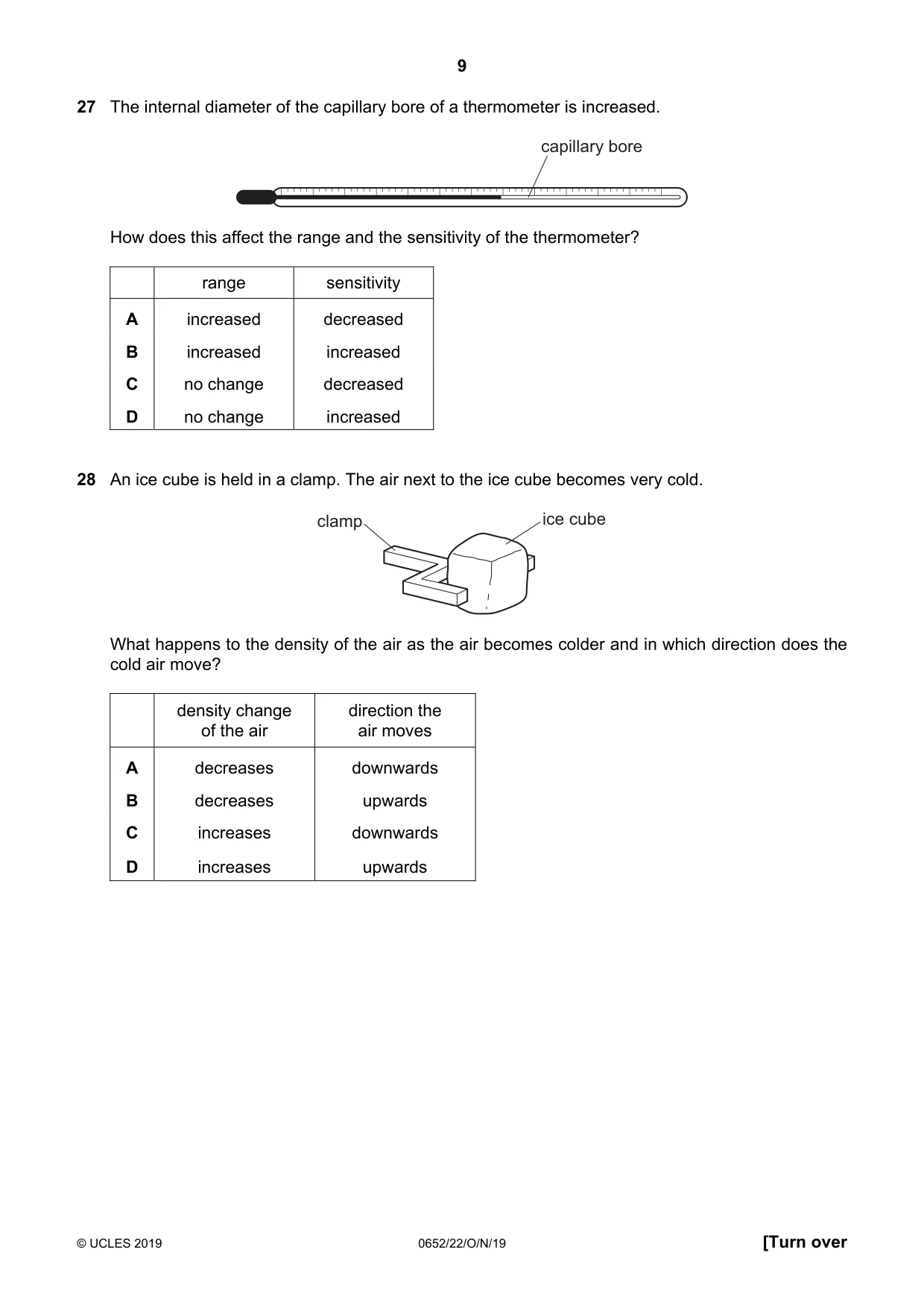
27 The internal diameter of the capillary bore of a thermometer is increased. capillary bore How does this affect the range and the sensitivity of the thermometer? range sensitivity A increased decreased B increased increased C no change decreased D no change increased
Mark scheme: A
Q28 · An ice cube is held in a clamp
28 An ice cube is held in a clamp. The air next to the ice cube becomes very cold. clamp ice cube What happens to the density of the air as the air becomes colder and in which direction does the cold air move? density change direction the of the air air moves A decreases downwards B decreases upwards C increases downwards D increases upwards
Mark scheme: C
Q29 · The diagrams represent water waves in a deep pond
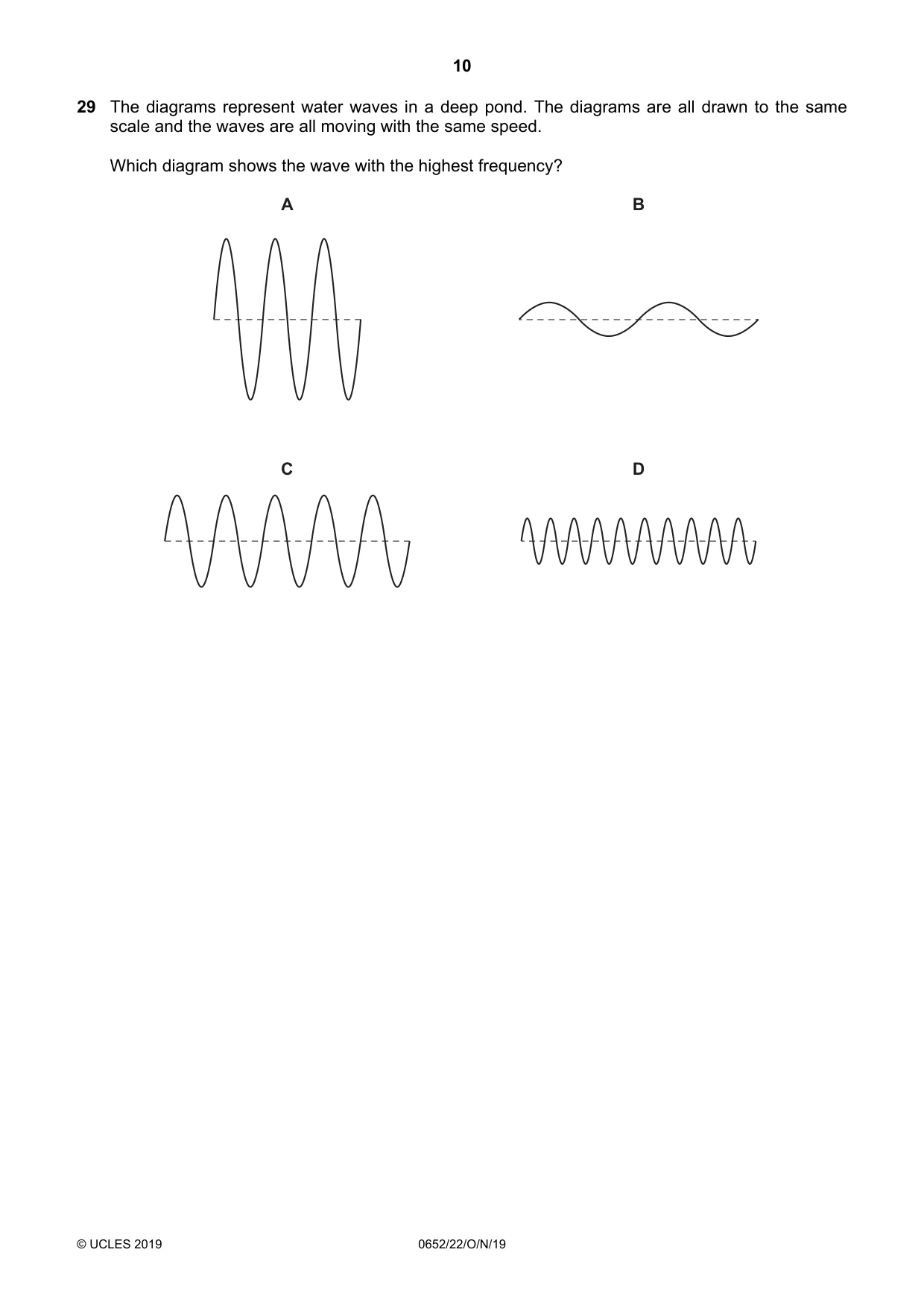
29 The diagrams represent water waves in a deep pond. The diagrams are all drawn to the same scale and the waves are all moving with the same speed. Which diagram shows the wave with the highest frequency? A B C D
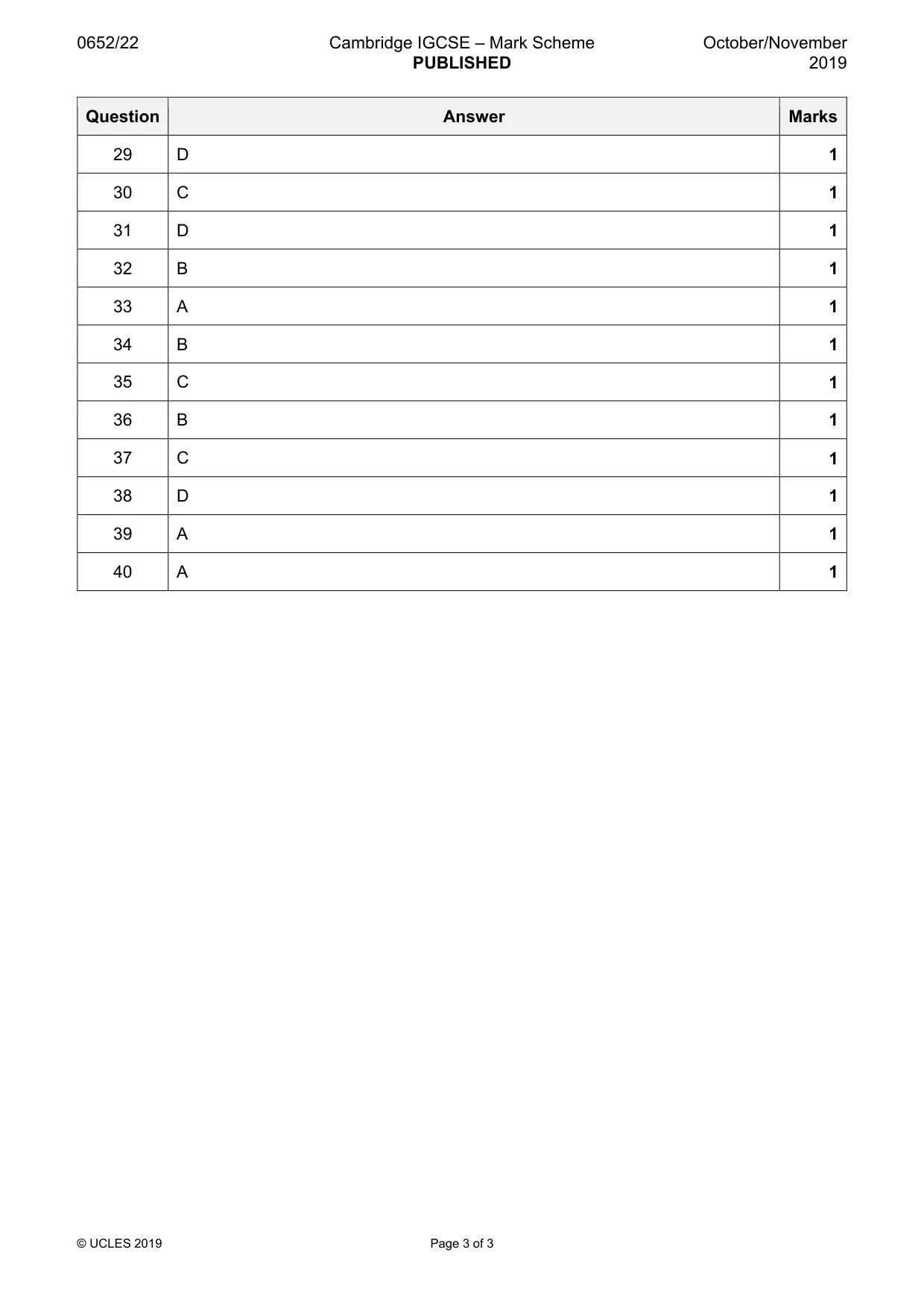
Mark scheme: D
Q30 · The speed of light in a vacuum is vv
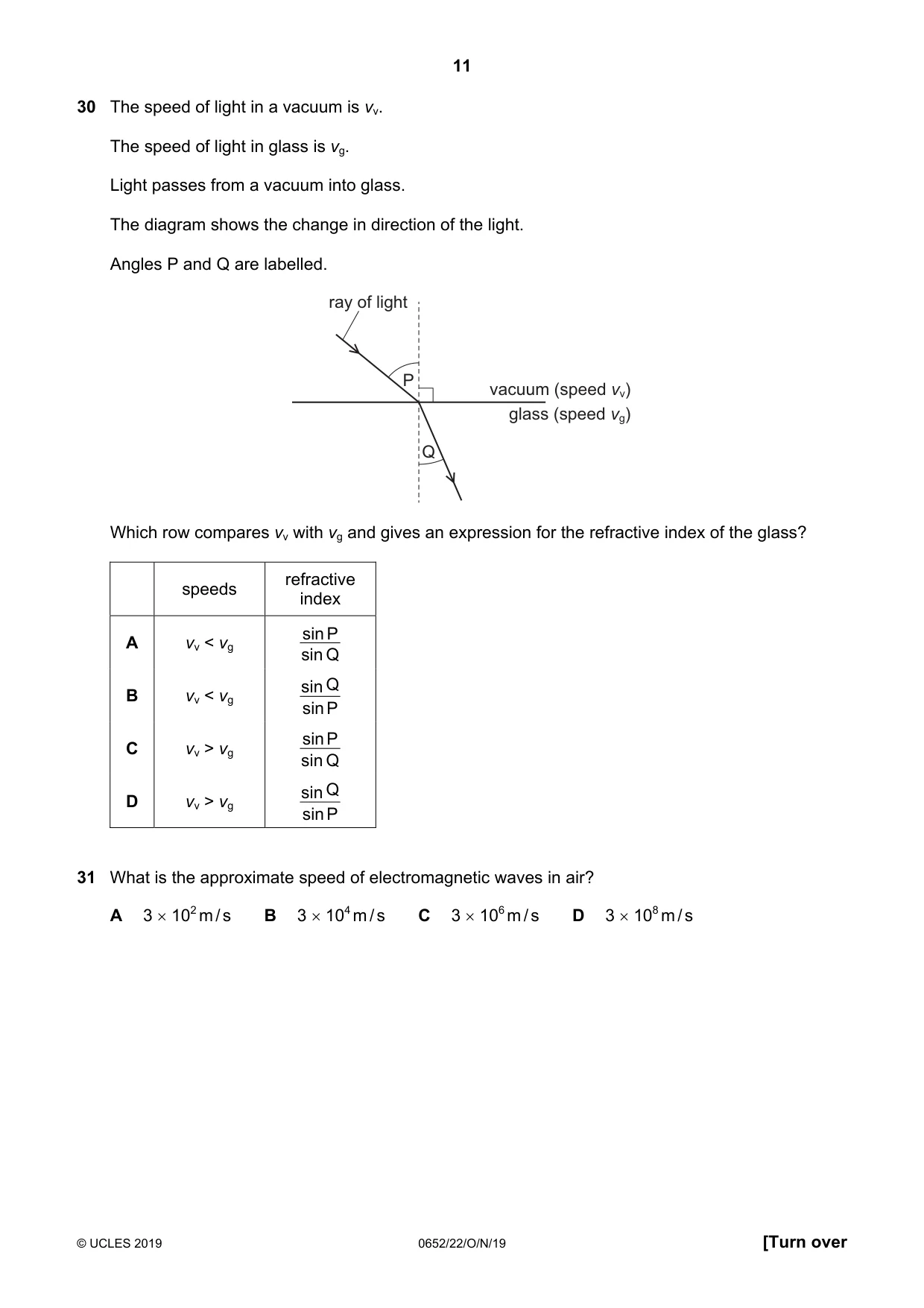
30 The speed of light in a vacuum is vv. The speed of light in glass is vg. Light passes from a vacuum into glass. The diagram shows the change in direction of the light. Angles P and Q are labelled. ray of light P vacuum (speed vv) glass (speed vg) Q Which row compares vv with vg and gives an expression for the refractive index of the glass? refractive speeds index sin P A vv < vg sin Q sin Q B vv < vg sin P sin P C vv > vg sin Q sin Q D vv > vg sin P
Mark scheme: C
Q31 · What is the approximate speed of electromagnetic waves in air?
31 What is the approximate speed of electromagnetic waves in air? A 3 × 10² m / s B 3 × 10⁴ m / s C 3 × 10⁶ m / s D 3 × 10⁸ m / s
Mark scheme: D
Q32 · Two astronauts without radios can only communicate in space if their helmets are touching
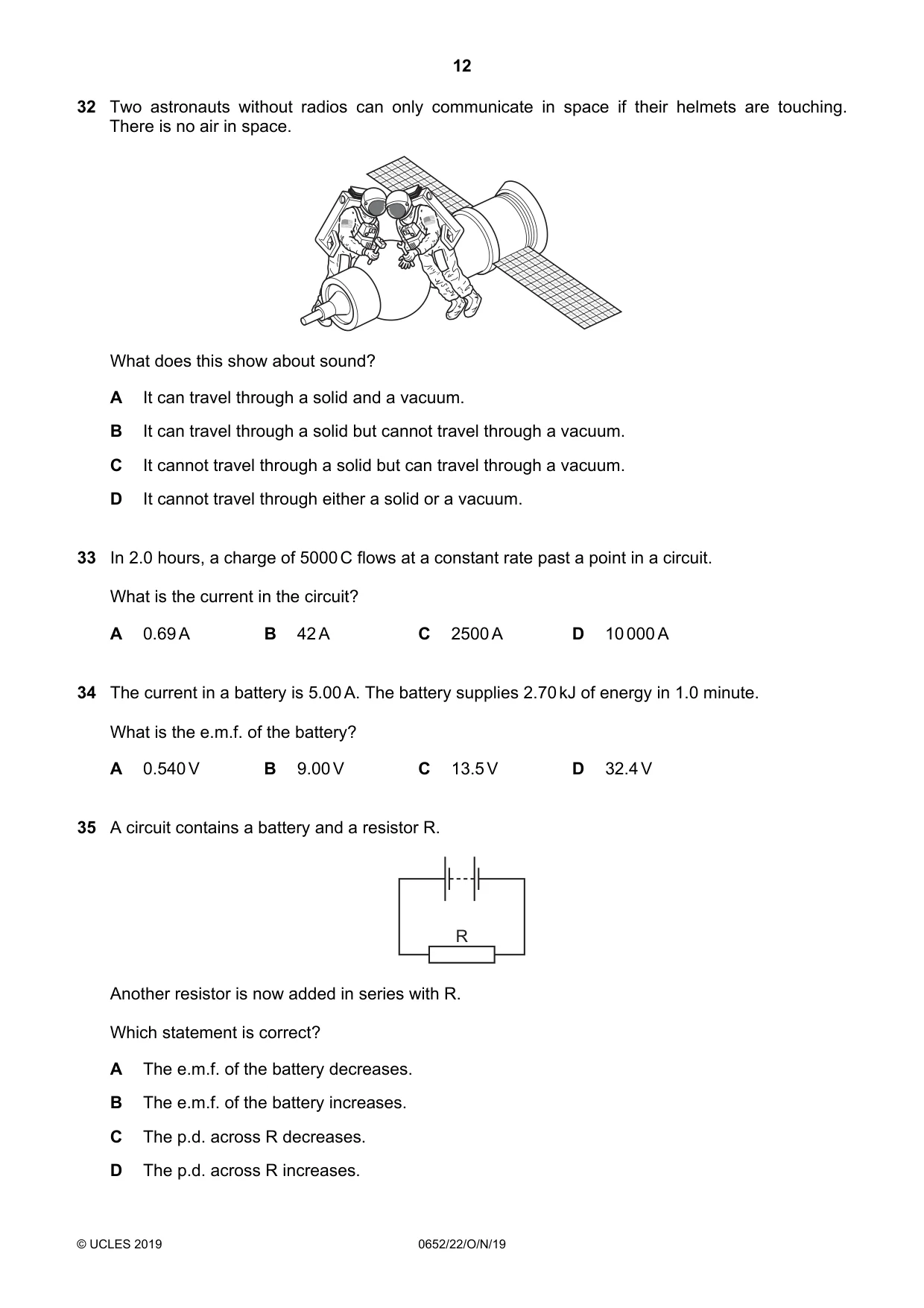
32 Two astronauts without radios can only communicate in space if their helmets are touching. There is no air in space. What does this show about sound? A It can travel through a solid and a vacuum. B It can travel through a solid but cannot travel through a vacuum. C It cannot travel through a solid but can travel through a vacuum. D It cannot travel through either a solid or a vacuum.
Mark scheme: B
Q33 · In 2.0 hours, a charge of 5000 C flows at a constant rate past a point in a circuit
33 In 2.0 hours, a charge of 5000 C flows at a constant rate past a point in a circuit. What is the current in the circuit? A 0.69 A B 42 A C 2500 A D 10 000 A
Mark scheme: A
Q34 · The current in a battery is 5.00 A
34 The current in a battery is 5.00 A. The battery supplies 2.70 kJ of energy in 1.0 minute. What is the e.m.f. of the battery? A 0.540 V B 9.00 V C 13.5 V D 32.4 V
Mark scheme: B
Q35 · A circuit contains a battery and a resistor R
35 A circuit contains a battery and a resistor R. R Another resistor is now added in series with R. Which statement is correct? A The e.m.f. of the battery decreases. B The e.m.f. of the battery increases. C The p.d. across R decreases. D The p.d. across R increases.
Mark scheme: C
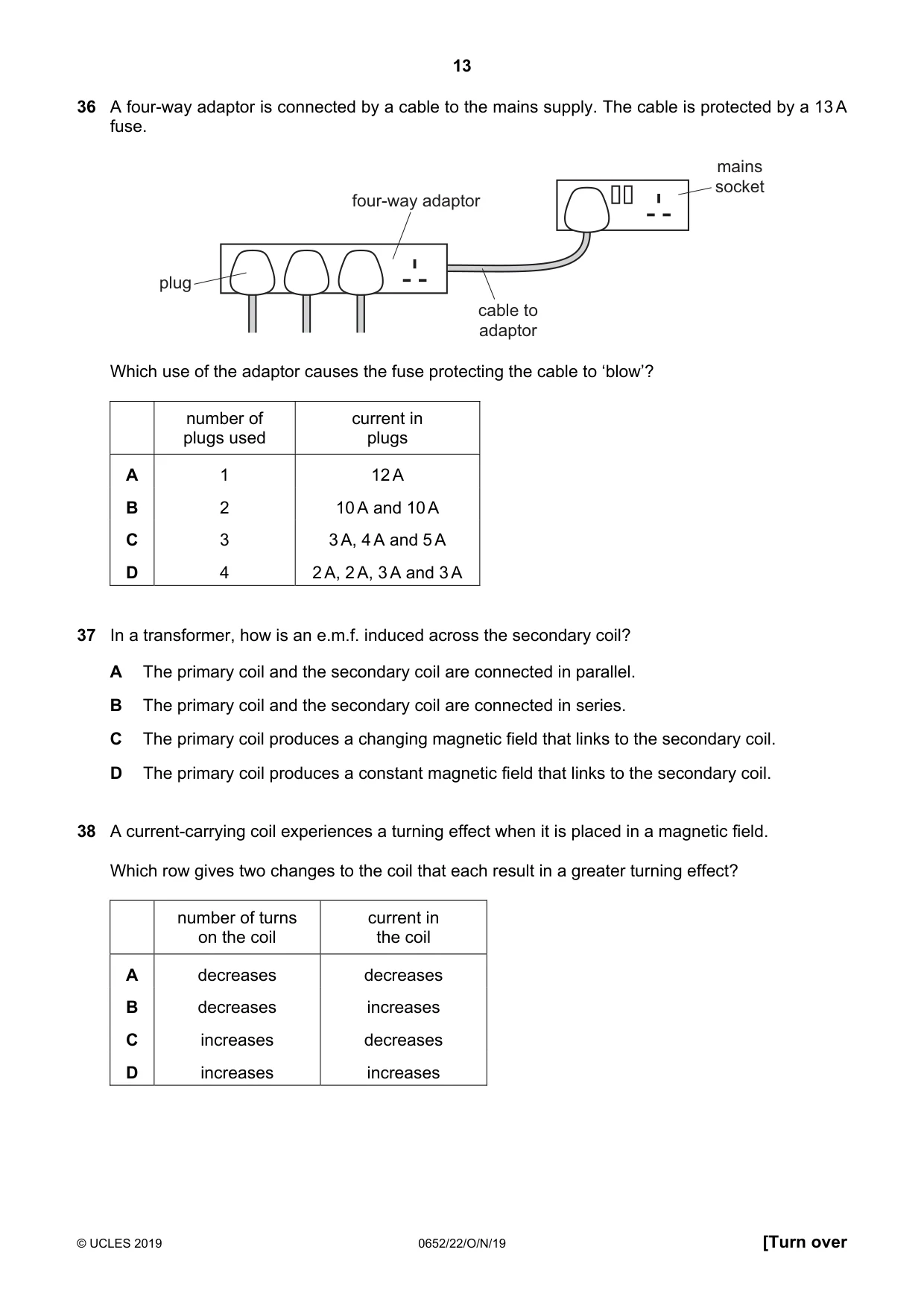
Q36 · A four-way adaptor is connected by a cable to the mains supply
36 A four-way adaptor is connected by a cable to the mains supply. The cable is protected by a 13 A fuse. mains socket four-way adaptor plug cable to adaptor Which use of the adaptor causes the fuse protecting the cable to ‘blow’? number of current in plugs used plugs A 1 12 A B 2 10 A and 10 A C 3 3 A, 4 A and 5 A D 4 2 A, 2 A, 3 A and 3 A
Mark scheme: B
Q37 · In a transformer, how is an e.m.f
37 In a transformer, how is an e.m.f. induced across the secondary coil? A The primary coil and the secondary coil are connected in parallel. B The primary coil and the secondary coil are connected in series. C The primary coil produces a changing magnetic field that links to the secondary coil. D The primary coil produces a constant magnetic field that links to the secondary coil.
Mark scheme: C
Q38 · A current-carrying coil experiences a turning effect when it is placed in a magnetic field
38 A current-carrying coil experiences a turning effect when it is placed in a magnetic field. Which row gives two changes to the coil that each result in a greater turning effect? number of turns current in on the coil the coil A decreases decreases B decreases increases C increases decreases D increases increases
Mark scheme: D
Q39 · Americium-241 ( 241 95Am ) decays to neptunium-237 ( 237 93Np )
39 Americium-241 ( 241 95Am ) decays to neptunium-237 ( 237 93Np ). One or two particles are emitted during this decay. Which particles are emitted? A an α-particle only B a β-particle only C an α-particle and a β-particle D two β-particles
Mark scheme: A
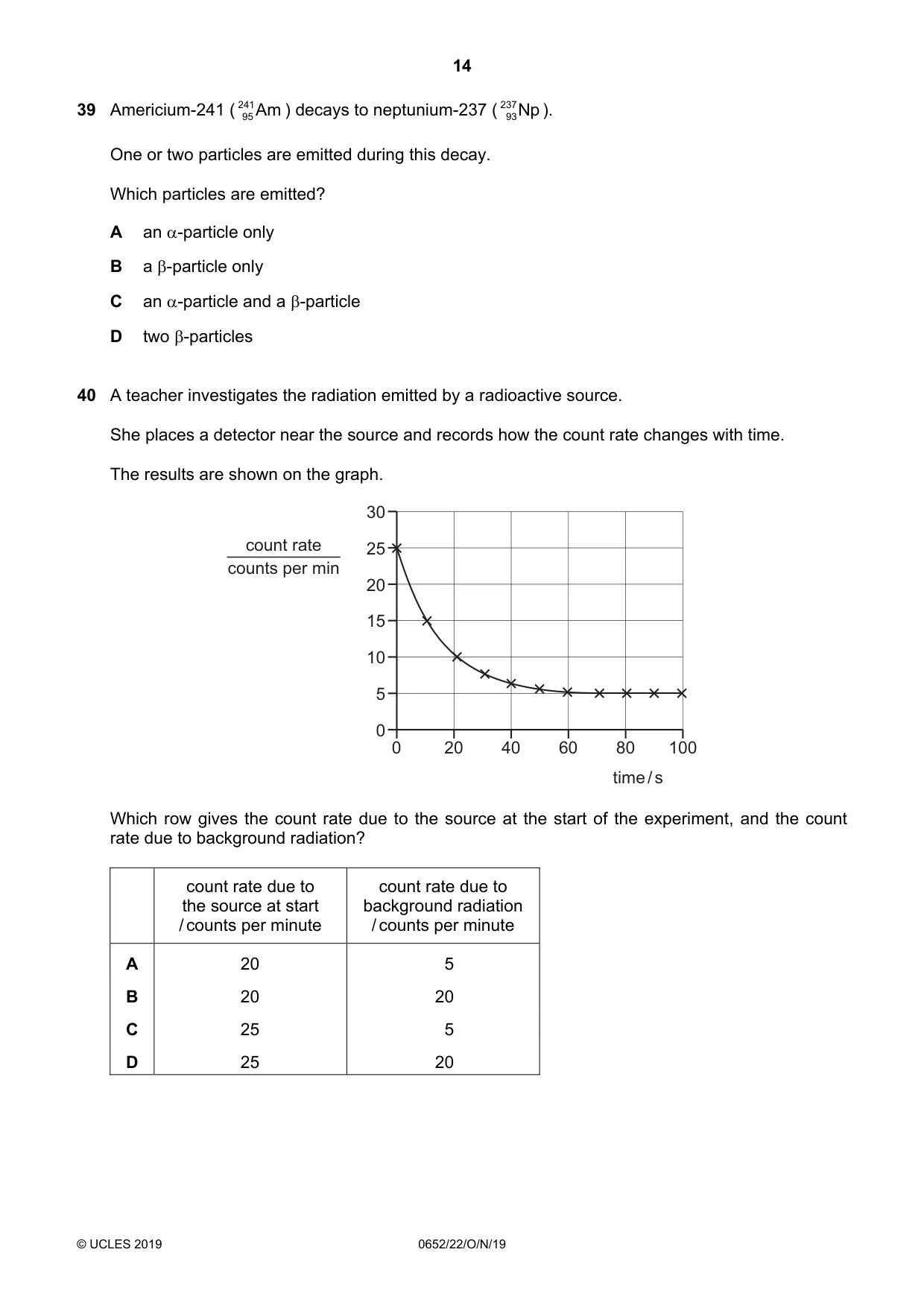
Q40 · A teacher investigates the radiation emitted by a radioactive source
40 A teacher investigates the radiation emitted by a radioactive source. She places a detector near the source and records how the count rate changes with time. The results are shown on the graph. 30 count rate 25 counts per min 20 15 10 5 0 0 20 40 60 80 100 time / s Which row gives the count rate due to the source at the start of the experiment, and the count rate due to background radiation? count rate due to count rate due to the source at start background radiation / counts per minute / counts per minute A 20 5 B 20 20 C 25 5 D 25 20
Mark scheme: A
What was in this paper
The subtopics covered by these 40 questions, and how many questions each got. Open one in a new tab to see every Cambridge question on it.
3Alkenes2Electromagnetic effects2General wave properties2Radioactivity2Stoichiometry2Alkanes1Dangers of electricity1Electric circuits1Electrical energy1Electrical quantities1Energetics of a reaction1Extraction of metals1Forces1Fuels1Group properties1Homologous series1Identification of ions and gases1Ions and ionic bonds1Length and time1Light1Macromolecules1Methods of purification1Motion1Periodic Trends1Reactivity series1Redox1Sound1The particulate nature of matter1Thermal processes1Thermal properties and temperature1Types of oxides1Uses of metals1What you needed in this session
Cambridge’s own grade thresholds for 2019 Oct/Nov, Paper 2 · Variant 2. A higher threshold means an easier paper — the bar moves with how the cohort did.