Questions as text
Q1 · A student does work by pulling a case across a horizontal floor 0652/21 Oct/Nov 2017
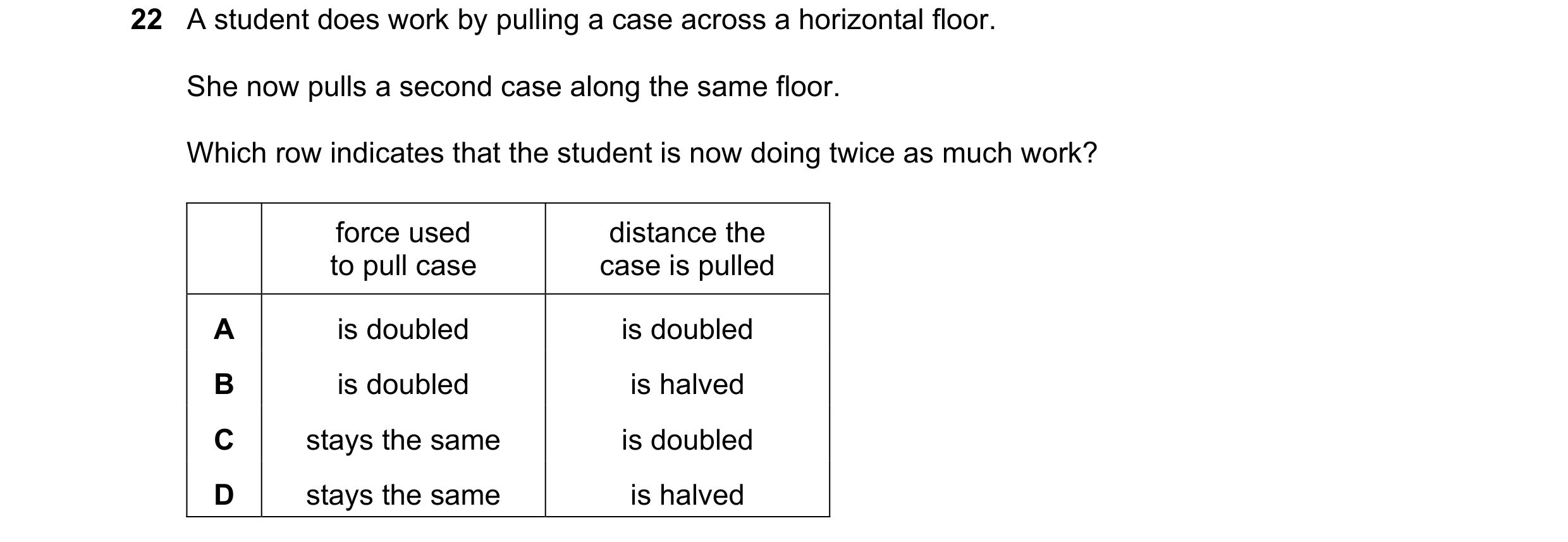
22 A student does work by pulling a case across a horizontal floor. She now pulls a second case along the same floor. Which row indicates that the student is now doing twice as much work? force used distance the to pull case case is pulled A is doubled is doubled B is doubled is halved C stays the same is doubled D stays the same is halved
1 marks
Answer: C
This question in 0652/21 Oct/Nov 2017
Q2 · An object of mass m moving with velocity v has kinetic energy E 0652/21 Oct/Nov 2017
26 An object of mass m moving with velocity v has kinetic energy E. What is the kinetic energy of an object of mass 4.0 m moving with velocity 2.0 v? A 2.0 E B 4.0 E C 8.0 E D 16.0 E
1 marks
Answer: D
This question in 0652/21 Oct/Nov 2017
Q3 · A power station uses nuclear fission to obtain energy 0652/21 Oct/Nov 2017
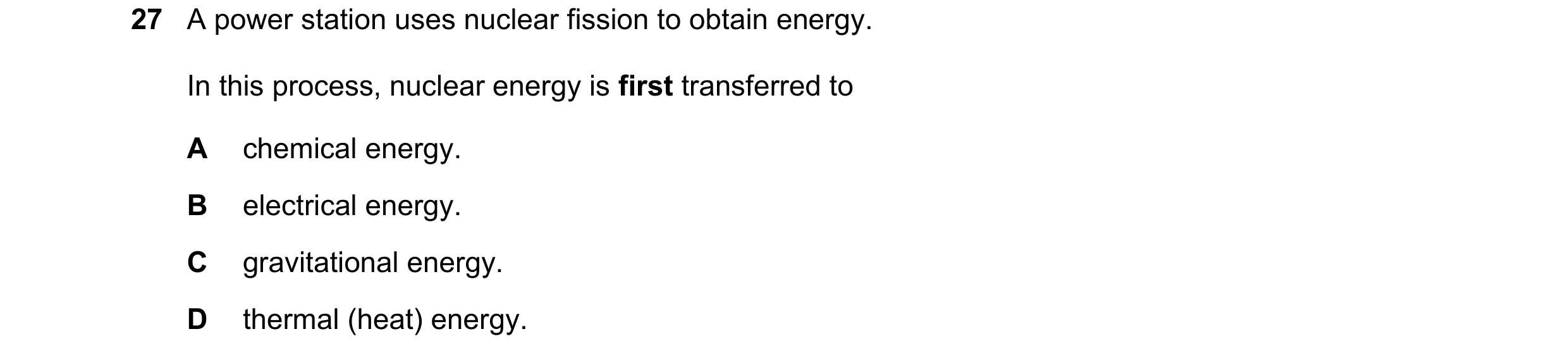
27 A power station uses nuclear fission to obtain energy. In this process, nuclear energy is first transferred to A chemical energy. B electrical energy. C gravitational energy. D thermal (heat) energy.
1 marks
Answer: D
This question in 0652/21 Oct/Nov 2017
Q4 · A student does work by pulling a case across a horizontal floor 0652/22 Oct/Nov 2017
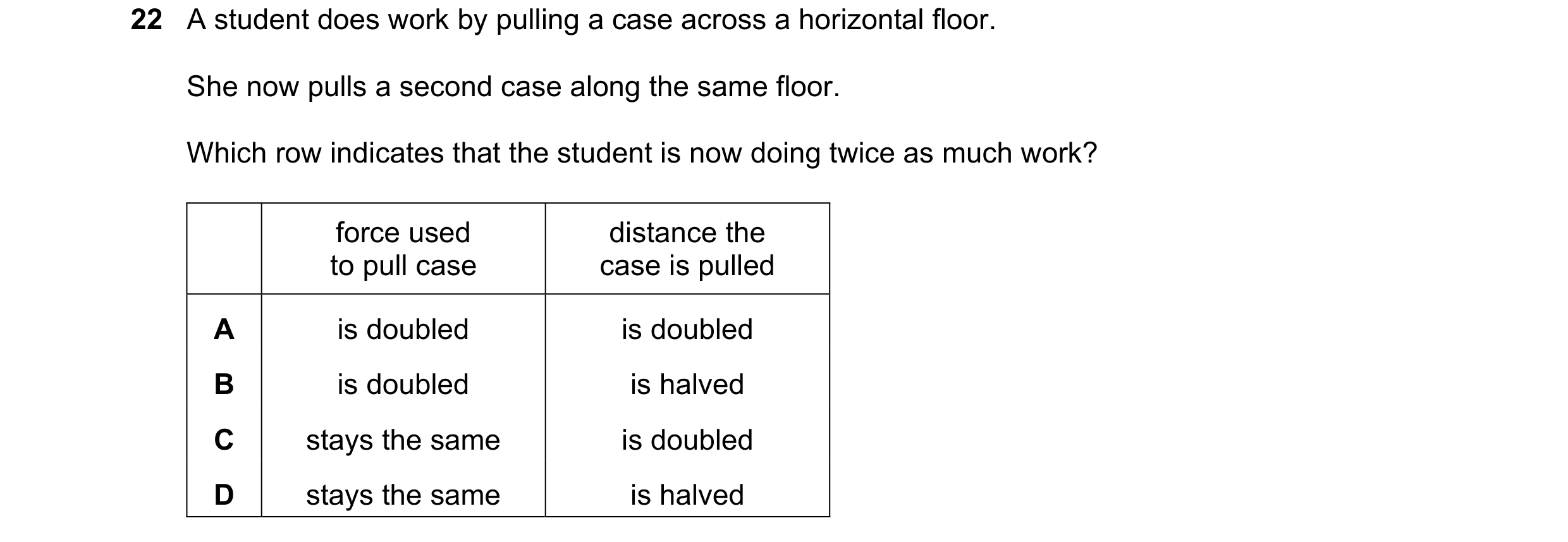
22 A student does work by pulling a case across a horizontal floor. She now pulls a second case along the same floor. Which row indicates that the student is now doing twice as much work? force used distance the to pull case case is pulled A is doubled is doubled B is doubled is halved C stays the same is doubled D stays the same is halved
1 marks
Answer: C
This question in 0652/22 Oct/Nov 2017
Q5 · An object of mass m moving with velocity v has kinetic energy E 0652/22 Oct/Nov 2017
26 An object of mass m moving with velocity v has kinetic energy E. What is the kinetic energy of an object of mass 4.0 m moving with velocity 2.0 v? A 2.0 E B 4.0 E C 8.0 E D 16.0 E
1 marks
Answer: D
This question in 0652/22 Oct/Nov 2017
Q6 · A power station uses nuclear fission to obtain energy 0652/22 Oct/Nov 2017
27 A power station uses nuclear fission to obtain energy. In this process, nuclear energy is first transferred to A chemical energy. B electrical energy. C gravitational energy. D thermal (heat) energy.
1 marks
Answer: D
This question in 0652/22 Oct/Nov 2017
Q7 · A stone is at rest at a height of 3.2 m above the ground 0652/21 Oct/Nov 2018
25 A stone is at rest at a height of 3.2 m above the ground. It is released and falls to the ground. The acceleration of free fall g is 10 m / s2. Air resistance can be ignored. At what speed does the stone hit the ground? A 3.2 m / s B 8.0 m / s C 32 m / s D 64 m / s
1 marks
Answer: B
This question in 0652/21 Oct/Nov 2018
Q8 · A stone is at rest at a height of 3.2 m above the ground 0652/22 Oct/Nov 2018
25 A stone is at rest at a height of 3.2 m above the ground. It is released and falls to the ground. The acceleration of free fall g is 10 m / s2. Air resistance can be ignored. At what speed does the stone hit the ground? A 3.2 m / s B 8.0 m / s C 32 m / s D 64 m / s
1 marks
Answer: B
This question in 0652/22 Oct/Nov 2018
Q9 · In a nuclear reaction, the total mass decreases by 1.0 g 0652/22 Oct/Nov 2018
26 In a nuclear reaction, the total mass decreases by 1.0 g. How much energy is released? A 3.0 × 10⁵ J B 3.0 × 10⁸ J C 9.0 × 10¹³ J D 9.0 × 10¹⁶ J
1 marks
Answer: C
This question in 0652/22 Oct/Nov 2018
Q10 · A force F acts on an object that moves in a straight line through a distance d 0652/21 Oct/Nov 2019
24 A force F acts on an object that moves in a straight line through a distance d. The change in energy of the object is equal to F × d. Which statement must be correct? A F is in the same direction as d. B F is perpendicular to d. C The object gains gravitational potential energy. D The object is moving at constant speed.
1 marks
Answer: A
This question in 0652/21 Oct/Nov 2019
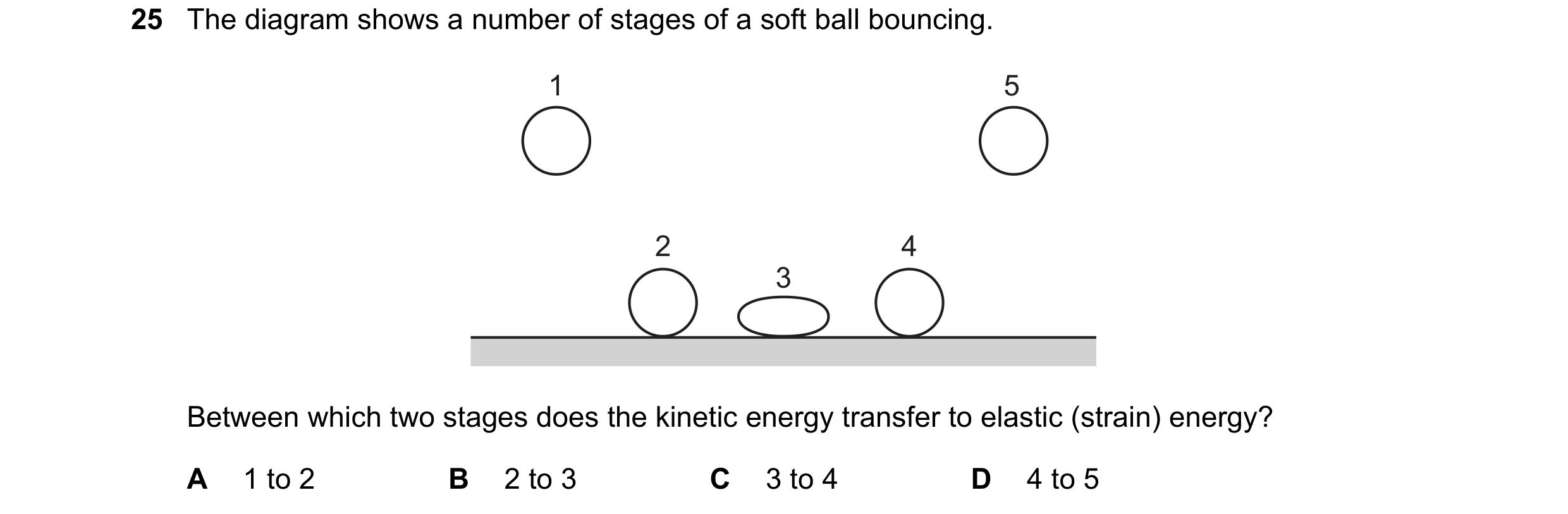
Q11 · The diagram shows a number of stages of a soft ball bouncing 0652/21 Oct/Nov 2019
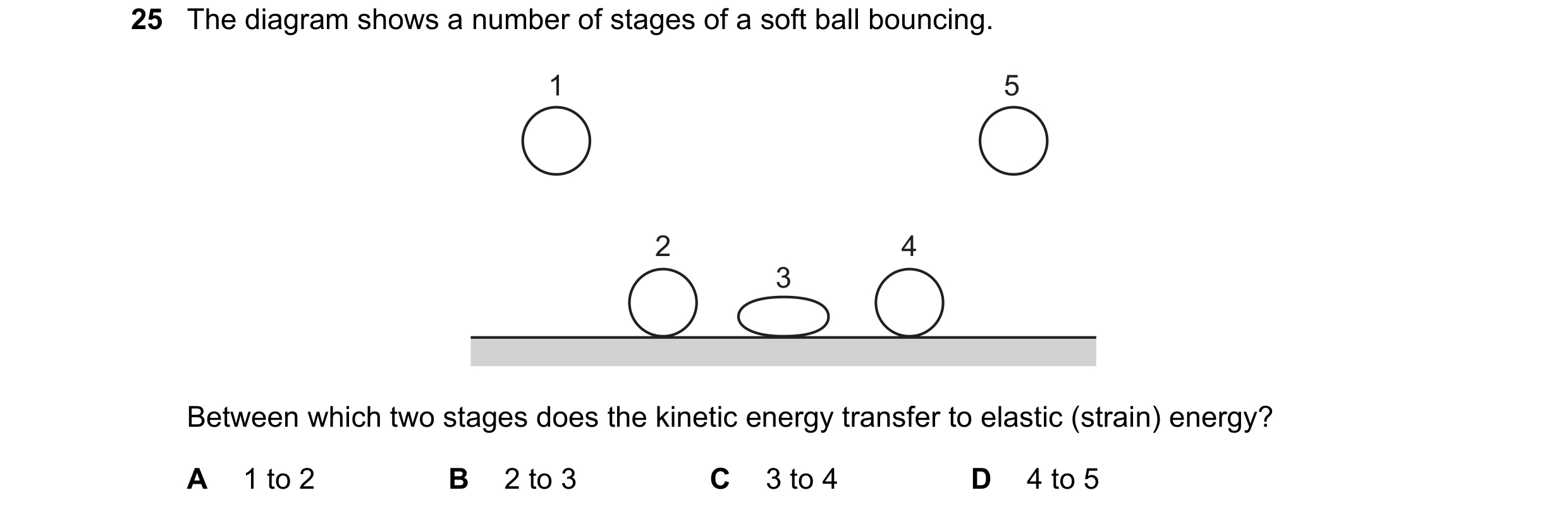
25 The diagram shows a number of stages of a soft ball bouncing. 1 5 2 4 3 Between which two stages does the kinetic energy transfer to elastic (strain) energy? A 1 to 2 B 2 to 3 C 3 to 4 D 4 to 5
1 marks
Answer: B
This question in 0652/21 Oct/Nov 2019
Q12 · A ball is thrown vertically upwards with a speed of 5.00 m / s 0652/21 Oct/Nov 2019
26 A ball is thrown vertically upwards with a speed of 5.00 m / s. All of the ball’s initial kinetic energy is transferred into gravitational potential energy. What is the maximum height reached by the ball? The acceleration of free fall is 10.0 m / s2. A 0.250 m B 1.25 m C 2.50 m D 12.5 m
1 marks
Answer: B
This question in 0652/21 Oct/Nov 2019
Q13 · A force F acts on an object that moves in a straight line through a distance d 0652/22 Oct/Nov 2019
24 A force F acts on an object that moves in a straight line through a distance d. The change in energy of the object is equal to F × d. Which statement must be correct? A F is in the same direction as d. B F is perpendicular to d. C The object gains gravitational potential energy. D The object is moving at constant speed.
1 marks
Answer: A
This question in 0652/22 Oct/Nov 2019
Q14 · The diagram shows a number of stages of a soft ball bouncing 0652/22 Oct/Nov 2019
25 The diagram shows a number of stages of a soft ball bouncing. 1 5 2 4 3 Between which two stages does the kinetic energy transfer to elastic (strain) energy? A 1 to 2 B 2 to 3 C 3 to 4 D 4 to 5
1 marks
Answer: B
This question in 0652/22 Oct/Nov 2019
Q15 · A ball is thrown vertically upwards with a speed of 5.00 m / s 0652/22 Oct/Nov 2019
26 A ball is thrown vertically upwards with a speed of 5.00 m / s. All of the ball’s initial kinetic energy is transferred into gravitational potential energy. What is the maximum height reached by the ball? The acceleration of free fall is 10.0 m / s2. A 0.250 m B 1.25 m C 2.50 m D 12.5 m
1 marks
Answer: B
This question in 0652/22 Oct/Nov 2019
Q16 · A ball of mass 0.25 kg has 18 J of kinetic energy 0652/21 Oct/Nov 2020
27 A ball of mass 0.25 kg has 18 J of kinetic energy. What is the speed of the ball? A 3.0 m / s B 7.2 m / s C 9.0 m / s D 12 m / s
1 marks
Answer: D
This question in 0652/21 Oct/Nov 2020
Q17 · A toy car without a motor is pushed, then follows the looped track shown 0652/21 Oct/Nov 2020
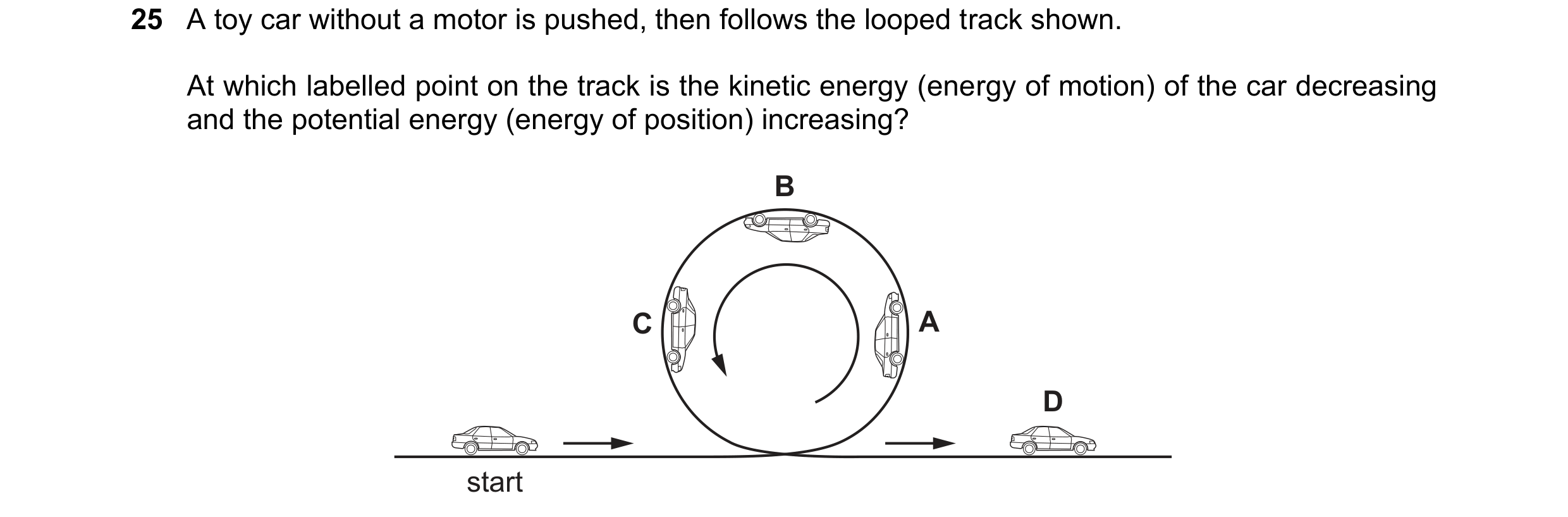
28 A toy car without a motor is pushed, then follows the looped track shown. At which labelled point on the track is the kinetic energy (energy of motion) of the car decreasing and the potential energy (energy of position) increasing? B C A D start
1 marks
Answer: A
This question in 0652/21 Oct/Nov 2020
Q18 · A student measures his power output by lifting a load of weight W through a vertical… 0652/21 Oct/Nov 2020
29 A student measures his power output by lifting a load of weight W through a vertical height h. In time t, he lifts the load n times. The student changes one of these variables to increase his power output. Which change produces this increase? A decreasing h B decreasing n C decreasing t D decreasing W
1 marks
Answer: C
This question in 0652/21 Oct/Nov 2020
Q19 · A resultant force of 4.0 N acts on an object of mass 2.0 kg 0652/22 Oct/Nov 2020
24 A resultant force of 4.0 N acts on an object of mass 2.0 kg. The force does 32 J of work. What distance does the object move? A 8.0 m B 16 m C 128 m D 256 m
1 marks
Answer: A
This question in 0652/22 Oct/Nov 2020
Q20 · A toy car without a motor is pushed, then follows the looped track shown 0652/22 Oct/Nov 2020
25 A toy car without a motor is pushed, then follows the looped track shown. At which labelled point on the track is the kinetic energy (energy of motion) of the car decreasing and the potential energy (energy of position) increasing? B C A D start
1 marks
Answer: A
This question in 0652/22 Oct/Nov 2020
Q21 · Which energy does an object possess due to its motion? 0652/21 Oct/Nov 2021
25 Which energy does an object possess due to its motion? A elastic (strain) B gravitational potential C kinetic D thermal
1 marks
Answer: C
This question in 0652/21 Oct/Nov 2021
Q22 · A box with initial kinetic energy 48 J is sliding along a horizontal floor 0652/21 Oct/Nov 2022
26 A box with initial kinetic energy 48 J is sliding along a horizontal floor. A constant frictional force of 9.0 N acts on the box. What is the kinetic energy of the box after it has moved a distance of 3.0 m? A 21 J B 27 J C 45 J D 75 J
1 marks
Answer: A
This question in 0652/21 Oct/Nov 2022
Q23 · Different energy resources are used to produce electricity 0652/21 Oct/Nov 2022
27 Different energy resources are used to produce electricity. Which resource is the least reliable? A geothermal B hydroelectric C nuclear D wind
1 marks
Answer: D
This question in 0652/21 Oct/Nov 2022
Q24 · A box with initial kinetic energy 48 J is sliding along a horizontal floor 0652/22 Oct/Nov 2022
26 A box with initial kinetic energy 48 J is sliding along a horizontal floor. A constant frictional force of 9.0 N acts on the box. What is the kinetic energy of the box after it has moved a distance of 3.0 m? A 21 J B 27 J C 45 J D 75 J
1 marks
Answer: A
This question in 0652/22 Oct/Nov 2022
Q25 · Different energy resources are used to produce electricity 0652/22 Oct/Nov 2022
27 Different energy resources are used to produce electricity. Which resource is the least reliable? A geothermal B hydroelectric C nuclear D wind
1 marks
Answer: D
This question in 0652/22 Oct/Nov 2022
Q26 · A student wishes to calculate his useful power output as he runs up some stairs 0652/21 Oct/Nov 2023
25 A student wishes to calculate his useful power output as he runs up some stairs. He measures the time he takes to run up the stairs. He can determine his power output if he knows only one other quantity. Which quantity does he need to know? A his final velocity B his increase in potential energy C his mass D his weight
1 marks
Answer: B
This question in 0652/21 Oct/Nov 2023
Q27 · Which energy source is a store of gravitational potential energy? 0652/21 Oct/Nov 2023
26 Which energy source is a store of gravitational potential energy? A coal B geothermal C hydroelectric D nuclear
1 marks
Answer: C
This question in 0652/21 Oct/Nov 2023
Q28 · A student wishes to calculate his useful power output as he runs up some stairs 0652/22 Oct/Nov 2023
25 A student wishes to calculate his useful power output as he runs up some stairs. He measures the time he takes to run up the stairs. He can determine his power output if he knows only one other quantity. Which quantity does he need to know? A his final velocity B his increase in potential energy C his mass D his weight
1 marks
Answer: B
This question in 0652/22 Oct/Nov 2023
Q29 · Which energy source is a store of gravitational potential energy? 0652/22 Oct/Nov 2023
26 Which energy source is a store of gravitational potential energy? A coal B geothermal C hydroelectric D nuclear
1 marks
Answer: C
This question in 0652/22 Oct/Nov 2023
Q30 · A student does work by pulling a box across a horizontal floor 0652/21 Oct/Nov 2024
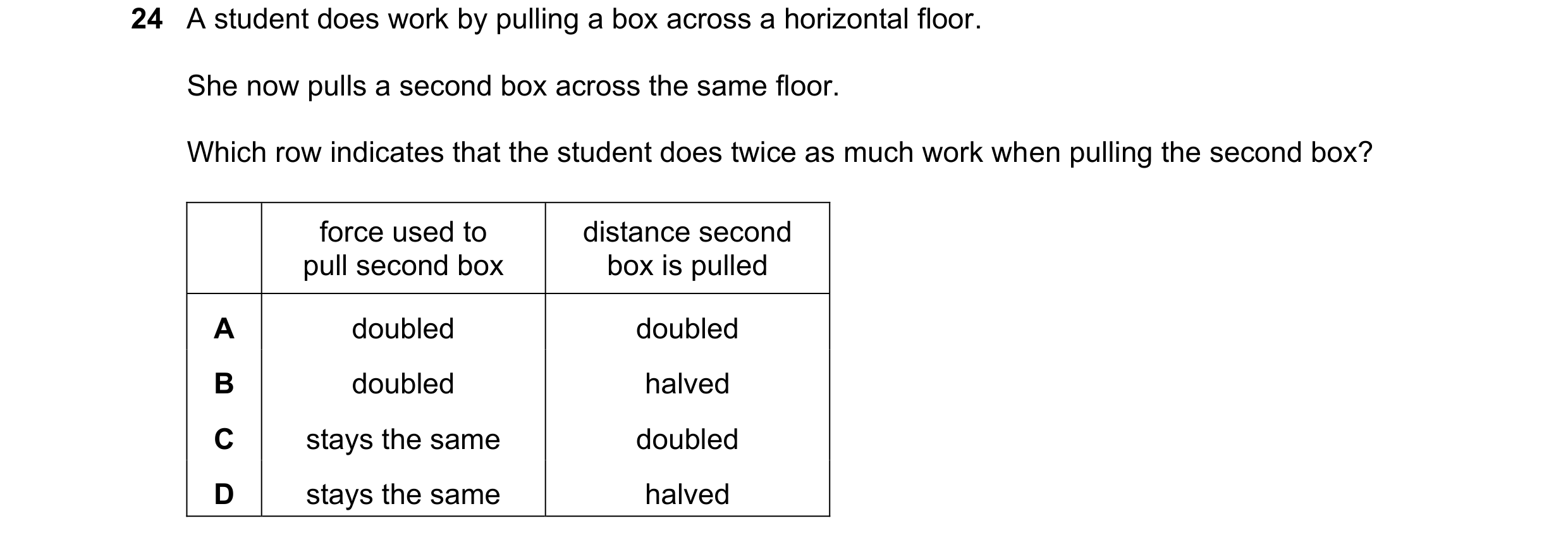
24 A student does work by pulling a box across a horizontal floor. She now pulls a second box across the same floor. Which row indicates that the student does twice as much work when pulling the second box? force used to distance second pull second box box is pulled A doubled doubled B doubled halved C stays the same doubled D stays the same halved
1 marks
Answer: C
This question in 0652/21 Oct/Nov 2024
Q31 · A ball of mass 200 g is thrown with an initial speed of 20 m / s 0652/21 Oct/Nov 2024
25 A ball of mass 200 g is thrown with an initial speed of 20 m / s. What is the initial kinetic energy of the ball? A 4.0 J B 40 J C 400 J D 40 000 J
1 marks
Answer: B
This question in 0652/21 Oct/Nov 2024
Q32 · A power station uses nuclear fission to generate electricity 0652/21 Oct/Nov 2024
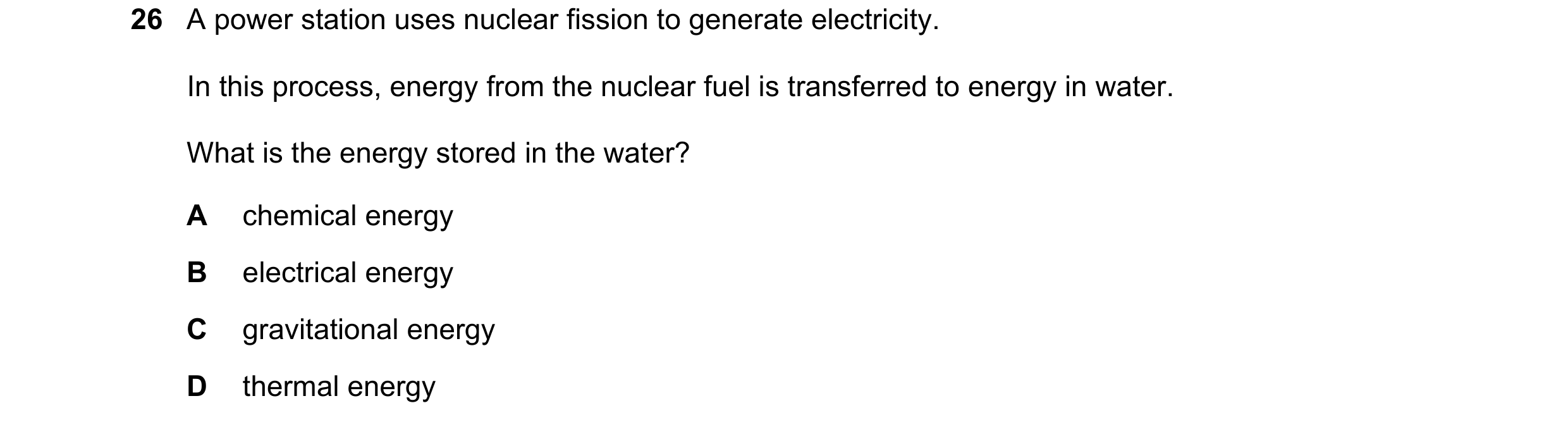
26 A power station uses nuclear fission to generate electricity. In this process, energy from the nuclear fuel is transferred to energy in water. What is the energy stored in the water? A chemical energy B electrical energy C gravitational energy D thermal energy
1 marks
Answer: D
This question in 0652/21 Oct/Nov 2024

 1 / 6
1 / 6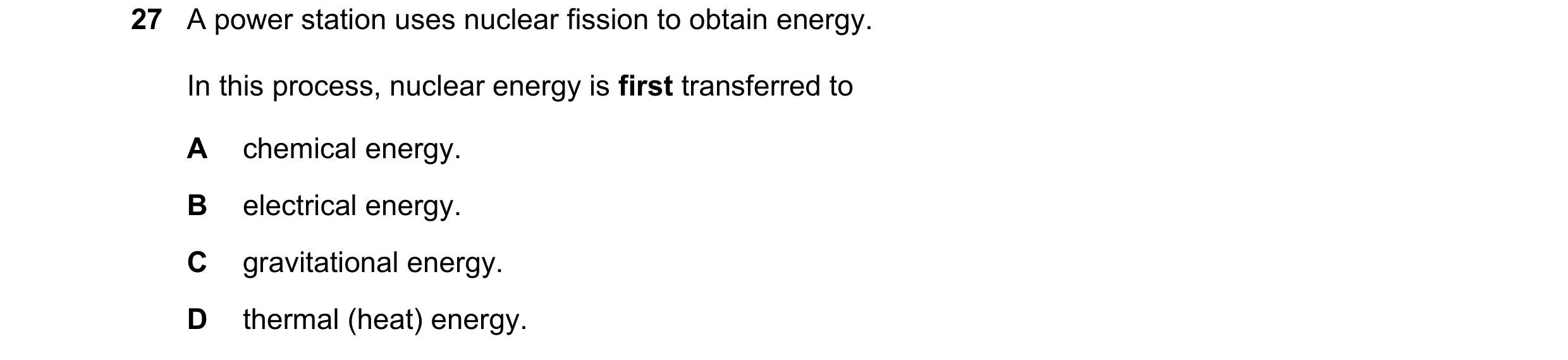



 2 / 6
2 / 6
 3 / 6
3 / 6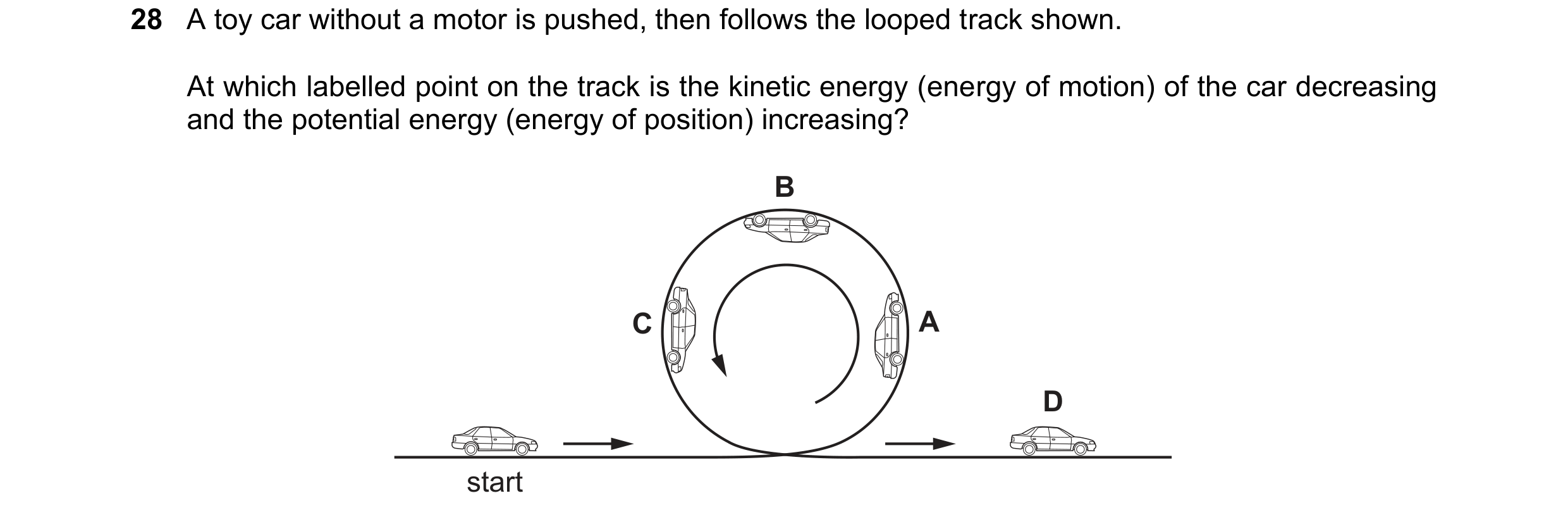

 4 / 6
4 / 6

 5 / 6
5 / 6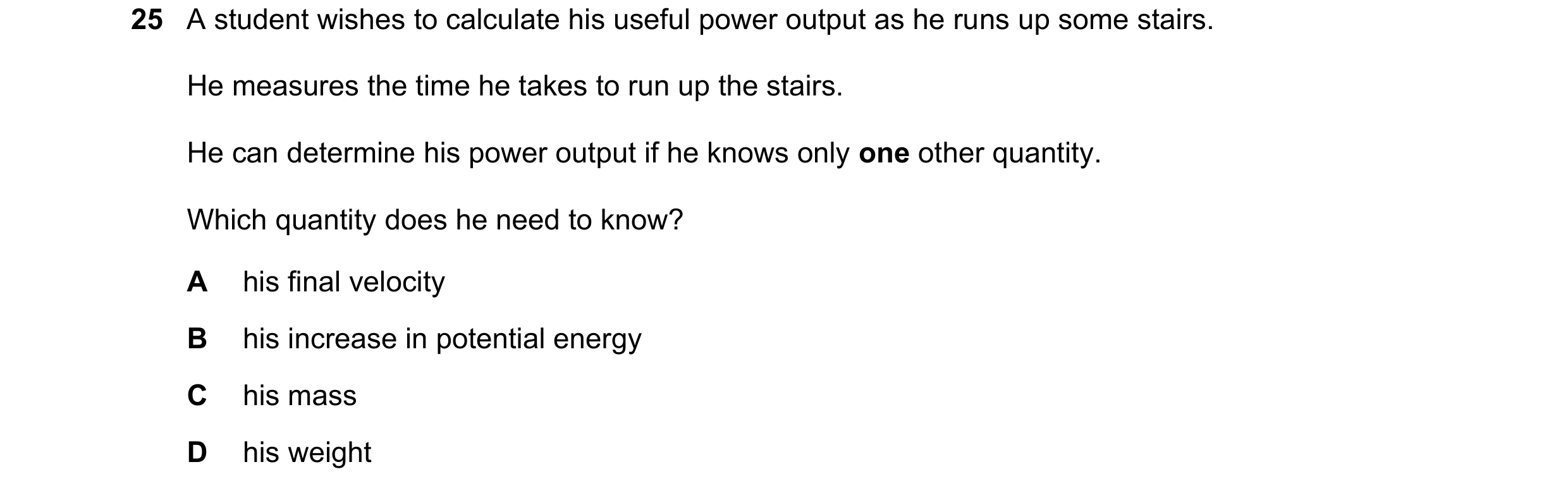


 6 / 6
6 / 6