Questions as text
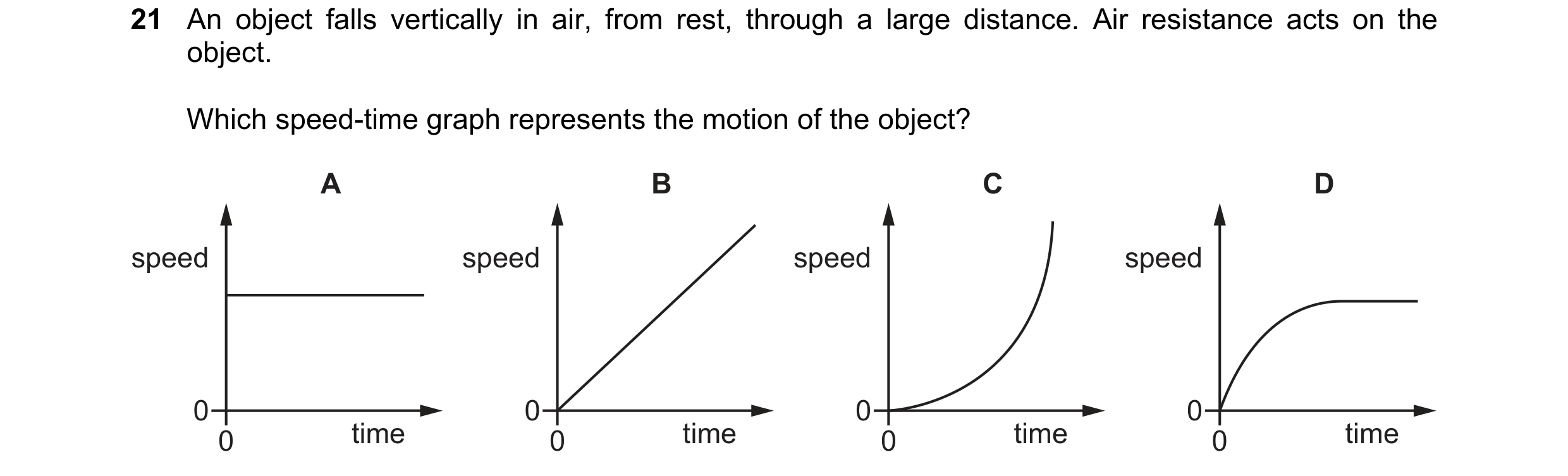
Q1 · An object falls vertically in air, from rest, through a large distance 0652/21 Oct/Nov 2017
21 An object falls vertically in air, from rest, through a large distance. Air resistance acts on the object. Which speed-time graph represents the motion of the object? A B C D speed speed speed speed 0 0 0 0 0 time 0 time 0 time 0 time
1 marks
Answer: D
This question in 0652/21 Oct/Nov 2017
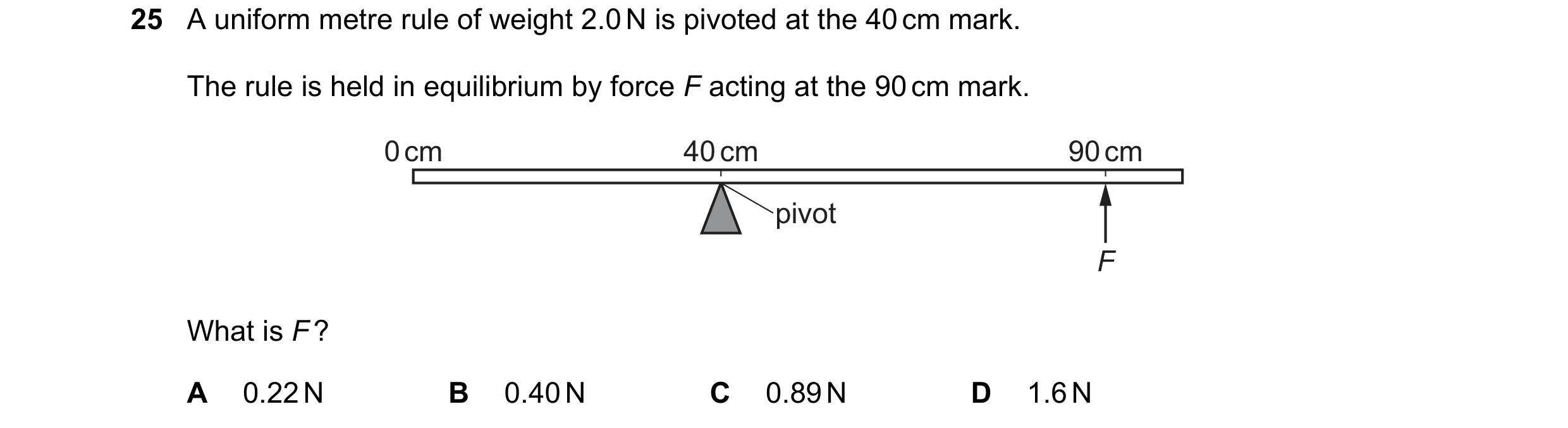
Q2 · A uniform metre rule of weight 2.0 N is pivoted at the 40 cm mark 0652/21 Oct/Nov 2017
25 A uniform metre rule of weight 2.0 N is pivoted at the 40 cm mark. The rule is held in equilibrium by force F acting at the 90 cm mark. 0 cm 40 cm 90 cm pivot F What is F ? A 0.22 N B 0.40 N C 0.89 N D 1.6 N
1 marks
Answer: B
This question in 0652/21 Oct/Nov 2017
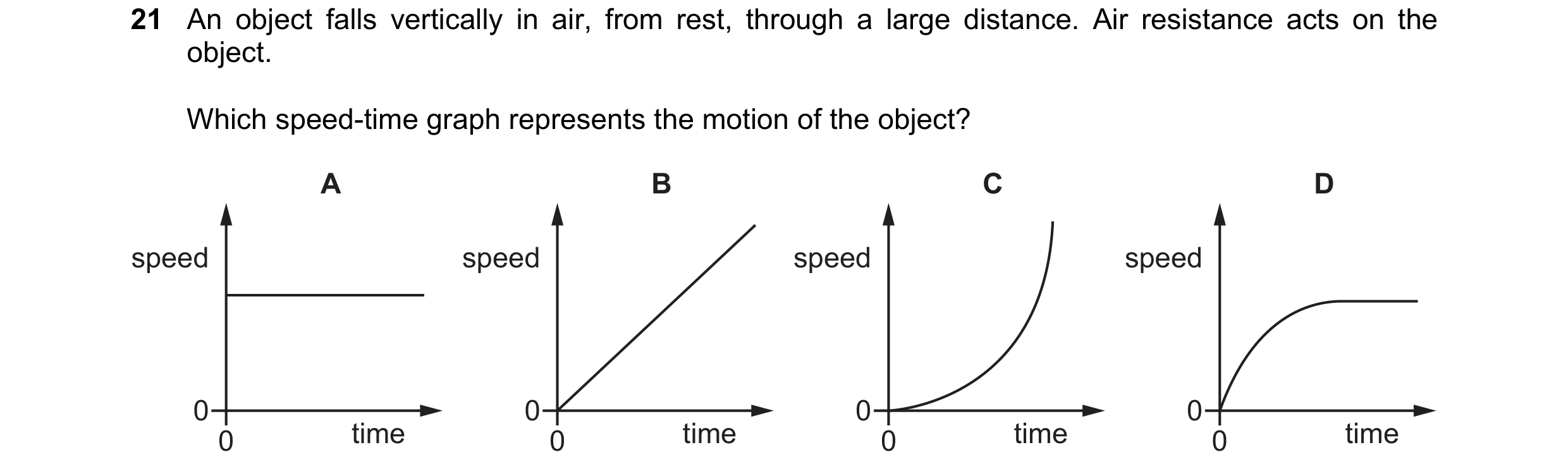
Q3 · An object falls vertically in air, from rest, through a large distance 0652/22 Oct/Nov 2017
21 An object falls vertically in air, from rest, through a large distance. Air resistance acts on the object. Which speed-time graph represents the motion of the object? A B C D speed speed speed speed 0 0 0 0 0 time 0 time 0 time 0 time
1 marks
Answer: D
This question in 0652/22 Oct/Nov 2017
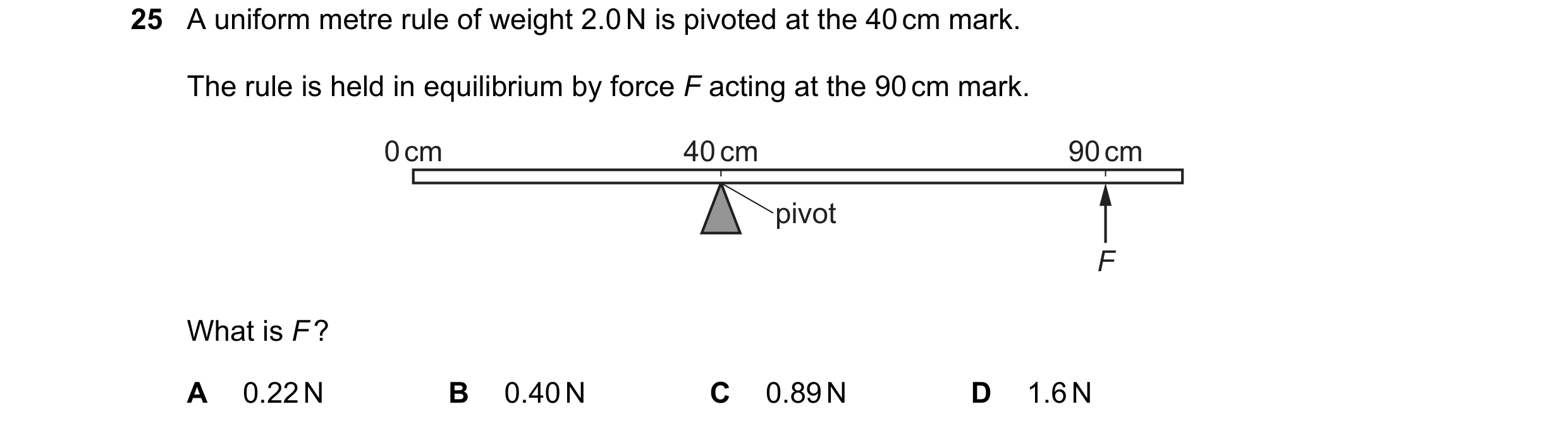
Q4 · A uniform metre rule of weight 2.0 N is pivoted at the 40 cm mark 0652/22 Oct/Nov 2017
25 A uniform metre rule of weight 2.0 N is pivoted at the 40 cm mark. The rule is held in equilibrium by force F acting at the 90 cm mark. 0 cm 40 cm 90 cm pivot F What is F ? A 0.22 N B 0.40 N C 0.89 N D 1.6 N
1 marks
Answer: B
This question in 0652/22 Oct/Nov 2017
Q5 · The diagram shows a man in a small boat 0652/21 Oct/Nov 2018
23 The diagram shows a man in a small boat. Why does the boat become less stable when the man stands up? A The centre of mass of the man and the boat is higher. B The centre of mass of the man and the boat is lower. C The total mass of the man and the boat is greater. D The total mass of the man and the boat is less.
1 marks
Answer: A
This question in 0652/21 Oct/Nov 2018
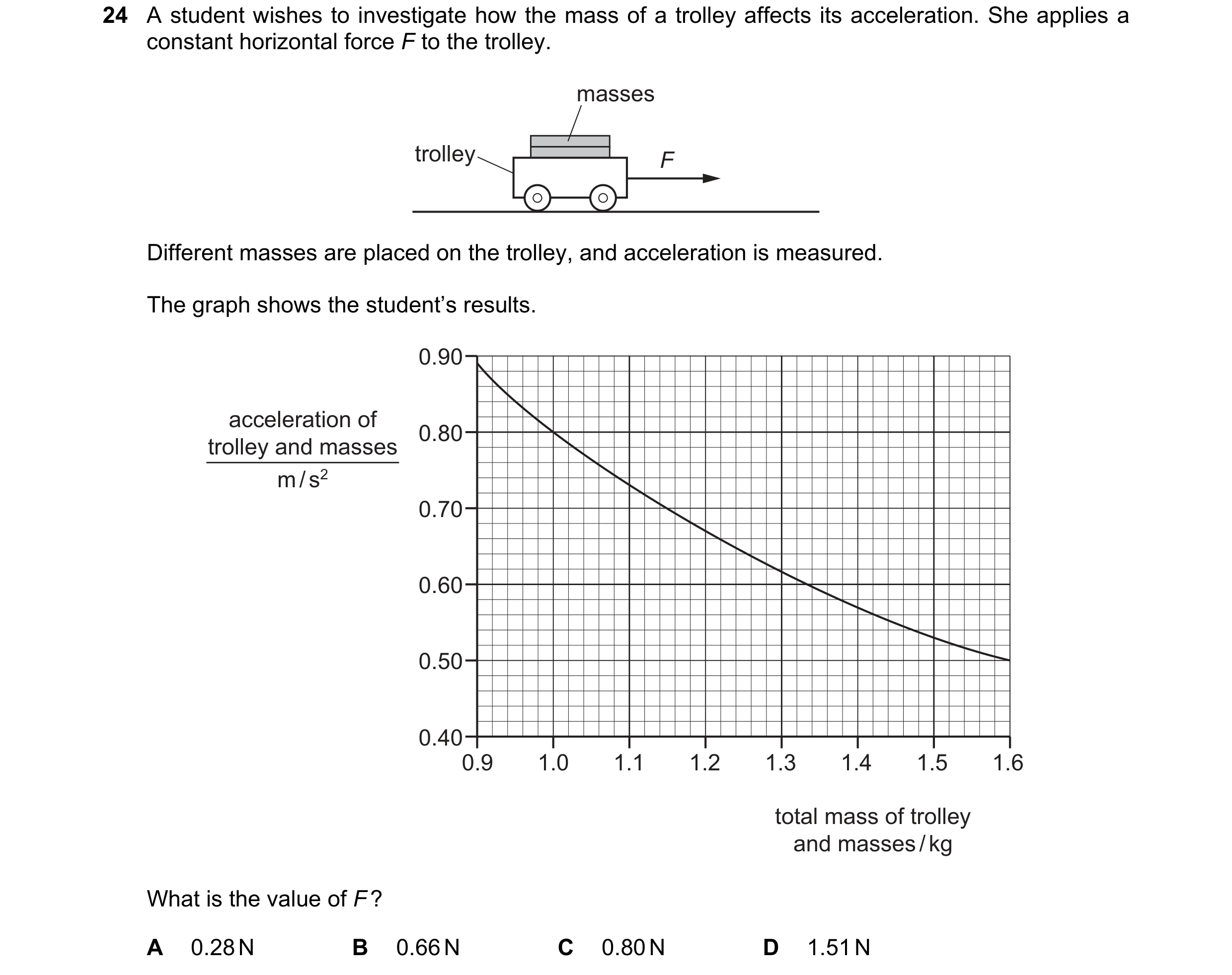
Q6 · A student wishes to investigate how the mass of a trolley affects its acceleration 0652/21 Oct/Nov 2018
24 A student wishes to investigate how the mass of a trolley affects its acceleration. She applies a constant horizontal force F to the trolley. masses trolley F Different masses are placed on the trolley, and acceleration is measured. The graph shows the student’s results. 0.90 acceleration of 0.80 trolley and masses m / s2 0.70 0.60 0.50 0.40 0.9 1.0 1.1 1.2 1.3 1.4 1.5 1.6 total mass of trolley and masses / kg What is the value of F ? A 0.28 N B 0.66 N C 0.80 N D 1.51 N
1 marks
Answer: C
This question in 0652/21 Oct/Nov 2018
Q7 · The diagram shows a man in a small boat 0652/22 Oct/Nov 2018
23 The diagram shows a man in a small boat. Why does the boat become less stable when the man stands up? A The centre of mass of the man and the boat is higher. B The centre of mass of the man and the boat is lower. C The total mass of the man and the boat is greater. D The total mass of the man and the boat is less.
1 marks
Answer: A
This question in 0652/22 Oct/Nov 2018
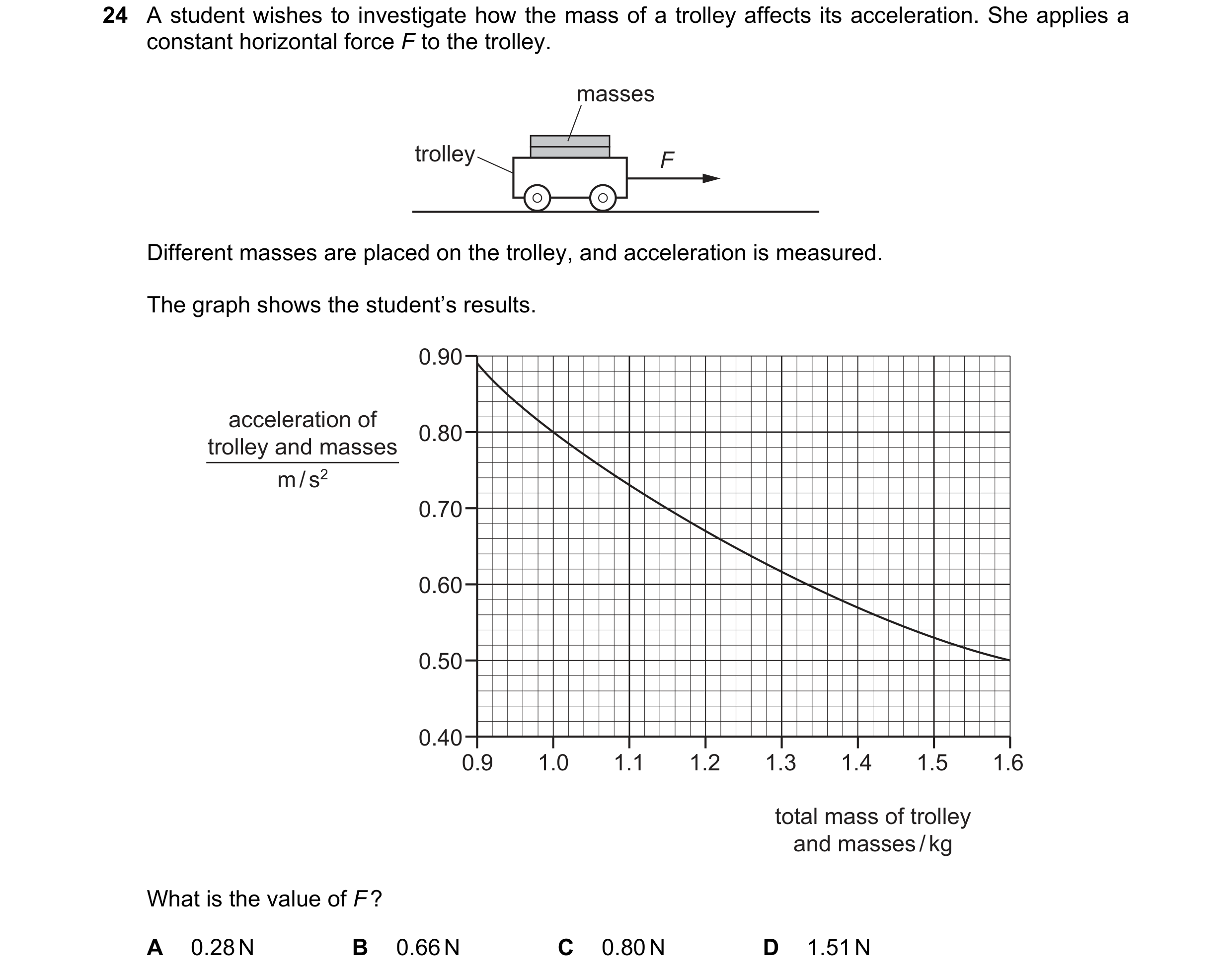
Q8 · A student wishes to investigate how the mass of a trolley affects its acceleration 0652/22 Oct/Nov 2018
24 A student wishes to investigate how the mass of a trolley affects its acceleration. She applies a constant horizontal force F to the trolley. masses trolley F Different masses are placed on the trolley, and acceleration is measured. The graph shows the student’s results. 0.90 acceleration of 0.80 trolley and masses m / s2 0.70 0.60 0.50 0.40 0.9 1.0 1.1 1.2 1.3 1.4 1.5 1.6 total mass of trolley and masses / kg What is the value of F ? A 0.28 N B 0.66 N C 0.80 N D 1.51 N
1 marks
Answer: C
This question in 0652/22 Oct/Nov 2018
Q9 · Three properties of a body are its mass, its shape and its size 0652/21 Oct/Nov 2019
23 Three properties of a body are its mass, its shape and its size.
Which row correctly shows whether these properties can be changed by a force?
size
v key
/ = can be changed
X = cannot be changed
\ <x
1 marks
Answer: D
This question in 0652/21 Oct/Nov 2019
Q10 · Three properties of a body are its mass, its shape and its size 0652/22 Oct/Nov 2019
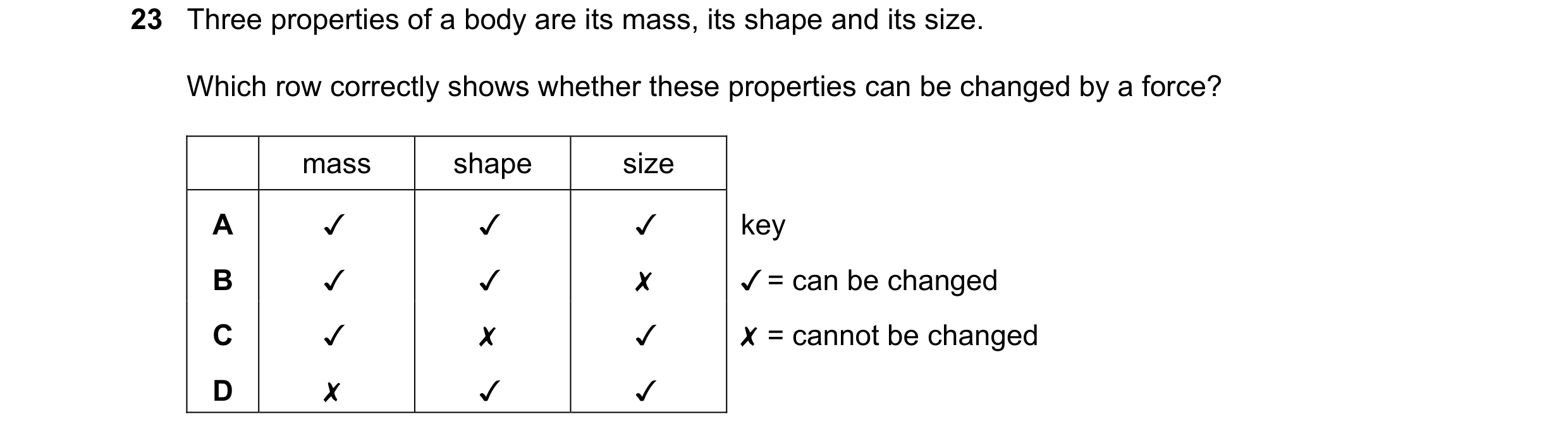
23 Three properties of a body are its mass, its shape and its size.
Which row correctly shows whether these properties can be changed by a force?
size
v key
/ = can be changed
X = cannot be changed
\ <x
1 marks
Answer: D
This question in 0652/22 Oct/Nov 2019
Q11 · The diagram shows the extension–load graph for a spring 0652/21 Oct/Nov 2020
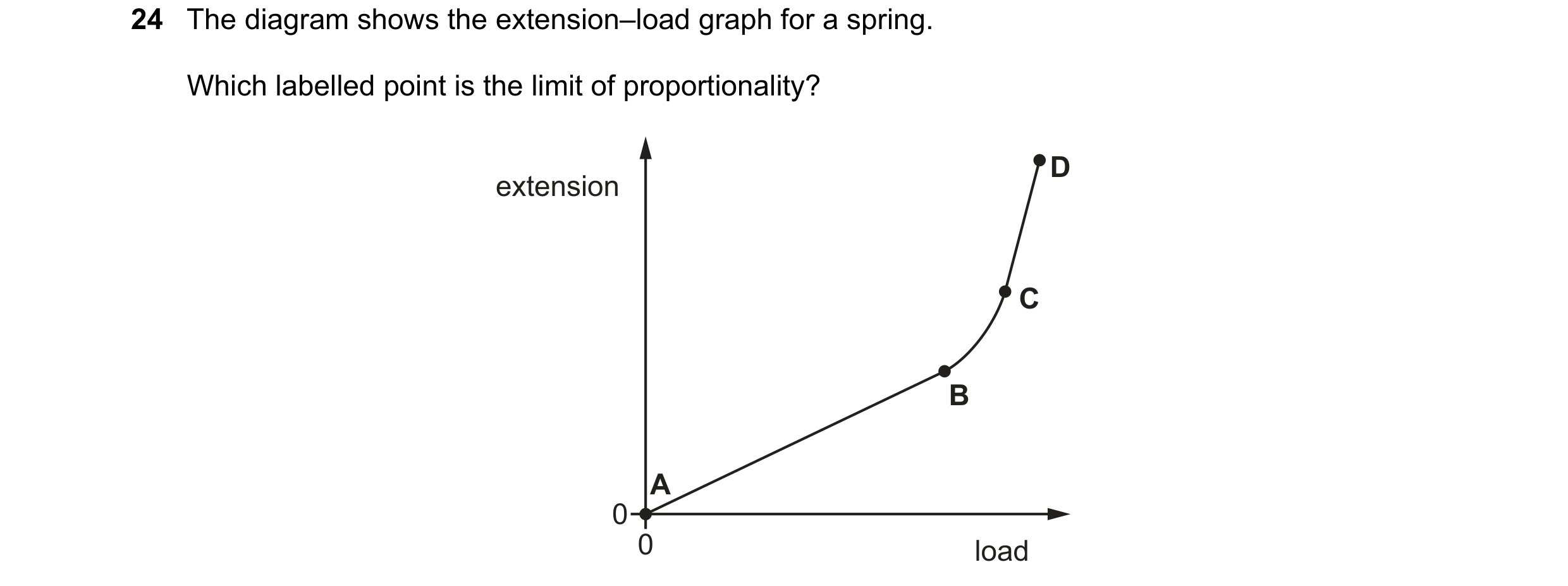
24 The diagram shows the extension–load graph for a spring. Which labelled point is the limit of proportionality? D extension C B A 0 0 load
1 marks
Answer: B
This question in 0652/21 Oct/Nov 2020
Q12 · An object of mass 5.0 kg moves at a constant speed to the right in a straight line 0652/21 Oct/Nov 2020
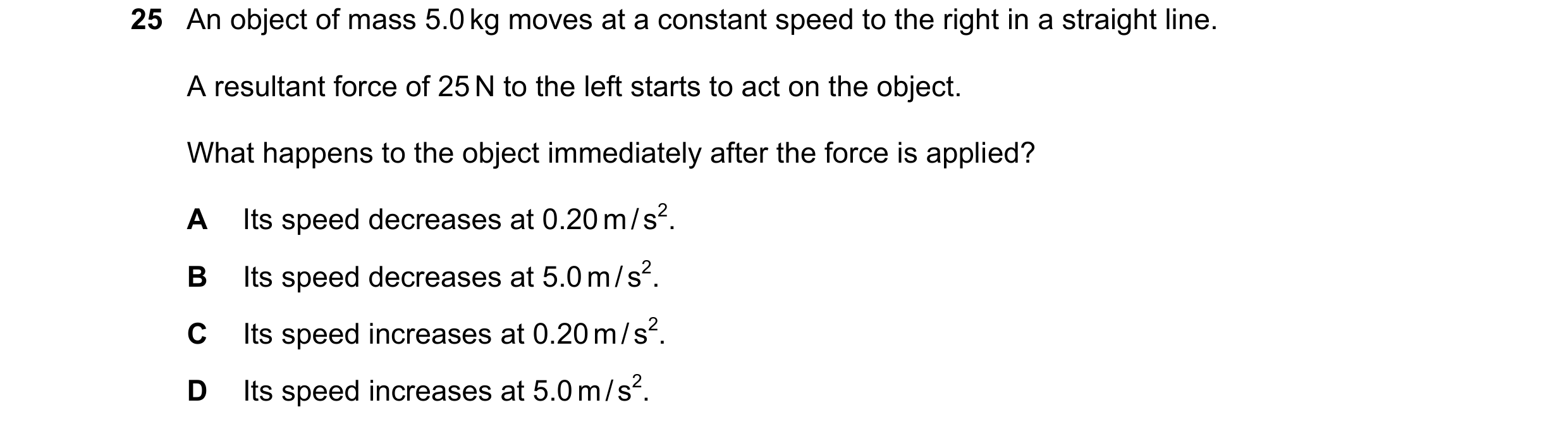
25 An object of mass 5.0 kg moves at a constant speed to the right in a straight line. A resultant force of 25 N to the left starts to act on the object. What happens to the object immediately after the force is applied? A Its speed decreases at 0.20 m / s2. B Its speed decreases at 5.0 m / s2. C Its speed increases at 0.20 m / s2. D Its speed increases at 5.0 m / s2.
1 marks
Answer: B
This question in 0652/21 Oct/Nov 2020
Q13 · The diagram shows a uniform metre rule that is in equilibrium 0652/21 Oct/Nov 2020
26 The diagram shows a uniform metre rule that is in equilibrium. It is supported by a pivot at the 50 cm mark and by an upward force F at the 20 cm mark. A 60 N weight is suspended from the rule at the 30 cm mark. A force R acts upwards at the pivot. The weight of the rule can be ignored. F R metre rule 0 10 20 30 40 50 60 70 80 90 100 cm pivot 60 N weight What are the values F and R? F / N R / N A 40 10 B 40 20 C 90 36 D 90 60
1 marks
Answer: B
This question in 0652/21 Oct/Nov 2020
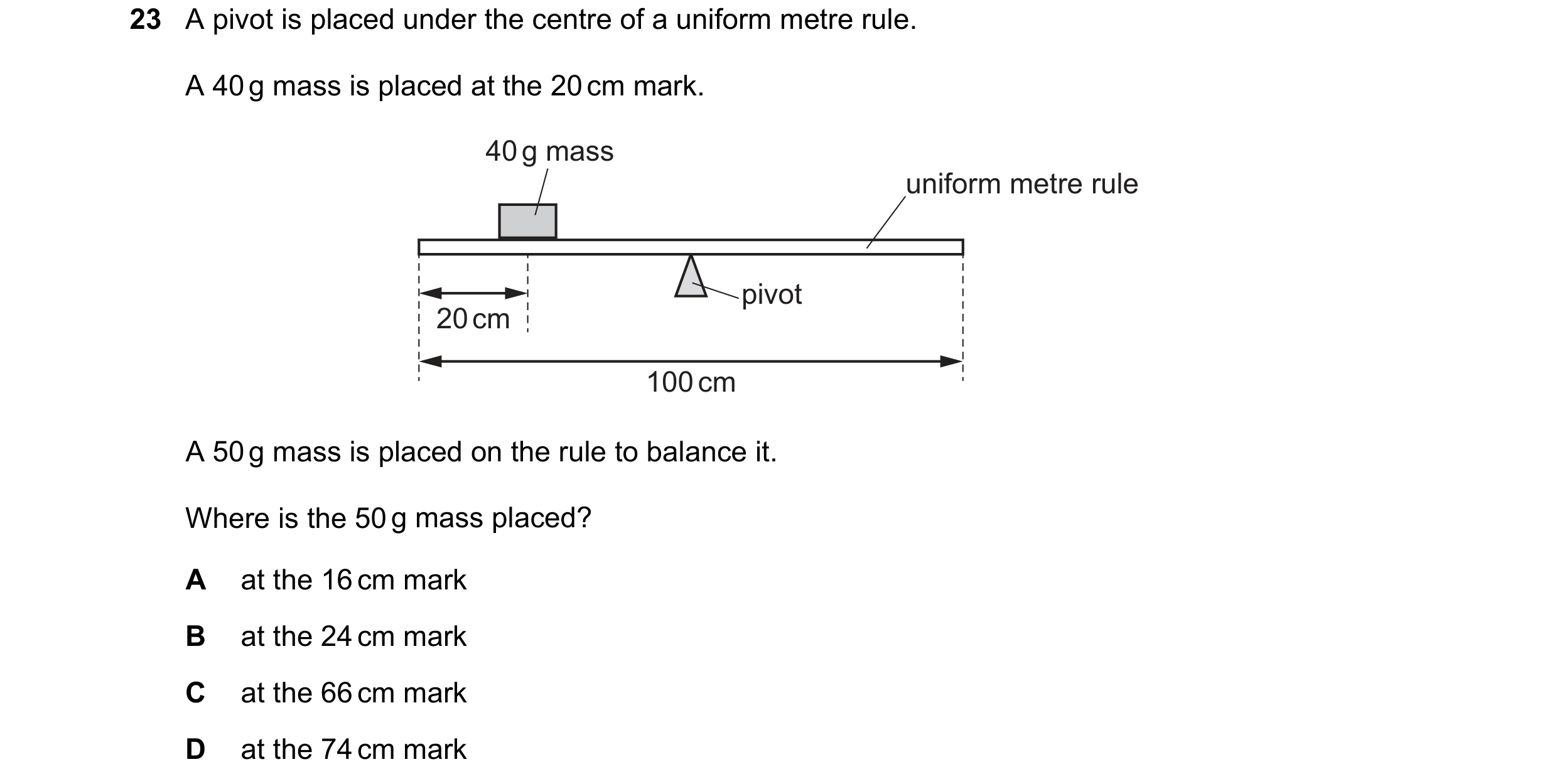
Q14 · A pivot is placed under the centre of a uniform metre rule 0652/22 Oct/Nov 2020
23 A pivot is placed under the centre of a uniform metre rule. A 40 g mass is placed at the 20 cm mark. 40 g mass uniform metre rule pivot 20 cm 100 cm A 50 g mass is placed on the rule to balance it. Where is the 50 g mass placed? A at the 16 cm mark B at the 24 cm mark C at the 66 cm mark D at the 74 cm mark
1 marks
Answer: D
This question in 0652/22 Oct/Nov 2020
Q15 · A resultant force of 4.0 N acts on an object of mass 2.0 kg 0652/22 Oct/Nov 2020
24 A resultant force of 4.0 N acts on an object of mass 2.0 kg. The force does 32 J of work. What distance does the object move? A 8.0 m B 16 m C 128 m D 256 m
1 marks
Answer: A
This question in 0652/22 Oct/Nov 2020
Q16 · An object falls vertically at a constant speed in air 0652/21 Oct/Nov 2021
22 An object falls vertically at a constant speed in air. Which statement about the forces on the object is correct? A Air resistance is the only force acting on the object. B The magnitude of the air resistance acting on the object is equal to the weight of the object. C The magnitude of the air resistance acting on the object is greater than the weight of the object. D The magnitude of the air resistance acting on the object is less than the weight of the object.
1 marks
Answer: B
This question in 0652/21 Oct/Nov 2021
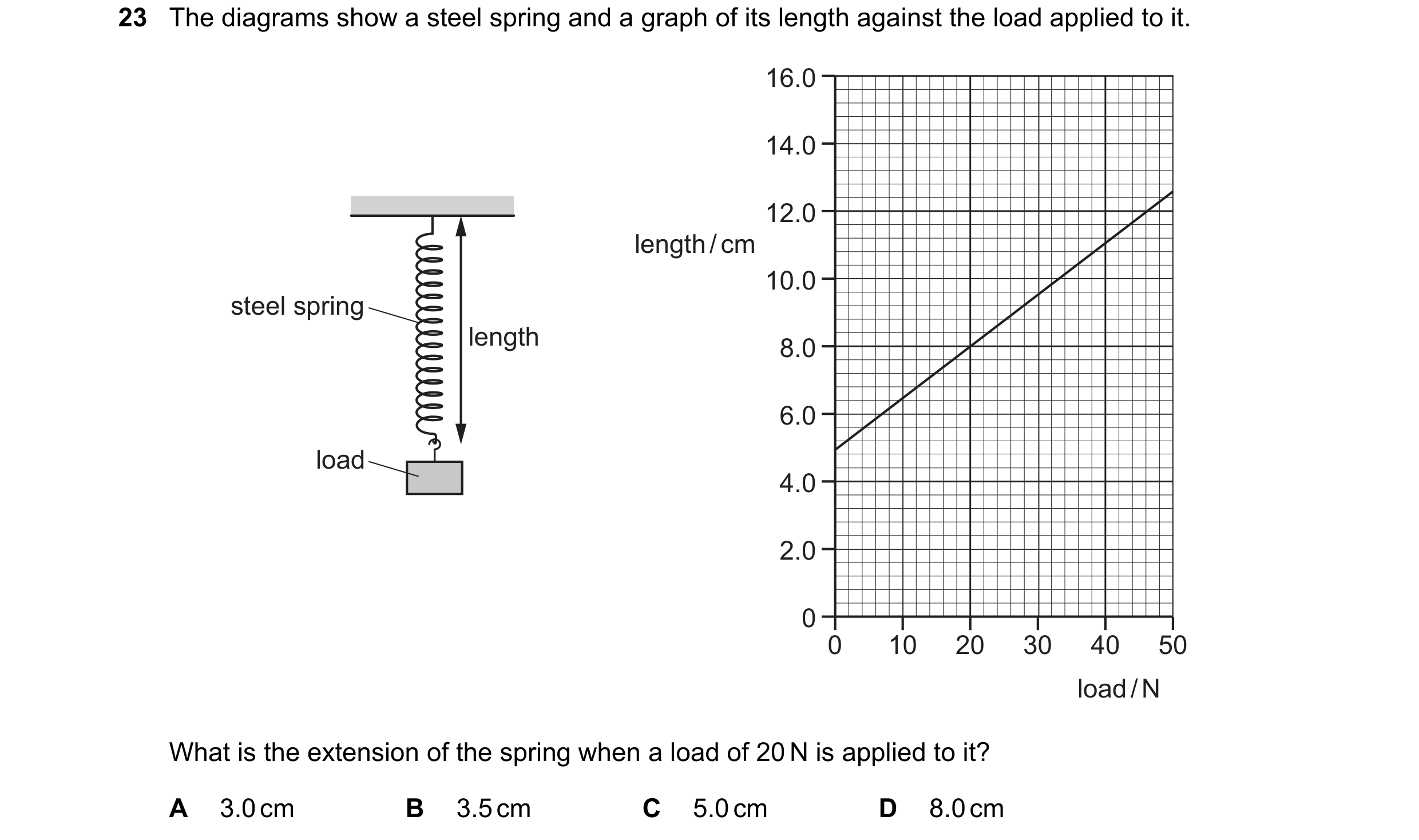
Q17 · The diagrams show a steel spring and a graph of its length against the load applied to it 0652/21 Oct/Nov 2021
23 The diagrams show a steel spring and a graph of its length against the load applied to it. 16.0 14.0 12.0 length / cm 10.0 steel spring length 8.0 6.0 load 4.0 2.0 0 0 10 20 30 40 50 load / N What is the extension of the spring when a load of 20 N is applied to it? A 3.0 cm B 3.5 cm C 5.0 cm D 8.0 cm
1 marks
Answer: A
This question in 0652/21 Oct/Nov 2021
Q18 · An object of mass 2.5 kg is acted upon by two forces 0652/21 Oct/Nov 2022
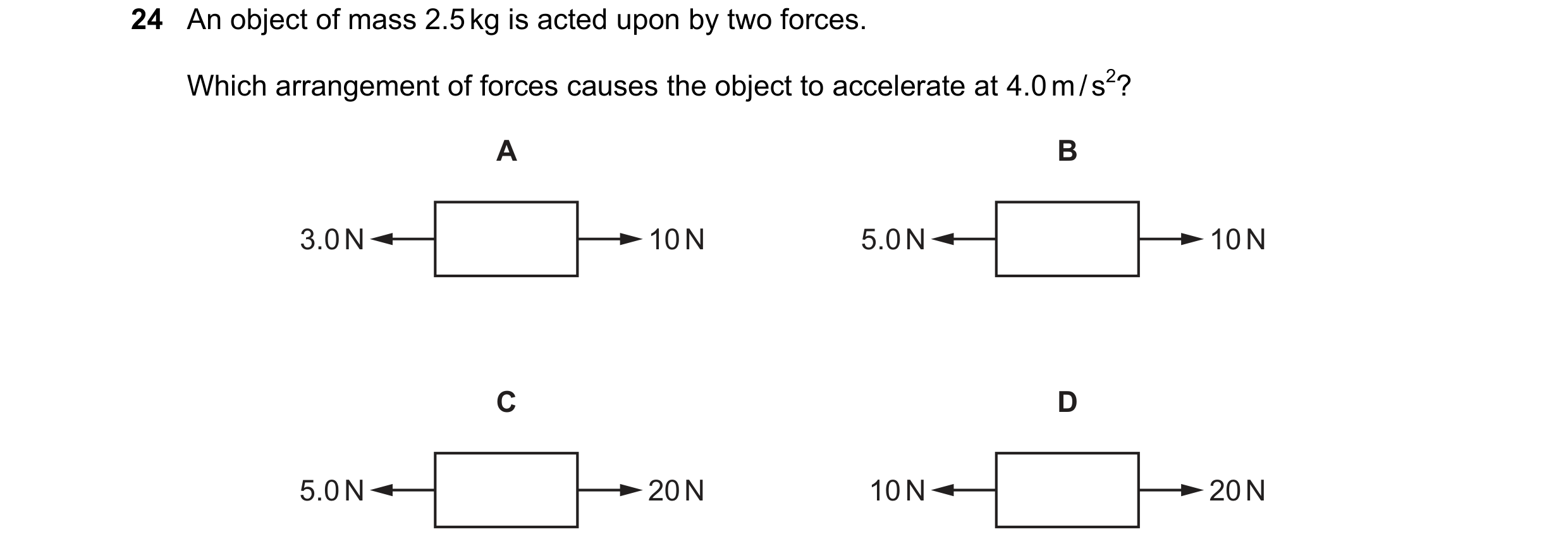
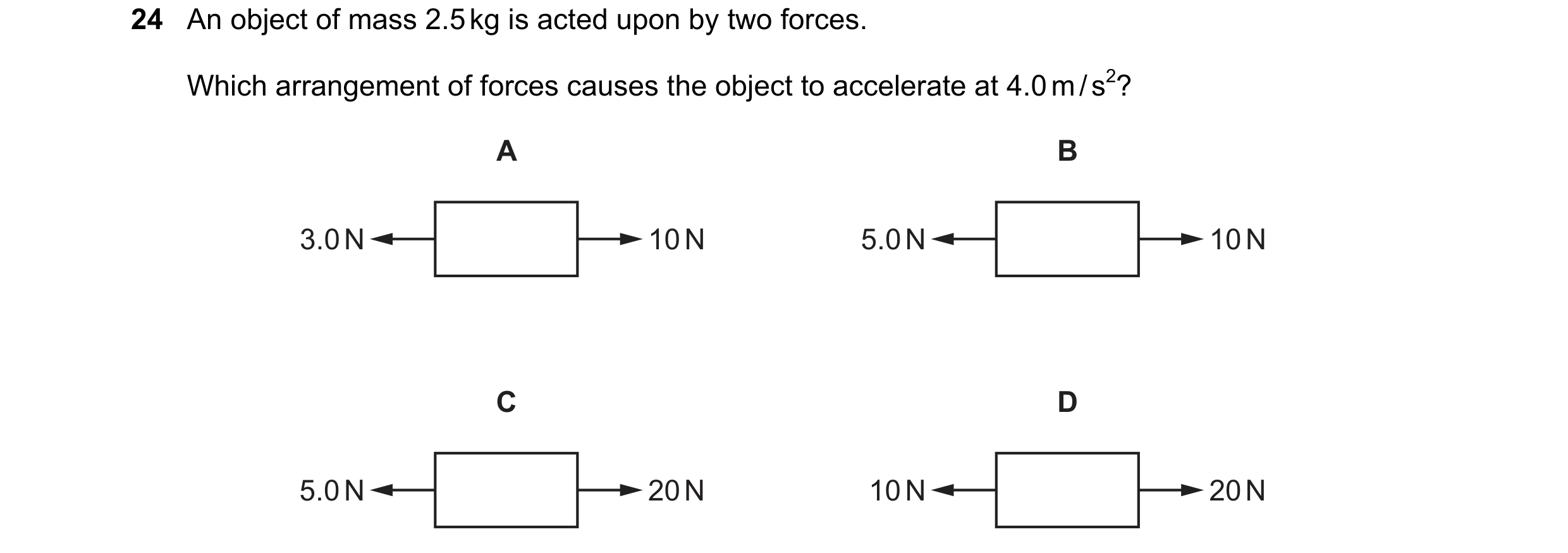
24 An object of mass 2.5 kg is acted upon by two forces. Which arrangement of forces causes the object to accelerate at 4.0 m / s2? A B 3.0 N 10 N 5.0 N 10 N C D 5.0 N 20 N 10 N 20 N
1 marks
Answer: D
This question in 0652/21 Oct/Nov 2022
Q19 · A stool of weight 620 N has four legs 0652/21 Oct/Nov 2022
25 A stool of weight 620 N has four legs. The legs all have a square cross-section of side length 4.0 cm. The seat of the stool is a square of side length 36 cm, as shown. 36 cm 4.0 cm What is the pressure exerted on the floor by the legs of the stool? A 0.48 N / cm2 B 9.7 N / cm2 C 39 N / cm2 D 155 N / cm2
1 marks
Answer: B
This question in 0652/21 Oct/Nov 2022
Q20 · A steel ball is dropped from a table 0652/22 Oct/Nov 2022
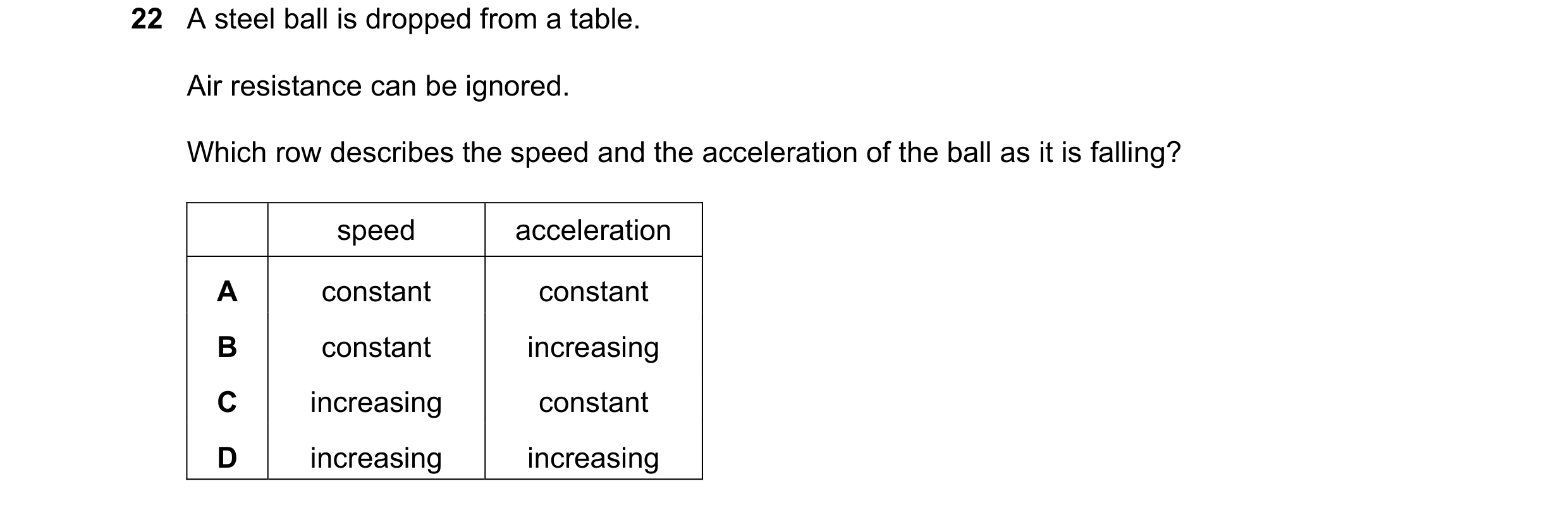
22 A steel ball is dropped from a table. Air resistance can be ignored. Which row describes the speed and the acceleration of the ball as it is falling? speed acceleration A constant constant B constant increasing C increasing constant D increasing increasing
1 marks
Answer: C
This question in 0652/22 Oct/Nov 2022
Q21 · An object of mass 2.5 kg is acted upon by two forces 0652/22 Oct/Nov 2022
24 An object of mass 2.5 kg is acted upon by two forces. Which arrangement of forces causes the object to accelerate at 4.0 m / s2? A B 3.0 N 10 N 5.0 N 10 N C D 5.0 N 20 N 10 N 20 N
1 marks
Answer: D
This question in 0652/22 Oct/Nov 2022
Q22 · A stool of weight 620 N has four legs 0652/22 Oct/Nov 2022
25 A stool of weight 620 N has four legs. The legs all have a square cross-section of side length 4.0 cm. The seat of the stool is a square of side length 36 cm, as shown. 36 cm 4.0 cm What is the pressure exerted on the floor by the legs of the stool? A 0.48 N / cm2 B 9.7 N / cm2 C 39 N / cm2 D 155 N / cm2
1 marks
Answer: B
This question in 0652/22 Oct/Nov 2022
Q23 · A pivot is placed under the 50 cm mark of a uniform metre rule 0652/21 Oct/Nov 2023
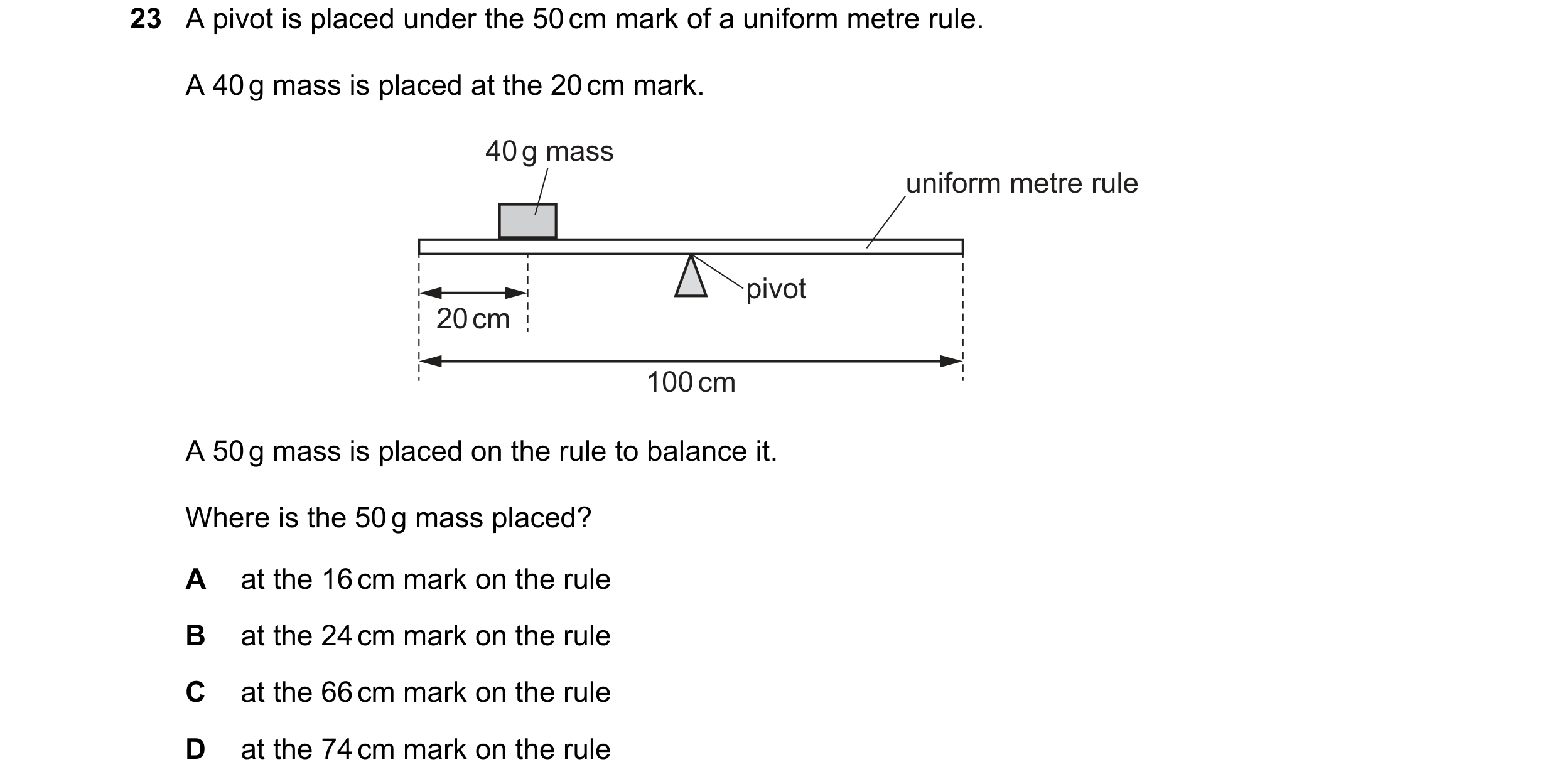
23 A pivot is placed under the 50 cm mark of a uniform metre rule. A 40 g mass is placed at the 20 cm mark. 40 g mass uniform metre rule pivot 20 cm 100 cm A 50 g mass is placed on the rule to balance it. Where is the 50 g mass placed? A at the 16 cm mark on the rule B at the 24 cm mark on the rule C at the 66 cm mark on the rule D at the 74 cm mark on the rule
1 marks
Answer: D
This question in 0652/21 Oct/Nov 2023
Q24 · A solid cube of mass 50 kg rests on a horizontal surface 0652/21 Oct/Nov 2023
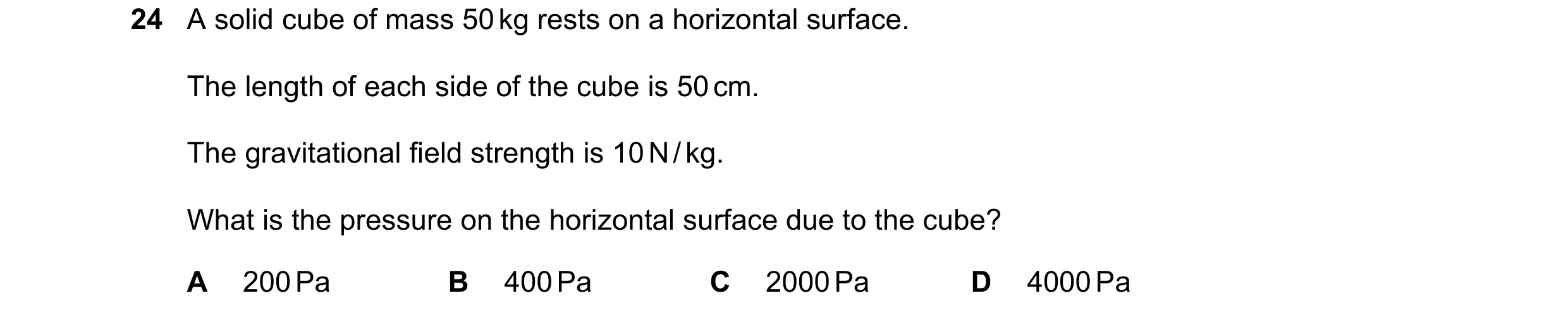
24 A solid cube of mass 50 kg rests on a horizontal surface. The length of each side of the cube is 50 cm. The gravitational field strength is 10 N / kg. What is the pressure on the horizontal surface due to the cube? A 200 Pa B 400 Pa C 2000 Pa D 4000 Pa
1 marks
Answer: C
This question in 0652/21 Oct/Nov 2023
Q25 · A pivot is placed under the 50 cm mark of a uniform metre rule 0652/22 Oct/Nov 2023
23 A pivot is placed under the 50 cm mark of a uniform metre rule. A 40 g mass is placed at the 20 cm mark. 40 g mass uniform metre rule pivot 20 cm 100 cm A 50 g mass is placed on the rule to balance it. Where is the 50 g mass placed? A at the 16 cm mark on the rule B at the 24 cm mark on the rule C at the 66 cm mark on the rule D at the 74 cm mark on the rule
1 marks
Answer: D
This question in 0652/22 Oct/Nov 2023
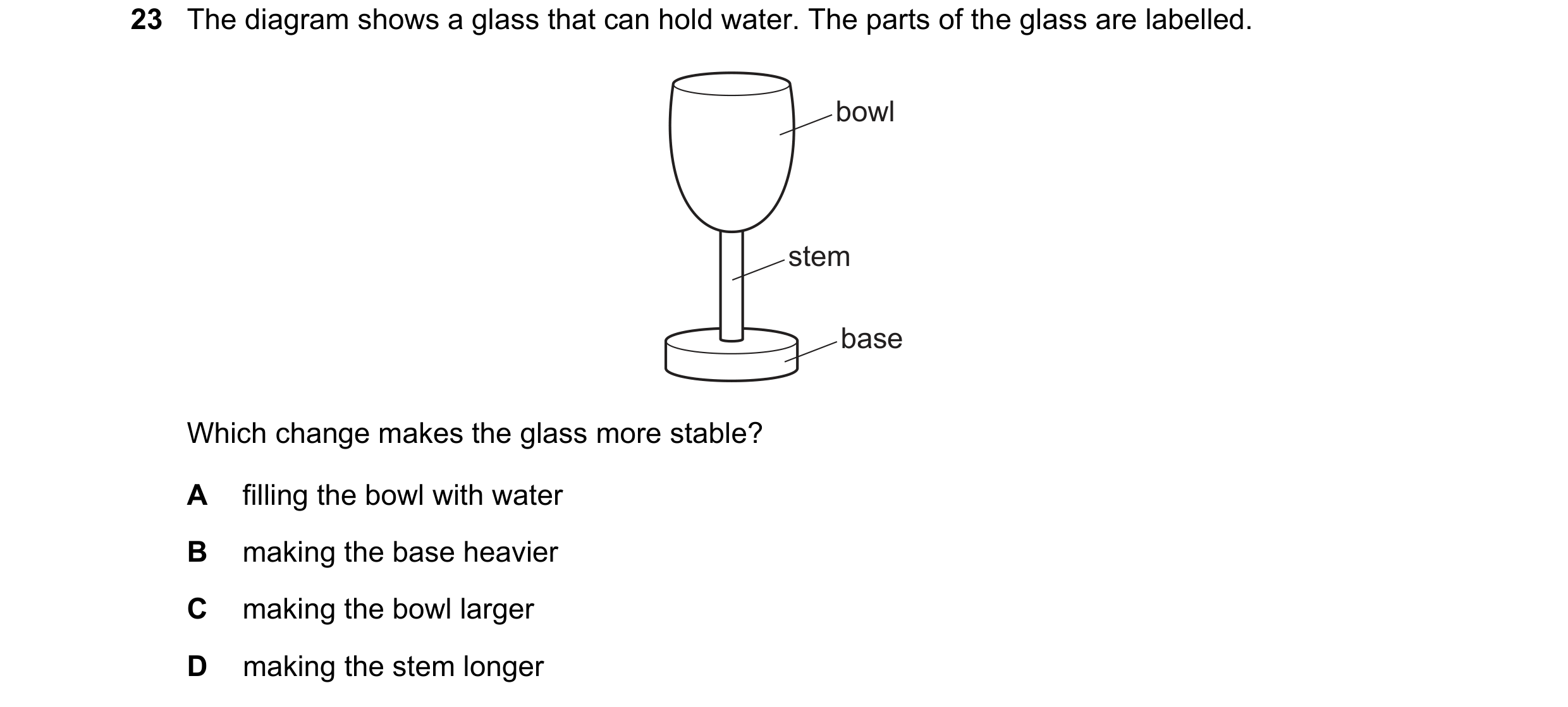
Q26 · The diagram shows a glass that can hold water 0652/21 Oct/Nov 2024
23 The diagram shows a glass that can hold water. The parts of the glass are labelled. bowl stem base Which change makes the glass more stable? A filling the bowl with water B making the base heavier C making the bowl larger D making the stem longer
1 marks
Answer: B
This question in 0652/21 Oct/Nov 2024
 1 / 9
1 / 9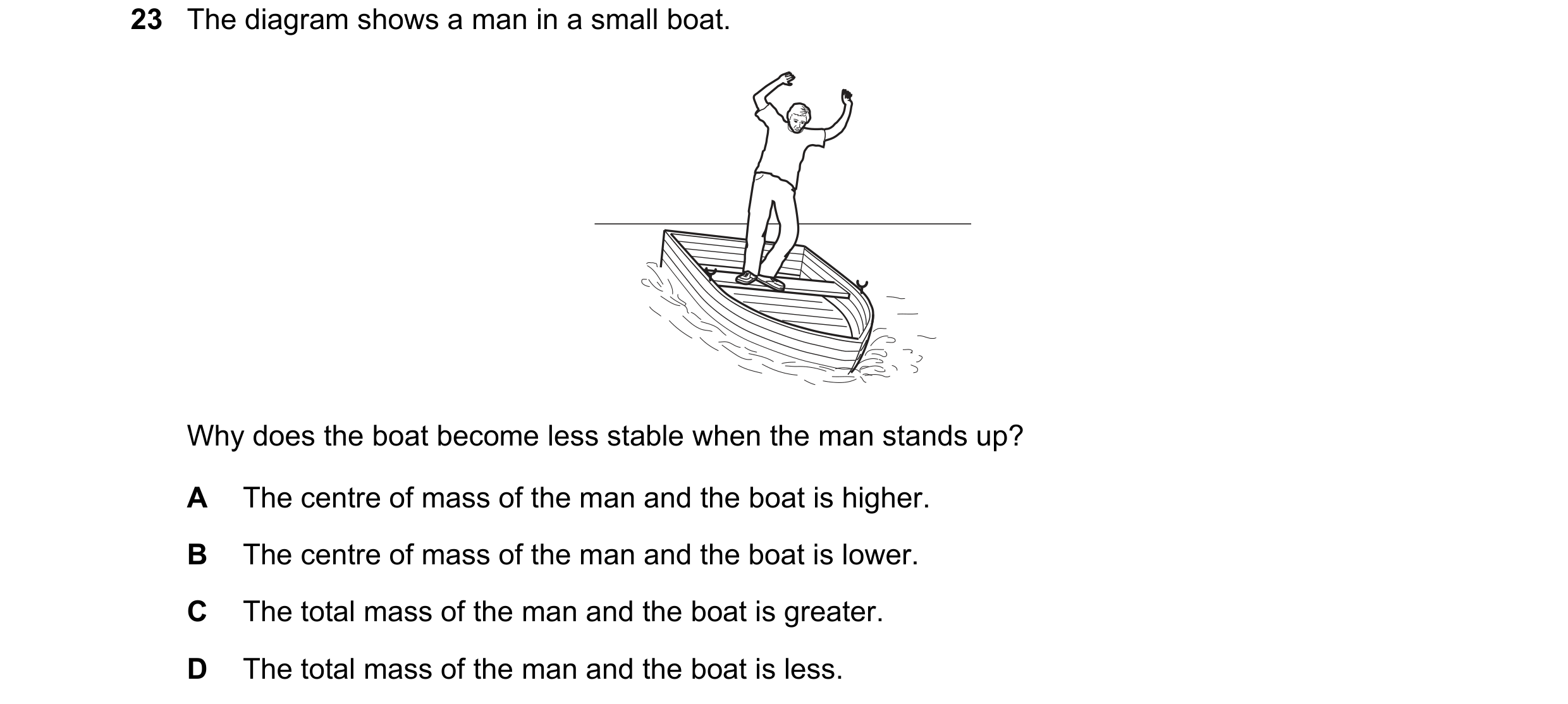
 2 / 9
2 / 9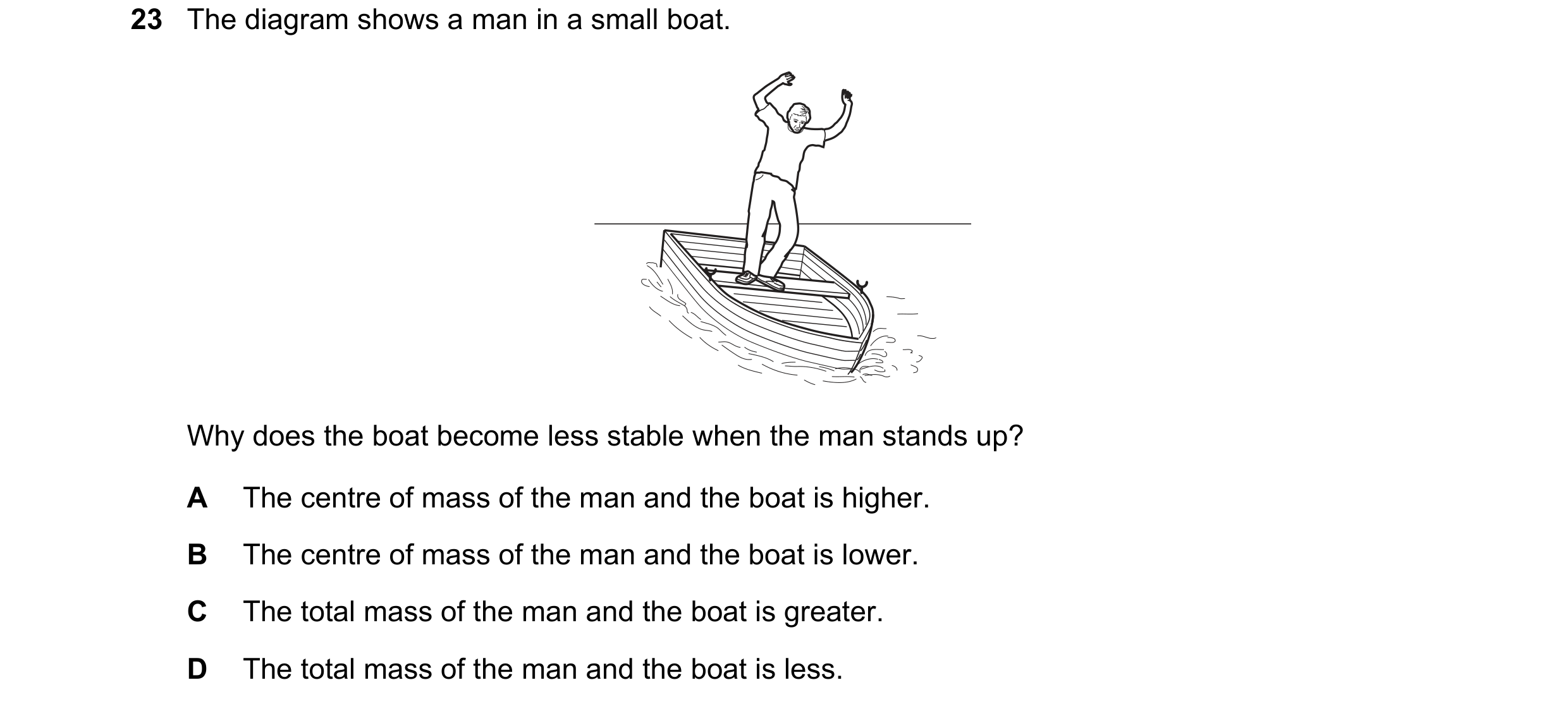
 3 / 9
3 / 9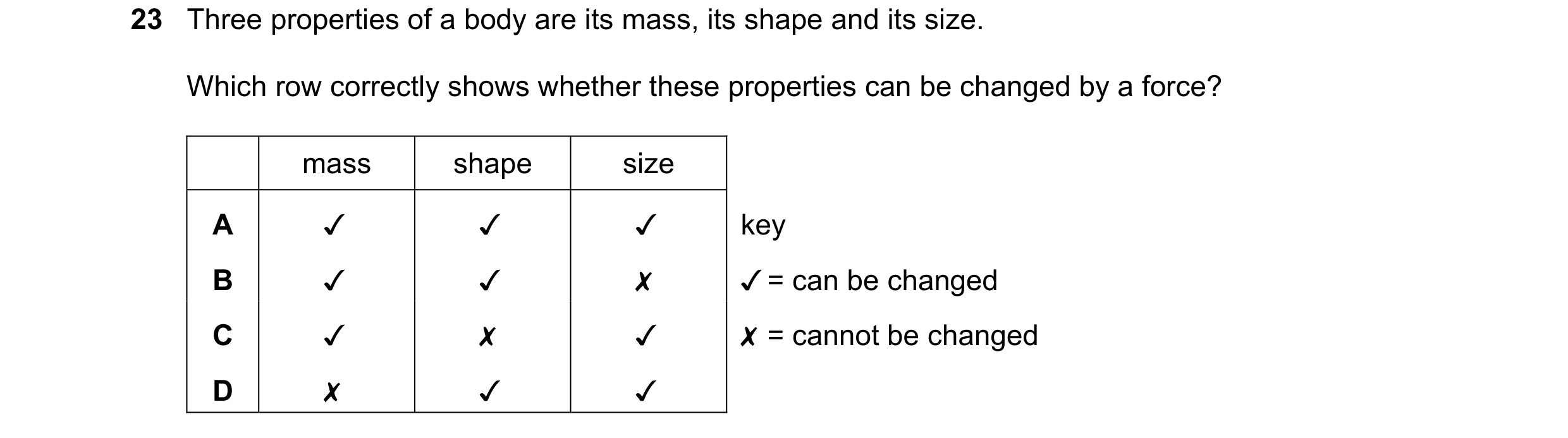
 4 / 9
4 / 9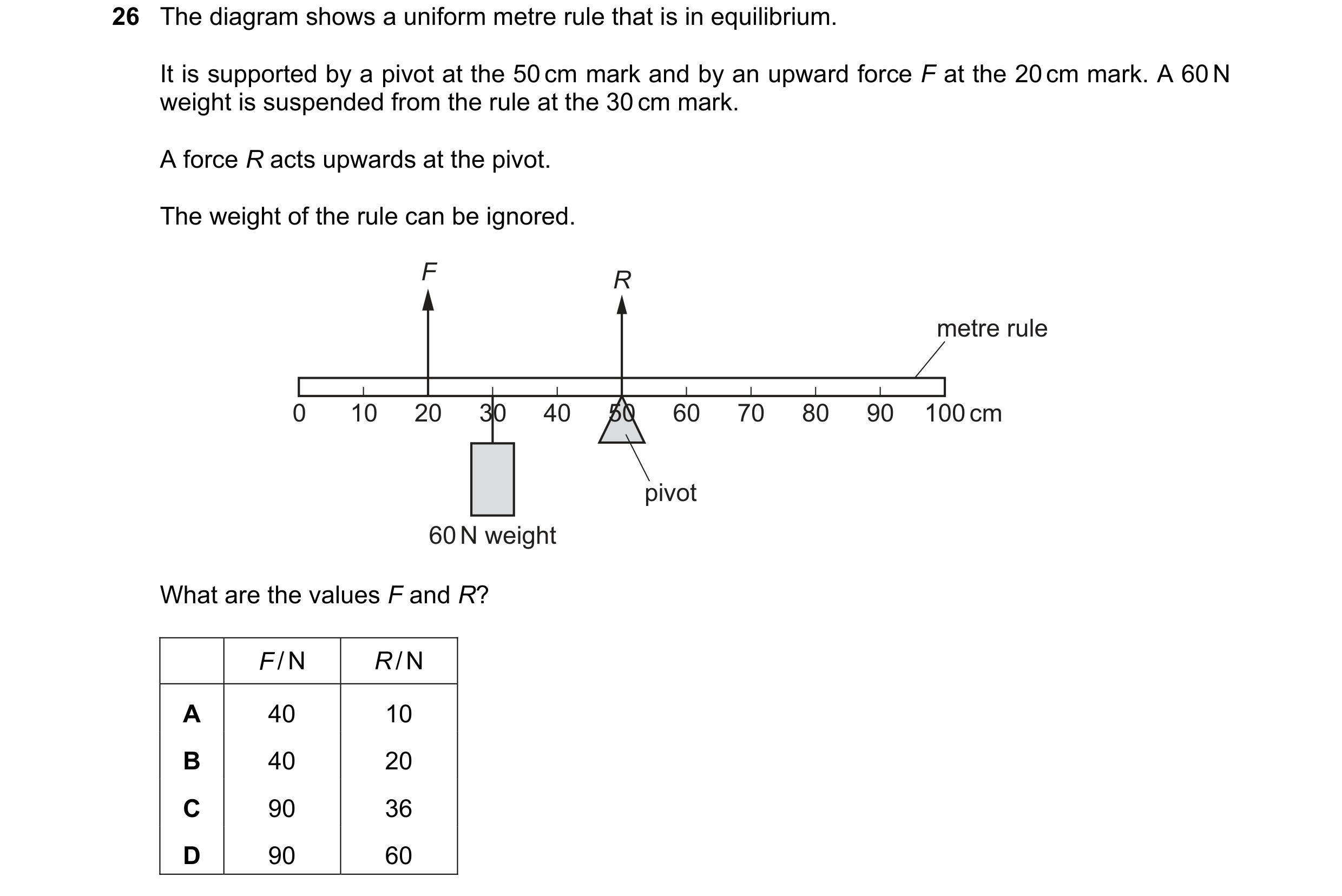
 5 / 9
5 / 9
 6 / 9
6 / 9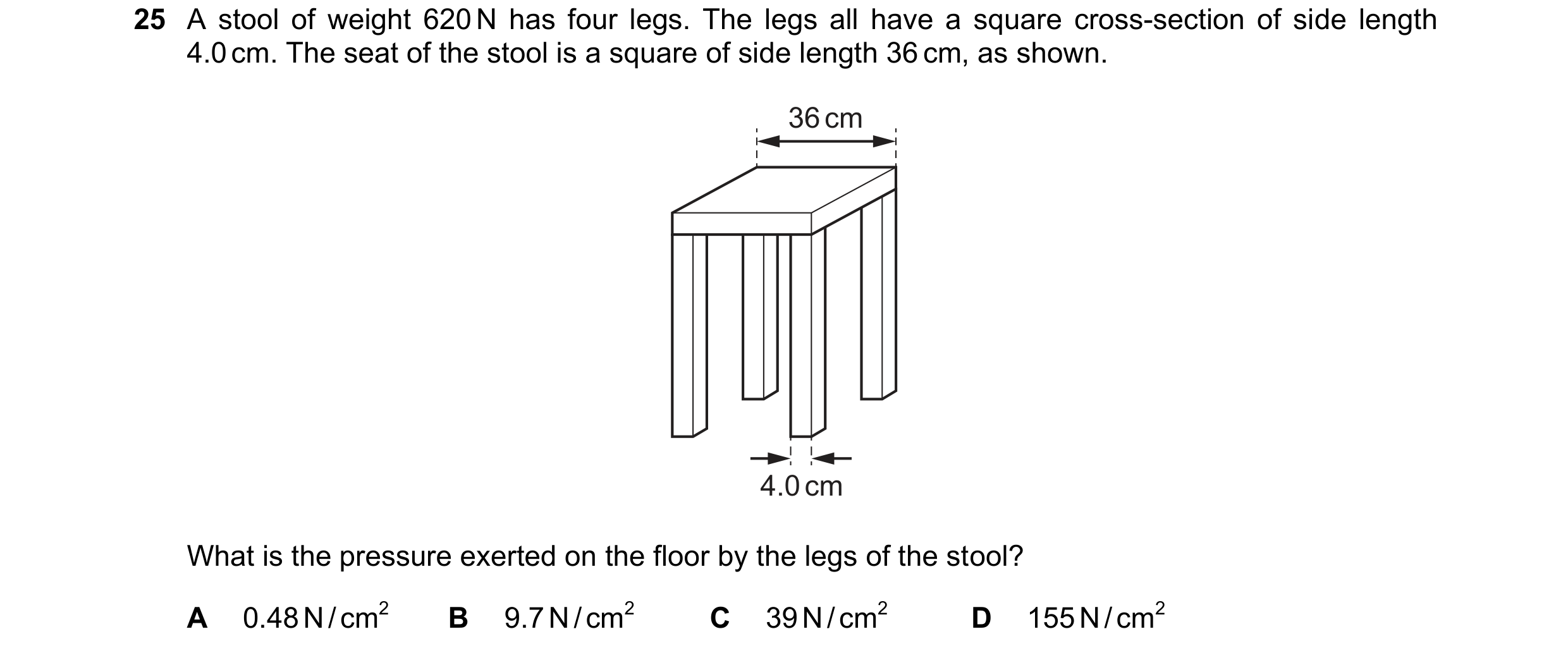
 7 / 9
7 / 9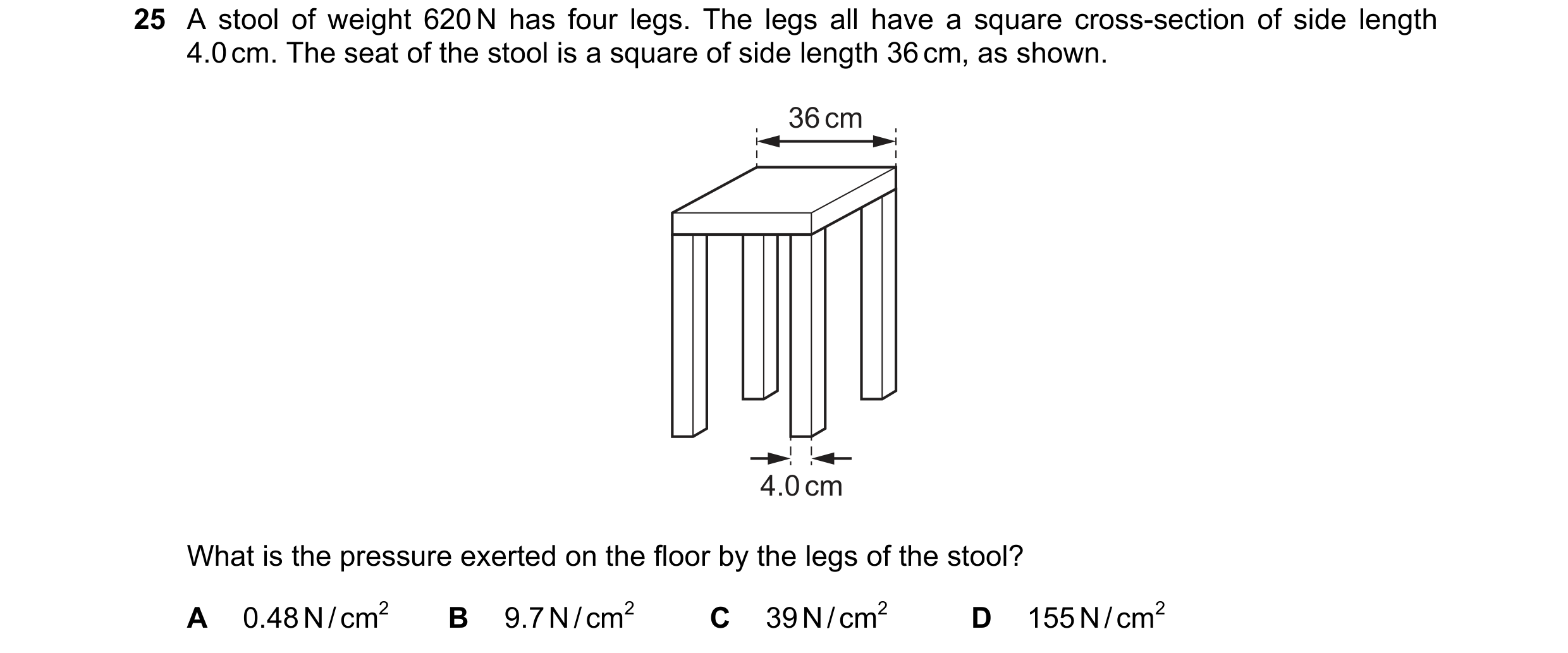
 8 / 9
8 / 9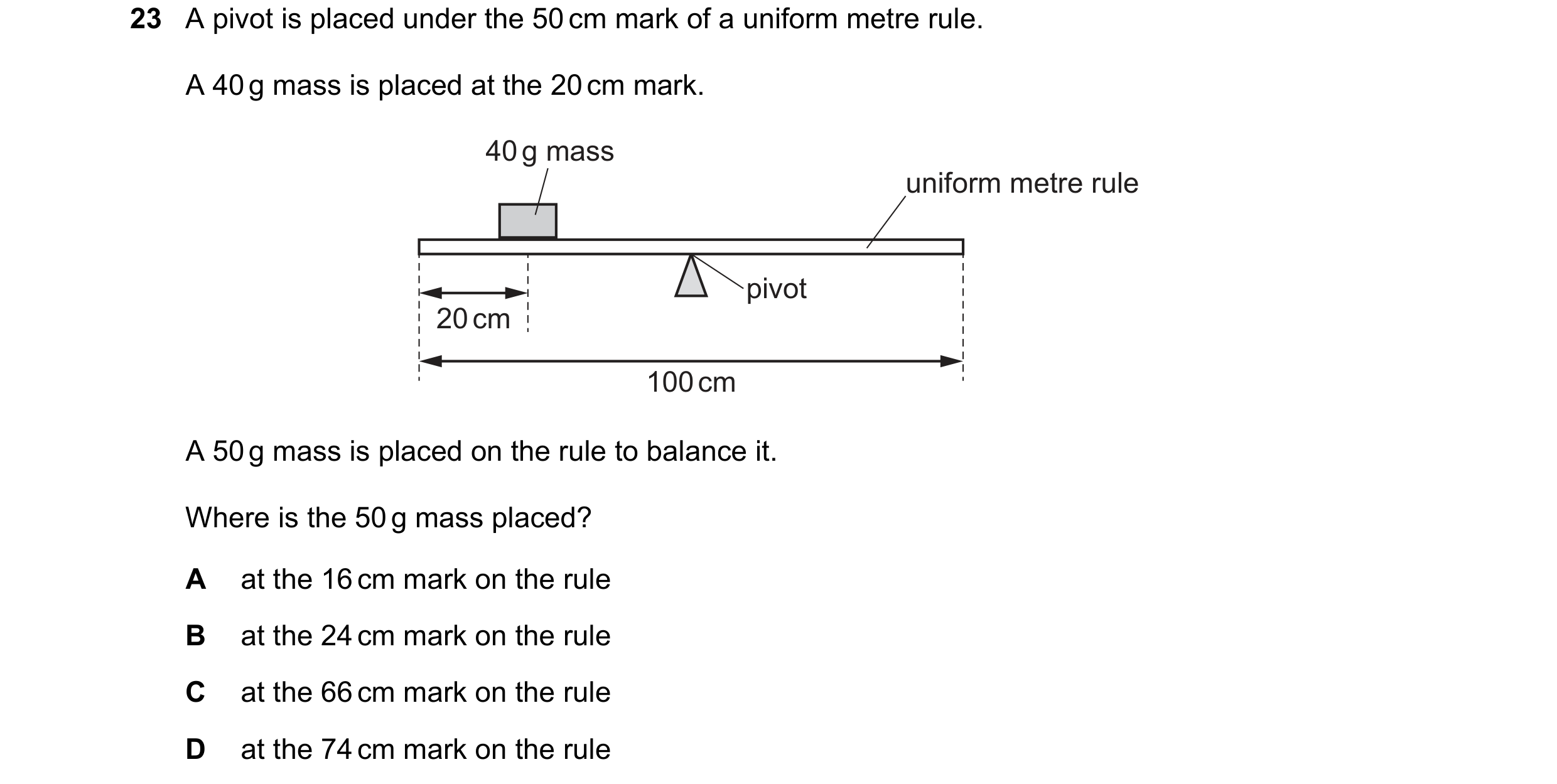
 9 / 9
9 / 9