Questions as text
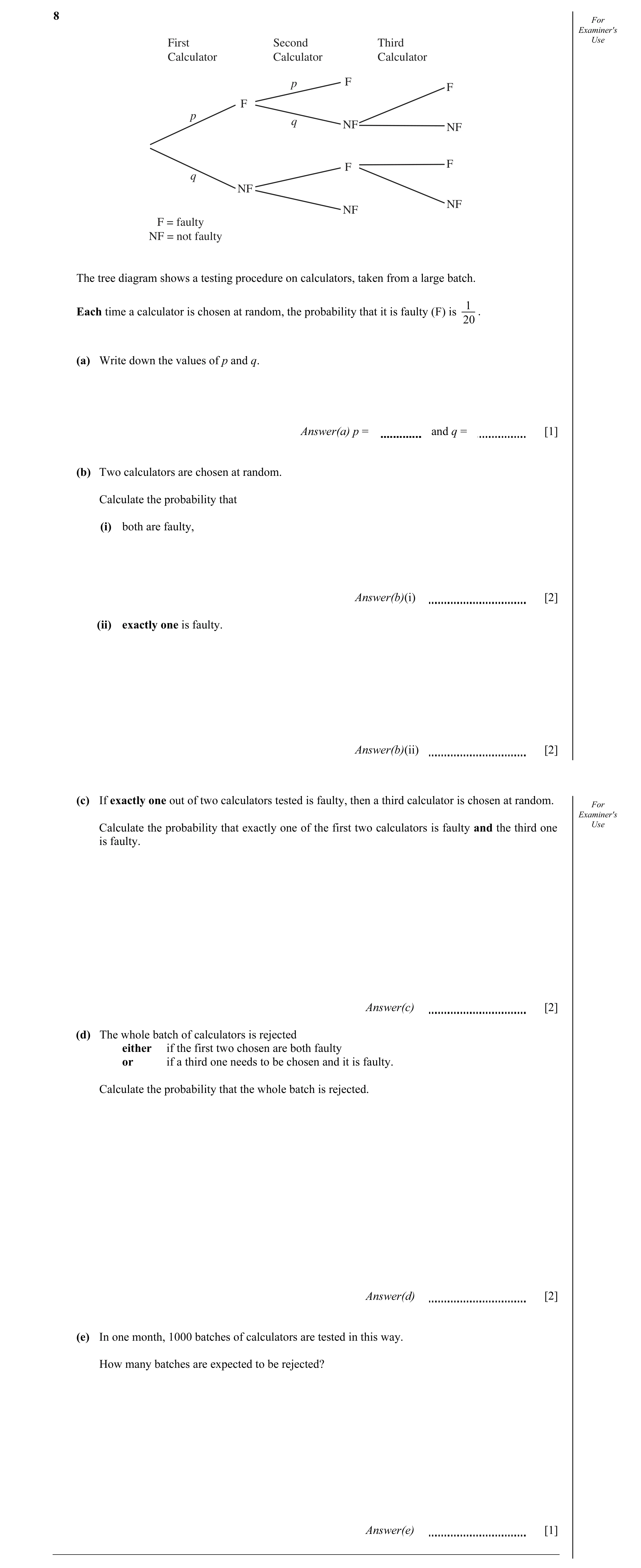
Q1 · For Examiner's First Second Third Use Calculator Calculator Calculator p F F F p q NF NF… 0580/41 May/June 2009
8 For Examiner's First Second Third Use Calculator Calculator Calculator p F F F p q NF NF F F q NF NF NF F = faulty NF = not faulty The tree diagram shows a testing procedure on calculators, taken from a large batch. 1 Each time a calculator is chosen at random, the probability that it is faulty (F) is . 20 (a) Write down the values of p and q. Answer(a) p = and q = [1] (b) Two calculators are chosen at random. Calculate the probability that (i) both are faulty, Answer(b)(i) [2] (ii) exactly one is faulty. Answer(b)(ii) [2] (c) If exactly one out of two calculators tested is faulty, then a third calculator is chosen at random. For Examiner's Calculate the probability that exactly one of the first two calculators is faulty and the third one Use is faulty. Answer(c) [2] (d) The whole batch of calculators is rejected either if the first two chosen are both faulty or if a third one needs to be chosen and it is faulty. Calculate the probability that the whole batch is rejected. Answer(d) [2] (e) In one month, 1000 batches of calculators are tested in this way. How many batches are expected to be rejected? Answer(e) [1]
10 marks
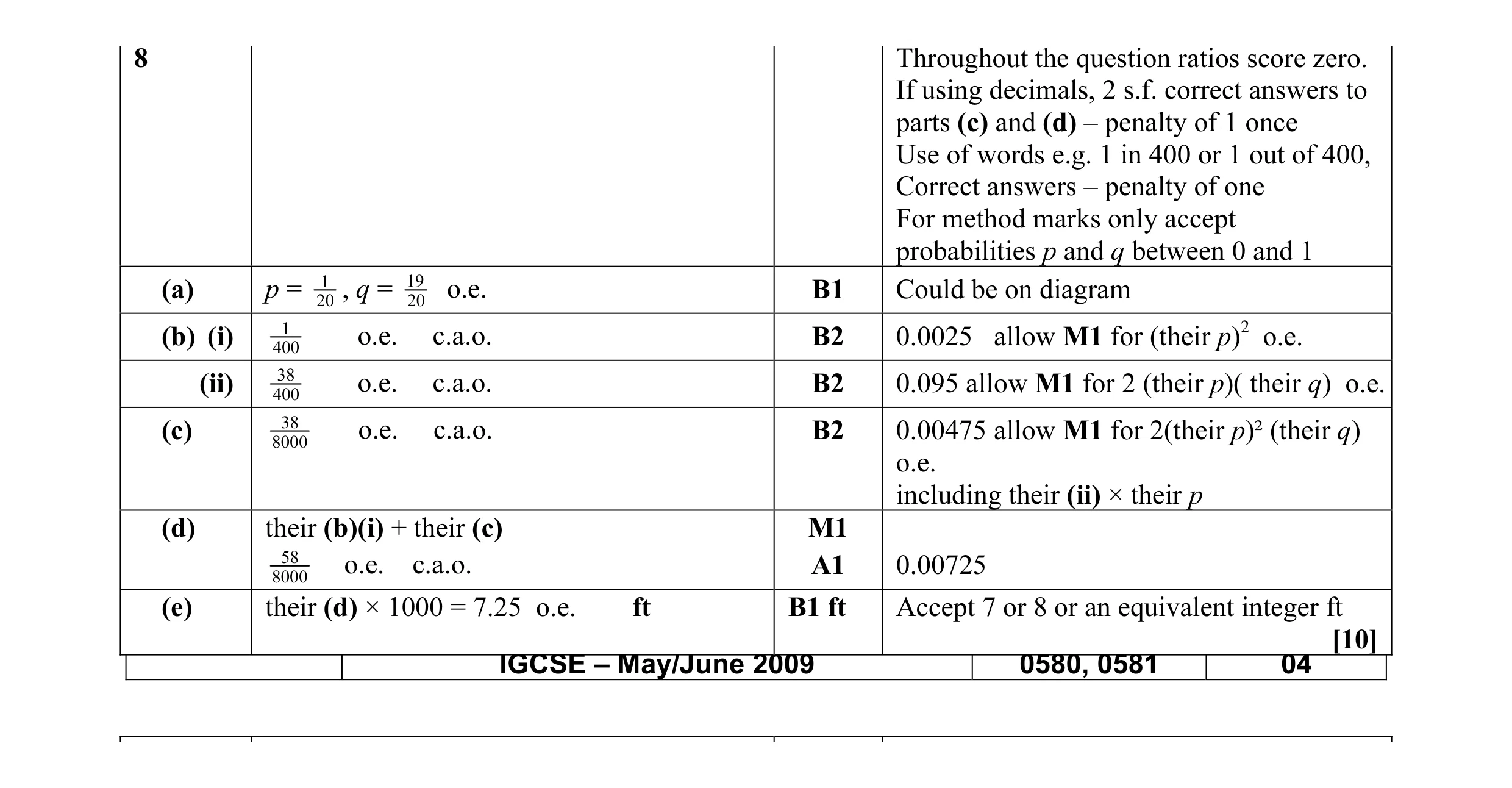
Mark scheme: 8 Throughout the question ratios score zero. If using decimals, 2 s.f. correct answers to parts (c) and (d) – penalty of 1 once Use of words e.g. 1 in 400 or 1 out of 400, Correct answers – penalty of one For method marks only accept probabilities p and q between 0 and 1 (a) p = 201 , q = 1920 o.e. B1 Could be on diagram (b) (i) 4001 o.e. c.a.o. B2 0.0025 allow M1 for (their p)2 o.e. (ii) 40038 o.e. c.a.o. B2 0.095 allow M1 for 2 (their p)( their q) o.e. (c) 800038 o.e. c.a.o. B2 0.00475 allow M1 for 2(their p)² (their q) o.e. including their (ii) × their p (d) their (b)(i) + their (c) M1 58 o.e. c.a.o. A1 0.00725 8000 (e) their (d) × 1000 = 7.25 o.e. ft B1 ft Accept 7 or 8 or an equivalent integer ft [10] IGCSE – May/June 2009 0580, 0581 04
This question in 0580/41 May/June 2009
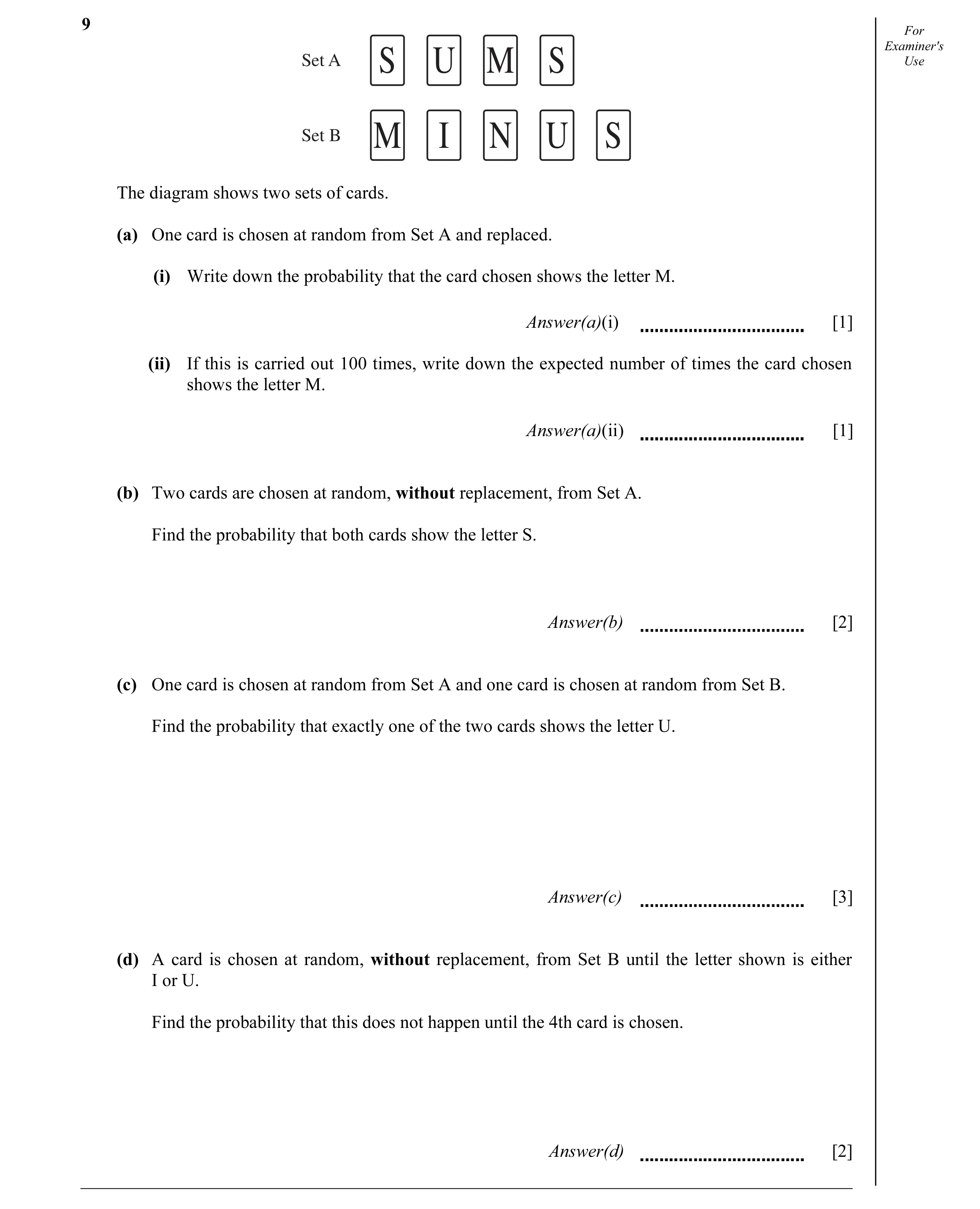
Q2 · For Examiner's Set A Use S U M S Set B M I N U S The diagram shows two sets of cards 0580/43 Oct/Nov 2011
9 For Examiner's Set A Use S U M S Set B M I N U S The diagram shows two sets of cards. (a) One card is chosen at random from Set A and replaced. (i) Write down the probability that the card chosen shows the letter M. Answer(a)(i) [1] (ii) If this is carried out 100 times, write down the expected number of times the card chosen shows the letter M. Answer(a)(ii) [1] (b) Two cards are chosen at random, without replacement, from Set A. Find the probability that both cards show the letter S. Answer(b) [2] (c) One card is chosen at random from Set A and one card is chosen at random from Set B. Find the probability that exactly one of the two cards shows the letter U. Answer(c) [3] (d) A card is chosen at random, without replacement, from Set B until the letter shown is either I or U. Find the probability that this does not happen until the 4th card is chosen. Answer(d) [2]
9 marks
Mark scheme: 9 Accept fraction, %, dec equivalents (3sf or better when not exact) throughout but not ratio or words isw incorrect cancelling/conversion to other forms 1 (a) (i) oe 1 4 1 (ii) 25 cao 1ft ft their × 100 to 3sf or better or rounding or 4 truncating to integer Not 25/100 2 2 1 (b) oe cao 2 M1 for × 0.167, 16.7% 12 4 3 7 1 4 3 1 (c) oe cao 3 M2 for × + × 20 4 5 4 5 1 4 3 1 or M1 for × or × 4 5 4 5 After 0, SC1 for 7 correct in list (condone UU in addition) 6 3 2 1 2 (d) oe cao 2 M1 for × × × 60 5 4 3 2
This question in 0580/43 Oct/Nov 2011
Q3 · Kiah plays a game 0580/42 May/June 2016
5 Kiah plays a game. The game involves throwing a coin onto a circular board. Points are scored for where the coin lands on the board. 5 10 20 If the coin lands on part of a line or misses the board then 0 points are scored. The table shows the probabilities of Kiah scoring points on the board with one throw. Points scored 20 10 5 0 Probability x 0.2 0.3 0.45 (a) Find the value of x. x = … [2] (b) Kiah throws a coin fifty times. Work out the expected number of times she scores 5 points. … [1] (c) Kiah throws a coin two times. Calculate the probability that (i) she scores either 5 or 0 with her first throw, … [2] (ii) she scores 0 with her first throw and 5 with her second throw, … [2] (iii) she scores a total of 15 points with her two throws. … [3] (d) Kiah throws a coin three times. Calculate the probability that she scores a total of 10 points with her three throws. … [5]
15 marks
Mark scheme: 5 (a) 0.05 oe 2 M1 for 1 – (0.2 + 0.3 + 0.45) oe (b) 15 1 (c) (i) 0.75 oe 2 M1 for 0.45 + 0.3 oe (ii) 0.135 oe 2 M1 for 0.45 × 0.3 oe (iii) 0.12 oe 3 M2 for 2(0.3 × 0.2) oe or M1 for 0.3 × 0.2 or 0.06 oe nfww (d) 0.243 oe 5 M4 for 3(0.45 × 0.45 × 0.2) + 3(0.3 × 0.3 × 0.45) oe or M3 for 3(0.45 × 0.45 × 0.2) or 3(0.3 × 0.3 × 0.45) oe or M2 for 0.45 × 0.45 × 0.2 and 0.3 × 0.3 × 0.45 or M1 for 0.45 × 0.45 × 0.2 or 0.3 × 0.3 × 0.45 oe or for identifying the correct 6 outcomes e.g. 10 0 0, 0 0 10, 0 10 0, 5 5 0, 5 0 5, 0 5 5
This question in 0580/42 May/June 2016
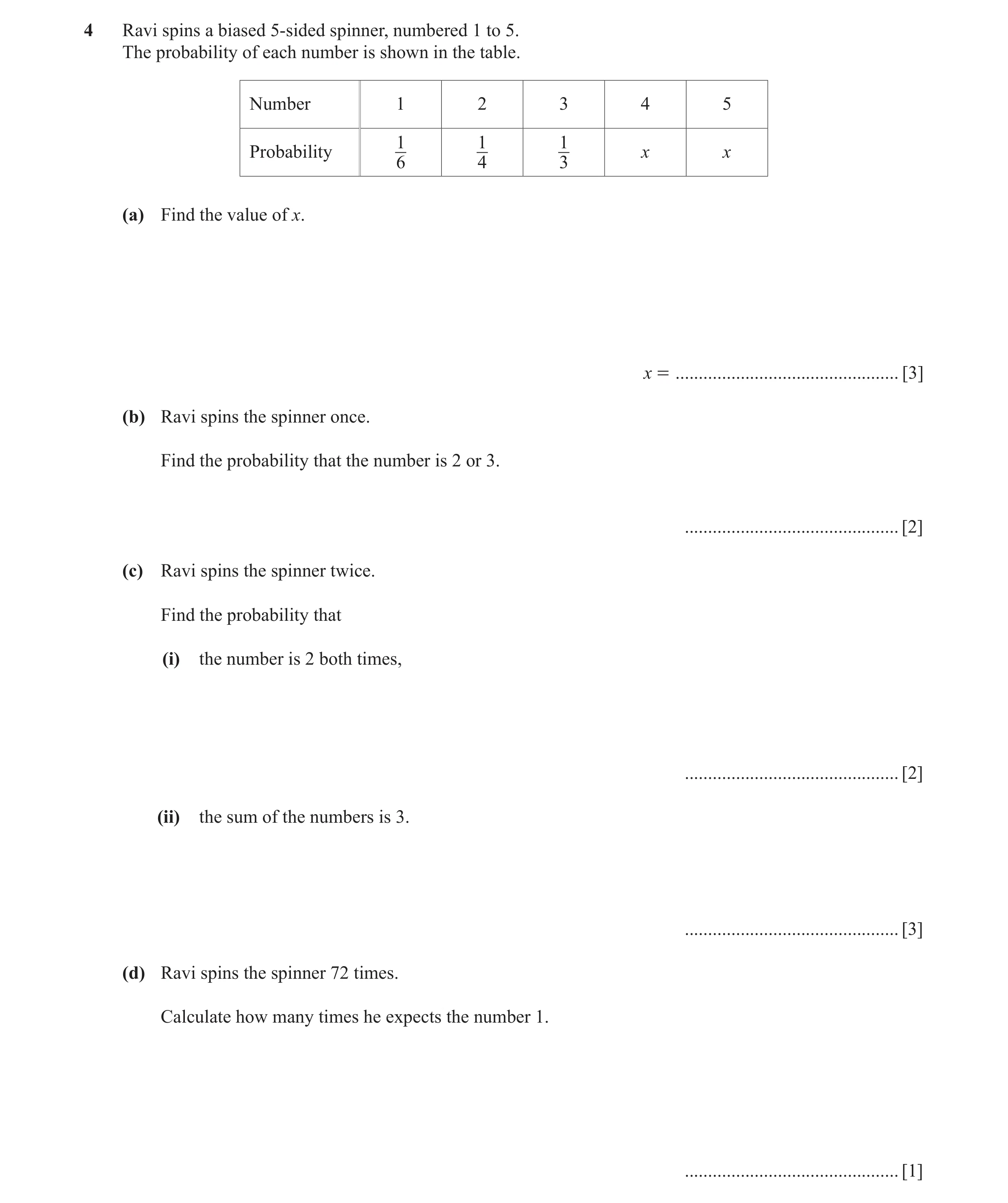
Q4 · Ravi spins a biased 5-sided spinner, numbered 1 to 5 0580/42 Feb/March 2017
4 Ravi spins a biased 5-sided spinner, numbered 1 to 5. The probability of each number is shown in the table. Number 1 2 3 4 5 1 1 1 Probability x x 6 4 3 (a) Find the value of x. x = … [3] (b) Ravi spins the spinner once. Find the probability that the number is 2 or 3. … [2] (c) Ravi spins the spinner twice. Find the probability that (i) the number is 2 both times, … [2] (ii) the sum of the numbers is 3. … [3] (d) Ravi spins the spinner 72 times. Calculate how many times he expects the number 1. … [1]
11 marks
Mark scheme: 1 1 1 1 1 4 (a) oe 3 M2 for 1 − − − oe 8 2 6 4 3 1 1 1 or M1 for + + seen oe or idea that 6 4 3 all sum to 1 7 1 1 (b) oe 2 M1 for + oe 12 3 4 1 1 1 (c) (i) oe 2 M1 for × oe 16 4 4 2 1 1 (ii) oe 3 M2 for 2 × × oe 24 6 4 1 1 or M1 for × oe 6 4 (d) 12 1
This question in 0580/42 Feb/March 2017
Q5 · Haroon has 200 letters to post 0580/43 May/June 2017
5 (a) Haroon has 200 letters to post. The histogram shows information about the masses, m grams, of the letters. 8 7 6 5 Frequency density 4 3 2 1 0 m 0 10 20 30 40 50 Mass (grams) (i) Complete the frequency table for the 200 letters. Mass (m grams) 0 1 m G 10 10 1 m G 20 20 1 m G 25 25 1 m G 30 30 1 m G 50 Frequency 50 17 [3] (ii) Calculate an estimate of the mean mass. … g [4] (b) Haroon has 15 parcels to post. The table shows information about the sizes of these parcels. Size Small Large Frequency 9 6 Two parcels are selected at random. Find the probability that (i) both parcels are large, … [2] (ii) one parcel is small and the other is large. … [3] 3(c) The probability that a parcel arrives late is . 80 4000 parcels are posted. Calculate an estimate of the number of parcels expected to arrive late. … [1]
13 marks
Mark scheme: 5(a)(i) 80 33 20 1, 1, 1 5(a)(ii) 17.3 nfww 4 M1 for 5, 15, 22.5, 27.5, 40 soi M1 for ∑fx with their f’s and x in correct interval including both boundaries M1 (dep on 2nd M1) for ∑fx ÷ 200 5(b)(i) 30 2 6 5 oe M1 for × 210 15 14 36 If zero scored, SC1 for answer oe 225 5(b)(ii) 108 3 6 9 9 6 oe M2 for × + × oe 210 15 14 15 14 9 8 6 5 or 1 – × − × 15 14 15 14 6 9 9 6 or M1 for × or × 15 14 15 14 9 8 6 5 or × + × 15 14 15 14 108 If zero scored, SC1 for answer oe 225 5(c) 150 1
This question in 0580/43 May/June 2017
Q6 · A bag contains red beads and green beads 0580/41 Oct/Nov 2017
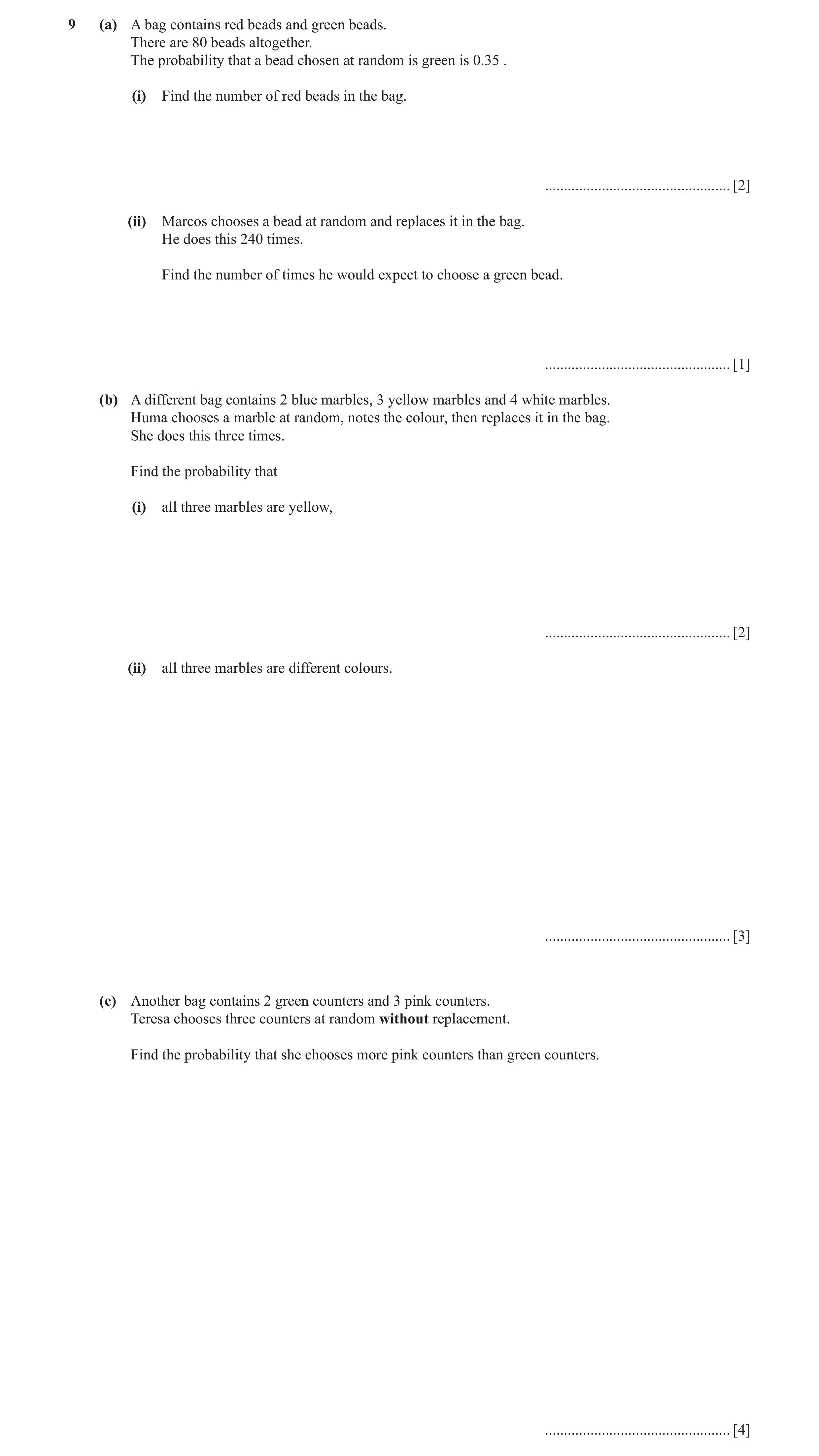
9 (a) A bag contains red beads and green beads. There are 80 beads altogether. The probability that a bead chosen at random is green is 0.35 . (i) Find the number of red beads in the bag. … [2] (ii) Marcos chooses a bead at random and replaces it in the bag. He does this 240 times. Find the number of times he would expect to choose a green bead. … [1] (b) A different bag contains 2 blue marbles, 3 yellow marbles and 4 white marbles. Huma chooses a marble at random, notes the colour, then replaces it in the bag. She does this three times. Find the probability that (i) all three marbles are yellow, … [2] (ii) all three marbles are different colours. … [3] (c) Another bag contains 2 green counters and 3 pink counters. Teresa chooses three counters at random without replacement. Find the probability that she chooses more pink counters than green counters. … [4]
12 marks
Mark scheme: 9(a)(i) 52 2 M1 for (1 – 0.35) × 80 oe 9(a)(ii) 84 1 9(b)(i) 27 2 3 3 3 oe M1 for × × 729 9 9 9 9(b)(ii) 144 3 2 3 4 oe M2 for × × × 6 oe 729 9 9 9 2 3 4 or M1 for × × oe isw 9 9 9 9(c) 42 4 3 2 1 3 2 2 oe M3 for × × + × × × 3 oe 60 5 4 3 5 4 3 3 2 2 or M2 for × × × 3 oe 5 4 3 3 2 1 3 2 2 or for × × + × × [× 2] 5 4 3 5 4 3 3 2 1 3 2 2 or M1 for × × or × × oe isw 5 4 3 5 4 3 or for PPG, PGP, GPP and PPP selected soi
This question in 0580/41 Oct/Nov 2017
Q7 · 0 1 0 1 1 2 A B The diagram shows two fair dice 0580/42 Oct/Nov 2017
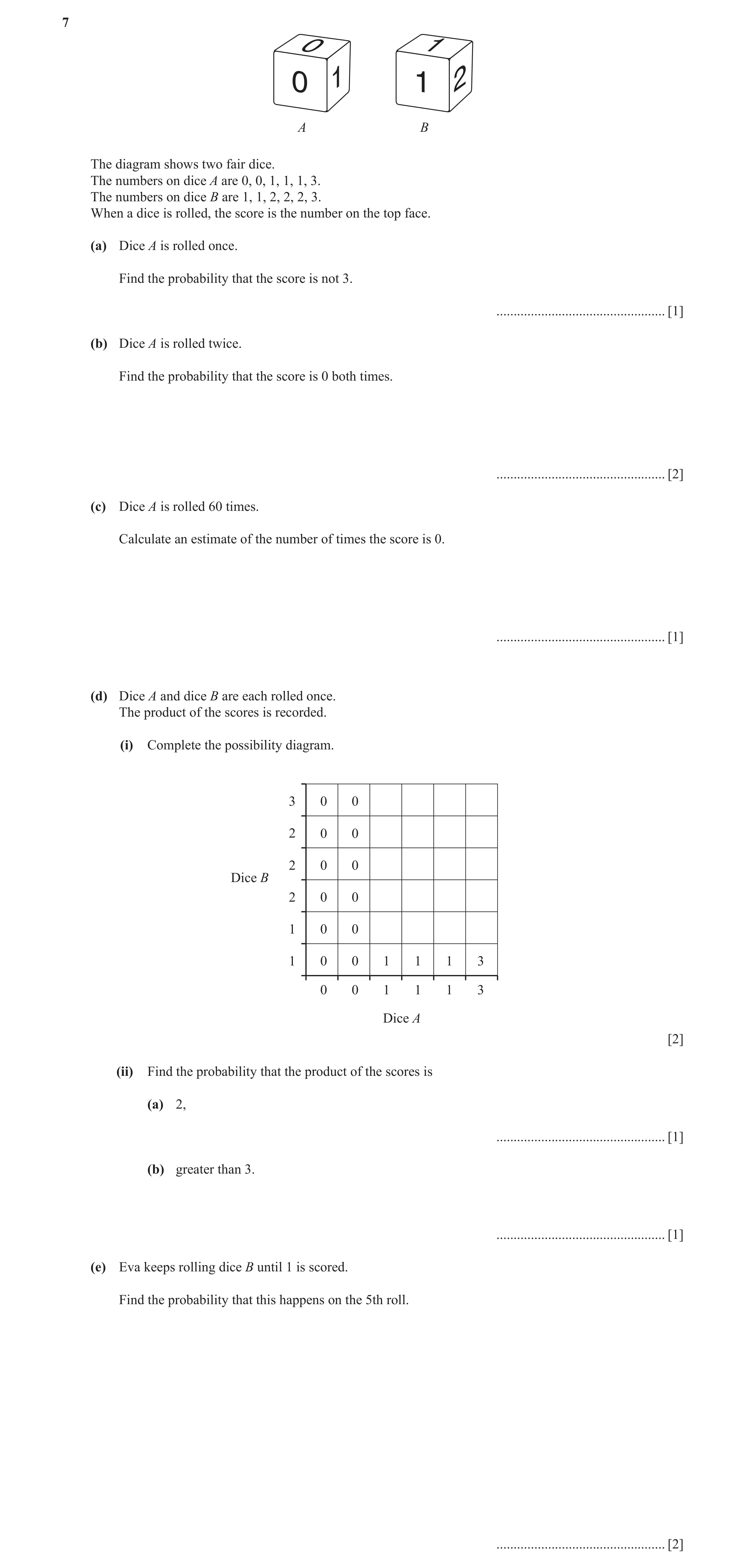
7 0 1 0 1 1 2 A B The diagram shows two fair dice. The numbers on dice A are 0, 0, 1, 1, 1, 3. The numbers on dice B are 1, 1, 2, 2, 2, 3. When a dice is rolled, the score is the number on the top face. (a) Dice A is rolled once. Find the probability that the score is not 3. … [1] (b) Dice A is rolled twice. Find the probability that the score is 0 both times. … [2] (c) Dice A is rolled 60 times. Calculate an estimate of the number of times the score is 0. … [1] (d) Dice A and dice B are each rolled once. The product of the scores is recorded. (i) Complete the possibility diagram. 3 0 0 2 0 0 2 0 0 Dice B 2 0 0 1 0 0 1 0 0 1 1 1 3 0 0 1 1 1 3 Dice A [2] (ii) Find the probability that the product of the scores is (a) 2, … [1] (b) greater than 3. … [1] (e) Eva keeps rolling dice B until 1 is scored. Find the probability that this happens on the 5th roll. … [2]
10 marks
Mark scheme: 7(a) 5 1 6 7(b) 4 2 2 2 oe M1 for × 36 6 6 7(c) 20 1 7(d)(i) Diagram completed correctly 2 B1 for 3 correct columns or for 4 correct rows x x 3 3 3 9 x x 2 2 2 6 x x 2 2 2 6 x x 2 2 2 6 x x 1 1 1 3 7(d)(ii)(a) 9 1FT FT their (d)(i) oe 36 7(d)(ii)(b) 4 1FT FT their (d)(i) oe 36 7(e) 512 2 4 k 2 oe M1 for oe k = 3, 4 or 5 only × 7776 6 6
This question in 0580/42 Oct/Nov 2017
Q8 · Suleika has six cards numbered 1 to 6 0580/42 Feb/March 2020
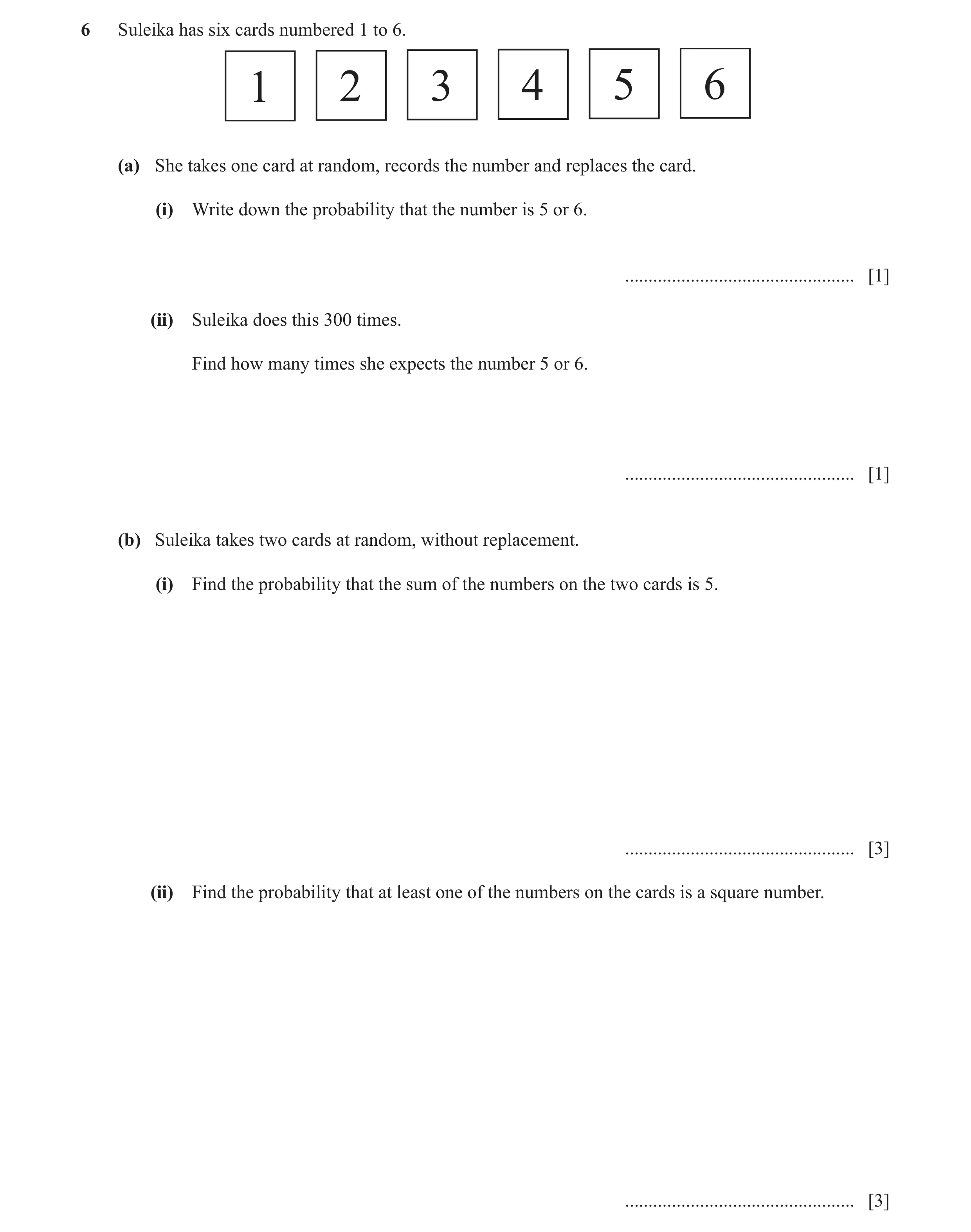
6 Suleika has six cards numbered 1 to 6. 1 2 3 4 5 6 (a) She takes one card at random, records the number and replaces the card. (i) Write down the probability that the number is 5 or 6. … [1] (ii) Suleika does this 300 times. Find how many times she expects the number 5 or 6. … [1] (b) Suleika takes two cards at random, without replacement. (i) Find the probability that the sum of the numbers on the two cards is 5. … [3] (ii) Find the probability that at least one of the numbers on the cards is a square number. … [3]
8 marks
Mark scheme: 6(a)(i) 1 1 oe 3 6(a)(ii) 100 1 FT their (a)(i) × 300 to at least 3 sf or rounded to the nearest integer 6(b)(i) 2 3 1 1 oe M2 for 4 × × oe 15 6 5 1 1 or M1 for k × oe 6 5 or list or indication of 4 correct pairs 6(b)(ii) 3 3 4 3 oe M2 for 1 – × 5 6 5 2 4 2 1 or 2 × + × oe 6 5 6 5 2 4 2 or + × oe 6 6 5 4 3 2 4 or M1 for × oe seen or × [× 2 ] oe 6 5 6 5 seen 2 1 or × oe seen 6 5 or correct identification of 18 pairs or space diagram oe
This question in 0580/42 Feb/March 2020
Q9 · A shop gives each of 1000 people a voucher 0580/42 Feb/March 2021
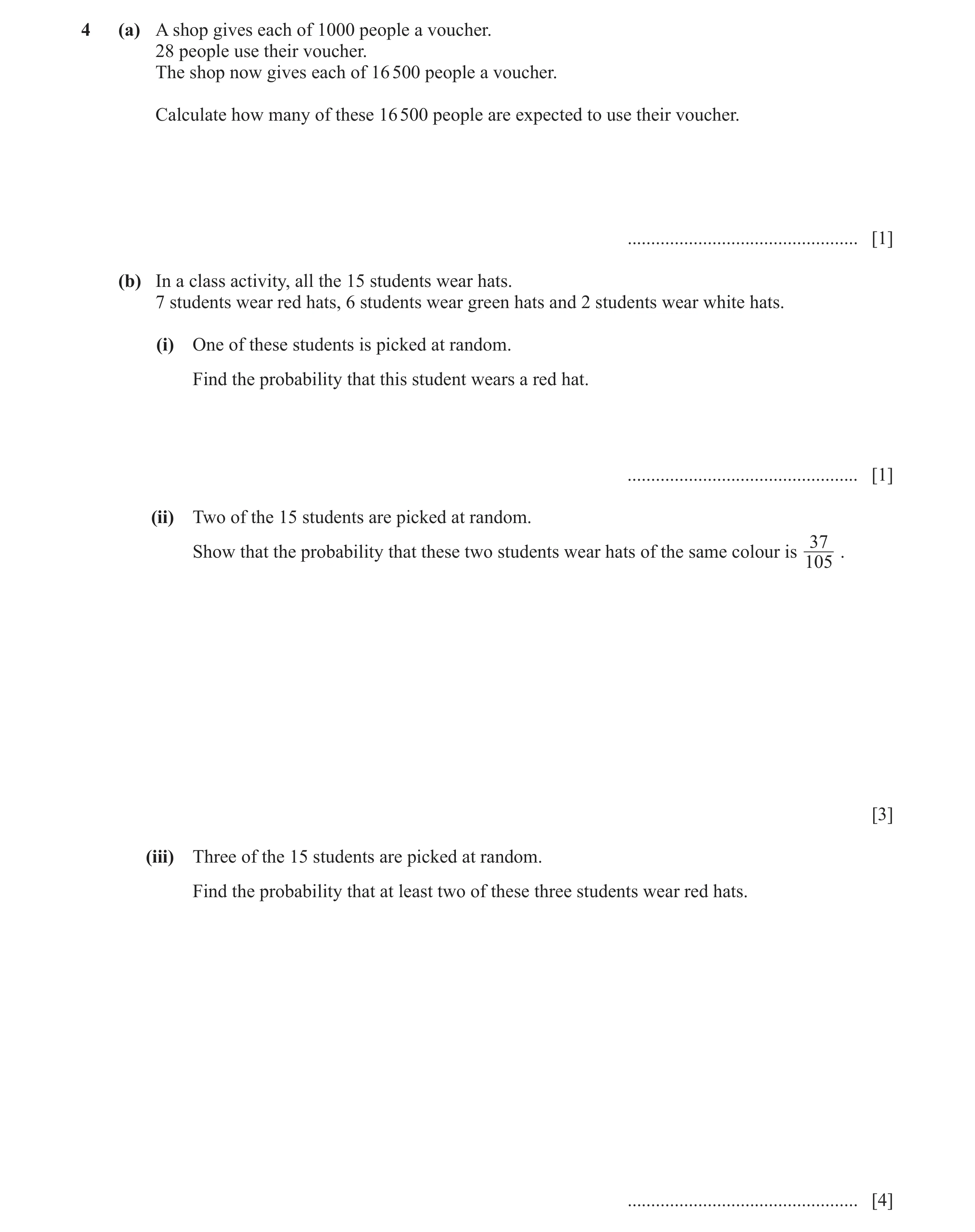
4 (a) A shop gives each of 1000 people a voucher. 28 people use their voucher. The shop now gives each of 16 500 people a voucher. Calculate how many of these 16 500 people are expected to use their voucher. … [1] (b) In a class activity, all the 15 students wear hats. 7 students wear red hats, 6 students wear green hats and 2 students wear white hats. (i) One of these students is picked at random. Find the probability that this student wears a red hat. … [1] (ii) Two of the 15 students are picked at random. 37 Show that the probability that these two students wear hats of the same colour is . 105 [3] (iii) Three of the 15 students are picked at random. Find the probability that at least two of these three students wear red hats. … [4]
9 marks
Mark scheme: 4(a) 462 1 4(b)(i) 7 1 oe 15 4(b)(ii) 7 6 6 5 2 1 3 M2 for addition of two of × + × + × 7 6 6 5 2 1 15 14 15 14 15 14 × + × + × 37 15 14 15 14 15 14 = or M1 for one of the products seen 105 4(b)(iii) 29 4 M3 for oe 7 6 5 7 6 6 7 6 2 65 × × + 3 × × × + 3 × × × oe 15 14 13 15 14 13 15 14 13 8 7 7 8 7 6 or 1 − 3 × × − × × oe 15 14 13 15 14 13 or M2 for the sum of at least two of 7 6 5 7 6 6 7 6 2 × × , N × × × , N × × × 15 14 13 15 14 13 15 14 13 seen 7 6 13 or for × × 15 14 13 7 6 7 6 k or × + N × × × seen 15 14 15 14 13 or M1 for 7 6 5 7 6 6 7 6 2 × × or N × × × or N × × × 15 14 13 15 14 13 15 14 13 seen 1519 If 0 scored SC1 for oe 3375
This question in 0580/42 Feb/March 2021
Q10 · Lucia has two fair spinners 0580/41 Oct/Nov 2023
4 (a) Lucia has two fair spinners. Spinner A is five-sided and is numbered 1, 2, 3, 4, 5. Spinner B is nine-sided and is numbered 3, 3, 3, 4, 4, 4, 4, 5, 5. Lucia spins the two spinners and records whether they land on a prime number. (i) Complete the tree diagram. Spinner A Spinner B prime … prime 3 5 not … prime prime … not … prime not … prime [2] (ii) Find the probability that (a) the two numbers are both prime … [2] (b) the two numbers are not both prime. … [1] (b) Lucia spins Spinner A 120 times. Find the expected number of times the spinner lands on a prime number. … [1] (c) Lucia spins Spinner B twice. Find the probability that the two numbers it lands on add up to 9 or more. … [3] (d) Lucia keeps spinning Spinner B until it lands on a 4. Find an expression, in terms of n, for the probability that this happens on the nth spin. … [2]
11 marks
Mark scheme: 4(a)(i) 2 5 4 5 4 2 2 , , B1 for and a pair of probabilities for spinner B 5 9 9 9 9 5 that sum to 1 4a(ii)(a) 1 2 FT dep their tree diagram oe 3 5 3 M1 for their 5 9 4a(ii)(b) 2 1 1 oe FT dep 1 – their 3 3 4(b) 72 1 4(c) 20 3 2 4 2 2 oe M2 for [ 2] + oe 81 9 9 9 9 2 4 2 2 or M1 for or oe 9 9 9 9 4(d) n−1 2 n−1 5 4 5 [] oe final answer M1 for seen 9 9 9
This question in 0580/41 Oct/Nov 2023
Q11 · 2 3 2 3 1 2 Dice A Dice B The diagram shows two fair dice 0580/42 Oct/Nov 2023
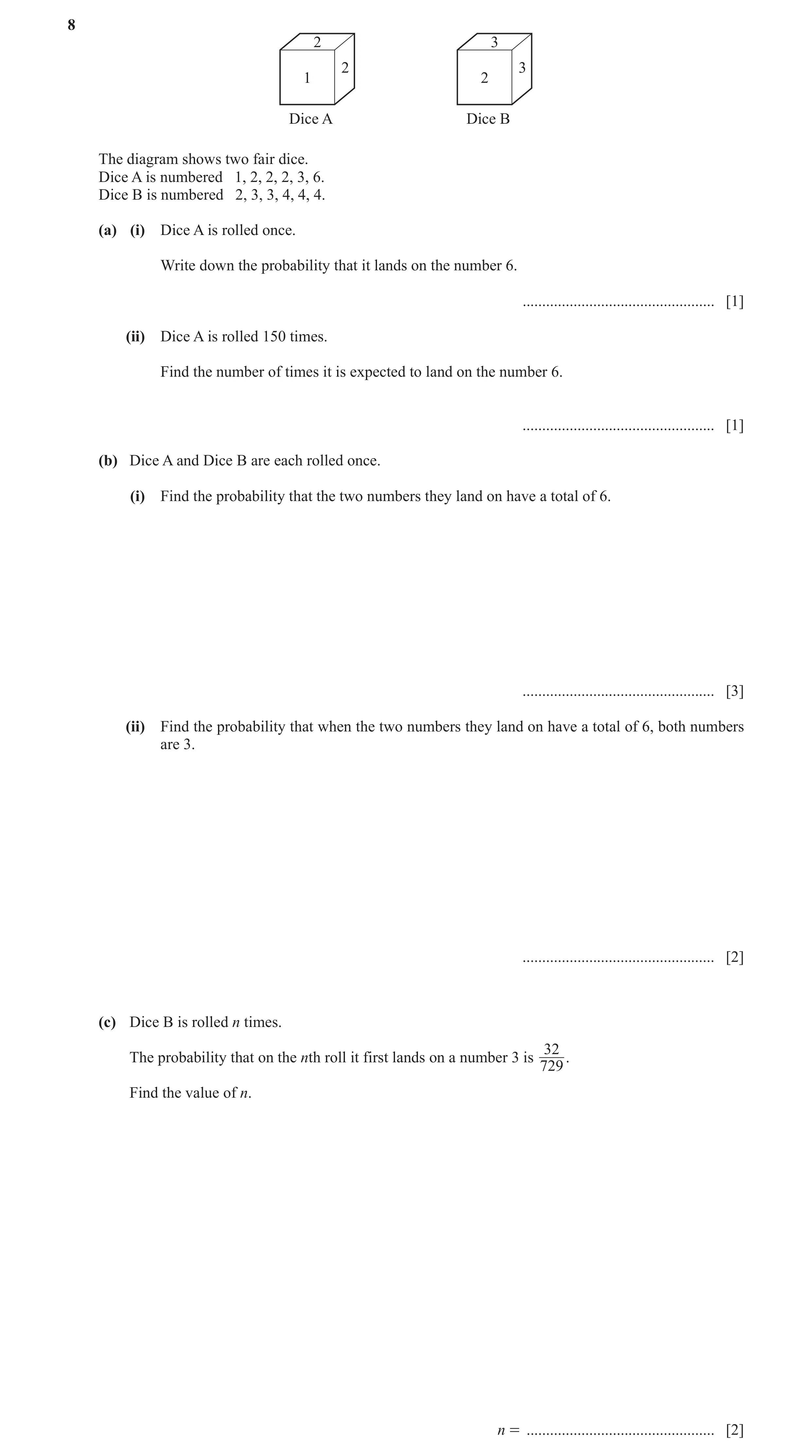
8 2 3 2 3 1 2 Dice A Dice B The diagram shows two fair dice. Dice A is numbered 1, 2, 2, 2, 3, 6. Dice B is numbered 2, 3, 3, 4, 4, 4. (a) (i) Dice A is rolled once. Write down the probability that it lands on the number 6. … [1] (ii) Dice A is rolled 150 times. Find the number of times it is expected to land on the number 6. … [1] (b) Dice A and Dice B are each rolled once. (i) Find the probability that the two numbers they land on have a total of 6. … [3] (ii) Find the probability that when the two numbers they land on have a total of 6, both numbers are 3. … [2] (c) Dice B is rolled n times. 32 The probability that on the nth roll it first lands on a number 3 is . 729 Find the value of n. n = … [2]
9 marks
Mark scheme: 8(a)(i) 1 1 oe 6 8(a)(ii) 25 1 FT their (a)(i) dep on 0 < (a) < 1 8(b)(i) 11 3 1 2 3 3 oe M2 for + oe or correct 36 6 6 6 6 possibility diagram with 11 outcomes identified 1 2 3 3 or M1 for or oe 6 6 6 6 or lists the 11 required outcomes or for possibility diagram but required outcomes not indicated 8(b)(ii) 2 2 2 p 11oe M1 for k or their 11 seen oe leading to answer 8(c) 6 2 k 4 2 32 = written oe M1 for 6 6 729 soi by one trial with k > 1 or 2 n −=1 32 or better or 3n = 729 or better
This question in 0580/42 Oct/Nov 2023
Q12 · A bag contains 5 white balls and 3 black balls 0580/43 Oct/Nov 2024
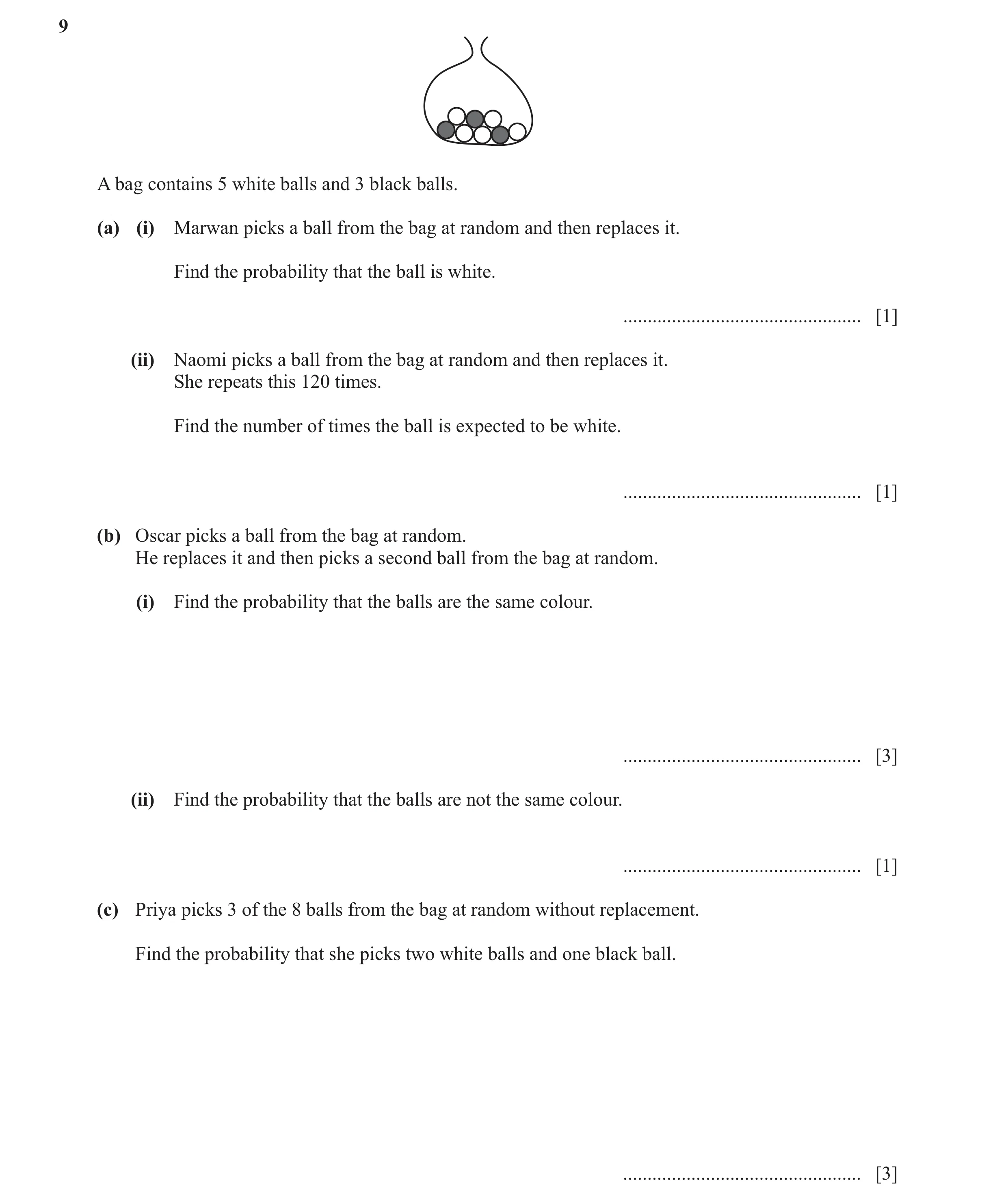
9 A bag contains 5 white balls and 3 black balls. (a) (i) Marwan picks a ball from the bag at random and then replaces it. Find the probability that the ball is white. … [1] (ii) Naomi picks a ball from the bag at random and then replaces it. She repeats this 120 times. Find the number of times the ball is expected to be white. … [1] (b) Oscar picks a ball from the bag at random. He replaces it and then picks a second ball from the bag at random. (i) Find the probability that the balls are the same colour. … [3] (ii) Find the probability that the balls are not the same colour. … [1] (c) Priya picks 3 of the 8 balls from the bag at random without replacement. Find the probability that she picks two white balls and one black ball. … [3]
9 marks
Mark scheme: 9(a)(i) 5 1 oe 8 9(a)(ii) 75 1 FT their (a)(i) 9(b)(i) 17 3 5 5 3 3 oe M2 for + 32 8 8 8 8 5 5 3 3 or M1 for or 8 8 8 8 9(b)(ii) 15 1 FT their (b)(i) oe 32 9(c) 15 3 5 4 3 oe M2 for k , k = 1 or 2 or 3 oe 28 8 7 6 5 4 3 M1 for and and or showing the 8 7 6 three possible combinations oe 225 If 0 scored SC1 for oe 512
This question in 0580/43 Oct/Nov 2024
 3 / 17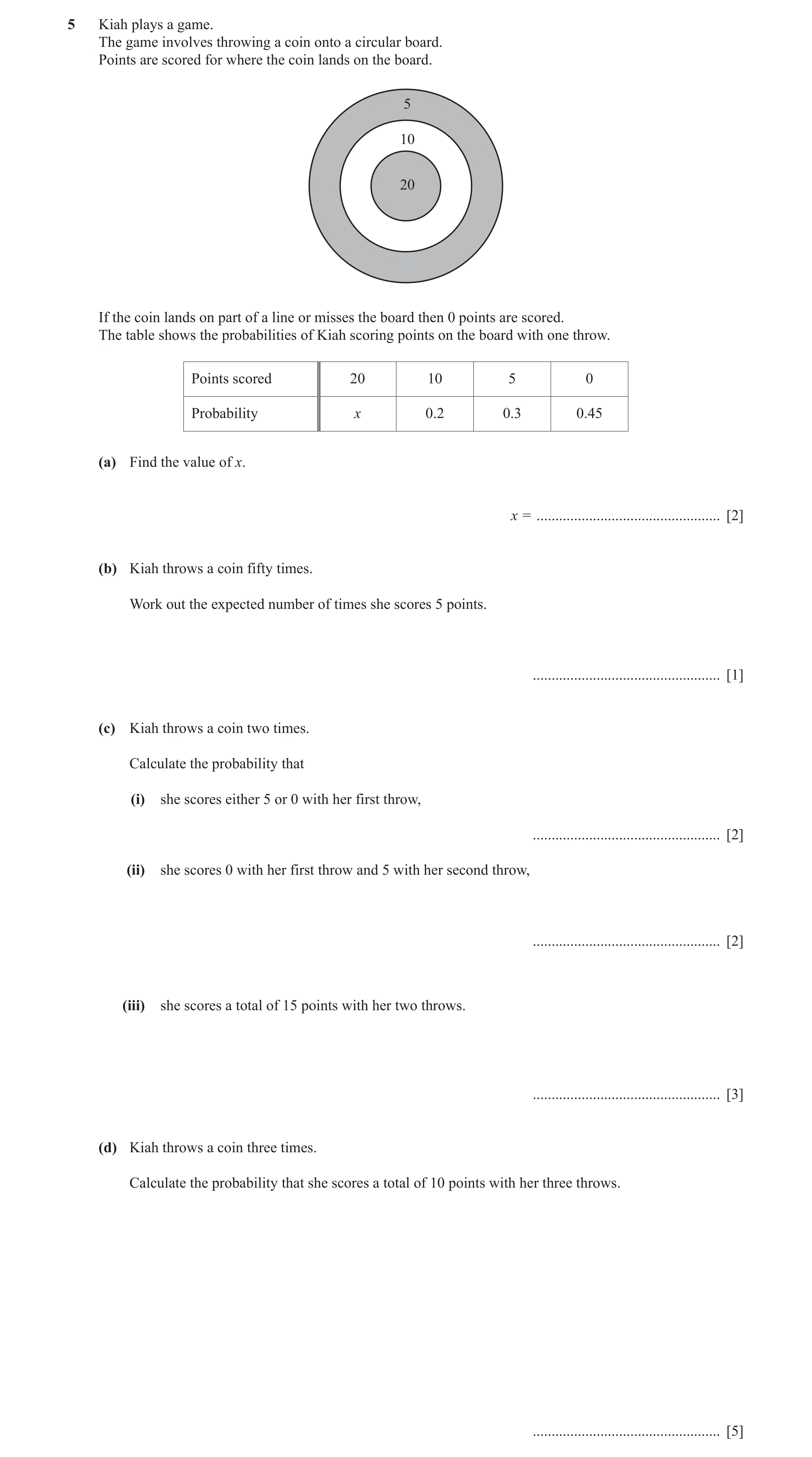
 6 / 17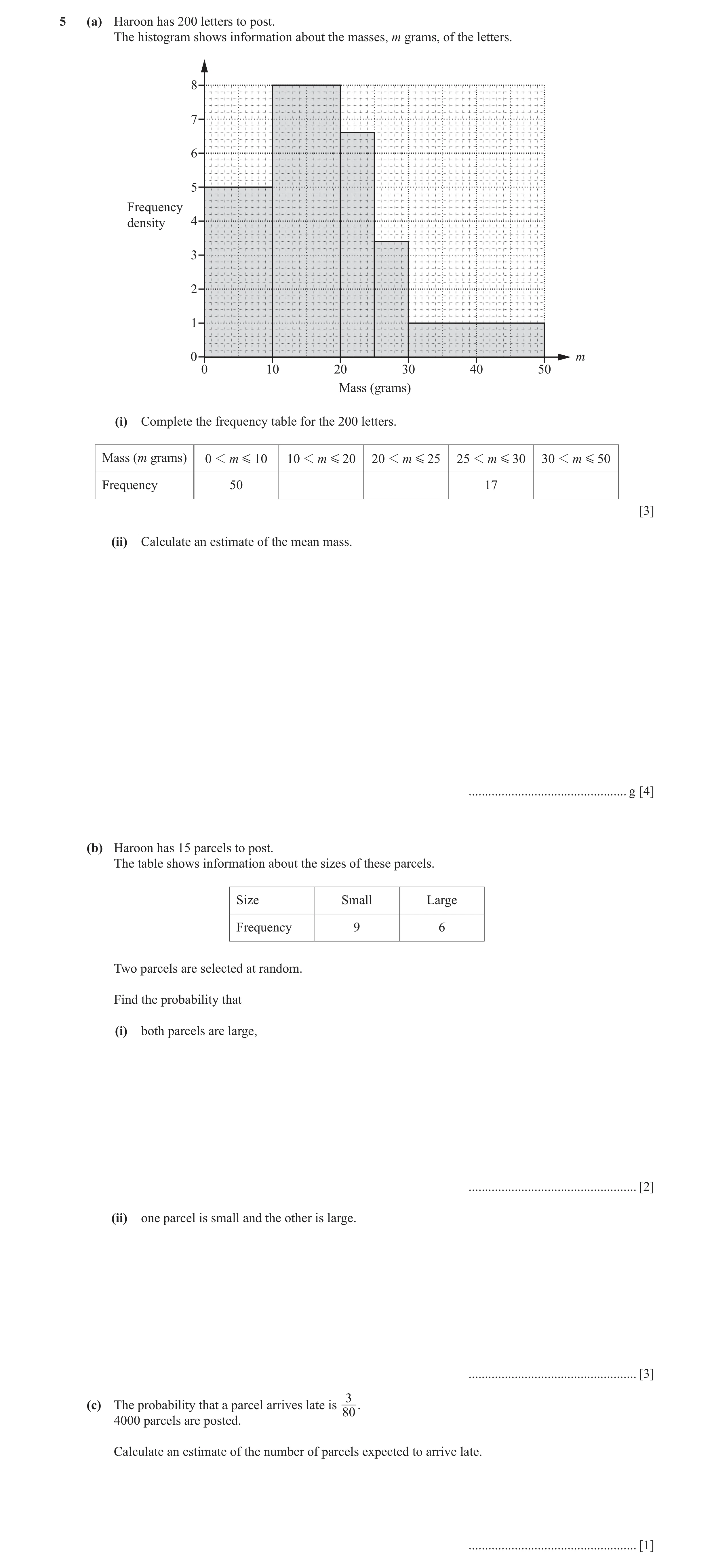
 12 / 17
 13 / 17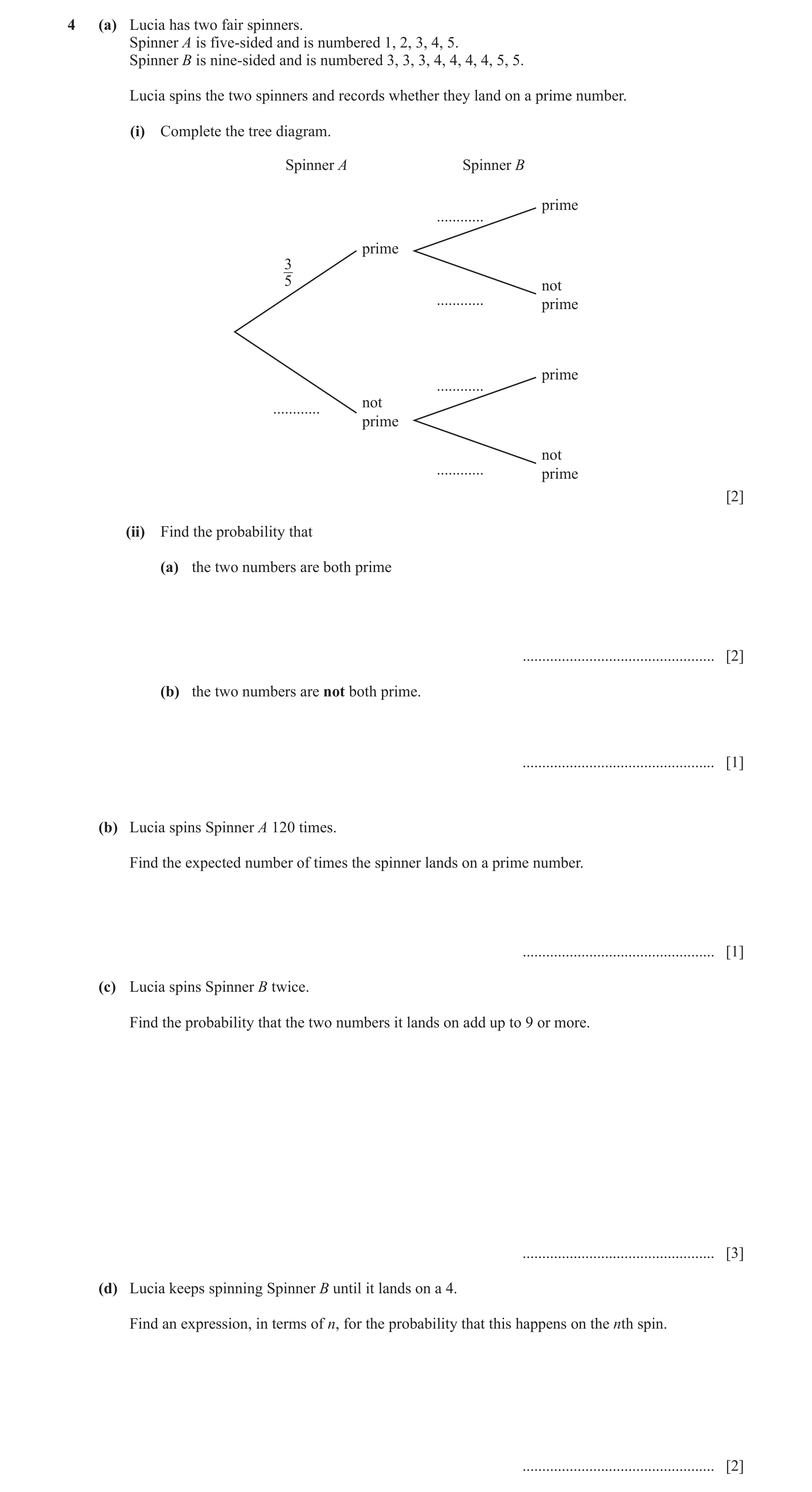
 17 / 17
 10
10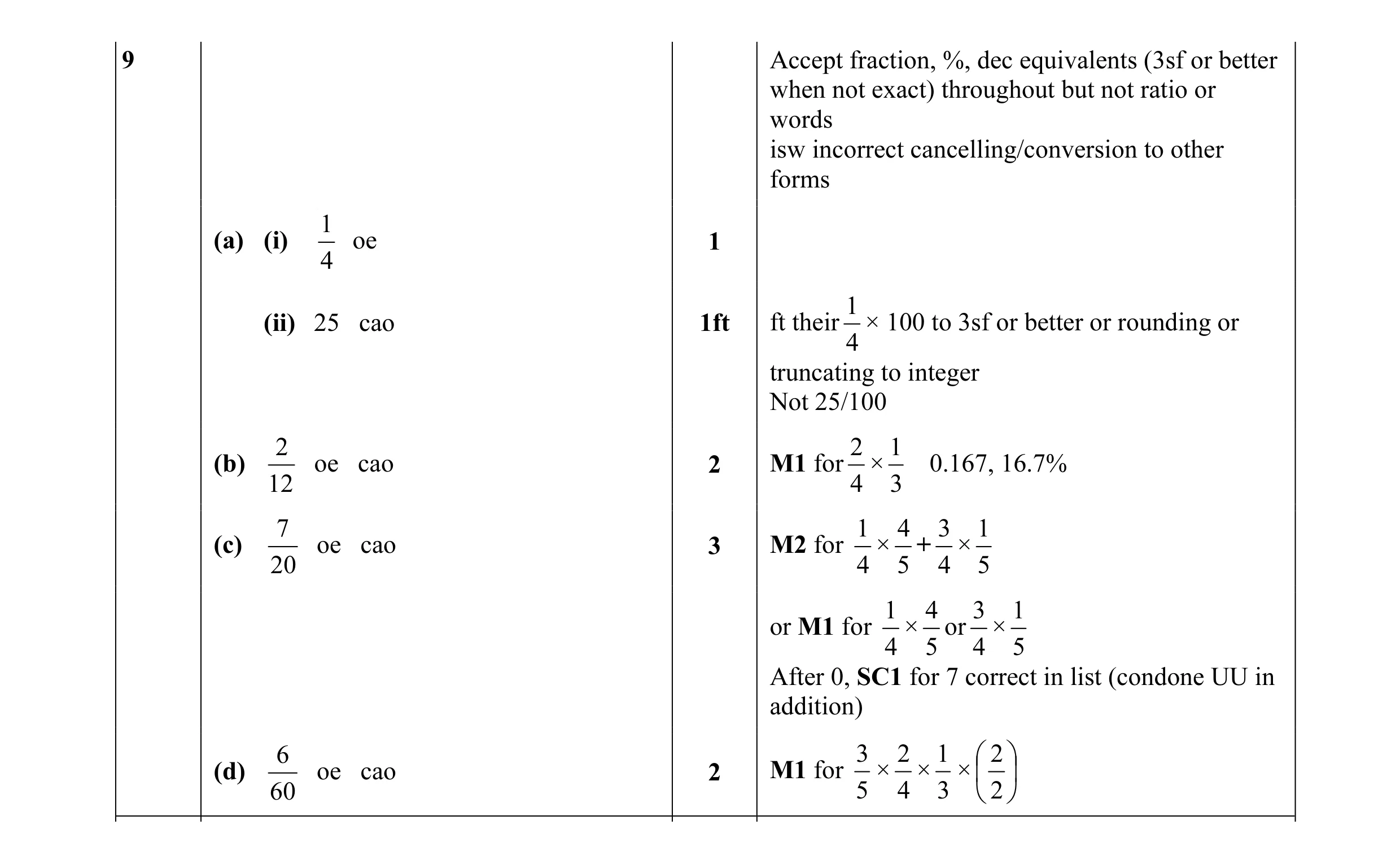 9
9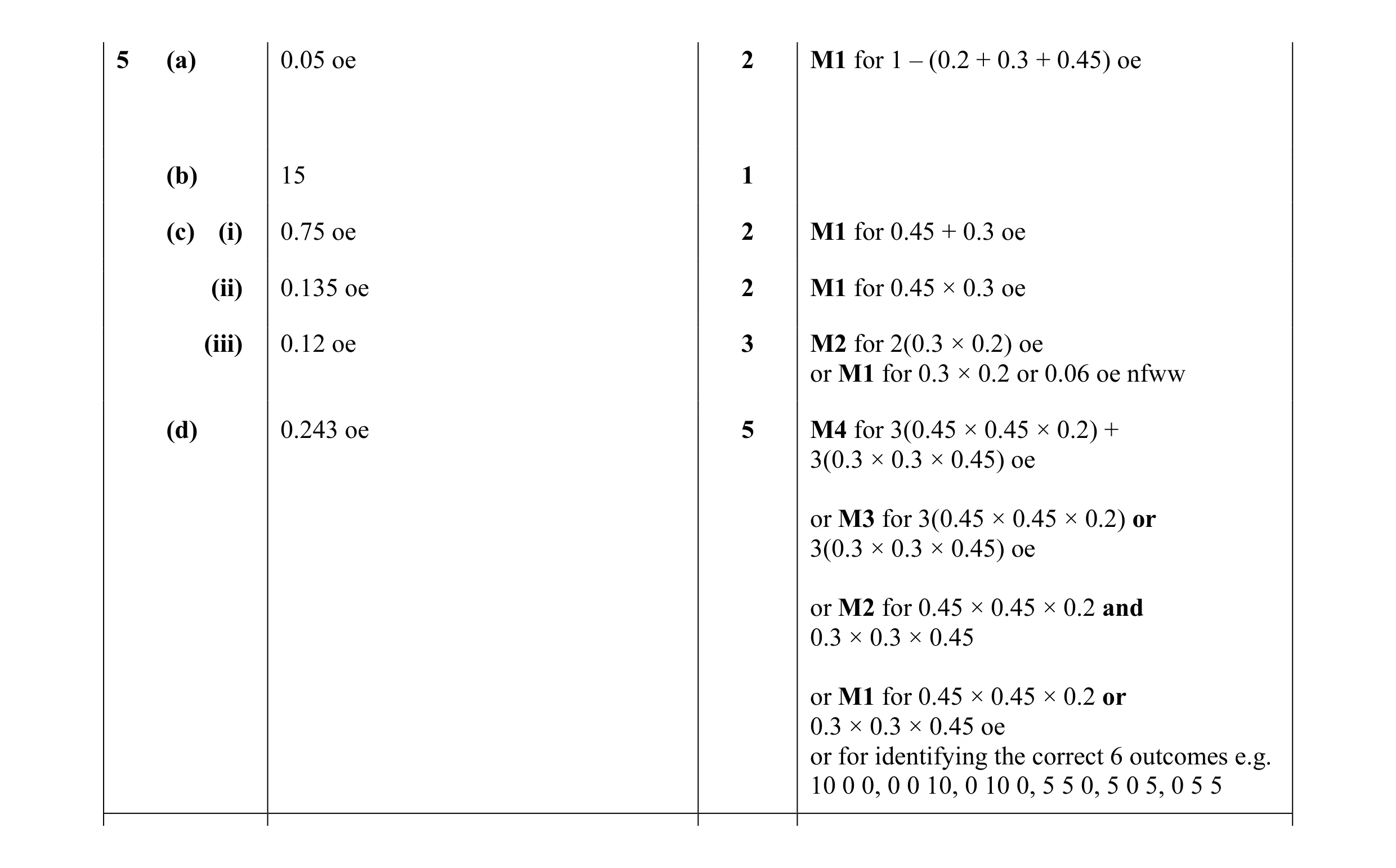 15
15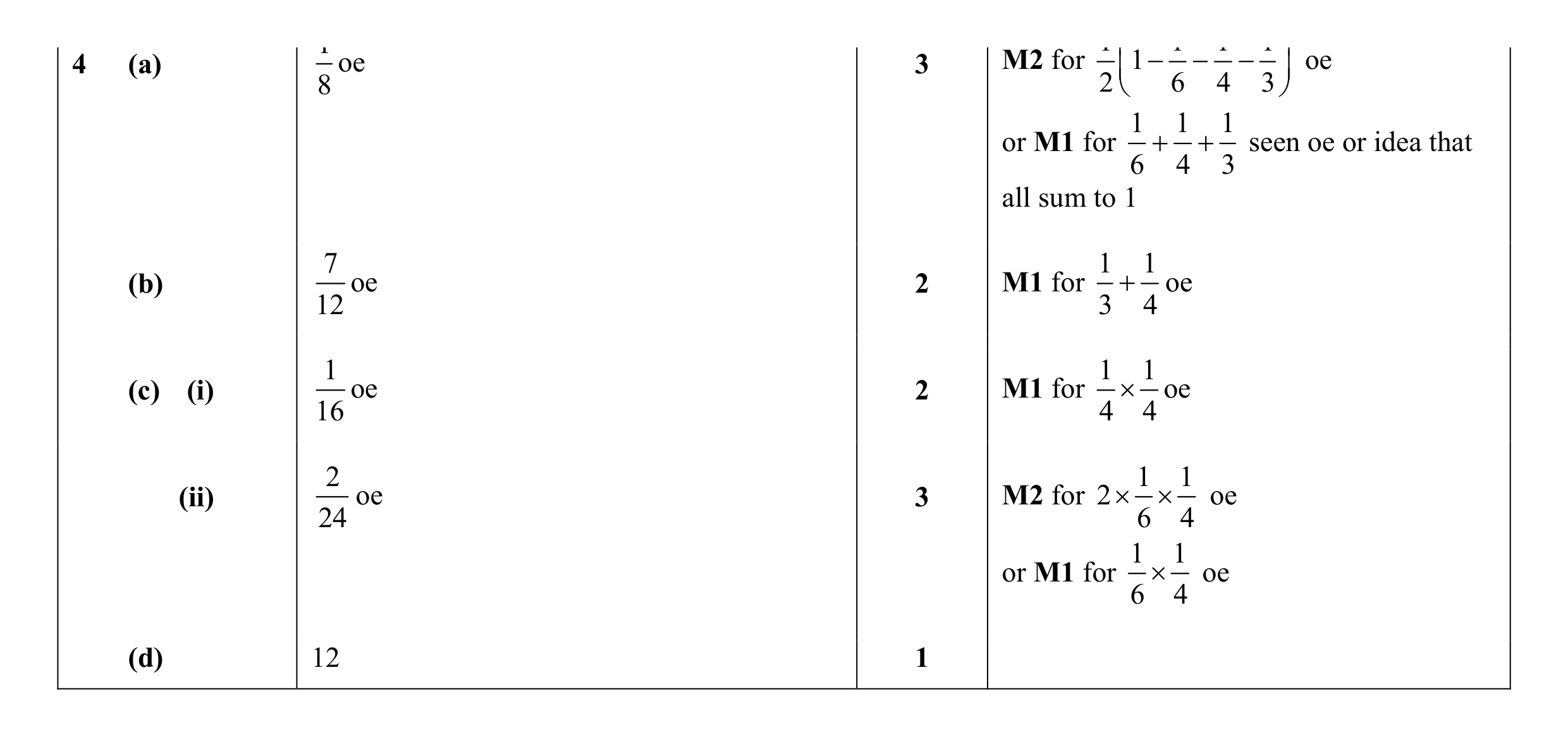 11
11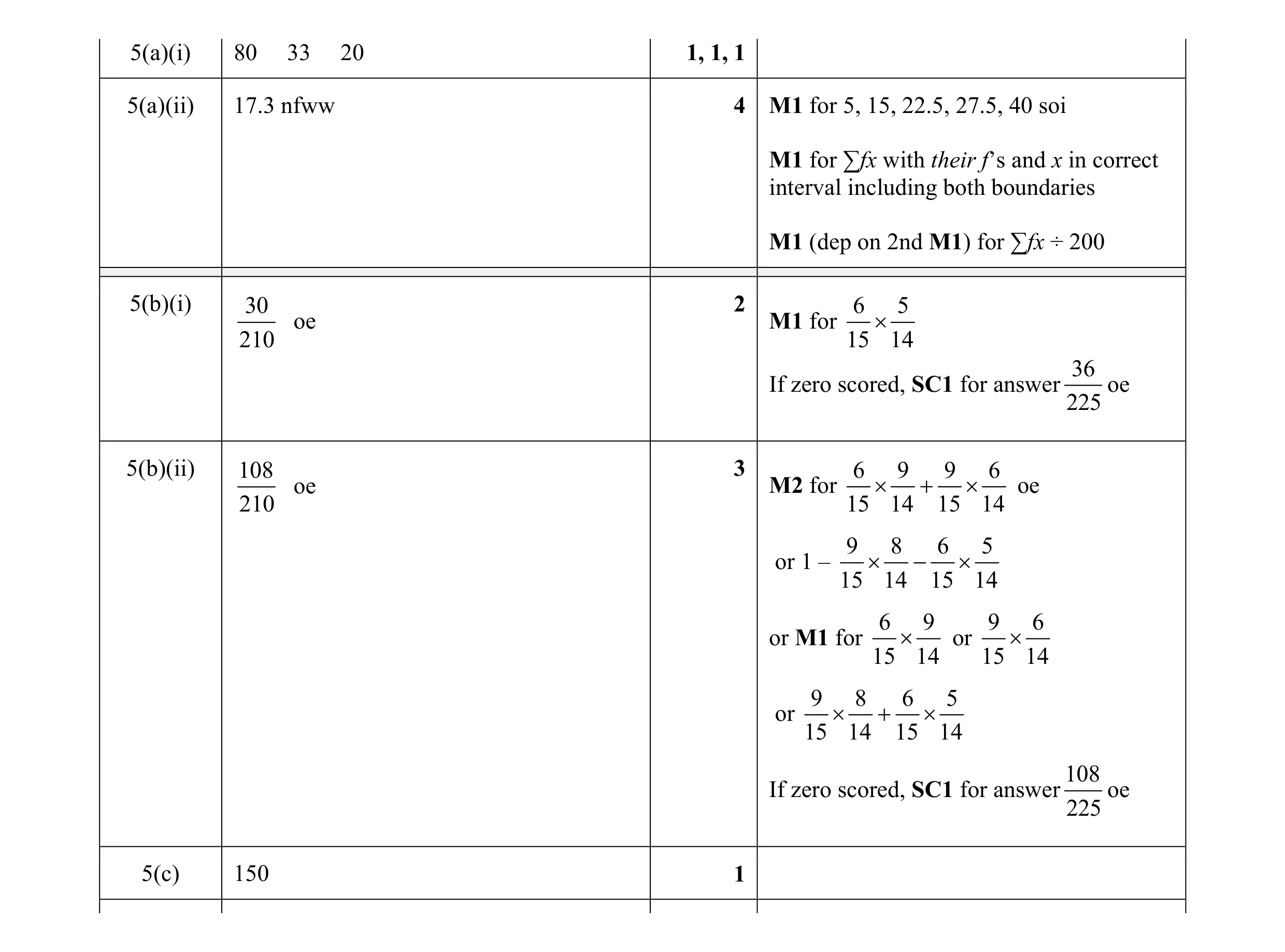 13
13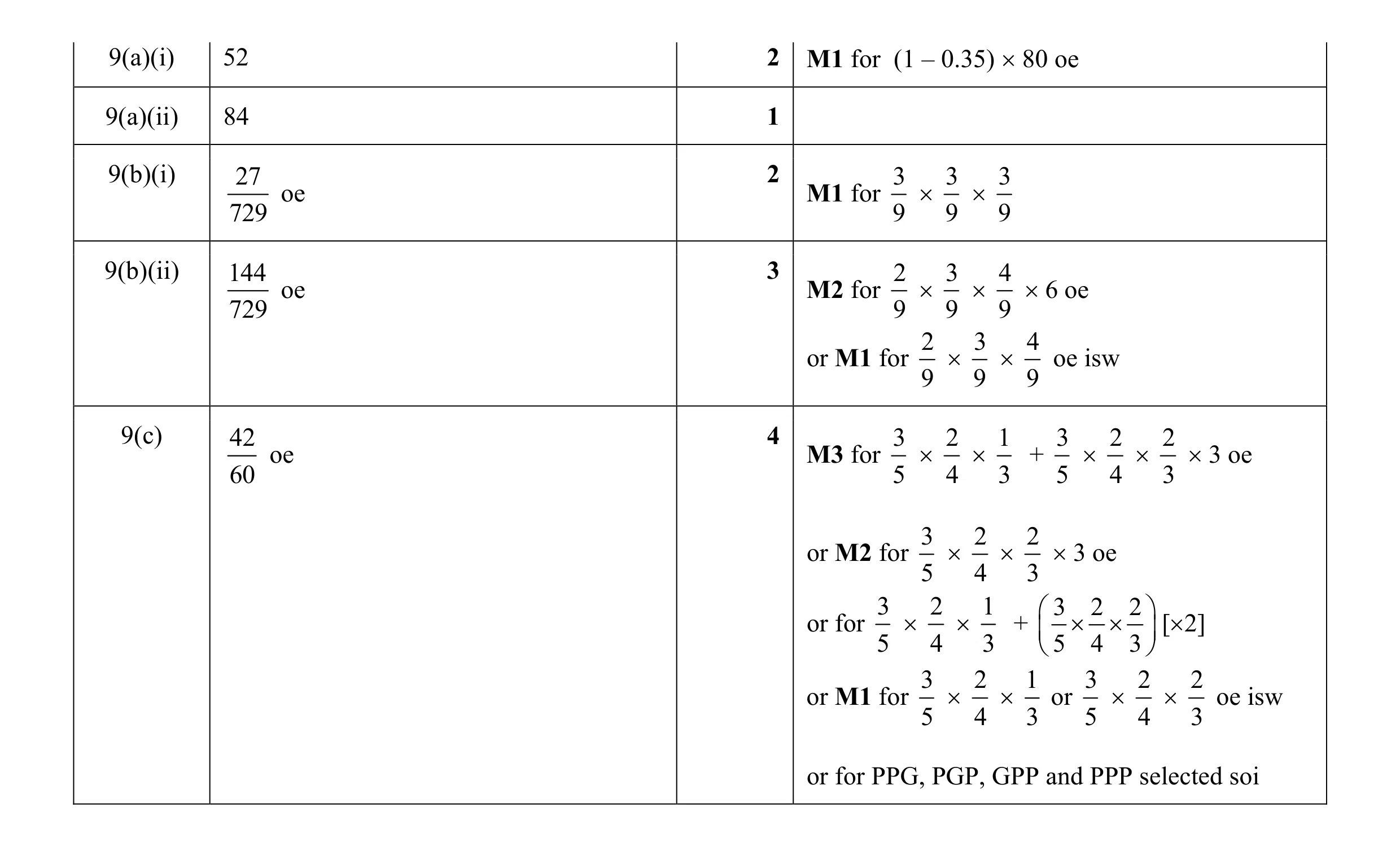 12
12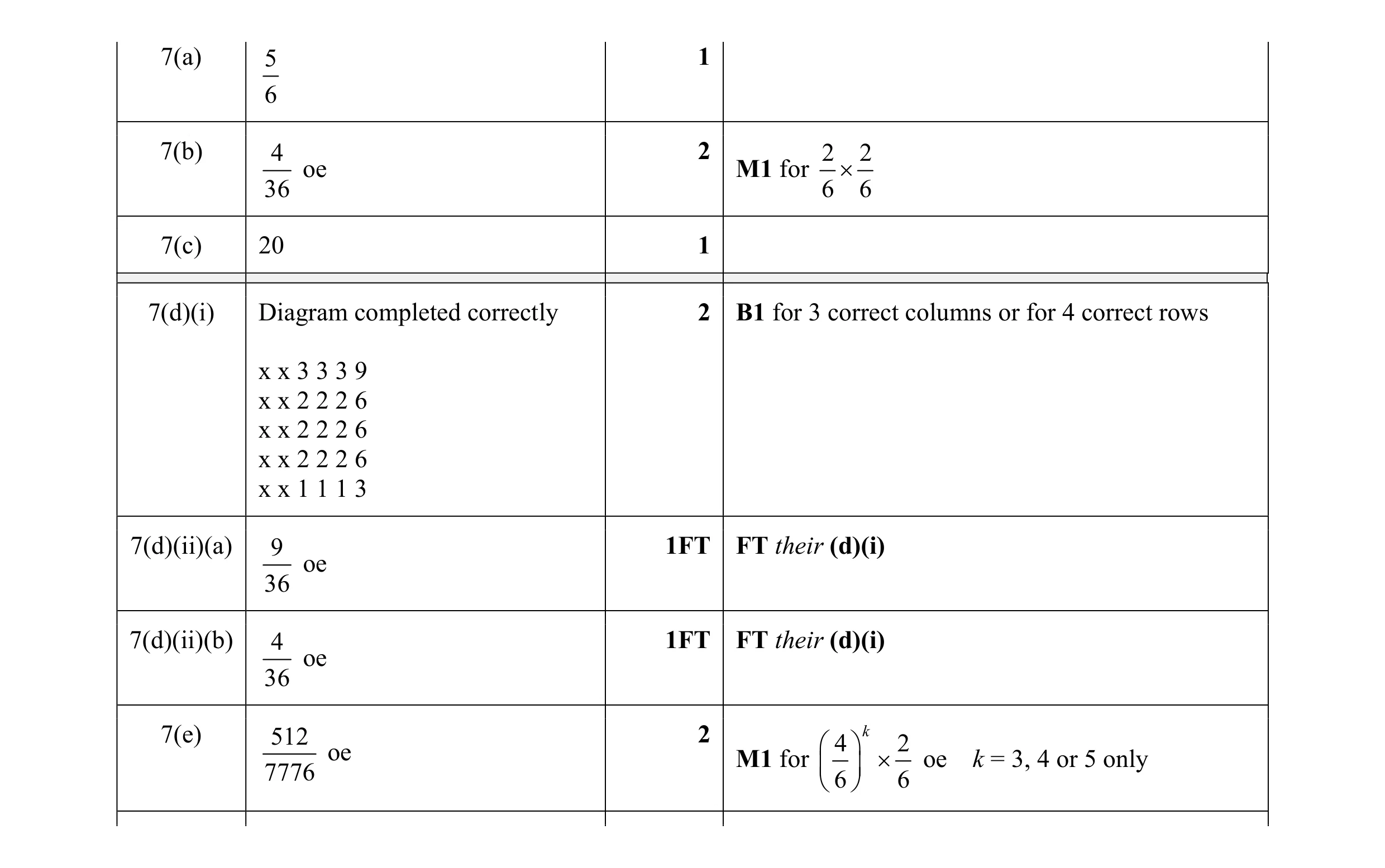 10
10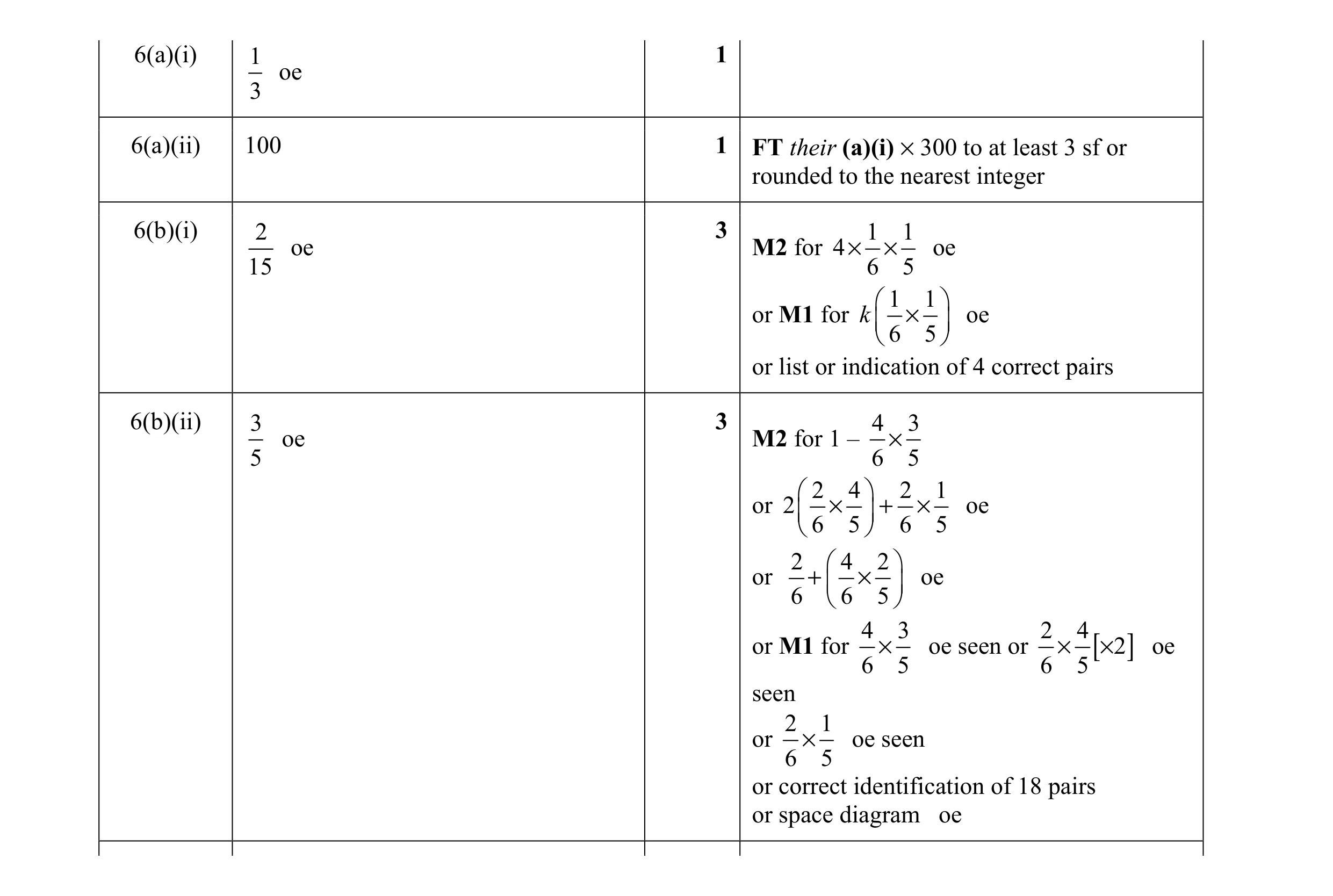 8
8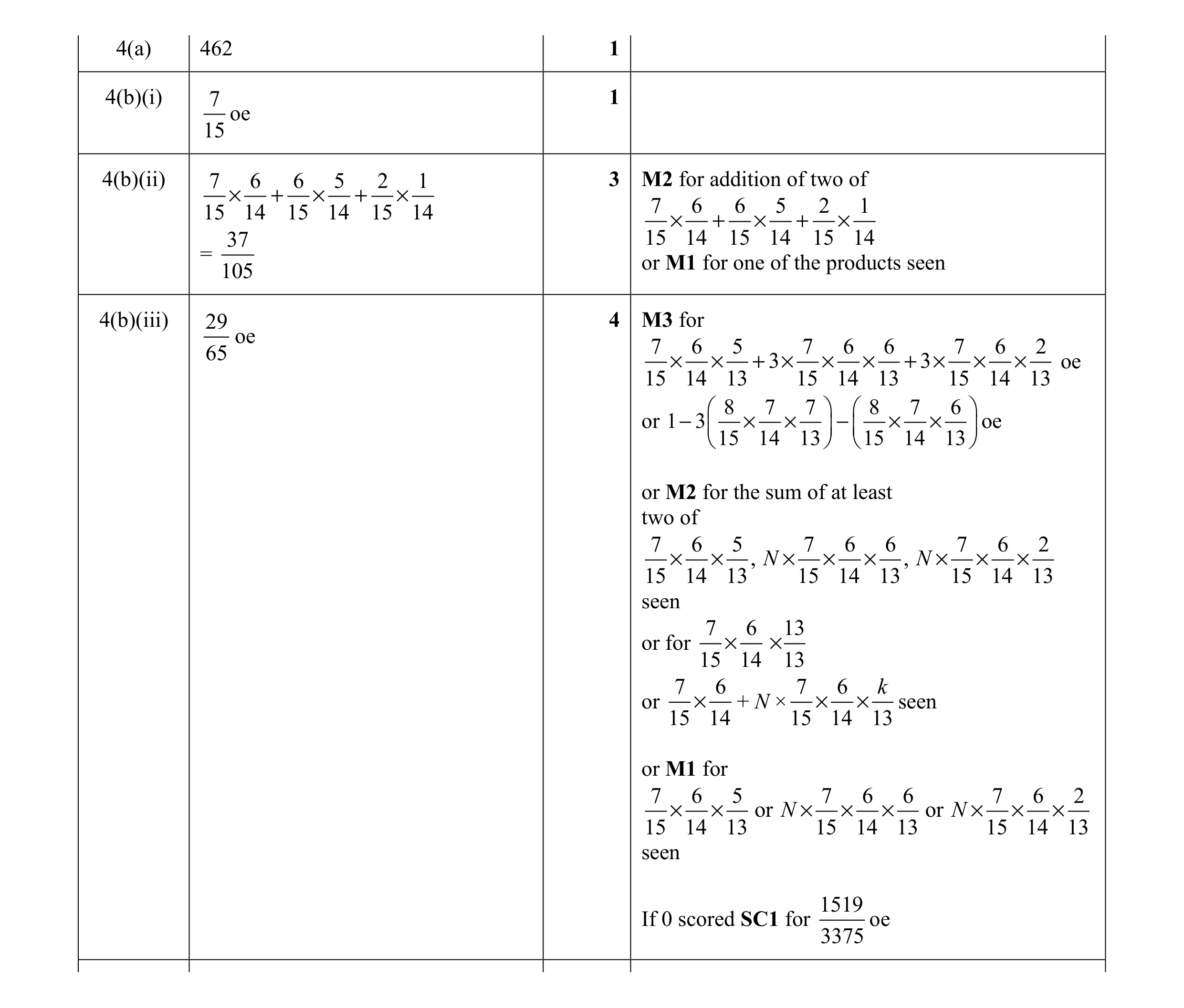 9
9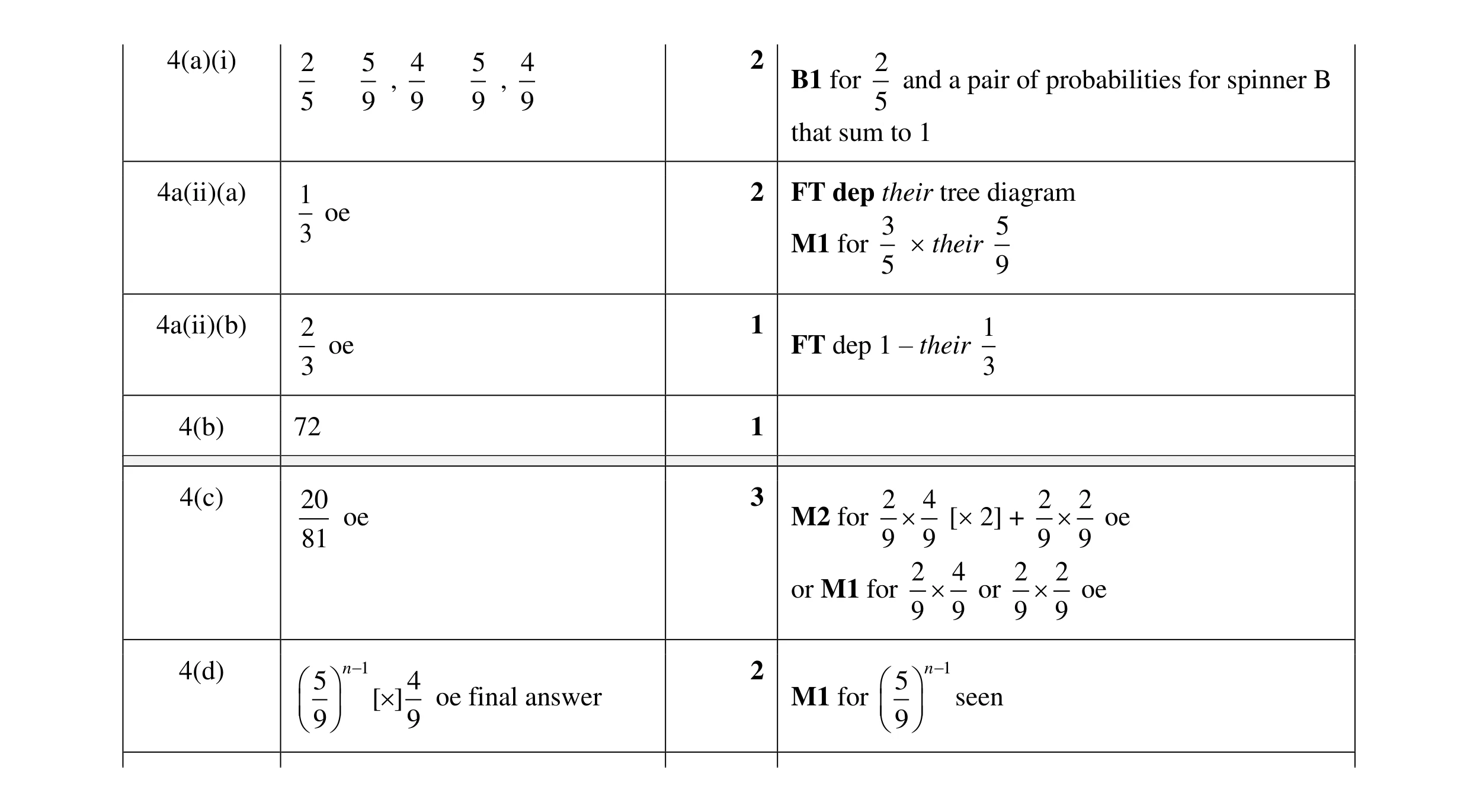 11
11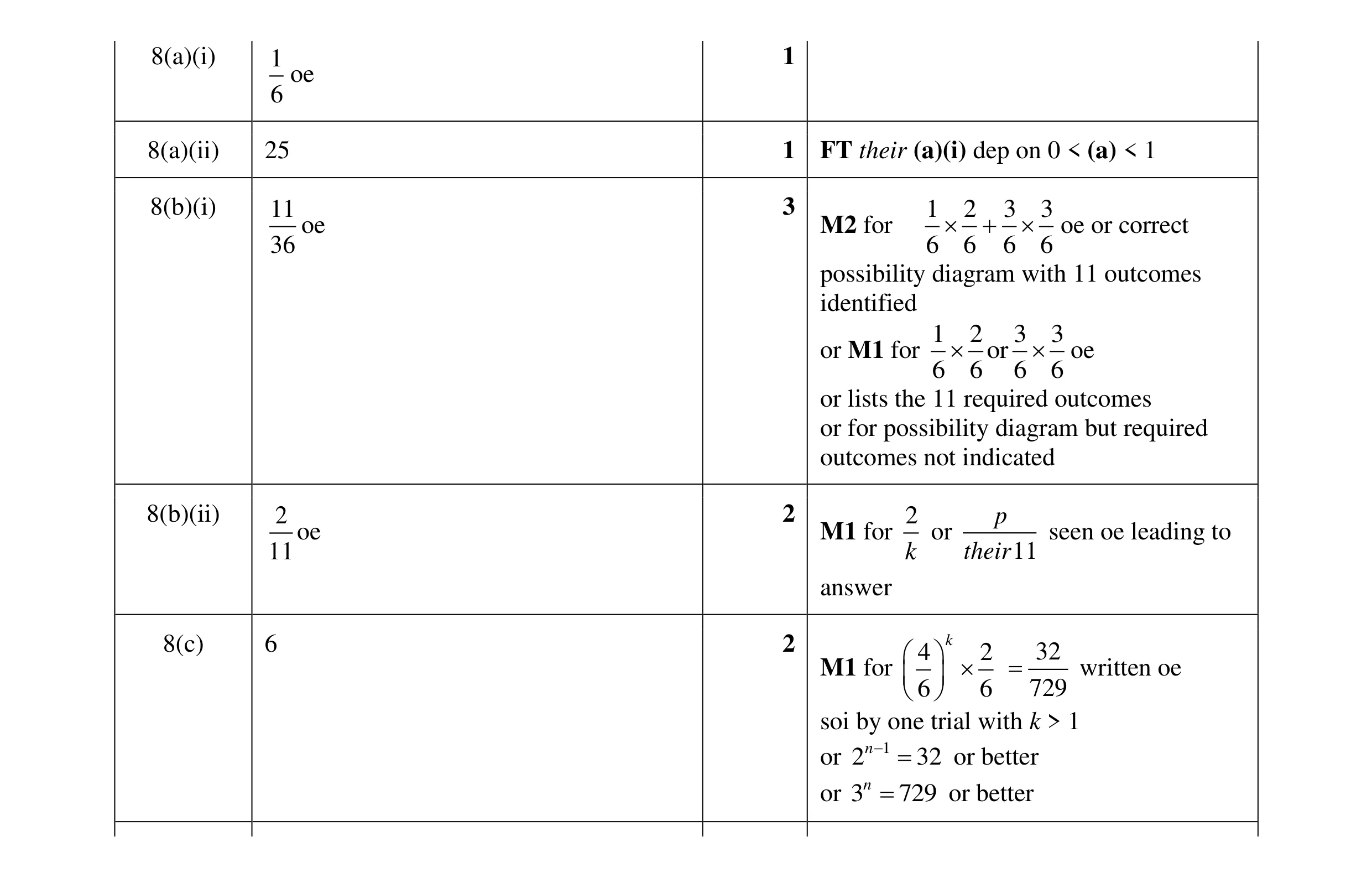 9
9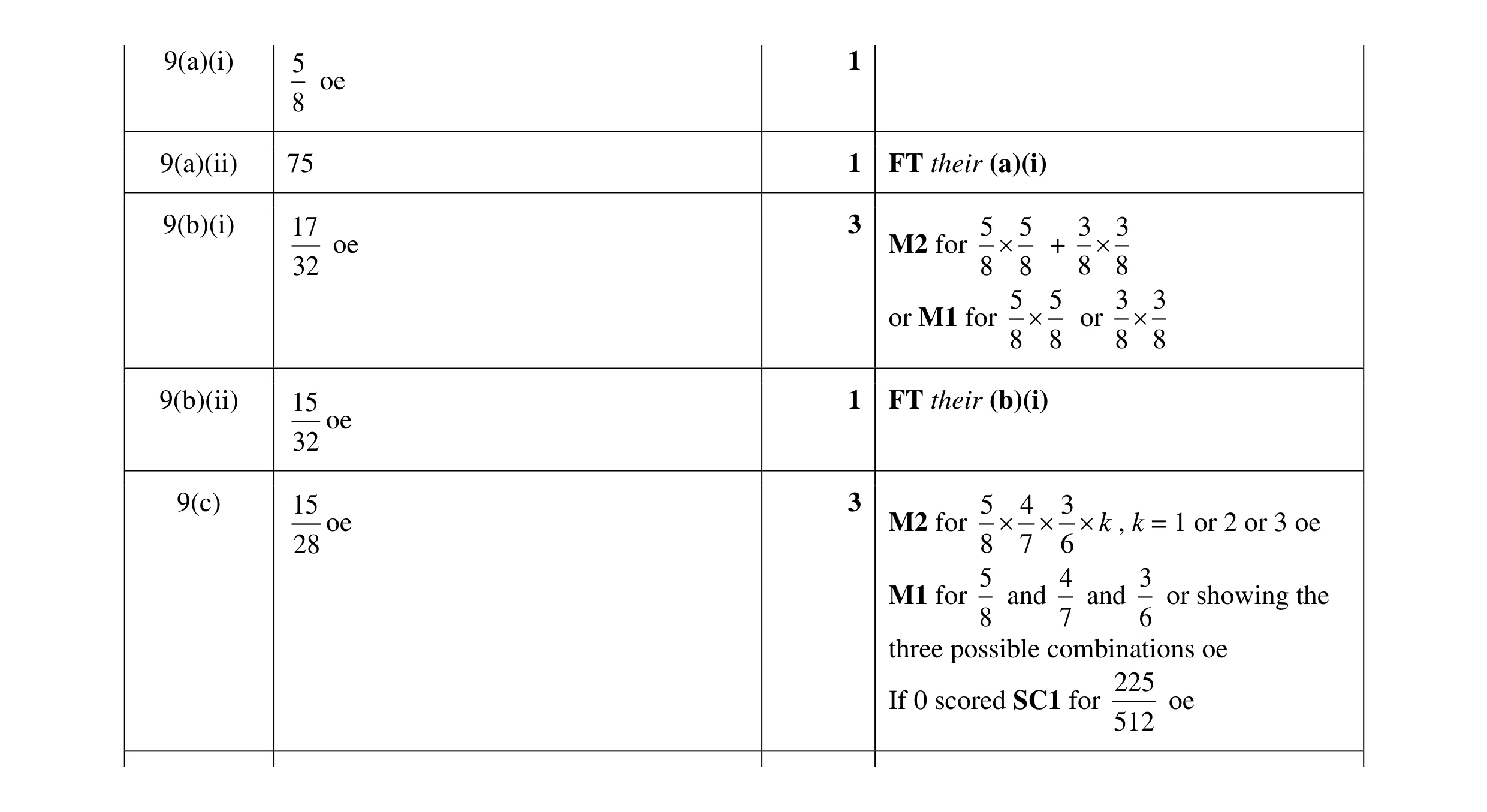 9
9