Questions as text
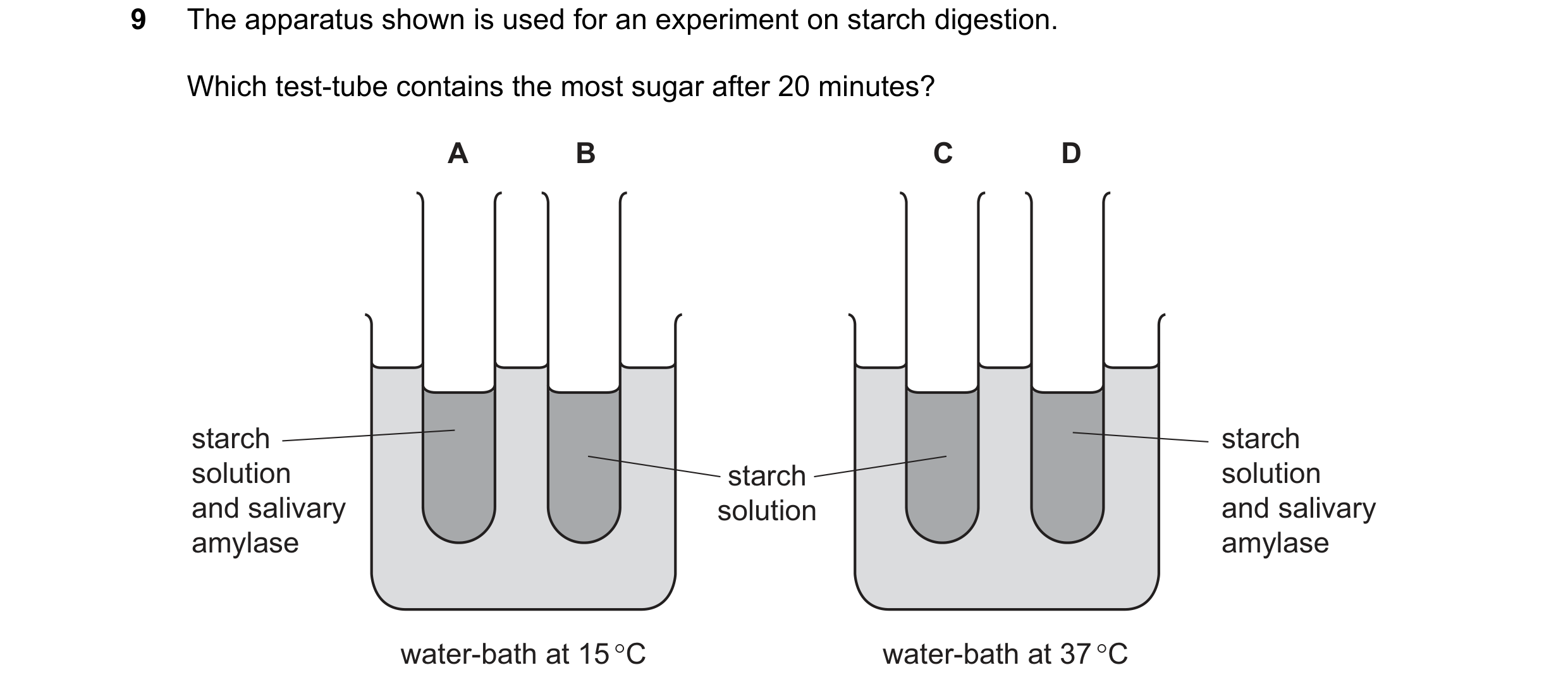
Q1 · The apparatus shown is used for an experiment on starch digestion 0970/22 Oct/Nov 2018
9 The apparatus shown is used for an experiment on starch digestion. Which test-tube contains the most sugar after 20 minutes? A B C D starch starch solution starch solution and salivary solution and salivary amylase amylase water-bath at 15 °C water-bath at 37 °C
1 marks
Answer: D
This question in 0970/22 Oct/Nov 2018
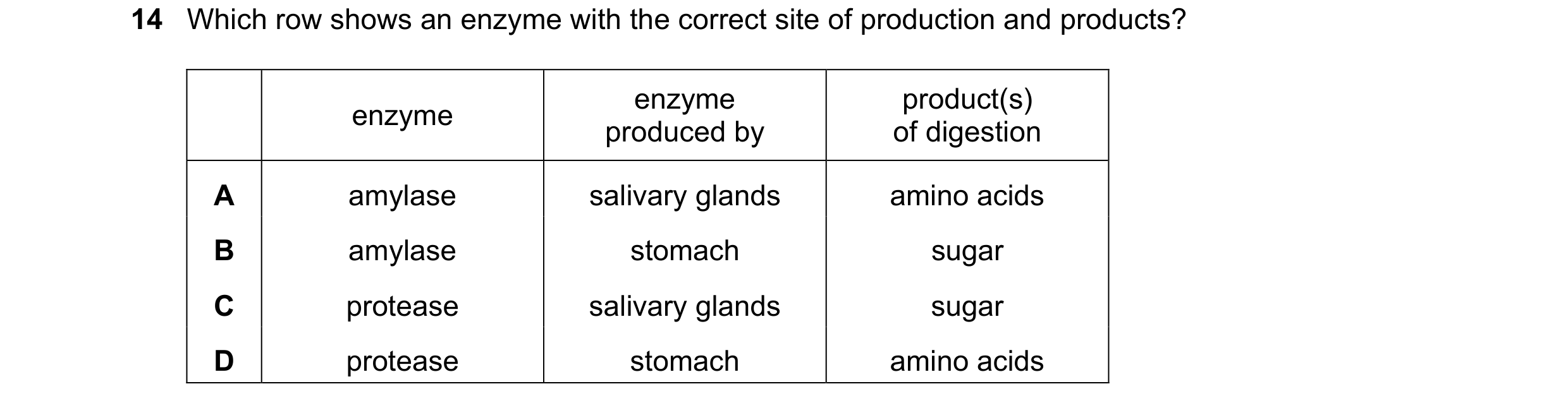
Q2 · Which row shows an enzyme with the correct site of production and products? 0970/22 Oct/Nov 2018
14 Which row shows an enzyme with the correct site of production and products? enzyme product(s) enzyme produced by of digestion A amylase salivary glands amino acids B amylase stomach sugar C protease salivary glands sugar D protease stomach amino acids
1 marks
Answer: D
This question in 0970/22 Oct/Nov 2018
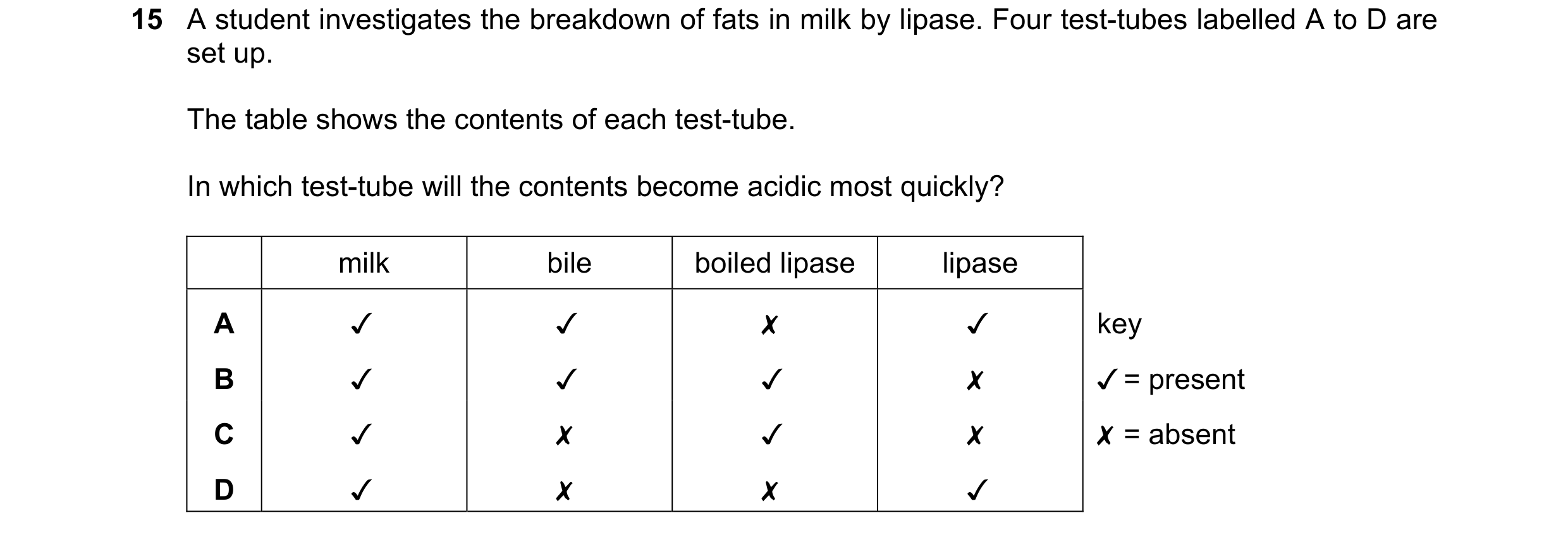
Q3 · A student investigates the breakdown of fats in milk by lipase 0970/21 May/June 2019
15 A student investigates the breakdown of fats in milk by lipase. Four test-tubes labelled A to D are
set up.
The table shows the contents of each test-tube.
In which test-tube will the contents become acidic most quickly?
milk bile boiled lipase
Jv x
Jv Jv
x Jv
x x
lipase
< x« x
key
v¥ = present
X = absent
1 marks
Answer: A
This question in 0970/21 May/June 2019
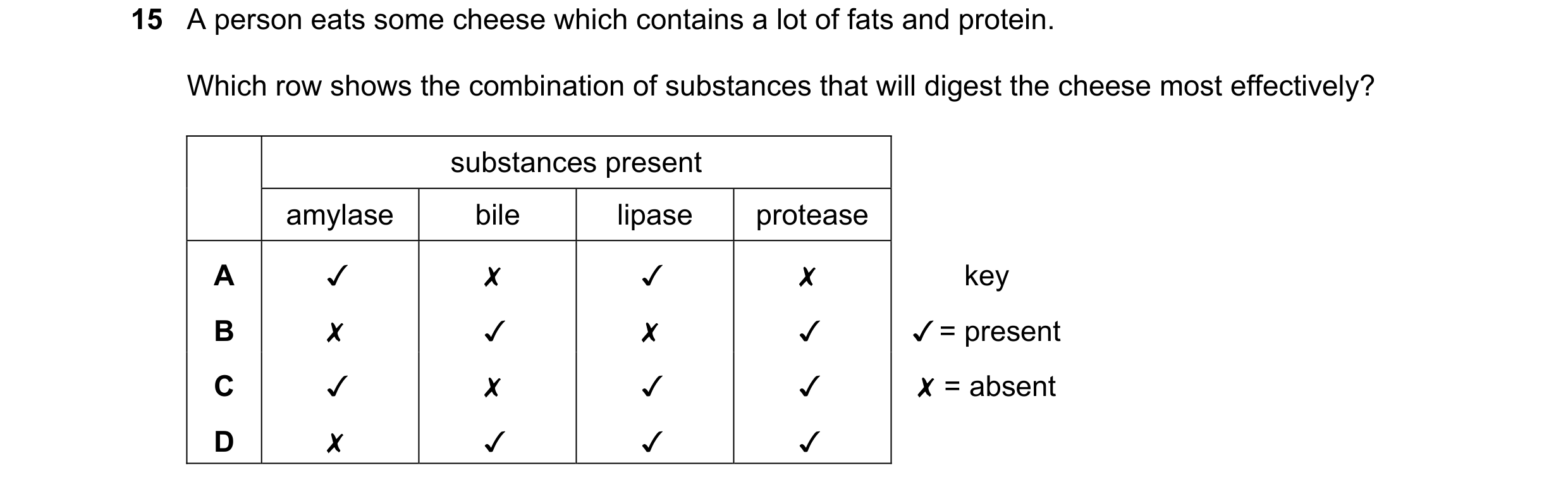
Q4 · A person eats some cheese which contains a lot of fats and protein 0970/22 May/June 2019
15 A person eats some cheese which contains a lot of fats and protein.
Which row shows the combination of substances that will digest the cheese most effectively?
substances present |
amylase
protease |
0 0O WwW D>
key
J/ = present
X = absent
1 marks
Answer: D
This question in 0970/22 May/June 2019
Q5 · The diagram shows an experiment kept at room temperature 0970/22 Oct/Nov 2019
14 The diagram shows an experiment kept at room temperature. tubing containing starch, protease, test-tube protein and simple sugars distilled water membrane permeable to small molecules only What is present in the water surrounding the membrane after 45 minutes? A amino acids and simple sugars B protein and amino acids C protein and simple sugars D starch and simple sugars
1 marks
Answer: A
This question in 0970/22 Oct/Nov 2019
Q6 · Which chemical reaction is catalysed by maltase? 0970/22 Oct/Nov 2019
38 Which chemical reaction is catalysed by maltase? A glycogen → glucose + maltose B maltose → glucose + glucose C maltose → starch D starch → glucose + maltose
1 marks
Answer: B
This question in 0970/22 Oct/Nov 2019
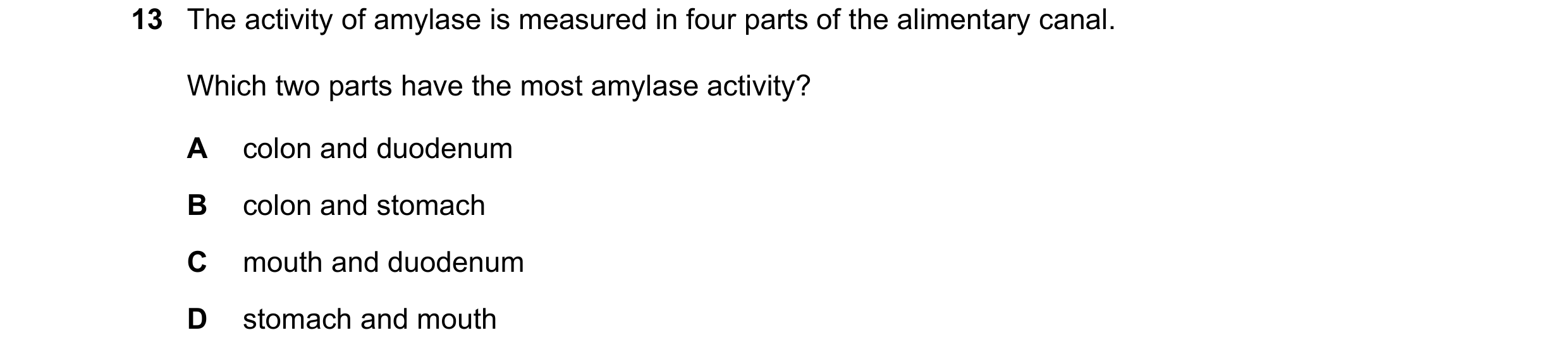
Q7 · The activity of amylase is measured in four parts of the alimentary canal 0970/21 May/June 2020
13 The activity of amylase is measured in four parts of the alimentary canal. Which two parts have the most amylase activity? A colon and duodenum B colon and stomach C mouth and duodenum D stomach and mouth
1 marks
Answer: C
This question in 0970/21 May/June 2020
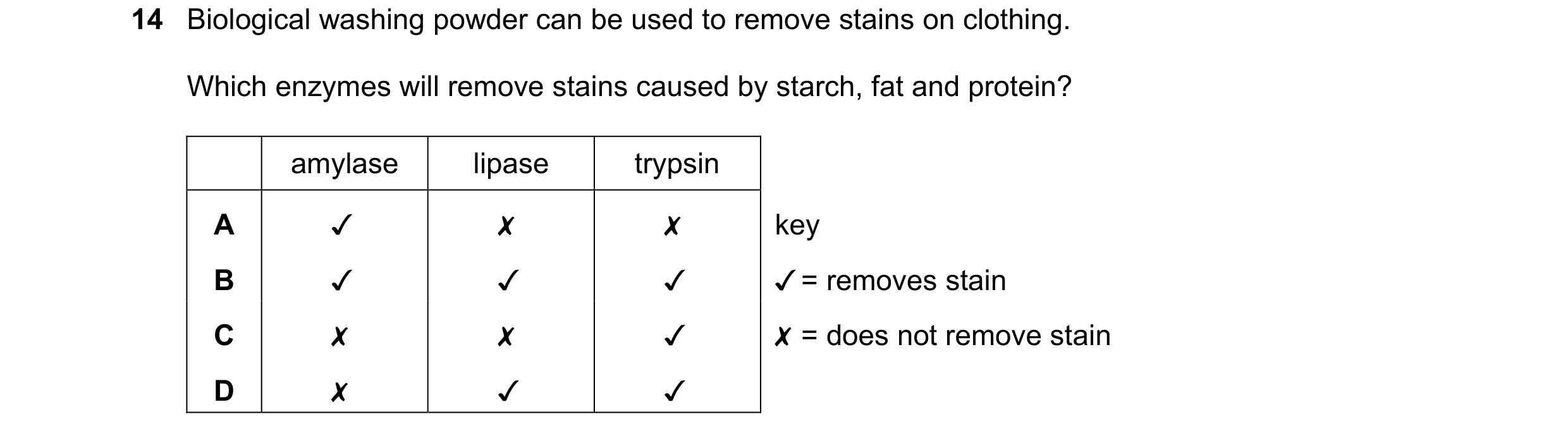
Q8 · Biological washing powder can be used to remove stains on clothing 0970/21 May/June 2020
14 Biological washing powder can be used to remove stains on clothing.
Which enzymes will remove stains caused by starch, fat and protein?
amylase
v x x key
/ = removes stain
X = does not remove stain
x « &
Kx 4
Q 44
1 marks
Answer: B
This question in 0970/21 May/June 2020
Q9 · The graph shows the effect of pH on the activity of an enzyme 0970/22 May/June 2020
13 The graph shows the effect of pH on the activity of an enzyme. enzyme activity 1 3 5 7 9 11 pH In which part of the alimentary canal would this enzyme be most active? A large intestine B mouth C small intestine D stomach
1 marks
Answer: D
This question in 0970/22 May/June 2020
Q10 · The diagram shows the apparatus used in an experiment to demonstrate two processes that… 0970/22 Oct/Nov 2020
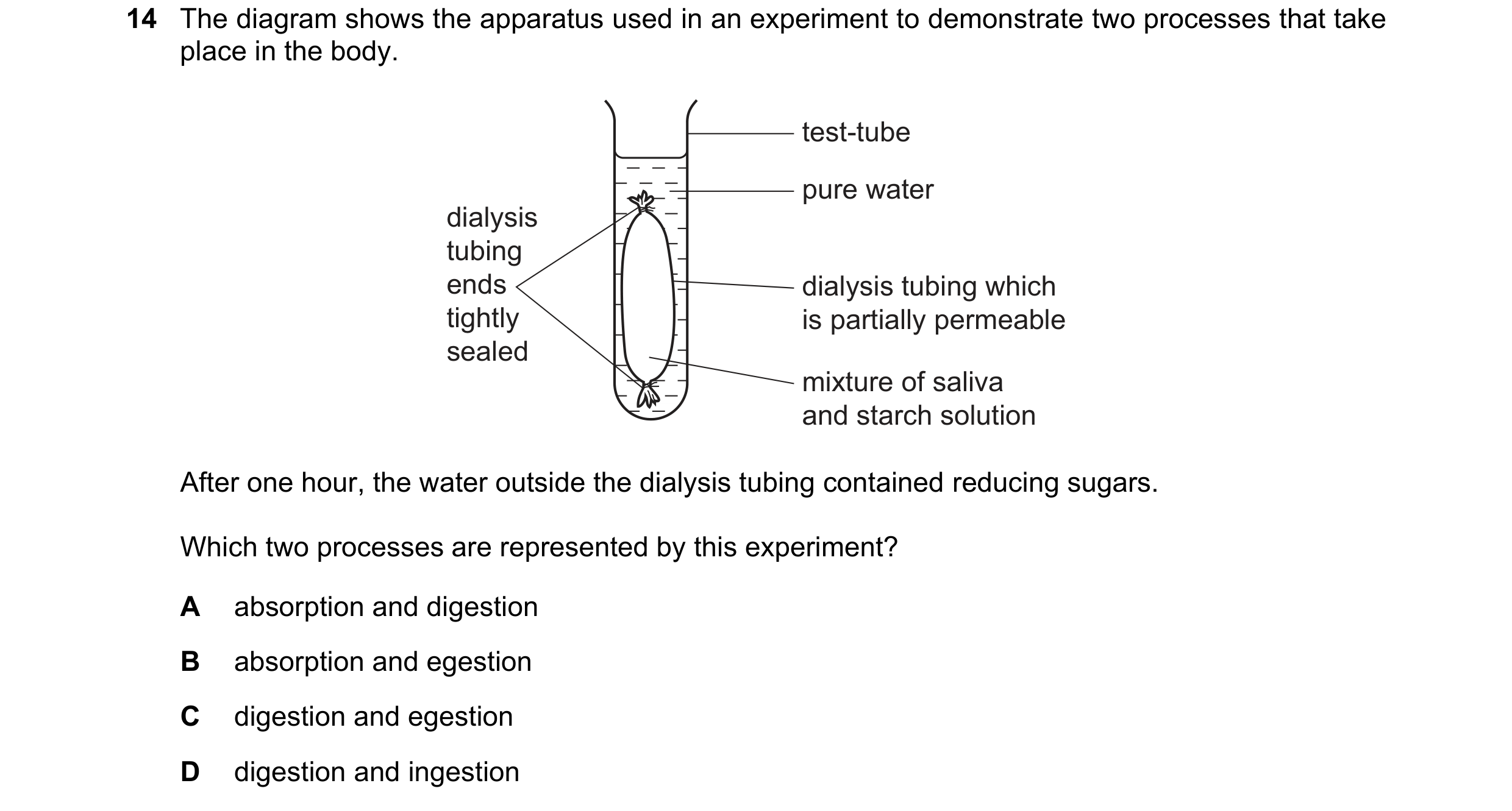
14 The diagram shows the apparatus used in an experiment to demonstrate two processes that take place in the body. test-tube pure water dialysis tubing ends dialysis tubing which tightly is partially permeable sealed mixture of saliva and starch solution After one hour, the water outside the dialysis tubing contained reducing sugars. Which two processes are represented by this experiment? A absorption and digestion B absorption and egestion C digestion and egestion D digestion and ingestion
1 marks
Answer: A
This question in 0970/22 Oct/Nov 2020
Q11 · Starch is digested by amylase in the mouth, but it is not digested in the stomach 0970/21 May/June 2021
11 Starch is digested by amylase in the mouth, but it is not digested in the stomach. What is the reason for this? A All starch digestion is completed in the mouth. B The pH in the stomach is not suitable for the amylase to work. C The starch does not stay in the stomach long enough to be digested. D The temperature in the stomach is not suitable for the amylase to work.
1 marks
Answer: B
This question in 0970/21 May/June 2021
Q12 · What are the products when proteins are broken down? 0970/21 May/June 2021
16 What are the products when proteins are broken down? A amino acids B fatty acids C glycerol D simple sugars
1 marks
Answer: A
This question in 0970/21 May/June 2021
Q13 · Starch is digested by amylase in the mouth, but it is not digested in the stomach 0970/22 May/June 2021
11 Starch is digested by amylase in the mouth, but it is not digested in the stomach. What is the reason for this? A All starch digestion is completed in the mouth. B The pH in the stomach is not suitable for the amylase to work. C The starch does not stay in the stomach long enough to be digested. D The temperature in the stomach is not suitable for the amylase to work.
1 marks
Answer: B
This question in 0970/22 May/June 2021
Q14 · Four test-tubes were set up as shown in the diagram 0970/22 Oct/Nov 2021
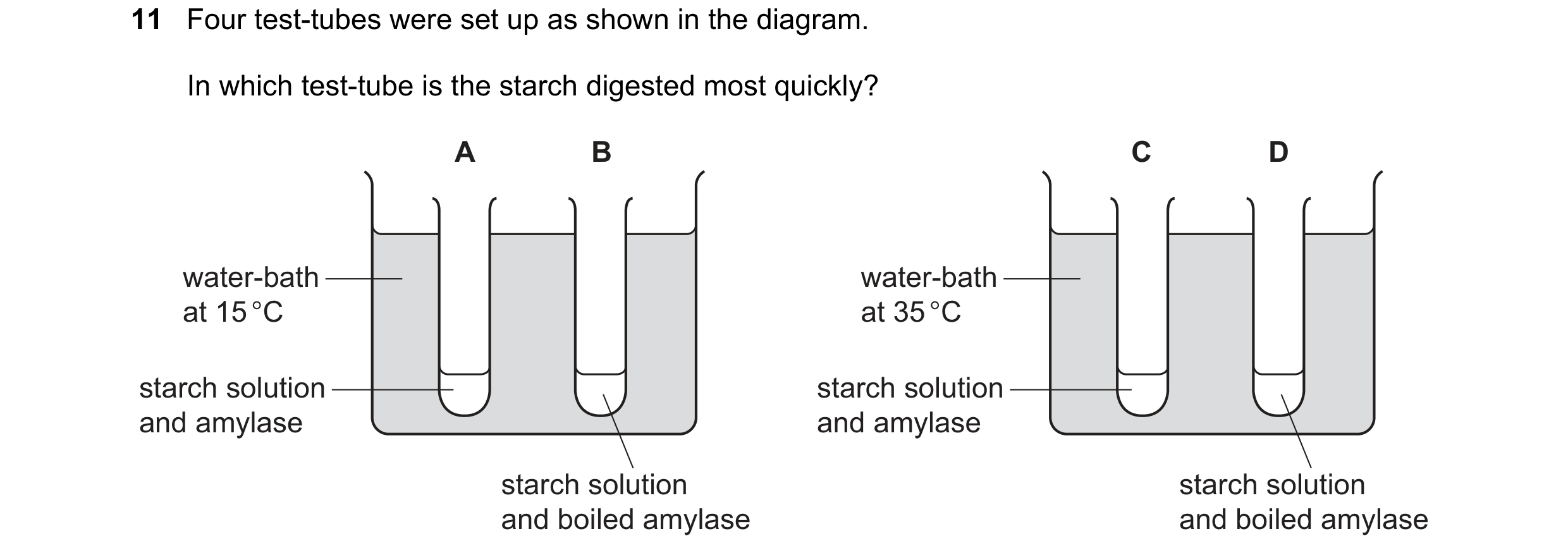
11 Four test-tubes were set up as shown in the diagram. In which test-tube is the starch digested most quickly? A B C D water-bath water-bath at 15 °C at 35 °C starch solution starch solution and amylase and amylase starch solution starch solution and boiled amylase and boiled amylase
1 marks
Answer: C
This question in 0970/22 Oct/Nov 2021
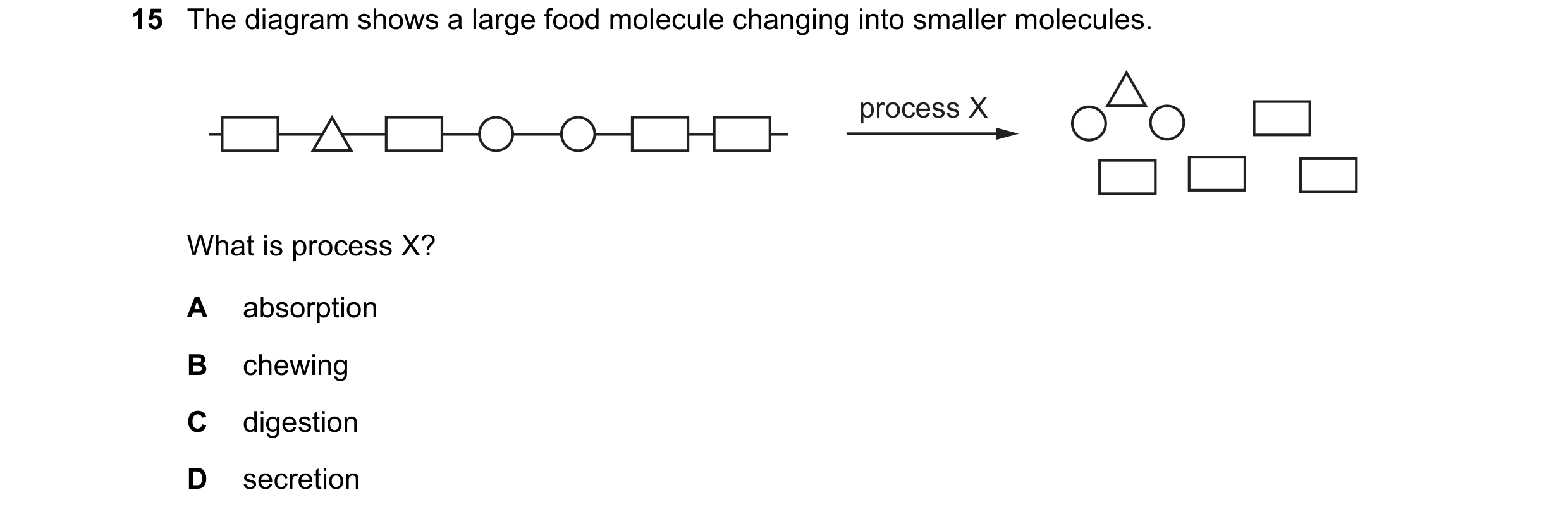
Q15 · The diagram shows a large food molecule changing into smaller molecules 0970/22 Oct/Nov 2021
15 The diagram shows a large food molecule changing into smaller molecules. process X What is process X? A absorption B chewing C digestion D secretion
1 marks
Answer: C
This question in 0970/22 Oct/Nov 2021
Q16 · The graph shows the concentration of maltose in different parts of the alimentary canal 0970/22 Oct/Nov 2022
14 The graph shows the concentration of maltose in different parts of the alimentary canal. X maltose concentration mouth stomach small intestine distance through the alimentary canal What causes the change in concentration at X? A absorption of maltose B action of amylase C action of maltase D assimilation of maltose
1 marks
Answer: C
This question in 0970/22 Oct/Nov 2022
Q17 · In which region of the alimentary canal is maltose digested? 0970/22 May/June 2023
9 In which region of the alimentary canal is maltose digested? A colon B rectum C small intestine D stomach
1 marks
Answer: C
This question in 0970/22 May/June 2023
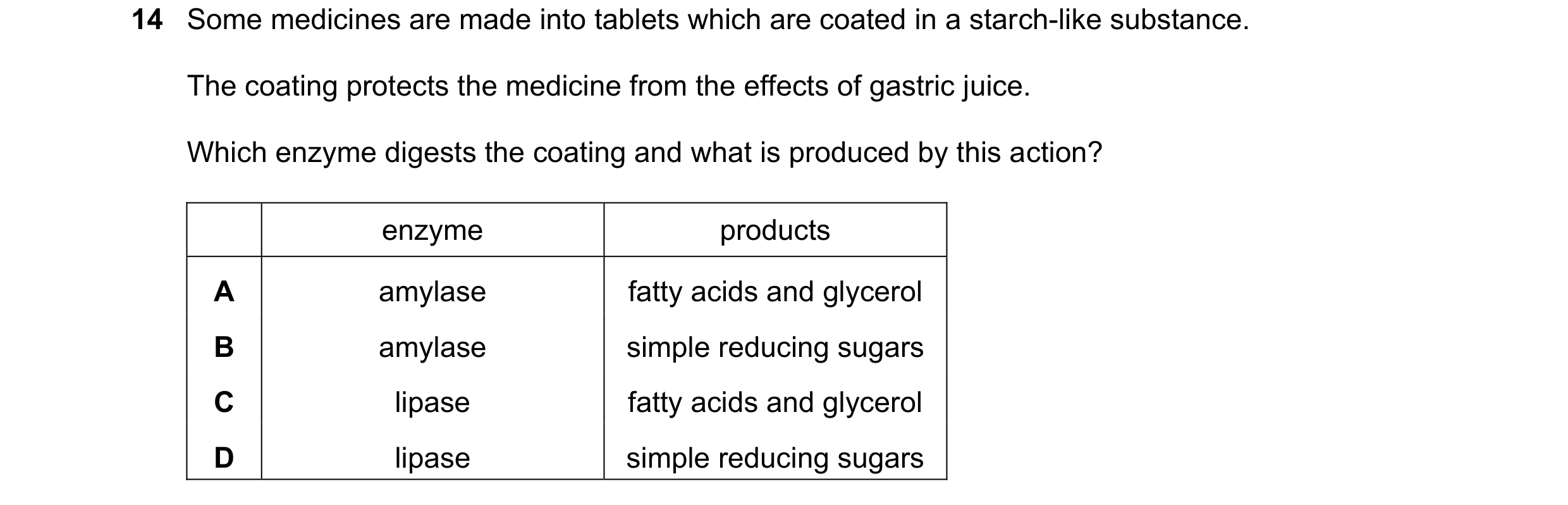
Q18 · Some medicines are made into tablets which are coated in a starch-like substance 0970/22 Oct/Nov 2023
14 Some medicines are made into tablets which are coated in a starch-like substance. The coating protects the medicine from the effects of gastric juice. Which enzyme digests the coating and what is produced by this action? enzyme products A amylase fatty acids and glycerol B amylase simple reducing sugars C lipase fatty acids and glycerol D lipase simple reducing sugars
1 marks
Answer: B
This question in 0970/22 Oct/Nov 2023
Q19 · The diagrams show carbohydrate molecules as they pass through the alimentary canal 0970/21 May/June 2024
14 The diagrams show carbohydrate molecules as they pass through the alimentary canal. Which row represents the molecules correctly? before taking after some time after some time in into the mouth in the mouth the small intestine A B C D
1 marks
Answer: B
This question in 0970/21 May/June 2024
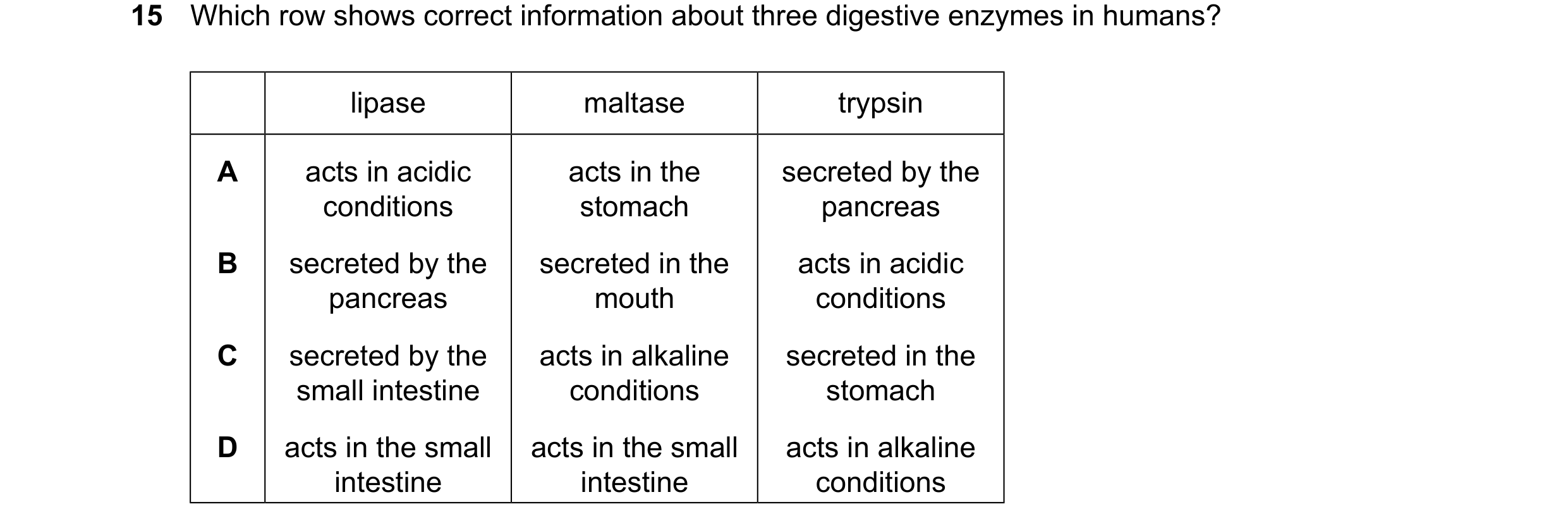
Q20 · Which row shows correct information about three digestive enzymes in humans? 0970/21 May/June 2024
15 Which row shows correct information about three digestive enzymes in humans? lipase maltase trypsin A acts in acidic acts in the secreted by the conditions stomach pancreas B secreted by the secreted in the acts in acidic pancreas mouth conditions C secreted by the acts in alkaline secreted in the small intestine conditions stomach D acts in the small acts in the small acts in alkaline intestine intestine conditions
1 marks
Answer: D
This question in 0970/21 May/June 2024
Q21 · What is the function of trypsin in digestion? 0970/21 May/June 2025
11 What is the function of trypsin in digestion? A It catalyses the breakdown of maltose in the mouth. B It catalyses the breakdown of maltose in the small intestine. C It catalyses the breakdown of protein in the small intestine. D It catalyses the breakdown of protein in the stomach.
1 marks
Answer: C
This question in 0970/21 May/June 2025
Q22 · The table shows the substrates and end products in four enzyme-controlled chemical… 0970/22 May/June 2025
12 The table shows the substrates and end products in four enzyme-controlled chemical reactions. Which reaction was controlled by lipase? substrate end product A maltose starch B oil fatty acids and glycerol C protein amino acids D starch maltose
1 marks
Answer: B
This question in 0970/22 May/June 2025
Q23 · Which function is performed in the duodenum? 0970/22 Oct/Nov 2025
7 Which function is performed in the duodenum? A assimilation B digestion C egestion D ingestion
1 marks
Answer: B
This question in 0970/22 Oct/Nov 2025
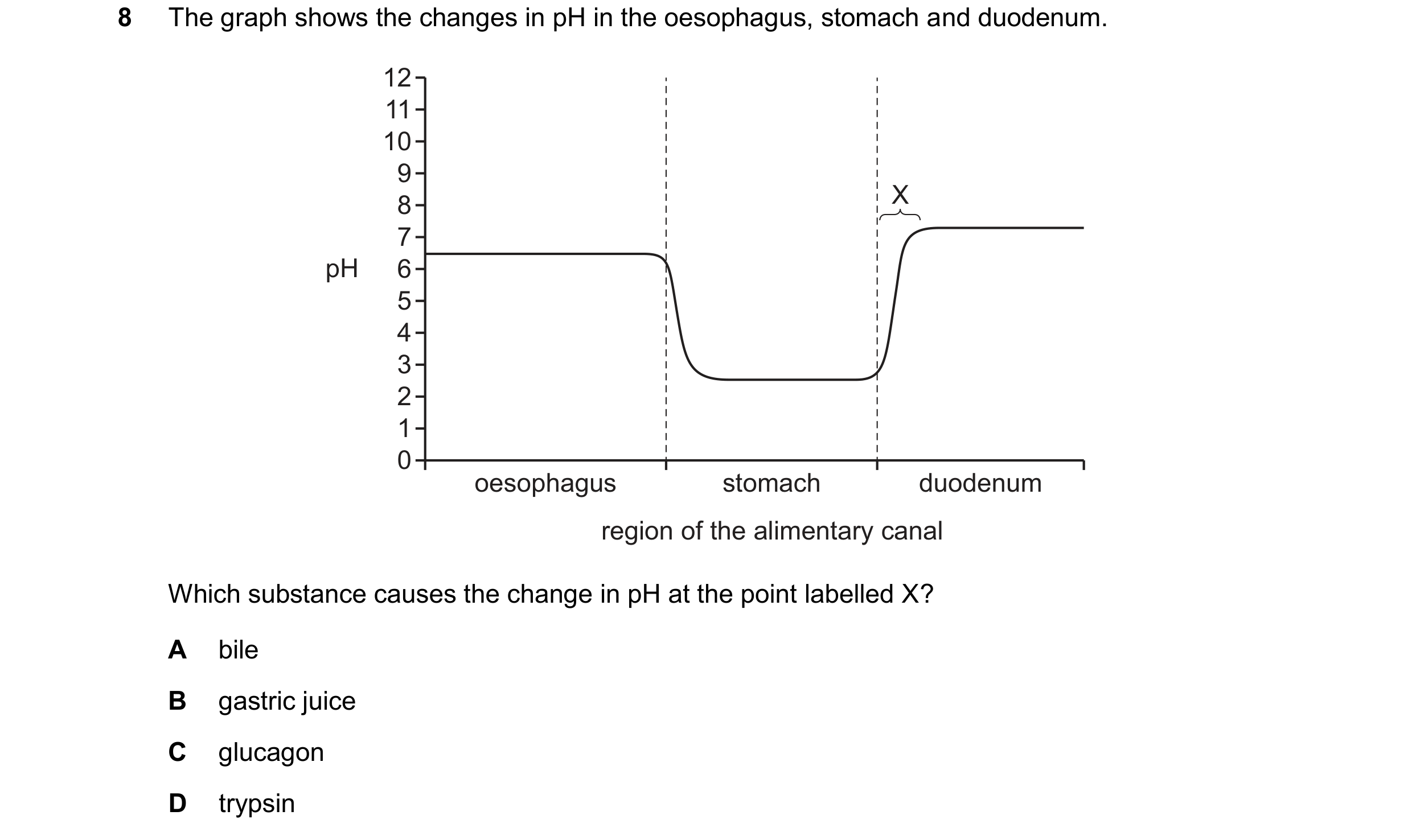
Q24 · The graph shows the changes in pH in the oesophagus, stomach and duodenum 0970/22 Oct/Nov 2025
8 The graph shows the changes in pH in the oesophagus, stomach and duodenum. 12 11 10 9 8 X 7 pH 6 5 4 3 2 1 0 oesophagus stomach duodenum region of the alimentary canal Which substance causes the change in pH at the point labelled X? A bile B gastric juice C glucagon D trypsin
1 marks
Answer: A
This question in 0970/22 Oct/Nov 2025
 1 / 7
1 / 7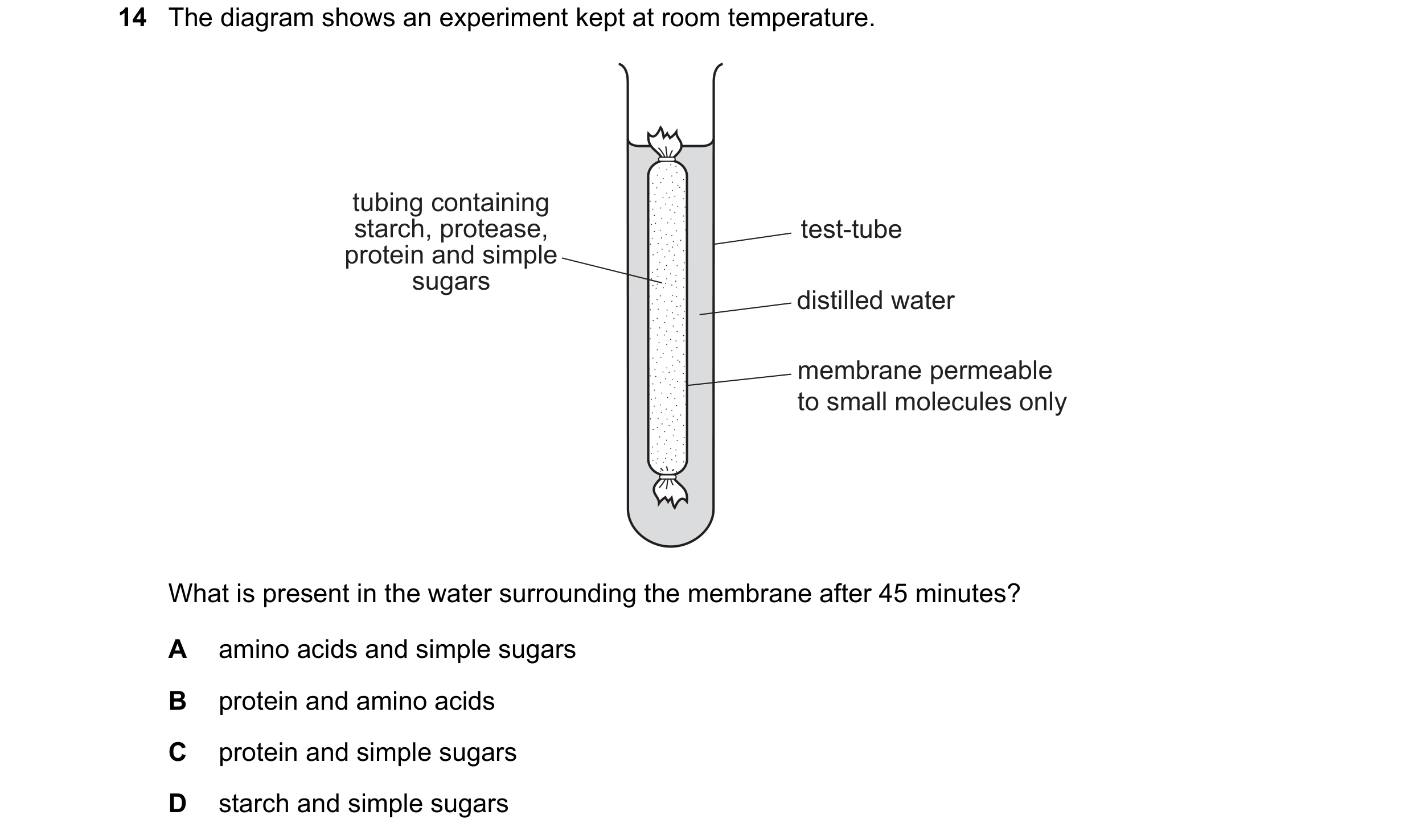

 2 / 7
2 / 7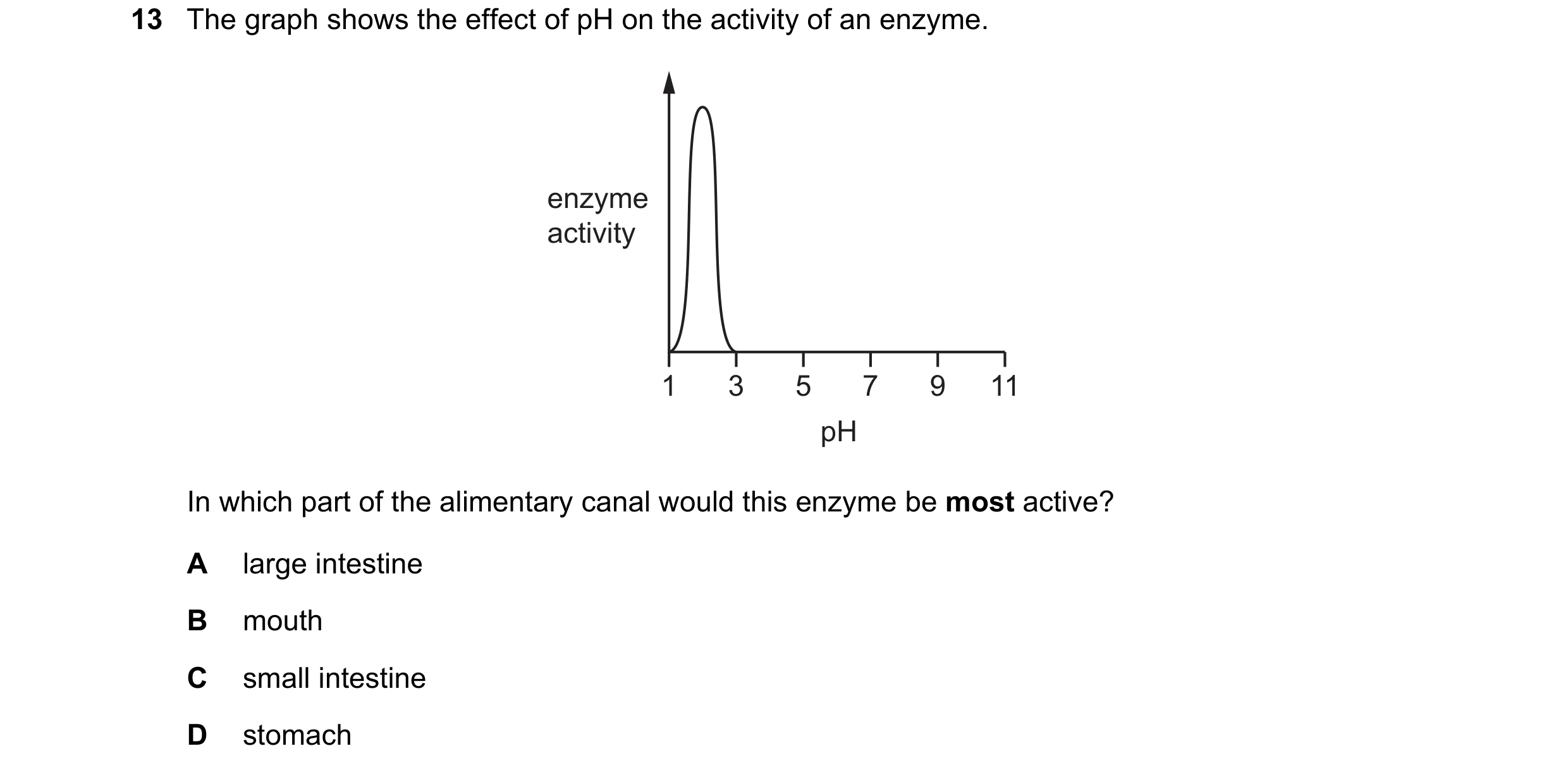
 3 / 7
3 / 7
 4 / 7
4 / 7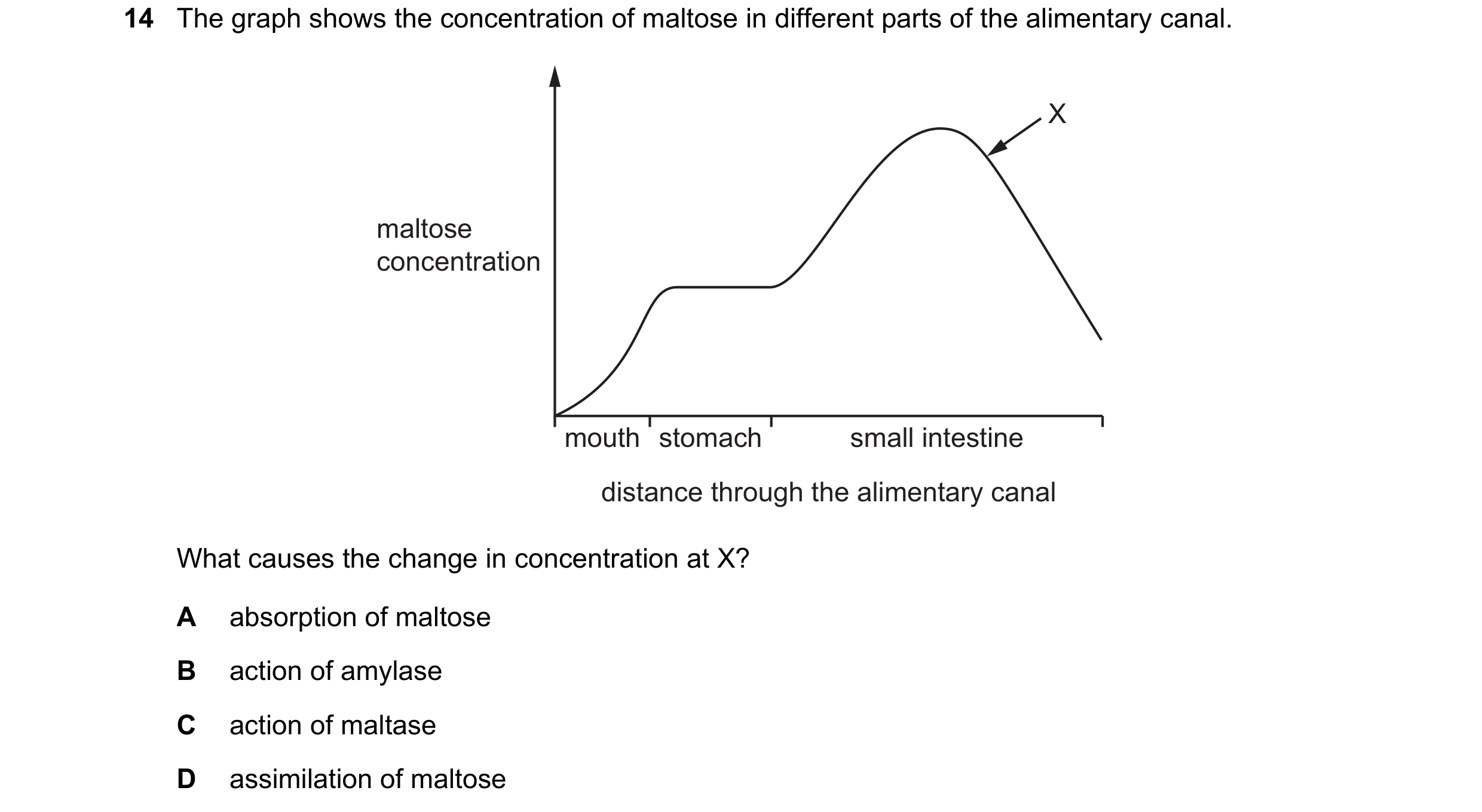

 5 / 7
5 / 7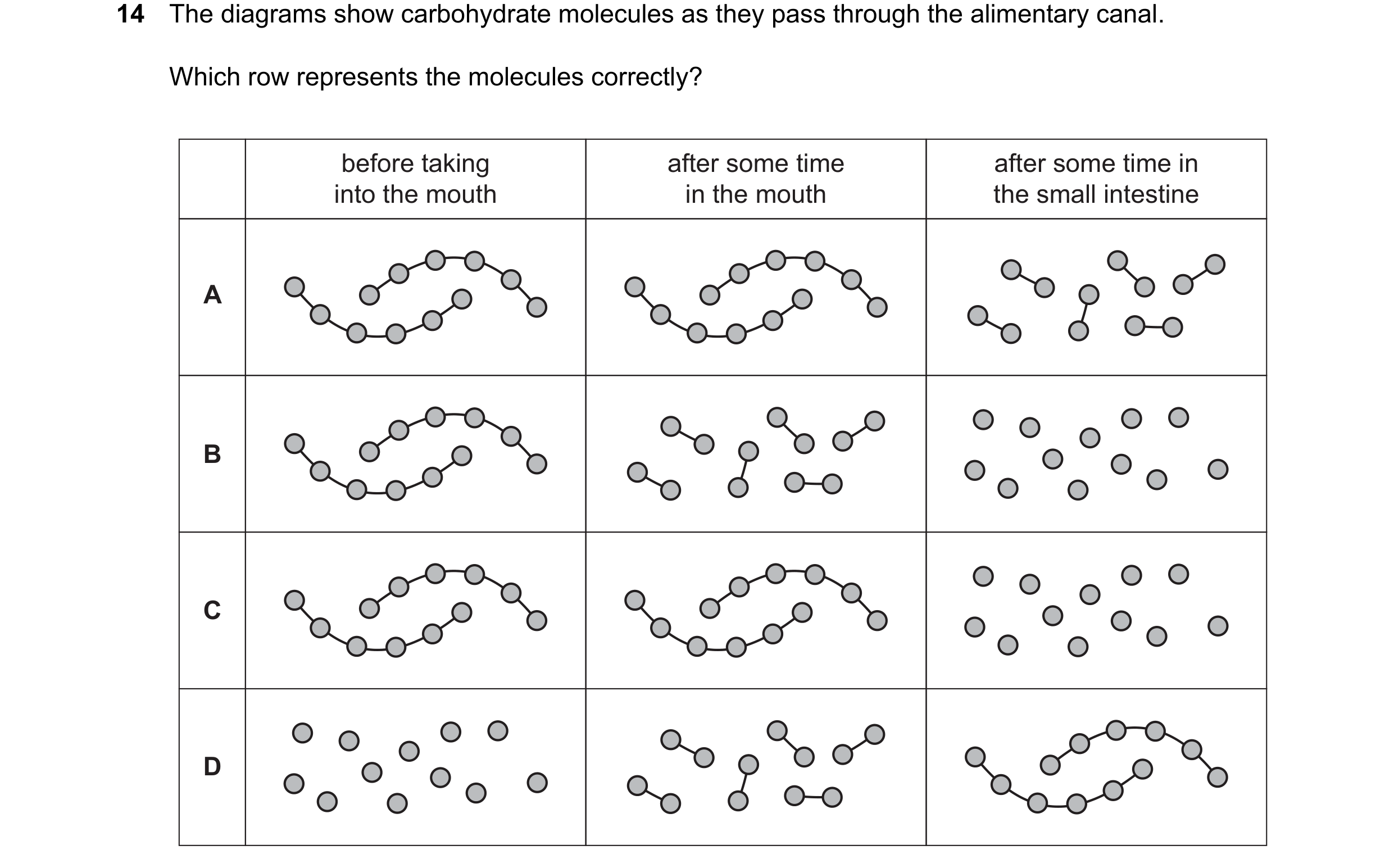
 6 / 7
6 / 7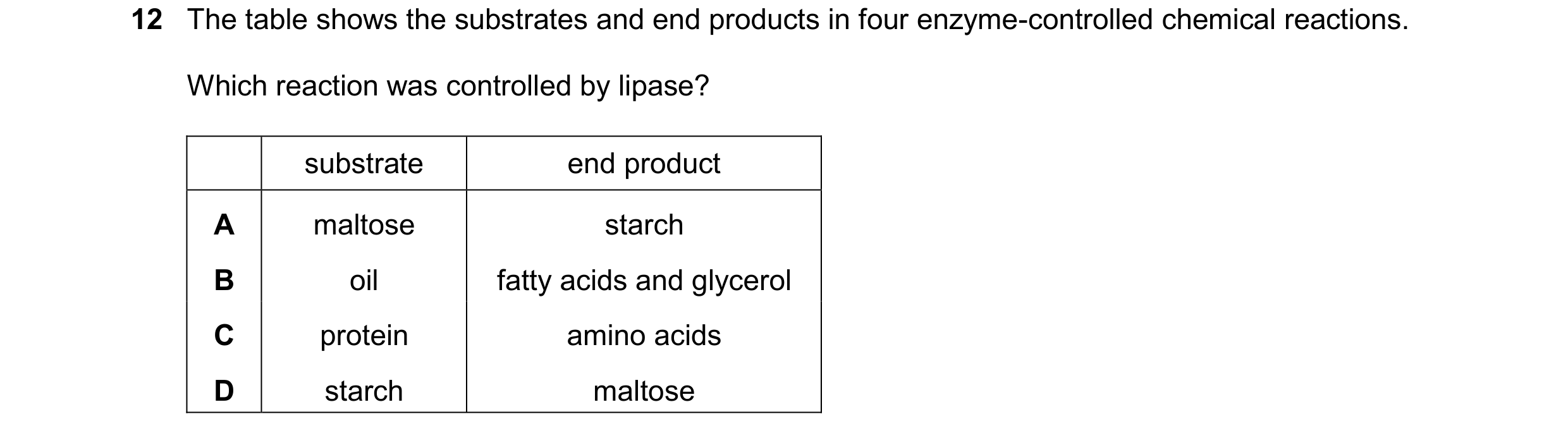

 7 / 7
7 / 7